FILM: Katrina’s Children : ‘If You’re Quiet Enough… You Hear Things’


Children of Katrina Still Bear the Scars
by Leonard Pitts, Jr. / August 24, 2008

You cannot watch Laura Belsey’s movie without ruminating upon the myriad ways we fail our young.

There are many wrenching scenes in Katrina’s Children but arguably the most wrenching is not the girl crying because the hurricane left her so fearful of water she can no longer swim, or the boys touring the wreckage that once was home, or the children recalling how corpses floated by, writhing with maggots, bursting open. No, the most wrenching scene comes when Tyronieshia tries to read.

She pauses before the sign warning of penalties for bringing firearms onto the elementary school campus — yes, they need a ”no guns” sign at an elementary school — but she can’t read it. She struggles to do so, but it’s no use. She can’t decipher ”carrying,” can’t figure out “firearms.”

Everyone failed her.

TYRONIESHA, 10, grew up in the St Bernard Projects and now lives in FEMA’s largest trailer park, Renaissance Village, near Baton Rouge. She believes that Katrina hit New Orleans “because the Devil told her to do it”.

Ten years old and she was already well on the way to illiteracy and the life of don’t have and can’t get that usually comes with it. And you realize, here is a child who was failed by her school, failed by her community, failed by her family. Then, three years ago this week, the storm came and she was failed by everything else.

Katrina’s Children is not coming soon to a theater near you. It can, however, be purchased online (http://www.katrinaschildren.com/). A portion of the proceeds go to help children’s programs in New Orleans.

See it if you can. It will claw at your heart.

There is no footage of the hurricane in it, no shots of rooftop rescues or chaos at the Superdome. There is no narration, no talking heads, virtually no adults whatsoever. Instead, there are the children, drawing pictures of the day their city drowned, telling how it feels to leave or lose everything you’ve ever known, walking you through the debris and the detritus, weeping, and wondering why it happened. They are white and black and one Vietnamese girl, children of various economic strata, some precocious and verbal, some so ill-spoken, so isolated from the mainstream, that their English requires subtitles.

All of them indelibly scarred.

”It was interesting when we screened the film for some of the parents and the kids,” says Belsey, the 42-year-old New York filmmaker who directed Katrina’s Children. “The parents were really moved. They had no idea the kids were thinking those thoughts. It just goes to show that if you take the time and pay attention and if you’re quiet enough . . . you hear things.”

But when are we that quiet?

We cry out at as the famous for nothing live their train wreck lives or the ballplayer runs for daylight or the TV news tells us about this week’s missing coed, but we fail to hear the quiet, painful sound of Tyronieshia trying to read.

Then a mammoth storm swallows an American city whole. And some of us cry out that liberals should not send help to a red state, or that God allowed the storm because New Orleans is too tolerant of homosexuals, or that this tragedy proves certain people are lazy and welfare-dependent. But we fail to hear Erica, who is 10, weeping because she saw babies die in the convention center’s heat and stench.

We forget that children are in the room sometimes. We push our agendas and assign our blame and impose our narratives and forget that they are right there, taking it in. Yet, if some of them were failed by schools, community and family, all were failed by the Army Corps of Engineers, the mayor, the governor, the emergency management director and the president. And don’t think they don’t know.

Maybe you take that as the cue to circle your wagons of race or politics. Well, Erica, who saw babies die, sees an imperative beyond that. She drew a picture, a mosaic of faces in rainbow colors, combining into a single image. A single destiny. With a little one’s gift for clarifying and purifying that which stymies and stupefies adults, she calls her drawing All In One.

And the prophet was right. A little child shall lead them.

© 2008 Miami Herald Media Company.

Source / Miami Herald

The Rag Blog

Posted in RagBlog | Tagged , | Leave a comment

The Sunday Snapshot : The Signpost for Change


Source / MoveOn.org

Thanks to Betsy Gaines / The Rag Blog / Posted August 24, 2008

Posted in RagBlog | Tagged , , | Leave a comment

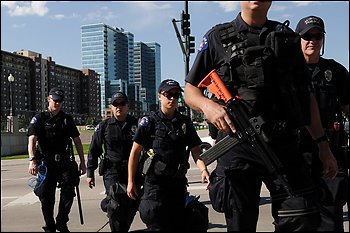
Denver : Police and Protesters Make Preparations

Two days before the start of the Democratic convention, police patrol Cuernavaca Park in Denver. The city has spent a year gearing up. Photo by Joshua Duplechian / Rocky Mountain News / AP.

Looks like they’re preparing for martial law
By Eli Saslow / August 24, 2008

DENVER — To the uninformed visitor, it has become difficult to tell whether Denver is preparing for a Democratic National Convention or the institution of martial law. Helicopters filled with armed commandos swooped over downtown in a training exercise earlier this summer. A warehouse was converted into a temporary jail with chain-link fences and signs threatening the use of electric stun devices. Travel agents sold getaway packages to locals, with one company imploring residents to “escape town while you still can.”

Hosting a convention necessitates preparing for the worst, Denver Mayor John Hickenlooper said, and his city has accomplished that with gusto. The possibility of protesters hurling buckets of feces? Denver proposed an ordinance to prevent it. The threat of crowd violence? The city spent $2.1 million on “personal protection equipment” for police.

More than 50,000 visitors will descend on the Mile High City this week, and Denver has spent the past year plotting ways to avoid public embarrassment. The city studied previous convention disturbances and negotiated with several groups that are planning to protest. With an international audience of media members, delegates and the Democratic Party elite expected to arrive this weekend, Denver hopes to capitalize on a chance to re-image itself as “more than a second-tier town,” Hickenlooper said.

“The nice thing about hosting one of these conventions is that you can show off,” said Hickenlooper, a Democrat who will speak on the opening night of the convention. “We don’t want some traffic jam, protest or unfortunate incident to become the big story, because there’s too much good stuff going on here. We have the infrastructure to be prepared to handle anything.”

Denver worked hard to procure such a visible moment. The city submitted convention bids in 2000 and 2004 but didn’t advance deep into the selection process, in part because it lacked enough hotel rooms. After another four years of growth — Colorado is one of the 10 fastest-growing states in the nation — Denver submitted a bid for the 2008 convention.

In its pitch, Denver highlighted the Rocky Mountain region’s potential to include several swing states. Once solidly Republican, Colorado has a Democratic governor and a Democratic majority in the legislature for the first time in half a century. Nevada and New Mexico also could flip from red to blue in the coming election.

The Democratic National Committee announced that Denver defeated New York City to win the bid in January 2007. DNC Chairman Howard Dean cited “recent Democratic gains in the West” as the primary motive for his decision. By coming to Denver, Dean said, Democrats hoped to signal their intent to compete for votes in the Mountain West.

It was a significant victory for the Mile High City, which has always suffered from something of an inferiority complex. Even though it ranks as one of the country’s top 20 metropolitan areas, with a thriving tourism industry and four major professional sports teams playing downtown, Denver residents say their city is often misrepresented as a cow town stuck in the middle of flyover country.

“We’ve always had to overcome this idea that we’re not big enough or important enough to even be part of the national political landscape,” said Elbra Wedgeworth, president of the convention’s host committee. “That was part of the idea behind wanting to get the convention in the first place. If people see Colorado and the Western spirit, they’ll get past all of that.”

But the past year also has provided a long and painful lesson in the downsides of hosting a convention, Denver officials said. The city struggled to raise the $50 million it promised to convention organizers. It received a $50 million federal grant for security, but that money has disappeared quickly, officials said.

Downtown office buildings have hired extra security and rehearsed evacuation plans. The Secret Service established 18 working groups in Denver, with assignments to coordinate air security, crisis management and more. The local host committee recruited, trained and organized 20,000 volunteers. Highway officials restructured traffic patterns to accommodate major road closures.

“There are some security measures in place that will be seen, and some that will be unseen,” said Malcolm Wiley, spokesman for the Secret Service. “We have a subcommittee to address any possible thing that can happen.”

What, exactly, can Denver expect this week? That’s difficult to predict, experts said. Conventions have transpired without major unrest since riots broke out at the 1968 Democratic convention in Chicago. Four major protest groups — one called Recreate ’68 — plan to demonstrate in Denver, mostly to demand more rights for immigrants and an end to the Iraq war. Organizers said they expect more than 25,000 protesters to participate, with the stated goal of derailing convention proceedings.

Denver already has experienced a few security scares. Sen. John McCain’s area headquarters here received an envelope containing white powder last week, and four employees went to the hospital for examination before officials determined the powder was not lethal. Earlier in the summer, a marijuana advocacy group gathered downtown and started beating people with bats. Police rushed to the scene — only to realize the protest was staged and the bats were inflatables.

In the local newspapers, Denver officials have outlined several worst-case scenarios: Protesters might chain themselves together with chicken wire, use quick-setting cement to block streets or threaten delegates with violence. One city councilman said anarchists had rented a house in Denver and stocked it with urine, which would be sprayed on crowds as they entered the Pepsi Center.

Protesters denied all of the above.

The protest groups responded by outlining a worst-case scenario of their own. Law enforcement officials might arrest nonviolent demonstrators and use aggressive force whenever necessary, protesters said. The groups described an arsenal of high-tech weaponry they expect to encounter: guns that shoot sticky film and rubber bullets; machines that emanate ear-piercing sound waves; microwave devices that create a burning sensation on the skin.

Denver said it will not use any of the above.

“Basically, what’s happening is a cat-and-mouse game,” said Adam Jung, organizer of a protest group called Tent State University, which plans to demonstrate in a 50,000-foot “freedom cage” outside the Pepsi Center. “The city keeps coming up with new restrictions on us, and we figure out ways to get around them. That’s how it’s going to go, until one of us gets the last word.”

Source / Washington Post

Thanks to Carl Davidson / The Rag Blog

Posted in RagBlog | Tagged , , , , , , | Leave a comment

‘We Filled a Lot of Space Together’ – G.W. Bush

When I decided to post this, I thought I would label it with the term ‘humor,’ but realised I just couldn’t bring myself to do it. There’s nothing even remotely humourous about these quotations from President Junior. They’re absolutely disheartening. Or, as E.L. Doctorow has said,

“He is the subject of jokes and he jokes himself about his clumsiness with words, but his mispronunciations and malapropisms suggest a mind of half-learned language that is eerily compatible with his indifference to truth, his disdain for knowledge as a foundation of a democratic society.” (from the Nation)

Richard Jehn / The Rag Blog

Bushisms: Adventures in George W. Bushspeak

“First of all, I don’t see America having problems.” –George W. Bush, interview with Bob Costas at the 2008 Olympics, Beijing, China, Aug. 10, 2008

“I’m coming as the president of a friend, and I’m coming as a sportsman.” –George W. Bush, on his trip to the Olympics in China, Washington, D.C., July 30, 2008

“There’s no question about it. Wall Street got drunk — that’s one of the reasons I asked you to turn off the TV cameras — it got drunk and now it’s got a hangover. The question is how long will it sober up and not try to do all these fancy financial instruments.” –George W. Bush, speaking at a private fundraiser, Houston, Texas, July 18, 2008

“I think it was in the Rose Garden where I issued this brilliant statement: If I had a magic wand — but the president doesn’t have a magic wand. You just can’t say, ‘low gas.'” –George W. Bush, Washington D.C., July 15, 2008

“And they have no disregard for human life.” –George W. Bush, on the brutality of Afghan fighters, Washington, D.C., July 15, 2008


“The economy is growing, productivity is high, trade is up, people are working. It’s not as good as we’d like, but — and to the extent that we find weakness, we’ll move.” –George W. Bush, Washington, D.C., July 15, 2008

“Goodbye from the world’s biggest polluter.” –George W. Bush, in parting words to British Prime Minister Gordon Brown and French President Nicolas Sarkozy at his final G-8 Summit, punching the air and grinning widely as the two leaders looked on in shock, Rusutsu, Japan, July 10, 2008

“Amigo! Amigo!” –George W. Bush, calling out to Italian Prime Minister Silvio Berlusconi in Spanish at the G-8 Summit, Rusutsu, Japan, July 10, 2008

“Throughout our history, the words of the Declaration have inspired immigrants from around the world to set sail to our shores. These immigrants have helped transform 13 small colonies into a great and growing nation of more than 300 people.” –George W. Bush, Charlottesville, Va., July 4, 2008

“Should the Iranian regime-do they have the sovereign right to have civilian nuclear power? So, like, if I were you, that’s what I’d ask me. And the answer is, yes, they do.” –George W. Bush, talking to reporters in Washington, D.C., July 2, 2008

“But oftentimes I’m asked: Why? Why do you care what happens outside of America?” –George W. Bush, Washington, D.C., June 26,2008

“I remember meeting a mother of a child who was abducted by the North Koreans right here in the Oval Office.” –George W. Bush, Washington, D.C., June 26, 2008

“I want to tell you how proud I am to be the President of a nation that — in which there’s a lot of Philippine-Americans. They love America and they love their heritage. And I reminded the President that I am reminded of the great talent of the — of our Philippine-Americans when I eat dinner at the White House.” –George W. Bush, referring to White House chef Cristeta Comerford while meeting with Filipino President Gloria Macapagal Arroyo, Washington, D.C., June 24, 2008

“And I, unfortunately, have been to too many disasters as president.” –George W. Bush, discussing flooding in the Midwest, Washington, D.C., June 17, 2008

“There is some who say that perhaps freedom is not universal. Maybe it’s only Western people that can self-govern. Maybe it’s only, you know, white-guy Methodists who are capable of self-government. I reject that notion.” –George W. Bush, London, June 16, 2008

“Your eminence, you’re looking good.” –George W. Bush to Pope Benedict XVI, using the title for Catholic cardinals, rather than addressing him as “your holiness,” Rome, June 13, 2008

“The German asparagus are fabulous.” –George W. Bush, Meseberg, Germany, June 11, 2008

“We’ve got a lot of relations with countries in our neighborhood.” –George W. Bush, Kranj, Slovenia, June 10, 2008

“One of the things important about history is to remember the true history.” –George W. Bush, Washington, D.C., June 6, 2008

“There’s no question this is a major human disaster that requires a strong response from the Chinese government, which is what they’re providing, but it also responds a compassionate response from nations to whom — that have got the blessings, good blessings of life, and that’s us.” –George W. Bush, on relief efforts after a Chinese earthquake, Washington, D.C., June 6, 2008

“Let’s make sure that there is certainty during uncertain times in our economy.” — George W. Bush, Washington, D.C., June 2, 2008

“We got plenty of money in Washington. What we need is more priority.” –George W. Bush, Washington, D.C., June 2, 2008

Read the rest of them here, if you can stand it. / About.com

Thanks to Diane Stirling-Stevens / The Rag Blog

Posted in RagBlog | Tagged , , , | Leave a comment

Drawn and Quartered


The Rag Blog / Posted August 24, 2008

Posted in RagBlog | Tagged , , , , , | Leave a comment

ECONOMY : The Cascading Effect of Peak Oil

Photo by Mannie Garcia / Bloomberg News.

‘Don’t take a weatherman’: Credit Default Swaps
By Roger Baker / The Rag Blog / August 24, 2008

I’m no expert on these financial instruments, but as we used to say, it don’t take a weatherman to know which way the wind blows. I think peak oil has a whole lot to do with the credit worthiness of the institutions that these CDS underwrite. My main topic is Credit Default Swaps, but meanwhile, here are three key links having to do with the steady financially corrosive effect of peak oil on the overall world economy and corporate profitability. It takes a real optimist these days to think that world oil production has not already peaked, given the fact that production hasn’t increased significantly in two years despite soaring oil prices:

Crude Oil Price Retreat: Sunrise or a Lull Before the Storm? / Energy Bulletin / August 12, 2008

PEAKING OF WORLD OIL PRODUCTION:
IMPACTS, MITIGATION, & RISK MANAGEMENT
/ .pdf

Peak oil primer and links / Energy Bulletin

Credit default swaps are basically paper guarantees traded among financial institutions that the corporations and financial institutions that underlie the US and world economy, and which guarantee that these institutions will operate soundly in the future and be able to repay their debts. What is alarming is their magnitude, proliferation, and non-transparency. The fact is that these debt repayment insurance policies are key elements in assuring the financial health of the US economy, and a major reason that the Federal Reserve had to bail out investment bank Bear Stearns on an emergency basis.

How many of them are scattered throughout the financial institutions of Wall Street? The total CDS value is now about $62 trillion, up from just $4 trillion in the last five years! This current total is now about equal to the entire annual world economy, calculated to be about $65 trillion by the CIA. Total external world debt of all types is calculated to be nearly as great, at $54 trillion.

The main tool to prevent a cascading chain reaction of CDS insolvency seems to be more Federal Reserve bailouts of the Bear Stearns type. Here are key links and documentation of the risk of a financial meltdown that they pose. A Federal Bailout basically means that US taxpayers rather than private investment banks are assuming the burden of debt, but this debt just inflates the current debt bubble further at public expense.

Meanwhile, commodity price increases due to peak oil and cost-push inflation have recently been on an accelerating upward trend (this factor has diminished at least temporarily; good discussion in the current Economist) that undermines the profitability of the global market economy. Since all manufacture relies on commodities, this factor decreases profits and increases the risk of corporate loan defaults.

Federal Reserve chair Bernanke at Woods Hole does not seem to be very cheerful these days, partly because stagflation (strongly linked to cost-push inflation due to energy price increases) appears to be becoming international in character; “View of economy somber from Fed mountain retreat.”

Last year the problem was CDOs. Now the Bear Stearns bailout shows that the financial consequences of preventing bank runs due to CDS on the part of the fed is thought to be necessary on an emergency basis, even over the weekend. At some point such emergency measures may not work to damp down a panic wherein everyone runs to their investment bank and tries to cash in their share of the towering mountain of speculative CDS diffused throughout financial institutions. Also see the book “The Trillion Dollar Meltdown” by Charles Morris.

“A credit default swap (CDS) is a credit derivative contract between two counterparties, whereby one makes periodic payments to the other and receives the promise of a payoff if a third party defaults[1]…

…because there is no requirement to actually hold any asset or suffer a loss, credit default swaps can also be used for speculative purposes…

Warren Buffett famously described derivatives bought speculatively as “financial weapons of mass destruction.” In Berkshire Hathaway’s annual report to shareholders in 2002, he said, “Unless derivatives contracts are collateralized or guaranteed, their ultimate value also depends on the creditworthiness of the counterparties to them…

Credit default swap / Wikipedia

IN THE weeks before Bear Stearns, a Wall Street bank, collapsed in March, nervous investors scanned not just its share price for a measure of its health, but the price of its credit-default swaps (CDSs), too. These once-obscure instruments, now widely enough followed that they have even earned a mention on an American TV crime series, clearly indicated that the firm’s days were numbered. The five-year CDS spread had more than doubled to 740 basis points (bps), meaning it cost $740,000 to insure $10m of its debt. The higher the spread, the greater the expectation of default.

Once again, CDS spreads on Wall Street banks are pushing higher, having fallen in March after the Federal Reserve extended emergency lending facilities to them…

There are some who doubt whether the CDS market is a reliable barometer of financial health. Though its gross value has ballooned in size from $4 trillion in 2003 to over $62 trillion, many of the transparency, and are prone to wild swings…

Pressure Guage: Are credit-default swaps living up to the hype? / Economist.com / August 21, 2008

The world gross domestic product according to the CIA yearbook is now about $65 trillion:GDP (purchasing power parity): GWP (gross world product): $65.61 trillion (2007 est.)…

…Debt – external: $53.97 trillion; note: this figure is the sum total of all countries’ external debt, both public and private (2004 est.)

Source / The World Fact Book / CIA

The Rag Blog

Posted in Rag Bloggers | Tagged , , , , , , | 1 Comment

You Might Want to Sandbag the Beach Cottage

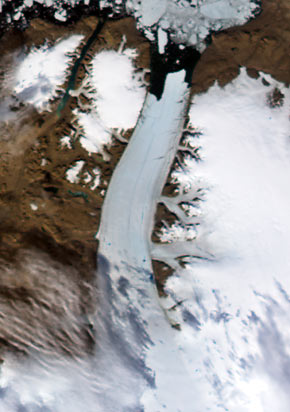
A massive crack in Petermann Glacier in Northern Greenland has at least one scientist predicting that a big part of the Northern Hemisphere’s largest floating glacier will be gone within a year. Photo: Byrd Polar Research Center / AP

Greenland Glacier Shows Giant New Crack
By Seth Borenstein / August 23, 2008

WASHINGTON — In northern Greenland, a part of the Arctic that had seemed immune from global warming, new satellite images show a growing giant crack and an 11-square-mile chunk of ice hemorrhaging off a major glacier, scientists said Thursday.

And that’s led the university professor who spotted the wounds in the massive Petermann glacier to predict disintegration of a major portion of the Northern Hemisphere’s largest floating glacier within the year.

If it does worsen and other northern Greenland glaciers melt faster, then it could speed up sea level rise, already increasing because of melt in sourthern Greenland.
The crack is 7 miles long and about half a mile wide. It is about half the width of the 500 square mile floating part of the glacier. Other smaller fractures can be seen in images of the ice tongue, a long narrow sliver of the glacier.

“The pictures speak for themselves,” said Jason Box, a glacier expert at the Byrd Polar Research Center at Ohio State University who spotted the changes while studying new satellite images. “This crack is moving, and moving closer and closer to the front. It’s just a matter of time till a much larger piece is going to break off…. It is imminent.”

The chunk that came off the glacier between July 10 and July 24 is about half the size of Manhattan and doesn’t worry Box as much as the cracks. The Petermann glacier had a larger breakaway ice chunk in 2000. But the overall picture worries some scientists.

“As we see this phenomenon occurring further and further north — and Petermann is as far north as you can get — it certainly adds to the concern,” said Waleed Abdalati, director of the Center for the Study of Earth from Space at the University of Colorado.

The question that now faces scientists is: Are the fractures part of normal glacier stress or are they the beginning of the effects of global warming?

“It certainly is a major event,” said NASA ice scientist Jay Zwally in a telephone interview from a conference on glaciers in Ireland. “It’s a signal but we don’t know what it means.”

It is too early to say it is clearly global warming, Zwally said. Scientists don’t like to attribute single events to global warming, but often say such events fit a pattern.

University of Colorado professor Konrad Steffen, who returned from Greenland Wednesday and has studied the Petermann glacier in the past, said that what Box saw is not too different from what he saw in the 1990s: “The crack is not alarming… I would say it is normal.”

However, scientists note that it fits with the trend of melting glacial ice they first saw in the southern part of the massive island and seems to be marching north with time. Big cracks and breakaway pieces are foreboding signs of what’s ahead.

Further south in Greenland, Box’s satellite images show that the Jakobshavn glacier, the fastest retreating glacier in the world, set new records for how far it has moved inland.

That concerns Colorado’s Abdalati: “It could go back for miles and miles and there’s no real mechanism to stop it.”

Source / AP / America On Line

The Rag Blog

Posted in RagBlog | Tagged , | Leave a comment

FILM : Lipstick & Dynamite: The First Ladies of Wrestling

‘These are not the type of women we usually listen to, so I was nothing less than thrilled to sit down to watch 80 minutes of their stories’

By Grace

Much as I love women in sports, and even sports with a little violence (remember my thoughts on roller derby?), I am hard-pressed to find feminist undertones in women’s wrestling.

That being said, I see definite heroine content in Lipstick & Dynamite, Piss & Vinegar: The First Ladies of Wrestling. We live in a society in which listening to the stories of older women is in and of itself a revolutionary act. It is this act on which Ruth Leitman’s film is based. The film is comprised nearly entirely of interviews with women who wrestled from the 1940s through 1970s. These aren’t women we usually see in films, even documentaries. They are missing their teeth, their eyebrows, and often their qualms about telling it like it is.

The stories, though, are horrifying. Most of the women had horrible childhoods, abusive relationships with men, run-ins with sleazy wrestling promoters demanding sexual favors, and years of physical and financial exploitation. Their wrestling stories are full of body slams and headlocks, but they are sadly devoid of independence or agency. Only one of the women interviewed, The Fabulous Moolah, who worked as a wrestling promoter (and occasionally entered the ring herself) from the early 1950s until her death in 2007, speaks about her years as a wrestler as if she set her own rules, and given the discrepancies between her stories and those told by her contemporaries, one wonders how much in charge she really was.

Some of the women, however, continue their stories beyond the years of exploitation. Penny Banner, whose interest in martial arts began after an attempted rape, wrestled professionally for more than 20 years, then went on to become a Senior Olympics multiple medalist in discus, shot put, and various swimming events. Your feminist heart must be very hard if watching a 70 year old woman throw a discus doesn’t choke you up a little bit.

Another of the featured women, Ida May Martinez, who spent the majority of the 1950s wrestling, said that she was grateful for the “road education” she received through wrestling, but went on to explain that her true source of pride in her life was her post-wrestling work as one of the first nurses for terminal AIDS patients. My favorite story, though, is that told by the most bitter of the former wrestlers, Ella Waldek, who moved from farm girl to roller derby queen to professional wrestler to owning her own security firm.

Few, if any, of the interviewed women make explicit claims to feminism. They show varying levels of awareness of how mistreated they were as wrestlers, mostly by male promoters. However, the film is made in an explicitly feminist way. Ruth Leitman takes her subjects seriously and allows them to speak for themselves, shooting them and their stories for what they are, both the good and the bad. As a documentarian, I give her full heroine content points.

On race, Lipstick & Dynamite is about what you would expect of a film featuring women whose glory days were mostly pre-Civil Rights. All of the women featured are white, with the exception of Hispanic Ida May Martinez. The only African-American woman I remember having any screen time at all is interviewed briefly about her relationship with The Amazing Moolah’s husband. Another problematic aspect is the segment about The Amazing Moolah’s relationship with little person wrestler Diamond Lil, who she describes as a midget and a dwarf and treats like a cross between a child and a house servant.

Of the film’s final scene, in which many of the featured wrestlers meet at a reunion, Roger Ebert wrote “one woman after another seems to have attended in order to say, “I’m still here,” as if being alive after what they’re been through is a form of defiance.” I would argue that being alive and telling these stories is indeed a form of defiance for these women, and one young feminists would be well served to learn from. I am impressed that Ruth Leitman was able to see this defiance, and will watch anything else she makes because of it. I’d give the film four stars, but I am knocking one off because I did feel that racial issues should have been addressed in the documentary but were not.

Source / Heroine Content / Posted August 18, 2008

The Rag Blog

Posted by thorne dreyer at 8:32 AM

Labels: Documentary, Feminism, Film, History, Independent Film, Women, Women’s Sports

Posted in RagBlog | Leave a comment

Remember : This Could Be YOU (Without Warning)


Pa pilot says he’s on watch list, sues to save job
By Peter Jackson / August 20, 2008

HARRISBURG, Pa. — A commercial airline pilot and convert to Islam who says his name is on the U.S. government’s secret terrorist watch list has fought back, filing a federal lawsuit against the Homeland Security Department and various other federal agencies.

Erich Scherfen says unless his name is removed from the list, he faces losing not only his job but the ability to make a living in his chosen profession.

“My livelihood depends on being off this list,” Scherfen told reporters Tuesday after his lawyers filed the lawsuit in U.S. District Court in Harrisburg.

He alleges that the government’s actions have violated his and his wife’s constitutional rights. The suit seeks a hearing and a decision before he is scheduled to lose his job on Sept. 1.

A New Jersey native, Scherfen, 37, said he believes his name was placed on a watch list because he converted to Islam in 1994 — even though he is a Gulf War combat veteran. Both he and his Pakistan-born wife, who is also a Muslim, said they have no criminal records or ties to terrorists.

In their lawsuit, the couple said they have been repeatedly subjected to searches, questioning and detention at airports and border crossings since 2006. Ticket agents and others have made vague references to their names being on lists, but there was no clear explanation for the extra scrutiny.

Scherfen said he learned that he was a “positive match” on a list maintained by the Transportation Security Administration in April, when his employer, Colgan Air Inc., suspended him for that reason. The Virginia-based regional carrier continued to pay him for the first two weeks of his suspension, but he is currently on unpaid leave and expects to lose his job if his name is not taken off the list by the end of this month.

Scherfen had worked for the airline for about a year when he was suspended, a Colgan spokesman confirmed.

The couple said their attempts to resolve the situation through the government have been unsuccessful.

Transportation Security Administration spokeswoman Ann Davis said the TSA gets watch lists from the FBI and requires airlines to cross-check the lists before issuing passengers boarding passes.

While declining comment on the lawsuit, Davis said “religious and political affiliation does not impact whether an individual is placed” on a list.

The Justice Department declined comment on the lawsuit and said in a statement that the FBI’s Terrorist Screening Center, “for both national security and personal privacy reasons,” does not confirm or deny the existence of any name on the watch lists that it maintains.

“We have a problem when a law-abiding combat veteran is about to lose his job because the government has placed him on a terrorist watch list, but refuses to tell him why,” said Harrisburg lawyer Amy C. Foerster, who is working with the Pennsylvania chapter of the American Civil Liberties Union on the case.

Source / Associated Press

The Rag Blog

Posted in RagBlog | Tagged , , | Leave a comment

MI5: No Easy Way to Identify a Terrorist in Britain

I don’t suppose that George W. Bush’s minions will bother reading this for the purpose of learning something meaningful about terrorism. The dogma in this administration precludes actually seeking the truth (about anything at all).

Richard Jehn / The Rag Blog

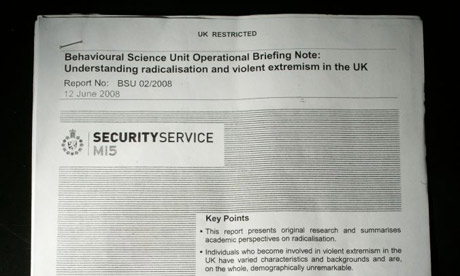
The MI5 research document. Photograph: Frank Baron

MI5 report challenges views on terrorism in Britain
By Alan Travis / August 21, 2008

Exclusive: Sophisticated analysis says there is no single pathway to violent extremism

Mi5 Security Service’s Behavioural Science Unit Operational Briefing Note

MI5 has concluded that there is no easy way to identify those who become involved in terrorism in Britain, according to a classified internal research document on radicalisation seen by the Guardian.

The sophisticated analysis, based on hundreds of case studies by the security service, says there is no single pathway to violent extremism.

It concludes that it is not possible to draw up a typical profile of the “British terrorist” as most are “demographically unremarkable” and simply reflect the communities in which they live.

The “restricted” MI5 report takes apart many of the common stereotypes about those involved in British terrorism.

They are mostly British nationals, not illegal immigrants and, far from being Islamist fundamentalists, most are religious novices. Nor, the analysis says, are they “mad and bad”.

Those over 30 are just as likely to have a wife and children as to be loners with no ties, the research shows.

The security service also plays down the importance of radical extremist clerics, saying their influence in radicalising British terrorists has moved into the background in recent years.

The research, carried out by MI5’s behavioural science unit, is based on in-depth case studies on “several hundred individuals known to be involved in, or closely associated with, violent extremist activity” ranging from fundraising to planning suicide bombings in Britain.

The main findings include:

• The majority are British nationals and the remainder, with a few exceptions, are here legally. Around half were born in the UK, with others migrating here later in life. Some of these fled traumatic experiences and oppressive regimes and claimed UK asylum, but more came to Britain to study or for family or economic reasons and became radicalised many years after arriving.

• Far from being religious zealots, a large number of those involved in terrorism do not practise their faith regularly. Many lack religious literacy and could actually be regarded as religious novices. Very few have been brought up in strongly religious households, and there is a higher than average proportion of converts. Some are involved in drug-taking, drinking alcohol and visiting prostitutes. MI5 says there is evidence that a well-established religious identity actually protects against violent radicalisation.

• The “mad and bad” theory to explain why people turn to terrorism does not stand up, with no more evidence of mental illness or pathological personality traits found among British terrorists than is found in the general population.

• British-based terrorists are as ethnically diverse as the UK Muslim population, with individuals from Pakistani, Middle Eastern and Caucasian backgrounds. MI5 says assumptions cannot be made about suspects based on skin colour, ethnic heritage or nationality.

• Most UK terrorists are male, but women also play an important role. Sometimes they are aware of their husbands’, brothers’ or sons’ activities, but do not object or try to stop them.

• While the majority are in their early to mid-20s when they become radicalised, a small but not insignificant minority first become involved in violent extremism at over the age of 30.

• Far from being lone individuals with no ties, the majority of those over 30 have steady relationships, and most have children. MI5 says this challenges the idea that terrorists are young men driven by sexual frustration and lured to “martyrdom” by the promise of beautiful virgins waiting for them in paradise. It is wrong to assume that someone with a wife and children is less likely to commit acts of terrorism.

• Those involved in British terrorism are not unintelligent or gullible, and nor are they more likely to be well-educated; their educational achievement ranges from total lack of qualifications to degree-level education. However, they are almost all employed in low-grade jobs.

The researchers conclude that the results of their work “challenge many of the stereotypes that are held about who becomes a terrorist and why”.

Crucially, the research has revealed that those who become terrorists “are a diverse collection of individuals, fitting no single demographic profile, nor do they all follow a typical pathway to violent extremism”.

The security service believes the terrorist groups operating in Britain today are different in many important respects both from Islamist extremist activity in other parts of the world and from historical terrorist movements such as the IRA or the Red Army Faction.

The “UK restricted” MI5 “operational briefing note”, circulated within the security services in June, warns that, unless they understand the varied backgrounds of those drawn to terrorism in Britain, the security services will fail to counter their activities in the short term and fail to prevent violent radicalisation continuing in the long term.

It also concludes that the research results have important lessons for the government’s programme to tackle the spread of violent extremism, underlining the need for “attractive alternatives” to terrorist involvement but also warning that traditional law enforcement tactics could backfire if handled badly or used against people who are not seen as legitimate targets.

The MI5 authors stress that the most pressing current threat is from Islamist extremist groups who justify the use of violence “in defence of Islam”, but that there are also violent extremists involved in non-Islamist movements.

They say that they are concerned with those who use violence or actively support the use of violence and not those who simply hold politically extreme views.

Source, with an audio of the findings / The Guardian

The Rag Blog

Posted in RagBlog | Tagged , , | Leave a comment

Kabul, Afghanistan : A City Under Siege

Taleban fighters

Rockets, guile and the lessons of history: the Taleban besiege Kabul
By Jeremy Page in Kabul / August 23, 2008

The lorry drivers who bring the Pepsi and petrol for Nato troops in Kabul have their own way of calculating the Taleban’s progress towards the Afghan capital: they simply count the lorries destroyed on the main roads.

By that measure, and many others, this looks increasingly like a city under siege as the Taleban start to disrupt supply routes, mimicking tactics used against the British in 1841 and the Soviets two decades ago.

Abdul Hamid, 35, was ferrying Nato supplies from the Pakistani border last month when Taleban fighters appeared on the rocks above and aimed their rocket-launchers at him, 40miles (65km) east of Kabul. “They just missed me but hit the two trucks behind,” he said. “This road used to be safe, but in the last month they’ve been attacking more and more.”

The road from Kabul to Kandahar is even more treacherous, according to other drivers. “If the Afghan Army isn’t there, a fly cannot pass,” said Bashir, a lorry owner, pointing to the scorched shells of three vehicles he retrieved from a Taleban raid on the Kandahar road last week. Of 60 lorries, 13 were destroyed, he said. “Why can’t the Americans stop this?”

Seven years after a US-led invasion toppled the Taleban, that is the question now troubling President Karzai and Nato forces in Afghanistan.

Despite the presence of 70,000 foreign troops, the Taleban have advanced on Kabul this year and hold territory just outside Maydan Shar, the capital of Wardak province, 20 miles southwest of the capital.

Militants in Wardak mount almost daily raids on the Kandahar road, which also links the main US bases in Afghanistan. In the past month, they have stepped up attacks on the road from Kabul to Pakistan via Jalalabad – the main supply route for food, fuel and water.

This week they killed ten French soldiers in Sarobi, 30 miles along the Jalalabad road from Kabul. Simultaneously, they attacked the biggest US base in eastern Afghanistan. Such is the fear of a Taleban “spectacular” in Kabul, that when Gordon Brown visited on Thursday he was taken around by helicopter rather than being driven through the streets.

“We’re seeing history repeat itself,” said Haroun Mir, co-founder of the Afghanistan Centre for Research and Policy Studies and a former aide to Ahmad Shah Massoud, the assassinated Mujahidin commander. “The Taleban’s trying to cut the main roads to Kabul to target supplies for foreign forces, just like the Mujahidin did with the Soviets. If the highways are cut even for two days, it could also create riots in the city.”

Kabul is vulnerable to blockades because it is surrounded by mountains and has to ship in supplies on three roads leading north, east and southwest. The British learnt this the hard way during the siege of Kabul in 1841, documented by Lady Florentia Sale in A Journal of the Disasters in Afghanistan. “Khojeh Meer says that he has no more grain,” she wrote on December 3, 1841. “He also says that the moolahs have been to all the villages and laid the people under ban not to assist the English and that consequently the Mussulman population are as one man against us.” A month later, the British began their retreat from Kabul.

In the 1980s it was Soviet forces encircled in Kabul by the Mujahidin. They withrew in 1989. In 1996 the Taleban took Kabul after capturing Wardak and Jalalabad and blockading the capital. Isaf, the International Security Assistance Force, says that circumstances are different today: it has superior air support and logistics to the Soviets and the Taleban. The militants, though, have experience on their side, thanks to former Mujahidin commanders who have blockaded Kabul before.

Zabihullah Mujahid, a Taleban spokesman, said that their new strategy was announced by the brother and deputy of Mullah Omar, the Taleban leader, in late 2007. “The Taleban will surround Kabul politically and militarily to make it hard for Nato forces to receive logistic convoys,” he told The Times. “That will mean less Nato movement and will show we can make trouble in the capital.”

Local officials say that the Taleban, which derive most of their support from ethnic Pashtuns, are enlisting villages around Kabul and feeding off frustration with the lack of development since 2001. They fear that the next target will be the northern routes to the borders of Uzbekistan and Tajikistan.

The Afghan Government insists that it controls the country’s main roads and Des Browne, the British Defence Secretary, this week dismissed recent Taleban raids near Kabul as

indiscriminate. “In no sense have they created, or can they make, a strategic threat to the Government of Afghanistan,” he said. Brigadier-General Richard Blanchette, an Isaf spokesman, said: “We’re fine for fuel and food. With the air power we have, and the quality of troops on the ground, there is no way they can win.”

But monthly foreign troop casualties are on the rise, surpassing those in Iraq, and set to make this year Afghanistan’s bloodiest since 2001.

The Taleban’s strategy is also impeding aid agencies, especially since militants shot dead three women aid workers last week. Ebadullah Ebadi, of the World Food Programme, said that 20 of its convoys had been attacked so far this year, compared with 30 in all of 2007, many in parts of southeastern Afghanistan previously considered safe.

The lorry drivers know the risks, but say there is no other work. “They used to warn us not to supply the infidel,” said Mr Hamid. “If they catch me now, they’ll throw me in my own container, cover me in petrol and burn me alive.”

The Afghan Interior Ministry said that 76 civilians, including 50 children and 19 women, were killed yesterday by US-led coalition forces in the western province of Herat. Western forces confirmed the operation, but said only 30 Taleban had been killed.

History of war in Afghanistan

1839 British invade Afghanistan to install compliant king
1842 British retreat from Kabul; 16,500 troops and civilians killed; one survivor
1878-80 Second Anglo-Afghan War
1979 Soviet forces invade to prop up Communist Government
1988-89 Soviets retreat
1989-92 Civil war among warlords
1996 Taleban take over
2001 US-led invasion topples Taleban Government

Source / The Times Online

The Rag Blog

Posted in RagBlog | Tagged , | Leave a comment

I Hate Those Corporate Fascists and Pigs


EV Bikes
By Edgar Alpo / August 21, 2008

Disclaimer: Sorry, I’m in a bad mood.

They don’t allow these in New York City. Otherwise known as the fascist capital of the world. New York City hates electric bicycles. They do like bankster grift money though… Bow down to New Jerk Shitty everyone, they have all the money because they are the filthy maggot banksters to the world. They steal from everyone, pension funds, foreigners, you, me, everyone.

This is how the current business model works (for them and not for us):

1) Start a private company.

2) Borrow from your fascist lodge buddies and buy assets.

3) Take a bonus.

4) Bribe officials with foreign investment dollars.

5) Take the corp.(se) public.

6) Run up the price of the stock with borrowed money from junk bond sale.

7) Take another bonus.

8) Get corporate msm cheerleaders to pump stock sales with propaganda.

9) Cash out stock options at the top.

10) Take bonus.

11) Short company stock to zero.

12) Get your talented ass another CEO job courtesy of your secret society bankster buddies.

13) Rinse, repeat.

Notice how the battery on that EV bike looks like a water bottle? Very sneaky, just like a hedge fund maggot, or a CONgreffsman. Here’s another just like it. The first one uses a trek chassis, I think I like it better. Both are about $2k, so I suggest you save your money. Especially, for the love of Mike, please don’t put that puppy on your credit card or pay any interest to the maggot banksters. I won’t be buying one anytime soon because I hate those corporate fascists and pigs more than all of you put together. I took the back brake off my broken down POS and plan to keep riding it. Let the banksters and billionaires keep this eCONoME going, they have stolen all the moolah anyway. Best of everything [/edgar].

Source / Petropest Launchpad

The Rag Blog

Posted in RagBlog | Tagged , , , | Leave a comment