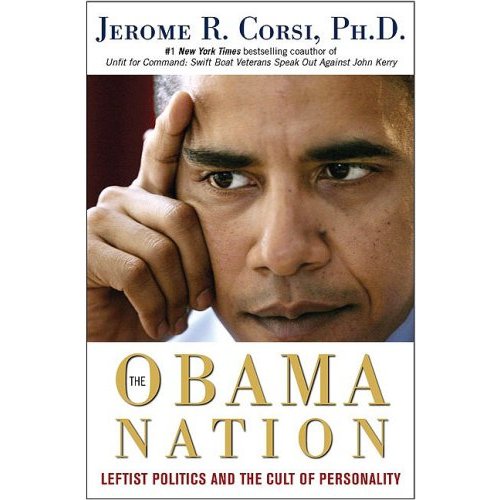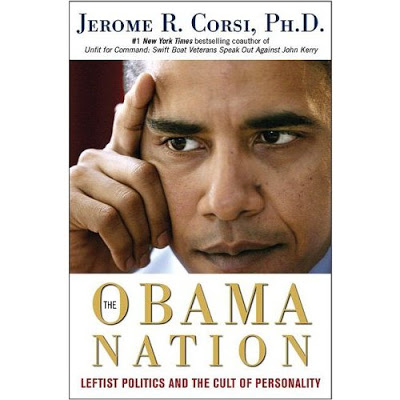
The following is a comprehensive review, and debunking, of Jerome Corsi’s book with the oh-so-clever title, The Obama Nation : Leftist Politics and the Cult of Personality. Corsi, it should be noted, is the architect of swiftboating and a man with no credibility whatsoever (except as a smearmeister). Yet his book will be number one on the upcoming New York Times bestseller list. With a bullet. The bullet, as Rachel Maddow pointed out last night on Countdown, is due to the fact that sales figures have been artificially boosted by extensive “bulk sales” to right wing organizations. Which means they’re being given away. Those that aren’t sitting in boxes somewhere.
A note about Corsi’s academic “credibility.” Countdown guest Eric Burns did a quick check of the book’s “footnotes” before the interview and said that of the first 11 citations, Corsi quotes himself (from his previous writings) in nine of them. In Burns’ words, “a dubious practice at best.”
Thorne Dreyer / The Rag Blog / August 15, 2008
‘This is one of the worst political books ever written’
by John K. Wilson / August 14, 2008
[Note: I’m the author of a book about Obama, Barack Obama: This Improbable Quest, but I’m not part of the Obama campaign.]
See Video from Countdown, below.
Jerome Corsi’s book, The Obama Nation: Leftist Politics and the Cult of Personality, has instantly soared to the top of the bestseller lists. But its popularity is in inverse proportion to its quality. This is one of the worst political books ever written. Corsi piles distortion upon innuendo to create a gigantic heap of right-wing garbage, with a seemingly endless parade of basic factual errors running through the text like rats. Corsi’s book is an embarrassment to the craft of journalism, and any of the conservatives who have praised and promoted it should feel humiliated at how bad it truly is. The Obama campaign just came out with a critique of Corsi’s book; it includes some of the many examples which I found independently and detail below.
Corsi’s editor, Mary Matalin, claims his book is “a piece of scholarship, and a good one at that.” There’s nothing scholarly at all about this pathetic excuse for a hatchet job.
Sean Hannity tried to push Corsi’s crazy theories on his radio and TV shows through multiple appearances. Hannity condemned “all you left-wing bloggers who want to smear Mr. Corsi” and to prove the author’s credibility asked him, “How many footnotes are in the book?” Corsi responded, “There’s over 300 pages, 700 footnotes, and I’ll stand by the truth of every statement in this book.”
Actually, there’s only 681 footnotes. But maybe he’ll stand by the truth of every statement after that one. (For the record, I have 769 footnotes in my shorter book about Obama, which, based on Hannity’s faulty logic, must mean that my book is 13% more true than Corsi’s.) The fact is, a footnote to an unreliable right-wing blogger isn’t proof of the truth; it’s proof that Corsi will write and cite anything, no matter how false, if it serves his far right agenda.
Corsi begins his book by noting that he titled it “Obama Nation” because that sounds like “abomination.”(x) This bad Biblical pun damning Obama as evil reflects the sleazy attacks Corsi makes throughout the book. Corsi recounts that at World Net Daily, “a large number of e-mails were received from readers objecting that Obama was not the Messiah but rather the biblical Antichrist prefigured in Saint John’s Apocalypse.”(225) Corsi denies that he thinks Obama is the Antichrist, but much of his book is devoted to demonizing Obama.
Corsi has admitted in one interview about Obama’s memoir, “I had to read it about six times before I began to figure it out.” Thousands and thousands of people have read Obama’s book, and Corsi seems to be the only one who had to read it six times before he could figure out that Obama was critical of his father’s flaws. No, correct that: Corsi actually never figured it out himself. He admits that he wondered “why Obama failed to discuss his father’s alcoholism and polygamy in his autobiography.”(24) But Corsi writes that he is told by journalist Rob Crilly that he’s wrong, that Obama in fact writes about all of this in his book (it’s described in depth on pages 125-126, 215-217, and 344 of Obama’s memoir). Unable to confess his own inability to read a book that he claims he’s almost “memorized,” Corsi prefers to blame Obama: “What is Obama trying to hide and why would he do so?”(24) Confronted with proof of his own stupidity, Corsi prefers to believe that Obama tried to conceal his father’s flaws in a book which is all about discovering his father’s flaws.
It takes real chutzpah to read a highly acclaimed book six times, overlook the most basic facts clearly written in it, and then blame the author for concealing the truth that he actually wrote. But Corsi has no shame. He writes: “That Obama’s father was a polygamist and an alcoholic may or may not tell us much about Obama. But that Obama does not present the true story about his father outright in his autobiography, in an easy-to-follow fashion, leaves the reader to discover the revelation, much as Obama claims he himself did.”(296) As a literary critic, Corsi is simply dreadful. The brilliance of Obama’s memoir is that he lets the reader discover the flaws of his father just as Obama did himself. It’s crazy to imagine that Obama’s memoir is deceptive because he didn’t follow a strict chronological order.
Obama’s memoir
Corsi’s embarrassing factual errors begin at the very start of his book. Corsi writes: “Interestingly, Obama did not dedicate Dreams from My Father to his mother, or to his father, Barack Senior, or to his Indonesian stepfather. Missing from the dedication are the grandparents who raised him in Hawaii….” That is very interesting, since Obama wrote in the introduction to his memoir, “It is to my family, though — my mother, my grandparents, my siblings, stretched across oceans and continents — that I owe the deepest gratitude and to whom I dedicated this book.”(xvii)
In an appearance on MSNBC, Corsi tried to explain away this mistake pointed out by Media Matters: “In the introduction that he wrote after, this was going with the second book. And the original book had no dedication page and this is not the typical way that you dedicate a book. So I’m making the distinction there is no dedication page in the book at all, never has been.” Once again, Corsi is wrong. The introduction where Obama dedicates his book to his family appears in the original edition of Obama’s memoir, as well as the revised edition Corsi used for his book. Moreover, Corsi’s attack against Obama was that he had not dedicated the book to his family, not that he didn’t have a specific dedication page. But rather than admit a clear factual error, Corsi continues to deny that he made a mistake and tries to deceive viewers about his book.
Corsi claims that in Obama’s memoir, “we find Obama caught up in half-truths”(18) because, Corsi reveals, Obama’s father had turned down a full scholarship from the New School in order to attend Harvard. Where did Corsi learn this? Well, actually, it was printed right there in Obama’s memoir. But Corsi calls it a “half-truth” because “Obama does not make this important point chronologically.”(18)
It’s difficult to convey just how bad of a reader Corsi is. Although he has a Ph.D. (as he reminds us on the cover of the book and the top of every other page), Corsi seems incapable of the most basic reading skills. Instead, Corsi complains about Obama’s memoir, “Deciphering the truth takes much effort….”(18) Unfortunately for his readers, Corsi is not someone who likes to put a lot of effort into a book, whether he’s reading it or writing it.
Many of Corsi’s critiques don’t make any sense at all. Corsi attacks Obama’s memoir because he “never states precisely how many wives his father had, or how many half-brothers and sisters he has from different mothers….”(21) Yet Corsi himself interviews Obama’s uncle: “Sayid Obama was not even sure how many wives his brother had….The number of children Obama Senior had is equally uncertain.”(26) If Obama’s uncle doesn’t know how many wives and children Obama’s father had, why is Corsi denouncing Obama for being unable to state the numbers “precisely”?
According to Corsi, “Obama blames racism for breaking up his parents’ marriage, not his father’s polygamist ways…”(21) Corsi provides no citation for this false claim, probably because it’s not true.
Corsi devotes six full pages of his book to expose a “lie” about how Obama’s father came to America: “Obama is again lying about history to claim JFK had anything to do with bringing his father to the United States to study.”(33) And what was this “lying”? As the Washington Post discovered, John F. Kennedy and the Kennedy family foundation had funded a second airlift to bring African students to US colleges, but that Obama’s father had been part of the first airlift. When Obama talks about the Kennedy family’s role in helping bring students like his father to America, he’s not lying.
By contrast, Corsi’s book is littered with factual errors, such as these identified by Media Matters:
Corsi claims that Obama’s omits his half-sister’s birth: “remarkably, he makes no reference to Maya’s birth”(48) In reality, Obama mentions it on page 47 of his memoir.
Corsi claims that Obama’s work as a community organizer in New York City is “a job Obama does not mention in his autobiography.”(129) Obama does discuss it on page 139.
Corsi suggests that “Obama Senior, following the prescripts of Islamic sharia law, divorced” Obama’s mother in 1963.(44) In reality, there’s not any evidence, beyond the assertions of a right-wing blog, that the divorce had anything to do with sharia law.
According to Corsi, “Still, Obama has yet to answer questions whether he ever dealt drugs, or if he stopped using marijuana and cocaine completely in college, or whether his drug usage extended into his law school days or beyond.”(77) In reality, Obama reports that after he went to college at Columbia, “I stopped getting high.”(120)
According to Corsi, “Nowhere in the autobiography does Obama disclose that his wife-to-be accompanied him to Africa on the 1992 trip.”(25) Not true. Obama writes on page 439, “After our engagement, I took Michelle to Kenya to meet the other half of my family.”
Corsi is fond of using a common technique: he cites some outrageous claim as if it were true and then discusses the impact it would have on voters. For example, he discusses a YouTube video and declares that “What would be heard by most listeners is that Obama hates the military so much that he might leave the United States defenseless against our enemies…”(3)
False reports about religion form a major part of Corsi’s book. Corsi claims, “Obama’s Kenyan father was Muslim.”(20) In reality, Obama’s father was an atheist. This fact is confirmed in Corsi’s own book when Sayid Obama (Barack Sr.’s brother) declared, “I did not see my brother practice Islam, especially after he came back from his studies in the United States.”(22) But Corsi claims, “there is no doubt Obama Senior was a Muslim by birth and upbringing”(22) That’s a lovely claim, but unfortunately for Corsi, it’s factually false: A Muslim, like a Christian, is determined by faith, not by birth and upbringing.
Corsi writes, “Was Obama ever trained in Islam? Obama and his presidential campaign vehemently deny he ever had anything to do with Islam. But is that the truth?”(50) No, it’s not the truth. But the lie belongs to Corsi, not Obama or his campaign. According to Corsi: “Obama did attend a government-run public school in Indonesia and he did receive Islamic instruction, including study of the Koran. Here the Obama campaign makes a mistake. I accept Obama’s statement that he is a Christian, but take exception to the claim that Obama was not introduced to Islam as a child.”(51) Of course, the Obama campaign never claimed that Obama did not receive instruction about Islam, as he explains in detail in his own memoir. Instead, the campaign asserted, “Barack Obama is Not and Never Has Been a Muslim,” which is true. Studying the Koran doesn’t make you a Muslim. Corsi claims that a blog found Obama’s school records and discovered his horrifying revelation: “his religion was listed as Islam.” Well, of course it was. You had to be listed as Christian or Muslim at the school, and with an atheist mother and a nominally Muslim stepfather, it was natural for Obama to be listed as a Muslim.
Corsi attacks Obama at length because his memoir describes a childhood Indonesian home in a “still-developing area on the outskirts of the town.” Corsi complains, “that physical description does not match the Indonesia television news videos showing the house…”(54) According to Corsi, it is “an attractive neighborhood in the center of Jakarta.”(54) Perhaps that’s because things change. In 1970, my parents lived in central Illinois near the edge of a cornfield; today, that same house is in the center of town. In 1970, when Obama lived in Indonesia, Jakarta had a population under four million; today, it’s over 13 million. But rather than the obvious explanation of urban growth, Corsi sees only a vast Obama conspiracy: “it is hard to decipher what Obama might be trying to hide by not being clear about the specific location of the houses where he lived in Jakarta….Looking closely at Obama’s narrative, what dominates the story are the holes.”(55)
Corsi notes “a bizarre but important story” where Obama recounts in his memoir being nine years old and reading a Life magazine in the embassy library and seeing a picture of “the black man who tried to peel off his skin” after using a chemicals to lighten his skin.(65) An extensive investigation by the Chicago Tribune found no such article in Life magazine. It’s possible that Obama had seen a July 1968 article in Esquire, titled “A Whiter Shade of Black,” which dealt with blacks who used an ointment that turned their skin white. Or it’s possible that as a child Obama saw advertisements for skin bleaching products and simply didn’t remember it correctly two decades later. As a 1966 Time article noted, “Advertisements in the Negro magazines still hymn Nadinola skin bleach: ‘Lightens and brightens skin.'”
Yet according to Corsi, “The entire episode suggests what psychologists call ‘hypothetical lying,’ in other words, imagining something that has not happened, but imagining it with so much precise detail that the made-up memory functions for the person as if it were real.”(66) Astonishingly, Corsi concluded: “Has Obama lost the ability to tell the difference between something that actually happened and something he invented?”(66)
The irony here is that Corsi makes far more factual errors than anyone has ever alleged against Obama’s memoir, and Obama was trying to remember incidents 20 years earlier that happened when he was a child.
Corsi offers yet another example of Obama’s faulty memory: a photo that Obama recalls seeing in Life magazine when he was in Indonesia was apparently published in Life a year “after the date Obama wants us to think he left Indonesia.”(67) Corsi concludes, “the puzzle just adds to the growing list of factual discrepancies or outright fabrications that Obama manufactures, very likely on an ongoing basis. Even Indonesian television reporters can’t identify with certainty the addresses where Obama lived with his family.”(67) But it’s ridiculous to conclude that Obama is guilty of “fabrications” because he failed to remember the exact year of his childhood that he saw a photograph in a magazine.
As Stephen Colbert said about Obama, “If we can’t trust you to remember which magazine you read in Indonesia when you were 9, how can we possibly ever trust you to protect our country?”
Who is Jerome Corsi?
Corsi brags that he is a member of the far-right Constitution Party, which “asked me to run as its presidential candidate in 2008…”(xi) As Media Matters noted, Corsi wrote many incredibly offensive and bigoted comments on right-wing message boards. He called Islam “a worthless, dangerous Satanic religion” and wrote that “RAGHEADS are Boy-Bumpers.” According to Corsi, “Boy buggering in both Islam and Catholicism is okay with the Pope as long as it isn’t reported by the liberal press.” And Corsi wrote, “didn’t John Kerry begin practicing Judiasm? He also has paternal grandparents that were Jewish. What religion is John Kerry?” Corsi referred to Katie Couric as “Little Katie Communist.” Corsi called Bill Clinton “an anti-American communist.” Corsi called Hillary Clinton a “FAT HOG” and possibly a “lesbo,” and repeatedly referred to their daughter as “Chubbie Chelsea.”
In short, Corsi is sexist, racist, and bigoted toward many different religions.
(Oddly, although Corsi has no problem denouncing Obama for a book written almost 15 years ago discussing his childhood memories, when Bob Beckel criticized Corsi’s offensive online comments from 2002 and 2003, Corsi complained, “you’re going back to ancient history.” But Corsi’s bigotry isn’t ancient history. As recently as August 9, Corsi claimed that Martin Luther King Jr. was “a shakedown artist.”
Corsi makes openly racist comments in his book, like “Obama’s mother chose another third world prospect for her second husband”(43) or declaring, “the race Obama embraces is not that of his mother, although he does have that choice.”(63) Presumably, Corsi thinks that all Obama needed to do was shout “Caucasian” loudly enough and no one would ever notice that he’s black. In Corsi’s delusional imagination, “Obama wants to will all the white blood out of himself so he can become pure black.”(91) Corsi declares, “His race, he self-determines, is African-American. In making that determination, he rejects everyone white, including his mother and his grandparents.”(91) Of course, anyone who actually reads Obama’s memoir realizes that he never rejects his family or white people. Corsi also worries, “If Obama does win the presidency in 2008, he will be the first president in our history to have an extended family in another country.”(113) These sleazy attacks are meant to convey that Obama isn’t “American” enough.
Corsi writes, “I have pursued Obama’s extensive connections with Islam”(xv) and attacks Obama for being insufficiently anti-Muslim. Corsi writes, “Obama could have an increasingly difficult time convincing U.S. voters he is anything but pro-Islam”(298) and adds, “Obama’s experience with Islam predisposes him to Islam.”(302) Demanding that presidential candidates must hate all Muslims is a particularly sick kind of bigotry.
Corsi even claimedin an August 9, 2008 interview that Obama may not be an American citizen and that his birth certificate is a fake: “We can’t yet get the authentic birth certificate….I’m convinced it’s a forgery.” According to Corsi, “if a birth certificate were forged and put on a website, it’s conceivable that somebody committed a felony.”
Here Corsi is embracing one of the dumbest conspiracy theories in the world. Obama’s birth certificate, released by his campaign to stop these loony rumors, has been proven to be authentic, but far-right conspiracy theorists claimed that the Obama campaign had taken the birth certificate of his sister, Maya Kassandra Soetoro, and changed the date of birth, place of birth, name, sex, and father’s name to make it appear to be Obama’s birth certificate. This conspiracy theory supported by Corsi is particularly stupid because Maya was born in Indonesia, not Hawaii, and therefore doesn’t have a Hawaiian birth certificate. The fact that Corsi supports this conspiracy theory should make everyone question both his sanity and his capacity for rational thought.
Corsi’s crazy theories aren’t limited to Obama. Corsi has accused George W. Bush of running a secret conspiracy to destroy the United States: “President Bush intends to abrogate U.S. sovereignty to the North American Union, a new economic and political entity which the President is quietly forming….Why doesn’t President Bush just tell the truth? His secret agenda is to dissolve the United States of America into the North American Union.” Conservative talk show host Michael Medved criticized Corsi and denounced these conspiracy theories as “puerile paranoia.” Conservative blogger John Hawkins of Right Wing News condemned Corsi’s lunacy: “Nobody has worked harder to convince people that the completely moronic North American conspiracy theory is real.”
Corsi wrote an entire book about this delusion, and has focused on a nonexistent “NAFTA superhighway” and even falsely published an article saying that Mexican president Vicente Fox had confirmed plans for the Amero, a fantasy of Corsi and the John Birch Society about a new currency to replace the dollar.
Plagiarism
Corsi even accuses Obama of plagiarism, claiming his book was a “borrowing of ideas.” According to Corsi, “Many of the black-rage paragraphs Obama wrote in Dreams from My Father bear a striking resemblance to passages Frantz Fanon wrote in his first book, Black Skin, White Masks….”(81) So what is this striking resemblance? Obama wrote about the phrase “white folks” and Corsi quotes him: “Ray assured me that we would never talk about whites without knowing exactly what we were doing. Without knowing that there might be a price to pay.” And the “similarity” in Fanon’s writing? “The black man has two dimensions. One with his fellows, the other with the white man. A Negro behaves differently with a white man and with another Negro.”(81) The only similarity here is the notion that blacks speak differently around whites, which is one of the most common motifs in African-American literature, and hardly original to Fanon or anyone else.
But Corsi has one last trick up his sleeve. He claims that Obama’s mis-remembered story about skin lightening was actually an idea stolen from this passage in Fanon’s book: “For several years certain laboratories have been trying to produce a serum for ‘denegrification'” with all the earnestness in the world, laboratories have sterilized their test tubes, checked their scales, and embarked on researches that might make it possible for the miserable Negro to whiten himself and thus to throw off the burden of that corporeal malediction.”(82) This is, of course, utterly silly. Chemicals to lighten skin had been around for ages and widely advertised. Obama didn’t need Fanon to come up with the idea, especially since Fanon’s bizarre notion of a “denegrification” serum appears to be very different from the skin chemicals.
To sustain this crazy theory of Obama plagiarizing Fanon, Corsi asserts that “Frantz Fanon’s revolutionary writings were instrumental in shaping Obama’s own political analysis of race.”(126) Corsi goes even further, imagining that Obama’s distant father was the source of some kind of Fanon obsession: “We do not know if Obama Senior ever shared Fanon’s writings with his son, but much of the expression of black resentment Obama offers in Dreams from My Father appears strongly influenced by Fanon’s pages.”(82-83) We do not know? Obama last saw his father when he was 10 years old. Does Corsi really think that Obama spent that short time as a kid with his father being indoctrinated in the works of Frantz Fanon?
According to Corsi, “Obama railed against the same forms of racial oppression his father must have felt under British colonialism.”(83) What is Corsi talking about? Obama ultimately rejects the “black rage” that Corsi attributes to him, and nothing about it is “anticolonial” in nature.
Corsi also accuses Obama of plagiarizing words from Deval Patrick, ignoring the fact that Patrick had urged him to use those phrases and was acting in the role of a speechwriter.(226) Then Corsi takes the accusation of plagiarism to psychotic new levels. According to Corsi, “Obama has repeatedly used the words bamboozled and hoodwinked,” claiming that Axelrod was stealing dialogue from a Spike Lee movie that used the same words.(228) Corsi also accuses Obama of plagiarism for using the common pro-labor phrases “si se puede” and “yes we can.” Corsi even accuses Obama of plagiarism for using the word “change,” claiming that “the use of ‘change’ as a political slogan dates back to socialist Saul Alinsky and his desire to cause a radical redistribution of income from the haves to the have-nots in America. Does Axelrod really want his candidate identified with Saul Alinsky?”(230) Needless to say, it’s highly doubtful that Alinsky invented the word “change.”
According to Corsi, “Obama has borrowed phrases freely even from movies, taking ‘bamboozled’ from Spike Lee’s movie about Malcolm X and the phrase ‘He is the One’ from the Matrix movie series.”(300) Of course, “bamboozled” existed as a word long before Spike Lee, and Obama has never said he is “the One.” Oprah Winfrey once said, “Is he the one? South Carolina, I do believe he is the one to bring us the audacity of hope.”(229) To claim that Oprah Winfrey plagiarized from a movie because she used the word “one” is silly.
Corsi’s false attacks on Obama as a plagiarist are particularly ironic because Corsi is himself a plagiarist. After right-wing blogger Debbie Schlussel discovered that Corsi was repeatedly stealing her work (while adding in mistakes), Schlussel declared that Corsi “is a plagiarist, plain and simple. He cannot be trusted.”
Guilt by association
Corsi’s favorite attack against Obama is guilt by association. Corsi complains that Bill Ayers “likes to present himself as the ‘Distinguished Professor of Education’ at the University of Illinois at Chicago.”(119) Perhaps that’s because his title is “Distinguished Professor of Education.”
Corsi claims that Obama’s distant connection to Ayers “could easily block Obama from the White House, and not just in 2008 but forever.”(120)
Corsi claims that, “In his eleven-year reign of underground terror, Ayers participated in thirty bombings.”(139) This is false; Corsi’s sole source is a World Net Daily article that offers no source for this claim. Altogether, there were perhaps 30 bombings and attempted bombings blamed on the Weather Underground, but no one imagines that Ayers participated in all of them, since the organization was highly decentralized while on the run from the police.
Of course, there’s no reason why Corsi needs to exaggerate Ayers’ crimes. What Ayers did was appalling and stupid. But it has nothing to do with Obama, who has condemned Ayers’ past. (By contrast, John McCain has never been asked to criticize G. Gordon Liddy, the Watergate criminal he calls his “friend” who urged his radio listeners to shoot federal law enforcement agents in the head; nor has McCain ever been asked about Oliver North, the Contragate criminal who illegally funneled government money and weapons to support the terrorist activities of the Contras.)
Corsi claimed Alice “Palmer would never have introduced Obama to the Hyde Park political community at the Ayres-Dohrn home unless she saw an affinity between Ayers and Dohrn’s radical leftist history, her own history of far-leftist politics, and the politics of Barack Obama.”(137) But the event wasn’t held primarily for Obama. It was Palmer’s own announcement that she would run for Congress, as the Politicoarticle cited by Corsi made clear. Obama was there as Palmer’s endorsed successor for her Senate seat, but there’s no evidence that he had any role in deciding to hold it at Ayers’ home.)
Corsi claims about Obama: “either he did not know Ayers and Dohrn are still radical leftists—in which case he is implausibly naive—or Obama did know, which would confirm he joined with Ayers and Dohrn because Obama too continues to believe, albeit silently and secretly, in the Far Left’s radical agenda.”(140) Of course, Corsi is so desperate to push the conspiracy theory of Obama as a secret left-wing radical that he omits another possibility: that Obama knew Ayers was a leftist, but he didn’t care. Perhaps Obama believes in the notion of a free society, where you work with people you disagree with.
But according to Corsi, “Even today, Ayers appears to hold the same radical political beliefs he did in the Weather Underground, and Obama had to know that was also the case when he first met Ayers in 1995.”(147) Corsi doesn’t explain how Obama “had to know” Ayers’ views on politics when he first met him. Telepathy? Mind-reading?
Corsi is fond of quoting other people to make the distortions and deceptions he’s afraid to do himself. He quotes a blogger referring to Ayers as “Obama’s boss” and explains that reference was due to Ayers being chair of the Woods Fund board.(147) Corsi doesn’t bother to correct this error (the chair of a foundation board is not the “boss” of the members)
Much like David Freddoso’s anti-Obama book (which I reviewed here), Corsi uses McCarthyist red-baiting techniques to attack Obama, such as his childhood friendship with an alleged communist poet, Frank Marshall Davis. Corsi glorifies the “McCarthy-era committees seeking to expose communists considered to be a security threat.”(86) So what “threat” did this committee find in Davis? According to Corsi, he wrote articles criticizing a Hawaii “Commission on Subversive Activities” and a 1951 article in a communist newspaper. Corsi notes that authors read by Obama were also reds: Langston Hughes and Richard Wright “both had communist connections as well.”(86)
Corsi also denounces Obama’s alleged connections to Saul Alinsky, because he worked for a community group that utilized some of Alinsky’s techniques. According to Corsi, “When Obama tells audiences that his community organizing experience ‘taught me a lot about listening to people as opposed to coming with a premeditated agenda,’ he is reciting pure Alinsky dogma.”(135) To Corsi, listening is “intrinsically an elitist view; always, the organizer knows best.”(135) This is an Orwellian perversion of language to claim that listening is “an elitist view.”
Corsi quotes numerous far-right sources to “prove” his claims, such as this: “Conservative columnist Ann Coulter has characterized Obama’s Dreams from My Father as a ‘dimestore Mein Kampf,'” an insane notion that Corsi doesn’t criticize at all.(78) Corsi doesn’t explain why he thinks it’s reasonable to compare Obama to Hitler.
Another guilt-by-association smear by Corsi is against Rashid Khalidi, a brilliant Columbia University professor who once taught at the University of Chicago and held a fundraiser for Obama. Corsi offers only this baseless attack: “Khalidi’s views are clearly anti-American” because he criticizes US support for Israeli settlements in Palestine.(142)
Corsi even condemns Obama for attending a 1998 Arab community fundraiser featuring the scholar Edward Said. Based on photographs of the event, Corsi makes this accusation: “Obama engages in what appears to be animated conversation with the professor. A second photograph shows Obama and Michelle paying close attention to Said as the professor delivers the evening’s keynote address.”(142) What a shocking revelation! Barack Obama actually listened to a world-renowned professor and then had a conversation with him.
Corsi even goes after the parents of Obama campaign workers. He attacks Obama advisor David Axelrod because his mother wrote in the 1940s for PM, a left-wing newspaper in New York.(216) Corsi even includes a bizarre section noting that Axelrod’s father killed himself and “Obama’s father killed himself driving drunk.”(218)
According to Corsi, Michelle Obama “made herself look like a black racist.”(233) How, exactly, did she do that? Michelle’s senior thesis at Princeton on race included an analysis of “black separatism” and she helped define that term by using a 1967 book, Black Power, which was co-written by Stokely Carmichael, who has since often made crazy speeches insulting whites and Jews. So, even though Michelle never embraced black separatism, because she cited a book to define it written by a controversial figure, she is therefore a “black racist.”(232) Incredibly, Corsi extends his guilt-by-association attacks even to the reading of books.
Nothing quite embodies the sleaziness of Corsi’s attacks so much as his smear of Sam Graham-Felsen, one of Obama’s official bloggers. Corsi recounts how “Graham-Felsen’s bookcase in the Quincy House dorm included titles by Karl Marx and Howard Zinn…”(149) Imagine that: a college student who has books! Graham-Felsen is also deemed guilty for praising Noam Chomsky.(149) And then, as Media Matters pointed out, Corsi falsely presents an article Corsi wrote for the Nation as being written for the magazine “Socialist Viewpoint” (which in reality reprinted it from the Nation, as it reprints many mainstream publications). Corsi then describes the publication in breathless detail: “The Socialist Viewpoint is a magazine published by the Socialist Workers Organization, a group that describes itself as ‘formed to advance the revolutionary Marxist political program in the United States.'”(150) Finally, Corsi declares, “Little Green Footballs has called Graham-Felsen ‘a hardcore Marxist.'”(151) Wow, Little Green Footballs, there’s an unimpeachable source. Corsi quotes another blogger who embraces his McCarthyism: “exactly what is a Democratic candidate doing with a staffer who acts as the campaign’s public’s face when the staffer is featured in Marxist publications?”(151)
Corsi concludes his chapter on Obama’s radical views by writing: “How possibly can Obama argue his association with radicals such as Bill Ayers and Bernardine Dohrn was a long time ago, when he continues to recruit a Marxist sympathizer such as Sam Graham-Felsen to be an official blogger of his 2008 presidential campaign?”(151) Corsi actually believes that Obama should be held responsible for the failure of his campaign to ban anyone who has read a book by Karl Marx or Howard Zinn. Perhaps it would assist the Obama campaign if Corsi came up with a list (let’s call it a “blacklist”) of books that anyone associated with his campaign is not allowed to have read at any point in their lives.
Reverend Wright
Not surprisingly, Corsi joins in the right-wing attacks on Obama for attending the church of Rev. Jeremiah Wright. Twice in the book, Corsi observes that Wright is often “wearing a dashiki”(10) and “gives his sermons while dressed in African garb,”(180) as if his clothing alone should be used to condemn him.
Corsi attacks Wright’s sermon after 9/11 that mentioned America’s “chickens coming home to roost.” According to Corsi, “Reverend Wright adapted the phrase to imply that the terrorist attacks of 9/11 were divine retribution for white America’s continuing racial injustice.”(181) That’s not true. Wright never said that 9/11 was due to “divine retribution” (that was Pat Robertson’s theory) or “racial injustice.” Wright was making the argument that America’s foreign policy had bred resentment in the world, and “violence begets violence.”
When Obama said that he hadn’t heard the most outrageous comments of Rev. Wright being shown over and over again in the press, Corsi wrote: “Obama’s denial spurred investigators to prove the contrary. On March 16, two days after Obama’s denial appeared on the Huffington Post, new evidence emerged. NewsMax’s Ronald Kessler reported that Obama had been in Trinity United Church of Christ on July 22, when Kessler was present. Kessler claimed he and Obama both heard Wright preach a sermon that day in which the preacher blamed the ‘white arrogance’ of America’s Caucasian majority for the world’s suffering, especially the oppression of blacks.”(196) As Media Matters pointed out, Obama was actually in Miami giving a speech at 1:30pm that day. But for Corsi, facts don’t really matter. Corsi also gets his basic facts wrong. It was Jim Davis, not Kessler, who falsely claimed to be in church with Obama that day. Corsi toldthe New York Times, “We can nitpick the date to death.” But the whole point of this fake story about the date was to prove that Obama was in the church when Wright made one of his controversial remarks. If the date is wrong (and it is), then the accusation is false.
Corsi recounts how Obama criticized Wright’s “distorted view” of racism and America and accuses him of “clearly contradicting” himself, writing about this gotcha moment: “How could Obama know these were the subjects of Wright’s sermons unless he had heard them?”(197) Gee, I don’t know, maybe it could have been the round-the-clock news coverage showing Wright’s speeches over and over again. Is Corsi really this stupid? Or does he think his conservative readers are so stupid that they will swallow this nonsense without thinking?
Corsi regularly attacks Obama’s faith. Corsi writes, “before Obama’s baptism at Trinity, when he was nearly thirty years old, there is no other life incident evidencing he is a Christian.”(187) It’s a particularly bizarre accusation: Before Obama became a Christian, there was no “life incident” showing he was a Christian. But that’s really the definition of what it means to become a Christian. Corsi seems to think that a Christian must prove that he was a Christian before he became a Christian in order to be called a real Christian.
Corsi also makes another baseless attack on Obama’s faith, claiming that Obama felt that he “did not necessarily have to be a believer” to join his church. Corsi tries to prove this by quoting what Obama writes in The Audacity of Hope: “faith doesn’t mean you don’t have doubts….religious commitment did not require me to suspend critical thinking….”(188) Amazingly, Corsi compares Obama to Machiavelli for this, calling Obama’s faith “a calculated decision to position yourself favorably in the eyes of those you want to lead, whether you believe in the decision or not.”(188) In Corsi’s view, Christians are incapable of critical thinking and doubt, and by showing his ability to think rationally, Obama must not be a Christian.
Corsi tries to associate Obama with black radicals, and even mentions a short profile on biography.com about Louis Farrakhan that declares, “along with other prominent black leaders such as Al Sharpton and Barack Obama, Farrakhan helped lead the Million Man March on Washington.”(191) Corsi writes, “Obama’s supporters, who clearly want to move Obama as far away from Farrakhan as possible, will be certain to disavow that Obama had any leadership role in Farrakhan’s 1995 march.”(192) Actually, they’ll be certain to disavow it because it’s not true. Obama attended the event, but he never had a leadership role (in fact, he criticized the march organizers). Corsi seems to think it’s perfectly acceptable to put false information in his book as long as he’s quoting someone on the internet.
The Kenya Conspiracy
According to Corsi, “Obama’s 2006 trip to Kenya evidenced his continued ties to a Raila Odinga, a fellow Luo tribesman, who was running for president of Kenya as a Muslim sympathizer with well-known communist political roots.”(93) Corsi falsely claims that Obama was “supporting Odinga openly in Kenya.”(93)
What was the connection? When Obama spoke publicly to a crowd, Odinga was nearby. That’s it. No endorsement. No mention of Odinga by Obama. Just this appearance where Odinga could be seen near Obama. According to Corsi, “Obama, by being seen this prominently with Odinga in public, had injected himself into the presidential contest on the side of his tribesman.”(95-96)
From this slight connection, Corsi goes on for an incoherent 20-page diatribe against Odinga and the intricacies of Kenyan politics. Corsi condemns Odinga, a Christian, for making an agreement with a Muslim group to maintain “open links of communication” if elected president, which Corsi calls “an undeclared radical Islamic political agenda.”(107)
Corsi also attacks Obama for criticizing the corruption of the Kenyan government that Odinga was opposing. Corsi seems to be arguing that there’s no corruption in Kenya, and the shakedown fees reported by a local Chicago news team to enter Kenya were simply a miscommunication.(96)
After the disputed election, when violence broke out between supporters of each candidate, Obama recorded a message urging peace at the request of Secretary of State Condoleezza Rice. Corsi condemns this by writing, “Senator Obama has continued to insert himself into Kenyan politics.”(104) Corsi even repeats conspiracy theories by some in Kenya who think that Obama as president would overthrow the Kenyan government “by means either military or political” to install Odinga.(106)
In one particularly bizarre part of the book, Corsi recounts how political consultant Dick Morris showed up in Kenya to volunteer for Odinga’s campaign (he was expelled from the country by the Kibaki regime Corsi admires). According to Corsi, “Morris’s showing up in Kenya makes no sense outside the Obama-Odinga connection. Odinga critics speculated that Morris had been recommended by former Clinton associates working for Obama.”(115) In reality, Morris worked in the past for both Democrats and Republicans before his sex scandal involving a prostitute drove him to the far right-wing. Corsi mentions that “Morris had been openly critical of Hillary Clinton’s campaign against Obama”(115) without bothering to mention that Morris is a conservative who hates the Clintons but also hates Obama, even falsely reporting in a January 2007 column that Obama had voted against an ethics reform bill that Obama actually voted for. Like so much else in this book, Corsi’s fantasy of an Obama-Odinga conspiracy has zero evidence to support it.
The Rezko Conspiracy
Corsi falsely accuses Obama of taking bribes from Antonin Rezko. According to Corsi, “As we shall see, Rezko was persistent, ultimately convincing Obama to drop working for political organizing causes so he could supplement the dwindling advance he had received at Harvard to write a book with real income as a lawyer, working the small Chicago law firm where the lead partner did much of Rezko’s slumlord legal work for him.”(157) This badly-written sentence includes some astonishing accusations, namely that Rezko was the one who convinced Obama to work for a small law firm that specialized in civil rights advocacy so that “Obama could work for Rezko indirectly and benefit from Rezko’s connections.”(158) There’s only one problem with Corsi’s assertion: He doesn’t have any evidence to support it. In a section completely free of footnotes, Corsi simply proclaims: “The likelihood is that Rezko played a role in getting Obama to join Davis Miner Barnhill & Galland.”(158) Likelihood? That’s a strong word for a completely baseless accusation.
Rezko had tried to hire Obama for his firm after he graduated from law school, which Obama turned down. But Corsi treats this as some secret conspiracy: “Alinsky taught that power was everything and that image, words, and positioning were just methods to capture power, working from communities up. Whatever Obama and Rezko talked about in their first meeting, the record shows Obama ended up working for the lawyer Allison Davis, who was one of Rezko’s business partners.”(159) None of this makes any sense. After law school, Obama could have worked almost anywhere and made a lot of money. Obama gave that up to work for a civil rights firm, not because Rezko made him some kind of a deal to promise him work at the law firm that he could have gotten anywhere.
Yet Corsi concludes that Obama “took steps that helped Davis and Rezko in their business relationship.”(159) In reality, all Obama did was his job. He did about five hours of routine legal work on behalf of community groups doing affordable housing projects with Davis and Rezko, since it’s not surprising that Davis would choose his former law firm to do the work. But this is Corsi’s attempt to blame Obama for Rezko’s corrupt business dealings and Rezko’s failure to maintain low-income housing.
Throughout the book, Corsi demands that Obama should have quit his job even though no one knew about Rezko’s crimes. Corsi wonders why Obama “continued to work for a law firm that had Rezko as a client.”(164)
Corsi declares, “There is no record that Illinois state senator Obama ever so much as placed a speech in the record objecting to the public-housing practices perpetuated in his district by Tony Rezko, let alone calling for investigation of Rezko and his business practices.”(164) That’s because there’s no record that Obama ever knew about the problems with Rezko’s business. The newspapers never reported on it until long after Obama left the state senate, and complaints from tenants would go to local aldermen and city officials, not to a state senator.
Corsi repeatedly tries to claim that Rezko overpaid for the lot he bought alongside Obama’s house, but it’s not true. Corsi admits that Rezko’s wife sold the lot for a profit to Rezko’s former attorney, Michael Sreenan, but treats this as part of the conspiracy: “in an article titled ‘Obama is one lucky fellow,’ Rezko Watch found it was unlikely that Sreenan would actually construct any condos on the lot he had bought from Rita Rezko.”(167) Corsi omits the fact (revealed in a Salon.com article Corsi cites) that Sreenan currently has the lot for sale at $950,000, $375,000 more than he paid for it. As numerous reports have found, the price Obama and Rezko paid for their properties was perfectly legitimate.
Unable to show any wrongdoing, Corsi offers this desperate argument: “Even if no illegality is ever identified, Obama’s continued willingness to take campaign contributions from his ‘friend’ Rezko, even after serious allegations about Rezko’s low-income housing empire began to be raised, have the feel of impropriety.”(170) But according to Opensecrets.org, Rezko’s last donation to Obama came on October 3, 2003, long before any scandal about Rezko appeared—and two months before Rezko gave $4,000 to George W. Bush’s campaign. Would Corsi blame Bush for the “feel of impropriety” of taking money from Rezko?
Corsi declares, “investigative reporters have drawn a line from Obama to Rezko to Saddam Hussein’s Oil for Food scandal, with the key connecting point being billionaire Nadhmi Auchi.”(173) But that same line could be drawn from George W. Bush or any other politician Rezko knew, since it’s pure guilt by association.
Corsi concludes his corruption chapter with one final outrageous lie: Obama “overlooked Rezko’s questionable activities to take money not just to finance his campaigns but to buy the mansion he feels his family deserves.”(175) Corsi’s claim that Obama somehow took money from Rezko to buy Obama’s house is a total fabrication. There is not even the slightest bit of evidence to support it. Obama had a bank loan and a $1.2 million book advance to buy his $1.65 million home. It’s insane to imagine that Obama, after winning a seat in the US Senate, took a massive cash bribe he didn’t need from Rezko and somehow concealed all the money.
Corsi on the issues
In the final line of the book, Corsi writes: “If he sticks to the issues, McCain will defeat Barack Obama.”(304) That’s ironic advice from a writer who devotes almost all of his book to false guilt-by-association smears. Corsi includes almost nothing in this book about Obama’s policies, and what he does write about is usually wrong.
For example, Corsi claims that Obama “pledged to reduce the size of the military,”(257) and claims that there are “video clips that show his saying he wants to reduce the military”(279) but Corsi provides no evidence or citation for this assertion. In reality, Obama has pledged to increase the size of the military by 92,000 troops. Corsi attacks Obama for declaring, “America seeks a world in which there are no nuclear weapons.”(261) Of course, he ignores the fact that Ronald Reagan (and many other presidents) have made similar statements.
Corsi even tries to attack Obama’s opposition to the war in Iraq. Twice in the book, Corsi notes that “Obama’s speech was not recorded by anyone.”(258) The text of Obama’s speech is widely available, and it’s not clear if Corsi is claiming that Obama never made the speech or later on changed the content of it to oppose the war. Corsi even tries to refute Obama’s claim that he was in the midst of a U.S. Senate campaign: “he gave his famous antiwar speech in October 2002 but didn’t officially declare his candidacy for the U.S. Senate until January 2003.”(258) Of course, anyone familiar with politics understands that candidates are often running for office long before an official announcement is made. Like so many other “gotcha” moments in Corsi’s book, he’s simply wrong.
Abortion is the issue Corsi is most obsessed about. According to Corsi, “Obama has consistently refused to support legislation that would define an infant who survives a late-term induced-labor abortion as a human being with the right to live.”(238) In reality, Obama has said he supported a US Senate bill that protects the life of any infant surviving an abortion of any kind at any time. Corsi also claims, “He insists that no restriction must ever be placed on the right of a mother to decide to abort her child.”(238) This is also factually wrong. Obama has endorsed the standard of Roe v. Wade, which allows for state restrictions on late-term abortions so long as the health and life of the mother is protected. In fact, Obama drew some criticism from abortion rights supporters because he said that a mother’s “mental distress” alone should not qualify for the health exception. What Corsi calls “Obama’s radical pro-abortion views”(240) actually represent what a majority of Americans believe.
On Fox and Friends, Corsi declared: “Obama on the floor of the Illinois state senate said that woman had an absolute right to abortion, to kill the baby even if it survived that abortion.” When he was challenged, Corsi declared: “You haven’t looked at the tapes, I’m sorry.” In reality, the transcript of the 2001 senate session cited by Corsi shows that Obama says nothing close to what Corsi claims. Obama expresses support for caring for fetuses after botched abortions. He only objects to the wording of the bill out of fear that it might be used to “essentially bar abortions” by defining the fetus as a person entitled to Constitutional protections.
Corsi offers a particularly inept attack on Obama’s support for raising capital gains tax rates on the wealthiest Americans. After confusing corporate taxes with capital gains taxes, Corsi claims that with higher taxes, “the government ends up collecting less capital gains tax revenue, not more. Why? The answer is fairly simple: under higher capital gains tax rates, investors realize their gains before the higher capital gains rates kick in.”(245) Of course, a capital gains tax increase causes investors to cash out their gains (which provides a temporary revenue jump for the government). But that doesn’t reduce future capital gains. Corsi argues that higher tax rates produce lower tax revenues, a standard conservative canard: “The economics of this principle have been proved repeatedly in the two decades since Reagan was president.”(245) Actually, exactly the opposite is true: tax revenues have grown substantially since tax hikes were passed by George Herbert Walker Bush and Bill Clinton. By Corsi’s logic, tax rates should be reduced to 0.01%, which would magically produce the highest tax revenues.
Some of Corsi’s policy attacks on Obama are comical. According to Corsi, “Obama quietly steered his Global Poverty Act, known as S. 2433, through the Senate.”(250) Corsi cites right-wing critics who declare that the legislation “would commit the U.S. To spending 0.7 percent of Gross Domestic Product on foreign aid, which amounts to a phenomenal total of $845 billion over and above what the U.S. already spends.”(250) This is utter nonsense. The $845 billion figure is entirely fictional, although the Republican National Committee continues to push it for fundraising purposes. Nothing in the bill commits the US to any level of spending, as merely reading the text of the bill would show. Did Corsi even bother to do that? The fact that Corsi repeats yet another right-wing crackpot fraud as if it were real shows how little journalistic credibility he should have.
Rather than examining issues, Corsi concludes one chapter with a section titled “Obama, Secret Smoker,”(234) in which he actually asks this question: “If Obama takes pains to hide his smoking from us, what else does he take pains to hide?”(235) His book features subheadings such as “Obama: Angry in Hawaii”(71), “Obama’s Communist Mentor”(84), “Obama Can’t Bowl”(212), “Michelle, the Angry Obama”(230), and “Obama Fails to Hold Hand over Heart During National Anthem.”(253)
Corsi misreads Obama’s books, selectively cites bits of information from the mainstream press, quotes unsubstantiated smears from right-wing bloggers, and then adds his own mix of lies, unsupported speculation, and conspiracy theories to this stew of slime.
Source / Daily Kos
Rachel Maddow and Eric Burns discuss Obama Nation on Countdown, MSNBC, August 14, 2008
The Obama Nation: Leftist Politics and the Cult of Personality by Jerome Corsi at Amazon.com.
The Rag Blog