The Tire-Gauge Solution : No Joke

‘We can use significantly less energy without significantly changing our lifestyle’
By Thomas Cleaver / August 5, 2008

God, a week to prove my great-grand-uncle who was Harry Truman’s “Eminence Grise” right:

“The only ‘Good Republicans’ are pushing up daisies.”

They were for it till they thought they could swing a vote from a drooler.

Just like the way they dissed real heroes 4 years ago with their “Purple Heart bandaids.”

I just want to shoot them.

Here’s a bit of the article:

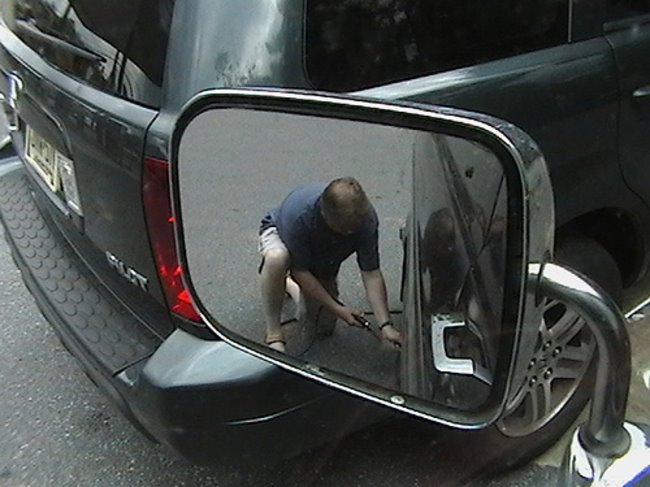
How out of touch is Barack Obama? He’s so out of touch that he suggested that if all Americans inflated their tires properly and took their cars for regular tune-ups, they could save as much oil as new offshore drilling would produce. Gleeful Republicans have made this their daily talking point; Rush Limbaugh is having a field day; and the Republican National Committee is sending tire gauges labeled “Barack Obama’s Energy Plan” to Washington reporters.

But who’s really out of touch? The Bush Administration estimates that expanded offshore drilling could increase oil production by 200,000 bbl. per day by 2030. We use about 20 million bbl. per day, so that would meet about 1% of our demand two decades from now. Meanwhile, efficiency experts say that keeping tires inflated can improve gas mileage 3%, and regular maintenance can add another 4%. Many drivers already follow their advice, but if everyone did, we could immediately reduce demand several percentage points. In other words: Obama is right.

Politics ain’t beanbag, and Obama has defended himself against worse smears. The real problem with the attacks on his tire-gauge plan is that efforts to improve conservation and efficiency happen to be the best approaches to dealing with the energy crisis, the cheapest, cleanest, quickest and easiest ways to ease our addiction to oil, reduce our pain at the pump and address global warming. It’s a pretty simple concept: if our use of fossil fuels is increasing our reliance on Middle Eastern dictators while destroying the planet, maybe we ought to use less.

The RNC is trying to make the tire gauge a symbol of unseriousness, as if only the fatuous believed we could reduce our dependence on foreign oil without doing the bidding of Big Oil. But the tire gauge is really a symbol of a very serious piece of good news: we can use significantly less energy without significantly changing our lifestyle. The energy guru Amory Lovins has shown that investment in “nega-watts” — reduced electricity use through efficiency improvements is much more cost-effective than investment in new megawatts, and the same is clearly true of nega-barrels. It might not fit the worldviews of right-wingers who deny the existence of global warming and insist that reducing emissions would destroy our economy, or of left-wing Earth-firsters who insist that maintaining our creature comforts would destroy the world, but there’s a lot of simple things we can do on the demand side before we start rushing to ratchet up supply.

Source / Michael Grunwald / Time

The Rag Blog

Posted in Rag Bloggers | Tagged , , , , | Leave a comment

Robert Reich : The Heart of the Economic mess.

Former labor secretary Robert B. Reich.

Most Americans can no longer maintain their standard of living. And the core problem isn’t the housing crisis or rising oil and food prices.
By Robert B. Reich / August 4, 2008.

The Federal Reserve Board’s “beige book” for June and July offers a clear explanation for why the economy has slowed to a crawl. It shows American consumers cutting way back on their purchases of everything from food to cars, appliances and name-brand products. As they do so, employers inevitably are cutting back on the hours they need people to work for them, thereby contributing to a downward spiral.

The normal remedies for economic downturns are necessary. But even an adequate stimulus package will offer only temporary relief this time, because this isn’t a normal downturn. The problem lies deeper. Most Americans can no longer maintain their standard of living. The only lasting remedy is to improve their standard of living by widening the circle of prosperity.

The heart of the matter isn’t the collapse in housing prices or even the frenetic rise in oil and food prices. These are contributing to the mess, but they are not creating it directly. The basic reality is this: For most Americans, earnings have not kept up with the cost of living. This is not a new phenomenon, but it has finally caught up with the pocketbooks of average people. If you look at the earnings of nongovernment workers, especially the hourly workers who comprise 80 percent of the work force, you’ll find they are barely higher than they were in the mid-1970s, adjusted for inflation. The income of a man in his 30s is now 12 percent below that of a man his age three decades ago. Per-person productivity has grown considerably since then, but most Americans have not reaped the benefits of those productivity gains. They’ve gone largely to the top.

Inequality on this scale is bad for many reasons, but it is also bad for the economy. The wealthy devote a smaller percentage of their earnings to buying things than the rest of us because, after all, they’re rich. They already have most of what they want. Instead of buying, the very wealthy are more likely to invest their earnings wherever around the world they can get the highest return.

This underlying earnings problem has been masked for years as middle- and lower-income Americans found means to live beyond their paychecks. But they have now run out of such coping mechanisms. As I’ve noted elsewhere, the first coping mechanism was to send more women into paid work. Most women streamed into the work force in the 1970s less because new professional opportunities opened up to them than because they had to prop up family incomes. The percentage of American working mothers with school-age children has almost doubled since 1970, to more than 70 percent. But there’s a limit to how many mothers can maintain paying jobs.

So Americans turned to a second way of spending beyond their hourly wages: They worked more hours. The typical American now works more each year than he or she did three decades ago. Americans became veritable workaholics, putting in 350 more hours a year than the average European, more even than the notoriously industrious Japanese.

But there’s also a limit to how many hours Americans can put into work, so Americans turned to a third coping mechanism: They began to borrow. With housing prices rising briskly through the 1990s and even faster from 2002 to 2006, they turned their homes into piggy banks by refinancing home mortgages and taking out home-equity loans. But this third strategy also had a built-in limit. And now, with the bursting of the housing bubble, the piggy banks are closing. Americans are reaching the end of their ability to borrow, and lenders have reached the end of their capacity to lend. Credit-card debt, meanwhile, has reached dangerous proportions. Banks are now pulling back.

As a result, typical Americans have run out of coping mechanisms to keep up their standard of living. That means there’s not enough purchasing power in the economy to buy all the goods and services it’s producing. We’re finally reaping the whirlwind of widening inequality and ever-more-concentrated wealth.

The only way to keep the economy going over the long run is to increase the real earnings of middle-class and lower-middle-class Americans. The answer is not to protect jobs through trade protection — that would only drive up the prices of everything purchased from abroad. Most routine jobs are being automated anyway. Nor is the answer to give tax breaks to the very wealthy and to giant corporations in the hope they will trickle down to everyone else. We’ve tried that, and it hasn’t worked. Nothing has trickled down.

Rather, the long-term answer is for us to invest in the productivity of our working people — enabling families to afford health insurance and have access to good schools and higher education — while also rebuilding our infrastructure and investing in the clean energy technologies of the future. We must also adopt progressive taxes at the federal, state and local levels. In other words, we must rebuild the American economy from the bottom up. It cannot be rebuilt from the top down.

Robert Reich is a professor of public policy at the Richard and Rhoda Goldman School of Public Policy at the University of California at Berkeley. He was secretary of labor in the Clinton administration.

Source / AlterNet

The Rag Blog

Posted in RagBlog | Tagged , , , , | Leave a comment

Houston Demonstrators Join World-Wide Protest Against Attacking Iran

A diverse, multi-generational group demonstrated on August 1 in Houston to demand that the US and Israel halt any plans for a war on Iran. Photo by Gloria Rubac.

‘In our name, with our money, they are killing people across the world.’
By Gloria Rubac / August 4, 2008

The threat of a U.S./Israeli attack against Iran is growing – but so is grassroots opposition.

Over the weekend of August 1-3, thousands of people from coast to coast and around the world gathered to demand no new war on Iran. Activists in Houston gathered at the Mickey Leland Federal Building on August 1.

On June 12, the Stop War on Iran Campaign issued an emergency call to action for August 2. Response was overwhelming, and activists had actions in more than 87 cities, including Los Angeles, New York, Boston, and Washington DC, as well as in smaller towns and cities like Westbrook, Maine; Melbourne and Ocala, Fla.; Charlotte, N.C.; Bozeman, Mont.; Salt Lake City; Oklahoma City, and Tucson, Ariz. Organizers as far away as Hawaii mobilized to protest as an attack against Iran is threatened daily.

Protests also took place in Australia, China, France, Germany, Italy, Japan, Bangladesh and a number of countries in the Middle East. There were also actions in cities across Canada.

Houston activists representing many organizations spoke on an open microphone on August 1, during a protest at the Mickey Leland Federal Building, to denounce any plans to make war on Iran. “We have so many issues to fight right here at home. We don’t need to make war on Iran,” said Alma Diaz, co-host of KPFT Pacifica’s Proyecto Latino Americano. “Tomorrow morning we are going to confront the racist Border Watch at a job site and we urge you to join us.”

The Troops Out Now Coalition organized the Houston protest and about 40 people came out in the 100-degree sun for almost 2 hours, attracting the attention of federal employees as well as motorists passing by in the 5 o’clock traffic. They occupied both corners of the federal building on St. Joseph Parkway.

Reactions to signs that read, “Honk to Stop War” were received with continuous honking and with waving and peace signs from car windows. People walking to bus stops signed petitions for “No War on Iran” and took leaflets with information about the US’s latest threats in the Middle East.

A representative of the Council on American-Islamic Relations, Ali Khalili, spoke. “Enough is enough,” said Khalili. “In our name, with our money, they are killing people across the world.” Khalili also accused the administration of lying to gain support for the war in Iraq and says the White House is using the same tactic to convince the American public to support a war with Iran. “We waged war in Iraq. More than a million innocent men, women and children have died,” he adds.

Members of the Harris County Green Party, Women’s International League for Peace and Freedom, the Houston Peace Forum, the Houston Peace and Justice Center, the Council on American-Islamic Relations, Code Pink, Texas Death Penalty Abolition Movement, Houston Coalition for Justice, justice for Palestinians, Venezuela Viva and several immigrant rights activists took part in Houston’s protest.

Njeri Shakur, an anti-death penalty activist who gathered sheets of signatures on petitions opposing a war on Iran during the protest said, “Peoples’ lives are in a crisis with the rising gas prices, rising rents and food costs. It is so clear that even in Houston, Texas, home of former President George Bush, people are sick of war and want our tax money to be spent on the real needs of the people. “

Source / Houston Independent Media Center

The Rag Blog

Posted in RagBlog | Tagged , , , , | Leave a comment

Grits for Breakfast :
Texas Jail Crisis : Pretrial Detention up nearly 50%

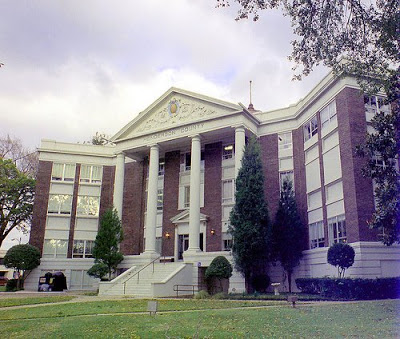
photo of Henderson County Courthouse

Henderson County (Texas) Courthouse. Photo by Bob Weston.

Dumping Debra and Donna: Counties should reduce pretrial incarceration if they can’t afford health costs

By Grits for Breakfast | The Rag Blog | August 4, 2008

Over the last decade or so, even as crime has declined, most Texas jails have gotten fuller mostly because of a dramatic expansion in pretrial detention – in particular requiring bail instead of releasing offenders on personal recognizance bonds.

Indeed, for reasons I cannot explain, this pattern constitutes a statewide trend even though the decisions behind it are all made by local judges. According to Dr. Tony Fabelo, overall jail populations in Texas increased 18.6% between 2000-2007, while the number of pretrial detainees increased 49.2% over the same period.

With this decision, though, comes all the costs resulting from jail overcrowding – particularly health care for inmates.

In two ugly cases this year in Henderson County, a judge refused to offer a female defendant a personal bond, then while incarcerated they became sick unto death. Reports the Athens Review (“Second inmate dies after jail release,” Aug. 1 ):

Like Debra Lee Newton, Donna Carroll, 49, of Mabank was released from jail on a personal recognizance bond a few days before she died earlier this month.

The cases of the two women are similar in some respects.

Both were handled by area police on drug charges. Both became ill while in the Henderson County Jail. And both were released on $5,000 personal recognizance bonds once it was determined they needed major medical attention.

Both also died within several days of being released from Henderson County Sheriff’s Department custody.

While Newton’s body was disposed of without an autopsy being performed, Carroll’s body was autopsied.

The difference?

Carrol’s death was “unattended” at her home in Mabank. State law requires that all such deaths undergo autopsy.

Newton died at ETMC as a patient of the hospital.

The article goes on to speculate that health problems related to meth abuse may have caused these women’s deaths, but there are policy concerns that won’t be satisfied with that explanation.

In the case of Debra Newton, she’d been in the jail two months before a judge released her on a personal bond and deputies took her to the local hospital where she later died. So even if drug abuse caused her problem, she’d presumably been off drugs and under the jail’s care for two full months. If either a) she was able to get drugs in the jail or b) the Sheriff did not provide adequate health care, the county may still be at fault.

Finding another, similar case makes me think the county simply has too many people in its jail to provide adequate health care. These women had not been sentenced, they were being held pretrial on drug charges because they could not make bail and a judge denied them personal bonds. Then, when healthcare costs became too dear, probably the same judge decided they were safe to release on their own recognizance, conveniently eliminating the county’s obligation to pick up the tab for their health care.

When judges require bail for low-level offenses, they’re undertaking costs to the taxpayers that can easily rise if the person gets sick or must stay in jail many months awaiting trial. Counties unwilling to meet their obligation to provide health care to inmates shouldn’t incarcerate so many of them prior to sentencing. But once they do, they’re the county’s responsibility when they get sick; jailers and judges can’t just dump sick inmates at home or in the local E.R. and wash their hands of the matter.

Posted in RagBlog | Tagged , , , | Leave a comment

Solar Power Breakthrough Stores Energy for Later Use

MIT’s Daniel Nocera.

‘Now we can seriously think about solar power as unlimited and soon’
August 2, 2008

CAMBRIDGE, Mass. – Within 10 years, homeowners could power their homes in daylight with solar photovoltaic cells, while using excess solar energy to produce hydrogen and oxygen from water to power a household fuel cell. If the new process developed at the Massachusetts Institute of Technology finds acceptance in the marketplace, electricity-by-wire from a central source could be a thing of the past.

“This is the nirvana of what we’ve been talking about for years,” said MIT’s Daniel Nocera, senior author of a paper describing the simple, inexpensive, and efficient process for storing solar energy in the July 31 issue of the journal “Science.”

“Solar power has always been a limited, far-off solution. Now we can seriously think about solar power as unlimited and soon,” Nocera said.

Until now, solar power has been a daytime-only energy source, because storing extra solar energy for later use is expensive and inefficient. But Nocera and his team of researchers have hit upon an elegant solution.

Inspired by the photosynthesis performed by plants, Nocera and Matthew Kanan, a postdoctoral fellow in Nocera’s lab, have developed a new process that will allow the Sun’s energy to be used to split water into hydrogen and oxygen gases.

Later, the oxygen and hydrogen can be recombined inside a fuel cell, creating carbon-free electricity to power buildings, homes or electric cars – day or night.

The key component in the new process is a new catalyst that produces oxygen gas from water – another catalyst produces valuable hydrogen gas.

The new catalyst consists of cobalt metal, phosphate and an electrode, placed in water.

When electricity from a photovoltaic cell, a wind turbine or any other source runs through the electrode, the cobalt and phosphate form a thin film on the electrode, and oxygen gas is produced.

Combined with another catalyst, such as platinum, that can produce hydrogen gas from water, the system can duplicate the water splitting reaction that occurs in plants during photosynthesis.

The new catalyst works at room temperature, in neutral pH water, and is easy to set up, Nocera said. “That’s why I know this is going to work. It’s so easy to implement,” he said.

Sunlight has the greatest potential of any power source to solve the world’s energy problems, said Nocera. In one hour, enough sunlight strikes the Earth to provide the entire planet’s energy needs for one year.

James Barber, a leader in the study of photosynthesis who was not involved in this research, called the discovery by Nocera and Kanan a “giant leap” toward generating clean, carbon-free energy on a massive scale.

“This is a major discovery with enormous implications for the future prosperity of humankind,” said Barber, the Ernst Chain Professor of Biochemistry at Imperial College London. “The importance of their discovery cannot be overstated since it opens up the door for developing new technologies for energy production thus reducing our dependence for fossil fuels and addressing the global climate change problem.”

Currently available electrolyzers, which split water with electricity and are often used industrially, are not suited for artificial photosynthesis because they are very expensive and require an environment that has little to do with the conditions under which photosynthesis operates.

More engineering work needs to be done to integrate the new scientific discovery into existing photovoltaic systems, but Nocera said he is confident that such systems will become a reality.

“This is just the beginning,” said Nocera, principal investigator for the Solar Revolution Project funded by the Chesonis Family Foundation and co-Director of the Eni-MIT Solar Frontiers Center. “The scientific community is really going to run with this.”

The project is part of the MIT Energy Initiative, a program designed to help transform the global energy system to meet the needs of the future and to help build a bridge to that future by improving today’s energy systems.

MITEI Director Ernest Moniz said, “This discovery in the Nocera lab demonstrates that moving up the transformation of our energy supply system to one based on renewables will depend heavily on frontier basic science.”

This project was funded by the National Science Foundation and by the Chesonis Family Foundation, which gave MIT $10 million this spring to launch the Solar Revolution Project, with a goal to make the large scale deployment of solar energy within 10 years.

Copyright Environment News Service (ENS) 2008. All rights reserved.

Source / Environment News Service

Thanks to CommonDreams / The Rag Blog

Posted in RagBlog | Tagged , , , | Leave a comment

Turning the American Dream Into Cold Cash

Jennifer Marcoe holds the opal ring she received on her first Mother’s Day. The ring is one of the treasures the family has had to pawn in order to make ends meet after husband Richard was laid off. The family is among a growing number of people who’ve been forced to turn to pawnshops and online auctions to raise money to pay the bills. Photo: THOMAS JAMES HURST / THE SEATTLE TIMES

Survival for Sale
By Nancy Bartley / August 4, 2008

At the pawnshop, the needs and the sacrifices are getting bigger.

It’s mid-week, the end of the month, and the wolverine is leaving the pawnshop. When it returns a few weeks later — jaws frozen in a timeless snarl — it’s a sign Charlie is broke. It’s a situation to which he’s become accustomed.

Ever since Charlie was young, growing up in Anchorage, the offspring of Eskimos who made their living in the wilderness, the wolverine was a fixture on the living-room walls, first at Charlie’s grandfather’s house, then his father’s.

Forty years ago Charlie’s great-grandfather trapped it, and over decades it was passed from one relative to another until it came to Charlie — a token of the life his ancestors once lived.

Now it hangs in Charlie’s Everett apartment.

When Charlie was injured on the job at a meat-packing company four years ago, he was unable to go back to the physically demanding work and had to take lesser-paying jobs like the one he has now as an apartment manager.

When his paycheck doesn’t stretch far enough, the prized family heirloom comes to the rescue.

In 2004, Charlie, whose lack of funds makes him too embarrassed to give his last name, took the wolverine to Pacific Pawn in Everett for the first time and used it as collateral for a loan.

Now with the cost of living higher than ever, the wolverine is back in action, being checked in and out of Pacific Pawn as if it were a hotel for taxidermied animals. There’s a python skin on the ceiling and the heads of a moose, a seal and a bison. There’s a raccoon and a duck, too, along with spare parts for humans like prosthetic legs, glass eyes and dentures as well as the usual pawnshop fare — DVDs, wedding rings, power tools and electric guitars.

As the price of gasoline and food soars and the resale value of houses drops, adjustable-rate interest on mortgages climbs and companies lay off employees, these once-cherished family treasures have become commodities traded for dollars to help people trying to make ends meet.

They are being traded at pawnshops, flea markets and online auctions in record numbers, and in many cases are making the difference between eating and going hungry, paying the mortgage and living on the street. And often, the sales are augmenting other urgent efforts to raise money — from hawking sewing, carpentry, computer and other skills to selling blood plasma.

“We are seeing significant growth” in listings, says chief executive officer Maureen Ellenberger at auctionPal, an online business that helps people sell things. On the listing form, auctionPal asks why the item is being sold, and “a lot of people are putting down, ‘I need the money,’ ” Ellenberger says. Recently she listed an entire set of Waterford crystal purchased for a wedding 18 years ago simply because the owner was desperate to pay the rent.

Tony Hargrove searches for a customer’s things held in the back of Pacific Pawn in Everett. Pawnshops store items they loan money on for 90 days. If a customer does not repay the loan or the accrued interest on the loan, the pawn broker can put the item on the shop floor to be sold. Photo: THOMAS JAMES HURST / THE SEATTLE TIMES

“They’re selling things like children’s clothing, things they’d never thought of selling before,” she says. “Or they’re selling things their mother had given them. We feel it’s pretty tough out there.”

Nancy Baughman, chief executive officer of the online e-BizAuctions.com, agrees.

The rising cost of gas tipped the scales for people who already were having a difficult time financially, she says.

“One gentleman lost his job and now he’s selling all his movie memorabilia. A lady on disability is selling her grandmother’s things. It’s heartbreaking. I do what I can for the people.”

Craigslist.com CEO Jim Buckmaster says the online classified-ad site in the first few months of 2008 had a “tremendous surge of activity” in its for-sale section — “beyond anything we’ve really seen before, to the point where we’re scrambling to add additional server capacity.” Especially busy, he noted, is the cars/trucks category “as millions of Americans look to unload their gas guzzlers — which puts money in their pockets and reduces the need for expensive gasoline.” In April 2007, the Web site listed 8 million cars and trucks for sale; a year later, it was 19 million.

The past few months have brought a big change to the pawnshop industry in general, says Nick Buell, state president of the trade group Washington Pawnbrokers Association.

Buell, owner of Kent Jewelry & Loan, says not only are a lot more people coming in, “there’s a change in the nature of why they’re getting loans. Yesterday, half the loans went to people who needed gas money. Some said it was just to get to work. The gas prices are killing them.”

In the past, he says, people got loans for more mundane things like entertainment or a household item or a vacation. “They turned to us to get them over the potholes in the road. Not anymore. Now it’s for survival.”

WHEN CHARLIE pushed open the barred door with the “Nordstrom of pawn shops” sign, carrying the wolverine under his arm, Jeff Maxwell gave him a smile of recognition and got out the paperwork. After four years of making loans on the wolverine, they don’t haggle over prices. The head is tagged, Charlie gets 50 bucks, and he’ll be back to pay off his loan, plus 3 percent interest, in a few weeks.

Pawnshops are regulated by the state, and the amount of interest they can charge is limited to 3 percent, for a maximum of 90 days, plus setup fees, unless a loan is extended. After 90 days, an item can be sold if it hasn’t been reclaimed and the loan repaid.

If the customers are a few days over, Tony Hargrove and Maxwell, both longtime employees, are forgiving and not quick to put the item up for sale. That’s earned them praise and a loyal following. “It’s a family place,” Charlie says. “They’re always willing to help.”

If possible.

Sometimes it’s not. A Graham man who’d lost his heavy-equipment-operator’s job in Enumclaw came into the shop to pawn a rifle scope, binoculars, wedding ring and other items with a retail value of $700. The best he could get was $100.

Although the man begged, Maxwell shook his head, telling him they had to buy items at a low-enough price to still make a profit.

“How can you guys sleep at night?” asked the man, who left in anger.

Although customers who want more for their goods occasionally criticize Maxwell and Hargrove, they say the business is a community service. Hargrove even plays uncle to a generation of kids who visit the shop. He pulls peppermint candy from their ears and keeps a dish on the counter. A champion kick-boxer who’s adept at handling any customer, Hargrove sees it this way:

“They help us and we help them.”

It’s not much different at Yuppie Pawn in Kirkland, a pirate ship of toys for rich boys who also have fallen on hard times. A builder brought in his collection of weapons, including a semi-automatic rifle so high-tech the Terminator could have used it.

In a red building tucked behind a bank, the shop is packed with priceless trinkets: lacquered humidors for keeping cigars, bottles of vintage Champagne and signed photos of sports stars.

“Our economy is so bad the only thing I’m taking now are motorcycles, Rolexes, gold, DVDs, snowmobiles, some original art, jet skis, some cars. Things unique enough we can sell for a low price,” says owner Brian Lurie, who started Yuppie Pawn in 1992 after his real-estate ventures stopped making money.

“I don’t want your laptops, your generators . . . We only take two out of 10 things that walk in the door.”

Like the sleek HK 223-caliber rifle once owned by a real-estate developer who needed cash. “I don’t know what you use this for,” he says, taking the rifle from a vault where he keeps it. “Home defense?”

“This past year’s volume of items for sale and the volume of dollars we’re taking out is so much bigger than before,” he says, attributing his store’s success to the cost of gas, the rise in interest rates and those people who still can afford to shop but want a bargain.

Lurie knows firsthand that “when you’re making a lot of money you live big.” But when hard times come, you’ve got a mortgage to pay like anyone else.

In hard times, it all comes down to sacrificing even very personal items.

THE GOLD NECKLACES

At Kent Jewelry & Loan, Colleen O’Neil pulls a handful of broken gold necklaces out of a brown sack. Frank Buell, Nick Buell’s son, weighs them carefully. Gold is selling high right now, so many in need are cleaning out their jewelry boxes or even bringing in old gold dental crowns to sell.

O’Neil, who was laid off from her job with the city of Seattle, didn’t have the money to fill her tank with gas to go to job interviews.

“It was my son’s idea to take this stuff to a pawnshop,” she says. She leaves with $80, having sold jewelry she hadn’t worn in years.

“She’s a prime example of the people we’re seeing now,” Nick Buell says. “Lots of upper-middle-class people who are short 50 or 60 bucks.”

THE AMETHYST RING

The boxes are packed in Suzanne Lorimer’s drafty Federal Way home. She says she’s eager to leave and head back to California to move in with a friend until she can find a job and get back on her feet.

A year ago, a complicated illness cost Lorimer her job as a paralegal. It was impossible to both work and go to all the doctor appointments for her chronic joint problems. Many surgeries later, she remains unemployed. Lorimer, 45, quickly went through her savings, sold her stocks and eventually was unable to pay the heating bill at her rental house. When the owner wanted to raise the rent, it was more than Lorimer could bear. She gave her notice. And she’s been selling as much as she can to raise cash to move.

“A friend once gave me a Coach purse,” she says. “I sold it for $50. I needed gas to take my son to school. What else could I do?”

She sold the family’s heirloom piano, but her mother bought it back for her. “I’m trying to hang on to that.”

The amethyst ring Lorimer listed on craigslist.com was given to her by her grandmother almost 30 years ago. “I remember hearing stories of the family and the things they had to do and sacrifices they had to make, like not being able to buy a new pair of shoes and always having to get secondhand things during the Depression.

“If anyone would understand my having to sell this ring, my grandmother would.”

THE BABY’S HIGH CHAIR

It’s new, shiny, sleek, gray and crème with two trays — a deluxe high chair for their youngest son, who’s 10 months old.

“He used it only twice, but if it can get us food on the table, it’s one of those things we don’t need,” says Jennifer Marcoe, 25, who put it on craigslist. She also listed necklaces and an opal ring, given to her on her first Mother’s Day.

The ring “has significant value as far as emotional attachment, but I have to do what I have to do. I will always have the memory.”

Jennifer’s husband, Richard Marcoe, 28, is a plumber, but as the housing market slowed, so did his business.

“We’re not ones who’ve ever lived off the state,” she says.

So when she went to apply for food stamps, she was surprised that the family of four — with their $2,100-a-month income, minus $910 in rent, $200 in utilities, car insurance and a car payment — made too much to qualify. She’s learned frugality and stretching the food budget to the max.

“Do you know how much I could buy with $200 in food stamps?” she asks.

As for the high chair, “most of the time, one of us holds him and one feeds him,” Jennifer says.

So many people are struggling, she says, “and it seems the government doesn’t care. I cried last night for a good hour. I just cried because I don’t know what we’re going to do.”

THE ELECTRONIC GAMES

Midmorning not long ago, Wes Smith sauntered into Pacific Pawn, a fresh needle stick in his arm and a handful of electronic games to sell. Smith, who has the names of his sons, David and Jaiden, tattooed on the sides of his neck, is 31, an unemployed security guard who just sold his plasma to help support his family.

His wife, Shaunna, 21, is pregnant and stays home.

Smith is hopeful he’ll get a job soon and be able to move his family out of their federally subsidized apartment in Everett, where they live on $400 to $600 a month and food stamps.

“The cost of everything is killing me,” he says. “Gas, stamps at 42 cents, and kids aren’t getting any cheaper.” He’s listed his truck for sale. He’ll worry about transportation when he gets a job. Because he grew up in foster care in Arizona and dropped out of high school, he wants more for his kids. Patting David’s head as the boy hides his face against his father’s legs, Smith elaborates:

“I want to raise my family like I never got to be raised. We live in a ghetto neighborhood with gang violence and all that. I want to move my family out of that.”

He hopes he’ll be employed soon at a nearby casino and once again have benefits. Until then, there’s the pawnshop, he says, pocketing the $180 he just made.

THE FAIRY DOLL

Her mother made the soft-bodied fairy doll, but when it becomes difficult to pay the rent, it’s no time to be sentimental, Tamra Valle believes.

Tamra and John Valle of Duvall are in their early 30s, both working — one at Safeway, one at Bartell Drugs — and have a 13-year-old daughter. But they, too, are selling all kinds of personal items.

“It’s not that I don’t value it, it’s that I value eating and driving more,” Tamra explains. Her husband’s sword collection went, her rings and finally the little soft-bodied doll made by her mother, listed online for an asking price of $100.

With $1,300 rent, a car payment, $200 a month just for the gas to heat the house and paying other bills, little is left over.

“We sold our condo after the property taxes blew up,” she says. “We don’t drive as much. We cut down on our food bill and use coupons. We haven’t bought clothes in a while. We don’t get a lot of extras like ice cream, just the necessities — fruit and vegetables and meat, the cheap cuts.”

EBay sales have tided them over. But the frustration of never having enough money “makes me want to move . . . maybe to northern Idaho. It’s so expensive here.”

THE HEDGE TRIMMER AND BIKE

Rick Gallegos, 45, was wide-eyed, a man in shock. He had spent the day trying unsuccessfully to find cars to fix and other ways to make a few bucks, and now he is at Yuppie Pawn, pawning the basics of yard maintenance and his weekend touring bike to fill his truck with gas. His middle-class life seems to be sliding away.

For many years, Gallegos — who grew up traveling the world with his diplomat father, who worked for the United Nations — was employed at a bio-tech company that made defibrillators. Not long ago, the company outsourced the work, and he lost his job. Gallegos’ wife works as a bus driver, and he gets $295 a week in unemployment. But with the $3,000-a-month mortgage on their Duvall home, gas and groceries and supporting his 16-year-old son, “we’re living well below our means.”

It rankles him that corporate executives bring in salaries in the high seven figures and outsource the work overseas.

“What can possibly justify that kind of money?” he asks. “Outsourcing is killing anyone with a drive.”

He glances around the pawnshop as if looking for the scuba gear he already brought in. Some of the disappearing trappings of the life he once knew.

Nancy Bartley is a Seattle Times staff reporter. She can be reached at 206-464-8522 or nbartley@seattletimes.com. Thomas James Hurst is a Times staff photographer.

Copyright © 2008 The Seattle Times Company

Source / Seattle Times, Pacific Northwest magazine

The Rag Blog

Posted in RagBlog | Tagged , , | Leave a comment

FILM : The Sociology of Wealth in the USA

Johnson and Johnson heir and filmaker Jamie Johnson.

‘Johnson is obviously thoughtful and also disturbed by his view from the top of the class pyramid of American society’
By Roger Baker / The Rag Blog / August 4, 2008

Having no choice but the slim pickings at Blockbuster to rent a video for entertainment (San Antonio is apparently without a good classic and art video store like Vulcan Video in Austin), I carefully studied the small foreign and documentary section and lucked into two very good ones. First “Why We Fight” about Rumsfeld, Cheney and the military-industrial complex that inevitably pushes us toward war.

My other interestig choice was “Born Rich”, about the sociology of the kids of the ultra-wealthy in the USA. “Born Rich” was made by Johnson and Johnson heir Jamie Johnson, who got in trouble for revealing and discussing the existence of class in the USA . His video has not always flattering portraits of super-rich kids, to which he had unique access because of his own status as a wealthy heir.

“Born Rich” got a lot of exposure after it got picked up by HBO.

Johnson made a second video titled “The One Percent”, which is discussed
here.

Johnson is obviously thoughtful and also disturbed by his view from the top of the class pyramid of American society. The born-rich seem by and large to be average decent kids. But they are born into an exclusive insular class and culture in partial denial of their class status. It often considers discussing money tacky. It is logical that this should be the case, since the super-rich families usually hire the best top managers for increasing their wealth. There are certain things that it is impolite to know about or discuss, whether it is in the details of making the high possible profit or sausage.

Naturally the super-rich regard the latest crop of mere centa-millionaires as troublesome interlopers that get in the way of high society, as opposed to the old wealth and megawealth that make it into the Fortune 500. One pattern is that the super-rich tend by their nature to create exclusive self-perpetuating tribal, social institutions of denial. Blue blood social structures that prevent any feedback arising from the spreading discontent at the bottom from ever reaching and destabilizing or exerting influence at the top.

At least Jamie Johnson is willing to break the code of silence and let us see and try to understand the newest generation of the hereditary US ruling class up close, as the economic base of the pyramid of US wealth erodes. Will the hereditary super-rich in the USA react in similar ways to the British aristocracy, after Britain’s loss of economic power after WWI?

The Rag Blog

Posted in Rag Bloggers | Tagged , , , , | 1 Comment

Foster Kids In Texas Get Lots of Meds

Copyright © Illustration by Olaf Hajek.

They get ‘three times the amount of psychotropic meds as their non-fostered Medicaid counterparts’
By Craig Malisow / August 4, 2008

As if they weren’t getting shafted enough, foster kids on Medicaid in Texas are receiving at least three times the amount of psychotropic meds as their non-fostered Medicaid counterparts – without any proven benefits.

This is according to a study led by Julie Zito, a professor of pharmacy and psychiatry at the University of Maryland-Baltimore, and published in the January issue of the journal Pediatrics.

The findings were based on the review of 32,135 Texas foster care kids enrolled in Medicaid between September 2003 and August 2004. More than 75 percent of the medications were used “off-label,” meaning not for their prescribed purposes.

“When two-thirds of foster care adolescents receive treatment for emotional and behavioral problems, far in excess of the proportion in non-foster care population, we should have assurances that the youth are benefiting from such treatment,” Zito testified in May, before a subcommittee of the U.S. House Ways and Means Committee.

She also testified that “Poverty, social deprivation, and unsafe living environments do not necessarily justify complex, poorly evidenced psychopharmacologic drug regimens.”

Read Zito’s complete testimony here.

Source / Houston Press

The Rag Blog

Posted in RagBlog | Tagged , , , , , , | 2 Comments

Bill Richardson for Obama’s Veep? : Two Views

The nation’s only Hispanic governor, New Mexico’s Bill Richardson, formally announced his endorsement of Barack Obama Friday, March 21, in Portland, Oregon. Photo by Brandon / AP.

Richardson is ‘a vicious politician’ and an ‘opportunist’
By Mark Rudd / The Rag Blog / August 4, 2008

As a citizen of New Mexico who has had to suffer through six miserable years of Bill Richardson’s governorship, I could write a book on what a vicious politician and person he is–a true opportunist scumbag. His administration has been thoroughly incompetent, even compared to that of the libertarian jerk who preceded him, with precisely one sole purpose: to get Richardson elected President. As Secretary of Energy he proved himself to be absolutely without principle, reversing his previous positions and supporting every single nuclear initiative as well as persecuting Wen Ho Lee. His reputation as an environmentalist has no substance behind it. His sole principle iin politics and life is Bill Richardson.

Outside New Mexico, Hispanics don’t recognize him at all. his showing in the primaries was insignificant. Plus, he’s really ugly. He takes a terrible picture due to his weight problem, though his recent beard has helped a bit. He also has a terrible Bill Clinton-type womanizing reputation. If Obama selects him as VP he’ll surely bring down the ticket. I’d be surprised if the Obama people don’t already know this. They probably offered him a sinecure like UN ambassador, where he was under Clinton, in return for his switching over during the primary campaign.

Bill Richardson has the ‘best judgement and the best experience’ to be Obama’s running mate
By Michael Alan Dover / The Rag Blog / August 4, 2008

…Since Iowa I’ve been convinced that Gov. Richardson is the best VP candidate and am still convinced. It’s simply a matter of who has the best judgement and the best experience. It’s not what part of the country they are from, what states they can bring, what demographics are needed. And it’s not about having a Governor on the ticket. It’s who inspires trust. And, yes, name recognition is important, and Richardson has that.

What is really amazing is how none of the media mention him, as if two people of color on the ticket would somehow sink it. I don’t agree. It’s not just change people want. It’s honesty and fairness. To deny the VP slot to the clearly most qualified potential candidate because he would be person of color #2 on the ticket would not be fair.

I recall well the Democratic convention which nominated Sen. Lieberman. It was electrifying that a Jew had been nominated, but what was clear to me from the TV version at least was that the most electrified delegates of all were the African-American delegates! They were clearly inspired and excited by the realization that once the religion barrier had finally been broken (first a Catholic, now a Jew and now doubt one year a Muslim such as the Representative from Minnesota), the race barrier would also soon be broken. I recall well and have an MP3 of the very moving concluding prayer from that convention, by an African-American pastor from Arkansas, who went out of the way to include ecumenical content with a strong focus on Old Testament conent. I’ve posted it here.

The phrase “in the City of our God” refers to Los Angeles…

As we ready ourselves for the 2008 convention and consider our political commitments, regardless of our religious views I think it is helpful to hear this.

Now we are on the verge of breaking that very race barrier to the Democratic nomination. Nominating Gov. Richardson would not be about further breaking that race barrier. It would be about selecting the best candidate. But imagine the degree to which people of any religion or any culture or “race” would be electrified by the realization that the political process in this great democracy is potentially open to all.

[Both Mark Rudd and Michael Alan Dover are affiliated with Progressives for Obama.]

The Rag Blog

Posted in Rag Bloggers | Tagged , , | 2 Comments

FILM : Arianna Huffington on ‘Swing Vote"

Kevin Costner in ‘Swing Vote’. Photo courtesy of Walt Disney Pictures.

What the new film tells us about the ’08 race, and why Obama needs to put Kevin Costner on his iPod
By Arianna Huffington / August 4, 2008

The makers of Swing Vote, the new film starring Kevin Costner, have pulled off a rare double play, producing a smart political satire that is also heartfelt and moving. It’s also a film that turns out to be remarkably relevant to the 2008 race.

Costner plays Ernie “Bud” Johnson, a beer-drinking, unemployed resident of Texico, New Mexico who as fate — and a voting machine error — would have it, will single-handedly decide a presidential election (sure, it’s high concept, but don’t forget that in 2000 New Mexico was decided by just 366 votes). The media descends on him, as do both presidential candidates and their win-at-all-costs campaign managers.

The film has lots to say about — and gets plenty of laughs from — the evils of modern campaigns: pollsters, lobbyists, focus groups, and the inevitable mudslinging and negative ads. The film features a bunch of satiric smear ads launched by the competing candidates — incumbent GOP President Andrew Boone (Kelsey Grammar) and his Democratic challenger, Donald Greenleaf (Dennis Hopper). You can see them here, here, here, here, and here.

But as ludicrous and over-the-top as the film’s negative ads are, none of them can hold a candle to the absurd ads unleashed last week by the McCain camp and the RNC.

Paris Hilton and Britney Spears? Really? David Hasselhoff? John McCain has been waiting his whole life to run for president and the best he’s got is Britney, Paris, and the Hoff? And Moses? Everything about the McCain media reeks of desperation — and a stunning disconnect from popular culture. Does the McCain campaign’s computers have Google software than can only go back to 2003? And the RNC’s ad ended with a riff on Leo DiCaprio in Titanic. That was 1997. When John McCain still had principles.

The film shows how, in their hunger to win, the candidates are willing to say or do just about anything — and chalk it up to the price of doing business. At one point near the end of the film, both candidates have crises of conscience. President Boone, disgusted at his own willingness to abandon his core principles to court voters — “dancing the dance,” as his campaign manager calls it — wonders aloud, “What are we about?” To which his campaign manager replies: “Winning. If we don’t win, you can’t do what you set out to do. And everything you’ve done won’t matter.”

But even the two campaign managers — who are the personification of cynicism — eventually admit the emptiness of that realpolitik rationalization. When one of them bemoans “the whole bullshit system,” the other reminds him: “We are the system. If it’s bullshit, it’s because we’re bullshit.”

Watching as these two fictional candidates completely lose sight of why they are running, and lose track of everything other than winning, I couldn’t help but think of McCain, reduced to voting against the banning of torture, and denouncing his own immigration bill.

In a moving speech before the film’s climactic final debate, Bud comes to terms with his own role in the degradation of our politics:

It’s sorta like somewhere along the way I checked out, and it’s not like I had huge dreams to begin with… I have never served or sacrificed. The only heavy lifting I have ever been asked is simple stuff, like pay attention — vote. If America has a true enemy, I guess it’s me.

It’s an incredibly tough scene to pull off — but Costner does it beautifully, giving flesh and blood to a man who has stopped believing that he can make a difference or that politics matters, and has simply given up.

Bud Johnson is a powerful stand-in for the 83 million eligible Americans who didn’t vote in 2004, and is precisely the kind of voter the Obama campaign should be targeting every day. Reaching America’s Buds is more critical than ever; if we don’t, and if the Buds keep turning away, disheartened and disillusioned, we will never see real change.

Instead we’ll see campaigns spending all their time courting the affection of fickle, fence-sitting swing voters. The kinds of people who could be influenced by the Britney/Paris ad.

So each and every day Barack Obama should roll out of bed in the morning and ask himself, “What can I do to get the real life Bud Johnsons of this country to check back in, to pay attention, to vote, to reconnect to the dreams they have abandoned along the way?” I recently suggested that Obama fill his Kindle and his iPod with the great speeches of RFK and Martin Luther King. He should add Costner’s finale to the mix.

I have a very small part in Swing Vote, playing myself. Talk about type casting. We filmed in New Mexico, in an arena. I was in a booth with Aaron Brown and Lawrence O’Donnell. There were laptops all over the set, and I kept pulling up the home page of HuffPost on each of them.

We filmed my scene all night. The producers had gotten me a hotel room, but I never even saw it. We kept shooting and I eventually just went straight from the set to the airport the next morning. In between shots, we would go to Kevin Costner’s trailer and sit outside under the stars while he played guitar.

I watched Costner film his big speech that night. And it was powerful. But not nearly as powerful as it is now, in the context of the current state of the race. So go see Swing Vote. Bring your cynicism, you idealism, and a box of Kleenex.

Source / The Huffington Post

The Rag Blog

Posted in RagBlog | Tagged , , , , | 1 Comment

Barack Obama : Pride and Prejudice

Barack Obama the new Mr Darcy? Dominic Cooper played the part in the BBC adaptation of Jane Austen’s ‘Sense And Sensibility.’

Read ‘Mr. Darcy Comes Courting’ by Maureen Dowd below.

Maureen Dowd hits the nail on the head
By Steve Russell / The Rag Blog / August 4, 2008

Maureen Dowd is no Molly Ivins, but sometimes she can both hit the nail on the head and deliver a chuckle (if not the roaring belly laughs that were Molly’s stock in trade).

I don’t fear that progressives will not hold Obama’s feet to the fire.

I fear that America is not ready to vote for a non-white President. I’ll say it again: the Dems are the left party and they nominated Obama JUST BARELY. Polling suffers from the Tom Bradley error on one side and the no land line error on the other. I just don’t know. I want to believe we’re past color but it’s hard to see right now…

Folks, when it became public knowledge that I’m enrolled Cherokee, thanks to the Austin paper, my IQ went down 20 points over night. Most of the people who did not suddenly treat me differently are on the Rag list. And my experience was AUSTIN, for crying out loud, which was weird enough to vote for me [for Travis County judge] in the first place.

I can’t help but think black is a harder sell than American Indian and most of the country is not as far towards post-racialism as Austin.

Please, let me be wrong!

Mr. Darcy Comes Courting
By Maureen Dowd / August 3, 2008

WASHINGTON — It is a truth universally acknowledged that Barack Obama must continue to grovel to Hillary Clinton’s dead-enders, some of whom mutter darkly that they will not only not vote for him, they will never vote for a man again.

Obama met for an hour Tuesday with three dozen top Hillaryites at a hotel here, seeking their endorsement and beguiling their begrudging. He opened the session by saying that he knew there had been frustration about what they saw as sexism during the primary.

The Los Angeles Times reported that Hillary die-hards want to enshrine a whine in the Democratic platform about how the primaries “exposed pervasive gender bias in the media” and call on party leaders to take “immediate and public steps” to denounce any perceived bias in the future. That is one nutty idea.

Perhaps it is because feminists are still so busy cataloging past slights to Hillary that they have failed to mount a vivid defense of Michelle Obama, who has taken over from Hillary as the one conservatives like to paint as a harridan.

Before the Obama campaign even had a chance to denounce Ludacris, one of the rappers on the senator’s iPod, Hillary Inc. started to mobilize. Susie Tompkins Buell, a former Clinton bundler, told The New York Observer that Obama had to distance himself, given Ludacris’s new song rooting for Obama to “paint the White House black” and calling Hillary the b-word.

Despite Obama’s wooing, some women aren’t warming. As Carol Marin wrote in The Chicago Sun-Times, The Lanky One is like an Alice Waters organic chicken — “sleek, elegant, beautifully prepared. Too cool” — when what many working-class women are craving is mac and cheese.

In The Wall Street Journal, Amy Chozick wrote that Hillary supporters — who loved their heroine’s admission that she was on Weight Watchers — were put off by Obama’s svelte, zero-body-fat figure.

“He needs to put some meat on his bones,” said Diana Koenig, a 42-year-old Texas housewife. Another Clinton voter sniffed on a Yahoo message board: “I won’t vote for any beanpole guy.”

The odd thing is that Obama bears a distinct resemblance to the most cherished hero in chick-lit history. The senator is a modern incarnation of the clever, haughty, reserved and fastidious Mr. Darcy.

Like the leading man of Jane Austen and Bridget Jones, Obama can, as Austen wrote, draw “the attention of the room by his fine, tall person, handsome features, noble mien. …he was looked at with great admiration for about half the evening, till his manners gave a disgust which turned the tide of his popularity; for he was discovered to be proud, to be above his company, and above being pleased.”

The master of Pemberley “had yet to learn to be laught at,” and this sometimes caused “a deeper shade of hauteur” to “overspread his features.”

The New Hampshire debate incident in which Obama condescendingly said, “You’re likable enough, Hillary,” was reminiscent of that early scene in “Pride and Prejudice” when Darcy coldly refuses to dance with Elizabeth Bennet, noting, “She is tolerable; but not handsome enough to tempt me.”

Indeed, when Obama left a prayer to the Lord at the Western Wall in Jerusalem, a note that was snatched out and published, part of his plea was to “help me guard against pride.”

If Obama is Mr. Darcy, with “his pride, his abominable pride,” then America is Elizabeth Bennet, spirited, playful, democratic, financially strained, and caught up in certain prejudices. (McCain must be cast as Wickham, the rival for Elizabeth’s affections, the engaging military scamp who casts false aspersions on Darcy’s character.)

In this political version of “Pride and Prejudice,” the prejudice is racial, with only 31 percent of white voters telling The New York Times in a survey that they had a favorable opinion of Obama, compared with 83 percent of blacks.

And the prejudice is visceral: many Americans, especially blue collar, still feel uneasy about the Senate’s exotic shooting star, and he is surrounded by a miasma of ill-founded and mistaken premises.

So the novelistic tension of the 2008 race is this: Can Obama overcome his pride and Hyde Park hauteur and win America over?

Can America overcome its prejudice to elect the first black president? And can it move past its biases to figure out if Obama’s supposed conceit is really just the protective shield and defense mechanism of someone who grew up half white and half black, a perpetual outsider whose father deserted him and whose mother, while loving, sometimes did so as well?

Can Miss Bennet teach Mr. Darcy to let down his guard, be more sportive, and laugh at himself?

Source / New York Times

The Rag Blog

Posted in Rag Bloggers | Tagged , , , , , | 4 Comments

The High Costs of the Things We Like


The Climate Costs of a Glass of Milk
by Raúl Pierri

MONTEVIDEO – A simple glass of milk on the breakfast table can carry high environmental costs. Because of this, some farmers and scientists are looking for ways to reduce the impacts of agriculture and livestock, which are responsible for 12 to 14 percent of global emissions of greenhouse gases.

There are already studies to measure the climate costs of that glass of milk, or of a country’s entire milk production, from raising the cow to the final product on the table.The farming sector’s emissions of climate change gases grew nearly 17 percent between 1990 and 2005 worldwide, and the biggest increase took place in the developing South (32 percent).

The intestinal fermentation in ruminant livestock, like cattle, releases into the atmosphere methane and nitrous oxide, two potent greenhouse gases. Further emissions come from animal manure and urine, the burning of plant biomass to clear pastures, rice production and biological and chemical processes occurring in soil.

The two gases contribute 70 percent of the emissions coming from the agricultural sector. Methane and nitrous oxide, respectively, have 21 and 300 times more “greenhouse effect” than carbon dioxide, the principal gas associated with climate change, released primarily by vehicles, industry and electricity production.

While countries are looking for ways to produce more food and overcome the current food price crisis, experts from LEARN (Livestock Emission Abatement Research Network) are studying ways to reduce emissions without undercutting productivity.

That was the focus of discussion amongst officials and researchers gathered in Uruguay Jul. 21-24 for the international workshop on agricultural emissions of greenhouse gases, organised by LEARN. Tierramérica was the only media outlet present for the technical segment of the meeting.

In Uruguay, agriculture generates 91 percent of the country’s methane emissions. In neighbouring Argentina, farming and ranching are responsible for 44 percent of national greenhouse emissions.

Because it involves a sector that is very important to countries like Uruguay, the reduction of emissions must ensure that pasture-raised livestock continue to eat a natural, chemical-free diet, Luis Santos, coordinator of Uruguay’s Climate Change Unit, told Tierramérica. One option is to modify the diet of the animals, using varieties of forage that are less rich in methane, he said.

Pastureland accounts for 26 to 40 percent of the world’s productive lands. And cattle emit 37 percent of the methane and 65 percent of the nitrous oxide generated by human-led activities. The vast majority of these gases come from pastures in Latin America and Asia.

Tim Clough, a scientist from New Zealand, noted that the atmospheric concentration of nitrous oxide continues to rise 0.26 percent annually. Globally, the nitrous oxide output is dominated by agricultural sources, he said, stressing the urgent need to reduce these emissions.

The main sources of nitrous oxide in pastures are manure and nitrogen-based fertilisers. Nitrous oxide is produced in the soil through microbe processes like nitrification or the conversion of ammonium nitrate, according to Clough, an expert in soil sciences from Lincoln University in New Zealand.

Clough suggested, as is being done in his country, the use of nitrification inhibitors, chemical substances added to nitrogen fertilisers (mineral or organic) or applied directly to the soil, which inhibit the activity of bacteria.

LEARN was founded last year in New Zealand, and includes representatives from politics, science and industry from some 40 countries, including agricultural giants like the United States, Brazil, Australia, India, China and Argentina.

Its aim is to define methods for measuring, verifying, communicating and mitigating the production of greenhouse gases from the livestock sector.

“The first objective is, in the context of the Framework Convention on Climate Change, to determine the factors of emissions in order to carry out an inventory of greenhouse gases released by the sector,” explained Santos.

“The countries of the developing South, according to the Convention, must adopt measures but are not obligated, like the industrialised countries, to reduce their emissions. That is why we want to know, for the countries like New Zealand that do have an obligation, how much they emit and how they are going to cut emissions,” he said.

To that end, a New Zealand Project presented at the meeting demonstrated the procedures for tracking greenhouse gases in the farming sector. In milk production, for example, this starts with emissions from the cow itself, to industrialisation and transport.

(*Originally published by Latin American newspapers that are part of the Tierramérica network. Tierramérica is a specialised news service produced by IPS with the backing of the United Nations Development Programme, United Nations Environment Programme and the World Bank.) (END/2008)

Copyright © 2008 IPS-Inter Press Service.

Source / Common Dreams

The Rag Blog

Posted in RagBlog | Tagged , , | 1 Comment