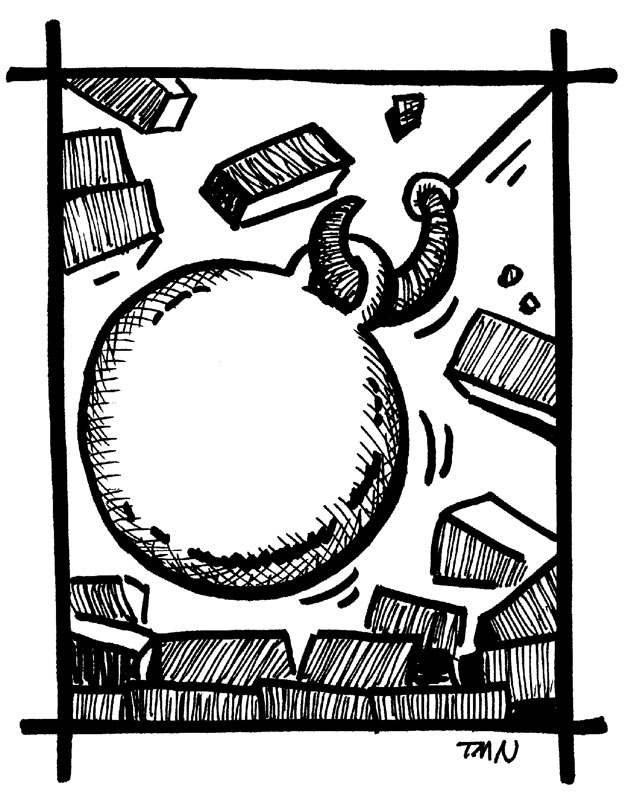
Drawn and Quartered

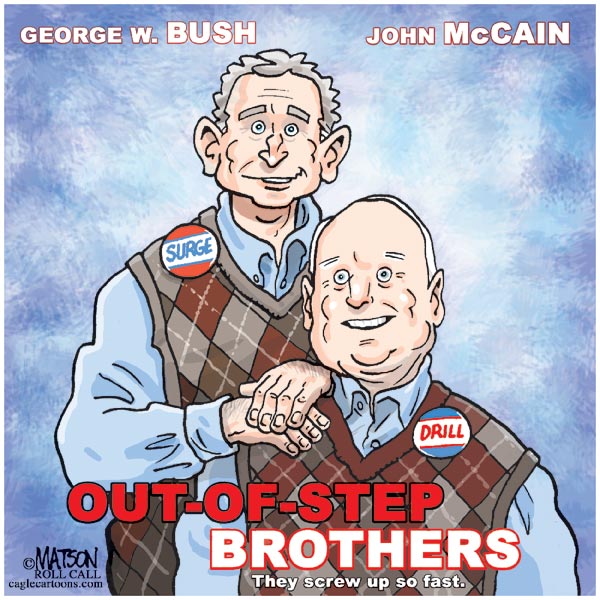
R.J. Matson / The New York Observer and Roll Call.

Thanks to Harry Edwards / The Rag Blog

Posted in RagBlog | Tagged , , , , | Leave a comment

India : On the Front Lines of the Global Food Crisis

The courtyard of the home where I stayed.

Things that go bump in the night
By Mira Kamdar / August 4, 2008

JAITU, FARIDKOT DISTRICT, India—Wrapped in a musky blanket under a fan that was frantically trying to beat the air free of mosquitoes, exhaustion was finally overtaking me when I vaguely felt something nuzzle my left hand. In theory, I was alone, deadbolted away from the family of six, who were sleeping outside on string cots so I could have the only bed in the only room of their home. At the second nudge, definitely mammalian, adrenaline flooded my body, sending me shrieking into an upright position. A rat scurried away.

I had traveled to this remote part of Punjab to try to understand India’s agricultural dilemma. Squeezed between the relentless pressure to increase production and an environment stressed to the breaking point, the agricultural miracle brought to Punjab by the Green Revolution back in the 1960s was failing, the terrible costs of its success tearing at the fabric of Punjabi society. If Punjab couldn’t find a way out of the current impasse, I didn’t see how India, or the world as a whole, was going to feed a growing population in the face of environmental collapse and growing political instability fueled by scarcity.

The next morning, after tea with milk from the cow tethered out front, my host family’s son Jitinder gave me a ride into town on the back of his motorcycle so I could attend a workshop on natural farming organized by Umendra Dutt, an agricultural activist who runs an organization called Kheti Virasat. Kheti Virasat’s work focuses on raising awareness about the damaging effects of chemical pesticides, synthetic fertilizers, and overwatering, as well as the mass dislocation of people away from their land and communities into an urban-oriented economy that can’t absorb them.

I braced myself as lightly as I could against Jitinder’s body, conscious of being a woman perched behind an unrelated man in a strongly patriarchal culture, as we wove our way out of the dirt lanes of the village and onto a narrow asphalt road that cut through an endless sea of ripening wheat, passing bullock carts piled high with fodder, tractors clanking toward the fields. I hadn’t ridden on the back of a motorcycle in a long time. It was exhilarating to feel the air whipping around my face, the throb and bob of the machine gripped between my legs. I could smell the green scent of the plants and hear the morning bustle of the birds. Farmers and laborers were already wading through the waist-high wheat, spraying pesticide by hand from backpack reservoirs.

When the Green Revolution arrived in Punjab, the “land of five rivers,” India faced chronic food shortages. A combination of massive irrigation infrastructure mandated by the Indian state, new hybrid seeds, chemical fertilizers, and pesticides boosted yields to record levels over the following decades, saving India from the specter of mass famine. With just 1.5 percent of India’s land area, Punjab produces 20 percent of the country’s wheat and 12 percent of its rice. It provides 60 percent of the government’s reserve stocks of wheat and 40 percent of its reserves of rice, the country’s buffer against starvation.

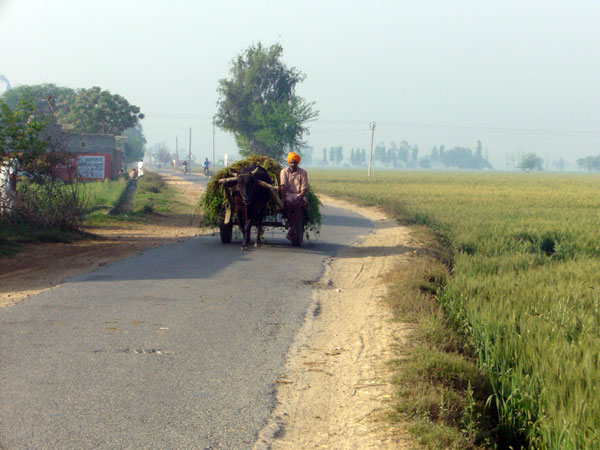
A farmer on the road.

Punjab’s amazing productivity made it possible for India to feed most of a growing population that tripled from 350 million when the country became independent in 1947 to more than 1.2 billion people today. In 2001, India even began to export grain, though critics claim this impressive achievement was gained at the expense of India’s poor.

Only two years later, in 2003, India had to reverse the funnel and import grain, something it had not done in decades. Every year since then, India has imported more and more of its food. Panic-buying by India is credited with helping to raise the price of wheat on global markets by more than 100 percent last year, causing prices to spike around the world, from pasta in Italy to bread in Russia.

In an era of global food scarcity, economic growth does not guarantee India the ability to buy as much food as it needs on the world market. And steps India has taken to liberalize its domestic grain market, a move hailed by some as a necessary corrective to a system riddled with inefficiencies and disincentives to production, may have contributed to the current food crisis by allowing agribusiness giants to siphon off huge quantities of grain.

Meanwhile, the tragic social and environmental costs of the Green Revolution are escalating, threatening a return of the political violence that took the lives of more than 25,000 Punjabis during the 1980s and ’90s when a violent secessionist movement—fueled by profound social disruption caused by the Green Revolution, which dislocated small farmers—militated for an independent Punjab, which would be called Khalistan. The movement had religious overtones derived from Punjab’s majority religion, Sikhism. The Indian state came down on the movement as hard as it could, culminating in June 1984 with an attack by the Indian army on Sikhism’s most sacred site, the Golden Temple in Amritsar. Then-Prime Minister Indira Gandhi was subsequently assassinated by her Punjabi Sikh bodyguards, after which thousands of Sikhs were massacred in retribution. The government, at the least, looked the other way.

The nasty side effects of the Green Revolution have gotten only worse in the years since. The irrigation canals are drying up. Water tables are sinking. According to a new report from Punjabi University in Patiala, pesticide levels, among the most elevated in the world, are being blamed for actually altering the DNA of Punjabis exposed to them.

Meanwhile, there aren’t enough jobs or slots at the better schools and universities. Unemployment is high. The children of farmers, who’ve grown up with the tantalizing images of the new urban India paraded before them on television, have no desire to farm but no skills to do much else. Drug addiction, fueled by heroin transited from Afghanistan via Pakistan through Indian Punjab on its way to Europe and North America, is rampant, claiming an astonishing 40 percent of the state’s youth and 48 percent of its farmers and laborers, according to one recent report.

Before my encounter with the rat, as I sat with my host family around the bed that would become mine for the night, Jitinder’s father, Prem Kumar, proudly showed me a photograph of his father, a Communist rebel who eluded Indian government forces for years. “He was never caught,” he exulted. “He fought in the tradition of Bhagat Singh,” Prem Kumar added proudly, citing a local boy turned national hero who didn’t hesitate to take up arms against the British in the early 20th century.

Prem Kumar explained to me that most of the land around the village was mortgaged to banks or private moneylenders. The water table keeps sinking, and the villagers are having trouble getting enough water to irrigate their fields. Prices for everything have gone up. Many people in the village are sick with cancer.

His 8-year-old granddaughter’s playmate came over to visit with her grandmother.

“She lost her mother just two months ago,” Prem Kumar explained.

“That’s horrible,” I replied. “What happened to her?”

“She had brain cancer,” he replied. Looking at the girl cradled in her grandmother’s lap, he sighed: “Such a beautiful child, like her mother.”

It was true, she was a beautiful child. I looked into her big brown eyes and wondered what her future held.

Source / Slate

The Rag Blog

Posted in RagBlog | Tagged , , , , , | Leave a comment

Nearly Half of all the World’s Primates at Risk of Extinction

The endangered golden lion tamarin. Photo by Anup Shah/Getty Images.

Study paints bleak picture for hundreds of species: Loss of habitat and boom in bushmeat trade blamed
By James Randerson / August 5, 2008

Nearly half of all primate species are now threatened with extinction, according to an evaluation by the International Union for the Conservation of Nature (IUCN).

The study, which drew on the work of hundreds of scientists and is the most comprehensive analysis for more than a decade, found that the conservation outlook for monkeys, apes and other primates has dramatically worsened.

In some regions, the thriving bushmeat trade means the animals are being “eaten to extinction”.

The 2007 IUCN “red list” has 39% of primate species and sub-species in the three highest threat categories – vulnerable, endangered and critically endangered. In today’s revised list, 303 of the 634 species and sub-species – 48% – are in these most threatened categories.

The two biggest threats faced by primates are habitat destruction through logging and hunting for bushmeat and the illegal wildlife trade.

“We’ve raised concerns for years about primates being in peril, but now we have solid data to show the situation is far more severe than we imagined,” said Dr Russell Mittermeier, the chairman of the IUCN Species Survival Commission’s primate specialist group and the president of Conservation International.

“Tropical forest destruction has always been the main cause, but now it appears that hunting is just as serious a threat in some areas, even where the habitat is still quite intact. In many places, primates are quite literally being eaten to extinction.”

The picture in south-east Asia is particularly bleak, where 71% of all Asia primates are now listed as threatened, and in Vietnam and Cambodia, 90% are considered at risk. Populations of gibbons, leaf monkeys and langurs have dropped due to rapid habitat loss and hunting to satisfy the Chinese medicine and pet trade.

“What is happening in south-east Asia is terrifying,” said Dr Jean-Christophe Vié, the deputy head of the IUCN species programme. “To have a group of animals under such a high level of threat is, quite frankly, unlike anything we have recorded among any other group of species to date.”

In Africa, 11 of 13 kinds of red colobus monkey have been listed as critically endangered or endangered. Two – Bouvier’s red colobus and Miss Waldron’s red colobus – may already be extinct.

Overall, 69 species and sub-species (11% of the total) are considered critically endangered, including the mountain gorilla in central Africa, Tonkin snub-nosed monkey in Vietnam and grey-shanked douc langur from Asia.

In the endangered category are another 137 species and sub-species (22%) including the Javan gibbon from Indonesia, golden lion tamarin from Brazil and Berthe’s mouse lemur from Madagascar. Species are judged to be in these categories if they have a small population size, are suffering rapid population declines and have a limited geographic range.

The apparent jump in the numbers of threatened primates from 39% to 48% has not in reality happened in the course of one year. The major new analysis has filled in missing data that was not available previously, according to Michael Hoffman at Conservation International. The last major assessment was carried out in 1996.

“The situation could well have been as bad as this, say, five years ago, we just didn’t know. But now we have a much better indication of the state of the world’s primates – and the news is not good,” he said.

The review, which is funded by Conservation International, the Margot Marsh Biodiversity Foundation, Disney’s Animal Kingdom and the IUCN is part of an unprecedented examination of the state of the world’s mammals to be released at the IUCN World Conservation Congress in Barcelona in October.

However there was some good news for primates. In Brazil, the black lion tamarin has been brought back from the brink of extinction and shifted from the critically endangered to endangered category. This is the result of a concerted conservation effort which has also benefited the golden lion tamarin – it was downlisted to endangered in 2003.

“The work with lion tamarins shows that conserving forest fragments and reforesting to create corridors that connect them is not only vital for primates, but offers the multiple benefits of maintaining healthy ecosystems and water supplies, while reducing greenhouse gas emissions that cause climate change,” said Dr Anthony Rylands, the deputy chair of the IUCN primate specialist group.

The scientists also came close to downlisting the mountain gorilla to endangered following population increases in their forest habitat that spans the borders of Rwanda, Uganda and Democratic Republic of Congo. However, political turmoil in the region and an incident in which eight animals were killed in 2007 led to the decision to delay the planned reclassification.

Primates under threat

There are 634 species and sub-species of primate including apes, monkeys, tarsiers and prosimians. Of these, 69 are now categorised as critically endangered, 137 as endangered, 97 as vulnerable and 36 as near threatened.

In Africa, 63 species or subspecies are in the top three categories (37% of African primates). The new assessment moved L’Hoest’s monkey (Cercopithecus l’hoesti), which is found in Nyungwe National Park, Rwanda, from vulnerable to endangered, for example.

In Asia, 120 species or sub-species are threatened (71%). The grey-shanked douc langur (Pygathrix cinerea) in Vietnam has been moved from endangered to critically endangered.

In Madagascar, 41 species and sub-species are threatened (43%). The black-and-white ruffed lemur, (Varecia variegata) for example, was endangered and is now considered critically endangered.

In Mexico, south and central America 79 species and sub-species are listed as threatened (40%). The cotton-top tamarin (Saguinus oedipus) is now critically endangered, but was endangered.

Source / The Guardian, U.K.

Thanks to CommonDreams / The Rag Blog

Posted in RagBlog | Tagged , , , | 1 Comment

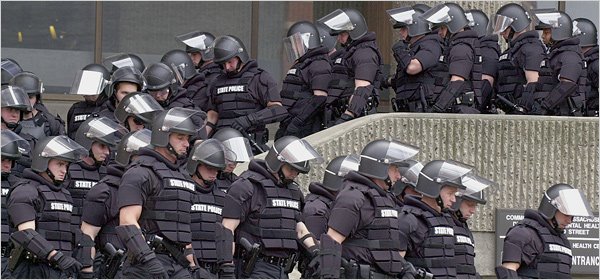
Denver Police Brace for Convention

Security was heavy for the Democratic National Convention in Boston in 2004, including state troopers in riot gear the day before it opened. This year’s convention is in Denver on Aug. 25-28. Photo by Bob Bukaty/Associated Press.

Officials ‘fearing that the convention will become a magnet for militant protest groups’
By David Johnston and Eric Schmitt / August 5, 2008

WASHINGTON — Federal and local authorities are girding for huge protests, mammoth traffic tie-ups and civil disturbances at the Democratic National Convention in Denver this month, fearing that the convention will become a magnet for militant protest groups.

Officials say that what makes Denver different than past conventions is the historic nature of Senator Barack Obama’s nomination, a megawattage event whose global spotlight could draw tens of thousands of demonstrators, including self-described anarchists who the police fear will infiltrate peaceful protest groups to disrupt the weeklong event.

The Secret Service is wary of discussing threats against the people they protect, but with Mr. Obama poised to become the first black presidential nominee, there are special worries. While law enforcement officials say there are no specific, credible threats against Mr. Obama, they expressed concern about low-level chatter on Web sites frequented by white separatists who spew hate about Mr. Obama’s race and what they perceive as his liberal agenda.

One recent scheduling change caused a major shift in security plans. When Mr. Obama announced last month that he would accept his party’s nomination not at the Pepsi Center in downtown Denver, where the convention is being held, but at Invesco Field, home of the Denver Broncos, the Secret Service scrambled to work out plans with local authorities to secure the open-air stadium, which seats more than 75,000 people. Invesco is also adjacent to Interstate 25, a major corridor through the Northern Rockies that will most likely be closed for at least part of Mr. Obama’s acceptance speech.

“The magnitude of the event has expanded,” said John W. Hickenlooper, the mayor of Denver and a Democrat. “It’s bigger and more profound than we expected.”

Officials acknowledge that their projections for the number of protesters are based more on a worst-case chain of events than specific information about who will show up, but they say they cannot take any chances.

As a result, the Secret Service, the Pentagon, the Federal Bureau of Investigation and scores of police departments are moving thousands of agents, analysts, officers and employees to Denver for the Aug. 25-28 convention. They will operate through a complex hierarchy of command centers, steering committees and protocols to respond to disruptions.

National political conventions are a chance for federal agencies to test their latest and most sophisticated technology, and this year is no different. There was a brief flare-up recently between the F.B.I. and the Secret Service, when each wanted to patrol the skies over the convention with their surveillance aircraft, packed with infrared cameras and other electronics. The issue was resolved in favor of the Secret Service, according to people briefed on the matter.

Both Denver and St. Paul, where the Republican National Convention will be held Sept. 1-4, are enlisting thousands of additional officers to help with security. Even so, their numbers will be only about a third of the 10,000 police officers that New York City fielded for the 2004 Republican convention, just three years after the Sept. 11 attacks.

The Denver Police Department will nearly double in size, according to federal officials involved in the planning. The city is bringing in nearly 1,500 police officers from communities throughout Colorado and beyond, even inviting an eight-person mounted unit from Cheyenne, Wyo. State lawmakers changed Colorado law to allow the out-of-state police officers to serve as peace officers in Denver.

The expressions of concern about security at the convention could have more immediate political and legal implications, too. A federal judge, Marcia S. Krieger of United States District Court in Denver, is expected to issue a decision this week in a lawsuit filed by the American Civil Liberties Union seeking to ease security provisions at the convention. The A.C.L.U. has suggested that the Secret Service and the Denver police have exaggerated risks as part of a crackdown on dissent.

The case centers on whether the security zone around the Pepsi Center is so large, and the designated parade route through the city for marches and rallies so far away, as to unnecessarily stifle free speech. New worries about protests and anarchy could bolster the government’s case that the plans are justified.

Last month, under pressure from the A.C.L.U. lawsuit, the city released a list of expenses related to the convention showing that the police were preparing for large demonstrations and mass arrests and that the department had spent $2.1 million on protection equipment for its officers, $1.4 million for barricades and $850,000 for supplies related to the arrest and processing of suspects.

In disclosing the cost breakdown, city officials denied rumors that had circulated for weeks that they had contemplated buying exotic nonlethal weapons that fired an immobilizing goo, or that used radiation or sonic waves to incapacitate people or vehicles.

Similar preparations are under way for the Republican convention in Minnesota, but without the harsh glare that, at the moment, seems to be focused on Denver. St. Paul’s 600-member police force will grow nearly sixfold with about 3,000 additional officers arriving from around Minnesota, as well as from Iowa, Illinois, Wisconsin and the Dakotas, said Tom Walsh, a spokesman for the St. Paul Police Department.

“St. Paul isn’t New York,” he said. “We just don’t have the staffing.”

Kenneth L. Wainstein, the White House adviser on homeland security and counterterrorism, recently visited Denver and St. Paul, a trip that reflected the administration’s interest in the conventions. “In the post-9/11 world, you have to prepare and plan for all contingencies,” Mr. Wainstein said. “That means preparing for everything from a minor disruption and an unruly individual to a broader terrorist event. We need to plan for everything no matter what the threat level is on any particular day.”

Intelligence analysts, however, have not reported a heightened threat from Islamic extremists or domestic threats from antigovernment groups or environmental militants like the kind that operate in many Western states, according to federal officials. “We just aren’t seeing a credible threat,” said James H. Davis, the F.B.I. agent in charge of the Denver office.

Each convention has been designated a National Special Security Event, which makes the Secret Service the lead federal agency responsible for protecting dignitaries and providing overall security. Other agencies will be on standby.

The National Guard in Minnesota and Colorado will each have hundreds of troops on call to their governors to help civilian medical personnel or bomb squads, for instance, if needed. National Guard specialists trained to deal with biological, chemical, nuclear and radiological weapons will also be available.

“There won’t be a visible military presence,” said Maj. Gen. Guy C. Swan III, director of operations for the military’s Northern Command, which is in charge of the military’s response to threats on American soil.

Each city has been awarded $50 million in federal funds for convention costs, a substantial part of which is being spent on security-related equipment and training. And each city has been enlisting the help of neighboring communities to provide more officers to help police the conventions.

The security and safety of convention delegates and visitors has become an increasingly significant issue in Denver and Minneapolis-St. Paul, where local officials were hoping to avoid complaints, heard in 2004 after the Democratic convention in Boston and the Republican convention in New York, that restrictive security arrangements had nearly locked down the convention sites.

From the start, the Democrats’ decision to hold their convention in Denver and the Republicans’ choice of St. Paul stirred concerns about whether local police in each city had enough officers to deal with a wide range of threats, including terrorist attacks or a lone gunman.

The most pressing fears, particularly in Denver, are that as many as 30,000 demonstrators may sweep into the city to disrupt the convention. Much of the city’s planning, in conjunction with federal authorities, has been based on the possibility of such protests, according to federal officials.

Still, these officials acknowledge that they have little concrete intelligence indicating that such large or unruly demonstrations are being planned. But, officials said they had based their assessments on groups like Recreate 68, Tent State and other activist coalitions. Organizers insist the groups are nonviolent, but to the authorities their names alone raise the specter of violent confrontations like those at the 1968 Democratic convention in Chicago.

In Denver, federal officials have expressed concern that demonstrators could try to shut down regular business at several major offices, including the Federal Reserve Bank, the United States Mint, and the federal courthouse.

“Because of the Internet, the ability of protesters to mobilize and share information has metastasized,” said Troy A. Eid, the United States attorney for Colorado. “That would be fine if it were peaceful, as we expect. But we have to plan accordingly.”

In recent days, domestic security officials issued a heightened awareness bulletin urging greater attention because of a number of factors, including the election and the conventions. But law enforcement authorities say they are trying to strike a balance between planning for every conceivable threat, including terrorist attacks and large public demonstrations, and not strangling a city’s commercial life in the process.

“We’re not looking to shut down an entire city,” said Malcolm Wiley, a Secret Service agent involved in security planning for the convention in Denver.

Source / New York Times

Thanks to Michael Pugliese / The Rag Blog

Posted in RagBlog | Leave a comment

Latest About Obama From Toby Keith, New Darling of the Right


Keith: Obama ‘Talks, Acts, And Carries Himself As A Caucasian’
By Max Blumenthal / August 5, 2008

Last week, I reported for the Huffington Post that country singer Toby Keith had performed a pro-lynching anthem on the Colbert Report, and would be playing the same song soon on the Tonight Show with Jay Leno and a slew of nationally televised talk shows.

The lyrics of Keith’s song, “Beer For My Horses,” which I transcribed, could hardly be less explicit — “Hang ’em high, for all the people to see.” In my piece, I also noted the racially tinged nature of the song’s video and the forthcoming movie that Keith’s song inspired.

The response from right-wing blogs was swift and strident. Townhall.com whined that “The Liberal Lynching of Toby Keith” had taken place; Lonewacko claimed that Keith was actually “promoting lawful executions.” And Keith found an avid defender in Robert Stacy McCain, the disgraced former Washington Times reporter and avowed neo-Confederate who once allegedly ranted in the middle of the Times newsroom that slavery was “good for the blacks and good for property owners.”

The comments section of my post was immediately swarmed by right-wing trolls twisting themselves into contortions to defend the indefensible. A typical comment read: “I can’t believe that this Max can’t find something real to complain about in this crazy world… I think Max is the bigot — he obviously hates country music, country singers and Southerners.”

Describing Keith’s over-produced truck commercial schmaltz as “country music” besmirches the dignified tradition established by Bill Monroe, Johnny Cash and Dolly Parton, while insulting the innovative artists propelling the genre into the future, from Neko Case to Son Volt to my good friend Dave Bryan (hear his music here). At his best, Keith is Merle Haggard with a lobotomy. But that’s beside the point.

The comments by the literally hundreds of trolls who leapt to Keith’s defense are significant for only one reason: they reveal the extent to which the radical right has anointed Keith as a icon of its movement. Keith’s schlock rock is the soundtrack of the culturally deprived australopithicenes who populate the cyber-caves of freeperland and comprise the movement’s most fervent activists. As a bellicose chickenhawk who has risen from the ranks of the rural working class to become “White Trash With Money,” Keith has carefully calibrated his image to fit the sensibility of his fans.

Now, Keith has trained his sights on Barack Obama, attacking him in language that startled even the notoriously reactionary radio jock Glenn Beck. During Keith’s appearance on the July 30 broadcast of Beck’s show, he remarked, “I think the black people would say he [Obama] don’t talk, act or carry himself as a black person.”

“What does that even mean?” the audibly shocked Beck replied.

“Well, I don’t know what that means,” Keith drawled, “but I think that that’s what they would say. Even though the black society would pull for him I still think that they think in the back of their mind that the only reason he is in [the general election] is because he talks, acts and carries himself as a Caucasian.”

How will Keith’s fans explain away his remarks without rejecting the essential thrust of his argument? The comments section is open.

Source / The Huffington Post

Toby Keith’s latest: Obama “talks, acts, and carries himself as a Caucasian.”

Also read MUSIC: Toby Keith’s Ode to Lynching / The Rag Blog / July 29, 2008

The Rag Blog

Posted in RagBlog | Tagged , , , , , | 1 Comment

Just Another "War on Terror" Conspiracy Theory


Vital unresolved anthrax questions and ABC News
By Glenn Greenwald

The FBI’s lead suspect in the September, 2001 anthrax attacks — Bruce E. Ivins — died Tuesday night, apparently by suicide, just as the Justice Department was about to charge him with responsibility for the attacks. For the last 18 years, Ivins was a top anthrax researcher at the U.S. Government’s biological weapons research laboratories at Ft. Detrick, Maryland, where he was one of the most elite government anthrax scientists on the research team at the U.S. Army Medical Research Institute of Infectious Disease (USAMRIID).

The 2001 anthrax attacks remain one of the great mysteries of the post-9/11 era. After 9/11 itself, the anthrax attacks were probably the most consequential event of the Bush presidency. One could make a persuasive case that they were actually more consequential. The 9/11 attacks were obviously traumatic for the country, but in the absence of the anthrax attacks, 9/11 could easily have been perceived as a single, isolated event. It was really the anthrax letters — with the first one sent on September 18, just one week after 9/11 — that severely ratcheted up the fear levels and created the climate that would dominate in this country for the next several years after. It was anthrax — sent directly into the heart of the country’s elite political and media institutions, to then-Senate Majority Leader Tom Daschle (D-SD), Sen. Pat Leahy (D-Vt), NBC News anchor Tom Brokaw, and other leading media outlets — that created the impression that social order itself was genuinely threatened by Islamic radicalism.

If the now-deceased Ivins really was the culprit behind the attacks, then that means that the anthrax came from a U.S. Government lab, sent by a top U.S. Army scientist at Ft. Detrick. Without resort to any speculation or inferences at all, it is hard to overstate the significance of that fact. From the beginning, there was a clear intent on the part of the anthrax attacker to create a link between the anthrax attacks and both Islamic radicals and the 9/11 attacks. [ … the letter sent to Brokaw is pictured above]

The letter sent to Leahy contained this message:

We have anthrax.
You die now.
Are you afraid?
Death to America.
Death to Israel.
Allah is great.

By design, those attacks put the American population into a state of intense fear of Islamic terrorism, far more than the 9/11 attacks alone could have accomplished.

Much more important than the general attempt to link the anthrax to Islamic terrorists, there was a specific intent — indispensably aided by ABC News — to link the anthrax attacks to Iraq and Saddam Hussein. In my view, and I’ve written about this several times and in great detail to no avail, the role played by ABC News in this episode is the single greatest, unresolved media scandal of this decade. News of Ivins’ suicide, which means (presumably) that the anthrax attacks originated from Ft. Detrick, adds critical new facts and heightens how scandalous ABC News’ conduct continues to be in this matter.

During the last week of October, 2001, ABC News, led by Brian Ross, continuously trumpeted the claim as their top news story that government tests conducted on the anthrax — tests conducted at Ft. Detrick — revealed that the anthrax sent to Daschele contained the chemical additive known as bentonite. ABC News, including Peter Jennings, repeatedly claimed that the presence of bentonite in the anthrax was compelling evidence that Iraq was responsible for the attacks, since — as ABC variously claimed — bentonite “is a trademark of Iraqi leader Saddam Hussein’s biological weapons program” and “only one country, Iraq, has used bentonite to produce biological weapons.”

ABC News’ claim — which they said came at first from “three well-placed but separate sources,” followed by “four well-placed and separate sources” — was completely false from the beginning. There never was any bentonite detected in the anthrax (a fact ABC News acknowledged for the first time in 2007 only as a result of my badgering them about this issue). It’s critical to note that it isn’t the case that preliminary tests really did detect bentonite and then subsequent tests found there was none. No tests ever found or even suggested the presence of bentonite. The claim was just concocted from the start. It just never happened.

Read all of it here. / Salon / Posted August 1, 2008

Thanks to Informed Comment / The Rag Blog

Posted in RagBlog | Tagged , , | Leave a comment

DEA Uses Blackwater to Raid Medical Marijuana Providers

Blackwater does the DEA’s job in Culver City, Cal.

‘I guess none of their usual buddies were available’
By Rebecca Saltzman

Last week the DEA raided a medical marijuana dispensary in Culver City, Cal., spending hours on site detaining employees and ultimately leaving the facility in disarray. This is unfortunately not an unusal story. Since 2005, the DEA has raided dozens of state-sanctioned dispensaries in California.

But this time was different. We’re used to the DEA calling in help from various federal agencies and local law enforcement. But I guess none of their usual buddies were available yesterday because from the picture below, which appeared in the LA Times today, it looks like they had to resort to calling in Blackwater:

The DEA often likes to say that medical marijuana is not their top priority (though at the height of the raids last year, they were raiding an average of one dispensary per week). They like to argue that medical marijuana raids do not take resources away from other drug interdiction. Yet this photo [above] makes me wonder – if they have sufficient resources to shut down meth labs and to bust medical marijuana providers, why do they need the help of Blackwater, a private agency?

Yet another reason we need Congress to hold oversight hearings on DEA medical marijuana activities. Good to know that House Judiciary Committee Chairman John Conyers is concerned about this issue and has already begun to question the DEA on its actions.

Source / Americans for Safe Access / Posted August 1, 2008

Thanks to Roger Baker / The Rag Blog

Posted in RagBlog | Tagged , , , , , , , , | Leave a comment

SCIENCE : Dark Energy’s Fingerprint Found in Distant Galaxies

This image was produced by combining a dozen NASA Chandra X-ray Observatory observations made of a 130 light-year region in the center of the Milky Way. When microwaves created by the Big Bang pass through large galaxies, they appear to pick up energy. The reason, say astronomers, is dark energy. Photo courtesy of NASA.

‘May be the clearest detection of dark energy to date’
By Irene Klotz / August 5, 2008

Scientists don’t know much about the mysterious phenomenon known as dark energy, but they do have a picture of what it’s doing to the universe, namely, driving it apart.

In what may be the clearest detection of dark energy to date, astronomers at the University of Hawaii looked at microwaves left over from the beginning of the universe some 13.7 billion years ago. The scientists grouped the rays depending on whether they had passed through massive clusters of galaxies or bee-lined to Earthly detectors through areas largely lacking galactic real estate.

The premise was that these “background” microwaves would pick up a little energy as they entered the clusters, urged on by the forces of gravity. But if gravity had a monopoly on the game, the rays would lose that snap as they pressed through the other side, rendering the energy gain a transitory phenomenon.

So how to explain that the microwaves passing through super-sized galaxy clusters got to keep a bit of unearned gain?

István Szapudi and colleagues believe it is because dark energy, which sometimes is referred to as anti-gravity or vacuum energy, had spread out the galaxy clusters, as it is doing to all space. By the time the microwaves exited, there was proportionally a bit less mass to deal with, leaving the rays with a slight energy advantage.

“It’s kind of like if you have a car on a hill,” explained Gary Hinshaw of NASA’s Goddard Space Flight Center in Greenbelt, Md. “You pick up energy as you’re going down, but you give it all back up again when you go up.

“What is happening here,” he added, “is that the acceleration of the universe is forcing the gravity wells to be less strong…so over the time it takes for energy to cross the cluster, the strength of the cluster has diminished.”

The measurements are difficult to make because tiny variations in the Big Bang remnant waves are larger than the observable effects of intervening galaxy clusters and voids. But by grouping together data from background radiation maps of the 50 largest galaxy clusters and the 50 largest voids, researchers were able to come up with a finding they say has only a one in 200,000 chance of being a statistical fluke.

The data was taken from Sloan Digital Sky Survey, which has mapped the distribution of galaxies in about 25 percent of the sky.

Previous dark energy studies have a one in 20 chance of being statistically coincidental, Szapudi said.

Dark energy was discovered about 10 years ago and is considered the leading outstanding puzzle in cosmology today.

“In the last six or seven billion years, the expansion of the universe has switched over from slowing down to speeding up, meaning that dark energy is becoming more dominant in controlling the growth of the universe,” Hinshaw said. “As the universe expands, matter gets more and more dilute and dark energy gets more and more dominate.”

Szapudi’s research will be published in an upcoming issue of The Astrophysical Journal.

Source / Discovery News

The Rag Blog

Posted in RagBlog | Tagged , , , , | 2 Comments

The Compromise ‘Drill Anywhere’ Plan


‘Joe Sixpack will never notice the effect of any oil recovered from these areas’
By Dean Baker / August 4, 2008

Senator McCain and the Republicans in Congress are calling Senator Obama and the Democrats environmental wimps for refusing to allow the oil industry to drill in the Arctic National Wildlife Refuge, environmentally sensitive offshore areas and anywhere else they please. The Republicans are claiming that the Democrats don’t care about Joe Sixpack, who now has to pay $4 a gallon for his gas. Nor do they care that most of this oil is now imported.

In addition to concerns about the environment, one major reason that Democrats oppose drilling is that Joe Sixpack will never notice the effect of any oil recovered from these areas, even if we did allow drilling. According to independent experts such as the Energy Information Agency, there is too little oil in the offshore protected areas to have any noticeable impact on gas prices.

In other words, we are not debating about helping Joe Sixpack pay for his gas. We are only arguing over whether to put environmentally sensitive areas at risk for nothing. The Republican claims about the impact of drilling on oil prices simply are not true.

But we all know that politics is about the art of compromise, so there is a simple compromise that opponents of drilling can put forward. Since the drilling advocates are telling us that increased drilling will bring down the price of gas, there is no reason not to take them at their word. Why not just give them the green light to drill in the Arctic National Wildlife Refuge, the Florida Coast and other offshore protected areas, Mount Rushmore and anywhere else on the planet that they want.

However, open drilling season comes with a simple quid pro quo. The oil industry gets slapped with a windfall profits tax that takes away any revenue in excess of $3 a gallon. Since we know it takes time to search for oil and drill wells, we can even give the oil boys a six-month grace period before the windfall tax takes effect.

Based on what Senator McCain and the Republicans are telling us, this windfall profits tax shouldn’t be of any concern to the industry. After all, opening up these protected areas for drilling will lead to a huge gusher of new oil on the market. This increased supply should push the price of gas back below $2 a gallon. According to McCain and the Republicans, once we declare open season for drilling, $4-a-gallon gas will just be a bad memory of what happens when you let environmentalists run the country.

It would be interesting to see the response if Senator Obama or Democrats in Congress put forward this proposal. If McCain and the Republicans believe what they have been saying, then they should have no problem putting a windfall profits tax provision into their bill, since they know it will have no effect. On the other hand, if they believe what all the experts are saying – that additional drilling will have no noticeable impact on oil prices – then they will strongly oppose this bill, since it would be a huge tax on their friends in the oil industry.

In short, this compromise “drill anywhere” plan is a simple way to force Senator McCain and the Republicans to tell the country whether they really believe that drilling in protected areas will lower gas prices, or whether they are knowingly making false claims for political gain. The “drill anywhere” plan will make them tell the truth without waterboarding.

Source / truthout

The Rag Blog

Posted in RagBlog | Tagged , , , , | Leave a comment

BOOKS : Dick Reavis on Carl Oglesby

Another view of ‘Ravens in the Storm’
By Dick J. Reavis / The Rag Blog / July 5, 2008

Comrades:

A week or so ago I more or less promised a review of Oglesby’s Ravens in the Storm. I have read the book and don’t think I have much to add to Wizard’s review, except the notes below.

Oglesby admits that he never advocated socialism and that he tended to view SDS as an anti-war group, not as the cradle of a new revolutionary or socialist movement. He is/was an American exceptionalist and a libertarian or social democrat. Since he states his positions honestly, I see nothing to be gained in expressing my disagreements with his political orientation, with two exceptions.

His attitude towards the black liberation movement of those days seems paternal to me, and he makes a big deal out of Cointelpro’s attempts to disorient SDS. But all governments try to disorient all opposition movements. It comes with the turf!

In the pages of Ravens, PL [Progressive Labor Party], which I supported, is beneath his notice, even beneath his contempt. His exposure to socialism comes from what he, I think accurately, terms the “comic book Marxism” of the Weathermen.

But that’s almost the point. Nowhere in his book does he describe the daily life of any chapter, or of any role he played in any chapter. He was a spokesman for a movement to which, on the grass-roots level, he did not belong. He learned about shifts in the thinking of chapter members from people like Dohrn, not from living the experience.

That he did so is a great indictment of the supposed democratic nature of SDS. A run of “leaders” was able to “lead” with being held accountable by the members on the ground. The book demonstrates that we had two types of elitism in SDS: the openly-declared elitism of PLP and the covert elitism of the national leadership during the group’s latter days.

Klonsky complained about Oglesby’s handling of him. I think his complaint is fair. Oglesby refers to him as a “thug of the Left,” but never justifies that characterization. One gets the impression that Oglesby was expecting to find thugs on the Left.

I was surpised to see that Oglesby apparently still feels a bitterness towards his former comrades in SDS. That’s sad. I would propose that he consider a general amnesty for anybody who took part!

For previous discussion of this topic, go to BOOKS : Carl Oglesby’s ‘Ravens in the Storm’ by Mariann Wizard / The Rag Blog / July 24, 2008;

And to Susan Klonsky on Carl Oglesby’s Memoir / The Rag Blog / July 30, 2008.

The Rag Blog

Posted in Rag Bloggers | Tagged , , , , , , , | 1 Comment

Tom Hayden : Empire Through the Athens-Sparta Prism

Spartan Warriors by Howard Johnson.

Obama-McCain Dilemma: Warriors or Statesman?
By Tom Hayden

ATHENS — As Barack Obama swept Europe politically this week, my vantage point was the ancient Agora of Athens, where I could muse whether the young conquerer might become more Athenian or Spartan.

Athens today still evokes a powerful historical parallel with the present American experience. Here, more than 2,000 years ago, an open participatory democracy was born, with lasting artistic, scientific and philosophic achievements, but in tandem with a system of slave labor. Obama strides the same historical contradiction.

The city-state of Sparta, on the other hand, birthed today’s military ideal, turning young boys into warrior-patriots, becoming the vanguard of “the 300” against the Persian advance at Thermopolae, but eventually succumbing to decay as their hyper-militarism led to over-extension.

The parallels between the Athenian Obama and the Spartan John McCain [and his neo-conservative allies] seem obvious.

After George Bush and the Iraq War, the vast majority of Greeks and Europeans long for the restoration of democratic, free-thinking Athens – with the Harvard scholar Obama symbolizing the overcoming the legacy of a slave-state underclass. Instead of Spartan militarism, and its echoes in Pax Romana, Nicolo Machiavelli, or Pax Americana, the dream here is of a Pax Humana led by Barack Obama. The “new Athenian” will have to negotiate with the modern Persians, not fight them at a modern Thermopolae.

The Republican incarnation of the Spartans is seen here as an insanely-dangerous neo-conservative faction attempting to hold off the terrorist throngs at a new Thermopolae, somewhere near the Khyber Pass. Sparta’s vanguard units in those times were known as the Crypteria, which roughly translates as “special ops brigade.” The hard lessons learned at Thermopolae, however, have been ignored by neo-conservative discourse, including the recent Hollywood film glorifying Sparta’s 300.

The Greek worldview is helpful here, in permitting a distinction between the Mythic Obama and the Literal Obama. The rapture in Europe is for the mythic Obama, whose candidacy suggests a possible transcendence of the world’s woes over racism and immigration. But support for Obama’s insistence that Europe join America in sending thousands of troops to Afghanistan, in a new, aggressive combat mission, meets with heavy resistance even among hard-core Obama supporters.

“The bottom line is an abhorrence with Bush”, says Spyros Draenos, a Greek researcher writing a history of the 1960s’ Greek reformer, Andreas Papandreou, overthrown and imprisoned with the cooperation of the American CIA. Draenos’ familiarity with the sadness of modern history places him as an interested, but by no means passionate, supporter of the Illinois senator who was two years old when the Greek generals jailed Papandreou and installed a dictatorship in 1967.

“But that leaves open the question of why the fascination with Obama”, Draenos admits. “We are in awe of the fact that a black could be elected president of the US, because America is so associated with racism. Yet underneath the deep anti-US sentiment here is a desire to believe. Back in the Sixties it was the same, it was the rise of a movement among those who were disillusioned pro-Americans.”

Obama is likely to be mistaken in his stated belief that his popularity in Europe will translate into support for more combat troops in Afganistan. Here the Mythic Obama faces the real world. There is little European desire to shed blood in Afghanistan or Pakistan, not even among the British who carved the two countries into existence. Those are seen as reputational interests of the American superpower, not global interests in securing peace. ***The literal Obama would have fared better in Europe if he had acknowledged America’s stakes in Pakistan’s garment sweatshops, which receive privileged trade status, or America’s tolerance of Afghanistan’s monopoly on opium.***

Dreanos notes his “amazement that young people here are actually following Obama when he makes compromises, and asking the same questions” as the older, more critical generation. “There is an underlying cynicism” that Obama has not yet addressed, “about America playing a different role in the world” from the Middle East to Afghanistan. “The Greeks are fatalistic about getting ***f-d over”*** by a varied series of masters, he bluntly says. They are not likely to understand the imperial goal of dying in Afghanistan. They think they have been here before, for centuries.

As Obama made his near-perfect pitch, for example, a top US official was confirming European skepticism by writing in the New York Times that Afghanistan is a “virtual narco-state” with collusion at “the top of government” and complete indifference from the Pentagon. [NYT, Global, July 25, 2008]. From any perspective, Obama’s proposal is to join a coalition in quagmire, a token form of Spartan resolve, designed to protect him through the next American election.

Obama also is asking NATO to sign up for combat, not peacekeeping, in the global war on terrorism [GWOT, in original Pentagon terminology], a haunting reminder of Greece’s experience with the first CIA subversion of a European government under the cover of the fledgling NATO.

In brief, Communist-led nationalist forces would have defeated the Nazis and taken power in 1944 were it not for British military intervention, a task soon handed off to the Americans. It is not clear what an anti-Nazi victory of the Left would have meant for Greece, but it is known that the Soviet Union left the Greek partisans on their own. As a result, a radical and turbulent Greece came under NATO control, with a royalist government that included an army, police and civil service purged of anyone suspected of anti-monarchist or left-wing sympathies.

In the Cold War dichotomy, neutralism was unacceptable to the Americans, a policy that foreshadowed the Bush/GWOT era’s pronouncements that governments and parties were “either for us or against us.” But the Greek passions for national sovereignty and social justice gave rise to a Center-Left resistance led by George Papandreaou and his son, the American-educated economist Andreas [and his Chicago-born wife Margaret] in the early Sixties. Following the US-supported overthrow of the democratically-elected governments of Iran, Guatemala and Brazil, the “colonels’ coup” in Greece was a preview of the violent overthrow of the Chilean government in 1973. In those years, right-wing generals seemed to be the solution to the rise of neutralism and non-alignment. The hubris was astounding, as recently-declassified CIA and State Department documents, never before reported in America’s mainstream media, reveal:

According to a CIA cable of January 21, 1965, retrieved from the Lyndon Baines Johnson Library, “the [Greek] king believes that the [Papandreaou] government’s move to the left and the apparent rise of leftist activity are dangerous developments and that preventive action should begin now.” And further: “the king wants Papandreou’s image destroyed…but he does not want to become involved or blamed if the attacks fail.” Another document, dated September 5, 1965, stated that the American “embassy has concluded George Papandreou’s return to power should be avoided if this can be done without a direct and open confrontation with him.”

A memo drafted by the CIA station chief in Athens concluded that “the anti-monarchists [led by Papandreou] would draw some 70 to 80 percent of the vote.” The CIA reported favorably on articles by the New York Time’s C.L. Sulzberger “highly critical of Andreas Papandreou and his father [as] a fair reflection of the U.S. [government view and were probably inspired by U.S. officials. [NYT, July 28, Aug. 4,5,6,1965]

Andreas Papandreou was an unlikely reformer or revolutionary, but a Greek patriot who sought alternatives to the Cold War divisions. Chairman of the economics faculty at UC Berkeley, he blended Greek destiny with the Sixties’s zeitgeist.

He was closely aligned with the Galbraithean wing of the Kennedy administration, and ***later*** with more progressive economists like Stanley Sheinbaum, then extricating himself from a CIA-funded Vietnam police training program at Michigan State University.

Like Obama, Andreas Papandreou developed what he called a “mystagogical” relationship with his fervent audiences at mass rallies in Greece. Despite a 53 percent electoral mandate for his father’s Center Union coalition, its ascendance was destabilized, thwarted and ultimately overthrown by a Greek junta with CIA support in 1967***. Andreas Papandreau’s life was saved by the passionate intervention by Americans like Sheinbaum. President Johnson told Arthur Schlesinger at the time that he ordered that the Greeks “not kill that son of a bitch”, according to later interviews and documents.

After being released from prison, Andreas Papandreou came to power on a democratic electoral tide in the 1980s. Ten years earlier he had written a prophetic book, Democracy at Gunpoint: The Greek Front, which contains a compelling challenge to today’s humanitarian hawks gathering around the Obama candidacy.

Caught between two powers [then the Cold War, now the Global War on Terrorism], Papandreou wrote that “democracy is indeed at the gunpoint; and the sooner that the democratic, progressive forces of the world perceive that situation, the greater is the chance that the trigger will not be pulled.”

I visited Papandreou’s widow, the American-born former first lady of Greece, at her shoreline home in Corinth as Obama passed through Europe last week. Now 85, Margaret Papandreou remains a charismatic proponent of human rights, particularly women’s rights, on a global basis. She finds Obama, a resident of her native city of Chicago, a fascinating new force in global politics. But aware of the haunted chapters of the Papandreou’s progressive legacy, she wonders aloud if Obama can achieve his idealistic origins, become more Athenian than Spartan.

Wishing him well and not waiting for a Delphic oracle, she already is planning conferences on how to organize community leadership for the next generation. She hopes to contact the Obama organizers for their advice.

Source / Progressives for Obama / Posted July 30, 2008

The Rag Blog

Posted in RagBlog | Tagged , , , , , | Leave a comment

BOOKS : White House Ordered Forgery


‘Designed to portray a false link between Hussein’s regime and al Qaeda’
By Mike Allen / August 4, 2008

A new book by the author Ron Suskind claims that the White House ordered the CIA to forge a back-dated, handwritten letter from the head of Iraqi intelligence to Saddam Hussein.

Suskind writes in “The Way of the World,” to be published Tuesday, that the alleged forgery – adamantly denied by the White House – was designed to portray a false link between Hussein’s regime and al Qaeda as a justification for the Iraq war.

The author also claims that the Bush administration had information from a top Iraqi intelligence official “that there were no weapons of mass destruction in Iraq – intelligence they received in plenty of time to stop an invasion.”

The letter’s existence has been reported before, and it had been written about as if it were genuine. It was passed in Baghdad to a reporter for The (London) Sunday Telegraph who wrote about it on the front page of Dec. 14, 2003, under the headline, “Terrorist behind September 11 strike ‘was trained by Saddam.’”

The Telegraph story by Con Coughlin (which, coincidentally, ran the day Hussein was captured in his “spider hole”) was touted in the U.S. media by supporters of the war, and he was interviewed on NBC’s “Meet the Press.”

“Over the next few days, the Habbush letter continued to be featured prominently in the United States and across the globe,” Suskind writes. “Fox’s Bill O’Reilly trumpeted the story Sunday night on ‘The O’Reilly Factor,’ talking breathlessly about details of the story and exhorting, ‘Now, if this is true, that blows the lid off al Qaeda—Saddam.'”

According to Suskind, the administration had been in contact with the director of the Iraqi intelligence service in the last years of Hussein’s regime, Tahir Jalil Habbush al-Tikriti.

“The White House had concocted a fake letter from Habbush to Saddam, backdated to July 1, 2001,” Suskind writes. “It said that 9/11 ringleader Mohammad Atta had actually trained for his mission in Iraq – thus showing, finally, that there was an operational link between Saddam and al Qaeda, something the Vice President’s Office had been pressing CIA to prove since 9/11 as a justification to invade Iraq. There is no link.”

The White House flatly denied Suskind’s account. Tony Fratto, deputy White House press secretary, told Politico: “The allegation that the White House directed anyone to forge a document from Habbush to Saddam is just absurd.”

The White House plans to push back hard. Fratto added: “Ron Suskind makes a living from gutter journalism. He is about selling books and making wild allegations that no one can verify, including the numerous bipartisan commissions that have reported on pre-war intelligence.”

Before “The Way of the World: A Story of Truth and Hope in an Age of Extremism,” Suskind wrote two New York Times bestsellers critical of the Bush administration – “The Price of Loyalty” (2004), which featured extensive comments by former Treasury Secretary Paul O’Neill, and “The One Percent Doctrine” (2006).

Suskind writes in his new book that the order to create the letter was written on “creamy White House stationery.” The book suggests that the letter was subsequently created by the CIA and delivered to Iraq, but does not say how.

The author claims that such an operation, part of “false pretenses” for war, would apparently constitute illegal White House use of the CIA to influence a domestic audience, an arguably impeachable offense.

Suskind writes that the White House had “ignored the Iraq intelligence chief’s accurate disclosure that there were no weapons of mass destruction in Iraq – intelligence they received in plenty of time to stop an invasion.

“They secretly resettled him in Jordan, paid him $5 million – which one could argue was hush money – and then used his captive status to help deceive the world about one of the era’s most crushing truths: that America had gone to war under false pretenses,” the book says.

Suskind writes that the forgery “operation created by the White House and passed to the CIA seems inconsistent with” a statute saying the CIA may not conduct covert operations “intended to influence United States political processes, public opinion, policies or media.”

“It is not the sort of offense, such as assault or burglary, that carries specific penalties, for example, a fine or jail time,” Suskind writes. “It is much broader than that. It pertains to the White House’s knowingly misusing an arm of government, the sort of thing generally taken up in impeachment proceedings.”

Habbush is still listed as wanted on a State Department website designed to help combat international terrorism, with the notation: “Up to $1 Million Reward.”

Suskind is scheduled to discuss the book’s findings – and his assertion that the country has “diminished moral authority” — in a pair of interviews by NBC’s Meredith Vieira on the “Today” show at 7:10 p.m. Eastern on Tuesday and Wednesday.

“[B]y placing so much on its secret ledger,” Suskind writes in his final chapter, “the administration profoundly altered basic democratic ideals of accountability and informed consent.”

The book (HarperCollins, $27.95) was not supposed to be publicly available until Tuesday, but Politico purchased a copy Monday night at a Washington bookstore.

Suskind, an engaging and confident Washingtonian, writes that the book was “one tough project.” He won the Pulitzer Prize for feature writing as a reporter for The Wall Street Journal, where he worked from 1993 to 2000.

The White House said Suskind received no formal cooperation. He writes in the acknowledgments section at the end of the book: “It should be noted that the intelligence sources who are quoted in this book in no way disclosed any classified information. None crossed the line.”

Among the 415-page book’s other highlights:

* John Maguire, one of two men who oversaw the CIA’s Iraq Operations Group, was frustrated by what Suskind describes as the “tendency of the White House to ignore advice it didn’t want to hear – advice that contradicted its willed certainty, political judgments, or rigid message strategies.”

And Suskind writes that the administration “did not want to hear the word insurgency.”

* In the first days of his presidency, Bush rejected advice from the CIA to wiretap Russian President Vladimir Putin in February 2001 in Vienna, where he was staying in a hotel where the CIA had a listening device planted in the wall of the presidential suite, in need only of a battery change. The CIA said that if the surveillance were discovered, Putin’s respect for Bush would be heightened.

But Condoleezza Rice, Bush’s national security adviser, advised that it was “too risky, it might be discovered,” Suskind writes. Bush decided against if as “a gut decision” based on what he thought was a friendship based on several conversations, including during the presidential campaign. The CIA had warned him that Putin “was a trained KGB agent … [who] wants you to think he’s your friend.”

* Suskind reports that Bush initially told Cheney he had to “‘step back’ in large meetings when they were together, like those at the NSC [National Security Council], because people were addressing and deferring to Cheney. Cheney said he understood, that he’d mostly just take notes at the big tables and then he and Bush would meet privately, frequently, to discuss options and action.”

* Suskind contends Cheney established “deniability” for Bush as part of the vice president’s “complex strategies, developed over decades, for how to protect a president.”

“After the searing experience of being in the Nixon White House, Cheney developed a view that the failure of Watergate was not the break-in, or even the cover-up, but the way the president had, in essence, been over-briefed. There were certain things a president shouldn’t know – things that could be illegal, disruptive to key foreign relationships, or humiliating to the executive.

“They key was a signaling system, where the president made his wishes broadly known to a sufficiently powerful deputy who could take it from there. If an investigation ensued, or a foreign leader cried foul, the president could shrug. This was never something he’d authorized. The whole point of Cheney’s model is to make a president less accountable for his action. Cheney’s view is that accountability – a bedrock feature of representative democracy – is not, in every case, a virtue.”

* Suskind is acidly derisive of Bush, saying that he initially lost his “nerve” on 9/11, regaining it when he grabbed the Ground Zero bullhorn. Suskind says Bush’s 9 p.m. Oval Office address on the fifth anniversary was “well along in petulance, seasoned by a touch of self-defensiveness.”

“Moving on its own natural arc, the country is in the process of leaving Bush – his bullying impulse fused, permanently, with satisfying vengeance – in the scattering ashes of 9/11,” Suskind writes. “The high purpose his angry words carried after the attacks, and in two elections since, is dissolving with each passing minute.”

* Suskind writes in the acknowledgments that his research assistant, Greg Jackson, “was sent to New York on a project for the book” in September 2007 and was “detained by federal agents in Manhattan. He was interrogated and his notes were confiscated, violations of his First and Fourth Amendment rights.” The author provides no further detail.

© 2008 Capitol News Company, LLC

Source / Politico

Find The Way of the World at Amazon.com

The Rag Blog

Posted in RagBlog | Tagged , , , , , , , , | Leave a comment