
Thanks to Harry Edwards / The Rag Blog / Posted July 27, 2008
Thorne Webb Dreyer, Editor

RECENT POSTS
Thanks to Harry Edwards / The Rag Blog / Posted July 27, 2008
‘Spreading the green gospel’
By Patrick Pfeiffer / July 27, 2008
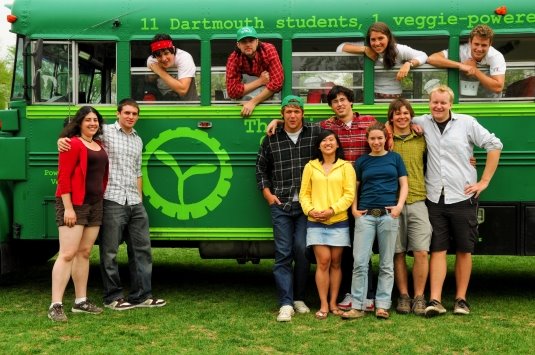
“Either you’re on the bus or you’re off the bus,” was the hackneyed statement proposed to me by three members of Dartmouth College’s Big Green Bus; an ex-diesel goes veggie 37′ foot school bus. My hometown San Francisco weekend was just beginning as I emphatically accepted the invitation to climb aboard and clock some miles with the 12 Dartmouth students on a mission to educate Americans about climate change through the use of this high profile ‘green’ machine.
A tour by resident Andrew Zabel (Dartmouth Class of 2009 and the bus’ leader) begins at the flap doors, in which the crossing of this threshold transports you into a funky retrofitted living space complete with bunk-beds, a library, multiple couches, a flat screen TV, a refrigerator, and a plethora of everyday comforts and necessities. A stroll along the central walkway brings you to the rear of the bus, to an oblong machine, complete with PVC piping, tubes, and everything else needed to take veggie oil and turn it into primo fuel. The ability of the Big Green Bus to run, relies on the ability of its team to track down ample amounts of spent deep-fryer oil from locations all across the country. The 70 gallons of McChicken grease that I witnessed came from a restaurant close to Shoreline Ampitheatre, the Saturday night Big Green Bus destination. The careful navigation of the bus down the restaurant’s narrow back ally and the subsequent assembly of the veggie oil pump to the gas tanks, serves to note the difficulty and time taken to refill the bus. At 7 miles per veggie-gallon, this fill would be enough to take the bus and its crew north to Oregon; stop number 27 of 43.
In ascertaining what the hardest part of the journey has been, Bennet Meyers (Dartmouth Class of 2009) complains of “California”. He then goes on to explain that because of “California’s environmental progressivism and forward-thinking population; it is extremely difficult to find any spent veggie oil in the state, for it has all been accounted for”. Whereas in the past burger joints and restaurants would have to pay a third party to remove this waste, they are now selling it to aggregators.
Within the past year, there is no doubt that the use of alternative fuels, especially biodiesel (made from veggie oil and other grades of diesel fuel) and ethanol have been on the front burner as a way to both help reduce our climatic impact and curb our dependence on foreign oil. However, the recent ramping up in production of biodiesel and ethanol has brought forth some bad rap to the alternative fuels world.
The negative side to increased biodiesel and ethanol production includes: an increase in food prices, an increase in land degradation (to grow the fuel stock) , and some experts even report that biodiesel and ethanol use leads to a net positive increase in carbon dioxide emissions (the most common of the greenhouse gasses).
Veggie oil is different however; the carbon impacts are net negative from a business-as-usual baseline. The oil used to power the Big Green Bus, would have been created anyways, and no additional cropland was used to create the stock. Furthermore, the use of veggie oil has been approved by the United Nations Framework Convention on Climate Change as an approved avenue to generate carbon credits (UNFCCC). Such credits, known as CERs (Certified Emission Reductions), are being traded at around $30 per metric ton. Even though the Big Green Bus is not eligible (the U.S. is not a signatory to the Kyoto protocol) to generate carbon credits, their carbon reductions and further, ability to affect change is priceless.
My weekend on the bus is one to remember. The ability to combine an environmental message with the fun of the bus is sure to inspire those who read about, saw, and/or toured the Big Green Bus. Whether it be Newman’s Own, Timberland, or Waste Management (3 of the bus’ biggest sponsors), corporations and individuals alike are hoping on this big green machine, helping to spread this green gospel.
Source / The Huffington Post
Hearing on Limits of Executive Power:
Vincent Bugliosi
Vincent Bugliosi’s opening statements during the House Judiciary Committee hearing on the constitutional limits of executive power.
The Rag Blog / Posted July 27, 2008
Evil as the Absence of Empathy
by Ernest Partridge / July 26, 2008
We live in a world … hardened and distorted by hate. We communicate in the language of fear and violence. Human beings are no longer viewed as human beings. They are no longer endowed in our eyes, or the eyes of those who oppose us, with human qualities. They do not love, grieve, suffer, laugh or weep. They represent cold abstractions of evil. The death-for-death means we communicate by producing corpses. – Chris Hedges
In 1946, Dr. Gustav M. Gilbert, a psychologist fluent in German, was assigned by the U.S. Army to study the minds and motivations of the Nazi defendants at the Nuremberg tribunals. The following year, his Nuremberg Diary was published, containing transcripts of his conversations with the prisoners. (Excerpts here).
In words consistent with what I have read of, and about, Gustav Gilbert, he is portrayed in the 2000 TV film Nuremberg, as telling the Head Prosecutor Robert Jackson (Alex Baldwin): “I told you once that I was searching for the nature of evil. I think I’ve come close to defining it: a lack of empathy. It’s the one characteristic that connects all the defendants: a genuine incapacity to feel with their fellow man. Evil, I think, is the absence of empathy.”
“Absence of empathy” is likewise, I submit, “the one characteristic that connects” most of the immoral and misbegotten tenets of Bushism: that dogmatic mix of market absolutism, libertarianism, corporatism and simple greed that falsely describes itself as “conservatism,” and which I choose to call “regressivism.” “Absence of empathy” is the essence of evil which, if unchecked and unreversed, is certain to bring about the demise of the American republic as we know it, just as it led to the fall of the Third Reich.
In contrast, empathy, the capacity to recognize and cherish in other persons, the experience, emotions and aspirations that one is aware of in oneself, is the moral cornerstone of progressive politics. It is a principle recognized and taught in all the great world religions, reiterated by numerous moral philosophers, and validated by the scientific study of human personality.
Empathy is the foundation of the moral teachings of Jesus of Nazareth. In that most-quoted New Testament verse, the golden rule, Jesus said: “as ye would that men should do to you, do ye also to them likewise.” (Luke 6:31, also Matthew 7:2). Also, “thou shalt love thy neighbor as thyself.” (Matthew 22:39, also Leviticus 19;18). Both commandments imply recognition in others of the human dignity and worth that one recognizes in oneself. In a word, empathy.
The golden rule is echoed in the moral teachings of Islam: “None of you [truly] believes until he wishes for his brother what he wishes for himself.” And as Mohamed taught in his last sermon, “Hurt no one so that no one may hurt you.” (Mohamed, last sermon). And Rabbi Hillel, a contemporary of Jesus, taught “What is hateful to yourself, do not do to your fellow man. That is the whole Torah; the rest is just commentary.”
And yet, how much empathy is to be found among self-proclaimed “Christian” end-times preachers, such as James Hagee and Tim LeHaye, who eagerly anticipate “the rapture” and the eternal torment and damnation that awaits virtually all of humanity, as punishment for the sin of failing to agree with the preachers’ theology? How much empathy is evident in the late Jerry Falwell’s on-air remark to Wolf Blitzer, about Islamic militants, “If it takes 10 years, blow them all away in the name of the Lord,” and Ann Coulter’s infamous outburst, “We should invade their countries, kill their leaders, and convert them to Christianity.” Because they explicitly renounce Jesus’ injunction to “love thy enemies” these hate-mongers are, in a literal and moral sense, “anti-Christs.”
Regressivism and the Absence of Empathy
Empathy is conspicuously absent in the off-hand remarks of George Bush, his family, and his political allies. For example,
* Bush himself, to an ordinary citizen after a campaign event: “Who cares what you think?” And to Bob Woodward: “History, we don’t know. We’ll all be dead.”
* The President’s mother, Barbara Bush, on Good Morning America: “Why should we hear about body bags and deaths. Oh, I mean, it’s not relevant. So why should I waste my beautiful mind on something like that?” (March 18, 2003).
* Dick Cheney, in an exchange with ABC reporter, Martha Raddatz:
Raddatz: Two-third of Americans say [the Iraq War] is not worth fighting.
Cheney: So?
Raddatz: So? You don’t care what the American people think?
Cheney: No….
* John McCain: “bomb bomb bomb, bomb bomb Iran.” And in response to the news that cigarettes are a major US export to Iran, McCain remarked that it might be “a way of killing ‘em.”
* Former Senator Phil Gramm, economic advisor to John McCain, in an interview with the Washington Times, remarked that the American economy is in “a mental recession.: “We’ve sort of become a nation of whiners,” he added.

The foundational doctrines of regressivism are equally devoid of empathy. For example, Ayn Rand: “Civilization is the progress toward a society of privacy.. the process of setting man free from men.” (The Fountainhead) And “Man must live for his own sake, neither sacrificing himself to others nor sacrificing others to himself.” (The Virtue of Selfishness)
Furthermore, “economic Man” (Homo economicus), a central concept of neo-classical economic theory favored by regressives, is an uncompromising egoist, whose sole motivation is to “maximize personal utility” or “preference satisfaction.” A “perfect market” of fully informed, non-colluding, uncoerced “economic men,” free of government interference, the theory tells us, will invariably produce better results for all than any governmental system yet devised. Never mind that “economic man” and “the perfect market” are fictions, that never have been and never can be realized in any human society. (For a defense of this claim, see my “Beautiful Theory vs. Baffling Reality”).
The unfounded yet undiminished right-wing faith in the “wisdom” of the free-market and in the superiority of the pursuit of individual “utility maximization” as the engine of social progress, was starkly summed up by “Gordon Gekko” (Michael Douglas) in the 1987 movie, Wall Street: “Greed … is good. Greed is right. Greed works. Greed clarifies, cuts through, and captures the essence of the evolutionary spirit. Greed, in all of its forms — greed for life, for money, for love, knowledge — has marked the upward surge of mankind.”
In fact, history teaches us that greed is not good, and greed does not work. Homo economicus is, in fact, a moral monster, for he is a being devoid of empathy and even of conscience. A mere bundle of “consumer preferences” can not add up to personhood, much less moral agency. When greed (call it “the profit motive”) reigns supreme, “others,” be they employees or fellow citizens, are reduced to impersonal objects. If these “others” are employees, they are regarded as units of “human capital” to be replaced by less costly “units” (e.g. “outsourced”) whenever possible. And if they are fellow citizens, they are prospective customers, to be relieved through “creative marketing” of their disposable wealth. Human, social, environmental “external costs” be damned. Witness the tobacco industry.
A “society” of private, egoistic, “utility maximizers,” devoid of empathy and unregulated by law and popular government, without shared values, loyalties and aspirations, is no society at all. It is a Hobbesian state of nature – a “war of all against all,” wherein life becomes “solitary, poor, nasty, brutish, and short.”1
As we are now discovering, to our great regret and sorrow.
Progressivism and Empathy
In stark contrast, empathy — awareness of the needs, sufferings, aspirations, rights, and dignity of others — is the unifying theme of the progressive agenda, and of the history of political/economic liberalism (in the traditional sense of the word). The elite and wealthy delegates to the Continental Congress, when they demanded recognition of their rights, did not fail at that time to acknowledge the rights of all persons:
We hold these truths to be self-evident: that all men are created equal; that they are endowed by their Creator with certain unalienable Rights; that among these are Life, Liberty, and the pursuit of Happiness.
True, at the outset the full “rights” of citizenship were restricted to white, male, landowners. But through time and constant struggle, those rights were extended to include all adult citizens, regardless of gender, race or creed. These struggles, which continue today, were led by “liberals,” and resisted by self-described “conservatives.”
Joe Conason eloquently describes these struggles and achievements:
If your workplace is safe; if your children go to school rather than being forced into labor; if you are paid a living wage, including overtime; if you enjoy a forty-hour week and you are allowed to join a union to protect your rights — you can thank liberals. If your food is not poisoned and your water is drinkable — you can thank liberals. If your parents are eligible for Medicare and Social Security, so they can grow old in dignity without bankrupting your family — you can thank liberals. If our rivers are getting cleaner and our air isn’t black with pollution; if our wilderness is protected and our countryside is still green — you can thank liberals. If people of all races can share the same pubic facilities; if everyone has the right to vote; if couples fall in love and marry regardless of race; if we have finally begun to transcend a segregated society — you can thank liberals. Progressive innovations like those and so many others were achieved by long, difficult struggles against entrenched power. What defined conservatism, and conservatives, was their opposition to every one of those advances. The country we know and love today was built by those victories for liberalism — with the support of the American people.2
That public support and the consequent liberal reforms issued from empathy: from the awareness throughout the general public that oppressed minorities and economically and educationally disadvantaged individuals, possess the same sentiments, needs, aspirations and rights that more fortunate citizens recognized in themselves.
Regressivism as Psychopathology
Empathy is never totally absent in any functioning human being. A recognition that other persons with whom one deals have functioning minds with ideas, emotions, and aspirations is implicit in game playing, in negotiations, and even ordinary conversation. Self awareness, even that of a thoroughly egoistic, narcissistic and sociopathic self, can only arise out of childhood interaction with others. The self is a social construct.
Thus even such sociopaths as George Bush and Dick Cheney will acknowledge that the bombs dropped on Iraq cause “collateral damage” and thus profound suffering to innocent civilians. They likewise are aware of the suffering in New Orleans caused by the mismanagement of the Katrina disaster. They are, after all, at least minimally sane. Such an awareness of others that is also devoid of feeling we might call “abstract empathy.” The misery to innocent others that they cause simply does not matter to the Busheviks. They do not care, unless these moral atrocities exact political costs to themselves.
This “abstract empathy” is not the sort of “empathy” that Dr. Gustav Gilbert found absent among the Nuremberg defendants. The empathy that he had in mind combines awareness with feelings of concern and with respect for the rights and integrity of the other.
In contrast, the regressivism of the Bush-Cheney administration would have us ignore the economic, social and environmental consequences of unregulated commerce, and also have us dismantle Social Security, impoverish public education, tolerate inadequate health care for millions of our fellow citizens, abolish fundamental constitutional rights, and engage in aggressive wars against unthreatening countries, all of this with minimal regard for the human misery caused by these policies. To do all this, requires a deliberate stifling of feelings of empathy, and what David Hume called the “natural moral sentiment” of benevolence: a genuine concern for the well-being of others.
Regressives who support such policies are, at worst, simply amoral: without moral restraint, “rotten to the core.” At best, they are profoundly mistaken: possibly fundamentally decent individuals, trustworthy, law-abiding, charming friends, devoted spouses and parents, but bewitched by false dogmas. The former are, by and large, beyond redemption and are best isolated from political influence and from positions of public responsibility. The latter might be amenable to evidence and rational persuasion.
How can such an ideology captivate and take political control of a nation once renowned and admired for its generosity and compassion and for its devotion to democracy and human rights?
In part, the rise and dominance of regressivism is the result of a deliberate and opulently funded public relations campaign, supported for the past forty years by wealthy individuals and corporations. This campaign included the establishment of ideological “think tanks” such as The American Enterprise Institute, The Heritage Foundation, and The Competitive Enterprise Institute, the abolition of The Fairness Doctrine and the consolidation of most of the mass media into six “conservative” mega-conglomerates, enormous expansion of corporate lobbying of Congress, and a vastly increased corporate involvement in campaign financing, of both major parties. With conservative Republicans in control of the White House for all but eight of the past twenty-eight years, the federal courts have become dominated by right-wing judges.
With these formidable propaganda resources, the resurgent Right has exploited “natural sentiments” equally fundamental to human nature as empathy; namely, ethnocentrism (identification with and loyalty to “our group”) and its negative complement, xenophobia (fear, distrust, and hatred of “outsiders”). The terrorist attacks of September 11, 2001 intensified these prejudices, objectifying and depersonalizing the new enemy (so-called “Islamo-Fascists”) while, at the same time, neutralizing empathetic sentiments toward the residents of these “alien” nations.
With the captive media exploiting and intensifying public fear of “terrorism,” the Bush regime formulated, and the intimidated Congress readily assented to, assaults upon our traditional civil liberties such as the PATRIOT Act, the Military Commissions Act, and now the revised FISA Act.
Finally, regressivism feeds upon greed: the relentless corporate drive for still more profits and political control, and the perpetual cultivation of consumer demand by the multi-billion dollar advertising and public relations industries.
But greed is pitiless and blind to the side effects (“externalities”) of the unconstrained appetite for the consumption of consumer goods and for profit: effects such as poverty, pollution, disease, and the “collateral damage” of war upon innocent civilians.
A political economy based upon unregulated greed has been tried numerous times in the past, and has failed in each and every occasion: the French and Russian Revolutions, the era of the robber barons in the late Nineteenth Century, the Great Depression of the Thirties. They failed because when greed rules, the nation’s wealth inevitably flows from those who produce the wealth to those who own and control the wealth until, eventually, the toleration of the increasingly miserable masses for this economic injustice collapses, and the oligarchic regime is overthrown.
Once again, regressivism is on the brink of collapse.
* Time magazine and the Rockefeller Foundation reported last week that 85% of US population is unhappy with the US economy.
* In April, 80% of Americans believed that the “country is moving in the wrong direction.”
* “During the first six months of 2008, 343,159 Americans lost their homes, up 136% from 145,696 recorded during the same period in 2007.” (CNNMoney.com).
* An alarming and under-reported increase in unemployment and inflation is underway. (US government cost of living statistics do not include food and fuel prices).
* The latest Gallup Poll reports that Democratic party affiliation leads Republican by ten points (47% to 37%).
* George Bush’s approval ratings are at an all-time low at 28% (disapproval from 61%-69%).
This public sentiment should suffice to overthrow any regime that maintains power “with the consent of the governed” and subject to recall by election. Under normal circumstances, these statistics would indicate a landslide repudiation of the regime in the coming national election.
But these are not normal circumstances, for this regime is supported by a formidable array of resources: virtually unlimited financial support, a captive media including a cadre of right-wing pundits, a proven ability to rig elections along with a refusal of the media to investigate and report election fraud, oppressive laws, a ruthless GOP campaign organization unconstrained by facts, fair-play, or even on occasion, by the law. All these resource might once again overwhelm the “consent of the governed,” and prolong the regressive regime for another four or even eight years. But eventually, it must fall. The longer it holds on, the greater the misery and repression that will ensue, and the more violent the eventual overthrow.
Best to end it now.
But it will take an extraordinary effort by an overwhelming number of ordinary citizens to bring it off. There are no guarantees.
Notes
1. Thomas Hobbes, The Leviathan.
2. Big Lies, p. 3.
Ernest Partridge is the co-editor of The Crisis Papers.
Source / Dissident Voice
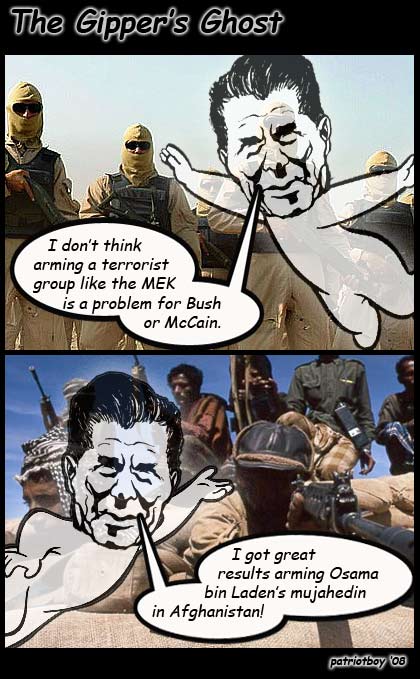
The M.E.K. [the Mujahideen-e-Khalqhas, Iranian dissident group] has been on the State Department’s terrorist list for more than a decade, yet in recent years the group has received arms and intelligence, directly or indirectly, from the United States. Some of the newly authorized covert funds, the Pentagon consultant told me, may well end up in M.E.K. coffers. “The new task force will work with the M.E.K. The Administration is desperate for results.”
Source / Jesus’ General
KIRKUK — The controversial provincial election legislation is leaving the northern oil-rich city of Kirkuk polarized between Arabs who believe it would restore justice and Kurds who see it a threat to their influence.
“We had only one day of hope and happiness when the new election law was approved,” Firas Bakar, an Arab resident of Kirkuk, told IslamOnline.net.
“Kurds, again, took away the dream.”
The law would have given equal distribution of seats among Kurds, Turkmen and Arabs in the disputed city, which means Kurds would lose their current control over Kirkuk’s provincial council seats.
The Presidential Council, headed by President Jalal Talabani, has rejected the law, passed by the parliament to pave the way for provincial elections later this year.
“The president does not accept a law like this,” read a statement issued by the office of Talabani, himself a Kurd.
“We were beginning to trust the government with the approval of the law but Kurds could not let it happen,” fumed Bakar, a 43-year-old teacher.
“The decision taken by the parliament was about to achieve justice,” insists Fadhel Mustafa, an Arab MP.
“Giving power to just one group is unfair and without logic.”
He warns that the city has been on shaky grounds for years.
“Kurdish politicians have been encouraging Kurds to settle in Kirkuk and change the normal structure of the city.”
Kirkuk, a historically and ethnically mixed city, has seen successive political policies altering its demographics.
Thousands of Kurds were reportedly forced out in the 1970s by the Saddam Hussein regime.
Over the past five years, the city has seen thousands of Kurds returning and other thousands of Arabs forced out from their homes.
Sunni Arabs, who make up nearly 30 percent of Kirkuk population, accuse the local government of siding with the returning Kurds.
Tension
For Kurds, rejecting the provincial election legislation and having total control over Kirkuk’s council is fair.
“We have the right to control Kirkuk and make it our own,” Heyas Rebiwar, a resident of Sulaimaniyah, told IOL.
“We don’t want division of power.”
Kurds believe the oil-rich city is rightfully theirs.
“It is clear that this land is part of Kurdistan and we are the majority,” insists Rebiwar.
“We should have control over Kirkuk. If it doesn’t happen, we will fight for out rights, whatever the consequences are.”
Tensions are already running high in the city.
“We have raised security over Kirkuk’s streets because we believe this recent announcement would drop more fuel over the fire,” a local police officer told IOL requesting anonymity for the sensitivity of the issue.
According to the police, five cases of sectarian violence were registered in only one day, and all of them resulted from heated political discussions over the law.
Uncertainty
Iraqi officials say vetoing the provincial election legislation over the Kirkuk dispute has left the entire political process in tatters.
“We expected that any decision that would involve Kirkuk’s control would create uncontrolled disputes,” a member from the electoral commission told IOL on condition of anonymity.
The commission had already said that provincial elections, scheduled for October 1, needed to be delayed until December 22.
The commission official believes that the delay would most likely be further extended now.
The presidential veto means the bill would be sent back to parliament to be redrafted.
“The situation is getting critical,” said the official.
“We hope a soon solution can be achieved so we can have a fair and democratic election.”
A delay of the elections would be a blow to the Bush administration, which considers them a key step toward national reconciliation.
The provincial elections are aimed at redistributing power in Iraq’s 18 provinces.
Most Sunni Arabs boycotted provincial balloting in 2005, enabling Shiites and Kurds to win a disproportionate share of power.
Source / Islam OnLine.Net

For women in the military, this election season has the potential either to focus a spotlight on long-neglected needs or to continue rendering us invisible. Due to our military training, we often struggle to exercise our right to speak out, but now we need systemic and systematic change both to do justice to service members and to create healthier communities for everyone.
I was still in high school in 2000 when I joined up, looking for a fuller life than I saw available to me in blue-collar Buffalo, New York. But would I have ever joined the military if higher education was not so hard to fund? Would the young, the poor, the single mothers feel their only option was to enlist if adequate housing, jobs and healthcare were available?
These are fundamental social inequalities that funnel people into the military. We hope to escape the injustice of racism, sexism and homophobia by proving ourselves—being able to say, “I served. I earned my place here.” And service does earn us praise, but only as long as we don’t rock that boat.
For the military, this election has heavy stakes, with two occupations taking place simultaneously, Iraq and Afghanistan, and a third waiting in the wings. Such high stakes tend to push aside other issues, and we risk being forced into silence for fear that the boat may capsize. But if it’s that close to going under, isn’t it time for a better boat?
Female veterans know this feeling all too well. All service members are taught to never question your own or your mission. For women service members this silence can have particularly dangerous consequences. When I began basic training, I never expected the culture of fear that service women take pride in living through. From a young woman ready to stand for what was right, I was being turned into a person who shrugged off injustice. When I helped another female recruit report a physical assault, I saw her become the target of widespread verbal harassment. The lesson? Bearing indignity silently in private is far better than risking public ridicule from those who choose to make you a target.
Imagine if those flashy recruiting commercials showed the real dangers a woman can face while serving in the military, living her formative years in a hazardous work environment where racism and homophobia are tolerated for the sake of “getting by” and sexual harassment goes unreported so you don’t “ruin his career.” All this while women work twice as hard to prove themselves as soldiers—more than just a “bitch,” “dyke,” “whore.”
I recently read a news story that highlighted service women who spoke of working twice as hard as the men in order to be seen as equal. That only made them appreciate the military, they said. These stories make me cringe because I remember very keenly boasting about unnecessary hardship—we thought it made us tough. But now such pride seems more like a coping method, one that allows negligent and sometimes criminal behavior to go unpunished. It pits women against one another, with those who are sexually assaulted seen as weak—as if strength alone and not luck allows one to avoid rape or assault.
Buried within this news story was an unfortunate example, a soldier named Spc. Kamisha Block reported dead in Iraq of a “non-combat related injury.” This injury turned out to be gunshot wounds inflicted by a male soldier who had a record of three previous assaults against her. It is obvious Spc. Block was not silent, yet her reports only resulted in her harasser being moved five minutes away from her in Iraq, allowing him the access to murder her before turning the gun on himself. When political candidates this season talk of foreign aggressors, they miss the largest threat military women face. By May of 2004 there were already 112 reports of sexual assault and rape in Iraq and Afghanistan. New Department of Defense policies make reporting easier, but what does it matter if complaints fall on deaf ears?
Sadly these are only secondary concerns in politics, at the VA and the Pentagon, or even in the antiwar movement—if they are issues at all. The current occupation of Iraq has left 97 women dead, the most so far of any American military intervention. Forty percent (39) of those are attributed to non-combat related injuries. Still uncounted in these numbers are suicides and murders that happen in the United States or on military bases post deployment. Spc. Block was reported to have died of friendly fire, so it is hard to extrapolate how many such deaths were actually murders. We need to know more about Pfc. Tina Priest, whose apparent suicide followed a rape allegation that was dropped after her death, and about Pfc. Lavena Johnson, who was brutally beaten, set on fire, doused with acid and somehow ruled a suicide. Their families are still trying to find answers.
One begins to understand why some women in Iraq—marked as targets by both their uniform and their womanhood—carry weapons for protection against fellow service members. We need to make these stories public, so that female service members find communities to amplify their voices when they speak out against these injustices. The Pentagon must be convinced that cover-ups will be uncovered with due haste. We need to ask other women, those who may feel like just one unworthy case, if they have stories to tell.
And we must look at the way post-traumatic stress disorder (PTSD) affects men if we really want to address the role of women in the military both as service members and partners of male soldiers. It’s easy to vilify men who turn on women with violence to escape their own powerlessness. Yet once again we don’t have a flashy military recruitment video that shows the real effects of war, seeing your friends blown up, being forced to kill. A whole generation of young service men is becoming emotionally shut off—for fear of seeming “weak” if they show signs of cracking under the enormous pressure of bloody combat.
The PTSD women experience in association with military sexual assault (MSA) must also be treated seriously. The title itself, post-traumatic stress disorder, suggests an abnormal reaction to combat or sexual assault. We continue to reinforce the idea that one is a broken person when experiencing PTSD—something wrong with the individual rather than with what happened to them. Women also lose out because current combat PTSD care is often geared towards men since women are officially barred from the combat zone, as though the military could sustain the occupation without women playing combat roles. If a woman is experiencing both combat and MST-related PTSD, she may be directed to male-filled PTSD groups or MST groups with no combat support. She has nowhere within the VA to find the care she needs.
If we are going to create any meaningful change for service women, it will require that as a country we begin to truthfully recognize our military. As it stands, the occupation of Iraq has become more of a far away sound bite than a tangible situation that real people face every day. Our media must do its job. Senator Barack Obama’s upcoming trip to Iraq, rather than becoming a media circus, could afford a valuable glimpse into the reality of the occupation for our female service members. Listen to their first hand accounts. It’s a real opportunity to highlight the dangers they face.
This is no time to relegate these concerns to the status of “women’s issues” in election campaigns. When any candidate is questioned on the gaps in VA health care, they cannot be allowed a free pass to render MST and female service members invisible. The candidates vying for commander in chief must be held accountable by the media for a full understanding of that job in the 21st Century when women in the military are a reality.
Women veterans and service members are bravely bringing these issues to light, breaking the codes of silence. Their acts of courage mean there is no longer an excuse for inaction at any level of our media or government. I have found a voice in SWAN, the Service Women’s Action Network, which allows me to share my story and help other women share theirs. The healing and subsequent strength gained from this regained visibility needs to happen for our country as well. Too often I am asked if my military battle dress is a boyfriend’s, as if it were not possible that the uniform was once my work clothing. Instead of asking such questions, it’s time to listen.
[With this commentary by SWAN activist Jennifer Hogg, WMC Media Track 2008 continues a series of dispatches on perspectives of issues that the press and the candidates must address in order to win women voters this November. The series began with economist Heidi Hartmann’s commentary, “Shaky Economic Times are Shakier for Women]
Source / Women’s Media Center / Posted July 18, 2008
Thanks to Alice Embree / The Rag Blog
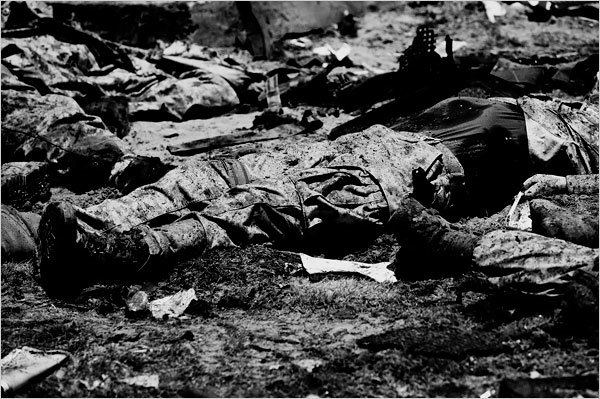
BAGHDAD — The case of a freelance photographer in Iraq who was barred from covering the Marines after he posted photos on the Internet of several of them dead has underscored what some journalists say is a growing effort by the American military to control graphic images from the war.
Zoriah Miller, the photographer who took images of marines killed in a June 26 suicide attack and posted them on his Web site, was subsequently forbidden to work in Marine Corps-controlled areas of the country. Maj. Gen. John Kelly, the Marine commander in Iraq, is now seeking to have Mr. Miller barred from all United States military facilities throughout the world. Mr. Miller has since left Iraq.
If the conflict in Vietnam was notable for open access given to journalists — too much, many critics said, as the war played out nightly in bloody newscasts — the Iraq war may mark an opposite extreme: after five years and more than 4,000 American combat deaths, searches and interviews turned up fewer than a half-dozen graphic photographs of dead American soldiers.
It is a complex issue, with competing claims often difficult to weigh in an age of instant communication around the globe via the Internet, in which such images can add to the immediate grief of families and the anger of comrades still in the field.
While the Bush administration faced criticism for overt political manipulation in not permitting photos of flag-draped coffins, the issue is more emotional on the battlefield: local military commanders worry about security in publishing images of the American dead as well as an affront to the dignity of fallen comrades. Most newspapers refuse to publish such pictures as a matter of policy.
But opponents of the war, civil liberties advocates and journalists argue that the public portrayal of the war is being sanitized and that Americans who choose to do so have the right to see — in whatever medium — the human cost of a war that polls consistently show is unpopular with Americans.
Journalists say it is now harder, or harder than in the earlier years, to accompany troops in Iraq on combat missions. Even memorial services for killed soldiers, once routinely open, are increasingly off limits. Detainees were widely photographed in the early years of the war, but the Department of Defense, citing prisoners’ rights, has recently stopped that practice as well.
And while publishing photos of American dead is not barred under the “embed” rules in which journalists travel with military units, the Miller case underscores what is apparently one reality of the Iraq war: that doing so, even under the rules, can result in expulsion from covering the war with the military.
“It is absolutely censorship,” Mr. Miller said. “I took pictures of something they didn’t like, and they removed me. Deciding what I can and cannot document, I don’t see a clearer definition of censorship.”
The Marine Corps denied it was trying to place limits on the news media and said Mr. Miller broke embed regulations. Security is the issue, officials said.
“Specifically, Mr. Miller provided our enemy with an after-action report on the effectiveness of their attack and on the response procedures of U.S. and Iraqi forces,” said Lt. Col. Chris Hughes, a Marine spokesman.
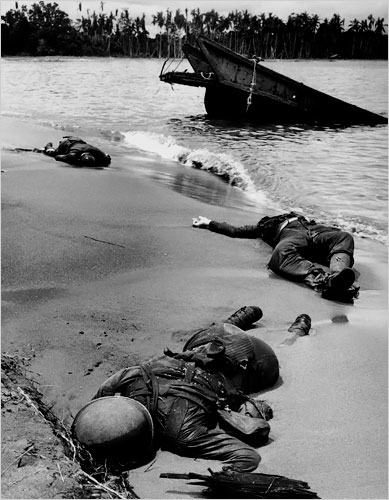
In Mr. Miller’s case, a senior military official in Baghdad said that while his photographs were still under review, a preliminary assessment showed he had not violated ground rules established by the multinational force command. The official, who spoke on condition of anonymity because the investigation was ongoing, emphasized that Mr. Miller was still credentialed to work in Iraq, though several military officials acknowledged that no military unit would accept him.
Robert H. Reid, the Baghdad bureau chief for The Associated Press, said one major problem was a disconnection between the officials in Washington who created the embed program before the war and the soldiers who must accommodate journalists — and be responsible for their reports afterward.
“I don’t think the uniformed military has really bought into the whole embed program,” Mr. Reid said.
“During the invasion it got a lot of ‘Whoopee, we’re kicking their butts’-type of TV coverage,” he said.
Now, he said the situation is nuanced and unpredictable. Generally, he said, the access reporters get “very much depends on the local commander.” More specifically, he said, “They’ve always been freaky about bodies.”
The facts of the Miller case are not in dispute, only their interpretation.
On the morning of June 26, Mr. Miller, 32, was embedded with Company E of the Second Battalion, Third Marine Regiment in Garma, in Anbar Province. The photographer declined a Marine request to attend a city council meeting, and instead accompanied a unit on foot patrol nearby.
When a suicide bomber detonated his vest inside the council meeting, killing 20 people, including 3 marines, Mr. Miller was one of the first to arrive. His photos show a scene of horror, with body parts littering the ground and heaps of eviscerated corpses. Mr. Miller was able to photograph for less than 10 minutes, he said, before being escorted from the scene.
Mr. Miller said he spent three days on a remote Marine base editing his photos, which he then showed to the Company E marines. When they said they could not identify the dead marines, he believed he was within embed rules, which forbid showing identifiable soldiers killed in action before their families have been notified. According to records Mr. Miller provided, he posted his photos on his Web site the night of June 30, three days after the families had been notified.
The next morning, high-ranking Marine public affairs officers demanded that Mr. Miller remove the photos. When he refused, his embed was terminated. Worry that marines might hurt him was high enough that guards were posted to protect him.
On July 3, Mr. Miller was given a letter signed by General Kelly barring him from Marine installations. The letter said that the journalist violated sections 14 (h) and (o) of the embed rules, which state that no information can be published without approval, including material about “any tactics, techniques and procedures witnessed during operations,” or that “provides information on the effectiveness of enemy techniques.”
“In disembedding Mr. Miller, the Marines are using a catch-all phrase which could be applied to just about anything a journalist does,” said Joel Campagna, Middle East program coordinator for the Committee to Protect Journalists.
New embed rules were adopted in the spring of 2007 that required written permission from wounded soldiers before their image could be used, a near impossibility in the case of badly wounded soldiers, journalists say. While embed restrictions do permit photographs of dead soldiers to be published once family members have been notified, in practice, photographers say, the military has exacted retribution on the rare occasions that such images have appeared. In four out of five cases that The New York Times was able to document, the photographer was immediately kicked out of his or her embed following publication of such photos.
In the first of such incidents, Stefan Zaklin, formerly of the European Pressphoto Agency, was barred from working with an Army unit after he published a photo of a dead Army captain lying in a pool of blood in Falluja in 2004.
Two New York Times journalists were disembedded in January 2007 after the paper published a photo of a mortally wounded soldier. Though the soldier was shot through the head and died hours after the photo was taken, Lt. Gen. Raymond T. Odierno argued that The Times had broken embed rules by not getting written permission from the soldier.
Chris Hondros, of Getty Images, was with an army unit in Tal Afar on Jan. 18, 2005, when soldiers killed the parents of an unarmed Iraqi family. After his photos of their screaming blood-spattered daughter were published around the world, Mr. Hondros was kicked out of his embed (though Mr. Hondros points out that he soon found an embed with a unit in another city).
Increasingly, photographers say the military allows them to embed but keeps them away from combat. Franco Pagetti of the VII Photo Agency said he had been repeatedly thwarted by the military when he tried to get to the front lines.
In April 2008, Mr. Pagetti tried to cover heavy fighting in Baghdad’s Sadr City. “The commander there refused to let me in,” Mr. Pagetti said. “He said it was unsafe. I know it’s unsafe, there’s a war going on. It was unsafe when I got to Iraq in 2003, but the military did not stop us from working. Now, they are stopping us from working.”
James Lee, a former marine who returned to Iraq as a photographer, was embedded with marines in the spring of 2008 as they headed into battle in the southern port city of Basra in support of Iraqi forces.
“We were within hours of Basra when they told me I had to go back. I was told that General Kelly did not want any Western eyes down there,” he said, referring to the same Marine general who barred Mr. Miller.
Military officials stressed that the embed regulations provided only a framework. “There is leeway for commanders to make judgment calls, which is part of what commanders do,” said Col. Steve Boylan, the public affairs officer for Gen. David H. Petraeus, the top commander in Iraq. For many in the military, a legal or philosophical debate over press freedom misses the point. Capt. Esteban T. Vickers of the First Regimental Combat Team, who knew two of the marines killed at Garma, said photos of his dead comrades, displayed on the Internet for all to see, desecrated their memory and their sacrifice.
“Mr. Miller’s complete lack of respect to these marines, their friends, and families is shameful,” Captain Vickers said. “How do we explain to their children or families these disturbing pictures just days after it happened?”
Mr. Miller, who returned to the United States on July 9, expressed surprise that his images had ignited such an uproar.
“The fact that the images I took of the suicide bombing — which are just photographs of something that happens every day all across the country — the fact that these photos have been so incredibly shocking to people, says that whatever they are doing to limit this type of photo getting out, it is working,” he said.
[Michael Kamber reported from Baghdad, and Tim Arango from New York.]
Source / New York Times
Also see Photographer Dismissed for Showing GI Remains / The Rag Blog / July 5, 2008
‘Oh, hell yes!’
By Steve Russell / The Rag Blog / July 26, 2008
Steve Russell is a former Austin activist and staff writer for the sixties underground newspaper The Rag. He has worked as a lawyer, an elected judge in Travis County (Austin), a writer and a professor. A citizen of the Cherokee Nation, Steve is a frequent contributor to The Rag Blog.
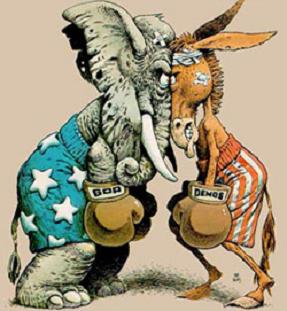
Is there a difference between Democrats and Republicans? Oh, hell yes!
Before I get started, I must recognize that the backbone of the Ragblog is a group of people who have known me very well for a long time—for several, that includes in the Biblical sense—so they know I held office as a Democrat. While I was, since before I held office, a sustaining supporter of the Travis County Democratic Party, I never voted a straight ticket in my life until the last elections, when the Iraq war pushed me to that extreme. When I had a choice, before Iraq took that choice away, I have at times voted Libertarian, Raza Unida, Socialist Workers, and, yes, even Republican.
Lately, though, there have been plenty of classic struggles at the federal level where party has made a difference.
At the Securities and Exchange Commission, Bush appointee Christopher Cox requested “emergency powers” to protect the stock of the privatized mortgage brokers, Fannie Mae and Freddie Mac. Shortly thereafter, he was informed that rule was already in effect to ban the practice that had him exercised, so-called “naked shorts” —short selling stock you do not own or have not made arrangements to borrow for the purpose. When Republicans took over the SEC, the rule became politically moribund. Another rule, the “uptick rule” — requiring that short-selling be preceded by a rise in stock price — was flatly repealed. The purpose is to keep big players from hammering a stock down for their own profit.
In anticipation of retirement, I have taken up some stock trading, but I do not sell short. It amounts to betting on someone else’s misery—entrepreneurs, workers, small stock holders—which offends me as much as insurance policies, which involve betting on my own misery. However, I understand that short selling serves a function in the market, just as insurance does. That I do not choose to participate is idiosyncratic.
When informed that he had the power, did Christopher decide to enforce the law? Well, not exactly. He announced that the naked short rule would henceforth be enforced in the case of stock in Fannie and Freddie as well as an announced list of behemoth investment banks. Not in the case of all stocks, or even all banks!
Who does the non-enforcement of short-selling rules benefit? Hedge funds, minimum price of buying in, $25,000 for a small one. If you are not worth a million dollars, hedge fund managers will not give you the time of day. They control enough investing power to create a downward spiral for a stock and then short into it, reaping millions while the average working stiff’s mutual fund takes the hit.
Need I add that the Republicans wanted to shift the Social Security program into the stock market? Where we would allegedly have more control over our own retirement funds. At the same time, the same folks were making it easier for the big players to manipulate the stock market to the disadvantage of small players.
The Housing Bill. As I was driving home this evening, I heard on the news that Senate Republicans were infuriated that they had staked out positions against the Democratic-tinged bill that passed the House, only to have Bush withdraw his veto threat and cut their legs off.
The swill these people signed on to sell is that the United States can afford to bail out Fannie and Freddie but not to undertake the rescue of individuals who have been sucked into subprime mortgages. That is not an easy sell.
The new GI Bill, which ought to be named the Jim Webb GI Bill, after the man who did the heavy lifting. The rightwing take on this bill was that it would make military service too unattractive by allowing soldiers to go to college after only one hitch. (Full disclosure: the GI Bill allowed me to go to college after only one hitch.) John McCain opposed Webb’s bill so strongly that he introduced an “alternative” with fewer benefits.
When the bill passed both houses with veto-proof majorities, Bush credited McCain, who had not bothered to vote on final passage after failing to stop it!
Energy Policy. You might have heard that the government subsidies for solar and wind power have not been reenacted because of “partisan bickering.” This is so. It goes as follows.
The Republicans favor renewable energy subsidies but as a price for their votes demand that current favorable treatments for oil and gas exploration be continued.
The Democrats claim that is both economically and environmentally irresponsible. We don’t get off the oil teat by subsidizing oil exploration. All these battles could be dismissed as “partisan bickering,” but in each case one party seems to be on the side of ordinary folks. Current events look like FDR v. Herbert Hoover.
There is no revolutionary electoral party. Revolution is not the purpose of voting, as I explained to my friends when I determined to run for office back in 1976. The fights the Democrats are in right now are fights worth having. There’s a right side and a wrong side. I’m voting for the right side, which in this case is the left side.

Full Court Press: Charles Kaiser on the Bush administration’s role in the subprime mortgage crisis
By Charles Kaiser / July 25, 2008
One of the most ignored aspects of the subprime mortgage catastrophe is the extremely active role the Bush administration played in creating it.
Last February, I pointed out an op-ed piece in the Washington Post that was written by then New York governor Eliot Spitzer, just before those unseemly events at the Mayflower Hotel dislodged him from office.
Spitzer revealed that not only did the Bush administration do nothing to prevent the subprime mortgage crisis, it actually “embarked on an aggressive and unprecedented campaign to prevent states from protecting their residents from the very problems to which the federal government was turning a blind eye.” When predatory lending practices became so prevalent five years ago that attorneys general in all 50 states started to take action against the banks responsible for the crisis, for the first time in its history Bush used the federal Office of the Comptroller of the Currency as a tool against consumers.
Some diligent lawyer in the administration dug up a clause from an 1863 banking act that gave the OCC the power to preempt all state predatory lending laws: “The OCC also promulgated new rules that prevented states from enforcing any of their own consumer protection laws against national banks. The federal government’s actions were so egregious and so unprecedented that all 50 state attorneys general, and all 50 state banking superintendents, actively fought the new rules. But the unanimous opposition of the 50 states did not deter, or even slow, the Bush administration in its goal of protecting the banks.”
This is an amazing example of federal intervention on behalf of the pure greed of America’s banks. And as far as I can tell, it has received virtually no coverage by the leading national newspapers or any television network.
This week, the Wall Street Journal did report on a smaller example of the federal government’s active role in creating the crisis. Mark Maremont wrote that after the Federal Deposit Insurance Company seized the assets of Superior Bank FSB, then a national subprime lender based in Hinsdale, Illinois, the FDIC “continued to run the bank’s subprime mortgage business for months as it looked for a buyer. With FDIC people supervising day-to-day operations, Superior funded more than 6,700 new subprime loans worth more than $550 million, according to federal mortgage data.”
“The FDIC then sold a big chunk of the loans to another bank. That loan pool was afflicted by the same problems for which regulators have faulted the industry: lending to unqualified borrowers, inflated appraisals, and poor verification of borrowers’ incomes, according to a written report from a government-hired expert. The report said that many of the loans never should have been made in the first place.”
In another fine story this week, titled “Unraveling Reagan,” the Journal reported on the only good effect of this scandal: a long overdue resurgence of government regulation of the financial sector.
Written by Bob Davis, Damian Paletta, and Rebecca Smith, the story described “a new wave of government regulation of business and the economy.”
“Federal and state governments alike are increasingly hands-on in their effort to deal with failing businesses, plunging house prices, worthless mortgages, and soaring energy prices. The steps add up to a major challenge to the movement toward deregulation that has defined American governance for much of the past quarter-century since the ‘Reagan Revolution’ of the early 1980s. In fact, some proponents today of a bigger oversight role for government are Republican heirs to the legacy of President Reagan.”
The housing and financial crisis may be finishing off the Reagan Revolution, the movement of smaller government and lighter regulation that has defined governance for the past 25 years. On Thursday, the government’s role in policing the financial markets took center stage at a House Financial Services Committee hearing.
“There’s a backlash against the laissez-faire, ‘isn’t it wonderful how creative markets are’ viewpoint,” says former Fed vice chairman Alan Blinder, a Democrat. “Markets are creative, but sometimes the creativity leads to strange and dangerous directions.”
What this scandal really proves is that the intellectual bankruptcy of the neocons reflected by the invasion of Iraq has a perfect mirror image in their obsession with deregulation of the economy. If a new Democratic president is elected with enhanced majorities in the House and Senate, he will have the opportunity to emulate everything Franklin Roosevelt did in the ’30s in response to the last great American binge of greed—the one that led to the crash of 1929.
Source / Radar Online

We’re a Nation of Lemmings: Screw The Climate! We Want Our Cheap Gas!
By Dave Lindorff / July 25, 2008
Listening to the endless stream of cars passing my house every day, and knowing, from watching them from my mailbox, that they are almost all carrying just one person, either commuting to work or running some kind of errand, I know we are headed for disaster.
Two days ago, there was a report by Agence France Presse about the ongoing destruction of the world’s remaining wetlands (60 percent have already been destroyed by man over the past century), and how they contain within them an amount of stored carbon equal to all the carbon currently in the atmosphere. Global warming and property development are drying out those remaining wetlands, causing the release of that carbon, which will more than negate even the most radical efforts at reducing carbon emissions from power plants, factories and automobiles.
There are also credible, well-researched reports that even a few more degrees of temperature rise in the arctic regions of Siberia and northern North America will melt the permafrost and release as much 400 gigatons of methane gas trapped in frozen clathrates for millennia — the release of which would cause global temperatures to soar to levels not seen in 250 million years (methane is 20 times as potent a global warming gas as CO2). Vast regions of Siberia are already bubbling with releasing methane as the permafrost line moves north.
Now I grant that our corporate media, ever focused laser-like on important stories like Britney Spears’ return to the stage and on the latest gaffe of one or the other presidential candidate, have not been very interested in alerting the masses to these disasters now in progress that could end humanity’s run on the planet (along with exterminating most of the rest of the life on the planet too). But that said, at this point everyone has surely heard enough, and witnessed enough in person of the dramatic changes taking place in the earth’s climate, to know that something scary is going on.
And yet, people are not just going about their business as usual — they are actually, for the most part, complaining not about the lack of highly energy-efficient transportation, the lack of alternative and less energy-wasting public transit, and the lack of government funding for a crash program into researching carbon-free energy solutions, but rather about the high price for carbon fuels. People are clamoring for solutions to make gasoline cheaper!
Years ago, back in the 1970s during an Arab-led oil embargo, when gas prices soared, there were mass campaigns to organize car pools. No such campaigns are being organized today, and if any are they don’t get any media attention. Instead we read that geologists are saying that massive quantities of untapped oil reserves exist in the far north.
Now the last thing we should be wanting to do is take that nicely sequestered carbon out of the ground and burn it into CO2! But that’s what many Americans want done. Screw the climate! We want our cheap gas!
There are so many things we could be doing right now to reduce carbon emissions — as individuals and as a nation. Turning off air-conditioners would be one. Why should entire houses be cooled by central air? Cool one room and use it for the hottest part of the day if need be. Live downstairs during the hottest months and close off the upstairs when it gets too hot. Ditto in the winter. There’s no need to occupy and heat an entire house when it gets really cold. Most Americans’ homes are way too large anyhow, but if you need that much room, use it when it doesn’t require all that extra energy to heat and cool. (When I lived in Cambridge, England as a kid, we used to sleep in unheated bedrooms under cozy comforters, and then in the morning, I’d go down and light a fire in the living room where we’d be during the day. It would be cold as hell until the fire started, but not for long.) Share rides. Plan errands so that many things get taken care of on one outing, instead of in multiple run-outs. Use bicycles. I have yet to see, on my own bike rides in down or when driving anywhere, someone who is actually riding a bike on some errand-carrying a load in a basket or in a backpack. The only bikers I see are people dressed like Tour de France racers out for some exercise. What’s the matter with using bikes for a purpose, instead of the family car?
I’m not trying to criticize, or to say I’m more ecologically virtuous. I’m looking at this as an unprecedented disaster that is dooming my kids, or their future children, to a life of strife, misery and maybe even catastrophe. If I don’t take serious action — and I don’t just mean individual life changes, but political action — to try and save their world, I am guilty of a serious crime. And so are we all.
What the hell happened to any sense of shared responsibility, not just for society, but for our own offspring?
Most decent parents are ready to sacrifice in their lifestyles in order to send their kids to college, or to help them out financially when they are starting out as young adults. But for some strange reason nobody seems ready to sacrifice at all when it comes to rescuing their collective future. This makes no sense.
And yet, this is what our mass culture has done to us. As a nation, as a people, we cannot think beyond our own noses. We cannot even think about the need to act in our own and our children’s interest.
Seventeen years ago, I had occasion while living in Shanghai, China, to visit a rural area in Anhui Province that the year before had been devastated by a flood so huge that the entire region had been not just flooded, but put deep underwater. As I neared a county seat town that was my intended destination, the bus I was on passed a dike-building project. Thousands of peasants were laboring by hand, with shovels and wheelbarrows, to erect a 50-foot wall of earth to keep the river in its banks in the event of another such flood. I got off the bus and, with my travel companion, started walking towards the project. When we were spotted, thousands of those workers dropped their shovels and ran towards us. It was a terrifying moment to have so many people heading towards and surrounding us, but they were very friendly — just curious because none of them had ever met a westerner. We began talking with them, and learned that they were all peasants who had left their fields to build this colossal new Great Wall of dirt. They brought us to the worksite and showed us how they would bring their wheelbarrows to the base of the dike, and then attach a cable, which was connected to a winch operated by those ubiquitous one-cylinder, two-stroke kerosene tractors used across rural China. The winch would whip the barrow up the steep hillside, with a peasant running up behind keeping it upright. At the last minute, the peasant would flip the barrow, dumping the dirt and releasing the hook. Then he’d be off down the hill to collect more dirt.
What struck me, besides their ingenuity, was how all these thousands of people had left their own fields to labor for the collective good that year.
I tried at the time to contemplate my fellow Americans doing the same thing, and couldn’t for the life of me imagine it.
Now we’re in that moment. We know the flood is coming, but no one is willing to join the brigade to take preventive action.
No. Buying a Prius is not taking action. Neither is upgrading the insulation on your house or buying carbon offsets when you fly. We need, as a nation, to commit to seriously ending our addiction to fossil fuels, to rapacious development and the concomitant destruction of forests and wetlands. We need to end our nation’s imperialist policies and to instead devote the trillion dollars a year spent on war to saving the planet from ourselves.
A good start would be seeing that people “get it.” That would mean communities starting to organize around improving mass transit, arranging for carpooling, and demanding climate-saving action from our political leaders.
I’m not optimistic.
[Dave Lindorff is a Philadelphia-based journalist and columnist. His latest book is “The Case for Impeachment” (St. Martin’s Press, 2006 and now available in paperback). His work is available at http://www.thiscantbehappening.net/. ]
Source /
Updated July 26, 2008
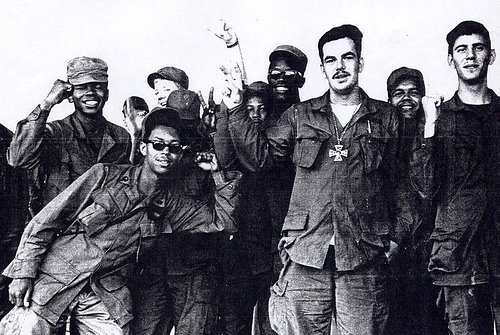
David Zeiger is an award-winning film producer and director whose highly–acclaimed film Sir! No Sir! documented the little-known GI resistance to the Vietnam War. He was a staff member at the Oleo Strut, a GI coffee house in Killeen, Texas near Ft. Hood that was a major center of anti-war activities from 1968 to 1972.
Zeiger, also a writer and an activist, produces and directs documentary films through his company, Displaced Films.
This article joins a Rag Blog discussion of the history of the GI anti-war movement with articles by Tom Cleaver on the history of the Oleo Strut coffee house and on the founding of a new GI coffee house in Killeen called Under the Hood. Please see Under The Hood : An Anti-War GI Coffeehouse in Texas.
Over the past three years, there has been a significant and heartening growth of opposition to the Iraq and Afghanistan occupations among active duty soldiers, and several organizations have been doing tremendous work with soldiers and veterans. From the groups and individuals supporting soldiers who have refused deployment and been court-martialed, to the work of Iraq Veterans Against the War, Veterans for Peace, the Military Project and Different Drummer Café, serious and determined work is being done to turn the deepening disaffection and anger with the occupations inside the military into a real political movement and force (and I apologize now to everyone who I left out).
It is a source of great joy for me, in that context, to see the story of the GI Movement against the Vietnam War playing a significant role in inspiring and helping shape that burgeoning movement. The reissuing of David Cortright’s Soldiers in Revolt, along with important books published in the 90s (please see the list at the end of this article), brought to life what had been deeply buried for two decades and made it possible for a film like Sir! No Sir! to be made, and for this new movement to be born.
The GI Movement of the 60s is loaded with lessons for today. But those lessons have to be seen realistically to really be truly learned, and that puts a tremendous responsibility in the hands of those of us who were part of that movement. Memory can be a tricky thing, and it is no more helpful to exaggerate the events of that time than it is to deny them. Mythologizing or inaccurately portraying the GI Movement can, in my mind, do far more harm than good as people struggle to find ways to build a new movement in the military today. But a real understanding of its ups and downs, victories and defeats, and most importantly the tremendous struggle it involved on every level can be a powerful resource.
So I was very interested to read about the effort to open a new GI Coffeehouse in Killeen, Texas, outside of Fort Hood. The coffeehouse movement has, since the invasion of Iraq, been one of the few “forms” of organization from the 60s that seem to me to make a lot of sense today. But as I read Tom Cleaver’s depiction of the Oleo Strut Coffeehouse and its relevance for today, I found myself growing increasingly concerned that real understanding may be being replaced by nostalgia (and I speak from experience, as I am always fighting my own nostalgia while looking at the past). And beyond that, Tom’s interpretation of the GI Movement in the 60s raised many issues that I want to discuss here, in the spirit of making history serve the present.
Let me emphatically state first that I am not an organizer, but a filmmaker, and I do not pretend to know what the “right thing to do” is today. Nor do I intend to criticize or direct anyone. I don’t even consider myself an “expert” on the GI Movement. But I do hope that my two years working at the Oleo Strut, and the work that I and others have done to tell the GI Movement story today can be helpful. For the record, I am not a veteran. I went to Killeen in June of 1970 as a 20-year-old drop-out– and scared to death, I might add.
Now to the issues. The biggest for me is Tom’s statement that “GIs stopped the war in Vietnam and they can stop the war in Iraq.” This has become a pretty popular view nowadays among many people, and while it may sound ironic coming from me, I find it to be misleading and potentially very harmful. It takes what is true, the fact that the GI Movement cut at the heart of the war, and uses it as a kind of club over everyone else. But most significantly, it rips the GI Movement out of the political and social context that gave birth to it and nurtured its growth.
Put simply, GIs did not stop the war in Vietnam. The Vietnam War was ended by a combination of forces–first and foremost the Vietnamese people, whose struggle for self-determination became an inspiration for millions around the world. And beyond that the antiwar, counterculture Black liberation and revolutionary movements were all key to creating the context for soldiers in their thousands to revolt and certainly play a major role in bringing the war to a grinding halt. It can even be described as the straw that broke the camel’s back–but that wouldn’t have happened without all those other straws!
Look at Tom’s main example from the summer of ‘68–the urban rebellions and demonstrations at the Chicago Democratic Convention, and the GI’s response to being ordered into riot control duty (“First we fought the Vietnamese, now they want us to fight Americans,” as Dave Cline said). There’s clearly a cause and effect here. If Black people were not rebelling in the cities, and if students and radicals weren’t planning to demonstrate at the Democratic convention, there would have been no riot control in the military, and it wouldn’t have been such a powerful impetus for rebellion that it was.
(In that light I want to correct a significant inaccuracy in Tom’s description of the Fort Hood 43, the Black GIs who resisted deployment to the Chicago convention. Tom describes them as a highly organized group, who had chosen which soldiers would refuse to go based on their service in Vietnam. That isn’t what happened. As vividly described in Sir! No Sir! by Elder Halim Gullabehmi, one of the participants, several hundred soldiers met all night in an open field to protest their deployment and discuss their grievances and make plans. No decision had been made. In the morning, when 43 were still in the field waiting for a response from the base Commanding General, they were ambushed by MPs, beaten, and thrown in the stockade. Many, including Elder Halim, were later sent to Vietnam as further punishment).
What gave the GI Movement so much power was its deep connection to the broader movement it was part of. That movement wasn’t just students resisting the draft to keep from going to Vietnam themselves (another popular myth, in my view). It was the Black Panther Party; it was Vietnam Veterans Against the War; it was national organizations that were constantly expanding the scope of protest against the war; it was students who were shutting their campuses down to force companies like Dow Chemical off campus and end university complicity with the war; it was all those things and more. In 1971, the same time Colonel Heinl wrote his famous article that Tom quotes, Washington was wracked with a myriad of demonstrations, including the May Day attempt by over 10,000 people to shut the city down (which Nixon specifically cited as a reason to “get the troops out as quickly as possible.”).
I’m not saying this to nit-pic, or to in any way lessen or denigrate the impact of the GI Movement. Yes, the GI Movement had become a force in the military that seriously challenged its authority and ability to fight; and yes, thousands of GIs were actively organizing and demonstrating, but that can’t be ripped out of the context it grew in and declared to be the sole force that ended the war. Doing so, it seems to me, could lead to a distorted view of the situation today and very unrealistic expectations. It certainly doesn’t help point the road forward.
Part of the importance of understanding the context for the GI Movement is recognizing that it faced tremendous repression. The whole nature of the military is based on isolation from the world outside, and the more that world intruded, the more they fought back. The coffeehouses were an essential link between soldiers who faced tremendous repercussions for their actions and the broader movement in society. That link was political, and just as importantly cultural, and without it much of what flourished would have been quickly crushed.
And that raises my questions about the differences between then and now. In 1968, the Oleo Strut was for the most part the only way that GIs could be in contact with that movement (although even the local porn shop carried The Autobiography of Malcolm X and Soul on Ice). Most GIs didn’t have cars then, and at night and on weekends the only place you could go was the downtown strip since bus service ended there. Life was very constricted. The Strut was literally a haven, one you couldn’t find anywhere else, and a place to listen to music and read literature that was only available there. Especially in the early years, that made up a lot of what sustained it.
It’s a different situation today, is it not? Mobility and communication are worlds apart from 1968. While we were filming IVAW in their efforts to bring Winter Soldier to the soldiers at Fort Hood this year, much of their outreach was done at bars in Austin–60 miles away! There isn’t the kind of central place today that GIs are locked into, making something like the Strut unique. That seems to me to be a significant change.
One reason this is important is that the coffeehouses themselves faced huge obstacles to staying open. Tom mentioned the KKK and “goat-ropers,” but it went way beyond that. They were physically attacked, hit with bizarre legal charges, and often burned down. But those weren’t the most difficult challenges.
Even the most successful coffeehouses were never self-sustaining financially. We barely survived, even with the Herculean efforts of the United States Serviceman’s Fund, a group whose sole purpose was raising money for the GI Movement. But even with that and the day jobs many of us had, we came close to shutting down many times. In addition the constant legal battles and harassment arrests (I spent nights in jail for such things as hitch-hiking, driving with a dirty license plate, and swearing in front of a police officer), were a huge financial drain.
It was also a constant struggle to keep staff. Burn-out was a big problem in places like Killeen (and I don’t imagine that’s much different today). Keeping a place like the Strut alive wasn’t a weekend or summer gig. The reality is that there were many long periods when it was successfully isolated from the soldiers, and it took tremendous endurance to survive those times. Life in the GI Movement, like life in the military, was characterized by many months of intense tedium punctuated by moments of intense action.
In short, the GI Coffeehouses of the 60’s were a major force that filled a very specific need, one that grew out of the times we were living in. They were also a major commitment of time and resources–extremely difficult to sustain but well worth it for the role they were playing at that time.
Again, I am not raising these things to pour cold water on the current effort. But I believe that to be kept alive, history has to be seen in all its parameters. And I do think it’s important to not view the coffeehouses of the 60s through rose-colored glasses, especially when you’re contemplating diving into the fire. I’m not drawing conclusions, just raising questions.
So as I said in the beginning, I offer these observations and thoughts in the spirit of welcoming all of the work being done today in the military, and wanting to use our history to enrich it. I hope this helps.
The books that I referred to are:
* Soldiers in Revolt by David Cortright (aka The Bible)
* The New Winter Soldiers by Richard Moser
* The Spitting Image by Jerry Lembcke (A wonderful expose of the myth of the spitting hippie)
* A Matter of Conscience: GI Resistance During the Vietnam War by William Short and Willa Seidenberg (This is an incredible book, very hard toget but well worth it. Bill and Willa traveled around the country in the early 90s photographing and recording extensive oral histories of dozens of veterans of the GI Movement. Their work formed much of the basis for Sir! No Sir!).
There are also several great books on the veterans’ movement, and particularly Vietnam Veterans against the War.
PS–Again to keep the record straight, Fred Gardner, one of the founders of the GI Coffeehouses, was not an officer, but a PFC attached to an Army Reserve unit at Ft. Jackson when he and others started the UFO Coffeehouse in 1967. The “Summer of Support” referred to in Cleaver’s article was not organized by him, but by Rennie Davis and Tom Hayden, original founders of Students for a Democratic Society. SOS was one of, but not the only organization supporting the GI Coffeehouses.
Thorne,
I heard an interesting story about the Olio Strut and the general attitude of the soldiers to authority. The guy who told me the story was a combat vet send to Ft Hood to decompress along with a lot of other guys who had seen heavy combat. He is the only source but I have no reason not to believe him. He told me that there was a small lake somewhere around the base with a small island in it and that it was common for the soldiers to use rowboats and go to the island where they would have numerous small fires around which they would talk and decompress. Of course there was a considerable amount of the magical herb being smoked out there too. The cops knew what was going on and a squadcar load of them got into a couple of the small rowboats and decided to liberate the island. They landed and went to the first campsite and announced “Y’all are all under arrest” My friend told me that the entire island became silent and then across the island could be heard the sound of the hammers being pulled back on the government issue .45 callibar handguns that the GI’s still carried. Needless to say the cops were tripping over one another trying to get back into their boats.
Robert Pardun / July 26, 2008
Under The Hood : An Anti-War GI Coffeehouse in Texas. / by Tom Cleaver / The Rag Blog / July 23, 2008
And Austin, 1969 : Bob Bower, Anti-War GI by Henry Mecredy / The Rag Blog / July 24, 2008
Thorne Webb Dreyer, Editor




