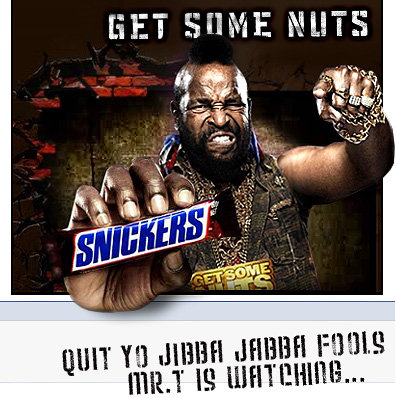
Snickers : ‘Get Some Nuts’


New ad encourages drive-by shootings of unmanly men

See video below.

Via Towleroad comes a new spot for Snickers which appears to endorse violence against the effeminate, or at least against speed-walkers. In the spot, a yellow-shorts-sporting butt-shaking speed-walker is attacked by former A-Team star Mr. T (?!) with a Snickers-shooting machine gun, for being “a disgrace to the man race.” Ga-wha? The ad was created by AMV BBDO, a subsidiary of the retro-futuristically named Omnicom, which turns out to be the company also responsible for a Dodge spot and another Snickers ad that inspired claims of homophobia. Ad Age critic Bob Garfield has written an open letter to Omnicom calling the spots “simply sick.”

I’ve been a vocal proponent of everybody chilling out over fictional portrayals of LGBT people and the gender non-conformist, but this is appalling, and also completely unfunny: making fun of racewalkers is so, like, 1993. Watch the offending ad after the jump. What do you think, Riffers, does it make you feel like “getting some nuts” and having a Snickers?


Snickers TV Commercial – Get Some Nuts – video powered by Metacafe

Source / The Riff / Mother Jones / Posted July 22, 2008

The Rag Blog

Posted in RagBlog | Tagged , , , , , | 1 Comment

Canada’s Spreading Cannabis Crop


Homegrown marijuana has become big business in British Columbia
By Misha Glenny / July 22, 2008

As we walk into John’s basement, the smell is so overwhelming it almost knocks me off my feet.

In front of me stand 120 marijuana plants whose thick bushy leaves cover the strong stems.

John explains quite nonchalantly that this is just a small growing operation, or grow-ops as they are known throughout Canada.

But he pays loving attention to the crop – adjusting temperature, light and nutrient supply – to ensure that it enjoys the best possible environment.

Every two to three months, John harvests some 8lbs (3.6kg) of his crop, worth about $20,000.

So even if he didn’t work at other jobs, that nets him a tidy salary (untaxed of course) of about $80,000 a year.

‘BC Bud’

Inspector Brian Cantera of the Royal Canadian Mounted Police (RCMP) in Vancouver believes that John’s small grow-op is one of 20,000 to be found in residential houses around the province.

That figure excludes the larger grow-ops in industrial locations, not to mention the huge dope farms that are scattered around British Columbia’s vast interior.

If Inspector Cantera’s estimates are accurate, then British Columbia is probably home to the largest concentration of organised criminal syndicates in the world.

The striking aspect of BC’s marijuana trade is that it has gone beyond the boundaries of traditional organised crime groups (although some are still heavily involved) and entered into the middle classes.

Much of the revenue derived from BC Bud, as the cannabis crop is known, goes on paying college fees, perhaps buying a second car or making that holiday to the Caribbean just a little bit more affordable.

The trade is so large that the police in BC are faced with an impossible task.

Inspector Cantera walked me around a cavernous warehouse somewhere east of Vancouver where the RCMP lock up goods confiscated from people involved in the drugs trade.

The most spectacular items are the cars, speedboats and even helicopters which the traffickers use to send the marijuana down to its biggest market across the 49th parallel in the US.

These busts net goods worth millions of dollars but it still isn’t enough to dent the extraordinary profits of the drug runners.

Border divide

Not surprisingly, BC’s drug culture is very controversial both inside Canada and over the border in the US.

Many Canadians believe that the widespread use of marijuana is having a devastating impact on young people in particular.

Billy Weselowski and his wife Kim have devoted themselves to helping vulnerable women caught up in drug and alcohol addiction to restart their lives.

Billy rails against those Canadians who are demanding the legalisation of marijuana.

“I’ve dealt with at least 20,000 addicts, and easily 10,000 will tell you they’ve relapsed on marijuana…That’s the underbelly of what marijuana (is) about – what it’s doing to people. And it’s like alcohol – it runs an industry.”

But the marijuana growers have equally passionate supporters like Michelle Rainey who has the legal right to cultivate a limited amount of marijuana for medicinal purposes.

It is the only non-addictive narcotic which helps relieve the pain inflicted by the debilitating Crohn’s disease from which she suffers.

But she is sought by the US to face charges of conspiracy and money-laundering because of a legal Vancouver-based marijuana seed business with which she was previously involved.

Over the past decade, Canada has been moving slowly towards a more benign regime of toleration towards marijuana (although the current minority federal government of Stephen Harper vehemently opposes this development).

This has placed the trade in the middle of some intense arguments between Canada (and BC in particular) on the one hand and the US and its guardian on drugs orthodoxy, the Office of National Drug Control Policy, on the other.

If BC’s marijuana trade ever did force through a change in the legal status of the drug in Canada, the implications for Canadian-US relations would be profound. This will be a crime story well worth watching.

[Misha Glenny is the author of McMafia: Crime without frontiers.]

Source / BBC News

The Rag Blog

Posted in RagBlog | Tagged , , , , | Leave a comment

Dennis Kucinich : Thanks to You, Impeachment Will Be Heard on Friday

Holding the administration accountable
By Dennis Kucinich / July 22, 2008

I want to thank you for the support which you have given to my efforts to hold this administration accountable for taking us into a war based on lies and for the destruction of the rule of law and the destruction of cherished constitutional principles.

Because of your support, this Friday in Washington, DC, I will make a presentation before the Judiciary Committee of the House of Representatives at which time I will make the case that this president has violated his oath of office, violated United States law and international law, has separated our nation from our constitution, and has taken us on a course that has been so profoundly anti-democratic that it has threatened the core of our nation.

Because of your support, I have been able to advance this series of matters right to the table of the Judiciary Committee.

Because of your support, I have been able to create an opening so we’re finally getting a chance in Washington to discuss the abuses of power, to discuss a war based on lies, to discuss the whole architecture of constitutional principles that have been taken down.

Every serious matter that faces the people of this country today can be linked to an administration which is not accountable.

For example, the price of gasoline. You know that Vice President Cheney with the permission and blessing of President Bush held secret meetings with leaders of the oil industry where they laid out maps of Iraq far in advance of the attack on Iraq. You know and I know the war was about oil, and if we can force the vice president of the United States to have to testify, we can get the information that is necessary to be able to prove that not only has US law been violated, but that the public trust has been under a continuous assault by an alliance between the White House and the oil companies.

You look at the sub-prime lending fiasco with millions of Americans having the dream of home ownership threatened, and you look at an administration that took the cops off the beat at the Securities and Exchange Commission that enabled the Fed to look the other way when they should have been disciplining the banks. The American people had a right to expect the government would protect their interests.

When you look at the shakeout in the stock market and all these small investors who are losing their life savings, again the Bush administration and their alliance with interest groups, violating an oath of office, enabling these interest groups to steal from the American people, over and over and over again.

For the first time we are going to have a chance to raise these issues in the Judiciary Committee in the context of a hearing at which I am going to present the Articles of Impeachment so that the Committee cannot say, well, they just didn’t know. We are going to force this issue because of you.

We are in danger of losing our country to war based on lies, to destruction of our civil liberties, but it is your commitment and your willingness to stand up and speak out that has enabled me to take a stand and to say not only are we going to save what is right and save what is dear to us, but we are going to hold this administration accountable so that it never happens again.

This is truly our moment. Friday is the beginning. Thank you for supporting this effort with signing petitions, with your emails and your letters and your phone calls.

I pledge to you that I will continue my efforts to defend a way of life that the American people have a right to expect – to expect to have a government they can call their own – to expect to have a government that will tell them the truth – to expect to have a government that is worthy of the tradition of democracy.

Thank you.

Source / AfterDowningStreet

The Rag Blog

Posted in RagBlog | Tagged , , , , , | Leave a comment

Jim Hightower : ‘Gooberhead Award’


VA treating vets as lab rats
By Jim Hightower / July 22, 2008

Time for another Gooberhead Award, presented periodically to those in the news who’ve got their mouths going 100 miles an hour – but forgot to put their brains in gear.

There are so many gooberheads in today’s story that it’s hard to tell who is the gooberest of all. It’s certainly not James Elliot, an Army veteran who came back from Iraq with PTSD. During his treatment by the Veterans Administration, he was recruited by VA doctors to be part of a behavioral study of Chantix, an experimental drug developed by Pfizer to help people stop smoking.

But no one told Elliott about one small detail: a side effect of Chantix is that it can make you suicidal. Not good for a PTSD victim. Sure enough, weeks into the drug test, he suffered a mental breakdown, got a gun, and ended up being tasered and arrested by the police.

Three weeks later, the VA finally notified the 940 other vets in the study that… uh… there could be a… uh… side effect. Unabashed, the lead doctor declared that Elliott’s breakdown was no reason to deprive veterans of “an effective method of treatment to help them stop smoking.” Well, yes, suicide is very effective at stopping smoking.

Then came the goobers in the White House to defend their VA appointees for running a dangerous human experiment on vets without telling them. Bush PR flack Tony Fratto hailed the “wonderful leadership” of VA secretary James Peake. Yet, when told that Elliott said he’d been treated like a “lab rat” by the VA, Mr. Wonderful responded that such a comment “hurts me.” Yeah Peake, it’s all about you! Then he said he saw “no evidence to suggest the study should be stopped.” Well, not unless you count Elliott’s breakdown as “evidence.”

So Secretary Peake’s attitude wins today’s Gooberhead Award – because he’s definitely the gooberest of all.

Source / Jim Hightower

Also see ‘Disposable Heroes’ / ABC News

The Rag Blog

Posted in RagBlog | Tagged , , , , , , | Leave a comment

Exposing Bush’s Historic Abuse of Power : Tip of Iceberg?

Revelations about Bush could rival Richard Nixon and the Watergate scandal.

New evidence of post-9/11 spying on Americans.
Obtained documents point to a potential investigation of the White House that could rival Watergate.

By Tim Shorrock / July 23, 2008

The last several years have brought a parade of dark revelations about the George W. Bush administration, from the manipulation of intelligence to torture to extrajudicial spying inside the United States. But there are growing indications that these known abuses of power may only be the tip of the iceberg. Now, in the twilight of the Bush presidency, a movement is stirring in Washington for a sweeping new inquiry into White House malfeasance that would be modeled after the famous Church Committee congressional investigation of the 1970s.

While reporting on domestic surveillance under Bush, Salon obtained a detailed memo proposing such an inquiry, and spoke with several sources involved in recent discussions around it on Capitol Hill. The memo was written by a former senior member of the original Church Committee; the discussions have included aides to top House Democrats, including Speaker Nancy Pelosi and Judiciary Committee chairman John Conyers, and until now have not been disclosed publicly.

Salon has also uncovered further indications of far-reaching and possibly illegal surveillance conducted by the National Security Agency inside the United States under President Bush. That includes the alleged use of a top-secret, sophisticated database system for monitoring people considered to be a threat to national security. It also includes signs of the NSA’s working closely with other U.S. government agencies to track financial transactions domestically as well as globally.

The proposal for a Church Committee-style investigation emerged from talks between civil liberties advocates and aides to Democratic leaders in Congress, according to sources involved. (Pelosi’s and Conyers’ offices both declined to comment.) Looking forward to 2009, when both Congress and the White House may well be controlled by Democrats, the idea is to have Congress appoint an investigative body to discover the full extent of what the Bush White House did in the war on terror to undermine the Constitution and U.S. and international laws. The goal would be to implement government reforms aimed at preventing future abuses — and perhaps to bring accountability for wrongdoing by Bush officials.

“If we know this much about torture, rendition, secret prisons and warrantless wiretapping despite the administration’s attempts to stonewall, then imagine what we don’t know,” says a senior Democratic congressional aide who is familiar with the proposal and has been involved in several high-profile congressional investigations.

“You have to go back to the McCarthy era to find this level of abuse,” says Barry Steinhardt, the director of the Program on Technology and Liberty for the American Civil Liberties Union. “Because the Bush administration has been so opaque, we don’t know [the extent of] what laws have been violated.”

The parameters for an investigation were outlined in a seven-page memo, written after the former member of the Church Committee met for discussions with the ACLU, the Center for Democracy and Technology, Common Cause and other watchdog groups. Key issues to investigate, those involved say, would include the National Security Agency’s domestic surveillance activities; the Central Intelligence Agency’s use of extraordinary rendition and torture against terrorist suspects; and the U.S. government’s extensive use of military assets — including satellites, Pentagon intelligence agencies and U2 surveillance planes — for a vast spying apparatus that could be used against the American people.

Specifically, the ACLU and other groups want to know how the NSA’s use of databases and data mining may have meshed with other domestic intelligence activities, such as the U.S. government’s extensive use of no-fly lists and the Treasury Department’s list of “specially designated global terrorists” to identify potential suspects. As of mid-July, says Steinhardt, the no-fly list includes more than 1 million records corresponding to more than 400,000 names. If those people really represent terrorist threats, he says, “our cities would be ablaze.” A deeper investigation into intelligence abuses should focus on how these lists feed on each other, Steinhardt says, as well as the government’s “inexorable trend towards treating everyone as a suspect.”

“It’s not just the ‘Terrorist Surveillance Program,'” agrees Gregory T. Nojeim from the Center for Democracy and Technology, referring to the Bush administration’s misleading name for the NSA’s warrantless wiretapping program. “We need a broad investigation on the way all the moving parts fit together. It seems like we’re always looking at little chunks and missing the big picture.”

A prime area of inquiry for a sweeping new investigation would be the Bush administration’s alleged use of a top-secret database to guide its domestic surveillance. Dating back to the 1980s and known to government insiders as “Main Core,” the database reportedly collects and stores — without warrants or court orders — the names and detailed data of Americans considered to be threats to national security.

According to several former U.S. government officials with extensive knowledge of intelligence operations, Main Core in its current incarnation apparently contains a vast amount of personal data on Americans, including NSA intercepts of bank and credit card transactions and the results of surveillance efforts by the FBI, the CIA and other agencies. One former intelligence official described Main Core as “an emergency internal security database system” designed for use by the military in the event of a national catastrophe, a suspension of the Constitution or the imposition of martial law. Its name, he says, is derived from the fact that it contains “copies of the ‘main core’ or essence of each item of intelligence information on Americans produced by the FBI and the other agencies of the U.S. intelligence community.”

Some of the former U.S. officials interviewed, although they have no direct knowledge of the issue, said they believe that Main Core may have been used by the NSA to determine who to spy on in the immediate aftermath of 9/11. Moreover, the NSA’s use of the database, they say, may have triggered the now-famous March 2004 confrontation between the White House and the Justice Department that nearly led Attorney General John Ashcroft, FBI director William Mueller and other top Justice officials to resign en masse.

The Justice Department officials who objected to the legal basis for the surveillance program — former Deputy Attorney General James B. Comey and Jack Goldsmith, the former head of the Office of Legal Counsel — testified before Congress last year about the 2004 showdown with the White House. Although they refused to discuss the highly classified details behind their concerns, the New York Times later reported that they were objecting to a program that “involved computer searches through massive electronic databases” containing “records of the phone calls and e-mail messages of millions of Americans.”

According to William Hamilton, a former NSA intelligence officer who left the agency in the 1970s, that description sounded a lot like Main Core, which he first heard about in detail in 1992. Hamilton, who is the president of Inslaw Inc., a computer services firm with many clients in government and the private sector, says there are strong indications that the Bush administration’s domestic surveillance operations use Main Core.

Hamilton’s company Inslaw is widely respected in the law enforcement community for creating a program called the Prosecutors’ Management Information System, or PROMIS. It keeps track of criminal investigations through a powerful search engine that can quickly access all stored data components of a case, from the name of the initial investigators to the telephone numbers of key suspects. PROMIS, also widely used in the insurance industry, can also sort through other databases fast, with results showing up almost instantly. “It operates just like Google,” Hamilton told me in an interview in his Washington office in May.

Since the late 1980s, Inslaw has been involved in a legal dispute over its claim that Justice Department officials in the Reagan administration appropriated the PROMIS software. Hamilton claims that Reagan officials gave PROMIS to the NSA and the CIA, which then adapted the software — and its outstanding ability to search other databases — to manage intelligence operations and track financial transactions. Over the years, Hamilton has employed prominent lawyers to pursue the case, including Elliot Richardson, the former attorney general and secretary of defense who died in 1999, and C. Boyden Gray, the former White House counsel to President George H.W. Bush. The dispute has never been settled. But based on the long-running case, Hamilton says he believes U.S. intelligence uses PROMIS as the primary software for searching the Main Core database.

Hamilton was first told about the connection between PROMIS and Main Core in the spring of 1992 by a U.S. intelligence official, and again in 1995 by a former NSA official. In July 2001, Hamilton says, he discussed his case with retired Adm. Dan Murphy, a former military advisor to Elliot Richardson who later served under President George H.W. Bush as deputy director of the CIA. Murphy, who died shortly after his meeting with Hamilton, did not specifically mention Main Core. But he informed Hamilton that the NSA’s use of PROMIS involved something “so seriously wrong that money alone cannot cure the problem,” Hamilton told me. He added, “I believe in retrospect that Murphy was alluding to Main Core.” Hamilton also provided copies of letters that Richardson and Gray sent to U.S. intelligence officials and the Justice Department on Inslaw’s behalf alleging that the NSA and the CIA had appropriated PROMIS for intelligence use.

Hamilton says James B. Comey’s congressional testimony in May 2007, in which he described a hospitalized John Ashcroft’s dramatic standoff with senior Bush officials Alberto Gonzales and Andrew Card, was another illuminating moment. “It was then that we [at Inslaw] started hearing again about the Main Core derivative of PROMIS for spying on Americans,” he told me.

Through a former senior Justice Department official with more than 25 years of government experience, Salon has learned of a high-level former national security official who reportedly has firsthand knowledge of the U.S. government’s use of Main Core. The official worked as a senior intelligence analyst for a large domestic law enforcement agency inside the Bush White House. He would not agree to an interview. But according to the former Justice Department official, the former intelligence analyst told her that while stationed at the White House after the 9/11 attacks, one day he accidentally walked into a restricted room and came across a computer system that was logged on to what he recognized to be the Main Core database. When she mentioned the specific name of the top-secret system during their conversation, she recalled, “he turned white as a sheet.”

Salon composite / Reuters images.

An article in Radar magazine in May, citing three unnamed former government officials, reported that “8 million Americans are now listed in Main Core as potentially suspect” and, in the event of a national emergency, “could be subject to everything from heightened surveillance and tracking to direct questioning and even detention.”

The alleged use of Main Core by the Bush administration for surveillance, if confirmed to be true, would indicate a much deeper level of secretive government intrusion into Americans’ lives than has been previously known. With respect to civil liberties, says the ACLU’s Steinhardt, it would be “pretty frightening stuff.”

The Inslaw case also points to what may be an extensive role played by the NSA in financial spying inside the United States. According to reports over the years in the U.S. and foreign press, Inslaw’s PROMIS software was embedded surreptitiously in systems sold to foreign and global banks as a way to give the NSA secret “backdoor” access to the electronic flow of money around the world.

In May, I interviewed Norman Bailey, a private financial consultant with years of government intelligence experience dating from the George W. Bush administration back to the Reagan administration. According to Bailey — who from 2006 to 2007 headed a special unit within the Office of the Director of National Intelligence focused on financial intelligence on Cuba and Venezuela — the NSA has been using its vast powers with signals intelligence to track financial transactions around the world since the early 1980s.

From 1982 to 1984, Bailey ran a top-secret program for President Reagan’s National Security Council, called “Follow the Money,” that used NSA signals intelligence to track loans from Western banks to the Soviet Union and its allies. PROMIS, he told me, was “the principal software element” used by the NSA and the Treasury Department then in their electronic surveillance programs tracking financial flows to the Soviet bloc, organized crime and terrorist groups. His admission is the first public acknowledgement by a former U.S. intelligence official that the NSA used the PROMIS software.

According to Bailey, the Reagan program marked a significant shift in resources from human spying to electronic surveillance, as a way to track money flows to suspected criminals and American enemies. “That was the beginning of the whole process,” he said.

After 9/11, this capability was instantly seen within the U.S. government as a critical tool in the war on terror — and apparently was deployed by the Bush administration inside the United States, in cases involving alleged terrorist supporters. One such case was that of the Al-Haramain Islamic Foundation in Oregon, which was accused of having terrorist ties after the NSA, at the request of the Treasury Department, eavesdropped on the phone calls of Al-Haramain officials and their American lawyers. The charges against Al-Haramain were based primarily on secret evidence that the Bush administration refused to disclose in legal proceedings; Al-Haramain’s lawyers argued in a lawsuit that was a violation of the defendants’ due process rights.

According to Bailey, the NSA also likely would have used its technological capabilities to track the charity’s financial activity. “The vast majority of financial movements of any significance take place electronically, so intercepts have become an extremely important element” in intelligence, he explained. “If the government suspects that a particular Muslim charitable organization is engaged in collecting funds to funnel to terrorists, the NSA would be asked to follow the money going into and out of the bank accounts of that charity.” (The now-defunct Al-Haramain Foundation, although affiliated with a Saudi Arabian-based global charity, was founded and based in Ashland, Ore.)

The use of a powerful database and extensive watch lists, Bailey said, would make the NSA’s job much easier. “The biggest problems with intercepts, quite frankly, is that the volumes of data, daily or even by the hour, are gigantic,” he said. “Unless you have a very precise idea of what it is you’re looking for, the NSA people or their counterparts [overseas] will just throw up their hands and say ‘forget it.'” Regarding domestic surveillance, Bailey said there’s a “whole gray area where the initiation of the transaction was in the United States and the final destination was outside, or vice versa. That’s something for the lawyers to figure out.”

Bailey’s information on the evolution of the Reagan intelligence program appears to corroborate and clarify an article published in March in the Wall Street Journal, which reported that the NSA was conducting domestic surveillance using “an ad-hoc collection of so-called ‘black programs’ whose existence is undisclosed.” Some of these programs began “years before the 9/11 attacks but have since been given greater reach.” Among them, the article said, are a joint NSA-Treasury database on financial transactions that dates back “about 15 years” to 1993. That’s not quite right, Bailey clarified: “It started in the early ’80s, at least 10 years before.”

Main Core may be the contemporary incarnation of a government watch list system that was part of a highly classified “Continuity of Government” program created by the Reagan administration to keep the U.S. government functioning in the event of a nuclear attack. Under a 1982 presidential directive, the outbreak of war could trigger the proclamation of martial law nationwide, giving the military the authority to use its domestic database to round up citizens and residents considered to be threats to national security. The emergency measures for domestic security were to be carried out by the Federal Emergency Management Agency (FEMA) and the Army.

In the late 1980s, reports about a domestic database linked to FEMA and the Continuity of Government program began to appear in the press. For example, in 1986 the Austin American-Statesman uncovered evidence of a large database that authorities were proposing to use to intern Latino dissidents and refugees during a national emergency that might follow a potential U.S. invasion of Nicaragua. During the Iran-Contra congressional hearings in 1987, questions to Reagan aide Oliver North about the database were ruled out of order by the committee chairman, Democratic Sen. Daniel Inouye, because of the “highly sensitive and classified” nature of FEMA’s domestic security operations.

In September 2001, according to “The Rise of the Vulcans,” a 2004 book on Bush’s war cabinet by James Mann, a contemporary version of the Continuity of Government program was put into play in the hours after the 9/11 terrorist attacks, when Vice President Cheney and senior members of Congress were dispersed to “undisclosed locations” to maintain government functions. It was during this emergency period, Hamilton and other former government officials believe, that President Bush may have authorized the NSA to begin actively using the Main Core database for domestic surveillance. One indicator they cite is a statement by Bush in December 2005, after the New York Times had revealed the NSA’s warrantless wiretapping, in which he made a rare reference to the emergency program: The Justice Department’s legal reviews of the NSA activity, Bush said, were based on “fresh intelligence assessment of terrorist threats to the continuity of our government.”

It is noteworthy that two key players on Bush’s national security team, Cheney and his chief of staff, David Addington, have been involved in the Continuity of Government program since its inception. Along with Donald Rumsfeld, Bush’s first secretary of defense, both men took part in simulated drills for the program during the 1980s and early 1990s. Addington’s role was disclosed in “The Dark Side,” a book published this month about the Bush administration’s war on terror by New Yorker reporter Jane Mayer. In the book, Mayer calls Addington “the father of the [NSA] eavesdropping program,” and reports that he was the key figure involved in the 2004 dispute between the White House and the Justice Department over the legality of the program. That would seem to make him a prime witness for a broader investigation.

Getting a full picture on Bush’s intelligence programs, however, will almost certainly require any sweeping new investigation to have a scope that would inoculate it against charges of partisanship. During one recent discussion on Capitol Hill, according to a participant, a senior aide to Speaker Pelosi was asked for Pelosi’s views on a proposal to expand the investigation to past administrations, including those of Bill Clinton and George H.W. Bush. “The question was, how far back in time would we have to go to make this credible?” the participant in the meeting recalled.

That question was answered in the seven-page memo. “The rise of the ‘surveillance state’ driven by new technologies and the demands of counter-terrorism did not begin with this Administration,” the author wrote. Even though he acknowledged in interviews with Salon that the scope of abuse under George W. Bush would likely be an order of magnitude greater than under preceding presidents, he recommended in the memo that any new investigation follow the precedent of the Church Committee and investigate the origins of Bush’s programs, going as far back as the Reagan administration.

The proposal has emerged in a political climate reminiscent of the Watergate era. The Church Committee was formed in 1975 in the wake of media reports about illegal spying against American antiwar activists and civil rights leaders, CIA assassination squads, and other dubious activities under Nixon and his predecessors. Chaired by Sen. Frank Church of Idaho, the committee interviewed more than 800 officials and held 21 public hearings. As a result of its work, Congress in 1978 passed the Foreign Intelligence Surveillance Act, which required warrants and court supervision for domestic wiretaps, and created intelligence oversight committees in the House and Senate.

So far, no lawmaker has openly endorsed a proposal for a new Church Committee-style investigation. A spokesman for Pelosi declined to say whether Pelosi herself would be in favor of a broader probe into U.S. intelligence. On the Senate side, the most logical supporters for a broader probe would be Democratic senators such as Patrick Leahy of Vermont and Russ Feingold of Wisconsin, who led the failed fight against the recent Bush-backed changes to FISA. (Both Feingold and Leahy’s offices declined to comment on a broader intelligence inquiry.)

The Democrats’ reticence on such action ultimately may be rooted in congressional complicity with the Bush administration’s intelligence policies. Many of the war on terror programs, including the NSA’s warrantless surveillance and the use of “enhanced interrogation techniques,” were cleared with key congressional Democrats, including Pelosi, Senate Intelligence Committee chairman Rockefeller, and former House Intelligence chairwoman Jane Harman, among others.

The discussions about a broad investigation were jump-started among civil liberties advocates this spring, when it became clear that the Democrats didn’t have the votes to oppose the Bush-backed bill updating FISA. The new legislation could prevent the full story of the NSA surveillance programs from ever being uncovered; it included retroactive immunity for telecommunications companies that may have violated FISA by collaborating with the NSA on warrantless wiretapping. Opponents of Bush’s policies were further angered when Democratic leaders stripped from their competing FISA bill a provision that would have established a national commission to investigate post-9/11 surveillance programs.

The next president obviously would play a key role in any decision to investigate intelligence abuses. Sen. John McCain, the Republican candidate, is running as a champion of Bush’s national security policies and would be unlikely to embrace an investigation that would, foremost, embarrass his own party. (Randy Scheunemann, McCain’s spokesman on national security, declined to comment.)

Some see a brighter prospect in Barack Obama, should he be elected. The plus with Obama, says the former Church Committee staffer, is that as a proponent of open government, he could order the executive branch to be more cooperative with Congress, rolling back the obsessive secrecy and stonewalling of the Bush White House. That could open the door to greater congressional scrutiny and oversight of the intelligence community, since the legislative branch lacked any real teeth under Bush. (Obama’s spokesman on national security, Ben Rhodes, did not reply to telephone calls and e-mails seeking comment.)

But even that may be a lofty hope. “It may be the last thing a new president would want to do,” said a participant in the ongoing discussions. Unfortunately, he said, “some people see the Church Committee ideas as a substitute for prosecutions that should already have happened.”

Source / salon.com

The Rag Blog

Posted in RagBlog | Tagged , , , , , , , , | Leave a comment

Mesmo : Meanderings on Obama

A couple of Chicago pols.

If he wins, maybe he can finally sit still
By Gerry Storm / The Rag Blog / July 22, 2008

After reading the long article on Obama in the controversial issue of the New Yorker, I am not convinced that he can focus on any problem for very long. The rhythms of his success are fast, hop from one crowd to another, win their support for an election, and then before accomplishing much in office, repeat the routine into a higher office. Many of his original cronies in Chicago have dumped him, some supported Hillary. One thing about it, if he becomes president he won’t have any higher office to seek, and we will see if he can sit in the same place for four years and rule. He has Neptune squared to the Sun which bothers me, super slick but maddeningly unable to give a straight, unnuanced answer.

So how is he going to control the corporations, kick the asses of the chemical and healthcare and oil monsters and bring them into line? It is just possible that he could do it with law, that is, enforcing the law…and maybe creating some new law to enforce, more nuanced law. We sometimes forget that the criminals in the white house have allowed broad law breaking and that a simple enforcement of the law can have a big impact on the society. He will certainly tighten things up a bit but how far will he go?

In spite of his hangups he has stayed clean. Nothing in his record to indicate that he went for the money. He has always had enough, both personal and campaign financing. The trail he left as a lawyer was carefully chosen, civil rights specialist, gave him an intro to Chicago politics. He played a few serious political chess matches and won most all of them. The trail of his career indicates that he has crafted his rise to Demo nominee in a very ingenious way.

When Jesse Jackson jumped on him it was not a recent feud. Obama was in a different faction of Chicago politics that was often at odds with Jesse’s gang, once supported a candidate running against Jesse Jr.

Wish you could share the weather we are having [in the southwestern New Mexico desert]. Time to sit on the porch and wait for my masseuse to arrive.

The Rag Blog

Posted in Rag Bloggers | Tagged , | Leave a comment

Reality in Palestine – Unconscionable IDF Brutality

Middle East: Rights group hails video as new weapon against Israeli army
By Rory McCarthy / July 22, 2008

JERUSALEM — Israel’s defence minister, Ehud Barak, yesterday promised an inquiry after video footage showed an Israeli soldier shooting baton rounds at a Palestinian detainee who was blindfolded and cuffed.

“The Israeli military will investigate the incident, learn its lessons and hold those responsible to account,” he told MPs from his Labour party. “Warriors do not behave like this.”

The advocate general, Brigadier General Avichai Mendelblit, is said to have ordered a military police inquiry after he saw the footage released on Sunday by the Israeli human rights group, B’Tselem. The incident happened on July 7 in Nil’in village. Several other soldiers were present, including a lieutenant colonel who was holding the arm of the Palestinian man.

The man shot, Ashraf Abu Rahma, 27, was treated for an injury to his toe and was then released.

It was the latest incident in which video footage has been used to highlight violence against Palestinians in the occupied West Bank. B’Tselem has been running a project since January last year in which it has given out around 100 video cameras to Palestinians to allow them to film human rights abuses in the West Bank. The Nil’in footage was filmed on a private camera by a 17-year-old girl who lives in the village. B’Tselem has now given her one of its cameras as part of its Shooting Back project.

Sarit Michaeli, spokeswoman for B’Tselem, said the footage was intended as much for an Israeli audience as for an international one. She said spoken or written testimony from Palestinians involved in such cases was often given little weight in official police or military investigations into apparent abuses, but video footage was much more powerful.

“I see no better way of encouraging accountability among members of the security forces,” said Michaeli.

Source / The Guardian

The Rag Blog

Posted in RagBlog | Tagged , , , | Leave a comment

Bobby Seale : Still Revolutionary After All These Years

Former Black Panther Party chairman Bobby Seale. Photo By Adam Wallacavage.

An interview with the former chairman of the Black Panther Party
By Kam Williams / July 20th, 2008

Robert George Seale was born on October 22, 1936 in Dallas, Texas where, from the age of six, he was raised by his father to be a carpenter-builder and a hunter-fisherman. During WWII, the family migrated to Northern California where Bobby graduated from Berkeley High with plans of becoming an architect.

However, those plans were put on hold when he instead enlisted in the Air Force, serving for almost four years, till being discharged for insubordination. He then moved to Los Angeles to take a shot at showbiz as a stand-up comedian and as a jazz musician, before returning to the Bay Area in 1961.

The next year, while working the night shift, full-time in the aerospace industry, Bobby attended Merritt College as an Engineering Design major. It was during this period of his life that he would meet Huey Newton and develop a passion for grassroots organizing and progressive politics. After identifying some pressing needs of Black America, the two decided to create a grass roots community-based organization. On October 15, 1966, they founded the Black Panthers, outlining the new political party’s 10-Point Platform, and naming Bobby its Chairman, and Huey its Minister of Defense, after flipping a coin.

The organization membership rolls surged in the wake of the assassination of Dr. Martin Luther King, when most young African-Americans began to question the wisdom of the late civil rights leader’s philosophy of civil disobedience and passive resistance. But the government would come down hard on the Panthers, using the FBI’s notorious Counter-Intelligence Program (COINTELPRO) along with local authorities to discredit, kill, frame, imprison and otherwise neutralize its members and sympathizers.

Although Bobby would himself spend over two years in jail on a variety of trumped-up charges, he was ultimately vindicated in every case. The most famous trial he was ever associated, dubbed the Chicago 8, began after his arrest along with 7 other activists for conspiracy and inciting to riot at the Democratic Convention in Chicago during the Summer of 1968.

The proceedings became something of a shameful spectacle when the judge had Bobby bound, shackled and gagged in the courtroom for repeatedly demanding that he be allowed to exercise his Constitutional right to represent himself. Here, he reflects on the new animated docudrama about the trial called Chicago 10, and on his enduring career as an unwavering advocate of the rights of the disenfranchised and the downtrodden.


So, what did you think of the film, Chicago 10?

BobbyS: Well, it needed my voice.

I take it you would’ve preferred to do your own voice for the animation, instead of having Jeffrey Wright do you.

BobbyS: Sure, the director [Brett Morgen] has since admitted to me that when he heard I was 70 years-old, he didn’t even consider me. He expected that I was going to be an old guy with a shaky voice going, “Well, you know, back in the day…” I said, “No, brother,” and got to reciting strings of historical facts about the Black Panther Party, and he said, “My God! You run off at the mouth like you’re 19!”

I guess it must be strange to hear someone else doing you, especially since you have such a distinct and recognizable voice.

BobbyS: Well, it’s alright, thought I feel he should have at least made a better effort to contact me and consult me about the film and about the history, regardless of how he ultimately made the movie. Plus, I had produced my own documentary, so I’m aware of a lot of the factors that go into making a halfway decent movie. I think I could’ve made a hellified contribution in terms of the storyline.

I even had a problem with the title. I felt it should be called The Chicago 8, as the defendants were known collectively, not Chicago 10.

BobbyS: I think it was a bad title, too. It should have been The Chicago 7 or The Chicago 8, preferably, the latter, because that’s the historical reference point for the average person who knows something about the Sixties. It reminds me how in 1988 I put a bad title on my own cookbook, calling it just “Barbeque’n with Bobby.” Only in small letters at the bottom did it say “recipes by Bobby Seale.” The title should have been Barbeque’n with Bobby Seale, because 100 million people know my name. So, that was bad marketing on my part.

Other than the title and not using your voice, what did you think of Chicago 10?

BobbyS: I thought it was pretty good, for a doc. It could have been about ten minutes longer to include more about what happened to me when I was in lockup, because I was in jail the whole time of the trial. The other seven defendants were out on bail, except for Jerry Rubin for three weeks.

Why do you think Judge Hoffman had you bound and gagged, and had your trial separated? Do you think he got an order from above, from someone like J. Edgar Hoover?

BobbyS: Nah, he just couldn’t handle me. He kept trying to say that William Kunstler was my lawyer. I kept telling him that Kunstler was not my lawyer. He and I went around and around arguing about that.

Charles Garry was your attorney, right?

BobbyS: Yeah, but Charles Garry was in the hospital recovering from a gall bladder operation. So, I had made a motion to defend myself at the beginning of the trial, before the jury had heard even one shred of evidence, since my lawyer wasn’t there. Every time anyone would mention my name in the courtroom, I would jump up out of my chair and yell, “I object! I object, because my lawyer, Charles R. Garry, is not present.” He’d order me, “Sit down, Mr. Seale.” And I’d respond, “No, I want the record to reflect that I am objecting, and I am going to continue to object because you denied me my right to defend myself.” So, he chained, shackled and gagged me for three days, until finally the press went against him.

Did you behave yourself after the restraints came off?

BobbyS: No. For instance, after the defense attorneys finished cross-examining an FBI agent on the witness stand, the judge would say, “Are there any more questions?” I would jump up and say, “Well, I want to cross-examine the witness.” And I’d walk over to the lectern and say, “Looka here, what the hell were you doing following me around in the first damn place?” I wasn’t a learned lawyer, but I but I was still doing my best to defend myself by asking logical questions. The judge would interrupt and say, “No, no, no, you don’t have to answer him” And I’d ask, “Why not? Why shouldn’t he have to answer the question? I’ve been denied the right to defend myself. Somebody has to answer these pointed questions if I’m going to be given a fair chance to prove my innocence.” At that point, Hoffman decided to charge me with 16 counts of contempt, and to sever my trial from that of the others. So, really, he got rid of me because he couldn’t handle me.

Do you think he would have had you bound, gagged and shackled, if you weren’t Black?

BobbyS: I don’t know. That’s hard to say. The fact that I was a Black Panther, a political revolutionary, had a lot more to do with the mentality of Judge Julius Hoffman, and his, quote-unquote, putting Bobby Seale the Black Panther leader down. In other words, J. Edgar Hoover, the FBI, the right-wing, the prosecution, the Nixon Administration, etcetera had all declared me and the other defendants a threat to the internal security of America. The government hated us. And Hoffman knew this. So, his thinking in gagging me was “I’m going to gag this Black Panther.”

I was fifteen in the 1968, and like the typical Black teenager, the Panthers became my heroes after Martin Luther King was assassinated. We saw where non-violence and passive resistance would get a pacifist begging for equality in a racist society.

BobbyS: Before King was killed, my friend Huey was in jail. To that point, I had only organized about 400 Black Panther Party members up and down the West Coast, between San Diego and Seattle. There were no other branches or chapters elsewhere in the country. All right? Then, in April, 1968 King is murdered, and by late May, when schools start letting out, I begin getting a flood of people into the organization, folks flying from cities all over the nation into Oakland to talk to me and the central committee about setting up new chapters in their hometowns. Young Black people were reacting to the fact that Dr. Martin Luther King had been killed. That tragedy enabled my organization to spread across the country. By November, I had 5,000 members and 49 branches. That’s 49 cities that we operated offices of the Black Panther Party in. We had the Free Breakfast for Children Program, free Sickle Cell Anemia Testing and Free Preventative Medical Healthcare Clinics in every last one of them. These programs organized and unified people on the grassroots level in the Black communities where we operated. And it is a real threat to the power structure, when you can organize and unify people around something concrete. Do you see what I’m getting at?

So, here is the Counter-Intelligence Program of the FBI (COINTELPRO) doing everything it can to distort and stereotype us. They don’t tell you that I was an engineer on the Gemini missile program, and an architect, and a stand-up comedian. All they said was that I was a hoodlum and a thug. They never said that Huey Newton had finished two years of law school by the time that we created the Black Panthers. They don’t say that I was actually employed by the City of Oakland when we created the Black Panther Party.

Do you think the Panther 10-Point Program is as relevant today as it was then?

BobbyS: Yes, as profoundly relevant. In fact, Congresswoman Barbara Lee, who worked with my organization for five years, back then, says that the Black Panther Party’s 10-Point Program is just as relevant today as it was years ago. And we could add some points to this son of a gun.

The big sister of a friend of mine was married to one of the Panther 21 arrested in NYC in 1969. I remember him telling me they had all been framed on bogus charges. Did you ever determine exactly when the FBI began infiltrating the Panthers and to what lengths it went to bring down the organization?

BobbyS: First of all, let’s say it this way. The FBI’s Counter-Intelligence Program would work hand-in-hand with police departments, literally planning attacks on Black Panther Party offices throughout the United States of America. They did this over a period of time. They also used provocateurs, and had agents infiltrating the organization. And they would issue press releases every month or so which they would send to politicians and the press in cities where we were operating. But the most profound thing the FBI did was being complicit in the murder of Fred Hampton and Mark Clark in Chicago, working with a special police division. The FBI was complicit in setting up that operation in December of 1969. A former FBI Agent named Wesley Swearingen even admitted it in a book published by South End Press called “FBI Secrets.” He also shows how the FBI was involved in the killings of Black Panthers John Huggins and Bunchy Carter at UCLA in January of 1969. COINTELPRO was trying to terrorize us out of existence. They didn’t say you’re under arrest on a bullhorn and ask for us to surrender. They just came in shooting. By the end of ‘69, every Black Panther Party office in this country had been attacked.

In 1969, there was also a lot of tension in L.A. between the Panthers and Ron Karenga’s Black nationalist organization, US.

BobbyS: It was half generated by COINTELPRO. The FBI admitted it in the Senate investigation hearings.

Would you say the FBI succeeded in bringing you down?

BobbyS: No, we weathered everything they threw at us. At a certain point, the U.S. Senate started investigating their attacks on us. When the FBI couldn’t give a good explanation as to why they were attacking all our offices, the raids finally stopped.

Meanwhile, how were you holding up behind bars?

BobbyS: In the end, I won all my cases. They had to let me out after holding me for two years in jail without bail. Lots of people think I went to prison. I never went to prison. I was in jail without bail. After I won all the cases, they had to release me. And from 1971 to 1974 there were no shootouts. We maintained our programs and ran for political office. So, the Black Panther Party was not destroyed in that sense, but our Constitutional, democratic, civil, human, and life rights had been violated.

What would you have done differently, had you known the government was going to come down on you like that?

BobbyS: What would I have done differently? I don’t know. I’ve tried to assess that. You know that racists are going to attack you. When we started out, we accept the fact that sooner or later they were going to try to kill us. But we decided not to let that deter us. We chose to stand on the right to self-defense as best we could. And it just so happened that they came down on us. Ultimately, 28 of my Black Panther Party members were killed in various attacks by or shootouts with the police. And in those confrontations, at least a dozen black police officers were killed. I still have 10 political prisoners in jail to this day behind some of those dead cops, when they were just defending themselves against those policemen. They were convicted of first-degree murder, but they were really only defending themselves. I wish I could get amnesty for them, and get my political prisoner friends out. At any rate, I can’t obsess about what I would have done if I knew they were going to come down on me, because I did kinda know they were going to come down on us. They were coming down on the Black community in the first place via institutional racism, rampant police brutality and so on.

What do you think of the New Black Panthers? Their philosophy strikes me as being totally different from yours.

BobbyS: Thumbs down! They hijacked our name. They do not represent what we represent. Our program was about all power to all the people. We had a progressive program, a relevant humanistic program, a true human liberation program. I have no time for the so-called New Black Panthers. We have invited them to three different Black Panther reunions, and every time they act stupider and stupider. I’m tired of them and have not time for them. It’s gotten to the point where we believe that their leadership is nothing but government operatives. They spout stuff that we were not about. The rank-and-file New Black Panthers probably don’t even know this. It’s like a COINTELPRO operation. I think the leadership is working for the government to spout a bunch of Black racist remarks and attitudes, saying they support Al-Qaeda and that sort of crap. I’m very skeptical. I feel for the young brothers who don’t know this is what’s happening. They should get out of that group. They act so silly and stupid. For instance, they took that famous picture of me and Huey standing in front of the original Black Panther Party office, and cut my head off and replaced it with Brother Khalid Muhammad’s. In other words, they want to hijack our reunions. They’re arrogant, and I have no time for that. So, I told them, “Don’t talk to me. And don’t try to act bad, just because you’ve got some little pistols under your coats there, because if you jump up in people’s faces here, they will defend themselves.” In fact, I said, “Your damn leadership ain’t nothing but a bunch of CIA a-holes.” That’s what I believe.

Yet, I always see some spokesman for them on Fox.

BobbyS: Fox News never calls up Bobby Seale to articulate a stance in opposition to right-wing conservatives. To me, giving the New Black Panthers a platform on Fox is a subtle tactic to scare people. As far as I’m concerned, any extremist organization whether it’s Al-Qaeda, the Ku Klux Klan, or any other a-holes who indiscriminately murder and blow-up innocent people, need to be routed out and dealt with. If they claim to be fighting for human liberation, they’re liars, because when you start killing indiscriminately on that level, you have totally stepped outside the civility of what human liberation is all about.

Were you politicized while serving in the Air Force?

BobbyS: Oh, no. I didn’t know politics back then. They put me in the stockade twice. I had been an honor student. But I ran into racism in the military and didn’t know how to handle it. I’d knock a racist out. So, they put me in the stockade.

So, what would you say politicized you?

BobbyS: The first thing that began to politicize me was Jomo Kenyatta’s “Facing Mount Kenya.” I started reading that in the Spring semester of 1962. From there, I went to hear Martin Luther King speak. In the early part of ’63, I was working on the freedom of Nelson Mandela and on ending apartheid. Next, I was listening to Malcolm X after he’d left the Nation of Islam. I was thinking about joining his new organization, the OAAU, but that never happened, because he wound up getting assassinated before I had an opportunity. I was steeped in African-American history and in and out of many different organizations in the Oakland area. I was a programmatic organizer. I quit my engineering job after three years to work at the grassroots level. I wasn’t married and had no kids, so I was able to do those things.

What was at the heart of your and Huey Newton’s creating the Panthers?

BobbyS: Patrolling the police, the breakfast and job programs were all political moves, but our overall objective was to organize a mass membership organization and to evolve a political, electoral, community unity in the Black community. That was my objective.

Do you think the government would have come down as hard on you if you hadn’t exercised your right to bear arms?

BobbyS: Yeah, because they came down hard on peaceful protesters. They were already shooting, killing, murdering and brutalizing peaceful protesters, so what’s the difference?

How do you think you managed to survive the Sixties when so many Black leaders either ended up dead, in prison or in exile?

BobbyS: I think they thought it was best to put Bobby Seale in jail and to try to convict him than to kill him, because killing him might make him a martyr and cause his organization to grow some more.

What do you think of Barack Obama?

BobbyS: I like Obama very much. He’s representative of a lot of changes which are necessary for the country. He might just be another guy who has been handed the keys by the corporate establishment. But if he can make it to President and actually use the bully pulpit to become a driving force for some progressive legislation related to human liberation, then that’s all the better.

How would you describe yourself politically today?

BobbyS: I am still a progressive, political revolutionary. I am a revolutionary humanist, like I was in the Sixties. Do you understand what I mean by revolution? Revolution is about the need to re-evolve political, economic and social justice and power back into the hands of the people, preferably through legislation and policies that make human sense. That’s what revolution is about. Revolution is not about shootouts.

Is there any question no reporter has ever asked you, that you wished one would?

BobbyS: Yeah, Where’s my eldest son?

Where is he?

BobbyS: In Iraq. He just got shipped there on June 19th. He’s been in the Army Reserves from the age of 18 to 30. He was going to leave, but he agreed to reenlist if they would make him a Military Police Officer, because that would help him get a higher paying job he wanted as a security guard with a bio-tech company. And right after that Bush started that damn, dumb-ass Iraq War. And my son just got shipped to Iraq for the first time.

Are you able to sleep, or are you always worried now?

BobbyS: Sure, I’m able to sleep. But I got a kid in Iraq, and I just don’t want him to be killed over there. I call him and email him and tell him I’m behind you and the troops, but not behind Bush. I also have a son who’s a doctor, and a daughter who’s 30. She’s finished school and needs to get married. I’m hoping she’ll find somebody really nice soon. But she’s got her job, and her principles, and her independence, which are all important in terms of her personalized liberation.

So, what else do you want ask? How much my income is?

How do you think I survive?

By giving lectures and writing books.

BobbyS: Yep, college lectures. I do about 20 lectures a year. I haven’t written any books for a while, although I have two books in the works. I’ve almost finished “The Eighth Defendant.” I’m looking for a top publisher who’ll give me a half-million dollar advance for it. I need a big advance to make my family secure. Are you going to write include that in the article?

Source / Black Star News

Also go to Bobby Seale’s website.

The Rag Blog

Posted in RagBlog | Tagged , , , , , , , | Leave a comment

HEALTH CARE : Depressed? Try An Anti-depressant and Get Really Depressed


Gives a whole new meaning to sex and drugs
By Duncan Echelson / The Rag Blog / July 22, 2008

Here’s a story from Jim Edwards’ blog NRx. He gives some facts and figures on how SSRI’s are having a devastating effect on people’s sex lives. We have been going through all these years thinking about how sex and drugs were connected in a positive correlation (more drugs, more sex) when all of a sudden they have a negative correlation (more drugs, less sex).

Not to worry though. Another story of the day is about how a research study shows that if women taking Paxil are experiencing a rotten sex life, the solution is to take Viagra. A wonderful deal for Pfizer which just happens to manufacture both drugs. Ain’t chemistry wonderful!!!

[Duncan Echelson also blogs at PharmCritic]

Worst Side Effect Ever: The ‘Pleasureless Orgasm’

File this one under “Why isn’t this on the front page?!” It’s a natural audience-grabber that actually has some proper science behind it:

SSRI antidepressants — such as Paxil, Lexapro, Zoloft, Luvox and Prozac — have rates of “decreased libido, delayed orgasm, anorgasmia, erectile dysfunction, and difficulties with arousal, of between 36 and 70%,” according to a new study.

First reported on the excellent (but badly named) psychiatry blog “Clinical Psychology and Psychiatry: A Closer Look,” the study is a comprehensive review of sexual side effects triggered by selective serotonin re-uptake inhibitors. (That’s happy pills, for us lay-folk.)

One of the worst side effects, seemingly designed by the devil himself, is the “pleasureless orgasm.” The condition goes hand in hand with “genital anaesthesia” (meaning “can’t feel anything,” presumably).

Let’s do a little math: According to Scientific American, close to 10% of Americans are on antidepressants. Let’s make it easy and say that’s 30 million of 300 million yanks. Of those, possibly 23 million are walking around in a state of sexual frustration. And they have partners — so that’s somewhere in the neighborhood of a possible 46 million of us who are inexplicably tetchy and bad tempered on most days. (Yes, I know that some of them will be dating each other — but you can see my point.)

Source. / Jim Edwards’ NRx

The Rag Blog

Posted in Rag Bloggers | Tagged , , , , | Leave a comment

African Anglican Leaders Call For Ouster of Gay Bishop

Rev. Gene Robinson touring stalls at Lambeth. He is not invited to the conference itself. Photo by Peter Macdiarmid / Getty Images.

‘Should resign for good of the church…’
By Riazat Butt / July 22, 2008

Rev. Gene Robinson, the gay bishop of New Hampshire should resign in order to save the Anglican Communion, a senior African archbishop said today.

The call came from the Rt Rev Dr Daniel Deng, the archbishop of Sudan, and followed a strongly worded statement that accused the US Episcopal church of exposing Anglicans to ridicule and damaging their credibility in a multi-religious environment.

African bishops who signed the statement rejecting homosexual practice said they could not accept it as part of their church. They reiterated their opposition to developments in the US and Canada, where gay clergy are ordained and where same-sex relationships are blessed.

“This has not only caused deep divisions within the communion but it has seriously harmed the church’s witness in Africa, opening the church to ridicule and damaging its credibility in a multi-religious environment.”

The statement was endorsed by more than 150 bishops attending Lambeth, who represent 17 of the 38 provinces in the Anglican Communion.

Deng said: “He [Robinson] should resign for the sake of the church. The people who consecrated him should confess to the conference because they created an outcry in the whole Anglican world. God is not making a mistake creating Adam and Eve – he would have created two Adams if he wanted. If he was a real Christian he would resign.”

There was already a breakdown in the Anglican Communion, with around 230 bishops boycotting the conference because of Robinson’s election, he said.

“Can he not resign to allow the 300 bishops to come back to the house? The norms of the communion have been violated. We’re asking them as Christians to keep the Anglican world intact.”

Robinson’s election divided the communion and his exclusion was intended to appease traditionalists. However, the decision of Rowan Williams, the Archbishop of Canterbury, to keep Robinson away angered the Episcopal church, which until 48 hours ago was lobbying to have him brought back into the fold.

US bishops expressed their anger and hurt over his exclusion at a closed meeting. However, the leadership declined to take up the issue and an increasing number of bishops are said to be distancing themselves from the New Hampshire cleric in order to avoid conflict with conference organisers.

Officially, today was the second day of the most important gathering in the Anglican calendar. But the crucial summit is descending into farce, with bishops publicising their disputes and grievances. Robinson complained at being shut out, not only from Lambeth but also from a key US House of Bishops meeting.

On his blog, he wrote: “It really puts all of us in a lose-lose position: if I abide by their ruling, I am excluded; if I fight it or simply show up, then I’m the troublemaker and rebel. This is not a ditch I feel called to die in. I will just mourn the sadness of it, and move on.”

Source / Guardian, UK

The Rag Blog

Posted in RagBlog | Tagged , , , , , | 1 Comment

Turning Into the Main Actors of Our Present & Future


Bolivian President Evo Morales on the WTO’s Round of Negotiations
By Evo Morales Ayma / July 22, 2008

International trade can play a major role in the promotion of economic development and the alleviation of poverty. We recognize the need for all our peoples to benefit from the increased opportunities and welfare gains that the multilateral trading system generates. The majority of WTO members are developing countries. We seek to place their needs and interests at the heart of the Work Programme adopted in this Declaration. Doha World Trade Organization Ministerial Declaration, November 14, 2001

With these words began the WTO round of negotiations seven years ago. In reality, are economic development, the alleviation of poverty, the needs of all our peoples, the increased opportunities for developing countries at the center of the current negotiations at the WTO?

First I must say that if it were so, all 153 member countries and in particular, the wide majority of developing countries should be the main actors in the WTO negotiations. But what we are seeing is that a handful of 35 countries are invited by the Director-General to informal meetings so that they advance significantly in the negotiations and prepare the agreements of this WTO “Development Round”.

The WTO negotiations have turned into a fight by developed countries to open markets in developing countries to favor their big companies.

The agricultural subsidies in the North, which mainly go to agricultural and food companies in the US and Europe, will not only continue but will actually increase, as demonstrated by the 2008 Farm Bill[1] in the United States. The developing countries will lower tariffs on their agricultural products while the real subsidies[2] applied by the US or the EU to their agricultural products will not decline.

As for industrial products in the WTO negotiations, developing countries are being asked to cut their tariffs by 40% to 60% while developed countries will, on average, cut their tariffs by 25% to 33%.

For countries like Bolivia the erosion of trade preferences due to the overall lowering of tariffs will have negative effects on the competitiveness of our exports.

The recognition of asymmetries, and the real and effective special and differential treatment in favor of developing countries is limited and obstructed when implemented by developed countries.

In the negotiations, there is a push towards the liberalization of new services sectors by countries when we should be definitely excluding basic services in education, health, water, energy and telecommunications from the text of the WTO’s General Agreement on Trade in Services. These services are human rights that cannot be objects of private commercial relations and of liberalization rules that lead to privatization.

The deregulation and privatization of financial services, among others, are the cause of the current global financial crisis. Further liberalization of services will not bring about more development, but greater probabilities for a crisis and speculation on vital matters such as food.

The intellectual property regime established by the WTO has most of all benefited transnational corporations that monopolize patents, thus making medicines and other vital products more expensive, promoting the privatization and commercialization of life itself, as evidenced by the various patents on plants, animals and even human genes.

The poorest countries will be the main losers. The economic projections of a potential WTO agreement, carried out even by the World Bank,[3] indicate that the cumulative costs of the loss in employment, the restrictions to national policymaking and the loss in tariff revenues will be greater than the “gains” from the “Development Round”.

After seven years, the WTO round is anchored in the past and out of date with the most important phenomena we are currently living: the food crisis, the energy crisis, climate change and the elimination of cultural diversity. The world is being led to believe that an agreement is needed to resolve the global agenda and this agreement does not correspond to that reality. Its bases are not appropriate to resist this new global agenda.

Studies by the FAO point out that with the current forces of agricultural production it is possible to feed 12 billion human beings, in other words, almost more than double the current world population. However, there is a food crisis because production is not geared towards the well-being of humans but towards the market, speculation and profitability of the big producers and marketers of food. To deal with the food crisis, it is necessary to strengthen family, peasant and community agriculture. Developing countries have to recover the right to regulate[4] our imports and exports to guarantee our populations’ food supply. We have to end consumerism, waste and luxuries. In the poorest part of the planet, millions of human beings die of hunger every year. In the richest part of the planet, millions of dollars are spent to combat obesity. We consume in excess, waste natural resources and we produce the waste that pollutes Mother Earth.

Countries should prioritize the consumption of what we produce locally. A product that travels half around the world to reach its destiny can be cheaper than other that is produced domestically, but, if we take into account the environmental costs of transporting that merchandise, the energy consumption and the quantity of carbon emissions that it generates, then we can reach the conclusion that it is healthier for the planet and for humanity to prioritize the consumption of what is produced locally.

Foreign trade must be a complement to local production. In no way can we favor foreign markets at the expense of national production.

Capitalism wants to make us all uniform so that we turn into mere consumers. For the North there is only one development model, theirs. The uniform models of economic development are accompanied by processes of generalized acculturation to impose on us one single culture, one single fashion, one single way of thinking and of seeing things. To destroy a culture, to threaten the identity of a people, is the greatest damage that can be done to humanity.

The respect and the peaceful and harmonic complementarity of the various cultures and economies is essential to save the planet, humanity and life.

For this to be in fact, a round of negotiations about development and anchored in the present and future of humanity and the planet it should:

-Guarantee the participation of developing countries in all WTO meetings, thus ending exclusive meetings in the “green room”.[5]

-Implement true asymmetric negotiations in favor of developing countries in which the developed countries make effective concessions.

-Respect the interests of developing countries without limiting their capacity to define and implement national policies in agriculture, industry and services.

-Effectively reduce the protectionist measures and subsidies of developed countries.[6]

-Insure that the right of developing countries to protect their infant industries, for as long as necessary, in the same manner that industrialized countries did in the past.

-Guarantee the right of developing countries to regulate and define their policies in the services sector, explicitly excluding basic services from the General Agreement on Trade in Services of the WTO.

-Limit the monopolies of large corporations on intellectual property, foster the transfer of technology and prohibit the patenting of all forms of life.

-Guarantee the countries’ food sovereignty, eliminating any limitation to the ability of the States to regulate food exports and imports.

-Adopt measures that contribute to limit consumerism, the wasting of natural resources, the elimination of greenhouse gases and the creation of waste that harms Mother Earth.

In the 21st century, a “Development round” can no longer be about “free trade”, but it rather has to promote a kind of trade that contributes to the equilibrium between countries, regions and mother nature, establishing indicators that allow for an evaluation and correction of trade rules in terms of sustainable development.

We, the governments, have an enormous responsibility with our peoples. Agreements such as the ones in the WTO have to be widely known and debated by all citizens and not only by ministers, businessmen and “experts”. We, the peoples of the world, have to stop being passive victims of these negotiations and turn into main actors of our present and future.

Evo Morales Ayma
Presidente of Bolivia

[1] The 2008 Farm Bill was approved on May 22 by the US Congress. It authorizes spending that includes subsidies to agriculture of up to 307 billion dollars in 5 years. Of these, there will be approximately 208 billion dollars that can be spent on food programs.
[2] The current text in Agriculture proposes the reduction of US subsidies by a range between 13 and 16.4 billion dollars per year. However, the real subsidies that will actually apply to the US are of approximately 7 billion dollars per year. On the other hand, the European Union is offering in the WTO negotiations the reform it carried out in 2003 to its Common Agricultural Policy (CAP), without proposing further opening.
[3] Developing countries have little to gain in the WTO Round: the projected gains are of 0.2% for these countries, the reduction in world poverty is of 2.5 million (less than 1% of the world’s poor) and the losses due to forgone tariff revenues will be of at least 63 billion dollars. (Anderson, Martin, and van der Mensbrugghe, “Market and Welfare Implications of Doha Reform Scenarios,” in Agricultural Trade Reform and the Doha Development Agenda, Anderson and Martin, World Bank in Back to the Drawing Board: No Basis for Concluding the Doha Round of Negotiations” by Kevin P. Gallagher and Timothy A. Wise, RIS Policy Brief #36).
[4] This regulation must include the right to implement taxes on exports, to lower tariffs to favor imports, ban exports, subsidize domestic production, establish price bands, and in short, any measure that, given each developing country’s reality, better suits the purpose of guaranteeing the population’s food supply.
[5] The green room meetings is the name of the informal negotiation meetings at the WTO in which a group of 35 countries selected by the Director-General participates.
[6] A real cut in agricultural subsidies in the US would have to reduce them to less than 7 billion dollars per year.

Source / Upside Down World

The Rag Blog

Posted in RagBlog | Tagged , , | Leave a comment

MUSIC : Gringos Recording Mexican Songs…

Doug Sahm and The Texas Tornados, 1996:(From Left) Flaco Jimenez, Sahm, Freddy Fender, and Augie Meyers.

Class personified: Nat King Cole.

The bueno, the bad and the muy ugly
By Gustavo Arellano and John Nova Lomax

Mexican artists have recorded English-language songs for decades, but the opposite is rare. American musicians have historically treated Mexican music like they treat Mexicans, and when they do bother to cover a classic, they tend to sound absolutely awful. Here, we present our favorite American covers of Mexican songs, plus a couple of efforts that deserve deportation. And for the purposes of continuity, wabs such as Linda Ronstadt and El Chicano don’t count, nor do semi-Spanish tracks such as “Que Sera Sera” and “Spanish Bombs.” (San Antonio-style Spanglish gets a pass, though.)

Anything by Nat King Cole: The man was class personified, even when he recorded three albums in Spanish during the ’50s and ’60s. Although he wasn’t fluent in español and had to pronounce every line phonetically, Cole still earned the love of Latin America, not just because of his earnest effort tackling Mexican and Latin American standards, but because his backing bands always rocked — witness the rollicking rumba on “Ay Cosita Linda.”

Pete Seeger: Not only did the big boss man of the folk movement and the founder of the modern-day protest song popularize the Cuban anthem “La Guantanamera,” he also recorded a banjo version of “Cielito Lindo,” the Mexican standard composed by Quirino Mendoza y Cortés in the 19th century. Perhaps it was Seeger’s version that inspired Frito-Lay to adopt the song for their ill-fated, ethnically insensitive Frito Bandito campaign, which, in turn, inspired the iconography of the San Leon-founded motorcycle gang the Bandidos. But it’s just as likely to have come from any of several other Anglo versions, including all-Spanish renditions by Nederland’s Tex Ritter (who went on to father John Ritter) and Riders in the Sky, and English-language versions by Homer and Jethro, and Count Basie with the Mills Brothers.

Doug Sahm: No Anglo artist was ever better at weaving in and out of Spanish, Spanglish and English vocals, not to mention Tex-Mex music styles, as Doug Sahm. Sahm’s Spanish vocals began with a verse on “Nuevo Laredo” on Sir Douglas Quintet’s debut album (which I think Sahm’s Hispanic bandmates sing without him) and continued with the Mexican folk instrumental “La Cacahuete” on Groover’s Paradise and the words “soy Chicano” and a full-throated grito on “Chicano” on Texas Tornado. Sahm was an hombre of two culturas, all through his various projects and alter egos (including the Mexican-American “Doug Saldaña”) right up to the end of his days. “Hey Baby (Qué Paso),” the unofficial municipal anthem of San Antonio, finds Sahm leading the Texas Tornados through inimitable South Texas Spanglish as only he could. (Both Tornados albums also came out in all-Spanish versions.) Come to think of it, fellow San Antonian Johnny Bush can swing this kind of stuff, too: Check out his “Dos Tacos” for proof.

Carl Stallings: The legendary Warner Bros. cartoon composer was more responsible than anyone else for popularizing Juventino Rosas’ “Sobre las Olas” (“Over the Waves”), a slow waltz that Stallings sped up whenever a cartoon needed to show people getting seasick — think any adventures with Bugs Bunny on a ship and turning green. Trust us, you’ve heard this song — and if you haven’t, you probably eat puppies for dinner.

The Breeders: How this alt-rock supergroup came across “Regálame Esta Noche” (“Give Me This Night”) is a testament to their genius — and perhaps to their Hispanic rhythm section of José Medeles and Mando López. This wistful bolero — made famous by Mexican ranchera icon Javier Solis — is treated nicely by Kim Deal, even though her Spanish is a bit too gabacha. And since we’re tangentially discussing the Pixies, special mention goes to their “Vamos,” which starts with Dominican-tinged Spanish and launches into some pro-immigrant moshing afterward.

The Simpsons: You catch only a snippet of them singing “La Bamba” in full mariachi outfits (to pay off a dinner) in the episode when Homer becomes Mr. Burns’ prank monkey, but it’s a hoot. Even better, though, is this exchange:

Marge: “When did this happen? When did we become the bottom rung of society?”

Homer: “I think it was when that cold snap killed off all the hobos.”

Neil Diamond: Speaking of “La Bamba,” he recorded a horrid version for his 1966 debut album, The Feel of Neil Diamond. It’s not his butchered pronunciation that offends — most Mexicans can’t even properly speak the language of Cervantes. No, the problem is in the music — out-of-place handclaps, wimpy backing vocals, and a piano riff stolen from Ray Barretto’s “El Watusi.” Hey, Neil: That intoxicating beat is Cuban, not Mexican — learn to differentiate your spics!

The Ventures: Besides “La Bamba,” “Perfidia” is probably the Mexican song most covered by Americans, a melancholy remembrance written by Alberto Dominguez in 1939, sung by any major Latin American artist since, and attempted stateside by everyone from Glenn Miller to Jimmy Dorsey to ska gal Phyllis Dillon’s rocksteady English take. The best version, however, is by surf-rock gods the Ventures, whose twangy reverb adds melancholy to the group’s trademark relentless chug.

Jon Dee Graham: The native of Quemado, a small town on the Rio Grande between Del Rio and Eagle Pass, grew up hearing plenty of Spanish, especially renditions of the song “Volver Volver,” the “Sweet Caroline” of south Texas. The gravel-voiced Graham recorded the tune on his 2002 album Hooray for the Moon, and if you’ve ever wondered what might have happened if Tom Waits had learned Spanish and grown up in southwest Texas, this might give you an idea. (Graham was also in the True Believers with Alejandro Escovedo, one of the most influential and revered Mexican Americans in underground rock ‘n’ roll history.)

Ted Kennedy: The Know-Nothing nation nearly exploded when clips of the Massachusetts senator singing in Spanish on El Piolín’s show hit the Internet and when he sang again at various campaign stops for Barack Obama. They theorized Ted was drunk, that he was butchering some romantic serenade, but the lovable liberal lush actually did a pretty good job with “¡Ay Jalisco, No Te Rajes!” (“Jalisco, Don’t Chicken Out!”), a mariachi song immortalized by Javier Solis and made popular in los Estados Unidos when it appeared in Disney’s 1944 propaganda effort, The Three Caballeros.

Big Walter Horton and Ronnie Earl: All you hear about nowadays is that Mexicans and blacks hate each other. Both sides should shut up and listen to the cross-cultural love that surfaces when these two blues legends do an awesome version of “La Cucaracha,” a rendition so great, I dare say it’s the greatest “La Cucaracha” not played out of a car horn.

Robert Ealey: Also in this black and brown, two-tone vein, we have late Fort Worth bluesman Robert Ealey’s “Tica,” which finds the north Texas boogie king declaring his love for a fair señorita in what sounds very much like, but is most definitely not, actual Spanish. “Siño no noma tita,” Ealey begins. “Sico camba ñe-yeeer.” Later he shouts some even more garbled faux-Spanish encouragement to his guitarist. The whole thing is too sweet-natured and funny to cause offense.

Source / Phoenix New Times / Posted July 17, 2008

The Rag Blog

Posted in RagBlog | Tagged , , , , , | Leave a comment