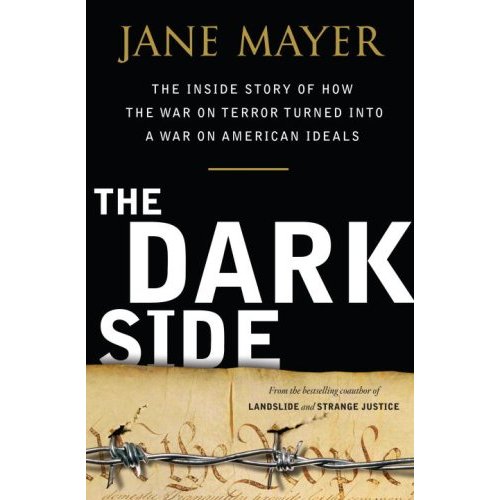
BOOKS : The Dark Side by Jane Meyer

They described not just standing, but being kept up on their tiptoes with their arms extended out and up over their heads, attached by shackles on their wrists and ankles, for what they described as eight hours at a stretch. During the entire period, they said they were kept stark naked and often cold.

Torture and the rule of law
By Glenn Greenwald / July 12, 2008

The New Yorker’s Jane Mayer, one of the country’s handful of truly excellent investigative journalists over the last seven years, has written a new book — “The Dark Side: The Inside Story of How the War on Terror Turned Into a War on American Ideals” — which reveals several extraordinary (though unsurprising) facts regarding America’s torture regime. According to the New York Times and Washington Post, both of which received an advanced copy, Mayer’s book reports the following:

* “Red Cross investigators concluded last year in a secret report that the Central Intelligence Agency’s interrogation methods for high-level Qaeda prisoners constituted torture and could make the Bush administration officials who approved them guilty of war crimes.”

* “A CIA analyst warned the Bush administration in 2002 that up to a third of the detainees at Guantanamo Bay may have been imprisoned by mistake, but White House officials ignored the finding and insisted that all were ‘enemy combatants’ subject to indefinite incarceration.”

* “[A] top aide to Vice President Cheney shrugged off the report and squashed proposals for a quick review of the detainees’ cases . . .

‘There will be no review,’ the book quotes Cheney staff director David Addington as saying. ‘The president has determined that they are ALL enemy combatants. We are not going to revisit it.'”

* “[T]he [CIA] analyst estimated that a full third of the camp’s detainees were there by mistake. When told of those findings, the top military commander at Guantanamo at the time, Major Gen. Michael Dunlavey, not only agreed with the assessment but suggested that an even higher percentage of detentions — up to half — were in error. Later, an academic study by Seton Hall University Law School concluded that 55 percent of detainees had never engaged in hostile acts against the United States, and only 8 percent had any association with al-Qaeda.”

* [T]he International Committee of the Red Cross declared in the report, given to the C.I.A. last year, that the methods used on Abu Zubaydah, the first major Qaeda figure the United States captured, were ‘categorically’ torture, which is illegal under both American and international law”.

* “[T]he Red Cross document ‘warned that the abuse constituted war crimes, placing the highest officials in the U.S. government in jeopardy of being prosecuted.'”

This is what a country becomes when it decides that it will not live under the rule of law, when it communicates to its political leaders that they are free to do whatever they want — including breaking our laws — and there will be no consequences. There are two choices and only two choices for every country — live under the rule of law or live under the rule of men. We’ve collectively decided that our most powerful political leaders are not bound by our laws — that when they break the law, there will be no consequences. We’ve thus become a country which lives under the proverbial “rule of men” — that is literally true, with no hyperbole needed — and Mayer’s revelations are nothing more than the inevitable by-product of that choice.

That’s why this ongoing, well-intentioned debate that Andrew Sullivan is having with himself and his readers over whether “torture is worse than illegal, warrantless eavesdropping” is so misplaced, and it’s also why those who are dismissing as “an overblown distraction” the anger generated by last week’s Congressional protection of surveillance lawbreakers are so deeply misguided. Things like “torture” and “illegal eavesdropping” can’t be compared as though they’re separate, competing policies. They are rooted in the same framework of lawlessness. The same rationale that justifies one is what justifies the other. Endorsing one is to endorse all of it.

In fact, none of the scandals of radicalism and criminality which we’ve learned about over the last seven years — including the creation of this illegal torture regime — can be viewed in isolation. They’re all by-products of the country that we’ve become in the post-9/11 era, primarily as a result of our collective decision to exempt our Government leaders from the rule of law; to acquiesce to the manipulative claim that we can only be Safe if we allow our Leaders to be free from consequences when they commit crimes; and to demonize advocates of the rule of law as — to use Larry Lessig’s mindless, reactionary clichés — shrill, Leftist “hysterics” who need to “get off [their] high horse(s)”.

That is the mentality that has allowed the Bush administration to engage in this profound assault on our national character, to violate our laws at will. Our political and media elite have acquiesced to all of this when they weren’t cheering it all on. Those who object to it, who argue that these abuses of political power are dangerous in the extreme and that we cannot tolerate deliberate government lawbreaking, are dismissed as shrill Leftist hysterics.

All the way back in May, 2006 — just months after the NYT revealed the illegal NSA spying program — I wrote in my first book, How Would a Patriot Act, the following about the NSA eavesdropping scandal:

This is not about eavesdropping. This is about whether we are a nation of laws . . . . The heart of the matter is that the President broke the law, repeatedly and deliberately, no matter what his rationale for doing so was . . . .

The National Security Agency eavesdropping scandal is not an isolated act of lawbreaking. It is an outgrowth of an ideology of lawlessness that has been adopted by the Bush administration as its governing doctrine. Others include the incarceration in military prisons of U.S. citizens who were not charged with any crime or even allowed access to a lawyer, the use of legally prohibited torture techniques, and the establishment of a military detention center in Guantanamo Bay, a no-man’s-land that the administration claims is beyond the reach of U.S. law. In the media and the public mind, these issues have been seen in isolation, as though they are unconnected.

In fact, all of these controversial actions can be traced to a single cause, a shared root. They are grounded in, and are the by-product of, an unprecedented and truly radical theory of presidential power that, at its core, maintains that the president’s power is literally unlimited and absolute in matters relating to terrorism or national security. . . .

What we have in our federal government are not individual acts of lawbreaking or isolated scandals of illegality, but instead a culture and an ideology of lawlessness.

But those who argued such things were The Shrill Leftists, The Crazed Civil-Liberties Extremists, the Hysterics. And they still are. By contrast, Serious People understood — and still understand — that our leaders made complex and weighty decisions for our own Good and that terms like “lawbreaking” and “war crimes” and “prosecutions” have no place in respectable American political circles. Hence, our political leaders operate in a climate where they know they can do anything — anything at all, including flagrantly breaking our most serious laws — and they will be defended, or at least have their behavior mitigated, by a virtually unanimous political and media establishment. The hand-wringing over Mayer’s latest revelations will be led by the very people who are responsible for what has taken place — responsible because they decided that rampant, deliberate lawbreaking by our Government officials was nothing to get worked up over.

There are many political disputes — probably most — composed of two or more reasonable sides. Whether the U.S. Government has committed war crimes by torturing detainees — conduct that is illegal under domestic law and international treaties which are binding law in this country — isn’t an example of a reasonable, two-sided political dispute. Nor is the issue of whether the U.S. Government and the telecom industry engaged in illegal acts for years by spying on Americans without warrants. Nor is the question of whether we should allow Government officials to break our laws at will by claiming that doing so is necessary to keep us Safe.

There just aren’t two sides to those matters. That’s what the International Red Cross means when it says that what we did to Guantanamo detainees was “categorically torture.” It’s what the only federal judges to adjudicate the question — all three — have concluded when they found that the President clearly broke our laws with no valid excuses by spying on our communications for years with no warrants. It’s why the Bush administration has sought — and repeatedly received — immunity and amnesty for the people who have implemented these policies. It’s because these actions are clearly illegal — criminal — and we all know that.

And that’s true no matter how many Bush-loyal DOJ lawyers justify the behavior, no matter how many right-wing lawyers go on TV to defend the Government’s conduct, no matter how many Brookings “scholars” go to The New Republic in order flamboyantly to boast how deeply complex these matters are and how only Super-Experts (like themselves) can grapple with the fascinating intellectual puzzles they pose. Displaying cognitive angst and/or above-it-all indifference in the face of unambiguously illegal and morally reprehensible government conduct isn’t a sign of intellectual sophistication or political Seriousness. It’s exactly the opposite. It’s the hallmark of complicity with it.

Law Professor Jonathan Turley, on MSNBC last night discussing Mayer’s revelations, put it this way:

[The IRC] is the world’s preeminent institution on the conditions and treatment of prisoners and specifically what constitutes torture. And the important thing here is they’re saying it’s not a close question, that as many of us, and there are many, many of us who have argued for years that this is clearly, unmistakably a torture program; the Red Cross is saying the same.

The problem for the Bush administration is they perfected plausible deniability techniques. They bring out one or two people that are willing to debate on cable shows whether water-boarding is torture. And it leaves the impression that it’s a close question. It’s not. It’s just like the domestic surveillance program that the a federal court just a week ago also said was not a close question. These are illegal acts. These are crimes. And there weren’t questions before and there’s not questions now as to the illegality. . . .

I never thought I would say this, but I think it might, in fact, be time for the United States to be held internationally to a tribunal. I never thought, in my lifetime, that I would say that, that we have become like Serbia, where an international tribunal has to come to force us to apply the rule of law. I never imagined that a Congress, a Democratic-led Congress would refuse to take actions, even with the preeminent institution of the Red Cross saying, this is clearly torture and torture is a war crime. They are still refusing to take meaningful action.

So, we’ve come to this ignoble moment where we could be forced into a tribunal and forced to face the rule of law that we’ve refused to apply to ourselves.

That’s the inevitable outcome when a country’s political establishment decrees itself exempt from the rule of law. If the rule of law doesn’t constrain the actions of government officials, then nothing will. Continuous revelations of serious government lawbreaking have led not to investigations or punishment but to retroactive immunity and concealment of the crimes. Judicial findings of illegal government behavior have led to Congressional action to protect the lawbreakers. The Detainee Treatment Act. The Military Commissions Act. The Protect America Act. The FISA Amendments Act. They’re all rooted in the same premise: that our highest government leaders have the power to ignore our laws with impunity, and when they’re caught, they should be immunized and protected, not punished.

When our political and media elite aren’t defending the Bush administration’s lawbreaking, they’re dismissing its importance. David Broder believes that government crimes are mere “policy disputes” that shouldn’t be punished. And here’s “liberal” pundit Tim Rutten of The Los Angeles Times, acknowledging that our highest political officials ordered illegal torture, but then invoking the very common — and indescribably destructive — mentality of most of our Good Establishment Liberals to insist that they should not be held legally accountable:

It’s true that there are a handful of European rights activists and people on the lacy left fringe of American politics who would dearly like to see such trials, but actually pursuing them would be a profound — even tragic — mistake. Our political system works as smoothly as it does, in part, because we’ve never criminalized differences over policy. Since Andrew Jackson’s time, our electoral victors celebrate by throwing the losers out of work — not into jail cells.

The Bush administration has been wretchedly mistaken in its conception of executive power, deceitful in its push for war with Iraq and appalling in its scheming to make torture an instrument of state power. But a healthy democracy punishes policy mistakes, however egregious, and seeks redress for its societal wounds, however deep, at the ballot box and not in the prisoner’s dock.

To do otherwise risks the stability of our own electoral politics almost as recklessly as the Bush/Cheney regime has risked our national interests abroad.

That warped mentality — as much as the most lawless elements of the Bush administration — is what is responsible for the destruction of our fundamental national character over the last seven years. “Laws” and “crimes” are only for the common people and for other countries. We’re too magisterial a country, our political leaders are too Important and too Good, to subject them to punishment when they break our laws. That’s the mentality that has created the climate of Lawlessness that defines who we are.

Yes, I’m well aware that the U.S, like all countries, was deeply imperfect prior to 9/11, and that many of the systematic excesses of the Bush era have their genesis prior to 2001. The difference (a critical one) is that what had been acts of lawbreaking and violations of our national values have become the norm — consistent with, rather than violative of, our express values and policies. As Mayer writes in her book:

For the first time in its history, the United States sanctioned government officials to physically and psychologically torment U.S.-held captives, making torture the official law of the land in all but name.

The enactment of the new FISA bill last week was destructive for many reasons, including the fact that it legalized a regime of warrantless eavesdropping that is certain to be abused. But the far more destructive aspect of the new law is that it was just the latest example — albeit the most flagrant — of our political class abolishing the rule of law in this country.

It will never stop being jarring that Pulitzer-Prize-winning revelations from the New York Times that the President and the telecom industry were committing felonies for years culminated in the full-scale protection of the lawbreakers and retroactive legalization of the criminality by the “opposition party” which controls the Congress.

One cannot coherently sanction or even acquiesce to serious government lawbreaking and then feign outrage over illegal torture and other war crimes. The sanctioning of government illegality is precisely what leads to abuses like the American torture regime. Those who have spent the last seven years scoffing at Unserious, Hysterical objections to Bush lawlessness are the very people who have created this climate that they will now pretend to find so upsetting. The “rule of law” isn’t some left-wing dogma that is the province of Leftist radicals and hysterics. It’s the cornerstone of every civilized and free society, and Jane Mayer’s new book is but the latest piece of evidence to prove that.

Source. / salon.com

Find The Dark Side by Jane Meyer at Amazon.Com

The Rag Blog

Posted in RagBlog | Tagged , , , , , , , , , , , | 1 Comment

Church Lures Teenagers With Assault Rifle Giveaway

Image courtesy Street Prophets.

Baptist pastor cancels AR-15 prize at youth conference after Oklahoma City shooting
July 12, 2008

An Oklahoma church canceled plans for a gun giveaway Friday at its annual youth conference, a local news station reported.

The church’s youth pastor, Bob Ross, said the AR-15 semi-automatic assault rifle was a means of luring young people as far away as Canada, according to Oklahoma City’s KOCO Channel 5 News.

“I don’t want people thinking ‘My goodness, we’re putting a weapon in the hand of somebody that doesn’t respect it who are then going to go out and kill,’” said Ross. “That’s not at all what we’re trying to do.”

The gun giveaway is a part of the event’s shooting competition. A gun was given away at last year’s conference and this year, Windsor Hills Baptist used the giveaway in the marketing of the event on its Web site (see above picture).

The pastor said the cancellation of the giveaway was due to the instructor of the shooting competition — and a pastor of the church — having injured his foot and being unable to attend.

The cancellation occurred after coverage of the controversy by local news stations.

A day before this story broke, a 12-year-old John White was accidentally shot in the head and killed in Oklahoma County by a 14-year-old friend who had easy access to his grandfather’s loaded weapons, local news stations reported.

“We would still have John with us today if people had taken more care, if they had used gun locks or gun safes,” says Kim Proc, John White’s great aunt.

Proc says officials told them they confiscated at least seven loaded guns from the home where White was that day, all owned by the 14-year-old’s grandfather, Channel 52 KSBI-TV reported.

John White’s family is determined to make sure his death impacts the way guns are kept in homes by changing the law.

Source. / The Raw Story

The Rag Blog

Posted in RagBlog | Tagged , , , | 2 Comments

Native Americans, Environmentalists : Thousands Gather in Washington

Dennis Banks organized the five month march to the White House.


‘Longest Walk’ reaches Washington
by Sally Art / July 11, 2008

WASHINGTON – Thousands of demonstrators are gathering in Washington DC after a five month long journey across America to draw attention to the state of the environment and press for the protection of sacred Native American sites.Thirty years ago, 40,000 Native Americans and their supporters participated in an historic cross-country march called the Longest Walk.

They travelled 3,600 miles from San Francisco to Washington gathering support to successfully halt bills before Congress, that Native Americans said threatened their sovereignty.

Commemorating that event, two groups of walkers set out from Alcatraz Island last February.

The Longest Walk 2 was longer by demand according to organiser Dennis Banks, who founded the first walk in 1978.

One group passed through southern states like Texas, Alabama and Tennessee while the northern delegation has walked through Pennsylvania and surrounding states.

Along the way they have picked up 3,800 bags of trash and gathered a list of American-Indian worries – everything from concern about burial grounds under threat in Kentucky to fears about the future of the Arizona Mountains threatened by ski resort development.

The marchers werere due to end their journey Friday at the White House and later present a 30-page manifesto to a Democratic Congressman, Rep. John Conyers, who advocates on a wide range of minority issues.

Some sceptics have questioned the impact a group of people on foot can have.

But one marcher, Shanawa Littlebow, has no doubts.

“To say it doesn’t work, it’s to say a wheel doesn’t work when it’s turning. We’re turning. We’re walking. It’s working,” he said.

Source. / Sky News / CommonDreams

The Rag Blog

Posted in RagBlog | Tagged , , , | Leave a comment

Stephen Payne : Hotshot Lobbyist Can Get You Into White House

Lobbyist Stephen Payne shown shooting with VP Dick Cheney. (Careful, dude.)

Offered access to Dick Cheney and others in return for donation to Bush library
By Daniel Foggo / July 13, 2008

A lobbyist with close ties to the White House is offering access to key figures in George W Bush’s administration in return for six-figure donations to the private library being set up to commemorate Bush’s presidency.

Stephen Payne, who claims to have raised more than $1m for the president’s Republican party in recent years, said he would arrange meetings with Dick Cheney, the vice-president, Condoleezza Rice, the secretary of state, and other senior officials in return for a payment of $250,000 (£126,000) towards the library in Texas.

Payne, who has accompanied Bush and Cheney on several foreign trips, also said he would try to secure a meeting with the president himself.

The revelation confirms long-held suspicions that favours are being offered in return for donations to the libraries which outgoing presidents set up to house their archives and safeguard their political legacies.

Unlike campaign donations, there is no requirement to disclose the donors to the libraries, no limit on the amount that can be pledged and no restrictions on foreigners contributing.

During an undercover investigation by The Sunday Times, Payne was asked to arrange meetings in Washington for an exiled former central Asian president. He outlined the cost of facilitating such access.

“The exact budget I will come up with, but it will be somewhere between $600,000 and $750,000, with about a third of it going directly to the Bush library,” said Payne, who sits on the US homeland security advisory council.

He said initially that the “family” of the Asian politician should make the donation. He later added that if all the money was paid to him he would make the payment to the Bush library. Publicly, it would appear to have been made in the politician’s name “unless he wants to be anonymous for some reason”.

Payne said the balance of the $750,000 would go to his own lobbying company, Worldwide Strategic Partners (WSP).

Asked by an undercover reporter who the politician would be able to meet for that price, Payne said: “Cheney’s possible, definitely the national security adviser [Stephen Hadley], definitely either Dr Rice or . . . I think a meeting with Dr Rice or the deputy secretary [John Negroponte] is possible . . .

“The main thing is that he [the Asian politician] comes, and he’s well received, that he meets with high-level people . . . and we send positive statements made back from the administration about ‘This guy wasn’t such a bad guy, many people have done worse’.”

Payne said that he would use the services of Mark Pritchard, a Conservative MP who chairs the House of Commons all-party Russia group and was last week on the brink of signing as a paid “adviser” to WSP. Pritchard issued a statement saying that he had not done any work for WSP.

When confronted, Payne said that there would be “no quid pro quo” for any donation and added that his firm was “always above board”.

The White House said it would not be influenced by such donations.

Source. / The Sunday Times, UK / The Huffington Post

Click here for a brochure on Stephen Payne’s company Worldwide Strategic Partners.

See video here.

The Rag Blog

Posted in RagBlog | Tagged , , , , , , , | Leave a comment

SPORT : John McCain’s Terrible (Towel) Tale

Packers fans shown waving “terrible towels.” No, wait a minute…

How about those… uh… Steelers?
By Sarah Wheaton / July 12, 2008

Terrible Towels are waving at half-staff today. It was only Wednesday when Senator John McCain was talking about how Pittsburgh’s beloved Steelers helped him get through his years in a North Vietnamese prison.

“When I was first interrogated and really had to give some information because of the physical pressures that were on me, I named the starting lineup — defensive line — of the Pittsburgh Steelers as my squadron-mates,” he told KDKA-TV in Pittsburgh, a city filled with the white, working-class voters who could be up for grabs in November (many of whom also happen to be diehard football fans).

But Mr. McCain evidently confused the Black and Gold with the Green and Gold. In his 1999 memoir, Mr. McCain wrote that he recited the names of Green Bay Packers. As sports fans were quick to point out, the Steelers version of Mr. McCain’s story just did not make much sense. Mr. McCain, a Navy brat, had no ties to Pittsburgh, and the team was in the middle of a streak of losing seasons in 1966, the year before he was shot down. Meanwhile, the Packers that season won the first Super Bowl. His campaign said it was simply a mistake.

Source. / The Caucus / New York Times blogs

Thanks to Harry Edwards / The Rag Blog

Posted in RagBlog | Tagged , , | 1 Comment

ART : Burning Man 2008

Obelisk with cutaway view of interior. Design by Rod Garrett and Larry Harvey. Illustration by Jack Haye and Rod Garrett.

Burning Man 2008
Monday, Aug. 25 – Monday, Sep. 1, 2008
Black Rock City, Nevada

The Burning Man project has grown from a small group of people gathering spontaneously to a community of over 48,000 people.

Every year, tens of thousands of participants gather to create Black Rock City in the Black Rock Desert of Nevada, dedicated to self-expression, self-reliance and art as the center of cummunity. They leave one week later, having left no trace.

Burning Man is much more than just a temporary community. It’s a city in the desert, dedicated to radical self reliance, radical self-expression and art. Innovative sculpture, installations, performance, theme camps, art cars and costumes all flower from the playa and spread to our communities and back again.

To learn more about the incredible Burning Man Experience, go to the Burning Man website.

The ritual highlight of the event is the ceremonial burning of the massive Burning Man structure.

2008 Art Theme: AMERICAN DREAM

And so from hour to hour we ripe and ripe,
And then from hour to hour we rot and rot;
And thereby hangs a tale
.
William Shakespeare, As You Like It

This year’s art theme is about nationality, identity and the nature of patriotism. One species of the patriotic urge conflates the nation state with mass identity. Governments, as actors on a worldwide stage, become a surrogate for self, a vast projection of collective ego. And yet, there is another type of patriotic feeling that attaches us to place and people, to a home and its culture. Both these feeling states (and their attendant ironies) are relevant to this year’s theme.

In 2008, leave narrow and exclusive ideologies at home; forget the blue states and the red; let parties, factions and divisive issues fall away, and carefully consider your immediate experience. What has America achieved that you admire? What has it done or failed to do that fills you with dismay? What is laudatory? What is ludicrous? Put blame aside, let humor thrive, and dare to contemplate a larger question: What can America, this stumbling, roused, half-conscious giant, still contribute to the world?

This year Burning Man will stand atop an obelisk. This imposing monument, emblazoned with the images of flags, will represent the countries of the world. Ranging from Canada to Chad, from Brazil to Burundi, from Vatican City to the Republic of China, these emblems will shine brightly in the night, gleaming like illuminated gems that stud a giant jewel box. A double-helix, like a strand of DNA, will form a staircase. Twining around the axis of this tower, it will spiral through a series of viewing platforms. The topmost tier will stand directly underneath the Burning Man.

Son, look, we might be in the desert, but we are still civilized people, and civilized people put up arbitrary boundaries that they will fight to the death to protect.

Hal speaking to Dewey, Malcolm in The Middle

Anyone embarking on this path will encounter hundreds of fellow participants – many of whom come to Black Rock City from around the world. Indeed, in order to discover the flag of any particular county amid this welter of imagery, it will be necessary to inspect the flags of many other nations. Each of these may be imagined as a dream no less radiant or precious than the rest. Each country is a source of culture and identity; yet each may also be regarded as a glimmering illusion: a sovereign artifact, an arbitrary puzzle piece, an isolated fragment on a map.

You making haste on decay: not blameworthy; life is good, be it
stubbornly
long or suddenly
A mortal splendor: meteors are not needed less than mountains:
shine, perishing republic.

Robinson Jeffers, Shine Perishing Republic

The 20th Century was, in many ways, the American century. At the close of World War II, the government of the United States created an enduring peace with its opponents that was almost without precedent. It embodied the ideals on which America was founded: democracy, equality, freedom and opportunity – a vision of unbounded hope for an improving future. It seemed natural for Americans to think their country was a master model for the world.

This post-war period also produced an unprecedented prosperity. America now hovered at the apex of its worldly fortunes. Never before had wealth been so broadly distributed throughout society. For many people – though, most certainly, not all – this was the era of what came to be called the American dream. Home ownership, a well paid job, a college education, the prospect of security in one’s old age: these blessings beckoned to a growing middle class.

The past does not repeat itself, but sometimes it rhymes.

Mark Twain

Today, Americans appear to live amid the tarnished squalor of a second Gilded Age. By nearly every measure, America has become a more unequal society. A mere one percent of the population now controls a third of the nation’s wealth. Education, health care and home ownership – these now escape the reach of those who thought they were the middle class. Forty years of heedless mass-consumption have turned dreams into delusions. America’s awash in debt. Embroiled in a wayward war, its citizens are told to shop.

Many feel that the United States is now adrift. Its allies, once so numerous, begin to fall away and chart an independent course. Its citizens, more tellingly, have lost their faith in progress. Polls indicate they now believe their children can’t expect a better future. They distrust the institutions of government, of finance, and the corrupting power of large corporations. And yet, the native traits of any culture are deep-rooted. Freedom, opportunity, inventiveness, the power to transform oneself: these values and a love of self-expression still endure.

Perhaps, it’s time Americans began to face themselves. Maybe, it’s also time that they began to listen to other countries of the world. All of us are immigrants to Black Rock City. What can we dream America to be? As always, any work of art by anyone, regardless of our theme, is welcome at the Burning Man event. If you are planning to do fire art or wish to install a work of art on the open playa, please see our Art Guidelines for more information.

Source. / The Burning Man Project

The Rag Blog

Posted in RagBlog | Tagged , , , , , , , | Leave a comment

MEDICINE : Houston’s Dr. Michael DeBakey: 1908-2008


‘Greatest surgeon of the 20th century’ dies
By Todd Ackerman and Eric Berger

Dr. Michael Ellis DeBakey, internationally acclaimed as the father of modern cardiovascular surgery — and considered by many to be the greatest surgeon ever — died Friday night at The Methodist Hospital in Houston. He was 99.

Medical statesman, chancellor emeritus of Baylor College of Medicine, and a surgeon at The Methodist Hospital since 1949, DeBakey trained thousands of surgeons over several generations, achieving legendary status decades before his death. During his career, he estimated he had performed more than 60,000 operations. His patients included the famous — Russian President Boris Yeltsin and movie actress Marlene Dietrich among them — and the uncelebrated.

“He was a great contributor to medicine and surgery, of course,” said Dr. Denton Cooley, president and surgeon-in-chief at the Texas Heart Institute in Houston and a longtime DeBakey rival.

“But he left a real legacy in the Texas Medical Center and at Baylor College of Medicine, where he’s brought so much attention. Together we were able to establish Houston as a world leader in cardiovascular medicine.”

Cooley had known DeBakey since 1945. “In the first half of the 20th century, very little went on in this field,” he said of cardiovascular surgery. “So when he and I began our careers, we pretty much had an open field.”

“Dr. DeBakey singlehandedly raised the standard of medical care, teaching and research around the world,” said Dr. George Noon, a cardiovascular surgeon and longtime partner of DeBakey’s. “He was the greatest surgeon of the 20th century, and physicians everywhere are indebted to him for his contributions to medicine.”

Debakey almost died in 2006, when he suffered an aortic aneurysm, a condition for which he pioneered the treatment. He is considered the oldest patient to have both undergone and survived surgery for it. He recovered well enough to go to Washington earlier this year to receive the Congressional Gold Medal, one of the nation’s two highest civilian honors.

“The full weight of his contributions may not be known for many years, but everyone who knew him gravitated to his kindness, warmth and spirit,” U.S. Sen. Kay Bailey Hutchison, R-Texas, said in a statement Saturday. “He was still innovating in medicine until his last breath.”

He remained vigorous and was a player in medicine well into his 90s, performing surgeries, traveling and publishing articles in scientific journals. His large hands were steady, his hearing sharp. His personal health regimen included taking the stairs at work and a single cup of coffee in the morning.

DeBakey’s death was mourned Friday night by the leaders of Methodist and Baylor. Methodist President Ron Girotto said, “He has improved the human condition and touched the lives of generations to come. We will greatly miss him.”

And Baylor President Dr. Peter Traber added that “he set a standard for preeminence in all areas of his life that those who knew him and worked with him are compelled to emulate. And he served as a very visible reminder of the importance of leadership and giving back to one’s community.”

Debakey was born in Lake Charles, La., in 1908, a month before Ford began making Model Ts and a quarter-century before the discovery of bacteria-fighting drugs. His genius helped shape surgery and health care as we know it. While still in medical school, he developed the roller pump for the heart-lung machine. DeBakey invented many of the procedures and devices — more than 50 surgical instruments — used to repair hearts and arteries today.

He is widely credited with laying the foundation for the Texas Medical Center in Houston by recruiting pre-eminent doctors and researchers and giving the city an international reputation for leading-edge health care. He was a maverick, running afoul of the Harris County Medical Society for insisting that surgeons be certified by the American Board of Surgery. At the time, it was common for general physicians to operate.

“DeBakey built a department of surgery at Baylor and at The Methodist Hospital, which was to become one of the most celebrated in the world, a galaxy of young stars,” the late author Thomas Thompson wrote in 1970 in Hearts: Of Surgeons and Transplants, Miracles and Disasters Along the Cardiac Frontier. “In a city where 25 years ago there was practiced medicine of the most mediocre sort, there sprung up in a swampy area six miles south of downtown … one of the handful of distinguished medical centers in the world.”

He invented and refined ways to repair weakened or clot-obstructed blood vessels using replacements made from preserved human blood vessels, and later, with artificial ones. He is credited with the first successful surgical treatment of potentially deadly aneurysms of various parts of the aorta. He co-authored one of the earliest papers linking smoking and lung cancer in 1939.

“Dr. DeBakey is a legendary figure in medicine and a mentor to hundreds of practicing doctors and medical students. The full weight of his contributions may not be known for many years, but everyone who knew him gravitated to his kindness, warmth and spirit,” U.S. Sen. Kay Bailey Hutchison, R-Texas, said in a statement.

During World War II, serving in the office of the U.S. Surgeon General, DeBakey’s work led to the development of mobile surgical hospitals, called MASH units. He helped President John F. Kennedy lobby for Medicare; he recommended creation of the National Library of Medicine, subsequently authorized by Congress. In 1963 DeBakey won the Lasker Award for Clinical Research, considered the U.S. equivalent of a Nobel.

“At times he could act like the meanest man in the world. He didn’t let you breathe,” said Dr. John L. Ochsner of New Orleans, who trained under DeBakey and whose father, Dr. Alton Ochsner, was DeBakey’s mentor at Tulane University School of Medicine. DeBakey baby-sat the four Ochsner children, including John, and let them do chin-ups on his arm.

Said John Ochsner, “The thing that made him so mad all the time was he was trying to conquer the world and every minute was so important to him. He didn’t have time for frivolity at all.”

Patients and their families saw him otherwise. To them, DeBakey was a healer with quiet authority who seemed to work miracles. Enfolding a patient’s hands in his, the patient’s face would relax, some recalled.

He was pained by the breakup in 2004 of the historic, 50-year marriage between Baylor and Methodist, which dissolved over disagreements about the future of the institutions. DeBakey said the breakup made no sense and hurt both parties. Friends described him as “heartbroken” about the split and in an interview earlier this year he said the description was not inaccurate.

In 2003, his MicroMed DeBakey LVAD was implanted in a 10-year-old girl, the youngest patient in the world to receive the device. In 2004, a special child-sized version became available for children as young as 5. DeBakey developed the device, which boosts the heart’s main pumping chamber, in collaboration with heart surgeon Noon and NASA.

“The man has an incredible mind and an incredible grasp of details,” said former MicroMed CEO Travis Baugh . “He’s also never stopped inventing. We are working on a project with him a new way of attaching sutures to the heart.'”

Real the rest of this article here. / The Houston Chronicle

The Rag Blog

Posted in RagBlog | Tagged , , , , , | 1 Comment

Texas Democrats Riding High

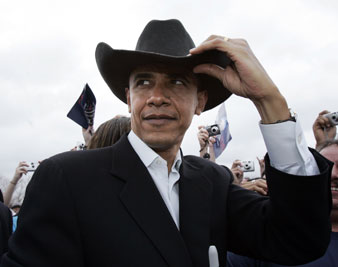
Barack Obama campaigning in Austin during the Texas Democratic primary. Photo by AP.

How Democrats Could Turn Texas Into the Blue Star State
By Bob Moser

The followinig article on the resurgence of the Democratic Party in Texas appears in the July 21, 2008 edition of The Nation.

“Did I mention that it’s fun to be a Democrat in Texas?” asks Matt Glazer, editor in chief of the Burnt Orange Report, the state’s leading progressive blog. He has, in fact, mentioned it a couple of times over beers at Scholz Garten, a legendary liberal hangout in Austin, and always with the same glimmer of happy bemusement behind his black-frame blogger specs. I’d been seeing that look in Democrats’ eyes all over Texas in early June–at their raucous, record-breaking state convention, at local Democratic shindigs, in giddily overburdened Obama HQs.

“It’s like everyone who toiled on that Democratic death march for years, when it was so difficult, is now seeing daylight,” says Josh Berthume of the Dallas suburb Denton, editor in chief of TheTexasBlue.com and another key player in a vigorous blogosphere that has helped ignite the startling Democratic flare-up here, in the bright red heart of Tom DeLay and Karl Rove’s “permanent” Republican majority.

The very notion of Texas Democrats glimpsing daylight–of America’s biggest chunk of Republican real estate being shaded pink on the ’08 election map–seems almost absurd, a contradiction in terms, even to those who are making it happen. Like many of the nuevo pols, bloggers and progressive activists who are constructing a state-of-the-art Democratic machine in Texas, Glazer and Berthume are too young to remember the last time skies were blue for the party that ruled Texas politics from Reconstruction clear through to Reagan/Bush. So is Burnt Orange publisher Karl-Thomas Musselman, who’s 23. “The last time Democrats won my hometown”–a small outpost in the central Hill Country–“was 1964,” he says. “And that was only because President Johnson brought the chancellor of Germany to Fredericksburg for a visit.”

The last Democratic presidential nominee to carry Texas was Jimmy Carter in 1976. The party hasn’t won a solitary statewide election since 1996. Every November from 1972 to 2004, the Democrats bled seats from their once-unanimous majority in the Statehouse. By the 1990s, national Democrats like Bill Clinton had come to see Texas as “a money pot, period,” says Molly Hanchey, a retiree who leads an 8,000-volunteer grassroots group called ObamaDallas. They flew in to raise cash, but they didn’t stick around to scare up votes–and Clinton’s party did nothing to help rebuild the state’s hopelessly antiquated Democratic infrastructure. Neither Al Gore nor John Kerry tried to compete here. By 2004, Democratic fortunes had sunk so low that they carried just eighteen of 254 Texas counties at the top of the ticket.

Four years later, the Realm of the Bushes is now being described–in the Wall Street Journal, no less–as potentially “the next California.” The next big Republican stronghold, in other words, that is headed for a seismic partisan flip. It won’t happen tomorrow, of course. But unmistakable signs of a Democratic breakout are all around. In Dallas, linchpin of the Republicans’ statewide ascendance in the 1980s, an innovative grassroots campaign in 2006 earned Democrats a sweep of more than forty contested judicial races–and Harris County (Houston) seems poised for a similar switch. Democrats won back six Statehouse seats in 2006, bringing them within five of regaining the majority and having a hand in revising Tom DeLay’s infamous Republican-friendly redistricting after the next census.

Recognizing the outsized influence of the state’s estimated fifty active left-leaning bloggers, this year’s NetRoots Nation (formerly called Yearly Kos) is coming to Austin in July. And in the March presidential primaries, a startling show of Democratic enthusiasm was the big story buried under the Clinton/Obama headlines: just 1.3 million Texans voted Republican, while nearly 2.9 million voted Democratic–more than voted here in either of the last two general elections for Gore or Kerry. Political scientists are projecting that Bush Country will morph, by 2020, into the nation’s second-largest Democratic state. “Texas,” Democratic National Committee chair Howard Dean enthused during the DNC’s rules committee showdown in May, “is ready to turn blue.”

Yes, Texas.

“Until three years ago, the Texas Democratic Party was just brain-dead and prostrate,” says Southern Methodist University professor Cal Jillson, author of Texas Politics: Governing the Lone Star State. “They were beaten down. During the Bush years, people wouldn’t even admit to being Democrats in Texas. Now they’re up on their hind legs, feeling confident. It’s the Republicans who are sullen and downcast.”

What in the name of Sam Houston is going on down here? Pretty much the same partisan upheaval that’s roiling several of the Southern and Western states that became staunch Republican turf in the Reagan ’80s–and are now surprisingly tempting targets for Obama ’08. Even more powerfully than in Nevada, Colorado, New Mexico, North Carolina, Georgia and Virginia, a demographic tide is washing away the political dominance of older white conservatives in Texas, which in 2005 officially became the nation’s fourth “minority white” state (after California, New Mexico and Hawaii). At the same time, anti-immigration, ideologically rigid, starve-the-government Republican leaders are giving the GOP an ugly reputation with the rising generation of younger Hispanics–the swing voters who are displacing the old Reagan Democrats–and simultaneously alienating independent-minded, middle-aged “office populists” massing around booming metropolises like Dallas.

While Texas’ swelling Hispanic population still registers and votes in smaller percentages than blacks or whites, turnout soared in this year’s primaries, and Hispanics–once courted lovingly and successfully by Bush–are leaning increasingly Democratic. While GOP leaders spout anti-immigration tag lines, Texas Democrats are brimming with ambitious young Hispanic leaders like this year’s US Senate nominee, Afghanistan veteran and progressive populist Rick Noriega, who until recently trailed by single digits in his long-shot race to unseat Republican John Cornyn; State Senator Leticia Van de Putte of San Antonio, a firebrand who delivered the party’s Spanish-language response to this year’s State of the Union address; and smooth-talking State Representative Rafael Anchía of Dallas, whom Texas Monthly recently predicted would be “El Gobernador.”

Demographics and immigration aside, Texas wouldn’t be swinging so far so fast without a rejuvenated Democratic Party, which was hard to imagine just four years ago. Nowhere did Southern (or Western) Democrats fall so far in the 1980s and ’90s, and nowhere have they lifted themselves back up so quickly and dramatically. As The Return of the Democrats becomes the latest legend in the colorful book of Texas politics, many will date the beginning of the tale to 2003, when Democrats in the Legislature reconnected with their party’s hell-raising roots in the fight against DeLay’s Machiavellian (and legally dubious) redistricting scheme.

“That’s when Democrats really started to get our legs under us in Texas,” says Matt Angle, former chief of staff to Dallas Congressman Martin Frost, who lost his reconfigured district in 2004 when the dust had settled. After all those years of being stuck in what Donna Brazile, Gore’s 2000 campaign manager, calls the “fetal crouch” of agreeable, Lite Republican centrism, Angle says, “we fought back tooth and nail. And the public began to see that the Republicans were really overreaching, that they were willing to do anything, that for them it wasn’t about what was good for Texas.” In the process, “Democrats realized that not only do we have a moral commitment to fight back but also that we have a chance to beat them.”

By the time the redistricting fracas kicked up, Democrats had lost every significant vestige of power in Texas. Nearly forgotten were the many generations when “calling yourself a Democrat was like declaring you had a pulse,” in the words of former Lieutenant Governor Ben Barnes. “If you were alive, you were a Democrat.” But there was an ironic upside to the Democrats’ struggles: during its three decades of slow, steady decline, the party shed most of its white conservatives. While the loss of those Reagan Democrats meant short-term pain at the ballot box, it also gave Democrats a chance to remake their party practically from scratch (as Republicans did in the 1970s), with the state’s urban-centered, multiethnic future firmly in mind, and with a whole new set of high-tech, grassroots techniques and resources on hand, thanks in part to Howard Dean’s fifty-state national strategy.

Elected in 2005, new party leaders like Dallas chair Darlene Ewing are reconstituting the historically disorganized party–in urban areas of the state, at least–into a precinct-by-precinct, voter-by-voter, high-tech machine. Angle’s Texas Democratic Trust, a Washington-based group funded by legendary trial attorney Fred Baron, the “Texas George Soros,” lent organizers and polling expertise to the “coordinated campaign” that took Dallas’s long-entrenched Republicans by surprise in 2006, and it’s providing similar aid to the Democrats’ takeover effort in Harris County this year.

The GOP should have seen it coming in Dallas County, which lost 130,000 white residents–and gained more than 220,000 Hispanics–just between 2000 and 2006. In 2004 George W. Bush had carried the county by a scant 10,000 votes. But it wasn’t the population shift that turned Dallas blue in 2006; it was, in the words of local organizer Kirk McPike, the fact that local Democrats “took a good situation and made it extraordinary.” Ewing persuaded most of the Democratic judicial candidates in Dallas–there were more than forty–to contribute to the party’s new coordinated campaign and trust their prospects to a radically newfangled approach: a nonstop flurry of phone-banking, precinct-walking, direct-mailing and vote-targeting. Every judicial candidate won, as did Dallas’s first African-American district attorney, progressive Craig Watkins.

“It was a triumph of grassroots politics,” says Angle. “Dallas Democrats spoke one-on-one to the voters, and more important, they communicated. It was research-based, targeted to things voters really cared about,” like the nation’s highest utility rates, statewide cuts in children’s healthcare and an unpopular Republican push for toll roads.

Which brings us to the other indispensable contributor to the Democratic upsurge: Texas Republicans.

Back at Scholz Garten, Burnt Orange blogger Karl-Thomas Musselman hoists his beer in a toast of sorts. “The best thing that ever happened to Democrats in Texas is that the people who took over the Republican Party in Texas are running it into the ground,” he says.

“They’re out of touch because they’re fanatically ideological,” says editor Matt Glazer. “They’ve failed to govern effectively by every measure you can come up with.”

“Say you’ve been voting Christian values, or along small-government Republican lines,” says Musselman, who comes from a place where most folks have been doing just that. “At some point, you have to start thinking, What does it do for me? My taxes are not lower. My kids are not smarter. My job is not better. What are we getting?”

Right now, folks are getting a heaping dose of right-wing bluster from the Texas Republicans–most notably, and most disastrously, on the sticky subject of immigration. Party leaders like Senator John Cornyn and Governor Rick Perry have veered from Rove and Bush’s formula and become fence-building border warriors. “They’re just digging themselves deeper in a hole by moving right on immigration,” says Cal Jillson. “The only prospect for the Texas Republican Party to remain competitive in ten years is to be winning 35 to 40 percent of Hispanic votes, along with 75 percent of whites and 10 percent of African-Americans.”

But as the center of Texas political gravity veers inexorably leftward, GOP leaders like Governor Perry appear determined to go down, Alamo style, with ideological guns blazing. “The reason we lost our majority in Congress,” Perry lectured the California Republican Convention last fall, “is not because our ideas lost their luster but our leaders lost their way…. It’s a sad, sad state of affairs,” he said, in a clear dig at fellow Governor Arnold Schwarzenegger, “when…Republicans govern like liberals to be loved.” No such coddling would be forthcoming from the governor of Texas. “We need to hold the line on what it means to be a Republican,” Perry said, “which is, of course, being conservative.”
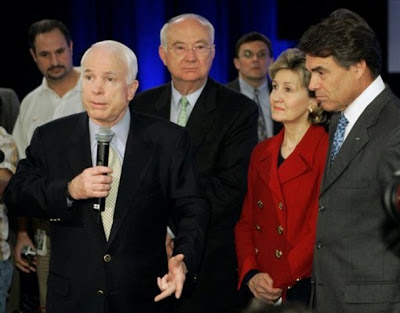
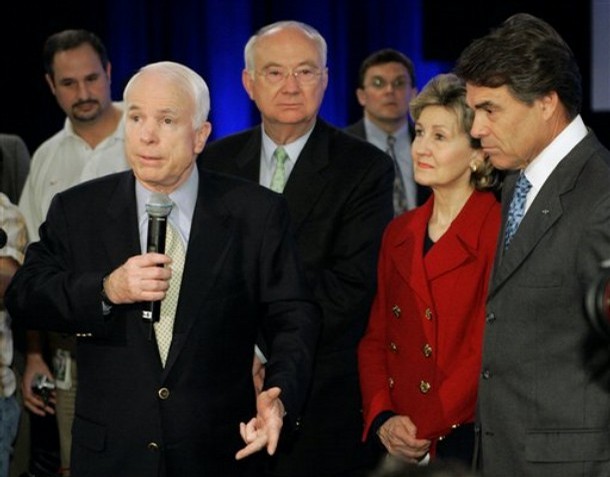
John McCain with his economic advisor former Texas Sen. Phil Gramm, US Sen. Kay Bailey Hutchinson of Texas and Texas Gov. Rick Perry, Republicans all, at Dell, Inc. in Austin earlier this year. Photo by Harry Cabluck / AP.

A converted Democrat who’s jostled for supremacy in the GOP with Senator Kay Bailey Hutchison (a relative moderate) since they both won statewide office in 1990, Perry is an intractable ideologue on “Christian values” and economic matters. At his urging, the Republican Legislature has cut more than 200,000 children off health insurance–and now, with a budget surplus, Perry is pushing for tax rebates. In 2006, after Perry’s hard-right re-election campaign netted him just 39 percent of the vote (enough to scrape by in a four-candidate field), he cheerfully declared of Texas voters, “They said, We like what you’re doing–keep it up.”

Such delusional thinking has many GOP leaders–the ones currently out of power, at least–profoundly worried. “The grassroots has withered up and died,” former state chair Tom Pauken recently lamented in the Houston Chronicle. “The Republican Party has definitely peaked in Texas,” says the party’s longtime political director, Royal Masset. GOP pollster Mike Baselice fears big numbers of “grumpy Republicans”–more than 50 percent in Texas say the state and country are on the wrong track–will sit out 2008. Meanwhile, the party looks to be skidding toward a bloodbath in 2010, when insiders expect both Lieutenant Governor David Dewhurst, a hellfire-and-brimstone Christian conservative, and Senator Hutchison, who embodies the politer, Chamber of Commerce wing of the party (and says she’s tired of Washington and wants to come home), to challenge Perry in the Republican primary. “And people say Democrats have circular firing squads!” says Glazer, clearly charmed by the prospect.

A Perry-Hutchison showdown could open a sizable tear in the coalition of Christian and business conservatives that has made the Texas Republican Party–like other state parties in the South and interior West–such a force in recent decades. “Hutchison is closer to a Republican in a more moderate state,” says Jillson. “She’s been booed sometimes at state conventions by the true believers. Perry might beat her in a primary, but she is more popular statewide.” And if she were to lose to Perry (or Dewhurst), a whole new bloc of moderate Republicans could be giving the Democrats a fresh look. Even if the Republicans steer clear of such a destructive internal battle, Jillson says, “there’s no denying that every trend is against them. You can’t argue with demographics. And the issues are all lined up against them. The grassroots energy is on the other side. They can see it coming, but they haven’t reacted.”

Rank-and-file Republican disquiet was all too palpable at the party’s state convention in Houston in June. Enthusiasm for the GOP’s presidential nominee-to-be was so damp that a local reporter counted the applause that followed John McCain’s campaign video at precisely eight seconds. Charisma-challenged Senator Cornyn, running for re-election in a state where a 2007 poll showed that 40 percent of voters had no opinion of him at all, unveiled an unintentionally uproarious video set to the old novelty hit “Big Bad John,” depicting the go-along senator as a take-no-prisoners, Stetson-hatted reformer making corrupt Washington politicians quake in their boots. Some of the weekend’s loudest cheers were spontaneous, off-the-agenda outbursts by supporters of rebellious Republican Congressman Ron Paul. For his part, Paul was one of an embarrassing fourteen no-shows–out of nineteen Congress members–who were being introduced at the convention.

The Democratic convention, held the previous weekend in Austin, was a jubilant throwdown by contrast. A broadly diverse, revved-up crowd of more than 12,000 cheered new party heroes like State Senator Mario Gallegos Jr. of Houston, who last year returned to the Senate floor with a hospital bed, against doctor’s orders after a liver transplant, to block a Republican-backed voter-ID bill that would have disenfranchised thousands of Texans. And notwithstanding a cranky fellow who circled the Austin Convention Center bearing a sign reading Small-town, gun-owning religious Democrat bitter about Obama, lingering wounds between the Hillary Clinton and Barack Obama camps were salved by such characteristically Texan means as Thursday night’s “unity pub crawl,” with downtown Austin’s bars jammed to overflowing with commingling drinkers of Obamarama ‘Ritas and Hillary Harps. On Saturday the delegates paused to watch as Clinton quit the race and endorsed Obama–at which point, par for the course at a Democratic gathering, the video feed sputtered. But around the convention hall, chants of “Hillary! Hillary!” soon gave way to a rousing, full-throated chorus of “United We Stand.”

“Given the news coverage beforehand, I’d almost expected a Jets versus Sharks rumble to break out,” says Berthume, the Texas Blue editor. Instead, “it was a Frank Capra moment for me as a Democrat. It was ridiculous. You’d see people with Clinton and Obama shirts holding hands, hugging. People cried.”

A few nights later Renee Hartley, vice president of the Dallas County Young Democrats, was still hoarse from her long weekend serving on the platform committee–but still making volunteer assignments to the forty folks who came out for the DCYD’s monthly meeting at Zúbar, a warm, woodsy drinking hole in East Dallas. Hartley originally backed John Edwards, then ended up as a Clinton delegate to the state convention–which brought her a certain amount of grief, since “I was under 35, an African-American female and people just assumed I’d be for Obama. How could I not be?” Hartley’s working-class roots inclined her toward Clinton’s populist pitch–but she said that, along with the vast majority of her fellow Clintonites, she was having no great difficulty making the switch. That’s partly because, she said, being a Democrat in Texas is no longer just about “which horse you ride.”

“There’s this overwhelming sense that we’re moving forward now as a party–it’s not about any one candidate, whether it’s for President or senator or governor.” Which is no small development in a state where Democratic politics long orbited around such outsized personalities as Lyndon Johnson, longtime House Speaker Sam Rayburn and Governors John Connally and Ann Richards. Now Texas Democrats are competing on Republican turf–at the grassroots, that is–and developing a message that resonates with old-style and new-school Texas populists. “Democrats have started learning this everywhere,” says Matt Angle, “but nowhere more than in Texas: you can’t be afraid to say that you want government to work, that some things are a higher priority than cutting taxes.”

The Democratic resurrection in Texas could hardly be happier news for the national party’s long-term future. But in the short-term calculus of a presidential election year, it does create a dilemma–albeit a rather pleasant one–for Barack Obama’s campaign.

On the one hand, Texas Democrats stand to gain more ground in local and legislative elections in November, and they could surely make good use of the rocket-boost of grassroots energy and big money that is Obama’s to spread around. Those investments, in turn, would build momentum for a quicker statewide turnaround–meaning, among other things, more members of Congress to bulk up the majority behind Obama’s policies. Down the road, of course, it would also bring the Democrats closer to a potential mother lode of electoral votes–thirty-four at present, with more than forty projected by 2030–that could make national contests vexingly difficult for Republicans to win.
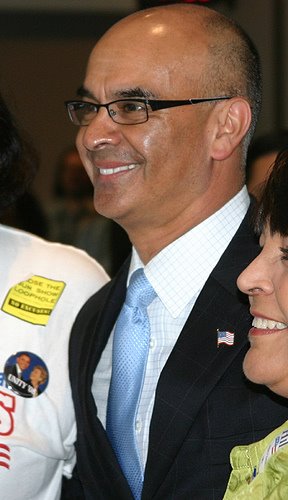
Hispanic Afghan war vet Rick Noriega, a progressive Democratic, at the 2008 Texas Democratic Convention, is taking aim at conservative US Sen. John Cornyn. Photo by montanaisaleg.

On the other hand, there is no realistic prospect that, barring a national landslide, Obama can carry Texas–until 2012, perhaps. And while Texas Democrats have a progressive, attractive Senate challenger in Rick Noriega, he’s struggling to rustle up the big bucks he needs against the well-heeled Cornyn. Besides, no matter how financially fat the Obama organization might be, running a full-scale campaign on Texas’ vast landscape of media markets is dauntingly expensive, with candidates needing to fork over some $1.4 million per week from Labor Day forward to get sufficient advertising on the air statewide. That adds up to a minimum of more than $11 million–money that might pay more immediate dividends in North Carolina, Nevada, Virginia, Colorado or New Mexico, toss-up states where Democratic turnarounds are further advanced.

In the consultant-driven, micro-targeting days of the not-so-distant Democratic past, the Texas dilemma would have been solved easily enough: look at the polls–screw it!–shovel everything into Florida and Ohio! As former DNC chair Terry McAuliffe reportedly declared in a strategy session during the Gore campaign, “All we care about is getting to 270”–electoral votes, that is. Winning the White House, in turn, was supposed to be a magic bullet for building the party nationally–though Democrats in states like Texas reaped no benefits from President Clinton’s two wins.

But it’s not only a new day for Democrats in Texas–it also looks like a new day for the national party. In May the Obama campaign dispatched hundreds of trained voter-registration volunteers to seventeen states, including Texas, where they will focus their efforts on the “blue boom” areas of Dallas, Houston, San Antonio and Austin, where hundreds of thousands of Hispanic voters are eligible but unregistered. In June, after the nomination was clinched, Obama deputy campaign manager Steve Hildebrand announced in an e-mail that the presidential campaign would extend Dean’s fifty-state strategy by running something close to a genuine national campaign. “Our presidential campaign will be the first in a generation to deploy and maintain staff in every single state,” he wrote, vowing to “provide help where we need it and impact races up and down the ballot this November.”

Just how much help Texas will be getting–“As in every presidential election, some states will be more competitive than others, and we will scale our resources accordingly,” Hildebrand carefully added–is anything but certain at this point. But Obama’s campaign guru, David Axelrod, promised in a series of Texas fundraisers in early June that fifteen staffers would be dispatched to Texas for the general election. “He was cagey about their level of investment,” says Molly Hanchey, the ObamaDallas chair. “But he was clear that we won’t be just an ATM this time.” And that’s more important, she says, than making Texas a full-scale presidential battleground in November.

“We’re going to do what we’re doing regardless,” she says. “They didn’t get us started–we did, even before Obama declared his candidacy.” And Texas’ newly focused Democrats have plenty to shoot for down the ballot. “The Dean strategy, and now the Obama strategy,” says Matt Angle, “recognizes that there is something to win in every state. And that, as we’ve learned in Texas, you don’t build a party from the top down.”

Here’s to that.

Source. / The Nation

Thanks to Harry Edwards / The Rag Blog

Posted in RagBlog | Tagged , , , , , | 2 Comments

Netroots Nation Comes to Austin

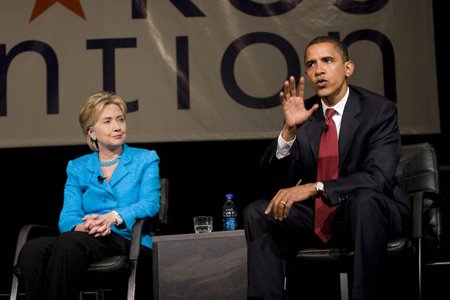
Clinton and Obama at 2007 YearlyKos Convention (now called Netroots Nation).

Netroots Nation 2008
Thursday-Sunday, July 17-20
Austin Convention Center

Netroots Nation, the third annual gathering of liberals and progressives from the blogosphere and beyond, meets July 17-20 at the Austin Convention Center. In addition to panels and discussion groups, the convention includes a progressive film series, a career fair, organizing sessions, and more. To register, or for panel and speaker lists, plus lodging and travel information, visit netrootsnation.org.

Convention brings Obamomentum and Web rebellion to Austin
By Wells Dunbar / July 11, 2008

As I write, the video “McCain’s YouTube Problem Just Became a Nightmare” has 2,654,664 views on the eponymous video-sharing website.

“There’s no question John McCain is getting a free ride from the mainstream press,” reads the description accompanying the clip, a three-minute reel of McCain flip-flops and flubs. “But with the power of YouTube and the blogosphere, we can provide an accurate portrayal of the so-called Maverick. We can put the brakes on his free ride!”

And there’s as succinct an encapsulation of Internet-driven, people-powered politics – the “netroots” – as you’re likely to find. Whereas four years ago it took a well-financed pack of political assassins to Swift boat John Kerry, increasingly cheaper technology, user-friendly tools like Blogger and WordPress, and an explosion in online fundraising are steadily wresting media power away from professionals to an impassioned grassroots base, irrevocably altering the political landscape.

Attempting to coalesce and promote that process is this weekend’s Netroots Nation, a four-day event at the Austin Convention Center bringing together the brightest lights in liberal and progressive opinion and activism. For regular blog readers, the speakers and attendees list reads like an RSS feed: Daily Kos founder Markos Moulitsas Zúniga, Duncan “Atrios” Black, Hullaballo’s “Digby” Parton, John Aravosis of AmericaBlog.com, and The American Prospect’s Ezra Klein, to name a select few – plus scores of other bloggers, authors, activists, politicians, journalists, and filmmakers.

But aside from a collection of technological tools, a constellation of small donors, and a din of liberal opinion, who exactly are “the netroots”? How are they changing politics? And can they reinvigorate a Democratic Party drifting dully to the center (and beyond) for more than two decades?

Speed Community

While 2004’s Swift boating represented the worst of top-down attack politics (amplified tenfold by an easily distractible media’s ceaseless reporting on “the controversy”), that year also saw the fullest expression of the Internet’s bottom-up potential to date: Howard Dean’s campaign. Dean’s example – via the adoption of his Web-driven, small-contributors model and his own leadership of the Democratic National Committee – still reverberates today. So it’s no surprise Dean recognizes the power of the netroots. Calling Netroots Nation “an important opportunity for progressives to come together and discuss the values and vision we share,” he says, “the progressive activists who fill Austin’s halls are an important part of our party and our nation, pushing every day for the change our country so desperately needs.”

Compared to the decades of hierarchical organization that modern movement conservatism required – financing right-wing think tanks, deregulating talk radio, and midwifing the Christian conservative movement (all arguably waning in importance) – the netroots’ ascendancy looks like an overnight success story. Its origin is often traced to the Nineties impeachment trial of Bill Clinton, which liberal Web hub MoveOn.org formed expressly to oppose; a prototypical weblog, Bob Somerby’s the Daily Howler (www.dailyhowler.com), also pushed back against the impeachment circus and its media facilitators. Then came a succession of flash points, each swelling the blogosphere’s readership and relevance: Florida 2000. Iraq. Election 2004. Katrina. “Macaca.” The 2006 Democratic reclamation of the House and Senate – and possibly, the 2008 reclamation of the White House.

“I think things move faster nowadays. … It’s just the nature of technology,” says Netroots Nation panelist Matthew Yglesias, who blogged independently before joining the American Prospect; he’s now a staffer at The Atlantic Monthly and writes for its website. “And also you’re talking about a movement, a group of people defined in part by using certain kinds of tools, so more and more people and more and more activity is moving online very rapidly. So what the conception of what the quote-unquote ‘netroots’ is is changing and growing.

“It’s a good way of assembling communities of interest,” Yglesias continues. “It may be [that] only a tiny minority of people in every American city are interested in a question like FISA,” the Foreign Intelligence Surveillance Act and the debate over vesting the president with new spying powers and granting retroactive immunity to snooping telecoms, “but thanks to the Internet, you can form a community of people who care about something like that.” By way of contrast, he points to the recent past, when “only players with a direct financial stake could effectively get themselves organized and make themselves known.”

It’s building a community with similar ideals and goals that makes the blogosphere formidable, a community Netroots Nation hopes to reinforce. “The nature of the netroots, of Inter­net politics – it’s all interacting with a huge number of people you don’t actually see or meet,” says Yglesias. “It’s nice to have the opportunity to get together and see other participants in this world. … It continues to build this sense of community, and there’s certain kinds of exchanges you can only do face to face.”

Who Controls the Message?

The Netroots Nation schedule covers every conceivable blogging topic under the sun – foreign policy, media accountability, campaign politics, plus meta concerns like increasing blog diversity and readership. Politicians also play a role: DNC Chair Dean and House Speak­er Nancy Pelosi are scheduled to attend. But the bottom-up, nonhierarchical instincts of the liberal blogosphere mean Demo­cratic politicians aren’t immune from critical scrutiny.

At last year’s convention, a leadership panel featuring Pelosi, Senate Majority Leader Harry Reid, and Rep. Rahm Emanuel was canceled – presumably because they most certainly would’ve gotten an unpleasant earful. Their appearance was scheduled at the same time the Democratic-controlled Congress looked like it was caving on Bush-directed changes to FISA, a move vehemently opposed by the netroots. FISA revisions are again up in the air this year, and tension persists between the netroots and Democratic politicians capitulating to a GOP-created “compromise” on FISA changes that will both expand warrantless presidential wiretapping authority and keep the program from judicial scrutiny, by granting civil immunity to telecom companies that have apparently already violated existing law. “Part of what you want to do as an activist is help the better candidate win in November,” says Yglesias, “but another part of what you wanna do is hold the better candidate’s feet to the fire.” Or as Salon.com blogger Glenn Green­wald (Unclaimed Territory) recently posted: “From the beginning, blogs have been devoted to opposing Democratic complicity and capitulation – to protesting the lack of Democratic responsiveness to their supporters – every bit as much as opposing GOP corruption and media malfeasance. That role is at least as important as the others.”

A new Web wrinkle has been the organizing success of the Obama campaign, using several of the netroots’ tools: harnessing online donors, accumulating a massive e-mail list, and building a formidable social-networking presence on websites like Facebook. It’s already having an impact on the netroots: Partially at Obama’s request, donations to third party groups that may deviate from Obama’s message have dried up. MoveOn.org recently announced it is shutting down its anti-McCain 527 group for lack of donations. So as the Obama campaign increasingly implements its message top-down, what will that mean for bloggers and activists?

“He’s running a top-down campaign which they think will help them get elected,” says Yglesias. “And I think they may be right.” But, he concedes, “a lot of activists aren’t gonna like that, because there’s always a tension between people who are pushing a specific policy agenda and people who are trying to win the next election.” Again, FISA has fanned the flames – Obama recently declared he supports the “compromise” legislation vesting the president with new spying powers – in direct contradiction to his earlier opposition and promise to filibuster the bill – and that put his campaign loudly at odds with the blogosphere. “Obama’s gonna want the flexibility to sell out people and causes if he feels it’s necessary,” says Yglesias. “That’s sort of the essential tension in all political movements; I don’t think it’s unique to the Internet. But the fact that people are thinking about it now shows that some success is being had on the part of the netroots.” Yglesias calls it “the problem you have when you may be winning.”

“It’s understandable that a presidential campaign would want to, as much as possible, control their message, but it’d be a mistake of the campaign if they fail to find ways to work with bloggers to help get that message out,” writes Duncan “Atrios” Black in an e-mail interview. But, he concedes, “there’s no way to control what bloggers write, of course.”

Making Media Liberal

A senior fellow at bias-watchdogs Media Matters for America, Black says: “Media accountability is certainly my issue. Much of what is wrong with politics in this country is due to how the media covers, or doesn’t cover, politics at all levels of government.” His blog, EschatonBlog.com, focuses as much on media failings and exploding Beltway narratives as anything else. To that end, he sees blogs having greater potential in setting the progressive agenda. “Strangely, I still think there’s a missing piece due to the unwillingness of politicians to fully make use of the messaging potential of bloggers and the netroots more widely,” writes Black. “For better or worse, we are the ‘liberal media,’ or at least a big chunk of it, and we could help set the political agenda for the country.”

Aside from getting people more interested in politics and welcoming more people to the conversation, have we reached the limits of what the netroots and online organizing can do? “The hope is always that some people who read blogs are inclined to do things like give money to worthy candidates and that, of those people, some more will be inspired to move into more time-consuming activities such as volunteering or running for office,” says Black. “By giving people a tiny way in so that they feel involved, you hope you can provide a path for people to do even more.”

And as more people find a way in, the netroots will grow in size and prominence. They won’t always come to agreement – among themselves or with outside political forces – but that’s their viral, indefatigable nature. They’ll continue to grow, often in unexpected ways. For instance, the social networking tools on My.BarackObama.com allow online supporters to join groups devoted to specific causes. One new group has ballooned into the largest on the entire site, numbering more than 16,250 members in little less than a week. Who are they? A collection of Obama supporters opposing his FISA stance: “Please Vote NO on Telecom Immunity – Get FISA Right.”

Once the politicians open the door – there’s no telling where the roots will grow.

Source. / Austin Chronicle

The Rag Blog

Posted in RagBlog | Tagged , , , , , , , , | Leave a comment

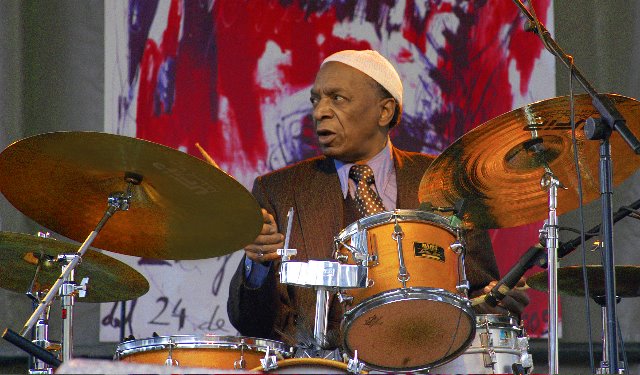
JAZZ: Drummer Bobby Durham Dies at 71

Bobby was always a quiet drummer, exquisite taste and touch, a polished gentleman with international reputation.

Doubt you would find him at Grand Auto or buying the first shirt he ran across while shopping.

Gerry Storm / The Rag Blog / July 11, 2008

Subtle drummer and scat singer played with jazz greats
By Dennis Hevesi / July 11, 2008

Bobby Durham, a drummer whose precise, understated style made him much sought after as a sideman by jazz greats like Duke Ellington, Lionel Hampton, Oscar Peterson and Ella Fitzgerald, died Monday in Genoa, Italy. He was 71 and had homes near Genoa and Basel, Switzerland.

See Videos, with Oscar Peterson, Ella Fitzgerald, below.

The cause was lung cancer, said Sandra Fuller, a friend.

Mr. Durham was probably best known for his trio work, from 1966 to 1971, with Peterson at the piano and Ray Brown playing bass. He also drew significant notice from 1973 to 1980 as an accompanist to Fitzgerald.

“One of his specialties was brushes,” said Dan Morgenstern, director of the Institute of Jazz Studies at Rutgers University, referring to soft-stroke wire drumsticks.

“It’s important when you work with a singer that you play sensitively, that you don’t overwhelm,” Mr. Morgenstern said.

But Mr. Durham, he said, “was also capable of playing really good extended solos.”

Mr. Morgenstern’s assessment echoed one in 1980 by John S. Wilson, writing in The New York Times about Mr. Durham’s performance with the organist Shirley Scott and the tenor saxophonist Harold Vick.

Mr. Durham “makes his presence felt without being obtrusive,” Mr. Wilson wrote.

“He steps forward occasionally with brief, rollicking statements that add sparkle to the group, and he feeds crisp breaks to Mr. Vick,” Mr. Wilson added. “When he finally takes a solo, he builds a steady, controlled development that never gives way to gratuitous flashiness.”

Besides playing with jazz greats like Hampton, in 1962, and Ellington, in 1966, Mr. Durham made recordings with, among others, the trumpeters Dizzy Gillespie and Roy Eldridge, the pianist Tommy Flanagan, the guitarist Joe Pass and the alto saxophonist Benny Carter.

One of Mr. Durham’s specialties, with brush sticks softly in play, was scat singing.

Robert Joseph Durham was born in Philadelphia on Feb. 3, 1937. His father was a professional tap dancer, and Bobby was taught to tap at the age of 2. He started playing drums with his junior high school band; by 16 he was playing professionally with a group called the Orioles. His next big gig was with a Marine Corps band, from 1956 to 1959.

Leading his own trio, Mr. Durham performed all over the world. “I played everywhere but Russia, Alaska and Arabia,” he said in a profile in the Biographical Encyclopedia of Jazz.

Mr. Durham’s wife, the former Betsy Perkins, died in 1996. He is survived by two daughters, Valarie Ahrar of Philadelphia and Robbin Carver of Woodbury, N.J.; and four grandchildren.

Source. / New York Times

Satin Doll: Oscar Peterson Trio with Sam Jones, Bobby Durham

I’m Gonna Sit Right Down and Write Myself A Letter:
Ella Fitzgerald with Joe Pass, Paul Smith, Keter Betts and Bobby Durham.

The Rag Blog

Posted in RagBlog | Tagged , , , | Leave a comment

Stop the New FISA


Allowing the new surveillance law to stand would seriously cripple our free press
by Chris Hedges / July 11, 2008

If the sweeping surveillance law signed by President Bush on Thursday — giving the U.S. government nearly unchecked authority to eavesdrop on the phone calls and e-mails of innocent Americans — is allowed to stand, we will have eroded one of the most important bulwarks to a free press and an open society.

The new FISA Amendments Act nearly eviscerates oversight of government surveillance. It allows the Foreign Intelligence Surveillance Court to review only general procedures for spying rather than individual warrants. The court will not be told specifics about who will be wiretapped, which means the law provides woefully inadequate safeguards to protect innocent people whose communications are caught up in the government’s dragnet surveillance program

The law, passed under the guise of national security, ostensibly targets people outside the country. There is no question, however, that it will ensnare many communications between Americans and those overseas. Those communications can be stored indefinitely and disseminated, not just to the U.S. government but to other governments.

This law will cripple the work of those of us who as reporters communicate regularly with people overseas, especially those in the Middle East. It will intimidate dissidents, human rights activists and courageous officials who seek to expose the lies of our government or governments allied with ours. It will hang like the sword of Damocles over all who dare to defy the official versions of events. It leaves open the possibility of retribution and invites the potential for abuse by those whose concern is not with national security but with the consolidation of their own power.

I have joined an ACLU lawsuit challenging the new law along with other journalists, human rights organizations and defense attorneys who also rely on confidentiality to do their work. I have joined not only because this law takes aim at my work but because I believe it signals a serious erosion of safeguards that make possible our democratic state. Laws and their just application are the only protection we have as citizens. Once the law is changed to permit the impermissible, we have no recourse with which to fight back.

I spent nearly 20 years as a foreign correspondent for the New York Times, as well as other news organizations. I covered the conflict in the Middle East for seven years. I have friends and colleagues in Jerusalem, Gaza, Cairo, Damascus, Tehran, Baghdad and Beirut. I could easily be one of those innocent Americans who are spied on under the government’s new surveillance authority.

The reach of such surveillance has already hampered my work. I was once told about a showdown between a U.S. warship and the Iranian navy that had the potential to escalate into a military conflict. I contacted someone who was on the ship at the time of the alleged incident and who reportedly had photos. His first question was whether my phone and e-mails were being monitored.

What could I say? How could I know? I offered to travel to see him but, frightened of retribution, he refused. I do not know if the man’s story is true. I only know that the fear of surveillance made it impossible for me to determine its veracity. Under this law, all those who hold information that could embarrass and expose the lies of those in power will have similar fears. Confidentiality, and the understanding that as a reporter I will honor this confidentiality, permits a free press to function. Take it away and a free press withers and dies.

I know the cost of terrorism and the consequences of war. I have investigated Al Qaeda’s operation in Europe and have covered numerous conflicts. The monitoring of suspected terrorists, with proper oversight, is a crucial part of our national security. But this law is not about keeping us safe, which can — and should — be done in a constitutional manner and with judicial oversight. It is about using terrorism as a pretext to permit wholesale spying and to silence voices that will allow us to maintain an open society.

Chris Hedges was part of the team of New York Times reporters who won a Pulitzer Prize in 2002 for reporting on global terrorism. He is the author of many books, including “War Is the Force that Gives Us Meaning.”

Source. / CommonDreams

Also go toThe Bush Administration Continues Looking Like that of Richard Nixon by Gary Ater / American Chronicle

The Rag Blog

Posted in RagBlog | Tagged , , , , , , , | Leave a comment

Pelosi Slips Impeachment Onto the Table

With the door opened, Judiciary chair John Conyers may press for action.

Door may be open for Kucinich’s resolution on Bush
By John Nichols / July 10, 2008

As Ohio Congressman Dennis Kucinich moved a “privileged resolution” to force House to consider the question of whether President Bush should be impeached for lying to Congress and the American people about the reasons for invading and occupying Iraq, House Speaker Nancy Pelosi surprised almost everyone by suggesting that the Judiciary Committee might indeed take up the issue.

Pelosi, who famously declared impeachment to be “off the table” before the 2006 election, now suggests that hearings on the president’s high crimes and misdemeanors are a distinct possibility.

“My expectation is that there will be some review of that in the committee,” the California Democrat told reporters Thursday.

“This is a Judiciary Committee matter, and I believe we will see some attention being paid to it by the Judiciary Committee,” Pelosi explained.

The speaker was not suggesting that members of the Judiciary panel would be voting anytime soon on formal impeachment resolutions. Pelosi said she did “not necessarily (see the committee) taking up the articles of impeachment because that would have to be approved on the floor, but to have some hearings on the subject.”

Judiciary Committee chair John Conyers, D-Michigan, has indicated that he is reviewing the 35 articles of impeachment Kucinich has proposed for President Bush. He has not indicated, however, whether he intends to hold hearings on any of them or on broads questions of whether violations of their oaths of office, the Constitutionally-defined separation of powers and the laws of the land by the president and Vice President Dick Cheney — the subject of three impeachment articles submitted by Kucinich — should be addressed by Congress.

It is no secret that Conyers has felt constrained by Pelosi’s “off-the-table” commitment.

Whether her new line opens the door for hearings before the end of the Bush-Cheney presidency remains to be seen.

But Pelosi’s remarks do create an opening for the members of the Judiciary Committee, including Florida Democrat Bob Wexler and Wisconsin Democrat Tammy Baldwin, who have co-sponsored Kucinich’s articles of impeachment and who have urged the committee to open hearings on issues of presidential accountability.

For his part, Kucinich will keep pressing for action.

“Congress must, in the name of the American people, use the one remedy which the Founders provided for an Executive who gravely abused his power: Impeachment. Congress must reassert itself as a co-equal branch of government; bring this President to an accounting, and in doing so reestablish the people’s trust in Congress and in our United States system of government. We must not let this President’s conduct go unchallenged and thereby create a precedent which undermines the Constitution,” the Ohio congressman said Thursday, as he prepared to introduce his privileged resolution to force consideration of impeachment of a president who he accuses of “deceiving Congress with fabricated threats of Iraq WMDs to fraudulently obtain support for an authorization of the use of military force against Iraq.”.

“In the final analysis this is about our Constitution and whether a President can be held accountable for his actions and his deceptions, especially when the effects of those actions have been so calamitous for America, Iraq and the world. Unless Congress reasserts itself as the power branch of government which the Founders intended, our experiment with a republican form of Government may be nearing an end. But when Congress acts to hold this President accountable it will be redeeming the faith that the Founders had in the power of a system of checks and balances which preserves our republic.”

Source. / The Nation

The Rag Blog

Posted in RagBlog | Tagged , , , , , | 2 Comments