Former Sen. Jesse Helms, Icon of the Ultra-Right, Dead at 86

Jesse Helms. Art by Paul Giambarba / Truthout.

Jesse Helms, isolationist, old school racist, he softened a bit near the end.
By Leonard Doyle / July 5, 2008

The former US Senator Jesse Helms, a legendary isolationist and defender of “Southern values” who spent much of his life goading liberals, died yesterday (July 4).

Universally known as ‘Senator No’ he was deeply sceptical of international cooperation and intervention. His refusal to ratify international accords, notably the Kyoto treaty on global warming, made him the bete noir of the Georgetown foreign policy establishment

”Compromise, hell! … If freedom is right and tyranny is wrong, why should those who believe in freedom treat it as if it were a roll of bologna to be bartered a slice at a time?” he wrote in an editorial setting out his political style back in 1959.

US business disliked him for his tireless campaigns for unilateral US economic sanctions on Iran and Cuba. He was also deeply sceptical of America’s opening up to China and always ready to reject international cooperation if it meant yielding American sovereignty.

As chairman of the Senate Foreign Relations Committee he used his power to oppose the international criminal court, the international land mine treaty, the Comprehensive Test Ban Treaty as well as Kyoto.

For many he was a caricature of a right wing conservative, being pro-gun, pro-death penalty and anti-abortion. He ran what many considered to be a vendetta against publicly-funded arts, and was frequently accused of homophobia and sexism,

He exploited racial divisions in his native North Carolina and was first elected to the US Senate in 1972. A deeply polarising figure in each of hi five contests he never won more than 55% of the votes. On the campaign trail he tapped into the fears of middle and working class white voters stirring up anger against affirmative actions programme to help unemployed blacks.

He famously ran a “white hands” ad that showed a white man crumpling up a letter while a narrator said: “You needed that job, and you were the best qualified, but they had to give it to a minority, because of a racial quota. Is that really fair?

He also used his power in the senate to block the nomination of black Americans to the courts and to ambassadorial positions.

A journalist in his early career, he persuaded millions of Americans that their country was being run by liberals in Washington, and controlled by the New York-based media.

Never caring much what his critics thought, he rampaged against what he believed were the evils of abortion, affirmative action and homosexuality.

“Just think about it – homosexuals, lesbians – disgusting people – marching in our streets, demanding all sorts of things including the right to marry each other and the right to adopt children. How do you like (that)?” he said.

Near the end of his career he would make his way his way through the US Capitol on a scooter. He decided not to run for a sixth term in 2002 and was diagnosed with vascular dementi after repeated minor strokes brain in 2006.

In his later years a compassionate side emerged that few of his colleagues believed was possible. At the instigation of U2’s Bono he accepted that debt was the cause of suffering in the developing world and campaigned for a debt relief bill and attended his first ever pop concert in Washington DC.

He was 86.

Source. / The Guardian, U.K.

Thanks to truthout / The Rag Blog

Posted in RagBlog | Tagged , , , , , | Leave a comment

Brother, Can You Spare a Euro?

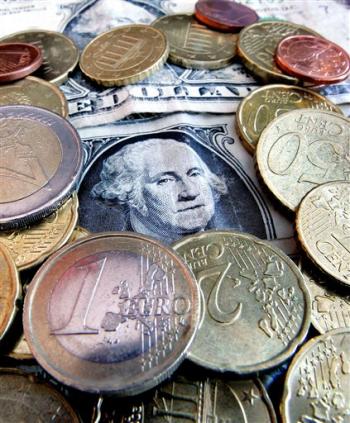
The U.S. dollar has been declining steadily for six years against other major currencies, undercutting its role as the leading international banking currency. (Photo by Michael Probst / AP.

The buck doesn’t stop here; it just keeps falling
By Tom Raum / July 6, 2008

WASHINGTON — Things in the U.S. sure are tough. Brother, can you spare a euro?

Signs saying “We accept euros” are cropping up in the windows of some Manhattan retailers. A Belgium company is trying to gobble up St. Louis-based Anheuser-Busch, the nation’s largest brewer and iconic Super Bowl advertiser.

The almighty dollar is mighty no more. It has been declining steadily for six years against other major currencies, undercutting its role as the leading international banking currency. The long slide is fanning inflation at home and playing a major role in the run-up of oil and gasoline prices everywhere.

Vacationing Europeans are finding bargains in the U.S., while Americans in Paris and other world capitals are being clobbered by sky-high tabs for hotels, travel and even sidewalk cafes. Northern border-city Americans who once flocked into Canada for shopping deals are staying home; it’s the Canadians flocking here now.

Everything made in America — from goods to entire companies — is near dirt cheap to many foreigners. Meanwhile, American consumers, both those who travel and those who stay at home, are seeing big price increases in energy, food and imported goods. The dollar has lost roughly a quarter of its purchasing power against the currencies of major U.S. trading partners from its peak in 2002.

Since oil is bought and sold in dollars worldwide, the devalued dollar has made the recent surge in energy prices even worse for Americans, leading to $4 gasoline in the United States. Analysts suggest that of the $140 a barrel that oil fetches globally, some $25 may be due to the devalued dollar.

Further declines in the dollar will add to oil’s appeal as a commodity to be traded.

Oil, suggests influential energy consultant Daniel Yergin, is “the new gold.”

The limp greenback has had one big benefit to the U.S. economy: Since it makes American goods cheaper overseas, it has helped manufacturers who export and other U.S. based companies with international reach. Exports have been one of the few bright spots in an otherwise darkening U.S. economy.

Franklin Vargo, vice president of international economic affairs at the National Association of Manufacturers, welcomes the dollar slide, as do members of his organization.

“We can see that, when the dollar’s not overpriced, that people around the world want American goods and our exports are going gangbusters now,” he said.

He doesn’t see the dollar as undervalued. He sees it as having being overpriced in the 1990s — and what’s happened since as something along the lines of a correction.

Still, Vargo acknowledges the dollar’s decline has brought a measure of pain to some consumers. “As the dollar has gone down in value, that has added to the dollar cost of oil. No question. So having the dollar decline is not unambiguously a plus. That’s why we say there’s got to be a balance there somewhere. What we want is a Goldilocks dollar. Not too strong, not too weak. But just right. And only the market can determine that,” Vargo said.

Mark Zandi, chief economist at Moody’s Economy.com, said expanding exports due to a weak dollar are “an important source of growth, but it doesn’t add a lot to jobs, it doesn’t mean very much for the average American household. For the average American, for the average consumer, these are pretty tough times.”

The loss of the dollar’s purchasing power and international respect has some experts worrying that the euro might one day replace the dollar as the so-called primary reserve currency. And that could trigger a dollar rout as foreign governments and international investors flee from U.S. Treasury bonds and other dollar-denominated investments.

Making matters worse: The gaping U.S. current-account deficit — the amount by which the value of goods, services and investments bought in the U.S. from overseas exceeds the amount the U.S. sells abroad — and the low levels of domestic savings means that foreigners must purchase more than $3 billion every business day to fund the imbalance.

Since roughly half of the nation’s nearly $10 trillion national debt is held by foreigners, mostly in Treasury bills and bonds, such a withdrawal could have enormous consequences.

Yet Washington finds its options limited.

President Bush asserts longtime support for a “strong” dollar, and made that point again Sunday in a news conference in Japan with Prime Minister Yasuo Fukuda. “In terms of the dollar, the United States strongly believes — believes in a strong dollar policy and believes that the strength of our economy will be reflected in the dollar.”

But not once in his presidency has the U.S bought dollars on foreign exchange markets — called intervention — to help prop up the greenback. There’s no telling where the buck will stop these days, although for the past few weeks it seems to be in a holding pattern. Even as three Bush Treasury secretaries in a row spouted the strong-dollar mantra, the dollar kept tumbling against the euro, the pound, the yen, the Canadian dollar and most other major currencies.

The Federal Reserve could prop up the dollar by increasing interest rates under its control. Increased yields would make dollar-denominated investments more attractive to foreigners. But that could undercut the already anemic economic growth in a frail U.S. economy rocked by soaring fuel costs, falling home prices and rising unemployment — and the lowest reading of consumer confidence in 16 years.

The Fed must do a balancing act between keeping the domestic economy from going into recession and keeping inflation at bay.

Furthermore, no Fed likes to raise rates aggressively in a presidential election year. It seems more inclined to hold interest rates low for now to give financial markets time to recover from the housing meltdown and credit crunch. It did just that in its meeting on June 25, leaving a key short-term rate at 2 percent. The rate reached that level in April after a series of aggressive cuts that brought it down 3.25 percentage points since September. Those cuts helped ease the housing and credit crises — but drove the dollar further down.

In early June, Bush declared before his trip to Europe: “A strong dollar is in our nation’s interests. It is in the interests of the global economy.” That, plus a warning by Fed Chairman Ben Bernanke that the dollar’s weakness was contributing to U.S. inflation, seemed to temporarily break the dollar’s tumble. Presidents and Fed chairmen don’t usually talk directly about the dollar and exchange rates — leaving that up to the Treasury secretary — and international bankers and investors took note of the high-level attention.

Over the past few weeks, the dollar has remained relatively stable, although it took a dip after the Fed decided to leave rates unchanged. The long slide may not be over.

Still, if the Fed moves to lift rates later this year, as some traders and investors anticipate, it could buttress the dollar and spur an exodus of speculators from the oil market — helping to both prop up the dollar and drive down oil prices. But few economists are sanguine that the economy will improve any time soon.

The other main tool to move the dollar — intervention in currency markets by buying dollars and selling other currencies — is risky.

It would take great sums of money to make any difference. The foreign exchange market is the largest in the world, with over $1 trillion traded each day. Seeing the U.S. trying to prop up the greenback by buying dollars could be taken as a sign of desperation and possibly trigger a renewed round of selling.

Furthermore, there has been little encouragement for such a strategy from finance ministers from the Group of Eight wealthy democracies — Japan, Britain, Germany, France, Italy, Canada and Russia plus the U.S.

Leaders of the eight countries were to meet in Japan beginning Monday, but the falling dollar was not even on the formal agenda. It’s too touchy an issue, and the dollar’s relative stability over the past few weeks makes it easier for world leaders to steer clear. “People will be talking about it in the corridors,” said Reginald Dale, a senior fellow with the Center for Strategic and International Studies.

Treasury Secretary Henry Paulson has suggested that nothing is “off the table” including intervention. But Bush has made statements suggesting he intends to let market forces set exchange rates.

The dollar has fallen so far, it will be difficult to halt or reverse its slide.

U.S. efforts to persuade Saudi Arabia and other major oil-producing nations to increase their production — and help ease pressure on both oil prices and the dollar — have brought scant results.

“There’s no magic wand,” said White House press secretary Dana Perino. “It’s not going to be a problem that we solve overnight.”

The impact of the falling dollar is not always visible to the average consumer. Not like the big numbers on gas pumps that give stark evidence of price levels.

But imported goods, from fuel to cars from Japanese automakers and toys from China — are getting more expensive just as U.S. wages are either stagnant or falling.

American companies suddenly look cheap to acquisition-minded foreigners, particularly those based in Europe.

Belgian-based InBev’s hostile bid for Anheuser-Busch is a recent example. It has bid $46 billion to acquire the company — a 30 percent premium above where Anheuser’s shares traded before the June 11 proposal.

A successful acquisition by InBev would put the last remaining mass-market American brewer in foreign hands. InBev is based in Belgium but run by Brazilians. Anheuser-Busch, which brews both Budweiser and Bud light, holds a 48.5 percent share of U.S. beer sales. Anheuser-Busch rejected InBev’s bid, but the Belgian brewer forged ahead, seeking to unseat Anheuser’s 13-member board and take its offer directly to shareholders.

If the takeover goes through, it might open the floodgates to other foreign takeovers of American companies.

Some of the dollar’s decline depends on hard-to-measure factors, like the psychology of foreign investors.

When the U.S. economy is weakening, many investors stay away. The slide of the dollar has coincided with a long period of relatively low interest rates.

And some of the decline in the dollar’s global role “is due to the foreign policy failures of the Bush administration, not just to recent economic developments and policies,” suggests Adam S. Posen, deputy director of the Peterson Institute for International Economics and a former economist at the Federal Reserve Bank of New York. In other words, some international investors unhappy with Bush’s policy on Iraq or toward other parts of the world might not wish to invest in American companies or buy U.S. bonds.

Still, he argues that the euro is unlikely to replace the dollar as the world’s main reserve currency, and that the euro may be at “a temporary peak of influence.”

David Wyss, chief economist at Standard & Poor’s in New York, says he envisions a day when the dollar and the euro will share billing as the world’s reserve currencies.

He predicts that the dollar will remain roughly at its present levels “for a couple years.” Still, he says, “We might not be done with this down leg.”

Another big problem for the dollar is that the European Central Bank is likely to hike rates while the Federal Reserve stands pat, giving euro-based investments a bigger yield advantage.

“I could see more downward pressure on the dollar, over the course of the summer, not dramatically, if the ECB does raise rates,” said Robert Dye, an economist with PNC Financial Services Group. “If it is one and done, pressure will be minimal. But if it’s an ongoing pattern of rate increases, there will be more substantial pressure.”

A euro now buys as much as $1.55 in the United States.

The dollar has been the leading international currency for as long as most people can remember. But its dominant role can no longer be taken for granted.

Paul Volcker, who headed the Federal Reserve from 1979-87, warned in April that the nation was in a dollar crisis, and that what is happening now reminds him of the early 1970s, when serious inflation erupted as economic growth stagnated.

Then, as now, a weak economy limited the Fed’s options. The result was a spiral of rising prices and wages — until the Fed, led by Volcker, suppressed double-digit inflation with huge interest rate increases that pushed the economy into a steep recession in 1982. He recently criticized the current Fed as defending the economy and the market, instead of defending the dollar. Volcker said that will make defending the greenback much harder later.

Energy consultant Yergin, chairman of Cambridge Energy Research Associates, recently told the House-Senate Joint Economic Committee that oil had become “the new gold.”

“Oil has become a storehouse of value — reflecting broad global economic trends and imbalances. At the same time, oil is increasingly seen as an asset by financial investors, an uncorrelated alternative to equities, bonds, and real estate,” he said.

When the credit crisis broke last summer, the result was a sharp reduction in interest rates by the Fed. That, in turn, accelerated the fall of the dollar.

“Instead of the traditional `flight to the dollar’ during a time of instability, there has been a `flight to commodities’ in search of stability during a time of currency instability and a falling dollar,” Yergin said. “There’s a painful irony here: The crisis that started in the subprime market in the United States has traveled around the world and, through the medium of a weaker dollar, has come back home to Americans in terms of higher prices at the pump.”

Source. / AP / Google News

Thanks to Jim Baldauf / The Rag Blog

Posted in RagBlog | Tagged , , , | Leave a comment

Ninety-Nine Percent of Iraq’s Budget for Walls

After all, the electricity isn’t that important, right? And we are especially fond of assassination from 10,000 miles away, thus reducing the numbers of US troop deaths and casualties. How humane, how civilised ….

Richard Jehn / The Rag Blog

How a Surge “Works”
by Gregg Gordon / July 5, 2008

Have you been feeling like me — like everything about our country in the waning months of the Bush administration, from the occupation of Iraq to the economy, is being held together with bailing wire? That the whole sorry mess has come down to (aside from stealing whatever items they can find that still haven’t been nailed down) trying to maintain just enough of the appearance of a functioning society that it will in the future be at least plausible to blame the ultimate collapse on the next president.

Well, if that’s how you’ve been feeling too, I’ve found some of the bailing wire: Miles upon miles upon miles of concrete blast walls — 10, even 20-feet high — that have turned the neighborhoods of Baghdad into a maze-like warren and the residents into laboratory rats.

They “block access to schools, mosques, churches, hotels, homes, markets and even entire neighborhoods — almost anything that could be attacked,” writes AP reporter Hamza Hendawi. “They have become the iconic symbol of the war.”

This is how the surge is “working.”

“Rows after rows of barrier walls divide the city into smaller and smaller areas that protect people from bombings, sniper fire and kidnappings,” Hendawi writes. “They also lead to gridlock, rising prices for food and homes, and complaints about living in what feels like a prison.

“Baghdad’s walls are everywhere. They have turned a riverside capital of leafy neighborhoods and palm-lined boulevards into a city of shadows that separate Sunnis from Shiites.”

Eighteen months ago, President Bush was in a world of hurt. The centerpiece of his presidency, the Iraq war, was on the brink of collapse, both on the ground over there and politically over here. Order had to be restored. They called it a surge, and we did send some more troops, but it was an incremental increase. It turns out the surge was mostly in these walls. Prisons can be useful in restoring order to a lawless society, but let’s face it, 25 million is a lot of people. So if you can’t imprison the nation, you turn the nation into a prison.

“The wall came to make us suffer,” said Waleed Mahmoud, a 35-year-old father of four, told the AP. “It takes my children an hour to get to school. I am often late for work, and there is never fewer than 10 cars in the line at the two crossing points.”

But he is less likely the be blown up than a year ago, and that’s something. From 2,000 civilian deaths a month to some 500 (just estimates of course — we don’t do body counts, except when we do, but it’s too dangerous for any journalist to go to the morgue and double-check, in any case). Yes, this is also how the surge is “working.” To adjust for the two countries’ sizes, multiply by 12 or so, and just think if the US was suffering just two 9/11’s per month — every month — instead of two per week — every week. Just think how much better that would be. Think how normal that would seem. Think how relieved we would feel.

But even with the decline in violence, such as it is, it’s still not quite business as usual. In Azamiyeh, Baghdad’s most famous Sunni district and one of the first to be walled, about half of the neighborhood’s residents have fled, leaving not enough locals to support its once-popular clothing stores, while Shi’ites from other parts of Baghdad are afraid to run the checkpoints necessary to come there to shop.

And there’s plenty else that hasn’t returned to normal either. Electricity is still no more than an hour or two a day. The sewage system is still collapsed. The water is not sanitary enough to bathe in, much less drink. All the money is going into blast walls — the last-ditch, desperate throw of the dice to get a handle on the violence.

“Now banks, the courts and even the markets are surrounded by walls, not to speak of military camps and police stations,” Iraqi contractor Yassir Jadu told Ammar Karim of Agence France Presse last fall. “If we measure the money spent on building blast walls you will find that it is more than that spent on fuel, electricity and other services. About 99 percent of Iraq’s budget is going towards building walls.”

As an example Jaddu said it cost $1.25 million just to buy the 2,500 concrete pieces needed to ring a single Baghdad police station. He could have bought them for only $1 million, but he is a Sunni, and the concrete plant is in a Shi’ite neighborhood, so he had to hire a go-between to buy the 3-meter-high, 5-ton pieces of concrete, adding $100 to the cost of each piece.

The surge has “worked” not only with walls, of course. God only knows how much money is being paid off to who in the financial black hole this occupation has become. $162 billion more, and so much will simply disappear, news that billions can’t be accounted for is scarcely considered newsworthy. The Iraqi official responsible for fighting corruption had to flee the country or be killed.

“In the past, notices would be published in the gazette calling for tenders,” says Sinan, another Iraqi contractor too frightened to state his full name. “Now officials just phone their friends and offer them the work.”

And then there are the drones, aircraft equipped with cameras and guided missiles which tend to keep our casualties down because the “pilot” is on an air force base in Las Vegas. We have hundreds of them in Iraq now, and their missions have doubled since the beginning of the surge. For us, it means fewer casualties. For an Iraqi, it means every day contains at least the slight chance, if you’re in the wrong place at the wrong time, your life could be extinguished without warning by someone who in 15 minutes will be unwinding in front of a slot machine 8,000 miles away.

So this is what Operation Iraqi Freedom has come to mean: A society kept under lockdown, with the hope the American public will buy it as “success” as long as casualties can be kept lower than they were before. And they may be right, given that the public receives too little news like these reports from Iraqi stringers and activists. Coverage on the evening news is down to two minutes per week — counting all three networks — according to a recent study, and given that such reporting as there is must be done in the presence of “minders” from the American military — it’s simply still too dangerous to do any other kind of story — the public would probably be better informed if they didn’t receive even that. It seems to be progress enough to satisfy Congress, anyway.

But it can’t be sustained forever, just as a prison can’t be kept in lockdown forever. At some point, you need the inmates’ cooperation. Constant coercion is simply too expensive, and how much has it been now? $600 billion? $700 billion? There are websites you can go to to look it up, but by the time you finish typing the number, it’s gone up another $10 million. And the bailing wire holding together the American economy is beginning to fray under the strain.

It’s almost enough to make me want to see John McCain win the election, since he so proudly claims authorship of this surge and so wants us to believe it’s “working.” When George Bush finally returns the keys to the car he so cavalierly took joyriding — you’ll find it down the street, wrapped around a tree — let it be to John McCain.

[Gregg Gordon is a writer, musician, activist, and otherwise ne’er-do-well in Columbus, Ohio.]

Source. / OpEdNews.com

The Rag Blog

Posted in RagBlog | Tagged , | Leave a comment

Obama, Speak Out Now About Iran

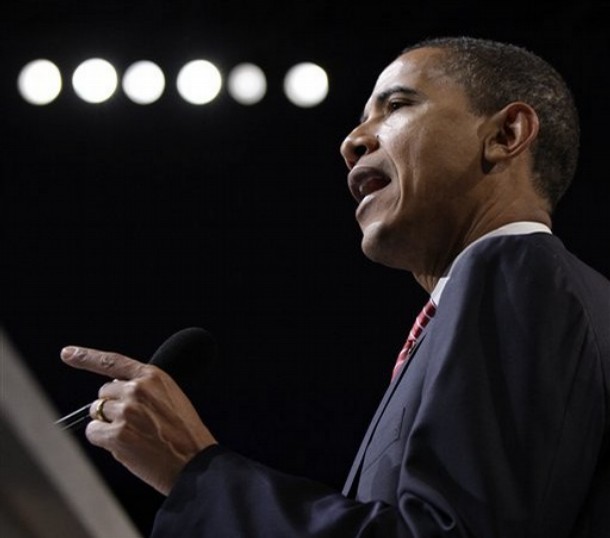
Sen. Barack Obama addresses the American Israel Public Affairs Committee, AIPAC, Policy Conference 2008, at the Washington Convention Center in Washington, on June 4, 2008 and speaks about Iran. Photo by Alex Brandon / AP.

An Open Letter to Barack Obama on Iran
July 5, 2008

Dear Senator Obama,

We the undersigned may have different views on U.S. foreign policy with respect to Iran. We all, however, are deeply concerned about the stories in the press in the past few weeks suggesting that the Bush administration might be considering a military strike on Iran, that it might give a green light to such an attack by Israel, or that it might engage in other acts of war, such as imposing a blockade against Iran.

We welcomed your stand against the war on Iraq in 2002. And we were encouraged by your early campaign statements emphasizing diplomacy over military action against Iran. Today, you have an opportunity to forestall a repeat of the tragic Iraq war. We hope you will use that opportunity.

We agree with the conclusion of Muhammed ElBaradei, the head of the International Atomic Energy Agency, that “A military strike … would be worse than anything possible. It would turn the region into a fireball…” A military attack, he said, “will mean that Iran, if it is not already making nuclear weapons, will launch a crash course to build nuclear weapons with the blessing of all Iranians, even those in the West.” ( Reuters, June 20, 2008.)

We don’t know, of course, whether an attack on Iran is in fact being considered, or if there are serious plans to initiate other acts of war, such as a blockade of the country. But we call on you to issue a public statement warning of the grave dangers that any of these actions would entail, and pointing out how inappropriate and undemocratic it would be for the Bush administration to undertake them, or encourage Israel to do so, in its closing months in office.

An attack on Iran would violate the UN Charter’s prohibition against the use or threat of force and the Congress’s authority to declare war. Moreover, the public right to decide should not be foreclosed by last-minute actions of the Bush administration, which will set U.S. policy in stone now.

We were heartened by your earlier comments suggesting that an Obama administration would act on the understanding that genuine security requires a willingness to talk without preconditions (something Iran has offered several times to no avail), and that threats and military action are counterproductive. We hope you will follow through on these commitments once in office, but also that you will speak out now against any acts of war by the Bush administration.

Sincerely,

Please join these signatories and sign here:

(organizations listed for identification purposes only)

Michael Albert. ZNet

Cathy Albisa, exec. director, National Economic and Social Rights Initiative

John W. Amidon, U.S. Veterans for Peace

Stanley Aronowitz, Professor of Sociology, Graduate Center, CUNY

Rosalyn Baxandall, Distinguished Teaching Professor, SUNY Old Westbury

Phyllis Bennis, Institute for Policy Studies

Stephen Eric Bronner, Professor (II) of Political Science, Rutgers University

Charlotte Bunch, exec. director, Center for Women’s Global Leadership, Rutgers Univ.

Noam Chomsky, Institute Professor (retired), MIT

Ray Close retired CIA Middle East specialist; Veteran Intelligence Professionals for Sanity

Rhonda Copelon, Professor of Law, CUNY Law School

Hamid Dabashi, Professor of Iranian Studies and Comparative Literature, Columbia Univ.

Lawrence Davidson, Professor of Middle East History, West Chester Univ.

Ariel Dorfman, author

Stuart Ewen, Distinguished Professor, Hunter College & the Graduate Center, CUNY

John Feffer, co-director, Foreign Policy in Focus

Bill Fletcher, Jr. exec. editor, BlackCommentator.com

Libby Frank, Women’s Internat’l League for Peace & Freedom, Philadelphia

Arthur Goldschmidt, Professor emeritus of Middle East History, Penn State Univ.

Tom Hayden, author

Doug Henwood, Left Business Observer

Doug Ireland, journalist

James E. Jennings, exec. director, U.S. Academics for Peace

Nikki Keddie, UCLA (emeritus), historian, Iran specialist

Janet Kestenberg Amighi, v.p., CDR (sponsor of Holocaust child survivor research)

Rabbi Michael Lerner, chair, The Network of Spiritual Progressives; editor, Tikkun mag.

Mark LeVine, Prof. of Modern Middle Eastern History, Culture and Islamic Studies, U. Cal., Irvine

Manning Marable, director, Center for Contemporary Black History, Columbia Univ.

David McReynolds, former chair, War Resisters Internat’l

Rosalind Petchesky, Distinguished Prof. of Poli. Sci., Hunter College & the Graduate Center, CUNY

Rachel Pfeffer, interim exec. director, Jewish Voices for Peace

Katha Pollitt, writer

Danny Postel, No War on Iran Coalition, Chicago

Matthew Rothschild, editor, The Progressive magazine

Stephen R. Shalom Prof. of Poli. Sci., William Paterson Univ.

(Rev.) David Whitten Smith, Univ. of St. Thomas, Minnesota (emeritus)

Meredith Tax, writer; president, Women’s WORLD

Michael J. Thompson, editor of Logos

Chris Toensing, editor, Middle East Report

Cornel West, Professor, Princeton University

Stephen Zunes, Professor of Politics, Univ. of San Francisco


Source. / Portside

The Rag Blog

Posted in RagBlog | Tagged , , , | Leave a comment

Abbie and the Theater of the Flag

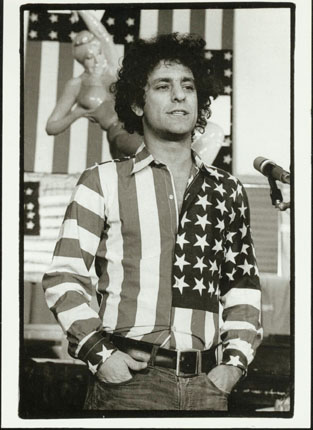
Abbie Hoffman, proudly attired.

What Would Abbie Hoffman Have Thought Of The Flag Lapel Pin Debate?
By Chris Weigant / July 4, 2008

I’d like to address, in as patriotic spirit as can be mustered, the wearing of United States flag lapel pins, and the inherent silliness this debate represents. Flag lapel pins are all the rage these days, but the battle over wearing the flag is older than you may have thought. Older than the battles in Congress over flag-desecration amendments to the Constitution (which stretch back to the 1980s … and which even Democrats who should know better still occasionally vote for in Congress … ahem).

In 1968, in the fading years of one of the most un-American chapters in our entire history, the “House Un-American Activities Committee” (“HUAAC” or “HUAC”) still existed. This committee was set up to root out (as you can tell from the title) “un-American” activities … which started out as “communism” but soon morphed into “anything the right wing didn’t approve of.” It was in this later incarnation that, in 1968, it was holding hearings on those unruly and upstart youngsters, the hippies.

These were not patchouli-reeking slackers (OK, well, maybe some of them were), these were the youth of America who were organized, seriously annoyed with the direction of a very unpopular war, and wanted to influence the political debate of the day. They formed their own “political party” in Chicago (at the Democratic National Convention), which they called the Youth International Party — or, the “Yippies.” At the forefront of this movement was the radical leader Abbie Hoffman. And in 1968, he was called before HUAAC to testify on his activities. His testimony followed fellow Yippie Jerry Ruben, who had appeared in front of the committee dressed in (as Hoffman later described it): “Beret by IRA. Black pajama bottoms by Viet Cong. Bandoleers borrowed from the mountains of Mexico were crisscrossed across the bare sexy chest of a yippie warrior — his body slashed with lavish swatches of red paint.”

Needless to say, political theater was very big, back in the day. Why don’t we have committee hearings this entertaining today, one wonders …

But the question remained, how could Abbie possibly top this opening act? Again, in his own first-person account (from his book, Soon To Be A Major Motion Picture):

“In exactly two hours I’d do more for the flag than anyone since Betsy Ross. As our star-spangled retinue approached the hallowed halls of Congress, a detachment of police summoned to the scene quickly encircled us. ‘You are under arrest for the desecration of the flag. Come with us.’ … Instantly the steps became a swarm of cameramen, cops, and screaming yippies. … I fought for life and shirt, swinging wildly. Rrrrrrrrrip! ‘You pigs, you ripped my fuckin’ shirt,’ I screamed … The next day I stood before the judge, bare to the waist. The tattered shirt lay on the prosecutor’s table in a box marked Exhibit A. ‘You owe me fourteen ninety-five for that shirt,’ I mentioned. Bail was set at three thousand dollars. ‘Get out of here with that Viet Cong flag. How dare you?’ the judge intoned. ‘Cuban, your honor,’ I corrected [Hoffman had painted a Cuban flag on his body]. A few months later this same judge started letting his hair grow long, called for the legalization of marijuana, and began speaking out against the war.”

When the trail was held, under a brand-new section of U.S. law (Abbie claims he was the first person tried under the statute, which carried a maximum penalty of a year in jail and a $1,000 fine), the judge, whom Abbie reports “deemed it his duty to find me guilty,” allowed him to make a statement. Big mistake, for anyone who knows Abbie Hoffman. Hoffman’s response was: “Your honor, I regret that I have but one shirt to give for my country.”

The case, of course, was later overturned on appeal (since it was blatantly unconstitutional to begin with), and Abbie never had to serve the month-long sentence handed down. Abbie reports further: “By the time we had [won the appeal], over three dozen people had already been arrested for similar offenses. A vest in Virginia. A bedspread in Iowa. All with the familiar flag motif. In arguing for the government in defense of the law, Nixon’s prosecutor stated, ‘The importance of a flag in developing a sense of loyalty to a national entity has been the subject of numerous essays.’ The first essay the U.S. government quoted was a lengthy passage from Mein Kampf, by history’s most famous housepainter, Adolf Hitler.”

Hoffman went on to wear a similar shirt on the Merv Griffin Show, which was the first example in television history of a show being broadcast with the video edited out. This proto-pixilation showed the entire screen as a deep blue, rather than subject America to an image of Abbie Hoffman with a flag motif shirt on.

Note that: flag motif. Abbie never cut up a flag to make a shirt, he bought these patriotic items from people who manufactured them. As Abbie relates his appearance with Merv (emphasis in original):

“I told him how I had just been given a thirty-day jail sentence, not for wearing the star-spangled shirt, but for the thoughts in my head; how Ricky Nelson, Roy Rogers, Dale Evans, Raquel Welch, and Phyllis Diller had all worn similar flag garb on television and in movies; how anyone could go to the fashionable boutique a few blocks from the studio where I had bought the shirt and get one just like it.”

Get that — it’s not just wearing the flag that will get you into trouble, but your political beliefs while you wear that flag. Starting to sound a little bit familiar?

Abbie’s appearance was aired the next night, but with the following disclaimer read by the vice-president of CBS before the broadcast (and before it was visually turned into a completely blue screen) [editorial note in brackets in original, by Hoffman, speaking in first-person]:

“An incident occurred during the taping of the following program that had presented CBS network officials with a dilemma involving not only poor taste and the risk of offending the viewers but also certain very serious legal problems. It seemed one of the guests had seen fit to come on the show wearing a shirt made from an American flag [not true; it was a shirt with a flag motif]. Therefore, to avoid possible litigation the network executives have decided to ‘mask out” all visible portions of the offending shirt by electronic means. We hope our viewers will understand.”

Pioneering television. Elvis’ pelvis was just kept off-screen, but the birth of what would develop later into pixilation had its origins not in hiding inadvertent nipples (a la Janet Jackson), or someone flipping the bird to the cameraman, but to hide a man wearing a shirt with a United States flag motif.

Abbie, however, got the last laugh, as he was so often wont to do:

“In all, 88,000 people were angry enough that night to call and protest the censoring. In the following days stores all over the country sold out their stock of shirts bearing the flag motif, demonstrations were held at CBS offices in three cities, and Merv Griffin publicly apologized, saying he had not been told of the censoring in advance.”

The Yippies went on to nominate, during the tumult surrounding the 1968 Democratic National Convention, a pig named Pigasus to run for President of the United States. Like I said, it was the era of great political theater.

Jump forward 21 years. In 1989, the “Flag-Burning Amendment” was in its infancy, but tensions were high. Republicans were successfully using this as a “wedge issue” to show American voters how gosh-darned patriotic as all get-out Republicans were when it came to sanctifying the American flag (an idea which would cause every single one of the Founding Fathers to spin in their graves so severely that their long-dead neighbors in their respective cemeteries would have risen to file complaints about the resulting noise). But Representative Pat Schroeder, the first woman elected to the House of Representatives from the great state of Colorado, had this to say during a hearing of the Civil and Constitutional Rights Subcommittee of the House Judiciary Committee, on the subject of U.S. Flag Desecration:

“Thank you, Mr. Chairman, and I too join in thanking you for calling these hearings. Mr. Chairman, I am very pleased that we’re looking at this because I’ve probably had a little longer experience with this whole flag issue than some of the others. After my exploratory race for the presidency in 1987, one of the women’s magazines decided that they wanted to do a documentary about that and we thought about what kind of cover would dramatize my feeling about the process and about America.

And we decided to do one of myself wrapped in the flag in the Sylvester Stallone, Rocky II-type of thing and in the American hockey team type of thing showing the expansiveness of the American system and how exciting it was. We thought it was a very positive, upbeat, love of America type of thing.

Well, I can tell you a lot of people didn’t. (Laughter) I got lambasted by all sorts of people for that. And as that little mini-debate raged in America, people started sending me all sorts of clips. Mr. Chairman, I won’t bring all the clips but both the pros and cons would send me clips talking about what do we mean when we talk about flag desecration and what are we talking about in this whole area of how do we use the flag or who can use the flag.

Because of all of these clips, which anybody’s welcome to look at, I probably have the world’s biggest file on the American flag in Washington, and on public officials crying in public, but I won’t bring them all out. But let me just show you some of the things that are interesting. We have here Barbara Bush at the foot of the Lincoln Memorial with a flag around her neck during the inaugural. We have someone who made a cashmere flag into a dress for $2500, and we have Abbie Hoffman wearing a flag.

Now, you know, that’s a range of things, and it’s interesting — are some of those desecrations? Is the commercial use good or bad? Those are very difficult issues. Then we have the whole thing of what do you do with artistic renditions. Here we have the Washington Times, not exactly a leftist newspaper, putting the President in a flag. Is that proper? I’m not sure. If you look at the American Legion calendar for 1988, they were the first to criticize my use of the flag. I was on the February cover of 1988. Let me show you the January cover of the American Legion magazine’s calendar, and I’m not quite sure what the difference is in all of this. It’s a little puzzling, but maybe that’s okay and I’m not. Again, I am — have difficulty in knowing where all these lines are.

And finally, here we have an interesting thing where the top picture is one of the recent press photos that many people protested; women using the flag at one of their meetings. However, the bottom picture is the lady’s auxiliary of the VFW marching. And I really wonder how we know which of these is desecration and which isn’t. They’re both women’s groups. They’re all American citizens and they’re all talking about the flag.

So, I guess what I’m saying is, I find this a very complex issue. Do we allow commercial uses of the flag over used car dealers in magazines and advertisements? We’ve got all sorts of those that I could have brought on board and shown you. What about political parties use of the flag? Should one political party be able to hide behind it or isn’t the flag big enough for everybody?

As I’ve seen America, it’s been a wonderful country big enough for more than one opinion, and that flag is a symbol that’s big enough to encompass it all. So as we talk about desecration, as we talk about intent, my experience has been these are very difficult issues, and I hope people tell us how we will know who’s truly desecrating and who’s not. Burning is a lot clearer. What about all these other things? And what does desecration really mean?”

That’s right. Twenty-one years after Abbie Hoffman was prosecuted for wearing a flag, the First Lady of the United States appeared in much the same garb. Of course, she didn’t face a court case for doing so, reinforcing Hoffman’s claim that he was being persecuted, not prosecuted, and his claim that, “I had just been given a thirty-day jail sentence, not for wearing the star-spangled shirt, but for the thoughts in my head.” But finally, Democrats were fighting back. The concept of outlawing flag-burning has died down somewhat since those days. With no help, I must admit, from another woman who recently ran for president.

It should be noted (back in the 1980s, when she became First Lady) that nobody arrested Barbara Bush. Or even suggested it. How times change.

Here is the appropriate federal law, still in effect, from (assuming I get this legal citation correct) Title 4, Chapter 1 of the United States Code, titled “The Flag.” Paragraph 8 (“Respect for the Flag”) reads:

No disrespect should be shown to the flag of the United States of America…

(d) The flag should never be used as wearing apparel, bedding, or drapery…

(g) The flag should never have placed upon it, nor on any part of it, nor attached to it any mark, insignia, letter, word, figure, design, picture, or drawing of any nature….

(i) The flag should never be used for advertising purposes in any manner whatsoever. It should not be embroidered on such articles as cushions or handkerchiefs and the like, printed or otherwise impressed on paper napkins or boxes or anything that is designed for temporary use and discard. Advertising signs should not be fastened to a staff or halyard from which the flag is flown.

(j) No part of the flag should ever be used as a costume or athletic uniform. However, a flag patch may be affixed to the uniform of military personnel, firemen, policemen, and members of patriotic organizations. The flag represents a living country and is itself considered a living thing. Therefore, the lapel flag pin being a replica, should be worn on the left lapel near the heart.

Whew! At least they left that loophole in there for lapel pins! One almost might think politicians wrote this particular piece of legislation, and left such a loophole for themselves. Ahem.

So — according to this federal law — every single car dealership, mattress discounter, tire shop, grocery store, electronics outlet, and other business who uses the flag in any advertising purposes “in any manner whatsoever” should be equally as culpable as Abbie Hoffman in the disrespect shown the American flag. And anyone who uses a paper napkin this weekend with a flag printed on it should be ashamed to call themselves an American. Any athlete participating in the Olympics wearing any part of the flag should be immediately arrested.

Or maybe not. Maybe the flag can survive on its own, as it has been doing nicely for over two centuries. And maybe the Bill of Rights actually means what it says, too. Tinkering around with it only invites turning the Bill of Rights into a political weapon to be used by one faction against another. Personally, I feel that if you give the government an inch, they’ll take a mile. You go down this road, and pretty soon Congress will convene committees to determine what is “un-American” and what is not. Which, to me, is one of the most un-American concepts in our entire history.

Because once you start talking about what the “intent” of the flag-wearer is, you have jumped over the Constitution and are now attempting to prosecute Thoughtcrime. The cops would have to figure out whether wearing a flag pin really made you patriotic, or whether it was some sort of protest of some type. And we wouldn’t want cops making these distinctions, would we? And we certainly wouldn’t want such a silly debate to determine who became our nation’s leader. One would think.

So happy Independence Day, for those that have stuck with this polemic to the end. And if you go to a parade today to celebrate our freedom, and see someone there dressed as Uncle Sam — complete with red-white-and-blue flag motif clothes — feel free to cheer. Feel free to wear a flag pin. Or not. Or even wear a flag-motif shirt yourself. Because freedom means being able to wear a flag motif in celebration of our 232nd birthday as a nation, and (even more importantly) freedom also means being able to do the exact same action to protest this nation’s government. That’s what freedom is all about.

Source. / The Huffington Post

The Rag Blog

Posted in RagBlog | Tagged , , , , , , , , , , , , , | 1 Comment

Panning for Gold in a Polluted River

… is the epitome of equal opportunity consumerism

Confessions of a lazy dumpster diver
Posted to Joe Bageant

Hi Joe,

I have only recently discovered your site and I wonder why it took two years of being connected to discover such wisdom and truth. I found you by linking to links that linked to links. I know that younger people call it surfing, but I think of it as panning for gold in a polluted river. Dip after dip into the Internet river, one finds the remains of a once towering mountain of freedom ground into pebbles and dirt under the relentless march of the glaciers of corpo-government. Mixed in with the debris of our freedom is a large amount of unidentified stuff that passes for political thought that has the suspicious odor of fish and frog shit. But the fishy smell of political lies is lost in the overpowering stink of societal and physical toxins that we are forced to bathe in and drink by our corporate masters. The flavor of the brew is getting so vile that it is difficult for even the most thoughtless to keep calling it Kool-Aid.

But back to my original bad analogy, imagine my surprise when I dipped into the river and found the gleaming gold nugget of your insight among the familiar clumps of waste. I yelled YES! — leading everyone nearby in the library to assume that I had finally received my stimulus check and could head to China-Mart to shop.

Not that I received a stimulus check. One key to participating in this placating scheme to pad the numbers of GDP so that the growing depression looks like recession just a bit longer and subsidize the corporations was to have a qualifying income. Even the working poor and retired poor on Social Security got to play the government’s we care so much about your blight — errr plight — that we are giving you real money and begging you to spend it game. Only the non-working poor and chronically unemployed living beneath bridges, camped along polluted creeks in abandoned industrial areas, and existing in rusted cars in the back lot of junk yards didn’t need to help the economy. But then those derelicts would have used it for food or god forbid bought an illegal gun and shot a Republican. Can’t give that much money to people with nothing to lose or some bad shit might ensue.

One other group that didn’t get to play the Spend It for America game this time were those living (I use the term very loosely) on SSI. Since they are paid out of the general fund of taxpayer money (read the working poor’s money) rather than the other general fund of Social Security taxes and because this group of cripples and retards are already reducing the money available for military expenditures and empire building (and few of them vote anyway) the economy doesn’t need to be further stimulated by them. Hell, we give them six-hundred whole dollars a month now and everyone knows that most of them are probably faking being limping dumb asses — unlike lawmakers who really are dumb asses. What do the mentally and physically defective fucks want us to do? Treat them like real people? If we could only kill them (faster than we do) like Hitler did.

Not that I receive SSI. My income for the past eight years has been nearly zero, but I know I am middle class. Frankly I have lived on other people’s waste — as in all that perfectly good stuff that the real middle class throws away to make room to buy more shit. The good news is that since I didn’t have a real job, a car, or desire to buy anything unnecessary, I could spend a lot of time in libraries pursuing my self-education and my carbon footprints looked like mouse tracks among those of elephants (pun intended).

The bad news is that some people don’t care for my idle lifestyle. My wife’s brother who has an IQ about seventy points lower than mine (and I might be kind on those IQ points) comes around occasionally to demand that I go to work and make some money — to give to his sister so he can borrow it, of course. I tell him that only the Fed makes money, the rest of us merely launder it and pass it back to them. It is just unpatriotic as hell to be a non-producing book reader in this society contributing nothing to growth — although all I see growing is ignorance, poverty, and despair.

I do more than just read. A couple of years ago I went to the local Habitat For Humanity to volunteer to help build houses for poor people. I assumed that I would be helping homeless folks get in out of the cold and rain. I also assumed that the organization would be bursting at the seams with liberals and other socialists and commies inspired to do their small part to alleviate the suffering of the poor. Imagine my surprise to find a crowd of right wing Christians pretending to help the poor while helping themselves.

I never made it to a house-build (with all the propaganda and hype shat by the local elite’s press about their god damn righteousness for actually doing something with their hands to help a poor motherfucker out). Of course no one brought attention to the fact that the local managers of the organization (the poverty Mafia) were paid well, gave all their relatives paying jobs, and embezzled and stole everything they could, giving a whole new twist to the Christian expression laying on of hands.

Because I had read a lot of technical books, I was sent to the local Habitat store to repair donated appliances to be sold to raise money to build houses for the poor. I soon learned that the poor in question couldn’t be too poor, dumb, or disabled to get or keep a real job or to qualify for a mortgage. And even though I was welcome to repair stuff and make them money, I was too poor to qualify for the program. So for a year I watched the relatives of the store manager who was the married girlfriend of the married Christian lay minister director load the good shit in the trunks of their cars while the Chinese-made crap went to the floor to be sold to the kind-hearted idiots who knew they were helping the children. For sure some children were helped. The manager qualified for a house — after donating pussy regularly to the director, so her children won’t be in the rain as long as mom keeps whoring for Jesus.

There was one paid employee in the store who was not related to the manager. Besides being the token non-relative, he was also the token non-bible-thumping left wing liberal in our midst, a bleeding heart that had voted for both Gore and Kerry. He talked a good line, but I knew that it was all bullshit one day when I was at the store later than usual and I found him on the back loading dock just before closing with a water-hose wetting the contents of the dumpster. I asked out of genuine curiosity why he was wasting precious fresh water to soak the trash. He replied that a lot of clothing that hadn’t sold had been cleared out of the store and thrown away that day and that if he didn’t wet everything some lazy god damn homeless bum would just steal the shit.

Jesus H. Christ and pass the mustard! We can’t have those homeless assholes fucking up our work to help poor people or slowing down the flow of trash to the landfill. When I confessed that I didn’t quite grasp the logic of intentionally fucking up clothes so really poor people would be discouraged from taking them, he explained that the boss (read born again Christian fascist asshole) feared that dumpster divers (in a tone that made “white trash” sound like a compliment) would turn our dumpster into a homeless bum’s pig trough which could lead to drug addicts and whores sleeping on the loading dock that had a roof of sorts. That would really fuck up the image of a place called Habitat for Humanity.

My left-wing and obviously very Good German friend revealed that the director who also provided spiritual counseling to the local jail population — when the director wasn’t fucking the manager or selling the good shit on eBay that her relatives ripped off from the donations — even had his police buddies come by the dumpster at night to discourage bums from stealing the trash. Only in the ignorant cesspool of America could someone think and act that way while actually believing they are the good and moral people. I terminated my volunteering to the Idiot Fucks For Inhumanity a few days later without bothering to explain that almost all homeless folks owned and understood solar powered clothes dryers.

Anyway, the purpose of this mail was to say that I have really enjoyed engorging myself on your essays these past few days. This was supposed to be a rant about the new debtors prisons in this country, but you know how unpredictable writing and rants can be. Perhaps if my give-a-shit Republican court appointed lawyer saves me from the just doing my duty fascist judge tomorrow morning and wins me a little more time to find a real job in this booming economy (yes, it’s a child support thang), I will return to tell the story. If not, while I pass the time in the pretty new privatized penal facility that someone has the temerity to call a Justice Center for my crime of being poor (read contemptuous), I will know that as long as you are out there contributing to the wakefulness of a few that the wolf in sheep’s clothing has not yet won.

With admiration,

Fred

PS: I took this computer out of Habitat’s dumpster two years ago without permission in order to see what this Internet thing was about. So, I obviously do have some criminal tendencies.

Source / Joe Bageant

The Rag Blog

Posted in RagBlog | Tagged | Leave a comment

Volkswagen Fast Tracks "One-Liter" Bullet Car

Of course it costs $30-50,000, but thats a detail. Just think of all the money you’re going to save on gasoline.

Roger Baker / The Rag Blog / July 5, 2008

Laugh at high gas prices with a 235-MPG VW
(Of course, it’ll cost you a pretty penny.)
By Chuck Squatriglia / July 3, 2008

With gas prices going through the roof and regulators requiring cars to be ever more miserly, Volkswagen is bringing new meaning to the term “fuel efficiency” with a bullet-shaped microcar that gets a stunning 235 mpg.

Volkswagen’s had its super-thrifty One-Liter Car concept vehicle — so named because that’s how much fuel it needs to go 100 kilometers — stashed away for six years. The body’s made of carbon fiber to minimize weight (the entire car weighs just 660 pounds) and company execs didn’t expect the material to become cheap enough to produce the car until 2012.

But VW’s decided to build the car two years ahead of schedule.

According to Britain’s Car magazine, VW has approved a plan to build a limited number of One-Liters in 2010. They’ll probably be built in the company’s prototype shop, which has the capacity to build as many as 1,000 per year. That’s not a lot, but it’s enough to help VW get a lot of attention while showing how much light weight and an efficient engine can achieve.

VW unveiled the slick two-seater concept six years ago at a stockholder’s meeting in Hamburg. To prove it was a real car, Chairman Ferdinand Piech personally drove it from Wolfsburg to Hamburg. At the time, he said the car could see production when the cost of its carbon monocoque dropped from 35,000 Euros (about $55,000) to 5,000 Euros (about $8,000) — something he figured would happen in 2012. With carbon fiber being used in everything from airliners to laptops these days, VW’s apparently decided the cost is competitive enough to build at least a few hundred One-Liters.

VW’s engineers — who spent three years developing the car — made extensive use of magnesium, titanium and aluminum to bring it in at less than one-third the weight of a Toyota Echo. According to Canadian Driver, the front suspension assembly weighs just 18 pounds. The six-speed transmission features a magnesium case, titanium bolts and hollow gears; it weighs a tad more than 50 pounds. The 16-inch wheels are carbon fiber. The magnesium steering wheel weighs a little more than a pound. How much of the concept car’s exotic hardware makes it to the production model remains to be seen.

Low weight only gets you so far in the quest for ultimate fuel economy; aerodynamics plays a big role. The One-Liter is long and low, coming in at 11.4 feet long, 4.1 feet wide and 3.3 feet tall. It features an aircraft-like canopy, flat wheel covers and a belly pan to smooth the airflow under the car. The engine cooling vents open only when needed, and video cameras take the place of mirrors. The passenger sits behind the driver to keep the car narrow. The car has a coefficient of drag of 0.16; the average car comes in around 0.30 and the Honda Insight had a Cd of 0.25.

As for the engine, the concept had a one-cylinder diesel engine producing 8.5 horsepower and 13.5 foot-pounds of torque. Car says the production model will use a two-cylinder turbodiesel for a little more oomph. Doubling the number of cylinders is sure to cut fuel economy, so VW may install a diesel-hybrid drivetrain. The engine turns off at stop lights to save fuel, then automatically restarts when the driver depresses the accelerator pedal.

(Update: The car reportedly has anti-lock brakes, stability control and airbags. According to Canadian Driver, “Volkswagen says the One-Liter Car is as safe as a GT sports car registered for racing. With the aid of computer crash simulations, the car was designed with built-in crash tubes, pressure sensors for airbag control and front crumple zones.”)

What’s it gonna cost? Car quotes “one well-placed insider” who says the One-Liter could have a sticker price of anywhere from 20,000 to 30,000 Euros (about $31,750 to $47,622). That’s a lot of money. But then, the One-Liter, despite its diminutive size, is a lot of car.

Source. / Wired.com

I think it’s good they only plan to sell 1000 a year worldwide. That’s probably about all they will be able to move, especially at that high price. And don’t they know people are sociable creatures who like to sit at least two in a row? Back to the drawing board!

Jon Ford / The Rag Blog

Hmmm, turbocharged 2 cylinder diesel. Companies like VW and Honda are really good at coming up with tiny engines that roar. I still think that in the future there will be city cars and road cars. No road cars in the cities except on freeways. City cars will be tiny like this one, and likely electric too, no wasted space like empty back seats. Carbon fiber is the material used in most all race cars, stout and light but expensive. 600 pounds is super light. Maybe putting a weight limit on cars would be the best way to insure efficiency…

Gerry Storm / The Rag Blog

The Rag Blog

Posted in RagBlog | Tagged , , , | Leave a comment

McCain Man Charlie Black Advised Jesse Helms on Racist Campaign Tactics

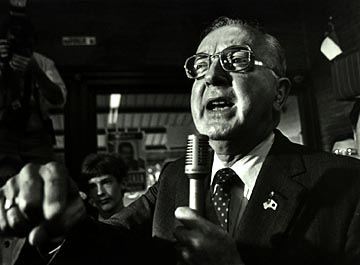
Senator Jesse Helms, campaigning in Lenoir, North Carolina for the first time as a politician, spoke inside an old storefront for ten minutes before leaving town in his motor home. Photo: “Jesse” (1991) by Spencer B. Ainsley.

The connection is Charlie
By Harry Siegel / July 4, 2008

From the right, Reagan biographer Craig Shirley remembers (Jesse) Helms as the man who made the Reagan revolution possible:

If Helms accomplished nothing else in his life, he is the man most responsible for the election of Ronald Reagan in 1980. Had Helms not engineered Reagan’s stunning upset win in the North Carolina primary in 1976, Reagan would have dropped out and faded into oblivion. Reagan staged a furious comeback as a result, losing the nomination to Gerald Ford by only a handful of delegate votes. As a result, Reagan became the front-runner for the 1980 nomination. None of this would have been possible without Helms. One man simply decided to change history.

And from the other side of the aisle, here’s a nice bit of quickly Nexised oppo from the proverbial sources-who-have-requested-to-remain-nameless recalling McCain chief strategist Charlie Black’s work for Helms, and tying him to some of the former senator’s more racially charged, to put it nicely, campaign tactics. Here’s the full memo, which was sent our way with the remark, “The connection is Charlie.”

1984: Black Advised Helms on Senate Re-Election Bid and Bragged About Victory.

The Washington Post reported, “‘It’s a tremendous victory for conservatives,’ Helms’ strategist Charles Black said. ‘It enhances his clout and influence in the Senate in the eyes of the press and his colleagues. He’ll be even more effective than he has been.’” [Washington Post, 11/8/84, emphasis added]

Black and Helms Used “Racist Appeals” to Win. Politics reporter Bill Peterson wrote in The Washington Post, “Lesson: A vicious new electronic form of negative politics has evolved and matured. And it is frightening. It is a politics of distortion, half truths and character assassination. Ends are used to justify means. Truth often takes a back seat. … Helms and the National Congressional Club, a political action committee run by his allies, had used negative advertising long before the Senate race began. … Racial epithets and standing in school doors is no longer fashionable, but 1984 proved that the ugly politics of race are alive and well. Helms is their master. A case in point was the pivotal event of the campaign: Helms’ filibuster against a bill making the birthday of the late Martin Luther King Jr. a national holiday. … Helms campaign literature sounded a drumbeat of warnings about black voter-registration drives. His campaign newspaper featured photographs of Hunt [his opponent] with Jesse L. Jackson and headlines like ‘Black Voter Registration Rises Sharply’ and ‘Hunt Urges More Minority Registration.’ Helms shamelessly mined the race issue.” [Peterson, Washington Post, 11/18/84, emphasis added]

1990: Black Advised Jesse Helms.

As He Ran Controversial “Hands” Ad Against Black Candidate. Newsday reported that Helms, “through a series of blistering advertisements unleashed just days before, had beckoned the long-simmering issue of race to the surface of this senatorial contest. In doing so, Helms had hurled the campaign into its most bitter and acrimonious phase to date, namely by labeling his opponent, falsely, an advocate of racial job quotas and accusing him of conducting a ‘secret campaign’ in the black community. … On the television commercial, the camera zones in on a white man’s hands, crumpling what apparently is a job rejection letter. The announcer then intones: ‘You needed that job and you were the best qualified. But they had to give it to a minority because of a racial quota. Is that really fair? Harvey Gantt says it is,’ the message continues. ‘Gantt supports Ted Kennedy’s racial quota law that makes the color of your skin more important than your qualifications.’” Black, an adviser to the campaign and a consultant for the Congressional Club — Helms’s political machine — insisted the race would come down to turnout: “‘What it’s going to come down to is turnout,’ said Charles Black, chairman of the Republican National Committee and a Helms adviser. ‘It’s, no question, the biggest challenge at this point.’” [Newsday, 11/4/90]

Black Defended “Hands Ad.”

Black defended Helms’s “Hands” television ad, which featured white hands crumpling a job rejection letter and linking Helms’s black opponent to racial job quotas. Asked about the ad on the MacNeil/Lehrer Newshour, Black said, “Well there is nothing racial about the campaign.” When asked if there was anything improper about the ad, Black said, “Of course not.” Another guest on the show, DNC Chairman Ron Brown, pressed Black again, saying, “You are a principal adviser of Jesse Helms. Would you advise him to run that kind of ad, Charlie? Do you approve of that ad, Charlie?” Black responded, “I advised Jesse Helms to do what he’s always done.” [MacNeil/Lehrer Newshour, 11/5/90]

Source. / Ben Smith’s Blog / Politico

The Rag Blog

Posted in RagBlog | Tagged , , , , , | Leave a comment

Witold Rybczynski :
Architecture-Bucky Fuller Revisited

Buckminster Fuller stamps
Inventor, tireless proselytizer, inspirational
cult figure, something of a flimflammer.

By Witold Rybczynski | July 2, 2008

The Buckminster Fuller exhibition that has just opened at the Whitney Museum of American Art in New York has already received a lot of press coverage, with long stories in The New Yorker and the New York Times. The latter ran a sensational report suggesting that Fuller’s depression and near suicide at age 32—which he famously described as spurring him to embark on his lifelong creative quest—were more or less invented, and that if he had a midlife crisis, it occurred later, as a result of a failed extramarital affair.

The Times story is titillating, but it pales beside the revelation made 35 years ago by Lloyd Kahn, an early geodesic dome devotee. The geodesic dome, a spherical structure constructed out of small elements that make it lightweight and extremely strong, was long associated with Fuller. Kahn revealed that the world’s first geodesic dome was a planetarium designed for the Carl Zeiss optical works in Jena, Germany, by Dr. Walter Bauersfeld in 1922—30 years before Fuller filed his patent for the device.

Neither the Jena dome nor the extramarital affair figure in the Whitney show, which is content merely to celebrate its subject (and repeats the old chestnut that Fuller “developed” the geodesic dome). That’s a shame since Fuller was a complex individual, and one not to be taken at face value. He is sometimes described as a global man, yet he was a quintessentially early-20th-century American type: the inventor who bootstraps himself out of obscurity, the self-promoter who turns into an inspirational cult figure, the tireless proselytizer who is also something of a flimflam man.

Fuller did not invent the geodesic dome, but he certainly popularized it, and in the 1950s domes were used by various American government departments as temporary shelters for traveling exhibitions and by the military, notably for building so-called radomes, housing radar installations in the Canadian Arctic. The geodesic dome became such a widely recognized icon of American know-how that it was used with great success as the U.S. pavilion at Expo 67, the Montreal world’s fair.

Fuller’s Dymaxion.

Most of Fuller’s inventions found less success. His most durable creation may have been his brand name, “Dymaxion,” a combination of dynamic, maximum, and ion, which conveyed his intention to radically rethink the design of everyday objects. The first Dymaxion House, octagonal in plan and suspended from a central mast, existed only in model form. The Dymaxion Bathroom, a prefabricated two-piece module that used a finely atomized spray instead of a conventional shower, made it to the prototype stage. Only three Dymaxion Cars were built, and the sole surviving prototype is on display in the Whitney. It’s worth the price of admission. The car looks like an airplane without wings, a three-wheeled lozenge that can turn in its own length. The elegant form owes a lot to W. Starling Burgess, a pioneering aeronautical engineer and renowned naval architect who designed several America’s Cup defenders. To obtain Burgess’ services, Fuller commissioned him to build a Bermuda-class sailing yacht, which he christened Little Dipper.

Burgess, who invented and flew the first Delta-wing airplane, is a reminder that Fuller’s period was replete with self-taught inventors. Many turned their attention to the problem of shelter. Wallace Merle Byam, an attorney, advertising executive, and publisher, invented and manufactured the Airstream trailer using airplane-building technology similar to the Dymaxion Car. The now-forgotten Corwin Willson built a two-story trailer house prototype using thin-shell-veneered plywood. Konrad Waschmann, a German immigrant, teamed up with Walter Gropius to design an ingenious prefabricated housing system using interlocking wood panels.

Waschmann and Gropius’ General Panel Corp. ultimately failed, and the closest that anyone ever came to realizing the age-old dream of a factory-produced home was probably Fuller’s Dymaxion Dwelling Machine. The all-aluminum house, which resembled an 18-foot-diameter flying saucer, incorporated dozens of innovations such as Plexiglas windows, a huge rotating ventilator that exhausted air from the interior, and revolving storage shelves. The whole thing weighed 6,000 pounds, could be transported in a compact cylinder, and sold for today’s equivalent of $50,000. The Dwelling Machine garnered immense publicity—including more than 37,000 unsolicited orders. Fortune magazine predicted that the dwelling machine would have a greater social impact than the automobile. Curiously, part of the reason for the project’s ultimate failure was Fuller himself: He cautiously delayed putting the house on the market for so long that in 1946 his company—the publicly traded Fuller Houses—finally collapsed.

photo of dyxmalion dwelling machines

A model of R. Buckminster Fuller’s “Dymaxion Dwelling Machines” community, about 1946. An exhibition at the Whitney Museum of American Art will offer a review of some of his grandest designs. / NYT

Many of the rooms in the Whitney exhibition contain flat-screen televisions playing films of Fuller. Martin Pawley, who wrote a biography of Fuller, described him as “perhaps one of the most prolific public speakers ever to remain outside politics,” and Fuller’s wide influence, especially later in his life (he died in 1983 at the age of 87), derived in no small part from his oratory. I heard him lecture several times in the 1970s, both in large and small groups. He had a flat, humorless, somewhat monotonous voice and spoke in a kind of verbal shorthand that was sometimes difficult to follow. Occasionally he appeared breathless, not out of any infirmity, but because—one had the impression—his brain was transmitting ideas faster than he was able to speak. The unlikely effect was captivating nonetheless.

Although the Whitney show describes Fuller as “one of the great American visionaries of the 20th century,” his influence today is hard to gauge. He had a short-lived influence on the counterculture of the 1960s, inspiring the Whole Earth Catalog and countless do-it-yourself domes. He also had an important influence on architects such as Richard Rogers, Renzo Piano, and Norman Foster (it’s hard to see the Hearst Tower, across town from the Whitney, as anything except Foster’s hommage to Fuller). It is tempting to see Fuller, with his emphasis on maximizing resources and reducing waste, as a harbinger of green architecture, but he was less interested in environmentalism than in efficiency. I once heard him answer a question about recycling a waste material: “No, no, you should never use something just because it’s available; you should always find the best solution to a problem.” The Whitney exhibition catalog makes an unconvincing case that Fuller was a kind of artist and tries to find links to his work in the art world. Anyone interested in Fuller would do better to find a copy of The Dymaxion World of Buckminster Fuller, by Fuller and Robert Marks, now out of print. This book contains a pithy description of Fuller’s philosophy, which, in our present condition of diminishing resources and environmental challenges, remains as pertinent as ever: “rational action in a rational world demands the most efficient overall performance per unit of input.” Vintage Bucky.

Source. / Slate

Also see Dymaxion Man / The New Yorker

And The Love Song of R. Buckminster Fuller / The New York Times

The Rag Blog

Posted in RagBlog | Tagged , , , , , , | Leave a comment

Social Change in America : Learning from History

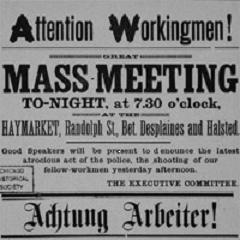
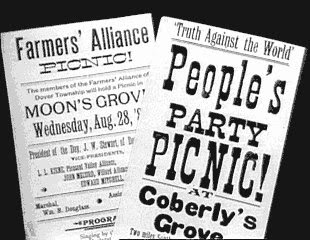
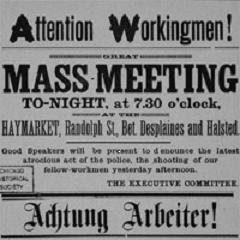
Populist handbills.

A flyer informing workers of a meeting that was to end in the Haymarket Riotof 1886. Police were called in when fighting broke out between striking workers and strikebreakers at the McCormick Harvesting Machine Company in Haymarket, Illinois. Two union men were shot by police, and an explosion killed seven policemen.

Creating a New Progressive Era
by Jack A. Smith / July 3, 2008

Jack A. Smith is editor of the Activist Newsletter and a former editor of the radical newsweekly The Guardian.

How can poverty and grave economic inequality be significantly reduced in the United States? Under what conditions might it be possible to bring about a period of significant progressive reform that would address our country’s major social problems?

As the income and living standards of the poor, the working class and a significant sector of the middle class in America have declined, a quite small portion of the population known as the upper class has become wealthier and more powerful than ever. One would have to revisit the Gilded Age of the late 1800s or the Roaring Twenties just before the 1929 Great Depression to locate comparable contradictions between the rich and the rest of the American people.

There are many distressing statistics that demonstrate the extent of economic inequality in the United States. The following is a telling illustration:

The top 20% of wealthy families in the U.S. now possess 84.7% of all assets and wealth. The top 5% alone control 58.9%, and the richest 1% command 34.3%. The “bottom” 80% possess of 15.3% of the nation’s wealth. The bottom 40% within this total have accumulated 0.2%. That’s two-tenths of one percent owned by 120 million Americans, while 34.3% is possessed by 3 million.

According to progressive economist William K. Tabb, writing in Monthly Review (July-August 2006), the Bush Administration’s economic policies “carry echoes which have been heard down through our nation’s history and have taken on resonance analogous to the Gilded Age and the Roaring Twenties, other periods when conservative ideology and politics held sway and rapid increases in inequalities were produced by deregulation and variants of laissez faire policy and Social Darwinist thinking. But in all periods, we have had a government of the rich that has acted in the interests of the rich.”

Columnist and Princeton economist Paul Krugman, writing in the N.Y. Times on April 27, 2007, argued that “Income inequality… is now fully back to Gilded Age levels… Last year… a hedge fund manager took home $1.7 billion, more than 38,000 times the average income. Two other hedge fund managers also made more than $1 billion, and the top 25 combined made $14 billion… The hedge fund billionaires are simply extreme examples of a much bigger phenomenon: every available measure of income concentration shows that we’ve gone back to levels of inequality not seen since the 1920s.”

There is a clear cause and effect when the “upper” classes get richer and the “lower” classes get poorer. It often derives from the ability of those with power and wealth to manipulate government policy regarding taxes, regulations, and programs to further benefit themselves at the expense of those lacking power and wealth.

This is hardly unique in American history, but more prevalent at certain periods, such as the present moment when economic inequality and poverty are at high levels. We will focus upon three comparable periods in the past that generated a progressive response ultimately resulting in major social and economic reforms.

The United States advertises itself as the world’s outstanding example of democracy. But how can a democracy function properly and fully in conditions of gross economic disequilibrium, especially when class inequality is compounded by racial and gender inequities as well?

President Franklin D. Roosevelt recognized this contradiction when he declared in 1944 that “true individual freedom cannot exist without economic security and independence.”

Economist Lester Thurow, in his 1999 book about the income gap titled Shifting Fortunes asked: “How does one put together a democracy based on the concept of equality while running an economy with ever greater degrees of economic inequality.”

American progressives of an earlier era understood this as well. Historian Richard C. Wade, writing about the reform struggle of the early 1900s, noted: “Progressives agreed that the central question of their times was how to control the power of concentrated wealth in a democracy.”

No wonder increasing comparisons are made between America in the early 2000s and the Gilded Age — a period of enormous wealth and opulence for the few and exploitation and oppression for the many.

An important difference between this earlier period and now is that in the late 1800s/early 1900s, there was a substantial fight back against the machinations of wealth and power, while in comparison today’s response has largely been confined to the wringing of hands.

Progressive movements arose in opposition in several past situations of extreme inequality and flaunted wealth. There were people’s organizations out in the streets; unions were marching; there were sizable left groups organizing and leading struggles. At times, popular pressure obliged the ruling parties to put some restraints on the corporations, investors, financiers, and their hangers-on, and even to pass legislation favorable to working people.

But now, after a quarter-century of stagnating wages, with a recession looming over the country as prices are rising and incomes are falling, as workers are losing their jobs and homes, Washington is spending trillions on aggressive wars and a relative pittance on new programs to help the masses of people.

There’s a class war going on, initiated and led by wealth and power. Various administrations in Washington in recent decades offer a perfect example of our government’s penchant for coddling the rich and ignoring the needs of working families. But aside from small left organizations and reform groups, some unions and a few politicians, what forces in our society are truly fighting for the poor, the working class and lower middle class majority of the American people? It is certainly not the two ruling parties.

There’s an election going and neither Democrat Barack Obama nor Republican John McCain has put forward a worthwhile immediate program to counter high prices for food and fuel, increasing unemployment, and depressed incomes. Neither offers a strategic program to greatly reduce poverty and inequality in America, to create good new jobs and affordable housing. Neither will contemplate big cuts in the military budget nor sharply increasing taxes for the rich to pay for these programs.

For over 200 years in America, virtually every decisively important government program or law that benefited the masses of people was the product of persistent, hard-fought struggle led by progressive and left social or political or labor movements, or all in combination. This was true at various points in history in the attainment of an eight-hour day, vacations, and a minimum wage; the right of women to vote and to work in jobs previously held by men only; the granting of Social Security pensions, Medicare and Medicaid; the end to lynch laws, the poll tax and formal racial segregation — and just about every other advance that has taken place in our society.

None of it was a gift. All of it was a struggle. And it’s the only way poverty and inequality — and all comparable abuses — can be reduced significantly.

The last period of relatively progressive governance in America lasted a few years and ended four decades ago when President Lyndon B. Johnson left office. LBJ is accurately remembered as the president who led the U.S. into the quagmire of the imperialist Vietnam War. But his extensive and fruitful “Great Society” domestic program was the final attempt to continue New Deal-type reforms initiated by President Roosevelt during the Great Depression when masses of people were demanding relief and reform.

The great obstacle to progressive social change in America today is that we have been living in conservative political times for decades. The nation is just emerging from eight years of George W. Bush’s hard core ribald neoconservatism and preemptive wars in Iraq and Afghanistan; preceded by eight years of Bill Clinton’s centrist compromise with the rightists, killer sanctions against Iraq and the unjust war in Yugoslavia; four years of George H. W. Bush’s conservatism and the first war against Iraq; and eight years of Ronald Reagan’s reactionary Cold War policies, subversion throughout Central America, and right wing economic programs.

The 2008 election offers the U.S. people a choice between centrism and neoconservatism — all in the name of an ambiguous mantra of undefined “change.” This means that the right and center — the political tendencies least willing and able to end gross economic inequality and banish poverty in the U.S. — will dictate national policy through the next four years as they have in the past.

It doesn’t have to be this way. There were periods in American history when conservative times did transform into progressive times. When this happened it was almost invariably a consequence of popular mass struggle for affirmative political reform.

Today, the U.S. left — from left-liberalism and progressivism to social democracy, socialism and communism — is weak and without meaningful influence. And our critically important union movement is weak as well, with a leadership that remains wedded to the “lesser evil” centrism of the Democratic Party in return for token political compensation.

When the American left revives, as it certainly will, and popular mass struggle resumes, the conditions will exist to bring about a new period of substantive social, economic, and political reform.

Lately there have been some reports of an incipient progressive upsurge within the Democratic Party that might seriously address matters of poverty and economic inequality, among others.

Undoubtedly there are many left-liberal and progressive Democrats who are justly disappointed by the cautious performance of their party’s majority in Congress and by the refusal of the leadership to venture even a trifle to the left of center. Groups such as Democrats.com and MoveOn.org, among others, are cited as evidence of a progressive resurgence and even a possible harbinger of an effort to seize party leadership “from the bottom up.”

Our country would benefit if the center/center-right Democratic Party moved to the center-left in the next few years on the basis of agitation within its ranks. But it is far-fetched to think it will do so after the party leadership’s diligent and successful efforts over the decades to bury liberalism and completely reject the hint of social democracy implicit in the first few years of FDR’s New Deal.

At some point there will be another period of progressive advance, such as several earlier times in America’s history. When that happens it probably will be generated from outside the Democratic Party and consist of mass movements with progressive and left leadership around such key issues as economic reform, peace, inequality, poverty, jobs, housing, militarism, imperialism, union rights, and so on.

Such circumstances might influence the Democrats to take some action. Or it could lead to another Progressive Party, as it has done thrice before on the national level (1912, 1924, and 1948) and four times on the state level, not to mention many other left third parties.
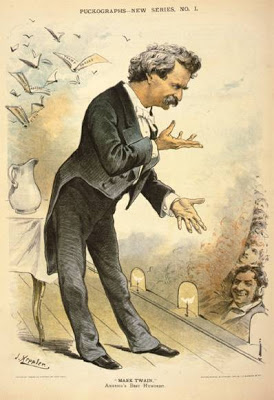
Humorist and social critic Mark Twain, himself an outspoken populist and anti-capitalist, wrote and performed during the Gilded Age.

Let’s briefly look back to some earlier periods of progressive reform in our history. While there were active reform movements in the years before the Civil War (abolition and women’s rights), a broad major reform struggle began in the 1870s and lasted with varying levels of intensity about 40 years. It took place during two historic periods: the Gilded Age and the Progressive Era.

The name Gilded Age was taken from a 1873 book of that title penned by Mark Twain and Charles Dudley Warner. Their use of “gilded” derived from Shakespeare’s King John: “To gild refined gold, to paint the lily… is wasteful and ridiculous excess.”

The Gilded Age officially began with the end of Reconstruction in 1877. It was weakened by the decimating depression of 1893-97 and declined at century’s end, though many of its conditions continued into the Progressive Era, which lasted between 1900 and World War I.

During the later 1800s America changed from a rural agrarian society into a mixture with urban industrial development that greatly accelerated the Industrial Revolution and created fabulous fortunes for the wealthy, and extreme exploitation for working class men, women and children. Long hours, low pay, and miserable living conditions painfully afflicted multimillions of American workers as unrestrained capitalism ran amuck.

Simultaneously, as the U.S. was adjusting to a post-Civil War, post-Reconstruction period of booms and busts (there were three depressions in the Gilded Age), the great majority of former slaves were forced into a new type of oppression under Jim Crow segregation laws (the model for pre-liberation South Africa’s apartheid system.) It took 90 years, the civil rights movement, and the 1960s reform period to end formal racial segregation, though racist inequality still exists in America.

The Gilded Age, according to author Steve Fraser in an article for TomDispatch.com April 28, was characterized by “crony capitalism, inequality, extravagance, Social Darwinian self-justification, blame-the-victim callousness, [and] free-market hypocrisy.”

In response, he wrote, “Irate farmers mobilized in cooperative alliances and in the Populist Party. Farmer-labor parties in states and cities from coast to coast challenged the dominion of the two-party system. Rolling waves of strikes, captained by warriors from the Knights of Labor, enveloped whole communities as new allegiances extended across previously unbridgeable barriers of craft, ethnicity, even race and gender.”

The strikes were militant and massive, and included the Great Railroad Strike of 1877; the 1886 railroad strike; the 1892 Homestead Strike; the Great Uprising of 1886 composed of nationwide strikes and demonstrations for an eight-hour work day, which led to the legal lynching of four anarchists on trumped up changes after the Haymarket Riots; and the 1894 Pullman Strike conducted by the American Railroad Union and led by socialist Eugene Debs.

The new labor movements were the only protection most American workers had against unbridled capitalist greed. The Knights of Labor, one of America’s first great unions, was formed in 1869 and played an important role in the working class fight back during the Gilded Age. It faded in the late 1880s. The more restrained American Federation of Labor was formed in 1889. The militant Western Federation of Miners was organized in 1893, and the revolutionary International Workers of the World, the Wobblies, came about in 1905.

The Populist (Peoples) Party was founded in 1890 to put forward demands ignored by the two ruling parties. It received over a million votes in the 1892 presidential elections on a platform calling for direct election of U.S. Senators, a secret ballot, referendums, recall of elected officials, direct primary balloting and opposition to the gold standard. A number of its candidates became governors and members of Congress.

By the next presidential election in 1896, the Democratic Party had adopted a number of the populist demands which it had earlier opposed. The Populist Party then supported Democratic candidate William Jennings Bryan, who lost to Republican William McKinley. That was the beginning of the end for the populists. Their party quickly declined and dissolved in 1908.

The excesses of capitalism were mainly addressed by reforms during the Progressive Era, but some took place in the 1890s, such as the Sherman Antitrust Act (1890), which outlawed business monopolies; The Interstate Commerce Act (1887), which protected small shippers against powerful railroads; and the Civil Service Act (1883), aimed at ending corruption, which substituted the merit system for the spoils system in filling government jobs.

The Progressive Era was a period of great reform in response to the extreme exploitation of working families that accompanied swift industrialization and the growth of cities at a time when millions of poor immigrants were pouring into our country. The working people benefited from these reforms, but so did capitalism, of course, the regulation of which was essential to rationalize and strengthen the system, not replace it.

According to a superb college textbook on American history, Who Built America? (vol. 2): “Scholars [of the Progressive Era] have been unable to agree on exactly what Progressivism was. In fact, Progressivism encompassed many distinct, overlapping and sometimes contradictory movements: it was working people battling for better pay and control over their working lives; it was women campaigning for more equality and the right to vote at the same time as African Americans were being disfranchised in the South. It was corporations and their allies pushing to make city governments more businesslike; it was middle class reformers closing saloons and prohibiting the sale of alcohol; it was politicians and presidents extending the power of government to ‘bust trusts’ and regulate corporate activity.

“Sometimes these various reform forces worked together, sometimes they fought each other. Each responded in some way to the profound economic and social changes of the Gilded Age, but they differed in their interpretation of problems and solutions. As coalitions shifted, these diverse campaigns laid the foundation for modern American politics.”

The progressive movement had a number of concerns: the terrible conditions of working class life, from child labor to poor housing and ill health; the abuses of robber barons and business owners; the lack of government regulation of the marketplace; women’s suffrage; prohibition; race oppression; direct elections (to the Senate); electoral reform; and anti-monopoly reform.

There was another concern as well, according to the Eagleton Institute of Politics at Rutgers: “Fear of the expansion of socialism and Marxism provoked many in the upper class to support more moderate reform efforts as a means to ease the growing tensions between rich and poor and head off more extreme threats to their privileged role in society.”

President Theodore Roosevelt, who as vice president entered the White House in 1901 after President McKinley was assassinated, was the foremost reform politician during the Progressive Era. Although a man of wealth, an open imperialist, and staunch advocate of capitalism, he opposed the excesses of the Gilded Age as counter-productive to the interests of the United States and to his own vision of America as a burgeoning world power. TR, as he was known, believed that “the man of great wealth owes a peculiar obligation to the state because he derives special advantages from the mere existence of government.”

Republican Roosevelt left office in 1908 after presiding over the passage of a number of reforms demanded by the progressive movement and the expansion of federal authority. He was succeeded by his own vice president, William H. Taft. Out of office but still riding the progressive wave in 1910, TR outraged his own class be declaring: “I believe in a graduated income tax on big fortunes, and… a graduated inheritance tax on big fortunes.”

Convinced that Taft and the Republican Party had turned against progressivism, Roosevelt unsuccessfully sought to obtain the party’s nomination in the 1912 presidential election. He then bolted the Republican Party and, with support from the progressive movement, formed the Progressive Party (known also as the Bull Moose Party) with an extensive reform agenda, the purpose being “to dissolve the unholy alliance between corrupt business and corrupt politics.” With the GOP split, the Democratic Party’s Woodrow Wilson won the election. Roosevelt was second and Taft last. Union leader Debs, running at the candidate of the Socialist Party, came in fourth with 6% of the vote. The Progressive Party collapsed in 1916.

Among the federal reforms of the Progressive Era were the following:

The Newlands Reclamation Act (1902) a conservationist measure; the Elkins Act, the Pure Food and Drug Act (1906 and 1911), making sure that companies label ingredients; the Meat Inspection Act (thanks to writer Upton Sinclair’s exposé in his novel The Jungle); the Federal Reserve Act; the Clayton Antitrust Act, opposing monopolies and ruling that labor unions did not fall under antitrust laws; and the Federal Trade Act that established the Federal Trade Commission that is supposed to investigate “unfair business practices.”

In addition, laws were passed regulating the drug industry, establishing federal controls over the banking industry, and improving working conditions. Further, two progressive constitutional amendments — the power to tax income and the direct election of Senators were approved in 1913. Another progressive cause, women’s suffrage, was passed in 1919.

The Roaring Twenties were hardly progressive. It was a period of extreme Republican laissez faire economics, until the stock market crashed in 1929, plunging America and the world into the Great Depression.

There were radical moments in the 1920s, however, including the resurrection of the Progressive Party, which fielded Wisconsin progressive Republican Sen. Robert M. LaFollette Sr. as its 1924 presidential nominee against conservative candidates from both the Democratic and Republican Parties. LaFollette, whose program included nationalization of large industries including railroads, higher taxes for the rich and lower taxes for working people, and collective bargaining for workers, was supported by labor, socialists and liberals. With nearly five million votes — 16.6% — La Follette came in third. The Progressive Party dissolved in 1946, long after it ceased activity on the national level. During these years in its Wisconsin stronghold the party elected a governor and six members of the House of Representatives.

By the second half of the conservative 1920s the rich-poor gap was reaching Gilded Age proportions. Herbert Hoover, who defeated liberal Democrat Al Smith in the 1928 election, was the third Republican elected to the presidency during the decade. In accepting nomination, Hoover declared: “We in America today are nearer to the final triumph over poverty than ever before in the history of any land. We shall soon… be in sight of the day when poverty will be banished from this nation.”

Hoover assumed office in March 1929. The Great Depression began seven months later, catapulting most of the working class and middle class into exceptionally hard times. Consistent with his conservative ideology of waiting for the “market” to cure itself, Hoover did practically nothing as the economy crumbled in the three years until the 1932 election, which gave rise to the greatest period of progressive reform in U.S. history.
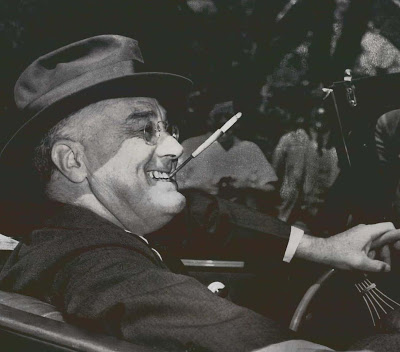
President Franklin Delano Roosevelt.

The Democrats nominated New York Gov. Franklin D. Roosevelt, a fifth cousin to Theodore Roosevelt. He declared in his acceptance speech, “I pledge myself to a new deal for the American people,” and his program became known as the New Deal. FDR, as he was universally known, captured 57.4% of the vote against 39.7 for Hoover, and remained in office to four terms. He delivered the famous line, “the only thing we have to fear is fear itself,” in his first inaugural address in 1933.

Roosevelt was under extreme pressure when he entered the White House. Unemployment reached its peak that year — 25.2% — meaning one in four workers was jobless and many others were working for reduced pay and waiting for their jobs to disappear. Millions of families were suffering great distress and relief from Washington barely existed.

From the day he entered the White House, Roosevelt understood that his principal task was to preserve capitalism in America at a time when private enterprise systems around the world were experiencing economic disasters. There were two threats. One was that the downward economic spiral in the U.S. might lead to a total collapse. The other was the fear that the working class might seek to replace capitalism with socialist or revolutionary communist alternatives. At the time, these were quite rational speculations.

The political left had been organizing since the day the stock market crashed. For instance, according to Who Built America?, just weeks after the market crash “the Communist Party organized the first of what was soon a nationwide network of ‘Unemployed Councils.’ These Communist-led neighborhood groups worked to aid the unemployed with immediate problems of rent and food, to apply pressure for improved relief programs, and finally to recruit new members to join the party. On March 6, 1930, the communists held a series of rallies on what it dubbed International Unemployment Day,’ demanding government action. In city after city, the turnout far exceeded expectations.”

The Communist Party was active throughout the 1930s, in all the major cities, in the unions, in the South among poor black sharecroppers, in Harlem stopping evictions and fighting for unemployed workers. Near the end of the 1930s CP membership rose to its highest number ever, 100,000. Many other progressive and left groups, including populist farmers, were organizing as well, but the communists were the most energetic.

Unions were active but did not come into their own until late 1935 with the formation of the CIO (Congress of Industrial Organizations). In little more than a year union membership in the U.S. rose from four million to seven million. Confrontations between labor and management sharply increased as companies resisted collective bargaining, often engaging in redbaiting in the process. Many in the wealthy class and their minions in corporate management viewed unionization as a red plot.

Company brutality, exercised through local police and private security thugs, increased as labor became stronger. Police shot and killed 10 striking workers outside a Chicago steel factory in May 1937. In the same month, a Ford company guard viciously beat leaders of the CIO’s United Automobile Workers union.

The less activist American Federation of Labor (AFL) was founded 46 years earlier as a craft union, organizing each craft — such as plumbers, sheet metal workers or carpenters — into separate unions. The CIO organized workers around entire industries — auto, steel, coal, and so on, conveying to each member a sense of mass and solidarity.

The CIO was known for its militancy and spectacular sit-down strikes. Many leftists including communists were CIO organizers and union militants at the time — often the most dedicated and hardest fighters for the union — even as a number of union leaders expressed anticommunist views in response to criticism from the owners. (The CIO purged most of its left militants in the late 1940s when it took a right turn in response to the Washington’s anticommunist campaign accompanying the start of the Cold War against the Soviet Union. It subsequently merged with the AFL and has generally supported some of the worst aspects of U.S. foreign policy ever since.)

The new president understood that the desperation afflicting American workers and their families, combined with the determination of the political, social, and union organizations demanding that Washington alleviate their plight, obligated him to proceed swiftly, decisively, and in tune with the progressive assumptions of the day.

Read the rest of this article here. / DissidentVoice

The Rag Blog

Posted in RagBlog | Tagged , , , , , , , , , | 2 Comments

Another Species Is Biting the Dust


Orangutan Populations Declining Sharply
By Michael Casey / July 5, 2008

BANGKOK, Thailand – – Orangutan numbers have declined sharply on the only two islands where they still live in the wild and they could become the first great ape species to go extinct if urgent action isn’t taken, a new study says.

The declines in Indonesia and Malaysia since 2004 are mostly because of illegal logging and the expansion of palm oil plantations, Serge Wich, a scientist at the Great Ape Trust in Iowa, said on Saturday.

The survey found the orangutan population on Indonesia’s Sumatra island dropped almost 14 percent since 2004, Wich said. It also concluded that the populations on Borneo island, which is shared by Malaysia, Brunei and Indonesia, have fallen by 10 percent. Researchers only surveyed areas of Borneo that are in Indonesia and Malaysia.

In their study, Wich and his 15 colleagues said the declines in Borneo were occurring at an “alarming rate” but that they were most concerned about Sumatra, where the numbers show the population is in “rapid decline.”

“Unless extraordinary efforts are made soon, it could become the first great ape species to go extinct,” researchers wrote.

The number of orangutans on Sumatra has fallen from 7,500 to 6,600 while the number on Borneo has fallen from 54,000 to around 49,600, according to the survey on the endangered apes, which appears in this month’s science journal Oryx.

“It’s disappointing that there are still declines even though there have been quite a lot of conservation efforts over the past 30 years,” Wich said.

Indonesia and Malaysia, the world’s top two palm oil producers, have aggressively pushed to expand plantations amid a rising demand for biofuels which are considered cleaner burning and cheaper than petrol.

Wich and his colleagues said there was room for “cautious optimism” that the orangutan could be saved, noting recent initiatives by Indonesian leaders.

Indonesian President Susilo Bambang Yudhoyono announced a major initiative to save the nation’s orangutans at a U.N. climate conference last year, and the Aceh governor declared a moratorium on logging.

Coupled with that are expectations that Indonesia will protect millions of acres of forest as part of any U.N. climate pact that will go into effect in 2012. The deal is expected to include measures that will reward tropical countries like Indonesia that halt deforestation.

“There are promising signs that there is a lot of political will, especially in Aceh, to protect the forest,” Wich said, adding however that much more needs to be done.

Michelle Desilets, founding director of Borneo Orangutan Survival Foundation UK, praised the study for offering the first comprehensive look at the species population.

“What matters is that the rate of decline is increasing, and unless something is done, the wild orangutan is on a quick spiral towards extinction, whether in two years, five years or 10 years,” Desilets said in an e-mail.

In their paper, the researchers recommended that law enforcement be boosted to help reduce the hunting of orangutans for food and trade. Environmental awareness at the local level must also be increased.

“It is essential that funding for environmental services reaches the local level and that there is strong law enforcement,” the study says. “Developing a mechanism to ensure these occur is the challenge for the conservation of the orangutans.”

The study is the latest in a long line of research that has predicted the orangutans demise.

In May, the Center for Orangutan Protection said just 20,000 of the endangered primates remain in the tropical jungle of Central Kalimantan on Borneo island, down from 31,300 in 2004. Based on that estimate, it concluded orangutans there could be extinct by 2011.

Source / America On Line

The Rag Blog

Posted in RagBlog | Tagged , , | Leave a comment

Cathy Garger :
A Small Environmental Victory for Washington State

photo of depleted uranium

US and UK forces continue to use depleted uranium bullets, shells, and defensive armor plating in Iraq

Depleted Uranium Activism Saves Washington!

By Cathy Garger | July 3, 2008

In the June 30 issue of Tacoma’s The News Tribune, readers from Washington got to read the attack on Governor Gregoire in “Gregoire’s inaction cost jobs, say Tri-Cities leaders”. In this piece that describes the rationale behind the Governor’s refusal to court the supreme federal God, Uranium, we get a glimpse of just how easily a state official can be lambasted for refusing to get into bed with the nuclear industry.

Another story exists within the story, however, which demonstrates how education around the dangers of what is deceptively labeled “Depleted Uranium” has saved both the day – and the very lives – of countless current and future generations of Washingtonians. Apparently, good news to those who appreciate a clean and healthy environment, some anti-nuclear activists got through to Governor Chris Gregoire of Washington, as it was reported, “The hang-up for Gregoire was the proposed plant’s waste stream of depleted uranium, a dangerous chemical with low levels of radioactivity.”

What exactly happened that influenced the life-preserving move for Washington? Apparently, the Governor had been concerned about a backlash by environmentalists that impacted her decision not to push to play host state to a proposed Uranium enrichment plant.

It is reported that the lack of energetic courtship on the part of Governor Gregoire influenced the decision made by French nuclear giant, Areva, to choose Idaho over Washington for its newest $2 Billion Uranium enrichment plant. In a May 7 Axis of Logic article, this writer had predicted this decision at that time, reporting, “The federal government is entering into what is quite literally dangerous territory with its plans to fully support yet another uranium enrichment plant certain to harm the good people of Idaho.”

Idaho’s somber news is certainly better news for Washingtonians – and residents of Ohio, Texas, and New Mexico, states that were also passed over in the decision. But for Washington, this is special reason for anti-nuclear activists to celebrate, as the state already has its hands full of massive hazardous waste at its 120 square mile Hanford Site, with its underground plume of Tritium, Chromium, Strontium-90 and Uranium, 18 square kilometers – nearly 7 square miles in size.

Hanford Nuclear Facility, Washington

With contamination of twenty (20) percent of its Columbia River shoreline, Hanford is, hands down, the most contaminated nuclear site in the country, with a more than $50 Billion price tag for clean up projected to continue through the end of 2019.

A hazardous legacy with 50 years of plutonium production to be passed down to future generations of Washingtonians, one study showed those living downwind of the Hanford facility experienced high incidences of cancers of all types. With the prospect of being stuck with another nuclear wasteland, one can understand why Washington activists took none too kindly to the construction of a Uranium enrichment plant certain to add to their state’s current radiological holocaust.

Yet while Washingtonians are off the hook from having to accommodate Areva’s Uranium poison factory, one can’t help but feel sorry for the poor residents of Idaho, whose state has been awarded the contract. Whatever did Idahoans do that was sufficiently bad to merit radioactive particulates blowing in their winds, poisoning their air, water and soil? Haven’t the good people of Idaho suffered enough cancer already from radioactive atomic bomb fallout exploded in Nevada?

I guess we could simply say, that’s Idaho’s business, right? In actuality, it is our business, too. Radiation emitted from any nuclear power plant, Uranium enrichment plant, or from munitions used in either combat or in “testing” at proving grounds and military bases does not stop magically at the state line. Invisible radionuclides – atoms of ionizing radiation – travel in the atmosphere for great distances through the winds.

Whether speaking about the nuclear gasses of Chernobyl that contaminate Europe, Russia, and eventually the Arctic Ocean, the US atomic bomb blasts that spread radiation from Nevada clear up to New York and Maine, or the radioactive Uranium oxide spread through Europe to the UK within a week of the “Shock and Awe” bombing of Baghdad, radionuclides are carried thousands of miles through the winds and can also leach underground into groundwater, affecting drinking water.

What about our food supply, which is contaminated wherever radionuclides land on the soils in which crops are grown? In Idaho, the airborne dispersal hits “home” for many of us who enjoy Idaho baked potatoes but are less than thrilled at the prospect of glow-in-the-dark spuds. It is important that potato lovers ‘round the country realize their favorite starch is grown in the same state which already houses another DOE public health disaster – the Idaho National Laboratory with its tens of millions of cubic feet of radioactively contaminated soil and the Snake River Aquifer.

The Idaho National Laboratory is one of 9,900 nuclear production facility contaminated sites “under assessment” by the DOE. Roughly translated, this means experts are scratching their heads, asking one another what in blazes they are going to do with this mighty nuked, bombed-out, country.

In a 7 year, $2.9 Billion clean-up project affecting the drinking water of 300,000 eastern Idaho residents, Plutonium – to the tune of one metric ton – is but one of the eighteen (18) contaminants of concern at the Idaho Laboratory.

With the Laboratory’s stated mission to “support our government’s role in leading the revitalization of the nation’s nuclear power industry and re-establishing U.S. world leadership in nuclear science and technology,” expansion of nuclear power and weapons technology continues to be the driving force of not just the Idaho Laboratory, but the DOE itself, without regard of cost to human health or environment.

An example of the impact of Uranium used for weapons by the Idaho National Laboratory involves risk calculations which indicate individuals living adjacent to the hazardous landfill even 1,000 years from now will have a greatly increased chance of contracting cancer from plutonium exposure due to inhalation of contaminated air and ingested foods grown nearby. Uranium materials left from nuclear processing at the site will continue to emit radiation, contaminating the earth and groundwater for far longer.

Some Effects of Depleted Uranium Poisoning

All of these serious and lingering nuclear disasters aside, Idaho’s Governor “Butch” Otter is still mighty proud his state’s been chosen as the winning site for even further radiological contamination. Witness the beaming pride of a Governor who had cast his net and pulled in the grand prize – a future hazardous National Superfund Site – in this May 14, 2008 quote made by Governor Otter after AREVA announced its decision: “Along with that kind of infrastructure and expertise, government regulations, market forces and most of all the watchful eyes of 1.4 million Idahoans all will ensure that the AREVA plant will be safe, clean and an enormous economic benefit to our state. AREVA’s decision is a testament to the hard work and progressive mindset of Idaho’s people, and the growing diversity and dynamism of our economy. There is a long way to go before AREVA’s promise becomes reality, but we already have proved that nothing is beyond our capability.

It is certainly curious to see that a Governor knows nothing at all about how Uranium enrichment plants work, evidenced by the fact he calls them “safe” and “clean.” Were there perhaps no Idaho activists to instruct their Governor any better than that? Moreover, in true Orwellian politico-speak, words and their meanings are often deceptively reversed. For the day the word “progressive mindset” is equated with polluting the environment with radioactive gasses is the very day environmental activists must start calling ourselves “conservatives.” We are, after all, on a mission to conserve – as in save – the planet and our very lives, are we not?

In stark contrast, the fact that Washington’s Governor Gregoire realized that Depleted Uranium would endanger her constituency – and the environment – is most likely due to the work of on–target environmentalists who would not allow her to forget Hanford… not in a Manhattan Project minute!

No doubt these anti-nuclear activists had done their homework on the voluminous research that exists which links chemically toxic and radioactive Uranium with health effects such as cancer, diabetes, neuro-muscular degenerative disease, birth defects, cardiac problems, thyroid disease, and auto-immune system diseases. Before we, therefore, drink another Uranium-contaminated glass of water, eat tonight’s Idaho baked potato, or inhale our very next breath of air? It would be more than wise to take a few minutes of our time to discover which radioactive sites are located in our area.

We must work hard to shut down nuclear power plants and facilities used to produce nuclear materials and weapons and clean up the ones already shut down. For a genuine “nuclear renaissance” is now upon us – whereby the Nuclear Regulatory Commission expects to receive (and, in all probability, will approve) applications for the construction of 34 new nuclear reactors.

All new nuclear reactors – for the sake of our kids and their kids… must be fought tooth and nail. Failure to do so will, quite literally, make radionuclides like Strontium-90, only one of over 100 harmful chemicals emitted from nuclear reactors that enter the body, become a permanent part of teeth and bones.

Washington is a prime example of how anti-radiation activists fighting nuclear contamination in their state can have a critical impact on decisions made in the current nuclear revivalist onslaught in America. We must both educate others about the hazards of life-destroying radioactivity released into our environment and also confront our legislators and other government officials, opposing nuclear contamination in all its lethal forms.

The dirty “business” of Uranium looms ominously in America’s future, spelling disaster for our nation’s environmental and public health. Yet, even still, there is hope that this trend will be slowed and eventually stopped – as is evidenced by environmentalists who made an undeniable impact on the decision of Governor Gregoire from Washington – one which will undoubtedly save countless lives.

One is tempted to wonder what an intensive opposition waged by a large and dedicated coalition of anti-nuclear activists might have accomplished in Idaho… had they only been able to “get through” to the Governor. Unfortunately – and most tragically – for both Idahoans alive today and for many generations to come, that question will never be answered.

Resources

An explanation of the Uranium production process appears on the Nuclear Information Referral (NIRS) website.

In addition, an entire website filled with scientific research devoted to the topic of the harm of radioactivity to humans is available for viewing at the Radiation and Public Health Project website. Another good resource on the health costs of low-level ionizing radiation is available here.

Cathy Garger is a regular guest contributor to Axis of Logic. She is a freelance writer, public speaker, activist, and a certified personal coach who specializes in Uranium weapons. Living in the shadow of the national District of Crime, Cathy is constantly nauseated by the stench emanating from the nation’s capital during the Washington, DC, federal work week. Cathy may be contacted at savorsuccesslady3@yahoo.com.

© Copyright 2008 by AxisofLogic.com

Source / Axis of Logic

The Rag Blog

Posted in RagBlog | Tagged , , | Leave a comment