
The Rag Blog / Posted July 5, 2008

Internal World Bank study delivers blow to plant energy drive
Biofuels have forced global food prices up by 75% – far more than previously estimated – according to a confidential World Bank report obtained by the Guardian.
The damning unpublished assessment is based on the most detailed analysis of the crisis so far, carried out by an internationally-respected economist at global financial body.
The figure emphatically contradicts the US government’s claims that plant-derived fuels contribute less than 3% to food-price rises. It will add to pressure on governments in Washington and across Europe, which have turned to plant-derived fuels to reduce emissions of greenhouse gases and reduce their dependence on imported oil.
Senior development sources believe the report, completed in April, has not been published to avoid embarrassing President George Bush.
“It would put the World Bank in a political hot-spot with the White House,” said one yesterday.
The news comes at a critical point in the world’s negotiations on biofuels policy. Leaders of the G8 industrialised countries meet next week in Hokkaido, Japan, where they will discuss the food crisis and come under intense lobbying from campaigners calling for a moratorium on the use of plant-derived fuels.
It will also put pressure on the British government, which is due to release its own report on the impact of biofuels, the Gallagher Report. The Guardian has previously reported that the British study will state that plant fuels have played a “significant” part in pushing up food prices to record levels. Although it was expected last week, the report has still not been released.
“Political leaders seem intent on suppressing and ignoring the strong evidence that biofuels are a major factor in recent food price rises,” said Robert Bailey, policy adviser at Oxfam. “It is imperative that we have the full picture. While politicians concentrate on keeping industry lobbies happy, people in poor countries cannot afford enough to eat.”
Rising food prices have pushed 100m people worldwide below the poverty line, estimates the World Bank, and have sparked riots from Bangladesh to Egypt. Government ministers here have described higher food and fuel prices as “the first real economic crisis of globalisation”.
President Bush has linked higher food prices to higher demand from India and China, but the leaked World Bank study disputes that: “Rapid income growth in developing countries has not led to large increases in global grain consumption and was not a major factor responsible for the large price increases.”
Even successive droughts in Australia, calculates the report, have had a marginal impact. Instead, it argues that the EU and US drive for biofuels has had by far the biggest impact on food supply and prices.
Since April, all petrol and diesel in Britain has had to include 2.5% from biofuels. The EU has been considering raising that target to 10% by 2020, but is faced with mounting evidence that that will only push food prices higher.
“Without the increase in biofuels, global wheat and maize stocks would not have declined appreciably and price increases due to other factors would have been moderate,” says the report. The basket of food prices examined in the study rose by 140% between 2002 and this February. The report estimates that higher energy and fertiliser prices accounted for an increase of only 15%, while biofuels have been responsible for a 75% jump over that period.
It argues that production of biofuels has distorted food markets in three main ways. First, it has diverted grain away from food for fuel, with over a third of US corn now used to produce ethanol and about half of vegetable oils in the EU going towards the production of biodiesel. Second, farmers have been encouraged to set land aside for biofuel production. Third, it has sparked financial speculation in grains, driving prices up higher.
Other reviews of the food crisis looked at it over a much longer period, or have not linked these three factors, and so arrived at smaller estimates of the impact from biofuels. But the report author, Don Mitchell, is a senior economist at the Bank and has done a detailed, month-by-month analysis of the surge in food prices, which allows much closer examination of the link between biofuels and food supply.
The report points out biofuels derived from sugarcane, which Brazil specializes in, have not had such a dramatic impact.
Supporters of biofuels argue that they are a greener alternative to relying on oil and other fossil fuels, but even that claim has been disputed by some experts, who argue that it does not apply to US production of ethanol from plants.
“It is clear that some biofuels have huge impacts on food prices,” said Dr David King, the government’s former chief scientific adviser, last night. “All we are doing by supporting these is subsidising higher food prices, while doing nothing to tackle climate change.”
Source / The Guardian
The Rag Blog

Carmen jams with a Texas touch
BEIJING — From Wednesday to Sunday, Carmen Hilbert joins a collection of lone-star imports at her uncle’s restaurant, Tim’s Texas Roadhouse.
Hilbert brings the music. With fiddle in hand and a guitarist for accompaniment, she rocks the bar that is heavily represented by Texan patrons.
“I wanted to bring Texas-style music here,” Tim Hilbert says. “Carmen had the skills and passion to do it.”
Two days off the plane, Hilbert wrapped up an afternoon practice session to an unexpected request. Her uncle asked her to play that evening. It was after 5 pm, and the band was to start at 7:30. But the recent high school graduate wasn’t fazed.
“Everybody’s enthusiastic,” she says. “Plus they’re drunk, so who’s keeping track anyway?”
Although young, Hilbert is no rookie to the music scene.
She has played violin since 6 but strayed from classical music when her teacher, who had played in honky tonk bars for years, introduced her to the retro country sound. Soon she was playing gigs at local bars in Austin, Texas.
In eighth grade, Hilbert put her fiddle playing on hold to pursue dance but had no problem returning to the instrument several years later.
When not performing, she learns Chinese and braves the public transportation system in search of quality eateries.
Homework is also on the agenda. She has to read Homer’s epic, The Iliad, for a class at Reed College in Oregon, where she will major in linguistics.
Meanwhile, Hilbert is mulling over her musical future. She is considering pursuing music recreationally. “I’m thrilled to pick violin up again,” she says.
Source. / China Daily
The Rag Blog
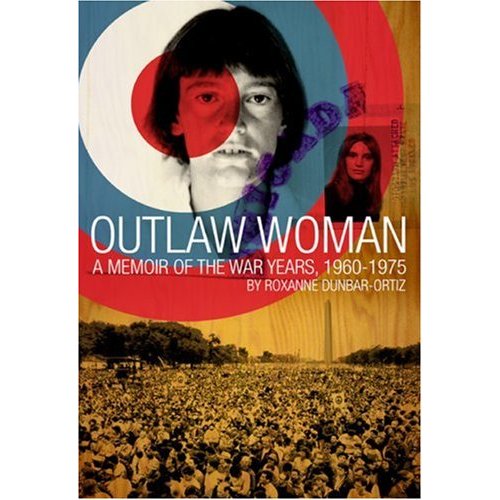
Roxanne Dunbar Ortiz: Roots of Resistance
By Andrej Grubacic
Roxanne Dunbar-Ortiz grew up in rural Oklahoma, daughter of a landless farmer and half-Indian mother. During the first two decades of the 20th century, her paternal grandfather, a veterinarian from a Scots-Irish agrarian background, had been a member of the Socialist Party in Missouri and Oklahoma and joined the Industrial Workers of the World when it was founded. Her grandfather’s stories inspired her to lifelong social justice activism.
Married at 18, she left with her husband for San Francisco where she has lived most of the years since, even after the marriage ended. Her account of life up to leaving Oklahoma is recorded in Red Dirt: Growing Up Okie. From 1967 to 1972, she was a full-time activist living in various parts of the United States, traveling to Europe, Canada, Mexico, and Cuba. She was one of the founders of the militant Women’s Liberation Movement. This time of her life and the aftermath, 1960-1975, is the story told in Outlaw Woman: Memoir of the War Years.
Dunbar-Ortiz took a position teaching in a newly established Native American Studies program at California State University at Hayward, near San Francisco, and helped develop the Department of Ethnic Studies, as well as Women’s Studies. In 1974 she became active in the American Indian Movement (AIM) and the International Indian Treaty Council, beginning a lifelong commitment to international human rights.
Her first book, The Great Sioux Nation: An Oral History of the Sioux Nation and its Struggle for Sovereignty, was published in 1977 and was presented as the fundamental document at the first international conference on Indians of the Americas, held at United Nations’ headquarters in Geneva, Switzerland. That book was followed by four others, including Roots of Resistance: A History of Land Tenure in New Mexico and Indians of the Americas: Human Rights and Self-Determination.
In 1981 she was asked to visit Sandinista Nicaragua to appraise the land tenure situation of the Miskito Indians in the northeastern region of the country. Her two trips there that year coincided with the beginning of United States government’s sponsorship of a proxy war to overthrow the Sandinistas. In over 100 trips to Nicaragua and Honduras from 1981 to 1989, she monitored the Contra Wars. In addition to her 1985 Caught in the Crossfire: The Miskito Indians of Nicaragua, her book, Blood on the Border: A Memoir of the Contra War was published in 2005.
She is presently at work on a history of the United States from the Native American perspective, which will be published by Beacon Press.
GRUBACIC: Talk about Roots of Resistance as well as your U.S. history from the Native American perspective?
DUNBAR-ORTIZ: Roots of Resistance: A History of Land Tenure in New Mexico had been my history doctoral dissertation at UCLA in 1974, then was co-published by the UCLA Chicano and Native American research centers in 1980. In 2007 it was issued in a revised edition by the University of Oklahoma Press. It may sound like a narrow topic, but it’s actually a universal story of European colonialism and the imposition of capitalism on democratic, self-managed communities, autonomous but linked to one another. I set out to apply Marxist theory to a particular region and ended up comprehending that theory at a deeper level. In particular, the appropriation of land as the first stage of capitalist development, turning independent or communal producers into beggars who had nothing to sell but their labor, transforming them into commodities. There is a vibrant struggle in New Mexico still to regain lost communal holdings and this kind of movement is going on all over the colonized world.
The book I’m working on now, an indigenous history of the United States, is one volume in the series Beacon Press is publishing over the next several years. Taking off on Howard Zinn’s concept of “people’s history,” the series will have volumes on the history of the United States from the perspectives of Native Americans, African Americans, Chicanos, Latinos, Asian Americans, workers, women, and gay/lesbian.
As my own work is related to the study of inter-racial self-governance and self-activity, I cannot resist the temptation of asking if you have encountered any instances of such practices in your research?
I had been a history graduate student studying the effects of colonization and imperialism on Latin America when I first read Franz Fanon in 1967, which changed my thinking entirely in this regard. For the first time, I saw the human potential rather than simply victimization in the wake of the wreckage from colonization and continued U.S. imperialism.
As historians, we are imbued with the idea of inevitability and progress. We are not supposed to ask “What if?” I began to see historical development differently, particularly as I became involved in indigenous social movements and experienced the resistance, solidarity, autonomy, and self-management you speak of. Many religions, if not most, acknowledge what the Calvinists (my own upbringing) call pre-destination. Secular idealists like Hegel saw the necessity of making right choices, defining freedom thusly. I see modern European colonialism—the plunder of the Americas, Africa, and much of Asia by European states (including the U.S.), the introduction of chattel slavery, the past 500 years—as a wrong direction of humanity. What I learned from indigenous resistance leaders and from the African liberation movements, particularly Amilcar Cabral, was that colonization halted the normal development of people, and part of the process of liberation was to pick up where history left off for the colonized, to construct new realities, rather than to, in Fanon’s words, “imitate Europe.”
In the processes of colonization, history did not actually stop, nor do I think Cabral meant that it did. Rather, the cultures for those who survived were cultures of resistance. Also, what I call “new peoples” were born of colonialism, mixed peoples, inter-racial communities. The descendants of the ancient Andean civilization speak of “rescuing the mestizo.” They have developed a kind of indigenous version of Bolivar’s and Jefferson’s ruling class dreams of one, borderless America—but with a difference, that being the recognition of the roots and heart of “our America,” the western hemisphere. I believe the “mestizo” or mixed peoples, what I call coyotes—which we all are—and all who are dispossessed, landless, without means or will to be rich and powerful, have a special role to play in the future. I see that role as a heavy responsibility.
What are your thoughts on the relationship between white privilege, class consciousness, and the women’s liberation movement?
I think it is difficult for anyone who has not grown up in the United States—with parents who go several generations or more back when they immigrated—to understand our preoccupation with race in the United States. White/European supremacy is the most defining element of the content of American identity, thereby obliterating to a great extent working class identity because of the British introduction and maintenance of slavery, with only Africans and their offspring being subject to enslavement and born into slavery. Nearly two centuries passed in the formation of the British North American colonies before the U.S. became an independent colonizing state. The culture and economy, not only in the southern states where the enslaved African population outnumbered the European, but also in the northern states and the new nation-state as a whole, were saturated with the institutions and social life of white supremacy.
Even members of the anti-slavery and abolitionist movements, all of whom thought slavery was immoral, did not want to mix socially or by intermarriage with Africans. Many favored deporting Africans to Africa at a time when there were no Africans living in the United States who had been born in Africa. To become an American, not in the legal sense, but for jobs, social acceptance, etc., in the 19th century, and even up to the present, meant striving to be identified as white.
Since the mid-20th century civil rights movement forced legislation for equal rights, affirmative action, and other measures, individuals of color can also “prove” their whiteness if they adhere to the “values” of Americanism, which includes acceptance of individual responsibility for their own situation, believing that the “playing field” is “level,” being spokespersons to blame their own communities for their conditions and that the U.S. government is the most perfect ever created with the right to rule the world, particularly the non-European parts. It’s within that reality that we must analyze class relations.
I recently reviewed an excellent and important new book, David Barber’s A Hard Rain Fell: SDS and Why it Failed. Barber attributes the failure of the 1960s New Left to its inability to act on its on rhetoric regarding race, gender, and empire. What’s missing throughout the book is the class composition and absence of class consciousness among New Leftists, including the Women’s Liberation Movement. Barber rightly observes that the young white women who went on to start the radical feminist movement first worked as volunteers in the civil rights movement in the South in the early 1960s and saw African-American women playing far different roles than was the case of white women within American society. But, in seeing this, these white women were seeing race as the defining factor rather than class.
As one who grew up rural and working class (part Indian, but in the white working class world) in Oklahoma, I embraced feminism in 1963 after reading de Beauvoir’s The Second Sex, which actually led me to anti-capitalist, anti-racist, anti-imperialist activism. Within a year, I was a member of the first U.S. campus-based anti-apartheid group, at UCLA. It did not take long for me to find New Left men grossly male supremacist, becoming unbearable in the summer of 1967 in London while working with the ANC and the London anti-apartheid solidarity movement. I vowed to return to the U.S. and help start a women’s liberation movement to make men change, so that a revolution would be possible with the defeat of patriarchy. I acutely felt my own potential as an effective revolutionary stifled.
I moved to the center of radical activity, the northeastern corridor (living in Cambridge, but with much travel to New York and Washington) and connected with hundreds of what I thought were like-minded women.
However, soon I felt the same stifling from the New Left women that I had felt from New Left men. I realized that the absence of class consciousness was the fatal flaw of the New Left, and anti-racism actually was a vehicle of privilege. I found many of the women’s liberation activists downright racist. I also became aware that the experience these feminist women had gained in the southern civil rights movement was based on a class privilege that I could not even imagine. But, if one raised the question of class among New Left women, one was accused of being Marxist or “thinking like a man.”
Did you have a similar feeling reading Cathy Wilkerson’s memoir, Flying Close to the Sun? What is your assessment of the whole Weather Underground?
I liked Cathy’s memoir for her honesty and acceptance of responsibility for her actions. However, other than reciting the economic ups and downs of her ancestors and immediate family, she doesn’t reflect upon her own class background and how it may have affected her political consciousness and choices. On the other hand, she’s very detailed about her white privilege. I think this is true of all factions of the New Left, not just the Weathermen [sic]. A part of their class privilege was that they did not deem it necessary or relevant to consider it. But, in acknowledging white privilege, they didn’t have anything to lose. They had the arrogance to assume that white privilege defined not only themselves, but also whites in the working class, without knowing anything about the working class of any color.
This line of thinking has grown even more central since the collapse of the New Left. Presently, anti-racist “training” is a major activity for social-justice activists who are white and mostly from the professional or upper middle class. For the past few years they have adopted the intersectionality thesis of the interlocking oppressions of race, class, and gender, but this is an even greater fallacy, since class distinctions exist among blacks and other peoples of color, and especially among women. It also treats class “oppression” as something to struggle against; that working class people should be “respected,” as if workers were a people rather than a class created by capitalist exploitation of labor. The role of the working class is to do away with class by destroying capitalism.
Regarding the Weatherpeople, I do think it was an error for them to go underground, but not the catastrophe that even some of them proclaim, as having destroyed SDS by doing so. The only real victims of their actions were themselves. The group I was a part of in New Orleans also went underground for a year in order to work clandestinely with the oil workers. That was a mistake as well.
I always felt that the new generation of American activists should find inspiration less in the Weather Underground and more in the Industrial Workers of the World. One of the most interesting episodes from U.S. radical history is that the IWW created the first inter-racial union in the U.S. history.
The IWW has been my life-long inspiration and the reason I became anti-capitalist and aspired to become a revolutionary and the reason I decided to study history. My grandfather was a Wobbly in Oklahoma. My father was born in August 1907 and was named Moyer Haywood Scarberry Pettibone Dunbar, after the Wobbly leaders who were on trial in Boise, Idaho, that summer. My grandfather died before I was born, but my father, a great traditional storyteller, told me every detail of my grandfather’s actions and really what amounted to a radical history of Oklahoma that officially remains obliterated today, along with a few others. From first grade to college, I found none of what I learned from my father by the time I was 5-years-old. Of course, I wasn’t about to distrust my father’s stories, so I sought to find confirmation in the study of history.
In 1968 two young people in Chicago from trade unionist families, typesetters, Franklin and Penelope Rosemont, printed up thousands of the IWW red books and started promoting its revival. It has survived and spread, mainly among two generations of young anarchists. The IWW puts out a good newsletter. Many trade union members are also IWW members. Earth First! in its 1980s heyday in the Northern California woods, under the leadership of the late Judi Bari, herself from the working class, were organizing loggers into the IWW. But among liberals and New Leftists and their heirs, there is little interest in studying the IWW as a model for contemporary organizing.
The IWW spanned a decade and a half of an extremely repressive period—Jim Crow segregation of Blacks and Mexicans was firmly entrenched, Native Americans had to have passes to leave their reservations and were not allowed to join trade unions, women didn’t have the vote. Yet, the IWW was able to organize and inspire inter-racial struggles. It was also the period of the prolonged Mexican Revolution and cooperation between the IWW and the Mexican revolutionary workers was constant. In Oklahoma, black, white, and Indian tenant farmers, inspired by the Wobblies, rose up together in 1917 to oppose the draft for World War I and oppose the war as a “rich man’s war.” It was called the “Green Corn Rebellion.” And, of course, women were prominent in the IWW founding and leadership: Elizabeth Gurley Flynn, Emma Goldman, Mother Jones, Lucy Parsons, and many local leaders.
I feel similarly about trying to restart SDS as I do about the IWW. I think we can take lessons from the earlier organizations, but not duplicate them. The times are so different. I was invited to speak by the new SDS at their summer training last year. It was held in Lancaster, Pennsylvania, a mostly Mennonite and Amish population. The SDSers who hosted it were from Mennonite families, pacifists in their religion. They are high school students from five different schools in the area. I was impressed with their organizational skills and dedication. There were around 50 participants from many different universities and schools, mostly from the East. I was encouraged that they were reinventing SDS to suit their own needs and aspirations. They were earnest in listening to me talk about the 1960s movements, taking notes, asking good questions. I talked a lot about class and the next day the working class young people among the participants formed a caucus to discuss class.
But the new SDS is different from the original. In the early 1960s, SDS began top down and organized chapters around the country off the momentum of the civil rights movement and soon grew with the escalation of the Vietnam War. The new SDS has no such wave to catch and ride, no group of skilled organizers to create a national network of chapters on hundreds of campuses. Yet, when a few activists started the new SDS, the word spread over the Internet and activist high school and college students started calling themselves SDS. Those who were attempting to organize from the top, a number of old SDS veterans and a few young organizers they had fostered, were baffled by the anarchic development.
As for what might spark a massive student movement like the one we saw in the 1960s in the U.S., and that exists in most countries continually, I doubt we’ll see that here again. That doesn’t mean that campuses lack radical activity. Every campus has radical activists working on single or multiple issues—sweatshop labor, the environment, women and gay/lesbian rights, the war. I do think there is a big deficit in understanding how to organize. In the 1950s, civil rights organizers experimented and hammered out organizing methods that student activists of the early 1960s inherited and reproduced. When the movement was weakened by repression, infiltration, use of drugs, media attention, and many other factors, liberal philanthropists filled the gap and “professionalized” organizing, creating non-profits and careers. They have not been interested in campus organizing. The new way is “training,” which is rather mechanical and too often staged for funders in order to get more funding. So I think the main thing the new SDS could do is study the organizing methods of the civil rights movement, the old SDS, and back to the IWW.
You are involved in organizing a conference on the “long 1968.” Can you talk about your personal experiences in those years? How did the movement in the United States go from insurgency to the politics of philanthropy?
I date the “long 1968” from 1960 to 1975, from the election of Kennedy to the end of the Vietnam War and Nixon’s resignation. Of course, the Vietnam intervention, the southern civil rights movement, and African liberation movements had been building for at least a decade before 1960 and are important to understanding the revolutionary surge of 1968. But I don’t think there’s any doubt that the 1968 surge had played out by 1975. I went back and completed my dissertation in 1974, which I had abandoned in 1968 to be a full-time revolutionary. I began university teaching that year and had the mission of developing Native American Studies and an Ethnic Studies Department. That was happening on many campuses, as well as the development of Women’s Studies. There was activity that was important, but it was mostly inward reform and not as much outward protest.
In the early 1970s, universities purged both radical untenured faculty and radical student leaders, particularly under Governor Ronald Reagan in California (1966-1974). Others began behaving accordingly. Movements also went inward, trying to figure out how to restart the mass movement, taking stock, also doing some good organizing. The group I was with, Line of March, and other groups in the San Francisco area got radicals into key local positions, which has had a permanent effect on local politics. The Black Power movement was ravaged by violence, some of it internal, but most from the state, yet it continued to be influential locally.
On the surface, it seemed there were many victories. In California Jerry Brown was elected governor in 1974 and was re-elected in 1978. He appointed SDS founder Tom Hayden and other New Leftists to state government positions. He also appointed four liberal judges to the California Supreme Court, making the chief justice a woman, Rose Bird, who had also worked with the migrant farm workers, as had one of the other new justices. In San Francisco a leftist, George Moscone, was elected mayor, and Harvey Milk became the first openly gay activist, also leftist, to be elected to the Board of Supervisors. (Both Moscone and Milk were assassinated by a right winger in 1978.) In Oakland, the grassroots infrastructure built by the Black Panther Party brought radical African Americans into local office and helped to elect Ron Dellums, an African American and self-identified socialist, to U.S. Congress.
By 1972, I was burned out and abusing alcohol after my stint underground. I was rescued by the American Indian Movement when they led the seizure of Wounded Knee in the Lakota Nation in early 1973. For the next several years I worked at organizing with the International Indian Treaty Council to take Native American demands to the international level. It was also the reason I returned to complete my doctorate, to have more credibility in that work. This also meant a lot of grassroots work on rural reservations. I was so busy I hardly noticed that there was no longer a mass movement and that the philanthropists were calling the shots.
Speaking of “humanitarian” politics, what do you think about the recent middle class enthusiasm for various independence movements? Jean Bricmont’s book, Humanitarian Imperialism, captures this phenomenon.
Well, it was in the atmosphere I described that “humanitarian” intervention took hold. Because I was doing a lot of work at the United Nations for the recognition of indigenous peoples’ rights from 1977 onwards, I saw the development of this insidious mode of imperialism. It has to be seen in the context of the destruction by the U.S. and the Western powers of the hard-won institutions of the New International Economic Order (NIEO), a 1974 proposal won by the former colonies, which had become the majority of UN membership. It called for speedy economic development in what was called the “third world,” through transfer of technology and economic assistance with no strings attached. Soon after, the roadmap for the program was drawn up in the Brandt Report, North-South: A Program for Survival. The 1980 UN conference on development that was to approve the program was shattered by the Carter administration’s refusal to participate or accept the principles of the NIEO. The U.S. demanded that people of the “third world” choose which side they were on. If they were not enthusiastically in favor of Western policies, they were categorized as pro-Communist. This is when they invented the idea of two “superpowers,” with equal power and responsibility in the world, a fallacy of the first order.
I think we can date the official beginning of the use of humanitarianism to attain imperialist goals to the Helsinki Declaration of August 1975. This came out of the Conference on Security and Cooperation in Europe and was signed by the European states, Canada, the United States, and the Soviet Union. The requirements under the agreement were virtually the same as the Covenant on Civil and Political Rights, one of the International Human Rights Covenants that were passed by the UN General Assembly in 1966. The other Human Rights Covenant pertained to economic, social, and cultural rights, which the “third world” countries and the Socialist bloc states had insisted on and which the United States refused to ratify. That treaty characterized human rights as the right to food, guaranteed income, housing, health care, and free education. Both the Helsinki accord and the UN Convent on Civil and Political Rights were used by Carter and every succeeding U.S. administration to intervene in third world countries. The first military uses of humanitarian intervention came with training counter-insurgents to overthrow the leftist governments in Afghanistan and Nicaragua and all of Central America, and the direct military intervention in Grenada and Panama, then to the much larger scale Gulf War, then the Balkans.
As I watched human rights instruments and initiatives, so important to people living under oppressive governments—particularly U.S.-supported ones in Latin America, as well as indigenous peoples in North America—being diverted to supporting “dissidents” in the Soviet Union and other socialist states, I saw increasing numbers of human rights activists and NGOs follow the money so generously distributed by the U.S. State Department. By the 1990s interventions in Yugoslavia, humanitarian intervention was broadly accepted even on the left in the United States, and still is.
The incredible wave of indigenous resistance and social and political creation in Latin America gives much hope for a new, global movement, built from below.
Going back to pre-destination and right paths, I actually am quite optimistic. I think there is a more profound revolution taking place in the world now than we could even imagine in the 1960s. Because of capitalism/imperialism, as well as seductions with consumerism and greed, the oppressed and exploited people of the world have invented new means of resistance, with the secret being the community. Indigenous people have much to teach about that and it’s no surprise that the model emerging out of the Andes with Bolivia and Mesoamerica with the Zapatistas has been embraced everywhere. Rather than devolution from the center, we have autonomous formations from the grassroots. The indigenous and peasants and farmers worldwide are reclaiming land and water as the lifeline of survival.
[Andrej Grubacic is one of the founders and editors of Zbalkans, a Balkan edition of Z Magazine.]
Source. / ZMag / July 1, 2008
The Rag Blog
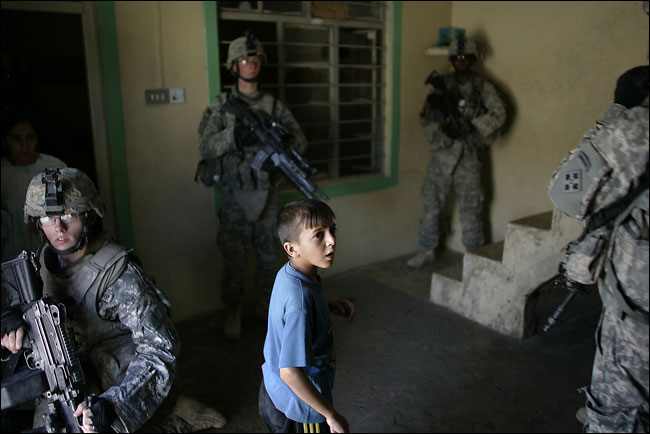
SAN FRANCISCO — U.S. journalist Zoriah Miller says he was censored by the U.S. military in the Iraqi city of Fallujah after photographing Marines who died in a suicide bombing.
On Jun. 26, a suicide bomber attacked a city council meeting in Fallujah, 69 kms west of Baghdad, between local tribal sheikhs and military officials.
Three Marines, Cpl. Marcus Preudhomme, Capt. Philip Dykeman, and Lt. Col. Max Galeai, were assigned to 2d Battalion, 3d Marines, 3rd Marine Division, Marine Corps Base Hawaii, Kaneohe Bay, Hawaii.
The explosion also killed two interpreters and 20 Iraqis, including the mayor of the nearby town of Karmah, two prominent sheikhs and their sons, and another sheikh and his brother. All were members of the local “awakening council,” one of the U.S.-backed militias that have taken up arms against al Qaeda in Iraq, according to U.S. and Iraqi authorities.
Miller was embedded with Marines on a patrol one block from the attack when it occurred. He had originally turned down the option of going to report on the city council meeting that was bombed.
Miller ran with the Marines he was with to the scene of the attack. “As I ran I saw human pieces…a skull cap with hair, bone shards,” he told IPS during a telephone interview from the so-called Green Zone in Baghdad. “When we arrived at the building it was chaotic. There were Iraqis, police and civilians running around screaming. Bodies were being pulled out of the building.”
“I went in and there were over 20 people’s remains all over the place,” Miller continued, “Of the Marines I jogged in with, someone started to vomit. Others were standing around, not knowing what to do. It was completely surreal.”
“At that moment I realised this was far beyond anything I’d experienced, and I realised I wanted to focus and make sure I could capture what it felt like, and the visual horror,” Miller explained.
“I thought, ‘Nobody in the U.S. has any idea what it means when they hear that 20 people died in a suicide bombing.’ I want people to be able to associate those numbers with the scene and the actual loss of human life. And to show why soldiers are suffering from PTSD [post-traumatic stress disorder],” Miller told IPS.
Miller was taken out of the building by Marines, but then allowed back inside where he took one last photo of the carnage before they closed the scene to him.
“We spent most of the rest of the day as Marines picked up body parts and put them in buckets and bags,” he said.
In an Iraqi Police station in Karmah, the Naval Criminal Investigative Service (NCIS) was brought in to investigate the bombing. Millers’ photos were the only ones of the scene, so the NCIS team asked for them.
“I made them copies, but then one of the Marines came in and told me to delete my memory card after I give them the photos, and I refused,” Miller told IPS, “I told the NCIS that if they forced me to delete them, I would stop sharing them. So they stopped pressing that issue.”
Miller said that he was following the rules for embedded journalists. “That evening, during the debriefing, the guys [Marines] I was with told me that the higher-ups had said I was a stand-up guy and behaved well and to treat me well. The guys I was with were all very much on my side.”
Miller explained to IPS that he meticulously showed his photos to the Marines he was with to make sure he was not going to show any photos that would upset the family members of the deceased Marines. “They were all okay with them, so then about 96 hours after the bombing I published the photos on my blog.” [The original blog post is here. It is graphic. As Miller himself says, the pictures “show the actual loss of human life.” rdj]
Then things got interesting.
“Tuesday [Jul. 1] I awoke to a call in their combat operations centre, and the person on the phone told me they were a PAO (Public Affairs Officer) at Camp Fallujah, and he wanted me to take my blog down right away,” Miller told IPS. “I asked them why, and was told then called back after five minutes by a higher ranking PAO who claimed I had broken my contract by showing photos of dead Americans with U.S. uniforms and boots.”
Miller said the PAO claimed he was not allowed, by the embed contract, to show dead or wounded U.S. citizens or soldiers in the field. “I never signed any contract for that,” Miller said.
He was called back after another five minutes and told his embed was terminated and they would send him back to Baghdad on the next flight. He was then taken back to Camp Fallujah where he said, “Everyone was extremely angry and fired up at me.”
Nevertheless, the lower ranking Marines he had embedded with “were on my side, and they told me they thought that what was happening was wrong.”
Miller explained that he grew nervous when the flight was cancelled due to a sandstorm, and then a security guard was assigned to him.
“I started to feel uncomfortable with this,” Miller explained. “The next day, Gen. Kelly, [Major General John Kelly, who is the Commanding General of the I Marine Expeditionary Force] wanted to have some words with me. I was to meet with him at 3 pm, and we sat outside in the sun for two hours and he never showed.”
Miller was told he would be flown out that night, but he was deleted from the flight and told that General Kelly wanted to see him, so he waited again until Thursday, Jul. 3. Again the general did not appear, so Miller was given an official letter about the grounds for the termination of his embed, signed by Gen. Kelly, and flown to Baghdad.
“Now, as I think about it, I think they needed the extra time to figure out what they were going to say about my dismissal,” Miller said. “Their original reason ended up being bogus, so they had to figure something else out.”
The letter he was given stated reasons for his dismissal as “you photographed the remains of U.S. soldiers”, “you posted these images along with detailed commentary”, and “by posting the images and your commentary you violated 14 H and O of the news media agreement you signed”.
In addition, the letter, which Miller read to IPS, stated, “By providing detailed information of the effectiveness of the attack and the response of U.S. forces to it, you have put all U.S. forces in Iraq at greater risk for harm.”
Miller feels the reason for his dismissal is otherwise.
“The bottom line is that the thing they cited as the reason for my dismissal was ‘information the enemy could use against you’. They realised, probably from keeping track of my blog, that I was not showing identifiable features of a soldier…and they couldn’t find a reason to kick me out. Because it was a high ranking person who got killed, they were all fired up.”
Miller concluded, “Up to that point they said it was because I showed pictures of bodies with pieces of uniform and boots. The letter, though, doesn’t mention that at all. I checked the document I had about ground rules for media embeds, and I followed them.”
The Pentagon would not comment on the story when contacted by IPS, saying they had no information on Miller’s case beyond what Central Command had already posted.
Source. / IPS
The Rag Blog

Barack at Risk
By Tom Hayden / July 4, 2008
Call him slippery or nuanced, Barack Obama’s core position on Iraq has always been more ambiguous than audacious. Now it is catching up with him as his latest remarks are questioned by the Republicans, the mainstream media, and the antiwar movement. He could put his candidacy at risk if his audacity continues to shrivel.
I first endorsed Obama because of the nature of the movement supporting him, not his particular stands on issues. The excitement among African-Americans and young people, the audacity of their hope, still holds the promise of a new era of social activism. The force of their rising expectations, i believe, could pressure a President Obama in a progressive direction and also energize a new wave of social movements.
And of course, there is the need to end the Republican reign that began with a stolen election followed by eight years of war and torture, corporate gouging, environmental decay, domestic spying and right-wing court appointments, just in case we forget who Obama is running against.
Besides the transforming nature of an African-American presidency, the issue that matters most to me is achieving a peaceful settlement of the wars in Iraq and Afghanistan – and preventing American escalations in Iran and Latin America. From the beginning, Obama’s symbolic 2002 position on Iraq has been very promising, reinforced again and again by his campaign pledge to “end the war” in 2009.
But that pledge also has been laced with loopholes all along, caveats that the mainstream media and his opponents [excepting Bill Richardson] have ignored or avoided until now. As I pointed out in Ending the War in Iraq [2007], Obama’s 2002 speech opposed the coming war with Iraq as “dumb,” while avoiding what position he would take once the war was underway. Then he wrote of almost changing his position from anti- to pro-war after a trip to Iraq. He never took as forthright a position as Senator Russ Feingold, among others. Then he adopted the safe, nonpartisan formula of the Baker-Hamilton Study Group, which advocated the withdrawal of combat troops while leaving thousands of American counter-terrorism units, advisers and trainers behind.
That would mean at least 50,000 Americans, including back up forces, engaged in counter-insurgency after the withdrawal of combat troops, a contradiction the media and Hillary Clinton failed to explore in the primary debates. To his credit, Obama said that these American units would not become caught up in a lengthy sectarian civil war, leaving the question of their role unanswered.
The most shocking aspect of Samantha Powers’ forced resignation earlier this year was not that she called Hillary Clinton a “monster” off-camera, but that she flatly stated that Obama would review his whole position on Iraq once becoming president. Again, no one in the media or rival campaigns questioned whether this assertion by Powers was true. Since Obama credited Powers with helping for months in writing his book, The Audacity of Hope, her comments on his inner thinking should have been pounced upon by the pundits.
Finally, it has taken the pressure of the general election to raise questions about whether his parsed and lawyerly language is empty of credible meaning. Consider carefully his July 4 statements:
The first one, promising a “thorough reassessment” of his Iraq position later this summer:
“I’ve always said that the pace of our withdrawal would be dictated by the safety and security of our troops and the need to maintain stability” – two conditions that could justify leaving American troops in combat indefinitely. “And when I go to Iraq and have a chance to talk to some of the commanders on the ground, I’m sure I’ll have more information and will continue to refine my policies” – another loophole which could allow the war to drag on.
Then there came the later “clarification”:
“Let me be as clear as I can be” [not, “let me be absolutely clear”].
“I intend to end this war.” [intention only].
“My first day in office I will bring the Joint Chiefs of Staff in, and I will give them a new mission, and that is to end this war – responsibly, deliberately, but decisively.” [ Sounds positive, but “decisively” can mean by military threat in the worst case. And it’s pure theatre, borrowed from Clinton, since the plans most likely will be drafted and finalized immediately after the November election.]
“And I have seen no information that contradicts the notion that we can bring our troops out safely at a pace of one or two brigades a month…” [but what if the military commanders on the ground assert that it is too dangerous to pull out those troops?]
Obama’s position, which always left a trail of unasked questions, now plants a seed of doubt, justifiably, among the peace bloc of American voters who harbor a legacy of betrayals beginning with Lyndon Johnson’s 1064 pledge of “no wider war” through Richard Nixon’s “secret plan for peace” to Ronald Reagan’s Iran-Contra scandal and the deep complicity of Democrats in the evolution of the Iraq War.
It is difficult to understand Obama’s motivation. Perhaps it is his lifetime success at straddling positions and disarming potential opponents. Perhaps it is a lawyer’s training. Perhaps being surrounded by national security advisers who oppose what they call “precipitous withdrawal”, and pragmatic Democrats distinctly uncomfortable with their antiwar roots.
What is clear is that Obama is responsive to pressures from the grass-roots base of a party that is overwhelmingly in favor of a shorter timetable for withdrawal than his, and favoring diplomatic rather than military solutions in Afghanistan and Pakistan. At a time that public interest in the war is receeding before economic concerns, it is time for the strongest possible reassertion of voter demands for peace.
The challenge for the peace and justice movement is to avoid falling into Republican divide-and-conquer traps while maintaining a powerful and independent presence in key electoral states, including Congressional battlegrounds, between now and November. There should be at the least:
– A demand that Obama talk to legitimate representatives of the peace movement, not simply hawkish national security advisers.
– A Democratic platform debate and plank that is unequivocal in pledging to end the war and avoid military escalation elsewhere.
– An energized antiwar voter education campaign that builds towards a clear November peace mandate to end the military occupation and shifr to political and diplomatic approraches.
– An organizational strategy to widen the base of the antiwar movement through the presidential campaign in preparation for a massive peace mobilization in early 2009.
Grass-roots people power is the only force that can keep alive the astute sense of pragmatism that led Obama to criticize the coming war in 2002. The stakes are higher now, and the enemies far more shrewd, wishing to rip asunder the Obama coalition. The peace movement assumption should be that there is no one in Obama’s inner circle of advisers to be counted on, no mainstream columnist to catch his eye with a persuasive column favoring withdrawal. They never have. Only the voice of the peace voters – and the countless activists who have volunteered on his behalf – can command his attention now.
Source. / Progressives for Obama
Thanks to Carl Davidson / The Rag Blog

Defending the patriotism of America’s internal critics is a time honored ritual, necessary because the warmongers invariably call it into question. Barack Obama is embroiled in this exercise now. The assumption shared by all parties in this debate is that being unpatriotic is a most odious characteristic. But patriotism is typically just a euphemism for nationalism. It is exemplified by the unqualified stance that right or wrong, one supports one’s country’s actions in the international arena. Nationalism was once progressive in relation to colonialism, but the era in which it is a force for good ended long ago.
Support of your country’s actions irrespective of the consequences for others is immoral. Germans are particularly well schooled on this point. Hitler was rabidly patriotic, and in reaction to the horrors he instigated under that banner, Germans are now the world’s most avid internationalists, and along with France, the nucleus of the European Union, the world’s most successful example of the transcendence of nationalism
Nationalism may be justifiably seen as the root cause for the loss of 100 million lives in wars of the 20th century. It was the central issue in both WWI and WWII. As the result of the excesses of nationalism, in 1945 Europe lay in ruins with over 50 million people having died unnecessarily in the preceding 5 ½ years.
Using patriotism to mask aggression is now virtually monopolized by the USA. During the past 40 years, instances of countries other than the US invading another country are rare. Saddam Hussein’s Iraq did invade Kuwait after the US ambassador told him the US would have no problem with such a move. The US client state, Israel, has occupied the territory of all of its Arab neighbors, although in some cases they were attacked first. Turkey, another close US ally, has occupied part of Cyprus and attacked Kurdish rebels in the border area with Iraq. During the same period, the USA has attacked Iraq twice, Panama, Nicaragua, Grenada, Vietnam, Cambodia, Laos, Sudan, Afghanistan, Somalia, Serbia and Libya. Now the US is threatening Iran and bombing along the Pakistan border.
This list does not include lethal CIA operations in many other countries. During this same period, Europe, the cradle of nationalism, has transcended it by establishing the European Union. As a result, there have been decades of peace between European nations, a historically unprecedented feat. A war in Europe is now almost unthinkable.
Patriotism is very often no more philosophical than the unity among Crips and Bloods or Longhorns and Aggies. Such tribal allegiance is based more on the male competitive instincts, testosterone run amuck, than on principle. Although it might be praiseworthy to go to war in support of values such as freedom, justice and democracy, in war these are typically just propaganda themes brandished by warmongers as rationalizations for aggression.
Hopefully, in the 21st century human society will evolve to the point where allegiance to universal human rights transcends allegiance to country and where international institutions will be the sole legitimate agencies to enforce international law. Such laws would include prohibitions against unilateral military actions by one country against another under any circumstances. Use of military force would only be legitimate if authorized and controlled by a United Nations reformed to remove the victors of WW II from their undemocratic dominance within it.
The Rag Blog
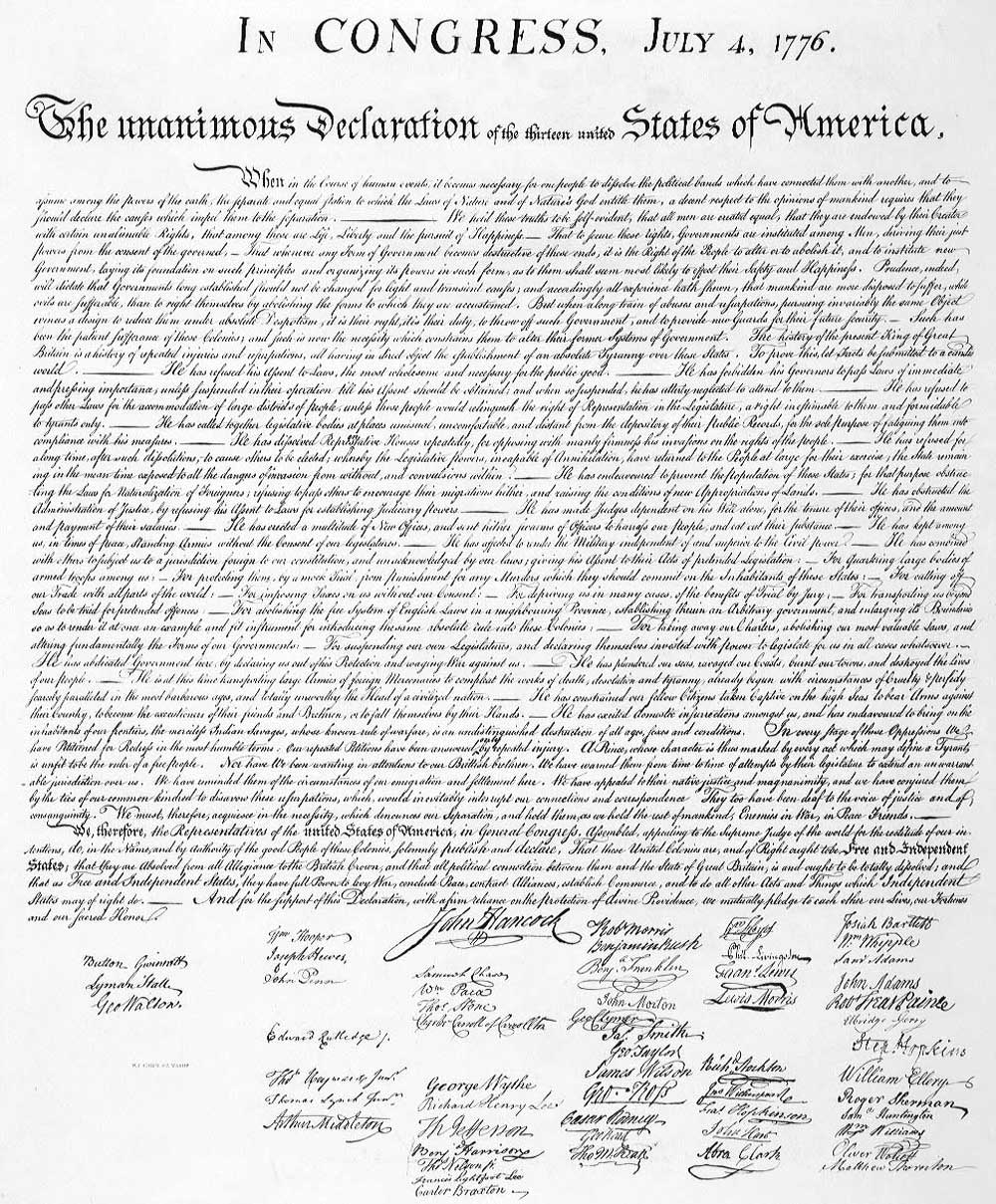
A Declaration Of Independence From The Government Of The USA
By Anonymous
Through my signature below I hereby withdraw my consent to be ruled by the organization that has called itself the Government of the United States of America.
A government is empowered through the consent of the governed to serve a sacred purpose, namely, to create a bright and sustainable future for its people and a biodiverse garden of its region. This purpose is possible.
If a government no longer serves its intended purpose then it is proper that each individual formally withdraw his or her consent to be ruled by that government.
Through a consistent stream of actions the United States Government has proved itself to be corrupt, having turned away from serving its original purpose. The United States Government has therefore failed, and is de facto illegitimate. Consequently, all of its authorities over me are hereby removed and the United States Government is hereby disbanded in its entirety. All branches, the legislative, executive and judicial branches, including all offices and resources, political, military, informational and financial, are hereby disenfranchised and replaced by local, self-organizing, bioregional governments and currencies that promote sustainable infrastructures and demonstrably serve the principles of integrity, transparency, interdependence, consciousness and the sustainable well being of their entire ecology.
Human beings carry an inalienable responsibility for choosing to whom or what they pledge their allegiance. From this moment forward I no longer pledge my allegiance to the organization that has called itself the Government of the United States of America. We are dissociated. I disallow that organization to legislate, adjudicate, use money, or make agreements in my name, either nationally or internationally. I hereby withdraw my franchise from the United States Government and I no longer submit myself to its authority. I hereby abandon my United States Passport as worthless, null and void because through its own actions the United States Government has invalidated itself.
This document recognizes that the United States Government has
Irredeemably abolished itself by no longer fulfilling its true purpose. This document announces that I take my authority back from that failed organization. The United States Government no longer has authority to represent me, tax me, detain me, question me, or in any way rule over me. It can no longer take any actions in my name. From this moment forward I take back my autonomy. I hereby declare my independence from the organization that has called itself the Government of the United States of America.
Although I alone, without reason or circumstance, am responsible for my decision to withdraw my franchise and allegiance from the organization that has called itself the Government of the United States of America, I am willing to name examples of how this organization has betrayed the purpose for which it was originally created:
1. The Government of the United States of America (herein referred to as the Government) has consistently legislated in favor of a carbon-based economy that multiplies corporate profits while disregarding the increases in greenhouse gas concentrations to the point where the future of all of humanity is now seriously threatened by the consequences of global warming.
2. The Government has promoted the use of nuclear powered electric generation plants creating millions of tons of lethal nuclear waste products that can never be safely stored, and creating decommissioned power plants that remain radioactive for eternity.
3. The Government has abused its leadership position in the world by promoting fear-based military force as the international culture of America, rather than a culture of innovation, compassion, respect, and mutual support of humanity.
4. The Government over and over again, and still now is using illegal DU (Depleted Uranium) weapons and devices in direct opposition to signed United Nations agreements, degrading the United States of America to a renegade country, likely to have its leadership regime brought to war crimes trials and capitally punished.
5. The Government has promoted an unsustainable consumerism culture that multiplies corporate profits while devouring the future’s natural resources and producing mountains, rivers and seas of toxic unrecyclable wastes. The consumer economy never did have a future and still the government promoted it wholeheartedly.
6. The Government has promoted covert military actions and subterfuge that includes traffic in illegal drugs, illegal weapons trade, assassinations, illegal takeovers of corporations and governments, and ruthless competition rather than intelligent cooperation or creative collaboration.
7. The Government has allowed itself to be infiltrated and corrupted by corporate and elite regimes that now direct the branches of Government to serve purposes contrary to the true and proper purpose of government.
8. The Government has turned over control of the currency of the United States of America (the original world currency) to private individuals who manipulate it for their own personal benefit rather than for the benefit of the world.
9. The Government has promoted a system of education that keeps people stupid rather than developing their innate potential and well being so they can create satisfying lives, fulfilling relationships and loving families in the 21st Century. The Government has allowed corporations and organized religions to control school curriculums, and has permitted drugs, gangs and guns to define the school experience for many children.
10. The Government has promoted economy over humanity in a value system that shamelessly sponsors injustice, inequity, and slavery, not only in America but around the world, regarding people in developing nations not as brothers and sisters but as sweatshop slaves for producing cheap clothes and the latest technological devices.
11. The Government has designed cities and towns around automobiles and roads rather than around people, cutting people off from their own community and trapping people in suburbs that are not sustainable.
12. The Government has consistently sponsored an imbalanced budget and has accrued a national debt over one trillion dollars that future generations must somehow pay back, meanwhile losing track of an additional trillion dollars.
13. The Government has greedily destroyed the future of civilization by developing an infrastructure, energy, food, housing and transportation systems relying entirely on consuming vast quantities of hydrocarbons that exist in limited supply, thus building a dangerous house of cards that will now tumble down as oil, gas and coal supplies dwindle. If half of the war budget would have been redirected towards developing renewable power for the last twenty years, the entire country would be oil free by now.
14. The Government has promoted a diet of fat-saturated fast-foods, and hormone and antibiotic saturated beef, pigs, poultry, and dairy products that endanger the health and general well being of its people, ground water and farmlands. The Government has also promoted fishing grounds to be exhausted to near extinction, and promotes deforestation and dependence on pesticides and fertilizers that undermine foreign economies but makes huge profits for corporations.
15. The Government has promoted the so-called patenting and engineering of the genetic designs of life forms to be used for the profit of corporations while endangering the future of the humanity.
16. The Government has promoted the introduction of genetically modified organisms into the general food chain for the profit of corporations while endangering the future of humanity.
17. The Government has used military force, assassination, and political manipulation to overthrow other governments as a desperate attempt to control remaining oil supplies for the purpose of maintaining the illusionary value of a world petro-dollar to assure profit for the corporations rather than assuring a bright future for the people.
18. The Government has promoted a medical establishment that profits pharmaceutical corporations and has blocked the development of less profitable but more humanistic, holistic and intuitive healing modalities.
19. The Government has persistently implemented legislation and presidential orders to override constitutional rights, and has built and staffed over 600 new prison camps across the country prepared to imprison citizens who might be regarded as the enemy of Government.
These and other actions reveal that the United States Government has irredeemably abolished itself by no longer fulfilling its original and true purpose.
This article is from an anonymous woman now living in South Africa. It was sent to me by a third party, and I have no reason to believe that it’s bogus. In any case, I believe its relevance to the present moment is stunning. — Carolyn Baker
Source / Carolyn Baker / Speaking Truth to Power / Posted July 2, 2008
The Rag Blog
We are here to help each other get though this thing, whatever it is.
Mark Vonnegut
Thanks to Duncan Echelson / The Rag Blog
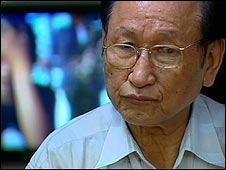
Tran Trong Duyet – a sprightly retiree and amateur ballroom dancer – must rank as one of John McCain’s more unlikely supporters.
Four decades ago, during the Vietnam war, Mr Duyet was in charge of the notorious Hoa Lo prison – the place where Mr McCain says he was brutally beaten and tortured during five-and-a-half years as an American prisoner of war.
“McCain is my friend,” said 75-year-old Mr Duyet as he feeds the caged birds he now keeps in his garden in this coastal city.
“If I was American, I would vote for him.”
Informal chats
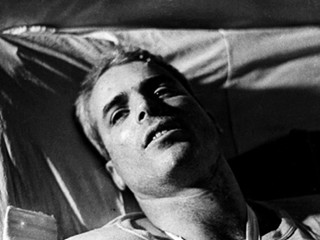
Navy pilot John McCain was shot down during a bombing raid over the North Vietnamese capital, Hanoi, in 1967.
He ejected from his aircraft and parachuted into a city lake – only to be dragged out by an angry crowd, barely conscious, and with two broken arms and a broken leg.
From there he was taken to Hoa Lo prison, known to its American military inmates as the “Hanoi Hilton”.
McCain has since described enduring months of solitary confinement and systematic torture which drove him to try to kill himself.
“But I can confirm to you that we never tortured him. We never tortured any prisoners.”
Mr Duyet reminisces instead about how he often summoned the future US presidential candidate to his private office for informal chats.
“We used to argue about the war – about whether it was right or wrong,” he says.
“He is a very frank man – very conservative, and very loyal to his country and the American ideal.
“He had a very interesting accent and sometimes he taught me words in English and corrected my accent. I have followed his career since he left prison.”
Rapprochement
So is Mr Duyet implying that that Senator McCain lied about his treatment at the Hanoi Hilton?
“He did not tell the truth,” he says.
“But I can somehow sympathise with him. He lies to American voters in order to get their support for his presidential election.”
But Mr Duyet’s propaganda-perfect version of events is impossible to verify – and should be treated with caution in a country where the Communist authorities still keep a tight control over the media.
Relations between Vietnam and the United States have improved dramatically in recent years, following the normalisation of ties between the former enemies in 1995.
Mr McCain played a crucial role in bringing about that initial rapprochement – a fact which helps explain Mr Duyet’s enthusiastic support for the McCain presidential campaign.
“I wish him success in the presidential election,” he says.
“Of course the Americans started the war in Vietnam and killed so many people – but now we want to leave the past behind.
“So now I consider John McCain my friend because he did much to mend relations between our two countries. And if he becomes president he will do more to improve those ties.”
Source / BBC News / June 23, 2008
The Rag Blog
“If you can’t stand behind our troops, do us all a favor and stand in front of them.”
–Text on t-shirt given away by Florida Sheriff. (See video.)
It is absolutely NO stretch whatsoever to say that this so-called public servant is advocating that misguided citizens kill peace activists.
Doug Zachary / The Rag Blog / July 4, 2008
Florida sheriff gives out shirts with violent message
ST. JOHNS COUNTY, Fla. — A T-shirt controversy in St. Johns County has prompted critics to question the actions of Sheriff David Shoar.
The controversy began when the sheriff donated several T-shirts at a gathering of military veterans. However, the slogan on the shirts upset some anti-war protesters.
Mary Lawrence won a shirt at the event, but she said she was upset by its message.
Lawrence said she never wins anything, so she was very happy when she won a gift bag at a veteran’s event.
“Later on, I won one of the raffle bags and took it home. That night, when I opened it, I discovered the shirt and my head just exploded. I couldn’t believe the sheriff was passing out this shirt,” Lawrence said.
On the front of T-shirt there is an image of a marksman aiming a rifle. The back of the shirt states, “If you can’t stand behind our troops, do us all a favor and stand in front of them.”
The sheriff said the intention of the shirts was not to upset people but to help veterans.
For Lawrence, the message was disturbing because she said she’s an anti-war protester. She told Channel 4 that she believes the message gives people permission to attack her and her friends.
Lawrence said she could not believe the sheriff had donated the shirts.
“To have that other concern of somebody maybe being trigger happy and being spurred by the message on that T-shirt is a real concern,” Lawrence said.
A spokesman for the sheriff’s office said the sheriff purchased the shirts with his own money to support local veterans. He thought a veterans meeting was one way to pass out the shirts.
“The sheriff bought the shirts. He didn’t design the shirts. He hasn’t done anything to promote the shirts. He’s just handed a few out after he purchased them to help them raise money and support a local family,” said St. Johns County Sheriff’s Office spokesman Sgt. Chuck Mulligan.
The sheriff’s office said the sheriff is not supporting or promoting violence. They said he’s just supporting the troops.
Several members of St. Augustine’s People for Peace and Justice have written the sheriff to voice their concerns.
“He is advocating whatever the real message is. That could be interpreted a lot of ways — not all good. But, he is advocating this as the sheriff,” said Terry Buckenmeyer.
The sheriff said he has talked to several people on the phone and returned some e-mails about the shirts. He said he plans to meet with the people next week to discuss their concerns.
Source. / news4jax.com
The Rag Blog

You’ve got to admire these essentially brainless politicians for being so remarkably and densely persistent. Oil production is consistently decreasing year over year, but they know how to resolve the issue: lower the speed limit, again !!!
I’ve withdrawn my support for any of these morons a long time ago. When one of them begins to talk seriously and meaningfully about sustainability, perhaps I will listen. In the meanwhile, good luck in the ensuing chaos.
Richard Jehn / The Rag Blog
Should There Be a National Speed Limit?
By H. Josef Hebert / July 3, 2008
WASHINGTON – An influential Republican senator suggested Thursday that Congress might want to consider reimposing a national speed limit to save gasoline and possibly ease fuel prices.
Sen. John Warner, R-Va., asked Energy Secretary Samuel Bodman to look into what speed limit would provide optimum gasoline efficiency given current technology. He said he wants to know if the administration might support efforts in Congress to require a lower speed limit.
Congress in 1974 set a national 55 mph speed limit because of energy shortages caused by the Arab oil embargo. The speed limit was repealed in 1995 when crude oil dipped to $17 a barrel and gasoline cost $1.10 a gallon.
As motorists headed on trips for this Fourth of July weekend, gasoline averaged $4.10 a gallon nationwide with oil hovering around $145 a barrel.
Warner cited studies that showed the 55 mph speed limit saved 167,000 barrels of oil a day, or 2 percent of the country’s highway fuel consumption, while avoiding up to 4,000 traffic deaths a year.
“Given the significant increase in the number of vehicles on America’s highway system from 1974 to 2008, one could assume that the amount of fuel that could be conserved today is far greater,” Warner wrote Bodman.
Warner asked the department to determine at what speeds vehicles would be most fuel efficient, how much fuel savings would be achieved, and whether it would be reasonable to assume there would be a reduction in prices at the pump if the speed limit were lowered.
Energy Department spokeswoman Angela Hill said the department will review Warner’s letter but added, “If Congress is serious about addressing gasoline prices, they must take action on expanding domestic oil and natural gas production.”
The department’s Web site says that fuel efficiency decreases rapidly when traveling faster than 60 mph. Every additional 5 mph over that threshold is estimated to cost motorists “essentially an additional 30 cents per gallon in fuel costs,” Warner said in his letter, citing the DOE data.
Source. / America On Line
The Rag Blog
Thorne Webb Dreyer, Editor