The Rag Blog / Posted July 7, 2008
Before the election, the Bush regime will very likely attack Iran.
Despite the official justifications, the primary motivation will be to derail an impending Obama victory. The attack creates a trap for Obama. If he opposes it, he will be painted as a pacifist wimp unfit to be commander-in-chief. If he goes along, he loses much of his antiwar base. Obama must get out front with vocal opposition so as to preemptively forestall this attack. One way to do that would be to threaten Bush with impeachment if he attacks without further consultation with Congress.However, Congress is even now being asked to approve a naval blockade of Iran, which is in itself an act of war.
Meanwhile, all antiwar activists must be making contingency plans so that any attack is met with massive nationwide civil disobedience.
Ideally, the threat of such a response would be a factor in preventing its happening.
David Hamilton / The Rag Blog / July 7, 2008
U.S., Israel take dangerous steps
By Eric Margolis / July 6, 2008
GENEVA — The U.S., Israel and Iran are playing a very dangerous game of chicken that soon could result in a new Mideast war.
U.S. intelligence has concluded that Iran is not working on nuclear weapons. But the Bush administration and Israel, recently joined by France, are issuing increasingly loud threats of military action to frighten Iran into halting its nuclear enrichment program.
Iran insists its nuclear program is entirely for civilian use. Tehran is alternating between conciliatory statements and threats to retaliate against any attack by inflicting economic chaos on the global economy. Europe fears the economic damage a war against Iran would bring far more than Iran’s nuclear program.
Senior Israeli officials are openly threatening to attack Iran’s nuclear installations before President George W. Bush’s term expires. Early, this month Israel staged a large, U.S.-approved exercise using F-15s and F-16s to rehearse an attack over 900 miles – precisely the distance to Iran’s nuclear facilities.
The highly regarded American journalist Seymour Hersh just confirmed that the U.S. Congress authorized a $400-million plan to overthrow Iran’s government and incite ethnic unrest. This column reported a year ago that U.S. and British special forces were operating in Iran, preparing for a massive air campaign. Israel’s destruction of an alleged Syrian reactor last fall was a warning to Iran.
This week a Pentagon official claimed an Israeli attack on Iran was coming before year end.
Other Pentagon and CIA sources say a U.S. attack on Iran is imminent, with or without Israel. The Bush administration is even considering using small tactical nuclear weapons against deeply buried Iranian targets.
Senior American officers Admiral William Fallon and Air Force Chief Michael Mosley recently were fired for opposing war against Iran. According to Israel’s media, President Bush even told Israel’s Prime Minister Ehud Olmert that he could not trust America’s intelligence community and preferred to rely on Israeli intelligence.
Air Blitz
Intensifying activity is evident at U.S. bases in Europe and the Gulf, aimed at preparing a massive air blitz that may include repeated attacks on 3,100 targets in Iran. Other sources say Iranian Revolutionary Guard installations will be barraged by cruise missiles.
In Washington, Congress, under intense pressure from the Israel lobby, is about to adopt a resolution calling for a naval blockade of Iran, an overt act of war.
Pro-Israel groups have been airing TV commercials claiming Iran is attacking American troops in Iraq and threatens the U.S.
The Bush administration’s last desperate act, its Gotterdammerung, could be war with Iran. UN weapons inspectors concur with U.S. intelligence that there is no proof Iran is working on nuclear arms, but the neocon war party in Washington is determined to loosen a final Parthian shaft by striking Iran.
Israel asserts the right to maintain its Mideast nuclear monopoly by destroying all fissile-producing reactors in the region. Iran vows to retaliate against Israel with its inaccurate Shahab missiles, shut the Strait of Hormuz and mine the Gulf, producing worldwide financial panic, severe fuel shortages, and $400-$500 per barrel oil. Iran likely will attack U.S. forces in Afghanistan, Iraq and Kuwait, and strike Saudi and Kuwaiti oil facilities. Canadians in Afghanistan could also become targets.
Grave Damage
The embattled Bush administration’s bunker mentality is leading to war that will gravely damage long-term U.S. Mideast interests. A single Iranian missile hit on Israel’s reactor would do more damage to the Jewish state than all its previous wars. Besides, Israel cannot destroy Iran’s nuclear infrastructure. A U.S. or Israeli attack on Iran will guarantee Tehran decides to build nuclear weapons.
Israel and Iran have turned their regional rivalry into a confrontation that threatens all.
Iran’s supreme leader, Ali Khamenei, not its bombastic President Mahmoud Ahmadinejad, controls that nation’s military and insists Iran will not produce nuclear weapons. Israel claims it faces a second holocaust. Iran says Israel’s nuclear forces threaten its existence.
The dogs of war are being unleashed.
Source. / Toronto Sun
I’m never one to belittle the danger of war, especially with the current crew in the White House.
But I’m still for taking all these dire warnings with a grain of salt, as largely a war of nerves and misinformation, which, however, is also dangerous in it’s own right.
I could be wrong, but let’s hope I’m not. Let’s oppose the danger of wider war without assuming it’s a done deal.
Why? Because while it’s fairly easy to bomb Iran, I’ve yet to hear anything even approaching reasoned analysis, from any military or security experts (not NeoCon pundits), as to what one does on the day after an attack, and the day after that, and so on.
Even with the problems of theocracy, Iran is a tough adversary with a large number of very important allies across the globe, not to mention 300 million Shia among 1.2 Muslims globally, and a Shia-dominated government in Iraq.
I think that’s why we hear reports of various Pentagon, State and CIA people nixing these ploys behind the scenes.
Goodness knows, I’d rather not have to rely on THEM, so let’s organize and empower ourselves, but without the Apocalypse, which sometimes has the opposite effect, of making people feel helpless and passive.
Carl Davidson / The Rag Blog
The Rag Blog
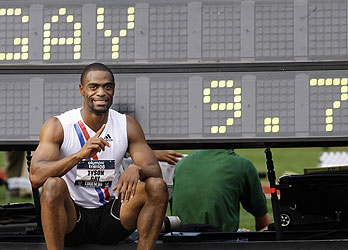
Calls Olympian Tyson Gay ‘Homosexual’
The American Family Association obviously didn’t foresee the problems that might arise with its strict policy to always replace the word “gay” with “homosexual” on the Web site of its Christian news outlet, OneNewsNow. The group’s automated system for changing the forbidden word wound up publishing a story about a world-class sprinter named “Tyson Homosexual” who qualified this week for the Beijing Olympics.
Tyson Gay won the men’s 100 meters final in June at the U.S. Olympic Track and Field Trials. The problem: Tyson’s real last name is Gay. Therefore, OneNewsNow’s reliable software changed the Associated Press story about Tyson Gay’s amazing Olympic qualifying trial to read this way:
“Tyson Homosexual was a blur in blue, sprinting 100 meters faster than anyone ever has. His time of 9.68 seconds at the U.S. Olympic trials Sunday doesn’t count as a world record, because it was run with the help of a too-strong tailwind. Here’s what does matter: Homosexual qualified for his first Summer Games team and served notice he’s certainly someone to watch in Beijing. “It means a lot to me,” the 25-year-old Homosexual said. “I’m glad my body could do it, because now I know I have it in me.”
Source. / Fox Sports / July 3, 2008
And from the Slueth:
Contacted by the Sleuth for comment on the software mishap, American Family Association spokeswoman Cindy Roberts in Tupelo, Miss., told us, “I think it was just a fluke.”
Fred Jackson, news director of OneNewsNow, tells the Sleuth his organization has now fixed the software glitch. “We took the filter out for that word,” he said, without uttering the “G” word.
“We don’t object to the word ‘gay,'” Jackson explained, except “when it refers to people who practice a homosexual lifestyle.” And the “G” word, he says, has “been co-opted by a particular group of people.” (People who are g-a-y.)
The OneNewsNow story about Gay, which was spotted by blogger Ed Brayton at scienceblogs.com, as well as by gay blogs, including PageOneQ, even included these nice details about Mr. Homosexual’s qualifying sprint:
Wearing a royal blue uniform with red and white diagonal stripes across the front, along with matching shoes, all in a tribute to 1936 Olympic star Jesse Owens, Homosexual dominated the competition. He started well and pulled out to a comfortable lead by the 40-meter mark. This time, he kept pumping those legs all the way through the finish line, extending his lead. In Saturday’s opening heat, Homosexual pulled way up, way too soon, and nearly was caught by the field, before accelerating again and lunging in for fourth place.
Source. / Mary Ann Akers / washingtonpost.com / July 1, 2008
Other items we’d like to see on the offending web site:
Enola Homosexual Drops A-Bomb on Japan!
Typhoon Homosexual Causes Devastation
Priest and writer Jean Pierre Homosexual Is Descendant of Lord John Peter Homosexual
Memorial Day Service Commemorates Hobart R. Homosexual (1894-1983), American general, and George Homosexual(1917-1994), Naval Aviator in World War II
Travel section: Visit These Happy Locales!
Homosexual Mountain, Virginia
Homosexual Spring, Tennessee
Homosexual Farms, Virginia
Homosexual Creek, Alabama
Homosexual, Georgia, Michigan and West Virginia
Homosexualville, South Dakota
Homosexual Hollow, Texas
AND Homosexual Head, Massachusetts!
Posted by What Big Implications You Have! / the sleuth / washingtonpost.com
Thanks to Jeff Jones / The Rag Blog
Two Potential Components of Microgeneration
By Paul Spencer / The Rag Blog / July 7, 2008
Microgeneration may or may not present much of a solution for our increasing energy deficit; but it’s still fun, and it’s not counter-productive as a hobby, as long as we continue to do our personal duty of energy-use reduction and political agitation for renewable-energy generation. Within the category of microgeneration, there are a number of interesting inventions and ideas; but some of them make claims that are – well – unsubstantiated, if not physically impossible. For instance, some ‘rooftop’ wind turbine designers claim that a device that looks like an over-sized passive roof vent will supply a household’s energy needs. Ain’t gonna happen.
So – into that breach I leap. Last year I collected the pieces of an interesting puzzle – an experiment actually. Y’all might be interested in the results, when they become available. I should have some initial data this coming Winter. Ingredients (puzzle pieces): forty 6-volt, 180 amp-hour batteries; one 2.5 kilowatt, true-sine-wave, grid-tie inverter; 0.6 kw capability photovoltaic modules; five 4-feet by 12-feet, black rubber, solar-water-heating “pads”; two 275 gallon (U.S.) plastic water tanks; two ½ horsepower electric pumps; one water-to-air heat pump (5-ton capacity).
Here is an example of the water tank.

Here is the water-to-air heat pump (compressor/input-exchange end).

Here is one of the pads.

Here’s the theory, summarized: Water-to-air heat pumps use the well-known refrigeration cycle of expansion/compression [of a gas] to concentrate heat in one region of the machine and to remove heat from another region. For those who don’t know about the so-called geothermal heat pump system, it is typically based on pipes set about 1.7 meters deep in the ground, where soil temperature stays fairly stable at close to 10 degrees C in the temperate zones of the world. In Winter the refrigeration cycle is designed such that the heat pump pulls out some of the heat inherent in 10 degree water, sending, say, 5 degree water back into the pipes in the ground. The length of the piping system is calculated to permit the water to equilibrate at the ground temperature before returning to the heat pump. In Summer the system is valved such that the system reverses direction in terms of heat flow – the heated water goes out to the pipes in the ground. The piping systems are typically quite long, but the extent of the trenching can be reduced by digging wider trenches and looping the pipe as it is laid.
Another less-used system (that is also becoming more common) is to use black rubber pads with small channels fabricated into the length of the pads, manifolded into pipes running width-wise at either end of the pads, to capture solar-based heat in water flowing through these channels. In the U.S. swimming pools are sometimes warmed in the Spring and Fall by this method. Occasionally, these pads are used in conjunction with storage tanks to provide warm/hot water for ‘hydronic’ heating of floors – water-carrying tubes laid in thick mortar beds under tiles, for instance.
The idea/experiment here is to combine the heating via the black pads with a water-to-air heat pump. One ½ hp pump will drive the water from the storage tanks through the pads on the roof and back into the tanks. A second pump will take water from the tanks to the heat pump, when a house-interior thermostat demands hot (or cold) air.
Now we get to the particular arrangement.
Here are 5 of the pads deployed and plumbed on my roof.

Here is the plumbing within the garage (directly under the pads).

Next are a couple of close-ups of the plumbing by which you can see the basic arrangement. First, the outlets of the two tanks are in parallel and connected to a pump (in-between the tanks) that pushes water from the bottom of the tanks up to the lower-side connections of the pads on the roof.

The pipe from the pump ‘tees’ to the water-to-air heat pump inlet. (From the heat pump outlet there is a pipe that goes to the return inlets in the caps on top of the tanks. These are loose-fitting to allow air pressure to stay equalized during pumping – and for ease of removal, if the caps need to be unscrewed for some kind of tank maintenance work.)

Returning water from the pads (hopefully, somewhat heated) is collected by a second pipe connected to the top ends of the pads. This bottom-to-top circulation keeps the water in the pads in contact with the pad’s tubes for best heat transfer. This collection pipe comes through the roof above the mid-point between the two tanks and ‘tees’ to two pipes lined up with the tanks’ caps (also ‘teed’ to the outlet pipe from the heat pump). The southern tank line (left side of picture) also is ‘teed’ with a return pipe from the water-pump-to-roof pipe, which is valved. This allows the water to be fully drained from the pads on the roof when the pump is not being operated. Without it, water would remain in the pads and the pipe to the pads, and, when outside temperatures go below freezing, the pipe and pads would be damaged by freezing water. In case it’s not clear, the valve is closed when the pump is operating; open when the pump is switched off.


As you can see there are several manual valves in the system. Initially, valves will be set by me for various periods of data collection. Eventually, the idea would be to put in servo- or electro-controlled valves that would be controlled by a computer set up to analyze water temperature, ambient outside temperature, and in-house temperature via sensors. The controls could be timed, too. It might be reasonable to have a daylight-sensing input, as well, since that should be the salient factor for heating, plus the salient counter-factor for cooling.
As I stated in my earlier diary my roof is a south-facing roof in the Columbia River Gorge, 65 kilometers east of Portland, OR. This geographical location is poor for solar insolation, and we have fairly strong winds that might cause loss of heat in the pads just from moving-air contact. Also, the roof is a 12:2, which means that it makes an angle of about 10 degrees to the horizontal. At my latitude the optimal roof angle would be more like 45 to 50 degrees to the horizontal as a compromise for the angle of the Sun in the sky from mid-Autumn to mid-Spring. Not the best situation for solar heating.
I have the forty 6-volt batteries in two rows, which will be arrayed in four parallel-circuit groups, which will then be hooked up in series, so that I’ll have a 24-volt system to match my inverter. The picture of the batteries shows them just after I had built the shelves and placed the batteries; they are now covered, but not connected. The inverter is mounted, but, obviously, not connected either.
Two pictures


The inverter can make switching decisions such as: 1) if no exterior power (e.g., downed transmission lines), route from batteries to house demand; 2) if house demand is less than solar-based input, charge batteries; 3) if 2) and if batteries are charged, send to the exterior power grid (turn meter backwards).
I have 0.6 kw capacity of photovoltaics to install, but these should go up by mid-Autumn. At that point I’ll decide whether to buy more and whether to mount them on a structure that will, at least, allow me to vary the angle to the southern horizon.
That’s the update on the solar heating project. Here’s a diary in The European Tribune by ‘Marco’ on microgeneration, which said:
“There are an estimated 100,000 microgeneration units already installed in Britain.
“Nearly 90,000 of these are solar water heaters, with limited numbers of biomass boilers, photovoltaic panels, heat pumps, fuel cells, and small-scale hydroelectric and windpower schemes…
“But, with the right incentives, nearly one in five buildings in Britain would effectively become mini power stations, feeding electricity into the grid, or generating enough to be largely self-sufficient. Some of the greatest gains would be in combined heat and power units which are suitable for large blocks of flats, estates and businesses.
“In Britain, as in the United States, zoning laws and regulations are obstacles that are blocking greater investment of microgeneration of power, especially with wind turbines. Britons, including Prime Minister Gordon Brown, ‘have all had applications to erect wind turbines on their roofs turned down by planning officers.'”
Sorry, but this just makes sense. Small, propellor-type turbines have a high rotational speed, which makes them a potential disaster for birds and bats, at least. Beyond that, there are critical issues of manufacture (balancing, for instance), installation, maintenance, and monitoring (for fatigue failure among other conditions).
As one reader commented:
“Microgeneration should not include windpower at this time in urban areas. Virtually no urban areas of the world have enough of a wind resource to sustain the development of such an industry. Even windy San Francisco can’t sustain residential scale wind turbines except right on the coast, or the highest elevations. Better that neighborhoods be allowed to invest in commercial developments where the winds are strong.”
Another reader raised a particularly good point:
“However, there is also the question of …
… sweat equity. In a system where large numbers of people cannot reliably expect to sell as much labor as they are willing to offer to the market, microturbines of the kind that have half the generator mechanism expoxied into the turbine might have a cash cost that is appealing for some, even if the full economic cost including the notional cost of labor would make it appear uneconomic.
“When it is reducing total demand from the grid, it is replacing electricity sold at retail … if net metering is in effect, this is topped up during surplus generation periods by selling surplus power onto the grid.”
So – the second part of this diary – how about VAWT (Vertical Axis Wind Turbines) as a kind of hobby with low cost, low risk, and modest payback? I know the efficiency arguments concerning vertical-axis vs. propellor-style turbines, and they are likely correct, but take a look at this just for fun:
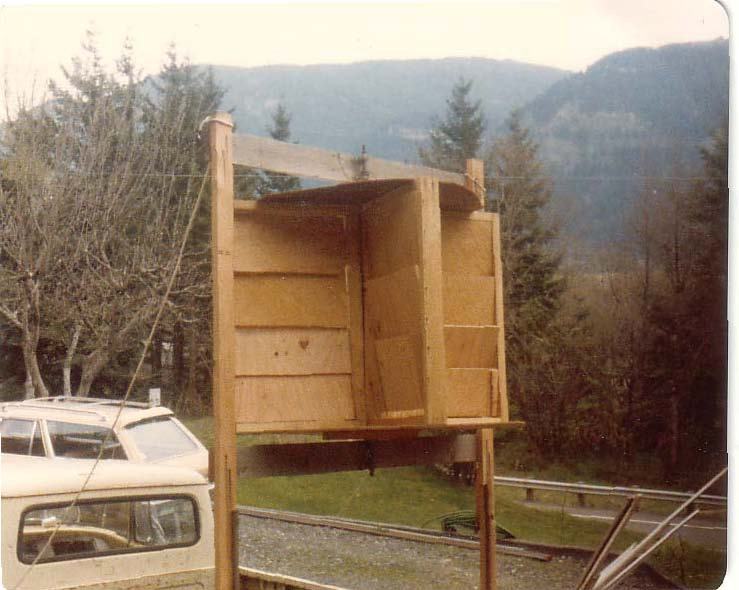
I suppose that it’s not self-explanatory, even in graphic form, but this device closes the vanes on the half of the cycle where the wind is driving the ‘wall’ and opens the vanes on the half of the cycle when the wind is opposing rotation. Does it actually perform as described? This is a picture from 1982 of my homemade model mounted in the back of my ’62 IH pickup truck. (I only drove used ‘cornbinders’ from county surplus sales from the late-’60s to the early ’80s. Larry Caroline introduced me to them.) I drove it down the road, and the ‘mill’ performed exactly as described. It started turning at about 5 mph, vanes started lifting and closing at about 7 mph, and it was spinning at a rather frightening rate when I hit 15 mph (and the vanes were still opening and closing, clacking away – no, it wasn’t my cornbinder’s valves). I didn’t dare go any faster than that, because I could also see that my lashing job wasn’t going to keep the device in my truck, if I didn’t slow down.
OK – this was an unbalanced model made out of pieces of stuff that I found in my garage, and the wood vanes made a fair racket. Now it’s time for me to make a more usable (and bigger) model out of materials that will endure and operate quietly. This time I won’t go for junkyard chic. In fact I will use materials that will test the cost factor for this design.
I predict that the cost for this type of device will be low, even with caging to prevent contact with anything larger than a dragonfly. As to conversion efficiency, I visualize a fairly reasonable torque that might be converted to high-speed rotation of an alternator via a simple belt drive – all right on the ground, where it’s relatively easy to support, to maintain, to replace, to whatever. Low wind-speeds due to ground interface? Probably, but the device should at least be responsive to changes in wind direction, however frequent and unpredictable. Y’all know the arguments, but this observation might be the clincher for going forward. This device can be made out of the “stuff in my garage”; it’s not a difficult job at all. If it turns out to be inexpensive to boot, what’s to lose?
What have y’all got for show-and-tell?
Go here for Paul Spencer’s all the entires so far “The Earth: Love It or Lose It” series on The Rag Blog.
The Rag Blog

CEO of Firm That Signed Controversial Iraq Oil Deal Longtime Bush, Cheney Adviser
By Jason Leopold / July 6, 2008
Ray Hunt, the Texas oil man who landed a controversial oil production deal with Iraq’s Kurdistan regional government, has enjoyed close political and business ties with Vice President Dick Cheney dating back a decade – and to the Bush family since the 1970s.
Despite those longstanding connections – and Hunt’s work for George W. Bush as a member of the President’s Foreign Intelligence Advisory Board – the Bush administration expressed surprise when Hunt Oil signed the agreement last September.
At that time, administration officials said Hunt Oil’s deal with the Kurds jeopardized delicate negotiations among competing Iraqi sects and regions for sharing oil revenues, talks seen as vital for achieving national reconciliation.
“I know nothing about the deal,” President Bush said. “To the extent that it does undermine the ability for the government to come up with an oil revenue sharing plan that unifies the country, obviously if it undermines it I’m concerned.”
However, on July 2, the House Oversight and Government Reform Committee released documents showing that senior administration officials were aware that Hunt was negotiating with the Kurdistan government and even offered him encouragement.
Hunt also personally alerted Bush’s PFIAB about his oil company’s confidential contacts with Kurdish representatives.
In a letter to Secretary of State Condoleezza Rice, Rep. Henry Waxman, D-California, committee chairman, complained that the administration’s comments last year were “misleading.”
“Documents obtained by the Committee indicate that contrary to the denials of Administration officials, advisors to the President and officials in the State and Commerce Departments knew about Hunt Oil’s interest in the Kurdish region months before the contract was executed,” Waxman wrote.
Waxman said the Hunt-Kurdish case also raised questions about the veracity of similar administration denials about its role in arranging more recent contracts between Iraq and major U.S. and multinational oil companies, including Exxon Mobil, Shell, BP and Chevron.
Plus, there’s the longstanding suspicion that oil was a principal, though unstated, motive behind the Bush administration’s invasion of Iraq, which sits on the world’s second-largest oil reserves.
Administration officials – and much of the mainstream U.S. media – have ridiculed the oil motive charge as a conspiracy theory.
Oil Deals
But many of the oil companies now stepping forward to benefit from Iraqi oil were instrumental in both supporting Bush’s political career and giving advice to Cheney’s secretive energy task force in 2001.
For instance, Ray Hunt’s personal relationship with the Bush family dates back to the 1970s as Hunt, the chief of Dallas-based Hunt Oil, helped build the Texas Republican Party as it served as a power base for the Bushes rise to national prominence.
The Hunt family donated more than $500,000 to Republican campaigns in Texas, while Hunt Oil employees and their spouses gave more than $1 million to Republican causes since 1995, according to the Center for Responsive Politics.
Ray Hunt also had strong ties to Dick Cheney during his years at the helm of Halliburton, the Houston-based oil-services giant. In 1998, Cheney tapped Hunt to serve on Halliburton’s board of directors, where Hunt became a compensation committee member setting Cheney’s salary and stock options.
In 1999, when Texas Gov. George W. Bush was running for the Republican presidential nomination, Bush turned to Hunt to help fund his presidential campaign efforts in Iowa, according to Robert Bryce’s book, Cronies: Oil, The Bushes, And The Rise Of Texas, America’s Superstate.
“By the summer of 1999, Bush had already raised $37 million but he wanted to conserve his campaign cash so he turned to a Texas crony, Ray Hunt, to help fund the Iowa effort,” Bryce wrote. “In July of 1999, Hunt was among a handful of Bush supporters who each donated $10,000 to the Iowa Republican party.”
In May 2000, Bush appointed Hunt finance chairman of the Republican National Committee. Hunt also donated $5,000 to the Florida recount battle and spent $100,000 on Bush’s inaugural party.
Bush Presidency
When Bush became President in 2001, Hunt emerged as an advisor to Cheney’s energy task force, according to highly placed executives at Hunt Oil whom I have been in contact with over the past seven years.
Bush also appointed Hunt to the Federal Reserve Bank of Dallas and to the PFIAB, giving him access to highly classified information.
Hunt’s son, Hunter, a vice president at Hunt Oil, became another top energy advisor to the new administration, the company’s Web site said.
One of the topics before Cheney’s task force was the hoped-for opportunity for American oil companies to regain access to Iraq’s underdeveloped oil fields as a way to meet increasing U.S. energy demands.
That opportunity opened up after the U.S.-led invasion and conquest of Iraq in March and April of 2003, although a stubborn insurgency and political disarray slowed efforts to modernize the Iraqi oil industry.
Further bolstering Hunt Oil’s influence in the region in November 2003, Bush named James Oberwetter, a Hunt Oil vice president, to be U.S. Ambassador to Saudi Arabia.
Hunt Oil finally nailed down a major oil agreement with the semi-autonomous Kurdish region on Sept. 7, 2007. But the deal outraged many Iraqi officials because it was enacted before a national law could be adopted on the distribution of oil revenues. Bush administration officials also criticized the deal.
At the time, Rep. Dennis Kucinich, D-Ohio, questioned whether Ray Hunt benefited from inside information from Bush, Cheney and/or other White House officials about Iraq’s stalled national oil law.
“As I have said for five years, this war is about oil,” Kucinich said. “The Bush administration desires private control of Iraqi oil, but we have no right to force Iraq to give up their oil. … The constitution of Iraq designates that the oil of Iraq is the property of all Iraqi people.”
Amazon Pipeline
The production-sharing agreement Hunt Oil signed with the Kurds is not the company’s first controversial energy project. Nor is it the first time the company has received help from the Bush administration for its work overseas, as documents obtained by Waxman’s investigators show.
In August 2003, the Bush administration threw its support behind the Camisea gas-pipeline project in the Amazon jungle in Peru that drew international criticism because it threatened to destroy a pristine stretch of rainforest and jeopardized the lives of indigenous people.
The London Independent reported that the beneficiaries of the project “would be two Texas energy companies with close ties to the White House, Hunt Oil and Kellogg Brown & Root, a subsidiary of Vice President Dick Cheney’s old company, Halliburton.” [Independent, Aug. 4, 2003]
When the pipeline deal went through, Hunt hired Halliburton to conduct the engineering work on the project as well as to build a $1 billion export terminal on the coast.
“Bush Pioneer Jose Fourquet played a pivotal role in the financing of a massive Peruvian natural gas project that benefited Hunt Oil Co., whose chairman, Ray L. Hunt, signed up to be a Pioneer and is a longtime ally of the president,” the Washington Post reported on May 17, 2004.
“Fourquet, the Treasury Department’s U.S. representative to the Inter-American Development Bank, rebuffed the official written and oral recommendation from other U.S. officials to vote ‘no’ on the project.
“Instead, he abstained on $135 million in financing for the project, allowing it to proceed. Opposition from the United States, a primary funder of the IDB bank, would have jeopardized the deal,” the Washington Post reported.
Wink and Nod
Now, the new evidence suggests that Hunt Oil at least benefited from the administration’s wink and nod in striking the Kurdish oil deal.
In a July 12, 2007, letter to PFIAB, Hunt disclosed that Hunt Oil was “approached a month or so ago by representatives of a private group in Kurdistan as to the possibility of our becoming interested in that region.”
Hunt described a visit of a Hunt Oil survey team and stated, “we were encouraged by what we saw. We have a larger team going back to Kurdistan this week.”
In a second letter to PFIAB, dated Aug. 30, 2007, Hunt revealed that he would travel to Kurdistan in early September for meetings with the Kurdistan regional government, including its president, prime minister and oil minister.
Those meetings led to the oil agreement between Hunt Oil and the Kurdish leaders — and now have raised questions about Bush’s denial that he had any advanced knowledge about the deal.
“State Department officials similarly disavowed involvement in the contract,” Waxman said in the letter to Rice. “Department officials claimed that to the extent they were aware of any negotiations, they actively warned Hunt Oil not to enter into a contract because it was contrary to U.S. national security interests.
“Documents obtained by the Committee indicate that contrary to the denials of Administration officials, advisors to the President and officials in the State and Commerce Departments knew about Hunt Oil’s interest in the Kurdish region months before the contract was executed.”
Waxman asked Rice to cooperate with the committee’s investigation. Hunt Oil declined to comment on Ray Hunt’s relationship with Bush or his administration.
Source. / The Public Record
The Rag Blog

Hidden Casualties
by Eric Ruder / July 5, 2008
A year and a half ago, Scott Eiswert, a specialist in the Tennessee Army National Guard, returned from Iraq, only to face an escalating battle with post-traumatic stress disorder (PTSD). When he learned that his unit would deploy again soon, he felt he could no longer stave off the pain. On May 16, his wife Tracy and his three daughters discovered his body after he shot himself in the family’s home.
Pfc. Jason Scheuerman left a note nailed to his barracks closet in Iraq. “Maybe finally I can get some peace,” wrote the 20-year-old man. Then he stepped inside the closet and shot himself. His parents only found out about the note after a yearlong fight to cut through military red tape and discover what happened to their son.
Scott and Jason are just two of the thousands of military personnel whose service in Iraq and Afghanistan plunged them into a place so dark that they took their own lives.
In fact, the number of suicides among veterans who served in Iraq and Afghanistan now likely exceeds the number of troops killed in combat.
Nearly one in five soldiers deployed to Iraq or Afghanistan–about 300,000–report symptoms of PTSD or major depression upon returning home, but only about half seek treatment, according to a Rand Corporation study released in April.
Based on known suicide rates for similar patients, “It’s quite possible that the suicides and psychiatric mortality of this war could trump the combat deaths,” according to National Institute of Mental Health director Thomas Insel, who is the government’s top psychiatric researcher.
But even more appalling than the human toll these wars are claiming even after troops leave the battlefield is the military’s shameless cover-up of the extent of the problem–and its effort to deny veterans the health care they deserve when they return.
The Pentagon officially reports that about 30,000 troops were seriously wounded in Iraq and Afghanistan. But USA Today found at least 20,000 cases of traumatic brain injury (TBI) not reported by the Pentagon when the newspaper conducted its own study and filed numerous requests for data under the Freedom of Information Act.
The Rand Corporation study found that 320,000 personnel may have experienced a TBI in Iraq or Afghanistan, but only 43 percent said they had ever been evaluated by a physician for the injury.
As for PTSD, the Pentagon officially acknowledges that 38,000 veterans have been diagnosed with it since 2003–so if the Rand study of 300,000 soldiers with PTSD is accurate, that means some 260,000 have either not sought treatment, not been diagnosed or simply aren’t being counted by the military.
This isn’t surprising, given the culture of denial that pervades the military and veterans health care system. In April, for example, an e-mail surfaced from Ira Katz, deputy chief patient care services officer for mental health at the Department of Veterans Affairs (VA), acknowledging that 1,000 veterans under VA care attempt suicide every month. On average, 18 veterans commit suicide in the U.S. every day, and four of those are veterans of the Iraq and Afghanistan wars.
“Shh!” begins the e-mail from Katz. “Is this something we should (carefully) address ourselves in some sort of release before someone stumbles on it?”
Another troubling e-mail from a VA official came to light in May. Norma Perez, a leading psychologist at a facility for veterans in Texas, wrote to staff members in March directing them to diagnose PTSD less frequently because PTSD patients can receive government disability payments for their condition.
“Given that we are having more and more compensation-seeking veterans, I’d like to suggest that you refrain from giving a diagnosis of PTSD straight out,” wrote Perez in the message to mental-health specialists and social workers. Instead, she continued, “consider a diagnosis of Adjustment Disorder.”
A diagnosis of adjustment disorder is considered less severe and isn’t typically compensated like PTSD, for which veterans are eligible for disability payments of up to $2,527 a month, depending on the severity of their condition.
“It is outrageous that the VA is calling on its employees to deliberately misdiagnose returning veterans in an effort to cut costs,” said Melanie Sloan, executive director of Citizens for Responsibility and Ethics in Washington, which released the memo to the media. “Those who have risked their lives serving our country deserve far better.”
Scott Eiswert had stopped going to the VA for PTSD treatment before his suicide, and the disregard for vets under its care was one reason why, according to Stacy Hafley, an advocate for military families who is helping the Eiswert family get back on its feet.
“He didn’t feel like it was helping,” said Hafley in an interview. “He thought they were leaning toward saying that his issues were ‘family problems,’ and not PTSD. So he stopped going, which is fairly common and symptomatic of PTSD.
“I’ve heard it so many times, and my husband, who also suffers from PTSD, did the same thing. So many feel that the VA is either trying to overmedicate or understate the scope of the problem, and neither of those is particularly helpful. They get frustrated, leave and don’t come back.”
Hafley underscored the chief problem facing an understaffed VA: “The VA is trying to build a million-dollar home with a penny, and it can’t be done,” she said.
The VA has an annual mental health budget of $3.8 billion, which U.S. officials contend is a substantial amount. But the U.S. spends this much every 11 days to keep U.S. forces fighting in Iraq and Afghanistan.
In late June, Bush signed a new supplemental war spending bill, approved by Democrats and Republicans in both houses of Congress. The bill allocates an additional $162 billion of spending that will last into the middle of 2009, well into the term of Bush’s successor.
While the bill increases spending on GI education benefits, it contains nothing for expanding the budget for military health care. “The recent war funding bill was passed to go clear through the spring of 2009, which was clearly a political ploy to not have to deal with war spending right before the election, given that both candidates are sitting senators,” explained Hafley.
“I feel like they are playing political games with the lives of our loved ones. We shouldn’t be tolerating that. This has been going on for years. These aren’t new problems. These are the same problems that Vietnam vets have been facing for decades.”
Hafley is right. Fighting wars by skimping on compensation for the soldiers who must fight them is a tried-and-true strategy of every commander in chief. Successive Democratic and Republican administrations stood in the way of compensation for Vietnam veterans struggling with PTSD and Agent Orange exposure.
The Clinton administration dragged its feet when tens of thousands of veterans of the 1991 Gulf War struggled to get compensation for the dizzying array of symptoms they were experiencing, such as frequent immune system disorders, birth defects, cancer, chronic fatigue, loss of muscle control, headaches, dizziness and loss of balance, memory problems, muscle and joint pain, indigestion, skin problems and shortness of breath.
Today, the military is employing a different arsenal to keep its overstretched military in the field at bargain-basement prices. “For the first time in history,” according to a cover story in the June 16 issue of Time, “a sizable and growing number of U.S. combat troops are taking daily doses of antidepressants to calm nerves strained by repeated and lengthy tours in Iraq and Afghanistan.
“The medicines are intended not only to help troops keep their cool, but also to enable the already strapped Army to preserve its most precious resource: soldiers on the front lines. Data contained in the Army’s fifth Mental Health Advisory Team report indicate that, according to an anonymous survey of U.S. troops taken last fall, about 12 percent of combat troops in Iraq and 17 percent of those in Afghanistan are taking prescription antidepressants or sleeping pills to help them cope.”
Chris LeJeune, who returned home in May 2004, began struggling with depression while on a 15-month deployment to Iraq. The uncertainty about the mission itself weighed heavily on his conscience and contributed to his condition.
“When you search someone’s house, you have it built up in your mind that these guys are terrorists, but when you go in, there’s little bitty tiny shoes and toys on the floor–things like that started affecting me a lot more than I thought they would,” LeJeune said.
When LeJeune sought counseling, he got a prescription for antidepressant and anti-anxiety medications, but not much else. “In the civilian world, when you have a problem, you go to the doctor, and you have therapy followed up by some medication,” said LeJeune. “In Iraq, you see the doctor only once or twice, but you continue to get drugs constantly.”
And that’s if you’re lucky enough to see a mental-health professional. According to Time, about a third of troops in Iraq and Afghanistan say they can’t see a mental-health provider when they need one.
Adding to the frustration facing the loved ones of veterans seeking help is the unresponsiveness of every level of government to the crisis.
Seeking to break the logjam, two veterans’ organization filed suit to ask a federal judge to order changes to how the VA delivers care to veterans. The suit sought redress for the lack of mental health care services, the long delays for appointments, and the four-and-a-half year backlog of cases in which veterans are appealing for a higher disability rating than was issued by VA doctors.
But the judge refused to grant the order, saying the plaintiffs were demanding nothing short of “a complete overhaul of the VA system.”
Hafley can think of only one other measure that would work better than a complete overhaul. “Quite frankly,” she said, “the best thing they could do to stop the overload at the VA is end the war, bring the troops home and stop creating more troops with PTSD who are at risk of suicide or having addiction problems. Adding more money into the VA does help the ones who are already home, but every day, new ones are being created.
“That influx is going to continue. Spending more money is just a temporary fix. They aren’t stopping the bleeding. And that’s the problem that brought us where we are now.”
The Rand Corporation’s study “Invisible Wounds of War” compiles information on veterans suffering from PTSD, TBI and major depression. The Rand site also has links to pamphlets with advice for individuals and families trying to cope with post-deployment stress.
To find out more about the Eiswert family and how you can help, go to the E-4 Scott Eiswert Memorial Fund.
In “Disposable heroes,” published in the International Socialist Review, Pham Binh covered the struggle of soldiers to get the government to devote adequate resources to compensating them for their service.
The Citizen Soldier is an excellent resource for active-duty soldiers looking for news and advice about their rights. Soldiers can also contact the GI Rights Hotline, or call 877-447-4487 from the U.S., 415-487-2635 from outside the U.S., or 06223-47506 from Germany.
[Eric Ruder writes for Socialist Worker, where this article first appeared.]
Source / Dissident Voice
The Rag Blog

Cold Shoulders
by Kathy Kelly / July 6, 2008
Over the past two years, here in Amman, Jordan, I’ve regularly visited the family of Umm Hamdi, an Iraqi woman forced out of her native Iraq four years ago by terrifying death threats after her husband, very likely prey to that same threatened violence, disappeared. Although often met with the proverbial “cold shoulder” when trying to improve conditions for her family, she persists,–in the daytime she does child care for another family and, in the evening, she knits, sews, and makes handicrafts to sell in a local market. Umm Hamdi is tough, strong and fiercely determined to provide for her children. Nevertheless, she’s wretchedly insecure as a single mother and one more refugee among thousands in a country where resources to cope with her anxious needs are very slim. And she is worried for her son who is still in Iraq.
Two nights ago, I turned up to her small bare apartment during an evening when her young daughters were out in the care of a local charity and she was home alone. I saw how worn out she was from working to support them – but more telling on her is the frustration and remorse she feels for Hamdi, her teenage son, who is barred from entering Jordan because he is a young man over 15 years of age, and whether for fear of spillover violence or from a wish to concentrate its taxed charitable resources among women and children, Jordan’s policy strictly bars him entry. In Iraq, Hamdi lives with a family that resents him for his unemployed status, (there are no jobs), and can barely spare the little support they offer him.
Umm Hamdi is stricken with remorse over separation from her son. In regular phone calls, he learns that his sisters are going to school, that one has completed a vocational training program, and that when the oldest daughter was recently married the family did everything they could to give her a traditional wedding. The anguish overwhelms her as she recounts their latest conversation: “You do everything for your daughters,” he had shouted, over the phone: “everything for them, but what about me? What about me? I am your son!” She clutches her hands over her eyes. Between sobs, she repeats, “My son, my son.”
Her son is one of many thousands in Iraq who are out of luck, out of work, undereducated, and lonely for parents and siblings lucky enough to escape to neighboring countries.
The International Organization for Migration (IOM) says that poverty is driving Iraq’s boys and young men, out of desperation, into the militias. A 2007 IOM report noted that “militant fighters sometimes buy the loyalty of displaced persons by providing them some of the things they need, such as food and shelter. More and more children are joining these armed groups, the militias and the insurgents,” said IOM officer Dana Graber Ladeck. “Sometimes they do it for money and sometimes for revenge, but we’re finding more and more child soldiers, so to speak.” (January 30, Voice of America interview)
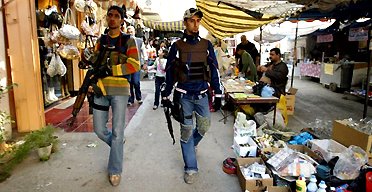
Some youngsters agree to carry guns and to man checkpoints for the strongest and most heavily armed militia in their country, the U.S. military. Reporting for Reuters, Adrian Croft recently wrote about a “ragtag band of men toting AK-47s at a checkpoint in Baghdad’s Sadr City,” some of 500 youngsters the US had recruited as part of a new plan to “strengthen the Iraqi army’s hold” in the backyard of U.S. rival Moqtada Sadr. (Jordan Times, June 27). New recruits risk their lives to earn $300 a month, guarding these checkpoints. It’s undoubtedly one of the best jobs in town. Will this option, will one like it, attract Umm Hamdi’s son?
Other Iraqi youngsters have been swept up by the U.S. military and sent to prisons, without charge, as a measure to prevent them from joining an Iraqi militia. On May 19, 2008, Fox News reported that the U.S. military is holding about 500 juveniles suspected of being “unlawful enemy combatants” in detention centers in Iraq. In August of 2007, in anticipation of the “troop surge,” CNN reported that the US had imprisoned, without charge, 800 Iraqi youngsters (or “security risks”) between the ages of 11 and 17, in a “prison school,” to prevent them from lending their bodies to militias as decoys or snipers. The CNN reporter said that, within the school, textbooks and classrooms were another “weapon” against terror. Commanding officer Lt. Glenn expressed his goal: “We ensure that when they are released that they don’t – they pick up a book instead of an AK-47 or laying an IED. And that’s what this really gets back to.” And when it gets back to young men like Hamdi, the message is perfectly clear: the U.S. will supply plenty of guns and explosives as long as the attacks are done in the name of protecting U.S. “security.”
Umm Hamdi doesn’t want her son to pick up a gun or lay an explosive device, for Iraq or for anyone. She would rather see him pick up a book. She cries herself to sleep at night wishing she could just see him. But she can’t bring her daughters back to the maelstrom of violence her native country has become with the U.S. invasion. And with Jordan straining to contain the refugees it has absorbed, she can’t bring her son out of Iraq.
Would it reassure her to think that Hamdi might find more secure shelter and achieve some educational goals if U.S. military jailers could imprison him for a year or so? Would it help if I told her that millions of impoverished parents in the U.S. worry that their sons might land in jail, and that many see the military as a better option?
I talked with her for a while longer. Her daughters returned from the event the charity had hosted for them, their faces sparkling with glitter and their arms colorful with painted designs. Umm Hamdi wiped away tears from a suddenly, forcedly, cheerful expression. She fetched a small ball of yarn – royal blue – and started rapid work to knit me a sweater, a parting gift I will take with me when I leave here. “It’s cold in Chicago, very cold!” she said, laying down the needles and yarn. She grabbed her shoulders to help me understand that she didn’t want me to have cold shoulders. “No, we don’t want you to be cold.”
Kathy Kelly (kathy@vcnv.org) co-coordinates Voices for Creative Nonviolence.
Source / Common Dreams
The Rag Blog
Why I’m Not Patriotic
By Matthew Rothschild / July 2, 2008
(In memory of George Carlin.)
It’s July 4th again, a day of near-compulsory flag-waving and nation-worshipping. Count me out.
Spare me the puerile parades.
Don’t play that martial music, white boy.
And don’t befoul nature’s sky with your F-16s.
You see, I don’t believe in patriotism.
It’s not that I’m anti-American, but I am anti-patriotic.
Love of country isn’t natural. It’s not something you’re born with. It’s an inculcated kind of love, something that is foisted upon you in the home, in the school, on TV, at church, during the football game.
Yet most people accept it without inspection.
Why?
For when you stop to think about it, patriotism (especially in its malignant morph, nationalism) has done more to stack the corpses millions high in the last 300 years than any other factor, including the prodigious slayer, religion.
The victims of colonialism, from the Congo to the Philippines, fell at nationalism’s bayonet point.
World War I filled the graves with the most foolish nationalism. And Hitler and Mussolini and Imperial Japan brought nationalism to new nadirs. The flags next to the tombstones are but signed confessions—notes left by the killer after the fact.
The millions of victims of Stalin and Mao and Pol Pot have on their death certificates a dual diagnosis: yes communism, but also that other ism, nationalism.
The whole world almost got destroyed because of nationalism during the Cuban Missile Crisis.
The bloody battles in Serbia and Bosnia and Croatia in the 1990s fed off the injured pride of competing patriotisms and all their nourished grievances.
In the last five years in Iraq, tens of thousands or hundreds of thousands of Iraqi civilians have died because the United States, the patriarch of patriotism, saw fit to impose itself, without just cause, on another country. But the excuse was patriotism, wrapped in Bush’s brand of messianic militarism: that we, the great Americans, have a duty to deliver “God’s gift of freedom” to every corner of the world.
And the Congress swallowed it, and much of the American public swallowed it, because they’ve been fed a steady diet of this swill.
What is patriotism but “the narcissism of petty differences”? That’s Freud’s term, describing the disorder that compels one group to feel superior to another.
Then there’s a little multiplication problem: Can every country be the greatest country in the world?
This belief system magically transforms an accident of birth into some kind of blue ribbon.
“It’s a great country,” said the old Quaker essayist Milton Mayer. “They’re all great countries.”
At times, the appeal to patriotism may be necessary, as when harnessing the group to protect against a larger threat (Hitler) or to overthrow an oppressor (as in the anti-colonial struggles in the Third World).
But it is always a dangerous toxin to play with, and it ought to be shelved with cross and bones on the label except in these most extreme circumstances.
In an article called “Patriot Games” in the current issue of Time magazine (July 7), Peter Beinart, late of The New Republic, inspects his navel for seven pages and then throws the lint all around.
“Conservatives are right,” he says. “To some degree, patriotism must mean loving your country for the same reason you love your family: simply because it is yours.”
And then he criticizes, incoherently, the conservative love-it-or-leave-it types.
The moral folly of his argument he himself exposes: “If liberals love America purely because it embodies ideals like liberty, justice, and equality, why shouldn’t they love Canada—which from a liberal perspective often goes further toward realizing those principles—even more? And what do liberals do,” he asks, “when those universal ideals collide with America’s self-interest? Giving away the federal budget to Africa would probably increase the net sum of justice and equality on the planet, after all. But it would harm Americans and thus be unpatriotic.”
This is a straw man if I ever I saw one, but if the United States gave a lot more of its budget to eradicating poverty and disease in Africa and other parts of the developing world, it might actually make us all safer.
At bottom, note how readily Beinart disposes of “liberty, justice, and equality.”
He has stripped patriotism to its vacuous essence: Love your country because it’s yours.
If we stopped that arm from reflexively saluting and concerned ourselves more with “universal ideals” than with parochial ones, we’d be a lot better off.
We wouldn’t be in Iraq, we wouldn’t have besmirched ourselves at Guantanamo, we wouldn’t be acting like some Argentinean junta that wages illegal wars and tortures people and disappears them into secret dungeons.
Love of country is a form of idolatry.
Listen, if you would, to the wisdom of Milton Mayer, writing back in 1962 a rebuke to JFK for his much-celebrated line: “Ask not what your country can do for you, but what you can do for your country.”
Mayer would have none of it. “When Mr. Kennedy spoke those words at his inaugural, I knew that I was at odds with a society which did not immediately rebel against them,” he wrote. “They are the words of totalitarianism pure; no Jefferson could have spoken them, and no Khrushchev could have spoken them better. Could a man say what Mr. Kennedy said and also say that the difference between us and them is that they believe that man exists for the State and we believe that the State exists for man? He couldn’t, but he did. And in doing so, he read me out of society.”
When Americans retort that this is still the greatest country in the world, I have to ask why.
Are we the greatest country because we have 10,000 nuclear weapons?
No, that just makes us enormously powerful, with the capacity to destroy the Earth itself.
Are we the greatest country because we have soldiers stationed in more than 120 countries?
No, that just makes us an empire, like the empires of old, only more so.
Are we the greatest country because we are one-twentieth of the world’s population but we consume one-quarter of its resources?
No, that just must makes us a greedy and wasteful nation.
Are we the greatest country because the top 1 percent of Americans hoards 34 percent of the nation’s wealth, more than everyone in the bottom 90 percent combined?
No, that just makes us a vastly unequal nation.
Are we the greatest country because corporations are treated as real, live human beings with rights?
No, that just enshrines a plutocracy in this country.
Are we the greatest country because we take the best care of our people’s basic needs?
No, actually we don’t. We’re far down the list on health care and infant mortality and parental leave and sick leave and quality of life.
So what exactly are we talking about here?
To the extent that we’re a great (not the greatest, mind you: that’s a fool’s game) country, we’re less of a great country today.
Because those things that truly made us great—the system of checks and balances, the enshrinement of our individual rights and liberties—have all been systematically assaulted by Bush and Cheney.
From the Patriot Act to the Military Commissions Act to the new FISA Act, and all the signing statements in between, we are less great today.
From Abu Ghraib and Bagram Air Force Base and Guantanamo, we are less great today.
From National Security Presidential Directive 51 (giving the Executive responsibility for ensuring constitutional government in an emergency) to National Security Presidential Directive 59 (expanding the collection of our biometric data), we are less great today.
From the Joint Terrorism Task Forces to InfraGard and the Terrorist Liaison Officers, we are less great today.
Admit it. We don’t have a lot to brag about today.
It is time, it is long past time, to get over the American superiority complex.
It is time, it is long past time, to put patriotism back on the shelf—out of the reach of children and madmen.
Source / The Progressive
h/t Earth Family Alpha
And there’s this:
Written on July 4, 2008
Some Thoughts on Patriotism
By WILLIAM BLUMMost important thought: I’m sick and tired of this thing called “patriotism”.
The Japanese pilots who bombed Pearl Harbor were being patriotic. The German people who supported Hitler and his conquests were being patriotic, fighting for the Fatherland. All the Latin American military dictators who overthrew democratically-elected governments and routinely tortured people were being patriotic — saving their beloved country from “communism”.
General Augusto Pinochet of Chile: “I would like to be remembered as a man who served his country.”[1]
P.W. Botha, former president of apartheid South Africa: “I am not going to repent. I am not going to ask for favours. What I did, I did for my country.”[2]
Pol Pot, mass murderer of Cambodia: “I want you to know that everything I did, I did for my country.”[3]
Tony Blair, former British prime minister, defending his role in the murder of hundreds of thousands of Iraqis: “I did what I thought was right for our country.”[4]
Read all of it, including notes, here. / Counterpunch
The Rag Blog

Joshua Key on stage in Ottawa talking about his memoir The Deserter’s Tale. Photo by John W. McDonald.
Ruling: Soldier witnessed enough rights abuses to gain Canadian asylum
OTTAWA — A Canadian court has sided for the first time with a military deserter who fled to Canada seeking refugee status, ruling yesterday that the U.S. soldier witnessed enough human rights abuses during a stint in Iraq that he could qualify for asylum.
The decision also marked the first time that the Federal Court, which has heard a handful of cases involving deserters, concluded that military action against civilians in Iraq violates the 1949 Geneva Conventions, an international prohibition against humiliating and degrading treatment.
Federal Court Justice Richard Barnes ordered the Immigration and Refugee Board to reconsider the failed refugee claim of Joshua Key, a soldier who entered Canada with his wife, Brandi, and their small children in March 2005.
Key, an army private, deserted during a two-week break from serving as a combat engineer in Iraq, where he spent eight months in 2003 and says he was involved in military-condoned home invasions against civilians.
“This is a real breakthrough,” said Lee Zaslofsky of the Toronto-based War Resisters Support Campaign. “What excites us is this may also apply to other war resisters who took part in Iraq.”
Barnes ruled that the board too narrowly interpreted refugee eligibility by concluding only soldiers who seek protection from committing war crimes need apply.
“Officially condoned military misconduct falling well short of a war crime may support a claim to refugee protection,” said the ruling.
Barnes said it “cannot be seriously challenged” that some of the conduct in which Keys participated violated the Geneva Conventions.
“This included the responsibility for conducting night-time raids of private Iraqi homes in search of weapons,” said the decision.
“Pte. Key’s role in this was to blow open the doors with explosives and then to assist in both securing the premises and detaining the adult male occupants. Mr. Key alleged that during these searches he witnessed several instances of unjustified abuse, unwarranted detention, humiliation and looting by fellow soldiers, much of which he said was ignored by his superior officers.”
The Geneva Conventions prohibits “outrages upon personal dignity, in particular humiliating and degrading treatment” and “unlawful confinement.”
Key, 30, is the co-author of The Deserter’s Tale, a book about serving in Iraq and his flight from the U.S. military. He was born in Oklahoma in 1978, enlisting in the military in 2002. He now lives in Spiritwood in northern Saskatchewan and says that he suffers from post-traumatic stress, including insomnia, nightmares and hallucinations that “flash me right back to Iraq.”
His lawyer, Jeffry House, said it was not lost on Key that the ruling was released on July 4, the U.S. national holiday.
“He’s crossing his fingers that he and his family will be able to stay,” House said.
Source. / Times-Colonist, Victoria
Thanks to Steve Russell / The Rag Blog
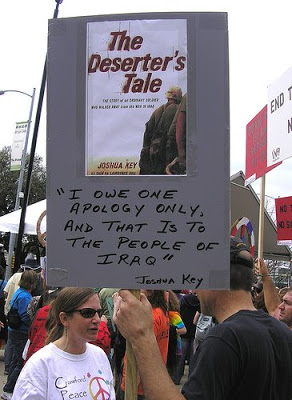
Photo by Ishiku.
Why I fled George Bush’s war
What happened to make a patriotic, gung-ho soldier desert the U.S. army, and turn against the war in Iraq.
By Joshua Key[Joshua Key, 28, was a poor, uneducated Oklahoma country boy who saw the U.S. army and its promised benefits — from free health care to career training — as the ticket to a better life. In 2002, not yet 24 but already married and the father of two , Key enlisted. He says his recruiting officer promised he’d never be deployed abroad, but a year later he was in Iraq. Only 24 hours after arriving, as Key recounts in The Deserter’s Tale(Anansi), he experienced his first doubts about what he and his fellow soldiers were doing there.]
I was scared out of my wits that first day in Ramadi. Our own air force had just finished bombing these people, but as soon as we got out of our vehicles we began patrolling their streets, on foot. With nearly 100 lb. of weaponry, equipment and clothing on my back, I was about as mobile as a cow. It was just my platoon, 20 guys, walking single file through streets full of Iraqis. I could not stop thinking that anywhere, at any time, some half-starved sniper on a roof could have taken me out in no time flat. Iraqi kids surrounded me in swarms, hands out, asking for water and food. I kept hearing the last words [my wife] Brandi said to me before I flew out: “Don’t you let those terrorists near you, Josh. Even if they are kids. Get them before they get you.”
I was awakened at 3 a.m. that first night and told to get my ass up quickly because in one hour we were going to raid a house full of terrorists. Capt. Conde and some sergeants showed me and my squad mates a satellite photo of a house and a drawing of the layout of the inside. Our assignment was to blow off the door, burst into the house, raid it fast and raid it good — looking for contraband, caches of weapons, signs of terrorists or terrorist activity, then rounding up the men and getting out damn fast. The longer we stayed in any one location, the longer somebody would have to put us in the sights of a rocket-propelled grenade or lob mortars at us.
I had no idea what to expect. Would I charge through the door, only to be blown to bits by a grenade? Would somebody with an AK-47 knock my Oklahoman ass right back out that door? Would some six-year-old terrorist with two days of gun training be waiting to put me in his crosshairs? The minutes ticked on, and I wanted the hour to speed forward so we could get on with it. One or two guys did push-ups to pump themselves up. I borrowed Mason’s portable CD player and bombed out my eardrums to the beat of Ozzy Osbourne. It got me going. High and ready for action. I checked my watch, wished it would accelerate, and stuck some dip — Copenhagen, bourbon flavor — behind my lip. You can’t manage a cigarette when you’ve got an M-249 automatic weapon on your arm. So dip was best. Makes your mouth black as sin, and rots the roots right out of your gums, but dip was my nicotine hit of choice going into that raid.
I committed our instructions to memory. I knew the angles of the house, what door I would help blow down, how many floors were in the house, and who would do what when we busted inside. I would be third in the door, which means I was the second most likely to get shot if anybody had a mind to take us down, and I’d head to the left. Always, for every raid, I would be third in, heading left. I gripped my M-249. Yes, it could belt out 2,000 rounds a minute but only in theory. You couldn’t really hold your finger down that long. When you were blazing away like that, the bullets turned the barrel as hot as Hades. And if you held your finger down too long, it would warp the barrel.
It took thirty seconds for Jones and me to put the charge of C-4 plastic explosive on the door. Then we dashed around to the side of the house so we wouldn’t blow ourselves up. You’d be fried meat if you were anywhere near the explosion. I set off the blast, and then the six of us charged in. Jones went first — that skinny, red-haired Ohio boy was always hot to trot. With Jones leading the way we burst into the house, armed to the hilt. Kevlar helmets, flak jackets, machine guns, combat boots, the whole nine yards.
I’d never been inside an Iraqi’s house before. We charged through a kitchen. I had been told by squad leader Padilla to check everything, so I even opened the fridge. Perhaps, I thought, I would find guns or grenades hidden inside. No such luck. In the fridge, all I saw was a bit of food. In the freezer I found big slabs of meat, uncovered. No wrapping. No plastic. Frozen, just like that. We ran into a living room with long couches, one along each wall. In this room with the couches we found two children, a teenager, and a woman. We also found two young men in the house. One looked like a teenager and the other was perhaps in his early 20s — brothers.
We hollered and cussed. I spat dip on the floor and screamed along with the other soldiers at the top of my lungs. I knew they didn’t understand, but I hollered anyway.
“Get down,” I shouted. “Get the fuck down. Shut the fuck up.”
They didn’t know what “get down” meant, so we knocked the two brothers to the floor, face down. We put our knees on their backs, pulled their hands behind them, and faster than you can bat an eye we zipcuffed them. Zipcuffs are plastic handcuffs that lock on tight. They must have bit something fierce into those young men’s skin. There was no key, nothing — the only way to get them off was to slice them with cutters.
We pushed the brothers outside, where 12 other soldiers from our platoon were waiting. The Iraqi brothers were taken away to an American detention facility for interrogation. I don’t know what it was called, and I don’t know where it was. All I know is that we sent away every man — pretty well every male over five feet tall — that we found in our house raids, and I never saw one of them return to the neighbourhoods we patrolled regularly.
Inside, we kept on ransacking the house. The more obvious it became that we would find no weapons or contraband, the more we kicked the stuffing out of the house. We knocked over dressers, sliced into mattresses with knives, kicked our way through doors, raiding the three bedrooms on the second floor, then raced up to the third floor. We turned over everything we could and broke furniture at random, searching for contraband, weapons, proof of terrorist activity, or signs of weapons of mass destruction. We found nothing but a CD. Soldiers initially said it showed proof of terrorist activity, but it turned out to have nothing on it but a bunch of speeches by Saddam Hussein.
Once we had everybody outside the house and had done our initial job of ransacking, another squad took over inside. They kept raising hell in there, breaking and turning over more furniture, looking for weapons that we might have missed. Outside, under a carport, I was assigned to watch the women and children. We weren’t arresting them, but we weren’t allowing them to go anywhere either. The family members couldn’t go back inside, and they couldn’t wander off into the neighbourhood. They had to stay right there while we tore the hell out of their house.
A girl in the family — a teenager — started staring at me. I tried to ignore her. Then she began speaking to me. Inside, when we had been screaming at her and the others, I’d assumed that nobody understood a word of English. But this young girl spoke to me in English, and her eyes bored holes right through me. She was skin and bones, not even 100 lb., not yet a full-grown woman, but something about her seemed powerful and disturbing. I feared that girl, and I wanted to get away from her as fast as I could, but it was my job to stay right there and make sure she didn’t move. I had my weapon ready. She was wearing a blue nightgown and had a white scarf covering her hair. She had no veil, so I could see her face perfectly. Her eyes were coal black and full of hatred.
In English, she asked me, “Where are you taking my brothers?”
“I don’t know, Miss,” I said.
“Why are you taking them away?”
“I’m afraid I can’t say.”
“When are you bringing them back?”
“Couldn’t tell you that either.”
“Why are you doing this to us?”
I couldn’t answer that.
I hoped she would not raise a fuss. I didn’t want her to start screaming, which could attract the attention of my squad mates. One or two, I feared, would be more than happy to use a rifle butt to knock out her teeth.
I hadn’t been in Iraq more than 24 hours and already I was having strange feelings.
First, I was vulnerable, and I didn’t like it. Even with all these soldiers and all this equipment, I knew that anywhere, at any time, any Iraqi with a gun, a wall to hide behind, and one decent eye could pick me off faster than a hawk nabs a mouse. Second, with hardly one foot into the war, I was also uneasy about what we were doing there. Something was amiss. We hadn’t found anything in this girl’s house, but we had busted it up pretty well in 30 minutes and had taken away her brothers.
Inside, another squad was still ransacking the house. I didn’t enjoy being stuck guarding this girl under the carport, in the cool April air before dawn in Ramadi. Her questions haunted me, and I didn’t like not being able to answer them — even to myself.
Busting into and ransacking homes remained one of my most common duties in Iraq.
Before my time was up, I took part in about 200 raids. We never found weapons or indications of terrorism. I never found a thing that seemed to justify the terror we inflicted every time we blasted through the door of a civilian home, broke everything in sight, punched and zipcuffed the men, and sent them away. One raid was far worse.
It was a handsome two-story house and quite isolated. As usual, I put the charge of C-4 explosives on the door and we blew it in. As we rushed into the house, women were staggering out of their rooms. Three teenage girls screamed when they saw us.
Some of my squad mates grabbed them and held them at gunpoint, and the rest of us ran through the house. We found no men at all, just six more women in their 20s and 30s. The guys in my squad couldn’t find a thing, not even any guns — and it seemed that the more incapable they were of locating contraband, the more destructive they became. They smashed dressers, ripped mattresses, broke cabinets, and threw shelves to the floor.
Outside I found Pte. 1st Class Hayes with a woman under an empty carport. He pointed his M-16 at her head but she would not stop screaming.
“What are you doing this for?” she said.
Hayes told her to shut up.
“We have done nothing to you,” she went on.
Hayes was starting to lose it. I told her that we were there on orders and that we couldn’t speak to her, but on and on and on she bawled at Hayes and me.
“You Americans are disgusting! Who do you think you are, to do this to us?”
Hayes slammed her in the face with the stock of his M-16. She fell face down into the dirt, bleeding and silent. The woman lay still on the ground. I pushed Hayes away.
“What are you doing, man?” I said to him. “You have a wife and two kids! Don’t be hitting her like that.”
He looked at me with eyes full of hatred, as if he was ready to kill me for saying those words, but he did not touch the woman again. I found this incident with Hayes particularly disturbing because during other times I had seen him in action in Iraq, he had showed himself to be one of the most level-headed and calm soldiers in my company. I had the sense that if he could lose it and hit a woman the way he had, any of us could lose it too.
Then something happened that haunts my dreams to this day. All the women were led back inside the house and our entire platoon was ordered to stand guard outside it. Four U.S. military men entered the house with the women. They closed the doors. We couldn’t see anything through the windows. I don’t know who the military men were, or what unit they were from, but I can only conclude that they outranked us and were at least at the level of first lieutenant or above. That’s because our own second lieutenant Joyce was there, and his presence did not deter them.
Normally, when we conducted a raid, we were in and out in 30 minutes or less. You never wanted to stay in one place for too long for fear of exposing yourself to mortar attacks. But our platoon was made to stand guard outside that house for about an hour. The women started shouting and screaming. The men stayed in there with them, behind closed doors. It went on and on and on.
Finally, the men came out and told us to get the hell out of there.
It struck me then that we, the American soldiers, were the terrorists. We were terrorizing Iraqis. Intimidating them. Beating them. Destroying their homes.
Probably raping them. The ones we didn’t kill had all the reasons in the world to become terrorists themselves. Given what we were doing to them, who could blame them for wanting to kill us, and all Americans? A sick realization lodged like a cancer in my gut. It grew and festered, and troubled me more with every passing day. We, the Americans, had become the terrorists in Iraq.
In December 2003, Key went home on a two-week leave. He never returned to Iraq. Instead, Key went into hiding. The following March, he and his family crossed the Canadian border at Niagara Falls.
[Published by House of Anansi. Reprinted by permission of the publisher. All rights reserved.]
Source. / Macleans, CA.
The Deserter’s Tale at Amazon.com.
The Rag Blog
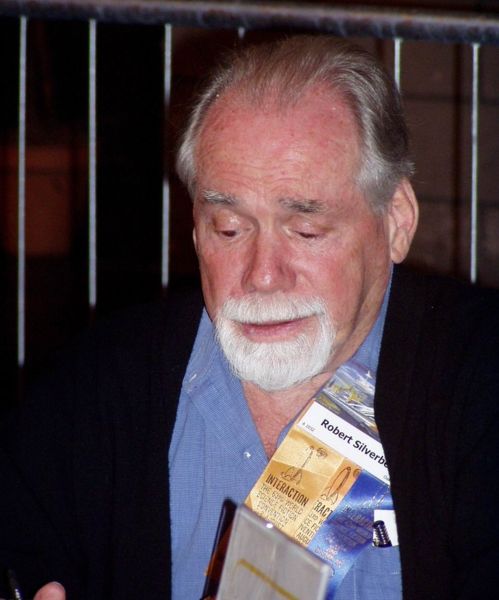
Robert Silverberg is an American author, best known for his work in the science fiction genre. He is a multiple winner of both the Hugo and Nebula Awards.
I mourn for the dodo, poor fat flightless bird, extinct since the eighteenth century. I grieve for the great auk, virtually wiped out by zealous Viking huntsmen a thousand years ago and finished off by hungry Greenlanders around 1760. I think the world would be more interesting if such extinct creatures as the moa, the giant ground sloth, the passenger pigeon, and the quagga still moved among us. It surely would be a lively place if we had a few tyrannosaurs or brontosaurs on hand. (Though not in my neighborhood, please.) And I’d find it great fun to watch one of those PBS nature documentaries showing the migratory habits of the woolly mammoth. They’re all gone, though, along with the speckled cormorant, Steller’s sea cow, the Hispaniola hutia, the aurochs, the Irish elk, and all too many other species.
But now comes word that it isn’t just wildlife that can go extinct. The element gallium is in very short supply and the world may well run out of it in just a few years. Indium is threatened too, says Armin Reller, a materials chemist at Germany’s University of Augsburg. He estimates that our planet’s stock of indium will last no more than another decade. All the hafnium will be gone by 2017 also, and another twenty years will see the extinction of zinc. Even copper is an endangered item, since worldwide demand for it is likely to exceed available supplies by the end of the present century.
Running out of oil, yes. We’ve all been concerned about that for many years and everyone anticipates a time when the world’s underground petroleum reserves will have been pumped dry. But oil is just an organic substance that was created by natural biological processes; we know that we have a lot of it, but we’re using it up very rapidly, no more is being created, and someday it’ll be gone. The disappearance of elements, though—that’s a different matter. I was taught long ago that the ninety-two elements found in nature are the essential building blocks of the universe. Take one away—or three, or six—and won’t the essential structure of things suffer a potent blow? Somehow I feel that there’s a powerful difference between running out of oil, or killing off all the dodos, and having elements go extinct.
I’ve understood the idea of extinction since I was a small boy, staring goggle-eyed at the dinosaur skeletons in New York City’s American Museum of Natural History. Bad things happen—a climate change, perhaps, or the appearance on the scene of very efficient new predators—and whole species of animals and plants vanish, never to return. But elements? The extinction of entire elements, the disappearance of actual chunks of the periodic table, is not something I’ve ever given a moment’s thought to. Except now, thanks to Armin Reller of the University of Augsburg.
The concept has occasionally turned up in science fiction. I remember reading, long ago, S.S. Held’s novel The Death of Iron, which was serialized in Hugo Gernsback’s Wonder Stories starting in September, 1932. (No, I’m not that old—but a short-lived SF magazine called Wonder Story Annual reprinted the Held novel in 1952, when I was in college, and that’s when I first encountered it.)

Because I was an assiduous collector of old science fiction magazines long ago, I also have that 1932 Gernsback magazine on my desk right now. Gernsback frequently bought translation rights to European science fiction books for his magazine, and The Death of Iron was one of them. The invaluable Donald Tuck Encyclopedia of Science Fiction and Fantasy tells me that Held was French, and La Mort du Fer was originally published in Paris in 1931. Indeed, the sketch of Held in Wonder Stories—Gernsback illustrated every story he published with a sketch of its author—shows a man of about forty, quintessentially French in physiognomy, with a lean, tapering face, intensely penetrating eyes, a conspicuous nose, an elegant dark goatee. Not even a Google search turns up any scrap of biographical information about him, but at least, thanks to Hugo Gernsback, I know what he looked like.
The Death of Iron is, as its name implies, a disaster novel. A mysterious disease attacks the structural integrity of the machinery used by a French steel company. “The modifications of the texture of the metal itself,” we are told—the translation is by Fletcher Pratt, himself a great writer of fantasy and science fiction in an earlier era—“these dry, dusty knots encysted in the mass, some of them imperceptible to the naked eye and others as big as walnuts; these cinder-like stains, sometimes black and sometimes blue, running through the steel, seemed to have been produced by a process unknown to modern science.” Which is indeed the case: a disease, quickly named siderosis, is found to have attacked everything iron at the steel plant, and the disease proves to be contagious, propagating itself from one piece of metal to another. Everything made of iron turns porous and crumbles.
Sacre bleu! Quel catastrophe! No more airplanes, no more trains or buses, no bridges, no weapons, no scissors, no shovels, no can-openers, no high-rise buildings. Subtract one vital element and in short order society collapses into Neolithic anarchy, and then into a nomadic post-technological society founded on mysticism and magic. This forgotten book has an exciting tale to tell, and tells it very well.
It’s just a fantasy, of course. In the real world iron is in no danger of extinction from strange diseases, nor is our supply of it running low. And, though I said a couple of paragraphs ago that the ninety-two natural elements are essential building blocks of the universe, the truth is that we’ve been getting along without two of them—numbers 85 and 87 in the periodic table—for quite some time. The periodic table indicates that they ought to be there, but they’re nowhere to be found in nature. Element 85, astatine, finally was synthesized at the University of California in 1940. It’s a radioactive element with the very short half-life of 8.3 hours, and whatever supply of it was present at the creation of the world vanished billions of years ago. The other blank place in the periodic table, the one that should have been occupied by element 87, was filled in 1939 by a French scientist, who named it, naturally, francium. It is created by the radioactive decay of actinium, which itself is a decay product of uranium-235, and has a half-life of just 21 minutes. So for all intents and purposes the world must do without element 87, and we are none the worse for that.
Gallium, though—
Gallium’s atomic number is 31. It’s a blue-white metal first discovered in 1831, and has certain unusual properties, like a very low melting point and an unwillingness to oxidize, that make it useful as a coating for optical mirrors, a liquid seal in strongly heated apparatus, and a substitute for mercury in ultraviolet lamps. It’s also quite important in making the liquid-crystal displays used in flat-screen television sets and computer monitors.
As it happens, we are building a lot of flat-screen TV sets and computer monitors these days. Gallium is thought to make up 0.0015 percent of the Earth’s crust and there are no concentrated supplies of it. We get it by extracting it from zinc or aluminum ore or by smelting the dust of furnace flues. Dr. Reller says that by 2017 or so there’ll be none left to use. Indium, another endangered element—number 49 in the periodic table—is similar to gallium in many ways, has many of the same uses (plus some others—it’s a gasoline additive, for example, and a component of the control rods used in nuclear reactors) and is being consumed much faster than we are finding it. Dr. Reller gives it about another decade. Hafnium, element 72, is in only slightly better shape. There aren’t any hafnium mines around; it lurks hidden in minute quantities in minerals that contain zirconium, from which it is extracted by a complicated process that would take me three or four pages to explain. We use a lot of it in computer chips and, like indium, in the control rods of nuclear reactors, but the problem is that we don’t have a lot of it. Dr. Reller thinks it’ll be gone somewhere around 2017. Even zinc, commonplace old zinc that is alloyed with copper to make brass, and which the United States used for ordinary one-cent coins when copper was in short supply in World War II, has a Reller extinction date of 2037. (How does a novel called The Death of Brass grab you?)
Zinc was never rare. We mine millions of tons a year of it. But the supply is finite and the demand is infinite, and that’s bad news. Even copper, as I noted above, is deemed to be at risk. We humans move to and fro upon the earth, gobbling up everything in sight, and some things aren’t replaceable.
Solutions will be needed, if we want to go on having things like television screens and solar panels and computer chips. Synthesizing the necessary elements, or finding workable substitutes for them, is one obvious idea. Recycling these vanishing elements from discarded equipment is another. We can always try to make our high-tech devices more efficient, at least so far as their need for these substances goes. And discovering better ways of separating the rare elements from the matrices in which they exist as bare traces would help—the furnace-flue solution. (Platinum, for example, always in short supply, constitutes 1.5 parts per million of urban dust and grime, which is ever-abundant.)
But the sobering truth is that we still have millions of years to go before our own extinction date, or so we hope, and at our present rate of consumption we are likely to deplete most of the natural resources this planet has handed us. We have set up breeding and conservation programs to guard the few remaining whooping cranes, Indian rhinoceroses, and Siberian tigers. But we can’t exactly set up a reservation somewhere where the supply of gallium and hafnium can quietly replenish itself. And once the scientists have started talking about our chances of running out of copper, we know that the future is rapidly moving in on us and big changes lie ahead.
Source. / Asimov’s Science Fiction
Thanks to devilstower / Daily Kos / The Rag Blog
Not even federal law can keep Bush’s fence from ripping through natural areas along the Rio Grande.
By Melissa del Bosque / June 27, 2008
The following article appears in the current issue of the Texas Observer [Vol. 100, No. 13, June 27, 2008].
Ken Merritt dedicated 31 years of his professional life to protecting endangered wildlife for the U.S. Fish & Wildlife Service. He’d still be doing the job he loved if not for a fateful decision. In December 2007, his bosses presented Merritt with a choice: Adhere to longstanding federal law, or sign off on a plan by the Department of Homeland Security to build an 18-foot steel wall through a wildlife refuge under his charge.
Merritt oversaw 180,000 acres of federally protected land that comprises three national wildlife refuges: the Lower Rio Grande Valley, the Santa Ana, and the Laguna Atascosa. In an area where 95 percent of the native habitat has fallen prey to development, the value of the refuges cannot be overstated. Over three decades, the federal government invested more than $80 million in buying and restoring habitat along the Texas-Mexico border, creating 115 refuges along the Rio Grande. Merritt’s three-refuge complex is the largest tract. Volunteers and federal employees painstakingly restored native grasses and trees to fallow farmland, and endangered species such as ocelots and jaguarundis slowly returned. The refuges are home to 700 species of birds and animals, as well as 300 species of butterflies, including the rare Telea hairstreak butterfly, which caused a stir last year in scientific circles when it was spotted for the first time in 70 years. The wildlife refuges have been an economic boon for one of the poorest regions in the country. The median annual household income along the border is $15,000. The more than 200,000 birders and ecotourists who visit the region generate an estimated $150 million a year.
Merritt assumed his job was secure. “I really didn’t think it was a career-ending decision until they told me so last December,” he says. “I thought what I was doing was right. But it was a train wreck waiting to happen.”
Merritt says his boss, Benjamin Tuggle, the southwest regional director at Fish & Wildlife in Albuquerque, explicitly asked him to approve the engineering survey for a fence through the Lower Rio Grande Valley National Wildlife Refuge. It was implied through numerous conference calls and a visit from Tuggle that the Bush administration wanted badly to begin building the border fence. A private environmental consulting firm from Colorado, E2m Inc., had won the contract to do surveys for the fence, and needed access to the refuge. The National Environmental Policy Act, however, requires that a wildlife refuge manager answer a series of questions to determine whether construction projects—in this case a border fence—are appropriate and not detrimental to wildlife in the refuge.
Merritt’s findings indicated the opposite. “It had no benefit for the refuge and no relationship to why the refuge was established,” Merritt says. He denied permission to perform the survey. Tuggle told him his choice was a “career-ending decision,” Merritt says. “He said some other things, which I won’t go into, but it was pretty ugly.” On January 3, Merritt retired.
Contacted by the Observer, Tuggle denied telling Merritt that his decision would end his career.
Merritt, 54, bemoans the politicization of wildlife protection under the Bush administration. He says political appointees with little background in wildlife management or biology have disregarded the agency’s mission, protecting the nation’s natural resources. “I put a lot of time and a lot of thinking into working through this issue on the border fence,” Merritt says. “And I came to the right conclusion about it, but nothing was done in the end because the waiver wiped everything out.”
The waiver in question stems from a provision Congress tucked into the Real ID Act in 2005 that allows the secretary of homeland security to ignore federal law in the name of national security. On April 1, Secretary Michael Chertoff used his authority to waive 36 federal laws, including the Clean Air Act, the Safe Drinking Water Act, the Antiquities Act, and the Native American Graves Protection Act. His waiver applies to 470 miles of southern border in California, Arizona, New Mexico, and Texas. The edict ended public input and interagency discussion on alternatives to the fence.
Yet, as Chertoff has admitted, building a fence through Texas’ wildlife refuges, while costly to taxpayers, will do little to solve America’s illegal immigration problems. The Government Accountability Office, a nonpartisan congressional watchdog, has estimated that building and maintaining fence segments along the southern border could cost $49 billion. Last July, Chertoff told CNN’s Late Edition that “fencing has a symbolic value, and it has usefulness in some parts of the border. And we’re going to use it where it is effective. The idea that you are going to solve the problem simply by building a fence is undercut by the fact that yesterday we discovered a tunnel. So the idea that fencing alone is a solution I think is overly simplistic.”
Despite complaints from congressional leaders about lack of public input, a class action lawsuit by several Texas border landowners and cities, and a lawsuit filed in the U.S. Supreme Court by Defenders of Wildlife and the Sierra Club, Chertoff expects private contractors to start building the fence in Texas by July or August.
In May, the Army Corps of Engineers began soliciting bids to build three segments of steel fence through the Lower Rio Grande Valley National Wildlife Refuge. Houston-based KBR Inc., formerly a subsidiary of Halliburton Co., is one of the companies bidding for the project.
Privatization of border security is a hallmark of the Bush administration’s effort to curb illegal immigration. At a January 2006 “Industry Day” in Washington, D.C., Deputy Director of Homeland Security Michael Jackson told more than 400 defense contractors, “We’re asking you, we’re inviting you to tell us how to run our organization.” Jackson, a former Lockheed Martin Corp. vice president, added, “This is an invitation to be a little bit aggressive, thinking as if you were owner and you were partners with CBP (U.S. Customs and Border Protection).”
In 2006, Boeing Co. won a multibillion-dollar contract to build and maintain “technology and tactical infrastructure projects” along the northern and southern borders. A Government Accountability Office report released in February indicated the contract runs for three years, with three one-year extension options. The GAO has repeatedly recommended that Homeland Security place a spending cap on the contract, to no avail.
Homeland Security’s Secure Border Initiative office, whose responsibility it is to oversee the Boeing contract and several other border-security projects, did not return six phone calls and four e-mails requesting comment.
Boeing drew the wrath of congressional leaders in February, when the company delivered a “virtual fence” to surveil the Arizona border near Tucson. It didn’t work. Under accelerated deadlines imposed by Congress and Homeland Security, the company used commercial software for police dispatchers. The company didn’t consult with Border Patrol agents as to what would work in the field. Congressional leaders threatened to take the project, called P-28, away from Boeing, but instead granted the company two more contracts worth $133 million to salvage the effort.
Democratic Congressman Raul Grijalva, whose district is on the Arizona border, has watched the P-28 debacle unfold over the past two years. “They screwed up the virtual fence, and $20.6 million was flushed down the toilet—no problem,” he says. “Now they’ve been given additional money to redo it. It’s nothing more than political symbolism.”
Chertoff announced this month that the technology would be operational in 2011.
In June 2007, Grijalva, who chairs the subcommittee on National Parks, Forests, and Public Lands of the House Natural Resources Committee, introduced the Borderlands Conservation and Security Act. His legislation requires, among other things, that Homeland Security publish full public notice and seek public input. And it repeals Chertoff’s waiver authority. Despite 49 co-sponsors, the legislation languishes in another House subcommittee—the equivalent of outer Siberia on Capitol Hill.
Grijalva has spent his whole life on the Arizona border, and he understands the complexities of the region. His Capitol office is decorated with Native American artwork and colorful southwestern décor. At times he slips into Spanish border slang. “The fence is not a deterrent for the high-level organized criminal organizations operating on both sides of the border,” he says. “Guns one way, dope the other way, human smuggling, stolen vehicles—those activities are now organized. And if you talk to Border Patrol agents who don’t have to carry the party line, they’ll tell you it’s not the poor pelado coming across to wash dishes in some restaurant that’s a threat. It’s the cartels that control Nuevo Laredo and Juarez in Texas and Naco, Nogales, and Agua Prieta in my state.”
Grijalva has been trying for months to get traction on his legislation. But it remains unacceptable to both Republicans and the Democratic leadership, the former for ideological reasons and the latter because it’s too controversial in an election year.
“When I first filed this bill, some of my colleagues thought it was a real pain in the ass,” Grijalva says. “Nobody thought the fence would be built. Then their communities started calling them.”
In April, he held a field hearing on his bill at the University of Texas campus in Brownsville. The hearing brought together seven committee chairs and a bipartisan panel of congressional members, including Republican Rep. Duncan Hunter of California, a primary architect of the Secure Fence Act. Colorado Republican Tom Tancredo, a staunch fence supporter, also took part. He had one of the more memorable lines of the day when he peevishly suggested that the border fence be built north of Brownsville since residents hated the plan so much.
One important witness was conspicuously absent. Grijalva had requested that a deputy or high-ranking member of Homeland Security be present to answer questions. Chertoff ignored Grijalva and the six other Democratic committee chairs, and didn’t send a high-level staffer.
“The administration is an animal unto itself,” Grijalva says.
Though Democrats have the majority in the House and the Senate, and control the administration’s purse strings, they have been reluctant to take on Homeland Security because they don’t want to be perceived as soft on security issues, Grijalva says.
“A lot of what we need to do as Democrats in Congress is not panic and stick our tails between our legs at the tactics that Homeland Security uses, such as ‘Oh, if you’re not for waiving 36 laws, building a fence, and putting the safety of the nation above a species, then you are obviously pro-terrorist, open borders, and don’t care about the security of our nation,’” he says. “It’s been a very convenient political hammer on both sides of the aisle.”
Grijalva’s hope is that Democrats can eventually reform Homeland Security, but he doesn’t see it happening until Bush has left the White House. “I think we can provide some real oversight over these agencies and at least minimize the damage and hold it until the new administration can come in and clean it up,” he says. “That’s the long-term strategy for me—holding the dogs at the gate until we can have a more rational look at border security and border policy. Because everything we are doing right now is in response to being perceived as a political advantage or disadvantage. And so when you create policy that way, like with the border fence, it is doomed to failure. Those policies have no lasting strength to them.”
Particularly galling to the congressman is Homeland Security’s plan to spend $1.3 billion to build a massive headquarters in Washington; the money will come from port of entry funding within the agency’s budget. Local officials, along with law enforcement personnel, have long begged for more money to beef up security at ports of entry along the border. “People are calling it the ‘Little Pentagon,’” Grijalva says of the new headquarters. “They squeezed port of entry funding, better security, and flow-of-traffic money slated for ports of entry to build it.”
He says he believes the agency never intended to follow federal law when building the fence segments across the southern border. “I think the waiver was always in the works,” he says. “There is a military mentality toward this now in the Department of Homeland Security. They use words like ‘operational management, operational control.’ They didn’t want to deal with the National Environmental Policy Act. Because Homeland Security feels it is to some extent part of the Defense Department and that oversight should be minimal and secretive. The National Environmental Policy Act is an open and public process, and in that culture they feel it’s their prerogative to be closed about it for security reasons.”
Every year, Grijalva says, at least 400 dead migrants who have succumbed to the elements are routinely discovered in the desert in his district. He is frustrated that the administration won’t work with local communities and law enforcement to come up with a border policy that works. Instead, private contractors are making millions off U.S. taxpayers building pieces of fence that no one believes will work. “This administration has made sure their allies have found a way to make money out of it,” Grijalva says. “I find it very disturbing.”
The congressman hasn’t given up on his legislation. He hopes to hold another hearing in July. While he has gathered support from 49 Democrats, not one Republican has joined them.
Noah Kahn, federal lands associate with Defenders of Wildlife, says his group has repeatedly met with Republican congressional members to persuade them to join Grijalva. “Many of them show interest, but they always ask, ‘Have any other Republicans signed on to the bill?’ No one wants to be the first Republican to sign on,” Kahn says.
“I don’t think I will get bipartisan support,” Grijalva says. “So the point quite honestly is to continue to move the issue—you don’t want it to disappear. We want to put this in front of the American people and say, ‘OK, the border fence is not going to solve the problem you perceive because, (a) it is dividing communities and, (b) it’s a waste of money, and it’s affecting the environment and our constitutional principles, such as private property and sovereign rights for native people.” Ken Merritt, for one, would like to see a real debate about the fence. On a sweltering June afternoon, he sits under a tree at the Santa Ana Wildlife Refuge in a contemplative mood. Just last December he was the boss here.
“The border fence really threw the service for a loop,” he says of Fish & Wildlife. “They wrote this policy about appropriate uses to protect the refuges as much as possible from political decisions. They never thought about a fence coming in. It’s a tough one because the administration wants a fence, and they are telling everyone down the line in the executive branch, ‘Make this thing happen.’”
Merritt says the American people shouldn’t have to choose between saving endangered species and securing the border. “You hear about a wildlife refuge and the border fence on Fox News, and they always paint it as black and white,” he says. “Do you want to save an ocelot or have our border secure? It’s a ridiculous question, because we ought to be able to have both.”
[Reporting for this story was supported by funding from the Fund for Constitutional Government.]
Source. / Texas Observer
EPA Wouldn’t Rubber Stamp Border Wall
By Melissa del Bosque / July 2, 2008Not even the Environmental Protection Agency was buying the border fence, according to documents released today by the Sierra Club.
In a 23-page document written in the past year about the Rio Grande Valley section of the fence, John Blevins, an EPA official, details the various reasons as to why the agency can’t rubber stamp Chertoff’s border fence plan. The first paragraph, titled “Purpose and Need,” highlights just about every question border residents have been asking for the past year.
Blevins writes:
“There is no text, studies, etc. that provide support for the Purpose and Need. There should be a section describing the amount of drug traffic that occurs along this sector, the number of illegal crossings, the number of Border Patrol responses, decreases in land values over time along the border, crime statistics, maps showing common interdiction locations, or the like. There are none in this document.”
Homeland Security officials should be answering these questions — especially when they plan on condemning private properties. Landowners such as Brownsville Resident Eloisa Tamez, 72, deserve an explanation why her land is targeted for the fence and not the River Bend Resort down the street.
But Chertoff wasn’t about to let something like a federal regulatory agency get in his way. In April — on April Fool’s Day, no less — Chertoff issued his imperial waiver of 36 federal laws — and thus bypassed agencies like the EPA and U.S. Fish and Wildlife.
In the current Observer issue, we highlight the story of Ken Merritt who worked at U.S. Fish and Wildlife for 31 years, but left the agency after refusing to sign off on Chertoff’s plan.
A U.S. Fish and Wildlife biologist recently told me that Homeland Security has created its own sham environmental assessments, since Chertoff waived the National Environmental Policy Act.
These new assessments are called the Environmental Stewardship Plan and the Biological Resource Plan. In this way, Chertoff is trying to create a patina of democracy and environmental stewardship for his border-fence boondoogle.
Source. / Texas Observer Blog
The Rag Blog

The former US Senator Jesse Helms, a legendary isolationist and defender of “Southern values” who spent much of his life goading liberals, died yesterday (July 4).
Universally known as ‘Senator No’ he was deeply sceptical of international cooperation and intervention. His refusal to ratify international accords, notably the Kyoto treaty on global warming, made him the bete noir of the Georgetown foreign policy establishment
”Compromise, hell! … If freedom is right and tyranny is wrong, why should those who believe in freedom treat it as if it were a roll of bologna to be bartered a slice at a time?” he wrote in an editorial setting out his political style back in 1959.
US business disliked him for his tireless campaigns for unilateral US economic sanctions on Iran and Cuba. He was also deeply sceptical of America’s opening up to China and always ready to reject international cooperation if it meant yielding American sovereignty.
As chairman of the Senate Foreign Relations Committee he used his power to oppose the international criminal court, the international land mine treaty, the Comprehensive Test Ban Treaty as well as Kyoto.
For many he was a caricature of a right wing conservative, being pro-gun, pro-death penalty and anti-abortion. He ran what many considered to be a vendetta against publicly-funded arts, and was frequently accused of homophobia and sexism,
He exploited racial divisions in his native North Carolina and was first elected to the US Senate in 1972. A deeply polarising figure in each of hi five contests he never won more than 55% of the votes. On the campaign trail he tapped into the fears of middle and working class white voters stirring up anger against affirmative actions programme to help unemployed blacks.
He famously ran a “white hands” ad that showed a white man crumpling up a letter while a narrator said: “You needed that job, and you were the best qualified, but they had to give it to a minority, because of a racial quota. Is that really fair?
He also used his power in the senate to block the nomination of black Americans to the courts and to ambassadorial positions.
A journalist in his early career, he persuaded millions of Americans that their country was being run by liberals in Washington, and controlled by the New York-based media.
Never caring much what his critics thought, he rampaged against what he believed were the evils of abortion, affirmative action and homosexuality.
“Just think about it – homosexuals, lesbians – disgusting people – marching in our streets, demanding all sorts of things including the right to marry each other and the right to adopt children. How do you like (that)?” he said.
Near the end of his career he would make his way his way through the US Capitol on a scooter. He decided not to run for a sixth term in 2002 and was diagnosed with vascular dementi after repeated minor strokes brain in 2006.
In his later years a compassionate side emerged that few of his colleagues believed was possible. At the instigation of U2’s Bono he accepted that debt was the cause of suffering in the developing world and campaigned for a debt relief bill and attended his first ever pop concert in Washington DC.
He was 86.
Source. / The Guardian, U.K.
Thanks to truthout / The Rag Blog
Thorne Webb Dreyer, Editor