There’s Just Something Wrong About Profit on Water


Tapped Out
By Lisa Margonelli / June 15, 2008

To paraphrase an old axiom: You don’t buy water, you only rent it. So why did Americans spend nearly $11 billion on bottled water in 2006, when we could have guzzled tap water at up to about one ten-thousandth the cost? The facile answer is marketing, marketing and more marketing, but Elizabeth Royte goes much deeper into the drink in “Bottlemania: How Water Went on Sale and Why We Bought It,” streaming trends cultural, economic, political and hydrological into an engaging investigation of an unexpectedly murky substance. Partway through her undoctrinaire book, Royte, a lifelong fan of tap water, refills her old plastic water bottle, reflecting that “what once seemed so simple and natural, a drink of water, is neither. All my preconceptions about this most basic of beverages have been queered.” And by the end of the book she will have discarded the old plastic bottle too, but not the tap.

“Bottlemania” is an easy-to-swallow survey of the subject from verdant springs in the Maine woods to tap water treatment plants in Kansas City; from the grand specter of worldwide water wars, to the microscopic crustaceans called copepods, whose presence in New York’s tap water inspired a debate by Talmudic scholars about whether the critters violated dietary laws, and whether filtering water on the Sabbath constituted work. (Verdict: no and no.) Water is a topic that lends itself to tour-de-force treatment (the book “Cadillac Desert” and the movie “Chinatown” come to mind), as well as righteous indictments and dire predictions (“Thirst: Fighting the Corporate Theft of Our Water,” “When the Rivers Run Dry: Water — The Defining Crisis of the Twenty-First Century”). Where others are bold, “Bottlemania” is subversive, and after you read it you will sip warily from your water bottle (whether purchased or tap, plastic or not), as freaked out by your own role in today’s insidious water wars as by Royte’s recommended ecologically responsible drink: “Toilet to tap.”

BOTTLEMANIA: How Water Went on Sale and Why We Bought It.
By Elizabeth Royte.
248 pp. Bloomsbury. $24.99.
Related
Op-Ed Contributor: A Fountain on Every Corner (May 23, 2008)
The ‘Bottlemania’ Web Site

Eww. Sorry. Let’s talk about those evil marketers. In 1987, Americans drank only 5.7 gallons of bottled water per person per year, but the cumulative impact of ad campaigns and the vision of Madonna fellating a bottle of Evian in “Truth or Dare” more than doubled consumption by 1997. In 2000 the chief executive of Quaker Oats bragged to analysts that “the biggest enemy is tap water.” By 2005, the enemy had become the consumer’s bladder; and in 2006, Pepsi, which owns Aquafina, spent $20 million suggesting that Americans “drink more water.” That year we drank 27.6 gallons each at a rate of about a billion bottles a week.

But marketing swings both ways. As quickly as bottled water became a symbol of healthy hyperindividualism — sort of an iPod for your kidneys — a backlash turned it into the devil’s drink. In 2006, the National Coalition of American Nuns came out against bottled water for the moral reason that life’s essential resource should not be privatized. New numbers surfaced: each year the bottles themselves require 17 million barrels of oil to manufacture, and, one expert tells Royte, “the total energy required for every bottle’s production, transport and disposal is equivalent, on average, to filling that bottle a quarter of the way with oil.” Mayors from San Francisco to New York suddenly became aware of the new symbolism of bottled water as a waste of taxpayer money, a diss of local tap water and a threat to the environment. Some canceled their city’s bottled water contracts. Chicago began taxing the stuff. And celebrities — among them Matt Damon and … Madonna — started backing a dazzling array of water charities in support of domestic tap and African water supplies, associating themselves with the magical ur-brand of “pure water” just as marketers and Madonna did in the early ’90s.

Royte asks, perceptively, if the pro-bottle and anti-bottle movements aren’t cut from the same plastic: “Is it fashion or is it a rising awareness of the bottle’s environmental toll that’s driving the backlash? I’m starting to think they’re the same thing.” To Royte, the author of “Garbage Land,” righteousness requires a greater commitment.

She finds it in Fryeburg, Me., a town of 3,000 that is trying to stop Nestlé’s Poland Spring from sucking 168 million gallons of water a year out of the pristine aquifer buried under its piney woods. As Royte arrives the town is in an uproar, with neighbor pitted against neighbor and rumors of secret planning-board meetings and of dummy corporations. Fryeburg is a “perfect example of water’s shift from a public good to an economic force,” she observes. The locals are more blunt: “This is what a water war looks like.” Fryeburg bears the burden of living at the other end of the giant green Poland Spring pipe. Residents of nearby Hiram count 92 water tankers rolling through their town in one typical 24-hour period; they feel themselves under siege precisely because their watershed is clean, while 40 percent of the country’s rivers and streams are too polluted for swimming or fishing, let alone drinking. Fryeburg residents try to repel the water company. They demand tests, throw a Boston Tea Party by dumping Poland Spring in a local pond, take the issue to Maine’s Supreme Judicial Court and hold a town meeting straight out of Norman Rockwell. Here I wish Royte had devoted more energy to the narrative. The people of Fryeburg and their complaints feel tentative — a sketch where a portrait could have been. And although her writing always flows, I sometimes wished for something less utilitarian.

That comes, unexpectedly, as Royte stands at the edge of the Ashokan Reservoir in upstate New York. “Ignoring the bluish mountains that form its backdrop and the phalanx of security guards in our foreground,” she gazes “down onto the spillway which curves and drops like a wedding cake, in four tiers, before sending its excess through a granite passage,” supplying 1.2 billion gallons a day through 300 miles of tunnels and aqueducts and 6,200 miles of distribution mains. There once was grandeur in public works, and Royte captures the mythic heroism that inspired the politicians and engineers to build great reservoirs more than a century ago. Their outsize civic largesse makes our current culture of single-serving bottles feel decidedly crummy. But returning to public water’s golden age, if it’s possible, will not come cheap. Royte says the country needs to invest $390 billion in our failing water infrastructure by 2020.

By the time I finished “Bottlemania” I thought twice about drinking any water. Among the risks: arsenic, gasoline additives, 82 different pharmaceuticals, fertilizer runoff sufficient to raise nitrate levels so that Iowa communities issue “blue baby” alerts. And in 42 states, Royte notes, “people drink tap water that contains at least 10 different pollutants on the same day.” The privatization of pristine water is part of a larger story, a tragic failure to steward our shared destiny. And if you think buying water will protect you, Royte points out that it too is loosely regulated. And there is more — the dangers of pipes and of plastic bottles, the hazards of filters, and yes, that “toilet to tap” issue. But there is slim comfort: Royte says we don’t really need to drink eight glasses of water a day. Drink when you’re thirsty, an expert says. That’s refreshing.

Lisa Margonelli is an Irvine fellow at the New America Foundation and the author of “Oil on the Brain: Petroleum’s Long Strange Trip to Your Tank.”

Source / The New York Times

Thanks to Betsy Gaines / The Rag Blog

Posted in RagBlog | Tagged , , | Leave a comment

Sen. Bond’s "Compromise" on Warrantless Wiretapping


Act now to save our rights
By Jim Retherford / The Rag Blog / June 13, 2008

Remember the Bill of Rights? Habeas corpus? Rule of law? It seems the New Corporatists view these concepts as “relics” of a bygone past.

Senator Kit Bond of Missouri is now floating legislation that he
calls a “compromise” on warrantless wiretapping. Unfortunately, the
bill would be a disaster for our civil rights and the rule of law. It
gives the President everything he’s demanded, including retroactive
immunity for telecom companies that spied on us without the warrants required by the current FISA law.

I just signed a petition calling on my representative to reject
Senator Bond’s legislation when it gets to the House. I hope you will
too.

Please have a look and take action.

Say No to Senator Bond’s FISA Capitulation
For over 30 years, the Foreign Intelligence Surveillance Act (FISA) has dictated necessary and appropriate ways for the U.S. government to collect intelligence on its own citizens for the sake of national security. Two key provisions of this law are that:

*The government must obtain a warrant from the Foreign Intelligence Surveillance Court (FISC) before spying on a citizen.

*Citizens have the right to sue if they believe they were spied upon illegally.

FISA provided broad leeway for every President from Carter to Clinton to conduct extensive intelligence-gathering operations. However, President Bush has decided that he is above warrants and judicial review, and major newspapers have reported that he has been using big telecoms like AT&T to spy on Americans without warrants for years.

Now, there are over 40 lawsuits against this arguably unconstitutional practice, and rather than taking his chances in court, President Bush is looking to his allies in Congress for a legislative back door solution. In February, the House of Representatives stood up to President Bush and protected the Constitution, but now the Senate is getting ready to cave in again. Senator Kit Bond is proposing a complete overhaul of FISA — he calls it a “compromise,” but we call it a catastrophe.

Here are some features of Senator Bond’s attack on civil liberties:

*Unlimited warrantless wiretapping for this President and every President for the next six years.

*Retroactive immunity for all the telecoms that helped President Bush wiretap illegally during the past 8 years — this time dressed up as a “trial” in the secret Foreign Intelligence Surveillance Court where a note from the President amounts to a get out of jail free card.

*No future judicial review for the President, either: the Attorney General gets to decide whether the President’s warrantless wiretapping is legal or not.

In order to avoid this disastrous legislation, all the House has to do is stand strong on their February vote, and stick with the current version of FISA. Send a message to your representative today, and him or her to vote for the Constitution by voting against Senator Bond’s catastrophic FISA “compromise” when it comes to the House.

Go here to sign the petition: Source. / Credo Action

The Rag Blog

Posted in Rag Bloggers | Tagged , , , | Leave a comment

Jim Hightower on The Media and a War Gone Missing

“And not a word about the war…”

And now a word about the war…
By Jim Hightower / June 11, 2008

George W keeps telling us that America is at war. But if were at war, he wouldn’t need to tell us, for we’d be fully engaged in the national effort.

In fact, America is not at war. Oh, our troops and their families most certainly are deep in the hell of George W’s war, but 99 percent of us have no personal involvement in it. We are making no sacrifices whatsoever, not even being taxed to pay for it. We’re at beaches, bars and barbeques this summer – not at war.

Neither is America’s media establishment. Media monitor David Carr reports that coverage of the war has fallen to a mere three percent of print and broadcast news, down from 25 percent as recently as September. Collectively, network TV is now devoting only four minutes a week to a war that already has killed 4,100 of our soldiers and is draining $12 billion a month out of our national treasury.

Why this big media yawn? Some publishers and editors have decided that the “story” isn’t that interesting anymore (of course, if their families were the ones at war, they undoubtedly would find the story riveting). Also, conglomerate owners are cutting newsroom budgets to jack up their profits, so they have fewer reporters to bring us war news.

But perhaps the biggest reason for the drop in coverage is this: the government does not allow it. At White House insistence, the Pentagon has so severely restricted the movements and freedoms of reporters and photographers in Iraq that most can’t do their jobs. Frustrated, many media outlets have simply withdrawn, choosing not to pay for reporters who aren’t allowed to report. I can certainly appreciate their frustration – but, wait a minute, isn’t this government lockdown of our media a rather huge story in itself? Surly that’s worthy of intensive reporting?

Meanwhile, people keep dying in a war that practically no one supports.

Source. / JimHightower.com

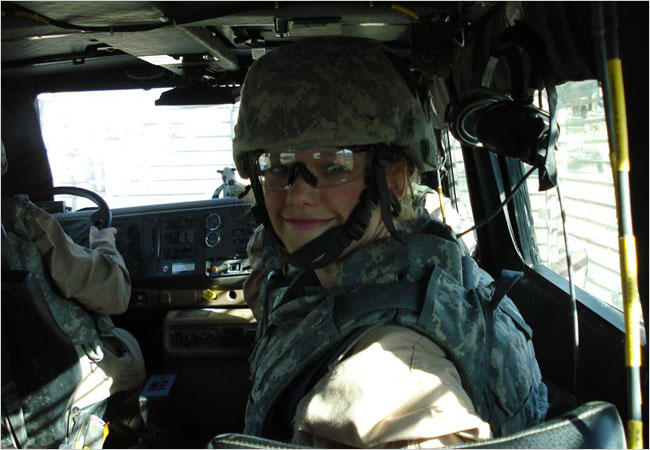
Cpl. Jessica Ann Ellis, 24, a medic, was injured in Iraq but wanted to return to the field. She was killed on May 11.

The Media Equation
The Wars We Choose to Ignore
By David Carr / May 26, 2008

Gen. John A. Logan was a Union officer, a fierce Republican partisan, an early advocate of the kind of volunteer army the United States now fights wars with. He is also one of the people credited with coming up with the holiday that we celebrate today. A statue in Logan Circle in Washington shows the general on horseback flanked by two female figures said to represent America at war and America at peace.

Given public indifference to a war that refuses to end, perhaps a third statue should be added: America at peace with being at war.

Even as we celebrate generations of American soldiers past, the women and men who are making that sacrifice today in Iraq and Afghanistan receive less attention every day. There’s plenty of blame to go around: battle fatigue at home, failing media resolve and a government intent on controlling information from the battlefield.

According to the Project for Excellence in Journalism’s News Coverage Index, coverage of the wars in Iraq and Afghanistan has slipped to 3 percent of all American print and broadcast news as of last week, falling from 25 percent as recently as last September.

“Ironically, the success of the surge and a reduction in violence has led to a reduction in coverage,” said Mark Jurkowitz of the Project for Excellence in Journalism. “There is evidence that people have made up their minds about this war, and other stories — like the economy and the election — have come along and sucked up all the oxygen.”

But the tactical success of the surge should not be misconstrued as making Iraq a safer place for American soldiers. Last year was the bloodiest in the five-year history of the conflict, with more than 900 dead, and last month, 52 perished, making it the bloodiest month of the year so far. So far in May, 18 have died.

Television network news coverage in particular has gone off a cliff. Citing numbers provided by a consultant, Andrew Tyndall, the Associated Press reported that in the months after September when Gen. David H. Petraeus testified before Congress about the surge, collective coverage dropped to four minutes a week from 30 minutes a week at the height of coverage, in September 2007.

It was also pointed out that when Katie Couric, CBS’s embattled anchor, went to Iraq to report the story, she and her network were rewarded with their lowest ratings in over 20 years. Hollywood producers who had hoped there would be a public interest in cinematic perspectives on this war have been similarly punished.

The war remains on the front burner for some outlets. On Sunday, The Los Angeles Times gave over much of its front page to chronicling Californians who have died fighting in Iraq and Afghanistan. The Washington Post continues to personalize the war with a series called Faces of the Fallen.

Earlier this spring, Alissa J. Rubin of The New York Times wrote about flying in a C-130 in Iraq, accompanied by soldiers, including one in a coffin at the back of the plane.

“I wondered what exactly he had died for. And although I did not know him, I felt melancholy as we flew onward, accompanied now by ghosts and memories of loss,” she wrote.

She may have been haunted by her proximity, but the rest of us? Not so much. I asked Bill Keller, the executive editor of The Times, how a war that had cost thousands of lives and over $1 trillion was losing news salience.

“There is a cold and sad calculation that readers/viewers aren’t that interested in the war, whether because they are preoccupied with paying $4 for a gallon of gas and avoiding foreclosure, or because they have Iraq fatigue,” he wrote in an e-mail message, adding that The Times stays on the story as part of an implied contract with its readers.

Other news editors have made the judgment — perhaps prodded by falling revenue and slashed news budgets — that public attitudes toward the war have become so calcified that few are interested in learning more. Why bother when things don’t change?

Except that they do, in a heartbeat. Last Thursday, Steve and Linda Ellis of Baker City, Ore., held a funeral for their daughter, Army Cpl. Jessica Ann Ellis. Corporal Ellis, a 24-year-old combat medic, died May 11 in Baghdad, a victim of a roadside bomb during her second tour of Iraq. She had been injured just three weeks before in a similar attack, but chose to go back out. She was assigned to the Second Brigade Special Troops Battalion, Second Brigade Combat Team, 101st Airborne Division and had curly, unruly hair, which brought her the nickname “Napoleon Dynamite” early in her military career.

More than 300 people gathered around this collective wound at St. Francis de Sales Cathedral, according to The Baker City Herald. In the funeral Mass, Bishop Thomas Connolly spoke plainly of her contribution.

“She was a good medic, well-trained and as brave as could be,” the newspaper quoted him as saying.

Hanging in the building where I work, there is a striking picture from the newspaper’s archives (by Angel Franco, a New York Times photographer) of a young soldier in Arizona looking up into the eyes of her father, saying goodbye, her eyes shiny with love and fear. I look at the picture every day as I walk by and think of my 20-year-old twin girls, safe at college. The feeling of gratitude is always followed by guilt. My girls are out of harm’s way, but what about that man’s daughter? What about Ms. Ellis?

On Saturday, her parents received an e-mail message from one of the colleagues in Iraq she was charged with looking after.

“There are wounds that don’t show on the outside,” he wrote. “She gave me the best medicine for what I had — hope and love.”

In a phone call Sunday, Mr. Ellis set aside his grief to describe his loss and the loss to the country she served.

“She wanted to be there for her guys; she told us that,” he said. “She gave the largest sacrifice a person possibly could, selflessly, like she did every day of her life.”

He added, “Jessica was a child who had no care in the world, none, besides making you smile, besides making you feel better.”

And although the Pentagon and the current administration will go to great lengths today to talk about the pride we should all feel in the fighting women and men of this country, increasingly onerous rules of engagement for the news media and the military make it difficult for the few remaining reporters and photographers to do their job: showing soldiers doing theirs.

Yes, the message seems to be, we honor the dead, but do not show them in your pictures. Of course, we care deeply about the wounded, but you now need their signed permission to depict their sacrifice. As the number of reporters and photographers has gone down, the efforts to control those who remain have gone up.

Ashley Gilbertson, a freelance photographer who has covered the war for Newsweek, Time and The New York Times and has written about covering the conflict in a book called “Whiskey Tango Foxtrot,” will be going back to Iraq in June. It will be his sixth time there, temperatures will range up to 130 degrees, and each time he has gone back there have been new restrictions.

“Many of my colleagues have turned away from the story because it has gotten to the point where they feel they just aren’t going to get anything useful, which I completely understand,” he said, adding that nonetheless, when the surge ends this summer, he wants to be there to chronicle what follows.

General Logan wrote long ago that both the glories and the consequences of war needed to be shared by all. He warned against “the dangers of confining military knowledge to a comparatively small number of citizens, constituting the select few who may hold the destinies of the country in their hands.”

Source. / New York Times

The Rag Blog

Posted in RagBlog | Tagged , , , , , | 1 Comment

Surprise!

We’re Voting Republican!

Thanks to Rik Sternberg / The Rag Blog

Posted in RagBlog | Tagged , , , | Leave a comment

Gore Vidal’s Article of Impeachment

Fightin’ words: Rep. Dennis Kucinich brandishes his pocket Constitution on the campaign trail in New Hampshire last January. Photo by Stephan Savoia / AP

I listened with awe to Kucinich…
By Gore Vidal / June 11, 2008

On June 9, 2008, a counterrevolution began on the floor of the House of Representatives against the gas and oil crooks who had seized control of the federal government. This counterrevolution began in the exact place which had slumbered during the all-out assault on our liberties and the Constitution itself.

I wish to draw the attention of the blog world to Rep. Dennis Kucinich’s articles of impeachment presented to the House in order that two faithless public servants be removed from office for crimes against the American people. As I listened to Rep. Kucinich invoke the great engine of impeachment—he listed some 35 crimes by these two faithless officials—we heard, like great bells tolling, the voice of the Constitution itself speak out ringingly against those who had tried to destroy it.

Although this is the most important motion made in Congress in the 21st century, it was also the most significant plea for a restoration of the republic, which had been swept to one side by the mad antics of a president bent on great crime. And as I listened with awe to Kucinich, I realized that no newspaper in the U.S., no broadcast or cable network, would pay much notice to the fact that a highly respected member of Congress was asking for the president and vice president to be tried for crimes which were carefully listed by Kucinich in his articles requesting impeachment.

But then I have known for a long time that the media of the U.S. and too many of its elected officials give not a flying fuck for the welfare of this republic, and so I turned, as I often do, to the foreign press for a clear report of what has been going on in Congress. We all know how the self-described “war hero,” Mr. John McCain, likes to snigger at France, while the notion that he is a hero of any kind is what we should be sniggering at. It is Le Monde, a French newspaper, that told a story the next day hardly touched by The New York Times or The Washington Post or The Wall Street Journal or, in fact, any other major American media outlet.

As for TV? Well, there wasn’t much—you see, we dare not be divisive because it upsets our masters who know that this is a perfect country, and the fact that so many in it don’t like it means that they have been terribly spoiled by the greatest health service on Earth, the greatest justice system, the greatest number of occupied prisons—two and a half million Americans are prisoners—what a great tribute to our penal passions!

Naturally, I do not want to sound hard, but let me point out that even a banana Republican would be distressed to discover how much of our nation’s treasury has been siphoned off by our vice president in the interest of his Cosa Nostra company, Halliburton, the lawless gang of mercenaries set loose by his administration in the Middle East.

But there it was on the first page of Le Monde. The House of Representatives, which was intended to be the democratic chamber, at last was alert to its function, and the bravest of its members set in motion the articles of impeachment of the most dangerous president in our history. Rep Kucinich listed some 30-odd articles describing impeachable offenses committed by the president and vice president, neither of whom had ever been the clear choice of our sleeping polity for any office.

Some months ago, Kucinich had made the case against Dick Cheney. Now he had the principal malefactor in his view under the title “Articles of Impeachment for President George W. Bush”! “Resolved, that President George W. Bush be impeached for high crimes and misdemeanors, and that the following articles of impeachment be exhibited to the United States Senate.” The purpose of the resolve is that he be duly tried by the Senate, and if found guilty, be removed from office. At this point, Rep. Kucinich presented his 35 articles detailing various high crimes and misdemeanors for which removal from office was demanded by the framers of the Constitution.

Update: On Wednesday, the House voted by 251 to 166 to send Rep. Kucinich’s articles of impeachment to a committee which probably won’t get to the matter before Bush leaves office, a strategy that is “often used to kill legislation,” as the Associated Press noted later that day.

Source. / truthdig

Kucinich, O’Reilly face off over impeachment


Thanks for video to Jim Baldauf / The Rag Blog

Posted in RagBlog | Tagged , , , , , , , , | Leave a comment

Port Arthur Site Set to Burn Toxic PCBs

Life in Port Arthur, Texas is about to get worse. Photo by AP.

EPA poised to let Mexican imports be destroyed in Texas town
By Matthew Tresaugue / June 13, 2008

PORT ARTHUR — The west end of this Gulf Coast refinery town is a weedy pocket of poverty, with blocks of shuttered storefronts and blue tarps still covering the rooftops of houses damaged by Hurricane Rita nearly three years ago.

Hilton Kelley, 47, sees his neighborhood’s commercial activity moribund, its residents sick, its children with nothing to do, and he blames the fire-and-fume-belching cluster of oil and petrochemical plants around Port Arthur.

Now the U.S. Environmental Protection Agency is poised to grant a request by the operator of a Port Arthur incinerator to import up to 20,000 tons of highly toxic PCBs from Mexico for their disposal. To many people living on the city’s predominantly black west end, the proposal is the ultimate affront.

“This adds insult to injury,” said Kelley, who heads the Community In-Power and Development Association. “Enough is enough already.”

Veolia Environmental Services’ petition comes nearly 30 years after legislation that banned the manufacture of PCBs, polychlorinated biphenyls, also prohibited bringing them into the United States. The EPA ruled in 1996 that the chemical compounds may be brought into the country for incineration, but a federal appeals court overturned the decision.

Agency officials, echoing the reasons for reversing the ban a decade ago, argue that the destruction of PCBs in this country is safer than allowing stockpiles to fester in Mexico and other nations.

But critics contend that there are cleaner, safer disposal methods for PCBs. When burned, they produce dioxin, which is linked to cancer, brain damage, reproductive problems and other ailments in humans.

Despite precautions, incinerators emit minute quantities that enter the food chain through meat, dairy products and fish — leading some to wonder why Port Arthur residents should again shoulder such an onerous burden.

“They’re getting all of the emissions and none of the prosperity,” said Jim Blackburn, a Houston-based environmental attorney who represented Port Arthur residents in a recent lawsuit over Motiva Enterprises’ expansion plans. “Why should we make an exception to put more pollution on a community that already has taken on more than its fair share?”

Environmentalists have dubbed the area “The Cancer Belt,” but there is no proven link to the refineries and Jefferson County’s cancer rate, which was 23 percent higher than the state overall, according to the Texas Cancer Registry’s most recent data.

• What: EPA hearing

• Where: Port Arthur City Hall, 444 Fourth St.

• When: 3:30-8:30 p.m., June 19

Refinery to expand

The health problem is part of the plight of Port Arthur, where the median household income is about $35,000 a year, less than half of Sugar Land. While there isn’t much left of downtown, new houses, restaurants and big-box stores are sprouting along the corridor leading to Beaumont and away from the biggest plants.

Last year Motiva began an expansion that will more than double the capacity of its Port Arthur refinery to 600,000 barrels a day by 2010 and make it the largest in the country. The plant is across the street from the Carver Terrace public housing project.

The Army also began shipping 1.7 million gallons of a nerve gas byproduct called hydrolysate from Indiana to Veolia’s incinerator, located about five miles west of downtown on Texas 73. The contract is worth $49 million.

Veolia applied to import PCBs in November 2006 before receiving the Army contract. Under the proposal, the company would ship the compounds by truck through Houston to Port Arthur — a distance of about 460 miles from entry points in Brownsville and Laredo.

Mexico now sends PCBs to Europe for incineration, exposing the compounds to loss at sea. The transportation cost for overseas shipment is at least three times more expensive than moving the waste from Monterrey, Mexico, to Port Arthur, according to the company.

Plant’s estimate

The Veolia facility, permitted to handle up to 150,000 tons of hazardous waste per year, burns between 20 million and 30 million pounds of PCB wastes from domestic sources annually. Mitch Osborne, the plant’s general manager, said smokestack tests show the incinerator destroys more than 99 percent of the material.

But environmentalists are not so sure about the plant’s safety record, pointing to the 1,933 pounds of PCBs that it reported releasing into the air in 2006, the most recent data available.

The plant alone accounted for more than two-thirds of the PCB releases nationwide, according to the federal Toxics Release Inventory, which is based on industry estimates.

Osborne said the plant’s estimate is wrong because of a bookkeeping error. In correspondence with the EPA last month, company officials said the amount should be less than one pound.

“If we didn’t think we could do it safely, then we wouldn’t bring it here,” Osborne said. “We have proven our capability over 15 years. It’s safer to burn here than to leave it in place.”

The EPA apparently agrees.

Position called absurd

The agency is proposing a one-year exemption for Veolia to import and burn the PCBs because the company “has demonstrated that no unreasonable risk to health or the environment would result,” EPA spokeswoman Roxanne Smith said.

The agency also contends that because the proposal poses no unreasonable health hazards to Port Arthur’s residents, there is no “environmental justice” issue.

Neil Carman, a former Texas Commission on Environmental Quality inspector who now works with the Sierra Club’s Lone Star chapter, said the EPA’s position is “absurd” because “incineration is a dinosaur technology.”

Carman said there are EPA-approved, non-burn technologies that could be used to dispose of the compounds in Mexico. A process called chemical dechlorination, for example, treats the PCB waste with a liquid agent that breaks down the toxins by removing their chlorine components.

“It’s inexcusable for Veolia to burn PCBs because they don’t all burn up,” Carman said, adding that the Sierra Club would sue if the EPA grants the plant’s request. “This could set a precedent that opens up the floodgates.”

Copyright 2008 Houston Chronicle

Source. / Houston Chronicle

The Rag Blog

Posted in RagBlog | Tagged , , , , , | Leave a comment

Obama Web Site : Fight the Smears

Obama has launched a web site to take on
malicious rumors about him, his family, and his campaign. Running this would be a 24/7 job for more than one person.

Guess I’m showing my geezerhood but it still amazes and confounds me that some slimy son of a bitch can fabricate a lie, throw it out on the Internet, and immediately it acquires a certain aura of “truth.”

Anyway, here’s the link to Fight the Smears. You can even see a copy of his birth certificate, and yes, he was born in Hawaii, and yes his name is really Barack Hussain Obama II.’

The truth shall make you free and piss a lotta fascists off.

twisty / The Rag Blog / June 12, 2008

Go to Fight the Smears

The Rag Blog

Posted in Rag Bloggers | Tagged , , , , | Leave a comment

Fox News : "Obama’s Baby Mama"


Fox Forced to Address Michelle Obama Headline
By Jim Rutenberg / June 12, 2008

For the third time in less than three weeks, Fox News Channel has had to acknowledge using poor judgment through inappropriate references to Senator Barack Obama.

The network has released a statement saying it should not have referred to Mr. Obama’s wife, Michelle, as “Obama’s Baby Mama,’’ as it did on Wednesday in an on-screen headline commonly called a “chyron.”

“A producer on the program exercised poor judgment in using this chyron during the segment,” Bill Shine, a Fox News senior vice president, said in a statement.

The chyron appeared during a discussion between the conservative columnist Michelle Malkin and the Fox News anchor Megyn Kelly about political attacks against Mrs. Obama. It read in full, “Outraged Liberals: Stop picking on Obama’s baby mama!” It was first publicized on Wednesday by Alex Koppelman of Salon.

The Oxford English Dictionary defines the term as one “chiefly in African-American usage” that refers to, “The mother of a man’s child, who is not his wife nor (in most cases) his current or exclusive partner.”

Earlier this week, the Fox News anchor E.D. Hill had apologized for raising the possibility that the Obamas affectionate fist bump during the senator’s victory rally in St. Paul on June 3 was “a terrorist fist jab.’’ Two weeks prior, the Fox News analyst Liz Trotta said she regretted making a joke about a possible assassination of Mr. Obama.

Her mea culpa followed that of former Gov. Mike Huckabee of Arkansas a week earlier after he made a similar crack at a gathering of the National Rifle Association.

In other news, Fox News Channel announced today that it was hiring Mr. Huckabee as a contributor.

Source. / The Caucus / NYT

Thanks to Harry Edwards / The Rag Blog

Posted in RagBlog | Tagged , , , , , | Leave a comment

Singin’ on Thursday – Save the Country

Rosanne Cash with Rodney Crowell

This tune comes thanks to Betsy Gaines. It is Rosanne Cash singing Save the Country.


The Rag Blog

Posted in RagBlog | Tagged | 1 Comment

BushCo Demands Are Unacceptable to Many Iraqis


Iraq officials question need for U.S. troop presence
By Ned Parker / June 11, 2008

Negotiations are underway between the two countries to decide how long troops will stay. The U.S. is scaling back its forces.

BAGHDAD — Officials in Prime Minister Nouri Maliki’s ruling coalition are questioning whether Iraq needs a U.S. military presence even as the two countries press forward with high-pressure negotiations to determine how long American forces will remain.

Some officials in Maliki’s Islamic Dawa Party and his larger Shiite United Iraqi Alliance bloc, which has cooperated with the U.S., have spoken in favor of imposing severe restrictions on U.S. forces after the United Nations mandate authorizing their presence expires at the end of the year.

Maliki and President Bush last year outlined goals for an agreement covering military, trade and cultural relations. They pledged to return Iraq to full sovereignty and said the agreement was expected to be finalized by July 31.

According to Iraqis, Americans supported a draft of the agreement that called for allowing U.S. forces to detain Iraqis and conduct missions without the government’s permission. They have also said the Americans required up to 58 permanent bases, control of Iraqi airspace and immunity for troops and contractors.

American officials have refused to disclose their negotiating stance and have accused their critics of deliberately distorting U.S. positions.

David Satterfield, the State Department’s senior advisor on Iraq, said Tuesday that the U.S. remained committed to an agreement by late July. He denied that the U.S. was pushing demands that infringed upon Iraq’s independence.

“We want to see Iraqi sovereignty strengthened, not weakened,” he said.

U.S. forces are scaling back from a massive troop buildup last year known as “the surge,” which helped put the brakes on Iraq’s civil war. U.S. troop levels are expected to drop to an estimated 140,000 by July as the Americans evaluate the effect of their military reductions on Iraq’s security. It remains to be seen whether the fragile peace between the country’s Shiite majority and onetime Sunni elite will hold if the Americans quickly leave the country.

United Iraqi Alliance lawmaker Sami Askari, who is considered a member of Maliki’s inner circle, said the changes in opinions in many cases are gradual.

“There is the camp who still believe that we need the Americans to stay and the other camp that says we don’t need them anymore,” Askari said. “You can’t draw a line, even within the Dawa Party, even within” the alliance, he said.

Shiite officials like Askari have warned there is no way any Iraqi politician could back the current U.S. security agreement proposals.

“If I’m from the group that believes in the need for the Americans to stay, and then they face me with such a draft, then I’ll say, look, I’d rather go with the others,” Askari said.

Iraqi Foreign Minister Hoshyar Zebari, a Kurd, has defended the agreement. “The recent statements you’ve heard, the recent politicking you heard by different groups has really been very unhelpful,” he said. “There has been no agreement yet.

“Secondly, most of the statements are coming from people who are unaware or not involved in the heart of this negotiating procedure. It has really been used for political brinksmanship,” Zebari said.

Senior Iraqi politicians and Western officials confirmed the friction and debate within the alliance about an agreement.

“Of course there are some people who are against it, no doubt,” said Deputy Prime Minister Barham Salih, who is a leading negotiator on the Iraqi side. Salih vowed that the Kurds, Maliki and the country’s presidency council would get approval for a bilateral agreement despite any opposition within the alliance.

Others warned that some Dawa members were seeking to sabotage a long-term deal.

“There is a lot of misrepresentation. It is deliberate. Some people don’t want this on principle. Some people may have ideological problems with this. Now they are showing their true colors,” said a senior Iraqi official who did not wish to be identified because it could endanger his position.

He warned that even Maliki’s backing was not a given. The prime minister is faced with pressure within his party. In the past, officials have described Maliki as flip-flopping on government decisions.

The official described Dawa members as having become overconfident after successful military campaigns this spring in the southern port of Basra, Baghdad’s Sadr City and Mosul that relied heavily on U.S. air support to defeat Sunni and Shiite armed groups.

Read all of it here. / Los Angeles Times

The Rag Blog

Posted in RagBlog | Tagged , , , | Leave a comment

Old McDonald Had a Pharm…


…And genetically modified his goats and chickens to produce drugs for humans.

But hold on. Should we be doing this to animals?
By Elizabeth Svoboda / June 11, 2008

Encompassed by pastoral green fields, the headquarters of GTC Biotherapeutics looks like any other New England farmstead. But its serenity is deceiving. Behind barn doors, the farm’s most valuable employees — a herd of pygmy goats from New Zealand — are working round the clock, their milk glands churning out hundreds of gallons of high-grade pharmaceutical compounds.

The white gold extracted from the goats’ udders will someday command big bucks in the American healthcare marketplace — or so GTC hopes. The company’s genetically modified animals possess a human gene that allows them to produce milk rich with a protein called antithrombin, which helps prevent blood clots from forming and staves off related conditions like heart attacks and strokes

Tom Newberry, GTC’s vice president of corporate communications, leads me into a corrugated-metal hutch. Goats enclosed in pens train inquisitive rectangular pupils on us and poke their heads through the bars. “They’re looking for a handout,” Newberry says, chuckling. But we can’t give these goats kibble or even a pat on the head; that would be a breach of strict sanitary regulations.

ATryn, GTC’s goat-derived antithrombin, cleared its first regulatory hurdle in 2006 when the European Commission approved it for sale in all 25 European Union countries. This past fall, GTC successfully lobbied the U.S. Food and Drug Administration to designate ATryn as a “fast-track product,” making it eligible for accelerated review on this side of the Atlantic.

But GTC is out to prove it’s no one-trick ruminant. Staff scientists have created transgenic goats that can churn out a smorgasbord of human proteins, including compounds that halt tumor blood-vessel development and blood-clotting factors for hemophiliacs. Protein-based human antibodies that protect against all kinds of diseases — from SARS to incurable cancers — could be next in the dairy pipeline.

A bevy of biotech companies is crowding the drug market with takes on the transgenic-remix concept. Origen, located in Burlingame, Calif., is developing a transgenic production line that employs chickens instead of goats as drug incubators. The company has bred birds that produce a range of human anticancer proteins and other antibodies in their eggs. In Athens, Ga., AviGenics is using a transgenic-chicken system to make a protein compound that stimulates the bone marrow to make more white blood cells — essential in helping cancer patients bounce back after chemotherapy.

“Transgenic drug technology has been in the incubation stage for a long time,” says Robert Kay, president and CEO of Origen. “But within the next five to 10 years, we should be seeing many new products in the clinic and pushing their way toward approval.” Future drug-producing menageries, he predicts, will include pigs, cows and rabbits.

While these transgenic pioneers might seem to be cruising toward FDA approval, the road is hardly without obstacles. To the frustration of executives like Kay and Newberry, most of the snags are not financial or logistical but arise from people’s reflexive reactions — as in, Omigod, they’re putting human genes into animals! It’s “The Island of Dr. Moreau” made real.

But the revulsion to transgenic animals is more than reflexive; some animal biologists say biotech companies are overselling the safety of the resulting drugs. Meanwhile, ethicists question whether we should be restyling animals as drug producers at all.

GTC transforms goats into drug factories thanks to a recently perfected biological sleight of hand. Once a goat embryo is artificially fertilized in the lab, technicians zero in on the portion of the goat’s genome that codes for a sugar found in goat milk and insert a human gene that codes for a naturally occurring protein. When the animal reaches maturity and begins producing milk, every cup of the white stuff contains large quantities of the therapeutic protein, which can be chemically extracted in pure form. “The mammary gland is nature’s way of making proteins that are nutritious for offspring,” Newberry says. “All we’re doing is placing extra DNA coding in this natural pathway.”

Before transgenic breeding, pharmaceutical companies normally extracted such protein compounds from donated blood plasma. But to get the same kilogram of antithrombin that a single transgenic goat produces each year, you’d have to get 50,000 people to donate blood — a time-consuming process with its own inherent risks. “It’s so bloody expensive, excuse the pun,” Newberry says, “and the Red Cross just got hit with another set of fines for insufficient screening. Now, would you rather have a drug derived from human blood donors, or from our goats, given that we know where they slept last night?”

That question ignores a key fact. “Using goats for drug production has unpredictable effects, and the genetic inheritance of the modified genes is not a given — 90 to 99 percent of the animals bred are killed immediately because they don’t incorporate the desired gene,” says Jessica Sandler, director of the regulatory testing division at People for the Ethical Treatment of Animals.

Creating transgenic animals does indeed have a high failure rate. With the technique known as pronuclear injection, only about one to 10 of every 100 attempts results in transgenic offspring, producing a high number of animals typically earmarked for euthanasia. The more sophisticated nuclear-transfer method that GTC uses ensures that virtually 100 percent of viable offspring are transgenic. Still, the transgene does not always land in the targeted section of the genome, and some offspring end up with severe birth defects for reasons that are still not well understood.

Tom Regan, a philosophy professor emeritus at North Carolina State University and author of “Empty Cages,” sees the death and suffering of defective animals as a grave ethical misstep. “The animals used for these purposes are in fundamental ways like us — their behavior tells us they’re like us, evolutionary theory tells us they’re like us,” he says. “What we have with transgenic research is another incentive for reducing animals to something whose purpose for being in the world is to serve human interests. And that’s fundamentally flawed.”

Others contend that raising animals to produce drugs is no crueler than raising them for agricultural purposes. “I’ve been involved in this for a long time, and the animals we have are positively spoiled,” says dairy scientist Robert Bremel, founder of transgenics company ioGenetics. “If the drug product is innocuous to the animals themselves, they do fine.”

Debates over animals’ welfare and self-determination aside, there’s the question of whether transgenic animals will produce drugs that create unexpected side effects in humans. “We have to be careful about the activation of retroviral or pathogenic agents,” says Doug Gurian-Sherman, a senior scientist with the Union of Concerned Scientists’ food and environment program, adding that human drug products derived from animals could potentially pass on such pathogens to recipients.

Spurred by similar worries, the National Academy of Sciences’ research council formed a committee to assess the safety of animal biotechnology products. “The mere fact that something is produced by a genetically altered animal does not make it harmful,” says John Vandenbergh, a biologist who chaired the committee. “But there was concern that some of these new proteins could induce allergic reactions in people.” The report the committee issued in 2002 recommended controls to keep transgenic animal products out of the food supply. (GTC adheres strictly to such standards, Newberry says: “We don’t sell our milk, and we give our dead goats to a licensed contractor that incinerates them.”)

To be sure, squeamishness about human-animal hybrids has a storied pedigree: Geryon of Dante’s “Inferno,” who dwells in the lowest circles of hell, is a fearsome crossbreed with a human face and a scaly tail. But is equating chimerism with fallen virtue still justified? What rules should govern foisting part of the genetic code that makes us human — no matter how small — onto chickens, goats and rabbits?

“With chimeras, we are challenging our concepts of what it means to be ‘human,'” bioethicist Linda MacDonald Glenn, a former ethics fellow at the American Medical Association, said in a 2003 speech. “We need to be prepared to ask, ‘How can we preserve our human rights and dignity despite the fact that our “humanness” may no longer be the exclusive possession of Homo sapiens?'”

Today, Glenn still struggles with questions about what “humanness” signifies. “If you say, ‘Humans are the ones who can reason,’ what happens when you have a child who’s born with mental deficiencies?” she says. “It’s insulting to say that child’s not a person. On the other hand, there are also animals that have high cognitive abilities.” The lack of a clear-cut distinction between humans and animals, Glenn says, makes it difficult to justify the process of drastically modifying animal genomes, though she feels some genetic alterations may be appropriate if they stand to improve human health and well-being significantly. “We are all interconnected. It’s important that we treat the goats with respect, because they’re really not that far away from us.”

In Newberry’s view, this kind of deep-waters philosophy is unwarranted. He scoffs at the implication that GTC’s operations are even in the Dr. Moreau ballpark. “People say, ‘Are they breeding centaurs out there, some kind of man-goat beast?’ No, of course not. We put a control sequence in the transgene to make sure it’s only turned on during lactation. And there’s a big difference between manipulating a single gene, like we’re doing, and manipulating a whole chromosome. Treating them the same is like saying, ‘I moved my brother-in-law into his new apartment with a pickup truck. Now I’m going to move all of New York City with that same truck.'”

Despite the deeply ingrained public perception that, darn it, there’s something just not right about this kettle of fish, companies like GTC may succeed if they can make a lights-out case for the medical necessity of their products. After all, even conservative grande dame Nancy Reagan became a stem-cell research crusader once she realized the treatment was the best hope to reverse her late husband’s Alzheimer’s.

“The bottom line is that people do these trade-off calculations,” says Edna Einsiedel, a communications professor at the University of Calgary. The World Organization for Animal Health commissioned her to write a 2005 survey report assessing the tenor of public opinion regarding transgenic animals. “There seems to be a hierarchy in terms of preferences — people view medical-related applications more positively than food-related ones. But there’s still some discomfort with the idea that you’re taking genes from one species and putting them into another. People ask things like, ‘What kind of animal will you end up with?'” At the same, Einsiedel continues, “Sometimes when you explain things to people in greater depth, their initial reluctance can change.”

Naturally, Newberry is at the ready with examples illustrating how transgenic drugs can transform patients’ lives. If hemophiliacs had an unrestricted supply of factor-7 protein — a drug that currently costs more than $1,000 a milligram — courtesy of his goats’ mammary glands, the drug “could be used as a prophylactic, not just a rescue therapy,” he says. This development, he adds, could markedly improve sufferers’ prospects, as they’d no longer have to endure the pinpoint bleeds that cause debilitating joint damage over time.

In reality, though, transgenic drug development simply isn’t far enough along for the public to perceive it as a medical grand slam. Being able to treat clotting disorders more cheaply and effectively is great, but whether transgenic medicines will ever vanquish intractable tumors or keep drug-resistant tuberculosis in check is still an open question.

Still, extrapolation — warranted or not — is one of the things visionary firms do best, and GTC is no exception. The company’s current full-tilt focus is on shepherding ATryn through the FDA approval process. When Newberry looks ahead, he likes to picture the day when GTC’s goat herd will become the pharmaceutical equivalent of a soft-drink machine, dispensing a vast array of life-giving substances on command.

“You can make hundreds of different proteins this way, and the system is linearly scalable: If you need more, you breed more,” he says. “This is like ‘Back to the Future.’ It’s Buck Rogers combined with farming, the oldest trade known to man.”

Source. / salon.com

The Rag Blog

Posted in RagBlog | Tagged , , , , , | Leave a comment

The Insurance Crisis : A Rag Blogger discussion

Discussion Updated June 14, 2008

The following provocative article about our health insurance crisis was brought to our attention by Roger Baker. It has stimulated a spirited discussion among Rag Bloggers whose comments and personal experiences follow this article.

Please add yours using the “Comments” feature at the end of the post.

Thorne Dreyer

Ranks of underinsured U.S. adults increase 60 per cent
By Victoria Colliver / June 10, 2008

The number of adults nationwide who have health insurance but face financial risk due to high out-of-pocket expenses – known as the underinsured – increased 60 percent between 2003 and 2007 to more than 25 million, a study released today found.

Middle- and higher-income families, those with annual incomes of at least $40,000, experienced the sharpest increase among the uninsured, nearly tripling from 4 percent in 2003 to 11 percent in 2007, according to the study by the Commonwealth Fund, which was published online in the journal Health Affairs.

While an estimated 47 million Americans have no insurance at all, health experts say people who are required to pay high deductibles and co-payments for limited benefits often go without care due to costs.

“Lack of insurance is only one part of the problem as even the insured have serious gaps in coverage,” said Karen Davis, president of the Commonwealth Fund, a private fund that supports independent health research. “Insurance coverage is the ticket into the health care system but, for too many, that ticket does not provide genuine access to care.”

The study based its data on a survey of about 3,500 adults conducted from June to October 2007. About three quarters of the respondents were between the ages of 19 and 64 years old, meaning most were working adults who were not yet eligible for the federal Medicare program.

Those defined as underinsured had health insurance all year but had out-of-pocket medical expenses of at least 10 percent of their income, or 5 percent for those with low incomes.

The report’s authors said people with individual or small-group coverage, typically those who worked for a small business or were self-employed, were more likely to have insurance that required substantial cost sharing than those with coverage through large employers.

Forty-five percent of the underinsured reported difficulties paying their medical bills, being contacted by collection agencies for unpaid bills or changing their way of life to cover their health expenses.

“Here in the United States, you can have health insurance all year long and still go into medical debt or face bankruptcy,” said Cathy Schoen, senior vice president of the Commonwealth Fund and lead author of the report.

A 61-year-old San Mateo County woman, who declined to be identified out of fear that she could lose her policy, said she’s incurred $35,000 in out-of-pocket medical expenses in the last six years despite never having a gap in health insurance.

“I’ve put stuff on credit cards up to my elbow,” she said. She and her husband changed their lifestyle to afford their share of medical costs, but have not had to file for bankruptcy.

Some of her uncovered expenses include $5,000 for her share of three MRIs conducted in January 2007 for a back injury and a recent $1,750 bill for three injections that were not covered by her Anthem Blue Cross small-group business policy. The policy costs $1,000 a month for her and her husband along with a $5,000 annual deductible.

“The rates keep going up, but they keep cutting services,” she said, noting that she still feels fortunate to have health insurance.

To read the report, go to commonwealthfund.org or healthaffairs.org.

Insured, but vulnerable

A study released today by the Commonwealth Fund found that people who had health insurance all year but were required to pay high out-of-pocket expenses experienced some of the same problems as those with no health insurance at all. According to the study:

*About 68 percent of the uninsured and 53 percent of the underinsured said they went without needed care because of cost, compared with 31 percent of those with adequate insurance.

*Nearly half – 45 percent – of the underinsured reported financial stress due to medical bills. About 51 percent of the uninsured and 21 percent of those with better coverage said they experienced similar financial difficulties.

Source: Commonwealth Fund

Source. / SF Gate


Comments from Rag Bloggers:

So, 47 million + 25 million = 72 million
divided by about 266 million who are under 65, and we get 27% of Americans under 65 are either uninsured or underinsured.

Scott Trimble

…and I’m one of them. I have asthma, it’s considered life-threatening enough to get insurance denied on my behalf. The only “offer” I have had as an adult was from a company that was willing to insure me as long as asthma and other respiratory illnesses were not covered.

My former landlady had breast cancer, and she too has been denied insurance–unless she signs a form allowing them to exclude any related cancer (and what all would those be? Anything?) from her policy.

This is obviously all upside down. It would be like an auto insurance firm saying they would cover you, as long as you didn’t have an accident. Why have we allowed the insurance companies in this country to operate in this way?

Alyssa Burgin

We have been among those underinsured. Here’s the greatly shortened version of our personal story (with a built in cautionary tale):

My wife Annie and I have had health insurance on and off ever since we grew up (some time in our 30s). In 1990, I had cancer. I had insurance at the time and it wasn’t an awful policy. Nevertheless, I had to fight them over most of the bills I was getting. They tried to deny benefits at every turn.

Fortunately, despite being sick and tired most of the time from chemo, surgery, etc., I was able to muster up the energy to do battle with the benefit deniers, sometimes having to escalate the battle to the company’s supervisory level. I fought and, for the most part won. Being young and basically strong helped, but being a tenacious, pushy NY Jew didn’t hurt either. I wondered at the time (and still wonder) what happens to people who are old or weak or just too sick to engage in arguments over every bill. I suspect that they just give up and get screwed out of the benefits that are their due.

After that, the insurance company started jacking up my rates every six months. There was nothing I could do because no other insurance company would take me having had cancer recently. So I paid the rates and paid and paid until my nose hurt. See, here in Texas they cannot raise one person’s rates. They can only raise the rates of all members of a “class”. So they raise the rates and those who can switch to a new policy or a new company to get a better rate do switch. They did that until the only members of my “class” left were those too sick or uninsurable to switch. Five years later, I was considered thoroughly in remission and I was able to get a policy with another company at better rates. I went with that company until their rates got too high and then I switched again, this time to Unicare (I call them un-care). Their rates were ok at first but then they started to soar at every renewal. To keep the rates manageable I kept raising the deductible until it got to $5,000 (the highest they went).

So, a couple of years ago I started shopping around again. I would find what seemed like a decent policy at a decent rate, send in my application with my $25 (or so) application fee, and later (often much later) find out that I had been denied. Seems that old cancer had become a problem for these companies even though I was now over 15 years in remission. I tried four different companies and was denied by all. Annie also had a few things in her medical history that made her less than the most desirable candidate for insurance.

Meanwhile, since Unicare didn’t cover much (they covered no prevention) and we had that $5,000 deductible anyway and we were shooting our wad on the insurance itself (about $11,000 a year for the 2 of us), we held back on going to the doctor. Annie, partially out of fear of becoming even more uninsurable, put off her mammogram for 3 years. ACC, where Annie teaches, started allowing adjunct professors to pay their own way and get into their group insurance so last year we finally left Unicare and switched to he ACC group policy. It took a while because we had to wait for the right time of year to sign up and then weren’t actually covered until some months later but we are now on that BC/BS plan.

Some time after we were covered, Annie got a mammogram and found out that she had stage 2 breast cancer. She is now in treatment and we feel like part idiot, part victim for having put off that exam. If done sooner, the lump would have no doubt been detected when it was a lot smaller and more easily treatable.

Again, what do the uninsured do? I guess they skip things like mammograms altogether. And the same might go for the underinsured like us. Anyway,the cautionary part of all this is, whatever the price, get it together and get those exams every year. Do it cursing the system all the way but do it. Then get out and raise your voices in support of a real, egalitarian, comprehensive single-payer system. It’s the least a civilized society should provide its citizens.

Ric Sternberg

I think, if the federal government doesn’t come through with universal single-payer care soon, we should form a nationwide healthcare co-op, a nonprofit group to insure everyone. According to Conyers’ numbers (from his website on HR 676), it would cost us about 15% of our paychecks, but my current policy costs almost that much now, and I still have to cover co-pays and deductibles. Personally, I wouldn’t even begin to know how to organize such a beast, but it must be possible, and we can’t wait forever.

Scott Trimble

Single payer will go a long ways, but we ought to pay a bit of attention to our public health officials as well.

Drugs are not the answer to health. Or certainly not the only one.

Public health officials say that as long as we have the enormous subsidies for junk food, and no subsidies for real food, that it will be impossible to achieve adequate health care for our people.

Real food keeps getting more expensive, junk food is cheap.

Back in the seventies, grass fed beef was cheaper than corn fed!! But thanks to the enormous subsidies for feed corn and soy, pastures are getting converted to corn.

Please check out Public Health Action on the farm bill.

Janet Gilles

I don’t think we’re just talking about “drugs”–I don’t take any drugs at all for asthma or for anything else. I’m talking about what Ric was talking about–putting off necessary care, exams, etc., to prevent catastrophic illness or at least catch it when it is in the nascent stages. I don’t get mammograms because there’s really no point to it. If they did find something, I would just have to die of it, because there’s no way I could afford to treat it. I can’t be the only person out there who is doing this, there are legions.

No amount of eating grass-fed beef is going to help me or anyone like me. In fact, I don’t eat beef and haven’t done so in 28 years. People need the ability to get routine medical care–not drugs, necessarily—routine medical care, in the hopes that they don’t come down with catastrophic, fatal illnesses.

Alyssa Burgin

Yes, but okay,

What if ninety percent of catastrophic illness could be prevented by eating a healthy diet in the first place?

Prevention is preventing something, not diagnosing it early after you get it.

Does it make sense to subsidize an unhealthy diet?

That is what we do, the farm subsidies only go to junk food, none to real food.

The public health authorities say we can never solve the problem of health as long as we subsidize junk food, so that people on a budget are forced to buy unhealthy food because good food is too expensive.

Janet Gilles

No beef, regardless of what it was fed before being ruthlessly slaughtered, is food. It’s not good food. It’s not junk food. It is poison, full of the death that brought it to the plate.

And I would like to reiterate Alyssa’s point: none of us were talking about drugs, although it is true that the modern medical industry has come to be heavily reliant upon them. But moving to a universal single-payer system should begin to counter that, as the drug companies will no longer have the ability to influence doctors that they now do.

However, Janet’s point is also valid, even if the example is not. A large part of our declining health can be attributed to the SAD (Standard American Diet) which is composed far too much of animal proteins from meats and dairy, along with all the saturated fats that go along with them, as well as white flour, white sugar, high fructose corn syrup, and other processed foods. A vegan diet high in whole grains, fiber, vegetable proteins, and low in unsaturated fats, but with some care taken to assure a proper balance of omega-3 to omega-6 fatty acids…is key to good health.

Nevertheless, things like broken bones and other injuries have considerably less to do with diet, and do require medical care. And preventative and diagnostic measures are also quite important to long term health, but as Alyssa points out we need to be able to have confidence that we will be able to address a problem if it is discovered. Again, for many, if not most of us, that will require universal single-payer….

Scott Trimble

The problem is progressives are always demanding medical care, but ignoring the reason for our poor health.

Half the calories or more in the American diet are white bread, high fructose corn syrup, deep fat fried (corn and soy oil) and other completely empty calories, all government subsidized by the Farm Bill.

We would have been demanding medical care for all the sailors with scurvy, when what they needed was limes or cabbages.

The government pays huge sums of money to provide junk food, (commodities in government speak). Driving the farmers who actually grow real food off the land.

Doctors don’t study nutrition, public health officials do. And that is the problem, empty nutrients provided at government expense.

Janet Gilles

This is not an either/or situation. As the MDS founding principles state:

“. . . we advocate: the restoration and preservation of the earth’s robust ecological health; the extension of human rights to include universal healthcare, decent housing, lifelong education, fortifying nutrition, reproductive freedom, meaningful work and the right to organize, bargain, and petition collectively to impartial arbitrators; Universal healthcare and fortifying nutrition and the restoration of the earth’s robust ecological health.”

That pretty much cuts out vast herds of cattle raised to be eaten after being fattened with corn. They are also the worst sources of methane gas which is damaging the ozone layer.

David Hamilton

For example, many problems are caused by lack of bone density, considered inevitable with the aging process, yet scientific studies consistently show that bone density will increase with aging, giving sufficient nutrients in the diet.

You cannot get this information from your doctor, as they do not study nutrition.

A system that simply pays for drugs and doctors and hospitals is doomed to failure.

Janet Gilles

Right! Several issues: Improve nutrition, protect the earth, provide health care! Where’s the argument? And for those who would blame the patient for somehow doing something wrong nutritionally, causing or contributing to their illness, I say HUH?

When I got cancer I was a vegetarian and ate organic food as much as possible (even grew some myself). I exercised regularly and, except for working too hard lived a healthy lifestyle. I had large cell, non-Hodgkin’s lymphoma (a 22cm tumor). That was the same type of cancer that was so prevalent among Iowa corn farmers (a 30% higher incidence than the general population at that time). Their cancer was very likely caused by a certain herbicide which happens to be a kissin’ cousin of paraquat. I never came into contact with an Iowa corn field but I sure as hell came into intimate contact with a certain Mexican crop. In my earlier days I was poor and could not bring myself to throw out anything, particularly my favorite substance, tainted and off-smelling though it might have been. That’s what I think caused my cancer – the US government and their misguided (lunatic) eradication program combined with my own youthful feeling of immortality which led me to take chances.

Bottom line though, was when I got sick I was willing to do anything to get well. Who cared what the cause was? The lousy, greedy, ill-informed, pill-pushing medical establishment was one place I turned. I also did nutritional, herbal, homeopathic, stinky Chinese teas, affirmations, etc. In the end, who knows what worked. But I would not have wanted to forgo the chemo. And that’s where we began this discussion – we need good insurance so everyone can have all possible cures available to them.

Ric Sternberg

Yeah, I get a little sick of the blame-the-victim mentality that I often see when health care is discussed. That has no place in this discussion or any other, frankly, and when one starts talking about nutrition, or pollution, or any of these things, it starts to look like we’re saying that if you get sick, you deserve it. Well, all I did to get asthma was CHOOSE THE WRONG PARENTS.

Of course we all want organic foods and a halt to deadly pesticides, healthy diets, and great nutrition. But that is not what I’m talking about right now. I’m talking about health care. Is it a right or is it not? Why do other industrialized nations have it and we don’t? And why the hell do our pharmaceutical companies and our mega-monolithic-over-merged healthcare companies bulge at the seams of their profits, stuffing cash in their pants as they go–?

We need good insurance, as Ric says, so that we can all take preventative measures, we can all have prophylactic health care, and we can all live our lives as we intend them.

Alyssa Burgin

Paul Krugman spoke on the UT campus awhile back, and said that France has the best health care system in the industrialized world.

Coincidentally, they subsidize their small farmers and their local agriculture.
You can’t have one without…

…The other.

Janet Gilles

The Rag Blog

Posted in Rag Bloggers | Tagged , , , | 1 Comment