More Guilty of Terminal Indifference Than Venality


Where Is the Outrage?
by Robert Scheer / May 28, 2008

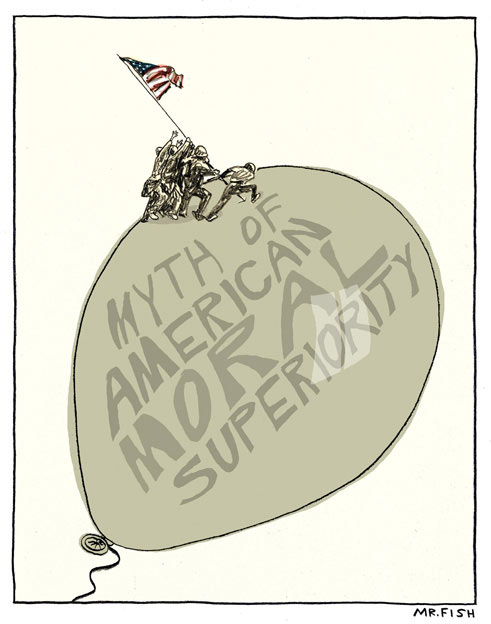
Are we Americans truly savages or merely tone-deaf in matters of morality, and therefore more guilty of terminal indifference than venality? It’s a question demanding an answer in response to the publication of the detailed 370-page report on U.S. complicity in torture, issued last week by the Justice Department’s inspector general.

Because the report was widely cited in the media and easily accessed as a pdf file on the Internet, it is fair to assume that those of our citizens who remain ignorant of the extent of their government’s commitment to torture as an official policy have made a choice not to be informed. A less appealing conclusion would be that they are aware of the heinous acts fully authorized by our president but conclude that such barbarism is not inconsistent with that American way of life that we celebrate.

But that troubling assessment of moral indifference is contradicted by the scores of law enforcement officers, mostly from the FBI, who were so appalled by what they observed as routine official practice in the treatment of prisoners by the United States in Afghanistan, Iraq and Guantanamo that they risked their careers to officially complain. A few brave souls from the FBI even compiled a “war crimes file,” suggesting the unthinkable — that we might come to be judged as guilty by the standard we have imposed on others. Superiors in the Justice Department soon put a stop to such FBI efforts to hold CIA agents and other U.S. officials accountable for the crimes they committed.

That this systematic torture was carried out not by a few conveniently described “bad apples” but rather represented official policy condoned at the highest level of government was captured in one of those rare media reports that remind us why the Founding Fathers signed off on the First Amendment.

“These were not random acts,” The New York Times editorialized. “It is clear from the inspector general’s report that this was organized behavior by both civilian and military interrogators following the specific orders of top officials. The report shows what happens when an American president, his secretary of defense, his Justice Department and other top officials corrupt American law to rationalize and authorize the abuse, humiliation and torture of prisoners.”

One of those top officials, who stands revealed in the inspector general’s report as approving the torture policy, is Condoleezza Rice, who in her capacity as White House national security adviser turned away the concerns of then-Attorney General John D. Ashcroft as to the severe interrogation measures being employed. Rice, as ABC-TV reported in April, chaired the top-level meetings in 2002 in the White House Situation Room that signed off on the CIA treatment of prisoners — “whether they would be slapped, pushed, deprived of sleep or subjected to simulated drowning, called water boarding. …” According to the report, the former academic provost of Stanford University came down on the side of simulated drowning.

As further proof that women are not necessarily more squeamish than men in condoning such practices, the report offers examples of sexual and religious denigration of the mostly Muslim prisoners by female interrogators carrying out an official policy of “invasion of space by a female.” In one recorded instance observed by startled FBI agents, a female interrogator was seen with a prisoner “bending his thumbs back and grabbing his genitals … to cause him pain.” One of the agents testified that this was not “a case of a rogue interrogator acting on her own.” He said he witnessed a “pep rally” meeting conducted by a top Defense Department official “in which the interrogators were encouraged to get as close to the torture statute line as possible.”

That was evidently the norm, according to FBI agents who witnessed the interrogations. As The New York Times reported, “One bureau memorandum spoke of ‘torture techniques’ used by military interrogators. Agents described seeing things like inmates handcuffed in a fetal position for up to 24 hours, left to defecate on themselves, intimidated by dogs, made to wear women’s underwear and subjected to strobe lights and extreme heat and cold.”

In the end, what seems to have most outraged the hundreds of FBI agents interviewed for the report is that the interrogation tactics were counterproductive. Evidently the FBI’s long history in such matters had led to a protocol that stressed gaining the confidence of witnesses rather than terrorizing them into madness. But an insane prisoner is the one most likely to tell this president of the United States what he wants to hear: They hate us for our values.

[Robert Scheer’s new book, The Pornography of Power: How Defense Hawks Hijacked 9/11 and Weakened America, will be released June 9 by Twelve. ]

Source / Common Dreams / TruthDig

The Rag Blog

Posted in RagBlog | Tagged , , , | Leave a comment

Friggin’ Shake Your Buns Out !!

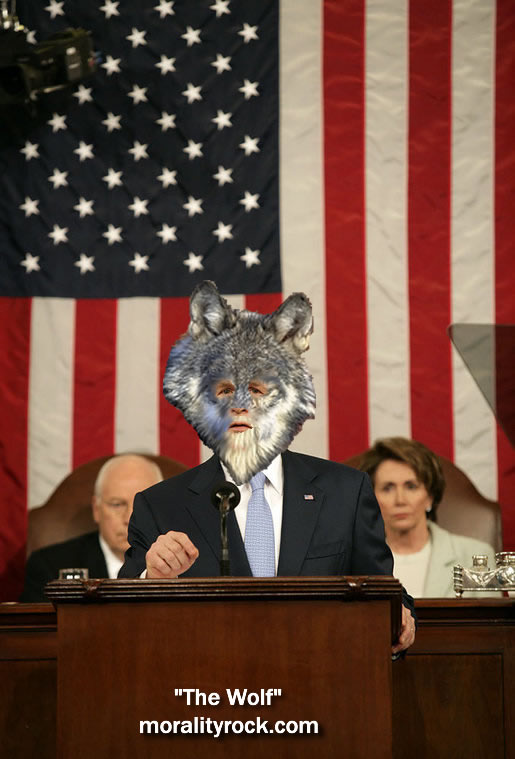
Well, this was an interesting contribution from one of our Friends. Morality Rock is a Web site all about who George Bush really is. And let’s be clear, it’s scary!


The Morality Rock Story: Defending Urination
by M. Rock

Morality Rock didn’t get its start in anyone’s garage, or in the Seattle club scene. It got its start in my unassuming and unhip office, where my small desk is cluttered with a variety of computers, peripherals, compact disks, and technical manuals. Morality Rock evolved quite by accident from an experiment with speech recognition software, which dictates computer users’ spoken words, converting them instantly into text on the screen.

I had been testing a new speech recognition product and inadvertently left my computer on overnight. When I arrived at work the next morning, I was shocked to find that my computer, in a presumably silent office, had produced a poem:


When The Idaho
over the foot
of the oversight
on 80000

have a high ionizing
a Have Been ionizing
Then a Lead
a Day
the Only When It Was

Nothing in His Essay
a Liaison
Last Move into How the Government Can Occur
Wednesday the DVD Can
I Do

Mounting an Inventor
and a Number
of the Move
Is the Means of Losing

This Is Nicely
on Earnings It Happens
That Ends
in an Omitted
and the Netherlands was Nothing

Removed Disease Toe
Him and I
the from
the Fund
and from the from

Using
If You Have the Time to Come
and Can and Can

the Old
the In
the End
of the Human


The last stanza was particularly chilling, coming from a computer. Needing answers, I frantically asked co-workers, the sanitation crew, and building security if anyone could possibly have been in my office that night. The unanimous answer: No. This led to my belief that my computer was tapping into a deeper reality. Whether these were the voices of ghosts, or far away voices imperceptible to human hearing, my computer was listening, and was recording every word. Perhaps I should briefly describe how speech recognition works. When someone (i.e., user, distant unassuming bystander, or ghost) speaks, my computer receives the signal through a microphone, then translates the incoming auditory signal into binary code. If the signal is distorted (for example, if there’s background noise), my computer activates her noise filtration algorithms so she can focus her perception entirely on the speaker to whom she’s listening. She then matches the result against the information stored in her vast language database, and does so in a fraction of the time required for comparable processing by the human brain. With a speech processing system this advanced, my computer is far better at ascertaining the contents of a spoken message than I am.

Since that night, I have questioned the reality that I had previously accepted at face value. If the room I’m in seems to be silent, is it truly silent? When you speak to me, do I hear and understand you correctly? When the President speaks, am I hearing the truth? Given my newfound distrust of all words previously trusted, the latter question particularly troubled me. What if we were being subtly, subliminally deceived by our government? What if the actual words of George W. Bush were different than those we perceived? I had to know the truth.

So one by one I fed to my computer the recorded audio from each of the President’s speeches, and watched as the words filled my computer’s screen, words like these:

From President Bush’s First Radio Address to the Nation

Children and parents need better Georges.

From President Bush’s Unveiling of his New Energy Policy

Many others, we are the land color hydropower in the year. And other energy shortages are mental pollution in all the hard-hit night.

Loyalist vanity is the land of the late in half, and miles away from the real impact of reservoir and ankle. In Arctic, I like and warmed Millrose. I can literally melt away with a kind, and is going to protect wildlife.

Read all about this here.

Thanks to Betsy Gaines / The Rag Blog

Posted in RagBlog | Tagged , | Leave a comment

Arianna Huffington : Scotty Come Lately

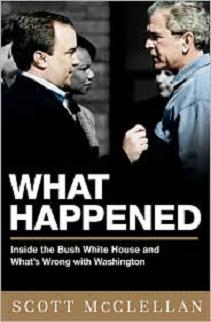
Seven takes on Scott McClellan’s new book
by Arianna Huffington / May 28, 2008

Take One: What Took You So Long?

In What Happened, Scott McClellan offers withering portraits of George Bush, Karl Rove, Condi Rice, and Scooter Libby, confirms that we went to war in Iraq under false pretenses, and that we were serially lied to about the outing of Valerie Plame.

Interesting stuff, Scott. But about five years too late.

It’s George Tenet déjà vu all over again. How many times are we going to have a key Bush administration official try to wash the blood off his hands — and add a chunk of change to his bank account — by writing a come-clean book years after the fact, pointing the finger at everyone else while painting himself as an innocent bystander to history who saw all the horrible things that were happening but, somehow, had no choice but to go along?

McClellan told the Washington Post that he wrote the book to “provide an open and honest look at how things went off course and what can be learned from it.” And he told Cox News Service, “My job was to advocate and defend [Bush’s] policies and speak on his behalf. This is an opportunity for me now to share my own views and perspective on things.”

Great. We need all the openness and honesty we can get. But it would have been a lot more helpful if he had taken the “opportunity” when it really mattered — say before the 2004 election, when it could have potentially saved thousands of lives.

What Happened is page-turning reading. What Didn’t Happen — namely McClellan telling the truth in service to his country rather than in service to his book sales — is a stomach-turning disappointment.

Take Two: The Rationale for Iraq is Even Worse Than We Thought

McClellan really lets it rip on Iraq. He says that Bush led a sophisticated “political propaganda campaign” to sell the war, was not “open and forthright on Iraq,” managed the runup to war “in a way that almost guaranteed that the use of force would become the only feasible option,” “largely ignored or simply disregarded” contradictory intelligence on the war, and as the war went poorly responded by “never reflecting, never reconsidering, never compromising.”

McClellan’s scathing conclusion: “History appears poised to confirm what most Americans today have decided: that the decision to invade Iraq was a serious strategic blunder. No one, including me, can know with absolute certainty how the war will be viewed decades from now when we can more fully understand its impact. What I do know is that war should only be waged when necessary, and the Iraq war was not necessary.”

Perhaps the most damning revelation regarding Iraq is McClellan’s assertion that the real reason Bush wanted to invade Iraq was the “opportunity to create a legacy of greatness” by transforming the Middle East into a land of peace and brotherhood. Over 4,000 dead U.S. soldiers sacrificed for a neo-con wet dream of democratic dominoes across the region. How chilling is that?

McClellan also tosses in a pinch of Oedipal subtext: “The president had promised himself that he would accomplish what his father had failed to do by winning a second term in office. And that meant operating continually in campaign mode: never explaining, never apologizing, never retreating.”

Such is the stuff foreign policy nightmares are made of.

Take Three: The Press Secretary Presses the Press

McClellan points an accusatory finger at the mainstream media — he calls them “enablers” and says they were too easy on the administration during the selling of the war:

“The national press corps was probably too deferential to the White House and to the administration in regard to the most important decision facing the nation during my years in Washington, the choice over whether to go to war in Iraq. The collapse of the administration’s rationales for war, which became apparent months after our invasion, should never have come as such a surprise. … In this case, the ‘liberal media’ didn’t live up to its reputation. If it had, the country would have been better served.”

Great point, Scotty. We and many others made it back in 2003.

It’s such a great point, it caused Karl Rove to act like something nefarious has happened to McClellan, transforming him from the lie-spouting sock puppet he has “known for a long time” into somebody who “sounds like a left-wing blogger.” Have anyone specific in mind, Karl?

Take Four: Rove More Turd Blossom Than Boy Genius

Speaking of Rove, McClellan’s tome continues the obliteration of the Rove mystique, reminding us what an out-and-out liar Rove was and is — more than willing to assure McClellan that he wasn’t involved in the leaking of Valerie Plame’s identity when, in fact, he was up to his Turd Blossom in the sordid affair, having discussed Plame with Matt Cooper and Bob Novak in an effort to discredit Joe Wilson.

McClellan also makes it clear that the indelible, says-all-you-need-to-know-about-this-administration photo of Bush looking out the window of Air Force One during his too-busy-to-stop flyover of New Orleans in the wake of Katrina was a Rove special: “Karl was convinced we needed to do it — and the president agreed.”

Take Five: Truthiness in Government

Stephen Colbert satirized the Bush approach when he coined the concept of “truthiness”: the truth we want, in our gut, to exist, without regard to evidence, logic, intellectual examination, or facts.

McClellan reveals how much the joke matched the reality, saying that Bush’s “leadership style is based more on instinct than deep intellectual debate.” Citing Bush’s assertion that he honestly couldn’t remember if he’d ever done cocaine, McClellan says he felt he “was witnessing Bush convincing himself to believe something that probably was not true, and that, deep down, he knew was not true.”

But who needs reality when you have faith? Who needs truth when you have truthiness? As George Costanza put it on Seinfeld: “Jerry, just remember, it’s not a lie if you believe it.”

A fantastic philosophy for a sit-com character. A disastrous philosophy for a sitting president.

Take Six: Truth in Government

According to McClellan, the Secret Service code name for the White House press secretary was “Matrix.”

As any Keanu Reaves fan will tell you, the Matrix is a simulated reality used to pacify and subdue the human population in a dystopian future.

Who knew Secret Service agents have such an arch sense of humor?

Take Seven: Heckuva Job, Scotty!

On the day McClellan resigned as press secretary, Bush pictured a time down the road when he and his former aide would “be rocking on chairs in Texas, talking about the good old days and his time as the press secretary. And I can assure you, I will feel the same way then that I feel now, that I can say to Scott, ‘Job well done.'”

Maybe not. Although, since, according to McClellan, Bush “has a way of falling back on the hazy memory to protect himself from potential political embarrassment,” who knows?

I can already see the blurb on the back of the paperback edition of What Happened: “Heckuva job, Scotty!” – George W. Bush, 43rd president of the United States

Source. / The Huffington Post

Also see White House Responds To Scott McClellan’s Accusations. / The Huffington Post

And go here to read the Politico.com exclusive that broke the story and to watch a video with Keith Olbermann and Rachel Maddow. / The Rag Blog

The Rag Blog

Posted in RagBlog | Tagged , , , , , | Leave a comment

"Situational Ethics" and the Clinton Campaign

Two-Faced Woman / Eltern, 1997

Clearly some kind of compromise must be and will be worked out concerning Michigan and Florida delegates. Hell, it’s not their fault and they deserve some representation. But I’ll tell you one thing: if I were a voter in one of those states and didn’t vote — or voted “uncommitted” — because I was told the vote wouldn’t count in the nominating process, and then they turned around and announced that the election counted after all, I’d certainly be angry and feel disenfrancised and cheated.

It’d be like the Sox having an uncatchable lead for the playoffs and the Yankees arguing that preseason exhibition games should be counted in the standings.

The following discusses how the Clinton camp originally supported the sanctions against those states. It makes their sudden about-face a textbook case, says Harold Meyerson, of “situational ethics.”

Thorne Dreyer / The Rag Blog

Clinton’s Two-State Two-Step
By Harold Meyerson / May 28, 2008

On Saturday, when the Rules Committee of the Democratic National Committee meets to determine the fate of Florida and Michigan’s delegations to this summer’s convention, it will have some company. A group of Hillary Clinton supporters has announced it will demonstrate outside.

That Clinton has impassioned supporters, many of whom link her candidacy to the feminist cause, hardly qualifies as news. And it’s certainly true that along the campaign trail Clinton has encountered some outrageously sexist treatment, just as Barack Obama has been on the receiving end of bigoted treatment. (Obama has even been subjected to anti-Muslim bigotry despite the fact that he’s not Muslim.) But somehow, a number of Clinton supporters have come to identify the seating of Michigan and Florida not merely with Clinton’s prospects but with the causes of democracy and feminism — an equation that makes a mockery of democracy and feminism.

Clinton herself is largely responsible for this absurdity. Over the past couple of weeks, she has equated the seating of the two delegations with African Americans’ struggle for suffrage in the Jim Crow South, and with the efforts of the democratic forces in Zimbabwe to get a fair count of the votes in their presidential election.

Somehow, I doubt that the activists opposing Robert Mugabe in Zimbabwe would appreciate this equation.

But the Clintonistas who have called Saturday’s demonstration make it sound as if they’ll be marching in Selma in support of a universal right to vote. The DNC, says one of their Web sites, “must honor our core democratic principles and enfranchise the people of Michigan and Florida.”
Had Florida and Michigan conducted their primaries the way the other 48 states conducted their own primaries and caucuses — that is, in accord with the very clear calendar laid down by the DNC well before the primaries began — then Clinton’s marchers would be utterly justified in their claims. But when the two states flouted those rules by moving their primaries outside the prescribed time frame, the DNC, which gave neither state a waiver to do so, decreed that their primaries would not count and enjoined all presidential candidates from campaigning in those states. Obama and John Edwards complied with the DNC’s dictates by removing their names from the Michigan ballot. Clinton did not.

Seating Michigan in full would mean the party validates the kind of one-candidate election (well, 1.03, to give Dennis Kucinich, Chris Dodd and Mike Gravel, who also remained on the ballot, their due) that is more common in autocracies than democracies. It would mean rewarding the one serious candidate who didn’t remove her name from the ballot when all her rivals, in deference to the national party rules, did just that.

What’s particularly outrageous is that the Clinton campaign supported the calendar, and the sanctions against Michigan and Florida, until Clinton won those states and needed to have their delegations seated.

Last August, when the DNC Rules Committee voted to strip Florida (and Michigan, if it persisted in clinging to its date) of its delegates, the Clinton delegates on the committee backed those sanctions. All 12 Clinton supporters on the committee supported the penalties. (The only member of the committee to vote against them was an Obama supporter from Florida.) Harold Ickes, a committee member, leading Clinton strategist and acknowledged master of the political game, said, “This committee feels very strongly that the rules ought to be enforced.” Patty Solis Doyle, then Clinton’s campaign manager, further affirmed the decision. “We believe Iowa, New Hampshire, Nevada and South Carolina play a unique and special role in the nominating process,” she said, referring to the four states that the committee authorized to hold the first contests. “And we believe the DNC’s rules and its calendar provide the necessary structure to respect and honor that role. Thus, we will be signing the pledge to adhere to the DNC-approved nominating calendar.”

Not a single Clinton campaign official or DNC Rules Committee member, much less the candidate herself, said at the time that the sanctions imposed on Florida or Michigan were in any way a patriarchal plot or an affront to democratic values. The threat that these rules posed to our fundamental beliefs was discovered only ex post facto — the facto in question being Clinton’s current need to seat the delegations whose seatings she had opposed when she thought she’d cruise to the nomination.

Clinton’s supporters have every right to demonstrate on Saturday, of course. But their larger cause is neither democracy nor feminism; it’s situational ethics. To insist otherwise is to degrade democracy and turn feminism into the last refuge of scoundrels.

Source. / Washington Post

The Rag Blog

Posted in RagBlog | Tagged , , | Leave a comment

CNN Still Promotes the Generals’ Propaganda

Pentagon Shill Returns to CNN to Talk About Iran
By Andrew Tilghman / May 27, 2008

Brig. Gen. David L. Grange doesn’t wear a star on his shoulder much since his retirement in 1999. But he’s on the list of retired officers the Pentagon has cultivated in an effort to influence domestic news coverage of military matters.

In fact, Grange, a CNN analyst, was tagged as the most visible shill for the Pentagon since 2002.

The Pentagon suspended the analysts’ program and its weekly briefings shortly after the Times published its story in April revealing the extent of the Pentagon’s message massaging.

When Grange appeared again on CNN late last week, host Lou Dobbs made no mention of Grange’s previous participation in the Pentagon program. But he did ask him about Iran.

Here’s a bit of the transcript:

DOBBS: Well, here is — on another issue. Let’s take a listen to what General Petraeus had to say today about Iran.

(BEGIN VIDEO CLIP)

GEN. DAVID PETRAEUS, CMDR. MULTI-NATIONAL FORCE-IRAQ: Iran continues to be a destabilizing influence in the region. It persists in its nontransparent pursuit of nuclear technology and continues to fund, train and arm dangerous militia organizations.

(END VIDEO CLIP)

DOBBS: What are we supposed to do with that?

GRANGE: Believe it.

DOBBS: OK. Then what?

GRANGE: Then we take — make sure that we take the diplomatic informational (ph), military and economic measures to make sure Iran understands the line in the sand that must be drawn.

Grange, who led much of the U.S. military operations in the Balkans in the 1990s, is now the president and chief executive of the McCormick Foundation, a Chicago-based charity.

Apparently, Grange doesn’t really see himself as a direct surrogate. He told the New York Times that he thought all those background sessions with Pentagon leaders were “just upfront information.”

But a Pentagon memo called them “message force multipliers.” The Defense Department often paid their travel expenses and hired a private defense contractor to monitor everything the analysts said in public.

Source / TPM Muckraker

The Rag Blog

Posted in RagBlog | Tagged , , | Leave a comment

Stop Being a Presidential Romantic

True patriotism requires Americans to reject the two-party plutocracy. Credit: open source

Poisonous Plutocracy Pushes Economic Inequality
By Joel Hirschhorn / May 28, 2008

Americans Must Find the Courage to Use Their Vote to Reject the Two-party Plutocracy Harming Them Financially

The biggest political issue receiving no attention by the Democratic and Republican presidential candidates is the powerful plutocracy that has captured the government to produce rising economic inequality.

Both major parties have enabled, promoted and supported this Upper Class plutocracy. Myriad federal policies make the rich super-rich and the powerful dominant in both good and bad economic times. Meanwhile, despite elections, the middle class sinks into one big Lower Class as the plutocracy ensures that national prosperity is unshared.

Why no attention? Why no explicit reference to a plutocracy that makes a mockery of American democracy? Simple answer: because both major parties and their candidates are subservient to numerous corporate and other special interests that use their money and influence to ensure that their elitist priorities prevail. Make no mistake. Barack Obama with all his slick rhetoric is just as much a supporter and benefactor of this Upper Class plutocracy as Hillary Clinton and John McCain.

Everyone that is not in the Upper Class who votes for any of these presidential candidates is voting against their own interests. They have been hoodwinked, conned, brainwashed and manipulated by campaign propaganda. They elect people for the visible government while they remain oblivious to the secret government – the powerful pulling the strings behind the stage. Money makes more money, financing more political influence.

One of the biggest delusions of Americans is that if they retain their constitutional rights that they still live in a country with a working democracy. Wrong. American democracy is delusional because the two-party plutocracy makes citizens economic slaves. This represses political dissent. It is 21st century tyranny. Two-party presidential candidates, unlike our nation’s Founders, lack courage to fight and revolt against domestic tyranny. Placebo voting distracts citizens from the political necessity of fighting the plutocracy.

Economic data show the plutocracy’s assault on American society. Consider these examples.

The top 20 percent of households earned more, after taxes, than the remaining 80 percent in 2005, while the topmost 1 percent took home more than the bottom 40 percent.

No American state has seen the gap between rich and poor widen faster than Connecticut. From 1987 through 2006, the top fifth of the state’s households saw their incomes increase by 44.8 percent, after inflation. Incomes for the bottom fifth fell 17.4 percent. On the other coast, just three of every 1,000 Californians in 2005 reported at least $1 million in income. But they got $213 of every $1,000 Californians earned in 2005 income. The state’s top 1 percent – average income $1.6 million – pay 7.1 percent of their incomes in income, sales, property, and gas taxes. The poorest fifth of California households pay 11.7 percent.

Real hourly wages for most workers have risen only 1 percent since 1979, even as those workers’ productivity has increased by 60 percent. Higher efficiency has rewarded business executives, owners and investors, but not workers. What’s more, American workers now work more hours per year than their counterparts in virtually every other advanced economy, even Japan, and without universal health care.

A typical hedge fund manager makes 31 times more in one hour than the typical American family makes in a year. In 2007, the top 50 hedge fund income-earners collected $29 billion – an average of $581 million each. John Paulson took home $3.7 billion from his hedge fund labors. These figures do not count profits from selling shares in their companies. Importantly, hedge fund players contributed nine times more to the Senate Democratic fundraising arm than they gave to Senate Republicans in 2007.

In 2009, Americans who make over $1 million a year will save an average $32,000 from the Bush tax cuts on capital gains and dividends. The average American household will save $20.

Between 1986 and 2005, the income of America’s top 1 percent of taxpayer jumped from 11.3 to 21.2 percent of the national total. Their federal income taxes dropped from 33.13 percent of total personal income in 1986 to 23.13 percent in 2005. From 2001 to 2008, the net worth of the wealthiest 1 percent grew from $186 billion to $816 billion.

Economic inequality and injustice reflect a political disaster, even with regular elections. It has resulted from government decisions on tax cuts, spending, trade agreements, deregulatory measures, labor unions, corporate handouts, and regulatory enforcement. All crafted to benefit the rich and powerful and leave the rest of us behind. It has happened under Democratic and Republican presidencies and congresses. Bipartisan domestic tyranny propels greed driven plutocracy.

What do we desperately need? A national discussion and referendum on inequality-pumping plutocracy, that none of the major presidential candidates shows any interest in having. Certainly not Barack Obama with his vacuous talk of change (but not about the political system) and John McCain’s incredulous talk of reform.

And it is delusional to think that populist global Internet connectivity producing what is called personal sovereignty threatens plutocracy. Networking among the rich and powerful strengthens the global plutocracy, placing it above national sovereignty. More than produce an army of revolutionaries to overturn the system, the Internet has fragmented every imaginable movement. Individuals indulge themselves with their own or social websites or fall victim to conventional politicians. Technology and media owned and controlled by plutocrats serves them while it shackles and deceives the multitudes.

Only one presidential candidate sees our core national problem and the need for revolutionary thinking and action to correct the system: Ralph Nader who said recently, “We need a Jeffersonian revolution.” Plutocrats should heed these wise words of John F. Kennedy: “Those who make peaceful revolution impossible will make violent revolution inevitable.” With all the guns and pain Americans have, the ruling class should worry and start reforms. To start, let third party and independent candidates into televised presidential debates. If the stage can be filled with a bunch of primary season candidates, why not more than two in the general election?

For electoral dissent, stop being a presidential romantic; use your vote to fight the plutocracy. Reject the Democratic and Republican presidential candidates. Put an end to serial disappointments. Time is running out. Talk is cheap. Action is crucial. Violent revolution is an option.

[Contact Joel S. Hirschhorn through http://www.delusionaldemocracy.com/.]

Source / Associated Content

The Rag Blog

Posted in RagBlog | Tagged , | Leave a comment

Mesmo’s Desert Digest : From Austin to Crazy Horse

Mesmo’s desert homeboy.

[This is the first installment of a regular feature coming from The Rag Blog’s new desert correspondent, Gerry, aka Mesmo. First: Getting to know you.]

Hello all, I am Gerry, aka Mesmo, a septuagenarian desert rat from Southwest New Mexico.

I live on a fading but functional old estate in the floodplain of the Gila River, near where it flows out of the Mogollon Mountains. Been here for 15 years now. This is the Greater Chihuahuan Desert, hot, dry, rocky, and disarmingly beautiful when it converges with the wilderness known variously as the Gila National Forest and the Gila National Wilderness.

My political life dates back to the mid 1960’s when I was a student at the University of Texas. It all began when I started reading The Rag. I made a complete turnaround in those years, from political naiveté to howling dissent. We had a large contingent of student activists who led protests on campus against the war in Viet Nam and related causes. Most of us had earned our stripes at the LBJ Ranch where we assembled on Sunday afternoons (outside the main gate on a designated road) during his presidency. Activists from all around the state would gather there. Our companions were on the other side of the road, American Nazi Party, Klu Klux Klan, etc. The FBI, Secret Service, and Texas Department of Public Safety troupers were always there to protect us from the opposition, to make sure we didn’t penetrate the borders of the ranch, and to photograph us for their records. We were dedicated pacifists in the mold of Dr. Martin Luther King

We earned our stripes at LBJ Ranch.

By the time the smoke settled we had turned Austin into a haven for the counter culture. I was a musician, did it for 35 years. Played in rock bands in Austin and San Francisco where many of us migrated in the late ‘60’s. Back in Austin in the ‘70’s after adopting the Whole Earth Catalogue way of life, I ran the local musicians’ union and sat for a time on the state labor council. We pioneered big free public concerts in the city parks which featured the best bands in Austin. Drew very large crowds and helped make the town into a choice location for musicians. But I left all that in 1985, moved away from Austin and the musician’s life.

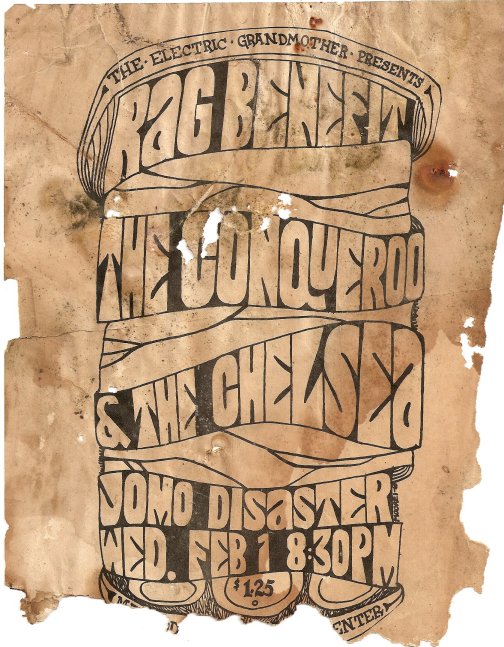
Rag Benefit handbill, 1967, from Vulcan Gas Co. collection.

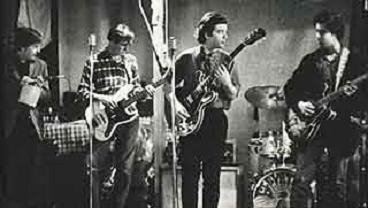
The way we were in Austin: The Thirteenth Floor Elevators, circa 1966.

I came to New Mexico to study herbal medicine with Michael Moore in Silver City. But he had moved so I studied with several graduates of his Southwest School of Botanical Medicine who were in the area. I met the desert plants. That’s how I got started in desert agriculture, a field in which I still spend my quality time, albeit on a very small scale these days. My dues were paid on a farm owned by Seeds of Change in our valley, a seed farm. I did farm work until my 60th year, helping to start a farm from scratch and turning it into a blooming paradise. I am one of those people whose annual rhythms revolve around growing food. Cannot shake the cycle. Do not intend to. I will no doubt write about this subject quite often in this slot.

My heroes include E.F. Schumacher, E.O. Wilson, and Crazy Horse. I suppose I am something of an animist in that I have been very close to the Native American spirituality and its practices which can often go beyond mere science. The future that I would like to see would incorporate Schumacher’s ideas of smallness, collectives of village size, off the grid, connected but independent. And it follows that I would favor a political system leaning heavily on socialism with a touch of libertarianism.

I am something of an animist.

I am equipped with a 512 bps internet connection, follow many blogs and news sources, recently added dish TV. I subscribe to the New Yorker and Netflix. My health care is covered by the VA. I make do mostly on a Social Security check. My approach to retirement is to take advantage of the many programs offered to poor people rather than to try to sock away lots of cash for insurance and a mainstream lifestyle or, heaven forbid, a nursing home. Oh yes, I am a registered, qualified indigent.

Next time around I will contribute something about the immediate effects of global warming or the joys of opiates, perhaps a blog or two on astrological connections with nature or politicians’ horoscopes. No telling really. Might even dedicate a piece to the magic of Mozart or West African rhythms. I promise that I will at all times tell the truth as I see it.

Mesmo / The Rag Blog
Greater Chihuahuan Desert / May 28, 2008

Posted in Rag Bloggers | Tagged , , , , , , , | 1 Comment

Senators Reportedly Briefed on Eminent Iran Attack


Bush ‘plans Iran air strike by August’
By Muhammad Cohen / May 28, 2008

NEW YORK — The George W Bush administration plans to launch an air strike against Iran within the next two months, an informed source tells Asia Times Online, echoing other reports that have surfaced in the media in the United States recently.

Two key US senators briefed on the attack planned to go public with their opposition to the move, according to the source, but their projected New York Times op-ed piece has yet to appear

The source, a retired US career diplomat and former assistant secretary of state still active in the foreign affairs community, speaking anonymously, said last week that the US plans an air strike against the Iranian Revolutionary Guards Corps (IRGC). The air strike would target the headquarters of the IRGC’s elite Quds force. With an estimated strength of up to 90,000 fighters, the Quds’ stated mission is to spread Iran’s revolution of 1979 throughout the region.

Targets could include IRGC garrisons in southern and southwestern Iran, near the border with Iraq. US officials have repeatedly claimed Iran is aiding Iraqi insurgents. In January 2007, US forces raided the Iranian consulate general in Erbil, Iraq, arresting five staff members, including two Iranian diplomats it held until November. Last September, the US Senate approved a resolution by a vote of 76-22 urging President George W Bush to declare the IRGC a terrorist organization. Following this non-binding “sense of the senate” resolution, the White House declared sanctions against the Quds Force as a terrorist group in October. The Bush administration has also accused Iran of pursuing a nuclear weapons program, though most intelligence analysts say the program has been abandoned.

An attack on Iraq would fit the Bush administration’s declared policy on Iraq. Administration officials questioned directly about military action against Iran routinely assert that “all options remain on the table”.

Rockin’ and a-reelin’

Senators and the Bush administration denied the resolution and terrorist declaration were preludes to an attack on Iran. However, attacking Iran rarely seems far from some American leaders’ minds. Arizona senator and presumptive Republican presidential nominee John McCain recast the classic Beach Boys tune Barbara Ann as “Bomb Iran”. Democratic candidate Hillary Clinton promised “total obliteration” for Iran if it attacked Israel.

The US and Iran have a long and troubled history, even without the proposed air strike. US and British intelligence were behind attempts to unseat prime minister Mohammed Mossadeq, who nationalized Britain’s Anglo-Iranian Petroleum Company, and returned Shah Mohammad Reza Pahlavi to power in 1953. President Jimmy Carter’s pressure on the Shah to improve his dismal human-rights record and loosen political control helped the 1979 Islamic revolution unseat the Shah.

But the new government under Ayatollah Ruhollah Khomeini condemned the US as “the Great Satan” for its decades of support for the Shah and its reluctant admission into the US of the fallen monarch for cancer treatment. Students occupied the US Embassy in Teheran, holding 52 diplomats hostage for 444 days. Eight American commandos died in a failed rescue mission in 1980. The US broke diplomatic relations with Iran during the hostage holding and has yet to restore them. Iranian President Mahmud Ahmadinejad’s rhetoric often sounds lifted from the Khomeini era.

The source said the White House views the proposed air strike as a limited action to punish Iran for its involvement in Iraq. The source, an ambassador during the administration of president H W Bush, did not provide details on the types of weapons to be used in the attack, nor on the precise stage of planning at this time. It is not known whether the White House has already consulted with allies about the air strike, or if it plans to do so.

Sense in the Senate

Details provided by the administration raised alarm bells on Capitol Hill, the source said. After receiving secret briefings on the planned air strike, Senator Diane Feinstein, Democrat of California, and Senator Richard Lugar, Republican of Indiana, said they would write a New York Times op-ed piece “within days”, the source said last week, to express their opposition. Feinstein is a member of the Senate Intelligence Committee and Lugar is the ranking Republican on the Foreign Relations Committee.

Senate offices were closed for the US Memorial Day holiday, so Feinstein and Lugar were not available for comment.

Given their obligations to uphold the secrecy of classified information, it is unlikely the senators would reveal the Bush administration’s plan or their knowledge of it. However, going public on the issue, even without specifics, would likely create a public groundswell of criticism that could induce the Bush administration reconsider its plan.

The proposed air strike on Iran would have huge implications for geopolitics and for the ongoing US presidential campaign. The biggest question, of course, is how would Iran respond?

Iran’s options

Iran could flex its muscles in any number of ways. It could step up support for insurgents in Iraq and for its allies throughout the Middle East. Iran aids both Hezbollah in Lebanon and Hamas in Israel’s Occupied Territories. It is also widely suspected of assisting Taliban rebels in Afghanistan.

Iran could also choose direct confrontation with the US in Iraq and/or Afghanistan, with which Iran shares a long, porous border. Iran has a fighting force of more than 500,000. Iran is also believed to have missiles capable of reaching US allies in the Gulf region.

Iran could also declare a complete or selective oil embargo on US allies. Iran is the second-largest oil exporter in the Organization of Petroleum Exporting Countries and fourth-largest overall. About 70% of its oil exports go to Asia. The US has barred oil imports from Iran since 1995 and restricts US companies from investing there.

China is Iran’s biggest customer for oil, and Iran buys weapons from China. Trade between the two countries hit US$20 billion last year and continues to expand. China’s reaction to an attack on Iran is also a troubling unknown for the US.

Three for the money

The Islamic world could also react strongly against a US attack against a third predominantly Muslim nation. Pakistan, which also shares a border with Iran, could face additional pressure from Islamic parties to end its cooperation with the US to fight al-Qaeda and hunt for Osama bin Laden. Turkey, another key ally, could be pushed further off its secular base. American companies, diplomatic installations and other US interests could face retaliation from governments or mobs in Muslim-majority states from Indonesia to Morocco.

A US air strike on Iran would have seismic impact on the presidential race at home, but it’s difficult to determine where the pieces would fall.

At first glance, a military attack against Iran would seem to favor McCain. The Arizona senator says the US is locked in battle across the globe with radical Islamic extremists, and he believes Iran is one of biggest instigators and supporters of the extremist tide. A strike on Iran could rally American voters to back the war effort and vote for McCain.

On the other hand, an air strike on Iran could heighten public disenchantment with Bush administration policy in the Middle East, leading to support for the Democratic candidate, whoever it is.

But an air strike will provoke reactions far beyond US voting booths. That would explain why two veteran senators, one Republican and one Democrat, were reportedly so horrified at the prospect.

Former broadcast news producer Muhammad Cohen told America’s story to the world as a US diplomat and is author of Hong Kong On Air (www.hongkongonair.com), a novel set during the 1997 handover about television news, love, betrayal, high finance and cheap lingerie.

(Copyright 2008 Asia Times Online Ltd.

Source. Asia Times

Thanks to Roger Baker / The Rag Blog

Posted in RagBlog | Tagged , , , | Leave a comment

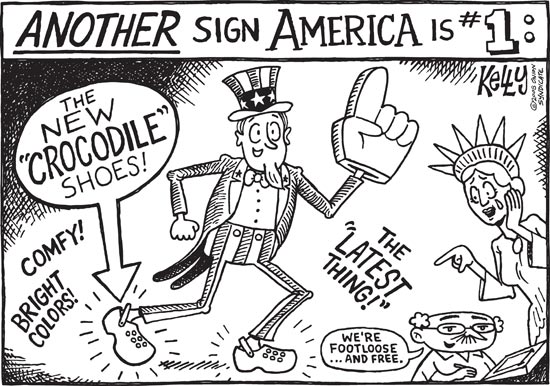
Put Your Best Foot Forward

The Onion. / The Rag Blog

Posted in RagBlog | Tagged , , , , | Leave a comment

Former Press Secy McClellan Bashes Bush in Memoir

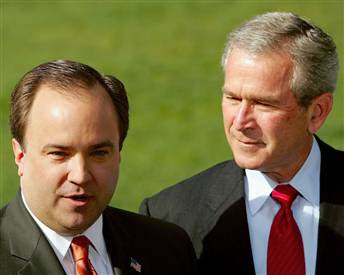
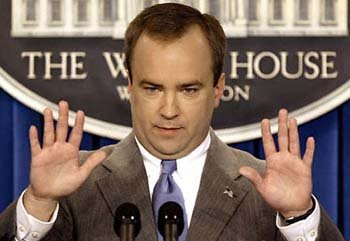
President George W. Bush listens as his Press Secretary, Scott McClellan, announces his resignation at the White House April 19, 2006 in Washington, DC. Photo by Win Mcnamee / Getty Images

Politico Exclusive: McClellan whacks Bush, White House
By Mike Allen / May 27, 2008

Former White House Press Secretary Scott McClellan writes in a surprisingly scathing memoir to be published next week that President Bush “veered terribly off course,” was not “open and forthright on Iraq,” and took a “permanent campaign approach” to governing at the expense of candor and competence.

Among the most explosive revelations in the 341-page book, titled “What Happened: Inside the Bush White House and Washington’s Culture of Deception” (Public Affairs, $27.95):

• McClellan charges that Bush relied on “propaganda” to sell the war.

• He says the White House press corps was too easy on the administration during the run-up to the war.

• He admits that some of his own assertions from the briefing room podium turned out to be “badly misguided.”

• The longtime Bush loyalist also suggests that two top aides held a secret West Wing meeting to get their story straight about the CIA leak case at a time when federal prosecutors were after them — and McClellan was continuing to defend them despite mounting evidence they had not given him all the facts.

• McClellan asserts that the aides — Karl Rove, the president’s senior adviser, and I. Lewis “Scooter” Libby, the vice president’s chief of staff — “had at best misled” him about their role in the disclosure of former CIA operative Valerie Plame’s identity.

A few reporters were offered advance copies of the book, with the restriction that their stories not appear until Sunday, the day before the official publication date. Politico declined and purchased “What Happened” at a Washington bookstore.

The eagerly awaited book, while recounting many fond memories of Bush and describing him as “authentic” and “sincere,” is harsher than reporters and White House officials had expected.

McClellan was one of the president’s earliest and most loyal political aides, and most of his friends had expected him to take a few swipes at his former colleague in order to sell books but also to paint a largely affectionate portrait.

Instead, McClellan’s tone is often harsh. He writes, for example, that after Hurricane Katrina, the White House “spent most of the first week in a state of denial,” and he blames Rove for suggesting the photo of the president comfortably observing the disaster during an Air Force One flyover. McClellan says he and counselor to the president Dan Bartlett had opposed the idea and thought it had been scrapped.

But he writes that he later was told that “Karl was convinced we needed to do it — and the president agreed.”

“One of the worst disasters in our nation’s history became one of the biggest disasters in Bush’s presidency. Katrina and the botched federal response to it would largely come to define Bush’s second term,” he writes. “And the perception of this catastrophe was made worse by previous decisions President Bush had made, including, first and foremost, the failure to be open and forthright on Iraq and rushing to war with inadequate planning and preparation for its aftermath.”

McClellan, who turned 40 in February, was press secretary from July 2003 to April 2006. An Austin native from a political family, he began working as a gubernatorial spokesman for then-Gov. Bush in early 1999, was traveling press secretary for the Bush-Cheney 2000 campaign and was chief deputy to Press Secretary Ari Fleischer at the beginning of Bush’s first term.

“I still like and admire President Bush,” McClellan writes. “But he and his advisers confused the propaganda campaign with the high level of candor and honesty so fundamentally needed to build and then sustain public support during a time of war. … In this regard, he was terribly ill-served by his top advisers, especially those involved directly in national security.”

In a small sign of how thoroughly McClellan has adopted the outsider’s role, he refers at times to his former boss as “Bush,” when he is universally referred to by insiders as “the president.”

McClellan lost some of his former friends in the administration last November when his publisher released an excerpt from the book that appeared to accuse Bush of participating in the cover-up of the Plame leak. The book, however, makes clear that McClellan believes Bush was also a victim of misinformation.

The book begins with McClellan’s statement to the press that he had talked with Rove and Libby and that they had assured him they “were not involved in … the leaking of classified information.”

At Libby’s trial, testimony showed the two had talked with reporters about the officer, however elliptically.

“I had allowed myself to be deceived into unknowingly passing along a falsehood,” McClellan writes. “It would ultimately prove fatal to my ability to serve the president effectively. I didn’t learn that what I’d said was untrue until the media began to figure it out almost two years later.

“Neither, I believe, did President Bush. He, too, had been deceived and therefore became unwittingly involved in deceiving me. But the top White House officials who knew the truth — including Rove, Libby and possibly Vice President Cheney — allowed me, even encouraged me, to repeat a lie.”

McClellan also suggests that Libby and Rove secretly colluded to get their stories straight at a time when federal investigators were hot on the Plame case.

“There is only one moment during the leak episode that I am reluctant to discuss,” he writes. “It was in 2005, during a time when attention was focusing on Rove and Libby, and it sticks vividly in my mind. … Following [a meeting in Chief of Staff Andy Card’s office], … Scooter Libby was walking to the entryway as he prepared to depart when Karl turned to get his attention. ‘You have time to visit?’ Karl asked. ‘Yeah,’ replied Libby.

“I have no idea what they discussed, but it seemed suspicious for these two, whom I had never noticed spending any one-on-one time together, to go behind closed doors and visit privately. … At least one of them, Rove, it was publicly known at the time, had at best misled me by not sharing relevant information, and credible rumors were spreading that the other, Libby, had done at least as much. …

“The confidential meeting also occurred at a moment when I was being battered by the press for publicly vouching for the two by claiming they were not involved in leaking Plame’s identity, when recently revealed information was now indicating otherwise. … I don’t know what they discussed, but what would any knowledgeable person reasonably and logically conclude was the topic? Like the whole truth of people’s involvement, we will likely never know with any degree of confidence.”

McClellan repeatedly embraces the rhetoric of Bush’s liberal critics and even charges: “If anything, the national press corps was probably too deferential to the White House and to the administration in regard to the most important decision facing the nation during my years in Washington, the choice over whether to go to war in Iraq.

“The collapse of the administration’s rationales for war, which became apparent months after our invasion, should never have come as such a surprise. … In this case, the ‘liberal media’ didn’t live up to its reputation. If it had, the country would have been better served.”

Decrying the Bush administration’s “excessive embrace of the permanent campaign approach to governance,” McClellan recommends that future presidents appoint a “deputy chief of staff for governing” who “would be responsible for making sure the president is continually and consistently committed to a high level of openness and forthrightness and transcending partisanship to achieve unity.
“I frequently stumbled along the way,” McClellan acknowledges in the book’s preface. “My own story, however, is of small importance in the broad historical picture. More significant is the larger story in which I played a minor role: the story of how the presidency of George W. Bush veered terribly off course.”

Even some of the chapter titles are brutal: “The Permanent Campaign,” “Deniability,” “Triumph and Illusion,” “Revelation and Humiliation” and “Out of Touch.”

“I think the concern about liberal bias helps to explain the tendency of the Bush team to build walls against the media,” McClellan writes in a chapter in which he says he dealt “happily enough” with liberal reporters. “Unfortunately, the press secretary at times found himself outside those walls as well.”

The book’s center has eight slick pages with 19 photos, eight of them depicting McClellan with the president. Those making cameos include Cheney, Rove, Bartlett, Mark Knoller of CBS News, former Assistant Press Secretary Reed Dickens and, aboard Air Force One, former press office official Peter Watkins and former White House stenographer Greg North.

In the acknowledgments, McClellan thanks each member of his former staff by name.

Among other notable passages:

• Steve Hadley, then the deputy national security adviser, said about the erroneous assertion about Saddam Hussein seeking uranium, included in the State of the Union address of 2003: “Signing off on these facts is my responsibility. … And in this case, I blew it. I think the only solution is for me to resign.” The offer “was rejected almost out of hand by others present,” McClellan writes.

• Bush was “clearly irritated, … steamed,” when McClellan informed him that chief economic adviser Larry Lindsey had told The Wall Street Journal that a possible war in Iraq could cost from $100 billion to $200 billion: “‘It’s unacceptable,’ Bush continued, his voice rising. ‘He shouldn’t be talking about that.’”

• “As press secretary, I spent countless hours defending the administration from the podium in the White House briefing room. Although the things I said then were sincere, I have since come to realize that some of them were badly misguided.”

• “History appears poised to confirm what most Americans today have decided: that the decision to invade Iraq was a serious strategic blunder. No one, including me, can know with absolute certainty how the war will be viewed decades from now when we can more fully understand its impact. What I do know is that war should only be waged when necessary, and the Iraq war was not necessary.”

• McClellan describes his preparation for briefing reporters during the Plame frenzy: “I could feel the adrenaline flowing as I gave the go-ahead for Josh Deckard, one of my hard-working, underpaid press office staff, … to give the two-minute warning so the networks could prepare to switch to live coverage the moment I stepped into the briefing room.”

• “‘Matrix’ was the code name the Secret Service used for the White House press secretary.”

McClellan is on the lecture circuit and remains in the Washington area with his wife, Jill.

© 2007 Capitol News Company, LLC

Source. / Politico.com

Keith Olbermann and Rachel Maddow on McClellan’s Book

Also see White House ‘puzzled’ by ex-spokesman’s book bashing Bush / CNN

The Rag Blog

Posted in RagBlog | Tagged , , , , | 2 Comments

Can George McGovern’s Left Populism Instruct Obama’s Modest Progressive Vision

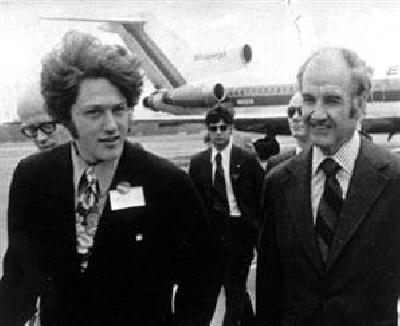
Campaign worker Bill Clinton shown with presidential candidate George McGovern in 1972 AP photo.

The American Left: McGovern, Obama, and ‘transformative’ change
By Ken Brociner / May 25, 2008

One of the most common complaints among progressives is that we don’t have a vision of how to actually change the world.

But to paraphrase Marx, it seems to me that our goal shouldn’t be to just change the world (especially given the abuse of the word “change” in the current election cycle). Instead we ought to transform it.

And in fact, in recent months, the word “transformative” has been popping up with some frequency – usually in reference to Barack Obama.

Is there any truth to this claim, or should we just chalk it up to hyperbole? Certainly if Obama is elected, he would steer America in a fundamentally different direction than Bush has taken us these past eight years. And the fact that Obama would be the first black president in American history could result in a transformative shift in the way that our nation deals with racial issues. But if we look at the likely contours of an Obama administration in comparison to, say, Bill Clinton’s eight years in office, can we reasonably expect that Obama might be a “transformative” president?

Apart from Obama’s views on NAFTA and other free-trade agreements – which are more enlightened than President Clinton’s were — the modest nature of his economic program simply doesn’t offer convincing evidence that the Illinois senator would be all that different from Clinton (either Clinton for that matter) when it comes to running the economy or setting the nation’s spending priorities. Similarly, Obama has given little indication that his foreign policy would differ significantly from either Bill Clinton’s or George H.W. Bush’s (whose foreign policy Obama recently praised).

Ironically, the Democratic presidential candidate who can most help progressives bring our vision of transformative change into sharper focus is a man who ran for president 36 years ago. By looking back to the unfulfilled promise of George McGovern’s 1972 presidential campaign, we can learn some valuable lessons for the long journey ahead.

For starters, we can see what a genuinely transformative political program looks like. McGovern’s platform was nothing less than visionary. In fact, McGovern was the most progressive major party candidate for president in American history.

In 1972 McGovern ran on a platform that not only called for an immediate end to U.S. involvement in the war in Vietnam (on Inauguration Day!), the senator from South Dakota also proposed an “alternative military budget” that included deep cuts in military spending – with the bulk of the savings going toward efforts to end poverty and fund programs that would guarantee a decent paying job to every American who wanted to work.

According to a Time magazine story from Feb. 14, 1972: “The heart of McGovern’s platform is a plan for income redistribution and tax reform and an alternative defense budget. Perhaps no presidential aspirant since Huey Long has proposed so sweeping an economic change as McGovern’s tax and income program.”

One of the main reasons the Democratic Party wound up nominating such an overtly left-leaning populist was because McGovern’s insurgent candidacy generated a nationwide grassroots movement that was fueled by opposition to the war. That movement was every bit as politically potent as the one that has mobilized support for Barack Obama in 2008.

For those progressives who fear that without a highly charismatic candidate like Obama, it would be next to impossible to mount a successful, substantive campaign for the Democratic nomination, McGovern’s first-round victory at the Democratic convention in Miami in July 1972 provides concrete evidence that it can be done.

While the 1972 campaign had the potential (if McGovern gone on to defeat Nixon) to radically transform American society while also having significant international impact, an Obama victory in 2008 would lead to important reforms in the years ahead.

Looking further down the road, eight years of a successful Obama presidency could serve as a bridge to another potentially transformative moment in American history – in, say, 2016. But in order to win that election, progressives would have to go into overdrive to lay the ideological and political groundwork needed to achieve such far-reaching changes.

For this to occur, the president who follows Obama would need to be ideologically committed – as McGovern was – to a program that includes deep cuts in military spending along with substantial economic redistribution. With the trillions of dollars that would eventually be freed up because of these new policies, we would finally be able to transform not only American society, but much of the rest of the world as well.

Ken Brociner’s essays and book reviews have appeared in Dissent, In These Times and Israel Horizons. He also has a biweekly column in the Somerville (Mass.) Journal.

Source. / In These Times

Thanks to Carl Davidson / The Rag Blog

Posted in RagBlog | Tagged , , , , | Leave a comment

the Cossacks are coming Hurrah Hurrah

Ilya Repins’s Zaporozhian Cosssacks.

the Cossacks are coming Hurrah Hurrah
the Cossacks are coming for you Grandma
the Cossacks are coming they’re coming Huzzah
the Cossacks are coming for you

the Cossacks are coming in SUVs
the Cossacks are coming get on your knees
the Cossacks are coming say I buh-beg you puh-puh-please
the Cossacks are coming because you’re the disease

the Cossacks are coming unlock your door
the Cossacks are standing on your kitchen floor
the Cossacks are calling your mother a whore
the Cossacks have come cause of the (wink) War

the Cossacks are coming they love their job
the Cossacks are coming they are no snob
the Cossacks will come for any old Bob
the Cossacks are coming for Bob

the Cossacks are coming you won’t know why
the Cossacks are coming they don’t seem shy
the Cossacks are coming to watch you die
the Cossacks are humming and eating your pie

the Cossacks are coming tra la la la
the Cossacks are coming valdaree valdera
the Cossacks are coming obla dee obla da
the Cossacks will come if you leave your cole slaw
the Cossacks are coming what a giant faux pax
the Cossacks are coming for you – et tu
the Cossacks are coming – HEY YOU

Honey, the Cossacks are here

Larry Piltz (in hiding)
October 2007

Indian Cove / Austin, Texas
Posted May 27, 2008 / The Rag Blog

Posted in Rag Bloggers | Tagged | Leave a comment