Battle of the Hawks


Hillary and McCain:
Race to be “the obliterator”
By Robert Scheer / May 6, 2008

In the increasingly unlikely event of a McCain-Clinton election, folks who care about the peace issue would have serious reason to worry. Both of these candidates are inveterate hawks, and what we would be up against is a choice between the neoconservatives and the neoliberals as to who could be more adventurous in getting us into unjustifiable foreign wars.

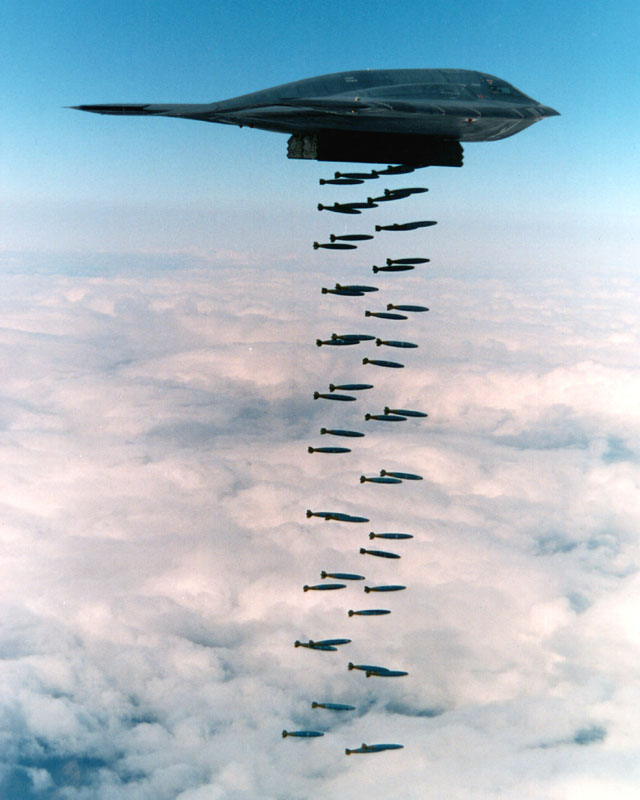
Both not only voted to authorize President Bush’s irrational invasion of Iraq but also have failed to apply those lessons to the real challenges we face, particularly concerning Iran. On the one hand, we have Sen. John McCain’s wildly inane “bomb, bomb, bomb, bomb, bomb Iran” singing refrain, and on the other, Sen. Hillary Clinton’s commitment to “totally obliterate” Iran in response to any nuclear attack by Tehran on Israel.

Clinton has stood by her implicitly genocidal threat against the 70 million innocent Iranians, who have no effective control over their government’s policy, a threat made in response to a question raised in the heat of primary day in Pennsylvania. She later extended the threat to include retaliation on behalf of Saudi Arabia, Kuwait and other Arab countries if they were attacked by Iran.

Her statement extending the U.S. “nuclear umbrella” far beyond the threat to retaliate against a Soviet nuclear attack during the Cold War was greeted with a yawn by the media, which interpreted it as an election-day ploy to appear tough and pro-Israel. The Washington Post referred to “Clinton’s apparent effort to distinguish herself from her rival for the Democratic nomination … by offering a more hawkish approach to world affairs.” That rival, Barack Obama, has called for negotiations with Iran’s leaders and condemned Clinton’s proposal as saber rattling.

But the Washington Post story provided evidence that Hillary’s hawkishness is not merely a campaign posture, as evidenced by her two key foreign policy advisers, who the Post reports helped come up with the “obliterate Iran” idea. One of them is Martin S. Indyk, the former Clinton administration ambassador to Israel, who was as strong as any of the neoconservatives in advocating the invasion of Iraq. In an article he co-wrote with Kenneth M. Pollack for the Los Angeles Times three months before the Iraq invasion, which cited their insider status as former government officials who “had access to the most sensitive U.S. intelligence on Iraq,” the two claimed that Iraq had “thousands of tons of precursor chemicals for chemical warfare agents, thousands of liters of biological warfare agents. …” That “insider” information was false.

The Clinton campaign’s national security director, Lee Feinstein, is another leading Democratic hawk and Clinton administration alum who promoted the threat to obliterate Iran. Feinstein, like Indyk, had strongly disparaged the work of the U.N. inspectors before the invasion. And even a month after the U.S. occupation began, as U.S. troops scoured all of the suggested weapons locations, Feinstein argued, “I believe they will find weapons of mass destruction.”

The dark irony here is that the unjustifiable invasion of Iraq has elevated Iran to a position of enormous power over events in the region, beginning with its influence over the puppet government in Iraq’s Green Zone, many of whose key members, including the prime minister, spent many years in exile in Tehran, where they were trained. The ability of Iran to make life miserable for the American occupation is the main counterweight to a tougher stance on Iran’s nuclear program, and that is the direct consequence of a war for which Clinton and McCain both voted.

Clinton seems to be far more hawkish than her husband, and her increasingly bellicose remarks support that perception. If she is chosen as the Democratic Party’s standard-bearer, she can be expected to tack further in that direction, once the primaries are over and the peace vote has been counted out.

I do not think this a matter of a female candidate having to prove that she is capable of being a macho commander in chief, although there is a whiff of Margaret Thatcher here, so proud of taking her nation to unneeded war. With Clinton, as with Thatcher, quite apart from gender, there seems to be a more basic philosophical commitment to using military force before other options have been seriously explored.

That the force cited by Clinton portends the “total obliteration” of another people raises the prospect of the United States, the only nation that has ever used nuclear weapons, doing so again. It suggests that such weapons of mass destruction are not heinous inventions but rather instruments of rational policy when in the hands of the virtuous. That is a message that we dare not deliver to the world.

Robert Scheer’s new book is “The Pornography of Power: How Defense Hawks Hijacked 9/11 and Weakened America.”

Source. / Truthdig

Thanks to David Hamilton / The Rag Blog

Posted in RagBlog | Tagged , , , | Leave a comment

The Earth : Love it or Lose It

The devastation of Dutch Elm Disease — metaphor for an ailing earth?

Before it’s too late…
To reinvigorate the quest for clean air, soil, and surface water by strengthening regulation and expanding rehabilitation
By Paul Spencer / May 8, 2008 / The Rag Blog

[This is the first of a series on The Rag Blog by Paul Spencer and others that will take a serious look at the threatened ecology of the earth and explore ways to address the problem. Paul Spencer is a former Austin activist and staff member of sixties/seventies underground newsppaper The Rag, who has been running for president as a way of addressing the serious issues facing our society and the world.]

When I was about seven (1952), my mother, brother, and I travelled by train from Dallas, Texas to Buffalo, New York. We left the blue sky and bright sunshine of Dallas and ran through the night to St. Louis. In the morning I looked down, as we crossed the Mississippi River, and noted the character of this wide and brown river with its dense river traffic and smoke stacks lining the river banks. Then a strange smell began to permeate the atmosphere in the train. It became extremely irritating. It was, I was told, the normal atmosphere of East St. Louis, Illinois.

We were still somewhat elevated as we entered the city. The place itself lay like a gray cemetery below and to the north of us, and there was a brown pall above it. I was glad when we were leaving the city and the smell behind us, as we headed into the Illinois countryside.

I don’t remember much more of the trip, until we reached the Buffalo area. Buffalo itself was as red-brown as East St. Louis was gray. It was like a patina on the brick buildings. The smells were comparatively subdued and very varied. As we headed north through Lackawanna, there was an almost metallic smell in the air; as we reached the Buffalo harbor area, there was the smell of grain, both fresh and roasting.

Eight years later, we were living in the Buffalo area. Elmwood Avenue, Delaware Avenue, Linwood Avenue were relatively wide boulevards overhung with 70-feet-tall Elm trees. They were tunnels of cool green for at least six months of the year. Lake Erie was a recreational focus – fishing, swimming, boating. Everybody in the town was busy and working hard – except, of course, the county road crews.

In 1966 I stayed in the area for six months. I went to work for the South Buffalo Railway, which was a captive service for the Bethlehem Steel plant in Lackawanna. One of our jobs was to pull the big slag pots from the back of the converters and dump the slag. The slag pots were inverted bells, hung by trunnions, one per short railcar. We would push them up a long, sloping hill – of slag – to the top, where a very large track-type crane would smack the slag pots with a wrecking ball, until they tipped over. The red-hot slag would tumble down the side of this slag hill into Lake Erie. It was quite a nice show at night.

Five years later, I came back for awhile. The Elms were two-thirds gone due to Dutch Elm disease; the Lombardy Poplars were dying en masse; fishermen were saying that the fish were disappearing from Lake Erie; the city was turning gray; the sky was turning gray-brown; and the county-crew-syndrome was spreading to many other segments of the workforce.

About that time, the federal Environmental Protection Agency was initiated. Studies were begun, and pretty soon we were hearing that: yes, Lake Erie is “dying”; yes, the local air quality is bad for people; yes, Bethlehem Steel is polluting the lake. Not too long after that, they “discovered” a huge toxic dump under a housing development up toward Niagara Falls, called Love Canal.

Type E Botulism, Lake Erie, 1999: Red-breasted Mergansers dead of Type E Botulism. Photo I.K. Barker

By the time that I left in 1979, there was hardly an Elm or a Lombardy Poplar to be found; the Sugar Maples were starting to die; Lake Erie was called “dead”; the population was declining; the sky was brown; and the county crews – among others – were being laid off permanently. That was my main environmental-destruction history, and I’m sure that most of you have experienced your own. One of the most amazing features to me was the speed of deterioration. It seemed that, if you blinked, something else was declining, dying, or dead.

There have been improvements in the Western New York area since then. Some fish species have re-established themselves in Lake Erie; the Sugar Maples have survived; the streams in the Northeast U.S.A. are not as choked with crud and algae and dead fish; the remaining population has found more employment; and the sky is not quite as brown as it was in 1979. More broadly, many species of trees are well established as replacements for the American Elms; songbirds and waterfowl are increasing in many areas; and most Rust-belt cities’ atmospheres are not laden with levels of noxious exhaust fumes as high as those of the late 1970s.

Of course, much of the basis for these improvements is the facts that: U.S. Steel in Gary, Bethlehem Steel in Buffalo, and Republic Steel in Cleveland are gone; many industries have moved manufacturing operations to foreign plants; exploitation of natural resources has declined within the contiguous 48 states; and international competition has caused improvement in the fuel-efficiency of cars and trucks. (Are these good developments? Yes and no.)

Other important factors mostly derive from regulation by government agency. Laws and regulations promulgated by the EPA (established in 1970), state environmental/ecological agencies, and some local authorities have protected species and habitat, promoted recycling, and mandated mitigation – both by device and by remediation. (Are these all good developments? Almost without exception.)

Where are we now in this situation? Just looking at the Pacific Northwest, there are tons of PCBs in and out of drums buried in Hamilton Island just below the Bonneville Dam on the Columbia River. There are many tons of radioactive waste water – and who knows what else – leaking into the water table under the Hanford reservation. The old Portland harbor area is a Superfund site (essentially inactive due to lack of funds). Wild (non-hatchery) salmon are barely hanging on. And the list continues ….

Where could we be, given the right spending and legislative priorities? We can:

1) Finish remediation of the 375 Superfund sites that are known to “degrade or threaten either groundwater or human health” before the next presidential election cycle (2012);

2) Require increases in fuel efficiency in new vehicles to the best levels currently available (e.g., VW’s GDI diesel for predominantly highway driving and Toyota Prius for city driving);

3) Nationalize (socialize) the railroads and begin to build two-way, high-speed track systems for inter-city public and freight transportation to alleviate car and truck traffic;

4) Increase the promotion of solar, wave, and wind-based power systems via increased tax credits, low-interest loans, and net-metering (at a minimum, the California model);
5) Research nuclear fuel recycling, as done in France;

6) Replace all applicable lighting with fluorescent systems or, better yet, LEDs (and establish local recycling sites for these devices);

7) Promote ground-source heat pump systems for new residential or commercial construction.

This is a short list. It is merely one possible (beginning) set of projects. We have much more that we can and must do. Exciting, isn’t it – and eminently doable. One overlying question requires discussion: Is it necessary to virtually eliminate manufacturing and resource extraction to regain ecological balance? My answer is “definitely not”. Much of the current adversarial relations between environmentalists (in the organized, committed sense of the word) and industry (read primarily “corporations”) is due to the dynamics of negotiation-of-position in a market context. Simply put, the average environmentalists’ position (not the preservationists’ wishlist) is the reasonable position. Having said that, there are sustainable levels and methods of logging, mining, grazing, road-building, irrigation, dam-building, wind-farm development, etc. to be encouraged and protected. Ecological concern must include the ability of people to build a reasonably secure and comfortable life – albeit in the context of decreasing the stress on the rest of the ecosystem. We human beings are part of the environment, too.

Paul Spencer for President.

The Rag Blog

Posted in Rag Bloggers | Tagged , , | Leave a comment

Remain Silent to the Crime and You Are Complicit


The ‘Surge’ of Iraqi Prisoners
by Ciara Gilmartin / May 7, 2008

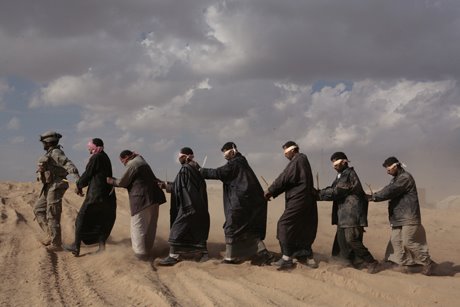
Amid all the talk about the U.S. military “surge” in Iraq, little has been said about the accompanying “surge” of Iraqi prisoners, whose numbers rose to nearly 51,000 at the end of 2007. Four years after the Abu Ghraib scandal, occupation forces are holding far more Iraqis than ever before and thousands more languish in horrendous Iraqi-run prisons.

The Detention Camps

Detainees are held by the U.S. command in two main locations — Camp Bucca, a 100-acre prison camp and Camp Cropper, inside a massive U.S. base near the Baghdad airport. The number of Iraqis held in these facilities has steadily risen since the early days of the occupation. In 2007, the inmate count rose 70% — from 14,500 to 24,700.

Camp Bucca, with about 20,000 inmates, is perhaps the world’s largest extrajudicial internment camp. The facility is organized into “compounds” of 800 detainees each, surrounded by fences and watch towers. Most detainees live in large communal tents, subject to collapse in the area’s frequent sandstorms. Water has at times been in short supply, while temperatures in the desert conditions can be scorching hot in the day and bone-chilling at night.

In October 2007, the U.S. Army Corps of Engineers awarded a contract to expand Camp Bucca’s capacity from 20,000 to 30,000. While easing notorious crowding, the contract suggests Washington is preparing for even more detentions in the future.

Camp Cropper consists of more traditional cellblock buildings. Among its roughly 4,000 inmates are hundreds of juveniles. Cropper is a site of ongoing interrogation and it holds many long-term detainees who complain that they never see the light of day. Though recently expanded, the facility suffers from overcrowding, poor medical attention and miserable conditions.

Indefinite Detention

U.S. forces are holding nearly all of these persons indefinitely, without an arrest warrant, without charge, and with no opportunity for those held to defend themselves in a trial. While the United States has put in place a formal review procedure that supposedly evaluates all detainees for release on a regular basis, detainees cannot attend these reviews, cannot confront evidence against them, and cannot be represented properly by an attorney. Families are only irregularly notified of the detentions, and visits are rarely possible.

These conditions are in direct violation of international human rights law, though Washington claims that such legal constraints do not apply, because the United States considers its forces to be engaged in an “international armed conflict.” The human rights community, however, firmly disagrees arguing that the conflict is not international in the traditional legal sense. Furthermore, international human rights law applies at all times, in war as well as in peace.

The detention facilities are closed to human rights monitors like Amnesty International, Human Rights Watch, or the International Federation of Human Rights. Even the United Nations Assistance Mission in Iraq, mandated by the Security Council to provide human rights reporting, is denied access by the U.S. command. Lack of such monitors greatly increases the likelihood that detainees will suffer from abuse and bad conditions, as human rights organizations have often pointed out.

Read all of it here. / Foreign Policy in Focus / Common Dreams

The Rag Blog

Posted in RagBlog | Tagged , , | Leave a comment

We Have the Answer, and It Is Us


Dismantling Peace Movement Myths
by Frida Berrigan

[From a speech for Peace Action Maine on April 26th, 2008]

This moment in time contains so much hope and possibility and so much death and destruction. These are not easy times and they are not getting easier — and so I thought that I would take on some of the myths that burden, complicate and undermine our peace movements.

We have internalized some of these myths pretty deeply. We even reinforce them with one another. So, I thought it might be a valuable exercise to spend some time together dismantling a few of them.

What follows is my highly subjective (and certainly incomplete) compilation of the myths of the peace movement.

  • In the 1960s, the peace movement was so much more powerful and so much cooler than we are.
  • There are no young people active in the peace movement. Don’t they care?
  • We are marginalized and we are not having an impact.
  • We’re not smart enough to oppose the war.
  • All we need to do is get the right person in the White House and then they’ll enact our solutions.

Does any of this sound familiar? This is what I hear from brothers and sisters over and over again. Now, these myths are not equal — some are bigger than others. And some have a kernel of truth (which is why they are myths and not lies) but cumulatively this constant bombardment is a real bummer.

So, I’m saying they are not true — I’m saying that there are young people, and we are having an impact, and that no one person in any position of power is going to offer any answer automatically or just because they promised they would.

I’m saying we are the ones we have been waiting for, that we are creating the alternative. If that is what we are doing, not just going through some exercise of opposition, some knee-jerk resistance or recalcitrance, then we have a lot of work ahead of us — and need to take the work more seriously, and ourselves less so.

And that starts with dismantling myths.

Myth One: In the 1960s, the peace movement was so much more powerful and so much cooler than we are today.

I want to start with the 1960s one. 2008 is a big year for revivals and recollections and reunions for the historians and the academics and the activists. 40 years since: the police riot in Chicago, the assassination of Martin Luther King and of Bobby Kennedy, Tommie Smith and John Carlos giving the black power salute as they received their Olympic medals, since Catonsville. And those are just a few of the things that happened in the U.S. that year — around the world there was Prague Spring, the massacre at Tlateloco, the Paris uprising, the Biafran war. Here we are forty years later, and it is a potent moment for reflection.

But, the demonstrations at the Democratic National Convention in Denver this summer are happening under the slogan “Recreate Sixty-Eight.” Disclaimer: Now, I don’t mean to undermine or disparage the work of activists and organizers in Denver and all of the friends who will go to Colorado this summer to demonstrate, and at the same time implore the democratic party to be the party of the people.

I like the rhythm of language a lot. And I love alliteration. In that way — Recreate Sixty Eight is AWESOME. I love how it sounds. The organizers have their reasons for choosing it beyond how cool it sounds. There are a lot of lessons to learn from that era, and a lot of good things that happened that year.

But “recreate sixty-eight”? We cannot and should not recreate sixty-eight. The parallels between today and forty years ago are clear and compelling, and as I said there is a lot to learn from that period.

But here we are in 2008 and we need to be building a movement and building bridges between movements (because we are not a monolith) that is rooted in an analysis and understanding of this moment, this place, this context.

I was struck to read recently that at the beginning of 1968, less than half the American people believed the war in Vietnam was wrong, 45%, and that more than 15,000 U.S. soldiers had been killed and nearly 100,000 wounded. So the Vietnam War was both more bloody and more popular than the war and occupations in Iraq and Afghanistan are in 2008.

In every way, this nation is less homogeneous than it was 40 years ago: we are racially, ethnically, religiously more diverse and more stratified. We are so much poorer, and so much richer than we were forty years ago. We are less innocent. We are less naïve. In short — we are different. And this war is different. And so our movements must also be different.

But the media compares ‘68 and ‘08, the peace movement then and now. Some activists then and now compare us, some leaders (those who survived) compare that time to now as they seek new relevance.

But, we must not fall sway to this comparison.

We live in the United States of America — a deeply nostalgic and deeply ahistorical nation saddled with a case of amnesia that approaches pathology. My SAT prep teacher would be so proud of that sentence. This is a dangerous and counterproductive combination — nostalgic amnesia. And it infects our peace movements. We are tempted to fetishize the past instead of learn from it. The past is constantly being rewritten and repackaged and then sold to us as a distorted reflection in a house of mirrors. So, we don’t want to recreate sixty-eight; we want to harness some of that energy, that sense of power and possibility and apply it to our very different context today.

Myth Two: There are no young people active in the peace movement. Don’t they care?

Read all of it here. / Common Dreams

The Rag Blog

Posted in RagBlog | Tagged , , , | Leave a comment

Arabs in Israel : Still Strangers in a Strange Land

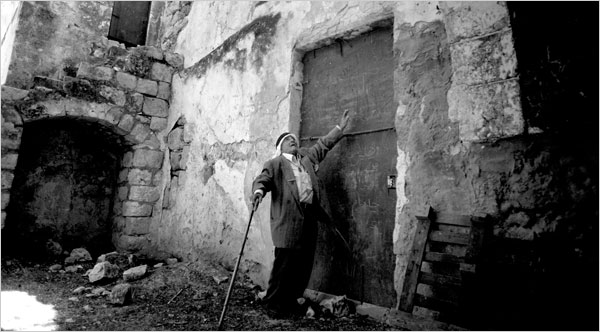
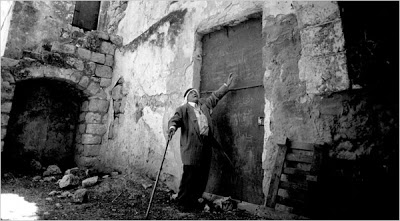
Abu Abed, 84, returned recently to what remains of Hittin, the former Arab village in northern Israel where he was born. He fled with his family in 1948. Photo by Rina Castelnuovo/NYT

After 60 Years, Arabs in Israel Are Outsiders
By Ethan Bronner / May 7, 2008

JERUSALEM — As Israel toasts its 60th anniversary in the coming weeks, rejoicing in Jewish national rebirth and democratic values, the Arabs who make up 20 percent of its citizens will not be celebrating. Better off and better integrated than ever in their history, freer than a vast majority of other Arabs, Israel’s 1.3 million Arab citizens are still far less well off than Israeli Jews and feel increasingly unwanted.

On Thursday, which is Independence Day, thousands will gather in their former villages to protest what they have come to call the “nakba,” or catastrophe, meaning Israel’s birth. For most Israelis, Jewish identity is central to the nation, the reason they are proud to live here, the link they feel with history. But Israeli Arabs, including the most successfully integrated ones, say a new identity must be found for the country’s long-term survival.

“I am not a Jew,” protested Eman Kassem-Sliman, an Arab radio journalist with impeccable Hebrew, whose children attend a predominantly Jewish school in Jerusalem. “How can I belong to a Jewish state? If they define this as a Jewish state, they deny that I am here.”

The clash between the cherished heritage of the majority and the hopes of the minority is more than friction. Even more today than in the huge half-century festivities a decade ago, the left and the right increasingly see Israeli Arabs as one of the central challenges for Israel’s future — one intractably bound to the search for an overall settlement between Jews and Arabs. Jews fear ultimately losing the demographic battle to Arabs, both in Israel and in the larger territory it controls.

Most say that while an end to its Jewish identify means an end to Israel, equally, failure to instill in Arab citizens a sense of belonging is dangerous as Arabs promote the idea that, 60 years or no 60 years, Israel is a passing phenomenon.

“I want to convince the Jewish people that having a Jewish state is bad for them,” said Abir Kopty, an advocate for Israeli Arabs.

Land is an especially sore point. Across Israel, especially in the north, are the remains of dozens of partly unused Palestinian villages, scars on the landscape from the conflict that gave birth to the country in 1948.

Yet some original inhabitants and their descendants, all Israeli Arab citizens, live in packed towns and villages, often next to the old villages, and are barred from resettling them while Jewish communities around them are urged to expand.

One recent warm afternoon, Jamal Abdulhadi Mahameed drove past kibbutz fields of wheat and watermelon, up a dirt road surrounded by pine trees and cactuses, and climbed the worn remains of a set of stairs, declaring in the open air: “This was my house. This is where I was born.”

He said what he most wanted now, at 69, was to leave the crowded town next door, come to this piece of uncultivated land with the pomegranate bushes planted by his father and work it, as generations had before him. He has gone to court to get it.

He is no revolutionary and, by nearly any measure, is a solid and successful citizen. His children include a doctor, two lawyers and an engineer. Yet, as an Arab, his quest for a return to his land challenges a longstanding Israeli policy.

“We are prohibited from using our own land,” he said, standing in the former village of Lajoun, now a mix of overgrown scrub and pines surrounded by the fields of Kibbutz Megiddo. “They want to keep it available for Jews. My daughter makes no distinction between Jewish and Arab patients. Why should the state treat me differently?”

The answer has to do with the very essence of Zionism — the movement of Jewish rebirth and control over the land where Jewish statehood first flourished more than 2,000 years ago.

Maintaining a Haven

“Land is presence,” remarked Clinton Bailey, an Israeli scholar who has focused on Bedouin culture. “If you want to be present here, you have to have land. The country is not that big. What you cede to Arabs can no longer be used for Jews who may still want to come.”

A Palestinian state is widely seen as a potential solution to tensions with the Palestinians of Gaza and the West Bank, but any deep conflict with Israel’s own Arab citizens could prove much more complex.

Antagonism runs both ways. Many Israeli Arabs express solidarity with their Palestinian brethren under occupation, while others praise Hezbollah, the anti-Israel group in Lebanon, and some Arabs in Parliament routinely accuse Israel of Nazism.

Meanwhile, several right-wing rabbis have forbidden Jews from renting apartments to Arabs or employing them. And a majority of Jews, polls show, favor a transfer of Arabs out of Israel as part of a two-state solution, a view that a decade ago was thought extreme.

Arabs here reject that idea partly because they prefer the certainty of an imperfect Israeli democracy to whatever system may evolve in a shaky Palestinian state. That is part of the paradox of the Israeli Arabs. Their anger has grown, but so has their sense of belonging.

In fact, the anxious and recriminating talk on both sides may give a false impression of constant tension. There is a real level of Jewish-Arab coexistence in many places, and the government has recently committed itself to affirmative action for Arabs in education, infrastructure and government employment.

“We know that they need more land, that their children need a place to live,” said Raanan Dinur, director general of the prime minister’s office. “We are working on building a new Arab city in the north. Our main goal is to take what are today two economies and integrate them into one economy.”

Still, there is a concern that time is short.

Mr. Mahameed and his fellow villagers will arrive at the Supreme Court in July with the goal of obtaining 50 acres of their families’ former land that sits uncultivated except for pine trees planted by the Jewish National Fund.

Their story is part of a larger one: After the United Nations General Assembly voted in late 1947 for two states in Palestine, one Arab and one Jewish, local Arab militias and their regional supporters went on the offensive against Jewish settlements, in anger over the United Nations’ support for a Jewish state. Zionist forces counterattacked. Hundreds of Palestinian villages, including Lajoun, were evacuated and mostly destroyed.
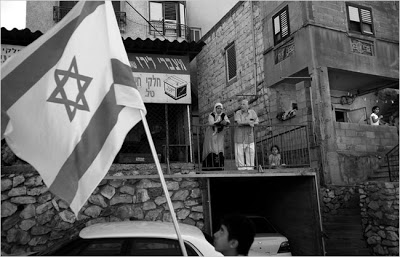
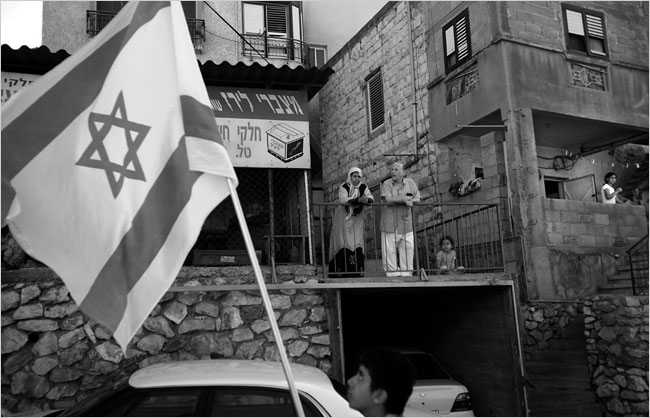
Arab residents of Shefaram, Israel, watched as an Israeli flag was carried in the streets in a 60th anniversary celebration. Photo by Rina Castelnuovo/NYT

Palestinian Arabs became refugees in Jordan, Lebanon and Gaza, then under Egypt’s supervision. But some, like Mr. Mahameed, stayed in Israel. They were made citizens and were promised equality, but never got it.

Those who had left or had been expelled from their villages were not permitted back and have spent the past 60 years often a few miles away, watching their land farmed or built upon by newcomers, many of them refugees from Nazi oppression or Soviet anti-Semitism.

In 1953, the Israeli Parliament retroactively declared 300,000 acres of captured village land to be government property for settlement or security purposes.

Mr. Mahameed and his 200 fellow complainants live in the crowded town of Um el-Fahm near their former land.

“Our claim is that since the land has not been used all these years, there was no need to confiscate it,” said Suhad Bishara, a lawyer with Adalah, a Haifa-based group devoted to Israeli Arab rights.

She lost that argument in the district court, which agreed with the government that the pine trees and a water treatment plant in Lajoun constituted settlement. For her, the ruling is part of a long tradition of trickery by Israel’s legal and political systems that have nearly always come down against expanding Arab land use.

Ms. Bishara says Arabs occupy only a tiny percentage of Israel, despite making up one-fifth of its population. The government said it could not provide an estimate of the land use.

Still, it is not hard to detail the gap between Arabs and Jews in nearly every area — health, education, employment — and in government spending. Three times as many Arab families are below the poverty line as Jewish ones, and a government study five years ago called for removing “the stain of discrimination.”

Mr. Dinur of the prime minister’s office has taken an interest in the issue and has met several times with Arab leaders. He says it may be possible one day for some Arabs to return to their native villages, but only as part of a process of integration and regional reconciliation. Otherwise, he says, Israeli Jews will fear that the Arabs’ goal will be to take back all the territory lost in the 1948 war.

Regional Tensions

For many Israelis, the challenge posed by the Arabs cannot be separated from what they see as the risks in the region — the increased influence of Iran, the growth of Islamic radicalism, the concern that another war in Lebanon or Gaza is not far away.

Michael Oren, a senior fellow at the Shalem Institute, a research group in Jerusalem, said that when the army prepares for war, it includes in the plan how to handle the possibility of Israeli Arabs rising up against the state.

Many also believe — and here Jews and Arabs seem to agree — that without a solution to the Palestinian dispute over the West Bank and Gaza, internal tensions will not abate. And given the pessimism about the peace talks with the Palestinians, the forecast does not look bright.

For many Israeli Jews who long resisted the idea of a Palestinian state, it was the realization that they were losing the demographic battle to Palestinians that turned them around. But of course the population challenge also comes from Israel’s Arabs.

Israeli Arabs are aware of the contest. And some figure time is on their side.

“Israel is living within the Arab-Islamic circle,” Raed Salah, head of the Islamic Movement of Israel, said in an interview. “It is important to look at the Jewish percentage in that larger context over the long term.”

Abdulwahab Darawshe, a former member of Israel’s Parliament and the current head of the Arab Democratic Party, sat in his Nazareth office recently and said: “No matter what happens, we will not leave here again. That was a big mistake in 1948. Yet our identity is becoming more and more Palestinian. You cannot cut us from the Arab tree.”

Asked his plans for Israel’s Independence Day, he said, “I will take a shovel and work the land around my olive trees.”

Source. / The New York Times

Thanks to Jim Retherford / The Rag Blog

Posted in RagBlog | Tagged , , | Leave a comment

S. Russell on Obama and Civility


Obama and this matter of negative politics
By Steve Russell / May 7, 2008 / The Rag Blog

[Steve Russell wrote the following to introduce an article entitled “Outright Barbarism vs. The Civil Society” by Sara Robinson. It is a fascinating and revealing read and we highly recommend you check it out. It follows Steve’s comments.]

Last night in Rawleigh, North Carolina, Barack Obama looked forward to the general election:

“Yes, we know what’s coming. We’ve seen it already. The same names and labels they always pin on everyone who doesn’t agree with all their ideas. The same efforts to distract us from the issues that affect our lives by pouncing on every gaffe and association and fake controversy in the hope that the media will play along. The attempts to play on our fears and exploit our differences to turn us against each other for pure political gain – to slice and dice this country into Red States and Blue States; blue-collar and white-collar; white and black, and brown.

“This is what they will do – no matter which one of us is the nominee. The question, then, is not what kind of campaign they’ll run, it’s what kind of campaign we will run. It’s what we will do to make this year different. I didn’t get into race thinking that I could avoid this kind of politics, but I am running for President because this is the time to end it.”

Obama must be serious about this because he has in so many cases declined to answer attacks from Hillary Clinton that begged for references to her on the same level. His response to the original Wright “God damn America” rant was a speech that was one of the best political speeches of my lifetime. If he needs to do anything more, he should carry copies…but you have to realize that nobody with any sense would any longer be asking about that particular Wright rant and pretending otherwise would not be fruitful—but he could have turned that nonsense around and aimed it at Clinton.

He could have an ad using the video of Bill Clinton’s “spiritual guidance” session with the same Rev. Wright right after that stain on the blue dress.

The other obvious negative Obama could do would be a “daisy ad” using tape of Clinton’s remarks about wiping out Iran with nukes.

NO, he should not do it.

Anybody with an IQ over room temperature could conjure up half a dozen drag Clinton in the dirt ads without breaking a sweat…which is why he should not go there. You don’t elevate politics above gotcha by playing gotcha.

This style of politics is a habit we need to break and it’s hard to break because it has been a winner. Those of us of a certain age remember the original daisy ad against Barry Goldwater, the anti-labor ad against Ralph Yarborough that showed empty streets allegedly from Yarborough running business out of town but actually shot at the crack of dawn when nobody was around.

There there was Bush 41 v. Willie Horton. Bush 43 claiming that McCain’s time in a Vietnamese prison camp drove him nuts. Karl Rove’s attacks on the patriotism of Max Cleland–chicken hawk destroys disabled veteran!

We don’t stop this brand of politics by wishing it away. We stop it by not doing it. By recognizing that it poisons democratic government. By being–gasp!–polite to our adversaries.

Outright Barbarism vs. The Civil Society
By Sara Robinson / May 6, 2008

I live in a nice place.

I mean that literally. It took some getting used to. After 20 years in Silicon Valley, where people put a premium on being direct and to the point, have no time to waste on small talk or personal sharing, and will call a stupid idea stupid to your face, moving to Canada required a whole lot of gearing back on that brusque American aggressive-in-your-face thing. The humbling fact was: We had to learn to mind our manners.

Much of the adjustment work that first year involved re-learning the art of Being Nice. We had to get used to meetings that started with 10 or 15 minutes of personal chit-chat. We had to train ourselves to stop interrupting people, and to be more careful to say “please” and “thank you.” We had to discover (sometimes, the hard way) that losing your temper with Canadians means that you will invariably lose the conflict. The more terse and irritated you get, the more determinedly calm and polite Canadians become, until you’re standing there looking like a raving idiot and they’re still firmly in control (though they’re very sorry you’re having such a bad day).

We also learned the unofficial Canadian motto, which is “I’m sorry.” Canadians will say “I’m sorry” even if you were the one who bumped into them. (Americans, on the other hand, won’t say it at all: apologizing is admitting fault, which is an invitation to lawsuits.) We used to respond to this by pleading with them out of our own misguided sense of Niceness: “No. Please. Don’t be sorry. It was MY fault.” But after a while, we gave up, went with the flow, and started apologizing for everything, too. It was really…well, nice, once we got used to it.

The whole world makes fun of Canadians’ resolute civility — but once I’d read a little Canadian history, I realized that this Being Nice thing isn’t just a cute cultural quirk. In fact, up here, it’s is a deadly serious matter of national survival. Canada’s 13 provinces and territories are, effectively, three separate nations—each with its own culture, language, religion, and history. On top of that, the country is the world’s largest importer of new immigrants, a large fraction of whom are from cultures very different from Canada’s aboriginal and European bedrock. The federal constitution that binds all this together is very weak (it’s not unlike the U.S.’s original Articles of Confederation), and the overwhelming bulk of government power is still tightly concentrated in the hands of the provincial premiers (that’s Canadian for “state governors”). Secession is eminently possible, as the Quebecois so often like to remind us.

In the face of all that, there’s the constant possibility—which does not exist in the U.S.—that one cranky politician having one bad day could stand up and say one idiot thing that would cause one faction or another to decamp en masse, thus precipitating the instant demise of Canada-as-we-know-it. The threat is real. It could happen. And the only thing that keeps it from happening is that resolute collective determination to stay calm, keep the peace, and Be Nice.

Civility is, in a very real sense, the glue that holds this big, diverse nation together. Name-calling, othering, and losing one’s temper is, quite simply, un-Canadian and unpatriotic. Failure to be civil in public is the fastest way (perhaps the only way) to get Canadians genuinely peeved at you. In the land where “life, liberty and the pursuit of happiness” is supplanted by “peace, order, and good government” as the organizing values, there is simply no excuse at all for that kind of behavior, ever.

Our essential reliance on civil discourse—and the big trouble that awaits us when we try to function without it—is the same idea that Jeffrey Feldman explores, far more pointedly, in his new book, Outright Barbarous: How the Violent Language of the Right Poisons American Democracy. Feldman, whose indispensable Frameshop blog has done a lot of the heavy lifting in deconstructing the way the American right uses and abuses language, briskly and thoughtfully deconstructs seven specific ways 30 years of us-versus-them rhetoric has polarized the country, forced us into unnecessary conflicts against each other and everyone else, and virtually destroyed our ability to govern ourselves.

Dave Neiwert, who coined the term “eliminationist rhetoric” to describe the language Americans have so often used to justify violence against each other, has carefully outlined the process by which ugly talk can easily devolve into horrific action. Call it holocaust, lynching, or apartheid — whatever the atrocity, it always begins with language that privileges us, dehumanizes them, and somehow justifies their removal from our midst. Feldman’s book breaks out another side to this conversation, by showing that the right wing has scored some very specific and tangible (and otherwise politically untenable) benefits by the simple act of grinding our discourse down the point where it’s now mostly conduced in the coarsest of us-versus-them terms.

Read all of it here. / Blog for Our Future

The Rag Blog

Posted in Rag Bloggers | Tagged , , , , | Leave a comment

T. Hayden on Obama, Limbaugh and What’s Ahead

Photo by Aaron M. Sprecher/European Pressphoto Agency.

TURNING POINT FOR OBAMA,
LIMBAUGH WINNING INDIANA FOR HILLARY

By Tom Hayden / May 7, 2008

Barack got his game back. Hillary needs a reality check.

Barack had the voters at his back against all the forces trying to bring him down. He held his lead in North Carolina, and only the Rush Limbaugh Republican vote stands between Barack and victory in Indiana. [Clinton took Indiana by two percentage points.]

Hillary needed two wins. She failed utterly. But she will not stop, not on her own.

The super-delegates should intervene tomorrow to send Hillary a message. Out now.

If they don’t, the supporters of Obama should step up their persuasion on those still-undeclared superdelegates to recognize the inevitable and bring this campaign to an end.

Supporters of John Edwards should push their former candidate to release his pledged delegates now, a move that might make the difference as early as this week.

Progressives should intensify the counter-attack against Clinton’s smear campaign against Barack’s character and bogus arguments for recognizing Michigan and Florida, sending the message that her campaign tactics risk a massive defection of the disillusioned in November.

It must be understood that the Clintons are beyond persuasion or capable of thinking beyond their own interests, at least not on their own. Left to their own repetitive patterns, they will step up the attempt to damage Barack Obama so that he is rendered unelectable in the minds of the superdelegates. At the very least, beginning this week, this may mean an assault on Bill Ayers, the Weather Underground, and a twisted depiction of Obama’s history of statements on the Palestinians. [On this latter point, they can run commercials of Clinton kissing Yasser Arafat’s wife, perhaps coupled with footage of the landing under “sniper fire” in Bosnia. Bloggers may have to carry these messages, since Obama won’t].

The Obama forces cannot [and will not] coast to victory. In terms of issues, they should intensify the focus on the Clinton proposal for “massive retaliation” and “obliteration” against Iran on behalf of Israel, Saudi Arabia and the United Arab Emirates. That was front-page news in Toronto yesterday while receiving zero attention in the New York Times and CNN. Barack should take up Robert Kennedy’s 1968 anti-poverty mission in West Virginia. Finally, his campaign needs to build firewalls in Oregon, Montana, and South Dakota to maintain his lead.

TomHayden.com.
Progressives for Obama.

Also see Obama Victorious, Clinton On The Ropes / The Huffington Post
And Wesley Clark reportedly urges Clinton to drop out.
/ AmericaBlog

The Rag Blog

Posted in RagBlog | Tagged , , | Leave a comment

The Sporting News – M. Wizard


Roundball Report: It’s the Finals
By Mariann G. Wizard / May 7, 2008 / The Rag Blog

Even if you’re not a basketball fan, if you’re not watching the Spurs-Hornets matchup in the NBA Western conference semi-finals, you are missing some show! Last night’s game, the second win in two games for the upstarts from New Orleans, was absolutely jaw-dropping, as young point guard (and league MVP runner-up) Chris Paul took multi-MVP Tim Duncan, as well as San Antonio stars Manu Ginobili and Tony Parker, to school. Literally running circles around the lightning-fast Parker, Paul is the quickest thing on the court since kangaroos, with an arrogant, self-assured ‘tude reminiscent of M. Ali when he was still lean and hungry Cassius; there’s also a definite footwork resemblance!

The 22-year old is being compared to a lot of aged NBA stars, but so far I haven’t heard today’s wannabe Cosells state the obvious — they’ve been wrong too many times — but this is the next Michael Jordan. MJ transformed his team, the lackluster Chicago Bulls; transformed the game of basketball as sport, spectacle, and business; and is still the ideal of aspiring young hoopsters worldwide. Chris Paul is gonna do and be all that, too, and be just as much fun to watch. It will be interesting to see how this series plays out when the inexperienced Hornets, who nonetheless have home court advantage over the reigning NBA champs, play game 3 Wednesday night in San Antonio. And LA’s Kobe Bryant, with the Lakers facing a tough opponent in Utah, better enjoy his MVP-ship this year; good as he is, there’s a new kid down on the block.

Meanwhile in the East, the Boston-Cleveland matchup is shaping up as a thriller, although Boston exits game two tonight with a two game lead. League-leading Celts’ star Ray Allen was held scoreless for the first time since 1997, and the Cavs’ LeBron James had an extremely poor shooting night as well. When the heavy hitters on either of these teams start hitting, it’s likely to be contagious! The series moves to Cleveland on Thursday, and I’m hoping for overtime! Also in the East, Detroit had handed Orlando two straight defeats without a lot of trouble. One young Pistons fan seen on teevee during Tuesday’s game two — who ironically was a ringer for the movies’ “Harry Potter” — had the real deal on this series painted on his chest: “THERE’S NO SUCH THING AS MAGIC.”

Well, almost no such thing. Anybody know when quidditch season starts?

The Rag Blog

Posted in Rag Bloggers | Tagged | Leave a comment

White House E-Mail Is Broken, Deliberately

The following article outlines technical reasons that the White House e-mail system failed and cannot provide evidence for an investigation into potential criminal activities that emanated from that building. That e-mails were missing, whether inadvertently through bad information technology (IT) practices or through deliberate removal of message stores and archives, has been known for some time. Not until recently, however, has the discussion turned to technical aspects of the loss.

From a purely technical perspective, it is absurd to claim that “[t]he system would require 18 months to ingest the existing backlog of messages in the Microsoft Xchange system” and “[t]he system offered users no option to distinguish between Presidential records and political or personal materials,” and the National Archives says as much in the article that follows. It is particularly unfathomable to me as an IT professional for over 20 years that there would be no backup system whatsoever in place for an office as critical as the Executive Branch of the US government. Backup is the first ground-rule for any IT operation, even on the smallest scale.

Let’s be clear about this: there is no such thing as “IT politics.” This was pure and simple George W. Bush / Dick Cheney politics, where revealing any sort of sensitive (read: “illegal”) activity in an e-mail would be strictly taboo. These clowns are criminals through and through.

From my perspective, many of the things written in this article are patently ludicrous. Writing that there are “technical issues and concerns” so vastly understates what is happening here that I cringe at the thought of the Information Technology Political Appointee department at the White House that “maintains” the computing systems there.

Richard Jehn / The Rag Blog

Another Rag Blogger adds:

Politics and other personal (and organizational) agendas are usually to blame for IT failure. By any reasonable measure, the guardians of White House email used poor IT practice as a tool to circumvent applicable law, avoid disclosure, and maintain control over sensitive data.

One more example of executive branch obfuscation and circumvention of law.

Bill Meacham / The Rag Blog

What the White House needs.

IT politics killed White House email project
By Michael Krigsman / May 6, 2008

Data archiving in the White House is a serious business mandated by the Presidential Records Act of 1978, which was passed following the Watergate scandal.

The Act requires the White House to maintain an historical archive of its activities, policies, and decisions. Despite this law, the White House email archiving system is a model of poor IT practice and has been called “primitive,” “inadequate,” and “not robust.” The system fails to fulfill its most basic requirements: enabling reliable backup, storage, and restore capabilities.

Email backup process. Quoted in a report by the House of Representatives Committee on Oversight and Government Reform, White House CIO, Theresa Payton, described how White House emails are archived using a manual method called “journaling:”

Under this process, a White House staffer or contractor would collect from a “journal” e-mail folder in the Microsoft Exchange system copies of e-mails sent and received by White House employees. After retrieving copies of these e-mails, the White House staffer or contractor would then manually name and save them as “.pst” files on various White House servers.

Former White House CIO, Carlos Solari, characterized the process:

[A]s a ‘message collection system’ even though we all understand that it hardly qualifies as a ’system’ by the usual IT definition.

In a memo to Acting CIO, John Straub, in 2005, IT manager, John McDevitt, described the ad hoc system:

The current email archive process depends on manual operations and monitoring, standard operating procedures do not exist, automated tools that support the email archive process are not robust, and there is no dedicated archive storage location.

The report points out at least three fatal flaws with the manual email archive process:

  • Risk of data loss
  • Risk of tampering
  • Inability to verify system functionality

Email archiving project failure. In 2003, the White House initiated an Electronic Communications Records Management System (ECRMS) project to automate email archiving. Booz Allen Hamilton was contracted to design the system and Unisys was engaged to test and implement it. According to the internal government program director for the project, John McDevitt, the project was completed in the spring of 2004:

According to Mr. McDevitt, this design was presented to the White House Counsel, the White House Office of Records Management, and counsel in the Office of Administration “for their concurrence” in the spring of 2004. With Unisys serving as the contractor for the implementation phase, the White House undertook “[s]ystem configuration, testing and tuning” through 2005. In early 2006, standard operating procedures were developed. In March 2006, the White House Counsel, the White House Office of Records Management, and OA counsel were briefed on the system, and in July of 2006, they were briefed “on the search and retrieval capabilities of the ECRMS solution.” Mr. McDevitt stated that the project was “ready to go live” on August 21, 2006.

Although the ECMRS was ready for use, current White House CIO, Theresa Payton, terminated the project in 2006 because:

“[t]he system would require 18 months to ingest the existing backlog of messages in the Microsoft Xchange system” and “[t]he system offered users no option to distinguish between Presidential records and political or personal materials.”

The National Archives responded with objections to these reasons, suggesting they did not present sufficient cause to abandon the completed project and revert to manual, and therefore unreliable, email backup techniques.

[snip]

Update 5/6/08 5:00pm EST: To gain further insight into this situation, I spoke with David Gewirtz, author of the book Where Have All the Emails Gone?. Here’s what David said:

White House email is broken. Their email archiving system is wildly inadequate to the point of negligence. Management of computer assets like laptops, flash drives, and BlackBerrys is completely non-existent.

Email in the White House needs to be fixed. Not because we want to give Congress a bigger stick with which to beat on Presidents, but because some really bad things could happen if it’s not fixed. There are technical issues and concerns, plus security issues and concerns that blast through the political rhetoric and even party affiliation. The practice of archiving is a technical act, while the practice of disclosing is a political or policy act.

We need to make sure we archive the White House email traffic, but that doesn’t mean confidential information must be disclosed to opposing parties or the general public.

Finally, there is breaking news out of the White House today. The White House has responded to Judge Facciola’s request for disclosure of email messages during the first term of the Bush administration. I’ve just gotten those court documents and am working my way through them now. The gist of them seems to be that the White House does not believe further document recovery is warranted. I’m going to be working my way through the full document set and will publish an analysis of it, probably tomorrow.

Read all of it here. / ZDNet

The Rag Blog

Posted in RagBlog | Tagged , , , | Leave a comment

Iraq War Moratorium Number 9, Number 9, Num …

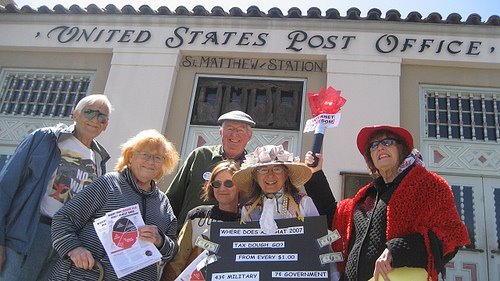
The Raging Grannies, backed by San Mateo Peace Action, demonstrated at the San Mateo, CA post office on “tax day,” as part of Iraq Moratorium 8.

The Iraq Moratorium is a national, grassroots effort uniting individuals and groups who want to end the war and occupation. It encourages people to take some action, individually or with a group, on the third Friday of every month to call for an end to the war.

More than 900 vigils, marches, rallies, speakers, films, and other actions have been listed on the Iraq Moratorium website, www.IraqMoratorium.org , since the monthly events began in September. Already about 60 are listed for May 16, with more coming in daily. The website also posts reports, photos and videos of past actions around the country.

Individual action is also encouraged on Moratorium days, ranging from wearing a button or armband to work or school to writing letters to the editor, calling Congressional representatives, and more.

“Two-thirds of the American people want this war to end,” said Paul Krehbiel, a Pasadena, CA Moratorium organizer. “The Moratorium’s goal is to get those people mobilized and encourage them to speak up and do something. The Silent Majority wants our troops home. We want them to quit being silent and put some pressure on the politicians to listen to the people.”

The Iraq Moratorium is endorsed by more than 80 organizations, including: Veterans for Peace, Military Families Speak Out, U.S. Labor Against the War, and United for Peace and Justice, the nation’s largest peace coalition of some 1,400 groups.

The Rag Blog / May 6, 2008

Posted in RagBlog | Tagged , , | Leave a comment

Surprise! You Can’t Trust Any of Them!

Jim Mitchell, communications director for the Office of the Special Counsel, in Washington on Tuesday. Photo by J. Scott Applewhite/AP.

F.B.I. Raids Office of Special Counsel
By David Stout / May 7, 2008

WASHINGTON — The office of the official responsible for protecting federal workers from political interference was raided by F.B.I. agents on Tuesday as part of an investigation into whether he himself mixed politics with official business.

The raid took place at the office of Scott J. Bloch, the head of the Office of Special Counsel. Computers and documents were seized by agents trying to determine whether Mr. Bloch obstructed justice by hiring an outside company to “scrub” his computer files, The Associated Press reported. Investigators also searched Mr. Bloch’s home in suburban Virginia after obtaining a subpoena.

“It is not clear to us what they are searching for,” James Mitchell, a spokesman for the office, told Reuters. “We are cooperating with law enforcement.” Mr. Mitchell said about 20 agents from the Federal Bureau of Investigation took part in the raid.

The Office of Special Counsel gives advice to federal employees on which activities are proper and which are not allowed under the Hatch Act, which is supposed to guard against direct political interference in governmental affairs. Mr. Bloch’s duties including shielding whistle-blowers who disclose such political meddling.

Mr. Bloch was in the news a year ago when his office began to look into political briefings given to employees of several agencies by aides to Karl Rove, who was then President Bush’s chief political adviser. The White House insisted at the time that the briefings met the definitions of allowable activities.

Mr. Bloch’s critics quickly accused him of announcing an inquiry into the Rove-inspired briefings simply to draw attention away from his own shortcomings. At the time, he was the target of a complaint filed by a group of employees who accused him of trying to dismantle his own agency, of illegally barring employees from talking to journalists and of reducing a backlog of whistle-blower complaints by simply discarding old cases.

Mr. Bloch has denied wrongdoing. Last week, the White House forced out Lurita A. Doan, the head of the General Services Administration, after Mr. Bloch’s office determined that she had improperly mixed politics with government business. Mr. Bloch was nominated for his post by President Bush on June 26, 2003. He was unanimously confirmed by the Senate on Dec. 9, 2003, and sworn in to a five-year term on Jan. 5, 2004. His agency’s Web site states that he has more than 17 years’ experience litigating “employment, lawyer ethics, and complex cases before state courts, federal courts and administrative tribunals.”

The agency’s Web site praises conscientious rank-and-file federal employees, “the great heroes, ordinary heroes who have the courage to blow the whistle, who are helping to bring our government to greater accountability.”

Source. / New York Times

The Rag Blog

Posted in RagBlog | Tagged , , , | Leave a comment

Hillary (Still) : Bombs Away!

This is exactly why I will never support Hillary Clinton for president, even if she wins the nomination and names Barack Obama as her VP. I support Obama because he offers the possibility for an alternative to American militarism. Clinton has proven over and over that she does not. It is likely that the Bush regime will carry out aerial attacks against Revolutionary Guard bases in Iran before November under the pretext that they are training Iraqi militias. Hillary Clinton will support that attack.

David Hamilton
/ May 6, 2008 / The Rag Blog

Obama accuses Clinton of using the language of Bush on Iran
By Ed Pilkington / May 5 2008

Barack Obama yesterday accused his rival for the Democratic nomination, Hillary Clinton, of adopting the language of the Bush presidency in her approach to dealing with a nuclear Iran.

Ahead of Tuesday’s hotly contested primaries in Indiana and North Carolina, the two Democratic contenders took to competing television networks and levelled at times pointed criticism at each other over foreign policy and the economy.

In the sharpest attack, Obama said that Clinton’s threat to “totally obliterate” Iran should it attempt a nuclear attack on Israel was inappropriate. “It’s not the language we need right now. It’s language that’s reflective of George Bush,” he said.

Obama said it was time to get away from a foreign policy of “bluster and sabre-rattling and tough talk”. He reminded Clinton that she had urged caution in terms of speculating about Iran on the campaign trail “yet a few days before an election she’s willing to use that language”.

Obama’s comments, made on Meet the Press on NBC, were put to Clinton as she appeared simultaneously on ABC’s This Week. She remained unapologetic: “I think we have to be very clear about what we would do. I don’t think it’s time to equivocate. [Iran has] to know they would face massive retaliation. That is the only way to rein them in.”

Asked by George Stephanopoulos, a former aide to Bill Clinton in the White House, whether she had any regrets over her Iran remarks, she replied: “No, why would I have any regrets?”

Clinton has been buoyed by her recent victory in Pennsylvania, and by evidence that white working-class voters are increasingly swinging behind her. An Associated Press survey of exit polls from earlier primaries shows that white voters without a college education favoured her by 64% to Obama’s 34%.

The New York senator has been trying to press home that advantage in Indiana, where polls suggest she has the lead, and in North Carolina, where she is behind but by a narrowing margin. The two states command 187 delegates.

On Saturday Obama added another victory to his tally, though the US territory of Guam had just four delegates riding on it. He won by seven votes.

During his interview with Tim Russert, Obama was quizzed about his relationship with the controversial pastor Jeremiah Wright. Asked why it had taken him so long to disassociate himself from the reverend, Obama said: “What became apparent to me was that he didn’t know me as well as I thought he did, and I certainly didn’t know him as well as I thought I did, and that was disappointing.”

Source. / The Guardian, U.K.

The Rag Blog

Posted in RagBlog | Tagged , , , | Leave a comment