Nuclear Reactors – Recalling Their Consequences

Three Mile Island at 29: Reactors and Infant Health
By John LaForge

Today marks 29 years since the partial meltdown and radiation disaster at Three Mile Island (TMI) near Harrisburg, Pennsylvania. News accounts noted the reactor’s loss-of-coolant, fuel melting, multiple explosions, venting of radioactive gases, dumping of contaminated water and the buildup of explosive hydrogen inside the reactor vessel. The accident caused such a nationwide scare that the expansion of nuclear power ended in the United States.

Yet the environmental and health consequences of the TMI disaster aren’t widely understood. Official cover-ups, industry propaganda, and ignorance of radiation-induced illnesses have led to present-day trivialization of TMI and a supposed revival of reactor construction. Any such revival is totally dependent on billions in federal subsidies included in the recent energy bill, because, as Forbes magazine blazoned across its cover: “The failure of the U.S. nuclear power program ranks as the largest managerial disaster in business history, a disaster on a monumental scale.”

The nuclear industry’s attempt to raise nuclear power from the dead involves denying the damage resulting from TMI itself and flies in the face of 25 years of science regarding the effects of low-dose radiation. One Wisconsin legislator said on the record last December, “Three Mile Island was a success of containment.”

Things weren’t much different in 1979. President Carter’s Kemeny Commission hurriedly finished its report on the disaster issuing it in Oct. 1979. The commission did not consider any data on the effects of wind-borne radiation, although the wind blew 6-to-9 mph toward upstate New York and western Pennsylvania.

Over 10 million curies of radioactive noble gases including 43,000 curies of krypton-85 — which stays in the environment for 100 years — as well as 15-to-24 curies of radioactive iodine-131, were vented from the “containment” building. (A curie — 37 billion disintegrations per second — is a huge amount of radiation.) As the Nuclear Regulatory Commission (NRC) later noted, several “deliberate but uncontrolled releases” were used to vent radioactive gas. Official airborne release estimates are just guesses, because of the insufficient number of outside radiation monitors half weren’t working, and a large number of them went off-scale.

On the third day of the venting of these gases, half the population within 15 miles — 144,000 people — fled the area. By this time the bulk of the accident’s airborne radiation was already spewed and drifting on the wind.

In addition, approximately 400,000 gallons of radioactive cooling water that had leaked from the reactor were secretly dumped into the Susquehanna River, a source of drinking water for nearby communities. Later about 2.3 million gallons of radioactively contaminated cooling water were allowed to be “evaporated” into the atmosphere.

In 1980, Pennsylvania State Health Department authorities reported a sharp rise in hypothyroidism in newborn infants in the three counties downwind from the reactor. Late in 1979, four times as many infants as normal were born with the disease. The NRC said the increase was unrelated to radiation released by TMI. Upwind incidence of the disease had dropped to below the national average.

Read the rest here.

Posted in RagBlog | Tagged , | Leave a comment

National Propaganda Radio


NPR News: National Pentagon Radio?
by Norman Solomon

While the Iraqi government continued its large-scale military assault in Basra, the NPR reporter’s voice from Iraq was unequivocal this morning: “There is no doubt that this operation needed to happen.”

Such flat-out statements, uttered with journalistic tones and without attribution, are routine for the U.S. media establishment. In the “War Made Easy” documentary film, I put it this way: “If you’re pro-war, you’re objective. But if you’re anti-war, you’re biased. And often, a news anchor will get no flak at all for making statements that are supportive of a war and wouldn’t dream of making a statement that’s against a war.”

So it goes at NPR News, where — on “Morning Edition” as well as the evening program “All Things Considered” — the sense and sensibilities tend to be neatly aligned with the outlooks of official Washington. The critical aspects of reporting largely amount to complaints about policy shortcomings that are tactical; the underlying and shared assumptions are imperial. Washington’s prerogatives are evident when the media window on the world is tinted red-white-and-blue.

Earlier this week — a few days into the sixth year of the Iraq war — “All Things Considered” aired a discussion with a familiar guest.

“To talk about the state of the war and how the U.S. military changes tactics to deal with it,” said longtime anchor Robert Siegel, “we turn now to retired Gen. Robert Scales, who’s talked with us many times over the course of the conflict.”

This is the sort of introduction that elevates a guest to truly expert status — conveying to the listeners that expertise and wisdom, not just opinions, are being sought.

Siegel asked about the progression of assaults on U.S. troops over the years: “How have the attacks and the countermeasures to them evolved?”

Naturally, Gen. Scales responded with the language of a military man. “The enemy has built ever-larger explosives,” he said. “They’ve found clever ways to hide their IEDs, their roadside bombs, and even more diabolical means for detonating these devices.”

We’d expect a retired American general to speak in such categorical terms — referring to “the enemy” and declaring in a matter-of-fact tone that attacks on U.S. troops became even more “diabolical.” But what about an American journalist?

Well, if the American journalist is careful to function with independence instead of deference to the Pentagon, then the journalist’s assumptions will sound different than the outlooks of a high-ranking U.S. military officer.

In this case, an independent reporter might even be willing to ask a pointed question along these lines: You just used the word “diabolical” to describe attacks on the U.S. military by Iraqis, but would that ever be an appropriate adjective to use to describe attacks on Iraqis by the U.S. military?

In sharp contrast, what happened during the “All Things Considered” discussion on March 24 was a conversation of shared sensibilities. The retired U.S. Army general discussed the war effort in terms notably similar to those of the ostensibly independent journalist — who, along the way, made the phrase “the enemy” his own in a followup question.

It wouldn’t be fair to judge an entire news program on the basis of a couple of segments. But I’m a frequent listener to “All Things Considered” and “Morning Edition.” Such cozy proximity of world views, blanketing the war maker and the war reporter, is symptomatic of what ails NPR’s war coverage — especially from Washington.

Of course there are exceptions. Occasional news reports stray from the narrow baseline. But the essence of the propaganda function is repetition, and the exceptional does not undermine that function.

To add insult to injury, NPR calls itself public radio. It’s supposed to be willing to go where commercial networks fear to tread. But overall, when it comes to politics and war, the range of perspectives on National Public Radio isn’t any wider than what we encounter on the avowedly commercial networks.

And a commenter adds:

Or just National Propaganda Radio…

I stopped listening in 2000, during the presidential campaign.

Polls had shown that two-thirds of us wanted third-party candidates in the debates, but when Cokie Roberts had Bush on the air and asked him about this, he said something like, “No, the American people want to see me and Al Gore go toe-to-toe on the issues.” That was a blatant lie and when Cokie failed to call him on it I knew the whole interview was pure propaganda BS. I turned NPR off permanently at that moment.

The documentary film “War Made Easy: How Presidents and Pundits Keep Spinning Us to Death,” based on Norman Solomon’s book of the same name, went into home-video release this week and is now available on DVD from Netflix, Amazon and similar outlets. For more information, go to: http://www.WarMadeEasyTheMovie.org/.

Source

Posted in RagBlog | Tagged , | Leave a comment

Iraq Sucked. Now Get On With It.

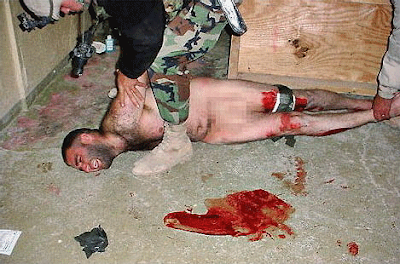
In Iraq, Was I a Torturer?
By Justine Sharrock / Mother Jones / March 27, 2008

The prisons in Iraq stink. Ask any guard or interrogator and they’ll tell you it’s a smell they’ll never forget: sweat, fear and rot. On the base where Ben Allbright served from May to September 2003, a small outfit named Tiger in western Iraq, water was especially scarce; Ben would rig a hose to a water bottle in a feeble attempt to shower. He and the other Army reservists tried mopping the floors, but the cheap solvents only added a chemical note to the stench. During the day, when the temperature was in the triple digits, the smell fermented.

It got even hotter in the Conex container, the kind you see on top of 18-wheelers, where Ben kept his prisoners. Not uncommonly the thermometer inside read 135, even 145 degrees. The Conex box was the first stop for all prisoners brought to the base, most of them Iraqis swept up during mass raids. Ben kept them blindfolded, their hands bound behind their backs with plastic zip ties, without food or sleep, for up to 48 hours at a time. He made them stand in awkward positions, so that they could not rest their heads against the wall. Sometimes he blared loud music, such as Ozzy or AC/DC, blew air horns, banged on the container, or shouted. “Whatever it took to make sure they’d stay awake,” he explains.

Ben was not a “bad apple,” and he didn’t make up these treatments. He was following standard operating procedure as ordered by military intelligence officers. The MI guys didn’t make up the techniques either; they have a long international history as effective torture methods. Though generally referred to by circumlocutions such as “harsh techniques,” “softening up,” and “enhanced interrogation,” they have been medically shown to have the same effects as other forms of torture. Forced standing, for example, causes ankles to swell to twice their size within 24 hours, making walking excruciating and potentially causing kidney failure.

Ben says he never saw anything like that. The detainees didn’t faint or go insane, as people have been known to do under similar conditions, but they also “weren’t exactly lucid.” And, he notes, “I was hardly getting any sleep myself.”

When I first set off to interview the rank-and-file guards and interrogators tasked with implementing the administration’s torture guidelines, I thought they’d never talk openly. They would be embarrassed, wracked by guilt, living in silent shame in communities that would ostracize them if they knew of their histories. What I found instead were young men hiding their regrets from neighbors who wanted to celebrate them as war heroes. They seemed relieved to talk with me about things no one else wanted to hear — not just about the acts themselves, but also about the guilt, pain and anger they felt along with pride and righteousness about their service. They struggled with these things, wanted to make sense of them — even as the nation seemed determined to dismiss the whole matter and move on.

This, perhaps, is the real scandal of Abu Ghraib: In survey after survey, as many as two-thirds of Americans say torture is justified when it’s used to get information from terrorists. In an ABC/Washington Post poll in the wake of the 2004 scandal, 60 percent of respondents classified what happened at Abu Ghraib as mere abuse, not torture. And as recently as last year, 68 percent of Americans told Pew Research pollsters that they consider torture an acceptable option when dealing with terrorists.

Critics of the administration’s interrogation policies warn that the ramifications will be felt across the globe, including by Americans unlucky enough to be imprisoned abroad. Foreign policy scholars fear the fallout from Abu Ghraib has already weakened the U.S. military’s anti-terrorism capabilities. Lawyers warn about war crime tribunals. But hardly anyone is discussing the repercussions already being felt here at home. It’s the soldiers tying the sandbags around Iraqis’ necks and blaring the foghorns through the night who are experiencing the effects most acutely. And the communities they’re returning to are reeling as a result.

When I went to visit Ben in Little Rock, Ark., I wanted to know why this charming, intelligent, and overly polite 27-year-old had done what he’d done. For 10 days we rode around in his beat-up maroon 1970s Mercedes — running errands, picking up job applications, meeting his girlfriend for lunch. Ben wore pink shirts, hipster blazers and color-coordinated Campers; he used hair products, which to his friends meant being a metrosexual; he listened to indie rock, watched “The Daily Show” and wrote attitude-filled blogs on veterans’ rights, which meant being a liberal. He refereed football games, worshipped novelist Dave Eggers and placed special orders at McDonald’s so his meals would be fresh.

He was unemployed, fired from his latest job as a bank teller the day before I arrived. Ben had worked there for four months — the longest he’d held down a full-time job since coming home from Iraq. He’d tried tutoring high schoolers, bagging groceries and doing IT support for Best Buy. Part of the problem, he said, was the lack of good jobs in the area, part of it his own “flailing and procrastinating.” He had toyed with the idea of law school and scored a near-perfect 178 on the LSAT entrance test, but then turned down offers from schools such as NYU. While I was in town he picked up an application for a job at his corner liquor store. In high school he was one of two students voted most likely to become famous. “The other kid became a doctor,” Ben confessed, “and I, well, yeah …”

[snip]

After Ben came home in March 2004, he was treated warmly. “I was at Applebee’s one night and a guy overheard that I had just come back from Iraq,” he recalls, “so he bought me a Jack and Coke.” He was offered discounts on cell phones and cars. “I finally felt appreciated after feeling used for so long.”

But the welcomes couldn’t silence the questions that kept him up at night. Ben loves to debate, perhaps because he usually wins, but now he was endlessly, fruitlessly arguing with himself. “Every human being instinctively knows right from wrong. There is never a justification for torture.” But then again, “Is softening people up wrong on some levels? I don’t know. It wasn’t beneficial to them, but it was presented as necessary.” He had seen a side of himself he didn’t know existed, and now he had to live with that. “In combat you question your mortality,” he told me. “In these prisons you question your morality.”

I asked Ben point-blank if he considered himself a torturer. It was a hard question to ask, a harder one to answer. He said he didn’t know. He asked me how other soldiers in his situation had responded. Most, I told him, didn’t even brook use of the word “torture” instead of “harsh interrogation.” He finally said he guessed he didn’t want to have to think of himself that way, and that it was time to go meet his girlfriend.

When he first got back from Iraq, Ben had nightmares and couldn’t remember things; this was infuriating, since he’d always prided himself on his perfect memory. A psychiatrist diagnosed him with PTSD, but he refused medication. Instead he blew $14,000 on bar tabs his first four months home. “I drank every night. I’d wake up next to a stranger at around 4 p.m. and head off to the strip club again.” He traveled some, because “you can reinvent yourself when you’re out of town.” He also re-enlisted; he’ll be on active duty until 2013, which means that once a month he has to cut his perfectly messy hair and show up at the local base. He thinks the military needs people like him, “people who can see both sides of things.”

Read all of this sad story here.

Posted in RagBlog | Tagged , | Leave a comment

Another Adrianople, Manzikert, or Rocroi

Sadly, Bill Lind usually knows exactly what he’s talkin’ ’bout. Watch your backs, boys and girls …

Richard Jehn / The Rag Blog

Operation Cassandra
By William S. Lind / March 3, 2008

“Lew Rockwell”- — Admiral Fallon’s (forced?) resignation was the last warning we are likely to get of an attack on Iran. It does not mean an attack is certain, but the U.S. could not attack Iran so long as he was the CENTCOM commander. That obstacle is now gone.

Vice President Cheney’s Middle East tour is another indicator. According to a report in The American Conservative, on his previous trip Cheney told our allies, including the Saudis, that Bush would attack Iran before the end of his term. If that report was correct, then his current tour might have the purpose of telling them when it is coming.

Why not just do that through the State Department? State may not be in the loop, nor all of DOD for that matter. The State Department, OSD, the intelligence agencies, the Army and the Marine Corps are all opposed to war with Iran. Of the armed services, only the Air Force reportedly is in favor, seeking an opportunity to show what air power can do. As always, it neglects to inform the decision-makers what it cannot do.

The purpose of this column is not to warn of an imminent assault on Iran, though personally I think it is coming, and soon. Rather, it is to warn of a possible consequence of such an attack. Let me state it here, again, as plainly as I can: an American attack on Iran could cost us the whole army we now have in Iraq.

Lots of people in Washington are pondering possible consequences of an air and missile assault on Iran, but few if any have thought about this one. The American military’s endless “we’re the greatest” propaganda has convinced most people that the U.S. armed forces cannot be beaten in the field. They are the last in a long line of armies that could not be beaten, until they were.

Read all of it here.

Posted in RagBlog | Tagged , , | Leave a comment

Crisis in Iraq. Big Time.

Five Things You Need to Know to Understand the Latest Violence in Iraq
By Joshua Holland and Raed Jarrar / AlterNet / March 27

The traditional media is incapable of reporting what’s going on in Southern Iraq.

Heavy fighting has spread across Shia-dominated enclaves in Iraq over the past two days. The U.S.-backed regime of Prime Minister Nouri al-Maliki has ordered 50,000 Iraqi troops to “crack down” — with coalition air support — on Shiite militias in the oil-rich and strategically important city of Basra, U.S. forces have surrounded Baghdad’s Sadr City and fighting has been reported in the southern cities of Kut, Diwaniya, Karbala and Hilla. Basra’s main bridge and an oil pipeline connecting it to Amara were destroyed Wednesday.

Six cities are under curfew, and acts of civil disobedience have shut down dozens of neighborhoods across the country. Civilian casualties have reportedly overwhelmed poorly equipped medical centers in Baghdad and Basra.

There are indications that the unilateral ceasefire declared last year by the nationalist cleric Muqtada al-Sadr is collapsing. “The cease-fire is over; we have been told to fight the Americans,” one militiaman loyal to al-Sadr told the Christian Science Monitor’s Sam Dagher by telephone from Sadr City. Dagher added that the “same man, when interviewed in January, had stated that he was abiding by the cease-fire and that he was keeping busy running his cellular phone store.”

A political track is also in play: Sadr has called on his followers to take to the streets to demand Maliki’s resignation, and nationalist lawmakers in the Iraqi Parliament, led by al-Sadr’s block, are trying to push a no-confidence vote challenging the prime minister’s regime.

The conflict is one that the U.S. media appears incapable of describing in a coherent way. The prevailing narrative is that Basra has been ruled by mafialike militias — which is true — and that Iraqi government forces are now cracking down on the lawlessness in preparation for regional elections, which is not. As independent analyst Reider Visser noted:

Most importantly, there is a discrepancy between the description of Basra as a city ruled by militias (in the plural) … [and the] facts of the ongoing operations, which seem to target only one of these militia groups, the Mahdi Army loyal to Muqtada al-Sadr.

Surely, if the aim was to make Basra a safer place, it would have been logical to do something to also stem the influence of the other militias loyal to the local competitors of the Sadrists, the Islamic Supreme Council of Iraq [SIIC], as well as the armed groups allied to the Fadila party (sic) (which have dominated the oil protection services for a long time). But so far, only Sadrists have complained about attacks by government forces.

The conflict doesn’t conform to the analysis of the roots of Iraqi instability as briefed by U.S. officials in the heavily-fortified Green Zone. It also doesn’t fit into the simplistic but popular narrative of a country wrought by sectarian violence, and its nature is obscured by the labels that the commercial media uncritically apply to the disparate centers of Iraqi resistance to the occupation.

The “crackdown” comes on the heels of the approval of a new “provincial law,” which will ultimately determine whether Iraq remains a unified state with a strong central government or is divided into sectarian-based regional governates. The measure calls for provincial elections in October, and the winners of those elections will determine the future of the Iraqi state. Control of the country’s oil wealth, and how its treasure will be developed, will also be significantly influenced by the outcome of the elections.

It’s a relatively straightforward story: Iraq is ablaze today as a result of an attempt to impose Colombian-style democracy on the unstable country: Maliki’s goal, shared by the like-minded allies among the Shiite, Sunni and Kurdish communities that dominate his administration, and with at least tacit U.S. approval, is to kill off the opposition and then hold a vote.

To better understand the nature of this latest round of conflict, here are five things one needs to know about what’s taking place across Iraq.

1. A visible manifestation of Iraq’s central-but-under-reported political conflict (not “sectarian violence”)

Iraq, which had experienced little or no sectarian-based violence prior to the U.S. invasion, has been plagued with sectarian militias fighting for the streets of Iraq’s formerly heterogeneous neighborhoods, and “sectarian violence” has become Americans’ primary explanation for the instability that has plagued the country.

But the sectarian-based street-fighting is a symptom of a larger political conflict, one that has been poorly analyzed in the mainstream press. The real source of conflict in Iraq — and the reason political reconciliation has been so difficult — is a fundamental disagreement over what the future of Iraq will look like. Loosely defined, it is a clash of Iraqi nationalists — with Muqtada al-Sadr as their most influential voice — who desire a unified Iraqi state and public-sector management of the country’s vast oil reserves and who forcefully reject foreign influence on Iraq’s political process, be it from the United States, Iran or other outside forces.

The nationalists now represent a majority in Iraq’s parliament but are opposed by what might be called Iraqi separatists, who envision a “soft partition” of Iraq into at least four semiautonomous and sectarian-based regional entities, welcome the privatization of the Iraqi energy sector (and the rest of the Iraqi economy) and rely on foreign support to maintain their power.

We’ve written about this long-standing conflict extensively in the past, and now we’re seeing it come to a head, as we believed it would at some point.

2. U.S. is propping up unpopular regime; Sadr has support because of his platform.

One of the ironies of the reporting out of Iraq is the ubiquitous characterization of Muqtada al-Sadr as a “renegade,” “radical” or “militant” cleric, despite the fact that he is the only leader of significance in the country who has ordered his followers to stand down. His ostensible militancy appears to arise primarily from his opposition to the U.S.-led occupation of Iraq.

He has certainly been willing to use violence in the past, but the “firebrand” label belies the fact that Sadr is arguably the most popular leader among a large section of the Iraqi population and that he has forcefully rejected sectarian conflict and sought to bring together representatives of Iraq’s various ethnic and sectarian groups in an effort to create real national reconciliation — a process that the highly sectarian Maliki regime has failed to accomplish.

It’s vitally important to understand that Sadr’s popularity and legitimacy is a result of his having a platform that’s favored by an overwhelming majority of Iraqis.

Most Iraqis:

Favor a strong central government free of the influence of militias.

Oppose, by a 2-1 margin, the privatization of Iraq’s energy sector — a “benchmark towards progress according to the Bush administration.

Favor a U.S. withdrawal on a short timeline (PDF) (most believe the United States plans to build permanent bases — both are issues about which the Sadrists have been vocal.

Oppose al Qaeda and the ideology of Osama Bin Laden and, to a lesser degree, Iranian influence on Iraq’s internal affairs.

With the exception of their opposition to Al Qaeda, the five major separatist parties — Sunni, Shia and Kurdish — that make up Maliki’s governing coalition are on the deeply unpopular side of these issues. A poll conducted last year found that 65 percent of Iraqis think the Iraqi government is doing a poor job, and Maliki himself has a Bush-like 66 percent disapproval rate.

Read all of it here.
From Roger Baker / The Rag Blog

Posted in RagBlog | Tagged , | Leave a comment

Tibetan Monks Spoil Press Party

Tibetan monks at the Jokhang Temple in Lhasa on Thursday. Photo by Andy Wong / AP.

Monks Protest During Press Tour of China
By David Barboza / New York Times / March 28, 2008

SHANGHAI — Tibetan monks shouting pro-independence slogans caught Chinese officials by surprise Thursday during a highly scripted tour for foreign journalists in Lhasa’s central Buddhist temple, disrupting China’s effort to portray the recent Tibetan rioting as the work of violent criminal thugs and separatists.

Tibet is not free! Tibet is not free!” yelled one young Buddhist monk, who then started crying, said an Associated Press correspondent in the tour.

Government handlers shouted for the journalists to leave and tried to pull them away during the 15-minute protest by about 30 monks at the Jokhang Monastery in the Tibetan capital, one of Tibet’s holiest shrines. It was unclear whether the protesting monks were arrested.

The demonstration amounted to another embarrassment for China, which organized the press tour to help sway international opinion. Foreign coverage and reaction has focused on China’s heavy crackdown and arrests in the aftermath of the riots and has led to talk among some foreign officials of boycotting the Summer Olympic Games in Beijing.

The Chinese wanted the reporters invited on the tour to see damage caused by the rioters and to interview Chinese victims of the violence, the worst here in 20 years.

But during the tour of the temple, reporters said, some monks shouted that there was no religious freedom in Tibet and that the Dalai Lama, Tibet’s spiritual leader in exile, had been wrongly accused by China of responsibility for the rioting. Some journalists even said a monk complained that the government had planted fake monks in the monastery to talk to the media.

China’s official news agency, Xinhua, mentioned the unscripted protest in a brief dispatch, saying 12 monks “stormed into a briefing by a temple administrator to cause chaos.”

Some American news organizations were invited to send representatives on the three-day press tour, but The New York Times was not.

The protest came a day after President Bush encouraged President Hu Jintao of China in a telephone discussion to initiate talks with the Dalai Lama, who is exiled in India.

China’s state-run media said that Mr. Hu responded that China has always been open to discussions with the Dalai Lama, as long as he renounces independence for Tibet and abandons efforts to “fan and mastermind violent crimes.”

There was also pressure Thursday from an international group of distinguished scholars, who wrote an open letter to Mr. Hu calling on China to “take steps to end the harsh repression” in Tibet.

The scholars, who specialize in Tibetan studies and teach at some of the world’s leading universities, also said the “tactic of blaming the unrest on the Dalai Lama masks a refusal on the part of the Chinese government to recognize the failures of its own policies.”

With international pressure mounting, particularly in Europe, China’s Foreign Ministry issued a separate statement Thursday, saying Beijing “bitterly opposes any country’s interference” in the Tibet issue. The ministry labeled foreign reports about Tibet “irresponsible and biased.”

For nearly a week, the state-controlled media have contended that some Western news organizations have wrongly described the riots in Tibet as “peaceful protests” and that some photographs distorted the government’s actions in Tibet.

China’s state-controlled media, though, have only been allowed to publish favorable articles on the government’s role in Tibet. At the same time, some foreign journalists in China have complained about efforts to impede or disrupt their reporting, despite the government’s pledges of greater openness in the months leading up to the Olympics.

On Thursday, the Associated Press reported that after the protest by monks at the Lhasa temple, the area was sealed off. Journalists seeking to report independently, away from government guides, were followed on foot and by car.

Chen Yang contributed research.

Source.

Posted in RagBlog | Tagged , , , | Leave a comment

More On Police State Amerikkka

We are coming to the point that we must conclude that George W. Bush and his entire administration could not, cannot, and will never do one fucking thing right. Now they turn away Iraqi refugees for having participated 17 years ago in efforts to overthrow Saddam Hussein, and call them terrorists, to-boot. What will come next, aside from the inevitable economic meltdown that is on our horizon?

Richard Jehn / The Rag Blog

“Was George Washington a Terrorist?” Patriots, Refugees and Terrorists
By Joanne Mariner

“Was George Washington a terrorist?” asked Bill Frelick, Human Rights Watch’s refugee policy director, only semi-facetiously.

What sparked his question was the exceedingly broad definition of terrorist activity employed in U.S. immigration law. That definition, as expanded in the USA PATRIOT Act and REAL ID Act, applies to “any activity which is unlawful under the laws of the place where it is committed,” when that activity involves the use of a weapon or “dangerous device” with the intent “to endanger, directly or indirectly, the safety of one or more individuals or to cause substantial damage to property.” The actions of a present-day George Washington would most certainly be covered.

A concrete reason why this broad definition is worrying is that under current U.S. law, people who have engaged in terrorist activities, or who have provided support for terrorist activities–in many cases, even involuntary support–are presumptively barred from resettlement in the United States as refugees. Among the thousands of people negatively affected by this rule in recent years have been Colombians who paid small bribes under duress to paramilitary groups, Burmese who were forcibly conscripted into rebel armies, and Cubans who supported “counter-revolutionary” groups funded by the US government.

The patent unfairness of this broad ban has garnered congressional attention and, as of last year, the problem was supposed to have been remedied. In December, Congress passed legislation that broadened executive authority to grant waivers to deserving refugees who would otherwise be barred under the law’s overly broad “terrorism”-related bans.

Yet the reform does not seem to have worked. In recent months it has become clear that, despite the changes in the terms of the law, the Department of Homeland Security is continuing to bar refugees who should benefit from the expanded waiver authority. These people have fled their countries to escape persecution, and they’re being told that they’re terrorists. What is going on?

Democrats and Mujahideen

Since the December amendments to the immigration laws, a number of refugees have received letters from the Department of Homeland Security informing them that they are being denied permanent residence in the United States because of facts that they stated on their applications for refugee status.

Among those who have received such letters are:

. Iraqi refugees who took part in failed efforts to overthrow Saddam Hussein in the 1990s;

. Afghans who supported the mujahideen groups that fought the Soviet occupation of Afghanistan, including groups that the United States funded;

. Sudanese who belonged to the Democratic Unionist Party, a democratic party opposed to the current Sudanese government and a partner in U.S. negotiations in the region.

In rejecting these people’s applications for permanent residence, DHS is relying on facts that, in many cases, were fully disclosed in their initial refugee applications. Circumstances that, in other words, were deemed acceptable under what were supposed to be tougher rules are now being relied upon to bar people from staying in the United States. In some instances, moreover, the department appears to be characterizing First-Amendment-protected speech as support of terrorism.

Politicians and Bureaucrats

Although the omnibus appropriations bill that was passed by Congress last December was lauded as an important immigration law reform, the officials at the Department of Homeland Security charged with implementing the new rules don’t seem to have gotten the message. Before too many deserving refugees are barred from the United States as terrorists, there needs to be clear and authoritative guidance from on high.

Senior DHS officials need to review the rules being applied in these cases to ensure that the Department of Homeland Security is actually implementing the statutory waiver authority that it has been granted. Congress has spoken and the law has changed: “Terrorism”-related immigration bans should not be applied to refugees who do not pose any threat to the United States.

In the longer term, of course, the law’s definition of terrorism should be narrowed to reflect a more meaningful, common-sense understanding of the term. While expanding DHS’s waiver authority was a step forward, it is still absurd that a present-day George Washington would require a waiver to settle in the United States.

Joanne Mariner is a human rights attorney.

Source

Posted in RagBlog | Tagged , , , | Leave a comment

Ice Shelf Collapse : Accelerated Global Warming

The UN’s Rajendra Pachauri

UN climate chief warns of ‘accelerated melting’ of ice caps
AFP / March 26, 2008 / The Rag Blog

Brussels — The head of the UN intergovernment climate change body on Wednesday voiced strong concern at the accelerated melting of the polar ice caps, calling for international tariffs on carbon emissions.

“Now there’s enough evidence to show that there is accelerated melting of some of these large bodies of ice; west Antarctic ice-sheet, the Greenland ice-sheet,” Rajendra Pachauri, chairman of the Intergovernmental Panel on Climate Change (IPCC), told reporters at the European Parliament in Brussels.

“It’s an issue of great concern,” added Pachauri, who addressed the parliament’s environmental committee.

His comments came after satellite images by the University of Colorado’s National Snow and Ice Data Center showed Antarctica’s massive Wilkins Ice Shelf has begun disintegrating under the effects of global warming.

The collapse of a substantial section of the shelf was triggered February 28 when an iceberg measuring 41 by 2.4 kilometers (25.5 by 1.5 miles) broke off its southwestern front.

Pachauri spoke of the possibility of “irreversible and abrupt changes… that would result in several metres of increase in sea levels,” as a result of global warming, blamed in part on carbon dioxide emissions.

He refused to speculate on how soon such catastrophic changes could take place but insisted on the urgent need to introduce an international system for charging polluters for carbon emissions.
“I think we need some coordinated actions that would put a price on carbon,” he said, adding that such a system would avert the need to introduce tariffs and other punitive measures on imports from countries with lax emissions rules.

The IPCC is a scientific intergovernmental body set up by the World Meteorological Organization and by the United Nations Environment Programme.

Source.

Posted in RagBlog | Tagged , | Leave a comment

War Profiteer Hall of Shame

AGED ARSENAL. Lt. Col. Amanuddin surveyed 42-year-old Chinese ammunition from AEY that arrived in crumbling boxes at his Afghan police post. Photo by Tyler Hicks / New York Times.

Defense Contractor Provides Shoddy Arms
By Paul Kiel / March 27, 2008

Courtesy of The New York Times, I’m proud to present to you a brand new member of the Bush Administration War Profiteer Hall of Shame: 22 year-old Efraim Diveroli, who’s company AEY has been awarded approximately $300 million in contracts by the Pentagon.

How does a 22 year-old get a multi-million dollar defense contract? you ask. “AEY’s proposal represented the best value to the government,” the Army tells the Times. (Never mind that AEY was headed by a guy who’d been busted by the police for carrying a fake ID.)

AEY’s fattest contract came in January of last year, when a Pentagon contract made AEY, “which operates out of an unmarked office in Miami Beach,… the main supplier of munitions to Afghanistan’s army and police forces.” AEY’s VP is 25 and a licensed masseur. AEY also had a $5.7 million contract for rifles for Iraqi forces, among others.

As the Times found out, AEY fulfilled that contract by dealing with a variety of shady arms dealers (one Czech, one Swiss) to get their hands on ammo stockpiles in the old Eastern bloc. And as far as ensuring the quality of the munitions? Here’s how it went in Albania:

Albania offered to sell tens of millions of cartridges manufactured as long ago as 1950. For tests, a 25-year-old AEY representative was given 1,000 cartridges to fire, according to Ylli Pinari, the director of the arms export agency at the time of the sale. No ballistic performance was recorded, he said. The rounds were fired by hand.

Not surprisingly, the Afghan army has been unhappy with the product. AEY shipped the decades-old ammo in cardboard boxes — apparently to save money on shipping charges. And the Times reports that the boxes arrived in Afghanistan spilling out of the boxes, “revealing ammunition manufactured in China in 1966.” It’s illegal to deal in Chinese arms.

In response to the Times’ questions, the Army has suspended AEY “from any future federal contracting, citing shipments of Chinese ammunition and claiming that Mr. Diveroli misled the Army by saying the munitions were Hungarian.”

But surely the most memorable details of the story (which is well worth reading in full) have to do with a kid trying to wiggle out of legal trouble on the basis of his work fighting terror:

By [2005, when Diveroli became president of the company at the age of 19, taking over from his father], pressures were emerging in Efraim Diveroli’s life. In November 2005, a young woman sought an order of protection from him in the domestic violence division of Dade County Circuit Court….

Mr. Diveroli sought court delays on national security grounds. “I am the President and only official employee of my business,” he wrote to the judge on Dec. 8, 2005. “My business is currently of great importance to the country as I am licensed Defense Contractor to the United States Government in the fight against terrorism in Iraq and I am doing my very best to provide our troops with all their equipment needs on pending critical contracts.”…

On Dec. 21, 2006, the police were called back to the condominium. Mr. Diveroli and AEY’s vice president, David M. Packouz, had just been in a fight with the valet parking attendant.

The fight began, the police said, after the attendant refused to give Mr. Diveroli his keys and Mr. Diveroli entered the garage to get them himself. A witness said Mr. Diveroli and Mr. Packouz both beat the man; police photographs showed bruises and scrapes on his face and back.

When the police searched Mr. Diveroli, they found he had a forged driver’s license that added four years to his age and made him appear old enough to buy alcoholas a minor. His birthday had been the day before.

“I don’t even need that any more,” he told the police, the report said. “I’m 21 years old.”

Diveroli would have been prohibited from dealing in contracts if he’d been convicted of possession of a forged document, which is a felony, the Times reports, but “to avoid a conviction on his record, Mr. Diveroli entered a six-month diversion program for first offenders in May 2007 that spared him from standing trial.”

Unfortunately, it seems that AEY is unwinding with all this public attention:

[I]n Miami Beach, even before the suspension, AEY had lost staff members. Michael Diveroli, the company’s founder, told a reporter that he no longer had any relationship with the company. Mr. Packouz, who was AEY’s vice president, and Levi Meyer, 25, who was briefly listed as general manager, had left the company, too.

Mr. Meyer offered a statement: “I’m not involved in that mess anymore.”

So it seems pretty clear that Diveroli is a shoo-in for the Hall of Shame. But the question becomes whether he’s in competition to be the champ. Is he competition for Erik Prince, Brent Wilkes?

Source.
New York Times story.

TPM Muckraker / Talking Points Memo / The Rag Blog

Posted in RagBlog | Tagged , | Leave a comment

Rag Blog Sports : Baseball Honors Frank Robinson at Civil Rights Game

Hall of Famer Frank Robinson will be honored for his contributions to civil rights and to the betterment of baseball. Photo by Jacquelyn Martin / AP.

Beacon Awards salute trailblazers
By Justice B. Hill / March 26, 2008

As it did a year ago, Major League Baseball will salute a man on Friday who blazed trails for others of color in a sport that helped reshape American society.

In Memphis, Tenn., baseball, its legends and its fans will pay homage to Hall of Fame outfielder Frank Robinson for his contributions to the sport.

Robinson will be one of three honorees during the second annual Beacon Awards.

Henry Aaron, Minnie Minoso, Joe Morgan and Joseph Lowery, the latter of whom co-founded the Southern Christian Leadership Conference in 1957 with the Rev. Martin Luther King, will headline a star-studded lineup of dignitaries at an awards dinner during which Robinson, actress/writer/social activist Ruby Dee and the late publishing tycoon John H. Johnson will receive Beacon Awards.

The Beacon Awards, which Commissioner Bud Selig established last year, honor people who have made significant contributions to civil rights and to the betterment of baseball. They are part of a week-long celebration of baseball and its ties to the civil rights movement.

As part of the celebration, baseball will hold its second annual Civil Rights Game, sponsored by AutoZone, on Saturday. The Chicago White Sox will take on the New York Mets in an exhibition game at 5 p.m. ET in the Triple-A home of the Memphis Redbirds. ESPN and MLB.TV will broadcast the game live, with pregame shows beginning at 4 p.m. ET.

Proceeds from all Civil Rights Game events go to charities, which include the National Civil Rights Museum, the NAACP Legal Defense and Educational Fund, the Memphis Redbirds Baseball Foundation, the MLB Urban Youth Foundation and Realizing the Dream, an organization dedicated to continuing the legacy and work of the King family.

During his career, Robinson contributed as much as anyone else to these causes. His playing days produced elite numbers, and in 1974, he broke one of the remaining barriers for black men in baseball: managing a team.

The Cleveland Indians hired the tough-minded Robinson, after giving consideration for the job to Larry Doby, to take over a storied franchise that had long played a role in bringing diversity to the game.

“If I had one wish in the world today,” Robinson said on the day his hiring was made official, “it would be that Jackie Robinson was here to see this happen.”

But what Frank Robinson did was keep the trailblazing spirit of Jackie Robinson alive, even though baseball and society had made great strides since the summer of 1947, when Robinson first played for the Brooklyn Dodgers.

Frank Robinson never did see his job as a manager as anything more than what others who held the job had done.

Groundbreaking, yes. Robinson understood the historical aspect of the job, but he was also mindful of what it meant to baseball fans.

“People come out to see the players,” he once said on the CBS show “Face the Nation.” “When do you see a manager anyway? When he’s out on the field arguing with the umpires, making a fool of himself and you know you can’t win, and when he brings out the lineup card.”

Even after his managing days ended, Frank Robinson remained a leading figure in baseball’s effort to diversify the game. He held administrative positions with Major League teams and in the Commissioner’s Office.

His contribution to the game featured the same drive to improve it that the late Buck O’Neil, the first winner of the Beacon of Life Award, displayed.

And much like O’Neil, Robinson has spent a lion’s share of his life as an ambassador for the game.

At the awards dinner on Friday, Dee will receive the MLB Beacon of Change Award for championing civil rights. Presented last year to filmmaker Spike Lee, the award is given to a person who inspires innovative social thought through his or her creative works.

As for Johnson, he will receive the MLB Beacon of Hope Award posthumously for using his enormous resources to nurture future journalists when he endowed the John H. Johnson School of Communications at Howard University.

Considered a trailblazer in the publishing industry, Johnson founded Ebony and Jet magazines, two publications that chronicled the history of black people and put a spotlight on their culture.

The inaugural Beacon of Hope went to Vera Clemente, widow of Hall of Famer Roberto Clemente, for her dedication to local youth through the development and operation of Ciudad Deportiva in her native Puerto Rico.

The Beacon of Hope is given to a person who invests in his or her country’s future through helping youth.

Justice B. Hill is a reporter for MLB.com. This story was not subject to the approval of Major League Baseball or its clubs.

More coverage.
Source

Posted in RagBlog | Tagged , , , | Leave a comment

There Is No Crime Here

It is ludicrous to prosecute any of this. Saddam knew he was about to get toasted and murdered – why wouldn’t he want to recruit a couple of prominent US politicians to his cause? Fuck the US government for pursuing something so over and done. If they need to prosecute someone, why not our criminal executive branch for committing the war crimes and atrocities that they have?

Richard Jehn / The Rag Blog

US Says Saddam Paid for Lawmakers’ Trip
By MATT APUZZO, AP, Posted: 2008-03-27 07:30:51

WASHINGTON (March 27) – Saddam Hussein’s intelligence agency secretly financed a trip to Iraq for three U.S. lawmakers during the run-up to the U.S.-led invasion, federal prosecutors said Wednesday.

The three anti-war Democrats made the trip in October 2002, while the Bush administration was trying to persuade Congress to authorize military action against Iraq. While traveling, they called for a diplomatic solution.

Prosecutors say that trip was arranged by Muthanna Al-Hanooti, a Michigan charity official, who was charged Wednesday with setting up the junket at the behest of Saddam’s regime. Iraqi intelligence officials allegedly paid for the trip through an intermediary and rewarded Al-Hanooti with 2 million barrels of Iraqi oil.

The lawmakers are not named in the indictment but the dates correspond to a trip by Democratic Reps. Jim McDermott of Washington, David Bonior of Michigan and Mike Thompson of California. None was charged and Justice Department spokesman Dean Boyd said investigators “have no information whatsoever” any of them knew the trip was underwritten by Saddam.

“Obviously, we didn’t know it at the time,” McDermott spokesman Michael DeCesare said Wednesday. “The trip was to see the plight of the Iraqi children. That’s the only reason we went.”

Both McDermott and Thompson are popular among liberal voters in their reliably Democratic districts for their anti-war views. Bonior is no longer in Congress.

Thompson released a statement Wednesday saying the trip was approved by the State Department.

“Obviously, had there been any question at all regarding the sponsor of the trip or the funding, I would not have participated,” he said.

During the trip, the lawmakers expressed skepticism about the Bush administration’s claims that Saddam was stockpiling weapons of mass destruction. Though such weapons ultimately were never found, the lawmakers drew criticism for their trip at the time.

Oklahoma Sen. Don Nickles, then the second-ranking Senate Republican, said the Democrats “sound somewhat like spokespersons for the Iraqi government.” Seattle-area conservatives dubbed McDermott “Baghdad Jim” for the Iraq trip.

Al-Hanooti was arrested Tuesday night while returning to the U.S. from the Middle East, where he was looking for a job, his attorney, James Thomas, said. Al-Hanooti pleaded not guilty Wednesday to charges of conspiracy to act as an unregistered agent of a foreign government, illegally purchasing Iraqi oil and lying to authorities. He was being held on $100,000 bail.

Between 1999 and 2006, he worked on and off as a public relations coordinator for Life for Relief and Development, a charity formed after the first Gulf War to fund humanitarian work in Iraq. FBI and Joint Terrorism Task Force agents raided the charity’s headquarters in 2006 but charged nobody and allowed the agency to continue operating.

McDermott identified that charity as the group financing the Iraq trip. In House disclosure forms, he put the cost at $5,510. Thompson also understood the charity to be financing the trip, spokeswoman Anne Warden said.

Prosecutors said Al-Hanooti was responsible for monitoring Congress for the Iraqi Intelligence Service. From 1999 to 2002, he allegedly provided Saddam’s government with a list of U.S. lawmakers he believed favored lifting economic sanctions against Iraq.

Thomas said Al-Hanooti would “vigorously defend” himself against the charges but he could not discuss the specifics of the case since he had seen none of the evidence.

Copyright 2008 The Associated Press.

Source

Posted in RagBlog | Leave a comment

Portland High School Students Protest Recruitment

Some remarkable local protests last week targeted miliary recruiting. High school students in Portland, OR left school and marched on City Hall, demanding answers from the Mayor. Why are recruiters all over the high schools?

Grandmothers for Peace went to a military recruiting station in Midtown Mall in Atlanta, trying to sign up. There were arrests, because they sat in after the recruiters wouldn’t take them into the military, in place of young people. You can see more on our website.

What does stopping recruiting do to end the war? All the candidates project increasing the size of the U.S. military by 100,000. And they need to replace the exhausted troops who have been in Iraq for several tours. Where will the soldiers come from for McCain’s 100 year war? Or Cheney’s two generation “war on terror?” From those who are 15, 16, 17 years old now. We need to intervene, now.

Debra Sweet, Director
The World Can’t Wait

Portland SDS Takes City Hall, Demands Meeting With Mayor

Posted in RagBlog | Tagged , , , | Leave a comment


