RAG RADIO / Thorne Dreyer : Interviews with Author John H. Slate & Singer-Songwriter Barbara K

Author-archivist John H. Slate on Rag Radio, Friday, Dec. 14, 2012, in the studios of KOOP-FM in Austin, Texas. Photo by Carlos Lowry / The Rag Blog.

Rag Radio podcasts:
Lost Austin author John H. Slate
and singer-songwriter/activist Barbara K

By Rag Radio | The Rag Blog | December 20, 2012

Dalas City Archivist John H. Slate, the author of Lost Austin, was our guest on Rag Radio, Friday, December 7, 2012. Lost Austin — a recently published volume in the “Images of America” series — records some of the rich and unique history that shaped Austin’s special character.

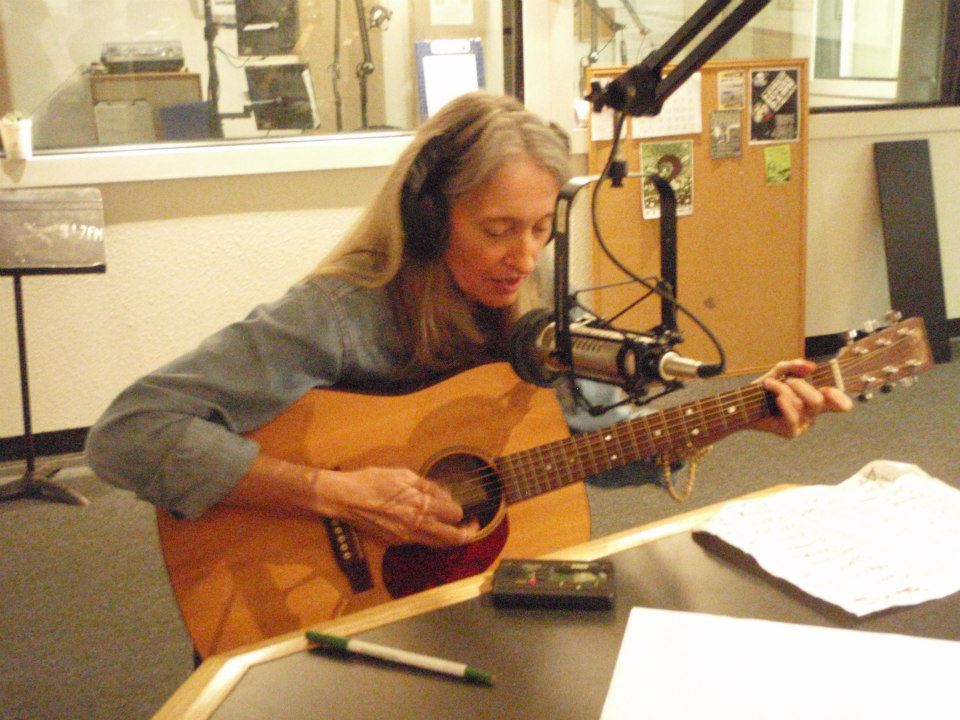
And on Friday, December 14, Singer-Songwriter Barbara K (Barbara Kooyman) — joined by New Orleans poet Don Paul — discussed her group, Artists for Media Diversity, and A4MD’s new “virtual album,” “Artists for Vieques.” Barbara also performed live, accompanied by Richard Bowden on violin and Gerald Torres on harmonica.

Listen to Thorne Dreyer’s interview with John Slate here:


And listen our show with Barbara K., Don Paul, et al here :


Rag Radio is a syndicated radio show produced in the studios of KOOP-FM, a cooperatively-run all-volunteer community radio station in Austin, Texas. It is broadcast live Fridays at 2 p.m. (CST) on KOOP, 91.7-FM in Austin, and streamed live on the Internet, and is rebroadcast on WFTE-FM in Mt. Cobb and Scranton, PA., on Sunday mornings at 10 (EST).

John H. Slate is the archivist for the City of Dallas, where he is responsible for historic city government records in the Dallas Municipal Archives. Slate’s recently-published book, Lost Austin, features images of iconic Austins institutions, most of which no longer exist.

On the show, John discusses the role of the archivist in the preservation of local history, the historical importance of alternative journalism, and — joined by our Carlos Lowry — reminisces on early Austin and especially its punk and other seminal music scenes. Interesting irony: John Slate appeared in Richard Linklater’s iconic indie film, Slacker, as a JFK conspiracy nut. Now, as Dallas municipal archivist, he coordinates the files on the Kennedy assassination.

Slate is a member of the Academy of Certified Archivists, has a BS from UT-Austin and a Masters in Library and Information Science, worked at the Center for American History at UT-Austin for 13 years, was curator/librarian at the Hertzberg Museum of the San Antonio Public Library, and was archivist at the Texas African American Photography Archive in Dallas.

He is past chair of the Government Records and the Visual Materials Sections of the Society of American Archivists and served as president of the Society of Southwest Archivists 2010-11. He is a member of the Texas State Library and Archives’ Historical Records Advisory Board.

Singer-songwriter Barbara K. performs on Rag Radio, Friday, Dec. 14, 2012. Photo by Tracey Schulz / Rag Radio.

Barbara K was half of the recording act Timbuk3, whose 1986 song, “The Future’s So Bright, I Gotta Wear Shades” was a big pop chart hit in the U.S. and England. The group traveled with Bob Dylan, Sting, and Jackson Browne, appeared on Saturday Night Live, and was nominated for a Grammy for Best New Artist in 1987. Barbara performs on the show with Austin violinist and activist, Richard Bowden, and Gerald Torres, who — in his other hat — holds the Bryant Smith Chair in Law at UT-Austin.

Barbara Kooyman helped create Artists for Media Diversity (A4MD), to protect freedom of speech through the funding of services for alternative non-commercial media sources, to foster independent media voices, and to promote musical and cultural diversity.

Artists for Vieques,” was produced by AM4D in collaboration with the Latino Public Radio Consortium and the National Federation of Community Broadcasters, and features recording artists from Puerto Rico and Austin — like Willie Nelson, Los Lonely Boys, and the popular Puerto Rican band Calle 13 — supporting the construction of WVQR-FM, which will be the only public radio station on the small Puerto Rican island of Viques that the U.S. Navy used as a bombing range and testing ground until protests forced its closure in 2003.

Don Paul is a New Orleans-based poet, recording artist, and activist, and the author of more than 20 books, including four novels and four books of poems. In 1971, at age 20, Don Paul was the youngest winner of a Stegner Fellowship in Creative Writing at Stanford University (other winners include Ken Kesey and Larry McMurtry).

Rag Radio features hour-long in-depth interviews and discussion about issues of progressive politics, culture, and history. The show, which has aired since September 2009, is produced in association with The Rag Blog, a progressive internet newsmagazine, and the New Journalism Project, a Texas 501(c)(3) nonprofit corporation.

The host and producer of Rag Radio is Rag Blog editor and long-time alternative journalist Thorne Dreyer, a pioneer of the Sixties underground press movement. Tracey Schulz is the show’s engineer and co-producer.

All Rag Radio shows are posted as podcasts and can be listened to at the Internet Archive.

Rag Radio can be contacted at ragradio@koop.org.

Coming up on Rag Radio:
THIS FRIDAY, December 21, 2012: Sixties rock legends, Powell St. John and Charlie Prichard.

The Rag Blog

Posted in RagBlog | Tagged , , , , , , , , | Leave a comment

Alan Waldman : Canada’s Two ‘Da Vinci’ Series Are Dramatic and Powerful

Waldman’s film and TV
treasures you may have missed:

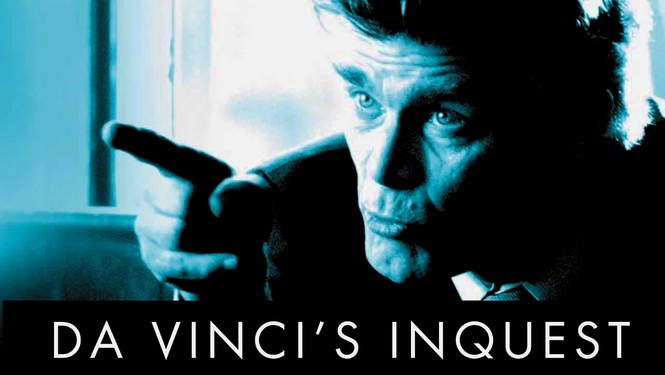
Canadian genius writer-producer Chris Haddock hit the bullseye with excellent procedurals Da Vinci’s Inquest and Da Vinci’s City Hall.

By Alan Waldman | The Rag Blog | December 20, 2012


[In his weekly column, Alan Waldman reviews some of his favorite films and TV series that readers may have missed, including TV dramas, mysteries, and comedies from Canada, England, Ireland, and Scotland. Most are available on DVD and/or Netflix, and some episodes are on YouTube.]

The terrific 1998-2005 Canadian TV series Da Vinci’s Inquest and its 2005-2006 spinoff Da Vinci’s City Hall were smart, gritty, honest, and eminently watchable. Largely based on actual Canadian criminal cases and social issues, both series were inspired by the career and exploits of Vancouver chief coroner-turned-mayor Larry Campbell. The title role, however, was written for actor Nicholas Campbell, who is just great in it.

Inquest ran for 91 episodes (seven seasons), and City Hall followed with 13 more. My wife Sharon and I saw most of them on U.S. TV and found them fascinating. Brilliant Canadian creator-writer-producer Chris Haddock followed the two fine Da Vinci series with the extraordinarily good, short-lived, drug- and corporate-crime series Intelligence, which I previously reviewed here.

The first three seasons of Inquest are available on Netflix, and episodes of both series can be seen on YouTube.

The two series were nominated for 61 major Canadian awards, winning 35. Inquest won the country’s top honor (the Gemini) for best dramatic series and best writing, for six of its seven seasons. The cast was very talented, and acting awards went to Campbell, Ian Tracey, Donnelly Rhoades, Venus Terzo, Duncan Fraser, Colin Cunningham, and Keegan Connor Tracy. More than 91.5% of the 602 viewers rating it at imdb.com gave it thumbs-up, and 41% rated it 10 out of 10.

Butting heads with bureaucracy in both series, Dominic Da Vinci strives to bring criminals to justice and mount needed social change. In City Hall, he locks horns with the police chief, while striving to implement controversial reforms, including a safe red-light district, help for the homeless, a safe injection site for addicts, and cross-training for Police and Fire & Rescue.

The first three episodes of Inquest dealt with a real case: the mysterious disappearance of numerous Vancouver prostitutes and the eventual arrest of a local pig farmer for multiple murder.

The drama of episodes is heightened by the evil of the villains and particularly that of a sly, crooked, and manipulative city cop. There is also much humor in character interactions, particularly in the running badinage between Da Vinci and an older cop played by Eugene Lipinski.

[Oregon writer and Houston native Alan Waldman holds a B.A. in theater arts from Brandeis University and has worked as an editor at The Hollywood Reporter and Honolulu magazine. Read more of Alan Waldman’s articles on The Rag Blog.]

The Rag Blog

Posted in Rag Bloggers | Tagged , , , , | Leave a comment

Howard Wooldridge : Rocky Mountain High / 2

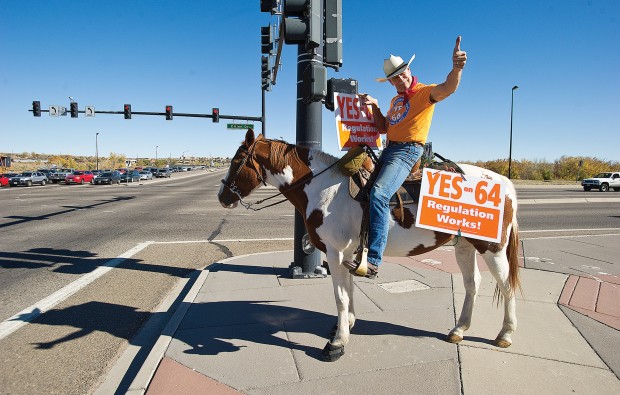
Howard Wooldridge and Misty in Pueblo, Colorado. Image from The Pueblo Chieftain.

Misty and me:
Fighting pot prohibition in Colorado, Part II

By Howard Wooldridge / The Rag Blog / December 20, 2012

Howard Wooldridge was Thorne Dreyer’s guest on Rag Radio, produced in the studios of KOOP 91.7-FM in Austin, Texas, on Friday, November 30, 2012. You can listen to the podcast here:

Howard “Cowboy” Wooldridge, the founder and director of Citizens Opposing Prohibition (COP), is a Texan since 1994 and a former Michigan police officer and detective. His experience in law enforcement taught him that arresting people for drug use is a faulty proposition: it doesn’t work and is a waste of police resources.

Wooldridge has become one of the most effective advocates in Washington, D.C., for ending marijuana prohibition and the “war on drugs.” Howard — with his horse (and “partner in politics”) Misty — took part in the successful Colorado campaign in support of Amendment 64, to legalize cannabis for recreational and industrial purposes there.

This is the second in a three-part series written for The Rag Blog.

I used the local McDonald’s railing in Sterling as a hitching post, tying Misty up while I went inside to buy lunch. A crowd had already gathered when I returned a few minutes later.

We were a combination “petting zoo” and political statement, as everyone took pictures of their kids with Misty. Her “64” signs would show up along with my t-shirt all over social media in the Sterling area. One guy boasted of having 3,000 Facebook friends and said he would make multiple posts.

Yes, adults were nearly as eager to have a picture of the horse as the kids. By the end of this Saturday, Misty and I were both approaching exhaustion. She was actually falling asleep on the corner. We took the next day off. I took Misty to a large park and let her roam loose for several hours.

On the 22nd of October we started our long march down the I-25 corridor, spending our day in Longmont. The gods of weather smiled upon us again with sunshine and high 60s. A reporter spent nearly an hour with us, asking almost as many questions about riding across America as our efforts for Amendment 64. The drivers and passengers gave us hundreds of honks, thumbs, and smiles, while the cell phone cameras kept taking our pictures.

I strongly believe we helped fire up the base to vote, even as we confounded the stereotype that only “stoners” were voting “yes.” The COP t-shirt and large pistol on my hip certainly set me apart from many. Note: My wife Karen insisted I take and wear the gun in case the Cartels tried to shoot me. Am I a lucky guy or what?!

Misty caught a break that night, sleeping in a paddock with two llamas. Bo and Betsy Shaffer of Erie put us up the next three nights, as we worked in Loveland. Bo had given us shelter in 2005 during our second ride across America. Nothing like a home-cooked meal and good conversation.

The enthusiasm for 64 exceeded that we received in our sojourn across California in 2010. The polls reflected us holding steady at 51% and, as we entered our last two weeks, I believed our efforts were helping the numbers. According to the election experts, turning out your supporters is crucial to any win. And Misty made people smile, even if they disagreed with the signs on her side.

The Front Range received 4-6 inches of snow on Wednesday evening, which meant Thursday was a snow day. I would never trailer Misty in snow. I took advantage of the off-day to visit my brother in the Denver area, had dinner with my ‘”librarian” Karen Bary and ended our day off doing a radio show in south Denver.

Colorado Springs in El Paso County — which is home to many mega-churches — was my last challenge. Bob Wiley not only arranged for a stall for Misty, he and his wife Rita put me in their guest bedroom, making our stay like heaven. Misty was able to take a load off. Sleeping on the ground left her markedly more rested and alert during her work time. The Wileys’ good food, drink, and conversation improved my morale, just as the grind of work and being on the road were wearing me down.

We worked a bit of the traffic going to the Air Force Academy football game, before the police forced us to leave… The officer told us he was voting for 64, which tells you how pleasant the whole thing went. In the next 10 days we worked every day at different intersections. On Saturday the local ABC TV station did a nice report on us. A few days later we made a side trip to the police station where a local medical cannabis patient was supposed to receive his five pounds and 60 plants back (he had been found not guilty). This resulted in me being quoted in the local daily paper.

Again the honks and smiles seemed to increase. People rolled down their windows to shout they had already voted YES on 64.

On Saturday, November 1, we worked the crowd going to the Romney rally at the Colorado Springs airport. The traffic was only averaging about two MPH into the parking lot area, so everyone saw the signs for a solid minute. Some of the Republicans were angry and abusive but overall the crowd seemed about 50-50. It was another good day in the saddle. Fire the base and confront the opposition is my strategy.

We made a two-day, 60 mile trip down to Pueblo to work their mall intersection. Again the media gods smiled on us, as we made the local paper, including a nice big picture. Mall security was an off-duty cop who was a bit nasty ordering me to leave his parking lot. Luckily across the street the Goodwill folks said we could park there.

Though tired, we decided to work Sunday in Colorado Springs. And it was lucky that we did. An off-duty Fox reporter saw us and said, “There is a story.” We made the local Fox news that night. Better, Fox national picked it up and we aired on all Fox channels on the Monday before the election, as the report went national.

After four more hours in Castle Rock on Monday, I bought a last, five-pound bag of carrots for Misty and pointed us home, our work done. Though invited to the victory party in Denver, attending would have meant a delay of 36 hours before being with my long-suffering Karen.

Near midnight on Tuesday, as we rolled into the Motel 6 in Indianapolis, I got the call from Bob that we had won with about 53% (the final total was 55%). I nearly cried with joy, knowing this was the beginning of the end of our national nightmare of marijuana prohibition. Late the next day we arrived at the ranch where Misty joined the herd of 50 on 80 acres. Later I learned that El Paso County voted in favor of Proposition 64 by a margin of 10 votes. Congratulations all around!

Ode to Misty: In August she thought, “Uh-ohh. Howard has ridden me three times this week. We are going someplace.” And with that realization, Misty had to prepare herself, mentally and physically, for yet another long ride in the trailer and upon arrival, to stand nearly motionless on one busy street corner after another. She knew that foul-smelling diesel smoke would mix with gasoline fumes to make her days less than pleasant. She knew she would be spending all night in her tight little trailer while Howard slept at the motel. Misery was spelled: “Howard-on-the-road-for-politics.”

Misty has carried the anti-prohibition message on her back since 2001. She carried my little butt across America twice, while I wore the COP T-shirt. She spent two months in California for Proposition 19; now one month for Amendment 64. Through it all she did not complain, act up, or be anything other than my magnificent, Texas horse and partner. Her good looks made her a TV star and allowed our message to be seen my millions.

She has done enough. I will ask no more of my Misty. She is retired from politics. I let her know this as I turned her out into the paddock back in Maryland.

To be continued…

[Harold Wooldridge, who was a Michigan police officer and detective for 18 years, co-founded Law Enforcement Against Prohibition (LEAP) and is executive director of Citizens Opposing Prohibition (COP).]

The Rag Blog

Posted in Rag Bloggers | Tagged , , , , , , , , | 1 Comment

Kate Braun : Will Winter Solstice Bring New Cosmic Balance?

Galactic Synchronization or end of the world? This illustration shows how some project the planets in the Milky Way to be aligned on the Winter Solstice, December 21, 2012. Image from About2012.

Winter Solstice 2012:
Will planetary alignment
bring new cosmic balance?

By Kate Braun | The Rag Blog | December 19, 2012

“I’m pickin’ up Good Vibrations…”

Friday, December 21, 2012, is Yule, the Winter Solstice. This year, according to the Mayan Calendar, a major cycle concludes, which is said to prompt major changes in the spiritual collective consciousness.

No, the world is not going to end; no, the X-Files prognostications of an alien invasion are not for real. But this year’s Galactic Synchronization, when lore says that the planets will come into alignment not only with themselves but also with the center of the Milky Way, implies a shift in the cosmic resonance that should affect all beings on Planet Earth.

Consider this: each planet in our solar system vibrates to a specific frequency which may be expressed as a musical note; when all the planets are in alignment, they vibrate in harmony; not dissonance, but harmony. The Galactic Synchronization brings this “harmony of the spheres” to the entire galaxy, creating a symphony of celestial vibrations attuned to balance in all things.

Weather permitting, I recommend you spend some time outdoors on Solstice Night. Open your senses. Breathe deeply and evenly; seven yoga-breaths (in through the nose to fill all the empty spaces in your body such as sinus cavities and the spaces between spinal vertebrae, hold a short time before releasing the breath slowly and evenly through a slightly open mouth) will put you in an Alpha-rhythm and open you to the meditative state.

Observe the moon, the stars, whatever planets may be visible in your area, and the night sky. Listen to the wind, to birdsong, to animals bustling through the brush, to whatever your ears notice. Pay attention to your dreams this night; you may receive insights that will prove helpful to you as we move forward into not only a New Year but also a New Balance.

Winter Solstice is a reestablishing of balance. We will notice the hours of daylight increasing daily as Planet Earth awakens from her deep meditative state to the new beginning that is 2013. What this New Year will bring is yet to be revealed. Each individual will have an individual response to the Galactic Synchronization, and while general trends will move us collectively to a better balance, each individual will still be walking an individual path to achieve that balance.

My feeling is that there will be a greater sense of responsibility to Planet Earth and that there will be a movement toward greater harmony in life, work, and play. My hope is that Yuletide 2012, truly marks the beginning of a more harmonic relationship between not only individuals but also nations, cities and their inhabitants, politicians and their constituents, and humans and their environment.

May each of you enjoy a Merry Christmas, Happy Yuletide, Serene Solstice, and Prosperous New Year.

[Kate Braun‘s website is www.tarotbykatebraun.com. She can be reached at kate_braun2000@yahoo.com. Read more of Kate Braun’s writing on The Rag Blog.]

The Rag Blog
Posted in Rag Bloggers | Tagged , , , , , | Leave a comment

Harry Targ : In Times Like These

“In Times Like These” performed by Arlo Guthrie.

In times like these:
Give peace a chance

By Harry Targ / The Rag Blog / December 19, 2012

In times like these when night surrounds me
And I am weary and my heart is worn
When the songs they’re singing don’t mean nothing
Just cheap refrains play on and on…

When leaders profit from deep divisions
When the tears of friends remain unsung
In times like these it’s good to remember
These times will go in times to come
I see the storm clouds rise above me
The sky is dark and the night has come
I walk alone along this highway
Where friends have gathered one by one

I know the storm will soon be over
The howling winds will cease to be
I walk with friends from every nation
On freedom’s highway in times like these.

Arlo Guthrie, “In Times Like These.”

All year we have been celebrating the 100-year anniversary of the birth of Woody Guthrie. “This Land is Your Land” has become the new national anthem, particularly for the 98 per cent of the population, mostly the American working class.

Singers now sing the forbidden verses challenging the rights of private property and choruses of cheering people, young and old, black and white, straight and gay, join in. It is a song of struggle, pride, and recognition that this world belongs to everybody.

Although the song has inspired us all as we sing it, sometimes we forget that the trajectory toward progressive change is not smooth. Guthrie’s friend and voice of our times, Pete Seeger, reminds us that “it is darkest before the dawn.”

Perhaps the anthem of these times, after hundreds of domestic instances of violence from Columbine to Newtown, from Trayvon Martin to Jordan Davis, to the streets of Chicago, is most poignantly articulated by Arlo Guthrie. And it is an anthem that peace activists should sing as we struggle against bombings, drones, economic blockades, covert interventions, assassination lists, killer teams, wars on drugs, huge appropriations of human resources to kill, violent video games, war toys, endless television shows and films that portray and normalize killings, as well as the tragedies such as at Newtown.

Major targets of violence and murder are educational institutions and particularly students. It is ironic that it is in these institutions that some of the most creative debates ensue around direct, or physical, violence and structural, or economic, sexual, and racial, violence.

After World War II, scholar/activists concerned about atomic war, arms races, and war on poor countries introduced Peace Studies into university and public school curricula. Educators and activists had studied and advocated for peace for hundreds of years, but in the environment of the Cold War distinguished academics demanded that the tools of modern research and education be applied to war, the social cancer of our time.

Peace Studies programs since the 1950s have taken many forms. Some concentrate on the “war problem” and engage it through studies of philosophy, social theory, and theology. Others, using modern statistical techniques, gather data on war and other forms of violence and test hypotheses about causes.

And finally, others, the “radical peace educators,” argue that research and teaching should use all available techniques to study violence. In addition, we should include in our study of violence, the violence of exploitation, discrimination, the prerogatives of institutionalized power, and the manipulating of minds as well as bodies.

These latter peace research/educators also argue that a connection needs to be made between theory and practice, reflection and action, studying causes and working to eliminate them.

Today there are some 250 peace studies programs. Some emphasize one or another or all of the three approaches. Despite efforts of rightwing political forces to eliminate Peace Studies programs, they persist. They persist because university alums, professors, teachers, and students remain committed to addressing the problems of violence in the 21st century.

So researchers continue to learn more about the problem of violence, teachers (kindergarten through college) try their best to develop curricula that celebrate the preciousness of all human beings, and activists continue to struggle to eliminate institutions and cultures of violence.

In sum, in the midst of our deep sorrow, we remember Arlo Guthrie’s words. “In times like these,” despite the emotional energy and time spent achieving some electoral, labor and Occupy victories, we get weary and our “heart is worn.” While we see the “storm clouds rise above,” we should remember that “the storm will soon be over.” Why? Because “I walk with friends from every nation, on freedom’s highway in times like these.”

[Harry Targ is a professor of political science at Purdue University who lives in West Lafayette, Indiana. He blogs at Diary of a Heartland Radical — and that’s also the name of his book from Changemaker Press which can be found at Lulu.com. Read more of Harry Targ’s articles on The Rag Blog.]

The Rag Blog

Posted in Rag Bloggers | Tagged , , , , , , | 1 Comment

Lamar W. Hankins : A Humanist Response to the Newtown Killings

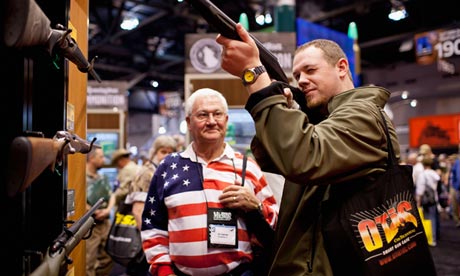
Photo by Whitney Curtis / Getty / The Guardian.

A humanist responds
to the deaths at Newtown

As a matter of public policy, there is no justification for allowing the widespread dispersal of semi-automatic weapons in the United States. They have done great harm in our society and have done no good.

By Lamar W. Hankins | The Rag Blog | December 18, 2012

As a freethinking humanist, I do not see the world as guided by some divine force, or by some evil force. I recognize that good and evil both exist among our species. And I react to the events of December 14 in Newtown, Connecticut, much the way President Obama did when he said:

We’ve endured too many of these tragedies in the past few years. And each time I learn the news, I react not as a president, but as anybody else would as a parent. And that was especially true today. I know there’s not a parent in America who doesn’t feel the same overwhelming grief that I do.

The majority of those who died today were children — beautiful, little kids between the ages of five and 10 years old. They had their entire lives ahead of them — birthdays, graduations, weddings, kids of their own. Among the fallen were also teachers, men and women who devoted their lives to helping our children fulfill their dreams.

So our hearts are broken today for the parents and grandparents, sisters and brothers of these little children, and for the families of the adults who were lost.

I react personally. I have a grand daughter who is eight years old. I was with her mother when her water broke. I was at the hospital when she was born. I helped care for her when she was an infant and for all the years since. To learn that her life had been snuffed out would be almost unbearable.

That it could happen by the senseless acts of a mentally unbalanced person who too easily laid hands on a semi-automatic rifle only makes my views of Wayne LaPierre and the organization he leads — National Rifle Association (NRA) — harden into something akin to hatred.

I have always seen the NRA as a front for the manufacturers of guns, especially semi-automatic weapons. I have no problem with guns, though I respect that they are dangerous, just as I respect that cars are dangerous. I own guns, but not the semi-automatic kind, though I could. I also don’t drive 85 mph on the highways, though I could do that also.

The primary difference between semi-automatic guns and fast cars is that there is no reason to possess semi-automatic guns except to go to war or to kill a lot of people in a short period of time.

Only those who have unreasonable fears about the dangers of our society, or fear totalitarianism to the point of paranoia, or who are influenced by fantasies about invasions of the wild pigs (name your own animal) see any need for semi-automatic weapons. I know these people exist because there are reality shows about them and I read about them. I also know people who are afraid to walk down the street in daylight and at night. Semi-automatic guns won’t help these people, though they might benefit from cognitive behavior or reality therapy.

The Humanist Manifesto II provides: “Faced with apocalyptic prophesies and doomsday scenarios, many flee in despair from reason and embrace irrational cults and theologies of withdrawal and retreat.” Public policy should not be decided by a retreat from reason. Our laws should not be determined by the needs of the few in our society who have outrageous fears or disturbed notions about American society. Our laws should be written for the benefit of the people as a whole.

As a matter of public policy, there is no justification for allowing the widespread dispersal of semi-automatic weapons in the United States. They have done great harm in our society and have done no good.

While denying the few the right to possess semi-automatic weapons would not have prevented all of the killings in Newtown, it likely would have reduced the slaughter. It would have allowed a few families who are now in the depths of despair at the loss of their children and grand children less cause for grief because they would not have lost those children to the actions of a mentally unbalanced man armed with semi-automatic weapons.

And let us not forget the recent mass shootings at a shopping mall in Portland, at a workplace in Minneapolis, at a Sikh temple in Wisconsin, at a movie theater is Colorado — all within the last five months. In the last 30 years, we have had 62 mass killings in this country. Something is terribly wrong.

A day after the shootings, New York Times columnist Charles Blow quoted Larry Pratt, the Executive Director of Gun Owners of America, a group more extreme than the NRA, who blamed the events in Newtown on gun control advocates:

Gun control supporters have the blood of little children on their hands. Federal and state laws combined to ensure that no teacher, no administrator, no adult had a gun at the Newtown school where the children were murdered. This tragedy underscores the urgency of getting rid of gun bans in school zones.

That Larry Pratt’s first reaction to the shootings in Newtown is to blame gun control supporters for the tragedy is to try to make a political point using the bodies of 20 school children and six teachers and administrators. And indirectly, Pratt is also blaming those teachers and administrators for their unwillingness to become a part of America’s gun culture. To emotionally dead people like Pratt, all that matters is his right to possess extremely dangerous weapons — the kind used in war and terrorism.

It doesn’t take much imagination to think about what would happen if everyone in every public venue in America walked around with a gun on their hip or in their purse. It is not necessary for our public school teachers to have to be armed to prevent such tragic shootings as those that occurred in Newtown. There must be other solutions.

Surely improved surveillance, greater passive security, and more institutional protection would serve our public schools better than arming all adults who work in our schools. Arming all teachers will assure that we raise a generation of students who are as wildly paranoid and emotionally lifeless as Larry Pratt and the leadership of the NRA.

And what about those teachers who don’t want to carry guns. Surely they and all others who don’t want to carry guns have a right to be safe. This is a question posed by Blow, who cited a Mother Jones study that revealed that the “vast majority of mass shootings in the last three decades involved assault weapons and semiautomatic handguns.”

Americans deserve the right to be free from mass slaughter without having to arm themselves. We need to find better solutions for the 55% of Americans who do not have a gun in their homes. The JustFacts website, which is a a non-profit research and educational institute dedicated to finding and disseminating scientifically valid research on public policy issues, cites a study that found that

households in which a homicide occurred had a firearm ownership rate of 45% as compared to 36% for non-homicide households. Also, households in which a homicide occurred were twice as likely to have a household member who was previously arrested (53% vs. 23%), five times more likely to have a household member who used illicit drugs (31% vs. 6%), and five times more likely to have a household member who was previously hit or hurt during a fight in the home (32% vs. 6%).

This suggests that many factors influence gun-involved injuries and deaths. Unless we take a wide range of issues into account, put emotions aside except as a source of motivation, focus on the rational, and base our decisions on scientifically valid studies, we cannot arrive at the best decisions for our society.

We do know that countries with similar cultures as ours have much lower rates of gun-related deaths. Switzerland, Canada, Finland, France, Austria, New Zealand, Belgium, Greece, Sweden, Denmark, Italy, Germany, Australia, Ireland, Spain, the Netherlands, and the United Kingdom all have much lower death by firearms rates than the U.S.

Looked at another way, we find that Canada has a rate of gun deaths three times lower than the U.S; Australia’s rate is five times lower; the United Kingdom’s rate is t30 times lower. Maybe we could learn something useful about better controlling the gun violence in our society by studying these other countries.

Owning guns makes some people feel safer. There is no good public policy reason to refuse such people the right to own guns, and I am not suggesting that we should do so. In fact, the Constitution gives all of us the right to own guns. But that same Constitution does not give us the right to possess semi-automatic guns, or bazookas, or surface-to-air missiles. And our society has a right to prevent such powerful weapons from falling into the hands of disturbed individuals, which is impossible to prevent if the guns are readily available.

A poll done this past August by CNN/ORC shows that a majority of Americans favor background checks before purchasing a gun, a ban on semi-automatic weapons, a ban on high-capacity clips, a ban on guns for the mentally ill and for felons, and gun registration. I don’t know if these views enacted into law would reduce the gun violence level in our society, but they are worth considering, as is closing the gun show loophole that lets people avoid registration and background checks.

I do know that to keep semi-automatic weapons from those who will do us harm requires one thing — enough politicians with the courage to take sensible steps to protect Americans from the devastation such weapons can create.

Unfortunately, most of our politicians take their orders from the NRA and Gun Owners of America, two organizations that contribute millions of dollars to protect the profits of the gun industry in the guise of standing up for rights to which none of us are entitled.

Their position on the issue of semi-automatic guns puts us all in jeopardy. They do not make us safer or more secure. On the contrary, they delay us from finding rational solutions that may prevent the kind of heartbreak felt by most Americans for the families of those children and adults killed in Newtown.

[Lamar W. Hankins, a former San Marcos, Texas, city attorney, is also a columnist for the San Marcos Mercury. This article © Freethought San Marcos, Lamar W. Hankins. Read more articles by Lamar W. Hankins on The Rag Blog.]

The Rag Blog
Posted in RagBlog | Tagged , , , , , , , | 4 Comments

VERSE / Alyce Guynn : Pale Mornings

Photo by Kelly Rossiter / treehugger.

Pale Mornings

     Brass buttons, green silks and silver shoes
     warm evenings, pale mornings, bottle of blues

          “Brass Buttons,” Gram Parsons

She removes her precious memories
from the store room of her heart
unwraps the protective tissue paper
shielding them from today’s
enlightened air, amorphous moisture
and lays them out, not only for reminiscing
but also, examination

Like the yellowed silk of yesterday’s finery
the treasured recollections reveal
the wear and tear of time

     It was a dream much too real
     to be leaned against too long

She has curated these memories
catalogued them, carefully preserved
in papyrus of the everlasting now
protected from the inherent vandalism
of close scrutiny

     Gram Parsons wrote
     “Brass Buttons” when he was 18

The eternal second guessing:
too much purple? Did they drink
too deeply from the bottle of blues?

     Gram Parsons died way too young
     he never knew how famous
     he would become

Pretty pictures of the past
too precious to be pixilated
too fragile to be framed

Like yesterday’s satin doll
edged in tatting and lace
ivory slowly shading to yellow
unable to retain its glow

     The bearded man from five blocks down
     suggesting Billy Gibbons
     always waves when I drive by
     the one-finger, Texas two-lane wave

Here in the eternal now
witness to her agony
rumpled and tousled
she leans over her shadow
observing self

It always slew her
each time she let herself
revisit his eyes
the look landing on her
an echoing thud of knowing
seeing behind her lids
where all her yearning hid out
like the Younger brothers
in the Missouri hills

With doleful acceptance
but no regrets
she steps inside her past
profound and magical in its excess
shimmering, incandescent
memories not to be squandered
brought out on rare occasions
carefully shared with trusted few
not to be profaned by parading
sheltered from indiscriminate scorn

     And all the while
     I think she knew

© Alyce Guynn
The Rag Blog
December 2012
Austin, Texas

[Alyce Guynn’s poetry appears in Feeding the Crow and Deal Me In, a book of her love poems illustrated by Jesse “Guitar” Taylor. A former reporter for the Austin American-Statesman in the ‘60s, Alyce never wrote for The Rag, but read it regularly. Alyce also works as an antitrust investigator.]

The Rag Blog

Posted in Rag Bloggers | Tagged , , | 1 Comment

Alice Embree : Campaigning against Cuts at Corn Dog’s Office

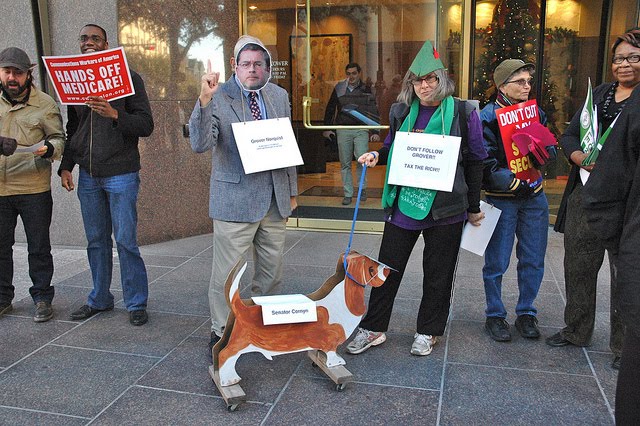
From left, at Austin “fiscal Cliff” demonstration: Aron Duhoon, Harrison Hiner, Grover Norquist (Thorne Dreyer), Alice Embree, Les Cunningham, Paula Littles, and, in front, Sen. John (Corn Dog) Cornyn. Photo by Carlos Lowry / The Rag Blog.

Austin protest against cuts for rich:
‘Racketeer’ Norquist meets ‘Corn Dog’ Cornyn

Union members, MoveOn, and citizens who want to protect Social Security, Medicare, and Medicaid, made their message to Senator Cornyn clear with a ‘Candlelight Campaign against Cuts.’

By Alice Embree | The Rag Blog | December 18, 2012

AUSTIN — Grover Norquist, Racketeer for the Rich, made an unannounced visit to Senator John Cornyn’s district office in Austin, Texas, on Monday, December 10, 2012. His message, “Don’t Tax the Wealthy,” is still wildly in vogue with Republicans. A group of citizens was there with another message for Senator Cornyn.

Cornyn (who was affectionately known as “Corn Dog” by George W. Bush), was present in canine form in front of the real Cornyn’s district office. Rag Blogger Thorne Dreyer (as Grover) tussled with Corn Dog handler, Alice Embree, over the direction he should take. Grover kept urging hard right turns.

As part of nationwide protests that coincided with International Human Rights Day, union members, MoveOn, and citizens who want to protect Social Security, Medicare, and Medicaid, made their message to Senator Cornyn clear with a “Candlelight Campaign against Cuts.” There were also demonstrations in Dallas, Austin, Corpus Christi, Laredo, San Antonio, and Houston suburb Sugar Land.

Participants in the Austin action included members of the Communications Workers of America, Texas State Employees Union (TSEU), National Nurses United, American Federation of State, County and Municipal Workers (AFSCME), United Steelworkers (USW), International Brotherhood of Electrical Workers (IBEW), and MoveOn.

Hats off to the spirited nurses who brought “Robin Hood” hats and a banner that read: “Don’t Push Seniors Off the Fiscal Cliff, Tax Wall Street.” (See RobinhoodTax.org and like it on Facebook.)

[Alice Embree is a long-time Austin activist, organizer, and member of the Texas State Employees Union. A former staff member of underground papers The Rag in Austin and RAT in New York, and a veteran of SDS and the women’s liberation movement, she is now active with CodePink Austin and Under the Hood Café. Embree is a contributing editor to The Rag Blog and is treasurer of the New Journalism Project. Read more articles by Alice Embree on The Rag Blog.]

Here are links to demonstrations around Texas:

The Rag Blog

Posted in Rag Bloggers | Tagged , , , , , , , | 1 Comment

Bob Feldman : The Rise of the Klan in Texas, 1920-1930

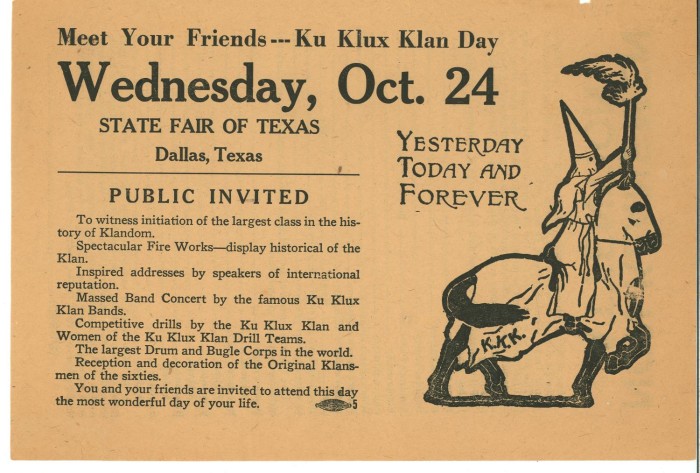
Flyer for “Ku Klux Klan Day,” October 24, 1923. Image from The Portal to Texas History.

The hidden history of Texas

Part 10: 1920-1930/1 — The rise of the Klan in Texas

By Bob Feldman | The Rag Blog | December 12, 2012

[This is the first section of Part 10 of Bob Feldman’s Rag Blog series on the hidden history of Texas.]

Between 1920 and 1930, the number of people living in Texas increased from over 4.6 million to over 5.8 million, and the percentage of Texas residents who now lived in urban towns and cities with populations above 2,500 people increased from 34 to 41 percent.

By 1930, over 292,000 people lived in Houston, over 260,000 people lived in Dallas, over 231,000 people lived in San Antonio and over 163,000 people lived in Fort Worth — although the number of people living in Austin in 1930 was still less than 54,000.

Between 1920 and 1930 the percentage of farmers in Texas who were now just tenant farmers also increased to 61 percent. And in Texas during the “Roaring Twenties,” as Randolph Campbell recalled in his book, Gone To Texas:

Thousands upon thousands of farmers continued to live in destructive poverty as tenants and sharecroppers. Giant corporations still wielded monopoly power because anti-trust and regulatory laws had always aimed more at “foreign” businesses… Laws protecting children in industry… went unenforced… The doctrine of white supremacy ruled race relations, and in South Texas Anglo bosses exploited Texans of Mexican descent politically and economically…

Alwyn Barr’s Black Texans, observed:

Mob violence increased in the early 1920s with the rise of the new Ku Klux Klan… Klansmen branded a black bellhop in Dallas with acid and castrated a light-skinned Negro accused of relations with a white woman. They raided the office of the Houston Informer and threatened the Dallas Express, both black papers. Hooded groups beat a black youth in Texarkana, removed two Negroes from the Denton jail to flog them, and forced black cotton pickers near Corsicana to end their strike for higher wages…

In addition, during the 1920s, “the new Klan, which claimed over 100,000 members in the state, proved powerful enough… to help elect Earle B. Mayfield, a Klansman, to the United States Senate from Texas,” the same book noted.

According to Gone To Texas :

The KKK arrived in Texas in September 1920 when a kleagle came to Houston and recruited 100 men into the state’s first local chapter. “The initial roster represented literally a glossary of Houston ’s Who’s Who,” wrote one observer. The charter members were silk-stocking men from the banks, business houses, and professions…

From its Houston beginning, the Klan spread rapidly across the state. In January 1922, when membership reached more than 75,000, Texas was organized as a realm of the “Invisible Empire” under its own grand dragon, A.D. Ellis, an Episcopal priest from Beaumont. That same year women… obtained a Texas charter as the Women of the Invisible Empire of America. In June 1923, 1,500 masked and robed klanswomen held a parade through Fort Worth. Eventually male membership alone stood at approximately 150,000.

Some opposition to the KKK’s growing influence in Texas electoral politics began to develop within Texas white power structure and political establishment circles (who then backed state-wide candidates that were able to defeat some KKK members who ran against them) by 1924. But as Merline Pitre’s In Struggle Against Jim Crow noted:

The Ku Klux Klan in the 1920s was a viable force in Houston and throughout the state. In Texas, this vigilante group occupied a position of power and influence unequaled in any other state, giving Texas the designation of Star Klan State. Houston was dubbed as the Star Klan City…

In 1921, Houston Klansmen, led by Deputy Sheriff George E. Kimbro, attacked and castrated a black dentist and beat a white lawyer who represented him. Several years later, the Klan tarred and feathered a black physician. In 1928, a Houston mob dragged a black man, accused of killing a white police officer, from his bed in a local hospital and hanged him from a bridge — a murder for which no one was ever convicted. Additionally, a Klan newspaper, Colonel Mayfield’s Weekly, circulated throughout the city.

[In Houston ] in 1920, backed by a city ordinance, the American Legion excluded blacks from the annual Armistice Day parade. Blacks also were prohibited from voting in the municipal elections of February 1921. In 1923 and 1924, respectively, blacks were banned from standing in the same lines as whites to purchase stamps at the post office and to pay property taxes at the Harris County Courthouse. In 1925, the Electric Company excluded blacks from riding its buses, while in 1926, the Majestic Theater refused to admit blacks on weekends.

In 1921, Houston ’s Democratic Party also passed a resolution “allowing only whites to vote in the upcoming Democratic primary;” and in 1923 the Texas state legislature passed a law stating that “only white Democrats and none other” could vote in primary elections, according to the same book.

Between 1920 and 1930, the KKK was also visibly active on the streets of Austin, Texas . In 1921, for example, “500 white-robed and hooded Ku Klux Klansmen from Austin and San Antonio marched single file in silence up and down Congress Avenue, while thousands of spectators looked on,” according to David Humphrey’s Austin: An Illustrated History. The same book also observed:

Capital City Klan No. 81 was organized in 1921 and a year later had 1,500 members including the sheriff of Travis County and apparently other highly placed city and county police officials. The Klan thrived in Austin in the early and mid-1920s… In the mid-1920s the Klan even purchased a sizable piece of property off South Congress Avenue and erected a hall or “Klan haven”…

So, not surprisingly, Austin’s “1928 city plan recommended that East Austin be designated a `Negro district’ and that municipal services for blacks, such as schools and parks, be confined to this district” and so “thirteen-acre Rosewood Park in East Austin provided recreational facilities for blacks, but other city parks were closed to them,” according to Austin: An Illustrated History.

[Bob Feldman is an East Coast-based writer-activist and a former member of the Columbia SDS Steering Committee of the late 1960s. Read more articles by Bob Feldman on The Rag Blog.]

The Rag Blog
Posted in Rag Bloggers | Tagged , , , , , , | 2 Comments

Alan Waldman: ‘Father Ted’ is Howlarious Irish Series

Waldman’s film and TV
treasures you may have missed:

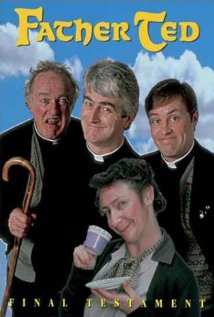
Anglo-Irish sitcom Father Ted brilliantly spoofs Catholic clergy in one of the funniest TV series ever.

By Alan Waldman | The Rag Blog | December 12, 2012


[In his weekly column, Alan Waldman reviews some of his favorite films and TV series that readers may have missed, including TV dramas, mysteries, and comedies from Canada, England, Ireland, and Scotland. Most are available on DVD and/or Netflix, and some episodes are on YouTube.]

The 1995-1998 TV series Father Ted, set on Ireland’s remote, fictional Craggy Island, was almost universally adored until the heart-attack death of star Dermot Morgan, 24 hours after the filming of its 19th and final episode. Father Ted took comedy in wonderful new directions, although its treatment of three eccentric Catholic priests roused viewer protests that drove Boston’s PBS station to take it off the air. All its episodes can be seen on YouTube, and the first season is on Netflix and Netflix Instant streaming.

As of December 6, 2012, more than 93.6% of the 11,959 viewers who rated it at imdb.com gave it thumbs up, and an astonishing 52% of them consider it a perfect 10. Judge for yourself by clicking here.

Created and written by Irish funnymen Graham Linehan and Arthur Mathews (who have written and/or created another 21 comedy series), it follows the hilarious adventures of three priests who have been exiled to a lonely parish house on remote Craggy Island as a punishment.

Father Ted Crilly (Morgan) was sent to Craggy Island as penance for “The Lourdes thing,” in which he supposedly stole the charitable donations meant to fund a children’s pilgrimage and hot-footed it to Las Vegas. He and nutsy housekeeper Mrs. Doyle (Pauline McLynn) now care for the supremely dim Father Dougal McGuire (a delightfully funny Ardal O’Hanlon) and the violent, alcoholic, deranged Father Jack Hackett (Frank Kelly).

Father Ted was nominated for 19 major British and Irish awards, winning 15, including Best TV Comedy for two of its three seasons. Morgan won two awards, including the BAFTA for Best Performer. O’Hanlon and McLynn won performer awards and Linehan and Mathews took two BAFTAs for producing and a best TV Situation Comedy honor from the Writers Guild of Great Britain.

One great running gag is that Father Dougal lacks even the remotest understanding of Catholicism. Father Ted once sarcastically cracks that Dougal entered the priesthood via a “collect 12 crisps packets and become a priest” promotion. His childlike view of life is endlessly hysterical, and he delivers his lines with great deadpan innocence.

By the way, O’Hanlon followed this role with the wonderful lead in the highly imaginative Britcom My Hero. O’Hanlon’s standup comedy is also terrific and can be found on YouTube. (“Women experience pain more deeply than men do, because a certain part of every woman’s brain is always thinking about shoes.)

Father Jack sits in a corner or is passed-out drunk most of the time, and his vocabulary mostly consists of four shouted words: “Drink!,” Arse!,” “Girls!,” and the Irish “F” word, “Feck!” He will drink anything, including floor polish and an Irish product called Toilet Duck. Father Jack’s face is covered with sores, and actor Frank Kelly looked so creepy while in costume that cast members refused to lunch with him.

[Oregon writer and Houston native Alan Waldman holds a B.A. in theater arts from Brandeis University and has worked as an editor at The Hollywood Reporter and Honolulu magazine. Read more of Alan Waldman’s articles on The Rag Blog.]

The Rag Blog
Posted in Rag Bloggers | Tagged , , , , | 1 Comment

Paul Buhle : Comix Artist Spain Rodriguez (1940-2012)

Spain Rodriguez: Transforming comics. Image from CBLDF.

The passing of a comix pioneer:
Spain Rodriguez (1940-2012)

By Paul Buhle / Dissent / December 12, 2012

In Trashman: Agent of the Sixth International, the signature saga of his early years, Rodriguez’s revolutionaries took revenge on a truly evil American ruling class.

We are now so far from the 1960s and ’70s that the crucial locations, personalities, and moments of one very popular art form’s transformation have been largely forgotten. Spain Rodriguez, with a handful of others (the best remembered are happily still with us: Gilbert Shelton, Robert Crumb, Bill Griffith, Kim Deitch, Art Spiegelman, Trina Robbins, and Sharon Rudahl, to name a few), pushed the comics agenda so far forward that no return to the limitations of superheroes and banal daily newspaper strips would ever be possible.

Comic art, belatedly recognized in The New York Times (and assorted museums) as a real art and not a corrupting children’s literature, owes much to them.

Spain (his birth name was Manuel, his father a Spanish immigrant, his mother an Italian-American artist) grew up in Buffalo, New York, a rebellious working-class kid who wore long sideburns and was impressed by the civil rights movement. He dropped out of art school in Connecticut and, after returning to Buffalo and working a factory job with a motorcycle gang engagement, landed in New York in time for the efflorescence of Underground Comix (styled with an “x” to distinguish itself) in a comic tabloid offshoot of the East Village Other.

His colleagues were a strangely mixed crew, all of them old enough to have been influenced by EC Comics, the most politically liberal and artistically accomplished of the old comics industry, and the one hardest hit by the congressional hearings of the McCarthy era. (As with attacks on the Left, every charge of subversion and perversion hid Middle-American outrage: these were Jews corrupting innocent American youth.)

In a sense, every “underground” artist of these early days sought revenge in the name of comic art, and realized it through the depiction of sex, violence, and anti-war and anti-racist sentiment unthinkable in what remained of the mainstream. Sex and violence, lamentably, became chief attractions to many readers, recalling the “headlights” (aka “sweater girl”) crime and horror comics of the late 1940s, albeit with a left-wing or libertarian ambience.

The whole comix artistic crowd moved to San Francisco around 1970, joining Robert Crumb and a few others already there, part of the acid-rock, post–Summer of Love setting. Underground comix, replicating the old kids-comics format but now in black and white, grew up alongside the underground press, whose reprinting of comix created the market for the books.

Crumb was the artist whose work sold the best, in the hundreds of thousands, but Spain was widely regarded as the most political. He was heavily influenced by the most bohemian of the EC comics world, wild man Wallace Wood, whose sci-fi adventures depicted civilizations recovering from atomic war and whose Mad Comics stories assaulted the 1950s commercialization of popular culture. Wood’s dames were also extremely sexy, too overtly sexy for the diluted satire of the later Mad Magazine.

Spain Rodriguez. Photo by Sean Stewart / Babylon Falling.

Trashman: Agent of the Sixth International was Rodriguez’s signature saga in these early years, serialized in underground papers, comix anthologies, and eventually collected in comic book form as Subvert Comics. These revolutionaries took revenge on a truly evil American ruling class in assorted ways, many of them violent, but they also had fun and sex, and were subject to many self-satirizing gags, in the process.

By the middle 1970s, his work had broadened into more social and historical themes, often with class, sex, and violence highlighting his points. Histories of revolutions and anti-fascist actions (and all their complexities) inspired some of his closest reading of real events, but he had no fixed point on the left-wing scale.

He admired and drew about anti-Bolshevist anarchist leader Nestor Makhno and also anti-Stalinist Spanish anarchist Durruti, but he also drew about Red Army members facing death fighting the Germans, and so on. (Several of these pieces are now reprinted in Anarchy Comics: The Complete Collection, an anthology from that 1980s series, just published by PM Press.)

In recollections of the internal conflicts among comix artists, sometimes pitting feminists against male-dominated circles, Rodriguez is remembered as having been unusually helpful and egalitarian, a memory that contrasts curiously with his sometimes sado-masochistic plot lines but not so curiously with the gender-equality of the sybarites (“Big Bitch” was Trashman’s female counterpart, the tough working-class broad with sex cravings for weaker men).

He poked and prodded San Francisco’s self-image as a haven of liberated sex, sometimes making his younger self a player on the scene. He also helped set in motion the vital murals movement in San Francisco’s Mission District, but was likely best known on the West Coast for his many posters of San Francisco Mime Troupe openings.

Spain Rodriquez lasted long enough to see his work in square covers (if not often hard covers), his unique and quasi-realistic modernism preserved for generations ahead.

The validation of comic art from near the end of the century onward — Spiegelman’s Maus and left-wing lesbian Alison Bechdel’s Fun Home high among the evidence of artistic achievement — found Rodriguez with a Salon series, “The Dark Hotel,” and several books of his own. Devil Dog, a biography of disillusioned Marine Corps general Smedley Butler, and Nightmare Alley, an adaptation of the classic noir novel, are easily among the best. Che, his graphic biography of Che Guevara, reached the furthest, with editions published everywhere from Latin America to Europe, Japan, and Malaysia.

At the time of his death, Rodriguez was amid “Yiddish Bohemians,” a strip about Jewish-American puppeteers during the 1920s and ’30s, in what would be the last in a stunning series of collaborations with playwright-professor Joel Schechter. Rodriguez had started a Woody Guthrie poster for an upcoming Bay Area concert and, had he lived, would have drawn a history of the 2003 San Francisco hotel strike.

After more than 40 years (and the disappearance of well over 90 percent of many little-remembered artists’ work in yellowing pulp), the impact of the Underground Comix world remains more a matter of style than substance, daring more than narrative and artistic content. This is unfortunate, because so many artists had particular contributions worthy of note, worthy of reprinting for the sake of comic art alone.

Spain Rodriquez lasted long enough to see his work in square covers (if not often hard covers), his unique and quasi-realistic modernism preserved for generations ahead. That he never lost his political vision or his sense of humor should go without saying, but those of us lucky enough to see him teach or to be taught by him felt the deep impact of his humanism as well.

Rodriguez died at home in San Francisco, with his wife, Susan Stern, a documentary filmmaker, and his daughter, Nora Rodriguez, by his side. A retrospect of his work, including a short documentary film made by his wife, is now in place at the Burchfield Penny Art Center in Buffalo, the second exhibit in Buffalo to honor this improbable local hero.

[Cultural historian Paul Buhl is professor emeritus at Brown University. He publishes radical comic books and graphic novels. Buhle was the editor of Che and is co-editor of the anthology Bohemians, to appear in 2013, with two strips by Rodriguez. Read more articles by Paul Buhle on The Rag Blog.]

The Rag Blog

Posted in RagBlog | Tagged , , , , , , , | 2 Comments

BOOKS / Ron Jacobs : ‘We Are Many’ Offers Thoughtful Analysis of Occupy Movement

From occupation to liberation:
A review of ‘We Are Many’

By Ron Jacobs | The Rag Blog | December 11, 2012

This aesthetically pleasing volume has the best overall take to date on the meaning of Occupy, its shortcomings and strengths, and its potential future.

[We Are Many: Reflections on Movement Strategy from Occupation to Liberation, edited by Kate Khatib, Margaret Killjoy, and Mike McGuire; Afterword by David Graeber (2012: AK Press); Paperback; 355 pp; $21.]

Despite a myriad of obituaries for the movement that began in Manhattan in September 2011, the people of Occupy refuse to let it die.

There are hundreds involved in the Occupy Sandy effort in the New York City region following the devastation of Tropical Storm Sandy. Individuals and groups connected to Occupy Wall Street have organized relief efforts that are feeding and caring for thousands of people left without power, work, and homes.

Those being helped are primarily the working poor and folks on assistance. They are also those traditional relief efforts tend to ignore, precisely because of their income status and, in the USA, also perhaps because of their skin tone or ethnic origin.

The vastness of the Occupy Sandy effort is testament to the Occupy movement’s most obvious strength: its ability to organize rapidly and from the ground up.

Since the advent of Occupy and the demise of its encampments, there have been millions of words written about the movement. From Fox News to the Revolutionary Communist Party’s journal Revolution; from Le Monde to the Jerusalem Post; and numerous journals, websites, blogs and television networks, Occupy Wall Street and the movement it spawned provoked a storm of commentary.

Some of it was sensationalist and some of it perhaps overly academic. It was occasionally overly laudatory and often overly critical. Overall, however, the press coverage did something that one could argue no left-leaning movement since the 1960s and 1970s had done. It changed the nature of the national conversation.

Like the black liberation and antiwar movement of those decades long past changed the way mainstream America thought about the treatment of African Americans and the nature of its foreign policy, Occupy changed the way mainstream America thought about its economic system. Or, maybe it just vocalized thoughts people had held but did not know how to vocalize in a way that would draw some attention.

A year later there have been a number of column inches written about Occupy and its meaning. The articles written in the mainstream press tend to acknowledge Occupy’s influence in the national conversation. At the same time, these articles tend to diminish its long term role. Perhaps because it is too early to tell. Perhaps because they hope it doesn’t have one.

Occupy was the greatest manifestation of anti-authoritarian organizing in the United States in recent history. It proved that spontaneity can work. The taking of property and occupying it is a radical act in itself and obviously one the powers that be find threatening.

The involvement of the houseless was and is important. Their presence and involvement not only made the gross shortcomings of monopoly capitalism real, they also provided food and a reaffirmation of value to those on the streets and an experience at self organizing for all. Yet, it suffered from some of the same ills present in the larger society: racism, sexis, and questions around violence and leadership.

Occupy was/is not a movement that began with highly defined politics. This was its strength and its weakness. Many different philosophies set up camp under its banner. Anarchists, socialists, libertarians, and liberals. Even the occasional tea partier and Democrat.

Yet, despite this multitude of philosophies that came to share the Occupy camps, the one that was its impetus remains a generally defined type of left anarchism. Somewhat situationist like the poster artists of Paris in May 1968 while also derivative of the squatters’ movement of the 1970s and 1980s in Europe, Occupy also drew from the anarchism of the Yippies, the counterculture of the 1960s, and the punk culture that came later. Therefore, it would seem that the best analysis of Occupy would come from folks that had similar roots.

Guess what? The best analysis of Occupy does come from such folks. Titled We Are Many: Reflections on Movement Strategy from Occupation to Liberation and published by AK Press, this aesthetically pleasing volume has the best overall take to date on the meaning of Occupy, its shortcomings and strengths, and its potential future.

Never shortchanging the arguments within the movement, the writers collected in We Are Many take on the questions of racism, sexism, the Black Bloc, and the cops, and they do so in an intelligent and lively manner. No other group of writers has done so well in exploring the Occupy movement from within its ranks. In fact, no other group of writers has done so well in exploring the Occupy movement, period.

Unlike earlier books about Occupy, most of which were published either during the life of the encampments or immediately after, We Are Many has the perspective a little time often provides. Away from the intensity of battles with police and the day-to-day reality of camping in the middle of some urban space, this book presents the reader with thoughtful essays designed to raise questions about strategy and politics that might have been pushed aside in the aforementioned day-to-day reality.

Earlier writings about Occupy were often chronicles of organizing; sometimes those chronicles were objective attempts to describe the daily life of the writer and those around them; other times they were impressionistic attempts to do the same thing.

We Are Many has its share of these essays, yet even those indicate a deeper reflection and understanding of Occupy’s historical meaning and the potential it unleashed for the future of oppositional and extra-parliamentary movements, especially in the United States.

Writers who appear in this volume include some names fairly well known in anti-authoritarian and left circles: Cindy Milstein, Vijay Prashad, Frances Fox Piven, Andy Cornell, David Graeber, George Cicciariello-Maher, and the Crimethinc Collective, to name just a few. This list is a small representation of the more than 50 writers and artists collected here.

AK Press has done a great service by publishing them together in this volume. Like so many of the publications released by this collective, not only is this book filled with good, thoughtful writing and great art, it is attractively presented. These writers take a hard look at manifestations of racism and sexism in the movement; they discuss the nature of violence and its role in popular movements; and they discuss these and other questions from a perspective that represents the grassroots democratic and anti-capitalist philosophy that motivated the movement.

We do not know what will happen next with the movement awakened by that first presence in lower Manhattan back in the autumn of 2011. In Europe, general strikes and daily protests continue to occur as neoliberal capitalism takes its ransom from governments across the continent. In the Middle East and Central Asia, wars continue to flare and military occupations continue to be challenged.

In North America, the corporate and financial elites continue to ravish the economy and politicians conspire to destroy the remaining social welfare and retirement systems previous generations fought hard to build. WalMart workers are organizing unions and Quebec students fought against university privatization moves and won.

It is not the end of the battle, but the beginning. Onward.

[Rag Blog contributor Ron Jacobs is the author of The Way The Wind Blew: A History of the Weather Underground. He recently released a collection of essays and musings titled Tripping Through the American Night. His latest novel, The Co-Conspirator’s Tale, is published by Fomite. His first novel, Short Order Frame Up, is published by Mainstay Press. Ron Jacobs can be reached at ronj1955@gmail.com. Find more articles by Ron Jacobs on The Rag Blog.]

The Rag Blog

Posted in Rag Bloggers | Tagged , , , , , , , | Leave a comment