Jonah Raskin : ‘Uncle Tom’ Vs. Simon Legree, 2012

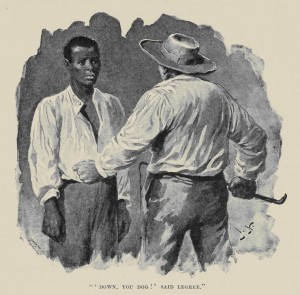
Uncle Tom and Simon Legree. Image from Uncle Tom’s Cabin Reconsidered.

Election 2012:
‘Uncle Tom’ Obama 
Vs. ‘Simon Legree’ Romney

Ironically, on the eve of the 150th anniversary of Lincoln’s Emancipation Proclamation, modern-day Americans are once again in need of emancipation and without an emancipator anywhere in sight.

By Jonah Raskin | The Rag Blog | October 24, 2012

From the wilds of northern California, which is solidly Democratic, it looks and sounds to me, a registered Democrat, that the main issues of the 2012 presidential election are gas, guns, and what might be called gender.

Drivers here don’t like the fact that they’re paying higher prices for gas than ever before at the pump. They don’t like the fact that the U.S. ambassador to Libya, Chris Stevens, was gunned down, or that U.S. guns ended up in the hands of Mexican drug lords in a botched operation known as “Fast and Furious.”

The price of gas close to home, the death of an ambassador far away, and guns spilling over the border with Mexico have all added to the sense of unease and anxiety that voters feel. On gender issues such as abortion and a woman’s right to choose, northern Californians are also anxious because they feel that a Romney victory would give conservatives the upper hand and leave women at the mercy of religious Catholics like Paul Ryan and religious Mormons like the Republican party candidate for president.

Not surprisingly they’re talking about fleeing to Canada.

The televised encounters between Obama and Romney have also multiplied anxieties. In the first debate, Obama’s body language, tone of voice, and facial expressions suggested a candidate who had lost a sense of direction and urgency.

In the town hall meeting with questions from the audience he was agile on his feet and in his head, and in the last debate when it came to foreign policy he had more facts and a more comprehensive view than Romney. He sounded like the black emperor of the American Empire.

For Democratic voters here in Northern California, however, the President has seemed all too often ineffectual, burned-out, and like a man running scared. Sometimes he has seemed just plain silly as when he talked about “Big Bird” and funding for public TV as though he could simply ridicule Romney out of the race.

Voters here see Romney as energized, aggressive, and self-confident — a man who plays on basic fears and whips them up, too. Northern Californians view Romney as an actor playing the part of a grandfatherly, paternalistic plantation owner and slick salesman who claims to know what’s best for the citizens who are slaves to their cars, to gas, to guns, and more.

They see the president himself as all too meek in the presence of the white plantation owner and when confronted with Wall Street plutocrats. Granted, he talks about the middle class, but he never talks about blue collar workers, pink collar workers, or about African Americans. Our African-American president seems to have forgotten about his own African-American roots, though I will still vote for him. I will cast my ballot for Obama and criticize him, too.

I know that the term “Uncle Tom,” which comes from Harriet Beecher Stowe’s 1852 novel Uncle Tom’s Cabin has rarely been used fairly when applied to African Americans who have survived injustice, discrimination, and more for centuries. And with a sense of real dignity, too.

Still, Obama seems more than a little like an Uncle Tom: an African American who is meek and deferential when it comes to rich, powerful white men. Romney, with his size and shape, skin-color and smile, seems more than a little like a confident contemporary incarnation of Simon Legree, Harriet Beecher Stowe’s representation of the evil, insidious slave owner.

Stowe’s best-selling novel has long been credited with starting the American Civil War. When Lincoln met the author in 1862 he apparently said, “so you are the little woman who wrote the book that started this great war.” There is no book today that expresses anywhere near the equivalent of the moral force of Uncle Tom’s Cabin; there is no movie or manifesto that has woken the conscience of the country to the current crisis.

Ironically, on the eve of the 150th anniversary of Lincoln’s Emancipation Proclamation, modern-day Americans are once again in need of emancipation and without an emancipator anywhere in sight. Our Uncle Tom president might take a page from history and learn from Lincoln himself, before the country, which is already deeply divided, descends even further into cultural and political warfare which would benefit no one.

Meanwhile, women voters — the moral descendants of Harriet Beecher Stowe — will have the power on Election Day to decide, more than any other single group, the fate of the nation.

[Jonah Raskin, professor emeritus at Sonoma State University is an author and a frequent contributor to The Rag Blog. Read more articles by Jonah Raskin on The Rag Blog.]

The Rag Blog

Posted in Rag Bloggers | Tagged , , , , , , | 2 Comments

Alan Waldman : NBC’s Short-Lived ‘Life’ Is Smart, Quirky Cop Show

Waldman’s film and TV
treasures you may have missed:

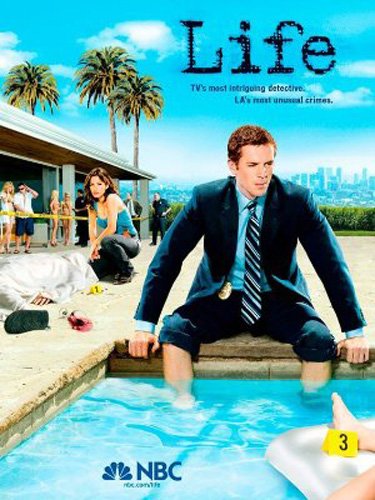
Short-lived NBC cop show Life is smart, quirky, and gripping. Damian Lewis is wonderful as the LAPD cop, falsely imprisoned for murder, who pursues the real killer and conspirators.

By Alan Waldman | The Rag Blog | October 24, 2012


[In his weekly column, Alan Waldman reviews some of his favorite films and TV series that readers may have missed, including TV dramas, mysteries, and comedies from Canada, England, Scotland, and Ireland. Most are available on DVD and/or Netflix.]

In May 2009, after 32 episodes, NBC cancelled the terrific policier Life, starring the hugely talented British thespian Damian Lewis. With a flawless American accent, he played an LAPD cop who returned to work after serving 12 years in prison for a triple murder he didn’t commit.

Over the course of the series, Lewis’s character Charlie Crews solves that crime and pursues the crooked cops who set him up. He and his female partner also crack interesting criminal cases each week.

Having lost his wife, his friends, his job and most contact with the outside world, Crews emerges as a follower of Zen with an amusing fixation on fresh fruit. Critics have compared Lewis’s character with the idiosyncratic protagonists of House and Monk.

Damian Lewis won this year’s best-actor Emmy for Homeland and was previously nominated for three other honors for Band of Brothers. He is delightful in this droll, offbeat role. The Life cast also includes Sarah Shahi, Donal Logue (The Tao of Steve), Adam Arkin (four award nominations for Chicago Hope) and Brent Sexton (The Killing).

Several good actors play villains — especially Titus Welliver and Garret Dillahunt. A consistently amusing subplot involves the doings of Arkin’s character Ted Early, Crews’ housemate, financial advisor, and former prison pal. He develops a crush on Charlie’s father’s fiancée, played by Christina Hendricks (three-time Emmy nominee for her memorable role as the redhead sexpot on Mad Men).

The whole series has aired in Australia, Italy, and Lithuania and is available here on Netflix instant streaming.

[Oregon writer and Houston native Alan Waldman holds a B.A. in theater arts from Brandeis University and has worked as an editor at The Hollywood Reporter and Honolulu magazine. Read more of Alan Waldman’s articles on The Rag Blog.]

The Rag Blog

Posted in Rag Bloggers | Tagged , , | Leave a comment

Lamar W. Hankins : Texas Cheerleaders for Jesus

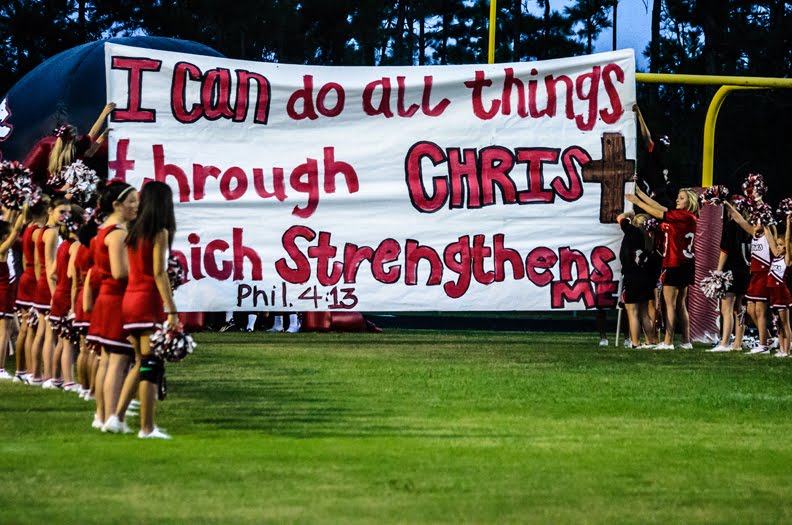
Kountze High School cheerleaders with banner at football game. Image from Atheist Camel.

Cheerleaders for Jesus:
Texas politicians jump
on religion bandwagon

Can cheerleaders who represent the Kountze Independent School District, while acting in their official capacities as school cheerleaders, promote their personal religious views?

By Lamar W. Hankins | The Rag Blog | October 24, 2012

SAN MARCOS, Texas — It seems that it is still popular to beat up on atheists and agnostics in Texas, in spite of gains in acceptance of both groups. At least, politicians have found that they can stir emotions and benefit politically from standing up for God and Jesus, whether or not God and Jesus want their help.

Governor Rick Perry and Attorney General Greg Abbott recently jumped on the religion bandwagon yet again to denounce atheists and, by implication, their partners in non-belief — agnostics, freethinkers, infidels, and secular humanists. Abbott directly attacked the Freedom From Religion Foundation (FFRF) as an organization from out of state.

While it is true that FFRF’s headquarters are in Wisconsin, FFRF has 700 members in Texas, including me. At its recent annual conference, there were members from 46 states in attendance. It is a national organization with affiliated groups in Texas and members from virtually every state.

The “outside agitator” description has been used forever to denounce anyone or any group that is not from the particular community where a controversy has arisen. In this case, the community involved is Kountze, Texas, located in Hardin County between Beaumont and Woodville, in the heart of what is known as the Big Thicket, an ecologically diverse and sensitive part of southeast Texas.

There is even a national park located there dedicated to preserving the unique natural environment of the area. Members of my family have lived in Hardin County for over 50 years, and I have done legal work there.

The current controversy in Kountze concerns a straight-forward constitutional question: Can cheerleaders who represent the Kountze Independent School District, while acting in their official capacities as school cheerleaders, promote their personal religious views?

Reasonable people might differ on their answer to this question (more about that later), but there is nothing reasonable about Perry and Abbott, both of whom have used religion to gain political advantage. On October 17, Perry and Abbott held a joint press conference to proclaim their undying support for Jesus and the Kountze cheerleaders’ right to press their religious beliefs on everyone attending football games while representing Kountze High School.

Gov. Rick Perry said, “We will not allow atheist groups from outside of the State of Texas to come into the state, to use menacing and misleading intimidation tactics, to try to bully schools to bow down at the altar of secular beliefs.”

Attorney General Abbott chimed in with, “After receiving a menacing letter from an organization with a reputation for bullying school districts, the Kountze [school superintendent] improperly prohibited high school cheerleaders from including religious messages on their game day banners.”

FFRF does not bully anyone. What it does is routinely send letters to governments after receiving a complaint about practices that violate the separation of religion and state, practices which are prohibited by the U.S. Constitution. In response to such a letter from FFRF, the Kountze ISD sought legal advice and concluded that because the cheerleaders were representing the school when they placed bible verses and religious messages on a banner prepared for the football team to burst through at the beginning of each school-sponsored game, the practice should stop.

The cheerleaders, through their parents, then sued the school district in state district court, represented by the Liberty Institute, a fundamentalist legal organization in Plano, Texas, that seeks to inject religion into government at all levels. FFRF is not involved in that law suit, but the group makes a handy whipping boy for political gain by Perry and Abbott. FFRF explained the issue this way:

The Constitution and FFRF are not “preventing freedom of expression,” we are defending freedom of conscience. The Constitution differentiates government (public school) speech from individual speech. Those cheerleaders are free to worship as they like, go to the church of their choice, but not to exploit a public school event, and their school-sponsored podium, to push their personal religious views on an entire stadium. That’s just plain bad manners.

Dan Barker, co-president of FFRF, added,

Since the state’s top law enforcer, Attorney General Greg Abbott, and its highest executive officer, Gov. Rick Perry, have openly expressed contempt for atheists and the Establishment Clause, this leads to a climate of intolerance. It takes courage to face down the full apparatus of state government, but we need those brave few to contact FFRF. Don’t let collusion, politicking, and religious fervor in Texas destroy respect for keeping public schools free of religious divisiveness.

Most people seem not to understand that the Constitution is not a self-enforcing document. Unless there is someone willing to ask a judge to determine whether a constitutional violation has occurred, the violation will continue unabated, sometimes for decades or centuries. We had segregated schools until the mid-50s, when several parents stepped forward to contest the separate and unequal public educations afforded their children.

Unless someone is willing to challenge government practices, most politicians are too unprincipled to stand up for the Constitution and end unconstitutional practices, especially when those practices are popular with a vocal group. When it comes to government support of religious practices, fundamentalist and evangelical citizens make their voices heard, and politicians usually acquiesce to their vehemence and emotion.

The closest case to the Kountze cheerleader situation involves having public prayer at football games sponsored by the school district — a government entity established by the state. The U.S. Supreme Court recognized the importance of preserving the secular nature of such high school functions in Santa Fe ISD v. Doe, 530 U.S. 290 (2000).

Santa Fe ISD is a school district near Houston. The school had a policy of electing a Santa Fe High School student to serve as student council chaplain, who would deliver a Christian prayer over the public address system at the beginning of home football games. As explained by FFRF,

One Mormon and one Catholic family filed suit challenging this and related practices as violations of the Establishment Clause, because the policy clearly favored the predominant Protestant viewpoint to the effective exclusion of non-evangelical students and audience members.

Justice John Paul Stevens wrote the majority opinion in Santa Fe ISD, which held that student-led, student-initiated prayer at school events violates the Establishment Clause. The school had claimed that the prayers were a student choice, and that attendance at an extracurricular event like a football game is voluntary. The Court found this rationalization unpersuasive because the prayers were authorized by the public school and took place on public school property at a school-sponsored event.

These salient facts lead a reasonable person to conclude that the school endorses the message of the students, making the students’ remarks public speech, not private religious expressions. Proponents of student-led prayer believe that students should have to choose between attending school functions or not attending to avoid school-sponsored prayer. The Supreme Court disagreed, writing,

The Constitution, moreover, demands that the school may not force this difficult choice upon these students for it is a tenet of the First Amendment that the State cannot require one of its citizens to forfeit his or her rights and benefits as the price of resisting conformance to state-sponsored religious practice.

An earlier U.S. Supreme Court case in 1992 affirmed nearly four decades of court precedent against school prayers. In Lee v. Weisman, 505 U.S. 577, the court held that prayers at public school graduations are an impermissible establishment of religion. Justice Anthony Kennedy wrote for the majority, “if citizens are subjected to state-sponsored religious exercises, the State disavows its own duty to guard and respect that sphere of inviolable conscience and belief which is the mark of a free people.”

While neither of these cases is exactly like the Kountze situation, they raise such similar issues and arise from such similar facts that it is logical to conclude that they control the behavior of the Kountze cheerleaders when they act in an official capacity on behalf of the Kountze ISD. Attorney General Abbott has not explained why these cases should not apply to the Kountze controversy, but he jumped at the chance to intervene officially in the case.

FFRF has noted these two cases, as well as six others that seem to provide adequate precedent to conclude that what the Kountze cheerleaders are doing violates the rights of other students. They include cases concerning prayer at high school graduations, prayer in public schools, devotional Bible-reading in public schools, and pre-football game invocations at public high school football games.

Clearly, the U.S. Supreme Court and lower courts have concluded that public schools have a legal duty to remain neutral toward religion. If the Kountze ISD allows official school representatives — the cheerleaders in this case — to promote religion through the display of signs that include both Bible verses and religious admonitions much like prayers, the Kountze ISD fears that it will be seen as promoting religion. For now, the state district court has ruled that the religious banners can continue. A trial on the issue is set for next summer.

For those people who want government to promote religion, court interventions are a hindrance to their theocratic ambitions. But there is no excuse for the Governor and the Attorney General of Texas to play politics with government promotion of religion. They know what the federal courts have held, but they choose to ignore the holdings — a sort of modern day interposition and nullification intended to undermine the U.S. Constitution, which both have sworn to uphold.

[Lamar W. Hankins, a former San Marcos, Texas, city attorney, is also a columnist for the San Marcos Mercury. This article © Freethought San Marcos, Lamar W. Hankins. Read more articles by Lamar W. Hankins on The Rag Blog.]

The Rag Blog

Posted in Rag Bloggers | Tagged , , , , , , | 1 Comment

Gerry Bello, Bob Fitrakis, and Harvey Wasserman : Do the Romneys Own Your E-Vote?

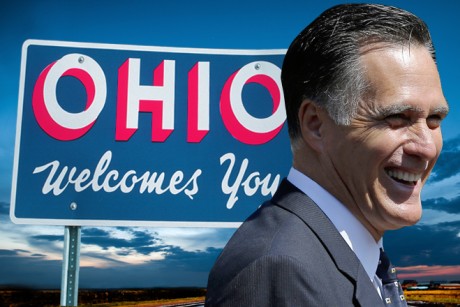
Photo by Brian Snyder / Reuters / Salon.

Does the Romney family
now own your e-vote?

A candidate for the presidency of the United States — and his brother, wife, and son — have a straight-line financial interest in the voting machines that could decide this fall’s election.

By Gerry Bello, Bob Fitrakis, and Harvey Wasserman | The Rag Blog | October 23, 2012

See Thorne Dreyer’s interview with journalist Harvey Wasserman and author Tova Andrea Wang about voter suppression and election theft, and listen to the podcast of the October 5 Rag Radio show with Wasserman and Wang.

Will you cast your vote this fall on a faulty electronic machine that’s partly owned by the Romney Family? Will that machine decide whether Romney will then inherit the White House?

Through a closely held equity fund called Solamere, Mitt Romney and his wife, son, and brother are major investors in an investment firm called H.I.G. Capital. H.I.G. in turn holds a majority share and three out of five board members in Hart Intercivic, a company that owns the notoriously faulty electronic voting machines that will count the ballots in swing state Ohio November 7. Hart machines will also be used elsewhere in the United States.

In other words, a candidate for the presidency of the United States — and his brother, wife, and son — have a straight-line financial interest in the voting machines that could decide this fall’s election. These machines cannot be monitored by the public. But they will help decide who “owns” the White House.

They are especially crucial in Ohio, without which no Republican candidate has ever won the White House. In 2004, in the dead of election night, an electronic swing of more than 300,000 votes switched Ohio from the John Kerry column to George W. Bush, giving him a second term.

A virtual statistical impossibility, the 6-plus percent shift occurred between 12:20 and 2 a.m. election night as votes were being tallied by a GOP-controlled information technology firm on servers in a basement in Chattanooga, Tennessee. In defiance of a federal injunction, 56 of Ohio’s 88 counties destroyed all election records, making a recount impossible. Ohio’s governor and secretary of state in 2004 were both Republicans, as are the governors and secretaries of state in nine key swing states this year.

As we have previously reported, H.I.G. Capital has on its board of directors at least three close associates of the Romney family. H.I.G. Capital directors John P. Bolduk and Douglas Berman are major Romney fundraisers. So is former Bain and H.I.G. manager Brian Shortsleeve. H.I.G. employees have contributed at least $338,000 to Romney’s campaign. Fully a third of H.I.G.’s leadership previously worked at Romney’s old Bain firm.

But new research now shows that the association doesn’t stop with mere friendship and business associations. Mitt Romney, his wife Ann Romney, and their son Tagg Romney are also invested in H.I.G. Capital, as is Mitt’s brother G. Scott Romney.

The investment comes in part through the privately held family equity firm called Solamere, which bears the name of the posh Utah ski community where the Romney family retreats to slide down the slopes.

Unlike other private equity firms, Solamere does not invest in companies directly. Instead, Solamere invests in other private equity funds, like H.I.G. Capital. Solamere calls them partners. These partners, like H.I.G., then invest in various enterprises, like Hart Intercivic, the nation’s third-largest voting machine manufacturer.

As reported by Lee Fang of The Nation, Solamere was founded by Tagg Romney and Spencer Zwick, Papa Romney’s campaign finance chair. Ann Romney and Mitt’s brother G. Scott Romney are also invested. Mitt himself threw in $10 million “seed money” to get the fund going, and spoke personally to its first full investors conference.

Solamere’s public web presence has been reduced to a front page only, so a complete list of it’s partners can not be found. But reportage by The New York Times, Boston Globe, Esquire, and The Nation have slowly given us a partial picture of which funds are being funded by Solamere. Some $232 million has been raised so far, according to SEC filings and industry publications.

In addition to Romney’s finance chair Spencer Zwick, Solamere has also provided the campaign with its finance director, Richard Morley, and a western regional finance coordinator, Kaitlin O’Reilly. O’Reilly is listed as an executive assistant at Solamere, and also at SJZ LLC, which was founded by her boss Spencer Zwick.

The SJZ LLC campaign finance consulting firm has billed Mitt’s campaign over $2 million this election cycle as well as doing another $9,687,582 in billing to various Congressional Campaigns. The host of the private fundraiser at which Romney made his infamous “47%” speech was Marc J. Leder, co-CEO of Sun Capital, another “partner” of the Solamere fund.

As in virtually every close presidential race, Ohio may well hold the key to the Electoral College decision as to who will become the nation’s next chief executive. The presence of Hart Intercivic machines in Hamilton County, home to Cincinnati, means there is a high likelihood the votes that will decide the presidency will be cast on them. Major media like CBS have begun reporting that Cincinnati could be “ground zero” in this year’s election.

But these Hart machines are deeply flawed and widely know to be open to a troubling variety of attacks and breakdowns. There is no legal or other means to definitively monitor and re-check a tally compiled on Hart or other electronic voting machines. Ohio’s current governor and secretary of state are both Republicans.

Does this mean the Romney investment in Hart Intercivic through H.I.G. Capital and Solamere will yield it not only financial profits but the White House itself?

Tune in during the deep night of November 7, when the electronic votes in swing state Ohio are once again opaquely reported to the nation and the world, without meaningful public scrutiny or legal recourse.

[Gerry Bello is chief researcher for Free Press. Bob Fitrakis and Harvey Wasserman are co-authors of five books on election protection, including Will the GOP Steal America’s 2012 Election?, an e-book at freepress.org. Read more of Harvey Wasserman and Bob Fitrakis’ writing on The Rag Blog.]

Also see:

The Rag Blog

Posted in Rag Bloggers | Tagged , , , , , , , | 1 Comment

>>> Does the Romney Family Now Own Your E-Vote? >>>>>> by Gerry Bello, Bob Fitrakis & Harvey Wasserman >>>>>>>>> Will you cast your vote this fall on a faulty electronic machine that’s partly owned by the Romney Family? Will that machine decide whether Romney will then inherit the White House? >>>>>> Through a closely held equity fund called Solamere, Mitt Romney and his wife, son and brother are major investors in an investment firm called H.I.G. Capital. H.I.G. in turn holds a majority share and three out of five board members in Hart Intercivic, a company that owns the notoriously faulty electronic voting machines that will count the ballots in swing state Ohio November 7. Hart machines will also be used elsewhere in the United States ( http://www.hartintercivic.com ). >>>>>> In other words, a candidate for the presidency of the United States, and his brother, wife and son, have a straight-line financial interest in the voting machines that could decide this fall’s election. These machines cannot be monitored by the public. But they will help decide who “owns” the White House. They are especially crucial in Ohio, without which no Republican candidate has ever won the White House. In 2004, in the dead of election night, an electronic swing of more than 300,000 votes switched Ohio from the John Kerry column to George W. Bush, giving him a second term. A virtual statistical impossibility, the 6-plus% shift occurred between 12:20 and 2am election night as votes were being tallied by a GOP-controlled information technology firm on servers in a basement in Chattanooga, Tennessee. In defiance of a federal injunction, 56 of Ohio’s 88 counties destroyed all election records, making a recount impossible. Ohio’s governor and secretary of state in 2004 were both Republicans, as are the governors and secretaries of state in nine key swing states this year ( http://www.freepress.org/departments/display/19/2012/4724 ). >>>>>> As we have previously reported, H.I.G. Capital has on its board of directors at least three close associates of the Romney family. H.I.G. Capital directors John P. Bolduk and Douglas Berman are major Romney fundraisers. So is former Bain and H.I.G. manager Brian Shortsleeve. H.I.G. employees have contributed at least $338,000 to Romney’s campaign. Fully a third of H.I.G.’s leadership previously worked at Romney’s old Bain firm. >>>>>> But new research now shows that the association doesn’t stop with mere friendship and business associations. Mitt Romney, his wife Ann Romney, and their son Tagg Romney are also invested in H.I.G. Capital, as is Mitt’s brother G. Scott Romney. >>>>>> The investment comes in part through the privately held family equity firm called Solamere, which bears the name of the posh Utah ski community where the Romney family retreats to slide down the slopes. >>> Unlike other private equity firms, Solamere does not invest in companies directly. Instead, Solamere invests in other private equity funds, like H.I.G. Capital. Solamere calls them “partners.” These partners, like H.I.G., then invest in various enterprises, like Hart Intercivic, the nation’s third-largest voting machine manufacturer. >>>>>> As reported by Lee Fang of the Nation (http://www.thenation.com/article/170470/tagg-team-romney-family-recipe-crony-capitalism# ), Solamere was founded by Tagg Romney and Spencer Zwick, Papa Romney’s campaign finance chair. Ann Romney and Mitt’s brother G. Scott Romney are also invested. Mitt himself threw in $10 million “seed money” to get the fund going, and spoke personally to its first full investors conference. Solamere’s public web presence ( http://www.solameregroup.com/page/1/strategy ) has been reduced to a front page only, so a complete list of it’s “partners” can not be found. But reportage by the New York Times, Boston Globe, Esquire and the Nation have slowly given us a partial picture of which funds are being funded by Solamere. Some $232 million has been raised so far, according to SEC filings and industry publications. >>>> In addition to Romney’s finance chair Spencer Zwick, Solamere has also provided the campaign with its finance director, Richard Morley, and a western regional finance coordinator, Kaitlin O’Reilly. O’Reilly is listed as an “executive assistant” at Solamere, and also at SJZ LLC, which was founded by her boss Spencer Zwick. The SJZ LLC campaign finance consulting firm has billed Mitt’s campaign over $2 million this election cycle as well as doing another $9,687,582 in billing to various Congressional Campaigns. The host of the private fundraiser at which Romney made his infamous “47%” speech was Marc J. Leder, co-CEO of Sun Capital, another “partner” of the Solamere fund. >>>>>> As in virtually every close presidential race, Ohio may well hold the key to the Electoral College decision as to who will become the nation’s next chief executive. The presence of Hart Intercivic machines in Hamilton County, home to Cincinnati, means there is a high likelihood the votes that will decide the presidency will be cast on them. Major media like CBS have begun reporting that Cincinnati could be “ground zero” in this year’s election ( http://www.freepress.org/departments/display/19/2012/4742 ). >>>>>> But these Hart machines are deeply flawed and widely know to be open to a troubling variety of attacks and breakdowns ( http://www.bradblog.com/?p=9628 ). There is no legal or other means to definitively monitor and re-check a tally compiled on Hart or other electronic voting machines. Ohio’s current governor and secretary of state are both Republicans. >>>>>> Does this mean the Romney investment in Hart Intercivic through H.I.G. Capital and Solamere will yield it not only financial profits but the White House itself? >>>>>> Tune in during the deep night of November 7, when the electronic votes in swing state Ohio are once again opaquely reported to the nation and the world, without meaningful public scrutiny or legal recourse. ——————————— Gerry Bello is chief researcher for www.freepress.org. Bob Fitrakis and Harvey Wasserman are co-authors of five books on election protection, including WILL THE GOP STEAL AMERICA’S 2012 ELECTION? an e-book at www.freepress.org.

Type rest of the post here

Source /

The Rag Blog

Posted in RagBlog | Leave a comment

Thomas McKelvey Cleaver : George McGovern, the Most Decent Man in Politics

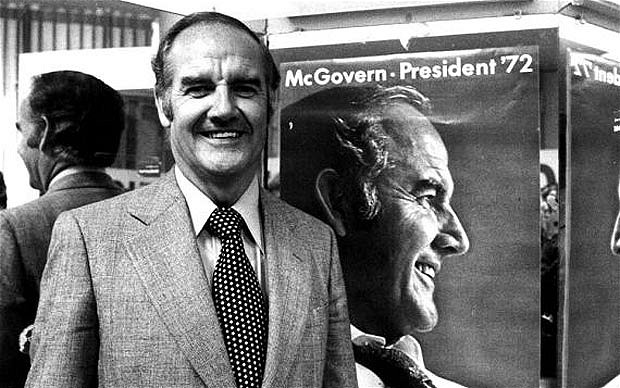
George McGovern during the 1972 presidential campaign. Photo from SIPA / REX.

George McGovern:
The most decent man in politics

McGovern, who flew 35 missions as pilot of a B-24, took what he had learned in those deadly skies and put it into his politics, caring for his country the way he cared for his crew…

By Thomas McKelvey Cleaver | The Rag Blog | October 22, 2012

In 1972, my then-boss met with then-presidential candidate Senator George McGovern, and thus I also got to meet him. The most decent guy I ever met in politics.

To me George McGovern and Richard Nixon perfectly illustrate the basic difference between the two parties, and the point is nowhere better made than to look at their respective careers in the Second World War:

Richard Nixon, who arrived on Guadalcanal a year after all the fighting was done, spent his time in the rear with the gear as a supply officer who played poker well enough to come home at the end of the war with the money for a down payment on his first home. Out for himself, from the git-go.

George McGovern, who flew 35 missions as pilot of a B-24 operating out of Italy, facing the chance of being blown out of the sky 35 times (flak was far more deadly to B-24s than fighters), who cared for his crew, men who loved him all the rest of their lives, who took what he had learned in those deadly skies and put it into his politics, caring for his country the way he cared for his crew, using that courage that had to sustain him then, to take the most unpopular position a politician could take: to oppose the war created by the president of his party, and make the issue stick.

Blue skies, Captain McGovern, sir.

Conor Friedersdorf, no Democrat or liberal, had this to say on McGovern’s passing:

Over the course of his career, McGovern made a lot of arguments that I personally find unpersuasive. But he sure did get the most important issue of his time right. Think of all the Americans who’d be alive today if the country had listened to McGovern rather than his opponents about the Vietnam War. Think of all the veterans who’d have been better off. Think of how many Vietnamese civilians would’ve been spared death by napalm.

From Hunter S. Thompson’s legendary Fear and Loathing on the Campaign Trail ‘72:

The tragedy of all this is that George McGovern, for all his mistakes… understands what a fantastic monument to all the best instincts of the human race this country might have been, if we could have kept it out of the hands of greedy little hustlers like Richard Nixon.

[Vietnam veteran Thomas McKelvey Cleaver is an accidental native Texan, a journalist, and a produced screenwriter. He has written successful horror movies and articles about Second World War aviation, was a major fundraiser for Obama in 2008, and has been an activist on anti-war,  political reform, and environmental issues for almost 50 years. Read more articles by Thomas Cleaver on The Rag Blog.]

The Rag Blog

Posted in Rag Bloggers | Tagged , , , , , , , | Leave a comment

Ron Jacobs : Reflecting on George McGovern

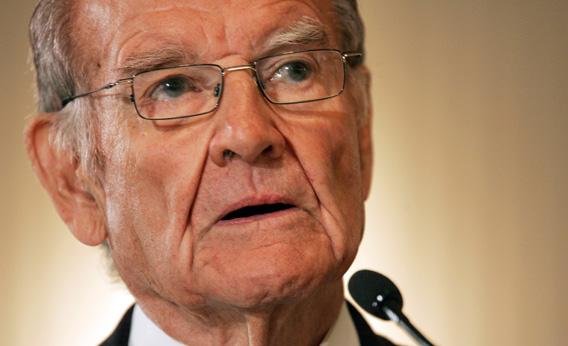
Former presidential candidate and Sen. George McGovern in 2007. Photo by Tim Sloan / AFP / Getty Images..

Come home, America:
Reflecting on George McGovern

I was a senior in high school in 1972. I listened to his acceptance speech while working my summer job and campaigned for McGovern on the military base where my school was located.

By Ron Jacobs | The Rag Blog | October 22, 2012

Like many people of my generation, it is with a certain regret that I read about George McGovern’s passing. His campaign for the presidency was, with the possible exception of Jesse Jackson’s 1984 run, the last radical run for the White House by any member of either mainstream political party.

Made possible by changes in the way Democrats chose their candidate, George McGovern’s ascent to the Democratic Party nomination in 1972 represented the best of the United States. His campaign promises were simple. He would end the Vietnam War within 90 days of his inauguration; he would guarantee every U.S. citizen a livable income; he would limit the income of the richest Americans through taxation; and he was a fervent believer in accessible health care for all.

His first brush with presidential politics occurred in 1968 when supporters of Robert F. Kennedy approached him to replace Kennedy after he was killed in June 1968. McGovern held fast to the platform plank demanding a withdrawal from Vietnam. Unfortunately, that plank was defeated by the Humphrey apparatchiks in the party.

His opposition to the Vietnam War was the key aspect of his campaign and the reason he was supported by most people in the antiwar movement, including Yippies Abbie Hoffman and Jerry Rubin and (secretly) members of the Weather Underground.

I was a senior in high school in 1972. I listened to his acceptance speech while working my summer job and campaigned for McGovern on the military base where my school was located. Organized by a couple of civilian employees of the Defense department working in Frankfurt am Main, we were mostly high school students and recent graduates opposed to the war. Plus, we hated Richard Nixon.

In the months leading up to the election, we would station ourselves just outside the property lines of the Army’s Post Exchange (a shopping center for military personnel and their dependents) several days a week. Passing out campaign literature, bumper stickers, and buttons, we were amazed at how well we were received. GIs of all skin colors took extra copies of our literature to distribute at their barracks.

Military wives took buttons and literature and asked us not to tell their husbands. Germans walking by would take a button and tell us they hoped McGovern would win.

Of course, we also had our detractors. There was more than one time a lifer (a career military man) called me a commie and a faggot. There were even a couple times I was shoved around by a right wing GI or NCO. Officers would argue with us, telling me and my fellow campaigners that we were just naïve and should leave politics to the professionals.

My most memorable interaction was with the wife of my dad’s commanding officer (a career officer). This woman, who had been a family friend since I was a kid, came up to me one afternoon and asked quietly if she could have a McGovern button. I gave her one immediately. She made me promise I wouldn’t mention it to my father or her husband. I smiled and told her I wouldn’t.

I did ask her if she was going to vote for McGovern. Of course, she replied. I don’t want my son (who was a freshman in college) to go to war. I’ve had enough of that with my husband. She hugged me and left.

As we know, George McGovern lost that election. Richard Nixon won by a landslide. The war in Southeast Asia went on for another three years despite the faux peace treaty signed in 1973. Richard Nixon and his administration continued to develop a police state apparatus that has only been improved on in the decades since.

In a piece of poetic justice, that very same administration crumbled by 1974 because of its criminality, corruption, and arrogance. In a moment that I celebrate every August, Richard Nixon resigned from the presidency to avoid going to trial. Dozens of his co-conspirators went to prison. As for the Democrats, they changed the rules once more to prevent a candidate like McGovern from ever gaining the party’s nomination again.

The news of Mr. McGovern’s declining health made me ask a question I hadn’t asked since the day after Nixon was re-elected in 1972. What would have happened if George McGovern had won?

[Rag Blog contributor Ron Jacobs is the author of The Way The Wind Blew: A History of the Weather Underground. He recently released a collection of essays and musings titled Tripping Through the American Night. His latest novel, The Co-Conspirator’s Tale, is published by Fomite. His first novel, Short Order Frame Up, is published by Mainstay Press. Ron Jacobs can be reached at ronj1955@gmail.com. Find more articles by Ron Jacobs on The Rag Blog.]

The Rag Blog

Posted in Rag Bloggers | Tagged , , , , , , , | Leave a comment

Roger Baker : Which Side Are You On, Austin?

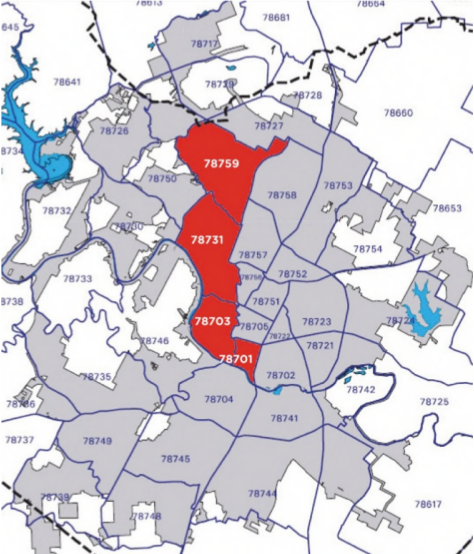
Most Austin City Council members are elected from four affluent zip codes, in red above.

Which side are you on?
The people’s plan versus the politicians’ plan

The struggle for populist control of the City of Austin government by means of 10 independent district elections can be seen as the 1960s struggle for civil rights brought up to date.

By Roger Baker | The Rag Blog | October 18, 2012

[I make no claim to be unbiased. I fully support and have worked for Proposition 3, which I believe to be the best option to bring more democratic government to Austin. (I also recommend The Austin Bulldog — Austin’s current gold standard for local political reporting — as the best source to learn more about this issue.) Those who want to participate in what can be a historic victory should contact the 10-1 office — to make sure that the advantage of people power gets translated into distributed door hangers and yard signs. — R.B.]

AUSTIN — Which side are you on? A historic grassroots fight for district representation in Austin, supported by an amazingly broad coalition of citizen groups, has emerged.

It’s about money power versus people power. If Proposition 3 is approved by the voters in November, it will be arguably the most meaningful and important Austin populist political victory in decades: a no-holds-barred fight for democratic control of Austin government.

Currently, Austin government is in the hands of six council members plus a mayor, all elected citywide by all Austin voters. As such, Austin is now the biggest city in the United States without districts to bring representative government down to the local level. With Austin’s current at-large system, big money tends to dominate Austin City Council elections. This is because non-wealthy candidates who might locally be very popular can’t afford the hundreds of thousands of dollars of media buys needed to run big citywide media campaigns.

One result of this is that almost all of the Austin City Council since the 1970s has been elected by a small affluent part of Austin centered in four zip codes — 78701, 78703, 78731, and 78759 — which together comprise only 10% of Austin’s population. Fifteen out of 17 Austin mayors in the last 40 years have come from this area, as have 50% of the City Council members. Meanwhile, the large numbers of voters in the lower income areas of South and East Austin have elected few Council members.

The struggle for populist control of the City of Austin government by means of 10 independent district elections can be seen as the 1960s struggle for civil rights brought up to date. With 10 districts, there would likely be at least two Hispanic seats on the Austin City Council, plus the high probability of an African-American seat.

It all boils down to a populist battle for control of Austin city government that directly challenges Austin’s entrenched political and consultant establishment, largely comprised of Democrats, who have an interest in maintaining control of those who profit from weak development restrictions and growth subsidies. The prevailing interests in Austin government have long favored a banker/developer/land speculator group who profit from suburban sprawl development.

Austin’s “growth at any cost” promoters have been in a political alliance with the Texas Department of Transportation  (TxDOT) and the Texas road lobby, building roads with public money to subsidize private growth, often in satellite cities like Round Rock within easy commuting distance.

There is no economy of scale with growth for a sprawling city the size of Austin. Rapid growth of low density sprawl outside the city limits tends to benefit land developers at the expense of existing city taxpayers. There is a lot of money to be made by perpetuating current pro-developer growth policies, both inside and outside Austin city limits. If snubbed by city growth regulations, developers can sometimes get Austin development restrictions weakened or overturned by the threat of going to the Republican-controlled Texas legislature.

Why now?

The people’s plan, Proposition 3 on the November ballot, got its start as a result of the fact that the Austin City Council set up a new citizen Charter Review Commission. This group can meet as often as every two years to suggest possible changes to Austin’s city charter form of government, subject to subsequent voter approval. When city politicians want to change some basic governance policy, they appoint such a Commission. However there is no guarantee that it will do what they want, or tell them what they want to hear.

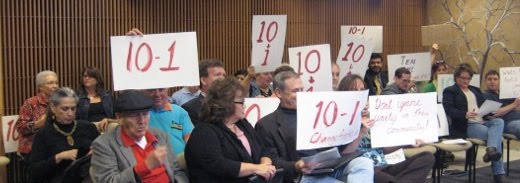
Supporters of the 10-1 City Council plan at meeting of Austin’s 2012 Charter Revision Committee, Feb. 2, 2012. Image from Trust Austin.

A core group of mostly liberals and political reformers saw this as an opportunity for reform, including veteran political strategist Peck Young and veteran organizer Linda Curtis, and many others (including the author). This citizen group was later known as Austinites for Geographical Representation (AGR), recently renamed “Trust Austin.”

AGR started meeting about a year ago in response to this citizen input opportunity. Eventually the group agreed to support a 10-district plan, and urged its members to lobby before the Charter Review Commission. The Charter Review Commission itself, including its chair, former Texas Senator Gonzalo Barrientos, finally, approved the 10-1 citizen plan by a narrow vote They then sent their 10-1 majority recommendation to the City Council.

The City Council, however, saw the 10-1 citizen plan more as a threat than an opportunity for reform. What amounts to an Austin shadow government fought back. Support from the Real Estate Council of Austin (RECA) soon led to the submission of a competing 8-2-1 charter proposal by Mayor Lee Leffingwell, who told the Charter Review Commission that this had to be accepted as a compromise. The battle lines were thus drawn.

The same 8-2-1 plan was decisively rejected by the voters 10 years ago, as had been a number of other attempts to get district representation passed over the last several decades. This spurred the effort to gather at least the 20,000 citizen initiative signatures needed to force the Austin City Council to place the 10-1 plan on the ballot. AGR worked from January and way into the summer this year getting the signatures, ending up with over 33,000 signatures, comfortably more than were required.

The citizen plan, Proposition 3, calls for 10 districts plus the mayor. It is being supported by an amazingly wide-ranging coalition of 29 organizations, including the NAACP and LULAC, the League of Women Voters, the Austin Firefighters and Police Associations, and the Austin Neighborhoods Council. Political support ranges from the Travis County Greens, to Democratic Hispanic groups, to the Travis Republicans and the Austin Homebuilders Association. At least two ex-mayors, Frank Cooksey and Bruce Todd, support it.

Political spending on elections is now largely conducted by political action committees or PACs. It costs a lot to get the word out — more than $100,000 to do it right. The Populist 10-1 plan has its “Trust Austin” PAC. The politician’s plan, 8-2-1, is being promoted by the “Austin Community for Change” PAC .

Why doesn’t Austin already have districts?

Austin’s current system of at-large elections originated during the era when Austin was much smaller, and has its roots in a racist past. The near win of a city council seat by popular community leader Arthur B. DeWitty in 1951 caused the city to adopt an at-large system. This was then seen as the best way to keep an African-American from winning a seat on the then effectively segregated Austin City Council. This link tells the story.

During the 1970’s the on-going conflict between the land development interests nnd the environmental community heated up. Groups such as AARO, the Austin Area Research Organization, were organized to promote business and real estate interests that felt threatened by populist politics. Beginning in 1977, and as part of their program, the business interests that benefited from rapid growth provided enough money to make sure that both an African-American and a Hispanic were always elected to the City Council.

This was the basis of the “gentlemen’s agreement,” still in effect. Failing to elect at least one African-American and one Hispanic would trigger federal intervention under the 1965 Voting Rights acts. Since Austin was and still rather narrowly is a white majority city, it took a well-funded effort to always elect two minorities to the City Council in order to legally protect the at-large voting system. Retaining business community control of Austin government required the politically active business interests to always promote the two minority campaigns sufficiently to make sure one of each minority would remain in office.

According to KUT, Austin’s public radio station,

Ed Wendler and Bill Youngblood were two big players in Austin politics in the ’70s. Peck Young says Youngblood was afraid if there wasn’t Hispanic or African-American presence on the council, the city would be open to a federal lawsuit that might force single-member districts. So they came up with an unspoken rule that the Place 5 council was the “Hispanic seat” and Place 6 was the “African-American seat.” But the agreement wasn’t aimed at encouraging council diversity — it was aimed at controlling that diversity. “You have minorities, but you don’t have minorities elected by minority voters,” Young said.

In a number of ways, the current fight recalls the earlier epic “Battle for Barton Springs” in 1991. This earlier citizen-led environmental rebellion also led to a grassroots petition effort that succeeded in forcing the issue of environmental reform onto the ballot. Then, as now, an innocent-sounding proposal was placed on the ballot as competition to try to kill the citizens’ initiative. Despite the business community’s opposition, the 1992 citizens’ initiative won big, with the help of united environmentalist support. This led to a successful ordinance to protect the Edwards Aquifer, Austin’s fragile recreational and groundwater supply aquifer.

San Antonio already has its own 10-1 system of city government in place, and it works to promote popular leaders of modest means. Having districts doesn’t necessarily guarantee good government but it helps. San Antonio’s Democratic Mayor Julian Castro was the keynote speaker at the recent Democratic Party convention in Charlotte NC.

The politicians’ plan, Proposition 4, has a few problems

The 8-2-1 plan, Proposition 4 on the November ballot, is conspicuously less democratic than 10-1. It was put on the ballot with no signatures, and without much popular support. The photo of a racially diverse group of “supporters” featured on their website is a stock photo they bought.

The politicians’ 8-2-1 plan has support from RECA, professional consultants, and political power brokers; it amounts to a full employment act for a handful of campaign consultants. One reason that the current City Council voted to put the politicians’ plan on the ballot is the pressure brought about by political strategist David Butts, a top strategist in the 8-2-1 campaign, who makes his living largely from City Council and other local political races. The way Prop. 4 is written it would allow the council to draw and gerrymander the 8-2-1 districts in such a way as to keep their seats. The current City Council members live relatively close together, and without some creative design of the new districts, many would likely end up within the same districts.

The main Austin media have not been neutral. In July, the Austin Chronicle featured a story by news editor Michael King titled “Point Austin: The Usual Suspects; The argument over council districting takes a nasty turn.” King’s biased political coverage in this case elicited a strong rebuke from UT law professor and national expert on election law, Steve Bickerstaff. He had been a pro-bono adviser for 10-1 on its legality, but had remained otherwise neutral, declining to advocate for either ballot Proposition. Prof. Bickerstaff does believe in fair reporting, however, and the Chronicle spin was too much.

…the Chronicle story was catty, cynical, biased, and poorly reasoned — unlike most articles written by Michael King. AGR has secured more than 33,000 voter signatures on its petition, the support of many different community organizations, and the recommendation of the Charter Revision Committee. Whether or not Mr. King or the Chronicle supports the group’s 10-1 proposal, they should respect this outstanding achievement and laud the vision and hard work evidenced in this exercise of democratic rights.

Council Member Mike Martinez explained his vote in favor of putting this proposal (unchanged) on the ballot as a means of recognizing this group’s achievement. Supporters of an 8-2-1 election system could have used a petition drive to show the degree of public support for their plan; they did not.

Also, I was surprised that the Chronicle, which has been so critical of the gerrymandering and self-interest shown in redistricting by the Texas Legislature, could be dismissive of an independent redistricting commission at the city level. Independent commissions have operated successfully in California at the state level and in a number of cities, such as San Diego and Minneapolis. They can take much of the self-interest and politics out of redistricting.

The Chronicle should be supporting the need for an independent commission in Austin as an essential part of any charter amendment changing from our at-large system. The Charter Revision Committee (13-2) politically endorsed creation of an independent commission. Many of the members of the City Council that the Chronicle identifies as preferring an 8-2-1 plan have voiced support of such a commission. Election district lines should not be drawn by the same politicians who seek election in those districts, or by committees appointed by such politicians.

It might be argued that as a halfway step in the direction of democratic district government, 8-2-1 is better than what we have now. However, its real impact, and the reason for the City Council putting it on the ballot very late in the game, is to act as a sort of a poison pill proposal. It was placed on the ballot in response to wide support for 10-1, with the hope of attracting enough votes away from the 10-1 plan to kill the latter.

The politician’s plan, the 8-2-1 plan, would appear to have one important flaw. It invites a legal challenge since it seems to be incompatible with the Voting Rights Act of 1965. Proposition 4 would be subject to legal challenge because Austin’s African-American population — which is about 7 percent of the city’s total population — has largely been forced out of its historic areas of concentration in East Austin over recent decades by a combination of gentrification and high property taxes.

This means that it will take a lot of districts of equal size, at least 10, to be able to draw one with sufficient African-American concentration to make it reasonably easy to win an election without outside support, particularly from the business community. With any fewer than 10 districts, according to recent census data, no contiguous district can be drawn that would give Austin’s remaining African-American population a legally defensible ability to elect their own representatives.

Bottom Line: Reasons to support Proposition 3 in the November 2012 Austin election, 10-1, the People’s plan:

  1. Citizen Districts: The 10-1 plan would establish a Citizen Redistricting Commission which would exclude city politicians, lobbyists, and consultants. The record shows that political insiders tend to draw gerrymandered district maps that favor their own interests.
  2. The 10-1 plan makes all neighborhoods equal, and ends the current concentration of power in a small part of Austin.
  3. Every vote becomes more important. The more districts, the more the candidate’s merit and local appeal become important.
  4. It is supported by 29 major organizations and 33,000 petition signatures gathered following a year-and-a-half-long transparent process (fully reported in The Austin Bulldog).
  5. At least 10 districts are required for a geographic representation system to be legally defensible for Austin under the Voting Rights Act.
  6. The 10-1 plan ends Austin’s racist “gentleman’s agreement” because minorities can best choose their own representatives.

Reasons to oppose Proposition 4, the 8-2-1 Politician’s plan

  1. Lacking the safeguards in the 10-1 plan, the 8-2-1 plan allows Austin districts to be gerrymandered by politicians, lobbyists, and consultants.
  2. The two at-large districts retain the unequal legacy of the four privileged ZIP codes.
  3. Having only eight districts denies African-Americans an opportunity district, meaning it will very likely be challenged in court.
  4. The mayor and the two at-large council seats will tend to remain controlled by the special interests.
  5. It perpetuates the “gentleman’s agreement” by which African-American and Hispanic seats can be chosen by power brokers.
  6. As a ploy to defeat the people’s plan, the 8-2-1 plan was put on the ballot by politicians with very little grassroots citizen input, even though the same plan failed by a wide margin 10 years ago.

For those who wish to follow the populist fight for Austin district representation in depth, to understand how we got to this point of decision over the past year and a half, the outstanding source is veteran investigative reporter Ken Martin’s pro-bono, online Austin political journal, The Austin Bulldog. There are several dozen Bulldog stories on the citizen meetings that led to the People’s 10-1 district representation plan, dating back to March 2011, linked here.

By contrast, Austin’s daily newspaper, the Austin American-Statesman and Austin’s sporadically liberal alternative weekly, The Austin Chronicle, have offered sparse and politically slanted coverage of the Austin district issue.

[Roger Baker is a long time transportation-oriented environmental activist, an amateur energy-oriented economist, an amateur scientist and science writer, and a founding member of and an advisor to the Association for the Study of Peak Oil-USA. He is active in the Green Party and the ACLU, and is a director of the Save Our Springs Association and the Save Barton Creek Association in Austin. Mostly he enjoys being an irreverent policy wonk and writing irreverent wonkish articles for The Rag Blog. Read more articles by Roger Baker on The Rag Blog.]

The Rag Blog

Posted in Rag Bloggers | Tagged , , , , , , , , | 5 Comments

Jay D. Jurie : A Free School for the 21st Century

The Professor, his own self. Graphic treatment by James Retherford / The Rag Blog.

A free school for the 21st century:
The Online University of the Left

The OUL is dedicated to ‘changing our thinking, changing opinion, changing the world.’

By Jay D. Jurie | The Rag Blog | October 18, 2012

Are you interested in learning more about society and the world we inhabit, how it all got to be the way it is, and of most importance, how it might be changed for the better? If so, there’s a new school at your fingertips, a good place to search for some answers, one that doesn’t saddle its students with a lifetime of loan debt.

Officially opened on January 1, 2012, the Online University of the Left (OUL) made its website debut in April at the Left Forum, an annual gathering of left-wing academics and organizers in New York City.

Dedicated to “changing our thinking, changing opinion, changing the world,” the OUL is largely the brainchild of Carl Davidson, twice a national officer of Students for a Democratic Society (SDS) during the 1960s, and currently co-chair of Committees of Correspondence for Democracy and Socialism (CCDS) and a regular contributor to The Rag Blog. OUL was created by wedding the “free schools” of the 1960s, the radical education project of SDS, and older expressions of democratic and left-wing education, with present-day technology.

Growing up in Pennsylvania, Davidson had an early interest in science and technology. This was followed by an interest in the philosophy of science, which led to philosophy and then Marxism, and eventually a return to his roots. He began using technology in media outreach and other political work that included teaching computer repair and internet skills to ex-offenders and former gang members. In Chicago, Davidson was a founder of a face-to-face “Open University of the Left” that sponsored class meetings and events at locales throughout the city.

For eight years he was the lead organizer of the Midwest Radical Scholars and Activist Conference. For 16 years he was a participant in the “Chicago Third Wave Study Group” which put some of its classes online. This background pointed toward the possibilities of a broader online university which could be facilitated by greater speed and broader reach.

These possibilities were coupled with the awareness that many working people with busy lives, even if they can afford it, don’t have the time to devote to learning in a traditional classroom setting. Influenced by the writings of Italian social theorist Antonio Gramsci, Davidson perceived that people can become “organic intellectuals” capable not only of learning but participating in the events that shape their lives. OUL’s online approach readily lends itself to these forms of exploration and growth.

Among the “top video courses” displayed on the OUL’s home page is a dialog about capitalism, socialism, and related topics between Charlie Rose, David Harvey and Richard Wolff; a documentary about the Occupy Wall Street Movement entitled “Rise Like Lions”; a talk by Angela Davis about slavery and the prison-industrial complex; and a discussion of Gramsci by the recently-deceased British historian Eric Hobsbawm.

One of the most captivating videos is “The U.S. in 2012: What’s Class Got to Do with It?” a roundtable discussion with Bill Fletcher, Jr., Juan Gonzalez, Bob Herbert, Frances Fox Piven, and Michael Zweig. Also shown on the home page are “top course outlines and materials,” including a Todd Nigel article comparing and contrasting Gramsci and Mao on the role of organic intellectuals, a link to the Solidarity Economy web site, and “Learning About Unions” by the AFL-CIO.

Presently featured on the OUL site are 20 academic departments, including political economy, solidarity economy, African American Studies, English & Literature, Womens Studies, History, Gay & Lesbian Studies, Global Studies, Psychology, Latino Studies, and Urban Studies, among others. In other words, something for almost everyone. Some of the departments offer subdivisions.

For example, the Science and Discovery department provides an Ecology and Energy subdivision, in which can be found a video entitled “The Story of Cap and Trade” moderated by Annie Leonard. Most of the material found in the departments consists of videos. Given its origins, OUL could be stronger on “hard science” and technology offerings.

There is a blog feature that consists of videos as well as written blog articles, including writings about the Occupy movement, the Black Bloc, and the crises of capitalism. There’s a section on books, which links to a page on the Goodreads site. Other links lead to World News from CEO Express, Arts & Letters Daily, U.S. Colleges and Universities, Left Parties of the U.S. & World and other sites.

One of the most fascinating blog entries is “Conquering a New Popular Hegemony,” an essay by Marta Harnecker, a Chilean sociologist and political theorist. Harnecker tells us that much of Latin America is in the process of adopting a 21st Century Socialism:

a new socialism, far removed from the Soviet model… We knew more about what we didn’t want in socialism than what we did want. We rejected the lack of democracy, totalitarianism, state capitalism, bureaucratic central planning, collectivism that sought to standardize without respect for differences, productivism that emphasized the expansion of productive forces without taking into account the need to preserve nature, dogmatism, intolerance toward legitimate opposition, the attempt to impose atheism by persecuting believers, the need for a single party to lead the process of transition.

Essays like this underscore the important role OUL can play in disseminating such ideas throughout North America.

A “classes” section features live video conferencing, with opportunities for questions and answers. One recent entry is a report-back on a trip to Cuba by philosophers and economists. An upcoming session will feature environmentalist Ted Glick on the topic of climate change.

A particularly interesting section is “archives,” with writings, audio, film, and video about Marxism, the Frankfurt School, Rosa Luxemburg, the Student Nonviolent Coordinating Committee (SNCC), the Black Panthers, open access to the Public Library of Science on science and medicine, and numerous other topics.

A study guides section consists of syllabi and course outlines, some in annotated bibliography, and others in slide show, power point, and multi-media formats. For example, one entry shows nine syllabi in U.S. history for courses taught by Allan Kulikoff of the University of Georgia History Department. Another provides course outlines and handouts for a course on the political economy of capital accumulation taught by Jonathan Nitzer of the Political Science Department of York University in Toronto.

Since its inception, OUL has continuously expanded its offerings, and awareness of its existence has grown. According to Davidson, by September 17th, 1,500 users had subscribed for regular updates, and over 70,000 had visited the site. OUL has reached over 15,000 in seven countries, including Serbia, Turkey, India, and Indonesia. OUL’s Facebook page has received 1,675 “likes.”

Potential for expansion is virtually limitless. Given re-thinking of old concepts and fresh new approaches, as exemplified by 21st Century Socialism, combined with the continued decline of neoliberalism and its resultant production of austerity, the audience is bound to grow. To facilitate this potential, OUL might consider widening its appeal a bit.

While information is provided on the site about other left tendencies such as anarchism and council communism, OUL presently bills itself as a Marxist school. Of course this is its prerogative, but if the desire is to be a genuine “left unity” project, the explicitly Marxist label might be loosened a bit to attract those who may not wholly subscribe to that identity, as well as broaden its appeal to others who have not yet formed firm political convictions.

An exponential expansion in distance learning and online education means that this audience can be reached ever more readily. According to Babson College Prof. Elaine Allen (not affiliated with OUL), “the rate of growth in online enrollments is 10 times that of the rate in all higher education.” In fact, OUL may face a certain amount of competition as more colleges and universities move not just into online teaching but move into offering more free online classes.

Pioneered by some of the top-tier universities in the U.S. an approach known as Massive Open Online Classes (MOOCs) is doing exactly that, which means this is a trend likely to spread. However, that should present no threat in the foreseeable future to OUL, which Davidson would like to see grow by a factor of 10, with 500 teachers, 10,000 students, and 100 classes in left bookstores in major cities across the country.

An impressive amount of work has been done in getting OUL off to a very auspicious start. There is every reason to believe this project will have a bright future. If OUL does realize its potential, it will not only open doors of discovery to countless new users, it may well serve as an essential platform for social change.

But even in the 1960s “free schools” were not free, as they had operational expenses such as rent, maintenance, utility, and repair costs. These expenses are somewhat ameliorated these days through the online environment, but there are still charges for operating a web site. OUL was initially funded by a start-up grant, which will run out soon. For these reasons, regular site users are asked to contribute or subscribe for a modest $5 per month.

To visit the OUL site, go here.

[Jay D. Jurie, who attended the University of Colorado at Denver, is a resident of Sanford, Florida. He researches, writes, and teaches in the areas of public policy, public administration, and urban planning. Read articles by Jay D. Jurie on The Rag Blog.]

For more about free schools:
http://coopcatalyst.wordpress.com/2011/08/18/free-schools-revisited-revolution-vs-transformation/

See also:
Ron Miller, Free Schools, Free People: Education and Democracy After the 1960s. Albany, NY: SUNY Press, 2002.

For more about distance/online learning:
Going the Distance, Online Education in the United States, 2011
http://sloanconsortium.org/publications/survey/going_distance_2011
 
For more about Massive Open Online Courses (MOOCs):
http://www.nytimes.com/2012/07/18/education/top-universities-test-the-online-appeal-of-free.html

The Rag Blog

Posted in Rag Bloggers | Tagged , , , , , , , | 1 Comment

Which side are you on? —

The Austin people’s district plan versus the politician’s district plan

By Roger Baker / The Rag Blog / October 12, 2012

For those who wish to follow the populist fight for Austin district representation battle in depth, to understand how we got to this point of decision over the past year and a half, the outstanding source is veteran investigative reporter Ken Martin’s pro-bono, on-line Austin political journal. The Austin Bulldog http://www.theaustinbulldog.org/ There are several dozen Bulldog stories on the citizen meetings that led to the People’s 10-1 district representation plan, dating back to March 2011, linked here. http://www.theaustinbulldog.org/index.php?option=com_content&view=article&id=229:proposition-3-campaign-report-finances&catid=3:main-articles.

By contrast, Austin’s daily newspaper, the Austin American-Statesman http://www.statesman.com/, and Austin’s sporadically liberal alternative weekly, The Austin Chronicle ,http://www.austinchronicle.com/ have offered sparse and politically slanted coverage of the Austin district issue, see below.

[As the author, I make no claim to be unbiased. I fully support Proposition 3, and also the Austin Bulldog, Austin’s current gold standard for local political reporting. Those who want to participate in what can be a historic victory should contact the 10-1 office, http://trustaustin.org — to make sure that the advantage of people power gets translated into distributed door hangers.]


Which side are you on?
The Austin people’s district plan versus the politician’s district plan

Which side are you on? A historic grassroots battle for district representation, supported by an amazingly broad coalition of citizen groups, has emerged. If Proposition 3 is approved by the voters in November, it will be arguably the most meaningful and important Austin populist political victory in decades. It is also shaping up as a no-holds-barred fight for democratic control of Austin government — money power versus people power.

Currently, Austin government is in the hands of six council members plus a mayor, all elected city-wide by all Austin voters. As such, Austin is now the biggest city in the United States without districts to bring representative government down to the local level. With Austin’s current at-large system, big money tends to dominate Austin City Council elections. This is because non-wealthy candidates who might locally be very popular can’t afford the hundreds of thousands of dollars of media buys needed to run big citywide media campaigns.

One result of this is that almost all of the Austin City Council since the 1970s has been elected by a small affluent part of Austin centered around four zip codes; 78701, 78703, 78731, and 78759, which together comprise only 10% of Austin’s population. Fifteen out of 17 Austin mayors in the last 40 years have come from this area, as have 50% of the City Council members. Meanwhile, the large numbers of voters in the lower income areas, South and East Austin, have elected few city council members.

The struggle for populist control of the city of Austin government through 10 independent districts should be seen as the 1960s struggle for civil rights brought up to date. With 10 districts, there would likely be two Hispanic seats on the Austin City Council, plus the high probability of an African-American seat.

It all boils down to a populist battle for control of Austin city government directly challenging the Austin entrenched political establishment, primarily Democrats, a ruling elite who profit from development and influence peddling. They comprise a sort of shadow government, often Democrats, and often tied to real estate investment interests, exemplified by the politically powerful secretive and unelected Real Estate Council of Austin (RECA), key opponents of the people’s 10-1 plan.

The people’s plan got its start as a result of the fact that Austin has a Charter Review Commission that meets every few years to suggest possible changes to Austin’s city charter form of government, all subject to subsequent voter approval.

A core group of mostly liberals and political reformers, including veteran political strategist Peck Young and veteran organizer Linda Curtis, and many others (including the author), who have been interested in reforming city politics. This group later became known as Austinites for Geographical Representation (now renamed Trust Austin), which started meeting in response to this charter amendment opportunity.

After meeting for about a year, the group got a consensus to support a 10-district plan, and urged supporters to lobby for it before the Charter Review Commission. The Charter Review Commission, including its chair, former Senator Gonzalo Barrientos, finally did narrowly approved the 10-1 citizen plan. They sent their recommendation to the City Council. The City Council, however, regarded the 10-1 citizen plan as a threat more than an opportunity for reform.

Thus came the effort to gather the 20,000 signatures needed to force the Council to put the 10-1 plan on the ballot. AGR worked from January and way into the summer this year getting the signatures, ending up with over 33,000 signatures, comfortably more than was required.

Austin’s shadow government fought back. A RECA endorsement soon led to the submission of a competing 8-2-1 charter proposal by Mayor Lee Leffingwell, who told the Charter Review Commission that this had to be accepted as a compromise. The battle lines were drawn. This same 8-2-1 plan had been decisively rejected by the voters 10 years previously, as had a number of other attempts to get district representation passed over several decades.

Political spending on elections is now largely conducted by political action committees or PACs. It costs a lot to get the word out — more than $100,000 to do it right. The Populist 10-1 plan has its “Trust Austin” PAC http://trustaustin.org/about-us/ The politician’s plan, 8-2-1, is being promoted by the “Austin Community for Change” PAC http://www.fairdistricts.org/.

The citizen plan, Proposition 3 on the November ballot, is often referred to as the “10-1” plan. It calls for 10 single-member districts, and is being supported by an exceptionally wide coalition of 29 organizations, including the NAACP and LULAC, the League of Women Voters, the Austin Firefighters and Police Associations, and the Austin Neighborhoods Council. Political support spans a remarkably wide range — from the Travis County Greens to Democratic Hispanic groups, to the Travis Republicans and the Austin Homebuilders Association. At least two ex-mayors, Frank Cooksey and Bruce Todd, support it.

Why doesn’t Austin already have districts?

In a number of ways, the current fight for the people’s plan, aka the 10-1 plan or Proposition 3 on the ballot, recalls the earlier epic “Battle for Barton Springs” in 1991. This earlier citizen-led environmental rebellion also led to a grassroots petition effort that succeeded in forcing the issue of environmental reform onto the ballot. Then as now, an innocent-sounding proposal was placed on the ballot as competition to try to kill the citizen initiative.

Despite the business community’s opposition, the 1992 citizen initiative won big, with the help of united environmentalist support. This led to a successful ordinance to protect the Edwards Aquifer, Austin’s fragile recreational and groundwater supply aquifer. http://www.austinchronicle.com/news/2012-08-03/the-battle-for-barton-springs-a-brief-timeline/

The prevailing interests in Austin government have long been centered on a banker-developer-land speculator axis profiting from suburban sprawl growth. Austin’s “growth at any cost” promoters have been in a political alliance with the Texas Department of Transportation (TxDOT) and the Texas road lobby, building roads with public money to subsidize privately funded growth within commuting distance.

Since there is no economy of scale for a sprawling city the size of Austin, rapid growth and low density sprawl outside the city limits tends to benefit land developers at the expense of existing city taxpayers. There is a ton of money to be made by perpetuating Austin’s current growth policies, both inside and outside our city limits.

Austin’s current system of at-large elections originated during the era when Austin was much smaller, and has its roots in a racist past. Since Austin was until recently a white majority city, it took a special effort to elect minorities to the city council while retaining an at-large voting system. Starting in 1977, the business interests who benefited from rapid growth provided enough money to make sure that both an African-American and a Hispanic were always elected to the City Council.

This was the basis of the “gentlemen’s agreement,” still in effect. Failing to elect at least one African-American and one Hispanic would trigger federal intervention under the 1965 Voting Rights acts. For this reason, retaining business community control of Austin government required the politically active business interests to always promote minority campaigns sufficiently to make sure each minority always stays in office. http://kut.org/2011/04/city-council-and-the-gentlemans-agreement/#

Ed Wendler and Bill Youngblood were two big players in Austin politics in the ’70s. Peck Young says Youngblood was afraid that, if there wasn’t an Hispanic or African-American presence on the council, the city would be open to a federal lawsuit that might force single-member districts. So they came up with an unspoken rule that the Place 5 council was the “Hispanic seat” and Place 6 was the “African-American seat.” But the agreement wasn’t aimed at encouraging council diversity — it was aimed at controlling that diversity.

“You have minorities, but you don’t have minorities elected by minority voters,” Young said.

In recent decades, however, many African-Americans have been forced out of their historic areas of high concentration in East Austin by gentrification and high property taxes. This means that it takes a lot of districts of equal size, at least 10, to be able to draw one with sufficient African-American concentration to make it fairly easy to win an election.

San Antonio already has district representation. One indication of the citizen advantages of districts in San Antonio’s system is the election of populist Mayor Julian Castro, the keynote speaker at the recent Democratic Party convention in Charlotte, N.C. http://trustaustin.org/about-us/

The 8-2-1 plan, Proposition 4 on the November ballot, is a less democratic district plan in various ways, put on the ballot with no signatures and with little popular support. As a diluted and less democratic kind of district plan, it is really designed as a sort of a poison pill proposal, put on the ballot with the objective of attracting enough votes from the 10-1 people’s plan to kill it.

The politician’s 8-2-1 plan does have support from the Real Estate Council of Austin, professional consultants, political power brokers, and essentially Austin’s shadow government. One reason that the current city Council voted to put the politicians plan on the ballot was the urging of political consultant David Butts, a top strategist in the campaign against 10-1 who makes his living largely from City Council races. The way Prop 4 is written would allow the council to draw and gerrymander districts in such a way as to keep their seats. The current city council members live relatively close together, and would likely end up competing in the same districts.

The politician’s plan, the 8-2-1 plan, appears to have a major flaw. It could be legally challenged as being incompatible with the Voting Rights Act of 1965 http://www.justice.gov/crt/about/vot/intro/intro_b.php P This is because Austin’s African-American population has been largely  forced out of their historic areas of concentration in East Austin in recent decades and such votes diluted, primarily due to high property taxes and gentrification. For this reason, with any fewer than ten districts according to the recent census data, no district could be chosen that would allow Austin’s still remaining African-American population a legally defensible ability to elect their own representatives without outside help.

The Austin Chronicle has not been neutral. Austin Chronicle political reporter Michael King featured a story in July; “Point Austin: The Usual Suspects The argument over council districting takes a nasty turn”. http://www.austinchronicle.com/news/2012-07-27/point-austin-the-usual-suspects/ King’s biased political coverage in this case elicited a strong rebuke from UT law professor and national expert on election law, Steve Bickerstaff. He had been a pro-bono legal adviser for 10-1, but has remainedstrictly neutral, and does not advocate either ballot Proposition. But Bickerstaff does believe in good government and good reporting and this kind of coverage was too much. http://www.austinchronicle.com/postmarks/2012-07-31/1350487/

“…the Chronicle story was catty, cynical, biased, and poorly reasoned – unlike most articles written by Michael King. AGR has secured more than 33,000 voter signatures on its petition, the support of many different community organizations, and the recommendation of the Charter Revision Committee. Whether or not Mr. King or the Chronicle supports the group’s 10-1 proposal, they should respect this outstanding achievement and laud the vision and hard work evidenced in this exercise of democratic rights. Council Member Mike Martinez explained his vote in favor of putting this proposal (unchanged) on the ballot as a means of recognizing this group’s achievement. Supporters of an 8-2-1 election system could have used a petition drive to show the degree of public support for their plan; they did not.

Also, I was surprised that the Chronicle, which has been so critical of the gerrymandering and self-interest shown in redistricting by the Texas Legislature, could be dismissive of an independent redistricting commission at the city level. Independent commissions have operated successfully in California at the state level and in a number of cities, such as San Diego and Minneapolis. They can take much of the self-interest and politics out of redistricting. The Chronicle should be supporting the need for an independent commission in Austin as an essential part of any charter amendment changing from our at-large system. The Charter Revision Committee (13-2) politically endorsed creation of an independent commission. Many of the members of the City Council that the Chronicle identifies as preferring an 8-2-1 plan have voiced support of such a commission. Election district lines should not be drawn by the same politicians who seek election in those districts, or by committees appointed by such politicians.”

Bottom Line: Reasons to support Proposition 3 in the November 2012 Austin election, 10-1, the People’s plan:

  1. Citizen Districts: The 10-1 plan would establish a Citizen Redistricting Commission which would exclude city politicians, lobbyists, and consultants — the record shows that political insiders tend to draw gerrymandered district maps that favor their own interests.
  2. The 10-1 plan makes all neighborhoods equal, and ends the current concentration of power in a small part of Austin.
  3. Every vote becomes more important. The more districts, the more the candidate’s merit and local appeal become important.
  4. It is supported by 29 major organizations and 33,000 petition signatures gathered following a year and a half long transparent process (fully reported in The Austin Bulldog).
  5. At least ten districts are required for a geographic representation system to be legally defensible for Austin under the Voting Rights Act.
  6. The 10-1 plan ends Austin’s racist “gentleman’s agreement” because minorities can best choose their own representatives.

Reasons to oppose Proposition 4, the 8-2-1 Politician’s plan

  1. Lacking the safeguards in the 10-1 plan, the 8-2-1 plan allows Austin districts to be gerrymandered by politicians, lobbyists and consultants.
  2. The two at-large districts retain the unequal legacy of the four privileged ZIP codes.
  3. Having only eight districts denies African-Americans an opportunity district, meaning it will very likely be challenged in court.
  4. The mayor and the two at-large council seats will tend to remain controlled by the special interests.
  5. It perpetuates the “gentleman’s agreement” by which Afro-American and Hispanic seats can be chosen by power brokers.
  6. As a ploy to defeat the people’s plan, the 8-2-1 plan was put on the ballot by politicians with very little grassroots citizen input, even though the same plan failed by a wide margin 10 years ago.

[Roger Baker is a long time transportation-oriented environmental activist, an amateur energy-oriented economist, an amateur scientist and science writer, and a founding member of and an advisor to the Association for the Study of Peak Oil-USA. He is active in the Green Party and the ACLU, and is a director of the Save Our Springs Association and the Save Barton Creek Association in Austin. Mostly he enjoys being an irreverent policy wonk and writing irreverent wonkish articles for The Rag Blog. Read more articles by Roger Baker on The Rag Blog.]

Type rest of the post here

Source /

The Rag Blog

Posted in RagBlog | Leave a comment

Chris Hedges : Heartland Resistance to the Pipeline

Treesitters in Winnsboro, Texas. Photo from the Tar Sands Blockade.

Resistance in the heartland:
The Great Tar Sands Blockade

Ranchers, farmers, and enraged citizens, often after seeing their land seized by eminent domain and their water supplies placed under mortal threat, have united with Occupiers and activists to oppose the building of the Keystone XL tar sand pipeline.

By Chris Hedges / Truthdig / October 17, 2012

Also see ” Texas landowners take a rare stand against Big Oil,” an AP story at Salon.com, “Keystone XL pipeline opponents turn to civil disobedience” at The Washington Post, and this video from Democracy Now!

The next great battle of the Occupy movement may not take place in city parks and plazas, where the security and surveillance state is blocking protesters from setting up urban encampments. Instead it could arise in the nation’s heartland, where some ranchers, farmers, and enraged citizens, often after seeing their land seized by eminent domain and their water supplies placed under mortal threat, have united with Occupiers and activists to oppose the building of the Keystone XL tar sand pipeline.

They have formed an unusual coalition called Tar Sands Blockade (TSB). Centers of resistance being set up in Texas and Oklahoma and on tribal lands along the proposed route of this six-state, 1,700-mile proposed pipeline are fast becoming flashpoints in the war of attrition we have begun against the corporate state. Join them.

The XL pipeline, which would cost $7 billion and whose southern portion is under construction and slated for completion next year, is the most potent symbol of the dying order. If completed, it will pump 1.1 million barrels a day of unrefined tar sand fluid from tar sand mine fields in Canada to the Texas Gulf Coast.

Tar sand oil is not conventional crude oil. It is a synthetic slurry that, because tar sand oil is solid in its natural state, must be laced with a deadly brew of toxic chemicals and gas condensates to get it to flow. Tar sands are boiled and diluted with these chemicals before being blasted down a pipeline at high pressure. Water sources would be instantly contaminated if there was a rupture.

The pipeline would cross nearly 2,000 U.S. waterways, including the Ogallala Aquifer, source of one-third of the United States’ farmland irrigation water. And it is not a matter of if, but when, it would spill. TransCanada’s Keystone I pipeline, built in 2010, leaked 12 times in its first 12 months of operation. Because the extraction process emits such a large quantity of greenhouse gases, the pipeline has been called the fuse to the largest carbon bomb on the planet.

The climate scientist James Hansen warns that successful completion of the pipeline, along with the exploitation of Canadian tar sands it would facilitate, would mean “game over for the climate.”

Keystone XL is part of the final phase of extreme exploitation by the corporate state. The corporations intend to squeeze the last vestiges of profit from an ecosystem careening toward collapse. Most of the oil that can be reached through drilling from traditional rigs is depleted. The fossil fuel industry has, in response, developed new technologies to go after dirtier, less efficient forms of energy.

These technologies bring with them a dramatically heightened cost to ecosystems. They accelerate the warming of the planet. And they contaminate vital water sources. Deep-water Arctic drilling, tar sand extraction, hydraulic fracturing (or hydro-fracking) and drilling horizontally, given the cost of extraction and effects on the environment, are a form of ecological suicide.

Appealing to the corporate state, or trusting the leaders of either party to halt the assault after the election, is futile. We must immediately obstruct this pipeline or accept our surrender to forces that, in the name of profit, intend to cash in on the death throes of the planet.

Nine protesters, surviving on canned food and bottled water, have been carrying out a tree-sit for more than two weeks to block the path of the pipeline near Winnsboro, Texas. Other Occupiers have chained themselves to logging equipment, locked themselves in trucks carrying pipe to construction sites and hung banners at equipment staging areas.

Doug Grant, a former Exxon employee, was arrested outside Winnsboro when he bound himself to clear-cutting machinery. Shannon Bebe and Benjamin Franklin, after handcuffing themselves to equipment being used to cut down trees, were tasered, pepper-sprayed, and physically assaulted by local police, reportedly at the request of TransCanada officials.

East Texas great-grandmother and farmer, Eleanor Fairchild, was arrested Oct. 4 while blocking TransCanada bulldozers on her property. Image from Tar Sands Blockade / Facebook.

The actress Daryl Hannah, along with a 78-year-old East Texas great-grandmother and farmer, Eleanor Fairchild, was arrested Oct. 4 while blocking TransCanada bulldozers on Fairchild’s property. The Fairchild farm, like other properties seized by TransCanada, was taken under Texas eminent domain laws on behalf of a foreign corporation.

At the same time, private security companies employed by TransCanada, along with local law enforcement, have been aggressively detaining and restricting reporters, including a New York Times reporter and photographer, who are attempting to cover the protests. Most of the journalists have been on private property with the permission of the landowners.

I reached climate activist Tom Weis nearly 1,000 miles from the blockade, in the presidential battleground state of Colorado, by phone Friday. Weis is pedaling up and down the Front Range, hand-delivering copies of an open letter — signed by citizens, some of whom, like Daryl Hannah, have been arrested trying to block the XL pipeline — to Obama and Romney campaign offices. He has been joined by indigenous leaders, including Vice President of Oglala Lakota Nation Tom Poor Bear, and in Denver by members of the Occupy Denver community.

Weis last fall rode his bright-yellow “rocket trike” — a recumbent tricycle wrapped in a lightweight aerodynamic shell — 2,150 miles along the proposed Keystone XL pipeline route. He was accompanied by Ron Seifert, now a spokesperson for the Tar Sands Blockade. Weis’ “Keystone XL Tour of Resistance” started at the U.S.-Canada border in Montana and ended 10 weeks later at the Texas Gulf Coast. He recently produced a 15-minute video in which he interviewed farmers, ranchers, and indigenous leaders who live in the path of the project.

“Keystone XL is being built as an export pipeline for Canada to sell its dirty oil to foreign markets,” he said. “This is not about energy security; it’s about securing TransCanada’s profits.”

Weis cited a report commissioned by Cornell University that concluded that the jobs estimates put forward by TransCanada were unsubstantiated and that the project could actually destroy more jobs than it created.

Barack Obama delayed, until after the election, a decision on permitting the northern leg of the pipeline after a series of civil disobedience actions led by Bill McKibben’s 350.org in front of the White House a year ago, as well as fierce opposition from ranchers in states such as Nebraska. The president, by announcing the delay, put an end to the widespread protests.

Obama, however, flew to Cushing, Okla., in March to call for the southern leg of the pipeline to be fast-tracked. Standing in a pipeline yard, he said, “I’m directing my administration to cut through the red tape, break through the bureaucratic hurdles, and make this project a priority, to go ahead and get it done.”

Obama’s rival for the presidency, Mitt Romney, was no less effusive in his support for Keystone XL, saying to a Pittsburgh audience in May: “If I’m president, we’ll build it if I have to build it myself.”

Grassroots organizing along the proposed pipeline has grown, especially as the project began to be put in place.

If completed, the 485-mile southern leg, from Cushing to Nederland, Texas, would slice through major waterways including the Neches, Red, Angelina, and Sabine rivers as well as the Carrizo-Wilcox Aquifer, which provides drinking water for some 10 million Texans. The southern section of the pipeline is now the focus of the Tar Sands Blockade.

The invasive extraction of tar sands and shale deposits, as well as deep-sea drilling in the Arctic, Alaska, the Eastern Seaboard, and the Gulf of Mexico, has been sold to the U.S. public as a route to energy independence, a way to create millions of new jobs, and a boost to the sagging economy, but this is another corporate lie.

The process of extracting shale oil through hydraulic fracking, for example, requires millions of gallons of chemically treated water that leaves behind poisoned aquifers and huge impoundment ponds of toxic waste. The process of extracting oil shale, or kerogen, requires it to be melted, meaning that tremendous amounts of energy are required for a marginal return. The process of tar sand extraction requires vast open pit mining operations or pumping underground that melts the oil with steam jets.

Tar sand extraction also releases significantly more greenhouse gas emissions than conventional oil drilling, meaning an acceleration of global warming. Drilling in the Arctic, with its severe weather, costs as much as half a billion dollars per well.

Tar sands protesters block TransCanada truck on August 29, 2012, in Livingston, Texas. Image from In These Times.

These processes are part of a desperate effort by corporations to make profits before a final systems collapse. Droughts are already sweeping the Midwest. The battle between farmers and fossil fuel corporations for diminishing water sources has begun. Yet our ruling elite refuses to face the stark reality of climate change. They ignore the imperative to find other ways of structuring our economies and our relationship to the environment. They myopically serve a doomed system. And, if left unstopped, the cost for all of us will be catastrophic.

Weis, a former congressional staffer, expects the last section of the pipeline to be authorized by the president once the election is over.

“It is critical that people understand that completion of the southern leg of Keystone XL — which President Obama and Gov. Romney both fully support — would give TransCanada a direct line from Alberta’s landlocked tar sands mine fields to refineries in Texas for export overseas,” Weis explained. “By tapping into Keystone I, which has already been built, the southern leg of Keystone XL would open the floodgates to tar sands exploitation in Canada. At a time when the climate is already dangerously destabilizing before our eyes, I can’t believe we’re even having this conversation.”

He described Obama’s and Romney’s “failure to stand up to this corporate bully” as a “failure to defend America.”

“It is unconscionable to put the interests of a transnational corporation before the health, safety, and economic well-being of the American people,” he said.

Weis sees the struggle to halt the Keystone XL pipeline as a symbolic crossroads for the country and the planet. One path leads, he said, toward decay. The other toward renewal.

There comes a time when we must say to the ruling elite: ‘No more,’ ” he said. “There comes a time when we must make a stand for the future of our children, and for all life on Earth. That time is here. That time is now.”

[Chris Hedges, a columnist for Truthdig, spent nearly two decades as a foreign correspondent in Central America, the Middle East, Africa, and the Balkans. He has reported from more than 50 countries and has worked for The Christian Science Monitor, National Public Radio, The Dallas Morning News, and The New York Times, for which he was a foreign correspondent for 15 years.]

The Rag Blog

Posted in RagBlog | Tagged , , , , , , , , , , | Leave a comment

Alan Waldman : ‘Bedazzled’ is Brilliant British Comedy Classic

Waldman’s film and TV
treasures you may have missed:

The 1967 Peter Cook and Dudley Moore film Bedazzled is a comedy classic. It’s one of the most brilliant, hilarious British movies ever.

By Alan Waldman | The Rag Blog | October 17, 2012

[In his weekly column, Alan Waldman reviews some of his favorite films and TV series that readers may have missed, including TV dramas, mysteries, and comedies from Canada, England, Scotland, and Ireland. Most are available on DVD and/or Netflix.]

The late Peter Cook and Dudley Moore were one of the most astonishingly talented comedy duos of all time, creating side-splitting classic sketches (available on YouTube) like “One Leg Too Few ” (in which a one-legged actor auditions to play Tarzan) and “The Frog and Peach” (about a restaurant with a very limited menu). These still broke me up the 20th time I saw them, even though I know them by heart. Cook and Moore were breathtakingly original, and their comedy was also very smart.

Their masterpiece was the 1967 black-and-white film Bedazzled (not to be confused with the dreadful 2000 remake, with the same title, starring Brendan Fraser and Elizabeth Hurley). In the early version, directed by Stanley Donen, the Devil (Cook) offers a schlemiel hamburger flipper named Stanley Moon (Moore) seven chances to win the heart of a waitress (Eleanor Bron) he loves from afar, in exchange for his soul. In this droll twist on the Faust legend, the Evil One (under the name George Spiggott) is in a contest with God to see who can gather 100 billion souls first.

Along the way we meet the Seven Deadly Sins — with Raquel Welch playing Lust and Barry Humphries (later to become Dame Edna) as Envy. At one point Spiggott tells Moon, “Lust and Gluttony have the bedrooms closest to the bathroom, but they rather have to.”

As an intellectual, then a rock star, then a wealthy industrialist, Moon seeks to seduce the waitress, but the Devil tricks him every time. Spiggott is full of mischief and is constantly doing things like tearing the last pages out of Agatha Christie mysteries.

When Bedazzled was being shot, the film didn’t have a title, so Cook suggested calling it “Raquel Welch” so the theatre marquee would say “Peter Cook and Dudley Moore in ‘Raquel Welch.’”

You can see the film trailer here. The leg sketch is here, and “Frog and Peach” is here.

I don’t mean to tease you, but I have to relate that in addition to Bedazzled, Peter Cook wrote (with Monty Python’s John Cleese and Graham Chapman) a very funny film that never screened in U.S. theatres and isn’t available on Netflix or for DVD rental (although it can be purchased at Amazon.com). It is 1970’s witty political satire, The Rise and Rise of Michael Rimmer, which I saw in London’s Leicester Square that year. It truly is a buried treasure.

[Oregon writer and Houston native Alan Waldman holds a B.A. in theater arts from Brandeis University and has worked as an editor at The Hollywood Reporter and Honolulu magazine. Read more of Alan Waldman’s articles on The Rag Blog.]

The Rag Blog

Posted in Rag Bloggers | Tagged , , , , , , | Leave a comment