Harvey Wasserman : Bonnie Raitt Lights Up the World

Bonnie Raitt. Image from R.C.’s Twin Cities Beat.

Bonnie Raitt lights up the world

Bonnie has balanced an astonishing musical range with a message and a way of carrying herself that are firmly rooted in her Quaker heritage.

By Harvey Wasserman | The Rag Blog | September 18, 2012

Adversity can debilitate and defeat a lesser soul. But for those with the inner strength to make the climb, new heights can beckon.

Along the way — especially for a musician — it helps to have an other-worldly talent, a gift that combines decades of hard work with those inexplicable powers that come from the slipstream of the spirit.

A combination like that can light up the world, especially at jam-packed concerts that become joyful communions.

Now on the second leg of an epic U.S. tour — to be followed in Asia and Europe — Bonnie Raitt has taken it to a new level. Reading through the show-by-show reviews of her performances is like being witness to an ecstatic coronation.

Bonnie’s well-deserved joyride comes after a long ordeal of personal loss. Her parents, brother, and a close friend all passed in scary succession. She has also set sail with her own Redwing Records label.

None of which have shaken her political convictions or willingness to act on them (by way of disclosure, I’ve worked with Bonnie since 1978 and edit the website for NukeFree.org, whose core she comprises with Jackson Browne, Graham Nash, and benefit producer Tom Campbell).

Bonnie’s Slipstream has the trappings of an album made by someone with a transcendent talent doing exactly what she wants — and making it work. The opening song — with which she opened concerts I saw in Indianapolis and near Dayton — is Randall Bramblett’s searing “Used to Rule the World,” an admonition to egos and empires about the immutable laws of karma:

Dr. Feelgood
Sitting on a park bench
Can I get a witness?

For all these decades, through a score of albums, nine Grammys, a slot at the Rock Hall, appearances with Leno-Letterman-Ellen-Colbert, Bonnie has balanced an astonishing musical range with a message and a way of carrying herself that are firmly rooted in her Quaker heritage. A mainstay of the No Nukes movement for more than 30 years, she is not shy.

Last week, while receiving a lifetime achievement award at the Americana Music Festival in Nashville, she told a standing-room-only crowd that this year’s election had become an “auction. The efforts that are going on in our country to actively discourage people from voting and to put up roadblocks to people getting registered to vote” are among “the saddest threats to our democracy to come along in a long time.”

The Supreme Court’s Citizen’s United decision,” she added, “is one of the worst things that has ever happened to our democratic process…If you look at the millions of dollars that are being wasted trying to buy elections when that money could help so many people, it makes you really sad.”

In many ways Bonnie’s newest album is her most interesting. My own favorite has long been the double-shot Road Tested, which puts her live and on stage.

But Slipstream is quirky, challenging, edgy, brilliant, brimming with confidence, and often just downright gorgeous. The songs work live and on stage, especially when mixed with classics like John Prine’s “Angel From Montgomery,” which she opened a capella, and the tear-inducing “I Can’t Make You Love Me.”

Bonnie’s talent and politics are both family affairs. A supporter of the legendary Quaker-based sea-faring opposition to nuclear testing in the Pacific, John Raitt was one of the great stage performers of his generation, bringing epic depth and power to Oklahoma and Carousel, which he took on tour for decades. Bonnie’s mother Marjorie was an accomplished pianist.

With them came a vital dose of essential good cheer. Bonnie thanked one audience for coming because “we’re not really suited for any other kind of work.” In the Rock Hall’s inductee film, when asked by a young girl why she took up the guitar, Bonnie explains it was “to meet boys.”

The four in her band include Hutch Hutchison on bass, George Marinelli on guitar, and Ricky Fatarr on drums — all with her forever. New piano man Mike Finnegan adds some Irish zip… and the chutzpah to “thank Bonnie for opening for me” when he takes a solo turn.

Having weathered her storms and grown into her unique talent, Bonnie is now being greeted by fans — at the sold-out Dayton show, one of them was my neighbor — turning up in bright red wigs and giant grins. What they get in exchange is a warm, unaffected master of spunk and joy, thankful to be performing, genuinely grateful to be with you. As no one else can, she brings rock, folk, country, blues, Broadway, soulful ballads, that amazing slide guitar, and an evergreen glow of accomplished integrity.

“My dad performed until he was 88,” she said at the end of the Dayton show. Hale, happy, and hearty at 62, Bonnie Raitt’s promise of decades more to come is the best music you’ll hear in many a year.

[Harvey Wasserman edits www.nukefree.org and is author of Solartopia!: Our Green-Powered Earth. He is co-author with Bob Fitrakis of Will the GOP Steal America’s 2012 Election? Read more of Harvey Wasserman’s writing on The Rag Blog.]

The Rag Blog

Posted in Rag Bloggers | Tagged , , , , , , | Leave a comment

David P. Hamilton : The Physics of the Drug War

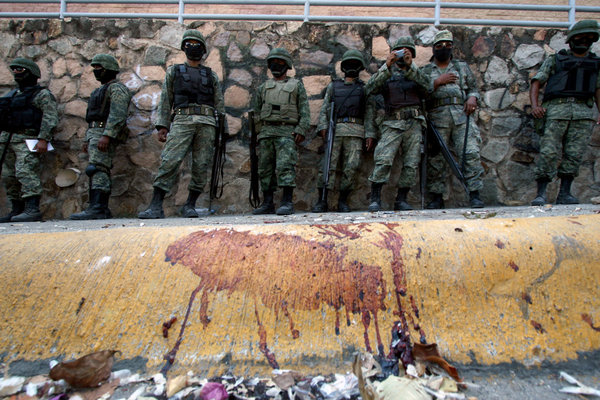
Mexican soldiers at site in Acapulco where three dismembered bodies were found in March 2012. Photo by Pedro Pardo / Agence France-Presse /Getty Images.

Drug War futures:
The dynamics against
an end to prohibition

The reliable physics of the drug war is that the more pressure the Mexican government puts on the drug cartels, the more violent they become.

By David P. Hamilton | The Rag Blog | September 14, 2012

Recently, Tom Hayden traveled through Austin with the Caravan for Peace composed of Mexican drug war victims. In his talks here, he sought to link the antiwar movement with the anti-drug war movement. This is a promising strategy that would unite and broaden both movements. But the forces that are rallying in support of drug prohibition include a powerful new alignment that will fight to its last billion to preserve the status quo.

Some think the dam was broken with the advent of medical marijuana in California, that legalization, at least of marijuana, is inevitable as a result. But those in favor of maintaining marijuana prohibition are likely to become less violent and better organized, have covert official sanction and new allies joining them in the fray.

Hayden spoke hopefully of how Latin American leaders, especially those in Mexico and Central America, were beginning to rebel from having to pay for U.S. drug prohibition with the blood of their citizens. As a case in point, earlier this year Guatemala’s new president, Otto Perez Molina, called for complete legalization of the prohibited drugs, including their manufacture and transit.

Unfortunately, it now appears that Perez Molina’s threat was a ploy to extract further U.S. drug interdiction money. The ex-general, chief of intelligence and serial human rights violator decided that the bad part of the deal was that Guatemala was required to pay for its own bloodbath.

Blood has a price and apparently that price has now been met. However inconsistent with his earlier gesture toward legalization, Perez Molina just allowed two hundred U.S. Marine combat troops and four of their attack helicopters to enter Guatemala to help the local police in chasing Zetas through the jungle.

In Mexico, the invariable result of this approach has been increased violence. Perez Molina’s threatened exit from the drug war has quickly morphed into an escalation thanks to cash and guns provided by the Obama administration and the U.S. taxpayer.

But however much the governments of Central America groan over being located in the drug transit corridor, even collectively they matter little compared to Mexico. Mexico is the colossus among them, with more people, more money, and a 3,169 km border with El Norte. What Mexico decides governs the approach to be taken by all the countries to the south through Panama.

The changing face of the drug war in Mexico

Major transitions have taken place recently in the drug war violence gripping Mexico. The murder rate in Ciudad Juarez is falling very fast, down over 50% since the peak in 2010. In July 2012, there were 40 murders in Juarez, 33 of them drug related. This compares to 8.5 a day in 2010.

The most plausible explanation is that the Sinaloa cartel seems to have largely wiped out the Juarez cartel and taken over complete control of drug trafficking in that city. It should also be noted that the murder rate in Juarez climbed to being the highest in the world after the Mexican army was sent in to fight the cartels and dropped precipitously as soon as they left.

Tijuana has now quieted down so much, a result of the Tijuana cartel taking over all of Baja California Norte, that now the mayor of San Diego has begun encouraging tourists to cross the border again.

The murder rate in Mexico topped out at 21 per 100,000 per annum in 1986, a time when many of us thought it was such great fun to go there. I drove to Mexico City with my seven-year-old daughter that year. The Mexican murder rate declined steadily until 2007, when it bottomed out at 10. The decline in the murder rate in Mexico was steepest during the administration of Vicente Fox, from 1 December 2000 through 30 November 2006.

Mexico officially declared war on the cartels 12 years ago when the PAN took over the presidency from the PRI. In contrast to the corrupt PRI party that colluded with the old drug lords, the new PAN plan was to arrest the leaders and break up the cartels using the military.

Vicente Fox endorsed this approach and did send troops into Nuevo Laredo with disastrous results, but he mostly just talked. The murder rate nationwide continued to decline, the drugs continued to flow, and eventually, after he left office, he came out for legalization.

Calderon put into practice the continuous aggressive military approach with far more disastrous results. The Mexican Drug Wars began in earnest on 11 December 2006 when newly elected PAN President Calderon, in office for just 11 days, sent 6,500 Mexican soldiers into his home state of Michoacan to fight the growing power of the La Familia cartel.

During the Calderon administration, the murder rate nationwide doubled with 50,000 drug war related deaths, tourism went into recession as a result of the violence and Mexico, its honor besmirched, is now called a failed narco-state.

This military-judicial approach has failed. Since the election of his replacement, Calderon was jeered in the Mexican Congress while defending his drug war policy. His strategy of arresting the leading cartel figures has invariably triggered greater violence between those who aspired to take over the positions being vacated, victory usually going to the most vicious.

As arrests were made and troops deployed, these battles heated up and corruption was exacerbated as more police and politicians had to be paid off or killed. The cartels, with vast financial resources and roots in Mexican society going back generations, were strengthened in the process of the struggle.

Drug warfare in Mexico has migrated and in different locations you have different combatants. While Juarez and Tijuana have calmed down, on the Gulf coast the Zetas and the Gulf cartel, the latter allies of the Sinaloans, are slugging it out from Vera Cruz to Monterrey. On the Pacific coast, the Sinaloans fight the La Familia/Knights Templar and Zetas in Acapulco. Throw in the military and the police fighting on both sides and you have a confusing battlefield.

The general configuration of the Mexican drug cartels is that there are two large “federations” fighting for dominance. The biggest and oldest is the Sinaloan cartel and their allies in the Sinaloan Federation.

The Sinaloans cover the northwest, except for enclaves in Tijuana, previously in Juarez and in the area of northern Sinaloa where the Beltran/Leyva cartel rules. Now the Sinaloans are reputedly in control in Juarez. Their principal ally is the Gulf cartel.

The next largest group, the Sinaloan’s principal adversary, are the aggressive newcomers, Los Zetas, who broke from the Gulf cartel in 2010 and now dominate in 11 states, mostly along the Gulf and Caribbean coasts. Their headquarters is in Nuevo Laredo.

The were founded by deserters from the Mexican special forces who had been trained to fight against drug cartels, bought off originally by the Gulf cartel, but soon they became independent. They are notorious for their military expertise and brutality and they are ascendant.

Member of Javier Sicilia’s Caravan for Peace against the Drug War during rally in New York City Sept. 16. Photo by John Moore / AFP / Getty Images.

The El Paso phenomenon

In 2010, Ciudad Juarez claimed the highest murder rate in the world with 3,111 homicides or over 200 per 100,000 residents per annum. Some estimates put that figure at nearly 300 per 100,000. As the Rio Grande isn’t very grand at that point, Ciudad Juarez and El Paso sit side by side with only a shallow stream dividing them. Ciudad Juarez has about 1,400,000 residents, and El Paso another 750,000.

El Paso had five murders in 2010, or 0.8 per 100,000. That tied Lincoln, Nebraska, for the lowest murder rate in of any city in the U.S. At the same time, Ciudad Juarez had more murders than that on the average day. To a lesser extent, this same striking contrast is also apparent in Brownsville-Matamoros, San Diego-Tiajuana, and Laredo-Nuevo Laredo.

What can explain the fact that murders are easily over 200 times more common in Juarez than in neighboring El Paso? Since the main function of drug cartels is moving illegal drugs across the border, it cannot be the case that the cartels just don’t exist north of the border. Captured cartel affiliates in the U.S. also testify otherwise. So why aren’t there piles of decapitated corpses in East LA or South Tucson? LA’s murder rate is at a 40-year low.

There are only a few logical possibilities to explain this phenomenon. The drug cartels either have truce agreements that are in effect when they operate inside the U.S. or they have an implicit truce because they all recognize the negative consequences of arousing the U.S. police unnecessarily or they have territories in the U.S. that are firmly established and uncontested.

The last of these possibilities seems unlikely given their lack of a similar territorial agreement in Mexico. Given the peacefulness of the U.S. side, some level of agreement seems likely. If they do have an agreement, it would not be unprecedented.

All the present day cartels used to be part of one confederated organization headed by Miguel Angel Felix Gallado who founded the Guadalajara cartel in 1980 and established an alliance with Pablo Escobar of the Medellin cartel in Columbia. Gallardo was the “godfather,” the “lord of Mexican drug lords.”

According to Peter Dale Scott, ex-Berkeley professor, Canadian diploma,t and author of Cocaine Politics: Drugs, Armies, and the CIA in Central America¸ Gallardo’s organization prospered “largely because it enjoyed the protection of Dirección Federal de Seguridad (DFS), under its chief Miguel Nazar Haro, a CIA asset.”

In 1987, after DEA raids on his properties, Felix Gallardo “decided to divide up the trade he controlled as it would be more efficient and less likely to be brought down in one law enforcement swoop.” He “convened the nation’s top drug narcos at a house in the resort of Acapulco where he designated the plazas or territories.” Thus were born the modern cartels.

This event was the first of many instances where pressure from the police fragmented the industry, producing violent power struggles.

Nieto’s choices

Enrique Peña Nieto of the PRI will be the next president of Mexico, an office he won with only 38% of the vote. He also lacks a majority in the Mexican Congress. His position is not strong and his potential to maneuver is limited. In that sense, it will indeed be a new PRI.

But the old PRI was notorious for making corrupt deals, including those with drug lords that were partially designed to institutionalize the industry so as to minimize competitive frictions and keep them from becoming violent. This policy did nothing, of course, to reduce drug trafficking, but it was successful in minimizing violence.

Polls show that the majority of Mexicans tell pollsters that they support the war on the drug cartels. Polls also show that the primary issue in the collective mind of the Mexican electorate was reducing drug violence. This is contradictory.

Although vague about his plan, Nieto ran on a platform that emphasized the reduction of violence, not the smashing of the cartels. He gives lip service to the continuation of the war on the cartels, but everyone knows that when his party was last in power the PRI made deals and the murder rate was half what it is now.

Back before 2000, the drug gangs were far less violent. Then the government facilitated agreements between cartels and safeguarded their leadership, while drugs moved silently north. Police were paid. Politicians were paid. People weren’t being decapitated. A network of trade that has been around since the 19th century was expanding, another growth industry for Mexico.

Violence has spiked since the government was taken over by the PAN. The PAN strategy was anti-corruption and war on the cartels using the military. Lots of kingpins were knocked over and the ensuing leadership struggles invariably instigated greater violence. The harder the government has pressed, the higher the level of violence. The peak murder rates in Juarez occurred after Calderon sent 20,000 army troops into that city. Those rates drastically declined when the army was removed. Coincidence?

The reliable physics of the drug war is that the more pressure the Mexican government puts on the drug cartels, the more violent they become. If Nieto is going to reduce violence, he must reduce that pressure. It is patently ridiculous to think that these venerable institutions, the contrabandistas, a part of Mexican life for many generations, are somehow going to go away while that massive market in the U.S. continues to beckon with such highly profitable opportunities.

As long as there is drug prohibition in the U.S. there will be drug cartels in Mexico. Legalizing cannabis, cocaine, and opiates in the U.S. would cause a major market collapse, with the ensuing deflation possibly triggering a depression.

As limited as are Nieto’s options and despite his pledges to continue the drug war and his acceptance of further U.S. anti-drug largesse, he was put in office by constituents who hope that his promise to reduce violence must necessarily involve traditional PRI willingness to make deals with the cartels.

Reducing that violence requires leadership in making peace treaties between the warring parties after a lot of blood has been spilled. This will require difficult agreements about territories and establishing a disciplinary system where those who break the treaties will face the combined forces of the offended cartel and the government. The inevitably attendant corruption must be institutionalized. With decades of experience, who better for this difficult task than the PRI?

The lineup of forces

If Nieto is successful in his campaign promise to reduce drug violence in Mexico by 50% during his term, it is not good news for the advocates of marijuana legalization. It will instead mean a better organized and less repugnant illegal drug industry streamlined by Mexican government regulation.

All parties involved in this nascent arrangement know that legalization would severely deflate the entire burgeoning industry. Those addicted to the tens of billions generated annually by illegal drugs include cartel affiliates like Wells Fargo, JP Morgan Chase, and every other major bank, the ultimate repositories of all that money, which would evaporate like the morning mist with legalization.

It is reputed that the above mentioned cartel affiliates have considerable influence within the U.S. political power structure, so much so that the drug war policies of Obama are indistinguishable from those of Bush.

Opposition to legalization would also seem the logical course for any Mexican government that wanted to stay in the good graces of the cartels in return for the cartels restraining themselves from the ancient tradition of ritual bloodletting. Cleansing the cartels is a PR problem solved by reduced violence.

The value of the illegal drug trade is a not insignificant element of the Mexican gross domestic product or its foreign currency earnings. There can be no doubt that marijuana is Mexico’s most valuable agricultural export. The tentacles of the drug trade reach into the deepest recesses of the Mexican oligarchy. If you sell luxury goods in Mexico, you’re in the illegal drug business.

The long-standing Mexican consensus has been that the nexus of the problem is north of the Rio Grande, so don’t damage Mexico in the process of fighting the Yankee’s drug problem.

The result of Nieto’s success will be reduced violence and a better organized illegal drug industry, both dedicated to not killing the goose that keeps laying those golden eggs — drug prohibition in the U.S. As long as U.S. prohibition stays in place, this system can keep paying off with the big bucks even while European and Latin American governments are drifting steadily toward decriminalization.

As a concession to the American consumer, Mexico will soon be able to ship north connoisseur quality to compete with California medical grade pot at $250 an ounce. Cheaper, but still five times the price were it legalized.

The traditional vested interests in favor of marijuana prohibition include the prison-industrial complex, the pharmaceutical, tobacco, and alcohol industries, gun manufacturers and dealers, police associations and prison guard unions and, of course, the banks.

But there is a relatively new player joining their cause, the medical marijuana industry. This industry is a rapidly growing manifestation of California’s most valuable agricultural export. It is already generating billions. And those ex-California hippies now making those big bucks do not want to kill off that golden goose either.

Since prohibition is universally hated by their clientele, the medical marijuana industry must endure the special requirement of coming up with a plausible cover story to justify their opposition to legalization, hiding both their hypocrisy and financial self-interest. Such an obfuscating devise is currently in evidence in Washington where the medical marijuana industry is opposing legalization because the law specifies questionable levels of driving impairment.

In California, they claimed to be protecting the interests of their “patients” in opposing legalization. In fact, marijuana prohibition is very much in their class interest.

This is another issue where the opposing forces are both strengthening and polarizing and the U.S. government seems incapable of devising a sensible solution. Despite the unpleasant side effects, the drug war still works quite well as a means of social control.

Although most U.S. citizens favor marijuana decriminalization, almost no establishment politician of either mainstream party will take any initiative in that direction. It is a taboo issue in federal elections despite majority support for reform.

The forces in favor of prohibition have to clean up the PR embarrassment of the violence, but with tens of billions annually at stake, this coalition of forces, the cartels, the big banks, and the pot growers, pot script doctors and pot dispensaries, have unlimited money, a huge financial interest in the outcome and the support of governments in both the US and Mexico in maintaining prohibition.

[David P. Hamilton, a graduate of the University of Texas at Austin in history and government was an activist in Sixties Austin and a contributor to the original Rag. David writes about France and politics (and French politics) for The Rag Blog. Read more articles by David P. Hamilton on The Rag BlogThe Rag Blog

The Rag Blog

Posted in Rag Bloggers | Tagged , , , , , , , , | Leave a comment

Sarito Carol Neiman : History, Herstory, Mystory, Mystery

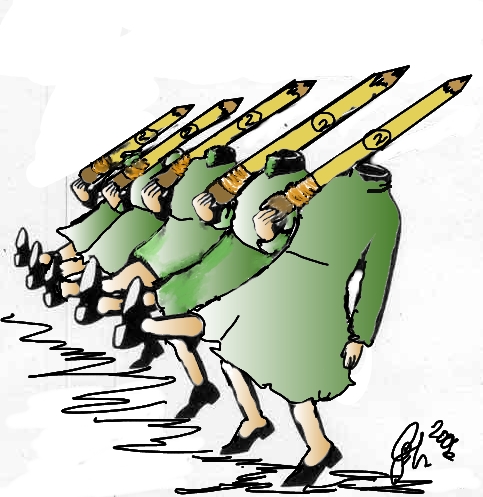
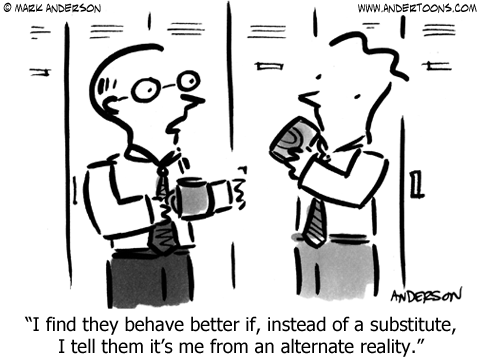
The Perfect Teacher. Cartoon from susanohanian.org. Inset cartoon below by Mark Anderson / Andertoons.

Shredding the envelope:
History, herstory, mystory, mystery

I discovered I am actually very good at getting up and talking to a bunch of kids about stuff. And even, for the most part, keeping their attention as long as it’s interesting stuff.

By Sarito Carol Neiman | The Rag Blog | September 13, 2012

[In another rare appearance of her very occasional column, Shredding the Envelope, Sarito gets a firsthand look, among other things, at what all the fuss is about when teachers make a fuss about standardized testing and its use in evaluating both student and teacher “performance.”]

Wow.

Let me first of all say that I have a whole new appreciation and respect for my sisters and everybody else I’ve ever met who are / have been teachers day in, day out, for much of their grownup lives.

Actually, I had a blast.

I didn’t have much fun in the anticipation of it. Like… “why did I pick up that call when the phone rang?” And once I’d picked it up, why did I just say yes instead of making some “not now, but call me again” excuse (like call me again after I’ve had time to get used to the reality of it instead of just the idea). And like being terrified. Because it was at the middle school, on top of it. The age group I told myself was the one I could probably least well handle. Texas History and U.S. History, 7th and 8th grades respectively, which I can remember really not liking very much at all when I was in school.

But what to do, I’d already said yes! So… I did a whole Google thing, got together a bunch of really interesting quotes about “history” that we could talk about — just in case the teacher didn’t leave a proper lesson plan. Or in case he did leave a lesson plan, but I couldn’t make any sense out of it. And marched on over there to meet my fate.

And the rest, as they say, is history.

I discovered I am actually very good at getting up and talking to a bunch of kids about stuff. And even, for the most part, keeping their attention as long as it’s interesting stuff.

I did things like write the words “History… Herstory… Mystory… Mystery” on the board. And talked about how it’s the STORY that makes history interesting, not just memorizing the dates and the places and the names. And who writes that story matters very much to whether it actually tells us very much about what is real.

And in the midst of that, the absolute thrill and rightness of this little snippet that came “out of the blue” and unprompted by me in its specifics:

Kid in class: “When did racism start, anyway?”

Me: “I dunno, I think maybe it’s been around almost forever. At least long enough that hundreds of years ago a bunch of white people went and stole people from Africa and took them back to their countries to be slaves.”

Class, in unison: “Whaaaaoah!!”

I also discovered, on the other hand, that I am not very good when it gets down to the nitty-gritty of “covering points 1-15 in the textbook.” For all kinds of reasons including all the reasons I didn’t like history very much when I was in school.

I was so touched by the kids. All of them…

The “very good, Straight-A students” who always had their hands up and always knew the textbook answers made me a little sad. Because they are trained so well in being eager to please the teacher that I was pretty sure the only thing they were learning was how to please teachers and pass tests.

The bright and inquiring ones who, before I realized that passing around fortune-cookie strips of history quotes made it impossible to get anywhere near covering points 1–15 in the textbook, chose the deepest and most challenging quotes when I asked what they really liked and wanted to share.

The kids, mostly boys, who were either so overmedicated for their ADHD, or suffering from such a horrible situation at home, they were almost catatonic and with a look of ancient suffering in their eyes.

The ones struggling with just the basics of reading comprehension, never mind getting a grasp on what “history” might mean in their lives and why it might be interesting to study it.

The grumpy ones who probably should be spending most of their days in art and music and writing classes.

The loud and boisterous ones who should be spending most of their days out running around in nature, digging in the dirt, catching frogs and snakes, and playing in the water.

The rare gift of seeing one of those “borderline” kids suddenly light up, say “aha, yes! and you know what THAT makes me think of is…”

And my immediate concern that too much of this can’t be allowed, or the principal is going to show up at the door because it starts to sound, from outside, like nobody is in charge here.

Each one of those classes should have been at least three or four smaller classes. Of six or seven kids each.

I probably won’t make a very good regular substitute teacher.

But… I might find some other way I can go spend time with some of those kids and help them find what they want to learn, what they’re excited about, how to cope with the limitations of the textbooks and the need to do well on the tests.

I had a blast.

[Sarito Carol Neiman (then just “Carol”) was a founding editor of The Rag in 1966 Austin, and later edited New Left Notes, the national newspaper of Students for a Democratic Society (SDS). With then-husband Greg Calvert, Neiman co-authored one of the seminal books of the New Left era, A Disrupted History: The New Left and the New Capitalism and later compiled and edited the contemporary mystic Osho’s posthumous Autobiography of a Spiritually Incorrect Mystic. Read more articles by Sarito Carol Neiman at The Rag Blog.]

The Rag Blog

Posted in Rag Bloggers | Tagged , , , | 1 Comment

INTERVIEW / Jonah Raskin : Fred Klonsky and the Chicago Teachers’ Strike

Chicago teachers on strike. Photo by Fred Klonsky / The Rag Blog.

An interview with Fred Klonsky:
Chicago teachers in red and on strike

If the city of Chicago wins this strike it will very likely give the green light to big cities such as Los Angeles and New York to go after teachers’ unions there.

By Jonah Raskin | The Rag Blog | September 13, 2012

Fred Klonsky, 64, retired in June 2012 after 30 years of working as an art teacher in grades k-5 in the public school system in Illinois.

He doesn’t go into the classroom to teach kids anymore, but he hasn’t retired from political activism and from protesting 101. A long-time president of his local union, he’s as politically active now as he’s ever been. With Chicago teachers on strike, he’s out in the streets with tens of thousands of other teachers and like them wears a red shirt. He also writes about the strike almost daily on his blog, FredKlonsky.com.

If the name Fred Klonsky rings a bell it might be because he’s a former SDS member and because his older brother Michael was national secretary of SDS in the late 1960s. Twenty years old in 1968, Fred participated in the civil rights and anti-war movements of the Vietnam War era. He attended Los Angeles City College and the University of Illinois at Chicago where he graduated in 1984. “Solidarity Forever,” the old union slogan, still lights a fire in his belly.

Fred Klonsky. Photo by Anne Klonsky / The Rag Blog. Inset photo below by Fred Klonsky / The Rag Blog..

Jonah Raskin: What’s at stake in the teachers’ strike that’s going on in Chicago now and that has been getting national media attention?

Fred Klonsky: Everything! The city is attacking the unions and collective bargaining rights. The Democratic Party administration wants to make it difficult if not impossible for teachers to go on strike. They want to break the back of the teachers’ union and they want school principals to have total control of the hiring and the firing of teachers.

It sounds like they’d like to put the old patronage system in place.

Chicago is famous for people getting jobs based on who they know not what they know or what they can do. They want to apply the same principle to education.

It seems to me to be an intense power struggle.

If the city of Chicago wins it will very likely give the green light to cities such as Los Angeles and New York to go after teachers’ unions.

Are you an observer or a participant in this strike?

I’m some of both. I’ve been on picket lines. Two days ago I was on the line from 6:30 a.m. to noon. I’m also writing about the strike.

What’s it like out there on the street?

I’ve been at a lot of demonstrations over the years, but there is nothing like what’s happening here. It’s beautiful. The striking teachers are wearing red shirts and at the rallies there’s a sea of red. The picket lines are spirited and lively. I’ve seen former students out there, too, and that’s gratifying.

What’s the ethnic make up of the striking teachers?

In 1987, which is when the last teachers’ strike took place in Chicago, over 50% of the teachers were African American. Today it’s about 19%. If the mayor wins and we lose I think that the number of African-American teachers will plummet even more. Moreover, the goal will be to serve wealthier kids not the most needy kids.

Does the city want to gentrify the schools?

Chicago is following the European model in which the wealthy live in the center of the city and the poor and the working classes in suburban enclaves.

What is the big demographic picture in Chicago?

Once upon a time there was white flight. That pattern has reversed since the 1970s. The 2010 census shows that the African-American population has declined sharply. Young white professionals have settled in the center of the city, but they leave when their kids are of school age.

So the city wants the public school system in Chicago to reflect demographic changes and bring the wealthier kids back into the school district?

Yes, the city wants to do that and to privatize schools and educational services which are a multi-billion-dollar a year business.

Why are teachers demonized and made the scapegoats in our society? Are they in the way of the corporations?

To a large extent the union movement in the private sector has been destroyed. The powers-that-be are aiming to destroy unions in the public sector. The National Education Association (NEA) with three- and-one-half-million members is the largest union in the United States. The American Federation of Teachers (AFT) has one million members. That’s a combined total of four million organized workers. They’re the last union men (and women) standing.

In this strike the city is depicting teachers as greedy folks who are against change and who want to keep the status quo. Nothing could be further from the truth.

Are Chicago schools typical of schools elsewhere?

They are like urban schools everywhere. There are 360,000 students in the Chicago public school system that now mainly serves the poorest of the kids from the poorest of families. Eighty-five percent of the students qualify for free lunches. That means they’re very poor. Those who can afford to have taken their kids out of the public schools and put them in charter or private schools. The public schools have very few supplies and very few books. They do not have adequate resources.

Is Chicago different?

The union leadership here is taking a real stand. There is real backbone among union members. Moreover, the unions for the police and for firemen are supporting the strike. There’s real solidarity here.

What grade would you give Mayor Rahm Emanuel so far in the strike?

A failing grade and not only because of what he’s done during the strike. He has said that no matter what, 25% of students will fail. That’s unacceptable to teachers and their union. Emanuel has only been in office for a year, but violence in the city has skyrocketed. There have been more murders here in the last year than in Afghanistan. He’s turned my city into crap. Harold Washington, who was the mayor in the 1980s, was far better. He actually paid attention to the needs of the most needy. Rahm Emanuel doesn’t.

Will the strike affect the presidential election?

I can’t imagine that Obama is happy about the strike. So far he has had no comment. Of course, Mitt Romney and Paul Ryan have offered their support to Mayor Emanuel. We have a Democratic mayor putting Republican educational policies into practice. It’s a sad day for the city of Chicago.

[Jonah Raskin, professor emeritus at Sonoma State University and the author of biographies of Abbie Hoffman, Allen Ginsberg, and Jack London, is a frequent contributor to The Rag Blog. Read more articles by Jonah Raskin on The Rag Blog.]

The Rag Blog

Posted in Rag Bloggers | Tagged , , , , , | Leave a comment

Tom Hayden : Building Populist Communities

Tom Hayden speaks with members of the Austin activist community, Friday, August 24, 2012, at a South Austin Mexican restaurant. The next day he spoke before a larger group at the 5604 Manor Community Center. Photo by Carlos Lowry / The Rag Blog.

Building populist communities

We must focus on fostering ‘communities of meaning’ where alternative identities, consciousness-raising projects, and even ways of life are built…

By Tom Hayden | The Rag Blog | September 12, 2012

No matter the outcome of the November election, but particularly should the federal government become crippled by Republican judges and House members, defensive Democrats, and deadheaded bureaucrats, we need to be prepared to dig our way out and press onward.

To my way of thinking, we in the movements must focus on fostering what I call “communities of meaning” — those where alternative identities, consciousness-raising projects, and even ways of life are built during the long periods between the rise and end of social movements.

A community of meaning enabled the Student Nonviolent Coordinating Committee (SNCC) to survive for more than five years while the Voting Rights Act was achieved. A community of meaning persisted throughout the 100 straight years of struggle for women to win the right to vote, a victory by the slenderest of margins. A community of meaning provided a sense of solidarity and growth for the student-led democracy movement against the Vietnam War. And these changes did not come easily.

Though sometimes there are surprising breakthroughs, more generally people must live their lives, raise their children and make their livings during the long spells before real victories. Richard Flacks’ great book, Making History: The American Left and the American Mind, is alone worth reading for its description of how the Left became a community of learning, self-help, and empowerment for immigrant communities a century ago.

But there is more than a cultural assertion. There is also the political. As Louis Brandeis wrote, it is about states (and cities) being “laboratories of reform.”

We are not going to radicalize Texas anytime soon, nor the diehard states of the Old Confederacy and Wild West. San Antonio, however, is promising; so, too, is Austin as I was recently reminded during my visit where I met with Javier Sicilia and his Caravan for Peace against the War on Drugs and with peace activists at the 5604 Manor Community Center in an event organized by The Rag Blog. Communities lead to cities, which lead to states, and in time you have half a nation and more.

Looking to communities, even when it comes to foreign wars, our urban mayors have been leading. Los Angeles’ Antonio Villaraigosa, chair of the U.S. Conference of Mayors, pushed through a resolution demanding an end to the wars in Iraq and Afghanistan and that their funding be transferred to our cities and domestic priorities. He followed up by lobbying Congress.

If the Congress does not preempt the states from acting, this is the ground whereon a battle for a Canadian-styled healthcare system is likely to be fought. It is where alternative energy, clean air, and fuel-efficiency programs already have and will continue to blossom from California to New York. It is where immigrant rights will be mainstreamed, and it is where same-sex marriage and reproductive rights are going to be protected and flourish.

And, if progressives get their act together, it is the ground on which a better, more accessible and affordable education system will take root. It is where the next generation of judges will start to address the role of money in politics, and where voting rights will either be protected or shredded.

The Arizonas will be the new Mississippis. If the federal government is on our side — like Obama’s Justice Department is today against Arizona — so much the better. If not, the progressive majority will have to lead, and defend against the white reactionaries, until the federal government eventually follows.

It is important that Obama wins, that Elizabeth Warren wins, and that the Congressional Progressive Caucus grows in size. But let us not federalize our minds altogether. Local control and states’ rights should not and do not belong to the Rick Perrys alone. Progressive populist movements can be the cradle of a new economy, politics, and culture.

[Tom Hayden is a former California state senator and leader of Sixties peace, justice, and environmental movements. He currently teaches at Pitzer College in Los Angeles. His latest book is The Long Sixties. Read more of Tom Hayden’s writing on The Rag Blog.]

The Rag Blog

Posted in Rag Bloggers | Tagged , , , , , , | 1 Comment

RAG RADIO / Thorne Dreyer : Political Analysts Glenn W. Smith & Peck Young on the 2012 Elections

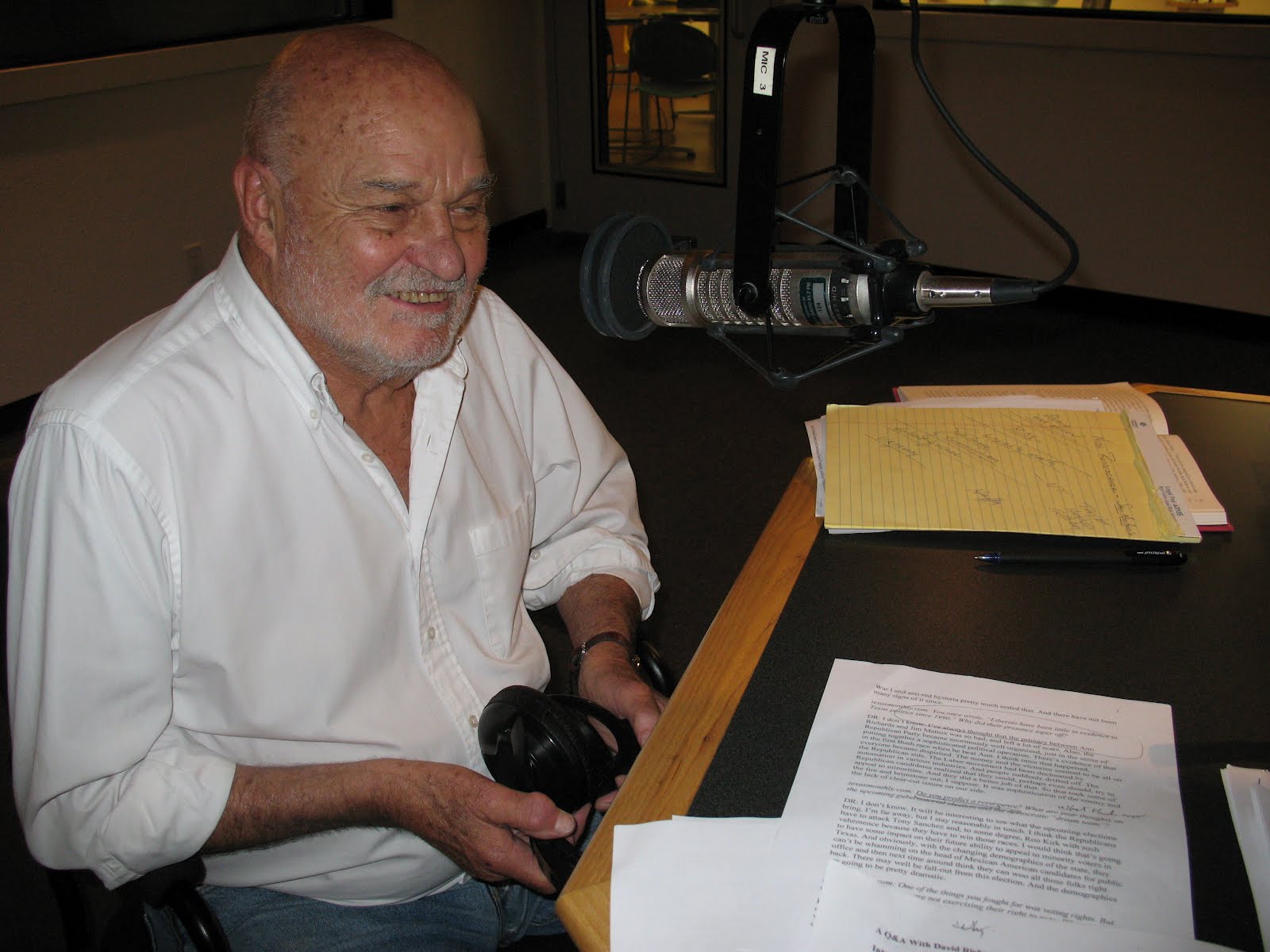
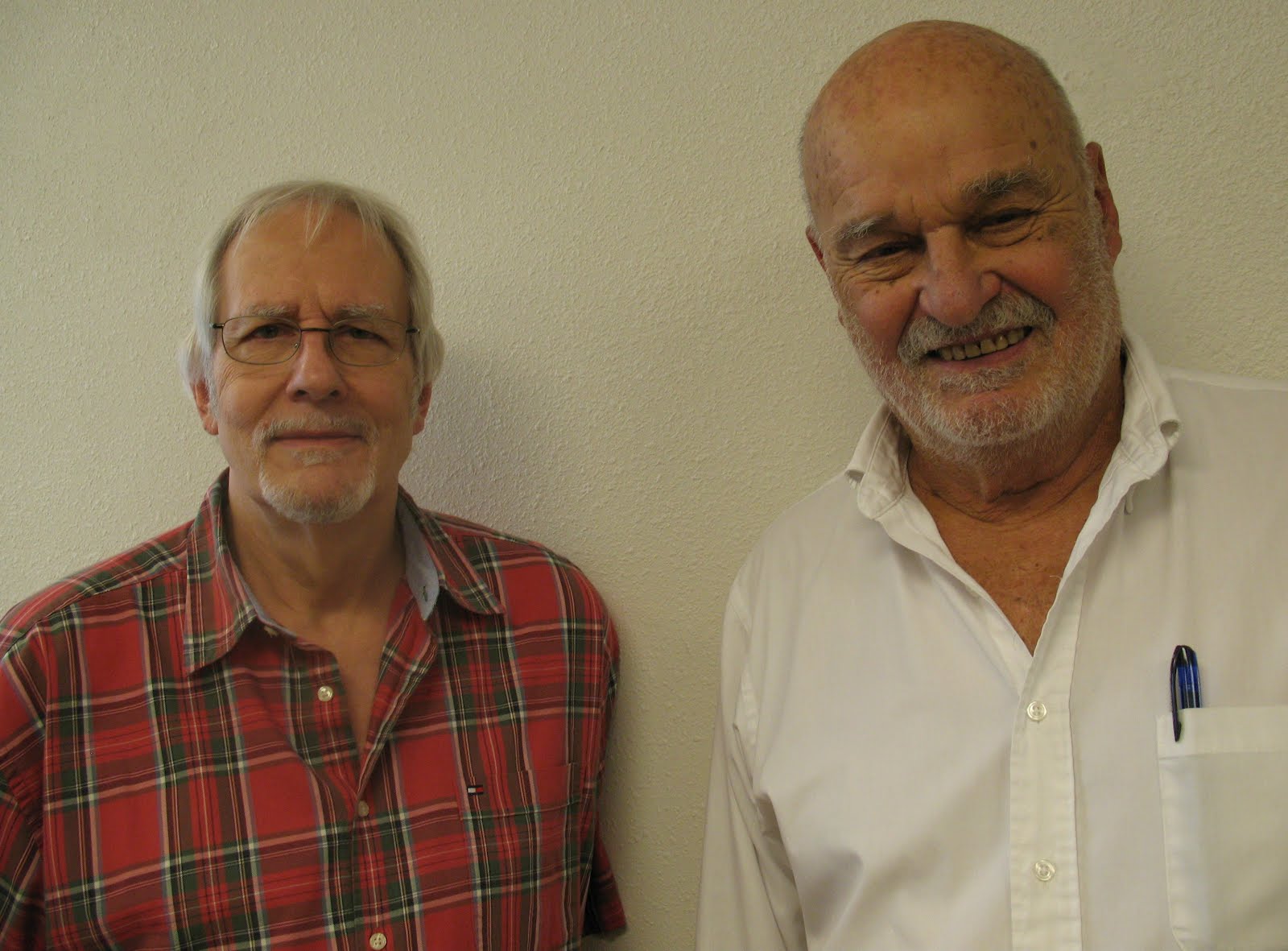
Glenn W. Smith, left, and Peck Young in the KOOP studios in Austin, Friday, September 7, 2012. Photo by Tracey Schulz / Rag Radio.

Rag Radio interview:
Glenn W. Smith and Peck Young
discuss the 2012 presidential elections

By Rag Radio | The Rag Blog | September 12, 2012

Prominent political analysts Glenn W. Smith and Peck Young were Thorne Dreyer’s guests on Rag Radio, Friday, September 7, 2012, on KOOP 91.7-FM in Austin. They discussed the recent Republican and Democratic national conventions and larger issues related to the 2012 presidential elections and electoral politics in American society today.

Listen to Thorne Dreyer’s Rag Radio interview with Glenn W. Smith and Peck Young, here:


Rag Radio features hour-long in-depth interviews and discussion about issues of progressive politics, culture, and history. The syndicated show is produced in the studios of KOOP-FM, Austin’s cooperatively-run all-volunteer community radio station. It is broadcast live on KOOP and streamed live on the Internet, and is rebroadcast on WFTE-FM in Mt. Cobb and Scranton, PA.

Glenn W. Smith has spent the past 30 years as a writer, campaign manager, activist, and think tank analyst. A former political reporter for the Houston Chronicle and Houston Post, Smith led Ann Richards’ successful 1990 campaign for Governor of Texas and worked for Texas Lt. Gov. Bill Hobby and U.S. Senator Lloyd Bentsen. He’s coordinated national campaigns for MoveOn.org. and was a senior fellow at George Lakoff’s prestigious Rockridge Institute in Berkeley.

Smith is the author of The Politics of Deceit: Saving Freedom and Democracy from Extinction, writes regularly for The Huffington Post and FireDogLake, and created the popular DogCanyon website. Smith has appeared as a political analyst with Chris Matthews, Joe Scarborough, Brit Hume, and many others.

Peck Young, who worked for 30 years as one of Texas leading political campaign strategists, is Director of the Center for Public Policy and Political Studies at Austin Community College. He has worked as a consultant with Texas Governor Ann Richards and numerous other leading Texas political figures, and for the presidential campaigns of Michael Dukakis, Bill Bradley, and Bill Clinton/Al Gore.

Young has received many professional honors and has been a force in Austin politics, working for renewable energy and single-member City Council districts, and drafted the city’s first Ethics, Financial Disclosure, and Lobby Registration ordinances.

This podcast includes original politically-themed topical songs by Austin singer-songwriter and “eco-troubadour” Bill Oliver that were first performed on the August 31 program. KOOP underwriting announcements and fall membership drive fundraising pitches have been removed from the podcast.

Rag Radio has aired since September 2009 on KOOP 91.7-FM in Austin. Hosted and produced by Rag Blog editor and long-time alternative journalist Thorne Dreyer, a pioneer of the Sixties underground press movement, Rag Radio is broadcast every Friday from 2-3 p.m. (CDT) on KOOP, 91.7-fM in Austin, and is rebroadcast on Sundays at 10 a.m. (EDT) on WFTE, 90.3-FM in Mt. Cobb, PA, and 105.7-FM in Scranton, PA.

The show is streamed live on the web by both stations and, after broadcast, all Rag Radio shows are posted as podcasts at the Internet Archive.

Rag Radio is produced in association with The Rag Blog, a progressive internet newsmagazine, and the New Journalism Project, a Texas 501(c)(3) nonprofit corporation. Tracey Schulz is the show’s engineer and co-producer.

Rag Radio can be contacted at ragradio@koop.org.

Coming up on Rag Radio:
THIS FRIDAY, September 14, 2012:
Famed Texas civil rights and labor attorney David Richards.
September 21, 2012: Singer-songwriters Bob Cheevers and Noelle Hampton & Andre Moran.

The Rag Blog

Posted in Rag Bloggers | Tagged , , , , , , , | Leave a comment

Harry Targ : The Decline of American Public Purpose

Art from poster for the 7th Annual Conference in Citizenship Studies at Wayne State University.

The decline of American public purpose

We must unite to save our citizenship, our public space, and our human community.

By Harry Targ /The Rag Blog / September 11, 2012

But we also believe in something called citizenship — citizenship — a word at the very heart of our founding, a word at the very essence of our democracy, the idea that this country only works when we accept certain obligations to one another and to future generations…

We, the people, recognize that we have responsibilities as well as rights; that our destinies are bound together; that a freedom which asks only, what’s in it for me, a freedom without a commitment to others, a freedom without love or charity or duty or patriotism, is unworthy of our founding ideals, and those who died in their defense…

As citizens, we understand that America is not about what can be done for us. It’s about what can be done by us, together through the hard and frustrating but necessary work of self-government. That’s what we believe. — Barack Obama, Democratic National Convention, September 6, 2012

Most political and cultural historians argue that the United States has not had a strong socialist tradition, at least compared to European countries.

While this view has some merit, these commentators ignore the deep communal traditions of Native peoples, the founders of utopian communities in the nineteenth century all across the Northeast and Midwest, radical socialists in the labor movements of the nineteenth and twentieth centuries, the large Socialist Party led by Eugene V. Debs, and the communist movement of the twentieth century.

These pundits also ignore violent state repression in virtually every period of American history that has been targeted against socialist dissenters.

However, despite state police, the FBI, strike breakers, and repressive cultural institutions such as churches, educational systems, and the media, the vision of community, sharing, and public purpose have survived.

Survival has taken many forms — political parties, mass movements, religious and secular campaigns for social and economic justice. President Obama was not talking about socialism in his acceptance speech at the Democratic National Convention September 6. Indeed, he would reject any suggestion that his political vision has a commonality with that of socialists.

But he did offer an insightful rendition of values embedded in the American experience. He called it “citizenship.”

What is citizenship about? For starters, it implies the idea of a public purpose. A society consists of persons of all races, genders, classes, sexual orientations, and ethnicities who are, of necessity, bound together to sustain life. The President is arguing that at a fundamental level human survival requires some sharing of pain and work as well as the enjoyment of life.

It is inevitable that a nation’s people, indeed global citizens, share space, water, the air we breathe, the roads we travel on, and virtually every physical, social, and economic institution and process beyond our most intimate and private lives. Ultimately citizenship is about human community.

In American political history, groups of people have had to struggle to get recognition of citizenship and community. In the nineteenth century, educational reformers had to campaign to establish public educational institutions. Reading, writing, research on agriculture and medical science was vital to human community.

The success of the public school movement and the passage of the Morrill Land Grant Act for higher education are examples of the realization of the needs of human community.

Citizens also came to realize that access to printed material, books, magazines, newspapers, was critical to an informed public and to human community. Public libraries were created to provide reading materials, public space for discussion, and meeting centers. In urban areas, people came to realize that human community, the practice of citizenship, required space for people to meet, to argue, to play dominoes, to lecture in front of interested audiences on the topics of the day.

Human community meant “hanging out,” in parks, on street corners, in empty lots.

At the dawn of the twentieth century, in response to the rapacious, unplanned spread of capitalism, it was recognized that rural space needed to be preserved. National parks were created to encourage the use of what remained of the natural environment, much of which had been destroyed when the colonists conquered the people and occupied the land on which they already had been living in harmony. The original dwellers would be forbidden from regaining what was stolen from them but efforts were made to return some of the land to its pristine beauty.

In addition to schools, libraries, urban spaces, and national parks, human community, it was realized, required social, economic, and political rights. Citizenship for people living in various geographic areas and working in various manufacturing and service venues required the right of people to associate with whomever they chose, in unions, churches, civic organizations, and interest groups. Citizenship meant coming together with like-minded others, particularly those who had economic interests in common. No human is “an island.” In a modern society where human community cannot be based solely on direct, interpersonal interaction, voting was necessary to allow the full expression of the sentiments of the human community.

So when President Obama spoke of citizenship, whether he realized the full implications of his remarks or not, he was speaking of human community, education, public space, the freedom of association, and the right to vote. All of these core values embedded in American history and culture are under fundamental threat today.

“Market fundamentalist” ideologues argue that there is no such thing as citizenship, human community, and a public sphere.

Advocates for the privatization of public schools — from vouchers in Indiana and charter schools in Chicago to the privatization of higher education by business model university presidents — forget that education has been a public good, not a commodity for sale in the market.

Those who call for the selling off of public spaces in cities and the countryside are advocating robbery of land for profit.

And those who challenge the right of workers to form trade unions and associations and those who seek to repress the right of people to vote are advocating the destruction of the most fundamental conceptions of citizenship and human community.

These are very dangerous times. Whether activists want to call themselves socialists, anarchists, occupiers, liberals, progressives, or whatever, the task is clear. We must unite to save our citizenship, our public space, and our human community.

[Harry Targ is a professor of political science at Purdue University who lives in West Lafayette, Indiana. He blogs at Diary of a Heartland Radical — and that’s also the name of his book from Changemaker Press which can be found at Lulu.com. Read more of Harry Targ’s articles on The Rag Blog.]

The Rag Blog

Posted in Rag Bloggers | Tagged , , , , , | Leave a comment

Ron Jacobs : Back to School in the Twilight of Capitalism

Back to school! Image from Power Line.

Back to school in the 
twilight of capitalism

The combination of high costs, a smaller job market, and decreasing financial assistance has made postsecondary education a less-likely choice for many capable potential students.

By Ron Jacobs | The Rag Blog | September 11, 2012

Universities serve multiple purposes in a modern capitalist society. One of those purposes — the education of young adults — is a noble and worthy one. It is how this is done that is often less noble.

If capitalism requires technicians and managers, it is technicians and managers that are trained. If capitalism needs fewer of these positions, then fewer are trained. Education as a worthwhile pursuit in itself is diminished by its subservience to the agents of capital. It is further diminished when those agents limit said education by raising the costs beyond that which is affordable for most.

It is also diminished when the research it undertakes is primarily that demanded by the military and corporate behemoth commonly known as the military industrial complex. When that subservience is enforced by police operating at the behest of the university administration (who are beholden to the corporate state for their funding), its function as an educational institution is replaced by its function of control.

Like protests in the 1960s and onwards, the Occupy-related protests on university and college campuses last year proved the veracity of the previous sentence quite dramatically. The aggressive use of nightsticks and pepper spray by campus police remain vivid images in the memories of those who saw them, no matter what their opinion of the protests. Like nightsticks and chemical agents of the past, the instances of their use are even more vivid in the memories of those who were the targets.

I work at a college in a college library. I am not a faculty member, but my work involves plenty of interaction with both faculty and students. Unlike many other institutions of higher education, the place I work tends to hire full time positions more than adjuncts. Most places where higher education is sold tend to hire the latter for the simple reason that adjuncts are cheaper. Indeed, they are the equivalent of hiring temps. No benefits, lower wages for the same work, no guarantees.

In short, the same work is expected from adjuncts that is expected from full-time tenured faculty. Often, however, adjuncts work at two or three institutions just to make ends meet. Consequently, the work they do occasionally suffers.

Another aspect of today’s colleges that I would like to address is the shrinking of the recruitment pool targeted by colleges today. This is caused in part by the decrease in government-supplied financial aid, from grants to work-study. In an environment where most private colleges cost $40,000 per year, the cutback in financial aid ensures even less access to potential students from working class families.

Another cause can be read into the questioning by right wing candidates of the value of a college education. Of course, it is not their children for whom they are questioning the value; it is for those very same students that the curtailment of financial aid has already made clear they are no longer so welcome. Many people can just plain not afford to go $20,000 or more in debt for an education, nor can their families afford to support them.

The first time I attempted college was in 1973. When my dad dropped me off at the Bronx campus of Fordham University I was greeted by my RA and an invite to the freshman orientation picnic. The first thing I noticed when I entered the courtyard where the picnic was just beginning was a garbage can full of iced-down Rheingold beers.

The next day I went to pay my bill. I had received a scholarship for everything but five hundred dollars of my total costs. Oh yeah, those total costs were around $5,300 for the entire year. Fordham now costs almost10 times as much.

I left Fordham after one year for non-financial reasons. I spent my sophomore year at the University of Maryland’s College Park campus. The cost for in-state tuition there in 1974 was $600 for the year. It is now a little more than $5,300. That is almost nine times the rate in 1974.

The bottom line is that these increases make it very difficult for many young people to go to college. It cannot be stated often enough that much of this change is due to a decrease in funding from the government.

As news reports of protests against tuition hikes from around the world prove, this is not merely an American phenomenon. In fact, student protesters in Britain, Chile, and Quebec (among others) have not only protested tuition hikes, they have also made it clear that those hikes are designed to prevent working class students from getting a university education by making that education unaffordable.

The neoliberal mentality taking over education will destroy its essence. That which is not necessarily quantifiable should not be commodified. When this occurs, the wrong elements will always be those which are measured. Education is not necessarily about getting a job. It is about learning to think critically. When the educational system no longer emphasizes this, its demise may not be far off.

Why are there not more student protests in the United States? Perhaps it is because U.S. residents are convinced that the government does not have a role in funding education.

When teachers are blamed for the recession and vilified for their wanting decent working conditions and a good wage to educate our children, there is something demented about the assumptions of our nation. When billionaires who made their money by destroying the economies of entire communities are given television shows where they “fire” people, there is something demented about our media.

When politicians from both the major parties are afraid to jail government officials, military officers, and torturers for crimes against humanity, there is something fundamentally wrong with our entire nation. When bankers write the very laws that govern their business practices and those laws have nothing to do with ethical business practices, the very system of laws is as bankrupt as the millions of people negatively affected by those laws.

The combination of high costs, a smaller job market, and decreasing financial assistance has made postsecondary education a less-likely choice for many capable potential students. This is not an accident. Neither are the attacks on education by politicians bought and paid for by the wealthiest of the human race.

After all, this latter bunch can always get a quality education for their offspring, just like they can get enough of the rest of us to fight their wars and work in their minimum wage jobs.

[Rag Blog contributor Ron Jacobs is the author of The Way The Wind Blew: A History of the Weather Underground. He recently released a collection of essays and musings titled Tripping Through the American Night. His latest novel, The Co-Conspirator’s Tale, is published by Fomite. His first novel, Short Order Frame Up, is published by Mainstay Press. Ron Jacobs can be reached at ronj1955@gmail.com. Find more articles by Ron Jacobs on The Rag Blog.]


The Rag Blog

Posted in Rag Bloggers | Tagged , , , , , | Leave a comment

Bob Fitrakis and Harvey Wasserman : Will the GOP Steal the Election?

Political cartoon by Bob Englehart / Hartford Courant. Image from Collin Dems.

Will the GOP steal America’s 2012 election?

Would the Koch Brothers, Sheldon Adelson, the Chamber of Commerce, and their related billionaires spend tens of millions of dollars to win the White House but stop short of spending the relatively small amount it would take to flip the vote?

By Bob Fitrakis and Harvey Wasserman / The Rag Blog / September 10, 2012

The Republican Party could steal the 2012 U.S. presidential election with relative ease.

Six basic factors make this year’s theft a possibility:

  1. The power of corporate money, now vastly enhanced by the U.S. Supreme Court’s Citizens’ United decisions;
  2. The Electoral College, which narrows the number of votes needed to be moved to swing a presidential election;
  3. The systematic disenfranchisement of — according to the Brennan Center — 10 million or more citizens, most of whom would otherwise be likely to vote Democratic. More than a million voters have also been purged from the rolls in Ohio, almost 20% of the total vote count in 2008;
  4. The accelerated use of electronic voting machines, which make election theft a relatively simple task for those who control them, including their owners and operators, who are predominantly Republican;
  5. The GOP control of nine of the governorships in the dozen swing states that will decide the outcome of the 2012 campaign; and,
  6. The likelihood that the core of the activist “election protection” community that turned out in droves to monitor the vote for Barack Obama in 2008 has not been energized by his presidency and is thus unlikely to work for him again in 2012.

Winning a fair and reliable electoral system can be achieved only with a massive grassroots upheaval.

The power of money is now enshrined by the infamous Citizens United decision. In at least 90% of our congressional races and at least 80% of our U.S. Senate races, the candidate who spends the most money wins.

From the presidency to the local level, our elections — and thus control of our government — are dominated by cash.

For more than a century, the ability of corporations and the super-rich to buy in directly has been legally constrained. But the concentration of media ownership in the hands of ever-fewer corporations has vastly enhanced their power.

Already in 2012, the tsunami of dollars pouring in from corporations and super-rich individuals has soared to entirely new levels. Even the floodgates opened by Citizens United can’t handle the flow. With its June decision denying Montana’s attempt to keep some spending restrictions in tact, the John Roberts U.S. Supreme Court has inaugurated an era in which virtually unrestrained “pay-to-play” money will redefine the electoral process. Republicans in the U.S. Senate have also blocked attempts to require that these campaign “donations” be made public.

It’s not hard to guess where this leads. The June 2012, recall election in Wisconsin saw at least eight times as much money being spent on protecting Republican governor Scott Walker as was spent to oust him.

Barack Obama has spent much of his presidency courting corporate interests. But he will be out-raised by the corporate/super-rich 1% backing Mitt Romney. A handful of high-profile billionaires will spend “whatever it takes” to put the GOP back into the White House. Just a dozen of them have already provided more than 70% of Romney’s early campaign budget.

Most of this corporate money is being used to persuade voters to oust Obama, which they may well decide to do. But U.S. history shows that some of it can also restrict the ability of Americans to vote. It can then “bend” the vote count in ways the public may not want.

Our nation’s history shows that given the same chance, the Democrats would gladly do the same to the Republicans. And it’s happened many times, especially in the Jim Crow south.

But in 2012, it will be primarily Republicans using gargantuan sums of corporate money to take control of the government from Democrats, and democracy be damned.


We are not writing this in support of Barack Obama or the Democratic Party. We are mystified by their unwillingness to fight for meaningful electoral reform. Both Al Gore and John Kerry were legitimately elected president, but neither was willing to fight for significant change, or even to discuss the issue. When we broke many of the major stories on the theft of Ohio 2004, it was the Democrats who most fiercely attacked us.

We’re continually asked why the Democrats have been willing since 2000 to sit back and let the GOP get away with this. Frankly, we have no answer.

But for us, the more important reality is that this electoral corruption dooms the ballot as an instrument of real democracy. A system this badly broken means a bipartisan oligarchy can always deny third and other grassroots parties the use of elections to challenge the status quo, in this case one increasingly defined by war, bigotry, injustice, moneyed privilege, and ecological suicide.

Thus it’s been a century since the last significant electoral challenges to the Democrat-Republican corporate domination of the political system.

That challenge was staged by the People’s (Populist) and then Socialist Parties. In rapid succession they rallied huge grassroots followings demanding core changes to the corporate domination of American politics. The 30-year upheaval they represented laid the groundwork for major changes. But it failed to crack the corporate domination of our political system.

The Populists were shattered in 1896 with a combination of cooption by William Jennings Bryan’s Democratic Party and election theft engineered by Mark Hanna’s Republicans. (Republican strategist Karl Rove, a serious student of the 1896 election, considers Mark Hanna to be one of his great heroes.)

The Socialists were co-opted and divided in 1916 by the Democrat Woodrow Wilson, who then crushed them in the most violent wave of physical repression ever imposed by a U.S. President on a mass movement that derived from the heart of America’s working public.

No third party has since risen up with enough real political clout to threaten corporate power through the electoral system. As long as our ballot box is corrupted and unaccountable, none will.

That one party could steal an election from the other means our democracy, if it could still be called that, is essentially in shambles.

Would the Koch Brothers, Sheldon Adelson, the Chamber of Commerce, and their related billionaires spend tens of millions of dollars to win the White House but stop short of spending the relatively small amount it would take to flip the vote?

Thankfully, we are citizens of a nation born with the bottom-up overthrow of the planet’s then-most powerful king. As believers in grassroots democracy, we know that the survival instinct is ultimately more powerful than the profit motive. When it comes to the basics, we have no doubt the power of the people will ultimately prevail.

For those working on the 2012 election, and for democracy in general, that will mean an extraordinary commitment to protecting the registered status of millions of Americans, getting them to the polls, guaranteeing their right to vote once there, and making sure there is an accurate vote count — electronic and otherwise — once those votes are cast.

[Bob Fitrakis and Harvey Wasserman are authors of Will the GOP Steal America’s 2012 Election?, their fifth book on election protection. It is available as an e-book at harveywasserman.com and freepress.org. Read more of Harvey Wasserman and Bob Fitrakis’ writing on The Rag Blog.]

The Rag Blog

Posted in Rag Bloggers | Tagged , , , , , , , | Leave a comment

Hadley Suter : The Maternal Instinct Vs. the Realities of Unwaged Labor

Graphic from The Motherhood Manifesto.

The maternal instinct versus
the realities of unwaged labor

I’ve been worried sick over the past nine months that I’m about to turn into a mommy-slave — and like it.

By Hadley Suter | The Rag Blog | September 6, 2012

[As we go to press, Hadley Suter reports that she has given birth. “He was very polite and waited till I’d finished and sent out the essay,” she tells us. “Then, boom! Labor.” We all wish her — and hers — our very best.]

The scariest part of being pregnant with my first kid has been the overwhelming fear that an impending maternal instinct will, upon the little creature’s arrival, wipe out all traces of my former self and transform me into the kind of psycho-mom who not only rejoices at negating her own identity in the name of her child but vaunts this state of sacrificial maternal nothingness as the epitome of female existential plenitude.

In other words, I’ve been worried sick over the past nine months that I’m about to turn into a mommy-slave — and like it.

Lucky for me, I’ve been able to grapple with this fear in tandem with the well-timed onslaught of books and articles about the so-called “Mommy Wars.” Some main contenders: In February, Pamela Druckerman’s Bringing Up Bébé, which claims that parenting à la française not only raises superior children but prevents one’s identity as a Woman from being usurped by one’s role as Mother.

Then there was the April arrival of the English translation of Elisabeth Badinter’s The Conflict: How Modern Motherhood Undermines the Status of Women, which lambasts the new ecologically-obsessed naturalism and essentialized notions of gender at the heart of modern motherhood.

In May came the ridiculous “Are You Mom Enough?” Time cover story featuring toddlers with full sets of teeth chomping away at their mothers’ nipples, a “controversy” the magazine was no doubt thrilled to declare itself relevant for having triggered — you could just hear the echoes of editorial backslapping for weeks afterwards.

Finally, in July, came Anne-Marie Slaughter’s Atlantic article on “Why Women Can’t Have It All,” a sentiment repeated recently by British Conservative Louise Mensch’s retirement from Parliament to spend more time with her three children.

While some of these writings were thought-provoking and others nauseous-making, it’s been nice having the growth of my uterus paralleled by the crescendo of debate about what, exactly, motherhood is. Much of the recent U.S. media discussion about mommy-ing boils down to this question: how much sacrifice is natural to the maternal role and how much is socially imposed?

Here we find ourselves in vintage Badinter territory. Though The Conflict continues her exposition of the pernicious underbelly of naturalism, it’s a question the French intellectual first broached with her 1981 L’Amour en plus : histoire de l’amour maternel (XVIIe – XXe siècle), where she claims that the maternal instinct is not primal, innate, but a social construct, propagated by the naturalist-misogynist par excellence, 18th century philosopher Jean-Jacques Rousseau.

Critics of Badinter are right to point out the cartoonishly corrupt conflict of interest at the heart of her condemnation of eco-naturalist maternalism — she argues against breastfeeding yet she chairs the supervisory board of a PR firm representing Nestlé, maker of infant formula Similac. But her assault on naturalism as the most poisonous legacy of Rousseau is completely justified; his interpretation of the “natural” differences between the sexes is insidious enough to be more widely reviled.

When certain strands of feminism buy into these supposedly natural differences, they become the fodder for all sorts of moralistic, irrational proclamations, often beginning with “If women ruled the world…” and ending with the disappearance of war, violence, and evil in general. This sort of thinking — call it Goddess Feminism — worships the physiological as some magical source of nurturing love and female power, while tacitly embracing the disproportionate responsibility these “innate” qualities translate into for women.

Naturalism, in the realm of gender, is bad for feminism because it justifies the division of the sexes and their societal roles in the name of a return to some long-lost, prelapsarian state of humanity. But more importantly, naturalism is bad for feminism because its very premise — that the division of labor between the sexes is less fixed now than it used to be — is a blatant lie, a rewriting of human nature that warps pre-industrial history in order to ignore the economic changes that paved the way for these divisions.

In their 1972 pamphlet The Power of Women and the Subversion of the Community, Mariarosa Dalla Costa and Selma James recount the shift from the gender-neutral oppression of the feudal system to the division of the sexes that came about with the rise of capitalism and that was sealed as fate with industrialization.

Pre-capitalist patriarchal society, they argue, was organized around the family, which represented the central unit of agricultural and artisan production. Men and women, children and the elderly, all the serfs lived in a communal state of “unfreedom” under their feudal lord.

When the family was replaced by the factory as the productive center of society, men were expelled from the home, as were children as they began to be educated in schools rather than by their family, leaving domestic life — and, more importantly, domestic labor — to women alone. “The passage from serfdom to free labor power separated the male from the female proletarian and both of them from their children.”

Whether we accept them as “natural” or not, our conception of “traditional” gender roles as being since the dawn of humanity divided down domestic lines is bogus; in fact, this separation of the sexes is a relatively recent phenomenon in human history, powered by industrial innovations that we universally characterize as Progress, or a step towards the enlightened freedom we believe ourselves to enjoy today as individuals.

With perspectives like this one from Dalla Costa and James, the maternal instinct, which today is understood in practical terms as the sort of passionate and exaggerated self-sacrifice — in the name of Motherly Love — to all the demands of child-rearing and domestic labor, is much easier to reject as a social construct, one just waiting to be exploited in the late 18th century by Rousseau and his mommy-complex.

But if it’s simple to snub the concept in theory, it becomes much harder to do in practice. Or, at least, I imagine it will be once I give birth. My fear is not that the baby will be some sort of parasite, sucking away at my time and soul till I’m left with little of my former self.

Rather, I’m scared the loss of self will come entirely from within: What if I start taking so much pleasure in caring for another that it becomes a convenient excuse to drop out of life? Let go of ambitions, interests, and the social obligations through which these are enacted? Willfully disappear behind diapers and nursing to avoid that other niggling duty of modern existence known as self-realization?

Though the potential for a biological component of the maternal instinct is derided by Badinter in The Conflict as downright offensive to the human race, pregnancy alone has been proof enough that there’s reason to fear the physiological.

Instead of becoming the moody nightmare I always imagined I’d be as a pregnant person, I’ve been almost creepily blissed out for most of the past nine months — much jollier, less impatient, more gregarious than I am in real life. Part of this is obviously social — people smile at pregnant ladies just for being pregnant — but mainly it’s hormonal. What if through some sick biological coup the sort of Goddess Feminism I’ve always sneered at will be my new ideological fate?

Over the past few months I’ve spent far too much time staring in wonder at the basketball that is my stomach. I’m terrified that the next step, once I have my kid, will be to adopt some sort of worldview centered on the holiness of reproduction: through no effort other than having given birth, I’ll start to profess to loving all creatures — or worse, all humans — great and small, good and vile. I’ll start thinking of everyone as the child of some mother, somewhere.

In Badinter’s eyes, the sanctification of the maternal role, and the self-sacrifice it stealthily demands, is externally imposed, but what if it also comes from within?

When I call this kind of mother a happy mommy-slave I mean it literally — as an unwaged laborer. If we consider sacrifice in its least spiritual, most empirical form, it is, quite simply, work. So how much work — how much labor — is natural to the maternal role and how much is socially imposed?

The media surrounding the Mommy Wars have only danced around the economic issues that are involved, and usually just to point out that the ideological choices of motherhood — home versus workplace, breast versus bottle, cloth versus disposable — are the privilege of the elite. Which is to say that ideology itself is only for rich people, with everyone else just worried about getting by.

The exclusion of the question of labor from the debate surrounding motherhood has helped turn feminism in America into a matter of freedom of consumption, as frivolous as any other luxury market where individuality and personhood are expressed through purchasing power. We might as well be talking about what kind of handbag to buy.

This hasn’t always been the case. The economics of women’s work — reproductive and domestic, two kinds of labor existing outside of the modern workplace — once occupied a much greater place in feminist discourse.

Central to James and Dalla Costa’s work, for example, is their rejection of the capitalist distinction between productive and unproductive labor as falling easily down gender lines. They successfully debunk the notion that man’s work in the factory is productive in that it contributes to capital, while woman’s work is merely re-productive, both in that it is procreative and that it re-creates, every day, through domestic labor, the series of tasks necessary to win the fight against atrophy and decline — cooking, cleaning, the works — without actually contributing to the production of capital.

Not so, Dalla Costa and James prove, as both housework and child-rearing reproduce not just life but “labor power.” The mother is not just feeding and nurturing her children but preparing them for productive lives as wage-earners or future reproducers. The happy slave-mother creates the conditions that ready the happy slave-child to contribute to the production of capital.

The difference between factory work and domestic work cannot then be described as productive versus unproductive, but rather as waged labor versus non-waged. This argument provided the basis for the international Wages for Housework Campaign, founded by James in 1972.

Interestingly, the false distinction between productive/workplace and unproductive/domestic labor is one upheld more rigorously today in the U.S. by left-leaning women than by right-wing men. Case in point: Democratic Party Commentator Hilary Rosen’s denouncement of Ann Romney as having “never worked a day in her life.”

Meanwhile, it’s usually conservative men (like those who rushed to Romney’s defense) who shout the loudest about how stay-at-home moms are in fact doing “real” work (though I wonder if they’d so readily classify it as such if it meant that this work had by law to be remunerated through government wages).

Today, we talk about the distinction between productive and unproductive labor as if it were a thing of the past, not only because we believe ourselves to have escaped its division along gender lines but also because the nature of work has changed thanks to industrial outsourcing, the explosion of the service sector, and technological advancement.

This is the movement towards what Autonomists Antonio Negri and Michael Hardt call “immaterial labor,” a shift they demonstrate to be linked with the increase of precarious labor, in the form of part-time employment, self-employment, work done from home, and unpaid internships.

At first glance, precarious labor would seem like something that only the most rabid free-market freaks would celebrate. But as Silvia Federici points out in Precarious Labor: A Feminist Viewpoint, even Autonomists like Negri see the precariazation of work as “a trend towards the reduction of work and therefore the reduction of exploitation.”

She goes on to show how wrong this premise is: not only does exploitation actually increase with precarious labor, but it does so disproportionately for women, who have “always had a precarious relation to waged labor” due to domestic duties, which for women in the workforce translates to more part time jobs, less security, fewer benefits, and lower salaries.

But lately, precarious labor, especially in its work-from-anywhere incarnation, has been increasingly extolled by women as a liberating force, or a way to succeed both at work and at home. This is Anne-Marie Slaughter’s premise when she vaunts the possibility of remote work as a means of proving one’s efficiency as a worker even in the midst of domestic duty: “Being able to work from home — in the evening after children are put to bed, or during their sick days or snow days, and at least some of the time on weekends — can be key, for mothers, to carrying your full load versus letting a team down at crucial moments.”

This basis of capitalist efficiency pervades the logic of Slaughter’s article, from her a priori acceptance that any sort of time not devoted to labor, what we used to call free time, be sacrificed, right down to her suggestion that women freeze their eggs for later use if their careers have not flourished fast enough for them to have children during their fertile years.

That precarious labor weighs heavier on women than it does on men should be obvious; what’s less apparent is how the very distinctions it seems at first to do away with — divisions between men and women, productive and unproductive labor, the office and the home — are actually reinstated.

Federici’s main critique of Negri and Hardt’s theory of precarious labor is their characterization of “affective labor” as immaterial. Affective labor is defined by Negri and Hardt as service jobs, held by those such as flight attendants and waitresses, that require certain affective behaviors — friendly smiles and the like — with the goal of producing “states of being.”

For Federici, the fact that work meant to produce “feelings” and “emotions” is by default categorized as immaterial is tantamount to the reduction of reproductive work to being a “labor of love”: in both cases, the work is stripped of its economic value, its contribution to the accumulation of capital, simply because its demands are affective or rooted in emotional work, and thus understood as natural to the (unproductive) female worker.

So belief in a natural maternal instinct is not just an acceptance of self-sacrifice, it’s the acceptance of affective labor as being inherently unproductive. It denies the material contributions of reproductive and domestic labor, by painting them as purely emotional products, and implicitly restores the supposedly defunct gender-lines of the distinction between productive and unproductive work — even when both labors are performed by women.

Such is the case with Slaughter’s suggestion that mothers continue their work from home after completing their domestic duties: it privileges her career-related “male” tasks as productive while relegating her work as a mother as purely reproductive — because it is affective.

But what’s more, to allow for the workplace’s colonization of the domestic sphere is to repaint even the most explicitly “productive” work as affective — those midnight email sessions Slaughter suggests as being the key to women’s career success should be recognized for what they are: unwaged work parading, like motherhood, as a labor of (if not motherly, then at the very least womanly) love.

The happy mommy-slave is as ripe for exploitation by her office as she is by her home.

[Hadley Suter is a Ph.D Candidate in UCLA’s Department of French and Francophone Studies.]

The Rag Blog

Posted in Rag Bloggers | Tagged , , , , , , | 1 Comment

Ed Felien : Batman and the Culture of Violence

Batman image from Batman: The Amimated Series / Wikimedia Commons.

Batman, The Joker, Nazis
and the culture of violence in America

Plato recognized the subversive value of art. He knew that art didn’t just hold a mirror up to society and reflect everything. It holds a lens that selects, frames, and distorts.

By Ed Felien | The Rag Blog | September 6, 2012

“Life imitates art far more than art imitates life.” — Oscar Wilde

Should we blame the Batman movies for the tragedy in Aurora? After murdering the people in the movie theater, James Holmes put his guns in his car and calmly told the police, “I’m the Joker.” He had booby-trapped his apartment so that anyone entering it would have set off massive explosions probably killing many more people. This begins to sound like The Dark Knight, where The Joker blew up a hospital because he was frustrated in getting revenge.

What explains the perverse pathology of The Joker? At one point in the movie he says he mutilated himself in sympathy with his wife who had been scarred by a knife, but later he says:

You wanna know how I got these scars? My father was a drinker and a fiend. And one night he goes off crazier than usual. Mommy gets the kitchen knife to defend herself. He doesn’t like that. Not. One. Bit. So, me watching, he takes the knife to her, laughing while he does it. He turns to me and says, “Why so serious?” Comes at me with the knife. “WHY SO SERIOUS?” He sticks the blade in my mouth. “Let’s put a smile on that face.” And…

In the comic book original, The Joker is disfigured by falling into a toxic vat while robbing a chemical factory. The story of child abuse and watching his mother be victimized by his father is the invention of Christopher Nolan, the writer and director of the series.

Nolan was praised by critics for making The Joker psychologically believable. Whether the incident of child abuse actually happened to The Joker is irrelevant. The story is so compelling and horrifying that it seems to justify even more horrible acts of revenge on an indifferent world. Anyone who has been victimized and feels that the world has turned away could identify with The Joker’s demand that the world take note of his dimension of pain.

Nolan’s comment on the tragedy in Aurora was self-serving and willfully naïve:

I believe movies are one of the great American art forms, and the shared experience of watching a story unfold on screen is an important and joyful pastime. The movie theater is my home, and the idea that someone would violate that innocent and hopeful place in such an unbearably savage way is devastating to me.

The Joker is fascinating in his capacity for violence and destruction, but no one would call him “joyful” or “innocent and hopeful,” and The Joker is more than half the weight of The Dark Knight.

Children learn to speak by imitating their parents. They learn to act by imitating role models. Cultural values are taught by popular culture. What is acceptable is what is popular. Don’t artists have to accept responsibility for the lessons their art teaches?

This is not a new question. The last time it was debated seriously was when The Beatles’ White Album was blamed for inspiring Charlie Manson and his gang to murder Sharon Tate and four others in August of 1969. Certainly, today, we consider The Beatles joyful, innocent and hopeful, but there are songs on the White Album that are very dark.

Consider even the deliberately humorous “Bungalow Bill”:

Hey, Bungalow Bill
What did you kill
Bungalow Bill?

The children asked him if to kill was not a sin
“Not when he looked so fierce,” his mummy butted in
“If looks could kill it would have been us instead of him”
All the children sing

Or, “Happiness is a Warm Gun”:

Happiness is a warm gun
( bang bang shoot shoot )
Happiness is a warm gun, yes it is
(bang bang shoot shoot)
When I hold you in my arms (oh yes)
When I feel my finger on your trigger (oh yes)
I know nobody can do me no harm
Because
happiness is a warm gun, momma
Happiness is a warm gun
-Yes it is.
Happiness is a warm, yes it is …
Gun!

Or, “Little Piggies”:

Have you seen the bigger piggies
In their starched white shirts
You will find the bigger piggies
Stirring up the dirt
Always have clean shirts to play around in.

In their sties with all their backing
They don’t care what goes on around
In their eyes there’s something lacking
What they need’s a damn good whacking.

Even the comic “Rocky Raccoon” has a dark edge:

Rocky had come equipped with a gun
To shoot off the legs of his rival
His rival it seems had broken his dreams
By stealing the girl of his fancy

Parts of “Yer Blues” are downright depressing:

Black cloud crossed my mind
Blue mist round my soul
Feel so suicidal
Even hate my rock and roll
Wanna die yeah wanna die
If I ain’t dead already
Ooh girl you know the reason why.

And Charlie Manson could believe that “Sexy Sadie” was talking directly about Sharon Tate:

Sexy Sadie how did you know
The world was waiting just for you
Sexy Sadie oooh how did you know

Sexy Sadie you’ll get yours yet
However big you think you are
Sexy Sadie oooh you’ll get yours yet

We gave her everything we owned just to sit at her table
Just a smile would lighten everything
Sexy Sadie she’s the latest and the greatest of them all
She made a fool of everyone
Sexy Sadie
However big you think you are
Sexy Sadie

But the song that was the biggest hit from the double album, the song with the longest legs, was “Revolution.” When John and Paul sing:

You say you want a revolution
Well you know
we all want to change the world
You tell me that it’s evolution
Well you know
We all want to change the world
But when you talk about destruction
Don’t you know you can count me out,

It’s probably John who ad-libs “in,” so a playful struggle goes on between the two as they go: “out” “in” “out” “in.” So, it’s left as an open question as to whether a revolution will mean destruction.

The Beatles didn’t pick those ideas out of thin air. They were the air that everyone was breathing that listened to popular music and wanted the war in Vietnam to end, and wanted racism to end, and wanted the oppression of women to end. The Black Panther Party was talking about armed self-defense and “Off the pig!”

Panther Bobby Hutton had been killed by the Oakland police after he had surrendered in 1968, and Fred Hampton was killed by federal authorities sleeping in his bed in 1969. The Weather Underground began its violent campaign against the war in Vietnam and draft boards in 1969.

Did The Beatles’ White Album cause the Tate murders? Of course not! Did they reflect the cultural values of the period? Yes! Did they have a responsibility to critically evaluate those ideas in their art? Do all artists have a responsibility to critically analyze the cultural values of their society, or is creating art enough of a responsibility? Was Sam Goldwyn right when he said, “If you’ve got a message, send a telegram”?

But this question goes back 2,500 years before The Beatles’ White Album. In Book III of The Republic, Plato seems to argue in favor of banning both The Beatles and Batman:

If a man, who through clever training can become anything and imitate anything, should arrive in our city, wanting to give a performance of his poems, we should bow down before him as someone holy, wonderful, and pleasing, but we should tell him that there is no one like him in our city and that it isn’t lawful for there to be. We should pour myrrh on his head, crown him with wreaths, and send him away to another city.

Plato recognized the subversive value of art. He knew that art didn’t just hold a mirror up to society and reflect everything. It holds a lens that selects, frames, and distorts. It judges society, and Plato knew it was possible that such judgment might find fault with his philosopher-kings. Plato believed it was best to eliminate the possibility of heresy while it was still outside the gates.

But, of course, Plato must have known that the instinct to create art that could reflect an idealized or distorted culture was an instinct in all of us. All of us have the capacity to create art, and whether the art reaffirms or criticizes society is a reflection of the individual artist’s point of view.

The Beatles’ White Album is a reflection of the popular resistance to the war in Vietnam, and, while it doesn’t articulate a coherent strategy, it seems in some songs to condone and romanticize armed struggle and guerrilla warfare.

The story of the Dark Knight is about Batman trying to save Gotham from a mad bomber. It sounds a lot like George W. Bush trying to save the world from Al Qaeda after the 9/11 bombing of the World Trade Center in New York City.

At one point the movie asks the question that has troubled philosophers and governments since the beginning of civilization: Is torture ever justified? The question is posed in the way it always is, “What if by torturing someone you could get valuable information that would save lives, you could prevent a bombing that could kill innocent people?”

Batman beats up The Joker to get him to reveal where he is holding two hostages. Christopher Nolan seems to be saying torture is justified in trying to save lives, as we see the Dark Knight inflict pain on The Joker.

There is a direct link between Christopher Nolan’s script for Batman and George W. Bush’s script for his dark knight. Dick Cheney explained the Bush Doctrine on Torture to Tim Russert a few days after 9/11:

We also have to work, though, sort of the dark side, if you will. We’ve got to spend time in the shadows in the intelligence world. A lot of what needs to be done here will have to be done quietly, without any discussion, using sources and methods that are available to our intelligence agencies, if we’re going to be successful. That’s the world these folks operate in, and so it’s going to be vital for us to use any means at our disposal, basically, to achieve our objective.

When they said we will use “any means at our disposal,” Bush and Cheney set themselves up above the law. Because the crime of 9/11 was so horrible, they felt using horrible means of retaliation simply balanced the scales of justice.

“An eye for an eye will leave everyone blind” is attributed to Gandhi.

Bush and Cheney did violence to the rule of law with their public justification of torture. If all crimes are allowed to balance the scales, then there is no law, and justice is simply the foot of the strongest on the neck of the weakest.

Someone who believes they have suffered a horrible injustice is then permitted to use whatever means they like to punish society and balance the scales.

Anders Breivik could justify killing 77 people associated with the Norwegian Labor Party because he believed their philosophy of multiculturalism was threatening the racial purity of Norway. Wade Michael Page could justify randomly killing six people in a Sikh temple in Oak Creek, Wisconsin, because he believed they were a threat to racial purity in America.

These are examples of racial extermination carried out by Nazi fanatics, and, if there is no rule of law, then their justification of their acts as a defense of racial purity makes as much sense as anything else.

America has lost its moral compass. More innocent women and children have been killed by drone attacks than were killed in Aurora. The President has a Kill List of people to be assassinated without trial or due process. We are supporting atrocities in Syria and claiming it is a popular rebellion.

It is probably true that life does imitate art. The killer in Aurora thought he was imitating The Joker. But, to disagree with Oscar Wilde, it is probably true that art more often imitates life. Batman was imitating Dick Cheney in his use of torture. The collapse of moral values, the end of the rule of law, the random violence are justified by the state and then rationalized by the individual, and they find their expression in art.

Batman is not responsible for the moral corruption of America. The government and the billionaires that own the government are responsible. And we’re responsible for letting them get away with it.

[Ed Felien is publisher and editor of Southside Pride, a South Minneapolis monthly. Read more articles by Ed Felien on The Rag Blog]

The Rag Blog

Posted in Rag Bloggers | Tagged , , , , , | Leave a comment

Thorne Dreyer : Tom Hayden on Drug War and Legacy of Port Huron

Tom Hayden speaks on “The Drug War, the Peace Movement, and the Legacy of Port Huron” at the 5604 Manor Community Center in Austin, Saturday, August 25, sponsored by The Rag Blog and Rag Radio. Video produced by Jeff Zavala of ZGraphix.

Tom Hayden in Austin:
The peace movement, the drug war,
and the Legacy of Port Huron

By Thorne Dreyer | The Rag Blog | September 6, 2012

AUSTIN, Texas — Progressive activist, New Left pioneer, and former California state senator Tom Hayden spoke on “The Drug War, the Peace Movement, and the Legacy of Port Huron” on Saturday, August 25, 2012, before an enthusiastic packed house at the 5604 Manor Community Center in Austin. He also appeared before a group of Austin activists at a South Austin Mexican restaurant the night before.

Both events were sponsored by the New Journalism Project, the nonprofit that publishes The Rag Blog, and by Rag Radio.

Tom Hayden addresses August 25 crowd at Austin’s 5604 Manor Community Center. Inset below: Hayden raps with Austin activists at gathering the previous night. Photos by Carlos Lowry / The Rag Blog.

Hayden was also in Austin as a correspondent for The Nation, covering Mexican poet Javier Sicilia’s Caravan for Peace, which aims at ending the U.S.-sponsored Drug War and which held a rally at the Texas State Capitol at noon that Saturday.

Tom Hayden was a moving force behind the Students for a Democratic Society (SDS)and was the primary author of the Port Huron Statement, the defining document of the Sixties New Left which is celebrating its 50th Anniversary this year. Historian James Miller called the Port Huron Statement “one of the pivotal documents in post-war American history” and Hayden said on Rag Radio that, “It’s a little uncanny how the words of the Port Huron Statement echo today…”

Hayden, who spent 16 years in the California state legislature, where the Sacramento Bee called him the “conscience of the Senate,” and is the author or editor of 19 books and a regular contributor to The Rag Blog, has been putting much of his energy into his outspoken criticism of America’s “long war” in Iraq, Afghanistan, and elsewhere, because of the way it “robs our domestic potential.” He now directs the Peace and Justice Resource Center in Culver City, California, and edits the Peace Exchange Bulletin.

Tom, who was a prime mover behind much of the social activism of the Sixties –- from civil rights to community organizing to opposition to the Vietnam War — said that he has been involved in “one kind of social movement or another,” for 50 years. He told the Austin gathering that “change comes from the margins, is almost never noticed by the mainstream media until it’s upon us like a wave, and is never mentioned or noticed by politicians until it comes to their district.”

“It comes like a miracle — un milagro as they describe this caravan against the drug war –- without notice, as if by God’s grace, and disappears before we know it, without our control.” But most of our social gains “come from this ‘mysterious force’” which “baffles journalists and even organizers.”

After his visit to Austin, Hayden wrote at The Nation about Sicilia’s Caravan for Peace: “This is a far different peace movement than the ones American officials and media are used to seeing. For the first time in memory, a caravan of Mexicans have crossed the border north to demand that the U.S. government take responsibility for its major part in the mayhem” caused by the drug war.

Members of Javier Sicilia’s Caravan for Peace — who have lost loved ones to the War on Drugs — demonstrate at the Texas Capitol, Saturday, August 25, 2012. Photo by Mariann Wizard / The Rag Blog.

“The core of the movement,” he wrote, after interviewing Sicilia in Austin, “is composed of Mexican victims of violence who are calling for the end of the militarized approach to drugs policy,” adding that Mexicans and others in Latin America “have had enough of tougher law-and-order (mano dura) crackdowns, police buildups, impunity for the powerful, corrupt judiciaries, dictatorships and torture chambers…”

Sicilia, who was moved to action after his son was killed in drug war-related crossfire, told Hayden in Austin: “The only ones who benefit [from the Drug War] are the criminals, the corrupt bureaucracy, the bankers who launder money protected by the state, and those who invest in prisons, the army, the police, industries of violence and horror.”

Sicilia told Hayden that the Drug War “has taken more lives, caused more misery, more destruction of democracy, far more than the consumption of drugs has done. It is the opening of the doors to hell.”

Tom Hayden’s August 25 talk at 5604 Manor will be broadcast on Allan Campbell’s People United on KOOP 91-7-FM in Austin, Friday, September 14, 1-2 p.m. The show will be streamed live here.

[Thorne Dreyer, a pioneering Sixties underground journalist and a veteran of SDS and the New Left, edits The Rag Blog, hosts Rag Radio, and is a director of the New Journalism Project. He can be contacted at editor@theragblog.com. Read more articles by and about Thorne Dreyer on The Rag Blog.]

The Rag Blog

Posted in Rag Bloggers | Tagged , , , , , , , , , , | 3 Comments