Greg Moses : It’s all Trick, no Treat, as Cops Bust Occupy Austin Protesters

Austin police confront demonstrators at City Hall, Oct. 29, 2011. Photo by Ann Harkness /Flickr.

All trick no treat:
Austin police take down
food table in midnight raid

By Greg Moses / The Rag Blog / October 31, 2011

Police in Austin, Texas, made 39 arrests early Sunday as they moved to enforce a new rule banning food tables in the City Hall plaza where protesters have camped out. Some protesters surrounded the tables with arms linked. Most were charged with criminal trespass, Police Chief Art Acevedo said. No injuries were reported.

Protesters had been advised of the food table ban on Friday, Assistant City Manager Michael McDonald told the Austin American-Statesman.“We want to facilitate their activities,” he said, “but we can’t allow this to be a permanent campsite.”

Some protesters found the ban arbitrary. “On a night where there are hundreds of drunks driving around town, they have all these resources here to take down three food tables,” protester Dave Cortez told the newspaper. — Salon / AP

If last Friday you could pull yourself from the temptation of ordering a $17 risotto among jam-packed downtown luncheoneers, then you could walk a little further to the west side of Austin City Hall and catch a free viewing of the noon sun as it stopped to warm a heap of oversized sleeping bags right outside the picture window of city council chambers.

Probably the architect who west-walled the council room in glass was suggesting something about democracy, so you wondered for a minute how that impromptu pile of cozy bedding looked from inside and how long the sight would be tolerated. Out on the west plaza meanwhile a well-bred dog concentrated on the art of warming, stretching its front legs out in such a way as to flatten its tummy across the sun-stained stone, stretching, and coughing just a little bit.

Of course it sounds too perfect that the only other thing you heard was the quiet melody of guitar strings being finger-picked by a youngish man whose presence, style, and musicality seemed to account for the dog’s single-minded attention to relaxation.

Now at what point exactly on this fourth weekend of Occupy Austin did the Austin Police swoop down to scoop up all these sleeping bags and dump them at some pre-authorized location? By Sunday afternoon a shoeless young woman will be trying to explain it all, pointing to her feet and saying yes, that’s why she has no shoes, because they were lost in the sleeping bag raid.

And sure enough on Sunday afternoon when you walk back around to check out the view near “democracy window” there is nothing but bare stone.

Rounding the corner to the south plaza on Friday, you saw a dozen folks sitting in various places upon the amphitheater to your upper left and another dozen people gathered in the plaza before you. Beyond the plaza, and around the sidewalks, perhaps another dozen sat, walked, or stood. Three dozen in all, up, down, and around.

A shirtless man with a bicycle mocked you on Friday for gaping at the scene, then turned his attention to two middle aged men with really cool bikes who were also just looking at things.

Where the east steps of the amphitheater met the plaza was an empty metal bookshelf labeled “Free Library,” not too far from a line-up of books sunning themselves on a warm block of stone. Sitting also on the stone was a young woman deep into the art of making a sign from poster-board and magic marker.

“The police took the bookshelf, too,” explains the barefoot woman on Sunday. “I think they called it a permanent fixture.”

Austin police arrest demonstrator at City Hall, Oct. 29, 2011. Photo by Ann Harkness / Flickr.

On Friday also you recall making notes about the food table that was serving free lunch on the lower deck of the amphitheater. “Mom’s Work” said a sign behind the table as food was being served by a healthy looking blonde.

“They didn’t come for the food table until midnight Saturday,” the barefoot woman explains on Sunday. “There was a new rule about no food from 10 pm to 6 am, so we were kinda giddy about it when they didn’t come for the table at 10. But the rule didn’t go into effect until Sunday, so that’s why they waited.”

Although the food-table arrests were not the first arrests for Occupy Austin, they were the first to be met with a unified and organized response. As the barefoot woman was informing me on Sunday about the overnight arrests, she wondered how she was going to march barefooted from city hall to the county jail.

Thinking back on Friday, you got the impression that the occupation camp was mostly glowing on the question of police relations. The Austin Police Chief had come to Thursday night’s General Assembly with some encouraging words and promises. Folks were chatting Friday about how Austin was an exception to the police attacks that had rocked other occupations.

Not that police had been exactly kindly up to the fourth weekend of Occupy Austin. For example, the “flag man” of the movement who wore a Veteran’s Administration tag around his neck and who camped out near the front sidewalk with an American flag said the cops warned him once that if he put his head down to sleep they would arrest him. After 36 hours of sleepless occupation he walked several miles to the VA facility before he felt safe enough to close his eyes.

After the food-table take-down, the police came back.

“Oh I don’t remember exactly what time it was, maybe between two and four in the morning,” says a trusted witness.

“One group of cops lined up at the top of the amphitheater.”

“No, there were two lines of cops at the top of the amphitheater,” says a friend.

“And they had another line of cops over there,” says the trusted witness, pointing to the sidewalk along the east side of the city hall plaza.

The cops swept southward down the amphitheater and westward across the plaza.

“It was ridiculous, because we have been moving to that side two or three times a week so that they could power-wash the plaza and amphitheater,” chimes in the friend. “Then last night they also changed the order of the power washing. Usually they wash the amphitheater first so that it has a chance to dry first and we can go back to sleep. But last night they washed the amphitheater last and we had the feeling they did it on purpose so that we would have wet spaces to sleep on.”

By the time the police intimidations were over with, nearly 40 people had been arrested. They were being bailed out all day Sunday, and at 4 pm it was time to redouble the support group that was assembled at the door of the county jail.

After a brief double-check via an iPhone map, organizers led 60 marchers north, up Guadalupe, from city hall to the county jail. Our barefooted marcher carried a sign taller than her that read: “Unless someone like you cares a whole awful lot, nothing’s going to get better, it’s not.” Signed by, “The Lorax.” Next time I will see her, she will be educating a television reporter who doesn’t appear shoeless to me.

“Shame on APD, Occupiers must go free!” chant some 60 marchers as they step past prime retailers and polished tour buses. “It’s the War Economy,” declares one protest sign as marchers pass a couple of banks. Small cars honk friendly notes as they pass us going south. Then as the last stragglers of the march finish crossing Fifth Street a big white gas-guzzling combo SUV pickup monstrosity lays on its horn and gas at the same time, nearly threatening to run ‘em down.

After marchers pass the John Henry Faulk city library and take a turn around Wooldridge Park, they are greeted with cheers from the branch occupation at the county jail. The merged rally is easily 150 strong. In this hour of triumph, the arrests themselves have energized the movement to a new plateau of solidarity and determination.

“Free Speech Dies, [The Police Chief] Lies,” chant the occupiers. They recite the First Amendment in unison.

The Bail and Jail Magnet for the occupation announces that $400 has just been posted for two more releases, a third release is pending after that, and a supporter has donated pizza! Boxes of pizza are stacked five high on a bench.

“This is what Democracy looks like,” chants the crowd as a lead organizer points to them. “This is what Hypocrisy looks like,” they chant as he points to the jail house door. All this is going out via live stream on the occupation’s trusty laptop, which has been marched up here, too.

“What happens when people violate your constitutional rights?” asks an organizer. “Do they get arrested?”

“They get elected!” answers a backbencher, cackling.

At that point the door to the county jail opens up and out come three jail trustees in blue scrubs, walking a dog, supervised by a uniformed deputy. The four of them take the dog to a grassy patch where he knows just what to do.

Two television crews break down and return home. A third crew arrives with a satellite truck. The air is swooning with the smell of hand-rolled tobacco.

Arrests accompany police shutdown of food table at Occupy Austin. Photo by Ann Harkness / Flickr.

Then we see our first liberation. Out from the glass doors of the jail strides a young man of stocky build, green t-shirt, desert camo pants, black bandana tied around his neck, and topped with a broad, flat Mohawk. He looks good to us, and you can tell we look good to him. He saunters toward the back benches where the jail veterans are sharing stories. Someone passes him a Coke.

Another stocky young man about this time is talking to the live stream about getting in and out of jail. Inside, they told him there were too many people in jail. He said he told them that’s an easy problem to fix. Just let the folks who didn’t do anything out.

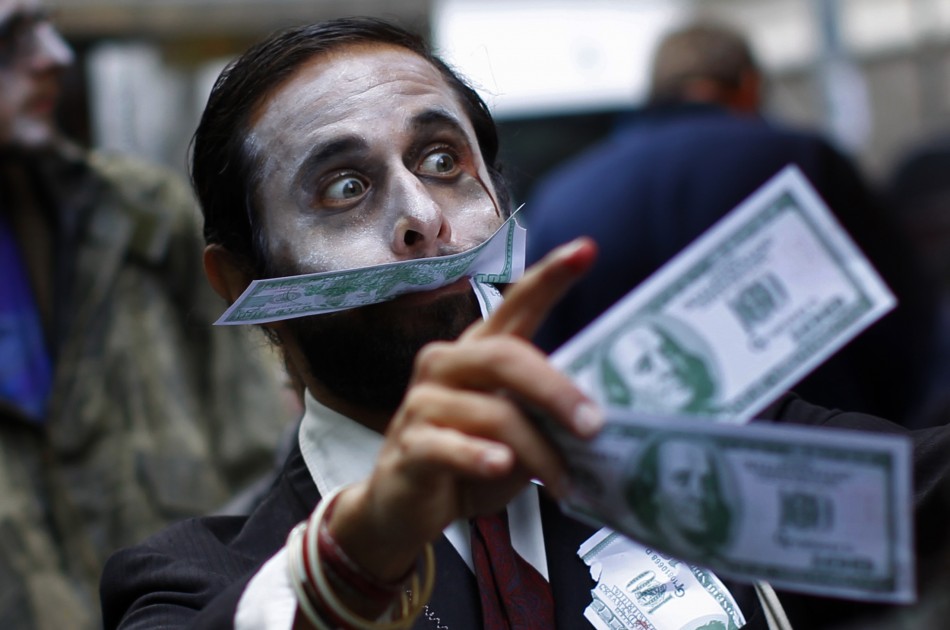
When organizers report three more arrests back at city hall, I walk south to check it out. At Wooldridge Park, three women have set up a table to give food, socks, undershorts, and t-shirts to a line that is already 60 men long. A man is asking for extra socks that he can give to his girlfriend. Down 9th St. near the Hirshfeld-Moore House I catch the back end of a Zombie march. Then it’s past the Texas Observer on 7th, under the porch at Betsy’s Bar, and down a stretch of Lavaca that stinks like puke and grease. At an upscale hotel, valets are lining up a Prius, an Audi, and a BMW.

“Yes, two guys got arrested here about ten minutes ago,” is what I hear from several people back at city hall. “They were fighting. Then while they were being arrested, another guy kept talking to the cops and wouldn’t shut up, so they arrested him too.”

It’s close to 6 pm Sunday and the fourth weekend of Occupy Austin is coming to a close. The last jail release won’t be live streamed until 9:22 pm. Meanwhile Bob Jensen is leading a few folks to the West side of city hall for a teach-in on toxic economics.

Occupiers on the plaza are already debating the meaning of today’s arrests and planning further actions to seek divestment of the city from Bank of America. Everybody is thinking about the next move.

[Greg Moses is editor of the Texas Civil Rights Review and author of Revolution of Conscience: Martin Luther King, Jr. and the Philosophy of Nonviolence. He can be reached at gmosesx@gmail.com. Read more articles by Greg Moses on The Rag Blog.]

The Rag Blog

Posted in Rag Bloggers | Tagged , , , , , | 3 Comments

Susan Van Haitsma : ‘Viva la Vida’ in Austin

CodePink at Viva la Vida. Photo by Susan Van Haitsma / The Rag Blog.

Viva la Vida…
and remember the dead

By Susan Van Haitsma / The Rag Blog / October 28, 2011

See gallery of photos by Susan Van Haitsma, Below.

AUSTIN — One of Austin’s most colorful events of the year is the Dia de los Muertos festival organized by the good folks at Austin’s Mexic-Arte Museum. For 28 years, the museum has hosted events to mark this indigenous occasion.

The Viva la Vida festival was held on Saturday, October 22, and included a beautiful and very lively procession from Saltillo Plaza in East Austin to the downtown museum at 5th and Congress. All ages were invited to paint and costume ourselves in skeleton regalia or in whatever ways we wished to commemorate our departed friends and ancestors while celebrating life in the moment.

Music, dance, art, food — the gifts of life — were shared between the living and the dead, lifting the thin veil, helping us to remember.

For the past few years, several of us CodePink Austin folks have participated in the procession and have created altars for the museum’s community altars exhibit. This year, because October marks the tenth anniversary of the beginning of the U.S. assault and occupation of Afghanistan, we dedicated our altar to the women and children in Afghanistan who have died as a consequence of the war.

For the procession, we also costumed ourselves with a peace/anti-war theme. As the procession made its way down Sixth Street toward the museum, crowds lined the route. Jim and Heidi Turpin, walking together as a dead U.S. soldier and dead Afghan woman, were an especially poignant sight, drawing much applause, a few frowns, and many photographs.

Mexic-Arte’s community altars exhibit, along with a concurrent show about the history of Dia de los Muertos, runs through November 13 at 419 Congress Avenue, Austin, Texas.

[Susan Van Haitsma is active in Austin with Sustainable Options for Youth and CodePink. She also blogs at makingpeace. Find more articles by Susan Van Haitsma on The Rag Blog.]


Viva la vida in Austin, Saturday, Oct. 22, 2011. Photos by Susan Van Haitsma / The Rag Blog.

The Rag Blog

Posted in Rag Bloggers | Tagged , , , , , , , | Leave a comment

David Van Os : ‘Non-Lethal Projectiles’ in Oakland

Police officers with “non-lethal ordnance” after an early morning raid on Occupy Oakland’s tent city, Oakland, CA, Oct.25, 2011. Photo by Stephen Lam / Reuters.

Military zone
in Oakland:
Riot cops use ‘non-lethal projectiles’
to attack occupiers’ encampment

Scott Olsen, who served two tours of duty in Iraq, was struck in the head with what the City of Oakland glibly referred to as a ‘projectile,’ fracturing his skull.

By David Van Os / The Rag Blog / October 27, 2011

UPDATE: See Oakland Mayor Jean Quan’s remarkable conciliatory statement about Wednesday’s police action, Below.

On Tuesday, October 25, in Oakland, California, a member of Veterans for Peace who was peacefully standing with Occupy Oakland demonstrators was shot in the head by Oakland police and is in a hospital in serious condition with a fractured skull.

The nationwide organizations Veterans for Peace and Iraq Veterans Against the War support the Occupy Wall Street demonstrations. In several of the Occupy locations members of VFP and IVAW have stationed themselves at the front of demonstrations to defuse potential conflicts with local police. The VFP and IVAW members urge calm on all sides and talk to the police about how the police officers are part of the 99%, while entreating the demonstrators to conduct themselves peacefully.

The veterans were doing that in Oakland Tuesday in an effort to calm the tense situation as armed Oakland police, dressed in riot gear, were preparing to attack the peaceful Occupy Oakland encampment while the demonstrators were refusing to leave.

The police opened fire with so-called “non-lethal ordnance.” Scott Olsen, who served two tours of duty in Iraq, was struck in the head with what the City of Oakland glibly referred to as a ‘projectile.” The “non-lethal projectile” fractured Olsen’s skull. He is reportedly in serious but stable condition.. Olsen was wearing a shirt conspicuously identifying him as a Veteran for Peace.

[The Huffington Post reported Thursday night that Scott Olsen’s condition had been updated to fair and that he is now breathing on his own. His roommate, Keith Shannon, reported that Olsen “needs surgery to relieve the pressure on his brain and it will happen in a day or two.” Olsen remains sedated.]

This event is reminiscent of the incident that galvanized resistance to the Vietnam War in 1970 when the Ohio National Guard opened fire on students demonstrating against the war at Kent State University and killed four young Americans who wanted a peaceful world.

In the aftermath of the Kent State massacre, college and university students all over America poured out in massive demonstrations that occupied and shut down college and university campuses everywhere. I was one of those student demonstrators at the University of Texas in Austin, where 10,000 of us packed the Main Mall and South Mall shoulder to shoulder the next morning after the news of the Kent State shootings raced quickly throughout the community — before the age of cell phones, text messages, desktop computers, or the Internet.

It is also reminiscent of the U.S. government’s brutal attack in 1932 on the “Bonus Army” of 10,000 World War I veterans who were peacefully encamped in Washington, D.C., seeking payment of the bonuses they were promised for their faithful service in the Great War, which they needed to help them survive the desperate economic situation of the Great Depression.

Veterans for Peace and the Iraq Veterans Against the War plan to conduct a mass demonstration outside the Oakland Police Department today. The radio news story I heard this morning stated that Veterans for Peace is asking people to go to the Occupy locations in their own cities today and stand in solidarity with Scott Olsen and his fellow veterans.

These courageous veterans are standing in solidarity with all of us in the 99% against the greed and abuse we suffer at the hands of the immoral, anti-democratic economic-political system symbolized by its nerve center on Wall Street.

Whether or not your economic and family responsibilities permit you to attend the Occupy demonstration in your city, please join me in saluting Veterans for Peace and Iraqi Veterans Against the War for their leadership in our national community. If you can’t physically attend your city’s demonstration, at least drive by and give the Occupy demonstration some loud honks of support.

Please spread this message. Quickly, the time is now.

[David Van Os is a populist Texas democrat and a civil rights attorney now living in Austin. He is a former candidate for Attorney General of Texas and for the Texas Supreme Court. To receive his Notes of a Texas Patriot — circulated whenever he gets the urge (and published on The Rag Blog whenever we get the urge) — contact him at david@texas-patriot.com. Read more articles by David Van Os on The Rag Blog.]

UPDATE: Statement by Oakland Mayor Jean Quan on Tuesday night’s police action against Occupy Oakland protesters:

[Oakland Mayor Jean Quan’s rather remarkable statement below marks a watershed for the burgeoning American Occupy movements. Cast against the backdrop of Wednesday’s fully-militarized Oakland City Center, Quan’s effusively conciliatory remarks can only be interpreted as an admission that turning downtown Oakland into a war zone to roll up a tent-city encampment did not work.

It should be noted that adherence to nonviolent discipline on the part of the Occupy Oakland organizers and all the protesters that participated throughout the day was a critically important factor in forcing the City of Oakland’s hand. Brute-force police oppression of the Occupy movement has taken its best shot. It is possible that nonviolent resistance has prevailed. — Marc Ash / Reader Supported News.]

We support the goals of the Occupy Wall Street movement: we have high levels of unemployment and we have high levels of foreclosure that makes Oakland part of the 99% too. We are a progressive city and tolerant of many opinions. We may not always agree, but we all have a right to be heard.

I want to thank everyone for the peaceful demonstration at Frank Ogawa Park tonight, and thank the city employees who worked hard to clean up the plaza so that all activities can continue including Occupy Wall Street. We have decided to have a minimal police presence at the plaza for the short term and build a community effort to improve communications and dialogue with the demonstrators.

99% of our officers stayed professional during difficult and dangerous circumstances as did some of the demonstrators who dissuaded other protestors from vandalizing downtown and for helping to keep the demonstrations peaceful. For the most part, demonstrations over the past two weeks have been peaceful. We hope they continue to be so.

I want to express our deepest concern for all of those who were injured last night, and we are committed to ensuring this does not happen again. Investigations of certain incidents are underway and I will personally monitor them.

We understand and recognize the impact this event has had on the community and acknowledge what has happened. We cannot change the past, but we are committed to doing better.

Most of us are part of the 99%, and understand the spirit of the Occupy Wall Street Movement. We are committed to honoring their free speech right.

Finally, we understand the demonstrators want to meet with me and Chief Jordan. We welcome open dialogue with representatives of Occupy Wall Street members, and we are willing to meet with them as soon as possible.

— Mayor Jean Quan, Oakland, California

The Rag Blog

Posted in Rag Bloggers | Tagged , , , , , | 2 Comments

Beyond the Causal Veil

By Bill Meacham / The Rag Blog /

Quantum indeterminacy operates inside your brain. What does that say about the nature of human will and decision-making?(1)

We’ve taken a look at the world of quantum physics before, but a little recap is in order in case you missed it. The quantum level is where thing are quite tiny, less than about 100 nanometers long. Here things behave very strangely. We can describe their properties and behavior mathematically by a formula called the “wave function,” and under certain circumstances the wave function divides into two or more pairs or branches, each with its own consequences. Each of these branches represents a potential future or a potential version of reality. When observed, only one of these branches is perceived; that is, only one of the potential futures becomes the actual perceived present.

Double-Slit experiment resultsA famous experiment, widely replicated, called the Double-Slit experiment reveals the strangeness of this level of reality. It consists of sending light through two side-by-side vertical slits to a recording medium, such as film; and it shows, among other things, that light can behave both as a stream of particles and as a wave. When light is sent through one slit at a time, a vertical band appears. In this case light acts like a series of particles that go through the slit, hit the recording medium and make an impression. If you open the slit on the right, the band appears on the right, and if you open the slit on the left, the band appears on the left. You would expect that if both slits were opened, the result would be two side-by-side bands. In fact, however, the result is a strong band in the middle, the expected bands on the left and right, and then dimmer bands extending outward in each direction. Light in this case acts like waves that cause interference patterns. That is, when a crest meets a crest, a more intense crest results; and when a crest meets a trough they cancel out. The bands of light are from the crests reinforcing each other, and the darkness in between is the from crests and troughs canceling each other out.

Even more interesting, when light is emitted one photon at a time and aimed at the two slits, it shows the same interference pattern. You would expect that a photon would go through one slit or the other. In fact it appears to act like a wave that goes through both slits, interferes with itself, and results in an impression in one and only one of the bands.

And you cannot predict in advance where the photon will make an impression.

You can predict that given a great number of photons, they will result in bands. That is, they won’t all end up in the same place, but rather in various places according to their probability distribution. But there is only a probability, not an absolute certainty, that any single photon will end up in one place or another.

We might well ask what causes the wave, which is mathematically described as a collection of probabilities of being detected in various places, to be in fact detected at only one place. I’ll return to this question shortly. For now, note the quantum indeterminacy, our inability to predict the final location of any single photon. The sequence in which the singly-emitted photons will arrive is completely unpredictable. We have a radical discontinuity of causality.

In ordinary life and in classical (non-quantum) physics, we have a clear concept of causality: a cause is something that reliably produces an effect. Given the same or a similar set of circumstances, we expect the same results to appear. Hitting a billiard ball at a certain angle and with a certain force will always cause it to move in a certain direction and at a certain speed. This conception of causality has three parts:

Regularity – A cause always produces its effect according to physical laws that can be discovered by observation and experiment.
Temporal sequence – The cause always precedes its effect in time. The cause never follows the effect.
Spatial contiguity – There is always some physical connection or spatial contact between the cause and its effect, or a chain of such connections.

At the quantum level, the regularity is missing. There is no set of circumstances that causes the photon always to be detected in a specific place. (And, as we have seen, sometimes spatial contiguity is missing as well.)

Once the photon has been detected then the ordinary chain of causality takes over. The beginning of a macroscopic event can certainly be dependent on a microscopic event. In that case, each microscopic possibility at the beginning can lead to a different chain of macroscopic events at the end.

This becomes important when we consider that some events in the brain happen at the quantum level.

The human brain is a mass of electrochemical activity. It contains approximately 100 billion nerve cells, or neurons, and up to five quadrillion connection points between them. Neurons are the fundamental elements of the brain; they transmit electrochemical impulses to and from other neurons, sense organs or muscles. Some impulses are triggered by sense organs, and some by the excitation of neighboring neurons. Some impulses excite or inhibit neighboring neurons and some cause muscle contractions that move the body.

Parts of a neuronA neuron consists of several parts: numerous dendrites, which look vaguely like trees with many branches, a cell body, and a single axon, a tube that divides at the end to many terminals. Dendrites are the incoming channels; they receive electrochemical impulses from other cells, which then pass through the body and out the axon terminals. Between the axon terminals and the dendrites of the neighboring neurons are gaps, called synapses, only twenty nanometers wide. On the other side of the synaptic gap from the axon is a receptor area on a dendrite of a neighboring cell. An axon can have many terminals, and each dendrite can have many receptor areas. Thus each neuron transmits impulses to and receives impulses from a great many neighboring neurons. Some neurons receive impulses from up to 10,000 neighbors. Some in the cerebellum receive up to 100,000. Clearly the brain is an organ of almost unimaginable complexity.

The impulse traveling through the neuron is an electrical charge. A neuron either transmits the impulse (we say it fires) or it does not; it is a binary element, either on (firing) or off (not firing). When the electrical charge reaches the synaptic gap, it triggers the release of chemicals, neurotransmitters, which is why we call brain activity electrochemical. A single release of a neurotransmitter might be too weak to trigger the receiving neuron, but since each neuron forms outgoing synapses with many others and likewise receives synaptic inputs from many others, the combination of several inputs at once can be enough to trigger it. Or the receipt of an inhibitory neurotransmitter can prevent an impulse that otherwise would have fired. The output of a neuron thus depends on the inputs from many others, each of which may have a different degree of influence depending on the strength of its synapse with that neuron.

What is interesting for the present discussion is what happens to cause the neurotransmitters to travel across the synapse. The chemistry is a bit complex, but basically neurotransmitter chemicals sit docked in little pockets, called vesicles, waiting for something to release them. When the electrical impulse arrives at the terminal, it opens up channels that let calcium ions in. The calcium makes the vesicle fuse with the cell wall and open up so the neurotransmitters go out into the synaptic gap and then hit the receiving neuron.

The channels through which calcium ions enter the nerve terminal from outside the neuron are tiny, only about a nanometer at their narrowest, not much bigger than a calcium ion itself. The calcium ions migrate from their entry channels to sites within the nerve terminal where they trigger the release of the contents of a vesicle. At this submicroscopic level of reality, quantum indeterminacy is in play. A given calcium ion might or might not hit a given triggering site; hence, a given neurotransmitter might or might not be released; hence the receiving neuron might or might not get excited (or inhibited).

In other words, at the most fundamental level, brain functioning is not causally determined.

And since the ordinary chain of causality takes over after the quantum event happens, quantum uncertainty at the synaptic level can lead to causal uncertainty at the level of the whole brain. And that means – since the state of the brain at least heavily influences, if not causally determines, our perceptions, thoughts, feelings and actions – that human conduct is not fully causally determined in the physical world.

What causes a quantum event – in this case the impact of a calcium ion on a triggering site – to cease being merely a probability and start being something that happens at a certain place? Not anything in the physical world. There is a causal discontinuity in nature. Events at the quantum level of reality have no physical cause, but are themselves causes of subsequent events. What is on the other side of the causal discontinuity?

At this point we move beyond what physics can tell us, but clearly it leaves open the possibility that human will is free and even that something that transcends our ordinary notion of the physical – a soul, perhaps, or a god or a plethora of deities – intervenes in the physical world.

Some protest that the causal uncertainty at the quantum level of reality is merely statistical. Events happen randomly; hence, we can draw no conclusions about nonphysical causality, free will, the existence of a soul or of God, or any such thing. In particular, they say, a decision that is initiated by a random occurrence is no more free than one initiated by physical causality. But random as they may be individually, quantum events considered as a group certainly do exhibit regularities. Light passed through double slits exhibits distinct patterns, not random noise.

Consider a pointillist painting, which consists of distinct dots of pigment. If you look at it up close, all you see is random dots. When you view it from afar, you see identifiable forms and shapes, recognizable objects, patterns. So what are the patterns that we find in the behavior that issues from the firing of our brain cells? Does what is outside the bounds of physical causality have any regularity or structure of its own that we can use to understand and predict what it will do? Are there any categories of causal explanation that might be applicable?

The answer is, yes, of course there are: the concepts that pertain to agents. We explain the behavior of agents not in terms of physics and chemistry but in terms of their perceptions, beliefs, desires and goals.

By “agent” I mean the usual: something with will and intention, something that initiates movement without an external nudge, something that acts or has the power to act on its own rather than merely reacting to events. Agency is a different category of causation from physical causation. What agents do is not uncaused, but what causes agents to act is their beliefs and desires, not mechanical or chemical forces. And what agents do is not completely predictable. We try to influence people by persuasion, but we can only influence them, we cannot completely control them. Rather like a single photon, we can never be sure what somebody will do until they have done it. Nor can we be sure what we ourselves will do until we have done it. And afterwards we recognize that we could have done differently.

We are agents not automata. In other words, we have free will. Now the question is, what shall we do with it?

———–

Notes

(1) What follows is summarized from my paper “The Quantum Level of Reality,” located here: http://www.bmeacham.com/whatswhat/Quantum.html. That paper contains more detail and all the footnotes and references. See also “Do Humans Have Free Will?” here: http://www.bmeacham.com/whatswhat/FreeWill.html.

Type rest of the post here

Source /

The Rag Blog

Posted in RagBlog | Leave a comment

William Rogers : Austin Labor Marches in Solidarity with Occupy Movement

Union workers march in solidarity with Occupy Austin, Oct. 23, 2011. Image from YNN.

Injury to one is injury to all:
Austin labor demonstrates
solidarity with Occupy movement

By William Rogers / The Rag Blog / October 27, 2011

AUSTIN — Five hundred union members marched through downtown Austin, Sunday, October 23, chanting, “What do we want? Union jobs,” and “They got bailed out, we got sold out,” during the Occupy Austin Labor Solidarity March. Ironworkers, sheet metal workers, electricians, telecom workers, and transit workers marched alongside teachers, state and local government workers, and EMS technicians.

Postal workers carried signs reading, “Save Our Postal Service, Save Saturday Deliveries” in reference to the United States Postal Service’s proposal to cut mail delivery services and lay off thousands of postal workers. Teamsters carried signs reading “Stop the War on Workers.”

Phil Bunker, vice president of Teamsters Local 657 explained to me how the war on workers is affecting local Teamsters who work for Yellow Freight, a regional trucking company. Recently, the company threatened to file bankruptcy unless the union agreed to reopen and renegotiate the contract. When the union reluctantly agreed, the company reduced wages by 15 percent, stopped making contributions to the workers’ pension fund, and reduced their health care benefit. “The members are very demoralized now,” Bunker said.

But on Sunday, those in the march were anything but demoralized as the spirited group marched past City Hall, where members of the Occupy Austin movement have set up camp to protest national and local economic and political policies that serve the interests of the richest 1 percent and ignore the interests of the rest of us.

The march ended up at a skyscraper on Congress Avenue that houses Wells Fargo Bank, a bank that received a $43.7 billion bailout from the U.S. government, and since then has recorded $24.6 billion in profits and paid bonuses and compensation totaling $27 billion, including a $14.3 million bonus to CEO John Stumpf. At the same time, the bank has denied 175,336 homeowners facing foreclosure a mortgage modification that would enable them to keep their homes and it pays its bank tellers an average of $22,000 a year.

Pointing to the building where Wells Fargo and other financial companies have their offices, a young electrician belonging to IBEW Local 520 told the crowd, “Labor built this building, but those who own it don’t want to treat labor fairly. When we fight to protect our wages and health care benefits, they call us greedy.”

Occupy Austin labor coordinator Snehal Shingavi, an assistant professor at the University of Texas, said that the most important idea that the labor movement has contributed to the Occupy movement and to the long struggle for social and economic justice is the idea of solidarity. “’An injury to one is an injury to all’ has been the cornerstone of the labor movement; that’s where our power lies and that’s how we can win this fight.”

Other speakers at the rally talked about how workers are paying the price for the economic recession caused by the reckless speculation of banks like Wells Fargo. “The Austin Independent School District eliminated 1,100 jobs of teachers and other education workers,” said Ken Zarifis, co-president of Education Austin, the union representing Austin’s public school employees. The job cuts were caused by cuts to state education funding, the result of declining revenue due to the recession.

“The state has severely reduced services to the people most affected by the recession,” said Jim Branson, lead organizer for the Texas State Employees Union, CWA Local 6186. “It could have raised taxes on the state’s wealthiest to help those in need, but instead chose to cut these services. The wealthy are wealthy because of the wealth created by workers. When those workers fall on hard times, it’s only fair for the rich to share the wealth with those who created it.”

The mood of the marchers was exuberant and angry. They were angry about the economic mess created by a system that puts profit ahead of people’s needs, but they were also happy about the opportunity that the Occupy movement has given them to express their anger and frustration and to build a movement for real change, equality, and social justice. “Thank you for this,” said a middle-aged IBEW member as he waved to the young people at the Occupy Austin encampment outside City Hall.

[William Rogers is a member of the Texas State Employees Union/CWA Local 6186. He blogs at Left Labor Reporter where this article also appears.]

The Rag Blog

Posted in Rag Bloggers | Tagged , , , , | 1 Comment

Police officers with “non-lethal ordnance” weapons after an early morning raid on Occupy Oakland’s tent city, Oakland, CA, Oct.25, 2011. Photo by Stephen Lam / Reuters.

Last night in Oakland:
Riot cops use ‘non-lethal projectiles’
to attack occupiers’ encampment

Scott Olsen, who served two tours of duty in Iraq, was struck in the head with what the City of Oakland is glibly referring to as “a projectile,” fracturing his skull.

By David Van Os / the Rag Blog / October 27, 2011

Tuesday, Oct. 25, a member of Veterans for Peace who was peacefully standing with Occupy Oakland demonstrators was shot in the head by Oakland police and is in a hospital in serious condition with a fractured skull.

The nationwide organizations Veterans for Peace and Iraq Veterans Against the War support the Occupy Wall Street demonstrations. In several of the Occupy locations members of VFP and IVAW have stationed themselves at the front of demonstrations to defuse potential conflicts with local police. The VFP and IVAW members urge calm on all sides and talk to the police about how the police officers are part of the 99%, while entreating the demonstrators to conduct themselves peacefully.

The veterans were doing that in Oakland last night in an effort to calm the tense situation as armed Oakland police, dressed in riot gear, were preparing to attack the peaceful Occupy Oakland encampment while the demonstrators were refusing to leave.

The police opened fire with so-called “non-lethal ordnance.” Iraqi war veteran Scott Olsen, who served two tours of duty in Iraq, was struck in the head with what the City of Oakland is glibly referring to as “a projectile.” The “non-lethal projectile” fractured Olson’s skull. He is reportedly in serious but stable condition this morning. Olson was wearing a shirt conspicuously identifying him as a Veteran for Peace.

This event is reminiscent of the incident that galvanized resistance to the Vietnam War in 1970 when the Ohio National Guard opened fire on students demonstrating against the war at Kent State University and killed four young Americans who wanted a peaceful world.

In the aftermath of the Kent State massacre, college and university students all over America poured out in massive demonstrations that occupied and shut down college and university campuses everywhere. I was one of those student demonstrators at the University of Texas in Austin, where 10,000 of us packed the Main Mall and South Mall shoulder to shoulder the next morning after the news of the Kent State shootings raced quickly throughout the community — before the age of cell phones, text messages, desktop computers, or the Internet.

It is also reminiscent of the U.S. government’s brutal attack in 1932 on the “Bonus Army” of 10,000 World War I veterans who were peacefully encamped in Washington, D.C. seeking payment of the bonuses they were promised for their faithful service in the Great War, which they needed to help them survive the desperate economic situation of the Great Depression.

Veterans for Peace and the Iraq Veterans Against the War plan to conduct a mass demonstration outside the Oakland Police Department today. The radio news story I heard this morning stated that Veterans for Peace is asking people to go to the Occupy locations in their own cities today and stand in solidarity with Scott Olson and his fellow veterans.

These courageous veterans are standing in solidarity with all of us in the 99% against the greed and abuse we suffer at the hands of the immoral, anti-democratic economic-political system symbolized by its nerve center on Wall Street.

Whether or not your economic and family responsibilities permit you to attend the Occupy demonstration in your city, please join me in saluting Veterans for Peace and Iraqi Veterans Against the War for their leadership in our national community. If you can’t physically attend your city’s demonstration, at least drive by and give the Occupy demonstration some loud honks of support.

Please spread this message. Quickly, the time is now.

[David Van Os is a populist Texas democrat and a civil rights attorney in San Antonio. He is a former candidate for Attorney General of Texas and for the Texas Supreme Court. To receive his Notes of a Texas Patriot — circulated whenever he gets the urge (and published on The Rag Blog whenever we get the urge) — contact him at david@texas-patriot.com. Read more articles by David Van Os on The Rag Blog ]

The Rag Blog

Posted in RagBlog | Leave a comment

Rag Radio : Academic/Activist Bernardine Dohrn, Former Leader of Weather Underground


Academic/activist Bernardine Dohrn, former leader of Weather
Underground, on Rag Radio with Thorne Dreyer. Listen to it here:

Thorne Dreyer‘s guest on Rag Radio this Friday, October 28, 2011, 2-3 p.m. (Central) on KOOP 91-7-FM in Austin, will be singer/songwriter and community activist Charlie Faye. Stream it live here.

Bernardine Dohrn, activist, academic, and child advocate, was Thorne Dreyer’s guest on Rag Radio Friday, October 21.

Dohrn is Clinical Associate Professor of the Northwestern University School of Law, and founding director of the Children and Family Justice Center. Bernardine was a national leader of SDS (Students for a Democratic Society) and the Weather Underground, and was on the FBI’s 10 Most Wanted List for over a decade.

Dohrn writes and lectures on war and peace, racism and justice, reconciliation and restorative justice, children in conflict with the law, human rights, torture, and family violence. Bernardine Dohrn is also a contributor to The Rag Blog.

On the show we discuss the historical importance of SDS and Bernardine looks back on the Weather Underground and her role in the controversial group; she discusses the declining status of the American empire and the differences between the Sixties and today; and she offers a critique of the criminal justice system and the effect of incarceration on our young people, especially those of color. She is upbeat about today’s youth, the possibilities for social change in America, and the mushrooming Occupy Wall Street movement.

Rag Radio — hosted and produced by Rag Blog editor Thorne Dreyer — is broadcast every Friday from 2-3 p.m. (CDT) on KOOP 91.7-FM in Austin, and streamed live on the web. KOOP is a cooperatively-run community radio station in Austin, Texas.

Rag Radio, which has been aired since September 2009, features hour-long in-depth interviews and discussion about issues of progressive politics, culture, and history. After broadcast, all episodes are posted as podcasts and can be downloaded at the Internet Archive. Tracey Schulz is the show’s engineer and co-producer.

Rag Radio is also rebroadcast on Sundays at 10 a.m. (Eastern) on WFTE, 90.3-FM in Mt. Cobb, PA, and 105.7-FM in Scranton, PA. Rag Radio is produced in the KOOP studios, in association with The Rag Blog, a progressive internet newsmagazine, and the New Journalism Project, a Texas 501(c)(3) nonprofit corporation.

Also see:

Thorne Dreyer, 2011 Eddy Award Winner

Thanks to Kerry Awn and the Uranium Savages for naming Rag Radio’s Thorne Dreyer the 2011 Eddy Award Winner for “Radio Personality of the Year.” Our congratulations to the other winners, including Jim Franklin, Bubble Puppy, and the South Austin Popular Culture Center. Photo by James Retherford / The Rag Blog.

The Rag Blog

Posted in RagBlog | Tagged , , , , , , , , , | 1 Comment


By Susan Van Haitsma / The Rag Blog /

One of Austin’s most colorful events of the year is the Dia de los Muertos festival organized by the good folks at Austin’s Mexic-Arte Museum. For 28 years, the museum has hosted events to mark this indigenous occasion.

The Viva la Vida festival was held on Saturday, October 22 and included a beautiful and very lively procession from Saltillo Plaza in East Austin to the downtown museum at 5th and Congress. All ages were invited to paint and costume ourselves in skeleton regalia or in whatever ways we wished to commemorate our departed friends and ancestors while celebrating life in the moment.

Music, dance, art, food — the gifts of lif — were shared between the living and the dead, lifting the thin veil, helping us to remember.

For the past few years, several of us local CodePink Austin folks have participated in the procession and have created altars for the museum’s community altars exhibit. This year, because October marks the tenth anniversary of the beginning of the U.S. assault and occupation of Afghanistan, we dedicated our altar to the women and children in Afghanistan who have died as a consequence of the war.

For the procession, we also costumed ourselves with a peace/anti-war theme. As the procession made its way down Sixth Street toward the museum, crowds lined the route. Jim and Heidi Turpin, walking together as a dead U.S. soldier and dead Afghan woman, were an especially poignant sight, drawing much applause, a few frowns and many photographs.

Mexic-Arte’s community altars exhibit, along with a concurrent show about the history of Dia de los Muertos, runs through November 13 at 419 Congress Avenue, Austin, Texas.

[Susan Van Haitsma is active in Austin with Sustainable Options for Youth and CodePink. She also blogs at makingpeace.articles by Susan Van Haitsma on The Rag Blog.]

The Rag Blog

Posted in RagBlog | Leave a comment

Kate Braun : Let the Spirits Dance at Samhain

Photo by Toby Ord / Book Jacket Blog.

Celebrating Samhain:
Let the spirits dance

By Kate Braun / The Rag Blog / October 26, 2011

Under the Full Moonlight We Dance/
Spirits dance we dance/
Joining hands we dance/
Joining souls rejoice.

Monday, October 31, 2011, with Lady Moon in her first quarter, we celebrate Samhain, Halloween, All Hallow’s Eve, Third Harvest. Mondays are Moon-days, meaning that Lady Moon’s influence will be stronger than usual. Honor her with songs and dancing; let your feet feel the earth beneath them; raise your voice in songs of praise and exultation. Paying attention to dreams received this night could prove enlightening.

Decorate your surroundings and yourself using the colors orange, black, gold; invite your guests to do likewise. Let cornucopias spill across the table. Enjoy Mother Earth’s bounty one last time before the dark descends, moving us into the “time that is no time” when we, like Mother Earth, lie fallow as we await the coming of the next cycle of giving and receiving.

Samhain means “End of Summer.” On the Wheel of Life calendar, it marks the end of the year and the beginning of Mother Earth’s rest and renewal for the coming year. All Hallow’s Eve is the night before All Soul’s Day, November 1, Dia de los Muertos in Hispanic tradition. It is not unusual to blend the celebrations, with sugar skulls sitting on the table in company with carved jack-o-lanterns and celebrants costumed as film favorites dancing with celebrants costumed as skeletons.

In a healthy contrast to the focus on sugary “treats,” you may choose to create a “dumb supper” in honor of friends and relatives who have crossed over. Place lights in the windows to guide these spirits to you, prepare their favorite foods, set a place for them at your dinner table. Eat this supper in silence, paying close attention to whatever vibrations or spiritual signals may present themselves. If they choose, your invisible guests will find a way to communicate.

Apples are another important feature of this celebration. When we bury apples beside the roadside, we are leaving an offering to those spirits who are lost or who have no descendants to provide for them.

When we capture a bobbing apple in our teeth, that apple becomes a tool for divination: before the stroke of midnight, sit in front of a mirror in a room lit by only a candle or the moon, taking care that neither candlelight nor moonlight reflects in the mirror. Silently ask a question. Then cut the apple into nine pieces. With your back to the mirror, eat eight of the pieces, then throw the ninth over your left shoulder.

Turn your head to look over the same (left) shoulder, and you may see an image or symbol in the mirror that will answer your question.

[Kate Braun‘s website is www.tarotbykatebraun.com. She can be reached at kate_braun2000@yahoo.com. Read more of Kate Braun’s writing on The Rag Blog.]

The Rag Blog

Posted in Rag Bloggers | Tagged , , , , , , | Leave a comment

Bob Feldman : The Confederate State of Texas, 1846-1860

Between 12,000 and 15,000 Texas lost their lives in the Civil War. Painting from the Texas Civil War Museum.

The hidden history of Texas

Part VI: The Confederate State of Texas, 1860-1865

By Bob Feldman / The Rag Blog / October 26, 2011

[This is Part 6 of Bob Feldman’s Rag Blog series on the hidden history of Texas.]

In 1861, the slave-owning Anglo political leaders of Texas decided that the state should secede from the United States and join the Confederacy during the U.S. Civil War.

According to Alwyn Barr’s Black Texans, “as their declaration of causes repeatedly proclaimed, white Texans seceded in 1861, primarily to defend `the servitude of the African to the white race.’” And “as Union armies pushed into Arkansas and Louisiana,” the “slaveholders from each state became refugees to Texas” and “they brought their slaves,” according to Barr’s “Black Texans During the Civil War,” an essay that appeared in Donald Willett and Stephen Curley’s Invisible Texans.

As a result, “by 1864, the slave population” in Texas “probably grew to 250,000.” In 1862, in Texas’s Smith County, authorities “arrested over 40 slaves and hanged one after hearing rumors of a plot to revolt,” according to the same essay.

White opponents of Texas seceding from the United States to join the Confederacy who lived in Texas were also repressed between 1861 and 1865. As Randolph Campbell’s Gone To Texas recalled, “some of the more vocal Unionists had to leave Texas” and “James P. Newcomb, editor of the San Antonio Alamo-Express, fled to New Mexico after a mob attacked his press.”

Although most white Texans “continued throughout the war to support the Confederacy as they had supported secession in the first place,” according to Gone To Texas, some organized support for the U.S. government’s Lincoln Administration and the cause of the Union Army did develop inside Texas during the Civil War. As the same book recalled:

Small groups of Unionists living in regions that voted against secession organized internal opposition to the Confederacy… Germans in the Hill County northwest of San Antonio formed a Union Loyal League with its own military companies… In the Spring of 1862 Confederate officials sent Texas troops into the region to disband the military companies and enforce the conscription law, whereupon 61 of the Unionists, mostly Germans led by Frederick “Fritz” Tegener, decided to go to Mexico and from there join the United States Army.

They… were overtaken by a detachment of 91 Texas Partisan Rangers… while camped on the Nueces River. Attacking before dawn on Aug. 10, 1862, the Confederates killed 19 of the Germans and captured nine who were badly wounded. The remaining Unionists escaped… After the battle, state troops executed the nine wounded Germans, and nine of those who escaped were caught and killed before they reached Mexico…

Armed Anglo supporters of the Confederacy in Texas also repressed supporters of the North and the Union in Cooke County between 1861 and 1865. As Gone To Texas notes:

In Cooke County… the passage of conscription led to the formation of a secret Peace Party that opposed the draft and supported the Union. Rumors that the Peace Party planned to… foment a general uprising led to the arrest on October [1862] of more than 150 suspected insurrectionists by state troops…

An extralegal “Citizen’s Court”… found seven leading Unionists guilty of treason and sentenced them to death. At this point, a mob… lynched 14 more of the prisoners and killed two who tried to escape…When unknown assassins killed Col. Young [of the Eleventh Texas Cavalry]…the jury then sentenced another 19 men to hang, bringing the total number of victims to 42. Texas authorities condoned this “Great Hanging at Gainesville”…

The military conscription law that provoked more organized internal opposition in Hill County and Cooke County, Texas, to the South’s Confederate Government had been passed in April 1862 by the Confederate Congress. As a result, all white males in Texas who were between 13 and 46 in 1860 — except for any white males whose work involved them in supervising 20 or more slaves — were now in danger of being drafted into the Confederate Army for as long as the U.S. Civil War continued.

So, not surprisingly, “nearly 5,000 Texans deserted from Confederate and state service, and an unknown number avoided conscription” by hiding “in isolated areas throughout the state — for example, the Big Thicket in Hardin County and the swamp bottoms of northeast Texas” or “in the northwestern frontier counties,” according to Gone To Texas. And, according to David Humphrey’s Austin: An Illustrated History, “draft-dodging was especially common among Austin’s unionists.”

But slightly more than 50 percent of the white males in Texas who were subject to the Confederate government’s draft during the Civil War were unable to avoid being drafted, and between 1861 and 1865 between 60,000 to 70,000 white men in Texas served in either the Confederate Army or in Texas state military units. And thousands of these military conscripts from Texas died during the U.S. Civil War. As Gone To Texas observes:

Approximately 20 to 25 percent of Texas soldiers died while in the army. More than half of these deaths resulted from a variety of illnesses… Deaths in battle and Union prisoner-of-war camps accounted for the other lives lost. The final death toll can be estimated at between 12,000 and 15,000 men, most of them in their twenties and thirties.

According to Austin: An Illustrated History, Texas’s “loss `in bone and blood’” during the Civil War was “proportionately higher than that of any northern state.”

While between 12,000 and 15,000 people in Texas lost their lives as a result of the Civil War, some other Texans apparently made good money between 1861 and 1865. As W.E.B. Du Bois’s Black Reconstruction 1860-1880 recalls:

Texas was one of the Southern states that had considerable prosperity during the war. She was outside the area of conflict; excellent crops were raised and slave labor was plentiful. Many slaves were deported to Texas for protection… so that Texas could furnish food and raw material for the Confederate States; and on the other hand, when the blockade was strengthened, Texas became the highway for sending cotton and other goods to Europe by way of Mexico.

[Bob Feldman is an East Coast-based writer-activist and a former member of the Columbia SDS Steering Committee of the late 1960s. Read more articles by Bob Feldman on The Rag Blog.]

The Rag Blog

Posted in Rag Bloggers | Tagged , , , | 1 Comment

Beyond the Causal Veil
by Bill Meacham

Quantum indeterminacy operates inside your brain. What does that say about the nature of human will and decision-making?(1)

We’ve taken a look at the world of quantum physics before, but a little recap is in order in case you missed it. The quantum level is where thing are quite tiny, less than about 100 nanometers long. Here things behave very strangely. We can describe their properties and behavior mathematically by a formula called the “wave function,” and under certain circumstances the wave function divides into two or more pairs or branches, each with its own consequences. Each of these branches represents a potential future or a potential version of reality. When observed, only one of these branches is perceived; that is, only one of the potential futures becomes the actual perceived present.

Double-Slit experiment resultsA famous experiment, widely replicated, called the Double-Slit experiment reveals the strangeness of this level of reality. It consists of sending light through two side-by-side vertical slits to a recording medium, such as film; and it shows, among other things, that light can behave both as a stream of particles and as a wave. When light is sent through one slit at a time, a vertical band appears. In this case light acts like a series of particles that go through the slit, hit the recording medium and make an impression. If you open the slit on the right, the band appears on the right, and if you open the slit on the left, the band appears on the left. You would expect that if both slits were opened, the result would be two side-by-side bands. In fact, however, the result is a strong band in the middle, the expected bands on the left and right, and then dimmer bands extending outward in each direction. Light in this case acts like waves that cause interference patterns. That is, when a crest meets a crest, a more intense crest results; and when a crest meets a trough they cancel out. The bands of light are from the crests reinforcing each other, and the darkness in between is the from crests and troughs canceling each other out.

Even more interesting, when light is emitted one photon at a time and aimed at the two slits, it shows the same interference pattern. You would expect that a photon would go through one slit or the other. In fact it appears to act like a wave that goes through both slits, interferes with itself, and results in an impression in one and only one of the bands.

And you cannot predict in advance where the photon will make an impression.

You can predict that given a great number of photons, they will result in bands. That is, they won’t all end up in the same place, but rather in various places according to their probability distribution. But there is only a probability, not an absolute certainty, that any single photon will end up in one place or another.

We might well ask what causes the wave, which is mathematically described as a collection of probabilities of being detected in various places, to be in fact detected at only one place. I’ll return to this question shortly. For now, note the quantum indeterminacy, our inability to predict the final location of any single photon. The sequence in which the singly-emitted photons will arrive is completely unpredictable. We have a radical discontinuity of causality.

In ordinary life and in classical (non-quantum) physics, we have a clear concept of causality: a cause is something that reliably produces an effect. Given the same or a similar set of circumstances, we expect the same results to appear. Hitting a billiard ball at a certain angle and with a certain force will always cause it to move in a certain direction and at a certain speed. This conception of causality has three parts:

Regularity – A cause always produces its effect according to physical laws that can be discovered by observation and experiment.
Temporal sequence – The cause always precedes its effect in time. The cause never follows the effect.
Spatial contiguity – There is always some physical connection or spatial contact between the cause and its effect, or a chain of such connections.

At the quantum level, the regularity is missing. There is no set of circumstances that causes the photon always to be detected in a specific place. (And, as we have seen, sometimes spatial contiguity is missing as well.)

Once the photon has been detected then the ordinary chain of causality takes over. The beginning of a macroscopic event can certainly be dependent on a microscopic event. In that case, each microscopic possibility at the beginning can lead to a different chain of macroscopic events at the end.

This becomes important when we consider that some events in the brain happen at the quantum level.

The human brain is a mass of electrochemical activity. It contains approximately 100 billion nerve cells, or neurons, and up to five quadrillion connection points between them. Neurons are the fundamental elements of the brain; they transmit electrochemical impulses to and from other neurons, sense organs or muscles. Some impulses are triggered by sense organs, and some by the excitation of neighboring neurons. Some impulses excite or inhibit neighboring neurons and some cause muscle contractions that move the body.

Parts of a neuronA neuron consists of several parts: numerous dendrites, which look vaguely like trees with many branches, a cell body, and a single axon, a tube that divides at the end to many terminals. Dendrites are the incoming channels; they receive electrochemical impulses from other cells, which then pass through the body and out the axon terminals. Between the axon terminals and the dendrites of the neighboring neurons are gaps, called synapses, only twenty nanometers wide. On the other side of the synaptic gap from the axon is a receptor area on a dendrite of a neighboring cell. An axon can have many terminals, and each dendrite can have many receptor areas. Thus each neuron transmits impulses to and receives impulses from a great many neighboring neurons. Some neurons receive impulses from up to 10,000 neighbors. Some in the cerebellum receive up to 100,000. Clearly the brain is an organ of almost unimaginable complexity.

The impulse traveling through the neuron is an electrical charge. A neuron either transmits the impulse (we say it fires) or it does not; it is a binary element, either on (firing) or off (not firing). When the electrical charge reaches the synaptic gap, it triggers the release of chemicals, neurotransmitters, which is why we call brain activity electrochemical. A single release of a neurotransmitter might be too weak to trigger the receiving neuron, but since each neuron forms outgoing synapses with many others and likewise receives synaptic inputs from many others, the combination of several inputs at once can be enough to trigger it. Or the receipt of an inhibitory neurotransmitter can prevent an impulse that otherwise would have fired. The output of a neuron thus depends on the inputs from many others, each of which may have a different degree of influence depending on the strength of its synapse with that neuron.

What is interesting for the present discussion is what happens to cause the neurotransmitters to travel across the synapse. The chemistry is a bit complex, but basically neurotransmitter chemicals sit docked in little pockets, called vesicles, waiting for something to release them. When the electrical impulse arrives at the terminal, it opens up channels that let calcium ions in. The calcium makes the vesicle fuse with the cell wall and open up so the neurotransmitters go out into the synaptic gap and then hit the receiving neuron.

The channels through which calcium ions enter the nerve terminal from outside the neuron are tiny, only about a nanometer at their narrowest, not much bigger than a calcium ion itself. The calcium ions migrate from their entry channels to sites within the nerve terminal where they trigger the release of the contents of a vesicle. At this submicroscopic level of reality, quantum indeterminacy is in play. A given calcium ion might or might not hit a given triggering site; hence, a given neurotransmitter might or might not be released; hence the receiving neuron might or might not get excited (or inhibited).

In other words, at the most fundamental level, brain functioning is not causally determined.

And since the ordinary chain of causality takes over after the quantum event happens, quantum uncertainty at the synaptic level can lead to causal uncertainty at the level of the whole brain. And that means – since the state of the brain at least heavily influences, if not causally determines, our perceptions, thoughts, feelings and actions – that human conduct is not fully causally determined in the physical world.

What causes a quantum event – in this case the impact of a calcium ion on a triggering site – to cease being merely a probability and start being something that happens at a certain place? Not anything in the physical world. There is a causal discontinuity in nature. Events at the quantum level of reality have no physical cause, but are themselves causes of subsequent events. What is on the other side of the causal discontinuity?

At this point we move beyond what physics can tell us, but clearly it leaves open the possibility that human will is free and even that something that transcends our ordinary notion of the physical – a soul, perhaps, or a god or a plethora of deities – intervenes in the physical world.

Some protest that the causal uncertainty at the quantum level of reality is merely statistical. Events happen randomly; hence, we can draw no conclusions about nonphysical causality, free will, the existence of a soul or of God, or any such thing. In particular, they say, a decision that is initiated by a random occurrence is no more free than one initiated by physical causality. But random as they may be individually, quantum events considered as a group certainly do exhibit regularities. Light passed through double slits exhibits distinct patterns, not random noise.

Consider a pointillist painting, which consists of distinct dots of pigment. If you look at it up close, all you see is random dots. When you view it from afar, you see identifiable forms and shapes, recognizable objects, patterns. So what are the patterns that we find in the behavior that issues from the firing of our brain cells? Does what is outside the bounds of physical causality have any regularity or structure of its own that we can use to understand and predict what it will do? Are there any categories of causal explanation that might be applicable?

The answer is, yes, of course there are: the concepts that pertain to agents. We explain the behavior of agents not in terms of physics and chemistry but in terms of their perceptions, beliefs, desires and goals.

By “agent” I mean the usual: something with will and intention, something that initiates movement without an external nudge, something that acts or has the power to act on its own rather than merely reacting to events. Agency is a different category of causation from physical causation. What agents do is not uncaused, but what causes agents to act is their beliefs and desires, not mechanical or chemical forces. And what agents do is not completely predictable. We try to influence people by persuasion, but we can only influence them, we cannot completely control them. Rather like a single photon, we can never be sure what somebody will do until they have done it. Nor can we be sure what we ourselves will do until we have done it. And afterwards we recognize that we could have done differently.

We are agents not automata. In other words, we have free will. Now the question is, what shall we do with it?

———–

Notes

(1) What follows is summarized from my paper “The Quantum Level of Reality,” located here: http://www.bmeacham.com/whatswhat/Quantum.html. That paper contains more detail and all the footnotes and references. See also “Do Humans Have Free Will?” here: http://www.bmeacham.com/whatswhat/FreeWill.html.


Type rest of the post here

Source /

The Rag Blog

Posted in RagBlog | Leave a comment

Harry Tarq : Does U.S. Foreign Policy Respect Human Life?

Libyan men and children queue up to view the corpse of Muammar Qaddafi. Photo from Getty Images.

U.S. foreign policy and
the respect for human life

By Harry Targ / The Rag Blog / October 26, 2011

“The Oriental doesn’t put the same high price on life as does a Westerner…We value life and human dignity. They don’t care about life and human dignity.” — Gen. William Westmoreland interviewed in Hearts and Minds (1974), a documentary about the Vietnam War.

This past week American politics took a peculiar turn. A new narrative about the Obama administration began to be systematically presented to the liberal media audience. Reviewing his three-year-old administration, the new construction is that on the national security front Obama is markedly more tough and effective than Republicans claim.

The brutal murder of Muammar Qaddafi by rebellious opponents on global television, followed by celebratory remarks by the president, his secretary of state, and other members of the administration, capped three years of U.S. violence on people of the Global South.

Many critics of Obama’s less than forceful advocacy of economic justice have shifted their focus to a frame of the president as resolute in protecting American national security in the face of a challenging world. They even have implied that Obama is more of a tough guy than his predecessor ever was.

What is the evidence for this? Frankly, President Obama has unleashed new variants of the U.S. killing machine. Violence against Asian, Middle Eastern, and African people has been visibly celebrated in public view. The numbers of victims killed may not be greater than that of prior administrations but the celebration of public murders seem to have increased.

Early in the Obama administration, the president made a decision to assassinate Somali pirates, pirates who had kidnapped westerners off the Horn of Africa. Last May, with the president’s diplomatic team staring at a television screen during a nail-biting meeting, Navy Seals invaded the compound housing Osama Bin Laden who was unceremoniously killed and dumped in the sea. The media highlighted Americans who celebrated this killing.

Four months after the successful murder of Bin Laden, Obama’s crack team assassinated Anwar al-Awlaki, American citizen and alleged leader of Islamic terrorists, who threatened the United States. Abdul Rahman al-Awlaki, his teenage son, and others were summarily executed for crimes for which they had not been accused or tried.

In addition, President Obama agreed to work with allies, Great Britain and France, who held colonial empires in the Middle East and North Africa in the twentieth century. They mobilized a campaign in the United Nations to gain public legitimacy for military intervention in Libya to overthrow the long-time idiosyncratic leader, Qaddafi, whose tiny nation from time to time supported dissidents in the Arab and African worlds.

The initial claim was that the force, a NATO operation, would be humanitarian, saving the lives of those who were rebelling against the Libyan dictatorship.

The rebels, unlike the nonviolent activists in Tunisia and Egypt where western support was minimal, were armed, probably by the West, and launched a civil war against the regime. Then NATO air power was used for seven months to pound Libya until the Qaddafi military collapsed.

The “humanitarian” intervention took between 30,000 and 50,000 lives, dissidents as well as Qaddafi loyalists. Shortly after the war ended with the death and mutilation of the dictator’s body on a street in Sirte, President Obama declared victory for the Libyan people — although who the rebels are remains unclear — and pronounced what he referred to as a new measured and wise U.S. foreign policy.

The new foreign policy, what might be called the “Obama Doctrine,” has four parts. First, the United States, as the last remaining superpower, and as the defender of the global moral standard, could once again assume the right and responsibility to intervene militarily to preserve and enhance human rights around the world. As the president put it, reflecting on the recent killings in a press conference after the death of Qaddafi was announced, U.S. actions have demonstrated “…the strength of American leadership across the world.”

Second, U.S. humanitarian interventions will be carried out in conjunction with military operations with our friends, presumably equally committed to high moral standards. In Obama’s words; “We’ve demonstrated what collective action can achieve in the 21st century.” NATO, an alliance established in 1949 to protect Western Europe and North America from security threats from “international communism,” now will police the world.

Third, new technologies make it possible for the United States to police the world without “boots on the ground.” Given the new technology, the free world can intervene virtually anywhere, anytime, through the use of incredibly sophisticated drone warfare. In the Libyan case, as the president said, “without putting a single service member on the ground, we achieved our objectives, and our NATO mission will soon come to an end.”

U.S./NATO warriors can target enemies without personal danger to themselves while working in antiseptic offices in the United States or Europe, or on small bases in the Indian Ocean, the Middle East, or Africa. Nick Turse, author of The Complex (2008) estimates that at least 60 drone bases are operational around the world, ready to hit enemy targets virtually anywhere.

Fourth, the Obama Doctrine makes it clear that human life is not sacred and that due process, the hallmark of western legal traditions, is now superseded by the unilateral right of key decision-makers to kill potential, as well as actual, enemies of the United States. To paraphrase the old definition of the state as that institution that holds the monopoly of the legitimate use of force, the state now holds the monopoly of legitimate use of murder.

In the end, the oft-quoted remark by General William Westmoreland about the Vietnamese enemy in the 1960s may more accurately be restated: “The United States government does not put the same high price on human life as other countries.”

Fortunately for progressives, mass movements exist that show the world that many Americans do not stand with their government’s use of violence. Progressives oppose mass murder, targeted executions, the death penalty anywhere, and despicable drone warfare. Progressives also respect the right and responsibilities of others to choose their own political destinies.

[Harry Targ is a professor of political science at Purdue University who lives in West Lafayette, Indiana. He blogs at Diary of a Heartland Radical — and that’s also the name of his new book which can be found at Lulu.com. Read more of Harry Targ’s articles on The Rag Blog.]
The Rag Blog
Posted in Rag Bloggers | Tagged , , , , | 1 Comment