A Word From Our Sponsor(s)

By Richard Raznikov / The Rag Blog / August 17, 2011

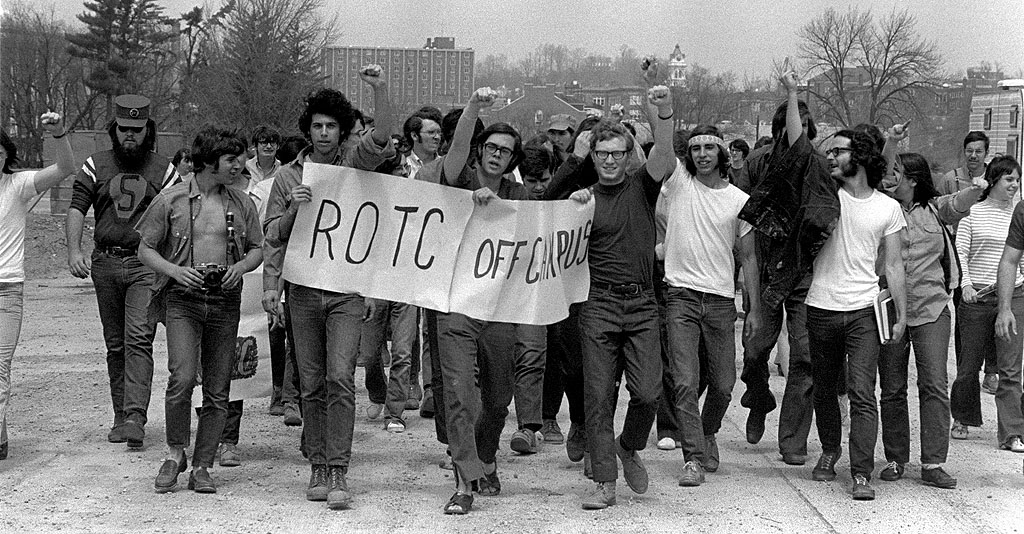
The first time I personally experienced the unreliability — i.e. lies — of the media was as a freshman at U.C. Berkeley in October 1964. Along with about a thousand others, my friend JBD and I found ourselves in the middle of what was to become the Free Speech Movement.

The University had embarked on a mission, spurred by its corporate sponsors, to impede the recruitment of civil rights volunteers on campus. Students were already in the forefront of demonstrations against racial discrimination in San Francisco at the Sheraton Palace, on auto row, and at Zim’s Restaurants, and the targets had grown to include businesses in Oakland’s Jack London Square and the Oakland Tribune newspaper.

Powerful people were pissed off, and they leaned on the University’s administration to put a stop to it.

The Free Speech Movement was the student response to new restrictions on free speech imposed by Chancellor Ed Strong and U.C. President Clark Kerr.

Being in the middle of this historic development was an intoxicating experience, and JBD and I participated in sit-ins and demonstrations, and passed out leaflets. We were among the first batch of students to surround a police car with our bodies, preventing the removal of one Jack Weinberg, who had been arrested for violating university rules when he sat at a recruitment table for either the Student Nonviolent Coordinating Committee (SNCC) or the Congress of Racial Equalit (CORE) –– I can’t recall which.

The October 1st capture of the police car in a spontaneous circle of students generated nationwide press coverage, and most of America learned of the incipient student revolt on their evening news programs. What they learned was a little bit different from what we were experiencing in Sproul Plaza.

The public heard that we were a bunch of ungrateful brats, outside agitators, and Communist dupes. The quite significant issues of freedom of speech and of constitutional rights in general, although they were the central point of the protests and of the speeches given by Mario Savio and others, standing atop the imprisoned squad car, were completely ignored.

We were too busy to watch ourselves on the news but we soon discovered how we were being portrayed. Personally, I didn’t mind the brat thing, but I resented anyone regarding me as a dupe. Not to mention that one of the friends I’d made in the FSM was a member of the steering committee who was a libertarian — and happened to belong to “Students for Goldwater.”

Whoever controls the media controls the story the public sees and hears. I am reminded of that daily, following events in England, in Israel, in Libya, in Syria, in Egypt, in Haiti, in Greece. Whatever “news” we get is filtered through the propaganda requirements of those who own it, those who sponsor it, and those whose threats can promote or make vanish a given narrative.

In other words, you can’t take at face value anything you see on television or coming from the mouths of politicians. They are lying to you. That’s a part of their job.

I wrote a piece called “London Burning” and got a pretty fast response from people who took issue with my slant on events. One of them was my old friend JBD himself, whose quite reasonable question was, mainly, how sympathetic would I be if the looters were looting and/or burning down my shop.

Answer: I wouldn’t be very sympathetic; I’d be pissed off.

But, here’s the thing: I didn’t write favorably about looters. I don’t even know how much looting has taken place, and neither do you. I know what the Cameron government is saying, but they are notorious liars to begin with. I also know that the media, in collusion with government, can make a snowplow look like a Trailways bus.

My point was this: the England riots are political.

What the media coverage is leaving out, among other things:

Last fall there were demonstrations across England by students angry about prospective cuts in social services. The level of outrage surprised the Cameron regime which, along with other European governments, has been implementing so-called “austerity” measures, the translation being that in order to satisfy the bankers and other corporate thugs the few crumbs formerly doled out to the poor will now be taken away.

Then, on March 26th of this year, half a million demonstrators — many of them trade unionists — converged on London to protest the slashing of government programs and social services. They were joined by huge numbers of the young, especially students.

In a prescient article two months ago in the Indypendent, Peter Bratsis wrote:

…the class dimensions of the demonstration are not yet obvious nor are they reducible to the social-economic positions or to the intentions of those of us who were there. The class character of the demonstration will be manifest by its impact and what will follow in the months ahead…

As Bratsis pointed out,

One thing is certain, however: The March 26 protest will have as little impact on policymakers as the antiwar demonstrations did. Within the “democratic” world at least, orderly popular protests have proven to be of little consequence when it comes to influencing policies.

He then observed that while many union participants would abandon the field, having come to London and “done all that they could,” the events would lead to further radicalization of those who were most directly victimized by the government’s actions and targeted by police.

Partly as a response to the heavy-handed actions of the police and partly as a product of principled political reflection and organization, the extra-parliamentary left, especially anarchism, is on the rise. There were hundreds of mask-wearing protesters willing to engage in property destruction and risk arrest.

Their occupation of Fortnum and Mason, one of the most famous stores in London, and their attack on the Ritz Hotel and dozens of stores on Oxford Street, especially those known for not paying any taxes, is a clear sign that the movement is growing. Although there may still be far to go before the streets of London look like those of Seattle in 1999 or Athens in 2008, major progress is being made.

Historically, ideology is always an unsteady partner to rebellion. Indeed, if revolution waited for the development of a broad-based intellectual theory it would wait forever. Most American colonists had not read Tom Paine’s “Common Sense,” and those Russians who stormed the Winter Palace had by and large never heard of Karl Marx.

Bratsis continues:

According to the historian Karl Polanyi, the working class in Britain has been the most repressed and beaten down in all of Europe. Polanyi asserts that this has rendered them nearly incapable of any self-directed, progressive, political action. Nonetheless, we have seen flashes of political possibilities, such as the poll tax riots of 1990 that brought down Margaret Thatcher and the fierce but unsuccessful coal miners’ strike of 1984-85 that broke organized labor in the U.K.

The stakes of the current attack on working people are clear. Orderly demonstrations and petitions are not sufficient for fighting the power of the ruling classes and their… servants within Parliament. A new chapter in disruptive, disciplined and disorderly political action by the dominated is necessary. If marching is as far as the political efforts go, the overcrowded classrooms, shrinking universities, declining life expectancy and decreasing wages and pensions will be all the evidence we need for understanding how the class struggle in Britain is progressing.

More than 16,000 police have been deployed to retake the streets of London. More than 1,700 arrests have been carried out, and magistrates have already tried and sentenced some to prison. A majority of the arrestees are minors. One such was sent to jail for six months for stealing bottled water. Prisons and juvenile detention centers are running out of cells for the inmates.

London police have conducted raids specifically against low-income housing projects, and concerns over civil liberties of the accused have been brushed aside by the Cameron regime in the wild rush to convict and imprison those accused. The prime minister declared that “phony concerns about human rights” wouldn’t be permitted to get in the way.

Despite the cover stories promoted by the British government and the widespread media complicity in reducing the rioters to “mindless” criminals and “anarchists,” the enormity of the rebellion — and its use of social networks and Blackberry messaging services — suggests something with clearer direction and better organization.

The British government is working on policies which will shut down these web sites and services to impede future actions, much the same way the Egyptian government sought to save Mubarak’s miserable skin. It didn’t work in Egypt but maybe the English will have better luck.

The U.S. government has, of course, embarked on the same course, and the mass media in this country are complicit in distorting the news out of London. After all, the same kind of phony “austerity” policies being used in Europe to screw the last dime out of the poor and the seemingly powerless are being tried in America by the Obama regime and its Republican allies. Don’t think for a minute we’re not being set up. In England, the economics editor at
The Guardian (and a part-time magistrate) wrote:

From the bench, what magistrates see is a raging bundle of id impulses, the desire for immediate gratification untempered by a sense of guilt and with only an ill-formed notion of right and wrong. The temptation to bang them up and throw away the key is strong, and magistrates will no doubt be encouraged to do just that over the coming weeks.

Don’t be fooled by the press releases. Crisis is manufactured in order to seize money or to get rid of civil liberties, often both. When people fight back with whatever rudimentary weapons are at their disposal, it is essential that they be divested of reason and marginalized as criminals. That’s what the mass media do these days — create and promote the cover stories of their sponsors.

No, I do not personally think that looting businesses is a good idea, a sound tactic, or a morally-defensible position. But I’m not going to pretend that there isn’t a reason for it.

[Richard Raznikov is an attorney practicing in San Rafael, California. He blogs at News from a Parallel World.]

Type rest of the post here

Source

The Rag Blog

Posted in RagBlog | Leave a comment

Bob Feldman : Texas Under Mexican Rule

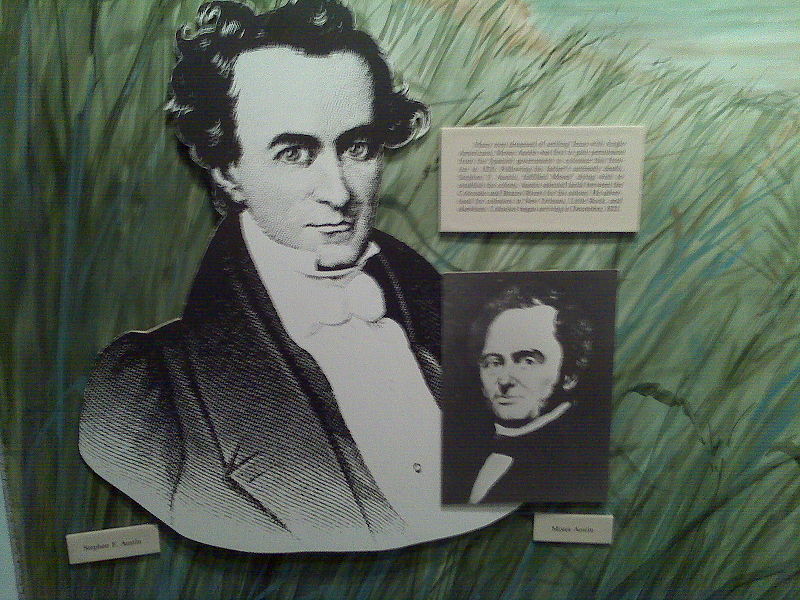
Texas colonizer Stephen F. Austin (with his father, Moses Austin, inset on right). Painting from the Fort Bend Museum / Wikimedia Commons.


The hidden history of Texas

Part 2: The 1821-1826 years under Mexican rule

By Bob Feldman / The Rag Blog / August 16, 2011

[This is the second installment of Bob Feldman’s new Rag Blog series on the hidden history of Texas.]

White English-speaking Texans of wealth have exercised a special influence over the direction of Texas history for many years. Yet it wasn’t until Dec. 21, 1821, that the first white Anglo, Mary James Long, was born on Texas soil.


And long before any white Anglos from the United States had settled in Texas in the early 19th-century, Spanish-speaking Texans had already, in the 18th century, developed the cattle ranching techniques such as the round-up, branding, roping, and herding from horseback, for which Texas later became well-known throughout the world as a result of Hollywood movies during the 20th century.

White Anglos only began crossing the border from Louisiana and into New Spain territory in Texas around 1815. So, not surprisingly, in the early 1820s the number of Native Americans who (as members of tribal nations like the Cherokees, Delaware, Shawnees, etc.) lived in Texas — 20,000 — was still greater than the number of white Anglo settlers who lived in Texas.

But in November 1820, a white Anglo named Moses Austin (accompanied by his African-American slave, Richmond) went to San Antonio and met with local authorities to talk about setting up an Anglo settler colony in not yet densely-populated Texas. And following Moses Austin’s death in June 1821, his son — Stephen Fuller Austin — established a settler-colony in Texas in December 1821, on land granted by Texas’s then-governing authorities.

Since thousands of acres of Texas’ best farmland were being offered by Stephen F. Austin to prospective Anglo settlers at a much cheaper price (10 cents per acre) than what land was then selling for in the United States — and on credit — the number of Anglo settler-colonists in Austin’s Texas colony quickly increased during the 1820s.

Under the Empire of Mexico’s Colonization Law of January 1823, each Anglo family who settled in Austin’s colony was given 4,423 acres of land in Texas if they planned to raise cattle stock and 177 acres of land in Texas if they planned to just be farmers. In addition, the Anglo settler-colonists were required to be only of Catholic background and were also required to free all the African-American slave children they owned when the slave children reached the age of 14.

Although the Empire of Mexico’s Colonization Law was voided by Mexico’s new federal republican government by March 1823, the land grant to Austin’s colony in Texas continued to be recognized as valid by the new Mexican federal republican government. But under the March 28, 1825 Colonization Act passed by the state government of Coahuila in Mexico (of which Texas was now a part), Anglo settlers in Austin’s colony had to agree to become both Mexican citizens and Catholics — in exchange for being given land in Texas (for less than $100 in fees) by Mexico’s governing authorities.

There were only seven African-American slaves in Texas — living around San Antonio — according to an 1819 census, and the same 1823 Empire of Mexico law that required slave children to be freed at the age of 14 also prohibited the sale or purchase of African-American slaves by the Anglo settlers in Austin’s colony.

But the newly-arrived white Anglo settlers soon began to create an economy based on the enslavement of African-Americans within Texas, and by 1825, Austin’s Anglo colony included 69 white slaveholders — mostly settlers from the southern United States region — who owned 443 slaves of African-American descent.

A white settler from Georgia, Jared E. Groce, for example, brought 90 slaves with him when he settled in Texas, establishing a plantation there in 1822, and apparently became one of the wealthiest settler-colonists. And around 25 percent of the 1,800 people who lived in Austin’s colony in Texas by 1825 were African-American slaves.

In his Gone To Texas, professor Randolph Campbell indicated the economic motive and the ideological reason for the white Anglos who settled in Austin’s colony deciding to set up a slave labor-based economic system in Texas during the 1820s, when he wrote:

A trend toward cash-crop agriculture developed almost immediately… Cotton production depended on slavery, which in turn provided the strongest link between Texas and the American South… Anglo-Americans made slavery an institution of significance in Texas beginning in the 1820s because they saw it as economic necessity… Free labor could not be hired where land was so inexpensive… Most Texas immigrants… held racist views that allowed them to see nothing wrong with the practice of whites owning blacks in order to profit from their labor…

So, not surprisingly, a few years after the Republic of Mexico legally prohibited the further importation of slaves of African-American descent into Mexico in 1824, a minority of the Anglo settlers in eastern Texas, led by Haden Edwards, declared their independence from Mexico on Dec. 21, 1826 and attempted to establish an independent “Republic of Fredonia.”

But the independent Republic of Fredonia did not gain the support of either Stephen F. Austin or most of the other Anglo settlers in Texas in 1826 — and once Mexican government troops arrived in the Republic of Fredonia on Jan. 4, 1827, the Republic of Fredonia quickly ceased to exist.

[Bob Feldman is an East Coast-based writer-activist and a former member of the Columbia SDS Steering Committee of the late 1960s. Read more articles by Bob Feldman on The Rag Blog.]

The Rag Blog

Posted in Rag Bloggers | Tagged , , , , , | Leave a comment

The hidden history of Texas

Part 2: The 1821-1826 years under Mexican rule

By Bob Feldman / The Rag Blog / August 16, 2011

[This is the second installment of Bob Feldman’s new Rag Blog series on the hidden history of Texas.]

White English-speaking Texans of wealth have exercised a special influence over the direction of Texas history for many years. Yet it wasn’t until Dec. 21, 1821 that the first white Anglo, Mary James Long, was born on Texas soil. And long before any white Anglos from the United States had settled in Texas in the early 19th-century, Spanish-speaking Texans had already, in the 18th century, first developed the cattle ranching techniques such as branding, the round-up, roping and herding from horseback, for which Texas later became well-known throughout the world as a result of Hollywood movies during the 20th century.

White Anglos only began crossing the border from Louisiana and into New Spain territory in Texas around 1815. So, not surprisingly, in the early 1820s the number of Native Americans who (as members of tribal nations like the Cherokees, Delaware, Shawnees, etc.) lived in Texas—20,000—was still greater than the number of white Anglo settlers who lived in Texas. But in November 1820, a white Anglo named Moses Austin (accompanied by his African-American slave, Richmond) went to San Antonio and met with local authorities to talk about setting up an Anglo settler-colony in not yet densely-populated Texas. And following Moses Austin’s death in June 1821, his son—Stephen Austin–established a settler-colony in Texas in December 1821, on land granted by Texas’s then-governing authorities. Since thousands of acres of Texas’s best farmland were being offered by Stephen Austin to prospective Anglo settlers at a much cheaper price (10 cents per acre) than what land was then selling for in the United States–and on credit–the number of Anglo settler-colonists in Austin’s Texas colony quickly increased during the 1820s.

Under the Empire of Mexico’s Colonization Law of January 1823, each Anglo family who settled in Austin’s colony was given 4,423 acres of land in Texas if they planned to raise cattle stock; and 177 acres of land in Texas if they planned to just be farmers. In addition, the Anglo settler-colonists were required to be only of Catholic religious background and required to free all the African-American slave children they owned when the slave children reached the age of 14.

Although the Empire of Mexico’s Colonization Law was voided by Mexico’s new federal republican government by March 1823, the land grant to Austin’s colony in Texas continued to be recognized as valid by the new Mexican federal republican government. But under the Mar. 28, 1825 Colonization Act passed by the state government in Mexico of Coahuila-Texas (of which Texas was now a part of), Anglo settlers in Austin’s colony had to now agree to become both Mexican citizens and Catholics–in exchange for being given land in Texas (for less than $100 in fees) by Mexico’s governing authorities.

There were only 7 African-American slaves living around San Antonio in Texas according to an 1819 census; and the same 1823 Empire of Mexico law that required slave children to be freed at the age of 14 also prohibited the sale or purchase of African-American slaves by the Anglo settlers in Austin’s colony. But the newly-arrived white Anglo settlers still soon began to create an economy based on the enslavement of African-Americans within Texas; and by 1825, Austin’s Anglo colony included 69 white slaveholders—mostly settlers from the southern United States region—who owned 443 slaves of African-American descent. A white settler from Georgia, Jared E. Groce, for example, brought 90 slaves with him when he settled in Texas, established a plantation there in 1822 and apparently became one of the wealthiest settler-colonists. And around 25 percent of the 1,800 people who lived in Austin’s colony in Texas by 1825 were African-American slaves.

In his Gone To Texas book, Professor Randolph Campbell indicated the economic motive and the ideological reason for the white Anglos who settled in Austin’s colony deciding to set up a slave labor-based economic system in Texas during the 1820s, when he wrote:

“A trend toward cash-crop agriculture developed almost immediately…Cotton production depended on slavery, which in turn provided the strongest link between Texas and the American South…Anglo-Americans made slavery an institution of significance in Texas beginning in the 1820s because they saw it as economic necessity…Free labor could not be hired where land was so inexpensive…Most Texas immigrants…held racist views that allowed them to see nothing wrong with the practice of whites owning blacks in order to profit from their labor…”

So, not surprisingly, a few years after the Republic of Mexico legally prohibited the further importation of slaves of African-American descent into Mexico in 1824, a minority of the Anglo settlers in eastern Texas, led by Haden Edwards, declared their independence from Mexico on Dec. 21, 1826 and attempted to establish an independent Republic of Fredonia. But the independent “Republic of Fredonia” did not gain the support of either Stephen Austin or most of the other Anglo settlers in Texas in 1826; and once Mexican government troops arrived in the “Republic of Fredonia” on Jan. 4, 1827, the “Republic of Fredonia” quickly ceased to exist in Texas.

[Bob Feldman is an East Coast-based writer-activist and a former member of the Columbia SDS Steering Committee of the late 1960s. Read more articles by Bob Feldman on The Rag Blog.]

Type rest of the post here

Source /

The Rag Blog

Posted in RagBlog | Leave a comment

Sarito Carol Neiman : The Highs and Lows of Rick Perry’s ‘Texas Miracle’

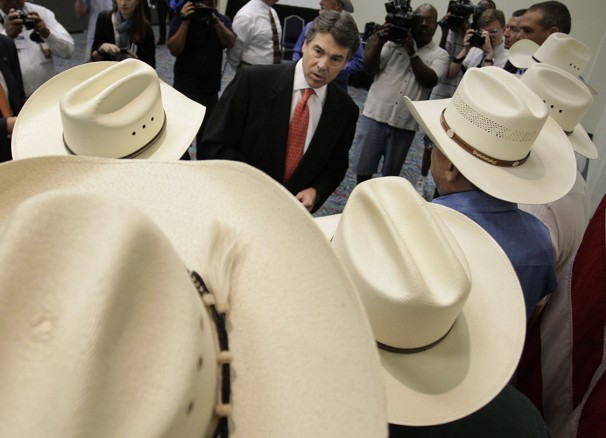
And a tip of the ten-gallon hat to the ‘Texas Miracle.’ Photo by Paul Moseley / Ft. Worth Star-Telegram.


The highs and the lows:

Rick Perry’s ‘Texas Miracle’

By Sarito Carol Neiman / The Rag Blog / August 16, 2011

Buried in the “Room for Debate” pages of The New York Times online is an interesting little piece by Ruben Navarrette Jr., a columnist with The Washington Post Writers Group, Cnn.com contributor, and member of the USA Today board of contributors. Before he reached such lofty national heights, Navarrette was on the editorial board of The Dallas Morning News, and sometime in the early part of 2003 he had the opportunity to interview Governor Rick Perry when he dropped by the Morning News offices.


In his “Room for Debate” piece, Navarrette recalls that at the time of the interview, he had just read a series in The New York Times about McWane, Inc., a company based in Birmingham, Alabama, that was, at the time, one of the world’s largest manufacturers of cast-iron sewer and water pipe, and had an absolutely horrendous and Dickensian record when it came to the safety of its workers.

Navarrette says he mentioned to the governor that this notorious company had said that it “would only do business in two places: developing countries and Texas.” I asked the governor if he was bothered by this fact. He wasn’t, to put it mildly.

“Well,” Mr. Perry said… “I don’t take direction from The New York Times.” Then he changed the subject and proceeded to make the case for why many other companies had moved to Texas. He also adjusted his chair so that, for the rest of the meeting, he had his back to me. Message received.

Since Perry’s “Response” prayer rally in Houston, and the declaration of his candidacy for president, more and more nuggets of information have been surfacing about “Gov. Goodhair,” the secrets to his success, who his best buddies are, and the mediocre grades that characterized his passage through his college years.

And much chatter has arisen about the “Texas miracle” that appears, in the world of “damn lies and statistics,” to award credit to Perry’s stewardship for the (relative) lower unemployment rate and faster job growth in the great state of Texas than in much of the rest of the country during the recent economic meltdown.

No doubt there is much yet to surface about that miracle, as more pundits and commentators take a closer look under the hood of the Texas economic engine and discover all the low-wage jobs (Texas ties Mississippi for the most minimum-wage workers in the country), disparities between the rich and the middle class and working poor, and unequal tax burdens that fuel that engine. Complicated, of course, by a very large Mexican-American population that has a not-insignificant portion of socially conservative, just-grateful-not-to-be-caught in the border drug wars, component.

Meantime — for the record — here’s a short list of the highs and lows — the “A’s” and the “F’s” if you will — on the transcript of Rick Perry’s Texas miracle. It might begin to answer the question, at least, of why the McWane, Inc. management considered Texas to be equivalent to a third world country. For the B’s, C’s, D’s, and E’s, see the Texas on the Brink website.

A’s (Texas is #1 in the country!)

  • Amount of Carbon Dioxide Emissions
  • Amount of Volatile Organic Compounds Released into Air
  • Amount of Toxic Chemicals Released into Water
  • Amount of Recognized Cancer-Causing Carcinogens Released into Air
  • Amount of Hazardous Waste Generated
  • Number of Executions
  • Percent of Population Uninsured

F’s (Texas is 49th/50th in the country!)

  • Women’s Voter Turnout
  • Percent of Pregnant Women Receiving Prenatal Care in First Trimester
  • Workers’ Compensation Coverage
  • Per Capita State Spending on Mental Health
  • Per Capita State Spending on Medicaid
  • Percent of Population 25 and Older with a High School Diploma
  • Average Credit Score.

[Sarito Carol Neiman was a founding editor of The Rag in 1966 Austin, and later edited New Left Notes, the national newspaper of Students for a Democratic Society (SDS). With then-husband Greg Calvert, Neiman co-authored one of the seminal books of the New Left era, A Disrupted History: The New Left and the New Capitalism and later compiled and edited the contemporary Buddhist mystic Osho’s posthumous Authobiography of a Spiritually Incorrect Mystic. Neiman currently lives in Junction, Texas. Read more articles by Sarito Carol Neiman on The Rag Blog]

The Rag Blog

Posted in Rag Bloggers | Tagged , , , , , , , | 1 Comment

Lamar W. Hankins : What Happened to ‘Government for the People’?

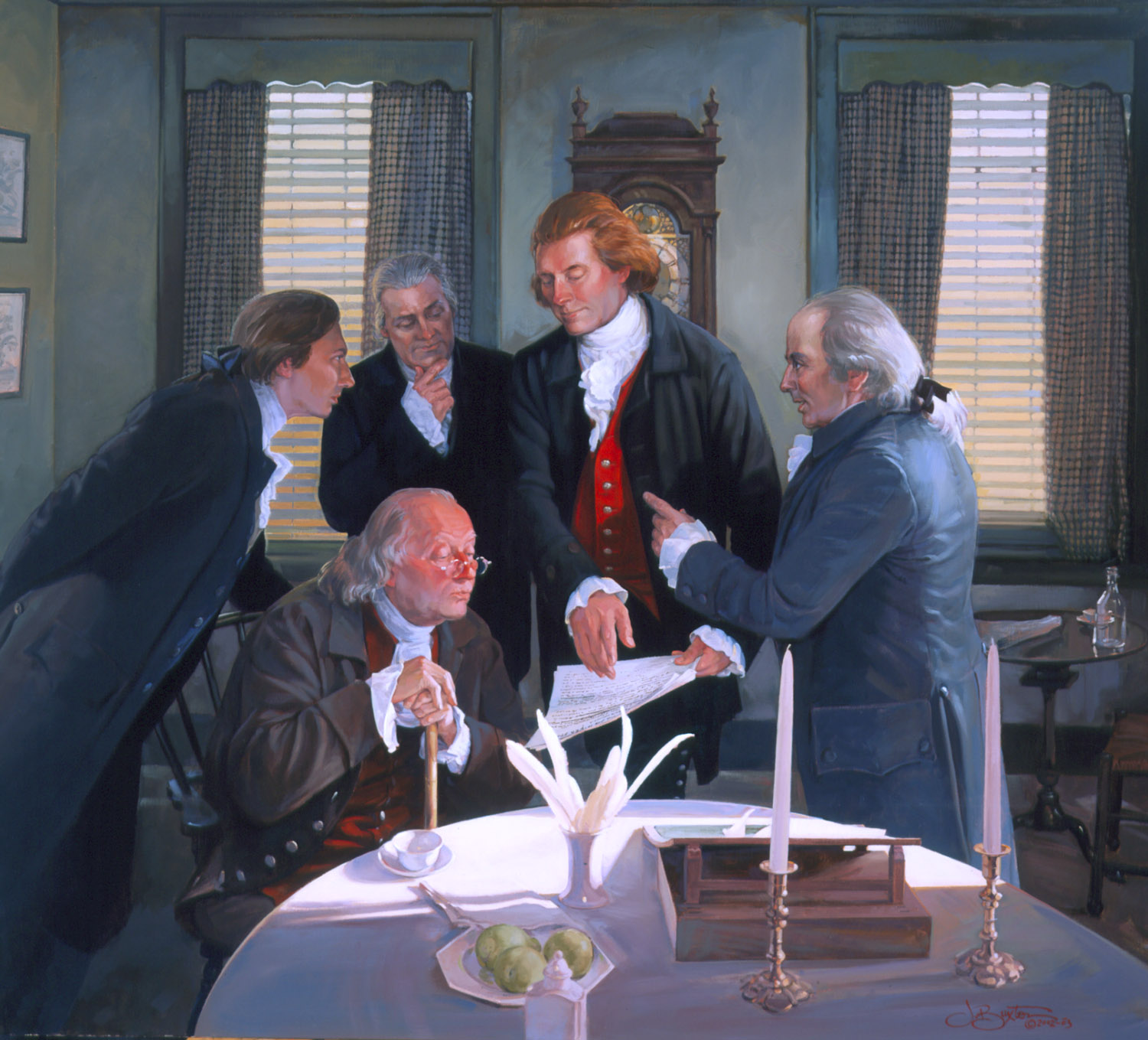
Do we still hold these truths to be self-evident? Image from Greenwich Workshop.


Why Republicans (and many Democrats)

don’t believe in government for the people

By Lamar W. Hankins / The Rag Blog / August 16, 2011

“I promise you this. I’ll work every day to try to make Washington, D.C., as inconsequential in your life as I can.” — Rick Perry, Candidate for the Republican nomination for president

Nearly all Republicans, and many Democrats, don’t believe in the American government because they don’t believe in the basic tenets of our democracy, they don’t believe in the Constitution, and they don’t believe in the Declaration of Independence.


Based on their actions in the last 30 years, nearly all Republicans (as well as many, sometimes most, Democrats and some independents) don’t believe that government should have the purposes envisioned by our founders. The Declaration, for instance, provides as follows:

We hold these truths to be self-evident, that all men are created equal, that they are endowed by their Creator with certain unalienable rights, that among these are life, liberty and the pursuit of happiness. That to secure these rights, governments are instituted among men, deriving their just powers from the consent of the governed.

For the most part, these politicians — all members of what I will call the Finance Party — don’t like the fact that governments are created by people (for now, I will ignore the misogyny implicit in the word “men”) to secure the basic rights of equality and a multitude of other rights — life, liberty, and the pursuit of happiness — which were further explained and expanded in the Constitution’s Bill of Rights.

All of these ideas from the Declaration and Constitution create an implicit bargain — a social contract — among the American people. The essence of that social contract is that we will help one another by joining together to form a government that will serve the interests of us all.

Governance — the task given to our elected representatives — is all about balancing the social contract and the rights we have so that one group cannot dominate another, a view anathema to the members of the Finance Party, who are perfectly happy

  • deciding who can marry whom;
  • helping corporations dominate American life in any way that satisfies their quest for greater profits;
  • enriching the wealthy further, insisting that people pull themselves up by their bootstraps (ignoring the fact that to do so literally means that you land on your backside when you try);
  • denying the basic need of all people for adequate food, housing, education, and medical care if they are unable to afford those things because they can’t find a job, are unable because of infirmity to hold a job, or are a child in need of nurture and care;
  • making medical decisions for others, particularly women;
  • passing laws like Medicare Part D in a way that enriches the pharmaceutical and insurance industries at the expense of the people and creates greater deficits;
  • letting half the people and many corporations get away with contributing nothing to fund the federal government;
  • refusing to stabilize Social Security through two simple methods — expanding the payroll tax to all earned income, and recovering most Social Security benefits paid to the wealthy through the tax system;
  • and fighting wars that do little if anything to protect America, but everything to enrich “defense” contractors, funding these wars with borrowed money.

I could go on, but I hope readers get the idea. The signers of the Declaration believed that laws should be adopted that are “most wholesome and necessary for the public good.” This is virtual heresy to most members of the Finance Party. Republicans in particular, along with a substantial number of Democrats, do not want laws that are for the public good. They want laws that benefit the corporations and the wealthy, particularly those that contribute to their political campaigns.

The Constitution itself provides that one of the purposes of our form of government is to “promote the general Welfare.” But the Finance Party members believe that government should promote the welfare of the wealthy.

The latest entrant into the Republican presidential sweepstakes believes that Social Security and Medicare are unconstitutional. When challenged on this notion and asked to explain what was meant by the “general Welfare” language of the Constitution, Rick Perry had no answer, which should not be surprising for someone that made a grade of D in a class on how to feed goats.

It is myopic to believe that the founders did not envision a role for the federal government in assuring that the elderly and infirm are not forced into penury and destitution by an economic and political system based on exploitation and greed. But these Finance Partiers are more than happy to enrich the corporations and toady up to the moneyed at the expense of the many. Rick Perry is just one more feckless politician from the party of finance who is seeking more power and money for his patrons.

We, the people, formed a government to be consequential in our lives, to overcome the tyranny of despotic rule, and to promote the general welfare. Now that we have a government that does just the opposite, it seems time to make use of our rights to reconstitute our government to meet the needs of the public, not the special interests of the financial class. We can do so with our votes and our voices.

[Lamar W. Hankins, a former San Marcos, Texas, city attorney, is also a columnist for the San Marcos Mercury. This article © Freethought San Marcos, Lamar W. Hankins. Read more articles by Lamar W. Hankins on The Rag Blog.]

The Rag Blog

Posted in Rag Bloggers | Tagged , , , , , | Leave a comment

Common Dreams : President Ricky Perry, Aggie

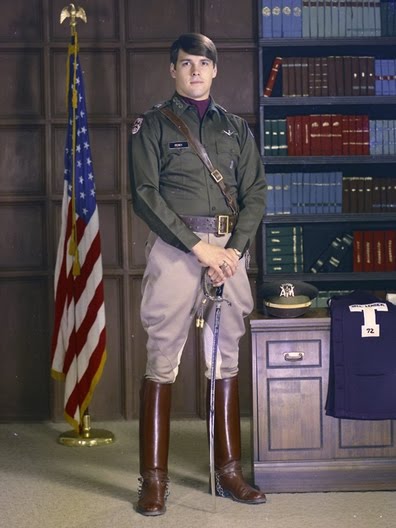
Ricky Perry, Cadet, 1972…


President Ricky?

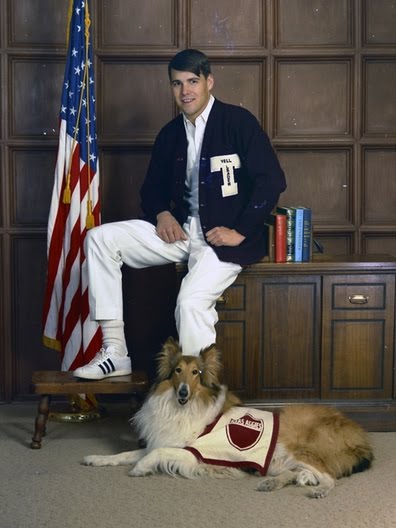
Cadet, cheerleader… Aggie


By Common Dreams / The Rag Blog / August 15, 2011

Sure Michele Bachmann and Sarah Palin are batshit crazy. But Rick Perry as a brown-shirted cadet and cheerleader at Texas A&M University… whoa!

The Texas Tribune writes:

When Rick Perry arrived at Texas A&M University in 1968, it was at the end of a summer in which Soviet troops crushed the Prague Spring, protesters at the Democratic National Convention were met by a police riot and the United States reeled from the twin assassinations of Martin Luther King Jr. and Robert F. Kennedy. With its conservative culture, military tradition and focus on agriculture, few places in the U.S. might have seemed more insulated from the prevailing currents of the age… Perry was elected a yell leader — an esteemed male cheerleader who has traditional responsibilities at major athletic events — and social secretary for his class. And he was exceedingly loyal to the corps, which he credited with giving him the discipline to get an animal sciences degree — his 2.5 grade point average wasn’t high enough to go the veterinary route — and join the Air Force.


…and Ricky Perry, Aggie (with Reveille), 1972. Images from Cushing Memorial Library and Archives, Texas A&M University / Texas Tribune / Common Dreams.


The Rag Blog

Posted in RagBlog | Tagged , , , | 3 Comments

ART / Jordan Flaherty : ‘Every Portrait Tells a Story’

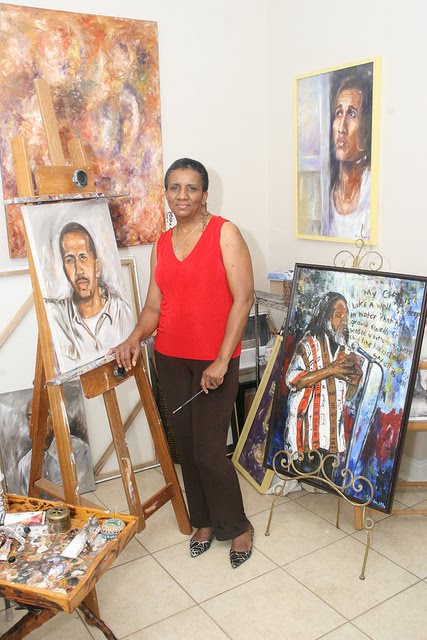
Sheila Phipps with some of her work from the exhibit, “Every Portrait Tells a Story.” Photo from Loop21.


A mother’s art:

Every portrait tells a story

Sheila Phipps does portraits of young men she believes were convicted of crimes they did not commit. Her son, New Orleans rapper ‘Mac,’ is serving 30 years for manslaughter and her art proclaims his innocence.

By Jordan Flaherty / The Rag Blog / August 14, 2011

NEW ORLEANS — As the date approaches for the 10th anniversary of her son’s conviction, Sheila Phipps is hard at work completing a powerful and moving series of paintings that tell the stories of wrongly-convicted young men in the U.S. prison system.


Phipps, a self-taught artist in New Orleans, has been selling and displaying her work for more than 20 years. Her son is Mckinley “Mac” Phipps, the legendary New Orleans rapper who was convicted of manslaughter in 2001 and sentenced to 30 years in prison.

In collaboration with the Innocence Project, Phipps contacted prisoners across the nation and researched their cases. Once she read enough evidence to convince her of their innocence, she communicated with the prisoner and then painted an image of them.

Now, Phipps is unveiling a series of 10 works, for a show called the Injustice Exhibition. Her use of color and framing varies with the inspiration, ranging from muted portraits to bright explosions of color, often capturing small details like focusing on a subject’s feet or hands. In the portrait of her son she highlights the gentle features of his face.

Seeing her son locked away caused Phipps’ to use her art in another way, as both activism and as release.

“To be honest I didn’t know what else to do,” says Phipps. “I’ve had four lawyers. One of the lawyers said she don’t even think the judges read the appeals we’ve written.” The hope is that her art will wake up people to the lives being wasted in prison — not only her sons’, but all lives.

“Art is a way to express yourself,” she says. “So why not express yourself by raising awareness?” Phipps started painting in the 1980s, using art as a way to relax from the strain of raising her six children. She quickly caught the attention of Sandra Berry who runs the Neighborhood Gallery, a New Orleans arts institution. “Her work is absolutely wonderful,” says Berry. “There is a sensitivity and a mother-like compassion in her work that she brings to every subject.”

The subject for whom Phipps’ compassion is most concentrated, her son “Mac,” started rapping at the age of seven. At 11, his talents won him a contest held at New Orleans’ Superdome, for which he won a record deal. He released his first album, featuring production work by former Cash Money Records artist Mannie Fresh — who would later develop the sound that made Cash Money Records famous — at age 12.

Painting by Sheila Phipps from “Every Portrait Tells a Story.” Image from Loop21.


By the age of 22, Mac had released two more albums, and was one of New Orleans’ most popular rappers. His collaborations included tracks with Master P, Snoop Dogg, and Mystikal. According to Phipps, Mac stayed grounded, despite his success. “He’s a very humble person,” she says. “He doesn’t even smoke and drink, if you can believe that in this day and time.”

On February 22, 2000, after a concert in Louisiana, a fight broke out and a young man named Barron C. Victor Jr. was shot and killed. Phipps, who helped book her son’s shows, was there that night. According to her, Mac was nowhere near the altercation. “Mac was in the corner signing autographs,” she says. “When the shots we’re fired, he hit the floor like everyone else.”

According to Phipps, Mac ran out of the club, but then came back in with a gun drawn. The reason? Phipps says he was trying to rescue her. “He heard the gunshot and didn’t know what was going on,” she says. “All he knew is, I gotta get my momma out of there.”

Although ballistics tests showed that Mac’s gun (which he had a license to carry) had never been fired, he was charged with second degree murder. Another man came forward and said that he had killed Victor, but prosecutors said they found his story unreliable. Mac was sentenced to 30 years behind bars. It was his first offense.

“Before this happened to my son, I thought when people went to jail that they were supposed to be there,” says Phipps. “Going to trial, I see how these DA’s twist stories just to get a conviction. Then they go home and sleep at night while innocent people are just sitting there behind bars.”

Mac’s story continues to inspire outrage. A documentary about his case, called “The Camouflaged Truth,” is currently in post-production, and last year Dee-1, an up-and-coming conscious New Orleans rapper with several videos in rotation on MTV networks, organized a benefit concert to raise awareness about Mac’s case. For Sheila, every day that Mac is locked up is a struggle, but she plans to continue fighting. “I want to travel with the exhibit,” she says. “Just to shine light on the prison system and how they railroad people. I hope that this will open up a lot of people’s eyes.”

View photos of Sheila’s work here: “Source Every Portrait Tells a Story.” For more about Mac and his case, see Source http://www.free-mac.org. You can contact Sheila at sheilaphippsstudio@yahoo.com

.

[Jordan Flaherty is a journalist and staffer with the Louisiana Justice Institute. His award-winning reporting from the Gulf Coast has been featured in a range of outlets including The New York Times, Al Jazeera, and Argentina’s Clarin newspaper. His new book is FLOODLINES: Community and Resistance from Katrina to the Jena Six. He can be reached at neworleans@leftturn.org, and more information about Floodlines can be found at floodlines.org. This article was also published at Loop21. Find more articles by Jordan Flaherty on The Rag Blog.]

The Rag Blog

Posted in Rag Bloggers | Tagged , , , , | Leave a comment

New Film ‘The Help’ Whitewashes the Civil Rights Struggle into a Heartstring-tugging Hallmark Card

By Julianne Escobedo Shepherd / AlterNet / August 14, 2011

This week, disgusted by The Help’s revisionist history, scholar and pundit Melissa Harris Perry began livetweeting the film halfway through it. This one summed it up best: “I just timed it. Miss Skeeter’s date got same amount of screen time as Medgar Evers assassination. #TheHelpMovie sigh.”

Hollywood’s compulsion for feel-good movies is annoying at best, but when applied to storylines that are ostensibly historical — particularly when they involve issues that people still don’t seem to understand — they can be toxic.

In The Help’s case, the history of civil rights in the virulently racist Southern town of Jackson, Mississippi, is neatly packaged into a heartstring-tugging Hallmark card, set to a rousing Mary J. Blige soundtrack, that completely trivializes the suffering and hard work that went into making civil rights a reality.

It also implies, perhaps inadvertently, that after the ‘60s everything was fine and dandy for non-whites in America, not to mention domestic workers. As The Nation points out, the civil rights struggle in Mississippi is still having to hang tough:

In the past few years, Mississippi activists’ formula of visible black and immigrant partnership, within a “workers’ rights/civil rights” frame, abetted by dogged labor organizing, has added up to visible success.

There’s no coincidence civil rights and workers rights groups are more successful when they band together — working class labor is more likely to be done by Latinos and other non-white groups. In particular, domestic workers are still among the last to receive basic rights such as sick leave, vacation pay, and overtime.

In New York, these were granted to domestic workers just last year. In June 2011, an international coalition for domestic workers was successful among a broad coalition at the Geneva Convention, ensuring basic rights and protection for laborers around the world, but the United States still leaves it up to states to decide how domestic workers will be treated, and is not likely to ratify it.

Thanks to The Help’s sugarcoating, the National Domestic Worker’s Alliance has been compelled to release a video discussing the truth about the country’s maids, nannies, and chauffeurs. As Colorlines notes,

The 2.5 million women who keep contemporary families going by cleaning their homes while looking after the young, the old and the infirm are still not covered by a large number of labor laws. Congress initially excluded domestic workers and agricultural workers from the Social Security and the Fair Labor Standards Acts specifically to keep “the help” under the thumbs of their employers. These workers were incorporated into some aspects of labor law over time — that kind of discrimination being, well, illegal — but they still suffer from an almost-total lack of enforcement.

Back to the movie, The Help. Based on Kathryn Stockton’s best-selling novel, it follows Skeeter, an idealistic, plucky young white journalist who was raised by a black nanny, and her interactions with similar black domestic workers Aibileen and Minny (who are played by the great actors Viola Davis and Octavia Spencer, but whose characters’ essential Mammy-ness cannot be overlooked).

She interviews Aibileen and Minny after much persuading, detailing the travails of their daily lives in a book. After tears, laughter and hugs, mutual understanding and racial harmony ensue.

There’s a lot written about the “magical negro” — the sagely black character in films who exists only to enlighten the white main character, and then go away. But its inverse is the scourge of the “magical cracker” — the white protagonist who becomes a vessel for a film’s disempowered characters, and therefore becomes the hero of the story, trivializing their actual struggle.

The Help is a classic example of “magical cracker” — Skeeter is the only way in which poor disempowered maid Aiblieen can tell her story, to recognize that she is worthy of a voice. Skeeter writes a book about the maids of Jackson, therefore as Harris-Perry put it in a tweet, “#TheHelpMovie reduces systematic, violent racism, sexism & labor exploitation to a cat fight that can be won w/ cunning spunk.”

When the super-sassy Minny talks back, she is simply reprimanded or let go — obscuring the fact that such petulant behavior toward whites by blacks in the Jim Crow South was often met with violence and murder.

A statement from the Association of Black Women Historians further details this whitewashing:

Both versions of The Help also misrepresent African American speech and culture. Set in the South, the appropriate regional accent gives way to a child-like, over-exaggerated “black” dialect. In the film, for example, the primary character, Aibileen, reassures a young white child that, “You is smat, you is kind, you is important.”

In the book, black women refer to the Lord as the “Law,” an irreverent depiction of black vernacular. For centuries, black women and men have drawn strength from their community institutions. The black family, in particular provided support and the validation of personhood necessary to stand against adversity. We do not recognize the black community described in The Help where most of the black male characters are depicted as drunkards, abusive, or absent. Such distorted images are misleading and do not represent the historical realities of black masculinity and manhood.

Furthermore, African American domestic workers often suffered sexual harassment as well as physical and verbal abuse in the homes of white employers. For example, a recently discovered letter written by Civil Rights activist Rosa Parks indicates that she, like many black domestic workers, lived under the threat and sometimes reality of sexual assault. The film, on the other hand, makes light of black women’s fears and vulnerabilities, turning them into moments of comic relief.

Similarly, the film is woefully silent on the rich and vibrant history of black Civil Rights activists in Mississippi. Granted, the assassination of Medgar Evers, the first Mississippi based field secretary of the NAACP, gets some attention. However, Evers’ assassination sends Jackson’s black community frantically scurrying into the streets in utter chaos and disorganized confusion — a far cry from the courage demonstrated by the black men and women who continued his fight.

Portraying the most dangerous racists in 1960s Mississippi as a group of attractive, well dressed, society women, while ignoring the reign of terror perpetuated by the Ku Klux Klan and the White Citizens Council, limits racial injustice to individual acts of meanness.

Tone-deaf white liberalism is at the heart of this film — the concept that some white liberals want everything to be okay and everything to be equal (up to a point), but don’t want to deal with the “icky” parts that go along with getting there in a fundamentally unjust society. It’s a reflection of white privilege, of course — that a book such as The Help could be so well received and its filmic counterpart so dunderheaded and feel-good, as if it were just another romantic comedy with a cheery outcome.

So with all the historical whitewashing, why does this type of film continue to exist? EW’s Martha Southgate puts it most succinctly:

Suffice it to say that these stories are more likely to get the green light and to have more popular appeal (and often acclaim) if they have white characters up front. That’s a shame. The continued impulse to reduce the black women and men of the civil rights movement to bit players in the most extraordinary step toward justice that this nation has ever known is infuriating, to say the least. Minny and Aibileen are heroines, but they didn’t need Skeeter to guide them to the light. They fought their way out of the darkness on their own — and they brought the nation with them.

On the off chance that you simply enjoy feel-good movies, might I recommend The Great Debaters, which dealt with Civil Rights in a more realistic way? And as for historical accuracy, Harris-Perry tweeted several books that would right The Help’s wrongs, including Clinging to Mammy: The Faithful Slave in Twentieth-Century America. While it’s always excellent to see a cast of talented black women getting starring roles in top films, let’s start demanding that Hollywood give them better, more accurate, less white-tethered roles to play.

[Julianne Escobedo Shepherd is an associate editor at AlterNet and a Brooklyn-based freelance writer and editor. Formerly the executive editor of The FADER, her work has appeared in VIBE, SPIN, New York Times and various other magazines and websites. This article was published and distributed by AlterNetSource

The Rag Blog

Posted in RagBlog | Leave a comment

Writer and progressive organizer Carl Davidson looks at the summer rebellions in the impoverished communities in London and other industrial centers of the UK — as well as the Arab spring uprisings — and, taking into account our current situation, exacerbated by the GOP-led “Shock Doctrine” — wonders if similar unrest could be in the cards for the U.S. this winter.

Posted in RagBlog | Leave a comment

Robert Jensen : Nature Bats Last

“Celebrating Global Warming.” Art quilt by Laura Wasilowski / PAQA.


Nature bats last:

Notes on revolution and resistance,

revelation and redemption

By Robert Jensen / The Rag Blog / August 14, 2011

[An edited version of this essay was presented as a talk to the Veterans for Peace conference in Portland, Oregon, on August 4, 2011.]

My title is ambitious and ambiguous: revolution and resistance (which tend to be associated with left politics), revelation and redemption (typically associated with right-wing religion), all framed by a warning about ecological collapse. My goal is to connect these concepts to support an argument for a radical political theology — let me add to the ambiguity here — that can help us claim our power at the moment when we are more powerless than ever, and identify the sources of hope when there is no hope.


First, I realize that the term “radical political theology” may be annoying. Some people will dislike “radical” and prefer a more pragmatic approach. Others will argue that theology shouldn’t be political. Still others will want nothing to do with theology of any kind. At various times in my life, I would have offered all of those objections. Today, I think a politics without a theology is dangerous, a theology without a politics is irrelevant, and radical is realistic.

By politics, I don’t mean we need to pretend to have worked out a traditional political program that will lead us to the land of milk and honey; instead, I’m merely suggesting that we always foreground the basic struggle for power in whatever work we do at whatever level. By theology, I don’t mean that we need to believe in supernatural forces that will lead us to a land of milk and honey; instead, I’m merely pointing out that we all construct a worldview that is not reducible to evidence and logic.

In politics and theology, it’s important to be clear about what we know, and even more important to recognize what we don’t know, what we can’t know, what is instinct and emotion.

And all this needs to be radical — not in the self-indulgent “more radical than thou” style that crops up now and then on the left — but rather in the sense of an unflinching honesty about that unjust and unsustainable nature of the systems in which we live. Whatever pragmatic steps we may decide to take in the world, they should be based on radical analysis if they are to be realistic.

Revolution

I’m not interested in speculating about future revolutions, I don’t take seriously anyone who predicts a coming revolution in the United States, and I doubt that the traditional concept of a revolution is even relevant today — the dramatic changes that lie ahead likely won’t arrive that way. Rather than dream of revolutions to come, it’s more productive to think about the revolutions that brought us to this moment.

Ask an audience to name the three most important revolutions in human history, and the most common answers are the American, French, and Russian. But to understand our current situation, the better answer is the agricultural, industrial, and delusional revolutions. While those national revolutions had dramatic effects, not only on those nations but on the course of the history of the past two centuries, these other revolutions not only reshaped the lives of every human but remade the world in ways that may spell the end of human history as we know it. The agricultural, industrial, and delusional revolutions were — to use a current political cliché — real game-changers.

The agricultural revolution started about 10,000 years ago when a gathering-hunting species discovered how to cultivate plants for food and domesticate animals. Two crucial things resulted, one political and one ecological. Politically, the ability to stockpile food made possible concentrations of power and resulting hierarchies that were foreign to band-level gathering-hunting societies, which were highly egalitarian and based on cooperation.

This is not to say that humans were not capable of doing bad things to each other prior to agriculture, but only that large-scale institutionalized oppression has its roots in agriculture. We need not romanticize pre-agricultural life but simply recognize that it was organized in far more egalitarian fashion than what we call “civilization.”

Ecologically, the invention of agriculture kicked off an intensive human assault on natural systems. While gathering-hunting humans were capable of damaging a local ecosystem in limited ways, the large-scale destruction we cope with today has its origins in agriculture, in the way humans started exhausting the energy-rich carbon of the planet, first in soil.

Human agricultural practices have varied over time and place but have never been sustainable over the long term. There are better and worse farming practices, but soil erosion has been a consistent feature of agriculture, which makes it the first step in the entrenchment of an unsustainable human economy based on extraction.

We are trained to think that advances in technology constitute progress, but the post-World War II “advances” in oil-based industrial agriculture have accelerated the ecological destruction. Soil from large monoculture fields drenched in petrochemicals not only continues to erode but also threatens groundwater supplies and contributes to dead zones in oceans.

While it’s true that this industrial agriculture has produced tremendous yield increases during the last century, no one has come up with a sustainable system for perpetuating that kind of agricultural productivity. Those high yields mask what Wes Jackson has called “the failure of success”: Production remains high while the health of the soil continues to decline dramatically.[1]

That kind of “success” guarantees the inevitable collapse of the system. We have less soil that is more degraded, with no technological substitute for healthy soil; we are exhausting and contaminating groundwater; and we are dependent on an agriculture tied to a fuel source that is running out.

That industrialization of agriculture was made possible, of course, by the larger industrial revolution that began in the last half of the 18th century in Great Britain, which intensified the magnitude of the human assault on ecosystems and humans assaults on each other.

This revolution unleashed the concentrated energy of coal, oil, and natural gas to run the new steam engine and machines in textile manufacturing that dramatically increased productivity. That energy — harnessed by the predatory capitalist economic system that was beginning to dominate the planet — not only eventually transformed all manufacturing, transportation, and communication, but disrupted social relations.

People were pushed off the land, out of communities, and into cities that grew rapidly, often without planning. Traditional ways of knowing and living were destroyed, by force or by the allure of affluence. World population soared from about 1 billion in 1800 to the current 7 billion, far beyond the long-term carrying capacity of the planet.

This move from a sun-powered and muscle-based world to a fossil fuel-powered and machine-based world has produced unparalleled material comfort for some. Whatever one thinks of the effect of such levels of comfort on human well-being — in my view, the effect has been mixed at best[2] — the processes that produce the comfort are destroying the capacity of the ecosystem to sustain human life as we know it into the future, and in the present those comforts are not distributed in a fashion that is consistent with any meaningful conception of justice.

In short, our world is unsustainable and unjust — the way we live is in direct conflict with common sense and the ethical principles on which we claim to base our lives. How is that possible? Enter the third revolution.

The delusional revolution is my term for the development of sophisticated propaganda techniques in the 20th century (especially a highly emotive, image-based advertising/marketing system) that have produced in the bulk of the population (especially in First World societies) a distinctly delusional state of being.

Although any person or group can employ these techniques, wealthy individuals and corporations — and their representatives in government — take advantage of their disproportionate share of resources to flood the culture with their stories that reinforce their dominance. Journalism and education, idealized as spaces for rationally based truth-telling, sometimes provide a counter to those propaganda systems, but just as often are co-opted by the powerful forces behind them.

Perhaps the most stunning example of this is that during the 2000s, as the evidence for human-caused climate disruption became more compelling, the percentage of the population that rejects that science increased.

Why would people who, in most every other aspect of life accept without question the results of peer-reviewed science, reject the overwhelming consensus of climate scientists in this case? Some have theological reasons, and for others perhaps it is simply easier to disbelieve than to face the implications. But it’s clear that the well-funded media campaigns using these propaganda techniques to create doubt have been effective.[3]

Even those of us who try to resist it often can’t help but be drawn into parts of the delusion; it’s difficult to keep track of, let alone understand, all of the fronts on which we are facing serious challenges to a just and sustainable future.

As a culture, these delusions leave us acting as if unsustainable systems can be sustained simply because we want them to be. Much of the culture’s story-telling — particularly that which comes through almost all of the mass media — remains committed to maintaining this delusional state. In such a culture, it becomes hard to extract oneself from that story.

Singer/songwriter Greg Brown captures the trajectory of this delusional revolution when he speculates that one day, “There’ll be one corporation selling one little box/it’ll do what you want and tell you what you want and cost whatever you got.”[4]

In summary: The agricultural revolution set us on a road to destruction. The industrial revolution ramped up our speed. The delusional revolution has prevented us from coming to terms with the reality of where we are and where we are heading.

Art and resistance: Mural on the Palestine Wall. Image from Tidings.

Resistance

Even if a revolutionary program is not viable at the moment, strategies and tactics for resistance are crucial. To acknowledge that the social, economic, and political systems that have produced this death spiral can’t be overthrown from the revolutionary playbooks of the past does not mean there are no ways to affirm life.

We face planetary problems that seem to defy solutions, but the U.S. empire and predatory corporate capitalism remain immediate threats and should be resisted. An honest, radical assessment of our situation doesn’t mean giving up, but it requires us to be tough-minded. We need to understand which resistance strategies and tactics are likely to be most productive at this moment in history.

To advance that discussion, let’s think back to February 15, 2003. Many of us on that Saturday participated in actions in opposition to the planned U.S. invasion of Iraq. It was an exhilarating day, the largest coordinated political protest in the history of the world.

At least 10 million people participated across the globe, with a clear message for U.S. policymakers: The invasion being planned is illegal and immoral, and we reject not only this war but your right to use violence to achieve your political and economic goals. I was the emcee of the event in Austin, and I remember being amazed at the thousands who gathered at the Texas Capitol, stretching back so far that our loudspeakers couldn’t reach the entire crowd.

We had a compelling message, rooted in international law, political principles, and moral values. We had huge numbers of people. We had an international presence. And none of it mattered; the war came.

Why could U.S. policymakers ignore us without consequence? First, those elites knew that a large segment of the public either actively supported the war or would passively support almost any war that was out of sight/out of mind. Second, they knew that when that day of protest was over, most of the people in the streets would go home, satisfied with their public statement and unlikely to go beyond that polite expression of dissent.

Political movements are most potent when people are willing to take risks; without a large number of such people, the powerful know they can wait out protests.

For most people, attending an anti-war rally posed no risk. Immigrants and people in targeted groups (Arabs, South Asians, Muslims) had reason to feel threatened, but people who look like me — with only rare exceptions — don’t face serious repression in the United States today for engaging in peaceful political activity, though that can change quickly.

What were most of us willing to do beyond attending a rally in opposition to a war being planned? A month later, when the war came, we got a partial answer. The crowd for the standing call to come to the Capitol when the bombs fell was at best one-fourth of the pre-war rally. Most of the people who came on February 15 weren’t willing to come out in public once the nation was at war; even that trivial a risk was too much.

I could be cocky and say that in 2003 I was willing to risk my job, my physical safety, even my life to stop the war. It might be true; I certainly felt the urgency of the moment. But the question is moot, because at that time there was no strategy for taking such risks. These decisions about risk are made by individuals but in the context of options developed collectively, and the movement I was part of had not discussed such options.

So, when certain resistance tactics don’t work as part of a strategy that’s not clearly articulated, it’s time to rethink. I have no grand strategy to offer, and I am skeptical about anyone who claims they have worked out such a strategy. But I am reasonably confident that this is not a mass-movement moment, not a time in which large numbers of Americans are likely to engage in political activity that challenges basic systems of power and wealth.

I believe we are in a period in which the most important work is creating the organizations and networks that will be important in the future, when the political conditions change, for better or worse. Whatever is coming, we need sharper analysis, stronger vehicles for action, and more resilient connections among people. In short, this is a cadre-building moment.

Although for some people the phrase “cadre-building” may invoke the worst of the left’s revolutionary dogmatism, I have something different in mind. For me, “cadre” doesn’t mean “vanguard” or “self-appointed bearers of truth.” It signals commitment, but with an openness to rethinking theory and practice.

I see this kind of organizing in some groups in Austin, TX, where I live. Not surprisingly, they are groups led by younger people who are drawing on longstanding radical ideas, updating as needed to fit a changing world. These organizers don’t have all the answers, and I don’t agree with some of the answers they do have, but I am drawn to them because they recognize the need to dig in.

Revelation

Most discussions of revelation and apocalypse in contemporary America focus on the Book of Revelation, also known as The Apocalypse of John, the final book of the Christian New Testament. The two terms are synonymous in their original meaning — “revelation” from Latin and “apocalypse” from Greek both mean a lifting of the veil, a disclosure of something hidden from most people, a coming to clarity. What is the nature of this unveiling today? What is being revealed to us?

A reactionary end-times theology turns that particular book of the Bible into the handbook for a death cult, fantasizing about an easy way out. That isn’t the direction I will be heading. Rather than thinking of revelation as divine delivery of a clear message about some fantastic future above, we can think of it as a process that requires tremendous effort on our part about our very real struggles on this planet.

That notion of revelation doesn’t offer a one-way ticket to a better place, but reminds us that there are no tickets available to any other place; we humans live and die on this planet, and we have a lot of work to do if, as a species, we want to keep living.

That process begins with an honest analysis of where we stand. There is a growing realization that we have disrupted natural forces in ways we cannot control and do not fully understand. We need not adopt an end-times theology to recognize that on our current trajectory, there will come a point when the ecosphere cannot sustain human life as we know it.

As Bill McKibben puts it, “The world hasn’t ended, but the world as we know it has — even if we don’t quite know it yet.”[5]

McKibben, the first popular writer to alert the world to the threat of climate change, argues that humans have so dramatically changed the planet’s ecosystems that we should rename the Earth, call it Eaarth:

The planet on which our civilization evolved no longer exists. The stability that produced that civilization has vanished; epic changes have begun. We may, with commitment and luck, yet be able to maintain a planet that will sustain some kind of civilization, but it won’t be the same planet, and hence it won’t be the same civilization. The earth that we knew — the only earth that we ever knew — is gone.[6]

If McKibben is accurate — and I think the evidence clearly supports his assessment — then we can’t pretend all that’s needed is tinkering with existing systems to fix a few environmental problems; massive changes in how we live are required, what McKibben characterizes as a new kind of civilization.

No matter where any one of us sits in the social and economic hierarchies, there is no escape from the dislocations of such changes. Money and power might insulate some from the most wrenching consequences of these shifts, but there is no escape. We do not live in stable societies and no longer live on a stable planet. We may feel safe and secure in specific places at specific times, but it’s hard to believe in any safety and security in a collective sense.

This is a revelation not of a coming rapture but of a deepening rupture. The end times are not coming, they are unfolding now.

Bill McKibben. Image from The Boston Globe.

Redemption

Just as revelation can be about more than explosions during the end times, redemption can be understood as about more than a savior’s blood washing away our sin. In a world in which so many decent people have been psychologically and theologically abused by being called “sinner” by jealous and judgmental scolds, sin and redemption are tricky terms.

But we shouldn’t give up on the concept of sin, for we are in fact all sinners — we all do things that fall short of the principles on which we claim to base our lives. Everyone I know has at some point lied to avoid accountability, failed to offer help to someone in need, taken more than their fair share.

Given that we all sin, we all should seek redemption, understood as the struggle to come back into right relation with those we have injured. If we are to live up to our own moral standards, we must deepen our understanding of sin and its causes so that we can understand the path to redemption.

For Christians, sin traditionally has been marked as original and individual — we are born with it, and we can deal with it through an individual profession of faith. In some sense, of course, sin is obviously original. At some point in our lives we all do things that violate our own principles, which suggests the capacity to do nasty things is a part of normal human psychology.

Equally obvious is that even though we live interdependently and our actions are conditioned by how we are socialized, we are distinct moral agents and we make choices. Responsibility for those choices must in part be ours as individuals.

But an individual focus isn’t going to solve our most pressing problems, which is why it is crucial to focus on the sins we commit that are created, not original, and solutions that are collective, not individual.

These sins, which do much greater damage, are the result of — we might say, created by — political, economic, and social systems. Those systems create war and poverty, discrimination and oppression, not simply through the freely chosen actions of individuals but because of the nature of these systems of empire and capitalism, rooted in white supremacy and patriarchy. Humans’ ordinary capacity to sin is intensified, reaching a different order of magnitude, and responsibility for the resulting sins is shared.

There is a politics to sin, and therefore there has to be a politics to redemption. That desire to return to right relation with others in our personal lives is not enough; collectively we have to struggle for the same thing, which requires us to always be working to dismantle those hierarchical systems that define our lives.

Within hierarchy, right relation is impossible; assertions of dominance and concentrations of power create domination and abuses of power. That includes the most abusive of all hierarchies: The human claim to a right to dominate everything else. Our most important struggle for redemption concerns our most profound sin: Our willingness to destroy the larger living world of which we are a part.

The first step in redemption is to not turn away from that lifting of the veil, to face honestly what we have done, to contest the culture’s delusions wherever possible. Then we can face what we must do to enhance justice and build sustainable living arrangements.

What does this kind of redemption look like in practice? I think we should proceed along two basic tracks. First, we should commit some of our energy to the familiar movements that focus on the question of justice in this world, such as anti-war struggles. We redeem ourselves — especially those of us with privilege that is rooted in that injustice — through that commitment to fighting empire, capitalism, white supremacy, and patriarchy.

But I also think there is important work to be done in experiments to prepare for what will come in this new future we can’t yet describe in detail. Whatever the limits of our predictive capacity, we can be pretty sure we will need ways of organizing ourselves to help us live in a world with less energy and fewer material goods.

We have to all develop the skills needed for that world (such as gardening with fewer inputs, food preparation and storage, and basic tinkering), and we will need to recover a deep sense of community that has disappeared from many of our lives. McKibben puts this in terms of a new scale for our work:

The project we’re now undertaking — maintenance, graceful decline, hunkering down, holding on against the storm — requires a different scale. Instead of continents and vast nations, we need to think about states, about town, about neighborhoods, about blocks… We need to scale back, to go to ground. We need to take what wealth we have left and figure out how we’re going to use it, not to spin the wheel one more time but to slow the wheel down… We need, as it were, to trade in the big house for something that suits our circumstances on this new Eaarth. We need to feel our vulnerability.”[7]

Nature bats last

The phrase “nature bats last” circulates these days among people who have their eye on the multiple, cascading ecological crises. The metaphor reminds us that nature is the home team and has the final word. We humans may be particularly impressed with our own achievements — all of the spectacular home runs we have hit with science and technology — but when those achievements are at odds with how nature operates, then nature is going to bring in the ultimate designated hitter and knock the human race out of the ballpark.

OK, let’s not try to stretch this too far — no single metaphor can work at every level needed. The point is simple: We are not as powerful as the forces that govern that larger living world.

The metaphor offers one other crucial lesson, in this case because of its limitations. When we say “nature bats last,” it implies we are one team and nature is on another, as if it were possible for us to compete with nature. But we are, of course, simply part of nature, one species in an indescribably diverse living world. To imagine ourselves as competing with nature would be like our lungs competing with our heart — either those organs work together, or an individual human dies.

Unfortunately, the architects of modern science didn’t see the world that way. One of the most often-quoted, Francis Bacon, believed that modern science and technology “have the power to conquer and subdue [nature], to shake her to her foundations.” Rene Descartes, another of these founding fathers, believed humans could achieve the knowledge and develop the means to know:

the force and action of fire, water, air, the stars, the heavens, and all the other bodies that surround us, as distinctly as we know the various crafts of our artisans, we might also apply them in the same way to all the uses to which they are adapted, and thus render ourselves the lords and possessors of nature.

These thinkers also contributed to our understanding of the workings and power of the natural world. But this language of domination — to conquer and subdue, becoming lords and possessors — is the language not of a baseball game but of war, which brings us to the relevance of this to Veterans for Peace. VFP members have seen through and gone beyond the egotistical rhetoric of our national fundamentalism — with all its fraudulent claims about “fighting for freedom” — to reject the U.S. wars of empire and stake out an audacious goal: “To abolish war as an instrument of national policy.”

We also need to see beyond the egotistical rhetoric of our technological fundamentalism — the claims that infinitely clever humans will solve all problems with gadgets — and stake out an even more audacious goal: To end the human war on the rest of living world.

3-D concept art by Alex Broeckel, Germany / CoolVibe.

Life is hard

If all this seems too much to ask of ourselves, that’s because it is. We live in a time when we must face honestly the whole truth, but to do that is too much to bear. We struggle to claim our power at the moment when we are more powerless than ever, and find hope where there is no hope.

On power: Those of us in dissident movements understand we face difficult odds, fighting entrenched forces of the state and corporation. We know the keys to prevailing: Fight organized money with organized people; compromise to build a power base but never abandon core principles; find ways to delegitimize authority; raise the social costs for elites to pursue unjust policies; hang in for the long haul. Those organizing basics don’t change, though the application of them must constantly adapt to changes in the structure of power. But the ecological crises change things in the big picture.

First, we should not assume the long haul is as long as we’ve always imagined. No one can predict the rate of collapse if we stay on this trajectory, and we don’t know if we can change the trajectory.

There is much we don’t know, but everything I see suggests that the world in which we will pursue political goals will change dramatically in the next decade or two, almost certainly for the worse. Organizing has to adapt not only to changes in societies but to these fundamental changes in the ecosphere. We are organizing in a period of contraction, not expansion.

Second, we can’t be satisfied with contesting imperialism in the nation-state and the concentration of wealth in corporate capitalism, but also must change the human relationship to the living world.

Dissident movements have an advantage, given that a larger percentage of people involved in left/radical politics have less of a commitment to maintaining the dominant culture’s delusions. Radicals don’t have the wealth and power that can appear to insulate us from collapse, which means we have more room to think about what living arrangements are consistent with reality. Elites, who typically mistake temporary domination for real power, have a harder time recognizing that humans are powerless in the face of the forces we have been trying to conquer and subdue.

In the end, we can never be the lords and possessors of something larger and more enduring in time. Many traditions recognize this basic reality: We don’t own the earth, the earth owns us. Our power comes in recognizing our powerlessness and adapting to the world as it is, not the world as we imagine it to be.

How does this approach give people hope? It doesn’t, and it shouldn’t, because hope is not something you give to people. The political organizers on the liberal/left who are always touting a new way to restore the American Dream are peddlers of false hope, offering allegedly exciting opportunities to allegedly new movements that are stuck in the same old failed ideology of the dominant culture, steadfastly ignoring the depth and scope of the ecological crises.

Real hope comes with abandoning the false prophets and moving on to accomplish something. Authentic hope comes when we honestly confront our condition and dig in to create new, or revive old, forms of community. Hope comes from proving to ourselves that we are competent to manage our own lives. Hope doesn’t fall from the sky but rather is built from the ground up.

That hope doesn’t ask for guarantees that our movements will prevail. That hope doesn’t require us to pretend we know whether the human experiment will go on forever. That hope comes from the understanding that while we did not choose to live in a desecrated world, such is the world into which we were born.

All we can do is act out of respect for ourselves, for each other, and for nature, in the hope that we can restore the sacredness of the individual, the human community in which individuals find meaning, and the living world of which human communities are a part.

Organizers have long said that the key to successful organizing is making it easy for people to do the right thing. Today, our task is to be honest about how difficult it is to do the right thing. Anyone who thinks it can be easy to do the right thing is part of the delusional culture. Rather than delude ourselves, let’s face the truth and recognize the difficulty of the path that lies ahead.

Other social movements have prevailed in the face of great difficulty, but no social movement has had to face this simple but profound reality: We have to become the first species on the planet to practice restraint in the scramble for energy-rich carbon. All life on this planet is based on that scramble, but if we continue on the path unchecked the planet will be incapable of sustaining human life as we know it.

That is a brand new organizing challenge. In facing it, we need to leave the platitudes at home.

The radical political theology I believe we need for this moment in history would acknowledge, rather than try to mask, our confusion and uncertainty. We know we are in deep trouble; beyond that, it’s guesswork. Facing that takes a new kind of courage.

We usually think of courage as rooted in clarity and certainty — we act with courage when we are sure of what we know. Today, the courage we need must be rooted in the limits of what we can know and trust in something beyond human knowledge. In many times and places, that something has gone by the name “God.”

Religious fundamentalism offers a God who will protect us if we follow orders. Technological fundamentalism gives us the illusion that we are God and can arrange the world as we like it. A radical political theology leaves behind fear-based protection rackets and arrogance-driven control fantasies.

The God for our journey is neither above us nor inside us but around us, a reminder of the sacredness of the living world of which we are a part. That God shares the anxiety and anguish of life in a desecrated world. With such a God we can be at peace with our powerlessness and alive in hope. With such a God, we can live in peace.


References:

[1] Wes Jackson, New Roots for Agriculture (Lincoln: University of Nebraska Press, 1980), chapter 2. Many of my points in this talk were greatly influence by the work of Jackson and The Land Institute, http://www.landinstitute.org.

[2] Tim Kasser, The High Price of Materialism (Cambridge, MA: MIT Press, 2002).

[3] Naomi Oreskes and Erik M. Conway, Merchants of Doubt: How a Handful of Scientists Obscured the Truth on Issues from Tobacco Smoke to Global Warming (New York: Bloomsbury Press, 2010).

[4] Greg Brown, “Where Is Maria?” from the CD “Further In,” Red House Records, 1996.

[5] Bill McKibben, Eaarth: Making Life on a Tough New Planet (New York: Times Books/Henry Holt, 2010), p. 2.

[6] McKibben, Eaarth, p. 25.

[7] McKibben, Eaarth, p. 123.


[Robert Jensen is a journalism professor at the University of Texas at Austin, where he teaches courses in media law, ethics, and politics — and a board member of the Third Coast Activist Resource Center in Austin. His books include All My Bones Shake: Seeking a Progressive Path to the Prophetic Voice, and Getting Off: Pornography and the End of Masculinity. His writing is published extensively in mainstream and alternative media. Robert Jensen can be reached at rjensen@uts.cc.utexas.edu. Read more articles by Robert Jensen on The Rag Blog.]

The Rag Blog

Posted in Rag Bloggers | Tagged , , , , , , , , | 2 Comments

Nancy Miller Saunders : Jane Fonda and the ‘Home of the Brave’

Jane Fonda at the Oleo Strut GI Coffee House, Killeen, Texas, circa May 1970. Photo by Thorne Dreyer / Space City!


Jane Fonda and the ‘home of the brave’

By Nancy Miller Saunders / The Rag Blog / August 11, 2011

“I was infuriated as I learned just how much our soldiers were being lied to about why we were fighting in Vietnam and I was anguished each time I would be with a young man who was traumatized by his experiences.” — Jane Fonda

The same day Obama and the Democrats caved in to Republican Tea Party extremists on the deficit, I learned that the cable channel QVC canceled an appearance by Jane Fonda because of angry calls from extremists objecting to her anti-Vietnam War activities. It has been nearly 40 years since that war ended yet these Swiftboater-types still cling to hatred of her, much of which is based on lies and distortions.


Yes, the picture of her sitting and laughing on a Vietnamese anti-aircraft gun damned her in many people’s eyes. But appearances can be misleading, which they are in this case as she explains in a recent piece, “The Truth About My Trip To Hanoi,” posted on her blog.

Although one picture may be worth a thousand words, those words can be misleading as easily as they can be revealing. But rather than risk letting go of their hatred by listening to her explanations of what happened and why she went to North Vietnam, these Swiftboaters have clamped their minds shut around their hatred. One mistake in an otherwise exemplary campaign to stop an increasingly unpopular war and Fonda is condemned forever and always.

We claim in our national anthem that ours is “the home of the brave.” Is it, when our president and Congress knuckle under to extremists’ threats to bankrupt the country? Is it, when cable channels let bullies frighten them out of letting a movie star peddle her latest book on an entirely different topic?

Where is the bravery in these cave-ins? Where is the bravery in our docile acceptance of such hateful extremism? We recently saw true bravery in Tahrir Square in Cairo, Egypt, where people fed up with corruption nonviolently withstood fierce attacks and toppled Hosnei Mubarak’s regime. We are seeing it again in the streets of Syria where people are being gunned down for their nonviolent protests.

Jane Fonda is a brave woman who looked beyond her instinctive feelings that would not let her imagine the United States could ever fight an unjust war. But then she met and listened to active duty GIs and Vietnam veterans. She began to study that war and discovered what it was doing to the men being sent to fight it. She worked to find them help they needed.

When they asked, she spoke for them, using her celebrity to amplify their voices in an effort to get the American people to listen to what they had to say about what was being done in our name and to our sons, brothers, and neighbors. Only with knowledge — not emotional assumptions, no matter how treasured — can we correct our mistakes and maybe, just maybe, avoid making them again in the future. But, sadly, we have repeated them in Iraq.

Fonda also campaigned for an organization that was unprecedented in our history: Vietnam Veterans Against the War (VVAW). Never before had U.S. combat veterans massed together to protest the continuation of the war in which they fought, but Vietnam veterans did just that, beginning in 1968.[1]

Two years later Fonda was working with VVAW and I found myself listening to the war’s veterans after VVAW asked a group of us filmmakers to film their first two major demonstrations. They pointed out that they had the message and we had the means to broadcast it.

We put together four film crews to accompany VVAW and document the first demonstration, a RAW March over Labor Day weekend, 1970, from Morristown, New Jersey, to Valley Forge, Pennsylvania.[2] (RAW stood for Rapid American Withdrawal from Vietnam.) Those of you old enough to remember that day may know that we risked being busted for crossing a state line to foment a riot, even though starting a riot was definitely not our intention.

Whenever possible VVAW used paradigms from the American Revolution to emphasize their patriotism and dedication to our founding principles. The route they chose was one some of George Washington’s troops took to Valley Forge that memorable winter. In towns along the way, the veterans performed guerrilla theater in which they used volunteers acting as Vietnamese civilians to demonstrate their sanctioned brutality during the many search and destroy missions they had been sent on.

Image from the 1972 documentary film, Winter Soldier. Photo from Winterfilm Collective.


We filmmakers were with VVAW the entire weekend, even camping on the ground next to the veterans’ encampment all three nights. We interviewed them, waded into the middle of their guerrilla theater to film it, and watched with growing admiration as they resisted provocation after provocation. They knew what violence is like and the damage it can do. They did not want to yield to it here at home.

At Valley Forge on Labor Day, VVAW staged a rally that began with more than 200 veterans making a moving entrance. Fonda was one of the speakers, again using her celebrity to amplify what the veterans had to tell their fellow citizens. She then left on a nationwide tour of campuses, introducing veterans to VVAW and recruiting volunteers for the next major action.

That second action was the Winter Soldier Investigation (WSI) in Detroit, Michigan, Jan. 31-Feb. 2, 1971, when more than 100 Vietnam veterans gave “straightforward testimony — direct testimony — about acts which are war crimes under international law. Acts which these men have seen and participated in. Acts which are the inexorable result of national policy.”[3]

Contrary to extremists’ accusations, VVAW carefully vetted the men it let testify. All had to have their discharge papers and IDs with them. Their testimony was checked against what other veterans knew, against documented evidence and whatever else the organizers could lay their hands on. We filmed the entire three days of testimony as well as related events and interviews with men who testified. Fonda financed us and attended the investigation, though she did not speak at it.[4]

The memories I brought away from the WSI are of haunted eyes of old men who had seen too much grief in already long lives — as they looked at me from youthful faces. The contrast was proof of their stories. I remember seeing tough, war-hardened men break down and weep. I remember them hugging each other for mutual support. I remember listening to gut-wrenching testimony hour after hour for the full three days.

And I remember a love that spread from the veterans to include all of us who took the time to listen, to really listen, to what they had to say. This was a love far more powerful than any romantic love. It was the love of shared commitment.

Working on those two films with VVAW changed my life, much as I imagine listening to GIs and veterans changed Fonda’s. Neither of us had to do what we did, but our hearts and souls had been touched. We knew, as few civilians did, why the war had to be ended. Its destruction had come home in the bodies and minds of those sent to fight it. Sadly there are people still trapped with the hatred necessary for war, necessary to make rational human beings kill other human beings.

I was so moved that I vowed to write the truths I learned about the war, about our national policy, and about the terrible toll it had taken on its veterans, and about the Nixon administration’s efforts to silence and discredit VVAW. A number of veterans entrusted their stories to me to tell, much as others had trusted Fonda to speak for them.

In far subtler ways than the blatant lies and hatred used to vilify Fonda, I was hounded, intimidated, pressured, and threatened — in attempts to make me shut up. The pressure was subtle, and friends to whom I turned for help told me to “stop being so paranoid” — but some of the veterans stood by me. The first two people not directly involved with VVAW to believe me both had connections in the CIA, which suggests that I was not being paranoid. At times I was so terrified that I did stop… for a while.

The cumulative result of this harassment is that it took me nearly 40 years to finally keep my vow. Unable to find a publisher brave enough to work with me, I had to self-publish Combat by Trial: An Odyssey with 20th Century Winter Soldiers.[5] All that interference would make another good book.

In a second book I would include the lessons I learned from the veterans about overcoming one’s fears, about reaching down inside oneself to find the courage needed to continue, about the value of humor and laughter. And I would write about a man I met, Budd Saunders, a combat veteran who believed me — although he was not a VVAW member or even a veteran of the Vietnam War.

Budd protected me, loved me, married me, and encouraged me to finish Combat by Trial. On our living room wall is a photograph of two of the veterans who most influenced me during those difficult years. One of them, Scott Camil, was hounded far worse than I was. He was framed several times, once for a capital offense (kidnapping), and he was shot in the back (the bullet barely missing his heart) by DEA agents when he refused to let them set him up on a drug deal.

Underneath their photograph I have pasted a quote from Scott: “If you let them demoralize you, then they’re effective. If you don’t, they aren’t. That’s up to you, not them.”

If enough of us keep such thoughts in mind, instead of clinging to our fears and wishful beliefs, we can rebuild our “home of the brave.” But it will take all of us finding the strength and courage that dwells within each of us to speak out against lies, distortions, and intimidation; to stand up to the corporate bosses who would squeeze us dry for their profit. And, above all, to stop letting hatred destroy us personally and as a nation.

References:

[1] Iraq and Afghanistan veterans have joined together in Iraq Veterans Against the War (IVAW).

[2] Different Sons , Bowling Green Films, New York, NY.

[3] Excerpt from the transcript of the opening statement to the Winter Soldier Investigation, January 31, 1971.

[4] Winter Soldier, Winterfilm, New York, NY; reissued by Millarium Zero, Harrington Park, NJ.

[5] Nancy Miller Saunders, Combat by Trial: An Odyssey with 20th Century Winter Soldiers, iUniverse, Bloomington, IN, 2008.

[Nancy Miller Saunders was a member of Winterfilm Collective which documented activities of the Vietnam Veterans Against the War. She is the author of Combat by Trial and is a freelance writer living in the Arkansas Ozarks with her husband Budd Saunders.]

Also see:

The Rag Blog

Posted in Rag Bloggers | Tagged , , , , , , , , | 11 Comments

VERSE / Felix Shafer : hey, marilyn

hey, marilyn

From august

through Black august

the drum beat us

all black and blue

and back again

where we live

inside shadows

with you

*

Here on the sad

fuming planet

comes a laughing ghost

beloved fugitive

our first anniversary

spun from these burning strands

our sensitive memory

of the afterlife without you

oh marilyn

a toast to your year

a salute to our tears

for the shadow of the panthers

cetewayo, shasha

smitty, dc and g (eronimo)*

now passing by


*

Here in my heart

a branch of middle summer

intermingles the past

with life’s juggly light

flowing like fire

over the river wide

your red kite

tangled, unescaped

high among

the maple trees

We are your family

the red blood cells

in & out of prison cells

the red resistance cells

grouped by transience

side by side

overcoming

great misfortune

in the lonely outside

*

Last night I dreamed

of walking down storied halls

a familiar house

after the typhoon

people known by their resemblances

returned, some drained of smiles

some doing yoga

some replacing mislayed objects

overcome in bedrooms

A daring girl led me closer to the last window

beyond where I can see

There where the backyard

ought to be

was the outdoor visiting patio

of FCI Dublin

*

We come to recollect your absence

with ourselves

to feel your palm

resting on each hand

To receive your

loving encouragment

and your example:

That to live we must risk ourselves

for the uncertain future

with dignity

*

Marilyn because

you were charming

and unb0wed

because you had

miles of style and acres of smiles

because you were a generous

citizen of earth

sister and god mother

I am throwing open the door

to release the bars

to forget the cancer and the tears

so that I can see

your shining face

*

When it’s quiet

when i lay deep down to sleep

i whisper kindness and

when I rise up

i sing of how

you wanted us to be happy and strong

when we were with you

Now a year after you have gone

I will We will

felix shafer 8.3.11


* Michael Cetewayo Tabor, Henry ShaSha Brown, Marc Smitty Smith, Don Cox and geronimo ji Jaga pratt are freedom fighters associated with the Black Panther Party & some with the Black Liberation Army who passed in the year since Marilyn died


Marilyn Buck — political prisoner, acclaimed poet, former Austinite, and former original Ragstaffer — was paroled last August after spending 30 years in federal prisons. But, after only 20 days of freedom, on August 3, 2010, Marilyn died of a virulent cancer.

Felix Shafer became an anti-imperialist/human rights activist while in high school during the late 1960’s and has worked around prisons and political prisoners for over 30 years. He is a psychotherapist in San Francisco and can be reached at felixir999@gmail.com. Read Felix Shafer’s three-part Rag Blog series, “Mourning for Marilyn Buck.”

Why We Sing


By Mario Benedetti

If every hour comes with its death


if time is a den of thieves


the wind is no longer a good


and life is nothing more than a moving target

you might ask, why do we sing?

if our bravos are left without support


our homeland dies from sorrow


and the heart of man is smashed to pieces


even before the shame explodes

you might ask, why do we sing?

if we’re as far away as the horizon


and if over there were left the trees and the sky


if every night is always some sort of absence


and if every waking is a missed encounter

you might ask, why do we sing?

We sing because the river is calling


and when the river calls, the river calls


we sing because cruelty has no name


and destiny does have a name

we sing because the child and because all


and because someday and because the people


we sing because the survivors


and our dead want us to sing

we sing because to shout is not enough


and the crying and the cursing is not enough


we sing because we believe in people


and because we will defeat failure

we sing because the sun recognizes us


and because the fields smell of spring


and because in this stalk in that fruit


every question has its answer

we sing because it rains over the furrows


and we are the militants of life


and because we neither want nor can


allow the song to be turned to ashes.

Mario Benedetti (Sept. 14, 1920 – May 17, 2009) a Uruguayan poet, journalist, and novelist, was considered one of Latin America’s most significant authors. Active in radical movements, he went into exile in 1973 when the military, backed by the U.S. CIA, took power. For 10 years, Benedetti lived in Argentina, Peru, Cuba, and post-Franco Spain. Mario Benedetti returned to Uruguay in 1983, yet lived for long periods in Madrid, Spain. Exile marked his life profoundly and one of his most important works is El Desexilio y Otras Conjeturas (Dis-exile And Other Conjectures, 1984). Marilyn Buck, who wrote about the internal exile of imprisonment, considered Mario Benedetti one of her favorite writers.

The Rag Blog

Posted in Rag Bloggers | Tagged , , , , , | 3 Comments