Ted McLaughlin : Unemployment News is Nothing to Celebrate

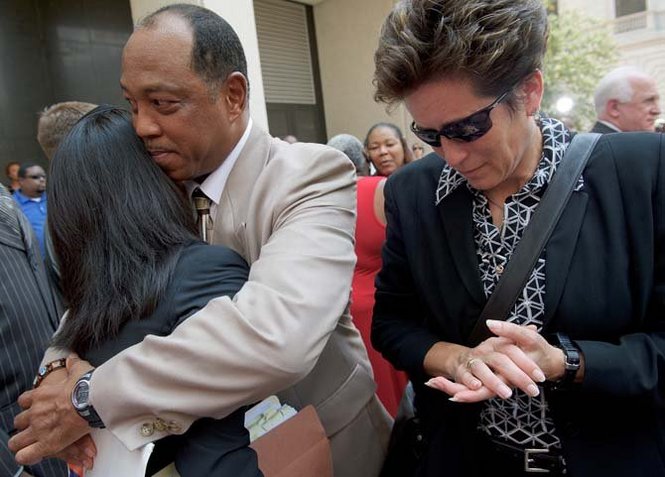
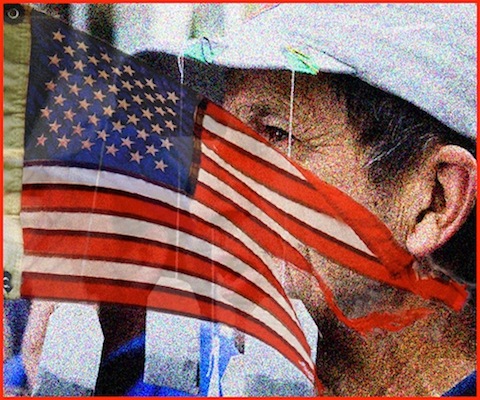
No celebration here. Image from the Atlanta Post.


The new unemployment numbers

are nothing to get excited about

By Ted McLaughlin / The Rag Blog / August 8, 2011

The U.S. Labor Department released its unemployment figures for the month of July, and if you just gave a cursory glance at the headlines you might think the unemployment situation is improving. There are headlines saying things like “Unemployment Rate Down,” “Jobs Rebound In July,” “Hiring Picks Up,” and “Improving Jobs Outlook.” Headlines like that could make a person feel like good times are back.


But don’t be fooled. Good times are not back and the unemployment situation is not getting better. Now you may want to correct me by saying that 117,000 jobs were created in July and the unemployment rate fell from 9.2% to 9.1% — isn’t that an improvement? Actually no. Let me explain.

While the 117,000 jobs created in July were more than the anemic number created in June, they were not even enough to cover the number of new workers entering the work force. It would take at least another 30,000 to 40,000 to do that. So the truth is that once again we have more people out of work than we did the month before — actual unemployment got worse.

But if we have more people unemployed, how did the unemployment rate fall from 9.2% to 9.1%. To understand that you have to know how the government figures the unemployment numbers. Any person that the government cannot verify has looked for work in the last four weeks is not counted as unemployed. They may still be unemployed and looking for work on their own (or have given up), but they are no longer counted by the government as unemployed.

In fact, the government figures show that the workforce (the employed plus the official unemployed) shrank last month. In June it was 153.4 million people, but in July it was only 153.2 million people. Of course the workforce didn’t actually shrink — the government is just not counting an additional 200,000 people (probably because they can’t be verified as looking for work in the last four weeks). This statistical shrinkage is the reason the official unemployment rate fell from 9.2% to 9.1%.

In June, the government figured the unemployment rate by dividing the number of unemployed (14.1 million) by the total workforce (153.4 million), and that came out to 9.2%. In July, after ignoring the 200,000 people they no longer want to count, they divided 13.9 million unemployed by a workforce of 153.2 million, and got a rate of 9.1%. That makes it look like the rate is going down, but it’s all just a numbers and statistics game — those people now being ignored are still out there and still out of work.

The government calls those they don’t wish to count as people “marginally attached” to the workforce. They estimate the number of those people to be about 2.8 million people. That figure is probably very low because these people do not receive unemployment benefits and no longer visit the unemployment office — making them very hard to count.

But let’s assume the government is correct and the number is about 2.8 million. To get a truer picture of the real employment number we need to add them back to the unemployed number and the total workforce number. Then dividing the number of unemployed (now 16.7 million) by the total workforce (now 156 million), we find a more honest unemployment rate of 10.7%.

And if you add in the number of the underemployed (those involuntarily working part-time because they can’t find full-time work — about 8.4 million people), the rate climbs much higher. Adding the 16.7 million unemployed to the 8.4 million underemployed, we get a figure of 25.1 million (which is the number of full-time jobs needed for full employment). It would take nearly 18 years (at 117,000 jobs a month) to achieve that (and then only if no new workers entered the workforce in those 18 years).

Dividing the 25.1 million by the 156 million workforce (since the 8.4 million underemployed are counted as employed and included in the workforce number), we come up with an unemployment/under employment rate of 16.1%. That is a horribly high number, but it is the number we really should be worrying about because it more accurately reflects the number of Americans who cannot find full-time jobs.

Now you may be telling yourself at this point that we are still doing better than during the Great Depression when the unemployment rate peaked at 22.1% in 1932. But that’s like comparing apples to oranges. The unemployment rate was figured differently back then. If the Great Depression unemployment rate was figured like the government computes unemployment now, it would be somewhere between 10% and 16%.

Since our current rates are between 10.7% (the unemployed) and 16.1% (adding in the underemployed), it looks to me like we are already experiencing Great Depression unemployment rates! And we haven’t even discussed the 1.8 million jobs our economy is expected to lose due to the new debt ceiling deal. That could jack the rates up to between 11.9% and 17.2%.

So you can see that we’re still in deep trouble as far as unemployment goes, and it looks like it will be a long time before things get better — especially since neither political party seems to care about doing much to encourage job creation. And don’t even try to tell me the Republican plan of tax cuts for the rich and government cuts is going to create any jobs. That’s the prescription that got us in this mess in the first place.

Celebrate the new 117,000 jobs if you want to, but it’s going to take a LOT more than that to even begin to pull us out of this hole.

[Ted McLaughlin also posts at jobsanger. Read more articles by Ted McLaughlin on The Rag Blog.]

The Rag Blog

Posted in Rag Bloggers | Tagged , , , | Leave a comment

Human rights advocate and Presbyterian minister Jim Rigby believes that the “use of the governor’s office to promote one religion in a country with such rich religious diversity is obviously unhealthy politics” — but that, “if one takes the Christian and Jewish scriptures seriously,” it is also “unhealthy religion.” Rev. Rigby offers five verses of relevant scripture that we aren’t likely to hear at Gov. Rick Perry’s Christian prayer event.

Posted in RagBlog | Leave a comment

Jim Rigby : Scriptures You Won’t Hear at Perry’s Prayer Event

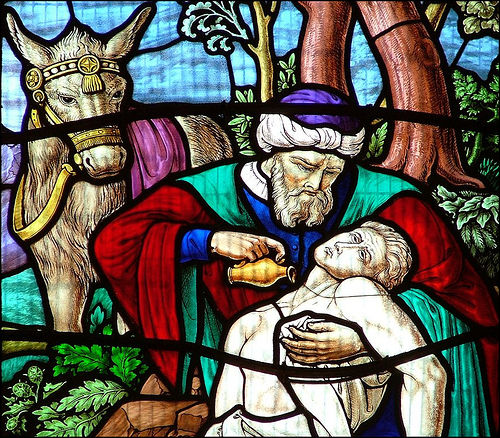
The parable of the Good Samaritan was a lesson in humility. Image from Sarcastic Lutheran.

Five scriptures you won’t hear
at Rick Perry’s prayer event

If the governor wants to call us to repentance it should begin with our real sins against the poor…

By Jim Rigby / The Rag Blog / August 4, 2011

As a native Texan, I’m used to crazy religion and crazy politics. So, the announcement of Gov. Rick Perry’s plans for “The Response,” a prayer event scheduled for August 6 at Houston’s Reliant Stadium, was not a surprise.

But as a Presbyterian minister and community organizer, it’s part of my job to stand up for my neighbors. The use of the governor’s office to promote one religion in a country with such rich religious diversity is obviously unhealthy politics, but — if one takes the Christian and Jewish scriptures seriously — it is also unhealthy religion. Here are five rather important verses of scripture you aren’t likely to hear at “The Response”:

Don’t make a show of prayer

“And when you pray, do not be like the hypocrites, for they love to pray in public places to be seen by others… But when you pray, go into your room, close the door and pray to your heavenly parent, who is unseen.” (Matt. 6:5-6)

While Jesus never addressed the issues most important to some of this event’s co-sponsors, such as homosexuality and abortion, he did speak out against public displays of religion. Whatever Jesus meant by the word “prayer,” it seems to have been about the quiet and personal. The disciples had to ask Jesus how to pray, which is a pretty good indication that he wasn’t praying a lot publicly. What he did say about prayer carried a warning label: “Don’t rub it in other people’s faces.”

God doesn’t withhold rain because we’ve done something wrong

“God causes the sun to rise on the evil and the good, and sends rain on the righteous and the unrighteous.” (Matt. 5:45)

Perry recently called Texans to pray for rain, which implies that God steers clouds toward the worthy. According to Right Wing Watch, one of the events co-sponsors has said the earthquake in Japan happened because the emperor had sex with the Sun Goddess. It may be a part of our lower nature to blame disasters on people we don’t like or understand, but Jesus taught that God sends rain on the just and unjust. Furthermore, he said our love should be equally nonselective.

I have chosen Christianity as my life’s religion, but when nonjudgmental love is taken out of its center, it becomes poisonous and predatory. The word “God” can be a helpful symbol for all the transcendentals of life, but the symbol becomes instantly pathological when used as a scientific explanation or political justification.

God doesn’t have favorites

Then Peter began to speak:

“I now realize how true it is that God does not show favoritism.” (Acts 10:34)

When the Bible says that God is not a “respecter of persons” it means that God doesn’t have a favorite country or religion. The idea that God wants Christians to be in charge of other people violates Jesus’ teaching that we are to take the lowest place. We are to change the world by humble persuasion and good example, not by messianic coercion. The assumption that Christianity and America are God’s two favorite things will be particularly ironic, as the prayer event falls on the anniversary of the bombing of Hiroshima.

Worship by those who neglect the poor is offensive to God

“I hate, I despise your religious festivals; your assemblies are a stench to me… Away with the noise of your songs! I will not listen to the music of your harps. But let justice roll on like a river, righteousness like a never-failing stream!” (Amos 5:21-24)

The prophet Amos chastised the religion of his day for praying to God while mistreating people. Texas leads the nation in citizens who are uninsured, who work for minimum wage, and who die from unsafe working conditions on construction sites. Our state has the widest gap between rich and poor of any in the union. If the governor wants to call us to repentance it should begin with our real sins against the poor, not the imaginary sins dreamed up by his friends.

The heart of Christian ethics is being a good neighbor

When Jesus told the story of the Good Samaritan (Luke 10:30-37) it was to teach humility to a rich young zealot who thought he was approaching moral perfection. The Samaritans were the scapegoats of the day. The rich young ruler would consider Samaritans heretics and immoral people. Jesus used a merciful Samaritan as the example of ethical perfection. It is a lesson many Christians have yet to learn.

One sponsor of the event, the American Family Association, is listed by the Southern Poverty Law Center as a hate group. The group’s director of analysis for government and policy is quoted by the SPLC as saying that Hitler was “an active homosexual” who sought out gays “because he could not get straight soldiers to be savage and brutal and vicious enough.” He also said Muslims should not be allowed in the military or be allowed to build mosques in the United States.

None of this analysis springs from malice. In fact, I must confess that I have a soft spot for Rick Perry. When the James Byrd, Jr. Hate Crimes Prevention Act in Texas was passed, I had the honor of pushing the wheelchair of Byrd’s mother into the governor’s office for the signing. I privately thanked Perry for his courage in standing up to all the groups who had fought against the bill; I knew he might pay a political price for signing the bill. Tears came to his eyes, and he said, “It’s the right thing to do.”

I can’t know what is in Perry’s heart, of course, but I do know the problem isn’t one politician but rather a nation that has embraced an unhealthy political arrogance undergirded by even unhealthier religious hubris. The “prayer” that is most needed at this time is for each of us, believer or not, to go into our own heart and find the humility and empathy that is at the core of righteousness, political and spiritual.

[Rev. Jim Rigby, a human rights activist, is pastor of St. Andrew’s Presbyterian Church in Austin, Texas. He can be reached at jrigby0000@aol.com., and videos of his sermons are available online here. Read more articles by Jim Rigby on The Rag Blog.]

The Rag Blog

Posted in Rag Bloggers | Tagged , , , , , | 3 Comments

David P. Hamilton : French Left Could Prevail in 2012

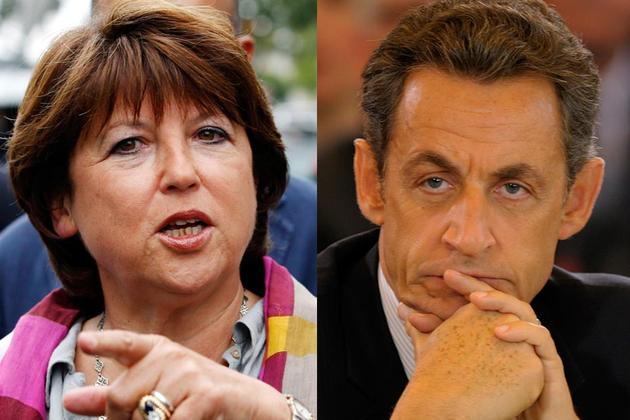
Martine Aubry of the Parti Socialiste (PI) and Nocolas Sarkozy of the Union pour un Mouvement Populaire (UPM) could end up in a runoff for the French presidency. Image from Reuters.

Letters from France VI:
The French presidential election of 2012

Sarkozy won in 2007 over a weak PS candidate, Sègoléne Royal, but his politics don’t reflect those of the majority of French voters…

By David P. Hamilton / The Rag Blog /August 4, 2011

[This is the sixth in a series of dispatches from France by The Rag Blog‘s David P. Hamilton.]

PARIS — In 2012, there will be a presidential election that offers at least some hope and opportunity for the left, the one that takes place next spring in France.

The president of France is elected every five years. Conservative Nicolas Sarkozy was elected in 2007 and will stand for reelection in 2012. Given the conservative Sarkozy’s persistent unpopularity, he’ll probably lose to the candidate of the Parti Socialiste (PS) and we will have the first socialist president in France since 1995 and only the second since the founding of the Fifth Republic 53 years ago.

And there is a good chance it will be the first woman president of France as well.

French presidential elections are fundamentally different from American presidential elections. They are largely publicly-funded and tightly regulated. Compared to U.S. federal elections, those in France are qualitatively less corrupted by corporate financing. Corporate contributions to political candidates or parties were prohibited in 1992 during the presidency of Francois Mitterrand, the only previous PS president. A study by the U.S. Library of Congress states,

The intent of the [French] Parliament was to cut any link between the economic world and the political world. To compensate for this loss of funding, it sensibly increased public funding.

Unlike in the U.S., French campaign expenditures are capped. That cap was roughly $32 million in 2007 for the two candidates making it into the second round finals. Obama plans to spend $1 billion getting reelected in 2012 and Republicans will try to match him.

In France, personal campaign contributions are capped at $6,300. All candidates are given free and equal TV time and they can’t buy more. This is not to say that no one cheats or that corporations still don’t have undue influence, but the official rules are profoundly better than those in the U.S. In France the government is not a wholly owned subsidiary of the mega-corporate hegemony and democracy still has a chance.

French presidential elections involve two rounds of voting, two weeks apart. To maximize participation, the elections take place on Sundays, not Tuesdays — a work day — as in the U.S. The first round in 2012 takes place next April 22. In it, candidates from many parties will run.

To qualify for a position on the ballot, a candidate must gather the signatures of 500 elected representatives in at least 30 (of 95) different French departments. This doesn’t seem to be a great obstacle. In the 2007 election, there were 11 candidates in the first round. The nine representing parties other than the two main parties won 43% of the first round votes. In 2002, there were 16 parties in the first round and the 14 smaller parties garnered over 63%.

In that year, the candidate of the far-right Front Nationale (FN), Jean Marie Le Pen, made it into the second round run off with only 17% of the first round vote, barely beating out the PS candidate. This was the result of the left vote being split among seven different parties, with parties to the left of the PS receiving 21% of the first round vote.

Le Pen was crushed in the second round by the candidate of the center-rightist Union pour un Mouvement Populaire (UMP), Jacques Chirac, whose vote went from 19% in the first round to 82% in the second, as the entire left was forced to support him in order to avoid the election of a neo-fascist.

The French presidential election would have only one round if someone got over 50% in the first round, but no one has ever come close to doing that. Close to half the electorate identifies with parties other than the two main ones of the center-left and center-right.

The 2012 second round run off takes place on May 6th. The normal and expected result is that the center-right UMP and the center-left PS will get the most votes in the first round and make it into a runoff. That has been the result every election except in 2002. Given voter fear that 2002 might happen again, there is a very strong likelihood that in 2012 the PS and UMP will face off again in the run off.

For many months, polls have shown the current French president, Nicolas Sarkozy of the UMP, with high disapproval ratings, though the most recent polls have showed that his political fortunes have somewhat improved. From a low in April of 20%, Sakozy’s most recent approval ratings have risen to 35%. He has benefited from the demise of Dominique Strauss-Kahn (usually known as DSK) as a candidate due to his arrest in New York and the lack of another PS contender of equal stature.

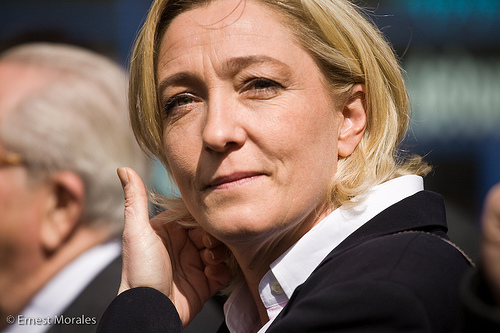
Far right candidate Marine Le Pen. Photo by Ernest Morales / The Perspectivist.

Sarkozy has also benefited at the expense of Marine Le Pen, who experienced a bubble of popularity when she took over the FN from her father, a bubble that has since receded. Still, Sarkozy’s approval ratings are the lowest of any French president since the beginning of the Fifth Republic in 1958 and lower than when his party was hammered in the regional elections this past March. Even with his recent rise in the polls, Sarkozy’s approval ratings remain 13 and 19% behind his principal PS challengers.

Sakozy’s popularity problems are not a mystery. They derive from the dislike many have for his personality and the fact that his rightist positions are just not very popular with the French public. He is seen as wanting to Americanize France, not a popular notion.

In those recent regional elections, his UMP was beaten badly, maintaining control of just one of France’s 22 regions, a major personal defeat for Sarkozy. Then in June his predecessor as president, the popular Jacques Chirac, also from the UMP, blasted Sarkozy in Chirac’s newly published memoirs as being “unFrench” and temperamentally unsuited to be president.

Sarkozy’s effort to raise the age at which one could begin receiving an old age retirement pension cost him politically. His banning the veil and deporting Roma were seen as efforts to win the anti-immigrant vote from the far right. He has been stained by allegations of political payoffs. His participation in the NATO alliance in Afghanistan is unpopular.

Typical of his missteps is his party’s position on gay marriage. They killed the most recent effort in the National Assembly to allow gay marriage despite polls that showed 63% of the French public supporting it. Their hard line opposition to reform of marijuana laws faces similar popular disapproval. With most of the French public wanting to reduce their dependency on nuclear energy after the disaster in Japan, Sarkozy increased the government’s investment in it.

Sarkozy’s taking the lead in the attack on Qaddafi in Libya was popular at first, but was again seen as an effort to appeal to the far-right supporters of Le Pen and it didn’t substantially improve his low poll numbers. That is now turning sour as well.

Sarkozy won in 2007 over a weak PS candidate, Sègoléne Royal, but his politics don’t reflect those of the majority of French voters, 43% of whom think capitalism is “fundamentally flawed.” Important members of his legislative coalition such as ex-Prime Minister Dominique de Villepin have abandoned him and threatened to run for president against him. Prominent centrists such as Francois Bayrou (Democratic Movement) and Jean-Louis Borloo (Radical Party) may also run against him.

Sarkozy will need lots of help to win. Without everything falling in his favor, the odds are that the next president of France will be from the Parti Socialiste.

The big question is who will be the Parti Socialiste nominee. Six candidates have entered the PS primary to be held in two rounds a week apart in October. Polls show Francois Hollande or Martine Aubry practically tied for the lead and far in front of the other four candidates. Hollande has been campaigning since March and has a slight lead.

Aubry had an agreement with DSK not to run against him. She didn’t enter the race until June when it became apparent DSK was out. She has closed the gap and now is running a close second to Hollande. Hollande was the leader of the Socialist Party from 1997 to 2008. Aubry has been the leader since 2008. There is not a great deal of political difference between them. Although Aubry is considered somewhat to Hollande’s left, both are within the mainstream of the PS.

Until his May 5 arrest in New York, Dominique Strauss-Kahn was the prohibitive favorite to be the next president, running as the nominee of the Parti Socialiste. A late April poll showed him 22% ahead of Sarkozy in a run off. The same poll showed Holland beating Sarkozy by 12% and Aubry beating him by 10%.

DSK will likely have the charges against him in New York dropped or reduced, but other accusations of sexual misconduct await him in France. He cannot return to the presidential race as a candidate in the PS primary, because the deadline to enter it has passed. Although he could still run as an independent if his legal troubles end soon, a big majority of the French public no longer wants him as a candidate.

Actually, it is a blessing that DSK is out of the race, great for the Parti Socialiste and for France. DSK is hardly a socialist. He is credited by economist Joseph Stiglitz with having made important reforms at the IMF, but that accolade has proven controversial on the left. However, it is beyond question that DSK headed an institution designed to facilitate the smooth functioning of international capitalism.

His opulent life style and proclivity to hang out with the elite of the international capitalist ruling class showed little evidence that he had much connection with the desires and needs of mere workers. Besides that, he is by far the strongest supporter of Israel among the PS leadership. The PS favored him because he looked like a sure winner. Now they have a renewed opportunity to nominate an actual socialist.

Francois Hollande is the leading candidate for the PS nomination. Besides being First Secretary of the Socialist Party for over 10 years, he is best known for being the partner of Sègoléne Royal, the PS’s losing candidate for president in 2007. Although never married, Hollande and Royal were together for 28 years and have four children.

Royal threw him out just after her 2007 election loss when his affair during the campaign with a French journalist was revealed. Typically, this private peccadillo has been shrugged off by the electorate, but after the DSK affair, the private life of candidates is increasingly seen as worthy of public scrutiny in France.

Sègoléne Royal was seen as a caviar-socialist and lightweight. She lost to Sarkozy by 6%. Then in 2008 she narrowly lost the race for First Secretary of the PS to Aubry. Royal is now running a distant third among candidates for the 2012 PS nomination.

Despite the loss of their majority in the National Assembly by the “plural left” (the PS and its leftwing allies) in 2002 while Hollande was its leader, he was reelected First Secretary of the PS in 2003 “against the leftwing of the party.” In 2005, Hollande advocated PS support for the adoption of the European Constitution in the French referendum. The left of the PS and the Communists opposed the constitution on the basis that it primarily supported capitalist interests.

In a great victory for the left, the vote to endorse the constitution failed in France and that spelled its doom. The fight over the EU Constitution split the PS and sent the party into disarray. Hollande was on the right in that split.

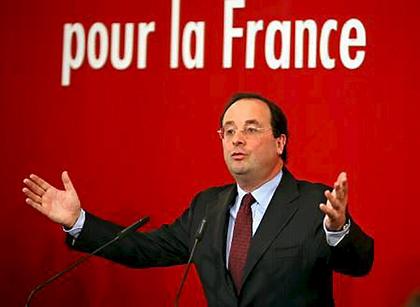
Socialist candidate Francois Hollande. Image from Atlas Forum.

Hollande is seen as lacking charisma, but he seems to relish that characterization. He has promised to be a “normal” president after the upheavals and controversies that have characterized the Sarkozy government. Some of his support stems from his ability to lose over 10 kilograms of weight in preparation to run for president. He seems to promise stability, respectability and minimal change, but with mildly socialist PS leadership.

He narrowly leads in polls among probable participants in the PS primary and among the general public, but he’s been campaigning three months longer than Aubry. Hollande now faces charges that he helped cover up previous sexual transgressions by DSK while First Secretary of the PS. He identifies himself as a practicing Roman Catholic although PS orthodoxy has long favored secularism. It is fair to say that he represents the right wing of the PS, a party whose dedication to socialism has been widely questioned.

Martine Aubry has an impeccable Parti Socialiste pedigree. She is the current First Secretary of the party and the mayor of the northern industrial city of Lille. She was a Minister in two previous PS governments: Minister of Labor from 1991 to 1993 and of Social Affairs from 1997 to 2000.

She is best known as the author of the controversial measure reducing the workweek from 39 to 35 hours. She also introduced a universal healthcare provision that gave full coverage to the poorest families. In 1986, she founded the anti-racist Act Against Exclusion Foundation. She has been mayor of Lille since 2001 and won the 2008 mayoral election with 67% of the vote. She is described as tough and demanding. She responds that “I am up-front and not a hypocrite. I am much less hard than many politicians. I may even be too sensitive.”

Aubry is the best hope of the left. Her election would more likely lead to greater changes in France and in the European Union than if Hollande wins. In addition, Aubry’s victory would be a historic triumph for feminism in France. Aubry’s record on gender equality is unassailable. But many of my left-leaning Paris friends, female and male, referred to her disparagingly as a “bulldog” whom they can’t stand.

This points to two unfortunate problems for her candidacy. First, she will have to overcome the sexism reflected in such remarks. Second, she is not glamorous and chic. Like Sarkozy, her personality is not especially winning. Many French prefer their president to exhibit those personal qualities, regardless of their politics. She probably wouldn’t win a “beauty contest” election, but her image advisors are trying to soften her edges. She is identified as a lapsed Roman Catholic although her father famously broke the barrier against a practicing Roman Catholic being a leader of the PS.

Jacques Delors, Aubry’s father, is a Parti Socialiste icon who was the Finance Minister under Francois Mitterrand (1981-85) and President of the European Commission (1985 – 95). As Finance Minister, he advocated a pause in the extension of the welfare state and the acceptance of the market economy.

He was expected to be the PS presidential candidate in 1994, but turned it down “due to the radicalization of the party which prevented his centrist strategy.” His daughter is considered to be closer to the left wing of the party. That will likely help her in the Socialist Party primary and, if she wins that, in the first round of the presidential election. Delors is supporting his daughter’s candidacy, as is Paris’ popular gay mayor, Bertrand Delanoe.

It was under Aubry’s leadership that the PS changed the rules for its primary election. Historically, only card-carrying members of the party voted to choose their presidential candidate. Now, any French citizen with “sympathies for the left” is entitled to vote in their primary. This will be the case for the first time this year and although what effect it will have is unclear, it is expected to help the left. Polls show that as many as a third of the general public might participate in the PS primary.

Although Hollande polls slightly ahead of Aubry at this time, with six candidates in the race, he doesn’t have enough support to win the PS primary without a runoff. Aubry’s campaign is newer and may not have reached its potential. She may benefit from a growing feminist backlash against the sexism in French politics in the wake of the DSK scandal. As such, she would become the vehicle for the aspirations of French feminists. She would be the first woman to be president of France.

The uncertainties related to the new format of the PS primary — and who among the first round losers would endorse whom in the runoff — provide enough variables to make the likely PS nominee unclear. But it will either be Francois Hollande or Martine Aubry. Sègoléne Royal is running a distant third and is probably out of serious contention. Given her personal history with Hollande, it will be fascinating to hear her second round endorsement.

Hollande and Aubry are graduates of both the prestigious Ecole National de Administration and the Paris Institute of Political Studies. Having attended these schools has been considered virtually a requirement for holding high public office in France. Two-thirds of the CEO’s of major French corporations are graduates of the ENA.

Aubry has been a professor at the ENA and, unlike Hollande, has numerous publications to her credit. Titles of publications she has written include “A Guide for Struggle Against the Extreme Right” (1995), “What is Solidarity?” (2002), “Culture Always and More Than Ever” (2004), “A Vision for Hope, A Will to Transform” (2004), and “Take Action Against Discrimination.” (2006). There is some prejudice against “ENAques” as an elite who have long dominated both French politics and business. Sarkozy is not an “enaque.”

There is a possibility that Marine Le Pen, candidate of the far right Front Nationale (FN), will make the presidential runoff in 2012. She could edge out the PS candidate as her father did in 2002, but it is more likely she would eliminate Sarkozy in the first round. If so, she will lose badly to whoever opposes her in the run off, just as her father did in 2002.

It is the dream of both Sarkozy and the PS nominee, that Le Pen will make the runoff and eliminate their more centrist opponent. There is some possibility of that happening. Polls earlier this year showed Le Pen’s popularity rising, but it has since declined. She has distanced herself from some of her father’s more disreputable positions (e.g., anti-Semitism) and endorsed a more “populist” agenda that conforms in some respects to that of the far left.

Still, the FN cannot win and probably cannot get over 30% of the vote in any runoff regardless of who is the opposition. Given the experience of 2002, which few would want to repeat, the left is more likely to support the PS candidate rather than voting for one of the smaller, further left parties in the first round. And the right is more likely to support Sarkozy of the UMP in the first round rather voting for the FN.

For what it’s worth, the newly adopted platform of the PS emphasizes economic development, aid to small businesses and to youth. High on its list of initiatives is the creation of a public investment bank to help small and medium sized businesses. The PS wants to lower taxes for businesses that reinvest profits and raise taxes on those that pay out profits in dividends to stockholders. They also propose to create 30,000 new jobs for youths in green industries and social services.

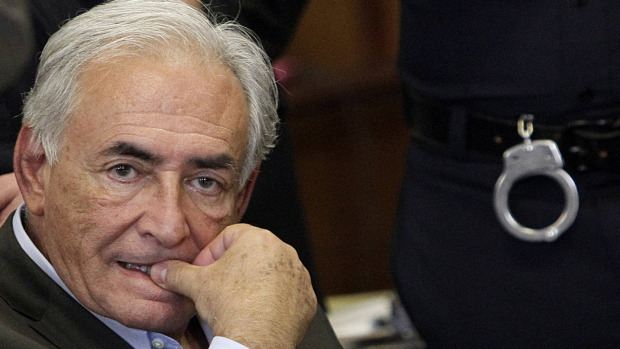
If he isn’t in jail, Dominique Strauss-Kaun could be Finance Minister. Photo by Richard Drew / AFP / Getty Images.

Their other proposals include higher import duties on products coming from countries that do not respect international social, sanitary, and environmental norms; lower taxes on non-polluting products; allowing gay marriage and adoptions; a reduction of reliance on nuclear energy; and reestablishing the minimum retirement age at 60.

If the PS candidate is likely to be the next president, regardless of who that candidate is, what might we expect from that candidate as president? There are a couple of major variables. Will the winning PS candidate be Hollande or Aubry? The consensus is that she is to his left, although they have had some difficulty articulating their differences in the campaign so far. My reading is that the differences between them could be significant.

Another major variable in play is whether there will be a PS or “plural left” majority in the National Assembly or will there be another round of “cohabitation”? With “cohabitation” you have the presidency in the hands of one party and the legislature in the hands of another, a divided government where little gets accomplished. Right now the UMP has a large majority in the legislature, but it did poorly in recent regional elections. The PS is expected to make advances, but will it be enough to take control of the legislature? No one knows.

Regardless, the hypothetical PS president would at least slow Sarkozy’s privatizations and blunt attacks on the reforms and benefit programs won by past left-led governments. But don’t expect the burst of nationalizations and other more radical measures that characterized the beginning of the last PS presidency, Francois Mitterrand in 1981, even if the PS wins the presidency and control of the National Assembly. In general, a new PS president would protect and refine benefits and socialist programs that already exist, such as the world’s best health care system, instead of presenting broad new initiatives.

What could a PS presidency mean in a EU context? If the PS is able to form a governing majority in the legislature, they will name the Prime Minister and his/her cabinet. In that case the key figure could be DSK, a strong candidate to be the future Finance Minister regardless of which PS candidate wins, provided he’s not in jail.

In the ongoing Euro debt crisis, onerous austerity measures, privatizations, and cuts in government spending have been forced upon Greece and others, typical of the pre-DSK approach at the IMF, an approach now widely rejected by potential recipient countries. DSK would be expected to reorient France’s approach to the Euro debt crisis in a manner similar to the changes he made at the IMF.

In praising DSK’s tenure there, liberal Nobel Laureate economist Joseph Stiglitz recently characterized those changes as “the link the IMF has finally drawn between inequality and instability”. Stiglitz goes on to quote DSK’s speech to the Brookings Institute earlier this year where DSK concluded, “Ultimately, employment and equity are the building blocks of economic stability and prosperity, of political stability and peace… It must be at the heart of our agenda.”

The election of a PS president in France is not the revolution. Besides, France has had four revolutions since we had ours. It’s our turn. But as the conservative Jacques Chirac demonstrated at the beginning of the Iraq War, it is sometimes helpful to have nominal friends in high places — like the Èlysée Palace.

[David P. Hamilton has been a political activist in Austin since the late 1960s when he worked with SDS and wrote for The Rag, Austin’s underground newspaper. Read more articles by David P. Hamilton on The Rag Blog.]

The Rag Blog

Posted in Rag Bloggers | Tagged , , , , , | 1 Comment

David MacBryde : In Germany, Power (Grid) to the People!

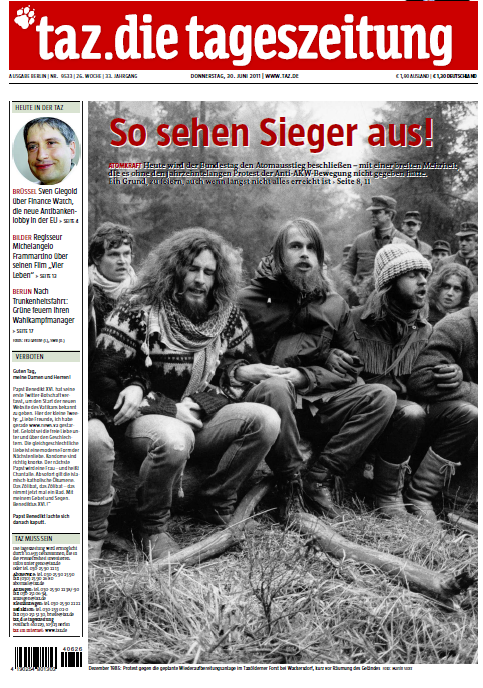
The German daily Die Tageszeitung humorously splashed on their front page a decades old archive photo of environmental pioneers. The headline: “This is what winners look like.”

Power (grid) to the people!
Germany’s ‘great transformation’

By David MacBryde / The Rag Blog / August 3, 2011

BERLIN — In Germany the decision has just been made to shut down ALL nuclear power plants by 2022. This is broadly seen here as a major step in the “great transformation” away from economic activity that endangers and depletes future opportunities and towards activities that achieve sustainable energy and value creation.

During the debate in the German Parliament about energy, Renate Kunast (of the German Green Party) began her presentation by thanking a number of persons by name for their pioneer work decades ago.

Before writing about developments in Germany, I too want to express thanks – for decades of hard work — to Rag Blog contributor Ray Reece, author of The Sun Betrayed, Gail Vittori and Pliny Fisk at the Center for Maximum Potential, Scott Pittman, founder of the Permaculture Institute, recently interviewed by Thorne Dreyer on Rag Radio, and of course many, many others.

The decision just made in Germany will have an effect on physics, economic activity, politics, philosophy, and more.

The main breakthrough here that I want to focus on – and this gets to my headline of “Power to the People” — is what is called the “Einspeisungsgesetzgebung.” That is a (typically German) very long word which refers to the legislative achievement by Jurgen Trittin (of the German Greens) when he was Minister for the Environment and got — in coalition with the SPD (the Social Democratic Party) — majority approval for an energy policy that enables decentrally-produced energy to be fed into the (at the time not-yet-so-smart) grid.

There are several points here:

  1. Physical: The legislation enables the transformation of power lines away from one-way transmission and into being a genuine interactive network.
  2. Economic: This opens opportunities for decentralized power production. And it is a significant step in the very large scale transformation from using up depletable energy to using sustainable, renewable, energy.
  3. The politics of power and power politics: In Germany four energy corporations effectively had (note the past tense) oligopolistic power, both in controlling energy and politically controlling energy policy.
  4. Philosophy: (I will focus on this in this article) “Ontology” is a technical philosophical term for the study of what “is” is — thus raising the question, “What is reality?”

It can be helpful to distinguish between an “impoverished ontology” that only handles a single kind of reality and an “enriched ontology” that can handle a variety of kinds of reality.

In this context we can more specifically ask, What “is” economic growth?

And we can enrich our understanding if we ask, “What kinds of economic growth are helpful, what kinds are harmful? And for whom? And who gets to participate in decisions about that?

The recent decisions made in Germany are part of what here is called the “great transformation” away from “growth” that actually depletes future opportunities to growth that enhances future opportunities.

Mrs. Elanor Ostrom, recent recipient of the Nobel Memorial Prize in Economics, was honored for her work looking at how economic decisions are made. She received a great ovation at her recent talk at the Technical University in Berlin.

Nobel laureate Elinor Ostrom. Photo by Ric Cradick / Indiana Public Media.

Elanor Ostrom is a rather jovial economist. Her main point is that even if the economy is very dismal, it does not have to be so.

Her scientific work focuses less on developing abstract mathematical models of the economy than it does on actually looking at how and by whom decisions are made.

Her main breakthrough — for which she received the Nobel Prize — was to point out that what had, in the history of economics, been called “the tragedy of the commons” — did not have to be tragic.

You can get Ostrom’s insight by first imagining a number of people fishing in a river or ocean. If each fisher maximized his or her catch it might well be possible to over-fish and maybe even exterminate the species. That might destroy future opportunities for future generations.

Ostrom does NOT argue that disasters cannot happen. There are plenty of historical examples of unsustainable overuse. She does argue that such disasters are not always “necessary” or absolutely unavoidable. In her research she finds plenty of examples where a number of different people do succeed in getting their acts together for sustainable fishing.

The classical definition of “tragedy” in old Greek plays involves the audience seeing a disaster necessarily, unavoidably, coming. This is contrasted to “comedy,” which refers to a play with a happy, successful, resolution.

Ostrom herself, perhaps wisely, does not in every case presume that a happy ending can be achieved — she prefers the term “Drama of the Commons.” Situations in which a number of different people do achieve a common solution can involve potential for disaster and considerable drama.

At the present time in the USA there certainly seems to be considerable drama about decision-making.

In Germany decisions on energy policy certainly have involved lots of drama. But the result is a “comedy” in the classical sense of achieving a positive solution. Though it was initiated by the German Greens, in coalition with the SPD (Social Democratic Party), the decision was also supported by a majority of the conservative party (CDU, Christian Democratic Party).

The drama here was intense, especially because of the huge crisis in the capital markets.

There had been lots of hard work over decades (see again the above picture of pioneers) with considerable success, including the breakthrough “Einspeisungsgesetzgebung” for decentralized energy production. Then the man-made capital market crisis hit.

I was very worried, as were many others here, that the reaction to the capital market crisis would derail developments.

Around the September 2008 emergency actions — such as Paulson’s panicky punt with his three-page policy paper — there were emergency efforts around the world, from Berlin to Brazil and Beijing.

The question was would we get an I V U W or L, or get to an E. (These are shapes of economic “growth” curves. I will write an update to my earlier Rag Blog post on this subject.)

Briefly here: In the capital market crisis Germany did take actions and did not collapse straight down (an “I”) and is now booming, relatively speaking — not improving as rapidly as Latin America or some countries in Africa and Asia, but rather well.

There was considerable worry that Germany might get stuck in an “L” — a downturn and a long lack of “recovery.”

Now it does look like Germany, especially with the decisions on energy policy, is back on the track to its “great transition” — to get to an “E.”

The core reality of the success here is that a very broad majority of the people and their parliamentarians now see clearly that the large transformation away from environmental depletion and towards environmental viability is crucial to reducing harmful kinds of economic “growth” and to achieving helpful kinds of economic growth.

And it is now broadly clear here, including within the large German Protestant and Catholic churches, that “social fairness” is not hot air but a significant moral compass and, particularly at this time, a prerequisite for domestic economic development. A range of modest but real wage increases have already been achieved and are helping to stabilize and improve domestic demand.

We will see whether these particular decisions succeed in avoiding tragedy and achieving some comedy. In any case it is dramatic. I will try to write more about what I see happening here.

[Rag Blog Berlin correspondent David MacBryde worked with Austin’s Sixties underground newspaper, The Rag. See more articles by David MacBryde on The Rag Blog.]

The Rag Blog

Posted in Rag Bloggers | Tagged , , , | 3 Comments

David P. Hamilton : French Left Could Prevail in 2012

Martine Aubry of the Parti Socialiste (PI) and Nocolas Sarkozy of the Union pour un Mouvement Populaire (UPM) could end up in a runoff for the French presidency. Image from Reuters.

Letters from France VI:
The French presidential election of 2012

Sarkozy won in 2007 over a weak PS candidate, Sègoléne Royal, but his politics don’t reflect those of the majority of French voters…

By David P. Hamilton / The Rag Blog / July 6, 2011

[This is the sixth in a series of dispatches from France by The Rag Blog‘s David P. Hamilton.]

PARIS — In 2012, there will be a presidential election that offers at least some hope and opportunity for the left, the one that takes place next spring in France.

The president of France is elected every five years. Conservative Nicolas Sarkozy was elected in 2007 and will stand for reelection in 2012. Given the conservative Sarkozy’s persistent unpopularity, he’ll probably lose to the candidate of the Parti Socialiste (PS) and we will have the first socialist president in France since 1995 and only the second since the founding of the Fifth Republic 53 years ago.

And there is a good chance it will be the first woman president of France as well.

French presidential elections are fundamentally different from American presidential elections. They are largely publicly-funded and tightly regulated. Compared to U.S. federal elections, those in France are qualitatively less corrupted by corporate financing. Corporate contributions to political candidates or parties were prohibited in 1992 during the presidency of Francois Mitterrand, the only previous PS president. A study by the U.S. Library of Congress states,

The intent of the [French] Parliament was to cut any link between the economic world and the political world. To compensate for this loss of funding, it sensibly increased public funding.

Unlike in the U.S., French campaign expenditures are capped. That cap was roughly $32 million in 2007 for the two candidates making it into the second round finals. Obama plans to spend $1 billion getting reelected in 2012 and Republicans will try to match him.

In France, personal campaign contributions are capped at $6,300. All candidates are given free and equal TV time and they can’t buy more. This is not to say that no one cheats or that corporations still don’t have undue influence, but the official rules are profoundly better than those in the U.S. In France the government is not a wholly owned subsidiary of the mega-corporate hegemony and democracy still has a chance.

French presidential elections involve two rounds of voting, two weeks apart. To maximize participation, the elections take place on Sundays, not Tuesdays — a work day — as in the U.S. The first round in 2012 takes place next April 22. In it, candidates from many parties will run.

To qualify for a position on the ballot, a candidate must gather the signatures of 500 elected representatives in at least 30 (of 95) different French departments. This doesn’t seem to be a great obstacle. In the 2007 election, there were 11 candidates in the first round. The nine representing parties other than the two main parties won 43% of the first round votes. In 2002, there were 16 parties in the first round and the 14 smaller parties garnered over 63%.

In that year, the candidate of the far-right Front Nationale (FN), Jean Marie Le Pen, made it into the second round run off with only 17% of the first round vote, barely beating out the PS candidate. This was the result of the left vote being split among seven different parties, with parties to the left of the PS receiving 21% of the first round vote.

Le Pen was crushed in the second round by the candidate of the center-rightist Union pour un Mouvement Populaire (UMP), Jacques Chirac, whose vote went from 19% in the first round to 82% in the second, as the entire left was forced to support him in order to avoid the election of a neo-fascist.

The French presidential election would have only one round if someone got over 50% in the first round, but no one has ever come close to doing that. Close to half the electorate identifies with parties other than the two main ones of the center-left and center-right.

The 2012 second round run off takes place on May 6th. The normal and expected result is that the center-right UMP and the center-left PS will get the most votes in the first round and make it into a runoff. That has been the result every election except in 2002. Given voter fear that 2002 might happen again, there is a very strong likelihood that in 2012 the PS and UMP will face off again in the run off.

For many months, polls have shown the current French president, Nicolas Sarkozy of the UMP, with high disapproval ratings, though the most recent polls have showed that his political fortunes have somewhat improved. From a low in April of 20%, Sakozy’s most recent approval ratings have risen to 35%. He has benefited from the demise of Dominique Strauss-Kahn (usually known as DSK) as a candidate due to his arrest in New York and the lack of another PS contender of equal stature.

Far right candidate Marine Le Pen. Photo by Ernest Morales / The Perspectivist.

Sarkozy has also benefited at the expense of Marine Le Pen, who experienced a bubble of popularity when she took over the FN from her father, a bubble that has since receded. Still, Sarkozy’s approval ratings are the lowest of any French president since the beginning of the Fifth Republic in 1958 and lower than when his party was hammered in the regional elections this past March. Even with his recent rise in the polls, Sarkozy’s approval ratings remain 13 and 19% behind his principal PS challengers.

Sakozy’s popularity problems are not a mystery. They derive from the dislike many have for his personality and the fact that his rightist positions are just not very popular with the French public. He is seen as wanting to Americanize France, not a popular notion.

In those recent regional elections, his UMP was beaten badly, maintaining control of just one of France’s 22 regions, a major personal defeat for Sarkozy. Then in June his predecessor as president, the popular Jacques Chirac, also from the UMP, blasted Sarkozy in Chirac’s newly published memoirs as being “unFrench” and temperamentally unsuited to be president.

Sarkozy’s effort to raise the age at which one could begin receiving an old age retirement pension cost him politically. His banning the veil and deporting Roma were seen as efforts to win the anti-immigrant vote from the far right. He has been stained by allegations of political payoffs. His participation in the NATO alliance in Afghanistan is unpopular.

Typical of his missteps is his party’s position on gay marriage. They killed the most recent effort in the National Assembly to allow gay marriage despite polls that showed 63% of the French public supporting it. Their hard line opposition to reform of marijuana laws faces similar popular disapproval. With most of the French public wanting to reduce their dependency on nuclear energy after the disaster in Japan, Sarkozy increased the government’s investment in it.

Sarkozy’s taking the lead in the attack on Qaddafi in Libya was popular at first, but was again seen as an effort to appeal to the far-right supporters of Le Pen and it didn’t substantially improve his low poll numbers. That is now turning sour as well.

Sarkozy won in 2007 over a weak PS candidate, Sègoléne Royal, but his politics don’t reflect those of the majority of French voters, 43% of whom think capitalism is “fundamentally flawed.” Important members of his legislative coalition such as ex-Prime Minister Dominique de Villepin have abandoned him and threatened to run for president against him. Prominent centrists such as Francois Bayrou (Democratic Movement) and Jean-Louis Borloo (Radical Party) may also run against him.

Sarkozy will need lots of help to win. Without everything falling in his favor, the odds are that the next president of France will be from the Parti Socialiste.

The big question is who will be the Parti Socialiste nominee. Six candidates have entered the PS primary to be held in two rounds a week apart in October. Polls show Francois Hollande or Martine Aubry practically tied for the lead and far in front of the other four candidates. Hollande has been campaigning since March and has a slight lead.

Aubry had an agreement with DSK not to run against him. She didn’t enter the race until June when it became apparent DSK was out. She has closed the gap and now is running a close second to Hollande. Hollande was the leader of the Socialist Party from 1997 to 2008. Aubry has been the leader since 2008. There is not a great deal of political difference between them. Although Aubry is considered somewhat to Hollande’s left, both are within the mainstream of the PS.

Until his May 5 arrest in New York, Dominique Strauss-Kahn was the prohibitive favorite to be the next president, running as the nominee of the Parti Socialiste. A late April poll showed him 22% ahead of Sarkozy in a run off. The same poll showed Holland beating Sarkozy by 12% and Aubry beating him by 10%.

DSK will likely have the charges against him in New York dropped or reduced, but other accusations of sexual misconduct await him in France. He cannot return to the presidential race as a candidate in the PS primary, because the deadline to enter it has passed. Although he could still run as an independent if his legal troubles end soon, a big majority of the French public no longer wants him as a candidate.

Actually, it is a blessing that DSK is out of the race, great for the Parti Socialiste and for France. DSK is hardly a socialist. He is credited by economist Joseph Stiglitz with having made important reforms at the IMF, but that accolade has proven controversial on the left. However, it is beyond question that DSK headed an institution designed to facilitate the smooth functioning of international capitalism.

His opulent life style and proclivity to hang out with the elite of the international capitalist ruling class showed little evidence that he had much connection with the desires and needs of mere workers. Besides that, he is by far the strongest supporter of Israel among the PS leadership. The PS favored him because he looked like a sure winner. Now they have a renewed opportunity to nominate an actual socialist.

Francois Hollande is the leading candidate for the PS nomination. Besides being First Secretary of the Socialist Party for over 10 years, he is best known for being the partner of Sègoléne Royal, the PS’s losing candidate for president in 2007. Although never married, Hollande and Royal were together for 28 years and have four children.

Royal threw him out just after her 2007 election loss when his affair during the campaign with a French journalist was revealed. Typically, this private peccadillo has been shrugged off by the electorate, but after the DSK affair, the private life of candidates is increasingly seen as worthy of public scrutiny in France.

Sègoléne Royal was seen as a caviar-socialist and lightweight. She lost to Sarkozy by 6%. Then in 2008 she narrowly lost the race for First Secretary of the PS to Aubry. Royal is now running a distant third among candidates for the 2012 PS nomination.

Despite the loss of their majority in the National Assembly by the “plural left” (the PS and its leftwing allies) in 2002 while Hollande was its leader, he was reelected First Secretary of the PS in 2003 “against the leftwing of the party.” In 2005, Hollande advocated PS support for the adoption of the European Constitution in the French referendum. The left of the PS and the Communists opposed the constitution on the basis that it primarily supported capitalist interests.

In a great victory for the left, the vote to endorse the constitution failed in France and that spelled its doom. The fight over the EU Constitution split the PS and sent the party into disarray. Hollande was on the right in that split.

Socialist candidate Francois Hollande. Image from Atlas Forum.

Hollande is seen as lacking charisma, but he seems to relish that characterization. He has promised to be a “normal” president after the upheavals and controversies that have characterized the Sarkozy government. Some of his support stems from his ability to lose over 10 kilograms of weight in preparation to run for president. He seems to promise stability, respectability and minimal change, but with mildly socialist PS leadership.

He narrowly leads in polls among probable participants in the PS primary and among the general public, but he’s been campaigning three months longer than Aubry. Hollande now faces charges that he helped cover up previous sexual transgressions by DSK while First Secretary of the PS. He identifies himself as a practicing Roman Catholic although PS orthodoxy has long favored secularism. It is fair to say that he represents the right wing of the PS, a party whose dedication to socialism has been widely questioned.

Martine Aubry has an impeccable Parti Socialiste pedigree. She is the current First Secretary of the party and the mayor of the northern industrial city of Lille. She was a Minister in two previous PS governments: Minister of Labor from 1991 to 1993 and of Social Affairs from 1997 to 2000.

She is best known as the author of the controversial measure reducing the workweek from 39 to 35 hours. She also introduced a universal healthcare provision that gave full coverage to the poorest families. In 1986, she founded the anti-racist Act Against Exclusion Foundation. She has been mayor of Lille since 2001 and won the 2008 mayoral election with 67% of the vote. She is described as tough and demanding. She responds that “I am up-front and not a hypocrite. I am much less hard than many politicians. I may even be too sensitive.”

Aubry is the best hope of the left. Her election would more likely lead to greater changes in France and in the European Union than if Hollande wins. In addition, Aubry’s victory would be a historic triumph for feminism in France. Aubry’s record on gender equality is unassailable. But many of my left-leaning Paris friends, female and male, referred to her disparagingly as a “bulldog” whom they can’t stand.

This points to two unfortunate problems for her candidacy. First, she will have to overcome the sexism reflected in such remarks. Second, she is not glamorous and chic. Like Sarkozy, her personality is not especially winning. Many French prefer their president to exhibit those personal qualities, regardless of their politics. She probably wouldn’t win a “beauty contest” election, but her image advisors are trying to soften her edges. She is identified as a lapsed Roman Catholic although her father famously broke the barrier against a practicing Roman Catholic being a leader of the PS.

Jacques Delors, Aubry’s father, is a Parti Socialiste icon who was the Finance Minister under Francois Mitterrand (1981-85) and President of the European Commission (1985 – 95). As Finance Minister, he advocated a pause in the extension of the welfare state and the acceptance of the market economy.

He was expected to be the PS presidential candidate in 1994, but turned it down “due to the radicalization of the party which prevented his centrist strategy.” His daughter is considered to be closer to the left wing of the party. That will likely help her in the Socialist Party primary and, if she wins that, in the first round of the presidential election. Delors is supporting his daughter’s candidacy, as is Paris’ popular gay mayor, Bertrand Delanoe.

It was under Aubry’s leadership that the PS changed the rules for its primary election. Historically, only card-carrying members of the party voted to choose their presidential candidate. Now, any French citizen with “sympathies for the left” is entitled to vote in their primary. This will be the case for the first time this year and although what effect it will have is unclear, it is expected to help the left. Polls show that as many as a third of the general public might participate in the PS primary.

Although Hollande polls slightly ahead of Aubry at this time, with six candidates in the race, he doesn’t have enough support to win the PS primary without a runoff. Aubry’s campaign is newer and may not have reached its potential. She may benefit from a growing feminist backlash against the sexism in French politics in the wake of the DSK scandal. As such, she would become the vehicle for the aspirations of French feminists. She would be the first woman to be president of France.

The uncertainties related to the new format of the PS primary — and who among the first round losers would endorse whom in the runoff — provide enough variables to make the likely PS nominee unclear. But it will either be Francois Hollande or Martine Aubry. Sègoléne Royal is running a distant third and is probably out of serious contention. Given her personal history with Hollande, it will be fascinating to hear her second round endorsement.

Hollande and Aubry are graduates of both the prestigious Ecole National de Administration and the Paris Institute of Political Studies. Having attended these schools has been considered virtually a requirement for holding high public office in France. Two-thirds of the CEO’s of major French corporations are graduates of the ENA.

Aubry has been a professor at the ENA and, unlike Hollande, has numerous publications to her credit. Titles of publications she has written include “A Guide for Struggle Against the Extreme Right” (1995), “What is Solidarity?” (2002), “Culture Always and More Than Ever” (2004), “A Vision for Hope, A Will to Transform” (2004), and “Take Action Against Discrimination.” (2006). There is some prejudice against “ENAques” as an elite who have long dominated both French politics and business. Sarkozy is not an “enaque.”

There is a possibility that Marine Le Pen, candidate of the far right Front Nationale (FN), will make the presidential runoff in 2012. She could edge out the PS candidate as her father did in 2002, but it is more likely she would eliminate Sarkozy in the first round. If so, she will lose badly to whoever opposes her in the run off, just as her father did in 2002.

It is the dream of both Sarkozy and the PS nominee, that Le Pen will make the runoff and eliminate their more centrist opponent. There is some possibility of that happening. Polls earlier this year showed Le Pen’s popularity rising, but it has since declined. She has distanced herself from some of her father’s more disreputable positions (e.g., anti-Semitism) and endorsed a more “populist” agenda that conforms in some respects to that of the far left.

Still, the FN cannot win and probably cannot get over 30% of the vote in any runoff regardless of who is the opposition. Given the experience of 2002, which few would want to repeat, the left is more likely to support the PS candidate rather than voting for one of the smaller, further left parties in the first round. And the right is more likely to support Sarkozy of the UMP in the first round rather voting for the FN.

For what it’s worth, the newly adopted platform of the PS emphasizes economic development, aid to small businesses and to youth. High on its list of initiatives is the creation of a public investment bank to help small and medium sized businesses. The PS wants to lower taxes for businesses that reinvest profits and raise taxes on those that pay out profits in dividends to stockholders. They also propose to create 30,000 new jobs for youths in green industries and social services.

If he isn’t in jail, Dominique Strauss-Kaun could be Finance Minister. Photo by Richard Drew / AFP / Getty Images.

Their other proposals include higher import duties on products coming from countries that do not respect international social, sanitary, and environmental norms; lower taxes on non-polluting products; allowing gay marriage and adoptions; a reduction of reliance on nuclear energy; and reestablishing the minimum retirement age at 60.

If the PS candidate is likely to be the next president, regardless of who that candidate is, what might we expect from that candidate as president? There are a couple of major variables. Will the winning PS candidate be Hollande or Aubry? The consensus is that she is to his left, although they have had some difficulty articulating their differences in the campaign so far. My reading is that the differences between them could be significant.

Another major variable in play is whether there will be a PS or “plural left” majority in the National Assembly or will there be another round of “cohabitation”? With “cohabitation” you have the presidency in the hands of one party and the legislature in the hands of another, a divided government where little gets accomplished. Right now the UMP has a large majority in the legislature, but it did poorly in recent regional elections. The PS is expected to make advances, but will it be enough to take control of the legislature? No one knows.

Regardless, the hypothetical PS president would at least slow Sarkozy’s privatizations and blunt attacks on the reforms and benefit programs won by past left-led governments. But don’t expect the burst of nationalizations and other more radical measures that characterized the beginning of the last PS presidency, Francois Mitterrand in 1981, even if the PS wins the presidency and control of the National Assembly. In general, a new PS president would protect and refine benefits and socialist programs that already exist, such as the world’s best health care system, instead of presenting broad new initiatives.

What could a PS presidency mean in a EU context? If the PS is able to form a governing majority in the legislature, they will name the Prime Minister and his/her cabinet. In that case the key figure could be DSK, a strong candidate to be the future Finance Minister regardless of which PS candidate wins, provided he’s not in jail.

In the ongoing Euro debt crisis, onerous austerity measures, privatizations, and cuts in government spending have been forced upon Greece and others, typical of the pre-DSK approach at the IMF, an approach now widely rejected by potential recipient countries. DSK would be expected to reorient France’s approach to the Euro debt crisis in a manner similar to the changes he made at the IMF.

In praising DSK’s tenure there, liberal Nobel Laureate economist Joseph Stiglitz recently characterized those changes as “the link the IMF has finally drawn between inequality and instability”. Stiglitz goes on to quote DSK’s speech to the Brookings Institute earlier this year where DSK concluded, “Ultimately, employment and equity are the building blocks of economic stability and prosperity, of political stability and peace… It must be at the heart of our agenda.”

The election of a PS president in France is not the revolution. Besides, France has had four revolutions since we had ours. It’s our turn. But as the conservative Jacques Chirac demonstrated at the beginning of the Iraq War, it is sometimes helpful to have nominal friends in high places — like the Èlysée Palace.

[David P. Hamilton has been a political activist in Austin since the late 1960s when he worked with SDS and wrote for The Rag, Austin’s underground newspaper. Read more articles by David P. Hamilton on The Rag Blog.]

The Rag Blog

Posted in Rag Bloggers | Tagged , , , , , | Leave a comment

Bill Meacham : Considering the Philosophy of Ayn Rand

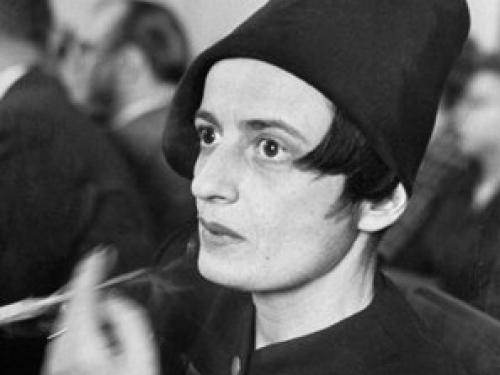
Russian-born philosopher/novelist Ayn Rand.

A compelling but flawed philosophy:
Considering Ayn Rand

By Bill Meacham / The Rag Blog / August 3, 2011

Ayn Rand advocates a promising methodology for ethical thinking, but has a deeply flawed vision of human nature, so her enterprise doesn’t quite pan out.(1) That’s too bad, because the methodology — to base ethical values on what is objectively and verifiably true about the world — is a good one, better than basing them on moral intuition or uncritically-accepted social norms or someone’s authority.

Moral intuition seems compelling, but different people have different intuitions, so how do you decide among them? Social norms seem as evident as sunlight, but different societies have different norms, so again how do you decide among them? The same goes for authority: how do you decide which authority is worth obeying, particularly if you suspect (often with good reason) that they are really trying to get you to behave for their benefit, not yours?

The answer goes all the way back to the Classical Greeks. We all want a fulfilling life, and we find out what that is by examining who and what we are. Knowing that, we have very good clues to two things: what we are good for or good at, and what is good for us. When we are doing what we are good at and getting what is good for us, then we are functioning well. And the internal experience of functioning well is fulfillment, a fulfilling life, in short: happiness. Aristotle sums it up:

[A clearer account of happiness] might perhaps be given, if we could first ascertain the function of man. For just as for a flute-player, a sculptor, or an artist, and, in general, for all things that have a function or activity, the good and the “well” is thought to reside in the function, so would it seem to be for man, if he has a function.(2)

What is good for us as human beings is to do well the uniquely human function.

And what is that? Rand follows Aristotle closely here. She says the essential function of the human being is to be rational. Unlike plants, which do not move and only react automatically to stimuli, and animals, which move around and act instinctively, humans think and reason.

Common to all three is the urge to survive and thrive. How humans do that is by the use of reason: “For man, the basic means of survival is reason.”(3) And “that which is proper to the life of a rational being [i.e. the exercise of reason] is the good [for that being]…”(4) So the ethical imperative for human beings is to exercise reason, to be rational.

So far, so good. We can quibble about whether the distinctions between plants, animals and humans are really so hard and fast, but as a first approximation the account is sound. But what shall we reason about? Certainly prudential calculation of risks and benefits in the economic sphere is a big part of it, as is scientific discovery and applied engineering to produce the means of sustenance.

By reasoning we figure out how to acquire what we need in order to survive. In large part that entails being productive, actively working to grow and manufacture the goods we require. For Rand, the ideal person is the one who thinks accurately and acts productively. She rails against thugs and dictators who steal from others without doing the work to produce what is stolen. (No doubt that is a big part of her appeal, because we have all been victims or fear being victims, or both.)

And all of this reasoning is to one end: our own survival and welfare. The goal is to “hold one’s own life as one’s ultimate value, and one’s own happiness as one’s highest purpose…”(5) She combatively calls this “the virtue of selfishness,” although a better characterization would be the virtue of rational self-interest. Thinking rationally about our own welfare is, according to this view, what humans do best and hence what we should do in order to survive, thrive and be fulfilled.

I have no argument with that, and in fact have discussed it before in my blog. What I find problematic is how this plays out in the social sphere. Her ideal is a society of rational actors, each out to satisfy his or her own interests, who trade goods and services with each other to maximize their wealth.

Each of us, in this view, is a homo economicus who seeks to obtain the highest possible well-being for himself or herself given available information about opportunities and constraints. Consequently, for Rand, the ideal human relationship is trade for mutual benefit, entered into freely and without coercion. She says so quite unambiguously:

The principle of trade is the only rational ethical principle for all human relationships, personal and social, private and public, spiritual and material.(6)

Well, that works fine for economic relationships, but does it make sense for personal relationships? I know someone who bases friendship on this principle. He openly looks for how others can be of use to him, and in turn he is willing to be used by them. Many people find this distasteful. Few entrust their deepest feelings and concerns to him.

Imagine a group in which loyalty is a must for survival. This is not implausible, because for hundreds of thousands of years that was exactly the case for all humans. Today as an extreme example we might think of a platoon of soldiers in battle, but to some degree it applies to any in-group.

In order to survive as a member of such a group you need the cooperation and help of others, and in order to secure such cooperation and help you need to be seen as cooperative and helpful yourself. Others need to recognize that you are loyal and reliable. And the best way to be perceived as loyal and reliable is actually to be loyal and reliable.

It is precisely not to act as Rand would have you act, coldly calculating whether to continue to be loyal. Instead you need to act in the interests of the group unhesitatingly, to act swiftly and automatically on your intuition that loyalty is obligatory and disloyalty is so hideous as to be almost unthinkable.

Those whom the group suspects of being purely self-interested are less likely to become trusted members of the group than those whose loyalty is immediate and unquestioned. As group membership is crucial for survival, by her own criteria Rand’s recommendation is anti-life.

What I am talking about here is a moral emotion, an emotion that has been ingrained in us through hundreds of thousands of years of human evolution as beings who are ultra-social, obligatorily gregarious. We need each other, constantly and thoroughly. Rand sneers at morality based on instinct, intuition or feeling, but the instinct for affiliation is what has enabled humans to survive.

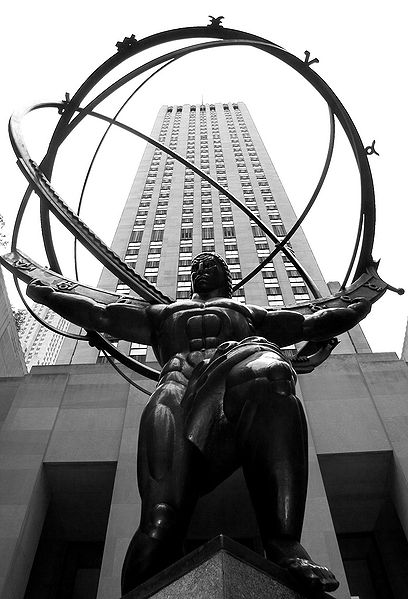
Atlas shrugging: New York City sculpture by Lee Lawrie.

Human societies are support systems within which individual weakness does not automatically spell death. Mutual dependence is key to our success. The moral emotion of loyalty is crucial for our survival. And so are others, such as willingness to devote resources to group welfare, cooperation, honesty, and many more.

We have two kinds of rationality, but Rand recognizes only one. We can think carefully and attentively, reasoning step by step from premises to conclusions. And we can react in the blink of an eye, assessing probabilities and choosing what to do without conscious thought. More often than not it is the latter that we employ.

Our minds do most of their work by automatic pattern matching. We do not pay attention, for instance, to how our visual systems translate excitation of receptor cells on the back of the eyes to recognition of objects and people; instead we just recognize things. Similarly, most of our social cognition occurs rapidly and automatically. We very quickly appraise people we meet as attractive or not, friendly or threatening, male or female, higher or lower in status than we are, etc.

Moral intuitions are a form of social cognition. Human beings come equipped with an intuitive ethics, an innate preparedness to feel flashes of approval or disapproval toward certain patterns of events involving other human beings.

But this is what Rand decries, instead praising a rationality that entails “a full mental focus in all issues, in all choices, in all of one’s waking hours,” a process of thought that is “precise,” “scrupulous, ” and “ruthlessly strict.”(7) Someone who actually acted that way would not last very long at all.

Rand overlooks two things: the role of what cognitive scientists call “hot cognition,” which I have been describing, and the essentially social nature of human reality. Nowhere in her essay is the word “compassion” to be found. Nowhere does she speak of empathy. She does mention love. She calls it a “spiritual payment given in exchange for the personal, selfish pleasure which one man derives from the virtues of another man’s character.”(8) Love as payment? If men are from Mars and women are from Venus, Rand appears to be from Jupiter.

Despite the inadequacies of Rand’s theory of human nature, however, there is something to be learned from her theory of ethics. As humans we do have the ability to reflect on ourselves and our situation, to exercise second-order mentation. We have the opportunity to judge whether the moral intuitions provided to us by our evolutionary heritage actually make sense in the present.

The feeling of loyalty to the group, crucial to the survival of small bands of hunters and gatherers, may not make sense when directed to sports teams or, less harmlessly, to governments that oppress portions of their populace and wage wars for the enrichment of the elites. We may not be able to fully divest ourselves of such feelings, but we can intervene when they arise and decide whether and in what manner to act on them.

And, more realistically, we can intervene ahead of time. We can cultivate habits of character that enable us to act in the heat of the moment as we have chosen in times of cool reflection.

Consider someone, perhaps a follower of Ayn Rand, who realizes that his excessively calculating attitude toward others is self-defeating. To overcome this deficiency he could deliberately cultivate habits of emotional openness, generosity and helpfulness. He could look for opportunities to speak the truth about what he is feeling, to be helpful to others, to give freely instead of hoarding.

At first, acting in these ways would feel uncomfortable and alien, but with time they would become second nature. And people would respond to him in kind.

And that is the real power of Ayn Rand’s ethics. Applied to a more accurate view of human nature, it encourages us, not to cogitate excessively over each situation, but to decide what kind of person we want to be. In true Aristotelian fashion it encourages us to cultivate virtues that enable us to live fulfilling lives in the company of others.

Notes

(1) I base this assessment on Rand’s essay “The Objectivist Ethics,” which seems to sum up her essential argument nicely and is certainly a quicker read than her monumental works of fiction.
(2) Aristotle, Nichomachean Ethics, I.7 1097b 22-29.
(3) Rand, pp. 22-23.
(4) Ibid., p. 25.
(5) Ibid., p. 32.
(6) Ibid., p. 34. Italics in the original.
(7) Ibid., p. 28.
(8) Ibid., p. 35.

References

Aristotle. Nichomachean Ethics, tr. W.D. Ross. In McKeon, Richard, ed., Introduction to Aristotle. New York: Random House Modern Library, 1947. Also available as an on-line publication, URL = http://classics.mit.edu//Aristotle/nicomachaen.html as of 17 April 2011.

Rand, Ayn. “The Objectivist Ethics,” in The Virtue of Selfishness, pp. 13-39. New York: Signet Books, 1964. Also available as an on-line publication, URL = http://www.aynrand.org/site/PageServer?pagename=ari_ayn_rand_the_objectivist_ethics as of 3 July 2011.

Wikipedia. “Homo economicus.” On-line publication, URL = http://en.wikipedia.org/wiki/Homo_economicus as of 16 July 2011.

[Bill Meacham is an independent scholar in philosophy. A former staffer at Austin’s 60’s underground paper, The Rag, Bill received his Ph.D. in philosophy from the University of Texas at Austin. Meacham spent many years working as a computer programmer, systems analyst, and project manager. He posts at BillMeacham.com, where this article first appeared.]

The Rag Blog

Posted in Rag Bloggers | Tagged , , , , | 2 Comments

Harry Targ : The Two-Headed Neoliberal Monster

Image from Stupid Comics.

An American dilemma, 2011:
The two-headed neoliberal monster

It became clear to the financiers that government regulations, social safety nets, and public institutions of all kinds had become impediments to the free flow of money capital.

By Harry Targ / The Rag Blog / August 3, 2011

Common threads run throughout America’s history from the revolution to 2011. Class and race are particularly enduring features of the life of the nation. Perhaps we need to examine our history and contemporary plight using class analysis and the fundamental interconnections of class and race to better understand why American society is in crisis today and what can be done about it.

First, it is undeniable that America is a class society. The dominant class owns the factories, the businesses, the entertainment and information industries, and the financial institutions that control investment, trade, debt, and speculation. As the capitalist economy has changed, the ruling class has changed also. But in each historical period the ruling class has acted on the basis of its interests and ideology. Since the 1970s, the economic ruling class, while diverse, has been dominated by finance capital.

Second, it is important to remember that concentrated economic wealth is usually complemented by centralized political power. In our own day, for example, Wall Street financial interests dominate the political process. In the increasingly desperate pursuit of increased rates of profit since the 1970s, financiers have been pressuring political elites to institutionalize policies that cut government programs, deregulate the economy, reduce workers rights, and shift societal wealth from the poor and working people to the wealthy. The deal being brokered to “solve the deficit ceiling” problem is the most current of examples.

Third, set against the economic ruling class in every age is a broad array of sectors of the working class, some employed, some not, who have little wealth and power. During exceptional periods they rise up angry, challenge myths about what the economy needs, and demand policies to further the shift of wealth from the few to the many. Since the 1980s, with brief exceptional periods, wealth and income has shifted more to the few.

This model of an economic ruling class and a vast working class is largely an accurate framework for understanding American history, from the revolution of 1776 to the deficit crisis of 2011. But the model needs to be refined based upon the particular interests, organizations, economic activities, and ideologies of the two basic classes, the ruling class and the working class.

For example, even within the two classes there are “fractions” or segments that do not share precisely the interests of other fractions within the class. For example, since the 1970s, more and more wealth has been invested in finance and less and less in manufacturing and agriculture, the traditional backbones of a capitalist economy.

It became clear to the financiers that government regulations, social safety nets, and public institutions of all kinds had become impediments to the free flow of money capital. Thus we saw the dawn of the Reagan “revolution,” which consisted of policies designed to replace the New Deal policies of mixed government and the private sector that favored manufacturing and workers in industry.

Over the last 30 years, the United States economy, and more or less all of the wealthy capitalist economies, have shifted their priorities to making money via financial speculation. Government has helped by adopting free market, market fundamentalist, and what people around the world call neoliberal economic policies. Introduced selectively during the presidency of Jimmy Carter and promoted full blown in the Reagan era, United States economic policy has been driven by the downsizing of government (except the military) and deregulation.

Today, most Democrats and Republicans are fighting over how to cut government spending and which people-oriented programs to eliminate. They are not fighting about whether to cut government, but rather in what ways it should be cut. In sum, if we label political actors, the neoliberal monster has two heads, Democrats and Republicans.

The current context is made even more complicated by the so-called Tea Party. The Tea Party was created by a small fraction of the wealthy economic class and sectors of the monopoly controlled media. Its membership consists of a vast array of disenchanted, alienated increasingly marginalized business and professional elites who claim to be motivated by the need to challenge intrusive government. While it has its roots in fractions of the economic ruling class it has used its resources to appeal to a base of supporters from the working class.

Many Tea Party activists have used the historic and institutionalized racism in the United States as a tool to expand their support. Tea Party enthusiasts have made it clear that their real motivation is to destabilize and destroy the United States government which happens to be led by the first African-American president.

Senator Mitch McConnell, in a desperate attempt to co-opt this political fraction, spoke frankly when he declared that the number one priority of the Republican Party is to insure that Barack Obama is a one-term president. This simple and frank declaration parallels the constant racist stereotypes of Obama that find their way into mainstream media and are staples of Fox News, and the reactionary radio chorus. And to generalize, the Tea Party and much of the Republican Party express their racism against Islamic and Latino targets as well.

Furthermore, the racist ideology that is just below the surface of political discourse has escalated as the gaps in wealth and income between whites and people of color have expanded over the last 30 years. In fact, the assault on government programs, and the vast majority of workers, has been at the same time an assault on African Americans, Latinos, and all other so-called minorities, who by 2050 will be the new majority of Americans.

In short, the deficit struggle may be seen as a conflict between two fractions of the economic elite, represented by most of their Democratic and Republican allies, over the shape of the neoliberal policies to be adopted as public policy AND the Tea Party political fraction, from the ruling and working class, who are driven as much by racism as by any idea of doing what is best for the economy.

The ideology of racism used by some of those who promote the neoliberal agenda is paralleled by the real maldistribution of wealth and income that has been exacerbated in recent years and will be a centerpiece of any deficit reduction deal in the future.

But as Marx said, all history is the history of class struggle. The working class, varied as it has been over time, continues to resist the efforts of the wealthy and powerful to appropriate more and more of society’s resources. In fact, what may be called the Progressive Majority is a coalition of workers, women, people of color, environmentalists, health care activists, and others who will refuse to accept neoliberal and Tea Party policies. For them the struggle is not over. It is just beginning.

In some ways, the impending deficit deal that leaders of the two political parties are consummating clarifies the task the progressive majority faces. The American Dilemma of 2011 requires mobilizing on two interconnected fronts.

First, progressives must adopt a campaign to increase government support for the vast majority of Americans and to do so by taxing the rich. In other words, progressives must say “no” to neo-liberalism. Second, progressives must incorporate a 21st century anti-racism platform in their economic program. Demographically, people of color will constitute a majority of the voting age population by 2050, a disquieting realization for Tea Party supporters and their neoliberal representatives who want to return to an era of Jim Crow economically and politically.

A useful guide for this progressive agenda is The People’s Budget proposed recently by the Congressional Progressive Caucus which calls for a massive jobs program, the construction of a fairer and more equitable tax system, real health care reform, tax reforms to safeguard the social security trust fund, and dramatic cuts to military spending. The People’s Budget clearly would address issues of government spending by shifting to policies of fairness that benefit the vast majority of the country’s population.

So the task of the progressive majority is clear whatever final form the deficit compromise takes. Joe Hill is still right: “Don’t Mourn, Organize!”

[Harry Targ is a professor of political science at Purdue University who lives in West Lafayette, Indiana. He blogs at Diary of a Heartland Radical — and that’s also the name of his new book which can be found at Lulu.com. Read more of Harry Targ’s articles on The Rag Blog.]

The Rag Blog

Posted in Rag Bloggers | Tagged , , , , , , , , | 1 Comment

Larry Ray : Tattered Leadership and Toxic Tea

Graphic by Larry Ray / The Rag Blog.

A virus has been unleashed:
Tattered leadership and toxic tea

By Larry Ray / The Rag Blog / August 2, 2011

A fetid brew of public ignorance and indifference flavored with abject partisan stubbornness forms the growth medium in America’s political petri dish. A virulent voter virus feeds upon it, spreading a plague of indecision, impotence, presidential pusillanimity, and contemptible congressional charade.

The voter virus was created by pseudo patriotism and the excesses of a previous decade of lax government whose singular priority was to reward the already wealthy.

Sober regulation of our banking and real estate industries was blithely and irresponsibly sidestepped for more than a decade. Then in late 2008 Wall Street’s wild, reckless ride came to a crashing halt. Finally the virus was loosed, infecting the American economy and reducing it to a rattling house of tumbling cards, all jokers.

Since 2009, more time has been spent by our elected leaders in assigning political blame than in launching a vigorous joint effort to cure and strengthen our economically bedridden nation. Confused Americans have not questioned flawed and false narratives from a brash, opportunistic, and well funded conservative chorus.

Repeated GOP mantras shamelessly blame the new black Democratic president for the entire mess, for all the nation’s out of control spending. But these duplicitous accusers never acknowledge the inherited debt racked up and left by their party.

This absurdity was parlayed into political propaganda gold by tax free groups, notably the “American Legislative Exchange Council” formed in 1973 by conservative activists. Finally, their time had come after the bruising they took in the 2008 Democratic election sweep. Millions of dollars from the ultraconservative billionaire Koch brothers slid into these “councils” as fast as they could qualify for nonprofit status.

The word “debt” is understood by everyone, and when the GOP heralded “an out of control national debt that must be stopped at all costs,” the warning was accepted as readily as an FDA ordered ground turkey alert after a multi-state Salmonella outbreak.

Raising the U.S. debt ceiling, was routinely done eight times under the Bush administration and countless other times all the way back to 1917 with no serious opposition whatsoever. But now “debt ceiling” was suddenly spotlighted and used as the hostage in a mad extortion plot.

Freshmen congressmen wearing tea bags as blinders had signed pledges to “change government in Washington” and their zealous naivete and self righteousness quickly clogged the old boy congressional sewer pipe leaving rookie Speaker of the House John Boehner unable to control his GOP vote.

The new conservative clog, after first finding their offices, quickly found the C-Span TV cameras and began immediately to promise their admiring ideologues back home that they would let America go into default unless a sweeping but ill-defined debt reduction bill was passed and signed by the president.

Most of these freshmen had no idea of how or why the debt ceiling has operated since 1917 or what the ruinous consequences of default would be. And they wore their ignorance as a badge of courage.

But back in November, 2010, Senate Minority Leader Mitch McConnell made the GOP goals and strategy crystal clear, setting the stage for the debt ceiling drama to come some seven months later. McConnell loftily proclaimed on national TV that if President Barack Obama wouldn’t go along with his key GOP goals, “the only way to do all these things is to put someone in the White House who won’t veto any of these things.”

After 27 years in the isolated, nurturing environment of the U.S. Senate, McConnell, who is worth an estimated $35 million dollars, has become the dour poster boy for America’s out of touch professional politicians. There are no poor people in elected office up in Washington.

Blinded by wealth and power, McConnell angrily told the nation that his forces would make the president bend to their will or they would have him removed… chilling echos from the 15th Century and the pronouncements from the House of Medici. And from that point forward with a new House majority all GOP votes were NO, hobbling the president and actively designed to make his life as difficult as possible.

Now, like the ending to a cookie-cutter Hollywood movie, Speaker John Boehner finally unclogged the congressional sewer main, and repacked the House sausage machine producing a 269-161 vote approving a budget agreement, thus certainly ending the threat of a U.S. Treasury debt default, and setting the stage for a heroic rally on the U.S. and foreign stock markets.

Boehner sent the winning sausage recipe on to the Senate where it was approved and sent to President Obama for signature, leaving a full twelve hours before the Treasury Department would have gone into default for the first time in the nation’s history.

Both chambers on The Hill think they have swallowed bitter pills but it wasn’t strong enough medicine to wipe out the voter virus. As America’s woes worsen, the voter virus will thrive on increasing universal voter disgust with the endlessly sorry and unacceptable performance of their House and Senate leaders.

The voter virus is predicted to attack the CDC (Completely Dysfunctional Congress) and erupt into a nationwide epidemic on November 6th, 2012. Mark your calenders.

[Retired journalist Larry Ray is a Texas native and former Austin television news anchor who now lives in Gulfport, Mississippi. He also posts at The iHandbill. Read more articles by Larry Ray on The Rag Blog.]

The Rag Blog

Posted in Rag Bloggers | Tagged , , , , , , | 2 Comments

John Nichols : The Debt Deal and Democratic Conscience

Members of Congressional Progressive Caucus express disapproval of debt ceiling deal Monday on Capitol Hill. From left, Rep. Sheila Jackson Lee, D-Texas, Rep. Maxine Waters, D-Calif. (speaking), and Rep. Raul Grijalva, D-Ariz. Photo from the AP.

The debt deal:
Dems split on issue of conscience

By John Nichols / The Nation / August 2, 2011

“I will have no part of a deal that cuts Social Security, Medicare, and Medicaid to appease the farthest reaches of the right wing of the Republican Party.” — Rep. Raul Grijalva, D-Ariz.

WASHINGTON, D.C. — House Minority Leader Nancy Pelosi reportedly told members of the House Democratic Caucus to vote their “individual consciences” when they were asked to approve the debt-celing deal cobbled together by the Obama White House and congressional Republicans.

Consciences divided evenly, with 95 Democrats opposed to the compromise agreement while 95 supported it in a Monday evening vote that saw the measure pass primarily on the basis of Republican backing — despite the fact that this was a deal promoted aggressively by a Democratic White House.

The final tally was 269 in favor, 161 opposed [1].

Republicans generally backed the deal, with 174 voting “yes” while 66 voted “no.”

Democrats were far more closely divided, with widespread opposition to what Congressional Progressive Caucus co-chair Keith Ellison, D-Minnesota, described as a violation of “core Democratic ideals.”

While Pelosi cast her own vote in favor of the agreement, she did not “whip” her fellow Democrats to back the deal during a marathon caucus meeting Monday. The former speaker outlined the consequences of a default by the federal government if an agreement to raise the debt ceiling is not reached.

But North Carolina Congressman G.K. Butterfield, who attended the caucus session said Pelosi avoided pressuring House Democrats to fall in line with the Democrats in the White House. “She told us to leave it to our individual consciences,” Butterfield told reporters.

With the House vote done, the Senate will be vote Tuesday on the deal, which proposes radical cuts in federal programs — cuts that some fear will ultimately threaten Medicare and other Democratic “legacy” programs — in return for raising the nation’s debt ceiling.

The Senate is likely to back the deal that was cut between the Obama White House and Republican leaders; Senate majority leader Harry Reid, D-Nevada, is already on board, as are key Republicans.

The general sense from the start was that the real test would come in the House, where Republican leaders had to scramble to keep Tea Party conservatives on board, and the White House faced a revolt by progressives.

Even as Pelosi and House Minority Whip Steny Hoyer indicated personal support for the measure, a striking number of Democrats spoke out in opposition to Obama’s position before the hastily-scheduled Monday evening vote.

Congressman Pete DeFazio, an Oregon Democrat who frequently breaks with the White House when he feels the president is not doing enough to address unemployment, went to the House floor Monday to declare that this is a “no jobs” deal.

Ohio Congressman Marcy Kaptur was opposed. Veteran New York Congressmen Jerry Nadler and Eliot Engle indicated early on that they are firmly opposed, as did former House Ways and Means Committee chair Charles Rangel, D-New York. Illinois Congressman Jesse Jackson Jr. was another “no.”

California Congresswoman Maxine Waters announced her “no” vote with a declaration that the deal was “one of the worst pieces of public policy” she had ever seen.

The progressive opposition to the deal grew, as grassroots groups stepped up their lobbying against the package. Progressive Change Campaign Committee [2] co-founder Adam Green said:

This deal will kill our economy and is an attack on middle-class families. It asks nothing of the rich, will reduce middle-class jobs, and lines up Social Security, Medicare, and Medicaid for cuts. Today, we’re putting in thousands of calls to Congress urging Democrats to keep their promise and oppose this awful bill. The 14th Amendment is unambiguous, and President Obama should invoke it to pay our nation’s debt. Then Democrats should focus on jobs — not cuts — in order to grow our economy.

Progressive Democrats of America launched a national “No Deal!” push. “The corporatists in Congress recognize that the United States cannot go into default for the first time in its 235-year history,” said PDA director Tim Carpenter.

Yet, they are claiming that we can only increase the debt ceiling by cutting vital social programs designed to protect working class and poor people across this country. Don’t drink the Kool-Aid! [3] We can block this “deal” and demand a clean debt ceiling increase.

At least 20 members of National People’s Action, a group that seeks to hold banks and financial institutions to account for the damage their speculation has done to the U.S. economy, were arrested when they disrupted debate in the Capitol. Decrying the debt-ceiling agreement as “a raw deal,” the NPA members chanted: “Hey, Boehner, get a clue, it’s about revenue!”

Congressional Progressive Caucus and Congressional Black Caucus members expressed the most serious skepticism regarding the measure.

That skepticism was rooted in a sense that this was a bad deal for both the economy and a Democratic Party that has historically positioned itself as the defender of working families.

Harry Truman used to say: “Given the choice between a Republican and someone who acts like a Republican, people will vote for the real Republican all the time.”

If the 33rd president was right, then Barack Obama did himself and his party a world of hurt by cutting the deal with the GOP leadership.

Faced with the threat that Tea Party-pressured Republicans in the House really would steer the United States toward default, and in so doing steer the U.S. economy over the cliff, Obama had to do something. But instead of bold action — borrowing a page from Ronald Reagan to demand a straight up-or-down vote on raising the debt ceiling; borrowing a page from Franklin Roosevelt to pledge to use the authority afforded him by the Constitution to defend the full faith and credit of the United States — the president engaged in inside-the-Beltway bargaining of the most dysfunctional sort.

In cutting a deal with Congressional Republicans [4] that places Democratic legacy programs — Social Security, Medicare and Medicaid — at risk while cutting essential programs for working families and the poor, Obama has positioned himself and his administration to the right of where mainstream Republicans such as Howard Baker, Bob Dole, and George H.W. Bush used to stand in fights with the fringe elements of their party.

Now, the fringe is in charge of the GOP. And Obama is agreeing to policies that are designed to satisfy Republicans that Britain’s banking minister describes as “right-wing nutters [5].’”

Obama and Democratic Congressional leaders claimed they have done everything in their power to avert deep cuts in Social Security, Medicare, and Medicaid. And it is true that they have given the Republicans (and their paymasters) less than House Budget Committee chair Paul Ryan was demanding with a budget proposal that turned Medicare into a voucher program and began the process of privatizing Social Security.

But a compromise with total destruction can still do a lot of damage.

The president’s bow to the political extremism — and the economic irrationality [6] — of a tiny circle of “right-wing nutters” in Congress and their dwindling Tea Party “base” will, according to reports based on briefings by White House and GOP aides,

…raise the debt limit by about $2.7 trillion and reduce the deficit by the same amount in two steps. It would cut about $1 trillion in spending up front and set up a select bicameral committee to put together a future deficit-reduction package worth $1.7 trillion to $1.8 trillion. Failure of Congress to pass the future deficit-reduction package would automatically trigger cuts to defense spending and Medicare.

An aide familiar with the deal told The Hill newspaper that the Medicare cut would not affect beneficiaries. “Instead,” the aide indicated, “healthcare providers and insurance companies would see lower payments.”

But that’s still a squeezing of Medicare in order to meet the demands of Congressional Republicans who have spent the past six months trying to put the program on the chopping block.

Congressional Black Caucus chairman Emanuel Cleaver, D-Missouri, responded to initial reports regarding the deal by describing it as “a sugar-coated Satan sandwich [7].”

Congressional Progressive Caucus [8] co-chair Raul Grijalva said Obama and his negotiators bent too far to the extremists. Like many progressives, Grijalva favored the straight up-or-down vote on debt ceiling. “Had that vote failed,” he argued, “the president should have exercised his Fourteenth Amendment responsibilities and ended this manufactured crisis.”

Grijalva joined members of the Congressional Progressive Caucus and the Congressional Black Caucus at a Monday press conference, where they called on Obama to sidestep Congress and raise the debt limit by invoking the Fourteenth Amendment [9].

Obama rejected this option.

Instead of taking a tough stance, the president blinked in the face of Republican recalcitrance. And in so doing Obama agreed to what the Progressive Caucus co-chair described as “a cure as bad as the disease.”

“This deal trades people’s livelihoods for the votes of a few unappeasable right-wing radicals, and I will not support it,” Grijalva declared Sunday afternoon. [10]

Progressives have been organizing for months to oppose any scheme that cuts Medicare, Medicaid, or Social Security, and it now seems clear that even these bedrock pillars of the American success story are on the chopping block. Even if this deal were not as bad as it is, this would be enough for me to fight against its passage.

Grijalva expressed immediate opposition to the deal. And he was not alone.

Congresswoman Donna Edwards, D-Maryland, slammed the deal. [11]

“Nada from million/billionaires; corp tax loopholes aplenty; only sacrifice from the poor/middle class? Shared sacrifice, balance? Really?” she complained, via Twitter, on Sunday.

Congresswoman Barbara Lee, D-California, complained that she was “not sure how Social Security and Medicare” will be preserved by the bargain the president has cut with the Republicans. “We have to make sure that within this deal… Medicare and Medicaid and Social Security and the most vulnerable are protected,” she said, while withholding an endorsement of the measure. “I worry about these triggers [for more cuts],” Lee concluded.

Grijalva objected, in particular, to the lack of shared sacrifice in the deal.

“This deal does not even attempt to strike a balance between more cuts for the working people of America and a fairer contribution from millionaires and corporations. The very wealthy will continue to receive taxpayer handouts, and corporations will keep their expensive federal giveaways. Meanwhile, millions of families unfairly lose more in this deal than they have already lost. I will not be a part of it,” the Arizona congressman explained.

Republicans have succeeded in imposing their vision of a country without real economic hope. Their message has no public appeal, and Democrats have had every opportunity to stand firm in the face of their irrational demands. Progressives have been rallying support for the successful government programs that have meant health and economic security to generations of our people.

Today we, and everyone we have worked to speak for and fight for, were thrown under the bus. We have made our bottom line clear for months: a final deal must strike a balance between cuts and revenue, and must not put all the burden on the working people of this country. This deal fails those tests and many more.

But Grijalva’s gripe was not merely a moral or economic one.

It was political, as well.

“The Democratic Party, no less than the Republican Party, is at a very serious crossroads at this moment. For decades Democrats have stood for a capable, meaningful government—a government that works for the people, not just the powerful, and that represents everyone fairly and equally. This deal weakens the Democratic Party as badly as it weakens the country,” explained Grijalva.

“We have given much and received nothing in return. The lesson today is that Republicans can hold their breath long enough to get what they want. While I believe the country will not reward them for this in the long run, the damage has already been done.”

The question that remains is: How much damage? How much damage to vulnerable Americans? How much damage to the global reputation of the United States as a functional state? How much damage to a U.S. economy that is threatened by rising unemployment? How much damage to the image of the Democratic Party as a defender of working families?

This deal cannot be defended as a sound or necessary response to a manufactured debt-ceiling debate and the mess that House Speaker John Boehner, R-Ohio, has made of it.

That is why the co-chair of the Congressional Progressive Caucus said: “I will not support the emerging debt deal.”

“I will have no part of a deal that cuts Social Security, Medicare, and Medicaid to appease the farthest reaches of the right wing of the Republican Party,” argued Grijalva. “It is unconscionable to put these programs on the chopping block and ignore the voices and beliefs of the millions of Americans who trust us to lead while continuing to give handouts to the ultra wealthy and the largest corporations. There is no human decency in that.”

Links:
[1] http://www.politico.com/news/stories/0811/60443.html
[2] http://www.boldprogressives.org
[3] http://www.pdamerica.org/
[4] http://thehill.com/homenews/senate/174595-reid-signs-off-on-bipartisan-debt-deal
[5] http://www.thenation.com/../../../../../../blog/162258/right-wing-nutters-threaten-global-economy-imf-warns-disastrous-consequences
[6] http://thehill.com/blogs/blog-briefing-room/news/174571-compromise-deal-could-include-broad-spending-cuts-as-a-trigger
[7] http://www.rollcall.com/issues/57_17/Debt-Deal-Emerging-With-Rightward-Tilt-207893-1.html
[8] http://cpc.grijalva.house.gov/
[9] http://thehill.com/homenews/house/174601-house-liberals-urge-14th-amendment-fix-in-lieu-of-bipartisan-debt-deal
[10] http://grijalva.house.gov /index.cfm?sectionid=13&sectiontree=5,13&itemid=1063
[11] http://thehill.com/homenews/house/174599-pelosi-dem-leaders-withholding-judgment
[12]
http://itunes.apple.com/us/app/nationnow/id399704758?mt=8

[John Nichols writes about politics for The Nation magazine as its Washington correspondent. He is a contributing writer for The Progressive and In These Times and the associate editor of the Capital Times, the daily newspaper in Madison, Wisconsin. This article was first published at The Nation and was distributed by Progressive America Rising.]

The Rag Blog

Posted in RagBlog | Tagged , , , , | 2 Comments

David Van Os : Surrender and Sellout

Political cartoon from OpEd News.

I rest my case:
Surrender and sellout

By David Van Os / The Rag Blog / August 2, 2011

According to all reliable news reports, John Boehner assured House Republicans that the budget deal does not endanger any Republican priorities and that the president gave up his previous demand for increased taxes on the wealthy.

In other words, the president capitulated. In other words, the wealthy that are hoarding the money get a free pass to keep freeloading on the rest of us. In other words, the poor, the working, and the middle classes are asked to make all the sacrifices to avoid national default.

In other words, the president pulled the rug out from under Democrats who were looking forward to attacking Republicans for wanting to cut Medicare in the 2012 elections.

To this president and his congressional allies, making a deal, any deal, is more important than any principle.

The desperate desire to achieve agreement even if it means giving up every fundamental principle means confrontation avoidance as an end in itself regardless of what is given up. It means agreements that lack moral content. It means there are no convictions worth drawing a line in the dirt over.

From now on, no demand that president Obama ever makes will be worth its own sound waves. The whole world knows that if his adversaries stand firm, he will give in, no matter what he may have said about any principles. He has become a lame duck before the end of his first term.

Some will say, “What could he have done?” He could have stuck to his guns to the very last minute. Then if the Republicans still would not compromise, he could have done what Big Dawg Bill Clinton suggested: raise the debt ceiling by presidential order. He would have been on solid Constitutional ground, since the 14th Amendment mandates the United States government to honor its debts.

In other words, he could have shown some guts and fulfilled his duty to uphold the Constitution no matter what heat the Republicans would generate. But there is the rub. He can’t take the heat.

[David Van Os is a populist Texas democrat and a civil rights attorney in San Antonio. He is a former candidate for Attorney General of Texas and for the Texas Supreme Court. To receive his Notes of a Texas Patriot — circulated whenever he gets the urge (and published on The Rag Blog whenever we get the urge) — contact him at david@texas-patriot.com.]

The Rag Blog

Posted in Rag Bloggers | Tagged , , , , | Leave a comment

Carl Davidson : ‘Business Guy’ Romney Feeds us Baloney

Former Massachusetts Gov. Mitt Romney speaks with Screen Machine Industries owner Doug Cohen, left, July 27, 2011, in Pataskala, Ohio. Photo by Jay LaPrete / AP.

Now let me get this straight:
‘Business guy’ Mitt Romney

feeds us a bunch of baloney

By Carl Davidson / The Rag Blog / July 30, 2011

Some things just drive you nuts.

Take Mitt Romney.Wednesday the GOP’s presidential wannabe toured Screen Machine, a factory in Pataskala, Ohio, just outside Columbus. The plant makes heavy construction equipment, rock crushers to be exact.

Romney and the owners, Doug and Steve Cohen, held a typical photo op. Mitt took the occasion to blast both Obama and “government” as “bad for business.”

Really? What did Mitt have in mind? A wimpy stimulus package? A failure to build more infrastructure? In that case, he might have a point.

But no, the real problems are environmental regulation, labor safety codes, and health care. In other words, with more pollution and more unsafe conditions at work, and less health care to deal with the consequences, business could surge ahead.

There’s not any truth to that claim, but that’s not the worst of it.

First, there’s the irony that Obama’s health care plan is basically a national version of Romney’s Massachusetts Plan. If we could scrap both and replace them with “Medicare for All,” yes, it would be better for both workers and business — save for the health insurance firms.

But the real clincher is the story of Screen Machines, where Mitt, the tough-minded, pragmatic business guy candidate, was delivering his words of economic wisdom. Here’s the Washington Post on the topic:

Yet it’s been the government — and Obama’s policies in particular — that has helped propel Screen Machine’s growth at its sprawling new headquarters here, even during the recession. The company, which builds heavy-duty crushing and screening machines used in construction, mining and recycling, received four stimulus awards totaling $218,607. It is also benefiting from a 10-year deal with local and state governments to not pay taxes on its property, equipment or inventory, according to public records.”

We need to make a minimum requirement of all elected officials that they at least have the ability to blush when feeding us a lot of nonsense. Of course, that might wipe out most of Congress, and a few in the White House, too. But then we’d have some open slots for politicians who count voters rather than dollars.

[Carl Davidson is a national co-chair of the Committees of Correspondence for Democracy and Socialism, a national board member of Solidarity Economy Network, and a local Beaver County, PA member of Steelworkers Associates. In the 1960s, he was a national leader of SDS and a writer and editor for the Guardian newsweekly. He is also the co-author, with Jerry Harris, of CyberRadicalism: A New Left for a Global Age. He serves as webmaster for SolidarityEconomy.net and Beaver County Blue, where this article was first published. Read more articles by Carl Davidson on The Rag Blog.]

The Rag Blog

Posted in Rag Bloggers | Tagged , , | Leave a comment