Type your summary here

Type rest of the post here

Source /

The Rag Blog

Posted in RagBlog | Leave a comment

SPORT / Dave Zirin : Why Lance Armstrong Will Survive

Lance Armstrong graphic by James Retherford / The Rag Blog.

Why Lance Armstrong will
survive ’60 Minutes’ and the feds

Armstrong doesn’t just have defenders. He has, in the legions of cancer survivors across our toxic nation, an army.

By Dave Zirin / The Rag Blog / May 24, 2011

Seven-time Tour de France winner and Austin resident Lance Armstrong is now facing the systematic disemboweling of his legacy as an athletic icon.

As revealed Sunday on 60 Minutes — a show that usually doesn’t do sports features unless there’s a synergistic tie-in with CBS Sports — three of Armstrong’s teammates have testified to a federal grand jury that they saw the great cyclist take performance-enhancing drugs. Armstrong’s top “lieutenant” Tyler Hamilton said, “He took what we all took… There was EPO, there was testosterone. And I did see a transfusion, a blood transfusion.”

60 Minutes also broke the news that George Hincapie, Armstrong’s closest friend and teammate, finally relented and testified to federal investigators. According to reporter Scott Pelley, Hincapie stated “that he and Armstrong supplied each other with the blood-booster EPO and discussed having used testosterone — another banned substance during their preparation for races.”

Hincapie is apparently shocked that his confidential grand jury testimony was leaked. He released a statement through his attorney where he said, “I can confirm to you that I never spoke with 60 Minutes. I have no idea where they got their information.” (Hincapie will be releasing his LiveNaïve rubber bracelets later this month.)

For what it’s worth, I find these federal grand juries aimed at “cleaning up sports,” a vulgar use of government power. In cycling, it’s particularly noxious. This is a sport that desperately needs organization and labor protections. Cyclists are pushed to extend their bodies beyond all possible human limits. Since 2000, 12 professional cyclists have died during races. Imagine the outcry if twelve NFL players had died on the field during the same time span.

Blood doping is a logical outcome of a sport where people push themselves to death for the enjoyment of fans and benefit of sponsors. Of the 70 top-10 finishers in Armstrong’s seven Tour De France victories, 41 have tested positive for PEDS.

That’s what happens when there is no legitimate union, commissioner, or controlling authority other than race organizers and sponsors — and highly competitive athletes pushing themselves at all costs to make it through the Pyrenees in one piece.

As for Armstrong, he has come out swinging with his typically furious denials, saying, “CBS’s reporting on this subject has been replete with broken promises, false assurances and selective reliance on witnesses upon whom no reputable journalist would rely.”

Armstrong has long insisted on his innocence and touted his reputation as “the most tested athlete on the planet.” Clearly he and the media believe his reputation as an athletic icon — like that of baseball greats Barry Bonds and Roger Clemens — is hanging by the thread. But unlike other athletes, Armstrong’s legacy is secure. That’s because his support comes from a far less fickle place than fandom.

In Robert Lipsyte’s recently released memoir An Accidental Sportswriter, the great columnist reveals that the only modern athlete who send his pulse racing is Armstrong. “He’s the closest thing I have to a celebrity jock hero,” says Lipsyte. This is a remarkable statement from a writer who is a great critic of that nexus of sports, media, and hero-worship that he brands “jock-sniffing.”

But his affection for Armstrong transcends cycling. Bob Lipsyte is a cancer survivor. Like many cancer survivors, he sees Armstrong as more than an icon of athletics, as an icon of survival and recovery.

Lipsyte’s love was cemented when he heard someone ask Armstrong how his belief in God helped him beat cancer and Armstrong responded, “Everyone should believe in something, and I believe in surgery, chemotherapy, and my doctors.” Armstrong also believes that everyone should have access to the kind of medicine that allowed him to beat death. He’s helped raise, through his LiveStrong foundation with its ubiquitous yellow bracelets, more than $400 million dollars for medical research.

This is why Armstrong doesn’t just have defenders. He has, in the legions of cancer survivors across our toxic nation, an army. The Associated Press quoted cancer survivor and amateur cyclist Raifie Bass, who said,

Lance is a true inspiration for so many people. He’s just a person that really is a great motivator for me as a cyclist and as a cancer survivor. What Lance has done for the global message of cancer and awareness, it’s unstoppable… it’s not how many Tours he won or what he’s done for cycling. It’s what he’s done for cancer.

What a country. We have a federal government spending untold amounts to “clean up” performance enhancing drugs in cycling, targeting someone whose celebrity and efforts are critical in the fight against cancer.

How about we close down the grand jury and in return, cycling agrees to get a commissioner, a union, and a method to handle its own drug testing? How about we take the money being spent to find out what someone might have taken to survive these torturous races, and donate it to cancer research?

I’m sure federal prosecutors have other people’s garbage to sift through, and 60 Minutes could then be free to finish its hard-hitting story about what makes Roger Goodell so dreamy. But however this ends, I wouldn’t bet against Lance Armstrong. The LiveStrong Army is bonded by something stronger than sports… and stronger than the Feds.

[Dave Zirin is the author of Bad Sports: How Owners are Ruining the Games we Love (Scribner) and just made the new documentary Not Just a Game. Contact him at edgeofsports@gmail.com. This article was also published at The Nation blogs. Read more articles by Dave Zirin on The Rag Blog.]

The Rag Blog

Posted in Rag Bloggers | Tagged , , , , | Leave a comment

Bill Fletcher tries to say he’s as much of an Obama critic as anyone, but his clear logical conclusion is that we must, in the end, support Obama in order to counter the Republican’s racism. I must disagree.

First, racism has been a cornerstone of Republican presidential campaigns since at least the passage of the Civil Rights Act, almost 50 years ago. The only thing new in 2012 is that they will employ that strategy this time against an incumbent who is 50% African American. It won’t work. Racism is no longer a winning strategy in US presidential elections. It has almost no traction among younger voters and the non-white segment of the electorate is growing ever larger. Obama backers are praying for a Haley Barbour or Michelle Bachman to run against.

Secondly, efforts by both capitalist parties to minimize the vote are even more longstanding. Why do you think we vote on a Tuesday, a workday, instead of on a weekend or, better yet, declaring election day to be a national holiday – and that this is not even controversial? Voter ID campaigns are primarily directed at Latinos, who will be the principal focus of Republican racism in the 2012 campaign under the guise of “securing our borders” so only white people can cross them unencumbered.

More importantly, the real issues of 2012 are Obama’s slavish subordination to finance capital and the complete corruption of US presidential elections by unrestricted corporate campaign contributions. This morning, there is an article in the press about how Eric Holder, head of the “Justice Department” and another sold out African American, has, despite his early vows to do so, has failed to prosecute a single Wall Street financier for the fraudulent manipulations that led to the collapse of the speculative bubble in 2008. Never has it been more true that there isn’t a dime’s worth of difference between the dominant capitalist parties.

But even more important is the corruption of the entire federal electoral system by corporate money in the wake of the Citizens United decision. To even participate in this travesty is to lend credence to fraud. Obama won’t need an army of small contributors (such as I was in 2008) in 2012. He has commitments for a cool billion from his billionaire buddies already in the bank. Nor will he need the army of progressive volunteers such as I was in 2008, instead reverting to the standard American way of vacuous 30 second television advertisements.

Nothing positive will come from the Left supporting a third party candidate either. The physics of our system dictates two parties fighting over what they collude to call the center. Furthermore, there is no credible third party. Those that exist have little structure, no money and unknown leadership. To participate is to agree to play a rigged game. Your odds are better buying lottery tickets.

The strategy of the Left should be to attack the system itself – to mount a vigorous and militant campaign to delegitimize the electoral process as corrupt. Millions of Americans of all political stripes hold this view already. This would involve picketing polling places, ballot mutilation, and confrontations with all candidates over the nature of their funding. There could be no more unifying, mobilizing and radical issue than democracy itself, or the lack thereof.

David P. Hamilton

Posted in RagBlog | Leave a comment

Bill Fletcher tries to say he’s as much of an Obama critic as anyone, but his clear logical conclusion is that we must, in the end, support Obama in order to counter the Republican’s racism. I must disagree.

First, racism has been a cornerstone of Republican presidential campaigns since at least the passage of the Civil Rights Act, almost 50 years ago. The only thing new in 2012 is that they will employ that strategy this time against an incumbent who is 50% African American. It won’t work. Racism is no longer a winning strategy in US presidential elections. It has almost no traction among younger voters and the non-white segment of the electorate is growing ever larger. Obama backers are praying for a Haley Barbour or Michelle Bachman to run against.

Secondly, efforts by both capitalist parties to minimize the vote are even more longstanding. Why do you think we vote on a Tuesday, a workday, instead of on a weekend or, better yet, declaring election day to be a national holiday – and that this is not even controversial? Voter ID campaigns are primarily directed at Latinos, who will be the principal focus of Republican racism in the 2012 campaign under the guise of “securing our borders” so only white people can cross them unencumbered.

More importantly, the real issues of 2012 are Obama’s slavish subordination to finance capital and the complete corruption of US presidential elections by unrestricted corporate campaign contributions. This morning, there is an article in the press about how Eric Holder, head of the “Justice Department” and another sold out African American, has, despite his early vows to do so, has failed to prosecute a single Wall Street financier for the fraudulent manipulations that led to the collapse of the speculative bubble in 2008. Never has it been more true that there isn’t a dime’s worth of difference between the dominant capitalist parties.

But even more important is the corruption of the entire federal electoral system by corporate money in the wake of the Citizens United decision. To even participate in this travesty is to lend credence to fraud. Obama won’t need an army of small contributors (such as I was in 2008) in 2012. He has commitments for a cool billion from his billionaire buddies already in the bank. Nor will he need the army of progressive volunteers such as I was in 2008, instead reverting to the standard American way of vacuous 30 second television advertisements.

Nothing positive will come from the Left supporting a third party candidate either. The physics of our system dictates two parties fighting over what they collude to call the center. Furthermore, there is no credible third party. Those that exist have little structure, no money and unknown leadership. To participate is to agree to play a rigged game. Your odds are better buying lottery tickets.

The strategy of the Left should be to attack the system itself – to mount a vigorous and militant campaign to delegitimize the electoral process as corrupt. Millions of Americans of all political stripes hold this view already. This would involve picketing polling places, ballot mutilation, and confrontations with all candidates over the nature of their funding. There could be no more unifying, mobilizing and radical issue than democracy itself, or the lack thereof.

Posted in RagBlog | Leave a comment

Jordan Flaherty : Rising Anxiety on the Gulf Coast

Many residents have been forced from their homes as a spillway is opened to protect major cities from the flood. Photo by Gallo / Getty / Al Jazeera.

One disaster after another:
Mississippi flood renews Gulf Coast anxieties

By Jordan Flaherty / The Rag Blog / May 23, 2011

NEW ORLEANS — Byron Encalade grew up in the swamps of southeast Louisiana, a place where day-to-day life hasn’t changed much in generations. “I grew up tying my Pirogue to the front porch when the tide would come up,” he says. “For a lot of us born and raised fishing and trapping and hunting, it’s a way of life.”

That way of life is now in danger.

First there was Hurricane Katrina and Hurricane Rita, two storms in 2005 that famously devastated the Gulf Coast, and literally changed the map of southern Louisiana, quickening already-rapid coastal erosion while destroying homes and communities. Just as coastal residents had begun to recover from those storms, last year’s BP Deepwater Horizon drilling disaster had a catastrophic effect on the economy and health of the region and its people.

Now, the waters of the Mississippi River have reached historic heights, and Encalade is worried. “For the small fishers, it’s a very thin line between losing money and making a profit,” he explains.

The Mississippi is central to economic life here on the Gulf, and it’s rising waters have wide-ranging effects, from disrupting shipping and causing rising prices for gas, food, and other necessities, to a loss of tourism dollars and the destruction of an estimated 100,000 acres of crops, as well as oyster fisheries, in the now-flooded Atchafalaya Basin.

A third generation oyster fisherman, Encalade serves as president of the Louisiana Oystermen Association, which represents minority fishers, including African-American, Vietnamese and Cambodian and Native Americans. “This flooding is going to have a enormous economic effect in the fisheries,” he explains.

The U.S. Army Corps of Engineers, the federal agency charged with maintaining the levees and overseeing the flood controls, has acted to preserve the safety of Baton Rouge and New Orleans; two cities perched along the Mississippi. To reduce the stress on the levees around the urban areas, the Corps has let water flow through the Morganza Spillway, flooding farmland and rural communities upriver from Baton Rouge, including thousands of houses, farms and oyster fisheries.

The Morganza, a flood control structure designed and built in the aftermath of a devastating 1927 flood of the Mississippi, has only been opened once before, in 1973.

While no one can say for sure the lasting effects of this flooding, optimism is rare. “The oyster people, they’re screwed again,” says George Barisich, president of the United Commercial Fisherman’s Association. “The oysters that survived the BP spill, they’re going to die now.”

Barisich, a fisherman who lives and works in southern Louisiana, says that across the Gulf Coast fishing industry, people have been hit hard, both economically and personally. “A lot of people, this is wearing down on them,” he says. “For the people with the small boats, it’s going to wipe them out. People have heart attacks over this.”

The high waters in the Mississippi have brought into focus problems that have existed for a generation. Land loss caused by oil company drilling has already displaced many who lived by the coast, and the pollution from treatment plants has poisoned communities across the state — especially in “cancer alley,” the corridor of industrial facilities along the Mississippi River south of Baton Rouge.

Matt Rota, science and water policy director for the Gulf Restoration Network, says that pollution carried by the Mississippi will create a massive “dead zone,” a lifeless stretch of water that he says will further harm the Gulf ecosystem and impact fishers.

According to Rota, the combination of oil company exploration with the construction of levees that have cut off the natural delta-building processes of the river has resulted in a massive loss of coastal land. The state loses a football field-sized area of its coast every 45 minutes, he says. Since 1930, Louisiana has lost over a million acres of land, an area the size of a small state.

While plans have been drafted to stop the erosion and replace the coast, the federal government has never found the money to actually follow through. “I’m seeing this as a squandered opportunity,” he says. “We need to build our wetlands and build our coast instead of losing it.”

Residents don’t trust the levees

Even with the Morganza open, high water levels continue to alarm residents of New Orleans, who are suspicious of the Army Corps of Engineers. “We can’t trust the levees, and we cant trust the Corps,” says Monique Harden, the co-director Advocates for Environmental Human Rights.

Harden, as with many Gulf residents, lost trust in the Corps after faulty construction and maintenance allowed the levees to fail in the wake of Hurricane Katrina. Her organization has worked to bring accountability to the U.S. government, even bringing charges of environmental injustice on the part of the U.S. to the United Nations. “This whole thing is going to be weeks, not days,” she says. “And no one’s giving any guarantees.”

Matt Rota of Gulf Restoration Network thinks the whole system of flood control needs to be rethought. “We’re still stuck in this opinion that we can control the Mississippi River,” he says. “We need to shift our thinking and let the river have more room. We’ve walled off the Mississippi from the vast majority of its floodplain.”

While freeing the river in these areas would carry great costs, it would also help restore the coast, and ease pressure on other levees, such as those protecting New Orleans, explains Rota.

“Right now, we’re very confident in the system we have,” responds Mike Petersen, public affairs officer for the Corps, when asked about the concerns expressed by Harden and Rota. However, says Petersen, there are still risks. “There’s no such thing as a flood-proof levee,” he acknowledges. “Although the system works beautifully now, it’s taking a beating like it never has before.”

First Sergeant Jimmy Hankins, with the New Orleans office of the Army Corps of Engineers, says he understands people’s fears. “People in New Orleans are always concerned about their levees. Were under sea level.” But he says New Orleans is safe. “Of course, we always recommend to be safe and concerned,” he added. “But the best levees there are, are the ones on the Mississippi because they’re tested every day.”

Byron Encalade doesn’t want to talk too much about the Army Corps or other federal agencies. “It gets to the point when you’re tired of saying who’s at fault,” he says. “Lets move forward with a solution.”

For Encalade, this means a comprehensive approach that repairs the Gulf, restores the coast, and maintains the freshwater, brackish water, and saltwater marshes so important to fisher communities and local ecosystems. “To do a plan that leaves out a part of it is to ruin it,” he says. For Encalade, whose family has been fishing here for generations, there is no other choice. “I just don’t know where else to go. I can’t live anywhere else. Louisiana is me.”

[Jordan Flaherty is a journalist and staffer with the Louisiana Justice Institute. His award-winning reporting from the Gulf Coast has been featured in a range of outlets including The New York Times, Al Jazeera, and Argentina’s Clarin newspaper. His new book is FLOODLINES: Community and Resistance from Katrina to the Jena Six. He can be reached at neworleans@leftturn.org, and more information about Floodlines can be found at floodlines.org. This article was also published at Al Jazeera. Find more articles by Jordan Flaherty on The Rag Blog.]

The Rag Blog

Posted in Rag Bloggers | Tagged , , , , , , | Leave a comment

David P. Hamilton : ‘Le Perv,’ ‘Le Perp,’ and Justice in America

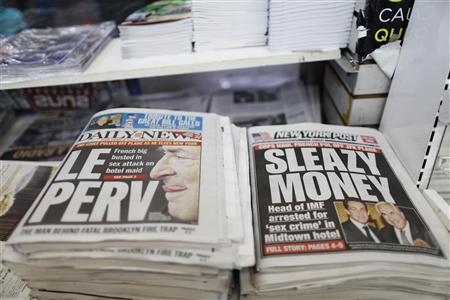
Le perv and les tabs.

Letters from France II:
Le perv, le perp, and justice in America

By David P. Hamilton / The Rag Blog / May 23, 2011

[This is the second in a series of dispatches from France by The Rag Blog‘s David P. Hamilton.]

PARIS — When I planned to write a series of articles from France, discussing the justice system was not on my list of topics. But given that the scandal involving Dominique Strauss-Kahn is on every front page, it’s unavoidable.

In anticipation of critical reaction, allow me preface my comments by saying that I regard rape as prima facie evidence of misogyny and thus a hate crime deserving enhancement of already justly severe punishment. Furthermore, despite my favorite economist, Joseph Stiglitz, writing recently in praise of Dominique Strauss-Kahn’s leadership of the IMF, DSK was hardly my favorite candidate to become the next president of France.

He represents the right wing of the Socialist Party and in a partisan political sense, I’m glad he’s gone. In addition, if I were forced to bet on DSK’s actual guilt or innocence, I would have to put my money on the former.

It must also be said that France is hardly a paragon of virtue when it comes to the issue of women’s rights. French women were only granted the vote in 1945. As reported in The Guardian (London),

Simon Jackson, an English historian at Sciences Po, the elite political studies institute in Paris, shares the view that, in France, male attitudes to sex lag behind Britain in terms of equality. “I think that’s in large part the product of serious and continuing deficits in the opportunities women enjoy professionally, educationally and socially in France, which is one of the least gender-equal countries in the EU.”

In a gender pay gap survey released recently at Davos, France came in 46th.

Nonetheless, I believe that DSK’s right to a fair trial has been irreparably violated by actions on the part of the NYC police, prosecution, and media. Hence, his case should be dismissed and he should sue every media outlet that contributed to his pretrial humiliation, particularly the New York’s Daily News and Rupert Murdoch’s New York Post.

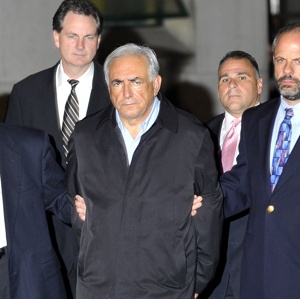
It is simply preposterous to argue that parading a disheveled DSK in handcuffs surrounded by a phalanx of police in front of hordes of photographers did not compromise his prior presumption of innocence. This is not only true in relation to DSK, but also in the case of anyone else abused by this unnecessary practice.

In France, such police behavior is quite specifically illegal. The Daily News plastered the DSK’s photo on its cover with the caption “Le Perv,” as in pervert. It cannot be argued reasonably that the potential jury pool in NYC was not thereby tainted.

Such behavior on the part of the police in France or the UK would result in the dismissal of the case on the basis of police misconduct and the resulting libel suits would likely never go to court because they would be such an obvious two-handed slam dunk for the plaintive.

In this, the Europeans are quite correct and the U.S. justice system is again revealed as fundamentally flawed.

This flaw is so obvious to Europeans that the French woman who has come forth since the incident in New York with allegations that DSK assaulted her during an interview eight years ago, now says, through her lawyer, that she does not “want to be manipulated by the American justice system, or help out in any way so that these two cases might be linked.”

The woman IMF employee with whom DSK had an affair while head of the IMF has said she felt pressured to sleep with him. This is the case in any situation where a boss hits on an employee. It may or may not have included physical force, although she did describe him as “a rutting chimpanzee.”

DSK was reprimanded and publicly apologized, but was allowed to continue as leader of the IMF without further consequences. Reprehensible as that is, no legal system regards such pressure as rape unless violence or threats thereof were involved. It is certain that she is now under pressure again, this time to testify against him. If she is willing to testify and indicates force was involved, and if the judge allows that testimony in court, DSK is very likely going to prison for the rest of his life.

As a result of his purposeful public humiliation and the resulting pretrial publicity, DSK will eventually get a change of venue if he wants it. But given the magnitude of this case and the fact that it has now been on the cover of every newspaper in the world, that solution, itself a compromise of justice, will not suffice to rectify the abuse of his right to the presumption of innocence or the consequences he will have suffered otherwise.

By the time that happens and he gets a trial, his opportunity to run for president will be a distant memory. He must declare his candidacy within a month and the Socialist Party nomination will be determined in November. The first stage of his trial is not until September. He has already been forced to resign from the IMF. The loss of his powerful job, his reputation and the near certainty he would be the next president of France has already been accomplished and cannot be seen as insignificant punishment, regardless of the trial’s outcome.
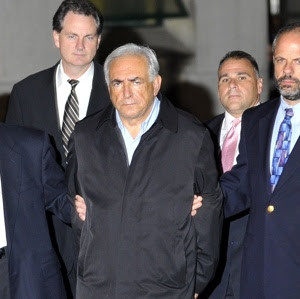
The perp walk. Photo from AP / Getty Images.

Given the defect in American jurisprudence that allows the pre-trial exposure to public humiliation of the accused, it is hardly surprising that France is not willing to sign an extradition treaty with the U.S. The recent Supreme Court decision allowing police to stage home invasions if they merely smell marijuana present only adds fuel to this perception of American justice being heavy handed if not brutal.

With the highest rate of incarceration in the world — mostly poor nonviolent drug offenders without access to good legal representation — the evidence of the U.S. system’s innate injustices is, in fact, ubiquitous.

The principal inherent fallacy in the U.S. legal system is that justice is a commodity. You can get it if you can pay for it. Ironically, this helps DSK because he has the money required. Without other women stepping forth to substantiate the accusations, the case becomes “he said vs. she said.”

The defense lawyers will endeavor to bar the testimony of other women who might step forward with similar allegations against him. With his high paid lawyers, he will likely be able to influence the jury selection in such a way as to find at least one juror who will doubt the case against him.

But why would anyone but sexists doubt DSK’s guilt besides the fact there has been no trial — except in the media, which has already given its guilty verdict despite not having access to the evidence? One possible answer is that polls have consistently shown DSK to be the strongest Socialist Party candidate in the field to defeat Nicolas Sarkozy in next year’s French presidential election. The most recent poll (April 20, 2011) showed DSK beating Sarkozy by 61-39 in the second round run off, a better showing than any other potential Socialist Party candidate.

One of Sarkozy’s aides came out shortly after the arrest saying that there had been previous similar incidents with DSK at that same luxury French-owned NYC hotel, but that the management had covered them up. One might wonder why very wealthy French hotel owners would protect the leading socialist candidate for president who was the clear favorite to displace the right-wing Sarkozy who has promised to Americanize the French economy.

Given DSK’s reputation as a womanizer and the fact that he would soon have to declare his candidacy, the possibility of a “set up” becomes plausible, however remotely, leading one to suspect there might be more here than meets the eye. A poll of 1007 French adults just found that 57% believe that a set-up was either certain or probable.

The other potential conspiracy stems from his attempts to supplant the dollar as the international reserve currency. Others who have advocated a similar goal have included Saddam Hussein and Mouammar Kadhafi. Given its past history of “black ops” it would be naïve to dismiss these kind of activities on the part of the U.S. government out of hand.

It is certain that the U.S. government would find a socialist president of France at least inconvenient. This is not to say these conspiracy allegations have any merit, but they provide a foundation for “reasonable doubt” in the mind of jurors and we are likely to hear more about them from his defense attorneys.

I am actually a big fan of “perp walks,” but only for those who have been convicted in a fair trial. Here, that is anything but the case. In the U.S., the media rushes willy-nilly to convict. It sells newspapers and improves the profit margin, the paramount consideration in a capitalist dominated culture.

There are other potential issues here. DSK’s defenders are being accused of blaming the victim. (Katha Pollitt in The Nation.) But in most press accounts and statements by his defenders, the victim has largely been ignored, that being facilitated by her disappearance. She is no longer on the job or even at home. Were I DSK’s defense lawyer, I would be curious to know who she is talking to besides her family, the police, and the prosecutor.

Then there is the issue of personal matters, such as infidelity, being illegitimate topics in public discussions of politicians. In the U.S., this is not the case. In France, a politician’s private life is usually off-limits. This is a “middle path” issue. Perhaps the U.S. becomes too focused on such private behavior and the French are too protective of their elite.

The principal legal issue remains the maintenance of the accused’s pre-trial presumption of innocence. That is the cornerstone of any reputable system of justice. The U.S. system gives it lip service and then routinely violates the principle. The EU is much more serious about it. Perp walks of those accused of crimes and other similar practices are unnecessary violations of fundamental rights and they should be banned.

[David P. Hamilton has been a political activist in Austin since the late 1960s when he worked with SDS and wrote for The Rag, Austin’s underground newspaper. Read more articles by David P. Hamilton on The Rag Blog.]

The Rag Blog

Posted in Rag Bloggers | Tagged , , , | 4 Comments

Bill Fletcher, Jr. : Obama, Progressives, and the White Nationalist Backlash

Image from Reckless Eyeballing.

Task for progressives in 2012:
Monkey-wrenching the white united front

It has been striking that many progressives have said so little about race, racism, and the discourse of right-wing populism in the context of the upcoming elections.

By Bill Fletcher, Jr. / The Rag Blog / May 22, 2011

In the context of the criticisms that many of us have of the Obama administration for what it has not accomplished, for its advance of a corporate agenda, and for the unacceptable compromises it has made with the Republicans, there is something that I have seen few progressives address.

To borrow from a comment offered by television commentator Tavis Smiley, the 2012 elections are likely to be the most racist that most of us have seen in our lifetimes. Given this, what are the implications?

It has been striking that many progressives, particularly those who have not only written off President Obama but also written off all those who offered critical support to the Obama campaign in 2008, have said so little about race, racism, and the discourse of right-wing populism in the context of the upcoming elections.

We have witnessed the first Black president of the United States questioned about his citizenship and birthplace, yet I have seen precious little from many friends on the left side of the aisle (particularly those so critical of Obama) responding to this. If you put your ear to the ground, however, you hear the murmurings of Black Americans furious that Obama was put in a place where he had to file a petition in order to obtain his Hawaii birth certificate.

The murmurings do not stop there. When Donald Trump and other opportunists started asking questions about how it was that Obama got into Columbia University and Harvard Law School (i.e., was he REALLY qualified to have gotten into those schools?), for most of us enough was enough. Because this was no longer about Obama and it had very little to do with criticisms of Obama and his policies.

The white nationalist backlash is using Obama as the target but they are attempting to create a white united front to, in their minds, take back the United States. Part of this agenda means delegitimizing the democratically elected President, but it also goes towards tampering with election laws and voting processes in state after state.

In case you have not noticed, in many states where there is a Republican majority in control, efforts are underway to restrict voting, whether by further limiting ex-felons from voting, to eliminating same-day voter registration, to the demand for picture identifications at the time of voting, to the shortening of periods of early voting.

The objective is to reduce the potential anti-Republican electorate. This is being done by demagogically and inaccurately crowing about alleged voter fraud. But this happens through the Right racializing alleged voter fraud. In other words, as opposed to a discussion about real voter theft, e.g., the Republican theft of the 2000 election, the right wing uses black and brown characters as the way of convincing segments of the white populace that something needs to be done, otherwise these colored peoples will be taking over.

The racist attacks on Obama, then, fuse with the larger right-wing narrative: the United States of America is being lost to white people. This has been the core of the Birther message, but it has also been the core of the attacks that contributed to the collapse of ACORN, as well as the blitzkrieg effort of the Right to overturn voting rights.

In its more extreme version it is the core of the message that comes out of the fascist and semi-fascist movements among white nationalists such as the Sovereign Citizens (the subject of a segment of the May 15th episode of 60 Minutes).

What we are witnessing is disturbingly similar to the period of the overthrow of Reconstruction and the building of the Jim Crow segregationist system in the South. Appealing to fears among whites, and in a frantic effort to destabilize any efforts at unity between the black and white poor in the South at the end of the 19th century, white Southern elites moved an agenda of voter disenfranchisement, hiding behind various coded concerns such as the literacy of the electorate.

African Americans were completely disenfranchised, and quite ironically, so were many poor whites.

Despite our knowledge of history and awareness of the antics of white right-wing populism, few progressives are discussing the implications of any of this for the 2012 elections. The implications, it would seem to me, are quite profound, and range from what this means about HOW to criticize the Obama administration, to how to ensure that the elections are not outright stolen by the white Right.

Just to be clear before some of my critics start yelling that “Fletcher is covering for Obama,” this column is about racial politics in the USA. The particular flashpoint happens to be Obama but what is at stake, as I have attempted to elaborate, is far more than the political future of a corporate liberal president.

Silence on the part of progressives in the face of this situation, despite our own legitimate criticisms of Obama, misses the larger picture. Yes, we must criticize Obama; yes, we must push this administration; yes, we must protest any retrograde domestic or foreign policies. But in the end, we need to be discussing how this is done in the context of fighting a white, right-wing populism that is arguing that Obama is an alien and that he (and the changing demographics of the USA) represents the end of the white “American Dream.”

We should have no illusions that the Republican candidate for the presidency, irrespective of who gets it, will center their campaign on anything but this one, critical message.

I think it is time to talk about strategy and tactics in the fight for power and against the Right, and not only about matters of policy. Politics is dirty, but it is also very complicated, that is, if one exists in the real world rather than in one’s own playpen.

[BlackCommentator.com editorial board member, Bill Fletcher, Jr., is a Senior Scholar with the Institute for Policy Studies, the immediate past president of TransAfricaForum and co-author of Solidarity Divided: The Crisis in Organized Labor and a New Path toward Social Justice (University of California Press), which examines the crisis of organized labor in the USA. This article was first posted at BlackCommentator.com and was distributed by Progressive America Rising.]

The Rag Blog

Posted in Rag Bloggers | Tagged , , , , , , | 4 Comments

David P. Hamilton : France’s Gift to America Was Our Independence

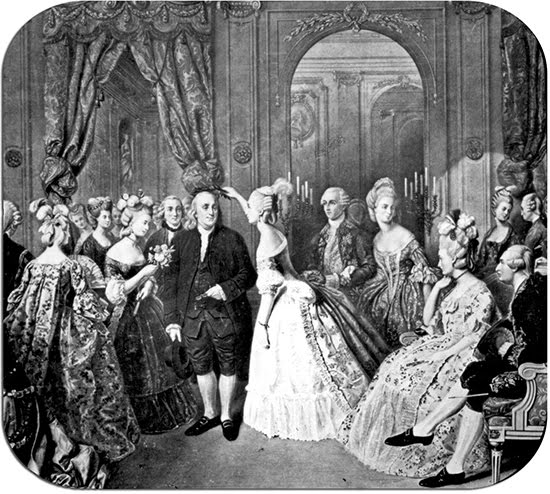
Benjamin Franklin at the Court of France, 1778. Painting by Hobens / Library of Congress.

Letters from France I:
France’s greatest gift to America
was our independence

By David P. Hamilton / The Rag Blog / May 19, 2011

[This is the first of a series of dispatches from France by The Rag Blog‘s David P. Hamilton.]

PARIS — Tea Party types love to bash France and worship the “Founding Fathers.” The historical reality makes this a perfect example of their ignorance. Without France, the American Revolution would have failed and the U.S. would have been a British colony for at least several decades longer.

Besides that, the “Founding Fathers” were a bunch of francophiles. Franklin, Jefferson, and Madison were all delighted to serve as American ambassadors to France, Washington incorporated Frenchmen into his General staff, and Tom Paine rushed off to join the French Revolution.

If one polled Americans about what was the most important gift France had ever given the U.S., they would probably say French fries, which actually came from Belgium. The more well-informed would more likely respond that it was the Statue of Liberty. While not wishing to denigrate that monumental work of art, the best answer would be independence from the British Empire. Without France, the 13 colonies would not have won the American Revolutionary War.

Those who have any knowledge concerning France’s contribution to American independence would likely point to the Marquis de Lafayette who was indeed an important military leader of American forces. Having been made a Major General at age 20, he commanded American troops in numerous successful engagements and was a close aide to General Washington.

But actually, there were hundreds of such French volunteers; men like Brigadier General Du Buysson des Aix of the North Carolina militia, Major General Louis Le Begue de Presle du Portail, Brigadier General Preudhomme de Borre, Major General Philippe Charles Jean Baptiste Tronsoin de Courdray, Brigadier General Tuffin, Marquis de La Rouerie, Brigadier General Jean Baptiste Joseph Laumoy, all serving in the American Continental Army, and Captain Pierre Landais, commander of the frigate “Alliance” of the Continental Navy.

Colonel Teissedre de Fleury was the only foreigner serving in the American army to ever be awarded the Congressional Medal of Honor. But individual French volunteers were just the beginning, icing on a much larger cake. They were not the crucial element.

One cannot understand the American Revolutionary War without understanding that it took place in the context of a long struggle between France and England. As a result of the Seven Years War (1756-63), France suffered considerable losses, including its North American colonies, Canada and the Louisiana Territory. Over a million people died in that war and the French navy was decimated. France remained bitter over these losses, reorganized its military and sought a means to recoup and to weaken its perennial rival, Great Britain.

When the American Revolution broke out, France had little confidence in its success. It did, however, allow individual young Frenchmen to join the American cause, including Lafayette. The ship that carried Lafayette and several other volunteers to America was bought with funds provided covertly by the French government. Early in the war France authorized the clandestine provision of military equipment to the American colonies.

Benjamin Franklin arrived in Paris as the American ambassador in late 1776 to seek French aid and was highly successful, becoming a phenomenon at the court of Louis XVI in the process. In October 1777, the Americans won the Battle of Saratoga, which convinced the French that the Americans could win.

In February 1778, Franklin signed a Treaty of Alliance with France. In response, England declared war on France the following month. They fought each other not only in America, but also in India, Africa, and the West Indies. Aid to the Americans from the French government had nothing to do with support for democracy. They were merely exploiting ways to diminish Great Britain.

The forces of British Major General Charles Cornwallis surrender to French and American forces after the Siege of Yorktown in 1781. Painting by John Trumbull, 1820, from the Rotunda of the U.S. Capitol. Photo from Wikimedia Commons.

Much of the costs of the American Continental Army were paid by France. But the biggest contribution was the participation of the French military, both regular French army troops and the French navy. Most notably, in early 1780, 6,000 French troops landed at Newport, Rhode Island under the command of General Rochambeau who had 40 years of military leadership experience.

After several months debating strategy with Washington, a plan to move south to attack the forces of British General Cornwallis in Virginia with the support of the French fleet under Admiral De Grasse was agreed upon. This was Rochambeau’s plan. He had conducted all the arrangements with De Grasse. Washington had wanted to attack New York, but his plan was essentially overruled by the French.

Unfortunately, while on their way south the American troops mutinied in Philadelphia over not being paid. The French picked up the tab and they moved on.

The decisive battle of the American Revolutionary War was a naval engagement between the British and French fleets, the Battle of Chesapeake Bay in September 1781. The French won. The British fleet retreated to New York. American naval forces were not involved. The defeat of the British fleet meant that Cornwallis had no means of escape from Yorktown, located on the end of peninsula. He was surrounded and outnumbered 2 to 1 by French and American troops on land and the French navy on the water. His defeat was only a matter of time.

Although fighting at Yorktown continued until October 17th, the British surrendered 8,000 men after only sustaining at most 300 killed. But their situation was hopeless and they were raked with dysentery. There were more French troops at Yorktown than American, not including the French naval personnel or individual Frenchmen fighting with the Americans. Some estimates say the disparity was as great as four Frenchmen to one American. French casualties in the battle were twice those of the Americans.

A contemporary observer described the French and American forces present at the surrender. “Among the Americans, the wide variety in age — 12- to 14-year-old children stood side by side with grandfathers — the absence of uniformity in their bearing and their ragged clothing made the French allies appear more splendid by contrast. The latter, in their immaculate white uniforms and blue braid, gave an impression of martial vigor despite their fatigue.”

Yorktown was the last major battle of the war. American independence was recognized by Great Britain at the Treaty of Paris in September 1783 as a direct result of the British defeat there.

Ironically, the war had been triggered by British attempts to make the colonists pay for their own protection, England being in dire financial straits as a result of the cost of the Seven Years War. After it was over, the cost France incurred in support of the American cause led to the bankruptcy of the French monarchy, which contributed enormously to triggering the French Revolution in 1789.

Such profound unintended consequences seem common in floundering empires in decline. The U.S. squandering a trillion dollars in the Iraq War is a prominent case in point.

[David P. Hamilton has been a political activist in Austin since the late 1960s when he worked with SDS and wrote for The Rag, Austin’s underground newspaper. Read more articles by David P. Hamilton on The Rag Blog.]

The Rag Blog

Posted in Rag Bloggers | Tagged , , , | 2 Comments

Ted McLaughlin : The ‘Passivhaus’ is a Smarter Way to Build

This Seattle passivhaus will use 70-90% less energy.

The energy-efficient passivhaus:
It’s a smarter way to build

By Ted McLaughlin / The Rag Blog / May 19, 2011

The new building above doesn’t look like anything special, but it is. It is Seattle’s first permanent building designed to meet the Passivhaus standard, which means it will use 70% to 90% less energy than buildings constructed using normal standards.

Now you may think it requires some kind of high-tech solution to achieve that much energy savings. It doesn’t. It is actually pretty simple to do, and could be done by any competent builder. All it requires is three ingredients:

  1. Highly insulated walls and windows.
  2. A tightly sealed envelope.
  3. Heat recovery ventilation.

There are already over 25,000 homes built to the Passivhaus standard in Europe — mostly in Germany. The building above did cost about 10% more in construction costs, but in Germany (where they have some experience in this type of construction) the additional cost runs about 5% to 8%. The beauty of this is that the small extra building cost is quickly recovered by the huge savings in energy. Just think of how much could be saved by cutting gas and/or electric bills by 70% to 90%.

The house above doesn’t even have a furnace. It can easily be heated by a couple of small baseboard electric heaters that would only have to be used on very cold days (and then for only short periods of time). Most of the time the house would be sufficiently heated by the excess heat from appliances, from people, and from sunshine coming in through the windows. The heat recovery ventilator does have to run 24-7 when the windows are closed, but it only draws about as much electricity as a 50-watt bulb.

Now some of you may be saying that since you live in the South and Southwest where the winters aren’t too bad, this kind of construction wouldn’t be as valuable. Not true. The house can keep in cool air as easily as it does warm air — meaning an air conditioner (preferably a very efficient one) would have to be used for only short and infrequent periods of time. This house saves on energy costs all year.

So why aren’t all new homes and other buildings constructed using the Passivhaus standard? That’s a very good question. Using this construction method would not only save owners a ton of money in energy costs, once they became numerous they would be an important part of energy conservation for the country as a whole — meaning far fewer dirty and polluting electric power plants would be needed to heat and cool them (which would be important since the U.S. seems determined to keep using coal to produce electricity). It would also reduce the need for natural gas and heating oil.

If we were a smarter country, we would require all new construction to use the Passivhaus standard when feasible. But don’t hold your breath for that to happen in the United States. That would reduce the need for oil, gas, and coal. And our politicians are far too busy protecting the corporations supplying these energy sources. They are not about to do anything that would reduce the need for these carbon-based and environmentally-damaging fuels.

There are those who say that renewable energy sources (like wind energy, wave energy, solar energy, etc.) could never supply our total energy needs. That may or may not be true, but if we built much more efficient buildings and drove much more efficient cars and used other conservation methods we might be able to do it.

It’s too bad that our politicians are more interested in protecting corporate profits than they are in solving our energy problems. Many of the solutions, like Passivhaus, are already out there. All we need is the moral and political will to begin using them.

[Ted McLaughlin also posts at jobsanger. Read more articles by Ted McLaughlin at The Rag Blog.]

The Rag Blog

Posted in Rag Bloggers | Tagged , , | 2 Comments

Don Swift : The Republicans’ Debt Default Threat

OMG. The Republicans’ default threat. Image from Reuters.

What will the GOP demand in
return for raising the debt ceiling?

The Republicans have used the threat of shutdown to make excessive demands. So far, the public has not rewarded their cynical efforts with contempt and revulsion.

By Don Swift / The Rag Blog / May 18, 2011

For months Republicans have been threatening to shut down the government if they don’t get what they want as payment for voting to raise the debt ceiling. This is a strange situation because they overwhelmingly control the House and have the responsibility for rounding up the votes to raise the ceiling. The people who are supposed to be producing a solution are threatening legislative terrorism as though they were still the minority.

George Packer writes that “the side with a fixed notion of ends and and an unscrupulous approach to means always has the advantage.” Add to this their domination of the public discussion, and it becomes clear why they are likely to get much of what they demand.

Everyone in the financial community seems to agree with Jamie Dimon of JP MorganChase that failure to raise the debt limit would be “catastrophic” and do great harm to financial markets. Despite this, the Republicans have used the threat of shutdown to make excessive demands. So far, the public has not rewarded their cynical efforts with contempt and revulsion.

As The New York Times notes, “the Republicans… now control the federal steering wheel.” They have control of policy, but a huge slice of the public do not understand this and will blame the Democrats for whatever goes wrong. That is why the Democrats have given away so much already.

In setting conditions for raising the debt ceiling, Republicans have several priorities.

  1. Above all they will oppose any deal that raises tax rates.
  2. They must get extensive budget cuts because they have repeatedly said that cutting expenses — and even jobs — somehow creates jobs. It makes no economic sense, but this has become dogma for them. They must make cuts and hope that Obama’s programs will continue to bring recovery and create jobs. If there is more recovery by November 2012, the GOP will take credit. If their cuts damage the economy, Obama and the Democrats are to blame.
  3. Protecting their key constituents down the road from tax increases is their top priority. They want to take steps to prevent government from raising taxes on the rich and corporations to meet rising entitlement and medical care expenses. They are worried about the ever increasing cost of taking care of the elderly. In 2010, the Republicans gained many votes by denouncing the Democrats for trimming Medicare of $500 billion over 10 years. When the GOP took control of the House, they voted to affirm all $500 billion of that cut. This was consistent with their goal of cutting entitlement costs. Only Republican columnist Richard Morris noted the vote and feared that the voters would remember it. That is most unlikely.

Annual increases in the cost of medical services far exceed overall inflation. The nation has rejected single payer health care, which would have contained costs, and the Republicans are bent on scuttling recently enacted savings mechanisms for Medicaid. Even more threatening than the annual increase in the cost of services is the number of people who are eligible for benefits. From 2007 to 2020, that number will increase by one third.

The long term Republican objective is to reduce federal spending to 16-18% of Gross Domestic Product. This provision is the key to their balanced budget amendment. It sets a ceiling of 18%, but the wording is that the GDP figure would be that of the last calendar year within the previous fiscal year. That means that the growth rate of that last calendar year would not be included in the calculations, so the actual spending limit would be set at about 16.7%.

The last time that government spending was at that fraction of the GDP was 1956, a time when Medicare and Medicaid did not exist. Social Security was far less inclusive then. To exceed the spending limit would require two-thirds votes in both houses of Congress. The amendment requires a three-fifths vote in each house to raise the debt limit.

As a down payment on meeting Republican demands, the Democrats gave them $38.5 billion in cuts, which came mainly from the departments of education, labor, and health. Those cuts will come out of the hide of the sick and poor and will also cost hundreds of thousands of jobs.

In addition, the Democrats agreed to provisions designed to hobble the new consumer protection bureau. There will be numerous audits of the agency conducted by the government and private sector entities. Studies will be made to focus on how much regulations cost financial institutions, but there is not one provision calling for studies of whether the regulations do anything of value for ordinary people.

So far, the Republicans swept the field. There were no cuts in defense or in the myriad of programs providing corporate welfare, and every single tax loophole for corporations remained in place. Budget Chairman Paul Ryan, now famous for his plan to quickly starve Medicare and privatize Medicare in 10 years, said he “got 79% of what we wanted.”

Ryan offered a plan that would include all the Republican budget goals. It ends health care reform, makes permanent tax cuts for the wealthy, and privatizes Medicare in 10 years. Its main accomplishment would be sharply reducing Medicaid coverage in many states within a few years. By 2012, the federal government would begin cutting a $100 billion a year from its support of the program.

Ryan would kill the health care reform plan and privatize Medicare in 10 years. People 55 and over would keep existing Medicare. Essentially they are being bribed with good medical benefits in return for stripping their children and grandchildren of Medicare as we know it. In 10 years, Medicare would become a subsidy the federal government mails to one’s health insurer. Each year, that subsidy would buy less coverage, and the person who is covered would pay more out of pocket.

Today, Medicaid is administered by the states, but they must provide certain services to all the people who qualify for assistance. Federal and state money pays for the services, and the beneficiaries might have a small co-payment. Under the Ryan plan, there would no longer be the guarantee that the state would take care of as many people as meet federal criteria.

There will be a federal block grant, and the states will add money. Then the states decide what to do with the Medicaid money. The idea behind block grants is to allow the federal government to avoid assuming the increased costs of medical care. Annually, the block grant might rise by the amount of inflation for that year, but it would fall short of meeting the inflation rate in medical services.

The states would be left with three options or a combination of them: (1) reduce the number of people covered by Medicaid, (2) increase the co-payments, (3) or reduce the number of services covered.

All but four House Republicans voted to support the proposal. However, they ran into stiff citizen opposition to Medicare changes when they returned to their districts. Some said the opposition was mere AstroTurf — not very deep. That may well be true, as they seem able to sell anything to the public these days. Nevertheless, they have decided to defer the destruction of Medicare. It is more likely that they will seek to enact the other part of the Ryan Plan, gradually defunding Medicaid and turning it over to the states through a block grant mechanism.

When the GOP backed away from the Ryan Plan, the party focused on slicing discretionary spending still more and enacting the part of the Ryan Plan that dealt with Medicaid. In the short term, this would not be politically costly as the people most likely to be on Medicaid vote less often than others. Most Americans seem to live under the delusion that Medicaid could not be in their future.

The House Republican Conference, which speaks for 176 members, said it would settle for $381 billion in cuts, $46 billion of which would come from discretionary spending. This would be in addition to the $38.5 billion that has already been accepted.

On May 10, Speaker John Boehner outlined in general terms what the Republicans would demand in return for extending the debt ceiling. He wanted “trillions” in cuts, but he did not say where the cuts would be. He ruled out any tax increases. This far exceeded what the Conference wanted and must be seen as an effort to appease his Tea Bagger members. He ruled out any tax increases.

Boehner did not mention the financial system near-meltdown or the great recession — both products of Republican policies. He blamed the Obama stimulus for slow job growth and never bothered to refute the Congressional Budget Office finding that the stimulus prevented a much worse disaster.

He ignored a mountain of evidence — some from the impartial Congressional Budget Office — that Obama and the Democrats headed off a recession and promoted economic growth by at least 1% a quarter — by the most conservative estimates. It is almost impossible to find a real economist who would support Boehner. His argument sells because so many understand it is about putting the president in his place, going after the so-called undeserving poor, and repudiating the dreaded liberals.

The final deal on raising the debt ceiling will probably occur in August.

It would appear that President Barack Obama has been maneuvered into a box when it comes to further negotiations with the Republicans. He has said too often that cutting the deficit is desirable, but he has also said he would not endanger the safety net. This leaves him with little room to maneuver. He should be repeatedly pointing out that cutting spending while the economy is weak risks plunging it back into another recession.

House Republicans made it clear they have not given up on Ryan’s plan to privatize Medicare. More than likely, they are waiting until after they gain control of the Senate in 2012, when 23 Democratic seats are up. For the moment, Senate Republicans will avoid doing much with Medicare and will go for huge cuts in Medicaid. In the short run, that may not prevent them from gaining the four or five votes they will need to control the Senate in the election of 2012. In the longer run, more and more voters will come to realize that they and their families are seriously threatened by cuts to Medicaid.

The Democrats need to find a way to hang on until the time when the public comes to associate Republicans with painful cuts in Medicare and Medicaid. The best way to do that is to insist on other ways to cut spending and to demand some revenue increases. Unless they are successful here, they will have helped lock into the conventional wisdom the notion that almost all cuts must come from entitlements and out of the hides of the unlucky, poor, and marginalized.

They must dig in. This is worth risking reelection over.

[Don Swift is a retired history professor.]

The Rag Blog

Posted in Rag Bloggers | Tagged , , , , , | Leave a comment

Peter Montgomery : Newt Gingrich Wants to Make America More Like Texas!

Newt Gingrich: Texas Number One!

Worse campaign promise ever?
Newt Gingrich wants to
make America ‘like Texas’

By Peter Montgomery / AlterNet / May 18, 2011

In his presidential campaign announcement on Sean Hannity’s Fox News Channel show last week, former House Speaker Newt Gingrich praised job creation in Texas and said he’d been talking to Texas Gov. Rick Perry. “I know how to get the whole country to resemble Texas,” Gingrich told Hannity.

That could go down as the worst campaign promise ever.

“I dearly love the state of Texas,” the late Texan and progressive icon Molly Ivins wrote, “but I consider that a harmless perversion on my part, and discuss it only with consenting adults.” Noting that Texas was a state that provided relatively few services to its residents, she once wrote, “The only depressing part is that, unlike Mississippi, we can afford to do better. We just don’t.”

Maybe that should be the motto for Newt Gingrich and his fellow anti-government demagogues.

The impact of that governing philosophy is spreading a lot of pain in Texas right now. Nobel Prize-winning economist and New York Times columnist Paul Krugman wrote earlier this year:

Texas is where the modern conservative theory of budgeting — the belief that you should never raise taxes under any circumstances, that you can always balance the budget by cutting wasteful spending — has been implemented most completely. If the theory can’t make it there, it can’t make it anywhere.

In fact, Texas lawmakers have been struggling all year to figure out how to deal with a massive budget deficit. An AP story from March, headlined “Texas’ economic miracle beginning to tarnish,” noted that the state’s budget shortfall was “among the worst in the nation.” A temporary budget deal in March involving more than $1 billion in spending cuts still left the state $23 billion short over the next two years by one estimate.

Proposed cuts could result in layoffs for 100,000 school employees and 60,000 nursing home workers and eliminate 9,600 state jobs this year. Just this week lawmakers struggled to reach agreement on a deal to close a $4 billion deficit in the current year, which ends in August.

It is possible that entire crisis may have been manufactured by Perry and other anti-government Republicans to give lawmakers a justification for further slashing government and basic human services.

Does Newt think we really want the whole country to look like Texas, which ranks:

  • 50th in percentage of population without health insurance (2010)
  • 50th in percentage of children insured (2009)
  • 50th in percentage of women receiving early prenatal care (2010)
  • 45th in rate of infectious diseases (2010)
  • 44th in percentage of children in poverty (2010)
  • 42nd in per capita health care funding (2010)
  • 40th in overall health (2010)
  • 36th in high school graduation rate (2010)
  • 35th in crime (2010)
  • 35th in percentage of children immunized (2010)
  • 34th in rate of occupational fatalities (2010)
  • 30th in percentage of people with college degree (2008)

Texas also ranks:

  • 1st in amount of recognized carcinogens released into the air (2002)
  • 4th highest in release of toxic chemicals into the environment (2002)
  • 8th highest in percentage of people below poverty level (2008)
  • 13th highest in obesity (2010)

“I know how to get the whole country to resemble Texas.” Uh, thanks, Newt, but no thanks.

[Peter Montgomery is a senior fellow at People For the American Way Foundation. This piece originally appeared at Right Wing Watch, a blog published by People For the American Way, and was distributed by AlterNet.]

The Rag Blog

Posted in RagBlog | Tagged , , , , , | 4 Comments

Dr. Stephen R. Keister : Fighting Money-Driven Medicine

Cartoon by tunin-s / toonpool.com.

The mouse that roared:
Fighting money-driven medicine

By Dr. Stephen R. Keister / The Rag Blog / May 18, 2011

As I look at the health care situation in this country, I am reminded of the Peter Sellers movie, The Mouse That Roared.

We have Physicians for a National Health Program and Healthcare-NOW! aligned against the wealthy corporations, associations, and professional societies — who control the media, that in turn feeds distorted information to the American public– while at the same time holding hostage our elected representatives.

Granted there are a few bits of encouraging news such as the Sanders/McDermott single payer bills being introduced in Congress, the ongoing progress of single payer legislation in Vermont, and a single payer health care bill passing the health committee in the California Senate.

In Maggie Mahar’s powerful book, Money Driven Medicine: The Real Reason Health Care Costs So Much — which I would strongly advise all single payer advocates to purchase and read – there is a thought-provoking paragraph in her last chapter:

But what the consumer movement seems to ignore is that before patients can reclaim their rightful place in the center — and indeed as the raison d’etre — of our health care system, we must once again empower doctors. Physicians must be free to practice patient-centered medicine — based not on corporate imperatives, doctors’ druthers, or even patients’ demands, but on what scientific evidence suggests would be in the best interests of the patient. In other words, society needs to recognize doctors as professionals.

We are very, very far from that ideal. The doctor-patient relationship has been destroyed in the financial interest of the health insurance industry, the pharmaceutical industry, the hospital associations, the nursing home cartels, the medical equipment industry, and all those collateral institutions that bleed away the health care resources from the American people.

A major aspect of the problem, and one that appears only rarely on the public radar, is the terrible cost that comes from medical errors. This discussed in detail in the Public Citizen Health Letter of March 2011:

Preventable medical errors hurt millions of Americans every year. Many suffer unspeakable pain, become disabled, lose their livelihoods, sometimes even lose their lives, because of these medical errors. Two hundred and fifty thousand Americans die each year due to these errors, and close to 900,000 deaths in total per year come as a result of unnecessary surgery, hospital-acquired infections, adverse drug reactions, medical errors, even bedsores. From adverse drug reactions alone, the number of deaths was 420,000 in 1997 as reported by Dr. Lucien Leape of Harvard.

If this isn’t a crisis, I don’t know what is. The pain and suffering is enormous, and so is the financial cost. It would be reasonable to assume that at least $200 billion or more per year is added onto our national health care costs as a result of these errors, and we can anticipate these numbers will continue to rise yearly unless there is intervention and some serious changes begin to take place. Safety must become a major priority, instead of profits. A priority shift is imperative.

We begin to see why our money-driven health care system still ranks something like 26th in the industrialized world — in both cost and quality. Yet we have idiots like Sen. Rand Paul (who during his election campaign falsified his board certification), making the statement: “The right to health care is slavery” as quoted in Raw Story of May 11, 2011.

Paul is merely one of many elected representatives who oppose true health care reform. There is a pattern here. These are the same folks who oppose tax increases for those Americans making over $250,000. Why? In the May 2011 issue of Vanity Fair, Nobel Prize winning economist Joseph Stiglitz provides a simple and compelling explanation:

Virtually all U.S. senators, and most of the representatives in the House. are members of the top 1 percent when they arrive, and are kept in office by money from the top 1 percent, and know that if they serve the top 1 percent well that they will be rewarded by the top 1 percent when they leave office,

These are the same “representatives of the people” who voted in the House of Representatives, 235-191 to defund a program in the new health care law that finances the construction of preventative-care clinics at schools. These wellness clinics are intended to provide primary care, dental services, and mental health care for youths who otherwise would not receive early medical attention, resulting in lower health-care costs in the long run. These same Neanderthals voted to defund any tax deductions as medical expenses for abortions, regardless of medical need, save in cases of rape or incest.

In previous articles I have dealt at length with the greed and manipulation of health care by the health insurance industry and PhARMA. One of great corporate interests that dominate health care today is the medical equipment industry. ProPublica published an outstanding article by Charles Ornstein and Tracy Weber on this subject. Of course this is only the tip of the iceberg, since it only covers one sub-speciality medical society. The payoffs to others, with orthopedic implants, home health care equipment, etc., is truly mind-boggling. Again, this is one of many topics presented in Maggie Mahar’s very well documented book.

I recently have encountered two questionable decisions by the FDA. We, of course, we’re well aware that the appointees to the FDA by President George W. Bush, were creatures of the pharmaceutical industry. I had assumed that the situation had been corrected within the Obama administration. Time will tell.

Colchicine is a medication derived from the Autumn Crocus that for many centuries has been used for the treatment of acute gouty arthritis. I first encountered it in my pharmacology classes in medical school in 1942. Its use was first described as a treatment for gout in De Materia Medica in the first century CE. It is mentioned in the Eber’s Papyrus, ca. 1500 B.C. It was brought to America by Benjamin Franklin who suffered from gout.

In my latter years I have encountered mild attacks of gout and hence have maintained a small supply of generic colchicine tablets in my medicine cabinet, a bottle of 30 tablets costing $15. Last week I stopped by my neighborhood pharmacy for a refill. The price had jumped to $152.

It seems that over all of these years no formal “randomized clinical trials” had ever been carried out; hence, the FDA granted exclusive rights for three years to URL Pharma to carry out those trials, and at the same time gave them exclusive rights to sell the medication under the trade name of Colcrys — at whatever price that they might deem appropriate. Go here to learn more.

On April 20 Raw Story ran an article by David Edwards, titled, “Big Pharma set to take over medical marijuana market.” In 2007 GW Pharmaceuticals announced that it had partnered with Otsuka to bring “sativex” — or liquified marijuana — to the U.S. The companies recently completed Phase II efficacy and safety trial testing. Phase III is generally thought to be the final step before the drug can be marketed in the U.S.

The Phase III trials will be directed at the treatment of pain in patients with advanced cancer who experience inadequate analgesia during optimized chronic opioid therapy. Saltivex is the brand name for a drug derived from cannabis salvia. It is an extract from the whole plant cannabis, not a synthetic compound. Naturally no facts have been revealed regarding pricing!

At the same time the FDA is poised to approve the drug for big Pharma, state-licensed medical marijuana dispensaries that provide relief for thousands of Americans are under attack by other federal agencies. Raw Story reported on May 4, 2011 that the DOJ plans to arrest state licensers, which could doom the medical marijuana industry. These two events would almost seem to be too coincidental!

As we carry on this fight I recall a quote from T.B. Macauley, in a letter to H.S. Randall, in 1857:

Either some Caesar or Napoleon will seize the reigns of government with a strong hand, or your republic will be fearfully plundered and laid waste by barbarians in the Twentieth Century as the Roman Empire was in the fifth; with this difference, that the Huns and Vandals who ravaged the Roman Empire came from without, and your Huns and Vandals will have engendered within your own country by your own institutions.

I think our situation is less like that of France in 1789, but closer to Germany in 1934. Hence, the idea of a Caesar is not far-fetched and even more frightening.

[Dr. Stephen R. Keister lives in Erie, Pennsylvania. He is a retired physician who is active in health care reform and is a regular contributor to The Rag Blog. Read more articles by Dr. Stephen R. Keister on The Rag Blog]

The Rag Blog

Posted in RagBlog | Tagged , , | 3 Comments