Lamar W. Hankins : America’s Gun Problem

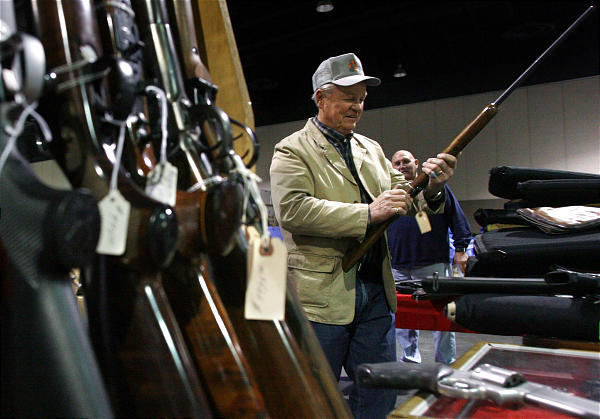
Guns in America. Image from Pics Ranch.

America’s gun problem

Gun regulation is an area where special interests control the Congress, preventing effective public policies that would benefit the welfare and safety of all Americans.

By Lamar W. Hankins / The Rag Blog / January 25, 2011

When Rep. Gabrielle Giffords was shot, a federal judge killed along with five others, and 15 other people wounded in a shooting spree in Tucson just over two weeks ago, I attributed the matter in part to the easy availability of guns that can spew death and destruction faster than eyes can blink.

Various public personalities have suggested banning such high-speed weapons; others have suggested going back to a law we had seven years ago that prohibited magazines that will hold as many as 33 bullets, limiting magazines to a size that can hold no more than 10 rounds.

This was effective policy. The Washington Post just reported that “The number of guns with high-capacity magazines seized by Virginia police dropped during a decade-long federal prohibition on assault weapons, but the rate has rebounded sharply since the ban was lifted in late 2004.”

Rep. Peter King wants to protect certain elected officials by making it unlawful to possess a firearm within a thousand feet of such officials — a sort of “protect Peter King and other important Americans law,” to hell with the rest of us.

Though I am not in favor of banning guns, I have wondered for years why Americans are so fascinated with guns and weapons, and why we have so many gun deaths in the U.S. I’ve not been interested in hunting for at least 40 years, but I have bought or inherited several hunting rifles, a couple of shotguns, and a World War II era Walther handgun brought back from Europe in 1945 by my father, complete with an authorization for the weapon signed by his commanding officer. If it was ever shot, the trigger was pulled by that German officer from whom it was taken nearly seven decades ago.

Over the years, I’ve hunted infrequently and done some target practice a couple of times with a shotgun. When I was about 12 years old, my uncle allowed me to shoot a double-barreled 12 ga. shotgun originally owned by my maternal grandfather. The recoil knocked me on my rear. My experiences help me understand the fascination with guns so prevalent in our culture, but those experiences do not help me understand the propensity to violence that permeates our lives and leads to the killing by guns of so many each year in the United States.

A study reported in 1998 by the Centers for Disease Control and Prevention (CDC) found that America accounted for 45% of the total gun-related deaths in the 36 countries studied. Between 1980 and 2006, the U.S. has had on average more than 32,000 gun deaths per year.

Like the CDC, the Harvard School of Public Health provides some dispassionate data on gun deaths. Looking at the relationship between gun availability and homicides in 26 developed countries, research reported in the Journal of Trauma in 2000 found that “Across developed countries, where guns are more available, there are more homicides. These results often hold even when the United States is excluded.”

And guns are more available in the United States than anywhere else. Forty-two per cent of U.S. households have guns. There are 90 guns per 100 persons in the U.S. The next closest country in guns per 100 persons is Yemen, with 61. Canada has 31 guns per 100 persons.

Another study in the American Journal of Public Health in 2002 that looked at gun deaths in the 50 states found that “After controlling for poverty and urbanization, for every age group, people in states with many guns have elevated rates of homicide, particularly firearm homicide.”

‘States with higher levels of household gun ownership had higher rates of firearm homicide and overall homicide.’

A study reported in the journal Social Science and Medicine in 2007 found that “States with higher levels of household gun ownership had higher rates of firearm homicide and overall homicide.”

Similar studies have found that the same sort of correlation between the availability of guns and the prevalence of homicide exists between the availability of guns and the prevalence of suicide. And a study reported in 2001 in Accident Analysis and Prevention found that “For every age group, where there are more guns there are more accidental deaths. The mortality rate was seven times higher in the four states with the most guns compared to the four states with the fewest guns.”

Other studies have found that children and women in states with more guns are more susceptible to “elevated rates of unintentional gun deaths, suicides and homicide, particularly firearm suicides and firearm homicides.”

One of the most prevalent beliefs in American culture is that the Wild West was a dangerous and violent place dominated by gun violence and that America’s gun obsession is the legacy of that violent frontier. Certainly, there was danger for those unaccustomed to the undeveloped wilderness, devoid of resources with which they were familiar, but death by violence on the frontier has been exaggerated by movies and television dramas.

According to historian Bruce Benson, while there was little government law and order (except near military posts), disagreements were usually resolved through both formal and informal agreements. Before embarking on the perilous journey westward, wagon trains usually negotiated their own system of social behavior, enforced within the wagon train community.

Mining camps followed similar plans for maintaining law and order and avoiding the anarchy which is the stuff of legend. Benson describes the use of hired “enforcement specialists,” which included justices of the peace and arbitrators to resolve disputes over property rights and criminal behavior in the mining camps.

Other cooperative law-and-order arrangements were designed by cattlemen’s associations and land clubs, which adopted their own constitutions to regulate claims to land before the government started regulating land ownership, as described by historians Terry Anderson and P. J. Hill.

Whatever the historical cause of gun violence, the reality is that we are faced with excessive gun deaths in the United States, at least as compared with the rest of the world.

Those who study public policy have noticed that with regard to other social issues, such as reducing the harm from motor vehicles, tobacco use, and alcohol use, more positive results are obtained by modifying both the product and the environment, rather than focusing mainly on the user.

Groups such as the National Rifle Association (NRA) focus almost exclusively on users, promoting classes on firearm safety and use, but opposing modifications to firearms, elimination of large weapon magazines, limitations on the kinds of weapons available for purchase, restrictions on the purchase of firearms, prohibitions on the kinds of ammunition that can be purchased (such as cop-killer bullets), changes in the formulation of bullets to aid law enforcement in apprehending wrong-doers, and increases of penalties for violating laws that prevent children’s access to guns.

By a 3-to-1 margin, Americans report that they do not feel safer when more people in their community acquire guns.

By a 3-to-1 margin, Americans report that they do not feel safer when more people in their community acquire guns. And by a 5-to-1 margin, they do not feel safer when more people in their community begin to carry guns.

In spite of the common belief that concealed-carry laws reduce violent crime, no data show that such laws have had an impact on crime. Yet public policy changes aimed at reducing gun violence seldom are enacted, largely because of the powerful lobbying of the NRA and the Gun Owners of America (GOA), along with several smaller groups, which collectively spend tens of millions of dollars on lobbying each year.

Groups like the NRA and the GOA use fear, antipathy toward government, appeals to rugged individualism, notions of limitless personal choices, and similar propaganda to persuade Americans and their representatives that gun issues should not be dealt with objectively, based on rational public policy considerations, but should be decided based on emotion and the personal preferences of gun owners.

They recognize no responsibility to the society as a whole to resolve social problems in ways that benefit society, rather than the narrow interests of gun owners.

I find criticisms of the NRA by groups like the Coalition to Stop Gun Violence (CSGV) persuasive for their logic and lack of appeal to emotion. The CSGV has reproached the NRA for its “warped conception of popular sovereignty… that citizens need to arm themselves to safeguard political liberties against threats by the government.”

The CSGV finds the NRA and its members in opposition to constitutional democracy because they “believe in the right to take up arms to resist government policies they consider oppressive, even when these policies have been adopted by elected officials and subjected to review by an independent judiciary.” In short, the gun lobby favors using guns to oppose any law and order with which it disagrees.

Other than perhaps better protecting some public officials, in the present political environment it seems unlikely that anything positive will come from the killings and shootings in Tucson, and America’s obsession with guns and their use to kill others probably will continue to grow unabated.

Gun regulation is another area where special interests control the Congress, preventing effective public policies from being adopted that would benefit the welfare and safety of all Americans. Whenever special interests control public policy, the system has become corrupted. Until public officials can escape that corruption, they will not act to benefit the society as a whole.

This is why citizens must speak up to counteract the irrational, unscientific, self-serving, corrupting, and fear-inducing campaigns of the organized gun lobby. We need to hear the voices of more Americans, not fewer, so that we can work toward achieving less gun violence against all Americans.

[Lamar W. Hankins, a former San Marcos, Texas, city attorney, is also a columnist for the San Marcos Mercury. This article © Freethought San Marcos, Lamar W. Hankins.]

The Rag Blog

Posted in Rag Bloggers | Tagged , , , , , | 3 Comments

Peter Finn : Drone Used in Austin Raises Privacy Issues

Wasp III drone — the kind used by Texas DPS in 2009 Austin police operation. Grab from KVUE.com / Austin.

Drones over Austin:
Law enforcement use of aerial drones
raises issues of privacy, civil liberties

By Peter Finn / CommonDreams / January 24, 2011

AUSTIN — The suspect’s house, just west of this city, sat on a hilltop at the end of a steep, exposed driveway. Agents with the Texas Department of Public Safety believed the man inside had a large stash of drugs and a cache of weapons, including high-caliber rifles.

As dawn broke, a SWAT team waiting to execute a search warrant wanted a last-minute aerial sweep of the property, in part to check for unseen dangers. But there was a problem: The department’s aircraft section feared that if it put up a helicopter, the suspect might try to shoot it down.

So the Texas agents did what no state or local law enforcement agency had done before in a high-risk operation: They launched a drone. A bird-size device called a Wasp floated hundreds of feet into the sky and instantly beamed live video to agents on the ground. The SWAT team stormed the house and arrested the suspect.

“The nice thing is it’s covert,” said Bill C. Nabors, Jr., chief pilot with the Texas DPS, who in a recent interview described the 2009 operation for the first time publicly. “You don’t hear it, and unless you know what you’re looking for, you can’t see it.”

The drone technology that has revolutionized warfare in Iraq, Afghanistan, and Pakistan is entering the national airspace: Unmanned aircraft are patrolling the border with Mexico, searching for missing persons over difficult terrain, flying into hurricanes to collect weather data, photographing traffic accident scenes, and tracking the spread of forest fires.

But the operation outside Austin presaged what could prove to be one of the most far-reaching and potentially controversial uses of drones: as a new and relatively cheap surveillance tool in domestic law enforcement.

For now, the use of drones for high-risk operations is exceedingly rare. The Federal Aviation Administration — which controls the national airspace — requires the few police departments with drones to seek emergency authorization if they want to deploy one in an actual operation. Because of concerns about safety, it only occasionally grants permission.

But by 2013, the FAA expects to have formulated new rules that would allow police across the country to routinely fly lightweight, unarmed drones up to 400 feet above the ground — high enough for them to be largely invisible eyes in the sky.

Such technology could allow police to record the activities of the public below with high-resolution, infrared and thermal-imaging cameras.

One manufacturer already advertises one of its small systems as ideal for “urban monitoring.” The military, often a first user of technologies that migrate to civilian life, is about to deploy a system in Afghanistan that will be able to scan an area the size of a small town. And the most sophisticated robotics use artificial intelligence to seek out and record certain kinds of suspicious activity.

But when drones come to perch in numbers over American communities, they will drive fresh debates about the boundaries of privacy. The sheer power of some of the cameras that can be mounted on them is likely to bring fresh search-and-seizure cases before the courts, and concern about the technology’s potential misuse could unsettle the public.

“Drones raise the prospect of much more pervasive surveillance,” said Jay Stanley, a senior policy analyst with the American Civil Liberties Union’s Speech, Privacy, and Technology Project. “We are not against them, absolutely. They can be a valuable tool in certain kinds of operations. But what we don’t want to see is their pervasive use to watch over the American people.”

The police are likely to use drones in tactical operations and to view clearly public spaces. Legal experts say they will have to obtain a warrant to spy on private homes.

Surveillance slingshot: A Wasp drone, used by the U.S. Marine Corps, shown being launched. Image from Defense Update.

FAA authorization

As of December 1, according to the FAA, there were more than 270 active authorizations for the use of dozens of kinds of drones. Approximately 35 percent of these permissions are held by the Defense Department, 11 percent by NASA and 5 percent by the Department of Homeland Security, including permission to fly Predators on the northern and southern borders.

Other users are law enforcement agencies, including the FBI, as well as manufacturers and academic institutions.

For now, only a handful of police departments and sheriff’s offices in the United States — including in Queen Anne’s County, Md., Miami-Dade County, Fla., and Mesa County, Colo.– fly drones. They so do as part of pilot programs that mostly limit the use of the drones to training exercises over unpopulated areas.

Among state and local agencies, the Texas Department of Public Safety has been the most active user of drones for high-risk operations. Since the search outside Austin, Nabors said, the agency has run six operations with drones, all near the southern border, where officers conducted surveillance of drug and human traffickers.

Some police officials, as well as the manufacturers of unmanned aerial systems, have been clamoring for the FAA to allow their rapid deployment by law enforcement. They tout the technology as a tactical game-changer in scenarios such as hostage situations and high-speed chases.

Overseas, the drones have drawn interest as well. A consortium of police departments in Britain is developing plans to use them to monitor the roads, watch public events such as protests, and conduct covert urban surveillance, according to the Guardian newspaper. Senior British police officials would like the machines to be in the air in time for the 2012 Olympics in London.

“Not since the Taser has a technology promised so much for law enforcement,” said Ben Miller of the Mesa County Sheriff’s Office, which has used its drone, called a Draganflyer, to search for missing persons after receiving emergency authorization from the FAA.

Cost has become a big selling point. A drone system, which includes a ground operating computer, can cost less than $50,000. A new police helicopter can cost up to $1 million. As a consequence, fewer than 300 of the approximately 19,000 law enforcement agencies in the United States have an aviation capability.

“The cost issue is significant,” said Martin Jackson, president of the Airborne Law Enforcement Association. “Once they open the airspace up [to drones], I think there will be quite a bit of demand.”

The FAA is reluctant to simply open up airspace, even to small drones. The agency said it is addressing two critical questions: How will unmanned aircraft “handle communication, command and control”? And how will they “sense and avoid” other aircraft, a basic safety element in manned aviation?

Military studies suggest that drones have a much higher accident rate than manned aircraft. That is, in part, because the military is using drones in a battlefield environment. But even outside war zones, drones have slipped out of their handlers’ control.

In the summer, a Navy drone, experiencing what the military called a software problem, wandered into restricted Washington airspace. Last month, a small Mexican army drone crashed into a residential yard in El Paso.

There are also regulatory issues with civilian agencies using military frequencies to operate drones, a problem that surfaced in recent months and has grounded the Texas DPS drones, which have not been flown since August.

“What level of trust do we give this technology? We just don’t yet have the data,” said John Allen, director of Flight Standards Service in the FAA’s Office of Aviation Safety. “We are moving cautiously to keep the National Airspace System safe for all civil operations. It’s the FAA’s responsibility to make sure no one is harmed by [an unmanned aircraft system] in the air or on the ground.”

Officials in Texas said they supported the FAA’s concern about safety.

“We have 23 aircraft and 50 pilots, so I’m of the opinion that FAA should proceed cautiously,” Nabors said.

Legal touchstones

Much of the legal framework to fly drones has been established by cases that have examined the use of manned aircraft and various technologies to conduct surveillance of both public spaces and private homes.

In a 1986 Supreme Court case, justices were asked whether a police department violated constitutional protections against illegal search and seizure after it flew a small plane above the back yard of a man suspected of growing marijuana. The court ruled that “the Fourth Amendment simply does not require the police traveling in the public airways at this altitude to obtain a warrant in order to observe what is visible to the naked eye.”

In a 2001 case, however, also involving a search for marijuana, the court was more skeptical of police tactics. It ruled that an Oregon police department conducted an illegal search when it used a thermal imaging device to detect heat coming from the home of an man suspected of growing marijuana indoors.

“The question we confront today is what limits there are upon this power of technology to shrink the realm of guaranteed privacy,” Justice Antonin Scalia wrote in the 2001 case.

Still, Joseph J. Vacek, a professor in the Aviation Department at the University of North Dakota who has studied the potential use of drones in law enforcement, said the main objections to the use of domestic drones will probably have little to do with the Constitution.

“Where I see the challenge is the social norm,” Vacek said. “Most people are not okay with constant watching. That hover-and-stare capability used to its maximum potential will probably ruffle a lot of civic feathers.”

At least one community has already balked at the prospect of unmanned aircraft.

The Houston Police Department considered participating in a pilot program to study the use of drones, including for evacuations, search and rescue, and tactical operations. In the end, it withdrew.

A spokesman for Houston police said the department would not comment on why the program, to have been run in cooperation with the FAA, was aborted in 2007, but traffic tickets might have had something to do with it.

When KPRC-TV in Houston, which is owned by The Washington Post Co., discovered a secret drone air show for dozens of officers at a remote location 70 miles from Houston, police officials were forced to call a hasty news conference to explain their interest in the technology.

A senior officer in Houston then mentioned to reporters that drones might ultimately be used for recording traffic violations.

Federal officials said support for the program crashed.

[This article was originally published by The Washington Post and was distributed by CommonDreams. Washington Post staff researcher Julie Tate contributed to this report. © 2011 The Washington Post.]

The Rag Blog

Posted in RagBlog | Tagged , , , , , | 1 Comment

Ted McLaughlin : Americans Don’t Want to Gamble With Social Security

Cartoon from Donklephant.

Americans aren’t buying the
lies about social security

New polls show that idea of cutting Social Security is not popular with the American public.

By Ted McLaughlin / The Rag Blog / January 24,2011

During the Great Depression one of the hardest hit groups of people was the elderly. And it was not just the poor who were destitute — many who thought they had planned for their “golden years” found that the crash of Wall Street and the failure of thousands of banks had wiped them out. President Roosevelt, with the help of many other Democrats, decided this would not happen again. They created the Social Security program to protect the elderly.

And since its inception Social Security has been a huge success. It has guaranteed that the elderly in this country have at least a modicum of income and don’t have to eat from dumpsters or live on the streets just because they can no longer work (and it has opened up jobs for younger people because the elderly are able to retire rather than work until they die).

But the Republicans don’t like Social Security. They opposed its creation and have consistently tried to abolish it throughout its existence. The latest incarnation of their opposition to Social Security is the idea of “privatizing” it. Instead of keeping Social Security funds in a safe government account, they want to create private accounts (which Americans would be forced to pay into). Then their rich buddies on Wall Street would be able to get their greedy fingers on that money in the guise of “investing” it for ordinary Americans.

The greedmongers on Wall Street would make millions in fees and bonuses off the money of ordinary Americans, but there would be no guarantee that the money would be there when a person retired. When Wall Street melted down at the end of 2007, trillions of dollars disappeared from the market and anyone depending on that money for their retirement was just out of luck — and naturally, small investors (ordinary Americans) were hurt the worst. This is a perfect example of why “privatized” accounts are a terrible idea.

But the Republicans haven’t given up. They have a couple of new lies they are trying to spread about Social Security in order to get their greedy hands on that money. The first is that Social Security must be cut because of the growing federal deficit. What they don’t tell anyone is that cutting Social Security would do nothing to help the federal deficit. Social Security is not a part of the growing national debt. Social Security is separate and draws only from money paid by all workers into the Social Security fund (and that money can only be used to pay Social Security benefits).

The second lie is that because of the large number of “baby boomers” who are just now starting to retire and receive their Social Security benefits, the program is going broke and cannot support the payment of these benefits. The truth is that the program can keep paying full benefits until at least 2027, and minor revisions could fund the program far into the future — like reducing benefits for the wealthy or removing the cap on the amount of income subject to Social Security taxes.

It has been my fear recently that people might start believing these lies and allow ignorant politicians to reduce benefits or destroy Social Security altogether (by privatization); after all, if you repeat a lie long and loud enough some people will come to believe it. Fortunately, the American people aren’t buying this nonsense — at least not yet.

A new poll done for The New York Times and CBS News shows that most people aren’t buying into the lies. The poll was conducted January 15th through the 19th, and has a margin of error of three points. Here is what the poll showed:

Which of the following would you be willing to change to cut government spending?

Social Security……………13%
Medicare……………21%
Military……………55%
No opinion……………10%

If you had to choose one, which of the following would you be willing to change to keep Social Security financially sound?

Reduce benefits for future retirees……………8%
Raise retirement age to receive full benefits……………18%
Reduce benefits for the wealthy……………66%
No opinion……………8%

And the best part is that these feelings cross party lines. Even a significant majority of rank-and-file Republicans aren’t buying in to the lies of their leaders. Here are the numbers broken down by party affiliation:

Reduce benefits for future retirees
Republicans……………8%
Independents……………9%
Democrats……………7%

Raise retirement age to receive full benefits

Republicans……………25%
Independents……………20%
Democrats……………13%

Reduce benefits for the wealthy

Republicans……………59%
Independents……………67%
Democrats……………71%

The poll didn’t ask about raising or abolishing the cap on the amount of income the Social Security tax would apply to. I wish it had. This one action would solve any problems Social Security has, and it would make it much fairer since the working class pays this tax on all their income while the wealthy pay the tax on only a tiny portion of their income.

One thing is clear though — the American people don’t support raising the retirement age or reducing benefits for all recipients. I hope the politicians are listening.

[Rag Blog contributor Ted McLaughlin also posts at jobsanger.]

The Rag Blog

Posted in Rag Bloggers | Tagged , , , | 3 Comments

Harry Tarq : JFK and Obama Inspired Something Bigger Than Themselves

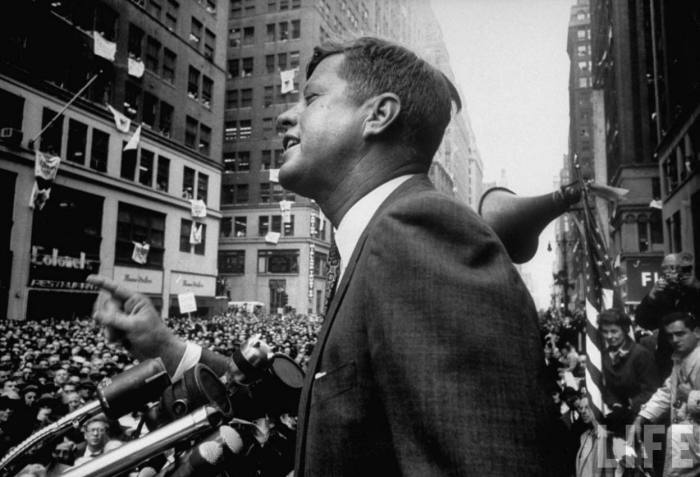
Jack Kennedy inspired idealism in youth of the 60s. Photo from Dysonology.

JFK and Obama:
Leaders who knew not what they were creating

By Harry Targ / The Rag Blog / January 23, 2011

A young college kid

I walked to campus one fall morning in 1960 and came upon a large crowd surrounding the main quadrangle at the University of Illinois. I asked someone hanging around what was up. He said that Democratic candidate for president John F. Kennedy was going to appear at the steps of the auditorium building at one end of the large area surrounded by classroom buildings.

I stayed and found his talk mildly interesting. I was studying journalism, found politics intriguing, and wanted to grow up to be a columnist like Walter Lippman. I was impressed by JFK’s youth, energy, glamour, as politicians go, and he was the polar opposite of the boring Republican choice, Richard Nixon.

I had not yet begun to read the Beat poets, Paul Goodman, William Whyte’s The Organization Man, or other such analysts of the 1950s “dark ages,” but I intuitively grasped the moment. I began to see the emergence of a new political generation in America. Later that fall Eleanor Roosevelt appeared at the YMCA to campaign for JFK. I did know that she spoke for the legacy of the New Deal of the 1930s and I admired her greatly. I probably saw a connection between that liberal legacy and the possibilities for the 1960s.

JFK as president

Two months later JFK won the election, probably with a significant assist from late night reports of Cook County votes which made Illinois a win for him. His election, of course, was followed by a stirring inaugural speech, one in which he called upon young people in particular to do things for their country, not just for themselves. I was too naïve to ask: “What did you have in mind?”

JFK launched a figurative shuttle from Harvard Yard to the White House. Bright, young intellectuals, policy analysts with connections to big corporations, theorists of modernization and development in the so-called “Third World,” liberal anti-Communists, and academics with a preference for moderate Democrats flew in to help the Kennedy team craft policies to expand capitalism on a worldwide stage.

Their project included developing policies that would transform the growing opposition to colonialism and neocolonialism in Africa, Asia, and Latin America into a set of regimes that would be sufficiently anti-Communist to accommodate global capitalism.

The 60s

While many people of my generation grew more excited by the new administration and how we could participate in the construction of radical change at home and abroad, Kennedy was expanding U.S. military activity in Vietnam, authorizing an invasion of the island 90 miles from our shores by Cuban counter-revolutionaries, dramatically increasingly military spending, and shifting the Pentagon from old-style professional militarism to new techniques of scientific management.

At home the administration was trying to figure out ways to “cool out” Southern militancy, temper opposition to segregation, and maintain support for the Democratic Party in the weakening “Solid South.”

I remember all this as we reflect on the 50-year anniversary of the dawn of the Kennedy era. We may quibble about when “the 60s” really began. Some might begin their narrative with the Montgomery Bus Boycott of 1955 or the publication of The Catcher in the Rye or Ginsberg’s reading of “Howl” in the Bay area, or manifestations of enthusiasm as Fidel Castro and the 26th of July Movement marched into Havana in January 1959.

However, alternatively, a case could be made that the 60s began with the Kennedy inaugural address.

The irony

The main point I take from my remembrances of JFK is the fact that he did turn on a generation to the possibilities of changing America at home and abroad. He presented a vision of a political regime in which citizens would want to participate for their own betterment and the betterment of others. While he surely did not mean to address these issues, his campaign, speeches, and persona conveyed a message of anti-imperialism, social and economic justice, and profound opposition to racism.

Ironically, he meant none of these but 60s youth assumed that that was what he stood for and wanted us to commit our lives to achieving. If Kennedy had lived, he would have opposed the movements against racism, war, and gender equality even more than his successor LBJ, but he turned us on to want to achieve these goals. That is the significance of JFK for the 60s and what followed.

Fast forwarding 48 years, a young Barack Obama, by his style, language, gestures, and some of his words, alluded to the same images of fundamental change we derived from JFK in his day. Young people flocked to the Obama campaign with a gusto not seen by young people politically since the 60s.

The record is still out but we can only hope that the fire and passion that stimulated youth for Obama in 2008 will ignite radicalism in the years ahead as JFK did in the 1960s; hopefully with Obama’s support, but if not, without it.

[Harry Targ is a professor of political science at Purdue University who lives in West Lafayette, Indiana. He blogs at Diary of a Heartland Radical.]

The Rag Blog

Posted in RagBlog | Tagged , , , , | 1 Comment

Gregg Barrios : The Risqué Business of Texas’ Most Famous Stripper

In the late ’50s, Candy Barr was the toast of the Dallas burlesque circuit.

Risqué Business:
The complicated life of Candy Barr,
Texas’ most famous stripper

By Gregg Barrios / The Texas Observer / January 21, 2011

How times have changed. These days, the term burlesque conjures the safest kind of sexiness, a retro-flirty striptease that’s tame enough for hipster bars, dates, and even a family-friendly Hollywood blockbuster staring Christina Aguilera as a small-town girl who makes it on the big-city burlesque stage.

In this narrative, vintage burlesque was a quaint fad that helped pre-feminist-era women express their vibrant sexuality in a society that wanted to cover it up. And the heroes are women like Candy Barr, Texas’ most famous burlesque dancer.

But women like Barr paid a price that’s hard to fathom these days. In the early ’50s, women were expected to settle down and raise a family. Candy Barr bucked all that: She strapped on some pasties and a couple of six-shooters and took to the stage.

It wasn’t an easy life, and Barr had a much more complex and multifaceted view of herself than the official accounts would lead you to believe. I knew Candy Barr, and Christina Aguilera, you are no Candy Barr.

I’m from Victoria; Candy was born and raised in nearby Edna. It was in our daily paper, the Victoria Advocate, where I first read about Juanita Dale Slusher and her larger-than-life exploits as Candy Barr. But when she died in Victoria of pneumonia on Dec. 30, 2005, the Advocate failed to print an obituary. Even in death, her persona was too dangerous to pay tribute to.

Juanita Dale Slusher (aka Candy Barr) in 1984. Photo from the Gregg Barrios Archive.

I first met Candy Barr in 1984 while on assignment for the Los Angeles Times. She was living in Brownwood at the time. Her lakeside cottage had an emblazoned, burnished sign: “Fort Dulce.” The gated property with its tall wooden fence was to “keep the crazies away.” The modest cottage was filled with bric-a-brac. There were no photos of her younger, famous self. A picture of Jesus hung on her bedroom wall.

Juanita Dale Slusher was born on July 6, 1935 (in her words, “a delayed firecracker”), in the tiny town of Edna. Her hardscrabble childhood was scarred by sexual abuse by a neighbor and babysitter. Her mother died when she was seven, and her father Doc Slusher remarried. Her stepmother proved a piece of work.

“I’m Juanita Dale Slusher,” she told me. “I didn’t like ‘Wan-eat-ah’ because they never pronounced it right in school. I never heard the beauty of ‘Juanita’ with its Spanish inflection. And growing up with the stigma of poor white trash, I went along hearing that my daddy was a bad man, and I grew up associating me with the thing that meant bad, too.”

Her stepmother would make her father beat her if she asked for new shoes, if she sprinkled too much water on her dress when she was ironing it. “I couldn’t take it anymore, and when I was 14, I ran away wearing the only dress I had that wasn’t a complete rag,” she said. “I walked off my father’s farm early one morning and headed for town.”

She made her way to Dallas, found work as a waitress, and saved enough money for her own room in a boarding house. She bought a new pair of shoes. “I carried the shoes to bed with me the night I got them and slept with them in my arms.”

In an account in a men’s magazine, Slusher recounted that in 1951 she was down and out after the arrest of her first husband, a crook named Billy Joe Dabbs. Only 16, she heard about a way to make some quick money.

I went to the address a friend gave me. The man behind the desk looked me over. He told me I had a great figure. Then he explained he wanted me to act in a risqué film. Then he opened his wallet and counted a bunch of ten-dollar bills. He counted them out on the desk before me, one by one. The purse I clutched in my hands contained exactly seven cents. I made the film.

The dinner I ate that day was the first decent meal I’d had in weeks. It was warm inside me. Only when my hunger was gone could I think straight. But I was still too young to understand fully just what I had done. I’m still sick with shame over what I did, but when you’re (young) and all alone and your insides are crying for food, you can’t always figure out right from wrong.

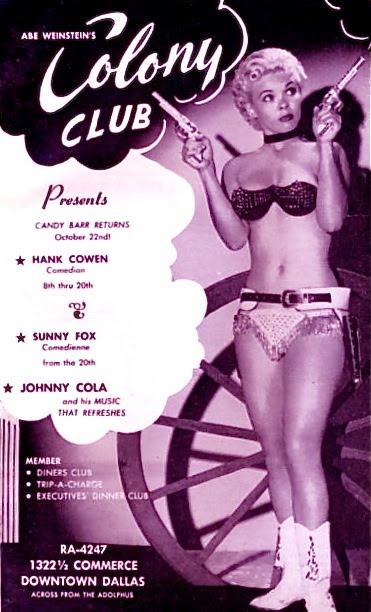
It might have simply been her 15 minutes of fame and notoriety, but instead it transformed battered Juanita into devil-may-care icon Candy Barr. Later in life, Slusher would say she did the film because she was drugged. Whatever the case, the film became a hit at frat houses, Elks and Moose lodges, and private servicemen clubs. It was the most popular of all the underground blue movies. Once the word was out, Dallas nightclub owner and promoter Abe Weinstein hired the underage teen for $85 a week to headline his Colony Club as Candy Barr, her blue movie name.

“Delayed firecracker”: Candy Barr publicity shot.

On stage, Candy Barr was among the best — a whirling dervish dancing to the beat of Artie Shaw’s spooky “Nightmare” or segueing into a sensual slow-mo tease set to a jazzy “Autumn Leaves.” She recalled, “Dancing was my greatest pleasure. It was my world. I danced a picture. I just lived it up there, and whatever I was painting came across — charcoals, oils, or pen-and-inks.”

Slusher played the tease, but she didn’t let men control her. The plot of her porn debut revolves around her refusal to provide fellatio on demand. And when Candy’s estranged second husband, Troy Phillips, tried to break down her door and rape her, she shot him. Phillips survived and Slusher was cleared of all charges.

“The last thing in the world I wanted was notoriety,” Barr said. “The shooting brought it to me, and I was worried that it might hurt my career. Being cleared, however, did me good. People came out of curiosity to see the girl who shot her husband to defend herself.”

In 1957, while Barr was the toast of the Dallas burlesque circuit, she had an opportunity to break out in a new direction as an actress. The director of a little Dallas theater group in dire financial straits approached her to star in Will Success Spoil Rock Hunter? in the role of Rita Marlowe, which fellow Texan Jayne Mansfield had played on Broadway. Barr agreed. The production became the hottest ticket in town and saved the theater.

But conservative Dallas blue-bloods were not about to have Candy Barr become a respectable actress. They encouraged the Dallas police to set her up with a small amount of marijuana — or so her lawyer later argued in court. During the prosecutor’s closing argument, he told the jury: “She may be cute, but under the evidence, she’s soiled and dirty.”

Slusher was found guilty of possession and sentenced to 15 years in the state penitentiary. While the case was being appealed, L.A. mobster Mickey Cohen, a co-founder of Las Vegas’ Flamingo Hotel, put up her bail, and they moved in together. Slusher starred in what was billed as the “biggest strip show in the world,” at the Largo in Los Angeles. 20th Century Fox hired Barr to teach Joan Collins how to “dance” for a film role as a stripper.

But two years later, on January 14, 1959, Slusher’s appeal was turned down and her life in the fast lane ended. She was sent to Goree, then a women’s prison in Huntsville, to serve her sentence. Prison life changed Barr. She was pregnant when she entered Goree and had a miscarriage. She was medicated with Thorazine, which she later became addicted to. She spent most of her free time in the library and taking education courses. She was assigned to work with the night sewing crew.

It was then that Slusher began to read Emily Dickinson, saying she identified with her “loneliness.” She wrote more than 50 poems in prison that would later become a collection. Here’s the title poem:

A Gentle Mind … Confused
Hate the world that strikes you down,
A warped lesson quickly learned.
Rebellion, a universal sound,
Nobody cares no one’s concerned.
Fatigued by unyielding strife,
Self-pity consoles the abused,
And the bludgeoning of daily life,

Leaves a gentle mind … confused.

Slusher was paroled on April Fool’s Day 1963 after serving three-and-a-half years. She went back to Dallas to return to her profession as a stripper, although she kept writing in her spare time. “It was then that Jack Ruby called me and said he wanted to hire me to dance in his Carousel Club,” she said. “Actually, due to parole stipulations, the only thing I could do was raise animals for profit. Jack came down to Edna to help me out. He brought me a pair of dachshund breeding dogs out of his litter.”

A few months later, Jack Ruby would be bigger news than Candy Barr. And 12 hours after Ruby shot Lee Harvey Oswald, the FBI showed up. They interrogated Slusher as she was making Thanksgiving dinner.

The FBI thought Ruby told me names, places and people, which he didn’t. What they didn’t realize is I don’t believe in the propaganda they put out. I don’t believe the CIA killed Kennedy; I don’t believe Jack Ruby was aware of a plot to kill Kennedy; and I don’t believe Lee Harvey killed John Kennedy. That is what I don’t believe. I can’t really tell you what I do believe since that would be my opinion which could be as incorrect as all their theories.

Slusher later said the same to the Warren Commission under oath. In 1967, Gov. John Connally called.

He told me he was proud of my testimony before that commission, and as of that day, I was pardoned. I never knew why he did that unless he studied the case and knew it was an injustice whether I was a victim or not.

She briefly returned to the strip circuit in Las Vegas and at the Colony Club in Dallas. But in the late ’60s she came back to Texas for good, to care for her dying father in Brownwood. It was there I met Slusher, as she lived in seclusion at “Fort Dulce.”

Juanita Dale Slusher (Candy Barr) and Gregg Barrios in 1984. Photo from Gregg Barrios Archive.

Even in middle age, Slusher continued to reinvent herself. She joined an organized prayer group. And for a time she was also a live-in caregiver for an elderly Czech woman in Moulton. Slusher reflected on how the public continued to view her alter ego:

People will always see Candy Barr as 23. They really can’t associate me as I am today because that’s the only time she was here. I am not that personality any longer. And I pity those out there who only have memories to live on or a faded career. I have an edge over all of them.

I told her that I was writing a play about her complicated and conflicted life the last time we spoke, Hard Candy: The Life and Times of a Texas Bad Girl. Four different actresses portray her at different times in her life: the young runaway, the famous showgirl, the prison poet, and the reflective recluse, conversing with one another.

She thought about it, then said, “Well, good luck, buddy.”

On this fifth anniversary of her death, I still remember her humor and ability to face the slings and arrows of outrageous fortune. “When I have a bad day, I walk to my room and talk to my buddy, the Chief, up there on the wall.”

Then, addressing a picture of Jesus in her bedroom, she said: “I didn’t do too good today, did I? And I may not do too good tomorrow either, but I’m aware of that. It doesn’t mean I failed, it’s just I couldn’t handle a few of your jokes today.”

[Gregg Barrios is a journalist, playwright, and poet living in San Antonio. Gregg, who wrote for The Rag in Sixties Austin, is on the board of directors of the National Book Critics Circle. His book of new poetry La Causa was published this year. His play Hard Candy will premiere later this year. A version of this article was first published in The Texas Observer.]

Click the graphic above to visit WFMU radio’s “Beware of the Blog” Web site.

Click the graphic above to visit WFMU
radio’s “Beware of the Blog” Web site.


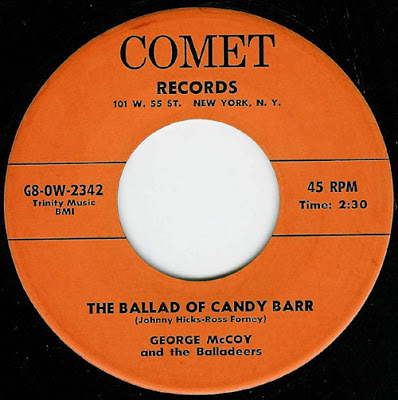
Listen to The Ballad of Candy Barr” by George McCoy at WFMU:

The underage teen headlined Dallas’ Colony Club for $85 a week.

Candy Barr in vintage dance video:

Projected poster for Hard Candy, Gregg Barrios’ play to be formally announced in 2011.

The Rag Blog

Posted in Rag Bloggers | Tagged , , , , , , , | 3 Comments

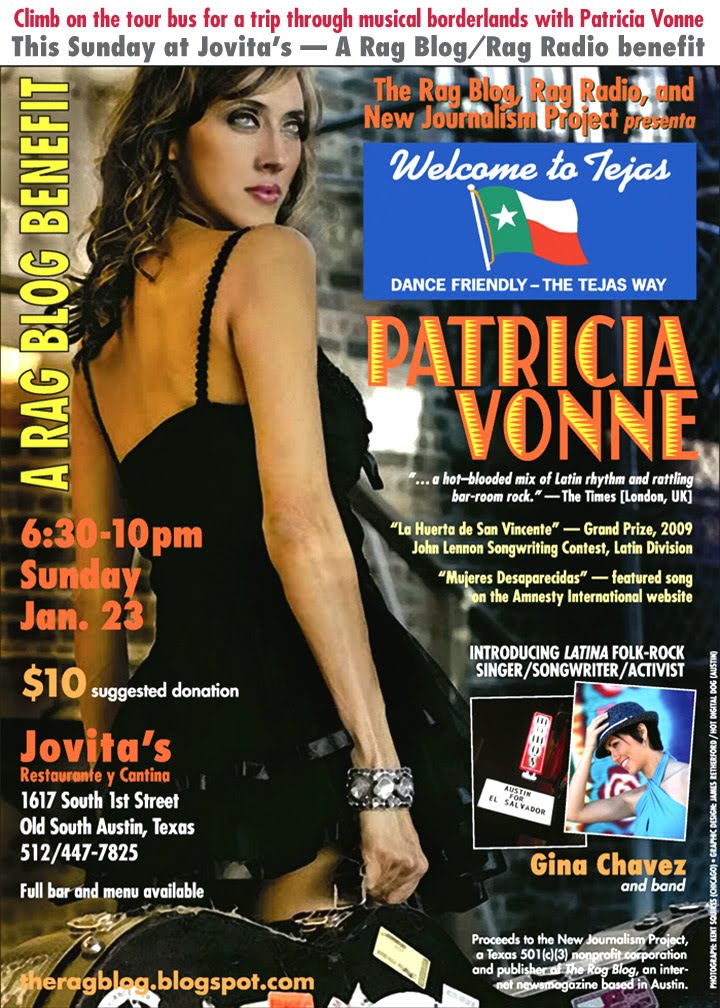
Patricia Vonne Headlines Rag Blog Benefit Sunday at Jovita’s in Austin

CLICK ON IMAGE TO ENLARGE.

Please join us this Sunday at Jovita’s

Please join us Sunday, January 23, from 6:30-10 p.m., at Jovita’s, 1619 South First Street in Austin, for the Rag Blog Benefit featuring Latina rocker Patricia Vonne and singer-songwriter Gina Chavez. For details, click on the image above, or go to the Facebook page for this event.

If you aren’t in Austin, or are unable to attend, please help support The Rag Blog and Rag Radio by making a donation through PayPal by clicking here, or send a check to the New Journalism Project, Inc., P.O. Box 16442, Austin, TX 78761-6442. The New Journalism Project is a Texas 501(c)(3) nonprofit corporation, and donations are tax-deductible.

Patricia Vonne and Gina Chavez will also be Thorne Dreyer’s guests on Rag Radio, Friday, Jan. 21, 2-3 p.m. (CST) on KOOP 91.7 FM in Austin and streamed live on the Internet). For a link to this show after it’s broadcast, or to earlier shows on Rag Radio, go here.

The Rag Blog

Posted in RagBlog | Tagged , , , , , , | 1 Comment

Jim Simons : Sargent Shriver and the Forgotten War Against Poverty

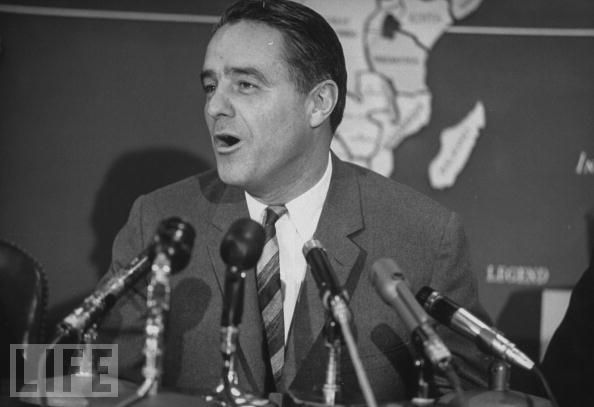
Sargent Shriver. Photo from Time/Life.

Sargent Shriver, warrior against poverty (1915-2011)

R. Sargent Shriver, the exuberant public servant and Kennedy in-law whose career included directing the Peace Corps, fighting the War on Poverty, ambassador to France and, less successfully, running for office, died Tuesday [January 18, 2011]. He was 95. Shriver, who announced in 2003 that he had Alzheimer’s disease, had been hospitalized for several days. [….]

The handsome Shriver was often known first as an in-law — brother-in-law of President John F. Kennedy and, late in life, father-in-law of actor-former California Gov. Arnold Schwarzenegger. But his achievements were historic in their own right and changed millions of lives. [….] President Barack Obama called Shriver “one of the brightest lights of the greatest generation…”

— Jessica Gresko / Associated Press

Sargent Shriver… built the left flank of John Kennedy’s remarkable 1960 presidential run. In so doing he freed President Kennedy to make critical choices in favor of civil rights and economic justice.

— John Nichols / The Nation

Poverty in America:
Sargent Shriver and the forgotten war

By Jim Simons / The Rag Blog / January 20, 2011

I heard a recording the other night of the telephone conversation between LBJ and Sargent Shriver when Shriver was appointed to head the War on Poverty. Johnson said something like, “I want to get on with it and end poverty in America.” He said this as one might say, “I want you to bring me the newspaper,” as though it could and would be done.

Shriver became the Director of the Office of Economic Opportunity (OEO) when it started. There could have been no better person for the job. The legislation (yes, it actually passed Congress) was inspired, so the story went, by Michael Harrington’s milestone book The Other America. There was significant poverty in the world’s richest country at the midpoint of the 20th century and it was inexcusable. It was that simple.

No one lambasted Johnson for being taken in by a socialist. Indeed, Harrington was a democratic socialist as well as being an intellectual and social critic with strong publishing credits. If anyone did yell “socialism,” no one paid any attention. How times have changed.

The War on Poverty initiated a panoply of wide-ranging programs designed to eradicate poverty — Head Start, Legal Services, VISTA, and the big one, the Community Action Program (CAP). CAP put hundreds of local Saul Alinsky’s in the poor communities nationwide, organizing and mobilizing the poor to make fundamental changes designed to bring the people up out of poverty.

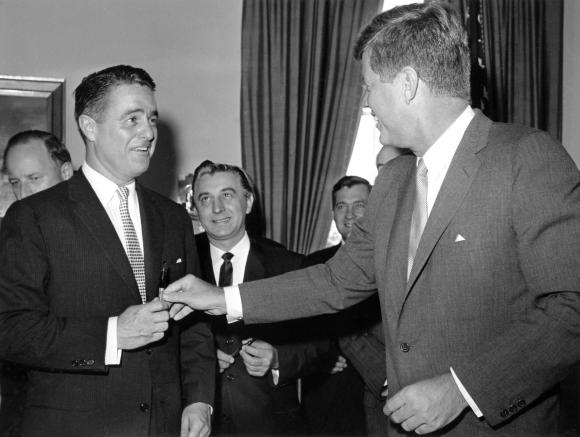
President John F. Kennedy with brother-in-law, Sargent Shriver, then director of the Peace Corps, after signing a bill giving the Peace Corps permanent status, Sept. 22, 1961. Photo from UPI.

Well, that was the theory. Oddly enough it was working to do just that when, finally, the predictable backlash came. Members of the establishment everywhere became riled up about the upset to the social order of their communities. If CAP had not been so effective we might never have heard from these representatives of the local power structures.

As it happened, newspapers editorialized and Congressional hearings were set in motion. Now came the chant of “socialism” and “communism.” OEO and the foment it swelled was every bit as big as the civil rights legislation of the same period. And it was working until backlash shut it down. Whenever there was a confrontation between the organized poor and the power structure, guess who prevailed.

Sargent Shriver died this week and I remembered that I had worked for him at OEO in 1966-1967. I met him once in Washington, D.C. and I believed in his commitment and ability to win the war on poverty. In the summer of 1966 he, or his deputy director, Edgar May, sent Peter Spruance of the OEO Office of Inspection (which May headed) to Austin where the Southwest Regional Office of OEO was. They wanted to find a suitable person to occupy the local Office of Inspection in the regional office.

Spruance, who was a lawyer from California, called Ronnie Dugger, editor of the (then) crusading liberal paper, The Texas Observer. I was working as Assistant City Attorney of Pasadena, the Houston suburb, and hating the job and the town. At this very time I was in Austin trying to find a job or some practice situation so I could live in Austin. I happened to call my friend Dugger and that is when he put me in touch with Spruance who interviewed me. As it is said, the rest was history.

So I was in a unique place and time to witness the winning of early skirmishes by the people and the ultimate losing of the war. The former was thrilling beyond words and I have never felt better about the work I was doing. The latter was among the saddest defeats I’ve ever been dealt, defeats for all of us as the ship went down.

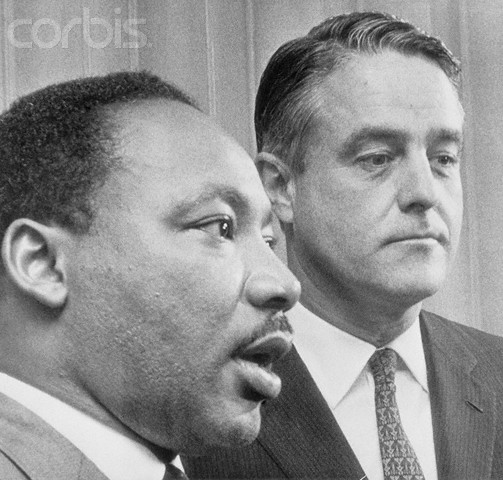
Sargent Shriver, then director of the Office of Economic Opportunity, shown with Dr. Martin Luther King, Oct. 24, 1966. Photo from Bettman / Corbis.

Over my two years at OEO the war in Vietnam was radicalizing me, to be sure. But the demise of the war on poverty set in motion in those years contributed to the process and probably had as much to do with my personal radicalization as did the war in Southeast Asia. They were interrelated wars. After that, I opted to open a basement law office to represent the peace and justice movement that had been waked in the country in the ‘60s. And that too was history.

But I have never forgotten the experience of the war on poverty, or for that matter, Sargent Shriver. I’ve always had immense respect for him. The times conspired to keep him from attaining high political office. I fear we will not see that caliber of person in politics unless the country changes more than now seems possible.

It is a big loss. But what strikes me as saddest of all is that the poor in America have been totally forgotten. No one talks of a war on poverty anymore. Supposedly progressive politicians speak of the middle class, not the poor. Everyone acts as if they don’t exist. There are more people in poverty now than in 1966 and it is getting worse all the time as the elite and the middle-class jockey for position in electoral politics.

When will we face again the challenge of ending poverty in America?

[Jim Simons practiced law in Austin for 40 years, representing many movement activists, including anti-war GIs. Jim served as a counsel for members of the American Indian Movement who were arrested at Wounded Knee in 1974. After he retired he published his memoir Molly Chronicles in 2007].

The Rag Blog

Posted in Rag Bloggers | Tagged , , , , , , | 4 Comments

Lamar W. Hankins : The Bowdlerizing of Huckleberry Finn

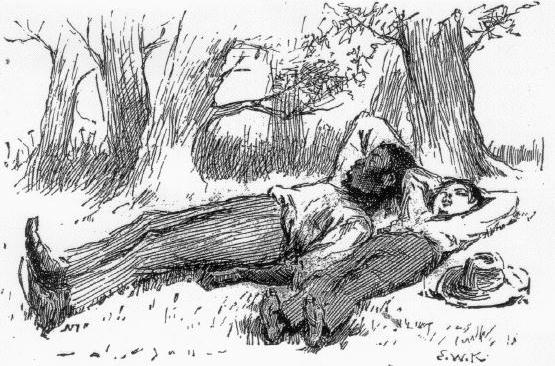
Huck and Jim. Image from Teachers.ash.org.

The bowdlerizing of Huckleberry Finn

By Lamar W. Hankins / The Rag Blog / January 19, 2011

A recent commentary by Leonard Pitts in the Miami Herald explained a significant problem with publication of a new edition of The Adventures of Huckleberry Finn by Mark Twain. The new edition removes all use of the words “nigger” and “Injun,” substituting less offensive words.

In Pitts’s view, the scrubbing of these words robbed the novel of its authenticity by ignoring Twain’s purpose in using the language that he chose and ignoring the social, cultural, and historical context in which the novel takes place.

Pitts explains, “Huck Finn is a funny, subversive story about a runaway white boy who comes to locate the humanity in a runaway black man and, in the process, vindicates his own.” I’ve always had a similar view of the novel, but it never occurred to me until reading Pitts’s words that I had had an experience similar to Huck’s, of becoming aware of another’s humanity, an experience shared by many others and one that may be universal.

I lived in Vidor, Texas, a rural community with a well-deserved reputation for racism, until I was four years old, when my family moved to the oil refinery town of Port Arthur. When I was seven, my parents, both of whom worked at refineries (my father as a machinist, my mother as an RN), hired a black woman to look after me and my younger brother. During the summer that I was 10 years old, I had many serious discussions with her about the ways of the world, especially about race relations and how African-Americans had been treated throughout the South since the beginning of this country.

My guess is that Lutricia Valore was about 25 years old in 1955. We called her by her nickname, Lou. The culture at that time in the south permitted even young children to address black women by their first name or whatever other informal name might apply. Lou cooked our food, cleaned our house, supervised our play, and took care of us when we had an accident or were sick.

She was my first sociology and history teacher. She told me about slavery. About having to sit in the back of the bus. About “separate but equal” schools. About being mistreated and disrespected by many whites. About segregation. About the slums in which she and her two children and husband lived. About the frequent humiliation she felt.

After reading Leonard Pitts’s words, I realized that Lou had transformed herself in my child’s eyes from the hired help to a person with fears, concerns, problems, and joys common to all human beings. She was my caretaker and became my friend. When she told me about how she was treated, I reacted first with disbelief that such a kind, decent person would be treated so badly. Then it made me angry. I wanted to do something about it, not recognizing that 10-year-old children can’t rectify society’s wrongs. I started looking around to see if I could find any of the circumstances she had described. I did not have to look far.

When I observed the city buses going down the street, I saw that all the blacks were in the back and the whites were in the front. When I went to the Weingarten grocery store with my mother, I saw the water fountains, side by side, one marked “Whites only,” and the other marked “Colored.”

In my first public rebellion against the established order, I decided to drink from the “Colored” fountain to see if the water tasted different from that in the “Whites only” fountain. I knew that my action violated accepted custom, but I did it anyway, and no one complained. I continued drinking from that fountain as long as my family shopped at that store. Later, when I rode the city buses to junior high school, I purposely sat in the back.

As a result of what I had learned from Lou, I continued my rebellion through the years by arguing about the nature of slavery with a junior high school history teacher and about job discrimination with a Sunday school teacher who did not want blacks working at the refinery because they would compete with him for jobs, an unrecognized acknowledgment that blacks could be as qualified as he to do the same work.

Huck Finn recognized Jim as a person of value because he came to know him at a basic human level. He saw that Jim had to make decisions about right and wrong, good and bad, fair and unfair, just as he did.

Both Jim and Huck were seeking freedom. To each one, freedom meant something slightly different, just as it means different things for different people all over the globe. And the novel deals with other human problems as well, including lying, deceit, cruelty, moral values, the role of family in a person’s life (Did Huck and Jim become a family?), selfishness, and hypocrisy.

All of these human issues are important for both children and adults to figure out for themselves. If a novel set shortly before the Civil War can help us discuss these issues, it has to be of value. If we take away from it its context, we rob it of some of that value as an educational tool. If some people are offended by the words common to the period and those words are censored, what does that take from the novel? For one thing, it blunts the razor-sharp edge of Twain’s depiction of racism in America.

We haven’t been able to have a broad, serious discussion about race and race relations in the 125 years since Huckleberry Finn was published. After all, we are still arguing about the reasons for the Civil War, in the face of documentary evidence that slavery and race were at its heart.

Now, we learn that a production of the play Joe Turner’s Come and Gone by the late, widely respected African-American playwright August Wilson is being forbidden by the superintendent of schools in Waterbury, Connecticut, because it contains the word “nigger” in several places.

Removing offensive words from the pages of Huckleberry Finn or any other literary work will make that important discussion about race less likely, and if our children read such works in a bowdlerized form, there will be no reason for them to even confront what such language is all about.

[Lamar W. Hankins, a former San Marcos, Texas, city attorney, is also a columnist for the San Marcos Mercury. This article © Freethought San Marcos, Lamar W. Hankins.]

The Rag Blog

Posted in Rag Bloggers | Tagged , , , , , , , , | 4 Comments

Ted McLaughlin : Haley Barbour’s ‘Eye for a Kidney’ Deal

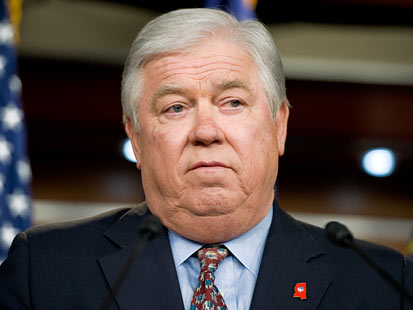
Mississippi Governor Haley Barbour: organ trafficker?

An eye for a kidney?
Haley Barbour’s terrible precedent

By Ted McLaughlin / The Rag Blog / January 19, 2011

See “Haley Barbour breaks the U.S. Organ Transplant Act,” Below.

Mississippi Governor Haley Barbour has received a lot of good press recently for commuting the life sentences of two sisters, Jamie and Gladys Scott (who had been convicted in 1994 of setting up a victim for an armed robbery that netted $11).

One of the sisters needed a kidney transplant, and the other had offered her kidney for the transplant. Barbour said, “The Mississippi Department of Corrections believes the sisters no longer pose a threat to society. Their incarceration is no longer necessary for public safety or rehabilitation, and Jamie Scott’s medical condition creates a substantial cost to the State of Mississippi.”

Let me be clear here — I do not oppose the commutation of the women’s prison sentences. There were many who believed the sentence had been too harsh to begin with, and the women had already served 16 years of that sentence. If the sisters did not pose a threat to society, and there was no need of further “rehabilitation,” then the governor did the right thing by commuting their sentences and freeing them.

And it is also within the powers of the governor to release them to save the state substantial medical bills, even if that seems a rather hard-hearted reason. It is even within the governor’s right to commute the sentences for political reasons — to repair some political damage he caused himself by downplaying the role of the White Citizen’s Councils in fighting against Civil Rights in the 1960s.

But there is something about the governor’s action in commuting these sentences that I find very troubling. He made a it requirement that one of the sisters give up her kidney — the commutation would not have happened without it (and they could be re-incarcerated if the donation failed to take place).

Now I don’t doubt that the sister was happy and very willing to donate a kidney to her sister. It is her right to do so (or not to do it). But she should not have been forced to do so with the threat of a continuing incarceration. By making it a requirement, in effect, the governor sold a commutation — and the price was one kidney. This sets a very bad precedent, and may violate the law. [See story below.]

Is it now a policy of the State of Mississippi that a prisoner can purchase his release by selling (donating) a kidney, or some other body part? It is not outside the realm of possibility that a future ethically-challenged governor (not uncommon for politicians of both parties) could repeat this action to get a kidney (or other body part) from a prisoner for a friend, family member, or high-profile person. After all, the precedent has now been set.

The governor had reasons to commute these sentences if that’s what he wanted to do, but it was just wrong for him to demand the payment of a kidney for the release. And I’m shocked that few people have noticed the ethical and moral problems of the governor’s decision.

Prison is for punishment and rehabilitation. It is not, and should never be, a source of organ donations.

[Rag Blog contributor Ted McLaughlin also posts at jobsanger.]

Jamie and Gladys Scott.

Haley Barbour breaks the U.S. Organ Transplant Act

Gladys and Jaime Scott went to a Mississippi prison for life in 1994 after committing an armed burglary which netted the then teens $11. On December 30, 2010, Mississippi Gov. Haley Barbour suspended the life sentences, but one sister’s release is contingent on her giving a kidney to the other. [….]

While donating a kidney is extremely safe when donors are healthy and a rigorous evaluation has taken place, it does have a small risk of death. Requiring a prisoner to agree to take this risk in return for parole violates international transplant standards and human rights.

The idea that prisoners are able to consent to risky medical treatment in return for benefits is one that ethicists have long questioned. It’s one step removed from the Chinese government practice of selling the organs of executed prisoners and kidneys from live Falun Gong and others in jail. The Chinese have made the practice illegal in response to international pressure, although few experts think it has stopped.

Governor Barbour and the prison board seem unaware that under the 1984 National Organ Transplant Act (NOTA) (42 U.S.C. 274e) it is “unlawful for any person to knowingly acquire, receive, or otherwise transfer any human organ for valuable consideration for use in human transplantation.”

What could be more “valuable consideration” than a get out of jail card? And given the state’s concern about the cost of Jaime’s dialysis they too receive valuable consideration in dumping Jaime and Gladys on Florida for a possible transplant.

Now, according to NOTA, any person who violates the valuable consideration provision “shall be fined not more than $50,000 or imprisoned not more than five years, or both.” The State Attorney General in Mississippi should move immediately to bar the parole if the condition of transplantation is not rescinded.

And the U.S. Attorney General Eric Holder should uphold the National Organ Transplant Act and ensure that if the parole proceeds as planned with organ donation a requirement, it be made clear that any hospital, physician or other individual including Mississippi state officials who participated in the procurement and transplant of the organ will be charged under NOTA. [….]

Frances Kissling / The Huffington Post

The Rag Blog

Posted in Rag Bloggers | Tagged , , , , , | 4 Comments

Thorne Dreyer : Journalist, Author, and ‘Investigative Poet’ John Ross (1938-2011)

The late great John Ross.

Farewell to our great friend John Ross

See “Los Muertos,” a poem by John Ross, Below.

By Thorne Dreyer / The Rag Blog / January 18, 2011

Yesterday I received an email with the following message: “John Ross passed peacefully in the arms of his good friends Arminda and Kevin in Tzipijo, near Lake Patzcuaro, Michoacan, after a two-year lucha against liver cancer.” The message was sent from John’s email address and included the above photo.

John Ross, who styled himself an “investigative poet,” was a long-time contributor to and friend of The Rag Blog. He was a singular talent whose work was always enlightening and entertaining, every post a revelation. No one ever wrote about Mexico like John Ross did… or ever will again.

Ross, whose roots were in the old left politics of New York City and the beat poetry scene of San Francisco, visited Austin last March promoting his latest book, El Monstruo: Dread and Redemption in Mexico City, and reading his poetry at MonkeyWrench and Resistencia bookstores.

Our mutual friend Mike Davis, himself a noted author and educator, wrote about John and El Monstruo: “From a window of the aging Hotel Isabel, where he has lived for almost a quarter of a century, John Ross sings a lusty corrido about a great, betrayed city and its extraordinary procession of rulers, lovers and magicians.”

Indeed, everything John Ross ever wrote was a “lusty corrido,” a vivid grito of protest and celebration.

The Rag Blog last heard from John late last year when he informed us he would be suspending his writing indefinitely due to the rigors of the latest round of chemotherapy to treat his advancing cancer of the liver, which had been in remission but had returned with a vengeance.

In my copy of El Monstruo, John Ross wrote, “To Thorne: Desde el corazon del Monstruo sigues en la lucha!

[Thorne Dreyer, a pioneering ’60s underground journalist, is a director of the New Journalism Project, Inc., editor of The Rag Blog, and host of Rag Radio.]

John Ross dies:
Opposing every war was his obsession

The American rebel journalist, poet, novelist and human shield, John Ross (New York, 1938), deacon of Mexico correspondents, died yesterday at 8:58 a.m. in Santiago Tzipijo, Michoacan, after battling for two years against liver cancer.

A wake is being held on the shores of Lake Patzcuaro. He will be cremated in Urapan and his ashes scattered in Mexico and in several cities in the U.S., according to his wishes.

Ross, whose last book is entitled El Monstruo: Dread and Redemption in Mexico City, arrived at Casa Santiago, on the shores of the lake, on Dec. 31 in a taxi, reports Kevin Quigley, who with his wife is owner of the guest house. Both were compadres of the New Yorker.

Two days earlier, friends of the journalist had retrieved his archives from the room he occupied in the hotel Isabel in Mexico City, where he had lived since the week following the earthquake of 1985. His files are to be temporarily stored at the Cemanahuac Educational Community in Cuernavaca.

John Ross was a man of the Left and one of his great obsessions was the struggle against wars of every type. His great labor as an independent journalist and correspondent was to participate in and cover the political and social events that happened here, to make them known in the United States. “He never quit telling the gringos what was happening in Mexico” …

La Jornada / Mexico City / January 18, 2011
(Translated by Dick J. Reavis / The Rag Blog)


John Ross. Photo from Con Carlitos.


LOS MUERTOS

After they had waited on line

for nearly eight straight hours

to vote for the candidate of their choice,

The Dead were finally informed

that they were no longer inscribed

upon the precinct lists of the Republic.

But we have only come to exercise

our rights as responsible citizens

The Dead complained bitterly

for it seemed to them that the President

in the spirit of national unity

had called upon all the people

to cast their ballots

as is the democratic norm.

The official registrar

who was still quite alive

could only explain

the exclusion of the calacas

with platitudes about Morality.

Oh said The Dead and voted anyway.

But your votes are clearly illegal

winced the official Official,

they can’t be counted in this election.

You have a point The Dead replied,

maybe they won’t be counted now

but surely you will count them later.

© John Ross


When John Ross was 18, he was a young member of the Beat Generation, reading his poetry in Greenwich Village bars with the great bass player Charles Mingus. — Beatitude Poetry

The Rag Blog

Posted in Rag Bloggers | Tagged , , , , , , , , , , | 3 Comments

Frank Bardacke : John Ross Had All the Right Enemies

John Ross, 1938-2011. Photo by Marcia Perskie, courtesy of Michael James, Heartland Cafe, Chicago.

All the right enemies:
Farewell to the utterly unique John Ross

By Frank Bardacke / CounterPunch / January 18, 2011

John’s gone. John Ross. I doubt that we will ever see anyone remotely like him again.

The bare bones, as he would say, are remarkable enough. Born to show business Communists in New York City in 1938, he had minded Billie Holliday’s dog, sold dope to Dizzy Gillespie, and vigiled at the hour of the Rosenberg execution, all before he was 16 years old. An aspiring beat poet, driven by D.H. Lawrence’s images of Mexico, he arrived at the Tarascan highlands of Michoacan at the age of 20, returning to the U.S. six years later in 1964, there to be thrown in the Federal Penitentiary at San Pedro, for refusing induction into the army.

Back on the streets of San Francisco 18 months later, he joined the Progressive Labor Movement, then a combination of old ex-CPers fleeing the debased party and young poets and artists looking for revolutionary action. For a few years he called the hip, crazy, Latino 24th and Mission his “bio-region,” as he ran from the San Francisco police and threw dead rats at slumlords during street rallies of the once powerful Mission Coalition.

When the not so ex-Stalinists drove him and others out of PL (“break the poets’ pencils” was the slogan of the purge) he moved up north to Arcata where he became an early defender of the forest and the self-described town clown and poet in residence. From there it was Tangier and the Maghreb, the Basque country, anti-nuke rallies in Ireland, and then back to San Francisco, where he finally found his calling as a journalist.

“Investigative poet” was the title he preferred, and in 1984, he was dispatched by Pacific News Service to Latin America, where he walked with the Sendero Luminoso, broke bread with the Tupac Amaru, and hung out with cadres of the M-19.

In 1985, after the earthquake, he moved into the Hotel Isabel in the Centro Historico of Mexico City, where for the next 25 years he wrote the very best accounts in English (no one is even a close second) of the tumultuous adventures of Mexican politics.

During the Mexican years, he managed to write nine books in English, a couple more in Spanish, and a batch of poetry chapbooks, all the while he was often on the road, taking a bus to the scene of a peasant rebellion or visiting San Francisco or becoming a human shield in Baghdad, or protecting a Palestinian olive harvest from marauding Israeli settlers.

He died Monday morning, January 17, a victim of liver cancer, at the age of 73, just where he wanted to, in the village of Tepizo, Michoacan, in the care of his dear friends, Kevin and Arminda.

That’s the outline of the story. Then there was John. Even in his seventies, a tall imposing figure with a narrow face, a scruffy goatee and mustache, a Che T-shirt covered by a Mexican vest, a Palestinian battle scarf thrown around his neck, bags of misery and compassion under his eyes, offset by his wonderful toothless smile and the cackling laugh that punctuated his comical riffs on the miserable state of the universe.

He was among the last of the beats, master of the poetic rant, committed to the exemplary public act, always on the side of the poor and defeated. His tormentors defined him. A sadistic prison dentist pulled six of his teeth. The San Francisco Tac Squad twice bludgeoned his head, ruining one eye and damaging the other. The guards of Mexico’s vain, poet-potentate Octavio Paz beat him to the ground in a Mexico City airport, and continued to kick him while he was down. Israeli settlers pummeled him with clubs until he bled, and wrecked his back forever.

John Ross at Day of the Dead celebration. Photo from CounterPunch.

He had his prickly side. He hated pretense, pomposity, and unchecked power wherever he found it. Losing was important to him. Whatever is the dictionary opposite of an opportunist — that’s what John was. He never got along with an editor, and made it a matter of principle to bite the hand that fed him.

It got so bad, he left so few bridges unburnt, that in order to read his wonderful weekly dispatches in the pre-internet years, I had to subscribe to an obscure newsletter, a compilation of Latin American news, and then send more money to get the editors to send along John’s column.

He had his sweet side, too. He was intensely loyal to his friends, generous with all he had, proud of his children, grateful for Elizabeth’s support and collaboration, and wonderful, warm company at an evening meal. When my son, Ted, arrived in Mexico in 1990, John helped him get a job, find a place to live, introduced him around, and became his Sunday companion and confidant, as they huddled in front of John’s 11-inch TV watching the weekly broadcasts of NBA games.

He was a great, true sports fan, especially of basketball. One of the last times I saw him was at a friend’s house in San Francisco, in between radiation treatments, watching a Warriors game on a big screen TV, smoking what he still called the “killer weed.” Joe and I listened to him recount New York Knicks history, the origin of the jump shot, and Kareem’s last game, which somehow led to a long complaint about kidneys for sale in Mexico that had been harvested in China out of the still warm body of some poor, rural immigrant who had been legally executed for jaywalking in Beijing.

The very last time I had the pleasure of his company was at breakfast in Los Angeles when Ted and I saw him off on his last book tour, promoting El Monstruo, his loving history of Mexico City. He was in great form. His cancer was in remission — a “cancer resister,” he called himself — and he entertained us with a preview of his trip: long, tiresome Greyhound rides, uncomfortable couches, talks to tiny groups of the marginalized, the last defenders of lost causes without the money to buy his books. It would be a losing proposition, like so many of his others, all of which secure his place among the angels.

[Frank Bardacke taught at Watsonville Adult School, California’s Central Coast, for 25 years. His history of the United Farm Workers and Cesar Chavez, Trampled in the Vintage, is forthcoming from Verso. He can be reached at bardacke@sbcglobal.com. This article was written for and distributed by CounterPunch.]

Please see:

The Rag Blog

Posted in RagBlog | Tagged , , , , , , , | 1 Comment

Joshua Brown : Life During Wartime: Data Overload

Political cartoon and verse by Joshua Brown / The Rag Blog / January 17, 2011.
The Rag Blog

Posted in Rag Bloggers | Tagged , , , , | Leave a comment