Tony Platt : My Friend Betita Martinez

Betita Martinez. Photo from SF Gate.

‘The heart just insists’:
My friend Betita Martinez

As the daughter of a dark-skinned immigrant from Mexico City and a blue-eyed North American, she felt racism in the air, ‘but I did not have words for it then.’

By Tony Platt / The Rag Blog / December 27, 2010

I’m visiting my old friend Betita Martínez a few days before her 85th birthday. I bring chocolate chip cookies, and my laptop to show her photographs of a recent trip to Europe and Morocco. Our conversation is not the grand political discourse it used to be. It’s more of an ode to the everyday.

We’ve known each other for 35 years, from the time we worked together on a radical pamphlet about the police, through our years as comrades in a Marxist organization, and during the last two decades as leftists struggling to find our way through the dystopian gloom.

While most of us licked our wounds and picked up our interrupted lives, she protested with anybody who would march in the 1990s and was never without a sheaf of leaflets in the 2000s. She kept the faith, while mine wavered. “The heart just insists on it,” she once explained.

Betita looms large in my memory as a professional revolutionary who managed on a few hours of sleep and an occasional steak, with little time for small talk. This wasn’t always the case. At one time she was on the fast track to professional success.

Elizabeth Martínez grew up in the white section of Washington, D.C.’s segregated suburbs in the 1920s and 1930s. As the daughter of a dark-skinned immigrant from Mexico City and a blue-eyed North American, she felt racism in the air, “but I did not have words for it then.”

Her father, Manuel Guillermo Martínez, who had witnessed the Mexican revolution as a young man, worked his way up from a clerk in the Mexican Embassy to professor of Spanish literature at Georgetown; and her mother, Ruth Sutherland Phillips, got a master’s degree from George Washington and taught advanced high school Spanish.

Soon Betita was emulating her parents’ hard work ethic, joining the bridge club in high school and prepping for college and a career. She was the first Latina at Swarthmore, graduating with honors in history and literature in 1946. Here she began a lifelong friendship with fellow student (and later renowned economist) Andre Gunder Frank, a Jewish scholarship boy from Europe who, like Betita, knew what it felt like to be in exile, never feeling quite settled anywhere.

After college, using her mother’s vaguely British middle name, Liz Sutherland plunged into the post-war ferment of New York’s cultural scene. With her contacts from Swarthmore opening doors to institutions typically closed to women and Latinos, jobs came quickly and easily: as a translator and researcher at the United Nations (1947-1953), an administrative assistant in the Photography Department at the Museum of Modern Art (1957-1958), an editor at Simon and Schuster (1958-1963), and Books and Arts Editor at The Nation (1963-1964).

Betita Martinez. Photo by Margaret Randall.

For some 15 years Liz hobnobbed with cutting edge artists and literati, and married one, the writer-activist Hans Koning. She moved easily between the beat milieu of the Village — hanging out with Diane Di Prima, Allen Ginsberg, Timothy Leary, and other demimonde intellectuals — and chic patrons at Fifth Avenue soirées. This ability to function in very different worlds would serve her well later in life when she had to fundraise for grassroots causes and translate radical rhetoric into palatable liberalism for middle-class audiences.

Among her friends were photographers Edward Steichen (her boss at MoMA) and Robert Frank, and the Russian poet Yevgeny Yevtushenko. She could more than hold her own reviewing French new wave and English kitchen sink movies in the la-di-da Film Quarterly.

“If the film speaks its piece well, it lacks the magic of the unsaid,” she wrote in 1961 about Karel Reiz’s Saturday Night and Sunday Morning. “There is nothing here to make you shiver, no awareness of ‘the million-eyed Spyder that hath no name.’ The characters are all there, but they are more recognizable than illuminating.”

Unusually for somebody still in her 30s, she had honed literary skills as an editor, designer, and writer. Most of us hope to be good at one of these things in a lifetime. She did them all really well.

In 1960, just two years into her job with a prestigious publishing firm, Simon and Schuster — and already an editor — she was assigned to work with the filmmaker Ingmar Bergman on the publication of Four Screenplays (including “Wild Strawberries” and “Seventh Seal”). She saw the landmark book “through from start to finish,” she told a reporter for Saturday Review. During a visit to Sweden to meet Bergman, they had lunch together on a set. “What was it like to talk with him, what’s he like?” I once asked her, wide-eyed. “He said I had nice legs,” she replied.

The following year she was off to Cuba, meeting with writers and filmmakers creating a “cinema of revolution.” That was her first turning point: “When Cuba declared itself socialist, so did I.”

In 1964, Liz served as go-between and editor for the militant black-led organization SNCC (Student Non-Violent Coordinating Committee) and Simon and Schuster, resulting in an extraordinary book of photographs, The Movement: Documentary of a Struggle for Equality. It opens with three tranquil, rural images of the Deep South, followed by a carnival scene of a lynching in graphic detail.

Lorraine Hansberry gets credited for the introduction, as do Danny Lyon, Roy de Carava, and others for their photographs, but Betita’s name is nowhere to be seen. (She was similarly unacknowledged for her editing role in Stokely Carmichael’s Black Power, another iconic publication.)

She finally gets her due years later for helping Jim Forman write one of the most significant memoirs of the civil rights movement, The Making of Black Revolutionaries. Holed up in a house in Puerto Rico, she helped him not only get his writing in shape, but also broaden his “understanding of the vast and deplorable role of the United States government in suppressing the rights of all nonwhite people.”

In the mid-1960s, now in the prime of her life, Liz Sutherland made the shift from publishing to joining the Movement, giving up a sure-thing life of privilege for long hours and low pay for the next 45 years.

She became director of SNCC’s New York office, getting the word out and raising funds from Jewish sympathizers when she wasn’t on the road in Mississippi and Alabama, or making overtures on behalf of black nationalists to the Chicano-led UFW organizing migrant workers in California.

“I did not grapple with my particular identity then, with being half Mexican and half white,” she recalls. “The work said who I was.” And the work was grueling, especially for a single parent. Her pre-teen daughter Tessa “endured many lonely hours and TV dinners” when her mother was interviewing civil rights workers in the South. “She understands about Mississippi.”

A few years later, three pivotal events propelled her political development in a new direction. First, SNCC had, as she put it, “an identity crisis” and decided it “should be an all-black organization.” Stokely Carmichael made clear in a speech given in Berkeley in 1966 that “we cannot have white people working in the black community.” No one “white-baited me to my face,” says Betita recently, but to most of the SNCC staff she was “classified as white.”

Secondly, Elizabeth Sutherland and several other refugees from SNCC contributed to “an energized convergence of women in New York City,” as one observer has noted, and were in on the ground floor of the women’s liberation movement. Elizabeth was a member of the New York Radical Women’s collective — a group that included Joan Brown and Shulamith Firestone — and contributed an article (with Carol Hanisch, instigator of the celebrated protest of the Miss America pageant in 1968) to the first issue of Notes From The First Year, a theoretical journal of radical feminism, priced 50 cents to women and one dollar to men.

The Hanisch-Sutherland essay, which follows right after Anne Koedt’s “The Myth of the Vaginal Organism,” is organized as a series of answers to typically asked questions about feminism. For example, don’t some women “naturally want to be housewives?” To which the authors of “Women of the World Unite — We Have Nothing To Lose But Our Men!” reply: “Anyone who thinks she feels good as she surveys her kitchen after washing the 146,789th batch of sparkling dishes isn’t being ‘natural’; she’s literally lost her mind.”

As Elizabeth Sutherland became Betita Martínez, she made sure that issues of gender were not put on the back burner. In 1970, she contributed “Colonized Women: The Chicana” to Robin Morgan’s Sisterhood is Powerful, an anthology that became required reading for a generation of feminists. Today, Morgan quickly recalls Betita’s “intensely feminist intelligence and commitment. Her stubborn insistence on freedom and power for all members of communities of color — including, surprise! women — got her into a lot of hot water. But that never stopped her.”

Thirdly, a trip to Cuba in 1967 connected her with an inspirational gathering of Latin American revolutionaries that triggered her own identity crisis: “the ground of my life was shifting, stretching.” She took off for New Mexico in 1968, where she founded a Chicano movement newspaper, El Grito del Norte, and organized the Chicano Communications Center. “A voice inside of me said, ‘You can be Betita Martínez here. It feels like home’.”

It felt like home until the mid-1970s, when Betita left New Mexico and joined a leftist organization in San Francisco, hoping to be part of a movement that would transcend identity politics. Ten years later, after the Marxist left imploded, she returned to grassroots work, searching for ways to bring communities of color together, speaking out fiercely against racism, sexism, and war — saying “NO to any definition of social justice that does not affirm our human oneness.”

While illness limited Betita’s mobility when she reached her 80s, she kept on writing, as she’d done all her life. Without a university base or philanthropic support, she has accomplished what most academics never do in a lifetime: written several books that have left a deep impact on readers searching for socially relevant, well researched, and thoughtful history and commentary.

Among her lasting contributions are Letters From Mississippi (1964), The Youngest Revolution: A Personal Report on Cuba (1969), 500 Years of Chicano History (1976), and 500 Years of Chicana Women’s History (2008), not to mention hundreds of journalistic essays. In 2000, she received an honorary doctorate from her alma mater, but not the private pension, home ownership, and other perks that typically crown an academic career.

Betita Martinez. Photo by Tony Platt / The Rag Blog.

Recently, Betita looked more deeply and honestly into the self-inflicted wounds that can’t simply be blamed on the Man, “the human toll of righting wrong.” It troubles her that for too long the Chicano movement was seen as a subsidiary of the African American movement; that women in SNCC and Chicano organizations were too often considered subordinate to “male warriors” and assigned housewifely duties; that in the name of fighting for a “humanist society,” Marxist organizations could treat its cadre so brutally.

And while she gave all to her extended political family, Betita “deeply regrets neglecting another identity: being the mother of a young daughter who needed much more attention than she received in those years.”

Now it’s the mother who needs and gets much more attention from her daughter. A stroke makes it hard for Betita to see, hear, and remember yesterday’s visitors, yet she insists on living by herself with her dog Honey in a small, rented apartment in San Francisco’s Mission district, surrounded by books, posters, mementos, and rows of filing cabinets. “I love all dogs and some people,” she says. But she’s always delighted to see visitors, and disappointed when we leave.

Today, the talk is about a trip Cecilia and I took recently. Her eyesight is not good, so she sits almost on top of the screen of my laptop as I scroll through hundreds of photographs that for me are already in the twilight between just now and the past.

As she imagines the photos through a blur, I tell her stories to go with the images: riding a lurching camel through pillowy sand dunes in the Sahara, shopping in an outdoor market in Provence for just-picked fruits and vegetables, circling Jeff Koons’ gigantic flowering puppy that sits calmly outside the Guggenheim in Bilbao, watching kids splashing through a swimming pool installation on the roof of the Hayward Gallery in London, and stumbling over memory plaques in Berlin.

She happily munches cookies, and lights up when I come to photos of our new dog. “You must bring Buster here,” she says. We must all go to Morocco to see the camels.” She laughs at the absurdity and attractiveness of the possibility.

She’s thirsty and I look for a glass near her sink. “This one?” I ask. “Yes,” she replies, “that one. It’s a mere bagatelle.” I do a double take and she laughs. “I haven’t heard that in a long time,” I say. “Me neither,” says Betita. “How come I can remember that, but can’t remember the name of the person who helps me every day?”

We stop for a moment, pondering the marvelous trickiness of the brain. Then, just as we have often done together, we muse about the meaning and origins of this trifle of a word. As I search her well-used English and French dictionaries, and read out aloud all the detailed information I can find, I am reminded of the many times that we have done this together, sharing our pleasure in words and language, and for this moment all is as it was.

Happy birthday to Elizabeth (Betita) Martínez, born 12 December 1925.

[Tony Platt is the author of 10 books and 150 essays and articles dealing with issues of race, inequality, and social justice in American history. He has written for the Los Angeles Times, San Francisco Chronicle, Truthdig.com, History News Network, Z Magazine, Monthly Review, and the Guardian. Platt, now an emeritus professor living in Berkeley, California, taught at the University of Chicago, University of California (Berkeley), and California State University (Sacramento). This article was also posted to his blog, GoodToGo.]

Thanks to Bernardine Dohrn /The Rag Blog

Posted in Rag Bloggers | Tagged , , , , , , , , , | 2 Comments

Type your summary here

Type rest of the post here

Source /

The Rag Blog

Posted in RagBlog | Leave a comment

Harry Targ : Good Obama, Bad Obama: The Changing Frame

Photo from The Guardian, U.K.

The story so far:
Achievements and disappointments
during the Obama years

By Harry Targ / The Rag Blog / December 27, 2010

Changing media frames of political reality

I am an inveterate watcher of MSNBC, the “liberal” end of the “mainstream” media spectrum. Reflecting on the last two years of American political life, often through their eyes but also through other mainstream media outlets, I have been fascinated by the swings in interpretation of the performance of the Obama administration and Congress.

During the campaign, Obama was doomed several times, according to the media, by such crises as the remarks by Reverend Wright and Obama’s alleged snobbish rendition of the flaws of working class consciousness. On the other hand, the media presented Obama as the savior of the United States reputation overseas, the committed anti-war activist, the environmentalist, union supporter, and the African American candidate who could bring the country together in a post-racial era. We cried as the President-elect celebrated victory with the slogan “Yes We Can.”

Within a month of Obama’s entering office riding a massive swing to the Democratic Party in the House and Senate, media pundits were speculating about an historic shift in national politics and whether it would equal the transformation of political life that occurred in the 1930s.

But then, the Obama administration and its allies in Congress began to experience roadblocks in efforts to provide an adequate economic recovery stimulus package and to radically reform health care. Climate change legislation and pro-union legislation went off the table. Congress and the White House launched a two-year discussion about ending discrimination against gays in the military.

And most important, economic recovery, jobs, and growth stalled. To top it off, after an extensive in-house review of United States foreign policy toward Afghanistan, the Obama administration chose to escalate U.S. military involvement in that country.

Media frames shifted dramatically (in all but the right wing Fox empire which was hostile all along) from the new political alignment in American politics to discussions of incompetence in Congress, Obama’s inability to lead, Obama’s reluctance to go back out to the people to mobilize support for his policies, to critiques of Obama’s strategy of compromising with the right wing in Congress even before negotiations begin.

Then the Tea Party emerged. The American politics in crisis frame dominated stories, at least on television. Names like Sarah Palin, Sharon Angle, Christine O’Donnell, Jim DeMint, dominated the news. While anger and frustration were real, particularly with the enormous economic suffering, the media exaggerated the strength of the Tea Party movement. And on November 2, the elections showed a dramatic shift to the Republican Party at the national and state levels. The savior of our economic and political life of 2008 had become, as the media told us, the pariah of 2010.

Lame ducks and triumphal returns

After the elections, right wingers licked their chops eagerly waiting for 2012 and the prospects of electing representatives of the ruling class who would return America to the Gilded Age. Many progressives saw in the Obama presidency and the Democratic Party majority future adversaries, not potential allies for change. And many, particularly youth, were seen as losing their enthusiasm for any and all politics.

Finally, liberals, including Obama, claimed that the answer to the “shellacking” of 2010 was more compromise with Republican foes in the future. No one thought the “Lame Duck” session of Congress, November and December 2010, would create anything other than stalemate and acrimony among the two parties and a further sense of despondency among the progressive majority.

But to everyone’s surprise, Congress, led by Obama, secured passage of the repeal of the Don’t Ask Don’t Tell policy that discriminated against gays in the military. The Senate passed the Strategic Arms Reduction Treaty (START) and Congress passed legislation giving some financial support to 9/11 responders who are suffering from health infirmities resulting from their rescue efforts.

And, in addition, Obama, almost despite his Democratic colleagues in the Congress, secured a piece of mega-legislation that extended Bush tax cuts to the super-rich but also the vast majority of Americans, continued unemployment insurance for those out of work between 26 and 99 weeks, saved Pell grants for needy college students, and added additional tax breaks for worthy and unworthy purposes.

However, Congress resisted passing the DREAM Act which would have provided a path to citizenship to young people who came to the United States without papers, attended college, and/or enlisted in the military.

The Lame Duck session since mid-December has been touted as an enormous victory for progressive forces. MSNBC commentators have begun to say that maybe they had been too harsh on Obama all along. Reviewing the list of legislative accomplishments and executive orders since 2009, they have concluded that this has been the most activist (and progressive) period in American political history since the days of Lyndon Baines Johnson.

For some, the most recent victory, DADT repeal, symbolizes the slow but dogged determination of an administration that must struggle against dysfunctional legislative hurdles to achieve any success at all.

So now the media frame, everywhere but FOX, Limbaugh, and the rest of the neo-fascist crowd, is back to Obama the crusader, and Democrats the progressives.

What to make of all this?

Well from the standpoint of building a progressive majority, the incumbent administration has made some significant advances. Several policy changes, such as reauthorizing U.S. aid to international agencies that provide family planning advice, remain below the public radar.

Repeal of DADT is worthy of celebration. Support for 9/11 responders is basic to a humane society. Some health care reform is better than none. Pell Grants need to be extended if we do not want our colleges and universities to be populated only by sons and daughters of the wealthy. And the inadequate economic stimulus package saved jobs and whole industries, such as auto.

But the other side of the story is instructive. This administration has participated in tax reduction for the super wealthy, froze wages for federal employees, did not struggle to save unemployment for the 99ers, has signed off on a U.S./South Korean trade agreement that Lori Wallach of Global Trade Watch claims will be of the magnitude of NAFTA. In essence, U.S. and South Korean workers will be the victims of an agreement that reduces barriers to capital flight and financial speculation.

While this list can be expanded, I only add that the foreign policy agenda of this administration has been one of extending, not retracting empire, in South Asia, in the Gulf, in Africa, and in Latin America.

In sum, lame duck aside, the Obama administration has continued to support the interests of finance capital at home and abroad at the expense of workers everywhere. What the world calls “neo-liberalism,” that is policies to cut government programs, extend privatization and deregulation of economies, and reduce wages and living conditions is the operant vision at home and abroad. The issue in the end comes down to “class,” and “class struggle.”

We can and should applaud the progressive victories (many of which are part of the social agenda) at the same time that we build a political movement that demands jobs and income now and an end to empire. By assessing the policies, the issues, and their impacts, progressives can determine where to go from here. And at this stage the class and anti-imperial issues must remain central to our work.

[Harry Targ is a professor of political science at Purdue University who lives in West Lafayette, Indiana. He blogs at Diary of a Heartland Radical.]

The Rag Blog

Posted in Rag Bloggers | Tagged , , , | Leave a comment

VERSE / Larry Ray : John Boehner: A Crocodilian Crock?

Sir John of Orange: A portrait in courage?

This, my last post of the year, dear readers, is a short few quatrains; prickly poetry that would probe the mind of the incoming GOP Speaker of the House, the emotionally delicate John Andrew Boehner.


A Crocodilian Crock?

Does Boehner’s orange face denote a great tan
or is it dermatologically the mark of a man
with dour countenance and low self esteem
who weeps and sobs as if reliving a dream?

A sad dream invoked so he may wear his past
as a badge of passage he fears cannot last
while his political career has arrived at a peak
emotionally odd weeping will not let him speak.

Fabled crocodile tears are not truly felt
but perhaps John’s weeping is darkly indwelt
from tormented pangs of past poverty, looming
his lachrymal breakdowns are now all consuming.

As Congress convenes, with new Speaker and gavel
will the negative spotlight make Boehner unravel
as his overblown ego casts a dull orange glow
will his bawling and weeping continue to grow?

Will Speaker John Boehner now tread that thin border
between sanity and madness, a narcissistic disorder?
Indeed, Jesus wept over the city of Jerusalem
I fear Boehner’s tears are just there to bamboozle ’em!

Happy New Year,

Larry Ray
Texas poet lariat

Posted December 27, 2010

[Retired journalist Larry Ray is a Texas native and former Austin television news anchor who now lives in Gulfport, Mississippi. He also posts at The iHandbill.]

The Rag Blog

Posted in Rag Bloggers | Tagged , , | 2 Comments

Bruce Melton : I Want a Sequestration Machine for Christmas!

Photo by Bruce Melton / The Rag Blog.

Climate intrigue and a change in prosperity:
I want a sequestration machine for Christmas

By Bruce Melton / The Rag Blog / December 23, 2010

Climate change is not just another dangerous dead-end road for humanity. There is really no doom and gloom just around the corner. The situation is not as dire as the catastrophists would have you believe. Yet, the news from climate science land has gone from bad to worse.

The impacts are happening faster with greater strength. The feedbacks appear stronger. The thresholds are proving to be nearer and threaten greater consequences. Ecosystems are rapidly deteriorating right now, or in some cases like caribou and coral reefs, they are simply collapsing.

So how can I be convinced that the solutions to the climate change challenge are things that can easily be accomplished? That the cost will at first seem burdensome, but will quickly be realized to be the intelligent investment that it is?

In the thousands of scientific papers on climate change that I have reviewed, most of the results talk about how lab tests sequestered far more carbon than imagined; about how the new techniques have been “scaled up” to mass production capacity and shown to be valid. The cost analyses show what at first would seem like ghastly expensive expenditures, but upon deeper thought, are revealed to be no different than other challenges we as society have already conquered.

Lord Nicholas Stern was former Prime Minister Tony Blair’s head of economic services in the United Kingdom. In 2006, Stern authored a definitive review of the economic impacts of climate change. His work was 700 pages of evaluation that included most of the current knowledge on climate science.

What Lord Stern found was that it would take approximately 1 percent of world gross domestic product to address climate change every year. But in 2008 Stern came forward with a revision to his report. He said that in the two years since his book was completed, new discoveries about climate change and about how we as a society were reacting would raise the cost of mitigating climate change to about 2 percent of gross domestic product.

So, one or two percent of world gross domestic product (GDP) is what it will take to avert a climate catastrophe; is that a lot of money? How much money is this exactly, compared to something that we can relate to? The Moon shot maybe


To see the value of anything, first we must understand how that value is important to our society. Preventing “dangerous climate change,” or as the scientists call it “dangerous anthropogenic interference,” is what the scholarly climate change literature tells us is our goal. The climate scientists say that just 2 degrees C of change (about 3.6 degrees Fahrenheit) will result in dangerous climate change.

Or at least this is what they said five or six years ago. Today the answer is more like 1.5 degrees C (2.7 degrees F) and this is additional warming above pre-industrial levels. We have already warmed 0.7 degrees C (1.3 degrees C). So just 1.3 to 2.3 degrees F of warming is what remains between dangerous anthropogenic interference and us.

Considering that most of the warming that has already occurred has happened since 1970, It appears as if we cannot help but pass this dangerous threshold. But, you may ask, what is so dangerous about a couple of degrees of warming?

Most folks think climate change is no big deal. The polls these days show that nearly one-half to two-thirds of Americans think that climate change is either not real, not going to impact them in their lifetimes or is exaggerated.

All of this while the latest mega review of climate science literature shows that 97 to 98 percent of climate scientists agree on the tenents of the Intergovernmental Panel on Climate Change.

In the climate scientists’ world, the one where I interpret the peer reviewed literature so you don’t have to, the beginnings of dangerous climate change are here now.

Right now, primary productivity in our oceans has declined 40 percent from levels in the 1950s because of warming. Billions of trees are dead in the North American Rockies in a sixty-one million acre attack. A native pine bark beetle is responsible and this event is 10 to 20 times bigger than anything ever recorded. It is still growing and is expected to impact virtually every pine forest in North America. Only extreme cold can kill the pine beetle, cold like we have not seen in nearly two decades.

Eighty percent of complex reefs in the Caribbean Sea have collapsed because of warming between 1969 and 2008 and the worst coral bleaching year ever recorded is likely to have just occurred in 2010. Greenland’s ice melt and discharge have quadrupled in 20 years. Antarctica is discharging now as much ice as Greenland, but Antarctica, in the 2001 IPCC report, was not supposed to start losing any ice for another 100 years or more.

These things are happening now, but as of yet they do not really rate as extreme enough to be called dangerous climate change. To get the idea across, I like to use an analogy comparing the weather to climate. We have all heard time and again that we cannot compare the weather to climate. We know that the weather is what happens tomorrow, or last spring, or even for the last decade and that climate is measured in decades, generations, and even centuries of average weather.

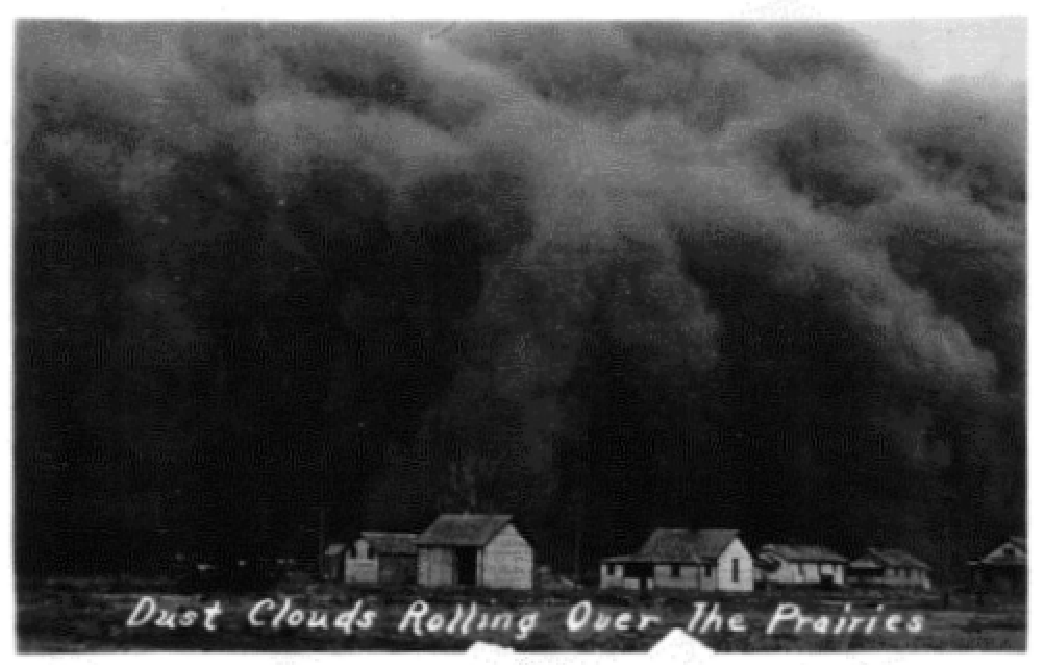
Climate happens on such a large scale though that it is difficult to grasp, even for me. So I have developed analogies to aid my own comprehension. My current favorite analogy compares the Dust Bowl to something that climate scientists call a mega drought.

We have these mega droughts in North America once every millennia or so, or at least we have had two or three of them in the last 1,500 to 2,000 years. These things are completely natural, they last for 100 to 300 years (the Dust Bowl lasted nine to 11 years) and they have only half of the rainfall annually when compared to the Dust Bowl.


As big as the Dust Bowl was, it was a simple weather aberration. Mega droughts however, at 10 to 30 times longer and twice as dry, are classified as something that would rate as a dangerous climate change. This is the scale of things that we have to contend with if we warm the planet just another 1.3 to 2.3 degrees F.

A mega drought would obliterate a continental agricultural region. There is only so much water underground that could be used for irrigation. Once groundwater is gone, all that would remain is shifting sand; for generations or centuries.

Another dangerous climate change would be 10 feet of sea level rise in a hundred years or maybe even as little as 500 years. It has already happened on a planet as warm as Earth is today, or within about one degree C of as warm as we are today.

The event occurred 121,000 years ago, in the interglacial warm period between the last 100,000 year-long ice age and the previous 100,000 year-long ice age (there have been about 10 100,000 year-long ice ages in the last million years.)

This globally catastrophic sea level jump happened naturally because of a collapse of the West Antarctic Ice Sheet due to natural warming between ice ages. It is just this kind of collapse that the ice scientists have seen signs of starting in the last several years.

Ten feet of sea level rise would displace 700 to 800 million people. Once the West Antarctic Ice Sheet collapsed, it would likely unleash a rush of dammed up ice from the Antarctic Continent into the ocean. This ice would continue to raise sea level at rates up to 10 feet per century or more for centuries on end.

Today we are changing the CO2 concentration of our atmosphere 14,000 times faster than normal for any time in the last 55 to 65 million years. If we as a society continue ignoring climate science as we have been for the last couple of decades, we will see 3 to 5 degrees C of warming (5.4 to 9 degrees F). This means by mid-century, maybe even just another 20 years, we will cross the 1.3 to 2.3 degree F threshold to dangerous climate change.

Our future lives may never be the same, but they may never be better either. We can prevent globally crippling mega drought that would starve hundreds of millions. We can keep the West Antarctic ice sheet from collapsing, or any number of other calamities that could basically end life as we know it.

All we have to do is bring CO2 levels in the atmosphere down to 350 ppm or less. Considering that the Kyoto Protocol would have had our society reducing our emissions to somewhere slightly below 1990 levels by 2012, and that emissions levels have only continued to climb since 1990, it is no wonder that doom and gloom is closely associated with climate change.


But the technologies are out there. The research has been done, the technologies proven in the lab, and some scale models have been built that prove successful. We could even use current CO2 extraction technology, commonly used in industry, to do the job. All it takes is a will to do so, money, and manpower.

For example, Klaus Lackner, at Columbia University, has shown how a polyester-like plastic sheet can absorb CO2 and the CO2 can be rinsed out with water. They built a full scale model and the technology worked well. The cost of the model was also in the feasible range.

Lackner’s full-scale test model was about the size of a train car. Thousands of these rail car-sized sequestration machines could easily be built. We could build enough to remove half of mankind’s CO2 emissions every year. The completed machine would be about the size of the Great Wall of China.

Lackner added up how much his machine cost and made some generalizations about full-scale implementation. When the numbers are looked at in more detail, a full scale model of their sequestration machine costed out so that it would take as much money as the U.S. spent on World War II, about $5 trillion adjusted for inflation, to pay for the machine.

That’s a lot of money of course. But Lackner was careful to explain that his cost was calculated on their own “actual costs” to build the one railcar-sized machine. Reduction in costs due to scale would likely be trillions of dollars.

This would still make the ultimate cost of the machine be trillions of dollars, but we just spent 3 trillion dollars on the economic conundrum bailout stimulus mess. And remember, this is just spending by the United States. Around the world, spending on World War II as well as spending this latest economic brain donation, was significantly more than just that spent by the U.S. alone.

Now comes the good part. These technologies are literally littered across the scientific landscape. We have all heard about how impossible clean coal is. But clean coal is only impossible on Earth as we know it. If our society finds the courage to address the true risks of climate change, clean coal suddenly becomes entirely feasible.


We are at the same point in our new clean energy economy today as we were just before the Interstate Highway system was built, or just before the Manhattan project ended World War II, or before John Kennedy said that we would go to the moon in 10 years because “it was hard.”

Wind energy is taking off like a bird. From 1996, wind energy installations doubled in capacity every three years. Installed solar capacity has increased 40 percent per year since 1990. Some parts of the U.S., Europe, and Japan have already reached parity — where solar costs the same as coal-fired power. Worldwide, solar should reach parity with coal in two to five years. In a decade or less, we will see “naked parity” where solar costs the same as coal without subsidies.

All of this clean energy will change our lives for the better. A new economic engine will take over our planet. We will no longer be slaves to fossil carbon. Our skies will clear, our health will improve, our lives will be better, and economies will prosper. It happened when we changed our base energy unit from wood to coal and again when we changed from coal to oil. It will do the same when we change from oil to wind and solar.

Our society has an innate capacity to accomplish vast challenges. The Great Wall of China and the pyramids are two low-tech accomplishments, built by hand, that can be seen from space. The Apollo project put a man on the moon. The winning of World War II saved our society from global dictatorship (or worse.)

Like the pyramids, the Great Wall, the Moon Shot, and World War II, fixing our climate will not be easy. And like those other things, it will not be cheap. It will take one to two percent of global Gross Domestic Product (GDP), which is $70 trillion today.

Remember Lackner’s sequestration machine the size of the Great Wall of China that you can see from the moon? One to two percent of GDP is a couple of trillion dollars.

So how much money is a trillion dollars? Let’s compare it to World War II and GDP. The $5 trillion that the U.S. spent on World War II was 25 times the U.S. GDP at the time, which was about $200 billion. Today’s U.S. GDP is $14 trillion. So 25 times today’s GDP would be about the same as what we spent on WW II, scaled for GDP. That’s $125 trillion dollars.


Scaled up to the actual size of the U.S. economy then (this is what GDP is), we spent $125 trillion dollars on World War II! So why is the measly $3 trillion that we spent on the economic conundrum perceived to be so much money? It’s all relative to perceived risk.

When the bailouts happened, Wall Street was being attacked by bad economic policy, not bad imperialists or Nazi’s bent on world domination. The perceived risk that the public has about climate change is just not comparable to world domination. It does not matter that the real risks of climate change are frightening beyond imagining; it is the perceived risk that counts.

Without public opinion, without the votes, without a global catastrophe threatening our very way of life, our leaders will not act. If the climate change threat were recognized for what it is, something worse than world domination, we would easily spend 25 times current GDP on prevention.

And the money is really there. Our capacity to create deficit spending 40 times greater than what we just spent on this little recession is real. It has happened before. We spent all that money during WW II because we saw the need. We understood the risks. We had the courage.

Please, in this time of thought about things bigger than ourselves, about the past and the future, and about our children, have courage. Go to meetings. Write your Senator. Tell your councilperson. Write a letter to the editor. Start a group. Attend a rally.

World War II was won by a revolution. The climate crisis is no less profound. It will need a revolution too. This new economic alternative energy revolution, this great societal challenge that we face, is not really without parallels. Repairing our deteriorating climate is a task that is within our grasp. There is no need for despair. We did not despair when we were attacked at Pearl Harbor. We rose to the challenge.

[Bruce Melton is a registered professional engineer, environmental researcher, trained outreach specialist, and environmental filmmaker. He has been translating and interpreting scholarly science publications for two decades. His main mission is filming and reporting on the impacts of climate changes happening now, unknown to the greater portion of society. Austin, Texas is his home. His writing and films are on his website.]

The Rag Blog

Posted in Rag Bloggers | Tagged , , , , , , , , | 6 Comments

Dr. Stephen R. Keister : Christmas Spirit and the Compassionate Doctor

“The Family Doctor,” lithograph by Grant Wood, 1941.

Christmas past:
The compassionate doctor
and today’s medical culture

By Dr. Stephen R. Keister / The Rag Blog / December 22, 2010

The Christmas season means many things to many people; however, as I approach age 90 I tend to reflect on what was and what might have been. Christmas to me represents a time of giving — not of material things, but of kindness and compassion.

Many of the modern day fundamentalist “Christians” might feel disdain for those of us who are secularists — and believers in a code of secular ethical culture. But to me the largest concepts of Christian morality lie within Matthew 5:1-12 (The Beatitudes), Luke 10:25-37 (The Parable of The Good Samaritan), and Matthew 19:23-26, (Jesus’ tale of the possibility of a rich man entering the Kingdom of Heaven).

I would like to reflect on two outstanding physicians that I have known who I believe embody that spirit.

Dr. William Watt Graham Maclachlan was my mentor during my period of residency in internal medicine at Mercy Hospital in Pittsburgh, 1945-1950. Dr. Maclachlan was some 60 years of age, a graduate of McGill when the tradition of Sir William Osler still persisted there, a member of the Association of American Physicians with its membership of 50 outstanding doctors nationally, and personal physician to two diverse personalities, Andrew Mellon and Philip Murray of the National Steelworkers.

Dr. Maclachlan’s great love was teaching and caring for the folks in the charity wards, especially those in the pneumonia ward where he supervised much of the early work with penicillin in treating lobar pneumonia, a disease that then carried a 50% fatality rate. The pneumonia ward was populated largely by residents of two local refuge houses, most of them alcoholics, who were admitted in dire straights and in many cases with little hope of recovery.

Dr.Maclachlan would pause at each bedside, check the individual’s name on his chart, pull up a chair, grasp the man’s hand, address him by his last name, and reassure him of his progress and care. It was from him that I learned to appreciate the true objective of the physician, love and consideration for the individual as a human being. In due time Dr. Maclachlan inspired me to become a rheumatologist, before such a specialty formally existed. and thus gave me a purpose for my life during the years 1950-1990.

At this season I think often of the privilege I had in knowing such a wonderful, far-sighted, compassionate human being.

Another person who I will always remember is Dr. Hyman Casselman, lovingly known as “Casey.” I met Dr. Casselman in 1950 or thereabouts, when I opened practice in Erie, Pennsylvania. Casey was a Canadian, also trained at McGill, who had interned in Erie, married a local lady of considerable means, and settled here to work as a family physician. During World War II he was assigned to an army dispensary in Arlington, Virginia. where his patients proudly included Generals Marshall and Eisenhower — before they had achieved full military rank.

Casey was the physician for the underprivileged, the poor and neglected, in the Erie area. He made house calls day and night in all kinds of weather and he never pushed a family for payment. His primary concern was for the well-being of the individuals and their families, not for his financial gain.

He never had a big house in the affluent section of the city. I remember encountering an elderly Afro-American who looked me in the eye and proudly said, “Dr. Casselman is my family doctor.” Casey was one of the few physicians who joined me in opposing the Vietnam War. I was proud to have such a partner in my personal and very lonely rebellion. I was also proud, in Casey’s later days, to be asked to present him with the Maimonides Award. Casey died at the age of 92 in 1998.

These two gentleman would be entirely befuddled by today’s medical culture where, upon entering a physicians office, you are immediately asked for your insurance card and asked to sign a bunch of papers having to do with financial and legal liability. You are then paged by your given name as if the receptionist/nurse were an old acquaintance, and escorted into an examining room where you are interviewed by a physician’s assistant.

No more of this sitting down and talking to the doctor for 45-60 minutes on the first visit and developing a personal friendship. Finally, if fortunate, one is able to spend 15-20 minutes with the physician, who may well be taking notes on a laptop during the interview. Sometimes you are even granted the opportunity to ask questions before being hurried out the door to set up your next appointment.

I have personally been fortunate, and I do not believe that it is because I am a physician, to have had the privilege of communicative, caring doctors (very much an exception these days) as my personal internist, my pain management physician, and an oncologist at our outstanding Regional Cancer Center.

Since the health insurance industry takeover of medical care in the United States — as we have noted in prior dispatches on The Rag Blog –- medicine has been transformed from a profession into a business not unlike those designed to sell insurance or used cars.

In the present culture of greed and materialism in the United States I see very little hope for our reverting to what we once were, or transforming our health care system into what exists in many other nations of the world. There appears to be little political interest, for instance, in establishing a single payer, universal health care system, as is promoted by Physicians for a National Health Program or the American Nurses Association.

In case you missed it, I would call everyone’s attention to an extensive and impressive document published on Mother Jones online. It’s the International Federation of Health Plans’ “2010 Comparative Price Report, Medical and Hospital Fees by Country.” We should become familiar with the information in this report if we indeed some day hope to join the rest of the world — with first rate care at reasonable costs.

There are only two nations in the industrialized world with “socialized medicine” — Canada and the UK — and 93% of Canadians are reported to be happy with their program. The UK program is a bit in flux under the current Tory Government and I have seen no recent statistics on satisfaction. The remaining nations have programs based on private health insurance with government oversight of costs and services.

I look to the future with more fear than I have experienced since the days of Sen. Joe McCarthy. The Obama administration, in spite of the howls from the political right, has little in common with the progressive America of the LaFolletts, Norman Thomas, and Franklin D.Roosevelt.

There is little hope of obtaining again our once national greatness under a Congress and Senate dominated by the corporations and their mainstream media shills. It seems to me a paradox that Obama is so hated by the mass of the conservative movement when in essence he is in bed with the majority of their policies.

One must surmise then that the dislike is based on his being seen as “the other” by a poorly informed, television-hypnotized public — a public which lives largely in a world noted for what Hannah Arendt called “the totalitarian contempt for facts and reality.” It was Joseph Goebbels who said, “It is the absolute right of the State to supervise the formation of public opinion.”

Finally, as a “senior citizen” I am aghast at the commercial efforts to take advantage of the elderly population with contrived misinformation like the massive advertising campaign to sell Medicare Advantage Plans in place of normal medicare to the senior population. This advertising costs millions of dollars, all to be passed on to the poor devil who buys the junk.

And the unending barrage of pharmaceutical ads on TV! The pharmaceutical industry, which spends more on advertising than on research, is passing on the costs to the buyer with this flow of undocumented foolishness. “Be sure and tell your doctor if you have diabetes or high blood pressure.” Goodness, if your doctor is not aware that you have high blood pressure or diabetes it is time you change doctors.

Happy Holidays to all.

[Dr. Stephen R. Keister lives in Erie, Pennsylvania. He is a retired physician who is active in health care reform and is a regular contributor to The Rag Blog.]

The Rag Blog

Posted in Rag Bloggers | Tagged , , , , , | 5 Comments

Dan Lyons : The Internet Splits in Two

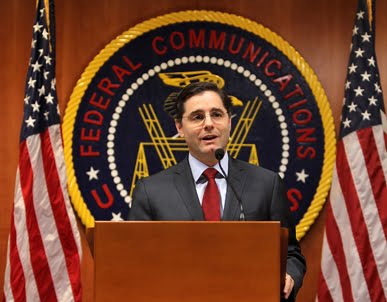
FCC Chairman Julius Genachowski speaks to media on net neutrality December 1, 2010 at FCC headquarters in Washington, DC. Photo by Alex Wong / Getty Images.

Compromise on net neutrality:
The Internet splits in two

By Dan Lyons / The Daily Beast / December 22, 2010

Tuesday’s FCC ruling on net neutrality shifts billions in profits and boils down to one fact: There will soon be a fast Internet for the rich and a slow Internet for the poor.

The Federal Communications Commission approved a set of net neutrality rules Tuesday, and nobody is happy. While liberals claim the FCC has caved to pressure from carriers, right-wingers are calling the new rules a government takeover of the Internet. In their tea-addled brains, the new rules represent yet another example of creeping socialism taking over every aspect of our lives. FCC Chairman Julius Genachowski is “Julius Seizure.” Cue the black helicopters.

No matter what you think about the new rules, however, they signal an important turning point in the development of the Internet. We are going from Phase One, where everything is free and open and untamed, into Phase Two, which is all about centralization, consolidation, control — and money.

Because don’t kid yourself. Money is driving all of this. As in: Hey, we’ve created this marvelous new platform for communicating with each other. We’ve demonstrated that very large sums of money can be generated by sending stuff over these wires. Now let’s figure out who gets what.

Tuesday’s new FCC rules grant two big concessions to carriers. First, the rules will apply to wired broadband connections, but they will pretty much leave wireless alone. Second, carriers remain free to create “fast lanes” on the Internet. They can charge Internet companies to ride on the faster pipes, and perhaps also charge consumers more money to get access to those speedy services.

That is a huge deal. It means we are entering an age in which we will have two Internets — the fast one, with great content, that costs more (maybe a lot more) to use, and then the MuggleNet, which is free but slow and crappy. Cable TV vs. rabbit ears.

On wireless — which eventually will be the more important platform — that disparity will be even more evident. The rich will get great stuff. The poor will get, well, what the poor usually get, which is not much.

Oddly enough this bifurcation resonates beyond just the speed of our Internet connection. It also is happening to information itself. We could be heading into a world where the rich get better information, from a wider choice of sources, while the poor get less.

That’s already happening, to some extent. If you’re a trader on Wall Street and can afford a Bloomberg terminal, you get better information sooner than the poor schlumps who are home trying to play at being day traders.

It will happen even more as news organizations, like Rupert Murdoch’s News Corp. and The New York Times, start putting content behind pay walls.

And so the digital divide widens into an information divide, which of course has huge implications for politics, economics, and even democracy itself.

Consider that in the 2008 election both sides were struggling to reach so-called low information voters. What happens when access to information becomes even more restricted? Where your ability to become informed is based upon your ability to pay? That’s the world we’re heading into. The first 15 years of the Internet, where it was all about peace and love and freedom, are drawing to a close.

The ultimate irony is that we are creating an information age where some of us — many of us — will get less information instead of more.

In his terrific new book, The Master Switch: The Rise and Fall of Information Empires, Columbia University professor Tim Wu describes the way every new communication platform starts out with a phase where there is openness and innovation, and where lots of amateurs (now we call many of them “hackers”) try out different things and spout lots of utopian rhetoric about making the world a better place.

Then, about 15 years in, things start to close down and become more centralized. The new platform becomes dominated by a small number of companies in the hands of powerful visionaries with an urge for empire-building. This also happened in telegraph, movies, radio, telephone — and now it’s happening to the Internet.

Steve Jobs is building an empire around selling music, movies, and news to people who own iPhones and iPads. Mark Zuckerberg is building an empire around the gathering and selling of the personal data of a half a billion people.

Now the carriers get their slice of the action. A lot of people hate the carriers, but try, for a moment, to see the world through their eyes. For 15 years they have sat around watching hundreds of billions of dollars of market value get created on the end of their wires (Google, eBay, Apple, Netflix, Amazon, Facebook) while all they get is a puny monthly subscriber fee.

The carriers won’t say this publicly, but I’m sure they resent being denied a share of the wealth being created on the platform that they’ve been so kind to build and maintain for the rest of us. What they also won’t say publicly, or at least not in this blunt a fashion, is: If you want us to keep building out more bandwidth, then start sharing the loot. Otherwise you can go build your own high-speed network.

Obnoxious? Certainly. But also persuasive. The FCC’s compromise probably represents the best deal anyone could get.

What this means for society remains to be seen. But I’m pretty sure those of us who have been around for Phase One of the Internet are going to look back on these last 15 years as the good old days.

[Dan Lyons is technology editor at Newsweek and the creator of Fake Steve Jobs, the persona behind the notorious tech blog, The Secret Diary of Steve Jobs. Before joining Newsweek, Lyons spent 10 years at Forbes. This article was originally published by the The Daily Beast and was distributed by Free Press.]

Obama caves on net neutrality

Interview with Timothy Karr, director of Free Press, by the Young Turks

The Rag Blog

Posted in RagBlog | Tagged , , , , , | 2 Comments

Medea Benjamin : To the Gay Community

Code Pink protesters at Senate Arms Services Committee hearing on “Don’t Ask, Don’t Tell” in Washington December 2, 2010. Woman with sign is Medea Benjamin. Photo from Democratic Underground.

To the gay community:
Now that you can join, please don’t!

By Medea Benjamin / December 21, 2010

The peace group I co-founded, CODEPINK, has not only been protesting the wars in Iraq and Afghanistan, and the drone attacks in Pakistan, but we have been going to military recruiting stations, high schools and career fairs throughout the country encouraging our youth not to join the military.

We talk to young people about the illegality of the wars under international law since we were not attacked by either Iraq or Afghanistan. We talk about how killing and maiming innocent civilians is morally wrong and creates new enemies, perpetuating the cycle of violence. We explain that the majority of Afghans and Iraqis want us out of their countries and that these wars are not making us safer. We insist that our military should be used to defend us at home, not to invade other people’s lands.

We know that the military is one of the only ways many young people can afford a college education these days and that the financial crisis severely limits this generation’s career options. But we still encourage young men and women to look for other opportunities that don’t involved killing or being killed in wars we shouldn’t be fighting.

It might seem contradictory, then, that CODEPINK was an enthusiastic supporter of the rights for gays and lesbians to join and serve openly in the military. But within our organization, it was never even controversial — we stand up for the rights of all human beings. The decision to join the military or not should be determined by individual choice, not institutional discrimination.

We pressured our Congressional reps and attended every hearing with signs calling for the repeal of Don’t Ask, Don’t Tell. We joined protests at the White House and rallies in Congressional districts. And we were in the Senate on Saturday when the historic vote passed, hugging and kissing our friends who had struggled so hard for this victory.

We understand that allowing gay soldiers to openly serve in the military is a crack in the armor of bigotry that will eventually open the way for gay people to marry and be guaranteed equality in the workplace. We understand this victory in the larger context of the march toward full human rights for this oppressed community. And who knows? Perhaps this victory will also serve to strengthen the military’s respect for human rights abroad.

We also understand the potential for a powerful alliance between the gay and anti-war communities. We can work together to help young people — gay and straight — find careers that won’t kill them, maim them, destroy them psychologically, or cause them to do harm to others.

We can jointly reach out to those already in the military to speak out against the violations of the rights of peoples whose land we occupy. We can ask gay veterans to join groups like Veterans for Peace and Iraq Veterans Against the War. And we can work together to turn our military from an aggressive force to one that truly defends us here at home.

As we struggle to find a more civilized way to treat each other in this world, let us recognize the commonalities in the fight for gay rights and the fight to end war.

[Medea Benjamin (medea@globalexchange.org) is cofounder of Global Exchange and CODEPINK: Women for Peace This article was distributed by CommonDreams.]

The Rag Blog

Posted in RagBlog | Tagged , , , | 3 Comments

Danny Schechter : WikiLeaks and the Fetish of Secrecy

Graphic from APS.

Wikileaks and the secrets that deceive us

It’s the age-old battle between our right to know and their right to keep us from knowing.

By Danny Schechter / The Rag Blog / December 21, 2010

In the days of Stalin’s Russia, not only would dissidents “disappear” but also, even in the pre-digital era, photographs of officials at May Day reviewing stands would be erased from photographs when their political stars fell. Our own “Kremlinologists” would know who was in, and who was out by comparing last year’s pictures with this years.

That’s one way of concealing information.

Just last week Republicans on the Financial Crisis Inquiry Commission pushed to have certain words removed from the report they were writing because they posed a conflict to their view that only the government was to blame for the financial collapse

Explained economist Paul Krugman,

Last week, reports Shahien Nasiripour of The Huffington Post, all four Republicans on the commission voted to exclude the following terms from the report: “deregulation,” “shadow banking,” “interconnection,” and, yes, “Wall Street.”

When Democratic members refused to go along with this insistence that the story of Hamlet be told without the prince, the Republicans went ahead and issued their own report, which did, indeed, avoid using any of the banned terms.

In our media today, omission of images and ideas is as key to sanitizing the news as is commission, What is not reported or perhaps even known is often more important than stories that are twisted by bias.

Enter WikiLeaks and an age-old battle between our right to know and their right to keep us from knowing. Its critics make a fetish about keeping secrets as if it is a holy duty and not a system of keeping the public uninformed about what their government is doing in its name.

The public has a right to know if officials are saying one thing in private and another in public, if they are concealing information or just plain lying.

The Pentagon Papers showed us that wars could be waged deceptively, based on deliberate falsehoods. WikiLeaks revelations about the Iraq and Afghanistan wars tell a similar story. We have learned how torture and civilian deaths were pervasive — and covered up.

Veteran investigative reporter Bob Parry argues that in the national security area, journalists — and the people — need leaks from officials of conscience.

He writes:

Whatever the unusual aspects of the case, the Obama administration’s reported plan to indict WikiLeaks founder Julian Assange for conspiring with Army Pvt. Bradley Manning to obtain U.S. secrets strikes at the heart of investigative journalism on national security scandals.

That’s because the process for reporters obtaining classified information about crimes of state most often involves a journalist persuading some government official to break the law either by turning over classified documents or at least by talking about the secret information. There is almost always some level of “conspiracy” between reporter and source.

Contrary to what some outsiders might believe, it’s actually quite uncommon for sensitive material to simply arrive “over the transom” unsolicited. Indeed, during three decades of reporting on these kinds of stories, I can only recall a few secret documents arriving that way to me.

It’s not just the government that hides behind secrecy rules it puts in place. The private sector does too — with the complicity of much of the media, which did not warn us about the financial crisis that was building. We didn’t learn about the pervasive fraud in the banking and real estate industries and still don’t know the full extent of the crimes of Wall Street.

Do we have to wait for historians to tell us that the stories we are being told are a crock?

Anyone remember reading about the Spanish American war? That’s the one which also marked the beginnings of “yellow journalism” when screaming headlines and falsified photos were used to mobilize the public for war.

Back then, at the turn of the last century, an American battleship, the USS Maine, sank in Havana Harbor. The incident sparked a battle cry, “REMEMBER THE MAINE.” We were told that “THEY” sank it. The incident led to war which later spread to the Philippines at a cost of six million lives.

Eighty years later, a submersible submarine went down to the remains of the Maine on the harbor floor. What they found was that no one — no terrorists, no Spaniards, no Cubans, nobody sank the Maine. There had been an accident in the engine room. The whole war was based on a well publicized event that never happened.

If we had known that at the time, many lives would have been saved and U.S. foreign policy might not have gone in an imperial direction.

So, back to today:

What do we gain from persecuting and prosecuting Bradley Manning who was among three million people with access to the diplomatic cables we are now reading about? What will we gain by jailing or killing (as some right wingers advocate) Julian Assange, who is already being called “the Che Guevara of the Information Age”?

The CIA’s murder of the original Guevara created a global martyr whose image is still among the most popular icons in the world. Guevara had his own problems with hostile women. One, Molly Gonzales, tried to break through barricades upon his arrival in New York with a seven-inch hunting knife. He later became famous for saying, “the true revolutionary is guided by a great feeling of love.”

Assange is being accused of sexual crimes in Sweden, a country, ironically, recently condemned by Amnesty International for not enforcing its own laws against rape. Now, the WikiLeaker-in-chief, is being targeted by the leak of a Swedish police document detailing charges against him. (They are charges, not facts, and may be serious under Swedish law.)

The ongoing and well-orchestrated war on WikiLeaks is also outraging millions worldwide who see the United States as a secretive and manipulative colossus that lives on lies and deception.

For many, this issue has reached a level of hysteria which, like the “Red Hunts” of the 1920s and the commie “crimes” of the cold war era, will only bring more shame to a Washington desperate to change the story away from the content of the leaked cables to allegations of wrongdoing by Assange. The Administration is also virtually torturing the man who dumped the documents, Bradley Manning, in Gitmo-like conditions, in an effort to turn hum against Assange. He has yet to be tried.

We can’t put the leaks genie back in the bottle. We might do better reflecting on the meaning of these disclosures for our democracy and media. The big secret is the one we don’t want to see: that we are building support and respect for WikiLeaks even as officials fulminate against it.

[“News Dissector” Danny Schechter is a journalist, author, Emmy award winning television producer, and independent filmmaker. Schechter directed Plunder: The Crime of Our Time, and a companion book, The Crime of Our Time: Why Wall Street Is Not Too Big to Jail. Contact him at dissector@mediachannel.org.]

The Rag Blog

Posted in Rag Bloggers | Tagged , , , , , , | Leave a comment

Greg Moses : Dream Remains for Hector Lopez and Others

Photo from Reuters.

Despite defeat of DREAM Act:
Hope remains for Hector Lopez and others

By Greg Moses / The Rag Blog / December 21, 2010

Two weeks ago 21-year-old Hector Lopez was the poster-perfect picture for hope in the DREAM Act. The story of his American dream, his abrupt deportation, and his heroic bid for asylum was featured in The New York Times just one day before the House of Representatives passed the act on Dec. 8. News reports called for a quick vote in the Senate. Lopez was riding high on a hope that the American system would shortly set him free from a federal lockup for migrants in Arizona.

Then the DREAM Act came unraveled. The Senate vote was postponed for a week. The vote to vote on it fell five votes short. And Lopez, the former student-body president of Rex Putnam High School of Portland, Oregon, suddenly felt the air sucked out of his hopes.

“But the failure of the Senate to pass the DREAM Act in no way changes the status of the dreamers,” insists immigrant advocate Ralph Isenberg, who has been working on the Lopez release full time for several weeks. “This is not a time to panic. Instead, we need to make certain that our national policy of not deporting students like Hector remains intact.”

Isenberg is referring to widely publicized statements made earlier this year by President Barack Obama and federal immigration authorities promising that they would cease spending tax money on efforts to deport young people who had been brought to the U.S. as children.

“I am absolutely certain that Hector Lopez will be released,” says Isenberg on the Sunday before Christmas. “He meets all the criteria for dreamers. He has lived in the U.S. for all but a few weeks of his life. He has been an exemplary student. And if the President’s words are any good, he said dreamers are not to be deported. I have not found another case where a dreamer with Hector’s qualifications and background has been deported.”

Encouraged by what he calls a “sincere tone” in his communications with Immigration and Customs Enforcement (ICE) authorities in Arizona, Isenberg has promised to meet all expenses involved in the bonding, release, transportation, and supervision of Lopez so that he can spend the holidays at home with his mother.

Isenberg says he is thankful that ICE officials conducted an interview with Lopez last Wednesday exploring claims that Lopez has a “credible fear” of being re-deported to Mexico. After two full months of life as an American exile in Mexico, Lopez came back across the border in mid-November carrying written appeals for asylum. Officials have reportedly promised a speedy evaluation of the claims in the coming week says Isenberg. Yet despite hopeful signs of sincere treatment in Arizona, Isenberg claims that the past week was stressful for Lopez.

Hector Lopez. Photo from ColorLines.

“Hector had a very bad week,” says Isenberg. “He was shocked by the DREAM Act failing in the Senate.” And he was informed that on Human Rights Day, Dec. 10, an immigration judge in California ruled that the Lopez deportation case could not be reopened at this time.

“Hector is starting to show signs of extreme stress that I fear could lead to depression,” wrote Isenberg in a weekend communication to ICE officials in Arizona. “I also understand the facility psychologist met with Hector. I sincerely hope Hector will be released soon and know that he will most likely suffer from post traumatic stress upon his release. He will get the love and attention he needs from his family and friends. It is imperative that we get Hector released to minimize the amount of mental trauma he has suffered and allow him to resume his position in our society.”

As for the immigration judgment coming out of California, Isenberg points to a passage in the ruling where the judge appears to be appealing to some common sense that cuts through the rigid legalism of the immigration codes.

“The Court notes that were the Government to agree to joint reopening of Respondent’s proceedings… [Lopez] is eligible to pursue relief in the form of suspension of deportation,” wrote the judge in his concluding remarks.

“Respondent has apparently lived in the United States since his entry in 1989… and therefore accrued the requisite physical presence. Respondent has presented voluminous evidence of his good character, contributions to society, and accomplishments. His affidavit also provides evidence of the hardship he has faced upon removal to Mexico.

“While the Court would be amenable to granting Respondent’s Motion sua sponte so that he could pursue his application for suspension of deportation, it is prevented from doing so due to lack of jurisdiction.”

As Isenberg sees it, ICE authorities in Arizona have the sua sponte discretion to release Hector Lopez immediately and return him to his American life by Christmas.

“I told Hector on the telephone this weekend not to give up,” says Isenberg. “He is still on track for being released this week. It would be cruel and unusual punishment not to release this kid.”

[Greg Moses is editor of the Texas Civil Rights Review and author of Revolution of Conscience: Martin Luther King, Jr. and the Philosophy of Nonviolence. A chapter by the author appears in Philosophic Values and World Citizenship: Locke to Obama and Beyond, edited by Leonard Harris and Jacoby Adeshei Carter. He can be reached at gmosesx@gmail.com.]

Also see:

The Rag Blog

Posted in Rag Bloggers | Tagged , , , , , | Leave a comment

Ted McLaughlin : Republicans Play Political Football With START Treaty

Political cartoon by Matson / Roll Call.

UPDATE: December 22, 2010 The New START arms control treaty with Russia was ratified by the Senate today by a 71-26 vote, with 13 Republicans crossing the aisle to support it. But they did so in defiance of the Republican leadership which opposed the treaty to the end — after making unsuccessful attempts to sabotage it with amendments that would have made the treaty unacceptable to the Russians.

The Republicans, the START Treaty,
and the “No” game

Congressional Republicans are treating the issue like another political football.

By Ted McLaughlin / The Rag Blog / December 21, 2010

It looks like the Republicans are still playing the “No” game, where they try to delay or stop anything President Obama tries to accomplish. The difference this time is that their obstructionism will make life more dangerous — both for Americans and for those living in other countries. That’s because this time their little game may determine whether the number of nuclear weapons in the world is reduced or increased.

Last April the United States and Russia agreed, after serious negotiations, on a new Strategic Arms Reduction Treaty (START). The new treaty, signed by Presidents Obama and Medvedev, would reduce the strategic nuclear weapons of both countries by an additional 30%. There is little doubt that the Russians will confirm the treaty, since Putin gets whatever he wants from the Russian Duma (legislature). The only doubt is whether the U.S. Senate will ratify the treaty.

It takes a two-thirds vote of the Senate to ratify a treaty with another country, and although a clear majority of the Senate is in favor of ratification, it remains to be seen whether the magic number of 67 can be reached. That’s because many Republicans, including the party leadership in the Senate, have come out against approving the treaty. One senator even had the temerity to suggest there is no reason to rush into approving the treaty — although voting on the treaty eight MONTHS after both presidents signed it can hardly be called a rush to judgment.

The Republicans have tried to give the impression over and over again that the treaty was unverifiable and would put the United States at a disadvantage somehow. Both of those charges are ridiculous. The fact is that all of the Joint Chiefs of Staff of the United States Military are enthusiastically in favor of the START treaty. I can’t believe they would be in favor of any treaty that disadvantaged the United States or weakened our defenses.

In addition, all of the former (and the current) Secretary of States (including the ones who served in Republican administrations) have come out in favor of the treaty. And all of our NATO allies (who are probably in more danger from Russian weapons than we are) are in favor of the treaty. In fact, it seems that the only opponents of the START treaty are some Congressional Republicans, and they’re treating the issue like another political football. They just don’t want to let President Obama have any kind of accomplishment — even one that makes the world a little safer place.

The Republicans seem to think they can kill the treaty (showing their fringe right-wing base how anti-Obama they are) and nothing will really change with the world balance of power. Unfortunately, that’s just not true. The Republicans have tried to amend the treaty, but that is just an effort to kill it. Any amendment would mean the two countries would have to go back and negotiate all over again, and the Russians are in no mood to do that.

Russian Foreign Minister Sergei Lavrov said, “The START agreement, which was drafted on the basis of strict parity, completely meets the national interests of both Russia and the United States. It cannot be reopened, becoming the subject of new negotiations.” Putin, the real power in Russia, went even further. He said the failure to ratify the treaty would be “dumb,” and would most likely be the start of a new arms race — he said Russia would have to take some kind of action in response.

So things are not going to stay the same no matter what the Senate does. If they ratify the treaty, nuclear arms will be reduced by a significant 30%. If they don’t, the Russians are likely to increase their nuclear weapons total (and we would probably do the same) — putting the Doomsday clock a few minutes closer to midnight. And I couldn’t really blame the Russians if they reacted in that way.

Why should they trust us if we refuse to ratify a reduction in nuclear weapons? Remember, we are the only nation on Earth that has ever used nuclear weapons. We are also the only nation that has refused to guarantee that we won’t launch a first strike of nuclear weapons. Those two facts together make us look like a very dangerous foe — a foe that may not be trustworthy.

It is extremely important that the United States ratify this treaty, especially after all the international relations that were seriously damaged by the Bush administration. It is critical that President Obama be viewed by the world as restoring the United States as a trustworthy partner in establishing world peace (and that he be viewed as having the internal power to do that). If the Republicans are able to kill the treaty it will damage our relations abroad — among our friends and our enemies.

It looks like the vote will be close [though things are looking better as of this writing]. All of the Republican’s “poison pill” amendments have been easily defeated, but not by two-thirds votes (like the treaty would need for ratification). The Democrats say they have 57 votes from their own caucus (55 Democrats and both independents — Sanders and Lieberman). Wyden (Oregon) is absent because he just had cancer surgery. That means 10 Republican votes will be necessary for ratification.

According to Sen. Schumer (New York), there are currently five Republicans who say they will vote for the START treaty — Cochran (Mississippi), Collins (Maine), Snowe (Maine), Voinovich (Ohio), and Lugar (Indiana). That means five more Republican votes will be needed, and it’s anyone’s guess as to who they will be or whether it’s even possible.

Even though I think it’s bad politics, I can sort of understand the Republican desire to obstruct President Obama from accomplishing anything. But this time they’ve stepped over the line. This time they’re playing a dangerous game of international political chicken. I wonder if they know that — or even care.

[Rag Blog contributor Ted McLaughlin also posts at jobsanger.]

The Rag Blog

Posted in Rag Bloggers | Tagged , , , , , , , , | Leave a comment

BOOKS / Robert Jensen: The Commons as Kinder-and-Gentler Capitalism


All That We Share isn’t enough:
The Commons as kinder-and-gentler capitalism?

By Robert Jensen / The Rag Blog / December 20, 2010

[All That We Share: A Field Guide to the Commons/How to Save the Economy, the Environment, the Internet, Democracy, Our Communities, and Everything Else That Belongs to All of Us, by Jay Walljasper and On the Commons (The New Press, 2010), 288 pages, $18.95.]

All That We Share is an exciting and exasperating book. The excitement comes from the many voices arguing to place “the commons” at the center of planning for a viable future. The exasperation comes from the volume’s failure to critique the political and economic systems that we must transcend if there is to be a future for the commons.

In the preface, the book’s editor and primary writer, Jay Walljasper, describes how he came to understand the commons as a “unifying theme” that helped him see the world differently and led him to believe that “as more people become aware of it, the commons will spark countless initiatives that make a difference for the future of our communities and the planet.”

Defining the commons as “what we share” physically and culturally — from the air and water to the internet and open-source software — the contributors recognize that a society that defines success by individuals’ accumulation of stuff will erode our humanity and destroy the planet’s ecosystems.

Walljasper calls for a “complete retooling” and “a paradigm shift that revises the core principles that guide our culture top to bottom.” No argument there. Unfortunately the book avoids addressing the specific paradigms we must confront. Is commons-based transformation possible within a capitalist economy based on predatory principles and an industrial production model built on easy access to cheap concentrated energy?

The book appears to offer a kinder-and-gentler capitalism with more regulated markets, but there is no attempt to wrestle with the effects of the corrosive and unsustainable principles — unlimited greed and endless growth — on which capitalism is based.

Can we expect those core principles of the system to magically evaporate? Why will the commons become the domain of popular movements rather than corporations? If there is no attention to the inherently predatory nature of capitalism, it’s difficult to imagine how people will win out over profit.

There’s also little in the book about the need to shift from the industrial mode of production, which has generated the material comfort taken for granted by most in the First World. A sustainable commons-based society requires dramatic reductions in consumption, but contributors rarely address the scope of the change necessary (with the exception of Winona LaDuke’s essay on efforts to rebuild indigenous life at the Anishinaabeg White Earth Reservation). Forget about critiquing the lifestyles of the rich and famous — the commons can’t sustain the lifestyles of ordinary folks in a high-energy/high-technology world.

The problem is not that “the commons” isn’t a valuable concept, but that it is not a substitute for analysis of the political and economic systems that degrade the commons. The book is right to call for local experiments in cooperative living (I spend considerable time and energy on such projects), but as we pursue those experiments within the existing systems, we have to be honest about the limits of those systems and not fear being labeled radical. Radical analysis is not an intellectual indulgence but a practical necessity.

As a model for “commoners,” Walljasper cites the right-wing forces’ ideological campaign in the late 20th century to shape the market fundamentalism that eventually became state policy. He suggests that today “large numbers of people of diverse ideological stripes” can rally behind the commons, which may be true.

But right-wing forces didn’t assemble people of different ideological stripes; they pushed an openly reactionary analysis and had a clear political and economic program. Just as they defended capitalism to the detriment of the commons, a countermovement has to openly critique capitalism to serve the commons. Just as they took the industrial model as a given, a countermovement has to question that model openly.

It may be that the commons has the power to transform people’s consciousness as Walljasper seems to hope, but hanging one’s analysis and political hopes — as the book’s long subtitle suggests — on that concept strikes me as evasion rather than engagement. In the end, we have to come to terms with capitalism and the industrial model that are deeply entrenched in the United States. That can’t be done obliquely but must be confronted head-on.

[Robert Jensen is a journalism professor at the University of Texas at Austin and board member of the Third Coast Activist Resource Center in Austin. He is the author of All My Bones Shake: Seeking a Progressive Path to the Prophetic Voice, (Soft Skull Press, 2009) and Getting Off: Pornography and the End of Masculinity (South End Press, 2007); Jensen is also co-producer of the documentary film Abe Osheroff: One Foot in the Grave, the Other Still Dancing, which chronicles the life and philosophy of the longtime radical activist. Robert Jensen can be reached at rjensen@uts.cc.utexas.edu.]

The Rag Blog

Posted in Rag Bloggers | Tagged , , , | Leave a comment