BOOKS / Rabbi Arthur Waskow : Marge Piercy: Science Fiction as Prophetic Vision


Marge Piercy’s ‘He, She and It’:
Science fiction as prophetic vision

By Rabbi Arthur Waskow / The Rag Blog / November 7, 2010

[He, She and It by Marge Piercy (Knopf, 1991); Hardcover; 446 pp.]

Marge Piercy’s novel He, She and It appeared almost 20 years ago. My review appeared in Tikkun magazine in 1992. During these years, many aspects of her novel have loomed more prescient — even prophetic in the sense not of prediction but of accurate warnings spoken by the Spirit.

Anyone concerned with corporate domination, with global scorching, with feminism, with Middle East peace, with the renewal of Jewish peoplehood and Judaism, with the deeper meaning of computer technology and “artificial intelligence,” with Kabbalah, with the nature of humankind — will be drawn to think and feel more deeply by reading her novel. And as I wrote then, it is a novel — joy and sorrow in tales of love and failure, moral conflicts embodied in four-dimensional human brings.

Why do I want to share the review now? We are standing today on the brink of a great choice — for America, for the planet. This book helps us to look across the brink of disaster into a world scorched and flooded, a world nakedly controlled by corporations in outright feudalism, a world in which nevertheless, technological creativity is matched with spiritual creativity.

After a passage from the review itself (the full original review is on-line), I have added a note on my own personal relationship to the book that I did not discover till years later.

Androgyny and Beyond:
‘He, She and It’ by Marge Piercy

I began to read science fiction when I was 12 years old, just a few months after the atomic bomb destroyed Hiroshima, and I’ve never stopped. It wasn’t gee-whiz gadgets that attracted me; it was the dark visions and the rainbow cloudbursts of imagined social transformation, dystopian and utopian. My commitment to healing the world has been shaped as much by science fiction as by those other Prophetic writers whom I discovered much later — Isaiah, Marx, Buber, Heschel.

All that time I have been waiting for Marge Piercy’s new book. Not quite consciously waiting, you understand. Not even in my dreams could I have created this book, but in my heart and kishkes, I’ve been waiting.

So what is so delicious? First of all, it’s Jewish science fiction. Feminist Jewish science fiction. Feminist Kabbalistic Jewish science fiction. Feminist Kabbalistic kibbutznik Jewish science fiction.

Not just casually Jewish, but rooted in a sardonic version of Jewish mysticism and in the profoundly Jewish spiritual wrestle about what social justice means in a world where the Messiah is ever-coming, ever-vanishing.

Feminist, yes, like all of Piercy’s work. The story of the Golem of Prague – that famous artificial “human” being clumsily created by a great rabbi five centuries ago — is at the heart of Piercy’s tale. But the Golem takes a different form when his tale is for the first time told by a woman, Malkah, one of Piercy’s heroines.

The communitarian ethos of the kibbutz is the air that Piercy’s story breathes, but the kibbutz is a different place when it is transformed by a feminist politics and culture. And the science of “artificial intelligence” is transformed by a feminist outlook.

Piercy’s kibbutz arises not in Israel but on the surviving hills of what we know as Boston. Surviving because much of the American coastline has been inundated by a new Flood, a surge of ocean from the melted ice caps, the result of global warming. It’s the mid-twenty-first century, and a lot we take for granted is gone.

The United States, for instance. It collapsed, like the — what was it? –oh yeah, the Soviet Union. The world is ruled by several gigantic corporations that have divided it into feudal fiefdoms. There are a few free cities, and the free Jewish town of Tikva (Hope) is one of them.

The Middle East has also vanished. Not just a government or two, a sovereignty or two, but the entire region, oil fields and fig trees and mountain goats and peoples. It’s the Black Zone now, an empty blotch on the map. Jerusalem is a wilderness of fused green glass, the thermonuclear casualty that set off a totally ruinous bio-chemical-nuclear war.

It turns out that there may be secret survivors — is anybody as stubborn and tenacious as Israelis and Palestinians? As women? But that’s a thread for you to follow when you read the book.

Piercy does give us some gee-whiz gadgets: computer networks deft enough to create planetary virtual realities, through which the corporations can struggle to invade Tikva, through which Tikva can struggle to defend itself, and through which people who explore them can transform themselves — and die. And cyborgs — cybernetic organisms, fusions of computer programming and biology, real live quasi-humans, with intelligence for sure, and maybe, just maybe, with free will. Or maybe not.

Can a cyborg be a citizen and vote in the town meeting of Tikva? Can a cyborg be a Jew and count in a minyan? And here is the neat and powerful question posed by Piercy’s fusion of feminism with science fiction: Who or what is a creature that is programmed with both a woman’s and a man’s mentality? Can a spiritual androgyne be a human? Or is the real question whether anyone who is not androgynous can be fully human?

Piercy’s androgynous cyborg may be the only fully human creature in the world. His name — in outward anatomy this cyborg is fully male, though inwardly also the He/She/It of the title — is Yod, the name of the tenth letter of the Hebrew alphabet. (This model was the tenth in a series of attempts to build a useful cyborg.) But “Yod” is also the first letter of God’s name, which is sometimes written as Yod-Yod. And it is close to the Yid that in Yiddish is the generic word for Jew.

Note the wonderful linguistic problems that Piercy introduces. Yod is the newest model of a cyborg, like the latest car, clearly an invention, a machine. Yet Yod has overtones of the ultra-human, much more fully in the Divine Image than anyone since the original Adam, who was made in Our Image, said God, in the Image of God, male and female, androgynous as God is androgynous. He, She and It.

This is a novel of ideas, but not only of ideas. By introducing a being who is both male and female, both human and machine, Piercy has jiggled and joggled the relationships of all the characters. Not only the ideas, but the people, are delicious. They make love, they get jealous, they fight for custody of their children and for control of their creations, they rebel against their bosses and comply with the rules, they take risks and die and go half-mad with grief.

The book is told from the alternating standpoints of Malkah, a tough and gentle grandmother who is sexually alive and technologically ingenious, and Shira, her bright and frightened granddaughter who is relearning her way toward love and a sense of her own power in the world. It is Malkah who has made sure that Yod has a full womanly as well as manly programming, and who searches for some way to tell him of his own ancestors. (Notice how Jewish is this desire: “Tell it to your child on that day,” says the Passover Haggada.)

But who, or what, is the ancestor of a cyborg? Malkah decides it is the Golem of medieval Prague, that doomed subhero to whom, in Jewish legend, the great Rabbi Judah Loew gave life and a mission to protect the Jewish people from pogroms. The story enters Yod’s consciousness at a level quite different from computer programming, a level that involves what seems to be free will; and after hearing the story, Yod assumes the triumph and tragedy of carrying the Golem’s being to a higher level.

This transmutation of the Golem story becomes a metaphor for Piercy’s own work. If the Golem is Yod’s ancestor, then the Golem story is ancestor to Piercy’s novel. Piercy in effect both locates the Golem story as a kind of early Jewish science fiction, and places her own work in the stream of mythic Judaism.

How can Piercy dare to see a tiny Jewish town in such a bold light? I think it is because her Jewishness and her feminism fuse into a new vision. The Jews are too few to shake the world; women are many. Women are too diffuse and too diverse to make a counter-community; Jews know how. Counting noses on the face of the earth, the Jews are just about the tiniest imaginable community with a transformative vision; women could be the largest. But they cannot transform the earth alone, and they cannot transform it if they work alone, as individuals.

Piercy is saying that women must create communities of women and men in conscious connection with the earth, communities that are intimate and participatory, that so thoroughly share an approach to work, sexuality, money, and spirituality that they can stand together against the powers that be.

The struggle to heal the world may well take generations, Piercy warns, during which time even more of the world may be deeply wounded. An ancient Jewish wisdom for a wider human future: Only painful birth pangs can give birth to the days of Messiah.

Years after the publication of this review, years after Piercy had taught several summers at the Elat Chayyim retreat center where Phyllis Berman (not yet a rabbi) was the director of the summer program, Phyllis and I had Marge as a visitor for dinner. The conversation turned to He, She and It, and I said again how much I loved it.

Marge said, “Did you ever notice that at the end of the book, among the acknowledgements, I thanked you?” “Yes,” I said, “But I never understood it. It said something about my having clued you into some aspects of Kabbalah, but I can’t remember doing that — or even in those days, being able to.”

“Yes,” she said. “Do you also remember that way back in the mid-’60s, I was a Visiting Fellow at the Institute for Policy Studies, where you were a Resident Fellow?

“Yes,” I said, scrunching up my face to recall. “So?”

“You asked people at IPS to look at about 50 pages of a novel you were trying to write. It began with a nuclear attack that destroyed Jerusalem and led to the collapse of both the USSR and the USA, and it included the creation of an independent Jewish commonwealth in New England.”

“Oh My God! Yes, it was around 1965. I was trying to write a novel in the form of letters from and to a future me. I called it “Notes from 1999.” I remember I imagined my grown-up daughter killed when a U.S. Navy sub unintentionally destroyed Jerusalem. Maybe that image was already a dead end. I never got anywhere with the book.”

“I know. But I kept the idea as a seed in my head, and it sprouted into He, She, and It.”

“Ohhh. Oh. My. God.

“Thank God you wrote it. I couldn’t write a novel. You could. You did. Thank God!”

[Rabbi Arthur Waskow is the director of The Shalom Center. He is co-author of The Tent of Abraham: Stories of Hope and Peace for Jews, Christians, and Muslims; author of Godwrestling, Round 2 and Down-to-Earth Judaism; and editor of Torah of the Earth (two volumes, eco-Jewish thought from earliest Torah to our own generation). These pioneering books on eco-Judiasm are available at discount from “Shouk Shalom,” The Shalom center’s online bookstore.]

The Rag Blog

Posted in Rag Bloggers | Tagged , , , , , , | 1 Comment

Lamar W. Hankins : 2010 Elections Without the Tea-Colored Glasses

Shading the truth? Tea Partier at Tax Day Rally in Pleaston, California, April 15, 2010. Photo by Justin Sullivan / Getty Images.

Looking at the election
without the Tea-colored glasses

To draw grandiose conclusions about ‘demands of the American people’ is unsupported by reality and is typical spin-doctoring by Tea Party Republicans and their fellow travelers.

By Lamar W. Hankins / The Rag Blog / November 7, 2010

The Republican spin-doctors, talking heads, intellectuals, and factotums want the country to believe that the Republicans got it right this election. They want us to believe that Republicans are in step with the American people; that the policies they promote represent American attitudes and values.

But if we count only those who voted on November 2, they had a 52% unfavorable view of the Republican Party and a 53% unfavorable view of the Democratic Party according to research conducted by the Pew Center for the People and the Press. Like me, a majority of the voters don’t like either major party.

But the more important figures to look at to explain the voting results last Tuesday are the electorate’s views on the general direction the country is going and its views on the national economy.

Sixty-two percent of those voting believe the country is on the wrong track; 52% see the economy as “not good” and 37% see it as poor. Only 9% saw the economy as good and 1% as excellent. That 1% must be the Wall Street bankers and hedge fund operators who voted. Nearly 90% of recent voters believe that the economy is in horrible shape. Washington needs to focus on fixing the economy before it does anything else.

While I agree with the majority view, it fails to account for some realities that were largely ignored in this election and continue to be distorted by right-wing pundits. As a recent political cartoon suggests, Bush failed us for eight years by getting us into two wars, running up huge deficits, and giving tax breaks to the wealthiest 2% of Americans, and now the Republicans are trying to blame it on the black guy. No surprise there. But this recent election was not a repudiation of Obama by an “American majority,” as George Will termed it.

A majority of the “American people” did not say “no” or “yes” to anything on November 2. Only about 41.5% of the voting-eligible population voted (as contrasted with 61.6% who voted in the 2008 general election) according to the United States Election Project. These 2010 voters may have been voting for or against various messages, but they do not represent the sentiments of a majority of Americans.

The recent voters who voted against Obama and the Democrats represent slightly more than 20% of the voting-eligible public, and far less than 20% of the total population. While the Republican Tea Partiers had an impact on who voted, it remains to be seen if they will continue as a force in American politics.

The Republican Tea Partiers were as confused at the start of their movement nearly three years ago as they were on November 2. The main theme of their effort is that they represent the patriotic rebellion that came to be known, some 50 years after the event, as the Boston Tea Party.

Today’s Republican Tea Party thinks that the Boston Tea Party was all about a rebellion against King George’s tax on tea sold in the colonies. They see that Tea Party solely as a rebellion against taxes. What it was, instead, was a rebellion against the government-granted monopoly power of the East India Company, which had been exempted from the tea tax by the Tea Act, passed by the British Parliament in 1773 — an unholy alliance between government and corporate power. The tax exemption allowed the East India Company to undercut the small businesses that sold tea in the colonies.

The only first-person account of the Boston Tea Party is found in the memoir of George R. T. Hewes, published 50 years after the event because of an agreement among the participants that they would not write about it for 50 years. Most of the participants were dead by then, but Hewes penned the story in a book printed on ragged paper, A Retrospect of the Boston Tea-Party, with a Memoir of George R. T. Hewes, a Survivor of the Little Band of Patriots Who Drowned the Tea in Boston Harbour in 1773 (New York: S. Bliss, printer, 1834).

According to author Thom Hartmann, the value of the tea destroyed by the colonists in 1773 was about $1 million in today’s currency — more than a little vandalism even by today’s standards.

But the views of the Republican Tea Partiers differ widely from the views of most Americans. During the last 23 years, Pew Research Center polling has revealed that 77% of Americans believe that there is “too much power in the hands of big companies.” Between 62% and 65% of Americans, over the same time span, believe that “business corporations make too much profit.”

Despite Americans’ long-term concerns about the power of the corporations, the Tea Party Republicans have promoted, almost exclusively, the notion that the only dragon that needs to be slain is the federal government.

It is an old Republican refrain that goes hand in hand with the belief that there is no role for the federal government in promoting the “public welfare,” yet Pew research over the last three decades has shown that Americans believe by a 62% majority that the “government should guarantee food and shelter,” and from 48% to 53% have agreed that “the government should help more needy people, despite debt,” and by 63% to 71% that “government should take care of people who can’t care for themselves.”

The Republicans, including the Tea Party Republicans, enjoyed success in this past election not because the values they pushed were overwhelmingly American values, but because they were able to stimulate their voters to get to the polls, helped along by Republican-dominated media and hundreds of millions of dollars in corporate contributions made by the U.S. Chamber of Commerce, the Karl Rove political groups, and such wealthy Republicans as the oil billionaire Koch brothers, Howard Rich (a New York media mogul), John Templeton, Jr. (the now rich son of a wealthy investor), and many others.

One group that did not vote in this election was a cohort of 14 million young voters who supported Obama in 2008 but chose not to participate in this election. With the opposition to Obama and the Democratic Party serving to motivate those people who did vote, it was expected that the opposition would do very well.

This does not mean, however, that the American people are demanding change that contradicts their core values as measured over the last three decades by the Pew Research Center. It does mean that a majority of voters in 2010 do not approve of Obama’s and the Democrat’s agenda.

But to draw grandiose conclusions about “demands of the American people” is unsupported by reality and is typical spin-doctoring by Tea Party Republicans and their fellow travelers.

One problem for the Democrats in this election was that Americans do not perceive the large number of positive actions taken by Obama and the Democratic-controlled Congress that follow the values held by a majority of Americans (information compiled from various sources):

  • Cut taxes — largely for the middle class — by $240 billion since taking office on Jan. 20, 2009 (Business Week)
  • Provided the Department of Veterans Affairs with more than $1.4 billion to improve services to America’s Veterans
  • Signed the Children’s Health Insurance Reauthorization Act, which provides health care to 11 million kids — 4 million of whom were previously uninsured
  • Signed the Christopher and Dana Reeve Paralysis Act, the first comprehensive legislation aimed at improving the lives of Americans living with paralysis
  • Developed a stimulus package, which includes approximately $18 billion for non-defense scientific research and development
  • Signed the Weapons Systems Acquisition Reform Act to stop fraud and wasteful spending in the defense procurement and contracting system
  • Established a Credit Card Bill of Rights, preventing credit card companies from imposing arbitrary rate increases on customers
  • Passed a Health Care Reform Bill, preventing insurance companies from denying insurance because of a preexisting condition, and allowing children to remain covered by their parents’ insurance until the age of 26
  • Provided tax cuts for up to 3.5 million small businesses to help pay for employee health care coverage
  • Passed tax credits for up to 29 million individuals to help pay for health insurance
  • Expanded Medicaid to all individuals under age 65 with incomes up to 133% of the federal poverty level
  • Added $4.6 billion to the Veterans Administration budget to recruit and retain more mental health professionals to help veterans, especially those with PTSD
  • Eliminated subsidies to private lender middlemen of student loans to reduce costs to students, and protected student borrowers from exploitation by lenders
  • Expanded Pell grants, which help low-income students pay for college
  • Signed a financial reform law establishing a Consumer Financial Protection Bureau to look out for the interests of ordinary Americans
  • Cut prescription drug costs for medicare recipients by 50%
  • Passed the American Recovery and Reinvestment Act of 2009: a $789 billion economic stimulus plan that has helped improve the economy
  • Increased funding for national parks and forests by 10%

While this list is incomplete, it serves to show that much has been done to benefit ordinary Americans during Obama’s presidency, and almost none of it was done with help from Republicans.

But these actions did not serve to motivate most voting-eligible Americans to vote. Most Americans are focused on the economic devastation they have faced for the last 2 1/2 years. The Democrats did little to respond effectively to those economic problems, primarily loss of jobs, foreclosures, and the fear caused by economic insecurity. Most Americans were not motivated to vote on November 2.

I have been a vigorous critic of Obama, and will continue to be, with regard to many issues, including the wars he has continued and expanded, his unwillingness to attempt to secure affordable health insurance for all Americans, his coddling of Wall Street and the bankers, his failure to take more direct action to head off the massive foreclosures that have devastated many segments of the country, his mistaken embrace of corporatism that has led us down the road to plutocracy, his continuation of the Bush policies that diminished our liberties (such as the Patriot Act), his frequent use of the “state secrets” doctrine to hide government misconduct, and his inability to face the reality that nearly all Republicans would rather play politics than make government serve the needs and interests of the people.

Obama’s presidency has been flawed and ugly in many ways, but it is better than most of what we have had for the last 40-plus years. The Democrats are a fickle, cowardly, sorry, and despicable political party, but for those of us who care more about the welfare of ordinary Americans than the welfare of the corporations and the wealthy, Democrats are unfortunately the better alternative among the two major choices now available.

The party will not change without unrelenting pressure by progressive populists pursuing the values held by most Americans, either from within the party or from outside.

[Lamar W. Hankins, a former San Marcos city attorney, is also a columnist for the San Marcos Mercury. This article © Freethought San Marcos, Lamar W. Hankins.]

The Rag Blog

Posted in RagBlog | Leave a comment

Marc Estrin : Spanking Your Inner Child

Inner Child. Image from Integral Options Cafe.

Have you spanked
your inner child today?

By Marc Estrin / The Rag Blog / November 7, 2010

I’m just beginning the week run of rehearsals and performances in the pit orchestra for Peter Pan. The Lyric Theater production will be extremely professional as usual, and attended by full houses of an enthusiastic community.

I play in these musicals not because I think the dramatic art is great or the music profound, but because they are such wonderful examples of communities coming together — 200 people working for months without pay — to produce a high-spirited event which several thousand people will enjoy.

Nevertheless, I have to admit being irritated by the very thought of Peter Pan. The unthinking enthusiasm with which his motto, “I won’t grow up,” is greeted reflects the destructive childishness, and embrace of that childishness, epidemic in the American public.

And here I’m not thinking of the occasional comico-pathetic gray-hair who earnestly exhorts me to honor my inner child as he or she does, and then trips blithely away in some psychic equivalent of tie dyes and bellbottoms. Rather I am concerned with the rampant embrace of the trivial and superficial.

This pattern has some innocent manifestations such as the recent adult enthusiasm for various children’s books, business-suited women carrying them proudly underarm and assuring questioners that they are “really for adults, too.” The infantilization of the reading public — bad for serious authors, but not all that sinister. Far more so is the dumbing down of news and other information, and the substitution of infotainment and celebrity.

I was reminded of this recently when Obama walked on stage, pre-election, at the Daily Show. The audience cheered and clapped — but in a way far beyond the polite, enthusiastic greetings routinely offered to even villains and semi-villains. The adulation went on and on. Obama tried four times to stop it, and finally just stood there smiling and waving occasionally.

Now remember, Jon Stewart’s audience is made up mostly of lefty liberals who enjoy his satirical critique of the powers that be.

Nevertheless, this very audience offered up an unstoppable standing ovation for a man who stands against everything they presumably stand for: a man who is currently answerable for the worldwide death and starvation of millions; the many domestic losses of home and job; the destruction of climate and disarmament conferences; the ever-increasing expenditures on ever-increasing wars; the now commonplace practice of torture; the undercutting of public healthcare; the shielding of executive crimes past and present; the hoarding of executive power; the resurgence of the nuclear industry; the embrace of Israel’s brutal policies in Palestine; the ever-increasing inequality of wealth; and now, post-election, the inevitable strangulation and death of democratic government.

For starters.

Yet the children cheered him, and cheered him, and cheered him, because he is the president and they were in the same room, behaving not unlike swooning teenage girls at early Beatles concerts. Clap if you believe in fairies. I was embarrassed for them.

Ice Cream Boy. Image from IceScreamer.

Burlington, Vermont, where I live, is the birthplace and main home of Ben & Jerry’s ice cream. Their motto, plastered all over bumper stickers, and inside their Burlington store, is IF IT’S NOT FUN, WHY DO IT? I’ve often pondered this question. And I’ve pondered alongside it another bumper sticker common in our area: Emma Goldman’s face next to the line “If I can’t dance, I don’t want to be part of your revolution.”

Is this a food fight between bumper stickers, or are they finally on the same side? Are they both exhorting us to honor our inner children? I decided to look further into the Goldman quote, and this is what I found — in her autobiography, Living My Life:

At the dances I was one of the most untiring and gayest. One evening a cousin of Sasha, a young boy, took me aside. With a grave face, as if he were about to announce the death of a dear comrade, he whispered to me that it did not behoove an agitator to dance. Certainly not with such reckless abandon, anyway. It was undignified for one who was on the way to become a force in the anarchist movement. My frivolity would only hurt the Cause.

I grew furious at the impudent interference of the boy. I told him to mind his own business. I was tired of having the Cause constantly thrown into my face. I did not believe that a Cause which stood for a beautiful ideal, for anarchism, for release and freedom from convention and prejudice, should demand the denial of life and joy. I insisted that our Cause could not expect me to become a nun and that the movement would not be turned into a cloister.

f it meant that, I did not want it. I want freedom, the right to self-expression, everybody’s right to beautiful, radiant things. Anarchism meant that to me, and I would live it in spite of the whole world — prisons, persecution, everything. Yes, even in spite of the condemnation of my own closest comrades I would live my beautiful ideal. (p.56)

This statement feels significantly different from “IF IT’S NOT FUN WHY DO IT?,” for behind the joy and exuberance, Emma embraces a larger ideal to be joyful about. The playfulness of Ben & Jerry’s, its flavors, its graphics, is more about honoring one’s inner child. and putting out a lot of money — with a smile — for an ice cream cone.

I must say that the figure of Peter Pan is more complex then his motto song “I won’t grow up” might imply. In Barrie’s book, and even in the musical, Peter is a semi-tragic figure, sentenced to repeated loss of the friends who do grow up to leave him, responsible for the parental pain of losing the children kidnapped, and the nostalgic regret of losing one’s childhood.

Peter is as much the villain of the piece as its hero. He is boastful, selfish, distructive, and unreflective. And naturally, the children abducted to Neverland give him a standing ovation at his every appearance.

While I may be a churlish old grouch, I really do think that we, the kidnapped, had better begin to honor our inner adults, and not continually embrace childishness — usually at the expense of others, and ourselves.

Hope is not a method, nor is belief in fairies.

[Marc Estrin is a writer, activist, and cellist, living in Burlington, Vermont. His novels, Insect Dreams, The Half Life of Gregor Samsa, The Education of Arnold Hitler, Golem Song, and The Lamentations of Julius Marantz have won critical acclaim. His memoir, Rehearsing With Gods: Photographs and Essays on the Bread & Puppet Theater (with Ron Simon, photographer) won a 2004 theater book of the year award. He is currently working on a novel about the dead Tchaikovsky.]

The Rag Blog

Posted in Rag Bloggers | Tagged , , , | Leave a comment

Kate Braun : (First Quarter) Moon Musings

Photo from I am marlon / Flickr.


Moon musings:

First Quarter Moon

(November 7-November 12, 2010
)

By Kate Braun / The Rag Blog / November 6, 2010

This phase of the moon is a time to act, to start new activities and projects, to work on things that require growth. Sunset is the best time to activate whatever energies you choose to work with, but preparation may begin earlier in the day as a first quarter moon always rises at noon.

One interesting activity would be to make a God’s Eye that would be used as a facilitator in your meditations during this moon-phase. Ideally you would use yew branches or twigs, but any wood is acceptable. Use white, red, blue, orange, and yellow (in that order) yarn or ribbon to weave the design.


Hold the God’s Eye while you perform this centering ritual: Sitting comfortably, take seven easy yoga-breaths (in through the nose, out through the mouth, gently and smoothly with no huffing, puffing, or gasping) as you concentrate on filling all the empty spaces in your body with each inhalation and emptying those spaces with each exhalation.

When you complete these seven breaths, you will be in an Alpha-rhythm, the best place to be for meditation. You may use the center of your God’s Eye as your focus-point.

If you celebrate on Sunday you should include rituals for money, health, and friendship-related matters in your projects. On Monday, the focus should be more on your Self, seeking inspiration and change. On Tuesday, some concentration on protecting property would be appropriate. On Wednesday, make career aspirations a focus of your intent. On Thursday, concentrate on money-making endeavors. On Friday, some of your energies should center on your personal feelings, especially where love and attraction are concerned.

Eat spicy food such as tamales, nachos, and tacos. Include the cheese of your choice as you assemble these foods. Drink tea, either black or green, and water. Don’t let yourself become too heavy with food. You need energy to properly connect with Lady Moon, not to be so well-fed that you feel the need for a siesta.

Whether you are alone or among friends, conclude the evening by saying aloud:

May I be at peace

May my heart remain open

May I awaken to the light of my own true nature

[Kate Braun’s website is www.tarotbykatebraun.com. If you know any moon lore that you would like to share with Kate, please send it to her at kate_braun2000@yahoo.com.]

The Rag Blog

Posted in Rag Bloggers | Tagged , , , , , | 2 Comments

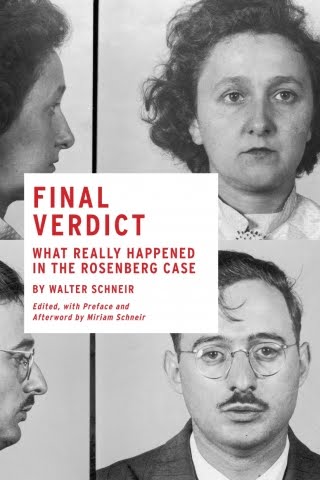
BOOKS / Jonah Raskin : Schneir’s ‘Final Verdict’ on Rosenbergs Offers No Such Thing


Walter Schneir’s ‘Final Verdict’:
New book on Rosenbergs fails to deliver

By Jonah Raskin / The Rag Blog / November 6, 2010

[Final Verdict: What Really Happened in the Rosenberg Case by Walter Schneir; Preface and Afterword by Miriam Schneir (Melville House, 2010); Hardcover; 203 pages; $23.95.]

Final Verdict, the book Walter Schneir was writing when he died, and before he could finish it, came to me highly recommended and I can understand why. For students and scholars who have followed the case of Ethel and Julius Rosenberg — the New York Jewish couple who were executed in 1953 as spies for the Russians — this book offers tantalizing stories and anecdotes.

It certainly keeps the case alive, but in no way does it close the book on the Rosenbergs, and in that sense the title is misleading. So is the subtitle: “What really happened in the Rosenberg case.” Whatever did happen, this book never makes clear. Let me explain.

There is no “final verdict” in Final Verdict; there are only more questions, more doubts, and more disquieting revelations. Here are some of the words that Schneir uses that reflect his perspective on the Rosenberg case: “baffling,” “mystery,” “frustrating,” “incomplete,” “presumably,” and more.

All too often, he writes phrases such as “I cannot resist wondering,” “for reasons unknown,” and “I have often pondered the question.” While they might be taken as the author’s own authentic disclosures about his troubled journey, they hardly inspire confidence about his methods and his conclusion. Final Verdict is a jumble and a mumble.

Reading Walter’s Schneir’s last book — it comes with a preface and an afterword by his widow, Miriam Schneir — led me to the conclusion that there will never be a complete and satisfactory explanation of who the Rosenbergs really were and what they might or might not have done.

As Walter Schneir himself points out, the U.S. Government lied about the Rosenbergs from the time they were arrested in the summer of 1950 until the time they were executed in 1953. The U.S. government refused to release their files for decades. Lies were piled on top of lies on top of lies until truths were buried probably forever. The Russians kept files too, but they’re hardly more credible or reliable than those of the FBI.

The Rosenbergs, Schneir says, lied too. They affirmed their innocence, and denied their guilt, though all of the evidence today makes it clear that Julius Rosenberg was a spy for the Soviet Union in the 1940s.

Julius Rosenberg lied, and so did Ethel. That they didn’t steal the secret of the atomic bomb — the crime they were accused of committing — is clear (as well as the fact that there was no single “secret” of the bomb) and has been for a long time.

That they were framed, and then wrongly and unjustly executed has also been apparent for a long time and is hardly new, or news, though Schneir tries hard to frame his story as a final revelation, the key that finally unlocks the Rosenberg riddle

Sadly, Final Verdict is a book by a scholar so caught up in his own scholarship that he becomes obsessed with it and buried under the weight of it. He is a cliché of the man who searches frantically for a needle in the proverbial haystack. In his case, the haystack or haystacks, are KGB and FBI files.

Schneir’s flawed reasoning leads him to believe that the truth is to be found somewhere in the hundreds of thousands of documents about the case. In fact, the documents are false; they are compounded of lies, untruths, half-truths, suppositions, fabrications and fictions.

Having lied in public before, during, and after the trial of the Rosenbergs, there was no legitimate reason to believe, as Schneir did, that the U.S. government would tell the truth in its own files. A romantic, and an idealist, Schneir believed that the dogged reporter would inevitably find the truth, ferret it out, and publish it for all humanity to see, read, and understand. If only it were so.

There is no clear narrative in Final Verdict; no straight story we can follow; only a mish-mash of dates and names and Schneir’s reflections and observations about his own work. Moreover, he becomes the main character in the story and the Rosenberg’s become the minor characters. I don’t believe that was his intent; but, unfortunately, in these pages, Ethel and Julius recede into the background while he emerges into the foreground.

No doubt about it, Walter Schneir was a kindly, humane man. But in these pages, he is guilty of a kind of intellectual arrogance. Moreover, he tends to belittle the very individuals he set out to defend. That too is an all-too frequent problem with scholars who spend so much time with and feel so intimately connected to their subjects that they come to loathe them, or feel superior to them.

At the start of a long paragraph about Julius Rosenberg’s politics, Schneir writes, “I can well imagine that the next two years were the most exciting and fulfilling of Julius Rosenberg’s life.” Schneir goes on to say, without providing the source of his information and without a single footnote, that “Julius was a man with a head full of the fantasies about the Soviet Union then current among the far left, a blind faith in the goodness of a land he had never seen.”

How Schneir knew what was in Julius’s “head” he never says. How he knew that Julius had “blind faith” he never says either. The fact that some members of the U.S. Communist Party had blind faith in the Soviet Union does not mean that Julius Rosenberg did, and it is unfair to link Julius to those trends and patterns without evidence.

Schneir goes on to say that “Rosenberg was no great shakes as an engineer,” as though that was further proof he could not have been guilty of the crime for which he was executed.

About three-quarters of the way though the book, Schneir writes that, “it would be interesting to have a clearer picture of what Julius was up to in the postwar years, but, unfortunately, a scarcity of hard evidence makes it impossible.” The lack of hard evidence does not prevent him, however, from writing that Julius Rosenberg’s “devotion to the Soviet Union and the cause of communism never wavered.” Perhaps Julius communicated with him secretly, or perhaps Schneir was channeling Julius.

If you want to read about the Rosenberg case, read Walter and Miriam Schneir’s earlier book, Invitation to An Inquest, or We are Your Sons, by Michael and Robby Meeropol — the sons of Ethel and Julius. Or read Sylvia Plath’s novel The Bell Jar that begins, “It was a queer, sultry summer, the summer they electrocuted the Rosenbergs, and I didn’t know what I was doing in New York.”

Or ponder the telegram that Allen Ginsberg sent to President Eisenhower in the White House in the summer of 1953: “Rosenbergs are pathetic! Government Will Sordid! Execution Obscene. America caught in crucifixion machine. Only barbarians want them burned. I say stop it before we fill our souls with death-house horrors.”

There is one very good reason to buy Final Verdict and that is the superlative black-and-white photos of the principal figures in the case. The documents in the case lie; the memories of those who lived then are no longer to be trusted. The photos are the closest things to the truth that exist.

The photos provide as real a story as we will ever know. Look at them and judge for yourself: Ethel and Julius; Ethel’s sister-in-law Ruth and her brother David; Judge Irving Kaufman who presided over the trial; Irving Saypol, the U.S. Attorney, who prosecuted, and his assistant Roy Cohen; Emmanuel Block, the Rosenberg’s lawyer. So many Jews! Indeed, the trial of the Rosenberg was all about Jews, Judaism, and anti-Semitism.

Finally, in Final Verdict, there is the amazing photo of the crowd of courageous New Yorkers who gathered on West 17th Street in Manhattan on June 19, 1953, the day of the execution, to bear witness to the deaths of Ethel and Julius and to this immense psychic and political wound to the body of America itself that has never healed, that won’t go away, that haunts this country to this day.

[Jonah Raskin is a professor of communication studies at Sonoma State University and has been writing about the Rosenbergs since 1962.]

The Rag Blog

Posted in Rag Bloggers | Tagged , , , , , , | 4 Comments

Margarita Alarcón : 50 Years of Cuban Embargo is Enough

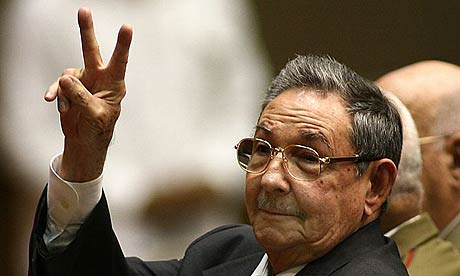
Cuban president Raul Castro at Cuba’s National Assembly in Havana. Photo by Ismael Francisco /AFP/ Getty images.

‘Four Riders’ and the Cuban embargo:
Fifty years should be enough

By Margarita Alarcón / The Rag Blog / November 6, 2010

In 1992, a little over 19 years ago during one typical hot summer season in New York City as the calm was smothering midtown and Murray Hill and the lethargic heat made it almost impossible to lift even an Italian Ice, four guys jokingly referred to as the Four Riders of the Apocalypse conceived of a work plan to fill up those slow muggy afternoons.

(The “Four Riders” were my father, the ambassador, and the three men below him in order of rank, while they were all at the UN during Cuba’s tenure in the Security Council as a non-permanent member, 1990-1992.)

There really wasn’t much to do in those days; the first Gulf War was “over,” the sanctions were in place, Saddam Hussein was still president, and the Iraqi people were suffering the after-effects of war and would do so till this very day; the Israeli Palestinian conflict was still going to be an issue one way or another; Puerto Rico was not going to be an independent island (at least not yet); North Korea and Iran had not yet made a peep over nukes.

Life was pretty slow in the UN. Well, for most, it was slow.

There were those who called them crazy — almost harebrained — given the extreme circumstances and what they were up against. To others it was remarkable how this particular topic had never been put forth.

Finally by the end of the summer, right as autumn was turning the Central Park leaves from green to the bright hues of auburn and yellow, they presented their plan to the largest world audience around, the United Nations. So it was that Resolution 59/11 of the United Nations General Assembly was adopted during the fall of the year 1992.

The way UN resolutions work is pretty simple. A nation — or a group of nations — get together and present a draft resolution which is then voted upon by the entire body of the General Assembly in order to become a topic of each year’s GA agenda. If it receives enough votes, it continues on the agenda.

Not very complicated, pretty straight forward, really not rocket science. As far as the rules and the regulations of the UN charter are concerned, member states have rights and responsibilities. One of the responsibilities is to adhere to the democratic voting process of the organization, its Charter, and its Security Council — whichever the case may be.

The United States of America is a founding member of both the General Assembly and the Security Council and has used both privileges on many occasions.

For almost two decades now, in what appeared to be a slow rise at first and has now become unwavering, the General Assembly has been voting in favor of resolution 59/11. Each year, gaining votes in favor, and losing abstentions with the same two nations voting against.

187-2-3

This year, the vote on resolution 59/11 on October 26th was once again described by the media as “an overwhelming majority” in favor of the resolution. Of the 192 member states that make up the entire body of the United Nations, 187 voted in favor of the resolution, Two — Israel and the United States — voted against it. And here is the punch line for geography buffs: the Marshall Islands, Palau, and Micronesia decided to abstain.

Resolution 59/11 is entitled “Necessity of ending the economic, commercial and financial embargo imposed by the United States of America against Cuba.” This is basically a fancier and nicer way of stating the following: put an end to the U.S. embargo against Cuba.

This is a legislated issue within the United States and thus does not fall automatically in the hands of the president. It isn’t President Obama’s embargo. Technically it belongs to Congress. Under law the only way the U.S. embargo against Cuba can be lifted is if two-thirds of the United States Congress (both houses) vote to do so. This has been a given since President William Clinton signed the Helms Burton Bill into law in 1996 serving at the pleasure of the Cuban American National Foundation and a few legislators.

It’s not President Barack Obama’s Embargo; it belongs to Congress and to the voters in the United States.

The irony is that Cuba is a Third World nation which has never had — and has never expressed — any intent of harming the people of the United State. Though unable to acquire practically anything on the open world market, this island has managed to achieve a 78-year life expectancy rate and an infant mortality rate at birth that would be the envy of any First World nation.

This is even more interesting if you take into account that the embargo has been around as long as the Cuban Revolution, so the “punishment” was not inflicted because of anything Cuba did or did not do to the United States or anyone else, but rather as a response to its sheer existence: radical social change 90 miles off the coasts of Florida.

So, I must ask the readers of The Rag Blog to urge the current President to advise his Congress (and yours) to lift this unjust, insane, ludicrous, and internationally condemned policy that is leading nowhere.

Those Four Riders of the Apocalypse didn’t spend their summer months writing in vain. Don’t let this president become the eleventh administrative head responsible for yet another year of unjust punishment of Cuba — for its simple desire for independence and sovereignty, something the forefathers of your own great nation also achieved through that “evil” word: revolution.

[Margarita Alarcón Perea was born in Havana, Cuba, and raised in New York City. She studied at Karl Marx Stadt in East Germany and Havana, and is a graduate of Havana University in linguistics. She has taught English translation and North American Twentieth Century Literature, and worked in the Cuban music industry. She is currently a news analyst for Cubadebate in Havana and contributes to The Huffington Post. Margarita’s father is Ricardo Alarcón, president of the Cuban National Assembly.]

The Rag Blog

Posted in Rag Bloggers | Tagged , , , , | 1 Comment

FAIR : Election Coverage Misses the Mark

Image from Blogging Belmont.

Surprise!
Press urges move to the right:
Media misreading midterm elections

By Fairness and Accuracy in Reporting / November 5, 2010

With the Democrats suffering substantial losses in Tuesday’s midterms, many journalists and pundits were offering a familiar diagnosis (Extra!, 7-8/06; FAIR Media Advisory, 2/3/09): The Democrats had misread their mandate and governed too far to the left. The solution, as always, is for Democrats to move to the right and reclaim “the center.” But this conventional wisdom falls apart under scrutiny.

For months, the problem for Democrats was correctly identified as the “enthusiasm gap” — the idea that the progressive base of the party was not excited about voting. The exit polls from Tuesday’s vote confirm that many Democratic-tending voters failed to show up.

How, then, does one square this fact with the idea that Obama and Democrats were pushing policies that were considered too left-wing? If that were the case, then presumably more of those base voters would have voted to support that agenda. It is difficult to fathom how both things could be true.

But reporting and commentary preferred a narrative that declared that Obama’s “days of muscling through an ambitious legislative agenda on [the] strength of Democratic votes [are] over” (Washington Post, 11/3/10). “The verdict delivered by voters on Tuesday effectively put an end to his transformational ambitions,” announced Peter Baker of The New York Times (11/3/10).

Some thought Obama’s post-election speech was still missing the point. As The Washington Post‘s Dan Balz put it (11/4/10), Obama was “unwilling, it seemed, to consider whether he had moved too far to the left for many voters who thought he was a centrist when he ran in 2008.” On CNN (11/3/10), David Gergen said, “I don’t think he made a sufficient pivot to the center today. He has to do that, I think, through policies and through personnel.” Gergen went on to cite Social Security “reform” as an ideal way to demonstrate he was “taking on his base.”

The Washington Post‘s David Broder (11/4/10) advised Obama to

return to his original design for governing, which emphasized outreach to Republicans and subordination of party-oriented strategies. The voters have in effect liberated him from his confining alliances with Nancy Pelosi and Harry Reid and put him in a position where he can and must negotiate with a much wider range of legislators, including Republicans. The president’s worst mistake may have been avoiding even a single one-on-one meeting with Senate Minority Leader Mitch McConnell until he had been in office for a year and a half.

USA Today‘s Susan Page noted before the election (10/29/10):

During his first two years in office, Obama often acted as if he didn’t need a working relationship with congressional Republicans. With big Democratic majorities in Congress… he could court a few moderate Republicans such as Maine Sen. Olympia Snowe in hopes of peeling off a GOP vote or two to block a filibuster or give legislation a bipartisan patina.

This view of Obama’s politics meshes poorly with reality. Much of the Democrats’ maneuvering over the healthcare bill, for example, was devoted to trying to find any Republicans who might support it, stripping out elements of the bill — such as the public option — that were drawing more enthusiasm from the party base. (A true single-payer plan was rejected from the beginning.)

The dramatic escalation of the Afghan War was a major disappointment to the progressive base, along with Obama’s embrace of nuclear power and offshore oil drilling. And critics on the left often expressed disappointment with the White House’s timid approach to Wall Street reform and economic stimulus.

Yet after the election, it was difficult to find TV pundits who would argue against the media conventional wisdom about an agenda that was too left-wing. Instead pundits were offering plenty of suggestions for Obama to move even further to the right — Time‘s Joe Klein recommended building more nuclear power plants (FAIR Blog, 10/29/10) and Washington Post columnist David Broder floated a war with Iran to boost the economy and promote bipartisanship (FAIR Blog, 11/1/10).

Bill Clinton, whom media likewise counseled to move right after heavy midterm losses, was frequently held up as an exemplar: “If there is a model for the way forward in recent history, it’s provided by President Bill Clinton, who established himself as more of a centrist by working with Republicans to pass welfare reform after Democrats lost their grip on Congress in 1994.” (Associated Press, 11/2/10).

The advice to move to the “center” was accompanied by reporting and analysis that wondered if Obama was even capable of doing so. “Obama has not shown the same sort of centrist sensibilities that Mr. Clinton did,” explained The New York Times (11/3/10).

Of course, Clinton’s first two years were centrist — and a disappointment to his base, seriously dampening Democratic turnout in the midterms (Extra!, 1-2/95; FAIR Media Advisory, 11/7/08). And the “Clinton model” failed to build broad Democratic electoral success.

Meanwhile, the pundits had right in front of them, in the sweeping Republican victory, an example of how a political party can organize a comeback — not by moving to the center and alienating its base, but by “using guerrilla-style tactics to attack Democrats and play offense” (New York Times, 11/4/10).

The economy, stupid

Much of the election analysis sought to ignore or downplay what was inarguably an election about unemployment and the state of the economy. Reporting that sought to elevate the federal budget deficit (FAIR Action Alert,6/24/10) as a primary issue of concern served as a diversion — and drove the election narrative into Republican territory, where rhetoric about “big government” and cutting federal spending were dominant themes.

“If there is an overarching theme of election 2010, it is the question of how big the government should be and how far it should reach into people’s lives,” explained the lead of an October 10 Washington Post article. There was little in that article — or anywhere else — to support that contention.

With the economy the overwhelming issue for the public (Washington Post, 11/3/10) the media should have led a serious discussion about what to do about it. Instead, there was a discussion that mostly adhered to a formula where the left-wing position was that nothing could be done to improve the economic situation (when the actual progressive view was that a great deal more could have been done), while the right offered an attack on federal spending but was never required to offer a coherent explanation of how such spending eliminated jobs.

As The New York Times‘ Baker (11/3/10) framed it: “Was this the natural and unavoidable backlash in a time of historic economic distress, or was it a repudiation of a big-spending activist government?”

There were some exceptions — MSNBC interviews with top Republican officials on election night (11/2/10), for instance, revealed that many could not offer a coherent plan for reducing spending or the budget deficit. This should have been a larger part of the media’s coverage of the election.

Who voted?
Some election reporting and commentary treated the results as if they represented a dramatic lurch to the right. As Alternet‘s Josh Holland noted (11/3/10), reporting like a New York Times article that talked of “critical parts” of the 2008 Obama vote “switching their allegiance to the Republicans” distracted from the main lesson — that many Obama voters of two years ago did not participate in 2010. Republican-leaning voters, on the other hand, did.

That fact, along with the disastrous state of the economy and the normal historical trends seen in midterm elections, would seem to provide most of the answers for why the election turned out the way it did.

But much of the media commentary wanted to turn the election into a national referendum on the new healthcare law or the size of government. The exit polls provide some clues about the sentiment of voters, but the lessons don’t seem to fit neatly into those dominant media narratives.

Asked who was to blame for the state of the economy, most picked Wall Street and George W. Bush (USA Today, 11/3/10). As a New York Times editorial noted (11/4/10), “While 48 percent of voters said they wanted to repeal the healthcare law, 47 percent said they wanted to keep it the way it is or expand it — hardly a roaring consensus.”

Some attention was paid to the exit poll finding that 39 percent of voters support Congress focusing on deficit reduction — which would appear to lend some credence to the media message that voters cared deeply about deficits. But the same exit polling found 37 percent support for more government spending to create jobs.

Given that polling of the general public shows stronger concern about jobs — The New York Times reported (9/16/10) that “The economy and jobs are increasingly and overwhelmingly cited by Americans as the most important problems facing the country, while the deficit barely registers as a topic of concern when survey respondents were asked to volunteer their worries” — if anything, this finding serves to reinforce that citizens energized by Republican talking points were the ones who showed up to vote (FAIR Blog, 10/18/10).

In the end, the elections were covered the way elections are often covered — poorly. As Dean Baker of the Center for Economic and Policy Research put it (Politico, 11/2/10), “Until we get better media, we will not get better politics.”

[Fairness and Accuracy in Reporting (FAIR) is a national media watch group that, in its own words, “has been offering well-documented criticism of media bias and censorship since 1986.” FAIR “work[s] to invigorate the First Amendment by advocating for greater diversity in the press and by scrutinizing media practices that marginalize public interest, minority, and dissenting viewpoints.”]

Source / Fairness and Accuracy in Reporting (FAIR) / CommonDreams

The Rag Blog

Posted in RagBlog | Tagged , , , | 1 Comment

Tom Miller: Travel Writing, Expatriates, and Vengeful Saguaros

Travel writer. Graphic from Ephemerist.

Travel writing, expatriates, and vengeful saguaros

Be skeptical of writers who talk of snow-capped peaks, bustling marketplaces where the beadwork is always intricate, and shy but friendly natives.

By Tom Miller / The Rag Blog / November 5, 2010

Great travel writing consists of equal parts curiosity, vulnerability, and vocabulary. It is not a terrain for know-it-alls or the indecisive. The best of the genre can simply be an elegant natural history essay, a nicely writ sports piece, or a well-turned profile of a bar band and its music.

A well-grounded sense of place is the challenge for the writer. We observe, we calculate, we inquire, we look for a link between what we already know and what we’re about to learn. The finest travel writing describes what’s going on when nobody’s looking.

Moritz Thomsen (1915-1991) was one of the great American expatriate writers of the twentieth century. Period. A soft-hearted cuss, a man of almost insufferable integrity, a lousy farmer and a terrific writer, his books have long since been smothered by the avalanche from megapublishers (yet remarkably, three of his titles remain in print).

Although all his works could be considered travel memoirs imbued with a sense of place, his third book, The Saddest Pleasure, embodies some of the very finest elements of the genre: constant doubt, a meddlesome nature, and a disregard for nationalism. (The book’s title comes from a line in Paul Theroux’s novel, Picture Palace: “Travel is the saddest of the pleasures.”)

Thomsen, who stayed in Ecuador following his mid-nineteen-sixties Peace Corps stint, pledged allegiance to nothing except his station as an expatriate. And as an expat he was free to judge us all, an undertaking he finessed with acute observations, self-deprecation, and a flavorful frame of reference that ranged from a Tchaikovsky symphony to a Sealy Posturepedic mattress.

Inquisitiveness. Yes. In The Art of Travel, a book worth staying home for, Alain de Botton quotes Alexander von Humboldt’s childhood curiosity: “Why don’t the same things grow everywhere?” And as children we might also ask, “Why doesn’t everyone look the same?” “Why don’t we all speak the same language?” Or, to quote Rodney King’s adult exasperation, “Can’t we all just get along?”

It is these pure and simple questions of innocence that should accompany travel writers, not iPads cell phones, or laptops. Travel with paper and pen, a book, maybe a bilingual dictionary. Ask the questions a child might.

In the late nineteen-seventies I advanced a notion that the U.S.-Mexico frontier was really a third country, 2,000 miles long and 20 miles wide, and went about testing it. I had little awareness of travel writing, but when my book about the borderland came out in 1981, reviews invariably referred to it as travel literature, a category I had never really considered.

Reviewers anointed me a travel writer; I didn’t choose the label. Others have recoiled at the identity. “I detest the term,” Jonathan Raban told the Chicago Tribune. Eddy L. Harris insisted to the same newspaper: “I’m not a travel writer. Absolutely not.” Although I’ve openly embraced it, the name sometimes makes me uncomfortable, too. It’s as if travel writing were considered a second-tier calling — “non-fiction lite.”

Yet surely as buses plunge off Peruvian mountainsides and Norwegian freighters collide with Liberian tankers, the basic ingredients of formula travel writing will endure. Henry Miller succumbed. When he lived in Paris, Miller wrote the odd travel piece for a friend’s publication. “They were easy to do, because I had only to consult the back issues and revamp the old articles,” he wrote in Tropic of Cancer. “The principal thing was to keep the adjectives well-furbished.”

(You’d shy away, too, if foreigners constantly accosted you, cameras, notepads, and tape recorders at the ready.) The essayist who calls a town quaint, the plaza charming, or the streets teeming, has no literary imagination. Distrust any writing that opens with a quote from a cabbie or closes with one from a bartender.

My favorite travel accounts all have an unspoken subtext. They are full of polemic, prejudice, adversity; revelation, conquest, triumph. “Somebody must trespass on the taboos of modern nationalism,” wrote Robert Byron in The Road to Oxiana, defending travelers whose writings insult their hosts. “Business can’t. Diplomacy won’t. It has to be people like us.”

The finest travel writing gets under the skin of a locale to sense its rhythm, to probe its contours, to divine a genuine understanding. We shed pre-, mal-, and misconceptions about a land, then sneak up on it and develop our own prejudices.

It’s difficult to parachute into a setting for just a few days and emerge with confident, intelligent writing. I am often envious and always bewildered by writers such as Joan Didion who spent two weeks in El Salvador and emerged with a most respectable book about that country at war, or Andrei Codrescu who did a fly-by over Cuba and crash-landed with Ay, Cuba!

Travel literature usually consists of writers from industrial countries visiting far less developed lands. (For a memorable variation to this regrettable state of affairs, read An African In Greenland, by Tête-Michel Kpomassie from the 1980s; or, from a century earlier, read the Cuban José Martí’s essays on life in the States.)

Not surprisingly, there is little tradition of homegrown travel literature in Namibia, Belize, or the Ukraine. Many countries publish anthologies of outsiders looking in at them, curious visitors who never quite unpacked their bags. In Notes of a Villager, the Mexican author José Rubén Romero laments, “Our country is like a cow fallen off a cliff, rich in spoils for the crows of other nationalities.”

As unrepentant crows from other nationalities, travel writers have enthusiastically picked at the rich spoils the world has lain bare. And we always go back, all of us, because somewhere in the world another cow is always falling off another cliff.

[Tom Miller is the author of Revenge of the Saguaro: Offbeat Travels Through America’s Southwest and many other books about Cuba, the borderlands, and Latin America. Tom can be seen live onstage along with gonzo writer and blogger Joe Bageant at the San Miguel Literary Sala, Posada San Francisco, San Miguel de Allende, Mexico (across from the main plaza), at 5 p.m., November 11, 2010.]

The Rag Blog

Posted in Rag Bloggers | Tagged , , , , | Leave a comment

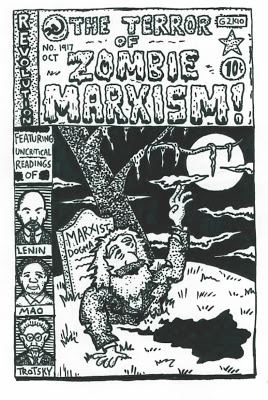
Alex Knight : Zombie-Marxism I: My Rocky Relationship with Grampa Karl

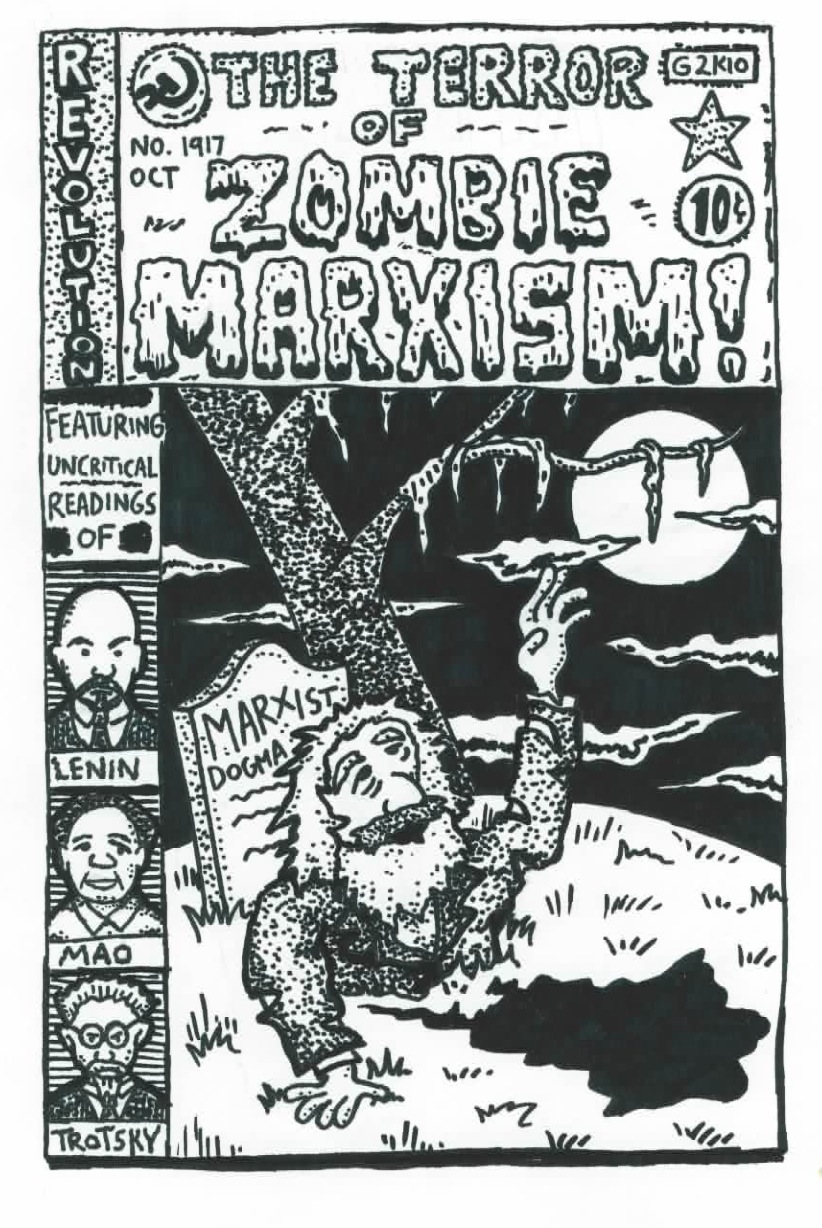
Image by Germ Ross / artnoise.net.

Zombie-Marxism I:

Why Marxism has failed, and
why Zombie-Marxism cannot die…

(Or, ‘My rocky relationship with Grampa Karl’)

By Alex Knight / The Rag Blog / November 5, 2010

“The tradition of all dead generations weighs like a nightmare on the brains of the living.” — Karl Marx, The Eighteenth Brumaire of Louis Bonaparte, 1852

“Once again the dead are walking in our midst — ironically, draped in the name of Marx, the man who tried to bury the dead of the nineteenth century.” — Murray Bookchin, Listen, Marxist!, 1969

[First of five.]

A specter is haunting the Left, the specter of Karl Marx.

In June, my friend Joanna and I presented a workshop at the 2010 U.S. Social Forum, an enormous convergence of progressive social movements from across the United States. The USSF is “more than a conference” — it’s a gathering of movements and thinkers to assess our historic moment of economic and ecological crisis, and generate strategies for moving towards “Another World.”

Our workshop, entitled “The End of Capitalism? At the Crossroads of Crisis and Sustainability,” was packed. A surprising number of people were both intrigued and supportive of our presentation that global capitalism is in a deep crisis because it faces ecological and social limits to growth, from peak oil to popular resistance around the world.

Participants eagerly discussed the proposal that the U.S. is approaching a crossroads with two paths out: one through neo-fascist attempts to restore the myth of the “American Dream” with attacks on Muslims, immigrants, and other marginalized groups; the other, a path of realizing and deepening the core values of freedom, democracy, justice, sustainability, and love.

Despite the lively audience, I knew that somewhere lurking in that cramped, overheated classroom was the unquestionable presence of Zombie-Marxism (1). And I knew it was only a matter of time until it showed itself and hungrily charged at our fresh anti-capitalist analysis in the name of Karl Marx’s high authority on the subject.

It happened during the question and answer period. A visibly agitated member of one of the dozens of small Marxist sectarian groups swarming these sorts of gatherings raised his hand to speak. I hesitated to call on him. I knew he wasn’t going to ask a question, but instead intended to speechify, to roll out a pre-rehearsed statement from his Party line.

I called on others first, but his hand stayed in the air, sweat permeating his brow. Perhaps by mistake or perhaps from a feeling of guilt I gave him the nod to release what was incessantly welling up in his throat.

“I don’t agree with this stuff about ecological limits to growth. Marx wrote in Capital that the system faces crisis because of fundamental cycles of stagnation that cause the falling rate of profit…”

With the resurrection of Marx’s ancient wisdom, a dangerous infection was released into the discussion. Clear, rational thought, based on evaluating current circumstances and real-life issues in all their fluid complexities and contradictions, was threatened by an antiquated and stagnant dogma that single-mindedly sees all situations as excuses to reproduce that dogma in the minds of the young and vital.

Marx didn’t articulate his ideas because they appeared true in his time and place. No. The ideas are true because Marx said them. Such is the logic. If I didn’t act fast, the workshop could surrender the search for truth — to the search for brains.

I would have to cut this guy off and call on someone else. I knew better than to try to respond to his “question” — it would only tighten his grip on decades of certainty and derail the real conversation. Unfortunately, there is no way to slay a zombie. Regardless of the accuracy or firepower in your logic, zombie ideas will just keep coming. The only way out of an encounter with the undead is to escape.

I motioned my hand to signal “enough” and tried to raise my voice over his. “Thank you. OK, THANK you! Yes. Marx was a very smart dude. OK, next?”

Karl Marx was without a doubt one of the greatest European philosophers of the 19th century. In a context of rapid industrialization and growing inequality between rich and poor, Marx pinpointed capitalism as the source of this misery and spelled out his theory of historical materialism, which endures today as deeply relevant for understanding human society. He emphasized that capitalism arose from certain economic and social conditions, and therefore it will inevitably be made obsolete by a new way of life.

For me, what makes Marx’s work so powerful is that he told a compelling story about humanity and our purpose. It was a big-picture narrative of economy and society, oppression and liberation, set on a global stage. Marx constructed a new way of understanding the world — a new worldview — which gave meaning and direction to those disenchanted with the dominant capitalist belief system.

And in crafting this world-view, Marx happened to do a pretty good job wielding the tools of philosophy, political economy, and science, aiming to deconstruct how capitalism functions and disclose its contradictions, so that we might overcome it and create a better future.

Brilliant ideas flowed from this effort, including his analysis of class inequality, the concepts of “base” and “superstructure,” and the liberating theory of “alienated labor.” Marx also showed that the inner workings of capital live off economic growth, and if this growth is limited, crisis will ensue and throw the entire social order into jeopardy. For all these reasons, Marxist politics — the Marxist story — remains popular and relevant today.

But due to serious errors and ambiguities in Marx’s analysis, Marxism has failed to provide an accessible, coherent, and accurate theoretical framework to free the world of capitalist tyranny.

I believe Marx’s foremost error was his propagation of the older philosopher Hegel’s linear march of history. This theory characterizes human society as constantly evolving to higher stages of development, such that each successive epoch is supposedly more “ideal” or “rational” than what came before.

Marx’s carrying forward this deterministic narrative into the anti-capitalist struggle created the confusion that capitalism, although terrible, is a necessary “advance” that will create the conditions for a free society by the “development of productive forces.” This mistaken conception often put Marx, and his uncritical descendants, on the wrong side of history — arguing that in order to achieve the ideal of socialism or communism, countries had to follow the Western European model of becoming capitalist first.

Hegel’s framework of linear progression blinded Marx to non-European, feminist, and ecological critiques of capital’s violent conquest of the world. Without this knowledge, Marx charted a flawed strategy for radical social change that missed the core of what human freedom is all about.

Instead of vocally, unambiguously opposing European colonialism and the displacement of small farmers from their land, Marx construed the proletarianization of the world as a matter of capitalism “producing its own grave-diggers.” Focusing narrowly on the economic “misery” of capitalism and upholding the proletariat as the agent of history, Marx simplified the aims of the anti-capitalist project to a matter of the working class seizing state power to “increase the total of productive forces as rapidly as possible” (Marx-Engels Reader, 490).

This mechanical focus on the hardships of workers led Marx to overlook the many other ways that capitalism threatens life on this planet, and therefore also the resistance coming from those outside his framework: peasants, indigenous cultures, women, youth, queer and trans people, students and intellectuals, immigrants, people of color, artists, and more.

Perhaps most urgently for our moment of climate meltdown, Marx’s view of capitalism as an “advance” blinded him to the ecological destruction that capitalism reaps on our planet, from deforestation to the extinction of species and so much more. Preoccupied with the “development of productive forces,” Marx predicted that communism would come about due to capitalism placing “fetters” on economic growth.

Growth itself was perceived as inherently good, and the rational proletariat would advance it further than capital ever could. Following this logic to its conclusion, Marx praised industrialization as creating the material conditions for the “scientific domination of natural agencies.”

Afflicted with these blindspots, the Marxist narrative was defenseless against repeated manipulations, and mutated into ideological cover for “Socialist” and “Communist” tyrants who have been chief enemies of human liberation. Where Marx’s doctrine didn’t fit the reality of social struggle, as in Russia, China, and every other country that has experienced a “Marxist” revolution, his disciples attempted to transcend reality in order to fit Marx’s doctrine, instead of transcending Marx’s ideas in order to explain reality. The results have been nothing short of nightmarish.

A zombie idea is an idea that has been demonstrably proven false by reality, which has expired in its usefulness, but which continues to reproduce itself by preying on real-live hopes and fears. A zombie idea cannot adapt to new conditions, it only decays. It lacks moral purpose, but will continue to lumber on, propelled by an insatiable hunger, for as long as it can find unfortunate victims.

Sadly, disturbingly, much of Marxist thought today finds itself in such a state. With the collapse of the Soviet Union, the monstrosity of “actually existing” Marxism spectacularly failed to bury capitalism. Quite the contrary, it was shocked to find itself swept into the “dustbin of history.”

Proven wrong, this dogma hasn’t stayed dead. Now a mockery of the living philosophy Marxism once was (and for some still is), Zombie-Marxism has continued to weigh heavily on the collective mind of the Left, for the simple reason that we haven’t turned a critical eye to Karl Marx’s body of work itself.

This essay is not meant to be an attack on any particular Marxist, or even on sectarian groups as a species of organization, but rather on a mindset, which uncritically carries forward Marx’s ideas into present circumstances where they no longer fit. Too often, Marx is invoked as an authority on subjects about which he was totally silent.

When Marx did make a statement related to a current issue, it is viewed as confirmation of his wisdom, rather than being evaluated for the relative clarity or obscurity which it brings to our understanding of capitalism and revolutionary practice today.

We need to carry out an autopsy on the old man. There is much to be gained from reading Marx. But when we look to him for all the answers we transform him into a prophet and transform ourselves into a mindless herd. One hundred and fifty years after Marx’s major writings, it is beyond time to ask ourselves: What did Marx get right?, What did he get wrong?, and Why has Marxism failed in practice?

Finally, how can we integrate Marx’s brilliance alongside the insights of many other necessary thinkers, to create a common-sense radical analysis, based not on ideological blueprints of the past, but on our lived conditions in 21st century late capitalism?

I was once infected with Zombie-Marxist ideas myself. I overcame this infection and freed my mind of such undead ideas, so I know it can be done. Of course, I am not the first, nor will I be the last, to raise these questions and attempt a critique of Marx.

For example, in this essay I will draw from the feminist critique of Silvia Federici, the anti-Eurocentric critiques of Russell Means and Kwame Turé, the democratic critique of Murray Bookchin, the anti-statist critiques of Mikhail Bakunin and Emma Goldman, the anti-dogmatic critique of Cornelius Castoriadis, and others.

I offer my own perspective on the Marxist tradition in the hope that others find it useful, and to spark conversation on the need to constantly reexamine our assumptions. Marx himself wrote:

The social revolution of the nineteenth century cannot draw its poetry from the past, but only from the future. It cannot begin with itself before it has stripped off all superstition in regard to the past. (M-ER, 597).

In this era of capitalist crisis, when the entire system threatens to implode, new challenges, and new opportunities, are springing to life. To be relevant to our own century requires shedding the dead superstitions of the past, and facing the future with critical consciousness.

In this essay, I will first recount how I became a follower of “Grampa Karl,” and why I was eventually disillusioned. In the two following sections I will lay out my critique of Marx, limited to what I see as Marx’s five most enduring contributions and his five most debilitating mistakes.

In the remaining parts of the essay I will explain how these theoretical failures led to “actually existing” Marxism — a monstrous dogma which dominated the revolutionary left for a century, and still perpetuates itself as an undead ideology even after mortifying two decades ago.

Finally I will attempt to rescue Marx from the zombies haunting his legacy and situate him in what I call a common-sense radical perspective of living anti-capitalist politics, incorporating newer theoretical developments such as “de-growth,” “reproductive labor,” and “transformative justice.”

My Encounter with Grampa Karl

When I was 18, I read the book Fast Food Nation by Eric Schlosser. The book famously declares “there’s shit in the meat.” Fast Food Nation exposes how factory farms, which produce the vast majority of meat for U.S. consumption, are hell-holes where unsanitary and unsafe practices not only carry out unspeakable animal cruelty, not only endanger and exploit their workers (who are mostly undocumented immigrants), but also pump out enormous quantities of excrement-laden and potentially dangerous meat, which has even killed children with E.coli. And this is to say nothing about the “normal” health effects of ingesting fast food.

The fast food industry is also directly responsible for the clear-cutting of the Amazon rainforest, as huge areas of the world’s most diverse ecosystem are burned down and replaced with ranches raising cattle for Americans’ burgers.

As Schlosser documents, the meat industry is well aware of its socially and ecologically destructive practices, but persists in them for the simple and undeniable reason of maximizing profit. The ongoing disaster has nothing to do with evil or immoral people — the system itself is responsible. Capitalism is feeding us shit and we’re “lovin’ it.”

Facing this truth was too much for my teenage apathy to withstand. My dispassionate ignorance of the world — cultivated by years of television and video games — was suddenly shattered on the grim rocks of reality. As my worldview lay in jagged pieces, I found myself overwhelmed with questions: “Is capitalism killing our planet?” “Why doesn’t anyone know about this?” “If they know, why don’t they ever talk about it?” “Is it wrong to think this way?” “Am I a Communist for asking these questions?”

I sank below waves of uncertainty and anguish. I thrashed about for any explanation of how this terrible reality could make sense. I clamored to know what I could do about it. Drowning in questions, I longed for answers.

Karl Marx presented me with the first solid ideas I could stand on. I read “Alienated Labor” and it gave me a name for the anguish I was experiencing. My hatred for my job did not mean there was something wrong with me, but that I was responding correctly to an alienating and exploitative situation. I wasn’t wrong; the system was wrong.

Feeling validated by the old man, I rapidly developed a strong affinity for his teachings. I read The Communist Manifesto, The Civil War in France, even the Grundrisse. Although the language was thick and foreign, I slowly waded through because my efforts were occasionally rewarded with profound nuggets of insight into my own world. I discovered a long and complex history of Marxist anti-capitalism.

I felt as though I had been mentally rescued. I had found an ideological home, from which I could launch criticisms of the capitalist system and encounter others who desired revolution. Marx was our guide, my guide. His story of class struggle gave me meaning and purpose, which is what I had been seeking.

In mainstream American society, Karl Marx is like an estranged grandfather who no one brings up in polite conversation. A long time ago there was a bitter falling out over politics and he stopped being invited to family functions — all the better because he wouldn’t be caught dead at those “bourgeois” ceremonies.

If the subject of Grampa Karl ever does come up, it’s usually in the context of a ghost story meant to frighten and silence unpatriotic sentiments. For example, Glenn Beck says Marx is controlling our president and destroying the country. On the other hand, Grampa Karl does get some favorable mentions in the university, where the facade of liberal education is more important than any minor disturbance that the introduction of students to Marx’s obscure rantings is likely to produce.

When I became a follower of Grampa Karl, I knew I was distancing myself from the mainstream. If people realized I was consorting with that rabble-rouser they might have thought I was crazy or stupid, or both. I had no problem with that. Rather, I had such contempt for the dominant culture as it exists, that I relished the identity of outsider and rebel.

Moreover, the old man had promised me it was only a matter of time before capitalism collapsed due to its internal contradictions. Time was on our side. I cherished my secret Marxist hope and laughed behind the back of bourgeois society.

But as time went on, Marx’s warts began to show. First, I noticed his almost-total silence on issues of ecology. Being motivated largely by my concern for capitalism’s apocalyptic approach to life on this planet, I strained to find even the slightest clues of environmental consciousness in Marx’s writings. Instead, I was confronted with the faulty notion of a linear development of history, with liberation equated with human domination of nature.

It became increasingly apparent that Marx didn’t have all the answers for me. His analysis was trapped in another century, when industrialization still seemed like a good idea to people.

Nevertheless, I was not ready to abandon my political home just because I had such doubts. On the contrary, I clung all the more desperately to my mentor, seeking to prove him right and his critics, perhaps even myself, wrong.

Looking back, I can locate in myself the attitude of one afflicted with Zombie-Marxism. If I didn’t understand what Marx was saying, it was because he was speaking to a higher truth that I couldn’t grasp. If Marx’s ideas were questionable, I hastened to silence the questions. Instead, I sought to dispose of them by returning to Marx’s writings and scouring for quotes or passages, no matter how tangential, which could be used to clobber those who dared to doubt the wisdom of Grampa Karl.

I felt as close to Marx as to a guardian — he had pulled me from confusion and provided me with clarity. Through him, the world made sense. Or at least I thought it did.

My questions didn’t ebb. I became disturbed by the company Marx was keeping. Leninists, Stalinists, Trotskyists, Maoists, and more, all swarming around him and treating his every word as gospel. Worse, they seemed to spend more energy feuding with each other than building the kind of movement we need to overturn capitalism.

I attended the 2006 Left Forum in New York City and despaired at seeing the horde of Marxist sectarian grouplets denouncing one another over petty ideological questions that had been irrelevant decades ago. Were these people engaged in the same project that Marx had given me?

My disappointment grew, so that when the anarchist critique finally reached me, I was ready to listen. Although it was plainly apparent to me that people like Lenin and Stalin had entirely distorted the liberatory potential in Marx and created something horrifying, the anarchists pointed to the errors of Marx’s ideology and method which paved the way for those distortions.

No matter how smart someone is, they are bound to make mistakes, so labeling yourself an “ist” of someone’s name is to engage in the worship of an individual, which can only detour you from trusting your own feelings and thoughts. How could someone know better than you what is hurting you and what you need to heal?

I saw this cult of personality in Venezuela, where I could not walk down the street, turn on the television, visit the beach or the mountains, without seeing President Chavez’s name or face everywhere. This essay is no place to critique the policies of the Chavez government, which are complex and contain both positive and negative aspects, but the omnipresence of an uncritical Chavismo made me cringe on an emotional level, even if I firmly supported his government against the right-wing U.S.-funded opposition.

I felt betrayed by Marx. He should have known, and stated clearly, that politicians, no matter how progressive, cannot make revolution. It has to come from the bottom — from everyday people organized into social movements — fighting for their liberation. Marx’s “dictatorship of the proletariat” suddenly appeared to me as a pathetic joke. How did he not see how such an absurd idea would be exploited by opportunists? Disillusioned in Venezuela, I read Emma Goldman’s My Disillusionment in Russia and parted ways with Marxism.

Even though Grampa Karl and I are no longer close comrades, Marx continues to influence my politics because there is much to value in his writings. A full recounting of his genius would be too difficult, but I will explore five key contributions of Marx that I believe remain relevant and useful insights today, during capitalism’s global crisis. Then I will follow this with what I see as the five most urgent failures in Marx’s analysis, from which spawned the Zombie-Marxism lurking in our midst today.

Karl Marx was no prophet. But neither can we reject him. We have to go beyond him, and bring him with us (2). I believe it is only on such a basis, with a critical appraisal of Marx, that the Left can become ideologically relevant to today’s rapidly evolving political circumstances.

Here is an outline of the remainder of the essay. Check back soon for more!

*What Marx Got Right

  1. Class Analysis
  2. Base and Superstructure
  3. Alienation of Labor
  4. Need for Growth, Inevitability of Crisis
  5. A Counter-Hegemonic World-view

*What Marx Got Wrong

  1. Linear March of History
  2. Europe as Liberator
  3. Mysticism of the Proletariat
  4. The State
  5. A Secular Dogma

* Hegemony over the Left

* Zombie-Marxism and its Discontents

* Conclusion: Beyond Marx, But Not Without Him

Footnotes

  1. The idea of a zombie ideology was transmitted to me from Turbulence magazine and the “zombie-liberalism” they discuss as taking the place of neo-liberalism in the wonderful article “Life in Limbo?”
  2. This framing comes to me through Ashanti Alston, the “Anarchist Panther,” and his excellent essay “Beyond Nationalism, But Not Without It.”

[Alex Knight is an organizer, teacher, and writer in Philadelphia. He maintains the website endofcapitalism.com and is writing a book called The End of Capitalism. He can be reached at activistalex@gmail.com.]

The Rag Blog

Posted in Rag Bloggers | Tagged , , , , , , | 3 Comments

James McEnteer : The Alamo Election

“Fall of the Alamo.” Painting by Robert Onderdonk / Friends of the Governor’s Mansion.

Barbarians at the gates:
The Alamo election

By James McEnteer / The Rag Blog / November 4, 2010

Our national 2010 midterm elections demonstrated that many citizens of the United States now suffer a siege mentality: against the Islamic world and other perceived barbarians at our gates; against socialists, homosexuals, minorities, and recent immigrants, documented or not. That turns out to be the majority of the Earth’s humans, many of whom reside among us. We are a house divided against itself.

Whites of European ancestry professing heterosexual Christianity have run the show in the USA since before the country’s independence. They are now feeling surrounded and outnumbered as the United States more accurately reflects the proportional population of the planet.

The paranoia of the powerful old guard goads them to tweak the Constitution: “Freedom of religion? Great — except for Islam. Freedom of speech? Certainly — as long as it doesn’t affront our majoritarian values. A presumption of innocence? Everyone’s entitled to that except terrorists of course, whom it’s okay to torture and lock up indefinitely.”

Members of the straight, white majority feel themselves slipping into minority status in our multi-cultural society. Their nativist rage and increasingly vocal intolerance reflects their fear of losing a power based less on achievement than on skin color and inherited privilege. They have taken to hiding behind hate speech and ever-higher walls of gated communities. While such fears may be understandable, they are not acceptable.

If our society is to meet the many daunting challenges ahead of us, it’s counterproductive to refight battles for racial and religious and cultural tolerance that we won more than 200 years ago. We can not afford to be squabbling over who is “more American” as the world burns. We have to move on.

Several years ago I published a book tracing the profound influence of Texas values on U.S. political policies of the past 200 years. The creation myth of Texas warrior culture is the battle of the Alamo in 1836. The Alamo myth — still taught in Texas public schools — conjures a small band of 180-odd freedom fighters battling for independence against a much larger Mexican force bent on suppressing their rights.

But it was a borrowed revolution. The only native Texans in the Alamo were those of Mexican descent. Whites who died there — of Scots-Irish ancestry — came from Tennessee, South Carolina, and elsewhere. Driven by violent race hatred, these men killed Native Americans with impunity and enslaved Blacks, before rising against the Mexican authorities largely because they despised their skin color, language, and religion.

After they died in the Alamo their martyrdom ignited racist outrage and a thirst for vengeance that remains unslaked almost 200 years later.

The astonishing rate of execution in Texas — which accounts for more than a third of all U.S. executions — is only one vestige of the retributive “take no prisoners” Alamo attitude. Minorities are disproportionately represented on death row in Texas, as they are in the general prison population nationwide. Texas — like many candidates for public office in the 2010 elections — makes a show of circling the wagons to keep “them” (outsiders) at bay.

Such primitive behavior is not logical. But logic is not the point. When right-wing extremists opine that Barack Obama holds a “Kenyan, anti-colonial world view” it sounds nonsensical. It’s a code phrase meant to signify that Obama is not one of “us” (right-thinking traditional Americans, white and Christian).

The right tried to make the election about the non-Caucasian, perhaps socialistic, Islamic sympathizer, Barack Obama. He represents many nativist fears of change. His attempts to conciliate his enemies cannot succeed because their hatred of him is not logical, or based on any policies. It is visceral and beyond rational discourse.

Rush Limbaugh has said of the president, “I hope he fails.” Senate Republican leader Mitch McConnell said, “Our goal must be to make Obama a one-term president.” Not a single positive policy suggestion sullies the agenda of Obama’s enemies. All they want, the country’s welfare be damned, is to wrest control of the agenda for their corporate masters.

The very hope Obama’s election offered the rest of the world, that the United States might rejoin the global community of nations for the common good, is what worries conservatives most. The problem and paradox is that the harder and dirtier Obama’s political enemies fight to exclude Obama and his ilk and maintain “purity,” the less of the republic there is to save.

We must not allow the American democratic experiment to end in suicidal bigoted imperial rage. Those who would recreate the Alamo will share its fate.

[James McEnteer is the author of Deep in the Heart: the Texas Tendency in American Politics (Praeger 2004) and other books. He lives in South Africa.]

The Rag Blog

Posted in Rag Bloggers | Tagged , , , , , | 5 Comments

Tom Hayden : Jerry Brown’s Green Vision for California

California Governor-elect Jerry Brown at Los Angeles campaign rally November 1, 2010. Photo by Justin Sullivan / Getty Images.

But it can’t be just for whites…
Brown’s green vision for California

Through all the political back and forth, alternative energy has been a settled idea in California, and for that we owe a large debt to Brown. He has been ahead of the curve on energy conservation and renewable resources for decades.

By Tom Hayden / November 4, 2010

LOS ANGELES — During the campaign season, it was easy to dismiss the idea of a green energy future for California as mere campaign rhetoric. But with the second coming of Jerry Brown, the reelection of Barbara Boxer, and voter endorsement of state policies to curb global warming, California really is poised to lead the country to a greener future.

Why were California voters not carried away by the Republican wave? We have certainly had our conservative hiccups in the past. There was the 1978 election when voters passed Proposition 13, which cut property taxes but also damaged school funding and caused chronic budget crises. And in 1984, California had its Arizona moment when voters passed Proposition 187, which would have terminated many public services, including schooling, for undocumented immigrants had the courts not struck it down.

But through all the political back and forth, alternative energy has been a settled idea in California, and for that we owe a large debt to Brown. He has been ahead of the curve on energy conservation and renewable resources for decades.

During Brown’s previous tenure as governor from 1975 through 1982, the nuclear industry was projecting the need for one nuclear power plant every five miles along the California coast. One of them was slated for Corral Canyon on Pacific Coast Highway near Malibu. Corporate interests also insisted on the need for a liquefied natural gas terminal at Point Conception in Santa Barbara, saying it was necessary to keep the lights from going out.

Brown turned these powerful interests down, siding instead with the no-nukes movement and the early dreamers of a solar future. Thirty years later, as a direct result of his vision, California is the most energy-efficient state in America, with an estimated 1.5 million clean-energy jobs and accumulated savings of $50 billion to $60 billion to California consumers. Two-thirds of venture-capital investments in American clean energy are in California.

American leadership on global warming has been derailed by a relentless campaign from oil companies and energy interests. “Remember Renewable Energy?” asked a New York Times editorial last week. Here in California we do remember, and the vote Tuesday reaffirmed our commitment to it.

The Obama administration still can wield regulatory power for energy conservation, and Boxer will continue to chair the Senate’s environmental policy committee. But it is Brown’s California that is poised to implement a vision of putting people to work at green jobs that will reduce air pollution and carbon emissions. Brown’s promise is to create 500,000 new green jobs in the next eight years, and we voters should hold him to — and help him realize — that pledge.

Brown faces two main challenges. The first is how to pay for a cleaner energy future. He has expressed hope that setting a requirement that one-third of the state’s energy needs come from renewable sources by 2020 will jump-start private investment.

Brown cites the example of the aerospace industry as a model. But he downplays the billions in federal investment that made that industry possible. He needs to recognize that some combination of rate hikes and tax revenues will be necessary to get the electricity-based transit revolution he envisions up and running.

The other challenge is to ensure that all Californians benefit from the state’s green energy push. Brown has succeeded in portraying his energy vision as good for the economy, but he has not explained how it will benefit the black and brown voters at the core of his support.

Put bluntly, the green future cannot be purely white. This is a great opportunity to put people to work who are now locked out of the job market. And in the end, it makes far more sense to employ at-risk youth weatherizing homes and installing solar collectors than locking them up in the largest mass incarceration system in the world.

That incarceration system could be Brown’s Achilles’ heel. If his energy policies are an example of his “paddling on the left,” his law-and-order legacy is an example of “paddling on the right.” In 1976, when then-Gov. Brown was supporting punishment rather than rehabilitation as state policy, the state prison population was slightly above 20,000. Today, the system holds 165,000 inmates and creates a massive drain on the state budget.

With Brown’s longtime support, California leads America and America leads every country in the world in incarceration rates. The state prison budget currently exceeds the combined budgets of the University of California and the California State University systems.

Brown may find that a greener future is incompatible with the state’s massive spending on incarceration at the expense of education. African Americans are 3% of UC students and Latinos are 11%. At the same time, those groups are 30% and 40%, respectively, of the state’s inmates.

While the state was building 33 new prisons in recent decades, its school funding has been stagnant. Prioritizing education and rehabilitation over prisons in state budgets could both save money and supply a steady and well-trained workforce for a green economy.

[Tom Hayden was chairman of Gov. Jerry Brown’s SolarCal Council in 1979 and a state legislator from 1982 to 2000. A founder of SDS and a leader of the Sixties New Left, Tom’s latest book is The Long Sixties.]

Source / LA Times / Progressive America Rising

The Rag Blog

Posted in RagBlog | Tagged , , , , , | 1 Comment

Robert Jensen : Radical Change Isn’t on the Ballot

Graffiti art by Banksy.

Making real choices:
Radical change isn’t on the ballot

By Robert Jensen / The Rag Blog / November 1, 2010

November 2 is going to be a big day in our political lives.

But November 3 will be far more important.

On mid-term Election Day, voters will choose between candidates with different positions on health care insurance, withdrawal from Afghanistan, and CO2 levels that drive global warming. The politicians we send to the legislatures and executive offices will make — or avoid making — important decisions. Our votes matter.

But Election Day is far from the most important moment in our political lives. The radical changes necessary to produce a just and sustainable society are not on the table for politicians in the Republican or Democratic parties, which means we citizens have to commit to ongoing radical political activity after the election.

I use the term “radical” — which to some may sound extreme or even un-American — to mark the importance of talking bluntly about the problems we face. In a political arena in which Tea Partiers claim to defend freedom and centrist Democrats are called socialists, important concepts degenerate into slogans and slurs that confuse rather than clarify. By “radical,” I mean a politics that goes to the root to critique the systems of power that create the injustice in the world and an agenda that offers policy proposals that can change those systems.

In previous essays in my campaign series on economics, empire, and energy, I argued that the conventional debates in electoral politics are diversionary because painful realties about those systems are unspeakable in the mainstream: capitalism produces obscene inequality, U.S. attempts to dominate the globe violate our deepest moral principles, and there are no safe and accessible energy sources to maintain the affluent lifestyles of the First World.

Why would politicians be unwilling to engage these ideas? Part of the answer lies in who pays the bills; campaigns and political parties are funded primarily by the wealthy, who have a stake in maintaining the system that made them wealthy. Also crucial is the ideology that pervades the dominant society; people have been subject to decades of intense propaganda that has tried to make predatory corporate capitalism and U.S. imperial domination of the world seem natural and inevitable.

As a result of these economic and political systems, 20 percent of the U.S. population controls 85 percent of the country’s wealth, and half the world’s population lives in abject poverty. None of that is natural or inevitable. This inequality is the product of human choices that benefit a relatively small elite, who buy off middle- and working-class people with a small cut of the wealth. This state of affairs is the product of policies that were chosen, and can be chosen differently.

Because these crucial questions are not on the agenda for the two dominant parties battling on November 2, we have to commit to a radical citizens’ agenda on November 3. The first step is building and fortifying — both the local grassroots institutions that can work independently of the powerful, and the networks of empathy and caring that will be needed if we are to survive the fraying of the systems in which we live.

For that work, don’t look to the corporate bosses or the politicians they employ. Look to the person sitting next to you.

[Robert Jensen is a journalism professor at the University of Texas at Austin and board member of the Third Coast Activist Resource Center in Austin. He is the author of All My Bones Shake: Seeking a Progressive Path to the Prophetic Voice, (Soft Skull Press, 2009); Getting Off: Pornography and the End of Masculinity (South End Press, 2007); The Heart of Whiteness: Confronting Race, Racism and White Privilege(City Lights, 2005); Citizens of the Empire: The Struggle to Claim Our Humanity (City Lights, 2004); and Writing Dissent: Taking Radical Ideas from the Margins to the Mainstream (Peter Lang, 2002). Jensen is also co-producer of the documentary film Abe Osheroff: One Foot in the Grave, the Other Still Dancing, which chronicles the life and philosophy of the longtime radical activist. Robert Jensen can be reached at rjensen@uts.cc.utexas.edu.]

The Rag Blog

Posted in Rag Bloggers | Tagged , , , , , | 1 Comment