Ted McLaughlin : Our Fear of the ‘S’ Word

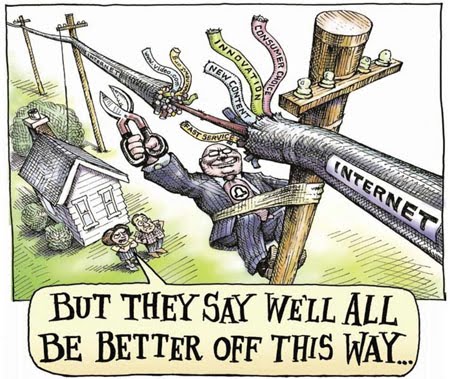
Graphic from gapingvoid.

Do the American people like socialism
as long as we don’t call it that?

By Ted McLaughlin / The Rag Blog / October 11, 2010

There is little doubt that for most Americans, “socialist” would be about the worst thing they could be called. Americans seem convinced that having a socialist system of economics (and it is an economic system — not a type of government) would be against everything America stands for. They feel this way because the word has been demonized for decades in this country by right-wingers and corporate interests.

Most Americans equate socialism with communism (a different economic system) and dictatorship (a type of government). The truth is that socialism has little to do with either one. I don’t think most Americans even know what socialism is. To them it is just an evil lurking in the shadows waiting to steal our freedom, something akin to slavery or tyranny.

But there is an interesting survey that tends to show we, as Americans, may be more afraid of the word than the reality. There’s no doubt Americans are afraid of the word, but the survey by Michael I. Norton of the Harvard Business School and Dan Ariely of Duke University shows that a huge majority of Americans may actually think socialism produces a fairer and better result than our own biased-toward-the-rich capitalist system.

Their survey, which included a large group of 5,522 American citizens, showed a couple of very interesting things. The first is that most Americans don’t realize just how out-of-whack the distribution of wealth is in America.

Survey respondents believed that the richest 20% of Americans control about 59% of the country’s wealth. The truth is much worse. In 2005, the richest 20% actually controlled about 84% of the wealth in America (and that percentage has undoubtedly grown in the last five years).

The authors of the survey then presented the respondents with three unmarked pie charts. The first showed an even 20% of wealth for each fifth of the population. The second showed the distribution of wealth in the United States. The third showed the distribution of wealth in Sweden (definitely a socialist country, where the richest 20% controls 36% of the country’s wealth). They were asked to choose which pie chart showed the most appropriate (fairest) distribution of wealth. Here are the results:

When asked to choose among all three charts
United States……………10%
Equal portions……………43%
Sweden……………47%

When asked to chose between Equal and Swedish charts
Equal……………49%
Sweden……………51%

When asked to choose between Equal and U.S. charts
Equal……………77%
United States……………23%

When asked to choose between U.S. and Swedish charts
United States……………8%
Sweden……………92%

It is interesting that a small majority of Americans chose the Swedish distribution of wealth over an exactly equal distribution of wealth. They were quite willing to accept that there will be some inequality in an economic system and thought the Swedish (socialist) distribution of wealth was the best possible outcome. But very few (8%) of the respondents thought the distribution of wealth created in the United States was fair or appropriate.

And even more amazing is that the preference for the Swedish distribution of wealth over the U.S. distribution of wealth cut across gender, party and income lines. Here is that breakdown:

Preferred the Swedish (socialist) distribution of wealth
Women……………92.7%
Men……………90.6%
Democratic voters……………93.5%
Republican voters……………90.2%
Make under $50,000……………92.1%
Make $50,000-$100,000……………91.7%
Make over $100,000……………89.1%

These lop-sided figures bring into question the supposed American hatred of socialism. It turns out that at least 90% of Americans would prefer the distribution of wealth created by a socialist system to the distribution our own capitalist system has created.

They may be afraid of the word “socialism,” but they believe the results of socialism are better — as long as you don’t use the “S” word to describe it. In other words, years of propaganda and scare tactics have frightened them into accepting a system they know is fair only for the richest few Americans.

Now I know that some will be screaming that socialism involves “income redistribution” — another term Americans have been convinced is a bad thing. But the truth is that there is income redistribution in all economic systems. In our form of rich-biased capitalism, that redistribution is to the richest citizens in the country from everyone else. In socialism, the redistribution is much fairer and more even.

Americans are really socialists at heart and believe in a fairer system of wealth distribution. They have just been convinced by decades of propaganda to vote against the their best interests of those of their fellow citizens, and that’s just sad.

[Rag Blog contributor Ted McLaughlin also posts at jobsanger.]

The Rag Blog

Posted in Rag Bloggers | Tagged , , , , , | 3 Comments

1. I’ve seen your name cited as being one of the original Rag founders and contributors — can you recall any specific details leading up to the decision to start the paper? Did you write for The Daily Texan beforehand? Were you a student at UT at this time?
2. How, in your opinion, did the Rag compare to other early underground papers?
3. Where was the Rag office (I understand it was originally published out of an old house near campus but then moved to a location on the Drag…the YMCA?) Can you describe what the office was like?
4. In retrospect, how, in your opinion, do you think the Rag was an agent of change for the times?
5. And, since my thesis is centered around the Drag, can you describe for me how the street played into this — how did it feel? How did it look? Who hung out there? Was there a sense of community on the Drag? Can you think of any specific instances involving the Drag that were memorable?

Posted in RagBlog | Leave a comment

Marc Estrin : Holocaust Thinking in America III: In the Here and Now

Creeping fascism in America. Graphic from LA Progressive.

Holocaust thinking in America III:
In the here and now

By Marc Estrin / The Rag Blog / October 11, 2010

[Part three of three. To read the entire series, go here.]

The end of last week’s essay: “Just in case there were any legislative objection to these judicial proceedings, Hitler pushed through the ‘Enabling Act’ which allowed his handpicked cabinet to make laws having the same validity as any passed by the Reichstag, even ones disregarding the Constitution. The circle was closed, complete and tight. The living dead would soon become the dead — period.”

Laws are being made here, too. And Presidential Enabling Acts, aka “signing statements.” And court seats being filled.

The cast of characters is somewhat changed. Instead of Jews, we have the poor and soon-to-be-poor, the homeless, the disabled, the aged, the immigrant “Other” — an open-ended, potentially unruly, group, getting larger with each job loss and foreclosure.

We have no Nazis, only Republicans and Democrats in Congress. Both parties agree that the foremost task is to eliminate the deficit, and both agree that the main hit will be on services to the poor, without tapping the military budget or corporate welfare. Both agree that taxes for the most part need to be cut — it’s good for getting re-elected.

Asses and Pachyderms (from Gr: “thickskinned”) may argue over numbers or priorities, but the fundamental assumptions — and the potential victims — are precisely the same. And outside the beltway is a population of Good Americans, voting their pocketbooks, not paying much attention to details evolving inside. How could they? All they know is what the government- and corporate-controlled media choose to tell them.

All the propensities of the Authoritarian Personality are still at large in this social consciousness, along with the tendency to behave as Milgram’s subjects did with respect to “legitimately constituted” authority. Weber’s analysis accurately describes what is going on today: bureaucracy, science, efficiency, and value-free thought running the show in the interest of “Progress” and “Freedom and Democracy” — and maximization of profit.

Social forces and individual thought habits are distressingly similar to those in Nazi Germany. The poor and the “Others” are as despised as were the Jews. Helping them is as verboten. There are no cultural safeguards in place which would prevent a holocaust-like social cannibalism, a society-wide suspension of morality with regard to the designated “problem.”

There would be no help on a global level, either, since every national state claims the right to dispose of its citizens as it will, starving them, imprisoning them, executing them as it finds necessary. The United States refuses to recognize judgments of the World Court except when such judgments suit its purposes, and refuses to ratify several international treaties concerning human rights.

International objectors like Amnesty International are delegitimized as “interfering in the internal affairs of sovereign nations.” The legitimacy of national sovereignty is built into the United Nations. Besides, who would take on the United States, militarily or economically for any mere human rights issue?

Thus, all the pieces are in place for another holocaust — this time against the poor and “Other.” Native racism adds to the potential, since — no surprise — many of the poor are immigrants and people of color, and code words overlap: “End welfare as we know it” = “Get the minorities under control.” Hence the ominous double significance of our move toward prison expansion. The U.S. already has a far greater percentage of its population behind bars than any other industrial country — the highest in the world. The vast preponderance of prisoners are poor people of color.

A comparative check on where we are now in the six historical steps above is sobering — and frightening.

Step 1. Defining the enemy. The poor are clearly defined as “the problem.” Not the profit-driven economy. Not the culture of violence. Not the controlled information system. Studies focus on the pathology of the “underclass.” The Poor are the problem. They are “other” to “normal Americans.” Consequently they must to be “dealt with.” Highest priority : “excess” population, a drain on the nation, unviable.

Step 2. Eliminating the enemy from the economy. By national policy, there are fewer and fewer jobs available to the poor, and fewer and fewer salaries that could raise a family out of poverty. Wall Street is bailed out, while money for public sector employment is denied, and corporate profits recover, with CEOs reaping massive benefits at taxpayer expense. Education funding is similarly squelched, so that the problem army of the poor can only swell. “Otherness” is increased as the media focus in on the predictably rising problems of crime, the inner city, and immigrant workers, ignoring problems elsewhere, and their root causes.

Step 3. Ostracism by custom and law. It is frightening to make such a list, but almost every step taken by the Third Reich has some parallel here and now — with no built-in limits:

  • Laws passed by Congress can be overridden by executive orders, presidential “findings,” National Security directives, or simply aborted by not disbursing committed funds.
  • Courts are routinely packed with obedient federal appointees. The current composition of the Supreme Court is the biggest scandal of all. Legal rights of poor defendants are being systematically reduced, and money for good lawyers diminished.
  • The current push in Congress is for law to serve the state and its rich financiers at the expense of individuals. Corporate personhood triumphs. Eavesdropping technology and “anti-terrorism” stand guard at the gates. The government moves to limit consumer and environmental protection. These laws are being made deliberately, without even pretending to be a democratic response to the will of the people. There is increasing governmental readiness to evade constitutional law
  • The many Nazi restrictions on employment are all replaced by the fact that — for the poor and uneducated above all — there are simply no jobs. Affirmative action is increasingly questioned. The situation has worsened catastrophically with jobs exported and capital flight, and its attendant dog-eat-dog resentments. With no money for private transportation, no money for parking, and increasingly expensive, inadequate public transportation, the poor are deprived of the mobility necessary to find and maintain employment — even if there were employment to be had.
  • Municipal services are neglected or abandoned in poor neighborhoods, and the police remain an occupying army, protecting and serving the threatened rich. Consequently, living conditions and ghettos become ever more intolerable.
  • Student loans are being cut at the same time that tuitions are skyrocketing. Thus education increasingly excludes the poor as effectively as discriminatory laws did the Jews. Without an educated workforce, the vicious spiral continues downward.
  • “Economics of scale” are driving out smaller, local businesses in favor of large corporate operations — if they even choose to locate in poorer neighborhoods.

Remember: such policies are not accidents. They are designed and signed by upper-class men and women, and approved by well-prepped voters.

Step 4. Removal from view. In addition to long-existing ghettoization, foreclosures on housing toxically mortgaged, and increasing inter-racial suspicion, many municipalities are now enacting draconian laws to “get the poor out from under our noses.” Sleeping in public spaces, panhandling, even accepting free food have been criminalized.

Here in Burlington, Vermont, an ordinance was floated to make it illegal to sit in a street, or even lean against a building. When there are no more poor on the streets or in the subways, how will we know when there are no more poor at all? As the plight of the poor is made ever more intolerable, radical solutions become ever more thinkable.

Steps 5 and 6 — Slave labor and death camps have not yet been literally established. Nevertheless there is recognizable social movement in that direction. Prisons are currently the greatest growth industry, and there is increasing practice of substituting prison labor for outside workers — at substantially smaller wages. As a co-worker once said to me, “Why should I support those criminals? Let ‘em earn their keep.” (She would also kill everyone on death row right away, so that her taxes wouldn’t be used to support murderers.)

Great for profits, terrible for labor, further incentive to put as many people behind bars as possible. And the attachment to capital punishment continues. Less legal protection for prisoners, less chance for appeal, more designated-capital crimes, destruction of habeus corpus and Miranda protections in the name of “fighting terrorism”; micro-fascism at the airport, greater surveillance, and now Obama giving himself permission to assassinate Americans without trial — all to general public approval.

Given the above array of conditions, what can we surmise about the likely American future?

Holocaust thinking in America

There is a scent of pre-holocaust in the air. It is a mood, a direction faced, a lingo, haze of assumptions. And look! — there is a Jack-in-the-box with a box’s six sides: authoritarianism, consumo-conformity, efficiency, moralism, patriotism, and a penchant for punishment.

Turn the crank:

All around the mulberry bush
the monkey chased the weasel,
the monkey thought ‘twas all in fun…

Now just hold it there. What will pop out at the very next move?

We don’t really know. The mind rebels. Tens of millions of children in poverty experiencing a “greater sense of personal responsibility”? Welfare cut-offs flooding an already non-existent job market getting people “back to work”? Or giving them back their “self-esteem”?

There is discontinuity in the curve of thought here — except for one constant — it is definitively the poor and “Other” that are poised to fall off the line into god-knows-what abyss. And the numbers of those impoverished are growing as the middle class shrinks away into unknown territory.

The number of officially poor is now over 45 million, higher than at any time in the 51 years of counting. 2009 saw the largest increase ever. The most vulnerable families are those headed by single mothers, and among them the hardest hit are those headed by single women of color. Two-thirds are employed.

But in addition to chronic low wages, many single mothers have seen their work hours cut in the recession. The number of Americans on food stamps is at an all time high, and the Republicans want to cut into those food stamps in order to “fund childhood nutrition.”

One out of every seven mortgages is delinquent or in foreclosure, 10 million Americans are on unemployment, more than half of them in long-term joblessness. Bankruptcy filings have risen 20% in the last year. One out of every five children lives in poverty.

Even though there are six people applying for every available job, the new “welfare as we now know it” (Temporary Assistance to Needy Families) insists that one has to find a job in order to continue benefits. So since there are no jobs, TANF is eliminating benefits for 85,000 families a month, even as the destitute swamp welfare offices, having exhausted all other options. Obama wants his administration to “break the cycle of dependency,” dontcha know.

Where have the jobs gone, the money? The current income gap is the largest its been since the late 1920s, the result of a long series of policy decisions by legislators bought and paid for by the high-class bandits making out. The race to the bottom is fueled by a race to the top. The dynamics seem irreversible.

The assault on America is a bipartisan operation. Whatever their deceitful rhetoric, neither party is willing to place serious limits on corporate speculation and profitability. Neither will question the need for public austerity and private profit, nor the enormous damage done by the military industrial complex.

The Republican’s current “Pledge to America” is most importantly a call to continue the Bush tax cuts for the rich to maintain the income gap and protect its well-heeled beneficiaries. Secondarily, it is a plan to repeal even the pathetic Affordable Health Care Act, itself written by lobbyists from insurance and pharmaceutical companies.

Even while in the minority, the Republicans have blocked benefits for homeless vets, health care for 911 first responders, a jobs bill that gives tax breaks to companies hiring new employees, an act to ensure women are paid the same wages as men, have tried to block unemployment benefits extension, and have succeeded in blocking stricter regulations for financial institutions. Their ultimate goal, often stated, is privatization of Social Security, Medicare and Medicaid. The Democrats have put up no fight in the interest of “compromise.” Is there a pattern here?

Such an immiseration project must be protected by spreading fear of “terrorism,” and the use of illegal spying now openly practiced, with sweeping new regulations for the internet. Robert Mueller, director of the FBI has stated that, “There is a continuum between those who would express dissent and those who would do a terrorist act.” One spokesperson from an FBI/police “information fusion center” claimed that the protest of a war against “international terrorism” is itself “a terrorist act.”

The USAPATRIOT Act (Uniting and Strengthening America by Providing Appropriate Tools Required to Intercept and Obstruct Terrorism — first prize for acronyms) stands behind him. And for good measure, Obama has come up with approved “kill lists” of suspected terrorists — including Americans — he claims he can exterminate with impunity. The final solution, no doubt.

Holocaust and totalitarianism

Many of the classic structures of a totalitarian state are already in place in contemporary America, Land of the Free. Many new ones, too — modern and post-modern. Official lawlessness no longer bothers to hide itself, and is tolerated or approved by the population at large. Criminal investigations into state crimes are blocked in the interests of “national security.” Checks and balances among the three branches of government have been manipulated into a seamless, self-validifying whole. Make that four, as the media becomes ever more embedded in the corporate beltway.

But while totalitarianism is almost certainly a necessary context for holocaust, genocide, nakba, shoah, it is not a sufficient condition: the cooperation of the population is necessary. And that is where the Milgram Experiments come in (see part one of this essay ). When the authorities say “do it!” — a population of authoritarian personalities, born and bred, will do it.

American murder, massive and limited, even if openly criminal, seems to have widespread support by a swamped population, ready to lash out at designated victims. Americans know about torture of detainees in hidden prisons. They know of American slaughter in Iraq and Afghanistan, even if they are only discovering such activities in Pakistan, Yemen, Somalia and well-supported in Palestine. Hey, freedom isn’t free.

They know, too, about the slave labor of prisoners, and of undocumented workers, frightened and hiding. Let the torture, war, and racist attacks proceed, I guess, if USA is once again to be Number One. Gott mit uns!

Should some object, they, like Germans in the Thirties, will find no levers of change in their much-vaunted political process, all of whose candidates stand behind the American project of victory, “democracy,” and control of resources. As Jay Gould said back in the 1880’s, “I don’t care who they vote for as long as I get to pick the candidates.”

And those candidates are — with notable exceptions — no dummies. They can see as clearly as anyone the general direction in which we are headed. Why else reduce or remove the safety net for Americans while pouring trillions into armaments, corporations, and banks? A group — the poor and Other — has been identified as the problem and the need for a “solution” given highest priority — Step 1, above.

Now we are poised at the edge of the precipice. “Terrorism” and its attendant and well-tended-to fear, make Step 2 certain: they virtually guarantee that most people will not be able to make the transition into productive work. They further assure galloping immiseration of the poor as they are cut off from food and cash assistance, childcare, and nutrition for their children. The consequent desperation will require more policing, desperate, more “final” and effective solutions, solutions which can ensure that the misery of the poor does not inflict itself on the top 10%.

Steps 1 and 2 have been taken. Steps 3 and 4 are underway. The smell of holocaust is in the air. Our civilization provides no safeguards. The Zweckrationalität dynamic described by Max Weber — the very one that nourished the Jewish holocaust in a most civilized, advanced-industrial Germany — still rules. Is it realistic to say “It can’t happen here”?

We have the Jewish holocaust behind us, and the words “Never Again” engraved in our collective heartminds. But our own history — previous and subsequent to the holocaust is not reassuring. Native Americans were wiped out to make room for middle America. “Pioneers” were rewarded by the government with land deeds for expropriating Native American territory and violating treaties. It is not necessary to go over the “social suspension of morality” with respect to African Americans, or the atrocities committed during the Civil War.

In our own time, we have seen World War II with its mass firebombings and atomic attacks, then two more wars, wiping out gooks with high-tech weapons. They don’t value life like we do. Just to keep our hands in it, we buried Iraquis alive and incinerated fleeing columns of troops with gas-air explosives. And now our middle-east atrocities. I don’t have much faith in home-grown American morality resisting commands to solve a problem by slaughter.

Richard Miller notes that

Most Germans did not believe the final steps would be taken. They saw each measure as a discrete event and failed to understand that each step prepared the way for the next. The SS journal Das Schwarze Korps noted in 1938, “What is radical today is moderate tomorrow.” In 1933 the Nazis had no plan to kill all the Jews, and even militants would have shrunk in horror from such a suggestion.

Gradually, over the next decade, “reasonable people” found that they had to become a little harsher. By 1943, the context of the war against Jews had escalated to the point where warriors could blandly pass bureaucratic memos back and forth about behavior that would have seemed unconscionable in 1933. “ (Nazi Justiz, p.3)

Our leaders are now passing such notes, and setting in place such laws concerning our current “Others.” Proposals are being negotiated which would have horrified officials of earlier administrations. This is our 1943. Will we allow a similar denouement? It can happen here.

[Marc Estrin is a writer and activist, living in Burlington, Vermont. His novels, Insect Dreams, The Half Life of Gregor Samsa, The Education of Arnold Hitler, Golem Song, and The Lamentations of Julius Marantz have won critical acclaim. His memoir, Rehearsing With Gods: Photographs and Essays on the Bread & Puppet Theater (with Ron Simon, photographer) won a 2004 theater book of the year award. He is currently working on a novel about the dead Tchaikovsky.]

Also see:

The Rag Blog

Posted in Rag Bloggers | Tagged , , , , , , , | 2 Comments

Paul Krassner : An Open Letter to Barack Obama

Image from GetReligion.org.

Listen to Thorne Dreyer‘s two-part interview with author, journalist, and legendary satirist Paul Krassner on Rag Radio here and here. To find all shows on the Rag Radio archives, go here.

‘Eat, pray, be disappointed’:
An open letter to Barack Obama

By Paul Krassner / The Rag Blog / October 11, 2010

Dear President Obama,

It seems that the theme emanating from the White House is “Eat, Pray, Be Disappointed.” And yet, whenever I do feel disappointed, I always realize that the alternative was John McCain, with Sarah Palin just one Halloween “Boo!” away from the presidency, and then I always feel a sense of relief.

Actually, you’ve kept one big campaign promise — to send more troops to Afghanistan — so I guess we can’t fault you for that. In fact, according to Bob Woodward in Obama’s Wars, all you want to do now is get out of Afghanistan. Well, why don’t you just do what Osama bin Laden did; cross over to Pakistan. Since we bribe Pakistan to be our ally, you’d think they would never consider harboring bin Laden, though they reek with empathy when our outsourced drones drop those bombs.

Also, during the campaign you said you believe that the legality of same-sex marriage should be decided by the states, but that you personally think marriage should be between a man and a woman. Which is exactly the position that caused Miss USA, Carrie Prejean, to have her crown revoked.

And another thing. You promised to end the raids on medical marijuana dispensaries, but they haven’t stopped. Here’s how I understand Washington. America’s puritanical political process serves as a buffer between the status quo and the force of evolution. For instance, in order to get Republican votes for the children’s healthcare bill, Democrats agreed to fund $28 million to their abstinence-only program.

And, during your own campaign, you admitted, in the context of health care reform, that the multinational insurance conglomeration is so firmly entrenched that you would be unable to dispense with it. So there would have to be compromises.

Now, what with the compromises made to help passage of Prop. 19, amnesty becomes the single-payer system of marijuana reform, and growing your own pot becomes the public option. Meanwhile, as long as any government can arbitrarily decide which drugs are legal and which drugs are illegal, then anyone serving time for a nonviolent drug offense is a political prisoner.

In his new book, Bob Woodward writes about Colin Powell’s status as an adviser to you. Referring to his previous book, Plan of Attack, The New York Times then reported that “Secretary of State Colin Powell disputed Woodward’s account… He said that he had an excellent relationship with Vice President Dick Cheney, and that he did not recall referring to officials at the Pentagon loyal to Cheney as the ‘Gestapo office.’”

Who among us would be unable to recall uttering such an epithet? Powell later apologized for it. He has also changed his mind about gays in the military. In my capacity as a stand-up satirist, I used to conduct an imaginary dialogue with Powell.

“General Powell, you’re the first African-American to be head of the Joint Chiefs of Staff, and you come from the tradition of a military family. So you know that blacks were once segregated in the Army because the other soldiers might feel uncomfortable if blacks slept in the same barracks. And now that’s what they say about gays, that other soldiers might feel uncomfortable about gays sleeping in the same barracks.”

“Well, you have to understand, we never told anybody we were black.”

And, Mr. President, that was the forerunner of the same “Don’t ask, don’t tell” policy that you promised to rescind, only you haven’t been acting like a Commander-in-Chief. All you have to do is sign such a directive. Those who serve in the military are trained to follow orders. If they can follow orders to kill fellow humans, they can certainly follow orders to treat openly gay service people with total equality.

Not only is the current guideline counterproductive, but also this display of trickle-down immorality must, on some level of consciousness, serve as a contributing factor to enabling the anti-gay bullying and torturing of innocent victims. I know, you don’t want to take a chance that retracting the policy would interfere with your re-election. You’ve made the point that you don’t want Mitt Romney to win in 2012 and turn around all the good things you’ve accomplished.

Incidentally, Romney had wanted to overturn Roe vs. Wade, yet, in 1994, when he was running for the Senate, he came out in favor of choice for women. However, freelance journalist Suzan Mazur revealed that he admitted to Mormon feminist Judith Dushku that “the Brethren” in Salt Lake City told him he could take a pro-choice position, and that in fact he probably had to in order to win in a liberal state like Massachusetts. Pandering trumps religious belief.

If gays and lesbians have waited this long for basic fairness, they might as well just wait for the next election. If you win, then would you kindly do immediately what you believe is right, constitutionally and in your heart, and end this injustice? The ultimate irony is that gays in the military are fighting and being maimed and dying unnecessarily, all supposedly to protect the freedom that their own country is denying them.

Sincerely,

Paul Krassner

[In December, the writers organization PEN-West will honor Paul Krassner with their lifetime achievement award. (He beat out Levi Johnston.)]

The Rag Blog

Posted in Rag Bloggers | Tagged , , , , , , | Leave a comment

Sarah Jaffe : ‘Mama Grizzlies’ and the New Tea Party ‘Feminism’

photo of Tea Party woman

Tea Party feminist? Image from Progressive Nation.


‘Mama Grizzlies’:
The Tea Party and its claims to feminism

By Sarah Jaffe / October 11, 2010

It all started with Sarah Palin.

Or did it? Maybe it started a few months earlier, when Hillary Clinton downed a shot of whiskey and made some offhand, wrong-footed comments about “hardworking voters, white voters” who still supported her despite her African-American opponent’s lead in delegates.

By “it,” of course I mean the rise of the Tea Party movement and other so-called patriot groups, and with them a new group of women on the right in the United States. They’re no longer content to pay lip service to male leadership, but they’ve got an ambivalent, vexed relationship to feminism as well. But one thing is uncontestable: With mainstream media captivated by their fringe appeal, they’re having a definite moment.

There’s Debra Medina, who failed to win the Republican nomination for governor of Texas but nevertheless managed to energize both her state’s disgruntled patriots and 9/11 “truthers.” Medina made headlines when she attended a “Sovereignty or Secession” rally, where she called for the “tree of freedom” to be “watered with the blood of tyrants and patriots.” (According to The Nation’s Bob Moser, when asked if she carried the handgun she kept in her car into the grocery store, Medina replied, “I’d like to, but I don’t.”)

Locked and loaded: Texas’ Debra Medina. Photo from Doctor Bulldog & Ronin.

There’s Keli Carender, a 30-year-old Seattle improv performer credited in a February New York Times profile with being one of the first Tea Party leaders. The nose ring on this free market-loving Ayn Rand acolyte got almost as much play in the Times piece as her politics.

Then there’s Michele Bachmann, the pro-life, pro-Creationism Minnesota congresswoman best known for her vocal opposition to the U.S. Census. Bachmann made headlines in 2008 when she told Hardball’s Chris Matthews that she believed Barack Obama held “anti-American” views and should be “investigated”; more recently, she’s been a trusty fueler of rumors that Obama’s healthcare plan would lead to state-funded euthanasia.

In Arizona, GOP governor Jan Brewer signed the country’s harshest immigration bill this past April, codifying into law a Minutemen-friendly nativism that permits law enforcement officials to harass at any time anyone they believe might not be “American.” She then promptly took another step toward state-sanctioned racism by signing a ban on ethnic studies courses in public schools.

The nativist tradition: Arizona Gov. Jan Brewer. Photo from AP.

The Tea Party-backed South Carolina state Rep. Nikki Haley could become the first female governor of South Carolina — and the second Republican South Asian governor in the South, after Louisiana’s Bobby Jindal.

And Senate Majority Leader Harry Reid faces a Republican challenger, Nevada’s Sharron Angle, who, as The Nation’s Betsy Reed notes, “makes Sarah Palin look like Eleanor Roosevelt.” Angle joined the GOP as a political stepping-stone; as part of her former affiliation with Nevada’s Independent American party, she flogged far-out views on both economic and social policy. In addition to advocating against Social Security and the IRS, the party in 1994 advocated for an amendment to the state constitution that would, according to Talking Points Memo, “explicitly permit discrimination against LGBT people by businesses and government.”

The Southern Poverty Law Center, which tracks hate groups, recently released a report titled “Rage on the Right,” looking at the rise of right-wing radicalization — not just the Tea Party, but more extreme patriot and militia groups, which the report notes have seen a 244 percent increase since Obama’s election.

“The anger seething across the American political landscape — over racial changes in the population, soaring public debt and the terrible economy, the bailouts of bankers and other elites, and an array of initiatives by the relatively liberal Obama Administration that are seen as ‘socialist’ or even ‘fascist’ — goes beyond the radical right,” wrote Mark Potok, adding that while the many Tea Party organizations “cannot fairly be considered extremist groups… they are shot through with rich veins of radical ideas, conspiracy theories, and racism.”

‘Makes Sarah Palin look like Eleanor Roosevelt’: Nevada’s Sharon Angle. Photo from AP.

Right-wing extremists are nothing new, of course. What is new is that, increasingly, the face of these groups is a female one. Statistics are tough to find — the more militant groups are notoriously press-shy — but Quinnipiac found more women than men in its poll of self-identified Tea Partiers; a Gallup poll found 55 percent male to 45 percent female.

They come from all over, from Alaska to Alabama, Massachusetts to Montana. And while “Tea Party” has become a convenient catchall, the groups’ concerns go well beyond taxation. There are libertarian followers of Ayn Rand and Ron Paul. There are people who were equally angry under the Bush administration and have come together around a desire to, say, audit the Federal Reserve.

Nativist groups have found that anti-immigrant rhetoric fits in well with “take our country back” chants. Gun lovers hold Second Amendment rallies and show up armed. And, of course, Fox News’s Glenn Beck started his 9.12 Project in an attempt to bring Americans back to the day after the worst terrorist attack in our history, as if we’re better people when we’re huddled in our homes in front of the TV, terrified and looking to Rudy Giuliani for leadership.

In a May Slate article titled “Is the Tea Party a Feminist Movement?” Hanna Rosin highlighted women’s primacy as Tea Party organizers and spokespeople, and posited that the movement “taps into both traditionalism and feminist rage.”

Anna Barone, a Tea Party leader from Mount Vernon, New York, interviewed for the piece, corroborates this picture, saying, “The way they treated Hillary is unforgivable, and then they did it to Sarah Palin,” and adding, “I’ve been to 15 Tea Party meetings and never heard a woman called a name just because she’s powerful. I guess you could say the Tea Party is where I truly became a feminist.”

U.S. Census a commie plot? Sen. Michele Bachmann. Photo by Chip Somodevilla / Getty Images.

The idea that the Tea Party and other far-right movements are more welcoming to women than mainstream politics is a troubling one. But what’s more troubling is that “feminism” has been so swiftly folded into ideologies that espouse racist rhetoric, anti-choice politics (a Gallup poll found that 65 percent of self-identified Tea Partiers considered themselves “pro-life”), and me-first libertarian scorn for social services. Is this the equality we wanted?

The long run-up to 2008’s election too easily became a battle of race vs. gender where both sides were brimming with essentializing rhetoric. The idea that, as Gloria Steinem noted in an infamous New York Times op-ed, women should vote for Clinton in solidarity for all women ignored several factors, most notably the race of Clinton herself.

The portion of Clinton supporters who shifted loyalty to Sarah Palin after Obama won the nomination was relatively tiny, but incredibly vocal. And their myopic, gender-above-all belief is reflected in the “Year of the Woman” media coverage of Palin and the Tea Party hostesses she helped spawn.

Though Palin has since vacillated between claiming feminism for the new breed of political woman she’s helped to anoint and denying that “this gender thing” is important, the Republican Party has seized on women as the perfect candidates for this particular moment: They’re political outsiders within the party (of 95 female Congress members, only 21 are Republican), but hardly ideological ones.

And much like on the McCain-Palin campaign, where Sarah Palin took on the role of attack dog, whipping rally attendees into a partisan frenzy with a fervor that many likened to that of George Wallace in the 1960s, women in the Tea Party movement are often the ones making the most outrageous statements.

Sarah Palin’s coinage of the phrase “death panels” in opposing Obama’s healthcare-reform proposal might be the most famous; Michele Bachmann’s slew of bombastic, factually shaky assertions on everything from financial reform (she compared it to Mussolini-style Fascism) to net neutrality are so numerous that her reelection opponent has collected them on a blog called Michele Bachmann Said WHAT?!

Glory, old and new: Gov. Sarah Palin. Photo from Reuters.

Sarah Posner, a reporter for the online magazine Religion Dispatches who has covered the religious right for years, sees direct connections between women in the religious right and those who have come to define the Tea Party and other patriot movements. Many female Tea Party organizers, she points out, got their training with Concerned Women for America and other religious-right groups.

Women like Phyllis Schlafly have always been leaders in those movements, she notes, but were able to justify their role with religious rhetoric — they were “called” by a higher power to lead. But with the rise of new movements like the Tea Party, more and more women are able to be leaders while still operating using the same strategies, which Posner notes originated because they allowed women to organize while home with their kids, preserving the domestic status quo.

In Rosin’s Slate article, she points out that a Tea Party group called Smart Girl Politics operates “like a feminist cooperative, with three stay-at-home moms taking turns raising babies and answering e-mails and phone calls.” The protests themselves are often family affairs: Allen McDuffee, a freelance reporter and blogger who covered last April’s Tax Day Tea Party in Washington, D.C., recalls seeing almost no women there unaccompanied by men.

Indeed, despite applications of the term “feminist” here and there, the Tea Party tends to frame female leadership less in terms of political power than in terms of family protectiveness. Rosin’s piece quotes Tea Party spokeswoman Rebecca Wales calling her group “a lot of mama bears worried about their families.”

A piece on Politico quotes Lu Ann Busse, head of the Colorado coalition of the Beck-inspired 9.12 Project, saying, “How do you justify figuratively or literally beating up on grandmas and moms with children in tow? It just does not look good.” And the post-Palin surge of conservative female pols like Oklahoma’s Mary Fallin and Washington’s Cathy McMorris Rodgers are now united under the media handle “Mama Grizzlies,” joining the idea of mother-as-protector to patriot-group undercurrents of by-any-means-necessary violence.

And escalating violent rhetoric is perhaps the most notable hallmark of the Tea Party with regard to its female leadership. Again, Palin is the pacesetter here, telling Twitter followers “Don’t retreat, instead — RELOAD!” and posting a map with targets on it where Democrats held seats in districts that she and McCain carried in 2008.

She and her compatriots have jumped on the “security mom” bandwagon of the post-9/11 Bush years, when pollsters reported widely on white, heterosexual married women leaning toward Republican candidates and repressive policies.

In contrast, there’s the treatment of Cindy Sheehan, the mother of a slain U.S. soldier who set up camp outside George W. Bush’s Texas ranch to protest the Iraq war. Far from being heralded as either security mom or fiercely bearish matriarch, the progressive Sheehan was mocked as an “irrelevant kook” by conservative columnists like Mark Steyn and pilloried for her antiwar position.

The women of the Tea Party represent the security moms taking the guns for themselves– Debra Medina, packing heat to fight an encroaching government; the sport-shooting Palin; or the more fringe-dwelling women associated with militias, like Shawna Forde, leader of the Arizona border-watch group Minutemen American Defense.

The grand tradition: Phyllis Schafly. Photo from AP.

Melanie Gustafson, professor of history at the University of Vermont, notes that these women fit into a tradition of Wild West gals — protective of freedom, comfortable with guns, and often tinged with a xenophobic distrust of the unfamiliar. As Barack Obama’s “un-American” origins are repeatedly asserted and immigration becomes a more heated topic among the Tea Party faithful, the independent, gun-carrying woman of the American West have met the traditional mom and blended with a version of “feminism” that focuses on individual equality, rather than liberation for all.

Now that the healthcare bill has passed, immigration has taken its place as the locus of Tea Party anger. Arizona’s Brewer has fired the metaphoric first shots in the battle, and South Carolina is attempting to pass a similar immigration bill. If Haley takes that state’s governorship, we’ll be seeing a lot more women on the front lines of this fight.

For feminists watching in slack-jawed amazement as this bizarre Year of the Woman unfolds, the immigration focus is particularly disturbing. When the bodies of people of color, particularly women and children, suffer the consequences of the anxieties and actions of white women claiming political and social power for a select few, that ain’t feminism.

As Kate Harding pointed out in a Jezebel.com post, feminism has been scorned and derided by politicians and the mainstream media until this very select group of conservative, anti-progressive women started claiming the term.

So why is the Year of the Woman so powerful an idea only when the women in question are right-wingers? Do they get some sort of credit, as Melissa Harris-Lacewell asserted on GRITtv recently, for being “independent thinkers” because they step outside of their expected identity group? Or is it more like what SF Gate columnist Mark Morford pointed out in a recent dispatch: “With power, glory, and long overdue cultural advancement comes a whole delightful s–bag of downsides, drawbacks, jackals, and bitches to poison the party”?

If there is anything to celebrate about the rise of right-wing women and their attendant violent rhetoric, maybe it’s that politics and even “fighting back” on a primal level are no longer cast as the province of men. But it’s also proved that equal representation alone won’t be enough to create real feminist politics.

[Sarah Jaffe is the web director at GRITtv with Laura Flanders and the deputy editor of GlobalComment.com. You can find her on Twitter at @seasonothebitch. This story originally appeared in Bitch no. 48, Fall 2010, and was distributed by Truthout.]

Source / Truthout

Also see:

The Rag Blog

Posted in RagBlog | Tagged , , , , , , , | 3 Comments

SPORT / John Ross : Torture and the National Pastime


New national pastime:
Torture and the San Francisco Giants

By John Ross / The Rag Blog / October 9, 2010

SAN FRANCISCO — The return of liver cancer has afforded me an unexpected opportunity to contemplate the National Pastime.

As I emerged from a bout of chemotherapy in late September, the San Francisco Giants were locked in a neck and neck drawdown with the San Diego Padres for a post-season play-off spot and Baghdad-by-the Bay was abuzz with pennant fever.

The Padres, who had dominated the National League West since the early days of the 2010 season, had suddenly plummeted into an unprecedented funk, at one point losing 10 games in a row. Bare percentage points separated the two teams as they entered the final weekend of the pennant race with the local heroes only having to win one out of three games here at home.

They, of course, lost the first two and diehards cringed that déjà vu was about to drop all over again. I have been a Giants fan since the day when the Polo Grounds, a misshapen stadium in upper Manhattan, was their chosen field of battle, and the scenario is an achingly familiar one for me.

Suddenly, the wind had been sucked out of the Giants’ pennant hopes. The orange “rally rags” which management distributes free of charge to the aficionados (its good for business) stopped twirling, altering wind currents over AT&T park. Those idiotic panda hats issued during the pre-season to hype the disappointing exploits of third baseman Pablo Sandoval AKA “Kung Fu Panda,” lay dormant splayed upon the scalps of the fanaticos.

No one “Feared the Beards,” the fake whiskers that transform mild-mannered fans into facsimile Mad Bombers and remind the opposition that ace reliever Brian Wilson would soon be on the mound to rescue the locals. No kind of mumbo jumbo seemed to snap the Giants out of their trance.

I saw the first hand-scrawled signs during the late innings of the Friday night series opener. As usual, the Giants had been unable to put two hits together and were deep in the hole in yet another nail-biter with the Padres. Two young people of indeterminate sex squatted down by the first base boxes to display their homemade handiwork. The wording, as best as I can remember, underscored that it was “torture” to be a Giants’ fan these days.

“Did you see that?” I turned aghast to my fellow couch surfer, the notorious peoples’ lawyer Dennis Cunningham. Dennis, who of late has been trying to prevent the feds from destroying fragments from the bomb that blew up a car occupied by Judi Bari and her Earth First! comrade Daryl Cheney in 1990, reasoning that that the threatened disappearance of the evidence would absolve the FBI of complicity in the matter, was similarly provoked.

Let me delineate the reasons for our dismay. Torture, in my dictionary, means the egregious and prolonged physical abuse governments inflict upon those they suspect of harboring information detrimental to their interests. When I speak of torture, I mean Abu Ghraib, Bagram, Guantanamo, CIO “black sites” — not an afternoon outing at Pac Bell Park.

When I speak out against torture, I mean waterboarding, having your fingernails pulled out one by one and your scrotum sliced by a razor, electrical currents shoved up your anus, extreme sensory deprivation — not having to endure a close shave out at the old ballgame.

When I speak out against torture, I think of the unending agony the Israelis inflict upon the Palestinian people, the castration of those who marched with Monsignor Romero, Victor Jara’s skull being shattered on the soccer stadium steps in Santiago —not Buster Posey and the “tools of ignorance.”

As the weekend progressed and the Giants continued to lose impossibly low-scoring games, the “torture” syndrome gained increasing currency. Legions of Giants fans were now showing up to wave signs spotlighting the torture motif. Now the offending word was spelled out in Giants’ colors and decorated with hearts and care bears. Both the Chronicle and the Examiner (“free” — and worth every penny of it) were running the T-word in their leads.

The kicker was a phone call from an old friend who has marched through this city for years decrying torture, injustice, and imperialist occupations. “It’s torture to be a Giants fan,” she chirped merrily. I just about did a Mike Tyson and bit her ear off to reciprocate.

The mindless drumbeat mounted last weekend at AT&T Park trivializes torture, transforming horrendous crimes against humanity into a sports slogan to be inserted somewhere between the Star Spangled Banner and God Bless America and further converting professional sports into a willing shill for U.S. domination of the Planet Earth. First and foremost, baseball is a business and I expect torture will soon be deployed to sell everything from beer and sushi to seasons’ tickets. The possibilities are depressingly endless.

“FANS JUMP ON THE TORTURE BANDWAGON,” the morning Chron, about the poorest excuse for a daily newspaper in this benighted land, headlines this morning (Wednesday, Oct. 6), guaranteeing that torture will be a part of the Giants’ sales pitch as they enter the second round of the play-offs. Perhaps my illness has magnified the malaise but this past weekend’s low-jinks seem to underscore the premise with which I launched this screed: Torture is indeed the new national pastime.

[John Ross, author of El Monstruo: Dread and Redemption in Mexico City, will be covering the new national pastime while recuperating from chemotherapy.]

The Rag Blog

Posted in Rag Bloggers | Tagged , , , , | 4 Comments

Margarita Alarcón : Cubana Flight 455 Was Cuba’s 9/11

73 black flags mark Cuban remembrance of the Oct. 6, 1976 terrorist bombing of Cubana Flight 455. Photo from picasa.

Cuba marked the thirty-fourth anniversary of the bombing of Cubana Flight 455 on Wednesday with a call for the U.S. to extradite the key suspect. Seventy-three people were killed in the October 6, 1976 attack, which was the first and only mid-air bombing of a civilian airliner in the Western Hemisphere. Speaking before relatives of the victims, Cuban President Raúl Castro called on the Obama administration to extradite the anti-Castro Cuban exile and CIA operative Luis Posada Carriles.
[….]
Castro also called for the release of the Cuban Five, who are serving lengthy sentences in the U.S. for trying to monitor violent right-wing Cuban exile groups responsible for attacks inside Cuba.

Democracy Now / Oct. 7, 2010

Cubana Flight 455:
Cuba’s 9/11

By Margarita Alarcón / The Rag Blog / October 9, 2010

For the victims and my friends, you all know who you are.

September 11th is a date that marks so many things for the history of this hemisphere that it’s almost scary. In 1973, President Salvador Allende was ousted and murdered during a coup d´état that left Chile under a fascist military regime that lasted for 17 years.

In 1980 a Cuban diplomat was assassinated in the streets of Manhattan on his way to lunch in Queens. In 2001, two towers fell hauntingly in what is now known as the worst terrorist attack in the history of the Americas and the reason why 911 has become more than a phone code.

All of these make 9/11 a date to remember, but there is an antecedent to this date that marks, unfortunately, a lesser known but horrifying occurrence.

October 6th marks the 34th anniversary of the first terrorist attack against a civilian aircraft in the Western Hemisphere: Cubana Flight 455. On that day, in 1976, a flight took off from Bridgetown, Barbados, on route to Jamaica and towards its final destination, Havana. Less than nine minutes after takeoff, two on-board explosions blew the aircraft out of the skies and into the deep warm waters off the island’s coast.

All 73 passengers were killed. The Cuban Olympic fencing team was on board, all of them proudly boasting their gold medals from the meet in Venezuela that previous week. The ages of the athletes ranged from 17 to 23. There was a Cuban crew that left behind wives, husbands, children, and parents to mourn their senseless death.

The horror inspired then President Fidel Castro to give one of his most dramatic and moving speeches which ended with a pronouncement that rings on today: “When an energetic and virile people weep, humanity trembles!”

The culprits of the attack were quickly found and sentenced to prison terms. Two of the men served less than the 20-year sentences they received. One was absolved and later pardoned by President Bush Sr., and the last, possibly the most infamous and dangerous and cruel of them all, is basking today in the lovely Florida sunshine awaiting some sort of trial for illegal entry into the United States: a bogus charge imposed on him when he was caught after escaping from Latin America where he is still wanted.

The name of this fellow may not mean much to most readers, but for many in Cuba and in the rest of Latin America the name Luis Posada Carriles rings out the same as Osama Bin Laden in New York City.

This was not the first act of terror against the Cuban nation after its social revolution of 1959. This was merely the most notorious on an international scale. It is because of this that Cuba has had to spend countless hours and dollars to protect its countrymen. It is because of this that five men are unjustly imprisoned in the United States today, because they tried to stop more of such acts.

Grieving relatives of those killed on Cubana flight 455. Image from Barista.

Terrorism is a heinous crime wherever it happens. There is no excuse for the untimely deaths of the innocent, and being “at war” with a government — as Orlando Bosch, the pardoned culprit, has used so many times as justification — is the lamest of excuses.

Whether it happens in the Middle East, from suicide bombs or state-sponsored terrorist attacks against civilians; whether it is ETA in Spain, or the IRA in Ireland, or on the streets of Puerto Rico, or in places of business in Miami; whether it is a shameful act on an early morning in Manhattan or the first one over the crystal blue waters of the Caribbean Sea: terrorism has no excuse and is an act of cowardice.

Seventy-three died 34 years ago this October 6th. How many more before we can make things different?

[Margarita Alarcón Perea was born in Havana, Cuba, and raised in New York City. She studied at Karl Marx Stadt in East Germany and Havana, and is a graduate of Havana University in linguistics. She has taught English translation and North American Twentieth Century Literature, and worked in the Cuban music industry. She is currently a news analyst for Cubadebate in Havana and contributes to The Huffington Post. Margarita’s father is Ricardo Alarcón, president of the Cuban National Assembly.]

Also see:

Cubana Flight 455. Photo by Pedro de la Cruz.

The Rag Blog

Posted in Rag Bloggers | Tagged , , , , , , , | Leave a comment

‘One Nation’ March Shows the Tough Fight
Ahead for the Emerging Progressive Majority

By Carl Davidson / The Rag Blog /

If you wanted to know what a dynamic and emerging progressive majority of Americans looked like, the place to be was the National Mall at the foot of the Lincoln Memorial in Washington, DC, on the beautiful and sunny Saturday afternoon of Oct. 2, 2010.

It was a sight to behold. Pulled together by the One Nation Working Together coalition of some 400 groups, an estimated 175,000 people filled the area. They were the country’s trade unions, civil rights, women’s rights, and community organizations, peace and justice groups, and many more. The focus was jobs, justice, and education, with sizable contingents against the wars as well.

“I hope they look at the mall today,” stated the Rev. Al Sharpton from the steps of the Lincoln Memorial, referring to the GOP and the Tea Party right, “because this is what America looks like, not just one color or one gender.”

A rainbow of nationalities, men and women, young and old, and with a solid core from all sectors of the working class, filled the area. The crowd’s mood was upbeat and militant, and they let it be known with a range of voices, from old-fashioned liberals to the socialist left, that they were fed up with the right wing assaults from Tea Party, the GOP neoliberals, and the Blue Dog Democrats going along with them.

“This gathering is a wakeup call for the American people,” declared Harry Belafonte, in one of the strongest and most critical speeches of the day. “Do we really believe that sending 100,000 troops to kill innocent men and women in Afghanistan and Pakistan makes any sense?” he continued, clearly and sharply criticizing Obama’s concession to the war machine.

The actor-singer went on to attack the “crippling poison of racism” and “the undermining of the Constitution and the systematic attack on our most inalienable rights… At the heart of this danger is the Tea Party which is coming close to achieving its villainous ends. On November 2, in the millions, we must overburden our voting booths, and vote against those who would have us become a totalitarian state.”

I arrived at the mall early, before 9 a.m., along with Randy Shannon from Beaver County in western Pennsylvania. We drove to D.C. to participate in a conference of political economists on jobs and the economy at Howard University on Friday. But now our task was to get as close as possible to the mall, where we were assigned a space for a literature table. We lucked out. There was one legal spot left only 50 yards away, so I snatched it.

Teams from other groups were arriving to do the same. Leslie Cagan and Mike McPhearson from United for Peace and Justice and Vets for Peace stopped to greet us.

“We’re just around the bend,” said Leslie. “If anyone needs a sign linking the war and jobs, send them over. We have plenty.” Next to stop was Aaron Hughes of Iraq Vets Against the War. “Greetings, Brother!” he said, and handed me a stack of handouts explaining their new campaign to get adequate benefits for returning soldiers with PTSD, post-traumatic stress disorder.

I put them on the table, along with an array of political books and literature from the Committees of Correspondence for Democracy and Socialism. Our most important item for the day was our new booklet making the case for full employment as the progressive path out of the crisis.

Randy took off to meet incoming buses from our area. Among the thousands arriving from the East Coast, South and Midwest, there were four from Beaver County—organized by a coalition of the United Steel Workers, the Beaver-Lawrence County Labor Council, the Beaver County NAACP, the Minority Coalition, SEIU, and our 4th CD Progressive Democrats of America. The USW had other buses and vans from other counties near us, and they, together with local civil rights groups, were fully engaged in building this event. Most important, they were also working to build new jobs coalitions to fight at the county level for new manufacturing startups. The Oct 2 rally was only one part of a wider and ongoing effort.

As I put the finishing touches on our book display, the busloads started pouring in. A huge throng of several hundred SEIU1199 healthcare workers from the Boston area, mainly Puerto Rican and African American, surges by. “Comrade Carl!” says Rafael Pizzaro, an old friend and an SEIU organizer, as he came over to give me a hug. “It’s great to see the CCDS table here!” Pizarro was one of the early Co-Chairs of CCDS; he said he’ll stop back later, and he did. I got $2 from him for the jobs booklet.

SEIU1199 was one of the initiators of today’s events, together with the NAACP and La Raza. It has largely through their prodding, along with the USW, that the national AFL-CIO came on board. But you could clearly see the clusters of SEIU locals everywhere in the crowd, with their distinctive purple T-shirts. Everyone was color-coded—red for the communications workers, sky blue for the NEA teachers, navy blue for the steelworkers, yellow for the NAACP, and so on.

The next surge was hundreds of African American youth from community colleges in the DC area, full of excitement, carrying banners demanding jobs and funding for schools. A few stopped to talk, eager for things to read. I got six of them to sign up for our email newsletter.

By this time I can hear the sound kick in from the main stage. Several bands, both rock and hip-hop, are warming up the growing crowd. But I’m far enough back that it’s not overwhelming. Besides, the messages were on target:

“Most of my childhood friends died over some dumb stuff, it’s like we all on some slum stuff, whatever happened to that we shall overcome stuff?” rapped Black Ice, a poet getting his politics out. “What’s a young boy to do when he want to do right but there’s a lock on the right door? When he has the heart of a soldier and the aggression of a prize fighter but no one’s taught him what to fight for?”

When a group of about 20 young people carrying signs from one of the new Students for a Democratic Society chapters passed by, one of them looked at me and the table, then at me again, comes over and said, “Hi, you’re Carl. I’m one of your Facebook friends–nice to meet you in person!” We both get a laugh out of this, and he picked up some literature. But I met five or six more ‘Facebook friends’ the same way throughout the day. “Facebook is cool,” I’d always say. “But to do serious organizing, you still have to talk with people face-to-face.”

One middle-aged union guy came up, wanting to learn about socialism. “Well, you can look at our ‘Goals and Principles’ statement, it’s only a buck,” I said. “But if you really want to get into it, read this book, ‘After Capitalism,’ by David Schweickart. It goes for $20, but it’s the best single thing on the topic for today’s times.” He bought both, signed the email list, and moved on. Now if I could multiply that by a hundred, it would make my day.

Another older guy in military fatigues stops and picks up a book on Afghanistan. We talked some about the war, then I asked him where he was stationed. “I was at the Pentagon,” he says, “but I just retired. I was finally able to get disability when they made some changes about PTSD.” I handed him one of the cards Aaron Hughes left, and said ‘You need to go talk with the Iraq Vets against the War, they have a new campaign on PTSD,” and pointed out their table location. He headed for it.

Around 1pm I got some relief. Janet Tucker, the CCDS national coordinator, who’s a retired nurse from Kentucky, arrived to help with the table. I decided to move around, and take stock of the event.

Standing at the World War Two Memorial at the rear of the mall, I could see that the entire area on both sides of the reflecting pond is completely filled, even under the trees, all the way from the steps of the Lincoln Memorial. But looking back at the Washington Monument, I could see large groups still arriving, meaning that buses are still unloading. Whatever the final count, I guessed it was somewhere between 100,000 and 200,000, and that made it a success.

The Code Pink area was a visual treat, as always, and the variety of signs and banners was also remarkable. Most stuck, more or less, to the official themes of jobs, justice and education, but a good number targeted the wars. One banner was especially interesting:

“Money for Jobs, not for War or Sanctions against Iran!,” it read, and was carried by members of the Campaign Against Sanctions and Military Intervention in Iran. One of them, Phil Wilayto, later wrote up his experiences with it:

“I was closely watching the faces of the people passing by our banner,” said Wilayto, “remembering the times years ago when I would attend a union rally with a banner about Vietnam, or the Middle East, or Central America or some other area of the world where the U.S. rulers were sending our young people to fight for Wall Street’s profits. Some of those encounters had been painful. Literally.”

“Today was very, very different. One big burly white guy, an auto worker, stopped and stared at the banner, then pulled out his camera and took our picture. Walking away, he smiled and gave us the thumbs-up sign. Others waved and smiled. Not one person showed any hostility.”

The large outdoor TV screens along the mall helped a lot for those listening to the speeches. There were two overlapping but distinct messages coming from the platform. One was that everyone needed to get out the vote in November against the GOP. In that sense, this was a rally to expand and fire up the voters in the Democratic base. The other was to push Congress and the White House on jobs, immigrant rights and peace, no matter which party held the balance of power.

After harshly denouncing the ‘moneyed powers’ on the right, AFL-CIO President Richard Trumka appealed to both union workers and progressive groups for broad unity: “Promise you won’t let anyone quiet us or turn us against each other. Promise to make your voices heard for jobs, justice, and education today — and on Election Day,” he declared. “Our best days are ahead, not behind us, and we will fight for them, and we won’t let anyone stand in our way.”

Communications Workers of America President Larry Cohen spanned both messages: “In the past 47 years, workers’ rights have been all but crushed,” he said. “Today, only one in 15 workers has bargaining rights. The U.S. is at the bottom of the global economy in protecting the rights of workers to organize and negotiate. We know that a minority in the U.S. Senate has prevented even discussion of 400 bills passed by the House of Representatives, including the Employee Free Choice Act.” This raised a sore point labor has with the Democrats and Obama, the foot-dragging on EFCA. But Cohen concluded,

“We will build one nation together. We can make progressive change on November 2. We can work for democracy in the U.S. Senate.”

Walking back to our table, I saw the Progressive Democrats of America table, with their head guy, Tim Carpenter, sitting under a tree. He wants to know what happened at the Howard University conference on political economy. “It looks like we’ll have a new full employment bill out of Conyers office by January. They want help organizing town meetings on it all around the country.” “Good!” he replied, “That’s right up our alley. It’ll fit well together with the ‘Medicare for All’ work. And it will help us grow with the unions.”

I also ran into a large group of workers in UAW jackets. “Where are you from?” I asked. ‘Saginaw, Michigan,” one replied. “That’s a long, tough bus ride,” I said. “Yes, but the spirit here makes it all worthwhile,’ he answered, as they moved on.

It summed up the day for me. Back at the table, about a dozen people from one of our Beaver County buses stopped by. There’s a retired IBEW electrician and former mayor of a small borough, three social workers, one Vietnam vet who works on the Ohio River locks and dams, a home day care provider, among others They all picked up stuff to read for the ride back.

By 5pm, it’s time to pack up. Just as I’m placing books in boxes, Medea Benjamin from Code Pink stops by on a bicycle. “What’s Code Pink up to next?” I asked? “Israel, Palestine and Gaza,” she replied. I let her know about our Beaver County Peace Links project to put a billboard on Ohio River Boulevard demanding a cutoff of military funding to Israel. She moved on, and in 15 minutes or so, we have the truck loaded, and were on the highway before six.

There’s always a point at the close of these big mobilizations when I take a critical look at whether it was worth it. This one definitely was a step forward. Cindy Grundy, one of our Peace Links stalwarts, noted: “On the ride back, when we stopped in Breezewood, PA, I felt a great sense of solidarity with other people on other busses. There were nods and eye contacts with so many strangers who were now my brothers and sisters. I didn’t feel this to this degree the last time we went to DC.”

I also heard from Steffi Domike from the USW staff, who served as a van driver for 10 retired steelworkers living near Pittsburgh. “This group was very excited about the event,” she concluded. “They stayed to the very end, way after the speakers were done and everyone else was rushing to the doors. These guys had retired in the 1980s, having worked from 20-50 years for Jones &Laughlin Steel; many of them had worked their last years up at the Aliquippa mill after the Pittsburgh mills had closed down. They were excited to see such a big community coming together, but they also were wondering if anyone with the needed resources would actually come to Beaver County to help back new manufacturing endeavors.”

Time would tell, but in any case, we’d have to fight for it. But given the diverse forces brought together locally in building this rally, we had a decent shot at it. That was the point of it all.

[Carl Davidson is a national co-chair of the Committees of Correspondence for Democracy and Socialism, a national board member of Solidarity Economy Network, and a local Beaver County, PA member of Steelworkers Associates. If you like this article, make use of the PayPal button on Keep On Keepin’ On.]

Type rest of the post here

Source /

The Rag Blog

Posted in RagBlog | Leave a comment

BOOKS / Harry Targ : Teach Your Children Well


Raising kids to be radical:
‘Annie Shapiro and the Clothing Workers’ Strike’

By Harry Targ / The Rag Blog / October 8, 2010

Teach, your children well
Their father’s hell
Did slowly go by
And feed them on your dreams
The one they picked
The one you’ll know by.
— Crosby, Stills, Nash and Young

One hundred years ago Hannah Shapiro, known as “Annie” among her fellow workers, sewed pants pockets at one of the Hart, Shaffner, and Marx men’s clothing factories in Chicago. She worked 10 hours a day, unless the foreman demanded more pants produced than usual. She earned four cents for every pocket she sewed.

Annie and her parents came from Russia to the United States in 1905 and the family settled on the west side of Chicago. Her father, a former rabbi, earned a modest living teaching Hebrew and Annie, the oldest of eight children, had to go to work to help support the family. She began working when she was 12 and was employed at HSM, when she was 17.

On a bright and sunny day, September 22, 1910, Annie went to work early in the morning. She was saddened to think that she would not leave work until it was dark. Upon arrival, Annie and her fellow workers were informed by the foreman on the floor that the piece rate for each pocket sewed would be cut from four cents to three and three quarter cents. This was the last straw for Annie who experienced daily indignities at the work place involving work rules and wages. She decided she had had enough and stormed off the job.

As she marched down the stairs from the fifth floor, she heard the tramp of many feet. Her fellow workers followed her off the job. Thus, as a result of the spontaneous leadership of Annie Shapiro the great Hart, Schaffner, and Marx strike of 1910 was launched. Eventually 40,000 workers from job sites around the city would march in solidarity with the HSM workers. Workers would receive support from noted progressive lawyer Clarence Darrow, the Women’s Trade Union League, and after a time, the United Garment Workers Union.

After a month’s general strike, HSM agreed to the establishment of a workers’ grievance committee but refused to recognize a union in the factory. That was to come later with the formation of the Amalgamated Clothing Workers, but workers all around the city learned a valuable lesson: the power of the working class comes from solidarity, organization, and action.

This inspiring story is told in a new book written for kids by children’s author Marlene Targ Brill. The book, Annie Shapiro and the Clothing Workers’ Strike, Millbrook Press, 2011, tells the story of Annie in words and attractive illustrations, and includes a script for children’s use in theatrical performances.

Beyond this being a blatant advertisement for a book written by my sister and about my wife’s aunt, I have been intrigued for a long time about education, consciousness raising, and the importance of transmitting progressive narratives from generation to generation.

For me, this is a vital project, particularly given the general ignorance and denial of history in our culture. Even so-called radical scholars reject “historical narratives,” defending a “post-modern” understanding of the world that emphasizes the here and now and the absolute subjectivity of the world.

Thinking about the question of how to reclaim and communicate progressive history to the young, I came across a recent book by Julia L. Mickenberg, Learning From the Left: Children’s Literature, the Cold War, and Radical Politics in the United States, Oxford Press, 2006. In this book Professor Mickenberg presents a history of the impacts of anti-communism on children’s political culture in the Cold War era. (Also, she and Philip Nel edited a collection of representative children’s stories from this period called Tales for Little Rebels, NYU Press, 2010.)

Paradoxically, as radical novelists, essayists, and journalists were blacklisted from publication outlets and public school and university teachers lost jobs or were censored because of what they taught, a small space was opened up for writers and educators in children’s literature. “Red hunters” were able to purge from education, kindergarten through college, curricula and reading materials that studied and advocated for peace, racial justice, equality, and worker rights. But they ignored the children’s book publishing field.

Mickenberg describes in rich detail the many children’s books that addressed these subjects, and in addition, the array of children’s books on science that presented physics and biology from the standpoint of materialism, dialectics, and evolution.

Mickenberg reports that children of the 1950s read books about African American and white kids befriending each other, kids from different countries engaging in common activities, kids enjoying the environments in which they lived, and in some cases books about active, engaged girls and women. Perhaps most important, many children’s stories emphasized the role of people, particularly young people, in bringing about change.


Mickenberg suggests some possible meanings of her research:

The young people in their teens and twenties who joined the Civil Rights Movement and called themselves the “New Left,” who protested the Vietnam War, who formed consciousness-raising groups, and who imagined a kind of “liberation” for their own children through books like Free to be You and Me (1974) had grown up in an age marked by conformity and the repression of dissent. Yet they also managed to find material promoting interracial friendship, critical thinking, “science for the citizen,” and a “working-class Americanism.” Through trade books, many children learned a version of history that was left out of their textbooks, and they found stories that encouraged them to trust their imaginations and to believe that the impossible was possible.

The task of progressives today is to pass along the stories of myriad Annie Shapiro’s to young people. History and consciousness, after all, can be a material force. “Teach your children…”

[Harry Targ is a professor of political science at Purdue University who lives in West Lafayette, Indiana. He blogs at Diary of a Heartland Radical.]

The Rag Blog

Posted in Rag Bloggers | Tagged , , , , , , , , | 3 Comments

Bernardine Dohrn : The Obsolete and Dangerous Federal Grand Jury

Bernardine Dohrn, with Bill Ayers and five-year-old Zayd, on the steps of the federal courthouse in New York City, 1982. Photo by David Handschuh / AP.

The curious, mysterious, obsolete,
and
dangerous federal grand jury

The federal grand jury is a secret, coercive fishing expedition, a rubber stamp and tool solely of the prosecutor.

By Bernardine Dohrn / The Rag Blog / October 7, 2010

I was subpoenaed to a federal grand jury in May of 1982 in New York City. It has left me as something of a specialist in an arcane, secretive, and obsolete area of the law — one that has just reappeared with FBI raids, seizures of private papers, computers, and subpoenas to compel testimony in Chicago, Minneapolis, and other cities across the country.

At the time of my subpoena, our sons were just five, two, and one. My five year old accompanied me to federal court that day and waved goodbye when the judge rejected my arguments, declared me in civil contempt, and sent me directly to federal jail. My sons visited weekly, brought separately by steady friends.

With the oldest, he sat on my lap while we did crossword puzzles, made calendars, and read books, and then he hugged goodbye after each visit, went outside and stood on the street corner downstairs signaling until I flashed the lights from my cell.

My middle child came into the visiting room, jumped up and cuddled in my arms, and directly went to sleep during his weekly visits, while I breathed in the sweetness of his breath, his hair, his skin. I tried to send him homemade, hopeful weekly cards.

The youngest was struggling to make nonverbal sense of his losses. I tried not to ask him for anything, but to play toddler games and to be fully present to him as much as I could in those cold circumstances.

My decision not to provide samples of my handwriting to the grand jury — even though the FBI and federal government admittedly had possession of boxes of my handwriting — was the most difficult decision of my life. I spent more than seven months in the federal correctional facility, not charged with any crime, allegedly not being punished (according to the judge), but rather being compelled to testify, and not knowing when, if ever, I would be released or if I might even be indicted.

When the same judge who had held me in contempt released me, he instructed the federal prosecutor to utilize the handwritten letters I was repeatedly submitting to him about dangerous jail conditions. He ruled that I was exceedingly stubborn, and that further incarceration would not change my recalcitrant mind and therefore holding me any longer had moved from coercion to punishment.

The federal grand jury is a secret, coercive fishing expedition, a rubber stamp and tool solely of the prosecutor. Although it was once (at the time of the Magna Carta) a check on the singular and arbitrary power of the king, it has become its opposite: a greatly enhanced power of the executive.

It has been abolished in England, virtually everywhere else in the world, and in more than half of the states in the U.S. It embodies fundamental violations of basic rights, and it is not necessary to the investigation and prosecution of crime.

The grand jury is mentioned in the Constitution’s Fifth Amendment: “No person shall be held to answer for a capital or otherwise infamous crime, unless on a presentment or indictment of a Grand Jury.”

Inside the grand jury room, there is no judge. The person compelled to appear cannot testify with her or his lawyer present, and cannot have a transcript of the proceedings. The grand jurors are sworn to secrecy. The prosecutor — alone — decides who and what to subpoena (testimony, records, computers, letters, photos), what possible crimes to investigate, who will testify, who gets immunity, and what charges to bring. It is famously said that any competent prosecutor can “get a grand jury to indict a ham sandwich.”

Here are 10 key and surprising elements of the federal grand jury:

  • It grants sweeping subpoena powers to prosecutors alone, with no safeguards or checks and balances.
  • Prosecutors can use a grand jury to conduct an inquisitorial investigation or fishing expedition where there is not sufficient evidence of a crime.
  • Defense counsel is barred from the grand jury, and no judge is present.
  • It is not open to outsiders.
  • Grand jurors hear one side only; prosecutors draft and read the charges to the grand jurors who are not instructed on the law, or screened for bias.
  • Grand jury proceedings are secret.
  • A grand jury subpoena compels a witness to testify under threat of an indefinite jail sentence until compliance; this coercion promotes unreliable evidence.
  • There is no way to know what the grand jury investigation is about or who is considered a target.
  • Grand juries subvert the Fourth Amendment to the U.S. Constitution (ban on unreasonable state seizure of private property).
  • Grand juries subvert the Fifth Amendment to the Constitution (ban on compulsory examination under oath).

It is no wonder that former judges and prosecutors, as well as legal scholars and organizations, call for reforms or abolition of the federal grand jury system.

Some will recall that during the Clinton administration, Monica Lewinsky’s mother was subpoenaed to a federal grand jury and compelled to testify about her daughter’s sexual relationships.

Some remember the wave of resistance to federal grand juries during the Nixon administration under Attorney General John Mitchell, against the antiwar movement, anti-racist solidarity activists, and the organizing work of Vietnam veterans who returned to tell the truth. A smaller number recall its use during the McCarthy era witch hunts of the 1950s. Recently, the environmental movement has been targeted by grand juries.

Today’s raids and subpoenas allegedly concern investigations into the sweeping and vague prohibitions of “material aid” to entities that the U.S. has deemed terrorist organizations. This federal legislation has been interpreted so broadly by the courts as to amount to a ban on peaceful opposition to U.S. wars, occupations, aerial bombings, and support for state terror.

Popular education about the realities and curiosities of federal grand juries is, again, urgently on the agenda.

[Bernardine Dohrn is Clinical Associate Professor of Law and Director and founder of the Children and Family Justice Center at Northwestern University. She and her husband Bill Ayers were leaders in SDS and the New Left, and were founders of Weatherman and the Weather Underground.]

Also see:

The Rag Blog

Posted in Rag Bloggers | Tagged , , , , , , , , | 3 Comments

Terry Townsend : John Coltrane and the Jazz Revolution

Trane photo used on jacket of The John Coltrane Quartet: Visit to Scandanavia. Image from Seattle Blogs.

‘A force which is truly for good’:
John Coltrane and the jazz revolution

By Terry Townsend / October 7, 2010

“You can play a shoestring if you’re sincere.” — John Coltrane

John William Coltrane (abbreviated as “Trane” by his fans) was born on September 23, 1926. Since his untimely death on July 17, 1967, saxophone colossus Coltrane has become an icon of African-American pride, achievement, and uncompromising determination. He led a revolution in music that mirrored the turbulent growth of black militancy and revolutionary ideas within the urban black community. Today, Trane continues to inspire.

Coltrane has often been likened to Malcolm X. U.S. jazz writer and socialist Frank Kofsky, in his classic 1970 book Black Nationalism and the Revolution in Music (Pathfinder Press, New York), wrote:

Both men perceived the reality about [the USA] — a reality you could only know if you were Black and had worked your way up and through the tangled jungle of jazz clubs, narcotics, alcohol, mobsters…

Both men called upon their followers to break out of accustomed ways of thinking and feeling, and they themselves were willing to lead the way by challenging all the conventional assumptions and discarding those that failed to meet the rigorous test of reality — even if, in doing so, they were forced to sacrifice their own material security.

Both men could have assured themselves of lives of relative comfort and wellbeing merely by making a few seemingly minor compromises; yet both refused to exchange a mess of consumer-goods pottage for the right to seek after and enunciate the truth as best they could.

John Coltrane in 1960 at the home of the late San Francisco Chronicle jazz critic Ralph Gleason. Photo by Jim Marshall.

It is no accident that references to Coltrane appeared in the films of Spike Lee — most prominently in Mo’ Better Blues but also in Malcolm X. That film features the haunting composition “Alabama” — written by Coltrane after reading a speech by Martin Luther King eulogizing four black children blown up in a racist attack on a church in 1963.

African-American culture often reflects the political and ideological moods and aspirations of the community from which it springs. It sometimes anticipates them. Coltrane’s music evolved during a political upsurge of the African-American people.

Through the late 1950s and into the ’60s, the momentum of the civil rights movement gathered pace. In the cities, the militant ideas of black nationalism and black power were embraced by larger and larger numbers of African Americans. Black youth were fired up by the struggles of their compatriots in the South and the liberation movements in Africa and the Third World.

A significant number discovered the works of Lenin, Mao, Castro, Nkrumah, Fanon, and Ho Chi Minh. This powerful movement for freedom combined with, and inspired, the huge anti-Vietnam War movement and women’s liberation movement to spark a massive youth radicalization that shook U.S. society.

There was also a vigorous cultural radicalization. Many African Americans explored art, music, culture, and religious and philosophical ideas from Africa and Asia that they felt were more in tune with their aspirations and desires. Others set about rediscovering their African heritage and history. It was a period of turbulence, impatience, excitement, frustration, and determination to create a better society.

John Coltrane provided the jazz soundtrack of the ’60s. Anybody who has attempted to come to terms with Coltrane’s music is immediately struck by its brooding impatience, absence of compromise, and sense of a tenacious quest for an undefined goal.

Coltrane’s musical quest began in earnest when he joined Miles Davis in 1955, played for a period with Thelonious Monk in 1957, and rejoined Miles in 1959. In this period, it was clear Coltrane was champing at the bit to break free of the constraints of the now accepted conventions of the previously avant-guard form of jazz, be bop (which itself had developed in the early 1940s among mostly African American musicians as a rebellion against the commercial homogenization of big band “swing” jazz).

His celebrated “sheets of sound” were first heard as his sax solos raced faster and faster, cramming notes into each other to create harmonies of fascinating complexity. His surging solos built around recurring motifs are prominent on Mile Davis’ forever fabulous Kind Of Blue. His recording debut as leader in 1959 with Giant Steps, soon followed by My Favorite Things, found him beginning to explore improvisational freedom.

John Coltrane quartet. Photo by Herb Snitzer / jazz.com

By 1961, the classic Coltrane quartet was in place — McCoy Tyner on piano, Elvin Jones on drums, and Jimmy Garrison on bass. With this band Trane created some of his greatest work. From 1961 to 1965, they explored new terrain in improvisation as they attempted to extend beyond the limits of bop. They investigated adventurous new polyrhythms and tempos borrowed from African, Arab, and Indian music.

Taking up soprano saxophone allowed Trane to focus on “Eastern” tonalities. He studied sitar and began writing to the great Indian sitarist Ravi Shankar. He experimented with drone instruments and chants. He investigated the use of unusual combinations of instruments to replicate the sound and texture of African and Indian music.

Yet as he experimented, he continued pushing and accentuating his characteristic dense, surging, complex sax lines. Albums such as Coltrane, John Coltrane Quartet Plays and A Love Supreme are great examples of this period.

By 1966, Coltrane’s ceaseless search for musical “progress” led to the demise of his classic quartet with the departure of Jones and Tyner. As far as they had traveled with Trane, they were not prepared to follow their leader further into the uncharted waters he was now exploring.

Respected Australian jazz critic Gail Brennan aptly described the music that followed the quartet’s disintegration, until Coltrane’s premature death from liver cancer at the age of 40, in OK Music magazine: “Some, but not all of the music of Coltrane’s last period pushes emotion, energy, sheer momentum and rhythmic, textural and harmonic complexity to the point where it seems that it can only seize up or explode’.”

Archie Schepp. Image from 123Nonstop.

Coltrane had been increasingly drawn towards the emerging generation of radical young black musicians who were abandoning the accepted rules of be bop and hard bop jazz to play “free jazz’.” Coltrane was soon seen as the leader of this iconoclastic movement, the first among equals of players like Albert Ayler, Ornette Coleman, Pharaoh Sanders, Archie Shepp, Eric Dolphy, and Cecil Taylor. Sanders, Shepp, and Dolphy played with Coltrane’s band prior to Jones’ and Tyner’s departure.

Coltrane never explicitly embraced black political black militancy or radical politics but was uncompromisingly in the vanguard of the cultural and spiritual radicalization that was political black nationalism’s constant companion. He buried himself in books on Indian, Asian, and African philosophies and African history — topics which recur regularly in the titles of his songs. His music was a source of black pride and consciousness.

Yet Coltrane was not opposed to radical politics nor was he apolitical. Many of his later musical collaborators were convinced radicals. Free jazz was considered to be the musical equivalent of the radical black politics. Archie Shepp said in 1968: “We are only an extension of that entire civil rights-Black Muslim-black nationalist movement that is taking place in America. That is fundamental to the music.” His saxophone, Shepp added, was “like a machine gun in the hands of the Viet Cong.”

It was not unusual for Coltrane’s performances to attract political crowds. According to one patron at New York’s Half Note club, young blacks would shout “Freedom Now!” as Trane’s long solos reached their climax.

Coltrane was an admirer of Malcolm X. He agreed to play benefit concerts for civil rights organizations, and many compositions were dedicated to Martin Luther King and the civil rights movement. He opposed the Vietnam War.

Trane in Chicago, 1965. Photo by Ted Williams.

In 1966, Coltrane told Frank Kofsky:

Music is an expression of higher ideals… brotherhood is there; and I believe with brotherhood, there would be no poverty… there would be no war… I know that there are bad forces, forces put here that bring suffering to others and misery to the world, but I want to be a force which is truly for good.

John Coltrane was responsible for some of the most beautiful, controversial, and challenging music ever created, as is well illustrated by two brilliant albums. Bye Bye Blackbird is a live concert recording made in Europe in mid-1962 consisting of two fantastic, surging 20-minute work-outs. First Meditations was recorded in late 1965 in the twilight of Coltrane’s classic quartet. While it precedes much of his most extreme work, its mystical, turbulent power is hypnotic.

If you have not listened to John Coltrane, these albums are as good a place to start as any. But be warned: experiencing the magic and tumult of Coltrane’s later music is not for the faint-hearted, but it is a challenge well worth meeting.

The militant and the mystic

John Coltrane’s music evolved as black America moved from the optimism sparked by the political and social gains of the mass civil rights movement in the late 1950s and early 1960s, through the mid-’60s explosion in black pride and militancy, to the late ’60s era of “black power’.”

From the mid-’60s, the optimism began to falter. The promise of equality evaporated as the cities and ghettos became increasingly run-down and the reality that the U.S. system was racist to the core became obvious. The militant ideas of “black nationalism,” black power, and socialism were embraced by large numbers of African-Americans as they sought solutions outside the system.

Coltrane’s music was the jazz soundtrack of black radicalization. Coltrane’s classic quartet — with McCoy Tyner on piano, Elvin Jones on drums, and Jimmy Garrison on bass — from 1961 to 1965 was in the vanguard.

But by 1966, Jones and Tyner were not prepared to follow their leader further into uncharted waters. Coltrane increasingly was drawn towards a younger generation of radical young black musicians who were abandoning the accepted rules of jazz to play avant-garde or “free jazz’.”

Pharoah Sanders. Photo from Axiom Images.

Archie Shepp and Pharoah Sanders soon became Coltrane’s most regular and important collaborators — at live gigs and on records — until his untimely death in 1967. As these brilliant ’60s reissues prove, they were capable of startling work in their own right.

Between them, Shepp and Sanders personified the two allied streams of black radicalism in jazz in the late ’60s — the political and the spiritual. As U.S. socialist Frank Kofsky pointed out in 1970, both trends reflected the black ghettos’ “vote of `no confidence’ in Western civilisation and the American Dream’.”

Politically, black youth were fired up by the civil rights struggles in the Southern states, the liberation movements in Africa and Asia, and the struggle to end the Vietnam War. The ideas of Marx, Lenin, Mao, Castro, Ho Chi Minh, Kwame Nkrumah, Franz Fanon, and especially Malcolm X were popular. Revolution was openly espoused.

There was also a vigorous cultural radicalization. African Americans explored art, music, and religious and philosophical ideas from Africa and Asia. They set about rediscovering African history. It was a period of turbulence, impatience, excitement, frustration, and determination to create a better society.

Shepp embraced political black nationalism and Marxism while Sanders, like Coltrane, was uncompromisingly in the vanguard of the cultural and spiritual radicalization.

Fire Music, released in 1965, was Shepp’s second Impulse album. Every track radiates warmth and determination. It has a horn-laden big band feel without any of the staidness that tag implies. While challenging many preconceived notions of jazz, it is thoroughly accessible. Shepp’s tenor sax exudes a rich, hoarse tone that can move from “down and dirty’,” to plaintive, to insistent in a single tune.

The album conforms to Shepp’s 1968 statement that free-jazz musicians were “an extension of that entire civil rights-Black Muslim-black nationalist movement.”

John Coltrane in 1960. Photo by Francis Wolff.

Fire Music opens with “Hambone’,” a tribute to African-American folk music — gospel and blues, and a touch of r&b. The simple melodies contrast with soaring solos and complex rhythms. The album also closes with a mind-boggling live version. “Los Olvidados (the forgotten ones)” is about the frustration Shepp felt when employed as a counselor with a government-funded program aimed at reducing “juvenile delinquency” in New York. The program was under-resourced and was simply a band-aid which, said Shepp, allowed the wealthy and powerful to “assuage their own guilt about the forgotten ones’.”

“Malcolm, Malcolm, Semper Malcolm” is a moving, moody eulogy to the radical black leader Malcolm X, who was assassinated that same year. Shepp, with sax and poem, conveys respect, love and anger while David Izenzon’s beautiful bowed bass “sings” along. It was first composed as part of “The Funeral’,” a longer composition dedicated to murdered Southern U.S. civil rights leader Medgar Evers.

“I call it ‘Malcolm forever’ because [although Malcolm] was killed, the significance of what he was will grow. He was the first cat to give actual expression to much of the hostility most American Negroes feel. A further significance of Malcolm was that toward the end of his life, he was evolving into a sound political realist’,” Shepp explained.

Pharoah Sanders’ radical egalitarian cosmic mysticism, which also characterized Coltrane’s last years, is central to Tauhid (1967) and Karma (1969). Sanders seems to begin where Coltrane left off. Like many other African Americans, he sought to go beyond the hypocrisy of mainstream white Christianity and philosophy to find a creed that was inclusive, non-discriminatory, and tolerant. Finding none, he invented his own.

Karma best illustrates Sanders’ utopian outlook. “The Creator Has a Master Plan’,” a majestic 32-minute opus not unlike Coltrane’s seminal “A Love Supreme,” is both deeply melodic and “caconophonic’.”

Sanders lures the unsuspecting listener with a beautifully conventional introduction which gently leads to his trademark wild and wonderful screams, squalls, squeaks, and growls, all the time softened by the soothing background pulse of bells, shaker, and percussion. Sanders’ world view is summed up by the chant that pervades “Creator”: “Peace and happiness for every man, through all the land.”

Tauhid concentrates on the historical and spiritual heritage of African Americans. “Upper and Lower Egypt” is the product of Sanders’ long research into the history and religions of Egypt. Using the unusual-in-jazz piccolo, Sanders glides through the Lower Nile, moving deeper into Africa. Once in the upper reaches, the mood changes with energetic, chant-like cadences that make the hairs rise on the back of your neck.

Archie Shepp’s political radicalism led to a falling out with Impulse, and he found it extremely difficult to persuade other U.S. record companies to record him. Instead, Shepp taught music at the University of Massachusetts after 1978. Sanders, his radicalism being far less threatening, continued to record and perform. Neither compromised.

What makes these artists great — as all the albums mentioned above reveal — is not simply their immense musical ability, but the fact that they drip with passion, honesty and commitment. Check them out.

Source / International Journal of Socialist Renewal.

The John Coltrane Quartet (John Coltrane, McCoy Tyner, Jimmy Garrison, Elvin Jones) on the 1963 TV program, Jazz Casual, playing “Alabama,” written by Coltrane after reading a speech by Martin Luther King eulogizing four black children blown up in a racist attack on a church in 1963.

Thanks to Carl Davidson / CCDS / The Rag Blog

Posted in RagBlog | Tagged , , , , , , , , , , | Leave a comment

Bernardine Dohrn : The Obsolute and Dangerous Federal Grand Jury

The curious, mysterious, obsolete and
dangerous federal Grand Jury

By Bernardine Dohrn / The Rag Blog / October 7, 2010

I was subpoenaed to a federal grand jury in May of 1982 in New York City. It has left me as something of a specialist in an arcane, secretive, and obsolete area of the law — one that has just reappeared with FBI raids, seizures of private papers, computers, and subpoenas to compel testimony in Chicago, Minneapolis, and other cities across the country.

At the time of my subpoena, our sons were just five, two, and one. My five year old accompanied me to federal court the day of the subpoena date and waved goodbye when the judge rejected my arguments, declared me in civil contempt, and sent me directly to federal jail. My sons visited weekly, brought separately by steady friends.

With the oldest, he sat on my lap while we did crossword puzzles, made calendars and read books, and then he hugged goodbye after each visit, went outside and stood on the street corner downstairs signaling until I flashed the lights from my cell.

My middle child came into the visiting room, jumped up and cuddled in my arms, and directly went to sleep during his weekly visits, while I breathed in the sweetness of his breath, his hair, his skin. I tried to send him homemade, hopeful weekly cards.

The youngest was struggling to make nonverbal sense of his losses. I tried not to ask him for anything, but to play toddler games and to be fully present to him as much as I could in those cold circumstances.

My decision not to provide samples of my handwriting to the grand jury — even though the FBI and federal government admittedly had possession of boxes of my handwriting — was the most difficult decision of my life. I spent more than seven months in the federal correctional facility, not charged with any crime, allegedly not being punished (according to the judge), but rather being compelled to testify, and not knowing when, if ever, I would be released or if I might even be indicted.

When the same judge who had held me in contempt released me, he instructed the federal prosecutor to utilize the handwritten letters I was repeatedly submitting to him about dangerous jail conditions. He ruled that I was exceedingly stubborn, and that further incarceration would not change my recalcitrant mind and therefore holding me any longer had moved from coercion to punishment.

The federal grand jury is a secret, coercive, fishing expedition, a rubber stamp and tool solely of the prosecutor. Although it was once (at the time of the Magna Carta) a check on the singular and arbitrary power of the king, it has become its opposite: a greatly enhanced power of the executive.

It has been abolished in England, virtually everywhere else in the world, and in more than half of the states in the U.S. It embodies fundamental violations of basic rights, and it is not necessary to the investigation and prosecution of crime.

The grand jury is mentioned in the Constitution’s Fifth Amendment: “No person shall be held to answer for a capital or otherwise infamous crime, unless on a presentment or indictment of a Grand Jury.”

Inside the grand jury room, there is no judge. The person compelled to appear cannot testify with her or his lawyer present, and cannot have a transcript of the proceedings. The grand jurors are sworn to secrecy. The prosecutor — alone — decides who and what to subpoena (testimony, records, computers, letters, photos), what possible crimes to investigate, who will testify, who gets immunity, and what charges to bring. It is famously said that any competent prosecutor can “get a grand jury to indict a ham sandwich.”

Here are ten key and surprising elements of the federal grand jury:

  • It grants sweeping subpoena powers to prosecutors alone, with no safeguards or checks and balances.
  • Prosecutors can use a grand jury to conduct an inquisitorial investigation or fishing expedition where there is not sufficient evidence of a crime.
  • Defense counsel is barred from the grand jury, and no judge is present.
  • It is not open to outsiders.
  • Grand jurors hear one side only; prosecutors draft and read the charges to the grand jurors who are not instructed on the law, or screened for bias.
  • Grand jury proceedings are secret.
  • A grand jury subpoena compels a witness to testify under threat of an indefinite jail sentence until compliance; this coercion promotes unreliable evidence.
  • There is no way to know what the grand jury investigation is about or who is considered a target.
  • Grand Juries subvert the 4th Amendment to the U.S. Constitution (ban on unreasonable state seizure of private property).
  • Grand Juries subvert the 5th Amendment to the Constitution (ban on compulsory examination under oath).

It is no wonder that former judges and prosecutors, as well as legal scholars and organizations, call for reforms or abolition of the federal grand jury system.

Some will recall that during the Clinton administration, Monica Lewinsky’s mother was subpoenaed to a federal grand jury and compelled to testify about her daughter’s sexual relationships. Some remember the wave of resistance to federal grand juries during the Nixon administration under Attorney General John Mitchell, against the antiwar movement, anti-racist solidarity activists, and the organizing work of Vietnam veterans who returned to tell the truth. A smaller number recall its use during the McCarthy era witch hunts of the 1950s. Recently, the environmental movement has been targeted by grand juries.

Today’s raids and subpoenas allegedly concern investigations into the sweeping and vague prohibitions of “material aid” to entities that the U.S. has deemed terrorist organizations. This federal legislation has been interpreted so broadly by the courts as to amount to a ban on peaceful opposition to U.S. wars, occupations, aerial bombings, and support for state terror.

Popular education about the realities and curiosities of federal grand juries is, again, urgently on the agenda.

[Bernardine Dohrn is Clinical Associate Professor of Law and Director and founder of the Children and Family Justice Center at Northwestern University.]

The Rag Blog

Posted in RagBlog | Leave a comment