FILM / Vanessa Carlisle : Berman’s Doc Explores the Two Halves of Hefner


Thank you, Hefner…
We’ll take it from here.

By Vanessa Carlisle / The Rag Blog / October 14, 2010

Brigitte Berman’s new documentary, Hugh Hefner: Playboy, Activist, and Rebel, deserves attention. Read this great interview at Collider.com for more background on the process of the film and its conclusions. Go see it if you’re interested in sex, law, social justice, censorship, publishing, and/or sexy girls.

On the movie’s opening night, July 30th, I went to the premiere at LA’s Nuart Theater. Both Hefner and director Berman were in attendance, and they did a brief Q&A after the film.

As inspiring as the film was, the way Hefner has had to live on the defensive his whole life made me sad.

At this point, he’s no longer defending himself against the obvious enemies he had in the ’60s. Then, it was the conservative Christians, the censors, the people who were out-and-out afraid of crass depictions of sexuality. That the feminists of the time (Susan Brownmiller and Gloria Steinem, famously) also vilified him is fascinating, since he thought he was working on the same project they were.

But it’s even more complex now. The people who scoff at Hefner are people my age, who know little to nothing about his heroism of the ’50s, ’60s, and ’70s, and only see the caricature of male sexuality he’s become.

They don’t care about the way he flouted racist convention, and in some cases actual law, to have black performers on his show and in his clubs. They don’t care that he published Charles Beaumont’s “The Crooked Man,” a short story that questioned homophobia directly, when no one else would. He said during the Q&A that he thinks most people nowadays don’t acknowledge “the other half” of his life.

The implication here is heavy: one half of his life is women/sex/silliness/parties and the other half is intensely focused intellectual, creative, activist work. Much like the way they were presented in Playboy, Hef thinks of the naked girls as a very separate experience from the writing.

This is such a puzzle to me. On the one hand, it seems like he should have the right to be a sexual adolescent, to love big boobies and blondes, and spend his time on that. He’s a grown man with consenting women, after all. On the other hand, I agree with the criticism that Playboy became, in some very important ways, a dictator of sexual taste, and that it presents a limited view of what is sexy.

What’s clear from the film is that this restricted taste that has become so ubiquitous is actually Hef’s. It doesn’t seem as though he had a mission to tell all Americans what they “should” like, in fact. It seems as though he was a brilliant business man who happened to know exactly what HE liked. That Americans are sheep, media consumers, and easily told what their preferences should be based on what they see around them, is their own fault.

Someone with Hugh Hefner’s acumen for business and a different aesthetic might have changed the course of American sexuality. Maybe. Or maybe Hef’s desire for a certain hour-glass gal is just so mainstream because it is also a basic biological imperative the way symmetry in the face seems to be in cross-cultural studies of beauty.

Certainly a particular waist-to-hip ratio (.7) has been theorized as a beauty ideal in many cultures. If Hef was just tapping into some heterosexual evolutionary biology, what exactly could the feminists expect?

What’s beautiful about Hef’s current incarnation as an 84-year-old business tyrant (he’s buying the magazine back from stockholders to, one imagines, exert some more creative control), strangely self-effacing lover (see a recent LA Weekly cover story by Dennis Romero), and general eccentric is that he still seems happily committed to being authentic — he really does exactly what he wants to do, no matter what.

This I respect I great deal. I don’t share my generation’s disdain for the grandfather-aged patriarch of The Girls Next Door, because the sheer volume of good he’s done simply outweighs the potential done by his perpetuation of certain boring sexual aesthetics.

It’s up to us to derail those aesthetics, offer alternatives in media, and so on. What is also up to us, and seems to be the next big project that Hef may never attempt, is to do real integration of the “two halves” — to lift the barrier between sex and intellect. They existed side-by-side in early Playboy, but they didn’t exist as integrated whole.

This is the ideal that excites me most: not just a culture that has stopped oppressing sexual expressiveness, but a culture that has no problem with sex and sexuality entering the ivory tower.

So overall I think we should see Hef as we see the early feminists or civil rights activists. We can never forget what they accomplished. We wouldn’t even be able to think the thoughts we think now without them. But we can’t pretend that the important fights have all been won, or we will be just a new generation of culture-slaves. There’s always a new front for revolutionary thinking.

[Vanessa Carlisle is a writer, teacher, and performer who lives in Los Angeles. Now a doctoral student in Comparative Literature at UC Riverside, she studied psychology at Reed College, has an MFA in creative writing from Emerson College, and taught psychology at Emerson and Wheelock Colleges. She has danced with a neo-burlesque troupe and a Hawaiian lounge act. Her work has appeared in both literary and trade magazines, and her novel is A Crack in Everything. Her website is VanessaCarlisle.com and her blog is Gorgeous Curiosity.]

The Rag Blog

Posted in Rag Bloggers | Tagged , , , , , , , , | 3 Comments

Roger Baker : Fed’s $2 Trillion Won’t Buy Much

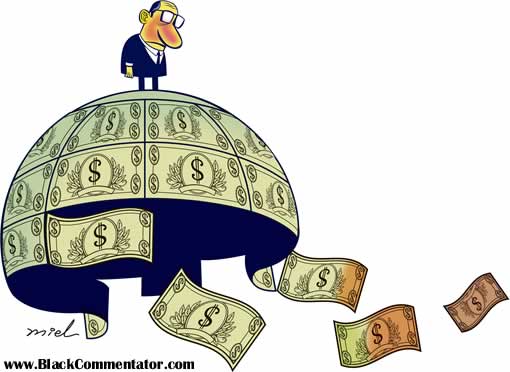
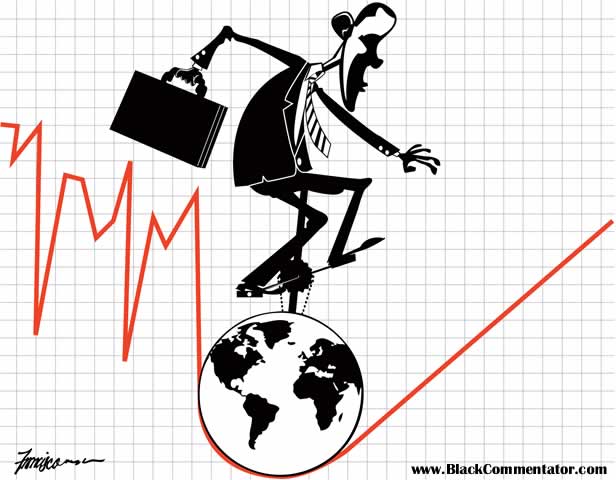
Cartoon from Black Commentator.

Time to reboot?
Fed’s big bucks may be drops in bucket

By Roger Baker / The Rag Blog / October 14, 2010

As is often the case, Bloomberg tells it like it is, although a little interpretation is needed to put things into their proper context. Rarely do we hear it put so plainly that the U.S. government is almost out of realistic options for reviving the U.S. economy:

For $2 trillion, Federal Reserve Chairman Ben S. Bernanke may buy little improvement in growth, employment or inflation over the next two years.

Firms with large-scale models of the U.S. economy such as IHS Global Insight, Moody’s Analytics Inc. and Macroeconomic Advisers LLC project only a moderate impact from additional Fed asset purchases. The firms estimate that the unemployment rate will remain around 9 percent or higher next year whether the Fed buys $500 billion or $2 trillion of U.S. Treasuries in a second round of unconventional stimulus.

“This is not a game changer for the economic outlook,” said Nigel Gault, chief U.S. economist at IHS Global Insight in Lexington, Massachusetts, whose models show that $500 billion of purchases would boost growth 0.1 percentage point in 2011 and leave the unemployment rate at 9 percent or above for the next two years. “There is clearly a risk that people start to perceive monetary policy as impotent.”

The meager impact shows the conundrum U.S. central bankers face. Interest rates near zero have failed to produce the intended cycle of borrowing and spending among consumers and businesses. Unemployment hovering near a 26-year high, partly a symptom of weak demand, keeps downward pressure on prices, and further declines in inflation would raise borrowing costs in real terms, making credit more expensive…

First they tried lowering interest rates, as they have done so often before, but that didn’t work. This was partly because they did it so often in the past — so it lost much effectiveness as a way to discipline risk during the successive Greenspan bubbles.

Then they bailed out the banks and injected a lot of Keynesian stimulus spending — which requires Congressional approval. This had little result except to make it easy to agitate the U.S. middle class, who probably feared all their taxes would go to immigrants on welfare.

A combination of Congressional gridlock plus conservative anti-Obama politics is now preventing much more Roosevelt-like stimulus spending, no matter how great the need. Probably this opposition will continue after the elections, and until grassroots economic pain increases its political impact.

Economists say further asset purchases could underscore the limits of monetary policy, which is hobbled by consumers’ desire to pay down debt and the reluctance of Congress to approve additional fiscal stimulus.

“At the zero boundary on interest rates, the burden shifts to fiscal policy, and fiscal policy is immobile because of the politics,” said [Macroeconomic Advisers co-founder Laurence] Meyer. “So now, the burden has shifted back to monetary policy. You have to hope the economy’s own resilience and underlying strength is going to be enough to have growth a little bit above 3 percent.”

Having few other options left, the Federal Reserve (channeled by Bernanke) is announcing that they may create up to $2 trillion in new easy credit (as they have the legal right to do), and trade lots of cash to the banks in return for their suspect securities, although this would create few jobs. It kind of sounds bad, so the feds may need to relabel this remedy.

“We know the Fed is going to be doing something,” said David Rosenberg, chief economist at Gluskin Sheff and Associates Inc. in Toronto.

“The question is, in a cycle of contracting credit, how far will it work,” he said. “If taking rates to zero didn’t work, and if QE1 didn’t work, then the question, legitimately, is QE2 going to work?”

Quantitative easing refers to large-scale asset purchases as a tool of monetary policy. Bernanke has said the purchases support growth by lowering borrowing costs across a broad spectrum of debt as investors reallocate money they would normally invest in Treasuries into mortgage bonds, corporate notes, and other securities…

“It is a small but meaningful benefit and the recovery can take all the help it can get,” [Moody’s Analytics’ Mark] Zandi said. Because purchases could have such a low medium-term impact, Fed officials may recast the strategy in terms of aiming at a level on an inflation index rather than the rate of change on the index, Zandi said.

Despite the known drawbacks and weak results of such quantitative easing, the U.S. Treasury and federal Reserve officials feel the need to try something other than watching things get worse.

The Fed “really doesn’t have any alternative but to give this thing a whirl,” former Fed Governor Lyle Gramley, now senior economic adviser at Potomac Research Group in Washington. “It has a mandate to create maximum employment and price stability. It has to try.”

This all sounds kind of bad. Let us now leave Bloomberg for a second opinion which explains the same situation. On NPR’s Money Planet, finance reporter Adam Davidson, who, like Paul Krugman, is a skilled popularizer of complex economic ideas, recently reported much the same thing. His perceptive blog explains why a second round of quantitative easing (called QE2 in the Bloomberg piece) — essentially giving easy cash to the banks in return for their paper, is unlikely to revive the economy. The track record of QE is not good; Japan tried it and it didn’t work:

“A big bank — Bank of America, say — has $50 billion in government bonds. They’d sell those bonds if anyone would pay enough for them, but nobody is willing to pay that much. So the bank just holds on to them.

With quantitative easing, the Fed comes along and says, “Hey, Bank of America, we’ll buy those bonds for a little more than anyone else is willing to pay.” Bank of America says, “OK, great, send us the money.”

This is where the Fed gets to use central-bank magic. They pay for that $50 billion purchase in new money. They just invent it. That’s what the Fed — but nobody else — gets to do.

So now Bank of America has $50 billion they need to do something with. The Fed is hoping that Bank of America will decide to lend that $50 billion to companies and people to invest or spend. That stimulates the whole economy.

It sounds great. Create new money, get it out there, everyone wins. But — of course there’s a but.

Nobody really knows if this works. It’s still really controversial among economists. It’s only been tried a few times and, as in the case of Japan, hasn’t had the greatest results.

The Fed first used quantitative easing in 2008. It’s now considering a second round, even though a lot of folks are against it.

While the economy is still this bad, the Fed really might only have two options: Do this as a desperation move, or do nothing.”

Thus the biggest private bankers, operating through the Fed, have effective legal control over the whole U.S. economy. Just as Davidson says, the Federal Reserve has the right to create as much money as they please and give it to whom they please. Consequently, the public benefits from our U.S. banking system are ultimately of a trickle-down nature, subject to the fickle motivation of banking profit and Federal Reserve whim, often in alliance with the U.S. Treasury.

The Fed is busy creating money and offering it to the banks in the apparent hope that — even in the absence of regulation or reform — some of it will stay here and won’t head toward more profitable investments that don’t create U.S. jobs. I described this same situation last December, as we can see from the Stiglitz snip in my earlier Rag Blog article:

Stiglitz, 66, also said the Federal Reserve contributed to the financial crisis by failing to supervise banks or stem the housing bubble. He questioned proposals to give the central bank more authority to supervise firms whose failure might threaten the financial system. “Giving more power to an institution which has failed so miserably, with results that have imposed such costs on all of us, cannot be the right solution unless there are deep and fundamental reforms in the institution, of a kind that are beyond those currently being discussed,” he said.

In the absence of the banking reform that Stiglitz advocates, reform that would partly take control of the U.S. economy away from private hands, the bankers have little incentive to create risky, low-profit domestic jobs.

The bankers see little profit to be made from investing in such jobs, knowing that the U.S. consumers are under great financial stress. U.S. bankers won’t invest much in the industrial production of globally traded goods, because U.S. labor costs are still high compared to those in China and the rest of the world.

Without strong outside regulation, the U.S. banks are free to use their $2 trillion (or whatever the Fed pleases to create and give to them) to speculate in the most profitable stuff. Things like gold, vital commodities like food, and in new industries abroad — like in China, where iPhone production remains highly profitable because of cheap labor. GM now makes lots of its money by building its cars in China rather than the U.S.

All things considered, it looks like a good time to reboot the whole U.S. economic system.

[Roger Baker is a long time transportation-oriented environmental activist, an amateur energy-oriented economist, an amateur scientist and science writer, and a founding member of and an advisor to the Association for the Study of Peak Oil-USA. He is active in the Green Party and the ACLU, and is a director of the Save Our Springs Association and the Save Barton Creek Association. Mostly he enjoys being an irreverent policy wonk and writing irreverent wonkish articles for The Rag Blog.]

The Rag Blog

Posted in Rag Bloggers | Tagged , , , , | 6 Comments

Diana Claitor : Why We Need To Protect Texas Inmates

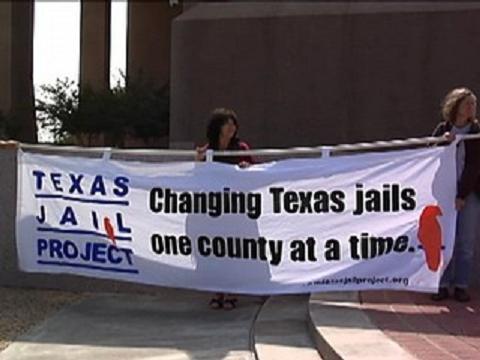
Texas Jail Project protests at Taylor County Jail in 2008. Image from Abilene Reporter-News.

Texas Jail Project director Diana Claitor will be Thorne Dreyer‘s guest on Rag Radio on KOOP 91.7 FM in Austin, Tuesday, October 19, 2-3 p.m. (CST). To stream Rag Radio live, go here. To listen to this show after the broadcast, or to listen to earlier shows on Rag Radio, go here.

Protecting Texas inmates:
Why do we need another law?

By Diana Claitor / The Rag Blog / October 14, 2010

I often hear about how stupid it is that Texas and other states have to pass bills and create laws to ensure care for pregnant inmates or to stop the shackling of nonviolent women during childbirth. Folks say, “Why don’t people in charge just do the right thing?”

Of course, you can say that about everything. Why do we have to pass laws against pollution or bribery? Why do we have to enact standards or requirements for elected officials to follow?

Probably because those in charge are human beings and make mistakes — and because they don’t always do the right thing. Like when sheriffs and jail administrators release inmates in dangerous locations after dark.

Texas Jail Project recently found out about a man with a mental disorder who was shoved out of the Val Verde County facility, onto the county road outside Del Rio. Traumatized and lacking any information about where the town was, he walked up and down the road for hours in the dark until a deputy felt sorry for him and drove him into town.

A typical response to stories like that: “Well, that’s an isolated case. You’re going to have that happen with some 245 jails all over this huge state.”

But it’s turning out not to be so isolated. We have received detailed accounts of similar releases at night in Houston, and in Seguin over in Guadalupe County. Even worse cases are coming to light, including two releases outside Brownsville that resulted in women being hit by cars. Both woman died, one of them this past summer. Priscilla Falduto was 27.

Patricia Falduta, who was arrested for swimming nude in a Brownsville park fountain, was killed when struck by a car after being released from custody on a highway close to the jail.

Brownsville citizens wrote to their newspapers in outrage and contacted their elected representatives. Texas Jail Project brought these examples up to the Texas Commission on Jail Standards in the past month, but director Adan Muñoz says it is outside their purview — that when and where people are released is under local control.

“The sheriff can’t be told when and where inmates are to be released,” says Muñoz.

Why not, Mr. Muñoz?

It seems to me that the legislature could pass a state law requiring that county jail inmates be released during daylight hours (like at Texas state prisons) at safe locations where transportation and a phone are available — thus ensuring that inmates are not treated like so much garbage, to be put out at night.

The general idea of incarceration is that jails should hold people safely until it is determined whether they have broken the law or not. In the latter case, or after bail is made, they are released — and we want that to be a safe release.

So it looks like we actually do need a new law, to require sheriffs and counties to be as careful in how they restore freedom as they are (or should be) when holding a person in custody.

If, however, any of you readers should discover that human nature has changed and that people in charge have started making sure that each inmate gets released safely, let me know — it will be a huge relief.

Please help us at the Texas Jail Project to research and publicize this problem.

[Diana Claitor is director of the Texas Jail Project, an organization dedicated to improving conditions for the approximately 70,000 people incarcerated in Texas jails on any given day. Visit www.texasjailproject.org to learn more or to help support their efforts.]

Activist-author Diane Wilson.

Diane Wilson headlines Texas Jail Project bash.

The Texas Jail Project is having a fundraising event Saturday, November 6, from 7-10 p.m., at 3209 Hemlock Ave. in Austin. Special guest will be TJP co-founder and award-winning author and activist Diane Wilson. Wilson will speak about the history of the Texas Jail Project and her experiences in the Harris and Victoria County Jails, and she will also tell about being arrested in Washington D.C. after disrupting two Senate hearings on the Gulf oil disaster.

Wilson will also preview her new book, Diary of an Eco-Outlaw: An Unreasonable Woman Breaks the Law for Mother Earth, to be published in the spring of 2011. For more information on this event, please contact Diana Claitor at diana@texasjailproject.org or call (512) 597-8746.

The Rag Blog

Posted in Rag Bloggers | Tagged , , , | Leave a comment

SPORT / Dave Zirin : Why the NFL is Thinking Pink

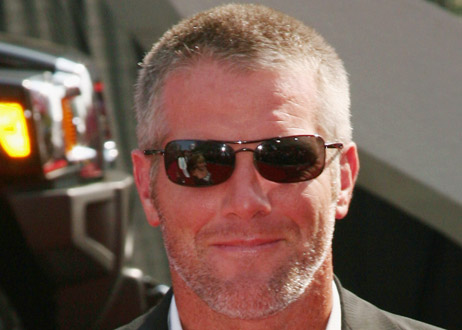
In the pink: Brett Favre. Image from Full Issue.

Brett Favre beware:
The NFL is thinking pink

By Dave Zirin / October 13, 2010

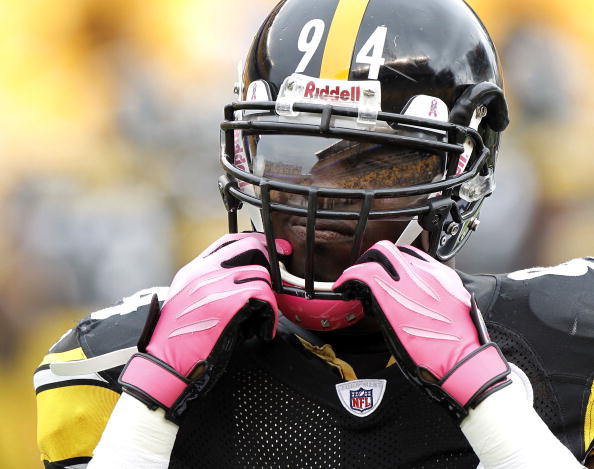
You may have noticed an abundance of pink on the fields of the National Football League this month. Between the pink sneakers, pink mouth guards, and pink wristbands, one would be excused for wondering how the machismo-drenched league became so fabulous overnight.

Welcome to the NFL’s celebration of Breast Cancer Awareness month. But there are reasons beyond the altruistic for the league’s sudden concern with women’s health. In September the league launched a $10 million public relations effort to woo female fans, which included the marketing of NFL jeans, sandals, and yoga mats. The 33 men that run the NFL have determined that this explosion of pink is just another way to say, “We care about our female fans: from their yoga to their tumors.”

Courageous as it may be to take a stand on the polarizing issue that is breast cancer, the NFL’s new efforts to woo the female fan come off as desperate and patronizing. Women go to the games for the same reason as men: to have fun and cheer themselves hoarse. But the NFL has taken on this campaign because there are those in the owner’s box who fear the league has financially peaked.

In a country where teams ensconced in Buffalo and Jacksonville are struggling to stay solvent, the internal expansion market has run dry. In a nation still in the grips of a Great Recession, attendance is down across the board. In a world where hatred of American football is a point of national pride, the NFL isn’t going to find revenue streams overseas. In an economic climate where the well of public subsidies is parched, the need to expand the fan base has become something of mania. Enter the pink.

This concern for female sensitivities is also the reason why Minnesota Vikings quarterback Brett Favre might be in a whole world of trouble. For those living in witness protection, Favre is being investigated by the NFL for violating the league’s personal conduct policy. The website deadspin.com posted voice messages and penis-pictures Favre is alleged to have sent to team employee Jenn Sterger, when both were with the New York Jets.

Two Jets masseuses have since emerged with similar stories, albeit without the now ubiquitous photos of Favre’s “Mississippi Burning.” These photos now wallpaper the internet and yes, this is another one of those sports stories that makes us all want to bathe in bleach. Brett Favre’s dong is like Lebron James: we are all witnesses.

Photo from Getty Images.

It also puts Favre in the position of now having to scramble to defend his career, legacy, and status as an athletic icon. Love him or hate him, Favre has had without question, one of the most remarkable careers in the history of sports. In 19 NFL seasons, he has as of this writing, 290 consecutive starts, 500 touchdown passes, and 70,000 yards passing: all records. Now his consecutive start streak could be snapped along with his reputation.

The sad truth is that in an era where sports scandals swirl all around us, redemption is a young person’s game. If you are Michael Vick or Tiger Woods or Alex Rodriguez, and can emerge from disgrace to excel on the field, much is forgiven and forgotten. If you are Roger Clemens or Barry Bonds or Mark McGwire, the last memory becomes indelible.

It doesn’t matter if your crimes are misdemeanors, felonies, or just an inability to control your libido. The field is like Lourdes and you are a SportsCenter highlight away from forgiveness.

Favre, however, is 41, missing throws he used to make in his sleep and for the first time in his long career, hearing from columnists that he should be benched. Roger Goodell, longing for that pink dollar, might agree.

But if Goodell thinks that female football fans will be twirling their parasols and raising their mint juleps in gratitude for his chivalry, then the Commish clearly hasn’t spent enough time in the stands of NFL games. If Goodell really wants to respect female fans, he should ban the cheerleaders, ban the sexist beer commercials, and continue to enforce equity and access for women journalists.

All the rest of this is smoke and mirrors for a league flailing for dollars. Favre may have royally crossed the line but larger concerns will determine the price that he pays.

[Dave Zirin is the author of Bad Sports: How Owners are Ruining the Games we Love (Scribner). Contact him at edgeofsports@gmail.com. This article also appears at The Nation.]

The Rag Blog

Posted in RagBlog | Tagged , , , , , , , | 2 Comments

Judy Gumbo Albert : The More Things Change…

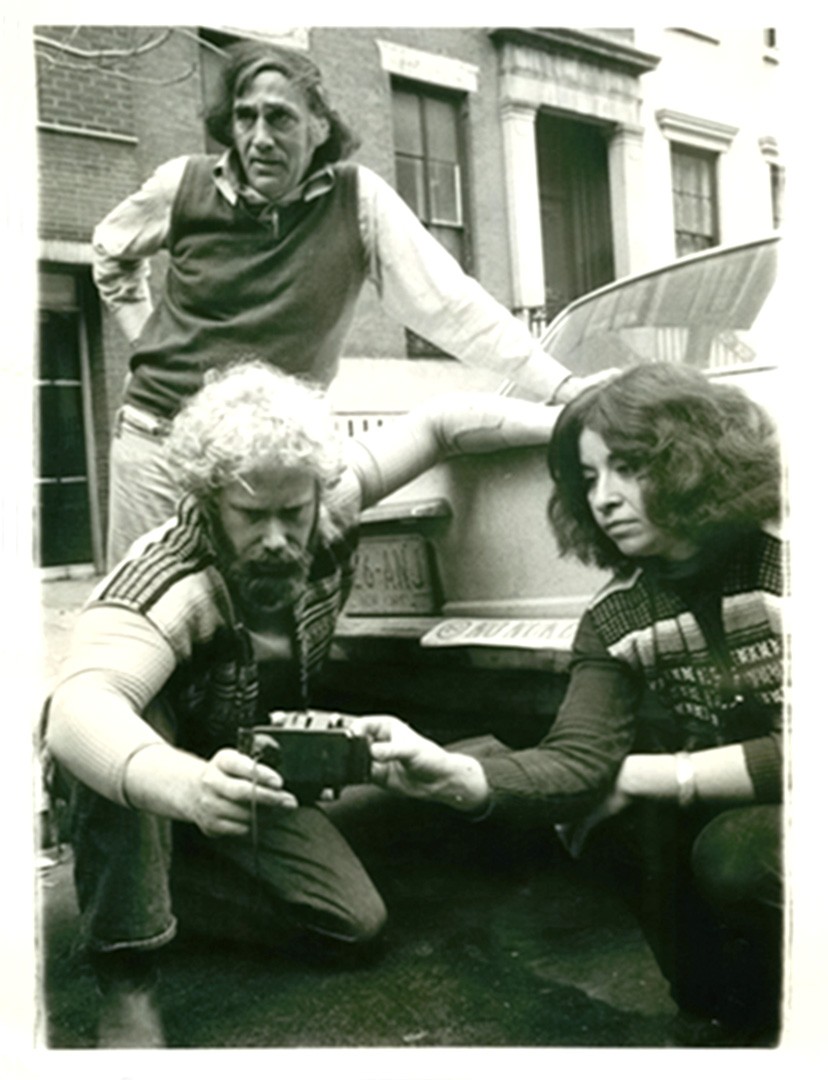
L-R: Stew Albert, Attorney William Kunstler, and Judy Gumbo Albert, December 14, 1975. Photo from Wide World Photos.

Adventures with the FBI:
The more things change…

By Judy Gumbo Albert / The Rag Blog / October 13, 2010

Last week a story surfaced about Yasir Afifi, a 20-year-old Egyptian-American student, who discovered an FBI homing device on his car. Thirty-five years ago, the FBI put a homing device on my car. To my surprise, given current technical advances in miniaturization, my device appeared to be not much larger than the one Afifi found.

I discovered my device because a wire hung down suspiciously; so did Afifi. Both devices were attached to our cars by magnets. FBI agents visited Afifi to retrieve their device; in my case, the FBI stole it back out of our lawyer’s office. The agent did this, I learned subsequently, because the cost of the missing device came directly out of the agent’s pocket.

In 1975, putting a homing device on my car without a warrant was against the law. My late husband Stew Albert and I sued the FBI. Bill Kunstler and the Center for Constitutional Rights represented us. Defendants in our lawsuit were Acting FBI Director L. Patrick Gray, Mark Felt of “Deep Throat” fame and Assistant Director Edward Miller. In 1978, Gray, Felt, and Miller were indicted for approving such illegal acts. Gray resigned because of Watergate; Felt and Miller were convicted, then subsequently pardoned by President Reagan.

My daughter is the lawyer in the family, not me, but I believe what the FBI did last week to Yasir Afifi is legal today under the USA Patriot Act and FISA.

This is my story:

The air around my ancient white Volvo felt charged with negative ions. I couldn’t put my finger on it, exactly. Perhaps my queasiness came from a half-formed memory of a man in a beige trench coat and fedora who I may or may not have spotted the night before lurking in a semi-dark stairwell next to Bill Kunstler and Margie Ratner’s red brick home on Gay Street in the Village. This is New York, I tell myself, everybody lurks in New York.

Stew and I return to our Volvo before alternate-side-of-the-street-parking-tow-away kicks in. A man in what I hallucinate to be a black trench coat, scurries down the sidewalk on the opposite side of the street..

Gumbo, are you going nuts or what? Then I notice it. Smack in the middle of the Volvo’s rear bumper is a well-defined white patch, serene amid the spewed up brown dirt the car accumulated on yesterday’s drive down from our beloved isolated cabin in the Catskill Mountains. Hanging down in the very center of the clean spot is a six-inch-long wire.

“Hey Stew, cummere.” I say. “Look at this. I think there might be something the matter with the car.”

“Whaddaya think it is?” Stew asks. He knows nothing about cars. A Brooklyn boy, he’s never learned to drive. This is fine by me. For me, car equals freedom, although I’m feeling momentarily insecure about my knowledge of automotive issues. Three weeks earlier I’d sent much of this poor Volvo’s electrical system up in smoke when, in a fit of know-it-all feminist machismo, I’d installed a new battery by myself, poles reversed, and fried much of the Volvo’s wiring.

“Maybe something else happened to the electrical system.” I say. Still, I’m not deterred. I kneel down and put my arm up behind the bumper where I think the weird wire comes from.

I’ve chewed on this moment for years and yet have never been fully able to explain to myself what prompted Stew and me to do what we did next.

“Ok, so, I’m going to try and start the car and see if anything happens.” I tell Stew, “Wait over there on the sidewalk.”

“Well… uh….. No!” Stew is adamant. He sits down heavily in his customary place in the passenger seat then brushes his famous blond curls back off his forehead. Stew jokes later that he did not want to see a news headline reading: “Sexist Survives.”

I get behind the wheel, insert the key, and turn the ignition key. No click. No terrorizing silence. No explosion. The car starts. I feel my breath rush gratefully back into my lungs.

I open the driver’s door, get back out, go back to the rear of the Volvo and kneel down in the gutter, avoiding as best I can the cold running water and dirty gray slush left behind from the previous day’s pre-winter storm. This time, when I reach up along the wire, my hand emerges clutching a size C battery, with a piece of black electrical tape wrapped around it.

“Let’s get the fuck outta here.” Stew says at the exact same time I think it.

We cut across town on 79th through Central Park. The more I drive, the more visible is the trail of cars behind us — two yellow cabs, three basic black Detroit four doors and, if memory serves, one Central Park horse and buggy taking up the rear. I pass fashionable Madison Avenue shops, then make a left at 86th to cross the Park. My new best friends stay close, never out of range. They make no attempt to conceal themselves.

I panic. “Let’s go for Chinese,” I say. Stew agrees instantly. Chinese food is comfort food for Jews of my generation. That it might be foolish to leave the Volvo exposed and unattended on Upper Broadway does not cross my mind. The sweet-smelling hot and sour soup filled with slices of squirmy black mushrooms and seaweed fans of cloud ear fungus does its job; Stew’s and my rationality is restored; we head back to Bill and Margie’s. After all, if you think you may be in trouble with the law; it’s best to be in the company of lawyers.

“Bill?”

“Yeah?”

“We think we’re being followed. I know we’re being followed. I drove through Central Park and there was a parade of cars behind us. And look, look here, look at this wire. It’s not a bomb. The car drives.” The tale tumbles simultaneously out of both our mouths.

Bill bends down and, with his long arms and large fingers, reaches far up under the Volvo’s rear bumper. He grunts, pulls out a 6” by 4” black box, with two intact batteries and the ubiquitous wire hanging down. Bill places the device in his kitchen freezer, which, he says will cut off its capacity to transmit. Then, always a Yippie, Bill contacts the press.

Over the years, I’ve often wondered who among us were the bigger schmucks — Stew and me, who gave the FBI access to our car by consigning it to the street, or the Keystone Cop FBI agents who installed a second, new, and completely functioning homing device.

Three years after these events, Attorney General Griffin Bell charged Acting FBI Director L Patrick Gray, the FBI’s number two man Mark Felt, and Assistant FBI Director Edward Miller with violating constitutional protections against unreasonable search and seizure of “acquaintances and relatives” of the Weather Underground.

Gray was, at the time, a leading candidate to succeed legendary FBI Director J. Edgar Hoover. Felt, the FBI’s key decision-maker on domestic spying, spilled the beans about the 1972 Watergate burglary to Washington Post reporter Carl Woodward, which led, ultimately, to the resignation of President Richard Nixon. Miller, the third person indicted, was an Assistant FBI Director of Intelligence between 1971 and 1974.

Miller made his appearance in my FBI files as the “go-to” person for the New York City agents who tailed me. In the early 1980’s close to 20 people received settlements of $10,000 each for the FBI’s illegal actions — which would come to approximately $60,000 for Stew and me in today’s money.

If I could offer any comfort to Yasir Afifi, it would be to say: don’t be afraid, hang in there. I wish I could promise that, one day, he’ll laugh about his homing device experience the way I can. Although we live in fear-based, anti-Arab, racist America, I nonetheless strongly encourage Yasir Afifi to exercise whatever remains of his constitutional right to legal redress.

[Judy Gumbo Albert is an original Yippie, along with Abbie and Anita Hoffman, Jerry Rubin and Nancy Kurshan, Paul Krassner, and Judy’s late husband Stew Albert. Judy has remarried, lives in Berkeley, California, and is currently writing her memoir, Yippie Girl. She can be found at www.yippiegirl.com.]

The Rag Blog

Posted in Rag Bloggers | Tagged , , , , , , | Leave a comment

Danny Schechter : The Burden that Haunts Obama

Cartoon from BlackCommentator.

Listen to Thorne Dreyer‘s Sept. 28 interview with journalist and filmmaker Danny Schechter on Rag Radio here. To find all shows on the Rag Radio archives, go here.

Financial crisis continues to take its toll:
The burden that haunts Obama

By Danny Schechter / The Rag Blog / October 12, 2010

WASHINGTON, DC — With the midterm election less than a month away and the economic crisis unabated, the Obama Administration may be at a crossroads.

The President’s own advisor, former Federal Reserve Chairman Paul Volcker, says the financial system is “broken.” High unemployment is not dropping and home foreclosures are up. The Obamacrats are being blamed for the economic downturn and the economy has become “the issue” of the November midterm elections.

The signs of an economic recovery are hard to see, and tensions with China, a leading trade partner, may be putting the country on the cusp of a trade war. Add to this the trillions poured into two wars we are not winning, and you have the elements of a perfect storm that some fear could lead to a depression or even a systemic collapse.

With the President’s popularity slipping and his opposition surging (at least in the media if not in the streets), the Democrats are expected to lose many seats, if not control of the Congress. Some in his party have been reduced to arguing, “we may not be great, but we are better than the other guys.” There is an anti-incumbent mood in both parties and the rhetoric (but not yet the reality) of revolution is motivating parts of the electorate on both sides.

In the White House, the President has become more of a manager than a militant: initially trying to please all sides with appeals to bi-partisanship, and later with programs to placate the military and Wall Street.

Wall Street helped fund Obama’s 2008 victory. He seems to have believed that policies that would support and even enrich the private sector would lead to more job creation and cooperation.

That didn’t happen — and now more and more billionaires are funding the Republicans with no pretense to promoting equality or to providing help for the middle class. The greed that drives these wealthy elites seems to know no bounds.

One by one, his chosen policy wonks have deserted the White House like those proverbial rats leaving a sinking ship.

First to go was wunderkind budget director Peter Orzag, then Christina Romer who headed his Council of Economic Advisors, followed by Larry Summers , the chief economic advisor and former Harvard President who was forced out of Harvard for remarks hostile to women. Finally, Obama’s Chief of Staff, former Congressman Rahm Emanuel, has also said sayonara to return to Chicago for a mayoral run.

Left in place — but hardly left – is Treasury Secretary Tim Geithner, Obama’s Ambassador to Wall Street and point man with China. Geithner and his former boss, Ben Bernanke, who heads the Federal Reserve Bank, see themselves as servants of stability wedded to big banks and the strategy of the soon to be departed. They have no progressive pretensions. Little has changed for them.

The only claim this crew could make about achievement is that they averted something worse from happening. They may be correct, but proving a negative is difficult and doesn’t play well with voters who are not well-versed in the reasons behind the financial crisis. A “jobless recovery” is no recovery at all.

They are right now considering a new bailout being urged by the International Monetary Fund.

To placate his base and the unions, Obama has appointed another Harvard Professor, Elizabeth Warren. Her role will be to assist in shaping the new Consumer Protection Bureau that she herself proposed, the only financial reform that enjoys any popularity.

Warren is outspoken and supported by progressives, yet it is not clear if she will end up with any power to run what she had hoped would be an independent agency. However, it ended up being tucked away as a bureau in the Federal Reserve Bank. As a result, some analysts fear she is being co-opted and politically neutered.

On the left, filmmaker Michael Moore speaks for many disenchanted Obama supporters who feel betrayed by the President’s predictable turn to the safety of the mushy middle. “Sadly, it’s a situation the Democrats have brought upon themselves — even though the majority of them didn’t create the mess we’re in,” he writes.

But they’ve had over a year and a half to start getting the job done to fix it. Instead, they’ve run scared ever since they took power. To many, the shellacking they’re about to receive is one they deserve. But if you’re of a mindset that believes a return to 2001-2008 would be sheer insanity, then you probably agree we’ve got no choice but to save the Democrats from themselves.

Moore’s populist progressive proposals include indicting Wall Street criminals — a proposal I put forward in my film Plunder — and imposing a moratorium on home foreclosures, something President Franklin Roosevelt did as a part of the New Deal in the 1930s. (Some big banks began suspending foreclosures after it was revealed they were breaking the law in at least 23 states.)

Moore’s views were not even present at a Washington demonstration backed by the unions in early October. And they are a long way from being implemented for at least four reasons.

First, they would represent a U-turn for an Administration that is nervous about appearing too anti-business and that often postures left to move right. Obama’s financial and health care reform — the administration’s two big “accomplishments” — reinforced corporate power more than transforming it.

Jailing Wall Street is difficult because years ago big business lobbyists assured that deregulation — and its kissing cousin, decriminalization — would make prosecuting financial crime far more difficult.

And then there’s the Congress under the sway of business interests with so-called “Blue Dog” Democratic conservatives, not to mention the rabidly anti-populist Republicans, able to filibuster and stop the kinds of changes Moore hopes for.

Oddly enough it was the banks that froze foreclosures in 23 States when fraudulent practices were unmasked. As Naked Capitalism noted,

We’ve discussed the fact the fact that banks have become so powerful in Florida that they have managed to get what amount to kangaroo foreclosure courts created. Not surprisingly, the assembly line imitation of justice railroads borrowers, and prevents legitimate grievances from being heard.

It turns out that banks in that state are so confident of their above the law status that they’ve also taken to casually changing the locks on and entering homes they don’t own, meaning haven’t foreclosed upon. This has become sufficiently common that the local press has taken notice.

And, very important, the Supreme Court remains under the sway of free market fundamentalists who genuflect to corporate needs in almost every decision.

So a stalemate remains in place with election rhetoric concealing the conventional wisdom and status quo orientation that make deeper reform unlikely. We seem to be in the era of one step forward and two back where the idea of change serves as an election slogan — not a commitment to more fundamental repairs.

The political system is as broken as the economic one, and there is no Superman on the horizon to fly in and fix it.

[“News Dissector” Danny Schechter is a journalist, author, Emmy award winning television producer, and independent filmmaker who also writes, blogs, and speaks about media issues. Schechter directed Plunder: The Crime of Our Time, and a companion book, The Crime of Our Time: Why Wall Street Is Not Too Big to Jail. Contact him at dissector@mediachannel.org. This article was originally commissioned by Al Jazeera.]

The Rag Blog

Posted in Rag Bloggers | Tagged , , , , | Leave a comment

FORECLOSE THIS: THERE’S MORE THAN ROBO SIGNATURES TO BLAME FOR THE ONGOING FORECLOSURE SCANDAL

By Danny Schechter / The Rag Blog / October 12, 2010

The other day, during an interview on Al Jazeera, I was asked if I was frustrated because my warnings and worries about the financial meltdown and foreclosure crisis, first aired in 2006, have been ignored so long.

Duh!

The excruciating lesson I learned is that it takes time for a problem to turn into an issue and, then, an issue to get attention, to move from the business section to the news section, from the back of the paper to page one. It is always hard to predict which story will grab the attention of a news media that has not paid sufficient attention to these issues for years.

What connect for editors are usually a small matter and a symbolic one, a story that’s not just new but dripping with the appearance of injustice or hypocrisy?

Once some truth slips through the cracks, a flood threatens like the toxic sludge undoing parts of Hungary.

The fact that millions of Americans were having their homes foreclosed on by a shadowy industry agency using robo signature machines without reviewing the details of the alleged default has become the scandal du jure. Committing this fraud is the Mortgages Electronic Registration System, (MERS) the company the big banks hired to do their dirty work with the appearance of computer-driven semi-official efficiency.

As they churned out and executed foreclosures (while making more than a pretty penny in the process) they, in effect, executed homeowners with the sanction and support of kangaroo courts. As soon as the Judges received their impeccably prepared documents — like Bernie Madoff’s meticulously written monthly statements fooling his investors — the orders went out to throw the deadbeats out.

One day, and for a quick second, your home sweet home’s fate is in court before some Judge who has received contributions from the industry, and the next day, the sheriff is outside your door with a goon squad to move your stuff into the street. It has been a cruel, stealth, and systematic process.

Explains Naked Capitalism:

…banks have become so powerful in Florida that they have managed to get what amount to kangaroo foreclosure courts created. Not surprisingly, the assembly line imitation of justice railroads borrowers, and prevents legitimate grievances from being heard.

It turns out that banks in that state are so confident of their above the law status that they’ve also taken to casually changing the locks on and entering homes they don’t own, meaning haven’t foreclosed upon. This has become sufficiently common that the local press has taken notice.

The only problem behind this flim-flam is that this practice violates the law in at least 23 states, leading to big banks imposing long overdue foreclosure moratoriums, not to safeguard human rights but to protect their property rights. The banks fear massive and very costly lawsuits. Fortunately, homeowners at risk or in foreclosure could benefit. Some have been fighting back.

Watch this.

This issue has been all over the media. MERS has been defending itself even as its ship has been sinking. Economics writer Yves Smith denounced a statement by its CEO this way: “Wow, this is an almost perfect statement from the Ministry of Truth. Virtually every statement is a lie or very disingenuous. I’m seeing if I can get a lawyer with recognized credentials to shred it.”

The Washington Post reports that the government had been warned repeatedly about problems among mortgage servicers.

The facts here, alas, may not matter as much as an often-omitted fact: the mortgage scandal that triggered the financial crisis goes much deeper than what is happening on the back end, i.e. when a property finally goes into foreclosure.

As Edward Harrison who writes the Credit Writedowns blog, points out,

“The crisis in foreclosure documentation is much deeper than the specific issue of robo-signers which has precipitated the halt in foreclosures by major banks. The fact is the mortgage process in the US is broken because securitization has created a byzantine mess that is wholly unsuited for the large number of foreclosures now on-going.”

And that process has been fudged, riddled with fraud and phony documentation provided by lenders who have been laughing all the way to the bank. There is has been a chain of criminality behind what the FBI has been calling a ‘mortgage fraud epidemic” that has not really been in the news. The press has avoided showing how three industries, real estate, finance and insurance worked together to rip off the American people.

This process has been given political cover, as Mike Taibbi reminds us, that the Tea Party was formed with demagoguery on this very issue (even as many conservatives are also losing their homes.)

“This second-generation Tea Party came into being a month after Barack Obama moved into the Oval Office, when CNBC windbag Rick Santelli went on the air to denounce one of Obama’s bailout programs and called for “tea parties” to protest. The impetus for Santelli’s rant wasn’t the billions in taxpayer money being spent to prop up the bad mortgage debts and unsecured derivatives losses of irresponsible investors like Goldman Sachs and AIG — massive government bailouts supported, …

“No, what had Santelli all worked up was Obama’s “Homeowner Affordability and Stability Plan,” a $75 billion program less than a hundredth the size of all the bank bailouts. This was one of the few bailout programs designed to directly benefit individual victims of the financial crisis.

“How many of you people want to pay your neighbor’s mortgage that has an extra bathroom and can’t pay their bills? Raise your hand!” Santelli roared in a broadcast from the floor of the Chicago Board of Trade. Why, he later asked, doesn’t America reward people who “carry the water instead of drink the water?”
Who is drinking that turgid water now?

Unfortunately, the blame the irresponsible homeowner narrative has become deeply embedded even after films like Leslie Cockburn’s Casino documented the way homeowners in Baltimore were targeted on a racial basis or my own In Debt We Trust and Plunder demonstrating that crimes were committed in a massive way. Michael Moore exposed the ugliness of foreclosures in his Roger and Me and Capitalism: A Love Story.

Now, a new film, Inside Job, fleshes out the story with a pretty looking, term paper/power point-style illustrated lecture showing, step by step, how homeowners were fleeced and why the crisis mushroomed. Worth seeing, It’s a bit top-down and dense for my taste with lots of visuals from helicopters over buildings and interviews with big name economists. At the same time, it reveals how former politicians turned academics are serving and servicing the right-wing elite with arguments that conceal their interests and agendas while drawing huge fees for their intellectual subservience/whoredom. It has a studio release so, hopefully, it will be seen widely.

If you like charts that shows how subprime turned subcrime, check this out.

The facts are here but the political will isn’t. Where is the solidarity with the victims as the media treats this as a “technical” issue, rarely explaining its premeditated criminal context?

We need the President to proclaim a national moratorium on foreclosures and a no holds barred investigation into these practices that lead to prosecutions. If a French trader who bet wrong can be fined for his billion dollar losses, why not the Wall Street powercrats who sucked away similar sums?

Mostly we need public outrage and popular organizations to force them to do it.

News Dissector Danny Schechter directed Plunder The Crime Of Our Time and wrote the companion book, ‘The Crime Of Our Time.’ Comments to dissector@mediachannel.org

Type rest of the post here

Source /

The Rag Blog

Posted in RagBlog | Leave a comment

BOOKS / Jonah Raskin : The Psychedelic Revolutionaries


The psychedelic revolutionaries…
‘White Hand Society:
The Psychedelic Partnership of Timothy Leary & Allen Ginsberg’

By Jonah Raskin / The Rag Blog / October 12, 2010

[White Hand Society: The Psychedelic Partnership of Timothy Leary & Allen Ginsberg, by Peter Conners (City Lights, 2010); Paperback, 200 pp.; $16.95.]

I took LSD for the first time in 1970, and haven’t taken it since then. Three of the trips were with fugitives in the Weather Underground all of them wanted by the FBI. At that time, the clandestine organization of former members of Students for a Democratic Society (SDS) insisted that taking LSD was consistent with armed revolution.

To make their point, they took a break from planting bombs to help Timothy Leary, the apostle of LSD, make his escape from prison and to leave the United States for Algeria under a fake passport. It was in Algiers in 1970 that I met Leary, and took LSD with him. I actually enjoyed that acid trip, unlike the previous psychedelic experiences with the Weather Underground. Leary was irrepressible and dangerous — an imp and a mad man.

My experiences in Algiers from 40 years ago came back to me recently while reading Peter Conners’ new book White Hand Society: The Psychedelic Partnership of Timothy Leary & Allen Ginsberg. Conners is a poet, a fiction writer, a book editor, and the author of a memoir, Growing Up Dead: The Hallucinated Confessions of a Teenage Deadhead.

In White Hand Society, he’s an historian and a group biographer. The individuals in the group that he profiles include not only Ginsberg, Leary, and the Weather Underground fugitives, but also many of the figures of the drug and countercultures of the 1960s, such as Ken Kesey, Neal Cassady, Ram Dass, Andrew Weil, and more. Jack Kerouac makes a brief and vivid appearance; his comments about his experiments with psychedelic drugs are well worth reading and pondering.

Conners’ main objective is to trace the connections between Ginsberg and Leary, and to show the impact they had on an era in which taking psychedelic drugs was an integral part of the rebellion and the protests of a generation. Indeed, drugs went hand in hand with the cultural revolutions of the 1960s; they were depicted as a kind of deprogramming of the institutional brainwashing that was carried out by the media and the educational system during the cold war. Moreover, drugs seemed to provide immediate gratification of pleasure.

White Hand Society is largely anecdotal, and the anecdotes, though they have mostly been told before, are well told in these pages. “White Hand Society” is the name that Leary gave to a group of his friends and associates — and just one of a series of names he coined to create a sense of élan and mystery about himself and those around him.

Leary, Ginsberg and their associates come to life in this book, and so do the times they helped to shape. The story moves from Massachusetts to New York to California and to Europe. The sections of the book about Leary are the most vivid and the most trenchant.

Conners doesn’t advance a theory to explain Leary’s behavior or the drug culture, but he does offer a long and illuminating passage from Alternating Currents, a 1967 book by Octavio Paz, the Mexican author and Nobel-prize winner famous for Labyrinth of Solitude. It is well worth repeating here. In the absence of a theory about drugs and addiction it will do nicely.

“We are now in a position to understand the real reason for the condemnation of hallucinogens and why their use is punished,” Paz wrote. “The authorities do not behave as though they were trying to stamp out a harmful vice, but behave as though they were stamping out dissidence. Since this is a form of dissidence that is becoming more widespread, the prohibition takes on the proportion of a campaign against a spiritual contagion, against an opinion. What authorities are displaying is ideological zeal. They are punishing a heresy, not a crime.”

Paz’s comments make a lot of sense. They seem both timely and contemporary, though they were written before the War on Drugs, at least in its modern phrase, began in 1970 under President Richard Nixon. Indeed, Nixon and his drug warriors — and all the drug warriors under every single American president since Nixon — have combated illicit drugs, from LSD to marijuana and cocaine, as though they were zealots on a religious crusade. This year, on the 40th anniversary of the war on drugs, it is perhaps more obviously than ever before a campaign against a “heresy, not a crime.”

Conners does not focus on the drug warriors themselves, but on their victims — on men like Leary who were arrested and jailed for smuggling and smoking marijuana — and on men like Ginsberg who rushed to their defense and who called for the legalization of marijuana.

Conners does not idealize Leary. He depicts him as a showman, a self-promoter, a huckster, and a sham who also became a snitch and cooperated with the FBI in exchange for leniency and for placement in the federal witness protection program

Conners offers a quotation from Leary himself in which he defends his honor and his reputation. “I did not testify against friends,” he told a reporter for The Berkeley Barb, one of the first of the underground newspapers of the 1960s. Leary went on to say, “I didn’t testify in any manner that would lead to indictments against the Weatherpeople… The fact is that nobody has been arrested because of me, and nobody ever will be.”

Conners offers his own interpretation of that statement. “In true Leary mode, he was refashioning the whole boondoggle of busts, imprisonment, federal cooperation… as if it had been nothing more than a game,” he writes. “In Leary’s mind, he had simply worked the system.”

Of course, the fact that Leary was a con artist, a liar, and a victim of his own delusions doesn’t let the drug warriors off the hook. Indeed, the drug warriors and law enforcement officers persecuted and prosecuted Leary again and again on charges of violating the marijuana laws — until they succeeded in sending him to prison. They did the same to hundreds of thousands of marijuana smokers year after year since 1970. In fact, there have been, in the past 40 years, more than 20,000,000 arrests for marijuana — most of them for possession.

That Leary was arrested on marijuana charges for the first time in Laredo, Texas was ironical indeed. After all, Ginsberg had written in his epic poem “Howl” (1956) about the “angleheaded hipsters” who were “busted in their pubic beards returning through Laredo with a belt of marijuana for New York.”

It was perhaps inevitable that their paths — the path of the poet and path of the man who called himself the “high priest” — would cross. Maybe, too, Ginsberg and “Howl” gave birth to Timothy Leary as they helped to give birth to the counterculture of the 1960s. Ginsberg certainly showed compassion for Leary, even after he snitched on friends.

Abbie Hoffman and Jerry Rubin were unforgiving. “Timothy Leary is a name worse than Benedict Arnold,” Abbie said, and Jerry Rubin added, “I know from personal experience with him over the past 10 years that he never had a firm grasp of where truth ended and fantasy began.”

[Jonah Raskin is the author of American Scream: Allen Ginsberg’s “Howl” and the Making of the Beat Generation and is a professor at Sonoma State University.]

The Rag Blog

Posted in Rag Bloggers | Tagged , , , , , , , , | 3 Comments

Ted McLaughlin : Our Fear of the ‘S’ Word

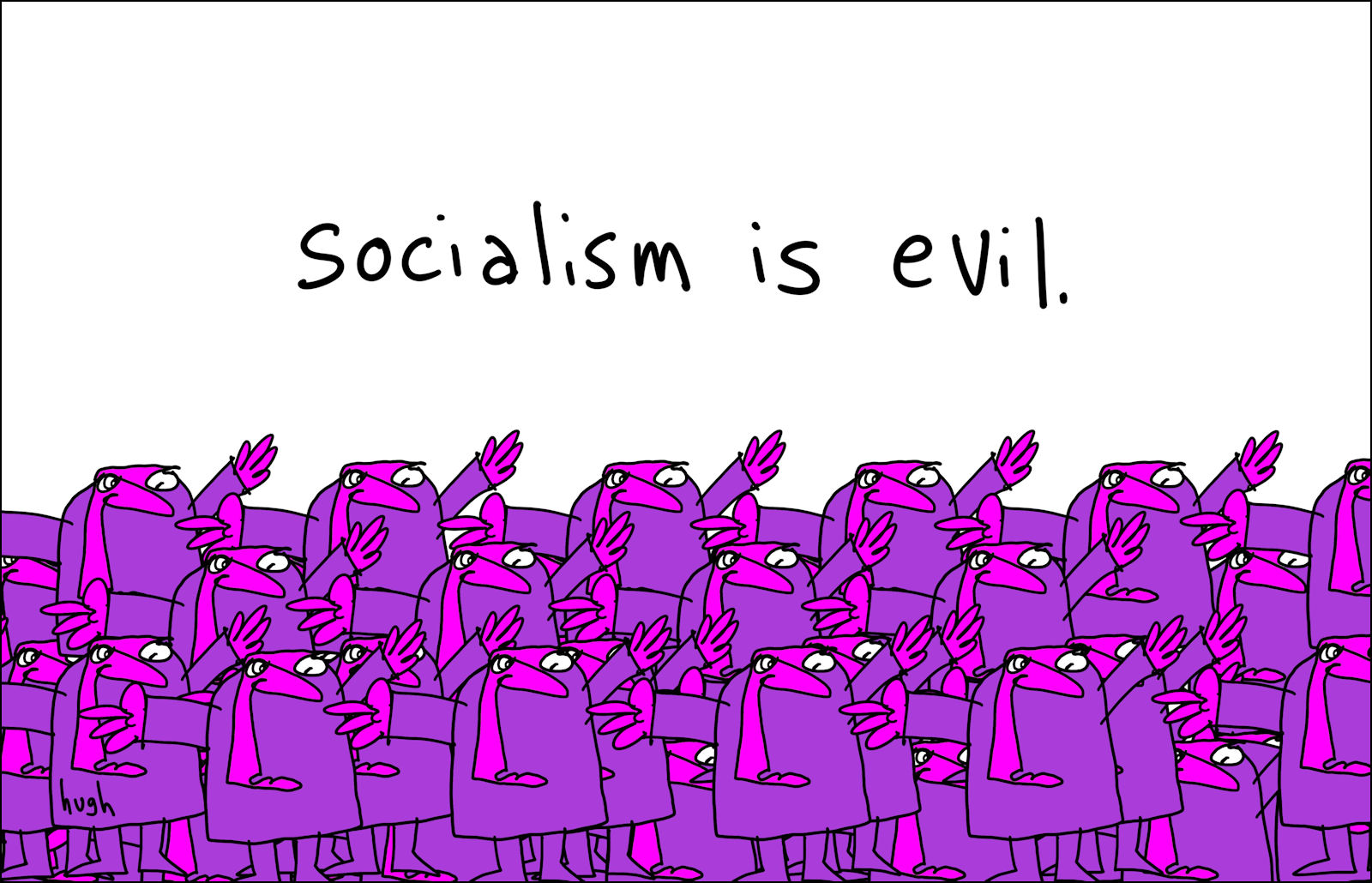
Graphic from gapingvoid.

Do the American people like socialism
as long as we don’t call it that?

By Ted McLaughlin / The Rag Blog / October 11, 2010

There is little doubt that for most Americans, “socialist” would be about the worst thing they could be called. Americans seem convinced that having a socialist system of economics (and it is an economic system — not a type of government) would be against everything America stands for. They feel this way because the word has been demonized for decades in this country by right-wingers and corporate interests.

Most Americans equate socialism with communism (a different economic system) and dictatorship (a type of government). The truth is that socialism has little to do with either one. I don’t think most Americans even know what socialism is. To them it is just an evil lurking in the shadows waiting to steal our freedom, something akin to slavery or tyranny.

But there is an interesting survey that tends to show we, as Americans, may be more afraid of the word than the reality. There’s no doubt Americans are afraid of the word, but the survey by Michael I. Norton of the Harvard Business School and Dan Ariely of Duke University shows that a huge majority of Americans may actually think socialism produces a fairer and better result than our own biased-toward-the-rich capitalist system.

Their survey, which included a large group of 5,522 American citizens, showed a couple of very interesting things. The first is that most Americans don’t realize just how out-of-whack the distribution of wealth is in America.

Survey respondents believed that the richest 20% of Americans control about 59% of the country’s wealth. The truth is much worse. In 2005, the richest 20% actually controlled about 84% of the wealth in America (and that percentage has undoubtedly grown in the last five years).

The authors of the survey then presented the respondents with three unmarked pie charts. The first showed an even 20% of wealth for each fifth of the population. The second showed the distribution of wealth in the United States. The third showed the distribution of wealth in Sweden (definitely a socialist country, where the richest 20% controls 36% of the country’s wealth). They were asked to choose which pie chart showed the most appropriate (fairest) distribution of wealth. Here are the results:

When asked to choose among all three charts
United States……………10%
Equal portions……………43%
Sweden……………47%

When asked to chose between Equal and Swedish charts
Equal……………49%
Sweden……………51%

When asked to choose between Equal and U.S. charts
Equal……………77%
United States……………23%

When asked to choose between U.S. and Swedish charts
United States……………8%
Sweden……………92%

It is interesting that a small majority of Americans chose the Swedish distribution of wealth over an exactly equal distribution of wealth. They were quite willing to accept that there will be some inequality in an economic system and thought the Swedish (socialist) distribution of wealth was the best possible outcome. But very few (8%) of the respondents thought the distribution of wealth created in the United States was fair or appropriate.

And even more amazing is that the preference for the Swedish distribution of wealth over the U.S. distribution of wealth cut across gender, party and income lines. Here is that breakdown:

Preferred the Swedish (socialist) distribution of wealth
Women……………92.7%
Men……………90.6%
Democratic voters……………93.5%
Republican voters……………90.2%
Make under $50,000……………92.1%
Make $50,000-$100,000……………91.7%
Make over $100,000……………89.1%

These lop-sided figures bring into question the supposed American hatred of socialism. It turns out that at least 90% of Americans would prefer the distribution of wealth created by a socialist system to the distribution our own capitalist system has created.

They may be afraid of the word “socialism,” but they believe the results of socialism are better — as long as you don’t use the “S” word to describe it. In other words, years of propaganda and scare tactics have frightened them into accepting a system they know is fair only for the richest few Americans.

Now I know that some will be screaming that socialism involves “income redistribution” — another term Americans have been convinced is a bad thing. But the truth is that there is income redistribution in all economic systems. In our form of rich-biased capitalism, that redistribution is to the richest citizens in the country from everyone else. In socialism, the redistribution is much fairer and more even.

Americans are really socialists at heart and believe in a fairer system of wealth distribution. They have just been convinced by decades of propaganda to vote against the their best interests of those of their fellow citizens, and that’s just sad.

[Rag Blog contributor Ted McLaughlin also posts at jobsanger.]

The Rag Blog

Posted in Rag Bloggers | Tagged , , , , , | 3 Comments

1. I’ve seen your name cited as being one of the original Rag founders and contributors — can you recall any specific details leading up to the decision to start the paper? Did you write for The Daily Texan beforehand? Were you a student at UT at this time?
2. How, in your opinion, did the Rag compare to other early underground papers?
3. Where was the Rag office (I understand it was originally published out of an old house near campus but then moved to a location on the Drag…the YMCA?) Can you describe what the office was like?
4. In retrospect, how, in your opinion, do you think the Rag was an agent of change for the times?
5. And, since my thesis is centered around the Drag, can you describe for me how the street played into this — how did it feel? How did it look? Who hung out there? Was there a sense of community on the Drag? Can you think of any specific instances involving the Drag that were memorable?

Posted in RagBlog | Leave a comment

Marc Estrin : Holocaust Thinking in America III: In the Here and Now

Creeping fascism in America. Graphic from LA Progressive.

Holocaust thinking in America III:
In the here and now

By Marc Estrin / The Rag Blog / October 11, 2010

[Part three of three. To read the entire series, go here.]

The end of last week’s essay: “Just in case there were any legislative objection to these judicial proceedings, Hitler pushed through the ‘Enabling Act’ which allowed his handpicked cabinet to make laws having the same validity as any passed by the Reichstag, even ones disregarding the Constitution. The circle was closed, complete and tight. The living dead would soon become the dead — period.”

Laws are being made here, too. And Presidential Enabling Acts, aka “signing statements.” And court seats being filled.

The cast of characters is somewhat changed. Instead of Jews, we have the poor and soon-to-be-poor, the homeless, the disabled, the aged, the immigrant “Other” — an open-ended, potentially unruly, group, getting larger with each job loss and foreclosure.

We have no Nazis, only Republicans and Democrats in Congress. Both parties agree that the foremost task is to eliminate the deficit, and both agree that the main hit will be on services to the poor, without tapping the military budget or corporate welfare. Both agree that taxes for the most part need to be cut — it’s good for getting re-elected.

Asses and Pachyderms (from Gr: “thickskinned”) may argue over numbers or priorities, but the fundamental assumptions — and the potential victims — are precisely the same. And outside the beltway is a population of Good Americans, voting their pocketbooks, not paying much attention to details evolving inside. How could they? All they know is what the government- and corporate-controlled media choose to tell them.

All the propensities of the Authoritarian Personality are still at large in this social consciousness, along with the tendency to behave as Milgram’s subjects did with respect to “legitimately constituted” authority. Weber’s analysis accurately describes what is going on today: bureaucracy, science, efficiency, and value-free thought running the show in the interest of “Progress” and “Freedom and Democracy” — and maximization of profit.

Social forces and individual thought habits are distressingly similar to those in Nazi Germany. The poor and the “Others” are as despised as were the Jews. Helping them is as verboten. There are no cultural safeguards in place which would prevent a holocaust-like social cannibalism, a society-wide suspension of morality with regard to the designated “problem.”

There would be no help on a global level, either, since every national state claims the right to dispose of its citizens as it will, starving them, imprisoning them, executing them as it finds necessary. The United States refuses to recognize judgments of the World Court except when such judgments suit its purposes, and refuses to ratify several international treaties concerning human rights.

International objectors like Amnesty International are delegitimized as “interfering in the internal affairs of sovereign nations.” The legitimacy of national sovereignty is built into the United Nations. Besides, who would take on the United States, militarily or economically for any mere human rights issue?

Thus, all the pieces are in place for another holocaust — this time against the poor and “Other.” Native racism adds to the potential, since — no surprise — many of the poor are immigrants and people of color, and code words overlap: “End welfare as we know it” = “Get the minorities under control.” Hence the ominous double significance of our move toward prison expansion. The U.S. already has a far greater percentage of its population behind bars than any other industrial country — the highest in the world. The vast preponderance of prisoners are poor people of color.

A comparative check on where we are now in the six historical steps above is sobering — and frightening.

Step 1. Defining the enemy. The poor are clearly defined as “the problem.” Not the profit-driven economy. Not the culture of violence. Not the controlled information system. Studies focus on the pathology of the “underclass.” The Poor are the problem. They are “other” to “normal Americans.” Consequently they must to be “dealt with.” Highest priority : “excess” population, a drain on the nation, unviable.

Step 2. Eliminating the enemy from the economy. By national policy, there are fewer and fewer jobs available to the poor, and fewer and fewer salaries that could raise a family out of poverty. Wall Street is bailed out, while money for public sector employment is denied, and corporate profits recover, with CEOs reaping massive benefits at taxpayer expense. Education funding is similarly squelched, so that the problem army of the poor can only swell. “Otherness” is increased as the media focus in on the predictably rising problems of crime, the inner city, and immigrant workers, ignoring problems elsewhere, and their root causes.

Step 3. Ostracism by custom and law. It is frightening to make such a list, but almost every step taken by the Third Reich has some parallel here and now — with no built-in limits:

  • Laws passed by Congress can be overridden by executive orders, presidential “findings,” National Security directives, or simply aborted by not disbursing committed funds.
  • Courts are routinely packed with obedient federal appointees. The current composition of the Supreme Court is the biggest scandal of all. Legal rights of poor defendants are being systematically reduced, and money for good lawyers diminished.
  • The current push in Congress is for law to serve the state and its rich financiers at the expense of individuals. Corporate personhood triumphs. Eavesdropping technology and “anti-terrorism” stand guard at the gates. The government moves to limit consumer and environmental protection. These laws are being made deliberately, without even pretending to be a democratic response to the will of the people. There is increasing governmental readiness to evade constitutional law
  • The many Nazi restrictions on employment are all replaced by the fact that — for the poor and uneducated above all — there are simply no jobs. Affirmative action is increasingly questioned. The situation has worsened catastrophically with jobs exported and capital flight, and its attendant dog-eat-dog resentments. With no money for private transportation, no money for parking, and increasingly expensive, inadequate public transportation, the poor are deprived of the mobility necessary to find and maintain employment — even if there were employment to be had.
  • Municipal services are neglected or abandoned in poor neighborhoods, and the police remain an occupying army, protecting and serving the threatened rich. Consequently, living conditions and ghettos become ever more intolerable.
  • Student loans are being cut at the same time that tuitions are skyrocketing. Thus education increasingly excludes the poor as effectively as discriminatory laws did the Jews. Without an educated workforce, the vicious spiral continues downward.
  • “Economics of scale” are driving out smaller, local businesses in favor of large corporate operations — if they even choose to locate in poorer neighborhoods.

Remember: such policies are not accidents. They are designed and signed by upper-class men and women, and approved by well-prepped voters.

Step 4. Removal from view. In addition to long-existing ghettoization, foreclosures on housing toxically mortgaged, and increasing inter-racial suspicion, many municipalities are now enacting draconian laws to “get the poor out from under our noses.” Sleeping in public spaces, panhandling, even accepting free food have been criminalized.

Here in Burlington, Vermont, an ordinance was floated to make it illegal to sit in a street, or even lean against a building. When there are no more poor on the streets or in the subways, how will we know when there are no more poor at all? As the plight of the poor is made ever more intolerable, radical solutions become ever more thinkable.

Steps 5 and 6 — Slave labor and death camps have not yet been literally established. Nevertheless there is recognizable social movement in that direction. Prisons are currently the greatest growth industry, and there is increasing practice of substituting prison labor for outside workers — at substantially smaller wages. As a co-worker once said to me, “Why should I support those criminals? Let ‘em earn their keep.” (She would also kill everyone on death row right away, so that her taxes wouldn’t be used to support murderers.)

Great for profits, terrible for labor, further incentive to put as many people behind bars as possible. And the attachment to capital punishment continues. Less legal protection for prisoners, less chance for appeal, more designated-capital crimes, destruction of habeus corpus and Miranda protections in the name of “fighting terrorism”; micro-fascism at the airport, greater surveillance, and now Obama giving himself permission to assassinate Americans without trial — all to general public approval.

Given the above array of conditions, what can we surmise about the likely American future?

Holocaust thinking in America

There is a scent of pre-holocaust in the air. It is a mood, a direction faced, a lingo, haze of assumptions. And look! — there is a Jack-in-the-box with a box’s six sides: authoritarianism, consumo-conformity, efficiency, moralism, patriotism, and a penchant for punishment.

Turn the crank:

All around the mulberry bush
the monkey chased the weasel,
the monkey thought ‘twas all in fun…

Now just hold it there. What will pop out at the very next move?

We don’t really know. The mind rebels. Tens of millions of children in poverty experiencing a “greater sense of personal responsibility”? Welfare cut-offs flooding an already non-existent job market getting people “back to work”? Or giving them back their “self-esteem”?

There is discontinuity in the curve of thought here — except for one constant — it is definitively the poor and “Other” that are poised to fall off the line into god-knows-what abyss. And the numbers of those impoverished are growing as the middle class shrinks away into unknown territory.

The number of officially poor is now over 45 million, higher than at any time in the 51 years of counting. 2009 saw the largest increase ever. The most vulnerable families are those headed by single mothers, and among them the hardest hit are those headed by single women of color. Two-thirds are employed.

But in addition to chronic low wages, many single mothers have seen their work hours cut in the recession. The number of Americans on food stamps is at an all time high, and the Republicans want to cut into those food stamps in order to “fund childhood nutrition.”

One out of every seven mortgages is delinquent or in foreclosure, 10 million Americans are on unemployment, more than half of them in long-term joblessness. Bankruptcy filings have risen 20% in the last year. One out of every five children lives in poverty.

Even though there are six people applying for every available job, the new “welfare as we now know it” (Temporary Assistance to Needy Families) insists that one has to find a job in order to continue benefits. So since there are no jobs, TANF is eliminating benefits for 85,000 families a month, even as the destitute swamp welfare offices, having exhausted all other options. Obama wants his administration to “break the cycle of dependency,” dontcha know.

Where have the jobs gone, the money? The current income gap is the largest its been since the late 1920s, the result of a long series of policy decisions by legislators bought and paid for by the high-class bandits making out. The race to the bottom is fueled by a race to the top. The dynamics seem irreversible.

The assault on America is a bipartisan operation. Whatever their deceitful rhetoric, neither party is willing to place serious limits on corporate speculation and profitability. Neither will question the need for public austerity and private profit, nor the enormous damage done by the military industrial complex.

The Republican’s current “Pledge to America” is most importantly a call to continue the Bush tax cuts for the rich to maintain the income gap and protect its well-heeled beneficiaries. Secondarily, it is a plan to repeal even the pathetic Affordable Health Care Act, itself written by lobbyists from insurance and pharmaceutical companies.

Even while in the minority, the Republicans have blocked benefits for homeless vets, health care for 911 first responders, a jobs bill that gives tax breaks to companies hiring new employees, an act to ensure women are paid the same wages as men, have tried to block unemployment benefits extension, and have succeeded in blocking stricter regulations for financial institutions. Their ultimate goal, often stated, is privatization of Social Security, Medicare and Medicaid. The Democrats have put up no fight in the interest of “compromise.” Is there a pattern here?

Such an immiseration project must be protected by spreading fear of “terrorism,” and the use of illegal spying now openly practiced, with sweeping new regulations for the internet. Robert Mueller, director of the FBI has stated that, “There is a continuum between those who would express dissent and those who would do a terrorist act.” One spokesperson from an FBI/police “information fusion center” claimed that the protest of a war against “international terrorism” is itself “a terrorist act.”

The USAPATRIOT Act (Uniting and Strengthening America by Providing Appropriate Tools Required to Intercept and Obstruct Terrorism — first prize for acronyms) stands behind him. And for good measure, Obama has come up with approved “kill lists” of suspected terrorists — including Americans — he claims he can exterminate with impunity. The final solution, no doubt.

Holocaust and totalitarianism

Many of the classic structures of a totalitarian state are already in place in contemporary America, Land of the Free. Many new ones, too — modern and post-modern. Official lawlessness no longer bothers to hide itself, and is tolerated or approved by the population at large. Criminal investigations into state crimes are blocked in the interests of “national security.” Checks and balances among the three branches of government have been manipulated into a seamless, self-validifying whole. Make that four, as the media becomes ever more embedded in the corporate beltway.

But while totalitarianism is almost certainly a necessary context for holocaust, genocide, nakba, shoah, it is not a sufficient condition: the cooperation of the population is necessary. And that is where the Milgram Experiments come in (see part one of this essay ). When the authorities say “do it!” — a population of authoritarian personalities, born and bred, will do it.

American murder, massive and limited, even if openly criminal, seems to have widespread support by a swamped population, ready to lash out at designated victims. Americans know about torture of detainees in hidden prisons. They know of American slaughter in Iraq and Afghanistan, even if they are only discovering such activities in Pakistan, Yemen, Somalia and well-supported in Palestine. Hey, freedom isn’t free.

They know, too, about the slave labor of prisoners, and of undocumented workers, frightened and hiding. Let the torture, war, and racist attacks proceed, I guess, if USA is once again to be Number One. Gott mit uns!

Should some object, they, like Germans in the Thirties, will find no levers of change in their much-vaunted political process, all of whose candidates stand behind the American project of victory, “democracy,” and control of resources. As Jay Gould said back in the 1880’s, “I don’t care who they vote for as long as I get to pick the candidates.”

And those candidates are — with notable exceptions — no dummies. They can see as clearly as anyone the general direction in which we are headed. Why else reduce or remove the safety net for Americans while pouring trillions into armaments, corporations, and banks? A group — the poor and Other — has been identified as the problem and the need for a “solution” given highest priority — Step 1, above.

Now we are poised at the edge of the precipice. “Terrorism” and its attendant and well-tended-to fear, make Step 2 certain: they virtually guarantee that most people will not be able to make the transition into productive work. They further assure galloping immiseration of the poor as they are cut off from food and cash assistance, childcare, and nutrition for their children. The consequent desperation will require more policing, desperate, more “final” and effective solutions, solutions which can ensure that the misery of the poor does not inflict itself on the top 10%.

Steps 1 and 2 have been taken. Steps 3 and 4 are underway. The smell of holocaust is in the air. Our civilization provides no safeguards. The Zweckrationalität dynamic described by Max Weber — the very one that nourished the Jewish holocaust in a most civilized, advanced-industrial Germany — still rules. Is it realistic to say “It can’t happen here”?

We have the Jewish holocaust behind us, and the words “Never Again” engraved in our collective heartminds. But our own history — previous and subsequent to the holocaust is not reassuring. Native Americans were wiped out to make room for middle America. “Pioneers” were rewarded by the government with land deeds for expropriating Native American territory and violating treaties. It is not necessary to go over the “social suspension of morality” with respect to African Americans, or the atrocities committed during the Civil War.

In our own time, we have seen World War II with its mass firebombings and atomic attacks, then two more wars, wiping out gooks with high-tech weapons. They don’t value life like we do. Just to keep our hands in it, we buried Iraquis alive and incinerated fleeing columns of troops with gas-air explosives. And now our middle-east atrocities. I don’t have much faith in home-grown American morality resisting commands to solve a problem by slaughter.

Richard Miller notes that

Most Germans did not believe the final steps would be taken. They saw each measure as a discrete event and failed to understand that each step prepared the way for the next. The SS journal Das Schwarze Korps noted in 1938, “What is radical today is moderate tomorrow.” In 1933 the Nazis had no plan to kill all the Jews, and even militants would have shrunk in horror from such a suggestion.

Gradually, over the next decade, “reasonable people” found that they had to become a little harsher. By 1943, the context of the war against Jews had escalated to the point where warriors could blandly pass bureaucratic memos back and forth about behavior that would have seemed unconscionable in 1933. “ (Nazi Justiz, p.3)

Our leaders are now passing such notes, and setting in place such laws concerning our current “Others.” Proposals are being negotiated which would have horrified officials of earlier administrations. This is our 1943. Will we allow a similar denouement? It can happen here.

[Marc Estrin is a writer and activist, living in Burlington, Vermont. His novels, Insect Dreams, The Half Life of Gregor Samsa, The Education of Arnold Hitler, Golem Song, and The Lamentations of Julius Marantz have won critical acclaim. His memoir, Rehearsing With Gods: Photographs and Essays on the Bread & Puppet Theater (with Ron Simon, photographer) won a 2004 theater book of the year award. He is currently working on a novel about the dead Tchaikovsky.]

Also see:

The Rag Blog

Posted in Rag Bloggers | Tagged , , , , , , , | 2 Comments

Paul Krassner : An Open Letter to Barack Obama

Image from GetReligion.org.

Listen to Thorne Dreyer‘s two-part interview with author, journalist, and legendary satirist Paul Krassner on Rag Radio here and here. To find all shows on the Rag Radio archives, go here.

‘Eat, pray, be disappointed’:
An open letter to Barack Obama

By Paul Krassner / The Rag Blog / October 11, 2010

Dear President Obama,

It seems that the theme emanating from the White House is “Eat, Pray, Be Disappointed.” And yet, whenever I do feel disappointed, I always realize that the alternative was John McCain, with Sarah Palin just one Halloween “Boo!” away from the presidency, and then I always feel a sense of relief.

Actually, you’ve kept one big campaign promise — to send more troops to Afghanistan — so I guess we can’t fault you for that. In fact, according to Bob Woodward in Obama’s Wars, all you want to do now is get out of Afghanistan. Well, why don’t you just do what Osama bin Laden did; cross over to Pakistan. Since we bribe Pakistan to be our ally, you’d think they would never consider harboring bin Laden, though they reek with empathy when our outsourced drones drop those bombs.

Also, during the campaign you said you believe that the legality of same-sex marriage should be decided by the states, but that you personally think marriage should be between a man and a woman. Which is exactly the position that caused Miss USA, Carrie Prejean, to have her crown revoked.

And another thing. You promised to end the raids on medical marijuana dispensaries, but they haven’t stopped. Here’s how I understand Washington. America’s puritanical political process serves as a buffer between the status quo and the force of evolution. For instance, in order to get Republican votes for the children’s healthcare bill, Democrats agreed to fund $28 million to their abstinence-only program.

And, during your own campaign, you admitted, in the context of health care reform, that the multinational insurance conglomeration is so firmly entrenched that you would be unable to dispense with it. So there would have to be compromises.

Now, what with the compromises made to help passage of Prop. 19, amnesty becomes the single-payer system of marijuana reform, and growing your own pot becomes the public option. Meanwhile, as long as any government can arbitrarily decide which drugs are legal and which drugs are illegal, then anyone serving time for a nonviolent drug offense is a political prisoner.

In his new book, Bob Woodward writes about Colin Powell’s status as an adviser to you. Referring to his previous book, Plan of Attack, The New York Times then reported that “Secretary of State Colin Powell disputed Woodward’s account… He said that he had an excellent relationship with Vice President Dick Cheney, and that he did not recall referring to officials at the Pentagon loyal to Cheney as the ‘Gestapo office.’”

Who among us would be unable to recall uttering such an epithet? Powell later apologized for it. He has also changed his mind about gays in the military. In my capacity as a stand-up satirist, I used to conduct an imaginary dialogue with Powell.

“General Powell, you’re the first African-American to be head of the Joint Chiefs of Staff, and you come from the tradition of a military family. So you know that blacks were once segregated in the Army because the other soldiers might feel uncomfortable if blacks slept in the same barracks. And now that’s what they say about gays, that other soldiers might feel uncomfortable about gays sleeping in the same barracks.”

“Well, you have to understand, we never told anybody we were black.”

And, Mr. President, that was the forerunner of the same “Don’t ask, don’t tell” policy that you promised to rescind, only you haven’t been acting like a Commander-in-Chief. All you have to do is sign such a directive. Those who serve in the military are trained to follow orders. If they can follow orders to kill fellow humans, they can certainly follow orders to treat openly gay service people with total equality.

Not only is the current guideline counterproductive, but also this display of trickle-down immorality must, on some level of consciousness, serve as a contributing factor to enabling the anti-gay bullying and torturing of innocent victims. I know, you don’t want to take a chance that retracting the policy would interfere with your re-election. You’ve made the point that you don’t want Mitt Romney to win in 2012 and turn around all the good things you’ve accomplished.

Incidentally, Romney had wanted to overturn Roe vs. Wade, yet, in 1994, when he was running for the Senate, he came out in favor of choice for women. However, freelance journalist Suzan Mazur revealed that he admitted to Mormon feminist Judith Dushku that “the Brethren” in Salt Lake City told him he could take a pro-choice position, and that in fact he probably had to in order to win in a liberal state like Massachusetts. Pandering trumps religious belief.

If gays and lesbians have waited this long for basic fairness, they might as well just wait for the next election. If you win, then would you kindly do immediately what you believe is right, constitutionally and in your heart, and end this injustice? The ultimate irony is that gays in the military are fighting and being maimed and dying unnecessarily, all supposedly to protect the freedom that their own country is denying them.

Sincerely,

Paul Krassner

[In December, the writers organization PEN-West will honor Paul Krassner with their lifetime achievement award. (He beat out Levi Johnston.)]

The Rag Blog

Posted in Rag Bloggers | Tagged , , , , , , | Leave a comment