Ed Felien : Jon Stewart, Meet George W. Bush


In defense of the Left,
with love to Jon Stewart

In trying to appear a moderate, Stewart criticized the right for its attacks on Obama and the left for accusing Bush of being a war criminal and comparing him to Hitler.

By Ed Felien / The Rag Blog / October 5, 2010

In a stroke of comedic genius Jon Stewart has called for a “Rally for Sanity” to “Take it down a notch” at the Washington Monument on October 30.

It’s part an answer to Glen Beck’s rally to Restore Honor and part Rock the Vote to motivate his younger demographic to get out and vote on November 2. Stewart is portraying the rally and himself as an island of sanity in an insane season when Obama is seen by the Right as a Kenyan Mau-Mau anti-colonialist, socialist, Muslim hell-bent on America’s destruction.

One of the suggested signs for demonstrators at Stewart’s rally would be, “I Disagree With You, But I’m Pretty Sure You’re Not Hitler.”

In trying to appear a moderate, Stewart criticized the right for its attacks on Obama and the left for accusing Bush of being a war criminal and comparing him to Hitler.

Are there parallels between Hitler and Bush? Is Bush a war criminal?

There are parallels in American history, but the scope and intensity of the repression that Bush initiated and justified by 9/11 went further than any previous President in wartime.

He did not just suspend the right of habeas corpus, the right to a fair trial, and the right to confront your accusers, he kidnapped U. S. citizens and foreign nationals off the streets and locked them up in concentration camps and subjected them to torture. The difference between Bush and Hitler in this is quantitative not qualitative; that is, they both did it but Hitler did a lot more of it.

They both ruled by terror. Bush modeled his government on George Orwell’s 1984: War is Peace; the war on terror was really a war OF terror; The Department of Homeland Security (with its permanent orange level of terror alert) created insecurity.

Bush spied on citizens and wiretapped their phones without any legal or ethical justification. He asserted a doctrine of preemptive war that meant he could attack anyone or any country that he felt might become a threat to U. S. vital interests. He declared that his administration was not bound by international law or treaties.

If someone in the government disagreed with him, their careers were destroyed; former Ambassador Joseph Wilson wrote an op-ed piece for The New York Times that pointed out the lies in the State of the Union Address that were used to justify the invasion of Iraq, and Bush officials ended his wife’s career as a CIA analyst. Dissent is the lifeblood of democracy and Bush crushed it.

The Nazi Party in Germany was a variant of the European fascist movement. Benito Mussolini was the first successful fascist leader. He led his Black Shirts in a march on Rome in 1922 that changed Italian politics. In an act of sincere flattery, Hitler imitated it by staging an unsuccessful beer hall putsch in Munich the following year.

Mussolini said, “Corporato il stati.” The corporation is the state. Hitler believed capitalists should be “masters in their own house.” Bush has taken fascism a step further. Mussolini and Hitler merely supported big business while they were pursuing other national objectives, but Bush allowed his family business to direct government policy. In his case, the corporation really did become the state.

The Bush family fortune for four generations has been tied to the business of war. Ever since Great Grandfather Sam Bush sat on Wilson’s War Industries Board in World War I and made parts for Remington revolvers, the Bush family has benefited from war.

Sam’s son Prescott wanted to make serious money when he graduated from Yale, so he and some of his buddies went to work for Brown Brothers Harriman. Peace had broken out in the 1920s, and the only hope for war profiteers was in the re-arming of Germany (in violation of the Versailles Treaty).

He became Manager of the Union Banking Corporation to trade with Nazi financier Fritz Thyssen. They sold bonds to help finance the re-arming of Germany. They bought a steamship line to ship Remington arms to Germany through a dummy corporation in Holland. He also managed a Silesian coal field that used slave labor from the neighboring Auschwitz Concentration Camp. According to Dutch intelligence sources he took direct management of some of the slave labor camps in Poland to aid Nazi armament industries.

Prescott Bush continued working for these interests for almost a year after the U. S. had declared war on Germany. It was not until October of 1942, when the U. S. seized the assets of Union Bank, the steamship line, the Seamless Steel Equipment (suppliers of steel, wire and explosives to the Nazis) and the Silesian-American Company (the coal mining company), that Prescott stopped supplying the Nazi war machine. Of course, at that point he switched sides and started supplying the Allies.

In 1929 Harriman & Company bought Dresser Industries (manufacturers of oil pipeline equipment) and Prescott Bush became a Director. He continued to run Dresser Industries from the board for the rest of his life. His son, George H. W. Bush, went to work there after graduating from Yale. Dresser was quite successful in selling oil pipeline and drilling equipment. It had a virtual worldwide monopoly. The oil drilling equipment in Iraq belonged to Dresser (through their French subsidiary) in violation of U. N. and U. S. sanctions.

Using lies and distortions, George W. Bush used the tragedy of 9/11 to justify invading Iraq. He wanted control of the oil for his family business. Dick Cheney has always been the chief thug and frontman for the Bush family. When H. W. George was President, Cheney was Secretary of Defense. When Bush lost, Cheney became CEO of Halliburton.

While CEO he bought Dresser Industries from the Bush family (the details were worked out on a hunting trip) for $8 billion. No cash changed hands and Halliburton was only worth $8 billion at the time, so the Bush family must own controlling interest in Halliburton.

When George W. Bush became President he made Cheney his vice president, and with old family friend Rumsfeld as secretary of defense, they were able to steer multi-billion-dollar no-bid contracts to Halliburton. With the U. S. and Bush in control of the Iraq government, they were able to steal 25 percent of the world’s known oil resources for the family business.

When George W. Bush was President and head of the family business, we had the perfect merger of state and corporation, the final stage of fascism only dreamt of by Mussolini.

Was Bush a fascist? Was he a Nazi?

Certainly grandfather Prescott was an active and effective collaborator with the Nazis. But it wasn’t just the money. Prescott and his father-in-law, George Walker (for whom George I and George II are middle-named), sponsored the Third International Congress of Eugenics on Long Island in the early 1930s, and many of the proposals about forced sterilization and elimination of the feebleminded that were discussed at the conference were later implemented by Nazi Germany.

But is it fair that the sins of the grandfather should be visited upon the children? No. Even if he carries the name(s), even if he inherits the family business and fortune, even if he inherits the political base of fascist elements that were driven from Europe at the end of World War II and became the virulent anti-Communist wing of the Republican Party, he still deserves to be judged on his own actions.

Did he repudiate his family’s past connections to Nazi Germany? No.

Did he suppress civil liberties? Yes.

Did he rule by terror? Yes.

Did he embark on total war? Yes.

Did he allow his family business interests to direct government policy? Yes.

Finally, the shelling of Fallujah, the brutal murder of defenseless Iraqi civilians, has as its only parallel the Nazi atrocities at Guernica and Lidice.

Was Bush a Nazi?

We can be certain that history will judge Bush to have been corrupt, arrogant, dictatorial, and brutal. Whether the atrocities he committed place him in the same rank as Hitler is a judgment for later generations, but we would be blind not to see that he is in the same group.

He stands indicted as a petty tyrant, a small fascist who ran the biggest superpower the world had ever seen. The damage he did to the rule of law, to the public treasury, to the national character at home and the horror and suffering he inflicted on innocent people abroad are crimes against humanity. To remain silent is to be an accomplice.

Jon Stewart has a powerful and eloquent voice and a genius for a comedic irony. He could benefit from reading history a little more closely.

[Ed Felien is publisher and editor of Southside Pride, a South Minneapolis monthly.]

The Rag Blog

Posted in Rag Bloggers | Tagged , , , , , , , , | 1 Comment

Marc Estrin : Holocaust Thinking in America II: How the Nazis Did It


Holocaust thinking in America II:
How the Nazis did it

By Marc Estrin / The Rag Blog / October 5, 2010

[Part two of three. Read part one here.]

I know one is not allowed to use the word “nazism” in any discussion of current practices, that the holocaust is unique, etc., etc. — but if you don’t see the similarities between the structures put into place in Germany in the mid- and late-1930s and those evolving here, now, well then, you don’t see structural similarities.


National Socialist strategy

What were the moves the Nazis evolved to “overcome animal pity” with regard to Jewish victims?

Step 1. Defining the enemy. Jewishness was clearly and legally defined as part of a problem. Thus the Jews were made “other” to the rest of the population.

Step 2. Eliminating the enemy from the economy. Jews were not allowed to work in state-affiliated institutions. Jewish stores were boycotted and vandalized. “Otherness” was thereby increased, as the Jews were forced from the normal productive economy, and were now an ever-increasing problem — and not just by definition.

Step 3. Ostracism by custom and law. Many other discriminatory laws were put into place. No Jews allowed, here or there, this place or that.

Step 4. Removal from view. Ghettos were created to wall the problem off from the rest of the population. Jews thus became less visible. When they began to disappear, there was often little to notice. As intolerable conditions developed in the ghettos, inhuman measures were justified as humane. Jews were killed in “acts of mercy” — in order to “spare them the agony of famine.” In deliberately intolerable conditions, the stage was set for even more radical steps.

Step 5. Transport to slave labor camps, using these “outsiders” to support the economy.

Step 6. Transport to death camps. The “Final Solution.”

Tactics: Ostracism as a policy in Nazi Germany

To better make some later comparisons, let me provide more detail about Step 3 above: “other discriminatory laws.”

In his hair-raising book, Nazi Justiz (Praeger 1995), Richard Miller describes the gradual, multifaceted ways in which Jews were turned from productive members of society into a kind of “living dead” who were permitted to wander through society, but forbidden to take part in it. The mass killings in the camps was only a late development, the logical “final” successor of many incremental “solutions” inflicted along the way on an increasingly desperate people.

Miller concentrates on Germany in the 30s, after the rise of Hitler, but before the war, all changes affecting Jews were done “legally,” “democratically,” with support from the media and the German people. In this “time of peace,” a variety of local and national laws were passed, with due deliberation, in no way a result of military desperation. Across the country, jot by innovative jot, legal and social restrictions fell into place which sealed the victims’ fate.

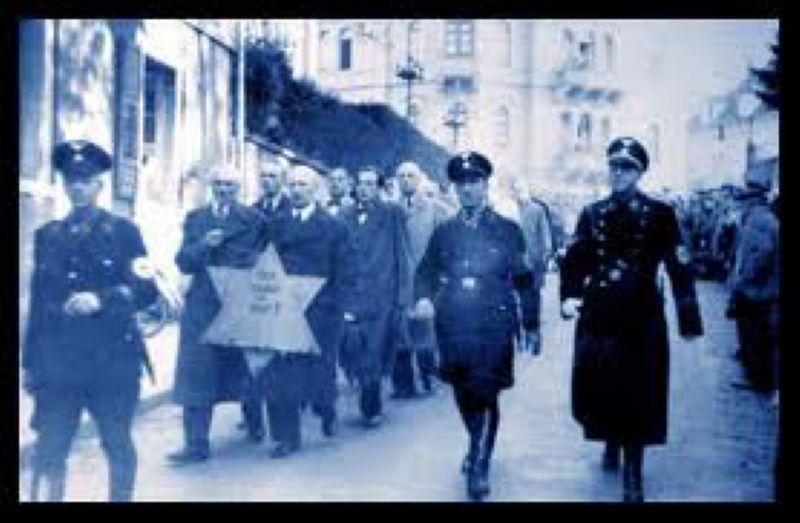
The movement began with “unofficial” boycotting of Jewish businesses or professionals. Boycotts spread to those who patronized Jews in any way, thus taking goods and wages away from good German citizens. Having a street conversation with a Jew could lead to charges of “race pollution” and “civic disloyalty,” and perhaps to being paraded through town, with a sign around one’s neck. Such “unofficial” boycotts were peppered with equally “unofficial” violence, of which Kristallnacht was the most coordinated example. Naturally, there was no police protection.

Having recognized a “mandate” from the people, governments began to act. A pastiche of creatively sadistic local law and ever more inclusive national law took control of Jewish life, and eventually obviated the need for “unofficial” populist action.

Place by place, Jews were not allowed in parks, theaters, libraries, museums, sports stadia, beaches, athletic and social clubs. They could not be guests in hotels, or get service at restaurants. One profession after another banned Jews from being licensed. Jews would no longer be granted permits to open retail stores, or be allowed into blue or white collar unions or the jobs they controlled.

They couldn’t be patent agents or lawyers, tax consultants or swimming instructors, lifeguards, jockeys, actors, lottery salesmen, stock brokers, antique dealers, archivists. They couldn’t rent out park chairs, or distribute motion pictures, or deal in art or literary works. They were prevented from dealing in currency, engineering construction projects, selling guns.

No Jew could be a detective, private guard, accountant, or work in a credit agency. No Jew could be a tourist guide, a peddler, auctioneer, or real estate agent, or manage a factory, house, estate, or land. Needless to say, all the new business and newly opened job opportunities went to Aryans, vastly increasing the popularity of the Nazi regime. Jobs, jobs, jobs. And housing.

In areas where Jews were not yet banned, other ways were found to shut them down. Before real estate licenses were outlawed for Jews, tax authorities refused to deal with Jewish agents, leaving few property owners interested in hiring them. Sugar was cut off to Jewish bakers and candy-makers, effectively destroying their businesses.

Legal Jewish newsstands would be refused newspapers; Jewish textile managers could no longer get raw materials. Jewish businesses could not put ads in commercial directories, newspapers, on billboards or the radio. Eventually all employment was restricted except particularly disagreeable tasks: cleaning public toilets and sewage plants, jobs at rag and bone works were considered possibly “suitable” for Jews. Outside of such work, Jews had to somehow fend for themselves.

How could even that be made more difficult? Travel bans and invalidation of passports were obvious. But how about no parking for Jews? Special license plates to identify Jewish cars for special harassment. Soon enough, prohibition of drivers licenses, and then restriction from public transportation.

Impoverished Jews could not rent their homes, sublet, or sell. Retirement benefits and contracted pensions were canceled, as were all insurance policies. Jewish students were not allowed to take finals, and so couldn’t complete their schooling. All student loans had to be repaid within two weeks, regardless of contractual payment schedules; those in default were subject to police action.

Jewish streets were not cleaned, nor were other municipal services available. German police, when present at all, were an occupying army, and beatings and attacks were common. Many main sections of towns became off-limits to Jews, and any remnants of Jewish culture came under attack: Jewish art and music were censored as “decadent,” and even jazz was attacked as “a barbarian invasion supported by Jews.”

Because Jews were to be restricted from so many areas, they needed to be easily identified. Rush-hour passengers were not about to tolerate checking IDs of every boarding passenger. Eventually the yellow star was required, with strict punishment for any Jew who did not wear one in public. Jews were forbidden to name their children with “Aryan sounding names,” and had to adopt the middle names “Israel” or “Sarah,” and use these names when identifying themselves.

Germany has long been known as a land of “law and order.” But Jews could not use the justice system to thwart clearly illegal onslaughts. All courts were packed with government appointees to enforce, not judge, official policy. The object of the law was to protect the state, not the individual citizen. If Jews were a menace to the state, then all laws oppressing them, were both legal and just.

Furthermore, laws were seen as implying “direction,” and were not confined to their original settings. For instance the Law for the Restoration of the Professional Civil Service spoke only of dismissing Jewish government employees. Martin Heidegger however, as rector of the University of Freiburg, ended fellowship payments to Jewish students under the guiding spirit of that decree.

Courts built rulings on Nazi party resolutions, and took their philosophical guidance from Hitler speeches. In 1934 Goering complained that defendants still had so many rights that convictions were being impeded. Naturally, Jewish defendants were at an extreme disadvantage.

Jewish lawyers were barred from court; Aryan lawyers could not serve Jews. Consequently, Jews had to represent themselves against highly trained adversaries. Judges were instructed to view Jewish witnesses “with extreme caution,” and no verdict was to be passed when a sentence would have to be based entirely on Jewish testimony.

Just in case there were any legislative objection to these judicial proceedings, Hitler pushed through the “Enabling Act” which allowed his handpicked cabinet to make laws having the same validity as any passed by the Reichstag, even ones disregarding the Constitution. The circle was closed, complete and tight. The living dead would soon become the dead — period.

Next week: You don’t need a weatherman to tell which way the wind blows — here and now in America.

[Marc Estrin is a writer and activist, living in Burlington, Vermont. His novels, Insect Dreams, The Half Life of Gregor Samsa, The Education of Arnold Hitler, Golem Song, and The Lamentations of Julius Marantz have won critical acclaim. His memoir, Rehearsing With Gods: Photographs and Essays on the Bread & Puppet Theater (with Ron Simon, photographer) won a 2004 theater book of the year award. He is currently working on a novel about the dead Tchaikovsky.]

Also see:

The Rag Blog

Posted in Rag Bloggers | Tagged , , , , , , , | 2 Comments

Suzy Khimm : Gerrymander This, Tom DeLay

Cartoon from The Hill, 2007.

Tom DeLay’s legacy:
Don’t mess with Texas Democrats

DeLay may have done more to fuel the Texas Democratic comeback than anyone else. ‘It took somebody that really played the villain role,’ says [Matt] Angle.

By Suzy Khimm / October 5, 2010

[The following article appears in the September-October issue of Mother Jones .]

You could say that Matt Angle has something of a vendetta. He worked for Rep. Martin Frost — once the most powerful Texas Democrat in the U.S. House — for the bulk of his adult life, starting as an intern in 1981 and rising to become the lawmaker’s chief of staff. Angle even met his wife, Dolly, while working in Frost’s office.

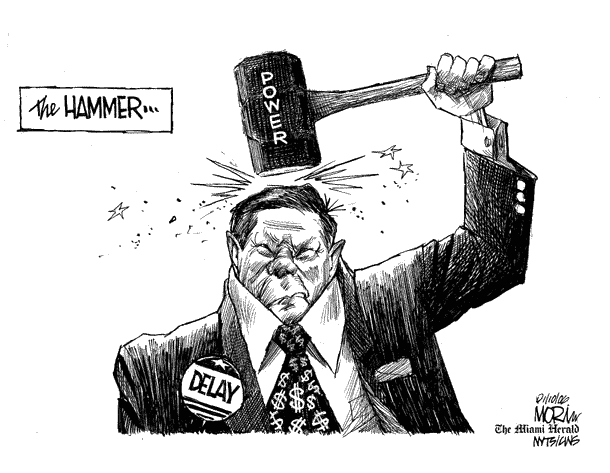
Then one day about six years ago, both Angle and his boss found themselves out of work, courtesy of then-House majority leader Tom DeLay. The Texas Republican, known as “The Hammer,” had orchestrated a Machiavellian scheme to redraw the state’s congressional districts and banish Democrats from power. In 2004, Frost was one of four Texas Dems in the House picked off as a result.

Redistricting typically happens every 10 years, to capture the population changes recorded by the U.S. Census. In most of the country, state lawmakers ultimately decide how congressional district boundaries in their state are drawn.

DeLay’s plan entailed engineering a Republican takeover of the Texas statehouse by strategically funneling money into key legislative races using his political action committee, Texans for a Republican Majority (TRMPAC). Having won a majority in Austin in 2002, DeLay’s allies managed to ram through a redistricting plan in 2003, even though it was a non-Census year, alleging that the plan based on the 2000 Census results had unfairly favored the Democrats.

DeLay ultimately went down for his efforts — resigning from Congress in 2006 under indictment for illegally using corporate contributions to fund TRMPAC — but his scheme capped his party’s 40-year ascendancy in Texas, where the GOP has seized every lever of power in a state that was solidly blue for the prior century.

“A political crime had occurred,” Angle says gravely, arguing that the 2003 redistricting particularly disenfranchised minority voters — the heart of the Democratic base in Texas. So the 52-year-old operative has spent the past six years working to avenge DeLay’s power grab, devoting himself to helping Texas Democrats recapture the statehouse and governorship in time for the 2011 round of redistricting.

Matt Angle. Image from Washington Post.

To this end, Angle has co-opted elements of DeLay’s playbook, creating a small but well-funded network of political organizations to channel money — all legitimate, he hastens to point out — into statehouse races. The ultimate goal? To turn the reddest of red states blue.

Nationally, Democrats are executing similar strategies to win back majorities in swing states like Tennessee, Michigan, Missouri, and Oklahoma — majorities that, along with key governorships, give them the power to help redraw the map. But in Texas, success would be especially sweet — and now, their resources of cash, organizing, and optimism replenished, Texas Dems are presenting the biggest challenge the state’s GOP has faced in decades. Down 14 seats in 2004, they are currently within 3 of capturing a majority in the statehouse. They even have a shot at unseating GOP Gov. Rick Perry.

Much of this wouldn’t have been possible without Angle — and without the late Fred Baron, a Texas lawyer whose hefty donations to Democratic causes led some to dub him “the Texas George Soros.” Together, they created a state-based organization with a single clear mission: Help Democrats take Austin in five years.

Angle’s Texas Democratic Trust toils in the unsexy, nuts-and-bolts work of elections: developing 12 million voter files to target likely supporters, crafting sharper opposition research, and paying the salaries of Democratic Party staff members.

Primarily bankrolled by Baron — who donated some $5 million — the Trust has raised nearly $12 million since its founding in 2005. State Rep. Jim Dunnam, the House Democratic Leader, remembers meeting with Baron shortly after the group launched. “He came in and said, ‘Y’all don’t worry — we’ll make sure the bill gets paid.'”

The Trust has since poured $1.3 million into Dunnam’s House Democratic Campaign Committee and $4.6 million into the Texas Democratic Party itself. The results speak for themselves: In 2006, Texas Democrats elected six new state reps and successfully protected the seats of all of their incumbents.

By 2008, they had picked up five more state House seats and made gains in the state Senate — and four of the state’s most populous counties swung blue in the presidential race for the first time since 1964.

Though his rich backers and insider status have allowed him to loom large, Angle has hardly been alone in helping Texas Democrats find their way out of the wilderness.

Annie’s List, which supports pro-choice Democratic women, has provided financing and staff support to two-thirds of the Texas Democratic lawmakers who’ve won since 2004. In the current election cycle, the state’s major progressive groups have thrown their resources behind at least seven Democratic challengers in swing districts.

Bolstered by such efforts, the Texas Democratic Party has gained new credibility after years of being written off. Its recent gains have even fueled speculation about when (not if) the state will flip blue in a presidential contest — perhaps as early as 2016, if you listen to the hopeful.

“If you had said before that Texas can be in play in five or six or seven years, they would have laughed you out of the room,” says Harold Cook, a political consultant who’s worked with Angle. “We’ve beaten them back.”

In retrospect, DeLay may have done more to fuel the Texas Democratic comeback than anyone else. “It took somebody that really played the villain role,” says Angle, pointing out that DeLay’s power grab motivated Texas Democrats to get their acts together.

It was a lesson Angle first learned in the years after the 1994 Republican takeover of Congress, when he served as executive director of the Democratic Congressional Campaign Committee (DCCC). “The thing that helped the Democrats was that [GOP House Speaker Newt] Gingrich made himself into the villain that they needed,” Angle says.

Working with the DCCC also helped connect Angle with the elite circle of Texas donors who’ve backed the Trust and its sister organizations: the Lone Star Project, an opposition research outfit originally launched to investigate DeLay, and an affiliated political action committee.

In addition to Baron and his wife, who’s donated more than $800,000 to the Trust since her husband’s death in 2008, Angle has tapped other high-powered contributors, including the cofounder of the Container Store.

Texas Republicans have seized upon Angle’s wealthy financiers to paint the Texas Democrats as an elite party backed by trial lawyers like Baron, who is best known for paying for John Edwards’ mistress, Rielle Hunter, to relocate during the presidential campaign.

“It can be an Achilles heel,” admits Mike Lavigne, a former executive director for the Texas Democratic Party. He also cautions that Texas Democrats may have become overly reliant on Angle’s well-funded operation. “The state party needs to be self-sufficient — they need to have the ability to raise money.”

Win or lose, the Trust’s five-year mission comes to an end following the midterms, and the state Democratic party is scrambling to prepare for the day when the money spigot runs dry. The party’s been working to make up the difference with small donors, says chairman Boyd Richie, though he admits, “We’re not 100 percent there yet.”

But for Texas Dems, there are more immediate concerns. They face the same political headwinds that have dampened Democratic expectations nationwide. If the party fails to win the governorship or boost its seat count, it could again find itself without a say as the GOP draws district lines in 2011.

As Angle and his allies work to erase DeLay’s gerrymandering legacy, they’ve been able to take some consolation in the fact that the highlight of the Hammer’s post-Congress career has consisted of an ill-fated appearance on Dancing With the Stars. But his ultimate comeuppance may arrive at the polls in November.

[Suzy Khimm is a reporter in the Washington bureau of Mother Jones. E-mail her with tips and ideas at skhimm@motherjones.com.]

Source / Mother Jones

The Rag Blog

Posted in RagBlog | Tagged , , , , , | 1 Comment

Rebellious Pixels : Right Wing Radio Duck (Video)

This is a re-imagined Donald Duck cartoon remix constructed from dozens of classic Walt Disney cartoons from the 1930s to 1960s. Donald’s life is turned upside-down by the current economic crisis and he finds himself unemployed and falling behind on his house payments. As his frustration turns into despair Donald discovers a seemingly sympathetic voice coming from his radio named Glenn Beck. — Will Shetterly / Boing Boing

Thanks to Carlos Lowry / The Rag Blog

Posted in RagBlog | Tagged , , , , | 3 Comments

Jonah Raskin : The California Cannabis Countdown

Supporters of Proposition 19 rally in Bay Area. Photo by Bill St. Clair / SF Weekly.

California counting down to November 2:
Marijuana initiative leading in polls

By Jonah Raskin / The Rag Blog / October 3, 2010

Thousands and thousands of words have been published in newspapers, magazines, and blogs — and broadcast on TV and radio stations — all over the word about Proposition 19 that would make it legal in California for an adult over the age of 21 to possess one ounce of weed, and to grow it for personal use in a 25 square-foot area.

The latest polls show 19 winning, not by a wide margin, but still by a comfortable margin. The polls have fluctuated all summer long and they may continue to fluctuate until Election Day, Tuesday, November 2, which is also the traditional Day of the Dead in Mexico.

I am planning to vote for 19, though I know that it is far from perfect, and though I know that even if it passes it will not end once and for all the prohibition against pot that has been in effect on a national level ever since the 1937 Marihuana Tax Act. (Yes, in those days the word was spelled with an “h,” as in the word “hell,” and not with a “j,” as in the slang word “joint.”)

Opponents of 19 include groups such as, not surprisingly, the California Beer and Beverage Distributors, and the California Cannabis Association, a group of medical marijuana dispensaries — despite the fact that the dispensaries have benefited financially, and indeed owe their very existence to the movement to legalize marijuana.

Moreover, no major politician in office or running for office has come out in favor of 19 — not Gov. Arnold Schwarzenegger, or ex-Governor Jerry Brown who is running for governor once again. His opponent is against it and so are the candidates running for the U.S. Senate.

Proposition 19 supporters rally in Irvine, California. Photo from ZUMA Press / Newscom / Christian Science Monitor.

What is obvious is that on the issue of the legalization of pot politicians are not on the same page as the voters. Hell, they aren’t even in the same book as the citizens of California, or in the same century. On the whole, they are hypocrites and cowards; some of them, such as Schwarzenegger, have even smoked marijuana and are still against it. The same holds true for the mayor of New York who has admitted to smoking pot and enjoying it — and is against legalization.

In the great desert inhabited by former California politicians, only Tom Hayden has come out clearly, forcefully, eloquently, and unambiguously for 19.

“I support the November ballot initiative because our country’s long drug war is a disaster and there is an alternative for our health, safety and democratic process,” Hayden said. “We need to consider carefully,” he added, “why the drug crisis is embedded in U.S. military campaigns — from the Golden Triangle in the Vietnam War era, to cocaine and the Columbia counterinsurgency and now to the current Afghanistan war, where 10,000 Europeans over-dosed on Afghan heroin during last year alone.”

Hayden does what few politicians do; he connects the war on drugs, including the war on marijuana, which has been waged now for about 100 years, to a global crisis. Indeed, while marijuana grows in our own backyards, and on native soil all over the United States, the politics and the economics of marijuana are connected to the whole world. The local is global and the global is local.

Yes, I am voting for Proposition 19 for most if not for all of the political reasons that Hayden gives. I am also voting for it for personal reasons. I have smoked marijuana for much of my life; I started in 1967 in New York. A Columbia Law School student who is now a judge turned me on for the first time.

For a decade in the 1970’s and 1980’s, I lived among the commercial pot growers of Northern California and wrote about them and their cash crop for High Times, the L.A. Weekly, and other publications. I also took my idea for a marijuana movie to Hollywood in 1980, and saw it eventually turned into a film called Homegrown.

I do not now nor have I ever considered myself a head or a stoner, but marijuana has wound itself around my life and around the lives of my friends, many of whom smoked it recreationally in the 1960’s and 1970’s, and who smoke it today for aches and pains, insomnia and arthritis, as well as to stimulate the appetite and just for pure pleasure. Who said that good old-fashioned getting high had to be a bad thing?

Deputies raid medical marijuana growers in California. Image from True/Slant.

Meanwhile, as the campaign for and against 19 goes on, as editorials are written and as advocates make speeches and hand out leaflets, the war on marijuana continues all over California. That is sad. That is tragic.

This year at least four marijuana cultivators have been shot and killed in California by deputies during raids on pot gardens. 2010 has been the most violent year that I know of in the war on marijuana. Many of the growers are armed. They have guns. That is true. But no grower has fired on a deputy. In fact, it has long been a rule of thumb among pot growers not to fire on deputies.

Besides, as most marijuana smokers know, smoking pot does not make users violent. It tends to calm smokers. Almost all of the pot farmers I know are also pot smokers and nonviolent individuals. Who are the violent ones? Look at the statistics. Look at the facts. It isn’t the deputies who are wounded and dying. It’s the growers.

Last month while visiting a woman who grows marijuana in the mountains — and who was arrested last week in a raid and all her plants confiscated — I asked her if she saw herself as a victim caught up in a war. We were sitting in the sun gazing down at plants that are now in the police locker.

“Is this a war?” I asked her and she just laughed. “Marijuana is not truly a drug,” she told me. “Drug implies a laboratory and scientists. What’s going on here is a plant war. It’s preposterous to make a plant illegal, and it’s obnoxious to stipulate that plants are illegal.” Then she asked rhetorically, “Are you going to put Mother Nature in jail for growing it as it does in the wild?”

Last week, she spent a night in jail sleeping on a cold cement floor with a dozen or so of her neighbors who were also arrested and their crops confiscated. Now, she’s back on her mountain, her garden stripped of her plants.

Proposition 19 can’t help her, but if it passes it might help some marijuana growers and some marijuana smokers. It might keep a few Americans like her out of jail. That would be a good thing, a kind thing, an act of forgiveness, and a saving grace in a legal system that has been barbaric and cruel for far too long.

[Jonah Raskin is the author of Field Days: A Year of Farming, Eating and Drinking Wine in California and a professor at Sonoma State University.]

Posted in Rag Bloggers | Tagged , , , , , | 6 Comments

Harvey Wasserman : Founding Fathers Would Make Glenn Beck See Red

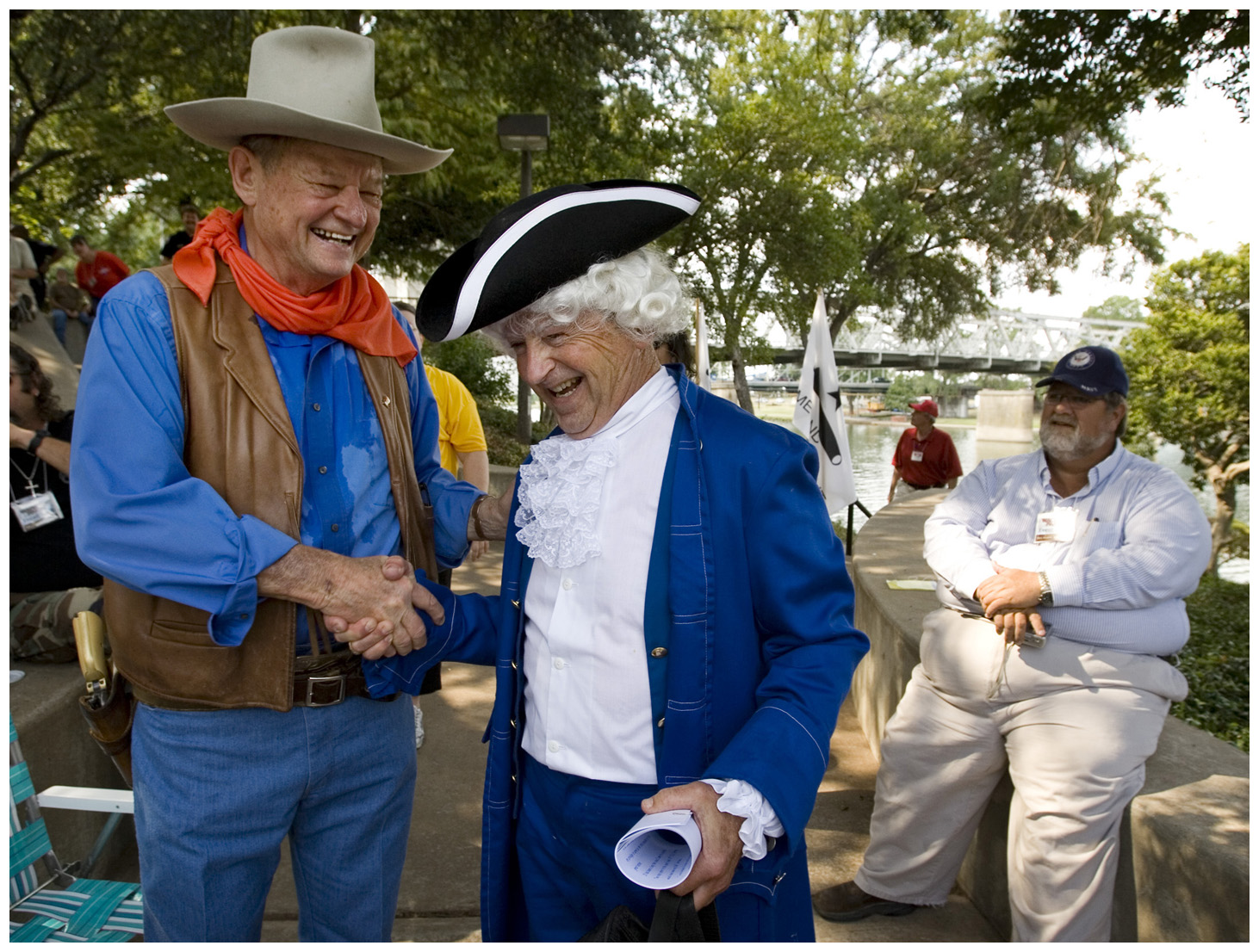
John Wayne and Thomas Jefferson make surprise appearance at 2009 Waco Tea Party rally. Photo by Jay Janner / Austin American-Statesman / Collective Vision.

Hey Tea/GOP:
Our Founding Fathers were a bunch of

free-loving deistic hemp-growers

By Harvey Wasserman / The Rag Blog / October 2, 2010

This is a Greco-Roman nation, gathered in a Hodenosaunee longhouse.

As they wrap themselves in the Constitution they mean to shred, that is the self-evident Truth the Tea/GOP Party ultimately cannot face.

Our legal godfathers — the ones Glenn Beck loves to conjure — were deistic liberal humanists whose core beliefs he hates.

They dumped that tea because they despised the corporation that owned it and the idea of empire it (and today’s corporate-military right) stood for.

The very first phrase of this nation’s defining document, the Bill of Rights, says:

“Judaeo-Christian? Not a chance.”

The grassroots farmers that made the Revolution were free-thinking hemp growers. Their favorite scribe, Tom Paine, was the son of a Quaker whose Age of Reason assaulted the church with unsurpassed fury. Today’s Tea/GOP would have it burned.

Our greatest genius, Ben Franklin, was a proud and joyous sexual adventurer. His very presence today would induce howls of (envious) outrage from the religious right.

It was Franklin who most loved Native America. He introduced himself to the French as “an American savage.” He stamped the Hodenosaunee (Iroquois) gifts of personal freedom and a democratic confederation into the soul of the new nation.

More formally, our tradition of direct voting, still alive in many New England towns, where the Revolution was born, was conceived in Athens, 508 BC. The Republic (“if you can keep it,” as Franklin warned) came from Rome, 509 BC.

The federal structure adopted in Philadelphia in the summer of 1787, was — with Franklin’s mentoring — based on the Iroquois Confederacy. That union was born at latest 1540 AD. It sustained a functioning democracy for at least 250 years, still longer than the U.S. has been in existence.

The matriarchal Hodenosaunee were defined by a love of nature and communal land stewardship. Open dialog was as easily accepted as abortion and homosexuality. Along with so many other lethal diseases, Original Sin was an unwanted import.

It is the humanistic liberalism of America’s Founders that STILL enrages today’s neo-Puritan Tea/GOP. The Jefferson they love to claim fathered at least five children with his slave Sally Hemings, 30 years his junior. Some were conceived while he lived “alone” in the White House.

He and Franklin and Madison and Paine had no time for the Christian faith. It’s by their intelligent design that Jesus appears nowhere in the Constitution. Their liberal Deism said a Creator got the universe going, installed the laws of nature, endowed humans with free will (and inalienable rights), then left.

Franklin’s disdain for church services spices his autobiography. Jefferson clipped all references to a divinity for Jesus out of his personal Bible. Paine’s Age of Reason still enrages the official church. Madison’s First Amendment enshrines disdain for an official religion. Unitarianism in all its liberal diversity was shared by presidents two through six, including two Adamses, Jefferson, Madison, and Monroe.

Their system of checks and balances was based on the Socratic proposition that with the freedom to dialog, human reason will prevail. Thus the First Amendment’s very first phrase exalts freedom from Religion, ie separation of church and state, a phrase coined by Jefferson, demanded by the new nation as a whole.

Like virtually all other American farmers, Washington and Jefferson raised serious quantities of hemp, and made good money from it. Franklin owned a paper mill that ran on it. All may well have smoked its psycho-active cousin, now known as marijuana. If you told them the nation they founded would make this versatile herb illegal, they would laugh at you.

They’d be equally horrified to hear the Foxist Tea/GOP claiming them as icons in a sectarian crusade for repression and empire.

Today’s religious right is an unholy fusion of theocratic authoritarianism — which our Founders hated above all — and corporate tyranny, whose tea they pitched in Boston harbor.

Along with George III, there’s nothing they loathed more than the anti-human hypocrisy we hear from the Foxist Legion.

Likewise, Beck, Pailn, Limbaugh, O’Reilly, and their ilk would have shrieked with rage at the actual Franklin and Paine, Jefferson and Madison, not to mention the populist farmers and sailors, workers and women who fought and died for the Revolution we all Revere (yes, him too!).

So next time those Tea/GOP phonies gaze off in the distance to claim kinship with the Founders, remind everyone you know who really did win that Revolution and write that Bill of Rights.

Those hemp-growing, tree-hugging, corporate-hating deistic free loving and free thinking present-at-the-creation Americans believed above all that the Truth would keep us free.

Now more than ever, it’s our patriotic duty to prove them right.

[Harvey Wasserman’s Solartopia! Our Green-Powered Earth is at http://www.solartopia.org/, along with Passions of the Potsmoking Patriots by “Thomas Paine.”]

The Rag Blog

Posted in Rag Bloggers | Tagged , , , , , | 3 Comments

Larry Ray : Our Schools, Their Madrassas

Graphic by Larry Ray / The Rag Blog.

Letters to Charlie:
Our schools, their Madrassas

By Larry Ray / The Rag Blog / October 1, 2010

Letters to Charlie is a collection of emails to a long time friend. He worked hard and did very well. To many of his wealthy conservative friends, Charlie is an anomalous dreaded liberal. He forwards many of their hateful and distorted right-wing emails to me and I frequently send Charlie my free-flow take on them. Education was the topic for a recent series… Islamic Madrassas versus American schools.

Imagine if all the glistening red white and blue was stripped from the history of America that is, or was, taught in our public schools. Americans just do not want to talk about or remember the darker history of this great country. But a mere 46 years ago black Americans were denied basic rights and could not drink from the same water fountains designated for use by white people. The same went for transportation, eating in restaurants, staying in hotels or motels, or voting without intimidation or paying a “poll tax.”

1964 is not that long ago, Charlie. There was even great doubt that JFK could be elected as president because he was, gasp, a Catholic! Senator Joe McCarthy’s Commie blacklist hearings and the actual existence of an “un-American activities committee” are well within your memory and mine.

The history of the American development of oil production in Saudi Arabia and the Middle East is a sorry tale of arrogance and complete disrespect for customs and religion in that region. Ancient tribal areas had been carved up into countries with boundaries drawn by colonial imperialists…

Great Britain and the USA have a shameful history of using our Christian badge of correctness to disregard any other religions as misguided and wrong. We still do that. Imagine Islamic missionaries roaming the cities and towns in rural America seeking to convert Christians.

Our public schools were wisely and purposefully made to be secular and apart from religious control or curriculum. There is no mention of setting up schools in the Constitution. We are constitutionally bound to respect and practice freedom of religion in America. That, however, mostly translates to freedom to be Christian of some stripe or another. Jews continue to fight antisemitism and did not easily build their Synagogues and other places of gathering without lots of ugliness. Muslims are having an even tougher time of it here being accepted as American citizens.

We invaded Iraq and blew up its already minimal, but functioning, infrastructure. People who suddenly lose their electricity, water, and sewer service and who have family members rounded up and even killed get pretty mad and disgusted. Americans would react the same way if some massive power invaded us for no apparent reason and crippled our basic infrastructure.

Our massively superior military took over large parts of Iraq, kicked in doors of the homes of ordinary people, wildly looking for a relatively small number of Islamic extremists. Young American soldiers by and large speak and understand only American English, so just like in Vietnam, the Iraqi’s became the “foreigners.” Our ignorance of historic Sunni-Shiia religious sectarian hatreds just added to needless stirring up of an old hornet’s nest.

Cumulative ancient local hatreds easily shifted to the American invaders. What had been a few extremist individuals, dedicated Islamic jihadists, became an easily organized resistance against the American invaders, and attracted extremists from other countries. Martyred suicide attacks by one sect against another expanded to larger and larger suicide attacks against the American invaders.

Now, a trillion dollars later with 4,500 dead American kids, and tens of thousands wounded, and hundreds of thousands of innocent Iraqis dead, we are still applauding our gift of bringing the first real Democracy to the Middle East. Except that has not happened.

“Freely Elected” candidates in Iraq are in a 50-50 standoff, each hewing to their tribal and sectarian power bases to get all they can for their side. Screw democracy. Screw America. Sharing is not part of the vocabulary in the ancient, tribal Middle East.

How much hatred does it take to pull off something as horrible and seemingly impossible as the 9-11 attacks? This relative handful of religious zealots not only triggered a fierce response by the American military, they also made it easy for this infuriated Christian nation to throw all Muslims into one big bad category.

So, what does a 234-year-old America teach in our secular schools? What do they teach in their ancient Islamic Madrassas? Should there be a threatening gulf between the two ways of educating our young?

You and I have traveled widely and lived in other countries, and have a sense of global diversity and inequity, Charlie. Most Americans never go abroad in their lifetimes, and for the past 40 years American students have not been taught much world or American history in public schools. A huge percentage of Americans have no sense at all of history, geography, or civics. We have been irresponsible in our materialism and now are pitifully lagging behind other developed nations in so many basic areas of education, health care, social responsibility, and even happiness.

And as if this was not enough, America, the land of the free, is now imprisoning itself with polarization, laziness, obesity, greed, denial, and indifference. Our roads, dams, and bridges are old and in disrepair, but there is a loud cry for no new taxes. And a loud conservative minority would do away with a strong, centralized federal government.

In past national times of crisis in America the young have taken up the banner of change and helped move this country forward. I don’t see America’s under-educated, over indulged, and seeming directionless young people being able to or even wanting to step up and face the challenge.

[Retired journalist Larry Ray is a Texas native and former Austin television news anchor. He also posts at The iHandbill.]

The Rag Blog

Posted in Rag Bloggers | Tagged , , , , , | 2 Comments

Carl Davidson : Mondragon Diaries IV: Banking on the Future

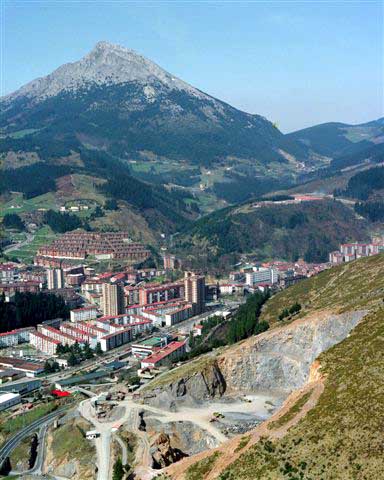
Arrasate-Mondragon in the Basque Country of Spain. Image from SolidarityEconomy.net.

Mondragon Diaries, Day Four
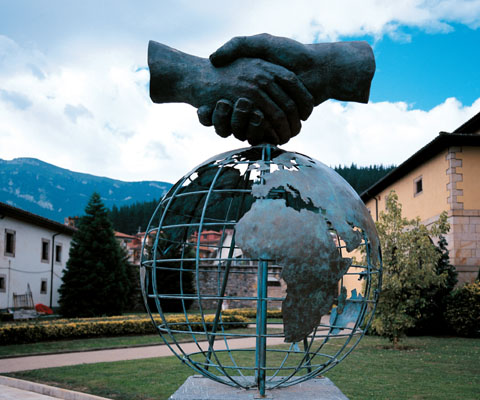
Worker coops, worker banks, worker skills:
Weathering today’s crises


By Carl Davidson / The Rag Blog / October 1, 2010
[This is the fourth of a five-part series by Carl Davidson about the Mondragon Cooperative Corporation, a 50-year-old network of nearly 120 factories and agencies, involving nearly 100,000 workers — centered in the the Basque Country but now spanning the globe. Go here for the series so far.]

BASQUE COUNTRY, Spain — Most new small businesses fail. That’s a fact, whether they are in the Basque Country or in the U.S. Or anywhere else. Yet the Mondragon Coops, which all started as small worker-owned businesses, have hardly ever failed. Why? The key is in Father Jose Maria Arizmendi’s original founding conception of cooperatives as the interlocking of school, factory, and credit union.

This was the thought I was rolling over in my mind as our bus again climbed the slopes on the Arrasate-Mondragon valley, this morning with grey skies and a light drizzle. We were headed for an administrative office of Caja Laboral, the worker-owned banking network of the MCC Coops. The ride wasn’t far, and we were soon whisked into a small auditorium. Our mentor, Mikel, introduced the staff member who would introduce us to the world of banking, and Mondragon’s modification of one corner of that reality.

Some people might question why workers for social change would want to be involved with banks at all. But certain kinds of credit and finance are important components of any society — capitalist, socialist, or somewhere in between.

Father’s Arizmendi’s conclusion that two of the many reasons cooperative movements failed in the past was the lack of reliable credit and the lack of innovation and new ideas. Hence the reason he started with a school, but was soon to add a small credit union formed from the small deposits of his parishioners and their neighbors. To start a factory, you had to borrow some money, and borrowing the money of people close to you at low cost was the best way to go.

By 1959, the small credit union had grown and transformed into Caja Laboral. Today it is one of the major banks in Spain, with assets of 21 billion euros and 1.5 billion in equity. It has 18.6 billion in customer deposits, offset by 16.4 billion in credit loans. It has 1,2 million clients, only 120 of which are the MCC coops.

It has 2,000 people working for it, and all are worker-owners. Actually, the bank is owned 55% by the MCC coops and 45% by the staff workers. But the rule they have adopted is that the factory coops pick eight of the board members, while the staff workers elect four. Since Caja Laboral, is a coop of coops, it is what MCC calls a “second degree” coop. Other second degree coops are their schools, medical clinics, and insurance agencies.

“We are rated the best bank in Spain in customer satisfaction,” says our presenter. “One reason is that we are worker-owners ourselves, and not socially distant from them. We work closely with our clients. We are prudent and conservative

Mikel gave a wry laugh from the back of the room, and interjected: “Except for the Lehman Brothers fiasco…” It turns out Caja Laboral had taken a hit of 160 million euros it had tied up in Lehman Brothers securities when the Wall Street investment bank collapsed at the beginning of the financial crisis two years back. Not only had MCC’s bank been hurt, but

“Yes,” said our presenter. “But we followed our rule of transparency. You and everyone else knew it the same day, and we announced it to the press the next morning.”

This opened up a discussion among all of us on the proper role of banking and credit unions, including cooperative ones. It’s not a subject progressive activists are all that familiar with, but we had it anyway.

First it was clear that Caja Laboral‘s big sin in the Lehman Brothers case was believing in the validity of the AAA ratings of its securities, set by U.S. Government agencies, which turned out to be a sham. Second, it was also clear from the numbers presented that Caja Laboral was really something on the order of a strong and relatively cash-rich savings and loan operation and consumer services bank. Its managers didn’t get rich, but had incomes within the same narrow and modest salary spread as all MCC coop members. Its profits were plowed back in to building new coops.

It was not in the same league as the giant Wall Street speculators in derivatives, with their billion dollar bonuses, who were trying to gain wealth not by creating new wealth, but by pure gambling with other people’s money.

Most of us concluded that Caja Laboral was a sound and necessary part of MCC and its growth, but the arguments continued out the door and on the bus ride further up the mountainside to our next talk at the Otalora conference center.

Here we had a new topic, the training of governing boards of the coops. It did no good to elect workers to coop governing boards, and then just let them sink or swim. A skills transfer and training program was in order.

Our presenter was Juan Ignacio Aitpunea. He was a well-seasoned and tough-minded older Basque worker with strong cooperative values in his heart.

“We use a Basque word, ORDEZKARI, for our program,” he started off. “It means ‘representative,’ because that’s the task of the boards, to represent the workers. Our boards are elected to four-year terms, but we stagger them. Every two years, only 50% change, but with 120 coops, that means we have about 1,000 new board members to train every two years.

“We do it in steps. In the first six months, we get the new people to do self-evaluations, to find out their competencies, or the lack of them, so we know what to stress over the next year or so.

What were the skills needed?

“First,” Juan continued, “you have to know the basics, the laws on cooperatives and the functions of coop leaders. Second, you need common skills — teamwork, how to communicate, how to lead, how to make timely decisions. Third, you have to know how to design and work through a followup plan.”

All this was crucial because the governing board not only shaped policy, it hired and fired managers. Worker-owners, by their nature, cannot be fired. Over 50 years there was only one case, where a small group got caught embezzling.

Juan went into more detail on this, but our crew had other questions: how were people nominated, and what was involved in running?

First, if there are two vacancies, there must be at least three candidates, he explained. Any worker could volunteer to run, but he or she had to get signatures of 10% of the workforce. Next, the workplace’s social council, which serves some of the functions of a trade union, could suggest a candidate. Finally the old board could name one new candidate itself. But an initial vote was taken so each of the final minimum of three candidates to get a 50% minimum, then the vote was held to determine the final two.

“We need this to make sure board members have a wide respect throughout the workplace,” Juan added. “This is especially important in hard times, like now, when hard decisions often have to be made.” This meant firing the temp workers or cutting salaries to deal with the downturns.

“Leading is not just about friendship, or making friends. This is not mainly a place for that. But it is a great school where you can learn what it means to be responsible. You may also make a few new friends. In fact, in tough times, that’s when you can make the best and truest friends.”

Juan also stressed the need for diversity and the need to bring forward younger leaders. “When you get old like me, you get too used to having your own way. A time comes when you need to let new people in, but still find other ways to make a contribution.”

Mondragon University. Image from Universidad.es.

Our last stop of the day was Mondragon University. It was formed as a second degree coop by joining the engineering school, the business studies program, and the humanities and pedagogy teaching coop. It currently has about 3,600 full time students. Tuition is about 5,000 euros a year, considered moderate for a European university. Most of the students are from middle-income families in the area or from the workers in the coops.

Fred Freundlich was our faculty presenter, an American who had been in the coop movement in the U.S. in the 1980s, but had lived in the Basque County for a good number of years. He gave frank and critical answers to our questions.

I raised my hand, and asked: “Suppose I’m a young worker in one of the local industrial coops, and I decide I want to become part of the management. How does MU help me? Do they?”

The short answer was, “Yes.” But Fred added that management usually required a college degree, and you didn’t necessarily need to get it from MU. If you had a good resume and vita from elsewhere, you’d still be considered. On the other hand, if your coop saw that you were eager to gain new skills, they would give you a good deal of support, including financial, and going through MU for your degree would be a plus.”

Others raised the general question of activism among youth.

Frankly, Basque youth aren’t all that active inside the coops. They’re into third world global justice issues, environmentalism in general, and Basque nationalism. About the coop managers, I’d say a strong minority, maybe 30 percent, have solid cooperative values at heart, another minority pays lip service to them, and the rest are somewhere in between. We clearly need a new surge of activism to spread cooperativism beyond the factories, but my guess is only about 30 percent of the workers today are activists on the matter. You really need to talk more with Mikel, who’s really a leader on this topic.

Mikel went up front and drew us a wave-like graph, showing an initial surge in the early MCC decades, then a leveling off, then a dip at the beginning of the crisis, and now a small upward turn.

“This is the beginning of a rich discussion, how we need to redefine and reinvent ourselves for the 21st century? But the bus is waiting to take us to dinner in San Sebastian. We can return to it tomorrow.”

[Carl Davidson is a national co-chair of the Committees of Correspondence for Democracy and Socialism, a national board member of Solidarity Economy Network, and a local Beaver County, PA member of Steelworkers Associates. His website is Keep on Keepin’ On, where this series also appears. Davidson is also available to speak on the topic. Contact him at carld717@gmail.com. For more info on these tours, go here.]

Also see:

The Rag Blog

Posted in Rag Bloggers | Tagged , , , , , , , , | Leave a comment

Marc Estrin : Holocaust Thinking in America I: The Authoritarian Personality

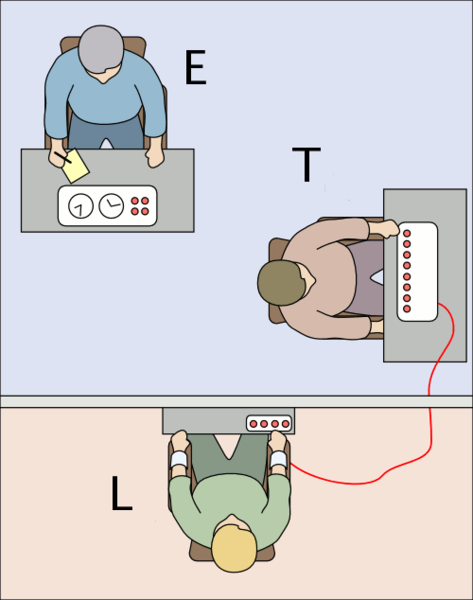
What is the limit of obedience? Illustration of the setup of a Milgram experiment (see below). Created by Wapcaplet in Inkscape / Wikimedia Commons.

Holocaust thinking in America I:
The Authoritarian Personality

My Marc Estrin / The Rag Blog / September 30, 2010

[Part one of three.]

So now, in place of Newt Gingrich’s 1994 Contract With America (aka Contract On America) we have the new GOP Pledge to America. Not unlike the current design, the rich are to get richer, and the poor to get sick, become homeless, starve, or shatter in endless wars.

The comparison of our American trajectory with the tactics and strategy of Germany in the late 1930s is more striking now than ever. We would do well to study this era carefully for a possible glimpse of our own future. Those targeted are no longer just our dispossessed, reviled and outcast — our “jews” — but much of the American (and of course world) population.

The attempt to exterminate European Jewry during the Nazi era was, in many ways, as unique as Jewish culture proclaims. Never before had an organized, industrial state targeted a population for complete annihilation, ruthlessly and efficiently pursued even within its “civil” codes and activities.

But to think of the Holocaust as a completely unique act, restricted to 20th century German antisemitism, is to limit it unduly, to make it unavailable as evidence and warning about tendencies in our own place, our own time.

For it would seem that every major thought pattern, every cultural institution that fueled the Nazi holocaust is present and empowered in the United States today. Safeguards against catastrophic outcomes are few and weak. “It can’t happen here”? Maybe. But with so many elements brewing together, and no visible controls to dampen the flux, there is no predicting in what direction the reaction will run.

Half a century ago, a civilization as culturally advanced as our own experienced a society-wide suspension of morality. Jews were the target. Now, the next set of domestic victims has already been chosen: the poor and unruly. Ready… aim…

The once and future perpetrators

Much of the current political agenda is dominated by what is popularly known as the “extreme right.” Clinton and Obama have been instrumental in moving the Democratic Party in that direction. The Tea Parties and religious fundamentalism nourish the “shift to the right” within the population at large.

Critics have unanimously deemed the right wing motives as “greedy” and “mean-spirited,” but such labels obscure the positive agenda involved — an agenda described in most detail by the Frankfurt School in its attempt to analyze the roots of German fascism. Then and now; the descriptions are eerily alike.

It is reasonable to assume that Obama, the Clintons, Bush and Joe&Jane Six-Pack are nice enough folks who love their children and grandchildren, and hope to pass on to them a better world. What is it, then, that drives them to outlandish and seemingly heartless proposals concerning the poor, often themselves?

The authoritarian personality

In each event — in the living act, the undoubted deed — there, some unknown but still reasoning thing puts forth the moulding of its features from behind the unreasoning mask. — Captain Ahab

While differing in detail, such right-wing positions are driven by belief systems characteristic of what The Frankfurt School called “the Authoritarian Personality,” whose main characteristic is the urgent need for order. Freud, Fromm, and Reich unearthed the psycho-dynamics of weak ego-structure which underlay it, while Adorno and Horkheimer analyzed the social repression which left its authoritarian marks on the individual soul. When ALLES IN ORDNUNG becomes the highest value,the consequences are predictable. For the authoritarian personality:

  1. Powerful leaders are needed to keep society in line and restrict it to conventional, middle-class values. Exaggerated assertions of toughness and strength become the norm. Trickle-down theories are designed to protect the powerful — in the interest of all. Though greed and lust for power may be involved, they are rationalized by an appeal to the general good.
  2. Democracy becomes a threat and must be limited. In The Crisis of Democracy: Report on the Governability of Democracies to the Trilateral Commission, Samuel Huntington warns about the consequences of an “excess of democracy”:

    The arenas where democratic procedures are appropriate are, in short, limited… The effective operation of a democratic political system usually requires some measure of apathy and noninvolvement on the part of some individuals and groups… Marginality on the part of some groups is inherently undemocratic, but it has also been one of the factors which has enabled democracy to function effectively.

    A need to control unpredictable “excess” democracy has guided American foreign and economic policy throughout this century. The pattern of marginalizing peasant populations and supporting dictatorial strongmen is likely driven as much by rage for order and fear of chaos as by the selfish need to maximize profits — which profits might be even greater should the general standard of living be raised. So great is the need for predictable order that maximal profits are sacrificed.

  3. Individualism becomes suspect, a negative value to be stamped out. “Difference” means unpredictability, and fear of an unpredictable, uncontrollable “Other” spawns all the “isms” which rampage today: racism, sexism, classism, anti-semitism, anti-immigrant, anti-muslim rage, xenophobia. Nature itself becomes an uncertain enemy to be conquered and subdued.
  4. The psycho-sexual chaos at the core of an authoritarian personality simultaneously fascinates and repels. Rigid moralism embracing stereotypical values seems the most secure protection against anarchy and chaos. There is exaggerated concern with and denunciation of libidinal art and sexual “goings-on.” At the same time, unconscious emotional impulses are projected outward, and the world is seen as a wild and dangerous place in which worst-case scenarios abound.
  5. Fear and guilt about chaotic thoughts within and anarchy without is so potentially threatening that psychic numbing is a typical response, with emotional dissociation from the consequences of action. Knee-jerk “patriotism” in response to moral questions is an effective defense mechanism. Yellow ribbons blindfold the eyes against mass incineration and live burial. The story of the Palestinians targeted by U.S. weapons must not be told. Such defensive control of information minimizes compassion for victims.
  6. A culture of punishment follows hard upon. Offenders against order must be strictly punished. Dominance and submission becomes crucial. The very same heartmind is both pro-life and pro-death penalty. But the sanctity of life is secondary: the important thing is punishment. Tender-mindedness is for “bleeding-heart liberals.”

While no political leader or follower may display every characteristic above, they are all on fine collective display in the current reactionary Zeitgeist — as they were in Nazi Germany.

Is it just that “people are no damn good”, or is their behavior created by social conditions surrounding them?

The Milgram evidence

In her study of Adolf Eichmann, Hannah Arendt noted that the greatest problem the Nazis faced was “how to overcome… the animal pity by which all normal men are affected in the presence of physical suffering.”

Most of the German perpetrators were “normal” people, people who would not be picked up by any questionnaire or psychiatric screen. They were by and large not sadists or moral degenerates or even political fanatics — yet they became conscious collaborators in the process of mass murder.

How was it possible to create torturers out of next door neighbors? (How could our clean-cut young boys napalm women and children?) What about that animal pity?

In the early Sixties, A Yale psychologist named Stanley Milgram began a series of experiments which sought to clarify these problems. The basic question was narrowed to “if an experimenter tells a subject to act with increasing severity against another person, under what conditions will the subject comply, and under what conditions will he disobey?”

Subjects were recruited from all walks of life to “help us complete a study of memory and learning.” An actor-scientist greeted pairs of volunteers, and lots were drawn to pick who would be the”teacher”and who would be the”learner.” The subject would always choose the “teacher” slip (all the slips said “teacher”); the other “volunteer” was a plant who then became the “learner”/victim.

The “scientist” explained that there has been some association of punishment with learning, but that there had never been any quantitative studies on how much punishment would give the best results.

After orientation, the “learner” was strapped into a chair in the next room, and an electrode glued to his wrist. The “teacher” could see and communicate with him via a glass panel and microphone. In front of the “teacher” was a bogus control panel consisting of 30 switches enabling him to deliver shocks from 15 to 450 volts in 15 volt increments.

The groups of switches were marked Slight Shock, Moderate Shock, Strong Shock, Very Strong Shock, Intense Shock, Extreme Intensity Shock, Danger: Severe Shock. Two switches after this last designation were simply marked XXX.

Milgram conceived many ingenious variations to examine different parameters, but the basic design was this: the “teacher” was read groups of word pairs to the “learner,” and then ask him to correctly identify the pairing word from lists of four. If the “learner” made a mistake, the “teacher” was to administer a shock. For each mistake, the “teacher” was instructed to “move one level higher on the shock generator.”

The victim (who, of course, was feeling no shock at all) greeted the increasing “voltage levels” with a full range of response, indicating no discomfort until the 75 volt shock was administered. At 120 volts he would shout to the experimenter that the shocks were becoming painful. Painful groans at 135 volts. At 150 volts. he would cry out, “Experimenter, get me out of here! I won’t be in the experiment any more! I refuse to go on!”

By 180 volts, “I can’t stand the pain,” and by 270, agonizing screams. After 300 volts he would no longer provide answers to the test questions. The “teacher” was told that no answer constituted a wrong answer, and was instructed to raise the shock level.

How far would these “teacher”/subjects go? In spite of there being no coercion or threat (as in Nazi Germany), and without any animosity toward the victim (unlike Nazi Germany), these average Americans far, far exceeded the expectations of all psychologists in their obedient compliance with instructions.

Despite the fact that many questioned or even protested what they were doing, a substantial proportion continued to the last last level of shock despite the “learners’” screams. Almost two-thirds of the subjects — ordinary people drawn from working, managerial, and professional classes — were “obedient subjects,” willing to go to almost any length at the command of an authority. Their explanations at post-experiment interview echoed those of Adolf Eichmann — “I was just doing my job. I was doing what I was told. I was only doing my duty.”

Milgram was profoundly disturbed by his findings, (as were many members of the scientific community who attacked him personally).

What is the limit of such obedience? At many points we attempted to establish a boundary. Cries from the victim were inserted: they were not good enough. The victim claimed heart trouble; subjects continued to shock him on command. The victim pleaded to be let free, and his answers no longer registered on the signal box; subjects continued to shock him.

At the outset we had not conceived that such drastic procedures would be needed to generate disobedience, and each step was added only as the ineffectiveness of the earlier techniques became clear. The final effort to establish a limit was the Touch-Proximity condition [where the “learner” sat, screaming, shoulder to shoulder with the subject]. But the very first subject in this condition subdued the victim on command, and proceeded to the highest shock level. A quarter of the subjects in this condition performed similarly.

The results, as seen and felt in the laboratory, are to this author disturbing. They raise the possibility that human nature or — more specifically — the kind of character produced in America democratic society, cannot be counted on to insulate its citizens from brutality and inhumane treatment at the direction of malevolent authority. A substantial proportion of people do what they are told to do, irrespective of the content of the act and without limitations of conscience, so long as they perceive that the command comes from a legitimate authority.

In spite of Milgram’s despair, the findings did have their bright side. A number of experiments were done in which the subjects were exposed to several experimenters who disagreed among themselves and argued about continuing the shocks. Another series was performed not at Yale, with its aura of authority, but in a minimal office, under the auspices of the fictitious, unknown, “Bridgeport Research Associates.” A third series was performed in which the “teachers” were not instructed to increase the shock level with each wrong answer, but could choose their own levels throughout the experiment.

The outcomes of these series was illuminating: given any hint of disagreement among the authorities, subjects immediately discarded their slavish obedience, and were no longer willing to engage in behavior they found morally questionable. When authority became questionable (“Bridgeport” vs. Yale), compliance dropped significantly. And without prompting from authority, “teachers” maintained shocks well under the discomfort level of the victim.

The casting off of “animal pity” was sustainable only under seamless monolithic authority. For all its fragility, it seems that it is not human nature per se that is malevolent, but that human malevolence, at least in part, is socially constructed. Under the right system, even here and now in the United States, obedience to authority can prevail against the “better instincts” of the population. The trouble is that such a system is currently alive and well throughout the land.

The system there and here and then and now

It is commonly assumed that outbreaks of bestial violence — the Holocaust, or what we have recently seen in Rwanda, Afghanistan or Palestine — are the result of primitive eruptions into a civilization insufficient to contain them. If people could only become “more civilized,” there would be no such behavior. But what if our civilization itself were the problem — not the solution? More civilization would mean more such crimes. Is such a proposition simply inappropriate self-hatred?

Again and again we have to confront the difficult fact that Nazi Germany was an advanced industrial culture quite like our own. The death machines were put into operation by people quite like us, living in comparable surroundings. Certified architects and engineers in well-lit rooms drew up plans for crematoria. Government bureaucrats, some trained in Kant and Hegel, purchased tickets for each passenger in the cattle cars.

Had there been computers, there would have been excellent data bases. Nazi soldiers played Beethoven sonatas to entertain the troops, to lift their spirits and help them return to guard duty at the camps. Bayer made superb aspirin using slave labor. Out of this modern, rational society, with a history of the highest culture, the Holocaust was born. Can we ever understand this? What can it tell us about our own situation?

One of the most crucial insights here came from a man who died well before Hitler came to power. Contemplating the industrialization of late 19th century Germany, Max Weber, “the father of sociology,” came to the conclusion that “Reason” — the ideal of the Enlightenment — was evolving dangerously into Zweckrationalität — instrumental reason, reason driven by a goal. In the service of its goals, modern society was becoming efficiently bureaucratic and scientific, but was losing its sense of values. In fact, “value-free” had become a test of objectivity and scientific legitimacy, as technique replaced moral responsibility.

This century has certainly proven Weber correct. Marxists and postmodern thinkers have taken Weber many steps further, as they deconstruct the goals we have inherited, and the stories we tell ourselves. Whose goals are they? What corpses lie between the lines in our story of “Progress”? If society is a garden, who decides on who gets weeded?

The important point is that Weber’s analysis of modern society — clearly increasingly applicable as the years push on — in no way excludes the possibility of another Nazi state. Nothing in the rules of the reigning instrumental rationality would disqualify Holocaust methods of social engineering, nor would its actions even seem improper. After all, social problems must be solved.

Milgram, too, found Weberian mechanisms at play in his subjects. To avoid confronting the victim’s pain, his “teachers” became absorbed in the technical aspects of voltage control and memory testing. They also demonstrated a kind of “counter-anthropomorphism,” denying any human element in a human-generated situation.

“The experiment requires that you continue” was often sufficient explanation to overcome any hesitations. “Scientific truth” as defined by “authority” was a goal so persuasive that its perceived legitimacy overwhelmed humane behavior.

Outside the laboratory, for instance in the military, we find parallel mechanisms at work. Boot camp is not so much a training in military technique as it is in absolute acceptance of monolithic authority. Patriotism requires such acceptance. Once in the field, attention to technical details blinds the perpetrator to the effects of his violence.

The bombing sequence in Dr. Strangelove is a brilliant satire on the efficient calm of men about to destroy the world. Violence is turned into a technique, free from emotion and purely rational, even reasonable. Similar comparisons can easily be made with the instrumental rationality of the corporate board room, where the lives of millions are part of the calculus of maximizing profit.

More to come.

[Marc Estrin is a writer and activist, living in Burlington, Vermont. His novels, Insect Dreams, The Half Life of Gregor Samsa, The Education of Arnold Hitler, Golem Song, and The Lamentations of Julius Marantz have won critical acclaim. His memoir, Rehearsing With Gods: Photographs and Essays on the Bread & Puppet Theater (with Ron Simon, photographer) won a 2004 theater book of the year award. He is currently working on a novel about the dead Tchaikovsky.]

The Rag Blog

Posted in Rag Bloggers | Tagged , , , , , , , | 3 Comments

Bill Freeland : Electric Cars Not All That ‘Green’

Graphic by Bill Freeland / The Rag Blog.

All-electric cars:
The not-so-green alternative

By Bill Freeland / The Rag Blog / September 30, 2010

Conventional wisdom has just assumed electric cars are clean because there’s no tailpipe. So the focus has only been on convenience and cost. We need to go back to square one and ask: what’s the point, since they’re no cleaner than what we already have — plus they have a short range and long recharge times.

With new all-electric vehicles (EV’s to the trade) soon coming to market, there’s a drumbeat building that proclaims them the next stage of the green revolution. They promise a convenient, cost-effective and clean alternative to the gas guzzlers we’ve been hoping to replace for years.

The only problem: the data so far show that none of this is true. Most surprising, going electric is at least as bad for the environment as staying with the fuel-efficient, gas-powered cars on the road today.

This is not the conclusion one would expect, given the hype.

Let’s start with the first two “benefits”:

U.S. Department of Energy (DOE) lists one EV model currently available and eight more “coming soon.” Four others are promised by 2013. In terms of driving range, DOE reports these cars go only “about 100–200 miles” on each charge. And recharging the battery pack can take “4 to 8 hours.” Hardly convenient.

And the initial cost? Of those with prices available, DOE finds the average base sticker price will be $43,600. Not exactly cheap.

And then there’s the upkeep — particularly replacement batteries.

Replacements for the Tesla Roadster, the only EV model now available (for $109,000!), for example, cost around $36,000. Tesla, however, offers the option to pre-order them now (for $12,000) for delivery in seven years, the time the originals are predicted to wear out.

Still, there are likely to be some who will be willing to accept these limitations for the greater good of the planet. But even that is more than these cars can deliver.

Here’s the reason: Whether you’re getting your “juice” from a pump or a plug, that energy is produced from fossil fuels — either at an oil refinery or a coal-fired electric power plant. So either way, cars pollute. The difference is whether the emissions are discharged locally from your tailpipe or somewhere else by a electric generating facility.

To understand why, imagine you’re making a trip of 30 miles. In today’s typical fuel-efficient car, that takes about one gallon of gas, which according to the U.S. Environmental Protection Agency (EPA), produces 19.4 pounds of CO2.

Now consider the EV alternative. Their power consumption is measured, not in gallons of gas, but kilowatt-hours of electricity. To drive the same distance in the EVs now under development will take an average 10.6 kilowatt-hours of electricity. And according to the EPA, generating that much power results in 21.5 pounds of CO2 — which is two pounds more than burning a gallon of gas!

So bottom line: there’s no free ride for any automotive technology based on fossil fuels.

Future advances in EV technology could increase battery performance. And mass production could bring down the sticker price. But gas-powered cars that get 40 miles per gallon are also on the horizon. And nothing is likely to surpass their driving range.

So EVs are likely to be only a “second car” at best. Which means the jury is still out on whether EVs will ever make sense.

But for now, if you’re considering electric transportation, you’re limited by driving range, recharge times and higher sticker prices — and overall the planet is still worse off!

So, sadly for the environment, while all-electric cars are the new thing, they aren’t any better than what we have now.

The Rag Blog

Posted in Rag Bloggers | Tagged , , , , , , | 7 Comments

Thomas McKelvey Cleaver : ‘I Agree With President Obama’

Photograph by Mark Seliger /RollingStone.com.

Put aside the President’s botch-ups:
We cannot ‘stand on the sidelines’

The Republicans are dedicated now to overthrowing everything I have worked for or supported for the past half century.

By Thomas McKelvey Cleaver / The Rag Blog / September 29, 2010

Let me just say that, as a person who has been politically active for change in this country for 45 years, I have had a rough time in the period since President Obama’s inauguration last year, watching things go as they have, particularly since I invested so much time and energy into working for his election.

I can specifically look at the botch-up of the fight over health care, the way the President ignored the base and let the organization he had built for the campaign turn into nothing when it could have been used across the country to build the kind of support that could have led to a really worthwhile health care reform.

I can specifically look at the idiocy of appointing Senator Salazar as Secretary of the Interior, where he has managed to make what is supposed to be the “greenest administration in history” look nearly as bad as the Bush Administration in their approach to environmental management.

I can specifically look at the war in Afghanistan, which has gone from bad to worse under leadership that fails to see the obvious right in front of them. I need not go into my dismay over the way they have handled things like DADT, marriage equality, and the rest.

At the same time, the mere fact there is a health care reform law in existence is good. For those who don’t pay attention to history, the original Social Security law in 1935 and the original Medicare law in 1966 were mere shadows of what they are today and what Social Security has been throughout my lifetime in the 50-odd years since I first got my Social Security card.

After these laws got their “foot in the door” they got amended and improved over the years. One can look at much of the environmental legislation in the same way — a foot in the door and then improvement. That is the way things work here in this country.

Or at least that’s the way it has worked in the past, back when there were two political parties that believed in actually governing and improving the country.

Today we have one party that has been taken over by a revolutionary far right political movement, which is dedicated to the overthrow of the system we all understand and support, and to the ultimate imposition of a theocratic corporate-fascist dictatorship — they are not “conservative.” They are radical and revolutionary.

Things are as dangerous for us right now, in my view, as they were in 1931 in Germany. Lots of people (myself included) have been pointing to the example of the 1933 German elections, but that misses the point. Had the Nazi party not managed to become the single largest party in the German Reichstag as a result of the 1931 elections, they could never have pulled off the victory in 1933.

So, to me, the election of 2010 in America is as important as that of 1931 in Germany. If the Republicans get the majority they are looking at, we can kiss all chance of getting any progressive change anywhere good-bye.

As a result of that analysis, I am willing even to vote for Jerry Brown, a politician I have not-so-cordially detested for 35 years, due to my personal direct knowledge of his role in creating the political/social/financial disaster we face today in California, back when it would have been easy to fix in 1975.

In this case, it really does come down to the lesser of two evils, because letting Whitman in completely wrecks the possibility of stopping things from getting a whole lot worse.

In fact, if we let the Republicans in, every last one of my concerns listed above will only get worse, with no possibility of “getting a foot in the door and then changing things as the opportunity arises.” The Republicans are dedicated now to overthrowing everything I have worked for or supported for the past half century.

And so I find myself in complete agreement with this statement by President Obama, in the new Rolling Stone interview. And I hope Rag Blog readers will see it for the good advice it is (emphasis mine):

One closing remark that I want to make: It is inexcusable for any Democrat or progressive right now to stand on the sidelines in this midterm election. There may be complaints about us not having gotten certain things done, not fast enough, making certain legislative compromises. But right now, we’ve got a choice between a Republican Party that has moved to the right of George Bush and is looking to lock in the same policies that got us into these disasters in the first place, versus an administration that, with some admitted warts, has been the most successful administration in a generation in moving progressive agendas forward.

The idea that we’ve got a lack of enthusiasm in the Democratic base, that people are sitting on their hands complaining, is just irresponsible.

Everybody out there has to be thinking about what’s at stake in this election and if they want to move forward over the next two years or six years or 10 years on key issues like climate change, key issues like how we restore a sense of equity and optimism to middle-class families who have seen their incomes decline by five percent over the last decade. If we want the kind of country that respects civil rights and civil liberties, we’d better fight in this election.

And right now, we are getting outspent eight to one by these 527s that the Roberts court says can spend with impunity without disclosing where their money’s coming from. In every single one of these congressional districts, you are seeing these independent organizations outspend political parties and the candidates by, as I said, factors of four to one, five to one, eight to one, 10 to one.

We have to get folks off the sidelines. People need to shake off this lethargy, people need to buck up. Bringing about change is hard — that’s what I said during the campaign. It has been hard, and we’ve got some lumps to show for it. But if people now want to take their ball and go home, that tells me folks weren’t serious in the first place.

If you’re serious, now’s exactly the time that people have to step up.

[Thomas McKelvey Cleaver is an accidental native Texan, a journalist, and a produced screenwriter. He has written successful horror movies and articles about Second World War aviation, was a major fundraiser for Obama in 2008, and has been an activist on anti-war, political reform, and environmental issues for almost 50 years.]

The Rag Blog

Posted in Rag Bloggers | Tagged , , , , | 2 Comments

Dr. Stephen R. Keister : On Biden’s Blaming the Base

Joe Biden, at a Manchester, NH, fundraiser on Sept. 27, 2010, told the Democratic base to “stop whining.” Photo from AP.

‘Perhaps I grow testy’:
On Obama and Biden blaming the Democratic base

By Dr. Stephen R. Keister / The Rag Blog / September 29, 2010

[On Sept. 27] at a fundraiser in Manchester, NH, Vice President Biden urged Democrats to “remind our base constituency to stop whining and get out there and look at the alternatives. This President has done an incredible job. He’s kept his promises.”

[On Sept. 20] at the Pyramid Club in Philadelphia, President Obama said “when I hear Democrats griping and groaning and saying, ‘Well, you know, the health care plan didn’t have a public option’ …. or this or that or the other — I say, folks, wake up… This is not some academic exercise. ”

Perhaps I grow testy in my old age, but I am very much bothered by the statements of President Obama and Vice President Biden demeaning their progressive supporters and the young activists who brought them to office.

To place the blame on the progressives within the Democratic party for their own lack of insight — and their pandering to the Republicans and “Blue Dogs” — strains credulity and reason. Once again Casandra is ignored with, I fear, potential results comparable to the fall of Troy come the election five weeks away.

I look for a personal analogy… In 1938 I applied for admission to medical school. One of my sponsors, who I feel was key to my admission, was the elderly family physician.

Let us assume that at the end of my freshman year my grades were below average, and let us assume that my sponsor admonished me for my lack of dedication and perseverance.I would have two options: (1) to show my gratitude and respect and assure the gentleman that I would do better; or (2) to be cutting, unkind, and show no respect for his efforts in my behalf… put him down, demean him. If I had been an insightful, courteous, and thinking individual I would have opted for the first.

(No such event ever occurred… I worked my butt off!)

The Obama/Biden response to their initial supporters and donors certainly shows complete lack of any comprehension of reality. We are asked to be thankful for the crumbs from their table, and concurrently provide them a scapegoat for their own failings come election night and an overwhelming Republican win.

Of course we must take into account that the administration has been facing a hostile minority, but a minority indeed. We elected these folks to do what is morally and ethically correct, not to cringe and hide behind their dissident Democrats in the Senate.

Whether their response is a product of lack of understanding, stupidity, or gross disrespect hardly seems to matter. Perhaps, just perhaps, these folks can be saved from themselves. Perhaps we can in our actions get it across to them that they are derelict in communicating with the American people, a point that should be repeated time and time again.

Elect Republicans and put in jeopardy your Social Security, Medicare, and tax relief for the great majority of the American people. Elect Republicans and look forward to escalation of foreign wars with the concurrent loss to our national economy. Elect Republicans and deny yourself further ability to make individual choices.

One can hardly anticipate any positive action from these folks who cannot see the forest for the trees, but it might help an iota if the White House would appoint a thinking person, a person of vision and compassion, to the openings in the Treasury and White House staff, rather than more clones of Wall Street or of the Blue Dog stripe.

However, as the followers of true progressive tradition we must hold our noses and GET OUT AND VOTE. We progressives cannot afford to be petty and stay home; we must drag ourselves, our families, and our friends to the polls if we are to preclude a situation that could become unimaginably worse.

This is crucial in many, many states and many, many congressional districts, but none more than here in Pennsylvania where in the senatorial contest Vice-Admiral Sestak faces a very well-funded (by the corporations) political Neanderthal — one Pat Toomey — who is a leader in the drive to privatize Social Security.

I remember while in college being at an FRD rally when Harold Ickes spoke. Oh, to see persons like him, Henry Wallace, and Francis Perkins in Washington again.

[Dr. Stephen R. Keister lives in Erie, Pennsylvania. He is a retired physician who is active in health care reform.]

The Rag Blog

Posted in Rag Bloggers | Tagged , , , , , | 10 Comments