
FILM / Ed Felien : Big Brother With a Dash of ‘Salt’

Angelina Jolie as Evelyn Salt: She takes it into her own hands.

Ignorance is Strength:
Perhaps we need a little ‘Salt’!

By Ed Felien / The Rag Blog / September 3, 2010

How often, or on what system, the Thought Police plugged in on any individual wire was guesswork. It was even conceivable that they watched everybody all the time. — George Orwell

Tanya Tucker once sang, “Any kind of love without passion, ain’t no kind of lovin’ at all,” and that’s sort of what’s wrong with Salt, the new movie starring Angelina Jolie as CIA agent Evelyn Salt.

There’s certainly enough action — probably enough action for three or four movies. In the first chase scene she jumps off a bridge onto a semi hauling a trailer, then onto a semi pulling a tanker, then onto a truck. Amazing stunts. Amazing athletic ability. But why should we care? We don’t really know Evelyn Salt, so after a while it’s a little like watching a gymnastics exhibition.

Well, if there’s no depth of characterization and the plot is a string of melodramatic cliffhangers and chase scenes, then what’s the pull of the movie?

Spoiler alert:

Evelyn Salt starts out the film as a tourist captured by North Koreans, being tortured and denying passionately that she is a spy. Then she is traded for a North Korean spy and in the exchange it is revealed she is in fact a CIA spy.

Then in an interrogation of a Russian defector it is revealed that she is a sleeper agent for the Soviets. Then she goes rogue from the CIA so she can totally eliminate the Soviet group. Finally, she’s rogue in both camps but determined to save the world in spite of their intelligence agencies.

She’s a comic book superhero, operating outside the law, hunted by both sides, following her own moral compass — sort of like Batman and Spiderman. The difference for Evelyn Salt is that the bad guys are the intelligence agencies that have been given the power of life or death over everything and everyone, and they’re out of control and Salt is the only one who can set them straight.

That’s what makes the movie so appealing.

On July 19 the Washington Post published a two-year study of the U. S. intelligence community. They found there were 1,271 government agencies and 1,931 private companies gathering intelligence on counterterrorism and homeland security, and 845,000 people holding top-secret security clearance. That seems like a lot of spies when you realize that the population of Washington, D. C. is only 600,000.

Most independent analysts agree, the intelligence community and the Pentagon are out of control. It’s where the bulk of our tax dollars go, and Congress and the President are spending as fast as they can “to protect us from enemies foreign and domestic.”

9/11 was manna from heaven for Halliburton and the military-industrial complex. It gave them a blank check in Iraq and Afghanistan, and it’s giving them even more money for intelligence gathering. Obama, who campaigned against the Patriot Act, now seems to like the idea of domestic spying:

There was of course no way of knowing whether you were being watched at any given moment. How often, or on what system, the Thought Police plugged in on any individual wire was guesswork. It was even conceivable that they watched everybody all the time.” (George Orwell, 1984)

Those people who hate big government have come to love Big Brother because they know he is protecting them from the evil-doers.They know that WAR IS PEACE because we have to fight them over there or else we would have to fight them over here.

At the Glenn Beck rally Saturday, August 28, Sarah Palin said, “Say what you want to say about me, but I raised a combat vet. You can’t take that away from me.” The Tea Party people want to end entitlement programs like Social Security, Medicare, and Medicaid. They want nothing left but a military budget and 3,000 spy agencies.

They know that FREEDOM IS SLAVERY because to go forward into the unknown is to abandon the sacred institutions of church and traditional authority. Sarah Palin told the crowd: “We must not fundamentally transform America as some would want. We must restore America and restore her honor.”

And they know that IGNORANCE IS STRENGTH. The Original Sin was to eat the fruit from the Tree of Knowledge. At a warm-up rally to the Glenn Beck-a-thon, Minnesota’s own Michelle Bachmann said, “It’s our country; we own it. It doesn’t belong to a cabal of a half-dozen radicals who are determined to reshape this country into an image that none of us would ever begin to recognize.”

The buses that transported Tea Partiers from Bachmann’s rally to Beck’s were paid for by Americans for Prosperity, a lobbying group of the Koch Brothers, whose combined wealth is only surpassed by Bill Gates and Warren Buffet. They own Koch Refineries, and it’s their funding that was responsible for many of the early Tea Party activities. They fund organizations that support Big Oil and the Military-Industrial Complex. They are the merchants of fear and death.

And how do they want to restore America and restore her honor? It can only be done through victory over our enemies. It can only come through a president flying a fighter jet onto an aircraft carrier with a banner saying, “Mission Accomplished” as a backdrop.

In the words of George Orwell, “Always, at every moment, there will be the thrill of victory, the sensation of trampling on an enemy who is helpless. If you want a picture of the future, imagine a boot stamping on a human face — forever.”

And that’s the world our government is creating. That’s the world the Tea Party worships.

And that’s why you have to agree with the CIA man who releases Salt from her handcuffs and says, “Go get ’em.” And Salt pushes loose the door of the helicopter, jumps into the Potomac, swims to shore and runs off through the woods to fight another day.

[Ed Felien is publisher and editor of Southside Pride, a South Minneapolis monthly.]

The Rag Blog

Posted in Rag Bloggers | Tagged , , , , , , , , , | Leave a comment

Glenn Beck : Testing the Waters?

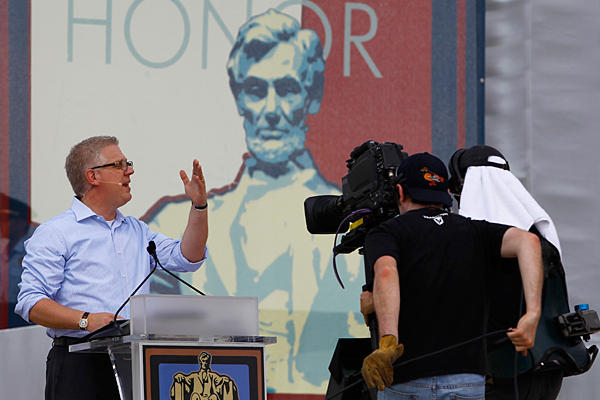
Glenn Beck and friend. Photo by Alex Brandon / AP.

Testing the waters?
Glenn Beck could happen here

Beck…ignores the reality that our essential legal structures are Greco-Roman and Hodenosaunee (Iroquois) in origin, NOT Judaeo-Christian. Five of the first six presidents of the United States were Unitarians and/or Deists, NOT Christians…

By Harvey Wasserman / The Rag Blog / September 3, 2010

Now that the dust has settled from Glenn Beck’s weekend revival at the Lincoln Memorial, two messages need to be delivered loud and clear.

First: the United States of America has NEVER been a Christian nation, but there are those who would make it so, past and future.

And second: do not discount Glenn Beck becoming president of the United States.

I say these things after having sat through nearly all of the 17-part video rendering of Beck’s rally this past weekend, and having read as many critiques of it — left and right — as I could find.

This rally was not about intellectual content, and it’s a mistake to analyze it that way.

Its organizers kept the verbal content extremely simple: honor the military, “restore America,” have faith in your churches, follow their lead, and donate generously.

Much of the real meaning was in who was missing.

The only major media stars were Glenn Beck and Sarah Palin. Limbaugh, O’Reilly, Hannity, Levin, Dr. Laura, Ann Coulter — no one else from the firmament of the Right got the mike or — unless I missed them — appeared on camera.

While his rhetoric was duly humble, the sum of Beck’s parts was about his personal Divine Inspiration. The rally was a “miracle,” he said. God told him to do it, and its stunning, unlikely, impossible, amazing, fantastic, Godly, lucrative success was all due to Him, operating through His only visible Messenger, Glenn Beck.

As of this rally, there is no other putative favorite for the Republican nomination for president. Beck is the only one with a very large, dedicated grassroots constituency.

His modus this weekend was keeping it simple. But there were some twists. He is a Mormon. He repeatedly referred to the Jewish exodus from slavery in Egypt (he timed it wrongly by about two millennia) and had a rabbi conspicuously center stage. He honored Native Americans, the other “lost tribe.” Until the very end, when he did mention “mosques” as a place of worship, there was virtually no mention of Muslims, and none prominently on display.

The vast bulk of the show had to do with honoring the military, the Christian faith, and with endless sermons by Beck himself. Except for Palin, no one else spoke anywhere near as long, and even her appearance was fleeting by comparison.

There was also a strenuous avoidance of explicit partisan politics. Obama’s name was barely mentioned. The most prominent reference to abortion came from Dr. Martin Luther King’s niece. The natural environment was a total no-show. Ditto partisan bickering over deficits, social security, etc. (Unspoken, too, was Beck’s endorsement of the legalization of marijuana).

One might assume Glenn figured we all know where he stands due to his radio and TV shows. But if that was meant to be the message, it was implied, not stated.

Dr. King’s fierce opposition to the war in Vietnam was never mentioned. But he was repeatedly placed in the pantheon of American greatness alongside Washington, Jefferson and Lincoln. The documentary clips — which Beck narrated — gave the impression of uncompromised support for the civil rights movement.

As usual, the proportion of people of color on stage vastly outstripped the diversity of the actual audience. Except for a Beatles t-shirt that somehow appeared on a participant in the crowd, the 1960s seemed to have never happened, except in the agonies of our troops in Vietnam.

No… on a bright, sunny day in front of the Lincoln memorial, surrounded by monuments to our great presidents and wars, this had all the trappings of well-scrubbed audition for a presidential candidacy.

As expected, the show did feature the usual array of patented historical fabrications. Topping the list was a “Black Robed” battalion of armed priests who allegedly terrified the British during the American Revolution. To end the rally Beck dragged up more than 200 preachers to replicate the symbol.

This is pure — and dangerous — invention. If you can find solid reference to this alleged priestly horde anywhere in our history, please send the citations.

Like most of the right, Beck avoids our nation’s deeply secular roots. He repeatedly cites the Constitution and Declaration, but NEVER the Bill of Rights.

Beck also ignores the reality that our essential legal structures are Greco-Roman and Hodenosaunee (Iroquois) in origin, NOT Judaeo-Christian.

Five of the first six presidents of the United States were Unitarians and/or Deists, NOT Christians. So were three of the five men charged with writing the Declaration of Independence. Tom Paine, who wrote the book — Common Sense — that inspired the Revolution, was deeply critical of the Christian faith, to which he most decidedly did not ascribe.

Nor did Ben Franklin, the new nation’s truest intellectual godfather, who is almost always absent from the neo-con iconography. It was the free-living Franklin who drew the inspiration for the federal union from the Iroquois Confederacy, still history’s longest-lived democracy.

Thanks in large part to Franklin, the word “Christian” (like the word “corporation”) was omitted from the Constitution by intelligent design.

None of which mattered at this excruciatingly sanitized gathering. We will see, in the coming months, what kind of legs it gave Mr. Beck, and where he wants to go with them.

He’s never run for or held public office. To many he seems a marginal fool, a bore and a rube, a Crusader Babbitt for a traumatized Main Street… just like, say, Ronald Reagan or George W. Bush.

Now he’s stepped out of the studio and into the real world of grassroots constituency-building. He has inspired a large and dedicated core and transcended his merely electronic base. His people have a fire in the belly, with a serious flow of cash nobody else on the right or left can currently match.

Maybe, for the true inner Beck, it’s just about the money and the glory. Until he hears those voices again.

For in a broke new world, where anything can happen, Glenn and his God just might smite us all.

[Harvey Wasserman has been involved in the struggle for peace, justice, and a green earth since the late 1960’s. Harvey Wasserman’s History of the United States is at www.harveywasserman.com, along with “Thomas Paine’s” Passions of the Potsmoking Patriots.]

The Rag Blog

Posted in Rag Bloggers | Tagged , , , , , , | 3 Comments

Glenn Smith reports on two seemingly coincidental events in Houston: a mysterious fire destroys all of the voting machines in Harris County in what is being investigated as arson; and a well-funded right wing group (TrueTheVote) emerges, making unfounded allegations of widespread voter fraud. A well-produced video on the group’s website shows white people talking patriotically about the need for a million vigilantes to suppress illegal votes. All this in the face of changing demographics that make the Houston vote critical to the possible election of Democrat Bill White as governor.

Posted in RagBlog | Leave a comment

Alice Embree : The War is Over

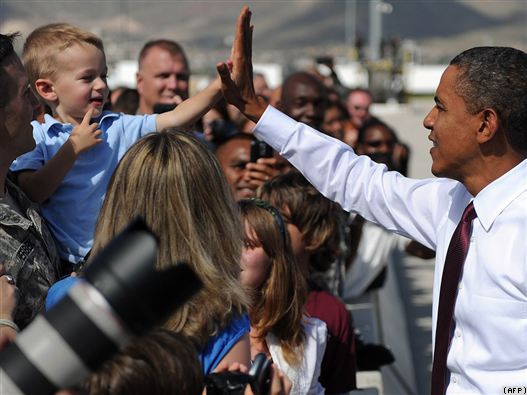
Dude. The War is over. President Obama visits with Iraq war veterans and their families at Fort Bliss, Texas, August 31. Photo from AFP.

(But don’t tell the GI’s at Fort Hood)
THE WAR IS OVER!

By Alice Embree / The Rag Blog / September 1, 2010

So do your duty, boys and join with pride
Serve your country in her suicide
Find the flags so you can wave goodbye
But just before the end even treason might be worth a try
This country is too young to die
I declare the war is over

— Phil Ochs, 1966

See photos, Below.

KILLEEN, Texas — As Barack Obama declares the end of “combat operations” in Iraq, the haunting refrains of Phil Ochs’ “The War is Over,” reverberate through my psyche. Isn’t this the second time a U.S. president has said the Iraq war is over?

We are seven years into the Second Bush Iraq War. Fifty thousand troops and that many contractors remain in Iraq. The 3rd Armored Cavalry Regiment (3rd ACR), a combat regiment, just deployed from Fort Hood to Iraq. The war’s not over.

It’s not over until the troops are home and the contractors’ checks can’t be cashed. The war’s not over for the Iraqi people until depleted uranium no longer poses a neonatal threat. It’s not over until Iraqi hospitals, electricity, and water are at least back to the levels of operation under Saddam Hussein, or better, back to the levels of operation prior to sanctions. The war’s not over until the five million displaced Iraqis can return home. It’s never over for the families of one million Iraqi dead.

The war’s not over for the U.S. soldiers returning with Post Traumatic Stress Disorder (PTSD) and Traumatic Brain Injury (TBI), or those who have lost limbs or the use of their limbs. It’s not over for the families of the more than 5,000 U.S. military men and women who died in Iraq.

On Sunday afternoon, August 29th, Dr. Dahlia Wasfi spoke to a packed crowd at the Texas State Employee Union’s meeting hall about the human catastrophe of U.S. policy in Iraq. As an Iraqi-American, she speaks with eloquence about her father’s place of birth. With her medical background, she brings disturbing details to the discussion of civilian casualties. She minces no words in describing the occupation.

Under the façade of liberation and democracy, U.S. troops seized the country, securing the oil fields, the Ministry of Oil, the Interior Ministry (CIA), and taking the lives of thousands of people. Iraq’s rich culture, history, and valuable assets were left vulnerable to stealth and destruction. In the years since [March 19, 2003], the lack of security, jobs, electricity, and potable water have made life for Iraqis unbearable… Our obligation to the people of Iraq, to the people of America, and to the rest of the world is the immediate and unconditional withdrawal of American troops and mercenaries from Iraq.

Go to www.liberatethis.com for more on Dr. Dahlia Wasfi.

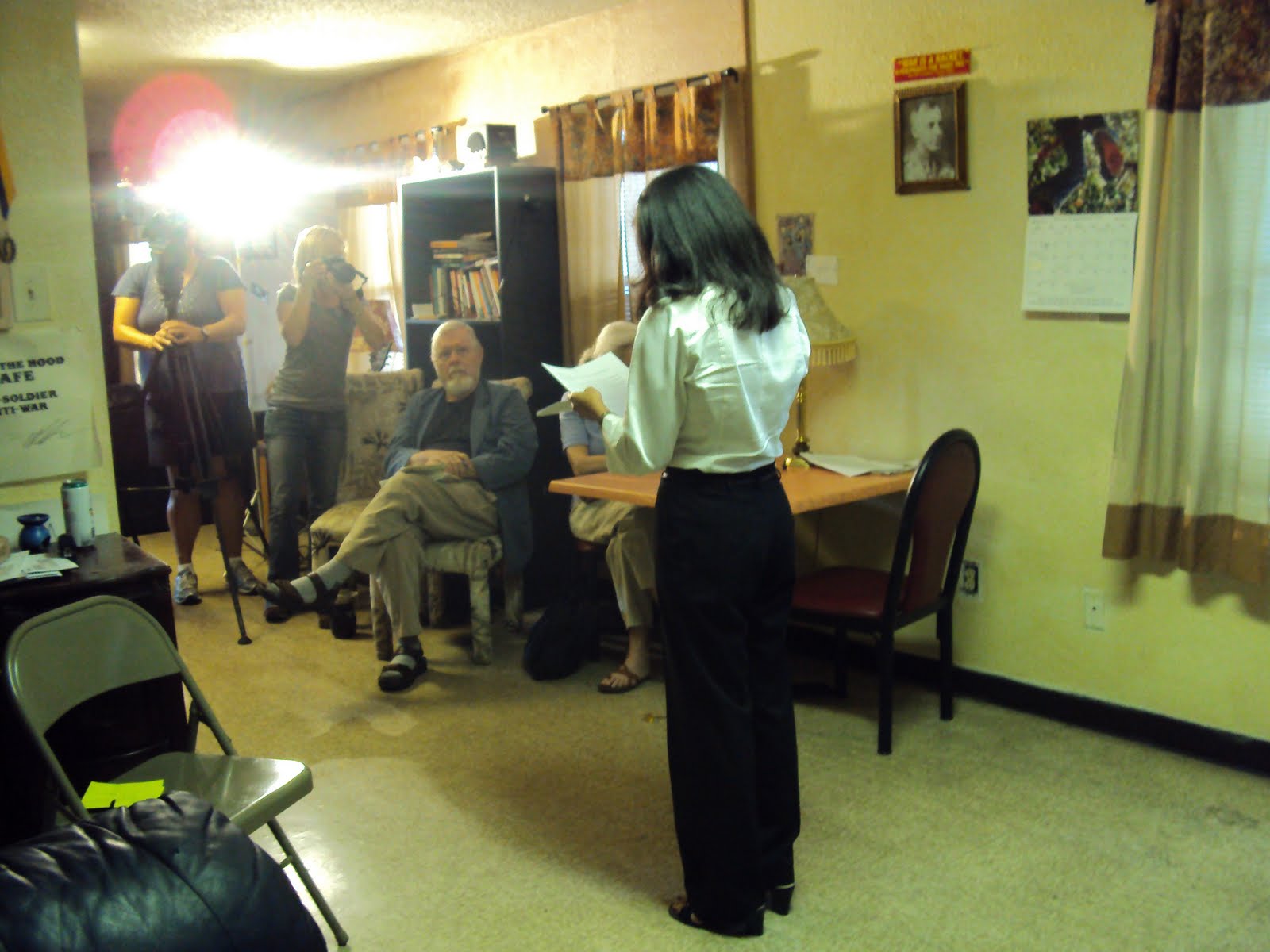
On Monday morning, August 30th, a press conference in Killeen, Texas countered the claim that the Iraq war is over. Killeen is the home of Fort Hood, the nation’s largest military base. Rep. Lon Burnam of Fort Worth joined Dr. Dahlia Wasfi and representatives from Iraq Veterans Against the War (IVAW), Texas Labor Against the War, Veterans for Peace, CodePink Austin, and the Peace and Justice Support Network of the Mennonite Church at Killeen’s Under the Hood Café.

The common message was that the war continues. Rep. Lon Burnam got directly to the point highlighting the costs of the Iraq debacle.

The Killeen Daily Herald noted, in extensive coverage of the event, that

Burnam said he was tired of officials using the “financial back of us working folks” to fund conflicts, and quoted a 1953 speech by President Dwight Eisenhower: “Every gun that is made, every warship launched, every rocket fired signifies, in the final sense, a theft from those who hunger and are not fed, those who are cold and are not clothed.”

In 1966 when Phil Ochs wrote his song, the Vietnam War was not over. In fact, it was far from over. In 2010, despite pronouncements from the Oval Office, the Iraq war is not over. The families of Fort Hood’s 3rd ACR can attest to that. And there is still another war raging in Afghanistan.

[Alice Embree is a long-time Austin activist and organizer, a former staff member of The Rag in Austin and RAT in New York, and a veteran of SDS and the women’s liberation movement. She is active with CodePink Austin and Under the Hood Café. Embree is a contributing editor to The Rag Blog and is treasurer of the New Journalism Project.]

Dr. Dahlia Wasfi speaking on the Humanitarian Catastrophe of U.S. Policy in Iraq, Austin, August 29, 2010, Texas State Employees Union. Photo by Carlos Lowry / The Rag Blog.

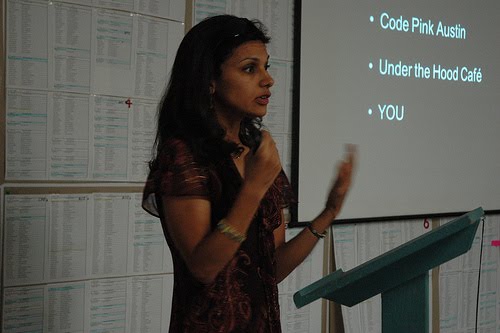
Dr. Dahlia Wasfi addresses media at Under the Hood press conference, August 30, 2010. Photo by Heidi Turpin / The Rag Blog.

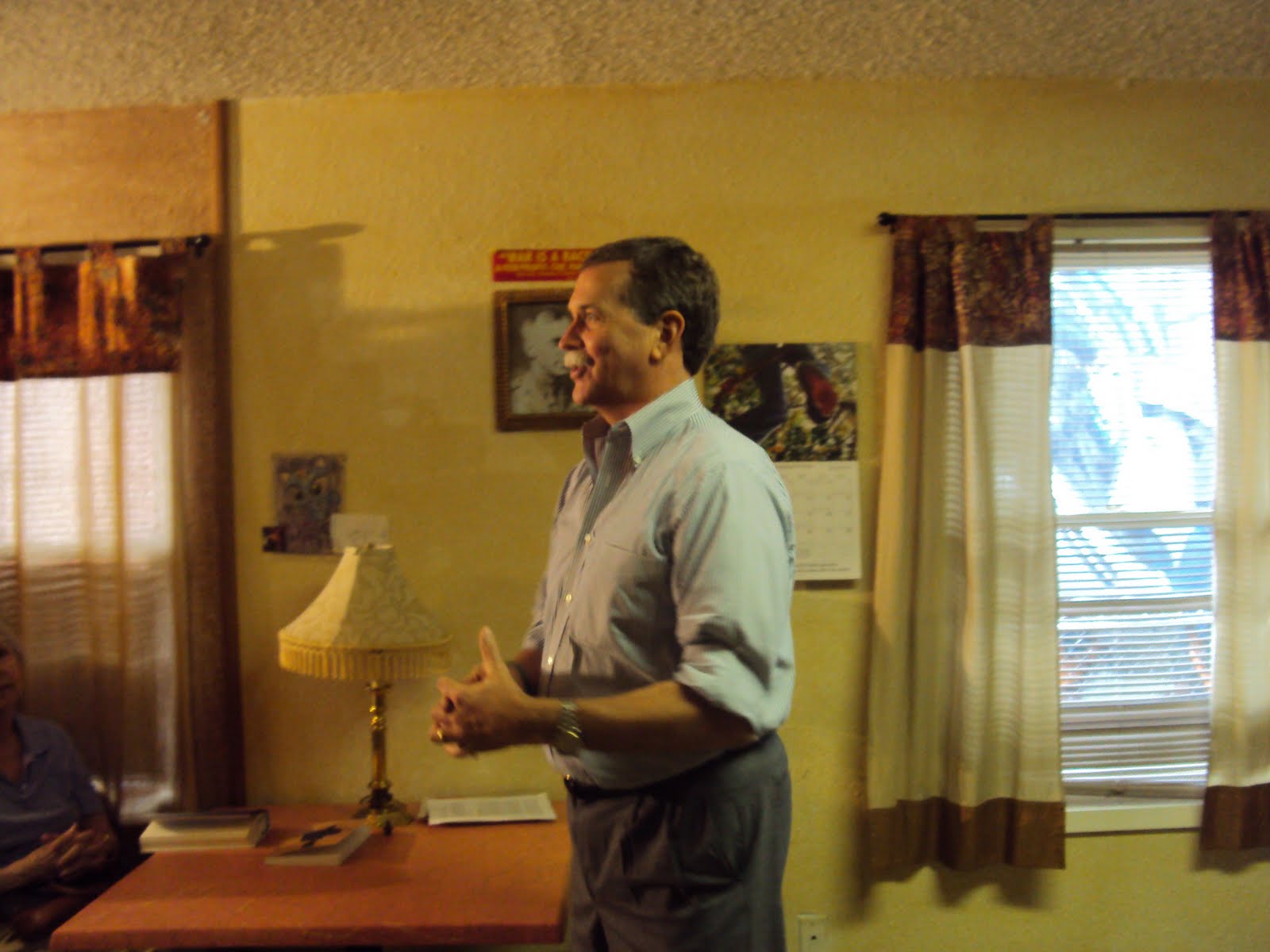
Texas Rep. Lon Burnam of Ft. Worth at Under the Hood press conference. Photo by Heidi Turpin / The Rag Blog.

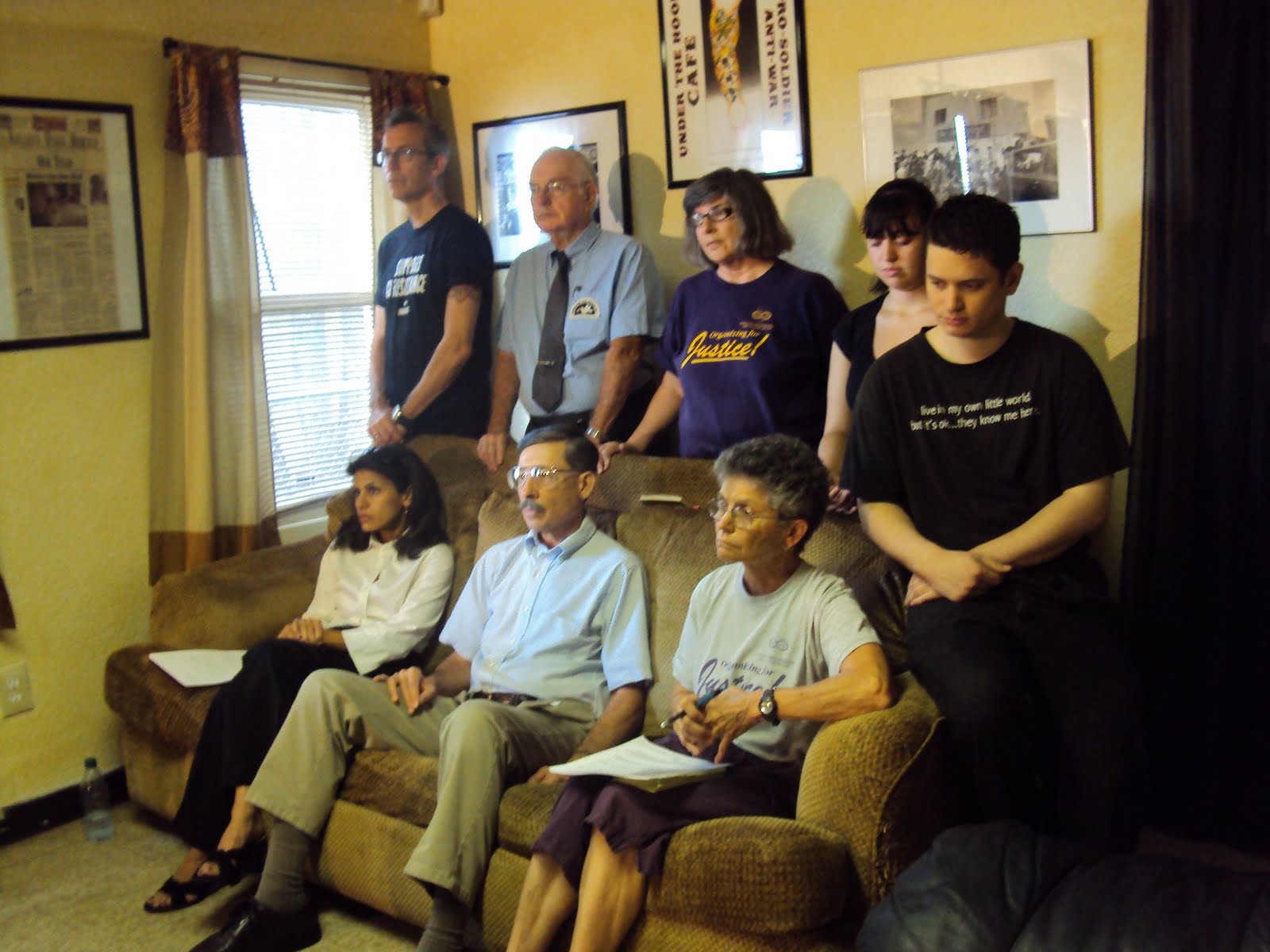
Under the Hood Press Conference. Seated (l-r): Dr. Dahlia Wasfi (Iraqi-American peace activist), Larry Egly (Mennonite Church), Leslie Cunningham (Texas Labor Against the War); Standing, Jim Turpin (CodePink Austin), Jack Prince (Veterans for Peace), Alice Embree (The Rag Blog), Jasmyne Thomas (Fort Hood military family member), Jeff Gernant (Iraq Veterans Against the War). Photos by Heidi Turpin / The Rag Blog.

The Rag Blog

Posted in Rag Bloggers | Tagged , , , , , | 5 Comments

Glenn W. Smith : It’s Getting Hot in Houston

Image from Dog Canyon.

Likely Arson in Houston, and
Voter suppression from the Right

By Glenn W. Smith / The Rag Blog / August 31, 2010

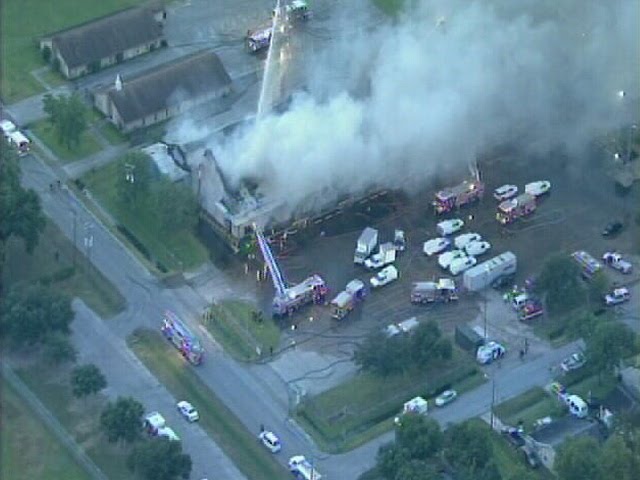
A mysterious fire last Friday destroys all of the voting machines in Harris County (Houston), Texas. Arson investigators have not yet issued an opinion.

Meanwhile, a well-funded right-wing group emerges in Houston and begins raising unfounded allegations of widespread voter fraud. A video on their website pictures only people of color when it talks of voter fraud. White people are shown talking patriotically about the need for a million vigilantes to suppress illegal votes.

In the video, an unidentified spokesman for “TrueTheVote” says, “If we lose Houston, we lose Texas. And guess what? If we lose Texas we lose the country.”

The former Mayor of Houston, Democrat Bill White, is running against secessionist Republican Gov. Rick Perry this year. White’s counting on a big turnout in his home town. The fire and the voter suppression campaign guarantee a greatly diminished turnout.

TrueTheVote’s video [see below] is well produced. Participants speak in calm and knowing tones, disguising the racist agenda behind their project. We don’t yet know where the group’s money comes from. But they have money.

As I’ve said before, right-wing voter suppression campaigns are the most under-reported political scandal of the last 50-100 years. But there’s never been anything like the criminal destruction of all the voting machines in the nation’s fourth largest city.

You don’t have to be a conspiracy theorist to suspect the machines in Houston were destroyed by an arsonist. Warehouses don’t regularly and spontaneously combust at four in the morning, especially warehouses containing all the voting tools in a pivotal city in a pivotal election.

In other details, the suppression campaigns follow a familiar pattern: raise suspicions of widespread voter fraud. Accuse “others” of stealing elections from us (read: white people). Threaten would-be voters with criminal charges. Limit polling locations in poor and minority precincts. Distribute spurious “felon lists” that disenfranchise legal voters who happen to share a name with a felon. Staff phone banks that make election calls to minority and poor voters giving incorrect polling locations and dates. Dress up vigilantes in cop clothes to intimidate would-be voters.

Huffington Post contributor Greg Mitchell wrote one of the best accounts of such a suppression and intimidation campaign in his book about the 1934 California governor’s race, The Campaign of the Century. At least since then, voter suppression has been a part of nearly every election cycle.

Voting machines go up in smoke in Houston. Photo from KRIV-TV.

There are simply no machines available to replace the loss of Houston’s machines. That means either a return to paper ballots (there may be very few scanners to count them) or a greatly reduced number of polling locations. The latter would require the emergency suspension of state law and run afoul of the Voting Rights Act. In any case, confusion will reign, and confusion reduces turnout.

What about that TrueTheVote statement, “If we lose Houston, we lose Texas. And guess what? If we lose Texas we lose the country.”? That may be the only true thing TrueTheVote has said.

For much of the country, Texas is a vast right-wing breeding ground. Actually, Democrats have nearly reached parity in the state House of Representatives. All the elected officials in Dallas are Democrats. Austin, too. Most of the judges and many of the officials in Houston are Democrats.

With a strong turnout in Houston, White could very well beat Perry. Without a national effort to counter the largest voter suppression effort in my memory, that turnout won’t happen. Even if the fire is ruled accidental, its consequences remain the same. If a great number of Houston voters are disenfranchised as a consequence of the fire and the right’s election vigilante effort, democracy loses, and so does the country.

Keep in mind that population shifts will hand Texas several new congressional seats lost in the Democratic rustbelt. This election will decide the players who will draw new lines in redistricting. The stakes are high. The question is, do Democrats have the will to do battle with right-wing forces who believe they can choose who votes and who doesn’t?

[Austin’s Glenn W. Smith, according toDaily Kos founder Markos Moulitsas, is a “legendary political consultant and all-around good guy.” His excellent blog on politics and culture is DogCanyon, where this article also appears.]


UPDATE: Tuesday, August 31, 2010
, 7:30 p.m.

The Houston Chronicle reported today:

Despite a fire that destroyed Harris County’s voting machines last week, County Clerk Beverly Kaufman said Monday that she intends to keep all polling places open with replacement machines on Nov. 2.

Commissioners Court approved Kaufman’s emergency plan Monday to spend $13.6 million to buy 2,325 electronic voting machines and supporting equipment.
[….]
Kaufman’s plan includes 1.4 million paper ballots, which will be distributed to polling stations as a backup in case a shortage of machines leads to long lines.
[….]
Despite Kaufman’s confident predictions of a timely and fair election, 16 Democratic state senators and representatives have asked the U.S. Department of Justice to oversee the development of an emergency plan for voting that begins in 48 days. Their letter asks for the department’s involvement to “protect the voting rights of racial and language minorities” against any plans to close some of the 739 scheduled polling places due to a lack of equipment.

“Removing neighborhood voting locations and fostering conditions for longer lines must be avoided to prevent suppression of minority voters,” the legislators wrote…

Despite her apparent confidence, Kaufman urged residents to vote early to avoid long lines and said she would seek “loaner machines” from other counties.

The Chronicle reported no new information about the cause of the fire, but said that an arson investigation is under way.

‘TrueTheVote’ Video

The Rag Blog

Posted in Rag Bloggers | Tagged , , , , , , , , | 3 Comments

Ted McLaughlin : These Jobs Won’t Cut It


We don’t just need jobs;
We need good jobs

By Ted McLaughlin / The Rag Blog / August 31, 2010

George Bush, with his policy of accelerated Reaganomics, made a real mess of the United States economy before he left office. It was not bad enough that he presided over a massive outsourcing of good American jobs, but his deregulation, tax cuts for the rich, and deficit spending created the worst income distribution since the 1920s and kicked off a serious recession resulting in the loss of millions more jobs.

In his entire eight years in office Bush only created about a million jobs (while his predecessor, Bill Clinton, created 23 million in his eight-year stint in office), and more than lost those in his recession (which started in the last part of 2007). President Obama is already poised to have created more jobs in his first two years in office than Bush did in eight years. That is a good thing, but not as good as you might believe.

The problem resides in just what kind of jobs are being created. This is not a new problem. Even back in the Bush administration, while good jobs were being sent overseas (where wages could be cut to less than minimum wage levels), the new jobs being created were low-wage jobs that would not allow a man/woman to support a family. Unfortunately, the problem is persisting under the current administration.

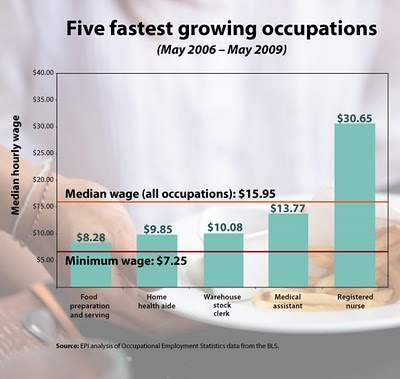
The chart above is indicative of the problem. The chart shows the five fastest growing jobs in the United States. Only one of those jobs (registered nurse) is above the median wage in America. The other four (food preparation and serving, home health aide, warehouse stock clerk, medical assistant) are well below the median wage and approaching the minimum wage. The problem is even worse when you consider the median wage has been depressed for the last 20 or more years and won’t buy close what it once would.

While the cost of nearly everything has climbed sharply for the last 20 years, the wages of the bottom 80% of Americans have been stagnant. This alone would have accounted for the pain being felt by middle and working class people, but it was made even worse by the millions of jobs lost by the Bush recession. Now the new jobs being created are lower-paying jobs than the ones that were lost. It’s hard to rejoice in the creation of these kind of jobs.

President Obama has said he wants to give tax cuts to companies that don’t outsource jobs (and hopefully bring good-paying jobs back to the United States). That would be a good start, but much more needs to be done. This recession will not be ended by the creation of minimum-wage jobs (even a lot of them). That would just continue the pain being currently felt by ordinary Americans. And it would set the country up for another, possibly worse, recession or depression.

The vast difference in both accumulated wealth and income distribution between the richest five percent of Americans and the rest of America was the real cause of this recession (while the financial mismanagement by Wall Street was just the trigger). The only real cure for our current economic woes is to find a way to more equitably distribute the nation’s income.

The nation’s health is not determined by how rich the richest 1-5% can get. No matter how hard they try, this small number of people just don’t have the purchasing power to keep an economy as large as ours growing. While the Republicans (and the rich) don’t want to admit it, America has always seen its best times when the working and middle class people have had adequate purchasing power to live a decent and comfortable life. When these people have the money to buy, everybody benefits — even the rich and the corporate interests.

Minimum wage jobs may be fine for high school students, but they won’t support a family. And they won’t lift this country out of the recession.

[Rag Blog contributor Ted McLaughlin also posts at jobsanger.]

The Rag Blog

Posted in Rag Bloggers | Tagged , , , , | 3 Comments

Paul Krassner : Censorship at Facebook


Unfriending the control freaks:
Censorship at Facebook

By Paul Krassner / The Rag Blog / August 31, 2010

Those control freaks who run Facebook are doing it again. This time, as you probably know, they’re not allowing the image of a marijuana leaf — because it’s “illegal content” — to appear in ads from the “Just Say Now” campaign for the legalization of pot, which is sponsored by Students for a Sensible Drug Policy. It’s not the first time Facebook has indulged in chickenshit censorship. Below is my piece about it that was published in the May issue of High Times.

Mikal Gilmore, one of the best journalists covering the counterculture, is the author of Stories Done: Writings On the 1960s and Its Discontents. “For more than half of the subjects here,” he states, “including Ken Kesey, Timothy Leary and the Haight-Ashbury, psychedelics were a major factor in their lives…” But recently Gilmore himself had a bad trip, resulting from an overdose of the modern drug, Facebook.

Like so many others, his account was shut down, and they wouldn’t tell him why he was kicked off the island, so that he had no way of knowing what he did wrong or how to avoid doing it again. A Facebook friend who attempted to contact him with no success informed me that, “after numerous tries, I got this horrible warning that covered the screen screaming ‘DANGEROUS.’ Holy shit! To say it was disconcerting is an understatement.”

Gilmore explained the situation to me:

I was booted, I’m told, because of an image I posted. I was listening one night a few months ago to an early 1970s pop album by Joey Heatherton, and I was struck by her voice, how good it could be when she worked at it. I posted something to that effect, and I also posted the album cover, which I always try to do when I mention some music or music artist (or a book or movie).

This particular album has a photo of Heatherton baring her breasts. Last week, I couldn’t access my account and was told I’d been dropped for violating Facebook policy, but they couldn’t tell me what the specific offense was because, “for security reasons,” they just can’t do that.

Since I’d acquired several friends at Facebook, and because my wife loves to take matters in hand, several people there raised a ruckus. I didn’t ask anybody to. In fact, I thought my deactivation was just some fluke mistake, but Facebook refused to answer any of my inquiries, and also refused to answer anybody else’s protests.

I was going to give up any idea of rejoining. Then, the same day I came to that conclusion, Facebook restored me, and told me they had deleted the offensive image. They never told me what the image was, but a Facebook member who has a relative at the place finally learned that it was the Heatherton album cover, and that Facebook had taken the action because another Facebook member had complained about the image.

Meanwhile, attorney Brian Cuban was fighting his own battle with Facebook, trying to get them to remove pages for Holocaust denial groups. He agreed with me that the First Amendment doesn’t apply to private companies, but he added, “I think you have to look at the way free speech is evolving in historical context. We have come into an age where, with the advent of the Internet and unchecked values out there in the blogosphere, mere words have in fact driven people to commit violent acts.”

I asked, “When you spoke to Facebook about why they don’t tell people why they were dropped, how did they justify that?”

It was a justification of cost/benefit. I think they would love to give everyone a detailed explanation of why they’ve been dropped to prove there is no conspiracy there, as many people believe. In my battle with Facebook over Holocaust denial groups, I have been hit with countless e-mails asking me to ask them why there’s a Jewish conspiracy at Facebook — to get rid of Jewish activists and to get rid of Jews in general — because we’re raising all this fuss about Holocaust denial. In reality, I think it’s just cost/benefit. They don’t have the intrastructure to give everyone an explanation.

Perhaps Mikal Gilmore should have covered Joey Heatherton’s nipples with swastikas.

[Paul Krassner, for decades one of the country’s foremost social critics, edited The Realist, America’s premier journal of cutting edge social and political satire. He was also a founder of the Yippies. And speaking of censorship, Krassner defies it by publishing the Disneyland Memorial Orgy poster. See it at paulkrassner.com.]

The Rag Blog

Posted in Rag Bloggers | Tagged , , , , | 3 Comments

Harry Targ : The Evolving Techniques of Empire

Image from ccsd.org.

Techniques of empire:
What is new and what is the same old stuff?

By Harry Targ / The Rag Blog / August 31, 2010

Empires past

Nations, tribes, armed members of messianic religions from time to time have engaged in conquest of others. Peoples have been slaughtered for their land, their natural resources, their mistaken beliefs. The techniques used to be simple: killing, imprisonment or enslavement, and occupation.

With the rise of capitalism as a global economic system, accumulated resources were used to create modern instruments of war — guns, ships, pollutants, and poisons. As Marx claimed long ago, capitalism was of necessity a global system so nation-states created in the era of economic modernity were compelled to pursue exploitable labor (particularly slaves), natural resources, market opportunities, and investment sites everywhere. Mercenary armies were created to conquer people and land and fight against the mercenary armies of other capitalist countries.

The British empire (“the sun never sets on the British Empire”) was caused by and facilitated the industrial revolution. In the 1880s European imperial powers came together to divide up the African continent. After the first of two world wars in the twentieth century, wars which cost 60 million deaths, the Middle East was divided up among declining powers, Great Britain and France.

The United States joined the imperial fray in the 1890s. It took the Hawaiian Islands, fought Spain to conquer Cuba, occupied other Caribbean Islands, and crushed the independence struggle in the Philippines. Over the next 30 years the United States invaded countries in the Western Hemisphere some 25 times, often leaving U.S. Marines in place for years.

The United States and the Cold War

A variety of imperial techniques became common as the United States fought the Communist enemy during the Cold War. With the creation of the Central Intelligence Agency in 1947, the first of many “intelligence agencies” was launched to interfere with the political life of countries the U.S. regarded as strategic.

CIA money was used to shape elections in democracies such as France and Italy. Money flowed to Christian Democratic Parties created to oppose Socialist campaigns. Also money found its way into anti-Communist trade union federations. This pattern of interference was replicated in Latin America as well and later in Africa, Asia, and the Middle East.

The United States engaged in visible campaigns to create and support military coups; the most critical being in Guatemala and Iran in the 1950s, Brazil and Indonesia in the 1960s, and Chile in the 1970s. And of course U.S. policymakers launched long and brutal wars in Korea and Vietnam leading to four million Asian deaths and 100,000 American soldiers killed.

The pursuit of U.S. empire included some modern strategies as well as conquest and subversion. President Truman, through the Marshall Plan, instituted an expensive campaign of economic and military assistance which would become a staple of U.S. Cold War policy. From the initiation of the Marshall Plan in 1948 with a modest $14 billion aid program to anti-Communist regimes in Europe through the Carter years, $235 billion was provided to selected and strategic imperial partners: first in Europe, then Asia and the Middle East.

President Kennedy contributed to the imperial tool kit; the provision of military advisors, funding for local militaries in countries threatened by revolution (such as in Central America), and training programs for military officers such as in the old School of the Americas. Economic assistance came with strings, the promotion of market-based economies, and opposition to indigenous and Communist political forces, at least as much as local political contexts would allow.

President Reagan was an imperial innovator as well. Constrained by the “Vietnam Syndrome,” public opposition to further Vietnam-style military quagmires, he established policies based upon “low intensity conflict.” Creating and funding local counterrevolutionary armies in places as varied as Nicaragua, Angola, Ethiopia, Cambodia, and Afghanistan, the U.S. role in conflicts could be kept off the front pages of newspapers.

Civil war violence stimulated by U.S. resources would not be “low intensity” in countries where it occurred but it might be considered so in the U.S. Citizens would not learn of the critical U.S. support given to Islamic fundamentalist rebels, including Osama Bin Laden, fighting a pro-Soviet regime in Afghanistan in the 1980s until quite recently.

To insure the limited visibility of U.S. global operations, and to reward political allies with government contracts, the Reagan administration dramatically expanded programs privatizing U.S. military operations. Support for the Contra war against the Nicaraguan people involved transferring public funds to private armies and using key foreign policy advisers, such as Colonel Oliver North, as conduits and organizers of networks of private sources of funding for war.

Thus began public programs to encourage and stimulate the creation of private companies that would fight America’s wars. The American people had little way of knowing how deeply involved they were in violence around the world and the danger of sinking into new Vietnams.

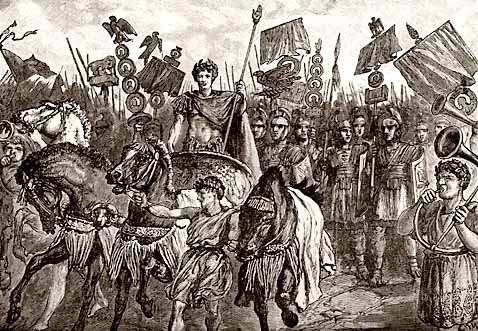
Roman legions. Image from Cultural Resources.

21st century techniques of empire

The world has come a long way from the days of Roman legions slogging across land pillaging and killing. The days of nineteenth century colonial rule — clumsy and arrogant with foreign occupants of land lording over exploited local workers — has changed. However, it is important to reflect on the new or more developed techniques of empire, while never forgetting that there are centuries long continuities of techniques of imperial rule.

For starters, Marc Pilisuk reports in Who Benefits From Global Violence and War: Uncovering a Destructive System that the character of war has changed over the years and centuries. Wars today are not usually between nations. Casualties of wars are overwhelmingly civilians rather than soldiers. The weapons used in wars today are more likely than in the past to temporarily or permanently damage the natural habitat as well as kill people.

Wars in recent years have been likely to be fought over natural resources. Nations and groups now are more likely to be supplied with weapons produced by a handful of corporations that specialize in the production of military supplies. These weapons are provided by a small number of nations. Finally, wars fought in modern times, the last 100 years, have caused more deaths than in any other comparable period of human history.

Pilisuk reports that since World War II 250 wars have occurred causing 50 million deaths and leaving millions homeless. (The United States participated significantly in 75 military interventions.)

Recently a number of journalistic and scholarly accounts have added to our understanding of newer techniques of empire, particularly U.S. empire.

  • Global presence. Pilisuk, Chalmers Johnson (The Sorrows of Empire) and others have estimated that the United States has over 700, perhaps 800 military installations in more than 40 countries. Some years ago the Pentagon determined that huge Cold War era military bases needed to be replaced with smaller, strategically located bases for rapid mobilization to attend to “trouble-spots” in the Global South. While forward basing in South Asia and in nations formerly part of the Soviet Union has received some attention seven new U.S. bases being established in Colombia (within striking distance of hostile Venezuela) and increased naval operations in the Caribbean have not. In addition, there are some 6,000 domestic military bases, many that anchor the economies of small towns.
  • Privatization of the U.S. military. David Isenberg (“Private Military Contractors and U.S. Grand Strategy,” PRIO, Oslo, 2009) refers to “…the U.S. government’s huge and growing reliance on private contractors” which “…constitutes an attempt to circumvent or evade public skepticism about the United States’ self-appointed role as global policemen.” While PMCs provide many services, such as combat, consulting, training armies, and military support, their combat presence in the two major wars of the 21st century, Afghanistan and Iraq, has generated the most, if limited, public attention. Isenberg says that between 1950 and 1989 PMCs participated in 15 conflicts in other countries and from 1990 to 2000 another 80. PMCs were employed in civil wars such as in Angola, Sierre Leone, and the Balkans.

    A recent Washington Post investigation compiled a data base, “Top Secret America,” “that found 1,931 intelligence contracting firms” doing top secret work “for 1,271 government organizations at over 10,000 sites.” TSA indicates that 90 percent of the intelligence work is done by 110 contractors. Defense department spokespersons and legislators claim that the United States needs to continue allocating billions of dollars to private contractors to maintain military performance levels that are minimally acceptable.

The X-47B unmanned combat air vehicle. Artist’s rendering from Defense Industry Daily.

  • Unmanned aerial vehicles. Nick Turse (The Complex: How the Military Invades Our Everyday Lives) describes the introduction of unmanned aerial weapons in the 1990s and their current weaponry of choice for the White House and others who prefer antiseptic and bloodless (on our side) technologies to eliminate enemies. New predator drones can be programmed to fly over distant lands and target enemies for unstoppable air strikes. Drones have been increasingly popular as weapons in fighting enemies in Afghanistan, Pakistan, Somalia, and Yemen.

    Connecting drone strikes to assassination teams and other war-making techniques, Shane, Mazzetti, and Worth, (“Secret Assault on Terrorism Widens on Two Continents,” The New York Times, August 16, 2010) refers to shadow wars against terrorist targets. “In roughly a dozen countries — from the deserts of North Africa, to the mountains of Pakistan, to former Soviet republics crippled by ethnic and religious strife — the United States has significantly increased military and intelligence operations, pursuing the enemy using robotic drones and commando teams, paying contractors to spy and training local operatives to chase terrorists.”

  • Assassinations. The United States has initiated campaigns to identify and assassinate presumed enemies. CIA operatives and private contractors join teams of army specialists under the Joint Special Operations Command (13,000 assassination commandos around the world) to kill foreigners alleged to be affiliated with terrorist groups. These targets can include U.S. citizens living abroad who have been deemed to be terrorist collaborators. In the Western Hemisphere, the United States, through Latin American military personnel trained at the School of the Americas, has long supported assassination programs that now seem to be “globalized,” that is administered everywhere.

    Fred Branfman (Alternet, August 24, 2010) starkly describes the assassination policy: “The truth that many Americans find hard to take is that mass U.S. assassination on a scale unequaled in world history lies at the heart of America’s military strategy in the Muslim world, a policy both illegal and never seriously debated by Congress or the American people.”

  • Missionary humanitarian interventions. While most techniques of empire involve the direct use of violence, public and private organizations expand the presence of empire through so-called “humanitarian assistance.” While the work of the missionary has often followed the flag, never has such activism impacted so heavily on global politics as today.

    For example, The New York Times (July 6, 2010) reported that Christian evangelical groups have transferred substantial amounts of funds to Jewish settlements in occupied territories of the West Bank. Furthermore, fundraising for settlements that stand in the way of the creation of a Palestinian state receive tax exemptions. The newspaper reports on “…at least 40 American groups that have collected more than $200 million in tax-deductible gifts for Jewish settlement in the West Bank and East Jerusalem over the last decade.”

    The newspaper correctly points out that so-called “humanitarian” and tax deductible donations to entities in other countries tied to U.S. foreign policy are not new. But, the article suggests that donations to the settler movement are special “because of the centrality of the settlement issue in the current talks and the fact that Washington has consistently refused to allow Israel to spend American government aid in the settlements. Tax breaks for the donations remain largely unchallenged, and unexamined by the American government.”


What is new about imperial policies

While the general character of imperial policies remains the same, whether the empire is Rome, Japan, Germany, France, Great Britain, or the United States, changes in technology, the state system, ideology, and tactical thinking have had their effects.

First, imperial rule has become truly global. From bases in far-off places to unmanned drones flying over literally millions of targets everywhere, empires operate with no constraints based on geography.

Second, the military has become big business. Private corporations assume a greater share of Department of Defense budgets. Private companies now clean up and cook for the troops, train foreign soldiers, assassinate assumed terrorist enemies, and fight small wars with almost no visibility to publics.

Third, the United States is moving toward fighting wars without soldiers on the ground. Enemies can be identified by computer and military technologists can then push the right buttons to kill the unfortunate targets. Killing has become antiseptic. Killers can say goodbye to the kids in the morning, drive to work, push some buttons, drive home and spend the evening with the family. Meanwhile thousands of miles away there are mourners crying over those just assassinated.

Fourth, empires, at least the U.S. empire, can kill with impunity. Targets labeled terrorist can be eliminated by unmanned space weapons, specially trained assassination teams, or average foot soldiers.

Finally, empires can expand and change the destiny of peoples through so-called “humanitarian assistance.” Local goals, good or bad, are furthered by the large financial resources that special interests can bring to other countries.

Empires have had a long and ugly history. Because of technology, economics, and ideology new techniques of empire have been added to the old. The struggle against all empires must continue.

[Harry Tarq is a professor in American Studies who lives in West Lafayette, Indiana. He blogs at Diary of a Heartland Radical.]

The Rag Blog

Posted in Rag Bloggers | Tagged , , , , | 2 Comments

Robert Jensen : Glenn Beck’s Redemption Song

rial in Washington, Saturday, Aug. 28. Photo by Alex Brandon / AP / Christian Science Monitor.

‘Restoring honor’ in DC:
Glenn Beck’s redemption song

By Robert Jensen / The Rag Blog / August 30, 2010

About halfway through Saturday’s “Restoring Honor” rally on the DC mall, I realized that I was starting to like Glenn Beck.

Before any friends of mine initiate involuntary commitment proceedings, let me explain. It’s not that I really liked Beck, but more that I experienced his likeability. Whether or not he’s sincere, I came to admire his ability to project sincerity and to create coherence out of his incoherent rambling about religion, race, and redemption.

As a result, I’m more afraid for our political future than ever.

First, to be clear: Beck is the embodiment of everything I dislike about the U.S. politics and contemporary culture. As a left/feminist with anti-capitalist and anti-empire politics, I disagree with most every policy position he takes. As a journalist and professor who values intellectual standards for political discourse, I find his willful ignorance and skillful deceit to be unconscionable.

So, I’m not looking for a charismatic leader to follow and I haven’t been seduced by Beck’s televisual charm, nor have I given up on radical politics. Instead, I’m trying to understand what happened when I sat down at my computer on Saturday morning and plugged into the live stream of the event.

Expecting to see just another right-wing base-building extravaganza that would speak to a narrow audience, I planned to watch for a few minutes before getting onto other projects. I stayed glued to my chair for the three-hour event.

My conclusion: What I saw was the most rhetorically and visually sophisticated political spectacle in recent memory. Beck was able to both connect to a right-wing base while at the same time moving beyond the Republican Party and the Tea Party movement, potentially creating a new audience for his politics. It’s foolish to make a prediction based on one rally, but I think Beck’s performance marked his move from blowhard broadcaster to front man for a potentially game-changing political configuration.

My advice: Liberals, progressive, and leftists — who may be tempted to denounce him as a demagogue and move on — should take all this seriously and try to understand what he’s doing. Here’s my best attempt to understand it.

Religion

There’s nothing new about mixing Christianity and right-wing politics in the United States, and Beck put forward a familiar framework: America is a Christian nation that honors religious freedom. Christians lead the way in the United States, but the way is open to all who believe in God.

Anyone teaching the “lasting principles” found in all faiths is welcome, despite theological differences. “What they do agree on is God is the answer,” Beck said in his call for a central role for religious institutions, whether they be churches, synagogues, or mosques.

But for all the religious rhetoric, Beck never talked about the hot-button issues that are important to conservative Christians. No mention of abortion or gays and lesbians. Theologically based arguments against evolution and global warming were not on the table. No one bashed Islam as a devilish faith.

Instead, Beck concentrated on basics on which he could easily get consensus. God has given us the pieces — faith, hope, and charity — and all we have to do is put them together. Rather than arrogantly assert that God is on our side, he said, we have to be on God’s side.

Beck may eventually have to voice clear opposition to abortion and gay marriage to hold onto conservative Christian supporters, but on Saturday it was his apparent religious sincerity that mattered. I have no way to know how serious Beck’s faith in a traditional conception of God really is, but it doesn’t matter.

He sounds sincere and moves sincere; he creates a feeling of sincerity. He brings an emotional candor to public discussion of religion that is unusual for someone in his line of work. When religious people believe that someone’s profession of faith is real — that it’s rooted in a basic decency and is deeply felt — then differences over doctrine become less crucial.

There has been some discussion of whether Beck, a convert to Mormonism, can really connect to Protestants and Catholics, some of whom view the Church of Jesus Christ of Latter-day Saints as a cult rather than an authentic Christian denomination. No doubt some evangelical/fundamentalist Christians will reject Beck, but his personal appeal could overcome those objections for many others.

Race

There’s also nothing new in Beck’s analysis of race. Like most conservatives, he argues that America’s racism is mostly a thing of the past, and that racial justice means a level playing field that offers equal opportunity but does not guarantee equal outcomes.

Rather than come to terms with the way white supremacy continues to affect those outcomes through institutionalized racism and unconscious prejudices, folks like Beck prefer a simple story about personal transcendence and the end of racism.

What was different about Beck’s version of this story was the supporting cast. There were a lot of non-white people on the stage, including a significant number of African Americans. The rally went well beyond the tokenism that we are used to seeing, not only in the Republican Party but also in institutions throughout society.

Beck not only gave a featured speaking slot to Alveda King — one of Martin Luther King, Jr.’s nieces, no doubt selected to bolster his claim to be speaking in the MLK tradition — but also paid close attention to race throughout the day. Take a look at the lineup for the presenters of the three civilian badges of merit for faith, hope, and charity: An American Indian presenting to an African-American; a white man presenting to a Dominican; and a Mexican-American presenting to a white man, with a black woman accepting on his behalf.

Is it all cynical and symbolic? For those of us who are white, do we have a right to ask that question in the presence of so much passion from the people of color on stage? These weren’t cardboard cutouts shoved in front of a camera to add color, but an eclectic mix of people, all espousing a fundamental faith that they seemed to share with Beck.

Whether a movement rooted in Beck’s approach can gain wide acceptance in non-white communities is not the only question. For white people who are struggling with how to live (or, at least, appear to live) a commitment to racial justice, this kind of space will be attractive.

Tea Party gatherings are weighed down by an overt racial ideology that limits their appeal; Beck may have a strategy that overcomes that problem, creating a movement that has a significant enough non-white component to make white people feel good about themselves without really challenging white dominance.

Redemption

The key message of the “Restoring Honor” rally was redemption, personal and collective, the personal intertwined with the collective. Unlike some reactionary right-wingers, Beck spoke often about America’s mistakes — though all of them are set safely in the past. Rather than try to downplay slavery, he highlighted it. It is one of America’s “scars,” a term he repeated over and over, to emphasize that our moral and political failures are from history, not of this moment.

“America has been both terribly good and terribly bad,” leaving us with a choice, he said. “We either let those scars crush us or redeem us.” Just as all individuals sin, so do all nations. Just as in our personal life we seek redemption, so do we as a nation. Framed that way, who would not want to choose the path of redemption?

But while on one level America has sinned, on another level it is beyond reproach. “It’s not just a country, it’s an idea, that man can rule himself,” Beck said. An idea remains pure, which means we don’t have to wonder whether there’s something about our political and economic systems that leads to failures; injustice must be the product of individuals’ mistakes, not flaws in the systems in which they operate.

This is all standard conservative ideology as well. The United States is not just a nation struggling to be more democratic, but is the essence of democracy. Our wars are, by definition, wars of liberation. The wealth-concentrating capitalist system is not an impediment to freedom but is the essence of freedom.

How any of this jibes with the egalitarian and anti-imperial spirit of the Gospels is off the table, because the United States is a Christian country and the idea of the United States is beyond reproach.

But, again, the key to Beck’s success is not just the ideology but the way he puts it all together. A nation whose wealth rests on genocide, slavery, and ongoing domination of the Third World is the nation that defines faith, hope, and charity? Beck “proves” it by connecting Moses to George Washington to Abraham Lincoln to Martin Luther King, Jr. All are part of the same tradition, the same striving for freedom.

Beck is the perfect person to sing this redemption song. He talks openly of the alcohol and drug abuse that ruled his life until he discovered his faith in God. Unlike George W. Bush, Beck tells the story with conviction. Perhaps both Bush and Beck tell the truth about their experience, but Beck makes you feel it is the truth in a way Bush could never pull off.

Reactions

Wait a minute, you say, none of this makes a lick of sense. Beck tosses a confused and confusing word salad that rewrites history and ignores reality. Maybe it sounds good, if you throw in enough energetic music and inspirational personal stories from veterans, ministers, philanthropists, and skillful TV personalities. But it’s really nothing but old right-wing ideology, no matter how slick and heartfelt the presentation.

What would Beck’s supporters say? Probably something like this:

So, you are one of those who wants to keep picking at the scars. Why do you lack faith, reject hope, refuse to offer charity? Why do you turn away from the values and principles that made us great? Glenn said it: “We must advance or perish. I choose, advance.” Glenn wants to help us advance, and you want us to perish.

I agree that Beck is wrong about almost everything. I agree that given his record of demagoguery and deception, he is unfit for work in the news media or political leadership. I agree that he may be one of those people incapable of sincerity, someone whose “real” personality is indistinguishable from his stage persona. I agree that he’s a scary guy.

I agree with all that, which is why I don’t really like Glenn Beck. If I ever got close to Beck I would probably like him even less. But after watching his performance on a screen over those three hours, I understand why it’s so easy to like him, at least on a screen. His convoluted mix of arrogance and humility is likable, so long as one doesn’t look too closely at the details.

More than ever, people in the United States don’t want to look at details, because the details are bleak. Beck is on the national stage at a time when we face real collapse. One need not be a Revelation-quoting end-timer to recognize that we are a nation on the way down, living on a planet that is no longer able to supply the endless bounty of our dreams. That’s a difficult reality to face, one that many clamor to deny.

The danger of Beck is not just his appeal to fellow conservatives, but rather his appeal to anyone who wants to deny reality. My fear is not that he will galvanize a conservative base and make a bid for leadership of that part of the political spectrum, but that his message will resonate with moderates, maybe even some liberals, who despair over the future.

Does worrying about Beck’s appeal beyond the far right seem far fetched? The most important rhetorical move Beck made on Saturday was to claim the rally “has nothing to do with politics.” Many people across the ideological spectrum want desperately to escape from contemporary politics, which seems to be a source of endless frustration and heartbreak.

To those people, Glenn Beck’s redemption song will be seductive.

A version of this essay appeared on the Texas Observer website.

[Robert Jensen is a journalism professor at the University of Texas at Austin and board member of the Third Coast Activist Resource Center in Austin. He is the author of All My Bones Shake: Seeking a Progressive Path to the Prophetic Voice, (Soft Skull Press, 2009); Getting Off: Pornography and the End of Masculinity (South End Press, 2007); The Heart of Whiteness: Confronting Race, Racism and White Privilege (City Lights, 2005); Citizens of the Empire: The Struggle to Claim Our Humanity (City Lights, 2004); and Writing Dissent: Taking Radical Ideas from the Margins to the Mainstream (Peter Lang, 2002). Jensen is also co-producer of the documentary film Abe Osheroff: One Foot in the Grave, the Other Still Dancing, which chronicles the life and philosophy of the longtime radical activist. Robert Jensen can be reached at rjensen@uts.cc.utexas.edu.]

The Rag Blog

Posted in Rag Bloggers | Tagged , , , , | 6 Comments

By Dr. Stephen R. Keister / The Rag Blog / August 30, 2010

I cannot tolerate watching Fox News; however, the end results are apparent as the mainstream media continue to disseminate and replicate this drivel included in secondary coverage.

I am especially apprehensive that history is once again repeating in view of the Beck “rally” Saturday at the Lincoln Memorial which reminds one of a like affair in Nuremberg on September 4, 1932 and the scheduled book burning in Florida on September 7 is akin to one in Berlin on May 10, 1933.

I will quote Hitler, by way of Louis Untermeyer’s Makers of The Modern World, published in 1955:

The masses prefer the ruler to the suppliant… They feel little shame in being terrorized intellectually and are scarcely conscious of the fact that their freedom as human beings is abused… The art of leadership consists of consolidating the attention of the people against a single advisory and taking care that nothing will split this attention… The leader of genius must have the ability to make different opponents appear as if they belonged to one category. Tell big lies, he insisted. Do not qualify or concede a point, no matter how wrong you may be. Do not hesitate or stop for reservations. ‘The masses are always more easily corrupted in the deeper strata of their emotional natures than consciously, and thus fall victims to the big lie rather than the small lie, since they themselves often tell small lies but would be ashamed to resort to large -scale falsehoods’. Vehemence persuades the masses–the louder the statement the more plausible it seems and the passion convinces them. ‘The masses always respond to compelling force….Since they have only a poor acquaintance with abstract ideas their reactions lie more in the domain of the feelings,where the roots of their positive as welll as their negative attitudes are implanted. — Adolph Hitler in Mein Kampf.

I lived through this era and subscribe to the concept that ‘history repeats’. I watch the current demagoguery and the uninformed public absorbing the total misinformation that is currently abroad. I watch the hate mongering, the demeaning of the entire culture arising in the Middle East. I watch the American people’s passive acceptance of militarism and unending war.I recall that the Third Reich was completely absorbed with vilifying and executing homosexuals and prosecuting physicians who did abortions and applauded racial purity. I see Fox News a much more thorough carrier of propaganda than the Voelkisher Beobachter , Der Angriff, or the films of Leni Riefenstahl.

I fear for my country led by a weak president who uniformly concedes to the political Right as did President Von Hindenburg in the final days of The Weimar Republic. Note the Obama Commission to review the national debt and his continued support of Bush policies regarding civil rights and surveillance of the people.

As one who lived throughout the era and now comes face-to-face with their latter days on earth it is not a bit consoling to think back on the history of events per Nuremberg, Sept 15, 1935; those throughout Germany November 9-10, 1938, or that momentous meeting at Wannsee on January 20, 1942. Yet, when one watches the present day culture of corruption, class division, militarism, hate for minorities, and public ignorance in the United States one must be afraid.

Dr. Steve Keister

Type rest of the post here

Source /

The Rag Blog

Posted in RagBlog | Leave a comment

Life During Wartime : ‘Danse Macabre’

Political cartoon by Joshua Brown / Historians Against the War / The Rag Blog

The Rag Blog

Posted in Rag Bloggers | Tagged , , , , , | 1 Comment

David McReynolds, who was at the great March on Washington in 1963, and heard Dr. King declare that he had a dream, calls it a “proud moment” in history, and provides background on that momentous occasion from an insider. And he contrasts the world of those who organized the event to that of media star Glenn Beck, who rallied his gathering “with all the majesty of Fox News behind him” — an event “funded by the multimillionaires who stand in the shadows behind Beck…”

Posted in RagBlog | Leave a comment