By Jay D. Jurie / The Rag Blog / April 14, 2010

With the death of 29 coal miners at the Massey Coal-operated Upper Big Branch Mine in West Virginia, the United States has experienced its worst mine disaster in close to 40 years.

It is widely understood the deaths were caused by safety violations that allowed methane gas to build up to explosive levels. What is not so well understood is that this was no “accident” that just “happened” because coal mining is “inherently dangerous.”

The explosion was preventable, and was brought about by lesser-known causes: increased demand for coal, and measures taken by mine owners to meet this demand and generate higher profits through cost-cutting and greater productivity.

Chief among those measures has been union-busting. Massey Coal has a long track record in this regard, even though, according to labor writer David Moberg, unionized coal mines have only a quarter to a half as many fatalities as do non-unionized coal mines.

Actively supporting safe working conditions for those who provide our electricity is the best way we have of showing our appreciation.

One important step would be to contact your Congressional delegation and insist they pass the Employee Free Choice Act, and especially its card-check requirement, that would enhance the ability of all employees to form a union.

The Rag Blog

Posted in RagBlog | Leave a comment

Nebraska : Protecting Women From Themselves

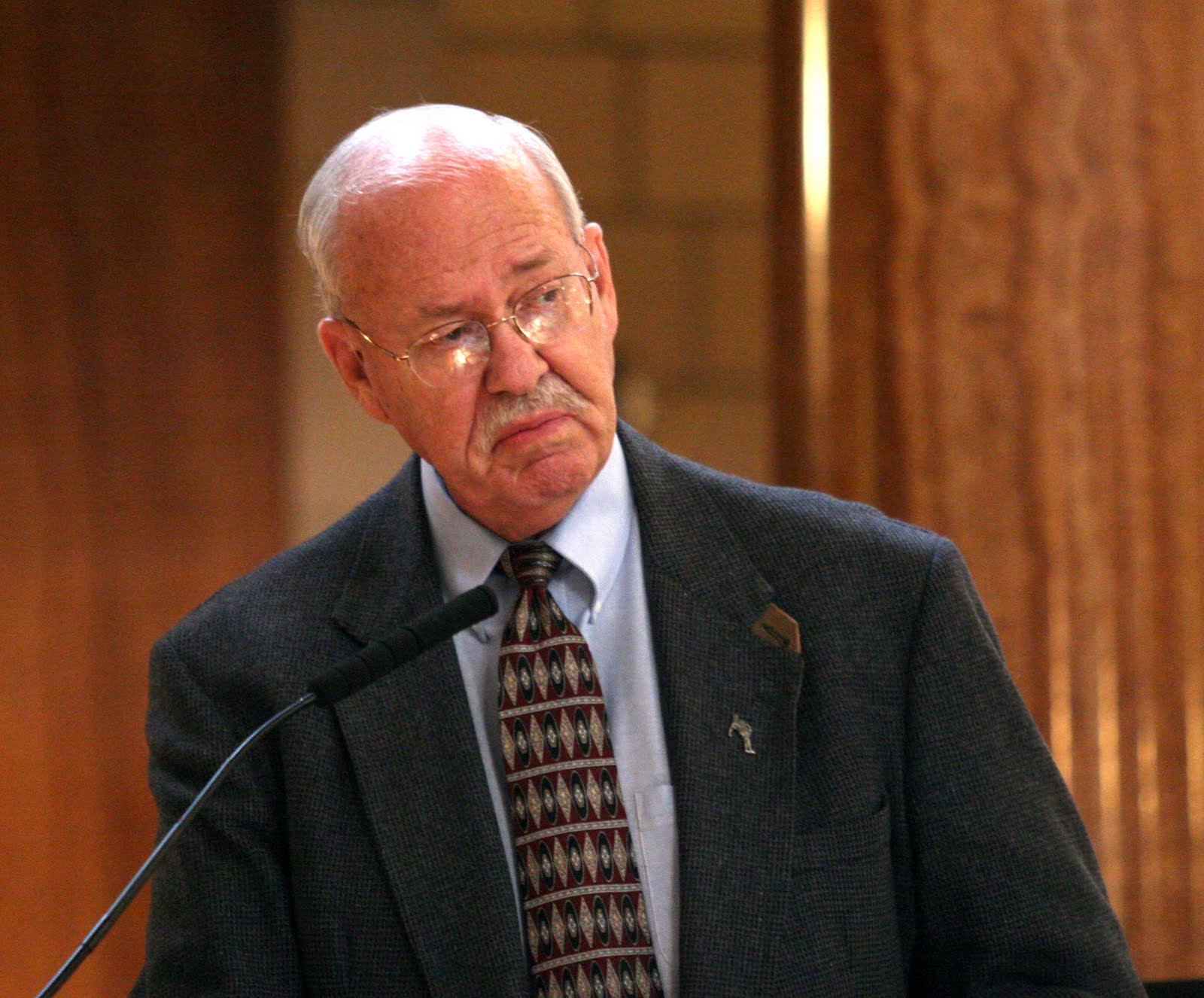
Sen. Cap Dierks introduced Nebraska’s new law restricting abortions.

Legislators in Nebraska
Tighten restrictions on abortion

By Ted McLaughlin / The Rag Blog / April 12, 2010

It looks like the male legislators in Nebraska are determined to keep women in a second-class status. They evidently think women are not capable of making their own decisions regarding their own bodies, so they have passed a new law to “protect” those women. Actually, the new law has nothing to do with protecting women, and everything to do with denying women the control over their own bodies.

The new bill, introduced by Senator Cap Dierks (a male who would never have to deal with the new restrictions imposed by the law), would impose new requirements on any woman seeking an abortion. It would require the woman to be screened for any risks the procedure could cause, including “physical, psychological, emotional, demographic or situational” risks.

The legislators have intentionally made the law as vague as possible in an effort to scare doctors away from performing legal abortions. What the hell is the difference between a psychological and emotional risk? And what the hell is a demographic or situational risk? Does anyone know? And if a doctor doesn’t know that, how can they be sure of complying with this silly law?

The law doesn’t provide for any criminal penalties, but it would allow a patient to sue any doctor who doesn’t comply fully with the law (and a jury of closet fundamentalists could wreck a doctor’s career for performing a legal procedure). Kyle Carlson, a Planned Parenthood attorney, said, “It’s very difficult to know for certain if you’re complying with this bill. There’s an undetermined amount of documentation you have to go through to know all the different… risk factors.”

These legislators tried to make it sound like they were worried about women’s health. They aren’t. This is nothing more than a backdoor attempt to take away a woman’s rights over her own body. Women are already screened for any medical problems the procedure might cause, and frankly, denying an abortion for a spurious reason (such as a demographic or situational risk) could easily be just as risky for a women not prepared to deal with a baby (or another baby).

There are already far too many instances of child abuse and child murders by women under stress or with psychotic problems. Forcing women to have unwanted babies will just make the problem worse. This must be a woman’s own decision, as she is the only person who truly knows the situation she is in.

Hopefully, this new law will be quickly challenged in court. I believe it can be challenged on grounds of vagueness and discrimination. The law is so vague as to be almost impossible to obey. Also, it will substantially increase the cost of the legal procedure — making it even more difficult for poor women, if not impossible.

This is just a bad law, and the courts need to toss it out as quickly as possible.

[Rag Blog contributor Ted McLaughlin also posts at jobsanger.]

The Rag Blog

Posted in Rag Bloggers | Tagged , , , | 1 Comment

Sen. Cap Dierks introduced Nebraska’s new law restricting abortions.

By Ted McLaughlin / The Rag Blog / April 12, 2010

It looks like the male legislators in Nebraska are determined to keep women in a second-class status. They evidently think women are not capable of making their own decisions regarding their own bodies, so they have passed a new law to “protect” those women. Actually, the new law has nothing to do with protecting women, and everything to do with denying women the control over their own bodies.

The new bill, introduced by Senator Cap Dierks (a male who would never have to deal with the new restrictions imposed by the law), would impose new requirements on any woman seeking an abortion. It would require the woman to be screened for any risks the procedure could cause, including “physical, psychological, emotional, demographic or situational” risks.

The legislators have intentionally made the law as vague as possible in an effort to scare doctors away from performing legal abortions. What the hell is the difference between a psychological and emotional risk? And what the hell is a demographic or situational risk? Does anyone know? And if a doctor doesn’t know that, how can they be sure of complying with this silly law?

The law doesn’t provide for any criminal penalties, but it would allow a patient to sue any doctor who doesn’t comply fully with the law (and a jury of closet fundamentalists could wreck a doctor’s career for performing a legal procedure). Kyle Carlson, a Planned Parenthood attorney, said, “It’s very difficult to know for certain if you’re complying with this bill. There’s an undetermined amount of documentation you have to go through to know all the different… risk factors.”

These legislators tried to make it sound like they were worried about women’s health. They aren’t. This is nothing more than a backdoor attempt to take away a woman’s rights over her own body. Women are already screened for any medical problems the procedure might cause, and frankly, denying an abortion for a spurious reason (such as a demographic or situational risk) could easily be just as risky for a women not prepared to deal with a baby (or another baby).

There are already far too many instances of child abuse and child murders by women under stress or with psychotic problems. Forcing women to have unwanted babies will just make the problem worse. This must be a woman’s own decision, as she is the only person who truly knows the situation she is in.

Hopefully, this new law will be quickly challenged in court. I believe it can be challenged on grounds of vagueness and discrimination. The law is so vague as to be almost impossible to obey. Also, it will substantially increase the cost of the legal procedure — making it even more difficult for poor women, if not impossible.

This is just a bad law, and the courts need to toss it out as quickly as possible.

[Rag Blog contributor Ted McLaughlin also posts at jobsanger.]

The Rag Blog

Posted in RagBlog | Leave a comment

Leonardo Boff : The Church, Celibacy, and the Criminal Sinners


Why the Church neither can nor wants
To abolish the law of celibacy

By Leonardo Boff / The Rag Blog / April 13, 2010

The surge of cases of pedophile priests in almost every Catholic country persists, revealing the magnitude of this crime that causes so much damage to its victims. It is not enough to say that pedophilia shames the Church, or to ask for forgiveness and to pray. It is worse than that. It is impossible to pay the debt to the children who were abused in the shadows of the credibility and trust that the priestly function embodies.

The central thesis of the Pope Ratzinger, which I have become tired of hearing in his conferences and classes, is completely invalid. To him, the size of the Church is not what matters. It is enough that the Church be a “small flock,” comprised of highly spiritual persons. It is a small “reconciled world” that represents the others and the whole of humanity.

But within this small flock there are criminal sinners, and it is anything but a “reconciled world.” One must humbly accept what tradition used to say: The Church is saint and sinner, a “chaste harlot,” as some ancient Fathers put it. It is not enough that it be the Church; it has to go through, as everyone else, the path of good, and integrate the pangs of sexuality — that have a thousand million years of biologic memory, into expressions of tenderness and love, and not of obsession and violence against minors.

The pedophilia scandal is a sign of the present times. We learn from Vatican II (1962-1965) that we must glean from such signs the interpellation that God is transmitting to us. It appears to me that the interpellation goes along this line: it is time the Roman Catholic Church does what every other Church has already done: abolish celibacy imposed by ecclesiastic law, and free it for those who see meaning in it and can live it without obsession and with a profound sense of spirituality. But this lesson is not being accepted by the Roman authorities. To the contrary, in spite of the scandals, they reaffirm celibacy with greater insistence.

We know how insufficient in integrating sexuality is the education of priests. It is conducted away from normal contact with women, which produces a certain atrophy in the construction of identity. Psychological sciences have made it clear that the male only matures under the gaze of the female, and the female only under the gaze of the male. Man and woman are reciprocal and complimentary.

The cellular-genetics of sex has shown that the difference between a man and a woman, in terms of chromosomes, is reduced to just one chromosome. A woman possesses two X chromosomes and a man has one X and one Y chromosome. It follows that the sex-base is the feminine (XX), the masculine (XY) being a differentiation from it. There is not, then, an absolute sex, only a dominant one. In every human being, man or woman, there exists “a second sex.” In the integration of the “animus” and “anima,” that is, of the two dimensions of the feminine and the masculine present in every human being, sexual maturity gestates.

This integration is hindered by the absence of one of the parts, the woman, for which is substituted imagination and phantoms, which, if they are not disciplined, can create distortions. The teaching in the seminaries was not devoid of wisdom: who controls the imagination, controls sexuality. To a large degree, this is true.

But sexuality possesses a volcanic vigor. Paul Ricoeur, who reflected a great deal philosophically about Freud’s psychoanalytic theory, recognizes that sexuality is not controlled by reason, moral norms, or the law. Sexuality lives between the law of the day, where rules and established behavior prevail, and the law of the night, the realm of impulses, the force of spontaneous vitality. Only an ethical and humanistic project of life (what we want to be) can give direction to sexuality and transform it into a force of humanization and fertile relations.

Celibacy is not excluded from this process. It is one of the possible options, which I defend. But celibacy cannot be born of an absence of love. To the contrary, it must derive from an over abundance of love for God, that overflows towards everyone around.

Why does the Roman Catholic Church not take a step forward, and abolish the law of celibacy? Because it is contradictory to her structure. It is a complete institution, authoritarian, patriarchal, highly hierarchical, and one of the last bastions of conservatism in the world. It takes the person from birth to death.

To one with a minimum of civic consciousness, the power given to the Pope is simply despotic. Canon 331 is clear: it is about a power “ordinary, supreme, plain, immediate and universal.” If we replace the word “Pope” with “God,” it functions equally. For that reason it was said: ”the Pope is the minor god on earth,” as many canonists have affirmed.

A Church that puts power at its core, closes its doors and windows to love, tenderness and compassion. The celibate person is functional to this type of Church, because that Church denies the celibate priest that which would make him more profoundly human: love, tenderness, the effective encounter with other persons, which could be more propitious if the priests could be married. They become totally disposable to the institution, that can send them to Paris or to South Korea.

Celibacy implies total cooptation of the priest, not into the service of humanity, but to the Church. That priest must love only the Church. When he discovers that she is not only “the holy mother Church” but that she can also be a stepmother who uses her ministers for the logic of power, the priest is disappointed, leaves the ministry with its forced celibacy; and gets married.

As long as this logic of absolutist and centralizing power prevails, we will not see the law of celibacy abolished, no matter how many scandals occur. Celibacy is too comfortable and useful to the ecclesiastic institution.

What then becomes of Jesus’ dream of a fraternal and egalitarian community? That is another problem, perhaps the primary one. There, the question of celibacy, and of the style of Church, would be put differently, in a manner that would better befit His liberating message.

Original in Portuguese; translated into Spanish by Servicios Koinonia; translated into English by Refugio del Rio Grande, Texas.

[A Brazilian theologian, philosopher, educator, and author of more than 60 books, Leonardo Bofff lives in Jardim Araras, an ecological wilderness area in the municipality of Petrópolis, Rio de Janeiro. Boff is Professor Emeritus of Ethics, Philosophy of Religion, and Ecology at the State University of Rio de Janeiro. A former Franciscan priest with a doctorate from the University of Munich, Boff was an early advocate of liberation theology. In 1991, after a series of clashes with the Vatican, Boff renounced his activities as a priest and “promoted himself to the state of laity.”]

The Rag Blog

Posted in Rag Bloggers | Tagged , , , , , , , | 1 Comment

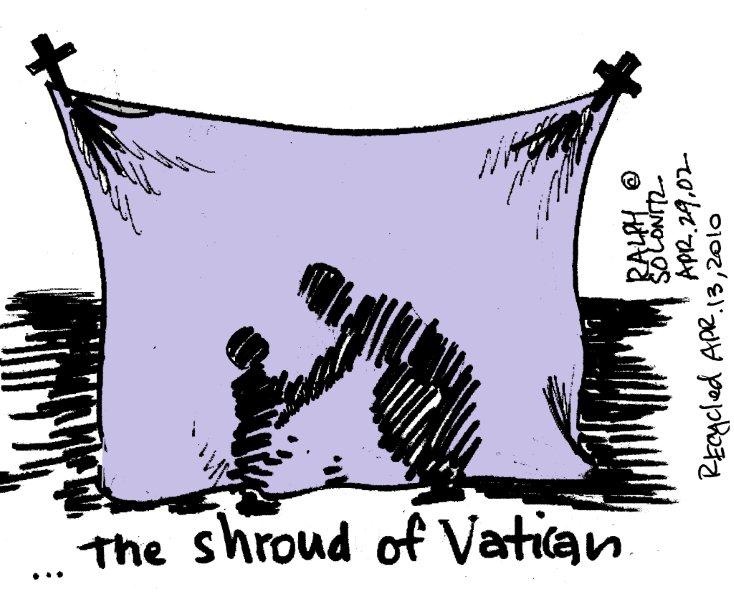
The Shroud of Vatican

Political cartoon by Ralph Solonitz / The Rag Blog / April 13, 2010
[Ralph Solonitz’ cartoons also appear at MadasHellClub.net]

The Rag Blog

Posted in Rag Bloggers | Tagged , , , , | Leave a comment

Internet Freedom : It’s On the Line


The battle for Net Neutrality:
Corporate takeover or opportunity?

By Megan Tady / April 12, 2010

On Tuesday, April 6, a federal court decision put the Internet, and your ability to use it, in jeopardy. It’s a major setback for free speech online and for the prospects of connecting the entire country to broadband.

The Washington, DC, Circuit Court of Appeals ruled that the Federal Communications Commission (FCC) lacks the current authority to enforce rules that keep Internet service providers from blocking and controlling Internet traffic — a principle called Net Neutrality.

The court ruled in favor of the Internet service provider Comcast, which was caught blocking the file sharing service BitTorrent in 2007 and contested the FCC’s attempts to stop the company. The decision makes it nearly impossible for the FCC to follow through with plans to create strong Net Neutrality protections that keep the Internet out of the hands of corporations. Additionally, without authority over broadband, the FCC could be unable to implement portions of its just released National Broadband Plan designed to bridge the digital divide.

Millions of Internet users don’t realize that a battle over the future of the Internet is being played out right now in Washington D.C.. On one side are public interest and consumer groups, small businesses, Internet entrepreneurs, librarians, civil libertarians, and civil rights groups. They want to preserve the Internet as it is — the last remaining open communications platform where anyone with access and a computer can create and consume online content. The principle of “Network Neutrality” is what makes this open communications possible. Net Neutrality is what allows us to go wherever we want online.

In a message to members of the organization ColorofChange.org, Director James Rucker stressed the importance of Net Neutrality for voices, perspectives, and communities traditionally marginalized and ignored. “For Black folks, [Net Neutrality] is crucial,” he writes. “For the first time in history we can communicate with a global audience — for entertainment, education, or political organizing — without prohibitive costs, or mediation by gatekeepers in government or industry.”

On the other side of this battle are the Internet service providers who want to dismantle Net Neutrality. Not only do they want to provide Internet service, but they want to be able to charge users to prioritize their content, effectively giving the Internet service providers the ability to choose which content on the Web loads fast, slow, or not at all.

The foundation for the Net Neutrality battle began in 2002 with the Bush FCC reclassifying broadband as an “information service” rather than a “telecommunications service.” This was a huge blow to Internet protections like Net Neutrality because the FCC doesn’t have the same regulatory oversight over information services that it has over telecommunications services.

It is this classification loophole, coupled with the D.C. Circuit’s decision, that let Comcast wiggle out from under the FCC’s thumb and convince the courts that the FCC has no business clamping down on their Net Neutrality violations. And it is this loophole that will make the FCC powerless when it comes to achieving many of the objectives set out in the Obama administration’s national broadband plan to provide high speed Internet access to rural America.

The FCC can resurrect its power by changing broadband back to a “telecommunications service.” Reclassifying broadband will make these questions about FCC authority obsolete, allowing the agency to get back to the important work of protecting free speech online and bridging the digital divide.

While this fix may seem simple, it will take political courage from the FCC and Chairman Julius Genachowski to do the right thing. The telecom industry will be hammering the FCC with pressure to keep broadband a lawless land in order to deepen their control and enormous profits. At the same time, concerned Americans are encouraging the FCC to protect Net Neutrality and the national broadband plan.

Free Press Director Josh Silver reminded the public what’s at stake during an interview Wednesday on Democracy Now! “People have to remember, all media — television, radio, phone service — every type of media other than the printed page, will soon be delivered by a broadband or Internet connection.”

Like me, you love the Internet. It takes you where you want to go. Frustrated with mainstream media you have found alternative news and information online, like this very site. You turn on your computer and you’re connected to the world. Our relationship with the phone and cable companies should stop when we pay for our Internet service. These companies should not be able to block, control, or interfere with what we search for or create online. Nor should they be able to prioritize some content over others.

Let’s hope the court just handed the FCC the best opportunity to make a systemic change to how they oversee our nation’s primary communications platform, and their ability to stop the corporate takeover of the Internet once and for all.

[Megan Tady is a blogger and campaign coordinator for the national, non-profit media reform organization Free Press. Megan has traveled across the country interviewing people who struggle to live and work without high-speed Internet access. This article was published in Women’s International Perspective and distributed by Media Channel.]

The Rag Blog

Posted in RagBlog | Tagged , , , | 3 Comments

Mack Royal : Darrell and Edith


Darrell and Edith

By Mack Royal / The Rag Blog / April 12, 2010

Tornado Alley is something that is pretty easy to define. It’s where tornadoes are most likely to occur. The Bible Belt, on the other hand, is a bit more mysterious. It doesn’t surprise me, however, that these areas cover a lot of common property. If I lived in tornado alley, I might pray more often too.

If you take the tornadoes and bible-thumping, add a healthy population of rattlesnakes, coyotes, sandy soil, and a Wild West culture, then you will have a picture of where both of my parents were born. Old Greer County, Oklahoma, was in the southwest corner of the state, down on the Red River.

Darrell K. Royal was born in Hollis in 1924. Edith Marie Thomason was born in 1925 on a small farm nineteen miles away.

It’s not all prairie dogs and flat farmland. There are some trees and hilly parts and places to fish.

It’s tough, but livable.


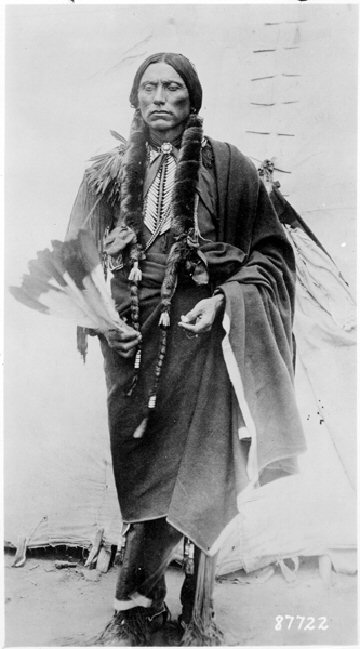
Quanah Parker lived in the neighborhood.

He retired from the warpath in 1875 and settled in Cache, Oklahoma Territory. He had at least five wives and around 25 children. It is estimated that 18 of Quanah’s children survived childhood. Most of them lived in the area.

Edith’s grandfather, Oscar Thomason, lived about 75 miles west of Cache near Russell.


The family story is that Oscar was traveling through Cache in a covered wagon in 1906. Quanah looked into the wagon and saw four-year-old Alfred Marion Thomason, rubbed him on the head, and called him “cubby bear.” From then on, Oscar’s third son was known as Cub.


I asked my grandpa Cub one time why he had an animal name and why my uncles were called “Duck” and “Goose.” He said to me, “Oh, it’s just something that the Indians around here used to do.” I caught a little twinkle in his eye. The names didn’t sound unusual to my young ears. I grew up hearing those names and visiting that farm at the end of the road, one hill away from the Salt Fork of the Red River.

I asked him this question when I was about nine years old. From the time he answered me that way, I started noticing how much my grandpa Cub actually looked like an Indian. He lived pretty much like a peaceful Indian, very simply and close to nature. He raised crops and animals on a small farm.

Cub had one drawer for himself in the house. It contained rattlesnake rattles, pennies, rolling papers, a can of Prince Albert tobacco, and sometimes a pipe. Cub had a very quiet way of talking. He explained to me about how it was with the “laws” and the “outlaws” in his youth. I know for sure he wasn’t a friend of the laws.

He was telling me stories of when he roamed on horseback with his friends and people wore guns on their hips. His grandfather, Francis Marion Thomason came from Cherokee County, Texas. There are rumors of his connection to the Jesse James gang there.


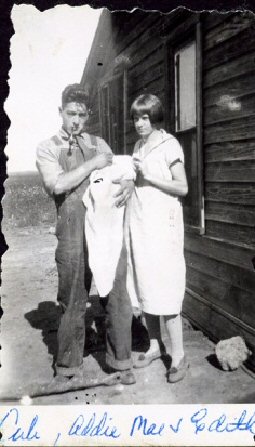
My grandma Addie Mae had blue eyes, very light skin and laughed a lot. She could also be pretty stern. She listened to the preachers on the radio and went to the little country church regularly. I went with her enough to get the feel of it. There were tears, shouting, waving of hands, and singing. She once gave me her opinion of a visiting preacher with the words “crocodile tears.”


She was from the Morrell family. Lafayette Morrell, a Frenchman, had gone to California looking for gold. Then the family moved to Oklahoma but would travel back to California. The trip took about 18 days in 1920. Cub went along on one of these trips with Addie Mae and they were married in Santa Ana, California. They returned to Greer County and raised Edith and her three younger brothers on the Salt Fork farm.


Darrell K Royal was born with three older brothers and two older sisters in the nearby town of Hollis.

The Royals and Harmons had been in Old Greer County about as long as the Thomasons and Morrells. The main difference between the tribes was that Edith’s family preferred the country and farm life and Darrell’s family lived in the towns.


Even though you couldn’t call the area crowded with people, it took some time for Darrell and Edith to actually meet.

Darrell was the youngest child of Burley and Katie Royal. Katie died just a few months after Darrell was born. His older sisters also died young. When Darrell was about six years old, Ruby died, and when he was about 13, Mahota died. Even though his three older brothers were there to help, they were all bereft of mother and sisters. Other family members pitched in to help raise the Royal boys, but there were empty spaces that needed filling.


Edith, on the other hand, was the eldest child and helped raise three younger brothers. She was taught by her mother and her aunts. She learned how to care for three younger brothers and survive on a farm.


When Darrell finally met Edith, they were in high school. They have been together since they met.

[Mack Royal’s father, Darrell K. Royal, is the winningest football coach in University of Texas history and is in the College Football Hall of Fame.]

The Rag Blog

Posted in Rag Bloggers | Tagged , , , , , , | 3 Comments

To Catch a Spy : The Story of George the Snitch

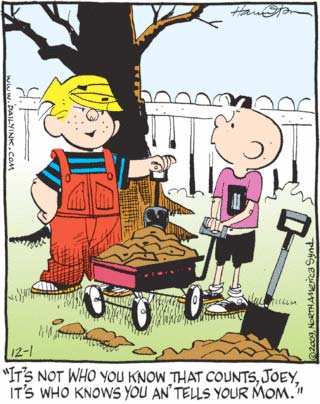
Dennis the Menace from The Comics Curmudgeon.

To catch a spy II:
A short history of one snitch

By Richard Lee / The Rag Blog / April 12, 2010

[The Rag Blog published an article by Lisa Fithian about acknowledged FBI informant Brandon Darby, on March 22, 2010. Lisa’s piece received thousands of hits, and was reposted all over the Internet. And for Richard, it brought to mind another story from another time. For links to Rag Blog material about Brandon Darby and the infiltration of community groups by law enforcement agencies, see below.]

This is the story of George, not his whole story, just the part I know about.

San Diego, 1972. Nixon is coming here. We have been planning his welcome since Chicago four years ago. Not heavy planning at first, but as time passed we worked on the Republican Convention ’72 with increasing intensity, and as we left Washington after the huge MAYDAY demo in May of ’71 we said our goodbyes to our tribes with the phrase, “See ya next year in San Diego.”

The San Diego Convention Coalition in the spring of that year was made up of dozens of groups from across the country. Our affinity group arrived in March to help organize. In that time, one of the strongest groups that planned to attend was Vietnam Veterans Against the War (VVAW.)

Two of us from our little affinity group were veterans. I had participated in some VVAW actions back in Boston, and we began to attend meetings of the San Diego chapter. Our thinking at the time was that, counting vets and their families, VVAW would bring about 50,000 demonstrators.

We met in public, open meetings once a week, and each week we would have two or three more vets than the last week.

One week a new guy came. His name was George. He was a vet; he had been in the Army for about a year, before he took the honorable way out with a Bad Conduct Discharge. My partner and I thought he might be the kinda guy we could relate to, and decided to get to know him better.

That VVAW meeting was the first time he had ever been to an anti-war gathering. George had no politics, neither left nor right, Republican or Democrat, he said he was against the war, but knew very little about it. He took notes, we stole them from him, and those notes consisted of little more than names, most misspelled.

We talked it over with some of the others in the chapter and decided that George needed a closer look. A week after the meeting, we invited George to go to out for a couple of beers. Instead, we drove to an isolated part of a park and started asking George some sharp questions. He didn’t put up much resistance, and after a couple minutes he ‘fessed up and began to tell us his story.

George was not only a vet, he was an ex-con, he had done nearly two years on a heroin conviction and was still on parole. Recently he’d been caught with a dirty spike by the SDPD. Instead of violating him, the SD pigs turned him over to the FBI. The feds told George they could make his bust go away if he would do a little something for them. VVAW was that something. And that was how George came to show up at the weekly meeting.

We spent an hour or so debriefing George. He told us that after the last meeting he went two blocks up the street where his handler was waiting in a car. They drove around while the feebee asked him questions; the Man was pissed that he had lost his notes (the ones we had stolen) and he couldn’t remember names. FBI man showed him pictures and when he recognized one, they wanted to know what the pictured vet had said.

I felt sorry for George. He was a loser, he had never won anything in his life and he never expected to. He hadn’t really hurt us at all, it was a public meeting of 20 or so people, we talked mostly about where we were going to camp the brothers and how we were going to feed them. But then again we couldn’t let him hang around, maybe to plant a wire, maybe to later tell lies at some trial. So, we told him it was over and not to come back. I wanted to give him a hug when we parted, but refrained.

The next week we reported what had happened to the membership. As we finished, the door opened and there was George again. He had given it some thought and seen that we were the right side to be on, and asked to be let back in. We put it to a vote, and it was surprisingly close, but he lost his bid. I knew his handler had put him up to it. George left and I never saw him again.

George didn’t become a snitch because of his politics, he had none. He didn’t do it for money, they didn’t pay him. George was only a junkie, a poor one, and he didn’t want to go back to the joint.

It leaves me with the question. What about Brandon Darby? Was it politics? Was it money? Was he jammed up? Blackmailed? Was he simply used, like poor George, or is he really just a snitch from that layer of scum that lies just above the scabs?

Also see:

  • To catch a spy by OneLove (now revealed to be Richard Lee) / The Rag Blog / January 11, 2009

And, Rag Blog articles about Brandon Darby and the Texas 2:

For more background on the history of informants in Texas, read The Spies of Texas by Thorne Dreyer / The Texas Observer / Nov. 17, 2006.

The Rag Blog

Posted in Rag Bloggers | Tagged , , , , , , , | 3 Comments

A Poet’s Legacy : No Rest for the Weary?

Image from Steve and Sara’s Photostream / Flickr.

Edna St. Vincent Millay and
The profitability of charity

By Carl R. Hultberg / The Rag Blog / April 12, 2010

“Thou canst not move across the grass
But my quick eyes will see Thee pass
Nor speak, however silently,
But my hushed voice will answer Thee
I know the path that tells Thy way
Through the cool eve of every day;
God, I can push the grass apart
And lay my finger on Thy heart!”

– Edna St. Vincent Millay (from Renascence, 1912)

Quick, which famous American poet was named after a long lived charity hospital in New York’s Greenwich Village?

In 1892 Charlie Bussell, older brother to Cora, soon-to-be mother of Edna was a stevedore on the El Monte. A rather laid back New England lad, while at dock in New Orleans he decided to take a snooze on a bale of cotton. Imagine his surprise when he awoke beneath deck in the hold.

Days later he was discovered, weak and emaciated, and was brought to New York City and put under the care of the Sisters of Charities at St. Vincent’s Hospital. His odd story became a bit of local news and his recovery at the lower Manhattan hospital a huge event in the recorded history of a small Maine mother-led family.

Edna St. Vincent Millay was born at that time and would have been named Vincent if she’d been a boy. After high school she came in second in a national poetry contest, partially by dropping her first name and publishing as Vincent Millay. That recognition got her a scholarship at Vassar and despite a troubled rebellious hyper-poetic existence she created a body of work in a bold daring neo-classical style that inspires to this day.

Perhaps the kinship Ms. Millay felt with the hospital was the result of their common commitment to compassion. Certainly St. Vincent’s was a hospital that cared.

Sadly, the hospital that Edna St. Vincent Millay took part of her name from is today no longer with us. Up until Monday, St. Vincent’s Hospital on Seventh Avenue in New York City had served the Village since 1849.

One of the reasons the facility had to close was that in serving the local poor predominantly, they “couldn’t make a profit.” What a surprise. I wonder how St. Francis managed to make a profit. (Perhaps he wasn’t paying minimum wage.) Medicare cuts and the uninsured also defunded the operation.

Maybe good old Catholic charity was actually part of the Obama socialist agenda. Lord knows we can’t have any of that.

The other well publicized reason for the hospital’s bankruptcy was the profligate board of directors who allegedly ran the place into the ground passing around percs and paying off expensive New Hampshire lawyer pals. Another big surprise in this day and age I suppose. To some people a hospital is just a pile of money with a sideline in serving humanity.

St. Vincent’s was supposed to be building a new facility between 12th and 13th Streets. After frittering away millions on Vice Presidents, property acquisition, lawyers, and world class architects, now it seems there is no money left to construct anything.

St. Vincent’s also had a major aesthetic problem, the low rise “modernist” pop art building they decided to build in the 1960s. Like the Huntington Hartford lollipop creation on Columbus Circle, St. Vincent’s second building was supposed to evoke smiley face hippie pop music sensibilities.

The trouble is happy circles cast in concrete don’t weather well and in St. Vincent’s case the structure looks like it would be next to impossible to renovate. I think New Yorkers would have been better served with a stark Catholic facility that showed it’s heart inside. And survived.

Now folks from the Village will have to ambulance crosstown to Bellevue or NYU Medical centers. Good luck finding anyone who cares there.

[Carl R. Hultberg’s grandfather, Rudi Blesh, was a noted jazz critic and music historian, and Carl was raised in that tradition. After spending many years as a music archivist and social activist in New York’s Greenwich Village, he now lives in an old abandoned foundry in Danbury, New Hampshire, where he runs the Ragtime Society.]

The Rag Blog

Posted in Rag Bloggers | Tagged , , , , | 1 Comment

Culture Wars : ‘Take Our Country Back’

Confederate flag at Tea Party March on Washington, September 12, 2009. Image from Think Progress.

Latest culture war in America:
Nationalism in dangerous form

Many fear that they have lost the country that was bequeathed to them — and to them alone — like an old pocket watch from their grandfather.

By Leonard Zeskind / The Rag Blog / April 12, 2010

At first glance it seems inexplicable: Confederate battle flags waving in Washington state and Washington, D.C., when the issue is health care.

Placards that read, “America is a Christian Nation,” appearing in marches when the stated concern is the federal deficit.

Barack Obama labeled a “Lying African,” when presidents from Democrat Woodrow Wilson to Republican George H.W. Bush have raised taxes without being dubbed aliens.

Where does the anger come from to call congressmen hateful names?

The answer resides inside the tea party anthem — oft-repeated since the protests on Capitol Hill last September — “Take Our Country Back.” Many fear that they have lost the country that was bequeathed to them — and to them alone — like an old pocket watch from their grandfather.

Theirs is a patriotism in which the common good devolves down to the individual privileges of property and wealth. It is a nationalism in which race is implicit, rather than explicit.

The crowds singing “Take It Back” might be all white, but when a black or brown face shows up it is welcomed as a sign of the “non-racial” character of their all-white cause.

From this medium of contradictory beliefs about “real Americans” and inglorious fears of “dispossession” has sprung a movement that is still developing and has not yet reached its final form.

Certainly, there are coldly dispassionate ideologues in this mix:

  • The conservative Republican operatives who train these new activists to become the foot soldiers for the party’s election campaigns.
  • The Ayn Rand libertarians who conflate Keynes with Marx, and a capitalist welfare state with socialism.
  • The old-line segregationists who regard every piece of federal civil rights law as an abrogation of states’ rights.
  • The hard core white nationalists who join the tea party movement hoping to convert its implicit whiteness into an explicit and coherent racism.

By themselves, these highly defined political strands are not strong enough to challenge the status quo. Intertwined with each other and with the chaotic mix of passions described above, however, the tea party movement has proven more powerful than expected.

It has transformed the political discourse and has systematically defied common-sense explanations.

While the tea parties have emerged during a period of economic distress, and unemployed job seekers are certainly in their midst, polling data tells us for the most part these people are not suffering financially themselves. According to a CNN survey in February, a full 66 percent of “tea party activists” said they made more than $50,000 a year.

Neither is this some form of populism, similar to the revolt by 19th century farmers. In this instance, the opposition to political and economic elites is predicated on the supposition that those at the “top” are using their power to serve those at the bottom, at the expense of those in the middle.

This is a form of Middle American nationalism more akin to that expressed by Gov. George Wallace’s 1968 presidential campaign than to the rarified blue-blood conservatism of William Buckley.

In the end, tea partiers are not engaged in a civil discussion with fellow Americans about public policy. Rather they are fighting a culture war against people they regard as enemies. The questions are whose America is the “real” America, and whether our society will remain open and democratic.

That is a decision all of us must make.

[Leonard Zeskind, author of Blood and Politics: The History of the White Nationalist Movement from the Margins to the Mainstream, is president of the Institute for Research and Education on Human Rights. Zeskind blogs at www.leonardzeskind.com/. This article was also published by the Kansas City Star.]

The Rag Blog

Posted in Rag Bloggers | Tagged , , , , , , | 5 Comments

Marc Estrin : Survival Tips for the Bailout Challenged

Photo by Donna Bister / The Rag Blog.

Gotten your bailout yet?

By Marc Estrin / The Rag Blog / April 12, 2010

No? Unemployment insurance running out? Mortgage under water? Yes and yes? Well, fear not. Since the war on terror is chugging along nicely, and the government/military is planning for survival in the face of climate catastrophe, infrastructure decay, financial crisis, disastrous health care, and deepening debt, you — as a free American — are at liberty to look to your survival in your own personal way.

You may need help. Advice. We have therefore undertaken to investigate survival techniques potentially useful to the literary and Facebook-reading classes. Over the past year, your author has been surveying homeless populations in four major cities; this is the first report of information gleaned from their years of human experience in exceedingly trying circumstances. It is hoped that as homeland political, social, and economic circumstances deteriorate, you may be able to take advantage of some of these techniques.

Optimal integration of food, clothing, and shelter

Multiple use of existing materials makes for economy in scarcity situations. Food, for instance, can serve for clothing, insulation, and even privacy. Consider for example the following not uncommon situation:

After a sleepless night in a public shelter or lavatory, exhausted by guarding your possessions, you will surely need a good daytime place to nap. In inclement weather, public libraries are ideal, especially for the well-educated. However, library policy has recently turned draconian, and anyone sleeping rather than reading is usually asked to leave.

Two slices of baloney can solve the problem. Choose a brand as close to your skin tone as possible. In the center of each slice, cut an eye-shaped hole. Choose a good book or journal, open it, sit well-propped in a chair, and place a slice of baloney over each eye. A cap or kerchief low on the forehead will improve the illusion. Then, off to the arms of Morpheus. It will take a sharp-eyed, highly motivated guard to catch you napping, and, what with budget cuts, these are in ever-rarer supply. After your nap, put the baloney away for further use.

Soft white bread, such as Wonder Bread or Tiptop is not only inexpensive, but is also an excellent insulator. Due to trapped air, its R rating is high, comparable to fiberglass or foam: a must investment, even with diminished funds. Slices can be stuffed in clothing, and in key body areas such as the small of the back or lower abdomen to maintain core temperature in hypothermic environments. Don’t forget the head! — 70% of body heat escapes from the scalp. Wonder Bread fits nicely under any hat or cap, or can be trimmed for a custom fit.

Fast food restaurants invariably have packets of yellow mustard available for the taking. You’d be surprised at how well Grandma’s recipe for cold still works! Simply smear yellow mustard over your chest and abdomen, and along your sides (get up under those arms!) for long-lasting, bio-chemical warmth. It’s free — and it’s good for you, too.

Forget Kleenex from now on, and don’t keep a cold in your pocket with cloth hankies. Even the worst exposure-induced upper respiratory condition can be contained by blowing the nose into lettuce leaves, available free in great quantity in supermarket dumpsters. A day’s supply can easily be carried in pocket or purse.

Now here’s a trick: At the end of a long day, when the baloney is a bit soiled and the bread somewhat tamped, scrape a small amount of mustard from the small of your back, whip out a few lettuce leaves, lay meat eye-hiders to bread insulation, and voila — a classical baloney sandwich — utilizing three of the four major food groups — for your evening meal. Well fed, you can re-pack for a nighttime of maximum insulation.

Other food possibilities

It is an open secret among the poor that pet foods are perfectly fit for human consumption. Don’t be embarrassed to survey the huge selection in your supermarket — no one will suspect you are shopping for yourself and not for Fido or Kitty. There are so many choices that it may take a while to discover your favorite brands and flavors. No need to restrict yourselves to “gourmet” varieties. The “gourmet” label is simply a marketing device targeted at upscale pet owners. The contents are virtually the same as that of cheaper brands.

Dry dog or cat food travels well, and can be wetted down at public drinking fountains. It is also ecological, since there is no can to dispose of. For the more affluent, canned cat food is probably your best bet. 9-Lives remains the trend setter, though it is virtually indistinguishable from other canned varieties. For an occasional treat, this writer recommends Sheba Moist Tender Chunks: Salmon Entree.

There do seem to be gender difference in the choice of food types, with men preferring dog food, and women, food for cats. For you he-men out there, we can recommend Mighty Dog — Beef.

A modest proposal

The Obama presidency boasts a radical neo-conservatism combined with a fearless approach to the future, a commitment to institutions of the past, and strong motivation to deal with the problems which lie ahead. In the interests of political clarity, I would urge the president, and his advisors — Messrs. Summers, Geitner, Bernanke, Emmanuel, and Netanyahu — to have the courage of their convictions, and take things all the way.

With bipartisanship guiding all three branches of government, there should be only minor difficulty in bringing back an idea whose time has surely come again. Slavery has gotten a bad name with the liberal press, yet an unprejudiced mind can easily see its many benefits. Who can deny that living in the homes of wealthy families — even without pay — is preferable to a life of hardship, disease, and crime on cruel streets?

Family values would be maintained and promoted as mammys took care of the children, aiding harried executive moms. Cultural diversity would prevail as songs of the old South were heard again, and mixed races and cultures would be seen once again in the more exclusive neighborhoods. This is compassionate conservatism at its best.

However divided liberal opinion here may be, given the advancing pauperization of the middle class, it is not hard to imagine a time in the near future when it, too, could benefit by such a system as greatly as people of color. Congressional debates will be heated, of course, but with a bi-partisan Senate, there should be no problem with having the majority prevail. Another hard-won triumph for democracy.

[Marc Estrin is a writer and activist, living in Burlington, Vermont. His novels, Insect Dreams, The Half Life of Gregor Samsa, The Education of Arnold Hitler, Golem Song, and The Lamentations of Julius Marantz have won critical acclaim. His memoir, Rehearsing With Gods: Photographs and Essays on the Bread & Puppet Theater (with Ron Simon, photographer) won a 2004 theater book of the year award. He is currently working on a novel about the dead Tchaikovsky.]

The Rag Blog

Posted in Rag Bloggers | Tagged , , , , | Leave a comment

Thomas McKelvey Cleaver : Keep on Truckin’

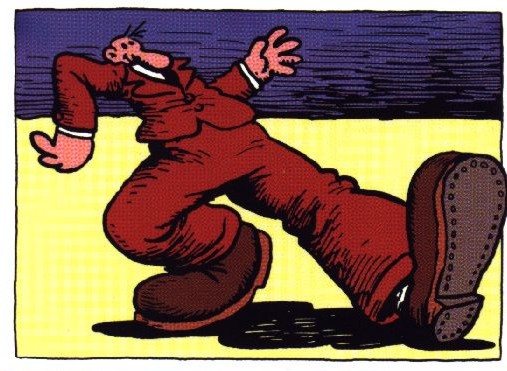
Keep on Truckin’. Classic cartoon by R. Crumb.

The David and Alice debate:
We can’t afford to give up the fight

By Thomas McKelvey Cleaver / The Rag Blog / April 11, 2010

[Austin activist David P. Hamilton announced his “retirement” from political activism in The Rag Blog on March 30, 2010. On April 6, our Alice Embree responded, proclaiming her intention to “carry it on.”]

I’ll say right up front that — at first read — I was surprised by David Hamilton’s announcement of his “retirement” from the movement and radical politics.

I don’t know David face-to-face, as do many readers, but over the past few years that I’ve marginally become re-involved with Austin politics through my involvement with Under The Hood Café [the Killeen-based GI coffee house], I have come to know David through our e-mail conversations. As with many ex-Weathermen I continue to disagree with him on certain important-to-us topics, but he’s a guy who brings intelligence, knowledge, passion, and commitment to what he says and does, making him someone whose thoughts I respect.

It only took me another few minutes to easily identify with what he was saying about his disillusionment with Obama. I’m the guy who spent the better part of five months in 2008 personally raising $350,000 for the Obama campaign from Democrats all over the country, and as a result I know first-hand the enthusiasm that was out there, the longing from “the rest of us” for real change in this country.

Thus, my disappointment as I have watched Obama the Candidate of Promise become Obama the President who takes every position I oppose on just about everything, is pretty damn strong — perhaps even stronger than David’s disillusionment. Most of my friends greet me nowadays by asking “So, what has Obama done to piss you off today?” It’s said as a joke, but sadly it really isn’t that funny. Thus, it’s easy for me to understand where David’s coming from.

I also know well the decision to withdraw from radical politics out of disappointment and disillusionment with the lack of “progress.” I did that myself for a number of years.

I’ve also been privileged to be a Fan of Embree for 44 years now, ever since Alice showed up looking for me at a college in Colorado where I was one of the few radicals and the only anti-war Vietnam vet. Over those years, she’s been one of my models for how one survives as a leftist in America without going nuts, and when I decided I would see what I could do to help the GIs at Fort Hood start a new coffeehouse, she was the first person in Austin I went looking for, knowing that if I could get her involved, things would be done right.

Reading her response to David, I identified with her decision to focus on the small victories that come along, and to keep working for the big one. My reason for coming back from withdrawal was that I found out that — for me personally — doing as Alice does was essential for my physical, mental, moral, and spiritual health.

It’s easy right now to take David’s way. I fight the urge to do so every morning when I read a blog and get outraged over the latest outrage. But we really can’t afford to do this, not now. Not with what’s out there.

The Washington Post recently documented that threats of violence from the Right are way up: 42 in the first three months of 2010, as opposed to 15 in the last three months of 2009. Who are they targeting?

They’re targeting the people David says are worthless (because they mostly are) — the Democratic members of Congress. They’re doing it over the passage of that worthless piece of legislation, the health care reform bill. Go read about the people being arrested for making credible threats against Speaker Pelosi or Senator Murray. These raving lunatics are only the tip of the iceberg, as was the Hutaree “militia.”

Back 20 years ago, I had the privilege from my work in Hollywood to get to know the legendary motion picture director, Billy Wilder. He told me the story of his years in Berlin in the 1920s and early 1930s. He came to the conclusion in 1928 that Hitler and the Nazis were a “credible threat.” Nearly all of his friends disagreed, and over the years he acquired the reputation of being a crank on the subject of those ridiculous Nazis.

On the night Hitler won the election in January 1933, Wilder packed all he owned into a steamer trunk, went to the Berlin train station, and bought a one way ticket on the Paris Express. As he put it, “I didn’t return for 12 years, and when I did, none of the people who had told me I was crazy to worry about Hitler were still alive. They’d been put to death.”

Back in 1933, the German political radicals refused to support the moderates and liberals against the Nazis, with the Communists calling the Social Democrats “Social Fascists” — a term not too far removed from David’s description of Obama and the Democrats. History has shown that attitude and the political strategy it engendered didn’t work out.

Right now, there is every indication that the Republican Party is about to win back nearly all that it lost in the 2006 and 2008 elections, despite the fact that their political platform is “more of the same” — more of the same of everything that nearly destroyed us over eight years.

Anyone with any brains can see clearly that the Obama Presidency and the Democratic Party have largely brought this on themselves with their fecklessness and their unwillingness to actually be “the party of change” that they campaigned on. This has in turn brought about the disillusionment of all those folks I called over the summer of 2008, the people who had never given money to a political campaign before and who really were giving “till it hurt,” and this disillusionment has created the gap that polls are seeing between Democrats and Republicans when it comes to enthusiasm for participating in this fall’s elections.

Consider, however, what a GOP majority in the House and/or Senate will create. Will it create more chances for the kinds of changes we hope to see? Newt Gingrich was cheered when he spoke to the Southern Republican Leadership Conference and called for a Republican congress to de-fund every progressive change that has been put in place by the Obama Administration.

He specifically mentioned the EPA and their plan to deal with climate change under the powers the Supreme Court says they have under the Clean Air Act. And he also mentioned de-funding the Department of Labor, which for the first time in 30 years has people running it who really are working for the interests of working people. Whatever one wants to say about health care reform, what is going on at EPA and DOL are the kinds of things we on the left want.

If we surrender to David’s attitude, if we decide to take our marbles and go home because everything isn’t perfect and the People’s Revolution hasn’t happened, then we are leaving the field uncontested to the people who would be happy as hell to put every one of us in a concentration camp, the people who have been The Enemy for all the history of this country.

If we want to keep the opportunity of doing the kind of work Alice Embree is the embodiment of, we cannot make the choice David Hamilton has. Not in 2010. Not in the face of what is happening.

Your mileage may vary.

[Thomas McKelvey Cleaver, an aviation writer, screenwriter, and social activist, worked hard for the election of President Barack Obama. A Vietnam veteran, he is active in the GI anti-war movement; he was involved in the Oleo Strut, the Vietnam-era coffee house in Killeen, Texas, near Ft. Hood, and helped start its modern day counterpart, Under the Hood. He is a frequent contributor to The Rag Blog.]

Also see:

The Rag Blog

Posted in Rag Bloggers | Tagged , , , , , , , | 1 Comment