Cannabis in California : The Growing Storm

Marijuana campaign image from Photo Bucket.

Cannabis is on the ballot:
All eyes are on California

By Jonah Raskin / The Rag Blog / March 26, 2010

The man in the dark slacks and the blue jacket counted out 100 $100 bills and handed them to the woman in jeans and a faded T shirt that said “Eat the Rich.” She handed the bills to another woman with dark glasses and turquoise rings on her fingers, and she sat down and counted them. They added up. There was $10,000 on the table.

The man in the slacks and jacket walked out of the hotel room with two-and-a-half pounds of organic California-grown marijuana. He was a happy man; he had customers from Pacific Palisades to Pasadena in Los Angeles who were eagerly awaiting their ounces, half ounces, pounds, and even grams. He had a price and a product for everyone no matter what their budget.

Call them potheads. Call them stoners. Call them what you will. They smoke marijuana daily and they go to work. They pay taxes, and on election day this coming November they will go to the polls to vote up or down on a state-wide measure that would allow dealers to sell ounces legally, an ounce at a time.

All the big-time politicians are against the measure. Jerry Brown, the State Attorney General, and the former Governor, known popularly in the 1970s as “Governor Moon Beam” is against it. So is the former eBay chief executive Meg Whitman, a rabid conservative, who is the leading Republican candidate.

Oddly enough, or perhaps not so oddly, many of the marijuana growers themselves — some of them cultivating indoors and some in greenhouses — are also opposed to legalization. “It will mean the end of my business,” one long-time grower told me. “I won’t be able to compete and to make the kind of money I make now. Legalization will ruin me.”

But the growers are in a minority. So are the dealers. The overwhelming majority of people in the pot equation are the pot smokers. There are millions of them in California (and elsewhere of course) and by and large they are sick and tired of being made to feel like criminals. They want pot to be legalized. They want to be able to purchase marijuana in the same way they purchase shoes, hats, tomatoes, and olive oil. They’re perfectly willing for it to be taxed.

Many of them are “true believers.” They feel that pot is practically a sacrament. They insist that it is good for them — good for their hearts, their eyesight, their digestion, and, if they are cancer patients, a remedy for loss of appetite and nausea. The medical evidence increasing shows that they are right.

In the state of California, a place in which there are very few “true believers,” the true believers in the goodness of marijuana will play a decisive role in whether or not the measure to legalize the drug will pass or fail. Every day, in almost everything they do and everything they say, they campaign for marijuana. When they smoke it they share it; when they cook with it they hand out brownies to friends and family members. They push pot constantly, and promote it endlessly.

Ever since 1996 when medical marijuana became legal in California, they have been smoking in public — in pot dispensaries, bars, and on the streets. After 14 years, it is out of control — at least by law enforcement standards; it is not possible to take pot out of the culture and the business of California without also imposing martial law.

And even that will not stop it. Thousands of Californians — and thousands of Americans — have been arrested for possession of marijuana in the last decade. And still the numbers of marijuana smokers have grown. Arrests have inflicted hardship and pain on California citizens from the Oregon border to Mexico.

At a time when the California budget is in deep financial trouble, the promise of tax dollars from the sale of marijuana will be hard to resist. And the call of marijuana as medicine will be hard to resist too.

In the next eight months, marijuana will be in the news in California every week, if not every day. The opponents of legalization will bring out the same old arguments. They will talk once again about that old bugaboo “reefer madness.” And in a way they are right.

Indeed, the pro-marijuana forces are mad. They are mad about the persecution they have suffered. They are mad about the lies and the distortions. They are so mad they are willing to fight in the open, to take their cause everywhere in the State of California.

The gap that exists between the citizens of the Golden State and their elected officials will become clearer and clearer. Marijuana will be a wedge that will drive them apart — except that some politicians like State Assemblyman Tom Ammiano from San Francisco, want legalization too. Ammiano is a true believer. To some he is a saint, to others a devil.

The growing storm will focus in part around him and in Sacramento, the state capitol. But no part of California can or will escape the issue of the legalization of marijuana. And the eyes of the nation will be on California.

[Jonah Raskin co-wrote the story for the marijuana feature length movie, Homegrown, that stars Billy Bob Thornton, Hank Azaria, Kelly Lynch, Ryan Phillippe, Ted Danson, Jamie Lee Curtis, and John Lithgow. Raskin teaches media law at Sonoma State University.]

The Rag Blog

Posted in Rag Bloggers | Tagged , , , , , , | 7 Comments

Robert Jensen : The Collapse of Journalism/The Journalism of Collapse

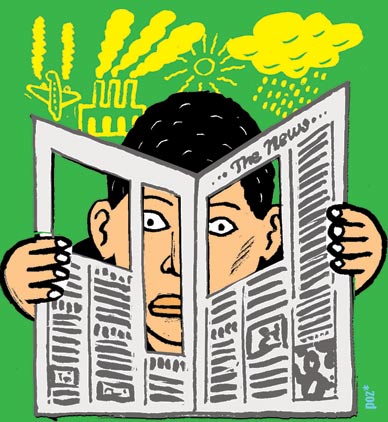
Image from Knight Science Journalism Tracker.

New Storytelling and a New Story:
The Collapse of Journalism/The Journalism of Collapse

By Robert Jensen / The Rag Blog / March 26, 2010

[A version of this essay was delivered as the Lawrence Dana Pinkham Memorial Lecture, Asian College of Journalism, Chennai, India, March 18, 2010.]

There is considerable attention paid in the United States to the collapse of journalism — both in terms of the demise of the business model for corporate commercial news media, and the evermore superficial, shallow, and senseless content that is inadequate for citizens concerned with self-governance.

This collapse is part of larger crises in the political and economic spheres, crises rooted in the incompatibility of democracy and capitalism. New journalistic vehicles for storytelling are desperately needed.

There has been far less discussion of the need for a journalism of collapse — the challenge to tell the story of a world facing multiple crises in the realms of social justice and sustainability. This collapse of the basic political and economic systems of the modern world, with dramatic consequences on the human and ecological fronts, demands not only new storytelling vehicles but a new story.

In this essay I want to review the failure of existing systems and suggest ideas for how to think about something radically different, through the lens of journalists’ work. The phrase “how to think about” should not be interpreted to mean “provide a well-developed plan for”; I don’t have magical answers to these difficult questions, and neither does anyone else.

The first task is to face the fact that every problem we encounter does not necessarily have a solution that we can identify, or even imagine, in the moment; that identifying how existing systems have failed does not guarantee we have the capacity to devise new systems that will succeed.

This is a realistic attitude, not a defeatist one. The lack of a guarantee of success does not mean the inevitability of failure, and it does not absolve us of our responsibility to struggle to understand what is happening and to act as moral agents in a difficult world. In fact, I think such realism is required for serious attempts at fashioning a response to the crises.

The eventual solutions, if there are to be solutions, may come in frameworks so different from our current understanding that we can’t yet see even their outlines, let alone the details. This is a time when we should be focused on “questions that go beyond the available answers,” to borrow a phrase from sustainable agriculture researcher Wes Jackson.

The old story

Before taking up that challenge, I want to identify the story that dominates our era, what we might call the story of perpetual progress and endless expansion. This is the larger cultural narrative in which specific stories that appear in journalistic outlets are set. Charting the whole history of this story is beyond the scope of this essay, so I will confine myself to the post-WWII era in which I have lived, when this progress/expansion story has dominated not only in the United States and other developed countries but most of the world.

This story goes like this: In the modern world, human beings have dramatically expanded our understanding of how the natural world works, allowing us not only to control and exploit the resources of the non-human world but also to find ways to distribute those resources in a more just and democratic fashion. The progress/expansion story assumes we have knowledge — or the capacity to acquire knowledge — that is adequate to run the world competently, and that the application of that knowledge will produce a constantly expanding bounty that, in theory, can provide for all.

The two great systems of the post-WWII era that were in direct conflict — the capitalist West led by the United States and the communist East led by the Soviet Union — shared an allegiance to this story, that humans had the ability to understand and control, to shape the future, to become God-like in some sense.

Even in places that carved out some independence in the Cold War, such as India, the same philosophy dominated, evidenced most clearly in big dam projects and the Green Revolution’s model of water-intensive, chemical farming.

The failure of the communist challenge was said to be “the end of history,” a point where the only work remaining was the application of our technical knowledge to lingering problems within a system of global capitalism and liberal democracy. Even with the widening of inequality and the clear threats to the ecosystem from human intervention, the progress/expansion story continues to dominate, bolstered by a widely held technological fundamentalism (more on that later).

The bumper-sticker version of this philosophy: More and bigger is better, forever and ever.

There’s one slight problem: If we continue to believe this story, and to base individual decisions and collective policies on it, we will dramatically accelerate the drawdown of the ecological capital of the planet, hastening the point at which the ecosystem will no longer be able to sustain human life as we know it at this level. In the process, we can expect not only more inequality, but in times of intense competition for resources, a dramatic increase in social conflict.

This critique cannot be dismissed as hysteric apocalypticism; it is a reasonable judgment, given all the evidence. The progress/expansion story has left us with enduring levels of human inequality that violate our moral principles and threaten to undermine any social stability, and an endangered ecosystem that threatens our very survival. Whatever systems and institutions we devise to replace those at the root of these problems, the underlying progress/expansion narrative has to change.

The collapse of journalism

In the United States, it is clear that at least in the short term, there will be fewer professional journalists working in fewer outlets with fewer resources for reporting. The Pew Research Center’s Project for Excellence in Journalism sums it up in its 2010 State of the News Media report: “[W]e estimate that the newspaper industry has lost $1.6 billion in annual reporting and editing capacity since 2000, or roughly 30 percent. That leaves an estimated $4.4 billion remaining. Even if the economy improves we predict more cuts in 2010.” Newspapers are hurting the worst, but there is no good news from any news media.

That loss of capacity comes from plunging ad revenues: In 2009, ad revenue fell 26 percent for U.S. newspapers, including online, bringing the total loss over the past three years to 43 percent. Local television ad revenue fell 22 percent, triple the decline the year before. Other media also saw a decline in ad revenue: radio, 22 percent; magazine, 17 percent; network TV, 8 percent (for network news alone, probably more).

Online ad revenue overall fell 5 percent, and revenue to news sites most likely also fared much worse. Cable news was the only commercial news sector keeping its head above water, barely, according to the report.

Revenue is down, and so are audiences. The PEJ study reports audience growth only in digital and cable news, with declines in local TV and network news. Print newspaper circulation fell 10.6 percent in 2009, and since 2000, daily circulation has fallen 25.6 percent.

This decline is also reflected in employment. According to a report by UNITY: Journalists of Color, Inc., there was a 22 percent increase in the journalism jobs lost from September 2008 through August 2009, compared with a general job loss rate of 8 percent. The news industry shed 35,885 jobs in a one-year period straddling 2008 and 2009.

Despite experiments with new ways to organize and support journalists — including grant-funded news operations such as Pro Publica, university/newsroom partnerships, citizen journalism collaborations with professional newsrooms, and various web projects — it is clear that, at least in the short term, there simply will be less journalism created by professional journalists.

It also seems clear that of the journalism remaining, a growing percentage is of less value to the project of enhancing democracy. I don’t want to pretend there was a golden age when professional journalism provided the critical and independent inquiry that citizens need to function as citizens.

For reasons articulated by critics such as Edward Herman and Noam Chomsky, contemporary professional journalism is hamstrung by institutional and ideological constraints that have been built into professional practices. As a result, corporate news owners rarely have to discipline mainstream journalists, who are socialized to accept the ideological prison in which they work and police other inmates.

But even with that rather large caveat, the slide of much of contemporary journalism into banality is frightening. Of public affairs journalism, we might paraphrase an old joke about hard-to-please restaurant patrons: “The food is awful here,” one says, and the friend replies, “Yes, and they’ve reduced the portions.”

The markers of this slide in quality are clear enough: An obsession with entertainment and sports, especially large-scale spectacles; routine exploitation of sexuality and violence in ways corrosive to human dignity; an endless fascination with celebrity, with the standards of what constitutes celebrity continually dropping; and a growing imposition of those spectacle and celebrity values on public affairs.

This is not a screed against entertainment, pleasure, fun, or the people’s desire to gain pleasure from fun entertainment. It is not an attempt to glorify the rational and devalue the emotional. It is not a self-indulgent lament that the kind of journalism I prefer is losing out. It’s an accurate description of our increasing numbed-out and intellectually vapid culture.

How much of this collapse of journalism is driven by the explosion of news outlets in a 24-hour news cycle, as an ever-larger media beast demands to be fed? How much is a product of bottom-line-focused news managers’ longstanding obsession with producing the extraordinary profits demanded by top-floor-dwelling executives? How much is panic caused by these dramatic drops in audience and revenue by so-called legacy media, leading to desperation in programming?

Whatever the relative weight of these causes, the effect is clear: In the mainstream outlets through which most people in the United States get their news, there is less journalism relevant to citizens’ role in a democracy and more journalism-like material that dulls our collective capacity for independent critical thinking. If journalists had only to struggle to return to some previous state in which they did a better job, that would be hard enough. But journalists can’t be satisfied with striving toward standards from the past. A new journalism is needed.

The journalism of collapse

The immediate crises that journalism and journalists face — some rooted in the pathology of professionalism and its illusory claims to neutrality, and some rooted in the predatory nature of capitalism and its illusory commitment to democracy — are serious, but in some sense trivial compared to the long-term crises in a profoundly unjust and fundamentally unsustainable world. We have to deal with the collapse of journalism, but we also must begin to fashion a journalism of collapse.

To reiterate my basic premise: Whatever the specific story being told in modern journalism, those stories typically are set in that larger narrative of perpetual progress and endless expansion. What kind of story is needed for a world that desperately needs to rethink its idea of progress in a world that is no longer expanding?

Here’s the story: On March 17, 2051, the world will pump its last easily accessible barrel of usable oil. By that time, cancer directly attributable to human-created toxicity will kill 125 million people per year, while major disruptions in the hydrological cycle will so dramatically reduce the amount of fresh water that 18.9 percent of the human population will die each year as a direct result.

On June 14, 2047, exactly half of the area of the world’s oceans will be dead zones, incapable of supporting significant marine life. Three and a half years later, topsoil losses will have reached the point where even with petrochemical based fertilizers, pesticides, and herbicides, yields will drop by 50 percent on the most fertile soil and fall to zero on soil that has effectively gone sterile due to contamination and compaction.

But there won’t be any petrochemicals anyway, because there won’t be any oil. And there won’t be enough water. And so there won’t be enough food. And getting reliable broadband internet service will be difficult.

OK, that was all meant to be funny. That, of course, is not the story. The story we need to tell won’t be focused on predictions about specific aspects of collapse. I have no doubt that if the human community continues on its present trajectory, such statistics will be all too real. I have no doubt that if the human community does not change that trajectory in substantial ways fairly soon, the future will be grim.

But rather than scurrying to make specific predictions, journalism should struggle to help people understand the processes that make that preceding paragraph plausible, and hence not funny at all. There’s little humor in the recognition that continued commitment to an ideology of perpetual progress and endless expansion — operationally defined as ever greater human consumption of the ecological capital of the planet — is a dead end. More and bigger not only is not better, it is not possible.

The response I often get to this view is the assertion that we need not worry about the physical limits of the planet because human ingenuity will invent increasingly clever ways of exploiting those resources.

This technological fundamentalism — the belief that the use of evermore sophisticated high-energy, advanced technology is always a good thing and that any problems caused by the unintended consequences of such technology eventually can be remedied by more technology — is more prevalent, and more dangerous, than religious fundamentalism. History teaches that we should be more cautious and pay attention to the unintended effects of such technology with an eye on the long term.

The fundamentalists believe the future is always bright, apparently because they wish it to be so. But the desire to live in an endless expanding world of bounty — a desire found both in those who currently have access to that bounty and those who don’t but crave it — is not a guarantee of it. We certainly know this at the individual level, that “you can’t always get what you want,” as the song goes, and what holds for us as individuals is also true for us as a species.

Those of us who question such declarations are often said to be “anti-technology,” which is a meaningless insult designed to derail serious discussion. All human beings use technology of some kind, whether stone tools or computers. An anti-fundamentalist position is not that all technology is bad, but that the introduction of new technology should be evaluated carefully on the basis of its effects — predictable and unpredictable — on human communities and the non-human world, with an understanding of the limits of our knowledge to control the larger world.

So the first step in crafting a new narrative for journalists is to reject technological fundamentalism and deal with a harsh reality: In the future we will have to make due with far less energy, which means less high-technology and a need for more creative ways of coping. Journalists have to tell stories about what that kind of creativity looks like. They have to reject the gee-whizzery of much of the contemporary science and technology reporting and emphasize the activities of those with a deeper ecological worldview.

There also is a corresponding need to tell stories about redefining our concept of the good life. Again, the basics are in pop songs: “all you need is love,” and “money can’t buy you love.” We all agree, yet that narrative of progress/expansion is rooted in the belief that acquisition and consumption are consistent with a good life, or perhaps even required for it.

Central to that redefinition is accepting that collectively we have to learn to live with less. In a world with grotesque inequalities in the distribution of wealth, some of our sisters and brothers are already living with less — less than what is required for a decent life, which reflects the unjust nature of our social systems.

For those of us in the more affluent sectors, the question is not only whether we will work for a more just distribution within the human family, but how we respond when the world imposes stricter limits on us all.

Living with less is crucial not only to ecological survival but to long-term human fulfillment. People in the United States live with an abundance of most everything — except meaning. The people who defend the existing system most aggressively are typically either in the deepest denial, refusing to acknowledge their culture’s spiritual emptiness, or else have been the privileged beneficiaries of the system. This is not to suggest that poverty produces virtue, but to recognize that affluence tends to erode it.

A world that steps back from high-energy, high-technology answers to all questions will no doubt be a harder world in some ways. But the way people cope without such technological “solutions” can help create and solidify human bonds. Indeed, the high-energy/high-technology world often contributes to impoverished relationships as well as the destruction of longstanding cultural practices and the information those practices transmit.

Stepping back from this fundamentalism is not simply a sacrifice but an exchange of a certain kind of comfort and easy amusement for a different set of rewards. We need not romanticize community life or ignore the inequalities that structure our communities to recognize that human flourishing takes place in community and progressive social change doesn’t happen when people are isolated.

Telling this story is important in a world in which people have come to believe the good life is synonymous with consumption and the ability to acquire increasingly sophisticated technology. The specific stories told in the journalism of collapse will reject technological fundamentalism and aid people in the struggle to redefine the good life.

Journalists need not merely speculate about these things; across the United States people are actively engaged in such projects. Though not yet a majority, these people are planning transition towns, developing permaculture systems, creating community gardens, reclaiming domestic arts that have atrophied, organizing worker-owned cooperative businesses. They are experimenting with alternatives to the dominant culture, and in doing so they are, implicitly or explicitly, rejecting technological fundamentalism and redefining the good life.

This journalism of collapse I am proposing would include stories about the problems we face, the harsh reality of a contracting world of less energy. But it also would include stories about people’s experiments with new definitions of progress and the good life. Such an approach to journalism would not only highlight the threats but also shine a light on the way people are coping with the threats.

Journalism in the prophetic voice

I would call this kind of storytelling “journalism in the prophetic voice,” borrowing a theological term for secular purposes. I prefer to speak about the prophetic voice rather than prophets because everyone is capable of speaking in the voice; the prophetic is not the exclusive property of particular people labeled as prophets.

I also avoid the term prophecy, which is often used to describe a claim to be able to see the future. The complexity of these crises makes any claim to predict the details of what lies ahead absurd. All we can say is that, absent a radical change in our relationship to each other and the non-human world, we’re in for a rough ride in the coming decades. Though the consequences of that ride are likely to be more overwhelming than anything humans have faced, certainly people at other crucial historical moments have faced crises without clear paths or knowledge of the outcome. A twenty-five-year-old Karl Marx wrote about this in a letter to a friend in1843:

The internal difficulties seem to be almost greater than the external obstacles. … Not only has a state of general anarchy set in among the reformers, but everyone will have to admit to himself that he has no exact idea what the future ought to be. On the other hand, it is precisely the advantage of the new trend that we do not dogmatically anticipate the world, but only want to find the new world through criticism of the old one.

We should understand the prophetic as the calling out of injustice, the willingness not only to confront the abuses of the powerful but to acknowledge our own complicity. To speak prophetically requires us first to see honestly — both how our world is structured by illegitimate authority that causes suffering beyond the telling, and how we who live in the privileged parts of the world are implicated in that suffering. In that same letter, Marx went on to discuss the need for this kind of “ruthless criticism”:

But, if constructing the future and settling everything for all times are not our affair, it is all the more clear what we have to accomplish at present: I am referring to ruthless criticism of all that exists, ruthless both in the sense of not being afraid of the results it arrives at and in the sense of being just as little afraid of conflict with the powers that be.

To speak prophetically is to refuse to shrink from what we discover about the injustice of the world. It is to name the wars of empire as unjust; to name an economic system that leaves half the world in abject poverty as unjust; to name the dominance of men, of heterosexuals, of white people as unjust. And it is to name the human destruction of Creation as our most profound failure. At the same time, to speak prophetically is to refuse to shrink from our own place in these systems. We must confront the powers that be, and ourselves.

Another prominent historical figure put it this way in 1909: “One of the objects of a newspaper is to understand the popular feeling and to give expression to it; another is to arouse among the people certain desirable sentiments; and the third is fearlessly to expose popular defects.” That was Mohandas Gandhi, on the first page of Hind Swaraj.

Those tasks — attempting to understand and give expression to what ordinary people feel, and then advocating progressive goals, while at the same time exposing problems in the culture — are not likely to make one’s life easy. Journalists willing to take this position will find themselves in a tense place, between a ruling elite that is not interested in seriously changing the distribution of power and a general public that typically does not want to confront these difficult realities of collapse.

To speak from a prophetic position is to guarantee that one will find little rest and small comfort. Such is the fate of a commitment to truth-telling in difficult times, and times have never been more difficult.

But others have faced similar challenges. Looking to the tradition in the Hebrew Bible, the prophets condemned corrupt leaders and also called out all those privileged people in society who had turned from the demands of justice, which the faith makes central to human life. In his analysis of these prophets, the scholar and activist Rabbi Abraham Joshua Heschel concluded:

Above all, the prophets remind us of the moral state of a people: Few are guilty, but all are responsible. If we admit that the individual is in some measure conditioned or affected by the spirit of society, an individual’s crime discloses society’s corruption. In a community not indifferent to suffering, uncompromisingly impatient with cruelty and falsehood, continually concerned for God and every man, crime would be infrequent rather than common.

That phrase, few are guilty but all are responsible, captures the challenge of the journalism of collapse. We can easily identify those powerful figures guilty of specific crimes. Who is guilty in perpetrating the illegal U.S. invasion of Iraq? That’s easy — Bush, Cheney, Rumsfeld, Powell, Rice. Who is guilty in the bailout of Wall Street and the big banks: That’s easy, too — Bush and Obama, Paulsen and Geithner, Bernanke and the boys. One task of journalists is to pursue the guilty, perhaps with a bit more fervor than contemporary U.S. news media; our journalists are too polite in handling war criminals and servants of the wealthy.

But when we look at the fragile state of the world, in some sense our future depends on recognizing that we all are responsible, depending on our status in society and resources available to us. Those of us in affluent sectors of society have the most to answer for, and the task of journalists is to raise questions uncomfortable for us all. This will rarely make journalists popular, but that also is not new. In each of the four Gospels, Jesus reminds us: “A prophet is not without honor, except in his own country, and among his own kin, and in his own house.” (Mark 6:4)

Since journalism has never really been an honorable profession, perhaps that makes us the perfect candidates for raising our voices prophetically.

[Robert Jensen is a journalism professor at the University of Texas at Austin and board member of the Third Coast Activist Resource Center in Austin. He is the author of All My Bones Shake: Seeking a Progressive Path to the Prophetic Voice, (Soft Skull Press, 2009); Getting Off: Pornography and the End of Masculinity (South End Press, 2007); and The Heart of Whiteness: Confronting Race, Racism and White Privilege (City Lights, 2005); Jensen is also co-producer of the documentary film Abe Osheroff: One Foot in the Grave, the Other Still Dancing. Jensen can be reached at rjensen@uts.cc.utexas.edu and his articles can be found online here.]

The Rag Blog

Posted in Rag Bloggers | Tagged , , , , , | 1 Comment

Singer/Soldier Travis Bishop : War Resister Released from Stockade

Singer/soldier Travis Bishop, who refused deployment to Afghanistan for reasons of consience, has been released from prison. Photo from Dallas Dreamer.

Fort Hood Soldier who refused to deploy:
Travis Bishop released from Fort Lewis stockade

By Alice Embree / The Rag Blog / March 26, 2010

War resister and conscientious objector Travis Bishop was released from the stockade at Fort Lewis, Washington Thursday morning.

During court-martial proceedings at Fort Hood, Texas, Bishop was sentenced to 12 months in prison for refusing to deploy to Afghanistan for reasons of conscience. He received a three-month reduction in sentence due to a successful clemency application to the Commanding General at Fort Hood, as well as receiving extra time off for good behavior.

Bishop served a total of seven months and 12 days of confinement. His rank was reduced from Sergeant to Private and a Bad Conduct Discharge is pending.

Travis Bishop was recognized by Amnesty International as a prisoner of conscience. He received support from hundreds of people from around the world who wrote letters of encouragement for him and called upon military authorities to release him.

“Travis really appreciated the support he received from Amnesty International and from many people throughout the U.S.,” said his lawyer, James Branum. “All those letters lifted his spirits and shortened his time in jail.”

Bishop spoke out about the inhumane conditions at the Fort Lewis stockade, which produced some reform in treatment of prisoners at the facility. Bishop was placed on the facility’s “most difficult” prisoners list for these efforts.

Bishop’s supporters in the Washington area are planning a celebration to take place at Coffee Strong GI Coffeehouse, on Sunday, March 28. Bishop also plans to come back to Killeen to visit his friends and supporters at Under the Hood Café and Outreach Center where additional celebrations will be held.

Bishop, a country music singer-songwriter, plans to resume his musical career.

Also on The Rag Blog:

The Rag Blog

Posted in Rag Bloggers | Tagged , , , , , , , | Leave a comment

BOOKS / Progressive Giants : Celebrating Paul Robeson and Anne Braden


Two books about two progressive giants:
Celebrating Paul Robeson and Anne Braden

By Harry Targ / The Rag Blog / March 25, 2010

The artist must take sides. He must elect to fight for freedom or slavery. I have made my choice. I had no alternative. — Paul Robeson, 1937.

…there are no heroes in this story…no villains…only people, the product of their environment, urged on by forces of history they often do not understand. — Anne Braden, 1958

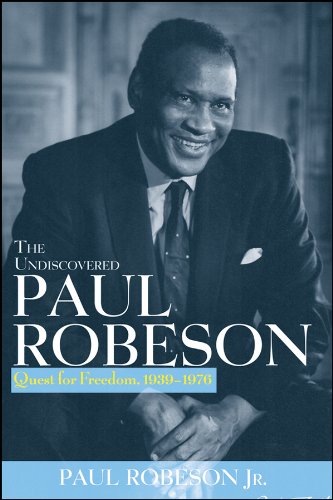
The Undiscovered Paul Robeson: Quest for Freedom, 1939-1976, by Paul Robeson Jr. (Wiley, January 26, 2010); Hardcover, 432 pp., $35.00.

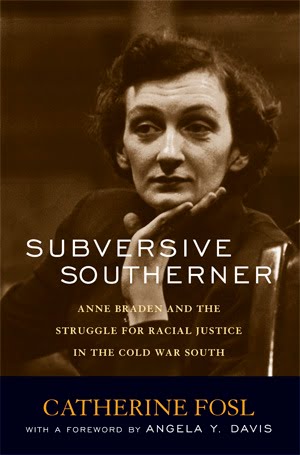
Subversive Southerner: Anne Braden and the Struggle for Racial Justice in the Cold War South, by Catherine Fosl (The University Press of Kentucky,August 25, 2006); Paperback, 464 pp., $26.95.

Biographies can tell us about ourselves, where we came from, and where we might go. I recently read two narratives of the lives of extraordinary people and their times. I think their lives and politics are relevant to us today.

The Undiscovered Paul Robeson: Quest for Freedom, 1939-1976, by Paul Robeson Jr., chronicles the years of struggle in the life of the theatrical performer, singer, linguist, and fighter for human freedom. Subversive Southerner: Anne Braden and the Struggle for Racial Justice in the Cold War South, by Catherine Fosl, tells the story of a militant Southern woman who rejected the political culture of her day to fight for the liberation of African Americans, always insisting that Southern whites had to play a significant role in that struggle.

Paul Robeson, born in 1898, in Princeton, New Jersey, only the third African American to attend Rutgers University, graduated with academic honors and all-American football status. He received a law degree from Columbia University but gravitated to the theater, the concert hall, film, and linguistics. As his world renown grew, Robeson became politically engaged. In 1937 he declared at a fund raiser for the brigadistas fighting the Spanish fascists that “the artist must take sides.”

Over the remaining 40 years of his life he fought alongside others at home and around the world against colonialism, racism, class exploitation, and imperialism. While he symbolized to the world the struggle for a humane socialist future for all, he became the number one target of racism and anti-communism at home.

Anne Braden, although younger than Robeson, led a parallel life of political activism. She was born in 1924 in Louisville, Kentucky, to a traditional Southern family. Schooled in the values of Southern womanhood, she increasingly saw the white supremacist south as an evil that not only repressed African Americans but served as an impediment to the achievement of human liberation for people everywhere.

She pursued a career as political organizer and journalist, publishing the invaluable periodical, The Southern Patriot. She, with her husband Carl Braden, spent years organizing against racial segregation. Her struggle repeatedly encountered racists who opportunistically used anti-communism to protect their white privilege.

The differences in the backgrounds of these two progressive giants are obvious, but the biographies referred to above illuminate fascinating parallels. First, both Robeson and Braden were raised in political cultures that were hostile to social justice. Each was raised in a supportive though sometimes stern family. The world beyond their immediate families was driven by racism. Robeson experienced it as an object. Braden experienced racism as a person being socialized to accept and endorse it.

Second, through a multiplicity of associations and experiences both came to realize that racism was not only an impediment to their own development as full human beings but was also an impediment to the development of all humanity. Consequently, at relatively young ages, Robeson and Braden came to the view that they must devote their lives to the struggle against racism.

Third, both Robeson and Braden realized in their struggles that capitalism as an economic system stood in the way of human liberation. They understood that the capitalist mode of production was built on the backs of workers. Racism, they understood, was used by capitalists to divide workers who together could organize to create a more humane society.

Fourth, Robeson and Braden accepted as a basic premise of their political work the proposition that human solidarity was a necessary if not sufficient condition for the creation of a humane society. Robeson wrote in his autobiography, Here I Stand, that underlying the world’s diverse folk music traditions there was a common musical form, a pentagonal chord structure. To Robeson this shared chord structure mirrored the fundamental oneness of humankind.

Anne Braden, saw human beings as shaped by their environments. Her own upbringing in a segregated society shaped her consciousness, but circumstances made her realize that people can liberate themselves by organizing resistance to that society. Racism has its roots in economic and political structures, and people are “urged on by forces of history they often do not understand.” But they can come to recognize and oppose those institutions that oppress others and by extension, themselves.

Fifth, both Robeson and Braden committed their lives to organizing against capitalism, imperialism, colonialism, and racism. For them this meant crossing racial lines, participating in union struggles, linking struggles for civil rights with struggles for civil liberties, and unabashedly working with the Left to bring about social change.

Finally, Paul Robeson and Anne Braden became two of the most despised political activists in Cold War America.

Robeson returned to the United States from a long sojourn in Great Britain during much of the 1930s to an America ready to embrace his music and theatrical performances. His classic radio broadcast, “Ballad for Americans,” was heard by millions of Americans.

But after World War II, Robeson turned his attention more toward fighting racism (lynchings, segregated institutions such as baseball, and white supremacy in the South), opposing colonialism, supporting the expansion of the right of workers to join unions, and promoting peace. In the context of the emerging Cold War the former celebration of his life and work turned to anger against him.

In the 1950s, the State Department pulled his passport so he could not travel overseas. He lost his audiences and livelihood as hundreds of his previously scheduled concerts were canceled. Even African American churches were reluctant to host a Robeson concert for fear of government reprisal.

Anne and Carl Braden purchased a home in Louisville in the 1950s and sold it to an African American family. The property was in an all-white neighborhood. This generated a massive campaign to keep the family from occupying their house. The campaign was leveled at the Bradens for their work against segregation as much as against the African American family.

After an extended public trial characterized by charges of Communist subversion Carl Braden was sentenced to prison for “sedition” based on an arcane Kentucky law. Subsequent to the trial and incarceration, virulent anti-communism dogged most organizing campaigns embraced by the Bradens.

The Southern Conference Educational Fund (SCEF), which the Bradens led, was always viewed with suspicion. Anti-communism even crept into the politics of the civil rights movement as it blossomed in the late 1950s. Despite the virulence of it, which usually was linked with racism, Anne Braden became an inspirational force among the young SNCC organizers in the South in the early 1960s, along with Ella Baker. Anne Braden took particular responsibility for building white activism around civil rights.

In the end, anti-communist campaigns, such as those against Robeson and Braden, were used as tools by racist forces to demean, delegitimize, and split the working class and youth and to defeat progressive forces. Anti-communism and the defense of white supremacy became inseparable.

How do we assess the roles of Paul Robeson and Anne Braden in historical perspective? They participated as leaders, as intellectual and moral inspirations at a time when the working class was on the move in the 1930s and 1940s, and civil rights activism spread in the 1950s. As workers mobilized to demand the right to form unions, Robeson was there. Braden committed her life to the struggle against racism and she saw Black/white unity as basic to victory.

Both participated in struggles with allies from the organized Left, particularly with members of the Communist Party USA.

Finally, and most critically, Robeson and Braden participated in and advanced a politics of the Popular Front. Popular Front politics began with a commitment to class struggle. It was based on the presumption that racism was the central barrier to social change. And Popular Front politics prioritized commitments to broad-based networking among people and groups who engaged in a whole array of peace and justice issues.

Are there lessons from these lives for us today? I believe so. Robeson and Braden taught us that the pursuit of social change was a lifetime activity. And they demonstrated to us that our political work must engage the broadest range of issues and the greatest numbers of people in our struggles for a humane future. These two biographies tell insightful and inspiring stories that everyone interested in social change should read.

[Harry Tarq is a professor in American Studies who lives in West Lafayette, Indiana. He blogs at Diary of a Heartland Radical.]

Find:

The Rag Blog

Posted in Rag Bloggers | Tagged , , , , , , , , | 2 Comments

REVISITING THE POPULAR FRONT: CELEBRATING THE LIVES OF PAUL ROBESON AND ANNE BRADEN
Harry Targ

The artist must take sides. He must elect to fight for freedom or slavery. I have made my choice. I had no alternative. — Paul Robeson, 1937.

…there are no heroes in this story…no villains…only people, the product of their environment, urged on by forces of history they often do not understand. — Anne Braden, 1958.

Biographies can tell us about ourselves, where we came from, and where we might go. I recently read two narratives of the lives of extraordinary people and their times. I think their lives and politics are relevant to us today.

The Undiscovered Paul Robeson: Quest for Freedom, 1939-1976, by Paul Robeson Jr., chronicles the years of struggle in the life of the theatrical performer, singer, linguist, and fighter for human freedom. Subversive Southerner: Anne Braden and the Struggle for Racial Justice in the Cold War South, by Catherine Fosl, tells the story of a militant Southern woman who rejected the political culture of her day to fight for the liberation of African Americans, always insisting that Southern whites had to play a significant role in that struggle.

Paul Robeson, born in 1898, in Princeton, New Jersey, only the third African American to attend Rutgers University, graduated with academic honors and all-American football status. He received a law degree from Columbia University but gravitated to the theater, the concert hall, film, and linguistics. As his world renown grew, Robeson became politically engaged. In 1937 he declared at a fund raiser for the brigadistas fighting the Spanish fascists that “the artist must take sides.”

Over the remaining 40 years of his life he fought alongside others at home and around the world against colonialism, racism, class exploitation, and imperialism. While he symbolized to the world the struggle for a humane socialist future for all, he became the number one target of racism and anti-communism at home.

Anne Braden, although younger than Robeson, led a parallel life of political activism. She was born in 1924 in Louisville, Kentucky, to a traditional Southern family. Schooled in the values of Southern womanhood, she increasingly saw the white supremacist south as an evil that not only repressed African Americans but served as an impediment to the achievement of human liberation for people everywhere.

She pursued a career as political organizer and journalist, publishing the invaluable periodical, The Southern Patriot. She, with her husband Carl Braden, spent years organizing against racial segregation. Her struggle repeatedly encountered racists who opportunistically used anti-communism to protect their white privilege.

The differences in the backgrounds of these two progressive giants are obvious, but the biographies referred to above illuminate fascinating parallels. First, both Robeson and Braden were raised in political cultures that were hostile to social justice. Each was raised in a supportive though sometimes stern family. The world beyond their immediate families was driven by racism. Robeson experienced it as an object. Braden experienced racism as a person being socialized to accept and endorse it.

Second, through a multiplicity of associations and experiences both came to realize that racism was not only an impediment to their own development as full human beings but was also an impediment to the development of all humanity. Consequently, at relatively young ages, Robeson and Braden came to the view that they must devote their lives to the struggle against racism.

Third, both Robeson and Braden realized in their struggles that capitalism as an economic system stood in the way of human liberation. They understood that the capitalist mode of production was built on the backs of workers. Racism, they understood, was used by capitalists to divide workers who together could organize to create a more humane society.

Fourth, Robeson and Braden accepted as a basic premise of their political work the proposition that human solidarity was a necessary if not sufficient condition for the creation of a humane society. Robeson wrote in his autobiography, Here I Stand, that underlying the world’s diverse folk music traditions there was a common musical form, a pentagonal chord structure. To Robeson this shared chord structure mirrored the fundamental oneness of humankind.

Anne Braden, saw human beings as shaped by their environments. Her own upbringing in a segregated society shaped her consciousness, but circumstances made her realize that people can liberate themselves by organizing resistance to that society. Racism has its roots in economic and political structures, and people are “urged on by forces of history they often do not understand.” But they can come to recognize and oppose those institutions that oppress others and by extension, themselves.

Fifth, both Robeson and Braden committed their lives to organizing against capitalism, imperialism, colonialism, and racism. For them this meant crossing racial lines, participating in union struggles, linking struggles for civil rights with struggles for civil liberties, and unabashedly working with the Left to bring about social change.

Finally, Paul Robeson and Anne Braden became two of the most despised political activists in Cold War America.

Robeson returned to the United States from a long sojourn in Great Britain during much of the 1930s to an America ready to embrace his music and theatrical performances. His classic radio broadcast, “Ballad for Americans,” was heard by millions of Americans.

But after World War II, Robeson turned his attention more toward fighting racism (lynchings, segregated institutions such as baseball, and white supremacy in the South), opposing colonialism, supporting the expansion of the right of workers to join unions, and promoting peace. In the context of the emerging Cold War the former celebration of his life and work turned to anger against him.

In the 1950s, the State Department pulled his passport so he could not travel overseas. He lost his audiences and livelihood as hundreds of his previously scheduled concerts were canceled. Even African American churches were reluctant to host a Robeson concert for fear of government reprisal.

Anne and Carl Braden purchased a home in Louisville in the 1950s and sold it to an African American family. The property was in an all-white neighborhood. This generated a massive campaign to keep the family from occupying their house. The campaign was leveled at the Bradens for their work against segregation as much as against the African American family.

After an extended public trial characterized by charges of Communist subversion Carl Braden was sentenced to prison for “sedition” based on an arcane Kentucky law. Subsequent to the trial and incarceration, virulent anti-communism dogged most organizing campaigns embraced by the Bradens.

The Southern Conference Educational Fund (SCEF), which the Bradens led, was always viewed with suspicion. Anti-communism even crept into the politics of the civil rights movement as it blossomed in the late 1950s. Despite the virulence of it, which usually was linked with racism, Anne Braden became an inspirational force among the young SNCC organizers in the South in the early 1960s, along with Ella Baker. Anne Braden took particular responsibility for building white activism around civil rights.

In the end, anti-communist campaigns, such as those against Robeson and Braden, were used as tools by racist forces to demean, delegitimize, and split the working class and youth and to defeat progressive forces. Anti-communism and the defense of white supremacy became inseparable.

How do we assess the roles of Paul Robeson and Anne Braden in historical perspective? They participated as leaders, as intellectual and moral inspirations at a time when the working class was on the move in the 1930s and 1940s, and civil rights activism spread in the 1950s. As workers mobilized to demand the right to form unions, Robeson was there. Braden committed her life to the struggle against racism and she saw Black/white unity as basic to victory.

Both participated in struggles with allies from the organized Left, particularly with members of the Communist Party USA.

Finally, and most critically, Robeson and Braden participated in and advanced a politics of the Popular Front. Popular Front politics began with a commitment to class struggle. It was based on the presumption that racism was the central barrier to social change. And Popular Front politics prioritized commitments to broad-based networking among people and groups who engaged in a whole array of peace and justice issues.

Are there lessons from these lives for us today? I believe so. Robeson and Braden taught us that the pursuit of social change was a lifetime activity. And they demonstrated to us that our political work must engage the broadest range of issues and the greatest numbers of people in our struggles for a humane future. These two biographies tell insightful and inspiring stories that everyone interested in social change should read.

[Harry Tarq is a professor in American Studies who lives in West Lafayette, Indiana. He blogs at Diary of a Heartland Radical.]

The Rag Blog

Posted in RagBlog | Leave a comment

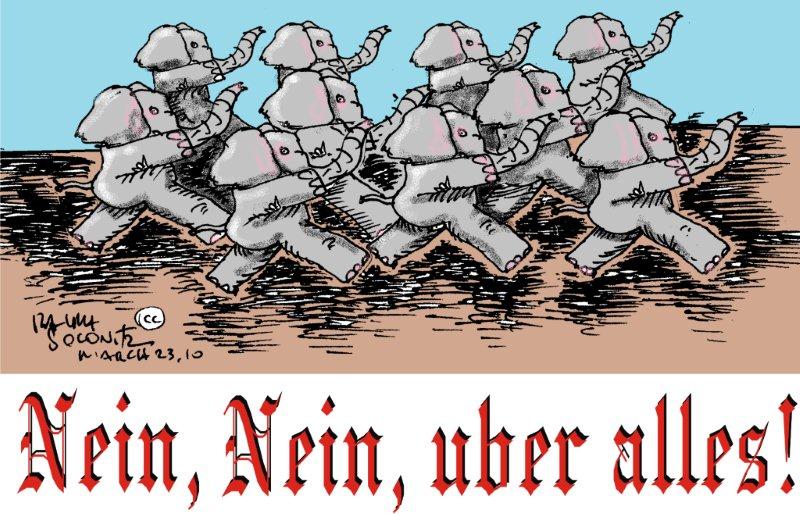
Elephant Graveyard Ahead?

Political cartoon by Ralph Solonitz / The Rag Blog / March 24, 2010
[Ralph Solonitz’ cartoons also appear at MadasHellClub.net]

The Rag Blog

Posted in Rag Bloggers | Tagged , , , | 1 Comment

Republicans on Health Care : The Gift That Keeps on Giving

Tweet from Roger Ebert. Image from Daily Kos.

Ain’t gonna happen:
Republican efforts to repeal reform

By Ted McLaughlin / The Rag Blog / March 24, 2010

Health care reform is now law, and in a few more days the reconciliation bill will pass and be signed into law to make that reform even better (although not perfect). There is more to be done, but I don’t want to minimize what has been accomplished. Many millions will be helped by this new law, and those who fought for it have good reason to celebrate.

But there are those who spent all their political capital to try and stop health care reform, and today their hopes are in shambles — mainly Republicans, especially those on the far right like the teabaggers. They are pinning their fading hopes on the hollow assumption that the American public will be so outraged by the new law that they will once again return the defeated Republicans to power.

Many on the far right are now saying they will repeal the new health care reform law, and they are counting on the November elections to give them the power to do that. In fact, the queen of right-wing insanity in the House of Representatives, Michele Bachmann, has already filed a bill to repeal the new law. And soon, Senator Jim DeMint will introduce similar legislation in the Senate.

Both of them know they have no chance to pass this legislation. What they are really trying to do is keep their teabagging followers engaged in the politics of denial until November, in the hopes they will go to the polls in droves and elect right-wing Republicans. And I don’t doubt they will re-elect some and elect a few new ones. It is a peculiarity of American politics that the party out of power will pick up seats in an off-year election, and that will probably happen.

But I seriously doubt they will pick up enough to challenge Democratic power in either the House or the Senate. One reason is that as the public learns more about the health care reform, they will like it (or at least most of it). They will realize that the new law changes things for the better. And the more that people understand the intricacies of the new law, the more unhappy they will be with those who tried to stop it — the Republicans.

Of course this is the great fear of the Republicans. It is why they cannot drop their efforts to overturn the new law. And it is why they will continue to lie and demagogue about the law until the November elections. But can they overturn the new law? No.

Let us assume the worst case scenario — that the Republicans somehow take control of both the House and Senate. I don’t think that can happen, but if it did, can they then repeal health care reform? Again, no. They will still have a Democrat in the White House who will not sign any kind of repeal legislation. That means they would need not just a majority, but a two-thirds majority to repeal. Even the Republicans don’t expect to do that good in November.

But there is another much better reason not to repeal the law. And all but the nuts on the right-wing fringe are very aware of this. What politician of either party is going to tell the American public the following:

  • Pre-existing conditions are a good thing and the insurance companies should once again be allowed to deny insurance coverage on this basis.
  • Government subsidies to help low and middle income families buy health insurance is a bad thing and should be stopped.
  • Recission is a good thing and insurance companies should be allowed to drop the policies of people who become seriously ill.

If the Republicans repeal the new law, that is what they would be saying to the American people. I think most politicians, even Republicans, know it would be political suicide to take back these things. A huge majority, even of those generally opposed to some aspects of the reform, knew these things needed to happen, and they are not about to let any politician take them away now.

Although there were many people who didn’t think the new law was exactly what was needed, there was never a majority of the people opposed to health care reform. That was just the teabaggers, and according to a recent poll, they only make up about 16% of the population. The other 84% knew that some kind of health care reform was needed. Now that it has been passed, they will not be willing to go backwards and give it up.

The river has been crossed, and there’s no going back now. The health care law can, and probably will, be amended and improved, but it will not be repealed. And if the Republicans don’t climb on board pretty soon, they will find themselves even further marginalized.

I hope the Republicans do campaign on repealing the health care reform law in 2012, because that would be disastrous for them. By then, the American public will understand the reform much better, especially the parts that apply to them — and most Americans will be positively affected by the new law.

So bring on the repeal efforts Republicans. It would be a gift for Democrats.

[Rag Blog contributor Ted McLaughlin also posts at jobsanger.]

The Rag Blog

Posted in Rag Bloggers | Tagged , , , , , , | 5 Comments

Roger Baker : Austin’s New Transportation Plan Throws a Few Curves


Bumpy road ahead?
Austin’s new long-range transportation plan

By Roger Baker / The Rag Blog / March 23, 2010

The background

The Capital Area Metropolitan Planning Organization (CAMPO) recently unveiled its new 2035 long-range draft transportation plan; “People, Planning and Preparing for the Future: Your 25 Year Transportation Plan,” plus a separate appendix with important details. (The page citations below are from these documents, either Pl=Plan or App=Appendix.)

This long range plan is the result of a federally mandated planning process required of all large U.S. metropolitan areas. The federal rules mandate that CAMPO’s long range plan will be updated every five years.

The incentive for local areas to do these long range plans is to get back part of the 38 cents a gallon or 44 cents on diesel that Texas collects. Of this, Texas retains 18 cents per gallon for gasoline and 20 for diesel and sends the rest to Washington. TxDOT has control over most of what is left, but a quarter goes to schools. This is due to a deal the road lobby cut after WWII to help make the Texas fuel tax politically bulletproof, plus they put it into the Texas Constitution, for good measure. Griffin Smith wrote about that in Texas Monthly.

On the federal funding level, the fate of the big new federal transportation funding bill, the successor to the current “SAFETEA-LU” legislation, is bogged down in Congress, with periodic emergency extensions.

Nobody can accurately foresee all the unknown implications of federal level political policy and how that could affect CAMPO’s funding and planning rules. Funding may strongly shift to favor transit. The long range vision of the CAMPO plan is based on speculation about federal funding decades from now. The truth is that we can’t predict federal funding next year.

Meanwhile, the Texas Legislature, no friend of TxDOT these days but generally opposed to taxes, seems very reluctant to raise the gasoline tax, even by a little in a poor economy.

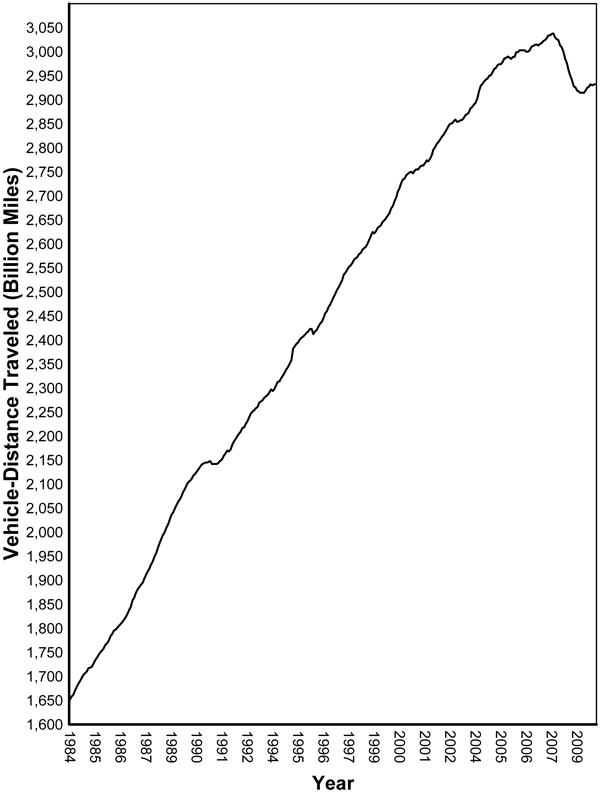
TxDOT’s gas tax revenue, its main source of funds, is stagnant, which is no surprise if we see the sharp drop in national driving over the last few years.

December 2009 Traffic Volume Trends: Moving 12-Month Total on All Highways.

Looking at this chart, it is not hard to draw the conclusion that, in the current world of hard times and the decreasing affordability of driving, it would take an. economic recovery to revive U.S. gasoline consumption. Most families have no easy alternative to driving their existing cars on existing roads.

TxDOT is claiming to be broke in a year or so, its options limited to no more new big roads at all, due to the rising cost of road maintenance, as Texas Senate Tranportation Committee Chair John Corona explains:

When it comes to transportation, Texas is broke. The state can’t afford the infrastructure it needs to keep goods flowing and our economy thriving, let alone accommodate future generations. Stop doing nothing.

Today, the state’s transportation revenue is almost equal to the maintenance costs for our current system. Texas can barely maintain the roads it has, let alone build new ones.

TxDOT is actually in the toll road business (the CTTP) and frankly has a lot of unknown future debt obligations on its books. TxDOT District 14, the Austin District, extends considerably beyond the CAMPO planning area, but the other counties are sparsely populated and not suburbanizing like the Austin area. There are future TxDOT obligations through pass-through or virtual tolling payback guarantees in Williamson and Hays Counties. Apparently, according to the way TxDOT set up these deals, TxDOT’s local pass through obligations depend on the future growth of VMT, even though travel on area roads has been flat for most of the past decade. Somebody takes the roads-built-on-credit hit in case the projected traffic doesn’t materialize.

If Texas driving recovers, the Texas fuel tax could recover. But how likely is that? Perhaps not very likely with the current jobless recovery. Texas is among many states facing a funding crisis. Given average consumer debt, long term consumer spending revival prospects are not so hopeful either. Given this situation, it seems plausible that Texas gas tax revenue already might have peaked forever.

Meanwhile, on the federal level, the fate of the big new federal transportation funding bill, the successor to the current “SAFETEA-LU” legislation, is bogged down in Congress, with periodic emergency extensions.

Nobody can accurately foresee the rules that will govern federal transportation funding in the new environment and how that could affect CAMPO’s planning. The long range vision of the CAMPO plan is based on sheer speculation about federal funding decades from now, when the truth is that we can’t even predict it for next year.

The politics of travel demand forecasting

Let us assume you are a transportation planner trying to avoid getting into the crossfire that comes with Texas road politics. You have a strong incentive to look for ways to have your cake and eat it too. In the context of severely limited road and transit funding, something has to give. It appears that the path of least resistance is road maintenance.

The maintenance portion of the total is now proposed to be slashed from 22% of the old CAMPO plan down to a mere 6% in the new one. The new plan indicates more funds at some point for pedestrians and bikes. Does this make sense in the context of poorly maintained roads?

The new plan is a carryover product of the recent Sen. Kirk Watson era, when the Real Estate Council of Austin and the Chamber of Commerce were heavily involved in lobbying for roads to serve hopeful land development and banking interests; such land development is historically how a big part of money has been made in the Austin area.

During the last several years, responsibility for funding major toll roads has shifted from TxDOT to the CTRMA. The latter group was appointed by Rick Perry to speed up road building through creative financing, meant to leverage ever scarcer state road funds. This even as recissions, or take-backs of previously promised federal funds, have stalled many projects.

CAMPO was told by the CAMPO Policy Board politicians, who make such decisions, to use the old 2006-2007 sprawl trend demographics for their long range planning. With the future problem to be defined in this way, the CAMPO planners are proposing to cluster suburban growth into growth centers to make the old development trends more affordable.

State transportation policy under Gov. Perry is to encourage local bodies like the CTRMA to do what TxDOT used to do. They can issue tax fee bonds and in general wheel and deal lots better than a stodgy old state agency like TxDOT. TxDOT remains subject to a lot of old state laws, even while it now contracts out a large part of its funds to large project-hungry, and politically active road contractors. Like Zachry Construction.

The prevailing majority of CAMPO politicians wanted certain things like lots of new roads in the new 2035 plan, meaning the total road spending only decreases a little in the new plan from 44% to 41% (but the categories change; freeways + arterials = roadways).

The CAMPO Policy Board wanted lots of transit, but without a very secure way to fund it. At any rate, the transit cost part of the total proposed pie expands from 32% to 45% in the new CAMPO plan.

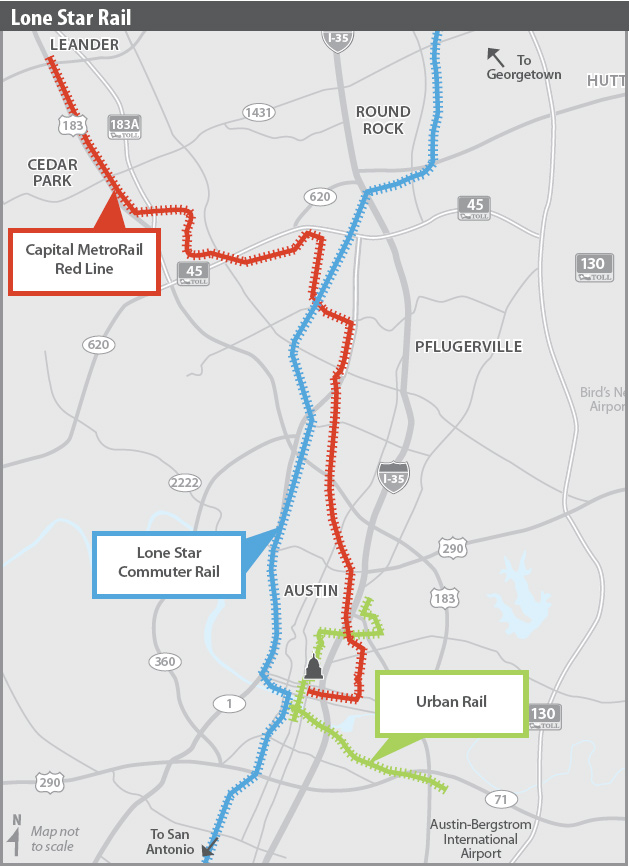
Lone Star Rail.

Well-informed sources indicate that one reason that the Austin area hasn’t gotten much federal transit money lately is that the CAMPO area isn’t speaking to the feds with one coordinated regional voice. Perhaps this is because Round Rock is planning one rail transit system, Cap Metro is planning another, Austin is planning a streetcar rail system with bonding now delayed, and Lone Star Rail is promoting its own regional commuter system.

There is no doubt that the poor economy has contributed to the national and local peak and a decline in driving in recent years. The poor economy has taken over from high fuel prices and congestion to help discourage increased driving in Texas, as well as nationally.

The new plan perpetuates recent suburban sprawl growth trends. But now with the goal of encouraging the high density clustering of development, in such locations as highway strip malls in the towns surrounding Austin, and at existing edge cities like Round Rock.

In general, the plan authorizes the building of a lot of roads ASAP, while most of the transit waits until the proposed funds appear. The new CAMPO plan, and its short range approval companion, the TIP, are heavily biased toward spending on roads in the early years, especially for Williamson County. Williamson County claims it can get the credit to issue and pay back $4.1 billion in road bonds on its own. Accordingly, it submitted a long very list of roads to be eligible for matching funds, compared to Travis County.

Because a lot of the future funding is so uncertain, the CAMPO plan is important largely because of what it authorizes and makes eligible for federal private and state funding within the coming three year TIP, assuming that these funds are available.

Looming problems

Due to a combination of congestion, energy cost, and a depressed economy, travel behavior has become just as unpredictable as future funds. It does seem clear that there is a trend in the U.S. to try to drive less. Left unclear is why this trend would facilitate suburban clustered center growth rather than core city infill development, where the public maximizes residential density to get closer to the major employers. We need more recent data to justify our assumptions about the geography of future employment trends.

It does seem sensible to require all metropolitan area planners in the USA to periodically do a long range plan, like the CAMPO plan, in order to get the federal gas money back. The problem with this is that there isn’t actually a requirement that the resulting plan must work very well, even on paper.

The new 2035 CAMPO plan is a blue ribbon example of this kind of planning deficiency. The following is a list of what I see as major shortcomings of the CAMPO 2035 plan. Appendices are provided at the end for easier referencing and documentation.

  1. Revenues are likely way too optimistic, in accord with loose federal rules — Appendix A
  2. 2035 demographic projections are based on the 2006-2007 construction boom — Appendix B
  3. Congestion would become far worse than it is now — Appendix C
  4. Little track record or support data for the preferred clustered growth “Centers” scenario — Appendix D
  5. Road maintenance is planned to fall precipitously — Appendix E
  6. Little environmental plan impact — Appendix F
  7. Peak oil mentioned but not incorporated into the planning — Appendix G
  8. Planning is blind to recent driving trends, due to aging, economy, congestion, fuel price, etc, — Appendix H
  9. Heavily front-loaded to favor expansion of Williamson County roads — Appendix I
  10. Highways today; transit someday — Appendix J

If the CAMPO plan being recommended by CAMPO staff is fully implemented, using every possible source of transportation funds that can be reasonably anticipated, what would happen?

The CAMPO model predicts that if its plan is fully implemented, Austin area residents will experience much worse traffic congestion than we see today, double the severely congested roads with about three times the daily driver delay to half an hour. CAMPO’s previous long range plans have been a stretch in terms of optimism, but the new plan breaks new ground in both its financial optimism and the poor end results predicted.

CAMPO’s previous 2030 plan was projected to cost about $23 billion. CAMPO’s new 25 year plan assumes almost $27 billion in income and spending, which means roughly keeping spending level after inflation over the past five years. The feds require that the envisioned long range expenses be matched with somewhat plausible revenue sources. CAMPO’s “preferred option” anticipates spending the maximum amount that optimistic expectations could generate.

CAMPO’s future revenue projections in the new plan have managed to retain most of their previous optimism. This is despite a lot of recent economic changes that have mostly reduced transportation revenue.

Demographic projections 25 years in the future are used to define the future peak hour commuting demand that the plan attempts to meet. At issue is whether it it is wise to do that by spending so much so soon, in accord with a plan that puts a lot of the spending in the early years while shifting the funding burden to local government.

There is not much evidence that the scattered suburban centers proposed by the plan, essentially denser, more walkable satellite cities, are a good fit for recent land development trends that seem to discourage suburban development. The availability of utility services and retail shopping are a big factor influencing the development potential of the proposed suburban growth centers. Can Manor thrive as a toll road crossroads, but without an HEB? Should the public underwrite this “centers” concept at the expense of the central city?

One can assign hypothetical future commuter trips to bus or rail to help handle future commuting numbers arising among edge cities like Cedar Park and Kyle and Manor. Based on experience elsewhere, the transition from well established car-centric commuting hubs like Kyle or Round Rock to different kinds of walkable development destinations will not be fast, easy, or cheap.

Increasing congestion has been weighing against driving through many US suburbs during the last decade. Suburban roads are overcrowded, not due to bad planning, but largely due to the inherent nature of trying to widen and fund the road capacity needed to serve an ever-expanding urban perimeter. Commuter roads based on leveraging public debt have become public subsidies to stimulate sprawl, profitable to influential and well established land development interests.

Transportation planners can view suburban commuting on congested roads strictly as a time penalty, but it is more than that. Every minute of time they spend commuting drivers must be on the lookout for unanticipated hazards on crowded roads that require full attention every second, even among elderly drivers. Austin area freeways like IH 35 reached peak hour saturation long ago, and now they experience frequent and unpredictable delays. Increasingly driving is stressful and people avoid it.

With the past growth pattern of expanding layers of suburbs added over decades, new suburban commuters drive ever farther and through other suburbs. The cost of providing enough road capacity for new layers of growth goes up as something like an exponential function of the core city’s radius.

The way the CAMPO planning process is currently headed, the policy is to try to keep building those roads with a lot of political support. SH 290 E is a toll road being built over stages with stimulus funds; it is now being managed by the CTRMA rather than TxDOT.

SH 45 SW, proposed as a new toll road over the Edwards aquifer, is in the plan as a proposed and supposedly fundable toll road. The reality is that it is struggling just to scrounge a few million dollars in planning funds; the CTRMA has said that it would probably not be bondable as a greenfield toll road.

The biggest threat: Soaring fuel prices

The one factor that seems most likely to scuttle the new CAMPO Plan, is the likelihood of much higher oil prices within the five year time frame of the new plan.

Higher gas prices began to inhibit U.S. driving starting in about 2003. By mid-2008, an unsustainable commodities price bubble, led by oil, was underway. Rising commodities prices plus a global finance bubble culminated in a global recession and precipitated a global economic crisis that persists.

Record fuel prices revealed the world’s maximum oil production in mid 2008 to be about 85 million barrels per day at that time. If the U.S. economy eventually recovers enough to accommodate a resumption of past driving behavior, then the oil market will surely have to tighten up, which will spike fuel prices and inhibit any increase in driving. Oil producers probably cannot keep global oil production above 92 million barrels a day no matter what the price, which sets the stage for another tight oil market and another price spike. Depletion will again overtake the maximum global oil production that even very high oil prices can deliver.

The first two issues encompass the balance of new oil supplies and declining production from existing oil fields. Here the report suggests a fairly specific time frame when significant additions of new production to the world’s oil supply is likely to end. The report says time is around the end of the current year. From 2011 on, the relentless drop in production of just over 4 million b/d from the fields that are currently producing about 85 million barrels a day will be just barely balanced with production from new projects through 2014. After that world production will go into decline.

In other words, the world’s ability to keep increasing its oil production will come to an end this year after 150 years of more or less steady growth. While new production from projects such as those in the deep waters off Brazil and the Gulf of Mexico will continue, these projects are five to ten years away from significantly adding to global production and likely will be overbalanced by the 4 million b/d annual drop in production from existing fields. New production will, of course, slow the pace of global oil depletion, but will not be enough to allow for global economic growth.

The Oil Crunch.

The British report, “The Oil Crunch”, is one of the clearest windows we have on the global liquid fuels future; it says we have a MAXIMUM of five years left before driving gets really expensive, worse than in mid-2008. How would this added driving cost increase affect travel demand in Texas, where vehicle travel demand is already pretty much flat?

If this report on energy is accurate, a lot of our shrinking supply of discretionary tax dollars are likely to be locally squandered trying to handle unlikely future traffic, while furthering a financial commitment to encourage sprawl development. If the anticipated toll revenues do not materialize, any resulting tax free municipal revenue bond default could undermine the Austin metropolitan area’s development potential.

If our readers would like to comment on the current draft new 2035 CAMPO plan before it gets changed or approved as policy by the CAMPO Board, comprised mostly of local politicians, there are a number of public hearings scheduled in the near future. Here are the times and locations.

Appendix A; Clearly short of Funds

Federal law requires CAMPO to develop a Financial Plan that
documents how the improvements called for by the Long
Range Plan are affordable within the revenues “reasonably”
expected to be available in the region. — App p 98.

However, no matter what the law says, there is not enough money to do what the planners regard as a good job, as the CAMPO planners admit:

CAMPO estimates that just over $26.7
billion in Federal, State, and local
revenue will be available to build, operate, and
maintain the regional transportation system
between today and the year 2035.
If regional growth and revenue trends
continue, we will fall considerably short of
addressing the transportation needs that have
been identified. (Even assuming the region
works to better integrate land use and transportation
by supporting centers.) The region
will need to pursue additional sources of
Federal, state and local funding to build on
the projects and programs identified in the
Plan. — Executive Summary, p 15

The proposed funding is highly optimistic. The Plan assumes a shift toward local funding like tolling and bond debt, as opposed to the past pattern of state and federal funding using the gas tax. More than 75% of the future money spent is assumed to be provided locally. — App p 08

The plan “assumes innovative finance to expedite projects and programs” — Pl p 92

“The projects included in this plan are affordable within the
revenue that is reasonably expected over the life of the plan.
However, the projects and programs fall considerably short
of addressing the full extent of transportation need that has
been identified through the planning process. CAMPO will
work with its regional partners to pursue additional sources
of Federal, State, and local revenue, as well as innovative
financing to expedite projects, and may amend the plan to
include additional projects and programs in the future.
Appendix 2 provides a description of the array of innovative
funding sources that could be pursued.” — Pl p 92

Even the intention to apply for potential future grants is counted as a plausible source of “Innovative Revenue” for CAMPO planning purposes:
LSTAR Innovative Revenues
The Lone Star Rail District has provided an estimate of the
funding that they have already secured or intend to pursue
for implementation of the Lone Star Rail Project Connecting
Austin and San Antonio. In addition to fares, the estimate
includes the following:

  • STP-MM Funding (through the SA-BC MPO): $20 million
    (already awarded)
  • Local Funds from Rail District Member Jurisdiction:
    $356.4 million
  • FRA Funding Programs(HSIPR): $136.0 million
  • Federal Appropriations: $18.00
  • Federal Reauthorization: $145.0 million
  • State Rail Relocation Fund, TxDOT: $241.5. — App p 25

Appendix B; Old growth and job trends used

The future travel problem the CAMPO plan is trying to solve is actually based on old trends from the Austin suburban growth boom era of 2006-2007.

The location and growth targets for these centers were based on a regional dialogue that CAMPO convened with the public, regional partners, and regionalexperts throughout 2006 and 2007. This dialogue led to the identification of a desired network of mixed use activity centers that were embodied in the “May 2007 Draft CAMPO Growth Concept. — Pl p 18

It is not clear that the new population distribution, see App p 110, has changed much from CAMPO’s previous long range 2030 plan; the population densities shown on the maps in the 2030 and 2035 plans are expressed in quite different ways, making a good comparison difficult.

Besides the issue of the future population distribution, there is the related issue of the magnitude of this increase. The Austin area population is proposed under the new CAMPO plan to more than double to 3.2 million. TxDOT just officially added Bastrop and Caldwell Counties to CAMPO, joining Hays, Travis, and Williamson counties, which were already in the CAMPO planning area.

The Texas State Data Center recommends that good long range planning should preferably use the .5 growth scenario for long range projections:

The One-Half 1990-2000 Migration (0.5) ScenarioThis scenario has been prepared as an approximate average of the zero (0.0) and 1990-2000 (1.0) scenarios. It assumes rates of net migration one-half of those of the 1990s. The reason for including this scenario is that many counties in the State are unlikely to continue to experience the overall levels of relative extensive growth of the 1990s. A scenario which projects rates of population growth that are approximately an average of the zero and the 1990 2000 scenarios is one that suggests slower than 1990-2000 but steady growth.

Instead, the CAMPO planners used a considerably higher rate of increase than that recommended. In accord with the sprawl development assumptions incorporated in the previous CAMPO plan; the counties surrounding Travis are proposed to continue to get a much bigger share of future growth than the more central Austin, or Travis County. Here are CAMPO’s projections:

Population:
2005 Est. 2015 2025 2035
Travis 896,800 1,105,000 1,318,000 1,555,300
Williamson 330,700 473,300 702,700 1,026,500
Hays 126,200 189,200 271,600 371,200
Bastrop 69,500 102,300 149,200 215,500
Caldwell 35,400 50,100 65,300 82,100
Total 1,458,600 1,919,900 2,506,800 3,250,600

Employment:
2005 Est. 2015 2025 2035
Travis 536,900 707,200 843,500 1,026,500
Williamson 101,500 165,700 253,000 400,300
Hays 41,000 66,200 97,800 137,300
Bastrop 12,000 20,500 34,300 58,200
Caldwell 7,000 10,500 15,000 20,500
Total 698,400 970,100 1,243,600 1,642,800 — App p 102.

It probably goes without saying that the current employment trends, which were a primary factor driving past growth in the Austin region, are now less favorable to growth. Jobs are still being created, but the workforce is increasing even faster, so that unemployment in the Austin Round Rock San Marcos MSA increased from 6.5% to 7.6% from Jan. 2009 to Jan. 2010.

Nobody can say where CAMPO’s large projected increase in future Williamson County jobs will come from; the vision seems to be based more on land development politics and past trends than anything else.

Appendix C; Congestion

CAMPO’s 2035 congestion map shows widespread rush hour congestion on most major roads. — App p 46.

Here are some numbers that tell the story.

The percent of congested roads will increase from 12% to 26%.
The Vehicle Hours of Delay Per Person during 24 hours would
nearly triple from .12 to .31 hours. — App p 41.

Of course the standard road lobby catechism says there is an obligation to fight congestion by building and widening roads. What is actually happening is that we are using relatively shrinking public money, or even worse public debt, to subsidize profitable but car-addictive land development. Congestion is by its nature self-limiting; it resolves itself over time. Congestion and the free market market play a beneficial role by generating a strong natural limits incentive for the public to shift land use patterns that favor more tax efficient urban infill with a higher population density.

Appendix D; CAMPO’s Preferred Growth Scenario: Edge City Clusters

The CAMPO planners looked at three scenarios: ‘no build’, ‘trends’, and ‘centers’. In other words the following three alternatives.

A. Do nothing,

B. Try to finance sprawl infrastructure as usual,

C. To cluster sprawl more densely in the edge cities surrounding Austin. This was approved as CAMPO’s preferred alternative.
“Preferred Scenario
The preferred scenario that is included in the draft CAMPO
2035 Plan assumes:

  • Implementation of all projects included in the current
    Transportation Improvement Program,
  • Implementation of mixed use activity centers throughout
    the region
  • Implementation of locally-funded projects as prioritized
    by project sponsors
  • Implementation of additional high priority regional
    projects.” — Pl p 32.

Numerous national studies have shown that higher density, mixed use development oriented around public transportation can help us get more for less by reducing vehicle miles traveled on the regional roadway system and increasing transit ridership. Over the last several decades regional transportation planning bodies around the country have had success encouraging movement toward this pattern through various initiatives.

The CAMPO 2035 Plan assumes that the region will work toward implementation of a network of high density mixed use centers oriented around the transportation investments included in the CAMPO 2035 Plan.” — Pl p 17

Missing is documentation that CAMPO’s preferred clustered sprawl scenario is an economically viable growth scenario. A big expansion in vehicle travel like cars and buses would be required, in contrast to the current tendency to cut back on per capita travel in the Austin area.

Appendix E; Severe road maintenance cuts

Let us compare the projected future costs pie charts in the new 2035 plan versus the previous 2030 CAMPO 25 year plans.

Here are the 2005-2030 CAMPO spending projections from the old 2005 CAMPO plan:

  • Roadways 44%
  • Transit 6%
  • Transit Operations 26%
  • Other/Bike Pedestrian 1.9%
  • Roadway Maintenance 22%

These are the new spending 2010-2035
projections in the 2010 CAMPO plan, Pl p 08

  • Freeways 15%
  • Arterials 26%
  • Rail 8%
  • Transit Operations 37%
  • Other 2%
  • Bike Ped 2%
  • Roadway Maintenance 6%

TxDOT Dist 14 maintenance costs are now about $182 million per year, mostly contracted with private companies, but this is proposed to drop greatly in future years.

Appendix F; Little attention to environmental constraints

Here is CAMPO planning in theory:

“Wise investment in our future demands a foresighted plan that balances transportation, land use and natural resources” — Pl p 05

Yet the CAMPO planners have historically usually favored minimum compliance with federal environmental law. The CAMPO planners have chosen 70 parts per billion, the highest ozone level that the feds are said likely to approve. Sen. Kirk Watson has even advocated that CAMPO keep the current goal of 75 parts per billion.

CAMPO area greenhouse gas emission (CO2), from a near doubling of vehicle trips, is projected to increase from 24,000 tons per day in 2010 up to 33,000 tons in 2035. — App p 64.

The CAMPO planners have not taken future water supply constraints into account in their planning process, especially the future water available for Willamson County.

Appendix G; Peak oil mentioned

The new 2035 plan is refreshing in one respect. It is no longer in denial of peak oil, it mentions it on page 45. The problem with this is that acknowledging that a problem exists is easy, but this falls way short of incorporating a plausible peak oil response scenario into the planning process. The study of peak oil is well advanced, we are probably peaking now according to many experts, so where are the numbers or key links needed to continue this important in a realistic way?

Global demand for oil shows no sign of decreasing; the
earth’s endowment of oil is finite. Large reserves of oil
remain, but will become more costly to extract. Fuel costs
will rise over the long-term, with short-term fluctuation
based on changes in demand and disruptions to the supply
system. Limited supplies and the high cost of petroleum are
especially problematic for the transportation sector because
the majority of motor vehicles, aircraft, trains, and ships
have no ready alternative to liquid petroleum fuels.

Many communities, including the city of Austin, have peak oil
preparedness plans. The city of Portland’s plan, for instance,
calls for a 50 percent reduction in total oil and natural gas
consumption over 25 years. Reductions of that size will rely
heavily on efficiency and conservation in transportation
systems, land use, and infrastructure development. Agencies
such as CAMPO and plans such as the 2035 Plan will be
critical to creating the kind of transportation system that
supports such reductions in consumption. — App p 45

Appendix H; Blind to recent driving trends

The plan is pretty much blind to changing demographics, income levels, and fuel prices, insisting that future residents will retain their old driving habits despite current trends to the contrary.

Forecast Methodology: Funding forecast developed by CAMPO
and assumes that the proportion of Austin’s population who
are low-income and welfare recipients will remain the same
over time. Forecast assumes that the rate of increase in the
annual authorization on a national level will be equal to the
compound rate of increase in authorization based on data
available in the SAFETEA LU years. The forecast assumes
that the Austin area will continue to receive 0.297% of the
funding available at the national level.

“Travel Behavior
The CAMPO Travel Demand Model, which is used to simulate
future trip-making in the region, includes mathematical
assumptions based on current travel behavior. Some of the
variations described below are factored into the CAMPO
model based on standard modeling practice and empirical
data; however, the model is not sensitive to all variations.
In particular, the travel behavior assumptions used by the
CAMPO model are not sensitive to the behavioral impacts of
micro-changes in land use or changes in age and ethnicity
over time.” — App p 116

Appendix I; Heavily favors Williamson County Roads

The plan is a prescription to transfer the road and transit funding burden to local debt. In the case of Williamson County, this means $4.2 billion of local bond debt. The current situation in some ways resembles a frontier land rush, with many of the future roads envisioned to supply Williamson County, which anticipates its billions in road bonds to be potentially issued in the near future, unlike the relatively more modest Travis County proposals being offered:

Travis County
Forecast Methodology: Funding forecast provided by Travis County based on issuance of approximately $100 million in bonds every five years, adjusted for inflation.

Williamson County
Forecast Methodology: Funding forecast provided by Williamson County based on issuance of $4,123,895,000 in transportation bonds and $130,000,000 in developer contributions over the life of the plan. County has documented that this amount is within their current bonding capacity and would not result in an increase in County tax rate. — App p 24

Appendix J; Highways now; Transit someday

The 2035 CAMPO plan is full of roads and toll roads seeking funding approval, with $2.7 billion proposed for roads during the first ten years of the 25 year plan, but only just $600 million in the last ten years. It is not clear how this emphasis on approval of lots of spending for roads as soon as possible differs from business as usual. The state and local arterial spending shows similar front loading on road spending. Local funding for arterials is also concentrated in the early years with $1.9 billion proposed during the first decade, but only $1.2 billion for the final decade. Rather heavy spending on passenger rail of just over $2 billion on the next 15 years is assumed, but this appears to be largely based on “innovative finance” for funding. Express bus service, largely commuter buses to the clustered suburban centers, is proposed to expand dramatically in the future from a mere $54 million in the first ten years to nearly half a billion in the last ten years. Meanwhile, maintenance spending for roads and bridges is proposed to decline from $618 over the coming decade, then shrinking to $557 million the last decade of the 25 year plan. — App p 10

[Roger Baker is a long time transportation-oriented environmental activist, an amateur energy-oriented economist, an amateur scientist and science writer, and a founding member of and an advisor to the Association for the Study of Peak Oil-USA. He is active in the Green Party and the ACLU, and is a director of the Save Our Springs Association and the Save Barton Creek Association. Mostly he enjoys being an irreverent policy wonk and writing irreverent wonkish articles for The Rag Blog.]

The Rag Blog

Posted in Rag Bloggers | Tagged , , , , , | 9 Comments

Bill Ayers and Bernardine Dohrn : Bringing the War Home, 1970

News photo taken March 6, 1970, of the New York Fire Department responding to an explosion at an upscale Greenwich Village townhouse. Image from Wikipedia.

Bringing the war home: 1970-2010

Eventually we came to think that we could make a revolution, and that in any case it was our responsibility to try.

By Bill Ayers and Bernardine Dohrn / The Rag Blog / March 22, 2010

Conscience is the sword we wield. Conscience is the sword that runs us through. — Marge Piercy

A front page headline in the New York Times on March 7, 1970, announced: “Townhouse Razed by Blast and Fire; Man’s Body Found.” The story described an elegant four-story brick building in Greenwich Village destroyed by three large explosions and a raging fire “probably caused by leaking gas” at about noon on Friday, March 6.

The body was later identified as belonging to 23-year old Ted Gold, a leader of the 1968 student strike at Columbia University, a teacher, and a member of a “militant faction of Students for a Democratic Society.”

Over the next several days two more bodies were discovered — Diana Oughton and Terry Robbins had both been student leaders, civil rights and anti-war activists — and by March 15 the Times reported that police had found “57 sticks of dynamite, four homemade pipe bombs and about thirty blasting caps in the rubble,” and referred to the townhouse for the first time as a “bomb factory.”

That awful event announced widely the existence of the Weather Underground, in some ways the most notorious, but far from the only group of Americans to take up armed struggle as a protest tool at that moment — the story took off from there, growing, changing, and accelerating every day

A few days after the Townhouse explosion Ralph Featherstone and William “Che” Payne, two “black militants,” associated with the Student Nonviolent Coordinating Committee, according to Time Magazine, “were killed when their car was blasted to bits” by a bomb police said was being transported to Washington D.C. to protest the prosecution of SNCC leader H. Rap Brown. The Black Liberation Army leapt onto the national scene, and other organized groups — Puerto Rican independistas, Native American first nation militants, and Chicano separatists — emerged demanding self-determination and justice.

Next door neighbor Dustin Hoffman stands near the West 11th Street townhouse that was destroyed by an explosion and fire on March 6, 1970. Photo from the AP.

Violent resistance to violence was far from an isolated phenomenon: Time noted that in 1969 there had been 61 bombings on college campuses, most targeting ROTC and other war-related targets, and 93 bomb explosions in New York, half of them classified as “political,” a category that was “virtually non-existent 10 years ago.”

According to the FBI, from the start of 1969 to mid-April 1970, there were 40,934 bombings, attempted bombings, and bomb threats. Out of this total, 975 had been explosive, as opposed to incendiary, attacks, meaning that on average, two bombs planned, constructed, and placed, detonated every day for more than a year. Our national history includes times of anarchist resistance, labor militancy, massive unreported (and still largely unacknowledged) slave rebellions, and the armed abolitionism of John Brown; the late 1960’s and 1970’s was becoming one of those times.

How had it come to this?

Empire, invasion, and occupation always earn blow-back. In 1965 most Americans supported the war, but by 1968 people had turned massively against it — the result of protest and organizing and a burgeoning peace movement, and of civil rights leaders like the militants from SNCC, Muhammad Ali, and Martin Luther King, Jr. denouncing the war as illegal and immoral. Even more important, veterans came home and told the truth about the reality of aggression and occupation and war crimes.

The US government found itself isolated around the world and in profound and growing conflict with its own people inside its own borders. The Vietnamese themselves were decisive: they refused to be defeated. The Tet Offensive in 1968 destroyed any fantasy of an American victory, and when President Lyndon Johnson announced at the end of March 1968 that he would not run for reelection, it seemed to us we had won a victory.

But peace proved to be a dream deferred, for the war did not end — it escalated into an air and sea war, expanded into all of Cambodia and Laos, and every week the war dragged on another six thousand people were murdered in Southeast Asia. Six thousand human beings — massive, unthinkable numbers — were thrown into the furnaces of war and death that had been constructed by our own government.

The war was lost, but the terror continued. All Vietnamese territories outside U.S. control were declared “free-fire zones” and airplanes rained bombs and napalm on anything that moved, destroying crops and live-stock and entire villages. John McCain, an unremorseful war criminal, flew some of those missions. As a young lieutenant, John Kerry testified in Senate hearings at the time that U.S. troops committed war crimes every day as a matter of policy, not choice.

No one knew precisely how to proceed, for the anti-war movement had done what it had set out to do — we’d persuaded the American people to oppose the war, built a massive movement and a majority peace sentiment — and still we couldn’t find any sure-fire way to stop the killing; millions of people mobilized for peace, and our project, our task and our obsession, was so simple to state, so excruciatingly difficult to achieve: peace now.

The war slogged on into a murky and unacceptable future, and the anti-war forces splintered then — some of us tried to organize a peace wing within the Democratic Party, others organized in factories and workplaces, some fled to Europe or Africa or Canada, others to communes, the land, and hopeful but small organizing projects. Some began to build a vehicle to fight the war-makers by other means, a clandestine force that would, we hoped, survive what we thought of as an impending American totalitarianism.

Every choice was contemplated, each seemed a possibility then — and we had friends and family in every camp — and no choice seemed utterly beyond the pale.

The Weather Underground carried out a series of illegal and symbolic attacks on property then, some 20 acts over its entire existence, and no one was killed or harmed; the goal was not to terrorize people, but to scream out the message that the U.S. government and its military were committing acts of terrorism in our name, and that the American people should never tolerate that.

Some felt that our actions were misguided at best, off-the-tracks, indefensible and even despicable, and that case is not impossible to make. But America’s longest war itself, with all its attendant horrors, was doubly despicable, and while many stood up, who in fact did the right thing; who ended the war; who transformed the world?

We began to think of ourselves as part of the Third World project — revolutionary liberation movements demanding justice and freeing themselves from empire, we believed, would also transform the world. We thought that we who lived in the metropolis of empire had a special duty to “oppose our own imperialism” and to resist our own government’s imperial dreams.

Eventually we came to think that we could make a revolution, and that in any case it was our responsibility to try. It was a big stretch, but every revolution is impossible until it occurs; after the fact, every revolution seems inevitable.

All of that was 40 years ago — lots of water under the bridge since then, raging rivers and cascading falls, rapids and torrents, chutes and ladders — a long time in the life of a person — the young become the old, and stories get retold.

But it’s also a matter of perspective: the meaning of any historical event will always be contested, and the more recent the event, the fiercer the contestation. The last word has not been written about the radical movements of youth in Europe in 1968, and certainly the meaning of the Black Freedom Movement or of the U.S. invasion and occupation of Viet Nam and the various American reactions to that catastrophe — from mindless jingoism to sincere patriotism, from reluctant participation to gung-ho brutality, from protest to armed resistance — are far from settled.

We’re reminded of the Chinese premier Chou En Lai responding to a French journalist’s question many years ago about the impact of the 18th Century French revolution on the 20th Century Chinese revolution. He thought for quite awhile and finally said, “It’s too soon to tell.” Forty years is less than the blink of an eye.

The big wheel keeps on turning: events and actions and adventures plunge relentlessly forward and nothing withstands the whirlwind of life on-the-move and history in-the-making. No single narrative can ever adequately speak to the diversity and complexity of human experience, for meaning itself is in the mix, always contested and never easily settled.

Because meaning is made and remade in the present tense, our backward glances are now necessarily refracted through the U.S. defeat in Viet Nam, the steady decline of empire, the hollowing out of the economy through militarism, the destruction of our political system, the environmental catastrophe that capitalism wrought, the terror attacks of 9/11 and the subsequent invasions and occupations and wars that continue as defining features of our national life. There is no sturdy accounting of distant times: everything must change, no one and nothing remains the same.

Many who knew and loved them 40 years ago, choose to remember Ted Gold, Diana Oughton, Terry Robbins, Ralph Featherstone, and Che Payne every day as beautiful and committed young people who believed fiercely in peace and justice and freedom, believed further that all men and women are of incalculable value, and thought that they had a personal and urgent responsibility to act on that deep belief.

Bill Ayers and Bernardine Dohrn.

We think of Brecht: a smile is a kind of indifference to injustice. And then we turn to Rosa Luxemburg writing to a friend from prison: love your own life enough to care for the children and the elderly, to enjoy a good meal and a beautiful sunset, to embrace friends and lovers; and love the world enough to put your shoulder on history’s great wheel when required.

We have not forgotten our fallen friends, not for a moment. March 6 was for us a time of more formal remembrance. Their deaths and all that followed offered us an opportunity to reconsider and recover. We were able to recommit and to see that the first casualty of making oneself into an instrument of war is always one’s own humanity, that, in the words of the poet Marge Piercy, “conscience is the sword we wield. Conscience is the sword that runs us through.” We remember our lost comrades, their many brave, as well as their damaging last acts, and we continue to vibrate with the hope and despair they embodied then.

[William Ayers is Distinguished Professor of Education and Senior University Scholar at the University of Illinois at Chicago. Bernardine Dohrn is Clinical Associate Professor of Law and Director and founder of the Children and Family Justice Center at Northwestern University. Both Ayers and Dohrn were leaders in SDS and the New Left, and were founders of Weatherman and the Weather Underground.]

The Rag Blog

Posted in Rag Bloggers | Tagged , , , , , , , , , | 14 Comments

Lisa Fithian: FBI Informant Brandon Darby : Sexism, Egos, and Lies

Brandon. Darby. Still from a video / videochannels.com.

Sexism, egos, and lies:
Sometimes you wake up and it is not different

By Lisa Fithian / The Rag Blog / March 22, 2010

Community organizer and nonviolent activist/trainer Lisa Fithian will be Thorne Dreyer’s guest on Rag Radio, Tuesday, March 23, 2-3 p.m. (CST) on KOOP 91.7 FM in Austin. For those outside the listening area, go here to stream the show.

[The Rag Blog has reported extensively on FBI informant Brandon Darby and the Texas 2. We have also dealt with the larger issues related to governmental use of espionage and informants. Please see links to all of our previous material at the end of this article.]

On December 31, 2008, the Austin Informant Working Group released a statement titled: “Sometimes You Wake Up and It’s Different: Statement on Brandon Darby, the ‘Unnamed’ Informant/Provocateur in the ‘Texas 2.’” It’s been over a year since then and here is my long-overdue version of that story.

It was on December 18, 2008, that I learned unquestionably that Brandon Michael Darby, an Austin activist, was an FBI informant leading up to the 2008 Republican National Convention protests in St. Paul, MN. He was the key witness in the case of two young men from Midland, TX, Bradley Crowder (23) and David McKay (22) who, thanks to Brandon’s involvement, have been convicted of manufacturing Molotov cocktails.

They are now serving two and four years, respectively, in federal prison. In 2010, Brandon will be a key witness in another important case to the Government — the case of the RNC 8, Minneapolis organizers who are facing state conspiracy charges.

The case of the “Texas 2” gained national media attention as a result of Brandon’s unique blend of egomania, the media’s attraction to charismatic and controversial men, and the persistence of the U.S. government to criminalize and crush a growing anti-authoritarian movement. I found myself strangely entwined in the story — past, present and future.

I knew Brandon, and I was given a set of the FBI documents because, as it became apparent from reading them, I was one of the primary people he was reporting on to the FBI. (I, like many others engaged in political protest, am suspect because of my politics not my actions.) Now all of us who knew Brandon and worked closely with him, have been coming to terms with what he did, how he was able to do it, how we were used and abused in the process, and what we might do differently next time.
The Texas 2: David McKay and Bradley Crowder.

Waking up

Some of us were more surprised than others when Brandon revealed himself as an informant. My first reaction was deep sadness. I then went through a range of emotions: disbelief, shock, anger, outrage, and at times vindication. I am still hurt and angry, not just with Brandon, but with the whole system that supports and enables him.

I am still struggling with forgiveness for choices made in activist communities and by some of my friends. I understand how difficult it was; Brandon, at times, was also my friend. In the end we must examine the behavior we experienced, reflect on the array of choices we had, and explore what we could do differently to insure this does not happen again.

Brandon’s behavior was problematic long before 2008. Whether or not he was actually working for the state, he was doing their job for them by breeding discord within our politically active communities. I raised my concerns about Brandon’s behavior in New Orleans, in Austin, and also in Minneapolis.

The news story broke on Thursday, December 29, when Brandon published an open letter to the community admitting he worked with the FBI. He knew we were about to blow the whistle, so he successfully preempted our headline. His initial words, however, were lies.

When asked why he got involved with the FBI, Darby said it was because he discovered that people he knew were planning violence. “Somebody had asked me to do something that would’ve resulted in hurting people, and I said no,” he said. “So they started asking other people. At that point, that’s when I went forward and contacted somebody in law enforcement.”

Darby had been involved with a group of young people from Texas who traveled together to the RNC. Their journey has become part of the fodder in the legal and media frenzy since September 2008. The trip proved to be a disaster. David and Brad ended up in jail, and the rest of the group was served Grand Jury subpoenas. The subpoenas were eventually dropped. While preparing for their trials, David and Brad both said Brandon was an informant and the community refused to heed their warnings. They felt like they knew Brandon, he’d been around for years.
Scott Crow (left) and Brandon Darby were photographed together on Nov. 3, 2007, at a party in Austin hosted by KUT Radio. Photo from bestofneworleans.com.

In November an article appeared in the St. Paul Press asserting that Brandon Darby was an informant. This, unfortunately, was based on false evidence. Scott Crow, a friend of mine, and Brandon’s main ally in the activist community, defended Brandon calling the accusation a “COINTELPRO lie.” Little did Scott know how right he was – this whole damn thing is COINTELPRO shit.

The documents we got in December 2009 were clear — Brandon began working for the FBI in November 2007. In November 2007 Brandon had no relationship with David or Brad and could not have known their plans for the St. Paul Republican Conventions. Their plans didn’t develop until after Brandon had become an informant and after he established himself as their ally and mentor.

Furthermore, Brandon has never been squeamish about violence. He owned guns and cultivated his reputation as a hotheaded, militant revolutionary. At least a half a dozen people were prepared to testify, under oath and with some risk to them, that Brandon had approached them with proposals to commit robbery or arson. Ultimately Brandon admitted that he turned informant for the money.

Brad, David, and their families’ lives have been changed forever because these two young men were seduced and influenced by a paid FBI informant. In his early memos to the FBI, Brandon referred to them as “collateral damage.” Now these two men are spending several years of their young lives in Federal Prison.

There are many people in the activist community who have crossed Brandon’s path and have been hurt, demoralized, alienated, frightened, or run off by him. Those of us who were lied to or lied about, spied on, bullied, must deal with the trauma of his abusive behavior. We must also come to terms with the behavior of those who supported and enabled Brandon. And, as a community, we must deal with those parts of ourselves that were seduced, manipulated, and marginalized by Brandon so that we can defend each other, our political work, and ourselves.

Background

I met Brandon through his relationship with another organizer, after I moved to Austin in February 2002. Over time I learned that it was a tumultuous and abusive relationship. When it ended in 2004 Brandon moved to New Orleans for about six months. Years later Brandon told me that he had turned himself in to the New Orleans Office of the FBI when he lived there during that time. He apparently told them that he knew they were looking for him, so here he was.

It was early 2003 around the U.S. invasion of Iraq, that Brandon inserted himself in the anti-war community and gained a reputation as a paranoid guy who got himself into unusual situations with police.

During the protests on the first day of the war, Brandon was supposedly arrested for photographing undercover cops. After that action he was, mysteriously, the only person who did not want legal support. The arrest apparently does not show up in any legal records. For more on this, go here.

During this time, Brandon began showing up regularly at anti-war rallies, trainings, and other events. The anti-war community had started to use civil disobedience as a protest tactic. In the first training I did following Brandon’s supposed arrest, Brandon insisted that one of the participants was an undercover cop and demanded that I ask that person to leave. High drama around other people being undercover is behavior I’ve learned to associate with informants as a way to divert attention from them. It also breeds distrust and is destabilizing of collective efforts.

In another intense protest when UT students attempted to block an intersection with a tripod, the police unfortunately were waiting near the intersection and quickly pulled out the legs of a tri-pod, and dropped the person about 15 feet onto the pavement. Brandon who had helped bring props to the site became erratic and started yelling at the police resulting in even more people being arrested, including people who were not intending to risk arrest. Several students left the anti-war movement as a result of this action.

At this time, it became very clear that a key local organizer was being intensely targeted. Her home was broken into repeatedly. She found her vehicle tampered with, was fired from her job, and her cat was poisoned. Coincidentally, also at this time, Brandon began to court her as a mentor, asking her to teach him what she knew about organizing.

The first time she recalled meeting Brandon was the day he was arrested, when he ran up to her yelling that there were undercover cops in the crowd. Following his arrest, Brandon consistently called her, wanting to talk about his arrest and aftermath but rejecting the legal support she was helping organize. Recently, when the Austin Informant Working Group did an open records request on this organizer, the FBI found 600 documents with her name in them (they have not been relinquished by the FBI to date).

Brandon also participated in a protest at the Halliburton shareolders’ meeting in Houston. He unexpectedly joined the group intending to commit nonviolent civil disobedience. The group was on edge the night before, and now I understand why. In the planning session the night before the action, Brandon argued strongly that provoking and fighting the police was a tactic to open the eyes of the masses to police brutality, and bring more people into our cause.

He held his ground even when the group strongly disagreed and told him that under no circumstances would the group agree to him provoking or fighting the police. Brandon was a loose cannon and a bully. Even when he said he would agree to nonviolence in the action, it was clear that in his mind his agreement was contingent on the police not “provoking” him. Going into the action the next day was like sitting on a tinderbox waiting to explode.

At some actions, Brandon would show up, all masked up, with a video camera and take a lot of footage. He has continued to do this over the years, including in Minneapolis. I don’t believe he has ever posted or published any of it.

Brandon also befriended a local Palestinian activist, a man named Riad Hamad. In the spring of 2008 his house was raided by the FBI. In April Riad was found bound, gagged, and drowned in Town Lake. The death was ruled a suicide and the FBI is not releasing any information, but it was made clear in David McKay’s trial that Brandon was also involved as an FBI informant on that case.

It was in the fall of 2005 that my path became more intertwined with Brandon’s.
New Orleans and Common Ground Relief

After Hurricane Katrina, New Orleans was a post-apocalyptic state. The whole social order had collapsed. A military occupation was underway and vigilantes were literally shooting Black men in the streets. It was in the midst of this chaos that Common Ground Relief was born. The organization grew from a driveway operation into a massive grassroots response to the Katrina disaster. With ex-Black Panther Malik Rahim at the helm, it was outside of government or charity organizations, and based in direct action, mutual aid, and solidarity.

Within the first year Common Ground Relief hosted over 12,000 volunteers and established an effective grassroots relief network in New Orleans following Katrina: CG moved millions of dollars in goods and resources; set up a free medical clinic; cleaned and gutted over 1,500 homes, churches and schools; organized a free legal services, media and computer centers; revived community gardens, planted thousands of acres of wetlands and did numerous bioremediation projects.

This work was done by an incredible group of long-term organizers who committed their lives for months if not years to the work. Brandon, was part of this team of volunteers but he held a great deal of power because of efforts he and Scott Crow made in the early days of the storm to rescue a friend, Robert King Wilkerson, and to defend Malik’s home in Algiers from the white vigilantes. It was during their second trip to New Orleans that Common Ground was born.

Despite all the good accomplished by Common Ground, there was discord with other local groups and organizers who were struggling to come home. Much of the discord involved Brandon. Brandon had strong authoritarian tendencies but his lack of organizing skills and experience and his resistance to working horizontally or collectively created discord and challenges.

He insisted on being the person in charge. He demanded a chain of command with him at the top. At one point he tried to create a central committee to insure that only a select few would be in any position of power. This style put him out front whether it was the media or a group of volunteers who would be doing the heavy lifting while he talked.

For example, in the Bywater area, Brandon insisted on being the liaison to the activist community. But he treated them with such disrespect and patronization that Common Ground lost an important ally base in the local community. In another example, a local organizer was talking about putting together a women’s space and clinic. Instead of supporting that process, Brandon just moved ahead and set up a space separate from that effort, further alienating local activists.

Brandon actively agitated against any relationship between Common Ground and the People’s Hurricane Relief Fund (PHRF). He and Scott Crow, one of the co-founders of Common Ground, took a particularly hard-line position against certain members of leadership within the PHRF.

In December 2005 Brandon goaded Scott Crow to write a public letter accusing PHRF of corruption. The letter was very destructive. I had never before or since seen Malik so angry. He understood the danger of this letter and the negative impact it could have on Common Ground and the community, and he moved quickly to limit the damage.

With Common Ground Relief as his platform Brandon attempted to extend his influence internationally. He pushed for a trip to Venezuela, which made little sense and raised even more questions about Brandon, especially for those who traveled with him. In the summer of 2006 Brandon tried to initiate another emergency response and relief effort only this time in Lebanon. It was called Critical Response and was going to save the people of Lebanon from the Israeli attacks in the war with Hezebollah. Fortunately this effort never happened.

Sexism, egos and…

Brandon was a master of manipulation, and worked both women and men. He would draw them into his sometimes-twisted perspective by cultivating them through coffee, cigarettes, alcohol, revolutionary rhetoric, emotional neediness, or his physical presence — either seductive or intimidating.

Young women are often attracted to Brandon. At Common Ground, his unrestrained sexual engagement with volunteers was a problem. His “love for sex” became part of the organizational culture. His leadership role set a tone that led to systemic problems of sexual harassment and abuse at Common Ground.

When a group of the women in leadership challenged his behavior and asked that he stop sleeping with volunteers, he said “I like to fuck women, so what.” Our concerns were disregarded. The abuse became so rampant that Common Ground had to issue a public statement in May of 2006 acknowledging problems of sexual harassment in the organization.

Brandon left for a while but returned in November 2006 when he was asked to become the Interim Director of CG. His first focus was to dismantle the primarily women and queer leadership team at the St. Mary’s volunteer site. He then started recruiting men for the security team, trained them in martial arts, and asked if they were willing to carry guns, despite the fact that Common Ground had an explicit policy against weapons at our sites.
Offices of Common Ground Relief in New Orleans. Photo from BigGovernment.com.

Brandon picked fights in the community, increasingly drawing police into the area and to Common Ground. He initiated action to kick down the door of the Women’s Center at two in the morning, to get rid of a man who was staying there. Brandon also kicked in the door of a trailer and pointed weapons at a group of volunteers who were hanging out with someone whom Brandon had asked to leave CG. As the Interim Director, Brandon felt he could do what he wanted without the consent of or accountability to the volunteers, the communities CG served, or other leadership.

In another incident, Brandon was arrested in a car chase. He was so angry about being arrested that Brandon once again trumped other work being done by deciding that he was going to personally clean up the New Orleans Police Department. He printed up hundreds of yard signs and put them around New Orleans, with a phone number saying that if you had a problem with NOPD, call Brandon Darby, Interim Director of Common Ground.

Brandon’s ego was getting more and more inflated making him even more dangerous. He covered his megalomania with a practiced humility and drawl. He became increasingly reckless and kept everybody in defensive and reactive postures.

Sexism, like racism, affects all of us. Brandon was allowed to assume leadership and authority at Common Ground because he was a strong, good-looking, charismatic, straight white male who was willing to take risks, even if reckless. As Malik’s favored son he did pretty much whatever he wanted. Yet, the work of activists who were women or queer or busy doing relief remained relatively invisible. Those activists were only given power where it didn’t challenge Brandon’s and he made sure of it.

During the first year of Common Ground, Brandon decided that I was an obstacle to his authority, and he worked to undermine me. He successfully diverted attention from my challenges to his sexist, abusive, unethical, and unaccountable behavior by framing them as a “power struggle”. Where he wasn’t able to convince others in the organization, he silenced them with fear of his retribution.

Brandon attacked me in public and spread disinformation about my work. He built a small group of dedicated followers that were willing to do his dirty work. They would tape record people, including myself and report back to him. He snitch-jacketed me — accused me of being an FBI agent. When I reached out to others, particularly men in New Orleans to intervene, I received little support. None of them were willing or able to challenge Brandon’s clearly destructive behavior. Those who backed his authority contributed to the organizational divisions that allowed his continued abuse of power.

In January 2007 I drove to New Orleans to pick up a friend who was kicked out of Common Ground by Brandon because she was a friend of mine. She was one of the coordinators at the St. Mary’s site. Other relief work coordinators were leaving the organization and because of this Brandon accused me of coming to town to wage a coup against him.

Early the next morning one of his “assistants” called me, threatening me with lawsuits. Then I get a call telling me that Brandon told them that King told him that Scott and I were conspiring against him. Crazy shit, crazy COINTELPRO shit. At the same time Brandon began a purge of three long-time coordinators by demanding they turn in the keys and leave the premises. But this time even Brandon went too far. Malik intervened and stopped the purge.

Lies

Brandon lies. He lied at Common Ground. He lied to the FBI. He lied in his open letter. He lied to his friends. He lied to the media. He lied to the judge and jury.

The government and the FBI lie, too. There is a long history of government infiltration and violence to disrupt social movements, a history that they have lied about in the past and they continue lie about today. It is documented that the government infiltrated and disrupted protests at the Republican National Conventions (2000 in Philly and 2004 in New York City). But in St. Paul they took it to a whole new level and they were more than willing to use Brandon to do it.

The government’s efforts to break the grassroots direct action anti-capitalist movement led to one of the most fascist operations I have experienced in the U.S. During the RNC — between knocking down doors, confiscating organizing materials, raiding homes, snatching people on the streets, impounding the skills training bus, and even surrounding my car with guns, they also arrested hundreds of innocent people and are continuing to prosecute the RNC 8, who are facing state conspiracy charges.

To this day it is my firm belief that the government set up both Brad and David, and another young man named Matt DePalma, in order to legitimize their acts of repression and to taint the environment in the case of the RNC 8. There were only two instances of Molotov cocktails in St. Paul and both of them had an FBI informant involved. In the case of Matt, the informant brought him to the library to learn how to make them, brought him to a store to buy the stuff and then made and tested them together!

In the case of David and Brad, Brandon had been goading them into a destructive mindset from the very first meeting and he continued to goad them throughout. Brandon created the environment in which they made some very bad decisions. I do not believe that those Molotov cocktails would have been made if Brandon had not been a part of that group.

One year later

At the time of this writing, Brad and David are both serving time in federal prison. Brad plea-bargained and was sentenced to two years. David went to trial and the first jury could not reach a verdict. Awaiting his second trial, prosecutors threatened to bring additional charges against Brad and to call Brad as a witness to testify against David.

Rather than force his friend to choose between self-interest and defending him, David made a decision to plea out. Instead of leniency, the judge doubled David’s sentence to four years without parole as punishment for the first trial.

Kate Kibby, who was previously arrested dressed as a zombie in a demonstration in Minneapolis.

Then in November 2009 the FBI unsuccessfully prosecuted a young woman, named Kate Kibby, for allegedly threatening Brandon in an email. Fortunately, the jury delivered a unanimous not guilty verdict. One of the many interesting things we learned in that case is that Brandon had actually drafted his open letter near the end of October and posted it against the FBI’s wishes.

We also learned that one of the FBI’s motivations in pursuing this case was the hope of finding a new informant. In their interrogation of this woman, they asked if she was working with me or Scott Crow. They told her she could be facing 20 years, but more likely 2-4. If she wanted to become an informant in the Austin and New York City anarchist scenes, they could work something out.

Fortunately, this woman had integrity and principles, and refused to be threatened or bullied. Because of this, she had to endure an FBI invasion into her life, and a terrifying trial. As her father said afterwards, “I knew if we could get 12 adults to sit down and look at this, they would see how absurd it is…”

I wish that this trial could be the end of any damage that Brandon might do, but we know that Brandon is likely to be a main witness in the trial against the RNC 8, organizers from Minneapolis who are facing conspiracy charges. Who knows how many other people he will concoct stories or fabricate lies about? Or how his brain twists the facts.

After Kate’s trial he sent an email to Scott, saying that Scott and I were responsible for David being in jail. He said:

I feel that you and Lisa bear some moral (not legal) responsibility for two of the years that David McKay is serving. Y’all let your dogma and your personal resentments guide you in the advice and encouragement you gave him. He did wrong and he would be free soon had he just been honest.

Y’all somehow convinced him that he had to “fight the man” and that his being honest was somehow unfair to the oppressed peoples of the world. Thankfully, Mrs. Kibby did not take y’alls guidance or drink your koolaid- and she’s free.

A few years ago, I began to feel that you guys were similiar to radical Imams in that y’all spout hatred (not all hatred, good things too) and young activists get in trouble all around y’all, but never y’all. I feel that y’all did that with my youthful anger as well.

Though I’m sure you don’t appreciate receiving an email from me, I think you can deduce some of my motivations from its words.

I am sorry; I have worked with thousands of young people over the years and none of them are in the situation that people find themselves in after working around Brandon. I have no time for his twisted logic, vague threats and destructive behavior. Instead, let us vanquish him and learn from this to insure that he, or people like him, can never do this again. To that end…

Behaviors of Brandon’s or others that enabled this kind of damage to be done.

  1. Deferring or listening to men, as opposed to women and/or attacking women in leadership positions. Our patriarchal society has taught us this and we need to deconstruct it.
  2. Charisma and confidence enabled him to assume leadership and control — people deferred even though he had little experience. He cultivated a handful of women and men to become personal assistants who did a lot of his work for him.
  3. Assuming credibility by his associations — Brandon tried to associate himself with other high profile organizers in the activist community.
  4. Preying on and exploiting people’s vulnerabilities and insecurities, particularly using alcohol or other addictions. He liked to “play with people’s minds.”
  5. Bullying. All bullies abuse their power and people let them do what they want because they are afraid of what will happen if they do not go along. They use their physical prowess to intimidate both women and men.
  6. Disrupting group process in meetings, derailing agendas, questioning process, challenging others, or not coming to meetings at all to avoid accountability. Or using secrecy and sub-groups to divide the whole.
  7. Pointing fingers at and ‘snitch-jacketing’ other people, accusing them of being cops, FBI agents, etc. This kept everyone on guard, and created an environment of suspicion and distrust.
  8. Seducing people using power or sex, leaving a lot of pain and destabilized situations in his wake or provoking people to do acts they would not do on their own.
  9. Being persistent and pursuing people, by calling them repeatedly or showing up at their homes, inviting them for coffee, he would wear you down, or find other ways back into important relationships.
  10. Being an emotional/physical wreck, becoming very needy and seducing people into taking care of him. Then people would defend him because of his emotional vulnerabilities or physical needs.
  11. Time and energy suck. Talk endlessly, consuming hours of time and energy — confusing, exhausting, and indoctrinating.
  12. Being helpful or useful — showing up when you most needed support. Brandon would arrive with tools, money, or whatever was needed at just the right time.
  13. Documenting through videotaping or photographing actions but never using it or working on communications systems which he attempted at the RNC.
Brandon Darby at work. Image from New Orleans Indymedia.

Some day I hope to wake up and find things different

Brandon’s behavior over the years makes it clear that he is a misogynist, an egomaniac, and a liar. Unfortunately, many in our broader community bought into the illusion that he was a great radical self-described “revolutionary.” They defended him again and again. He repaid their support with betrayal. He continues to make a mockery of our work and supports the FBI in their efforts to crush our struggle for justice.

Some day I hope to wake up and find things different. I hope to see our communities deepen our understanding and commitment to uprooting all the “isms.” I would like to see a community where we create agreements and structures of accountability that will not allow behaviors like those highlighted above to continue, and if they do continue, that men will listen to women, and stand up to each other when someone is clearly abusing their power and authority.

In the end, I do not know what other choices I could have made short of leaving Common Ground earlier. I actually believe I tried to interrupt, make visible, warn and mitigate the damage of Brandon, but it was the people around me that continued to support Brandon despite the obvious problems.

Some of the lessons I have learned are that if someone is continually engaging in a pattern of disruptive behavior, like those mentioned above, that people must make clear agreements about what kind of behavior is OK and not OK and then collectively hold each other to those agreements.

If people/women are continually raising an issue about a particular person I will pay more attention, do some research, and if questions or problems continue to arise about that person, I will work together with others to ask that person to leave. Whether they are infiltrators or not, the behaviors that they are exhibiting are counterproductive to a world rooted in justice and equality. They are also, by their very nature, putting all of us at risk of unjust government action and imprisonment by their reckless and provocative behavior.

I also hope that someday when I wake up that I will live in a world where people do not use the threat of or use of violence to get their way or impose their will. That if we have such people in our movement that we will not be intimidated but instead will work together to end those abuses of power, for they mirror the abuses the Government in their efforts to exploit and control.

I also hope more people will chose nonviolent action since such action prefigures our future, can be strategically effective, and minimizes our movement’s vulnerability — and because I do not believe we can make lasting real radical change through violent means in this country.

Some day when I wake up, I hope to find an end to the systemic oppression and repression that unjustly locks up so many innocent people, while destroying and thwarting the dreams of so many others. Perhaps if we built our communities based on just agreements and real accountability, prisons would become obsolete.

Until we wake up in that world, let us remember that no one is free until we all are free. No day will be different until we make it so. Let us begin today.

Here is a link to a story about a long-time informant in New Zealand that also made the news in December 2008. It is uncanny how many similarities there are and lots of good lessons for us…http://indymedia.org.nz/newswire/display/76563/index.php

A great deal has been written about the case of the Texas 2 and can be found at www.freethetexas2.org

Many thanks to the following for their editorial support: James Clark, Lauren Ross, Ted German, Casey Pritchett, Scott Crow, and Missy Benavidez.

[Lisa Fithian has been organizing for 35 years — working with peace, labor, student/youth, immigrant and global, environmental and racial justice organizations and movements. Much of her work has been focused on using creative nonviolent direct action and civil disobedience in strategic campaigns. She is a member of the Alliance of Community Trainers, a small collective working to empower communities for collective transformation.

Lisa has worked with Common Ground Relief, the post-Katrina New Orleans collective; the new Students for a Democratic Society (SDS); United for Peace and Justice; and environmental groups like Save our Springs — and she helped Cindy Sheehan coordinate activities at Camp Casey. Check out Lisa’s websites: www.organizingforpower.org and www.trainersalliance.org.]
Top: Lauren Ross, center, is comforted by her friend Lisa Fithian after they were arrested during a protest in New York Sept. 2, 2004. Photo by Bebeto Matthews / AP. Image from CommonDreams. Below: Lisa Fithian and Ken Butigan at a National Assembly of United for Peace and Justice in Chicago, 2007. Photo by Diane Greene Lent / dianelent.com.

Previous Rag Blog articles on Brandon Darby and the Texas 2:

Go to the Support the Texas 2 website.

And listen to “Turncoat,” a story about Brandon Darby on Chicago Public Radio’s This American Life. [The Darby segment starts 13 minutes in.]

Also, read this remarkable piece of reporting: The Informant: Revolutionary to rat: The uneasy journey of Brandon Darby by Diana Welch / Austin Chronicle / Jan. 23, 2009

For more background on the history of informants in Texas, read The Spies of Texas by Thorne Dreyer / The Texas Observer / Nov. 17, 2006.

And see the entire “Hamilton Files” of former UT-Austin police chief Allen Hamilton that served as documentation for Dreyer’s story, here.

The Rag Blog

Posted in Rag Bloggers | Tagged , , , , , , , , , , , , | 40 Comments

Type your summary here

Type rest of the post here

Source /

The Rag Blog

Posted in RagBlog | Leave a comment

Cartoonist Keough discusses (and illustrates) the role being played by the IWW’s Starbucks Workers Union and the way it is addressing sexual exploitation in the company — and the much publicized Kati Moore rape case. With political cartoons.

Posted in RagBlog | Leave a comment