Colombia: Six Decades of Fighting for Peace : Paramilitary Reemerges


A Promise of Peace:
Colombia and the paramilitary successor groups

By Marion Delgado / The Rag Blog / March 11, 2010

Part three: Resurgence

In my last posting I looked at the demobilization of Colombia’s paramilitary blocs in an agreement with the government of Álvaro Uribe Velez, overseen by the OAS (Organization of American States) that took place in 2003-2006. The government estimated that there were between 7,000 and 9,000 paracos when the process began. By February 2006 they claimed 17,000 were “demobilized”; now it appears, according to Human Rights Watch, that 31,671 persons participated in the demobilization process.

For the most part this peace process was Uribe’s gift to the paramilitaries that he and his cousin, Mario Uribe, helped to create when Alvaro was a senator, a sort of “get out of jail free card” with many benefits. Besides a few dozen leaders of the blocs who were extradited to the U.S. to stand trial for drug trafficking and money laundering, the paracos were shuffled through a loose process and sent out to become good citizens again. Now it appears that it didn’t happen that way.

The Colombian Attorney General has said repeatedly that the paramilitars no longer exist. Only recently has the government taken notice of two social phenomena that the Colombian people have known about all along. First, in many cases, the paracos, although going through a demobilization ceremony, never really demobilized at all, but continued to maintain control over vast areas of Colombia, and specifically over the cocaine trade.

Second, there are a growing number of successor groups, new paracos, if you will, that have organized and stepped up to fill the power vacancies left by the demobilization process. A third phenomenon combines both of these. Middle level leaders from the old blocs are back in business as organizers and controllers of “new” successor groups.

There are differences between the successors of the paramilitary groups and the demobilized Autodefensas Unidas de Colombia (AUC). First, the successor groups seem to operate relatively independently of each other; apparently they have not yet formed a coalition to articulate common goals and interests, coordinate their criminal activities, and, in some cases, their military-type operations.

Second, leaders have less visibility than some of the leaders of the AUC — for example, AUC founder Carlos Castaño. Most of the successor groups seem less focused on fighting guerrilla insurgents than was the AUC. What they have in common with the AUC is a strong involvement in Mafia-type criminal activity, including drug trafficking, as reported not only by the government but also by the Mission to Support the Peace Process in Colombia of the OAS (MAPP/OE).

According to police reports about the structure of the successor groups, most are led by former mid-level leaders of the AUC who never demobilized or simply continued to operate after a supposed demobilization. This is the case with Pedro Oliverio Guerrero (“Cuchillo”), leader of ERPAC (El Ejército Revolucionario Popular Antisubversivo de Colombia), several leaders of groups operating in Medellin, and Ovidio Isaza in the Magdalena Medio region, among others.

Daniel Rendon (see below), who directed the Urabeños bloc until his capture in 2009, also was a member of the AUC and a brother of Freddy Rendon, leader of the Elmer Cardenas Bloc. The main exception is the group Rastrojos that reportedly originated as an armed drug cartel in the North Valley and was not allowed to participate in the demobilization process.

As with the blocs of the AUC, the successor groups are deeply involved in crime, including drug smuggling, extortion, and money laundering. Early AUC blocs were formed from the group “Muerte a Secuestradores” (MAS; Death to Kidnappers), an alliance formed in the eighties by drug lords Pablo Escobar, Fidel Castano, Gonzalo Rodriguez Gacha, and others, in order to free traffickers or smugglers who had been abducted by guerrilla groups.

In Norte de Santander, for example, even though the Catatumbo Bloc of the AUC participated in horrific massacres of civilians who were identified as “guerrilla sympathizers,” sources report that seldom did they have direct combat with the guerrillas. Its main activity was to control lucrative drug running and smuggling operations along the border with Venezuela, as well as extortion and other criminal activities.

Many paramilitaries, such as “Don Berna” and “Macaco,” were simply drug traffickers who were presented before the world as paracos.

A senior officer of the police said that he saw a clear continuity between paramilitary groups and successor groups, in the sense that some AUC blocs “were not paramilitaries but were drug mafias who grabbed the paramilitary identity during demobilization. [The successor groups] are the product of a deception for demobilization. These guys tricked us all. They recruited displaced children. Then they killed some of the demobilized.”

Emergence and development of the successor groups

Demobilization of the AUC officially ended on August 15, 2006. Subsequently, many successor groups closely linked with the AUC appeared.

MAPP/OAS, relying on official information from the Colombian police, reported in early 2007 that it had identified “22 structures in which there is participation of mid-level demobilized [persons], recruitment of former combatants of the AUC, and control of illicit economies.” MAPP/OAS said that such groups then had approximately 3,000 members.

Since then, numbers of members of these groups and areas in which they operate have grown steadily. Estimates of the number of successor groups and their membership vary significantly according to the source, but in some cases reach 10,200 members.

In mid 2008, MAPP/OAS expressed concern that “these factions continue and even increase, despite the actions taken by the security forces. This shows a significant capacity for resistance and renewal, with resources that allow for constant recruitment and maintenance of corruption at the local level.”

According to police, who produce the most conservative figures, the total number of groups has declined, as many have merged or been absorbed within each other, and some have disappeared or been defeated. However, membership has grown and continues to grow. As of July 17, 2009, police said that the successor groups had 4,037 members, an increase over the 3,760 that they had estimated a few months earlier, in February 2009. Successor groups operate in 24 of the 32 departments of Colombia.

Police figures also show that during the same period, groups began to operate in 21 new municipalities, and went from having a presence in 152 municipalities to 173.
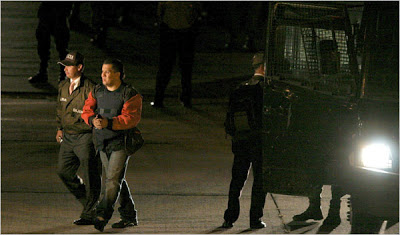
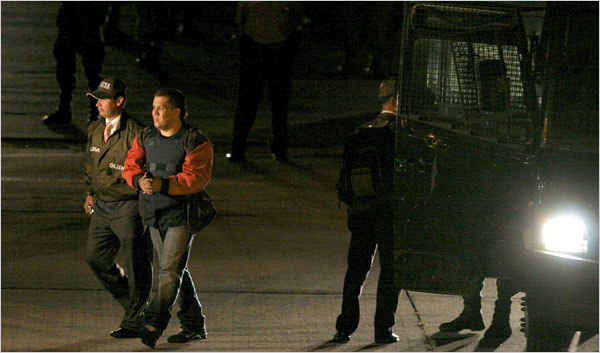
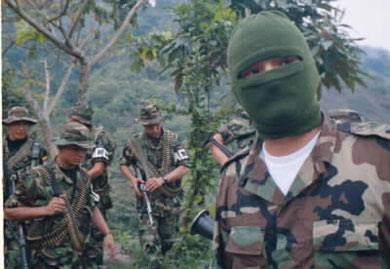
Paramilitary leader Edwin Mauricio Gómez luna was extradited in 2008. Photo by Raul Arboleda / AFP / Getty Images.

The main successor groups

In mid-2009, police records indicated there were nine successor groups in business. According to police sources and the Attorney General, four are significantly stronger than the rest, and are the main focus of the authorities.

  • The Urabá or Urabeños: Previously, this group was led by Daniel Rendon (also known as “Don Mario“), who was demobilized from the AUC and is the brother of Freddy Rendon Arias (“The German”), former leader of the Elmer Cárdenas Bloc that supposedly demobilized in 2006. After the capture of Don Mario in early 2009, police documents indicated that the group came under the command of Juan de Dios Usuga David, also known as “Giovanni.”

    However, in October 2009 police arrested another man, Omar Alberto Gomez, known as “El Guajiro,” who they identified as the group’s leader. According to police records, this group, that had previously used other names such as “Castaño’s Heroes” (referring to the late AUC leader Carlos Castaño) and “Self-Defense Forces of Colombia Gaitanistas,” has extended its area of operations from the Urabá region of Chocó and Antioquia to nine departments and 79 municipalities. It is reported that the group has 1,120 members.

  • The Stubble: According to multiple reports received by Human Rights Watch, Stubble was the armed drug cartel “Valle Norte” (North Valley), that historically was linked to Wilber Varela (also known as “Jabon“), a drug dealer murdered in Venezuela in January 2008. It is believed that they had links with the demobilized paramilitary leader Carlos Mario Jimenez Naranjo (also known as “Macaco“). The group attempted to participate in the demobilization process, but ultimately it was not allowed because the government considered them a criminal organization.
  • Paisas: Paisas are the heirs of paramilitary leader Don Berna, and have links with their “Office of Envigado,” a criminal organization operating in Medellin. According to multiple sources, Don Berna continued to control these groups from prison. It’s been reported that, since his extradition, there have been many internal struggles and possible splits of the group. Official documents indicate that Paisa operates in seven departments and 45 municipalities with 415 members. It is said that their current leader is Fabio Velez (also known as “Nito“).
  • Popular Revolutionary Army or ERPAC: This group is led by Pedro Oliverio Guerrero Castillo (also known as “Cuchillo“). Cuchillo is a longtime paraco leader who first operated in the private army of drug trafficker Gonzalo Rodriguez Gacha, and then joined the Centaurs Bloc of the AUC. It is said that Miguel Arroyave (aka “Arcangel”) led the Centaurs Bloc. He participated in the demobilization process as leader of the Heroes of Guaviare, but continued his illegal activity. The ERPAC operates mainly in the plains east of Bogota, in the departments of Meta, Casanare, Guaviare and Vichada, although police reports indicate that it also has a presence in Arauca and Guainía. Police estimate that it has 770 members.

In addition, the police say that they have identified the following groups:

  • Renacer: Police say the group operates in 11 municipalities in Chocó department under the command of Jose Maria Negrete (also known as “Raul“), and has 100 members.
  • New generation or “n”: Human Rights Watch has received credible information that this group was created by members of the Bloque Libertadores del Sur of the AUC almost immediately after their supposed demobilization. Police say they operate in three municipalities of Nariño, under the orders of Omar Grannobles (also known as “El Tigre“), with 114 members.
  • The Middle Magdalena: Police report that this group operates in eight municipalities in four departments, with 80 members. Its leader is Ovidio Isaza (also known as “Roque”). Isaza is a former leader of the AUC in the Magdalena Medio region. He is the son of Ramon Isaza, one of the earliest and most prominent leaders of the AUC. After their supposed demobilization, although they were never involved in the process of Justice and Peace, Ramon was released by the authorities for lack of evidence.
  • Males: Like the Stubble, it is said that this group is the armed wing of a drug cartel that existed previously. Police say it operates in two municipalities of Valle del Cauca department and has 44 members.
  • Rastrojos: The Rastrojos operate in 10 departments and 50 municipalities, have 1394 members, and are under the command of Antonio Calle Javier Serna (also known as “The Doctor”).

Interviews with victims and local authorities across the country suggest that police figures underestimate the number of members and the number of successor groups. In some areas, Human Rights Watch received information about the existence of groups that the police did not recognize.

For example, in an interview with Human Rights Watch, a senior member of the police forces said the group Black Eagles of Narino is “more myth” that reality. However, on several occasions, Human Rights Watch received matching information from inhabitants of Nariño about the operations of the Black Eagles, who control various parts of the territory, threatening civilians and, apparently, waging a bloody battle against Rastrojos for control of Tumaco.

Less than two months after denying the existence of the Black Eagles, police announced the capture of 36 members of the group in Nariño. Similarly, although the police indicate that the ERPAC has only 770 members, news reports have quoted data from the Army and the Technical Research Office estimating that it has 1,120 members and is growing rapidly through active recruitment.
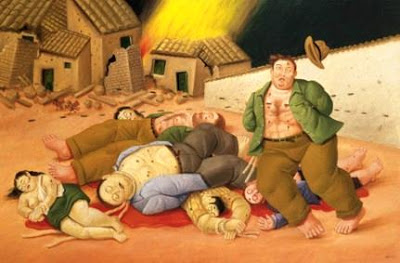
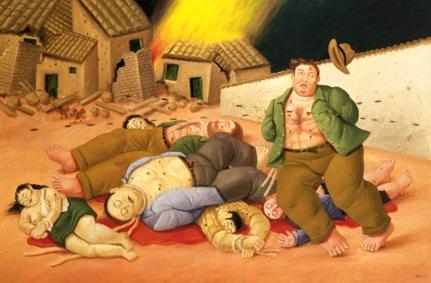
“Masacre en Colombia.” Painting by Fernando Botero.

Who are the Black Eagles?

In many parts of the country, witnesses who contacted Human Rights Watch said that people who ordered crimes of murder, forced displacement, rape, and threats of the same were identified as members of the Black Eagles. Leaflets and written threats against human rights defenders often bear the signature of Black Eagles.

Police told Human Rights Watch that the Black Eagles were not a single group, but merely a name that had been appropriated by various groups, including local gangs, to instill fear among the population.

However, Nariño Human Rights Watch received similar complaints from several residents and authorities in that region indicating that the Black Eagles are actually a single successor group with a high degree of coordination which operates in many respects like a Bloc of the AUC.

In Urabá, Human Rights Watch received reports that local successor groups (the Urabeños) have sometimes been identified as Black Eagles, and have used this name interchangeably with others. These groups are not merely local gangs. But Human Rights Watch received no solid information that the various groups using the name Black Eagles were a single national group.

Successor groups actively recruit members by offering very high salaries and, sometimes, using threats to force people to join their ranks. They often seek potential members among the demobilized population.

According to a former paraco from Sucre, when he was demobilized in 2005, his boss told the group, “Whoever… wants to return, can return” to their area of operations in Antioquia. “They’re there. The story is not over,” he said.

Another demobilized paraco said, “There are people who go to the new groups… There are guys who ask me if I would be ready to go again. You feel afraid to speak. Many people have been killed for talking. The AUC has not been dissolved… There are others who go, new people. [Payment] is never less than half a million pesos ($250 U.S.). It’s easy to enter, but it’s hard to leave.”

As reported by Human Rights Watch and officials of MAPP, it is estimated that over 50% of successor group members are recently recruited individuals. Mission members say the groups often use threats and deception to persuade new members to join.

So, it appears that the “AUC peace process” was just a sham perpetrated from the very beginning by Álvaro Uribe to pay off his friends and to cover up his and his government’s complicity in the unspeakable crimes of the AUC.

This should be enough reporting on the indignities the Colombian people suffer at the hands of criminals and the criminal government that bring suffering to every aspect of life here in Colombia. But it isn’t, there is one more atrocity to add. Read this story from The Colombian newspaper:

Up to 14,000 Colombian children recruited by armed groups

Friday, 12 February 2010

There are between 8,000 and 14,000 children involved in Colombia’s ongoing conflict, working for gangs and armed groups, according to figures released by an NGO on Friday to mark the International Day Against the Use of Child Soldiers.
The Humanitarian Diplomatic Mission, a Medellin-based NGO, reports that Colombia has the fourth-highest number of child soldiers in the world, behind Burma, Sudan, and the Congo.

“In the last two years, the conflict in Colombia has changed, and there are now children in the intermediate structures of these armed groups doing intelligence work and drug trafficking,” their report says.

Children as young as six are involved in the conflict, either carrying arms or doing intelligence work.

The level of violence against children in Colombia is “very high,” according to the report. Sergio Tapia, the NGO’s president, told Caracol Radio that, “We suspect that 10% of victims of paramilitaries are children,” and that thousands of these deaths have not been reported to authorities.

The International Day Against the Use of Child Soldiers, February 12, commemorates the UN protocol which came into force on this date in 2002, banning the recruitment of minors under the age of 18 into armed groups.

The report supports remarks made by Colombian Vice President Santos on Wednesday, in which he called the [Fuerzas Armadas Revolucionarias de Colombia] FARC’s recruitment of minors “a disgrace,” and expressed the government is very concerned about this phenomenon, the recruitment of children.

There was no mention of his friends and supporters, the paramilitars.

Also see:

The Rag Blog

Posted in Rag Bloggers | Tagged , , , , , | 1 Comment

SUNDAY : Celebrate Albert Einstein’s Birthday With Us

THIS SUNDAY!


Rag Blog Benefit Bash and
Albert Einstein Birthday Party

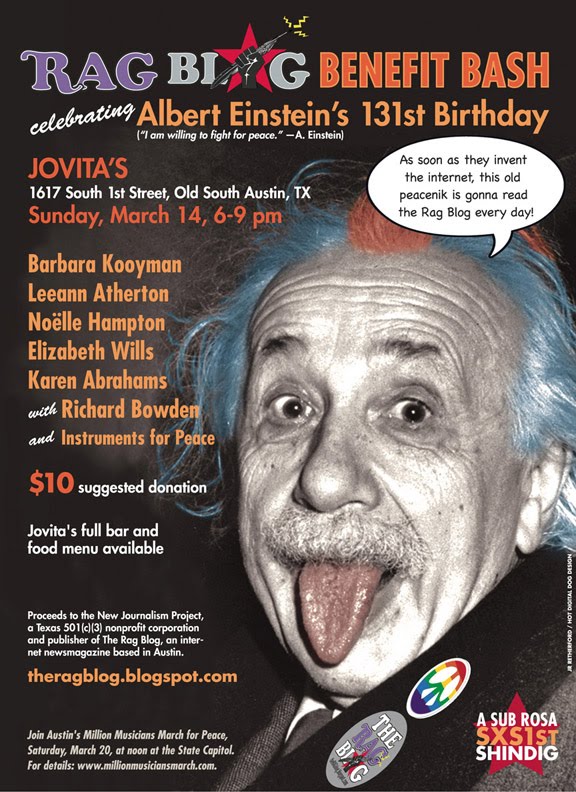
The Rag Blog, the Austin-based progressive internet newsmagazine, is celebrating Albert Einstein’s 131st birthday with a big benefit bash at Jovita’s, 1617 South 1st Street in Austin, from 6-9 p.m., this Sunday, March 14.

The event features a stellar lineup of musicians including Barbara K, Leeann Atherton, Noëlle Hampton, Elizabeth Wills, Karen Abrahams, and Richard Bowden with Instruments for Peace.

There will also be a sneak preview of the first 15 minutes of a documentary film being made by People’s History in Texas (working title: The Truth as We Saw It) — about The Rag, the legendary underground newspaper published in Austin from 1966-1977.

Jovita’s full bar and food menu will be available. There is no charge, but a donation of $10 is suggested.

If you are unable to join us in this celebration, please help us out with a $10 one-time or recurring donation. Click the DONATE button on the sidebar, or click HERE. The funds go to support The Rag Blog, published by the New Journalism Project, a Texas 510(c)(3) nonprofit corporation.

The Rag Blog

Posted in RagBlog | Leave a comment

MEDIA / ACORN Hoax : Times Won’t Admit It Was Wrong

Pimp and ho: James O’Keefe and Hannah Giles went undercover at ACORN. But guess what: They weren’t dressed like this!

NYT and the ACORN Hoax:
Paper won’t admit its mistakes

March 11, 2010

Ignoring calls from numerous critics, the New York Times refuses to own up to mistakes in the paper’s coverage of the now-famous right-wing videotapes attacking the community organizing group ACORN. Instead, the paper’s public editor, Clark Hoyt, is relying on an absurd semantic justification in order to claim the paper does not need to print any corrections.

As conventionally reported in the Times and elsewhere, right-wing activists James O’Keefe and Hannah Giles dressed up as a pimp and a prostitute and visited several local ACORN offices, where office workers gave the duo advice on setting up a brothel, concealing a child prostitution ring and so forth. But many of the key “facts” surrounding the videos are either in dispute or are demonstrable fabrications.

Though O’Keefe appears in various scenes in the videos wearing a garish and absurd “pimp” costume, he in fact did not wear the outfit when he appeared in the ACORN offices (Washington Independent, 2/19/10); he was dressed in a button-down shirt and slacks. This fact undermines one of the key contentions of the ACORN smear–that the group is so hopelessly corrupt that they would dispense advice to an obvious criminal.

What’s more, the “advice” that they received, according to the transcripts released by O’Keefe and Giles, does not appear to be as incriminating as it was portrayed in the videos–and echoed in outlets like the New York Times.

A review of the Times coverage:

  • In an early piece (9/16/09), readers were told of the “amateur actors, posing as a prostitute and a pimp and recorded on hidden cameras in visits to ACORN offices…. Conservative advocates and broadcasters were gleeful about the success of the tactics in exposing ACORN workers, who appeared to blithely encourage prostitution and tax evasion.” The Times explained:

    The undercover videos showed a scantily dressed young woman, Hannah Giles, posing as a prostitute, while a young man, James O’Keefe, played her pimp. They visited ACORN offices in Baltimore, Washington, Brooklyn and San Bernardino, Calif., candidly describing their illicit business and asking the advice of ACORN workers. Among other questions, they asked how to buy a house to use as a brothel employing underage girls from El Salvador.

    The paper also reported that O’Keefe “was dressed so outlandishly that he might have been playing in a risque high school play. But in the footage made public–initially by a new website, BigGovernment.com–ACORN employees raised no objections to the criminal plans. Instead, they eagerly counseled the couple on how to hide their activities from the authorities, avoid taxes and make the brothel scheme work.”

  • Three days later (9/19/09): “Their travels in the gaudy guise of pimp and prostitute through various offices of ACORN, the national community organizing group, caught its low-level employees in five cities sounding eager to assist with tax evasion, human smuggling and child prostitution.”
  • New York Times public editor Clark Hoyt weighed in (9/27/09), chiding the paper for not being more aggressive in promoting the ACORN videos–lamenting that Times readers weren’t as up-to-speed on the story as “followers of Fox News,” who already knew “that a video sting had caught ACORN workers counseling a bogus prostitute and pimp on how to set up a brothel staffed by under-age girls, avoid detection and cheat on taxes.”
  • The following week (10/4/09), Hoyt was on the ACORN case again: “To recap: Two conservative activists with a concealed video camera, posing as a prostitute and her pimp, visited offices of ACORN, the community organizing group, and lured employees into bizarre conversations about how to establish a bordello, cheat on taxes and smuggle in underage girls from Central America.”
  • After O’Keefe was charged in January with attempting to tamper with the phone system in Sen. Mary Landrieu’s office, the Times reported under the headline, “After Arrest, Provocateur’s Tactics Are Questioned”
    (1/28/10): “Mr. O’Keefe is a conservative activist who gained fame last year by posing as a pimp and secretly recording members of the community group ACORN giving him advice on how to set up a brothel.”
  • On January 31, 2010: “Mr. O’Keefe made his biggest national splash last year when he dressed up as a pimp and trained his secret camera on counselors with the liberal community group ACORN — eliciting advice on financing a brothel on videos that would threaten to become ACORN’s undoing.
  • On March 2, 2010, under the headline, “ACORN’s Advice to Fake Pimp Was No Crime, Prosecutor Says, “the Times reported: “The ACORN employees in Brooklyn who were captured on a hidden camera seeming to offer conservative activists posing as a pimp and a prostitute creative advice on how to get a mortgage have been cleared of wrongdoing by the Brooklyn district attorney’s office.”

But the story the Times continues to tell is wildly misleading, as a review of the publicly available transcripts of his visit (BigGovernment.com) makes clear. O’Keefe never dressed as a pimp during his visits to ACORN offices, seems to never actually represent himself as a “pimp,” and the advice he solicits is usually about how to file income taxes (which is not “tax evasion”). In at least one encounter (at a Baltimore ACORN office), the pair seemed to first insist that Giles was a dancer, not a prostitute.

In the case recounted in the March 2 Times story, the transcripts show that O’Keefe did not portray himself as a pimp to the ACORN workers in Brooklyn, but told them that he was trying to help his prostitute girlfriend. In part of the exchange, O’Keefe and his accomplice seem to be telling ACORN staffers that they are attempting to buy a house to protect child prostitutes from an abusive pimp.

Throughout the months the Times covered the story, it made a major mistake: believing that Internet videos produced by right-wing activists were to be trusted uncritically, rather than approached with the skepticism due to anything you’d come across on the Web. O’Keefe and the Web publisher Andrew Breitbart refused to make unedited copies of the videotape public, and with good reason: A more complete viewing, as the transcripts show, would produce a much different impression.

While the Times decide to skip the standard rules of journalism, ACORN commissioned an independent investigation led by former Massachusetts Attorney General Scott Harshbarger (12/7/09), which noted that the

unedited videos have never been made public. The videos that have been released appear to have been edited, in some cases substantially, including the insertion of a substitute voiceover for significant portions of Mr. O’Keefe’s and Ms.Giles’ comments, which makes it difficult to determine the questions to which ACORN employees are responding. A comparison of the publicly available transcripts to the released videos confirms that large portions of the original video have been omitted from the released versions.

So what has the Times done in response? As reported extensively by blogger Brad Friedman (Brad Blog), several Times staffers have been asked to justify the paper’s lack of accountability. In the most remarkable exchange, public editor Clark Hoyt–who had criticized the paper for not doing enough reporting on the tapes–wrote that the paper had made no errors that merited a correction (Brad Blog, 2/23/10). He explained that the January 31 story “says O’Keefe dressed up as a pimp and trained his hidden camera on ACORN counselors. It does not say he did those two things at the same time.”

It is hard to believe that Hoyt actually believes what he’s saying here. The obvious implication from the language of the article (and the others documented above) is that ACORN was dispensing advice to someone dressed up in an absurd pimp outfit. The Times chose to believe that O’Keefe’s work was journalism that didn’t need to be treated skeptically. The videos were in fact a hoax, and the Times was duped. Its readers deserve to know as much–and ACORN, which suffered serious political damage as a result of the false stories, deserves an apology.

In his September column criticizing the paper for being slow to report the ACORN videos, Hoyt wrote: “Some stories, lacking facts, never catch fire. But others do, and a newspaper like the Times needs to be alert to them or wind up looking clueless or, worse, partisan itself.” Worse than looking partisan, though, is being wrong.

ACTION: Encourage New York Times public editor Clark Hoyt to recommond that the paper investigate the ACORN videos and produce a report that clarifies the record.

CONTACT:
New York Times
Clark Hoyt, Public Editor
public@nytimes.com
Phone: (212) 556-7652

Source / Fair.org

The Rag Blog

Posted in RagBlog | Tagged , , , , | 3 Comments

Kate Braun : Vernal Equinox Seasonal Message

The egg and the emergence of Lord Sun: Egg tulip image from uphilldowndale.

Vernal Equinox:
Honor Eoster, the goddess of Spring

By Kate Braun / The Rag Blog / March 11, 2010

Every day’s another dawning/
Give the morning winds a chance/
Always catch your thunder yawning/
Lift your mind into the dance.

Saturday. March 20, 2010, is the Vernal Equinox/Ostara/Lady Day. Lady Moon is in her first quarter, in Taurus, the fixed Earth sign.

The name Ostara comes from the Indo-European root “aus” which gives us Eos (the maiden aspect of the Goddess, also the name of a Greek goddess of the dawn) and Aurora (Roman dawn goddess, also the name of Sleeping Beauty). Taurus’ energy bonds us with the earth, enforces our connection to the earth, reminds us we are dependent on the earth. I recommend that your Ostara celebration acknowledge this deep, stubborn, earthy aspect of the season.

We are still welcoming Lord Sun and encouraging his continuing growth, so burning candles and/or a fire is appropriate. However, since Ostara honors Eoster the goddess of Spring, a balance of masculine and feminine energies is required in your celebration. Using a solar cross (one with arms of equal length) in your decorations will do nicely in this respect.

Pink, light yellow, and light green are your first color choices for your dress and decoration, with all pastel shades being appropriate as accent colors. Other decorations may include living plants, eggs (both real and artificial), and rabbit images.

Eggs are an important part of this celebration as the Earth continues to be reborn and the egg is a symbol of rebirth.

An activity you and your guests may care to pursue involves egg imagery. Let each guest pick a hard-boiled egg from a basket serving as a centerpiece at your table and share this lore with them: the yolk and white of a hard-boiled egg represents the Sun hidden in the worm of the White Goddess.

We crack the shell (all crack shells), symbolizing the cracking of winter’s ice. We peel the white (all peel away the white), symbolizing the melting of the snow, freeing the golden yolk that represents Lord Sun emerging from his wintry seclusion. We share bits of egg (each guest gives a bit of egg to his neighbors at the table), sharing in Lord Sun’s rebirth as we eat (all eat the bits of egg).

Another ritual associated with this celebration is to bury a real egg, cooked or raw, in the east corner of your garden. This is said to bring fertility to the garden.

Put eggs at the center of your menu. Serve quiches, custards, egg salad, deviled eggs; accompany them with ham, cheeses, toasted pumpkin seeds and/or pine nuts, sprouts, leafy green vegetables, and hot cross buns. And don’t forget some chocolate for dessert. Eoster is fond of chocolate; eating some honors her.

[Kate Braun’s website is www.tarotbykatebraun.com. She can be reached at kate_braun2000@yahoo.com.]

The Rag Blog

Posted in Rag Bloggers | Tagged , , , , , | 1 Comment

Farrah’s Story : How Could the Academy Forget Her?


Survivors remember…
How could the Academy forget Farrah?

By Jody Schoger / The Rag Blog / March 11, 2010

American icon and Emmy-award winning actress Farah Fawcett was notably absent in the traditional memorial included each year as part of the annual Academy Awards ceremony, which aired last Sunday. Roger Ebert, writing on Twitter, quickly noted, “No Farrah Fawcett in the memorial tribute? Major fail.”

Major fail is right. From a purely historical standpoint, based on the length or her career and her social impact, she should have been there, along with Bea Arthur.

But perhaps the omission is as it should be. Like icons before her (Marilyn Monroe comes to mind) Ms. Fawcett did not seem like part of Hollywood, or even of Hollywood. In both cases, separating the woman from the image became as intriguing as the image itself.

In the real world I think Ms. Fawcett was an incredible artist who unintentionally saved her best public work until last.

She gave the most extraordinary gift of her intelligence, grace and spirit in Farrah’s Story, the no-holds-barred documentary that chronicled her struggle with the cancer that prematurely ended her life last summer. Both she and Michael Jackson died on the same day.

In 2006 Ms. Fawcett was diagnosed with anal cancer, one of those cancers people don’t talk about very much, if at all. In the last 30 years its incidence has risen by 78% in women, according to an article in US News & World Report. While only one in 640 women will be diagnosed with anal cancer over the course of their lifetime, not even half of anal cancers are detected early, when they are most easily treated.

The fact that this engaging woman, who fought on many fronts to retain her privacy, chose to let us in on this last chapter of her life certainly says more than I can. Farrah’s Story shows us a rare courage and also the unflinching nature of enduring friendship and love. Alana Stewart is by her side filming through treatments, illness, laughter, and tears. If you’ve had cancer, you know what these moments feel like. Of all the moments shared, one of my favorite is one all of us can identify with: the two friends cooking dinner and laughing in the kitchen.

When the Academy of Motion Pictures Arts and Sciences decided “that we can’t include everybody” in their “memoriam,” they rendered the rest of the segment meaningless.

So to Ms. Fawcett? What a life you lived. Thank you.

[Jody Schoger is a writer, public relations consultant, and cancer advocate who lives in the Woodlands near Houston. He blogs at Women with Cancer.]

Farrah Fawcett. Photo from Getty Images.

The Rag Blog

Posted in Rag Bloggers | Tagged , , , , , , | 7 Comments

Marc Estrin : Our Unsingable National Anthem


Bombs bursting in air…
Oh say can you sing?

By Marc Estrin / The Rag Blog / March 11, 2010

Oh, say can you see? o sa cn u c? When did we have to stand and sing this at hockey games? Revolutionary War? The War of 1812? Maybe the Civil War? Actually it wasn’t until this week in another Great Depression year, 1931, that President Hoover signed a congressional resolution creating “our national anthem.”

Originally a British drinking song, the octave and a half tune is quite unsingable — at least for the average Joe when sober — to the point that “the rockets’ red glare” or “conquer we must,” or even “freeeeeee” take on a grotesque crowd cacophony so beautifully illustrative of our drone attacks for democracy around the world.

In November of 2001, shortly after 9/11, along with the music to be played (one piece being Grieg’s Two Elegiac Melodies) the players found on their stands the music to The Star Spangled Banner. The orchestra board had decided that from here on, we would begin each concert, to a standing audience, with this hymn to patriotism. I stood up and objected, to glares from the other players, and did not participate in the short play-through.

At the next rehearsal, the players found on their stands a little manifesto:

A PERSONAL STATEMENT
For those who find perplexing the opposition to playing the Star-Spangled Banner.

At the present moment, the Star-Spangled Banner is not just the Star-Spangled Banner, but is also a clear, even fierce, political CODE. For those of us in the peace movement, here is what the code signifies:

— My country right or wrong.
— Rally behind the President, regardless of his agenda.
There are corollaries to the code, not as universally espoused:
— You are with America or against it.
— If you don’t support the war, you are a traitor.

As I stand daily at a Burlington peace vigil, I am acutely aware of a dangerously violent strain of jingoism, as some people yell obscenities at us, and advise us loudly to “Kill ’em all!” or “Nuke ’em.” One guy even swerved onto the sidewalk yesterday threatening to swipe the vigilers. Invariably, these cars are flying the largest possible flags on antennas and windows, and the comments often accuse us of not supporting America. [This was back then; mostly we get thumbs up now.]

There are those of us who believe that democracy involves multiple opinions, not unanimity, and that patriotism can require criticizing the government, especially in a thrust involving killing innocent civilians, skewing domestic budgets toward military spending, and tightening down on civil rights in the name of “security.” I personally — and I am not alone — believe that our current course, far from increasing national security, will seriously increase the odds of further attacks against hated Americans.

It would surely be appropriate to acknowledge the tragedies spinning around us, and to dedicate the Grieg elegiac pieces to the victims of terrorism — which I understand to mean ALL victims of ALL terrorism, individual, group and state terrorism, everywhere. But playing the Star-Spangled Banner transforms the sentiment into the CODE, and implies the orchestra’s support for the Bush/Cheney agenda. I think this inappropriate for us to do.

Sincerely,

Marc Estrin

By the first rehearsal of next spring’s concert, it seems all this had been forgotten — no Star Spangled Banner was on the stands or at the concert. Did I win? I doubt it. Probably the “good intentions” were just gobbled up by the memory hole.

But what wasn’t gobbled was the jingoist military muscularity — now enshrined ever more fiercely in our foreign and domestic policies — making any “national anthem” (much less the unsingable SSB) stick in the craw of peace-loving, humane singers except of course those who have substituted the far simpler-to-sing obsessive compulsive chant, USA! USA! USA! USA!

Franklin warned us as he left the Constitutional Convention in 1787. A reporter asked: “Well, Doctor, what have we got — a Republic or a Monarchy?” The good doctor famously responded: “A Republic, if you can keep it.”

When the bankers and political crooks seized on the opportunities offered them by the nation’s founding documents, the founders, whatever their differences, lamented:

Hamilton spoke of “the culpable desire of gaining or securing popularity at an immediate expense of public utility.”

John Adams: ”Oh my country, how I mourn over thy contempt of Wisdom and Virtue and overweening admiration of fools and knaves!”

Jefferson feared the onslaught of “pseudo-citizens infected with the mania of rambling and gambling” among those obsessed with commerce and moneymaking.

Madison had hoped that ordinary people would have the “virtue and intelligence to select men of virtue and wisdom” as their representatives; if not, he warned, no government could “render us secure.”

Oh, say, could they see? You betcha. We, as a nation, are just beginning to understand what they saw.

[Marc Estrin is a writer and activist, living in Burlington, Vermont. His novels, Insect Dreams, The Half Life of Gregor Samsa, The Education of Arnold Hitler, Golem Song, and The Lamentations of Julius Marantz have won critical acclaim. His memoir, Rehearsing With Gods: Photographs and Essays on the Bread & Puppet Theater (with Ron Simon, photographer) won a 2004 theater book of the year award. He is currently working on a novel about the dead Tchaikovsky.]

The Rag Blog

Posted in Rag Bloggers | Tagged , , , | 5 Comments

Health Care : Social Darwinism and Stupak Obstructionism

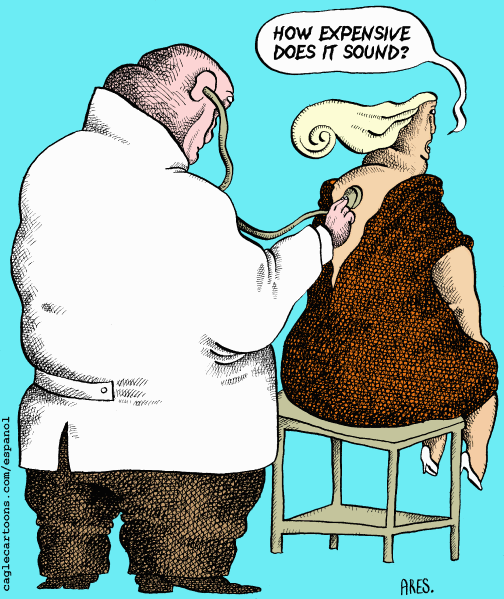
Cartoon from caglecatoons.com.

Overcoming political agendas:
Will health care reform happen
And what will it look like?

By Dr. Stephen R. Keister / The Rag Blog / March 11, 2010

It appears that Congress will pass some kind of health care legislation, be it well conceived and useful or, more likely, bogus and politically driven. It is sad that in a seemingly advanced society such as ours there is such lack of direction and focus — and commitment to human concerns.

And it is sad that our health care debate has been used by zealots like Rep. Bart Stupak to advance their political agendas. Those who would seem to believe that the only life worth preserving is that of a fertilized ovum (with total disregard for those children who are dying of disease, malnutrition, and poverty in the United States, as well as those thousands being killed abroad in needless wars).

The Republicans have clearly dug in and are content to say “no” to any meaningful health care reform. They have passed their slogans on to the misinformed, ill-informed, or purely misguided tea baggers who somehow equate a public health policy that addresses the obscene profits of the private insurance cartel with “socialism.”

The folks at the financial top of the social order are conning the populace into believing that social Darwinism is to their advantage and not solely structured to the benefit of the wealthiest 1% of Americans, leaving the table droppings for the rest of us. With the aid of Faux News and other outlets of corporate propaganda, these greedy few at the top are also convincing the naive among us that there is no such thing as global warming, while our children and grandchildren stand to inherit an environmental disaster.

The only way we can obtain decent health care in this country is through a government supervised system like Medicare. (Note that Medicare Advantage is not a government program.) Philadelphia based journalist, Dave Lindorff wrote about his experience with the health care system in Switzerland as he was treated for a head injury.

In Switzerland, everybody buys a basic health insurance plan, and the Swiss insurance companies are barred from making a profit. The insurance firms can offer highly profitable supplemental plans that cover amenities like private rooms, but they must offer the basic plans at competitive rates.

Patients can choose their own doctors and hospitals, and do not go through medical “gate-keepers” to get treatment. They do not have co-pays for treatment, but the total deductible outlay per person ranges from 300-2,500 Swiss Franks per year (about $275-$2,300), depending on the plan chosen by the enrollee.Nowhere in the present health care debate in the United States has such a concept been seriously discussed.

Uwe E. Reinhart, an economics professor at Princeton, provides an extensive review of how health insurance is delivered in other countries in a The New York Times article titled “How The World Balances Health Care Risk.”

Congress must place the health care industry under the antitrust laws and enact a formula for controlling prices levied on the policy holder, as well as guaranteeing the insured that they will be free to purchase insurance at a reasonable price, with no exceptions for “pre-existing conditions,” and that no one will not be capriciously dropped from coverage should they develop a severe or ongoing illness.

And we must remember that nonprofit companies such as Blue Cross/Blue Shield are “non-profit” by legal definition only. These are tax-exempt businesses that differ from the major for-profit companies only in that they do not have stockholders and “profit” is listed on their balance sheets as “surplus.” Their executives, as is the case with the regular insurance companies, can receive multimillion dollar salaries covered by the dividends that the public pays to receive health care and hospital benefits.

The other obstacle facing passage of a bill through reconciliation is Representative Stupak, whose background with “The Family” and the C Street connection has been discussed extensively by Rachel Maddow. It seems that Representative Stupak has been a C Street boarder, at a ridiculously low rent. Jeff Sharlet has addressed this in some detail in his book The Family.

Rachel Maddow pointed out that Mr. Stupak has recently moved out of the house on C Street, that he has never been accused of any amorous misconduct, and that he denies being a member of the quasi-Christian organization known as The Family. Mr. Stupak however vows to derail a health care bill if it doesn’t include his anti-abortion language; he apparently feels that the long standing Hyde Amendment, which forbids paying for abortion with any government funding is inadequate.

Jessica Arons writes in The Nation,

The amendment that Bart Stupak sponsored, which is currently part of the House bill, does bar so-called indirect funding. It forbids insurers from selling plans that include abortion coverage to people who receive help from the government in paying for premiums — a restriction that would apply to approximately 85% of customers in the new health insurance exchange and thus virtually eliminate abortion from the exchange.

Money in Stupak’s world is “fungible,” meaning whatever money the government gives you frees up private money to use on something else. So every dollar the government pays toward your health insurance premiums allows you and your insurer to spend private funds in that plan that might not otherwise have had on abortion. To Stupak, that subsidization is the equivalent of a direct payment.”

Do we allow the religious beliefs of Mr. Stupak and his followers to stand in the way of decent health care in the United State? Where is their shame? Where is their concern for the human condition? Let them debate this issue in some other venue, where the lives of so many already living human beings are not at stake.

The executives from America’s health care industry are gathering in Washington at The Ritz Carlton Hotel in a last ditch effort to stay Congress from acting in the interests pf the American people. They have been met with massive demonstrations organized by Health Care For America Now and allied group. We wish that the mainstream media would give this confrontation the exposure it deserves. The MSM seems to dote on the tea party types — the crowd that is underwritten by Judson Phillips, Mark Skoda, Dick Armey , Steve Forbes, Tim Phillips, and the Koch family foundation.

Congress must come together in the interests of the people and act with courage and without delay — just as it must with the Employee Free Choice Act, the bank regulation legislation, the student loan bill, and legislation to preserve our planet.

Health care in the United States need not rank 26th among Western nations. We must provide decent health care now — and we must strengthen Medicare, provide funding for training and decent compensation for our primary care physicians, our internists (with special attention to the non-invasive subspecialists), our family doctors, our pediatricians, dermatologists, endocrinologists, rheumatologists, and neurologists.

The physicians and nurses must have more input in this health care debate; their role must not be ignored. Remember, your Congressman does not treat your children’s measles or your father’s heart attack.

[Dr. Stephen R. Keister, a regular contributor to The Rag Blog, lives in Erie, PA. He is a retired physician who is active in health care reform.]

The Rag Blog

Posted in Rag Bloggers | Tagged , , , , , | 1 Comment

Text and Subtext : The Media’s Tea Party

Framing the Tea Party movement: New Left redux? Photo from RaceWire.

‘Wal-Mart Hippies?’
Framing the Tea Party movement

By Harry Targ / The Rag Blog / March 10, 2010

Friday morning I was listening to my pseudo “fair and balanced” National Public Radio station, sipping my fair-trade coffee, and crunching on my organic granola while listening to two reports on American politics.

The first addressed the rising threat of the Tea Party movement to the “traditional” Republican Party. Of course, the victory of Rick Perry over Senator Kay Bailey Hutchison figured in the analysis as did the significant showing of a third, Tea Party, candidate in the Republican gubernatorial primary.

The second report was on the upcoming primaries in Arkansas where incumbent but very conservative Democratic candidate Blanche Lincoln is being challenged by a much more liberal challenger, Bill Halter, who wants to be the party’s choice to run for the U.S. Senate. Lurking in the wings of this story, of course, is the Tea Party movement on the right which will run against either the conservative or liberal Democrat.

The subtext of these stories, that is texts that are partially hidden but still visible, is the rise of the new right which if the media is to be believed constitutes a major grassroots movement in the political life of the country.

Robert Borosage, announcing a June conference of progressives, captured my sense of frustration when he wrote:

Apparently, any time more than two right-wingers get together, the media gets the vapors, showers the teabaggers with fluff coverage, and heralds the beginning of a transformational movement.

Then I read David Brooks’ March 5 New York Times column, “The Wal-Mart Hippies.” Now I am not a Brooks naysayer. Sometimes he has interesting things to say even though I usually disagree with him. But this column was too much. For Brooks, the similarities between the New Left of the 1960s and the Tea Party of today are much greater than their differences. He said that the two movements have used the same shock and awe tactics. In fact, he said, the Tea Partiers are adopting the tactics of Saul Alinsky.

Most important, Brooks suggests that both movements had this simplistic notion that “the people are pure and virtuous.” Both movements “go in big for conspiracy theories.” The 60s theorists had these silly ideas about “shadowy corporatist/imperialist networks-theories that live on in the works of Noam Chomsky.” The Tea Party folks also have silly ideas about how the Federal Reserve Bank, the F.B.I, big banks, and corporations have caused our problems.

And both movements “have a problem with authority.” Brooks says both New Leftists and Tea Party activists oppose any systems of authority, reject the idea of original sin, assume the perfectibility of human kind, and believe in mass spontaneous action. The last straw was when he referred to a pundit’s comparison of Glenn Beck to Abbie Hoffman.

Brooks, while paying brief lip service to differences in the two movements, ignores the theory and political perspectives that animated the two movements. As a result he elevated the theory as well as practice of the Tea Party followers. In this way Brooks gave legitimacy to mainstream media political discourse that has made the Tea Party story a significant one. As with the New Left failures of the 1960s, “the Tea Partiers will not take over the G.O.P., but it seems as though the 60s political style will always be with us-first on the left, now the right.”

Perhaps David Brooks should have suggested that the “60s political style” will always be with us as long as the monopoly media choose to create, distort, and use various political currents as part of common and enticing frames.

As Robert Borosage suggested, the main stream media has created for its own purposes, and perhaps the purposes of political reaction, the imagery of an angry, grassroots movement that bravely confronts authority figures, both liberal and conservative, Democratic and Republican. They are framed as well-informed, though impetuous citizens, who are suffering from the downside of big moneyed interests.

The media presents Tea Party claims that the problem with America is government with little or no reflection on the bases of their claims. The media instill in public consciousness Tea Party claims about the dishonesty of science, the heartlessness of all politicians, inhumanity of “bureaucrats,” and the distance the United States has come from the framers of the Constitution.

And the Tea Party phenomenon is presented as an authentic grassroots movement with little or no analysis of its support, encouragement, and financing by inside the beltway big capital (the very folks they presumably are railing against). Hardly a word is printed, for example, about Tea Party funding from former Congressman Dick Armey’s Freedom Works or funding by the Koch Family Foundations of Americans for Prosperity. And the media fail to discuss the racism embedded in many of their claims such as, “They are taking our country away.”

And interestingly enough, the media portrait of Republicans is of a beleaguered middle-of-the road political faction that just might have supported health care reform, climate change legislation, and other Obama proposals if it were not for the pressure from the grassroots.

While reflecting upon the Tea Party phenomenon, how it has been framed, and the Brooks comparison, I was reminded of Todd Gitlin’s book, The Whole World is Watching, which showed the radical shift of the media frame on the New Left before and after 1965. After the first major protest rally against the escalating war in Vietnam, Gitlin suggested, the media frame of the New Leftists as sweet caring young people shifted to the bomb throwing monsters that the media argued they had become.

While the Tea Party phenomenon is only a year old, according to Borosage, they are still showered with “fluff coverage.” If the media had continued its positive coverage of New Left activism after 1965, the way they seem to be covering the Tea Party today, perhaps the war in Vietnam would have been stopped sooner.

In the end, it may be that the Tea Party movement is far less pervasive than has been presented. Its level of popularity probably varies enormously from place to place. And the pain and suffering of many people identified with the Tea Party — alienation, powerlessness, economic marginalization, inequality, and hopelessness — is buried in stories, such as the one by Brooks, of political style.

[Harry Tarq is a professor in American Studies who lives in West Lafayette, Indiana. He blogs at Diary of a Heartland Radical.]

The Rag Blog

Posted in Rag Bloggers | Tagged , , , , , | 5 Comments

Gilbert Shelton, the legendary underground comix artist who created the Fabulous Furry Freak Brothers and Wonder Wart Hog, started out with the famed Texas Ranger humor magazine in Austin, where he and Ramsey Wiggins first met — back in the heady days of the early 60s countercultural scene — where this tale starts. Includes a remarkable gallery of vintage photography and cartoon art.

Posted in RagBlog | Leave a comment

Joseph Stack and the Texas GOP : Murder-Suicide of the King’s English

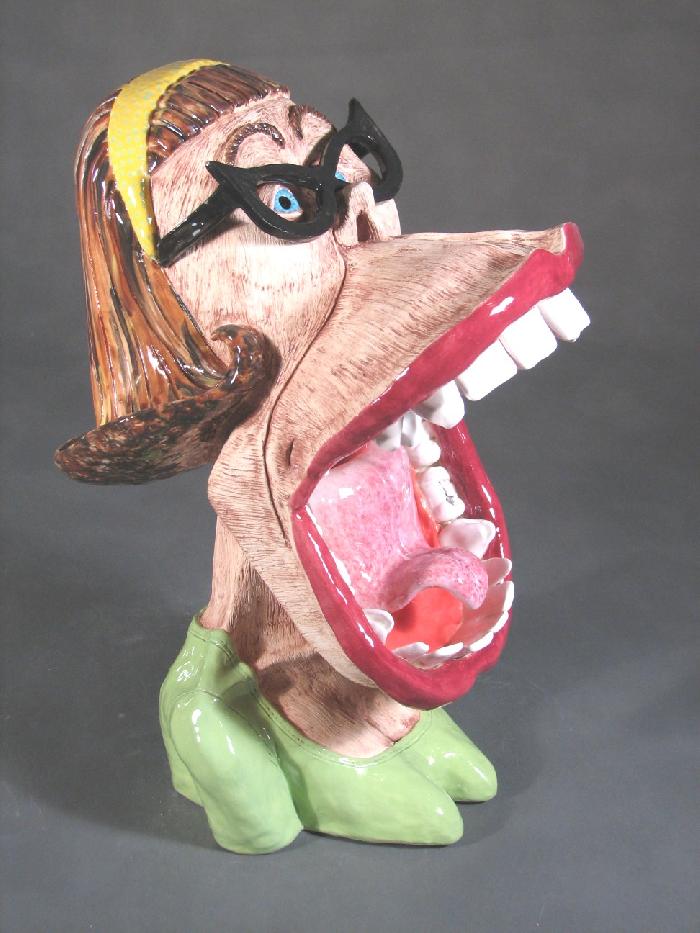
Art by Cindy Flynn / Clifton Studios.

Murder-suicide of the English language:
Stack, and the Texas Republican primary

By Greg Moses / The Rag Blog / March 9, 2010

Like fabled ruts gouged into dirt by heavy wheels, or war trenches widened by running boots, English language usage has hardened against all recent attempts to veer away from a mainline madness of selfish and violent arrogance.

Suicide pilot Joseph Stack wanted to write a note that would supply enough therapy “to fix what is really broken.” Instead, he found the process of writing “frustrating, tedious, and probably pointless.” There was a storm in his head that he could not “gracefully articulate.” And so last month he blew up his house and slaughtered a Black federal worker in a fury of violent self-expression.

Or take the case of voters in the Texas Republican Primary who last week cast 61 percent of their ballots for the last name “Porter” because it was not a Hispanic name. Their English-only prejudice ended the promising political career of Victor G. Carrillo, the sitting Chairman of the Texas Railroad Commission.

“Given the choice between ‘Porter’ and ‘Carrillo’ — unfortunately, the Hispanic-surname was a serious setback from which I could never recover, although I did all in my power to overcome this built-in bias,” explained Carrillo in a pained letter to supporters.

These ritualized usages of English that we have seen lately in Texas can only trigger rapid-fire bursts of ignorance, aggression, and intolerance. Maybe we have the internet to thank for this? Communication as flame war? Chairman Carrillo put it this way: “political dynamics have changed some.”

What Stack and Republican voters share is a language they can’t use properly either as an adequate expression of their own feelings or as a medium of critical democratic autonomy. Whether your advanced technology is a single-engine aircraft or an electronic voting machine, if you can’t use your own language to think with, how will you make the wisest use of your tools?

Of course, the language failures of Stack and Republican voters are symptoms of something more widespread. We recall how the “great communicators” of our political life — from Reagan to Obama — can be most effective only when they work from ritualized scripts.

If we believe that Stack dedicated the life of his mind to the triumphant conquest of IRS code, then plain language would warn us right away that he was stalking the domain of the language slayer. The day Stack killed himself and IRS worker Vernon Hunter, I received a communication via federal mail from my online broker regarding the official tax accounting procedures for certain trusts: “Please note: 1099’s will never match the original cash payments received.” In plain English: my income tax for these things will never be based on my income.

As for the bramble of language that counts for Republican discourse in Texas, you could easily get hooked on the idea that Texas government is always superior to Washington government. Until they count the votes in Texas. Then you realize that Texas Republican voters don’t even know the names of Republicans who run the government of Texas.

To be sure, IRS code is imperial jargon, not a living language. And voting is little more than a lottery of jargon mongers. But whatever else might be true of the new anti-taxers or Texas secessionists, they have not proved that they are capable of transcending the jargon of their own white, racist heritage.

Stack’s note asks us to agree that against the jargons of power in America, violence is the “/only/” answer. But isn’t this jargon in its essential form as the murder-suicide of language itself?

[Greg Moses is editor of the Texas Civil Rights Review and author of Revolution of Conscience: Martin Luther King, Jr. and the Philosophy of Nonviolence. He can be reached via jargon or language at gmosesx@gmail.com.]

The Rag Blog

Posted in Rag Bloggers | Tagged , , , , , | 3 Comments

Ramsey Wiggins : Me and Gilbert Shelton: A Memoir

Legendary underground cartoonist and comix artist Gilbert Shelton.

Me and Gilbert Shelton: A Memoir

By Ramsey Wiggins / The Rag Blog / March 8, 2010

Legendary underground artist Gilbert Shelton will be Thorne Dreyer’s guest on Rag Radio, Tuesday, March 9, 2-3 p.m. (CST) on KOOP 91.7 FM in Austin. For those outside the listening area, go here to stream the show.

Shelton is the creator of such iconic comic strips as the Fabulous Furry Freak Brothers, Fat Freddy’s Cat, and Wonder Wart Hog. His comix have sold over 40 million copies in 15 languages. Born in Houston, Shelton developed his art in Austin and then San Francisco. He now lives in France, where he is collaborating with French artist Pic on a strip called Not Quite Dead.

I. The Texas Ranger and Wonder Warthog

“Bright college days, oh carefree days that fly
To thee we sing, with our glasses raised on high.” — Tom Lehrer

In 1960 at the University of Texas (at Austin: that was the only one back then), if you helped to sell the Ranger, the student humor magazine, you got to attend the keg party that was held the weekend after the issue hit the streets. If you were only 20 years old and looked like you were 14, access to many kegs of beer on a Saturday night was a more than reasonable payment for hawking the magazine on campus for a couple of hours.

One of the other perks was that you got to hang out with the people who created the magazine. That’s when I met Gilbert Shelton and the others who brought forth the prize-winning best college humor magazine in the country.

The Rangeroos, as they called themselves, were an extraordinary bunch. Creative, smart, hard-drinking, and somehow older and more worldly-wise than the rest of us, they were the best of the best. We who were less than pretty, less than rich, or, despite being both, still disaffected, were drawn to the like minds of this social and party axis.

Lieuen Adkins and Gilbert Shelton when they both worked for the famed humor magazine, the Texas Ranger. The photo was taken at Lieuen’s house on East 23rd in Austin, where the LBJ Library now stands. Photo by Bob Simmons / Austin Photos ’62-69 / Texasghetto.org.

This was where I met people who knew stuff: music to listen to, authors to read, how to write, what was funny, and how to drink a lot without throwing up. I also met Janis Joplin, Bill Helmer (later a senior editor at Playboy), Dave Hickey, Billy Brammer, Tony Bell, Lieuen Adkins, Joe Brown, Hugh Lowe, Pat Brown, and all the others who couldn’t settle for life in the herd.

These were heady times. The glacial epoch of the early cold war era was transitioning into Camelot; crewcuts, panty-girdles, Eisenhower, and communist witch hunts were yielding to Ivy League, leotards, the Kennedys, and the Playboy philosophy. We joined the Civil Rights movement. We danced the Limbo, drove MGs and Volkswagens, and listened to The Kingston Trio, Charlie Mingus, Miles Davis, and Bob Dylan’s acoustic incarnation. We read poetry and angry young men. It was rumored that women could have orgasms, and that love might be free. Revolution wasn’t in the air yet, but the possibility of joy extended to the horizon.

One of the newer joys back then was to pull the king’s beard. Marching and demonstrating for civil rights had been righteous, but dreadfully serious. Mockery and satire, when served up with a deft hand, were much more cool. A put-down, especially when the target remained clueless about the damage done, was the coolest of all.

The Ranger served this up and more. In 1960 the entire staff was fired three times in the course of a semester for hiding various put-downs and obscenities in successive issues of the magazine. After that, the infighting became more and more elegant, as a blustering and clueless Texas Student Publications office was outflanked again and again by subtlety, irreverence, and skill.


Enter Wonder Warthog.

He had already appeared in 1962 in the Bacchanal, an off-campus commercial attempt by Bill Killeen — and several of the staffers fired in 1960 — to escape the strictures of a college publication. The threat of the draft drove Gilbert back to graduate school 1962-63 where he became the editor of the Ranger and further polished the Hog of Steel.

WW sent up superheroes, arch-villains, beatniks, LBJ, J. Edgar Hoover, and most concepts of morality extant at the time. Gilbert, who has nearly always had a collaborator or two, worked off and on with fellow Rangeroos Tony Bell, Lieuen Adkins, and Joe Brown to produce the first drafts of what would become world-class social satire.

Wonder Warthog later took Gilbert and friends to a wider audience, but back then the Fearless, Fighting, Foulmouthed alter ego to mild-mannered Philbert Desanex, ace reporter for the Muthalode Morning Mungpie was all ours. Frat boys might have money, cars, and high-maintenance girlfriends, but we had Wonder Warthog. Comic books had a whole new meaning.

Things change, and everybody moves on. One day I looked up and I was married, a father, a graduate student, and wore a suit to work at the Graduate Dean’s office. The summer of love came and went. John Kennedy had been assassinated, then Robert, then Martin Luther King, Jr.

Janis died of an overdose, then Jimi Hendrix and Brian Jones. Woodstock had turned into Altamont. The Civil Rights movement had turned into a shooting war. Vietnam was turning teenagers into post-traumatic heroin addicts by the thousands. We all marched after Kent State; My Lai revealed us as torturers, rapists, and murderers. The ship of hope was dashed on the rocks of the military-industrial complex. I drank too much and every night before I fell asleep had the terrifying thought that my life would be the same until I died.

Meanwhile, I heard stories. Gilbert had joined Pat Brown, then a student at the Cleveland Art Institute in Cleveland, where he had tried to work for American Greeting Cards, but it hadn’t taken. Back in Austin, he did psychedelic posters for the Vulcan Gas Company, then he joined the general exodus to the west coast, hoping to do rock posters.

His new strip, the Fabulous Furry Freak Brothers, had begun to appear in The Rag, an off-campus production with low production values and a serious antipathy for the Vietnam War. The strips in The Rag would be reprinted in rags all over the world

In 1971, my college friend Dave Moriaty showed up and told me how he, Gilbert, Jack Jackson (whose art carried the moniker “Jaxon”) and Fred Todd had bought a printing press and were publishing comic books as Rip Off Press. I wanted to die from envy. He was thinking of starting a magazine, and suggested that I might want to join them.

Dave Moriaty at the Rip Off Press, 17th and Missouri in San Francisco, in 1970. Photo by Bob Simmons / Austin Photos ’62-69 / Austinghetto.org.

II. Rip Off Press

“The term ‘drunken printer’ is redundant.” — Men’s room wall in Rip Off Press

I wanted in the game. The degree was finished, the marriage was over, my boss was about to retire, and I had more old friends in San Francisco than I did in Austin. The party wasn’t over yet. I had already stopped cutting my hair, so in May of 1972 I quit the job, took out my retirement money, and headed for the coast.

Rip Off Press had relocated from the increasingly dangerous and expensive Haight-Asbury area into the warehouse district at the bottom of the north side of Potrero Hill. There was a trucker’s bar across the street (The Bottom of the Hill Bar, now famous as a music venue), and my friend Moriaty had a flat up the hill on Arkansas Street. You could see Berkeley and Oakland from his back porch and Mount Sutro from the front window. The flat downstairs could be had for $100 a month. Jack Jackson and his old lady lived across the street. Deal.

Rip Off Press was hot. Gilbert wasn’t just an artist, he was now a franchise. He lived with a very, very smart woman, Laura Fountain, and they had a big house on a cul-de-sac that had a block party every Bastille day.

Faded glory: Your correspondent Ramsey Wiggins, upstairs at the Rip off press office in 1972. Photo by Bob Follet.

The Freak Brothers were worldwide. A German lawyer with a Polish name, Manfred Mroczkowski, had come up with the idea that all the bootleg European editions of the Freak Brothers could be licensed and made to pay royalties. The first official publication had just come out in German. Rip Off and their main competitor, Last Gasp Eco-funnies had come to détente; each sold the other’s material in their mail-order operations. Serious business.

Rip Off was begun to print rock posters, but the ancient press wasn’t good enough for close-register poster work. It was, however, good enough for underground comic book covers, and was soon augmented by a better, smaller press. Gilbert’s office/studio/playhouse was upstairs, the press, shipping office, and a cavernous, mostly empty warehouse were downstairs. In the summer, the roof was festooned with sunbathing naked hippies. The truckers loved us. At 10:30 and again at 3:00, Fred Todd would ring a bell and we would troop into the walk-in safe for a smoke break. You couldn’t make this stuff up.

I wasn’t good enough to be on the creative team, but Art can always use another handmaiden. I went to work as a dogsbody in the job printing shop we ran as a sideline and was given the nonpaying title of Managing Editor for the short-lived Rip Off Review of Western Culture.

It was the end stage of the best of times. In 1972 the summer of love had come and gone, but there were still affordable places to live, the counterculture was alive and well, and San Francisco was — well, San Francisco. Robert Crumb was there, along with S. Clay Wilson, Dave Sheridan, Ted Richards and all the other underground comic artists.

Rock stars came and went. Chet Helms, grand poobah of the near-defunct Family Dog, appeared from time to time to try and get us to print posters on the cuff. Eddie Wilson, who had started Armadillo World Headquarters in Austin, stopped off at our house to have a shower.

Gilbert Shelton designed this poster for Austin’s famed rock hall, the Vulcan Gas Company.

The great circus that was Berkeley was across the bay, and Marin County was across the Golden Gate Bridge. Occasionally a young woman would find it interesting that I worked at Rip Off Press. I got tongue-kissed by a Hell’s Angel at the Garden of Earthly Delights, and had enough class to give him some tongue back. We parted with mutual respect. I was, after all, from Texas.

Once at a party I stepped between Robert Crumb and a large, angry woman who took offense at his Big Ass Comics, keeping her at bay while he escaped down the stairs. I ate with artists, and I drank with giants.

Every morning I would drink a pot of strong coffee and walk down Arkansas Street to the bottom of Potrero Hill, arriving at the press at the civilized hour of nine o’clock. Company president Fred Todd would be in the office, pacing up and down, throwing the point of his buck knife into the floor and swearing as he waited for the mail and the daily receipts to see if we would be able to buy paper and ink or, on Fridays, meet the payroll.

The shipping clerks would already have popped their white crosses and begun packing up orders. Moriaty got us to work burning plates for the printers. By 10 the head printer, a part-time rock organist and full time drug addict, would arrive and begin his morning routine of two cups of coffee, two joints and two Desoxyns before cranking up his press. (Our motto was “Quality is not our bag”)

Gilbert would arrive around eleven and, depending on the company that showed up, work, play ping-pong, or otherwise amuse himself. Jack Jackson worked at home but would pop in, usually late in the afternoon. Various print shop customers, artists, artist wannabes, and plain delusionals would come and go through the day.

At noon we would troop across the street for a sandwich and a beer, then back to the press for the afternoon, then back across the street for beer, eighty cent highballs, and a game of pool. Then back up the hill for dinner or out into the night, depending on the amusements available for the evening.

Life was good. I worked in the print shop with a future mayor of Marble Falls and a future Austin real estate developer. One day the drug addict printer got his right arm stuck in the press. He was in a cast for a long time.

Eventually a woman joined me from Austin, and we were together for quite a while. We later had a son who became famous. The Rip Off print shop invested in a worn-out magazine web press that we could never get to work right. I almost fell into the folder.

Things, change, and everybody moves on. After I had been there for about a year, the job printing shop, never a profit center, was declared a failure, closed and the equipment was sold off except for one press used to print comic book covers. The Rip Off Review of Western Culture wasn’t cultured enough and ceased publication. I was out of a job and out of Rip Off Press.

I stayed on in San Francisco for awhile, but after three days transcribing numbers at a nut and bolt manufacturing company for a temp agency, I had had enough. I was a revolutionary, god damn it. I spent two weeks in my basement rebuilding the engine in my 1966 Volkswagen, then packed the woman from Austin and what else would fit and headed back to Austin in September of 1973: The last to come to San Francisco, and the first to go back. I was sad for a time.

Rip Off Press founders Fred Todd, Gilbert Shelton, Jack Jackson, Jackson’s companion Beatrice Bonini, and Dave Moriaty.

Time passed. Rip Off Press prospered without me, and I without it. The chance meeting with Eddie Wilson in my San Francisco living room turned into a three-year rock and roll marathon as the Advertising and Public Relations Director at Armadillo World Headquarters. After I burned out at the Armadillo, I made a Faustian bargain and sold ads for the Austin Sun, and, after that I really floundered for awhile. Doug Brown took pity on me and I started one of several stays at Oat Willie’s, Austin’s oldest headshop. The Sixties were officially over, even in Austin. It was confusing for awhile.

Meanwhile, more and more comic books came out of Rip Off Press. Dave Sheridan continued to collaborate on the Freak Brothers, and Fat Freddy’s Cat became its own publication. Paul Mavrides also began collaborating on the Freak Brothers in 1978.

Foreign-language editions came out officially in every European language except Russian. I’ll bet there is at least one unofficial version there, too. So far, no one in China has offered to make a deal, nor have the African languages stepped up, but long after the counterculture had lost its currency in the U.S. it remained alive and well in Europe, and The Freak Brothers did well. The Freak Brothers appeared in High Times magazine, and Universal Studios bought the license to produce a live-action Freak Brothers movie. Gilbert did an album cover for Doug Sahm, and then one for the Grateful Dead. Money rolled in.

Then, the logical next step for the Freak Brothers: A coffee table edition.

Freak Brother Freewheelin Franklin with his customary sage advice.

III. Oat Willie’s Campaign Headquarters

Ok, so I’m a clerk at Oat Willie’s, in 1978, leading the simple life, when the word comes out that Rip Off Press has done the first Freak Brothers collection, a coffee-table sized perfect bound book, for a respectable price and at a respectable investment in production costs, which Gilbert is going to go on tour to promote. One of the places he wants to do this is Austin, and since Oat Willie’s sells more Freak Brothers comics than any place in Texas, he wants to do an autograph party here.

Did I mention spending three years flogging rock and roll at the Armadillo? Anyway, Doug asked me to help a little with the publicity, so I started calling around and, a few days before the event went around to visit a few disc jockeys at a few radio stations. It turns out that the Freak Brothers are about as famous as Jerry Garcia. Everybody talks it up on the radio, and Gilbert gets to do an on-air on the top-rated FM station in Austin.

Came the day, and the place was a mob scene. Gilbert signed autographs until his hand hurt. TV stations showed up, then more people showed up. At one point a cop showed up in a patrol car, and everybody was nervous until it turned out he just wanted a signed copy of the new book like everybody else. He went to the head of the line.

I’m pretty sure that was the biggest-grossing day in Oat Willie’s history. It was the first really good day for me in a long time, anyway. I remember it fondly.

And Then…

Things change, and people move on. Gilbert and Laura escaped to Europe in 1979, first for an extended visit, and then permanently to Paris in 1982. Robert Crumb and his wife Aline Kominsky live in France, too. Two American national treasures, expatriated to France. Hmm.

Gilbert Shelton: Cool one with a cool one.

Dave Sheridan, Gilbert’s first collaborator, died of cancer in 1982. The Freak Brothers continued with collaborator Paul Mavrides. Universal Studios bought two more licenses to produce a Freak Brothers movie, and another company, bolixbrothers in Bristol, England, has been trying to produce an animated feature since 2003. The latest, but hopefully not the last, Freak Brothers collection is the full catastrophe, the Freak Brothers Compendium, which is the complete collection, all under one cover.

Gilbert’s latest undertaking is Not Quite Dead, the adventures of the world’s least-famous rock band. It’s also a collaboration, this time with the French underground cartoonist Pic. Three issues of this comic are out so far, and two have been translated into English.

Me, I stumbled around like a bull in a china shop until I had a spiritual awakening in 1989, and have been remarkably clear-headed since then. I live sedately in Austin with my wife, who understands me.

We’ve both done well, Gilbert and me.

I’ll get to see him one more time at Oat Willie’s on Friday, March 12th, where he’ll be autographing his works one more time. I’m doing a little publicity for this one, too, but maybe the lines won’t be as long. Or maybe they will.

He’ll host an art retrospective on Saturday the 13th at the South Austin Museum of Popular Culture if you miss the autograph party. If you see a tall old guy with a glass of club soda, it’ll be me.

Until we meet again: Gilbert Shelton’s Fabulous Furry Freak Brothers were first published in Austin’s underground newspaper, The Rag.

  • Cartoonist and underground artist Gilbert Shelton’s work is being featured in an exhibit at the South Austin Museum of Popular Culture, 1516-B South Lamar Blvd. in Austin. Shelton’s work will be on display from March 13th-May 8, 2010. An opening reception, featuring the artist, will be held on March 13, starting at 7:09 p.m. Original art and prits will be available for sale.
  • Gilbert Shelton — whose published work includes The Fabulous Furry Freak Brothers, Fat Freddy’s Cat, Wonder Wart Hog and Not Quite Dead (with French cartoonist Pic) — will autograph copies of his work at Oat Willie’s Campaign Headquarters, 617 West 29th St. in Austin, beginning at noon on Friday, March 12, 2010.
  • Shelton — whose Fabulous Furry Freak Brothers are to be featured in a movie now under development, will appear in “A Conversation with Gilbert Shelton” at South by Southwest (SXSW), at the Austin Convention Center, Monday, March 15, 2010, at 3:30 p.m.

Gilbert Shelton: Things are looking up.

Gilbert Shelton and the Simpsons’ Matt Groening.

Gilbert did this jacket art for the Grateful Dead.

Wonder Wart Hog at home.

Fat Freddy’s Cat speaks in many tongues.

Shelton’s latest effort, done in collaboration with French artist Pic.

Still from long-in-development Freak Brothers movie, Grass Roots.

Texas Ranger party in 1963 at 18th and Brazos in Austin. That’s Fontaine Maverick dancing on the furniture. Ramsey Wiggins is the tall guy in glasses and the gray sports jacket (already) turned to the left. Photo by Bob Simmons © 2000.

Some of the Rip Off Press crew at the corner of Franklin and Golden Gate Ave. in San Francisco in 1969. Photo by Bob Simmons.

Rip Off Press staffers dine in San Francisco, 1972. L-R: Bob Follet, editor of the Rip Off Review; Beatrice Bonini, Jack Jackson, Dave Moriaty, Aline Kominsky, Ramsey Wiggins, and Philipp Carlisle. Grab from a polaroid photo taken by the waiter.

Oat Willie’s crew, 1977. Ramsey’s the tall dudely one in the shades. Photo by Ken Hoge.

Ramsey Wiggins, his own self. Photo by Eric Rosenblum from the Austin Sun Reunion, October 31, 2009.

The Rag Blog

Posted in Rag Bloggers | Tagged , , , , , , , , , , , , | 16 Comments

San Antonio : Thousands Rally for International Women’s Day

More than 2,000 demonstrators celebrated International Women’s Day, Saturday, March 6, in San Antonio. Photo by Alice Embree / The Rag Blog.

International Women’s Day:
Multi-ethnic coalition
Celebrates the struggles of women

By Alice Embree / The Rag Blog / March 8, 2010

SAN ANTONIO — International Women’s Day, celebrated the world over on March 8th, has its origins in the struggle of women garment workers in the United States. But, like May Day that also commemorates a U.S. labor struggle, International Women’s Day is often ignored in this country.

It’s not ignored in San Antonio, Texas. Continuing a 20-year tradition, a coalition of San Antonio groups celebrated the power of women organizing with a march and rally that drew an estimated crowd of 2,200 on Saturday, March 6. Beginning at the doorstep of the Grand Hyatt Hotel, the rally featured Iola Scott, Hyatt employee and member of Unite Here, a union organizing hotel workers in the tourist-intensive district.

Leaving the Hyatt to the beat of indigenous dancers, the march snaked down Market to Milam Park, chanting

Hyatt, Escucha! Estamos en la lucha.”
“Money for homes, not for prisons. Money for healthcare, not for war.”
Se Oye! Se Siente! La Mujer Esta Presente!

With an inspiring mix of African American, Mexican-American, Latinas, and Anglos, the march commemorated organizers past and present. Images of San Antonio 1930-era labor organizers like Emma Tenayuca of the Pecan Shellers Union danced above the crowd. Crosses commemorated the women dead in Juarez. One sign read: “End NAFTA, Stop the Femicide in Juarez.”

A somber procession honored the dead from violence against transgender people. Life-size black plywood figures stood on small altars with wheels, carrying the stories of the victims. Photos of their faces stood out in color against the black wood.

More than 20 organizations co-sponsored the march, including academic women’s studies centers, Planned Parenthood, gay and lesbian alliances, and several labor organizations. Providing 20 years of organizational stability to this kind of coalition building is the Esperanza Peace and Justice Center. www.esperanzacenter.org

At Plaza del Zacate, speakers and entertainers included Betita Martinez — Chicana social justice activist, writer and educator — Suzy Bravo, Amanda Flores, Kiawitl Xochitl, and many more.

I guess it takes 70 miles down an interstate to experience the kind of coalition work that Austin doesn’t dare to dream of. I marched with a contingent of Austin CodePink. It was invigorating to be part of an effort that transcended the divides of race, class, and sexual preference. An excerpt of the coalition’s vision statement states:

We, like women and girls all over the world, are the voices of conscience, the roots of change, and the leaders of local and global movements. We seek healthcare, housing, education, environmental justice, and fair wages not just for women, but also as people of color, as youth and elders, as immigrants and indigenous people, as lesbian, bisexual, intersex, two-spirit, transgender, and queer women, and as poor, and working class people.

We oppose all forms of violence. We advocate for reproductive choice. We call for an end to war, genocide, and occupation. We claim our own voices and come together to share them in public spaces. We march in solidarity with women and social justice movements around the world.

  • For more of Alice Embree’s photos, go here.

The Rag Blog

Posted in Rag Bloggers | Tagged , , , , , , | 3 Comments