Rabbi Arthur Waskow: 1,000 : Afghanistan Milestone of Death

On April 5, 2009,the American public saw the flag-draped casket of a fallen service member for the first time since 1991 — that of Staff Sergeant Phillip Meyers. Sadly, we’ve seen way too many more.

Milestone of death: 1,000 GIs
And God knows how many Afghans

By Rabbi Arthur Waskow / The Rag Blog / February 20, 2010

Usually we look upon the next milestone in our lives as a great step forward. But we also need to mark and mourn milestones of death, not only the physical deaths of beloved people but explosions of moral and ethical death for those who brought about these deaths — milestones that remind us of how human beings — who bear the Image of God — are killing other human beings who bear the Image of God.

For this kind of death, God is inconsolable, and we should be as well.

We have nearly reached the tragic milestone of the death of the 1,000th U.S. soldier in Afghanistan. As of this writing, the most reliable source (icasualities.org) lists 998 U.S. soldiers as having died in Afghanistan. So it is sadly probable that the milestone will be reached in the next few days. Check the link above.

God only knows how many Afghans have now died in this war, including many civilians — just recently, an entire family, including six children, in a house bombed by “mistake,” for which the U.S. military “apologized.” But no apology can redress those deaths. We can mourn them, however, along with the American dead.

Various groups are preparing vigils throughout the USA. Some will be the day after, others are scheduled for the next working day. There seems to be no national list; if you find one near you, I urge you to join it and/or to mark this moment in prayerful communal services or private prayer and meditation this weekend.

I hope and urge that such memorial events will mourn the human and economic cost of war, call for the troops to come home, and support transferring most of the funds being spent for death to meeting the urgent public needs of our own country, with some going to fund an Afghan-led reconstruction of the war-torn country.

[Rabbi Arthur Waskow is director of The Shalom Center; co-author of The Tent of Abraham; author of Godwrestling — Round 2, Down-to-Earth Judaism — and a dozen other books on Jewish thought and practice, as well as books on U.S. public policy. The Shalom Center voices a new prophetic agenda in Jewish, multireligious, and American life.]

Editor’s note: As we publish this article, the total of GI deaths in Afghanistan stands at 999.

The Rag Blog

Posted in Rag Bloggers | Tagged , , , , | 1 Comment

Colombia and FARC : Six Long Decades of Fighting for Peace

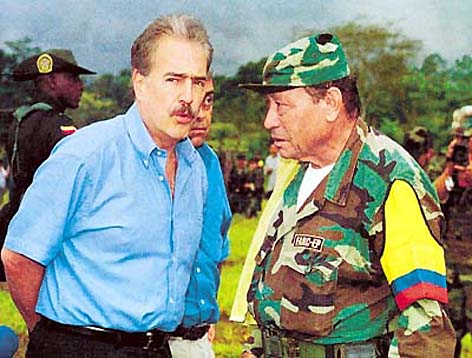
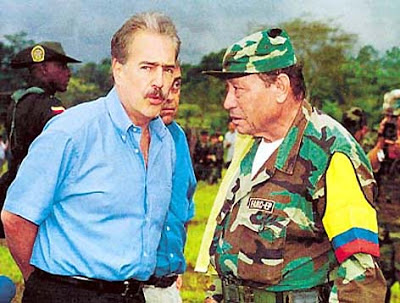
Andres Pastrana, President of Colombia from 1998-2002, in peace negotiations with FARC leader Manuel Marulanda Velez. Photo from Latin American Studies.

A Promise of Peace:
Colombia, the guerrillas, and the paracos

By Marion Delgado / The Rag Blog / February 20, 2010

Part One: Peace and the FARC

[The phrase “peace process” has been heard throughout the country of Colombia for years. It refers to a way to end the violence, now more than a half century old that, has involved many different groups and many different governments of this war-torn country. This is the first of a three part series from our man in Cartegena, Marion Delgado.]

CARTAGENA DE INDIES, Colombia — In October 1997, in a non-binding ballot accompanying municipal elections, the vast majority of voters — 10 million Colombians in all — voiced support for a peaceful end to Colombia’s conflicts.

That was not the first time that the people of Colombia have voiced their desire for peace. Votes, marches, petitions, commissions, promises; in every way imaginable Colombian citizens have for 60 years, since El Bogotazo of 1948, called for an end to the Bogota government’s war against the Fuerzas Armadas Revolucionarias de Colombia — Ejército del Pueblo (Revolutionary Armed Forces of Colombia — People’s Army), also known by the acronym of FARC or FARC-EP. This war has killed, and is still killing, hundreds of thousands, and has displaced millions.

This time, their wish got some traction.

After the vote, the people kept up the drumbeat for peace, and the media joined in. Even the ruling class, forgetting for a minute how much the war had benefitted them, joined the outcry. In May 1998, on the one-year anniversary of the murder of two human rights workers, thousands of Colombians took to the streets to demand peace. The peaceful protests were the largest in Bogotá in decades.

1998 was a presidential election year, and on June 15, with popular clamor growing for a peaceful resolution of the conflict, peace became a key issue in Colombia’s presidential campaign. Candidate Andrés Pastrana revealed that his emissary, future High Commissioner for Peace Victor G. Ricardo, had met with FARC leader Manuel Marulanda Velez (alias “Tirofijo,” or “Sureshot”).

Pastrana’s cooptation of the desire for peace worked. He was elected president. By October 1998, one year after the “Vote for Peace,” the government and guerrilla representatives were discussing a FARC proposal to pull all security forces out of five municipalities in southern Colombia, creating a temporary “clearance zone” for holding peace talks. The municipalities were Vistahermosa, La Macarena, Uribe, and Mesetas in Meta department and San Vicente del Caguán in Caquetá department.

The guerrillas‘ clearance plan required that the “Cazadores” Infantry Battalion vacate their headquarters in San Vicente del Caguán, Caquetá. The government, however, insisted that the 130 troops stationed there be allowed to remain.

Eventually, the government and the FARC agreed to demilitarize the five municipalities, except for the Cazadores Battalion. In November, the first 90-day demilitarization period officially began in the five municipalities where talks were to occur. Except for those stationed in the Cazadores Battalion, all soldiers and some police in the newly demilitarized zone were recalled.

(Colombia has several types of police. Those recalled, sometimes referred to as “housed” or “domiciled” police, live in barracks, usually in a compound, as opposed to ordinary street cops that live at home.)

The FARC conditioned the start of official talks on the removal of the Cazadores Battalion and added a new condition. They wanted the government to agree to a controversial prisoner exchange.

Finally, on December 14, FARC leader “Tirofijo” and Ricardo agreed to hold talks on January 7, 1999. Ricardo agreed to withdraw the Cazadores Battalion, apparently without consulting the Colombian Army (COLAR).


Peace talks begin

On January 7, 1999, formal peace talks began between the government and FARC.

Things got off to a rough start when Victor Julio Suarez Rojas, aka “Jorge Briceño Suarez” or “Mono Jojoy“, the number two man in the FARC, threatened to begin kidnapping congress people and other politicians if the government refused to agree to the proposed prisoner exchange.

Pastrana responded that the peace process would end immediately if the FARC carried out Briceño’s threat. By the end of the week, citing an upsurge in paramilitary activity, the FARC “froze” the peace dialogue until April 20. Talks would not continue, a guerrilla communiqué stated, until the government acted against right-wing paramilitary groups (paracas) and military officials believed linked to them.

Though talks with the FARC remained frozen, on February 6 the Pastrana government announced a 90-day extension of the demilitarized zone in southern Colombia. The “clearance” was then set to expire on May 7.
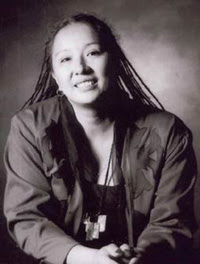
Indigenous-rights activist Ingrid Washinawatok was kidnapped and murdered by FARC forces. Photo from El Pais.

With FARC talks frozen the “hot” war resumed. Three U.S. indigenous-rights activists, Terence Freitas, Lahe’ena’e Gay, and Ingrid Washinawatok, were abducted on February 25 by FARC guerrillas in the northeastern state of Arauca. Their bodies were found on March 6. The three had been working with the U’wa, an indigenous ethnic group in the region. After conducting its own investigation, the FARC admitted responsibility for the murders, asking forgiveness and blaming the act on a low-ranking field commander in the area.

The Colombian government, however, alleged that higher-ranking FARC commanders ordered the killings, including the chief of one group operating in the area, German Briceño (“Grannobles“), the brother of Mono Jojoy.

In early May, President Pastrana visited FARC rebels in the “clearance zone” for the second time since becoming president. Pastrana met with FARC leader Marulanda for six hours, convincing him to agree to formal peace talks with the government starting May 6. In a statement, Pastrana mentioned the “unwavering political commitment of both sides to find a political solution to the conflict.”

Although the size of the clearance zone was not expanded, its expiration date was postponed. The two leaders also agreed to form an international commission to verify agreements and monitor FARC actions in the clearance zone.

FARC and government officials met again on May 6 and agreed on a joint Twelve-point Agenda for formal negotiations, a stage that past talks with the FARC were unable to reach. The formal talks were to begin in approximately three weeks.

Just as talks were about to begin, the respected Minister of Defense, Rodrigo Lloreda, threw a hissy-fit and abruptly resigned, citing disagreements over the peace process with the FARC. Lloreda protested statements made on May 21 by government Peace Commissioner Ricardo that the “clearance zone” might be extended indefinitely. The defense minister also cited Pastrana’s failure to return a phone call asking about Ricardo’s statements.

Lloreda’s resignation was accompanied by the alarming resignations of at least 50 other high-ranking officers, including 18 generals. While President Pastrana accepted Lloreda’s resignation, he refused to accept the others. The head of the armed forces, Gen. Fernando Tapias, offered Pastrana a public show of support.

Luis Fernando Ramirez was named as the new Defense minister.

In June, the government announced that the formal negotiations with the FARC would begin on July 7. But on July 6, the government and FARC postponed peace talks until July 19. Reasons given for the postponement were (1) the inability of three members of the FARC negotiating team to arrive at the clearance zone on time, and (2) the need for more time to define “the rules of the game” for the international commission, agreed upon by Pastrana and Marulanda, that would verify conditions in the clearance zone. Things seemed to be back on track, until…

Two days later, the FARC launched a five-day offensive throughout Colombia which one army official called “the largest and most insane guerrilla offensive in the past 40 years.” The attacks occurred in 15 towns, one only 35 miles south of the capital, Bogotá. The guerrillas bombed banks and blew up bridges and energy infrastructure; they blocked roads and assaulted police barracks.

The Colombian military successfully countered the offensive, thanks in part to U.S. intelligence that enabled government aircraft to bomb FARC transports en route to target areas. Government reports claimed that over 300 combatants lost their lives in the fighting, over 200 of them FARC guerrillas. The FARC said the government exaggerated FARC losses.

The Associated Press called a FARC attack on the town of Nariño, Antioquia, “one of the most deadly guerrilla assaults on civilians in memory,” with 300 guerrillas going up against a police station guarded by 35 police officers. The guerrillas‘ use of inaccurately launched bombs made from gas canisters destroyed the downtown area and killed 17 people, including eight civilians, four of them children.

On October 24, between six and 12 million Colombians mobilized in the streets to demand an end to the fighting. Several peace and human rights groups, among them País Libre, Redepaz and Viva la Ciudadanía, organized this nationwide protest against kidnappings and the armed conflict.

This same date also saw a restart of talks between the FARC and the government.

In November, a FARC offensive — believed to be in response to President Pastrana’s call for a holiday cease-fire — dealt the peace process another setback. Colombian armed forces turned back a FARC attempt to take Puerto Inírida, the capital of remote Guainía department.

FARC leaders and Colombian government officials held a televised meeting at Los Pozos, Meta, on December 5, asking the Colombian people for suggestions or questions via e-mail, fax and phone. The event, however, was plagued by technical difficulties which prevented many Colombians from viewing it or contacting participants.

Beginning on December 9 and lasting until December 20, the FARC carried out another offensive, with combat in seven different departments. The greatest casualties resulted from an attack on a naval post in Juradó, Chocó, near the border with Panama, and from a military air attack on FARC fighters outside Hobo, Huila.

On December 20, the FARC announced a holiday cease-fire, calling off military operations until January 10, 2000. Peace talks were to resume on January 13.

On January 14, 2000, FARC leader Marulanda paid a surprise visit to the site of the talks in Los Pozos. Marulanda voiced optimism, stating that talks were near the point at which substantive negotiations, following the Twelve-point Agenda agreed to in May, could begin.

In spite of the imminent peace talks, its Christmas truce over, the FARC carried out attacks again in Nariño department and southeast of Bogotá on the day of the announcement.

With Colombia’s economic model the first topic on the agenda, Finance Minister Juan Camilo Restrepo traveled to Los Pozos in February to meet Marulanda and seven other FARC leaders. He stayed two weeks. The purpose of the meeting was to evaluate the cost of making peace and other economic issues, particularly unemployment

FARC leader Manuel Marulanda Velez, center, with number two man Mono Jojoy in San Vicente del Caguan, southern Colombia, April 29, 2000. Photo from AP.

International efforts

At the same time, Peace Commissioner Ricardo and a delegation of FARC negotiators traveled to Sweden, Norway, Switzerland, Italy, France, and Spain on a “tour” facilitated by Jan Egeland, the special representative for Colombia for UN Secretary-General Kofi Annan.

The trip’s primary purpose was to inform the negotiations’ discussion of Colombia’s economic model by familiarizing participants with the mixed economies of Scandinavia and Western Europe. An unstated secondary goal was to increase the FARC’s exposure to a changing world and international expectations.

In March 2000, America Online co-founder James Kimsey traveled to the FARC demilitarized zone for a meeting with Marulanda. The meeting’s purpose was to educate the guerrillas about the changes in the world economy wrought by new technologies and international investment.

A group including some of Colombia’s most important businessmen (known colloquially as “los cacaos“) traveled to the zone to meet Marulanda and the FARC leadership.

Even as the peace process showed progress, the war went on. The FARC earned widespread condemnation by carrying out a brutal attack in Vigía del Fuerte, Chocó, killing 21 policemen and several civilians.

In April, the FARC and Colombian government hosted a “public audience” in Los Pozos, inviting Colombian organizations and citizens to the demilitarized zone for an open discussion on “the generation of employment.” Though the meetings were marked by tensions between representatives of unions and business groups, both called on the FARC to implement a cease-fire, a halt to kidnappings, and respect for international humanitarian law in the conflict.

Government and FARC negotiators announced that a possible open-ended cease-fire agreement was “on the table.” Cease-fire discussions would take place behind closed doors, with confidential proposals. According to reports, the FARC’s proposal foresaw a temporary cessation of hostilities for a fixed period that could then be extended. A bilateral government-FARC commission would verify the agreement. The most difficult condition in the FARC proposal was a demand that the cease-fire apply to all parties to the conflict, including right-wing paramilitary groups.

Mono Jojoy then announced that any person whose net worth exceeded $1 million would be “taxed” by the FARC.

Peace Commissioner Ricardo, in apparent response, announced his resignation. While Ricardo said he was leaving because the peace process had reached “a point of no return,” there was speculation that frequent death threats influenced his decision.

Camilo Gómez, the president’s private secretary and a member of the government negotiating team, replaced Ricardo as high commissioner.

On May 17, 2000, President Pastrana suspended peace talks with the FARC for several days after a woman in Boyacá department was killed by a bomb placed around her neck. It was the first time since the peace process began that the government had suspended the talks. A few days later, the Colombian government acknowledged that evidence did not implicate the FARC in this crime and peace talks resumed.

June came and went with little movement on either side. More than 20 diplomats from Europe, Canada, Japan, and the United Nations meet in San Vicente del Caguán with Colombian officials and FARC leaders to talk about alternatives to drug production. This was the first discussion of drug policy since peace talks began.

On July 3, FARC and government negotiators exchanged cease-fire proposals in sealed envelopes. Though the proposals were to be discussed after a one-month analysis period, no progress was made.

September saw more war than peace. A FARC guerrilla named Arnubio Ramos hijacked a commuter airplane and forced it to land in San Vicente del Caguán, in the FARC demilitarized zone. Government officials insisted that the guerrillas turn Ramos over to show their commitment to the peace process. The guerrillas refused to hand him over, arguing that Ramos hijacked the plane on his own account and “the FARC bears no responsibility.”

The FARC called an “armed strike” in the southern department of Putumayo, where the U.S.-funded anti-drug offensive is very active. Demanding an end to Plan Colombia‘s military component, the guerrillas prohibited all vehicular traffic in Putumayo. As a result, isolated towns and hamlets suffered severe shortages of food, gasoline, and drinking water. The prohibition lasted until early December, when the FARC unilaterally lifted it.

October brought more peace initiatives and voting. More than 300 people met in Costa Rica for a three-day gathering known as “Paz Colombia.” The meeting was designed to increase civil-society participation in peace efforts and to come to agreement on alternatives to “Plan Colombia.”

The meeting brought together representatives from the Colombian government and civil society. More than six weeks after the Arnubio Ramos hijacking, government and rebel representatives resumed talks. Discussions of a possible cease-fire led the agenda.

Four FARC units then launched attacks in Dabeiba, Antioquia, and Bagadó, Chocó. The upsurge in fighting came right before nationwide elections for both municipal and departmental posts. Officials said that, aside from isolated fighting between members of the FARC and army troops in the outlying provinces, the election was carried out with no major disruptions.

On October 15, the FARC declared a unilateral “freeze” on the peace process. The guerrillas said they were suspending talks until the government took firmer measures against paramilitary groups. On October 29, Carlos Julio Rosas, mayor of Orito, Putumayo, was assassinated; the seventeenth Colombian mayor killed that year.

At the end of 2000, Camilo Gomez met with Manuel Marulanda, though the talks remained officially “frozen.” President Pastrana announced that the guerrillasdespeje (demilitarized) zone was extended until January 31, 2001.

COLAR chief Gen. Jorge Mora declared that the Army was prepared to reclaim the demilitarized zone whenever it was called upon to do so.

On the eve of the New Year, Diego Turbay, a Colombian legislator who headed a congressional peace committee, was assassinated along with his mother and five other people on a highway in southern Caquetá, not far from the demilitarized zone. The assassination was widely attributed to the FARC, casting further doubt on the future of peace talks.
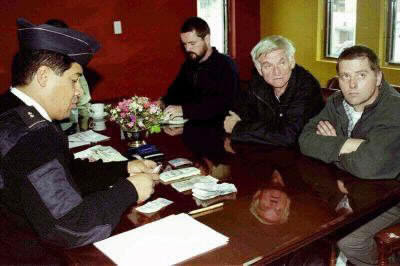
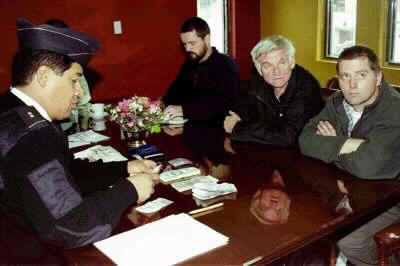
James Monaghan, Martin McCauley, and David Bracken, alleged to be members of the Irish Republican Army, were arrested and accused of training the FARC. Photo from Latin American Studies.

Year three

The two-year anniversary of the FARC peace talks passed in a moment of pessimism, with dialogue frozen since mid-November. Reports indicated that the FARC might release 100-150 soldiers and police officers in its custody by the middle of February.

On January 23, the FARC rejected a Colombian government proposal for re-starting the talks, which had called for an end to kidnappings and the guerrillas’ use of homemade bombs. With a January 31 deadline for renewal of the demilitarized zone approaching, the COLAR announced that 600 counter-guerrilla troops had been airlifted to sites near the zone. “If Manuel Marulanda wants an extension of the safe haven, he has to sit at the negotiating table,” President Pastrana said.

On the eve of the deadline, Pastrana extended the zone for four more days, asking for a face-to-face meeting with FARC leader Marulanda. Marulanda agreed to meet on February 8-9.

President Pastrana stayed overnight in the FARC demilitarized zone between the two days of meetings with Marulanda. The two emerged with a deal to revive peace talks, the 13-point “Pact of Los Pozos.” Pastrana and Marulanda agreed to extend the demilitarized zone for another eight months, and to negotiate a prisoner exchange and a possible ceasefire.

The Pact created a 3-panel advisory group to report on the paramilitary and guerrilla terrorism problem, side issues that could threaten the peace process, and conditions in the demilitarized zone. The pact, while often ambiguous, increased optimism about the peace talks’ future.

Under a June 2 accord, the FARC agreed to free 42 sick military and police personnel in exchange for 15 ailing guerrillas in government prisons. On June 5, FARC released police Col. Alvaro León Acosta and three other officers, a beginning of compliance with the exchange agreement.

But on June 23, FARC militias attack La Picota prison in southern Bogotá, freeing 98 prisoners, including several FARC members.

Later that week, the FARC unilaterally released 242 soldiers and police agents it had held prisoner, in most cases for years. The group threatened more kidnappings, however. Jorge Briceño told prisoners he released, “We have to grab people from the Senate, from Congress, judges and ministers, from all the three branches (of the Colombian state), and we’ll see how they squeal.”

The public-relations impact of the prisoner release was further dulled by the group’s kidnapping of Hernán Mejia Campuzano, vice-president of the Colombian Soccer Federation. Mejia was not kidnapped because of his position; in fact, the guerrillas released him unharmed on June 29 so that the Copa America tournament, scheduled to begin in mid-July in Colombia, wouldn’t move elsewhere.

Queen Noor of Jordan and America Online founder Kimsey visited the demilitarized zone for a meeting with Marulanda and Gómez in July, but two more FARC kidnappings angered the international community and slowed the peace talks.

On July 15, FARC guerrillas in Meta kidnapped the department’s former governor, Alan Jara, while he was traveling in a clearly marked United Nations vehicle. A FARC statement later accused Jara of paramilitary ties, criticized the UN for transporting him, and promised to submit the former governor to a “popular tribunal.”

Then, on July 16, the FARC kidnapped three German development workers in Cauca department, demanding an end to U.S.-driven aerial spraying of coca plants in the zone (which had started the day before). The UN and European Union issued strong protests.

The Pastrana government named a new team of negotiators (now called “consultants”) for the peace talks: Manuel Salazar, the president’s advisor for social policy; Ricardo Correa, secretary-general of the National Association of Industries (ANDI, one of Colombia’s main business associations); Reinaldo Botero, coordinator of the government’s human rights program; and Luis Fernando Criales, assistant high commissioner for peace for the FARC peace talks.

In August, the Colombian government arrested three suspected members of the Irish Republican Army in the Bogotá airport. James Monaghan, Martin McCauley, and David Bracken were accused of spending five weeks in the FARC demilitarized zone, offering training in urban terror tactics.

Finally, in September, a “notables commission” created on May 11 to find solutions to the paramilitary problem issued a report recommending that government-FARC talks proceed under a six-month cease-fire. Under this proposal, the FARC would abstain from kidnappings and extortion, while the government would pay for the FARC members’ basic needs and refrain from herbicidal spraying of small-holding coca-growers.

On September 29, Liberal Party presidential candidate Horacio Serpa was forced to give up an attempt to lead a protest march into the FARC demilitarized zone. FARC fighters at the zone’s entrance fired warning shots with rifles and mortars, calling into question the status of the zone just over a week before its renewal deadline.

Soldiers then found the body of Consuelo Araújonoguera, a popular former minister of Culture and the wife of Attorney-General Edgardo Maya. Araujonoguera had been kidnapped September 24 by the FARC at a roadblock near Valledupar, Cesar. The FARC admitted the kidnapping but denied the murder, though witnesses say Araujonoguera’s guerrilla captors shot her at pointblank range while being pursued by COLAR.

Days before the FARC demilitarized zone’s next expiration deadline of October 10, FARC and Colombian government negotiators signed the “San Francisco de la Sombra Accord,” renewing the zone until January 20, 2002. (FARC negotiators expressed disappointment that it was not renewed until August, when President Pastrana’s term would end.)

The accord committed both sides to focusing talks on conditions for a cease-fire, and the FARC pledged to cease its practice of “miracle fishing,” staging roadblocks and kidnapping travelers for ransom. The government pledged to increase anti-paramilitary efforts.

In a letter to his negotiators, dated November 7, Marulanda listed demands for the stalled peace talks’ resumption. These included, among other items, suspension of government over-flights of the demilitarized zone, a government affirmation that the FARC are not terrorists or narco-traffickers, an end to military incursions in the zone (COLAR denied any such episodes had occurred), and suspension of the government’s ban on unauthorized foreigners in the zone.

If these demands were not met, Marulanda said, “it will be necessary to agree upon a day… to officially hand over” the demilitarized zone to the government. President Pastrana and other government officials rejected Marulanda’s “ultimatum.”

Residents of the indigenous community of Caldono, Cauca, resisted an attempted FARC takeover of their town by assembling nonviolently in the town center. Similar examples of nonviolent resistance to incursions followed in several indigenous towns in southwest Colombia. FARC fighters killed some nonviolent resisters in Purace, Cauca, on December 31, 2001.

FARC leader Marulanda invited Pastrana, leaders of business groups, Colombia’s Congress, judiciary, and the Catholic Church to a January 15 meeting in the demilitarized zone. The meeting, Marulanda indicated, would seek to determine “what is negotiable” among a list of concerns, among them Plan Colombia, drug crop eradication, prisoner exchanges, and paramilitarism. The meeting would occur five days before the January 20, 2002, deadline for expiration of the demilitarized zone where talks were taking place. The Colombian government declared it would “study” Marulanda’s proposal and respond in writing.
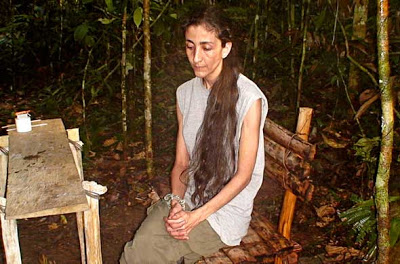
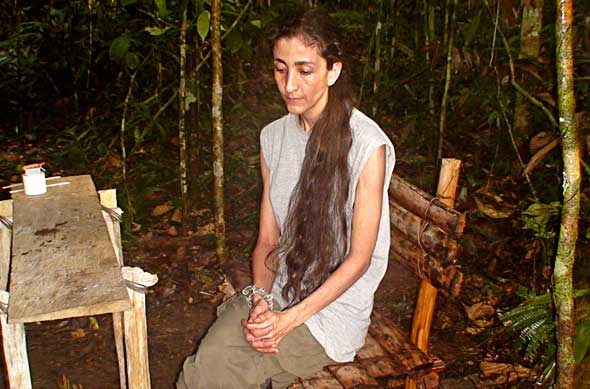
Presidential candidate Ingrid Betancourt was kidnapped by the FARC on Feb. 26, 2002. Photo from Latin American Studies.

Year four

The third anniversary of the beginning of peace talks rolled by. The FARC and Colombian government agreed to hold talks, for the first time since mid-October, on January 3 and 4, 2002. According to a January 3 FARC communiqué, the talks’ purpose was “to find formulas to get the process moving and to allow for discussion” of the talks’ common agenda, a cease-fire, subsidies for the unemployed, the September recommendations of the “notables commission,” and the previous October’s San Francisco de la Sombra accord.

No progress was made in two days of talks. The FARC continued to insist that the government lift the control measures it had implemented in the area surrounding the group’s demilitarized zone, such as border controls and air patrols that the guerrillas viewed as tantamount to a blockade. Arguing that the control measures had brought a reduction in kidnappings, the government, particularly armed forces Chief Gen. Fernando Tapias, made clear its intention to keep them in place.

On January 8, another meeting between the FARC and the government failed to make progress. The FARC continued to cite government controls on the demilitarized zone as the chief obstacle to progress and to the guerrillas‘ compliance with the San Francisco de la Sombra accord. In a letter, Marulanda left the talks’ future up to Pastrana. He also proposed a timetable, should the present difficulties be overcome: discussion of a subsidy for the unemployed in February and March, and discussion of a ceasefire in April and May. The FARC released a series of open letters to officials and sectors of society.

The next day, the Colombian government announced the suspension of peace talks. The military was to enter the demilitarized zone 48 hours after Pastrana issued an order. The U.S. State Department blamed the FARC for the talks’ collapse.

As troops massed on the fringes of the demilitarized zone, Pastrana granted the United Nations time to find a solution to the stalled dialogues with the FARC. If no agreement was reached, the 48-hour countdown for the guerrillas’ exit from the zone would begin the evening of Saturday, January 12.

UN representative James LeMoyne arrived in the demilitarized zone in early afternoon of January 11 for last-ditch talks with the FARC. The two sides had until 9:30 pm the following day to find a way to save the peace process.

After two days of talks with LeMoyne, the FARC released a proposal for re-starting the peace talks, just before the 9:30 deadline. The guerrillas’ draft re-affirmed the commitments of the San Francisco de la Sombra accord, but left out the question of government controls in the area surrounding the demilitarized zone. The FARC had demanded that these measures be lifted in order for talks to continue.

To most observers, the statement tacitly acknowledged that the FARC had yielded on the issue of the control measures, though the guerrilla proposal would create a commission to investigate complaints about the measures.

At midnight, Pastrana rejected the guerrillas‘ proposal and ordered COLAR to re-take the zone at 9:30 pm on Monday, January 14. Pastrana offered one last hope: that the guerrillas clearly state that the dialogues may continue even with the control measures in place. The UN’s Lemoyne and FARC negotiators continued meeting on January 13.

The FARC announced that they would hand over the demilitarized zone’s town centers, officially ending the three-year-old peace process.

In late afternoon on the 14th, after a day of efforts from the UN, international, and church representatives, the FARC announced that guarantees existed for the peace process to continue, complying with President Pastrana’s demand. The January 20 deadline for the demilitarized zone’s renewal remained in place, Pastrana said, unless both sides could agree on a strict timetable for cease-fire discussions. Future talks would include international representatives in a more formal fashion.

FARC offensives on February 5, much of it sabotage of infrastructure and bombings of urban areas, further increased skepticism about the peace process. The Colombian government issued a proposal for a six-month cease fire.

Shortly before the February 14 deadline for expiration of the guerrilla demilitarized zone, the FARC and the Colombian government agreed to a timetable for cease-fire discussions. The main issues to be discussed were cease-fire terms, kidnapping, and paramilitarism. The document, drawn up in the presence of UN, foreign embassy, and church representatives, laid out a brisk schedule that would bring a cease-fire by April 7. President Pastrana extended the demilitarized zone until April 10.

As time ran out on the FARC peace process, several presidential candidates, including Horacio Serpa, Luis Eduardo Garzón, and Ingrid Betancourt traveled to the demilitarized zone for a meeting scheduled as part of the peace talks’ timetable. All candidates sharply criticized the guerrillas’ ongoing offensive against civilian targets.

FARC and government representatives exchanged cease-fire proposals. The government proposal called for maintaining guerilla fronts in small zones to keep them separate from the armed forces.

February 20, 2002. Last call.

The end of the FARC peace process

The FARC hijacked a domestic airliner, forcing it to land on a stretch of highway in Huila department. All passengers were freed but one, Colombian Senator Jorge Gechem Turbay, the fifth member of Colombia’s Congress to be kidnapped by the guerrillas since June 2001.

President Pastrana responded by announcing the end of the three-year-old talks with the FARC. Aerial bombardment, the first phase of military operations to re-take the demilitarized zone, began at midnight.

It should be noted that this declaration was signed in Washington, D.C., where Pastrana had gone to receive orders from his masters of war.

Senator and presidential candidate Ingrid Betancourt was kidnapped three days later by FARC while traveling to the former demilitarized zone on a mission to advocate respect for the rights of the zone’s residents.

The FARC gave the Colombian government one year to negotiate the exchange of Betancourt and five other kidnapped legislators for FARC prisoners in Colombian jails. She was freed by the COLAR six and a half years later.

Presidential elections were held on May 20, 2002. Alvaró Uribe Velez won. That was the end of the “peace process” as it relates to the FARC.

Under the Uribe regime, a new and different kind of “peace process” would take place.

Next: Colombian peace process, Part two: the AUC. (This very different peace process, between the Autodefensas Unidas de Colombia [AUC], [United Self-Defense Forces of Colombia] and the government of Alvaro Uribe Velez, began even as the previous one with the FARC failed.)

The Rag Blog

Posted in Rag Bloggers | Tagged , , , , , | 2 Comments

Poor Grow Poorer : Richest 1% Has Captured America’s Wealth


The ultra rich have captured America;
How can we take it back?

By David DeGraw / February 19, 2010

“The war against working people should be understood to be a real war… Specifically in the U.S., which happens to have a highly class-conscious business class… And they have long seen themselves as fighting a bitter class war, except they don’t want anybody else to know about it.” — Noam Chomsky

As a record amount of U.S. citizens are struggling to get by, many of the largest corporations are experiencing record-breaking profits, and CEOs are receiving record-breaking bonuses. How could this be happening, how did we get to this point?

The Economic Elite have escalated their attack on U.S. workers over the past few years; however, this attack began to build intensity in the 1970s. In 1970, CEOs made $25 for every $1 the average worker made. Due to technological advancements, production and profit levels exploded from 1970-2000. With the lion’s share of increased profits going to the CEO’s, this pay ratio dramatically rose to $90 for CEOs to $1 for the average worker.

As ridiculous as that seems, an in-depth study in 2004 on the explosion of CEO pay revealed that, including stock options and other benefits, CEO pay is more accurately $500 to $1.

Paul Buchheit, from DePaul University, revealed, “From 1980 to 2006 the richest 1% of America tripled their after-tax percentage of our nation’s total income, while the bottom 90% have seen their share drop over 20%.” Robert Freeman added, “Between 2002 and 2006, it was even worse: an astounding three-quarters of all the economy’s growth was captured by the top 1%.”

Due to this, the United States already had the highest inequality of wealth in the industrialized world prior to the financial crisis. Since the crisis, which has hit the average worker much harder than CEOs, the gap between the top one percent and the remaining 99% of the U.S. population has grown to a record high. The economic top one percent of the population now owns over 70% of all financial assets, an all time record.

As mentioned before, just look at the first full year of the crisis when workers lost an average of 25 percent off their 401k. During the same time period, the wealth of the 400 richest Americans increased by $30 billion, bringing their total combined wealth to $1.57 trillion, which is more than the combined net worth of 50% of the US population. Just to make this point clear, 400 people have more wealth than 155 million people combined.

Meanwhile, 2009 was a record-breaking year for Wall Street bonuses, as firms issued $150 billion to their executives. 100% of these bonuses are a direct result of our tax dollars, so if we used this money to create jobs, instead of giving them to a handful of top executives, we could have paid an annual salary of $30,000 to 5 million people.

So while U.S. workers are now working more hours and have become dramatically more productive and profitable, our pay is actually declining and all the dramatic increases in wealth are going straight into the pockets of the Economic Elite.

If our income had kept pace with compensation distribution rates established in the early 1970s, we would all be making at least three times as much as we are currently making. How different would your life be if you were making $120,000 a year, instead of $40,000?

So it should come as no surprise to see that we now have the highest inequality of wealth in the industrialized world and the highest inequality of wealth in our nation’s history. The backbone of America, a hard working middle class that has made our country a world leader, has been devastated.

Now that we have a better understanding of how our income has been suppressed over the past 40 years, let’s take a look at how the economy has been designed to take the limited money we receive and put it into the hands of the Economic Elite as well.

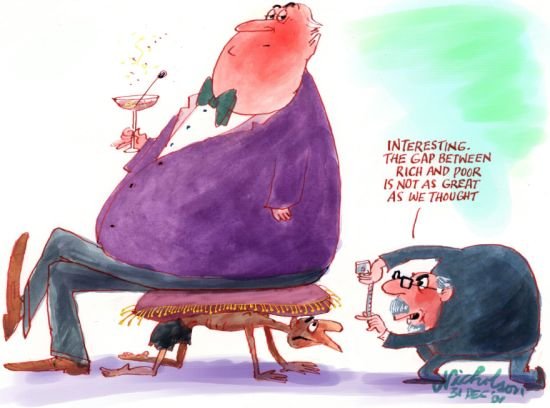
Cartoon from links.org.

Costs of living

Other than in the workplace, in almost all our costs of living the system is now blatantly rigged against us. Let’s take a look at it, starting out with our tax system.

In total, the average U.S. citizen is forced to give up approximately 30% of our income in taxes. This tax system is now strategically designed to flow straight into the hands of the Economic Elite. A huge percentage of our tax dollars ultimately end up in their pockets. The past decade proves that — whether it’s the Republicans or the Democrats running the government — our tax money is not going into our community, it is going into the pockets of the billionaires who have bought off both parties — it is obscene.

For an example of how this system flows to the Economic Elite, just look at the Wall Street “bailout.” The real size of the bailout is estimated to be $14 trillion — and could end up costing trillions more than that. By now you are probably also sick of hearing about the bailout, but stop and think about this for a moment. Do you comprehend how much $14 trillion is?

What could be accomplished with this money is almost beyond common comprehension.

And this is just the tip of the iceberg that has hit us. On top of the trillions given to the Wall Street elite, we already have a record $12.3 trillion in national debt — and we now have to pay $500 billion in interest to the Economic Elite on this debt every year, yet another way they are milking us dry. When you add in unfunded liabilities owed, like social security payments, we actually owe a stunning $74 trillion. That adds up to a debt of $242,000 for every man, woman and child in America.

Trillions more, 25% of taxpayer dollars allocated to military spending, goes unaccounted for every year, not to mention the billions spent on overcharging and outright fraud. During the War on Terror, the Economic Elite have used our tax money to build a private army that has more soldiers deployed than the U.S. military — a congressional study revealed that 69% of the “U.S.” fighting forces deployed throughout the world in our name are in fact private mercenaries, 80% of them are foreign nationals.

Private contractors regularly get paid three to five times more than our soldiers, and have been repeatedly caught overcharging and committing fraud on a massive scale. A congressional investigation revealed this and strongly recommended that we seize wasting tax dollars on these private military contractors. However, under Obama, there has actually been a drastic increase in total tax dollars spent on them.

In 2009, just over $1 trillion tax dollars were spent on the military, it’s safe to say that at least $350 billion of that was needlessly wasted.

When you research our tax system you see an unprecedented level of waste and fraud rampant throughout most expenditures. Our tax system is a national disaster of epic proportions. It is literally an organized criminal operation that continues to rob us in broad daylight, with zero accountability.

Politicians and mainstream “news” outlets will not tell you this, but most every serious economist knows that due to so much theft and debt created in the tax system, the only way to fix things, other than stopping the theft and seizing the trillions that have been stolen, will be for the government to cut important social funding and drastically raise our taxes.

Other than the record national debt, many states are running record deficits and are barreling toward economic disaster, raising the likelihood of higher taxes, more government layoffs and deep cuts in services. Our nation’s biggest state economies, like California and New York, are the ones in most trouble.

To merely say that things will not be improving economically is to be a delusional optimist. The truth that you will not hear: we have been hit by an economic deathblow and the United States lay in ruins.

It’s not just this criminal tax system; the theft is now built into all our costs of living.

Trillions more in our spending on food and fuel has been stolen due to fraudulent stock transactions and overcharging. Just 10 years ago, in 2000, American families paid 7% of our income on food and fuel. We now pay 20%.

This drastic increase is primarily driven by fraudulent market manipulation that drives up stock prices. Congress uncovered this in 2006; as part of the Enron investigation they found that companies manipulated the oil market to create major spikes in stock values, and then they didn’t do anything about it — nothing to see here, just move on.

As mentioned before, we have the most expensive health care system in the world and we are forced to pay twice as much as other countries, and the overall care we get in return ranks 37th in the world. On average, U.S. citizens are now paying a record high 8% of their income on medical care.

Part of the reason why foreclosure rates are so high is because the percentage of income Americans pay on their housing has risen to 34%.

So for these basic necessities — taxes, food, fuel, shelter and medical bills — we have already lost 92% of our limited income. Then factor in ever-increasing interest rates on credit cards, student loans, rising prices for cable, internet, phone, bank fees, etc., etc., etc. We are being robbed and gouged in all costs of living, in every aspect of our life. No wonder bankruptcies are skyrocketing and the number of people suffering from psychological depression has reached an epidemic level.

The American worker is screwed over every step of the way, and it all starts with the explosion in the cost of a college education. This is one of the Economic Elite’s most devastating weapons. To have any chance of succeeding in this economy, it is commonly believed that you must attend the best college possible. With the rising costs involved, today’s students are graduating with record levels of debt from student loans.

At the same time, the unemployment rate among recent college graduates has risen higher than the national average, and those that do find work are making significantly less than they expected to make. This combination of extreme debt and reduced pay has crippled an entire generation right from the start and has put them in a vicious cycle of spiraling debt that they will struggle with for the rest of their lives. The most recent college graduates are now known as a “lost generation.”

The American dream has turned into a nightmare. The economic system is a sophisticated prison cell; the indentured servant is now an indebted wage slave; whips and chains have evolved into debts.

“There are two ways to conquer and enslave a nation. One is by sword. The other is by debt.” — John Adams

Concealing national wealth

“Liberty in the concrete signifies release from the impact of particular oppressive forces; emancipation from something once taken as a normal part of human life but now experienced as bondage… Today, it signifies liberation from material insecurity and from the coercions and repressions that prevent multitudes from participation in the vast cultural resources that are at hand.” — John Dewey

When you take the time to research and analyze the wealth that has gone to the economic top one percent, you begin to realize just how much we have been robbed. Trillions upon trillions of dollars that could make the lives of all hard working Americans much easier have been strategically funneled into the coffers of the Economic Elite. The denial of wealth is the key to the Economic Elite’s power. An entire generation of massive wealth creation has been strategically withheld from 99% of the U.S. population.

The U.S. public doesn’t have any understanding of how much wealth has been generated and concentrated into the hands of the Economic Elite over the past 40 years; there is no historical frame of reference. This withholding of wealth is truly the greatest crime against humanity in the history of civilization.

What could be done with all the money that has been hoarded by the Economic Elite is extraordinary!

Let’s consider what we could do with the money that has been stolen from us? On top of what should be our average six-figure yearly income, we could have:

  • Free health care for every American,
  • A free 4 bedroom home for every American family,
  • 5% tax rate for 99% of Americans,
  • Drastically improved public education and free college for all,
  • Significantly improved public transportation and infrastructure,

The list goes on…

This is not some far-fetched fantasy. These are all things that Franklin D. Roosevelt talked about doing in the 1940’s, long before the explosion of wealth creation in our technologically advanced global economy. The money for all this is already there, stashed into the claws of the Economic Elite.

The denial of wealth to the masses is the key to the Economic Elite’s power. Outside of outdated and obsolete economic models and theories — and incredibly short-sighted greed — there is no reason why all this money should be kept in the hands of a few, at the immense suffering and expense of the many.

If Americans could just understand how much wealth is being withheld from us, we would have a massive uprising and the Economic Elite would be swept away, into the history books alongside the evil despots of the past.

[This is Part II of David DeGraw’s report, “The Economic Elite vs. People of the USA,” originally published at Amped Status. Click here for Part I. Read more of David McGraw’s writing here.]

© 2010 Amped Status

Source / Amped Status / AlterNet

Thanks to S.M. Wilhelm / The Rag Blog

Posted in RagBlog | Tagged , , , , , , | 8 Comments

A Dangerous Profession : Worldwide Abuse of Journalists

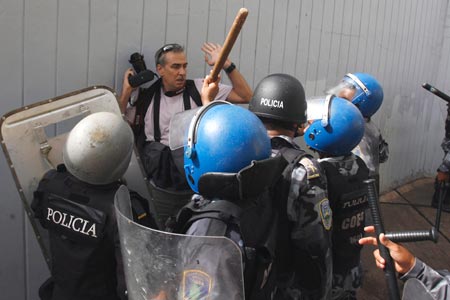
Honduran police surround AP photographer Dario Lopez-Mills as he covers protests that followed the June presidential coup. Photo by Oswaldo Rivas / Reuters / CPJ.

CPJ report:
Journalists around the world
Face harassment, prison, death

801 journalists have been killed since 1992, and the profession seems to be getting more dangerous — not less.

By Ted McLaughlin / The Rag Blog / February 19, 2010

Hundreds of thousands of young people in the United States and across the globe picture themselves as someday becoming famous journalists. They see the profession as rather glamorous, and hope to be the next Woodward, Bernstein, Murrow, or Cronkite — covering great achievements like the moon landing, exposing injustices like abuse of the farmworkers, or bringing down a government by bringing to light its corrupt practices.

A very few of them might actually accomplish this, provided they have the stamina to work the long hours, the ability to recognize and write a great story, the courage to fight corporate ownership, and the ability to live on a less than stellar salary for many years. But while those may be roadblocks to the desired fame, there is an even darker side to journalism.

That darker side is that a journalist who seeks to write or report the truth, instead of being rewarded with fame and fortune, may actually be subjected to exile, imprisonment, or even death (and some just disappear). There are many governments, organizations, and people who don’t want the truth revealed, and are capable of doing vile things to suppress it.

This is not just true in developing nations or with tyrannical regimes, but all over the world including the United States (you may remember the murder of radio broadcaster Alan Berg a few years ago by white supremacists). Even here in the United States, which is supposedly a free country with a free press, it is not all that uncommon to find journalists jailed for something like refusing to reveal a confidential source (without which they could not properly do their job).

According to the Committee to Protect Journalists (CPJ), which tries to keep abuses of journalists in the public eye to help protect them, 136 journalists were imprisoned worldwide in 2009. Here are the eleven worst violators:

  • China…..24
  • Iran…..23
  • Cuba…..22
  • Eritrea…..19
  • Burma…..9
  • Uzbekistan…..7
  • Azerbaijan…..6
  • Ethiopia…..4
  • Egypt…..3
  • Tunisia…..2
  • Yemen…..2

Fifteen other nations have imprisoned at least one journalist for trying to do his/her job, including a freelance journalist in Iraq, Ibrahim Jassam, who is being held by the United States military. The Iraqi Central Criminal Court has ruled there was no evidence to hold him and ordered his release, but the U.S. military has refused to do so. They continue to hold him in prison without evidence and without charges.

And while we’re on this subject, bloggers and other internet writers of news or politics shouldn’t be too smug or too sure of their own security. Over half of those currently in prison are “internet journalists.”

But in a way, those imprisoned are the lucky ones — because they are at least still alive. In 2009, at least 71 journalists were killed in the line of duty — the most since CPJ began keeping track in 1992. In fact, 801 journalists have been killed since 1992, and the profession seems to be getting more dangerous — not less. Here are the 20 deadliest countries for journalists:

  • Iraq…..141
  • Philippines…..68
  • Algeria…..60
  • Russia…..52
  • Columbia…..42
  • Somalia…..32
  • Pakistan…..26
  • India…..26
  • Afghanistan…..21
  • Turkey…..20
  • Bosnia…..19
  • Mexico…..19
  • Sri Lanka…..18
  • Tajikistan…..17
  • Rwanda…..16
  • Brazil…..16
  • Sierra Leone…..16
  • Bangladesh…..12
  • Israel and Occupied Territory…..10
  • Angola…..9

We should never forget the many journalists who have given their freedom and their lives, and the journalists who continue to risk their freedom and their lives, to bring the truth to the world. They are not just heroes, but absolutely necessary if we are to progress toward a better, more free, and more humane world.

While knowing the truth is necessary for freedom, reporting that truth is now, and always has been, a very dangerous profession.

[Rag Blog contributor Ted McLaughlin also posts at jobsanger.]

The Rag Blog

Posted in Rag Bloggers | Tagged , , , , , | 1 Comment

Sky is Falling : The Press and Evan Bayh’s Retirement

Panic attack. Image from Moonbattery.

Press frames the corporate spin:
Evan Bayh calls it quits

By Harry Targ / The Rag Blog / February 18, 2010

On February 15, 2010, the sky began to fall, at least according to media pundits. Incumbent Senator Evan Bayh announced that he was not running for a third term as senator from Indiana.

The press scurried to construct a frame on the story that would be compatible with corporate spin. The Democratic Party is doomed. No alternative candidate could possibly surface in this red state to maintain the Democratic Party edge in the Senate. The Bayh announcement, the stories said, followed on a flood of other announcements by Democrats. Bayh was just the latest of the entire class of incumbent Democrats who were fleeing the sinking ship.

Why did the Senator from Indiana choose to retire even though he had at least a ten-point lead on any possible Republican opponent and a multi-million dollar war chest for his campaign? Well, Bayh said he had had enough of partisanship, polarization, and the broken system called Congress. And he, the good centrist, had been unable to lead the ne’er do well partisans to the compromise table.

And, the media suggested, the sainted Democrat resigned out of frustration because the “left” in the Democratic Party could not be tamed. The sub-text in the news suggested that once again the system is coming crashing down because of those dogmatic politicians who support real health care reform, a jobs bill that would create jobs, finance reform with teeth, and a substantial reduction in wasteful spending justified by reckless war. When will they ever learn.

The real story might be a bit different.

Democrats in the state of Indiana now will have a chance to select a candidate who can represent the interests of the people rather than the health care industry. The source of the Congressional gridlock has been the Republicans who have opposed every piece of legislation and every nominee to fill an administrative position recommended by the Democrats and the White House. And, the efforts to stifle governance by the Republicans have been aided and abetted by a handful of centrist Democrats such as Evan Bayh who oppose real health care reform and labor rights.

Bayh’s voting record earned him an Americans for Democratic Action rating of 70, which is fairly liberal (his fellow Hoosier Senator Richard Lugar has a rating of 25). But Bayh’s senatorial career is marked by extreme fluctuations from one congressional session to another. As Ezra Klein reported last April:

In the 109th Congress, Bayh’s voting pattern suddenly develops an uncharacteristic liberalism. He becomes the 19th most conservative member, with a record more liberal than, among others, Joe Biden. As context, these were also the years when Bayh was preparing for the presidential run that he eventually aborted.

In the 110th Congress, however, that flash of liberalism gives way to a career-high conservatism: He actually displaces Nelson as the Caucus’s most conservative member.

In addition to being an on-again off-again liberal and a reigning centrist today, Senator Bayh served as chairman of the Democratic Leadership Council from 2001 to 2005, and a member of the Senate Centrist Coalition and other centrist sounding legislative bodies. He was also a member of the Board of Directors of the National Endowment for Democracy.

Perhaps most important, his wife, Susan Bayh, has earned over $250,000 in stock options for serving on the board of the giant health insurance company Wellpoint. Though the Senator has denied being influenced by his wife’s corporate ties, he has expressed his preference for maintaining the primacy of the marketplace for health care.

My own preference would be — and you may have found common ground here this morning on Easter, which is appropriate — deal with the inefficiencies, figure out a way to make the private marketplace accomplish our public good, only have the government role as a backstop, as a last resort, if the private sector has just failed to meet the challenge. [Evan Bayh on Fox, Sunday, April 12, 2009]

Hoosier Democrats need to do what all progressive Democrats need do over the next election period. Identify progressive candidates who will address and commit themselves to the 2008 Obama campaign agenda (whether Obama supports it or not). That means meaningful health care reform, support for the Employee Free Choice Act, real climate change legislation, and a jobs package that will put millions of Americans back to work. In Indiana a candidate standing on that record would be a significant improvement over Evan Bayh.

[Harry Tarq is a professor in American Studies who lives in West Lafayette, Indiana. He blogs at Diary of a Heartland Radical.]

The Rag Blog

Posted in Rag Bloggers | Tagged , , , , , , | 3 Comments

ExxonMobil and the Oil Supply : The Bigger Picture

ExxonMobil CEO Rex W. Tillerson: What, me worry? Photo from Getty Images.

The good news and the, well…
Exxon says: No need to worry

By Roger Baker / The Rag Blog / February 17, 2010

Here is the good news as seen through the eyes of Texas-based global energy giant Exxon:

ExxonMobil is an industry leader in reserves replacement,” said Rex W. Tillerson, chairman and chief executive officer.“We have replaced more than 100 percent of production for 16 consecutive years, reflecting our strategic focus on resource capture, a disciplined approach to investment and excellence in project execution. Adding new reserves ensures that ExxonMobil will continue to develop new supplies of energy to meet future demand and support economic growth and improved standards of living.

This sounds like we don’t need to worry very much, at least about Exxon’s oil. But let us read between the lines.

We need to know that the world’s cheap conventional oil on dry land probably peaked in 2005, whereas most of the new oil being added is very expensive. The average price of adding new oil is thought now
to be about $70 a barrel, which doesn’t leave much profit (today’s Nymex price is $77). The new oil reserves being discovered and produced are mostly deep underwater, or arctic, or heavy crude, or tar sand oil etc.; this is the kind of oil you go after only when you run out of the easy reserves to produce.

Exxon now produces only about 3% of world oil production. It used to be called “big oil” but a better term nowadays would be “baby oil.” Exxon already produced its main reserves in Texas etc., long ago.

The Mideast, OPEC politics, and, increasingly, Saudi production are now what really count in determining global oil price. They can keep the global price from sinking so much in a slack market, but they can’t hold price down very well when the world is demanding and producing at maximum, as the world saw in mid-2008.

There are several ways that Exxon’s news release paints too rosy a picture. First of all, what they carefully don’t say is the degree to which they are replacing their old cheap reserves on dry land with much more costly oil and gas offshore, etc. Anyone can drill for and find some oil in certain known areas, but to what degree is it profitable?

These additions are based on the corporation’s definition of proved reserves, which utilizes the long-term pricing basis that the corporation uses to make its investment decisions. This is a different price basis than the SEC basis, which uses 12-month average prices for the 2009 year-end reserves calculation.

Exxon says that their analysis does not comply with SEC practice. Perhaps one reason is that they seem to be considering gas as an equal replacement for oil. Gas as a fossil fuel is very expensive (~10X) to move around when compared to oil; this is why they used to flare it in West Texas. Oil is inherently more valuable than gas as a liquid fuel. It is irreplaceable in powering the world’s transportation, and it will be for a long time to come.

At year-end 2009, ExxonMobil’s proved reserves base, utilizing the corporation’s definition of year-end reserves, increased to 23.3 billion oil-equivalent barrels, split approximately evenly between liquids and gas (51 percent liquids, 49 percent gas).

The third way Exxon can try to look good is by exploring the edges of their big old fields, which are some of the only rich areas left. There are certain tax advantages to the majors in underestimating their true reserves. When prices get high they can keep drilling and producing the dregs in their fields that are left over from their golden era:

The corporation’s reserves additions in 2009, the highest in the decade, reflect new developments with significant funding commitments as well as revisions and extensions of existing fields resulting from drilling, studies and analysis of reservoir performance.

This is not to say that Exxon reserves are not worth its stock price, whenever the global market tightens up and the global oil price soars again. However, Exxon’s best days as an energy producer are numbered, and it doesn’t like to admit that, or to discuss the implications of peak oil.

For those who want to understand the big picture, the sites Energy Bulletin and The Oil Drum are excellent places to go for the smart analysis needed to penetrate the cloud of corporate BS, as well as the popular oil addiction denial.

[Roger Baker is a long time transportation-oriented environmental activist, an amateur energy-oriented economist, an amateur scientist and science writer, and a founding member of and an advisor to the Association for the Study of Peak Oil-USA. He is active in the Green Party and the ACLU, and is a director of the Save Our Springs Association and the Save Barton Creek Association. Mostly he enjoys being an irreverent policy wonk and writing irreverent wonkish articles for The Rag Blog.]

The Rag Blog

Posted in Rag Bloggers | Tagged , , , , , , | 2 Comments

Nuke Loan Guarantees : Obama’s Atomic Blunder

Simpsons nuclear plant mogul Mr. Burns likes it!

8.3 billion in nuclear guarantees:
Obama throws good money after bad

By Harvey Wasserman / The Rag Blog / February 17, 2010

As Vermont seethes with radioactive contamination and the Democratic Party crumbles, Barack Obama has plunged into the atomic abyss.

In the face of fierce green opposition and withering scorn from both liberal and conservative budget hawks, Obama has done what George W. Bush could not — pledge billions of taxpayer dollars for a relapse of the 20th Century’s most expensive technological failure.

Obama has announced some $8.3 billion in loan guarantees for two new reactors planned for Georgia. Their Westinghouse AP-1000 designs have been rejected by the Nuclear Regulatory Commission as being unable to withstand natural cataclysms like hurricanes, tornadoes and earthquakes.

The Vogtle site originally was to host four reactors at a total cost of $600 million; it wound up with two at $9 billion.

The Southern Company which wants to build these two new reactors has cut at least one deal with Japanese financiers set to cash in on American taxpayer largess. The interest rate on the federal guarantees remains bitterly contested. The funding is being debated among at least five government agencies, and may well be tested in the courts. It’s not clear whether union labor will be required and what impact that might have on construction costs.

The Congressional Budget Office and other analysts warn the likely failure rate for government-back reactor construction loans could be in excess of 50%. Energy Secretary Stephen Chu has admitted he was unaware of the CBO’s report when he signed on to the Georgia guarantees.

Over the past several years the estimated price tag for proposed new reactors has jumped from $2-3 billion each in some cases to more than $12 billion today. The Chair of the NRC currently estimates it at $10 billion, well before a single construction license has been issued, which will take at least a year.

Energy experts at the Rocky Mountain Institute and elsewhere estimate that a dollar invested in increased efficiency could save as much as seven times as much energy as one invested in nuclear plants, while producing 10 times as many permanent jobs.

Georgia has been targeted largely because its regulators have demanded ratepayers put up the cash for the reactors as they’re being built. Florida and Georgia are among a handful of states taxing electric consumers for projects that cannot come on line for many years, and that may never deliver a single electron of electricity.

Two Florida Public Service Commissioners, recently appointed by Republican Governor Charlie Crist (now a candidate for the U.S. Senate), helped reject over a billion dollars in rate hikes demanded by Florida Power and Light and Progress Energy, both of which want to build double reactors at ratepayer expense. The utilities now say they’ll postpone the projects proposed for Turkey Point and Levy County.

In 2005 the Bush Administration set aside some $18.5 billion for reactor loan guarantees, but the Department of Energy has been unable to administer them. Obama wants an additional $36 billion to bring the fund up to $54.5 billion. Proposed projects in South Carolina, Maryland, and Texas appear to be next in line.

But the NRC has raised serious questions about Toshiba-owned Westinghouse’s AP-1000 slated for Georgia’s Vogtle site, as well as for South Carolina and Turkey Point. The French-made EPR design proposed for Maryland has been challenged by regulators in Finland, France, and Great Britain. In Texas, a $4 billion price jump has sparked a political upheaval in San Antonio and elsewhere, throwing the future of that project in doubt.

Taxpayers are also on the hook for potential future accidents from these new reactors. In 1957, the industry promised Congress and the country that nuclear technology would quickly advance to the point that private insurers would take on the liability for any future disaster, which could by all serious estimates run into the hundreds of billions of dollars.

Only $11 billion has been set aside the cover the cost of such a catastrophe. But now the industry says it will not build even this next generation of plants without taxpayers underwriting liability for future accidents. Thus the “temporary” program could ultimately stretch out to a full century or more.

In the interim, Obama has all but killed Nevada’s proposed Yucca Mountain nuclear waste dump. He has appointed a commission of nuclear advocates to “investigate” the future of high-level reactor waste. But after 53 years, the industry is further from a solution than ever.

Meanwhile, the Nuclear Regulatory Commission has reported that at least 27 of America’s 104 licensed reactors are now leaking radioactive tritium. The worst case may be Entergy’s Vermont Yankee, near the state’s southeastern border with New Hampshire and Massachusetts. High levels of contamination have been found in test wells around the reactor, and experts believe the Connecticut River is at serious risk.

A furious statewide grassroots campaign aims to shut the plant, whose license expires in 2012. A binding agreement between Entergy and the state gives the legislature the power to deny an extension. U.S. Senator Bernie Saunders (D-VY) has demanded the plant close. The legislature may vote on it in a matter of days.

Obama has now driven a deep wedge between himself and the core of the environmental movement, which remains fiercely anti-nuclear. While reactor advocates paint the technology green, the opposition has been joined by fiscal conservatives like the National Taxpayer Institute, the Cato Institute, and the Heritage Foundation.

Reactor backers hailing a “renaissance” in atomic energy studiously ignore France’s catastrophic Olkiluoto project, now $3 billion over budget and three years behind schedule. Parallel problems have crippled another project at Flamanville, France, and are virtually certain to surface in the U.S.

The reactor industry has spent untold millions lobbying for this first round of loan guarantees. There’s no doubt it will seek far more in the coming months. Having failed to secure private American financing, the question will be: in a tight economy, how much public money will Congress throw at this obsolete technology.

The potential flow of taxpayer guarantees to Georgia means nuclear opponents now have a tangible target. Also guaranteed is ferocious grassroots opposition to financing, licensing, and construction of this and all other new reactor proposals, as well as to continued operation of leaky rustbucket reactors like Vermont Yankee.

The “atomic renaissance” is still a very long way from going tangibly critical.

[Harvey Wasserman is Senior Advisor to Greenpeace USA and the Nuclear Information and Resource Service. His Solartopia! Our Green-Powered Earth is at www.solartopia.org.]

The Rag Blog

Posted in Rag Bloggers | Tagged , , , , , , | 3 Comments

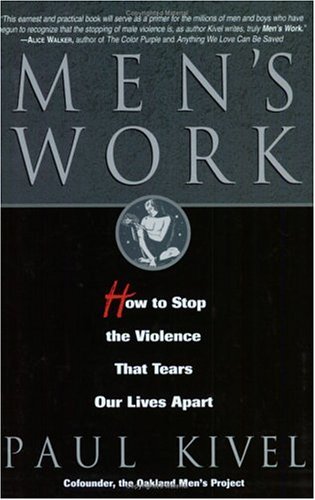
“Men’s Work: How to Stop the Violence That Tears Our Lives Apart.” Paul Kivel, cofounder of the Oakland Men’s project, drew on decades of experience in the movement to end male violence in producing this book that talks about patriarchial male abuse and how men can start to heal. He also addresses the societal aspects of violence engendered by the military, prisons, and capitalism itself.

Posted in RagBlog | Leave a comment

Stayin’ Alive : Learning About our Bodies

Apples and oranges: Rats have substantially different physiological systems.

Stayin’Alive:
What do we know about our bodies,
And how do we know it?

By Mariann G. Wizard / The Rag Blog / February 16, 2009

[Stayin’ Alive is a periodic column on Complementary and Alternative Medicine by Rag Blogger Mariann G. Wizard, a professional science writer with a wide-ranging knowledge of natural health therapies. Readers may suggest topics for future columns; use the Comments section below the article.]

In establishing a self-health care continuum that successfully incorporates both conventional Western medicine (CWM) and complementary and alternative medicine (CAM) elements, the best tool would be a solid understanding of how our own bodies work. Many people believe that they possess such knowledge; many more believe that even if they don’t, their health care provider (HCP) does, or that Medical Science in general must have the facts.

“Nuts!” to all that.

To the contrary, I would venture to say, for example, that most folks’ understanding of their digestive system resembles the indigestion remedy ads of the 1950s: a hole at each end, a long tube connecting them, and a holding tank, or “tummy,” nestled cozily in the middle, where mysterious fluids ebb and flow.

As far as imagining that your HCP has a much better understanding, that is also a dubious assumption. HCPs are highly educated and well-informed about many things, but the how and why of healthy functioning aren’t much stressed in their education; it’s more about how to respond to the illnesses and dysfunctions we all-too-frequently sprout.

As for Medical Science, sometimes it must seem to the attentive reader that we are still living in the Middle Ages, if not Middle Earth! Many amazing things may be seen and “proven” in laboratory (in vitro) studies, where everything happens in a test tube or Petri dish.

In screening labs all over the world, substances are tested for antibiotic, anti-inflammatory, and/or anti-cancer effects, among other actions. Many hundreds of natural substances, most from plants, exert such effects in vitro. Among them, as one small example, rosmarinic acid, from the common herb rosemary, has very potent antibiotic effects in vitro.

However, this has not yet translated into an effective antibiotic medicine.

Similarly, animal tests (in vivo) may illuminate many biologically active substances; however, they are unreliable predictors of how a substance will act on humans. Rodents and rabbits, used in the great majority of in vivo studies, have substantially different physiological systems than humans. The only animals, really, that are close enough to human beings to make in vivo studies reliably predictive of a chemical’s effects on us are other primates: chimpanzees, orangutans, monkeys, etc.

We have no compunction, as a species, about sacrificing hundreds of thousands of rats and rabbits annually in the name of Science, even breeding special research animals who are born with or develop specific disease conditions, e.g., cancer.

Primates, fortunately for them, do not reproduce quickly enough, or in sufficient numbers, to make similar research on them cost-effective, and we may stroke our “humanitarian” side as Masters of Nature, with strict controls on primate medical research, requirements for “humane” treatment, and laws limiting trafficking in their lives, although these latter seem, from preservationists’ reports, to be rather loosely observed in some areas.

The essential irrelevance of animal research to advance Medical Science as applied to humans is probably the strongest argument against such research. A cancer drug that “works” in mice doesn’t necessarily produce the same effects in human beings.

Human clinical research is much more strictly limited, with international protocols and standards of informed consent, exclusion of subjects with certain risk factors, and the option to drop out if a trial medication produces unacceptable adverse effects. Randomized, placebo-controlled human trials (RCTs), the “gold standard” of clinical research that can lead, in the U.S. and in many other countries, to official approval of a new medication, are thus extremely expensive and, as has been pointed out in previous columns, are generally only conducted by pharmaceutical companies seeking approval for a single, newly-synthesized chemical compound for use in a specific condition or conditions.

More and more, as our frontiers of knowledge expand, researchers are better able to see the great unknown in which they operate. Within the human body, thousands of compounds are created, used, activated and de-activated, altered, broken down and disposed of, all without our conscious volition. We are, each of us, amazing biochemical factories. Responses throughout our bodies occur in linked but mutable ways, often involving “cascades” of reactions, like a string of black-cats popping on the 4th of July.

In the U.S., pharmaceutical companies seeking drug approval provide evidence of effectiveness and safety that meets Food and Drug Administration (FDA) standards. And, while there are hundreds of ways to design RCTs, hundreds of different “outcomes” that may be measured, and hundreds of ways to statistically analyze the results, there is no agency blueprint for constructing a study design that would or could apply in every case.

Nor is there any true national or international agenda for research, in terms of priority diseases to combat, or studies that should be conducted. It is all done on a somewhat laissez-faire basis, with scientists trying to research along their own interests, and funders defining those interests with dollars.

By the time Medical Science gets down to the level of a busy CWM practitioner, it is usually in the form of a pharmaceutical company salesman with new drug samples, or a Physicians’ Desk Reference (PDR), with information on every approved drug available, its indications, dosage, and known adverse effects or contraindications.

By the time it gets down to us, the Patient, it’s an advertisement for a new product that promises relief of what ails us; how it works is often the least of our concerns. We simply assume that somebody knows, and take our medicine.

Unfortunately, knowing how a compound behaves toward disease organisms, for example, doesn’t necessarily convey how it behaves toward healthy tissue, or what other effects it may exert over time. The periodic recall of formerly-FDA-approved drugs that have been found, sometimes years later, to cause unacceptable “side effects” is a constant reminder of the huge void in which Medical Science is still but a flickering candle throwing shadows on the walls.

Women’s health

Our slow climb from ignorance to knowledge has hardly been uninterrupted. In 1973, Our Bodies, Ourselves: A Book by and for Women (Boston Women’s Health Book Collective) showed women of all ages with photographs and accurate diagrams of their own intimate body parts and instructions for self-examination that had previously been available, without the straightforward text, only in the rawest men’s sex mags.

[Austin bookseller Susan Post (Book Woman, 5501 N. Lamar, Austin) recommends Our Bodies, Ourselves as a great high school graduation gift. Newer companion volumes cover girls’ and teens’ health issues, pregnancy and childbirth, and menopause.]

For many generations “Nice girls” were strongly discouraged from curiosity about what they looked like “down there,” how the female organs functioned (other than to regularly “bleed”), and, certainly, from knowing how to self-identify and treat common conditions like yeast or urinary tract infections. Breast self-exams? We weren’t supposed to play with the melons, either, especially not rubbing them firmly with soap-slippery fingers in rapid concentric circles!

Yet at one time, worldwide, women were primary keepers of much medical knowledge: herbalists, midwives, wetnurses, gardeners, cooks, preparers of the dead. Man, perhaps because of his interests in hunting and herding, seems historically to have gravitated more towards dentistry, surgery, and bonesetting. However, much herbal knowledge, and common remedies, are shared by both sexes in almost every “primitive” society.

“Witches,” or traditional healers, both female and male, have been persecuted particularly since the rise of Christianity, and continue to be persecuted in Africa today, but what Friedrich Engels called the “world historical defeat of matriarchy” happened long before Jesus’ birth. We won’t go into all that now; it’s too long and sad a tale.

As a result of “all that,” however, health issues specific to women have often been relegated to second-class status in CWM. Even today, women are under-represented in clinical trials, and even in some population-based (epidemiological) studies that track broad health trends.

For example, there are epidemiological studies showing that Asian men who adopt a Western-style diet, both in Asia and in the West, tend to develop Western-style cardiovascular and other problems at a higher rate than those who eat a traditional Asian diet, but little research has asked if the same trend exists in women.

And, while heart disease is the number-one killer of men and women worldwide, it is much more studied in men than in women. Only recently has it been recognized that women’s heart attack symptoms differ substantially from men’s, and that many women’s heart attacks are not recognized as such.

CAM research is a little better. Herbalists frankly acknowledge their debt to “wise women” of past eras. But ethnomedical researchers, seeking new therapeutic compounds and/or practices, tend to focus on interviews and field expeditions with traditional male healers. Unless a female healer is especially renowned, her knowledge is likely to be relegated to the dustbin of “folk or household remedy.”

Some CAM clinical studies, as in CWM, focus on men alone. Of course, there are legitimate reasons for this in some cases — for example, in studying benign prostate hyperplasia (BPH), women participants would have little to contribute — but clinical knowledge tends to build up, over time, more knowledge of men’s health.

However, modern pharmaceutical companies and medical specialists have taken to heart women’s quest for health, and a growing number of products and services are targeted to women consumers. Dear Sisters, please keep in mind that, just because a product’s ads imply that the entire company is founded on love and respect for women, features pink bows, and contributions to women’s health research, that doesn’t necessarily mean it does what it says, or only what it says. Don’t be conned by a cute, savvy marketing campaign.

On a more positive note, a growing body of research shows that the health of any community’s female members is a strong predictor of the health of all. Healthy women tend to produce healthy children and nurture healthy men, boys, and girls.

How others see it

By now, some of my readers are surely bubbling over with vexation at my debunking the infallibility of CWM. “At least,” they may be thinking, “Western science has identified all of the human organs, unlike nonsensical psuedo-systems such as traditional Chinese medicine (TCM)!”

I have to admit, when I first began reading articles on TCM for Austin’s American Botanical Council, I was quite flabbergasted by some of the concepts it involves. The most difficult to swallow was TCM’s apparent ignorance of the stomach and other organs in favor of an “upper burner,” “middle burner,” “lower burner,” etc. I mean, even if the study of anatomy never got around to dissection, any meat-eating society ought to be able to identify a mammal’s “liver and lights,” right?

My bafflement came from looking at TCM with CWM-educated eyes. TCM is, first and foremost, a philosophy of health, in which structure is less important than function, and “balance” between and among an infinite variety of biological events and processes is the essence of health.

In my own crude way, I’ve come to see TCM’s upper burner “organ” as corresponding to the oxygen/carbon dioxide cycle of CWM’s heart, lungs, and circulatory system; the “middle burner” as corresponding to digestion and extraction of nutrients in CWM’s stomach and small intestine; and the “lower burner” as corresponding to the waste removal functions of CWM’s large intestine, kidneys, bladder, etc. I’m probably wrong in the specifics of my grasp. But I’m convinced I’m on the right path!

It’s somewhat analogous, I think, to being able to identify and/or trouble-shoot a carburetor, and being able to identify and/or trouble-shoot an internal-combustion engine. One may lead you to the other, but the other will never lead you to the One!

The tendency to focus on one aspect or effect — to look at one tree instead of the forest — may be the main weakness of CWM as a system of medicine. Laboratory research and RCTs tend to illuminate only a few of what may be many variable effects of a medication. Single-molecule medicines are the standard, with the thousands of molecules present in any herbal remedy, for example, being perceived as potentially problematic rather than potentially synergistic or balancing.

Literally thousands of standard multi-herb formulas are recognized in TCM and in other CAM systems such as India’s traditional Ayurveda (one of several recognized systems of medicine on the subcontinent). These routinely contain at least three different herbs; many boast a dozen or more. Analyzing their effects scientifically presents major challenges, although both China and India are strongly committed to such research, in the hope that some traditional formulas may reward those who can obtain approval for their use on a prescription basis.

Frankly, I can’t help but think that the profusion of multi-herb formulas must challenge TCM practitioners as well. Success demands that they be able to see both the forest of possibilities and the individual “tree” presenting with pain or other symptoms; then to select, and in many cases personalize, the formula that will be most helpful in restoring systemic balance. Tell you what, we’ll see if any practitioners of this fine art can explain it for a future column, OK?

Whoooooo are we? Who, who, who, whooo??

As human beings, most particularly in the West, we learn to see ourselves as unique individuals; each of us a perfect snowflake in the blizzard of life. When we get sick, we become even more determinedly individualistic, each of us asking, “Why me?” Yet there is more and more evidence that our question should be, “Why us?”

For every cell in what you think of as your body, you contain, or carry, ten (10) single-celled organisms: bacteria, fungi, and whatever else is out there in the unicellular universe. And the majority of these are not invaders, parasites, or attackers, but symbiotic organisms without which you could not live, or would experience a far inferior quality of life. (I’ll admit to wondering if that 1:10 ratio is somehow related to the reported “fact” that we use only 10% of our brains. Are our symbiotes using the other 90%??? Goddess, I hope so!)

Really, everybody should know by now about the symbiotic organisms that live in our digestive tracts, performing functions that our bodies cannot perform without their presence. Yet we abuse these little critters unmercifully, eating foods that don’t nourish them, and periodically dosing them with killer chemicals – ANTI-BIOTICS, get it??

After any course of antibiotics, it is both wise and kind to restore one’s natural microflora balance with a course of probiotics. Why aren’t these routinely recommended or even prescribed at the same time antibiotics prescriptions are written? Why doesn’t the pharmacist counsel us to ingest probiotics after the antibiotics are done? The simplest way to support your gut symbiotes is to eat yogurt, and/or other fermented foods with active cultures.

Besides our gut, the skin, our largest organ, is next-most-populated with micro-critters. This was brought home to me forcefully and embarrassingly last summer, when a persistent butt-oriented rash defied a round dozen over-the counter and CAM products, prescribed antibiotics and antifungals, the services of five HCPs, recommended soaps and cleansers, sitz baths, antihistamines, and a recommended herbal tea, and led your humble health writer to the brink of despair; yea, to the brink of triggering her high-deductible health insurance!

Robert W. Cline, M.D., of Central Texas Colon and Rectal Surgeons, in the nicest way imaginable, finally clued me that cleanliness is not next to godliness where the sun don’t shine. I had, you see, been using flushable moist wipes — I told you it was embarrassing! — and was killing off beneficial microflora that are vital to keeping the skin of rectum, anus, and adjoining areas proof against harmful organisms, to which they are routinely exposed in doing their duty.

The wipes I used contained vitamin E and aloe vera – two natural skin protectors – and I’d been using them for quite some time before problems developed, so it didn’t occur to me that I was causing the rash. By depleting my skin’s natural oils, I was depriving my microflora of their habitat. Three days after I stopped using the moist wipes, I could sit down again!

According to Dr. Cline’s “butt lecture,” the cure for 95% of pruritis ani (itchy anus) — is to stop overzealous cleaning. Wash with warm water and pat dry; that’s all ya need.

One problem with this sort of experience is that any number of the remedies I tried may have been sufficient to treat the various infections and what-not I may or may not have had, but I kept on ignorantly repeating the underlying, undiagnosed cause, so none of them had a chance to work.

So, whattaya gonna do?

So, given that human health, disease prevention, and treatment, regardless of which system of medicine one chooses, are full of unanswered questions and unsolved mysteries, how is an average, non-medically educated person supposed to take care of him-or-herself?

First and foremost, know what it feels like to feel your best, and be aware of your own health practices. If you are accustomed to eating whatever you like, and begin to notice frequent indigestion or an unwanted change in your weight, start keeping a detailed food diary, writing down every single thing you eat and any symptoms you experience.

Stay away from foods you suspect may be disagreeing with you and see if symptoms clear up. Allergies to wheat, gluten, milk products, eggs, and other foods may emerge at any age. The very act of keeping a food diary has been found to improve weight control.

On the other hand — and there is always an “other hand” — be aware of what nutrients you may be giving up if you delete a certain food from your diet, and take care to replace it with other foods or supplements. I have what is these days called a lactose intolerance — in my opinion, adult mammals are not meant to drink milk as a beverage! — so I’m careful to get calcium and vitamin D from other sources.

Do you feel less energy than you think you should? Have more insomnia? Unless symptoms arise suddenly or involve pain, I would try to observe and be conscious of possible causes for a couple of weeks, anyway, before visiting a HCP.

Stress — unrelieved activation of a biological response — depletes energy, yet can also cause sleeplessness. Stress contributes to many common illnesses, including heart disease, irritable bowel syndrome, depression, and, probably, cancer. Increasing pleasurable physical activity, getting a therapeutic massage, or giving yourself a long, pampered week-end of rest and wellness can make a strong positive contribution to restoring overall health.

Be aware when stress, changeable weather, air-borne allergens, or other conditions may tax your immune system. I’ve found in recent years that a few cups of tasty echinacea tea, sweetened with honey or agave nectar, really bolster my immune system in cold and flu season.

If a couple of weeks of solid rest, healthy eating, and adequate exercise don’t make a difference in your feelings of well-being, consider having a complete physical exam. Whether by a general practitioner (GP), TCM doctor, naturopath, or other qualified HCP, a complete exam should measure baseline parameters and health status, and identify areas of concern. And we’ll talk more about getting one in yet another future column!

For now, take good care of yourselves!

Image from aussie claus.

Self-health tip:
Miracle cures and fads don’t work

Human beings are funny. We have rational minds, but often ignore what our minds know in favor of what our emotions (or our symbiotes???) desire.

In health care, if it sounds too good to be true, it probably is.

Americans spend millions every year on diet fads, in a vain attempt to shed pounds. Currently, there is only one FDA-approved product for weight loss. It is quite costly, and not reimbursed by insurance plans.

The only proven way to lose weight, and to keep off excess weight, is to consume fewer calories than are expended in activity. Even the new over-the-counter pharmaceutical operates on this principle, preventing digestive absorption of some fat calories.

“Miracle cures” are touted for diabetes, arthritis, cardiovascular complaints, and about every ailment known to mankind, and have been for thousands of years. In general, it’s best to keep in mind that someone who is trying to sell you a product is not the most objective source of information on that product’s efficacy. (To me, a real “miracle cure” would be one without a price tag!)

This same philosophy can be applied to the hoped-for miracle of “health care reform” in the U.S.! There is no quick cure for what ails us. The only way to reduce health care costs, and to keep them down, is to consume fewer acute health care services, preventing serious problems through positive practices.

As the population ages — over 22,000 Americans are now over 100 years of age, with the number increasing every year — preventive health care will become more and more vital to prevent a break-down of the health care system. If we’re going to live to see 100, don’t we want to be healthy as long as possible?

The biggest thing fueling the popularity of “miracle cures,” as well as of proven CAM treatments, is CWM’s lack of success in treating chronic illnesses and disorders. Fact-based research into what works and why could begin to show a way out of the maze of competing claims, but when almost all medical research is funded by pharmaceutical manufacturers, is it any wonder that our most popular medical fads all seem to involve a novel synthetic pill?

As for dietary supplements, there is not any one vitamin, mineral, or herb that can cure the hundreds of conditions for which claims are implied by unscrupulous internet marketers. As we can and really should learn from TCM, Ayurveda, and other non-Western health system, true health rests on balance, and over-reliance on any one substance simply isn’t healthy.

— mgw

The Rag Blog

Posted in Rag Bloggers | Tagged , , , , , | 3 Comments

BOOKS / Men’s Work : Stopping the Violence


Men’s Work:
The movement to end male violence

By Alex Knight / The Rag Blog / February 16, 2010

[Men’s Work: How to Stop the Violence That Tears Our Lives Apart, by Paul Kivel. (Ballantine Books, 2nd Edition, 1998), 382 pp, $14.95.]

Paul Kivel, cofounder of the Oakland Men’s Project, has given all men (and those concerned about them) a tremendous gift in the form of this inspirational book. Valentine’s Day having just passed, this is a good time for us to accept this gift so that we might heal our relationships with the ones we love and with ourselves.

Men’s Work draws on Kivel’s decades of experience in the movement to end male violence, along with his life experiences as a father, son, partner, and friend, to speak about the trauma and feelings of powerlessness men experience in our capitalist, patriarchal society. He describes how men reproduce this system by hurting women, trans folks, children, and themselves.

He explains that this crisis cannot be solved by locking up male offenders, because this will only cause more violence and trauma. Instead, Kivel has devoted his life to helping men understand the roots of their behavior so that they might change, to become more caring and compassionate. One helpful way he approaches these roots is through the “Act Like a Man” box, which shows how patriarchal masculinity limits and hurts men:

Men….. Men are…
yell at people….. aggressive
have no emotions….. responsible
get good grades….. mean
stand up for themselves…. bullies
don’t cry….. tough
don’t make mistakes….. angry
know about sex….. successful
take care of people….. strong
don’t back down….. in control
push people around….. active
can take it….. dominant over women

All men have received this male training, and know that when they step outside these boundaries they will face abuse, scorn, name-calling, accusations of homosexuality or femininity, or violence. The fear of this abuse is ultimately what keeps us inside the Box.

Paul relates,

It is not an irrational fear. This fear in me was built by getting beaten up after school by some older kid in the neighborhood who didn’t like me, by being teased and called names because sometimes I cried after I got beaten up. This fear was built by all the times my dad put me down because I wasn’t good enough in sports., at school, or whatever he decided was the standard that day.”

Hearing a man brave enough to tell these kinds of stories was empowering and validated my own experiences.

The book also includes a wealth of activities that the Oakland Men’s Project developed to help men think about violence, masculinity, abuse, and privilege, so that they might change their behavior. For those who are organizing men’s groups or accountability processes, these activities are fantastically useful examples.

Men’s Attitudes and the Cost to Women:

Stand up silently if you have ever…

  • interrupted a woman by talking louder than she
  • not valued a woman’s opinion about something because she was a woman
  • made a comment in public about a woman’s body
  • discussed a woman’s body with another man
  • been told by a woman that you are sexist
  • been told by a woman that she wanted more affection and less sex from you
  • lied to a woman with whom you were intimate about a sexual relationship with another woman
  • left care for birth control up to the woman with whom you had a sexual relationship
  • used your voice or body to scare or intimidate a woman
  • hit, slapped, shoved, or pushed a woman
  • had sex with a woman when you knew she didn’t want to

There are many more example activities and scenarios that are helpfully fleshed out by real-life experiences of Paul and other men from the Oakland Men’s Project facilitating them in schools, groups of child sex offenders, and elsewhere. This way we get a realistic picture of how difficult, but also inspiring, it is when individual men learn and grow from their experiences.

On the other hand, I think what makes Men’s Work best is that it puts the actions of individual men within a systemic context. We understand that changing individuals’ behaviors, while important, is not enough to end patriarchy as a whole. We also must tackle the violence carried out by institutions such as the military, prisons, and capitalism.

Paul states, “When we advocate local and national politics that encourage war, prevent people from meeting basic needs, or destroy the environment, we are supporting violent behavior.” He also incorporates an intersectional analysis of race, class, sexuality, and age, so that we understand that male violence is not only used to hold up some generic colorless classless patriarchy, but a system that hurts people differently according to where they stand in society.

As feminist men and those working towards gender equality, we need to develop strategies to tackle our own individual patriarchal behaviors and attitudes, while also working against the patriarchal system as a whole. This kind of strategy is not really laid out in Men’s Work, but at least the book provides us a political context in which this work could be possible.

The one major criticism I have of the book is that it’s not inclusive of trans or gender non-conforming issues. The language is limited pretty much to “men” and “women” all throughout. There is also a lot of language that basically assumes heterosexuality, which of course is not inclusive of those of us who are queer or pansexual.

This book was originally written in 1991, and in some ways it seems to still be a part of the “Second Wave” of feminism which viewed “men” as the perpetrators and “women” as the victims of patriarchy. Obviously it is not that simple, because anyone can abuse anyone. As a male survivor of various forms of abuse, I know this firsthand.

Nevertheless, I don’t think this unfortunate limitation prevents Men’s Work or its analysis from remaining useful. The reality is that MOST abuse IS perpetrated by male-socialized people, and therefore men need to step up and take responsibility for ending this abuse.

Perhaps the greatest tragedy in our training is that we literally lost our souls. We became so cut off from our feelings that we no longer connected with other people, with life, or with the natural world. We became protective and controlling, unable to participate in the giving and receiving of love, intimacy, and relationship.

For me what ultimately makes this book necessary is that it talks about how men need to heal. We all suffer tremendously from patriarchy, including men (not more than women or trans folks, just differently), and therefore we all stand to gain from its overthrow. Paul Kivel writes in plain, everyday language that giving up male privilege will benefit men by opening up infinite possibilities, to understand and express emotions, to love, to live without fear and abuse, and to tap into a spiritual wholeness that we yearn for and need.

Thank you, Paul! Check it out, men everywhere!

[Alex Knight is an organizer and writer in Philadelphia. He is currently organizing with Philly Students for a Democratic Society (SDS) and working with others to mobilize Philadelphia for the US Social Forum this June 22-26 in Detroit. He also maintains the website endofcapitalism.com and is in the process of writing a book called The End of Capitalism. He can be reached at activistalex@gmail.com]

The Rag Blog

Posted in Rag Bloggers | Tagged , , , , , | 1 Comment

Nation’s Biggest Polluter : Texas Sues the EPA!

Houston: Texas likes its greenhouse gases. Photo by David J. Phillip / AP.

Protecting the corporate interests:
Texas sues EPA over greenhouse gas regulations

By Ted McLaughlin / The Rag Blog / February 16, 2010

There is no doubt at all that the state of Texas is by far the biggest polluter in the United States. It is such a bad polluter that it makes other large state polluters like California, New York, Ohio, and Illinois look like paragons of cleanliness by comparison. In fact, if Texas were a country it would be the seventh largest polluter in the entire world.

For the eight environmentally devastating years of the Bush administration, Texas had a protected status thanks to Texan George Bush and pseudo-Texan Dick Cheney. They refused to let the Environmental Protection Agency (EPA) declare greenhouse gases as pollution or put any kind of onerous restrictions on Texas polluters. But with the election of Barack Obama that has changed.

Last year, the EPA finally came to its senses and declared greenhouse gases to be pollution. That means their production can now be restricted and the EPA can finally take serious steps to clean up the massive pollution problem in Texas.

This gave the state leadership in Austin a choice. They can act in concert with the EPA and actually make Texas a safer and healthier place for its citizens (especially children with conditions like asthma) and provide a better future for the country and world by controlling and cutting back on greenhouse gases. Or they can fight the ruling and protect corporate polluters.

To anyone familiar with the state’s Republican leadership, it was certainly no mystery which choice the state would make. A quick look at how ineffective and utterly useless the Railroad Commission (which controls oil and gas production) and the Commission on Environmental Quality (which controls other pollution, including radioactive waste) are would tell anyone what the answer would be.

Texas Republican leaders, from the elected officials to those appointed by them, were long ago bought and paid for by the corporations. They are always going to act to protect the corporate polluters, regardless of how much that destroys the quality of life for ordinary citizens.

On Tuesday, Governor Rick Perry, Attorney General Greg Abbott, and Agriculture Commissioner Todd Staples once again pledged their fealty to their corporate masters by announcing they had filed suit against the EPA to overturn the greenhouse gases decision. These global climate change deniers say the EPA decision is based on “bogus conclusions” and would cause “billions of dollars of economic damage in Texas.”

Governor Perry declared, “The EPA’s misguided plan paints a big target on the backs of Texas agriculture and energy producers and the hundreds of thousands of Texans they employ.” The governor would like for everyone to believe that the poor energy producers would go out of business and cost Texas thousands of jobs if they had to clean up the pollution they are currently filling the air with.

That’s a ridiculous assertion. These are the same corporations that are reaping record windfall profits in the middle of a serious recession. They can easily afford to use cleaner technologies and renewable energy sources. In addition, moving to greener energy would undoubtably create many more jobs than the clean-up would cost.

The environmental groups Public Citizen and the Sierra Club have delivered a symbolic “citizen citation” to Governor Perry, demanding that he “cease and desist endangering the health of breathers, the economy and the climate in Texas.” While I approve of their action, I doubt it will have much effect on the state’s Republican leaders.

I enjoy political theater as much as anyone, but what is really needed is to replace these Republican leaders with Democrats in the coming general election. I’m not sure replacing Perry with leading Democrat Blue Dog Bill White will do much good, since he is a corporate-owned conservative in Democratic clothing, but replacing others could do a lot of good.

This nonsensical lawsuit could be stopped by replacing the Attorney General with Democrat Barbara Radnofsky, and replacing the Agriculture Commissioner with either Kinky Friedman or Hank Gilbert — all of whom are progressives who will fight to clean up the Texas environment (and Texas politics).

I wish I could say there’s a good chance of that happening this November, but I don’t think there is. In the last couple of decades, Texas voters have proven to be easily deluded by the Republicans. Republicans know they can get most Texas voters to vote against their own interests by addressing fringe issues that don’t really affect most Texans but appeals to their bigotry (homosexual, minority, and immigrant rights) and their religious fundamentalism (gay and lesbian marriage, prayer in schools, and intelligent design).

I’m afraid we’re probably going to have to rely on the courts to rein in the corporate polluters, and that’s not good news either. I expect the state (and the polluters) will appeal all the way to the Supreme Court. That conservative court has already declared the corporations to be “people” with the right to spend as much as they want in political campaigns to protect their interests. From there, it’s just a small step to giving them the right to pollute as well.

I wish I could be more positive about this issue, but frankly the future looks pretty dim for citizens and the environment and very bright for the corporate polluters.

[Rag Blog contributor Ted McLaughlin also posts at jobsanger.]

The Rag Blog

Posted in Rag Bloggers | Tagged , , , , , , , | 2 Comments

Ray Reece : A Luddite’s Prayer to Gaia

“Space Junk” by Todd M. Bacastow / academics.uww.edu.

Stop the (lunar) madness:
A Luddite’s prayer to Gaia

By Ray Reece / The Rag Blog / February 16, 2010

In the New York Times Online of 11 February, columnist Ross Douthat writes disapprovingly in his blog of his suspicion that Barack Obama is hellbent on terminating the U.S. “manned spaceflight” program administered by NASA. He quotes a chap named Christopher Caldwell to the effect that the “decision to abandon moon exploration has ‘decline’ written all over it.” Meaning the decline of the American empire.

Douthat bitterly adds that “the decision in question belongs to all of us, and not just to Barack Obama. The administration wouldn’t be cutting the manned spaceflight program if Americans were still enthusiastic about going to the stars — if space exploration still occupied a privileged place in our imagination, if our jocks still wanted to be astronauts and our nerds still wanted to build rockets. Obama is simply bowing to our culture’s priorities.”

I was so thrilled by this speculation that I fired off a comment on Douthat’s post. I saw the next day that my comment was #83 out of 87, and not a single reader had “recommended” it. Thus did I taste oblivion again as a sender of dispatches to America’s media paragons. And I asked myself: Is it not for such reasons as this that we freethinkers and malcontents have brave new alternatives like The Rag Blog? I offer herewith my slightly edited comment on Ross Douthat’s post that day.

A few months ago, when NASA divulged its intent to resurrect its manned lunar program, indeed to establish a permanent humanoid “colony” on the moon, I gnashed my teeth and rent my clothes. I had the same reaction to photos I saw of a dust plume rising from the spot on the moon where NASA deliberately crashed a toxic rocket, ostensibly in search of ice on the moon, i.e. water, wherewith to quench the thirst of the future colonists.

The prospect of NASA’s humanoids setting their leaden feet on Mars is equally repugnant to me. I pray to Gaia, the Greek goddess of the biosphere, that Ross Douthat is correct in his assumption that the U.S. manned spaceflight program is now in its death throes. I pray to Gaia that Russia and China don’t scramble to fill the void. I pray to Gaia that the “space tourism” enterprises of ego-maniacs like Richard Branson crash on the rocks of global economic contraction.

The launching of humanoids into space, starting with Sputnik in 1957, has always been above all a manifestation of Homo sapiens’ insatiable lust to dominate, intimidate and conquer. Likewise, most of NASA’s criminally expensive efforts in space have simply been extensions of the same American imperialist impulse that wiped out the Indians, enslaved the Africans, incinerated the Japanese at Hiroshima and Nagasaki, killed 2 million Vietnamese a couple decades later, invaded Iraq on the warpath to oil reserves, and led the way in laying waste to so much of planet Earth and its biosphere that the survival of Homo sapiens itself is now in question.

Withal, I pray to Gaia that Barack Obama’s attempt to phase out NASA’s manned spaceflight program, if that’s what he’s doing, will be but the first of many steps toward a healthier, saner, more civilized world. Instead of gigantism, like the idiotic “space shuttle,” let there be human scale. Instead of arrogance, let there be humility. Instead of bluster and hubris, let there be quiet reverence for all living things. Instead of competition and conquest, let there be fellowship, let there be sharing, let there be love and peace in the universe.

[Ray Reece is affiliated with the World Coalition for Local and Regional Self-Reliance. He is a former columnist for The Budapest Sun and author of The Sun Betrayed: A Report on the Corporate Seizure of U.S. Solar Energy Development, among other published works. His most recent book is Abigail in Gangland, a novel. He is currently based in Cagli, Italy.]

The Rag Blog

Posted in Rag Bloggers | Tagged , , , | 2 Comments