Messina Earthquake of 1909 : The U.S. and the ‘Great White Fleet’

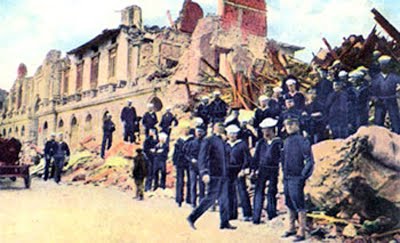
“The Great White Fleet” Comes to the rescue in Italy, 1909.

American ships, sailors and soldiers:
A history of sea power and disaster relief

By Larry Ray / The Rag Blog / February 14, 2010

America’s leading role in emergency assistance following last month’s devastating earthquake in Haiti and the huge numbers of U.S. Navy ships, sailors, and soldiers sent to help has been lauded worldwide.

But there is always one critical jackass who gets it all wrong and tries to take the good guys to task.

The jackass in this case is a well known Italian politician, Guido Bertolaso. He is Italy’s national civil defense director and their special envoy to Haiti. A few days after the Haiti quake Mr. Bertolaso made a quick visit and immediately issued scathing criticism of the effectiveness of the entire relief effort to the international press before his superiors could call him quickly back home.

He particularly singled out the U.S.-led efforts calling them a “pathetic” failure. His blistering remarks included an observation that America, “… when confronted by a situation of chaos, tends to confuse military intervention with what should be an emergency operation, which cannot be entrusted to the armed forces.”

You bet Guido. You seem to know even less about your own country’s history than many politicians your age here in America know about ours. The irony is that you must have missed reading about the big historic commemoration in Italy in 2009 recognizing relief efforts for a terrible Italian earthquake in 1909.

The huge celebration singled out America and its military for our help and generosity in Messina 100 years ago. You know, Messina, Guido, down in Southern Italy? Coverage of the celebration was in all the Italian newspapers.

So, here’s a quick history lesson for everyone about the effectiveness of the American military in earthquakes. I found a scholarly article by Prof. Jeff Matthews, an expat scholar, historian and teacher who has lived with his wife in Naples, Italy for decades. His English language, web based, “Around Naples Encyclopedia,” has a worldwide following.

His latest article, reprinted below, spurred me to report on this historic connection between today’s American military help in Haiti and our much earlier help in Italy.

Mr. Bertolaso’s own government has loudly denounced his wrong-headed criticisms of the USA. Perhaps they can get him to bone up on things like the history below. . . before he heads out again as their international envoy, civil defense expert and spokesperson.

American relief troops in Messina, Italy, 1908.

The Great White Fleet and the Messina earthquake

On July 27, 1909, the New York Times reported that “The first baby born in a new house in Messina was named Theodore Roosevelt Lloyd Belknap Palmieri!” This was Mr. & Mrs. Palmieri’s tribute to those American politicians and diplomats who had organized the relief effort in aid of the city of Messina, Italy, devastated by a powerful earthquake on the morning of December 28, 1908.

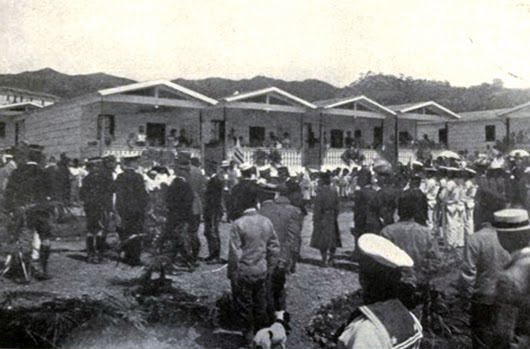
The quake killed about 60,000 people and destroyed much of the city. (Some estimates of the number of dead are as high as 200,000.) In the months following the quake, U.S. aid was considerable and — to explain the “new house” in the above quote — included the building of 1,500 frame houses. The rest of the name: Teddy Roosevelt was U.S. president at the time of the quake; Lloyd C. Griscom was the U.S. ambassador to Italy; and Reginald Rowan Belknap was the US Naval Attaché in Italy. [See American House Building In Messina And Reggio: An Account Of The American Naval And Red Cross Combined Expedition (1910) by Reginald Rowen Belknap, pub. G. P. Putnam’s Sons, New York and London.]

One of 1,500 sturdy wooden frame homes built in Messina with U.S. aid.

The early aid was immediate and direct. It came in the form of ships from the U.S. Great White Fleet, which was circumnavigating the globe and, at the time of the quake, found itself in the “home stretch,” as it were, of a cruise of 43,000 miles — 16 modern warships, employing 15,000 men — in a brash display of young U.S. sea power.

The cruise lasted from December 1907 through February 1909 and was under the command of Admiral Charles S. Sperry. The Great White Fleet went from Hampton Roads, Virgina, around South America and up to San Francisco; then, across the Pacific to Australia, the Philippines and Japan, and then across the Indian Ocean, through the Suez Canal, west across the Mediterranean, through the Straits of Gibraltar and back home across the Atlantic.

The fleet was in Egypt when it received news of the Messina earthquake. The flagship, Connecticut, with support vessels, arrived in Messina on January 9, 1909, with thousands of pounds of food, medicine and temporary shelters for survivors. About 17,000 persons were pulled from the rubble, their lives saved by the heroic efforts of the combined search and rescue crews of the U.S. ships and of vessels of other nations that were near Messina at the time of the quake.

The U.S. ships docked at the port of Naples during operations, and their presence is noted in the January issues of il Mattino, the Naples daily newspaper. The fleet stayed until late January and then left for home. In January, 2009, 100 years after the fact, ceremonies were held in Messina to commemorate the international effort that helped the city through the tragedy. I really do wonder what happened to Theodore Roosevelt Lloyd Belknap Palmieri. I hope he had a fine life.

— Jeff Matthews / Around Naples Encyclopedia

[Retired journalist Larry Ray is a Texas native and former Austin television news anchor. He also posts at The iHandbill.]

The Rag Blog

Posted in Rag Bloggers | Tagged , , , , , | 2 Comments

Marc Estrin: Hearts and Minds : A Valentine’s Day Love Offensive

Israeli school children are shown writing messages on shells meant for targets in Lebanon. The incident took place July 17, 2006, near the northern Israeli border. The messages reportedly included hearts, a star of David, and the words “From Israel with Love.” Photo from AFP.

Hearts and flowers, hearts and minds:
Valentine’s Day love offensive

By Marc Estrin / The Rag Blog / February 14, 2010

Today is February 14th, so let me wish you a happy Firebombing of Dresden Day… whoops, no, I meant to say Valentine’s Day, and I hope you all have sent your sweeties messages that will win over their hearts and minds.

That’s what this lovely young Israeli girl is doing for her Lebanese friends. “From Israel with love,” she is writing. That’s what Gen. Stanley McChrystal is currently doing in Marjah as you read. His 15,000 troops have blocked off all roads so that no messages will get lost, and pre-valentines have been dropped instructing the population not to try leaving.

The idea behind this largest love-offensive in a decade is to win the hearts and minds of the local Afghanis, so that the Taliban can be replaced with democratic leaders sent in from Kabul. Even Hallmark couldn’t match that.

And speaking of Dresden, I’m sure many of you have read Kurt Vonnegut’s masterpiece, Slaughterhouse Five. If not, grab a copy right away. You won’t forget it. It’s a riot.

But even Kurt — who was there — didn’t really understand why all those people were getting burned and suffocated to death. An excellent article backgrounding the affair appeared recently on the Global Research website.

It seems there was almost no military necessity for this enormous operation by February, 1945. Rather, the barbarous wiping out of the population was directed at our allies, the Soviets, to warn them not to get too uppity with their post-war victor claims. The Russkis needed to witness the application of this kind of air-strike by the US and Britain which could just as easily be turned on them.

Six months later, the US alone would put on a similar show at Hiroshima and Nagasaki. The cover story would be the same — we need to do this to end the war — like the massive final blasting at our own fireworks displays. But the real story (victims aside) was to intimidate our Soviet friends with our love-power and solidarity.

Hearts and flowers, hearts and minds. May our beloveds beware.

[Marc Estrin is a writer and activist, living in Burlington, Vermont. His novels, Insect Dreams, The Half Life of Gregor Samsa, The Education of Arnold Hitler, Golem Song, and The Lamentations of Julius Marantz have won critical acclaim. His memoir, Rehearsing With Gods: Photographs and Essays on the Bread & Puppet Theater (with Ron Simon, photographer) won a 2004 theater book of the year award. He is currently working on a novel about the dead Tchaikovsky.]

The Rag Blog

Posted in Rag Bloggers | Tagged , , , , , , | 1 Comment

VERSE / Larry Piltz : You Asked Us To Believe

“Library” by Bernard Zackheim, 1933. Detail from a mural at the Coit Tower in San Francisco. It was part of a series of murals produced under the auspices of the New Deal’s Public Works Art Project. The massive effort stirred up controversy due to the inclusion by some of the 26 participating artists of what were interpreted as leftist images.

You Asked Us To Believe
(Oh Yes You Can)

Fear Wins read the headlines
on the papers on the windows
as the sun rose on the anger
of a nation at the headlines

Where’s the savior who’s in favor
of the humans and the being
and the freeing of the nation
from the bread lines and their danger

There’s a moment in the waiting
in the hoping amid the wondering
when time turns into motion
into the surge of a mighty ocean

Hear me now
you asked us to believe
in something more
than what we thought we could achieve
so we carried you
right through that open door
into the sun
now please don’t make us grieve
that open door
we can do more
you asked us to believe
we can do more
so hear me now
oh yes you can
oh yes we can
we can do more

It’s been an eon in the making
and we’re tired of fear and quaking
when time stops but for its moment
to observe just what will foment
what will you do for the people
you of the people
you by the people
will you mount up
or preach a sermon
when the people
are called vermin
cause they’re hungry
and they’re desperate
will your peace
be one that’s separate

There’s a champion in the headlines
in the bread lines in the life lines
with a deadline and a dateline
but whose dream will be the byline
will Love Wins read the headlines
in the sunshine will it be mine
and the nation’s claim to glory
when history writes its story

So hear us now
you made the world believe
in something more
that it’s dreamt it can achieve
we’ll carry you
push right on through that door
it can be done
so help us celebrate
that open door
we can do more
oh yes you can
oh yes we can
you’ve helped us to believe
we can do more
Oh yes you can
Oh yes we can
right through that open door
we can do more
Oh yes we can

Larry Piltz / The Rag Blog

Indian Cove
Austin, Texas
February 13, 2010

[Note: This poem is a song.
Anyone capable of helping
get it produced and recorded
please speak up in the comments.
Thanks. – L.P.]

The Rag Blog

Posted in Rag Bloggers | Tagged , , , , , | 1 Comment

The Christian Right : Our Founding Fathers Would be Appalled

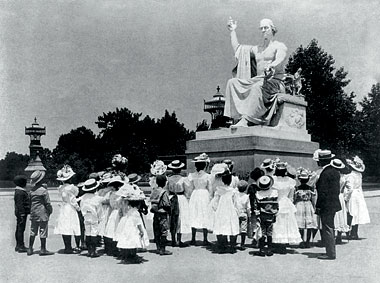
George Washington, the Father of our Country, is memorialized in marble — totally ready to toga — on the U.S. Capitol grounds (circa 1899). The statue is now in the Smithsonian. Photo from the Library of Congress / Boston College Magazine.

Today’s Christian fundamentalists would have
Despised Washington, Franklin, and crew

By Harvey Wasserman / The Rag Blog / February 13, 2010

“God made the idiot for practice, and then He made the school board.” —Mark Twain

Tomorrow’s New York Times Sunday Magazine highlights yet another mob of extremists using the Texas school board to baptize our children’s textbooks.

This endless, ever-angry escalating assault on our Constitution by crusading theocrats could be obliterated with the effective incantation of two names: Benjamin Franklin, and Deganawidah.

But first, let’s do some history:

  1. Actual Founder-Presidents #2 through #6 — John Adams, Thomas Jefferson, James Madison, James Monroe and John Quincy Adams — were all freethinking Deists and Unitarians; what Christian precepts they embraced were moderate, tolerant, and open-minded.
  2. Actual Founder-President #1, George Washington, became an Anglican as required for original military service under the British, and occasionally quoted scripture. But he vehemently opposed any church-state union. In a 1790 letter to the Jews of Truro, he wrote: The “Government of the United States, which gives to bigotry no sanction, to persecution no assistances, requires only that they who live under its protection, should demean themselves as good citizens.” A 1796 treaty he signed says “the government of the United States of America is not, in any sense, founded on the Christian religion.” Washington rarely went to church and by some accounts refused last religious rites.
  3. Washington was also the nation’s leading brewer, and since most Americans drank much beer (water could be lethal in the cities) they regularly trembled before the keg, not the altar. Like Washington, Jefferson, and Madison, virtually all American farmers raised hemp and its variations.
  4. Jefferson produced a personal Bible from which he edited out all reference to the “miraculous” from the life of Jesus, whom he considered both an activist and a mortal.
  5. Tom Paine’s Common Sense sparked the Revolution with nary a mention of Jesus or Christianity. His Deist Creator established the laws of Nature, endowed humans with Free Will, then left.
  6. The Constitution never mentions the words “Christian” or “Jesus” or “Christ.”
  7. Revolutionary America was filled with Christians whose commitment to toleration and diversity was completely adverse to the violent, racist, misogynist, anti-sex theocratic Puritans whose “City on the Hill” meant a totalitarian state. Inspirational preachers like Rhode Island’s Roger Williams and religious groups like the Quakers envisioned a nation built on tolerance and love for all.
  8. The U.S. was founded less on Judeo-Christian beliefs than on the Greco-Roman love for dialog and reason. There are no contemporary portraits of any Founder wearing a crucifix or church garb. But Washington was famously painted half-naked in the buff toga of the Roman Republic, which continues to inspire much of our official architecture.
  9. The great guerrilla fighter (and furniture maker) Ethan Allen was an aggressive atheist; his beliefs were common among the farmers, sailors, and artisans who were the backbone of Revolutionary America.
  10. America’s most influential statesman, thinker, writer, agitator, publisher, citizen-scientist and proud liberal libertine was — and remains — Benjamin Franklin. He was at the heart of the Declaration, Constitution, and Treaty of Paris ending the Revolution. The ultimate Enlightenment icon, Franklin’s Deism embraced a pragmatic love of diversity. As early America’s dominant publisher he, Paine, and Jefferson printed the intellectual soul of the new nation.
  11. Franklin deeply admired the Ho-de-no-sau-nee (Iroquois) Confederacy of what’s now upstate New York. Inspired by the legendary peacemaker Deganawidah, this democratic congress of five tribes had worked “better than the British Parliament” for more than two centuries. It gave us the model for our federal structure and the images of freedom and equality that inspired both the French and American Revolutions.

It’s no accident today’s fundamentalist crusaders and media bloviators (Rev. Limbaugh, St. Beck) seek to purge our children’s texts of all native images except as they are being forceably converted or killed.

Today’s fundamentalists would have DESPISED the actual Founders. Franklin’s joyous, amply reciprocated love of women would evoke their limitless rage. Jefferson’s paternities with his slave mistress Sally Hemings, Paine’s attacks on the priesthood, Hamilton’s bastardly philandering, the grassroots scorn for organized religion — all would draw howls of righteous right-wing rage.

Which may be why theocratic fundamentalists are so desperate to sanitize and fictionalize what’s real about our history.

God forbid our children should know of American Christians who embraced the Sermon on the Mount and renounced the Book of Revelations… or natives who established democracy on American soil long before they saw the first European… or actual Founders who got drunk, high, and laid on their way to writing the Constitution.

Faith-based tyranny is anti-American. So are dishonest textbooks. It’s time to fight them both.

[Harvey Wasserman’s History of the United States is at www.harveywasserman.com, along with Passions of the Potsmoking Patriots by “Thomas Paine.” This article is written in honor of the spirit of Howard Zinn.]

The Rag Blog

Posted in Rag Bloggers | Tagged , , , , , , , , | 5 Comments

Report : Skyrocketing Profits for Big Insurance Companies

Photo by Tanya J. Harding from stock.xchng.

Report: Big insurance companies out of control

The top five insurers made $12 billion in profits last year, while dropping coverage for 2.7 million people.

By Chris Frates / February 12, 2010

With health reform floundering, Democrats have renewed their attacks on the insurance industry and they hope that a new report out yesterday will bolster their case that insurance company practices need to be reigned in. The report finds that the top five largest for-profit insurance companies increased their profits by $12.2 billion last year while dropping coverage for 2.7 million Americans.

As a group, WellPoint, Aetna, UnitedHealth Group, Humana, and Cigna saw their profits jump 56 percent in 2009, up $4.4 billion over the previous year, according to the report. Four out of five companies saw profits increase while insuring fewer people. Cigna increased earnings by 346 percent while UnitedHealth shed 1.7 million beneficiaries. Aetna, which increased its membership and percentage of premiums spent on medical care, was the only company to see less income in 2009 than 2008.

“Increasing your profits, dropping people is a specific corporate strategy,” said Richard Kirsch of Health Care for America Now, the progressive coalition that prepared the report. “What the big health insurance companies do to please Wall Street denies affordable health insurance to millions of Americans, millions more Americans every year.”

The report comes as the Obama administration and House Democratic leadership have seized on Anthem Blue Cross’ decision to raise rates by up to 39 percent in California. Health and Human Services Secretary Kathleen Sebelius wrote a letter to Anthem this week asking them to justify their rate hike and House Energy and Commerce Chairman Henry Waxman announced that his committee will hold a hearing on increases this month.

Robert Zirkelbach, a spokesman for the industry trade group, America’s Health Insurance Plans, said that for every dollar spent on health care, less than a penny goes to health insurers’ profits, which are below other health care industries.

“According to new government data, in 2009 the portion of premiums that went towards administrative costs declined for the second year in a row, while spending on hospitals, physicians, and prescription drugs continued to soar. The real focus needs to be on the increase in the underlying cost of medical care, which is putting health care coverage out of reach for many families and small businesses,” he said.

But Rep. Rosa DeLauro (D-Conn.) isn’t buying that explanation.

“They’re going to try to hide behind the actuaries to tell us the increases are justified, but you have to remember these are the same insurers that for months have been manufacturing reports claiming that health insurance reform will cause them to raise premiums,” she said. “The fact is they can’t have it both ways.”

Source / Politico

Thanks to S.M. Wilhelm / The Rag Blog

Posted in RagBlog | Tagged , , , | 3 Comments

BOOKS / ‘The New Class Society : Goodbye American Dream?’


New Class Society:
Making class analysis relevant

By Harry Targ / The Rag Blog / February 12, 2010

I am using a text by Robert Perrucci and Earl Wysong called New Class Society: Goodbye American Dream? (Rowman and Littlefield, 2008) in a course called “The Politics of Capital and Labor.” The authors review and synthesize a variety of definitions of class from political theory and sociology.

Their answer to the question of what is class draws upon Marxian notions of relations of production, Max Weber’s ideas about persons in various organizational positions, and the more conventional view of class as relating to the distribution of income, wealth, and power.

Using data reflecting their synthetic definition of class, the authors conclude that the portrait of a U.S. class system consisting of a small ruling class, a large “middle class,” and a small percentage of economically and politically marginalized people is no longer an accurate way to describe society. The class system of the days of relative prosperity from the 1940s until the late 1960s, which looked like a diamond with a broad middle, has become like a class system looking like a “double diamond.”

In this new class society, the first diamond, the top one, consists of the “privileged class” composed of a “super-class,” “credentialed class managers,” and “professionals.” All together these representatives of privilege constitute about 20 percent of the population. All the others constitute a “new working class,” some living in relative comfort but most engaged in wage labor, modest self-employment, or part-time work. This is the second diamond representing 80 percent of the population.

Students in my course have been debating some of the formulations but certain elements of the text have been uniformly accepted by them. First, everyone seems to accept the double-diamond metaphor as a way of conceptualizing the distribution of wealth, income, and power.

Those in the top diamond representing privilege are relatively assured that their sources of income and wealth are permanent. Their sustenance and family stability are assured while the other 80 percent, the model suggests, live economically marginal existences and in conditions of precariousness.

My students raise no objections about what Perrucci and Wysong regard as broadly accepted features of this new class system.

First, since the 1970s, there has been increasing class polarization. Gaps in distributions of wealth and income have grown. Real wages of workers have stagnated since the 1970s. In addition, workplace benefits have declined, including pensions. Permanent jobs have been replaced by contingent labor. The percentage of unionization of the work force has declined by two-thirds.

The authors cite a recent study that estimates that only one-fourth of jobs today are “good jobs,” paying at least $16 an hour. And, on the other hand, the share of income and wealth accumulated by the top one percent or 10 percent or 20 percent, the entire privileged class, has risen. The rich have gotten richer while the poor poorer.

Second, since the 1980s, workers and their families have experienced downward mobility, that is their social and economic position has declined. This has occurred because stable, well paying jobs have disappeared due to outsourcing, capital flight, and deindustrialization. By any number of measures, the “American Dream” of helping one’s children to move up the status ladder has been reversed.

Third, the increasing accumulation of wealth and power through tax cuts, deregulation of financialization, and declining government support for public services have encouraged the privileged to embark on class secession.

Increasingly, the authors suggest, the privileged class withdraws its support for public institutions as it funds its own private schools, libraries, recreational facilities, and additional social services. The rich build gated communities, electrify their fences, hire private guards to protect themselves, and create private institutions to replace public ones.

The authors refer to Robert Reich’s “secession of the successful” which they say “combines traditional forms of physical and social separation and increasing numbers of privately provided services with the ideology of neoliberalism, an idea system of free market fundamentalism that encourages and legitimates hostility to public institutions.” They conclude that “class secession today involves both a separatist social identity and a conscious secessionistic mentality.”

The findings reported in The New Class Society about class in America are profound. Long-term trends in the United States since the 1970s have led to growing wealth and power at one pole and increasing immiseration at the other pole. The idea of a broad middle class is further away from reality than ever.

For the vast majority of Americans economic security is declining. And, most important, the privileged class, which has built its wealth and power on the growing immiseration of the new working class, is physically, financially, and ideologically seceding from the system that historically claimed to provide at least some institutional support for enrichment of the citizenry at large.

The authors also present data to show how the brutality of the new class society particularly impacts on people of color, women, immigrants, and other traditionally marginalized people.

While the task of my course is to study the underlying fundamental features of American society, particularly those bearing on political economy, the implications of this analysis for practical political work seem obvious.

First, progressives need to “make class analysis relevant to our organizing.” This includes educating ourselves and those we work with about the ways in which society is divided into classes based upon how people are related to the workplace, the status and power of workers in different organizational positions, the distribution of wealth and income in society and the history of class in America.

Our educational work must show how class relates to race, gender and the environment. In the end we must construct a compelling vision for the abolition of our class divided society.

Second, progressives must articulate in every political setting those experiences of class that vast majorities of the people share.

Years ago Harry Braverman, in Labor and Monopoly Capital demonstrated that work was being transformed by the capitalist system; that patterns of control of the minds and actions of workers were being increasingly controlled by a deepening division of labor, and that the work process, whether white collar or blue collar, service or manufacturing, was being homogenized. He and others called this process of work transformation, “proletarianization.”

This historic development argues for a political strategy that prioritizes education about the growing commonality of work experience of those in the bottom 80 percent of the work force.

Third, progressives must articulate programs of education and action that seek to deepen understanding of barriers to solidarity resulting from race, gender, and even political ideology. Progressives must be more mindful of the different experiences of class in America, such as the historic role of slavery and immigrant labor, super-exploitation of African Americans and women, and ethnic discrimination.

The articulation of the different experiences of class through race and gender should be used to broaden understanding of how those differences were used to increase class exploitation of all those in the majority.

Fourth, progressives should began to analyze the ways in which many of the new right wing “tea party” activists share a common experience of class. Education and advocacy must more clearly be based upon an understanding of the common interests privileged class Republicans and Democrats share and the reality of interests shared by the new working class majority.

In the end there is no substitute for building what activists used to call “class consciousness.” The realities of class exploitation, as Perrucci and Wysong suggest, seem more obvious than ever. They just need to become a central element of our political discourse.

[Harry Tarq is a professor in American Studies who lives in West Lafayette, Indiana. He blogs at Diary of a Heartland Radical.]

The Rag Blog

Posted in Rag Bloggers | Tagged , , , , , , , | 5 Comments

Texas State University : Escalate the Peace!

Bobby Whittenberg, Iraq Vet, at Escalate the Peace! rally, Texas State University in San Marcos, Wednesday, February 10. Photo by Alice Embree / The Rag Blog.

Escalate the Peace!
San Marcos demonstrators rally in the sleet

By Alice Embree / The Rag Blog / February 12, 2010

Neither sleet nor drizzle deterred a scheduled antiwar rally on the Texas State University (TSU) Campus in San Marcos on Wednesday, February 10. In the courtyard of the LBJ Amphitheatre, speakers used bullhorns to talk about Iraq, Afghanistan, Yemen, and Palestine under a banner that read, “Escalate the Peace!”

The rally was organized by two TSU student organizations, the Campus Antiwar Movement to End the Occupations (CAMEO) and the Progressive Bobcats Union (PBU).

Speakers included Rev. Jim Rigby from St. Andrew’s Presbyterian Church in Austin and Bobby Whittenberg, an antiwar activist who was deployed to Iraq as a Marine. Courtney Glenn, one of the rally organizers, read a poem about returning soldiers. Caitlin Eaves spoke about Yemen. Liz Welch read a passage from Howard Zinn about why we should never lose hope.

I spoke about the Vietnam-era antiwar movement and about the current GI coffeehouse, Under the Hood Café, in Killeen, Texas. These lines from Courtney Glenn’s poem stayed with me:

We are the disorder
with our mislabeled freedom,
our cannon songs,
our flags of blood.

You are the fodder
for rhetoric
and I will exchange
gratitude for
apology

Today’s antiwar movement is often compared with the Vietnam era. But, the comparison usually conjures up 1968 images. On Wednesday, I watched the sleet bounce off the coat of a speaker and remembered what it felt like in 1964 to be among 20 students demanding a negotiated peace in Vietnam.

I was proud to be there with this small and dedicated group, protesting the wars that seem to morph without end, proud that women were speakers and organizers in ways that were uncommon in 1964, proud to see the familiar faces of veterans I know from the Killeen coffeehouse.

In the words of Margaret Mead, “Never doubt that a small group of thoughtful, committed, citizens can change the world. Indeed, it is the only thing that ever has.”

The Rag Blog

Posted in Rag Bloggers | Tagged , , , , , | 2 Comments

Sarah Palin : Popularity Dropping Like a Rock


She may still be a good story
But Palin’s poll numbers keep going south

By Ted McLaughlin / The Rag Blog / February 12, 2010

The teabaggers, Republican right-wingers, political pundits, and media talking heads seemed determined to keep Sarah Palin relevant, and an important figure on the American political scene. For the media talking heads, she is a good story since few people are noncommittal about Palin — you either like her or hate her.

Three TV networks even carried her speech to the sham teabagger convention a few days ago (although I doubt that many Americans watched). The media seems to think that Palin actually makes politics interesting, and they don’t want her to go away because then they would be reduced to covering only boring real politicians — whom the American public really won’t take much interest in for another couple of years.

The political pundits basically have the same interest as the media talking heads. They know a column about Palin will get readers — even those who hate her will read the column. Whereas, a column about Mitt Romney or some other semi-competent politician will not get nearly the readership. Therefore, they go out of their way to try and convince readers that Palin is popular and actually has a chance to be elected to something again.

As for the teabaggers and right-wing Republicans, they are just trying to remain relevant themselves. They have to appeal to the Palin-bots, because they make up a large part of the base for both groups and without them they would wither into insignificance. The teabaggers have little connection to reality, but I think most Republicans know Palin is not a real possibility as a candidate — they just can’t say that out loud without angering a large part of their base.

But regardless of how hard the teabaggers, Republicans, pundits and media personalities try to keep Palin relevant to the national political scene, the American people aren’t buying it. With each month that goes by, fewer people have a favorable opinion of Sarah Palin. As the chart above shows, Palin’s popularity is dropping like a rock(and has been dropping since September of 2008).

According to Washington Post/ABC News polls, back in September 2008 Palin had a favorability rating of nearly 60%. At that time, she was new on the national political scene and the public knew very little about her. But as the public learned more, her favorability rating has dropped in every poll taken since then.

According to the latest Washington Post/ABC News poll, taken after her nationally televised speech, her popularity is still declining. Currently, 37% of Americans view her favorably (the lowest of any poll so far) and 55% of Americans view her unfavorably (a clear majority, even considering the 3% margin of error).

But it gets even worse for Palin. That’s because about 30% of those who view her favorably don’t think she is qualified to be president. Only 26% of Americans believe she is qualified, while a full 71% say she is not qualified. These numbers are also going in the wrong direction for Palin (back in November 2009 38% said she was qualified and 60% said she wasn’t).

The powers that be may still be touting the viability of a Palin candidacy, but the American people are simply not buying it.

[Rag Blog contributor Ted McLaughlin also posts at jobsanger.]

The Rag Blog

Posted in Rag Bloggers | Tagged , , , | 6 Comments

Marc Estrin : Happy Birthday, Bertolt Brecht

Bertolt Brecht, 1948. Photo from Deutsches Bundesarchiv / Wikimedia Commons.

Of Poor B.B.:
Bertolt Brecht speaks from the grave

By Marc Estrin / The Rag Blog / February 11, 2010

[German playwright, poet, and theatrical director Bertolt Brecht was born on February 10, 1898, and died August 14, 1956.]

Bertolt Brecht lies in his grave. The alarm goes off and off. Time to get up again. Evil-doing comes like falling rain. Get up. We need you.

In the grey light before morning the pine trees piss
And their vermin, the birds, raise their twitter and cheep.
At that hour in the city I drain my glass, then throw
My cigar butt away and worriedly go to sleep.

No, up. Not sleep. Get up. It’s time. Fifteen days the rain is falling. The birds have stopped their cheeping. Cheep, BB, cheep at least. Twitter. Piss. Someone will hear. Someone will understand. Here’s my crust of bread. Eat, BB, eat, then speak. Get up and speak.

Like one whose blood flows from a wound and who awaits the doctor: his blood goes on flowing. So do we come forward and report that evil has been done.

Yes! Good. Come forward. Report. Report on the good times that starve the millions and poison the world.

The first time it was reported that our friends were being butchered there was a cry of horror. Then a hundred were butchered. But when a thousand were butchered and there was no end to the butchery, a blanket of silence spread. When evil-doing comes like falling rain, nobody calls out ‘stop!’

Stop! (My voice is small.) Stop!

When crimes begin to pile up they become invisible. When sufferings become unendurable the cries are no longer heard. The cries, too, fall like rain in summer.

And rain also in winter. And the tree limbs snap, and the wires break, and people huddle under what blankets they have, and the circus band blares out its tunes, and some there cackle and others smirk. I am discouraged, BB. What will become of us?

Of those cities will remain what passed through them, the wind!

And then? When it all comes crashing to the ground, what then? What shall we do?

— Remember:
Hatred, even of baseness
Contorts the features.
Anger, even against injustice
Makes the voice hoarse. Even we,
Who wanted to prepare the ground for friendliness
Could not ourselves be friendly.

Bertolt Brecht wrote poems and essays and plays. He spoke up for the poor. He said, “First, people have to be able to feed their faces — then they can think about morality.” He was number one on Hitler’s hit list. We need his voice today.

Here — from the grave — is what he says:

Nowadays, anyone who wishes to combat lies and ignorance and to write the truth must overcome at least five difficulties. He must have the COURAGE to write the truth when truth is everywhere opposed; the KEENNESS to recognize it, although it is everywhere concealed; the SKILL to manipulate it as a weapon; the JUDGMENT to select those in whose hands it will be effective; and the CUNNING to spread the truth among such persons.” – Bertolt Brecht, Five Difficulties in Writing the Truth

[Marc Estrin is a writer and activist, living in Burlington, Vermont. His novels, Insect Dreams, The Half Life of Gregor Samsa, The Education of Arnold Hitler, Golem Song, and The Lamentations of Julius Marantz have won critical acclaim. His memoir, Rehearsing With Gods: Photographs and Essays on the Bread & Puppet Theater (with Ron Simon, photographer) won a 2004 theater book of the year award. He is currently working on a novel about the dead Tchaikovsky.]

The Rag Blog

Posted in Rag Bloggers | Tagged , , , , , , , | 3 Comments

Harvey Wasserman : Vermont’s Radioactive Nightmare

Image from This Week in Nuclear.

Radioactive fallout:
Vermont Yankee one of 27 U.S. reactors
Known to leak carcinogenic tritium

By Harvey Wasserman / The Rag Blog / February 11, 2010

Like a decayed flotilla of rickety steamers, at least 27 of America’s 104 aging atomic reactors are known to be leaking radioactive tritium, which is linked to cancer if inhaled or ingested through the throat or skin.

The fallout has been fiercest at Vermont Yankee, where a flood of cover-ups has infuriated and terrified near neighbors who say the reactor was never meant to operate more than 30 years, and must now shut.

In 2007 one of Yankee’s 22 cooling towers simply collapsed due to rot.

Now the Nuclear Regulatory Commission has confirmed tritium levels in a monitoring well at Vernon to be 3.5 times the federal safety standard. The leaks apparently came from underground pipes whose very existence was recently denied by VY officials in under-oath testimony at a public hearing. Vermont’s pro-nuclear Republican Governor Jim Douglas has termed the event “a breach of trust that cannot be tolerated.”

Yankee is owned by Entergy, a Mississippi-based consortium that also owns New York’s Indian Point reactor, which suffered an internal gusher of radioactive water in May, 2009. Another leak has just been found at Oconee in South Carolina. Illinois’ Braidwood leaked so many millions of gallons of tritium-laced water that its owner, Exelon, was forced to buy a new municipal water system for a nearby town.

Entergy says none of Yankee’s tritium has been found in local drinking water or in the Connecticut River, which supplies the plant’s cooling water. Vernon sits near Vermont’s southeast border with Massachusetts, across the river from New Hampshire. “The existence of tritium in such low levels does not present a risk to public health or safety whatsoever,” says the company’s Robert Williams.

But VY is just the latest of more than two dozen U.S. nuclear plants — many built in the 1960s and ’70s — to be found with leaking tritium.

Last year at New Jersey’s Oyster Creek, tritium was reported leaking a second time shortly after Exelon got it a 20-year license extension. Entergy’s Pilgrim reactor, at Plymouth, Massachusetts, has recently leaked tritium into the ground.

The NRC’s Neil Sheehan has confirmed leaks involving 27 of 104 licensed U.S. reactors, and says that probably doesn’t account for all of them. At Yankee, Oyster Creek and elsewhere, rotting pipes are the likeliest culprit, but no one is 100% certain.

The epidemic has escalated public dismay. Vermont state Representative Tony Klein, chair of House Natural Resources and Energy Committee, says that “when you have public officials that the public depends on for their health and welfare making casual statements that a radioactive substance is not harmful to you, I think that’s ludicrous.”

For decades the Encylopedia Britannica, National Academy of Sciences and other primary scientific bodies have confirmed that no dose of radiation, no matter how small, can ever be deemed perfectly safe. “There is no threshold of exposure below which low levels of ionizing radiation can be demonstrated to be harmless or beneficial,” says Richard R. Monson, associate dean for professional education and professor of epidemiology at the Harvard School of Public Health.

Thus far the NRC has granted a series of license renewals to aging reactors. But by virtue of a long-standing agreement with Entergy, the Vermont Legislature can deny Yankee’s request for a 20-year extension. In the 1990s local groups like the Citizen’s Awareness Network helped force down the Yankee Rowe plant on the Deerfield River in Massachusetts, about 25 miles southwest of Vernon. The root cause was concern over embrittlement of the elderly reactor’s core, a key to the future of all other aging nukes.

In Vermont, angry debate has also arisen over Entergy’s dwindling decommissioning fund, which has been slashed by a declining stock market. Entergy has proposed spinning off plant ownership to a shell corporation whose assets may be even more dubious. But area residents also fear Entergy may be pushing Yankee operations in an attempt to find the source of its leaks.

With VY operating under duress, Katz and others report an increasing wave of concern among local citizens starting to think seriously about how they might evacuate if Entergy keeps pushing. “This plant appears to be leaking from its reactor piping, but they don’t really know where,” she says. “They don’t want to shut down because they’re afraid they’ll never get back up. Entergy is choosing to protect its bottom line rather than the health and safety of our community.”

Indeed, a desperate national industry now pushing for massive federal subsidies to build new reactors may not survive a flood of elderly clunkers being forced to close by the weight of their own contamination. “This is an industry trying to build a new fleet of Titanics while the old ones are sinking,” says Katz.

Amidst the gusher of tritium leaks, Governor Douglas wants to postpone the legislature’s vote on VY’s license extension. But his term expires in November, and all five Democratic gubernatorial candidates are pledged to a Yankee shutdown.

What happens next will be defined by fierce grassroots activism crashing into a flood of corporate money in support of a rickety old reactor being operated with increasing recklessness.

The highly hyped “reactor renaissance” — and much more — may hang in the balance. Stay tuned.

[Harvey Wasserman is Senior Advisor to Greenpeace USA and the Nuclear Information and Resource Service, and Senior Editor of www.freepress.org, where this article also appears. His Solartopia! Our Green-Powered Earth is at www.harveywasserman.com.]

The Rag Blog

Posted in Rag Bloggers | Tagged , , , , , | 1 Comment

Sgt. Travis Bishop : Ft. Hood War Resister to Get Out Early

War resister Sgt. Travis Bishop flashes peace sign to supporters as he is taken to the Bell County (Texas) Correctional Unit after being sentenced to one year in prison at court martial on August 14, 2009. Photo by Eric Thompson.

Afghanistan War refuser:
Ft. Hood’s Travis Bishop gets reduced sentence

By Alice Embree / The Rag Blog / February 10, 2010

Sgt. Travis Bishop has learned that the 12-month sentence he is serving at Fort Lewis will be reduced by three months. Sgt. Bishop was sentenced at Fort Hood near Killeen, Texas, in August 2009 for refusing orders to deploy to Afghanistan.

Sgt. Bishop, a Kentucky native and country singer, enlisted in 2004. He was deployed to Korea and then to Iraq. He had served five years of active duty when he refused orders based on religious reasons.

One of the people testifying against Bishop at his court martial was the chaplain he had hoped would listen to his concerns. Instead, Lt. Col. Ronald Leininger had reduced the amount of time scheduled for their original interview and then repeatedly took phone calls during the session. In his official statement, the chaplain said that people with Bishop’s religious heritage were “generally pro-military service with no pacifist tendencies in doctrine or practice.”

Lt. General Robert Cone, commanding general of Fort Hood approved the sentence reduction on February 4, after considering Sgt. Bishop’s clemency application. The clemency request included a legal brief alleging problems in the processing of Bishop’s conscientious objector claim, problems with the trial proceedings, and mistreatment at Fort Lewis where Sgt. Bishop has been detained.

In large part, the reduction in sentence is due to the dogged perseverance of GI rights attorney James Branum, and the public pressure that was brought to bear. Sgt. Bishop’s clemency request included 433 letters (signed by a total of 538 people from 21 different countries). Many came from pastors who disagreed with the military chaplain’s view on their churchs’ support for conscientious objection.

Through his attorney, Sgt. Bishop relayed his thanks to all his supporters. He said he had no regrets and urged others who are feeling moral conflicts with war to follow their conscience, but not to wait as long as he did to get help.

Attorney James Branum released the news of Sgt. Bishop’s early release and ackowledged many supporters, including the GI coffeehouses, Under the Hood in Killeen and Coffee Strong near Fort Lewis in Washington, Amnesty International’s London office and Courage to Resist. Sgt. Bishop’s release is expected to be no later than March 31, based on the amount of good behavior credit he has earned.

Supporters of Sgt. Bishop can find instructions on writing him at www.couragetoresist.org.

Also on The Rag Blog:

The Rag Blog

Posted in Rag Bloggers | Tagged , , , , , , , , | Leave a comment

FILM / David McReynolds : ‘Never Cry Wolf’


Profoundly mystic:
Carroll Bellard’s Never Cry Wolf

By David McReynolds / The Rag Blog / February 10, 2010

We each have our own habits, and one of mine is tracking down films that had been well received in their time, but which I had missed — for which purpose Netflix is a great resource. I recently got a copy of Never Cry Wolf, made in 1983. (Somewhat ironically, since it is neither animated, nor a “family film,” it was a Walt Disney Production.)

The film is an adaptation of Farley Mowat’s autobiography. Directed by Carroll Ballard, it stars Charles Martin Smith, Brian Dennehy, and Zachary Ittimangnaq. The music, haunting enough to merit special mention, is by Mark Isham, and the cinematography is by Hiro Narita. Narita’s work is magical, his effects achieved without computers, the closeups of wolves — and their interaction with Smith — so remarkable as to be nearly incredible.

The premise of the film is that the Arctic caribou are dying off as a result of being preyed on by wolves. A young government biologist, Tyler (Charles Martin Smith), is sent to the Arctic wilderness of Northern Canada to gather proof than the savage wolves are the reason the caribou herds are dying. Tyler is flown there, to a totally isolated area, and begins his study. He is a survival expert — and indeed, he needs to be, in this situation!

What the young biologist quickly learns is that the wolves are not renegade killers, but smart, courageous, very caring of their families. In the course of the film (just short of two hours) we meet an Inuit family and realize that, like the caribou, they are at risk from contact with “civilization” (represented here by Brian Dennehy).

When the film ended I realized I was weeping. Why, I’m not sure. There was no moment of tragedy. The young biologist survives. (But it is left open as to whether he returns or remains in the wilderness.)

Smith devoted nearly three years to Never Cry Wolf and said he found the process difficult, that “during much of the two-year shooting schedule in Canada’s Yukon and in Nome, Alaska, I was the only actor present. It was the loneliest film I’ve ever worked on.”

Perhaps what affected me was the encounter with the vast, empty, yet vitally alive landscape of the Arctic.

An American composer, John Luther Adams — who had moved toward his own form of contemporary music after discovering the works of Edgar Varese, John Cage, Morton Feldman, and Harry Partch — eventually left a Southern California he found overdeveloped and moved to Alaska, which since 1978 has been his home (his work received a respectful review in the New Yorker). His music (and I’m listening to a CD of his, In the White Silence) reflects his adopted landscape.

As my email friend, Hunter Gray, will understand, better I think than most, what seems empty is full, what seems silent has a sound many have lost the ability to hear.

I found, in the 24 hours after mentioning Never Cry Wolf to a few friends, that they had seen it, and had much the same reaction I had. A strange film. Very real, and like so much that is very real, profoundly mystic.

[David McReynolds worked on the staff of the War Resisters League for 39 years, retired in 1999, and lives with two cats on Manhattan’s Lower East Side. He has been active in the socialist movement, being the Socialist Party’s candidate for President in 1980 and 2000.]

  • Rent Never Cry Wolf at Netflix.
  • Find Never Cry Wolf on DVD at Amazon.com.
  • Find Never Cry Wolf : Amazing True Story of Life Among Arctic Wolves by Farley Mowat at Amazon.com.

The Rag Blog

Posted in Rag Bloggers | Tagged , , , , , , | Leave a comment