Paul Krassner : In Praise of Indecency

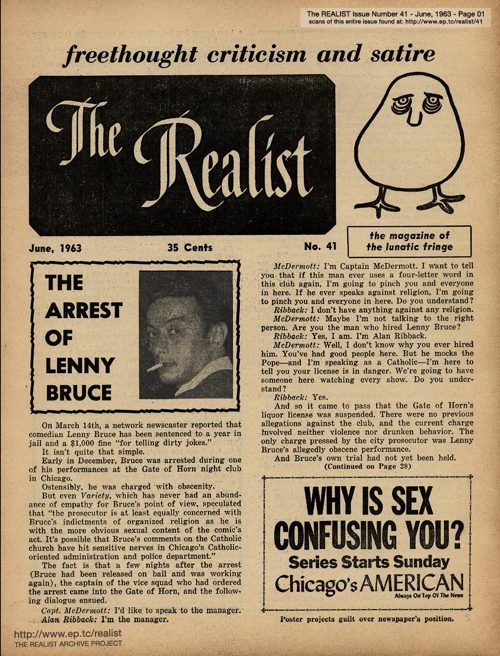
Paul Krassner depicted in Oui Magazine advertisement for an upcoming October 1975 interview. Graffiti includes references to the Realist mascot, Lenny Bruce, and Jerry Rubin. Image from the Realist Archive Project.

In praise of indecency:
Paul Krassner is our ‘Satirist-Laureate’

By Harvey Wasserman / The Rag Blog / November 24, 2009

It’s time our national government at last enshrines its most critical artistic need, that of “Satirist-Laureate.” The first nod must go to the man who has pioneered the idiom in modern America — Paul Krassner.

Since the days of Lenny Bruce, Krassner (a good friend, but no relation) has been poking brilliant fun at every sacred horse’s ass in American politics and culture.

He also remains our cutting edge critic on censorship and its pornographic twin. His two recent books slash to the core of the utter hypocrisy of the government sticking its nose in what we read and write, think and smoke.

Krassner is the godfather of The Realist, the longest running periodical purely devoted to pushing the limits of what may and may not be rendered into print in this country. His infamously horrific description of what Lyndon Johnson may or may not have done to John F. Kennedy’s corpse remains the unsurpassed definition of bad taste and over-the-top satire. The fact that there are still those who believe it to be a true literal description of what actually transpired remains the ultimate monument to both credulity and the lingering effects of illicit psychotropics.

The Realist’s publication of the now-iconic Wallace Wood centerfold portraying our previously iconic Disney characters engaged in various obscene acts also crossed the line between legend and libel. Don’t these characters have lawyers?

When he folded The Realist a few years ago, Paul exhibited a typically Oprahtic (no relation) sense of good timing, quitting while he was well ahead to concentrate on books and performance art. Paul’s autobiography, soon to be reissued for Kindle, reminds us that he coined the term “Yippie!” to describe the thousands of young cultural and political radicals who would descend on Chicago for the 1968 Democratic Convention. In the ensuing conspiracy trial, he was the only witness (that we know of) who testified while under the influence of LSD.

The Realist, Issue Number 41, June 1963.

Krassner’s true genius has been to remain current, relevant and cutting. In his various CDs (“The Zen Bastard Rides Again,” etc.), especially good for playing while driving long distances, he is laugh-out-loud funny. Paul’s friendly, low-key delivery style belie an inner mensch SCREAMING at official uptightness.

His more recent In Praise of Indecency and Who’s to Say What’s Obscene? are packed with insane anecdotes, including the devastating tale of the totalitarian censorship that destroyed Lenny Bruce. Those would be gut-wrenchingly funny if they weren’t so tragic in their outcome. Today, of course — except for his extraordinary brilliance — what Bruce said and how he said it would be considered mild in your average nightclub.

But after all these years nobody beats Paul’s unerring instinct for irony and the absurd. Krassner’s beat goes from cops fighting each other to cover the sex censorship beat, to drug laws that uniformly imprison the innocent to gays in Congress oppressing gays who aren’t. When speaking in public he will “flap his wings.” If he doesn’t fly, he knows he’s not dreaming.

When you read Paul’s books, crazy as they seem to be, you need to recall your inner Yogi Berra, who reminds you it’s all true because “you can’t make this stuff up.”

Paul Krassner put the “class” in iconoclast, the “mensch” in the unmentionable. Read Paul’s stuff as soon as you can, while there’s still time to laugh.

[Harvey Wasserman’s History of the U.S. is also true, and appears at www.harveywasserman.com with “Thomas Paine’s” Passions of the Potsmoking Patriots, which may or may not be.]

The Rag Blog

Posted in Rag Bloggers | Tagged , , , , , , , , , | 1 Comment

Ted McLaughlin : The Backpacks of Moberly


A quiet way of helping:
The backpacks of Moberly, Missouri

…we began to realize that some of these children go home to houses where they literally may not eat over the weekend. And we couldn’t just sit back and not do anything to help them.

By Ted McLaughlin / The Rag Blog / November 23, 2009

“Every Friday afternoon, the backpacks are placed carefully on the floors of the hallways in the elementary schools of Moberly, Missouri. There are 106 of them: 106 backpacks, each of them with no child’s name and with no individual owner.”

Those are the opening words in a heart-rending story by CNN contributor Bob Greene that I recommend you read. It is a story about the harshness and unfairness of life, but it is also a story that will restore your faith in humanity.

What’s so special about those backpacks? Not much. It is what’s in them and the fact that they are placed there every Friday that makes them special.

Here’s how Francine Nichols, the staff member in charge of the backpack program, tells it, “We serve breakfast at school, and we serve lunch. But we began to realize that some of these children go home to houses where they literally may not eat over the weekend. And we couldn’t just sit back and not do anything to help them.”

So the teachers and administrators of the Moberly elementary schools started the backpack program. When a staff member learns of a student in need, they contact the parent(s), and if they will allow it, the child is added to the backpack program and is told privately that a backpack will be waiting for him/her in the hallway on Friday. Most of the food is supplied by a food bank 30 miles from Moberly.

The idea is that the child can grab a backpack, sling it over his/her shoulder and walk out with the other kids. No one says or does anything that would single out the child — there is no profit to humiliating a child in need. They just pick up the backpack and go.

Ms. Nichols says, “We’ll fill each backpack with soup, with ravioli in a can, with canned fruit, with cereal bars, with juice. We make sure that the food is the kind that a young child can prepare himself or herself, if need be. Because some of these children live in single-parent homes, and when that parent works, not only does it mean that there might not be enough food in the house, but there may not be anyone to fix the meal for the boy or girl.”

And for those of you who may be thinking the recession is getting better, the backpacks tell a different story. Last year there were 34 backpacks set out in the hall. This year there are 106 of them.

Moberly is not the only school district to try and help kids on weekends away from school. But I especially like the way Moberly does their backpack program. They go out of their way to try not to humiliate the child in need — these children face enough hardship without having to endure that.

Too often today we forget just who the poor are. The fact is that most are just decent people who are going through a tough time and trying their best to struggle through and put their lives back together. For most, the struggle is temporary and help is needed for only a finite period of time.

In our distant past, neighbors could help out by discreetly providing what was needed, and a friendly storekeeper would give and carry credit for a longer period than normal without demanding immediate payment, or a community church would help with food or rent without bragging or demanding religious devotion. But those times are gone forever.

Today, most people don’t even know their neighbors (let alone want to help them), and credit is something given only to those who really don’t need it by banks and businesses that charge exorbitant interest rates. Even churches that offer help often want to do it publicly so as to get maximum publicity for their “good deeds,” or they demand a certain fealty to their religious beliefs.

Although many right-wingers don’t want to admit it, it has become necessary today for the government to assume responsibility for helping the poor. This is right and proper, because here in America we are the government. And it is the responsibility of every citizen to help those less fortunate than ourselves.

There are still those who believe the help must come from private sources and not the government, but in our modern world that is simply not possible. Government has had to assume the responsibility because the private entities are either no longer there or have utterly failed to get the job done.

Sadly, even “we the people,” acting through our government, have not done a very good job. Although some programs like Food Stamps and Aid To Families With Dependent Children have been passed, the grinches in government have made sure those in need must humiliate themselves and dance publicly through hoop after hoop to meet the most onerous of conditions — just to receive too little help, insuring that many remain in a circle of poverty.

We could and should do much better, but we seem to prefer spending our money on wars and war materials, corporate welfare and bailouts, foreign aid which allows dictators to amass fortunes and other such nonsense.

That is why I was so impressed by the unobtrusive little backpacks of Moberly. By people wanting to help without fanfare and without humiliating those in need. Well done. We could all learn from your example.

[Rag Blog contributor Ted McLaughlin also posts at jobsanger.]

The Rag Blog

Posted in Rag Bloggers | Tagged , , | 2 Comments

Honduras : The ‘Election’ and the Resistencia

Above,“Golpistas: Here Is Your Vote.” Rebelión poster. Demonstration against electoral campaign, Intibucá. Photo from Indymedia Honduras.

Micheletti prepares for election;
Moves against boycott, resistance

By David Holmes Morris / The Rag Blog / November 23, 2009

With a nod of approval from the U.S. State Department, the de facto president of Honduras, Roberto Micheletti, has announced he will take a leave of absence from office beginning on November 25 and will return on December 2, the day the country’s legislature is scheduled to convene to decide whether Manuel Zelaya should be reinstated to the presidency.

State Department spokesman Robert Wood said at a press briefing on November 20 that Micheletti’s leave will “allow some breathing space for the process in Honduras to go forward” and will “allow for the people of Honduras to focus on the elections,” to be held on Sunday, November 29.

“Micheletti hasn’t resigned,” Zelaya declared. “This is a crude maneuver, a blunder of his that stains the electoral process, that stains Honduran democracy.” And Patricia Rodas, foreign minister in the Zelaya government, warned that the golpista regime may be planning covertly to incite disorder in the country during his absence so that Micheletti can return to office early in order to make a show of restoring order, thus saving the country from the violence of anti-coup forces.

“If there should be some general disturbance of order and security that threatens the peace of the nation and the security of the Honduran people,” Micheletti declared when he announced his leave, “let there be no doubt… that I will resume my duties immediately and will order vigorously and firmly whatever measures are necessary to guarantee order.”

In the meantime, resistance to the golpista government and rejection of the elections inside Honduras and elsewhere continue unabated. As announced by the Frente de Resistencia contra el Golpe de Estado, the umbrella organization opposing the coup government, demonstrators have hindered candidates from holding campaign rallies, especially in poor and working class areas, where opposition to the coup is strongest. In particular, in the towns of La Esperanza and Intibucá, in a mountainous area of western Honduras, anti-coup residents recently prevented altogether a rally for Partido Liberal presidential candidate Elvin Santos.

The golpista government has threatened proponents of a boycott of the elections with severe reprisals. Micheletti has said anyone advocating publically for abstention will be prosecuted and that “those who create or advocate or attempt to advocate disturbances at the polling places will be dealt with seriously and severely in accordance with the law.”

Micheletti has also attempted to silence Zelaya. “Instead of inciting violence and threatening the electoral process and its results,” he warned publicly, “I urge don José Manuel Zelaya Rosales to reflect as a Honduran and I invite him to observe a prudent silence between now and December 2, during the electoral process and the vote in Congress.”

A number of candidates for local offices, including many aligned with the Partido Liberal, the party of both Manuel Zelaya and Roberto Micheletti, have withdrawn from the race in protest of the coup. The leftist Partido Unificación Democrática, which has opposed the coup consistently, nevertheless decided recently not to withdraw from the race as a party, although a number of individual candidates have done so.

Honduran human rights groups report that employers are threatening to fire workers who do not vote.

In anticipation of the elections, the government has reportedly added 5,500 army reservists to the 12,000 military personnel and 14,000 members of the national police already patrolling the streets and has increased its public displays of military force, particularly in those residential areas where opposition to the coup government is strongest.

The government has instructed hospitals to prepare for an increase in patients in the next few days by emptying the wards of patients who can be discharged safely and by postponing elective surgeries.

According to La Jornada of Mexico City, the Honduran armed forces have been instructing mayors throughout the country to report leaders of the resistance living in their towns.

Outside Honduras, the United States and Panama appear to be the only countries willing to recognize the elections as legitimate, with suggestions that the U.S. will send election observers now that Micheletti has announced his leave of absence. On the continent, in addition to the Organization of American States, Brazil, Argentina, Venezuela, Bolivia, Nicaragua, Guatemala, and Ecuador have all denounced the elections as illegitimate.

The Rag Blog

Posted in Rag Bloggers | Tagged , , , | 2 Comments

The REAL Death Panel : Congress Gutting Reform

Photo by Mike Albans / AP.

The real death panel:
A requiem for true health care reform?

By Dr. Stephen R. Keister / The Rag Blog / November 22, 2009

It was ten years ago that I lost my wife who was my buddy and companion. The Lady succumbed to a particularly virulent type of malignancy after a year of intensive treatment which she had hoped would give her a few more years.

Happily, at the end we were blessed with excellent, compassionate hospice care (Sarah Palen’s “death squad”) which allowed her to be free of unneeded machines, and permitted her to spend her last days in peace surrounded by her family and attended by dedicated hospice personnel.

The final night I had gone home for a few hours sleep and my always attentive daughter-in-law was with her mother. At 2 a.m. I received the call and was making my way back to the hospital when I turned on the car radio and was greeted with – how appropriate — Mozart’s “Requiem.”

The “Requiem” once again seems appropriate as I watch the demise of any meaningful health care legislation at the hands of our elected representatives. Thomas Jefferson’s admonition echoes in my head: “The care of human life and happiness and not their destruction is the first and only legitimate object of good government.”

A recent e-mailing by Sen. Dick Durbin points to a poll where four out of five folks voiced full support for a 50 state public option and roughly three out of four respondents voiced little or no support for a public option bill that requires states to “opt-in” before they can participate. However there’s a rub as virtually all of the talking heads on TV stress that politics is the “art of compromise,” suggesting that if any bill is enacted it will have less than a “robust” public option, and indeed will include an opt-out provision.

Further, the public plan, such as it is, won’t be available until 2013 at the earliest. The single payer consideration is long gone. All of this doublespeak gives credence to Otto von Bismarck’s comment: “Laws are like sausages, it is better not to see them being made.”

In Tikkun magazine, John Geyman M.D., from the University of Washington and past president of Physicians for a national Health Program, gives his opinion that, when all things are taken into account, the present approach to reform is worse than nothing.

He acknowledges that the bill will reduce the number of uninsured by up to 30 million over ten years; will help many Americans pay for insurance through government subsidies; will help small businesses provide coverage for their employees; will expand Medicaid and community health centers; will bring about limited reforms to the health care industry, like ending (four years hence)the common practice of denying coverage based on pre-existing conditions; will phase out government overpayment to private Medicare Advantage plans; and may revoke a decade old anti-trust exemption for insurance companies. (The last may be in dispute between the House and Senate and could be compromised away.)

But, Dr. Geyman believes that the negatives far outweigh the positives and that adopting the bill will delay real reform for years. After months of intensive lobbying and massive campaign contributions to legislators crafting the legislation, this bill ends up providing a bailout for the insurance industry and a bonanza for stakeholders in the medical industrial complex. There is no regulation of insurance industry costs, or costs in general, and many provisions will not take effect for at least four years.

Meanwhile 45,000 uninsured Americans are dying each year. This bill will leave 18 million uninsured, and the growing epidemic of underinsured Americans will continue. The public option may well be diminished by political compromise to the extent that only 2% more Americans would be covered by 2019. The bill will not reverse the unraveling of the employer-sponsored insurance system where rising health care costs outpace the rest of our economy; despite subsidies to small business, employer sponsored insurance would remain unsustainable. And health care reform, as currently envisioned, could dismantle the states’ consumer-protection laws.

Marcia Angell, M.D., writing in The Huffington Post, echos Dr. Geyman’s concerns in an article, “Is the House Health Care Bill Better than Nothing?” She points out that the insurance industry will be the net gainer with millions of new customers subsidized by the taxpayer, and with the insurance companies able to charge twice as much for older people as for younger people who are less apt to use their insurance. Dr. Angell, who for 20 or more years has been crusading for universal health care, suggests the following:

  1. Drop the Medicare eligibility age from 65 at 55;
  2. Increase Medicare fees for primary care doctors;
  3. Medicare should monitor doctor’s practice for evidence of excess;
  4. Provide generous subsidies to medical students entering primary care;
  5. Repeal the provision of the Medicare drug benefit that prohibits Medicare from negotiating with drug companies for lower prices.

In the past several weeks we have discussed the Medicare Advantage plans that hopefully are under full review by the House and Senate. But allow me a few words about Medicare Part D prescription plans, which I am told are incorporated into the upcoming debate. In the spring of 2004 Congress passed the”’Medicare Prescription Drug and Modernization Act of 2003, P.L. 108-173.” This 681-page document was an effort by the Bush administration to “provide financial support to the elderly to aid in payment for prescription drugs.” The bill in its final form, as passed by two votes in The House at two in the morning, was about as easy to comprehend as a Kafka novel.

In reality it was a payoff to the corporations for “participation.” The pharmaceutical companies were to receive $139 billion in Medicare money over a ten year period, while the insurance companies — the HMOs — would receive $20 billion. Thus, the Medicare recipient was forced to pay a monthly fee to an insurance company, which was already being paid from the Medicare fund, and at the same time was being charged full price by the pharmaceutical companies for their prescriptions, while the drug company was already receiving Medicare money.

It should be noted that the bill did not permit negotiating drug prices with Medicare and attempted to prevent the consumer from getting pharmaceuticals from abroad, where they are available at perhaps half the price charged in the United States. It is my hope that Congress will repeal these laws that discriminate against the elderly.

Rep. Billy Tauzin, a Blue Dog Democrat turned Republican, was one of the leaders in enacting the Medicare Part D. legislation. Tauzin subsequently became a top lobbyist for the pharmaceutical cartel. This is the same gentleman who has had free run of the White House and has been negotiating with President Obama for the pharmaceutical industry. One wonders why PhARMA and the insurance cartel have had free access to the president while the nation’s physicians and nurses, who have a little something to do with health care in this country, have been kept at arm’s length, save for photo ops, by both the White House and Congress. Indeed some physicians were arrested and shackled for speaking up before Senate Committees.

As our chief executive, Barack Obama has made enough mistakes with his Wall Street-dominated economic team, his apparant lack of concern about unemployment, his pursuit of the Bush “civil rights” doctrines, his cool reception to the employee rights legislation, his disdain for the legitimate government of Honduras, and his indecisiveness regarding health care.

Yet there is still a frightening hue and cry from the political right — the Republicans and ‘tea-baggers” who ominously call for physical harm, if not worse, for our president and his family. I may disagree with the administration regarding issues, but I am terrified of what I hear from a growing movement that is reminiscent of the brownshirts. We must support the President despite our philosophical and political disagreements.

A letter to the editor in my local paper today reads:

I watch Fox News. Why? Because: (1) They dress appropriately (2) They dig for truth (3) They use decent language (4) Their programs are uplifting — and true (5) The clientele are church-reared and try not to be too “worldly” (decent attire) (6) Fox News seems to be the only network able to enlighten us as to the events and consequences evolving in the destructive behavior thrust upon our generation and impressionable youth.

Ouch! There are a lot of people out there looking for a man on a white horse to lead them. There are the folks with the guns, those who believe that once one puts on a military officer’s uniform he becomes omnipotent — for instance General McChrystal — not recalling the history and very poor judgment exercized by General George McClelland, General George Custer, General Douglas MacArthur, and General William Westmoreland.

Carlos Ruiz Zafon envisioned a discussion between two educated people. One mentions that “people are evil.” The other replies,

Not evil, but moronic which is not quite the same thing. Evil presupposes a moral decision, intention or some forethought. A moron or a lout, however does not stop and think or reason. He acts on instinct, like a stable animal, convinced that he is doing good, that he’s always right, and sanctimoniously proud to go fucking up anyone he perceives to be different from himself, be it because of skin color, creed, nationality, or leisure habits. What the world needs are more thoughtful evil people and fewer borderline pigheads,

[Dr. Stephen R. Keister lives in Erie, Pennsylvania. He is a retired physician who is active in health care reform. His writing appears regularly on The Rag Blog.]

The Rag Blog

Posted in Rag Bloggers | Tagged , , , , , | 9 Comments

Health Care Hypocrisy : The GOP’s Nutty Screaming

“Wait Times!” Cartoon by Matt Bors.

The GOP’s health care nuttiness
And the insurance industry backstory

The problem the right has with health care reform is not that it represents intrusive government (it doesn’t). It’s that it doesn’t represent the kind of intrusive, authoritarian government they like.

By Glenn W. Smith / The Rag Blog / November 22, 2009

The sheer volume of the nutty screaming from the Right can obscure the rank hypocrisy of the GOP’s attacks on health care reform. So let’s clear up a few things.

Health care reform is about getting our neighbors better health care, reducing unnecessary suffering and early death. “Socialism!” cry the Republicans. “Tyranny!” But how are the reforms being discussed any different in kind from existing public health services, like ambulances?

Here’s a picture. A Republican gets a broken collar bone in a car wreck. The EMS folk show up. “Get away,” shouts the Republican. “You’re a communist!” Right.

Just as baffling: the same right wing people who support government domestic spying, an imperial presidency, an end to habeas corpus, government controls on our private lives, public school teaching of unique religious doctrine, etc. oppose a government role in making us healthier. Spy on us, send our kids to war, imprison us without cause, tell us who we can love, control women’s bodies — it’s okay for government to do those things. But improve our health? That’s dangerous.

The problem the right has with health care reform is not that it represents intrusive government (it doesn’t). It’s that it doesn’t represent the kind of intrusive, authoritarian government they like.

Or how about this. An obscure panel that develops medical guidelines questions whether regular mammograms should be delayed until age 50. They are suggestions, not regulations. All hell breaks loose. “See,” cry the Republicans. “Government rationing of health care!” Lost in the shouting is the undeniable fact that private health insurance companies are already rationing health care. But here’s the key point: All the shouting– from justifiably concerned and confused women to right wing partisan exploiters — gets the agency to back off. See, government can be made accountable in ways private insurance companies never have been and never will be.

The health care debate has made one fact obvious: there are no credible, principled arguments against using our democratically elected government to help improve our health. Many of those screaming “socialism” today are already accepting the benefits of Medicare of Social Security. Right wingers, paid by insurance companies to do it, attacked those programs too, warning that they would destroy America.

For those of you who are on your way to Thanksgiving dinners next week with family members who, let’s say, do not always see eye to eye with you politically, here is a little of the private insurance back story. It might be helpful.

The insurance industry did not really want to get into the health business, and didn’t until the 1930s and 1940s. Why? Because they couldn’t figure out how to make money. Life insurance made money, because the investment of premium dollars earned them much more than benefits paid. Property insurance was profitable because premiums are paid by millions of people whose houses never burn down. But everyone needs a doctor. What to do?

Insurance big wigs figured it out. Deny coverage to those at risk of poor health. Deny reimbursement or benefits to policy holders. In other words, all of the health insurance industry profits come from the denial of care. It’s an ugly fact, but true nonetheless.

And this turned the American health care system into a brutal, nationwide version of Sophie’s Choice. Collectively, the health of one depends upon the sacrifice of another. Is that really how we want to treat one another?

The New York Time’s Nicholas D. Kristof made an excellent point in his column this week. I’ll close with his thought:

These days, the critics of Medicare have come around because it manifestly works. Life expectancy for people who have reached the age of 65 has risen significantly. America is no longer shamed by elderly Americans suffering for lack of medical care.

Yet although America’s elderly are now cared for, our children are not. A Johns Hopkins study found that hospitalized children who are uninsured are 60 percent more likely to die than those with insurance, presumably because they are less likely to get preventive care and to be taken to the doctor when sick. The study suggested that every year some 1,000 children may die as a consequence of lacking health insurance.

Why is it broadly accepted that the elderly should have universal health care, while it’s immensely controversial to seek universal coverage for children? What’s the difference — except that health care for children is far cheaper?

[Austin’s Glenn W. Smith, according to Daily Kos founder Markos Moulitsas, is a “legendary political consultant and all-around good guy.” His excellent blog on politics and culture is DogCanyon, where this article also appears.]

The Rag Blog

Posted in Rag Bloggers | Tagged , , , | 3 Comments

Agriculture : The Uses of Biotechnology


Genetic science in agriculture:
The uses of biotechnology

By Roger Baker / The Rag Blog / November 22, 2009

I recently wrote about GMO’s on The Rag Blog (“The Future of Agriculture: Genetics and the Limits of Oil“) and I want to expand a little on the thoughts I presented in that article.

Biotechnology is a powerful new tool that we are just learning to use, but it can give certain targeted benefits to agriculture. Maybe you could engineer a strain of cotton with some poison alkaloid genes expressed in the cotton bolls to defeat boll weevils for years or a decade, assuming boll weevils were your main problem.

We would all likely agree that we don’t want to see Monsanto in charge of this work, but what if some U.S. government lab offered the results of the weevil resistant gene spliced cotton seeds to all southern U.S. farmers, both big and small at low government subsidized cost? A sort of shallow band aid approach reflecting our simple current understanding of gene splicing that might be of obvious benefit for a time, but that ought not to be privatized.

But what if global warming is your main problem, as is typically likely with many food crops? Here gene spicing will do little good. Why?

Because in the case of global warming, you really need to find strains of existing plants where nature and natural selection have already solved the problems of climate acclimation involving many genes in ways we do not understand and won’t for many years. This assumes that our government would put a reasonable amount of effort into the basic research, now that we have the lab tools to greatly advance our deep understanding of how biology works.

Global warming (intensifies droughts in the Southwest, and floods in many cases) plus peak oil will hit U.S. and world agriculture quite hard and the forced response will require improved tolerant strains and varieties of crops from our genetic resource banks (now largely privatized?) to be developed and planted.

If I were advising some scholarly young person which branch of science to go into to make a good living for decades to come, I think I would now advise them to go into public sector agricultural science, and perhaps plant breeding in particular. Agriculture will have to become a lot more localized and I believe that crop experts good at passing on practical advice way down to the backyard garden level will be in big demand.

There is another side to the current revolution in genetic science, and that is personal medicine. The use of genome analysis and genetic engineering to solve medical problems on an individual level is likely to become a very profitable and effective branch of medicine since it can provide individualized advice on preventive medicine.

But biotechnology is rapidly moving to China. They have cheap, dependable, and skilled lab workers there and the highly targeted pharmaceuticals and methods like antibodies and genome analysis are labor-intensive.

This all cries out for socialized medicine or strong regulation of the biotechnology industry. Since I assume the Chinese have socialized medicine for their own domestic care, the emphasis maybe should be to ensure that the American companies don’t charge a hundred times the real cost/Chinese price for delivering the same medical benefits in the U.S. — now that we have largely failed to reform the high cost drivers in our medical health delivery system.

The Rag Blog

Posted in Rag Bloggers | Tagged , , , , , | 3 Comments

Val Liveoak : Remembering the ‘Tope’ in El Salvador

Mural at the University of Central America in San Salvador depicts martyred Jesuit priests and suggests complicity of the nation’s business and political leadership.

Slain Jesuit priests honored in El Salvador

In El Salvador, six Jesuit priests are being honored twenty years after their murders by the U.S.-backed Salvadoran military. On Monday [November 16, 2009], the priests were bestowed the nation’s highest civilian award, marking the first time the Salvadoran government has honored the priests since their deaths. In a ceremony attended by the priests’ families, Salvadorian President Mauricio Funes said his country is “pulling] back a heavy veil of darkness and lies to let in the light of justice and truth.” — Democracy Now (see story below)

Twenty years later:
Remembering the ‘Tope’
A time of fear in El Salvador

By Val Liveoak / The Rag Blog / November 21, 2009

I lived in El Salvador from August 1986 to September 1990. I worked on a Catholic parish team in a small town in the eastern part of the country, training village health promoters.

Our town in northern Usulatán was very isolated, literally the end of the road, with nothing beyond it but mountains and the unpatrolled border with Honduras. But in November 1989 we joined the whole country in the time of fear and danger called the “Tope” — the “final offensive” of the FMLN, the rebel guerrillas.

Most of the fighting was in the larger cities, with street fighting especially in San Salvador’s poor neighborhoods. The guerrillas expected that the population would rise up in support of their offensive, and that they would thus win the long civil war against the government. As it turned out, that didn’t happen in numbers sufficient to turn the tide, and the war continued for another two years.

We had little news, and being far from most of the action, were spared the worst of the struggle. We’d get some radio news, from the FMLN’s clandestine station, and occasionally from Voice of America or BBC. We knew about the simultaneous U.S. attack on Panama City as the army went in to arrest the then president, Manuel Noriega. But all the highways were shut down by a paro, a traffic blockade enforced by the guerrillas on a national level. And phone and electric lines were cut, too. There was no way to know what was happening to our friends in other places, nor to let them know how we were doing.

The offensive went on for many days. We could hear sporadic artillery in the next town over, but our town remained quiet, although government soldiers from a large garrison in town were out patrolling. We probably continued our visits to outlying villages 2-3 times a week since we went on foot anyway. But mainly we hunkered down and waited it out.

On the morning of Nov. 16, the news came that the six Jesuit priests and their housekeeper and her daughter had been found shot execution style at their house at University of Central America, the UCA. We struggled with fear since we also lived in a parish house, beside the church. Would more priests, nuns and lay workers be targeted? Would there be men who would come in the night for us?

During that time we had a young Salvadoran man from the capital working with us. He had been an active member of popular organizations in his poor neighborhood. He became filled with fear for his safety when the radio announced the death of a near relative in the fighting. He quickly decided to flee the country, and began the perilous trip by land to exile in the U.S. The last we heard, he was living as an undocumented worker in Los Angeles.

After over two weeks of fighting, things finally calmed down and the guerrillas went back to the hills. After the traffic blockade was lifted, we went into the capital to see how others in our program were doing, to call home and let people know we were ok.

Our friends had had to flee the house where our volunteers stayed since it was in the crossfire when people in the house next door began firing at soldiers in the streets. To find safety, they went to the Hilton where the international press stayed, and we shared the room there with four or five other volunteers for a few days. (The Hilton may not have been all that safe—one journalist found rifle shells pressed under his door, a not so subtle threat.)

On the TV there we watched CNN tell the story of our colleague who had been arrested by the Salvadoran police and charged with having weapons buried in her yard, which she denied. Senator Christopher Dodd and other from the U.S. intervened, and after more than a week, she was released from jail and deported. But as an aside to that story, then Undersecretary of State Elliot Abrams said, “Well, we know that some of the U.S. citizens who claim to be missionaries support the guerrillas.” I’ll never forget my outrage — I shouted at the TV, ”Why not just paint targets on our backs!”

After the fighting, the destruction and the killing, things settled back into an uneasy calm in the city. Soldiers and police patrolled the streets, arms at the ready. Cleanup began, and the last of the burials took place. Death threats and oppression of the opposition continued. There were sporadic battles in the rural area. In our town, the soldiers patrolled and noisily trained in the early mornings right outside the church. Everyone kept their heads down a little lower. The memorial chapel for the Jesuits was built and regular services were held there. Life, such as it is during a war, went on.

[Texan Val Liveoak is a nonviolent activist, currently living in El Salvador and San Antonio. She coordinates Peacebuilding en las Americas, the Latin American Initiative of Friends Peace Teams that also has programs in the African Great Lakes region and in Indonesia.]

Demonstrators in San Salvador in 2008 hold banners depicting six Jesuit priests massacred in 1989 in El Salvador. Photo by Edgar Romero / AP.

In Landmark Ceremony,
El Salvador Honors Slain Jesuit Priests

November 18, 2009

In El Salvador, six Jesuit priests are being honored twenty years after their murders by the US-backed Salvadoran military. On Monday, the priests were bestowed the nation’s highest civilian award, marking the first time the Salvadoran government has honored the priests since their deaths. In a ceremony attended by the priests’ families, Salvadorian President Mauricio Funes said his country is “pulling] back a heavy veil of darkness and lies to let in the light of justice and truth.” El Salvador’s defense minister also announced the military is ready to ask for forgiveness and open its archives to a long-sought investigation. The Jesuits had been outspoken advocates for the poor and critics of human rights abuses committed by the ARENA government. They were killed on November 16, 1989, when a military unit entered the Central American University campus and shot them to death. The priests’ housekeeper and her daughter were also killed in the attack. The current head of the university, Priest Jose Maria Tojeira, welcomed the posthumous recognition.

Priest Jose Maria Tojeira:

Many people from all parties—of course, ARENA, as well—said the priests were great men who helped to end war before, because their martyrdom pushed to accelerate peace talks. But never in twenty years has there been an official word of recognition for these people’s dignity. This is the first time, and I think it’s a very important symbol that should be opened to all victims from El Salvador.

The order to kill the priests is widely believed to have come from senior ARENA party and military leaders, but no high-ranking official has ever been charged

Source / Democracy Now

The Rag Blog

Posted in Rag Bloggers | Tagged , , , , | 1 Comment

Bart Stupak and the Family : The Power of C Street

Above, the Fellowship’s house on C Street in Washington, D.C. Photo by Olivier Douliery / Abaca Press / MCT. Below, U.S. Rep. Bart Stupak. Photo by Susan Walsh / AP.

The Fellowship on C Street:
Bart Stupak and the impact of the Family

Expect it to grow in power if economic conditions do not improve dramatically

By Sherman DeBrosse / The Rag Blog / November 21, 2009

See ‘C Street House no longer tax exempt,’ by Zachary Roth, Below.

Congressman Bart Stupak of Michigan led about 40 other Democrats and the Republicans in amending the House Health Care Plan with a proviso that made it impossible to use federal credits in the proposed insurance exchanges to purchase insurance that covered abortion. Stupak says that women could use their own funds to buy abortion riders through the exchanges.

In 17 states, women have the right to buy such riders to accompany their coverage under Medicaid, but few have done so. There is no language in the amendment that prohibits purchasing riders, but the wording is complex and can be read many ways. The Library of Congress says that the riders cannot be purchased.

The houses on C Street

Representative Stupak is a member of the Family or the Fellowship and resides at its house on C Street in Arlington. The Family has another complex in Arlington at “The Cedars,” a former CIA safe house they purchased in 1976. The townhouse at 133 C Street, S.E. is a former convent registered under the ownership of Youth With A Mission to Washington D.C. Five or six other Representatives and Senators live there and pay about $600 a month rent.

Until recently, the building was classified as a church, and was not on the tax rolls. Senator Jim DeMint (R-SC), perhaps the most conservative man in Washington, is a resident, as are Sen. Sam Brownback (R-KS) and Representatives Zach Wamp (R-TN), Bart Stupak (D-MI) and Mike Doyle (D-PA). There are many powerful Washington politicians who are members of the Family and/or come there for religious studies. Among they are Pete Domenici (formerly R-NM), Chuck Grassley (R-Iowa), Lindsay Graham (R-SC)) , Mike Enzi (R-WY), John Thune (R-SD), Mark Pryor (D-AK) and James Inhofe.

They all champion what they call “family values.” Washington, D.C. authorities recently removed the house’s tax exemption. Zach and other C Streeters have been busy building megachapels on military bases. Most of these “Christian” politicians are Republicans, but some members are conservative Democrats. Prominent people from outside politics are sometimes found there, and it is said that Michael Jackson once spent the night there.

What sexual scandals reveal

Senator John Ensign resided in the C Street house until he found it necessary recently to move because of spotlight his sex scandal brought to the secretive cult. Ensign had been involved with a former member of his staff, and her husband had also worked for the Nevada Senator. The senator’s parents gave her family $96,000, but the husband of his mistress said that Ensign and his C Street friends had discussed far larger payments. Senator Tom Coburn, another member of the cult, said he would not discuss in court any advice he gave because it was a confidential communication. The Oklahoman claimed this privilege because he is a practicing OB-GYN and also an ordained deacon.

Former Rep. Charles “Chuck” Pickering of Mississippi is a former resident of the C Street house, and his former wife claimed that the Congressman carried on there with another female. He is a former Baptist missionary. South Carolina Gov. Mark Sanford , now famous for his affair with a beautiful Argentine newscaster, is an alumnus of C Street from his Washington days, but he did not live there. He returned to C Street to seek advice about dealing with his love problems.

No one seems to know if Senator David Vitter, now well known for his interest in prostitutes, had any ties to the Family. He has had a great deal to say about Christian family values. Tennessee Republican state Sen. Paul Stanley also had a lot to say about morality and family values. He was caught in an affair with a 22 year old intern. His first wife claimed physical abuse and got a restraining order against him. His second wife was a former intern. When in Washington, he stays at the C Street upscale dorm for right-wing Christian politicians.

Ordinarily the sexual transgressions of politicians are best not discussed, but there is a different situation when politicians who advertize themselves as “Christian” and proponents of “family values” are involved. At the least monumental moral hypocrisy is involved. Former Family leader Doug Coe once said, ”when you’re chosen, the normal rules don’t apply.” He was not referring to sexual conduct, but people who think they are chosen by God to do something important often have a hard time where the rules might apply to them. Some of them have said that morality and ethics are secular concepts.

Sen. John Ensign moved out of C Street after his sex scandal became public.

Harold Bloom, a great scholar at Yale, wrote that the American religion is antinomianism. Two of its elements are claims to special mission and exemption from some norms. Some of the people who came here in the Seventeenth Century thought God expected them to build “A City on a Hill.” But they stressed its nonmaterial dimensions. American exceptionalism reinforced the idea of mission as did Manifest Destiny and its various extensions.

The Family has a strong admixture of antinomianism, but it is clear that it is the American religion. We might recall that some of the antinomians in early Massachusetts Bay claimed to be specially chosen by God and exempted some societal rules, and they were accused of sexual sinfulness.

The Family is about power

As noted in my previous article on this subject, the Family has a record of catering to unsavory dictators abroad who inflicted great harm and burdens upon their peoples. There were also signs of a softness towards fascism in its history. Many of these people chose not to work through churches because they are too democratic and because women have considerable influence in some churches.

With the exception of Senator Pyor, they oppose organized labor, and have a long record of backing big business, Big Pharma, the health insurance companies, and military contractors. They are all hawkish and bent on extending the American empire. They think unfettered capitalism is God’s will.

It is a peculiar form of Christianity they advance. Christ comes across not so much as the friend of the poor and outcasts, but instead seems to be a hard charging executive type and role model for dictators, captains of industry, and people with Type A and authoritarian personalities. The Family’s Christ is no longer the “Prince of Peace.” Rather they repeatedly say he came to bring the sword and division. Somehow, it is hard to imagine their Christ espousing the principles of the Sermon of the Mount or calling other people “brother” unless those people were initiates in a secret cultish organization.

When one first learns what the Family is all about, one is tempted to wonder how such a group became so powerful. While the Fellowship has more power today than before, we should remember that, in the Vietnam era, Family members ran World Vision and the Family was a front for some business and intelligence activities in Southeast Asia.

The Family has long been active in organizing military officers and can take some of the credit for creating right-wing Christian dominance in the military, as observed at the Air Force Academy and in the Marine Corps. It also has some influence in Campus Crusade for Christ. It is impossible to measure the extent of its power, but what we see is indeed impressive.

C Street resident Jim DeMint may be the most conservative man in Washingon.

Dominionism

The Family’s members are clearly dominionists, people who believe that there should be no separation of church and state, and that God’s saints should rule. There are different varieties of dominionism, and it is unclear how the Fellowship is tied to other strands. Dominionism in the United States is growing more rapidly than almost any other movement. The press missed the fact that three of the churches Sarah Palin attended are part of a dominionist movement called the New Apostolic Reformation.

One of our two or three best religious reporters was taken in by Sarah’s talk about ‘a post-denominational Christianity.” He thought she was for broad tolerance and respect. The term refers to a time when the apostles leading the NAR have forced the competition out of business. As a rule, dominionists have ties to white power groups, survivalists, militias, and even secessionist groups like the Alaska Independence Party. These are the sorts of folks who turn up at Tea Bagger rallies. These elements are growing and are ripe to be manipulated by the Family’s politicians.

Good scholars speculate that as the dominionists gain power, they will be less concerned about the second coming of Christ. If they have a shot at gaining power, they will talk less about rapture and end times and more about why they need to rule a good long time to prepare for the Lord’s coming, sometime in the distant future.

Is the Family a cult?

Some might object to calling the family a “cult.” The fact is that it is secretive and relies upon charismatic leadership. In the past, some cults had different levels of membership, and this seems true of the Family. Some cults in history, such as the Manicheans and Albigensians, claimed to have special knowledge. In the case of the Family, they just insist on a unique interpretation of Christianity. Unlike those two cults, the Family seems very materialistic in its concerns — the focus on cultivating powerful people and gaining power, serving big economic interests, fostering globalism and American imperialism.

The Family is as American as spoiled apple pie

Since the 1970s, the nation has embraced the corpus of economic doctrines associated with what is called market fundamentalism. Even the Social Darwinism of the late 19th Century — root, hog or die and leave the poor to their fate — has had an astonishing rebirth. As the middle class has become more anxious about its future and threatened standard of living, people have been more inclined to turn their backs on forms of religion that embrace peace and social justice.

The Social Gospel among protestant denominations seems in headlong retreat, and among Roman Catholics there is a growing core of bishops obsessed with abortion but unwilling to give more than lip service to the church’s teachings on peace, economic justice, the death penalty, and preservation of the environment. Many of them act as though the church has become an arm of the Republican Party.

Of course, all the mainstream churches are hemorrhaging members as people move to right wing Christian denominations that blend promises of prosperity with nationalism, and cultural and economic conservatism. Many of them are openly Republican political clubhouses. These forms of Christianity illustrate how easily religion can be absorbed and transformed by the host culture. Given all of this, The Family should come as no surprise. It may not represent genuine Christianity, but it is a genuine and almost typical outgrowth of American culture, reflecting forces that have long been here.

We lack effective language to discuss the common good

Obama and the Democrats are having a devil of a time selling health care reform in part because there is no compelling way to help people think in terms of the common good.

Decades ago, Daniel Callahan of the Hastings Institute discussed health care reform with several senators, including Jacob Javits and Ted Kennedy. They told him that a major obstacle was that American culture provided no common concepts and language that enabled Americans to discuss the common good. That situation has grown worse. Now we have crowds of old people, some bearing arms, demanding that there be no effort to help the 45,000,000 without health insurance because they fear their benefits might suffer a little.

South Carolina Gov. Mark Sanford, whose extramarital affair with an Argentine newscaster hit the news, is a C Street alumnus. Photo by Brett Flashbnick / AP.

Our founders left us with some concepts that could have facilitated an honest discussion of the common good, but over time materialism and selfish individualism made them appear to be suspect. The nation’s founders left an ideology that combined Lockean individualism with the goals of equality and brotherhood.

A minority, inspired by radical British writers like Thomas Paine, Joseph Priestly, and Richard Price was responsible for drawing equality and brotherhood from the thought of the republican tradition. The people who introduced these elements were an important minority, and their support for these ideas was infectious, even influencing some Protestant elements that people today would mistakenly equate with today’s fundamentalists and evangelicals.

Over more than two centuries, the potency of equality and brotherhood in American thought waxed and waned. Of late, they have been in sharp decline. When these ideas were powerful, Americans had periods of reform. Often, these periods of reform came at times when progressive elements in American religion were strong. The last period of significant reform was the when the civil rights movement made headway pursing Martin Luther King’s dream of a beloved community.

The late John Patrick Diggins thought that over the course of American history the idea of individualism gained ground at the expense of equality.. This may have been because Americans were essentially a people of plenty, as David Potter said. Until 1980, real wages and the standard of living increased steadily. We were blessed with an abundance of land and resources that fuelled prosperity, but Americans were inclined to attribute success to their own virtues, most of were thought to have stemmed from rugged individualism.

Another reason why it is so hard to talk about the common good is that the subcultures of our population groups are largely rooted in what Leo Strauss called modern rather than ancient thought. The ancients valued virtue and were accustomed to thinking in terms of the community. According to Strauss, a sharp philosophical decline in virtue began with Machiavelli’s The Prince.

Eventually, man would see himself as freed from the natural order, free to define what a human being should be. Strauss, unlike many of his unwitting followers, thought the state and society better equipped to determine what was acceptable conduct, and he welcomed the decline of Christianity. The dominant cultural stream in the United States is rooted in religions that were founded after ancient community-oriented thought was in decline. We just are not accustomed to thinking in terms of community.

The sad truth might be that the ravings of a Ronald Reagan, Rush Limbaugh, or Glenn Beck resonate strongly with so many Americans because they appeal to elements that have become dominant strains in our culture. They also have the great advantage of appealing to people who want simple answers to complex questions.

At first glance one might think see the secretive and elitist Family as an odd phenomenon. But, like the movements led by Gerald L.K. Smith, Father Caughlin, and Charles Lindbergh in an earlier time, the Family is a typical American movement. Like those other movements, it will grow in strength during tough economic times. The power the Family holds is a natural outgrowth of our history. In the case of the Family or Fellowship, the marriage of religion, “market economics,” Social Darwinism, and aggressive nationalism results in a grotesque form of Christianity that is essentially a shell or Trojan horse for more dominant forces that have done little to advance the good.

C Street House no longer tax exempt

By Zachary Roth / November 17, 2009

Residents of the C Street Christian fellowship house will no longer benefit from a loophole that had allowed the house’s owners to avoid paying property taxes.

Previously, the house — despite being home to numerous lawmakers — had been tax exempt, because it was classified as a church. That arrangement had allowed the building’s owner, the secretive international Christian organization The Family, to charge significantly below market rents to its residents. In recent year, Senators John Ensign (R-NV), Tom Coburn (R-OK), Sam Brownback (R-KS) and Jim DeMint (R-SC), and Reps. Zach Wamp (R-TN), Bart Stupak (D-MI) and Mike Doyle (D-PA) have all reportedly called C Street home.

Natalie Wilson, a spokeswoman for the Office of Tax and Revenue for Washington D.C., told TPMmuckraker that her office inspected the house this summer. “It was determined that portions of it were being rented out for private residential purposes,” she said. As a result, the tax exempt status was partially revoked. Sixty-six percent of the value of the property is now subject to taxation.

According to online records, the total taxable assessment is $1,834,500. The building’s owner last month paid taxes of $1714.70 on the property.

A commenter using the name Vince Treacy, posting on a blog run by George Washington Law professor Jonathan Turley, noted in June that the property enjoyed tax exempt status. In a comment yesterday, he wrote:

Well, at least one complaint just happened to be filed a few months ago, by some anonymous citizen who will remain nameless “”wink, wink,” with the taxpayer hotline at the DC tax office.

The C Street house has lately been the subject of unwanted attention thanks to its role in three GOP sex scandals. Ensign, who reportedly recently moved out of the house, was confronted there last year by his fellow C Streeters, including Coburn, about his affair with a top aide’s wife. South Carolina governor Mark Sanford revealed this summer that he had received counseling from the house’s denizens over his own randy hijinx with his Argentinean mistress. And the wife of former GOP congressman Chip Pickering has alleged in divorce proceedings that the house was the site of “wrongful conduct” between her husband and his girlfriend.

Source / TPM

Please see:

The Rag Blog

Posted in Rag Bloggers | Tagged , , , , , , , | Leave a comment

A Modest Proposal : Eat the Rich!

Photo by chrisjfry / Flickr.

Serve the people!
Carve up Wall Street

By Alex Knight / The Rag Blog / November 20, 2009

See Amy Goodman’s interview with Robert Scheer on Wall Street and the economy, from Democracy Now!, Below.

Yesterday, Democracy Now! reported that two major records have been broken in 2009 — Wall St. profits ($35.7 billion in the first half of the year), and the number of Americans going hungry (50 million). These two seemingly unrelated tragedies immediately suggest a common solution — carve up the bloated hulks of Wall Street swine and serve them up to the American people!

On Tuesday, the NY Comptroller’s Office released a report showing that “broker-dealer operations of New York Stock Exchange member firms earned a record $35.7 billion in the first half of 2009.” Through September, $22.5 billion in profits were reported from the four largest firms alone — Goldman Sachs, Merrill Lynch, Morgan Stanley, JPMorgan Chase. These are the same banks that got bailed out by the Federal Government last year — which means that taxpayers like you and I paid for these creeps’ bonuses.

Not coincidentally, these obscene profits were recorded at the same moment that the Department of Agriculture released a report showing that “nearly 50 million people — including almost one child in four — struggled last year to get enough to eat” (as written in the Washington Post on Monday). While the economy has been in the tank and unemployment has surpassed 10% officially, food prices have been skyrocketing, and so millions more Americans are being forced to go without needed nutrition.

Why isn’t it a coincidence? Because the crooks who sent global markets into a freefall last September, causing millions to lose their homes and jobs, have been rewarded for their bad behavior with preferential treatment from Uncle Sam. These Wall Street piggies have been gorging themselves on trillions of U.S. federally-approved dough, while regular folks struggle to pay the rent or put food on the table — without so much as a measly health care reform bill to give hope to their deteriorating condition. Now one out of every four of our kids is going hungry while the government subsidizes the very stock market slimeballs responsible for creating the trouble to begin with.

“Where’s OUR bailout?” struggling folks are wondering, as they see food prices climb and jobs shipped overseas by the day. 50 million folks are wondering where their next meal is gonna come from… and it’s time to entertain innovative, cost-effective proposals, even if they may seem exotic.

Well it turns out there’s one way to solve this problem without tapping the Treasury for so much as a penny!

It would bring down the cost of high-protein, high-quality food, providing much-needed nutrition to the hungry.

It could create high-paid and unionized manufacturing jobs, right here in the U.S. of A!

It would be environmentally friendly, dolphin-safe, and carbon-neutral (although there may be some associated methane emissions after the plan is implemented).

Best of all, this solution would remove the parasitic, bonus-hungry, pyramid-scheming, derivative-trading, regulation-gutting, President-advising, economy-wrecking, bailout mongers from the picture, allowing the American people to determine our economic future democratically!

And it’s so straightforward even Timothy Geithner could understand it:

Eat the Rich!

Below is the transcript from Democracy Now!’s interview with Robert Scheer on these two unprecedented reports and what they mean for the economy.

AMY GOODMAN: We turn now to the latest on the economy. A pair of new government reports released this week paint a startling picture of where the country is, more than a year after the economic meltdown. On Tuesday, the New York Comptroller’s Office said Wall Street profits are set to exceed the record set three years ago. The four largest firms — Goldman Sachs, Merrill Lynch, Morgan Stanley, JPMorgan Chase — took in $22.5 billion in profits through September. The top six banks set aside $112 billion for salaries and bonuses over the same period. In a recent interview, the CEO of Goldman Sachs, Lloyd Blankfein, defended the bank’s massive profits, saying Goldman is, quote, “doing God’s work.”

Meanwhile, the Department of Agriculture has revealed that far more people are going hungry in the United States than previously thought. The Department estimates 50 million Americans, including a quarter of all children, struggled to get enough to eat last year. The number of children who live in households in which food at times was scarce last year stands at 17 million, an increase of four million children in just a year.

Our next guest has been closely following the impact and causes of the economic meltdown. Robert Scheer, editor at Truthdig.com, author of many books, including The Pornography of Power: How Defense Hawks Hijacked 9/11 and Weakened America. His latest column is called “Where Is the Community Organizer We Elected?” He joins me here in Burbank, California.

Welcome to Democracy Now!, Robert Scheer. OK, just talk about these figures, from hunger to Goldman Sachs.

ROBERT SCHEER: Well, first of all, I mean, the whole thing about the profit of Wall Street that makes it particularly obscene is that we gave them that money. Your previous guest talked about how China is carrying $800 billion of our debt. We’re running up a $1.4 trillion deficit.

And what happened was, we threw a lot of money at Wall Street. In particular, in relation to Goldman, we had this buyout of AIG, $180 billion. We’ve guaranteed the toxic assets of these enterprises. And that money, in a really truly shameful way, was passed on directly to the very companies that you mentioned that are giving themselves profits. So there’s something—yes, I’ll use the word “obscene.”

It’s also interesting that he should say he’s “doing God’s work,” Blankfein, the head of Goldman Sachs. And my goodness, if Scripture is clear on anything, it’s condemnation of those who take advantage of the poor. You know, after all, Jesus threw the money changers out of the temple. Scripture is devastating in its condemnation of usury, the immorality of usury. And yet, in your promo, you mentioned Chris Dodd is trying to get a bill passed that would cap interest rates.

You know, where is the Christian right? Where are the Christians? Where are the Jews, for that matter? Or the Muslims? At least the Muslims, in their religious practice, don’t believe in interest as a principle, but the idea that we’re jacking up credit cards to 30, 35 — this is loan sharking. And we can’t even get a bill passed through Congress that would cap interest payments.

The other thing is, their rationalization is they’re somehow saving the economy. It’s the old blackmail thing. They ruined the economy; they got the legislation, the radical deregulation they wanted, that permitted them to become too big to fail — Citigroup and these companies; and then they turn around and say, “If you don’t throw all this money at us, the economy is going to go into the Great Depression.”

But they haven’t solved the main problems. Mortgage foreclosures this month are higher than they’ve been in ten months. We have the commercial housing market exploding, you know, apartment building rentals exploding, going into mortgages. And so, you know, they are not dealing with the fundamentals. What has happened is an incredibly expensive bandaid was put on this. And these people don’t even have — they’re not even embarrassed.

And the reason I wrote that column is they’ve also captured the President. And, you know, I voted for this president. I even contributed money that I didn’t have to his campaign. You know, I still feel great that he’s the President. You know, I’m biased. I like the guy, you know. I like everything about him.

AMY GOODMAN: Yet you ask, where’s the community-organizer-in-chief?

ROBERT SCHEER: I am appalled. This is not a minor criticism. I think the guy is betraying — betraying — his own presidency, the promise of his presidency, because he has taken these thieves — and I use the word advisedly. You know, I think people like Lawrence Summers, who pay themselves — you know, maybe he’s not legally a thief, but, you know, a guy who pays himself, or gets paid from hedge funds and other people, $15 million in ’08, while he’s advising Obama about the economy.

And he’s the guy who, more than anyone else, when he was Secretary of the Treasury in the Clinton administration, pushed through the radical deregulation that allowed these businesses to get in all this trouble and refused to regulate derivatives and all that sort of thing. And then these guys are made the head of the — what? They’re going to save us now?

And so, you have the one I attack, particularly, Neal Wolin, who was the general counsel of Hartford, but before that he’d been the general counsel to the Treasury Department, he’s now Deputy Secretary of the Treasury, and he’s the guy that pushed through the reversal of Glass-Steagall. He wrote the actual words in, you know, the Gramm-Leach-Bliley Act. And now he’s our deputy. And he condemns — the point of the column was that there’s actually a chance to do something now. Chris Dodd has finally seen the light. He is the most important…

AMY GOODMAN: While he is running for reelection.

ROBERT SCHEER: Yeah, running for election.

AMY GOODMAN: Ralph Nader could run against him possibly.

ROBERT SCHEER: Right, and he’s also under pressure, because he did get insurance money and all that sort of thing. But the fact is, he’s got a bill that makes sense, which is, you know, the Fed has been at the center of the problem. Ron Paul is right. The Libertarians are right. You know, the Fed is out of control. It has a higher degree of secrecy than the CIA. We don’t know what they’re doing with our money. There is no accountability there.

Basically it’s run by the banks themselves on the regional level. They’re the ones that are listened to. And what’s happened is that Chris Dodd said, no, you’ve got to take power away from the Fed, and you have to put a new agency that will control these “too big to fail” agencies. And the administration is opposed to it. I can’t—I mean, I know why they’re opposed to it.

AMY GOODMAN: The administration is opposed to it, and the Republican senators are opposed to it.

ROBERT SCHEER: Yeah, exactly.

AMY GOODMAN: Why are they opposed to it?

ROBERT SCHEER: Because they think — they like business as usual. I mean, they are for Wall Street going its own way. They haven’t learned the lesson that capitalism uncontrolled is capitalism destroyed.

You know, I really found your previous interview on the China thing fascinating. And why is China doing well? You know, this is a startling lesson here, because we were always told unbridled capitalism is the best capitalism. Well, the Chinese have a marriage, like western Europe, but even more so, of government and the free market. It’s not unbridled capitalism. And they’ve been able to come out of this recession that we created. It’s an incredible object lesson here. These commies over there were able to take the capitalist energy and free market model and control it to a considerable degree, and they have an eight, ten percent growth rate now at a time when we’re floundering.

AMY GOODMAN: OK, so you have Lloyd Blankfein, head of Goldman Sachs, saying they’re “doing God’s work.”

ROBERT SCHEER: Yeah.

AMY GOODMAN: And then a week later, they issue this apology, apologizing for past mistakes that led to the financial crisis and announcing a plan to work with Warren Buffett to help 10,000 small businesses recover from this recession and spend $100 million a year for five years. Now, the Financial Times did point out the $100 million annual cost is the equivalent of one good trading day, but explain what’s going on here.

ROBERT SCHEER: Well, first of all, Buffett is the biggest holder in Goldman Sachs, and Buffett is a man of social conscience. I think he’s a very decent, enlightened capitalist of the kind you would hope exists, a long-term view, doesn’t want to destroy the system. And Buffett has said a number of sensible things over the years. And I think he put pressure on them.

He said, “Look, you guys are out to lunch here. You don’t understand how much the people hate you at this point.” You know, and Buffett is out there in real America, you know, and he called them on it. But it’s chump change, what they’re talking about. It’s a program to help small businesses.

I just want to say something emotionally, since you brought up the poverty. I happened to be in Riverside, California last week, and this is a place where the American Dream died at this point. These are people who work hard. You know, they clean our buildings. They work in factories. They got conned into buying homes they couldn’t afford by people who were then going to package them and sell them somewhere.

And you go out there now — I talked to a young man, he bought a house for $350,000, scraped up everything. He works like a dog. His parents have been cleaning buildings for forty years. That house is now worth $120,000. He lost not only — he lost everything his family had ever saved. OK? So we’re talking about human tragedy.

These people—he went to college, he went to Riverside, UC Riverside, did everything he was supposed to do, works, you know, twelve-hour days. As I say, his family has always worked hard, paid their taxes, scraped up this money. They buy this house and to have the American Dream. And every fourth house — they’re making their payments, but, you know, house next door, house over there goes back.

Why didn’t we have a freeze on foreclosures? The smartest thing to do. Jon Stewart recommended it on The Daily Show. He’s the only person. I mean, where are these pundits, you know? And they would laugh. His guests on The Daily Show would laugh at him when he brought it up. But, you know, a freeze on foreclosures, we still need it. A moratorium on foreclosures for two years. They’re not doing it. What they’re doing is throwing more and more money at Wall Street.

And I go back to Obama and the point of my column: he has betrayed his own — what is it? It wasn’t a revolution, but his own promise. You know, he gave a speech at Cooper Union in ‘08, in March at Cooper Union. This was two months after Robert Rubin, the mentor of all of these people, said there’s no problem, we don’t have any flap in the economy, it’s just a little mild blip.

And Obama gave a speech that was right on. You could give that speech now, and it would be on target. He blamed Wall Street. He blamed radical deregulation. And then, inexplicably, when he got the nomination, he turned to these very same people that had created the problem and said, “OK, now you get us out of it.”

And they’re not doing it. You know, maybe if they’d gotten religion, maybe if they’d learned their lessons, you know, maybe if they were a different breed — but they’re not. You know, and this Neal Wolin, he attacked Chris Dodd. You know, and they say, “Oh, you’re going to create nervousness for Wall Street.” That was the word they used: you’re going to make Wall Street nervous. I want to make Wall Street nervous. You know, the next time these guys figure out another way to fleece us, they should worry they’re going to get caught. Maybe they won’t do it.

AMY GOODMAN: What about this new government report that’s found Goldman Sachs could have suffered dramatic losses if the federal government hadn’t intervened to bail out AIG, American International Group, the report by the special inspector general for the government bailout program raising doubts about Goldman’s previous claims that it was hedged against potential AIG losses?

ROBERT SCHEER: Yes, well, first of all, this has been…

AMY GOODMAN: What does all that mean?

ROBERT SCHEER: This is the big lie from Goldman, is that, you know, we didn’t — look, look what happened. Lehman was Goldman’s competitor, was allowed to go belly up, OK? The Secretary of the Treasury was a former head of Goldman Sachs. I don’t want to get into conspiracy theories here, but Robert Rubin was a head of Goldman Sachs, OK? And Paulson was a head of Goldman Sachs. They decide not to—you know, and Rubin was involved in these discussions, Lawrence Summers, Paulson and so forth. Timothy Geithner, who is our Secretary of Treasury, was head of the New York Fed for five years while all this was going on.

So they say, “Let Lehman go, you know, down the tubes,” which is great for Goldman Sachs, because now you have basically two investment houses that are getting all the business. “But on the other hand, we’ll put all this money into AIG,” which was backing these junkie derivatives, these mysterious packages, “and it will be a pass through. People won’t notice, because we’re giving it to AIG.”

$180 billion of our taxpayer money, we taxpayers get nothing in return, AIG is still in the toilet, but Goldman got its money. You know, it got upwards of $20 billion, that they don’t have to pay back. They make a big thing about “We’re going to pay back some of the TARP funds” and everything. And by the way, they were allowed to become a bank. No hearings, no judicial proceedings and so forth. You know, the very thing Lehman was asking for — “Let us become a bank so we can get some of this TARP funds and everything” — that was granted to Goldman Sachs.

You know, Ron Paul, by the way, who has been trying to go after the Fed, and he has an accountability piece of legislation that the Democrats have gutted, and said, “Let’s have an audit of the Fed. Let’s find out what does the Federal Reserve do. What are the deals they made? Where did the money go?” We don’t have that.

And the inspector general of the Treasury Department, the inspector general, you know, Elizabeth Warren, all of these people have pointed — from the Congressional Oversight Panel — all of these people point out, “We don’t have the facts. We don’t know where the trillions are going.” We know trillions have been committed. We know all of these huge pools — Bank of America’s $300 billion of toxic assets have been backed up. But there’s no accountability.

I have covered the CIA, I’ve covered national security, and I’ve covered banking. I did it for the LA Times in one way or another for thirty years, OK? It is more difficult to cover Wall Street, in terms of secrecy and classification and their protection, than it is to cover the CIA and the Pentagon. That much I’ll tell you.

You know, you get greater claim on the truth covering the Pentagon, as I did in my last book, than I’m having in my current book called The Great American Stick-Up that Nation Books is publishing. And, you know, these people go, “No, it’s proprietary. It’s our business. It has nothing to do with you.” And that goes for the Fed, which is supposed to be a government agency.

And so, for Chris Dodd to say, “No, we have to take power away from the Fed. We have to create a new independent agency to supervise these too big to fail institutions to make sure that they don’t go belly up and we taxpayers pay for them again,” he’s absolutely right. And people watching this, if there’s one thing they should demand from the Obama administration, is get behind the Dodd bill on taking power from the Fed and creating a new publicly accountable agency. That’s absolutely critical. Without that, we’re not going to get out of this mess, and we’re not going to prevent a future one.

AMY GOODMAN: Very quickly, you profile — you profile Brooksley Born in an article, “They Shot the Messenger.”

ROBERT SCHEER: Yeah.

AMY GOODMAN: What was his message?

ROBERT SCHEER: That was in Ms. Magazine, that my wife wrote, Narda Zacchino, and I worked with her. Brooksley Born is the great hero of the whole drama. Brooksley Born was the head of the Commodity Futures Board. And Brooksley Born, seventeen times, testified before Congress that this was a disaster in the making.

And the old boys’ club that is now in power — Lawrence Summers, Timothy Geithner, and it was Robert Rubin and Neal Wolin, who condemned Dodd the other day — they smashed Brooksley Born. They took away her power. They pushed through the Commodity Futures Modernization Act that said there can be no regulation of these over-the-counter derivatives. That’s why we’re in this big mess today.

So Brooksley Born should have statues to her, you know? She is on the committee — Nancy Pelosi appointed her to the committee that’s supposed to be, you know, overseeing the rewrite of legislation. I’m hoping, you know, that she’ll be listened to. But basically it’s the old boy club that got us into this mess that is scamming us once again.

AMY GOODMAN: Robert Scheer, I want to thank you for being with us, of Truthdig.com, author of many books, including, appropriately, The Pornography of Power.

[Alex Knight maintains the website endofcapitalism.com where this article also appears, and is writing a book called The End of Capitalism. He can be reached at activistalex@gmail.com.]

The Rag Blog

Posted in Rag Bloggers | Tagged , , , , , , , | 5 Comments

Robert Jensen : How I Stopped Hating Thanksgiving

“The First Thanksgiving,” painting by Jean Leon Gerome Ferris (1863–1930) / Wikimedia Commons.

How I stopped hating Thanksgiving
And learned to be afraid

This is a society in which even progressive people routinely allow national and family traditions to trump fundamental human decency.

By Robert Jensen / The Rag Blog / November 20, 2009

I have stopped hating Thanksgiving and learned to be afraid of the holiday.

Over the past few years a growing number of white people have joined the longstanding indigenous people’s critique of the holocaust denial that is at the heart of the Thanksgiving holiday. In two past essays (here and here) I examined the disturbing nature of a holiday rooted in a celebration of the European conquest of the Americas, which means the celebration of the Europeans’ genocidal campaign against indigenous people that is central to the creation of the United States.

Many similar pieces have been published in predominantly white left/progressive media, while indigenous people continue to mark the holiday as a “National Day of Mourning.”

In recent years I have refused to participate in Thanksgiving Day meals, even with friends and family who share this critical analysis and reject the national mythology around manifest destiny. In bowing out of those gatherings, I would often tell folks that I hated Thanksgiving. I realize now that “hate” is the wrong word to describe my emotional reaction to the holiday. I am afraid of Thanksgiving. More accurately, I am afraid of what Thanksgiving tells us about both the dominant culture and much of the alleged counterculture.

Here’s what I think it tells us: As a society, the United States is intellectually dishonest, politically irresponsible, and morally bankrupt. This is a society in which even progressive people routinely allow national and family traditions to trump fundamental human decency. It’s a society in which, in the privileged sectors, getting along and not causing trouble are often valued above honesty and accountability.

Though it’s painful to consider, it’s possible that such a society is beyond redemption. Such a consideration becomes frightening when we recognize that all this goes on in the most affluent and militarily powerful country in the history of the world, but a country that is falling apart — an empire in decline.

Thanksgiving should teach us all to be afraid.

Although it’s well known to anyone who wants to know, let me summarize the argument against Thanksgiving: European invaders exterminated nearly the entire indigenous population to create the United States. Without that holocaust, the United States as we know it would not exist. The United States celebrates a Thanksgiving Day holiday dominated not by atonement for that horrendous crime against humanity but by a falsified account of the “encounter” between Europeans and American Indians. When confronted with this, most people in the United States (outside of indigenous communities) ignore the history or attack those who make the argument. This is intellectually dishonest, politically irresponsible, and morally bankrupt.

In left/radical circles, even though that basic critique is widely accepted, a relatively small number of people argue that we should renounce the holiday and refuse to celebrate it in any fashion. Most leftists who celebrate Thanksgiving claim that they can individually redefine the holiday in a politically progressive fashion in private, which is an illusory dodge: We don’t define holidays individually or privately — the idea of a holiday is rooted in its collective, shared meaning. When the dominant culture defines a holiday in a certain fashion, one can’t pretend to redefine it in private. To pretend we can do that also is intellectually dishonest, politically irresponsible, and morally bankrupt.

I press these points with no sense of moral superiority. For many years I didn’t give these questions a thought, and for some years after that I sat sullenly at Thanksgiving dinners, unwilling to raise my voice. For the past few years I’ve spent the day alone, which was less stressful for me personally (and, probably, less stressful for people around me) but had no political effect. This year I’ve avoided the issue by accepting a speaking invitation in Canada, taking myself out of the country on that day. But that feels like a cheap resolution, again with no political effect in the United States.

The next step for me is to seek creative ways to use the tension around this holiday for political purposes, to highlight the white-supremacist and predatory nature of the dominant culture, then and now. Is it possible to find a way to bring people together in public to contest the values of the dominant culture? How can those of us who want to reject that dominant culture meet our intellectual, political, and moral obligations? How can we act righteously without slipping into self-righteousness? What strategies create the most expansive space possible for honest engagement with others?

Along with allies in Austin, I’ve struggled with the question of how to create an alternative public event that could contribute to a more honest accounting of the American holocausts in the past (not only the indigenous genocide, but African slavery) and present (the murderous U.S. assault on the developing world, especially in the past six decades, in places such as Vietnam and Iraq).

Some have suggested an educational event, bringing in speakers to talk about those holocausts. Others have suggested a gathering focused on atonement. Should the event be more political or more spiritual? Perhaps some combination of methods and goals is possible.

However we decide to proceed, we can’t ignore the ugly ideological realities of the holiday. My fear of those realities is appropriate but facing reality need not leave us paralyzed by fear; instead it can help us understand the contours of the multiple crises — economic and ecological, political and cultural — that we face. The challenge is to channel our fear into action. I hope that next year I will find a way to take another step toward a more meaningful honoring of our intellectual, political, and moral obligations.

As we approach Thanksgiving Day, I’m eager to hear about the successful strategies of others. For such advice, I would be thankful.

[Robert Jensen is a professor in the School of Journalism of the University of Texas at Austin and a board member of the Third Coast Activist Resource Center. His latest book is All My Bones Shake: Seeking a Progressive Path to the Prophetic Voice (Soft Skull Press, 2009). Jensen can be reached at rjensen@uts.cc.utexas.edu. His articles on The Rag Blog are here and his writing can also be found here.]

The Rag Blog

Posted in Rag Bloggers | Tagged , , , , , , | 18 Comments

Lily Keber : Putting Families in Jail in America


Putting children in jail:
T. Don Hutto and family detention in America

As hope for change in Obama immigration policy dwindles, activists speculate on the fate of family detention.

By Lily Keber / The Rag Blog / November 20, 2009

See ‘Hutto: America’s Family Prison,’ A film by Lily Keber and Matt Gossage, Below.

When she first arrived in the U.S. with her two small children, Denia didn’t realize she was pregnant. Fleeing an abusive relationship in Honduras, she had traveled north to the U.S. to reunite with her mother, a naturalized citizen living in Houston. But instead of reuniting with their grandmother, Denia and her daughters found themselves in a medium-security prison, dressed in prison garb and forced to line up to be counted several times daily.

Though pregnant, she was losing weight from lack of food. Guards shouted at her children and threatened to take them away if they misbehaved. Security lights were left on all night, and alarms went off if a child wandered from its cell during the night.

Denia remembers:

“I was really scared. I would say: ‘Dear God — what am I going to do with a newborn here? He’ll die in this freezing cold’ It was so cold, and the worst thing was that they wouldn’t give us enough blankets… And how could I get enough rest if resting is prohibited here? I wouldn’t be able to take care of myself properly the way one should after giving birth. I was really worried.”

The rise of family detention

Unfortunately, Denia’s experiences are not unique. The U.S. has been detaining families since March 2001. In an effort to end what was labeled the “catch-and-release” policy — wherein migrants with immigration violations were given a mandate to appear in court and then released back into the community — the Department of Homeland Security under Michael Chertoff began detaining all immigrants without documents — even those with small children.

The first facility for families was an 84-bed converted nursing home in Berks County, PA. At Berks, families were separated by age and gender and slept in dorm-style rooms, 2–8 per room. (Children under five slept with their parent.) But even with Berks open, there was not enough room for all the families ICE was detaining. Some were still being released. Others were separated — adults sent to adult facilities while children as young as six months old were sent to children’s facilities or foster care. After 9/11, DHS announced it needed more room to expand, and turned to long-time partner Corrections Corporation of America (CCA) for solutions.

The largest for-profit corrections company in the country, CCA is best known for its infamous failed bid to take over the corrections operations of the entire state of Tennessee. However, by 2000 CCA had hit hard times and its stocks were at an all-time low. In July 2005, it had been forced to shutter the T. Don Hutto Detention Facility — a medium-security prison in Texas — due to lack of demand. CCA jumped at the government’s offer to pay $2.8 million a month to house immigrant families. In May 2006, it reopened the prison as the T. Don Hutto Residential Facility. Little had changed except the name and the population. Razor wire still laced the fencing, though now with wooden playgrounds in the yard and painted murals in the halls.

Familes in the hall of the T. Don Hutto Residential Center in Taylor, Texas. Photo by Charles Reed / Dept. of Homeland Security / via AP.

“I was shocked. It was like nothing I had ever seen,” said Barbara Hines, director of the University of Texas Immigration Clinic and one of the first to visit Hutto. Frances Valdez, a former UT Immigration Clinic student, adds:

“It was surreal. It was everything I had already experienced in other jails, but here was this baby. I would go out [to Hutto] asking [the inmates] about their immigration issues and… they started telling me about the conditions… They were like, ‘Hey, I can’t be here, get me out of here. My kids are getting sick, and they can’t eat the food and I can’t eat the food, and they separate us at night and they yell at us and they only give us 15 minutes to eat and my children are really scared and crying and it’s horrible.’”

Other reports from initial visits describe children in prison garb, poor sanitation, limited education for the children, only one hour of access to fresh air and recreation, and armed guards threatening the families.

Denia’s 5-year-old daughter remembers:

“For me it was terrible because I would always dream at night that they were yelling at my mother and they were going take her to another jail. And they had told us that mothers who misbehave and take extra cookies in their pockets [for their kids to eat] would be sent somewhere else and…that they would take the children away from their mothers.”

Word spread about the facility and outrage grew. An early report of the rape of an inmate by a guard mobilized neighbors. Local activists from Williamson County and nearby Austin began staging candlelight vigils and protests. Representatives from the Women’s Commission for Refugee Women and Children testified to Congress about its findings at Hutto, recommending the facility be closed immediately.

Jorge Bustamante, United Nations Special Rapporteur on the Human Rights of Migrants, attempted an investigation on conditions in Hutto and was denied access. Two documentaries were made, and screenings staged across the country. Articles appeared in the New York Times, New Yorker, The Economist, salon.com, and local papers.

Barbara Hines, clinical law professor at the University of Texas, Austin, with ACLU lawyers Vanita Gupta and Lisa Graybill at T. Don Hutto in 2007. Photo from statesman.com.

In March 2007, the ACLU and UT Law Clinic waged a lawsuit against ICE maintaining that children were being held in inhumane conditions. Several months later, ICE settled and pledged improvements to the facility. Education and recreation times increased, pregnant women were allowed more food, and families permitted to close the door to their rooms as they slept. CCA officials maintain that reforms at Hutto had been underway already and were not due to the lawsuit.

Immigrant detention continued to expand throughout the Bush years. Plans were announced for three similar facilities to be built in other parts of the country, and rumors spread of families held in other unauthorized facilities.

With Obama’s election, hopes soared that the new administration would usher in comprehensive change in immigration policy. In August of this year, ICE Secretary John Morton announced a reworking of the nation’s immigration jail network into a “truly civil detention center.” In August 2009, ICE announced Hutto was to stop taking families, and that plans for three additional family detention facilities were to be scrapped. Obama’s call for progressive reform was, it seemed, coming to fruition. By September 17th, all families had left the facility.

Demonstrators at T. Don Hutto. Photo from Of América.

Family detention under Obama

Today, Hutto looks pretty much the same as it always has: a drab building tucked just out of town, sandwiched between a train car storage yard and fields of Texas beef cattle. The razor wire is gone, and freshly painted murals inside the facility depict smiling cartoon animals, a reminder to visitors of its former occupants. Hutto is back at maximum occupancy, though this time with women. Even before the last of the families were out, CCA had worked a new contract with ICE to house women from its other immigrant detention facilities at Hutto.

“By more fully utilizing the facility’s capacity and consolidating the female populations from multiple facilities, this change will yield substantial savings each month, “ICE spokeswoman Nina Pruneda said. And indeed, current reforms seem driven as much by the bottom line as by humanitarian concerns. By ending family detention at Hutto, ICE will save nearly $900,000 per month in contract costs.

The question remains, though: Where are arrested families going today? According to ICE, detained families will now be housed at Berks Family Residential Center in PA. Yet not a single family from Hutto made it to Berks; all were either deported or released. And at an 84-bed capacity, it is hardly sufficient for current needs, let alone for future expansion. Compounding this is an August announcement in the Reading Eagle that Berks County commissioners “are considering getting out of the alien-housing business.” New federal regulations prohibit governmental agencies from turning a profit on these types of services, and the county is just breaking even.

According to ICE spokesperson Carl Rusnok, today “each family is evaluated on a case-by-case basis. The Berks Residential Family Facility is the only facility ICE now uses to house families. Families that are encountered may be placed at Berks, placed on an ‘alternative to detention’ or issued a notice to appear before a federal immigration judge and released on their own recognizance.”

But Bob Libal of Grassroots Leadership worries:

“I think it is still unclear what is happening to people apprehended at the border. ICE says it is sending people to Berks, but I think there is some concern ICE may facilitate a new family detention center. I think it is important to look critically at Berks… and see if conditions are adequate or if people are being held for long periods of time. Is Berks another 84 beds that ICE doesn’t have to use?”

Libal adds: “The advocacy community is ready to fight for increased use of alternatives rather than increased family detention.”

Others worry that ICE has no intentions of limiting detention, only of avoiding the flashpoints that caused public outcry in the past. This spring, it released a request for comments on standards for a family residential facility, leading some to suggest that it will be building its own facilities. “ICE says they are in the process of developing a new assessment tool that will help them determine whether a family can be released, or placed into an alternatives program pending resolution of their status instead of being detained,” says Michelle Brane of the Women’s Refuge Commission. [The Women’s Commission for Refugee Women and Children has since changed its name to Women’s Refugee Commission.] “They have told us in the meantime that they are releasing families and using alternatives to detention.”

Alternatives to detention — such as supervised release and ankle-bracelet monitoring — allow a family to remain in the community while greatly improving the chances they’ll make their court hearing. It also saves the government a substantial sum of money: the most expensive alternatives to detention cost $14 per day, compared with detention rates that can exceed $100 per day.

“In general, ICE seems to be moving away from subcontracting its detention needs out to private companies and local jails,” said Lauren Martin, doctoral student at the University of Kentucky. This continued reliance on detention “indicates a lot of continuity between Bush and Obama. They’re going to build facilities for low-risk populations like asylum seekers, families, etc, and actually expand capacity.”

A cell with a baby bed and children’s toys at the T. Don Hutto Residential Center in Taylor, Texas. Photo by L.M. Otero / Pool via AP.

Though all sides agree that Hutto is better than it was when it initially opened, it’s hard to find such enthusiasm about the broader picture. “Even though Hutto no longer holds families, there’s still 512 women being held there. That’s not something that anyone would have advocated for. Beyond that, here they haven’t made any moves to shut down or improve the most egregious conditions in Texas detention centers… There’s a lot of skepticism,” contended Martin.

A recent report by Dr. Dora Schriro, former director of the ICE Office of Detention Policy, focuses federal priorities on detainee care and uniformity at detention centers. The report recommends that ICE establish standards and assessment tools for its detention facilities, improve medical care, and provide federal oversight of its detention operations- all goals lawyers and activists have been calling for.

But with nearly 380,000 immigrants detained in ICE custody a year — 30,000 on any given day in 300 facilities nationwide — it is clear that Obama has not brought a shift away from detention, only a repeal of some of the worse malpractices of the Bush administration.

Where family detention will go from here, no one knows for sure. “ICE has made clear that they plan to issue [a Request for Proposals] and open a new facility, one that they say will be better suited to families with young children. It is still unclear what that means,” says Michelle Brane. “For the present, we are all still waiting for answers from ICE.”

[Lily Keber is a documentary filmmaker and teacher living in New Orleans. Her film Hutto: America’s Family Prison brought family detention to national attention and continues to be used as an activism tool throughout the country. She currently is a media trainer for New Orleans Video Voices, a media collective devoted to fostering critical, independent thinking through the direct and meaningful use of new media.]

Hutto: America’s Family Prison:
A film by Lily Keber and Matt Gossage


Hutto: America’s Family Prison from Lily Keber on Vimeo.

  • For previous Rag Blog articles on T. Don Hutto and immigrant family detention, go here.

The Rag Blog

Posted in Rag Bloggers | Tagged , , , , , , , , , , , | 4 Comments

Rogues and Centrists : How Media Frame the World


The symbolic uses of politics:
The Gipper and the Rogue

By Harry Targ / The Rag Blog / November 20, 2009

Moderate Republicans — yes, they are not extinct, though most are in hiding — scoff at Sarah Palin and wish she would go away.

…Reagan piously gave lip service to the right-wing social agenda while doing nothing to further it by legislation.

…The ‘Gipper’ talked tough about the Russians — while doing more that any other president to foster détente.

…But it’s no coincidence the Eisenhower ‘50s and Reagan ‘80s were periods of unusual peace and prosperity.

Evan Thomas, ‘Gone Rogue,’ Newsweek, November 23, 2009.

Hitherto men have constantly made up for themselves false conceptions about themselves, about what they are and what they ought to be. They have arranged their relationships according to their ideas of God, of normal man, etc.

Karl Marx, ‘Preface,’ The German Ideology

Insights from social science

A long time ago the eminent political scientist Murray Edelman wrote a book entitled The Symbolic Uses of Politics. In it he postulated that most people experience the political world not through concrete reality but through emotional symbols. For example, the classic way in which people relate to their political institutions is through the flag of their nation.

Americans viewing the flag see images of men in combat fighting for freedom or men and women standing in line waiting to vote for their preferred political candidates. A colorful cloth with stars and stripes gets transformed in our consciousness into a rich, glamorized history even when the emotive images are in direct contradiction with people’s lives.

In addition, Edelman suggests the ways in which the emotional symbols get embedded and reinforced in the consciousness of peoples by borrowing from anthropological writings on myth and ritual. Myths are networks of emotional symbols that collectively tell a story that explains “reality.” Rituals reinforce in behavior the mythology of public life. We need only reflect on the pledge to the flag that opens elementary and secondary school class sessions in rich and poor communities alike or regular meetings of AFL-CIO labor councils.

Edelman pointed out that emotional symbols (he called them “condensational”) provide the primary way people connect with the world beyond immediate experience. The extraordinary complexity of the modern world is reduced to a series of powerful symbols such as the threats of “international communism” or “terrorism.”

Media analyst Todd Gitlin, wrote about “media frames;” that is the ways in which media construct the symbols and myths that shape information about the world. Print media shapes what we read, who are regarded as authoritative spokespersons, and what visual images shape our thinking about countries, issues such as war and peace, trade, investment, and the global climate. Television emphasizes visual images rather than words. Whatever the media form, points of view are embedded in the words and images communicated.

Writers such as Noam Chomsky, Michael Parenti, and Robert McChesney accept implicitly Edelman’s counsel that people experience the world indirectly and usually in emotional form. They also assume, as does Gitlin, that what we read, see, and hear about the world is framed for us. They go further to suggest that what Marx called the “false conceptions about ourselves” in symbols, myths, rituals, and frames are usually the product of ruling class interests.

Enter Rogues and Centrists

The Newsweek article cited above was selected not because it was unique but rather because it was representative of ongoing and dominant media discourse. Sarah Palin, while popular with an undetermined but substantial segment of the U.S. population, is presented as an extremist. The article hastens to add that a similar collection of “Democrats can be just as rigidly partisan on the left.” The article suggests that these extremes represent big problems for the political parties in which they operate and most importantly this “polarization” is a threat to the well being of the United States itself.

The article then refers to the “two greatest postwar presidents,” Dwight Eisenhower and Ronald Reagan. They were great in part because they presided over two periods, the ’50s and the ’80s, “of unusual peace and prosperity.” Reagan was the president who did the most to stimulate détente with the former Soviet Union.

In addition to this curious revisionism about “peace and prosperity,” the author claimed that while these two presidents were products of conservatism in their respective Republican parties, they ruled from the center.

To generalize from this extraordinary historical rendition, therefore, contemporary politicians must learn that “populism” from the left or right must be avoided if American society is to survive and thrive.

Further, the article says that the Eisenhower and Reagan years symbolize peace. The collapse of the former Soviet Union occurred because of the policies of the latter. And, despite an enormous array of data and human experiences to the contrary, the 50s and 80s were years of prosperity as well as peace. One can conclude from the description that history is myth, symbol, and ritual, and it is packaged and provided to us in media form as frames.

Perhaps the most potent assumption embedded in this mystification is the proposition that only centrist politics can work.

What role for the Rogues?

It is clear that the centrist agenda could not be defended on its own terms. It is an agenda that supports militarism, financial speculation, deindustrialization, and globalization. The byproducts of these processes are experienced directly by working people throughout the country as joblessness, declining real wages, inadequate access to health care, education, and transportation, and forms of pollution that can be seen from many people’s bedroom windows.

But if Americans can see “extremism” from the “left and right,” often shown on the screen as screaming protesters, then the centrist logic becomes more compelling even though people know that centrism means a weak public option in health care and Wall Streeters regulating themselves.

And which political extremist today can better promote the symbols, myths and centrist media frame than Sarah Palin. So while journalists and their bosses have nothing but scorn for her, she is trumpeted on every news and talk show on television.

The analysis above is not too surprising but what remains more difficult is figuring out a progressive agenda for recapturing the production of symbols and myths and establishing a space to provide more effectively alternative media frames. While alternative media and advocacy groups exist, the need to develop a national and global progressive media agenda still is required.

[Harry Tarq is a professor in American Studies who lives in West Lafayette, Indiana. He blogs at Diary of a Heartland Radical, where this article also appears.]

The Rag Blog

Posted in Rag Bloggers | Tagged , , , , , , | 1 Comment