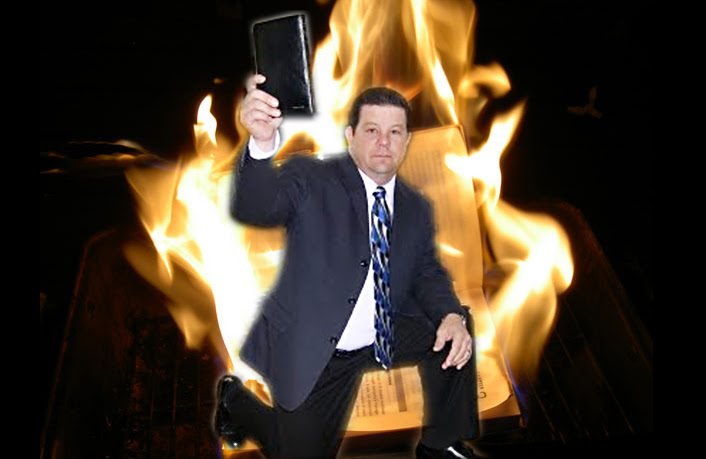
Playing with Fire : Perry Admits Medina Role in Winningham Execution


Fighting fire with fire:

David Medina played role in execution:
Perry’s counsel was cleared of arson charges

By Glenn W. Smith / October 19, 2009

Dog Canyon’s Glenn W. Smith and Steve Hall of the StandDown Texas Project join Thorne Dreyer on Rag Radio, Tuesday, Oct. 20, from 2-3 p.m. on KOOP, 91.7 FM in Austin. They will discuss Rick Perry’s handling of the Willingham execution and other issues involving criminal justice and Texas politics. To stream Rag Radio, go here.

David Medina, Gov. Rick Perry’s general counsel when Perry denied a stay of execution to Cameron Todd Willingham, was later cleared of arson-related charges in the fire that destroyed his home. Medina is now on the Texas Supreme Court. His wife, Francisca, was cleared of arson charges based on an independent forensic and arson investigator’s report. The expert found the fire might have been accidental.

Willingham was convicted and sentenced to death for a fire that killed his three children. A report from an independent forensic and arson investigator sent to Perry and Medina 88 minutes before the execution said the fire was probably accidental. Perry and Medina ignored it as irrelevant. Perry has subsequently mocked independent scientists.

Now Perry has publicly admitted Medina’s role in the 2004 Willingham execution. There could be no greater or more tragic example of our unequal, two-tiered system of justice. I don’t know if the Medinas set the fire or not. I don’t know if Willingham was guilty, although all the independent experts say the fire wasn’t even arson, meaning no crime was committed.

What I do know is that a scientist’s report in the Medina case was given so much weight that the indictment was dismissed. In the Willingham case, such a report was not deemed important enough to delay an execution. Perry and Medina were not asked to pardon Willingham or find him not guilty. They were asked to wait a while before executing him. That’s all.

Steve Mills of the Chicago Tribune, has listed the deceptions in Perry’s recent responses to the Willingham case:

Charge: On Thursday, officials in Corsicana, Texas, released a sworn affidavit from the brother of Willingham’s wife that he signed shortly before the execution. In it, he claims that Stacy Willingham told her family that her husband confessed to her before the execution.

Fact: In 2004, Stacy Willingham told the Tribune that Willingham never confessed. Earlier this year she told David Grann, a reporter for The New Yorker magazine, that she stood by her statements. She came to believe that Willingham was guilty after she reviewed the case herself.

In addition, on the same day that Stacy Willingham’s brother claimed she told the family that Willingham had confessed, she spoke to the local newspaper, saying that during her last meeting with him, he maintained his innocence.

She did not mention a confession.

Charge: Perry has called the fire scientists and investigators who have reviewed the case “latter-day supposed experts.” He has suggested they were aligned with death penalty opponents. Both statements appear to be efforts to question their impartiality and their credentials.

Fact: The nine scientists and investigators involved, all of whom have found the original investigation flawed, have worked for both defense lawyers and prosecutors, as well as for attorneys in civil litigation. All are considered among the field’s leaders. Some are viewed as prosecution-oriented.

They have no vested interest in the outcome of the debate and are not active in the nation’s ongoing death penalty debate.

“My work was a scientific investigation,” said Craig Beyler, who investigated the case for the Texas Forensic Science Commission. “There’s no political agenda.”

Charge: Perry said recently that there was “clear and compelling, overwhelming evidence” of Willingham’s guilt. He has said more than a dozen courts rejected Willingham’s claims.

Fact: The heart of the case prosecutors brought against Willingham was that the fire was arson. Besides testimony from fire investigators, prosecutors offered a jail inmate who said Willingham told him he set the fire. The inmate, however, was a drug addict who was taking psychiatric medication at the time. Since the trial, he has hinted his testimony was false; even prosecutors have discounted his claims.

Willingham’s appeals did make their way through the state and federal courts, but his claim that the fire investigation was flawed was made just before his execution to a Texas court and a federal appeals court, as well as to the governor and the state’s parole board.

Charge: Perry has called Willingham a “monster.” The man who prosecuted him, John Jackson, suggested in a “Nightline” interview on ABC that Willingham was a devil-worshiper because he listened to heavy-metal music and had a band poster in the house.

Jackson also claimed fire patterns on the floor were in the shape of a pentagram to buttress his contention.

Fact: There is no evidence in court records to support claims that Willingham was involved in any such activities. Fire investigators made no references to the shape of burn patterns.

Source / Dog Canyon

Rick Perry admits David Medina role in execution

For previous Rag Blog posts about Rick Perry’s handling of the Willingham case, go here.

The Rag Blog

Posted in RagBlog | Tagged , , , , | 2 Comments

Austin : Billionaires for Wealthcare!

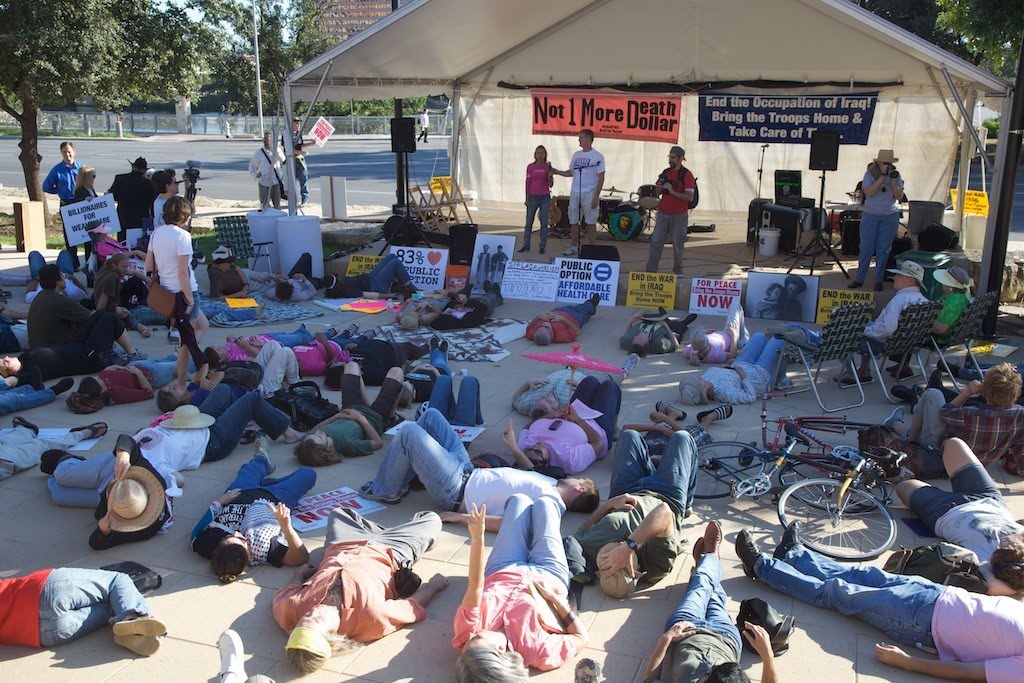
Healthcare Not Warfare demonstration in Austin. Above: “Billionaires for Wealthcare.” Below, demonstrators stage a “die-in” for peace. Photos by Alan Pogue / The Rag Blog.

Austin rally calls for healthcare reform,
An end to the Afghanistan War

By Alice Embree / The Rag Blog / October 19, 2009

More photos, Below.

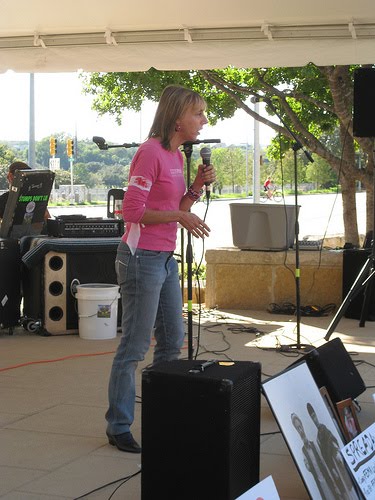
A rally for “Healthcare Not Warfare” drew more than 200 people to Austin City Hall on Saturday. An Austin coalition that included Texans for Peace and CodePink called the rally to coincide with the 8th anniversary of the invasion of Iraq. They put out the call to coincide with the anniversary of the beginning of U.S. military action in Afghanistan in 2001. At a time when the Obama administration is talking of expanding the war, the speakers addressed the need to end the Afghan occupation.

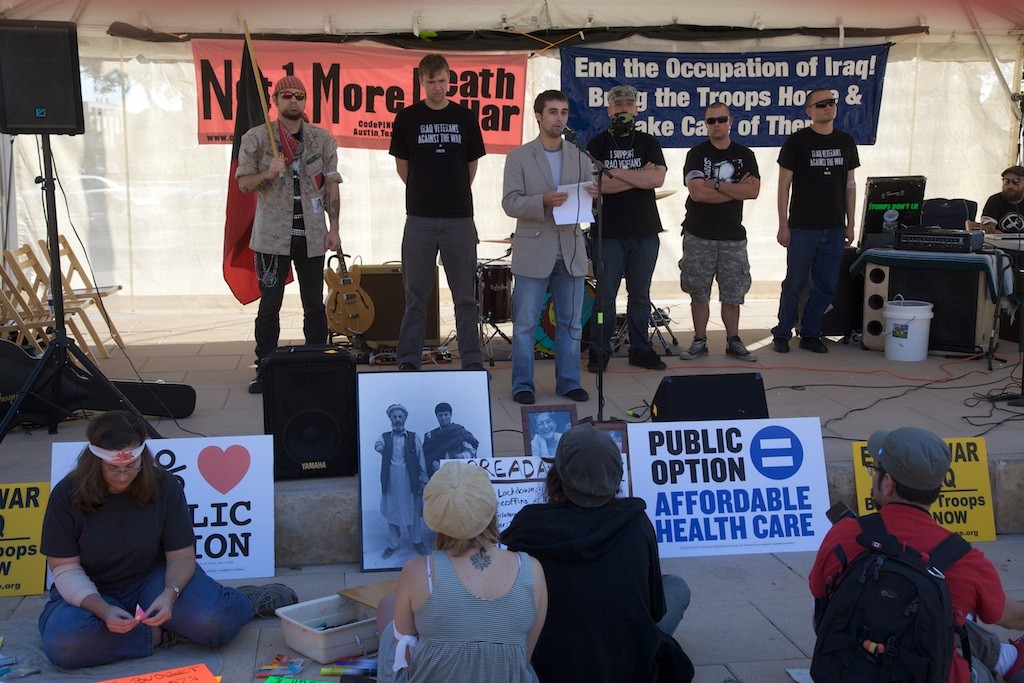
Faith leaders Rev. James Rigby and Rev. Roscoe Overton addressed the crowd. Castro’s Beard and Will T. Massey provided music. Cynthia Good and Joe Carr shared poetry. Members of the Iraq Veterans Against the War flanked Bobby Whittenberg, an Iraq veteran, as he spoke. Brian Hannah, also an Iraq veteran, addressed the crowd.

Medea Benjamin, a co-founder of CodePink, spoke about her recent trip to Afghanistan. Her delegation met with Afghan women there. They returned with a petition from those women demanding that peace talks begin and that Afghan women be participants in those talks. At the recent San Francisco fundraiser which Obama attended, Jodie Evans of CodePink was able to hand the petition directly to the President.

On a lighter note, the rally was visited by “Billionaires for Wealthcare.” Dressed elegantly in black dresses and one tuxedo, sporting champagne glasses and one cigar, they urged the crowd to look at the world from their perspective with posters that read: “Do No Harm To My Bottom Line,” and “Cigna and Palin in 2012.”

Demonstrators also staged a “die-in” to honor the war dead.

On Sunday at Cafe Caffeine in Austin, Medea Benjamin spoke at length about the Afghanistan war and the need to advocate for withdrawal of U.S. troops and the initiation of peace talks. United Nations Resolution 1325 calls for women to participate in peace talks and Benjamin said that Obama should earn his Nobel peace prize through a peace process that includes women in accordance with Resolution 1325.

Benjamin talked about the large presence of contractors from KPR, Z (formerly Blackwater) and the Armor Group (whose members were recently photographed in a lewd Embassy hazing party). She spoke of the poverty and dire need for economic development, the rising civilian casualties.

A young Texan for peace. Photo by Alan Pogue/ The Rag Blog.

Charlie Jackson of Texas for Peace. Photo by Alan Pogue / The Rag Blog.

Vet Brian Hannah, flanked by members of Iraq Veterans Against the War. Photo by Alan Pogue / The Rag Blog.

Rev. Jim Rigby of St. Andrews Presbyterian Church in Austin calls for a reexamination of our values. Photo by Alan Pogue / The Rag Blog.

CodePink co-founder Medea Benjamin addresses the crowd. Photo by Alice Embree / The Rag Blog.

Members of Texas CodePink at Cafe Caffeine in Austin. Front row, second from left, is Medea Benjamin. At top right, flashing peace sign, is The Rag Blog’s Alice Embree. Photo by Allan Campbell / The Rag Blog.

The Rag Blog

Posted in Rag Bloggers | Tagged , , , , , , , | 2 Comments

Mariann G. Wizard : Danger Found Code Blue

Cody Ryan Patterson on graduation day from basic training. Family photo.

Army Spec. Cody Ryan Patterson:
Danger found him in his own home

He was a proud, happy soldier of the Imperium when he died, had never been under hostile fire nor killed another human being.

By Mariann G. Wizard / The Rag Blog / October 19, 2009

Those of you who read The Rag Blog compulsively, even unto the Comments, may have seen one or two such in which I’ve mentioned, without naming him completely, my nephew from North Central Texas, serving with the U.S. Army in Iraq.

Army Spec. Cody Ryan Patterson corresponded with his Auntie M. a bit, when he had Internet access. He sent me a piece of spam at one point, an arrogant, militaristic set of instructions to U.S. civilians on how service personnel should be treated when encountered here at home; it basically said that if a person had some issue with the mission, to keep it to him or herself or risk an “ass-kicking.”

I wrote back that I would turn Cody Ryan over my knee when he was home on leave! “If you’re not over there protecting my right to think and say what my conscience tells me, buster, you shouldn’t be wearing the uniform!”

He came right back at me, like a (very young) man, having what may have been one of his first sustained intellectual arguments with an adult relative. I sent him a Rag Blog story about Army resister Victor Agosto, and he was totally appalled by it; felt that Victor must be a coward and was glad he didn’t have anyone who felt that way in his unit, since they would be a danger to him.

He argued for duty and contractual obligation, and I argued for individual responsibility. But we ended each e-mail with hugs and kisses, reminders of the bond we shared.

Cody and I met when my youngest brother married his Mom, who came to us with a son and a daughter. He was a bright, mischievous, totally typical brown-eyed boy, and, like his sister and little-brother-to-come, an outgoing, affectionate kid who never said “Good-bye” to his aunts or his grandma without also saying, “I love you,” and giving a hearty kiss and hug. My affectionate nickname for him became “Code Blue,” for some reason I no longer recall.

He was a natural-born fisherman, but was allergic to fish. I bought him a copy of the first Harry Potter book when it was published, at the apparently perfect time to spark his interest in reading for a while, but it didn’t last. After my brother and Cody’s Mom split up, not what you’d call amicably, I didn’t see much of him.

Later, with no college-oriented funds, prospects, or ambitions, he left high school and went to work, but couldn’t find a job in Hill or Johnson counties that paid enough to get his own place, buy a reliable truck, and do the other things young men need to do. He would have gone to the Marines, but an old eye injury kept him out, and the Army got him instead.

Cody came home on leave a week ago. He was to have deployed to Afghanistan on Oct. 28. I’d hoped to see him and hug his neck before he left Texas again. But danger found him at 5 a.m. Saturday morning in his mother’s house in Blum. Cody was killed by someone he trusted. It was not a member of his family. The murder appears to have been premeditated, and a young woman has been arrested in connection with the crime

Cody was Army strong. He made it to the door of his mother’s room before collapsing against it, calling, “I’ve been shot” as he fell. Cody was dead before the ambulance and the police arrived. His sister and his Mom’s boyfriend both did CPR on him but to no avail.

I could go into a lot more detail here about the regular rural po’folks who are my family, could make it seem even more sordid, senseless, sad. But what is the difference, for a 20-year old boy-man, in dying in a village quarrel in Texas or in one halfway around the world, in somebody else’s village? What is the difference in hearing your son’s last gasps as he dies in your arms and in imagining them every night he is in harm’s way?

Army recruiters sealed their deal with Cody when they had him come to see them in Ft. Worth and put him up on the next-to-penthouse floor of a downtown hotel. He’d never been that far off the ground before.

After basic training, he called my brother, his former step-dad, to thank him for his efforts in requiring young Cody to be responsible, to do chores, and for extensive camping and hunting experiences; he felt infinitely more prepared than some of the guys he’d met in basic, who apparently cried for their blankies at night and ain’t never kilt a rabbit.

He was a proud, happy soldier of the Imperium when he died, had never been under hostile fire nor killed another human being.

No one in Cody’s family can escape knowing that whatever facts may emerge, the young woman arrested is somebody’s child, and also somebody’s mother. We’re not naive enough to seek “closure,” or imagine that further tragedy will mitigate this one. But we will be looking for justice. That may be the only real difference between Blum and any hamlet of 300 souls in “Afraq.”

Some Rag Blog readers who’d read about my recent exchanges with Cody expressed good wishes for his upcoming deployment, that he would come home OK, with both his life and his sacred honor intact. I appreciated those good wishes for this good kid, and wanted to let you know, as his Mom reportedly said yesterday in her grief, that we “don’t have to worry for him anymore.”

[Editor’s note: This article has been revised, and a portion redacted, at the author’s request, due to concerns from the immediate family and in the interest of a continuing criminal investigation.

In the words of Mariann Wizard: “Last night, I made a mistake. I allowed speculation to creep into an otherwise factual story about my nephew’s life and death. I should have waited before submitting this article, should have run it by Cody’s family first, and I apologize for not having done so. I let my emotions carry me away. Thanks to all those who responded.”]

The Rag Blog

Posted in Rag Bloggers | Tagged , , , , | 14 Comments

Health Insurance : Does Baucus Bill Make Things Worse?

Cartoon by David Horsey / Seattle P.I.

Public option a necessity:
Baucus Bill protects insurance companies

By Ted McLaughlin / The Rag Blog / October 19, 2009

There are two especially devious ways that private health insurers use to keep their own profits high (and deny health care to consumers). The first is to cherry pick only healthy people to cover with insurance, and deny insurance to sick people or people with pre-existing conditions.

The second is to deny coverage for specific treatments to those with insurance. It is not uncommon for seriously ill people to find that their private insurance will not cover the treatment they need to get well. In many cases, these people die because they are unable to get the treatment their insurance company has refused to pay for.

The Baucus Bill, the health care reform bill approved by the Senate Finance Committee, would take care of the first problem. Private insurance companies would no longer be able to deny coverage to sick people or those with pre-existing conditions (or price that coverage out of the consumer’s reach). But it does nothing to fix the second problem.

In fact, an excellent article by Lisa Girion in the Los Angeles Times makes the point that the Baucus Bill would only make the second problem worse, and leave consumers no better off than they are now. After all, what good is private insurance coverage if that coverage will not pay for needed treatment?

Since they could not exclude sick people or those with pre-existing conditions, the insurance companies would be left with two choices to maintain their exorbitantly high profits — raise premiums or deny treatment. Of the two choices, the easiest option is to deny treatment — a choice that could easily be hidden in the policy’s fine print.

Considering the fact that private insurers already do this for many expensive procedures, is there any doubt that they would protect their profits by denying coverage even more often? I think that answer is self-evident. But there is a simple solution to this problem.

One might think the solution is to require coverage and payment of any treatment declared necessary by a doctor, but that won’t work. That would just raise the premium cost of private insurance, and in the Baucus Bill there is nothing by private insurance.

The real solution is to include a public option for insurance in the bill. A public option would cover those with pre-existing conditions, cover all necessary treatments and it would keep premium costs low (by significantly lowering overhead among other things). This would force the private insurers to do the same, or lose consumers to the public option.

Senator John D. Rockefeller (D-W. Virginia) says, “We’ve seen all the insurance industry tricks — hiding rules in fine print, cutting people off when they get sick, and refusing to pay for necessary treatment because of pre-existing conditions. This is why I am fighting for a public option — we need an insurance option out there that puts people first, not profits. We need a real public option, one that competes with private insurance companies to keep them honest and accountable.”

There are those who think the public option would drive private insurers out of the health insurance business. Personally, I don’t care. There are plenty of other things they can insure.

It comes down to a choice. Which is more important — protecting private insurers or providing necessary treatment for sick Americans? I choose the latter.

[Rag Blog contributor Ted McLaughlin also posts at jobsanger.]

The Rag Blog

Posted in Rag Bloggers | Tagged , , | 9 Comments

‘Tormenta Electrica’ : Mexico’s Calderon Busts Union, Fires 44,000 Workers

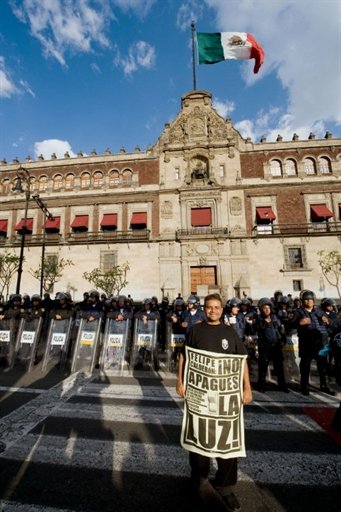
Mexican Electrical Workers Union members protest the summary firing of 44,000 members. Photo: La Jornada. At top, a laid-off worker protests in front of the National Palace in Mexico City. Photo by AFP.

Lightning strikes in Mexico:
Calderon, cops move against electrical workers

‘With one stroke of a pen Calderon has ruined our lives.’

By John Ross / The Rag Blog / October 19, 2009

MEXICO CITY — During the first week of October, the increasingly unpopular government of Felipe Calderon stepped up its ongoing war of words against the Mexican Electricity Workers Union (SME), one of the nation’s oldest labor organizations founded at the apogee of the landmark Mexican Revolution in 1914 when workers repeatedly shut down the Canadian-owned Mexican Light & Power Company.

Now with the centennial of the Revolution on deck in 2010, the SME’s survival as a union is in jeopardy and it may never make it to the birthday party.

Following the nationalization of electricity generation and distribution under President Adolfo Lopez Mateos in 1960, the SME (“Esmay”) won collective bargaining agreements for the newly created Luz y Fuerza Del Centro that distributes about a fifth of the nation’s energy to Mexico City and four surrounding states.

Mexico’s second power utility, the Federal Electricity Commission (CFE), services the rest of the country and its workers are represented by a “charro” (company) union under the thumb of the Institutional Revolutionary Party (PRI) that ran the lives of Mexicans from the cradle to the grave for 71 years until it was displaced from power by Calderon’s rightist PAN in 2000.

Although the SME had longstanding ties to the PRI, it maintained a modicum of critical independence. Communists and Trotskyists wielded influence in union circles and decorated the walls of the union headquarters with proletarian murals. The Sindicato Mexicano de Electricistas has always been good for 40,000 boots on the ground when it comes to social protest.

After the 1985 Mexico City earthquake that took up to 30,000 lives, SME workers rescued victims trapped in the rubble of fallen buildings and worked tirelessly around the clock to restore power in working class colonies. In contrast, the PRI-run government abandoned “los de abajo” (“those down below”) to their own fate.

Three years ago, after hotly contested presidential elections, the SME cautiously lined up with Andres Manuel Lopez Obrador (AMLO) after Calderon was awarded victory over the leftist leader in fraud-marred balloting. Calderon has never forgiven the union’s 66,000 members — 44,000 active workers and 22,000 pensioners — for this partisan sin.

The Sindicato Mexicano de Electricistas is built on a democratic structure although it has not always been a paragon of democracy. Strikes can only be called by referendum and plebecite and negotiated settlements are ratified by general assemblies in which every vote is counted. Union officials and members of its executive board are elected every three years but the vote-taking is staggered and the union always seems to be in the process of electing its officials.

When last spring Martin Esparza, a 45 year-old veteran official, sought a third term as SME secretary-general, he was opposed by union treasurer Alejandro Munoz in an election that was redolent with mudslinging — Esparza accused Munoz of playing footsy with Calderon’s then-personal secretary Cesar Nava, now president of the PAN, and Munoz charged that his rival had pocketed moneys set aside for the construction of a new union office building.

When Esparza was re-elected by a little more than 300 out of 66,000 votes, Munoz appealed to Calderon’s hardnosed Secretary of Labor Javier Lozano not to recognize Esparza as secretary general of the SME. Lozano was eager to comply, refusing to sign a “nota de toma” or official recognition of Esparza’s re-election. As a result, Luz y Fuerza del Centro cut off all check-off dues and subsidies to the SME and the union was unable to meet its payroll.

As is union tradition, Esparza mobilized his loyalists and 10,000 workers encamped outside the Labor Secretariat in the south of the city adjacent to the Periferico or ring road, this megalopolis’s most vital traffic artery, threatening to shut it down. Rumors circulated that SME workers would “baja el switch” (diminish electricity distribution) and security forces were put on alert at the end of September — the criminalization of social protest has been the most salient feature of Calderon’s three rocky years at the wheel of state.

Javier Lozano is Felipe Calderon’s hatchet man. For the past few years, he has been seeking (with little success) to dismember the Miners and Metalworkers Union that, like the SME, dates back to the Mexican revolution. His encounters with the Chinese businessman Ye Gon are the stuff of legend — Mr. Ye alleges that the labor secretary forced him to stash $200 million USD from a Calderon slush fund in his palatial Mexico City mansion, ordering the pharmaceutical kingpin who was granted citizenship by the president’s predecessor Vicente Fox, to either “cooperate” (“coopeles” in fake Mexican Chinese) or have his throat slashed (“cuello.”) When Ye Gon rebelled, he was jailed.

The Lozano-Calderon assault on the SME obeyed the same logic. At the nub of the dispute is 1100 kilometers of fiber optics that would be run through Luz y Fuerza power lines by a private Spanish transnational — the concession was handed down by 1998 by then president Ernesto Zedillo to the Madrid-based WS Communications Corporation whose chief Mexican stockholders are two ex-energy secretaries Ernesto Martens and Fernando Canales Clariond.

For arcane reasons probably related to the reluctance of Carlos Slim, owner of the near-monopoly phone company Telmex and the richest tycoon in Latin America, the concession was repeatedly modified and did not kick in until 2008. By then, Esparza, in his second term as boss of the SME, was proposing that Luz y Fuerza be awarded the fiber optics concession for the so-called “triple play” (telephone, television, and internet) connection.

WS Communications’ legal representative Diego Fernandez de Cevallos, the bristly-bearded PAN fixer and former presidential candidate from whose law firm Calderon has drawn two key cabinet members — Interior Secretary Fernando Gomez Montt, the second most powerful politico in Mexico, and Attorney General Arturo Chavez Chavez — went to work. Calderon and Fernandez offered the union two options: “Cooperate or Cuello.” The stage was set for an epic showdown.

A laid-off worker carries a Mexican flag during a protest at “Luz y Fuerza del Centro.” Photo from AFP.

Saturday, October 10th: Something odd was in the air. Weather forecasts prognosticated a 40% chance of “tormentas electricas” (electrical storms.) That afternoon, Mexico would face off against El Salvador at the mammoth Azteca Stadium in the run-up to next year’s World football Cup in South Africa. The home team had already clinched a ticket to Jo’berg and the outcome against the hopelessly outgunned Central Americans was never in doubt.

Nonetheless, the nation’s two-headed television monster Televisa and TV Azteca, both of which had spent the past week trashing the SME for its workers’ “exorbitant” salaries (6000 pesos a month, about $500 Americano) and Luz y Fuerza’s over-the-top rates (the government sets the rates), launched into hours of relentless ballyhoo replete with Mariachis, fight songs, and scantily-clad cheerleaders.

The contest as expected was no contest with Mexico’s national team pouring in four quick goals. After the lopsided victory, as is traditional is this football obsessed country, tens of thousands of fans descended on the monument to the Angel of Independence on posh Reforma boulevard to celebrate and Mexico City mayor Marcelo Ebrard dispatched city cops to police the party which often gets unruly. Around 11 p.m., the police moved in to wind down the fiesta.

At the same hour and just blocks away, 5000 Army and Federal Police troops (the Federal Police is drawn from the military) were forcing their way into the central Luz y Fuerza installation and 103 other power stations in the capital and adjoining states at gunpoint. They met with little resistance from the SME skeleton crews inside the plants on a Saturday night. One worker, Fernando H., a 22-year veteran of Luz y Fuerza, had only time to grab his jacket before he was pushed into the street, leaving a mountain of memorabilia he had accumulated down the years behind. Once the plants were cleared, the Army threw up metal barricades to keep the workers at bay.

By midnight, an extraordinary edition of the Official Diary (one had never been published on a weekend before) was rolling off government presses containing President Felipe Calderon’s decree dissolving Luz y Fuerza del Centro and, as a consequence, the union that kept the state company running. Striking such a low blow on a Saturday night when no one was watching constitutes a “Sabadazo.” Remember Richard Nixon’s Saturday Night Massacre?

Sunday, October 11th: Word of the takeover flared like wildfire in the colonias where SME workers live. Everyone in Mexico but me has a cell phone now and the shocking news spread from ear to ear. Thousands were gathered outside the Sindicato‘s downtown offices on Antonio Caso Street by 3 a.m.. Martin Esparza closeted with his executive committee to decide on a plan of action. By first light, the crowd had spilled out onto the nearby esplanade of the Monument of the Revolution where the bones of the heroes of that glorious struggle are entombed.

In mid-morning, the Secretary General emerged from his inner sanctum arm-in-arm with his rival Alejandro Munoz and the two led 20,000 SME members to the heavily barricaded Interior Secretariat several blocks away. Fenced off from the old colonial building by thousands of police and army troops, the workers sat down in the street.

Meanwhile, inside the complex, Calderon’s brain trust was trying to put a happy face on the seizure of Luz y Fuerza at a tightly controlled press conference during which only the “prensa vendida” (bought-off press) was allowed to ask questions.

Gomez Montt, Cevallos’s burly law partner, postulated that the President had been forced by limited government resources to shut down the company because it had become a bottomless sinkhole of subsidies in the midst of a crushing economic downturn that had left the government without sufficient funds to even buy a fresh batch of swine flu vaccine.

The President would no longer tolerate throwing good money after bad to sustain the privileges of “elite” workers at the expense of 26,000,000 poverty-stricken Mexicans — the Calderon bureaucracy counts 26,000,000 extreme poor but most workers live in and around the poverty line and would indeed themselves descend into “extreme poverty” if deprived of their jobs as Calderon had just ordered.

Then the 350-pound finance minister Augusto Carstens took the mic to sweeten the pot. Workers who signed off on their own liquidation would receive two and a half years worth of salary — an additional bonus if they did so in the next 30 days. Carstens presented a blizzard of data to justify the 20,000,000 peso boodle that it would cost the government to shut down Luz y Fuerza — the money is thought to be drawn down from nearly a billion dollars in World Bank credits granted last April for environmental mitigation. The World Bank and the International Monetary Fund have a track record for favoring the privatization of state electricity companies in Latin America.

There were few questions from the prensa vendida.

By nightfall, once the workers had retreated from the Interior Secretariat, Felipe Calderon went on national television to explain the flimflam to the nation. His conscience was clear. He was doing the right thing for Mexico — despite the fact that he had just deprived 66,000 workers of their livelihood (the number is closer to 300,000 since each Mexican family has an average five members) in a country that has been whacked by the steepest economic downslide since the Great Depression and where unemployment now exceeds 16%.

SME veteran Fernando H. stood stiffly across the avenue from the central Mexico City Luz y Fuerza plant, staring forlornly at his now police-occupied former place of employment. “With one stroke of his pen, Calderon has ruined our lives.”

To be continued.

[John Ross’s monstrous El Monstruo — Dread & Redemption in Mexico City will be published by Nation Books November 3rd. Northern Californians can get an earful Friday the 13th at Northtown Books in Arcata and Modern Times on the 18th in San Francisco’s Mission District. Ross, who will also be traveling with his recently published Iraqigirl, the highly praised diary of a teenager growing up under U.S. occupation, is scouting venues for 2010. Write johnross@igc.org if you have any bright ideas.]

The Rag Blog

Posted in Rag Bloggers | Tagged , , | 1 Comment

Dick Flacks : Pete Seeger’s Project


Celebrating Pete Seeger:
Our political troubador

More than any other individual, he had conceived and fostered a tradition of protest song that drew from a number of cultural roots, had significant political consequence, and reshaped the forms and content of popular music.

By Dick Flacks

[This article also appears in the Autumn issue of Jewish Currents. A longer version was published on Truthdig.]

Pete Seeger turned 90 on May 3rd, providing the occasion for a huge celebratory concert in Madison Square Garden featuring a wide array of popular musicians. In the two years prior, Pete got more mainstream attention than he’d received in the previous seventy years.

Bruce Springsteen toured internationally with a large band playing material from Pete’s folksong repertory. There was a documentary film in theaters and on public television, Pete Seeger: The Power of Song. Two new biographies are in the stores (“To Everything There Is a Season”: Pete Seeger and the Power of Song, by Allan Winkler, and The Protest Singer: An Intimate Portrait of Pete Seeger, by Alec Wilkinson), and David King Dunaway’s earlier work, “How Can I Keep From Singing”: The Ballad of Pete Seeger, has been updated and republished.

There’s even an ongoing campaign to get Seeger nominated for the Nobel Peace Prize.

The attention he is now getting is certainly deserved, given his life story and his influence on American music. One feature of that story, however, is that he is one of the least-known famous people in America. I use protest music a lot in my teaching about social movements, and over the years I’ve found that fewer than five percent of my students can identify him. Even with the attention he’s received in recent years, he remains paradoxically shadowy, given his political and cultural influence.

This paradox goes to the heart of what his life project has been. One obvious reason for Seeger’s marginalization has been his commitment to the political left.

His father, noted composer and musicologist Charles Seeger, was an important leader of the cultural front fostered by the Communist Party during the 1930s. Charles helped form a composers’ collective that sought to create a new music for revolutionary workers and to preserve and reinvigorate folk and vernacular musics as an alternative to commodified mass culture (its members included Marc Blitzstein, Aaron Copland and other young radical musicians).

So Pete grew up immersed in the left. He joined the Young Communist League during his brief time at Harvard, and was a Communist Party member (according to his biographers) during most of the 1940s. Although he dropped formal membership in the CP in the late 1940s, he was one of the star cultural figures of the communist-oriented left for many years after.

Teenagers like me and my wife (both red-diaper babies) were proud that Pete was “ours,” appearing at the benefits, hootenannies, summer camps and rallies that defined much of our cultural lives during the 1950s, when kids of our background felt pretty isolated from the political and cultural mainstream. His allegiances made him the prototype of the blacklisted entertainer — and it was the blacklist that excluded him from television and blanked him out of the awareness of mainstream America.

That exclusion did not derail Pete’s life project. On the contrary, it compelled him to fulfill that project rather than succumb to temptations or demands that might have come from more conventional commercial success. I want here to spell out what that project was, and how it affected history.

Alec Wilkinson’s new biography defines Seeger as the epitome of the rugged individualist. We see him in very old age, living in a house he built on the banks of the Hudson River. He, his wife Toshi, and their small children moved there in the 1940s, and their lives were indeed rugged — without electricity and running water for a while, they chopped wood and grew food in a clearing in the forest.

Near the end of the book, we see Seeger and members of his clan collecting sap and making maple syrup. Wilkinson appreciates the paradox that this man, long reviled as a communist, has tried to live the American ideal of the self-made, self-sufficient man.

But Seeger was a Communist, and continues to describe himself as a “communist with a small c.” He was raised by his father to see music as a group activity, dependent on the people’s participation, more than as a realm of individual accomplishment dependent on the virtuosity of a few.

“Vernacular” music, said Charles Seeger, is the foundation from which all other musics derive, and music, in turn, should aid in inspiring people “into more independent, capable, and democratic action.” We can read in these lines the principled foundation for Pete Seeger’s seventy years as an artist and political being. They are a primary source for the life project he began to formulate and implement when he was in his early 20s.

I use the word “project” instead of “career” because Seeger himself resisted talking about his “career.” From the outset, he sought to channel his ambition toward social and cultural change and to exorcise his strivings for personal recognition.

In the early 1940s, the Almanacs even performed anonymously (with Pete often using an assumed name), emulating various European artistic collectives of that time. A number of politically committed young musicians were part of the Almanacs collective, but Pete, in his early 20s, was the most disciplined — focused on keeping the group together and achieving its shared purpose, which was to create new songs, rooted in vernacular music, with lyrics that might mobilize political action.

The Almanac Singers, 1941. From left, Bess Lomax, Pete Seeger, Millard Lampell, Woody Guthrie, Arthur Stern, Sis Cunningham.

The Almanacs’ most lasting songs were those like Woody Guthrie’s “Union Maid” that became anthems of the CIO organizing campaigns or spurred anti-Nazi sentiment to support the war effort (“The Sinking of the Reuben James”).

In the entertainment world, there was something new and attractively fresh about the fusion of folk music and contemporary topics. The middle-class Almanacs, especially Seeger, undoubtedly thought that their unprofessional style (they wore blue jeans or overalls, and their performances were deliberately unpolished) would help them forge connections to the working-class audiences they hoped to reach.

That assumption has often been mocked; workers were much more likely to want the polished performances of Tommy Dorsey, Bing Crosby or the Andrews Sisters. But the mockery misses the deeper aim of Seeger’s project, to make space for a popular music created not for the commercial market but for sustaining the “democratic action” envisioned by his father.

The Almanacs’ collective didn’t last long, in part because several members entered the military. While in uniform, Seeger continued his project, recording songs of the Spanish civil war and a number of other topical songs (accompanied by other emerging folksingers such as Burl Ives, Josh White, and Sonny Terry). He served in the Philippines as an entertainer for wounded GIs and learned quite a bit about how music can work to build collective morale. By war’s end, he was certain that making politically relevant music was his life’s work.

After the war, Seeger’s energies turned toward organizational entrepreneurship rather than merely performing. He sparked the formation of a national “People’s Artists” network of leftwing music-makers to serve as a booking agency, a publisher of song-filled newsletters and books, and a support framework for advancing a popular music relevant to political action.

In the immediate postwar period, leftists hoped that the dynamism of the 1930s labor movement would continue and that the social democratic logic of the New Deal would be followed by the post-FDR government. Seeger imagined that his people’s music network would be wedded to the unions and other social movements, providing fertile ground for growing a leftward popular culture.

But a profound split in the union movement on the “Communist” issue dashed such optimism, and the increasing tempo of the Red Scare thoroughly marginalized the network Seeger had worked so hard to build.

Still, his penchant for organizational entrepreneurship was an important dimension of his work that deserves more attention than any of his biographers provide. Seeger’s major successes have included the song magazines Sing Out! and Broadside, which published and publicized the politically conscious new songwriting of the 1960s; the Newport

Folk Festivals of the late ’50s and ’60s, which brought together a new generation of troubadours with a vast array of traditional performers; a book, originally mimeographed, How To Play the 5-String Banjo, which inspired tens of thousands to play this largely forgotten instrument; the formation of the Freedom Singers (Cordell Reagon, Bernice Johnson, Charles Neblett and Rutha Mae Harris), who toured (with Toshi as their agent) to raise awareness and money for the Student Nonviolent Coordinating Committee; and the Clearwater Sloop, which sparked the movement to clean up the Hudson River and became the center of an ongoing environmental education program.

None of these efforts was single-handedly created by Seeger, of course. In fact, his biographers suggest that he was not exactly a detail person. Toshi took on many of the managerial tasks his work required (while managing their household of three children in their log cabin). But Pete always had the ability to make the impossible seem plausible and thereby inspire and goad others to help fulfill his various organizational visions.

It’s a rare thing for an artist to be so aware of the need for institution-building, but Seeger saw from the start that cultural change is inextricably bound up with social organization.

His most promising mainstream venture was the effort by the Almanacs’ successor group, the Weavers, to work commercial venues. The quartet, born out of the People’s Artists cultural left, was discovered and signed by Gordon Jenkins of Decca, one of the largest record labels of the 1940s and ’50s. Jenkins produced a series of enormous hits with the Weavers, and they were booked into many of the leading club and concert venues. Rightwing entrepreneurs quickly went after them, however, largely based on Seeger’s long association with “Communist” politics, and only two years after they had burst on the scene, the Weavers’ commercial career was over.

Seeger quickly embarked on a perpetual tour of America’s college campuses, summer camps, and auditoriums, where he honed a solo performance style and repertory that defined him as a musician. In the process, he brought into being a ragtag army of young fans. His commitment to his project was embodied in his particular performance style: The goal was not to display his own talent, nor to thrill an audience, but to bring songs to people so that they could make them their own.

Every Seeger performance was centered on group singing. Simply getting a mass audience to join in requires skill, but he aimed further — to teach new songs, and to foster singing in harmony. He particularly relished teaching South African songs in their original language (most famously “Wimoweh”) with two or three competing melodic lines.

There is an empowering effect in the very sound of a singing assembly. There is a persuasive effect that can come when audience members sing lyrics expressing a political perspective or commitment. There is a sense of mutual validation when a crowd of people sing together in an attitude of resistance. And once you sing a song, there is a good chance that you will be able to reproduce it by and for yourself, with no need for the professional performer to evoke it.

By working as a song leader and teacher, Pete was achieving Charles Seeger’s wish for a mode of musical performance that had an ability to “aid in the welding of the people into more independent, capable, and democratic action.”

Pete Seeger’s blacklisting by network TV lasted at least fifteen years and made it impossible for him to have access to mass audiences in the U.S. Still, his cultural impact steadily increased during those years. When the Weavers reunited in an historic Carnegie Hall Christmas season concert in 1955 in defiance of the blacklist, the recording of this event on the upstart Vanguard label hit the charts, and the group continued to tour and record for several more years (although Seeger separated from it).

Seeger drew ever larger concert crowds, including many of the young who heard him first at summer camp or college campus. He recorded dozens of albums for Folkways in that period.

Meanwhile, a pop-centered folksong revival became commercially huge. The Weavers’ imitators, led by the Kingston Trio and, later, Peter, Paul and Mary, sold millions of records. The resulting commodification inevitably denatured and contradicted Seeger’s project.

His support of the Newport Folk Festivals helped provide alternative, more authentic access to rooted musics and performers. By the early 1960s, a musical rebellion against pop folk was in the works, as a band of young troubadours, consciously following in Woody and Pete’s footsteps, started singing. Bob Dylan, Joan Baez, Phil Ochs, Odetta and many others performed in new folk clubs, recorded on upstart labels, appeared at civil rights and ban-the-bomb rallies, and dominated the college tours.

The folk music revival became a political as well as cultural phenomenon. The festivals, concerts and clubs where folk fans congregated were among the prime social spaces for shaping awareness and engagement with the civil rights movement and the New Left.
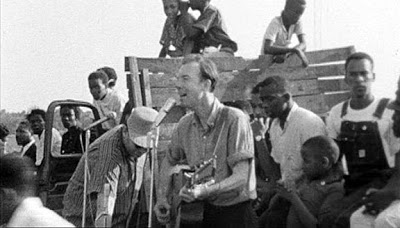
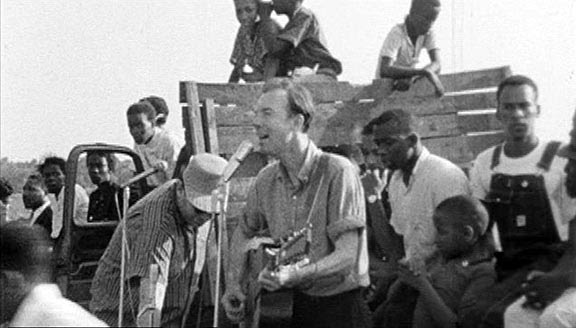
Pete Seeger sings “If I Had a Hammer” at a Student Nonviolent Coordinating Committee (SNCC) rally in Greenwood, MS, 1963. From “Pete Seeger: The Power of Song.”

Pete Seeger’s belief in the power of song derived in large part from the fact that a number of great social movements were fueled by music. There is a tradition of labor song in America, dating from the 19th century, and a number of songs from that tradition continue to this day to help define the identities of labor organizers and raise spirits on the picket line.

Seeger’s dream of a singing mass movement was much more fully realized, however, in the civil rights struggle. As marchers gathered in churches to prepare to challenge segregation with their very bodies, traditional songs and song styles used in African-American churches were turned into hymns of solidarity and shared risk-taking, with lyrics adapted for the occasion.

It was Seeger who had first made “We Shall Overcome” known to civil rights activists in the 1950s, and his concerts in the early ’60s taught the new freedom songs to mass audiences in the north. The music of the southern movement was an important factor in forging a moral identification with it among northern students — an identification that led to a flood of volunteers to southern organizing campaigns.

By his mid-40s, Pete Seeger could take satisfaction that his decision to organize his life around a principled project and disdain a “career” had changed history. More than any other individual, he had conceived and fostered a tradition of protest song that drew from a number of cultural roots, had significant political consequence, and reshaped the forms and content of popular music.

He had revived the social role of the troubadour — a special kind of intellectual, who, as Bruce Springsteen said at Madison Square Garden, pointed a dagger at the heart of Americans’ illusions about their history while telling their stories in song. But Seeger performed in ways that intended, and sometimes succeeded, in empowering audience members to sing their own songs and find capacities for democratic action through that singing.

If he’s often portrayed as a victim of blacklist and censorship, it is clear that his long marginalization from the mainstream was necessary for the fulfillment of his project. When he refused to discuss his political allegiances with the House Un-American Activities Committee in 1955 (basing his non-cooperation on his First Amendment rights rather than on the Fifth Amendment protection against self-incrimination), Seeger’s courageous stance led the committee to charge him with ten counts of contempt of Congress, each punishable by a year in jail.

Trial and appeal of these charges took seven years and reinforced his blacklisting. In the end, the Court of Appeals overturned his conviction. It was in many ways a costly time for the Seegers, yet as a result he came, says Wilkinson, to “typify the principles of all the brave people he sang about.”

In our time, troubadours have become icons of resistance, and Pete Seeger did quite a bit to popularize them, most notably the Wobbly bard Joe Hill and Woody Guthrie. Then, in the 1960s and ’70s, iconic troubadours emerged all over: Bob Marley in Jamaica, Victor Jara in Chile, Vladimir Vysotsky in the Soviet Union, Wolf Biermann in East Germany, Cui Jian in China, Miriam Makeba in South Africa.

Some, like Jara, explicitly used Seeger and Guthrie as models. All were able to achieve iconic stature and profound popular affection despite, and because of, persecution, censorship, martyrdom. Meanwhile, all over the world, many hundreds of other singers have taken on the troubadour role, not as heroes and martyrs, but, like Seeger, as cultural workers pursuing various versions of his project.
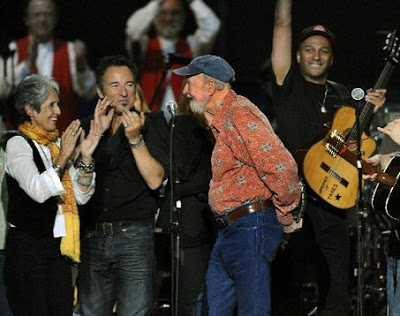
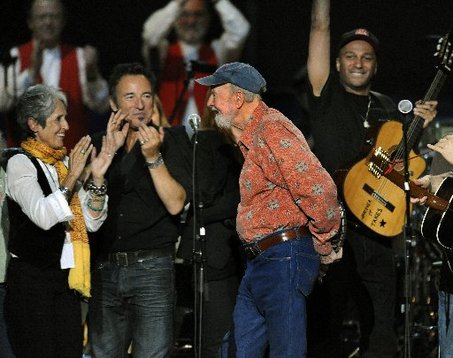
Left to right, Joan Baez, Bruce Springsteen, Pete Seeger and Tom Morello celebrate Seeger’s 90th birthday at Madison Square Garden, Sunday, May 3, 2009. Photo by Timothy A. Clary / AFP / Getty.

The Madison Square Garden 90th birthday celebration featured many American musicians of this sort. Some like Bruce Springsteen and Dave Matthews have had enormous commercial success, and most of the others on stage are probably better known to a wider public than Seeger himself. Their participation was evidence of the cultural effect of his project, as each star testified, explicitly or implicitly, to the pull of Seeger’s devotion to social movements and his challenges to the constraints of the culture industry.

That event was the culmination of several years during which the “entertainment industry” and the state not only stopped blacklisting Seeger but bestowed honors on him: enrollment in the Rock and Roll Hall of Fame, the Kennedy Center Award, the President’s Medal of Freedom.

A cynic might say that in America, political troublemakers are marginalized and suppressed, then canonized when they are safely old or dead; that’s how we periodically persuade ourselves that we really are a free country.

At 90, Pete, we imagine, must feel enormous personal fulfillment. How rewarding to get to sing Woody Guthrie’s radical verses to “This Land is Your Land” at the inauguration concert for our first black president, side by side with one of the biggest stars of popular music! Still, I can hear him saying: “Yes, but will the human race survive the 21st century? There’s a fifty-fifty chance. We’ve got a lot of work to do.”

[Dick Flacks is emeritus professor of sociology at University of California, Santa Barbara. His many writings on U.S social movements include Making History: The American Left and the American Mind. He hosts a weekly radio show, “Culture of Protest,” which can be heard on Thursdays 6-7p.M. EST at www.kcsb.org. He has co-authored the forthcoming Playing for Change: Music and Social Movements with Rob Rosenthal, to be published by Paradigm publishers.]

Source / Jewish Currents

The Rag Blog

Posted in RagBlog | Tagged , , , , , , , , , | 5 Comments

BOOKS / The Secret Fundamentalism of ‘The Family’


The Family:
A little-known Christian ‘Mafia’

By Sherman DeBrosse / The Rag Blog / October 18, 2009
[This is the first of a two-part series.]

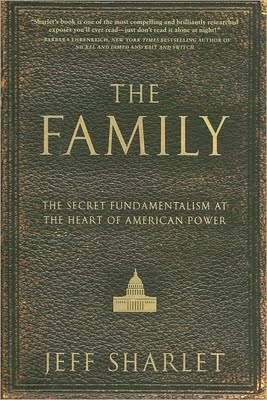
The Family: The Secret Fundamentalism at the Heart of American Power by Jeff Sharlet. 464 pp. Hardback, Harper (May 20, 2008); trade paperback, Harper Perennial (June 2, 2009).

Jeff Sharlet has written a very provocative book entitled The Family: The Secret Fundamentalism at the Heart of American Power. It is about the powerful “Family” or “Fellowship” of politicians, corporate types, and other “big men” who pray together and consider themselves brothers.

Members define themselves as a “Christian Mafia,” but they do not pack heat or break the law. These people are not ignorant wingnuts. Rather, they are intelligent, resourceful, accomplished, and often very charismatic. They operate secretly, are hierarchically organized, and place great stock in obedience, which they constantly describe as “love.” They claim to be non-partisan, but they are on the way to becoming the officer corps for the Right.

Sometimes they seem to say one thing and do another, and Charles Colson, who is tied to them, might be shedding light on this practice when he frequently discusses the value of the “noble lie.”

Brothers are organized into prayer cells, and this method of organizing has been widely adapted in conservative Christian circles. They have a network of houses and campgrounds, and there is a famous house in Washington, DC where some members of Congress live. Recently, we learned that three members of Congress living in the Fellowship’s house on C Street were involved in sexual scandals. An estate on the Potomac named “The Cedars” is their headquarters.

After 9/11, Sharlet spent some time in “Ivanwald” a training house in Arlington, Virginia, where the brothers trained young men thought to have leadership potential. This movement attracts people who want black and white clarity rather than subtle thinking; they are either Alpha males or want to become them.

From the beginning, the Family has claimed that it was taking Christianity back to what it was in the first century. They never explain what that is, and this claim can best be taken as an indirect way of saying other Christians simply have it wrong. Early Christianity was the religion of the poor and marginalized. These Christians did not seek power and wanted to live apart, thinking that the Second Coming was imminent. They often held goods in common and sometimes bought the freedom of slaves. That kind of Christianity is light years away from what the Family represents!

The Fellowship has existed for seventy years, going back to a group in Seattle who came together to fight unionized longshoremen. They saw strikes as sinful and acts of disobedience against God. It claims to be non-partisan and has some Democratic members, who are usually conservatives. There have been a few liberal members. These people rarely come to the surface, except at the annual National Prayer Breakfast, which they have sponsored since 1953.

Doug Coe took over leadership of The Family in the 1960s, and has only gone into semiretirement recently. Dick Foth, an advisor of John Ashcroft, now leads the Family. Coe is clearly one of the most powerful men in America. He is not into having people attend churches or subscribing to creeds. For him, it is all about submitting to Christ. Another reason to stay away from the Protestant churches was that the brothers thought women ran them.

Vereide and Coe both thought they were conducting spiritual warfare, but their approaches were different. Vereide would openly fight against unions and strikers. Coe is much more subtle, with his followers quietly working in cloakrooms, over dinner, through marriages, and even in bedrooms.

Coe would not change our institutions, but he thinks they should be run by men who submit to Christ. It is a sort of mild dominionism, the idea that the United States must be ruled by followers of Christ. One of their successes was obtaining federal funding of religious outreach programs and charities, and they aim to privatize welfare.

Reverend Vereide was strongly anti-union, pro-laissez faire capitalism, and fiercely anti-Communist. Coe has less to say against unions and cultivates conservative union leaders. He identifies empire and free enterprise with America’s core role in the world. Hence, they are somehow Christ’s program.

Sometimes members talk about helping the poor, but they make it clear that poverty is God’s disobedience. Some members, like Ed Meese, say it is hard to believe there are any starving children in the United States. They seem far more concerned about the welfare of big oil.

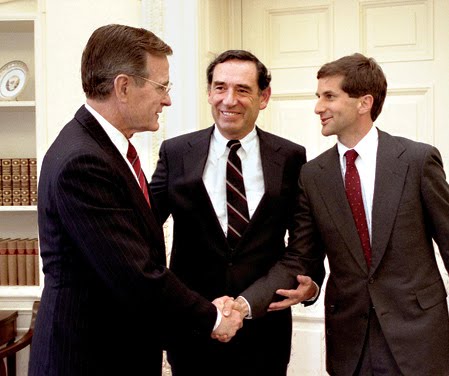
President George H.W. Bush, left, with the The Family’s Douglas Coe, center. Photo from the George Bush Presidential Library.

They are about power

The brothers of The Family are about wielding power and influencing people who have it, the “big men.” They patiently spend years cultivating these big men. They see Christ as the ultimate strong, forceful male and frequently quote his words about bringing the sword and division.

These people are what some would call “social dominance oriented.” Studies suggest that such people view equality negatively and would strongly agree that some people are more worthy than others.

Theirs is not the gentle Christ of the beatitudes and Sermon on the Mount. Sharlet does not explain why the cult of the personality is so important to them, but he quotes Theodore Adorno: “The more impersonal our order becomes, the more important personality becomes as an ideology.”

Maybe that explains the Sarah Palin phenomenon. Doug Coe emphasizes the person of Jesus rather than his teachings and sees The Master as a powerful Alpha male. Coe repeatedly talked about “Jesus + nothing,” and it seems to be a completely malleable formula. Any policy can be plugged in and be made a policy Christ demands the United States follow.

These people have an unhealthy interest in Hitler, Stalin, Mao Tsedung, and Ghengis Khan. They are particularly interested in Hitler, whom they admit was an evil man. But they admire his organizational skill, his understanding of human nature, his genius, and particularly his ability to sway others. Some of the brothers study and practice Hitler’s oratorical techniques. The Family of Coe’s generation are not fascists, but they have no warm feelings about democracy. They are authoritarians by any measure.

The Brothers are mainly cultivating potential leaders and “big men” so that they can use them. But they also want to save the souls of ordinary people so that those folks can be controlled and social order will be preserved. Their bottom line is that salvation comes to nations and not to persons on an individual by individual process — a very unfundamentalist bit of theology.

These people take very seriously the medieval idea that God anoints rulers. That explains, in part, the support they have given a number of bloody dictators, including some non-Christians like General Shuarto. There is a long list of similar monsters that they befriended, in return for their help in extending American economic and political power. Among these foreign friends are Papa Doc Duvalier, Emperor Heili Selassie, Korea’s General Park, and Brazil’s General Medici.

By all accounts, they have great power. It is difficult to measure their power because they keep a low profile. This book provides many examples of ways in which they have influenced other governments and their ability to access anyone in government. Their power rests upon their personalities, their connections, the importance of the people within the Fellowship, and their influence over conservative Christianity.

Sharlet demonstrates that the Family has strong ties to leaders of the Religious Right, which includes fundamentalists, evangelicals, Pentecostals, and others. Bill Bright of the Campus Crusade for Christ is tied to the brothers. Though claiming his movement is non-political, he occasionally has revealed an intense partisanship and strong opposition to the doctrine of the separation of church and state.

Chuck Colson, another close ally, writes about a “veritable underground of Christ’s men all through government.” Billy Graham had early ties with the movement and learned lessons he applied to his overseas operations. Family members also extended various services to the young Pat Robertson. The Fellowship has extensive overseas networks.

Some have written that Secretary of State Hillary Clinton is a member and that Coe is her spiritual mentor. It appears that she has prayed with Senator Sam Brownback’s group, has met Coe, and was grateful for Fellowship people’s prayers during the Lewinsky affair. However, she is a female so she cannot be a member. There is no evidence Coe is her spiritual mentor.

Religious fundamentalism

So much is secret about the Family that Sharlet thought it necessary to do extensive research on the thought of various Christian fundamentalists and evangelicals. What was striking to this writer was that so many of the fundamentalists and evangelicals he discussed felt left out and powerless, and that they sought to reverse these feelings by finding absolute TRUTH in scripture and doctrine. This kind of belief seemed to greatly empower them.

On the other hand, the people in the Fellowship are powerful and know it. Indeed, their sense of being empowered makes it possible to override and reinterpret many of Christ’s clear teachings.

Sharlet calls Family members “fundamentalists.” That term, when defined strictly in religious terms, probably fit their founder, Abram Vereide, in some ways and in his early years. Fundamentalists are biblical literalists, and “fundamentalism” has a very precise religious meaning, and does not really fit today’s Family.

Religious fundamentalists have very clearly defined beliefs, and the Family is not in favor of creedalism. The Family speaks the language of religious fundamentalists and aspires to speak for the religious Right, which includes the more numerous evangelicals and Pentecostals.

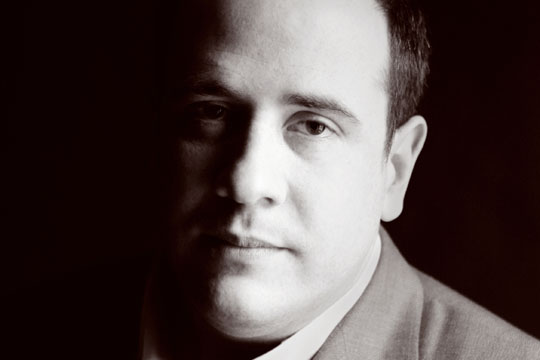
Author Jeff Sharlet. Photo by Greg Martin.

Social fundamentalism

If the term “fundamentalism” is applied to the Family to measure a fundamentalism in economic, cultural, and social matters, it is apt. Some, like Jimmy Carter, have used the word “fundamentalism” in the broader sociological context suggested here, and Martin Marty has sometimes done the same He believes that Adorno’s study of the roots of authoritarianism is really an examination of societal fundamentalism.

Luigi Tomasi of the University of Trento, who works in sociological theory, development, and religion, speaks of a “social fundamentalism” that best describes the kind of fundamentalism Jeff Sharlet is discussing.

Like the religious fundamentalists, the social fundamentalists think that their principles must be practiced in full, and without compromises. Social fundamentalists, like religious fundamentalists, adhere to what they think are some simple but noble principles that they think are overlooked.

Both sorts of Fundamentalists are absolutists in the sense that they can explain all relevant phenomenons in terms of their basic ideas. Alternative interpretations must be demonized. Whatever they believe is sanctioned by a higher authority. In the case of the Fellowship, it is God the processes of history.

Literalism is another characteristic, but it only seems to apply some of the time in the case of the Family.

They are also exclusivist in that they believe there is only one way to interpret their basic ideas. Fundamentalists or both the religious and social sorts are inclined to be true believers. They boost their self esteem by seeing themselves as an “in” group that opposes an “out” group that, for the moment, dominates society.

The desire to be part of an important “in” group seems to be related to creating for themselves a collective identity as religious fundamentalists or as members of the Fellowship.

Religious and social fundamentalists want to reconstruct the world by applying principles drawn from the past. They can be viewed as radical traditionalists. As traditionalists, they think time honored social distinctions are just part of the nature of how things are and should be.

They are atavistic in that they want to return to elements of a mythic past, especially one in which women were kept in their place. Atavistic movements find salvation in elements of the past and create myths about them. Frequently, they target neighbors as the dreaded “Other.” Feminism is the scapegoat for many problems, partly because it is totally secular.

This anti-feminism is rooted in the fact that males are losing power, and, in a larger sense, fundamentalisms represent efforts of individuals and groups to regain power and control over their situations. In the case of the Family, social fundamentalists, we have an extreme effort of males to acquire great power as a group and individually, as Alpha males.

In some ways they are anti-modern, although religious fundamentalists have pioneered in exploiting new developments in communications technology. Fundamentalists generally are troubled by diversity and pluralism, and some resent the modern tendency toward economic globalization.

However, the Family has a record of working to promote economic globalism, and here it differs sharply from many of the religious fundamentalists they would lead and speak for. In other cultures, religious fundamentalists have often taken positions in defense of the poor, but in the United States they often resent money spent alleviating poverty, and they embrace economic doctrines that serve the rich and corporate power.

There was a time when religious fundamentalists refused to engage the culture and broader society. Now many of them seek to use their votes to take over the political polity. The Family, religious conservatives and social fundamentalists, work day and night to accomplish this and are experts at engaging the culture and mixing with people who do not agree with them.

The Fellowship consistently champions bare-knuckled, unfettered capitalism as Christ’s doctrine. They are what the British call “market radicals” or what Americans call “market fundamentalists.” High on their agenda is extending U.S. influence in the world, and they subscribe to what scholars have called “foreign policy fundamentalism,” the outlook that more force is always appropriate.

They subscribe to the notion that the United States is God’s favored nation and they back interventionism and U.S. imperialism. Vereide had a fetish about conforming to traditional social norms. The Family, as social fundamentalists, join religious fundamentalists, are upset or worse by the onset of modernization and the ascendancy of secular values. Both are at odds with what they think is a depraved culture.

Political wolves in sheep’s clothing

There are many serious and able Protestant theologians. As a volunteer for an historical agency, I read and analyzed their works for many years. On the other hand, there is much that passes as theology that is little more than political commentary or weak social science.

Some years ago, I acquired a multi-volume set by an eminent conservative Protestant theologian. As I studied the volumes, I kept wondering if I was reading a mix of politics and sociology rather than theology. Most of it was like what we often find on Sunday morning TV, mostly politics and maybe a little religion. What I knew as theology was largely absent. The religious comments that were there were thin gruel, and not the careful argumentation of a theologian.

The same is true of The Family. They have all the cultural concerns of the old evangelical America that has been slowly fading since the 1920s. But their real passion is for market capitalism and the American empire. There are some positive accomplishments to attribute to them. Coe worked with Bono in his humanitarian work, and some members have helped build hospitals.

When I set aside the last volume, I was unable to identify where the theology was. Sharlet tried to trace The Family back through the Second Great Awakening and all the way back to Jonathan Edwards. Those links are not that solid.

The Family members pray, but it is hard to find any serious religious thought or theological literacy here. What we have is social and political movement taking on religious clothing. That, of course is natural. Even medieval weavers did a better job presenting their discontent over wages as a religious movement.

Post-Civil War southern frustrations presented themselves as the religion of the lost cause, and had a certain degree of theological substance. Too many on the Religious Right have taken the road of Doug Coe — perhaps beginning with some genuine religious concerns but soon practicing politics falsely presented as religious work.

Next: Part II: Right Wing Populism.

[Sherman DeBrosse is a retired history teacher. Sherm spent seven years writing an analytical chronicle of what the Republicans have been up to since the 1970s. The New Republican Coalition : Its Rise and Impact, The Seventies to Present (Publish America) can be acquired by calling 301-695-1707. On line, go here.]

Find The Family: The Secret Fundamentalism at the Heart of American Power by Jeff Sharlet on Amazon.com.

The Rag Blog
Posted in Rag Bloggers | Tagged , , , , | 1 Comment

Biodiversity and Global Change : Carbon in the Soil


Insights from soil carbon research:

Scientists analyze interactions with climate change and land management to address food, fuel, water and fiber needs.

By Alison Grantham / October 18, 2009

Nearly 300 soil scientists from 33 countries gathered last week in Colorado Springs, Colorado, for the second International Symposium on Soil Organic Dynamics under the theme “Land Use, Management and Global Change.”

I presented a poster on the Rodale Institute’s research on soil carbon and nitrogen mineralization potential in our Farming Systems Trial (FST) and soaked up all the knowledge I could.

The universe of the conference focus increased even as we met. Conference host Keith Paustian of Colorado State University opened the conference emphasizing that global soil organic matter (SOM) stocks are now estimated to contain 3 trillion tons of soil organic carbon.

This estimate just increased significantly in a recent publication in Global Biogeochemical Cycles where the authors reported that carbon stocks in peat soils are much larger than previously understood. That makes soil the largest actively cycling pool of carbon — more than quadruple the amount of carbon in vegetation and more than triple that in the atmosphere.

In an era where rising concentrations of atmospheric carbon are threatening global climate function, ecosystem stability and agricultural productivity, the sheer size of the soil carbon pool makes it imperative that we learn more about the pool’s dynamics.

Highlights from the remarks of the event’s leading presenters illustrate the profound ways that soil dynamics and the variations in soil capacities impact individuals, communities and nations.

Abad Chabbi, host of the first symposium on these topics in France two years ago, protested that the clear challenges addressed in 2007 persist today, including:

  • The extent and role anthropogenic forcing.
  • The feedbacks between vegetation and SOM.
  • Interactions between climate change, SOM and biodiversity.
  • SOM generated greenhouse gases.
  • Soil quality and SOM.

Gary “Pete” Peterson emphasized that organic matter is the essence of soil health and quality, railing against the destructive wheat-fallow system that brought SOM levels in eastern Colorado from 2.5 percent to less than 1 percent. To Peterson, 14 month fallows make no sense, while alternative systems that increase biomass inputs through improved rotation intensity and complexity generate multi-faceted improvements in soil.

Testifying to water scarcity in Colorado and the value of improving soil water retention, this reservoir was created by piping water hundreds of miles through the Rocky Mountains.

He pointed out that increasing biomass:

  • Improves aggregate yields for the farmer
  • Increases the food supply and soil carbon levels
  • Decreases soil bulk density (degree of compaction), which, in turn, increases both soil porosity and water infiltration rates, thereby decreasing water stress in this highly water constrained region.

Finally, Eldor Paul, the grandfather of soil science himself, rose to deliver the keynote. A highly esteemed scientist who has published thousands of articles and books over the last century, Paul is a man who scorns retirement and still fells his own lumber on his Colorado ranch.

Brusquely addressing the international audience of soil science leaders, he reviewed the last 200 years of soil organic matter research and turned quickly to outlining the community’s objectives for 2030. Actually, the way Eldor laid it out, they were less objectives and more assignments; tasks that must be completed by 2030, no excuses.

Figuring out sequestration

First and foremost, he charged his peers with figuring out “this soil carbon sequestration thing.” He admitted that he had thought the issue had already been figured out, although now his confidence has been eroded by poor consistency within the field in the way data were collected and reported.

Future monitoring and reporting must be much more precise with the terms of estimates like soil carbon pool’s mean residence time reported relative to the experiment’s length, or the necessity that the uncertainty of any and all estimates of soil carbon change (measured or modeled) be clearly stated.

After paying due respect to carbon, which Paul acknowledged as, “What’s paying all our salaries,” he concluded that “nitrogen is what actually deserves more attention in the long run.”

Over the next four days through some 120 presentations, eight poster sessions, coffee breaks, tea times and social dinners, the leaders in this field set about offering their answers and posing new questions relative to these challenges.

To me, the most exciting talks came at the “land use, management and global change” workshop where we dealt with consideration of principles of ecosystem function, such as biodiversity, as well as needs for nutritious food and renewable energy.

To that end I’ll stick to a couple inspirational and exciting talks that covered those issues. Finally, I will offer a brief overview of the advances in soil carbon measurement and change detection that several research groups have worked to develop.

Coming from Rodale, where researchers and farmers have toiled for more than 60 years to demonstrate the potential for organic systems to achieve improvements in soil health and quality, it was heartening to see long-term organic research from around the world that chronicled similar achievements in soil through organic methods.

Biodiversity builds carbon

Compost in Korea: From Korea, Dr. Chang Hoon Lee, reported on 40 years of rice research where mineral fertilizer and compost approaches to soil fertility were compared. Although compost alone had a 12-year lag time to catch build up to conventionally fertilized yields, the compost alone and compost plus reduced NPK treatments both supported significant improvements in soil microbial health, soil organic matter and rice productivity in the long term.

Czech pasture biodiversity: Perhaps most inspiring was Dr. Borivoj Sarapatka’s report on the carbon sequestration and biodiversity of organic pastures in the Czech Republic.

In that nation there has been huge growth in organic farming since 1991, when there was essentially none. Today, more than 10 percent of the total agricultural area is organically managed, according to the latest census. A large part of that growth has happened in pastures.

Sarapatka characterized those pastures by the level of plant biodiversity along a spectrum from “newly established pastures” with 16 plant species on average to “semi-natural grasslands” with 33 or more plant species. He studied 44 characteristics of those communities, and discovered some astounding differences.

Amazingly, the more biodiversity in a pasture, the more carbon Sarapatka found in the soil. The most species-rich grasslands had roughly double the carbon of their species-poor counterparts. How fabulous! He identified yet another co-solution inherent to maturing, biologically managed agricultural systems: improving biodiversity while producing organic food also sequesters carbon.

Polycultures in Michigan: Finally, Dr. G. Phil Robertson of the W.K. Kellogg Biological Station in Michigan reported on the potential of biodiverse perennial polycultures to meet the United State’s mandated biofuel needs of the future. Thanks to the U.S. Energy and Policy Act of 2007, the United States must develop the capacity to generate 21 billion gallons of cellulosic ethanol (or “advanced biofuels”).

Robertson posited, “…we know there are right and wrong ways to deploy and manage the systems that will provide this biomass. Wrong approaches amplify the current shortcomings of intensive grain-based agriculture.”

He presented results quantitatively depicting the biodiverse alternative of minimally managed, early successional native prairie biofuel production systems. This data comes from the Kellogg Center’s two-decade comparison of several annual and perennial agroecosystems and three successional ecosystems. These systems range from conventionally managed corn-soy-wheat, to organically-managed legume-based corn-soy-wheat, to perennial alfalfa and poplar, to three ecosystems representing the range from an early successional native prairie to mature forest.

Researchers found the greatest biomass production, the greatest biodiversity, the greatest carbon sequestration, and the best lifecycle greenhouse gas balance in these early successional prairie systems. These findings indicate we can find co-solutions that simultaneously address the most daunting biodiversity, fuel, and climate challenges.

Lastly, numerous researchers reported on optical soil-carbon sampling techniques from mid-infrared to near-infrared that allow 10-fold increases in soil carbon sampling intensity. These advances allow quantification of soil-carbon levels with much greater confidence that will, in turn, allow us to determine soil carbon change much sooner than we can now.

Based on what we’ve learned in 60 years of looking at how farmed soils respond to biologically based farming techniques, we hope that these technical advances in C measurement will allow carbon-offset payments based on measured sequestration rather than estimates from practices alone. After my week in Colorado with the world’s soil inquisitors, I have great confidence in this possibility.

[Alison Grantham is research director at the Rodale Institute.]

Source / Rodale Institute

Thanks to Richard D. Jehn / The Rag Blog

Posted in RagBlog | Tagged , , , , | 2 Comments

AfPak War : Not a Pretty Picture

Here there be monsters. Graphic from Asia Times.

War destabilizing Pakistan;
Veteran officer urges Afghan drawdown

By Roger Baker / The Rag Blog / October 16, 2009

The news regarding the war in Afghanistan just keeps getting worse. The NATO alliance war in Afghanistan is increasingly morphing into “AfPak” war that is also destabilizing Pakistan. Meanwhile the Taliban is steadily increasing in strength whereas the US/NATO forces are regarded by the population as corrupt and ineffective.

In one recent case, the Italian NATO troops bribed the Taliban to maintain the peace. When the French troops who were sent in to replace them were not in on the deal, they were attacked and mutilated.

Here is an exclusive report by a journalist who interviewed a top Taliban commander who outlines their strategy; an interview rather unlikely to be granted if the Taliban were not confident of victory.

Most observers, including even top generals like McChrystal, who are actively trying to promote an escalation of the war, agree that we are currently losing strength to the Taliban guerrillas.

Independent military observers think that any US escalation will strengthen the insurgents, and that we are unlikely to be able to prop up the unpopular Afghan army. And that if we could do so, it would take a long time.

Veteran Army Officer Urges Afghan Troop Drawdown

A veteran Army officer who has served in both the Afghanistan and Iraq wars warns in an analysis now circulating in Washington that the counterinsurgency strategy urged by Gen. Stanley A. McChrystal is likely to strengthen the Afghan insurgency, and calls for withdrawal of the bulk of U.S. combat forces from the country over 18 months.

In a 63-page paper representing his personal views, but reflecting conversations with other officers who have served in Afghanistan, Lt. Col. Daniel L. Davis argues that it is already too late for U.S. forces to defeat the insurgency…

In the paper, Davis argues that the counterinsurgency strategy recommended by McChrystal would actually require a far larger U.S. force than is now being proposed. Citing figures given by Marine Corps Col. Julian Dale Alford at a conference last month, Davis writes that training 400,000 Afghan army and police alone would take 18 brigades of U.S. troops – as many as 100,000 U.S. troops when the necessary support troops are added.

The objective of expanding the Afghan security forces to 400,000, as declared in McChrystal’s “initial assessment”, poses other major problems as well, according to Davis.

He observes that the costs of such an expansion have been estimated at three to four times more than Afghanistan’s entire Gross Domestic Product. Davis asks what would happen if the economies of the states which have pledged to support those Afghan personnel come under severe pressures and do not continue the support indefinitely.

“It would be irresponsible to increase the size of the military to that level,” he writes, “convincing hundreds of thousands of additional Afghan men to join, giving them field training and weapons, and then at some point suddenly cease funding, throwing tens of thousands out of work.” — Gareth Porter / IPS

Not only is the war in Afghanistan costly and nearly certain to be protracted into a war lasting years, but it is a logistical nightmare, with no clear goals. The few operable roads leading into the capital of Kabul are now frequently mined with IEDs. The Pentagon is reporting to Congress that the fuel to fight the war is costing the US $400 per gallon to deliver. Given the logistics, often the only way to supply US/NATO troops is by helicopter.

The Pentagon pays an average of $400 to put a gallon of fuel into a
combat vehicle or aircraft in Afghanistan….

The Pentagon comptroller’s office provided the fuel statistic to the committee staff when it was asked for a breakdown of why every 1,000 troops deployed to Afghanistan costs $1 billion….

According to a Government Accountability Office report published earlier this year, 44 trucks and 220,000 gallons of fuel were lost due to attacks or other events while delivering fuel to Bagram Air Field in Afghanistan in June 2008 alone….

The Marines in Afghanistan, for example, reportedly run through some 800,000 gallons of fuel a day.

Thanks to S. M. Wilhelm / The Rag Blog

Posted in Rag Bloggers | Tagged , , , | 1 Comment

Health Care Reform and the ‘Independent Voter’


In the health care debate:
‘Independent’ usually means ‘misinformed’

By Dr. Stephen R. Keister / The Rag Blog / October 16, 2009

As witness not of our intentions but of our conduct, we can be true or false, and the hypocrite’s crime is that he bears false witness against himself. What makes it so plausible to assume that hypocrisy is the vice of vices is that integrity can indeed exist under the cover of all other vices except this one. Only crime and the criminal, it is true, confront us with the perplexity of radical evil; however only the hypocrite is really rotten to the core. — Hannah Arendt, 1963

Last evening on MSNBC’s the Ed Show it was suggested that most “independent voters” do not appear to understand the essence of the health care debate. This statement gave me pause, for it suddenly occurred to me that I really have a very hazy perception of who those “independent voters” really are.

My first inclination is to think of a large group of citizens who are not party-affiliated but are independent thinkers. I believe that many in the educated, progressive community would have the same immediate response. Well, stop! It was largely the “independent voters” who voted against their own self interests and twice elected Ronald Reagan president. Time to slow down and reflect…

No doubt there are those who do not belong to a specific political party, or consider themselves Socialists or Greens; however, this is not the mass of the electorate. Who are we discussing?

The Democrat or Republican is moved by tradition or conviction to register as he or she does. In the health care debate most registered Democrats favor including a non-profit entity — whether it be a true non-profit company, overseen by physicians and members of the community at large (universal single payer care as described by Physicians For A National Health Program), or a government agency like Medicare or the Veterans Administration.

Most Republican champion a “free market” neo-liberal economic theory, social Darwinism, in fact dominated by the insurance cartel and pharmaceutical giants Yet this does not account for the masses of the “independent voters” alluded to on the Ed Show.

We return to the so-called independent voters, the ones who voted for Ronald Reagan. These people were not well informed, as we might delude ourselves into thinking. These were the folks who were moved to vote for an actor, an actor they had seen on the screen as a soldier, as a cowboy, or a he-man. Many, as with Reagan himself, did not divorce his roll playing from reality. They did not consider that here was a puppet managed by a number of ambitious puppet masters from the world of the corporations and the military-industrial complex, who were the powers behind the throne.

These were the folks who were unaware that their trade unions were being undermined, their financial and social safety nets were being destroyed, and their jobs were beginning to be shipped overseas to increase the profits of the large corporate interests behind the Reagan presidency.

Certainly, a few “independent” voters are at home studying political trends, reading economic theory, trying to comprehend the geo-politics of the Middle East; however, most are watching Fox News, attending Ron Paul discussion groups, seriously considering the overtly absurd, corporate sponsored, anti-health care propaganda on television.

These are the people who chose their health care companies and part D Medicare insurance carriers from ads on TV; they are totally oblivious to the fact that the cost of TV advertising is tremendous and in the long run will be passed on to the consumer who has been suckered into purchasing the product. Lost with them is the old adage that you don’t get “something for nothing.”

Unfortunately most of the “information” available to the average person is not information at all, but is misinformation provided by the corporations who control much of the print media, the preponderance of the TV stations, and nearly all radio. Yet there is a glimmering of hope. The October 12th Modern Physician reported that the American physician is much more satisfied in dealing with a government program such as Medicare than with private insurance companies. On a 1-5 scale, the 1700 physicians participating in the survey gave Medicare part B a score of 3.59, Aetna was second with a rating of 3.15, followed by Cigna 3.11, Coventry Health Care 2.99, Humana 2.92, Anthem 2.84, and United Health Care 2.45. Please note that Humana is probably the most widely advertised health insurance/hospital company on telebision!


Consumers Union, publisher of Consumers Reports, for decades, rarely makes a political statement.; however, in a Consumer Reports survey, republished by McClatchy Newspapers on October 9, showed that 51 % of Americans have “faced difficult health care choices in the past year.” The survey showed that because of costs 28% put off doctors visits; 25% have been unable to afford medical bills or medication; 22% put off medical procedures; 20% declined medical tests; 20% skipped filling prescriptions; 15% tool expired medication; 15% skipped scheduled dosages of medication. Jim Guest, Consumers Union president and CEO said, “Today health care costs too much. Many Americans are one slip or major illness away from losing their coverage.”

During the past week the insurance cartel has exposed its true face with its threat to Congress and the President that if proposed health care legislation (read “insurance reform”) is not passed to their liking that they will raise rates throughout the insurance industry. And they are demanding that congress include a mandate requiring Americans to own health insurance, with a penalty as high as $3,800 a family to enforce it. Further, the insurance industry would be delighted if Congress includes tax-payer funding of private insurance company premiums, for those who cannot afford to buy the mandated private insurance.

In other words the health insurance industry is trying to blackmail our elected representatives, at least those that who are not already bribed, to provide more income to the insurance industry on the backs of the poor and the taxpayer. Thus, higher salaries for the executives – making possible larger mansions and more elegant yachts — as well as increased income to the stockholders and the entire Wall Street establishment.

Of course this is merely the tip of the iceberg; the power structure in the United States is determined to create a two class society. This is well illustrated in an article by Mark Ames, distributed by AlterNet, entitled “8 Shocking Ways the Billionaires Have Schemed to Rob Us of Every Last $.” It is time that the “independent voters” awaken and face reality, since most of this approach is based on lack of medical care to the average citizen. Note, for example, that there is now a policy among the private insurance companies to deny health care coverage to women who have had a Caesarian section, unless she is voluntarily sterilized thereafter.

I have had Medicare coverage for the past 18 years, and have experienced no denials or other problems in spite of treatment for cancer of the prostate and and (hold your hats) an idiopathic demyelinating periperal motor neuropathy that is gradually interfering with my walking. At no time has my physicians’ treatment, testing, or prescribing been challenged. At no time has there been evidence of a government bureaucrat interjecting himself into the process, and my final death-bed wishes have been purely private between my family and myself, and those I have informed, my physician and attorney. My main concern, and this MUST be addressed by Congress, is the fact that Medicare funding will become a real problem by 2017 unless the gross waste of billions of dollars poured into the Medicare Advantage Programs or The Medicare Part D prescription programs in not halted by Congress.

We have reached the crucial stage of health care reform.

I have faith in the House of Representatives; however, I am much concerned about the Senate, with its jellyfish-like majority leader, and its antiquated parliamentary rules — with 100% of the Republican Senators, including those from Maine, as well as “independent” Sen, Lieberman, being totally beholden to the insurance industry. We also have the pre-paid group of 6-7 Democratic Senators, most a part of the Senate Finance Committee.

Unfortunately, in the face of the widely disseminated information regarding their acceptance of baksheesh, they show no shame. Only superhuman pressure from the public, including the “independents,” can alter this nearly untenable situation. It blows my mind that the United States, among all industrialized nations, citizens do not have decent, universal health care — or even the prospect of having it — as a moral imperative. Only in the USA do we see boxes in check-out lines asking donations to pay for a certain child’s brain tumor surgery. Shame, shame, shame.

I have a bit of remaining hope that the President will rise to the task of demanding a TRUE public option, Medicare-for-all. A plan parallel to the current Medicare for the elderly, paid for by premiums collected from the insured, or with government subsidy for the poor. This would not be related to the current Medicare programs which have been paid for in advance by a 3 3/4% tax deduction from participants’ paycheck throughout their working years.

The Medicare-for-all would not subject to the rationing of care as is rampant among the private insurers, there would be no denial of insurance du to pre-existing illness, and no insurance company employees would be searching through your claims to find a reason to deny payment.

To date President Obama has not shown himself to be a person of strong conviction, when we consider the failure to establish regulations subsequent to the financial crises; his deference to the military, rather than the Middle East experts, concening Afghanistan; and his blathering homage to a Republican senator from Maine, rather than taking an unequivocal position of leadership in support of a public option as the keystone of universal health care.

Once again, we as a people, must make our voices heard at the White House. Time grows very short.

[Dr. Stephen R. Keister lives in Erie, Pennsylvania. He is a retired physician whose articles on health care reform appear regularly in The Rag Blog.]

The Rag Blog

Posted in Rag Bloggers | Tagged , , , , | 13 Comments

Nobel Laureate Elinor Ostrom : Economics and the Environment

Elinor Ostrom celebrates winning the Nobel prize in economics. Photo by John Sommers II / Reuters.

Elinor Ostrom breaks the Nobel mold:
A new look at economics, the environment and the commons

The economics profession needs to be shaken up. Ostrom’s Nobel prize should encourage us to take a fresh approach

By Kevin Gallagher / October 15, 2009

The economics profession is in such disarray that one of the Nobel prizes in economics this year went to political scientist Elinor Ostrom — the first woman to be awarded the economics prize. This is an excellent choice (in any year) not only because of what Ostrom has contributed to social theory but also because of how she goes about her work.

In a nutshell, Ostrom won the Nobel prize for showing that
privatising natural resources is not the route to halting environmental degradation.

In most economics classes the environment is usually taught as being the victim of the “tragedy of the commons”. If one assumes, like many economists do, that individuals are ruthlessly selfish individuals, and you put those individuals onto a commonly owned resource, the resource will eventually be destroyed. The solution: privatise the commons. Everyone will have ownership of small parcels and treat that parcel better than when they shared it.

Many environmental experts also reject the tragedy of the commons argument and say the government should step in.

Ostrom says the government may not be the best allocator of public resources either. Often governments are seen as illegitimate, or their rules cannot be enforced. Indeed, Olstrom’s life work looking at forests, lakes, groundwater basins and fisheries shows that the commons can be an opportunity for communities themselves to manage a resource.

In her classic work Governing the Commons: The Evolution of Institutions for Collective Action, Ostrom shows that under certain conditions, when communities are given the right to self-organise they can democratically govern themselves to preserve the environment.

At the policy level, Ostrom’s findings give credence to the many indigenous and peasant movements across the developing world where people are trying to govern the land they have managed for centuries but run into conflict with governments and global corporations.

Some economists on the frontier of their discipline have started to use Ostrom’s insights in their work. In their recent book Reclaiming Nature: Environmental Justice and Ecological Restoration, James Boyce, Liz Stanton and Sunita Narain, show how communities in Brazil, India, West Africa and even in the United States have managed their resources in a sustainable manner when given their rightful access to their assets.

Indeed, Boyce and his collaborators find that communities should be paid for their services, since they can sometimes do a far better job than government or corporations at managing resources. Indeed, “payment for environmental services” has become a buzzword in development circles. Now even the World Bank has a fund for PES schemes across the world.

In terms of methodology, Ostrom proves her findings three times over. As opposed to many economists who never leave the blackboard, Ostrom often conducts satellite analyses of resource depletion to measure amounts of degradation. Second, she actually goes out into the field and performs case studies of human and ecological behaviour all across the world. However, she doesn’t stop there. When she gets back from her fieldwork she conducts behavioural experiments to see if random subjects replicate her findings in the field.

The Nobel committee should be applauded for recognising such rigorous theoretical and empirical work. Shining light on Ostrom is a call to economists to spend a lot more time analysing human behaviour, rather than assuming that we are all rational selfish individuals. It is also a call on economists to become more empirical and to find ways to validate their theories.

Adopting Ostrom’s approach will not only help us forge a better relationship with the natural environment, but will help us become more realistic about the economy in general. It’s time for a fresh approach to both.

Source / Guardian, U.K.

The Rag Blog

Posted in RagBlog | Tagged , , , | 1 Comment

Climate Bill : Morphing into a Monster?

“Acid Tar.” Image ©2009 ~Monster-Man-08.

A John Kerry/Lindsay Graham production:
Pro-nuke, pro-drilling, pro-coal ‘climate bill’

By Harvey Wasserman / The Rag Blog / October 15, 2009

Is the climate bill morphing into an excuse to promote fossil fuels and new nuclear power plants?

Sen. John Kerry’s (D-MA) recent promotion of a pro-nuke/pro-drilling/pro-coal agenda in the name of “climate protection” has been highlighted in a New York Times op ed co-authored with Sen. Lindsay Graham (R-SC). The piece brands nuke power “our single largest contributor of emissions-free power.” It advocates abolishing “cumbersome regulations” so utilities can “secure financing for more plants.” And it wants “serious investment” to “find solutions to our nuclear waste problem.”

The Senate bill as now drafted also includes a “Clean Energy Development Administration” that could deliver virtually unlimited federal cash to build new reactors and fund other mega-polluters.

Also on the table are vastly expanded permits for off-shore drilling. And Kerry/Graham have talked of making the U.S. “the Saudi Arabia of clean coal” while bringing “new financial incentives for companies that develop carbon capture and sequestration technology.”

If you think pushing nukes, oil wells and coal mines to “prevent global warming” is counter-intuitive, you ain’t seen nothin’ yet.

The give-aways are allegedly meant to attract GOP votes. The joint Kerry/Graham op ed is being billed as a “game changer.”

But even with provisions pushing a hundred new reactors in the U.S. alone, some GOP stalwarts hint they would NEVER vote for a bill that includes cap-and-trade clauses. So is the GOP set to play the same game with climate legislation as it has with health care: prolong negotiations, gut the substance of reform, demand — and GET — untold corporate giveaways, and then oppose the bill anyway?

What thin green substance survives could be limited to a few showpiece handouts for renewables and efficiency, with cap-and-trade as the centerpiece. But many environmentalists argue that cap-and-trade could create yet another costly bureaucracy with little real impact on the climate crisis.

To get real about solving this crisis, Congress should demand — and fund — a definitive national transition to energy efficiency and modernized mass transit. We still waste half the energy we consume. There’s no source of usable juice cheaper and quicker to install than increased efficiency.

Taxes on carbon and other forms of “ancillary” pollution would help if they assess radioactive emissions (from coal as well as nukes), destruction of our oceans,lakes and rivers, removal of mountain tops, creation of nuclear waste, and so on.

Merely axing the subsidies to King CONG (Coal, Oil, Nukes & Gas) and rendering a level playing field for true green energy sources to fairly compete with the old fossil/nukes would take us a long way up the road to Solartopia. A feed-in tariff that rewards renewables for the pollution they avoid would also help.

Without all that, the climate bill’s outright negatives could be huge. Atomic reactors can do little or nothing to bring down carbon emissions. Projected construction costs for new nukes have jumped from $2 billion to $13 billion and counting. Body-blows to the all-but-dead Yucca Mountain nuke waste dump have left the industry, after 50 years, with nothing tangible to do with some 50,000 tons of spent lethal radioactive fuel rods.

And after a half-century, the industry cannot command private construction financing or private liability insurance to cover a catastrophic melt-down or terror attack. Even if reactors could help with greenhouse gas emissions, it would take a trillion dollars or more to make a noticeable dent, and a decade or more for such reactors to begin to come on line.

But the reactor lifeline does not flow through licensing or waste. Because it has failed as a commercial technology, the industry must have massive infusions of cash and loan guarantees. The climate bill’s real damage will be measured by the size and scope of reactor subsidies, if any.

Kerry’s willingness to entertain “clean coal” and new offshore oil drilling as “solutions” for climate chaos staggers the imagination. It seems to signal that King CONG still owns Washington, and that any meaningful Congressional push for green power will demand serious redirection from the grassroots.

DC insiders generally doubt that any climate bill can pass this year. Afghanistan and health care still dominate the national agenda.

But Democrats are desperate for SOMETHING to show at December’s Copenhagen Climate Conference. The question is: how much will they give fossil/nuke Republicans to get a bill — ANY bill — with the world “climate” attached?

The anti-nuclear movement has three times defeated proposed $50 billion loan guarantees for new nuclear plants. The environmental community still understands that solving the climate crisis requires the ultimate phaseout of fossil fuels.

“A carbon-free, nuclear-free energy future is within the Senate’s reach,” says Michael Mariotte of the Nuclear Information and Resource Service. “The approach laid out by Kerry and Graham would lead to a climate bill in name only.” NIRS is organizing a national call-in this week. A nationwide series of demonstrations for the environment will take place October 24.

Preserving our ability to survive on this planet demands we phase out fossil fuels and nuclear power, and win a green-powered Earth based solely on renewables and efficiency. Ultimately, we cannot live with less.

[Harvey Wasserman’s Solartopia! Our Green-Powered Earth is at www.solartopia.org. He is senior advisor to the Nuclear Information and Resource Service, and senior editor of www.freepress.org, where this article also appears.]

The Rag Blog

Posted in Rag Bloggers | Tagged , , , , | 9 Comments