Health Care Reform : Screeching to a Halt?

Supporters of health care reform rally outside the office of Rep. Mario Diaz-Balart, Florida Republican. Photo from AP.

Unhappily, the current situation is much more ominous than simply the denial of proper health care. The encouragement of mob violence by the corporations and the blackshirts they are stirring up begins to cast a pall over our daily life.

By Dr. Stephen R. Keister / The Rag Blog / August 11, 2009

Meaningful, caring revision of our health care system has definitely screeched to an unhappy, unforgivable, but not unforeseen halt.

We should note that the cupidity and avarice exhibited by members of a senatorial body can be seen throughout history. When Marcus Titus Cicero announced for election to Consul in the first century BCE he found to his dismay that many members of the Senate, which was the electoral body, had been bribed and were about to support his opposition. Only with hard work, courage, and leadership did Cicero overcome the obstacles and ultimately achieve his supreme imperium.

President Obama was elected largely by progressive visionaries who have supported the concept of universal health care throughout the discussions appropriate to the election and subsequently when he was blathering about the obviously illusionary concept of bipartisanship. Last week the President admonished his dedicated supporters, in essence, to “lay-off’.”

It would seem that Obama, who likes to draw parallels to Abraham Lincoln, has found a new Civil War ideal. We are now in the era of emulating General George McClelland conducting the Peninsular Campaign. McClelland, in 1862, faced inferior forces, inferior equipment, but never took Richmond because of lack of desire and purpose. If he had shown courage Lee might have been defeated then rather than in 1984,

Thus, the progressives who desire something better for our country, the American people, and the status of the nation in the world at large, are hamstrung by a system that is near impossible to overcome. The August 3, New Yorker Magazine makes the following point:

“In other free countries, legislation, social and otherwise, gets made in a fairly straightforward manner. There is an election, in which the voters, having paid attention to the issues for six weeks or so, choose a government. The governing party or coalition then enacts its program, and the voters get a chance to render a verdict on it the next time they go to the polls. Through one or another variation of this process, the people of every other wealthy democracy on earth have obtained for themselves some form of guaranteed health insurance or universal health care.”

Rep. Dennis Kucinich, in an excellent article in the July 2009 Progressive, notes:

”We’ve got fifty million Americans without health care, tens of millions more underinsured, people losing their homes, people losing their life savings, losing a chance for their kids to go to college — all because we have an insurance-based health care system. WE have to take a stand for a not-for-profit health care system. We know these insurance companies make money by not providing health care.”

Yet because of the perfidy of the Congress, and the obfuscation of the executive, which shows a frightening tendency to be on the verge of self immolation, the process appears to be coming to a dead halt. Much can be said of the hypocrisy and avarice of the Senate Finance Committee, whose home districts’ combined resident populations account for less people than reside in the New York City area.

It is interesting to note that the poverty rates are higher and the per-capita incomes are lower in these legislators’ specific districts than in the nation as a whole. Add to this that obstruction in The House can occur in The Commerce Committee which includes seven southern Democrats. Blue Dogs, who are opposed to universal health care. In addition we are currently faced with the greatest program of lies, deceitful advertising, and misinformation that the nation has been subjected to in its history. This propaganda is obvious on talk radio, Fox News, and in the conservative press.

However, much of TV is complicit. CNN, for instance, reports these events as straight news with no effort to point out the well financed forces behind the disinformation. Thankfully MSNBC on weekday evenings has been filling us in on the frightening story behind these disruptions; however, the MSNBC audience consists of only a few million viewers who are already well educated and informed. The intrusion by mobs into town hall meetings presided over by our elected representatives has never been heard of in the history of the republic, yet the story behind it remains largely concealed by the MSM.

Rachael Maddow this past Wednesday revealed the names of the political consultants and big money backers who are selling the crazy, endless conspiracy theories that health care reform is communism, that it is a secret plot to kill grandpa, and that it is a government takeover that is going to mandate abortions and sex-change operations. In some ways these wingnuts have confused the making of a living will with a plot to kill people.

The folks behind this despicable crap include such reactionary organizations as Michael Malkin, the Red State Blog, and such vaguely named groups as Freedom Works, American Majority, Americans for Linited Government, and the Sam Adams Alliance. The director of the American Majorities Minnesota office was a regional director for the Bush-Cheney ‘04 campaign; the Kansas office, a former Republican state legislator. The Sam Adams Society is run by a former director of the Illinois State Republican Party. Sam Alliance is headed by a former Dow Chemical Engineer, and Americans for Prosperity is run by Art Pope, a North Carolina millionaire who for years has given millions to The Republican Party.

The common denominator for all is the fact that they are paid quite well — an estimated 1.4 million dollars per day, by the insurance cartel, the pharmaceutical industry, the medical equipment industry — to confuse, misinform, and lie to the uneducated, American public. These corporations will gladly deny the American people the health care that is obtainable in every other country of the industrialized world to maintain their obscene profits, multimillion dollar executive salaries and bonuses, and stockholder dividends.

If you wonder where much of the pharmaceutical industry’s income goes, merely watch TV for an hour or so and you will see that nearly every other commercial is sponsored by a drug company, drug companies that spend approximately 17% of their income on basic research according to Marcella Angel, prior editor of The New England Journal of Medicine.

The opponents of health care reform cite costs. These are the same folks who do not concern themselves with costs relative to foreign military adventures, but feel that it is in some way wrong to spend taxpayer money to help defray the costs of cancer care, child health care, and public health programs for the American taxpayer.

In truth, the program promulgated, and well documented, by The Physicians for a National Health Program would cut national health care costs by approximately 30% and at the same time provide health care for all, with free choice of physician, medical specialist, hospital, nursing home, and pharmacy. Prescription drug prices would be reduced to be commensurate with the prices in Canada or Europe. The concerns of bankruptcy or job loss and insurance would be eliminated. More family physicians would be trained, and yes, they would be better paid than now, and might even make house calls as they do in various European Countries.

The Congress will not even consider such care, since, due to the baksheesh they receive, they are willing to allow the citizen continue with health care rationed by the insurance companies, and dictated to the physicians by insurance company bureaucrats. And the Republican’s keep raising the issue of “tort reform” when indeed malpractice issues cost but a fraction of 1% of total health care spending. Another distraction is malpractice, an issue that must be dealt with but not be used as a silly issue to derail matters of importance.

Unhappily, the current situation is much more ominous than simply the denial of proper health care. The encouragement of mob violence by the corporations and the blackshirts they are stirring up begins to cast a pall over our daily life. Many serious political thinkers believe that we could be facing the Rubicon and if the right wing extremists among us are allowed to cross, that the United States as a democratic nation will be no more.

I would encourage all thinking people to read the Rag Blog article by retired history professor Sherman DeBrosse , entitled “Extremism and Right Wing Populism: The Face of the Republican Party,” as well as Frank Schaeffer’s piece entitled “Right-Wing Turncoat Gives Inside Scoop on Why Conservatives Are Rampaging Town Halls.” I would also recommend Professor DeBrosse’s new book “The New Republican Coalition, Its Rise and Impact,” now available through Barnes and Noble or Amazon.

Unfortunately it may be very difficult to sustain support for a health care program provided in the best interest of the American public, since that public seems more likely to be swayed by slogans and propaganda — enhanced by fear — than by reason. The proponents of decent health care have little funding with which to educate the public, as opposed to the billions being spent to mislead.

We must keep trying and hoping, but I trust, as an elderly physician, that if congress is about to pass a bill which is a farce, and a concession to the insurance industry, that the progressive members of The House of Representatives will stand as one and vote “No.” Better to try again in two years for real reform than produce a Frankenstein monster under the guise of “insurance reform.” As long as the insurance industry is in control they will find methods to circumvent and deceive.

As for the thugs that are denying democratic process at the town halls, the true believer cast-offs from the pro-life movement that would appear to sanction assassinations, and the unquestioning gun toters who pervert the historical and grammatical content of The Second Amendment, a thought from Eric Hoffer:

” The effectiveness of a doctrine does not come from its meaning but from its certitude. No doctrine however profound and sublime will be effective unless it is presented as the embodiment of the one and only truth. It must be the one word from which all things are and all things speak. Crude absurdities, trivial nonsense and sublime truths are equally potent in readying people for self sacrifice if they are accepted as the sole, eternal truth.”

[Dr. Stephen R. Keister lives in Erie, PA. He is a retired physician who is active in health care reform.]

The Rag Blog

Posted in Rag Bloggers | Tagged , , , , | 7 Comments

Demonizing Canadian Health Care

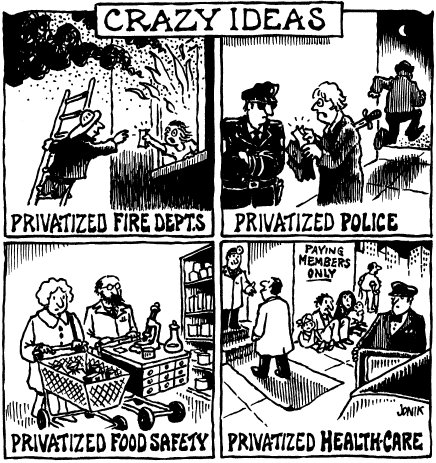
Cartoon by John Janik.

Health care reform and the lies about the Canadian system

When you put the two systems side by side, it is easy to see why no Canadian would even consider changing their system for ours (even conservative Canadians). In Canada, they consider decent health care to be a right of every citizen regardless of wealth or class.

By Ted McLaughlin / The Rag Blog / August 10, 2009

We’ve been hearing a lot recently from the Republicans about the Canadian health care system. If you listen to them, you would believe the Canadians have a terrible system, with rationing that is a death sentence for the elderly and possibly others, who have to wait endlessly for life-saving treatment from a government doctor.

Of course, these are all lies. But with our own system so badly broken it is indefensible, how could the Republicans possibly justify wanting to keep the current system? There was only one way. Accuse the Democrats of trying to institute a system like the Canadian system, and then tell so many lies and half-truths that the Canadian system would be so demonized that our own terrible system would look good by comparison.

They are able to get away with demonizing the Canadian health care, because very few Americans actually understand what that system entails. They just have heard that it is a government-run system, and therefore must be socialist (and Americans have been taught that anything connected to the word socialism must be bad).

A good example of this attempt to demonize Canadian health care is a TV ad paid for by an ultra-right-wing group called the Americans for Prosperity Foundation. They created and funded an organization called Patients United Now, that they were hoping gullible Americans would think was a grassroots patients organization. It isn’t. It’s a shadow organization created by the wealthy who want to keep our current badly broken health care system.

The TV ad they are running shows a Canadian woman named Shana Holmes who says she had a fast-growing and life-threatening brain tumor, but she would have had to wait six months in Canada for treatment. She claimed she would have died waiting for treatment in Canada, so she went to Arizona and was saved by the American health care system where she didn’t have to wait.

That sounds like a horrible indictment of the Canadian system. The only problem is that it is NOT TRUE! She did not have a brain tumor, and her life was not at stake. Even if she had to wait the full six months (and that is doubtful), she would not have died. What she had was a cyst, which she had since birth. It was beginning to press on her optic nerve and needed to be removed, but a short wait would have caused her no harm.

Another thing she fails to mention in the ad is that she ran up a huge medical bill by coming to America for her operation — a bill that is too large for her to pay. She is currently suing the Canadian government in an attempt to make them pay for it.

After all the lies and falsehoods being told about Canadian health care, I thought it would be good to actually compare their system to the American system. Can it be as bad as the Republicans would have us believe? If it is, why aren’t the Canadians flocking to America for treatment (and they are not, regardless of what right-wingers want us to believe)?

Here is the truth about both systems:

  • Canada has only one health insurance provider — the government. There is no need for the system to make a profit.

The United States has hundreds of private insurance companies, all trying to maximize their profits and curb the amount they pay for medical care.

  • All of Canada’s citizens have health insurance coverage.

At least 46 million Americans (and possibly many more) do not have any health insurance at all, and currently 14,000 people a week are losing their coverage in our poor economy.

  • Canadians have their choice of any doctor or hospital they want to use.

Americans must choose their doctor and hospital from a list provided by their private insurance company.

  • No Canadian can be denied insurance coverage for a pre-existing condition or because their required treatment is very expensive.

American insurance companies routinely deny coverage for pre-existing conditions, and have been known to cancel policies when treatment gets expensive.

  • Many times Canadians must wait weeks or months for elective surgery, because those with life-threatening illnesses are treated first.

Americans do not have to wait for elective surgery if they have the money to pay for it. But the insurance will pay for little or none of it. The poor and uninsured cannot get this surgery at all.

  • The Canadian system puts an emphasis on preventive care, and Canadians see their doctor more often.

The uninsured and underinsured in the U.S. get no preventive care at all.

  • Canadians live an average of three years longer than Americans.
  • The Canadian infant mortality rate is 20% lower than in the U.S.

Well, there it is. When you put the two systems side by side, it is easy to see why no Canadian would even consider changing their system for ours (even conservative Canadians). In Canada, they consider decent health care to be a right of every citizen regardless of wealth or class.

Our current system does not recognize a right to decent health care. Instead, health care is a commodity to be sold to those who can afford it. The rich get top-notch care, while the middle class struggles to get adequate care (about a million a year go bankrupt trying to pay for health care). The poor and working classes get inadequate or no health care. This is not a system worth defending. That is why the Republicans must demonize the Canadian system in order to keep our current system intact.

The truth is that none of the plans introduced by the Democrats would impose anything like the Canadian system. Even those plans with a public insurance option fall far short of the Canadian system. I wish our politicians had the political courage to propose something similar to what the Canadians have, but they don’t. The best we can hope for at this point is that the reform will contain a public option, which can be enhanced in the future when Americans come to their senses.

Don’t believe the Republican right-wing lies. Demand a public option be included in any reform.

(There is an Source excellent article in the Los Angeles Times written by a Canadian doctor. I urge you to read it.)

Also see Exposing Lies About Canadian Health Care by Victoria Foe / The Rag Blog / August 5, 2009

[Rag Blog contributor Ted McLaughlin also posts at jobsanger, an excellent Texas political blog.]

The Rag Blog

Posted in Rag Bloggers | Tagged , , | 12 Comments

Rabbi Arthur Waskow : Like War? You’ll LOVE Global Scorching

As long as the oil and coal keep pouring CO2 into our planet’s atmosphere, the food will wither, the ice will melt, the oceans will flood, and people will die — and kill.

By Rabbi Arthur Waskow / The Rag Blog / August 10, 2009

This past Friday night, I was speaking at a synagogue on the Jewish obligation to reduce the danger of global scorching. One of the congregants asked why I, who had spent so much of my life working for social justice and against war, was now working “instead” on healing the earth.

The answer came Sunday morning, on the front page of the New York Times:

“Recent [Defense Department] war games and intelligence studies conclude that over the next 20 to 30 years, vulnerable regions, particularly sub-Saharan Africa, the Middle East and South and Southeast Asia, will face the prospect of food shortages, water crises and catastrophic flooding driven by climate change that could demand an American humanitarian relief or military response.”

The same Jewish organizations, the same churches, the same Muslim networks that claim to care about the poor of Africa, Asia, and (especially!) the Middle East still see the climate crisis as a side issue that is somewhere down in the middle of their long priority lists. And anyway, it’s all 20 years away or more. Why worry now?

Actually, it isn’t 20 years off. It’s in the present, NOW. Most of the sound and fury expended on “ending the genocide” in Darfur has ignored the underlying causes of the violence there. But the same NY Times article reports that [Senator John] Kerry said the continuing conflict in southern Sudan, which has killed and displaced tens of thousands of people, is a result of drought and expansion of deserts in the north. “That is going to be repeated many times over and on a much larger scale,” he said.

What’s the connection? Formerly flourishing crops withered and died under the baleful heat of planetary climate “change.” When there’s not enough food, people will kill to feed their families. And whole ethnic groups will kill other ethnic groups to make sure their own folks get to eat.

You can proclaim “Never again!” as loud as you like, and insist the UN and the U.S. send peacekeepers, but as long as the food is withering away, the killing will continue. As long as the oil and coal keep pouring CO2 into our planet’s atmosphere, the food will wither, the ice will melt, the oceans will flood, and people will die — and kill.

George Bernard Shaw once wrote (in his play Saint Joan), “Must Christ be crucified in every generation for the benefit of those who have no imagination?”

Substitute whatever metaphor fits your own worldview: “Must Dr. King be murdered in every generation … ” “Must Auschwitz recur in every generation . . .”

Use your imagination!! If you care about Israelis, about Palestinians, about Ugandans and Kenyans and Bangla Deshis, either because you care about all who suffer or you care about your own kinfolk who suffer, USE YOUR IMAGINATION! Turn your imagination to political action — to stop global scorching.

This fall, prophetic voices like Bill McKibben have called for public actions on October 24 to demand that governments take vigorous action to curb global scorching. A wide swathe of the American Jewish community has called for making that day, the Shabbat when Jews read the biblical story of Noah, the Flood, the Ark, and the Rainbow, into “Climate Healing Shabbat,” with political action during the week before or after and prayer, sermons, discussions, Torah-nature walks, on Shabbat itself.

To register your own intention to take on this commitment, please register your community at both these places:

The international observance of “Global Climate Healing Shabbat Noach” is not the end – but a beginning, or a deepening. It points toward the crucial United Nations conference on the climate crisis scheduled for Copenhagen in December, 2009.

For more information on what you can do, please go here.

On the Shalom Center website are a number of items that may be of use to you:

A chapter, “Rainbow Sign,” from my book GODWRESTLING — ROUND 2, a midrashic examination of the Noah story for its importance in healing our planet today;

“The Return of Captain Noah,” a story by Rabbi Phyllis Berman and myself from our book Tales Of Tikkun: New Jewish Stories To Heal The Wounded World, in which Noah and his wife Naamah awake in our own generation from a long sleep in a cave on Mt Ararat to hear God’s call that the earth and all life are again in danger — and what they do to save it.

A new Haftarah to the Flood/ Rainbow story that came through me several years ago at Elat Chayyim, in my English and Reb Zalman Schachter-Shalomi’s translation into Hebrew.

And this — a song, maybe mostly for children but I have found adults get a great kick out of it as well — “GOD SAID TO NOAH: An Old/ New Song to Avert a New Flood.” It begins this way:

God said to Noah, The earth’s getting hotter, hotter,
Yet she is My (clap) beloved daughter, daughter —
Children of the Lord.

CHORUS: Rise and shine and give God the glory glory
Rise and shine and give God the glory glory
Rise and shine and (clap!) give God the glory glory
Children of the Lord!

People are making My air too smoky, smoky
Fix it now! (clap) and don’t be pokey, pokey —
Children of the Lord. … [and more verses]

I hope this will jump-start your thinking. Please write me what has begun to percolate for you, and I’ll pass the ideas around.

Shalom, salaam, shantih — peace,

Arthur

[Rabbi Arthur Waskow is director of The Shalom Center. He can be reached at awaskow@shalomctr.org.]

The Rag Blog

Posted in Rag Bloggers | Tagged , , , , | 1 Comment

Moral Relativism: We Call Our Suicide Bombers ‘Heros’

American child dressed as suicide bomber for Halloween. Photo: Source.

Our Suicide Bombers: Thoughts on Western Jihad
By John Feffer / August 6, 2009

The actor Will Smith is no one’s image of a suicide bomber. With his boyish face, he has often played comic roles. Even as the last man on earth in I Am Legend, he retains a wise-cracking, ironic demeanor. And yet, surrounded by a horde of hyperactive vampires at the end of that film, Smith clasps a live grenade to his chest and throws himself at the enemy in a final burst of heroic sacrifice.

Wait a second: surely that wasn’t a suicide bombing. Will Smith wasn’t reciting suras from the Koran. He wasn’t sporting one of those rising sun headbands that the Japanese kamikaze wore for their suicide missions. He wasn’t playing a religious fanatic or a political extremist. Will Smith was the hero of the film. So how could he be a suicide bomber? After all, he’s one of us, isn’t he?

As it happens, we have our suicide bombers too. “We” are the powerful, developed countries, the ones with an overriding concern for individual liberties and individual lives. “We” form a moral archipelago that encompasses the United States, Europe, Israel, present-day Japan, and occasionally Russia. Whether in real war stories or inspiring vignettes served up in fiction and movies, our lore is full of heroes who sacrifice themselves for motherland, democracy, or simply their band of brothers. Admittedly, these men weren’t expecting 72 virgins in paradise and they didn’t make film records of their last moments, but our suicidal heroes generally have received just as much praise and recognition as “their” martyrs.

The scholarly work on suicide bombers is large and growing. Most of these studies focus on why those other people do such terrible things, sometimes against their own compatriots but mainly against us. According to the popular view, Shiite or Tamil or Chechen suicide martyrs have a fundamentally different attitude toward life and death.

If, however, we have our own rich tradition of suicide bombers — and our own unfortunate tendency to kill civilians in our military campaigns — how different can these attitudes really be?

Western Jihad

In America’s first war against Islam, we were the ones who introduced the use of suicide bombers. Indeed, the American seamen who perished in the incident were among the U.S. military’s first missing in action.

It was September 4, 1804. The United States was at war with the Barbary pirates along the North African coast. The U.S. Navy was desperate to penetrate the enemy defenses. Commodore Edward Preble, who headed up the Third Mediterranean Squadron, chose an unusual stratagem: sending a booby-trapped U.S.S. Intrepid into the bay at Tripoli, one of the Barbary states of the Ottoman empire, to blow up as many of the enemy’s ships as possible. U.S. sailors packed 10,000 pounds of gunpowder into the boat along with 150 shells.

When Lieutenant Richard Sommers, who commanded the vessel, addressed his crew on the eve of the mission, a midshipman recorded his words:

“‘No man need accompany him, who had not come to the resolution to blow himself up, rather than be captured; and that such was fully his own determination!’ Three cheers was the only reply. The gallant crew rose, as a single man, with the resolution yielding up their lives, sooner than surrender to their enemies: while each stepped forth, and begged as a favor, that he might be permitted to apply the match!”

The crew of the boat then guided the Intrepid into the bay at night. So as not to be captured and lose so much valuable gunpowder to the enemy, they chose to blow themselves up with the boat. The explosion didn’t do much damage — at most, one Tripolitan ship went down — but the crew was killed just as surely as the two men who plowed a ship piled high with explosives into the U.S.S. Cole in the Gulf of Aden nearly 200 years later.

Despite the failure of the mission, Preble received much praise for his strategies. “A few brave men have been sacrificed, but they could not have fallen in a better cause,” opined a British navy commander. The Pope went further: “The American commander, with a small force and in a short space of time, has done more for the cause of Christianity than the most powerful nations of Christiandom have done for ages!”

Preble chose his tactic because his American forces were outgunned. It was a Hail Mary attempt to level the playing field. The bravery of his men and the reaction of his supporters could be easily transposed to the present day, when “fanatics” fighting against similar odds beg to sacrifice themselves for the cause of Islam and garner the praise of at least some of their religious leaders.

The blowing up of the Intrepid was not the only act of suicidal heroism in U.S. military history. We routinely celebrate the brave sacrifices of soldiers who knowingly give up their lives in order to save their unit or achieve a larger military mission. We commemorate the sacrifice of the defenders of the Alamo, who could have, after all, slunk away to save themselves and fight another day. The poetry of the Civil War is rich in the language of sacrifice. In Phoebe Cary’s poem “Ready” from 1861, a black sailor, “no slavish soul had he,” volunteers for certain death to push a boat to safety.

The heroic sacrifices of the twentieth century are, of course, commemorated in film. Today, you can buy several videos devoted to the “suicide missions” of American soldiers.

Our World War II propaganda films — er, wartime entertainments — often featured brave soldiers facing certain death. In Flying Tigers (1942), for example, pilot Woody Jason anticipates the Japanese kamikaze by several years by flying a plane into a bridge to prevent a cargo train from reaching the enemy. In Bataan (1943), Robert Taylor leads a crew of 13 men in what they know will be the suicidal defense of a critical position against the Japanese. With remarkable sangfroid, the soldiers keep up the fight as they are picked off one by one until only Taylor is left. The film ends with him manning a machine gun against wave upon wave of oncoming Japanese.

Our warrior culture continues to celebrate the heroism of these larger-than-life figures from World War II by taking real-life stories and turning them into Hollywood-style entertainments. For his series of “war stories” on Fox News, for instance, Oliver North narrates an episode on the Doolittle raid, an all-volunteer mission to bomb Tokyo shortly after Pearl Harbor. Since the bombers didn’t have enough fuel to return to their bases, the 80 pilots committed to what they expected to be a suicide mission. Most of them survived, miraculously, but they had been prepared for the ultimate sacrifice — and that is how they are billed today. “These are the men who restored the confidence of a shaken nation and changed the course of the Second World War,” the promotional material for the episode rather grandly reports. Tokyo had the same hopes for its kamikaze pilots a few years later.

Why Suicide Missions?

America did not, of course, dream up suicide missions. They form a rich vein in the Western tradition. In the Bible, Samson sacrificed himself in bringing down the temple on the Philistine leadership, killing more through his death than he did during his life. The Spartans, at Thermopylae, faced down the Persians, knowing that the doomed effort would nevertheless delay the invading army long enough to give the Athenians time to prepare Greek defenses. In the first century AD in the Roman province of Judea, Jewish Zealots and Sicarians (“dagger men”) launched suicide missions, mostly against Jewish moderates, to provoke an uprising against Roman rule.

Later, suicide missions played a key role in European history. “Books written in the post-9/11 period tend to place suicide bombings only in the context of Eastern history and limit them to the exotic rebels against modernism,” writes Niccolo Caldararo in an essay on suicide bombers. “A study of the late 19th century and early 20th would provide a spate of examples of suicide bombers and assassins in the heart of Europe.” These included various European nationalists, Russian anarchists, and other early practitioners of terrorism.

Given the plethora of suicide missions in the Western tradition, it should be difficult to argue that the tactic is unique to Islam or to fundamentalists. Yet some scholars enjoy constructing a restrictive genealogy for such missions that connects the Assassin sect (which went after the great sultan Saladin in the Levant in the twelfth century) to Muslim suicide guerrillas of the Philippines (first against the Spanish and then, in the early twentieth century, against Americans). They take this genealogy all the way up to more recent suicide campaigns by Hezbollah, Hamas, al-Qaeda, and Islamic rebels in the Russian province of Chechnya. The Tamil Tigers of Sri Lanka, who used suicide bombers in a profligate fashion, are ordinarily the only major non-Muslim outlier included in this series.

Uniting our suicide attackers and theirs, however, are the reasons behind the missions. Three salient common factors stand out. First, suicidal attacks, including suicide bombings, are a “weapon of the weak,” designed to level the playing field. Second, they are usually used against an occupying force. And third, they are cheap and often brutally effective.

We commonly associate suicide missions with terrorists. But states and their armies, when outnumbered, will also launch such missions against their enemies, as Preble did against Tripoli or the Japanese attempted near the end of World War II. To make up for its technological disadvantages, the Iranian regime sent waves of young volunteers, some unarmed and some reportedly as young as nine years old, against the then-U.S.-backed Iraqi army in the Iran-Iraq War of the 1980s.

Non-state actors are even more prone to launch suicide missions against occupying forces. Remove the occupying force, as Robert Pape argues in his groundbreaking book on suicide bombers, Dying to Win, and the suicide missions disappear. It is not a stretch, then, to conclude that we, the occupiers (the United States, Russia, Israel), through our actions, have played a significant part in fomenting the very suicide missions that we now find so alien and incomprehensible in Iraq, Afghanistan, Chechnya, Lebanon, and elsewhere.

The archetypal modern suicide bomber first emerged in Lebanon in the early 1980s, a response to Israel’s invasion and occupation of the country. “The Shiite suicide bomber,” writes Mike Davis in his book on the history of the car bomb, Buda’s Wagon, “was largely a Frankenstein monster of [Israeli Defense Minister] Ariel Sharon’s deliberate creation.” Not only did U.S. and Israeli occupation policies create the conditions that gave birth to these missions, but the United States even trained some of the perpetrators. The U.S. funded Pakistan’s intelligence service to run a veritable insurgency training school that processed 35,000 foreign Muslims to fight the Soviets in Afghanistan in the 1980s. Charlie Wilson’s War, the book and movie that celebrated U.S. assistance to the mujihadeen, could be subtitled: Suicide Bombers We Have Known and Funded.

Finally, the technique “works.” Suicide bombers kill 12 times more people per incident than conventional terrorism, national security specialist Mohammed Hafez points out. The U.S. military has often publicized the “precision” of its airborne weaponry, of its “smart” bombs and missiles. But in truth, suicide bombers are the “smartest” bombers because they can zero in on their target in a way no missile can — from close up — and so make last-minute corrections for accuracy. In addition, by blasting themselves to smithereens, suicide bombers can’t give away any information about their organization or its methods after the act, thus preserving the security of the group. You can’t argue with success, however bloodstained it might be. Only when the tactic itself becomes less effective or counterproductive, does it recede into the background, as seems to be the case today among armed Palestinian groups.

Individual motives for becoming a suicide bomber or attacker have, when studied, proved to be surprisingly diverse. We tend to ascribe heroism to our soldiers when, against the odds, they sacrifice themselves for us, while we assume a glassy-eyed fanaticism on the part of those who go up against us. But close studies of suicide bombers suggest that they are generally not crazy, nor — another popular explanation — just acting out of abysmal poverty or economic desperation (though, as in the case of the sole surviving Mumbai suicide attacker put on trial in India recently, this seems to have been the motivation). “Not only do they generally not have economic problems, but most of the suicide bombers also do not have an emotional disturbance that prevents them from differentiating between reality and imagination,” writes Anat Berko in her careful analysis of the topic, The Path to Paradise. Despite suggestions from Iraqi and U.S. officials that suicide bombers in Iraq have been coerced into participating in their missions, scholars have yet to record such cases.

Perhaps, however, this reflects a narrow understanding of coercion. After all, our soldiers are indoctrinated into a culture of heroic sacrifice just as are the suicide bombers of Hamas. The indoctrination doesn’t always work: scores of U.S. soldiers go AWOL or join the peace movement just as some suicide bombers give up at the last minute. But the basic-training techniques of instilling the instinct to kill, the readiness to follow orders, and a willingness to sacrifice one’s life are part of the warrior ethic everywhere.

Suicide missions are, then, a military technique that armies use when outmatched and that guerrilla movements use, especially in occupied countries, to achieve specific objectives. Those who volunteer for such missions, whether in Iraq today or on board the Intrepid in 1804, are usually placing a larger goal — liberty, national self-determination, ethnic or religious survival — above their own lives.

But wait: surely I’m not equating soldiers going on suicide missions against other soldiers with terrorists who blow up civilians in a public place. Indeed, these are two distinct categories. And yet much has happened in the history of modern warfare — in which civilians have increasingly become the victims of combat — to blur these distinctions.

Terror and Civilians

The conventional picture of today’s suicide bomber is a young man or woman, usually of Arab extraction, who makes a video proclamation of faith, straps on a vest of high explosives, and detonates him or herself in a crowded pizzeria, bus, marketplace, mosque, or church. But we must expand this picture. The September 11th hijackers targeted high-profile locations, including a military target, the Pentagon. Hezbollah’s suicidal truck driver destroyed the U.S. Marine barracks in Beirut on October 23, 1983, killing 241 U.S. soldiers. Thenmozhi Rajaratnam, a female Tamil suicide bomber, assassinated Indian Prime Minister Rajiv Gandhi in 1991.

Suicide bombers, in other words, have targeted civilians, military installations, non-military sites of great significance, and political leaders. In suicide attacks, Hezbollah, Tamil Tiger, and Chechen suicide bombers have generally focused on military and police targets: 88%, 71%, and 61% of the time, respectively. Hamas, on the other hand, has largely targeted civilians (74% of the time). Sometimes, in response to public opinion, such movements will shift focus — and targets. After a 1996 attack killed 91 civilians and created a serious image problem, the Tamil Tigers deliberately began chosing military, police, and government targets for their suicide attacks. “We don’t go after kids in Pizza Hut,” one Tiger leader told researcher Mia Bloom, referring to a Hamas attack on a Sbarro outlet in Jerusalem that killed 15 civilians in 2001.

We have been conditioned into thinking of suicide bombers as targeting civilians and so putting themselves beyond the established conventions of war. As it happens, however, the nature of war has changed in our time. In the twentieth century, armies began to target civilians as a way of destroying the will of the population, and so bringing down the leadership of the enemy country. Japanese atrocities in China in the 1930s, the Nazi air war against Britain in World War II, Allied fire bombings of German and Japanese cities, the nuclear attacks against Hiroshima and Nagasaki, U.S. carpet bombing in Cambodia and Laos, and the targeted assassinations of the Phoenix program during the Vietnam War, Russian depredations in Afghanistan and Chechnya, the tremendous civilian casualties during the Iraq War: all this has made the idea of conventional armies clashing in an area far from civilian life a quaint legacy of the past.

Terrorist attacks against civilians, particularly September 11th, prompted military historian Caleb Carr to back the Bush administration’s declaration of a war against terror. “War can only be answered with war,” he wrote in his best-selling The Lessons of Terror. “And it is incumbent on us to devise a style of war more imaginative, more decisive, and yet more humane than anything terrorists can contrive.” This more imaginative, decisive, and humane style of war has, in fact, consisted of stepped-up aerial bombing, beefed-up Special Forces (to, in part, carry out targeted assassinations globally), and recently, the widespread use of unmanned aerial drones like the Predator and the Reaper, both in the American arsenal and in 24/7 use today over the Pakistani tribal borderlands. “Predators can become a modern army’s answer to the suicide bomber,” Carr wrote.

Carr’s argument is revealing. As the U.S. military and Washington see it, the ideal use of Predator or Reaper drones, armed as they are with Hellfire missiles, is to pick off terrorist leaders; in other words, a mirror image of what that Tamil Tiger suicide bomber (who picked off the Indian prime minister) did somewhat more cost effectively. According to Carr, such a strategy with our robot planes is an effective and legitimate military tactic. In reality, though, such drone attacks regularly result in significant civilian casualties, usually referred to as “collateral damage.” According to researcher Daniel Byman, the drones kill 10 civilians for every suspected militant. As Tom Engelhardt of TomDispatch.com writes, “In Pakistan, a war of machine assassins is visibly provoking terror (and terrorism), as well as anger and hatred among people who are by no means fundamentalists. It is part of a larger destabilization of the country.”

So, the dichotomy between a “just war,” or even simply a war of any sort, and the unjust, brutal targeting of civilians by terrorists has long been blurring, thanks to the constant civilian casualties that now result from conventional war-fighting and the narrow military targets of many terrorist organizations.

Moral Relativism?

We have our suicide bombers — we call them heroes. We have our culture of indoctrination — we call it basic training. We kill civilians — we call it collateral damage.

Is this, then, the moral relativism that so outrages conservatives? Of course not. I’ve been drawing these comparisons not to excuse the actions of suicide bombers, but to point out the hypocrisy of our black-and-white depictions of our noble efforts and their barbarous acts, of our worthy goals and their despicable ends. We — the inhabitants of an archipelago of supposedly enlightened warfare — have been indoctrinated to view the atomic bombing of Hiroshima as a legitimate military target and September 11th as a heinous crime against humanity. We have been trained to see acts like the attack in Tripoli as American heroism and the U.S.S. Cole attack as rank barbarism. Explosive vests are a sign of extremism; Predator missiles, of advanced sensibility.

It would be far better if we opened our eyes when it came to our own world and looked at what we were actually doing. Yes, “they” sometimes have dismaying cults of sacrifice and martyrdom, but we do too. And who is to say that ending occupation is any less noble than making the world free for democracy? Will Smith, in I Am Legend, was willing to sacrifice himself to end the occupation of vampires. We should realize that our soldiers in the countries we now occupy may look no less menacing and unintelligible than those obviously malevolent, science-fiction creatures. And the presence of our occupying soldiers sometimes inspires similar, Will Smith-like acts of desperation and, dare I say it, courage.

The fact is: Were we to end our occupation policies, we would go a long way toward eliminating “their” suicide bombers. But when and how will we end our own cult of martyrdom?

[John Feffer is the co-director of Foreign Policy in Focus at the Institute for Policy Studies and writes its regular World Beat column. His past essays, including those for Tomdispatch.com, can be read at his website. Kathryn Zickuhr contributed research assistance to this article.]

Source / TomDispatch

The Rag Blog

Posted in RagBlog | Tagged , , | 13 Comments

Girls Night Out : Cyndi Lauper and Rosie O’Donnell Celebrate Life

The Girls Night Out promo poster — and ticket stub. Photo by Thomas Good / NLN / The Rag Blog.

Cyndi Lauper and Rosie O’Donnell:
Terrific show for a great cause

Although ‘Girls Just Want to Have Fun’ is the most famous Lauper anthem, her current show is about more than the desire to live joyously. The Girls Night Out tour is asking fans to donate food to local social service organizations that feed the hungry.

By Thomas Good / The Rag Blog / August 8 2009

STATEN ISLAND, N.Y. — At times it felt as though the audience was sitting in Cyndi’s living room — the banter went well beyond the usual perfunctory exchanges between rock star and fans.

The event was billed as “Girl’s Night Out” and featured a half hour of comedian Rosie O’Donnell’s standup followed by almost two hours of Lauper’s greatest hits. “Out of a possible five apples” — this reviewer gives Cyndi Lauper’s “Girls Night Out” tour the Big Apple. It’s hers to begin with — and on Wednesday night she stole the heart of every New Yorker in the joint.

Two years ago I began attending metal concerts as an exercise in father-son solidarity. I wanted to spend time with my newly minted teenager doing things HE wanted to do. Along the way I learned a thing or two. I discovered that my son had quietly learned how to critique art and had developed a keen interest in experimental music. Gaining self confidence, my son told me, “Forget about punk, the real experimentation is going on in metal — and there are hybrids out there too, ‘metalcore’ bands that have the best of both genres.” He’s right: bands like Between The Buried And Me prove this. However, some of the original experimentation that characterized punk continues, even though the music industry does not promote it.

One of the original experimenters signed under the punk umbrella — who is still producing great music — is Cyndi Lauper. The unusual girl from Queens, known as a champion of human rights and hero of the LGBT community, has a stunning four octave range and a unique vocal style. But what is truly special about her is that she embodies something that appeals to the kid in all of us: her very existence is a celebration of life. And even more remarkable, if not particularly surprising, is that this appeal is not limited to adults who want more from life than Blackberries, hopeless wars and sub-prime economic disasters. Lauper appeals to kids too. I know this because Wednesday night I attended a show in solidarity with another of my children. My 7-year-daughter is a Cyndi Lauper fanatic and has been for years, dating back to when she pronounced Lauper, “Locker”.

Lauper and O’Donnell’s “Girls Night Out” took place in Staten Island’s premiere venue, the St. George Theater, where the finale of the 2003 Jack Black film “School of Rock” was filmed. The St. George, with its explosion of Spanish and Italian Baroque styles, high ceiling and unobstructed view of the stage, was the perfect setting for the colorful Cyndi — and her friend Rosie. Completing the picture was the audience — devoted fans, a number of whom I recognized from covering LGBT Pride parades.

Rosie O’Donnell, Lauper’s friend and collaborator on the current tour, opened the show. Her standup — my first experience with seeing it performed live — was entertaining and she is clearly in command of the art form. She discussed being lesbian, being a mother and going through menopause. She also got in a few digs at Donald Trump — and Elisabeth Hasselbeck, the ultra-conservative co-host of The View who cat fought O’Donnell during the time they both worked the show. O’Donnell’s comedy, coarse at times but chock full of endearing personal anecdotes, resonated with the crowd.

O’Donnell, who took a short break after her performance, returned to introduce Lauper — and sang backup on a few songs before departing a second time.

“They were throwing rocks at me because my clothes were funny. It just goes to show. And let’s face it, in the Eighties I got my revenge.” — Cyndi Lauper describing her childhood to fans at the St. George.

Clad in sheer black stockings, a short black waistcoat and topped off with a platinum perm, Lauper looked the part of the “weirdo artist”. That’s how the mother of an 11-year-old son defines herself, and performing live she’s nothing if not high definition. During Wednesday’s show, roadies struggled to keep up with the 56-year-old Lauper as she moved from playing her trademark dulcimer to dancing across the stage in her familiar frantic-but-very-chic style. Several times she ventured into the audience to dance with her fans, at one point climbing up on a chair and waving at fans in the balcony.

It wasn’t long before Cyndi tossed her shoes backstage so she could dance barefoot. And once she started dancing, she never looked back.

Rosie O’Donnell and Cyndi Lauper: Girls Night Out.

Although “Girls Just Want to Have Fun” is the most famous Lauper anthem, her current show is about more than the desire to live joyously. The Girls Night Out tour is asking fans to donate food to local social service organizations that feed the hungry. The beneficiary of Lauper’s Staten Island appearance was Project Hospitality, a North Shore homeless shelter led by longtime human rights activist Reverend Terry Troia. Lauper mentioned Project Hospitality several times during her show, thanking the organization and urging people to support its work.

“Let’s have a good time and have each other’s backs,” Lauper said.

The theme of having each other’s back, and the importance of family and friends punctuated the show.

Locating a relative in the audience — Lauper’s family is spread across Brooklyn, Queens, and Staten Island — Cyndi struck up a conversation with her cousin “Joey”, asking about the photo of her greatgrandmother he had sent her and getting details about her “Aunt Tilly”. As a fascinated audience looked on.

“Joey is my cousin, he’s here, where are ya? Right there? I was dancing with you! Anyway, I got the picture…” — Cyndi Lauper, whose performance in Staten Island included an impromptu family reunion.

When a member of the audience began yelling “shut up and sing”, Lauper shouted back, “Shut the fuck up!”, which prompted cheers from a crowd grateful for the opportunity to see a star be herself. With tongue firmly in cheek, Lauper scolded the anxious audience member and then belted out another danceable tune, “Into The Nightlife”. The track is from her most recent CD, “Bring Ya To The Brink”, which was nominated for a grammy in December.

A touching moment, and there were several, came when Lauper described how she came to write the song “Sally’s Pigeons” — from the underrated fourth album, “Hat Full of Stars”, which included tracks that dealt with homophobia, spousal abuse, racism and abortion.

“There’s a place where my family came, to get a leg up, because they came out of the cold-water flats on Marcy Street. The buildings they tore down to build the projects they tore down. But this inspired me to write these songs about these times,” said Lauper.

Lauper had not rehearsed the song. But in response to a request from the audience, she sang it — a capella. Losing her place once, she stopped and started again. No one seemed to mind. At least for one evening, we were all family.

Speaking of family, my own provided the most telling critique of the show: my seven-year-old sang harmony vocals on quite a few songs — and stood up in her seat for most of the evening. So she could dance with Cyndi.

The comprehensive “Girls Night Out” setlist featured Lauper’s biggest hits: “Change Of Heart”, “When You Were Mine”, “She Bop”, “All Through The Night”, “Time After Time”, “Into The Nightlife”, “Money Changes Everything”, “Girls Just Want to Have Fun”, and “True Colors”; as well as songs from “Blue Angel”, Lauper’s first band, and an impressive rendition of Joni Mitchell’s “Carey”. The fact that Lauper performs her hits endears her to her fans and is refreshing. As someone who has seen many shows over the last 35 years, I weary of performers who refuse to play the songs that made their careers. While it is understandable that playing the same song thousands of times is tedious, there is something very appealing about a performer who draws inspiration from the energy of the fans, fans who get very fired up when they hear songs that served as soundtracks to their lives.

And the biggest hits came last, capping a brilliant performance.

Returning to the stage to join her friend “Cyn” for an encore performance of “Girls Just Want to Have Fun”, O’Donnell banged on cymbals and a pair of snare drums. She not only pulled it off but played well, adding dramatic emphasis to Lauper’s already dramatic signature song.

During the final encore, a haunting rendition of “True Colors”, Lauper raised her fist and said, “Power to the People”, telling the audience to never forget that “it’s We The People…For the People…” I couldn’t agree more. Lauper is the People’s performer and this tour is Citizen Cyndi at her best.

And as Lauper commented on People Power — behind her was O’Donnell, saying, “Amen, Sister”, and flashing the peace sign to the audience.

Amen, indeed.

[Thomas Good is editor of Next Left Notes, where this article also appears.]

The Rag Blog

Posted in Rag Bloggers | Tagged , , , | 4 Comments

Honduras : U.S. Waffles; Repression of Opposition Intensifies

Students and police outside university in Tegucigalpa. Photo from La Prensa, Honduras.

State Department backs away from support for Zelaya while resistance is met with more violence

‘What happened today is the most brutal repression we have lived through,’ labor and anti-coup leader Juan Barahona said after a demonstration in Tegucigalpa on July 30.

By David Holmes Morris / The Rag Blog / August 8, 2009

While the battle of Honduras rages, the U.S. State Department has backed away from its earlier strong condemnation of the ouster of President Manuel Zelaya and made clear its unwillingness to declare it a coup d’état. U.S. law would require cutting off economic aid altogether if in the judgement of the State Department a coup had occurred, a step widely considered crucial to forcing the resignation of the golpista government and the reinstatement of Zelaya.

“We have rejected calls for crippling economic sanctions,” announced Richard Verma, a State Department assistant secretary, in a letter to Republican Senator Richard Lugar dated August 4. Verma wrote, “Our policy and strategy for engagement is not based on supporting any particular politician or individual.” Thus in the State Department’s view, democratically elected President Manuel Zelaya and president by force of arms Roberto Micheletti have equal standing.

The letter goes on to claim Zelaya’s “insistence on undertaking provocative actions contributed to the polarization of Honduran society and led to a confrontation that unleashed the events that led to his removal.” Honduran military officers abducted Zelaya at gunpoint and flew him out of the country early in the morning of June 28, hours before a scheduled nonbinding referendum on the question of rewriting the constitution, a referendum Zelaya and large sectors of the population supported but that rightists claimed was in reality an attempt to extend his rule beyond the single four-year term permitted by the current constitution.

In an August 1 interview in La Jornada of Mexico City, journalist Arturo Cano pointed out to Ramón Custodio, human rights commissioner in the Micheletti regime, that Zelaya had not proposed his own re-election but a constituent assembly. “It was moving in that direction,” Custodio replied. “The constituent assembly was going to be installed by the end of the day (June 28, the day of the coup) and the members were going to be those who had been with him the night before the referendum, and they know it.”

In the meantime, the repression of coup opponents has intensified. “What happened today is the most brutal repression we have lived through,” labor and anti-coup leader Juan Barahona said after a demonstration in Tegucigalpa on July 30. Police used teargas and clubs against the demonstrators, jailing many and shooting one, Roger Abraham Vallejo, a member of the teacher’s union, who died the following Saturday. Another teacher, Martín Florencio Rivera Barrientos, was stabbed to death the next day after attending a wake for Vallejo. “This is a campaign of intimidation against the teacher’s union, the largest and best organized in the country,” according to a union official.

Police attacked a student demonstration reportedly numbering 3,000 outside the campus of the National Autonomous University of Honduras on August 5, using teargas and water cannons to drive them back onto the campus, where they beat and arrested many of them. By tradition, “autonomous” universities in Latin America are sanctuaries for political dissidents and government forces are excluded from them. The university rector, Julieta Castellanos, was beaten and knocked to the ground when she tried to intervene on the students’ behalf.

And the Honduran telecommunications commission has ordered the closing of Radio Globo, the only remaining widely available source of news in the country not controlled by the de facto government or its supporters. The government has charged the station with sedition.

At a rally in Tegucigalpa on August 3, Rafael Alegría and other leading opponents of the coup said military chief of staff General Romeo Vásquez and de facto President Roberto Micheletti have instigated what they called “Operation Tundra,” a revival of Batallion 3-16, the notorious death squad of the ‘80s, to eliminate opposition to the golpista government.

General García Padget: “socialism disguised as democracy.” Photo from La Prensa, Honduras.

The generals who carried out the coup have shown no regrets. In a television program featuring the chairman of the joint chiefs of staff and the commanders of the army, the air force and the navy, army General Miguel Ángel García Padget said that by removing Zelaya he and his fellow golpistas had put a stop to “that expansionist plan for carrying to the very heart of the United States a socialism disguised as democracy,” a plan devised by Venezuelan President Hugo Chávez, according to García Padget, to spread Socialism for the Twenty-First Century over the entire continent.

Head of the navy Admiral Juan Pablo Rodríguez told the television audience, “The democratic system was being threatened because that referendum was an effort to establish a national constituent assembly… The entire system would have been toppled for the interests of a small group.”

There are continuing reports of divisions in the armed forces, however. In an August 3 interview, Minister of Education in the Zelaya government Marlon Brevé Reyes repeated claims made earlier by Zelaya that lower ranking officers disagree strongly with the generals and resent being held responsible for the coup. Zelaya and Brevé both said the coup government would collapse when the dissident officers deposed the generals.

A statement attributed to the Movimiento de Oficiales Superiores y Subalternos de las Fuerzas Armadas (Movement of Superior and Subordinate Officers of the Armed Forces) and distributed on July 29 by anti-coup organizations declared, “Politicians, in collusion with military commanders, have implicated the armed forces and have damaged the good reputation we had with the Honduran people.”

But there are also differences of opinion among those opposed to the coup and some dissatisfation with Zelaya’s strategy. At a meeting of the Frente Nacional contra el Golpe de Estado on August 2 to plan a national march, one participant declared, “We are not going to win this struggle in the mountains, we are going to win it in the streets and the highways,” a reference to Zelaya’s forming a “peaceful popular army” in Ocotal, Nicaragua, near the Honduran border. Made up of anti-coup Hondurans who had followed Zelaya into Nicaragua, the army would supposedly return to Honduras eventually to be joined by others opposed to the coup.

Beyond the reinstatement of Zelaya, talk at the meeting was of the struggle “for a new Honduras.” “First we have to get rid of the golpistas,” one activist at the meeting said, “then bring back Zelaya and immediately afterward form a national constituent assembly.”

Zelaya has recently announced that he would accept the latest version of the San José Accords offered by Costa Rican President Óscar Arias which, among other provisions, call for his reinstatement but with greatly reduced power and for abandoning any efforts to rewrite the constitution. The Frente has consistently opposed all Arias’ proposals except the reinstatement of Zelaya and has insisted on efforts to write a new constitution.

[San Antonio native David Holmes Morris is an army veteran, a language major, a retired printer, a sometime journalist, and a gay liberationist. Morris’ previous Rag Blog articles on Honduras are here.]

The Rag Blog

Posted in Rag Bloggers | Tagged , , , , | 1 Comment

Extremism and Right Wing Populism : The Face of the Republican Party


The GOP and its extremists

The recent tea parties sponsored by some Republican columnists and Fox News were frightening because they so catered to people on what was once the lunatic fringe… The ugly spirit of the tea parties soon animated the mob behavior of rightists invading town hall meetings that were to focus on health care reform…

By Sherman DeBrosse / The Rag Blog / August 8, 2009

E.J. Dionne has another good column on whether the GOP can escape the grip of its extremists. It is especially timely in view of the current rightist mob actions at town meetings Democrats have called to discuss health care reform.

He notes that Senator George Voinovich has complained to the Columbus Dispatch that the party is being taken over by Southerners and that it has too many Jim De Mints and Tom Coburns

Voinovich is depicted as a moderate, but he is essentially an old-style Ohio country club Republican who is wise enough to avoid wild attacks on organized labor and the American automobile industry. He is not Olympia Snow or Susan Collins. Some trot out Charles Grassley as a moderate because he might be open to a very weak, pro-insurance industry health care plan. On most matters, he is solidly conservative. He has sometimes briefly flirted with protecting whistleblowers, but invariably backs off when he feels the heat.

In 2008, the Dispatch, though as conservative as ever, did not endorse John McCain. Perhaps the editors were bothered because the Ohio GOP that year was almost a wholly owned subsidiary of the Christian right, even using church space and at least one church-owned airplane. If the Republicans want to return to power, they need, in some states, to learn to satisfy their new masters.

David Brooks and some others think the GOP must counter adverse demographic trends by becoming moderate. Going moderate is not an option. The simple fact is that genuine moderates are an endangered species in the Republican Party, and the few that exist do not offer policy choices for the GOP to consider.

The best the GOP can do is distance itself a bit from its extremists. As for offering new policies, it has nothing it can unite on. On the stimulus package, some Republicans wanted to do nothing; and others demanded more tax cuts. On health care, they are only united in protecting the insurance companies and big pharmaceuticals.

Emphasizing right wing populism — a fear of an imagined cultural elite plotting against traditional American values — brought the GOP very close to its goal of a permanent majority. Of course, there was a slightly disguised admixture of anti-minority sentiment in this formula. There is something infectious about rage and paranoia, especially in bad times. As the longshoreman/philosopher Eric Hoffer wrote: “hatred is the most accessible and comprehensive of all unifying agents.”

From time to time, the GOP has adopted some of the intemperate language of people once considered the lunatic fringe: survivalists, the Patriots, Christian Identity, etc. These folks are to the right of the right-wing populism and advocate refusal to pay taxes, sometimes racial supremacy, and various forms of exclusionist doctrines. Each time, Republicans were able to import some of their rhetoric without shifting dramatically to the far, far right twilight zone.

The Swift Boat frenzy of 2004, claiming John Kerry was some sort of anti-American elitist and even a traitor, attracted these exclusionists in droves, but it also appealed to many, many others. No amount of solid information dissuaded any of these deluded people. The controversy also illustrated that the mainstream media will not correct patently false and wild political propaganda and that the GOP, when using it, pays no price for deploying vile tactics.

The nomination of Governor Sarah Palin for vice president briefly resurrected the McCain campaign, but it also put the GOP on a fast track to greater extremism. She repeatedly spoke about some parts of the United States being much more American and patriotic than others. Soon, her events resembled Klan rallies. Her devoted supporters were no longer worried about some relatively small cultural elite that was plotting against them. Now the enemies were more numerous, they were liberal Americans.

John McCain tried to dial back the paranoia because he feared it could threaten his campaign. Whether that’s a real threat remains to be demonstrated. Americans have become so accustomed to the right’s binges of irrationality. It could be that only we progressives, and a very few thoughtful conservatives and centrists, are really bothered by the extremists.

Today, the appeals to right-wing populism are especially shrill. Senior citizens are being told that liberal elitists want to use health care reform to deprive them of end-of-life care because they are too old, too sick, and require very costly treatment. They are also being told that the liberals want to strip away Medicare, which many oldsters incorrectly think is private insurance. A few papers have tried to correct these lies. Republican tactician Dick Morris is now bragging that senior citizens are quickly turning against health care reform.

The recent tea parties sponsored by some Republican columnists and Fox News were frightening because they so catered to people on what was once the lunatic fringe. Democrats were called “socialists,” and there was a great deal of hate speech. Usually, loose talk about secession was confined to gatherings of Constitutionalists, survivalists, and the Alaska Independence Party, to which the Palins had ties. But there was more than a little talk about secession at the tea parties, and even the Republican governor of Texas mentioned it as an option.

The ugly spirit of the tea parties soon animated the mob behavior of rightists invading town hall meetings that were to focus on health care reform. Palin-like Republicans are currently being sent to pro-health care reform rallies — the political meetings of progressive Congressmen — with instructions on use of thuggish tactics to disrupt the events.

Thug-like conservatives use GOP talking points to shout down speakers at town hall meetings on health care. Extremists attending a town meeting held by Christopher Dodd demanded that he commit suicide as a way of resolving his problem with prostate cancer. Followers of Glenn Beck created a near riot at a recent Tampa meeting, where violence was reported. In Rome, New York, Majority Leader Steny Hoyer of Maryland struggled to speak over someone repeatedly shouting “Liar.”

A Connecticut group called Right Principles organized some of the disruptions. Conservatives for Patient Rights bragged about the organized disruptions, while Republican officials claimed none of the disruptions were organized. Some think there will be a public backlash against these Brown Shirt tactics, but there is a substantial body of evidence that much of the public has learned to tolerate ugly tactics when they are deployed by Republicans.

Freshman Maryland Congressman Frank M. Kratovil was hanged in effigy outside his district office and a town meeting he organized was disrupted. Representative Brad Miller of North Carolina received a death threat. Representative Tim Bishop of New York needed police to extricate him from an angry mob so that he could go home.

Anti-black feelings have always been part of right-wing populism, and they are now almost front and center in the GOP’s assault on President Barack Obama. Rush Limbaugh, who does the thinking for over 20,000,000 lemmings, has a long history of making racist comments and is now saying Obama is anti-white. Glenn Beck, the embodiment of the Republican lunatic fringe, claims that President Obama “has a deep seated hatred for white people or the white culture.”

Rush Limbaugh, who does the thinking for over 20,000,000 lemmings, has a long history of making racist comments and is now saying Obama is racist, and other conservative commentators indirectly make this point. Pat Buchanan gave away the Republican strategy in his “Buchanan to Obama” piece. He cited noted statistics on blacks robbing and raping whites and demanded that blacks show profound gratitude for all that white America has done for them.

Latent racism is also a major ingredient in the “birthers” movement and white outrage over Professor Henry Louis Gates’ remarks to a white policeman. The “birthers” are saying that Barack Obama is part of some 48 year old conspiracy to place a black Kenya-born male in the White House. Richard Shelby and a number of Republican senators said they were not sure Obama was born in the United States.

They have been joined by radio and television shock jocks, including Lou Dobbs. He is an unusually bright man who seems to be saying that he personally does not believe Obama was born in Kenya but he eggs on the birthers nonetheless. At base, this has always been a way for those who abhor having an African American in the Oval Office to express their anger without appearing to be overt racists.

When Barack Obama said it was stupid to arrest Dr. Henry Louis Gates, he handed the Republicans the perfect issue to subtly fan racist sentiments. Most whites did not vote for Obama and they do not believe that police often mistreat African Americans. Two-thirds of whites disapproved of Obama’s initial support of Gates, who was arrested in his own home after he had properly identified himself. The arresting officer had refused to provide identification.

Many whites were bothered by the image of an uppity black mouthing off to a white officer. The story dominated the news cycle for almost two weeks, and it still has legs. There is no way to document how much this drove down Obama’s public approval rating because very few would admit to racist sentiments.

Unable to provide positive options in the health care and stimulus and hydrocarbons debates, the Republicans’ best choice is continued obstruction and playing to right-wing populism, while trying to avoid excesses. This might well work in the short run. In the longer run, it may not hurt the GOP as the press and nation seem willing to tolerate almost any outrage from that quarter. But the effect all this hate-mongering will have on our democratic processes cannot be salutary.

Scholars once thought that right-wing populism was a phenomenon that ran its course in short episodes, such as the popularity of Father Charles Coughlin or Senator Joseph McCarthy. We now know that it can last decades, when properly managed by very bright people in conservative think tanks. At the moment, it appears these scholars think it necessary to borrow more from the fringe elements, including some mob tactics. It is unlikely that many of them want to go much farther than bully boy tactics now and then and occasional not-so-subtle appeals to racism.

As Dionne notes, much depends upon what happens with health care. It looks like the Democrats are going to pass something, but the Obama health care package is likely to be far too costly and inefficient because the Blue Dogs and others will not vote for a package that provides real savings at the expense of the providers and insurance companies.

For starters, a good package would permit citizens to import drugs from Canada, would allow Medicare and ObamaCare providers to bargain for better provider prices. Recently, Bill Moyers listed many other cost savings provisions that are not in any of the legislation on center state.

If the GOP does well in 2010, there is little likelihood it can or will depart from its present course of obstruction and catering to its extremists. It is likely that the Democrats will either fail to pass health care or pass a plan that is too expensive because so many concessions will be made to special interests. Either way, the GOP comes out covered in roses. In 1994, the voters rewarded the GOP for blocking a health plan. Today, the anti-health reform advertising blizzard is at least as effective as its predecessor and could help the GOP regain seats next year.

Moreover, “the Great Recession” proved to be far worse than many of us expected and is likely to lead to a weak, jobless recovery. Maybe we should have known how deep the crisis would be as household debt in 2007 exceeded $40,000 per every man, woman and child in America. The financial services sector incurred massive damage due to unbelievable self-abuse and is likely to be weak for years to come.

Hard times could lead the whites among the jobless and working poor to accept the easy solutions offered by right-wing extremists. Given this situation, the GOP strategy of right-wing populism combined with obstructionism and carping because full recovery has not yet arrived could well work.

Much depends upon whether today’s voters remember who created this economic disaster and have a measure of the patience their ancestors had during the New Deal.

[Sherm’s The New Republican Coalition: Its Rise and Impact, The Seventies to Present (Publish America) can be acquired by calling 301-695-1707. On line, go here.]

The Rag Blog

Posted in Rag Bloggers | Tagged , , , , , , | 4 Comments

National Review’s Texas Tall Tale


Texas through the looking glass:
Chamber of Commerce fluff

By Larry Ray / The Rag Blog / August 7, 2009

See ‘Going Alamo,’ by Kevin D. Williamson, Below.

Here’s a dandy bit of fabricated economic good news from National Review. It is classic Republican POV, and the worst they call dear leader, Gov. Rick Perry, is “a classic conservative hard case who just vetoed a pre-kindergarten spending bill.”

This “through the looking glass” reasoning is Chamber of Commerce fluff extolling a Texas with no mention of barrios, death row stats, incredible property taxes and soaring power bills just to note a few obvious omissions. High-rung GOP Leader, Mississippi Governor, Haley Barbour is barely making it even with his state’s “punitive income tax system” and even with Toyota and Nissan plants operating in Mississippi the state is in dire shape financially.

Barbour’s Republican conservative state leadership has made the poor poorer, kept uneducated still uneducated, while he and his white male cronies remain firmly in control playing to the state’s deluded conservative base. Meanwhile Barbour’s Washington Lobbying Firm is raking in the moolah.

This article by Kevin Williamson is a classic case of comparing apples to oranges. Let’s hear it for the wonderful Republicans and their wonderful leadership and their wonderful ability to forget the disaster of the past eight years!

Going Alamo
By Kevin D. Williamson / July 20, 2009

If you want to know where the future is headed, look where the people are going. And if you want to know where the people are going, check with U-Haul. Here’s an interesting indicator, first noted by the legendary economist Arthur Laffer: Renting a 26-foot U-Haul truck to go from Austin to San Francisco this July would cost you about $900. Renting the same truck to go from San Francisco to Austin? About $3,000. In the great balance of supply and demand, California has a large supply of people who are demanding to move to Texas. There’s a reason for this.

“Did the greater prosperity in low-tax states happen by chance?” asks Laffer, who studied the issue for a detailed economic report, Rich States, Poor States. “What seems obvious to us appears as right-wing science fiction to many California legislators and pundits. They claim that serious reform of the tax code is unrealistic, that a large state has many duties to fulfill, and that it is irresponsible to call for a return to a 19th century view of the role of government… Not only does Texas lack a highly progressive income tax — it doesn’t have one at all!

“We hasten to add that the last time we checked, Texas still had literate kids, navigable roads and functioning hospitals, which one would think impossible given the hysterical rhetoric coming from defenders of California’s punitive tax system. In fact, the Texas success story illustrates everything we have been recommending for California all these years. How do they do that?”

How, indeed?

Texas was among the last states to enter the recession. California is expected to be the last state to leave it. Texas has lots of jobs and not much in the way of taxes. California, the other way around. California has Arnold Schwarzenegger, a Hollywood Republican who presided over enormous expansions of spending and debt. Texas has Rick Perry, a classic conservative hard case who just vetoed a pre-kindergarten spending bill, adding to the record number of vetoes he’s handed down as governor. And it’s not just Perry — the story of Texas politics is full of Democrats who would have been too right-wing to be elected as Republicans in Connecticut or Pennsylvania. Things are a little different down south of the Red River.

Governor Perry sums up the Texas model in five words: “Don’t spend all the money.” Here’s what a good long run of small-government, low-tax conservatism has achieved in Texas: Once a largely agricultural state, Texas today is home to 6 of the 25 largest cities in the country, more than any other state. Texas has a trillion-dollar economy that would make it the 15th-largest national economy in the world if it were, as some of its more spirited partisans sometimes idly suggest it should be, an independent country.

By one estimate, 70 percent of the new jobs that were created in the United States in 2008 were created in Texas. Texas is home to America’s highest-volume port, the largest medical center in the world, and the headquarters of more Fortune 500 companies than any other state, having surpassed New York in 2008. While the Rust Belt mourns the loss of manufacturing jobs, Texans are building Bell helicopters and Lockheed Martin airplanes, Dell computers and TI semiconductors. Always keeping an eye on California, Texans have started bottling wine and making movies. And there’s still an automobile industry in America, but it’s not headquartered in Detroit: A couple thousand Texans are employed building Toyotas, and none of them is a UAW member.

Source / National Review (access restricted)

The Rag Blog

Posted in Rag Bloggers | Tagged , , , | 1 Comment

Alice Embree : The Court Martial of Victor Agosto

Victor Agosto, immediately prior to his Court Martial at Fort Hood, Texas. Seated on left is Agosto’s civilian attorney, James Branum. Photo by Cynthia Thomas / The Rag Blog.

The Summary Court Martial of SPC Victor Agosto

In an unscripted emotional moment after the sentence was read, Victor Agosto ripped his rank off his uniform and put it in front of the Captain.

By Alice Embree / The Rag Blog / August 7, 2009

See ‘The truth is on our side,’ by Victor Agosto, Below.

Three knocks on the door of the small conference room signaled the beginning of Specialist Victor Agosto’s summary court martial. Captain Santos said, “Enter.”

Victor saluted her and said, “Specialist Agosto reporting as ordered.”

A summary court martial is a scripted affair in which the presiding officer serves as judge, prosecutor and defense attorney. At this hearing Victor Agosto’s charge was his refusal to obey orders to deploy to Afghanistan and the tiny room was packed with civilian supporters. An Associated Press reporter would soon give the story a national audience.

Specialist Victor Agosto has been stationed with the 57th Expeditionary Signal Battalion, 69th Air Defense Artillery, Rear Detachment. He had served a thirteen-month deployment in Iraq. On the day of his court martial he had been in the Army four years and one day. His contract would have been up at the end of June, but the unpopular stop/loss clause was invoked, his termination date revised and he was told he would be deployed to Afghanistan.

Rather than going AWOL or trying to escape punishment, Agosto informed his command in April that he would not be deployed to Afghanistan. He reported for work, but refused all orders that directly supported the war that he found immoral and unjust.

In the court martial hearing on Wednesday, August 5, 2009, Cynthia Thomas testified to Victor Agosto’s character. She told those present that as an Army wife for seventeen years, she had met many soldiers, from privates to officers. “And in all that time I have not met a soldier with more integrity than Spc. Victor Agosto… He’s not impulsive or rash… he carefully considers the consequences of his actions… I have seen him struggle with the question that plagues many of our soldiers and family members. Whether the wars in Iraq and Afghanistan are just.”

Cynthia told the court that Victor Agosto “made the very hard decision to follow his conscience knowing that his peers and his command would ostracize him. That he would lose all the benefits he has earned after fulfilling his 4-year contract, and after serving thirteen months in the Iraq war… Victor feels so strongly in following his conscience that he is willing to give up his freedom. The very freedom that our country asks our soldiers to fight for…”

After Cynthia’s testimony, the hearing was moved to a larger hearing room in order to accommodate more supporters who had not been able to get in. Victor Agosto was allowed to present testimony at that time. He spoke of his good conduct medal, of the fact that he didn’t break rules other than those he could not follow in good conscience. He testified that he did not pursue a Conscientious Objector discharge because he believed that some wars were necessary. Agosto said that he believed that the war in Afghanistan was illegal under international law — that the United Nations Charter prevents countries from engaging in wars unless they are in self-defense or authorized by a United Nations Security Council resolution.

Agosto went on to cite the letters of support he has received, including one from Noam Chomsky. He said that he has received over 2,000 online signatures on petitions of support and several hundred more petition signatures on paper.

After a short adjournment, Captain Santos read Agosto’s sentence — loss of rank, loss of half a month’s pay, and thirty days confinement. He is then likely to receive an Other Than Honorable discharge that will cost him additional GI benefits.

In an unscripted emotional moment after the sentence was read, Victor Agosto ripped his rank off his uniform and put it in front of the Captain. Later, his attorney said, he received a guard’s help in removing the rank sewn on to his hat.

Supporters waited for about forty minutes for Victor Agosto to be brought downstairs. Guards escorted him to a white van. He was undaunted, unshackled and without handcuffs, flashing a peace sign as supporters did the same and raised fists. Despite a guard’s repeated warnings of “no pictures,” cameras clicked and film rolled.

Victor Agosto’s civilian attorney, James Branum, returned reporters’ phone calls all afternoon. He had acted as an occasional advisor, but did not represent his client. Under the strange rules of military
code, if Branum had represented Agosto, a guilty verdict would remain permanently on Agosto’s criminal record.

At 7:00, under a still unforgiving Texas sun, about sixty supporters gathered at the East Gate of Fort Hood. Active duty soldiers in Iraq Veterans Against the War were joined by people from Killeen, Belton, Austin, and as far away as Fort Worth. Protestors stood across from the sprawling military base — the country’s largest base — holding signs of support for Victor and chanting. Drivers passing by flashed peace signs, held thumbs up and honked, proving that there is more of a bond than most would suspect between the peace movement and the soldiers and military families ground down by multiple deployments in seemingly unending wars.

James Branum read a statement from Victor Agosto. “I have learned that nothing is more frightening to power than a direct and principled challenge to its authority. The truth is on our side and those who have incarcerated me know it.”

Victor Agosto will serve thirty days in a Bell County Correctional Facility. (His official inmate listing says “offense unknown.”) Supporters have scheduled weekly protests 1-2:00 p.m. each Saturday while Agosto is incarcerated. Belton’s New Jail Facility, also known as Loop 121, is located at Loop 121 and Huey Drive.

Supporters of Victor Agosto protest his Court Martial, East Gate of Fort Hood, 8 p.m., August 5, 2009. Photo by Michael Kern / The Rag Blog.

The truth is on our side

By Victor Agosto / The Rag Blog / August 5, 2009

[The following statement was read at the protest after Thursday’s court martial by James Branum, Victor Agosto’s civilian attorney.]

I have learned that nothing is more frightening to power than a direct and principled challenge to its authority. The truth is on our side and those who have incarcerated me know it. This is something that no amount of pro-war propaganda can change.

My only regret is that I did not begin refusing orders sooner. My only apologies are to the people of Iraq and Afghanistan. I hope that someday they can forgive me for my contributions to their distress. Thank you for coming here to protest my incarceration. I am humbled by your demands for even greater concessions by the United States Army. I am completely content to spend a month in jail for the sake of my conscience. But it seems that reducing my sentence from a year in jail to thirty days in jail is just not enough for you people. This dedication to justice is something that draws me to people in the peace movement.

I look forward to continuing to work with you, the Texas peace community, to bring about the end of these horrendous occupations in Afghanistan and Iraq. I thank you for making me feel that I can comfortably call Texas my home, something that seemed unimaginable three and a half years ago when I first arrived at Fort Hood. You have treated me with a compassion and kindness that I do not deserve. Your dedication to the cause inspires me to continue struggling for world peace.

Also see:

For previous coverage of Victor Agosto on The Rag Blog, go here.

To learn more about Victor, go here.

The Rag Blog

Posted in Rag Bloggers | Tagged , , , , , , | 11 Comments

KUT Austin : Messing With History

Photo from KUTAustin / Flickr

The growing protest against KUT-FM’s decision to cut back the shifts of longtime disc jockeys Paul Ray and Larry Monroe is shaping up as something of a last stand for the public radio station’s old guard disc jockeys. “They haven’t even begun to hear from us,” said musician Cleve Hattersley, co-founder of seminal local band Greezy Wheels, who is spearheading the protest.

His supporters, who include former Mayor Lee Cooke and 570 Facebook fans, have been calling station board members, staging meetings, and enlisting the support of musicians such as Joe Ely, Marcia Ball, and Toni Price. “We’re going to raise such a stink, we’re going to get [Ray and Monroe] back,” Hattersley said.

But they’re battling what station insiders say is a long-running effort to marginalize and push out the station’s core group of ol’ record spinners, the holdovers from a different era — Monroe, Ray, and morning host John Aielli, in particular — who have been part of KUT for 30 years and remain the station’s most recognizable personalities…

— Kevin Brass / Austin Chronicle

Photo by Amanda Klaus.

Austin public radio community
gathers to protest changes at KUT

By Jim Ellinger / The Rag Blog / August 6, 2009

Allow me to share with you some thoughts on last night’s impressive meeting of concerned Austin radio listeners who gathered, and stayed in the 100-plus heat, at Threadgill’s beer garden to express their concerns, and some muted outrage, at our local NPR affiliate’s decision to dump on popular veteran DJs Paul Ray and Larry Monroe.

Included in the more than 150 folks were, variously, past Austin City Council members (and mayors), the UT student body president, scores of musicians, rows of small business owners, potloads of policitos, tons of Tweeters, bloggers, and shutter clickers.

KEYE-42 showed up and did a very supportive piece, with a definite “this story is just starting folks… Stay tuned!” angle. The Austin Chronicle’s Kevin Brass’ did an excellent overview article. 


From my perspective, KUT management will have to either return Ray and Monroe to their respective timeslots, and maybe make some additional concessions, or dig in their heels, claim that they know best what Austin wants to hear and that the station “must” make these regrettable but necessary cuts. As of this date, it appears they are twisting their heels into the plush carpeting at Communications Building B on the UT campus.

The KUT fall pledge drive starts on October 20th, and the station may find itself confronted with hundreds of dissatisfied listeners, literally waving pledge checks in their faces, saying, “Not until you bring Larry and Paul back! AND the Texas Music Show!!”

The whole apple cart of “one of America’s finest public radio stations,” is now beginning to wobble. Even as the station continues to support scores of local musicians and community institutions, better than virtually all the other electronic media in the city, they will have to try and get comfortable with being in the bullseye of Austin’s extremely engaged population. Extremely engaged. Outraged Austin citizens. Pledge drive is 75 days away and counting down. A nightmare.

Back to the meeting: It came as no surprise to me that the vast majority of those who attended were — let’s be frank here — aging hippies and musicians. (DISCLAIMER: I am 55 y.o. and did the live NPR/KUT radio ‘cast from the last night at the ‘Dillo, thank you…) [Austin’s legendary music venue, the Armadillo World Headquarters, closed it’s doors for the last time on New Years Eve, 1980.]

Of course, in Austin, the aging hippie/musician demographic includes plenty of politicos, acclaimed authors, journalists and (Michael) Dell-ionaires. But, the president of the UT Student Association was also joined at the event by the President of the East Sixth Street Business Association.

All these “Don’t call me ‘Sir,’ kid!” listeners represent a sizable percentage of KUT’s long term supporters. The station simply cannot afford to dis them. One proposal (okay, by me…) is to set aside listener pledges to a “Phriends of Phil Music” checking account, to be held until and unless KUT does right by their 25-plus year programmers. Safe bet that it is being discussed behind closed door in the big rusty cube at 25th and Guadalupe this week.

Consider this: radio, once you got the transmitter and AC up and running is damn cheap. It is still the cheapest form of mass communication available. Every soul in Austin, literally 100% of the population, can tune in, all at the same time, real time, for free, maybe even without the lights on. Other community media groups in Austin are struggling with budgets of a few hundred thousand dollars. KUT? Try $6 million. With 60 employees, many apparently making salaries of $80-100,000.

Remember: UT does not DO “poor.”

How about, instead of dumping on the station’s best talent, all of the senior KUT management take a 2% pay cut?

Hold on to those KUT pledge envelopes.

[Jim Ellinger a community media activist in Austin. He is the Vice-President for North America of AMARC, the World Association of Community Radio Broadcasters. His Austin Airwaves, Inc. is a Texas, not for profit 501c3 educational group working on a wide range of radio projects worldwide.]

Also see Bad Boogie at Austin’s KUT : ‘We Built This City’ by Cleve Hattersley / The Rag Blog / July 29, 2009 [Includes ‘Time to break out the torches and pitchforks? Format change at KUT,’ by John Conquest]

The Rag Blog

Posted in Rag Bloggers | Tagged , , , | 11 Comments

Fascist America : Are We There Yet?


Fascism in five easy steps

…mature democracies turn fascist by a recognizable process, a set of five stages that may be the most important family resemblance that links all the whole motley collection of 20th Century fascisms together.

By Sara Robinson / August 6, 2009

All through the dark years of the Bush Administration, progressives watched in horror as Constitutional protections vanished, nativist rhetoric ratcheted up, hate speech turned into intimidation and violence, and the president of the United States seized for himself powers only demanded by history’s worst dictators.

With each new outrage, the small handful of us who’d made ourselves experts on right-wing culture and politics would hear once again from worried readers: Is this it? Have we finally become a fascist state? Are we there yet?

And every time this question got asked, people like Chip Berlet and Dave Neiwert and Fred Clarkson and yours truly would look up from our maps like a parent on a long drive, and smile a wan smile of reassurance. “Wellll…we’re on a bad road, and if we don’t change course, we could end up there soon enough. But there’s also still plenty of time and opportunity to turn back. Watch, but don’t worry. As bad as this looks: no — we are not there yet.”

In tracking the mileage on this trip to perdition, many of us relied on the work of historian Robert Paxton, who is probably the world’s pre-eminent scholar on the subject of how countries turn fascist. In a 1998 paper published in The Journal of Modern History, Paxton argued that the best way to recognize emerging fascist movements isn’t by their rhetoric, their politics, or their aesthetics. Rather, he said, mature democracies turn fascist by a recognizable process, a set of five stages that may be the most important family resemblance that links all the whole motley collection of 20th Century fascisms together.

According to our reading of Paxton’s stages, we weren’t there yet. There were certain signs — one in particular — we were keeping an eye out for, and we just weren’t seeing it.

And now we are. In fact, if you know what you’re looking for, it’s suddenly everywhere. It’s odd that I haven’t been asked for quite a while; but if you asked me today, I’d tell you that if we’re not there right now, we’ve certainly taken that last turn into the parking lot and are now looking for a space. Either way, our fascist American future now looms very large in the front windshield — and those of us who value American democracy need to understand how we got here, what’s changing now, and what’s at stake in the very near future if these people are allowed to win — or even hold their ground.

What is fascism?

The word has been bandied about by so many people so wrongly for so long that, as Paxton points out, “Everybody is somebody else’s fascist.” Given that, I always like to start these conversations by revisiting Paxton’s essential definition of the term:

Fascism is a system of political authority and social order intended to reinforce the unity, energy, and purity of communities in which liberal democracy stands accused of producing division and decline.

Elsewhere he refines this as

a form of political behavior marked by obsessive preoccupation with community decline, humiliation or victimhood and by compensatory cults of unity, energy and purity, in which a mass-based party of committed nationalist militants, working in uneasy but effective collaboration with traditional elites, abandons democratic liberties and pursues with redemptive violence and without ethical or legal restraints goals of internal cleansing and external expansion.

Jonah Goldberg aside, that’s a basic definition most legitimate scholars in the field can agree on, and the one I’ll be referring to here.

From proto-fascism to the tipping point

…it’s easy to trace how American proto-fascism offered redemption from the upheavals of the 1960s by promising to restore the innocence of a traditional, white, Christian, male-dominated America.

According to Paxton, fascism unfolds in five stages. The first two are pretty solidly behind us — and the third should be of particular interest to progressives right now.

In the first stage, a rural movement emerges to effect some kind of nationalist renewal (what Roger Griffin calls “palingenesis” — a phoenix-like rebirth from the ashes). They come together to restore a broken social order, always drawing on themes of unity, order, and purity. Reason is rejected in favor of passionate emotion.

The way the organizing story is told varies from country to country; but it’s always rooted in the promise of restoring lost national pride by resurrecting the culture’s traditional myths and values, and purging society of the toxic influence of the outsiders and intellectuals who are blamed for their current misery.

Fascism only grows in the disturbed soil of a mature democracy in crisis. Paxton suggests that the Ku Klux Klan, which formed in reaction to post-Civil War Reconstruction, may in fact be the first authentically fascist movement in modern times. Almost every major country in Europe sprouted a proto-fascist movement in the wretched years following WWI (when the Klan enjoyed a major resurgence here as well) — but most of them stalled either at this first stage, or the next one.

As Rick Perlstein documented in his two books on Barry Goldwater and Richard Nixon, modern American conservatism was built on these same themes. From “Morning in America” to the Rapture-ready religious right to the white nationalism promoted by the GOP through various gradients of racist groups, it’s easy to trace how American proto-fascism offered redemption from the upheavals of the 1960s by promising to restore the innocence of a traditional, white, Christian, male-dominated America.

This vision has been so thoroughly embraced that the entire Republican party now openly defines itself along these lines. At this late stage, it’s blatantly racist, sexist, repressed, exclusionary, and permanently addicted to the politics of fear and rage. Worse: it doesn’t have a moment’s shame about any of it. No apologies, to anyone. These same narrative threads have woven their way through every fascist movement in history.

In the second stage, fascist movements take root, turn into real political parties, and seize their seat at the table of power. Interestingly, in every case Paxton cites, the political base came from the rural, less-educated parts of the country; and almost all of them came to power very specifically by offering themselves as informal goon squads organized to intimidate farmworkers on behalf of the large landowners.

The KKK disenfranchised black sharecroppers and set itself up as the enforcement wing of Jim Crow. The Italian Squadristi and the German Brownshirts made their bones breaking up farmers’ strikes. And these days, GOP-sanctioned anti-immigrant groups make life hell for Hispanic agricultural workers in the U.S. As violence against random Hispanics (citizens and otherwise) increases, the right-wing goon squads are getting basic training that, if the pattern holds, they may eventually use to intimidate the rest of us.

Paxton wrote that succeeding at the second stage “depends on certain relatively precise conditions: the weakness of a liberal state, whose inadequacies condemn the nation to disorder, decline, or humiliation; and political deadlock because the Right, the heir to power but unable to continue to wield it alone, refuses to accept a growing Left as a legitimate governing partner.”

He further noted that Hitler and Mussolini both took power under these same circumstances: “deadlock of constitutional government (produced in part by the polarization that the fascists abetted); conservative leaders who felt threatened by the loss of their capacity to keep the population under control at a moment of massive popular mobilization; an advancing Left; and conservative leaders who refused to work with that Left and who felt unable to continue to govern against the Left without further reinforcement.”

And more ominously: “The most important variables… are the conservative elites’ willingness to work with the fascists (along with a reciprocal flexibility on the part of the fascist leaders) and the depth of the crisis that induces them to cooperate.”

That description sounds eerily like the dire straits our Congressional Republicans find themselves in right now. Though the GOP has been humiliated, rejected, and reduced to rump status by a series of epic national catastrophes mostly of its own making, its leadership can’t even imagine governing cooperatively with the newly mobilized and ascendant Democrats.

Lacking legitimate routes back to power, their last hope is to invest the hardcore remainder of their base with an undeserved legitimacy, recruit them as shock troops, and overthrow American democracy by force. If they can’t win elections or policy fights, they’re more than willing to take it to the streets, and seize power by bullying Americans into silence and complicity.

When that unholy alliance is made, the third stage — the transition to full-fledged government fascism — begins.

The third stage: being there

Now, the guessing game is over. We know beyond doubt that theTeabag movement was created out of whole cloth by astroturf groups like Dick Armey’s FreedomWorks and Tim Phillips’ Americans for Prosperity, with massive media help from FOX News.

All through the Bush years, progressive right-wing watchers refused to call it “fascism” because, though we kept looking, we never saw clear signs of a deliberate, committed institutional partnership forming between America’s conservative elites and its emerging homegrown brownshirt horde. We caught tantalizing signs of brief flirtations — passing political alliances, money passing hands, far-right moonbat talking points flying out of the mouths of “mainstream” conservative leaders. But it was all circumstantial, and fairly transitory. The two sides kept a discreet distance from each other, at least in public. What went on behind closed doors, we could only guess. They certainly didn’t act like a married couple.

Now, the guessing game is over. We know beyond doubt that theTeabag movement was created out of whole cloth by astroturf groups like Dick Armey’s FreedomWorks and Tim Phillips’ Americans for Prosperity, with massive media help from FOX News. We see the Birther fracas — the kind of urban myth-making that should have never made it out of the pages of the National Enquirer — being openly ratified by Congressional Republicans.

We’ve seen Armey’s own professionally-produced field manual that carefully instructs conservative goon squads in the fine art of disrupting the democratic governing process — and the film of public officials being terrorized and threatened to the point where some of them required armed escorts to leave the building. We’ve seen Republican House Minority Leader John Boehner applauding and promoting a video of the disruptions and looking forward to “a long, hot August for Democrats in Congress.”

This is the sign we were waiting for — the one that tells us that yes, kids: we are there now. America’s conservative elites have openly thrown in with the country’s legions of discontented far right thugs. They have explicitly deputized them and empowered them to act as their enforcement arm on America’s streets, sanctioning the physical harassment and intimidation of workers, liberals, and public officials who won’t do their political or economic bidding.

This is the catalyzing moment at which honest-to-Hitler fascism begins. It’s also our very last chance to stop it.

The fail-safe point

According to Paxton, the forging of this third-stage alliance is the make-or-break moment — and the worst part of it is that by the time you’ve arrived at that point, it’s probably too late to stop it. From here, it escalates, as minor thuggery turns into beatings, killings, and systematic tagging of certain groups for elimination, all directed by people at the very top of the power structure.

After Labor Day, when Democratic senators and representatives go back to Washington, the mobs now being created to harass them will remain to run the same tactics — escalated and perfected with each new use — against anyone in town whose color, religion, or politics they don’t like. In some places, they’re already making notes and taking names.

Where’s the danger line? Paxton offers three quick questions that point us straight at it:

  1. Are [neo- or protofascisms] becoming rooted as parties that represent major interests and feelings and wield major influence on the political scene?
  2. Is the economic or constitutional system in a state of blockage apparently insoluble by existing authorities?
  3. Is a rapid political mobilization threatening to escape the control of traditional elites, to the point where they would be tempted to look for tough helpers in order to stay in charge?

By my reckoning, we’re three for three. That’s too close. Way too close.

The Road Ahead

Unfortunately, all the noise and bluster actually obscures the danger. These people are as serious as a lynch mob, and have already taken the first steps toward becoming one.

History tells us that once this alliance catalyzes and makes a successful bid for power, there’s no way off this ride. As Dave Neiwert wrote in his recent book, The Eliminationists, “if we can only identify fascism in its mature form — the goose-stepping brownshirts, the full-fledged use of violence and intimidation tactics, the mass rallies — then it will be far too late to stop it.”

Paxton (who presciently warned that “An authentic popular fascism in the United States would be pious and anti-Black”) agrees that if a corporate/brownshirt alliance gets a toehold — as ours is now scrambling to do — it can very quickly rise to power and destroy the last vestiges of democratic government. Once they start racking up wins, the country will be doomed to take the whole ugly trip through the last two stages, with no turnoffs or pit stops between now and the end.

What awaits us? In stage four, as the duo assumes full control of the country, power struggles emerge between the brownshirt-bred party faithful and the institutions of the conservative elites — church, military, professions, and business.

The character of the regime is determined by who gets the upper hand. If the party members (who gained power through street thuggery) win, an authoritarian police state may well follow. If the conservatives can get them back under control, a more traditional theocracy, corporatocracy, or military regime can re-emerge over time. But in neither case will the results resemble the democracy that this alliance overthrew.

Paxton characterizes stage five as “radicalization or entropy.” Radicalization is likely if the new regime scores a big military victory, which consolidates its power and whets its appetite for expansion and large-scale social engineering. (See: Germany) In the absence of a radicalizing event, entropy may set in, as the state gets lost in its own purposes and degenerates into incoherence. (See: Italy)

It’s so easy right now to look at the melee on the right and discount it as pure political theater of the most absurdly ridiculous kind. It’s a freaking puppet show. These people can’t be serious. Sure, they’re angry — but they’re also a minority, out of power and reduced to throwing tantrums. Grown-ups need to worry about them about as much as you’d worry about a furious five-year-old threatening to hold her breath until she turned blue.

Unfortunately, all the noise and bluster actually obscures the danger. These people are as serious as a lynch mob, and have already taken the first steps toward becoming one. And they’re going to walk taller and louder and prouder now that their bumbling efforts at civil disobedience are being committed with the full sanction and support of the country’s most powerful people, who are cynically using them in a last-ditch effort to save their own places of profit and prestige.

We’ve arrived. We are now parked on the exact spot where our best experts tell us full-blown fascism is born. Every day that the conservatives in Congress, the right-wing talking heads, and their noisy minions are allowed to hold up our ability to govern the country is another day we’re slowly creeping across the final line beyond which, history tells us, no country has ever been able to return.

How do we pull back? That’s my next post.

[Tip o’ the hat to Chip Berlet and Steven Martin for their research help and encouragement.]

Source / The Seminal / Firedoglake

Thanks to Bob Simmons / The Rag Blog

Posted in RagBlog | Tagged , , , , , , , , | 9 Comments

‘The Mexican Genome’ : Big Science and Indian Genocide

‘Mexican People — Mexico Today and Tomorrow, 1934-35,’ by Diego Rivera.

The manipulation of the genetic mapping of the indigenous peoples of Mexico is only one front on which Big Science aids and abets ethnic cleansing.

By John Ross / The Rag Blog / August 5, 2009

MEXICO CITY — When last May 11th, at the nadir of this spring’s swine flu panic, President Felipe Calderon strode to the flag-bedecked podium in southern Mexico City and, under the strictest health protocols, lowered his “tapaboca” (surgical mask) to punch the button that would load “The Mexican Genome” onto the world’s computers, the only thing that seemed to be missing was a military band to strike up the National Anthem.

The human genome is the ordering of genes in a determined set of chromosomes that contain all the genetic and hereditary memory of the human organism, i.e. the history of our DNA. Although distinct genomes have been decoded for racial groupings — European Caucasians, Asians, and Africans — science has never before been assigned to decipher the genome of a national state or nation which is, by definition, a political entity, and many here questioned the existence of a “Mexican Genome.”

Despite the nay sayers, Dr. Gerardo Jimenez, director of the National Institute of Genomic Medicine (INMEGEN) whose scientists did the gene mapping insists that the 89 deviations from genetic patterns found in other races, justifies the national character of the “Mexican Genome.”

Other scientists scoffed at the INMEGEN project. Science writer Julio Munoz Rubio wondered if Calderon’s genome would prompt a genetic explanation for such peculiarly Mexican propensities as “mariachis, tequila, wife-beating, gay-bashing, and racist attitudes towards indigenous peoples.”

Would a gene be discovered for electoral fraud and the corruption of public officials asked one letter-writer to La Jornada, the left daily, pointing out that, according to a government audit, half a million Yanqui dollars appears to have gone missing during the construction of the INMEGEN headquarters in the south of the city?

Calderon’s political opponents also questioned the timing of the announcement of the discovery of the Mexican Genome during a health crisis that had been tainted by his administration’s overreaction to the swine flu pandemic after a six-week delay in alerting the public to the contagion.

The president countered his critics by lauding the cost benefits that the decoding of the Mexican Genome would mean for public health care. Cost effective preventative medicines and treatments could now be delivered to confront the nation’s Number One killers, Diabetes, and Obesity. So-called “personalized” drugs would now be designed to deal with the health problems of the Mexican people. “Super Positive News!” read the crawl on the Univision report about the “Mexican Genome.”

But which Mexicans will be the beneficiaries of this cutting edge science? Mexico is, indeed, many nations. The vast bulk of the population — 80 million out of 103 million — are of mixed European and indigenous stock (65% of the genetic material identified in the Mexican Genome is listed as “Amerindian”). On the other hand, Mexico is home to 57 distinct ethnic groups or “peoples” (15 to 20 million, a fifth of all Mexicans) whose genetic make-up is distinct from the Mestizo population.

The INMEGEN’s Jimenez insists that indigenous peoples were not slighted in the compilation of the Mexican Genome — although he is not sure if samples of DNA were collected from all 57 indigenous peoples.

During a forum held this July at the National College to celebrate the publication of the Mexican Genome, Dr. Jimenez explained that INMEGEN scientists had rounded up samples from anonymous Indian donors — it is unclear if the donors knew what they were being swabbed for. Skeptical academics in the audience also wondered if drugs or treatments designed for the mestizo population would be accessible to Indian communities? Dr. Jimenez did not respond to questions about the sale or leasing of the Mexican Genome to transnational pharmaceutical giants.

“The Indians will contribute the prime material — their DNA — to enrich the pharmaceutical industry,” observes Silvia Ribiero, a biotech writer for La Jornada. “As usual, we will be excluded from the benefits,” adds Genaro Dominguez, founder of the National Coordinating Council of the Indian Peoples (CNPI), arguing that the Mexican Genome is a form of ethnocide.

The posting of the Mexican Genome raises critical ethical questions, Diego Valades, former Mexican attorney general and now dean at the National Autonomous University (UNAM)’s law faculty, posited at the July 2nd forum. Will indigenous peoples, the first Mexicans, be regarded as “unMexican” because their genetic sequencing differs from the mestizo norm?

Could the compilation of a separate indigenous genome be used to imply the inferiority of Indian Mexicans? The commercial implications of the Mexican Genome are troubling to Valades — the genome is commercial property and can be bought and sold by service providers. Could insurance companies, for example, up premiums for policyholders with bad genes?

The manipulation of the genetic mapping of the indigenous peoples of Mexico is only one front on which Big Science aids and abets ethnic cleansing. The contamination of native maize by transgenic corn and the forced privatization of Indian lands also place scientists in the service of ethnocide.

For eight millenniums, indigenous Mexicans developed and cultivated 300 families of native corn, each with properties designed for the soils and climates in which they were grown. Indian culture and civilization are indelibly entwined with corn cultivation — indeed the Mayans are “people of the corn”, literally made from maiz. “No hay pais sin maiz!” (“We have no country without corn!) is the battle cry of Indian campesino movements.

The penetration of transgenic corn into Mexico is the result of massive importation of biotech grains under provisions of the North American Free Trade Agreement (NAFTA). Some like Zapotec Indian leader Aldo Gonzalez consider the contamination of native corns by transgenic strains developed by U.S. biotech titans like Monsanto tantamount to genocide.

The discovery that genetically modified corn had been introduced into the rural Oaxaca outback in 2001 alarmed Zapotec farmers in the Sierra Norte, sometimes known as the Sierra of Benito Juarez because it is the birthplace of Mexico’s only Indian president.

Three years ago, at a forum in the state capital that brought together scientists from the three NAFTA nations to evaluate the impacts of the penetration of transgenic corn on the native crop, Gonzalez, a spokesperson for the Union of Social Organizations of the Juarez Sierra (UOSJS), shook a drying cornstalk at the distinguished panel and accused its member of nothing less than genocide: “the seed of the Zapotec people is our corn and when you kill our corn, you kill us.”

Recent non-government studies indicate that the incidence of transgenic corn has spread to maiz-growing regions in at least five non-contiguous states. The surge of transgenic corn threatens to overwhelm and homogenize native species and obliterate millions of years of genetic history.

Now the Sierra of Juarez is under siege from an unlikely coalition of U.S. scientists and the U.S. military. It seems hardly to be a coincidence that University of Kansas geographers working on a grant supplied by the U.S. Department of Defense have spent the past three years mapping the “human terrain” of Zapotec corn growers in the Oaxacan sierra.

The “Mexico Indigena” (sic) Project was launched in 2006 by geographers Peter Herlihy and Jerome Dobson and is underwritten by the Foreign Military Study Office (FMSO) based at Fort Leavenworth Kansas, the home of the United States War College. The FMSO is administrated by Lieutenant Colonel Geoffrey Demarest, a graduate of the School of the Americas and author of such pertinent texts as “Mapping Counterinsurgency.”

Technology and data processing for the Mexico Indigena Project is provided by Radiance Technologies, a Pentagon contractor that specializes in information gathering technology. Information gathered by Mexico Indigena will be made available to U.S. government agencies such as the Department of Homeland Security and its Customs & Border Protection branch.

Ever since the rising of the Mayan Indian Zapatista Army of National Liberation (EZLN) in Chiapas on the very night that NAFTA kicked in in January 1994 and the election of Aymara Indian leader Evo Morales as the first indigenous president of majority Indian Bolivia a decade later, the continent’s 60,000,000 Indian peoples have become a source of alarm for Washington strategists.

The National Intelligence Council document “Global Trends 2000-2015” warned that Indian uprising would be a cause of instability south of the border in the coming years. The NIC’s successor document “Global Trends 2020: Mapping the Global Future” is even more explicit: “indigenous movements are redrawing the regional map.”

In Oaxaca, the Mexico Indigena Project is mapping the NIC’s global future.

Curiously, Mexico Indigena was launched in 2006 in two Sierra Norte villages, the same year as Oaxaca was torn asunder by the uprising of a broad coalition of grassroots organizations determined to remove the state’s despotic governor — the Union of Social Organizations of the Juarez Sierra was a prominent member of the Assembly of the Oaxacan Popular Peoples Organization or APPO. In the Mexico Indigena prospectus posted on line, Project director Herlihy boasts that his work “will illuminate important but neglected facets of these movements.”

The Oaxaca isthmus, which the Juarez Sierra borders, is the narrowest neck of Mexico separating the Pacific and Atlantic oceans by a scant 225 kilometers of mountainous terrain and has been considered a strategic passage for global trade between the east and the west for centuries — the isthmus has been an object of U.S. interest ever since Benito Juarez was Mexico’s president in the mid-19th century.

According to Aldo Gonzalez, Mexico Indigena geographers have violated their project’s stated ethical guidelines by gathering information on the human terrain of the Juarez Sierra by deception. Villagers testify that Herlihy and Dobson never informed the elders’ councils of the two villages being mapped that Mexico Indigena was funded by the U.S. military.

Nor did the two University of Kansas scientists divulge to their Zapotec informants that in 2006 they met with none other than General David Petraeus, now in charge of the Central Command and charged with running the U.S. wars in Iraq and Afghanistan. Petraeus, the author of the U.S. Marine corps counter-insurgency manual, complimented the Mexico Indigena Project’s goals: “understanding the cultural terrain is a force multiplier (for the U.S. military).”

But what the Mexico Indigena scientists did tell the Zapotec elders was that the mapping information elicited from their communities would be shared with the PROCEDE program, the Mexican Secretary of Agriculture’s agency that certifies the holdings of the nation’s 27,000 “ejidos” (villages organized as rural production units) and encourages farmers to privatize their plots.

Under neo-liberal revisions of Article 27 of the Mexican constitution, ejido farmers can now sell or rent their land or enter into “association” with transnational capital. Although Indian lands are held collectively, Gonzalez reports that PROCEDE agents try to convince Indian farmers to apply for ejido status so their land can be privatized. PROCEDE, in effect, converts Indian land into real estate.

By compiling a plot-by-plot map of the human terrain of the Juarez Sierra, the Mexico Indigena Project is committing “geo-piracy,” the Zapotec leader warns. The U.S. scientists locate and map natural resources and facilitate biological theft — bio-piracy, if you will. “The Mexico Indigena scientists are looting Zapotec knowledge of land and territories,” Gonzalez insists.

Privatizing Indian land is as much a facet of ethnocide as destroying native corn or submerging indigenous genes in a mestizo genome. Although science has learned to mask its homicidal intentions since the days when Lord Jeffrey Amherst distributed typhoid-impregnated blankets to Ottawa Indian rebels under Chief Pontiac and General George Custer decimated the Sioux, corporate scientists continue to serve the interests of Indian genocide.

[John Ross’s El MonstruoDread & Redemption In Mexico City, will be published by Nation Books this December. Iraqigirl, the diary of an Iraqi teenager growing up under U.S. occupation, developed and edited by Ross, is now available from Haymarket Books. John Ross has just been declared cancer-free and will soon be returning to Mexico.]

The Rag Blog

Posted in Rag Bloggers | Tagged , , , , | Leave a comment