Exposing Lies About Canadian Health Care


Common Myths About the Canadian Health Care System Exposed

By Victoria Foe / The Rag Blog / August 5, 2009

I am a dual U.S./Canadian citizen. I am American by birth. I became a naturalized Canadian in my early forties and Canada was my primary residence for eight of my 63 years. Though I now live and work in the U.S., I still return yearly to Canada. I currently have medical insurance through my employer here in the U.S., and in the past, when self-employed, I purchased health care insurance as an individual.

I have first hand experience with Canada’s single-payer health care insurance program, to which I continue to subscribe. For-profit health insurance companies here are intentionally spreading misinformation about the Canadian system to frighten people away from a not-for-profit, government-administered insurance plan being added to the insurance options available to Americans. Here I correct five lies about Canada’s medical insurance program.

Lie #1. Canada has socialized medicine, putting the federal government, rather than doctors, in charge of medical decisions.

In fact the Canadian federal government plays only two roles: 1) it provides an eight page document — the Canada Health Act — outlining the attributes that Canadian medical insurance must meet (coverage of all “insured persons,” for all “medically necessary” hospital and physician services, without co-payments, transportable throughout Canada, and stipulates that the insurance program must be administered on a not-for-profit basis by the provinces) and 2) it transfers federal tax dollars to provinces whose medical insurance coverage meets these standards.

Except for complying with the Canadian Health Act, each province has autonomy in administering and delivering health care services and in determining how to finance its share of the cost of its health insurance plan. Financing can be through the payment of premiums (as is the case in Alberta and British Columbia), payroll taxes, sales taxes, other provincial or territorial revenues, or by a combination of methods.

In British Columbia I pay a premium of 640 Canadian dollars per year. In 2007 the total annual medical insurance cost, including provincial plus federal contributions, was $3,895 USD per Canadian, and everyone was covered; this contrasts with $7,290 per year in the US, while still leaving 44 million Americans uninsured (OECD Health Data, 2009; the World Health Organization data for 2006 shows a similar Canada/US health expenditure ratio).

Whereas the provinces manage the insurance component on a not-for-profit basis, and fund major facilities such as hospitals, healthcare itself is provided by physicians, most of whom are in private practice. Canadian doctors generally work on a fee-for-service basis, as in the U.S., but instead of sending the bills to one of hundreds of insurance companies, they send it to their provincial government.

Medical peer review (not the government) establishes best medical practice. Specifically, in each province a College of Physicians and Surgeons prescribes the diagnostic procedures and treatments shown to have the best outcome, provides advice on emerging diseases, preventative care etc.

Contrary to propaganda here, Canada’s version of national medical insurance is characterized by provincial control, physician autonomy and consumer choice. It is not the practice of medicine, but the business of insurance, that has been socialized in Canada, and the change from for-profit to non-profit insurance, plus low administrative overhead, has resulted in enormous cost savings in Canada.

In summary, Canadian medical insurance distributes risk over the entire population, is administered on a not-for-profit basis by the provinces, with oversight as regards fairness by the federal government, but with the actual medical services largely provided by private entities and with medical peer review prescribing best care practice.

Lie #2. Canadians have no choice of doctor and medical care is rationed.

In Canada the majority of physicians are in primary care practice. Canadians can go to any primary practice doctor who has an opening, in any Canadian province, whenever and wherever they need to.

It is true that before we can go to a specialist we need a referral from our primary care doctor, but many private insurance companies in the U.S. require the same. And here again, in Canada we can choose from among the relevant specialists, seek second opinions, and change doctors etc. The average number of physician visits per capita per year is about 6.0 in Canada, vs. 3.8 in the United States — hardly evidence of rationing and inverse to the yearly cost per person.

When in Canada this June I went to one of the three doctors who live and work on the island I used to live on, seeking a physician’s perspective on Canada’s medical insurance system. I asked how often the government had intervened in his practice. He was surprised by the question, and said “never.” He also claimed he has never been denied reimbursement for tests or treatments he prescribed, and his only complaint was that the wait time for diagnostic MRI is longer than he would like.

I asked what percentage of his time was spent on paperwork. He initially misunderstood my question to mean time spent documenting the medical needs and care of his patients in their charts. When I clarified my question to mean dealing with insurance coverage and payment, he snorted dismissively and said he did not spend any time at all on that, that billing was a small routine job his receptionist performed for him and for the two other doctors with whom he currently shares a clinic. I asked whether he felt cheated having to practice in Canada given that he could make more money in the U.S. He denied any envy and went on to opine that better medicine was practiced in Canada than in the U.S.

Lie #3. Public-funding of health insurance leads to second-rate medicine.

The proof of the pudding is in the eating thereof and World Health Organization analyses show that Canada consistently, and significantly, outperforms the United States in life expectancy, years of disability-free life, and infant mortality.

One might attribute this to the high number of uninsured Americans dragging down the national average. However, a systematic review comparing health outcomes in the United States and Canada among patients treated for similar underlying medical conditions (including cancer, coronary artery disease, and various chronic illnesses and surgical procedures) found that Canadian outcomes were more often superior to U.S. outcomes than the reverse.

Of course, there are outstanding and mediocre doctors everywhere, and of course, errors or malpractice by individual doctors can have tragic consequences anywhere. But there is no evidence that the 87% higher per-capita expenditures on health care in the United States systematically buys superior outcomes for the sick, or better preventative care.

Lie #4. Long wait times for medical care in Canada are routine.

In Canada, I have never needed to wait more than a day or two to see a primary care physician; in the U.S. I have never gotten to one that quickly. In Canadian cities, walk-in clinics supplement primary care doctors by attending to non-catastrophic urgent care that in the U.S. clogs emergency rooms. Life-threatening illness gets Priority 1 attention throughout the system.

Of course, Canadian doctors, like doctors everywhere, have preferences about where to live and raise their families. So, in the vast sparsely-populated country that is Canada, there are under-served communities, just as there are in the U.S.

The one common complaint I do hear from Canadians is that wait times are too long for diagnostic MRI and for those surgical procedures that the provincial Colleges of Physicians & Surgeons have designated non-urgent. Most complaints concern hip and knee replacements (in BC the median wait time for knee replacement is currently 13 weeks and 10 weeks for hip replacement).

Rather than add facilities that will be under-utilized, patients are queued, and patients needing emergency surgery and those in most urgent need of elective surgeries are moved to the head of the line. This practice annoys those waiting in line, but it has helped Canada hold per capita health care costs to just a little above 50% of what Americans pay for medical insurance, while still covering everyone, including for elective surgeries, long-term care and all hospitalization.

However, one consequence of having heath care administered by a government is that it becomes responsive to voter satisfaction. Reducing wait times is currently politically urgent in Canada, new funds have been targeted to increasing operating room capacity and MRI machines, and wait times are now shorter than a few years ago. (Wait list information by year is posted by each of the provincial Ministries of Health Services; e.g. www.health.gov.bc.ca/cpa/mediasite/waitlist/median.html).

One feature of Canadian health care that I think would amaze and delight Americans is the utter absence of paperwork for the user. When I go to my doctor, or for a test, or to a hospital I show my BC health card and that is the beginning and end of my part of the paperwork!

Lie #5. Given a choice, Canadians would choose the American system of medical insurance.

Access to good medical care as a universal right is a value that unifies the geographically vast and ethnically heterogenous country that is Canada, allowing citizens to move or change jobs while retaining health care coverage. Canadians are justifiably proud of their medical insurance program and value it so highly that Tommy Douglas (the colorful Baptist minister, premier of the prairie province of Saskatchewan and father of Canada’s universal health Insurance program) was voted “the greatest Canadian of all time” in a 2004 CBC poll.

Debates on how best to afford new medical technologies and the increasing medical cost of an aging population are ongoing north of the 48th parallel, just as they are here. But, as Saskatchewan physician E.W. Barootes, originally an opponent of universal health care, put it, “today a politician in Saskatchewan or in Canada is more likely to get away with canceling Christmas than… with canceling Canada’s health insurance program.”

President Obama’s Public Health Insurance Option vs. Universal Single-Payer Insurance.

Americans generally know little about the superior insurance programs other modern democracies give their citizens. And conservatives here have assiduously promoted distrust in, and disdain for, governmental programs. Thus, I think the Obama proposal of offering a not-for-profit government-administered insurance plan as an option, on a trial basis as it were, is a smart way forward. But, unless people rise up in huge numbers to support it, even that is going to be blocked by the for-profit insurance companies.

Friends, if good and affordable health care insurance is something that matters to you, we have August to make our opinions known, in every way we can. By the way, check out, add to, and pass along stories.barackobama.com/healthcare/.

The Rag Blog

Posted in RagBlog | Tagged , , | 8 Comments

Jonah Raskin : Robbing Jack Kerouac With a Fountain Pen

Jack Kerouac. Photo by Tom Palumbo.

Robbery:
The ongoing legal battle for
Control of Jack Kerouac’s literary estate

By Jonah Raskin / The Rag Blog / August 5, 2009

Woody Guthrie was right. Some will rob you with a six-gun, some with a fountain pen. A fountain pen was the weapon used in a case concerning the estate of Jack Kerouac. It began when he died in 1969, and it ended forty years later in South Florida this July where Judge George W. Greer — who first came to national attention as the trial judge in the Terri Shiavo case — made legal history in a case that has far-reaching consequences for Kerouac’s publisher, Viking Press.

Kerouac, of course, is famous not only for On The Road, but for his guidelines in which he offered practical suggestions to writers. “Scribbled secret notebooks, and wild typewritten pages, for yr. own joy,” he wrote at the top of the list he entitled “Belief & Technique for Modern Prose.” About copyright he was often silent and seemingly unconcerned. Still, he became increasingly vigilant as he aged and about his own literary estate he was adamant.

At the age of 47 and in declining health he wondered what might happen, “if I kick the bucket” as he put it. He was certain he did not want his third wife, Stella Sampas, or her brothers –- whom he knew from his boyhood days in Lowell, Massachusetts — to inherit anything. He didn’t want his daughter Janet — his one and only child — to inherit either, and that was Kerouac at his most mean.

On October 20, 1969, the day before he died, he wrote a long, candid letter to his nephew Paul Blake, Jr. in which he stated, “my entire estate, real, personal, and mixed all goes to you.” But that did not happen. Kerouac’s mother Gabrielle inherited everything, and, after she died in 1973, Jack’s wife Stella Sampas inherited the estate. After her death in 1990, her brothers inherited –- and that was precisely what Kerouac did not want to happen. The Sampas brothers were the last people in the world he wanted to have his estate.

Now, it appears beyond a reasonable doubt that the signature on Gabrielle Kerouac’s will that gave the Sampas’s their millions –- they sold the long typescript of On the Road for $ 2.3 million — was a forgery. Neither Stella nor her brothers had a legal right to Kerouac’s estate. That is what Judge George W. Greer ruled in a Florida court on July 29, 2009 after hearing the testimony of handwriting, and other experts who said that Gabrielle was too infirm to sign her name as it appears on her last will and testament. Judge Greer declined to state who might have forged her signature, but Kerouac fans are imaging who took the pen and wielded it like a sword.

Jack Kerouac’s one and only daughter, Janet Michelle Kerouac — who was a novelist in her own right — brought the original lawsuit against the Sampas family. When she died in 1994, Paul Blake, Jr., Jack’s nephew, and the son of his sister Caroline, continued it. Now 61, and living in Arizona, Blake isn’t sure what’s next and no one else seems to know, either. Blake’s Florida lawyer Bill Wagner hasn’t decided whether to sue John Sampas for a part of the Kerouac estate, valued at $20 million.

Who has the last word remains to be seen, too. Right now the person who is doing most of the talking about the case is Gerald Nicosia, a long-time friend of Jan Kerouac, and the author of Memory Babe, probably the most authoritative biography of Kerouac. It was Nicosia who jump-started the case in the 1990s. While playing literary detective and conducting research for his biography, Nicosia uncovered a copy of Gabrielle’s will, which he showed to Jan. They both concluded it was a forgery. After Jan’s death, Nicosia took on the Sampas brothers, and battled them year after year. The July ruling in Florida by Judge Greer has enabled him to rejoice after years and years of what seemed to him a literary injustice.

“What is the lesson of the case?” Nicosia asked soon after he heard Judge Greer’s decision in the Kerouac case. “That it’s possible to stand up against the worst the liars can bring at you. I didn’t give up and I didn’t stop telling the truth.”

[Jonah Raskin is the author of American Scream: Allen Ginsberg’s “Howl” and the Making of the Beat Generation.]

For other articles by Jonah Raskin on The Rag Blog, go here.

The Rag Blog

Posted in Rag Bloggers | Tagged , , | 2 Comments

James Retherford : Who Watches the Watchman? Watergate and COINTELPRO


Part V
Who Watches the Watchman?

COINTELPRO and the Federal Government’s
Clandestine Attack on the U.S. Constitution

The FBI eventually acknowledged conducting 2,218 separate COINTELPRO actions from mid-1956 through mid-1974.

By James Retherford / The Rag Blog / August 4, 2009

Quis custodiet ipsos custodes?
Juvenal, Satires, VI, 347

[A version of this series was originally researched and written six years ago. It describes in chilling detail how the U.S. government surreptitiously conspired to maintain lockdown social control of American citizens in the period up to and including post-Watergate. Go here for the introduction to and earlier installments of “Who Watches the Watchman.”]

In 1973 a group who identified themselves as the “Citizens’ Commission to Investigate the FBI” turned the tables on the FBI by pulling their own “blackbag job” on a bureau field office in Media, Pa. More than a thousand pages of secret COINTELPRO files were “liberated;” the information obtained was widely distributed through left and peace movement channels and was headlined the following week in the Washington Post.

One year later, as the Watergate political scandal began to unravel when one of the five men who were arrested for breaking into the Democratic National Committee headquarters was discovered to be an employee of the Committee to Re-elect the President, a government-wide effort was undertaken to convince the public that its institutions were fundamentally sound, albeit in need of fine tuning and a bit of housecleaning. Televised congressional hearings were staged to “get to the bottom of Watergate,” a spectacle which soon led to the resignations of a number of Nixon officials, the brief imprisonment of several, and the resignation of the president himself.

President Nixon’s forced resignation on August 9, 1974, was described in the nation’s press as “a stunning vindication of our constitutional system.” Yet the Watergate affair — hyped by the media as affirmation that the Fifth Estate is alive and well — instead merely demonstrated the press’ continued subservience to power and official ideology. Until a year after the dust had settled over Watergate, there was virtually no mention of the clandestine government programs of violence and disruption.

Beginning in 1974, the Senate held hearings to investigate COINTELPRO and other intelligence agency abuses, and in 1975 President Gerald Ford appointed Vice President Nelson Rockefeller to head the Commission on CIA Activities. Chaired by Senator Frank Church, the Senate Select Committee to Study Governmental Operations with Respect to Intelligence Activities, known as the Church Committee, produced an extensive series of reports entitled, “Intelligence Activities and the Rights of Americans,”encompassing not only COINTELPRO, but also a wide variety of other subjects, including: (1) electronic surveillance by the National Security Agency, (2) domestic CIA mail opening programs, (3) the misuse of the IRS, (4) the assassination of President Kennedy, (5) covert actions abroad, (6) assassination plots involving foreign leaders, and (7) various topics related to military intelligence.

The Church committee found that COINTELPRO, presumably set up to protect national security and prevent violence, actually engaged in other actions “which had no conceivable rational relationship to either national security or violent activity. The unexpressed major premise of much of COINTELPRO is that the bureau has a role in maintaining the existing social order, and that its efforts should be aimed toward combating those who threaten that order.” This meant that the FBI would act against individuals and organizations simply because they were critical of government policy.

The Church committee report gives examples of such violations of the right of free speech and association in which the FBI targeted people because they opposed U.S. foreign policy, or criticized the Chicago police actions at the 1968 Democratic National Convention. The documents assembled by the Church committee “compel the conclusion that federal law enforcement officers looked upon themselves as guardians of the status quo” and cite the surveillance and harassment of Martin Luther King Jr., as an example. The committee concluded that:

Many of the techniques used would be intolerable in a democratic society even if all of the targets had been involved in violent activity, but COINTELPRO went far beyond that… The Bureau conducted a sophisticated vigilante operation aimed squarely at preventing the exercise of First Amendment rights of speech and association, on the theory that preventing the growth of dangerous groups and the propagation of dangerous ideas would protect the national security and deter violence.

The Church committee’s conclusions with regard to COINTELPRO were based on a staff study of more than 20,000 pages of FBI documents, including depositions by many of the agents involved in the operations. The FBI eventually acknowledged conducting 2,218 separate COINTELPRO actions from mid-1956 through mid-1974. These, the bureau conceded, were undertaken in conjunction with other significant illegal activities, to wit: 2,305 warrantless telephone taps, 697 buggings, and the opening of 57,846 pieces of mail. Though an indication of the magnitude of FBI illicit criminality, this itemization was far from complete. The counterintelligence campaign against the Puerto Rican independence movement was not mentioned at all, while whole categories of operational techniques — assassinations, for example, and obtaining false convictions against key activists — were not divulged at all.


Although COINTELPRO and many of the other government covert domestic spy operations were first exposed during the Watergate period, they were virtually ignored by the national press. Writing in Public Eye, a journal published by Political Research Associates, an independent investigative organization, Chip Berlet asserts that major news organizations were silent about the excesses of the government’s secret anti-democratic operations because many of them “willingly cooperated with the FBI knowing they were participating in counterintelligence programs.” For instance, Berlet states, “in 1966 the FBI provided the Chicago Daily News with information that a local Black communist leader owned a ghetto apartment house with building code violations. The resulting article was picked up locally and nationally, resulting in tremendous loss of credibility for the activist.” Berlet further cites many instances in which journalists worked with the FBI and “promised not to reveal that the bureau had suggested coverage or provided information.”

Among the prominent daily newspapers providing support for FBI counterintelligence actions were the New York Daily News, Cleveland Plain Dealer, Philadelphia Inquirer, Chicago Tribune, and the Los Angeles Herald Examiner. Hearst chain newspapers were frequently cited as “cooperative,” as Berlet discovered in reading the FBI files, and on one occasion the FBI ordered its bureaus to collect data to assist a Newhouse chain reporter develop his story.

Television stations WHDH in Boston, KTTV in Los Angeles, and WCKT in Miami actively supported COINTELPRO. WCKT-TV, for instance, worked closely with the FBI in preparing a thirty-minute color documentary on the Nation of Islam; “each and every film segment produced by the station” was submitted to the FBI to insure that the FBI was satisfied “and that nothing was included” which in any way was “be contrary” to FBI interests.

[James Retherford knows firsthand what it was like to be targeted by COINTELPRO. A founder and editor of The Spectator in Bloomington, Indiana, in 1966, Retherford is a director of the New Journalism Project, the nonprofit organization that publishes The Rag Blog.]

Please see

Also see James Retherford : Brandon Darby, The Texas 2, and the FBI’s Runaway Informants by James Retherford / The Rag Blog / May 26, 2009

And for more background on the history of informants in Texas, read The Spies of Texas by Thorne Dreyer / The Texas Observer / Nov. 17, 2006.

The Rag Blog

Posted in Rag Bloggers | Tagged , , , , , , , | 1 Comment

Health Care Disruptions an Orchestrated Campaign

UPDATE: ‘Anti-Reform Group Takes Credit For Helping Gin Up Town Hall Rallies.’ Read it here.

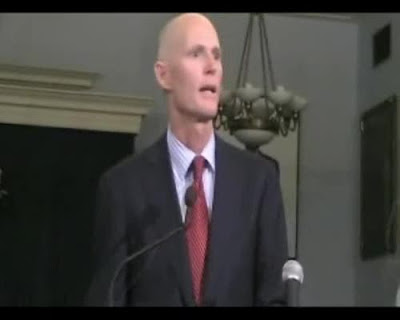
Rick Scott of “Swift Boat” fame, heads “Conservatives for Patients’ Rights.”

Inside the Tea Partiers’ anti-health care organizing campaign

Though conservatives portray the tea bagger disruptions as symptoms of a populist rebellion… they have to a great extent been orchestrated by anti-health care reform groups financed by industry.

By Brian Beutler / August 4, 2009

See ‘Recess Watch: Conservatives Shout Down Health Care, Doggett In Austin,’ by Mark Ambinder, plus Video of Austin demonstration, Below.

These teabaggers disrupting congressional town halls is just a spontaneous groundswell of populist opposition to health care reform, right? Riiiight.

On Friday, July 24, a representative of Conservatives for Patients Rights — the anti-health care reform group run by disgraced hospital executive Rick Scott, in conjunction with the message men behind the Swift Boat Veterans for Truth — sent an email to a list serve (called the Tea Party Patriots Health Care Reform Committee) containing a spreadsheet that lists over one hundred congressional town halls from late July into September.

The email from CPR to tea baggers suggests that, though conservatives portray the tea bagger disruptions as symptoms of a populist rebellion roiling unprompted through key districts around the country, they have to a great extent been orchestrated by anti-health care reform groups financed by industry. (CPR did not immediately respond to a request for comment.)

That email predates by about a week a recent flurry of events at which Democratic members of Congress [including Texas Democrat Lloyd Doggett of Austin] have been accosted and harassed by anti-health care reform tea party protesters. But beyond putting those spectacles, now receiving wide play on cable news, into a fresh light, it also provides a window into the tea party protesters’ organizing infrastructure, which, like so much political organizing today, occurs in private email list serves.

Earlier today [Monday], I reported that a Freedom Works volunteer, and tea party protester, named Robert MacGuffie had authored a strategy memo for his fellow activists — a playbook of sorts for protesters seeking to disrupt and harass members of Congress during town hall forums in their districts.

MacGuffie and four friends lead a group called Right Principles, described as “a communication and organizing platform so those for whom our core beliefs…ring true.” Despite his connection to Freedom Works, MacGuffie insisted to me that his group is unaffiliated with the wealthy conservative interest groups that have fronted the right wing tea party events.

But his memo nonetheless found its way to hundreds of tea party activists, including the very organizations MacGuffie insists he’s unaffiliated with.

Like many political movements in the country, the so-called Tea Party Patriots organize on a number of email list serves — an eponymous google group, one called Health Care Freedom Tea Party, the aforementioned Tea Party Patriots Health Care Reform Committee — where the broader community of tea baggers, including those working independently, co-ordinate.

MacGuffie’s memo was posted to the Tea Party Patriots’ list serve, which is hundreds of members large, and includes representatives from not just small protest groups, but also major anti-health reform organizations such as Conservatives for Patients Rights, and Patients First, Patients United Now (an affiliate of Americans for Prosperity), and, yes, Freedom Works.

With such broad and powerful memberships, the group is able to coordinate protests and counter protests at events hosted by members of Congress and pro-reform groups. And that’s just what they’ve been doing, and plan to do much more over the August congressional recess, during which many believe the fate of health care reform will be decided.

This isn’t the first time private correspondence on these list serves has opened a window into the tea bagger id. Last month, TPMMuckraker’s Zack Roth broke the story of Dr. David McKalip — a high profile anti-health care reformer who forwarded a racist email to fellow activists on what Zack described as a “Google listserv affiliated with the Tea Party movement.” Once exposed, McKalip withdrew from public activism, to the great, effusive dismay of his supporters on that list. In addition, then, to organizing shout downs at town halls, these list serves are used as a hub for those who like to guffaw at pictures of Barack Obama with a bone through his nose.

Late update: By what must be a complete coincidence, CPR’s website contains a list of the same town hall forums on its website, “provided as a resource for our visitors.” It also contains a separate page, where the group hosts videos of the same town hall disruptions which, behind the scenes, it’s doing whatever it can to encourage.

Source / TPM

Lloyd Doggett teabagged in south Austin, Aug. 1, 2009

Recess Watch: Conservatives Shout Down Health Care, Doggett In Austin

By Mark Ambinder / August 4, 2009

It’s August, and lawmakers are back in their home states talking to constituents. Liberals and conservatives alike will show up to town-hall meetings and other events to question their elected officials–sometimes loudly–about health care and the rest of Washington’s business, as lawmakers make the case for their own agenda. When passions run high, debate can be spirited. We’ll be watching.

Rep. Lloyd Doggett, the Democrat who represents Austin, Texas, has never won with less than 67 percent of the vote in his district. But that didn’t stop conservatives from shouting him down as he tried to talk to constituents about health care over the weekend.

Sign-waving conservatives chant, very loudly, “Just Say No,” making other conversations (including Doggett’s) inaudible. One protester has a sign that show’s Doggett with devil ears springing from his head. They follow Doggett from the event across a parking lot, where he tries to talk to some more people and then leaves. Politico, reporting on Doggett’s experience and others, notes that Rep. Patrick Murphy (D-PA), a Blue Dog a former Army captain who served in Iraq, also had to deal with a shouting audience and urged them to “be respectful.”

Source The Atlantic

Thanks to Thomas Cleaver / The Rag Blog

Posted in RagBlog | Tagged , , , , , , | 29 Comments

Larry Ray : Beneath Naples: The ‘Parallel City’


Beneath Naples, Italy via Radio New Zealand!

By Larry Ray / The Rag Blog / August 4, 2009

The reach of the internet continues to amaze me. I have long had fascination with the “Parallel City” beneath Naples, Italy, since the early 1960’s when I lived there. Called the “sottosuolo,” it is a maze of giant cavities, tunnels, aqueducts, passageways, ancient Greek tombs, WWII air raid shelters and more.

Stationed in Naples many years ago, I became fascinated with the mysterious network below the city, which few locals knew much about at all. For many years I regularly returned to Naples to see friends and pursue exploration of the wonders below the city.

In recent years I have translated into English a wonderful website operated by my urban speleologist friends in Naples. The English Language version has resulted in a much wider knowledge of the marvels beneath the city including attracting the interest of regular visitors from around the world, National Geographic who did a great article with stunning photos, a travel article in The New York Times a couple of months ago, and a phone call a couple of weeks ago from Radio New Zealand wanting to do an interview with me for their popular “Nights” program.

That interview, broadcast August 3, down under in Kiwi-land, is available now in streaming form at the link below through the marvel of the internet. Imagine the improbability of Radio New Zealand interviewing an old guy in Gulfport, Mississippi, about a secret world beneath Naples, Italy!

I believe you will enjoy the interview. Chris Whitta, the program host, is personable and asked great questions. So take a few minutes and come enjoy the mysterious “Sottosuolo” of Naples. The podcast streaming link will remain available till August 10th, 2009.

Go here to listen to the interview.

You may also visit here to download the MP3 version of the interview.

[Retired journalist Larry Ray is a Texas native and former Austin television news anchor. He also posts at The iHandbill.]

The Rag Blog

Posted in Rag Bloggers | Tagged , , | 2 Comments

Health Care Reform and Mind Control


The enactment of true universal health care hangs by a string.

We are faced with educating the 40% of the population who are grist for the propaganda mill.

By Dr. Stephen R. Keister / The Rag Blog / August 4, 2009

In the 1950s and 1960s there was considerable academic research about mind control, largely sponsored by various agencies of the U.S. government. These studies were largely carried out by out by Dr. Ewen Cameron at McGill University and were deemed MKUltra and evolved into the Kubark Counterintelligence handbook. These studies are well documented by Naomi Klein in her excellent book The Shock Doctrine.

Concurrently Professor Stanley Milgram was involved in much more innocuous research at Stanford University. Milgram was a psychologist whose research proved conclusively that obedience to authority was so ingrained in the average U.S. citizen that they were prepared to do even lethal harm to others when instructed by those in authority to do so. This was in spite of the fact that before the trials were initiated the participants were asked if they felt capable of harming other human beings, and as a group they answered, “No.”

At one point Dr. Milgram wrote,

“With numbing regularity good people were seen to knuckle under the demands of authority and perform actions that were callous and severe. Men who are in everyday life responsible and decent were seduced by the trappings of authority, by the control of their perceptions, and by the uncritical acceptance of the experimenter’s definition of the situation, into performing harsh acts. A substantial proportion of people do what they are told to do, irrespective of the content of the act and within limitations of conscience, so long as they perceive that the command comes from a legitimate authority.”

This brings us to the tea-bag gatherings blessed by the occupants of 133 C Street in Washington, D.C. Gatherings organized to misrepresent the concept of universal health care coverage for the approximately 50% of Americans who even now fail to understand that, unlike most civilized nations, the United States has not assumed the moral and ethical task of providing first class health care to its entire population.

Paradoxically, the majority of folks who do not have decent health care are under the influence of the insurance cartel and its political hangers-on and are being persuaded that health care reform will increase their taxes, which it will not, as tax increases are considered in current legislation only for the top 1.2% of earners. They are being persuaded that “bureaucrats” will manage their health care, even though under Medicare and the VA they do not have any managed care.

The Republican and Blue Dog Democrat politicians initially opposed the Medicare system and now would like to destroy it by enacting such plans as Medicare Advantage and Medicare Plan D prescription insurance. (I am always amazed how many of the elderly say, “I don’t want government medicine, I have Medicare.”) They will be told gross lies and distortions about the nature of of health care in Europe and Canada. We will see ongoing anti-health care ads on TV performed by professional actors.

On July 31, Politico reported that Democratic members of Congress are increasingly being harassed by “angry, sign-carrying mobs and disruptive behavior” at local town halls. For example, in one incident, right-wing protestors surrounded Rep .Tim Bishop (D-NY) and police officers had to escort him to his car for safety. The growing phenomenon is often marked by violence and absurdity. Recently, right wing demonstrators hung Rep. Frank Kratovil (D-Md) in effigy outside his office. Missing from the reporting of these stories is the fact that much of these protests are coordinated by public relation firms and lobbyists who have a stake in opposing President Obama’s reforms.

This activity appears to have been organized through a Political Action memo put out by the political right entitled “Rocking The Town Halls — Best Practices.” Details are included in this article. It would behoove any and all advocates for universal health care to be aware of these instructions. Adequate counter measures must be considered in advance.

The proponents of universal health care, whether single payer — which would be much more inclusive, more economical by far, and more easily administered — or the “public option,” must face this situation during the Congressional Recess. We are badly outnumbered; I would estimate that health care activists constitute only about 10% of the population. They are basically liberals who are guided by precepts of Christian doctrine, progressive Judaism, or by secular ethics and morality. They sincerely want what is best for the population as a whole, not for their own advantage, since I would estimate that most of the proponents already have decent health care. Many are motivated out of shame, knowing that our health care ranks 39th in the world.

One underlying problem in the liberal community is the fact that, though wishing well for others, they cannot agree among themselves. Most are well educated and tend to resist authority. Generally, we cannot set aside our idealism and communicate with the 50% who need to be educated. We sure as hell had better cooperate, set aside academic disputes, and unite, or we will surely lose. And the politicians must set aside this absurd foolishness about “bipartisanship” which appears a certain way of shooting ourselves in the foot.

Further, the political proponents of universal care must stop equivocating and state our position boldly. We must point out in large letters; “MEDICARE IS GOVERNMENT SPONSORED AND SUBSIDIZED MEDICINE” and it, with the Veterans Administration and military hospitals provide first class medical care.

We are faced with educating the 40% of the population who are grist for the propaganda mill. Many are totally divorced from reality. These are the folks who are waiting to be led, not by reason but by slogans and dogma. These are the folks who will turn out in droves at tea-bag rallies and campaign against their own best interests, the interests of their families, and their communities. I would suggest that any and all of the pro-health care community rush to the neighborhood bookstore and purchase a copy of Eric Hoffer’s classic The True Believer.

We will see all of the lackeys of the right wing, the present day equivalent of Germany’s 1930s brownshirts, let loose at discussion groups creating distraction for those who really want information. This will be augmented by The Republican Party, the prostituted Democratic Senators and the Blue Dog Congressmen, as well as by the NRA, the U.S. Chamber of Commerce, the pharmaceutical Industry, the insurance cartels, the conservative media, and certain, minority members of the medical establishment.

It seems as if the vast majority of physicians recently have undergone an epiphany and now support universal health care. Perhaps they are tired of being serfs to their masters in the insurance industry or are sick of being called “providers” rather than physicians. This fact flies in the face of a recent statement by a Republican Congressman that all doctors are opposed to universal health care. Fact: in polls, 65-70% of physicians support universal care.

Two recent encouraging developments are the Mad As Hell Doctors Tour, organized by a group of physicians in Oregon — an automobile caravan to Washington supporting single payer health care. They call it “Mad as Hell. Health Care for People — not Profit.” More about them can be found here. Nancy Pelosi is said to have promised Congressman Weiner of New York that HR 676 would be introduced, debated, and voted on by the full House in September.

We still hear screams of indignation from the right regarding costs of universal health care, but an article by Professor Chalmers Johnson might help put that in perspective. Titled “Three Good Reasons to Liquidate Our Empire,” it is a well reasoned, lengthy article, well worth perusing. From the second paragraph: “According to the 2008 official Pentagon inventory of our military bases around the world, our empire consists of 865 facilities in more than 40 countries and overseas territories.

We deploy over 190,000 troops in 46 countries and territories. In just one such country, Japan, at the end of March 2008, we still had 99,295 people connected to U.S. military forces living and working there — 49,364 members of our armed forces, 45,753 dependent family members, and 4,178 civilian employees. Some 13,975 of these were crowded into the small island of Okinawa, the largest concentration of foreign troops anywhere in Japan.” I have read elsewhere that over 100 of these bases have 18 hole golf courses! And they say that the United States cannot afford universal health care !

Here’s another thing to keep in mind during August. The August 1 Washington Spectator reported that the Alexandria, Va. PR firm, Creative Response Concepts, coordinating the anti-health care movement, has a history of partisan advocacy that extends beyond its widely reported role in the Swift Boat Veterans for Truth attack on Sen. John Kerry in 2004. It also coordinated the confirmation campaigns of Justices John Roberts and Samuel Alito. It worked to discredit the 60 Minutes story questioning George W, Bush’s service in the Air National Guard. CRC’s media campaigns are run by Pat Buchanan’s former communications director Mike Russell, who previously worked for the Christian Coalition, another DRC client.

One final thought from Professor Noam Chomsky:

“For those who stubbornly seek freedom, there can be no more urgent task than to come to understanding the mechanisms and practices of indoctrination. These are easy to perceive in totalitarian societies, much less so in the system of ‘brainwashing under freedom’ to which we are subjected and in which all too often we serve as unwilling instruments.”

The Rag Blog

Posted in Rag Bloggers | Tagged , , | 8 Comments

Bob Dylan : Texas Troubadour


More than iconic
Bob Dylan: Texas Troubadour

By Guy Schwartz / The Rag Blog / August 4, 2009

Bob Dylan was more than iconic Sunday night in The Woodlands outside Houston. He rocked and grooved!

It was a concert that I wasn’t too interested in, so I stayed home and kept overdubbing my way thru Willie Nelson and John Mellencamp’s set times. (Yeah — I missed Willie. So, sue me!)

But — Bob Dylan is an icon, one I hadn’t seen since 2004 in Amsterdam (and the best thing about that show was watching one of our party, Carolyn Wonderland, go backstage to meet with Bob at intermission), so I saddled up the Blue Scion, and drifted out to the Woodlands after dark.

I’d heard that Bob had taken to saying he was from Texas (in some European interviews). It seemed like more amusing Bobness with the press, but last night I found out that his reasons for making that statement were deeper than they initially appeared!

The band’s groove was deep! Musically, the history and home towns didn’t matter. On this tour, The Bob Dylan Show featured a great Texas roadhouse band.

Bob’s suit was black and his hat was white. The rest of the band wore all black with white sport coats.

And…

Every musician onstage played rhythm! The band’s groove was deep, I tell ya!

No solos except for a few from Bob!

Rearranging old classics into mostly Texas shuffles on this tour, the band played those as if they had all grown up on the Texas Gulf Coast. It felt good! Watching those fellas in their matching jackets and hats, I felt like I was 14 in 1966 again, sneaking out of the house and taking the old Dodge Dart to some faraway East Texas dance hall to see some space-aged Ernest Tubb and Texas Troubadours.

Bob’s still in Texas for a spell. He’s at Round Rock tonight.

Take advantage of it if you can.

The Rag Blog

Posted in Rag Bloggers | Tagged , , , , , , | 5 Comments

The Bankruptcy of Economic ‘Theory’ Based on the Celebration of Greed


Just the Facts: Taxes, Debts, and National Prosperity

By Sid Eschenbach / The Rag Blog / August 3, 2009

For the past 30 years, conservative Republicans have been able to dominate the economic policy debate by controlling the framework of the argument, by building an economic ‘theory’ based on the celebration of greed, by selling the erroneous belief that that high taxes create low growth, and that low taxes create high growth. As no one, rich or poor wants to pay taxes, it was an easy sell. Unfortunately, if we didn’t suspect it’s legitimacy before, we confirmed the lie in September of 2008 when all the houses built on greed collapsed.

Amazingly, today, under a very different presidency than the Reagan presidency that started the disaster, we still hear Republicans advance the same ‘Atlas Shrugged’ narrative; that we’re overtaxed as a nation, that big government and high taxes stifle healthy economic growth, and that Obama’s financial recovery spending combined with health care spending will create big government and massive deficits that will bring hyperinflation and/or slavish indebtedness.

Just this week, after seeing evidence that the Obama Recovery Act has dramatically helped the local, state and national economies, we hear more from the party line: economist Randall Pozdena said the temporary boost will ‘hurt the economy in the long run because taxes will rise.’ “The question is, are you spending money productively?” said Pozdena, managing director of ECONorthwest, a consulting firm in Portland, Ore… as though buying flat-screen TV’s made in Korea was the highest, best and most productive use of capital.

Unfortunately for the nation, the Democrats don’t challenge the premise and continue to commit the fundamental error of fighting the battle on the opponent’s terms. Until they slay that dragon and redefine the conversation, neither the discussion nor the policies will evolve in a more prosperous direction. Therefore, a review of the actual economic record is urgently needed in order to escape from the Reagan framework and free policymakers and voters alike from a mistaken premise… and allow them to hold a real debate about the merits and the affordability of healthcare reform. Finding answers to the following five questions may help in this regard:

  1. Are rates of taxation related statistically to rates of national economic growth?
  2. Are U.S. taxes high by historic U.S. standards?
  3. Does U.S. national debt represent a threat to the U.S. economy?
  4. Is the U.S. government large or small by international standards?
  5. What is the ‘proper’ size of government (or, is big government bad government)?


Are rates of taxation related statistically to rates of national economic growth?

Since the 1980’s, it has been advanced as economic fact that high tax rates create low growth rates, and that low tax rates create high growth rates. This theory of the relationship of taxes to growth is at the heart of neo-liberal economics, and has come to form a major pillar of conservative Republican politics. Over the past three decades it has been successfully used to brow-beat, mislead, fear-monger and usually defeat efforts to raise taxes at local, state and national levels in order to balance budgets and provide public services without going into debt. However, a review of the historical record shows there is absolutely no proof of any statistically significant relationship of that ‘fact’ being true over the past century of American history. Indeed, to the degree that there is a relationship at all, it appears to be the reverse; that higher taxes create higher growth, while lower taxes create lower growth.

The following chart shows the relationship between economic growth (net GDP growth year by year) and tax policy (as represented by the highest marginal rate) for every year from the first national income tax (1913) to the present. As can be seen, the first 30 years are entirely inconclusive regarding any relationship between taxation and growth, probably explained by the much bigger effects that World War I, the Great Depression and World War II had on the national economy during that period… and the wild swings in both taxation and growth produced by them.

Therefore, if there is a relationship at all we should see it from 1945 to the present, a relatively stable and consistent period of modern American History. The second graph (below) shows that period by itself, again with figures for each year of both net GDP and highest marginal rate of taxation.

According to neo-liberal theory, with the top marginal tax rate over 70% for the first 37 years of the post war period (and over 90% for 15 of those years), and the top marginal tax rate under 40% for the past 26 years, we should see very low growth rates for the first 37 years, and very high growth rates over the past 26 years… but we don’t. Indeed, to the degree that there is a relationship, it is just the reverse. The years of highest growth are in the 38 high tax years (6.04% average GDP growth), and the years of lowest growth are in the 26 low tax years (4.8% average GDP growth). The growth rate in the high tax years is 26% higher on average than the low tax years.

The statistical correlation, the ‘p’ value for the post war period to the present is ‘.14’. To put this result in medical terms, if a company ran tests on a drug to determine its effectiveness and came up with an equivalent p value, they wouldn’t even bother to present it to the FDA, as it would have demonstrated no statistical treatment efficacy. Furthermore, the stock value of the company that had produced those results would take a major hit… something that the Republican proponents of their economic ‘drug’ with a similar failed outcome took in the last elections, as the effectiveness of their ‘drug’ was finally revealed to the world.
In this case of the economic data, while it doesn’t prove statistically that high tax rates cause high growth, it doesn’t even pass a laugh test insofar as supporting the argument that high rates cause low growth and low rates cause high growth. In passing, it is also worthwhile to note that the extraordinarily high tax rates of the post-war period didn’t, as predicted by Ayn Rand, Arthur Laffer and President Reagan, discourage all the creative, intelligent, educated hard working people from working… something that most seemed to do all through the 50’s, 60’s, and 70’s. Indeed, the period is marked by robust growth and unrivaled generalized prosperity.
The economic truth is that growth rates within an economy are the sum of many factors, a short listing of which would include labor policy, trade policy, educational levels, wars, political stability, social and entrepreneurial culture, tax policy, the quality of the legal system, transportation infrastructure, etc. What makes it worse is that the importance of these and other factors vary in importance over time and place, so it’s very difficult to attribute to any one of them a primal importance relative to growth… of the sort attributed to tax policy by the Republicans.

What the data shows very clearly is that over the length of the American experiment, there is NO statistical basis whatsoever to the argument that a high tax environment slows growth, or that a low tax environment spurs growth, and if Ronald Reagan ran a drug company, he’d now be bankrupt. More importantly, it means that anyone who advances that particular lie is just doing just that…. lying.

Are U.S. taxes high by historic standards?

Another of the mistaken premises neo-liberals have been successfully able to insert into discussions about public policy is that U.S. tax rates are ‘too high’… that Americans are ‘over-taxed’, that that ‘over-taxation’ threatens productivity (see above), and the solution to this supposed problem is to lower taxes and, not incidentally, shrink government. As can be seen in the following graph, American tax history can be divided into 8 major tax eras, the last of which being the one we are currently in, from 1987 – 2009. As can also be seen, the current maximum marginal tax rate of 34% is the second to lowest top rate ever paid by Americans, and by far the lowest of the past 80 years. So much for being overtaxes by historical standards.

It comes as a shock to many Americans that during the period generally considered by economists to be the most robust and prosperous of our history, the period from 1945 to 1980, Americans paid maximum rates that averaged over 70% and went over 90% for 15 years… or nearly three times as high as is paid today by the wealthiest Americans. Never bothered by facts standing in the way of a good theory, however, there is still constant carping that the U.S. is ‘overtaxed’ and that that is the reason we’re not as prosperous as we once were. It’s nothing but greed masquerading as reason, and its pure nonsense.

As regards the previous point, the argument that low taxes create high productivity, the following chart shows clearly the GDP growth rates over the postwar period. Keep in mind when looking at these rates that taxes after 1980 were much lower (50% lower) than before 1980. What does that say about the relationship between taxes and productivity?

Does U.S. national debt represent a threat to the U.S. economy?

We hear on a daily basis from Republicans that Obama’s spending on healthcare and the stimulus will ‘destroy’ the economy. While they’re sure it’ll get destroyed, they’re not sure exactly how… but they generally offer either of two scenarios; through hyperinflation or by ultrahigh taxes on our children and grandchildren (see the first question above to understand the independent absurdity of this ‘threat’), Could they be right, at least about hyperinflation? Is the current or forecast U.S. government debt really a systemic or socio-economic threat?

The following graph is helpful in understanding how far the U.S. actually is from such a threat… to the degree that it can even be taken at face value (the idea that the world’s largest and only internationally recognized trading currency would be subject to hyperinflation is absurd on it’s face… but again, that’s never stopped a Republican economic argument before.) The U.S. would have to run a deficit of over two trillion dollars a year for the next 10 or so years just to catch up to Japan… which not incidentally doesn’t appear to be doing so badly now with their 170% rate. In short, the argument is absurd, and Japan proves it if nothing else.

Is the U.S. government large or small by international standards?

This is not a question that would have mattered as much 40 years ago, but as the globe shrinks with advances in communication and transportation, relative national tax rates and total tax revenues become more important. The argument made by conservative Republicans is that if taxes are too high in the U.S., the highly mobile international businesses will simply move elsewhere, and that will hurt the domestic economy. As the following chart shows, the size of the total tax revenue as a percentage of GDP in the U.S. is among the lowest of all the industrialized nations. If the general assertion that higher taxation invariably produces lower growth were true, then all the countries shown below that have higher total tax burdens as a percent of GDP than the U.S. does (some nearly double) should be withering while those below the U.S…. Afghanistan for example, with its total tax burden of 6%… should be prospering. Of course, none of those predictions based upon the ‘high tax low growth’ theory are in fact true. Afghanistan is not prospering, and Germany is not withering. There is clearly something else at play here, but as long as the Republicans can frame the debate in the ‘high tax = low growth’ context, those other factors that lead to growth will be neither identified nor fortified.

What is the proper size of government?

The above chart clearly shows that economies can be successful, even thrive, at much higher tax burdens than currently set in the U.S. As that is the case, a question policy makers must ask (after they have freed themselves from the ‘high tax = low growth dogma’) is the fourth… what is the ‘proper’ size of government?

Unfortunately, there is no simple answer to this question other than that there are no simple answers… such as the ‘government bad, big government worse’ mantric nonsense peddled by ‘conservative’ Republicans. In government, as in much else, size is far less important than efficiency and goals. It should be obvious that a good big government is better than a bad small government… but thanks to Reagan, it’s not seen that way. There are many who still laugh at the joke he used to great effect: “Hello, I’m from the government, and I’m here to help”. They don’t laugh when they call the police, and they don’t laugh when they drive on public highways; they don’t laugh as they send their children to free public schools or sleep safely in their homes at night, and they don’t laugh when they visit the majestic national parks or pick up their unemployment checks… but as no one wants to pay taxes, Reagan’s joke made it o.k. to scorn and belittle the very government that does and must do all those essential things.

This last graph, however, can give us an idea of what other successful countries spend on their governments, and shows the gap between what they spend and what is currently spent in the U.S. As shown, the U.S. currently spends about 28% of GDP on government, Germany about 40%, and the Danish spend 50%. In dollar terms, the actual amounts represented by the red (difference) sections in the German and Danish column equal, for the U.S. economy, an additional $1.7 trillion in spending if the U.S. were to spend at the Germans rate, and an additional $3.1 trillion if the U.S. were to spend at the rate of the Danish.

In other words, there is no economic reason whatsoever that the U.S. couldn’t easily provide healthcare AND balance the budget AND have a healthy economy if it so desired. The only reason it “can’t” be done is because opinion makers and policy writers are still thinking from inside the box that Ronald Reagan built and put them into: they are still thinking that more taxes will necessarily hurt the economy (FALSE), that we are overtaxed as a nation (FALSE), and that big government is necessarily bad government (FALSE).

In Review:

  1. Are rates of taxation related statistically to rates of national economic growth? NO.
  2. Are U.S. taxes high by historic U.S. standards? NO.
  3. Does U.S. national debt represent a threat to the U.S. economy? NO.
  4. Is the U.S. government large or small by international standards as a share of GDP? SMALL.
  5. What is the ‘proper’ size of government (or, is big government bad government)? NO.


What all of this proves is that greed and power never go out of style, and the Republican economic theories are all about both. To the degree that the rich keep more money and deny funds to the government, they are able to control government and dominate political discourse. Unfortunately, their economic theories combined with their greed and desperate grasping at power brought the world to a standstill in September of 2008. However, nothing will change unless Democrats slay the premises that created the disaster and set economics… and the nation, on a sounder path.

[Sidney Eschenbach, 60, lives and works in Guatemala, Central America. His thoughts regarding developmental economics and trade are based on decades of development work in Latin America at various levels, community and corporate.]

The Rag Blog

Posted in RagBlog | Tagged , , | 1 Comment

Victor Agosto : Soldier of Conscience Faces Court Martial

Victor Agosto speaks at Austin benefit for Under the Hood Cafe. Photo by Carlos Lowry / The Rag Blog.

Soldier of conscience to be court-martialed
SPC Victor Agosto refuses deployment and faces incarceration

August 4, 2009

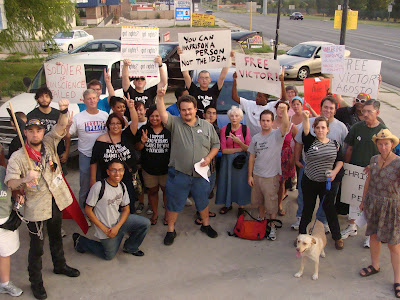
SPC Victor Agosto, a soldier stationed with 57th Expeditionary Signal Battalion, 69th Air Defense Artillery, Rear Detachment, is scheduled for court-martial on August 5 at Fort Hood, TX.

A victim of the highly unpopular stop/loss policy, SPC Agosto, whose contract was over at the end of June, was told that his next assignment would be deployment to Afghanistan. At the end of April, with support of local residents, Agosto went public with his intent to refuse the orders to Afghanistan, on the basis of the occupation being “immoral and unjust.”

Instead of going “underground” and trying to escape punishment from the Army, Agosto chose to remain at Fort Hood as a tangible symbol of GI resistance. Refusing all orders that directly support the war, he has found himself in an overwhelming struggle to maintain his honor and position. His court-martial will culminate with the sentencing portion of the trial, at which, it is believed that the Army will enforce the highest form of sentencing it can impose.

SPC Agosto’s attempt to raise awareness and support has not fallen on deaf ears, even in a military community; he has found supporters and friends who are willing to help. As the unit serves overseas, he continues to voice his dissent for an “unjust” war. There will be demonstrators present the day of his arraignment, located off-post due to military regulations concerning demonstrations on military posts.

Supporters are urged to gather to support Victor Agosto from 7:00 to 8:30 p.m., Wednesday, August 5th, at the Fort Hood East Gate in Killeen, Texas. SPC Agosto’s attorney, James Branum will be available for interviews and will read a public statement by Victor Agosto.

To learn more about Victor, go here.

For previous coverage of Victor Agosto on The Rag Blog, go here.

The Rag Blog

Posted in Rag Bloggers | Tagged , , , , , | 7 Comments

Peak Oil: Will It Be Sooner Than We Expect?


Warning: Oil supplies are running out fast
By Steve Connor / August 3, 2009

Catastrophic shortfalls threaten economic recovery, says world’s top energy economist

The world is heading for a catastrophic energy crunch that could cripple a global economic recovery because most of the major oil fields in the world have passed their peak production, a leading energy economist has warned.

Higher oil prices brought on by a rapid increase in demand and a stagnation, or even decline, in supply could blow any recovery off course, said Dr Fatih Birol, the chief economist at the respected International Energy Agency (IEA) in Paris, which is charged with the task of assessing future energy supplies by OECD countries.

In an interview with The Independent, Dr Birol said that the public and many governments appeared to be oblivious to the fact that the oil on which modern civilisation depends is running out far faster than previously predicted and that global production is likely to peak in about 10 years – at least a decade earlier than most governments had estimated.

But the first detailed assessment of more than 800 oil fields in the world, covering three quarters of global reserves, has found that most of the biggest fields have already peaked and that the rate of decline in oil production is now running at nearly twice the pace as calculated just two years ago. On top of this, there is a problem of chronic under-investment by oil-producing countries, a feature that is set to result in an “oil crunch” within the next five years which will jeopardise any hope of a recovery from the present global economic recession, he said.

In a stark warning to Britain and the other Western powers, Dr Birol said that the market power of the very few oil-producing countries that hold substantial reserves of oil – mostly in the Middle East – would increase rapidly as the oil crisis begins to grip after 2010.

“One day we will run out of oil, it is not today or tomorrow, but one day we will run out of oil and we have to leave oil before oil leaves us, and we have to prepare ourselves for that day,” Dr Birol said. “The earlier we start, the better, because all of our economic and social system is based on oil, so to change from that will take a lot of time and a lot of money and we should take this issue very seriously,” he said.

“The market power of the very few oil-producing countries, mainly in the Middle East, will increase very quickly. They already have about 40 per cent share of the oil market and this will increase much more strongly in the future,” he said.

There is now a real risk of a crunch in the oil supply after next year when demand picks up because not enough is being done to build up new supplies of oil to compensate for the rapid decline in existing fields.

The IEA estimates that the decline in oil production in existing fields is now running at 6.7 per cent a year compared to the 3.7 per cent decline it had estimated in 2007, which it now acknowledges to be wrong.

“If we see a tightness of the markets, people in the street will see it in terms of higher prices, much higher than we see now. It will have an impact on the economy, definitely, especially if we see this tightness in the markets in the next few years,” Dr Birol said.

“It will be especially important because the global economy will still be very fragile, very vulnerable. Many people think there will be a recovery in a few years’ time but it will be a slow recovery and a fragile recovery and we will have the risk that the recovery will be strangled with higher oil prices,” he told The Independent.

In its first-ever assessment of the world’s major oil fields, the IEA concluded that the global energy system was at a crossroads and that consumption of oil was “patently unsustainable”, with expected demand far outstripping supply.

Oil production has already peaked in non-Opec countries and the era of cheap oil has come to an end, it warned.

In most fields, oil production has now peaked, which means that other sources of supply have to be found to meet existing demand.

Even if demand remained steady, the world would have to find the equivalent of four Saudi Arabias to maintain production, and six Saudi Arabias if it is to keep up with the expected increase in demand between now and 2030, Dr Birol said.

“It’s a big challenge in terms of the geology, in terms of the investment and in terms of the geopolitics. So this is a big risk and it’s mainly because of the rates of the declining oil fields,” he said.

“Many governments now are more and more aware that at least the day of cheap and easy oil is over… [however] I’m not very optimistic about governments being aware of the difficulties we may face in the oil supply,” he said.

Environmentalists fear that as supplies of conventional oil run out, governments will be forced to exploit even dirtier alternatives, such as the massive reserves of tar sands in Alberta, Canada, which would be immensely damaging to the environment because of the amount of energy needed to recover a barrel of tar-sand oil compared to the energy needed to collect the same amount of crude oil.

“Just because oil is running out faster than we have collectively assumed, does not mean the pressure is off on climate change,” said Jeremy Leggett, a former oil-industry consultant and now a green entrepreneur with Solar Century.

“Shell and others want to turn to tar, and extract oil from coal. But these are very carbon-intensive processes, and will deepen the climate problem,” Dr Leggett said.

“What we need to do is accelerate the mobilisation of renewables, energy efficiency and alternative transport.

“We have to do this for global warming reasons anyway, but the imminent energy crisis redoubles the imperative,” he said.

Oil: An unclear future

*Why is oil so important as an energy source?

Crude oil has been critical for economic development and the smooth functioning of almost every aspect of society. Agriculture and food production is heavily dependent on oil for fuel and fertilisers. In the US, for instance, it takes the direct and indirect use of about six barrels of oil to raise one beef steer. It is the basis of most transport systems. Oil is also crucial to the drugs and chemicals industries and is a strategic asset for the military.

*How are oil reserves estimated?

The amount of oil recoverable is always going to be an assessment subject to the vagaries of economics – which determines the price of the oil and whether it is worth the costs of pumping it out –and technology, which determines how easy it is to discover and recover. Probable reserves have a better than 50 per cent chance of getting oil out. Possible reserves have less than 50 per cent chance.

*Why is there such disagreement over oil reserves?

All numbers tend to be informed estimates. Different experts make different assumptions so it is under- standable that they can come to different conclusions. Some countries see the size of their oilfields as a national security issue and do not want to provide accurate information. Another problem concerns how fast oil production is declining in fields that are past their peak production. The rate of decline can vary from field to field and this affects calculations on the size of the reserves. A further factor is the expected size of future demand for oil.

*What is “peak oil” and when will it be reached?

This is the point when the maximum rate at which oil is extracted reaches a peak because of technical and geological constraints, with global production going into decline from then on. The UK Government, along with many other governments, has believed that peak oil will not occur until well into the 21st Century, at least not until after 2030. The International Energy Agency believes peak oil will come perhaps by 2020. But it also believes that we are heading for an even earlier “oil crunch” because demand after 2010 is likely to exceed dwindling supplies.

*With global warming, why should we be worried about peak oil?

There are large reserves of non-conventional oil, such as the tar sands of Canada. But this oil is dirty and will produce vast amounts of carbon dioxide which will make a nonsense of any climate change agreement. Another problem concerns how fast oil production is declining in fields that are past their peak production. The rate of decline can vary from field to field and this affects calculations on the size of the reserves. If we are not adequately prepared for peak oil, global warming could become far worse than expected.

Source / The Independent

The Rag Blog

Posted in RagBlog | Tagged , , , | 8 Comments

DC Madam : Sexual Extortion During Republican Rule

DC Madam Deborah Jeane Palfrey, who later died in what was called a suicide, is shown with her lawyer at federal court in Washingon in 2007.

The Sexual Extortion Scandal:
Sex and Politics Under Republican Rule

By Sherman DeBrosse / The Rag Blog / August 3, 2009

Sex and politics were inextricably linked in the D.C. Madame Case, but the mainstream media never got beyond surface events. Deborah Jeane Palfrey died May 1, 2008, in a shed behind her mother’s house. This is about all most people know for certain about her.

A little digging by the mainstream press or the Justice Department could well turn up information suggesting that Ms. Palfey served the interests of the intelligence community.

The official cause of death was that she had hanged herself, but there were claims that the FBI suppressed evidence that she had been murdered. It was said she killed herself rather than go to prison.

Palfrey, the notorious “DC Madam,” used her Pamela Martin Associates escort service as a cover for a call girl ring. A great deal of FBI effort went into bringing her to court and sentencing her to prison. She was indicted March 1, 2007, for employing more than 100 women for the purpose of prostitution. The feds neglected to seize her 46 pounds of business telephone records which were in California and then got restraining orders forbidding the release of the records.

Judge Gladys Kessler and marveled at why the government was determined to come down hard on this woman while moving heaven and earth to protect her customers. The judge then asked to be reassigned, and she was replaced by a judge who had been on the Federal Intelligence Surveillance Court. The judge rejected her effort to invoke the Classified Information Procedures Act (CIPA) .

Trying to defend herself, she probably sealed her own fate when she gave here telephone records to the ABC television network, whose Brian Ross began an investigation. The investigation ended quickly and abruptly and it was said that parent Disney bowed to pressure from Karl Rove and the White House. Ross said none of the clients were “newsworthy.” Palfrey also said her case had national security implications. Some said one of its prominent personalities had used the service. Senator David Vitter of Louisiana confessed to using the service. There was quite a bit of information that Richard Cheney was a client, sometimes using the name Bruce Chiles, when he ran Halliburton, but it could have been that he was simply hiring girls for customers.

Somehow, Palfrey got a lawyer from a firm tied to intelligence cases. A senior partner became a federal judge who was known for a “rocket docket” when it came to intelligence cases. There were e-mails in which her lawyer assured the prosecution he would call no defense witnesses.

Palfrey’s death was convenient because it seriously hindered a number of inquires. The most important was a long-standing probe into a D.C. sex ring that was probably employing her people. The ring was used to entertain politicians and channel money from defense and intelligence contracts to Republicans through Jack Abramoff and some of his friends. The sex ring could well have been the key to understanding the full dimensions of the K Street Strategy, a plan to force lobbyists to hire Republicans and milk as much money from them as possible. There were a few convictions, including that of Abramoff, for bribery and influence peddling, but much remains to be known.

The only serious inquiry into the sex ring was a long probe of the limousine service that brought the ladies of the night to the hotels. Telephone records showed that Palfrey talked to one of the men accused of bribery who held some of the sex parties, and there were calls to the service that transported the women. That service received $12 million in government contracts. San Diego U.S. Attorney Carol Lam, who was investigating the DC sex ring funded by the two contractors, was fired by the Bush Administration.

A subset of this inquiry should have involved exploring reports that children were also being employed for sex. Investigator Tom Flocco, who is sometimes very much on target, claims that good sources claimed the political sex rings had ties to deviant sex rings, and that they in turn were tied to a prominent right-wing policy council. After all, we know that two sex rings in the 1980s did this, and that a few child prostitutes were even given a late night tour of the White House.

The Palfrey inquiry to some extent also that served the staff of Maryland Republican Governor Bob Ehrlich. Ms. Palfrey said that some of her girls were used there. This ring seemed to be fueled with money generated by gambling interests. Tom DiBiagio, the U.S. Attorney in Baltimore, was fired by the Bush administration 2004 after he had uncovered a great deal of corruption. on Palfrey and the use of sex to corrupt people but was not interested in Palfrey. He was after the governor, Abramoff, three congressmen, and top staffers for several Republican Representatives and Senators. Brandy Britton, a former University of Maryland professor, a Palfrey employee, was charged with prostitution, and hanged herself.

At some point, Palfrey must have thought she would get off, as she took steps to purchase a home in Frankfurt, Germany, where Foggo had once worked. Some have speculated that she was getting ready to set up a similar operation for the agency in Germany. She was forced to return to the U.S. when Governor Ehrlich was facing re-election. Perhaps there was a fear that she kept a “black book.”

In 1990, Deborah was arrested for “pimping, pandering, and extortion” in connection with an escort service she ran in San Diego. With the help of CIA logistics officer Kyle “Dusty” Foggo, she was released in 1993. It has been reported that he ran sex extortion rings in other countries to ensnare politicians. He had also worked for Ambassador John Negroponte in Honduras during Reagan’s not-so-secret war in Central America. Jim Olson, a former station chief, noted that Foggo “failed to report a number of his contacts with foreign national women.”

Deborah established a new escort service in the District of Columbia in 1993, which employed a Naval Academy instructor, several other military personnel, a psychiatrist, and a number of highly educated professional women. Some add up the factual information and infer she was working for the CIA.

It is claimed by some that Foggo came to run the CIA’s sexual blackmail operations in the U.S. We know that he played cards at events where prostitutes were employed. He was indicted in 2007 for fraud involved in matters related to the bribery of California Republican Congressman Rusty Cunningham. Before the indictment, Director Porter Goss had promoted Foggo to the number three job in the agency. Foggo threatened to expose “sensitive programs” and the government dropped 27 of 28 counts against him. He could have received a 20 year sentence but got 37 months.

Wayne Madsen reports that some of those who played poker at these hotel parties watched videos of sex between prostitutes and targeted diplomats, politicians, and Bush administration officials. Sometimes present were Cunningham, Porter, Foggo, and Brant ‘Nine Fingers’ Bassett, a House Intelligence Committee staffer.

There is a long history of sexual blackmail in Washington going back at least to the ring jointly operated by Roy Cohn and the CIA. In the eighties, there were two well known rings that even received some coverage in the D.C. papers. Both of these had ties to the intelligence community. Later, we discovered there were at least two other smaller operations, one of which was revealed in Ed Rollins’ autobiography. These two latter operations seemed to have been focused on getting Republicans to vote for the legislation of certain lobbyists and did not appear to be tied to the intelligence community.

The three former rings benefitted special interests and the intelligence community. The Cohn operation seemed to be thoroughly bipartisan, while the two in the eighties and Hookergate were tied to one party. However, they appear to have been some Democratic targets.

With this much information at our disposal, one wonders why there was not one thorough MSM probe of the George W. Bush era sex ring financed by the two San Diego contractors and possibly Jack Abramoff. We also know that until 1976 hundreds of MSM journalists were on the CIA tab as part of Operation Mockingbird. Maybe there are more effective ways of muzzling journalists these days than cash payments.

This would be a good time to open a full investigation, but the present Justice Department does not seem friendly to snitches and whistleblowers.

Articles on previous DC sex rings have been posted here.

References

  • ABCNews.gocom (May 4, 2008)
  • Eric Lichtblau, “Former Prosecutor Says Departure was Pressured,” The New York Times (March 6, 2007)
  • “Karl Rove and CIA Foggo, DC Madam Palfrey ,” Democratic Underground (July 8, 2009)
  • “New World Order Advisor Resigns In Alleged D.C. Madam Prostitution Scandal,” LiveLeak.com (April 29, 2008)
  • Tom Flocco.Com ( October 5, 2006)
  • Wayne Madsen Report (May 3, 2008, April 21, 2009 July 21-22, 2009)

[A Plug for Sherm’s Book. Sherman DeBrosse spent seven years writing an analytical chronicle of what the Republicans have been up to since the 1970s. It discusses elements in the Republican coalition, their ideologies, strategies, informational and financial resources, and election shenanigans. Abuses of power by the Reagan and G. W. Bush administration and the Republican Congresses are detailed. The New Republican Coalition : Its Rise and Impact, The Seventies to Present (Publish America) can be acquired by calling 301-695-1707. On line, go to here.]

The Rag Blog

Posted in Rag Bloggers | Tagged , , | 5 Comments

Derelict Auto Plants Growing in Numbers

The NY Times writers generously call these derelict plants ‘white elephants.’ Perhaps ‘capitalism’s skeletal remains’ is more accurate.

Richard Jehn / The Rag Blog

The Wixom Assembly Plant in Wixom, Mich., was one of Ford’s largest and oldest facilities, but it has been dormant since it closed in May 2007. Photo: Fabrizio Costantini/New York Times.

When Auto Plants Close, Only White Elephants Remain
By Bill Vlasic and Nick Bunkley / July 30, 2009

WIXOM, Mich. — The sheer size of the sites has inspired grand visions for redevelopment — a $1 billion football stadium, a huge Hollywood movie studio, even the world’s largest indoor tennis complex.

But for the communities saddled with a huge, empty auto plant, the reality is dismal.

Abandoned car factories, sprawling over hundreds of acres, often stand vacant for years awaiting demolition, environmental cleanup and a willing developer.

Since 2004, General Motors, Ford and Chrysler have closed 22 major auto plants in the United States. Only eight of those have found buyers. And in the wake of the G.M. and Chrysler bankruptcies, another 16 plants will be shut by 2011.

The most optimistic redevelopment proposals, like a football stadium for the Atlanta Falcons or a movie studio in the small Michigan town of Wixom, a Detroit suburb, are long shots at best.

“The plants, whether they’re still standing or reoccupied, are always going to be a haunting reminder of what we were, what we’ve gone through, and where we still need to go,” said Representative Thaddeus McCotter, Republican of Michigan, whose district includes an old Ford plant in Wixom and a G.M. plant that will soon close.

Even sites in attractive locations are hard to sell in the weak economy. With so many companies being squeezed financially, there is a glut of available commercial real estate.

“Even if you only go back three or four years, it was easier than today,” said Phil Horlock, head of Ford’s land development division.

The loss to the local community when a plant closes goes well beyond jobs. Tax revenue evaporates and related businesses vanish.

Industry analysts estimate that each job in a plant helps create another five to seven jobs.

“Some of those are direct suppliers, but then there are places that workers spend money, like grocery stores, restaurants and day care,” said Kristin Dziczek of the Center for Automotive Research in Ann Arbor, Mich.

Ford’s 4.7-million-square-foot Wixom factory, which closed in 2007, was the company’s largest assembly plant in the United States. More than six million cars were built there over 50 years.

At its peak in the late 1980s, the factory employed nearly 4,000. Now it’s an empty shell of rusting corrugated metal, surrounded by desolate parking lots and a barbed-wire fence.

The plant fronts an Interstate highway, and stretches almost a mile along Wixom Road. It once provided 40 percent of the town’s property taxes, but now accounts for less than 15 percent.

The town has about 13,000 residents, and relied heavily on the paychecks of plant workers.

“When it closed, a lot of businesses around us closed too,” said Moe Leon, owner of the Bullseye Sports Bar and Grill on Wixom Road. “We’re fighting night and day to stay above water.”

Last year, a team of executives from Warner Brothers toured the plant as a potential site for a new studio. Other developers have floated proposals for a hotel, an ice hockey arena and a business district devoted to green technology.

Ford officials said several ideas were under consideration, but there was no timetable for a sale.

Mr. Horlock said Ford had sold five large factories in the last five years. He said the company generally did not raze a plant, or begin to clean up any toxic wastes, until a deal was sealed.

The auto company sold one assembly plant, in Lorain, Ohio, to a developer who leases out space to small industrial firms. Honda, a competitor of Ford’s with two assembly plants in Ohio, recently started storing excess inventory of cars and minivans in the plant’s parking lots. But most closed plants languish.

After G.M. closed a factory in Doraville, Ga., last year, there was an initial rush of interest from developers. One of them suggested the site be used for a new stadium for the National Football League’s Falcons, but the team’s owners have so far shown little enthusiasm for that idea.

Luke Howe, an assistant to Doraville’s mayor, said other proposals for the 165-acre site range “from the ridiculous to the sublime,” and no developers had come forward with adequate financing.

“We knew it would be a lengthy process,” he said. “It just happened to fall during one of the worst economic times.”

But some factory sites have remained vacant through good times as well — a sign of just how difficult it is to create a second life for them.

G.M. demolished most of its giant Buick City manufacturing complex in Flint, Mich., a decade ago. The 200-acre property appeared to finally have a future as a transportation hub for long-haul trucks and rail cars, but G.M. could not complete a deal before filing for bankruptcy on June. 1.

The Flint site, along with dozens of other factories and properties, is part of the old G.M. that is still in bankruptcy and will most likely be sold, eventually, in the liquidation process. The company’s best assets were transferred to a new corporate entity that now operates as General Motors. Auto companies sell their old plants for a song, compared to what they put into them. The government in Oklahoma County, which covers much of Oklahoma City, for example, paid $55 million last year for a four-million-square-foot plant that will be leased to the United States Air Force to expand a nearby base. Just eight years ago, G.M. invested $700 million in the plant to modernize it.

Environmental problems can also hamper a sale. While every plant has different pollution issues, G.M.’s restructuring chief, Albert A. Koch, estimated in bankruptcy court that the company’s liabilities for all its closed sites was $530 million.

One old G.M. plant that has found a new life is in Linden, N.J. The company shut down the factory in 2005, demolished it two years ago, and sold it to a developer for a mixed-use project called Legacy Square.

The 104-acre site will be anchored by a Super Wal-Mart store, and ultimately will pay more taxes to the city than G.M. did.

But the 2,400 permanent jobs will fall far short of the 6,000 workers that G.M. once employed in the city.

“The United Auto Workers had very high-paying jobs there, and those will not be comparable to the jobs that are going to be in the shopping mall,” said Linden’s mayor, Richard J. Gerbounka.

But, he added, “We’re better off than having 104 acres of vacant property sitting there.”

The worst of the empty auto plants is located, perhaps fittingly, on the downtrodden east side of Detroit.

The 3.5-million-square-foot factory has been crumbling since the Packard Motor Car Company closed its doors more than 50 years ago. Trees grow on the plant’s roof, and chunks of concrete regularly fall from the bridge that connects two of its buildings.

Trespassers often explore its rotted interior, and photographs and videos of the ruins are easily found on the Internet.

Vandals have set fires several times this year in the piles of wooden pallets, tires and garbage that litter the complex. It is not unusual to see clouds of thick smoke pouring from the building on a summer evening.

Source / New York Times

The Rag Blog

Posted in RagBlog | Tagged , | 3 Comments