Bishop Takes Pawn : The Real Meaning of ‘Pro-Life’

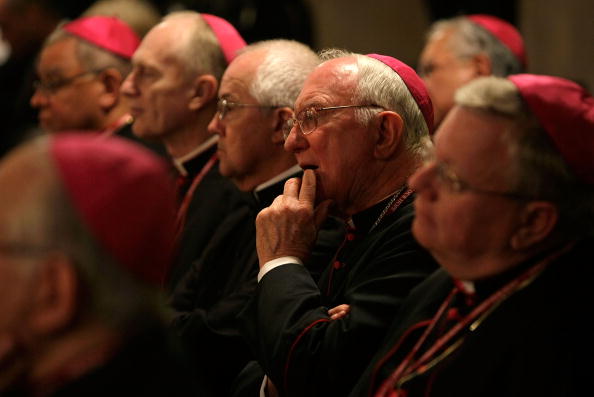
U.S. Catholic bishops listening to Pope Benedict XVI. Photo by Alex Wong / Getty Images.

The present effort to politicize the church and marginalize pro-choice will drive away more of the flock and quickly shed the intellectual credibility it so laboriously earned.

By Sherman DeBrosse / The Rag Blog / June 10, 2009

My friend Lee recently entered an art competition and won first prize with a moving painting on the folly of war. His other entry was entitled “Right to Life.” In the upper left-hand corner was a mitered bishop proclaiming that life begins at conception and that all life is sacred.

In the lower right, the same bishop is busy denying medical assistance to the poor, childcare, and other forms of help to those who need it.

Of course, the bishops do not actively speak against helping the poor, but their political activism seems to have had the same effect because the large minority of political bishops who back the Republicans, are in effect, joining the GOP’s crusade against the poor and marginalized. They have also rounded up the votes that enabled George W. Bush to continue the war in Iraq and to torture prisoners.

Many Americans see only that a substantial minority of Catholic bishops appear to have become Republican operatives and are busy turning local churches into Republican political club houses. Lee and many others do not read the documents churned out by the U.S. bishops. He and others only see only see the political bishops refusing to allow pro-choice Catholic politicians to receive communion. They hear harsh, uncharitable, condemnations and altogether too few words trying to explain their positions to people not subject to their religious authority. In the recent debate over Notre Dame’s granting President Barack Obama an honorary degree, we saw 70 political bishops denouncing some of their co-religionists.

We would hope that the bishops would not resort to medieval threats and uncharitable language. These are bright, highly–educated men who should be able to make their case in terms that people who rely upon science and reason could respect. When the bishops copy the language and tactics of their right-wing Protestant political allies, observers simply conclude that these Catholic bishops are similarly thoughtless and uncivil.

In their defense, it should be noted that the U.S. bishops conference is on record as supporting the entire Roman Catholic peace and social justice agenda. The trouble is that the American bishops did not exert themselves in supporting the Vatican’s opposition to the Iraq war or its call for an even-handed position in the Israeli-Palestinian dispute. Too often their positions on social justice issues appeared to be muted or even lip service. Critics cannot be blamed for concluding that the bishops care a lot more about their teachings on abortion and stem cell research than about these other questions. Has any Congressman been denied communion because he supported the death penalty and opposed extending unemployment benefits or including assistance for the destitute in the stimulus package?

The late Joseph Cardinal Bernardin tried to explain the great bulk of Roman Catholic teachings in terms of the fundamental belief in the dignity of every human being. It would be helpful if the bishops tied their views on abortion and stem cell research to the Catholic positions on peace, the death penalty, and a host of issues addressed in the social encyclicals. Of course, they would need to be willing to exert as much energy in opposing an unjust war and defending the poor as they expend now in defense of abortion policies that are very unlikely to become public policy in the near future. Roe v. Wade is probably settled law, and there are many political reasons to explain why both parties are not likely to change the status quo.

Above all they need to abandon the harsh language and medieval threats. Such behavior leads many to forget that these men are highly educated and to group them with the right-wing Protestant allies who often seem to lack civility and an ability for nuanced judgment. Some of us wonder if all the harsh language might inspire unhinged individuals to seek to kill abortionists.

The nub of the abortion problem is that many intelligent people think the embryo is part of our human species but they do not think it is yet a person. That is a defensible position, and the church, while disagreeing, should recognize this. The union of the sperm in the egg is part of a process and can no longer be ascribed to a precise moment. Why not admit that? On the other hand, none of this damages the Catholic position, in the words of John Paul II, that “the mere probability that a human person is involved would suffice to justify an absolutely clear prohibition or any intervention aimed at killing a human embryo.”

This is not much different from the position of Immanuel Kant, the great defender of human dignity. It is a reasonable position. It would be more persuasive if the church coupled it with its other concerns for human dignity in a wide variety of areas from labor law to health care for poor children.

By giving the appearance that the Catholic Church in the United States is becoming an arm of the Republican Party, the bishops have re-ignited a latent anti-Catholicism. Their nearly criminal handling of the sex abuse scandal has alienated the larger part of a whole generation. It is no wonder that so many women see the church as anti-woman. It offers a lame explanation for not ordaining women — women do not come with the same physical equipment as men. If the church were to adopt Cardinal Bernadine’s “seamless garment” argument and give as much attention to children’s health matters as to abortion, more women might accept the sincerity of its arguments and perhaps write off the refusal to ordain women as simply an inability to shed some very undesirable cultural baggage.

The present course of the American bishops seems to be part of the ancient “faithful remnant” outlook. In the time of Christ, his righteous opponents, intent upon absolutely strict observance of the law as they saw it, sought to separate out a holy remnant, but it is very doubtful that he was interested in doing the same thing. Maybe the bishops should see pro-choice advocates as Christ saw the tax collectors as neighbors and try to win them over.

The present effort to politicize the church and marginalize pro-choice will drive away more of the flock and quickly shed the intellectual credibility it so laboriously earned. Catholics will be viewed more and more as something akin to the evangelicals and fundamentalists — politically oriented and opposed to full dialogue and engagement. However, the bishops will enjoy the support of wealthy right-wing Catholics and they will have high visibility and some influence when Republicans are in power. Their rewards will be lip service on abortion and photographs of churchmen with important people. If they are not serious about the rest of the Catholic agenda, this might be their best course.

[Sherman DeBrosse, the pseudonym for a retired history professor, is a regular contributor to The Rag Blog and also blogs at Sherm Says and on DailyKos.]

The Rag Blog

Posted in Rag Bloggers | Tagged , , | 2 Comments

Bush Lawyer: Prolonged Indefinite Detention Already Widespread

A flag waves behind the barbed and razor-wire at the Guantanamo Bay detention center. Photo by AP.

Richard Klingler:

‘the wartime framework underlying [these tactics] have settled well within the mainstream of the American tradition,’ setting the stage for ‘a broader recognition of the established legal basis for indefinite detention.’

By Daphne Eviatar / June 9, 2009

At the Senate Judiciary Committee hearing this morning titled “The Legal, Moral, and National Security Consequences of ‘Prolonged Detention,’” it was actually Richard Klingler, a former lawyer in the Office of White House Counsel under President George W. Bush and former general counsel on the National Security Council staff, who presented the dilemma most starkly in his testimony. From his prepared remarks:

The debate over indefinite detention often wrongly focuses on Guantanamo Bay. The current practice is considerably more widespread, and any limitations on indefinite detention would have correspondingly wide implications. The U.S. military indefinitely detains enemy combatants, including members and supporters of al Qaeda and other terrorist organizations, on a wide scale in Iraq and Afghanistan, as well as at Guantanamo, and press reports indicate that U.S. officials work closely with our allies to detain al Qaeda members in other countries.

“Prolonged” detention is thus not something proposed for the future, for just a small subset of Guantanamo detainees. It is, instead, a practice that this Administration is already conducting on a widespread scale, will continue to pursue, and has already defended repeatedly in federal court. No matter how Guantanamo detainees are handled, this Administration will continue, directly or indirectly, to detain hundreds if not thousands of enemy combatants indefinitely in many places for many years to come.

And he added:

“The extent of the current Administration’s continued use of war powers against terrorist organizations is hard to overstate. The Obama Administration has pursued nearly every aspect the prior Administration’s conduct of the war in Iraq and Afghanistan and against terrorist networks globally. As a formal matter, this Administration has embraced nearly all the components of wartime and related Executive powers asserted by its predecessor and then subject to controversy. In addition to continuing indefinite detention in Afghanistan, Iraq, and Guantanamo, and committing to do so for a subset of Guantanamo detainees even once transferred elsewhere, the Administration has, for example:

  • continued, according to the Attorney General, a valuable foreign intelligence surveillance program, unsupported by warrants, that critics had characterized as “warrantless wiretapping”;
  • continued to use provisions of the previously controversial PATRIOT ACT, including the most contested provisions, which the current FBI Director has defended and sought to have reauthorized;
  • asserted through a Presidential Signing Statement that the Executive Branch would treat certain statutory provisions infringing on the President’s constitutional powers, as determined by the President, as “precatory” or “advisory”;
  • denied habeas corpus rights to detainees held by the military at Bagram, Afghanistan and elsewhere beyond Guantanamo, avoiding judicial review of detention decisions previously criticized as creating a “legal black hole”;
  • continued the robust use of the “state secrets doctrine” to prevent disclosure in litigation of national security information;
  • fought against disclosure of documents, under the Freedom of Information Act, where the military finds that release would harm the national security;
  • declined to extend the protections of the Geneva Conventions for prisoners of war to members of al Qaeda;
  • continued to act against designated financiers of terrorism, and against would-be travelers placed on “terror watch lists,” without affording the affected individuals the due process protections demanded by critics; and
  • committed to continue use of military commissions, virtually unmodified beyond formal recognition of requirements previously imposed by military judges. [All emphasis added.]

The upshot of all this, said Klinger, is that “the wartime framework underlying [these tactics] have settled well within the mainstream of the American tradition,” setting the stage for ” a broader recognition of the established legal basis for indefinite detention.”

That was clearly not what Sen. Russ Feingold (D-Wis.) hoped to establish by holding today’s hearing, which also included testimony from a range of established international law and human rights experts about the dangers such tactics have created. But Klinger’s testimony, although perhaps framed to legitimize the Bush administration’s actions now under assault, did make clear the importance of Congress taking a hard look at what the current administration is doing under its watch.

Source / The Washington Independent

Also see Statement of U.S. Senator Russ Feingold on ‘Prolonged Detention’ / CommonDreams / June 9, 2009

And go to Incoming: More Torture Documents By Dan Froomkin / Washington Post / June 10, 2009

Thanks to S.M. Wilhelm / The Rag Blog

Posted in RagBlog | Tagged , , , , , , | Leave a comment

When Running to Stand Still Isn’t Where Your Joy Lies

In the corporate world, I always knew there was some higher position I could attain, which meant that, like Zeno’s arrow, I was guaranteed never to arrive and always to remain dissatisfied.

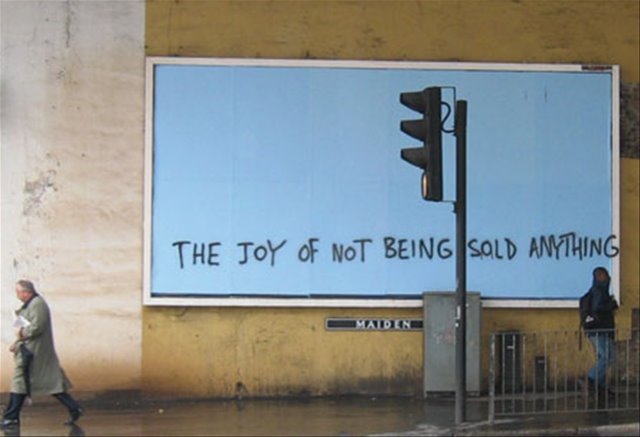
The Joy of Less
By Pico Iyer / June 9, 2009

“The beat of my heart has grown deeper, more active, and yet more peaceful, and it is as if I were all the time storing up inner riches … My [life] is one long sequence of inner miracles.” The young Dutchwoman Etty Hillesum wrote that in a Nazi transit camp in 1943, on her way to her death at Auschwitz two months later. Towards the end of his life, Ralph Waldo Emerson wrote, “All I have seen teaches me to trust the creator for all I have not seen,” though by then he had already lost his father when he was 7, his first wife when she was 20 and his first son, aged 5. In Japan, the late 18th-century poet Issa is celebrated for his delighted, almost child-like celebrations of the natural world. Issa saw four children die in infancy, his wife die in childbirth, and his own body partially paralyzed.

I’m not sure I knew the details of all these lives when I was 29, but I did begin to guess that happiness lies less in our circumstances than in what we make of them, in every sense. “There is nothing either good or bad,” I had heard in high school, from Hamlet, “but thinking makes it so.” I had been lucky enough at that point to stumble into the life I might have dreamed of as a boy: a great job writing on world affairs for Time magazine, an apartment (officially at least) on Park Avenue, enough time and money to take vacations in Burma, Morocco, El Salvador. But every time I went to one of those places, I noticed that the people I met there, mired in difficulty and often warfare, seemed to have more energy and even optimism than the friends I’d grown up with in privileged, peaceful Santa Barbara, Calif., many of whom were on their fourth marriages and seeing a therapist every day. Though I knew that poverty certainly didn’t buy happiness, I wasn’t convinced that money did either.

So — as post-1960s cliché decreed — I left my comfortable job and life to live for a year in a temple on the backstreets of Kyoto. My high-minded year lasted all of a week, by which time I’d noticed that the depthless contemplation of the moon and composition of haiku I’d imagined from afar was really more a matter of cleaning, sweeping and then cleaning some more. But today, more than 21 years later, I still live in the vicinity of Kyoto, in a two-room apartment that makes my old monastic cell look almost luxurious by comparison. I have no bicycle, no car, no television I can understand, no media — and the days seem to stretch into eternities, and I can’t think of a single thing I lack.


I’m no Buddhist monk, and I can’t say I’m in love with renunciation in itself, or traveling an hour or more to print out an article I’ve written, or missing out on the N.B.A. Finals. But at some point, I decided that, for me at least, happiness arose out of all I didn’t want or need, not all I did. And it seemed quite useful to take a clear, hard look at what really led to peace of mind or absorption (the closest I’ve come to understanding happiness). Not having a car gives me volumes not to think or worry about, and makes walks around the neighborhood a daily adventure. Lacking a cell phone and high-speed Internet, I have time to play ping-pong every evening, to write long letters to old friends and to go shopping for my sweetheart (or to track down old baubles for two kids who are now out in the world).

When the phone does ring — once a week — I’m thrilled, as I never was when the phone rang in my overcrowded office in Rockefeller Center. And when I return to the United States every three months or so and pick up a newspaper, I find I haven’t missed much at all. While I’ve been rereading P.G. Wodehouse, or “Walden,” the crazily accelerating roller-coaster of the 24/7 news cycle has propelled people up and down and down and up and then left them pretty much where they started. “I call that man rich,” Henry James’s Ralph Touchett observes in “Portrait of a Lady,” “who can satisfy the requirements of his imagination.” Living in the future tense never did that for me.

Perhaps happiness, like peace or passion, comes most when it isn’t pursued.

I certainly wouldn’t recommend my life to most people — and my heart goes out to those who have recently been condemned to a simplicity they never needed or wanted. But I’m not sure how much outward details or accomplishments ever really make us happy deep down. The millionaires I know seem desperate to become multimillionaires, and spend more time with their lawyers and their bankers than with their friends (whose motivations they are no longer sure of). And I remember how, in the corporate world, I always knew there was some higher position I could attain, which meant that, like Zeno’s arrow, I was guaranteed never to arrive and always to remain dissatisfied.

Being self-employed will always make for a precarious life; these days, it is more uncertain than ever, especially since my tools of choice, written words, are coming to seem like accessories to images. Like almost everyone I know, I’ve lost much of my savings in the past few months. I even went through a dress-rehearsal for our enforced austerity when my family home in Santa Barbara burned to the ground some years ago, leaving me with nothing but the toothbrush I bought from an all-night supermarket that night. And yet my two-room apartment in nowhere Japan seems more abundant than the big house that burned down. I have time to read the new John le Carre, while nibbling at sweet tangerines in the sun. When a Sigur Ros album comes out, it fills my days and nights, resplendent. And then it seems that happiness, like peace or passion, comes most freely when it isn’t pursued.

If you’re the kind of person who prefers freedom to security, who feels more comfortable in a small room than a large one and who finds that happiness comes from matching your wants to your needs, then running to stand still isn’t where your joy lies. In New York, a part of me was always somewhere else, thinking of what a simple life in Japan might be like. Now I’m there, I find that I almost never think of Rockefeller Center or Park Avenue at all.

[Pico Iyer’s most recent book, “The Open Road: The Global Journey of the Fourteenth Dalai Lama,” is just out in paperback.]

Source / The New York Times

The Rag Blog

Posted in RagBlog | Tagged , | 1 Comment

Crackdown in Peruvian Jungle; Indigenous Leader Seeks Asylum

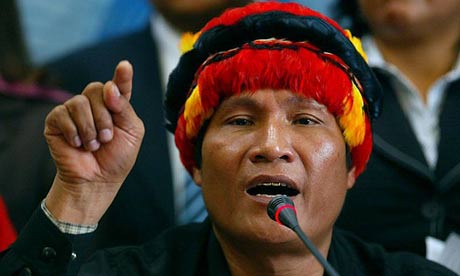
Alberto Pizango, leader of Peruvian indigenous communities, speaks during a news conference in Lima. Photo from Reuters / Guardian, U.K.

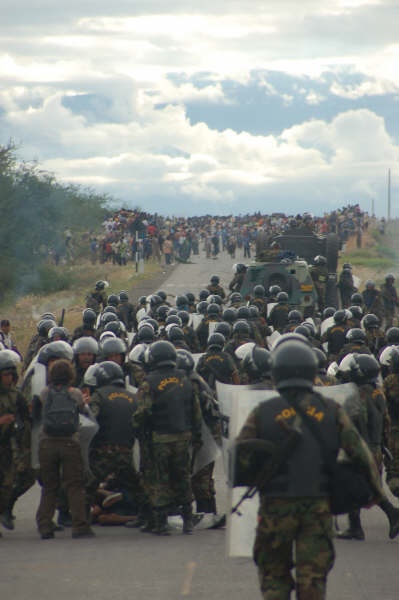
UPDATE: See ‘Peru: 60 dead as Garcia Regime sends police to attack indigenous road blockade,’ at Axis of Logic, with photos like the ones below.

Peruvian indigenous leader seeks asylum in Nicaragua’s embassy

Alberto Pizango was charged with sedition following protests in the Amazon rainforest which turned violent.

By Rory Carroll / June 9, 2009

See Video report from Amy Goodman / Democracy Now!, Below.

A Peruvian indigenous leader has sought asylum in Nicaragua’s embassy to escape sedition charges over anti-government protests in the Amazon which turned bloody last weekend.

Alberto Pizango, a leader in a campaign against oil and mining projects in the rainforest, slipped into the Nicaraguan embassy in Peru’s capital, Lima, after an arrest warrant was issued on Saturday.

Meanwhile in the jungle hundreds and possibly thousands of Awajun and Wambis Indians hid from security forces who were retaking control after two days of mayhem which left dozens dead, including 23 police. Dodging a military curfew and round-ups, many protestors trekked back to remote villages.

Indigenous leaders said at least 40 protesters were killed, including several children, and alleged that security forces dumped other victims in mass graves and rivers to conceal the extent of the crackdown.

“The government appears to be destroying the bodies of slain protesters and giving very low estimates of the casualties,” said Gregor MacLennan, of the advocacy group Amazon Watch, from the flashpoint town of Bagua.

Indigenous leaders said violence flared when police, including some in helicopters, opened fire last Friday on thousands of protesters who were peacefully blocking a road in Bagua, 870 miles north of Lima.

Authorities confirmed only nine indigenous protesters dead and rejected claims of cover-up. There are graphic images of dead and wounded protesters but so far no strong corroboration of accounts of mass graves or corpses being burnt and dumped. A government TV campaign portrayed protesters as barbarians who slaughtered “humble” police with spears and bullets.

The Andean country’s worst violence in a decade has left a question mark over the fate of billion-dollar deals with foreign multinationals, including the Anglo-French oil company Perenco, to extract oil, gas and minerals from the rainforest.

Indigenous leaders said they would continue a six-week-old campaign to block roads, waterways and pipelines to protect ancestral land.

President Alan Garcia, who has pushed for free trade deals with the United States and European Union, said the Amazon’s wealth belonged to all 28 million Peruvians, not just a few hundred thousand Indians. He hinted, without furnishing evidence, that the leftist governments of Bolivia and Venezuela had fomented the trouble.

The Catholic church urged the government to suspend the controversial decrees which opened the Amazon to multinationals.

“This was a disaster waiting to happen,” said Archbishop Miguel Cabrejos. “The indigenous peoples have been forgotten. We must listen to them.”

Source / Guardian, U.K.

Amy Goodman: Democracy Now! Report on Alleged Police Massacre of Indigenous People

Thanks to Jeffrey Segal and S.M. Wilhelm / The Rag Blog

Posted in RagBlog | Tagged , , , , | Leave a comment

Stephanie Chernikowski : ‘Looking at Music: Side 2’ at the MOMA

Sonic Youth. 1983. Black-and-white photograph, 11 x 17″ (27.9 x 43.2 cm). Photo by Stephanie Chernikowski / Looking at Music: Side 2 / Museum of Modern Art, New York.

That is a very early shot of Kim Gordon and Thurston Moore of Sonic Youth playing at CBGB. They are both multi-talented, as are many of the artists in the show. Looking at Music: Side 2 examines a movement of downtown artists, musicians, photographers, and film makers who enjoyed breaking rules and usually did their art on the cheap. New York was broke and so were we. It sounds like a brilliant show and includes artists I really like — Patti Smith, Richard Hell, Jean-Michel Basquiat. I look forward to seeing it.
sc nyc 6.2009

Stephanie Chernikowski / The Rag Blog / June 9, 2009

Stephanie Chernikowski, a former denizen of the Sixties Austin artistic and literary bohemia who now resides in New York City, is featured in an exhibition at New York’s Museum of Modern Art (MOMA).

The show, titled Looking at Music: Side 2, opens June 10, and runs through Nov. 30.

Stephanie Chernikowski moved to New York City from her native Texas on Columbus Day of 1975. She began working as a photojournalist shortly before her move and has continued to view life through a lens. Her concentration has been on 35mm black & white portraiture and documentation of the downtown music and arts scene, with occasional digressions.

Looking at Music: Side 2
June 10, 2009–November 30, 2009
The Yoshiko and Akio Morita Media Gallery, second floor

The Museum of Modern Art presents Looking at Music: Side 2, a survey of over 120 photographs, music videos, drawings, audio recordings, publications, Super 8 films, and ephemera that look at New York City from the early 1970s to the early 1980s when the city became a haven for young renegade artists who often doubled as musicians and poets. Art and music cross-fertilized with a vengeance following a stripped-down, hard-edged, anti-establishment ethos, with some artists plastering city walls with self-designed posters or spray painted monikers, while others commandeered abandoned buildings, turning vacant garages into makeshift theaters for Super 8 film screenings and raucous performances.

Many artists found the experimental music scene more vital and conducive to their contrarian ideas than the handful of contemporary art galleries in the city. Artists in turn formed bands, performed in clubs and non-profit art galleries, and self-published their own records and zines while using public access cable channels as a venue for media experiments and cultural debates.

See the online interactive presentation of the works included in Looking at Music: Side 2, with a slideshow of selected highlights, interpretive texts, and original acoustiguide conversations recorded for the exhibition. The site will launch by June 17, 2009.

Go to MOMA’s public flickr page for Looking at Music: Side 2.

Visit Stephanie Chernikowski’s website.

The Rag Blog

Posted in Rag Bloggers | Tagged , , , , , , , | Leave a comment

Stopping Israeli Settlements : Can Obama Deliver?

Can Barack Obama succeed in pressuring Israeli’s Netanyahu to stop the expansion of Israeli settlements on Palestinian land?

Can Obama Stop Israeli Settlements?

As Obama and his advisors see the issue, American interests in reigning in nuclear proliferation, reducing terrorism, and protecting sources of oil and natural gas in Muslim countries require ending the conflict between Israelis and Palestinians, or at least being seen trying our best to do so.

By Steve Weissman / June 8, 2009

Now comes the heavy lifting. Barack Obama has spoken in Cairo, calling for a new beginning between the U.S. and the world’s one billion Muslims. All the major players have offered their initial reactions, and everyone from Israeli Prime Minister Bibi Netanyahu to the incredibly shrinking Osama bin Laden is asking the same question: Can Obama deliver?

The first and most obvious test will be Israeli settlements on the occupied West Bank. In his speech, Obama drew a rather modest line in the sand. “The United States does not accept the legitimacy of continued Israeli settlements,” he said. “This construction violates previous agreements and undermines efforts to achieve peace. It is time for these settlements to stop.”

Obama did not call for a withdrawal of existing settlements, the tearing down of the separation wall, or the opening of the Israeli-only highways that carve up the Palestinian land and make a viable state impossible. He left these and other life-and-death issues to future negotiations between the Israelis and Palestinians.

Even so, Netanyahu and his Likkud-led government said no. “Israel will not heed President Barack Obama’s powerful appeal to halt all settlement activity on lands the Palestinians claim for a future state, officials said Friday, a position that looks sure to cause a policy clash with its most powerful ally,” the Associated Press reported.

“The government plans to allow construction inside existing West Bank settlements to accommodate for growing families, said the officials.”

Columnist Charles Krauthammer and America’s whatever-Israel-wants crowd dutifully repeated the “natural growth” argument, finding a humanitarian necessity in helping Israeli families grow and prosper on Palestinian land.

In their eagerness to avoid any suggestion of “moral equivalence” in the suffering of Palestinians and Jews, the American Likkudniks urged Obama to hold off on the settlements until he stopped the Iranian nuclear program, the build-up of Hamas missiles in Gaza, and the threat posed by a newly-strengthened Hezbollah in Lebanon.

And, no surprise, the same voices somehow managed to overlook the Fourth Geneva Convention, which makes it a crime in international law for any country to colonize land it has conquered in war.

One could be forgiven for beginning to see a pattern here.

Obama, in the meantime, soared above the fray. Having brilliantly used his speech to redefine the game, he deftly passed the ball to Bibi, suggesting that the Israeli leader might well become the Nixon of the Middle East.

“There’s the famous example of Richard Nixon going to China,” Obama told a small group of reporters, according to ABC News. “A Democrat couldn’t have gone to China. A liberal couldn’t have gone to China. But a big anti-communist like Richard Nixon could open that door. Now, it’s conceivable that Prime Minister Netanyahu can play that same role.”

Obama then flew off to the Nazi concentration camp at Buchenwald, where he repeated his condemnation of Iranian President Ahmadinejad and others who deny the reality of the Holocaust. Neither Netanyahu nor his American allies will get away with smearing this president as an enemy of either the Jewish people or the State of Israel.

All the while, the White House and State Department played solid defense, insisting that Obama was simply continuing the long-standing American opposition to Israeli settlements. Secretary of State Hillary Clinton even rejected the claims made by former Israeli officials that the administration of George W. Bush had secretly agreed to expanding Jewish settlements on the West Bank within their existing boundaries.

“There is no memorialization of any informal and oral agreements,” she told a news conference, as reported by the Israeli daily Haaretz. “If they did occur, which of course people say they did, they did not become part of the official position of the United States government.”

Will Obama make his opposition to the settlements stick where earlier administrations failed? He will definitely try, and the reason has nothing to do with whatever compassion he might feel for the Palestinians.

As Obama and his advisors see the issue, American interests in reigning in nuclear proliferation, reducing terrorism, and protecting sources of oil and natural gas in Muslim countries require ending the conflict between Israelis and Palestinians, or at least being seen trying our best to do so. This is where the “foreign policy realism” of the first George Bush meets “Change We Can Believe In,” and Obama’s speech in Cairo and meetings with Egypt’s Hosni Mubarak and Saudi King Abdullah set in motion a process that will push Washington in that direction.

Newsweek’s current interview with Saudi Foreign Minister Prince Saud al-Faisal makes the point. His message: The US should cut off aid if Israel does not end the occupation.

“The United States has the means to persuade the Israelis to work for a peaceful settlement,” said the Saudi prince. “It needs to tell them that if it is going to continue to help them, they must be reasonable and make reasonable concessions.”

The White House and Congress remain a long way from cutting off aid to Israel. But Obama has opened the door to increasing pressure on himself, and that will translate into increasing pressure on the Israelis.

[A veteran of the Berkeley Free Speech Movement and the New Left monthly Ramparts, Steve Weissman lived for many years in London, working as a magazine writer and television producer. He now lives and works in France. He is also a regular contributor to The Rag Blog.]

Source / truthout

The Rag Blog

Posted in RagBlog | Tagged , , , , | 1 Comment

Far Right Makes Big Gains in European Elections

Nick Griffin, leader of the BNP in Great Britain, celebrates as results are announced at Manchester Town Hall. Griffin has a criminal conviction for incitement likely to cause racial hatred. Photo by Dave Thompson / PA.

Hard right on the move in 10 member states of European Union

The Netherlands leads the way with four seats for the anti-immigrant and anti-Islam Freedom Party of the platinum blond Geert Wilders, the producer of the notorious Muslim-baiting film short Fitna.

By Leigh Phillips / June 8, 2009

Also see ‘Free-web Pirate Party captures seat’ by Victoria Ek, Below.

BRUSSELS — Across Europe, the far right is on the march, claiming increased numbers of seats in ten different member states. However, in Belgium, France and Poland, the far right saw some significant losses as well.

In total, the far right is up eight seats on the 2004 European elections.

In Austria, Denmark, Finland, Greece, Hungary, Italy, the Netherlands, Romania and the UK, the far right made moderate to significant advances.

However, the extreme right saw sharp declines in Belgium, and France, and were completely wiped out in Poland.

“The far right growth is a really bad sign, and this is clearly linked to the economic crash,” Gerry Gable, the editor of Searchlight, a long-standing anti-fascist monthly magazine out of the UK, where the British National Party elected its first-ever MEP, told EUobserver.

“This is the entirely predictable result of the social fall-out of the financial crisis,” he added. “It’s a particularly worrying trend, especially in Austria and the Netherlands.”

The Netherlands leads the way with four seats for the anti-immigrant and anti-Islam Freedom Party of the platinum blond Geert Wilders, the producer of the notorious Muslim-baiting film short Fitna.

Austria as well delivered two seats to the identically named Freedom Party, up one seat from 2004 and winning 13.4 percent of the vote.

The BVO of the late Joerg Haider, a breakaway from the FPO, however was denied any representation in the European Parliament, although it did manage to win the support of 4.6 percent of voters.

Together, Austria’s far right won a clean 18 percent.

Hungary too returned three MEPs from the Movement for the Better Hungary, or Jobbik, on some 15 percent of the vote. The group is the founder of the Hungarian Guard, a paramilitary outfit whose uniforms recall the Nazi youth organisations from Europe’s darkest days.

In Denmark, the anti-immigrant Danish People’s Party, which nevertheless rejects the far-right label, gained an extra seat, up from one.

Finland also delivered up its first hard-right deputy, from the Perussuomalaiset, or True Finns, a nationalist and staunchly anti-EU grouping. The group’s win at the EU level follows on from its successes in domestic elections. In the 2003 parliamentary elections, the party won three seats and in 2007, it won five.

The Greater Romania Party won two seats, up from nil in 2007. Prior to the country’s entry into the European Union, the party did however have representation in the form of five ‘observer’ MEPs. In 2007 however, they lost all MEPs.

Greece’s Popular Orthodox Rally, or LAOS grouping, led by right-wing journalist Georgios Karatzaferis, doubled its representation from one to two MEPs, with around seven percent of the vote.

Italy’s anti-immigrant Northern League also doubled its representation, but from four to eight MEPs. However, the fate of the far right in Italy is difficult to measure, as the two other hard-right parties, the self-styled ‘post-fascist’ National Alliance of Gianfanco Fini, and the neo-fascist Social Alternative of Alessandra Mussolini, merged with Forza Italia in Silvio Berlusconi’s the People of Freedom party earlier this year.

France’s National Front however, lost four seats, down from seven, while the hard-right sovereignist Movement for France of Philippe de Villiers, now branded Libertas under the umbrella of Irish centrist eurosceptic Declan Ganley, also dropped two seats down to one.

“The Front National in France has taken a beating, largely as a result of the governing party taking on some of their rhetoric and Le Pen himself has just gone on too long and accumulated too many convictions,” said Mr Gable. “But the key is the party pulling itself apart in different directions.”

“It’s a similar story in Belgium, where the Vlaams Belang is losing backing to the Lijst Dedecker, but when they begin to pull apart, that’s when they start to suffer.”

The Flemish separatist Vlaams Belang lost one seat and now has only two in the house, while the right-wing populist Lijst Dedecker gained one. Together however, their combined roughly 15 percent of the vote does not match the Vlaams Belangs’ 23 percent of 2004.

Poland saw the biggest drop in the far-right vote, however, which returned 16 right-of-the-right MEPs last time around. This year, not a single one has been elected from either the League of Polish Families or the Self-Defence party.

Mr Gable attributed this to the hard conservatism of the mainstream parties.

“The collapse of the far right is just a sign of how right wing the governing parties have been.”

Bulgaria’s extremist anti-minority National Union Attack, or Ataka party, also dropped down one seat to two, and Latvia’s For Fatherland and Freedom (LNNK) lost three.

Finally, while results from the UK have been late to arrive, early projections suggest the British National Party will have at least one seat, from the Yorkshire and Humber region.

The candidate, Andrew Brons, “is a really nasty character and a long-time Nazi activist that has a conviction for an assault on a Black policeman,” said the Searchlight editor.

“He really is the true face of the BNP.”

“It’s very disappointing that they’ve taken any seats in the UK, and there’s still the Northwest and Midlands constituencies to come in and it could be very close there as well.”

[The above is based on preliminary results. Particularly in the case of fringe parties, results are very likely to change in the coming days.]

Source / eurobserver.com

A supporter of file-sharing hub The Pirate Bay, waves a Jolly Roger flag during a demonstration in Stockholm April 18 2009, as Sweden’s Pirate Party chairman and founder Rickard Falkvinge talks to the crowd in the background. Photo by Fredrik Persson / Scanpix / Reuters.

Free-web Pirate Party captures seat

By Veronica Ek / June 8, 2009

STOCKHOLM -– Sweden’s Pirate Party, striking a chord with voters who want more free content on the Internet, won a seat in the European Parliament, early results showed Sunday.

The Pirate Party captured 7.1 percent of votes in Sweden in the Europe-wide ballot, enough to give it a single seat. The party wants to deregulate copyright, abolish the patent system and reduce surveillance on the Internet.

“This is fantastic!” Christian Engstrom, the party’s top candidate, told Reuters. “This shows that there are a lot of people who think that personal integrity is important and that it matters that we deal with the Internet and the new information society in the right way.”

Previously an obscure group of single-issue activists, the party enjoyed a jump in popularity after the conviction in April of four men behind The Pirate Bay, one of the world’s biggest free file-sharing website.

The case cast a spotlight on the issue of internet file-sharing, a technique used to download movies, music and other content. The defendants have called for a retrial.

Despite the similar names, the party and the website are not linked. The party was founded in 2006 and contested a Swedish general election that year, but received less than one percent of the vote.

Engstrom credited the party’s appeal to young voters for its success. “We are very strong among those under 30. They are the ones who understand the new world the best. And they have now signaled they don’t like how the big parties deal with these issues.”

The Pirate Party will take up one of Sweden’s 18 seats in the 785-seat parliament. “We will use all of our strength to defend personal integrity and our civil rights,” Engstrom said.

[Reporting by Veronica Ek, writing by Adam Cox.]

Source / Reuters / Yahoo News

Thanks to Jeffrey Segal and S.M. Wilhelm / The Rag Blog

Posted in RagBlog | Tagged , , , , , | Leave a comment

Robert Jensen : Lingering White Supremacy in South Africa Feels Like Home

Sign in South Africa from the days of apartheid — the practice of racial “seperateness” that was dissolved in 1994. White supremacy, however, is not so easily dispatched by changes in laws. Photo from SouthAfrica.TO.

Lingering white supremacy in South Africa sounds much like United States

…it is clear that we white people can’t hide behind the litany of excuses we use to justify our failure to confront white supremacy.

By Robert Jensen / The Rag Blog / June 9, 2009

Apartheid is dead in South Africa, but a new version of white supremacy lives on.

“During apartheid the racism of white people was up front, and we knew what we were dealing with. Now white people smile at us, but for most black people the unemployment and grinding poverty and dehumanizing conditions of everyday life haven’t changed,” a black South African told me. “So, what kind of commitment to justice is under that smile?”

This community activist in Cape Town said that, ironically, the end of South’s Africa’s apartheid system of harsh racist segregation and exploitation has in some ways made it more difficult to agitate for social justice today. As he offered me his views on the complex politics of his country, Nkwame Cedile, a field worker for People’s Health Movement, expressed a frustration that I heard often in my two weeks in the country: Yes, the brutality of apartheid ended in 1994 with free elections, but the white-supremacist ideas that had animated apartheid and the racialized distribution of wealth it was designed to justify didn’t magically evaporate.

That shouldn’t be surprising — how could centuries of white supremacy simply disappear in 15 years? What did surprise me during my lecture tour was not the racial tension but how much discussions about race in South Africa sounded just like conversations in the United States. There was something eerily familiar to me, a lifelong white U.S. citizen, about those discussions. I have heard comments from black people in the United States like Cedile’s, but I’ve also heard white Americans articulate views on race that were sometimes exactly like white South Africans’. I learned that even with all the differences in the two countries there are equally important similarities, and as a result the sense of entitlement that so many white people hold onto produces similar dodges and denials.

Those similarities: South Africa and the United States were the two longstanding settler states that maintained legal apartheid long after the post-World War II decolonization process. The crucial term is “settler state,” marking a process by which an invading population exterminates or displaces and exploits the indigenous population to acquire its land and resources, with formal slavery playing a key role at some point in the country’s history. Both strategies were justified with overtly racist doctrines about white supremacy, and both required the white population to discard basic moral and religious principles, leading to a pathological psychology of superiority. Both of those settler strategies have left us with racialized disparities in wealth and well-being long after the formal apartheid is over.

The main difference: The United States struggles with its problem with a white majority, while South Africa has a black majority. But what I found fascinating is how little difference that made in terms of the psychological pathology of so many white people. So, as is typically the case, my trip to South Africa taught me not only about racism in South Africa but also in the United States, which reminded me that perhaps we travel to observe others so that we can learn about ourselves.

From a two-week trip I wouldn’t claim deep insights or knowledge about South Africa. My contact in the country, outside of informal chats with people on the street, was limited primarily to university professors and students, or left/progressive activists in Cape Town, Johannesburg, and Durban. I didn’t have a chance to get behind the gates in the wealthy neighborhoods or talk to elite business people, and my travels in the black townships were limited in time and scope. But with those limits, some clear patterns emerged about the moderate/liberal/left white people I engaged with.

[A footnote on racial terms: In South Africa people sometimes talk about race in terms of white and black, with “black” in that context meaning all people who aren’t of European descent. More specifically, the black population is made up of black Africans (such as the Zulu and Xhosa), Indians (descended from various waves of immigration from India), and coloured (mixed-race). Most whites tend to identify as of primarily English or Dutch/Afrikaner background. Many people in South Africa try to avoid apartheid-era terminology but still sometimes use these four traditional racial categories, in part because they are the basis for measuring economic progress in relation to various forms of affirmative action.]

The first trend was the belief that whatever racism remained in South Africa, things will get better naturally, as long as South Africans respect all cultures. The argument seems to go something like this: Apartheid is over, we have a black government, and now it’s time to move ahead by understanding that the problem of race in no longer political but one of inadequate cultural understanding and engagement. This celebration of diversity is familiar to us in the United States, where institutions (especially corporations and schools) tend to address difficult questions about disparities in political power and the distribution of wealth through multiculturalism. While there’s nothing wrong, of course, with acknowledging cultural diversity and helping people learn more about other cultures, multiculturalism does not take the place of real politics, no matter how much many white people wish it could. Understanding others doesn’t automatically mean that those with unearned privileged will work to undermine the system that gives them that privilege.

During my first days in the country, my host for the trip, Junaid Ahmad, reported an incident that drove home how superficial such commitment to multiculturalism can be. Ahmad, a Ph.D. student and activist at the University of Cape Town, had been asked to appear on the campus radio station opposite the student government president to discuss race issues. When the other student (a white man) pointed to a recent musical performance in which black African and coloured choirs sang together, Ahmad (a Pakistani-American) challenged the assumptions of multiculturalism-as-a-solution behind the comment. The student body president got more and more agitated with Ahmad’s critique until finally, as the interview was ending, the student president turned to him and said, “You should be careful.”

Ahmad said the man didn’t appear to be reminding him to look both ways while crossing the street or to be careful driving in heavy traffic. The vague warning wasn’t a direct threat, but Ahmad said that given the context of a white man angered by a challenge from an Indian (the category into which Ahmad would likely fit in South Africa), it was hard not to interpret the comment as white-supremacist. The white man had acknowledged that racial issues still haunt South Africa but wasn’t eager to engage in a debate about his assessment of what was needed for real progress, especially not when the critique came from …

Though his expression of his emotional reaction was crude, the young man was not idiosyncratic. In my experience, many whites — in South Africa and the United States — expect their endorsement of multiculturalism to be accepted as evidence of a serious commitment to ending racism.

After a talk at the University of Johannesburg in which I argued for always keeping discussions of race grounded in the white-supremacy of the culture, a faculty member there took issue with the tone of my remarks. If we want to be a “post-racial” society, she suggested that dialogue without all the political baggage was necessary. The only path to racial harmony was to put aside the bitterness and find a common humanity, and part of the success of the interracial dialogues she was part of was the ability of the group to put race aside, she said.

I told her I had no problem with people pursuing such discussions so long as we didn’t pretend we could erase the effects of race with the snap of our fingers. Racial distinctions and racialized disparities in wealth endure, even without the legal enshrinement of them, and that reality has to be acknowledged. She pressed the claim that such a focus on race undermines commonality, noting that as a person of German and Jewish heritage, she knew this first hand. The comments from blacks in the room who disputed her call for color blindness didn’t dissuade her; she was adamant about the proper path. As she pressed on, I noticed a row of black students behind her rolling their eyes, suggesting they had heard this before and were tired of it. The price of admission to these race dialogues was to leave behind what people of color know about race, and one thing they know is that we whites typically are too quick to believe we have transcended race.

There’s nothing new about either of these examples, of course. The student leader’s sense of supremacy that lingered just below his multicultural commitment is a painfully obvious sign of self-deception, but so are the feel-good claims of the fans of race dialogues. In 1970 one of South Africa’s most eloquent voices for justice, Steve Biko, referred to these black-white circles as “tea parties” that turn out to be “a soporific on the blacks and provide a vague satisfaction for the guilty-stricken whites.” Biko can’t be written off as a black separatist from a bygone era who is no longer relevant; he maintained personal and political relationships with principled white allies while he was alive, and today even with a black-run government South Africa’s economy is dominated by whites with privilege. Biko’s analysis rings as true today as it was in the years before he was murdered while in police custody in 1977. Quoting more extensively from that same essay, “Black Souls in White Skins?”:

“Instead of involving themselves in an all-out attempt to stamp out racism from their white society, liberals waste lots of time trying to prove to as many blacks as they can find that they are liberal. This arises out of the false belief that we are faced with a black problem. There is nothing the matter with blacks. The problem is WHITE RACISM and it rests squarely on the laps of the white society.”

In rejecting what he saw as a false integration, Biko made it clear he believed in real integration premised on a struggle for justice:

“If by integration you understand a breakthrough into white society by blacks, an assimilation and acceptance of blacks into an already established set of norms and code of behaviour set up by and maintained by whites, then YES I am against it. … If on the other hand by integration you mean there shall be free participation by all members of a society, catering for the full expression of the self in a freely changing society as determined by the will of the people, then I am with you.”

Those principles were central to the black consciousness movement that Biko helped lead in South Africa, and they apply just as clearly to the United States, then and now. As I read Biko’s words while in South Africa, I was reminded of my own attempts in the past to prove my anti-racist bona fides by creating the appearance of solidarity when I had yet to demonstrate real solidarity. I cringed at how much I still struggle to avoid this.

My point is not that all problems in South Africa or the United States are the result of racist actions of whites. In South Africa I heard a steady stream of criticism of the ruling African National Congress (ANC) for its failure to live up to the promises in its Freedom Charter that had helped define the struggle against apartheid, for what some see as its willingness to sell out the interests of ordinary people to the white elites who were allowed to retain much of the wealth acquired under apartheid. Leaders such as Biko don’t blame everything on whites but instead analyze the effects of white supremacy and ask for accountability on the part of everyone. For people with unearned privilege, that accountability is too easily avoided.

I finished reading “I Write What I Like,” the book of Biko’s writings quoted from above, while sitting in the Cape Town airport waiting for my flight home. The book stuck out of my over-stuffed shoulder bag as a white South African sat down next to me and said hello. Tired of reading, I put down my newspaper and responded to his friendly conversation starter. As we chatted about our personal lives and I reported on my experiences in the country, I could see his eyes glance several times over at the Biko book. After a few more minutes he felt comfortable enough to ask me what I knew about Biko. I mentioned I had taken a South African history course around 1980 and had read about Biko right after his murder. But this was the first time I had read his own writing, I said, and I was sorry I had waited so long.

After acknowledging Biko’s political skills and courage, my conversation partner warned me not to be too taken in by the “cult” around Biko. “Remember, he died before he had a chance to get corrupt,” he said. Playing a bit dumb, I asked what he meant, and then the floodgates opened. “Just look,” he said, at the litany of incompetent and corrupt ANC politicians. They’ve gotten rich but are slowly turning the country into “one more basket case in Africa.”

Were there no honest black leaders? Was corruption more common in a black government than a white one?

He conceded that there were honest ANC leaders, and perhaps the ANC was no more corrupt than a white party. But it’s not just about honesty, he said, his sentence trailing off. I asked what he meant.

“South Africa is a modern society. We have advanced technology,” he said. “We’re more like a European country than an African one.”

That is the other face of white liberalism. A “hard-headed realism” that understands you can’t really expect the blacks to run the complex society that whites built. After our initial amiable chatting, I was taken aback by the overt racism, though I knew enough to know lots of pleasant people are racist. I awkwardly excused myself to go to the bathroom, though it was as clear to him as to me why I was leaving. As I walked away I immediately felt ashamed for not confronting him. I told myself that this wasn’t my country and it wasn’t my job, that I was legitimately tired, that the man likely would have dismissed me as a naïve American. I told myself that it was okay to walk away, and maybe it was in that particular situation. I reminded myself that I was emotionally and physically exhausted from the trip, but the more I reminded myself, the less compelling my excuses sounded to me. I couldn’t avoid the fact that I, like other white people, always have the choice to walk away.

Whatever my obligation was that day in South Africa, it is clear that we white people can’t hide behind the litany of excuses we use to justify our failure to confront white supremacy: “you have to pick your battles,” or “you can’t change every person.” Maybe that’s all true, but as I got in line to board the plane and looked up to see the man smirk at me, I realized my failure and recognized my moral laziness. The question for me, and for all whites, is whether we learn from those failures or remain stuck in the laziness.

[Robert Jensen is a journalism professor at the University of Texas at Austin and board member of the Third Coast Activist Resource Center. His latest book is All My Bones Shake: Seeking a Progressive Path to the Prophetic Voice (Soft Skull Press, 2009). Jensen can be reached at rjensen@uts.cc.utexas.edu and his articles can be found Source.]

The Rag Blog

Posted in Rag Bloggers | Tagged , , | 1 Comment

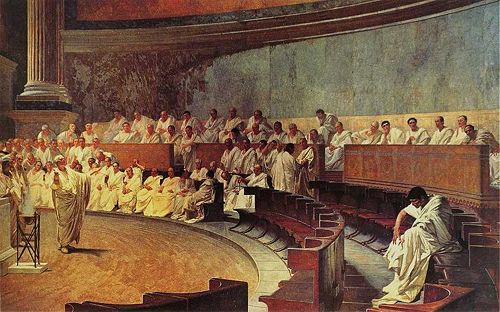
Health Care Reform and the Senate : Do as the Romans Did

Cicero addresses the Roman Senate in a 19th century fresco. Image from Wikipedia Commons.

Cicero put the Senate itself on trial

‘…if [Gaius Verrus’] immense wealth is sufficient to shatter your honesty — well then… they will certainly know all they need to know about a jury of Roman senators!’

By Dr. Stephen R. Keister / The Rag Blog / June 8, 2009

The Roman criminal court, in the days of The Republic, convened in the Forum before the Temple of Castor and Pollux. In the year 70 BC, Verres, governor of Sicily,was on trial for corruption, theft, and embezzlement, before the praetor Aclius Glabrio and a jury of 23 of The Senators. The prosecutor was Marcus Cicero who was well aware that Verres was a friend and benefactor of many members of The Senate.

Cicero began his prosecution with the following words to the Senators: “But the character of the man I am prosecuting is such that you may use him to restore your own good name. Gaius Verrus has robbed the Treasury and behaved like a pirate and destroying pestilence in his provence of Sicily. You have only to find this man guilty, and respect in you will be rightly restored. But if you do not — if his immense wealth is sufficient to shatter your honesty — well then, I shall achieve one thing at least. The nation will certainly not believe Verres to be right and me wrong — but they will certainly know all they need to know about a jury of Roman senators!” Great crowds of common folks had gathered in respect to Cicero — as the trial progressed the weight of the evidence and the mood of the multitude did indeed lead to the conviction.

How does this relate to the health care hearings in the U.S. Senate? Quoting from the June 22, 2009, Nation: “Writing on The Atlantic’s website, Scott Bland and Donald Brownstein identify of what they dub ‘The Democratic Industrial Complex.’ Energy and health care companies, automakers and banks all understand that the Democrats control much of their fate, so they’ve cast their lot with the majority party in a big way: John Kerry got less than 20% of the donations from electric utilities; Barack Obama got almost 60%. So far in this cycle, Democrats have captured two-thirds of the donations from the health care industry.”

Tom Hinton, president and CEO of The American Consumer Council, elaborates on the baksheesh that Sen. Max Baucus has received from the insurance companies, pharmaceutical companies, and others to whom universal health care is anathema. The Washington establishment is awash in corruption and graft. Thus, little concern for the needs of the American people.

According to Jane Stillwater, writing in the Baltimore Chronicle, Sen. Max Baucus of Montana has received almost $2 million dollars from health care lobbyists alone –$1,826,652 to be exact. Corporate health profiteers who invest in Baucus will now benefit from his stewardship over health care reform. His 2008 donations from health care profiteers included: insurance, $592.185; health professionals. $537,141; pharmaceuticals/health products, $524,813; health service/HMOs, $364,500; hospitals/nursing homes $332,826.

The Republicans continue to collect their dues; for instance Sen. Charles Grassley has collected $1.3 million in donations from industries related to the health care debate. Obviously 65% of American citizens and 63% of American physicians are to be ignored by our elected representatives.

The AP reports that Sen. Edward Kennedy has offered a plan requiring employers to offer health care to employees or pay a penalty. In addition the bill would provide subsidies to poor people to pay for care, and require everyone to purchase health insurance, with exceptions for those who cannot afford it.

Once again we are faced with the little discussed problem of requiring everyone to purchase insurance from a private insurance company. Is this constitutional? Karl Manheim and James Court of the Loyola Law School are quoted in the Christian Science Monitor discussing this question in detail as does Robert Greenslade, a writer on issues involving the Federal Constitution, on the Web Site The Price of Liberty. One would think that some of our constitutional scholars would look into this further and inform the public of their opinions.

Finally, President Obama released a letter on June 2, 2009, addressed to Chairman Baucus and Chairman Kennedy. His concluding paragraph: “I strongly believe that Americans should have the choice of a public health insurance option along side private plans. This will give them a better range of choices, make the health care market more competitive, and keep insurance companies honest.” This was released by Health Care for America Now, among others.

Dr. Paul Krugman congratulated the President in his column in the June 5 New York Times. Krugman gave two worthy bits of advice: 1. Don’t trust the insurance industry; 2. Don’t trust the insurance industry. One might add to Dr. Krugman’s advice; beware of the falsifications on TV relative to health care in Canada or Europe. Overall health care in France per any objective reporting ranks first while the United States is 26th. The June 8 issue of Time Magazine provides a brief overview of health care in certain countries abroad. The Joseph Goebbels and the Leni Riefenstahls of the insurance/pharmaceutical companies’ TV programing will convince the uninformed and the naive otherwise.

President Obama has equivocated on many issues but we hope that he remains steadfast on this one, just as we hope that he remains true to his foreign policy goals as enunciated in Cairo where he was somewhat reminiscent of Prince Metternich after the Congress of Vienna. It seemed a true effort to achieve peace in the world and at the same time retrieve the character of the United States as envisioned by its founders. Yet the president is loath to truly revise the Bush/Cheney horrors of Guatanamo, undue the policy of rendition, abrogate the illegal wiretapping, remove the mercenaries from Iraq and Afghanistan, and release the torture photographs. One must hope that he does not give way to corporate interests in the area of universal, affordable health care, not dictated by big business, but granting to our citizens what is a right and in the end what is in the best interests of the nation at large. I personally still favor single payer, universal care, as the most inclusive, least expensive option, as recommended in the 25 year study by Physicians For A National Health Care Policy.

In my last submission I suggested that marijuana be decriminalized, its sale be licensed, and that a tax be levied as a way of paying in part for universal health care. Since then I saw this in an article by Alfredo Corahado, a Nieman Fellow at Harvard University writing in The Wilson: “The story of drug violence and cartels overwhelming vulnerable democracies is one of the oldest tales in Latin America. Indeed, Mexico is proving — as have Columbia, Peru and Bolivia — that the war on drugs is unwinnable as long as Americans fail to curb their insatiable appetite for illicit drugs”.

The author continues: “After nearly 40 years, U.S. drug policy, at a cost of $40 billion a year, is generally viewed as a failure. In a recent report by the Latin American Commission on Drugs and Democracy, three former heads of state, of Mexico, Columbia, and Brazil, called for a new approach, namely, decriminalizing marijuana. Yet any proposal that smacks of decriminalization is political suicide in the United States.”

Where did the seemingly unassailable prejudice against the use of marijuana originate in the united States. We once had a similar unfounded prejudice regarding absinthe which has now been found to be essentially fictitious and it is now available in most liquor stores. But where did the mythology regarding pot originate? According to the Austin Peace and Justice Coalition Newsletter of November 1993, marijuana (hemp) prohibition was driven by specific commercial interests. William Randolph Hearst started the whole racist “reefer madness” scare. He owned timberlands as well as newspapers. Hemp paper competed with timber, and, with hemp-harvesting equipment patented in 1937, would have cut costs for Hearst’s news competitors. The DuPont chemical and Lilly pharmaceutical firms — increasingly reliant on petroleum — also pushed cannabis prohibition. Cannabis sativa was used in dozens of cheap, safe, effective medicines that Lilly et al could not patent or control. At the time tobacco interests, beer, wine, and other alcohol interests worried that cannabis legalization would cut into their profits, and on and on.

The moral guardians joined the fray in spite of the fact that alcohol and certain prescription medications kill, and cigarettes cause lung cancer. Hearst’s anti-hempster Harry Anslinger, convinced of the debilitating effects of killer weed, testified that its use would make pacifists of military age men! Today, hemp activists take the moral initiative, pointing out that truth in drug education is better than lies; that marijuana-only “offenses” are nonviolent victimless crimes. Once I thought about the prohibition of cannabis, which was not one of my priority interests, I suspected that there must be a financial motive somewhere, as there is in most sereptitious maneuvers in the USA. So there was, and so there is. So often the big corporations flim-flam the “moralists” and use them to their own advantage.

I am not asking that an immediate revision in drug laws be made re: cannabis, and I am not suggesting that cocaine, the opium derivatives, LSD, “angle-dust,” and the amphetamines be decriminalized. I am suggesting that the FDA, and our public health agencies seriously, scientifically, study the effects of certain types of cannabis, and then consider legalization and distribution with federal taxation as is done with alcohol and tobacco.

I do believe that, with the Bush departure, our federal agencies that have to do with health care are once again managed by scientists rather than by political hacks. At the same time I would request that the Justice Department take a hard look at the sentencing laws for the possession of pot. Most other Western nations consider possession or use to be concerns for rehabilitation, if addiction does exist, rather than incarceration. Our prisons are overcrowded with nonviolent offenders at the costs of billions of dollars to the taxpayers which would be much better spent on universal health care among other things. Further, the government will save millions of dollars on futile and sometimes ludicrous enforcement. I recently heard of a woman serving three years in a local prison for growing several cannabis plants in her yard, yet the folks on Wall Street who brought down the nation’s economy go free.

The Rag Blog

Posted in Rag Bloggers | Tagged , , , | Leave a comment

Before it’s Too Late : Save the World’s Fish

Bluefin tuna is being over-fished and its numbers can’t be sustained, scientists say. Photo from Getty Images / The Independent, U.K.

Public supports creation of marine nature reserve

The poll came ahead of the launch of a film, The End Of The Line, which reveals the impacts of overfishing on the world’s oceans.

By Emily Beament / June 8, 2009

More than four fifths of people support the introduction of a nature reserve in our seas to protect stocks of fish, according to a survey published today on World Oceans Day.

The poll came ahead of the launch of a film, The End Of The Line, which reveals the impacts of overfishing on the world’s oceans.

The documentary, by journalist Charles Clover, claims that industrial fishing is emptying the seas of fish, destroying the livelihoods of poor fishermen in places such as Africa and killing wildlife accidentally caught in the process.

And as fisheries ministers are accused of failing to tackle the problems, demand for species such as blue fin tuna, including from top restaurant Nobu, is driving the species closer to the brink of extinction than the white rhino, say campaigners.

The film has been described as the equivalent of Al Gore’s An Inconvenient Truth for fishing, and is being backed by a wide range of green groups including Greenpeace, WWF and the Wildlife Trusts, and retailers such as Waitrose.

Meanwhile, actress Greta Scacchi is launching her own initiative to help save the world’s fish stocks.

She is working with London-based Japanese restaurant Soseki and photographer Rankin to take images of celebrities holding fish for a poster campaign.

Richard E. Grant, Emilia Fox, Terry Gilliam, Lenny Henry and O.T. Fagbenle have already participated.

Scacchi, who starred in White Mischief in 1988, said: “The first round of images are very striking – weird, witty, very saucy and some sensual.

“I have always made environmental issues a priority but recently I have been alerted to the urgency and importance of the effect of over-fishing.

“Nothing prepared me for the impact of Charles Clover’s documentary. I came out of the screening shaken by the gravity of the situation.”

The campaign will be launched at a celebrity party tonight at Soseki, opposite the Gherkin in the City of London.

A survey by the Co-operative, asking customers to vote at the tills on the chip and pin consuls, found that 83 per cent of the 360,000 people polled were in favour of highly protected marine reserves.

According to the retailer, evidence shows an increase of some 446 per cent in the amount of sealife found in reserves where fishing is banned compared to unprotected areas, while the benefits spill over into nearby waters – boosting productivity for fishermen.

Some scientists have warned that globally, without action to bring in marine reserves and stop the most destructive forms of fishing, the world’s fisheries could all collapse by 2048.

As The End Of The Line was released, Mr Clover warned overfishing of the world’s oceans ranked beside climate change as one of the biggest problems facing humans this century.

Mr Clover said: “The issue of overfishing isn’t just something for the most junior minister in the cabinet and EU – it’s one of the world’s most important problems and it’s the big problem on 70% of the Earth’s surface.”

“The world needs to understand over-fishing ranks up there beside climate change, human overpopulation and food security as one of the four big problems facing the present century.

“We’re going to have to start managing large abundant fish populations for healthy oceans, rather than hunting down the last fish and then moving onto the next species.”

The RSPB said that in addition to damaging fish stocks, industrial fishing was killing at least 300,000 birds a year, and threatening 18 out of 22 species of albatross with extinction.

The Co-op and Marine Conservation Society are backing calls for some 30% of the UK’s seas to be included in a network of highly protected marine reserves under the Marine Bill which comes before the Commons this week.

MCS director Dr Simon Brockington said: “Our seas have taken a battering over the last century, but they may be amazingly forgiving.

“By offering much needed protection to important areas of our seas now, we could still ensure a diverse and productive future”.

Dr Helen Phillips, chief executive of the Government’s conservation agency Natural England, said the Marine Bill would “provide a once in a lifetime opportunity to rescue this incredibly precious resource from additional harm, to recover its fish stocks and to help the fishing industry move towards a more sustainable footing for the future”.

She added: “As the End of the Line shows, this level of protection cannot come quickly enough if we are to avert an environmental disaster on an unprecedented scale.”

But industry body Seafish urged the Government to acknowledge the role of British fishermen in the Marine Bill for their contribution to the economy, leading the way globally on sustainability and ensuring food supplies in a world of growing food insecurity.

Source / Press Association / The Independent, U.K.

The Rag Blog

Posted in RagBlog | Tagged , , , | Leave a comment

David P. Hamilton : Antigua Morning

“Morning Street, Antigua Guatemala.” Photo by dawilson / imagekind.

Antigua Morning

By David P. Hamilton / The Rag Blog / June 8, 2009

ANTIGUA, Guatemala — Day breaks noisily with exuberant bird songs, fire crackers announcing birthdays, competing church bells and an errant car alarm, its owner oblivious in slumber.

To the west, Fuego puffs against a clear morning sky, telling us the wind is gentle from the north.

Ancient steeples, domes and cupolas rise above red tile roofs.

Poor Maya boys bike over cobblestone streets for the privilege of mixing concrete at a nearby construction site while local rulers leave for their offices in helicopters.

Smoke waifs from the roasting shed of a neighboring finca.

The rising sun bathes the face of Agua to the south.

A single overripe orange clings to the top branch of an untended tree.

Doves cooing remind us of home and provide bass to the avian chorus.

A dense expanse of forests and fields stretches from volcano to volcano.

The air defines mild.

The coffee is rich and so are we.

The Rag Blog

Posted in Rag Bloggers | Tagged , | Leave a comment

On Cumming and Going : RIP, Grasshopper

David Carradine as Shaolin monk Caine from 1970’s tv series “Kung Fu.” Apparantly there was one habit he didn’t kick. Photo from Hulton Archive / Getty Images.

Auto-erotic asphyxiation is quite common, but is usually kept quiet when the deceased is not famous… there are a number of guys in the Academy of Criminal Justice Sciences… who make their livings as auto-erotic asphyxiation experts.

By Steve Russell / The Rag Blog / June 8, 2009

Auto-erotic asphyxiation is quite common, but is usually kept quiet when the deceased is not famous. Just like the birth of babies of difficult to discern sex is usually “fixed” and covered up.

How do I know?

Well, there are a number of guys in the Academy of Criminal Justice Sciences (I’ve been a member since 1990 or so) who make their livings as auto-erotic asphyxiation experts.

Who pays them?

Well, if it’s auto-erotic asphyxiation, the insurance has to pay, since that is death by accident. If it’s suicide, the insurance does not have to pay. There’s normally at least one expert on each side.

I have seen their photo collections. All the victims are nude except the ones that are cross-dressed. Men outnumber women 7 or 8 to one.

Some of the cases are really hard.

One fighter ace from the Vietnam War did it in a really simple way, hanging over the edge of the bed. If he had not been cross-dressed, I think the insurance company would have won that one.

Then there was a college girl found hanging, nude, in a dorm closet with all the doors and windows locked, just before she was to both graduate and get married. It was treated first as a very clever homicide, principally because nobody could figure out how her hands got strapped behind her back.

The case was solved by the expert’s wife, based on something she noticed in the picture of the way the body was found. I must confess I saw the picture and it went right past me.

She noticed a brand name of belt had secured the wrists and she knew that it was woven in a manner so it would bend like a regular belt would not. She was able to show her husband how she could step in and out of having the belt in the very position in which it was found.

Then there was a guy who liked to chain his genitals to his VW and drive it around a parking lot, ghost riding. His sex play went wrong when the chain wrapped around the axle and he could no longer reach the controls. He was found twisted up into the wheel well. Boy, that had to hurt….

Personally, I find this drive to “other” other people in terms of their sex practices much more disturbing than the practices.

And, of course, if you take up for somebody who has a stuffed animal fetish or whatever, the uglies immediately assume that you must have the same fetish.

I am skeptical that there is anybody who has no fetish at all. That is, an object or part of the body or song or place or whatever that begins the process of sexual arousal without regard to the rest of the context.

It is not strange to me that more men are “into” fetishes deeply than women. It is one of the adaptive traits that sets men apart from women that we can be sexually aroused “out of context,” the most obvious being response to another woman when in the presence of our mate–which does us no good in the political bedroom but has its advantages for the species generally.

I can tell you exactly how AEA got started.

Hangings used to be public. It was hard not to notice that felons typically died with a roaring erection. There was some colloquialism for a post-mortem erection that escapes my aged brain right now, and good literature is rife with references to it–e.g., Billy Budd. Melville is no pornographer and neither were most of the other writers who referenced it. It was common and everybody knew it. If you did not, you had never seen a hanging and in the days of the death penalty for any felony, that meant you didn’t get out much.

Of course, those among us medically trained will know the counter-intuitive fact that an erection results not from tense muscles but from relaxed ones, and this explains why the erections did not disappear when the hangmen moved from “turning off” to the drop.

Yes, the drop, done correctly, broke the neck and killed virtually instantly. But there was the erection anyway. What happened to the major erogenous zone being the brain? How can a person get turned on with a broken neck?

While I have no first hand experience, I doubt that you can get turned on while being executed unless you have a death fetish.

There’s nothing erotic about the erection at a hanging. It’s mechanical. The muscles of the pelvis go limp and the blood rushes in.

Non-medical types now don’t know that; even medical types then did not know it. I guess they thought his Invisible Friend was giving him a delightful send off.

Anyway, a little light strangulation during sex, people found out, can give you quite an intense jolt. Either sex. Some people want to dial up their orgasms and they get in the habit.

That’s how AEA becomes a sub-specialty in my academic field. There’s a lot of it and people often get killed in mishaps. If you do erotic asphyxiation with a partner, not only is there no problem stopping (normally), you also have somebody who cares about you right there to revive you in case of error…or not.

All of this seems perfectly understandable to me and no occasion to belittle the dead.

[Steve Russell, Cherokee Nation of Oklahoma, is a Texas trial court judge by assignment and an associate professor of criminal justice at Indiana University. Steve, who lives in Bloomington, wrote for Austin’s The Rag in the Sixties and seventies and is a regular contributor to The Rag Blog.]

The Rag Blog

Posted in Rag Bloggers | Tagged , , | 1 Comment