True Fiction, Dept. : San Angelo Mayor Quits to be With Gay Alien Lover

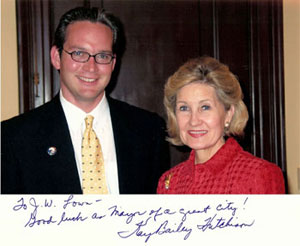
(Former) San Angelo Mayor J.W. Lown, in a photo with (and autographed by) U.S. Sen. Kay Bailey Hutchinson. Photo from jwloan.com

San Angelo Mayor springs a Hell of a surprise on his town
By Richard Connelly / May 21, 2009

See ‘Texas Mayor Resigns To Be With Gay Lover,’ by Mona Elyafi, Below.

Out there in West Texas, they know how to do things right. Like spring surprise mayoral resignations.

The mayor of San Angelo, J.W. Lown, abruptly announced his resignation just days before he was to be sworn in for his fourth term as mayor, the San Angelo Standard Times reports.

Surprise Number One: He made the announcement from Mexico, where he had suddenly bolted to.

Surprise Number Two: He was resigning because he is in a relationship with an illegal alien and they’re trying to fix the alien’s status.

Surprise Number Three: Both Lown and the Mexican citizen are guys. As in HE’S GAY. In San Angelo.

Lown is obviously a well-respected public servant: He won the most recent re-election with 89 percent of the vote, and stunned city council members were effusive in their praise for his work.

But it’s also obvious they didn’t know he was in the closet.

Lown told the paper he would come back to the city “if the people of San Angelo will welcome me back.”

Let’s hope they do. It could be fascinating.

Some would be troubled by the illegal-alien thing, of course. Some because he was helping someone he knew was illegal, and was mayor of the town while doing so. Others might just hate the Messkins.

But the whole gay thing, in West Texas? Hard to say. You would hope people would be open-minded, but then again we’ve been to West Texas.

Boy, there’s a TV movie here for someone: Popular, young attractive mayor of a prairie town, torn by love, decides to go back to Mexico to help his partner get legal. He has to give up a job he also loves…and he has to come out.

J.W. Lown, get yourself an agent.

Source / Hair Balls / Houston Press

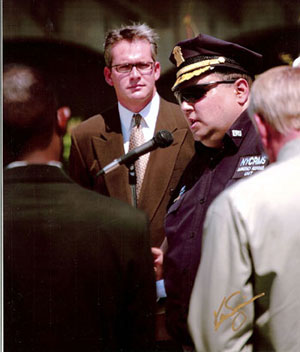
Mayor J.W. Lown and Ret. NY CRMS Chief Rosey Valez at 9/11 Memorial Ceremony. Photo from jwloan.com.

Texas Mayor Resigns To Be With Gay Lover
By Mona Elyafi / April 22, 2009

San Angelo, Texas Mayor J.W. Lown abruptly resigned from office effective immediately to be with his illegal alien gay lover, according to Perez.

Lown had just been elected to his fourth term in a landslide only a few weeks ago garnering about 89 percent of the votes.

Lown broke the news of his stepping down from Mexico where he flew to be with his partner. He tendered his resignation through a letter to City Manager Harold Dominguez.

Scheduled to take the oath of office last Tuesday for his fourth term as mayor, Lown did not appear at the event. In a telephone call late Wednesday afternoon from Mexico the Mayor explained that because he was in personal relationship with a man who does not have legal residency in the United States, he didn’t see fit to take the oath of office knowing he was “aiding and assisting” someone who was not a legal citizen.

“I made the final decision when I knew it was the right decision to make for me and my partner and our future – and for the community,” said Lown.

While Lown declined to provide the name of the person, he did confirm that his lover entered the United States five years ago to attend Angelo State University. Lown also said that their relationship didn’t start until after March. He and his partner are currently in Mexico in a hotel awaiting a visa to legally re-enter the US territory.

“I did the best I could,” Lown said. “I had to get down here and get everything in order to make a life for myself.”

The 32-year-old real estate owner who has dual citizenship in both the U.S. and Mexico, said that while he wasn’t sure how long it would take for his partner’s visa to be granted, the couple would only come back if “the people of San Angelo will welcome (them) back.”

Source / She Wired

Thanks to Jeff Jones and Harry Edwards / The Rag Blog

Posted in RagBlog | Tagged , , , | 2 Comments

Canada Convicts Rwandan War Criminal

If this can happen, then surely we can also bring people such as George W. Bush and Dick Cheney to justice. Genocide in Rwanda or genocide in Iraq are of equal weight – both are heinous crimes under international law and should be dealt with accordingly.

Richard Jehn / The Rag Blog

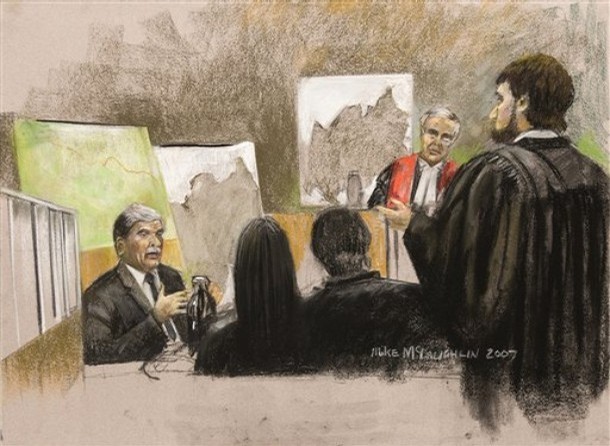
Retired general Romeo Dallaire is seen in a court sketch before judge Andre Denis and crown attorney Alexis Gauthier, standing, during his testimony at the war crimes trial of Desire Munyaneza, Tuesday, Oct. 2, 2007 in Montreal. Munyaneza, a former Toronto resident, was accused and is now convicted of genocide, crimes against humanity and war crimes for leading a militia gang that allegedly killed and raped civilians during the Rwanda genocide in 1994. Graphic: Source.

Canadian Judge Convicts Rwandan in Genocide
By Ian Austen / May 22, 2009

OTTAWA — A Rwandan who entered Canada more than a decade ago claiming to be a refugee was convicted Friday in a Montreal court on seven charges related to the 1994 genocide.

The conviction was the first under a Canadian war crimes law introduced nine years ago and followed an unusually complex two-year trial that involved hearings in Africa and in Europe.

The Rwandan, Désiré Munyaneza, 42, a Hutu and a son of a prominent businessman, was accused of mass murders, rape and pillaging in the Butare region of the small central African nation.

Justice André Denis of Quebec Superior Court found him guilty of war crimes, crimes against humanity and genocide in a nonjury trial.

“The accused’s criminal intent was demonstrated beyond a reasonable doubt, as was his culpable violence,” he wrote in his decision, which ran more than 200 pages and was published in English and French.

“The educated son of an important bourgeois family in Butare, Désiré Munyaneza was at the forefront of the genocidal movement.”

The judge added that while he found prosecution witnesses, many testifying anonymously and in private for their security, to be generally credible, he had a hard time believing most of the defense witnesses.

Lawyers for Mr. Munyaneza said outside the courthouse that they would appeal the verdict.

The bloodshed in Rwanda began in April 1994 when extremists among the majority Hutu population organized mass killings of Tutsis and moderate Hutus. The passage of time as well as the extent of the massacres — which took an estimated 800,000 lives — has made prosecutions difficult.

Many witnesses offered harrowing accounts of Mr. Munyaneza’s role in the genocide. One witness passed out after testifying that she and several other women had been raped repeatedly over several days by a group led by Mr. Munyaneza.

Another witness, identified only as RCW-11, described his participation in a daylong killing tour led by Mr. Munyaneza. It began at a mosque where Tutsis were removed from their hiding place in a ceiling and killed.

From there, the killers moved to a Roman Catholic church where, according to other witnesses, about 500 Tutsis had sought shelter. After initially assuring the Tutsis that they would be taken to a safer place, the killers spent the next five hours removing them in small numbers and killing them. The day concluded with the killing of Tutsis hiding in an Adventist church.

RCW-11 himself was convicted in Rwanda of taking part in the genocide.

News of the conviction was received positively by many in Kigali, Rwanda’s capital.

“Maybe it’s a beginning that many of them will be brought to justice,” said Raphael Mipali, a musician. “The priority first for me is to bring these people to Rwanda, because this is where genocide was committed. But if there is no way for them to come to Rwanda, they should be brought to the book somewhere else.”

An international tribunal in Tanzania, established to supplement Rwanda’s justice system, has convicted about 30 people and acquitted 6.

The Montreal case was aided by a continuing tribunal case, in which six other people were being tried for massacres in Butare. Mr. Munyaneza was described in his trial as a militia leader who had worked with them.

Mr. Munyaneza arrived in Toronto in 1997 and sought refugee status, which was ultimately denied. Late that year a complaint to the Royal Canadian Mounted Police from a Rwandan in Canada prompted an inquiry. After investigators traveled to Rwanda six times to gather evidence, Mr. Munyaneza was arrested in 2005.

Under the war crimes law, which allows Canada to prosecute residents for acts they committed in other countries, Mr. Munyaneza, who has two children, faces life in prison when he is sentenced Sept. 9.

Switzerland and Belgium have also convicted Rwandans for crimes related to the genocide.

[Josh Kron contributed reporting from Kigali, Rwanda.]

Source / New York Times

The Rag Blog

Posted in RagBlog | Tagged , , , , | Leave a comment

Talk Show Host Waterboarded : ‘It Was Instantaneous… Absolutely Torture’

Right-Wing Radio Host Gets Waterboarded, and Lasts Six Seconds Before Saying It’s Torture
By John Byrne / May 22, 2009.

Host Erich Muller says “It was instantaneous…and I don’t want to say this: absolutely torture.”

Chicago radio host Erich “Mancow” Muller decided he’d get himself waterboarded to prove the technique wasn’t torture.

It didn’t turn out that way. “Mancow,” in fact, lasted just six or seven seconds before crying foul. Apparently, the experience went pretty badly — “Witnesses said Muller thrashed on the table, and even instantly threw the toy cow he was holding as his emergency tool to signify when he wanted the experiment to stop,” according to NBC Chicago.

“The average person can take this for 14 seconds,” Marine Sergeant Clay South told his audience before he was waterboarded on air. “He’s going to wiggle, he’s going to scream, he’s going to wish he never did this.”

Mancow was set on a 7-foot long table with his legs elevated and his feet tied.

“I wanted to prove it wasn’t torture,” Mancow said. “They cut off our heads, we put water on their face…I got voted to do this but I really thought ‘I’m going to laugh this off.’ “

The upshot? “It is way worse than I thought it would be, and that’s no joke,” Mancow told listeners. “It is such an odd feeling to have water poured down your nose with your head back…It was instantaneous…and I don’t want to say this: absolutely torture.”

“Absolutely. I mean that’s drowning,” he added later. “It is the feeling of drowning.”

“If I knew it was gonna be this bad, I would not have done it,” he said.

The 42-year-old radio host is no stranger to controversy. In 2005, he was maligned for saying that then-Democratic National Committee Chairman Howard Dean was “vile,” “bloodthirsty,” “evil” and “should be kicked out of America.”

Source / AlterNet

Thanks to Jeffrey Segal / The Rag Blog

Posted in RagBlog | Tagged , , | 1 Comment

Card Check is Dead : Did Obama Betray Labor?

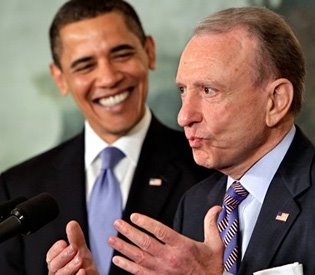
Sen. Arlen Specter, “Democrat” of Pennsylvania, with President Obama, says he will accept a compromise on the Employee Free Choice Act. Photo by AP.

Last Thursday President Obama pronounced “card check” dead, saying that the current Employee Free Choice Act didn’t have the votes to pass but that a “compromise” could work. By compromise, the president meant a version of the bill without card check, the provision obliging employers to recognize unions after a majority of workers have signed cards, rather than after an election. On the same day, Sen. Arlen Specter, newly “D”-Pa., a key swing vote, said that he, too, would support a “compromise” on EFCA: card-check-free, of course.

Liza Featherstone / Reuters / May 21, 2009

Democrats Betray Labor
Card Check is Pronouced Dead

By David Macaray / May 22, 2009

Earlier this week it was acknowledged by labor officials and Democratic insiders that the EFCA (Employee Free Choice Act), as presently written, wasn’t going to pass. While the bill may be reintroduced in a different form, the crucial “card check” component has been pronounced dead. Although labor wonks across the country were disappointed by the news, most weren’t surprised by it.

Despite all the hoopla and anticipation, skeptics had predicted long ago that this ambitious bill, which would have provided working people with far greater access to labor unions, had virtually no chance of passing. Why? Because it was too explicitly “pro-labor.”

Big Business and the Democratic Party (despite its lip service) simply couldn’t allow legislation this progressive to become law. Not for nothing has Taft-Hartley remained on the books for 62 years.

Let’s clarify what the EFCA was and wasn’t. First, it wasn’t the draconian, anti-democratic measure it was portrayed to be by its Republican opponents and back-pedaling Democrats (e.g., Senator Diane Feinstein of California) who, while schmoozing with organized labor, were looking to bail.

There was nothing “anti-democratic” about it. Clearly, it was “public,” rather than “secret,” but how is that anti-democratic? Legislators use nay and yea votes on the floor of Congress hundreds of times a year, and a show of hands is used everywhere—from city councils to school boards to company boards of directors. How is card check “anti-democratic”?

If you want an example of “anti-democratic,” just consider the system that exists today—a system that allows a group of workers who actually want to join a union to be nonetheless prevented from doing so by a combination of stalling tactics and company propaganda.

You say you want to join a labor union? Fine, you have that legal right. What that means, precisely, is that you have the legal right to “want” to join. But the company can make you wait months and months before you vote, and has the authority to force you to attend hours of mandatory “fright seminars.”

Management has the right to barrage you with anti-union propaganda. They have the de facto right to threaten you, intimidate you, offer you bribes and promises, and spread false or slanderous information. And while those tactics are more or less legal (if you think they’re not, try fighting them in court), what isn’t legal is allowing you to simply sign a card saying you want to join. Now how topsy-turvy is that?

Second, instead of depicting the EFCA as some sort of wildly “radical” measure, let’s put it in perspective. What the EFCA would have given American workers is what they already have in Europe and Canada. Yes, they have this arrangement in Canada—our calm, stolid, unimaginative, boring neighbor to the north. We’re speaking here of Canada, people, not Albania.

Accordingly, as anti-labor as some members of Canada’s conservative party are, they would, frankly, be taken aback, if not staggered, by the suggestion that Canadian workers not be allowed to freely choose whether or not to belong to a union. While Canadian conservatives may regard unions as detrimental (and harbor the conceit that they themselves wouldn’t join one if given the opportunity), they don’t interfere with workers who choose to join. If only our country were as egalitarian.

How ironic is it—given our fetish for personal liberty—that it’s harder for an American to become a union member than for a foreigner to become a U.S. citizen?

And third, let’s not pretend that this debate had anything to do with the freedom of choice, or adherence to the Bill of Rights, or any other noble-sounding issue. Opposition to the EFCA was no more about a worker’s constitutional “right to choose” than it was about George Washington’s powdered wig.

Let’s be clear: This whole anti-EFCA drive was designed to keep the unions out. Everything else is smoke. The U.S. Chamber of Commerce didn’t spend tens of millions of dollars to promote some abstract principle involving a citizen’s right to choose; they did it to pierce the heart of organized labor.

So who do we blame for the defeat? Obviously, when something as big and expensive and widely publicized as the EFCA falls on its face, somebody has to be held accountable. In truth, organized labor seems the likeliest candidate.

Not only was labor unable to speak with one voice (e.g., UNITE HERE’s battle, SEIU’s leadership scandals, Change to Win’s breakaway from the AFL-CIO, et al), but they once again allowed themselves to be sweet-talked and misled by the Democrats. Yes, labor had on board its Russ Feingolds (D-WI) and Carl Levins (D-MI), but there were too many other DINOs (Democrats In Name Only) eager to jump ship.

In hindsight, organized labor should have relied more heavily on the support of America’s four “most popular” unions—police, firefighters, nurses and airline pilots. This would have helped clear the public relations hurdle raised by teachers, autoworkers and longshoremen, unions that have been receiving bad press.

As much as we like to think we’re an “issue-driven” electorate, it’s often a handsome face, a nice smile, or a famous family name that wins elections. After all, isn’t it the cute weather girl who gets hired for TV, and not the nerdy meteorologist?

Unbelievable as this sounds, it was reported that one of Governor Rod Blagojevich’s staffers once told him “he had the hair” to become U.S. president. And polls showed that 25% of Republican males approved of Sarah Palin because they found her “hot.” (That whirring sound in the background is James Madison spinning in his grave.)

Still, organized labor may not have invented the game, but they’re compelled to play it. Therefore, “pretty” unions (police, firemen, pilots) are going to be more popular than the conspicuously “ugly” ones—like teachers, who are being blamed for the nation’s low test scores, and the UAW, which, as urban myth has it, was responsible for killing the American auto industry and Detroit along with it.

At the EFCA’s coming-out party, the American Labor Movement should have dolled itself up before entering the room. It should have made the grand, sweeping entrance worthy of a prized debutante. Instead, it chose to conduct business in its usual, plodding fashion. Granted, it’s easy to second-guess, but organized labor clearly needs a makeover.

Of course, we’re already hearing people say, “Wait til 2010,” suggesting the Democrats will pick up enough senate seats to have those 60 votes necessary for cloture. The problem with that logic is it assumes the Democrats want card check to pass. Alas, there’s little evidence to support that assumption.

[David Macaray, a Los Angeles playwright (“Americana,” “Larva Boy”) and writer, was a former labor union rep. He can be reached at dmacaray@earthlink.net.]

Source / CounterPunch

President Obama now says that card check is dead…

He says he regrets that it may be necessary to find a compromise on labor reform that does not include card check, “as the votes aren’t there.” The fact is that the interview Obama granted to the Washington Post on Jan. 16, six days before he was sworn into office, was aimed consciously at trying to bury EFCA and card check.

By urging the political establishment to consider “an alternative” that would be more palatable to Big Business than EFCA, as he did in this interview with the Washington Post, Obama sent a signal to Arlen Specter, Dianne Feinstein and all the other politicians that he would not uphold his promise to labor and use the power of his presidency and his massive support among working people to fight for EFCA. His about-face began six days before he took his oath of office. It shows how hard the Chamber of Commerce and Wall Street must have leaned on Obama on this burning question for the entire labor movement — and for working people as a whole…

Alan Benjamin
Unity & Independence / UnionBook

Thanks to Jeffrey Segal / The Rag Blog

Posted in RagBlog | Tagged , , , | 2 Comments

‘Be Safe’ : A Poem by Mariann G. Wizard

“A Fox in the Hen House,” woodcut by Chet Philips / The Painter Factory.

In response to former Vice President Cheney’s ongoing fear-mongering and divisiveness.

Be Safe

“Be safe,” we say, when taking leave of friend and family member –
“Be safe,” more nuanced than it was before that one September.
Where once the phrase was meant to ward against life’s daily mishaps
(the slip on icy pavement, or in the bathtub, perhaps),
now it invokes the shadowed threat of alien freedom fighters
blowing up the local market with their bombs, the blighters!

“Be safe,” we plead, not just at home, but in a public fiction,
as if the words were something more than private benediction.
A dubious concept has been formed that we may be protected
from threats at home, threats abroad, and threats yet undetected;
if only we’ll agree to live cocooned inside a fence,
and only venture out in groups, and frightened beyond sense.

This fear gives power to the goals of certain social forces
whose wealth and influence derive from their “fence-selling” sources.
Think of the legendary fox, who seals the henhouse door,
warning the hens of darker fates; they trust their jailer more
   and more!
They fret that the sky will fall, and Fox predicts bad weather;
our own fears swirl, suspended, in a haze of shit and feathers.

Life is not safe, my dearest dears, nor can more fences save us;
thus, guard your liberty; that’s all that our Creator gave us!

Mariann G. Wizard / The Rag Blog
Austin, Texas
May 22, 2009

The Rag Blog

Posted in Rag Bloggers | Tagged | 2 Comments

Climate Change Legislation : Landmark Energy Bill Faces Major Challenge

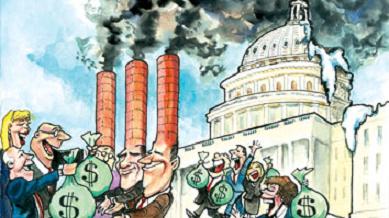
Illustration by KAL / The Economist.

The Energy Bill… sets us on two important courses: major support for development of alternative energy, and establishment of a cap-and-trade system to reduce emissions 80 percent by 2050.

By Thomas Cleaver / The Rag Blog / May 22, 2009

See ‘Cap-and-trade showdown,’ by Jared Allen, Below.

The Energy Bill currently before Congress is probably the most important environmental legislation since the original Environmental Quality Act 37 years ago. It sets us on two important courses: major support for development of alternative energy, and establishment of a cap-and-trade system to reduce emissions 80 percent by 2050.

This is incredibly important. When Obama announced last November that he would commit the US to this, and to working on the new climate treaty that is to be signed this December, it resulted in the Chinese announcing they would do the same if the US did (and since they’re the #2 polluter on the planet, we can’t do a thing without them). And Brazil announced that if the international cap-and-trade system was established in the treaty, that Brazil would commit to an 80 percent reduction of Amazonian deforestation in 10 years — right now, tropical deforestation emits more carbon dioxide than all the cars, trucks and airplanes in use.

If the U.S. goes to the treaty signing with this bill signed into law, it establishes our leadership, and will likely bring in the Indians and the Indonesians, the other crucial new ones. If we do this, we might have a chance of meeting what the IPCC said last year — that we have (or had then) a 3-4 year window of opportunity left to establish the policies that will allow us to mitigate climate change.

In the Congress, the Republicans are unanimously opposed, and plan to bring up 100 plus amendments, one at a time, to be voted on in an effort to run the clock out on passing the bill altogether. It is crucial to maintain Democratic support. My congressman, Henry Waxman, is doing this and he is great at getting things done. Tireless. But the big problem is the centrist Democrats who face competitive races in the face of the Republican disinformation campaign now being run in their districts.

That’s why this report from “The Hill” blog is so important.

Cap-and-trade showdown

By Jared Allen / May 20, 2009

A committee chairman is threatening House leaders to either give him a role in shaping climate change legislation or risk losing every Democratic vote on his panel when the bill hits the floor.

Rep. Collin Peterson (Minn.), the outspoken Democratic chairman of the Agriculture panel, has been making it well-known that he wants his committee to have full jurisdictional authority over whatever climate change bill emerges from Chairman Henry Waxman’s (D-Calif.) Energy and Commerce Committee.

But Peterson is no longer making idle threats.

Peterson earlier this week met with the 26 Democrats on his panel and emerged with a “virtually unanimous” agreement that his committee members would stand with him in opposition to a climate change bill that didn’t adequately address the concerns of the agriculture industry, according to one of those Democrats.

“We’ve thrown a pitchfork in the sand,” the Democrat said.

Peterson wants a full markup to alter what he and other committee Democrats think are inadequate provisions on everything from fuel standards to renewable energy definitions to regulations governing the trading of carbon derivatives created through a cap-and-trade system, all of which have been written into the Energy and Commerce bill.

“We expect the bill to be re-referred to us by the [House] parliamentarian,” Peterson said in a brief interview Wednesday. “At this point my intention is to make it prohibit derivatives from being traded on this.”

That point alone would put Peterson and Waxman worlds apart.

Waxman has said that his staff is in early discussions with Peterson’s staff about the jurisdictional question — and noted he has not talked to Peterson directly. But he has also said that he believes his bill has fully addressed the concerns of the agriculture community.

Energy and Commerce Committee spokeswoman Karen Lightfoot said Waxman is continuing to work with Peterson and other committee chairmen on the bill.

Agriculture Committee Democrats, though, see it differently.

“There’s been some things relating to agriculture that have been put together rather sloppily by the Energy Committee,” a Democrat on the Agriculture panel said. “If they don’t address those concerns, they’re not going to have the votes to pass this.”

Waxman and House Democratic leaders, who have been trying to patch together enough votes to clear the Energy and Commerce Committee, have been delicately tiptoeing around the issue of whether to send the bill to Peterson’s committee.

But they won’t be able to dance around that question too much longer, especially because Waxman appears to have the votes to move the bill out of his panel. And anything resembling a gentlemanly meeting of the minds between Energy and Agriculture Democrats is evaporating as an option, sources said.

There is not a single Democrat who sits on both panels. Further complicating the equation for party leaders is the fact that the Agriculture Committee is loaded with vulnerable and freshman Democrats — those members who most fear Republican attacks on what the GOP has labeled a “cap-and-tax” bill.

Eleven freshmen sit on the Agriculture Committee, and seven of them are in competitive reelection races, according to The Cook Political Report, which handicaps House and Senate contests.

All of Cook’s three Democratic “toss-ups” — Reps. Bobby Bright (Ala.), Walt Minnick (Idaho) and Frank Kratovil (Md.) — sit on the Agriculture Committee.

Minnick said Wednesday that he was undecided on climate change.

Asked if his decision on how to vote will be influenced by Peterson, he responded; “Certainly, how the leadership reacts to Chairman Peterson’s concerns will have an impact on how all of us on the committee feel about this legislation.”

Leadership sources said that no final decisions have been made about how to deal with Peterson’s demands.

“The focus up until now has been getting through the Energy and Commerce Committee,” a senior aide said.

Peterson’s hostage-like situation presents a major problem for House Speaker Nancy Pelosi (D-Calif.), who has called climate change her flagship issue. Getting a bill through the House will be incredibly difficult, with an overwhelmingly majority of Republicans expected to vote no.

Turning a blind eye to Peterson would allow vulnerable members — many of them already queasy about climate change — plenty of cover to buck their leaders and vote against the bill on the House floor.

But acquiescing to the chairman has its own potential risks.

A number of Energy and Commerce Democrats have told Waxman he has their votes this week, but have hedged in indicating their support for anything other than what emerges from the Energy panel.

Rep. Rick Boucher (D-Va.), the key architect of an agreement with Waxman and Energy and Environment subcommittee Chairman Edward Markey (D-Mass.) allowing the markup to begin, on Wednesday said his support is conditional once the bill clears the Energy markup stage.

“Well, I am a yes vote in the committee,” Boucher said on C-SPAN Wednesday morning. “Then I will simply weigh the improvements that are made in the House and in the Senate.”

House Majority Leader Steny Hoyer (D-Md.) on Tuesday said that he anticipates climate change legislation will hit the House floor “probably in June or the first part of July.” Some aides said they interpreted that timeline to mean that leaders need time to work out jurisdictional issues even if Waxman manages to complete his markup this week.

House leaders, including Pelosi, will eventually determine the timeline of referrals to other committees.

There is a total of eight committees that can claim jurisdiction over the climate change bill — outside of Energy and Commerce and Agriculture, those panels include: Appropriations; Education and Labor; Financial Services; Natural Resources; Science; and Transportation and Infrastructure. But the only real saber-rattling has come from Peterson, a centrist lawmaker who voted against President Obama’s stimulus bill and has been highly critical of his agriculture-related proposals.

Waxman has acknowledged having direct talks about jurisdiction with only one gavel-wielding lawmaker: Ways and Means Committee Chairman Charles Rangel (D-N.Y.).

But Ways and Means member Chris Van Hollen (D-Md.), who is also the assistant to the Speaker, indicated that Ways and Means is not looking either for a jurisdictional fight or even to change the bill substantially.

“I wouldn’t expect to see any major surgery by the Ways and Means Committee,” Van Hollen told reporters on Tuesday.

Source / The Hill

Source

The Rag Blog

Posted in Rag Bloggers | Tagged , , , | Leave a comment

2010 : ‘Year of the Bible?’

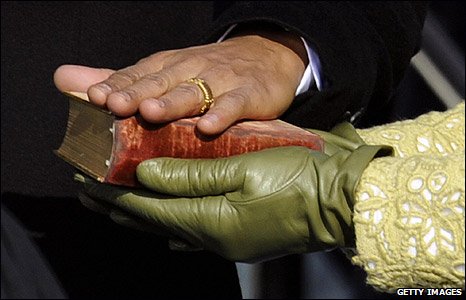
President Barack Obama swears in on the Lincoln Bible. Photo from Getty Images.

The Bible bill?

Rep. Broun’s simple congressional resolution aimed at honoring the Good Book has produced a push-back of biblical proportion in the blogosphere, with critics dismissing it as either unconstitutional or a waste of time.

By Victoria McGrane / May 22, 2009

When the clock strikes midnight on Dec. 31, 2009, Rep. Paul Broun (R-Ga.) hopes you’ll be ringing in “the Year of the Bible.”

It’s probably just wishful thinking.

Broun’s simple congressional resolution aimed at honoring the Good Book has produced a push-back of biblical proportion in the blogosphere, with critics dismissing it as either unconstitutional or a waste of time. Jews in Congress and atheist activists are dismissing the resolution, while none of the many Democrats in Congress who are Christian have bothered to sign on as co-sponsors.

According to GovTrak.us, the resolution is among the most-blogged-about pieces of legislation, with most posts less than complimentary in nature.

“Does that mean 2009 is not the year of the Bible?” mocked Rep. Barney Frank (D-Mass.), who is Jewish. “What is 2012 the year of? The Quran?”

“That’s an endorsement of religion by the federal government, and we shouldn’t be doing that,” said Rep. Jerrold Nadler (D-N.Y.), even though he has introduced his own legislation dealing with religion.

“Republican lawmakers with apparently too much time on their hands and no solutions to offer the country are pushing a resolution that will not address the nation’s problems or advance prosperity or even untangle their previous governing mistakes,” blogged the Progressive Puppy.

Broun rejects the critiques leveled at this effort.

“This doesn’t have anything to do with Christianity,” he said in an interview with POLITICO. Rather, he says, it seeks to recognize that the Bible played an integral role in the building of the United States, including providing the basis for our freedom of religion that allows Muslims, Hindus and even atheists to vocalize their own beliefs.

And even as Nadler criticized Broun, he has done his own share of mixing religion and legislation.

Last year, he introduced a bill that would overturn a federal appeals court ruling — an “idiot” decision, he says — that a condominium board in Chicago had the right to ban Jews from installing mezuzahs, which consist of a piece of parchment inscribed with a specific religious text put inside a case and hung on a door frame.

Condo boards shouldn’t be able to interfere in an individual’s right to practice his or her religion, Nadler said.

But he himself declined to install a mezuzah on his congressional office door when asked by a rabbi, even though he does so at home.

“That’s my religious symbol, and the office does not belong to me; it belongs to the people of the congressional district, and no one should feel uncomfortable walking into the office if it’s not their religion,” Nadler said, describing his feelings on religion and Congress.

“Same thing with the Bible. … It’s not everybody’s religion. And the federal government should not be imposing religious viewpoints.”

Atheists, who might feel themselves a particular target with the declaration of a biblical year, aren’t even worried about Broun’s effort.

“Right now, we’re seeing atheism on such a rise,” said David Silverman, vice president and national spokesman of American Atheists, a group dedicated to fighting for the civil rights of atheists.

“We are seeing Christianity on such a dramatic decline that we’re not particularly worried about it. We’re thinking that this kind of old-style George W. Bush Republicanism is about to go away,” Silverman said, referring to the latest Pew Forum survey of American religious life, which showed nonreligious Americans as the fastest-growing group.

And it may be the best-selling book of all time, as Broun’s resolution points out, but the Bible isn’t such a popular legislative topic.

A search of Thomas, the online congressional database, for “Bible” yields just one other bill: a resolution to have the “Lincoln-Obama Bible” on permanent display in the Capitol Visitor Center.

The resolution specifically asks the president “to issue a proclamation calling upon citizens of all faiths to rediscover and apply the priceless, timeless message of the Holy Scripture which has profoundly influenced and shaped the United States and its great democratic form of government.”

As for the economy, health care, global warming and all the other issues on Congress’ plate?

“While we must focus on fiscal policies that provide relief to families during these tough economic times, an endeavor I have been working tirelessly towards in this Congress, we must also not forget to protect and celebrate our fundamental freedoms that the Bible has influenced,” Broun said.

Broun has gathered 15 co-sponsors, all Republicans, but says he’s looking for more and hopes Democrats will sign on, as well.

“This is not a partisan issue,” he said. “I want it to be bipartisan.”

Whether he’s successful or not — the same measure didn’t go anywhere last year — at least Broun and his fellow supporters can take heart in one fact: They already had a “year of the Bible.”

Source / Politico

Thanks to Kathy Tomlinson / The Rag Blog

Posted in RagBlog | Tagged , , , | 1 Comment

Philadelphia, Mississippi : Former Klan Stronghold Elects Black Mayor

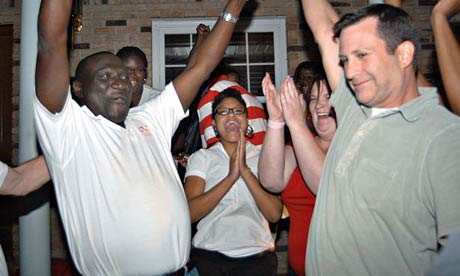
James Young, left, newly elected mayor of Philadelphia, MS, celebrates with supporters. Photo by Jim Prince / AP

The election of an African-American mayor in Philadelphia, Mississippi, site of infamous 1964 civil rights murders, indicates a page may have been turned.

By Jay D. Jurie / The Rag Blog / May 22, 2009

See ‘Black mayor of Mississippi town brings “atomic bomb of change”‘ by Ed Lavandera, Below.

When I was with VISTA in Mississippi during the late 1970s, Philadelphia, the seat of Neshoba County, was one county away.

Once I spent most of the day in Philadelphia. Eating lunch at a downtown restaurant, the people I was with told me in the segregation days whites were seated in the front, Indians (the local Choctaws) in the back, and African-Americans weren’t served. I saw the site of the church the Klan burned before the civil rights workers were murdered. Life was still slow in this small Southern town. Memories of what had occurred were vivid and the past was very much present.

In Southern Journey, the author, Tom Dent, visits major locales of the civil rights movement. His mention of Philadelphia at the time of publication in 1997 largely concerned ongoing abuse of African-Americans by local authority.

The election of an African-American mayor indicates a page may have been turned.

Black mayor of Mississippi town brings ‘atomic bomb of change’

By Ed Lavandera / May 22, 2009

PHILADELPHIA, Mississippi — James Young still remembers the Ku Klux Klan tormenting his neighborhood. He can still see his father holding a gun on the living room couch ready to shoot anyone who threatened his family.

Nothing about Young’s childhood ever made him think he could be the mayor of Philadelphia, Mississippi, the town best known for the killings of three civil rights workers in 1964.

That’s the way it was for black kids growing up in this crucible of racial hostility — big dreams were often squelched. Sitting on a sprawling Southern front porch this week, Young broke down in tears about what it means to be elected the town’s first black mayor.

“When you’ve been treated the way we’ve been treated,” he told CNN, choking up and then pausing to wipe the tears from his face.

For a moment, he couldn’t speak. He then regrouped, “That’s why it’s so overwhelming to be a part of this history.”

This week, the 53-year-old Young was elected the mayor of Philadelphia, a town of about 8,000 in the east-central part of the state. Despite a 55 percent white majority, Young defeated Rayburn Waddell, a white, three-term incumbent, by the slim margin of 46 votes.

Young described the victory as “an atomic bomb of change.” Another resident rejoiced, saying Young’s win symbolized the scab finally falling off this town’s wound.

“I couldn’t even have wrote that in a fairy tale,” Young said. “Who would have thought a little country boy like me would be mayor of Philadelphia, Mississippi?”

Philadelphia was the site of one of the most notorious killings of the civil rights era. On June 21, 1964, three civil rights workers — James Chaney, a 21-year-old black man from Mississippi; Andrew Goodman, 20, and Michael Schwerner, 24, both activists from New York — were shot to death at the edge of town. The killings inspired the 1988 movie “Mississippi Burning.”

“Philadelphia will always be connected to what happened here in 1964,” said Jim Prince, the publisher of the Neshoba Democrat newspaper.

“But the fact that Philadelphia, Mississippi, with its notorious past, could elect a black man as mayor, it might be time to quit picking on Philadelphia, Mississippi.”

Young knows his slim margin of victory means he still has to earn the trust of many more voters here. He knows there are still some in town who won’t vote for him because he’s black, but he says that number gets smaller and smaller as time passes.

“We have some — a very small pocket — that will never change. That’s what we’ve got to deal with,” said Young.

The mayor-elect says his election symbolizes a dramatic shift away from his hometown’s racist past. And for many black residents, it means they can finally call this place home.

“The places where we were locked out, I’m gonna have the key,” he said. “The places we couldn’t go, I’ve got the key. No better way to say it than that.”

He takes special pride that his victory comes the same year the nation swore in its first African-American president in Barack Obama. “It inspired people,” Young said.
“There are times and seasons, I think, for everything. The season arrived and the people let me know it was my time.”

The mayor-elect says he won by shaking hands and knocking on doors all over town. But the groundwork for Young’s climb to the top of Philadelphia’s political world started decades ago.

Young was one of the first black students to integrate Philadelphia’s white schools. After graduating from high school, he worked in a motor factory and then as a hospital housekeeper.

A white boss noticed Young’s charming people skills and recommended that he become a paramedic. He eventually worked his way up to become the director of the EMT unit, and that catapulted him to his first elected job as a county supervisor in 1991.

He is also a Pentecostal minister preaching on Sunday and organizing weekly Bible studies.

“I’ve been prepping for this. I felt like I knew enough people. I felt like they knew me and that if I could convince them to just give me the opportunity, things could happen,” said Young.

Driving around Philadelphia in a 1981 Ford pickup truck, Young basked in the glow of victory. He calls it the “honeymoon” period. As we drove down the road, black and white residents cheered.

“We’re so happy,” screamed one lady.

Young shouted back, “We did it!”

Until he’s sworn in as mayor, Young will work out of a makeshift transition office provided by a prominent attorney. His victory might seem unlikely but there’s little time left to celebrate.

“It’s an awesome feeling to have that kind of respect that people support you in this way,” Young said near the end of our interview. “I’ll never let the people down which called for that.”

Source / CNN

The Rag Blog

Posted in Rag Bloggers | Tagged , , , , , , | 3 Comments

Ft. Hood GI Travis Bishop : Why I Won’t Go

Travis Bishop, opening for Toby Keith in Bagdhad, Iraq. Photo from MySpace.

If I had deployed to Afghanistan, I don’t think I would have been able to look into another mirror again.

By Travis Bishop / The Rag Blog / May 21, 2009

[Ft. Hood soldier and musician Sgt. Travis Bishop has refused deployment to Afghanistan. This is his story in his words.]

Why am I doing what I’m doing? Why am I resisting? Refusing? It wasn’t so long ago that I deployed to Iraq in support of the war on terror. I didn’t refuse then. Like a good Soldier, I did what I was told, and I spent 14 months stationed in Baghdad. It was a quiet enough deployment, I suppose. Mortars and rockets flew over the walls with unnerving frequency, but otherwise, it felt more like a move to a different duty station than a deployment to a warzone.

I didn’t see real combat. I didn’t come back with Post-Traumatic Stress Disorder. I didn’t lose friends. Mine was, in my opinion, an average deployment. Go overseas, play X-Box and read for a year, come back with money that’s gone before you remember how you spent it. We talked and laughed about it once we came back, and talked about what we would do with the money we made from our next deployment, whenever that may be.

Back home, I received a hero’s welcome. That was the first time I felt unsettled over what I had done overseas. My hand was shook, my back was patted, and every night my belly was burning, full of free alcohol. I was a veteran of a foreign war, hailed as a hero, and yet I felt…unnerved; anxious. I felt as if I had a big secret inside me that threatened to burst out of me at any moment, exposing what I really was to the rest of the world…but I couldn’t figure out what the secret was. Not for a long, long time.

I was never plagued with nightmares from the war. I was plagued with guilt. I literally felt guilty for receiving the accolades that come from redeploying as a “hero,” knowing that I had not paid the price for the Army’s true definition of a hero. Here it goes:

Army Hero; noun. Soldier who has deployed overseas to a combat zone. Has participated in active combat. Has redeployed with PTSD, a bullet in their leg, and a time bomb in their head. Unable to rejoin the civilian world in a normal psychological state.

In my heart of hearts, I know I don’t fit this definition, or anything resembling it.

For a long time, my unit was set to redeploy to Iraq in August 2009. However, in February 2009, we were told there was a change of plans. Instead of Iraq, it would be Afghanistan. Instead of August, it would be the end of March, less than sixty days away. Rumor had it that, although we were told the rush was because of a Brigade Commander’s wishes, it was our Battalion Commander who requested our unit be put on the Afghanistan Troop Surge.

Once again, in good Soldier mode, I prepared to deploy. This time I was a Sergeant, and I had Soldiers to take care of, one of which my best friend. These things drove me to be well prepared. We had things to do, and not much time to do them in. I rarely gave myself time to think about what it was we were actually deploying for. When I did, I started to question everything.

Why are we going? What purpose does it serve? Nothing sat right. I began to read the Bible again. More and more I saw things like “turn the other cheek” and “love thy enemy.” These were things that went directly against the war we were in, and they were spoken by Jesus himself. Could I really deploy again, and compromise my beliefs, just because I was told to? Would I be able to live with that? What if I had to take a life, and knew that if I hadn’t deployed, I would never have been put in that situation?

I became afraid to voice my opinion, knowing that if I spoke to the wrong person, I would face persecution and ridicule. I told my best friend, who voiced the same opinions to me, but it seemed he was content to deploy, do his time, make some money, and then get out of the Army upon his return. I respected his opinion, didn’t try to talk him out of it, and let it be.

The rest of the pre-deployment phase went uneventfully. We loaded our gear, got our trucks ready, and inspected our equipment. We went to the field several times, and although my team and other teams never fully accomplished the missions we were given, Command congratulated us on a successful field mission, and said we were more than ready to deploy. I started to worry again after that.

I worried when they said I was leaving early with the cargo. I worried again when our cargo flights were suddenly “cancelled,” and the main body of our unit deployed to Afghanistan before us, the “advanced” party. Once again, I got the feeling that we were rushing into something before we were even close to being ready. Weeks went by, and groups of us went out on separate days, sometimes only two Soldiers at a time.

A few days before I was set to deploy, I was approached by members of an organization who told me that I had a choice. They told me that they were here to support me, and that if I really was against the war our country was currently in, I could choose not to go. All those old feelings and worries came back with a vengeance, and I began to question the war again. After a full day of thinking, the only reason I had come up with for me to go was the fact that my best friend was going too. And, in the end, I decided that, although he might hate me for it, he was better off with me not going in the long run. I had to put my needs before his, though it killed me inside, because a three year friendship is hard to come by in the Army. I hope that he can forgive me one day.

So the afternoon I was set to deploy, while everyone else was loading their gear in the van headed toward the airfield, I loaded my gear in my car, and left. It was the hardest decision I have ever made.

I plan on coming back; soon. I am not a deserter, and I wouldn’t go AWOL for months and risk ruining my chances at getting a good job later in life. I am a Patriot. I love my country, but I believe that this particular war is unjust, unconstitutional and a total abuse of our nation’s power and influence. And so, in the next few days, I will be speaking with my lawyer, and taking actions that will more than likely result in my discharge from the military, and possible jail time… and I am prepared to live with that.

My father said, “Do only what you can live with, because every morning you have to look at your face in the mirror when you shave. Ten years from now, you’ll still be shaving the same face.”

If I had deployed to Afghanistan, I don’t think I would have been able to look into another mirror again.

Pray for me.

[This story has also been posted to Ft. Hood Soldier Voices and to Facebook.]

Also see GI Victor Agosto : ‘There is No Way I Will Deploy to Afghanistan’ by Alice Embree / The Rag Blog / May 7, 2009

The Rag Blog

Posted in Rag Bloggers | Tagged , , , , , | 20 Comments

FCC Warrantless Searches : Coming to a Home Near You?


FCC’s Warrantless Household Searches Alarm Experts

‘Anything using RF energy — we have the right to inspect it to make sure it is not causing interference,’ says FCC spokesman David Fiske. That includes devices like Wi-Fi routers that use unlicensed spectrum, Fiske says.

By Ryan Singel / May 21, 2009

You may not know it, but if you have a wireless router, a cordless phone, remote car-door opener, baby monitor or cellphone in your house, the FCC claims the right to enter your home without a warrant at any time of the day or night in order to inspect it.

That’s the upshot of the rules the agency has followed for years to monitor licensed television and radio stations, and to crack down on pirate radio broadcasters. And the commission maintains the same policy applies to any licensed or unlicensed radio-frequency device.

“Anything using RF energy — we have the right to inspect it to make sure it is not causing interference,” says FCC spokesman David Fiske. That includes devices like Wi-Fi routers that use unlicensed spectrum, Fiske says.

The FCC claims it derives its warrantless search power from the Communications Act of 1934, though the constitutionality of the claim has gone untested in the courts. That’s largely because the FCC had little to do with average citizens for most of the last 75 years, when home transmitters were largely reserved to ham-radio operators and CB-radio aficionados. But in 2009, nearly every household in the United States has multiple devices that use radio waves and fall under the FCC’s purview, making the commission’s claimed authority ripe for a court challenge.

“It is a major stretch beyond case law to assert that authority with respect to a private home, which is at the heart of the Fourth Amendment’s protection against unreasonable search and seizure,” says Electronic Frontier Foundation lawyer Lee Tien. “When it is a private home and when you are talking about an over-powered Wi-Fi antenna — the idea they could just go in is honestly quite bizarre.”

George Washington University professor Orin Kerr, a constitutional law expert, also questions the legalilty of the policy.

“The Supreme Court has said that the government can’t make warrantless entries into homes for administrative inspections,” Kerr said via e-mail, refering to a 1967 Supreme Court ruling that housing inspectors needed warrants to force their way into private residences. The FCC’s online FAQ doesn’t explain how the agency gets around that ruling, Kerr adds.


The rules came to attention this month when an FCC agent investigating a pirate radio station in Boulder, Colorado, left a copy of a
2005 FCC inspection policy on the door of a residence hosting the unlicensed 100-watt transmitter. “Whether you operate an amateur station or any other radio device, your authorization from the Commission comes with the obligation to allow inspection,” the statement says.

The notice spooked those running “Boulder Free Radio,” who thought it was just tough talk intended to scare them into shutting down, according to one of the station’s leaders, who spoke to Wired.com on condition of anonymity. “This is an intimidation thing,” he said. “Most people aren’t that dedicated to the cause. I’m not going to let them into my house.”

But refusing the FCC admittance can carry a harsh financial penalty. In a 2007 case, a Corpus Christi, Texas, man got a visit from the FCC’s direction-finders after rebroadcasting an AM radio station through a CB radio in his home. An FCC agent tracked the signal to his house and asked to see the equipment; Donald Winton refused to let him in, but did turn off the radio. Winton was later fined $7,000 for refusing entry to the officer. The fine was reduced to $225 after he proved he had little income.

Administrative search powers are not rare, at least as directed against businesses — fire-safety, food and workplace-safety regulators generally don’t need warrants to enter a business. And despite the broad power, the FCC agents aren’t cops, says Fiske. “The only right they have is to inspect the equipment,” Fiske says. “If they want to seize, they have to work with the U.S. Attorney’s office.”

But if inspectors should notice evidence of unrelated criminal behavior — say, a marijuana plant or stolen property — a Supreme Court decision suggests the search can be used against the resident. In the 1987 case New York v. Burger, two police officers performed a warrantless, administrative search of one Joseph Burger’s automobile junkyard. When he couldn’t produce the proper paperwork, the officers searched the grounds and found stolen vehicles, which they used to prosecute him. The Supreme Court held the search to be legal.

In the meantime, pirate radio stations are adapting to the FCC’s warrantless search power by dividing up a station’s operations. For instance, Boulder Free Radio consists of an online radio station operated by DJs from a remote studio. Miles away, a small computer streams the online station and feeds it to the transmitter. Once the FCC comes and leaves a notice on the door, the transmitter is moved to another location before the agent returns.

[This post was updated Thursday morning to include comment from Professor Kerr, and to remove an inaccurate example of unrelated criminal behavior.]

Source / Wired

Thanks to S.M. Wilhelm / The Rag Blog

Posted in RagBlog | Tagged , , , , | Leave a comment

Life During Wartime : Hole in One

Political cartoon by Joshua Brown / Historians Against the War / The Rag Blog

Thanks to Dr. S.R. Keister /The Rag Blog

Posted in Rag Bloggers | Tagged , | Leave a comment

Got Work? College Grads Driving Cabs?

Grads at University of Pennsylvania commencement ceremonies May 18, 2009. Fewer than 20 percent of new graduates have landed work, compared to 50 percent two years ago. Photo by Matt Rourke / AP.

The problem with higher education is that few can predict where the economy will be hiring years from now.

By Roger Baker / The Rag Blog / May 21, 2009

See ‘Got Work? College Graduates Face Toughest Job Market in Years,’ by John Berman, Below

I think it is common in many Third World countries for highly educated folks to drive taxis. It looks like that situation is probably coming here as a common situation.

The problem with higher education is that few can predict where the economy will be hiring years from now. Higher education investment is largely a guess when it comes to the needs of the future economy.

In the years ahead, the U.S. will be groping with trends toward survival basics that are now becoming apparent. Like rebuilding the transportation infrastructure, reducing carbon burning through serious conservation and planning higher energy costs, caring for the elderly in a much more cost effective way, and relocalizing agricultural production.

There is plenty of opportunity ahead for well-trained experts in these emerging but vital areas of the economy to do such work. But our higher education system is grounded on the theory that the richest and most powerful (mostly) men appointed to, in our case, the UT-Austin Board of Regents are qualified to guide the lines of training, research, and degrees bestowed. The current system is very much biased towards making the wealthy and their friends ever richer by bankrolling the exhausted trends of a failing empire.

If higher education were to rebuilt on a rational basis of what skills are likely to be needed, the problem of future higher education employment could be largely solved, if not the ability to provide for a traditional upper class lifestyle, still expected by graduates in business administration, law, and the like. We need education geared toward sensible, sustainable goals. Trying to sustain the old higher education/anticipated lifestyle goals of students’ parents is futile.

Hopefully students are beginning to figure that out.

Got Work?
College Graduates Face Toughest Job Market in Years

By John Berman / May 20, 2009

HARTFORD, Conn — Casey Savage graduated from Trinity College in Hartford with a 3.8 grade-point average and honors. What he doesn’t have is a job.

“I’ve talked to 24 different firms so far. Hedge funds, investment banks, private equity shops,” Savage said. “And I just feel that there’s limited opportunities at this point.”

It’s a familiar refrain being echoed at colleges and universities across the country, as the economy continues to slump and layoffs, furloughs and pay cuts dominate the employment landscape. The struggling economy means college seniors are facing one of the toughest job markets in years.

According to a survey from National Association of Colleges and Employers, the class of 2009 is leaving campus with fewer jobs in hand than their 2008 counterparts. The group’s 2009 Student Survey found that just 19.7 percent of 2009 graduates who applied for a job actually have one.

In comparison, 51 percent of those graduating in 2007 and 26 percent of those graduating in 2008 who had applied for a job had one in hand by the time of graduation.

Economist say the members of this year’s graduating class are also facing unique challenges not only because they are dueling against the growing ranks of unemployed for work, but because they are also facing a backlog created from last year’s graduates who have yet to find fulltime employment.

Bryan Hopkins, a senior at the University of Florida, calls the situation frustrating. “You feel frustrated because you feel now that was it all worth it,” he said. “In a perfect world, I would have walked right off the stage and into a fulltime job in my field, but I mean I have the degree now and I am still waiting.”

Yale University School of Management professor Lisa Kahn said recent college graduates will suffer the long-term effects of this recession much more than their counterparts who graduated in boom times.

Departing seniors are “suffering from the recession like everyone else is, but the effects are going to stay with (them) for much longer,” Kahn said.

Tougher Times Ahead for Grads

Kahn studied the impact of the recession in the 1980s and found that seniors who graduated then were still feeling the impact 20 years later. Today’s seniors are “going to be earning much less than their counterparts who graduated in better times and they’ll be in lower level occupations,” she said.

University of Arizona senior Reyna Nowaczyk said the lack of job prospects has left her “overwhelmed.”

“I don’t know what to do next,” she said. “I’ve done all the right things: done my fair share of internships, studied abroad. I’ve studied languages while abroad. I have my letters of recommendation from employers. I feel like I prepared myself; I feel like I’m ready. I want to work.”

But according to employment professionals, graduating seniors will need to be flexible in this economy.

“If I were a 22-year-old today I would be willing to take an unpaid internship,” said Lanna Hagge, director of Career Services at Trinity College. “I would be willing to do almost anything just to get the experience and exposure.”

That’s advice Trinity graduate Chauncy Kerr is taking. She is looking to land an unpaid internship this summer.

“You get job experience so I’m excited about that,” Kerr said. But, she added, “It would be nice to get paid.”

Copyright © 2009 ABC News Internet Ventures

Source / ABC News

Thanks to S.M. Willhelm / The Rag Blog

Posted in Rag Bloggers | Tagged , , | Leave a comment