
CIA Director Asked to Preserve Secret Prisons
By William Fisher / April 17, 2009
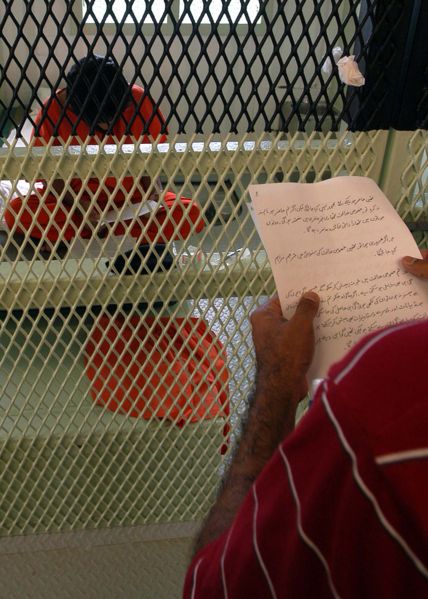
NEW YORK — Lawyers for a Guantanamo detainee who claims he was held and tortured in one of the “black site” secret prisons run by the U.S. Central Intelligence Agency is demanding that the CIA preserve cells and interrogation paraphernalia there as evidence of mistreatment.
Military and civilian counsel to Abd Al-Rahim Hussain Mohammed al-Nashiri sent a letter to CIA Director Leon Panetta requesting that the CIA “black site” buildings, interrogation cells, prisoner cells, shackles, waterboards and other equipment be preserved for inspection and documentation.
Disclosure of the letter came on the heels of Thursday’s release of four more top-secret “legal memoranda” prepared by the Justice Department’s Office of Legal Counsel during the administration of former President George W. Bush. The memos approved “enhanced” interrogation techniques they claimed were not torture – a claim rejected by both the Barack Obama administration and human rights advocates. Nine other OLC memos were previously released by the Obama administration.
OLC is the DOJ office that provides authoritative legal advice to the president and all executive branch agencies. It drafts legal opinions of the attorney general and also provides its own written opinions and oral advice in response to requests from the executive branch.
Al-Nashiri, who is now detained at Guantánamo, was held in the secret CIA prison facilities from 2002 to 2006. While President Obama has ordered the closure of CIA black sites, al-Nashiri’s attorneys are concerned that the CIA intends to destroy the sites, including the buildings and the equipment used to interrogate and torture al-Nashiri and other detainees. They say that would amount to destroying evidence of his mistreatment.
Panetta told CIA personnel on April 9, 2009, that the CIA would be “decommissioning” the CIA secret facilities. The letter asks Panetta to “preserve all the secret sites.”
The CIA has admitted that al-Nashiri was subjected to waterboarding while in CIA custody. Videotapes depicting his abusive interrogations have already been destroyed by the agency and are the subject of ongoing litigation by the American Civil Liberties Union (ACLU).
Through its John Adams Project with the National Association of Criminal Defense Lawyers, the ACLU worked with under-resourced military lawyers to provide legal counsel for several of the Guantánamo detainees including al-Nashiri during the military commissions process.
The lawyers’ letter put Panetta “on notice that we will be seeking discovery and inspection of this highly relevant evidence in whatever court Mr. Al-Nashiri finds himself.”
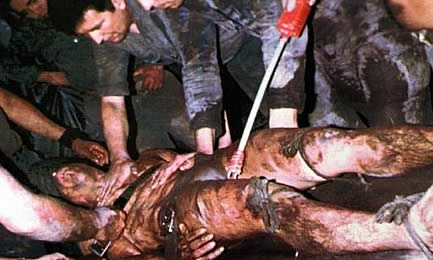
The lawyers added, “We have already lost the video tapes which would have allowed a jury to see what happened to Mr. Al-Nashiri in those secret prisons. We cannot lose the remaining tangible evidence of the actual prisons themselves and the instruments of torture within them.”
They note that Panetta’s predecessor, General Michael V. Hayden, has admitted that Mr. Al-Nashiri was subjected to waterboarding, “which is a form of torture, while in the custody of the CIA.”
According to the recently released report from the International Committee of the Red Cross (ICRC), ‘waterboarding was only one of the many forms of torture inflicted on Mr. Al-Nashiri while in the custody of the CIA,” the lawyers’ letter said.
They claim that, according to the ICRC report, “While in CIA custody, Mr. Al-Nashiri was also forced to stand with his wrists shackled to a bar in the ceiling for prolonged periods of time – extending to several days – and was threatened with sodomy and with the rape and arrest of his family members.”
Throughout that time, the letter says, Al-Nashiri “was not able to communicate with his family, a lawyer or anyone. Effectively the CIA ‘disappeared’ him for four years while it tortured him at will and beyond the eyes of the world.”
The CIA and other government agencies also admitted to the purposeful destruction of at least 92 videotapes of interrogations and observations of prisoners in its black sites, specifically including the destruction of videotapes of waterboarding and other observations of Mr. Al-Nashiri, the letter says.
It concludes, “Had Mr. Al-Nashiri known that the CIA possessed these video tapes and intended to destroy them, he would have demanded their preservation. However, neither he, his lawyers nor the courts learned of the CIA’s plan until after the tapes had been destroyed and now they are forever gone.”
“Although we welcome your decision to cease the secret detention and mistreatment of prisoners of the United States Government, we are concerned that the CIA intends to actually destroy the sites – including the buildings and the equipment used to interrogate and torture Mr. Al-Nashiri – before Mr. Al-Nashiri has had the opportunity to fully investigate his conditions of confinement. We write to avoid the destruction of more evidence – namely the actual secret facilities themselves,” the lawyers wrote.
Al-Nashiri was charged in the military commission with offences that carried the death penalty. His lawyers note that, “Although those charges have now been dismissed, we fully expect the government to prosecute Mr. Al-Nashiri and again charge him with offenses that could carry the death penalty. In fact the government is now actively working to determine in what forum he will be prosecuted.”
Evidence held by the CIA “is exculpatory evidence” and Al-Nashiri “will be entitled to it.”
The letter concludes: “The CIA’s secret prison facilities and the inquisition-like treatment meted out to its prisoners were a tragic, immoral and illegal period in our history that we all hope has come to an end. But its effects are enduring, especially on someone like Mr. Al-Nashiri who, according to the ICRC report, lived through the horror chambers of at least three different secret prisons.”
Following Thursday’s release of the four OLC memos, it is likely that the government’s treatment of detainees will attract increased public scrutiny – despite President Obama’s pledge to close Guantanamo Bay and CIA black site prisons.
Continuing concern about U.S. credibility in war-on-terror detentions and prosecutions has been voiced by many U.S. legal scholars. David Cole, one of the country’s preeminent constitutional authorities, told IPS, “For better or worse, the U.S. is a world leader on matters of human rights. When the U.S. violates human rights in the fight against terrorism, it sends a message to autocrats and dictators worldwide that they, too, can deny human rights in the name of counterterrorism.”
Source / IPS News North America













Naomi Klein : Hopebroken and Hopesick
In Obamafanland:
A Lexicon of Disappointment
by Naomi Klein / April 17, 2009
All is not well in Obamafanland. It’s not clear exactly what accounts for the change of mood. Maybe it was the rancid smell emanating from Treasury’s latest bank bailout. Or the news that the president’s chief economic adviser, Larry Summers, earned millions from the very Wall Street banks and hedge funds he is protecting from reregulation now. Or perhaps it began earlier, with Obama’s silence during Israel’s Gaza attack.
Whatever the last straw, a growing number of Obama enthusiasts are starting to entertain the possibility that their man is not, in fact, going to save the world if we all just hope really hard.
This is a good thing. If the superfan culture that brought Obama to power is going to transform itself into an independent political movement, one fierce enough to produce programs capable of meeting the current crises, we are all going to have to stop hoping and start demanding.
The first stage, however, is to understand fully the awkward in-between space in which many US progressive movements find themselves. To do that, we need a new language, one specific to the Obama moment. Here is a start.
Hopeover. Like a hangover, a hopeover comes from having overindulged in something that felt good at the time but wasn’t really all that healthy, leading to feelings of remorse, even shame. It’s the political equivalent of the crash after a sugar high. Sample sentence: “When I listened to Obama’s economic speech my heart soared. But then, when I tried to tell a friend about his plans for the millions of layoffs and foreclosures, I found myself saying nothing at all. I’ve got a serious hopeover.”
Hoper coaster. Like a roller coaster, the hoper coaster describes the intense emotional peaks and valleys of the Obama era, the veering between joy at having a president who supports safe-sex education and despondency that single-payer healthcare is off the table at the very moment when it could actually become a reality. Sample sentence: “I was so psyched when Obama said he is closing Guantánamo. But now they are fighting like mad to make sure the prisoners in Bagram have no legal rights at all. Stop this hoper coaster-I want to get off!”
Hopesick. Like the homesick, hopesick individuals are intensely nostalgic. They miss the rush of optimism from the campaign trail and are forever trying to recapture that warm, hopey feeling-usually by exaggerating the significance of relatively minor acts of Obama decency. Sample sentences: “I was feeling really hopesick about the escalation in Afghanistan, but then I watched a YouTube video of Michelle in her organic garden and it felt like inauguration day all over again. A few hours later, when I heard that the Obama administration was boycotting a major UN racism conference, the hopesickness came back hard. So I watched slideshows of Michelle wearing clothes made by ethnically diverse independent fashion designers, and that sort of helped.”
Hope fiend. With hope receding, the hope fiend, like the dope fiend, goes into serious withdrawal, willing to do anything to chase the buzz. (Closely related to hopesickness but more severe, usually affecting middle-aged males.) Sample sentence: “Joe told me he actually believes Obama deliberately brought in Summers so that he would blow the bailout, and then Obama would have the excuse he needs to do what he really wants: nationalize the banks and turn them into credit unions. What a hope fiend!”
Hopebreak. Like the heartbroken lover, the hopebroken Obama-ite is not mad but terribly sad. She projected messianic powers on to Obama and is now inconsolable in her disappointment. Sample sentence: “I really believed Obama would finally force us to confront the legacy of slavery in this country and start a serious national conversation about race. But now whenever he seems to mention race, he’s using twisted legal arguments to keep us from even confronting the crimes of the Bush years. Every time I hear him say ‘move forward,’ I’m hopebroken all over again.”
Hopelash. Like a backlash, hopelash is a 180-degree reversal of everything Obama-related. Sufferers were once Obama’s most passionate evangelists. Now they are his angriest critics. Sample sentence: “At least with Bush everyone knew he was an asshole. Now we’ve got the same wars, the same lawless prisons, the same Washington corruption, but everyone is cheering like Stepford wives. It’s time for a full-on hopelash.”
In trying to name these various hope-related ailments, I found myself wondering what the late Studs Terkel would have said about our collective hopeover. He surely would have urged us not to give in to despair. I reached for one of his last books, Hope Dies Last. I didn’t have to read long. The book opens with the words: “Hope has never trickled down. It has always sprung up.”
And that pretty much says it all. Hope was a fine slogan when rooting for a long-shot presidential candidate. But as a posture toward the president of the most powerful nation on earth, it is dangerously deferential. The task as we move forward (as Obama likes to say) is not to abandon hope but to find more appropriate homes for it-in the factories, neighborhoods and schools where tactics like sit-ins, squats and occupations are seeing a resurgence.
Political scientist Sam Gindin wrote recently that the labor movement can do more than protect the status quo. It can demand, for instance, that shuttered auto plants be converted into green-future factories, capable of producing mass-transit vehicles and technology for a renewable energy system. “Being realistic means taking hope out of speeches,” he wrote, “and putting it in the hands of workers.”
Which brings me to the final entry in the lexicon.
Hoperoots. Sample sentence: “It’s time to stop waiting for hope to be handed down, and start pushing it up, from the hoperoots.”
© 2009 The Nation
[Naomi Klein is an award-winning journalist and syndicated columnist and the author of the international and New York Times bestseller The Shock Doctrine: The Rise of Disaster Capitalism, now out in paperback. Her earlier books include the international best-seller, No Logo: Taking Aim at the Brand Bullies; and the collection Fences and Windows: Dispatches from the Front Lines of the Globalization Debate (2002). To read all her latest writing visit www.naomiklein.org.]
Source / The Nation / CommonDreams
The Rag Blog