Music Video : Arlo Guthrie is (Still) Changing His Name to Chrysler

I’m Changing My Name to Chrysler
Performed by Arlo Guthrie. Lyrics by Tom Paxton.

“Corporate welfare-the enormous and myriad subsidies, bailouts, giveaways, tax loopholes, debt revocations, loan guarantees, discounted insurance and other benefits conferred by government on business-is a function of political corruption. Corporate welfare programs siphon funds from appropriate public investments, subsidize companies ripping minerals from federal lands, enable pharmaceutical companies to gouge consumers, perpetuate anti-competitive oligopolistic markets, injure our national security, and weaken our democracy.”Ralph Nader in “Cutting Corporate Welfare.”

Thanks to Roger Baker / The Rag Blog

Posted in RagBlog | Tagged , , , , | 1 Comment

A Sermon : The Political Meaning of Easter

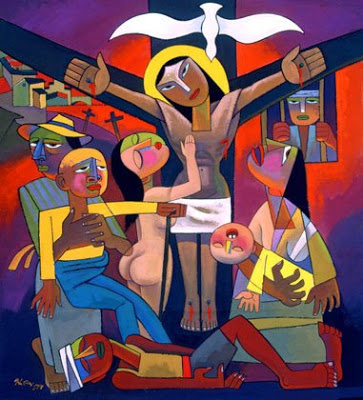
Crucifixion scene by Chinese artist He Qi from Mustard Seed Journey.

Especially on Easter I feel called to preach in a way that reminds us that if we take the text and our tradition seriously, we will be uncomfortable in our imperial society.

By Jim Rigby / The Rag Blog / April 9, 2009

Even in progressive churches that challenge the political and theological orthodoxy, Easter is a day many people want to find comfort in the traditions of Christianity — a special day for putting on one’s sharpest-looking outfit for church and the family gathering. But especially on Easter I feel called to preach in a way that reminds us that if we take the text and our tradition seriously, we will be uncomfortable in our imperial society.

So, I can’t give a traditional Easter sermon, one that makes us comfortable about Christianity, about our nation, about ourselves. On a day when people typically want to take a break from politics, I feel compelled to talk politics.

A sermon for Easter Sunday

When I was young and heard about the Nazi holocaust, I didn’t ask the question many of my classmates asked. I didn’t ask “how could Germans do such a thing?” I asked, “how could Christians do such a thing? How did the holocaust happen in the very cradle of the Reformation?” The Lutheran faith was born in those same places that eventually embraced fascism. How is it possible, in our own country, that Christians would go to church every week and not realize there was something deeply evil about slavery? What kind of theology allowed that to happen?

Those Christians said the same creeds we say. They sang many of the same hymns. And yet, their theology did not trigger an alarm when an atrocity was happening. And so I asked myself a question: “Do I have that same theology? Have I been propagandized in a way that I will turn against my brother and sister if they happen to be born in a different country or different religion?”

When I first began in ministry, I was popular. I remember someone once said, “Jim, I’ve never heard anyone say anything bad about you.” At the time, that seemed like a compliment, but is it really? If we really love other people, we need to love them enough to risk offending them. Paul tells us to speak the truth in love. We have to do that for each other. You have to do that for me, and I have to do it for you, because we cannot see ourselves from the outside. We cannot always step outside of ourselves and realize when we’re doing crazy or cruel things.

Most people, inside the church and out, were taught a view of the resurrection that had no ethical implications at all. You were probably taught a theology that’s not immoral, but it’s amoral. In that view, the biblical is about magic tricks. A man is born of a virgin, and then, gets up from his grave. If you believe the story, you’re saved, if you don’t you’re damned. And I want to say, that’s bad theology. When we study the life of Jesus, there are clear ethical implications from the day Jesus says he has come to announce good news for the poor, to the day he tells Peter to love Him by caring for other human beings. The story of Jesus has clear ethical and political implications. And Easter is no exception.

I think Paul is giving us three warning labels for doing theology: The first warning is never let religion talk you into surrendering responsibility for your life. The second warning is never to let theology reduce down to hypothetical truth claims. And finally, Paul warns us never to reduce your worldview down to your own group.

Our text today is a passage in Colossians where Paul tells us, “Because you have been resurrected with Christ, set your heart on higher things.” (Col 3:1) Paul says something very interesting here. He says: “Because you have been resurrected with Christ.” He doesn’t say, “Because Jesus was resurrected.” He’s talking about your life. What kind of a theology tells you to surrender responsibility to Jesus? Jesus didn’t say that. What happens when we do that is that someone else always steps in on Jesus’ behalf.

If you’re Catholic, it may be the church hierarchy; a priest, bishop, or pope may step in to tell you what Jesus wants you to do. So, you’re not surrendering responsibility to Jesus so much as to a cleric. In a Protestant church, we’re cleverer than that. We say, “It’s all about the Bible. Just believe in the Bible.” But then we step in to tell you the right way to interpret the Bible. That’s how we disguise what we are doing. We can pretend that it’s the Bible we care about, but if you’re watching, our interpretation of the book always puts us in power and control over other people. We aren’t trying to control others — it’s just one of those darn things that just keeps happening.

In Colossians, Paul is explaining the Resurrection in a different way than the gospels do. The gospels tell you a story at a level that a child can understand. Even when you’re tired, even when you are afraid, the story gives you a compass. What Paul does is unpack the story and show you how to apply it in particular situations. But you can’t take either version of the story literally.

There are types of theology that completely dis-empower the follower. I would suggest that is what happened in Germany when they told people that obedience was a virtue, no matter what. So the first thing we should know about theology is that it would lead us to our own core. Christ is a symbol of your own soul in its fullness. Christ is your own best self that you can’t always find. Yes, Jesus was a person, but a person who completely died into love, and held nothing back. So in following Christ, we should always discover ourselves as well.

The second warning is not to let theology become a set of theoretical assertions about reality. Notice that Paul now moves to a plea for unity in the early church. The symbols of religion should not point outside our experience to hypothetical beings but should waken us to the real people in our lives. So Christ is a symbol not only of your life, but of the life of your friends and your enemies. Paul tells us to bear with each other, to forgive each other as a way of making love real.

When religion becomes hypothetical, we are disoriented from ourselves and each other. The resurrection didn’t take place when a body got up. That would be a theoretical historical claim. The resurrection took place when the disciples could see Christ in each other. Believing that Jesus got up from the grave does not mean that one has experienced the risen Christ. That we find in the eyes of each other.

There is a hidden life in us all. A radiant being, that permeates every plant, animal, and person that you will ever meet. Christ is a symbol of that hidden life in us all. To be a Christian does not mean to join the Christian sect, it means to be irradiated by that one life. It means to live out of that life and for that life.

The third “warning label” is not to reduce your allegiance to any one group. Paul says in Colossians as in Galatians, “in Christ there is neither Greek nor Hebrew, neither Jew or Gentile, neither barbarian or Scythian, neither slave or citizen. There is only Christ, who is all in all.”

When we hear our leaders say that they will do whatever is in the best interest of America no matter what, or when we hear Christians say that people are saved through Christ alone, we should hear and recoil from the same rhetoric that leads to a holocaust. The words are not purified because they come through our lips. Whenever we put sectarian brackets around our ethics, then we have no ethics. When I am ethical only to those within my brackets, I am unethical to anyone outside them. When I only serve America, and you have the bad judgment to be born on the other side of that boundary, guess who pays for my arrogance?

Paul is talking about a universal humanity into which we become members. He is talking about the common body of humankind. If you look at the text, it seems clear to me that the salvation that’s being talked about is not just joining the Christian church. We are being called to the common body of humankind beyond race, gender, or religion.

What good does it do to take up the Christian label, and then serve the selfish needs of any one group? Two thousand years is enough to know that sectarian Christianity doesn’t lead to peace. But what if we loved universally the way Jesus did? What if we saw, neither Jew nor Greek, slave nor free, male nor female?

This is the ethical content of Easter. If I think that Christians are better than Jewish people, then the resurrection hasn’t fully happened for me yet. If I think the rich are better than the poor, the Resurrection hasn’t fully happened for me. If I think my group is superior to other groups just because I was born in it, the resurrection has not yet happened in my life.

When we awaken to our common life, something happens to our fear. Our greatest fear is no longer that someone will hurt us, but that we might harm another. Our only fear is of losing the universal love that Christ has given us. So I need not fear that someone will rob me of my life. If I am true to the virtues of patience, kindness, love — the things that Paul lists there — there is nothing on earth that can rob me of that basic, core energy that early Christians called “eternal life.”

And that is why, even though it’s Easter, I’m not going to say that the resurrection is when Jesus got up from the grave. Or that, if you believe in Jesus’ resurrection, then your body will get up too someday. That’s a religion for children. We all start out as children and that’s fine. But if our faith does not grow, then when we are afraid our immature religion will cause us to hurt other people, our immature religion will cause us to reject those who are different, our immature religion will be capable of taking advantage, enslaving, or even killing other people.

That kind of immature, cruel Christianity is a mockery of the One who died and rose again in a small band of Easter people. To be Easter people means to live out of a radical solidarity with our whole human family. To be an Easter people means to have a radical hope that can look at our dangers and unblinkingly affirm that love is stronger than any empire, stronger than any weapon. You know the Easter has happened when, for human betterment, you are willing to face death itself.

[Jim Rigby is pastor of St. Andrew’s Presbyterian Church in Austin. This March his sermons are about the Biblical roots of activism. Jim Rigby is also an activist for universal human rights. He can be reached at jrigby0000@aol.com.]

Thanks to Robert Jensen / The Rag Blog

Posted in Rag Bloggers | Tagged , , | 1 Comment

Time Warner Singles Out Geek-Rich Austin for Metered Broadband Trial

Penny-pinching broadband. Graphic from DVICE.com

Austin is not a city that takes its broadband lightly. It’s home to supercomputers, digital media studios and online gaming companies. Thanks to that, it’s now a microcosm for a battle against consumption-based broadband attempts around the country.

By Stacey Higginbotham / April 6, 2009

When it comes to trialing its metered broadband service, Time Warner Cable’s choice to do so in the tech-savvy city of Austin, Texas, was no accident. And residents may not be able to do much about it.

According to TWC spokesman Jeff Simmermon, Austin’s dedication to all things digital was precisely why it was chosen as one of four cities where the company plans to trial consumption-based broadband plans, which range from 5 GB to 40 GB per month (TWC says it has plans for a 100 GB-per-month tier as well). “Austin is a passionate and tech-savvy city, and the spirit that we’re approaching this (metered broadband) test with is that if it’s going to work, it has to work in a tech-savvy market where the use patterns are different,” he told me.

So far, Austin isn’t impressed, but since the local cable franchise it grants only deals with video, there may not be much it can do. Chip Rosenthal, one of seven commissioners on the City of Austin’s Technology and Telecommunications Commission (a strictly advisory body), hopes that concerned citizens will show up at the meeting it’s holding at City Hall this Wednesday and talk about metered broadband. He wants to get the metered bandwidth issue added to the agenda of the commission’s May meeting as well.

But local efforts aside, Rosenthal says Austin will have to take a national approach, either through Congress and the Federal Communications Commission, or through a lawsuit to prevent or influence the deployment of metered broadband. “The city has much greater national influence than you or I as individuals, ” Rosenthal said.

He’s right, but for those wanting to express their individual disdain, here’s an online petition put forth by a local citizen. As for the city, it’s encouraging to note that within two days of the story breaking, two of the city’s mayoral candidates issued statements questioning such caps [Lee Leffingwell and Brewster McCraken]. One noted that downloading the first season of my hometown’s favorite TV show, “Friday Night Lights,” would require almost 31 GB and would subsequently put people in danger of violating the current top-tier cap of 40 GB. “Friday Night Lights” isn’t just about Texas football, it’s also shot in town, and an important showcase for film production here in Austin.

Austin is not a city that takes its broadband lightly. It’s home to supercomputers, digital media studios and online gaming companies. Thanks to that, it’s now a microcosm for a battle against consumption-based broadband attempts around the country. If metered broadband works in Austin, then it can work anywhere — even in your hometown.

Source / GigaOM

Thanks to Media Reform Daily / The Rag Blog

Posted in RagBlog | Tagged , , , | 3 Comments

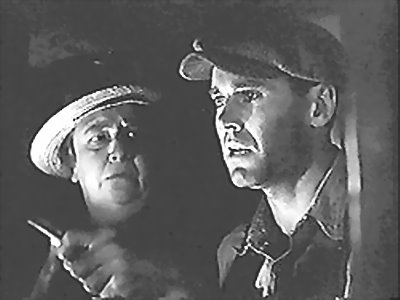
‘Wherever they’s a fight so hungry people can eat, I’ll be there.’

Jane Darwell as Ma Joad and Henry Fonda as Tom Joad.

Above the din, Ma Joad’s voice still confident, clear
By Pierre Tristam / April 7, 2009

Homeless camps now sprawl instead of developments. Unemployment numbers are spilling off front pages into our lives. Employers are turning workers into modern-day sharecroppers (every man his own contractor). And next week, as if on cue, marks the 70th anniversary of the publication of “The Grapes of Wrath,” John Steinbeck’s novel of foreclosure and dispossession in the 1930s. How timely.

The Oakies at the heart of the story were sharecropper migrants drummed off their land by banks and the Dust Bowl only to be terrorized by locals across the West in what Time in 1939 called “one of the grimmest migrations of history.” By then the Depression and Franklin Roosevelt had shaken up the country’s conscience, but Steinbeck gave the decade’s angers its voice. It was outraged and lyrical — as revolted over the country’s exploitative instincts as it was hopeful of its redemptive capital. Have we lost something since? The din of hateful sanctimony mugs the airwaves, giving no chance to a voice like Steinbeck’s, at once protesting, confident and forgiving. But nothing has been lost, exactly.

“The Grapes of Wrath” resonated with American empathy as few works of art ever have. It sold 100,000 copies in less than a week and became the biggest-selling novel of 1939. Within six days of publication Twentieth Century-Fox had acquired the movie rights for $75,000, close to a record for a novel back then. Within 20 days Henry Fonda was cast as Tom Joad and the ending was rewritten, supposedly to make it less grim, but in fact to avoid the image of Tom’s sister, Rosasharn (who’s given birth to a stillborn baby), breastfeeding a stranger demolished by starvation. The most charitable image of the novel somehow turned, in the perverted little minds of Hollywood producers, into an objectionably unhappy ending.

In the movie ending, what’s left of the Joads amble down a road toward the promise of 20 days of cotton picking while Ma, played by the wonderful Jane Darwell, who won an Oscar for the role, sums it all up: “I ain’t never gonna be scared no more. For a while it looked as though we was beat. Good and beat. Looked like we had nobody in the whole wide world but enemies, like nobody was friendly no more. Made me feel kinda bad and scared, too. Like we was lost and nobody cared. . . . We keep a comin’. We’re the people that live. They can’t wipe us out, they can’t lick us. We’ll go on forever Pa, ’cause we’re the people.” The End.

Steinbeck loved it. “In fact,” he wrote his agent, “with descriptive material removed, it is a harsher thing than the book, by far. It seems unbelievable but it is true.” He couldn’t have objected to the ending because his books were nothing if not sentimental anyway. It was their weakness and their strength, what makes reading Steinbeck the kind of guilty pleasure that secretly wishes irony wasn’t every contemporary novel’s inside joke.

Judging from the bestseller list’s biggest titles of the past 40 weeks (a novel about one woman’s resistance to space aliens and comedian Chelsea Handler’s “Are You There, Vodka? It’s Me, Chelsea”) you’d think Tom Joad’s famous last words, in the book and the movie, would themselves sound like alien gibberish to contemporary ears: “Wherever they’s a fight so hungry people can eat, I’ll be there. Wherever they’s a cop beatin’ up a guy, I’ll be there . . .” Steinbeck took the lines from Eugene Debs, the social democrat and union founder who said, “While there is a lower class, I am in it; while there is a criminal class, I am of it; while there is a soul in prison, I am not free.” Speak these words today — words that once redeemed America — and you’re more than likely branded a scumbag, a socialist, a loser, or worse.

But self-pity would be very un-Ma like. So would romanticizing Debs and Tom Joad as some sort of irrecoverable standard of decency. Recently I came across words similar to theirs: “Where there is injustice, we should correct it; where there is poverty, we should eliminate it; where there is corruption, we should stamp it out; where there is violence we should punish it; where there is neglect, we should provide care; where there is war, we should restore peace; and wherever corrections are achieved we should add them permanently to our storehouse of treasures.”

Those weren’t in any fiction. You can read the words on one of the most famous tombstones at Arlington National Cemetery — that of Earl Warren, the lifelong Republican and Chief Justice of the United States from 1953 to 1969. You can also see the line from Tom Joad’s last words to Ma Joad’s to Warren’s, with this difference: Warren and people like him, when they had the power, made them real. That voice, that instinct, is as American as grand old plagues of greed and exploitation. It was on the defensive for a few decades. But it was never absent. Last November, it was 10 million voices louder than the cynics’. There’s wrath in those grapes yet. And wine, too.

[Pierre Tristam is a Daytona Beach News-Journal editorial writer. Reach him at ptristam@att.net or through his personal Web site at www.pierretristam.com.]

Source / Smirking Chimp

Thanks to Jeffrey Segal / The Rag Blog

Posted in RagBlog | Tagged , , , | 2 Comments

Rudd: Put the War Budget Into Peace, Diplomacy, Law, and Sustainable Energy Development

Mark Rudd.

Pacifism and The Military-Industrial-University Complex: Interviewing Mark Rudd
By Bob Feldman / The Rag Blog / April 7, 2009

Mark Rudd was the chairman of the Columbia University chapter of Students for a Democratic Society [SDS] at the time of the 1968 Columbia Student Revolt; and Rudd’s autobiography, Underground: My Life with SDS and the Weathermen was finally published in March 2009.

In a recent email interview with Toward Freedom, Rudd responded to some questions about how U.S. pacifists might consider responding to the role U.S. universities play in the current historical era of “permanent war abroad and economic depression at home” and about his new book.

In 2009, some U.S. pacifists seem to regard elite universities like Columbia as institutions that have, both historically and currently, opposed war and opposed racism—since they hire both anti-war and African-American professors and administrators, implement affirmative action hiring programs, set up “peace studies” and “African-American studies” departments, steer foundation grants and scholarship money in the direction of students from historically oppressed communities and to local community groups, and provide free or low-rent meeting room space for anti-war students and off-campus pacifist groups.

Yet in the preface to your book, you write that between 1965 and 1968 you were “a member of SDS at Columbia University” and “made as much noise and trouble as possible to protest the university’s pro-war and racist policies.” In what ways were Columbia University’s policies “pro-war and racist” in 1968 and in what ways are the policies of Columbia University and other elite U.S. universities “pro-war and racist” in 2009?

Mark Rudd: The specific demands we raised leading up to the spring of 1968–training and recruitment of military officers for the war in Vietnam, weapons research for the war, the building of a gym in public park land–were only the tip of the iceberg of Columbia’s policies. Within months of the strike, the North American Congress on Latin America (NACLA) produced a book entitled “Who Rules Columbia,” in which they detailed the military, State Dept., and CIA contracts and connections with the School of International Affairs, the various geographical “area studies,” such as the East Asia Institute, as well as the revolving door between Columbia and the government; also Columbia’s expansion into the surrounding community at the expense of non-white residents. Most of these connections and policies are still in place; almost all major research universities are still major war contractors. The point is that student activists have their work cut out for them to research and expose what’s correctly called the military-industrial-academic complex.

In chapter 1 of your book, titled “A Good German,” you recall that when you first met the then-chairman of Columbia’s Independent Committee on Vietnam (ICV) anti-war student group–current U.S. political prisoner David Gilbert—in early 1966, Gilbert mentioned that in May 1965 his group had “held an antiwar protest at the Naval ROTC graduation ceremony” at Columbia. And later in the “A Good German” chapter you mention that in March 1967 you had “taken part in a sit-in at a Naval ROTC class” at Columbia.

Why did you oppose Naval ROTC at Columbia in the 1960s? And do you think U.S. pacifists should consider opposing ROTC on U.S. university campuses in 2009?

Mark Rudd: The issue is fundamentally moral. Is the training of people to wage war against other countries, carrying out a criminally aggressive military policy, appropriate in an institution that pretends to seek the truth? Our answer to this question was NO, because we believed in the necessity to oppose U.S. violence as a moral value. Remember, too, that the time we lived in was essentially post-World War II, and the problem of values in society was still being debated in the aftermath of Nazism. I have no doubt that contemporary students will be taking this up again in the near future.

In chapter 2 of your book, you mention that anti-war students at Columbia protested against recruitment on campus by external organizations like the CIA and the U.S. Marines. Why did you think that it was morally wrong for Columbia University to allow external organizations like the CIA and the U.S. Marines to recruit on campus in 1967? And do you think U.S. pacifists in 2009 should also protest against U.S. universities that allow the CIA and the U.S. Marines to recruit on campus while the Pentagon’s war in Iraq and Afghanistan continues?

Mark Rudd: Same response as #2 above. Whether recruitment is “external” (e.g., Marine recruiters) or “internal” (Military Science Dept. training future naval officers), it amounts to the same thing. The resources of the university are being used to help wage war.

In chapter 3 of your book, titled “Action Faction,” you write that on March 27, 1968 “SDS had fifteen hundred names on a petition calling for the severing of ” Columbia University’s “ties with the Pentagon think-tank, the Institute for Defense Analyses (IDA);” and “IDA…became the shorthand symbol for Columbia’s huge network of complicity with the war.”

In 2009, IDA still exists. Do you think that U.S. pacifists should consider demanding that IDA be finally shut down by the Democratic Obama Administration and that U.S. pacifists should consider demanding that U.S. universities like Columbia, MIT and Harvard stop performing war research for the Pentagon’s Defense Advance Research Projects Agency [DARPA] in 2009?

Mark Rudd: I believe that the entire US military budget should be cut back and the money used for social needs both in this country and around the world. Security would be much better served by the development of true international law, not more nuclear weapons. If that doesn’t happen in the 21st century, we’re doomed. All war research should immediately stop everywhere and the money be put into peace, diplomacy, law, and sustainable energy development. To do less now is not only suicidal, it’s downright dumb.

In your book, you mention that you and Abbie Hoffman were both arrested at a November 1967 anti-war protest in Midtown Manhattan against the Foreign Policy Association giving an award to then-Secretary of State Dean Rusk.

April 2009 marks the 20th anniversary of Abbie’s death. How would you characterize the role that Abbie Hoffman played in U.S. anti-war movement history and his historical relationship to U.S. pacifists and non-violent anti-war activists like Dave Dellinger?

Mark Rudd: Abbie was essentially a comedian and an organizer. He was not at all violent; he always encouraged mass organizing, though often in the form of provocative guerilla theater, like the Yippies nominating a pig for president in 1968. I forget how he and Dave Dellinger got along in Chicago, both in 1968 and during the conspiracy trial the next year. My guess is that they respected each other. Perhaps you know more specifics.

Speaking of Abbie Hoffman, how would you respond to Professor Jonah Raskin’s assertion in his review of your book which was posted on The Rag Blog that “like Abbie Hoffman, Mark Rudd wasn’t suited for the underground life—he needed attention, and attention is, of course, the last thing that any fugitive wants;” and “Underground suggests, implies, and shows that Rudd is up there, along with Abbie, near the top of the list of 1960s radicals who wanted attention, and who received far more attention than they needed…It undid Abbie, and it also helped to undo Rudd.”?

Mark Rudd: I wonder if Jonah actually read my book.

Why do you think the right-wing media monitoring pressure group” Accuracy In Media” [A.I.M.] apparently attempted to pressure Rupert Murdoch’s HarperCollins publishing firm to not promote your book, according to the” Accuracy In Media” web site?

Mark Rudd: Just another way for the far right to try get at Obama, but it’s so indirect that it makes zero sense to anybody else. There was a tiny connection between Obama and Bill Ayers, but that fact gained no votes for John McCain. These people are so stupid that they’re still pursuing a tactic that’s already failed. I find that a rather comforting fact.

Do you think it’s likely that Columbia University’s Pulitzer Prize Board will decide to give you a Pulitzer Prize for writing Underground—after Columbia University’s current president–a current board member of the Washington Post Company/Newsweek media conglomerate named Lee Bollinger—reads what you’ve written about Columbia University?

Mark Rudd: I’m a shoe-in.

[This interview was also posted on Toward Freedom.]

The Rag Blog

Posted in RagBlog | Tagged , , , | 2 Comments

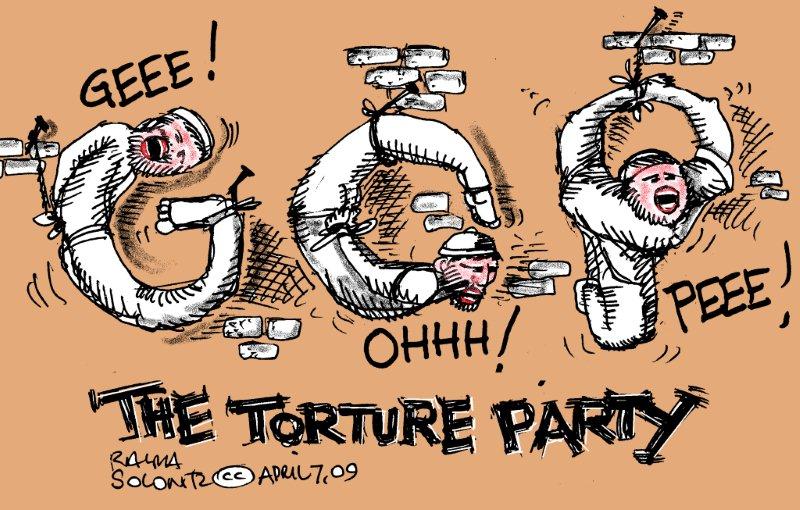
The Torture Party

Cartoon by Ralph Solonitz / The Rag Blog

Posted in RagBlog | Tagged , , | Leave a comment

Roger Baker : The Reality of ‘Peak Oil,’ Part 1

ASPO Ireland.

Peak Oil is the point at which the total world oil production reaches its high point and finally starts to decline… We at last have some pretty convincing data to indicate that world oil production probably peaked forever in the summer of 2008…

By Roger Baker / The Rag Blog / April 7, 2009

Has peak oil arrived yet, and how do we know when that happens?

Everyone has probably at least heard the term “peak oil” by now, but perhaps without understanding much about what that phrase means or implies. It is the point at which the total world oil production reaches its high point and finally starts to decline. This is something that almost all geologists have known was going to happen sooner or later. During the energy crisis of the 1970’s, Scientific American predicted that oil production was already going to have peaked by now. There are many good “peak oil” sites these days, but this primer from Energy Bulletin is as good as any place to learn the basics:

For those of us who have been warning of the economic implications of peak oil, we do have at last some pretty convincing data to indicate that world oil production probably peaked forever in the summer of 2008. For one thing, we know from the official OPEC and International Energy Agency data that there was a supply peak and decline about the same time as the price peaked in the summer of 2008. Go here and scroll down to the chart titled “Now it is beginning to look like world oil production is beginning to decline.” (Lots more good economic discussion at the same link.)

As a follow-up example, look at Tony Ericksen’s chart and the discussion on the Oil Drum, which is a leading and essential energy policy discussion website. Erickson’s conclusions were based on a combination of current production data together with knowledge of the new oil production projects scheduled to come on line. His conclusion of a peak in 2008 was supported by most of the Oil Drum’s staff of (pro bono) writers and researchers.

In addition, the highly respected ASPO International newsletter, edited by the Association for the Study of Peak Oil International director and geologist Dr. Colin Campbell, agrees with a 2008 world oil production peak. This fact is represented in the information on the second page of recent ASPO newsletters. Conventional oil produced from drilling on land probably peaked in 2005. The other more difficult and expensive sources like polar and deep-water and tar sand oil are now themselves falling short of being able to fill the widening oil demand shortfall left by the slow decline of the huge but aging fields that supply most of the world’s oil.

The argument for making the case that we have already hit world peak oil production is simple. First, oil production is known from the official data (see the second link above) to have reached a peak in July 2008 of about 86 million barrels per day. Since that time production declined, but not fast enough to match an even steeper drop in demand caused by the global economic crisis.

Up until July 2008, the bidding for the amount of oil globally available, including some element of speculation associated with a super-tight world market, raised the oil price to a historic high of $147 a barrel before the oil supply, oil price and the global economy collapsed, approximately together in their timing.

The July 2008 maximum production level was hugely expensive to reach. As one might imagine, vast amounts of capital were attracted in the past few years to the lucrative profits to be made in places like the Canadian tar sand fields from producing $100 plus oil.

Now that the price has collapsed to less than $50 a barrel, very many oil (and gas) drilling rigs previously devoted to trying to maintain maximum oil production have been shut down, or are falling into disrepair. Major oil projects around the world, including those in Saudi Arabia, have been canceled.

This collapse in current oil infrastructure investment due to a current lower price, together with the slow depletion of the biggest global super-giant fields, makes it very likely that oil production will now continue to contract. This no matter how much we might try to invest when the price shoots back towards $150 a barrel. Crash investments are unlikely to make much difference, assuming the capital is still available.

Since we don’t know the depth of what already amounts to a world depression, oil prices could remain at $50 a barrel for several years until a partial global economic recovery recreates a world market bumping up against the slowly declining ceiling in production once again. Nobody can accurately predict what will happen because the unpredictability of the current economic crisis makes the recovery of energy demand unpredictable. (See Heinberg in the upcoming Part 2 of this article.)

Oil is like nothing else in its role in the economy. Oil is the essential lifeblood of our modern fossil-fueled global economy, powering virtually all transportation, whether on land, or air, or sea. For this reason, the global economy is ultimately limited in its potential expansion by oil, and will for the foreseeable future. Just try to imagine the cost and difficulty of retrofitting the world’s jet aircraft to burn some other fuel than the kerosene-like jet fuel that they need now. We use a similar oil distillate fuel to launch rockets into space because nothing else can safely deliver more energy per pound when burned together with liquid oxygen. Less and more expensive oil means we will necessarily fly less and move fewer things around.

There are many important economic implications of our inconvenient industrial addiction, with most of them likely to be seen as unwelcome to conducting business as we have in the past. This is especially true when viewed in the context of a global capitalist economy.

By definition capitalism must always increase its production of goods, in order to earn interest on investment and remain economically healthy. Capitalism exists solely by virtue of its tendency to expand more strongly than competing modes of economic organization. When there is still lots of planet left to profitably exploit, capitalism tends to win out, at least in a Darwinian sense.

High oil prices act like a universal tax on all commerce. The price of oil is still poised to surge again whenever the desire to pay customers to move things around exceeds the amount of oil needed to accomplish that goal.

Not only is peak oil bad news to its users in a direct sense, but the evidence indicates this economic headwind, operating together with an unregulated and unwieldy mountain of poorly-secured global debt, probably initiated the economic collapse of 2008, as the Wall Street Journal indicates.

This is not the only source to implicate peak oil as a primary cause of the financial crisis. The crisis started to unwind in August 2007, beginning with the sub-prime mortgage problem, but it became acute in mid 2008. The following is from “Oil price and economic crash,” ASPO International, Feb. 1, 2009.

The German Financial Times features an article that links the record high oil prices of last July to the onset of the financial

No financial analyst managed to predict that 2008 would end in a recession. Generally the financial crisis has been described as the cause. However, it turns out that the initial suspicion was wrong. The chronology speaks against the fact that the September bankruptcy of Lehman Brothers crash caused the real economy. Key economic indicators were on descent weeks before Lehman Brothers collapsed.

In the United States, the number of new applications for unemployment benefits soared in the last week in July suddenly to recession levels – not mid-September. In August broke the upward trend in orders for U.S. companies, the orders fell within one month increased by four percent. Industrial production also fell abruptly in the month before the Lehman-crash – not afterwards. The same is true for America’s exports, which previously had boomed for months.

In the euro zone started in the mood indicators in June to time, with worsening in July. Even in China there was already weeks before Lehman signs of a serious economic setback. The crash of the summer of 2008 coincided with another global phenomenon: In June and July 2008, at the rise in oil prices, the first courses were almost twice as high as a year earlier. This also caused another shock as a result of the global: an inflation scare that led to just the interest rate in June shot up high expectations.

In agreement with the oil price theory, the sales of cars in the U.S. crashed at exactly the mid-July . With the oil price could also explain why no industry as a crisis like the car industry. In the euro zone fell to new registrations from June to July by 8.3 percent. The German car industry was almost 15 percent fewer orders than last year.

Oil production limits clearly initiated the bidding war that raised the world price to $147 a barrel before the oil price and the global economy collapsed approximately together. The ASPO newsletter has an oil price graph that strikingly shows the slow acceleration of oil price from 2000 to a soaring peak in summer of 2008. This chart can be seen as a visual representation of an irresistible economic force in direct collision with an immovable natural barrier.

Since liquid fuel production (most of which is oil) was running flat out at nearly 86 million barrels per day, any further bidding by an expanding economy, including some short term speculative forces, could only bid the price up still further, perhaps to $200 a barrel as some were anticipating in 2008.

At some point these very high fuel costs were bound to wreck the ability of the over-leveraged economy to expand and repay its debt. Cost-push inflation associated with the embedded cost of transportation was poised to diffuse throughout the economy within months of fuel price increases. Things just happened to hit the wall of financial reality when oil reached $147 per barrel.

This world fuel production level of 86 million barrels per day was a very expensive and difficult level of oil production to achieve and maintain. Now that the world oil price has collapsed to less than $50 a barrel, partly due to about a 4% reduction in yearly US oil demand, many oil and gas rigs have been forced to shut down.

This collapse in current investment together with slow depletion of the biggest global giant fields virtually assures that world oil production will now continue to contract. Since oil is the lifeblood of the modern world economy, powering virtually all transportation, the global economy will have to contract too, and probably for a long time to come.

There are many implications of peak oil. There are delayed effects, like the current economic crisis, but most of the results are likely to be seen as unwelcome. If things were bad when gasoline hit $4 a gallon last summer, what happens when it costs $10 a gallon?

[What to do about the current situation will be the focus of Part 2 of Roger Baker’s series, “The Reality of ‘Peak Oil.'”]

The Rag Blog

Posted in Rag Bloggers | Tagged , , , , | 3 Comments

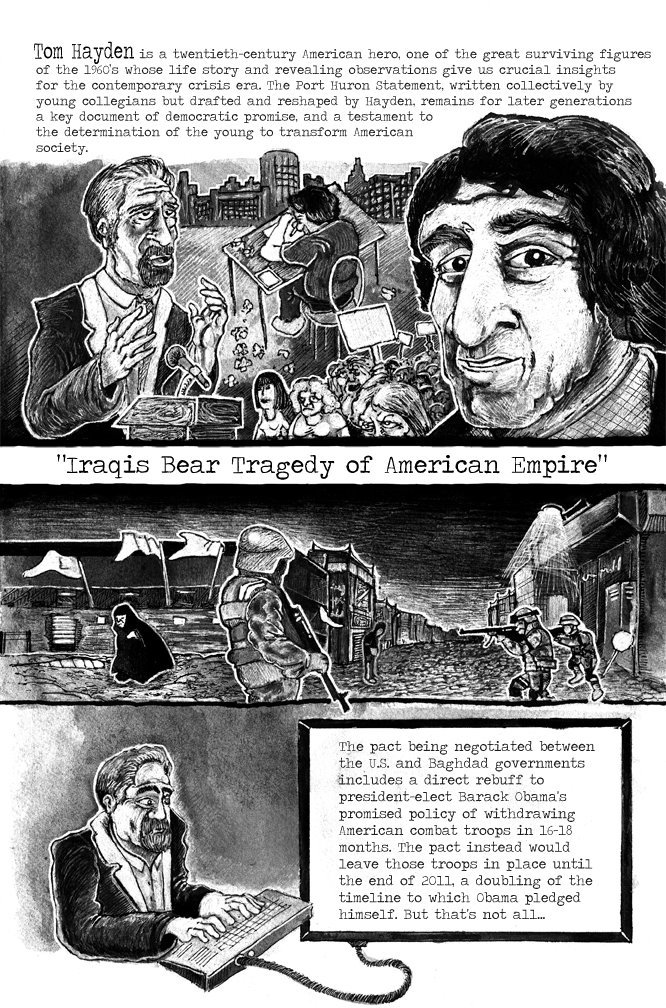
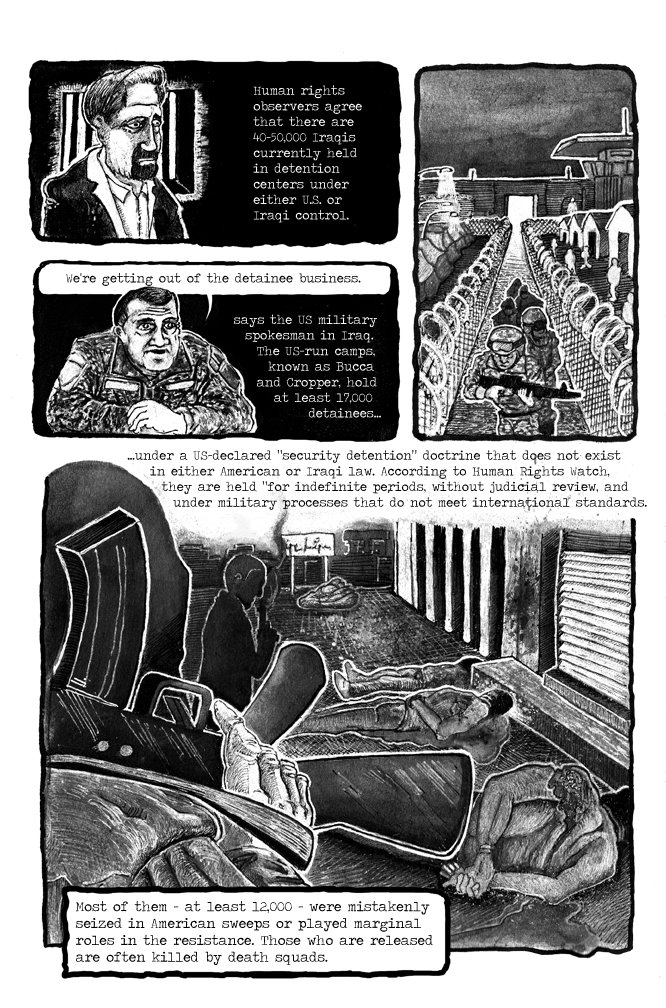
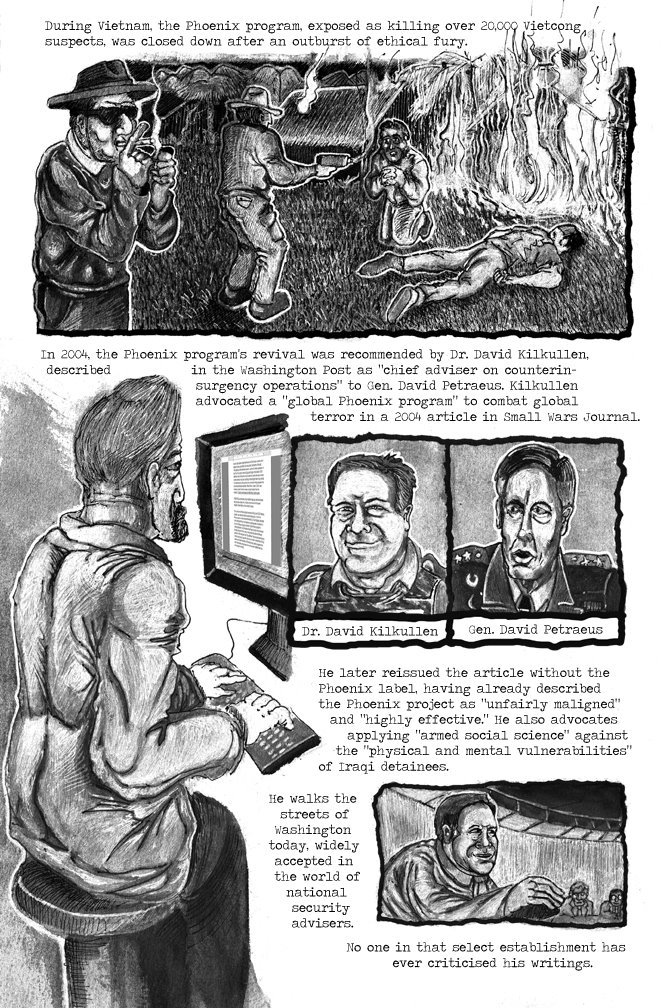
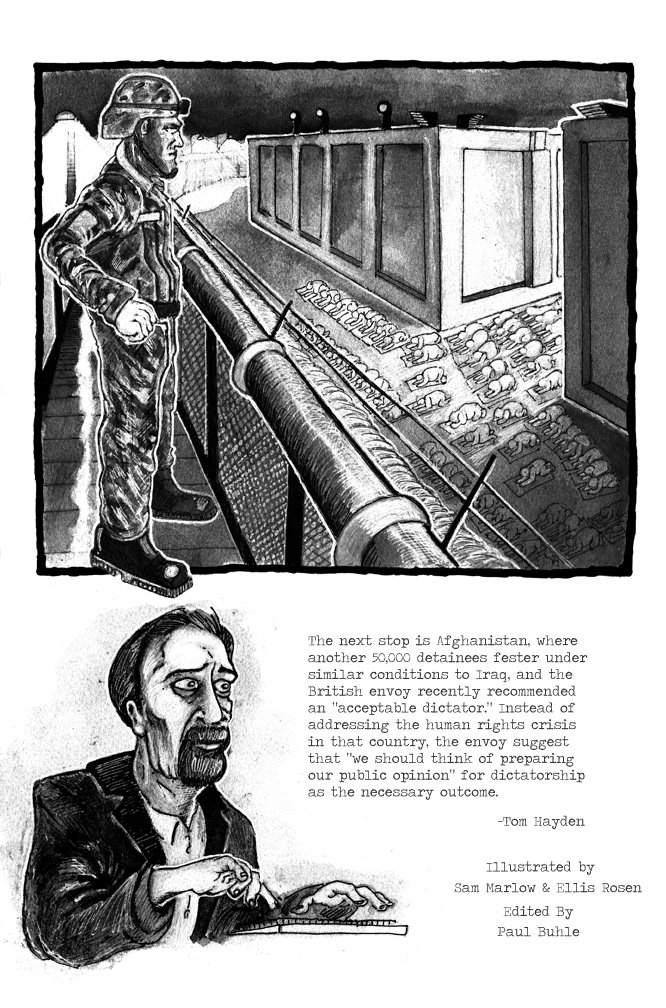
Tom Hayden Comic : The Tragedy of Iraq

Iraqis Bear Tragedy of American Empire
Text by Tom Hayden.
Illustrated by Sam Marlow and Ellis Rosen. Edited by Paul Buhle.

Published by The Rag Blog.

CLICK TO ENLARGE

See additional frames, Below.

Comic art is growing up
By Paul Buhle / The Rag Blog / April 7, 2009

Comic art is growing up. And the youngest generation promises to be the best yet, building upon the work of the past. That is to say: the previous generations of newspaper and comic book art, but especially the Underground Comix days of The Rag and others, and the alternative art (Austin’s Jack Jaxon notably) that began to take history seriously. I’m happy to have had a small role in much of this since the appearance of RADICAL AMERICA KOMIKS in 1969, with Gilbert Shelton in charge editorially and me, a mere publisher.

It was the happiest of coincidences that brought artist Ellis Rosen and Sam Marlow together with me, through a particularly wonderful student of mine at Brown. I’d been working fitfully on a Tom Hayden Comic, given it up a couple years ago, now see it come to life in a new way, from Tom’s passing observations on the global scene.

Keep tuned, this is something new and exciting.

CLICK TO ENLARGE

CLICK TO ENLARGE

CLICK TO ENLARGE

[Tom Hayden, a prime mover in the Sixties New Left, was a California State Senator. A respected activist and author, he was a founder of Progressives for Obama and is the author of Ending the War in Iraq (2007), The Voices of the Chicago Eight (2008), and Writings for a Democratic Society, the Tom Hayden Reader (2008).]

[Sam Marlow and Ellis Rosen are graduates of the School of the Art Institute of Chicago. Together they self-published two comics. Marlowe also worked as a digital colorist for Chicago comic artist, Paul Hornshemeier, on titles such as “The Three Paradoxes”, and Marvel Comics’ “Omega the Unknown.” He recently completed a short science fiction comic about the end of the world. He is currently volunteering at the Museum of Comic and Cartoon Art. Rosen lives in NewYork where he also works part time at the Barry Friedman Gallery.]

[Paul Buhle is an educator and a historian. He published the New Left journal Radical America during the 1960s and has written or edited many books on radicalism and culture. He now organizes leftwing comic books.]

Coming Soon: “Partial Peace, Looming War,” by Tom Hayden, a Rag Blog comic.


The Rag Blog

Posted in Rag Bloggers | Tagged , , , | 1 Comment

Cuba: Encouraging Artists to Criticize the System

Cuba’s Minister of Culture Abel Prieto in Havana during an interview he granted La Jornada. Photo: Pablo Espinosa.

Cuba urges artists to be critical in order to defend the utopia, Abel Prieto says
By Pablo Espinosa

A CubaNews translation. Edited by Walter Lippmann. Originally published April 2, 2009.

This analytical spirit is often in line with our efforts to eliminate the very bureaucracy we have created, holds the Minister of Culture. We have managed to turn our capital city into a great art gallery, he tells La Jornada.

HAVANA — Cuban Minister of Culture Abel Prieto stated in no uncertain terms that using art to criticize the system is indeed a revolutionary action nowadays. “We encourage the kind of critical, reflective art that helps find out where we go wrong and defend the utopia. When criticism is exercised from a position of commitment to the country, the outcome can be really productive”.

Interviewed by La Jornada a week into the 10th Havana Biennial, the senior official offers a preliminary assessment, speaks about sensitive topics and stakes out new directions for Cuban culture.

Q: What would be a preliminary assessment now that the 10th Biennial is in full swing?

“We are quite satisfied. A major goal has been met: turning Havana into a great art gallery. It’s a principle of our cultural policy to outsmart and democraticize any elitist approach to art. Still, our institutions are weak in the face of talent, whose strength, energy and demanding nature are beyond our real institutional ability.

“That we sometimes find ourselves crippled to operate by financial problems and a marked lack of resources is a crude reality we can’t deny. When you add it all up you realize this Biennial was put together cent by cent and working wonders. Some friends who know about it told us, ‘Hey, you need millions to organize a thing like this’…”

A FORUM OF RADIATING POVERTY

“This is a biennial of poverty,” Abel Prieto continues, “of radiating poverty, like [late Cuban writer José] Lezama Lima said, and I mean it as a good and positive quality.

“And it’s precisely the field of visual arts where we are worst stricken, because our institutions lack the financial means to put artists on the great market.

“However, artists like Kcho, for instance, acknowledge that the Havana Biennials have been a launch pad for the main Cuban artists in the last 20 years.”

Q: Is it in the nature of this Biennial to promote alternatives to a market-oriented art?

“One of the Biennial’s principles is to provide a choice to dealership and the frequent occurrence of fraud, since some works receive a lot of publicity and become highly successful even if they have almost no artistic value.”

Q: How significant is the presence in this Biennial of U.S. artists and their works of political criticism?

“It puts symbolic pressure on Obama’s government and its hostile blockade and policy. There’s a whole movement of artists and cultural representatives in the U.S. who oppose any barrier to cultural exchange, even powerful people who hold important positions in show business.

“Unfortunately, as you know, Joe Biden said a few days ago that the blockade will remain. We expect no big changes in the U.S. policy on Cuba, but at least the exhibition Chelsea visits Havana raises a symbolic flag after years of silence under Bush. Many U.S. actors used to come before, such as Jack Nicholson, Robert de Niro, Steven Spielberg, etc. The Cuban National Ballet traveled every year to the States, and so did the music group Los Van Van. At a disadvantage, of course, since neither [Cuban prima ballerina] Alicia Alonso’s company nor [Cuban singer and composer] Juan Formell’s band could be paid for what they did, a drawback to the Cuban artists but a cultural exchange after all.

“There was a Havana Biennial attended by three thousand American artists. Bush nipped that in the bud by denying them further visas. He even had the passports of Irakere’s founder Chucho Valdés and Los Van Van’s director Juan Formell stamped with an insane caption that says something like they are dangerous to the national security of the United States. That’s how far he took his paranoid hatred.

“That’s why Chelsea visits Havana is such an important exhibition: it’s a first for U.S. culture in the post-Bush era. Here in Cuba we always stress the fact that we feel no contempt for the American people or their artists, quite the opposite.”

HEALTHY REVOLUTIONARY CRITICISM

Q: An outstanding fact of this Biennial is the presence of the Cuban artist Tania Bruguera with her Cátedra de Arte Conducta (Studies in the Art of Behavior), made up of very young figures whose work levels harsh criticism at the Cuban system. Is that openly critical spirit encouraged or tolerated?

“A critical, analytical art that rekindles society’s time-honored, avant-garde spirit of changing things, people and the environment is visible not only in Tania’s project, but in general among our young artists.

“It’s a healthy thing, this criticism from positions of commitment to the Revolution which is very often in line with our efforts to be more efficient and eliminate the bureaucratic snags we have put up ourselves.”

Q: There are works in this Arte Conducta Workshop where Fidel Castro is portrayed as one of those plush animals you can “fish” for some coins from vending machines in shopping malls and the glorification of Cuban athletes is shown to be nothing but an utilitarian tendency to treat them like objects. Is that also a tolerated or a fostered practice?

“Those artworks sprung from Arte Conducta have a demystifying purpose which proves very attractive to young artists. But there’s a downside, like the provocation on Sunday evening during Bruguera’s performance when this famous bloger-girl Yoani Sánchez took the microphone and made a speech against the Revolution. She said the Internet was a chink in the wall of Cuban censorship.

“She talked about something we deem important: to provide a proper framework to receive that kind of art. But it happens that we in Cuba are under constant surveillance by a media bent on distorting reality on a regular basis. The Sunday events were used by unscrupulous individuals and the Florida-based newspapers.

“That’s one of the topics addressed by this critical art in Cuba, which we promote in order to fuel reflection and pinpoint our flaws, so that it helps us defend the utopia.

“When you exercise criticism as Tania Bruguera does, from a position of commitment to the country, the outcome can be really productive.”

Source / La Jornada

Thanks to Jeffrey Segal / The Rag Blog

Posted in RagBlog | Tagged , , | Leave a comment

‘Justice in the Coalfields’ : The Pittston Strike, April 5, 1989

Trailer: ‘Justice in the Coalfields’ by Anne Lewis

Anne Lewis’ provocative and skillfully produced documentary of the strike, Justice in the Coalfields, has had a profoundly formative influence not only on my understanding of the struggle, but larger issues of American culture and Appalachian collective politics… Justice in the Coalfields is a remarkable oral history narrated by persons on both sides of the nearly year-long dispute.Tal Stanley / Southern Changes

By Anne Lewis / The Rag Blog / April 6, 2009

Yesterday was the anniversary of the Pittston Strike that began April 5, 1989 in Virginia’s coal country.

The reason I know is that I had one of those flashback moments last week. The Richmond Times Dispatch wanted clips from my film “Justice in the Coalfields” to run on their website for a major retrospective on the Pittston strike. Then they laid off the reporter (one of 28 lay-offs) on Friday so they didn’t run the story. And just when they were doing something good about the coalfields. Folks in southwest Virginia (and I was one of them) believe that the only time the rest of the state recognizes their existence is when the governor declares martial law.

The Pittston strike rings out as an example of worker and community solidarity. More than 1,700 coal miners in southwestern Virginia and West Virginia walked out after the company revoked the health care of pensioners, disabled miners and their families, and widows. There were 4,000 arrests for nonviolent civil disobedience against Pittston which owned Brinks armored trucks as well as coal mines.

The strike was about so many current issues — the demand for universal health care, global energy, lay-offs, worker/community alliances, the Right to Work law, that “Justice” might have renewed usefulness.

You can also view a trailer from the film at annelewis.org. If you have any problems, you might want to right click on the link and open with quicktime player. The trailer is also available at Appalshop’s General Store.

Here is a review of the film by Tal Stanley. It appeared in Southern Changes in 1995.

[Anne Lewis is an independent filmmaker associated with Appalshop, senior lecturer at UT-Austin, and member of TSEU-CWA Local 6186 and NABET-CWA. She is the associate director of “Harlan County, U.S.A” and the producer/director of “Fast Food Women,” “To Save the Land and People,” “Morristown: in the air and sun,” and a number of other social issue and cultural documentaries. Her website is annelewis.org.]

See these related articles:

  • Tension Easing, but Miners’ Strike Against Pittston Goes On by B. Drummond Ayres Jr. / Special to The New York Times / Nov. 26, 1989
  • The Place of Justice by Tal Stanley / Southern Changes / Vol. 17, No. 3-4, 1995
  • And:

    The Rag Blog

    Posted in Rag Bloggers | Tagged , , , , , , | 1 Comment

    Dr. Stephen R. Keister : The Insurance Industry Could Use a Hippocratic Oath

    Hippocrates / josh pincus is crying.

    Nowhere, does the Hippocratic Oath require a physician to be a peon, or a servant of a HMO or insurance company.

    By Dr. Stephen R. Keister / The Rag Blog / April 6, 2009

    The total lack of ethical or moral standards in our society is now being demonstrated by the actions of the health insurance industry, its prostitutes, and its collaborators. Their deceit and arrogance was highlighted during a special on PBS that aired Friday, April 3. Its subject was our country’s current health insurance problems, and the producers’ not so oblique contention that these indignities could never happen in a European nation.

    Then on Sunday, April 5, CBS’ 60 Minutes ran an account of the University of Nevada Medical Center’s having to cancel treatment of all uninsured cancer patients due to budgetary difficulties. Happily, my anger was mitigated in part by my experience with a private oncology practice that takes on a limited number of these poor folks in their private practice, requesting small donations from patients and the community. Only in the USA!

    I am taken back in time to a date in 1943 when I and my classmates in our academic robes recited:

    I swear by Apollo the physician and Asclepius, and Hygieia and Panacea and all the gods and goddesses as my witness, that, according to my ability and judgement I will keep this Oath and this contract. To hold him who taught me this art dear to me as my parents, to be a partner in life with him, and to fulfill his needs when required; to look upon his offspring as equals to my own siblings, and to teach them this art, if they wish to learn it, without fee or contract, and that the set of rules, lectures, and every other mode of instruction, I will impart a knowledge of the art to my own sons, and those of my teachers, and to students bound by this contract and having sworn this Oath to the law of medicine, but to no others. I will use those dietary regimes which will benefit my patients according to their greatest ability and judgement, and I will do no harm or injustice to them.

    I will not give a lethal drug to anyone if I am asked, nor will I advise such a plan; and similarly; I will not give a woman a pessary to cause an abortion. In purity and according to divine law I will carry out my life and my art. I will not use the knife, even upon those suffering from stones, but will leave this to those who are trained in this craft. Into whatever homes I go, I will enter them for the benefit of the sick, avoiding any voluntary act of impropriety or corruption, including the seduction of women or men, whether they be free men or slaves. Whatever I see or hear in the lives of my patients, whether, in connection with my professional practice or not to be spoken outside, I will keep secret, as considering all such things to be private. So long as I maintain this Oath faithfully and without corruption, may it be granted to me to partake of life fully and the practice of my art, gaining the respect of all men for all time. However, should I transgress this Oath and violate it, may the opposite be my fate.

    Nowhere, does the Hippocratic Oath require a physician to be a peon, or a servant of a HMO or insurance company. The fall of a noble profession occurred some 30 years ago when the various insurance companies colluded to take over the practice of medicine in the United States, strictly for their own profit and enrichment, and were unopposed, by-in-large, by the doctors who were too distracted, too cowardly, or too concerned about income, to turn aside this well financed Leviathan.

    Today the United States stands alone in the world with this monstrous situation where if you cannot provide health insurance you can jolly well go ahead and die. There are folks, supported by 73% of the literate population of the USA, who wish as their right universal single payer health care. However the propaganda mill of the insurance industry, abetted Richard Scott’s pro-free market message, is already at work with deceit, misinformation and out and out lies about what universal health care entails. Scott is backed by a group of Republican PR consultants in an effort to persuade those who cannot think for themselves that the USA has the best health care in the world. He puts forth the lie that in Europe one cannot choose their own physician, must wait inordinately long for treatment, and that care is managed by “bureaucrats.” ALL LIES. This is the same Scott who, according to a 2000 article in Forbes, was forced to resign as head of what became known as Columbia/HCA after fraud charges against the massive health care company in 1997. He was replaced by Thomas Frist, Jr., the original founder of HCA and brother of future Senate Majority Leader Bill Frist.

    Let us take a look at European medicine, which I fear becomes entangled with European education, as one will see. First of all it is not “socialized medicine,” there is no such thing. This is a word contrived by those who will deny Americans decent health care. Matter of fact, universal health care in Germany arose in the late 1800s under Otto van Bismarck, a Royalist, and in England under Winston Churchill, a Conservative, to note two examples. Each European nation has variations in its system; hence, let me try and amalgamate the essence of the various nations into a single entity which we will call New-Gaul.

    New-Gaul has health care for all citizens, from birth to death, without payment for services, or in some instances, a minimal co-payment. One can choose one’s own doctor, dentist, specialist or hospital. For acute surgical procedures or medical emergencies there is no waiting. For elective procedures there may be a wait of several weeks, i.e. total knee replacement. Pharmaceuticals may be free or purchased for a minimal amount. One is not rushed out of the hospital after an illness or operation to save the insurance company money. Medical appliances and devices are covered by the program. There are more doctors, hospital beds and MRI machines per capita than in the USA. Many doctors make house calls since there is an abundance of primary care doctors since physicians are trained by the government. The city hospital ERs are not overburdened by taking care of gunshot wounds. One may buy inexpensive private insurance to cover private hospital rooms, special nursing, or to see a few physicians not included in the system.

    How is this paid for? The income for universal health care is bundled with that for education providing free education through the university for qualified student. There is no property tax. Income taxes are commensurate with ours save for the wealthy who are taxed at a much higher rate. There is a very high gasoline tax, a gallon costing approximately twice what it costs in the USA; hence, the New-Gaul citizen uses a gasoline conserving vehicle or uses the excellent, frequently running, well-maintained public transportation. There is a 16% value added tax, i.e. similar to a sales tax on all manufactured products, but not on food.

    Such a plan has been introduced into the US congress: Rep. John Conyers’ HR 676 in the House of Representatives and Sen. Bernie Sander’s bill in the Senate. However, Sen. Max Baucus, in charge of introducing health care legislation to the Senate, has stated that “single payer health care is off the table.” It is noted that Sen. Baucus wants to force everyone to buy health insurance by legislation. I have pointed out in previous articles that this entails questionable constitutionality. It should be noted as well that Sen. Baucus is one of the senators who receives the largest campaign contributions from the insurance and pharmaceutical industries.

    Sen. Baucus’ plan, which will be run by the insurance companies, will cost the tax payer twice what the Sanders bill will cost. The Baucus concept is supported by ex-congressman “Billy” Tauzin who now runs the pharmaceutical lobby. While in congress he helped steer President Bush’s Medicare Prescription Bill through Congress with a pay off of millions of taxpayer dollars to the insurance and pharmaceutical industries. Recall as well that these Medicare plans, run through the insurance industry, tend to shun persons taking certain medications. Of course, this is what the Republicans, some well purchased Democrats, and the political right think the American people deserve. We who want better are opposed by a well financed ruthless power structure that depends on the naiveté of the people. The denouement approaches!

    Joe Klein in the April 6, 2009, Time Magazine, reviews a book by Leslie Gelb of the Council on Foreign Relations. Gelb is a prickly political moderate, and has words worth listening to: “Republicans act like rabid attack dogs in and out of power, and treat facts like trash. Democrats seem to lack the decisiveness, clarity of vision and toughness to govern.”

    For those who are really interested in how the health insurance industry can defraud one, I suggest reading the article “Hazardous Health Plans” in the May, 2009, Consumer Reports. Then organize groups to visit your elected senator and representatives and make yourselves known in a peaceful manner. We who want better for the nation do not have the vast resources of the corporate interests; hence, we must make our case personally.

    I had hoped to review the subject of medical costs and related subjects including “non-profit” institutions and the culture of medical fee structures; however, my ranting is long enough for now. I hope that I can keep my own malignancy in abeyance until we can see a positive resolution, of some nature, not including the insurance industry. The people of the United States deserve better…

    [Dr. Stephen R. Keister, a regular contributor to The Rag Blog, lives in Erie, PA. He is a retired physician who is active in health care reform. His previous articles on The Rag Blog can be found here.]

    The Rag Blog

    Posted in Rag Bloggers | Tagged , , , | 3 Comments

    Life During Wartime : The Contortionist

    Political cartoon by Joshua Brown / Historians Against the War / The Rag Blog

    The Rag Blog

    Posted in Rag Bloggers | Tagged , | 2 Comments