More About MRSA and Agribusiness

This is a follow-up to an article we posted a few days ago. The big news here is the potential connection between the development of debilitating (even deadly) antibiotic-resistant pathogens and the use of antibiotics in animal feed. Let’s press for more active research to determine if this might be true.

Richard Jehn / The Rag Blog

A simple petri dish test revealed that by overlooking basic hygiene, a healthcare worker infected a quadriplegic Iraq war veteran with MRSA, an antibiotic-resistant bacteria that plagues hospitals. Photo: Source.

Pathogens in Our Pork
By Nicholas D. Kristof / March 14, 2009

We don’t add antibiotics to baby food and Cocoa Puffs so that children get fewer ear infections. That’s because we understand that the overuse of antibiotics is already creating “superbugs” resistant to medication.

Yet we continue to allow agribusiness companies to add antibiotics to animal feed so that piglets stay healthy and don’t get ear infections. Seventy percent of all antibiotics in the United States go to healthy livestock, according to a careful study by the Union of Concerned Scientists — and that’s one reason we’re seeing the rise of pathogens that defy antibiotics.

These dangerous pathogens are now even in our food supply. Five out of 90 samples of retail pork in Louisiana tested positive for MRSA — an antibiotic-resistant staph infection — according to a peer-reviewed study published in Applied and Environmental Microbiology last year. And a recent study of retail meats in the Washington, D.C., area found MRSA in one pork sample, out of 300, according to Jianghong Meng, the University of Maryland scholar who conducted the study.

Regardless of whether the bacteria came from the pigs or from humans who handled the meat, the results should sound an alarm bell, for MRSA already kills more than 18,000 Americans annually, more than AIDS does.

MRSA (pronounced “mersa”) stands for methicillin-resistant Staphylococcus aureus. People often get it from hospitals, but as I wrote in my last column, a new strain called ST398 is emerging and seems to find a reservoir in modern hog farms. Research by Peter Davies of the University of Minnesota suggests that 25 percent to 39 percent of American hogs carry MRSA.

Public health experts worry that pigs could pass on the infection by direct contact with their handlers, through their wastes leaking into ground water (one study has already found antibiotic-resistant bacteria entering ground water from hog farms), or through their meat, though there has been no proven case of someone getting it from eating pork. Thorough cooking will kill the bacteria, but people often use the same knife to cut raw meat and then to chop vegetables. Or they plop a pork chop on a plate, cook it and then contaminate it by putting it back on the original plate.

Yet the central problem here isn’t pigs, it’s humans. Unlike Europe and even South Korea, the United States still bows to agribusiness interests by permitting the nontherapeutic use of antibiotics in animal feed. That’s unconscionable.

The peer-reviewed Medical Clinics of North America concluded last year that antibiotics in livestock feed were “a major component” in the rise in antibiotic resistance. The article said that more antibiotics were fed to animals in North Carolina alone than were administered to the nation’s entire human population.

“We don’t give antibiotics to healthy humans,” said Robert Martin, who led a Pew Commission on industrial farming that examined antibiotic use. “So why give them to healthy animals just so we can keep them in crowded and unsanitary conditions?”

The answer is simple: politics.

Legislation to ban the nontherapeutic use of antibiotics in agriculture has always been blocked by agribusiness interests. Louise Slaughter of New York, who is the sole microbiologist in the House of Representatives, said she planned to reintroduce the legislation this coming week.

“We’re losing the ability to treat humans,” she said. “We have misused one of the best scientific products we’ve had.”

That’s an almost universal view in the public health world. The Infectious Diseases Society of America has declared antibiotic resistance a “public health crisis” and recounts the story of Rebecca Lohsen, a 17-year-old New Jersey girl who died from MRSA in 2006. She came down with what she thought was a sore throat, endured months in the hospital, and finally died because the microbes were stronger than the drugs.

This will be an important test for President Obama and his agriculture secretary, Tom Vilsack. Traditionally, the Agriculture Department has functioned mostly as a protector of agribusiness interests, but Mr. Obama and Mr. Vilsack have both said all the right things about looking after eaters as well as producers.

So Mr. Obama and Mr. Vilsack, will you line up to curb the use of antibiotics in raising American livestock? That is evidence of an industrial farming system that is broken: for the sake of faster-growing hogs, we’re empowering microbes that endanger our food supply and threaten our lives.

Source / New York Times

The Rag Blog

Posted in RagBlog | Tagged , , , | 2 Comments

Rachel Maddow and the Irresistible Rise of Sarcastic News


The Sarcastic Times. . .

For Rachel Maddow and the other ironic anchors, absurdity is serious stuff

What has caused sarcastic news to flower? For starters, today’s bloggers and YouTube snidesters see parody as information and information as parody.

By Alissa Quart

[The following article appears in the March/April, 2009 issue of the Columbia Journalism Review.]

On a Wednesday night in December, Rachel Maddow, in a toreador-style black jacket, waits for her show to start. She types last-minute notes on her computer with the intensity of a graduate student. At the 30 Rock news television studio, with its red, white, and blue décor, late-night assistants running about, and two dozen television screens on all around her, Maddow seems in her element. And when the show begins, perhaps unsurprisingly, it is devoted to “Blago”–the thoroughly and hilariously embarrassing (and now former) Illinois governor Rod Blagojevich. Maddow asks the “awkward question,” as she puts it: Is Blago not well? She riffs a bit and then concludes, with a sarcastic smile, “Illinois, you are getting almost as fun to cover as Alaska!”

MSNBC’s The Rachel Maddow Show made its debut in the fall of 2008 and by October had grabbed 1.89 million viewers, beating CNN’s Larry King Live in the over-twenty-five and under-fifty-four demographic for that whole month. Maddow’s mocking on-air demeanor reminds many people of what they liked most about college. But she’s not just clever: she’s a tough-minded Rhodes Scholar, former aids activist, and an out lesbian. Her very existence as an anchor on cable television defies a number of different common wisdoms.

That’s all remarkable unto itself. But to my mind, what really makes the show special is how it embodies the rise of what I think of as sarcasm news. More and more news programs are likely to go absurdist in the coming months and years. As faith in and loyalty to traditional anchors wither, one can even hear ironic Maddowian intonations creeping into the delivery of CNN’s not-so-funny anchor Campbell Brown on her new show.

Now, you may be thinking, Jon Stewart and Stephen Colbert perfected comedy news a while back, no? But Maddow marks a watershed for a different sort of news comedy. Stewart (and Craig Kilborn before him) was a comic first and foremost—when The Daily Show started, the news was the surprising part. Maddow’s show works the opposite way: the news is the thing and the humor is the surprise. Along with her precursor, the five-year-old Countdown With Keith Olbermann, these are two “real” news programs permeated by parody.

What has caused sarcastic news to flower? For starters, today’s bloggers and YouTube snidesters see parody as information and information as parody. This is not entirely a mistake. Now, the news-with-satire approach can seem like the only thing that makes sense, since at least these shows are in on their own jokes. Even politicians sometimes embrace the idea of themselves as caricatures. They show up on Saturday Night Live to rap, or to meet their comedy doubles. They import self-parody into their own campaigns, as in Hillary Clinton’s faux Sopranos video on YouTube.

Also, the proliferation of niche audiences spurs sophisticated and partisan humor because these smaller groups of viewers have very particular tastes, identities, and affinities. They are thus more likely to share a sense of what’s funny. Critical verbal humor is a very specific thing—one reason that American film comedies struggle for viewers overseas. Sarcastic ripostes call for sarcastic viewers who know how, and when, to laugh. Simply put, Maddow is joking to the converted.

Finally, we have a far more sophisticated audience today than in the past, one that sees more clearly behind the manipulations and stagecraft of its political leaders. Two decades ago, Reagan got away with his spin, and his spinster, Michael Deaver, was and still is considered an untainted spokesman. Karl Rove, on the other hand, is widely seen as a vile little prince of handling. Yet Deaver, if we remember, was as much a master manipulator as Rove was; he got Reagan, you’ll recall, to gin up fake remorse during the Iran-Contra affair. Both the comedy and the news coverage of our decade and decades past reflect each era’s understanding of public relations and doublespeak. Now, news parody is truly a tool with which to strike back at political PR.

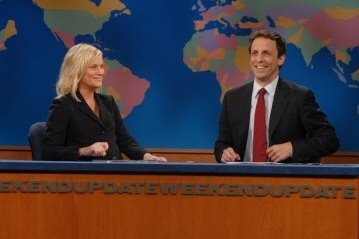
Political caricatures have been an American staple since the Colonial period. In the late nineteenth century, these sorts of illustrations tended to be scathing social critiques. In the twentieth century, though, news parodies were a bit more milquetoast. This was true even thirty-three years ago, when Saturday Night Live’s “Weekend Update” kicked off the modern form of news parody. Back then, of course, real anchors exuded TV’s version of gravitas and solidity. The SNL Update was just milking anchors’ self-seriousness for laughs.

In the 1990s and 2000s, this satirical mode built up a head of laughing gas with The Daily Show With Jon Stewart, Stephen Colbert, and Air America’s Al Franken. Comic news has become so popular that it even saved the career of a louche pothead named Bill Maher, who in a few short years went from comic outlier to éminence gris.

According to Bill Wolff, executive producer of The Rachel Maddow Show and vice president of msnbc’s primetime programming, nothing less than George W. Bush has paved the way for his programs, as well as the others. “The funnier side of the political spectrum is the one where your enemies are most ridiculous,” says Wolff.

Maybe, but I think it has more to do with a shift in how people like information conveyed. Bush perhaps accelerated the process. So many felt degraded by the Bush era that they wished to degrade him back, on television. And then there are liberals who are now recalling their long-forgotten weapon: wit. As Jackson Lears, a professor of American history at Rutgers University, says of Maddow and the rest, “After decades of being mocked for excessive earnestness, the Left is remembering what the [1960s] counterculture knew: flagrant lies demand absurdist responses; they deserve to be not merely refuted but laughed to scorn.”

Still, MSNBC’s Wolff admits his network has gone in this direction partly due to the success of its rival network, Fox. A decade ago, Fox was established and MSNBC was just starting to brand itself as a distinct network. After Olbermann’s show became a hit, one might hypothesize that msnbc thought it could go for broke by doubling down on Maddow.

Wolff ties the rise of Maddow and Olbermann to their ability to bring analysis to news audiences. “With information becoming cheap, the success of Rachel and Keith is because people want someone collating or commenting on information,” says Wolff.

A lot of Maddow’s success derives from her taste for the absurd. At one point during the night of my visit, I watched from the sidelines as she showed a Christmas ad made by the coal industry, starring pieces of coal with bulging eyes and green and red carol books. “Anthropomorphic lumps of carbon singing,” Maddow hooted. Three cameras swung around her, using the in-your-face-and-out-of-our-minds technique so beloved by Olbermann. She then went further into the comedy ether: “The earth’s rotation is slowing down . . . that’s fodder for your next existential crisis.”

Throughout her show, Maddow’s bookishness comes through her wit. Early in the fall, she had a field day with Sarah Palin’s penchant for falsehoods, but in a very particular way. On one show around the election, she called Palin “a prevaricating, mendacious truth-stretcher or whatever other thesaurus words we can come up with for lying, is just far less efficient than calling a lie a lie, and a liar a liar.” I realized that in order to find this fully funny, you had to like jokes about abusing the thesaurus.

In October, Maddow’s wit became the accidental subject of one of her shows: a tormented-looking David Frum complained on-air that her humor was juvenile. “Making jokes about it is part of the way that I am talking about it,” Maddow fired back. “I don’t necessarily agree with you on ‘grown up.’ I think there’s room for all sorts of different kinds of discourse, including satire, including teasing, including humor. There’s a lot of different ways to talk about stuff, and Americans absorb information in a lot of different ways.”

It was a standoff between a conservative who knew that his party had lost its sense of humor and an anchor utterly assured that satire was the transom for getting political information—and critique—to her audience.

I talked with Maddow after her show about her absurdist approach. “When Frum said I talked about things in an immature way, I am cool with that,” she said, as she gleefully removed her pancake makeup (which she appeared to despise). She then told me how she first found her ironic humor, in college, when she crashed an event called Conservative Coming Out Day, stole the group’s sign, and changed it to Sexually Frustrated Conservative Mud Wrestling Day. After graduation, she had more prosaic practice in comedy: her early jobs in commercial radio included writing a hot-tub-company jingle and dressing as an inflatable calculator.

Still standing in the show’s mirrored makeup room, she donned her signature horn rim glasses and said, “I realized I didn’t have to be afraid to be smart, and the audience can be there with me.”

Maddow, like so many others in the Obama age, is moving the mainstream in her semi-subversive direction. But before progressives pop open Prosecco, celebrating how they’ve finally taken over not only the White House and the Senate but also cable news with comedy, let’s pause to consider these shows’ future. Olbermann and Maddow’s audiences combined aren’t as big as Brian Williams’s, and their market share fell off along with everybody else’s after the election. Will the clever-comedy-news trend last? I think yes, mostly because I don’t believe that Obama is so radiant that he will defy parody, or that Bush and Palin alone created our taste for irony-laced news. Also, the Republicans, and their nutsy pundits, are not going away.

There are those who fret about whether news humor simply co-opts political life, acting as an escape valve that lets our civic energy dissipate. I agree with them that news satire like Saturday Night Live’s can serve as this kind of vent, ameliorating outrage with a laugh. But Maddow’s wit—and more obviously, Olbermann’s—is too pointed to just act as a kind of political-anger-management regimen.

As for those critics who fear that Maddow and Olbermann and the others have replaced thoughtful newsgathering with snickering, I can see their point. But I think they don’t need to worry so much. As I watched Maddow do her show in the studio that winter day, she struck me as a relatively trustworthy source for news.

She may look Chaplinesque, with her dark cap of hair and expressive black eyebrows set against pale skin, but her humor is, actually, pretty serious stuff. In fact, her take on the news is so gravely absurd it often makes the news seem even darker than it is. By calling attention to the malevolence and dishonesty around us, Maddow and the new ironic anchors have come up with one way to shake us out of our exhausted acceptance of it all. 

Source / Columbia Journalism Review.

Thanks to Tom Cleaver / The Rag Blog

Posted in RagBlog | Tagged , , , | 4 Comments

A Rush from the Past : The Hammering of ‘Jabber the Nut’

Graphic by Larry Ray / The Rag Blog (with apologies to Jabba and friends).

Rush Limbaugh: The Hammering of ‘Jabber the Nut’

By Larry Ray / The Rag Blog / March 15, 2009

See Video from Rush Limbaugh’s 1990 TV talk show, Below.

Rush Limbaugh, during his brief and disastrous run as a TV talk show host in 1990, was hammered by his audience on one show to a point that he was forced to halt taping. Less than a minute after he started, his audience became so outraged at his mean spirited attacks on women that he literally couldn’t get a word in edgewise. Audience members repeatedly got in his face, refusing to be be intimidated by his bluster. Taping was stopped after the shouting, jeering audience ultimately reduced Rush to a red-faced mumbling wimp. Show producers finally were forced to clear the studio in order for Rush to be able to finish the segment.

With Rush challenging President Obama to debate him, the video clip below of a much younger Rush Limbaugh, shows how he actually holds up when he is not totally alone, unopposed, shouting into a microphone in his radio studio.

After the corpulent, “Jabber the Nut” shook like a ton of jelly speaking before the Conservative Political Action Committee a couple of weeks ago, it is delightful to see him hooted off his own stage before a real audience.

From the video archives, the “Hammering of Jabber the Nut” is presented below for your viewing pleasure . . . he makes it almost exactly one minute before the attack begins.

[Retired journalist Larry Ray is a Texas native and former Austin television news anchor. He also posts at The iHandbill.]

The Rag Blog

Posted in Rag Bloggers | Tagged , , , | 3 Comments

Austin : Eyewitness Accounts from Winter Soldiers for Peace

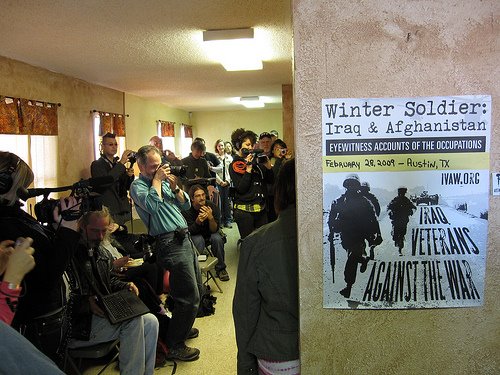
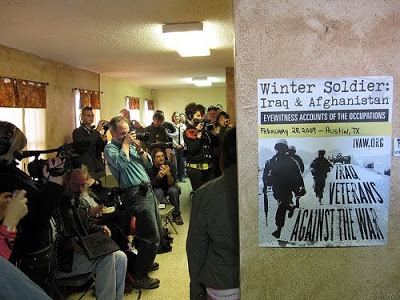
Winter Soldier: Iraq and Afghanistan. Austin, Texas, Feb. 28, 2009. Photo by Carlos Lowry / The Rag Blog.

Winter Soldiers for Peace

After three more decades of aggressions upon foreign soils, brigades of Veterans for Peace (VFP) and Vietnam Veterans against the War (VVAW) have been joined by Iraq Veterans against the War (IVAW). Testimonies today from this new generation of “boots on the ground veterans” will carry echoes blown in from Vietnam and Detroit ‘71.

By Greg Moses / The Rag Blog / March 14, 2009

AUSTIN — In the stone-walled sanctuary of Central Presbyterian Church, on Saturday, Feb. 28, three hundred faithful settle into pews as the dean of Austin peace activism, Fran Hanlon, previews how the rest of the weekend schedule has been planned for this Winter Soldier event.

Fran’s partner at the podium, Doug Zachary, is looking pleased already. The house is full. The program is printed. The act is together. A banner hanging large to stage left says “Winter Soldier” and Zachary with his whitening beard, angle-bent hat, and Palestinian scarf, is looking like a perfected instance of the eternal type.

Zachary has been a Winter Soldier for 37 years. In 1970 he won an honorable discharge after convincing the Marine Corps that he took the words of Jesus seriously. In 1971, as Zachary was seeking alternative paths through Texas, the Winter Soldier Movement was born in Detroit where 109 veterans of the War on Viet Nam turned out the truth of what they’d done as war criminals in a criminal war. Not many years later, of course, that war was ended.

After three more decades of aggressions upon foreign soils, brigades of Veterans for Peace (VFP) and Vietnam Veterans against the War (VVAW) have been joined by Iraq Veterans against the War (IVAW). Testimonies today from this new generation of “boots on the ground veterans” will carry echoes blown in from Vietnam and Detroit ‘71.

A Winter Soldier, says Zachary, is “loyal, steadfast, faithful, resolute, conscientious, scrupulous, and unafraid of painstaking work.” On this last day of February, 2009, with north winds howling out back along San Jacinto Boulevard, Zachary is here to declare that the movement– in these “times that try men’s souls”–shall not quit resisting the ongoing “imperialist, racist, and anti-democratic” wars on Afghanistan and Iraq.

Zachary yields the podium to the chaplain of the Austin IVAW, Hart Viges, who will be moderating the first panel of speakers. Viges looks like a lanky pastor with his trimmed hair, spectacles, dark blazer, white shirt, and blue jeans, not to mention the mighty large cross hanging on the wall behind him.

“I’d like to give a quote from Rabbi Yeshua (Jesus)” says Viges. “He said, ‘Blessed are the ones who have undergone ordeals, for they have entered into life’.” After this refreshing translation of a beatitude the IVAW chaplain reminds us that even the things we will hear today can be transcended.

They Built Hanging Gardens without Strange Fruit

First to speak today is Dr. Dahlia S. Wasfi, M.D. whose grandparents include a Sunni Muslim, a Shia Muslim, and two Holocaust Jews. She therefore begins her story with a memory of the Abraham who once upon a time walked with Allah in Iraq. Dr. Wasfi’s cousins will sometimes boast that they walk the same ground as Abraham, but it has been hard ground lately. There was an 8-year war with Iran, a 42-day bombing of the First Gulf War, and of course the Shock and Awe campaign of 2003. In such a land it would be miraculous not to be living out some disorder of post-traumatic stress.

A film clip pulls us into the streets of Fallujah where two children carry small bags to a cemetery. A tiny grave marks the burial of a child’s arm. A grown man weeps. Another declares that “our enemy” is anyone who had any part in these killings. Clicking between slides, Dr. Wasfi shows us two more children from Iraq and Philadelphia joined together through an extended family that spans half the world and several religions. Shouldn’t we be working to build a world where these children can enjoy a common future of peace and prosperity?

Consider the example of Babylon. Dr. Wasfi presents a slide of what the Hanging Gardens must have looked like when they counted among the Seven Wonders. Do we seriously think that such a people from such a land actually need our outside assistance to figure out how to be great or to do great things? Well there is one thing the Iraqi people could use that we could give them, says Dr. Wasfi, and that is immediate and unconditional withdrawal.

HUMINT Unit

Winter Soldier testimony begins with Ronn Cantu, who steps to the podium with trim dark hair, a bare shadow of beard and mustache, dressed in jeans and a black t-shirt that identifies him as an Iraq Veteran Against the War. In 2003, he believed so strongly in “the war on terrorism” that he re-joined the Army after two years out. The Army sent him to Iraq once, then twice. So 2007 found him back in Iraq.

“During my second tour I served as a human intelligence collector,” says Cantu, looking over his notes. “A lot of people know that as an interrogator, but interrogation is only half of what a HUMINT DIR does. The other half is source operations where we look for Iraqi citizens to give us information willingly and thereby become sources.”

Cantu explains the method of “dual source reporting” which requires two written statements before a suspect can be detained. The database assigns each report a number, but the number does not reveal whether a second report comes from a second source. Two reports from a single source could therefore qualify as “dual source reporting.” Database numbers could also be entered without any real sources behind them.

One of his first assignments was to help round up four members of an IED cell. It seemed like a “success” but Cantu wondered: “Does a flock disperse when you detain the shepherd?” As a HUMINT operator, Cantu was working for the “new body count,” and under these circumstances his unit could do what’s ethical or please the masters. “We did the latter.”

From questionable database practices that could barely count to two, the operation soon degraded into detain first, dual source later. From one suspected “al Qaeda” mosque Cantu’s unit detained every male and then looked for reasons to keep them. Thirteen qualified.

“Then the worst thing happened,” said Cantu. “We accidentally caught somebody big.” Congratulations came sliding down the command chain. What was there to do but to repeat the whole method next week. By this time the people in the neighborhood were convinced that the Army had declared war against Islam. To show how that wasn’t true, the Army got the Iraqi police to handle the next mosque roundup. Since the neighborhood was Sunni and the police were Shia, the operation worked perfectly to divide and conquer.

When detainees were sent to confinement with boot-shaped bruises, missing teeth, or broken arms, military handlers got nervous and started rejecting them. Once again, Iraqi police could help with backup detention facilities. But when Cantu attempted to report questionable detention practices on the basis of seeing a man with an eye swollen shut he was asked: “Did you see him being tortured?” What he heard was: “If you didn’t see it, it didn’t happen.” When a Warrant Officer assured Cantu that he did not have to carry out duties he considered to be illegal and discomforting, he began to pull away.

Gitmo Grand Opening

Brandon Neely was born into a military family in Georgia and he turned to the military when he reached working age in Texas. He still keeps a military haircut that he wears today with his IVAW t-shirt. Like Cantu’s before him, Neely’s confessions have been made in previous venues. He opens by explaining how military guards sent to the Guantanamo Bay prison were never trained in the Geneva Conventions because they were taught that Gitmo was an exceptional place where the Geneva Conventions didn’t apply.

We’ve seen pictures of Gitmo prisoners arriving at Camp X-Ray, dressed in bright orange jumpsuits, knit orange caps, surgical masks, goggles, earmuffs, and gloves; hands strapped together. What we didn’t see was the first guy who hopped off the bus on one leg as he was screamed at to move it. Nor did we see how after he had hopped so many yards someone bothered to toss from the bus his prosthetic leg.

We’ve seen the cruel pictures from Iraq of naked prisoners piled on top of each other, but we haven’t seen the pileup that Neely describes when a bunch of Gitmo guards jumped on top of a prisoner who called one of them a bitch.

And we’ve heard the hype about the Gitmo prisoners being certified homicidal maniacs, but we haven’t heard how the first prisoner that Neely took charge of was trembling with all his might under a fear of everything he expected to experience when ordered to kneel. He was slow to get into that position because he believed it would be his last. What Neely reflexively took to be killer resistance was only one mortal’s attempt to steal an extra breath from this life, sucking it down from behind a surgical mask that he was convinced he would never be able to remove. From their separate places across the globe, two distraught men were ordered to collide at Gitmo, each brainwashed into thinking that he was meeting a killer of instant resort.

Wake Up Call

“He knew how to sleep as only the innocent and the dead could dig,” says Rooster Romriell, opening his testimony with a poem made from fragments of razor-edged memories. Long hair covering his right ear is mismatched by a buzz cut on the left side, as if to say once you get that military cut, it can never be outgrown. His black t-shirt declares an imperative: “Support GI Resistance.”

Rooster transports the sanctuary to a home in Sadr City where an American squad has just discovered an AK-47, which is a legal weapon to keep at home. We watch horrified as “an old woman with an infant in her arms” falls to the ground “weeping inconsolably” as two shots ring out. The bullets crash through an innocent man’s face. With a quivering chin, Rooster tells us that the woman still screams in his head at night when he’s trying to sleep.

Then comes the dump truck. American troops fire upon it and watch it burn. A man comes “waving a white cloth and yelling ‘baby, baby,’ trying to tell us that we were destroying nothing more than children and garbage.” Rooster’s flesh quivers again with the pain of a conscience that dares him not to cry on the spot. He exhales into the sanctuary and we barely breathe. He has more stories to tell.

“Obama claims that he wants to withdraw the troops from Iraq—at least he did prior to gaining the presidency—all the while saying that Iran is a constant threat, allowing troops to be increased in Afghanistan, turning his sights on Russia, claiming they were delivering nukes to the terrorists, and now he’s confronting China for currency manipulation and monetary policy. He’s calling for a civilian security force and mandatory service. We cannot allow a blind eye to be turned on these things. Obama is no friend to the veteran.” As Rooster withdraws from the podium, Cantu offers a handshake.

“Bring the Troops Home Now”

“I’m a little overwhelmed by some of the testimony that’s been shared with us today, as I imagine many of you are,” says the next speaker. Greg Foster is president of the Austin IVAW. He is a panelist during this part of the program. Later he will serve as moderator. His black t-shirt bears a familiar script: “We the People.” Picking up the general theme of the day, Foster declares that Winter Soldiers are responsible citizens.

“We know the reality of the occupations of Iraq and Afghanistan,” says Foster. The testimonies may be difficult to speak and difficult to hear, but the truth is important and it should be shared. The US owes compensation and reparations for damage done on foreign soil, but the country also needs to provide full benefits and adequate health care to “soldiers and Marines.”

Foster, like Rooster, spent time in Sadr City. He recalls fighting street by street to secure a zone of operation, then watching burned-out awnings replaced with fresh cloth. “I saw Sadr City slowly start to rebuild itself.” After his unit was transferred out, the new unit had to start all over again with another street-by-street battle to reassert the “hegemony” of American power. Says Foster: “When I say bring the troops home now, it’s not a slogan.”

The FOBulous Life

After a crowded and chattering intermission in the basement Fellowship Hall, the afternoon program resumes with two videos by Casey J. Porter. As far as Porter was concerned, one tour of duty in Iraq would have been enough. After returning from his first year in Iraq he joined the IVAW in 2007. Yet that same year he was “stop-lossed”– instead of getting out on schedule he was ordered back to Iraq. This time around, Porter posts short anti-war videos to his YouTube channel.

The first Porter film today is “The Deployment Game: Livin’ FOBulous,” a satirical presentation of Camp Taji, a forward operating base (FOB) north of Baghdad that boasts 29,000 square feet (count ‘em) of retail space, complete with comfort foods from back home (listed in order of appearance): Subway, Burger King, Pizza Hut, Seattle’s Best Coffee, Cinnabon, and Taco Bell.

Cut to a car salesman seated behind a laptop, discussing the price of a Mustang GT fully loaded with leathers, then to a segment about KBR–the corporation that announced 2007 revenues of $8.7 billion, down a hundred million dollars from 2006 because of “lower Iraq-related activities in the Government and Infrastructure business unit.” From a faucet in Iraq we watch a dingy yellow liquid fall into a sink and down a drain. If it’s not a picture of the clean water KBR is supposed to be providing, then it’s a perfect image of something.

“It’s going to take a lot of stuff to kind of fix this bruise that we put on the whole earth,” says a fully jacketed combat soldier in the Porter film Deconstructed. A hand-held camera follows soldiers through a home raid, lingers over a twig that a soldier uses to poke through human remains, records passing scenes of Iraqi life as viewed from a moving patrol vehicle, and occasionally shows a tender moment between an American GI and an Iraqi child. “Going out into these neighborhoods and really helping to reconstruct, we’re not you know,” says the GI. “I don’t see that happening. I don’t see a true reason for us being here.” The video has racked up 46,000 confirmed views.

A Woman in the War System

After “Deconstructed” comes an awkward pause, as if the fog of war leaked into the sanctuary upon images of IED dust. Greg Foster gets things back on track by introducing the first speaker of the second panel, Navy veteran Marie Combs. Although Combs has been featured at Winter Soldier events before, this is her first appearance since leaving the Navy two weeks ago. As a military translator, her experience begins at the Defense Language Institute in Monterey, California, where she learns how women in the military are treated to health care. At every visit to the doctor every woman is asked to take a pregnancy test. Apparently when it comes to women, pregnancy is the only “medical condition” that the system is prepared to see.

At a deployment base near Iraq, there is one woman physician, but she is frequently sent away on the medevac transport with women in labor. And wherever they are taken, stories come back that women are made to walk on days when they should qualify for transport, such as when they’ve just had a c-section or when they are visiting the hospital to nurse their infants. If war is something only real men do, then women soldiers also have war done to them, even though they wear the war’s uniform. Combs herself suffered from depression after the birth of her daughter, nor was it easy to find help for that.

“The more wars we start, the more countries we invade, it’s breaking all of us down,” warns Combs. She recalls a newscast where the war in Iraq was dubbed a “detour” that would soon be finished on our way back to a fresh start in Afghanistan. But how can we start this kind of thing again? “It’s hard to speak,” says Combs, “when nobody is listening. No one’s paying attention to war.” Now that Combs puts it that way, a kind of coherence emerges. Wherever terms of power are deployed by real men, the voice of peace counts precisely as the voice of a woman.

The Art of Peace

“I’d really like to speak about the strategies that I feel would really bring an end to this war quicker,” says Austin IVAW Chaplain Hart Viges, who has changed roles from moderator to panelist. “So I look to peace and try to find my definition of peace, and the best thing I can come up with (and I think there is influence from other sources) is that peace is conflict without violence. In this life that we live we cannot escape from conflict or the rubbing of parts or ideas. This is our life and it is the struggle. Buddha says that life is suffering, then so be it. So I go to war,” says Chaplain Viges, holding up a book. “Sun Tzu, The Art of War–this is a very important book that every peace activist should read and soak in. It may sound confusing, but really the same strategies that we apply to war can be applied to peace.”

Viges takes special interest in Sun Tzu’s advice that victory in war depends upon seizing something that the enemy holds dear. And so what do the makers of war need? They need people and money. But “if there’s no one to pull a trigger and if they don’t have any money to spend on a trigger they cannot make war.”

Strategy number one for the art of peace: deprive the warmakers of people. To do his part, Viges hangs out where young soldiers can be talked to. He also helps to staff a local GI Rights Hotline. Viges declares that there is no better satisfaction than taking calls from people with stress in their voices. They have been told they cannot say no to military service. When they are advised how to remove themselves from that matrix, Viges can hear their voices change from stress to relief. In hearing that change in voice, Viges gets the best feeling.

Viges also works with the local counter-recruitment group, Nonmilitary Options for Youth, where he takes credit for deterring ten young people from signing up for military service. “That’s a body count I can live with,” he smiles. Already, the local group has won a public complaint in the form of a newspaper quote from military recruiters. If local recruiters can feel the impact of a half-dozen organizers working on a shoestring, what would happen with a steady budget and expanded staff?

Strategy number two: take away the warmakers’ money. According to the current pie chart at WarResisters.Org more than half of our federal tax payments in 2008 will help to fund wars past and present. “And since I’ve been downrange,” says Viges, “I know what those dollars turn into. They turn into real bullets and real bombs that kill real people.” The Religious Freedom Peace Tax Fund Act would allow citizens to opt out of war spending as a matter of conscience. During the last session of Congress, legendary peacemaker John Lewis (D-GA) was able to gather more than 40 co-sponsors for the bill. Watch for the bill to come up again this session, then “saturate them with communication.”

Keep Yourself Right

It takes Oklahoma farmer John Scripsick about seven seconds to draw cheering applause: “After listening to you talk about recruiting, I think it should be a law that a recruiter cannot go into a high school.” Dressed in plain clothing and ball cap, Scripsick tells the story of his son Bryan who joined the Marines right out of high school and served for three years and three weeks before being killed in Iraq.

“I often wonder if my son had lived if he would have joined your cause,” says Scripsick. “I was told that in a training exercise in California a higher up gave Bryan an order and Bryan just stood there. The higher up gets in Bryan’s face and asks him if he is going to obey his orders and Bryan just stood there and said, ‘No sir!’ The guy got louder and asked Bryan, you know, ‘Why aren’t you going to do that?’ And Bryan said, ‘Because. That’s. Stupid. Sir!’”

The week before Bryan left for Iraq, Scripsick told his son that although he was going to some dangerous places, if he kept himself right with the man upstairs, he would have nothing to be afraid of. “You who see wrong and speak out,” says Scripsick nodding to the Winter Soldiers, “you’re speaking the truth, and you don’t have anything to be afraid of.” As the audience rises for a standing ovation, Scripsick collects his notes from the podium.

We are not Dollar Signs

As Scripsick walks slowly away from the podium, past the first chair at the panel table, Bobby Whittenberg rises to give the Gold Star Father a big hug and a hearty slap on the back. Whittenberg is introduced as a new member of the IVAW with an impressive passion for the cause of peace. “Hey thanks a lot for being here everybody,” says Whittenberg leaning forward into the mic. Over his black t-shirt, Whittenberg wears a camouflage shirt filled with counter-insignia, sleeves rolled up past elbows. His cap, too, is decked with pins, and he looks out with intensity from behind a trim brown beard as he checks his watch for the starting time.

It was the way his John Wayne commander wanted his men to come swaggering into that Iraqi town that is to blame for Whittenberg getting shot with an AK-47 in some foreign war. “But what happened after that blew my mind even more,” he says. “I became a pariah.” Whittenberg found himself fighting for medical attention then fighting to get out. By the time he won his freedom, he was virtually bed sick and the Veteran’s Administration was explaining to him why he couldn’t get the latest drug to address his medical condition. As soon as he switched to a civilian doctor, his health improved within weeks.

“And the reason is this:” explains Whittenberg, “when you live in a hierarchical capitalist system, the little guy on the bottom, everyone, every one of you, is assessed not by your value as a human being, but by your market value. My market value was not very much at the Department of Defense and was not very much at the V.A. But we’re not dollar signs,” says Whittenberg pointing upward with his left hand. “We’re not weapons. We are not a means of spreading capitalism and greed around the world. We are human beings,” he declares. As Whittenberg says “human” he raises his right forearm to flash the tattoo that says “HUMAN” in bold, all-cap font, written from elbow to wrist.

Soon enough the sound system is quavering and popping as Whittenberg raises one arm and another in passionate declarations that, “Each one of us is born into this world in the same way. We live the same way. Breathe the same air. They can try to commodify food, they can try to commodify water, they can try to commodify health care, but they will never commodify our lives!” Whittenberg shouts into a commotion that drowns his voice, so he pauses. “Your power is not at the ballot box. Your power is in your voice. We need no representation. We can speak for ourselves. We are all equal.” As Whittenberg brings the hall to a crescendo, a man stands fist-up to echo his final refrain: “All power to the people!”

Gazing Upon the Future

“That’s Bobby,” deadpans Greg Foster, raising a swell of laughter as he prepares to introduce the last speaker on the program, Mike Corwin. “When I was talking to some local IVAW members about the program and they saw Mike’s name on the program they said, ‘Is that that one guy who’s smiling and always friendly?’ I said, yeah, that’s Mike, so here he is.”

Corwin has been a socialist a little too long to get qualified as a Winter Soldier, but if we think about the qualities that Doug Zachary says a Winter Soldier should have, then Corwin clearly counts as a steadfast activist against imperialist aggressions. A civilian for peace was the first panelist of the day; another civilian for peace will be the last.

“Why is it that we are spending trillions of dollars already on the wars in Iraq and Afghanistan and being told at the same time that the money is not there to bring badly needed relief to people here at home,” asks Corwin. He wants to frame an answer in the context of Obama America. On the one hand, Obama’s election seemed to signal a “total rejection of ideas popular for a generation.” On the other hand, as far as the interests of the “American corporate class” are concerned, the new administration offers “a great deal of continuity.”

In fact, says Corwin, “Obama’s goal is to salvage and rehabilitate U.S. military power for the ruling class.” Tactical decisions on Iraq and Afghanistan are still being governed by an overall strategic priority to prop up a permanent global reach for US empire, which means the withdrawal from Iraq is getting slower, the buildup in Afghanistan bigger, and the legacy of the endless war on terrorism clings to its spending priorities.

But there are “chimes of freedom flashing,” says Corwin with Dylan on his mind. Chicago workers occupied their workplace to win severance pay. Students at New School University occupied their cafeteria to gain influence in university leadership. And on college campuses across the country, students protested Israel’s attack on Gaza. At the University of Rochester, a student occupation drew concessions regarding institutional spending in the Middle East.

Corwin wins a passionate burst of applause as he takes his seat. After a round of Q&A, folks head outdoors into the wind for a spirited march through downtown Austin, chanting, “They’re our brothers, they’re our sisters! We support war resisters!” As marchers round the corner in front of the homeless shelter at 7th and Neches, they chant, “Money for Jobs, Not for War!” At Sixth Street the “Not for War” chant draws a heckler: “Ain’t gonna stop the war, get used to it!” But nobody misses a step.

At the sundown rally on West Cesar Chavez St., three generations of war resisters hold up an American flag, an IVAW banner, and the day’s Winter Soldier banner that Heidi Turpin made. Casey Porter’s mother greets the group with smiling support and appreciation from Casey’s extended family. And Arizona Winter Soldier Adam Kokesh punctuates the day with his ex-Marine conclusion that there is no such thing as a good war.

Tonight there will be fellowship in famous Austin fashion, and tomorrow up the road there will be a grand opening of the “Under the Hood” coffee shop for soldiers near Ft. Hood. But right now as the sun glows into the evening wind, pretty much what you hear are the birds gathering in the Live Oak trees, chattering insistently about their Saturday. Yes of course it is–no it must be–a conference of the birds preparing themselves to see in the Colorado water below everything they’re looking for when nothing but the ultimate answer will suffice. Perhaps there are no more than thirty left at the rally after all, but why should any more be needed to set the universe right side up?

[Greg Moses is editor of the Texas Civil Rights Review and author of Revolution of Conscience: Martin Luther King, Jr. and the Philosophy of Nonviolence. He is a regular contibutor to The Rag Blog. This article was also posted at Dissident Voice.]

The Rag Blog

Posted in Rag Bloggers | Tagged , , , , , , , | Leave a comment

Power Struggle : Shining a Light on the Salvadoran Elections

On March 13, 2009, a pedestrian in San Salvador walks past a mural supporting the FMLN in the upcoming elections . Photo by Daniel Leclair / Reuters.

Live from El Salvador:

We see the electric cable hacked apart and lying on the sidewalk… A delegate asks the driver if the electric company is near. ‘Oh, they are here,’ he says. ‘Great!’ she responds, ‘they can fix the power.’ The driver responds, ‘They are the ones who cut the power line.’

By Al / The Rag Blog / March 14, 2009

[The following is the second of a series of dispatches from a regular Rag Blog contributor who is writing under a pseudonym due to the sensitivity of the situation in El Salvador.]

I am part of a huge presence of international observers in El Salvador, preparing for the Sunday, March 15th election here in which the FMLN and ruling ARENA party are the two contenders. There are 4,000 of us here, from the OAS, EU; there are diplomats and representatives from 30 countries.

Imagine an election with a change candidate and a corrupt party in power for twenty years, presiding over an economy that widens the gap between rich and poor, concentrates wealth, starves public services until they break and then uses that opportunity to privatize those services. Two days before an historic election, International Observers are invited to a reception by the opposition party. A similar reception is given by the party in power. The Vice Presidential candidate is present as are many other elected officials and there are hundreds of observers. After food and drinks, there are speeches. Then the power goes off.

Sabotage say those who know. As my delegation goes off to its tour bus, we see the electric cable hacked apart and lying on the sidewalk. When we get into our bus, a delegate asks the driver if the electric company is near. “Oh, they are here,” he says. “Great!” she responds, “they can fix the power.” The driver responds, “They are the ones who cut the power line.” They work for the privatized electric company in San Salvador with U.S. owners, fearful of any change in government. This is the climate here. Highly charged. A climate of fear.

On the other hand, it has been gratifying to see that public pressure has been mounted. The State Department issued a statement of neutrality. Even the Embassy here has echoed these words. Today, we hope that Hillary Clinton will speak out as well. Some of this has been picked up in the press here and it has dampened the words of a small gaggle of right wing Republicans who have likened the presidential candidate Mauricio Funes to a demonic Hugo Chavez, eager to spread red flags across Latin America. More later. We’re leaving to see our polling stations.

[See Al’s March 13 post on the same subject: El Salvador : U.S. Republicans Meddling in Historic Election]

The Rag Blog

Posted in Rag Bloggers | Tagged , , | 1 Comment

Ritter: Obama Needs to Learn the Truth About Iran

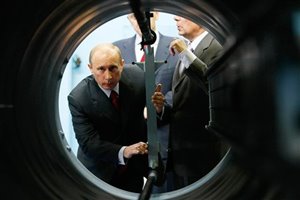
Prime Minister Vladimir Putin, doing his best impersonation of a Bond villain, tours a Russian facility last summer that produces advanced surface-to-air missiles. AP pool photo / Aleksey Nikolskyi.

A Lesson in International Gamesmanship: Barack Obama, Meet Team B
By Scott Ritter / March 13, 2009

President Obama received a lesson in international gamesmanship last week, when his secret offer to trade the deployment of a controversial missile defense system in Eastern Europe for Russian assistance in getting Iran to back down from its nuclear program was publicly rebuffed. The lesson? You don’t get something for nothing, especially when the something you’re looking for is, itself, nothing.

If the members of the Obama administration would bother to take a stroll down memory lane, they might recall that once upon a time there was a document called the anti-ballistic missile treaty, signed in 1972 between the United States and the former Soviet Union, which recognized that anti-missile defense shields were inherently destabilizing, and as such should not be deployed. The ABM treaty represented the foundational agreement for a series of strategic arms limitation and arms reduction agreements that followed. President Obama was 10 years old when that treaty was signed. He was 40 years old when President George W. Bush withdrew from it, in December 2001, and set in motion a series of events that saw arms control between the U.S. and Russia completely unravel. The proposed U.S. missile defense shield, to be deployed in Poland and the Czech Republic, had the Russians talking about scrapping the INF treaty (which eliminated two classes of nuclear-armed ballistic missiles that threatened Europe) and deploying highly accurate SS-21 “Iskander” missiles within striking range of the proposed Polish interceptor site.

Russia did not create the missile defense system crisis. The United States did, and, as such, cannot expect to suddenly receive diplomatic credit when it puts this controversial program on the foreign policy gaming table as if it were a legitimate chip to be bargained away.

Russia has always, correctly, claimed that any missile defense system deployed in Eastern Europe can only be directed at Russia. While both the Bush and Obama administrations denied that was the case, Poland has all but admitted its concerns are not about missiles coming from Tehran, but rather missiles coming from Moscow. The American “sweetener” for a potential Polish loss of a missile shield is to offer Poland advanced Patriot surface-to-air missiles, whose intended target is clearly not a Persian missile which cannot reach Polish soil, but rather Russian missiles and aircraft which can.

There are three basic facts that the Obama administration needs to address, but as of yet has not: First, missile defense systems are inherently destabilizing and only contribute to the acquisition of offensive counters designed to defeat those defenses. Second, the rapid expansion of NATO in the past decade has in fact threatened Russia. And third, the Iranian missile “threat” to Europe has always been illusory.

The proposed U.S. missile defense shield in Eastern Europe has been a highly flawed concept from its very inception. Although it used unproven technology, it was sold as a means of protecting Europe from a threat that did not exist (Iranian missiles), while creating the conditions for exposing Europe to a real threat that the missile defense shield was incapable of defeating (Russian missiles). The fact that Obama would put the missile defense shield up for trade as part of a “Grand Bargain” with Russia on Iran only underscores how little value the system has to begin with. It is a big zero, both from a military and diplomacy perspective. Obama, in making it part of his bargain, was trying to give it value it lacked, and the Russians weren’t buying.

The Iranian situation is far too real, but not in terms of the dangers posed by anything Iran itself is doing. The United States has not helped matters by hyping the threat posed by nonexistent Iranian missiles targeting Europe and capable of carrying nonexistent nuclear warheads. Russia has expressed a desire to work with the United States to better control Iran’s program of uranium enrichment, which Iran and the nuclear watchdog, the International Atomic Energy Agency (IAEA), state has been clearly demonstrated as part of a peaceful nuclear energy program. For Russia to buy into Obama’s “deal,” it would have to buy into a threat from Iran’s missile and nuclear programs, a threat Russia does not believe to exist.

Obama would do well to call in his national security team and have it lay out the intelligence information used to assert the Iranian threat. There must be such a foundational document, since Secretary of State Hillary Clinton, Secretary of Defense Robert Gates, Chairman of the Joint Chiefs of Staff Adm. Michael Mullen and the president himself all have repeatedly referred to the “threat” posed by Iran’s “nuclear weapons” ambitions. It is important to distinguish between what we know and what we think we know. For instance, we know that Iran does not have any highly enriched uranium, the kind needed to produce a nuclear weapon. Just ask Adm. Dennis Blair, the director of national intelligence. This is what he told the U.S. Senate Armed Services Committee this week in testimony on Iran. And yet many in the U.S. intelligence community continue to state unequivocally that Iran is on the verge of possessing a nuclear weapon.

Obama should take each assertion put forward about Iran’s nuclear ambition and then reverse-engineer the underlying factual basis for making that assertion. If he did so, he would quickly find that he and his advisers know less about Iran than they think they do. The entire U.S. case against Iran is built on supposition and speculation. If the president disassembled the speculative assertions, he would find them cobbled together from an ideologically motivated methodology designed more to justify a policy of containing and undermining Iran’s theocracy than understanding its nuclear ambitions.

Obama ought to reacquaint himself with the 1972 ABM treaty and the case of the CIA versus “Team B.” This chapter of America’s failed arms control policy unfolded from 1975-1976, during the administration of Gerald Ford. Once upon a time, there was a Soviet Union, and a Cold War between the Soviet Union and the United States. In an effort to prevent the Cold War from becoming a “hot war,” the two powers launched arms control initiatives, packaged as part of a larger East-West détente, to better manage the escalation of an arms race derived from Cold War tensions. It was critical in this effort to have an accurate understanding of not only the physical reality of Soviet strategic weapons programs, but also their intent. The CIA produced a report that addressed these issues, National Intelligence Estimate (NIE) 11-3/8-74, “Soviet Forces for Intercontinental Conflict Through 1985.”

The benign picture painted by the CIA’s estimate of Soviet strategic capability clashed with ideologues in and out of government who were pushing for U.S. defense programs that could not be justified if the CIA’s estimates were allowed to stand. Rather than confront the facts of the CIA’s estimates, these ideologues instead assaulted the methodology used to determine them. Political pressure was brought to bear on President Ford by conservative opponents of détente to prepare a “Team B” of analysts (outside ideologues) who would challenge the conclusions put forward in the CIA estimate by “Team A” (the CIA’s own staff). “Team B” didn’t produce better facts (indeed, every one of its assertions was proved to be wrong), but it did produce better fear. Its claims about Soviet intentions and capabilities, highly inflated and inaccurate, were political dynamite that could not be ignored, especially in the politically charged presidential election year of 1976. “Team B” won out over “Team A,” and the foundation was set for not only the dismantling of U.S.-Soviet détente, but also for the biggest arms race in modern history, culminating in the destruction of the very agreements designed to constrain such an escalation.

Obama should acquaint himself with the story of “Team B,” because “Team B” exists today, propagating myths about an Iranian “threat” that are analogous to those employed by the team that sold the fable of the Soviet “threat.” The new president was critical of the Iraq war, and the sad tale of misinformation and deception that has since been repackaged as an “intelligence failure.” There was no “failure” because there was no “intelligence.” “Team B” doesn’t produce intelligence, but rather ideological assertions used as justification for policy. The same “Team B”-based methodologies which gave us the Iraq assertions about WMD programs are in play today in the Iran “intelligence” used by President Obama and his national security team.

Obama might be surprised that one of the programs being sold by “Team B” in its assault on truth was a missile defense shield to counter the team’s perception of a Soviet missile threat. The falsehoods and fabrications sold by “Team B” back in the 1970s set America on the path toward the withdrawal from the ABM treaty in 2001, and the proposed deployment of the very missile defense shield Obama is trying to bargain away to get Russia to help confront an Iranian “threat” manufactured by none other than “Team B.”

Secretary of State Clinton impressed many when she spoke of the need for America to embrace “smart power.” The implication of her words was that the United States, under President Obama, would use all the tools available, especially diplomacy, in seeking to solve the myriad problems it faces around the world in the post-Bush era, including the problem of Iran. But one cannot begin to solve a problem unless one first accurately defines the problem, for without that definition the “solution” would in fact solve nothing. Any solution to the problem of Iran must be derived from an accurate intelligence picture of what is transpiring inside the country today, one drawn more from fact than ideologically based fiction. Obama is advised to challenge the totality of the current U.S. intelligence used to define Iran as a threat, and purge once and for all the corrupting ideological “Team B” holdovers who still reside within the structure of the American intelligence community. Intelligence is never about hearing what you want to hear, but rather about learning what you need to know.

Obama needs to learn the truth about Iran, and about the proposed missile defense system in Europe. This truth would be inconvenient, but it would also liberate him to develop meaningful solutions to serious problems in a manner that avoids a repeat of his embarrassing “Grand Bargain” gambit with Russia, trying to trade nothing for nothing in an effort to certify something for nothing. There are a lot of “zero sums” in that equation, which pretty much sums up Obama’s Iran and Russia policies to date.

[Scott Ritter is a former intelligence and arms control official who served as an inspector in the former Soviet Union (1988-1990) and Iraq (1991-1998). He is the author of “Target Iran” (Nation Books, 2007) and the forthcoming “On Dangerous Ground: Following the Path of America’s Failed Arms Control Policy” (Nation Books).]

Source / TruthDig

The Rag Blog

Posted in RagBlog | Tagged , , | Leave a comment

Richard L. Scott: Healthcare Enemy Number One

See also Dr. Stephen R. Keister’s remarks below about Richard L. Scott. All of this is rather enlightening to say the least.

Richard Jehn / The Rag Blog

Former Columbia/HCA Healthcare Corp. co-founder Richard Scott is now chairman of Solantic, a local walk-in medical care clinic company. Photo: Susen St. Peter.

Healthcare Enemy No. 1
By Christopher Hayes / March 11, 2009

Rush Limbaugh offers Democrats an irresistible target as the de facto leader of the Republican Party, but for my money, Rick Scott is the man who best embodies the spirit of the current conservative opposition. The name may not exactly be a household word, or it may ring a faint bell, but Politico recently reported that the millionaire Republican would be heading up Conservatives for Patients’ Rights (CPR), a new group that plans to spend around $20 million to kill President Obama’s efforts at healthcare reform.

Having Scott lead the charge against healthcare reform is like tapping Bernie Madoff to campaign against tighter securities regulation. You see, the for-profit hospital chain Scott helped found–the one he ran and built his entire reputation on–was discovered to be in the habit of defrauding the government out of hundreds of millions of dollars.

This is the man who will be delivering what Politico called the “pro-free-market message.”

A Texas lawyer who shared a business partner with George W. Bush, Scott started his health company, Columbia Hospital Corporation, in 1987. Its growth was meteoric, expanding from just a few hospitals to more than 1,000 facilities in thirty-eight states and three other countries in 1997. As his firm gobbled up chains, like the Frist family’s Hospital Corporation of America (HCA), it became the largest for-profit hospital chain in the country. By 1994, Columbia/HCA was one of the forty largest corporations in America, and Scott had acquired a reputation as the Gordon Gecko of the healthcare world. “Whose patients are you stealing?” he would ask employees at his newly acquired hospitals.

He promised to put nonprofit hospitals–which he insisted on referring to as “nontaxpaying” hospitals–out of business and touted his company’s single-minded pursuit of profit as a model for the nation’s entire healthcare system. “What’s happening in Washington is not healthcare reform,” he told the New York Times in 1994. “Healthcare reform is happening in the marketplace.”

The press portrayed Scott as a guru to be admired and feared, “a private capitalist dictator,” in the words of one Princeton health economist. “Probably the lowest body fat of anybody I’ve been in business with,” his partner told the Times.

“Other hospitals were intimidated,” recalls John Schilling, who worked for Columbia/HCA in the 1990s. Scott was “like the bully that would come into town and if you didn’t sell to him or partner with him, he would open up shop across the street from you and put you out of business.”

Not long after joining the company in 1993 as the supervisor of reimbursement for the Fort Myers, Florida, office, Schilling noticed things weren’t quite kosher. “They were looking for ways to maximize reimbursement…which ultimately would improve the bottom line.”

One way they did this was to fudge the costs on their Medicare expense reports. They were “basically keeping two sets of books,” says Schilling. The company would maintain an internal expense report, what it called a “reserve” report, which accurately tallied its expenses. “And then they would have a second report, which…they would file with the government, which was more aggressive.” That report would “include inflated costs and expenses they knew weren’t allowable or reimbursable. The one they filed with government might claim $5 million and the reserve would claim $4.5.” Columbia/HCA would pocket the difference.

It wasn’t just happening in Florida, and it wasn’t just fraudulent Medicare expense reports. Around the country, dozens of whistle-blowers like Schilling stepped forward to file lawsuits under the False Claims Act, charging the company with sundry forms of chicanery: kickbacks to doctors in exchange for referrals, illegal deals with homecare agencies and filing false data about the use of hospital space.

By 1997 the FBI was investigating Columbia/HCA. Days after agents raided company facilities armed with search warrants, Scott was forced to resign. In 2000 the company pleaded guilty to fraud and agreed to pay the government $840 million. Other civil settlements would follow, ultimately totaling a staggering $1.7 billion, making it the largest fraud case in American history.

(Scott was never criminally charged and continues to deny wrongdoing. His spokesperson did not respond to repeated interview requests.)

But in Washington there’s no such thing as permanent disgrace, and as the healthcare debate heats up, Scott has established himself as a go-to source for reporters looking to hear from the opposition. He’s been quoted in the Wall Street Journal and the Washington Post. He’s been on Fox, of course, railing against President Obama’s efforts to control healthcare costs. He appeared on CNN, where (as Media Matters noted) host Jessica Yellin never saw fit to notify viewers that the man she introduced as running “a media campaign to limit government’s role in the healthcare system” once ran a company that profited mightily from ripping off that government.

Indeed, if there’s one thing that’s most galling about Scott’s antigovernment jihad–and most emblematic–it’s that for all his John Galt bluster, he made his fortune (which, yes, he still has) in no small part thanks to steady contract fees from the Great Society’s entitlement programs.

Congressman Pete Stark, a veteran of the last bruising round of fighting over healthcare reform, remembers Scott all too well. Stark recently sent his colleagues a letter hoping to refresh their memories. Calling Scott a “swindler,” the letter said, “If he is the conservative spokesperson against healthcare reform, there is no debate.”

Source / The Nation

The Rag Blog

Posted in RagBlog | Tagged , , , | Leave a comment

Eliminating the Taliban Threat: Not Achievable


How to Leave Afghanistan
By Leslie H. Gelb / March 12, 2009

ONLY if our troop levels hit 100,000 and fighting floods over into Taliban havens in Pakistan will Washington be likely to look hard at the alternative policy for Afghanistan — withdrawing most American forces and refocusing our power on containing, deterring and diplomatically encircling the terrorist threat. But by then it will be too late.

President Obama is now confronting the classic problem from hell: either do more to stave off defeat and hope to get lucky, or withdraw and face charges of defeatism and perhaps new terrorist attacks. Mr. Obama’s goal is to “ensure” that Afghanistan is not a sanctuary for terrorists, which effectively restates his campaign call for victory there. Thus, he recently decided to add 17,000 American troops to the more than 35,000 already in Afghanistan. But his goal of eliminating the Taliban threat is not achievable.

Mr. Obama needs to consider another path. Our strategy in Afghanistan should emphasize what we do best (containing and deterring, and forging coalitions) and downgrade what we do worst (nation-building in open-ended wars). It should cut our growing costs and secure our interests by employing our power more creatively and practically. It must also permit us — and this is critical — to focus more American resources and influence on the far more dire situation in Pakistan.

We can’t defeat the Taliban in Afghanistan, as the last seven years have shown. Numbers are part of the problem: most Taliban are members of Afghanistan’s majority tribe, the Pashtuns. More confounding, the Taliban and their Qaeda allies have found in northwestern Pakistan a refuge that has proved almost impregnable. These factors make overcoming the enemy in Afghanistan infinitely harder than it was in Iraq.

What we can do is effectively reduce the risk of terrorist attacks from Afghanistan against its neighbors, the United States and its allies. We can do this in a way that would allow for the withdrawal of American forces, though economic and military aid would continue.

Graphic by Fogelson-Lubliner.

The first step is to provide significantly increased economic support, arms and training to friendly Afghans as United States combat forces gradually depart over, say, three years. We could use the intervening time to increase present counterinsurgency operations to better protect Afghans and give them a boost to fight on their own, if they have the will.

The second step is to try to separate less extremist elements of the Taliban from their leadership and from Al Qaeda. Mr. Obama is already considering reaching out to Taliban moderates, and he could do this through the Afghan government and covert contacts. No group is monolithic once tested with carrots and sticks, as we saw in Northern Ireland and Iraq.

The Taliban are no exception. While most of them want to drive America out, they have no inherent interest in exporting terrorism. As nasty as the Taliban are, America’s vital interests do not require their exclusion from power in Afghanistan, so long as they don’t support international terrorists.

Third, while we should talk to the Taliban, Washington can’t rely on their word and so must fashion a credible deterrent. The more the Taliban set up shop inside Afghanistan, the more vulnerable they will be to American punishment. Taliban leaders must have good reason to fear America’s military reach. Their leaders could be hit by drones or air strikes. The same goes for their poppy fields, from which they derive considerable income. Most important, Mr. Obama must do what the Bush team inexplicably never seemed to succeed in doing — stop the flow of funds to the Taliban that comes mainly through the Arab Gulf states. At the same time, he could let some money trickle in to reward good behavior.

Fourth, President Obama has to ring Afghanistan with a coalition of neighbors to show the Taliban they have no place to seek succor, even after an American departure. The group would include China, India, Russia, NATO allies, and yes, Iran. They all share a considerable interest in stemming the spread of Afghan drugs and Islamic extremism. China and Russia should be more willing to help in this anti-Taliban effort as the American military presence recedes from their sensitive borders.

Then there’s Pakistan, both the heart of the problem and the key to its solution. The peaceful future of the region depends on the resolve and ability of Pakistan’s secular and moderate religious leaders to provide decent government to their people. China, India, Iran and Russia might cooperate with Washington simply because there’s no motivation greater than the nightmare of extremists controlling Pakistan’s nuclear weapons.

India in particular wants to combat extremism in Pakistan. It could do that by reducing its forces on the border with Pakistan, for example, thereby allowing Pakistani moderates to focus their attention more on the growing and already formidable extremist threat within.

Withdrawal need not mean defeat for America and victory for terrorists, if the full range of American power is used effectively. Richard Nixon and Henry Kissinger proved that by countering the nasty aftereffects of Vietnam’s fall to communism in a virtuoso display of American power. They did this by engaging in triangular diplomacy with China and the Soviet Union; brokering a de facto peace between Israel and Egypt; and re-establishing American prowess in Asia as a counterweight to emerging Chinese power. By 1978, three years after Saigon’s fall, America’s position in the area was stronger than at any time since the end of World War II.

I don’t know whether the power extrication strategy sketched out here would be less or more risky than our present course. But trying to eliminate the Taliban and Qaeda threat in Afghanistan is unattainable, while finding a way to live with, contain and deter the Taliban is an achievable goal. After all, we don’t insist on eliminating terrorist threats from Somalia, Yemen and Pakistan. Furthermore, this strategy of containing and deterring is far better suited to American power than the current approach of counterinsurgency and nation-building.

President Obama and Congress owe it to both Afghans and Americans to explore a strategy of power extrication before they make another major decision to expand the war.

[Leslie H. Gelb, a former editor and columnist for The Times, is the president emeritus of the Council on Foreign Relations and the author of the forthcoming “Power Rules: How Common Sense Can Rescue American Foreign Policy.”]

Source / New York Times

The Rag Blog

Posted in RagBlog | Tagged , , , | Leave a comment

The Explosion at the Shrine of Rahman Baba

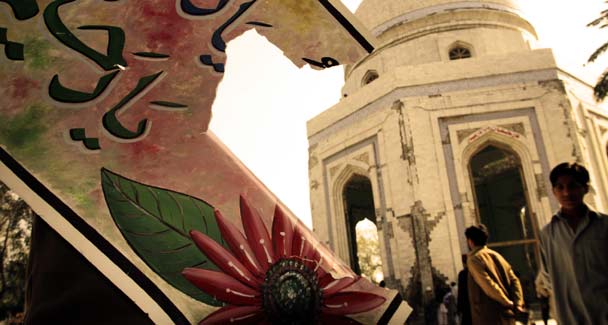
The explosion badly damaged Rahman Baba’s Shrine. AP Photo/Muhammad Sajjad.

Uprooting Flowers on Pakistan’s Frontier
By James Caron / March 14, 2009

Some time before dawn on the 5th of this month, there was an explosion in the main building at the ziyarat, or shrine, of ‘Abd-ur-Rahman in Hazar Khwani village, North-west Frontier Province, Pakistan. While explosions have become despairingly common in this general region, with Taliban-inspired networks proliferating among the majority Pashtun ethnic group, this particular explosion shocked many commentators. It did so not only because the village was located in a fairly secure area, but also because Rahman Baba, as the saint was better known, was something of a symbol of peace in the Pashtun regions of Pakistan and Afghanistan, and his poetry continues to be one of the sturdiest foundations of Pashtun cultural heritage.

Since the bombing a variety of commentators – some in Pakistan and especially western observers – have read this event as a war between two cosmically separate factions of Islam. In a piece in The Observer on March 8th, William Dalrymple’s headline claimed that “Wahhabi radicals are determined to destroy a gentler, kinder Islam.” The article argued that a wholesale Saudi-funded importation of “madrasa student” ideology threatens a somehow more authentic Pakistani Islam based on a tolerant Sufism.

I disagree with both the reifications of pundits such as Dalrymple and those of certain sections of the critical Pakistani intelligentsia, at least in part. In my recent experience living in and around Peshawar and the NWFP, I sensed that one major social fault line in Frontier Islam is something more basic. In many cases, working-class and service-industry people belonging to the Deobandi school of thought, which casual commentators often conflate with “radical Wahhabism,” proved to be among the gentlest and most generous people I met in Pakistan. In my extended interactions with certain such people, even though they belonged to proselytizing groups such as the Tablighi Jama‘at this membership did not color their interactions with me as a person.

I noticed, instead, a split between those who focused on the social role of their Islam as an analytical and activist tool to create social movements; and those for whom Islam was a humanist experience. Simply put, it was abstracted social-centric Islam versus concrete people-centric Islam. Social-centric Islams of all stripes, moderate or radical; their largely middle-class propagandists, and their populist adherents tend to say a similar thing. That is, they hold that reform of superstitious customs – including shrine pilgrimage – will help poor people better their material lives and create a more just social order. In seeking to forcibly enable an abstract vision of purist religious and social reform for people in a highly unjust political and economic environment, paradoxically the radical faction responsible for this blast probably never stopped to think about actual people.

This for me is the real tragedy of the symbolic attack – for there was little real damage – on Rahman Baba’s ziyarat. For me, an American Muslim academic who has studied the Pashto language, it was my favorite place in Pakistan exactly because of its people-centrism.

One of the Masters students in the Pakistan Studies program at Peshawar University lives in Hazar Khwani village where the tomb is, and in 2005 he invited me to visit his family there. I’d prefer not to mention his name, since association with Americans is no longer something that people would wish others to know about. After several languorous hours of the legendary Pashtun hospitality, a sizable group of us went to the shrine to say a fatiha prayer for Rahman Baba.

One reason I love the shrine is the personality of Rahman Baba himself, as reflected in his poetic work. A couple of lines that illustrate well a social religion grounded on a genuine love for individuals and personalized devotion are the following. The version sung by Qamar Gula, an Afghan woman singer in the 1970s, is my favorite:

Dwa yaran da ranga cha na de lidali / Che yaw da bal khkandzal kral; bal du’a kra

Che me mina Khdae pa ta bande payda kra / Tarka ma pa hagha wradz khpala riza kra

Who ever heard of two lovers like this / Where one cursed the other; while the other prayed for the first

When God created love for you in me / On that day I gave up my free will

The following lines may be among the most widely known bits of Pashto poetry anywhere. A fair number of Pashtuns I have met know this passage by heart:

Kar da gulo ka che sima de gulzar shi / Aghze ma kara; pa pkho ke ba de khar shi

Kuhi ma kina da bal sari pa lar ke / Chere sta ba da kuhi pa ghara lar shi

Plant flowers where you live, so that your region is a flower garden / Don’t plant thorns or they will stick in your feet

Don’t dig a pit in someone else’s path / Your path might sooner or later end up leading into that pit

The shrine is located where Rahman Baba and his disciples used to meet. And whether or not he planted the garden himself, Rahman Baba’s shrine complex sits in a grove of deciduous trees – sycamore, poplar, and eucalyptus – interspersed throughout an ancient graveyard. Rahman Baba purportedly had the ability to communicate with animals due to his gentleness, and even now, when people have birds that are suffering from any form of ailment, they bring them to Rahman Baba’s forest to recuperate. There is a special very large aviary constructed in and among the trees for this purpose. I imagine these innocent creatures were spared on the dawn of the 5th. There were a few buildings in between the aviary and the main mausoleum which might have sheltered them from the blast.

Writers, civili society workers and lovers of Rahman Baba observed vigil on the Shrine of Rahman Baba.

Rahman Baba’s shrine complex had none of the ostentation of most South Asian shrines. The sober austerity struck me as very “Pashtun” – not at all like the stereotype of a sensuous, mystical “Sufi Islam” as opposed to some other essentialized “strict Islam”. The shrine complex consists of a number of small cube-shaped whitewashed buildings, and a large marble mausoleum structure sponsored by the Saudi government in 2001 or 2002. If there was much beauty, it was mainly located in the trees and the sunlight filtering through, and in non-visual adornments granted not by wealthy donors but by the participation of everyday visitors.

Instead of visual ostentation, the main decoration was verbal. Much like the Persian poet Hafiz of Shiraz, Rahman Baba of Hazar Khwani wrote poetry that is still used daily by people today for inspiration in coping with their problems. People do a niyat – meditate on their problem – and then open Rahman Baba’s diwan, or poetry collection, to find a couplet at random. Almost invariably it helps (and the couplets above give only the most rudimentary sense of the gentle sorts of “advice from beyond” that the diwan contains). I myself have kept a copy in my office. It got me through a difficult year of teaching full time and advising students for the first time. In any case, after this exercise, if the couplet has been helpful, supplicants often visit the shrine complex and commission that couplet to be painted in green lettering on the whitewashed walls of the small boxlike buildings there.

My inlaws from the lowlands of the (ethnically very different) Punjab province sometimes gently poked fun at me, a historian, visiting the NWFP for research. I remember one asking incredulously, “What are you going to see there? There’s nothing but Pashtuns!” His point was that unlike the Punjabi city of Lahore, for example, Peshawar and the surroundings offer little in the way of glorious monuments or iconic cityscapes (with a few notable exceptions). For him, and for too many others, those things are what history is all about. Ergo, in this view, Pashtuns have no history. But personally, I draw the most inspiration in my work from reflecting on various modalities of verbal culture. And there are few societies on earth that have produced the sort of oral-historical, poetic patrimony that Pashtun society has – language-based monuments so socially intimate that most outsiders will never appreciate them, or even see them. “Wildflowers blooming, ignored, in the wasteland” is the analogy used in the title of a mid 1980s poetic anthology, as well as a paraphrase of words that the legendary peace activist Khan ‘Abd-ul-Ghaffar Khan once used to describe his people. For this other reason the shrine struck me as a very “Pashtun” monument, stripped of everything but those beautiful green words on white, words which meant the world to someone in an hour of need. It is this people-centric Islam that was under attack, an Islam that cuts across sectarian divides and invites Wahhabis and all other Muslims alike to imagine each other as fellow humans above all else, complex and unique. Though this was not true of everyone, many so-called ‘Wahhabis’ I knew answered that invitation with a soft and understated “yes”, and coexisted with the more socially marginal figures who managed this space full-time.

After our group paid our respects in the mausoleum, we met a large group of malangs, or ascetics/hermits. They were chopping wood at the time, in preparation to cook lentil soup for the evening charity kitchen. There was already a fire going, and I detected hashish fumes mixing with the mesquite smoke. The malangs put down what they were doing and made us some milky tea, without any request on our part. It was the first time I’d ever had a substantive discussion with malangs. It mainly pivoted on my telling one of the malangs that even in the US, some of us study the poetry of Rahman Baba. The malang I was speaking to – in true ego-denying form, he never offered his name – was not surprised. He said, “Of course, he is a great friend of God. Even in America he must be famous.”

One photo I took of the main mausoleum is my favorite among all those I took in my entire time in Pakistan. Quite by chance, I hit the camera button at the exact moment when two friends were greeting each other in an embrace, which is exactly the feeling I get when I open Rahman Baba’s diwan. Looking even more closely one notices two women in brown burqas, mostly obscured by shadows, between two flags off to the left. This almost unnoticeable presence is part of what so outraged the new crop of ‘religious students’, the literal meaning of the word ‘taliban’. Superstition and saint veneration was objectionable enough; but according to what I’ve read of the event, the thought of women engaging in these activities, in public, appears to have been the trigger for this bombing. The act, therefore, consisted of two parts. The perpetrators viewed women as a social category to be reformed, not as individual people with individualized spiritual needs; and they viewed individualized Islam, grounded in actually-existing people, to be beside the point. In attempting to destroy this shrine, or to discourage attendance at it, they saw no value in the relationships expressed here.

For me at least, Rahman Baba the man is not the object of veneration; Rahman Baba the tradition is. To me Rahman Baba was a geographic focal point which communicated all the individual desires and hopes that passed through society. The saint is immortal because of his words; and his words are immortal partly because their presence in that concrete physical space engenders a personal connection to other individuals regardless of sectarian or socioeconomic or even temporal boundaries. For this reason, an attack on Rahman Baba’s ziyarat hit me especially hard. Despite all the distance between my life and that of Hazar Khwani village, I felt that I had added my own presence to that of countless other specific individuals. When I saw the news of this bombing, I felt as if I was seeing the participatory history of unique people, with individual pains and individual dreams, being replaced by dogmatic abstraction. For this reason, it would be a true shame in my eyes if popular and critical analyses of this, and other such, events also replicated a typology-based worldview, with ideological labels like “Deobandi” or “Barelvi” or “Wahhabi – not actual people – at their core.

[James Caron is in the Ph.D. Program of S. Asia Studies at the Univ. of Pennsylvania.]

Source / Informed Comment

The Rag Blog

Posted in RagBlog | Tagged , , , , | Leave a comment

Misplaced Anger : Coming to Terms with the Obama Health Care Plan

Perhaps too many liberals are exhausted by watching the Kabuki Theatre of the Republican congressional leadership and their total disregard for the welfare of the nation in this time of deep crisis.

By Dr. Stephen R. Keister / The Rag Blog / March 14, 2009

On Tuesday March 3, the attendee list for the Health Care Summit at The White House was announced and I, like many, many other advocates of universal, single payer health care felt that President Obama had entered a Faustian agreement with AHIP. I, again, like many others spent hours on the internet attempting to rally support for our cause. Seemingly the effort bore results as Rep. Conyers and Dr. Fein, President of Physicians for a National Health Policy (PNHP) were included in the gathering. Dr. Fein’s speech is reproduced in my last Rag Blog submission.

It was the next morning that I found the extensive pamphlet issued during the Obama campaign wherein he described his plan for universal health care on page 34. Indeed, he did not include HR 676 in his thinking but a viable, and possibly enactable plan was described which we will touch on in more detail later.

Perhaps too many liberals are exhausted by watching the Kabuki Theatre of the Republican congressional leadership and their total disregard for the welfare of the nation in this time of deep crisis. Perhaps we are becoming a bit touchy as a result of their nay saying, and their opposition to increasing taxes for the wealthy, their placing blame for our economic woes on the working man, and their absurd argument that if the super-wealthy have to pay more taxes it will reduce their giving to charity, as if tax-deductions were the sole reason for charitable giving. However, back to the subject of health care in the after glow of the White House conference . . .

In our discussion of health care let us apply the dictum of Ockham’s razor to the discussion. First, the cost of universal health care has been bandied about with little thought to realities. If one goes to the PNHP website one can click on “Single Payer National Health Insurance” for a well presented summary. For extensive details go to the left column and click on “Frequently Asked Questions.” Second, the need for national health care becomes apparent when one reviews the “Human Development Index.” This was a totally new concept to me but one that is explained in Wikipedia. The Human Development Index (HDI) is a comparative measure of life expectancy, literacy, education and standards of living in countries worldwide. It is a standard means of measuring well-being, especially child welfare. The standing of the United States? Look it up!

Subsequent to the White House Conference Rep. John Conyers, speaking at Thomas Jefferson University, said that President Obama would not support single-payer universal health insurance now because he had too much on his plate — two wars and an economic crises — and would have to settle for the health reform he could get. The Michigan Democrat said the President would push through a public-private system of health reform, keeping private insurance through employers, and expanding a Medicare-like system for the uninsured, “if he is lucky.” This, of course, is compatible with the Obama campaign promise.

Even this concession has caused the AHIP (America’s Health Insurance Plans) to launch a vitriolic campaign, well detailed in an article in Campaign for America’s Future, by Monica Sanchez. These are the folks who feigned support for and then helped torpedo health care reform in the early 90s with the now infamous “Harry and Louise” ads. They have good reason to mount an opposition since the top seven “for profit” health insurers made a combined $12.6 billion in 2007 — an increase of 170.2% from 2003. Further, the CEO compensation packages for the top seven for profit health insurance companies ranged from $3.7 million to $25.8 million.

Business Week in the March 5, 2009, issue has a lengthy article entitled “A Backlash against Obama’s Budget.” It is noted that lobbyists are already planning public protests, ad campaigns and more targeted appeals to key members of Congress. On March 3, former Columbia/Hospital Corporation of America CEO Richard L. Scott, contributed $5 million from his own pocket, launched a $20 million advertising and public relations effort emphasizing free market alternatives to Obama’s health-care plans. Scott plans three weeks of ads on CNN and NBC, then video documentaries hosted by former CNN anchor Gene Randall in which doctors and patients in Britain and Canada bemoan their health systems.

If I were Mr. Scott I would go at this in two ways: (1) In every community, in every social group, there are, as we all know, folks who are chronically complaining, the tiring bitchers, that we all encounter. Surely, with the added incentive of several thousand dollars, they would be only too eager to vent their hostility in public; (2) And then there are unemployed professional actors, looking for work, who will be glad to oblige. One thing that I cannot comprehend is why Mr. Scott omitted Fox News from his selections. I vaguely remember legal fraud representations against Columbia Hospital Corporation some years ago.

More from the excellent Business Week article:

Obama and his team will also be hearing from health insurers like United Health Group, Humana, Well-point and Kaiser. They are balking at the plan to cut $176 billion in costs out of Medicare Advantage which combines private insurance with Medicare coverage. The lobbyists aim to send a message to Max Baucus of Montana, the Democratic chairman of the Senate Finance Committee, and Charles Grassley of Iowa, the committee’s top Republican. The plan is to show how much rural areas would suffer under the proposal. “By rural areas,” we basically mean Iowa and Montana”, says one industry lobbyist. “Baucus and Grassley will understand that.”

Again, in our last Rag Blog article we dealt with the United Health Care Group, and have addressed Humana on repeated occasions. We also reported on Sen. Baucus’ repeated receipt of donations from the health insurance and pharmaceutical industries in prior presentations. Remember that President Bush established Medicare Advantage with several thoughts in mind: (1) to enrich the insurance industry; (2) to privatize Medicare as he failed to privatize Social Security and thus deplete the Medicare reserve funds per neoliberal economic theory; (3) and to reward his contributors in the insurance industry.

In The Guardian of March 7, 2009, there is a telling quotation from Senator Grassley; “Should the reform plan include a public-sector insurance programme (some call it ‘Medicare for All’) as an alternative to private insurance?” A lot of us feel that the public-sector option would create unfair competition “for the private insurers.”

David Sirota on March 6, in “Blog For Our Future” asks the question, “If government is so awful, so inefficient and so supposedly hated by the country as the Right so often insists, how are those same Republicans insisting that Americans would overwhelmingly opt to be covered by a government-run health plan, if given the choice.” Further, “Mitch McConnell suggested that there were areas in which Republicans won’t compromise, particularly the creation of a new public insurance program to compete with private insurers. ‘Forcing free market plans to compete with those government-run programs would create an unleveled playing field and inevitably doom the competition.’

Of course the playing field would not be level. At the present time the administrative cost consumes approximately 6% of the budget, while over 30% of the private plans go into administrative costs, which include CEO salaries, stock holder dividends and advertising. And remember as well, the private companies have a big expense in paying lobbyists and bribing our elected representatives.

The Republican thinking is well represented in The Raw Story on March 5, 2009. Republican Representative Zach Wamp of Tennessee told MSNBC that Obama’s proposed healthcare plans would be a “fast march to socialism” and that he believes that healthcare is not a right because many choose not to have insurance. Listen, healthcare is a privilege.” (Does he not know that a decent private plan for a family of four can cost $12,000?)

Obviously Rep. Wamp has not the vaguest ideas of what is inherent in “socialism” and is totally unfamiliar with the excellent privileged health care in the vast majority of Western European nations. One wonders if, as a child, the “gentleman” enjoyed teasing animals!

The March 16 issue of Time Magazine, hardly a liberal publication, presents, on page 26, an excellent article entitled “The Health Care Crisis Hits Home.” Near the end of the article the author points out that 25 million are UNDERINSURED. They pay for health care coverage but have inadequate coverage. There is no magic formula for figuring out how much coverage is enough, but here are a few pitfalls to avoid: (1) High Deductibles Commonwealth Fund found that 25% pay annual deductibles of $1,000 or more, a red flag for scant coverage. (2) Caps or omission of services. Read your plan to check on drug coverage or per day hospital fees, which may leave you with bulging health care bills. (3) Temporary or short-term policies. Buying into these plans may disqualify you from comprehensive, long term coverage later, especially if you have a pre-existing condition.

At the near age of 88, I would love to see single payer, universal health care enacted, and have worked for it as a member of PNHP; however, I am a realist and for the present will support the Obama plan, knowing that it is not perfect but feeling that it is a step in the right direction with better things to come. I must admit hesitancy in accepting the Obama Treasury team, and his apparent lack of historical perspective re: Afghanistan; however, he is taking many steps that rile the far right establishment and which I in turn find comforting. I remember quite well when President Kennedy was advocating withdrawal of troops from Viet Nam, a more tolerant attitude toward Cuba and an accelerated civil rights policy. Perhaps President Obama should stay within his armored limousine! One assumes that in our nation there are greater, and more malicious, forces than the Presidency.

The Rag Blog

Posted in Rag Bloggers | Tagged , , , | 2 Comments

Republican Buffoon Bunning : Another Shameful Show

Graphic by Larry Ray / The Rag Blog (with apologies to the horse).

Sen. Jim Bunning: A Shameful Show

While many senators were terse and faulted Geithner for not having a detailed bailout plan in hand, Senator Bunning was coarse, mean spirited and imperious.

By Larry Ray / The Rag Blog / March 13, 2009

New Treasury Secretary Tim Geithner was subjected to an unconscionably mean, sarcastic and possibly pathological verbal lashing by Kentucky Republican Senator Jim Bunning in a televised senate hearing today.

Secretary Geithner was questioned by members of the Senate Budget Committee with Republican Senators particularly putting on quite a show, peppering Geithner with rhetorical verbal lashings that served not so much to educe useful answers as to vent frustrations and to grandstand for the voters back home.

Televised hearings, instead of being orderly proceedings seeking to find solid solutions, are unfortunately being used as free political advertising by disorderly and disgraceful public officials like Senator Jim Bunning.

Secretary Geithner has barely had time to move into his office. Yet he has spent more time appearing before hearings than he has using his expertise and experience to craft details of his bailout budget plan. Today’s petty viciousness did not serve America in any way. Instead of budget committee members asking rational questions and attempting to help craft a plan with positive ideas and input, the hearing was more like something from the Spanish Inquisition.

Secretary Geithner showed his mettle and maturity as he weathered the rude rantings and abrupt cavalier treatment, the worst of which came from aging Republican Senator Jim Bunning. In case the name doesn’t roll off your tongue immediately, Bunning is the snappish buffoon who has a history of ugly, mindless and mean spirited comments for which he has repeatedly been forced to apologize. He made Time magazine’s list of the worst senators, and refused to return to Kentucky to debate his opponent, instead doing it from Washington, where it was later learned he had used a teleprompter for the debate.

His most recent gaffe was made at a Hardin County (Ky.) Republican Party’s Lincoln Day Dinner. In a headline grabbing comment about approaching vacancies on the Supreme Court he predicted that U.S. Supreme Court Justice Ruth Bader Ginsburg would be dead by year’s end.

Justice Ginsburg returned to work just two weeks after her surgery for pancreatic cancer. Bunning issued an apology, but his press release reportedly misspelled Justice Ginsburg’s name.

While many senators were terse and faulted Geithner for not having a detailed bailout plan in hand, Senator Bunning was coarse, mean spirited and imperious. After asking Geithner, “Where is your plan to rescue the United States system? We’ve been waiting for that.” he would not allow Geithner to even respond, shouting over him with more ranting questions.

Bunning’s tirade was what one might expect to see from an an enraged worker who has lost his job, all his savings and his home having a rude rant at George Bush. Yet here is a disgraced Republican Senator whipping up on a member of President Obama’s cabinet.

Fearful of losing his seat as junior senator from Kentucky, Bunning just a few weeks ago threatened to sue the National Republican Senatorial Committee if it tries to recruit a GOP candidate to challenge him. He went on wildly, claiming Kentucky Senate President David Williams “owes him $30,000” and questioned the honesty of NRSC Chairman John Cornyn of Texas.

To his credit, Secty. Geithner kept his cool, and strongly defended his budget plan and even after being rudely interrupted by Bunning who waived a memo and hissed, “Where is the bottom line to the taxpayer dollar-wise?” Geithner defended the $160 billion AIG bailout, offering measured, rational reasoning.

Sadly, his fellow senators allowed Bunning to berate and verbally lash the Treasury Secretary like he was an unprepared schoolboy. Finally, following the firestorm, Senator Lindsey Graham, R-S.C. attempted a half-hearted try at extending an olive branch, saying to Geithner, “Thank you for taking the job, I know it is tough.” It was too little too late. But Geithner remained poised, restrained and certainly much more professional than the gathered Senators.

Bunning is clearly old, cranky and may be exhibiting early senile dementia. He also may still be living in some reverie from his days as a major league baseball pitcher dating back to the 1950’s. But even back then the only good thing many baseball fans remember Jim Bunning ever did was blowing the 1964 pennant for the Phillies, so the Cardinals could come from 6 games back and win. But finding a way to halt America’s worsening economy is no game, and Senator Bunning’s time at bat today showed him swinging wildly and striking out.

Like the old horses from his state of Kentucky, he needs to be put out to pasture. It is no secret that many of his colleagues would like that.

[Retired journalist Larry Ray is a Texas native and former Austin television news anchor. He also posts at The iHandbill.]

The Rag Blog

Posted in Rag Bloggers | Tagged , , , | Leave a comment

El Salvador : U.S. Republicans Meddling in Historic Election

Mauricio Funes, a former television reporter, is the FMLN candidate for president of El Salvador.

It is outrageous to see how a small contingent from the Party of No can contribute to a climate of electoral fear.

By Al / The Rag Blog / March 13, 2009

[The following is a dispatch from a regular Rag Blog contributor who is writing under a pseudonym due to the sensitivity of the situation in El Salvador.]

Live from San Salvador.

I am here as an international observer to an historic election in El Salvador. Before I came here, Rep. Raul Grivalva from Arizona, Senator Bernie Sanders and 31 others signed a letter to the Obama administration requesting that the U.S. remain neutral and support the outcome of the presidential election this Sunday, March 15, 2009. What I have seen here is the way that a few Republicans testifying on the floor of Congress can intervene in that sovereignty.

The front pages of the paper here trumpeted the news that the United States would cut off aid and stop Salvadoran immigrants from submitting remittances to their country. It is outrageous to see how that small contingent from the Party of No can contribute to a climate of electoral fear. The other claim is that the journalist Mauricio Funes from the FMLN party is a terrorist. I was walking in the neighborhood near our hotel two days ago when an airplane dropped flyers over several blocks advertising a documentary. The ad featured Hugo Chavez stabbing his finger at his audience. The ruling ARENA party here is trying to demonize Funes and the FMLN, paving the way for potential violence. Two FMLN activists were murdered last night after they were followed and cornered by a truck full of men.

This is the old El Salvador of death squads and assassinations which our tax dollars supported for so many years. Please pay attention to what is happening here. Call your Congressional representatives and demand that the U.S. remain neutral and support the democratic choice that is made on Sunday. Pressure today has resulted in a statement of neutrality from the State Department, but it is hard to publicize this statement. Read the Huffington Post for more action items

Mil gracias,

Al

The Rag Blog

Posted in Rag Bloggers | Tagged , , , | Leave a comment