Dr. Stephen R. Keister : Where Our Health Care Money Goes

William McGuire, former CEO of United HealthGroup, was paid $54.1 million, not counting stock options. Photo by G. Paul Burnett / NYT.

One wonders just what motivates these [Republican] clowns. One could conjecture that it is an abiding, almost religious faith in the philosophy of Leo Strauss, or the economic diktat of Milton Friedman, or one could assume this is purely a product of the baksheesh received from the Wall Street bankers, the defense contractors, the pharmaceutical industry, the medical appliance makers or the insurance companies.

By Dr. Stephen R. Keister / The Rag Blog / February 20, 2009

Frequently of late it seems that CNN provides an inordinate amount of time for the Republican Congressional Leadership to vilify the president’s attempts to care for the poor, the helpless and the infirm. As I watch these folks babbling away I am reminded of a comment that Mark Twain wrote in the New York Tribune on March 10, 1873: “I never think of Judas Iscariot without losing my temper. To my mind Judas Iscariot was nothing but a low, mean, premature Congressman.”

One wonders just what motivates these clowns. One could conjecture that it is an abiding, almost religious faith in the philosophy of Leo Strauss, or the economic diktat of Milton Friedman, or one could assume this is purely a product of the baksheesh received from the Wall Street bankers, the defense contractors, the pharmaceutical industry, the medical appliance makers or the insurance companies.

Whatever the thinking, which is opposed to the well-being of the populace at large, it well may destroy the opportunity to establish a health care system here in the United States of the quality inherent in Canada, Australia or Europe. As I have noted previously, passing such legislation, especially in the Senate, is indeed a long shot without concerted, fearless action on the part of we who believe in the rights of the people to be provided with a much better option, than profit driven system now crushing our citizens.

Perhaps as Kate Loving Shenk noted in OpEd News, Feb.18, 2009, Washington currently may not be the right venue for single payer passage, and grassroots support may be more likely to be effective if done on a state by state basis. It is noted that Cong. John Conyers, who orchestrated HR 676, is now putting his energy into state sponsored single payer bills. He will be coming to Pennsylvania, Massachusetts and Ohio to help these states with their single payer initiatives. Let us keep in mind that the Canadian Healthcare System began in Saskatchewan in 1962, and then went national a year later,

Here in Pennsylvania a Quinnipac Survey taken in May, 2008, showed that 68% of Pennsylvanians supported single payer legislation. With so many folks out of work one can assume that the support currently will be even higher.

Healthcare For All PA has 8000 members from all walks of life; nurses, doctors, medical and nursing students, Chambers of Commerce, League of Women Voters. Council of Churches, AFL-CIO, as well as Democrats, Republicans, Greens who support the bills. Pennsylvania Governor Ed Rendell, has said that he will sign the bill if the people will get it on his desk. It should be noted as well that on Feb. 18, Massachusetts Labor for Health Care, an organization associated with Jobs with Justice, wrote President Obama supporting HR 676, as the Massachusetts plan utilizing private insurance companies as written is failing as the insurers increase cost.

Back on the national front 14,000 Americans lose health care insurance every day. In the original Economic Recovery Package, recently signed by the President, the Democratic leadership had provided that the unemployed could sign up for COBRA and continue same until eligible for Medicare. This was stripped from the bill in an effort to compromise with the Republicans. Yet, even with the Democratic proposal there was a problem. The average unemployment benefit is $1278/month. COBRA for a family costs on average $1069/month. The Democratic compromise which provides COBRA for nine months provides a subsidy of 60% for that period… still very expensive in relation to the income.

Continuing to look at costs, let us peek into the salaries of the insurance company executives to see where our health insurance premiums are utilized. According to Families USA, the compensation, as of 2000: William McGuire (CEO of United HealthGroup), $54.1 Million; Wilson Tayler (Retired Chairman of CIGNA) $24.7 million; Ronald Williams (Executive VP, WellPoint) $13.2 million; William Donaldson (Chairman,Aetna) $12.7 million. These various folks also had unexercised stock options ranging from $64.6 million to $357.9 million.

Let us not stop there, as there are also the “non-profit” ‘Blues’. In 2007 Keneth Melani, CEO of Highmark (BC/BS Western Pa.) drew $2.97 million, while Joseph Frick (Independent Blue Cross, Philadelphia) drew $2.94 million. Robert Lufrano’s pay at Blue Cross/Blue Shield of Florida was $4.7 million. Daniel Loepp, BC/Bs Michigan drew $1,657,555. Perhaps in looking at medical costs any commission appointed by the president should look at the matter of tax free, “non-profit” corporations across the board including senior care facilities and nursing homes.

To continue this exercise in discovering where your health care dollar goes, let us look at the pharmaceutical industry. Remember how many commercials there are on TV for prescription medications? Keep in mind as well that the pharmaceutical companies spend more on marketing than on research. In any event, Fiercepharma.com, as of May 19, 2008, provides us with the following. Miles White, Abbot Laboratories, drew $33.4 million; Fred Hassan of Schering-Plough drew $30.1 million, Bill Weldon of Johnson and Johnson , 25.1 million, Bob Essner of Wyeth, $24.1 Million. The list goes on and on; however, the least poorly paid executives (and remember stock options and bonuses are not indicated, if any) are Werner Wenning of Bayer, $4.77 million; David Brennan of AstraZenka, $4.3 million; Gerard LeFur of Sanofi-Aventis, $3.27 million. One striking aside in view of the fact that almost all, if not all, pharmaceutical companies are multinationals, is the fact that the top salaries are paid in the United States, and the lesser ones in the European based companies.

For those interested in more detailed information on pharmaceutical salaries and profits I refer you here.

Our problems continue to multiply. In a recent article by Dr. Howard Dean that ran in the Huffington Post and also appeared The Rag Blog on Feb. 19, he points out that in the Recovery Package there is a section that has become a contention with the Repugs and the Radical Right. Dr. Dean writes:”At issue is something called “Comparative Effectiveness Research” which basically means giving your doctor access to the latest research on which treatments and therapies work and which don’t. It also helps doctors know which treatments are more expensive than others, and helps both patients and doctors decide if there is a cheaper treatment that is just as effective. As a doctor and the husband of a doctor, I know how important it is to have solid scientific research to make critical decisions for my patients. The research will help doctors choose the best treatment for each patient’s situation and help them make more informed choices rather than risk prescribing less effective or even potentially harmful treatments.”

The author, as a retired physician, wholeheartedly agrees. I worked a 10-12 hour day, which left precious little time form me to peruse the dozens of medical journals available. I would have been delighted to have a website to provide me supplement that research. However, to go ahead with Dr. Dean:

Medicine is and always should be science based-not driven by ideology. Mr Limbaugh and his cohorts would have you believe that this research will be used to deny needed care to your great Aunt May and be run by the politburo. I was surprised to see Sen Coburn (R-Ok) who is a doctor make a statement against medical research which in part stated ‘this bill lays the groundwork for a Soviet-style Federal Health Board that will put bureaucrats and politicians in charge of our nations health care system. Sadly, it seems that Sen. Coburn has his political hat on when he relies on Rush Limbaugh to ”help” his patients.

While quoting Dr. Dean, who I supported during his presidential primaries, and who was an outstanding chairman for the DNC, one wonders why he has been banished to outer darkness by the Obama White House advisers. Here, in my opinion, was an excellent candidate for the cabinet post at HHS, or Surgeon General. In passing I note that Dr. Ezekiel Emanuel, Rahm’s brother, as been tapped for White House Health Care Adviser. In reviewing Lynn Sweet’s article in the Chicago Sun-Times, Dr. Emanuel is a very capable physician, and Chair of The Department of Bioethics at The Clinical Center of the NIH and a breast oncologist.

I will refrain from repeating myself to those weary from my prior ramblings on The Rag Blog. There must be cost control in any national health program and, as I have noted, the initial steps are to rid the Medicare Fund of expenses such as Medicare Advantage (Humana, which owns hospitals, as well as running a “health care plan” advertises on TV constantly) and reworking of the Medicare prescription drug plan that is first and foremost a payoff to the insurance and pharmaceutical industries. One must read and implement the lengthy and detailed Robert Wood Johnson “Improving Quality and Achieving Equity, A Guide for Hospital Leaders.” This is available on the RWJ website.

Two final observations: In the Stimulus package there is protection provided for medical whistleblowers. A much needed protection for those folks with a conscience who wish to reveal malpractice or neglect by physicians, hospitals, nursing homes, etc. This is detailed in the Op-Ed News of February 16, 2009.

Finally, be alert to the attempt of a “grand bargain” being proposed by the governing elite to the Obama Administration to establish a commission to utilize the Social Security and Medicare Trust Funds to further pump money into failing banks. This is detailed in The Nation , The effort is being led by Peter Peterson, a Republican financier who made a fortune doing corporate takeover deals at Wall Streets Blackstone Group, and is the Daddy Warbucks of the “fiscal responsibility” crusade. He has campaigned for decades against the dangers old folks pose to the Republic. He is beloved by the mainstream media so expect to hear a lot about his endeavors on Fox News and CNN. He is starting a crusade among the young folks asking them to question why they should support the elderly via Social Security and Medicare.

With $2.8 billion at hand he can do a lot of distorted advertising via the public media.This deceit, is further addressed in an article by Robert Borosage & Bernie Horn in The Feb. 19 Campaign For Americas Future.

Two other thoughts from the past: Will Rogers, “The country has come to feel the same when Congress is in session as when the baby gets hold of a hammer.” Woodrow Wilson, “A conservative is a man who sits and thinks, mostly sits.”

The Rag Blog

Posted in Rag Bloggers | Tagged , , | 2 Comments

Type your summary here

Type rest of the post here

Source

The Rag Blog

Posted in RagBlog | Leave a comment

Blind Justice in Texas : Judge Keller Faces Impeachment Trial

Texas Judge Sharon Keller, and Michael Richard, who was executed after Judge Keller closed her door to his appeal. Keller photo by Elena Grothe / Austin American-Statesman. Photo of Richard from Texas Department of Criminal Justice.

Sharon Keller – presiding judge on the Texas Court of Criminal Appeals — created a flood of world-wide outrage when she blocked an appeal from defense attorneys for death row inmate Michael Richard by declaring her doors closed at five o’clock sharp. Now she’s being called to account.

By Thorne Dreyer / The Rag Blog / February 20, 2009

The Texas criminal justice system – and it is only with the truest of grit that we refrain from placing justice in quotes –- is perhaps the greatest current blight on the great State of Texas. (And there is substantial competition in “the best and the blightest” category. Texas’ sadly lacking health care system. The “creation science” obsessed Board of Education. And clueless Rick Perry for chrissakes, ol’ Governor Goodhair, who most recently has publicly pondered refusing the state’s due take from the recovery bill.)

But in arguing that the honor go to the “justice” and corrections system — where the mantra de jour is “incarcerate, incarcerate, incarcerate” — we must note the state’s over-zealous prosecutors who consistenly cut legal corners to get convictions. And the prosecution-driven, demonstrably flawed and cover-up riddled crime labs. And the absolutely disgraceful, perennially overcrowded Harris County Jail. But the darkest mark on the State of Texas is the assembly line of death that leads the nation in executions by a whopping margin. Texas’ revolving door death row shames us all.

Of course, we can’t leave out the state’s higher courts that regularly ignore exonerating evidence and side with the prosecution over the defendant.

But finally, a call to account.

Sharon Keller –- presiding judge on the Texas Court of Criminal Appeals — created a flood of world-wide outrage when she blocked an appeal from defense attorneys for death row inmate Michael Richard by declaring her doors closed at five o’clock sharp. This despite the fact that defense attorneys had reported that they were having computer problems and asked that the offices be kept open for an additional 20 minutes.

As a result the appeal was not heard and Richard was executed several hours later.

Now Judge Keller is going on trial and facing impeachment.

The following report is from Chuck Lindell in the Austin American-Statesman.

The state judicial ethics commission has charged Sharon Keller, the presiding judge of the state’s highest criminal court, with violating her duty and bringing discredit upon the judiciary when she declined to allow a death row prisoner to file an after-hours appeal in 2007. The inmate, Michael Richard, was executed about 3½ hours later.
[….]
Richard’s lawyers, experiencing computer problems, had asked the court to stay open for an appeal based on that morning’s decision by the U.S. Supreme Court to examine whether lethal injection amounted to cruel and unusual punishment.

The Supreme Court review halted all executions for seven months — except for Richard’s. Denied the proper forum to raise the appeal, he was executed at 8:20 p.m. that night.

One week later, the Austin American-Statesman reported that Keller made the decision to close without consulting the other eight judges on the appeals court, even though several stayed past 5 p.m. in anticipation of a late appeal. The report ignited global protests and several complaints to the judicial ethics commission claiming that Keller violated her legal obligations and deprived Richard of his constitutional right to court access.
[….]
Keller will face a public trial to answer the charges and could be removed from office, reprimanded or exonerated.

Hal at Half Empty commented :

In my humble opinion, someone who is condemned to death — that is the public ending of his days — deserves to be heard and does not deserve the peckish and decidedly icy response “we close at 5.” It reflects on the entire state, and deservedly so, as it was the voters that put this cold-hearted woman on the bench.
[….]
I believe the words that sealed the ultimate fate of this man, accused of rape and murder, were “We close at 5.”

Judge Keller’s action, or lack of same, in the case of Michael Richard was far from an isolated instance, but was part of a history of highly questionable judicial activity on her part..

Rick Casey reports in the Houston Chronicle:

This is a woman who voted to deny freedom to a man imprisoned for rape even after DNA evidence showed the sperm belonged to someone else. Her argument: He might have worn a condom.

Later evidence provided proof of his innocence even she couldn’t explain away.

This is a woman who, with her colleagues, appointed grossly incompetent lawyers to handle appeals for indigent death row inmates and then said, “Sorry, your client had his chance,” when skilled lawyers later came in to try to clean up the messes.

This is a woman who, a week before Christmas in 2002, voted to deny freedom to a man who under pressure had accepted a plea bargain for a crime that new evidence showed — “unquestionably,” according to the trial judge who heard the evidence — he did not commit.

Now, Keller stands accused of five violations of the state constitution or its judicial code of conduct.

Judge Keller — who was a prep school girl with a degree in philosophy from Rice Unviersity before deciding to attend law school — was interviewed on PBS’ Nightline about the rape case of Roy Criner, the man mentioned in the Chronicle article whose conviction was later overturned after Keller’s decision to keep him locked up in the face of potentially exonerating DNA evidence. Judge Keller said that Criner

…did not meet his burden to prove that he is actually innocent of this offense. At best, he established that he might be innocent. We can’t give new trials to everyone who establishes, after conviction, that they might be innocent. We would have no finality in the criminal justice system, and finality is important.
[….]
Now, it’s up to him to prove that he’s innocent. That’s his burden under the law: Has he unquestionably established that he’s innocent?

In a later update about the documentary , Frontline informed that “Roy Criner was pardoned in August [of 2000] by Texas Gov. George W. Bush after DNA tests proved he could not have committed the rape and murder for which he had served nearly ten years in prison.”

They added,

In [the Frontline documentary] “The Case for Innocence,” both District Attorney Michael McDougal and Appeals Court Judge Sharon Keller defend their refusal to grant Criner a new trial, suggesting that the sixteen-year-old victim–whom Keller calls “promiscuous”–could have had sex with someone else before Criner raped and murdered her. The fact that Criner’s DNA was not present, they said, proved nothing.

DNA testing conducted after the FRONTLINE broadcast, however, confirmed that a cigarette butt found at the murder scene had traces matching both the victim and the semen donor, placing the latter at the scene of the crime. The district attorney subsequently recommended that Criner be pardoned.

We’ll close with the following from a The New York Times editorial published Feb. 18.

…The case prompted widespread outrage. A group of lawyers filed a complaint with Texas’s State Commission on Judicial Conduct, but more than a year later, the commission, inexcusably, still has not taken any public action. This week, State Representative Lon Burnam introduced an impeachment resolution against Judge Keller, accusing her of “gross neglect of duty” and “willful disregard for human life.”

If the facts are as reported, Judge Keller should be removed from the bench. It would show monumental callousness, as well as a fundamental misunderstanding of justice, for a judge to think that a brief delay in closing a court office should take precedence over a motion that raises constitutional objections to an execution. If the facts have been misreported, the impeachment process would allow Judge Keller to set the record straight.

Impeaching a judge is not a step a legislature should take lightly. It is important that judges be insulated from political pressures so they have the independence necessary to administer justice fairly. But judges cannot be allowed to use their extraordinary discretion to deny litigants the fundamentals of due process. That is especially true if the stakes are literally life or death.

The Rag Blog

Posted in Rag Bloggers | Tagged , , , | Leave a comment

Some Litttle-Known Financial Crisis Trivia

Rep. Paul Kanjorski of Pennsylvania explains how the Federal Reserve told Congress members about a “tremendous draw-down of money market accounts in the United States, to the tune of $550 billion dollars.” According to Kanjorski, this electronic transfer occured over the period of an hour or two.

Thanks to Axis of Logic / The Rag Blog

Posted in RagBlog | Tagged , , , | Leave a comment

Sustainability : Transforming Detroit

Photographer: Fabrizio Costantini/Bloomberg News. Hazel Williams picks green tomatoes at an Urban Farm off Linwood Avenue in Detroit, on Sept. 22, 2008. Photo by Fabrizio Costantini / Bloomberg.

Detroit: City of Hope
Building a sustainable economy out of the ashes of industry.

By Grace Lee Boggs

Detroit is a city of Hope rather than a city of Despair. The thousands of vacant lots and abandoned houses not only provide the space to begin anew but also the incentive to create innovative ways of making our living—ways that nurture our productive, cooperative and caring selves.

The media and pundits keep repeating that today’s economic meltdown is the worst financial crisis since the Great Depression. But in the ’30s, the United States was an overproducing industrial giant, not today’s casino economy.

In the last few decades, once-productive Americans have been transformed into consumers, using more and more of the resources of the earth to foster ways of living that are unsustainable and unsatisfying. This way of life has created suburbs that destroy farmland, wetlands and the natural world, as well as pollute the environment.

The new economy also requires a huge military apparatus to secure global resources and to consume materials for itself, at the same time providing enormous riches for arms merchants and for our otherwise failing auto, air and ship-building sectors.

Instead of trying to resurrect or reform a system whose endless pursuit of economic growth has created a nation of material abundance and spiritual poverty—and instead of hoping for a new FDR to save capitalism with New Deal-like programs—we need to build a new kind of economy from the ground up.

That is what I have learned from 55 years of living and struggling in Detroit, the city that was once the national and international symbol of the miracle of industrialization and is now the national and international symbol of the devastation of deindustrialization.

When I arrived in Detroit in 1953, the population was 2 million, the majority white. Today, it is less than 900,000, majority black. Back then, racism was blatant and overt. Many bars, restaurants and hotels refused service to blacks. Blacks could buy homes in inner city neighborhoods but could not rent apartments in buildings right next door to these homes.

Meanwhile, freeways were enabling white flight to the suburbs, and technology was replacing human beings with robots.

In 1973, we elected our first black mayor, Coleman Young. Young was a gifted politician who was able to eliminate the most egregious examples of racism, especially in the police and fire departments and City Hall. But he was unable to imagine a post-industrial society. So, for 14 years, he tried in vain to woo industrial jobs back to Detroit.

In 1988, toward the end of his fourth term, Young decided that the factories weren’t coming back and that Detroit’s salvation depended on casino gambling, which he said would create 50,000 jobs.

To defeat his proposal, we organized Detroiters Uniting, a coalition of community groups, blue-collar, white-collar and cultural workers, clergy, political leaders and professionals.

Our concern was with how our city had been disintegrating socially, economically, politically, morally and ethically. We were convinced that we could not depend upon one industry or one large corporation to provide us with jobs. It was now up to us—the citizens of Detroit—to create meaningful jobs and income for all citizens.

We needed a new kind of city where citizens take responsibility for their decisions instead of leaving them to politicians or the marketplace.

Greening the Motor City

In 1992, to introduce this civic vision, we founded Detroit Summer, a multicultural, intergenerational youth movement and program to rebuild, redefine and respirit Detroit.

Youth volunteers began working on community gardens with Southern-born African-American elders who called themselves “Gardening Angels.”

People were moved by the image of young people and elders reconnecting with one another and with the Earth. The result has been an escalating agricultural movement: neighborhood gardens, youth gardens, church gardens, school gardens, hospital gardens, senior independence gardens, wellness gardens and Kwanzaa gardens.

Capuchin monks have created Earthworks, a program that uses gardening to educate Detroit school children in the science, nutrition and biodiversity of organic agriculture, as well as to provide fresh produce for the Capuchin Soup Kitchen and for WIC (Women, Infants and Children) supplemental nutrition program.

At the Catherine Ferguson Academy—a public high school for pregnant teens and teenage mothers—students raise vegetables and fruit trees and grow alfalfa to feed the small animals that provide eggs, meat, milk and cheese for the school community.

Architectural students at University of Detroit Mercy produced a documentary called Adamah (Hebrew for “of the Earth”) that envisions how a 2.5 square-mile area on the east side of Detroit could be developed into a self-reliant community with a vegetable farm, a tree farm and a sawmill to produce lumber.

Every August, the Detroit Agricultural Network conducts a tour of community gardens. After one such tour, one of my friends, a retired city planner, told me that it gave her a sense of how important community gardens are to a city, how they reduce neighborhood blight, build self-esteem among young people, and provide them with structured activities, build leadership skills, provide healthy food and a community base for economic development.

“I see it as the quiet revolution,” she said. “It is a revolution for self-determination taking place quietly in Detroit.”

This quiet revolution has been preparing Detroiters to meet today’s growing crises of global warming and spiraling food prices.

As writer Rebecca Solnit said in the July 2007 issue of Harper’s, “Detroit is where change is most urgent and therefore most viable. The rest of us will get there later, when necessity drives us too, and by that time Detroit may be the shining example we can look to—the post-industrial green city that was once the steel-gray capital of Fordist manufacturing.”

What’s next?

From my experience with the Boggs Center to Nurture Community Leadership, a nonprofit organization founded in 1995 in Detroit, I have seen and heard many stories of grassroots activities that Detroiters are creating—or want to create.

Because of these inspiring stories, in 2007 we launched the Detroit City of Hope campaign. Our aim was to identify, encourage and promote infrastructure-building initiatives:

  • Expand urban agriculture and small businesses to create a sustainable local economy.
  • Reinvent work so that it is not simply done for a paycheck but to develop people and build community.
  • Reinvent education to include children in activities that transform themselves and their environment.
  • Create co-ops to produce local goods for local needs.
  • Replace punitive justice with restorative justice programs to keep nonviolent offenders out of prison.

Working together as neighbors of all ages, we can evolve into the more socially responsible, active citizens we are capable of becoming.

We can begin by organizing ourselves in every city and community to secure a moratorium on foreclosures.

As food prices soar, we can achieve food security and better health by joining the local foods movement.

We can bring the neighbor back to the ‘hood by organizing “skills banks” to exchange goods and services among ourselves.

We can create home-repair teams to fix homes and/or tear down those beyond repair. The Electrical Workers, Carpenters and other unions can dedicate one day a week to work with community groups to rebuild whole neighborhoods, while also training young people in rebuilding skills to help them get jobs and recognize the dignity of work.

Other communities across the country are beginning to create alternative ways of living. In Milwaukee, a renaissance has begun, sparked by the two-acre farm of former basketball player Will Allen, who recently received a MacArthur Genius award. “We have to go back to when people shared things and started taking care of each other,” Allen said recently. “That’s the only way we will survive. What better way to do it than with food?”

These are only a small sample of what is possible once we recognize that a new local and sustainable economy is desirable and necessary.

Creating this new economy starts by accepting that there are no solutions except the ones we imagine and implement. 

[This article was excerpted from Grace Lee Boggs’ keynote address at the National Lawyers Guild Convention in Detroit on Oct. 16, 2008. For information about the Boggs Center to Nurture Community Leadership, visit www.boggscenter.org. Grace Lee Boggs is a writer and lifelong activist whose career spans more than 60 years. She is the author of Revolution and Evolution in the Twentieth Century (with her husband James Boggs), Women and the Movement to Build a New America and Living for Change: An Autobiography.]

Source / In These Times / Posted Feb. 17, 2009

The Rag Blog

Posted in RagBlog | Tagged , , , | 1 Comment

Fixing Health Care : Rush Limbaugh and the Radical Right

Our health care system is a ticking time bomb and the right wing opposes every effort to fix it. Photo/illustration by Mark Hooper / Stanford Medicine Magazine

The science is already published, especially by Scripps Institute, Harvard, Johns Hopkins, and many more, to reduce our bloated health care costs, and, praise President Obama, the new stimulus bill includes getting this information to doctors.

We spend way more than other countries, buying the most expensive — but not the best — treatments, but the right wants to keep it that way.

Janet Gilles / The Rag Blog / February 19, 2009

The Far Right’s All Out Offensive Against Medical Research

Mr. Limbaugh and his cohorts would have you believe that this research will be used to deny needed care to your great Aunt May and be run by the politburo.

By Howard Dean / February 17, 2009

Opponents of fixing our broken health care system are at it again, attempting to use their same old scare tactics and falsehoods to kill a common-sense health care provision in the economic recovery package. Fortunately Congressional leaders have recognized these tactics for what they are and have wisely kept this provision in the legislation.

Under attack is a provision that is in the package that will help your doctor be better informed and more effective at the job they signed up to do in the first place – taking care of you and your family.

Comparative Effectiveness Research:

At issue is something called “Comparative Effectiveness Research” which basically means giving your doctor access to the latest research on what treatments and therapies work and which don’t. This also helps doctors know which treatments are more expensive than others, and helps both patients and doctors decide if there is a cheaper treatment that is just as effective. As a doctor and the husband of a doctor, I know how important it is to have solid scientific research to make critical decisions for my patients.

This research will help doctors choose the best treatment for their patients’ situation and help them make more informed choices rather than risk prescribing less effective or even potentially harmful treatments.

Essentially, in order to control costs and provide patients with better care as we reform health care, the Federal Government will fund and disseminate research that evaluates the effectiveness of different treatments and medicines. This research will give doctors and patients better choices, and most importantly better health care for their money.

This is a common sense idea that should have been put in place a long ago.

When I was practicing medicine, having greater access to scientific evidenced-based research would have been truly helpful in guiding me to make the best medical decisions for my patients.

If an inexpensive pill that has been around a long time works substantially better than a brand new, highly-advertised and thus far more expensive pill – doctors should have that information at hand when we prescribe medications to our patients. When I do something for a patient, I want the scientific research that tells me its the best course for my patient. But the far right, led by people like Rush Limabaugh, hopes to somehow convince Americans that more and better research is a bad thing.

Medicine is and should always be science based – not driven by ideology.

Mr. Limbaugh and his cohorts would have you believe that this research will be used to deny needed care to your great Aunt May and be run by the politburo. But the Bill passed by Congress states right up front that the Government can not make coverage decisions based on this research.

I was surprised to see Senator Coburn (R-Ok) who is also a doctor make a statement against medical research which in part stated “this bill lays the groundwork for a Soviet-style Federal Health Board that will put bureaucrats and politicians in charge of our nation’s health care system.” Sadly, it seems that Senator Coburn has his political hat on and not his white coat when he relies on Rush Limbaugh to “help” his patients.

This claptrap is really about the far right laying the ground work for a far greater and more sustained attack on the Democrats’ attempt to fix our health care system. As we move forward with the American people to finally fulfill the promise of Harry Truman, who over sixty years ago suggested that every American ought to have a reasonable health care plan, we will rely on the voters to remind the right wing that change is what we promised, and change is what we will deliver.

Their opposition is about politics at its worst and their desire to make sure that the new administration and the Congress do not get a “win”

In these rough economic times, we have got to do better than the same old scare tactics and games for political gains. It’s time to fix our health care system and it’s time for common sense and honesty.

[Howard Dean, a physician, is the former Governor of Vermont and former chairman of the Democratic National Committee.]

Source / The Huffington Post

The Rag Blog

Posted in RagBlog | Tagged , , , | Leave a comment

Roger Baker :
Texas Toll Road 183-A: The economics and the special interests

Shrinking traffic increases could mean bond default problems for US 183-A.

Texas Toll Road US183A

Texas Tollroad U.S. 183A northbound in outskirts of Austin, approaching toll plaza.

By Roger Baker | The Rag Blog | February 18, 2009

The road lobby operates as a sort of well-funded shadow government, organized to overcome citizen opposition to unpopular toll roads intended to serve hypothetical sprawl development.

In August 2007, the Central Texas Regional Mobility Authority’s (CTRMA’s) first toll road, US 183-A, was newly opened and was acclaimed as a star performer. And yet it could still be in trouble due to outside factors beyond the control of the CTRMA. Let us drill down and examine the background and details.

The success of 183-A is important because the CTRMA, which manages 183A, intends to use the current extra revenue being generated by 183-A as a financial “backstop.” The 183-A toll revenue will essentially serve as collateral for leveraging funding for another toll road, US 290 E, that the CTRMA is actively promoting. Such speculative use of deficit spending to leverage rapid growth in road infrastructure was part of a leveraged debt trend encouraged under Bush, called public-private partnerships (PPPs).
Continue reading

Posted in Rag Bloggers | Tagged , , , , , , | 2 Comments

Racism in the New York Post? Sharpton Spanks the Monkey Cartoon

Cartoon by Sean Delonas in today’s New York Post.

‘The cartoon in today’s New York Post is troubling at best given the historic racist attacks of African-Americans as being synonymous with monkeys.’ — Rev. Al Sharpton

By TMZ / February 18, 2009

The Reverend Al Sharpton is putting the smack down on the New York Post — suggesting racism could be a factor in a political cartoon featured in this morning’s edition.

The cartoon (by Sean Delonas) comes in the wake of yesterday’s national news story about the cop who shot and killed a rampaging chimp in Connecticut. But the controversy in the comic comes from the dialogue between the two officers — which reads, “Now they will have to find someone else to write the stimulus bill.”

Before most of you woke up, Sharpton already fired off a statement saying, “The cartoon in today’s New York Post is troubling at best given the historic racist attacks of African-Americans as being synonymous with monkeys. One has to question whether the cartoonist is making a less than casual reference to this when in the cartoon they have police saying after shooting a chimpanzee that “Now they will have to find someone else to write the stimulus bill.”

“Being that the stimulus bill has been the first legislative victory of President Barack Obama (the first African American president) and has become synonymous with him it is not a reach to wonder are they inferring that a monkey wrote the last bill?”

Calls to the Post have not been returned.

Source / TMZ

The Rag Blog

Posted in RagBlog | Tagged , , | 3 Comments

Rabbi Arthur Waskow to the Senate : We Need Cloture

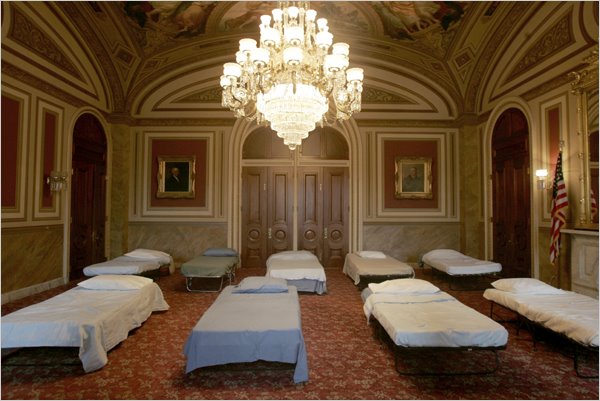
Sometimes cots have been set up at the Senate during filibusters. Photo by Stephen Crowley / NYT.

Is it possible that an anti-filibuster campaign, grounded on the importance of letting a majority of Americans address this crisis that endangers us so deeply, would win instant and strong support in the country?

By Rabbi Arthur Waskow / The Rag Blog / February 18, 2009

I am wondering whether it would make sense to aim for a national campaign to reduce the number of Senators necessary to call cloture from 60 to 55, or 51.

The question arises from what happened to the Recovery Act in the Senate. I think Paul Krugman is right, and we are standing on the brink of an economic disaster that will destroy our economy and with it the Obama Administration and every possibility of progressive change.

Many if not all of the anti-cloture Republicans know this perfectly well, and are seeking it. Like Limbaugh, they want Obama to fail. They think that their own insular constituencies, now that they have lost “moderate” districts and states, will stick with them, and they will not lose in 2010. (In fact, it will be a lot harder to make Democratic gains in the Senate in 2010, because the one third class of Senators up for reelection then are more slanted to Democrats than the class of ‘06 or ‘08. There are fewer Republicans to defeat.)

The conservatives expect that Obama’s failure would put the country back under their control. What they may or may not have taken into account is that if a liberal Presidency and Congress cannot deal with this crisis, we know from the ‘30s there is likely to be a furious upwelling of not conservative but ultra-right-wing energy. (Remember that in the Great Depression, it was a conservative administration — Hoover —that failed. Turning leftward made sense. But if a liberal administration fails?)

Progressive/liberal responses to the only half-success of the final Recovery Act has taken two basic tacks: (1) Obama screwed up by trying for bipartisanship too hard and long [Krugman]; (2) Obama had no choice because there weren’t 60 votes in the Senate, and he pulled off the best possible result [Herbert]. But what if they’re both right — Obama did the best he could, and it isn’t good enough to save him or the country — and the real problem is that the Senate rules are heavily skewed toward giving a conservative minority a veto, on top of the minority rule that is built into the two-senators-per-state structure?

Indeed, adding up the number of constituents of the Senators who voted for cloture on the Recovery Act vs. the number of constituents of those who voted against it would make very impressively clear how the will of a great majority of Americans to address the danger of Great Depression II is being thwarted.

And this goes beyond the Recovery Act. What will happen to health care, capping CO2, another Recovery Act, etc? It seems likely that any attempt to deal with the major issues we face will fail unless the filibuster is taken out of play.

Is it possible that an anti-filibuster campaign, grounded on the importance of letting a majority of Americans address this crisis that endangers us so deeply, would win instant and strong support in the country?

Certainly a national campaign would be necessary; the Senate will not take this step on its own. The Senate rules, of course, make it hard. According to a review of them by the Congressional Reference Service of the Library of Congress, this is the situation:

The Senate sees itself as a “standing body” because two thirds of its membership are always incumbents. Therefore the standing body always has a set of standing rules, unlike the House of Reps, which adopts new rules at the beginning of each new congress. The standing rules of the standing body say that it does take a super-majority to amend the rules (and thus to reduce cloture to 55 or 51 votes).

BUT — there is a long-standing and unresolved argument that when the Constitution says “the Senate” makes its rules, that means a majority of the Senate is free to do so. Just four years ago the GOP was threatening to do that by majority vote, about confirming judicial nominations — it’s what people then called the “nuclear option” — and they were certainly saying it was legal. But the Senate has never, even when VP Mondale ruled that it could, accepted the proposition and changed the rules by majority vote.

So it’s rough. But — if we don’t do this, what do you think is going to happen to health insurance, to cap-and-trade, to any more than marginal reform? The question is whether there is energy in the country to raise enough hell to make the Senate change — maybe demanding majority vote will make them go to 55? Is there more energy for this than for, let’s say, a decent healthcare bill? Is it just inside baseball? Could it break loose if the filibuster threat damages enough bills that people care about?

“Bring democracy to the Senate!” Could it work, or does it make more sense to focus on the bread-and-butter issues like healthcare?

For background, see How the Filibuster Became the Rule by David Herszenhorn / The New York Times / Dec. 2, 2007

The Rag Blog

Posted in Rag Bloggers | Tagged , , | Leave a comment

Cable TV : A Republican Punch and Judy Show

Graphic by Larry Ray / The Rag Blog.

Cable TV news and commentary channels seem to make little distinction between featuring a live two-headed mule on their shows or a live falsehood-spouting politician.

By Larry Ray / The Rag Blog / February 17, 2009

America’s Cable TV carnival midway is more and more becoming our modern day equivalent of the old traveling Punch and Judy Shows. Viewers gaze at the loud animated talking heads, following the verbal head-bopping, screaming and whining as the partisan puppeteers perform almost hourly on TV.

This has been a boon, especially to angry deluded and ignored Bush-era Republicans. They still do not want to admit that the only way to fight rising joblessness is for the US Government to spend lots of cash, in a hurry. Even though they have no moral right to lecture America after the past eight disastrous years, they loudly repeat the old disproved arguments that tax cuts and tax credits alone will solve our growing problems. The truth or logic of what they say matters little. Their show must go on, for re-elections are not far off.

Lovable Lindsey Graham, South Carolina’s bachelor Senator who is disliked not only by liberal progressives, but also by ultraconservatives back in his home state, has a way with words. When he uttered, on live TV, “If I may say, if this is going to be bipartisanship, the country’s screwed,” there were looks of puzzlement and incredulity. His House minority party voted against the stimulus bill. That’s what opposition parties do. But America is not “screwed” to use Lindsey’s eloquent oratory, just because the Republicans marched in lock step with their No vote. They offered no new or remotely useful alternatives to help reverse the course of the deepening recession. The lack of help from impotent Republicans in an historic time of crisis caused no screwing whatsoever . . . of America or anything else.

Virginia’s Representative and Minority Whip, Eric Cantor, the only Jewish Republican in the US House of Representatives, is being touted as a latter day Newt Gingrich. Cantor has been all over the airwaves with his authoritative, stentorian monologue, kvetching about the fatal flaws in the Democrat’s stimulus bill. It is mostly so much hysterical bull. Cantor, performing on Fox News a few weeks ago, gave one of his examples of fraud and waste, recounting that in a meeting with President Obama, he asked if the President “could use his influence on this process to try and get the pork barrel spending out of the bill. I mean, there’s $300,000 for a sculpture garden in Miami.”

What a ghastly picture of utter waste . . . on art! Except it was totally false. Cantor staffers pulled an example of a National Endowment for the Arts project funded under its budget last year then said it was in the projected stimulus bill. It is not. Even after Politifact.com awarded Cantor a “Pants on Fire” false rating for his claim, he has continued to make it repeatedly. But he puts on a real righteous show for TV. Never matter it is tacky Punch and Judy drama.

And let’s not forget TV’s crying soap opera star, Senator John Boehner. Even his own party seems to be trying to lower the Minority Leader’s profile on TV after repeated gaffes. A master of the mis-quote, Boehner announced, “Israel is a critical American ally and a beacon of democracy in the Middle East, not a ‘constant sore’ as Barack Obama claims.”

Well, President Obama said no such thing. The ‘constant sore’ reference was to the entire problematic Middle East situation. The public should still have that image of Boehner, like a jolly Punch character, actually handing out checks from the tobacco industry on the House floor. Yet he would lecture the new President.

Cable TV news and commentary channels seem to make little distinction between featuring a live two-headed mule on their shows or a live falsehood-spouting politician. Both can astound, disgust and amaze viewers. But the mule cannot talk. However, it can bray just like politicians. More and more, the off button on the TV remote seems the best choice.

[Retired journalist Larry Ray is a Texas native and former Austin television news anchor. He also posts at The iHandbill.]

The Rag Blog

Posted in Rag Bloggers | Tagged , , , | 1 Comment

US Military: Just an Imperial Police Force?

Not to quibble, but the US military has been an imperial police force since time immemorial, or at least since the Monroe Doctrine. Thinking otherwise has frequently led this nation to murder (not to war) for no particularly good reason.

Richard Jehn / The Rag Blog


An American Foreign Legion: Is the U.S. Military Now an Imperial Police Force?
By William Astore / February 15, 2009

A leaner, meaner, higher tech force — that was what George W. Bush and his Secretary of Defense Donald Rumsfeld promised to transform the American military into. Instead, they came close to turning it into a foreign legion. Foreign as in being constantly deployed overseas on imperial errands; foreign as in being ever more reliant on private military contractors; foreign as in being increasingly segregated from the elites that profit most from its actions, yet serve the least in its ranks.

Now would be a good time for President Barack Obama and Secretary of Defense Robert Gates to begin to reclaim that military for its proper purpose: to support and defend the Constitution of the United States against all enemies, foreign and domestic. Now would be a good time to ask exactly why, and for whom, our troops are currently fighting and dying in the urban jungles of Iraq and the hostile hills of Afghanistan.

A few fortnights and forever ago, in the Bush years, our “expeditionary” military came remarkably close to resembling an updated version of the French Foreign Legion in the ways it was conceived and used by those in power — and even, to some extent, in its makeup.

For the metropolitan French elite of an earlier era, the Foreign Legion — best known to Americans from countless old action films — was an assemblage of military adventurers and rootless romantics, volunteers willing to man an army fighting colonial wars in far-flung places. Those wars served the narrow interests of people who weren’t particularly concerned about the fate of the legion itself.

It’s easy enough to imagine one of them saying, à la Rumsfeld, “You go to war with the legion you have, not the legion you might want or wish to have.” Such a blithe statement would have been uncontroversial back then, since the French Foreign Legion was — well — so foreign. Its members, recruited worldwide, but especially from French colonial possessions, were considered expendable, a fate captured in its grim, sardonic motto: “You joined the Legion to die. The Legion will send you where you can die!”

Looking back on the last eight years, what’s remarkable is the degree to which Rumsfeld and others in the Bush administration treated the U.S. military in a similarly dismissive manner. Bullying his generals and ignoring their concerns, the Secretary of Defense even dismissed the vulnerability of the troops in Iraq, who, in the early years, motored about in inadequately armored Humvees and other thin-skinned vehicles.

Last year, Vice President Dick Cheney offered another Legionnaire-worthy version of such dismissiveness. Informed that most Americans no longer supported the war in Iraq, he infamously and succinctly countered, “So?” — as if the U.S. military weren’t the American people’s instrument, but his own private army, fed and supplied by private contractor KBR, the former Halliburton subsidiary whose former CEO was the very same Dick Cheney.

Fond of posing in flight suits, leather jackets, and related pseudo-military gear, President Bush might, on the other hand, have seemed overly invested in the military. Certainly, his tough war talk resonated within conservative circles, and he visibly relished speaking before masses of hooah-ing soldiers. Too often, however, Bush simply used them as patriotic props, while his administration did its best to hide their deaths from public view.

In that way, he and his top officials made our troops into foreigners, in part by making their ultimate sacrifice, their deaths, as foreign to us as was humanly possible. Put another way, his administration made the very idea of national “sacrifice” — by anyone but our troops — foreign to most Americans. In response to the 9/11 attacks, Americans were, as the President famously suggested only 16 days after the attacks, to show their grit by visiting Disney World and shopping till they dropped. Military service instills (and thrives on) an ethic of sacrifice that was, for more than seven years, consciously disavowed domestically.

As the Obama administration begins to deploy U.S. troops back to the Iraq or Afghan war zones for their fourth or fifth tours of duty, I remain amazed at the silent complicity of my country. Why have we been so quiet? Is it because the Bush administration was, in fact, successful in sending our military down the path to foreign legion-hood? Is the fate of our troops no longer of much importance to most Americans?

Even the military’s recruitment and demographics are increasingly alien to much of the country. Troops are now regularly recruited in “foreign” places like South Central Los Angeles and Appalachia that more affluent Americans wouldn’t be caught dead visiting. In some cases, those new recruits are quite literally “foreign” — non-U.S. citizens allowed to seek a fast-track to citizenship by volunteering for frontline, war-zone duty in the U.S. Army or Marines. And when, in these last years, the military has fallen short of its recruitment goals — less likely today thanks to the ongoing economic meltdown — mercenaries have simply been hired at inflated prices from civilian contractors with names like Triple Canopy or Blackwater redolent of foreign adventures.

With respect to demographics, it’ll take more than the sons of Joe Biden and Sarah Palin to redress inequities in burden-sharing. With startlingly few exceptions, America’s sons and daughters dodging bullets remain the progeny of rural America, of immigrant America, of the working and lower middle classes. As long as our so-called best and brightest continue to be AWOL when it comes to serving among the rank-and-file, count on our foreign adventurism to continue to surge.

Diversity is now our societal byword. But how about more class diversity in our military? How about a combat regiment of rich young volunteers from uptown Manhattan? (After all, some of their great-grandfathers probably fought with New York’s famed “Silk Stocking” regiment in World War I.) How about more Ivy League recruits like George H.W. Bush and John F. Kennedy, who respectively piloted a dive bomber and a PT boat in World War II? Heck, why not a few prominent Hollywood actors like Jimmy Stewart, who piloted heavy bombers in the flak-filled skies of Europe in that same war?

Instead of collective patriotic sacrifice, however, it’s clear that the military will now be running the equivalent of a poverty and recession “draft” to fill the “all-volunteer” military. Those without jobs or down on their luck in terrible times will have the singular honor of fighting our future wars. Who would deny that drawing such recruits from dead-end situations in the hinterlands or central cities is strikingly Foreign Legion-esque?

Caught in the shock and awe of 9/11, we allowed our military to be transformed into a neocon imperial police force. Now, approaching our eighth year in Afghanistan and sixth year in Iraq, what exactly is that force defending? Before President Obama acts to double the number of American boots-on-the-ground in Afghanistan — before even more of our troops are sucked deeper into yet another quagmire — shouldn’t we ask this question with renewed urgency? Shouldn’t we wonder just why, despite all the reverent words about “our troops,” we really seem to care so little about sending them back into the wilderness again and again?

Where indeed is the outcry?

The French Foreign Legionnaires knew better than to expect such an outcry: The elites for whom they fought didn’t give a damn about what happened to them. Our military may not yet be a foreign legion — but don’t fool yourself, it’s getting there.

[William J. Astore, a retired lieutenant colonel (USAF), taught for six years at the Air Force Academy. He currently teaches at the Pennsylvania College of Technology. A TomDispatch regular, he is the author of Hindenburg: Icon of German Militarism (Potomac Press, 2005), among other works. He may be reached at wastore@pct.edu.]

Copyright 2009 William Astore

h/t Juan Cole / Source / TomDispatch

The Rag Blog

Posted in RagBlog | Tagged , , | 2 Comments

Compassion Is the Only Course, Even When the Crimes Are Atrocious

This is a profoundly important piece, written by a victim of a Cambodian war criminal. When the author writes that “We shall all be at the trial — not just as judges, but also as victims, and the accused,” his words penetrate to the core of many human issues we have always faced.

Richard Jehn / The Rag Blog

Graphic: Emiliano Ponzi.

My Savior, Their Killer
By François Bizot / February 16, 2009

Phnom Penh, Cambodia — AFTER 10 years of detention, Kaing Guek Eav, alias Comrade Duch, is to appear today before the Extraordinary Chambers in the Courts of Cambodia, charged with war crimes and crimes against humanity. He was arrested in 1999, after 20 years of living incognito, for crimes committed on his orders as commander of the Tuol Sleng prison in Phnom Penh from 1975 to 1979, when the Khmer Rouge controlled Cambodia and were responsible for the deaths of more than a million people.

I was his prisoner for three months in 1971, in a camp known as M13 hidden in the forest of the Cardamom mountains. I had been doing field work in the Cambodian countryside, searching for ancient Khmer Buddhist manuscripts, when I was ambushed by Khmer Rouge militants fighting Cambodia’s American-backed government. I was accused of being a C.I.A. spy and sentenced to death.

Duch was in charge of the jungle camp, both my jailer and my prosecutor. I was kept in chains and interrogated daily by him. Somehow, during the strange dialogue that began between us, he became convinced that I really was just a Frenchman who wanted to study Buddhist texts. Duch undertook to secure my release. My two Khmer assistants did not have the same good fortune: despite Duch’s promise to me, they were executed soon after I left the camp, as so many thousands were in the years to come under his meticulous supervision.

I did not see Duch again until 2003, in the military prison in Phnom Penh. Conditions there were rudimentary, but the general feel was not that of a jail. I remember that he had the same look of determination that he had had 32 years earlier, though the smile that he had occasionally flashed when he ruled over my fate was gone.

In the whirl of conflicting emotions provoked by seeing him again, I asked him: “How are things here? Is it all right?” Compelled to repeat the question, I felt its incongruity: the executioner was now on the other side of the gate, as I had foreseen in my dreams, in the place once occupied by his victims.

In July 2007, he was transferred to one of the eight cells in the detention center that is part of the vast complex where the war crimes court is based and where his trial will take place. I visited him there. At the time, he enjoyed the relative comfort of his new surroundings. Four other elderly Khmer Rouge leaders were also incarcerated there. They were well cared for; food, cells, a television room, a visiting room — everything was in conformance with international rules, enough to make the guards jealous.

But Duch may today regret having left the tedium of the military prison. After years of stalling, and many months of thorough preliminary investigations, the trial that so few people wanted is about to begin. The sound of the preparations for it rings out in the detention center as if it were an execution.

The death penalty, which Duch ordered at least 12,380 times, does not exist in United Nations-backed tribunals like this one. His condemnation will not have the too-familiar instantaneousness of the Khmer Rouge hoe striking the back of the neck, but his sentence will be long and relentless.

The worst that he risks, however, is not imprisonment itself, but seeing his reasons for living disappear. His life now revolves around the visits from his children, a right that was denied to his victims, and his faith in the judicial process — a process that did not exist at Tuol Sleng.

Duch does not raise any objection to his trial. In his heart lie the same fears that haunted each of his victims — ancient fears that have never ceased to haunt mankind. Thus he has admitted his guilt, bowed over and humbled by the horror of what he has done.

Last February, Duch was led, with his consent, to the scenes of his crimes. The visit was a shock for all who witnessed it. This major judicial step took place in an atmosphere of intense, palpable emotion.

“I ask for your forgiveness — I know that you cannot forgive me, but I ask you to leave me the hope that you might,” he said before collapsing in tears on the shoulder of one of his guards.

I was not there — it was a closed hearing — but those who were reported that the cry of the former executioner betrayed such suffering that one of the few survivors of Tuol Sleng screamed out, “Here are the words that I’ve longed to hear for 30 years!”

It could be that forgiveness is possible after a simple, natural process, when the victim feels that he has been repaid. And the executioner has to pay dearly, for it is the proof of his suffering that eases ours.

Let us not fool ourselves. Beyond the crimes that Duch committed against humanity, those of the Khmer Rouge will also be judged. And beyond the crimes of the Khmer Rouge, the capacity of the tribunals to mete out justice will be tested, as well as our ability to judge man himself, and history. We shall all be at the trial — not just as judges, but also as victims, and the accused.

The genocide of the Khmer Rouge will be judged as a “crime against humanity,” a crime against ourselves. As such, Duch’s guilt exceeds his immediate victims; it becomes the guilt of humanity, in the name of all victims. Duch killed mankind. The trial of the Khmer Rouge should be an opportunity for each of us to gaze at the torturer with some distance — from beyond the intolerable cry of the suffering, which may veil the truth of the abomination. The only way to look at the torturer is to humanize him.

[François Bizot is the author of “The Gate,” a memoir. This essay was translated by The Times from the French.]

Source / New York Times

The Rag Blog

Posted in RagBlog | Tagged , , | 2 Comments