A [Sic] Berd in the Hand…

My sister took this picture. It’s from the El Paso Independent School District print shop!

She wrote:

‘Look at the signs carefully. The first sign on the fence was the white one, it is a piece of paper in a plastic sleeve. The red sign was ordered and placed above it. I wonder who does the proofreading???’

Sarito Neiman / The Rag Blog / December 8, 2008

The Rag Blog

Posted in Rag Bloggers | Tagged , | 5 Comments

Improving on Worker Exploitation : Smart Stitch

Ouch !!! What else can we possibly say?

New Portable Sewing Machine Lets Sweatshop Employees Work On The Go

Source / The Onion

Thanks to Diane Stirling-Stevens / The Rag Blog

Posted in RagBlog | Tagged , , , | 1 Comment

Here’s a Plan : Nationalize General Motors


‘The United States government should buy 51% of the GM stock and put a green Board of Directors in place.’
By Terry J. DuBose
/ The Rag Blog / December 8, 2008

See ‘Here’s a plan: Buy GM’ and ‘Nationalize GM’ by Dan Neil, Below.

Last Sunday I posted on DailyKos (and said to the Hippies of the Square Table), “Bailout the Automotive Industry? GM?” and added why I thought the United States government should buy 51% of the GM stock and put a green Board of Directors in place. Our local paper ran an editorial by Dan Neil of the Los Angeles Times that supported that same solution for GM.

He did not have the same reflection on the history of GM’s fight to destroy urban public rail transportation and killing the electric car that I have, but he comes to the same conclusion… nationalize GM.

Here’s a plan: Buy GM
By Dan Neil / December 7, 2008

LITTLE ROCK — At the moment, D.C. and Detroit are brooding on two equally unpleasant choices: Watch the American automakers auger in and take hundreds of thousands of jobs with them, or bail out these failed and incorrigible companies whose management so richly deserves whatever hell (flying coach?) awaits them.

Tops on the critics’ list of grievances is Detroit’s failure to anticipate the inevitable. Why didn’t these companies sufficiently invest in next-generation technology-fuel-efficient small cars, high-mileage hybrids, plug-ins and all-electric vehicles-that could help wean the U.S. off foreign oil and take the automobile out of the climate-change equation? As the auto executives again bring their begging bowl to Congress, a consensus is forming: No bailout unless Detroit buildsgreener cars.

From my perch, as someone who drives all of the Big Three’s North American product offerings, I think a lot of the anger is reflexive and misplaced. Detroit makes some amazing cars, and anyone who thinks otherwise should hold a Corvette ZR1 to his head and pull the trigger. The Ford F-150 pickup I drove last week flat-out humbles rivals from Toyota or Nissan. Considering that the domestic carmakers are shouldering titanic “legacy” costs — it’s estimated that $2,000 in health care, pension and employee post-retirement benefits are baked into the price of every UAW-built vehicle — just being competitive in any segment is a signal achievement.

Nonetheless, the question remains: What to do about the domestic automakers? My modest proposal: Nationalize GM…

Source / Los Angeles Times / Arkansas Online

The LA Times ran this editorial December 2nd.

Nationalize GM…
The federal government should buy GM. We can run it, then sell it at a profit once it recovers
.

By Dan Neil / December 2, 2008

At the moment, D.C. and Detroit are brooding on a Morton’s Fork: Watch the American automakers auger in and take hundreds of thousands of jobs with them, or bail out these failed and incorrigible companies whose management so richly deserves whatever hell (flying coach?) awaits them.

Tops on the critics’ list of grievances is Detroit’s failure to anticipate the inevitable. Why didn’t these companies sufficiently invest in next-generation technology — fuel-efficient small cars, high-mileage hybrids, plug-ins and all-electric vehicles — that could help wean the U.S. off foreign oil and take the automobile out of the climate-change equation? As the auto executives again bring their begging bowl to Congress, a consensus is forming: No bailout unless Detroit builds greener cars.

From my perch, as someone who drives all of the Big Three’s North American product offerings, I think a lot of the anger is reflexive and misplaced. Detroit makes some amazing cars, and anyone who thinks otherwise should hold a Corvette ZR1 to his head and pull the trigger. The Ford F-150 pickup I drove last week flat-out humbles rivals from Toyota or Nissan. Considering that the domestic carmakers are shouldering titanic “legacy” costs — it’s estimated that $2,000 in healthcare, pension and employee post-retirement benefits are baked into the price of every UAW-built vehicle — just being competitive in any segment is a signal achievement.

Nonetheless, the question remains: What to do about the domestic automakers? My modest proposal: Nationalize GM.

To be clear, I mean that the federal government should buy GM; forget rathole loans or nonvoting equity shares. The company’s stockholder value has been essentially wiped out. The company’s enterprise value — the lock, stock and forklift price — is about $32 billion; its total debt is $45 billion. Let’s make GM an offer.

If you feel the gall of free-market ideology rising, consider that the measures being bruited about as preconditions for a bailout — firing GM’s top management; forcing a bankruptcy-like renegotiation of contracts with the UAW, suppliers and dealers (it has too many); and creating a czar of product development to force the building of green cars — are nationalization in all but name. I say embrace it. GM-USA.

Here are the benefits of nationalization:

GM’s fundamental problem is that it’s too big — and expecting it to fix itself in exchange for a $10-billion to $15-billion loan (its share of the vaunted $25-billion bailout) or magically right-size in Chapter 11 is foolhardy. It would take too long, cost too much and bankruptcy, should it come, would send customers running for the hills. Time is of the essence. Congress, writing a GM law and using federal power to abrogate contracts, could achieve at least some of these goals at a stroke.

GM is full of talent and potential. The company spent $8.1 billion on research and development last year, second only to Toyota. Of all the carmakers, GM is closest to commercializing a full-size, four-door, plug-in electric vehicle, the Volt, due in the fourth quarter of 2010. The Volt should travel about 40 miles in all-electric mode before requiring the services of its onboard, gas-powered generator. Many owners could go weeks before they used any gasoline. This is precisely the sort of car that environmental and energy security advocates have been clamoring for.

GM’s business is growing in other parts of the world; it’s only the North American operations that are killing the company. This is a corporation that had $181 billion in revenue and sold 9.4 million vehicles in 2007. To put it another way: GM, though distressed, looks like a good investment. Also, the federal government can sell the company — at a profit — once it’s righted and sailing forward again.

GM is competing with companies that are quasi-national now. If you consider the advantages the government of Japan has bestowed on Toyota, Nissan and Honda — in terms of healthcare and retirement benefits for its employees — the unevenness of the field is clear. The same goes for most European companies, and the rising rivals in China will enjoy similar state-subsidized advantages.

The government can afford long-term planning. Many of GM’s strategic missteps — such as betting large on trucks and SUVs and not investing early in hybrid technology — were the result of willful shortsightedness at the board level, responding to a financial market in which shareholders look for the quick return. Putting Uncle Sam in charge would fundamentally enlarge the return-on-investment horizon.

We need government-sized automotive help anyway. This country should be putting millions of plug-in hybrid and electric vehicles on the road. As far as I can tell, without big subsidies, there is no way in the near term to build these vehicles and make a reasonable profit, due to the stubbornly high cost of advanced batteries. Besides, if GM were owned by the government, it wouldn’t spend time and money litigating and lobbying against clean-air and safety rules

Why not pick up Ford and Chrysler too? If Chrysler goes south, it’s too small to drag down the rest of the domestic auto industry. Ford, which has been pursuing its “Way Forward” cost-cutting plan for more than two years, will probably survive the moment without government assistance, though it’s going to be close.

To be sure, the yard marks of democratic capitalism have moved under us in recent months. Last week, the feds announced that the government would take a $20-billion stake in Citigroup and guarantee hundreds of billions in risky assets, a move that would have seemed pure socialism had we not lived through the last few months. Have we not in effect nationalized the mortgage-loan industry?

I say, let’s avoid the euphemisms and have the courage of our supercharged Keynesian convictions. By nationalizing GM, we can aim the company’s astonishing resources at one of the biggest public-policy problems we have: oil. Restructured and refocused, GM could build green vehicles by the millions in a few years and still have the capacity to build gasoline- and diesel-powered pickups (which we’ll still need) … and maybe even some Corvettes on the side.

[Dan Neil is the automotive critic for the Los Angeles Times.]

Source / Los Angeles Times

Also see If GM Fails, Then What? by Tom Petruno and John O’Dell / Los Angeles Times / April 23, 2006

The Rag Blog

Posted in Rag Bloggers | Tagged , , , , , | 5 Comments

Curbing Emissions Through Construction Retrofits

Sustainable refit of the Department of Conservation office building in Wellington, New Zealand. Photo: Tom Walter.

Construction Industry Could Trim Climate Emissions Cheaply
December 8, 2008

POZNAN, Poland – Energy use in buildings accounts for one-third of global greenhouse gas emissions, but the potential of the construction sector to combat climate change has not been tapped, according to a new report issued by the United Nations Environment Programme.

The report was released Saturday to governments meeting in Poznan for the latest round of UN climate change talks. The negotiations are aimed at reaching agreement on a successor pact to the Kyoto Protocol, whose first commitment period ends in 2012.

Today’s commercially available technologies make it possible to halve energy consumption in both new and old buildings without significant investment, the report finds.

Yet only 10 out of some 4,000 projects in the pipeline of the Kyoto Protocol’s Clean Development Mechanism, which finances initiatives that help reduce emissions, are designed to curb the use of energy in buildings.

The UN Intergovernmental Panel on Climate Change, co-recipient of last year’s Nobel Peace Prize, has warned that building-related emissions could nearly double from almost nine billion tons in 2004 to nearly 16 billion in 2030.

The surge will be driven by construction booms in the next two decades in Asia, the Middle East and Latin America.

“Report after report is now underlining the huge, cost-effective savings possible from addressing emissions from existing buildings alongside designing new ones that include passive and active solar up to low-energy heating and cooling systems and energy-efficient systems,” said UNEP Executive Director Achim Steiner.

Dozens of surveys conducted worldwide show that up to 30 percent reduction in emissions from residential and commercial buildings can be achieved by 2030 at a net negative cost.

Effective measures include improved ventilation and insulation, stepped up use of natural lighting and the use of solar and other natural heat sources.

The sector remains virtually untapped because six years after the start of the Clean Development Mechanism, very few building projects have managed to enter its pipeline. Nearly half of all proposals were rejected during the registration phase.

High administrative costs and weak financial incentives as being among the barriers for approval by the CDM, according to the report entitled “The Kyoto Protocol, the Clean Development Mechanism, and the Building and Construction Sector.”

Eight projects proposed by a Brazilian supermarket chain, for instance, were rejected because of difficulties in accounting for the projected 20,000 tons of annual carbon savings. Only $3,000 of carbon revenue would be generated by the store, which is less than the basic operating costs for the projects and would not cover the energy-efficient equipment necessary.

Kuyasa retrofit project in Cape Town, South Africa is the first CDM-registered project to improve the thermal efficiency of low-income housing. The project aims to install solar water heaters, insulated ceilings and compact fluorescent lights in over 2,000 residential homes for low-income families, resulting in cuts of 6,580 tonnes of CO2 equivalent every year.

Resident of a Kuyasa demonstration house points to an energy-efficient lightbulb. Photo: UN Chronicle.

Yet despite successful registration in 2005, the project has yet to take off except for 10 demonstration homes, illustrating the challenge of using the CDM to finance such projects.

In a related development, UNEP announced Saturday in Poznan that the Pacific Island nation of Niue, the United Kingdom city of Slough and the New Zealand city of Waitakere are among the latest to sign on to its Climate Neutral Network.

That initiative brings together countries, cities, businesses and organizations which pledge to reduce greenhouse gas emissions.

“For many small island developing states like Niue climate neutrality is more than just a concept – it is a matter of survival,” Steiner said. The tiny nation, with a population of some 1,700, releases jsut 0.003 million metric tons of carbon dioxide annually but is at risk from rising sea levels as polar ice caps and glaciers melt.

Slough, home to nearly 120,000 people and situated between London and Bath, is seeking to have all public transport and council vehicle run on cleaner fuel and slash its emissions by one-fifth in the next two decades.

Waitakere, the fifth largest city in New Zealand, is aiming to stabilize per capita emissions by 2010 and reduce them 80 percent by 2051.

In addition, 11 companies and organizations have signed on to the Climate Neutral Network in Poznan, joining the four countries, four cities and dozens of other participants in the initiative.

Copyright Environment News Service (ENS) 2008.

Source / Environment News Service

The Rag Blog

Posted in RagBlog | Tagged , | 2 Comments

Obama Shows Progressive Side : Vocal Support for Chicago Workers

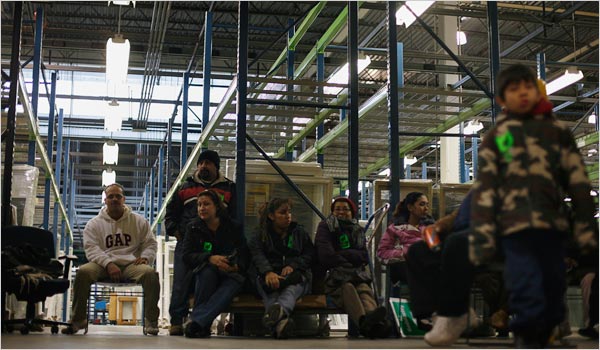
Workers laid off from a Chicago factory on Saturday at what they called an occupation of the plant. They criticized their former bosses, the company’s creditors and the federal government. Photo by Beth Rooney / NYT.

There are those on the left who have challenged Obama’s appointees. Some even say that Obama’s presidency is no different than Bush’s. That’s what Nader and McKinney supporters have suggested might be the case. Well, yesterday, we saw concrete evidence that the world has changed.

By Rob Kall / December 8, 2008

Martin Luther King would be proud.

What a difference a president makes. With a few words, workers protesting move from being at risk of being accused of terrorism to becoming national heroes. It took just a few words from President-elect Obama to set an extraordinarily different tone. Perhaps more than anything he’s done or said, Obama’s response to a question at yesterday’s press conference, announcing his latest appointee, exemplifies, in a palpable way, the huge difference between a president who walks to talk about caring about workers, versus one who stiffly issues empty proclamations.

It looks like the laid off workers in Chicago who are sitting-in at the Republic Windows and Doors factory which gave them three days notices, after, for some, 34 years of dedicated work, represent the beginning of a movement, a message we can not only rally around, but have faith that OUR PRESIDENT supports.

This doesn’t mean that we can assume that Obama will support or approve of any kind of escalation of what the workers are engaged in. But what a concept — a president who hears what protesters say… and then, damn, it brings tears to my eyes, actually supports them.

There are those on the left who have challenged Obama’s appointees. Some even say that Obama’s presidency is no different than Bush’s. That’s what Nader and McKinney supporters have suggested might be the case. Well, yesterday, we saw concrete evidence that the world has changed.

A little background: The layoff hit 250 workers. Some of them have been staying at, sleeping at the factory since it was closed this past Friday. The The New York Times’ Monica Davey reports,

“They want the poor person to stay down,” said Silvia Mazon, 47, a mother of two who worked as an assembler here for 13 years and said she had never before been the sort to march in protests or make a fuss. “We’re here, and we’re not going anywhere until we get what’s fair and what’s ours. They thought they would get rid of us easily, but if we have to be here for Christmas, it doesn’t matter.” ….

The workers, members of Local 1110 of the United Electrical, Radio and Machine Workers of America, said they were owed vacation and severance pay and were not given the 60 days of notice generally required by federal law when companies make layoffs. Lisa Madigan, the attorney general of Illinois, said her office was investigating, and representatives from her office interviewed workers at the plant on Sunday. ….

“…Still, as they milled around the factory’s entrance this weekend, some workers said they doubted that the company was really in financial straits, and they suggested that it would reopen elsewhere with cheaper costs and lower pay. Others said managers had kept their struggles secret, at one point before Thanksgiving removing heavy equipment in the middle of the night but claiming, when asked about it, that all was well.

Workers also pointedly blamed Bank of America, a lender to Republic Windows, saying the bank had prevented the company from paying them what they were owed, particularly for vacation time accrued.

“Here the banks like Bank of America get a bailout, but workers cannot be paid?” said Leah Fried, an organizer with the union workers. “The taxpayers would like to see that bailout go toward saving jobs, not saving C.E.O.’s.” ….

In a statement issued Saturday, Bank of America officials said they could not comment on an individual client’s situation because of confidentiality obligations. Still, a spokeswoman also said, “Neither Bank of America nor any other third party lender to the company has the right to control whether the company complies with applicable laws or honors its commitments to its employees.” ….

“…Throughout the weekend, people came by with donations of food, water and other supplies. The workers said they were determined to keep their action reminiscent, union leaders said, of autoworkers’ efforts in Michigan in the 1930s, peaceful and to preserve the factory.”

The workers were visited by two members of congress — Representatives Luis V. Gutierrez and Jan Schakowsky, both from Illinois, and Rev. Jesse Jackson.

“This is a nonviolent wake-up call to all of America,” the Chicago Sun Times reported Jackson observed. “It’s the beginning of a bigger movement to resist economic violence.”

President-elect Obama commented, in his press conference, yesterday,

“When it comes to the situation here in Chicago with the workers who are asking for their benefits and payments they have earned, I think they are absolutely right.

“When you have a financial system that is shaky, credit contracts. Businesses large and small start cutting back on their plants and equipment and their work forces.

“So, number one, I think that these workers, if they have earned their benefits and their pay, then these companies need to follow through on those commitments. Number two, I think it is important for us to make sure that, moving forward, any economic plan we put in place helps businesses to meet payroll so we are not seeing these kinds of circumstances again.”

But let’s take the follow-through on commitments line a bit further. How about congress. They handed, without supervision, $700 billion to Paulson to dole out to his friends in the finance industry. And they’ve taken it and used it to pay dividends, throw parties, invest in buying up smaller operations. Just about everything except helping the people at the bottom– you know the bottom that Obama seems to talk about every time he mentions dealing with the economy from the bottom-up.

It seems to me these heroic, simple folk protesting at the factory may have, perhaps without realizing it, fired the first shot, like the shot heard round the world– one that will get the congress to listen, to start doing things that FIRST take care of we-the-people.

We know that GM is facing bankruptcy not because it didn’t make green cars. It’s because they didn’t listen to consumers and they failed to learn from the Japanese approach to working with workers, treating them with trust and respect. Refusing to recognize the essential importance of these two bottom-up approaches of the Japanese to the car business, GM took a top-down path that led to certain ruin, without congressional rescue.

But congress is not getting it — the reality that the same top-down mindset in approaching the economic crisis and bailout numbers 2, 3, etc. will not work either.

These factory workers are the flesh and blood victims, whose hearts are bleeding on the factory floor. THEY, have put their thumbs on this travesty, that the big banks get rescued, but the poor, the working, they are allowed to fall through the massive cracks in the net that only helps big corporations.

We need to find some ways to show solidarity with these victims of heartless, shortsighted planning.

We need to DO something local that shows that congress must end its misguided top down simple-minded, quick-fixes. They don’t work.

Obama needs to walk his talk on providing bottom up approaches. His ideas for implementing major infrastructure projects will help those in the construction industry. It’s a start. But between now and then, we need to do more. It’s hard to find anyone who hasn’t already been affected by the economic crisis. We know — Obama just reiterated it yesterday — that things are going to get much worse. We MUST make it clear to congress that handing billions over to big companies that have already shown they are failures is absolutely not the way to get out of the mess. And letting the managers and CEOs who rode their companies to close to death are certainly not the ones who should be given the responsibility of using the hundreds of billions in rescue funds we, the American People or footing the bill for.

There may be a time, not too far down the road, when the the Republic Windows and Doors Factory protest will looked at as a tipping point event that woke up the American people. If that happens, it will be because YOU were inspired and did something locally in the next two or three days.

[Rob Kall is executive editor and publisher of OpEdNews.com, President of Futurehealth, Inc, inventor. He is also published regularly on the Huffingtonpost.com and is a columnist with Northstarwriters.com.]

Source / OpEd News

Thanks to Dr. S. R. Keister / The Rag Blog

Posted in RagBlog | Tagged , , , , , | Leave a comment

Andy Worthington On Addressing the Bush Administration Legacy of Torture

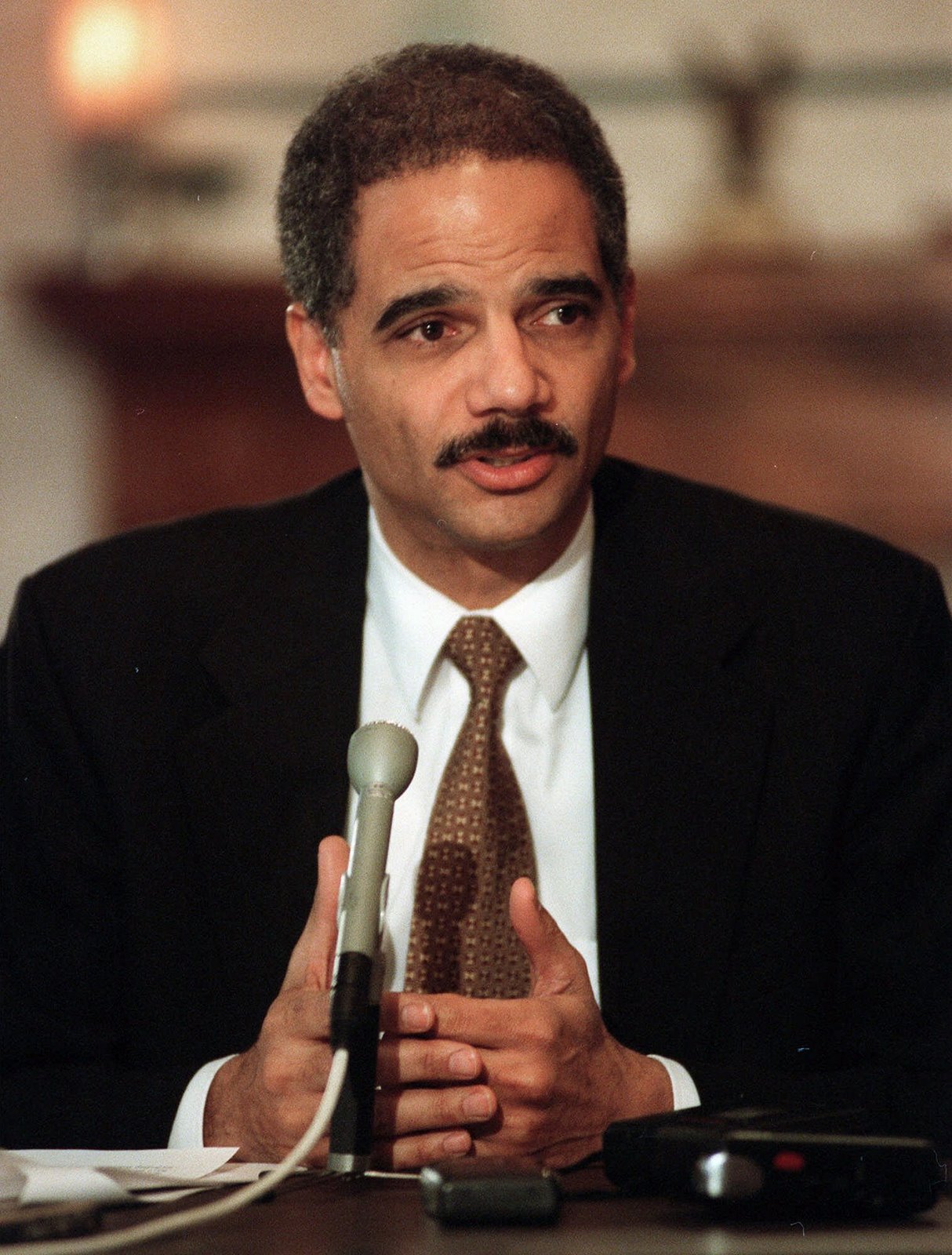
Eric Holder, Obama’s choice for Attorney General.

Obama and Holder Must Return to a September 10th Mind-Set
By Andy Worthington / December 8, 2008

During the election campaign, one of the sticks with which John McCain’s team attempted to beat Barack Obama was a claim that he was soft on terrorism, or, as Senator McCain’s national security director Randy Scheunemann declared to reporters in June, “Senator Obama is a perfect manifestation of a September 10th mind-set … He does not understand the nature of the enemies we face.”

Far from providing a rebuke to Barack Obama, this simple phrase encapsulated all that was wrong with the counter-terrorism policies of the last seven years: a misguided belief that an appropriate response to the 9/11 attacks was to launch an ill-defined but far-reaching global war on terrorism, to grant the President the power to seize anyone he regarded as a terrorist — or a terrorist sympathizer — and imprison them indefinitely without charge or trial, to wage an unprecedented assault on the U.S. Constitution, and to discard the UN Convention Against Torture, the War Crimes Act, the Army Field Manual and the Geneva Conventions.

Even now, apologists for the crimes of the last seven years refuse to concede that the 9/11 attacks had anything to do with U.S. foreign policy, with the failures of the intelligence services to monitor the threat posed by al-Qaeda, and with the failure of successive administrations — both Bill Clinton’s and George W. Bush’s — to take the threat on board.

And yet, a September 10th mind-set is exactly what is required to begin undoing the damage inflicted on America’s moral standing by President Bush and those closest to him, who were responsible for driving the country on a fear-filled journey to the “Dark Side.” Specifically, those most culpable are Vice President Dick Cheney, former defense secretary Donald Rumsfeld, and Cheney’s former legal counsel and now chief of staff, David Addington, all exponents of the “unitary executive theory” of government, for whom the declaration of a state of permanent war provided the perfect opportunity to grant the President dictatorial powers.

It remains to be seen whether, in dismantling the tyrannical aspirations of the Bush administration, President Obama will be able to call the crimes to account without implicating the perpetrators. My hope is that it will be impossible to let Cheney, Addington and Rumsfeld off the hook as more is revealed about the extent of their crimes, but in the meantime Barack Obama’s most important course of action is to adhere to the promises he made over the last year and a half: to close Guantánamo, to repeal the Military Commissions Act, to uphold the absolute ban on torture, and to trust the federal court system to bring criminals to justice. He will, in addition, need to make sure that the CIA’s post-9/11 job revision — involving the industrial-scale “extraordinary rendition” of prisoners to torture, and running secret prisons — is also brought to an end.

Much of this return to the law — as it existed on September 10, 2001 — will involve breaking the chain of command that led from the Office of the Vice President to the Pentagon, but if Obama does repeal the Military Commissions Act, then those most closely involved with Cheney and Addington’s pet project will also be out of a job; in particular, Susan Crawford, the retired judge who was the Commissions’ supposedly impartial “Convening Authority,” despite being a close friend of Cheney and Addington, and Daniel Dell’Orto, the acting general counsel who took over from the torture ideologue William J. Haynes II in February, when Haynes resigned following severe criticism by Col. Morris Davis, the Commissions’ former chief prosecutor.

Even more crucial, therefore, is Obama’s choice to overhaul the Justice Department, which, under orders from Cheney and Addington, was ruthlessly purged of any critics of the administration’s law-shredding policies, as it is here that effective plans to close Guantánamo will have to be implemented. These, presumably, will involve a rapid and dispassionate review of the existing cases, the release of the majority of the prisoners, and the transfer of those considered truly dangerous (perhaps three dozen at most) to the U.S. mainland to face trials in federal courts.

Though largely overlooked in the column inches devoted to the return of Hillary Clinton, Obama’s choice of Attorney General, Eric Holder, a partner at the law firm Covington & Burling (where some of his colleagues represent 17 Yemeni prisoners at Guantánamo), seems admirably equipped to oversee the necessary transformation of the Justice Department. Snipers have already picked up on the fact that, in January 2002, Holder delivered a speech about Guantánamo that could have been scripted by David Addington — full of references to the limitations on interrogation imposed by the Geneva Conventions, and his impression that terror suspects were not entitled to the protections of the Geneva Conventions — but as Glenn Greenwald recently pointed out, few lawyers were demanding rights for the Guantánamo prisoners back in January 2002.

More significant, therefore, are the comments that Holder made about the conduct of the “War on Terror” in June this year, to a meeting of the American Constitution Society, in which his rhetoric matched that of Barack Obama. After stating that the Bush administration had taken many steps that were “both excessive and unlawful” in the wake of the 9/11 attacks, he explained,

I never thought I would see the day when a Justice Department would claim that only the most extreme infliction of pain and physical abuse constitutes torture and that acts that are merely cruel, inhuman and degrading are consistent with United States law and policy, [and] that the Supreme Court would have to order the president of the United States to treat detainees in accordance with the Geneva Convention … This disrespect for the rule of law is not only wrong, it is destructive in our struggle against terrorism.

He then signaled his willingness to close Guantánamo, transfer the remaining prisoners to the US mainland, and adopt an “expedited and procedurally fair” review process for evaluating the status of the prisoners, which, of course, is just what long-term critics of Guantánamo have been suggesting. As with all speculation, of course, we will have to wait for January 21 to see what will actually emerge, but for now, at least, the omens are good.

[Andy Worthington is the author of The Guantánamo Files: The Stories of the 774 Detainees in America’s Illegal Prison (published by Pluto Press).]

Source / Informed Comment

The Rag Blog

Posted in RagBlog | Tagged , , , | Leave a comment

Chicago Workers Forcing Management’s Hand


Making a new New Deal: Sitdown Strike in Chicago
By John Nichols / December 7, 2008

Much has been made about the prospect that Barack Obama’s presidency might, due to economic necessity and the president-elect’s interventionist inclinations, be a reprise of the New Deal era.

But there will be no “new New Deal” if Americans simply look to Obama to lead them out of the domestic quagmire into which Bill Clinton and George Bush led the country with a toxic blend of free-trade absolutism, banking deregulation and disdain for industrial policy. Just as Roosevelt needed mass movements and militancy as an excuse to talk Washington stalwarts into accepting radical shifts in the economic order, so Obama will need to be able to point to some turbulence at the grassroots.

And so he may have it.

After the Bank of America — a $25-billion recipient of Bailout Czar Hank Paulson’s “Wall Street First” largesse — cut off operating credit to the Republic Windows and Doors company, executives of the firm announced Friday that they were shutting its factory in Chicago.

Instead of going home to a dismal Holiday season like hundreds of thousands of other working Americans who have fallen victim to the corporate “reduction-in-force” frenzy of recent weeks — which has seen suddenly-secure banks pocket federal dollars rather than loosen up credit — the Republic workers occupied the factory where many of them had worked for decades.

Members of United Electrical Workers Local 1110, which represents 260 Republic workers, are conducting the contemporary equivalent of the 1930s sit-down strikes that led to the rapid expansion of union recognition nationwide and empowered the Roosevelt administration to enact more equitable labor laws. And, just as in the thirties, they are objecting to policies that put banks ahead of workers; stickers worn by the UE sit-down strikers read: “You got bailed out, we got sold out.”

“We’re going to stay here until we win justice,” says Blanca Funes, 55, of Chicago, who was one of the UE members occupying the Republic factory over the weekend for several hours.

Most of Republic workers are Hispanic and they want answers from the Bank of America and the company.

According to the UE, the workers hope “to force the company and its main creditor to meet their obligations to the workers.”

“Their goal is to at least get the compensation that workers are owed; they also seek the resumption of operations at the plant,” explains the union. “All 260 members of the local were laid off Friday in a sudden plant closing, brought on by Bank of America cutting off operating credit to the company. The bank even refused to authorize the release of money to Republic needed to pay workers their earned vacation pay, and compensation they are owed under the federal WARN Act because they were not given the legally-required notice that the plant was about to close.”

UE is an independent union that is not affiliated with the AFL-CIO, although its roots go back to the militant labor organizing of the 1930s that gave rise to the groundbreaking Congress of Industrial Organizations.

Some of the solidarity of old has been on display in Chicago this weekend, as UE members have been supported by unions that are affiliated with both the AFL-CIO and the Change to Win coalition of major unions.

Recognizing the absurdity of taxpayer-funded bailouts that enrich banks that in turn cut credit for American manufacturers, Richard Berg, president of Chicago’s powerful Teamsters Local 743, said. “If this bailout should go to anything, it should go to the workers of this country.”

Invoking Chicago’s rich record of labor struggle — from the Haymarket Martyrs in the 19th century to the steel industry organizing of the 1930s — American Federation of State, County and Municipal Employees Council 31 regional director Larry Spivack hailed its latest expression.

“The history of workers is built on issues like this here today,” Spivack told union members at the plant.

Spivack’s right.

But it is not just the history of workers that turns on struggles such as this. It is the history of presidents and the United States.

Barack Obama will not be the new FDR, and this coming period will not see a “new New Deal” unless labor is inspired to fight once more to keep workers on the job, plants operating and American manufacturing industries muscular enough to survive in the global market. Then, the proper demands can be made on an Obama administration to back up not just unions but their expanding membership.

If the right history of this time is written, it will be said that the new New Deal began in Chicago — not just because Obama comes from the city but because workers there chose to stand up by sitting down.

For updates on developments in Chicago, UE website.

Source / The Nation

The Rag Blog

Posted in RagBlog | Tagged , | 6 Comments

Singin’ on Sunday – Kelley Johnson

Photo: Steve Robinson

I learned of Kelley Johnson rather accidentally when I was leaving for Austin the next day and needed some dinner and (I hoped) good music. Found both at a little club in Belltown, Seattle named Tula’s. Kelley is a joy live, easy with her audiences, a great stage presence and voice. She has four albums out. Here is Make Someone Happy, from the album of the same name.

Richard Jehn / The Rag Blog

Kelley Johnson reaches her audience with storytelling, subtlety, soulfulness and swing. Twice chosen to be a Musical Ambassador abroad, her quartet auditioned live and was chosen by Wynton Marsalis and Lincoln Center in 2007, and the Kennedy Center in 2004 for lengthy tours for the US State Department. Kelley is the 2003 first place winner of the International Jazzconnect Vocal Competition, and the Jazz Education Journal listed her “Live at Birdland” as a Blue Chip Jazz Vocal album of 2004. Most recently, the CD recording “Music is the Magic” with it’s passionate world-view and original spoken-word, rose to#15 on the national jazz radio chart, Jazzweek. Kelley’s lithe velvety voice mixes with a feisty delivery, tricky colorful arrangements and spirited players like Geoffrey Keezer, Ingrid Jensen, John Hansen, and Brian Lynch. The result is music that is personal and moving.

Kelley Johnson grew up all over the place, but mostly she grew up in Ironwood, Michigan. Surrounded by the sounds of music, her mother was a painter who filled the studio with the music of the 60s, 70s, R&B, country, jazz and especially the blues. When her mother was severely injured in a tragic auto accident, her family took in boarders to make ends meet. Among their guests were singers, songwriters, actors, and comedians who introduced Kelley to more music. Around the time that she and her mother and sister moved to Milwaukee, Wisconsin, she began to absorb Billie and Miles records. “Jazz had become a beacon for me”, she says. She began hanging out at Milwaukee’s Jazz Gallery learning the vernacular from Brian Lynch, David Hazeltine and the cats while studying Betty Carter five nights in a row on her annual visit to town. Her education grew to be both formal (Magna Cum Laude from the Wisconsin Conservatory of Music) and informal (gigging in Milwaukee jazz clubs). This two-fold education and her subsequent career experience produced a schooled musician who was growing into a jazz singer.

Read the rest of her bio here. And here is Kelley’s Web site.

The Rag Blog

Posted in RagBlog | Tagged | 3 Comments

Life in American Prisons: Radicalizing the Masses


The Radicalization Of An American Prisoner
By George Peter Jr. / December 5, 2008

During a hearing before the Senate Intelligence Committee in 2006, high- ranking F.B.I. officials testified that the Bureau considered U.S. prisons to be “fertile grounds for extremists”, and that they were in the process of developing “threat assessments” for those individuals who may have become “radicalized” during their incarceration.

Listening to those officials postulate a variety of theories as to the perceived radicalization of American prisoners since 9/11, ranging from a misguided identification with terrorist leaders such as Osama bin Laden, to the radical preachings of jailhouse religious leaders, it became readily apparent that today’s F.B.I. is as out of touch with reality as the one headed by J. Edgar Hoover, which for decades denied the existence of the mafia.

As one who has been confined in the Illinois Department of Corrections since 1967, I myself have observed a change in the attitudes and political philosophy of the average American prisoner, shaped not because of an external event occurring in some distant land, or the importation of some radical religion; but instead, due to the unrelenting assault upon prisoners by state houses around the nation, the unwillingness and/or inability of states to protect those who are imprisoned in their penal systems, the dual-standard of justice imposed upon prison guards who commit criminal acts against prisoners, and the daily vilification and demonization of those caught up in the criminal justice system, best exemplified in such television shows as “Cops”, “Nancy Grace”, and MSNBC’s “Lockup” the ultimate in reality programming.

To help one get a clearer understanding of this issue, let us utilize the eyes of a hypothetical prisoner (we’ll call him “Tony”) returning to the Menard Correctional Center, after living in the outside world for the last decade; what would he observe? Probably the first thing he would sense is a feeling of abandonment, due to the near complete abolishment of any meaningful rehabilitative programming. Thanks to the efforts of William Jefferson Clinton, the college classrooms have been long shuttered, as have the vocational schools, due to the elimination of prisoner access to the federal government’s Pell Grants.

Tony would further note that the prison has abolished every organizational recreational activity previously used to release tension and help maintain control of the facility. Now he would find himself confined in a space 4′ 3″ by 10′, with another prisoner, for a minimum of 159 hours a week, with little but a television set to help while away the hours. His cell is so small that it contains no table or chair, and the space between the bunks is so small 26″ that he must sit on the toilet if he wishes to write a letter. Other than that, his only options are to lie down, or stand up.

Although lockdowns occurred during Tony’s previous incarceration, they were primarily used in response to large-scale confrontations between various factions of the prison community, and to conduct periodic searches for contraband. He will now see that they are routinely scheduled to facilitate employee absences over the Thanksgiving and Christmas holidays, as well as the annual deer-hunting season.

When he walks into the dining room, he will discover he is now allotted only ten minutes to eat a barely palatable meal, but due to the miniscule portions, that will be more than a sufficient amount of time. Surprisingly, he will learn that the prison guard’s union has publicly described the food served as “barely edible1.”

If he believes that the conditions he is confined under are unconstitutional, this is probably at least partially attributable to the fact that the federal enforcement of civil rights laws has dropped precipitously since 1999. According to the Transactional Records Access Clearinghouse at Syracuse University, the Justice Department has seen the prosecution of civil rights cases fall by one-third through 2005. Additionally, the state statute that allowed clergy and attorneys to monitor the constitutional rights of prisoners was repealed.

Borrowing some reading material from a neighbor, Tony reads multiple examples of the duplicitous nature of the criminal justice system, how it inflicted Draconian penalties upon those who committed trivial offences during incarceration, while those employed by the government would receive, at worst, a mere slap on the wrist, when discovered abusing those under their control. The penalty imposed upon Colorado prisoner Douglas Wilson for passing out an extra cheese sandwich to fellow convicts was three additional years in prison; while in May 23, 2006 Illinois prison guard Clarence Howard was sentenced to two years probation for smuggling drugs into the facility where he worked.2 When Pennsylvania prisoner Darren Miller threw urine on a guard, he had 15 more years tacked onto his sentence, whereas Hawaiian prison guard Brian Freitas was placed on one year’s probation for his rôle in the murder of prisoner Antonio Revera.3

However, what Tony found the most appalling were the direct assaults upon the minimal rights of those confined all around the country. When inmates had the audacity to actually seek the protection of laws enacted by state legislatures, they discovered the courts unwilling to ensure the safeguarding of these basic rights. When the mother of a Connecticut prisoner sued the state for the failure to treat her son in accordance with the state’s “Patient’s Bill of Rights”, the prison system did not deny the allegations; rather they claimed in court that the Bill of Rights did not apply to prisoners. The state’s supreme court agreed.

After receiving numerous complaints of employee misconduct against youths confined in Oklahoma’s maximum security prison for youthful offenders, the state’s attorney general’s office declined to investigate, citing budgetary woes. This is the same state that chose to expend millions of dollars to secure additional life sentences against Timothy McVie’s co-defendant, Terry Nichols, after he had already received a life sentence in federal court.

Closer to home, Tony gained a degree of understanding as to why Illinois’ prisons appeared to be in a state of mismanagement. This came to light as he read about the investigation of the March 2, 2006 murder of an inmate at the Muddy River Correctional Center, where it was discovered that assistant warden Julie Wilkerson’s only apparent qualifications for her job were the campaign contributions she made to Governor Rod Blagojevich. Ms. Wilkerson is a former music teacher, with no prior prison experience.

Tiring of this self-flagellation, Tony turns on the television, where he discovers that law and order shows appear to be the flavor of the day. As he looks in on “The Nancy Grace Show”, he quickly discerns that Miss Grace routinely projects an attitude of unbridled anger and animosity towards anyone who disagrees with her prosecutorial mindset. Most frightening in her telecasts are the incessant and one-sided diatribes spewed forth against whichever criminal defendant she is focusing on in that particular episode. While her viewers may not be cognizant of her ability to appreciate the finer points of due process, the Georgia Supreme Court has, as it rebuked her on multiple occasions for her “unethical behavior” in securing criminal convictions. In comparison to this bubble-headed bleach blonde, Ann Coulter is a flaming liberal.

Flipping the dial, in search of something less intense, Tony tunes into “Cops”, a program devoted almost entirely to showing slow-footed African and Appalachian Americans attempting to out-run the police unsuccessfully, I might add and then being body slammed to the ground when they get caught. While not a serious show, it still serves to humiliate and dehumanize those appearing on it.

Lastly, he tunes into MSNBC’s “Lockdown”, undoubtedly the most insightful of the crime programs he has seen, as the camera takes the viewer into prisons across the nation mostly maximum and super-maximum security for an up-close and personal view. Unfortunately, what it so clearly displays is the rampant brutality and stifling isolation these human beings are exposed to, year after year. Little mention is made to explain how these prisoners could possibly be expected to successfully re-enter society after surviving this man-made hellhole.

As this story comes full circle, Tony wishes that for just one day, those high-ranking F.B.I. officials could experience what prisoners around the nation have to live with on a daily basis. Only then could they begin to conceptualize the mis-treatment being inflicted upon those incarcerated in America’s prisons, and the anger it breeds. Perhaps at this juncture they would realize that while there is a definite undercurrent of alienation and animosity within the country’s prison population, it is not a radicalization born from the exposure to the vitriolic venom spewing from the mouths of psychotic mass murderers such as Osama bin Laden, an individual I would happily speed on the way to his reward of 72 virgins.

No, my “radicalization” as you describe it, has been incubated and nurtured by this cesspool you call a penal system, and every day your brutality adds yet another name on the rolls. At what point will you sit up and take note?

Notes

1. “Maximum Insecurity”, at www.afscme31.org
2. Prison Legal News, June 2006, p. 42
3. Prison Legal News, June 2006, p. 35

Source / Information Clearing House

The Rag Blog

Posted in RagBlog | Tagged , , | 6 Comments

The Secret Laos Bombing and Legacies of War


Drawing the Future from the Past
By Channapha Khamvongsa / December 5, 2008

The bombing was relentless. From 1964 to 1973, the United States dropped more than 2 million tons of ordnance on Laos. That’s a planeload of bombs every eight minutes, 24 hours a day, for nine years. Laos has the unfortunate distinction of being the most heavily bombed country in the history of the world.

“In the area of Xieng Khoang, the place of my birth, there was health, good earth, and fine weather,” one survivor, a 33-year-old man, recalls of that period. “But then the airplanes came, bombing the rice fields and the forests, making us leave our land and rice fields with great sadness. One day a plane came bombing my rice field as well as the village. I had gone very early to harrow the field. I thought, ‘I am only a village rice farmer, the airplane will not shoot me.’ But that day truly it did shoot me and wounded me together with my buffalo, which was the source of a hundred thousand loves and a hundred thousand worries for me.”

For nearly three decades, the U.S. secret war in Laos and the impact of the most massive bombing campaign in the world was nearly forgotten. For those who remembered, the events seemed surreal. They witnessed the reckless destruction of a people and their land, and careful efforts by the U.S. government to conceal it. For those too young to know, gathering information and knowledge of this history was scattered and fragmented. It seemed the secret war in Laos and its aftermath would remain a secret.

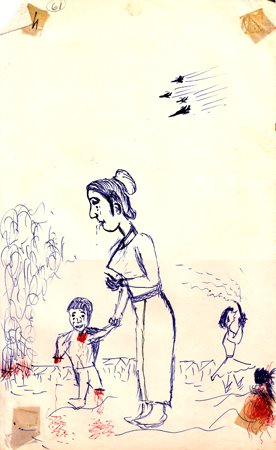
But then a remarkable set of drawings and eyewitness accounts came to light. Laotian villagers put their memories on paper in the 1970s to depict the secret bombing of their country. This trove of reminiscences became the inspiration for Legacies of War. Founded by Laotian Americans in 2004, the project raises awareness about the history of the Vietnam War-era bombing in Laos. Using a unique combination of art, culture, education, community organizing, advocacy, and dialogue, Legacies of War also works for the removal of unexploded bombs in Laos, to provide space for healing the wounds of war, and to create greater hope for a future of peace.

A Secret War, a People Scattered

When the United States withdrew from Indochina, the “Secret War” in Laos was lost to history. But the legacy of the war lives on. Up to 30% of the cluster bombs dropped by the United States in Laos failed to detonate, leaving extensive contamination from unexploded ordnance (UXO) in the countryside. That translates into 78 to 130 million unexploded bomblets. Over one-third of the land in Laos is contaminated. These “bombies,” as the Lao now call them, have killed or maimed more than 34,000 people since the war’s end, and continue to claim more innocent victims every day. About 40% of accidents result in death, and 60% of the victims are children. UXO remains a major barrier to the safety, health, livelihoods, and food security of the people of Laos.

The war also displaced up to one-third of the Lao population. Nearly 750,000 would eventually become refugees in France, Australia, and Canada, among other countries. Over 350,000 refugees from Laos came to the United States after having experienced war, destruction, death, imprisonment, family separation, loss of homeland, loss of identity, and loss of control over their destinies. Many had undiagnosed post-traumatic stress disorder. But these weren’t things Laotian refugees had the luxury to contemplate, for basic economic survival trumped all other needs.

Drawing on the Past

Between December 1970 and May 1971, Fred Branfman, an American, and Boungeun, a Lao man, collected illustrations and narratives in the Vientiane refugee camps, where bombing victims fled. The drawings and narratives represent the voiceless, faceless, and nameless who endured an air war campaign committed in secrecy. Drawn in pencil, pens, crayons, and markers, they are raw and stark, reflecting the crude events that shaped their reality. The simplicity of the narration and drawings emphasize the illustrators’ identities as ordinary villagers who bore witness to a devastating event.

For instance, an 18-year-old woman remembers, “In the year 1967, my village built small shelters in the forest and we had holes in the bamboo thicket on top of the hill. It was a place to which we could flee. But there were two brothers who went out to cut wood in the forest. The airplanes shot them and both brothers died. Their mother and father had just these two sons and were both in the same hole with me. I think with much pity about this old father and mother who were like crazy people because their children had died.”

Each of the illustrations demonstrates the violence of warfare. However, the images of blood and death are contradicted by the memories of the scenic and peaceful village life these survivors once lived. Scenes show farmers tending to their rice fields, monks praying at the temple, women going to the market, and children playing in the schoolyard. The drawings capture the very moments when their lives and society were forever altered. The illustrations and narratives are at the heart of the Legacies of War National Traveling Exhibition, which is accompanied by historical photos, maps and other relevant documents to give context to the decade-long bombings.

Only a small circle of individuals knew of the existence of these illustrations. The pictures hadn’t been seen in decades, not since the end of the war. A fortuitous meeting between me and Institute for Policy Studies director John Cavanagh led to the return of the illustrations to the Lao American community. In the last several years, thousands of visitors have seen the illustrations through the Legacies of War traveling exhibit and other community forums. Although most Laotian Americans didn’t experience the same horrors depicted in the drawings, the illustrations invoke memory of their own stories of refuge, survival, and resilience.

The reaction to the drawings was instructive to Legacies’ work. Initially considered an artifact, the illustrations have become a living document. One at a time, each drawing tells the story of a survivor. Although the illustrations were from four decades ago, they inspire others to share their stories, contributing to a collective narrative that began long ago in Laos, but continues today through the voices of Laotian Americans.

Following a viewing of the illustrations at an exhibit in Lowell, Massachusetts, a Lao woman in the audience stood up to speak at a community forum, “The illustrations made me remember. I have not shared, not even with my family because I didn’t think it was important. When I was a young woman in Laos, I worked as a nurse to help people hurt by the bombing. Every day, the airplanes would come: Boom! Boom! Boom! And then one day, it came so close to us, we had to hide in the cave and we hear right outside the cave, the sound so loud. It scared me so much. I feel so lucky I did not die. The pictures made me remember. I am so sad that today, people in Lao are still being hurt and dying from these bombs.” The woman, whose husband had spoken on several occasions about his experience, had never shared hers. The illustrations and community forum gave her a chance to tell her story for the first time in 30 years. Today, she remains engaged in educating people in the Boston-area about the bombing and its aftermath.

These new voices and stories are captured in various ways through Legacies of War: interactive exhibition pieces, community programs, oral history interviews, theater performance pieces, and new commissioned works of art. Based on oral histories collected from Laotian refugees and their descendents, the Refugee Nation theater piece reveals connections between U.S. and Southeast Asian history, and the unique challenges faced by political refugees and their American children. Touching on themes of identity, globalization, and activism, it brings a Laotian voice to a growing part of the Asian-American Diaspora that is yet to be included in the American experience.

The integration of storytelling, art, and performance are critical in breaking the silence. By creating multiple access points of engagement, Legacies of War facilitates the connection of personal stories to a collective experience in recognition that we are not alone in our experiences, that we are connected to a larger narrative and a larger context. The acknowledgement of a shared journey and struggle could lead to collective strength and power.

Since the end to the U.S. wars in Southeast Asia, many other wars have been waged, in other parts of the world, in new terrain, villages, and communities. Yet, the wars in Southeast Asia lingers. And for the people living in Laos as well as those who became refugees, the lingering impact of war remains ever present in their daily lives. Although war and conflict created the refugee community, they don’t have to define it. Through the transformative power of stories, art, and performance, Laotian Americans are evolving from victim to agency of change. “Now that I know about the secret war,” said a Lao American student in Seattle, “I have to do something about the horrible things that are still happening to people. As Americans, we must do something.”

Another victim, a 37-year old woman, reflects, “Our lives became like those of animals desperately trying to escape their hunters . . . Human beings, whose parents brought them into the world and carefully raised them with overflowing love despite so many difficulties, these human beings would die from a single blast as explosions burst, lying still without moving again at all. And who then thinks of the blood, flesh, sweat and strength of their parents, and who will have charity and pity for them?…In reality, whatever happens, it is only the innocent who suffer. And as for other men, do they know all the unimaginable things happening in this war?”

[Channapha Khamvongsa, the executive director of Legacies of War, is a Foreign Policy In Focus contributor. Editor: John Feffer.]

Source / Foreign Policy in Focus

The Rag Blog

Posted in RagBlog | Tagged , , , | 1 Comment

Russell Weiner : This Rockstar Hits Sour Notes


‘He is a “chip off the old block” and donates significantly (using his Rockstar profits) to many many many far right causes.’
By Thomas Cleaver / The Rag Blog / December 7, 2008

It’s always amazing what you can discover, reading the celebrity real estate pages in the Los Angeles Times.

Like the fact that Russell Weiner, the creator of “Rockstar” energy drink, is the son of Michael Weiner – better known as right wing hate radio propagandist “Michael Savage.” Russell, proving that the seed doesnt fall far from the bush, tried to run as a right-wing Republican for a California Assembly seat (financed with Rockstar) eight years ago and lost. But he is a “chip off the old block” and donates significantly (using his Rockstar profits) to many many many far right causes.

Mmmmm…. shade-grown/fair-trade Central American coffee, grown as a product of the project by the Nature Conservancy to help stop the deforestation of the Cloud Forest by giving the people who live in the forest an economic reason to believe in conservation just tastes better and better.

Please pass this far and wide through the left – kicking fascists in their billfolds is the best place (other than planting a .45 caliber hole in the “third eye,” which is illegal, not to mention a felony, and you never heard me advocate such a thing).

Mr. Weiner already had to drop the overpriced sale price of his home overlooking Sunset Boulevard 50% in order to sell it (taking a $2 million hit on what he paid two years ago). Perhaps we can help his balance sheet in other ways??

The Rag Blog

Posted in RagBlog | Tagged , , | 3 Comments

‘Socialized Medicine’ : It Works for Others


‘Sweden and other European countries have some of the best health care in the world and provide it at a cost far less than in America.’
By Hosea W. McAdoo M.D. / The Rag Blog / December 7, 2008

[President-elect Barack Obama has asked the public for input on health care reform. These are Dr. McAdoo’s suggestions.]

I am a physician who has been involved in private health care as well as short stints in VA and Navy medicine. During my career over thirty years I have seen Medicare evolve, seen the resistance to both Medicare and Medicaid. I have seen medicine change from being physician centered to business centered.

With the new medicine I have seen costs soar, malpractice become an industry and seen many patients (NOT CLIENTS) find it impossible to get any kind of care. This in spite of the frightening misinformation presented by both President Bush and McCain’s health care adviser that all Americans really have health insurance by just going to emergency rooms. When leaders give such atrocious advice it is clear why America is near the bottom ranking in health care.

During the campaign McCain made a statement that we don’t want health care like Sweden that is socialized. This is another incredibly stupid remark as Sweden and other European countries have some of the best health care in the world and provide it at a cost far less than in America. Remember, a socialized system seems to work for President Bush, Vice President Cheney and Sen. McCain since they go to the National Naval Medical Center or similar hospitals and seem to like it. They just don’t want the rest of us to have it.

The incredible controversy about “socialized medicine” is a false argument revealing little understanding of health care delivery here and abroad. The word, “socialized,” is used more for it’s emotional charge than as a part of logical argument. It is true that the UK is very close to socialized, but provides excellent medicine in spite of the slander about long waits etc. Have you tried to get an appointment with a new primary care physician or specialist? Note, the UK far outranks our system in bottom line results, much better than America. Canada has a system similar in many ways to our Medicare and also provides better care than we do and at far less cost but is not socialized at the level of delivery. There is freedom of choice. Unlike Medicare, each province manages its own system although they are quite similar and care is given across Canada. There seems to be much dislike for the Canadian system in America, but Canadians almost universally like the system with far fewer complaints than here. The misinformation about these other systems seems to be very common in those who accept whatever rumor is being spread.

In America, we have the potential for giving excellent care but our main failure is cost and the inability to give care for all. We also have too few physicians and nurses and they are allocated in inefficient ways. Physician reimbursement always seems to be a place to shave costs, but when the costs of education and the number of hours of work, office overhead and malpractice insurance costs are factored in, reimbursement may be one reason many students choose fields with “gimmicks” that make time more valuable such as endoscopy and surgery. This leaves primary care and other fields that bill by time rather than by procedure in worsening straits.

Many people have told me that they don’t want government interference in their choice of a physician. A moment’s thought will reveal the absurdity of this view. Medicare allows almost total choice of physician and choice of hospital where that physician is on staff.

Private insurance will give you a book of preferred providers, actually should be called, “if you don’t go here we won’t pay and may not anyway.”

I do not trust government to run things but we are already socialized in many aspects from our military, police, fire protection, highways, FAA, the VA system and education as well as in many others. Most of these work reasonably well and it us unlikely that private industry can do better and still provide for stockholders and high salaries.

Medicare operates with an overhead of about 3% while private insurance with its various rules, uncertain payment and limited physician choice charge about 30%. That’s TEN times as much. This means that for each health care dollar under Medicare 27 cents more is available for patient care and better provider reimbursement and lower cost overall. Just look at the medicare Advantage boondoggle to see how private insurance milks the system, something Medicare can do far cheaper.

My recommendations are:

1. Much more use of nurse practitioners and physician assistants. Their schooling is shorter and cheaper. They seem to be more compulsive with exams and protocols. This would build the base of primary care. I do think they should operate with some physician guidance as their training is less extensive in diagnosis and treatment of less common problems.

2. Anything short of a single payer system will fail. We can pussyfoot around trying this and that to continue the welfare to insurance companies but these 30% gifts will continue to break the system, restrict access, fail to cover pre-existing illness, limit physician choice and force higher office overhead and cost physician time dealing with 3,000 plus providers. I understand that telling the insurance companies bye bye will be hard for our indebted and spineless politicians. It only makes sense to model ourselves after systems that work and work well rather than sticking to a system we know is broken just to make life easier for a few at the expense of the people. (I know. that’s how politics works but it is time for CHANGE!)

3. COST, that is a problem. We can see instantly a 27% savings by going to a Medicare system and that alone will come close to covering all those now left out. There will be cost savings to physicians by lowering overhead now taken by large insurance departments, accounts payable and stumbling blocks used by companies to avoid or delay payment. When used properly, Medicare is amazingly smooth and fast paying and since private insurance usually is tied to Medicare Usual and Customary payments the payments are similar.

At present, money flows into the health care system from many sources, private pay, the Federal government via medicare, Medicaid, VA , USPHS, Military medicine, research grants and others. States provide via Medicaid, public health, public and teaching hospitals and others. Private insurance covered by private and employer premiums is a large part. Since this amount already flows into the medicine by a multitude of confusing, inefficient and possibly dishonest methods why couldn’t the same amount be collected by other means and used to finance a Medicare for all?

In America it would be very helpful to look at other working systems. The other systems have many problems and surely are not perfect but their bottom line concerning access, longevity, neonatal mortality, chronic illness, preventative medicine, lower cost, absent paperwork would seem to me to be worthwhile even if some misinformed call it socialist. Health care is too important to ration it based on finances. These other countries base it on medical need.

[These comments were also posted on the Progressives for Obama listserv.]

The Rag Blog

Posted in RagBlog | Tagged , , , | 1 Comment