Odetta : Bid Farewell to Another Legend

Odetta at Radio City Music Hall in New York for a “Salute to the Blues” Benefit concert in 2003Odetta, Voice of Civil Rights Era, Dies at 77. Photo by Nancy Siesel / NYT.

‘Her voice plunged deep and soared high, and her songs blended the personal and the political, the theatrical and the spiritual.’
By Tim Weiner / December 3, 2008

Odetta, the singer whose deep voice wove together the strongest songs of American folk music and the civil rights movement, died on Tuesday at Lenox Hill Hospital in Manhattan. She was 77.

Odetta sang at coffeehouses and at Carnegie Hall, made highly influential recordings of blues and ballads, and became one of the most widely known folk-music artists of the 1950s and ’60s. She was a formative influence on dozens of artists, including Bob Dylan, Joan Baez and Janis Joplin.

Her voice was an accompaniment to the black-and-white images of the freedom marchers who walked the roads of Alabama and Mississippi and the boulevards of Washington in the quest to end racial discrimination.

Rosa Parks, the woman who started the boycott of segregated buses in Montgomery, Ala., was once asked which songs meant the most to her. She replied, “All of the songs Odetta sings.”

Odetta sang at the march on Washington, a pivotal event in the civil rights movement, in August 1963. Her song that day was “O Freedom,” dating to slavery days: “O freedom, O freedom, O freedom over me, And before I’d be a slave, I’d be buried in my grave, And go home to my Lord and be free.”

Odetta Holmes was born in Birmingham, Ala., on Dec. 31, 1930, in the depths of the Depression. The music of that time and place — particularly prison songs and work songs recorded in the fields of the Deep South — shaped her life.

“They were liberation songs,” she said in a videotaped interview with The New York Times in 2007 for its online feature “The Last Word.” “You’re walking down life’s road, society’s foot is on your throat, every which way you turn you can’t get from under that foot. And you reach a fork in the road and you can either lie down and die, or insist upon your life.”

Her father, Reuben Holmes, died when she was young, and in 1937 she and her mother, Flora Sanders, moved to Los Angeles. Three years later, Odetta discovered that she could sing.

“A teacher told my mother that I had a voice, that maybe I should study,” she recalled. “But I myself didn’t have anything to measure it by.”

She found her own voice by listening to blues, jazz and folk music from the African-American and Anglo-American traditions. She earned a music degree from Los Angeles City College. Her training in classical music and musical theater was “a nice exercise, but it had nothing to do with my life,” she said.

“The folk songs were — the anger,” she emphasized.

In a 2005 National Public Radio interview, she said: “School taught me how to count and taught me how to put a sentence together. But as far as the human spirit goes, I learned through folk music.”

In 1950, Odetta began singing professionally in a West Coast production of the musical “Finian’s Rainbow,” but she found a stronger calling in the bohemian coffeehouses of San Francisco. “We would finish our play, we’d go to the joint, and people would sit around playing guitars and singing songs and it felt like home,” she said.

She began singing in nightclubs, cutting a striking figure with her guitar and her close-cropped hair.

Her voice plunged deep and soared high, and her songs blended the personal and the political, the theatrical and the spiritual. Her first solo album, “Odetta Sings Ballads and Blues,” resonated with an audience hearing old songs made new.

Bob Dylan, referring to that recording, said in a 1978 interview, “The first thing that turned me on to folk singing was Odetta.” He said he heard something “vital and personal,” and added, “I learned all the songs on that record.” It was her first, and the songs were “Mule Skinner,” “Jack of Diamonds,” “Water Boy,” “ ’Buked and Scorned.”

Her blues and spirituals led directly to her work for the civil rights movement. They were two rivers running together, she said in her interview with The Times. The words and music captured “the fury and frustration that I had growing up.”

Her fame hit a peak in 1963, when she marched with the Rev. Dr. Martin Luther King Jr. and performed for President John F. Kennedy. But after King was assassinated in 1968, the wind went out of the sails of the civil rights movement and the songs of protest and resistance that had been the movement’s soundtrack. Odetta’s fame flagged for years thereafter.

In 1999 President Bill Clinton awarded Odetta the National Endowment for the Arts Medal of the Arts and Humanities.

Odetta was married three times: to Don Gordon, to Gary Shead, and, in 1977, to the blues musician Iverson Minter, known professionally as Louisiana Red. The first two marriages ended in divorce; Mr. Minter moved to Germany in 1983 to pursue his performing career.

She was singing and performing well into the 21st century, and her influence stayed strong.

In April 2007, half a century after Bob Dylan first heard her, she was on stage at a Carnegie Hall tribute to Bruce Springsteen. She turned one of his songs, “57 Channels,” into a chanted poem, and Mr. Springsteen came out from the wings to call it “the greatest version” of the song he had ever heard.

Reviewing a December 2006 performance, James Reed of The Boston Globe wrote: “Odetta’s voice is still a force of nature — something commented upon endlessly as folks exited the auditorium — and her phrasing and sensibility for a song have grown more complex and shaded.”

The critic called her “a majestic figure in American music, a direct gateway to bygone generations that feel so foreign today.”

Source / New York Times

Thanks to Larry Piltz / The Rag Blog

Posted in RagBlog | Tagged , , , , , , , , | 1 Comment

Mumbai LeT Terrorists May Have Trained in Iraq

I want to explain my headline. It is now known that the Lashkar-e-Taiba (LeT) are responsible for the Mumbai attacks. It is also know that the LeT have been active in the insurgency in Iraq since 2004. Although specific training is identified in this article, it remains a possibility that the Iraq violence has provided a training ground for LeT fighters, some of whom may have been part of the attacks on Mumbai. If even remotely connected, this provides further evidence that George Bush’s war on terror is yielding even greater terrorism world-wide, which is strongly suggested for many other reasons.

Bottom line? It is time to end the War on of Terror and think outside the box for other, meaningful and constructive solutions to the terrorist violence in the world.

Richard Jehn / The Rag Blog

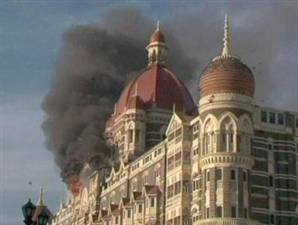
ATTACKS PLANNED MONTHS AGO — One of the attackers captured by police said the terror group began their voyage to India on Nov. 12 or Nov. 13, and that they had earlier received trained in marine and urban warfare. The photo shows a policeman guarding the CST railway station in Mumbai on Dec. 1. Order at the railway station, a landmark building in Mumbai, has returned to normal after the terror attacks. (Xinhua/Photoshot via Newscom)

Spy Agencies Gather Intel on LeT After Mumbai Attacks
By Richard Sale / December 2, 2008

The extremist al-Qaida affiliate Lashkar-e-Taiba, or Let, has been named as the perpetrator of the recent horrific Mumbai attacks, according to U.S. officials. “This was definitely a LeT operation. There’s no doubt about it,” said a former senior CIA official with close knowledge of the dossier.

Last week’s attacks on 10 sites in Mumbai killed 188 people in three days including six Americans in the heart of India’s commercial capital, putting the government there in a state of shock. Indian forces killed nine assailants and wounded one, and the search is still going on for more.

“Indian security may not have gotten them all,” a U.S. official said.

According to Indian press reports, names and phone numbers were found in the wallets and cell phones of the attackers. U.S. officials said they believe the data is credible.

A former U.S. intelligence official said that the CIA “had warned the government of India that LeT was planning a terrorist attack on Mumbai but the intelligence wasn’t specific enough.”

Although known mainly as a Kashmiri group, LeT was actively fighting U.S. forces on the ground in Iraq, beginning in late 2003-2004, U.S. officials said. They still had a presence through 2007 when their members began to shrink.

According to Indian press reports, confirmed as credible by U.S. and serving former intelligence officials, data obtained from a captured satellite phone found on a vessel seized in the Arabia Sea revealed that the assaults were planned at least six months ago.

Ajmai Amir Kamal, one of the attackers captured by police, has claimed that the group launched their voyage to India on Nov. 12 or Nov. 13, and that they had been trained in marine warfare along with a special course Daura-a-Shifa conducted by LeT, according to the Indian Research for Conflict Management that operates the South Asia Terrorism Portal (SATP).

According to the former senior U.S. intelligence official, Kamal acknowledged he was a resident of Faridot near Multan in the Punjab province of Pakistan.

SATP claimed that Kamal said they were not suicide bombers but had planned to escape on Nov. 27 using a route plotted for their return and stored in a Global Positioning System device.

U.S. officials said they believe Kamal’s statements “plausible” and that they are still gathering evidence, while continuing to corroborate the facts “beyond doubt,” as one U.S. official said.

U.S. officials were also investigating reports that the group’s cell phone was used to call Yusuf Muzmail, the Lashkar commander in Muzaffarabad. The attacking group remained in Karachi for four days or so before launching the assault. A cell phone found on a dead fisherman at sea had been used to call Pakistan. The Indian Coast Guard warned of a possible sea infiltration on Nov. 18, but the Indian government was inert.

“The Indian response to this puts its antiterrorist groups in a very bad light. The response was disgracefully scattered,” another former senior U.S. official said.

The SATP sources said that Kamal had named Pakistani citizens including Abu Ali, Fahad, Omar, Shoaib, Umer, Abu Akasha Ismail, Abdel Rahman, and Abdel Rahman as his accomplices.

Initial reports said that en route to Mumbai, the gunmen captured the trawler Kuber and killed five fishermen.

Other versions claim that two Pakistani ships, MV Al-Kabir and MV Alpaha were used as “mother ships” to transport the terrorists. Both have been detained in a joint operation by Border Security Guards and Navy Coast Guard ships.

The extremists used an inflatable boat and a speedboat to land near the Sasson dock, very near the Taj Continental Hotel, U.S. officials said. Once ashore they split up into five teams. Two batches went by taxi to the Victoria Terminus station. The three others headed for Nariman House, the Oberoi Hotel and Café Leopold. The last quartet went to the Taj Hotel.

They were heavily armed and spoiling for an offensive. According to U.S. officials there were seven incidents that involved explosive devices and the throwing of hand grenades, 13 incidents of intense exchanges of fire with Indian security troops, three incidents of infiltration into buildings that resulted in extensive fire-fights with Indian security forces.

U.S. officials have confirmed reports by Israeli intelligence that the jihadis released 17 Russian hostages after checking their passports, despite known and lingering animosities over the Chechen conflict. The motive is unclear, they said.

Most U.S. terrorism experts believe that LeT is an al-Qaida affiliate, a subcontractor to Osama bin Laden helping to run al-Qaida’s infrastructure, fund-raising, recruiting and propaganda in South Asia.

In 1989, bin Laden had declared the liberation of Kashmir an al-Qaida objective and soon the radical Jaish-e-Mohammed (JEM) merged with LeT which was active in promoting the independence of Kashmir from India, a popular cause among Pakistani Muslims that provided a sure recipe for inaction on the part of the Pakistan government.

Although described by many as a Kashmiri group, LeT is in fact made up of Punjabis with a sprinkling of Afghanis, Arabs, Bangladeshis, Southeast Asians and the occasional Westerner.

In addition to wanting to annex Kashmir to Pakistan, the organization also sought to establish an extremist Islamic Caliphate. LeT had increasingly seen America as an obstacle on a par with India and Israel to the spread of jihadist or Salafist (Wahabi) Islam.

The parent of LeT is a Saudi jihadist group, Ahl-i-Hadith which supports jihad in Kashmir. U.S. State Department officials say the Saudis saturate their media with pleas for Kashmir’s independence.

According to former CIA official and terrorism expert Marc Sagemen, LeT is only one of several regional jihadist organizations that operate to further al-Qaida objectives without close supervision from the core al-Qaida leadership, which has been severely weakened by losses and has shrunk to only 100 members.

LeT became active in Iraq in 2004 and attracted notice when U.S. forces arrested a Pakistani national, Dilshad Ahmad, a long-time LeT operative from the province of Punjab who had led terror bombings against India for four years.

Through interrogations, U.S. officials have established that LeT had moved its operations to the theater of Iraq. LeT had been named a terrorist organization by the U.S. State Department in 2001 following the Sept. 11, 2001 attacks. Until then they had fought mainly in Kashmir, India, and Chechnya.

U.S. officials said that LeT was involved in the July 7, 2005 terrorist attacks against the London Underground.

The Mumbai attacks were unusual in that they specifically targeted foreigners such as British, Americans and Israelis, and for the first time, took hostages, U.S. officials said.

FBI officials at home and CIA and other intelligence agencies overseas are stepping up scrutiny of the activities of LeT, U.S. officials tell the Middle East Times.

Perhaps most startling is the fact that LeT executed a dry run of the operation in 2007 to test the reliability of the sea method of attacks, U.S. officials said.

The use of mother ships to transport terrorists had long been part of the method of operation of the Palestinian Liberation Organization, U.S. officials said.

According to The Hindu Times, LeT had sent an eight-man squad to Mumbai by fishing boat in 2007 in a dry run of the attack to test the reliability of the sea route.

The paper also quoted Jammu and Kashmir police investigators as saying the men in groups of two traveled by road from Bait-ul-Mujahidee, LeT’s headquarters in Muzaffarabad to Rawalpindi before heading south to Karachi by train. There they sat in separate compartments for the Rawalpindi to Karachi journey.

After waiting for a week, they were allowed to start their dry run for Mumbai.

Arriving late at night the raiders hid in a safe house near the Bahhabna Research Center. Many of India’s nuclear installations are close to the sea.

Once disembarked the squad traveled north to Jammu and Kashmir, the newspaper said.

After four days at sea, their commercial fishing boat was intercepted by the Indian Coast Guard. After the Coast Guard captain was bribed, the LeT vessel was allowed to proceed but, unknown to the terrorists, the Coast Guard had planted a tracking device aboard, which led police to arrest them in Jammu.

One of the prisoners, Abul Majid Araiyan told interrogators that he had taken religious classes in a Pakistani madrassa, and in 2003, only days after Pakistani President Pervez Musharraf banned Let, had received an advanced 40-day advanced course in guerrilla warfare. Araiyan officially joined LeT in 2005.

Source / Middle East Times

The Rag Blog

Posted in RagBlog | Tagged , , | Leave a comment

Beyond the Bailout State : Empire of Depression


‘What kind of new administration could actually get beyond Roosevelt’s era as well as our own staggering disaster, leaving “the bailout state” behind us?’
By Tom Engelhardt / December 1, 2008

See ‘Roosevelt’s Brain Trust vs Obama’s Brainiacs’ by Steve Fraser, Below.

If you want to catch something of the fears and hopes of Americans right now, go to News.Google.com and try searching for a few words. For instance, put in “FDR” — the well-known initials of the man who was president four times and took America through the Great Depression and all but the last months of World War II — and endless screens of references pop up.

The Nation and the National Review have both devoted space to him. Paul Krugman and George Will both thought this was the moment to focus on him. Checking out the headlines you might think that the intervening sixty-four years since his death had simply vanished: (“Will FDR Inspire Obama?” “Obama’s jobs plan could echo FDR’s,” “Clinton’s potential pitfalls seen in FDR’s secretary of State,” Channeling FDR,” “FDR saved capitalism — now it’s Obama’s turn,” and so on); headlines galore, not to speak of that Time Magazine “Obama as FDR?” cover.

Or, if you have another moment, try “the New Deal,” or even the 2008 Obama version of the same,”the new New Deal”; or, if you really want to get a sense of the moment, try “since the Great Depression,” which now seems to be embedded in any article about the present economic situation — as in the “worst crisis since the Great Depression,” or “the worst economic downturn since the Great Depression,” or even “the most severe credit crunch since the Great Depression.” It’s a phrase that hovers between horror and euphemism, between the urge to invoke the word “depression” for our moment and an almost superstitious fear of doing so.

Historian Steve Fraser, author of Wall Street: America’s Dream Palace, has been writing at TomDispatch about both the Great Depression and the possibility of a modern version of the same for some time. Now, he returns to the dawn of the Rooseveltian era to offer a unique and telling comparison — between FDR’s expansive, experimental “brain trust” and Obama’s new “team of rivals.” In his usual fashion, he raises the truly pregnant question: What kind of new administration could actually get beyond Roosevelt’s era as well as our own staggering disaster, leaving “the bailout state” behind us?

Beyond the Bailout State:
Roosevelt’s Brain Trust vs Obama’s Brainiacs

By Steve Fraser / December 1, 2008

On a December day in 1932, with the country prostrate under the weight of the Great Depression, ex-president Calvin Coolidge — who had presided over the reckless stock market boom of the Jazz Age Twenties (and famously declaimed that “the business of America is business”) — confided to a friend: “We are in a new era to which I do not belong.” He punctuated those words, a few weeks later, by dying.

A similar premonition grips the popular imagination today. A new era beckons. No person has been more responsible for arousing that expectation than President-elect Barack Obama. From beginning to end, his presidential campaign was born aloft by invocations of the “fierce urgency of now,” by “change we can believe in,” by “yes, we can!” and by the obvious significance of his race and generation. Not surprisingly then, as the gravity of the national economic calamity has become terrifyingly clearer, yearnings for salvation have attached themselves ever more firmly to the incoming administration.

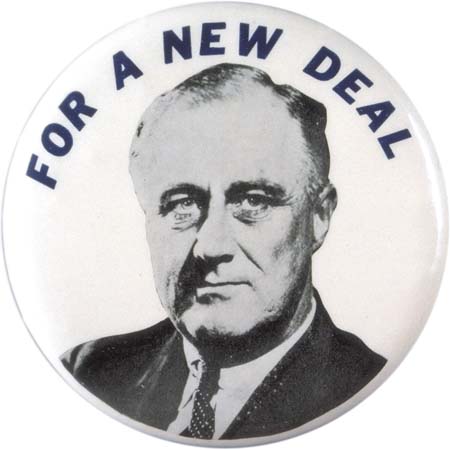
This is as it should be — and as it once was. When in March 1933, a few months after Coolidge gave up the ghost, Franklin Delano Roosevelt was inaugurated president, people looked forward to audacious changes, even if they had little or no idea just what, in concrete terms, that might mean. If Coolidge, an iconic representative of the old order, knew that the ancien régime was dead, millions of ordinary Americans had drawn the same conclusion years earlier. Full of fear, depressed and disillusioned, they nonetheless had an appetite for the untried. Like Obama, FDR had, during his campaign, encouraged feverish hopes with no less vaporous references to a “new deal” for Americans.

Brain Trust vs Brainiacs

Yet today, something is amiss. Even if everyone is now using the Great Depression and the New Deal as benchmarks for what we’re living through, Act I of the new script has already veered away from the original.

A suffocating political and intellectual provincialism has captured the new administration in embryo. Instead of embracing a sense of adventurousness, a readiness to break with the past so enthusiastically promoted during the campaign, Obama seems overcome with inhibitions and fears.

Practically without exception he has chosen to staff his government at its highest levels with refugees from the Clinton years. This is emphatically true in the realms of foreign and economic policy. It would, in fact, be hard to find an original idea among the new appointees being called to power in those realms — some way of looking at the American empire abroad or the structure of power and wealth at home that departs radically from views in circulation a decade or more ago. A team photo of Obama’s key cabinet and other appointments at Treasury, Health and Human Services, Commerce, the President’s Economic Recovery Advisory Board, the State Department, the Pentagon, the National Security Council, and in the U.S. Intelligence Community, not to speak of senior advisory posts around the President himself, could practically have been teleported from perhaps the year 1995.

Recycled Clintonism is recycled neo-liberalism. This is change only the brainiacs from Hyde Park and Harvard Square could believe in. Only the experts could get hot under the collar about the slight differences between “behavioral economics” (the latest academic fad that fascinates some high level Obama-ites) and straight-up neo-liberal deference to the market. And here’s the sobering thing: despite the grotesque extremism of the Bush years, neo-liberalism also served as its ideological magnetic north.

Is this parochialism, this timorousness and lack of imagination, inevitable in a period like our own, when the unknown looms menacingly and one natural reaction is certainly to draw back, to find refuge in the familiar? Here, the New Deal years can be instructive.

Roosevelt was no radical; indeed, he shared many of the conservative convictions of his class and times. He believed deeply in both balanced budgets and the demoralizing effects of relief on the poor. He tried mightily to rally the business community to his side. For him, the labor movement was terra incognita and — though it may be hard to believe today — played no role in his initial policy and political calculations. Nonetheless, right from the beginning, Roosevelt cobbled together a cabinet and circle of advisers strikingly heterogeneous in its views, one that, by comparison, makes Obama’s inner sanctum, as it is developing today, look like a sectarian cult.

Heterogeneous does not mean radical. Some of FDR’s early appointments — as at the Treasury Department — were die-hard conservatives. Jesse Jones, who ran the Reconstruction Finance Corporation, a Hoover administration creation, retained by FDR, that had been designed to rescue tottering banks, railroads, and other enterprises too big to fail, was a practitioner of business-friendly bailout capitalism before present Treasury Secretary Henry Paulson was even born.

But there was also Henry Wallace as Secretary of Agriculture, a Midwestern progressive who would become the standard bearer for the most left-leaning segments of the New Deal coalition. He was joined at the Agriculture Department — far more important then than now — by men like Mordecai Ezekiel, who was prepared to challenge the power of the country’s landed oligarchs.

Then there were corporatists like Raymond Moley, Donald Richberg, and General Hugh Johnson. Moley was an original member of FDR’s legendary “brain trust” (a small group of the President’s most influential advisers who often held no official government position). Richberg and Johnson helped design and run the National Recovery Administration (the New Deal’s first and failed attempt at industrial recovery). All three men were partial to the interests of the country’s peak corporations. All three wanted them released from the strictures of the Sherman Anti-Trust Act so that they could collaborate in setting prices and wages to arrest the killing deflation that gripped the economy. But they also wanted these corporate behemoths and the codes of competition they promulgated subjected to government oversight and restraints.

Meanwhile, Felix Frankfurter (another confidant of FDR’s and a future Supreme Court justice), aided by the behind-the-scenes efforts of Supreme Court Justice Louis Brandeis, fiercely contested the influence of the corporatists within the new administration, favoring anti-trust and then-new Keynesian approaches to economic recovery. Secretary of Labor Frances Perkins used her extensive ties to the social work community and the labor movement to keep an otherwise tone-deaf president apprised of portentous rumblings from that quarter. In this fashion, she eased the way for the passage of the Wagner Act that legislated the right to organize and bargain collectively, and that ended the reign of industrial autocracy in the workplace.

Roosevelt’s “brain trust” also included Rexford Tugwell. He was an avid proponent of government economic planning. Another founding member of the “brain trust” was Adolph Berle, who had published a bestselling, scathing indictment of the financial and social irresponsibility of the corporate elite just before FDR assumed office.

People like Tugwell and others, including future Federal Reserve Board chairman Marriner Eccles, were believers in Keynesian deficit spending as the road to recovery and argued fiercely for this position within the inner councils of the administration, even while Roosevelt himself remained, until later in his presidency, an orthodox budget balancer.

All of these people — the corporatists and the Keynesians, the planners and the anti-trusters — were there at the creation. They often came to blows. A genuine administration of “rivals” didn’t faze FDR. He was deft at borrowing all of, or pieces of, their ideas, then jettisoning some when they didn’t work, and playing one faction against another in a remarkable display of political agility. Roosevelt’s tolerance of real differences stands in stark contrast to the new administration’s cloning of the Clinton-era brainiacs.

It was this openness to a variety of often untested solutions — including at that point Keynesianism — that helped give the New Deal the flexibility to adjust to shifts in the country’s political chemistry in the worst of times. If the New Deal came to represent a watershed in American history, it was in part due to the capaciousness of its imagination, its experimental elasticity, and its willingness to venture beyond the orthodox. Many failures were born of this, but so, too, many enduring triumphs.

Beyond the Bailout State

Why, at least so far, is the Obama approach so different? Some of it no doubt has to do with the same native caution that caused FDR to navigate carefully in treacherous waters. But some of it may result from the fallout of history. Because the Great Depression and the New Deal happened, nothing can ever really be the same again.

We are accustomed to thinking of the Bush years — maybe even the whole era from the presidency of Ronald Reagan on — as a throwback to the 1920s or even the laissez-faire golden years of the Gilded Age of the late nineteenth century. In some respects, that’s probably accurate, but in at least one critical way it’s not. Back in those days, faced with a potentially terminal financial crisis, the government did nothing, simply letting the economy plunge into depression. This happened repeatedly until 1929, when it happened again.

Since the New Deal, however, inaction has ceased to be a viable option for Washington. State intervention to prevent catastrophe has become an unspoken axiom of political life in perilous times. Of course, thanks to regulatory mechanisms installed during the New Deal years, there was no need to engage in heroic rescues — not, at least, until the triumph of deregulation in our own time.

Then crises began to erupt with ever greater frequency — the stock market crash of 1987, the savings and loan collapse at the end of that decade, the massive Latin American debt defaults of the early 1990s, the collapse of the economies of the Asian “tigers” in the mid-1990s, the near bankruptcy of the then-huge hedge fund, Long Term Capital Management, later in that decade, the dot-com implosion at the turn the century, climaxing with the general global collapse of the present moment. Beginning perhaps with the bailout of the Chrysler Corporation in the late 1970s, these recurring crises have been met with increasingly strenuous efforts to stop the bleeding by what some have called “the bailout state.”

The Resolution Trust Corporation, created to rescue the savings and loan industry, first institutionalized what Kevin Phillips has since described as a new political economy of “financial mercantilism.” Under this new order the state stands ready to backstop the private sector — or at least the financial sub-sector which, for the past quarter century, has been the driving engine of economic growth — whenever it undergoes severe stress.

Today, the starting point for all mainstream policymakers, even those who otherwise preach the virtues of the free market and the evils of big government, is the active intervention of the state to prevent the failure of private-sector institutions considered “too big to fail” (as with most recently Citigroup and the insurance company AIG). So, too, the tolerance level for deficit spending, not only for military purposes but, in extremis, to help stop ordinary people from going under, is infinitely higher than in 1932. Ronald Reagan was prepared to live with such spending, if necessary, even as he removed portraits of Thomas Jefferson and Harry S. Truman from the Cabinet Room and replaced them with a canvas of Calvin Coolidge.

The question for our “new era” — not one our New Deal ancestors would have thought to ask — has become: How do we get beyond the bailout state? This is one crucial realm where genuinely new thinking and new ideas are badly needed.

At the moment, as best we can make out, the bailout state is being managed in secret and apparently in the interests, above all, of those who run the financial institutions being “rescued.” Often, we don’t actually know who is getting what from the Federal Reserve and the Treasury, or on what terms, or even which institutions are being helped and which aren’t, or often what our public monies are actually being used for.

What we do know, however, is anything but encouraging. It includes tax exemptions for merging banks, prices for public-equity stakes in failing outfits that far exceed what is being paid by governments (or even private investors) abroad for similar holdings. Add to this a stark lack of accountability, aggravated by the fact that the U.S. government has neither voting rights (nor even a voice) on boards of directors whose firms would be in bankruptcy court without Washington’s aid.

Living in an Empire of Depression

Are we, then, witnessing the birth of some warped, exceedingly partial version of state capitalism — partial, that is, to the resuscitation of the old order? If so, lurking within this string of bum deals might there not be a great opportunity? Putting the economy and country back together will require massive resources directed toward common purposes. There is no more suitable means of mobilizing and steering those resources than the institutions of democratic government.

Under the present dispensation, the bailout state makes the government the handmaiden of the financial sector. Under a new one, the tables might be turned. But who will speak for that option within the limited councils of the Obama team?

A real democratic nationalization of the banks — good value for our money rather than good money to add to their value — should be part of the policy agenda up for discussion in the Obama era. As things now stand, the public supplies the loans and the investment capital, but the key decisions about how they are to be deployed remain in private hands. A democratic version of nationalizing the financial system would transfer these critical decisions to new institutions created by the Congress and designed to pursue public, not private, objectives. How to subject the flow of credit and investment capital to public control ought to be on the drawing boards if we are to look beyond the old New Deal to a new one.

Or, for instance, if we are to bail out the auto industry, which we should — millions of jobs, businesses, communities, and what’s left of once powerful and proud unions are at stake — then why not talk about its nationalization, too? Why not create a representative body of workers, consumers, environmentalists, suppliers, and other interested parties to supervise the industry’s reorganization and retooling to produce, just as the president-elect says he wants, new green means of transportation — and not just cars?

Why not apply the same model to the rehabilitation of the nation’s infrastructure; indeed, why not to the reindustrialization of the country as a whole? If, as so many commentators are now claiming, what lies ahead is the kind of massive, crippling deflation characteristic of such crises, then why not consider creating democratic mechanisms to impose an incomes policy on wages and prices that works against that deflation?

Overseas, if everything isn’t up for discussion — and it most certainly isn’t — it ought to be. What happens there bears directly on our future here at home. After all, we live in the empire of depression. America’s favorite export for more than a decade has been a toxic line-up of securitized debt. Having ingested it in lethal amounts, every economy in the world from Iceland’s and Germany’s to Russia’s and Indonesia’s is either folding up or threatening to fold up like an accordion under the pressure of economic disaster.

Until now, the American way of life, including its economy of mass consumption, has depended on maintaining the country’s global preeminence by any means possible: economic, political, and, in the end, military. The news of the Bush years was that, in this mix, Washington reached for its six-guns so much more quickly.

A global depression will challenge that fundamental hierarchy in every conceivable way. The United States can try to recapture its imperiled hegemony by methods familiar to the Obama-Clinton-Bush (the father) foreign policy establishment, that is by using the country’s waning but still intimidating economic and military muscle. But that’s a devil’s game played at exorbitant cost which will further imperil the domestic economy.

It might, of course, be possible, as in domestic affairs, to try something new, something that embraces the public redevelopment of America in concert with the global South. This would entail at a minimum a radical break with the “Washington Consensus” of the Clinton years in which the United States insisted that the rest of the world conform to its free market model of economic behavior. It would establish multilateral mechanisms for regulating the flow of investment capital and severe penalties and restrictions on speculation in international markets. Most of all, it would mean lifting the strangulating grip of American military might that now girdles the globe.

All of this would require a capacity for re-imagining foreign affairs as something other than a zero-sum game. So far, nothing in Obama’s line-up of foreign policy and national security mandarins suggests this kind of potential policy deviance. Again, no Rooseveltian “brain trust” is in sight, even though unorthodoxies are called for, not just because of the hopes Obama’s victory have aroused, but because of the urgency of our present circumstances.

If original thinking doesn’t find a home somewhere within this forming administration soon, it will be an omen of an even more troubled future to come, when options not even being considered today may be unavailable tomorrow. Certainly, Americans ought to expect something better than a trip down (the grimmest of) memory lanes into the failed neo-liberalism of yesteryear.

[Steve Fraser is a visiting professor at New York University and the author of Wall Street: America’s Dream Palace. He is a regular contributor to TomDispatch.com and co-founder of the American Empire Project (Metropolitan Books).]

Copyright 2008 Steve Fraser

Source / TomDispatch

Thanks to Dorinda Moreno / The Rag Blog

Posted in RagBlog | Tagged , , , , , , , | Leave a comment

Michael Moore : Saving the Big 3 for You and Me


‘Congress must save the industrial infrastructure that these companies control and the jobs they create. And it must save the world from the internal combustion engine.’
By Michael Moore / December 3, 2008

I drive an American car. It’s a Chrysler. That’s not an endorsement. It’s more like a cry for pity. And now for a decades-old story, retold ad infinitum by tens of millions of Americans, a third of whom have had to desert their country to simply find a damn way to get to work in something that won’t break down:

My Chrysler is four years old. I bought it because of its smooth and comfortable ride. Daimler-Benz owned the company then and had the good grace to place the Chrysler chassis on a Mercedes axle and, man, was that a sweet ride!

When it would start.

More than a dozen times in these years, the car has simply died. Batteries have been replaced, but that wasn’t the problem. My dad drives the same model. His car has died many times, too. Just won’t start, for no reason at all.

A few weeks ago, I took my Chrysler in to the Chrysler dealer here in northern Michigan — and the latest fixes cost me $1,400. The next day, the vehicle wouldn’t start. When I got it going, the brake warning light came on. And on and on.

You might assume from this that I couldn’t give a rat’s ass about these miserably inept crapmobile makers down the road in Detroit city. But I do care. I care about the millions whose lives and livelihoods depend on these car companies. I care about the security and defense of this country because the world is running out of oil — and when it runs out, the calamity and collapse that will take place will make the current recession/depression look like a Tommy Tune musical.

And I care about what happens with the Big 3 because they are more responsible than almost anyone for the destruction of our fragile atmosphere and the daily melting of our polar ice caps.

Congress must save the industrial infrastructure that these companies control and the jobs they create. And it must save the world from the internal combustion engine. This great, vast manufacturing network can redeem itself by building mass transit and electric/hybrid cars, and the kind of transportation we need for the 21st century.

And Congress must do all this by NOT giving GM, Ford and Chrysler the $34 billion they are asking for in “loans” (a few days ago they only wanted $25 billion; that’s how stupid they are — they don’t even know how much they really need to make this month’s payroll. If you or I tried to get a loan from the bank this way, not only would we be thrown out on our ear, the bank would place us on some sort of credit rating blacklist).

Two weeks ago, the CEOs of the Big 3 were tarred and feathered before a Congressional committee who sneered at them in a way far different than when the heads of the financial industry showed up two months earlier. At that time, the politicians tripped over each other in their swoon for Wall Street and its Ponzi schemers who had concocted Byzantine ways to bet other people’s money on unregulated credit default swaps, known in the common vernacular as unicorns and fairies.

But the Detroit boys were from the Midwest, the Rust (yuk!) Belt, where they made real things that consumers needed and could touch and buy, and that continually recycled money into the economy (shocking!), produced unions that created the middle class, and fixed my teeth for free when I was ten.

For all of that, the auto heads had to sit there in November and be ridiculed about how they traveled to D.C. Yes, they flew on their corporate jets, just like the bankers and Wall Street thieves did in October. But, hey, THAT was OK! They’re the Masters of the Universe! Nothing but the best chariots for Big Finance as they set about to loot our nation’s treasury.

Of course, the auto magnates used be the Masters who ruled the world. They were the pulsating hub that all other industries — steel, oil, cement contractors — served. Fifty-five years ago, the president of GM sat on that same Capitol Hill and bluntly told Congress, what’s good for General Motors is good for the country. Because, you see, in their minds, GM WAS the country.

What a long, sad fall from grace we witnessed on November 19th when the three blind mice had their knuckles slapped and then were sent back home to write an essay called, “Why You Should Give Me Billions of Dollars of Free Cash.” They were also asked if they would work for a dollar a year. Take that! What a big, brave Congress they are! Requesting indentured servitude from (still) three of the most powerful men in the world. This from a spineless body that won’t dare stand up to a disgraced president nor turn down a single funding request for a war that neither they nor the American public support. Amazing.

Let me just state the obvious: Every single dollar Congress gives these three companies will be flushed right down the toilet. There is nothing the management teams of the Big 3 are going to do to convince people to go out during a recession and buy their big, gas-guzzling, inferior products. Just forget it. And, as sure as I am that the Ford family-owned Detroit Lions are not going to the Super Bowl — ever — I can guarantee you, after they burn through this $34 billion, they’ll be back for another $34 billion next summer.

So what to do? Members of Congress, here’s what I propose:

1. Transporting Americans is and should be one of the most important functions our government must address. And because we are facing a massive economic, energy and environmental crisis, the new president and Congress must do what Franklin Roosevelt did when he was faced with a crisis (and ordered the auto industry to stop building cars and instead build tanks and planes): The Big 3 are, from this point forward, to build only cars that are not primarily dependent on oil and, more importantly to build trains, buses, subways and light rail (a corresponding public works project across the country will build the rail lines and tracks). This will not only save jobs, but create millions of new ones.

2. You could buy ALL the common shares of stock in General Motors for less than $3 billion. Why should we give GM $18 billion or $25 billion or anything? Take the money and buy the company! (You’re going to demand collateral anyway if you give them the “loan,” and because we know they will default on that loan, you’re going to own the company in the end as it is. So why wait? Just buy them out now.)

3. None of us want government officials running a car company, but there are some very smart transportation geniuses who could be hired to do this. We need a Marshall Plan to switch us off oil-dependent vehicles and get us into the 21st century.

This proposal is not radical or rocket science. It just takes one of the smartest people ever to run for the presidency to pull it off. What I’m proposing has worked before. The national rail system was in shambles in the ’70s. The government took it over. A decade later it was turning a profit, so the government returned it to private/public hands, and got a couple billion dollars put back in the treasury.

This proposal will save our industrial infrastructure — and millions of jobs. More importantly, it will create millions more. It literally could pull us out of this recession.

In contrast, yesterday General Motors presented its restructuring proposal to Congress. They promised, if Congress gave them $18 billion now, they would, in turn, eliminate around 20,000 jobs. You read that right. We give them billions so they can throw more Americans out of work. That’s been their Big Idea for the last 30 years — layoff thousands in order to protect profits. But no one ever stopped to ask this question: If you throw everyone out of work, who’s going to have the money to go out and buy a car?

These idiots don’t deserve a dime. Fire all of them, and take over the industry for the good of the workers, the country and the planet.

What’s good for General Motors IS good for the country. Once the country is calling the shots.

P.S. I will be on Keith Olbermann tonight (8pm/10pm/midnight ET, Wednesday, Dec. 3) to discuss this further on MSNBC.

This story is also posted on Michael Moore’s websute.

The Rag Blog

Posted in RagBlog | Tagged , , , , , , | 1 Comment

Spain an Accessory to CIA Rendition Flights

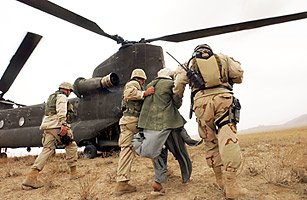
Afghan detainees are walked to a Chinook helicopter for transport by
Special Operation Forces. Photo: Darren McCollester/Getty.

“However, if, for unseen reasons, an emergency landing were necessary, the U.S. government would like the Spanish government’s authorization to use one of our airports.”

Spain’s Secret Role in the War on Terror
By Lisa Abend, Madrid / December 2, 2008

In normal times, the request would be superfluous. International aviation law and a separate bilateral agreement between Spain and the United States both require all airports in the two countries to permit emergency landings. But the flights the Spanish note refers to were far from normal. The year was 2002 and the U.S. Air Force was transferring Taliban and al-Qaeda prisoners from Afghanistan to a U.S. prison in Guantanamo Bay. Washington wanted to know if Spain could help.

It could. On Nov. 30, Spain’s El Pais newspaper published a document, marked “top secret,” that proves that high-ranking officials within the former government of Jose Maria Aznar, including the foreign minister Josep Pique, not only had knowledge of, but gave permission to the United States to use military bases in Spain for layovers during the long flight from Afghanistan to Cuba. (See pictures from inside Guantanamo.)

“The arrests of the people on board those flights were made without lawyers, without a judge’s authorization,” says Esteban Beltran, president of the Spanish branch of Amnesty International, which has conducted its own investigation into the secret flights. “Which means that the Spanish government colluded with illegal detentions.”

Just hours after Spain’s foreign affairs ministry communicated its assent to the U.S. embassy request on January 11, 2002, a flight took off from a military base in Moron, in southern Spain. “From our investigation using Portugal’s registry, we know that the plane originated in Kandahar, landed at Moron, crossed Portuguese air space, and continued on to Cuba,” says Beltran. “The 23 people onboard inaugurated Guantanamo.”

Spain’s government was clearly aware that the flights were of questionable legality. A separate document sent from the Spanish section of the Permanent Hispano-North American Committee and published in Monday’s El Pais suggests that out of the three U.S. military airports in Spain, Moron would be the “most discrete.” That same report urged its recipients to consider that “some of the people transported could have European nationality” and to “weigh the legal consequences.”

The Aznar government and its Socialist successor have long claimed ignorance of these military flights to Guantanamo, believed to number 13. On the day of the first El Pais story, current foreign minister Miguel Angel Moratinos told the press that he had had “no knowledge of the report” prior to its publication, and called for an internal investigation to locate any other related documents. “Our government is committed to the defense of human rights,” Moratinos said. “We have nothing to hide.”

Both Amnesty and the European Parliament have found evidence that the CIA also used civilian airports in Spain on 68 different occasions between 2002 and 2005 for layovers on flights used for the transport of suspected terrorists.

Spain’s national court has opened an investigation into the CIA flights, and it’s possible that the reports published in El Pais are part of the documentation submitted to the presiding judge. But the question of why these documents have surfaced now remains a mystery. “We have no idea where this came from,” says a spokesperson at the foreign ministry. “It was very surprising.”

Source / Time

Thanks to Karen Lee Wald / The Rag Blog

Posted in RagBlog | Tagged , , , , | Leave a comment

Rabbi Arthur Waskow : Barack Obama, Religious Dialogue and a Response to Mumbai

‘He should be clear that the serious adherents of ALL religions should be condemning the use of violence in the name of their own as well as other religions, and that this should be true when Christians, Jews, Muslims, Hindus, or Buddhists use violence in the name of their faith.’

By Rabbi Arthur Waskow / The Rag Blog / December 3, 2008

A new Presidential policy on religiously defined terrorism should act in three directions:

(1) Work to strengthen those in every religious community — beginning with those in American mosques and Muslim organizations — who oppose religious violence;

(2) Treat terrorism as a crime to be policed and punished, not through “war’ that breeds more terrorists by destroying civilian life;

(3) heal the political canker-sores (such as conflict over Kashmir and over Israel-Palestine) that have festered into motivations and excuses for terrorism.

Right now —- not waiting till January 20 —- President-elect Obama should start visiting mosques, speaking in mosques. It is shameful that he did not do so even once during the entire election campaign. At these mosques, he should praise those Muslim organizations —- by name , including the Islamic Society of North America, CAIR, and the Muslim Public Affairs Council -— for their forthright and vigorous public statements denouncing the Mumbai attacks, and others in the past. He should make clear that of course they were doing no more than is their responsibility, but it is especially incumbent on the American media to let the public know about these statements, and that he is mentioning them to aid in that process.

He should be clear that the serious adherents of ALL religions should be condemning the use of violence in the name of their own as well as other religions, and that this should be true when Christians, Jews, Muslims, Hindus, or Buddhists use violence in the name of their faith. He should praise the efforts at Jewish-Muslim inter-education by the Union for Reform Judaism and ISNA, and urge churches and mosques to pursue the same kind of efforts.

And he should urge the governments of India and Pakistan to undertake two joint projects:

(1) seeking out by means of criminal investigation and police work the perpetrators and planners of the Mumbai attack, explicitly refusing to criticize either government for the Mumbai attacks and refusing to define them as acts of “war” or responding to them through a “war” on terror: Mass murders they were, and should be prosecuted hat way, rather than creating more terrorists by bombing whole villages in retaliation.

(2) Agreeing to heal the poisonous canker of the Kashmir question by bringing the UN to negotiate toward and conduct a free and fair election by Kashmiris to decide their own future, including such choices as independence, demiitarized accession to Pakistan or India, and unconventional multinational status with representation in both national governments, etc.

No doubt some will complain that this is encouraging terrorism by responding to terrorist actions. In fact, it cuts the roots out of terrorism by providing a legitimate political process to achieve what the people want, not what the terrorists demand.

He should ask the leaders of American faith communities to convene a world conference on religious dialogue and action toward peacemaking and to put on the table the question of how each community separately and all together can address the bloody, violence–inciting streaks in their own texts and traditions.

Finally, Secretary of State-designate Clinton should announce that on January 20, the United States will begin work to convene a multinational conference to work out a comprehensive peace settlement in the broader Middle East that includes full peace agreements and security for Israel, a new and viable Palestinian state, all Arab states, Iran, and Afghanistan.

Shalom, salaam, peace —

[Rabbi Arthur Waskow is director of The Shalom Center. ]

The Rag Blog

Posted in Rag Bloggers | Tagged , , , , , , , | 2 Comments

Iraq : KBR Subsidiary Confines Asian Workers in Warehouse

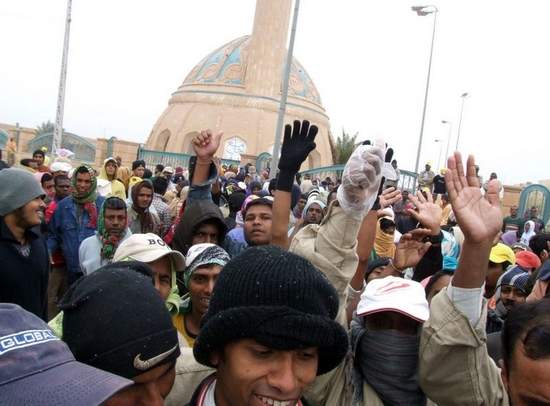
About a thousand men living in warehouses near the Baghdad airport marched out of their compound today to protest what they call broken promises from Najlaa, a Kuwaiti catering company that had offered them jobs in Iraq. Instead, Najlaa’s contracts didn’t work out as expected and the company kept the men in the compound. photo by Adam Aston / Modesto Bee / MCI

‘They promised us the moon and stars,’ said Davidson Peters, 42, a Sri Lankan. ‘While we are here, wives have left their husbands and children have been shut out of their schools’ because money for the families has dried up. The men live in three warehouses with long rows of bunk beds crammed tightly together.

By Adam Ashton / December 2, 2008

BAGHDAD — About 1,000 Asian men who were hired by a Kuwaiti subcontractor to the U.S. military have been confined for as long as three months in windowless warehouses near the Baghdad airport without money or a place to work.

Najlaa International Catering Services, a subcontractor to KBR, an engineering, construction and services company, hired the men, who’re from India, Nepal, Sri Lanka and Bangladesh. On Tuesday, they staged a march outside their compound to protest their living conditions.

“It’s really dirty,” a Sri Lankan man told McClatchy, speaking on the condition of anonymity because he still wants to work for Najlaa. “For all of us, there are about 12 toilets and about 10 bathrooms. The food — it’s three half-liter (one pint) bottles of water a day. Bread, cheese and jam for breakfast. Lunch is a small piece of meat, potato and rice. Dinner is rice and dal, but it’s not dal,” he said, referring to the Indian lentil dish.

After McClatchy began asking questions about the men on Tuesday, the Kuwaiti contractor announced that it would return them to their home countries and pay them back salaries. Najlaa officials contended that they’ve cared for the men’s basic needs while the company has tried to find them jobs in Iraq.

The laborers said they paid middlemen more than $2,000 to get to Iraq for jobs that they were told would earn them $600 to $800 a month. Some of the men took out loans to cover the fees.

“They promised us the moon and stars,” said Davidson Peters, 42, a Sri Lankan. “While we are here, wives have left their husbands and children have been shut out of their schools” because money for the families has dried up. The men live in three warehouses with long rows of bunk beds crammed tightly together. Reporters who tried to get a better glimpse inside were ushered away by armed guards.

The conditions in which the men have been held appear to violate guidelines the U.S. military handed down in 2006 that urged contractors to deter human trafficking to the war zone by shunning recruiters that charged excessive fees. The guidelines also defined “minimum acceptable” living spaces — 50 square feet per person — and required companies to fulfill the pledges they made to employees in contracts.

A U.S. military spokesman for the Multi-National Force-Iraq referred questions to KBR, a Texas-based former subsidiary of Halliburton. The spokesman said that the American military wasn’t aware of the warehouses until McClatchy and the Times of London began asking questions about it on Monday.

Some of the men who’ve been living in the warehouses said that KBR representatives visited the site two weeks ago. They said Najlaa held their passports until the KBR inspection, which Najlaa officials denied. Seizing passports is a violation of the U.S. military’s 2006 instructions to contractors.

KBR didn’t answer direct questions about the warehouses but issued a two-paragraph statement. “When KBR becomes aware of potential violations of international laws regarding trafficking in persons, we work, within our authority, to remediate the problem and report the matter to proper authorities. KBR then works with authorities to rectify the matter,” it said.

Reached in Kuwait, Najlaa chief executive Marwan Rizk said the company recruited the laborers for contracts it expected to begin servicing, but the work didn’t materialize. He didn’t specify which contracts fell through or why they were delayed. The company offers a number of services in Iraq, including catering at U.S. military bases. “We had some obstacles with the services we were contracted to do,” Rizk said. “These obstacles were not forecasted.”

He said it’s the company’s practice to begin paying its employees once they start their jobs, though Najlaa credits them from the time they arrive in Iraq.

While the main complaint in the warehouses centered on living in what many considered prison-like conditions, Najlaa officials said it was crucial to keep the men in the compound to prevent kidnappings or other dangers. “We’re in Iraq; it’s a war zone,” said Isha Rufaie, a Najlaa logistics manager who tried to calm the protest Tuesday.

Peters, the Sri Lankan, said the men had notified Najlaa officials in advance, and the firm had agreed to let them protest their status outside their compound. They walked in thick clusters up and down an airport side road that wouldn’t be visible even to the sparse traffic that passes on the airport’s primary routes.

The protest, nonetheless, caught the attention of Sabre, a British company that holds a contract to maintain security at the airport.

Sabre officers halted the protest by telling Najlaa to get the men back in the compound. Najlaa officials did so by telling the men they’d be paid Tuesday. They returned to the camp voicing skepticism that Najlaa would follow through. Some of them, reached by phone later in the day, said they hadn’t been paid.

Sabre representatives said they’ve closed similar buildings housing laborers near the airport in the past. Peters, the Sri Lankan, had a message for his countrymen who might consider pursuing work in Iraq. “There is little money here. The jobs do not come easily and people are being held against their wishes,” he said.

A group of about 50 men living in tents about a mile away were even worse off than the men in the warehouses, and they appeared to be victims of human trafficking. They live in huts they built with tarps and pieces of carpet, and said they had no access to food or water.

The property is under the control of the Iraq Civil Aviation Administration, which couldn’t be reached for comment Tuesday.

These men apparently didn’t arrive in Iraq with contracts promising them work, but instead had relied on agents who were supposed to place them in jobs. The men in the tent camp, who’re from the same countries as those in the warehouses, said they paid close to $5,000 to the agents.

“We came to make a good salary and go home, but we’re not lucky,” said Ganesh Kumar Bhagat, 22, a Nepalese man who sleeps with four others in a tent along the main airport road.

He hasn’t told his family that his plans did not succeed in Iraq, instead assuring them that he lives and works safely on an American base.

Bhagat and others at the camp gave a McClatchy reporter phone numbers for the agents who led them to Iraq. Some numbers had been disconnected. In other cases, people quickly hung up.

[Ashton reports for the Modesto (Calif.) Bee]

Source / McClatchy

The Rag Blog

Posted in RagBlog | Tagged , , , | Leave a comment

Cosmic Smiley Face : Hey, What’s so Funny?

A rare positioning of planets Venus (top left) and Jupiter (top right) and the crescent moon of the Earth provides a “smiley” effect that captivated Asia Monday night Dec. 2, 2008. Photo by AP.

The next time the moon, Jupiter and Venus will be as close and visible as this will be Nov. 18, 2052.

By Graham Tibbetts / December 2, 2008

Smiling down from the heavens are the three brightest objects in the night sky – Venus, Jupiter and a crescent moon.

Over the last week the two planets moved closer together so that they appeared no more than two degrees apart, which equates to a finger’s width when held out at arm’s length.

As they were joined by the moon on Monday night photographers around the world – from Bangkok to Kenya – captured the image.

“This certainly is an unusual coincidence for the crescent moon to be right there in the days when they are going to be closest together,” said Alan MacRobert, senior editor of Sky and Telescope magazine.

The moon is the brightest, closest and smallest of the three and is 252,000 miles away. Venus, the second brightest, closest and smallest, is 94 million miles away, while Jupiter is 540 million miles away.

The three celestial objects come together from time to time, but often they are too close to the sun or unite at a time when they are less visible.

The next time the three will be as close and visible as this week will be Nov 18, 2052, according to Jack Horkheimer, director of the Miami Space Transit Planetarium.

Two out of three – Venus and the crescent moon – will again be in close proximity on New Year’s Eve, Mr MacRobert said.

Source / Telegraph, UK

The Rag Blog

Posted in RagBlog | Tagged | Leave a comment

White House : Artist’s ‘Impeach Bush’ Ornament Nixed for Xmas Tree

Deborah Lawrence and her “Impeach Bush” ornament. Photo courtesy of Deborah Lawrence / Washington Post.

Sally McDonough, a spokeswoman for first lady Laura Bush: ‘It’s inappropriate and it’s not being hung.’
By Roxanne Roberts and Amy Argetsinger / December 2, 2008

That controversial ornament calling for President Bush’s impeachment? Won’t hang in the White House after all

“Oh, dear,” said Seattle-based artist Deborah Lawrence, who created the red and white ornament that salutes Rep. Jim McDermott (D-Wash.) and his support for a resolution to impeach the president. “This doesn’t really surprise me. But it’s disappointing that I won’t get to see it on the tree.”

Laura Bush asked all members of Congress to pick artists from their districts to decorate ornaments, presumably highlighting local landmarks and heroes. Lawrence, 55, used the opportunity to honor McDermott, a strong critic of Bush. The collage artist glued tiny text on the nine-inch ball thinking no one would actually read her embedded “subversive” message.

But Lawrence shared her secret protest with friends, and the news quickly spread. “An artist doesn’t always get this kind of attention,” she told us. “It took on a life of its own, obviously. In a way, I’m speechless.”

Sally McDonough, a spokeswoman for the first lady, confirmed the ornament would not be displayed. “It’s inappropriate and it’s not being hung,” she said. She said that when asked about the issue yesterday, the White House tree decorations were not complete. “We reviewed the ornament along with all the [other] ornaments, and Mrs. Bush deemed it inappropriate for the holiday tree.”

Lawrence is still slated to attended a White House reception for the artists this afternoon.

Source / The Reliable Source / Washington Post

The Rag Blog

Posted in RagBlog | Tagged , , , | Leave a comment

Honour Killings in Basra, Iraq Are on the Rise

May 2007 demonstration against honor killing, Kurdistan, Iraq. Photo: Source – Women’s News Network.

Hitmen charge $100 a victim as Basra honour killings rise
By Afif Sarhan / November 30, 2008

Fathers and husbands who openly hire assassins on the streets of the city are going unpunished

Authorities in the southern Iraqi city of Basra have admitted they are powerless to prevent ‘honour killings’ in the city following a 70 per cent increase in religious murders during the past year.

There has been no improvement in conviction rates for these killings. So far this year, 81 women in the city have been murdered for allegedly bringing shame on their families. Only five people have been convicted.

During 2007 the Basra security committee recorded 47 ‘honour killings’ and three convictions. One lawyer in the city described how police were actively protecting perpetrators and said that a woman in Basra could now be murdered by hired hitmen for as little as $100 (£65).

The figures come despite international outrage which followed The Observer’s coverage of the death of 17-year-old Rand Abdel-Qader, who was murdered by her father last April in an ‘honour killing’ after falling in love with a British soldier in Basra. The 4,000 British troops stationed in the city since the invasion that toppled Saddam Hussein in 2003 withdrew to the airport last September.

Rand Abdel-Qader was killed after her family discovered that she had formed a friendship with a 22-year-old infantryman whom she knew as Paul. She was suffocated by her father then hacked at with a knife. Abdel-Qader Ali was subsequently arrested and released without charge.

Rand’s mother, Leila Hussein, who divorced her husband after the killing, went into hiding but was tracked down weeks later and assassinated by an unknown gunman. Her husband had told The Observer that police had congratulated him for killing his daughter.

Seven months after the murders, the problem of these killings in Basra has become worse, according to lawyers. Ali Azize Raja’a, an Iraqi prosecutor who has represented the victims of 32 ‘honour killings’ since 2004, said that, despite accumulating sufficient evidence to prove who was responsible in each murder, he had won only one case.

He said that the greatest issue was the decision by police to release suspects. Seven in 10 of those thought to be responsible for such a killing have left the city, with little attempt made to track them down.

The father of Rand is also understood to have left Basra. He was held by police in connection with his daughter’s murder for only two hours. A local businessman who described the actions of Rand’s father as ‘courageous’ is believed to have given a considerable sum of money to him and his two sons, who disowned their mother after she objected to Rand’s killing. Raja’a said that when he was approached by Leila over Rand’s case, his family was threatened by relatives.

Another Iraqi lawyer, who requested anonymity, said that some fathers had started to hire professional hitmen to carry out ‘honour killings’ which were then covered as ‘sectarian murders’. He said: ‘The life of these women isn’t higher than $100. You can find a killer standing in any coffee shop of Basra, discussing prices of a life as if he was buying a piece of meat.’

Mariam Ayub Sattar, an activist in Basra, said that any woman caught speaking to a man in public who was not her husband or a relative was considered a prostitute and punished. A fortnight ago three women were burned with acid while walking through a market in Basra after stopping to speak to a male friend, Sattar said.

Nine of the 12 voluntary organisations helping women in Basra have closed down since the US-led invasion.

The Women’s Rights Association in Basra was forced to close down after death threats were made following the murder of Rand’s mother last May. Two women from a voluntary organisation who had been helping her to hide from her husband were also injured.

Alia’a Obeidi, the organisation’s president, said that one of her colleagues was killed while driving to work and, fearing for her family’s safety, she later moved to the Kurdish region in northern Iraq.

The Iraqi Ministry of Human Rights said that it was working on new projects to end gender discrimination in the country. ‘We try to make a difference by teaching students at schools about gender equality, but it only will be possible when parents don’t teach the opposite at home,’ said Hameed Walled, senior official in the Ministry of Human Rights.

Source / The Guardian

The Rag Blog

Posted in RagBlog | Tagged , , | Leave a comment

Socialism for the Rich

Thanks to Harry Edwards / The Rag Blog

Thanks to Harry Edwards / The Rag Blog

Posted in RagBlog | Tagged , , | Leave a comment

The Many Faces of Terrorism

The Muslim Indian Emperor Akbar was a champion of religious dialogue and tolerance. During his reign the Inquisition was happening in the West.

‘If we rid ourselves of every vestige of racism then we are confronted by the fact that our government is murdering our neighbors, our family members, on a daily basis. In this global village a person in what we call Pakistan might as well be living on West 32rd St.’

By Alan Pogue / The Rag Blog / December 2, 2008

See ‘Confronting the Terrorist Within’ by Chris Hedges, Below.

I am reflecting on the difference between the Democratic and Republican parties. The Democrats have always had a better domestic policy but their foreign policy is not so different from the Republicans. I went to the war in Vietnam during the Johnson administration. Lyndon nearly killed me. His wife owned stock in Northwest Orient Airlines that flew me to Vietnam so she made a few dollars off of my near death experience. What I see in the Democratic Party is “War on Terrorism (somewhat) Lite” but no end to the “war on terrorism.” No end to ripping off other countries.

Anyone who wishes to pursue this thought may read the article by Chris Hedges that follows. If we rid ourselves of every vestige of racism then we are confronted by the fact that our government is murdering our neighbors, our family members, on a daily basis. In this global village a person in what we call Pakistan might as well be living on West 32rd St. There is no fundamental difference unless our minds are taken over by the mainstream press which fails, in most cases, to profile the murder victims. What if every person who is killed in Afghanistan (pick your country) had a full page in the New York Times to examine the significance of their death

Confronting the Terrorist Within
By Chris Hedges / December 1, 2008

The Hindu-Muslim communal violence that led to the attacks in Mumbai, as well as the warnings that the New York City transit system may have been targeted by al-Qaida, are one form of terrorism. There are other forms.

The wars in Iraq and Afghanistan, when viewed from the receiving end, are state-sponsored acts of terrorism. These wars defy every ethical and legal code that seek to determine when a nation can wage war, from Just War Theory to the statutes of international law largely put into place by the United States after World War II. These wars are criminal wars of aggression. They have left hundreds of thousands of people, who never took up arms against us, dead and seen millions driven from their homes. We have no right as a nation to debate the terms of these occupations. And an Afghan villager, burying members of his family’s wedding party after an American airstrike, understands in a way we often do not that terrorist attacks can also be unleashed from the arsenals of an imperial power.

Barack Obama’s decision to increase troop levels in Afghanistan and leave behind tens of thousands of soldiers and Marines in Iraq—he promises only to withdraw combat brigades—is a failure to rescue us from the status of a rogue nation. It codifies Bush’s “war on terror.” And the continuation of these wars will corrupt and degrade our nation just as the long and brutal occupation of Gaza and the West Bank has corrupted and degraded Israel. George W. Bush has handed Barack Obama a poisoned apple. Obama has bitten it.

The invasions and occupations of Afghanistan and Iraq were our response to feelings of vulnerability and collective humiliation after the attacks of Sept. 11, 2001. They were a way to exorcise through reciprocal violence what had been done to us.

Collective humiliation is also the driving force behind al-Qaida and most terrorist groups. Osama bin Laden cites the Sykes-Picot Agreement, which led to the carving up of the Ottoman Empire, as the beginning of Arab humiliation. He attacks the agreement for dividing the Muslim world into “fragments.” He rails against the presence of American troops on the soil of his native Saudi Arabia. The dark motivations of Islamic extremists mirror our own.

Robert Pape in “Dying to Win: The Strategic Logic of Suicide Terrorism,” found that most suicide bombers are members of communities that feel humiliated by genuine or perceived occupation. Almost every major suicide-terrorist campaign—over 95 percent—carried out attacks to drive out an occupying power. This was true in Lebanon, Sri Lanka, Chechnya and Kashmir, as well as Israel and the Palestinian territories. The large number of Saudis among the 9/11 hijackers appears to support this finding.

A militant who phoned an Indian TV station from the Jewish center in Mumbai during the recent siege offered to talk with the government for the release of hostages. He complained about army abuses in Kashmir, where ruthless violence has been used to crush a Muslim insurgency. “Ask the government to talk to us and we will release the hostages,” he said, speaking in Urdu with what sounded like a Kashmiri accent.

“Are you aware how many people have been killed in Kashmir? Are you aware how your army has killed Muslims? Are you aware how many of them have been killed in Kashmir this week?” he asked.

Terrorists, many of whom come from the middle class, support acts of indiscriminate violence not because of direct, personal affronts to their dignity, but more often for lofty, abstract ideas of national, ethnic or religious pride and the establishment of a utopian, harmonious world purged of evil. The longer the United States occupies Afghanistan and Iraq, the more these feelings of collective humiliation are aggravated and the greater the number of jihadists willing to attack American targets.

We have had tens of thousands of troops stationed in the Middle East since 1990 when Saddam Hussein invaded Kuwait. The presence of these troops is the main appeal, along with the abuse meted out to the Palestinians by Israel, of bin Laden and al-Qaida. Terrorism, as Pape wrote, “is not a supply-limited phenomenon where there are just a few hundred around the world willing to do it because they are religious fanatics. It is a demand-driven phenomenon. That is, it is driven by the presence of foreign forces on the territory that the terrorists view as their homeland. The operation in Iraq has stimulated suicide terrorism and has given suicide terrorism a new lease on life.”

The decision by the incoming Obama administration to embrace an undefined, amorphous “war on terror” will keep us locked in a war without end. This war has no clear definition of victory, unless victory means the death or capture of every terrorist on earth—an impossibility. It is a frightening death spiral. It feeds on itself. The concept of a “war on terror” is no less apocalyptic or world-purifying than the dreams and fantasies of terrorist groups like al-Qaida.

The vain effort to purify the world through force is always self-defeating. Those who insist that the world can be molded into their vision are the most susceptible to violence as antidote. The more uncertainty, fear and reality impinge on this utopian vision, the more strident, absolutist and aggressive are those who call for the eradication of “the enemy.” Immanuel Kant called absolute moral imperatives that are used to carry out immoral acts “a radical evil.” He wrote that this kind of evil was always a form of unadulterated self-love. It was the worst type of self-deception. It provided a moral façade for terror and murder. The wars in Iraq and Afghanistan are a “radical evil.”

The tactic of suicide bombing, equated by many in the United States with Islam, did not arise from the Muslim world. It had its roots in radical Western ideologies, especially Leninism, not religion. And it was the Tamil Tigers, a Marxist group that draws its support from the Hindu families of the Tamil regions of Sri Lanka, who invented the suicide vest for their May 1991 suicide assassination of Rajiv Ghandi.

Suicide bombing is what you do when you do not have artillery or planes or missiles and you want to create maximum terror for an occupying power. It was used by secular anarchists in the 19th and early 20th centuries, who bequeathed to us the first version of the car bomb—a horse-drawn wagon laden with explosives that was ignited on Sept. 16, 1920, on Wall Street. The attack was carried out by an Italian immigrant named Mario Buda in protest over the arrest of the anarchists Sacco and Vanzetti. It left 40 people dead and wounded more than 200.

Suicide bombing was adopted later by Hezbollah, al-Qaida and Hamas. But even in the Middle East, suicide bombing is not restricted to Muslims. In Lebanon, during the attacks in the 1980s against French, American and Israeli targets, only eight suicide bombings were carried out by Islamic fundamentalists. Twenty-seven were the work of communists and socialists. Christians were responsible for three.

The dehumanization of Muslims and the willful ignorance of the traditions and culture of the Islamic world reflect our nation’s disdain for self-reflection and self-examination. It allows us to exalt in the illusion of our own moral and cultural superiority. The world is far more complex than our childish vision of good and evil. We as a nation and a culture have no monopoly on virtue. We carry within us the same propensities for terror as those we oppose.

The Muslim Indian Emperor Akbar at the end of the 16th century filled his court with philosophers, mystics and religious scholars, including Sunni, Sufi and Shiite Muslims, Hindu followers of Shiva and Vishnu, as well as atheists, Christians, Jains, Jews, Buddhists and Zoroastrians. They debated ethics and belief. Akbar was one of the great champions of religious dialogue and tolerance. He forbade any person to be discriminated against on the basis of belief. He declared that everyone was free to follow any religion. His enlightened rule took place as the Inquisition was at its height in Spain and Portugal, and in Rome the philosopher Giordano Bruno was being burnt at the stake in Campo de’ Fiori for heresy.

Tolerance, as well as religious and political plurality, is not exclusive to Western culture. The Judeo-Christian tradition was born and came to life in the Middle East. Its intellectual and religious beliefs were cultivated and formed in cities such as Jerusalem, Antioch, Alexandria and Constantinople. Many of the greatest tenets of Western civilization, as is true with Islam and Buddhism, are Eastern in origin. Our concept of the rule of law and freedom of expression, the invention of printing, paper, the book, as well as the translation and dissemination of the classical Greek philosophers, algebra, geometry and universities were given to us by the Islamic world. The first law code was invented by the ancient Iraqi ruler Hammurabi. One of the first known legal protections of basic freedoms and equality was promulgated in the third century B.C. by the Buddhist Indian Emperor Ashoka. And, unlike Aristotle, he insisted on equal rights for women and slaves.

The East and the West do not have separate, competing value systems. We do not treat life with greater sanctity than those we belittle. There are aged survivors in Hiroshima and Nagasaki who can tell us something about our high moral values and passionate concern for innocent human life, about our own acts of terrorism. Eastern and Western traditions have within them varied ethical systems, some of which are repugnant and some of which are worth emulating. To hold up the highest ideals of our own culture and to deny that these great ideals exist in other cultures, especially Eastern cultures, is made possible only by historical and cultural illiteracy.

The civilization we champion and promote as superior is, in fact, a product of the fusion of traditions and beliefs of the Orient and the Occident. We advance morally and intellectually when we cross these cultural lines, when we use the lens of other cultures to examine our own. The remains of villages destroyed by our bombs, the dead killed from our munitions, leave us too with bloody hands. We can build a new ethic only when we face our complicity in the cycle of violence and terror.

The fantasy of an enlightened West that spreads civilization to a savage world of religious fanatics is not supported by history. The worst genocides and slaughters of the last century were perpetrated by highly industrialized nations. Muslims, including Saddam Hussein’s brutal regime, have a long way to go before they reach the body count of the secular regimes of the Nazis, the Soviet Union or the Chinese communists. It was, in fact, the Muslim-led government in Bosnia that protected minorities during the war while the Serbian Orthodox Christians carried out mass executions, campaigns of genocide and ethnic cleansing that left 250,000 dead.

Those who externalize evil and seek to eradicate that evil through violence lose touch with their own humanity and the humanity of others. They cannot make moral distinctions. They are blind to their own moral corruption. In the name of civilization and high ideals, in the name of reason and science, they become monsters. We will never free ourselves from the self-delusion of the “war on terror” until we first vanquish the terrorist within.

[Chris Hedges writes a weekly column for truthdig. He was the Middle East bureau chief for The New York Times.]

Source / truthdig

The Rag Blog

Posted in Rag Bloggers | Tagged , , , , , , | Leave a comment