Thanksgiving: No Reason for Indians to Celebrate

See video “Thanksgiving: A Native American View” below.

Native Blood: The Myth of Thanksgiving
By Mike Ely

It is a deep thing that people still celebrate the survival of the early colonists at Plymouth — by giving thanks to the Christian God who supposedly protected and championed the European invasion. The real meaning of all that, then and now, needs to be continually excavated. The myths and lies that surround the past are constantly draped over the horrors and tortures of our present.

I originally wrote this article a decade ago, and it has showed up in different places and publications usually around the holiday. Pass it on.

Every schoolchild in the U.S. has been taught that the Pilgrims of the Plymouth Colony invited the local Indians to a major harvest feast after surviving their first bitter year in New England. But the real history of Thanksgiving is a story of the murder of indigenous people and the theft of their land by European colonialists–and of the ruthless ways of capitalism.

illustration of a native american

Mike Ely’s articles is available as an MP3 recording. Click on the picture above.

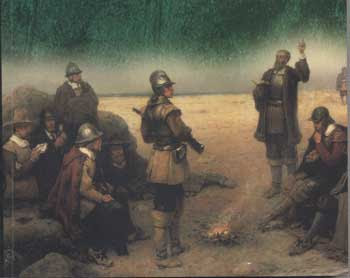
In mid-winter 1620 the English ship Mayflower landed on the North American coast, delivering 102 exiles. The original Native people of this stretch of shoreline had already been killed off. In 1614 a British expedition had landed there. When they left they took 24 Indians as slaves and left smallpox behind. Three years of plague wiped out between 90 and 96 percent of the inhabitants of the coast, destroying most villages completely.

The Europeans landed and built their colony called “the Plymouth Plantation” near the deserted ruins of the Indian village of Pawtuxet. They ate from abandoned cornfields grown wild. Only one Pawtuxet named Squanto had survived–he had spent the last years as a slave to the English and Spanish in Europe. Squanto spoke the colonists’ language and taught them how to plant corn and how to catch fish until the first harvest. Squanto also helped the colonists negotiate a peace treaty with the nearby Wampanoag tribe, led by the chief Massasoit.

These were very lucky breaks for the colonists. The first Virginia settlement had been wiped out before they could establish themselves. Thanks to the good will of the Wampanoag, the settlers not only survived their first year but had an alliance with the Wampanoags that would give them almost two decades of peace.

John Winthrop, a founder of the Massahusetts Bay colony considered this wave of illness and death to be a divine miracle. He wrote to a friend in England, “But for the natives in these parts, God hath so pursued them, as for 300 miles space the greatest part of them are swept away by smallpox which still continues among them. So as God hath thereby cleared our title to this place, those who remain in these parts, being in all not 50, have put themselves under our protection.”

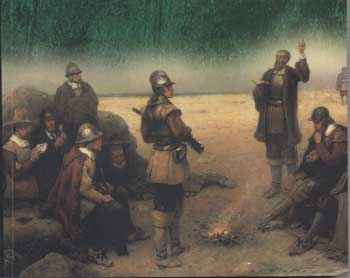
The deadly impact of European diseases and the good will of the Wampanoag allowed the settlers to survive their first year.

In celebration of their good fortune, the colony’s governor, William Bradford, declared a three-day feast of thanksgiving after that first harvest of 1621.

How the Puritans Stole the Land

But the peace that produced the Thanksgiving Feast of 1621 meant that the Puritans would have 15 years to establish a firm foothold on the coast. Until 1629 there were no more than 300 settlers in New England, scattered in small and isolated settlements. But their survival inspired a wave of Puritan invasion that soon established growing Massachusetts towns north of Plymouth: Boston and Salem. For 10 years, boatloads of new settlers came.
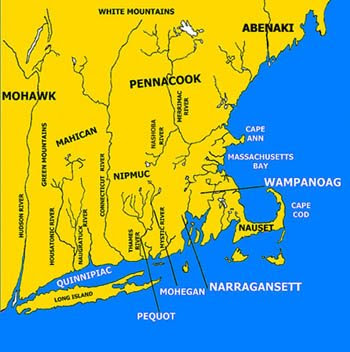
Early North America as Native peoples and Europe settlers collide

And as the number of Europeans increased, they proved not nearly so generous as the Wampanoags.

On arrival, the Puritans and other religious sects discussed “who legally owns all this land.” They had to decide this, not just because of Anglo-Saxon traditions, but because their particular way of farming was based on individual–not communal or tribal–ownership. This debate over land ownership reveals that bourgeois “rule of law” does not mean “protect the rights of the masses of people.”

Some settlers argued that the land belonged to the Indians. These forces were excommunicated and expelled. Massachusetts Governor Winthrop declared the Indians had not “subdued” the land, and therefore all uncultivated lands should, according to English Common Law, be considered “public domain.” This meant they belonged to the king. In short, the colonists decided they did not need to consult the Indians when they seized new lands, they only had to consult the representative of the crown (meaning the local governor).

The colonists embraced a line from Psalms 2:8. “Ask of me, and I shall give thee, the heathen for thine inheritance, and the uttermost parts of the earth for thy possession.” Since then, European settler states have similarly declared god their real estate agent: from the Boers seizing South Africa to the Zionists seizing Palestine.

The European immigrants took land and enslaved Indians to help them farm it. By 1637 there were about 2,000 British settlers. They pushed out from the coast and decided to remove the inhabitants.

The Shining City on the Hill

Where did the Plymouth and Massachusetts colonies of Puritan and “separatist” pilgrims come from and what were they really all about?

Governor Winthrop, a founder of the Massachusetts colony, said, “We shall be as a City upon a Hill, the eyes of all people are upon us.” The Mayflower Puritans had been driven out of England as subversives. The Puritans saw this religious colony as a model of a social and political order that they believed all of Europe should adopt.

The Puritan movement was part of a sweeping revolt within English society against the ruling feudal order of wealthy lords. Only a few decades after the establishment of Plymouth, the Puritan Revolution came to power in England. They killed the king, won a civil war, set up a short-lived republic, and brutally conquered the neighboring people of Ireland to create a larger national market.

The famous Puritan intolerance was part of a determined attempt to challenge the decadence and wastefulness of the rich aristocratic landlords of England. The Puritans wanted to use the power of state punishment to uproot old and still dominant ways of thinking and behaving.

The new ideas of the Puritans served the needs of merchant capitalist accumulation. The extreme discipline, thrift and modesty the Puritans demanded of each other corresponded to a new and emerging form of ownership and production. Their so-called “Protestant Ethic” was an early form of the capitalist ethic. From the beginning, the Puritan colonies intended to grow through capitalist trade–trading fish and fur with England while they traded pots, knives, axes, alcohol and other English goods with the Indians.

The New England were ruled by a government in which only the male heads of families had a voice. Women, Indians, slaves, servants, youth were neither heard nor represented. In the Puritan schoolbooks, the old law “honor thy father and thy mother” was interpreted to mean honoring “All our Superiors, whether in Family, School, Church, and Commonwealth.” And, the real truth was that the colonies were fundamentally controlled by the most powerful merchants.

The Puritan fathers believed they were the Chosen People of an infinite god and that this justified anything they did. They were Calvinists who believed that the vast majority of humanity was predestined to damnation. This meant that while they were firm in fighting for their own capitalist right to accumulate and prosper, they were quick to oppress the masses of people in Ireland, Scotland and North America, once they seized the power to set up their new bourgeois order. Those who rejected the narrow religious rules of the colonies were often simply expelled “out into the wilderness.”

The Massachusetts colony (north of Plymouth) was founded when Puritan stockholders had gotten control of an English trading company. The king had given this company the right to govern its own internal affairs, and in 1629 the stockholders simply voted to transfer the company to North American shores–making this colony literally a self-governing company of stockholders!

In U.S. schools, students are taught that the Mayflower compact of Plymouth contained the seeds of “modern democracy” and “rule of law.” But by looking at the actual history of the Puritans, we can see that this so-called “modern democracy” was (and still is) a capitalist democracy based on all kinds of oppression and serving the class interests of the ruling capitalists.

In short, the Puritan movement developed as an early revolutionary challenge to the old feudal order in England. They were the soul of primitive capitalist accumulation. And transferred to the shores of North America, they immediately revealed how heartless and oppressive that capitalist soul is.

The Birth of “The American Way of War”

In the Connecticut Valley, the powerful Pequot tribe had not entered an alliance with the British (as had the Narragansett, the Wampanoag, and the Massachusetts peoples). At first they were far from the centers of colonization. Then, in 1633, the British stole the land where the city of Hartford now sits–land which the Pequot had recently conquered from another tribe. That same year two British slave raiders were killed. The colonists demanded that the Indians who killed the slavers be turned over. The Pequot refused.
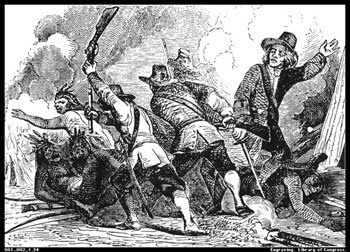
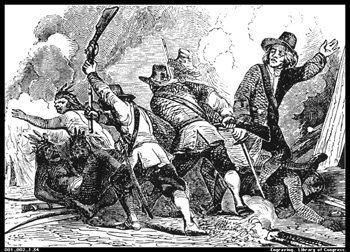
European colonists attack the Pequot village.

The Puritan preachers said, from Romans 13:2, “Whosoever therefore resisteth the power, resisteth the ordinance of God: and they that resist shall receive to themselves damnation.” The colonial governments gathered an armed force of 240 under the command of John Mason. They were joined by a thousand Narragansett warriors. The historian Francis Jennings writes: “Mason proposed to avoid attacking Pequot warriors which would have overtaxed his unseasoned, unreliable troops. Battle, as such, was not his purpose. Battle is only one of the ways to destroy an enemy’s will to fight. Massacre can accomplish the same end with less risk, and Mason had determined that massacre would be his objective.”

The colonist army surrounded a fortified Pequot village on the Mystic River. At sunrise, as the inhabitants slept, the Puritan soldiers set the village on fire.

William Bradford, Governor of Plymouth, wrote: “Those that escaped the fire were slain with the sword; some hewed to pieces, others run through with their rapiers, so that they were quickly dispatched and very few escaped. It was conceived they thus destroyed about 400 at this time. It was a fearful sight to see them thus frying in the fire…horrible was the stink and scent thereof, but the victory seemed a sweet sacrifice, and they gave the prayers thereof to God, who had wrought so wonderfully for them.”

Mason himself wrote: “It may be demanded…Should not Christians have more mercy and compassion? But…sometimes the Scripture declareth women and children must perish with their parents…. We had sufficient light from the word of God for our proceedings.”

Three hundred and fifty years later the Puritan phrase “a shining city on the hill” became a favorite quote of conservative speechwriters.

Discovering the Profits of Slavery

This so-called “Pequot war” was a one-sided murder and slaving expedition. Over 180 captives were taken. After consulting the bible again, in Leviticus 24:44, the colonial authorities found justification to kill most of the Pequot men and enslave the captured women and their children. Only 500 Pequot remained alive and free. In 1975 the official number of Pequot living in Connecticut was 21.

Some of the war captives were given to the Narragansett and Massachusetts allies of the British. Even before the arrival of Europeans, Native peoples of North America had widely practiced taking war captives from other tribes as hostages and slaves.

The remaining captives were sold to British plantation colonies in the West Indies to be worked to death in a new form of slavery that served the emerging capitalist world market. And with that, the merchants of Boston made a historic discovery: the profits they made from the sale of human beings virtually paid for the cost of seizing them.

One account says that enslaving Indians quickly became a “mania with speculators.” These early merchant capitalists of Massachusetts started to make genocide pay for itself. The slave trade, first in captured Indians and soon in kidnapped Africans, quickly became a backbone of New England merchant capitalism.

Thanksgiving in the Manhattan Colony

In 1641 the Dutch governor Kieft of Manhattan offered the first “scalp bounty”–his government paid money for the scalp of each Indian brought to them. A couple years later, Kieft ordered the massacre of the Wappingers, a friendly tribe. Eighty were killed and their severed heads were kicked like soccer balls down the streets of Manhattan. One captive was castrated, skinned alive and forced to eat his own flesh while the Dutch governor watched and laughed. Then Kieft hired the notorious Underhill who had commanded in the Pequot war to carry out a similar massacre near Stamford, Connecticut. The village was set fire, and 500 Indian residents were put to the sword.

A day of thanksgiving was proclaimed in the churches of Manhattan. As we will see, the European colonists declared Thanksgiving Days to celebrate mass murder more often than they did for harvest and friendship.

The Conquest of New England

By the 1670s there were about 30,000 to 40,000 white inhabitants in the United New England Colonies–6,000 to 8,000 able to bear arms. With the Pequot destroyed, the Massachusetts and Plymouth colonists turned on the Wampanoag, the tribe that had saved them in 1620 and probably joined them for the original Thanksgiving Day.

In 1675 a Christian Wampanoag was killed while spying for the Puritans. The Plymouth authorities arrested and executed three Wampanoag without consulting the tribal chief, King Philip.

As Mao Tsetung says: “Where there is oppression there is resistance.” The Wampanoag went to war.

The Indians applied some military lessons they had learned: they waged a guerrilla war which overran isolated European settlements and were often able to inflict casualties on the Puritan soldiers. The colonists again attacked and massacred the main Indian populations.

When this war ended, 600 European men, one-eleventh of the adult men of the New England Colonies, had been killed in battle. Hundreds of homes and 13 settlements had been wiped out. But the colonists won.

In their victory, the settlers launched an all-out genocide against the remaining Native people. The Massachusetts government offered 20 shillings bounty for every Indian scalp, and 40 shillings for every prisoner who could be sold into slavery. Soldiers were allowed to enslave any Indian woman or child under 14 they could capture. The “Praying Indians” who had converted to Christianity and fought on the side of the European troops were accused of shooting into the treetops during battles with “hostiles.” They were enslaved or killed. Other “peaceful” Indians of Dartmouth and Dover were invited to negotiate or seek refuge at trading posts–and were sold onto slave ships.

It is not known how many Indians were sold into slavery, but in this campaign, 500 enslaved Indians were shipped from Plymouth alone. Of the 12,000 Indians in the surrounding tribes, probably about half died from battle, massacre and starvation.

After King Philip’s War, there were almost no Indians left free in the northern British colonies. A colonist wrote from Manhattan’s New York colony: “There is now but few Indians upon the island and those few no ways hurtful. It is to be admired how strangely they have decreased by the hand of God, since the English first settled in these parts.”

In Massachusetts, the colonists declared a “day of public thanksgiving” in 1676, saying, “there now scarce remains a name or family of them [the Indians] but are either slain, captivated or fled.”

Fifty-five years after the original Thanksgiving Day, the Puritans had destroyed the generous Wampanoag and all other neighboring tribes. The Wampanoag chief King Philip was beheaded. His head was stuck on a pole in Plymouth, where the skull still hung on display 24 years later.

The descendants of these Native peoples are found wherever the Puritan merchant capitalists found markets for slaves: the West Indies, the Azures, Algiers, Spain and England. The grandson of Massasoit, the Pilgrim’s original protector, was sold into slavery in Bermuda.

Runaways and Rebels

But even the destruction of Indian tribal life and the enslavement of survivors brought no peace. Indians continued to resist in every available way. Their oppressors lived in terror of a revolt. And they searched for ways to end the resistance. The historian MacLeod writes: “The first `reservations’ were designed for the `wild’ Irish of Ulster in 1609. And the first Indian reservation agent in America, Gookin of Massachusetts, like many other American immigrants had seen service in Ireland under Cromwell.”

The enslaved Indians refused to work and ran away. The Massachusetts government tried to control runaways by marking enslaved Indians: brands were burnt into their skin, and symbols were tattooed into their foreheads and cheeks.

A Massachusetts law of 1695 gave colonists permission to kill Indians at will, declaring it was “lawful for any person, whether English or Indian, that shall find any Indians traveling or skulking in any of the towns or roads (within specified limits), to command them under their guard and examination, or to kill them as they may or can.”

The northern colonists enacted more and more laws for controlling the people. A law in Albany forbade any African or Indian slave from driving a cart within the city. Curfews were set up; Africans and Indians were forbidden to have evening get-togethers. On Block Island, Indians were given 10 lashes for being out after nine o’clock. In 1692 Massachusetts made it a serious crime for any white person to marry an African, an Indian or a mulatto. In 1706 they tried to stop the importation of Indian slaves from other colonies, fearing a slave revolt.

Celebrate?

Looking at this history raises a question: Why should anyone celebrate the survival of the earliest Puritans with a Thanksgiving Day? Certainly the Native peoples of those times had no reason to celebrate.

The ruling powers of the United States organized people to celebrate Thanksgiving Day because it is in their interest. That’s why they created it. The first national celebration of Thanksgiving was called for by George Washington. And the celebration was made a regular legal holiday later by Abraham Lincoln during the civil war (right as he sent troops to suppress the Sioux of Minnesota).

Washington and Lincoln were two presidents deeply involved in trying to forge a unified bourgeois nation-state out of the European settlers in the United States. And the Thanksgiving story was a useful myth in their efforts at U.S. nation-building. It celebrates the “bounty of the American way of life,” while covering up the brutal nature of this society.

[Mike Ely is a participant in the Kasama Project, where several of his other historical writings are available.]

Source / Links: International Journal of Socialist Renewal

Thanksgiving: A Native American View

Many thanks to Diane Stirling-Stevens / The Rag Blog

Posted in RagBlog | Tagged , | 2 Comments

Gimme Shelter : Pilots ‘n Paws Offers Dogs at Risk a Ticket to Ride

“I’m leavin’ on a jet plane.” Photo by Joyce A. Davis / USA Today.

These are wonderful dogs that simply had the bad luck of winding up in a place where there are too many pets in shelters,’ says Pilots N Paws co-founder Jon Wehrenberg.’
By Sharon L. Peters / November 25, 2008

Puppy love is reaching new heights.

Pilots are donating their time, planes and fuel to transport dozens of dogs a month from overcrowded shelters where they face almost certain death to rescue groups and shelters several states away that are committed to finding them homes.

The mission-of-mercy relocations are flown by general aviation pilots who have signed on with the recently formed Pilots N Paws, a Web-based message board where pilots can access information about animals in need.

Once the electronic connection is made, dogs plucked by rescuers from death row — mostly in the South where sterilization rates are low and pet overpopulation is rampant — are loaded onto small planes and flown one, two or six at a time to rescue groups and shelters that have available space.

“These are wonderful dogs that simply had the bad luck of winding up in a place where there are too many pets in shelters,” says Pilots N Paws co-founder Jon Wehrenberg of Knoxville, Tenn. The retired manufacturing executive and weekend pilot has flown scores of dogs from high-kill shelters this year. Earlier this month, his mission involved six small mixed-breed dogs from Knoxville’s Young-Williams Animal Center.

The happy half-dozen enjoyed a smooth-sailing, 90-minute flight to Greensboro, N.C., where they were met by radio station executive Jennifer Hart, head of Animal Rescue & Foster Program, who had arranged foster care. One dog has been adopted; the others are receiving additional attention, socialization and training and should be ready for new homes soon after Thanksgiving.

Beginning of the journey

“Pilots N Paws has given about 20 of our animals a second chance,” says Tim Adams, executive director of the Young-Williams shelter, which euthanizes 70% of the animals that land there. “We take in 17,000 animals a year, and Knoxville simply isn’t big enough… to get new homes for them here. Twenty animals saved may not sound like much, but every one of them matters.”

Pilots N Paws started operating in February soon after Wehrenberg offered to fly a Doberman in Florida to his pal Debi Boies of Landrum, S.C., who is a retired nurse, horse breeder and long-time rescuer. He began asking questions about the rescue world and learned about the passionate underground railroad of animal lovers who orchestrate days-long road journeys to save some of the 4 million to 6 million animals destined for euthanasia in U.S. shelters annually.

“I’d had no idea of the number of animals being euthanized, and the ordeal people and animals were going through in transports,” Wehrenberg says. “Pilots love to fly. I believed that if we created a means for them to discover situations where they could fly and also save animals, many would do it.”

He and Boies joined forces to spread the word, and within months, 85 pilots had signed on. Nearly 200 dogs have now been flown from several shelters and rescue groups to welcoming arms hundreds of miles away.

“For most of these dogs, the next walk they would have taken would have been to death’s door,” says administrative assistant Dawn Thompson of Falconer, N.Y., who for 18 years has taken in, nursed, socialized and re-homed more than 100 dogs a year from various high-kill areas. In recent months 30 have arrived via Pilots N Paws, and she’s learned the ones that arrive by plane rather than ground transport “don’t have the stress that two days on the road creates, and that makes them almost instantly adoptable.”

‘Doggy kisses’ are worth gas

Each flight costs the pilot hundreds of dollars in fuel alone, not including routine maintenance and other operating expenses. Boies and Wehrenberg are working to gain non-profit status for the group so pilots could declare the fuel costs a charitable contribution. But the pilots aren’t exactly agitating for that.

“Doggy kisses are worth the $6 a gallon,” says Westminster, Md., businesswoman and small-plane pilot Michele McGuire. She was recently part of a two-leg relay that flew a 110-pound skin-and-bones Great Dane from Arab, Ala., where a rescue group saved it from euthanasia, to a new family in Baldwin, Mass.

“I don’t know what (the animals’) opinion of flying is, but it sure makes their trip a lot shorter,” says Nick O’Connell, a Williamsburg, Va., contractor who did his first such flight earlier this month. The two-leg hand-off involved two pilots, several hundred miles and two chow-mix puppies rescued from a dump near Atlanta and delivered to their new family in Chesterfield, Va.

The animals are almost always remarkably calm about the adventure, O’Connell and other pilots report.

“It’s almost as if they understand that this is their chance for life,” Boies says.

Sometimes pilots scroll through the “Transport needed” section of Pilots N Paws and find a plea to fly an animal to a town or city they already were planning to visit.

Most times, however, they study the requests, see a need that touches them and offer their services.

Broomfield, Colo., software engineer/pilot Mike Boyd was involved in a multi-state, multi-person transport of a German shepherd in October, and he’s aiming to do more missions. “To take my hobby and apply it to help this situation, well, it’s just a great feeling,” he says.

Adds O’Connell: “It is rewarding beyond my wildest imagination.”

Source / USA Today

Pilots save 10-year old Great Dane Dana

The Rag Blog

Posted in RagBlog | Tagged , | 1 Comment

Thorne Dreyer : The American Voting Public? Not that Bright.

Kathleen Parker, having fed publicly on the bones of the Republican Party and the evangelical movement within it, now suggests that the dumbing down of America reaches far beyond the walls of the Grand Old Party.

By Thorne Dreyer / The Rag Blog / November 26, 2008

See Kathleen Parker’s sad commentary on the sagging IQ of the American public, Below.

And the hits just keep on coming.

The latest dispatch from the surprising Kathleen Parker should give pause to all. Parker asserts, using a recent study as ammunition, that most citizens don’t know “diddly about doohickey.” Her report about the dumbing down of America — certainly facilitated by the less than scholarly (hell, marginally literate) Bush regime — is revealing if not a revelation.

The findings of this study are remarkable and chilling. Parker suggests that the Founding Fathers would find the development, shall we say, revolting. They understood, she says “that an ignorant electorate was susceptible to emotional manipulation and feared the tyranny of the masses.”

The traditionally conservative Parker, incidentally, continues to impress. During the recent election she shocked many (“Oh my. Oh my.”) and was ostracized by some in the Republican ranks for standing up, pointing her finger, and shouting that the Emperor had no clothes. Obvious, to be sure, but previously unspoken and presumably verboten in the ranks of conservative punditry.

Parker even tagged Sarah Palin unworthy of higher office and called on her to drop off the ticket. (“Oh my.”)

Her withering attacks on the state of the Republican Party and the conservative movement, have continued.

In a recent column she suggested that the party check out “the gorilla in the pulpit” — what she labeled “armband religion” — as a topic for the ritual post-mortems. She referred to it as “the evangelical, right-wing, oogedy-boogedy branch.” The GOP has become “beholden to an element that used to be relegated to wooden crates on street corners,” she said, and prayed that religion be returned to “the privacy of one’s heart where it belongs.”

Now Katheleen Parker suggests that the Grand Old Party has no exclusive when it comes to dumbing down. (My, oh my.)

‘It’s disheartening in the wake of a populist-driven election celebrating joes-of-all-trades to be reminded that the voting public is dumber than ever.’
By Kathleen Parker / November 25, 2008

WASHINGTON — So much for the wisdom of The People.

A new report from the Intercollegiate Studies Institute (ISI) on the nation’s civic literacy finds that most Americans are too ignorant to vote.

Out of 2,500 American quiz-takers, including college students, elected officials and other randomly selected citizens, nearly 1,800 flunked a 33-question test on basic civics. In fact, elected officials scored slightly lower than the general public with an average score of 44 percent compared to 49 percent.

Only 0.8 percent of all test-takers scored an “A.”

America’s report card may come as little surprise to fans of Jay Leno’s man-on-the-street interviews, which reveal that most people don’t know diddly about doohickey. Still, it’s disheartening in the wake of a populist-driven election celebrating joes-of-all-trades to be reminded that the voting public is dumber than ever.

The multiple-choice ISI quiz wouldn’t deepen the creases in most brains, but the questions do require a basic knowledge of how the U.S. government works. Think fast: In what document do the words “government of the people, by the people, for the people” appear? More than twice as many people (56 percent) knew that Paula Abdul was a judge on “American Idol” than knew that those words come from Lincoln’s Gettysburg Address (21 percent).

In good news, more than 80 percent of college graduates gave correct answers about Susan B. Anthony, the identity of the commander in chief of the U.S. military, and the content of Martin Luther King Jr.’s “I Have a Dream” speech.

But don’t pop the cork yet. Only 17 percent of college grads understood the difference between free markets and centralized planning.

Then again, we can’t blame the children for what they haven’t been taught. Civics courses, once a staple of junior and high school education, are no longer considered important in our quantitative, leave-no-child-behind world. And college adds little civic knowledge, the ISI study found. The average grade for those holding a bachelor’s degree was just 57 percent — only 13 points higher than the average score of those with only a high school diploma.

Most bracing: Only 27 percent of elected officeholders in the survey could identify a right or freedom guaranteed by the First Amendment.

Forty-three percent didn’t know what the Electoral College does. And 46 percent didn’t know that the Constitution gives Congress power to declare war.

What’s behind the dumbing down of America?

The ISI found that passive activities, such as watching television (including TV news) and talking on the phone, diminish civic literacy.

Actively pursuing information through print media and participating in high-level conversations — even, potentially, blogging — makes one smarter.

The ISI insists that higher-education reforms aimed at civic literacy are urgently needed. Who could argue otherwise? But historian Rick Shenkman, author of “Just How Stupid Are We?” thinks reform needs to start in high school. His strategy is both poetic (to certain ears) and pragmatic: Require students to read newspapers, and give college freshman weekly quizzes on current events.

Did he say newspapers?! Shenkman even suggests government subsidies for newspaper subscriptions, as well as federal tuition subsidies for students who perform well on civics tests. They could be paid from a special fund created by, say, a “Too Many Stupid Voters Act.”

Not only would citizens be smarter, but also newspapers might be saved. Announcements of newsroom cuts, which ultimately hurt quality, have become routine. Just this week, USA Today announced the elimination of about 20 positions, while the Newark Star-Ledger, as it cuts its news staff by 40 percent, lost almost its entire editorial board in a single day.

In his book, Shenkman, founder of George Mason University’s History News Network, is tough on everyday Americans. Why, he asks, do we value polls when clearly The People don’t know enough to make a reasoned judgment?

The founding fathers, Shenkman points out, weren’t so enamored of The People, whom they distrusted. Hence a Republic, not a Democracy. They understood that an ignorant electorate was susceptible to emotional manipulation and feared the tyranny of the masses.

Both Shenkman and the ISI pose a bedeviling question, as crucial as any to the nation’s health: Who will govern a free nation if no one understands the mechanics and instruments of that freedom?

Answer: Maybe one day, a demagogue.

Source / Washington Post

The Rag Blog


Posted in Rag Bloggers | Tagged , , , | 1 Comment

A Bulldog for the Underdog : Jim Mattox Laid to Rest

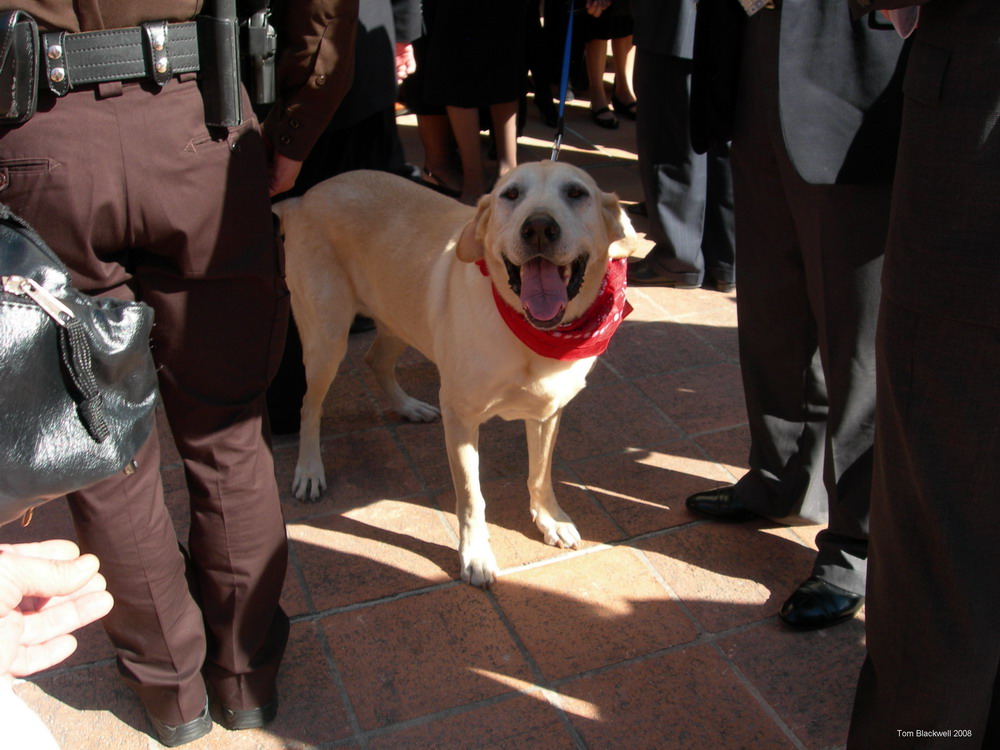
Yellow Dog Democrat pays respects: Photo by Tom Blackwell / The Rag Blog.

This wonderful yellow dog attended the funeral of Attorney General Jim Mattox in Austin on Tuesday. Here he waits while the casket was loaded on a horse drawn hearse. There was a walking procession to the State Cemetery from the First Baptist Church.

Tom Blackwell / The Rag Blog / November 25, 2008

In Memoriam: Jim Mattox
By Vince Leibowitz / November 20, 2008

Today, Texas lost a luminary and a fighter. Texas lost Jim Mattox.

Former Texas Attorney General James Albon “Jim” Mattox passed away last night in his sleep. He was 65.

He will be remembered as a man who fought many fights for average, working Texans, and who left an indelible mark on Texas government in politics in the late 20th and early 21st centuries. Mattox will likely be remembered as one of the state’s greatest attorney generals in history, along with Jim Hogg and James Allred.

James Albon Mattox was born in Dallas on August 29, 1943, the first of three children of Norman and Mary Katheryn Harrison. His father was a union sheetmetal worker, and his mother was a waitress.

He attended Woodrow Wilson High School in Dallas, worked his way through the Baylor School of Business. He graduated from Baylor magna cum laude in 1965 and won the Wall Street Journal Award for academic excellence. He earned his law degree from Southern Methodist University, and received the third-highest grade on the state bar exam in 1968.

Mattox served as an Assistant District Attorney in Dallas County under the legendary Harry Wade, and embarked on a long political career when he took office as a State Representative from East Dallas in 1973. Early in his career, Mattox was also an intern to Congressman Earl Cabell.

Mattox gained a reputation as a reformer during his service in the legislature, and worked for open government legislation focusing on open meetings, open records, full financial disclosure, campaign finance reform, and lobby registration.

In 1976, Mattox was elected to the U.S. Congress from the Fifth District. He became the only freshman elected to the House Budget Committee that session and later chaired that committee’s Task Force on National Security and Veterans Affairs, as well as the Banking Committee.

In 1979 and 1980, Mattox ran aggressive campaigns for Congress, defeating Tom Pauken, a Dallas Republican best known for chairing the Republican Party of Texas.

He was elected the 47th Attorney General of Texas in 1982, succeeding Mark White, and went on to win re-election in 1986. Maddox’ 1982 election came in the last year in which Democrats swept all statewide races on the ballot. Mattox defeated State Senator William “C. Bill” Meier (R-Euless).

Many will remember that Mattox’s 1986 re-election came after he was acquitted, following a lengthy trial, of commercial bribery charges. In spite of that incident, “The People’s Lawyer” still had the support of the people.

His 1986 election victory over San Antonio lawyer Roy Barrera, Jr., proved that Mattox was a popular figure and someone who Texans believed was on their side. Mattox revolutionized child support collection, and his use of the Texas Deceptive Trade Practices act against large corporations earned him many admirers among everyday Texans.

As attorney general, Mattox took on airlines over deceptive advertising related to fare prices, and the insurance industry–among many other corporations–on behalf of Texas consumers. Mattox fought insurance companies, claiming they were trying to create an insurance crisis in Texas in his second term.

In 1990, Mattox ran for attorney general and was defeated in the Democratic Primary by former governor, the late Ann Richards.

In 1994, Mattox ran for U.S. Senate in the Democratic primary and lost to Richard Fisher, a Ross Perot campaign operative during the 1992 presidential election. Fisher was eventually defeated by Senator Kay Bailey Hutchison.

In 1998, Mattox again ran for Attorney General and fell to John Cornyn in a year when Democrats at the top of the ticket in Texas were forced to deal with then-governor George W. Bush’s long coat-tails.

He was a delegate to numerous Democratic National Conventions, including the 2008 DNC in Denver. As recently as a week ago, Mattox was still working hard for change and reform in the Democratic Party, testifying at a hearing on the state’s prima-caucus system, where he was cheered by loyal Democrats:

Participants in the hearing at the Texas AFL-CIO Building in Austin cheered former Attorney General Jim Mattox , who said the caucus feature needs reform.

“You’re not dealing with a Gordian knot here,” Mattox told the panel. “This is not something you can’t untie.”

Mattox, a Clinton delegate to the national convention, called the caucuses an embarrassment to the party.

Rest in Peace, General Mattox. Texas is a better place having had the benefit of your service.

Source / Burnt Orange Report / Nov. 20, 2008

Also see Texans pay respects to Mattox by Corrie MacLaggan / Austin American-Statesman / Nov. 25, 2008

And Jim Mattox, Combative Texas Politician, Dies at 65 / AP / New York Times / Nov. 20, 2008

Thanks to Tim Mahoney Law / The Rag Blog

Posted in RagBlog | Tagged , , , , | 1 Comment

Legendary Artist of the New Left : Frank Cieciorka Dead at 69

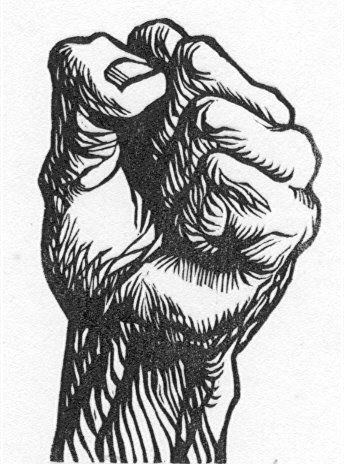
Iconic image of the New Left: Woodcut by Frank Cieciorka.

My year in Mississippi was certainly one the most profound experiences in my life and helped shape my political consciousness to this day. I’m saddened that this country hasn’t done more to eliminate poverty and racism in the intervening forty years.

Frank Cieciorka

Noted watercolorist and graphic artist, Frank Cieciorka organized during Freedom Summer in Mississippi, was art director at The Movement and created the emblematic version of the left’s iconic clenched fist image.

November 25, 2008

A great movement artist and friend of the Freedom Archives, Frank Cieciorka, has died. He will be missed­ –his work goes marching on!

Frank Cieciorka, a nationally recognized watercolor painter, political artist, activist, and author who created many of the iconic images of the 1960s, including the clenched fist and the black panther, died on November 24, 2008 at his home in Alderpoint, California. The cause was emphysema.

Born April 26, 1939, Frank grew up in the upstate New York factory town of Johnson City where his father worked at a grocery store. Frank began work at the age of 14 as a bowling alley pin-boy and then on the assembly line at the local shoe factory. Recognized since childhood for his artistic talent, he enrolled in the fine arts program at San Jose State College in 1957, where he became an anti-war activist, protesting military interventions in Vietnam and the Dominican Republic.

On graduating in 1964, Frank volunteered for Freedom Summer in Mississippi and later was hired as a field secretary for the Student Nonviolent Coordinating Committee (SNCC). He helped organize African-Americans to register to vote and assisted in organizing the racially integrated Mississippi Freedom Democratic Party, which challenged the all-white official Democratic Party. Frank also wrote and illustrated Negroes in American History­A Freedom Primer, taught in Freedom Schools throughout the south. The book is still used as a resource text.

Frank continued his political activism in San Francisco, where he became artistic director of The Movement, a national newspaper of community, anti-war, and civil rights organizing. His art also appeared in many other publications, posters, and underground papers, including The Realist. Among the powerful images he created for The Movement were full-size front-page portraits of Nat Turner and John Brown. His political artistry there and at People’s Press inspired a generation of activist artists.

At the end of the Sixties, tired of city life, Frank became an avid backpacker. In 1972 he purchased a half-acre plot in rural Alderpoint, where he designed and built his own home and studio, and turned to watercolor painting. His works celebrate the southern Humboldt County countryside, the beauty of the female figure in natural settings, and ordinary people doing what they do.

He is survived by his wife, the painter Karen Horn, with whom he enjoyed over 25 years of love and artistic dialogue. He is also survived by his step-daughter, Zena Goldman Hunt and her family, and by his brother, James Cieciorka, and his wife, Jean. Family and friends rejoice in having shared Frank’s life: a testimony to political and artistic passion.

The Freedom Archives.

Also see Frank Cieciorka, Designer for the Left, Is Dead at 69 by Steven Heller / New York Times / November 27, 2008

And A brief history of the “clenched fist” image.

Thanks to Col. Jeffrey Segal / The Rag Blog

Posted in RagBlog | Tagged , , , , , , , , , , , | 4 Comments

Foreclosure Chronicles : The Desperate Hours of Addie Polk

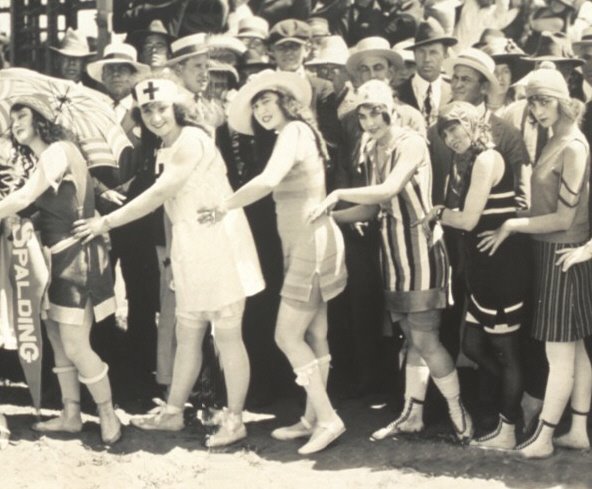
1918: Bathing suit parade, the year Addie Polk was born.

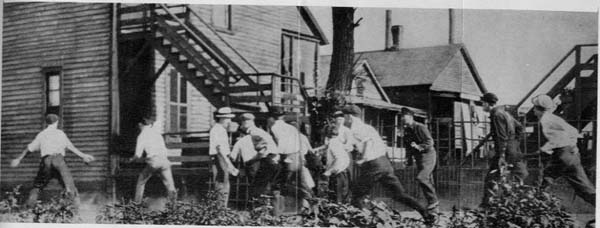
1919: Race Riots in Chicago.

2008: Fannie Mae foreclosed on the home of Addie Polk; Annie Mae Polk put a gun to her chest.

‘In 1970, Robert and Addie Polk bought a small white wood-frame house in a Black neighborhood of Akron for $10,000. Or to put it another way, he exchanged years of labor on the Goodrich assembly line for a place to live.’

On October 1, 2008, a sheriff and his deputy knocked on the door of a small white house in Akron, Ohio. Addie Polk, the 90-year-old Black woman who lived there, went to her dresser and looked at the foreclosure notice that had been duct-taped to her door a month earlier. She pulled out her life insurance policy. She put it next to her keys.

And then she opened the drawer where the pistol was kept.

Addie Polk was born in 1918. It was the year World War 1 ended. That war—between England, France, Russia and the U.S. on one side, and Germany on the other—was fought over which imperialist powers would control the colonies of Asia, Africa and Latin America. The war brought carnage on an unprecedented scale—five million lives thrown onto the altar by the “great powers” to determine the outcome. The war also brought huge changes, all over the world.

In the United States, the war provided a chance to make big profits. But the American capitalists needed workers to make those profits, and their preferred source of workers—the impoverished immigrants from Europe—were cut off by the war.

So the capitalists cast their gaze to the South, where the masses of Black people were still chained to the land. The South, where Black people were forced to grow and pick the cotton, from can’t see in the morning to can’t see at night, only to end up deeper in debt at year’s end—while the landlords grew richer. The South, where Black people had to step off the sidewalk when a white man walked down it, and turn their eyes to the ground when they talked to a white man. Where they couldn’t drink out of fountains reserved for whites, or go to school with whites. And where those who didn’t go along were jailed and made into a new kind of slave on the road gangs and in the mines of the South…or were beaten…or were lynched.

So when the northern capitalists put out the word that they would, for the first time, hire Black people in large numbers, the people responded. They fled the horrors of the South for the “promised land” of the North in massive numbers, and half a million found jobs in the big northern industries. Sometimes, especially in the early days of the migration, the Black people heading North would even break into cheers and song when the train passed over the Mason-Dixon line—the dividing line between North and South.

Akron—where Addie Polk was to make her home—boomed in the war as well. It became the “rubber capital” of the world, churning out tires. Its population went from 69,000 in 1910 to nearly 210,000 in 1920. And Akron, where a lynch mob had once run wild for two days in 1900, saw a Black community begin to take root.

But when the war ended, the boom ended. Capital could no longer profitably employ many Black people who had come North. It didn’t need them.

And besides—the social order was becoming unglued. In Russia, the Bolsheviks had led the masses to make a revolution. This revolution was led by the formerly bitterly-exploited working class and it had, as a central point, freedom and equality for the oppressed nationalities of the Russian empire. The revolution, and the communist ideology that led it, were gaining worldwide influence. And the Black men who had been drafted in World War I had been trained and sent to Europe to fight for the U.S.—where they were in some cases treated as equals by European whites. The men of property and power decreed that traditional social relations—the hierarchy—must be forcibly hammered back into place.

And so in 1919, when Addie Polk was one year old, the cheers on the train turned to dust in the people’s mouths. White workers (along with small businessmen, shopkeepers, etc.) were, once again, mobilized as white people—to protect “their” jobs and “their” neighborhoods. Scores of cities, North as well as South, witnessed barbaric white rampages against African-Americans. Chicago was the worst, with at least 38 Black people killed. Norfolk, Virginia was in a way the most bitterly and bloodily ironic, as a white mob broke up a reception for Black troops returning from World War I and murdered six. Hundreds fell to the violence of white mobs—with at least eight Black people being publicly burned.

But there was also something new afoot. W.E.B. Du Bois, a great Black intellectual and leader of the time, put it this way: “Today we raise the terrible weapon of self-defense. When the murderer comes, he shall no longer strike us in the back. When the armed lynchers gather, we too must gather armed. When the mob moves, we propose to meet it with bricks and clubs and guns.”

The riots finally ended. But the majority of Black people who had come north had been cast and hammered into a subordinate position within the working class. They were to be the last hired and first fired, and when they did work they were to be confined to the very worst, dirtiest and most dangerous jobs. They were segregated into housing that was almost as expensive as it was dilapidated, and cast into broken-down schools that barely deserved the name; and they were dogged at every turn by brutalizing and murdering police. Northern capital inserted Black workers into its system—and in such a way that their labor would turn super‑profits for the system.

This was the world in which Addie Polk took her first steps; the world in which she learned her ABCs; the world in which she grew to womanhood.

Addie Polk looked at the pistol. She heard again the knock at the door, and the voices of law enforcement. She felt the blood pounding in her chest, and pounding in her brain. She picked up the pistol and walked, stiffly, over to her bed.

When World War 2 came in the 1940s, capital once again had need of Black labor—and this time on a far greater scale than before. Now millions more Black people came North. Black men like Robert Polk—Addie Polk’s husband—could find work at Goodrich Tire. The dirtiest, the hardest, and the most dangerous work—but work.

America came out of World War 2 on top. U.S. capital called the tune for the whole world—except for the Soviet Union and the new revolutionary socialist state in China. Facing off against the challenge of the socialist world, and riding atop the imperialist heap, the capitalist rulers of America felt they could—and they felt they had to—pay higher wages to the workers within the U.S., to pacify them and turn them away from any radical movement.

These capitalists also felt that they could—and that they had to—begin to make some concessions to Black people. On the one hand, the big changes of the “Great Migration” and of the upheaval of the war itself contributed to a more militant mood among Black people from all strata, and to growing grassroots resistance. On the other hand, it didn’t go down well internationally for the United States to pose as the supposed great upholder of freedom, when millions of its own people were legally forced to endure segregation, to live without political or social rights, and to face lynch-mob violence at any time.

But those concessions were not enough to stop Black people from rising up, first in the civil rights movement and then in the Black liberation struggle. Over 250 American cities erupted in rebellion during the 1960s. A spirit of defiance took hold and a revolutionary movement began to develop, in the streets and on the campuses and more broadly beside—including the factories where Black workers labored. The ruling class was forced to grant concessions far beyond what they had ever envisioned, and this included opening up jobs that were formerly reserved for whites.

Meanwhile, Robert Polk worked in one of those factories. He punched in each morning and when he did he turned over all his life force to the greater good—and profit—of Goodrich Tire. He punched out each night and went home dead tired. And on payday, he would open the envelope to find just enough to provide the necessities that would bring him back again to the time clock early Monday morning.

It was the “equal exchange” that, multiplied a billion times, keeps capitalism running—the exchange of one person’s life force and labor power, which produces those profits, for the means of subsistence. The “equal exchange” that results in the most profound inequality in wealth, in power, and in life-chances. The “equal exchange” on which all the so-called financial instruments are built. The “equal exchange” that masks a relation of exploitation: the exchange of labor power for wages.

In 1970, Robert and Addie Polk bought a small white wood-frame house in a Black neighborhood of Akron for $10,000. Or to put it another way, he exchanged years of labor on the Goodrich assembly line for a place to live.

Addie Polk lay down on her bed, pistol in her hand. Still the voices, still the occasional knock. She put the pistol to her chest. She began to squeeze the trigger with the 90-year-old fingers that were so achy, and finally so tired.

Capitalism came into the world unique—the only economic system in which innovation was a necessity. No capitalist knows how much “the market will bear”—they don’t know in advance if they can sell all that they produce. But if they do not sell, they go under. So they must constantly figure out ways to produce more goods more cheaply. They invest in new, more productive machinery and they constantly search for ways to more thoroughly exploit the workers they already employ…or else they shift operations altogether.

The U.S. stood atop the heap after World War 2. But European capital innovated. The tire companies of Akron “lost market share” in the ‘70s and early ‘80s to new kinds of tires produced first in Europe, and then in the factories of the “third world.” Soon the factories shut down. Akron, once dubbed the “rubber capital” of the world, found a new title as the city decayed: the “meth capital” of Ohio. Akron, now nearly 30% African-American, saw crack invade its Black community and the streets and schools fall further into disrepair. On Addie Polk’s street, the roadbed comes right up through the concrete, and nearly every other house lies empty, or is up for sale.

Robert Polk died in 1995. But capital was not done with Addie Polk yet. There was blood yet left to suck. Just as meth and crack rampaged through Akron, stoking people up to make it through one more day of hell, new “instruments” of credit gave the capitalist economy a shot of new energy. Politicians and financial commentators on TV talked as high and as giddy about this as a cranked-out meth freak yammering in a bar. But these new “credit instruments” now turn out to have victims. They have victims all over the world on a horrendous scale—and they have victims within the U.S. as well.

Addie Polk’s house had been hers, bought and paid for, “free and clear.” But in a society where the basic necessities of health care, for instance, constantly climb out of reach …in a situation where no one even pretends that the social security and the pittance of a pension for industrial workers are enough to survive on…Addie Polk needed money. The sharks came—not the street-corner ones, but the “legitimate” ones. And they offered her deals—mortgage your house again and get the money you need, up front. And then mortgage it once more, to pay off your earlier deal and to get more money. It was all part of what they now call “the real estate bubble.”

And like so many others, when the real hidden terms kicked in, Addie Polk fell behind. The notices began to come. Knocks on the door, followed by the frightening papers that said NOTICE in big red letters and threatened eviction. The lending company foreclosed. And on October 1, 2008, three men with guns stood downstairs, preparing to move Addie Polk and the few cherished possessions of 90 years, into the streets.

Addie Polk held the gun to her chest, and pulled the trigger. Did she cry out in despair when the first shot missed, and hit her shoulder? We don’t know. But if she had second thoughts, they carried no force—for she marshaled the strength to pull the trigger yet again.

Addie Polk, somehow, did not die. Her neighbor, Robert Dillon, had climbed into her window to check on her and found her stretched out, unconscious, on the bed. She was rushed to the hospital, where she remains today. The mortgage holder, stung by the bad publicity, promises, for now, to let her remain in her home—when and if she gets out of the hospital.

Last week, it was announced that another 765,000 houses entered into the foreclosure process, or were actually being auctioned in the last three months alone.

The end is not in sight.

Source / Revolution

Also see Fannie Mae forgives loan for woman who shot herself / CNN / Oct. 3, 2008

Thanks to Mercedes Lynn de Uriarte / The Rag Blog

Posted in RagBlog | Tagged , , , , , , | Leave a comment

Climate Change : OMG. It’s Even Worse Than we Thought it was Worse Than.

House sliding into the sea. As climate change melts the permafrost, Arctic villages slip into the sea, taking a way of life with them. Photo by Robert Knoth / Mother Jones.

The planet is now so vandalised that only total energy renewal can save us. It may be too late. But without radical action, we will be the generation that saved the banks and let the biosphere collapse.

By George Monbiot / November 25, 2008

George Bush is behaving like a furious defaulter whose home is about to be repossessed. Smashing the porcelain, ripping the doors off their hinges, he is determined that there will be nothing worth owning by the time the bastards kick him out. His midnight regulations, opening America’s wilderness to logging and mining, trashing pollution controls, tearing up conservation laws, will do almost as much damage in the last 60 days of his presidency as he achieved in the foregoing 3,000.

His backers – among them the nastiest pollutocrats in America – are calling in their favours. But this last binge of vandalism is also the Bush presidency reduced to its essentials. Destruction is not an accidental product of its ideology. Destruction is the ideology. Neoconservatism is power expressed by showing that you can reduce any part of the world to rubble.

If it is too late to prevent runaway climate change, the Bush team must carry much of the blame. His wilful trashing of the Middle Climate – the interlude of benign temperatures which allowed human civilisation to flourish – makes the mass murder he engineered in Iraq only the second of his crimes against humanity. Bush has waged his war on science with the same obtuse determination with which he has waged his war on terror.

Is it too late? To say so is to make it true. To suggest there is nothing that can be done is to ensure that nothing is done. But even a resolute optimist like me finds hope ever harder to summon. A new summary of the science published since last year’s Intergovernmental Panel report suggests that – almost a century ahead of schedule – the critical climate processes might have begun.

Just a year ago the Intergovernmental Panel warned that the Arctic’s “late-summer sea ice is projected to disappear almost completely towards the end of the 21st century … in some models.” But, as the new report by the Public Interest Research Centre (Pirc) shows, climate scientists are now predicting the end of late-summer sea ice within three to seven years. The trajectory of current melting plummets through the graphs like a meteorite falling to earth.

Forget the sodding polar bears: this is about all of us. As the ice disappears, the region becomes darker, which means that it absorbs more heat. A recent paper published in Geophysical Research Letters shows that the extra warming caused by disappearing sea ice penetrates 1,000 miles inland, covering almost the entire region of continuous permafrost. Arctic permafrost contains twice as much carbon as the entire global atmosphere. It remains safe for as long as the ground stays frozen. But the melting has begun. Methane gushers are now gassing out of some places with such force that they keep the water open in Arctic lakes through the winter.

The effects of melting permafrost are not incorporated in any global climate models. Runaway warming in the Arctic alone could flip the entire planet into a new climatic state. The Middle Climate could collapse faster and sooner than the grimmest forecasts proposed.

Barack Obama’s speech to the US climate summit last week was an astonishing development. It shows that, in this respect at least, there really is a prospect of profound political change in America. But while he described a workable plan for dealing with the problem perceived by the Earth Summit of 1992, the measures he proposes are hopelessly out of date. The science has moved on. The events the Earth Summit and the Kyoto process were supposed to have prevented are already beginning. Thanks to the wrecking tactics of Bush the elder, Clinton (and Gore) and Bush the younger, steady, sensible programmes of the kind that Obama proposes are now irrelevant. As the Pirc report suggests, the years of sabotage and procrastination have left us with only one remaining shot: a crash programme of total energy replacement.

A paper by the Tyndall Centre for Climate Change Research shows that if we are to give ourselves a roughly even chance of preventing more than two degrees of warming, global emissions from energy must peak by 2015 and decline by between 6% and 8% per year from 2020 to 2040, leading to a complete decarbonisation of the global economy soon after 2050. Even this programme would work only if some optimistic assumptions about the response of the biosphere hold true. Delivering a high chance of preventing two degrees of warming would mean cutting global emissions by more than 8% a year.

Is this possible? Is this acceptable? The Tyndall paper points out that annual emission cuts greater than 1% have “been associated only with economic recession or upheaval”. When the Soviet Union collapsed, emissions fell by some 5% a year. But you can answer these questions only by considering the alternatives. The trajectory both Barack Obama and Gordon Brown have proposed – an 80% cut by 2050 – means reducing emissions by an average of 2% a year. This programme, the figures in the Tyndall paper suggest, is likely to commit the world to at least four or five degrees of warming, which means the likely collapse of human civilisation across much of the planet. Is this acceptable?

The costs of a total energy replacement and conservation plan would be astronomical, the speed improbable. But the governments of the rich nations have already deployed a scheme like this for another purpose. A survey by the broadcasting network CNBC suggests that the US federal government has now spent $4.2 trillion in response to the financial crisis, more than the total spending on the second world war when adjusted for inflation. Do we want to be remembered as the generation that saved the banks and let the biosphere collapse?

This approach is challenged by the American thinker Sharon Astyk. In an interesting new essay, she points out that replacing the world’s energy infrastructure involves “an enormous front-load of fossil fuels”, which are required to manufacture wind turbines, electric cars, new grid connections, insulation and all the rest. This could push us past the climate tipping point. Instead, she proposes, we must ask people “to make short term, radical sacrifices”, cutting our energy consumption by 50%, with little technological assistance, in five years.

There are two problems: the first is that all previous attempts show that relying on voluntary abstinence does not work. The second is that a 10% annual cut in energy consumption while the infrastructure remains mostly unchanged means a 10% annual cut in total consumption: a deeper depression than the modern world has ever experienced. No political system – even an absolute monarchy – could survive an economic collapse on this scale.

She is right about the risks of a technological green new deal, but these are risks we have to take. Astyk’s proposals travel far into the realm of wishful thinking. Even the technological new deal I favour inhabits the distant margins of possibility.

Can we do it? Search me. Reviewing the new evidence, I have to admit that we might have left it too late. But there is another question I can answer more easily. Can we afford not to try? No, we can’t.

Source / Guardian, U.K.

Thanks to David Hamilton / The Rag Blog

Posted in RagBlog | Tagged , , , , , | 1 Comment

Cauldron Bubble : Witch’s Mix of Socialism and Capitalism


‘Our goal is to grow the commons and regulate capitalism, not abolish it.’
By David P. Hamilton / The Rag Blog / November 25, 2008

From Friedman to Fidel, all agree.

No one seriously argues against some form of mixed economy, some combination of public/private sectors. Hence, the traditional argument between socialism and capitalism, framed as the conflict of opposites in which only one can survive, is arcane and obscuring.

Our goal is to grow the commons and regulate capitalism, not abolish it. Single payer universal health care would move the line between public and private considerably in favor of the commons. Another way to move the line would be partial government ownership of major elements of the economy, a common feature of European socialist government policy.

General Motors could be bought at this moment for under $10 billion. So what sense does it make to loan them $20 billion to stay afloat with just a few strings attached? The government should just buy controlling interest in it and convert its factories to the production of high speed trains, electric cars, wind turbines and other environmental products. Failing corporations could be bailed out of bankruptcy only by selling large chunks of their voting stock cheap to the government and having true representatives of the public and unions on their boards of directors.

In any period of revolutionary change, the most important factors are the objective conditions. The Russian Revolution happened as poorly equipped and badly led Russian armies where being massacred by invading Germans, their highly stratified economy was collapsing and the Tzar was being advised by a mad cleric. The subjective factors, e.g., the Bolshevik Party, were just those able to successfully surf the wave.

We are currently in the early stages of the most cataclysmic and punishing changes in the objective conditions that we have experienced in our lifetimes. The American model of laissez faire capitalism is belly up and the world financial system is in serious crisis. The environmental crisis is probably even worse as the climate necessary to sustain human life is rapidly deteriorating.

Obama’s administration is, therefore, likely to be much more “socialist” than you would expect, growing the commons, because that’s their only logical choice given the objective conditions. For example, how can an American auto company, which is required to contribute to its employee’s health care insurance costs, possibly for life ($1500 per car at Chrysler), compete with an auto company in a country that has government funded universal health care? Hence, we have to have government funded universal health care in order to have a competitive auto industry.

As Mike Davis points out in his article, “Note to Obama: ‘Futurama’ Has to Wait Its Turn,” posted on The Rag Blog on Nov. 22, “Of the larger rich, industrial countries, only the United States has yet to build a single mile of what constitutes the new global standard of transportation,” high speed rail. That too, has to be done. And the only checkbook in town big enough to do it is the government.

So have high expectations and keep demanding real change. But Obama meeting those demands will be more a function of his responding to drastic conditions in order that we might mutually survive.

The Rag Blog

Posted in Rag Bloggers | Tagged , , , , , , | 1 Comment

Energy Tech : There’s Still Some Buck Rogers Stuff Out There

Buck Rogers #1, Melbourne, Fitchett Brothers, 1936-1953 / Monash University Rare Book Collection.

‘There is still some Buck Rogers stuff out there that might become important if we can just back the smart people who are not in the oil business.’
By Steve Russell / The Rag Blog / November 25, 2008

As we detach ourselves from a national energy policy written behind closed doors by oilmen, we naturally move to proven technology that is underused in the United States: wind, solar, geothermal.

But, you know, there is still some Buck Rogers stuff out there that might become important if we can just back the smart people who are not in the oil business.

Here we have hydro power from slow currents.

Here we have hydrogen power accomplished by splitting water as needed rather than storage. Therefore, no big infrastructure required.

Here we have carbon captured by algae that turns into biofuel.

All of this stuff comes from fundamental research of the kind ridiculed by John McCain during this election cycle.

Some of it no doubt will not come to fruition, but putting science back on the national agenda can only be a good thing in the long run.

The Rag Blog

Posted in RagBlog | Tagged , , , | Leave a comment

Tim Wise : Obama’s Victory and the Rage of the Barbiturate Left

Member of the “joyless left.”

Now in the wake of Barack Obama’s victory these barbiturate leftists are back in full effect, lecturing the rest of us about how naive we are for having any confidence whatsoever in him, or for voting at all, since “the Democrats and Republicans are all the same…”

By Tim Wise

My political entry into the left (and by this I mean the real left, beyond the Democratic Party) came a little more than twenty years ago in New Orleans, when, as a college student I became involved in the fight against U.S. intervention in Central America. In particular, the groups of which I was a part sought to end military aid to the death squad governments in El Salvador and Guatemala, and to block support for the contra thugs our nation was arming in Nicaragua, who by that time had already killed about 30,000 civilians in their war with the nominally socialist Sandinista government.

It was the first place where I came into contact with folks who defined themselves as radicals (I had grown up in Nashville, after all, where at that time, even finding “out” liberals was sometimes a challenge), and where I got to experience all the fascinating permutations of Marxism that the left had to offer. In addition to unaffiliated socialists (which I considered myself to be at the time), there were Trotskyites, old-line Leninists, Maoists, and even some bizarre Stalinists in the bunch. Excluding from consideration those among this number who turned out to be FBI spies, there were still plenty of real and interesting ideologues who had valuable insights to offer, even for those of us who didn’t swallow their particular party line.

But despite being interesting, these folks also managed, at least for me, to demonstrate one of the key problems with the left in the U.S. Namely, for the sake of ideological purity few within the professional left expressed any joy about life, or any emotion whatsoever that wasn’t rooted in negativity. They were like the political equivalent of quaaludes: guaranteed to bring you down from whatever partly optimistic place you might find yourself from time to time.

This was never so evident as the day I hopped into a car with one of the Stalinoids (a member of something called the Albanian Liberation League, which viewed the brutal regime of Enver Hoxha as a worker’s paradise), and headed downtown for a rally to protest Contra aid. Once in the car, I asked about the music playing from his stereo. What was it? I wanted to know. He quickly explained that it was Albanian folk music, and the only music he listened to. I made some joke about how strange it was to be living in one of the greatest musical towns on Earth and yet to restrict oneself to a single genre of music (especially that favored by Albanian sheepherders), to which my revolutionary friend responded with a grunt and a scowl. Of course, because Comrade Stalin never much liked jazz.

The humorlessness of the far left — to which I remain connected ideologically if not organizationally — has always struck me as one of its greatest weaknesses. People like to laugh, they like to smile, they like to be joyful, and an awful lot of hardened leftists seem almost utterly incapable of doing any of these things. It’s as if they have all taken a pledge that there should be no laughter until the revolution, or some such shit. No positivity, no hope, no happiness so long as people are still poor and exploited and being murdered by cops, and victimized by United States militarism, or performing as wage slaves for global capital, or eating meat, or driving cars. And they wonder why the left is so weak?

Now, in the wake of Barack Obama’s victory these barbiturate leftists are back in full effect, lecturing the rest of us about how naive we are for having any confidence whatsoever in him, or for voting at all, since “the Democrats and Republicans are all the same,” and he supports FISA and the war with Afghanistan, and all kinds of other messed up policies just like many on the right. Those of us who find any significance in the election of a man of color in a nation founded on white supremacy are fools who “drank the kool-aid,” unlike they, whose clear-headed radical consciousness leads them to recognize the superior morality of Ralph Nader, or the pure “scientific wisdom of chairman Bob Avakian,” or the intellectual profundity of their favorite graffiti bomb: “If voting changed anything it would be illegal.” Yeah, and if body piercings and anarchy tats changed anything, they would be too, and then what would some folks do to be “different?” (Note: there is nothing wrong with either type of adornment, but getting either or both doesn’t make you a revolutionary, any more than voting, that’s all I’m saying).

These are people who think being agitators is about pissing people off more than reaching out to them. So they pull out their “Buck Fush” signs at their repetitively irrelevant antiwar demonstrations, or their posters with W sporting a Hitler mustache, because that tends to work so well at convincing folks to oppose the slaughter in Iraq. But effectiveness isn’t what matters to them. What matters to them is raging against the machine for the sake of rage itself. Their message is simple: everything sucks, the earth is doomed, all cops are brutal, all soldiers are baby-killers, all people who work for corporations are evil, blah, blah, blah, right on down the line. It’s as if much of the left has become co-dependent with despondency, addicted to its own isolation, and enamored of its moral purity and unwillingness to work with mere liberals. In the name of ideological asceticism, they spurn the hard work of movement building and inspiring others to join the struggle, snicker at those foolish enough to not understand or appreciate their superior philosophical constructs, and then act shocked when their movements and groups accomplish exactly nothing. But honestly, who wants to join a movement filled with people who look down on you as a sucker?

If we on the left want those liberals to join the struggle for social justice and liberation, we’re going to have to meet people where they are, not where Bakunin would want them to be. For those who can’t get excited about Obama, so be it, but at least realize that there are millions of people who, for whatever reason, are; people who are mobilized and active, and that energy is looking for an outlet. Odds are, that outlet won’t be the Obama administration, since few of them will actually land jobs with it. So that leaves activist formations, community groups and grass-roots struggles. That leaves, in short, us. Just as young people inspired by the center-right JFK candidacy in 1960 ultimately moved well beyond him on their way to the left and made up many of the most committed and effective activists of the 60s and early 70s, so too can such growth occur now among the Obama faithful. But not if we write them off.

At some point, the left will have to relinquish its love affair with marginalization. We’ll have to stop behaving like those people who have a favorite band they love, and even damn near worship, until that day when the band actually begins to sell a lot of records and gain a measure of popularity, at which point they now suck and have obviously sold out: the idea being that if people like you, you must not be doing anything important, and that obscurity is the true measure of integrity. Deconstructing the psychological issues at the root of such a pose is well above my pay grade, but I’m sure would prove fascinating.

The simple fact is, people are inspired by Obama not because they view him as especially progressive per se (except in relation to some of the more retrograde policies of the current president, and in relation to where they feel, rightly, McCain/Palin would have led us), but because most folks respond to optimism, however ill-defined it may be. This is what the Reaganites understood, and for that matter it’s what Martin Luther King Jr. and the civil rights movement knew too. It wasn’t anger and pessimism that broke the back of formal apartheid in the south, but rather, hope, and a belief in the fundamental decency of people to make a change if confronted by the yawning chasm between their professed national ideals and the bleak national reality.

In other words, what the 60s freedom struggle took for granted, but which the cynical barbiturate left refuses to concede, is the basic goodness of the people of this nation, and the ability of the nation, for all of its faults (and they are legion) to change. Look at pictures of the freedom riders in 1961, or the volunteers during Freedom Summer of 1964 and notice the dramatic difference between them and some of the seething radicals of today–whose radicalism is almost entirely about style and image more than actual analysis and movement building. In the case of the former, even as they stared down mobs intent on injuring or killing them, and even as they knew they might be murdered, they smiled, they laughed, they sang, they found joy. In the case of the latter, one most often notices an almost permanent scowl, a dour and depressing affect devoid of happiness, unable to appreciate life until the state is smashed altogether and everyone is subsisting on a diet of wheatgrass, bean curd and tempeh.

Hell, maybe I’m just missing the strategic value of calling people “useful idiots,” or likening them to members of a cult, the way some leftists have done recently with regard to Obama supporters. Or maybe it’s just that being a father, I have to temper my contempt for this system and its managers with hope. After all, as a dad (for me at least), it’s hard to look at my children every day and think, “Gee, it sucks that the world is so screwed up, and will probably end in a few years from resource exploitation…Oh well, I sure hope my daughters have a great day at school!”

Fatherhood hasn’t made me any less radical in my analysis or desire to see change. In fact, if anything, it has made me more so. I am as angry now as I’ve ever been about injustice, because I can see how it affects these children I helped to create, and for whom I am now responsible. But anger and cynicism do not make good dance partners. Anger without hope, without a certain faith in the capacity of we the people to change our world is a sickness unto death. It is consuming, like a flesh-eating disease, and whose first victim is human compassion. While I would never counsel too much confidence in far-right types to join the struggle for justice — and there, I think skepticism is well-warranted — if we can’t conjure at least a little optimism for the ability of liberals and Democrats to come along for the ride and to do the work, then what is the point? Under such a weighty and pessimistic load as this, life simply becomes unbearable. And if there is one thing we cannot afford to do now — especially now — it is to give up the will to live and to fight, another day.

Tim Wise is a prominent writer and anti-racist activist. He is the author of White Like Me: Reflections on Race from a Privileged Son, and Affirmative Action: Racial Preference in Black and White. He has contributed essays to 17 books, and is one of several persons featured in White Men Challenging Racism: Thirty-Five Personal Stories, from Duke University Press. A collection of his essays, Speaking Treason Fluently: Anti-Racist Reflections From an Angry White Male, will be released in fall 2008.

Source / Red Room / Posted Nov. 10, 2008

Thanks to David Hamilton / The Rag Blog

Posted in RagBlog | Tagged , , , , , | 5 Comments

Obama’s Team : Can the Big ‘O’ Put the Ball in the Hoop?

‘Our early take must hinge on how much we believe in Obama’s long-term commitment to at least a modicum of progressive change and his ability to listen, to incorporate the ideas of others, and to use their skills to make him a more effective leader.’

By Thorne Dreyer / The Rag Blog / November 25, 2008

See ‘Obama’s Brain Trust’ by E. J. Dionne Jr., Below.

There has been understandable disappointment among many progressives over President-elect Barack Obama’s early appointments; moderates have praised the choices as a smart and pragmatic first step. There is little doubt, however, that the team so far assembled is packed with unprecedented brainpower and a track record of getting things done. And Obama’s choices certainly show his personal confidence: he clearly thrives on having strong-willed people around him, many of whom not only disagree with some of his tenets, but with each other’s as well.

Our early take must hinge on how much we believe in Obama’s long-term commitment to at least a modicum of progressive change and his ability to listen, to incorporate the ideas of others, and, bottom line, to use their skills and judgments to make him a more effective leader.

And we can hope at least that even the choice of Rahm Emanuel, with his reactionary foreign policy history, is based on the man’s undeniable skills as one who makes things happen and Obama’s calm certainty that he well be the one determining what those things are. We’re talking “decider” here.

One can conclude this: in the realm of brainpower, Obama can hold his own with the best and there’s scarce liklihood of a Dick Cheney (or a Joe Lieberman!) perched on his shoulder issuing whispered directives.

Part of Barack Obama’s strategy — his preemptive strike — is to incorporate and thus neutralize the opposition. To buy into this you must be willing to make a leap of faith: that Obama knows what he’s doing, that he will be able to make it work, and that his projected endgame will be to our liking.

Put this in your pipe: Obama will do things that cause the left to feel despair and outrage. True as the sun will rise. But also remember that even the most committed leftist president — dedicated to constructing, say, a European style socialist government in these United States — could, in reality, do little. Might be the very best we can hope for is some diminution of the corporate stranglehold and an incremental move in the direction of economic democracy.

And, if there’s still room in that pipe: We will not finally end war in our lifetime. Certainly won’t get the troops home from Iraq as quickly as we should and much of that momentum will most likely just be transferred to Afghanistan. American imperialist foreign policy will continue to ride high in the saddle, even without a faux Texan “yippee-yi-yo”-ing at the reins; however, a steadier and more enlightened hand should result in a turn back to diplomacy and away from waterboarding. And our community organizer president-to-be could make– already is — a real difference in the tone of world politics, a return to civility, as they say.

A diffusing of the extremist momentum poisoning the world could be a legitimate expectation. Though words and tone must be accompanied by a serious commitment to addressing the social conditions at the core of the problem. I don’t believe it’s too much of a stretch to expect that of an Obama presidency.

Seems the prudent thing to this moldy observer that we reserve judgment at least until the man takes office. And those of us holding out hope for this presidency should keep in mind that conditions — especially the economy — mitigate strongly for progressive solutions. An expansive public works project appears inevitable. And I, for one, wouldn’t be surprised to see even the neo-liberal Clintonites, newly unfettered by the pull of cynical triangulation — the whole damn pack — move solidly to the left.

And then again: if this be delusion, we should all be perched to pounce.

Below E. J. Dionne sheds a bit of light on the recently annointed Obama team, which he says informs the expectation that our next president will govern as both a progressive and a pragmatist.

Obama’s Brain Trust
By E. J. Dionne Jr. / November 25, 2008

President-elect Barack Obama has now made three things clear about his plans to bring the economy back: He wants his actions to be big and bold. He sees economic recovery as intimately linked with economic and social reform. And he is bringing in a gifted brain trust to get the job done.

Just three weeks after Election Day, Obama has already expanded his authority by seizing on “an economic crisis of historic proportions,” as he described it yesterday, to call for a stimulus package that will dwarf anything ever attempted by the federal government.

But Obama is also using the crisis to make the case for larger structural reforms in health care, energy and education — “to lay the groundwork for long-term, sustained economic growth,” as he put it. Obama clearly views the economic downturn not as an impediment to the broadly progressive program he outlined during the campaign but as an opportunity for a round of unprecedented social legislation.

“He feels very strongly that this is not just a short-term fix but a long-term retooling of the American economy,” said one of Obama’s closest advisers. “Obama has a holistic view of the economy. Health care is going to be part of it,” the lieutenant told me, and so will green energy investments, education reform and a new approach to regulating financial markets.

Obama further underscored his decision to tether social and economic policy by linking his announcement of Melody Barnes as the director of the White House Domestic Policy Council to the unveiling of his economic team.

Getting Timothy Geithner and former Treasury secretary Larry Summers working in harness is Obama’s single biggest post-election victory.

Some who know Summers, a man with a large personality, were surprised that he would take the job as inside-the-White-House economic adviser and accept the appointment of Geithner, the president of the Federal Reserve Bank of New York, as Treasury secretary.

But Obama’s aides are making clear that Summers is being assigned a large role in shaping the administration’s overall economic policy, and his White House post will free him from the day-to-day responsibilities of running the Treasury Department — duties well suited for Geithner, widely seen as a good manager and also as an economic diplomat likely to broker international cooperation in stemming the downturn. The fact that Summers and Geithner have a long history of working together should ease potential conflicts.

The senior Obama adviser said the president-elect benefited from Summers’s desire to be at the center of the action during the greatest economic crisis since the Great Depression. “If ever there was a time to want to be involved, it’s now,” said the adviser, who added that Obama, in turn, sees Summers as “brilliant.”

Obama got to know Geithner “during the final weeks of the campaign,” said the senior Obama aide, and the two hit it off immediately. Like Obama, Geithner had partly grown up abroad, and this gave the two an immediate connection. It led to “an ease in conversation,” and the two discovered they “also share a common temperament,” including a calm demeanor and a curiosity about the thinking of others.

“When Obama emerged from the first meeting, he was very effusive,” said the senior aide. “He said, ‘I feel good about him as a person; he inspires confidence.’ ” Geithner did not campaign for the job, which only sent his stock higher in the Obama circle. “He suggested that others might be better, that he might be more useful where he is,” said the Obama lieutenant. “That was impressive as well.”

Obama’s selection of a team of highly skilled pragmatists has already been described as a move to the political center, but Obama advisers and longtime acquaintances say that this is a misreading of the incoming president and his approach. They describe it as combining a practicality about means with an overriding concern about the corrosive effects of growing economic inequalities.

Aides say that Obama was drawn to Summers in part because the former Harvard president shares the president-elect’s passion for a more equitable distribution of economic benefits. Obama was impressed during campaign policy discussions that Summers would often pull the conversation away from general talk about economic growth to a concern with the living standards of families with average incomes.

Washington often divides the Democratic policy world between progressives and pragmatists. With Obama, as yesterday’s news conference showed, it will have to become accustomed to a president who is both.

Source / Washington Post

The Rag Blog

Posted in RagBlog | Tagged , , , | Leave a comment

Quickie Questionaire : How Long Have You been a Heterosexual?


The Heterosexual Questionaire : Turning the other cheek.

The Heterosexual Questionnaire was created back in 1972 to put heterosexual people in the shoes of a gay person for just a moment. Questions and assumptions made of Gays and Lesbians that are unfair, are reversed and this time asked to the straight people.

This is a fun survey, but also an activist survey. Please repost this to your email list, myspace bulletin, use it in a group setting, have fun with it but also let the point be made.

1. What do you think caused your heterosexuality?

2. When and where did you decide you were a heterosexual?

3. Is it possible this is just a phase and you will out grow it?

4. Is it possible that your sexual orientation has stemmed from a neurotic fear of others of the same sex?

5. Do your parents know you are straight? Do your friends know- how did they react?

6. If you have never slept with a person of the same sex, is it just possible that all you need is a good gay lover?

7. Why do you insist on flaunting your heterosexuality… can’t you just be who you are and keep it quiet?

8. Why do heterosexuals place so much emphasis on sex?

9. Why do heterosexuals try to recruit others into this lifestyle?

10. A disproportionate majority of child molesters are heterosexual… Do you consider it safe to expose children to heterosexual teachers?

11. Just what do men and women do in bed together? How can they truly know how to please each other, being so anatomically different?

12. With all the societal support marriage receives, the divorce rate is spiraling. Why are there so few stable relationships among heterosexuals?

13. How can you become a whole person if you limit yourself to compulsive, exclusive heterosexuality?

14. Considering the menace of overpopulation how could the human race survive if everyone were heterosexual?

15. Could you trust a heterosexual therapist to be objective? Don’t you feel that he or she might be inclined to influence you in the direction of his orher leanings?

16. There seem to very few happy heterosexuals. Techniques have been developed that might enable you to change if you really want to.

17. Have you considered trying aversion therapy?

Martin Rochlin, Ph.D., 1972

Source / Queers United

The Rag Blog

Posted in RagBlog | Tagged , , | 1 Comment