POETRY / Richard Jehn: All the Colour

Truck Road, Welcome, Washington. Photo by author. Click to enlarge.

All the Colour

Driving through a cavern of colour,
Unwittingly watching my life change as the leaves.
For all the times I drove that highandlowway,
Never did I see it so profoundly as that day.

I wanted to believe in God.
That’s how beautiful and moving was the experience.
Knowing that I had answered two key questions
Certainly, for once.

Too long waiting,
But finally the answers.
And with them god-food:
Cajun smoked salmon from the best.

To make a loving dish for someone special,
A Friend so dear, means so much.
The cadence of quiet, the rhythm of soft.
The leaves’ brush of love.

By Richard Jehn
28 October 2008

The Rag Blog

Posted in Rag Bloggers | Tagged , | 4 Comments

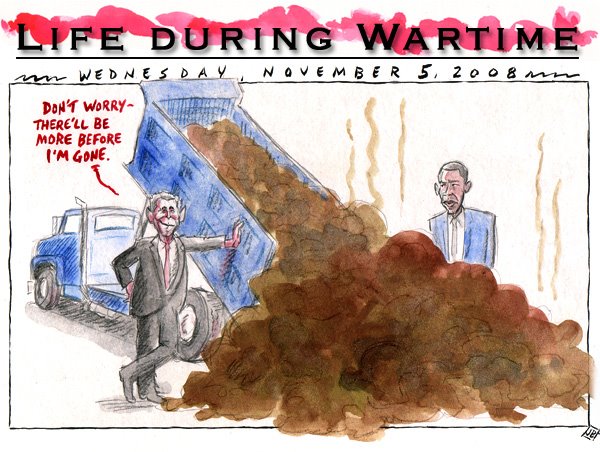
Do You Smell Something?

Thanks to S. R. Keister / The Rag Blog

Posted in RagBlog | Tagged , , , | Leave a comment

California Election: Gay Marriage Is History

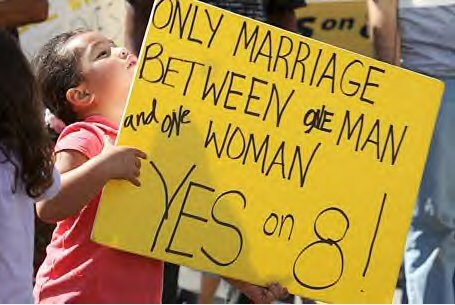
A child holds a sign promoting California Proposition 8. The ballot measure to ban gay marriage passed Tuesday. Photo: David McNew, Getty Images

California Approves Gay Marriage Ban
By Lisa Leff / November 5, 2008

LOS ANGELES – Voters put a stop to same-sex marriage in California, dealing a crushing defeat to gay-rights activists in a state they hoped would be a vanguard, and putting in doubt as many as 18,000 same-sex marriages conducted since a court ruling made them legal this year.

The gay-rights movement had a rough election elsewhere as well Tuesday. Ban-gay-marriage amendments were approved in Arizona and Florida, and Arkansas voters approved a measure banning unmarried couples from serving as adoptive or foster parents. Supporters made clear that gays and lesbians were their main target.

But California, the nation’s most populous state, had been the big prize. Spending for and against Proposition 8 reached $74 million, the most expensive social-issues campaign in U.S. history and the most expensive campaign this year outside the race for the White House. Activists on both sides of the issue saw the measure as critical to building momentum for their causes.

“People believe in the institution of marriage,” Frank Schubert, co-manager of the Yes on 8 campaign said after declaring victory early Wednesday. “It’s one institution that crosses ethnic divides, that crosses partisan divides. … People have stood up because they care about marriage and they care a great deal.”

With almost all precincts reporting, election returns showed the measure winning with 52 percent. Some provisional and absentee ballots remained to be tallied, but based on trends and the locations of the votes still outstanding, the margin of support in favor of the initiative was secure.

Exit polls for The Associated Press found that Proposition 8 received critical support from black voters who flocked to the polls to support Barack Obama for president. Blacks voted strongly in favor of the ban, while whites narrowly opposed it and Latinos and Asians were split.

Californians overwhelmingly passed a same-sex marriage ban in 2000, but gay-rights supporters had hoped public opinion on the issue had shifted enough for this year’s measure to be rejected.

“We pick ourselves up and trudge on,” said Kate Kendell, executive director of the National Center for Lesbian Rights. “There has been enormous movement in favor of full equality in eight short years. That is the direction this is heading, and if it’s not today or it’s not tomorrow, it will be soon.”

The constitutional amendment limits marriage to heterosexual couples, nullifying the California Supreme Court decision that had made same-sex marriages legal in the state since June.

Similar bans had prevailed in 27 states before Tuesday’s elections, but none were in California’s situation — with about 18,000 gay couples already married. The state attorney general, Jerry Brown, has said those marriages will remain valid, although legal challenges are possible.

Elsewhere, voters in Colorado and South Dakota rejected measures that could have led to sweeping bans of abortion, and Washington became only the second state — after Oregon — to offer terminally ill people the option of physician-assisted suicide.

A first-of-its-kind measure in Colorado, which was defeated soundly, would have defined life as beginning at conception. Its opponents said the proposal could lead to the outlawing of some types of birth control as well as abortion.

The South Dakota measure would have banned abortions except in cases of rape, incest and serious health threat to the mother. A tougher version, without the rape and incest exceptions, lost in 2006. Anti-abortion activists thought the modifications would win approval, but the margin of defeat was similar, about 55 percent to 45 percent of the vote.

“The lesson here is that Americans, in states across the country, clearly support women’s ability to access abortion care without government interference,” said Vicki Saporta, president of the National Abortion Federation.

In Washington, voters gave solid approval to an initiative modeled after Oregon’s “Death with Dignity” law, which allows a terminally ill person to be prescribed lethal medication they can administer to themselves. Since Oregon’s law took effect in 1997, more than 340 people — mostly ailing with cancer — have used it to end their lives.

The marijuana reform movement won two prized victories, with Massachusetts voters decriminalizing possession of small amounts of the drug and Michigan joining 12 other states in allowing use of pot for medical purposes.

Henceforth, people caught in Massachusetts with an ounce or less of pot will no longer face criminal penalties. Instead, they’ll forfeit the marijuana and pay a $100 civil fine.

The Michigan measure will allow severely ill patients to register with the state and legally buy, grow and use small amounts of marijuana to relieve pain, nausea, appetite loss and other symptoms.

Nebraska voters, meanwhile, approved a ban on race- and gender-based affirmative action, similar to measures previously approved in California, Michigan and Washington. Returns in Colorado on a similar measure were too close to call.

Ward Connerly, the California activist-businessman who has led the crusade against affirmative action, said Obama’s victory proved his point. “We have overcome the scourge of race,” Connerly said.

Energy measures met a mixed fate. In Missouri, voters approved a measure requiring the state’s three investor-owned electric utilities to get 15 percent of their electricity from renewable sources by 2021. But California voters defeated an even more ambitious measure that would have required the state’s utilities to generate half their electricity from windmills, solar systems, geothermal reserves and other renewable sources by 2025.

Two animal-welfare measures passed — a ban on dog racing in Massachusetts, and a proposition in California that outlaws cramped cages for egg-laying chickens.

Amid deep economic uncertainty, proposals to cut state income taxes were defeated decisively in North Dakota and Massachusetts.

In San Francisco, an eye-catching local measure — to bar arrests for prostitution — was soundly rejected. Police and political leaders said it would hamper the fight against sex trafficking. And in San Diego, voters decided to make permanent a ban on alcohol consumption on city beaches.

Associated Press writer Paul Elias in San Francisco contributed to this report.

Copyright 2008 The Associated Press.

Source / America On Line

The Rag Blog

Posted in RagBlog | Tagged , , | 5 Comments

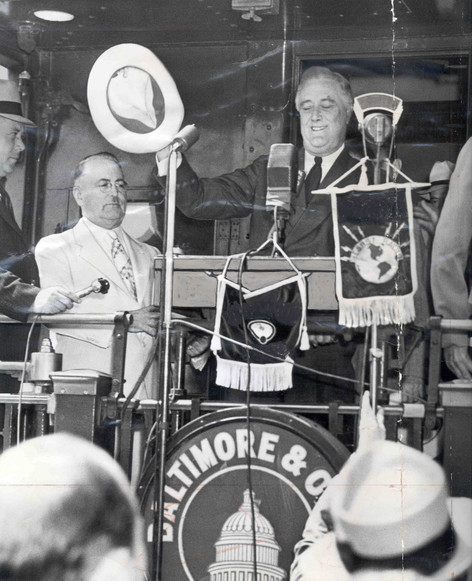
Paul Buhle : FDR, Obama and a new Popular Front

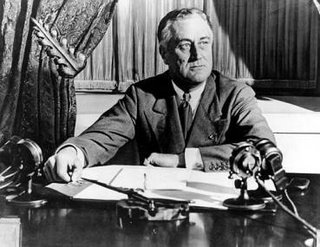
FDR: Time for a new Popular Front to support Obama?

‘The young and not-so-young folks in Times Square, Harlem, Capital Square in Madison, Grant Park in Chicago are our people, and have every potential of mobilization for the long haul.’
By Paul Buhle
/ The Rag Blog / November 5, 2008

Hello everybody. I was asked to write an election piece for a French leftwing mag, and will be doing so in the next couple days.

I say, the small blip that produced new SDS (and the effort to create a real MDS) a couple years ago was a precursor of the large blip that brought young people into a decisive role in the election.

We all know the limitations of Obama’s campaign and advisors and all that, no need to dwell on those for the moment.

What counts more, in my view, is the prospect or possibility that, as FDR, an embattled Obama being pushed in every-which direction will need the kind of voting and support bloc that the Popular Front created, mainly through the new CIO but also through a range of cultural organizations, for FDR’s re-election campaigns (leaving aside 1940 and even then, FDR depended heavily upon the movement that the Pop Front had created). The Left built itself up around and beyond the titular political leader.

I showed my “Jewish Americans: Films and Comics,” an animated 1944 film piece, a couple days ago, made by folks who quit Disney after the strike, and other lefties; I could identify several of my interviewees in the credits. It looked, more than anything else, like an Obama video ad.

Let’s savor this moment and use every possibility to our advantage.

The young and not-so-young folks in Times Square, Harlem, Capital Square in Madison, Grant Park in Chicago and all those places are our people, and have every potential of mobilization for the long haul.

Let’s help them win their place in history.

[Historian Paul Buhle is a writer, editor and senior lecturer at Brown University, and a leader of Movement for a Democratic Society.]

The Rag Blog

Posted in Rag Bloggers | Tagged , , , , , , , , , , | 1 Comment

Michael Moore : Pinch Me!

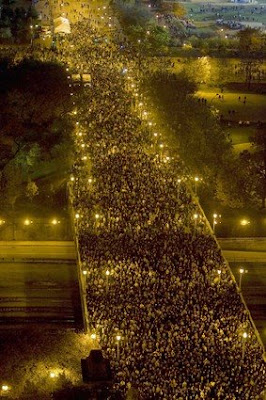
President-elect Barack Obama addresses victory crowd at Grant Park in Chicago Tuesday night. Photo by Pat Benic / UPI.

‘Never before in our history has an avowed anti-war candidate been elected president during a time of war.’
By Michael Moore / November 5, 2008

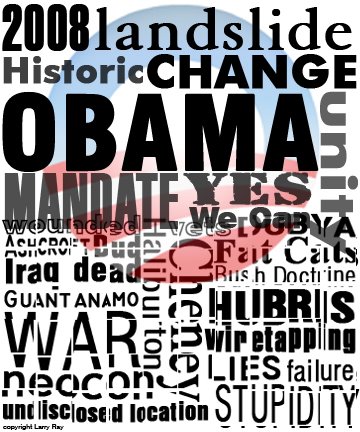
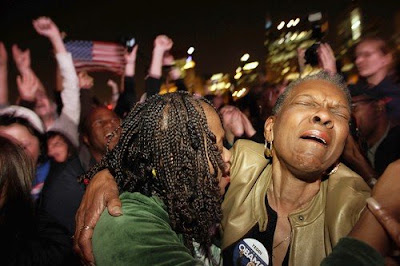
Who among us is not at a loss for words? Tears pour out. Tears of joy. Tears of relief. A stunning, whopping landslide of hope in a time of deep despair.

In a nation that was founded on genocide and then built on the backs of slaves, it was an unexpected moment, shocking in its simplicity: Barack Obama, a good man, a black man, said he would bring change to Washington, and the majority of the country liked that idea. The racists were present throughout the campaign and in the voting booth. But they are no longer the majority, and we will see their flame of hate fizzle out in our lifetime.

There was another important “first” last night. Never before in our history has an avowed anti-war candidate been elected president during a time of war. I hope President-elect Obama remembers that as he considers expanding the war in Afghanistan. The faith we now have will be lost if he forgets the main issue on which he beat his fellow Dems in the primaries and then a great war hero in the general election: The people of America are tired of war. Sick and tired. And their voice was loud and clear yesterday.

It’s been an inexcusable 44 years since a Democrat running for president has received even just 51% of the vote. That’s because most Americans haven’t really liked the Democrats. They see them as rarely having the guts to get the job done or stand up for the working people they say they support. Well, here’s their chance. It has been handed to them, via the voting public, in the form of a man who is not a party hack, not a set-for-life Beltway bureaucrat. Will he now become one of them, or will he force them to be more like him? We pray for the latter.

But today we celebrate this triumph of decency over personal attack, of peace over war, of intelligence over a belief that Adam and Eve rode around on dinosaurs just 6,000 years ago. What will it be like to have a smart president? Science, banished for eight years, will return. Imagine supporting our country’s greatest minds as they seek to cure illness, discover new forms of energy, and work to save the planet. I know, pinch me.

We may, just possibly, also see a time of refreshing openness, enlightenment and creativity. The arts and the artists will not be seen as the enemy. Perhaps art will be explored in order to discover the greater truths. When FDR was ushered in with his landslide in 1932, what followed was Frank Capra and Preston Sturgis, Woody Guthrie and John Steinbeck, Dorothea Lange and Orson Welles. All week long I have been inundated with media asking me, “gee, Mike, what will you do now that Bush is gone?” Are they kidding? What will it be like to work and create in an environment that nurtures and supports film and the arts, science and invention, and the freedom to be whatever you want to be? Watch a thousand flowers bloom! We’ve entered a new era, and if I could sum up our collective first thought of this new era, it is this: Anything Is Possible.

An African American has been elected President of the United States! Anything is possible! We can wrestle our economy out of the hands of the reckless rich and return it to the people. Anything is possible! Every citizen can be guaranteed health care. Anything is possible! We can stop melting the polar ice caps. Anything is possible! Those who have committed war crimes will be brought to justice. Anything is possible.

We really don’t have much time. There is big work to do. But this is the week for all of us to revel in this great moment. Be humble about it. Do not treat the Republicans in your life the way they have treated you the past eight years. Show them the grace and goodness that Barack Obama exuded throughout the campaign. Though called every name in the book, he refused to lower himself to the gutter and sling the mud back. Can we follow his example? I know, it will be hard.

I want to thank everyone who gave of their time and resources to make this victory happen. It’s been a long road, and huge damage has been done to this great country, not to mention to many of you who have lost your jobs, gone bankrupt from medical bills, or suffered through a loved one being shipped off to Iraq. We will now work to repair this damage, and it won’t be easy.

But what a way to start! Barack Hussein Obama, the 44th President of the United States. Wow. Seriously, wow

Michael Moore’s website.

The Rag Blog

Posted in RagBlog | Tagged , , , , , | 2 Comments

America: Happy, Happy, Happy !!


Happy, Happy, Happy !!
By Diane Stirling-Stevens / The Rag Blog / November 4, 2008

Boy, what a wonderful day I had! My back was killing me; took my pain medication, and finally headed over to the casino to gamble; eat lunch, and watch the election as it unfolded.

I ‘placed my numbers’ – always use #44 since it’s Hank Aaron’s number, and he was my favorite baseball player (it is also the number of the president who was elected today). I was ‘up and down’ – hit $100; then down – then hit another $100, and after going up and down with about $75 still in the machine, I nailed it for $4,700.00 shortly after 4 this afternoon. I broke into tears of happiness; gave out $300 for a tip – handed out a few hundred to those who were seated near me (and hadn’t had a bite/good luck), and told a couple people ‘now if only Obama wins I’ll have had the best day’.

I went home to get my husband to treat him to dinner; that was wonderful, and when we came out Obama was ‘over the top’ – the casino and restaurant was in an uproar of happiness, and we spent the rest of the time having ‘good cheer drinks’, and celebrating.

I’m happy my family in Ohio; California, Michigan and Florida all ‘chimed in’ at the last, and agreed Obama was the ‘pick’, and I see he carried all of those states as well as my state of Nevada – now that was just the ‘topping’ on a wonderful election day/night cake for me.

I loved Obama’s speech; he was clearly happy and grateful, but still that wonderful reserved and poised individual that I admire so much.

I can hardly wait to ring our neighbor’s door-bell tomorrow; they are a lovely black family, and they all were so unsure of Obama’s success – I bet they are celebrating now, but I don’t want to interfere with their family gathering, so tomorrow is soon enough.

It’s more than an election to me; it’s an acceptance that not just a ‘white man’ is qualified to be president, but that anyone with the right education, desire, and commitment should be eligible to become a leader for our country (or our state), in a capacity where they can represent our dreams and goals because they share them, too.

I don’t think I’ll sleep easily tonight; it’s just too wonderful. I must say coming home with a wad of $100 bills made it just a bit more delightful ….

The Rag Blog

Posted in Rag Bloggers | Tagged , , , | 3 Comments

Talking to Afghans About the US/NATO Presence

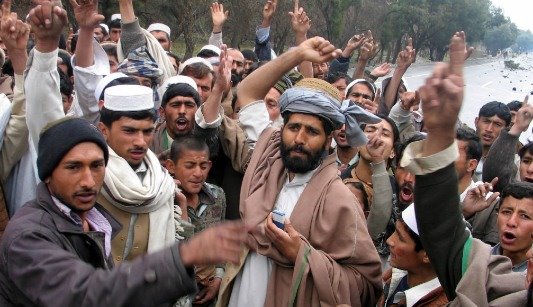
Many Afghans are critical of the US mission in Afghanistan. Photo: GALLO/GETTY.

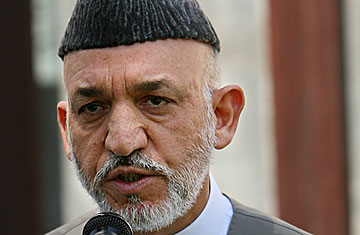
Afghans uneasy over US relationship
By Aunohita Mojumdar / November 4, 2008

As a managing director of Radio Killid, a radio station dedicated to socially relevant programming, Najiba Ayubi keeps a keen eye on international political developments and is well aware of public opinion in Afghanistan.

Like many Afghans, the position of the US presidential candidates on and their rhetoric towards Afghanistan do not impress her.

“They are tools to come to power with,” she says.

Unlike the focus on talk of a so-called “surge” in the number of troops in Afghanistan which dominates US talk shows and occupies American political pundits, Afghans are concerned on what the troops will do, the nature of the military operations and the rules of engagement.

The increase in both the violence and the number of Afghan civilians being killed, continuing poverty and a loss of hope are making Afghans’ relationship with the foreign presence in their land more complicated.

Anger over casualties

Many Afghans continue to view foreign troops on their land as a necessary evil, but even those supporting them want fundamental changes in the conditions of their presence.

“We have got some good things from the US – the laws, the new constitution, the parliament – but we would like the international military presence here to be under a framework which includes a date for its withdrawal,” says Ayubi.

Ayubi is no traditionalist. Her radio programming raises social awareness and tackles difficult subjects such as violence against women.

However, she feels Afghans have become very critical of the US because of the increasing civilian casualties in military operations.

She says: “In 2001, we would have welcomed anyone who came to deliver us from the Taliban. But now that feeling is changing.

“The US does not consult anyone. It decides, unilaterally, to do whatever it wants.”

Civilian casualties, for example, could be prevented if there was greater consultation with locals “since the foreign troops do not know the customs or culture”.

What the soldiers take for a militant gathering may just be the Afghan tradition of setting up open kitchens for weddings which go on for several days,” she says.

Occupation anger

Khalid Dawari, a young man who works in an architect’s firm, shares Ayubi’s lack of interest in the impact of the US elections on Afghanistan.

Khalid says little will change under a new US administration

“The foreign policy of the US doesn’t depend on one individual. It will not change.” he says but, unlike Ayubi, he feels civilian casualties are part of any conflict.

He is more strident in his criticism of the western presence.

“Afghanistan has been occupied or captured by Americans or other European countries,” he says, explaining that the very presence of foreign soldiers denotes occupation.

“It is fine for now. But they are doing it for their own benefit. Bush is in the oil and gas business isn’t he?”

A ‘tortured’ relationship

Khalid’s remarks reflect the tortured relationship of many Afghans to the presence of the West which is something they cannot live with, nor without.

He believes his country’s president, Hamid Karzai, has been selected by the US and not the Afghans.

“Who is he? We never heard of him earlier. He was not a leader. He has been selected by Mr Bush,” he said.

He sees a substantive portion of the country’s aid going back to the donor countries but sees no way out.

“Afghanistan is not in a situation where it can help itself. We are hopeless from every side. If they withdraw, the Taliban may come and capture Kabul.”

Dawari is clear that the western intervention in Afghanistan is dominated and led by the US.

As for other countries, he says “the rest are just members of the party”.

Taliban memories

US dominance of the foreign intervention in Afghanistan is overwhelming.

It has contributed approximately half of the troops there and, between 2002 to 2008, provided one-third of the entire aid to Afghanistan.

The large presence of US consultants, contractors and aid workers has spawned its own economy, services and goods for the expatriate market.

The Kabul Coffee House, for example, is an American style cafe that is frequented largely by internationals.

Haseebullah Fayez, 20, is grateful for his work there as a cashier.

Haseebullah does not want to go back to life under the Taliban

He was living in Kabul during the rule of the Taliban and has strong memories of what life was like.

“I went to school, but got no education. There was no work,” he says.

“After they [the Taliban] left I could study. I learnt English. Now at least we can find some work. I support my family. My father’s salary as a school teacher is only $60 a month and not enough for our family of five,” he said.

Haseeb has been in the cafe for three years and along the way has acquired a taste for cheeseburgers, Bob Dylan’s music and Arnold Schwarzenegger movies.

He regularly hears the criticism of the foreign reconstruction effort in his country.

He agrees that civilians get killed in military operations and that a substantial portion of the money Afghanistan receives goes back to the donor countries.

But his anger is not directed towards them.

“I wonder why it [war and destruction] had to happen to Afghanistan,” he says.

He says that lives do get lost in a war but “they [US forces] don’t want to kill them. It happens by mistake”.

No ‘nation building’

Aziz Hakimi, the country director of the charity Future Generations, digs much deeper than his compatriots, questioning not just the US role but the entire idea of “nation building” by the West.

Aziz feels that the West has abandoned Afghanistan

The mistakes made in the initial days of the US intervention – such as putting in power ‘warlords’ and “the very people who are a threat to security” has cost dearly, he feels.

“The Afghans welcomed the intervention as they welcomed change each time. However, just as in the past, they were disappointed again,” he said.

The change in Afghan society must be rooted in the community, he feels.

Decisions must be made by local communities “rather than being dictated by budgets in Brussels or Washington” he says.

Hakimi does not buy into the popular notion that the foreign aid has not been enough.

“It’s dangerous to assume that throwing dollars at the problem will solve it. It will compound the problem. You cannot use development dollars and military might to deal with a political problem.”

While he agrees that the Western presence is dominated by the US, he blames, at least partially, the Europeans who have contributed to Nato’s Afghan troop force, for it, and echoes the feelings of many Afghans who believe the West has abandoned them repeatedly.

“The West abandoned us after they got what they wanted in the Cold War. They are here now to fight the ‘war on terror’,” he says.

He insists: “They will abandon us again if the al-Qaeda is routed. Afghans should think about this.”

Source / Al Jazeera English

The Rag Blog

Posted in RagBlog | Tagged , , | Leave a comment

Rag Blog Report from Berlin : The Whole World is Watching


Reflections on the US elections and the possibilities for a better world
By David MacBryde / The Rag Blog / November 4, 2008

BERLIN — You are not alone today. The whole world is watching.

In Berlin tonight we are having a “Party With Us Into the Sunrise” election party. We named it that with the hope that the results will enable a “sunrise” out of dire times, and because it will be sunrise here by the time polls close across the United States. The traditional venue here for US election watching is the Amerika Haus — formally a cultural center run by the US State Department. (Personal disclosure: father Duncan helped initiate it at the end of WW II.) The building is now owned by the city of Berlin. The city has made it available for the event. The place can hold some 300 people.

As the election got closer we thought more space might be needed, and a movie theater offered an additional venue, with room for 800 people. But there have been over 6,000 requests for reservations so far, and climbing. We will set up an outdoor screen and beamer.

Let us hope we can indeed beam.

I voted by mail at my parents last address, in North Carolina. Will be watching the senate race there too.

We will see what happens. The whole world is watching. In addition to the “global electoral college” unscientific readers poll by The Economist (UK), there is an experimental site by three young Icelanders.

After you vote check out On Day One. What do you think the next US President should do on day one?

In 1999, looking to the new millennium, Ted Turner (not without influence from Jane Fonda) donated $1 billion (US) to the United Nations to create the non-profit Better World Foundation for United Nations educational work. On Day One is a current project of the Better World Foundation Add your comments to that campaign. See what others are advocating. It is a long-term project.

For one current United Nations effort, go to Global Green New Deal .

London/Nairobi, 22 October 2008 – Mobilizing and refocusing the global economy towards investments in clean technologies and ‘natural’ infrastructure such as forests and soils is the best bet for real growth, combating climate change and triggering an employment boom in the 21st century.

The call was made today by the United Nations Environment Programme (UNEP) and leading economists as they launched the Green Economy Initiative aimed at seizing an historic opportunity to bring about tomorrow’s economy today. Achim Steiner, UN Under-Secretary General and UNEP Executive Director, said: “The financial, fuel and food crises of 2008 are in part a result of speculation and a failure of governments to intelligently manage and focus markets”.

“But they are also part of a wider market failure triggering ever deeper and disturbing losses of natural capital and nature-based assets coupled with an over-reliance of finite, often subsidized fossil fuels,” he said.

“The flip side of the coin is the enormous economic, social and environmental benefits likely to arise from combating climate change and re-investing in natural infrastructure – benefits ranging from new green jobs in clean tech and clean energy businesses up to ones in sustainable agriculture and conservation-based enterprises,” he added.

That fits with the United Nations Millennium Goals, especially overcoming poverty. See September-October action (while Palin and US media were doing what at the United Nations?)
Or more generally at the UN.

In the US, the Nation has an article by Van Jones posted Oct. 29 titled “Working Together for a Green New Deal,” about forming alliances, locally and globally, to deal with economic justice, energy and the environment.

And, on the current investment decision crisis, the recession/depression and issues of what future “growth” can be:

Will the excitement, anger and hope around the elections collapse after election day? I think not.

BREAKING NEWS in Germany: first private bank applies for “umbrella” help — will know more in a few days. There is a meeting of European finance ministers on the crisis on Nov. 7. The German approach to dealing with the banks and investment disasters is different from the Paulson plan. Here there is huge pressure against misallocation of public funds. AND the concern here is less with the local banking system than with the real economy and recession. IG Metal, the big machinists and engineers union, went out on a warning strike today. Much pressure to transform the real economy.

Evidently the pressures on Paulson are growing: Here’s a little from the Nov. 4 Wall Street Journal by y Deborah Soloman:

“Treasury’s planning could be complicated by Tuesday’s election. Mr. Paulson has said he wants to involve the next administration in major decisions between now and January. Both Sen. John McCain, the Republican nominee, and Sen. Barack Obama, the Democratic nominee, voted for the $700 billion rescue plan, but a new administration is certain to have its own ideas about how best to use the remaining $450 billion.”

The Rag Blog

Posted in Rag Bloggers | Tagged , , , , , , | Leave a comment

Progress Toward a Ban on Cluster Munitions

Cbu97 Cluster Bomb

Movement to Ban Cluster Bombs Gains Momentum
By Lisa Schlein / November 3, 2008

Activists are urging governments to sign an international treaty to ban the use, production and stockpiling of cluster bombs one month from now in Oslo. The Cluster Munition Coalition says global momentum is growing to put an end to these weapons, which the group says mainly maim and kill civilians. Lisa Schlein reports for VOA from Geneva.

A Group of Governmental Experts is meeting at the United Nations to negotiate a treaty on cluster munitions. The agreement aims at striking, what it calls, a balance between military and humanitarian considerations.

The Cluster Munition Coalition calls the process flawed. It says the draft text being discussed will do nothing to stop the death and destruction from cluster bombs. It says the text proposes a 13 to 20-year transition period in which States would be able to continue to use, produce, stock pile and trade these weapons.


On the other hand, Coordinator of the Coalition, Thomas Nash, says the Oslo treaty offers a holistic solution because it will ban an entire category of weaponry before it gets out of control.

“It has been largely preventive in nature,” he said. “Unlike the landmine problem, which spread to around 80, 90 countries before an international treaty was agreed to prohibit that weapon. So far, cluster munitions have only affected-I say only, it is already too much of a problem, but, only around 32 States or territories have been affected. So, in many ways, we are acting before the problem gets to the scale of landmines. Far too many people have been killed or injured by this weapon. ”

The Coalition says about 76 countries have stockpiled cluster bombs. It says it is the billions of sub-munitions contained within these weapons that create all the damage. It says the U.S., with nearly one billion sub-munitions, possesses the biggest arsenal in the world.

It says 34 countries produce cluster bombs. The biggest producers are the United States, Russia and China. Others include Britain, Germany, France, Israel and Brazil. It says the number of victims is unknown, but may be in the hundreds of thousands.

About 100 countries are expected to sign the Oslo Treaty next month. The U.S., Russia and China are major holdouts. Co-Chair of the Coalition, Steve Goose, agrees this is problematic. But, says it will not lessen the impact of the agreement.

“We believe in the power of the stigma against the weapon,” said Steve Goose. “We have seen this very clearly with anti-personnel landmines. That same litany of States that we just ran through-U.S., Russia, China, India, Pakistan, Israel-none of those States are part of the landmine treaty either 10 years later. And, yet, we see that the stigma of the weapon has had a very powerful deterrent affect on those States.”

Goose says the United States has not used, produced and traded in landmines since the treaty was signed. And, it has destroyed millions of its stockpiles.

He says almost none of the 39 countries that did not join the agreement have used this weapon. He says Burma was the only State that used landmines in any significant way last year.

He says even those States that stay outside the treaty have to bend to the new standard of behavior that is being established internationally.

Source / Voice of America News

The Rag Blog

Posted in RagBlog | Tagged , | Leave a comment

Jim Hightower : The Five Most Wanted Men from Wall Street and Washington


Our economy didn’t melt down, it was taken down by ideological extremists.
By Jim Hightower / November 3, 2008

What the hell’s happening here?

Why is my bank in the tank? And my house and job? And my retirement money? Even my state’s teetering on the brink of broke! Who did this to us?

Fair questions, but we’re not getting honest answers. Last year, at the first signs of the global financial slide toward the abyss, we were told that it’s just a little hiccup caused by something called subprime mortgages. Not to worry, the Powers That Be declared confidently, for we have the damage contained. And rest assured that “the fundamentals of our economy are sound.”

Then, this spring, Bear Stearns cratered, requiring an emergency federal subsidy to cover billions in bad loans. Okay, admitted those in charge, that subprime stuff actually is leveraged on up the financial system, and maybe there’s been a bit of greed among a few of the big players, but we really do have the problem contained now, and, hey, “the fundamentals of our economy are sound.”

But in September–Omigosh!–there went Lehman Brothers, Freddie Mac and Fannie Mae, AIG, Merrill Lynch, Goldman Sachs, Citigroup, WaMu, Wachovia, and others. Well, yes, conceded the now-frazzled financial establishment, but gollies, we’re throwing hundreds of billions of your tax dollars into sandbags to contain the problem, and remember: “The fundamentals of our economy are sound.”

In October, the contagion rolled through Britain, Canada, and Europe; it spread to Brazil and across to China and Japan; and–Holy Schmoly–suddenly all of Iceland was melting in bankruptcy! Stay calm, cried an openly panicked chorus of Washington officials, for we’re holding some big summit meetings soon and consulting our Ouija boards, and…uh…ah…um…y’all just keep clinging to the thought that “the fundamentals of our economy are sound.”

Laissez Fairies

You don’t have to be in Who’s Who to know What’s What, do you? The fundamentals are NOT sound.

Wall Street and Washington (excuse the redundancy there) want us commoners to believe that this viral spread of economic grief was caused by those lower-income homeowners who couldn’t pay their subprime loans–merely an unforeseeable glitch in a complex and otherwise healthy financial system. Hogwash. The source of today’s pain is the same as it was in America’s previous financial collapses: the unbridled greed of economic elites, enabled by their political courtesans in Washington.

This unbridling has been the long-sought goal of a cabal of deregulation ideologues who dwell in laissez-fairyland. During the past two decades, they have relentlessly pushed their economic fantasies into law. Their theory was that (to use Ronald Reagan’s simple construct) “the magic of the marketplace” would create an eternal rainbow of prosperity through financial “innovation”–if only the market was unshackled from any pesky public regulations. What the dereg theorists missed, however, is that magicians don’t perform magic. They perform illusions.

Let’s meet some of the illusionists who are directly responsible for hurling you, me, America, and most of the world into this dark and as-yet unplumbed economic hole.


Snide, sour, and sanctimonious, this former senator from Texas is now head lobbyist for the Swiss-based banking giant, UBS, as well as chief economic adviser for his old chum John McCain. A bathed-in-the-blood, footwashing, free-market absolutist, Gramm advocates a virulent brand of antigovernment, market-knows-best, Rambo capitalism.

In 1999, as chair of the Senate Banking Committee, he had the power to implement some of his cockamamie dogmas. First, he pushed through a bill to dissolve the 1933 Glass-Steagall Act, a New Deal reform that prohibited banks, investment houses, and insurance companies from combining into one corporation. By keeping these components of our financial system separate, Glass-Steagall made sure that the crash of one of them would not bring down the other two. But a number of Wall Street banks, led by what would become Citigroup, saw a profit windfall for themselves if only they could scuttle the old law and merge banking, investment, and insurance into huge financial conglomerates. The senator was their ideological soul mate, and he was delighted to rig the system for them.

On November 12, 1999, a gloating Gramm celebrated having sledgehammered the regulatory walls that separated the three financial functions:

“We are here today to repeal Glass-Steagall because we have learned that government is not the answer. We have learned that freedom and competition are the answers. We have learned that we promote economic growth and we promote stability by having competition and freedom. I am proud to be here because this is an important bill; it is a deregulatory bill. I believe that’s the wave of the future, and I am awfully proud to have been a part of making it a reality.”

But repealing Glass-Steagall was only step one for this free-market holy roller. In literally the dead of night, just before Congress’s Christmas break in 2000, Chairman Gramm snuck a short provision into an 11,000-page appropriations bill. The item, which only a few lobbyists and lawmakers knew had been inserted, became law when the larger bill was signed by then-President Bill Clinton. Gramm’s little legislative sticky note decreed that a relatively new, exotic, and inherently risky form of investments called “derivatives” were not to be regulated–or even monitored–by the government.

It should be noted here that Democrats were also butt-deep in the dereg orthodoxy. Such Wall Street sycophants as Sen. Chuck Schumer (D-NY) had drunk deeply from the holy cup of derivatives deregulation, and Clinton’s top economic advisors Robert Rubin (formerly with Goldman Sachs and now with Citigroup) and Lawrence Summers (also a veteran of Wall Street) were in harness with the Republicans on this effort.

By 2008, the freewheeling derivatives market, including derivatives based on those lowly subprime housing loans, bloated to a stunning $531 trillion. That’s 531 followed by 12 zeroes! These little-understood, essentially secret investment schemes came to dominate our entire financial system–and when thousands of regular folks began defaulting on their subprime loans, the derivatives based on them essentially became worthless. Investment houses, which were up to their corporate keisters in these funny-money subprime derivatives, began collapsing, and the now-interlocked banks and insurance companies began tumbling down with them. Gramm’s deregulatory “wave of the future” had become a financial tsunami.


This guy’s mug should be on wanted posters in every post office in America. As Federal Reserve chairman from 1987 to 2006, he held the regulatory power to prevent the irrational inflation of the huge derivatives bubble that has now burst– yet he fought fiercely through four presidencies to prevent even the meekest oversight by the Fed or any other agency. Nicknamed “The Oracle,” Chairman Greenspan was inscrutable and arrogant, but he also possessed a detailed knowledge of financial minutiae and an air of superiority that simultaneously bedazzled and intimidated presidents, lawmakers, and other public officials.

However, not everyone was sanguine about the chairman’s reliance on derivatives [see below] as the pillar of Wall Street’s financial strength. Many wise heads viewed these financial “products” as speculative mumbo-jumbo. Billionaire financier George Soros says his firm never invested in them “because we don’t really understand how they work.” Investment banker Felix Rohatyn described them as “hydrogen bombs.” Back in 2003, investment guru Warren Buffett called them “financial weapons of mass destruction” that were “potentially lethal” for our economy.

But Greenspan’s voice was the most powerful, and he was both a determined bureaucratic protector and an exuberant cheerleader for derivatives. Meanwhile, wealthy investors worldwide were making a killing from their investments in these bizarre pieces of paper, and few in Washington were willing even to question The Oracle.

“I always felt that the titans of our legislature didn’t want to reveal their own inability to understand some of the concepts that Mr. Greenspan was setting forth,” said Arthur Levitt, a well-regarded Wall Street regulator under Clinton. “I don’t recall anyone ever saying, ‘What do you mean by that, Alan?'”

So the bubble kept expanding.

Why was Greenspan so insistent on no regulation? Because he is the hardest of hardcore laissez-faire ideologues, holding a blazing disdain for government. An avowed worshiper of libertarian novelist Ayn Rand, he views public oversight of business as an evil force that deters the creativity of smart elites. He is so psyched by his religious-like faith in the “free market” that he fervently believes in what he considers to be the innate good will and moral superiority of investors and bankers. He asserts that these self-interested individuals can simply be trusted to do the right thing, and that government should not second-guess their decisions.

Even the faith of snake handlers is not as devout as Greenspan’s. Unfortunately, however, he was able to hitch our nation’s economic well-being to his own absurdist ideological fancy. The guy who was lionized as the smartest, most- stable economic thinker in the land essentially turns out to have been a quasi-religious nut.


A GOP member of Congress for 17 years, Cox was another deregulation diehard and a reliable advocate for Wall Street’s pampered CEO class–a role he continued to play after Bush chose him in 2005 to succeed Donaldson as SEC chair. At the commission, he weakened the ability of the enforcement staff even to investigate securities violations by Wall Street firms, much less prosecute them. Also, in an act of pure ideological folly, he eliminated an office that had been set up specifically to watch out for future problems with such high-risk investments as derivatives.

In essence, he took the cops off the beat at the very time more cops were needed. In October, when the stuff was hitting the fan, a chagrined Cox offered this brilliant insight: “The last six months have made it abundantly clear that voluntary regulation does not work.” Thanks, Chris.


The Securities and Exchange Commission supposedly regulates investment banks, and in 2004 it was headed by–guess who?–a Wall Street investment banker, Bill Donaldson. On April 28 of that year, he presided over a little-noticed SEC meeting held in the commission’s basement to consider an obscure rule change urgently requested by the Big Five investment banks (including Goldman Sachs, then headed by Henry Paulson–yes, the same treasury secretary who just designed George W’s Wall Street bailout). The bankers wanted an exemption from a sensible requirement that they keep a sizeable pool of money on hand to cover potential losses. Turn these reserve funds loose, pleaded the bankers, so we can put more of our investors’ money into this opaque but lucrative area known as derivatives.

After less than an hour of discussion, Donaldson and his four SEC colleagues voted unanimously to do this favor for the bankers. As a bonus, the generous commissioners also decided to let the banks themselves monitor the level of risk they were putting on investors–and ultimately on the backs of taxpayers.

In this one meeting, which was not covered by the media, the dereg geniuses had struck another major blow for banker recklessness, and the likes of Bear Stearns, Lehman Brothers, Merrill Lynch, and others were sent further down the giddy path to their–and our–ruin. “The problem with such voluntary [regulations],” said Roderick Hills, Gerald Ford’s former SEC chairman, “is that, as we’ve seen throughout history, they often don’t work.” Duh!


As honcho of Goldman Sachs, Hank drew a $37 million paycheck the year before Bush waved him into the Treasury Department to oversee the whole U.S. economy. At Goldman, he was considered one of Wall Street’s “smart guys” who had figured out how to make billions in brokerage fees by packaging and selling these wondrous pieces of wizardry called derivatives, and he came into government as an unquestioning believer in deregulatory doctrine. Now that deregulated derivatives have turned out to be so much hokum, Hank’s in charge of the bailout–and his former firm is in line to get at least $10 billion from it.

The Paulson bailout plan is flawed in many awful ways, but start with this basic one: the money (some estimates now put the total taxpayer cost above $2 trillion) is being handed to the same schemers and finaglers who caused the crash. The public gets to contribute the funds, but it gets no seat at the table to decide how the system (and who in it) will be “rescued.”

With typical antigovernment extremism, Paulson’s plan makes the public passive investors in the banks we’re saving, leaving all the say-so to the banks’ current executives and directors. Our money is being given away by the Bush ideologues with no strings attached–not even a requirement that it go into new loans so credit can quickly flow into the American economy again! Excuse me? Unclogging that credit flow was Paulson’s rationale for giving $125 billion to nine giant banks (Bank of America, Citigroup, JPMorgan Chase, Wells Fargo, Goldman Sachs, Morgan Stanley, Bank of New York, and State Street). He now says he “hopes” the banks will use the money to make loans, but he refuses to require them to do so.

Meanwhile, bankers themselves say they are more likely simply to sit on the money for awhile or–get this–use it to buy up smaller competitors! Yes, that means that our tax dollars will go toward eliminating competition in America’s banking market. Not only will this leave consumers and businesses with fewer choices, but this will also increase the size of poorly managed megabanks that have already been designated by the Bush-Paulson regime as “too big to fail.”

Laissez-faire follies

One positive to come from this collapse is that it exposes the bankruptcy of several core ideas that have been pushed by free-market illusionists. For example, market infallibility–the notion that Wall Street investors, analysts, and bankers know more than anyone else, and the government (aka the public) should just get the hell out of the way and behold unfettered genius at work. So, behold. (And, by the way, these are the exact same people who only months ago were insisting that Americans would be so much better off if they would move their Social Security money from government hands to the more adventuresome wizards of Wall Street.)

Yet, those bankers and politicos who pushed this antigovernment ethos to today’s disastrous conclusion remain delusional. They cry for trillions of our tax dollars, but they insist that the profiteers must control the bailout and remain free of public supervision. George W himself still sticks with fantasy over reality, claiming that the fundamentals of the system are sound and that it is “essential” that any reforms not interfere with the “free market.”

It’s been a scream to hear these devout market ideologues explain how they’ve just become Wall Street socialists. Having big, bad government buy up the failed investments, then partially nationalize America’s financial system, is an unwelcome choice for Bush. “I frankly don’t want the government involved,” he said. “It was necessary.” Bailout chief Paulson (dubbed “King Henry” by Newsweek) said, “We regret having to take these actions”–but they’re necessary.

Why necessary? Because laissez-faire ideology is a crock. It failed. Americans are not being told the blunt truth, which is that the financial mess we’re in today is a direct result of the laissez-faire fraud that Wall Street and Washington willfully imposed on our nation. CEOs and banking lobbyists, presidents and treasury secretaries, regulators and lawmakers (of both parties) failed to protect America from money-grubbing bankers, hedge-fund speculators, and other big players.

As we’ve learned in the past few weeks, there is no “free” market. Indeed, it’s quite pricey when it trips and falls over the inevitable outcroppings of greed. That’s why strong, vigilant, and aggressive public regulation is essential. Don’t be fooled by claims that just throwing money at the hucksters will fix the problem. The only way to make America’s financial system trustworthy is to return to the sound fundamentals of public oversight–starting with the bailout itself.

Derivatives: What are these things?

Derivatives amount to a casino game. They are pieces of paper whose only real value is derived from the anticipated value of some other tangible asset–such as mortgages on people’s homes. Wall Street banks buy up millions of these pieces of paper from local lenders, package them into inscrutable securities called derivatives, add a nice profit margin, and sell them to wealthy individuals, foreign governments, pension funds, etc.

The derivatives sold by Wall Street are actually bets that something will happen. Thus, in the case of mortgage-based derivatives, investors placed bets that the value of the homes underlying the pieces of paper they had bought would keep increasing and that homeowners would keep making their monthly mortgage payments. Millions weren’t able to, and BLAMMO!–the bubble burst.

But the financial crash wasn’t the fault of struggling, low-wage working folks who weren’t able to meet their obligations. That’s a cynical lie now being pushed by right-wing corporate apologists. Note also that the derivatives game created by Wall Street smarties is based not only on mortgages, but also–and much more–on the future value of everything from commodities like oil and pork bellies to shares of stock and the weather (yes, there are even derivatives based on which way the wind will blow).

Jim Hightower

Source / Hightower Lowdown

Thanks to David Hamilton / The Rag Blog

Posted in RagBlog | Tagged , , , , , , , | Leave a comment

Would John McCain Re-establish the Draft?


The Coming McCain Military Draft
By Juan Cole / November 3, 2008

There has been almost no discussion in the press about the broader implications of John McCain’s military policies.

McCain wants to keep a large military contingent in Iraq for some years to come.

He agrees that more US troops should be sent to Afghanistan. (Obama wants more troops for Afghanistan but will draw down the ones in Iraq so that is a wash).

McCain has joked about bombing Iran, accuses Iran of sending insurgents into Iraq, and pledges to stop Iran’s nuclear research program. McCain has said, “There is only one thing worse than a military solution, and that, my friends, is a nuclear-armed Iran.”

McCain has all but pledged a war on Iran. (In contrast, Obama says he will conduct direct tough diplomacy with Tehran).

McCain is also a hawk on Georgia in the Caucasus and if he is to remain credible he’d have to increase US troop presence in the Greater Middle East.

Although US military re-enlistments in the ten combat divisions have not fallen in the way some observers had feared, that statistic only speaks to the ability of the US military to maintain the status quo. Even that ability is in long-term question, as African-American enlistments, traditionally a significant proportion, slip.

But McCain is not about the military status quo. He is ambitious for further conflicts. The current US military is too small to handle yet another front, and to maintain, as McCain insists they must, the current ones.

My friends, there is only one way for McCain to make good on his hawkish foreign policy and his virtual pledge of more wars.

McCain will need to institute a draft for young American men (and, given the times, maybe for women as well).

McCain has been frank about this issue (see youtube):

The argument that Congress would have to approve the draft does not reckon with the executive’s power in modern practice to begin military conflicts that then dragoon the legislature into funding and supporting them (look at the Pelosi Congress, which wanted out of Iraq as of Jan. 2007 but was blocked by the Republican plurality in the Senate). Bush discussed with Blair getting up a phony provocation that looked like it was coming from Iraq, as a way of getting into a war. The executive, with its legion of black ops units, can always get up a Gulf of Tonkin incident and stampede the the legislature into emergency measures. It could even start with a “temporary” draft, analogous to the “temporary” Bush tax cuts for the billionaires, which McCain now insists must be permanent.

As for the argument that the USG can’t afford a draft, uh, I’ve got news for the civilians who say this. They don’t pay draftees anything to speak of, and they have plenty of cots and plenty of barracks and old blankets. If it happens, you’ll see what a good deal it is for the USG, especially compared to the $200,000 a year they pay the mercs.

If you are in your late teens and early twenties, or if you are a parent of a person that age, and you have strong views on a renewed draft, it should come into your decision about whether to vote on Tuesday and for whom.

Source / Informed Comment

The Rag Blog

Posted in RagBlog | Tagged , , , | 1 Comment

A Great Idea: Give the Baghdad Embassy to Iraqis


A bold step for US good will in Iraq: Convert the huge US Embassy into a university.
By Adil E. Shamoo / November 4, 2008

Baltimore – Here’s a bold proposal for the next US president: Issue an order to convert the controversial US Embassy in Baghdad into a university for the Iraqi people. This powerful message from our new leader would convey to the Iraqi people in particular a new direction for US policy.

Reports suggest that US combat troops will be on their way out by 2011. But the larger question of what gets left behind remains unanswered. The negotiations between Iraq and the United States on the long-term presence of US combat troops haven’t touched on the issue of the gigantic Green Zone and the US Embassy inside it. What we leave behind will have a lasting effect on Iraq, the Iraqi people, and the rest of the Muslim world.

Currently, the sprawling embassy reminds Iraqis of their occupation by an alien nation. It reminds them of the power and wealth of the United States while they live in squalid conditions, in part, as a result of this occupation.

Even after US troops leave Iraq, the embassy, in its current form, could remain a source of indignity to the Iraqi people. It could easily become the focus for all those who hate America for any reason and remain a target of violence.

Transforming it into a university, however, would be a striking symbol of American good will toward Iraq.

Why would the embassy make a fine university? It’s outsized dimensions make it ideal for a university campus in a downtown urban area.

It’s located in the heart of Baghdad on the banks of the Tigris River among Saddam Hussein’s former palaces. The embassy complex sits on 104 acres with 27 buildings and facilities, costing more than $700 million. It can house about 5,000 staff. The Romanesque structure and fortress-like compound is the largest US embassy in the world. And it is actually more like a small town than a diplomatic outpost. It’s self-contained with water, electricity, power, a food court, a swimming pool, a gym, and other forms of recreation – amenities well suited to school the next generation of Iraqis.

The university could draw hundreds of faculty volunteers from the United States and Europe, including many of the thousands of expatriate Iraqi professors now residing in those countries, as well as Iraqi professors. (The US volunteers would teach for short stints and wouldn’t be paid except for travel, lodging, and meals. The Iraqi professors would earn a regular salary.)

This transformation would signal a dramatic change. More important, this new university would annually train thousands of Iraqis in all disciplines essential to rebuilding the Iraqi infrastructure.

The university could be modeled after the outstanding American universities in Beirut and in Cairo, as well as the one under construction in Iraq’s Kurdish region. It could be called the American University in Iraq.

These universities are primarily grant-funded and the recipients of donations from individuals. They’re accredited in similar fashion to American universities. This accreditation would give the graduates access to further education anywhere in the world. This advantage would make the university very attractive to Iraqi students. The payment for the building cost could be negotiated between the US and Iraq, and the Iraqi government could shoulder some of the operating costs.

The US could then build a far smaller embassy that would be more appropriate for a country Iraq’s size. And the Iraqi government, as in any other country, would take responsibility for protecting it.

Recently, Secretary of Defense Robert Gates, Admiral Michael Mullin (chairman of the Joint Chiefs of Staff), and General David Petraeus have stated that economic reconstruction for Iraq and Afghanistan is crucial. Transforming a symbol of military occupation into a symbol of good will is part of that reconstruction. It’s the right thing to do – and it’s consistent with American values.

Converting the US Embassy in Baghdad into a university would mark a gigantic step toward reconciliation with Iraq. It would convey not only our long-range peaceful intentions towards Iraq, but also that our power resides in the talents of the American people and their values. Having our legacy in Iraq be symbolized by a university that helps Iraqis prepare for the future would be far better than letting it be defined by an American-occupied fortress.

Adil E. Shamoo, a senior analyst for Foreign Policy In Focus, is an Iraqi-American and a professor at the University of Maryland School of Medicine. He writes on ethics and public policy.

Source / Christian Science Monitor

The Rag Blog

Posted in RagBlog | Tagged , | Leave a comment