Ron Ridenour: Sounds of Venezuela, Part VI

Venezuelan flag (left) and banner of Mision Zamora

Click here to view the entire series.

Sounds of Venezuela
Part VI: The Green Revolution, 2
By Ron Ridenour / The Rag Blog / October 5, 2008

I had only observed cooperative farming. I wanted to participate. So I planned a bus trip to Carocote, which knowledgeable Diego said is a more productive cooperative located in the adjacent municipality of José Rafael Revenga.

Carocote is a mountain range area previously owned by the same Vollmer family. This 390 hectare area lay fallow in 2003 when one of the first land occupations took place. Forty-six families came from nearby towns of Sabaneta and Tasajera to claim the soil. And once again, Chavez intervened to accomplish the mission.

There is no level area here except a space bulldozed out for the 26 new houses finished a year ago. Only 25 families remain; the others left because of no housing facilities and lack of income. Five of those families which left, however, built their own ramshackle houses at the very top of this mountain range and grow their own crops. I was told that they do better than the cooperative. The National Institute of Land (INT), which oversees Mission Zamora, still considers them part of the mission and assists them with credits and equipment, showing quite a bit of flexibility for a “dictatorial” government, as the right-wing opposition and Yankees refer to it.

Zamora Mission hopes to reorganize the ownership and use of agricultural unused lands for eradicating latifundiums. This is a constitutional guideline framed within the transformation process that Venezuela is experiencing, to reach equality and social equity fulfilling Article 307 of the Constitution of the Bolivarian Republic of Venezuela.

Nancy, one of the five elected cooperative leaders, took me to the empty house used for visitors. The houses here are just like those at Quebrada Seca. As I was arranging my bunk bed, I found stacks of information pamphlets promoting the constitutional reform referendum voted on last December. It would have qualitatively improved the rights, benefits and power of the poor and working class, but it failed to pass by one percent of the vote. The greatest disappointment was the failure of three million voters, who had voted for Chavez as president, to go to the polls. They were a large part of the 44% abstention. Chavez forces engaged in internal analysis and self-criticism. One of the main reasons for its failure was the lack of organizing for it; too few doors knocked on. And here before me was evidence: many hundreds undelivered, unused pamphlets.

Two Cuban advisors lived next door to the visitor’s house. With typical Cuban hospitality, Rudys immediately invited me into his house and asked if I had had lunch. He fed me leftovers from his Cuban prepared lunch of black beans, rice, yucca and a bit of meat. Rudys was eager to speak with me as he had seen the “contra golpe” TV interview and knew I had lived in Cuba.

Rudys had taken a three-year agriculture education in his home province of Pinar del Rio, north of La Habana. He’d been at Carocote 16 months and would be here for two years. The advisors get a vacation in Cuba at mid-term. Rudys was glad to be helping Cuba’s good neighbor Venezuela. He was also concerned about the great degree of thievery and insecurity that people experience. This must contribute to the fact that few Venezuelans invite people inside their houses. Despite the close cooperation these families experience here everyone locked their doors. I was told they did not have internal thievery but people from the town sometimes come looking for something to steal. Just the week before, someone had set fire to dry grass on a hillside, which burned some trees, but the residents were able to put it out before it attacked their young crops.

I hooked up with Nancy and part of her team, one of six. Two members were not present. The coop’s president, Nancy’s husband, was in Cuba for a two-week training course. On the way to their plot of carrots, a 20-minute walk, we passed seven long nurseries. They were well built steel structures. Nancy explained that they would be used for tomatoes and other vegetables but were just short of being completed.

“We should have had them functioning by now, but one big problem is that our motor pump was stolen.”

The carrot patch was near the end of the cultivatable area. Like the other crops, all the rows are dug on hillsides, making sowing, cultivating and harvesting quite difficult and even painstaking. The terrain here does not allow for tractors. Most of the weeds had to be pulled up by hand, if one wanted to take up the roots. But the others used hoes to cut them above the roots. There were far more weeds than carrot plants. In the two and one-half hours we worked—instead of the designated four—I cleaned four rows, revealing very few carrots. In some places plants were two even three meters apart. Most of this crop had already been lost to weeds. I had done this work when I lived in Cuba and know that it is not a welcome task but this was below par.

I asked Nancy why there were so many weeds and why the team didn’t have seeds with them to sow where carrot plants had been choked. She was embarrassed by my questions, admitting that she should have thought of bringing seeds. “Next time.”

Ricardo, the other Cuban advisor, later told me: “The most important thing for farmers is consciousness, not the back. If they cultivated more often, it would be easier to work the hoe and there would be more plants.”

In the evening, I had a long conversation with another neighbor, Luis, who gave me an overall view of their history.

“In the beginning, most of us still worked for wages nearby. Some of us built make-shift living quarters while we were here preparing the earth. Just clearing the earth and irrigating by hand took us three years, and there was the dispute about ownership too. It wasn’t until 2006 that we began to be full-time farmers. And INT gave us a 200BF monthly stipend to make ends meet. That was terminated this year in the hope—and with gentle pressure—that we will produce enough to pay ourselves.

“Although about 50 hectares are cultivable, we only have 10 or 11 in seed. We will soon have 15 hectares planted. The majority of our crops are vegetables, some potatoes, a few herbs, and a couple hectares in plantain and cambur”—the Venezuelan banana.

“Unfortunately, we have not yet begun ecological farming methods, but we hope to.”

“Each crop takes between three and six months from seed to maturity, so we are harvesting and selling several times a year. Our teams are economically independent from one another and sell on the local markets, especially to Mercal.

“We decide what we will grow but INT helps us with earth analysis, and the mission’s principle is based on producing necessary products at low costs and prices. We undercut the speculating supermarkets and the big plantation owners who hoard products.”

Luis’s wife, Juanita, is one of the adults who do not work the land but work in the home and take major responsibility for the children. Had the December 2007 referendum passed, she like all housewives would have received a government wage for that work.

“Our lives have improved so much,” Juanita said softly with a smile as she joined us.

“Chavez has accomplished so many good things. I am so proud to be Venezuelan now. But there are people who accuse our president of being responsible for all that is not good, for all that goes wrong. Some say he robs. What a lie that is. The truth is that the opposition is the thief; the rich are thieves. And everybody knows that all previous presidents were thieves, so some people just assume that Chavez is as well.”

guacharaca variable (Ortalis guttata). Photo source.

Early next morning, after a hearty breakfast at home, I went to find a team to work with. None were about. Everyone was at home. I took a stroll over the hillside passed a plot of young plants and down to the stream that crossed the mountain. I climbed up its bank under tall trees. The gentle rolling sound was suddenly overcome by a chattering flock of guacharaca. These turkey-sized birds cackle similarly as well yet fly more like predators. Locals hunt them for their red meat. Once they settled, another sound crashed into my ears from upstream. I followed its call to the foot of a waterfall cascading ten meters into an inviting pool. Stripped in a flash, I dived into the blue paradise. After a refreshing swim, I crawled upon a large warm rock. Bathing in the sun, one of the world’s greatest waterfalls sparkled behind my closed eyes. Venezuela harbors Angel Falls, or “Kerepakupai merú”. At 979 meters, it is the planet’s highest free-falling waterfall.

After a leisurely early swim and sun-bath, I returned to the residential compound and found Enrique sitting contemplatively on his porch.

Enrique is, at 57 years of age, a new farmer. A former petroleum worker, he had worked his way up to production chief for a large oil company. Workers tripled production during his time as chief but they received none of the extra profits. Enrique took the issue up.

“You know what the owners’ bosses did? They fired me. It didn’t matter to them that I was an excellent foreman for them. What mattered is that I crossed the line to speak up on behalf of their productive workers. In their eyes, this was treason. It was then that I became a determined follower of Hugo Chavez.”

Enrique was an initiator of the cooperative. He looks upon his present life optimistically. He views the future as one in which the poor and the conscious working class of the Third World take the offensive against a decaying capitalism.

“It will not be far away when an explosive crisis will bring much of the working class within the rich lands on the side of their historic brothers and sisters around the world.

“Today, I live for our fellowship, our common life. I now earn about 5,000BF a year instead of 36,000 but I am a happy man. My children bloom with free education and health care, and we all live tranquilly.”

But Enrique is not naïve or fundamentalist.

“We still live as egoists in this land. We still are affected by the capitalist disease, greed. Our consciousness still lacks power.”

Enrique wanted to talk about Barak Obama.

“Obama could be the alternative man for capitalism-imperialism for three to four years. He won’t do much for the poor and workers. He’d be a good trading man for big capitalism. He can talk better with Third World rich leaders, blacks, Arabs, Latin Americans. But he’d disappoint many of his hopeful, idealistic followers. Maybe this would bring about a greater awareness of the real nature of capitalism-imperialism, no matter the spokesman’s color or gender, and maybe a radicalization would take off.”

I left this homegrown polilogue and headed home. I passed a group of boys playing soccer. During a pause, I asked them how they felt living here. All of them expressed contentment. No worries; plenty to eat; transport to a school where they thrived. Good Cuban doctors in town.

My third day at Carocote was a rest day, Sunday, so I would return to La Victoria. But first, I wanted to talk with the oldest cooperativist. At 68, Pedro is a happy man with eight children and eight grandchildren—or is it six, mused the gray-haired black man.

“My memory fails me. But I remember how it was living here as a child. I was born in this same area. There was nothing. None of the governments before Chavez did anything for the poor, and we were the vast majority. We lived in tin-covered straw sheds with no water or electricity. We couldn’t go to school. Nobody knew how to read or write. We grew corn. Coño how things have changed since Chavez! Look at this house I have. My wife’s in town where we also have a room. She’s sick and can’t get about. She gets what care can be given, and it’s the Cuban doctors who are caring for her.

“Now we have land and houses. I plant cambur y ocumo. I hope Chavez continues leading and goes the way of Fidel. The bad ones, those who have the money, don’t want him. The President is with the people.”

Yeah, Pedro told it like it is! The man with the big heart, a man who came from their roots, the brave one standing up against Goliath—this is a leader!

The Rag Blog

Posted in Rag Bloggers | Tagged | Leave a comment

Levy: Israeli Policy in Gaza Needs Modification

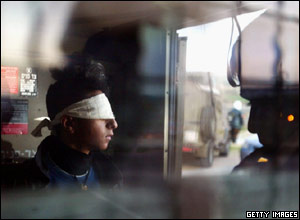
This is not the specific photo that Levy references.

Twilight Zone / Blindfolded
By Gideon Levy / October 4, 2008

Take a quick look at the photo before you. We took it last fall by chance. In the course of another interminable wait at the Hawara checkpoint, on our way to another story in Nablus, we saw this man being arrested. Bingo, the game of the checkpoint soldiers. We didn’t know his name, why he was arrested or when he’d be released, if ever. But we noticed his proud bearing – solitary, upright. His eyes were already covered by the IDF-issue flannel, the type meant for cleaning guns, and his wrists were about to be bound with plastic handcuffs. We seemed more upset by his sudden arrest than he was. After 41 years, the Palestinians are used to it, that on any ordinary day, on the way to or from work, everything might be abruptly turned upside down.

This was a routine year, another year of the occupation of which no end is in sight. From Rosh Hashana 5768 to Rosh Hashana 5769 our forces killed 584 Palestinians, 95 of them minors. Many fewer than in 2002, when 989 were killed; many more than in 2005, with 190 killed. Eighteen Israelis were also killed in the past year, many more than in the previous year, when just five were killed, and much less than in 2002, when 184 Israelis were killed. All in all, an average year for bloodshed.

All of this was observed by Israeli society with eyes covered. Even the nearly 60 Palestinians who were killed on one black summer day in Gaza barely earned a mention in the newspapers. With eyes covered, Israeli society continued to look at the routine of the occupation, the mothers in labor who lost their babies at checkpoints, the farmers victimized by lawless settlers, the night raids, the unemployment, the poverty and the hope that died long ago.

In the past year we’ve barely heard about life under siege in Gaza. For two years now, we, the handful of Israeli journalists who seek to fulfill their journalistic mission, have been prohibited by Israeli orders from entering Gaza. When I questioned Defense Minister Ehud Barak a few weeks ago he seemed unaware of the ban. He instructed an aide to look into it, but of course we never heard back. us. It’s not all that surprising that Israel’s defense minister hasn’t heard about Israeli journalists being prevented from covering Gaza under orders from his own defense establishment: Gaza doesn’t interest anyone in Israel.

And so another year has passed, and our eyes remain blindfolded.

With the tiny flashlight still in our possession we tried here, during the past year, to shine a few pale beams onto the routine of life under the occupation. It’s thankless work whose harvest few want, but we persevered. A few gleanings from the shadowy backyard of the state, the only democracy in the Middle East.

In the middle of one night in early 5768 IDF soldiers charged into homes in the Ein Beit Ilma refugee camp in Nablus, hunting for a wanted man. They went from one dwelling to the next by wrecking the walls. Gaping holes in the living rooms of meager homes, kitchens destroyed, and one terrified little girl standing amid the rubble, washing dishes. A few weeks later it was the turn of an old couple in Nablus. For an entire night the Wazirs were alone, trembling with fear in their small house while gunfire and explosions sounded outside, until an order to leave the house was issued. Abdel Wazir, the uncle of the legendary Abu Jihad (Khalil al Wazir), walked outside and was immediately shot dead by soldiers. He was 71, the oldest shahid.

Then we told the story of Ma’ida al-Akel, who went to Jordan to visit her ailing mother and was barred from returning, possibly forever, to her husband and six children. The following week we described the Hashlamouns of Hebron. Nora and Sami were placed under administrative detention – no trial, no charges. The grandmother of their six children is doing her best to look after them.

The 63-member Qa’abneh family, Bedouin, were cut off from their source of livelihood by the separation fence near Bir Naballah. In the Tarqumiya area, 150 refugees from 1948 became refugees a second time when they were expelled from their houses this year, due to construction of the checkpoint. Mohammed Ashkar was shot in the head point-blank killed during riots at Ketziot Prison; at home, his brother Lo’ai, paralyzed in the legs from Shin Bet torture, waited for him. Another prisoner, Imad Khotri, tortured by “Major Effi” from the Shin Bet, was left paralyzed in the arms, in Kishon Prison. Unemployed gardener Firas Kaskas was killed on a nature hike with friends at a wadi near Ramallah, leaving behind three daughters – shot at very long range by soldiers.

The IDF, the Border Police and the Shin Bet weren’t alone: Last year was mainly the year of the settlers. In recent months their rampages have escalated terribly, while the IDF and police stand idly by – and in at least one instance, join in. They sowed fear and destruction in a reprisal action in the village of Al-Funduq: Five settlers from Havat Gilad beat up shepherd Hashem Ahmed, 51, so badly he needed hospitalization. On several occasions settlers from Asael have attacked members of the Abu Awad family, shepherds from the South Hebron hills, and destroyed all their meager possessions. In the wake of the article on this case a good-hearted, well-known Israeli who wished to remain anonymous made a very generous donation to the family and a doctor Physicians for Human Rights arranged for four of the family’s children, who have a serious skin condition, to be examined at his hospital. A neighboring family, the Abu Qabeitas, were attacked by settlers from Sussia and Beit Yattir. They set fire to homes, poisoned sheep and even fired mortars.

Killed in the line of duty: Palestinian police officer Mohammed Salah, who dared to stop a car of Israeli undercover agents at a police checkpoint in Bethlehem. They killed him right after he opened the door of their car to check it. And then there were the babies born under a bad sign: Kifah Sider was forced to give birth on the road in the freezing cold winter in Hebron, after being delayed at the Tel Rumeida checkpoint. Her baby is healthy, but the Abu Radas were less lucky: For 75 minutes Mu’ayyad begged in vain for his wife to be allowed through the Hawara checkpoint to get to the hospital in Nablus. She gave birth – to a stillborn – at the checkpoint.

Meanwhile, Fawziya al-Daraq arrived at the Tuk Karm checkpoint after a major heart attack. Her husband pleaded for them to be allowed through to the hospital in Tul Karm. They were turned away from the checkpoint, and Fawziya died.

Ghassan Burqan also wanted to get through a checkpoint, to reach his home in Hebron’s Tel Rumeida quarter. Ghassan was carrying a new washing machine on his head, a gift for his wife. The Border Police officers claimed he tried to attack them with the washer, and destroyed it, Fortunately, the military judge released him, and a loyal Israeli reader bought him a new washing machine.

Omar Alian’s family was forced to wait 12 hours after he died of cancer at his parents’ home before they were permitted to return his body to the other side of the checkpoint sealing off Jerusalem’s Sheikh Sa’ad neighborhood. On another occasion, Israeli soldiers fired at a new Mercedes-Benz taxi at the Gush Etzion junction, with a family, including a baby, inside. When they found out they’d endangered the life of an innocent family they confiscated the taxi for “investigation.” It was returned a few days later, ruined.

Soldiers stole thousands of shekels worth of jewelry from Mohammed Abu Arkub, a barber. In a late-night search a neighbor, tile-layer Sami Huatra, was shot twice for no reason, and left to bleed for a long time. Fadi Darabiya was kicked so hard in the groin by soldiers that he lost a testicle. Other soldiers shot a nearly blind youth, Ahmed Sabarna, from Beit Umar, when they suspected he was somehow throwing rocks at them.

“Captain Joe,” as one army officer is known, left behind threatening, Mafia-style fliers in Azun, in the name of the Israel Defense Forces. “Captain Joe will come into the village and shoot deadly gunfire at the residents, arrest the children and shut down the shops,” warned his missives. Another “captain,” from the Civil Administration, was responsible for the destruction of the spectacular terraces of the Beit Ula fields. Two years of hard work and a major contribution from the European Union down the drain in two hours.

This year soldiers also abducted two shepherds in the Jordan Rift Valley and held them prisoner all night, while other soldiers helped search for them. The father of the young videographer from Na’alin was also arrested by soldiers. Jamal Amira sat in prison for 26 days, for no reason. His only sin: the video shot by his daughter, Salam, who dared to document the shooting of a bound Palestinian by a soldier and brigade commander in Na’alin.

After all this and more, many were amazed that members of a delegation of human rights activists from South Africa who visited Nablus with us this year, including two Supreme Court of Appeals justices, said the Israeli occupation was much worse than apartheid. Wishing everyone another good year of occupation.

Source / Haaretz

The Rag Blog

Posted in RagBlog | Tagged , , | Leave a comment

Ask a Tuvaluvian If Global Warming Is a Myth

The Pacific island of Tuvalu is facing a near certain death as global warming raises the sea level.

Sinking Tuvualu wants our help as ocean levels rise
By Brad Crouch / October 4, 2008

THE first nation likely to be overwhelmed by climate change wants Australia to accept its entire population if sea levels continue to rise.

Tuvalu, in the South Pacific, is one of the world’s lowest-lying nations and faces inundation within a generation by rising tides linked to mankind’s impact on the climate.

In a week where Ross Garnaut delivered his climate change report, the Tuvalu issue poses a question for Australia: Do we take on other countries’ problems as well?

In a twist with far-reaching implications, Tuvalu Government officials and community elders are hoping in a worse-case scenario Australia will accept the entire population of about 10,000 and allow them to continue to function as a sovereign nation, in the hope of one day returning to their island home.

Tuvalu Prime Minister Apisai Ielemia visited Canberra in August in what Tuvalu officials described as a “secret visit” to float the migration plan. Australian officials have refused to comment on the meeting.

Such an unprecedented environmental evacuation could become the model for other low-lying nations such as Kiribati and the Maldives, which face being swept away by rising tides.

Tuvalu has previously approached Australia and New Zealand with pleas to open up a migration channel — Australia’s previous government twice refused, but NZ now accepts 75 migrants a year.

Data from groups including the Intergovernmental Panel on Climate Change and the CSIRO indicate mass evacuation may need to happen within decades.

A gauge installed in 1993 shows the sea level at Tuvalu has been rising by 5.7mm a year.

Most of Tuvalu is just 1m above the high-tide mark and water already bubbles up through the porous coral during high tides, flooding the land during king tides.

Projections show that over the next century sea levels will rise by up to 0.8m, making Tuvalu uninhabitable.

The nation already faces problems from chronic flooding, storm surges and king tides.

Several islands have been lost to the sea in the past decade and there has been widespread shoreline erosion and salt contamination of areas used to grow the staple root crop pulaka.

Research by the Tuvalu Meteorological Service shows the nation, which has just 26sqkm of land area, has lost several per cent of that in recent years.

Tuvalu Government spokesman on climate change Kilifi O’Brien said the Government was drawing up contingency plans for a mass evacuation.

But he said any such evacuation would revolve around maintaining Tuvalu as an entity.

“If we lose our land we risk losing our identity,” Mr O’Brien said.

“We know if the worst comes to the worst, we would have to relocate.

“But we would be looking at taking one sovereign country to another — we would want to keep our economic exclusion zone, our United Nations seat and so on. We would want to keep our identity as Tuvalu, in another location.

“The Government is considering how to do this, and Australia is certainly seen as an option.”

Foreign Affairs Minister Stephen Smith declined to be interviewed about whether Australia would take Tuvaluans as refugees or whether the Government would allow a sovereign nation to operate within Australia.

But in a statement his office said Australia would, where necessary, consult with others in the region “how best to respond to the needs of people displaced by the impact of climate change”.

The Niue Declaration on Climate Change, recently agreed by Pacific Islands Forum leaders, including Prime Minister Kevin Rudd, recognises the desire of the Pacific peoples to continue to live in their own countries and the importance of retaining the Pacific’s social and cultural identity.

The [Australian] Federal Government has committed $150 million over the next three years to climate adaptation needs in the Asia-Pacific.

Source / Perth Now

And then there’s this, Tuvalu as the first nation that exists only virtually:

Tuvalu’s sinking, but its domain is on solid ground
By Kevin Manney / April 28, 2004

Of all the dot-com bubble fantasies gone awry, none could be more bizarre than the story of the tiny island nation of Tuvalu.

In the late-1990s, Tuvalu was supposed to get rich by selling access to its Internet domain, which happens to be .tv — funny, since the entire nation has not a single broadcast TV station.

If all went as planned, by now the 11,000 or so Tuvaluans would be living in McMansions, driving to the beach in Hummers and getting regular Botox treatments.

Instead, the money is more of a trickle, and Tuvalu has a much bigger problem: The entire Tuvalu land mass — nine slender South Pacific islands and atolls — is apparently doomed to sink beneath the ocean. Earlier this year, Tuvalu came the closest yet to vanishing.

Oddly enough, Tuvalu might then leave a legacy imagined only in science-fiction novels. It could become the first virtual nation — a country that exists only on the Internet. If Tuvalu’s land disappears, its population will disperse, yet Tuvalu under international law will remain a sovereign nation even though its only “real estate” will be the .tv Internet domain.

While all this is going on, neighboring South Pacific island nation Palau is started down a similar path. It recently signed over rights to its domain — .pw — to a Massachusetts tech company that promises a more reasonable financial outcome for the Palauans. Of course, it helps that Palau is not about to burble beneath the waves.

This South Pacific tale begins amid the 1990s madness for Web addresses, when some addresses were selling for millions of dollars. Speculators bought up every word in the dictionary — even the likes of hookworm.com and supercilious.com — certain they could sell each one of them for a bundle to some start-up.

Then people realized it was possible to register a Web address in another country and use its domain. That would open up whole new swaths of Web real estate. Every country has its own top-level domain — Afghanistan is .af; Ghana is .gh. Since the Net is boundary-less, Amazon.gh could theoretically be as accessible as Amazon.com.

Of all the world’s countries, none had a more exploitable domain assignment than Tuvalu. The letters TV are linked to entertainment in just about every language.

So entrepreneurs from the USA, Japan and Europe descended on Tuvalu, where the prime minister works in a two-bedroom house and most of the population subsists on the fish caught each day.

The first guy offered $5,000 but shortsightedly backed out when the parliament held out for $10,000. By the time it was over, Tuvalu had a 12-year contract to share revenue from .tv registrations to be marketed by a start-up company called DotTV, which was backed by $50 million from California high-tech incubator Idealab.

Tuvalu expected a windfall. DotTV predicted every entertainment company would want a .tv address. At the time, its executives cited examples such as sony.tv, nbc.tv and zee.tv — the last for India’s Zee TV network.

This being the era when people talked of initial public stock offerings before a company’s bathroom needed its first replacement roll of toilet paper, DotTV anticipated a big IPO. The company even said it would create a .tv portal.

Of course, in 2000 the dot-com bubble blew apart, and the value of Web addresses dove like a pelican after a fish. No .tv boom ever happened. Today, nbc.tv is a dead end, sony.tv is for sale, and zee.tv bounces to sheeraz.com, the Web site of Southeast Asian television entrepreneur Sheeraz Hasan.

According to Web monitor Hitwise, the most popular .tv site is Fox’s kids site, foxbox.tv. It gets a market share one-hundredth that of the top television-based Web site, espn.com. In the meantime, DotTV was sold to Internet company VeriSign, and recent news reports say Tuvalu’s Internet revenue is used primarily to pave roads.

That alone would be a heck of a dot-bust sob story, but then there’s the part about Tuvalu sinking.

The islands are, at best, 15 feet above sea level. Unusually high tides have started flooding the islands — not by creeping up the beaches, but by bubbling up through the ground, as if the islands were leaky boats. Prime Minister Saufatu Sopoaga has been jetting around the world in a panic, telling anyone who will listen that Tuvalu will be the first victim of global warming. As sea levels rise, tourists might soon be able to see Tuvalu only by snorkel.

Now, that brings up a question: What happens to a domain if a nation disappears?

VeriSign spokesman Tom Galvin tells me that a defunct country’s Internet domain lives on. For instance, you can still find addresses on .su — the domain for the Soviet Union.

Anyway, as Galvin points out, Tuvalu would not necessarily cease to exist. Apparently, the laws of the sea say that a country is a country, even if underwater. Sopoaga has said in speeches, “Our sovereignty would not be threatened. Our claim would be maintained on this spot.”

Which is how you get to the point where Tuvalu could have a government, a people — albeit a diaspora — but no territory. Yet Tuvalu would exist on the Internet as .tv. Sci-fi novels such as Neal Stephenson’s Snow Crash predict virtual nations. Tuvalu might someday be revered as a trendsetter.

Along the way, we can watch Palau’s adventure unfold. This year, it sold rights to .pw to a Woburn, Mass., company called PW Registry, which wants to market the domain for “personal Web” sites. “Individuals will eventually establish a permanent presence on the Internet, just like companies do,” says PW Registry founder Tom Barrett. And .pw would be the place for them, he says.

Palau could turn out to be a better story. The nation isn’t starting with mania-driven expectations. Its 20,000 citizens are also counting on a future in tourism. It is building its first golf course and later this year will launch its national airline, which will consist of a single Boeing 737.

The only thing I can’t figure out is why this hasn’t happened yet in the Bahamas.

Its domain: .bs.

Kevin Maney has covered technology for USA TODAY since 1985. His column appears Wednesdays. Click here for an index of Technology columns. E-mail him at: kmaney@usatoday.com.

Source / USA Today

The Rag Blog

Posted in RagBlog | Tagged , | Leave a comment

Post-Bailout : Why the Stock Market Still Plunged

Unemployment, tempera on paper by Ben Shahn, 1938. © Private Collection/Christie’s Images / The Bridgeman Art Library.

It’s the economy, stupid….
By Steve Russell / The Rag Blog / October 4, 2008

Why, I was asked off line, did the market dive after the bailout passed?

First, the bailout was not about the Dow Jones/S&P/NASDAQ but about the LIBOR (London Interbank Offered Rate).

However, the straight answer is that the smart money had already priced in the bailout as a lead pipe cinch after the Senate moved things a few notches to the right to capture House Repugs. I would have thought moving to the right would cost votes on the left but that turned out not to be the case as every chamber of commerce in the country was in a blind sweat panic over new collateral requirements and drying up lines of credit. You don’t think a car dealer owns those new cars on his lot, do you?

Anyway, after the big dive the market came back to an equilibrium slightly lower than it was before the far left and the far right joined hands and jumped off the cliff.

The Friday dive was about more dire economic news, principally the unemployment numbers. Those numbers and the LIBOR are directly related, so here’s hoping we can at least slow down the bleeding when the “toxic assets” become sort of liquid again.

The Rag Blog

Posted in RagBlog | Tagged , , , , , | 4 Comments

Abstinence Only : Sex Education as Politics


Annual funding for abstinence-only is close to $175 million
By Scott Murray / October 1, 2008

When Alfred Kinsey published Sexual Behavior in the Human Male in 1948, he included a stern word of caution to his readers: “as long as sex is dealt with in the current confusion of ignorance and sophistication, denial and indulgence, suppression and stimulation, punishment and exploitation, secrecy and display, it will be associated with a duplicity and indecency that lead neither to intellectual honesty nor human dignity.” In the 60 years following Kinsey’s groundbreaking study, the decision-making establishment of the U.S. has consistently ignored his rebuke, preferring to pursue harmful policies that further their own reactionary agendas.

One of these policies is abstinence-only sex education, which teaches that remaining abstinent until marriage is the only safe and acceptable option for adolescents and teens. These courses avoid all discussion of contraceptives and their use or only emphasize the alleged failure rate of common devices like condoms and the birth control pill. Since 1982, the federal government has spent over $1.5 billion subsidizing abstinence-only programs which, according to the Guttmacher Institute, are used in over one-third of public school districts in the United States. Annual funding for abstinence-only now stands at nearly $175 million, more than double the amount spent at the beginning of the Bush presidency.

The prevalence of abstinence-only programs in the education system illustrates the severe democratic deficit in the United States. For decades, the American population has overwhelmingly opposed abstinence-only sex education, and for good reason: the programs are medically inaccurate, misrepresent the evidence on which they claim to be based, and are rooted in sexist and fundamentalist attitudes. However, despite widespread popular disapproval, those in positions of power, including President Bush, have not only allowed abstinence-only curricula to flourish in American schools, but have worked tirelessly to ensure their proliferation both at home and abroad at the expense of comprehensive sex education.

Public Opinion

In a book review for the journal Critical Sociology, Lesley Shore writes that public opinion polls taken as early as the 1960s “revealed widespread support for comprehensive sex education” among Americans. Little has changed since then. A 2004 survey, conducted by the Kaiser Family Foundation (KFF), found that over 90 percent of parents felt it was “very or somewhat important” to have comprehensive sex education in public schools. In addition, two-thirds of American voters expressed support for comprehensive sex education and 67 percent of the adult population favored “comprehensive sex education programs that included information on how to obtain and use condoms and other contraceptives.” These findings were confirmed earlier this year, at the state level, when the University of Minnesota published a report detailing how nearly nine out of ten Minnesota parents support comprehensive sex education programs that “[include] information about abstinence and prevention of pregnancy and sexually transmitted diseases.” The study also found that Minnesota’s “overwhelming” support for comprehensive sex education cut across gender, age, race, class, and political lines. Minnesota is not unique in this regard as opposition to abstinence-only is so widespread that nearly 20 states, including Minnesota, have rejected Title V sex education funding because of the federal government’s stipulation that it be spent on abstinence-until-marriage programs.

Teenagers and young adults, like their parents, extensively support comprehensive sex education as well. According to one survey by Tina Hoff (KFF), 82 percent of teens ages 15-17 and three-quarters of young adults ages 18-24 favored sex education curricula that included information on “how to protect yourself from HIV/AIDS and other STDs,” “the different types of birth control that are available,” and “how to bring up sexual health issues such as STDs and birth control with a partner.” Reflecting the attitudes of American parents and teens, a number of influential professional groups have also issued statements opposing abstinence-only sex education, including the American Medical Association, the American Psychological Association, the American Academy of Pediatrics, the American Public Health Association, the National Education Association, and the American School Health Association.

Contrary to impressions, support for abstinence-only sex education is limited even among Christians in the United States, who traditionally are expected to take strong conservative positions on issues of sexuality. According to one survey cited by Susan Rose the journal Social Forces, eight in ten people who identify as conservative Christian support comprehensive sex education in high schools, and seven in ten support it in middle schools. Another study, carried out by NPR and the Kennedy School of Government, found similar results: nearly nine in ten people who describe themselves as “conservative Evangelical” or “born-again Christians” favor the teaching of human sexuality in schools. (No significant evidence exists on the attitudes of American Jews and Muslims regarding sex education, although some of them—such as those belonging to the Union for Reform Judaism—have publicly spoken out against abstinence-only programs.)

The American public opposes abstinence-only sex education for a number of sensible reasons. First, the programs are remarkably and consistently inaccurate. The most comprehensive analysis of the medical accuracy of abstinence-only courses was carried out, incidentally, by a U.S. House of Representatives committee in 2004. This widely-cited review, often referred to as the Waxman report, discovered that over 80 percent of federally funded abstinence-only curricula contained “false, misleading, or distorted information about reproductive health.” The courses were found to teach, among other things, that pregnancy occurs once out of every seven times a couple has intercourse using a condom, that 10 percent of abortions result in sterility, that HIV can be transmitted through sweat and tears, and that a human being has 48 chromosomes. Abstinence-only programs are also known to teach that touching another person’s genitals can “result in pregnancy,” that a 43-day-old fetus is a “thinking person,” and that half of the gay male teens in America are infected with the AIDS virus. Some members of Congress, namely the Republicans who endorsed the 2002 Personal Responsibility, Work and Family Protection Bill, have attempted to deflect such criticism, arguing that “it would be impossible to agree on what information is medically accurate.”

Click to enlarge image.

Second, in addition to containing “false, misleading or distorted” sexual health information, abstinence-only programs misrepresent the evidence on which they are based. One of the most instructive examples is found in AC Green’s Game Plan, a federally funded abstinence-until-marriage program produced by the Illinois-based Project Reality. Early in the student workbook, it quotes a 2001 survey conducted by the National Campaign to End Teen Pregnancy as saying that American teens desire a “strong message…that they should abstain from sex” until marriage. This is inaccurate. The quotation, which is found on the second page of the survey, actually reads that American teens desire a “strong message…that they should abstain from sex until they are at least out of high school,” a sentiment that is at variance with the abstinence-only ethic. In fact, that same paragraph, and indeed the rest of the survey, goes on to report that both parents and teens strongly desire a “greater emphasis on contraception” in sex education courses, findings conveniently—and likely consciously—omitted from the student workbook. Such misrepresentations are much too common in abstinence-only programs, and should trouble those who believe that adolescents and teens deserve honest sexuality education.

Third, many Americans strongly object to the sexist and fundamentalist attitudes expressed by abstinence-only sex education programs. According to the previously cited Waxman report, several courses “present [gender] stereotypes as scientific fact,” especially those related to women and girls. One popular curriculum, Why kNOw, teaches that “men’s happiness and success hinge on their accomplishments,” while women “gauge their happiness and judge their success by their relationships.” Another program, WAIT Training, lists “financial support” as one of the “five major needs” of women, while listing “domestic support” as one of the major needs of men. Choosing the Best, the most popular federally funded abstinence education program, regales students with a tale of a knight who rescues a princess from a dragon. The dragon soon returns to seek revenge, but the princess advises the knight to slay the dragon with a noose and poison. The tactic works, but the knight believes he fought dishonorably and feels “ashamed.” In the end, the knight does not marry the princess, but rather a village maiden—and “only after making sure she knew nothing about nooses or poison.” The “moral of the story,” it concludes, is that “occasional suggestions and assistance may be alright, but too much of it will lessen a man’s confidence or may even turn him away from his princess.”

Further stereotypes abound. Many abstinence-only programs teach students that “men are always ready for sex,” while women “often need hours of emotional and mental preparation.” In a talk delivered on the Google campus, sex educator Violet Blue quotes the Why kNOw curriculum as saying that “girls are responsible for boys’ inability to control their sexual urges,” a statement which implies that girls are at fault if they are harassed, sexually assaulted, or even raped. Glencoe Health, a secular abstinence-only health textbook produced by education giant McGraw-Hill, discourages premarital sex by teaching that sexually active teens, presumably girls, “risk developing a reputation among peers as someone who is ‘sexually easy'”—a sanitized way of telling young women that if they have sex, their classmates are expected to call them a “slut”—just as they did publicly to Harvard student and sex blogger Lena Chen earlier this year after participating in a debate at her school.

Patricia Miller, a journalist and reproductive policy analyst, explains that the federal government’s earliest abstinence-only policies had religious motivations, beginning with President Reagan’s Adolescent Life and Family Act which “frequently promoted specific religious values” until successfully challenged by the ACLU in 1993, following a ten-year court battle. The religious right recovered soon after, though, when Democrat Bill Clinton supported a funding provision for abstinence-only programs in his 1996 welfare reform bill. The measure, which allotted $50 million a year in subsidies to abstinence education curricula, was not drafted by medical professionals or educators, but by “representatives from the Family Research Council, the Christian Coalition, and other conservative groups,” who in turn cooperated with Heritage Foundation policy analyst and abstinence-only champion Robert Rector.

Although many abstinence-only courses do not explicitly reveal their Christian foundations, there are a number that do. In an official newsletter accompanying the widely-used Why kNOw curriculum, for example, the author laments contemporary social mores, writing that “no longer were we valued as spiritual beings made by a loving Creator.” The author closes the letter by signing “In His Service.” True Love Waits, a popular program produced by LifeWay Ministries, aims to “[teach] students the Biblical standards for purity,” and desires to create a generation of teens that will “[live] for the glory of God with sails raised for revival” and be “prepared for Biblical, lifetime marriages.” Sex Respect, which reaches students in over 20 countries and bills itself as “the world’s leading abstinence education program,” informs visitors to their website that their abstinence courses are consonant with Catholic doctrine.

The Democratic Deficit

The federal government’s shaping of sex education funding programs, its appointment of extreme reactionaries to high positions of sexual policy planning, and the feeble opposition to abstinence-only waged by congressional Democrats vividly illustrate the fact that the United States is little more than a formal democracy where opportunities for public participation are limited to selecting leaders from a pool of virtually indistinguishable candidates, with identical financial backers and only marginally different interests.

To begin, the programs that fund sex education in the United States are structured in such a way that they support only abstinence-until-marriage curricula at the expense of comprehensive sex education courses. According to Section 510 of the Social Security Act, which was authorized during the Clinton administration, sex education programs in the United States are eligible for Title V federal funding only if their “exclusive purpose” is to “[teach] the social, psychological, and health gains to be realized by abstaining from sexual activity.” Sex education courses receiving federal funding must also preach that “a mutually faithful monogamous relationship in context of marriage is the expected standard of human sexual activity,” and that “sexual activity outside of the context of marriage is likely to have harmful psychological and physical effects.” Furthermore, abstinence-only programs receiving federal funding are not reviewed by the federal government for factual or medical accuracy, which explains why the Waxman report discovered “serious and pervasive problems with the accuracy of abstinence-only curricula” that permeate the American education system.

With a little investigation, it is easy to learn why sex education funding programs, like many other public health policies in the United States, are so morally draconian: key decision-making positions regarding sexual policy are held by extreme conservative reactionaries who are selected based on ideological conformity rather than professional qualification. There are several examples of these officials who currently sit in high positions of sexual authority or have done so in the recent past. Thomas A. Coburn, now a junior senator from Oklahoma, served as co-chair of the Presidential Advisory Council on HIV/AIDS, where he pledged to “challenge the national focus on condom use for preventing the spread of [HIV]” and lamented what he called the “gay agenda” that has “infiltrated the very centers of power in every area across this country” and “wield extreme power.” Robert George, a member of the eminent President’s Council on Bioethics, wants laws passed to outlaw masturbation, and the former chair of the Council, Leon Kass, has spoken out against sexual indecencies like the licking of ice cream cones in public, since “eating in the street is for dogs.” Susan Orr, who recently resigned from her position as the Deputy Assistant Secretary for Population Affairs, was a senior director at the archconservative Family Research Council and advocates “abstinence over making contraceptives more available.” She also has called birth control providers “collaborators with the culture of death.”

Orr’s successor has not yet been named (at the time of writing), but the nature of Washington’s previous appointees does not bode well for the future. Dr. Eric Keroack, Orr’s immediate predecessor, is a prominent abstinence advocate who sits on the Medical Advisory Council for the Abstinence Clearinghouse. He is a staunch opponent of abortion who has stated that contraceptives are “demeaning to women, degrading of human sexuality, and adverse to human health and happiness.” Dr. Alma Golden, who held the Deputy Assistant Secretary position before Keroack, characterized contraceptive education and distribution programs as merely offering teens “free condoms for their weekend party” and worked to put “more emphasis on ‘abstinence-only'” in the family planning programs she helped administer.

Although many staunch abstinence-only advocates hold high office in the United States government, there are state officials that are opposed to such programs. Unfortunately, these dissenters have put forth a dubious effort in trying to curb abstinence-until-marriage sex education courses and have even consciously contributed to expanding it to make political gains elsewhere. The Waxman report, for instance, which represents the federal government’s harshest and most notable internal critique to date, contained no policy recommendations or suggestions whatsoever. Another report, published by the Government Accountability Office in 2006, was similarly weak—its strongest suggestion was that federally funded abstinence-only programs should be made to “sign written assurances in grant applications that the materials they use are accurate.” Neither of the government reports called for the abolition of abstinence education programs.

Congressional Democrats, who typically oppose abstinence-only programs, signed on to a bill last June that increased funding for abstinence-only by $27 million, just weeks after issuing a misleading promise to “end abstinence-only funding.” The reason for this maneuver, according to Democratic officials, was to gain “leverage—namely Republican allies in Congress—in fights to come with Bush over domestic spending,” demonstrating clearly their committed opposition to abstinence-only sex education while being conciliatory during a recent congressional hearing on abstinence-only where the discussion “rarely moved beyond championing the value of pre-marital abstinence,” according to Bob Roehr of Pride Source Media Group, and ended in the mild suggestion that block grants be created for states to spend on comprehensive sex education, if they so choose.

The continued expansion of abstinence-only sex education programs, coupled with the unfailing pragmatism of the alleged opposition party, illustrates the severe democratic deficit in the United States. As with many other public policy issues—including healthcare, domestic spending, and the war in Iraq—public opinion is held in extremely low regard and often dismissed as “politically unrealistic.” Those who oppose abstinence-only sex education cannot and should not rely on their elected officials to effect positive social change. The need for popular mass action in support of comprehensive, candid, and inclusive sex-education programs has never been greater, and there are many opportunities for action. Students and teachers can participate in noncooperation, refusing to take part in or teach from curricula that preach only abstinence-until-marriage. Members of the community, including health professionals, educators, and concerned families can organize neighborhood sex education seminars that provide adolescents with the reproductive health information they desperately want and need. As long as abstinence-only sex education is allowed to flourish unchallenged, young people in the United States will suffer a form of indoctrination that leads “neither to intellectual honesty nor human dignity.”

[Scott A. Murray is an undergraduate student of rhetoric, gender studies, and human sexuality from central Illinois.]

Source / Z Magazine

The Rag Blog

Posted in RagBlog | Tagged , , , , , | 2 Comments

We Will Pay Because God Loves the Rich

And as we all know, worms do not rise up in revolt. That takes a backbone.

Speaking in the Tongues of Brokers: The Bailout in Plain English
By Joe Bageant / October 2, 2008

Any number of cultural historians have noted the American belief that success is a sign of God’s favor. And over the past couple of decades he has had a downright love fest with the already-rich. So much so that the richest 400 Americans now have more money stashed away than the combined bottom 150 million Americans. Some $1.6 trillion bucks.

This was accomplished by selling off or shipping out every available asset, from jobs to seaports, smashing usury and anti-monopoly laws, raiding the public coffers and manipulating the medium of exchange and blackmailing the peasantry regarding common needs such as heath care and energy to keep their asses warm … to name a few. The ultimate coup was to convince the entire nation that the well being of the rich, meaning the well being of Wall Street, was indeed the common man’s well being.

All went well for a while. People went into credit card hock up to their noses in order to provide 26% credit card interest to Wall Street, etc. And when that became untenable, flimsy mortgages were cranked out by the millions ensuring that every American who could hold a crayon could sign to purchase a home. To facilitate this all sorts of shaky ‘mortgage instruments’ were created – balloon, (sign here Jeeter, you’re gonna flip it in a year and make a hundred K on this house trailer) interest only, and finally negative balance mortgages where you only paid part of the interest and the rest was rolled back into the principal balance. And joy of joys you could refinance a couple of times while the inflated value of these houses was on the way up. Life was good for everybody. The bill was never gonna come due because, god in his wisdom, had deemed that capitalism would defy the second law of thermodynamics and expand forever. So every time a bank made a mortgage loan of say, $400,000, even though the debtor had never even made a payment yet, the loan was declared a bank asset and another $400,000 was loaned against it. Meanwhile, the Federal Reserve Bank yelled whoopee and printed another $800,000 in currency. Of course at some point the country had to run out of customers, so the loans got easier and easier. No matter that debt is not wealth. Wink and call it that and most folks won’t even look up from their new big screen high resolution digital TVs.

Problem was that all the jobs to pay for this stuff were stampeding off toward places in China with names containing a lot of Xs, Zs and praying for a vowel. It was becoming clear that the entire economy was running on fumes. In fact less than fumes. It was running on the odor of paper. Mountains of the stuff. Bundles of mortgages and very strange securities and derivatives of unknown origin and value. Paper that stated its own worth and signed by some mystic hand no one could quite identify though the blurry signatures looked to read Greenspan, Paulson and Bernanke.

But there was a rub. Things reached the point where there simply was not anything left to defraud the public out of, nothing left to steal from the nation’s productive capability, no matter how much paper Jeeter and Maggie signed for that trailer house, no matter how secure Brian and Jennifer out there in Arlington Virginia and Davis California thought they were. So the only thing left to do was steal from future generations of Americans and accept an I.O.U. which the government would happily sign on behalf of the people and enforce. By the wildest coincidence, under the Bush administration this I.O.U. happened to tally up to about $700 billion.

Seeing the oncoming train of financial disaster, the financiers just about wet their pants, and screamed “We want it all now! And if we don’t get it the “economy” will lock its brakes and crash. Remember, we control the medium of exchange. Nobody gets a paycheck if we don’t. Remember that it’s lines of credit from us that back every working man’s and woman’s paycheck in the country. So pay the hell up”

Folks, they’ve got us all by the nuts and nipples. McCain knows that. Obama knows that. In the end, regardless of the so-called dissenters in the House and the Senate, we will pay up. It’s election season and the dissent is for show. So it looks like we will get some “concession.” For example, we will get shares in these “toxic assets” that are stinking up the joint. The rich need to dump them and dump them fast. In another magnanimous concession, the Federal Deposit Insurance Corporation will raise the insurance on “our savings” to $250,000 (how many readers have 250 K in the bank?). But it will be redeemable in even more inflated currency amid an inflationary environment. And, in case you didn’t know, the FDIC has up to ten years to pay up on that insurance. So don’t get any ideas about running off to Mexico, to which by the way, we are a net debtor nation.

We will pay. We will pay because the European banks holding all that bad paper we wrote demand that we make good on it so even more of their banks will not fail. We will pay because the Chinese, the Japs and everyone else will cut off the loan tap with which we pay the interest (not the principal) on our exploding super nova of national debt. We will pay because God loves the rich. We will pay because we will not be offered any other choice. We will pay because George Bush worked hard for all those Ds in school and became the first MBA president. We will pay because our media has internalized the capitalist system so thoroughly they can only talk in Wall Speak. We will pay because the only language we have to describe our world is that of our oppressors because we have been taught to think in Wall Speak. We will pay because we hitched our wagon to last stage capitalism and even though the wagon has now two wheels over the cliff and roars forward, we don’t know where the brake handle is located. And because we don’t know any better or understand any possible resistance to the system because we have been kept like worms in a jar and fed horse shit.

And as we all know, worms do not rise up in revolt.

That takes a backbone.

Joe Bageant is author of the book, Deer Hunting With Jesus: Dispatches from America’s Class War. (Random House Crown), about working class America. He is also a contributor to Red State Rebels: Tales of Grassroots Resistance from the Heartland (AK Press). A complete archive of his on-line work, along with the thoughts of many working Americans on the subject of class may be found on ColdType and Joe Bageant’s website, joebageant.com.

Source / CounterPunch

The Rag Blog

Posted in RagBlog | Tagged , , | 2 Comments

Ron Ridenour: Sounds of Venezuela, Part V

Blas Castillo, 57, works on Fundo Bella Vista, a farm cooperative sanctioned by the Venezuelan government. Photo: David Rochkind/Polaris, for The New York Times

Click here to view the entire series.

Sounds of Venezuela
Part V: The Green Revolution, 1
By Ron Ridenour / The Rag Blog / October 4, 2008

I wanted to see how the new farm cooperatives were operating, and I needed a break from the house I lived in and from city life. I lived in an upstairs bedroom across the hall from a young woman, who spent most of her time locked inside her room watching TV. My room contained essential and rustic furniture. The sagging mattress had metal springs sticking through. The bathroom had a flush toilet and a single-stream shower. The plaster and paint in the kitchen and living room downstairs were cracking and falling. Caked dirt permeated all appliances and shelves. Fifty meters from this house stood a noisy car firm. Albeit a small city, La Victoria screams with noise from car alarms and horn-honking drivers, from ghetto-blasting radios, and boisterous children and adults (la bulla).

The upper classes complain that the Chavez government has limited the number of vehicle imports, although in the two previous years 600,000 private cars were imported. The government seeks to diminish importation and increase national production in all areas. It already produces many of its military vehicles and tractors, and it has just begun to produce its own cars for private sales in a joint venture with Iran. The “People’s Car” will sell for a modest $7,000 — new imported cars sell for four times that at a minimum. The first 20,000 cars are planned to role off the assembly line in 2009. Furthermore, the millions of Venezuelan drivers are privileged to have what must be the world’s cheapest fuel. While a liter of bottled water costs the equivalent of $1.40, the now nationalized gasoline costs about $.04 cents (100 centavos in national currency) a liter, or $.15 cents a gallon, which is 35 to 45 times less the price of gasoline in the warring-for-oil United States.

Early one morning in February, Diego borrowed his girl friend’s car and drove me to a low mountain range where Quebrada Seca’s farm cooperative is located. He told me some of its history and I had done some research.

I had read Central Bank figures, which show that the government had increased financing of agricultural production by 738% between 2004 and 2007. About five million of the nation’s 30 million hectares of cultivable land have been expropriated and turned over to about 200,000 people, most of them not farmers. In many cases, the very land titles have been contested. Some lands had simply been seized decades or hundreds of years ago by those with great local power and weaponry.

The Chavez government inherited a “one-crop” economy based on oil, mostly owned by US and British companies. In 1935, 60% of the work force was rural, mostly in agriculture. By 2000, only 12% of the population was rural. In 1998, only 6% of GNP came from agricultural production, the lowest rate in all of Latin America. And three-quarters of the land was held by five percent of landowners. Under Chavez food production has doubled but demand has also grown, even more than national supply. So it has been necessary to increase foodstuff imports, which come mainly from the new regional economic alliances, Mercosur and the Venezuela-Cuba ALBA initiative and now four more member nations.

The fact that the government has several times increased wages and pensions dramatically is a major cause for the increase in demand and consumption. On worker’s day, May 1, 2008, Chavez announced that the minimum monthly wage and minimum pension is to be the equivalent of $560, placing Venezuelans minimum incomes 2.6 times higher than the entire continent average.

Diego told me that, three years ago, about 150 people occupied this mountainous area of 1000 hectares owned by a wealthy German family. The Vollmers had long ago immigrated to Venezuela and became the largest agro-landowners in Aragua state. Like many wealthy plantation owners much of their land lay fallow. Who owns land and how it is used is fundamental to whether a society is based on capitalist market enterprise or socialist fellowship. And large private property owners have been the core power for hundreds of years before Chavez. His new national assembly passed a law allowing the government to expropriate idle land and redistribute it to landless peasants and other poor people. In October 2005, a comprehensive land reform was implemented with the name Mission Zamora. This occurred following President Chavez’s first public speech advocating a socialist system. He did so at the 2005 World Social Forum in Porto Alegre, Brazil.

“Everyday I become more convinced…that it is necessary to transcend capitalism. But capitalism can’t be transcended from within capitalism itself, but through socialism, true socialism, with equality and justice. But I’m also convinced that it is possible to do it under democracy, but not in the type of democracy being imposed from Washington,” he said.

“It is impossible within the framework of the capitalist system to solve the grave problems of poverty of the majority of the world’s population. We must transcend capitalism. But we cannot resort to state capitalism, which would be the same perversion as the Soviet Union. We must reclaim socialism as a thesis, a project and a path…a new type of socialism, a humanist one, which puts humans and not machines or the state ahead of everything. That’s the debate we must promote around the world…”

Diego introduced me to the cooperative’s secretary and one of the two Cuban advisors. With his recommendation, and my CV from eight years working in Cuba, I was warmly welcomed and permitted to go about the farm and speak with whom I wished. Diego drove back and I went on my own. At the entrance to the farm land stood a large billboard sign. It read (English translation):

“Quebrada Seca. Free Town. Agriculturally Productive People. Socialist Future.”

After two kilometers cross mainly brush land, I came across a coop team. Three women and one man were cultivating a plot. Juleen spoke for them.

“This year we’ve started a new work structure, hoping this will allow a surplus. Last year I was cultivating peppers and we lost the crop. We didn’t earn anything. The only way we’ve survived is due to a small annual stipend from the Ministry of Agriculture — which it stopped this year — plus credit for seed and farm tools. But now we plough the land with our bare nails, because our three tractors are broken down and we don’t have money for repairs. So, you ask, how do we eat?” chuckled chubby Juleen.

“We get help from our families who live and work in cities. And here we all help each other, we share what we have. Most families are headed by a man and a woman and one of them usually works outside on the weekends, at least one day a week. My husband and I alternate. He works at manual labor and I wash and iron clothes in Quebrada Seca. We each earn 30BF a day. We have no money for anything other than essentials, never for vacations, because then we work for cash in the town.”

It was nearly time for lunch so we starting the long walk up a steep hill toward the housing complex. Working hours are from 07:00 to 11:00, followed by a three-hour lunch break, and then back to work from 14:00 to 18:00. On the way up, the four new farmers spoke about their three-year history. When Mission Zamora started almost all the plantation owners protested expropriations. They went to court, which would tie up the question of land ownership for years.

In the last three years, Chavez has often intervened to convince landowners to release fallow lands, sometimes offering compromises so that peasants and relocated city folk could get started. That was the case here. The government offered assistance on long-term credit with low or no interest rates to start farming. This included new housing for those who stay on. The houses are about 80m2, made of concrete and some wood, with tile roofs and floors. It usually takes up to a year to construct the houses in each cooperative and costs between 80,000 and 120,000BF to build. The first five years of residence is free. Once they reach the end of that time, a decision will be made about how much each cooperative family will pay. The objective is that full ownership is turned over to the families after 20 years.

“That’s the best thing about being here, our houses” garrulous Juleen said, beaming. “You’ll see.”

The new farmers explained that production relations have changed three times in so many years. First everyone worked as one collective but it was difficult to motivate all to work equally hard. Most had never tilled soil. The second year, they broke into ten teams of four to six each. Still it didn’t work. Now each team is independent and is responsible for its own economy. There are only 57 residents left, 25 farmers work in five teams. Seven of them have taken farming courses. In theory, thirty percent of the total cooperative’s income should go back into the coop to pay off state credits. Seventy percent is shared internally. However, since real production has been so low almost no payment on credits has been forthcoming. The government does not press them.

“We have technical assemblies each week. There’s one this afternoon. Here we plan and learn together. We used to haggle about who works well or not but there was no way to determine this objectively. Then we decided individual income on the basis of just showing up for work. That didn’t work either. Now each team has equal status, responsibility and income from proceeds. But, in reality, there is no income to divide. Yeah, we’ve sold what little we’ve produced to local markets, to Mercal, but it doesn’t make ends meet,” I’m told.

Mercal is a mission, which seeks to increase the country’s food sovereignty, providing access to quality produce, especially grains, dairy and meat at subsidized prices, averaging about 40% of the chaotic supply-demand system’s prices. From its initiation, in 2002, the items sold in local Mercals, usually located in private homes, has increased from just 15 elements to 400. The Ministry of Agriculture’s figures early this year indicate that 12 million people shop at Mercal’s 15,677 locations, meeting about 67% of the nation’s needs. The woman owner of the house where I stayed is coordinator of the local Mercal.

Twenty-seven new houses sit just under the peak of this mountain. They look like the 50 recently built in the local town and 10,000 more across the nation — a figure that lags behind the goal of building homes for everyone by 2021, which means more than one million. This project — Mission Hábitat — is part of the incentive for new farmers, and they are pleasant structures.

While Juleen and a neighbor woman prepare lunch for their families and me, I wonder about the fresh-smelling environment. The kitchen, which opens to a patio, has what is essential: refrigerator, gas stove, sink with drinkable water from nearby wells, cabinets and drawers. This house has two bedrooms and six beds. There’s an extra room. Two tiled bathrooms serve this family of six with shower and flush toilet. The living room has seating place for the entire family — sofa and two stuffed chairs — and there is a dining room. The ceiling is high, about five meters, and wood-paneled. There are many windows and good ventilation. Everything is clean and shiny. Each house has a small yard area. Some grow a few vegetables and herbs. In the center of the complex is a playground with swings, slide and teeter-totter.

Juleen’s husband comes in. He is a bit shy but answers a couple of questions. The kitchen hardware came with the house; the furniture they bought on credit and some were gifts. They also have a radio. As yet there is no television signal or telephones.

After a great lunch of fruit, two vegetables, beans, pasta and chicken, we walk down to the main building where assemblies occur. On the way, Juleen complains that the children must walk to and from school an hour a day.

“Some cooperatives have mini-buses to transport children to school and adults to shop at markets, but we don’t. The future: I don’t know. We don’t work as much or as hard as we should. We have internal problems. We have a five-member executive committee elected every six months. They receive no money for this service and are workers too. Sounds good in theory but our first president stole money. We fired him but he still hasn’t been tried. Our new president spends little time here. He mostly confines himself to his own production of 500 chickens for eggs and meat. We buy much of his produce.”

Twenty farmers came to the assembly and a few children. An advisor from the ministry came to speak about the “green revolution”, combating plagues organically. A Cuban advisor spoke of Cuba’s success in this. They explained how they could get funguses and combative insects from government laboratories to replace costly insecticide sprays. Over time, production would increase in quality and quantity.

People listened attentively and asked questions. Suddenly the meeting was interrupted by a dog fight and subsequent laughter. The assembly ended with an account of what land was planted in what. Only about a fourth of the 100 cultivatable hectares were under seed.

I walked back to town for the bus, a bit down by what I had seen and heard. Making a “green revolution” with city folk is not a quick process, but it had started.

The Rag Blog

Posted in Rag Bloggers | Tagged | 1 Comment

To Begin Healing the Nation, Accept Responsibility


Shame! Shame! Come Back Shame
By Joel Hirschhorn / October 3, 2008

Shame on them (the politicians) and shame on us (the public). We live in the United States of Shame. Why? Because everywhere we see nothing but disgrace, dishonor and infamy, yet a complete absence of shame. In a nation where religion supposedly plays such a big role, people seem to have used it to suppress shame and avoid blame.

Republicans should feel nothing but shame over the worst presidency in American history. Democrats should feel utter shame for a Congress that has sold out ordinary citizens. Lesser evil voters should feel heart-attack pain for their shameful behavior in maintaining the status quo two-party plutocracy. All those millionaires and billionaires that made it big in corporate America should have SHAME tattooed on their foreheads.

I have been thinking about shame as I reflect on how our nation has sunk so low and how little confidence I have that any Democrat or Republican – not Barack Obama or John McCain – will truly reform a totally corrupt and dysfunctional political system. I keep waiting to hear either of these two or any of the so-called leaders in Congress say something as simple as “As an American and an elected public official I feel nothing but shame for being part of this awful political system that has let you down.”

When those with power feel no shame over their incompetence and ineptitude they clearly have no ability to own up to it. Without the expression of shame there is no genuine apology.

I do not want to keep seeing a grinning John McCain and a smiling Barack Obama. I want to see them and Nancy Pelosi and Harry Reid and all the other losers in Congress plea publicly for forgiveness from the nation they have shamed. This is what we all should demand of them. Say this clearly; say it every freaking day every time you get in front of a microphone and camera: “I am ashamed to be part of this system. Forgive me. I will set aside all my ambitions and excuses and try to earn your forgiveness.” Write it 1,000 times every damn day. Make it your mantra. Say it every time you shake the hand of an American.

When you automatically say yet another lie to the public stop yourself, pause and say “Forgive me, bad habits are so hard to break. What I just said is really a lie. I am ashamed. Here is the truth…”

Until all those with power in the public and private sectors totally recognize, accept and proclaim their shame there is no hope for returning our nation to greatness.

Until ordinary people also accept their shame for their cowardly behavior in supporting our shameful two-party plutocracy that has given us nothing but a fake democracy, there is no way that we will vote our way out of this awful mess.

Where there is no shame there is no acceptance of blame. And we know who to blame.

Shame! Shame! Come back shame.

[Contact Joel S. Hirschhorn through www.delusionaldemocracy.com.]

Source / Associated Content

The Rag Blog

Posted in RagBlog | Tagged , , | 1 Comment

The Guantanamo Military Commissions: A Parody of Justice


Who’s Pulling the Strings? The Dark Heart of the Guantánamo Trials
By Andy Worthington / October 3, 2008

On September 24, Col. Lawrence Morris, the chief prosecutor of Guantánamo’s Military Commission trial system, announced that Lt. Col. Darrel Vandeveld, the prosecutor in the case of Mohamed Jawad (an Afghan — and a teenager at the time of his capture — who is accused of throwing a grenade at a jeep containing two US soldiers and an Afghan translator), had asked to quit his assignment before his one-year contract expired.

Although Col. Morris attempted to explain that Lt. Col. Vandeveld was leaving “for personal reasons,” the real reasons were spelled out in a statement issued by Vandeveld (PDF), in which he expressed his frustration and disappointment that “potentially exculpatory evidence” had “not been provided” to Jawad’s defense team:

My ethical qualms about continuing to serve as a prosecutor relate primarily to the procedures for affording defense counsel discovery. I am highly concerned, to the point that I believe I can no longer serve as a prosecutor at the Commissions, about the slipshod, uncertain “procedure” for affording defense counsel discovery. One would have thought … six years since the Commissions had their fitful start, that a functioning law office would have been set up and procedures and policies not only put into effect, but refined.

Instead, what I found, and what I still find, is that discovery in even the simplest of cases is incomplete or unreliable. To take the Jawad case as only one example — a case where no intelligence agency had any significant involvement — I discovered just yesterday that something as basic as agents’ interrogation notes had been entered into a database, to which I do not have personal access … These and other examples too legion to list are not only appalling, they deprive the accused of basic due process and subject the well-intentioned prosecutor to claims of ethical misconduct.

Vandeveld also stated, “My view of the case has evolved over time,” and proceeded to explain how he had come to suspect that Jawad, who has always denied throwing the grenade, was duped into joining a militant group, and was drugged before the attack. Michael Berrigan, the Commissions’ deputy chief defense counsel, added that prosecutors also knew that the Afghan Interior Ministry said that two other men had confessed to the same crime, although Vandeveld did not mention this in his statement.

Vandeveld added, “Based on my view of the case, I have advocated a pre-trial agreement under which Mr. Jawad would serve some relatively brief additional period in custody while he receives rehabilitation services and skills that will allow him to reintegrate into either Afghan or Pakistani society.” This, however, was turned down by his commanding officers. He continued: “One of my motivations in seeking a reasonable resolution of the case is that, as a juvenile at the time of capture, Jawad should have been segregated from the adult detainees, and some serious attempt made to rehabilitate him. I am bothered by the fact that this was not done.”

On October 26, as Jawad’s defense lawyer, Maj. David Frakt, sought to have the case dismissed due to “gross government misconduct,” Lt. Col. Vandeveld testified for the defense by video link from Washington D.C., explaining, as the Associated Press described it, that “the embattled military tribunal system may not be capable of delivering justice for Jawad or the victims.” “They are not served by having someone who may be innocent be convicted of the crime,” Vandeveld said, reiterating that, even after six years, “it is impossible for anyone in good conscience to stand up and say he or she is provided all the discovery in a case.”

Explaining more of his reasons for quitting his job, Vandeveld told the court that he “reached a turning point” when he chanced upon “key evidence among material scattered throughout the prosecutors’ office.” In another case file, he said he “saw for the first time a statement Jawad made to a military investigator probing prisoner abuse in Afghanistan,” and described it as “an episode that helped convert him from a ‘true believer to someone who felt truly deceived.’” He added that he had “even developed sympathy” for Jawad. “My views changed,” he said. “I am a father, and it’s not an exercise in self-pity to ask oneself how you would feel if your own son was treated in this fashion.”

Lt. Col. Vandeveld’s departure — and his reasons for leaving — are another serious blow to the credibility of the Military Commissions, which were established by Dick Cheney and his close advisers in November 2001. In June 2006, they were ruled illegal by the US Supreme Court, and although they were revived by Congress later that year in the much-criticized Military Commissions Act, they have never escaped accusations that they are a parody of justice, designed to secure convictions at all costs. Even so, Lt. Col. Vandevelt’s profound criticisms of a system that imprisons juveniles instead of rehabilitating them, and that suppresses evidence relevant to the defense, is just part of a much darker narrative that has been unfolding for the last 18 months.

The role of Brig. Gen. Hartmann

From this perspective, an even more significant event was the Pentagon’s announcement, on September 19, that Brig. Gen. Thomas Hartmann had been removed from his post as legal adviser to the Convening Authority overseeing the Commission process, which, as the Washington Post recently explained, is “a Pentagon office that is required to exercise a neutral role in the commissions, overseeing but not dictating the work of prosecutors and allocating resources to both the prosecution and defense.”

Hartmann, a reservist whose civilian job is chief counsel to the Connecticut-based Mxenergy Holdings Inc., became the legal adviser to the Convening Authority in July 2007, and was also required to “exercise a neutral role.” According to the rules set up for the Commissions, he was “supposed to provide impartial advice” to the Convening Authority (retired judge Susan Crawford), and was also supposed to “make an independent and informed appraisal of the charges and evidence,” to help Crawford “decide whether charges proposed by the prosecutors are sufficient to go to trial.”

However, complaints arose almost as soon as Hartmann was appointed. Just two months after he took the job, the Wall Street Journal revealed that Col. Morris Davis, the Commissions’ chief prosecutor, had filed a formal complaint alleging that he had “overstepped his mandate by interfering directly in cases.” In a letter, Davis suggested that both he and Hartmann should resign “for the good of the process,” adding, “If he believes in military commissions as strongly as I do, then let’s do the right thing and both of us walk away before we do more harm.”

Officials who spoke to the Journal’s Jess Bravin made it clear that Col. Davis was not alone in his complaints. A lawyer close to the process explained that, although Hartmann had complained that, after four years, the prosecution was “still unready to try cases,” and was frustrated with their “can’t do” approach, some of the prosecutors regarded him as “‘micromanaging’ cases he doesn’t fully understand.”

Brig. Gen. Hartmann escaped unscathed from Col. Davis’ accusations — and in fact it was Davis, alone, who resigned on October 4 — and he also escaped censure the following month, when, during a pre-trial hearing for Omar Khadr (the Canadian who was just 15 years old when he was captured in July 2002), Khadr’s defense team announced that they had just been informed of the existence of an eyewitness to the main crime for which Omar was being charged — the death of a US soldier in a grenade attack — whose testimony could exonerate their client. This was extraordinary enough, in and of itself, but what made the story particularly shocking was prosecutor Jeff Groharing’s admission that, as the Los Angeles Times described it, “he had been prohibited from talking about the case” by Brig. Gen. Hartmann.

Hartmann is barred from three trials

Hartmann’s luck finally ran out in May, when, after Col. Davis reprised his complaints in pre-trial hearings for Salim Hamdan (a driver for Osama bin Laden whose trial took place this summer), the judge in Hamdan’s case, Capt. Keith Allred, disqualified him from playing any role in Hamdan’s trial, ruling that he was “too closely allied with the prosecution,” and that “national attention focused on this dispute has seriously called into question the legal adviser’s ability to continue to perform his duties in a neutral and objective manner.” Allred added, “Telling the chief prosecutor (and other prosecutors) that certain types of cases would be tried and that others would not be tried, because of political factors such as whether they would capture the imagination of the American people, be sexy, or involve blood on the hands of the accused, suggests that factors other than those pertaining to the merits of the case were at play.”

In August, Hartmann was excluded from Mohamed Jawad’s trial for the same reasons. Jawad’s lawyer, Maj. David Frakt, told the judge, Col. Stephen Henley, that Hartmann “usurped the role of a prosecutor — rather than acting dispassionately — and pushed to get Jawad charged because the case involved battlefield bloodshed.” Frakt also pointed out that Hartmann had “failed to turn over defense documents” to Susan Crawford, even though these documents “outlined mitigating circumstances that might have altered her decision to endorse the charges.” He also secured testimony from an unlikely ally, Brig. Gen. Zanetti, the deputy commander of Guantánamo’s Joint Task Force, who declared that Hartmann’s demeanor was “abusive, bullying and unprofessional … pretty much across the board,” and described his approach to the Commissions as, “Spray and pray. Charge everybody. Let’s go. Speed, speed, speed.”

Three weeks ago, Hartman was barred for a third time, this time from any post-trial review in Omar Khadr’s case. The judge, Col. Patrick Parrish, had refused a request from Khadr’s lawyers to disqualify Hartmann from involvement in Khadr’s trial, but he barred Hartmann from reviewing it, in the case of a conviction, for the same reasons as those described above.

To add to the criticism, Lt. Col. Vandeveld also tore into Hartmann as he announced his departure from the Commissions. The Los Angeles Times spoke to a Pentagon official, who explained that “Vandeveld had defended Hartmann against the undue-influence allegations in the Jawad case in recent weeks but lost,” and Hartmann “had retaliated against him, causing the prosecutor emotional distress and prompting him to quit and go public with his concerns.”

News of Brig. Gen. Hartmann’s departure was telegraphed three weeks ago, in the wake of the Khadr ruling, when Charles “Cully” Stimson, a former deputy assistant secretary for detainee affairs, stepped forward to suggest that, under a “three strikes and you’re out” philosophy, Hartmann should resign. Stimson explained that he was particularly concerned about challenges and appeals frustrating the forthcoming trial of Khalid Sheikh Mohammed and his co-conspirators in the 9/11 attacks, which Hartmann “helped shepherd.”

Hartmann’s extraordinary promotion

Instead of losing his job, however, Brig. Gen. Hartmann was actually promoted to a new post, as Director of Operations, Planning and Development for the Commissions, responsible, as the Associated Press put it, for “such activities as the hiring of dozens of lawyers and paralegals and ensuring there are adequate resources for the massive legal undertaking.” His deputy, retired Army Col. Michael Chapman, took over as legal adviser.

In the Miami Herald, Carol Rosenberg shrewdly realized that the Pentagon had hoped to bury the news of Hartmann’s reassignment. Explaining that the announcement “ended weeks of speculation on the fate of Hartmann with little fanfare,” she noted that it was issued “on Friday afternoon, a time considered in Washington circles to be when the Defense Department disposes of uncomfortable business.” This was certainly true, but it soon became clear that what was particularly “uncomfortable” about the “business” was not Hartmann’s removal as legal adviser, but the significance of his effective promotion to a new job.

Although the Associated Press reported that the new job “takes Hartmann away from direct supervision of the prosecution,” other observers were not convinced. The Washington Post reported that Human Rights Watch had stated that “instead of trying to clean up house, the Pentagon has now moved a man accused of bullying prosecutors to bring cases to trial and dismissing concerns about evidence being tainted by torture into a position coordinating all matters relating to the commissions.”

In addition, Col. Davis compared the reassignment to that of Russia’s former Premier and his newly promoted protégé, saying, “Elevating his deputy and leaving him in the process, I’m afraid, will be like the Vladimir Putin-Dmitry Medvedev relationship where there’s some real doubt over who pulls the strings.” Speaking to the AP, Davis was even blunter, comparing Hartmann to a “cancer” that had infected the entire Commission process. “The only way to ensure cancer can do no harm,” he said, “is to get it out of the body.”

Noticeably, Hartmann himself confirmed that his reassignment was anything but a punishment. “I feel like it’s an elevation, a promotion, because it recognizes … the exponential growth of the commissions,” the AP reported him as saying, and in the Washington Post he claimed that, although “the recent court rulings forced him and others at the Pentagon to think about his role,” the reason for his new assignment was that “he and his superiors thought that the ‘best way to run the system was to take this more senior leadership position.”

Hartmann continued crowing in comments to the Miami Herald. Likening his new job to that of a “chief executive officer at a 250-staff corporate headquarters,” and adding that he “had no fixed budget,” he declared that his biggest challenge was “to keep the process moving, really intensely.” He added, “Everybody needs to start seeing more trials. I want those courtrooms to be as filled up as they can possibly be — six days a week.”

While this is nothing short of despicable, given the condemnation of Hartmann’s pro-prosecution bias by three government-appointed judges, what no one has yet done in the last two weeks is to look behind the scenes to see what Hartmann’s reassignment reveals about the whole command structure of the Military Commissions. And when this is looked at in detail, Hartmann appears, shockingly, to be little more than a puppet (albeit a willing and hard-working one), whose reassignment is a reward to prevent him from being a sacrifice, which was bestowed upon him by his masters — in the Pentagon, and in the Office of the Vice President — who have no interest in establishing a fair or just process at Guantánamo.

Who’s pulling the strings?

To understand this story we need to look back, beyond Hartmann’s appointment, to February 2007, when Susan Crawford was appointed as the Commissions’ Convening Authority. In a revelatory article for Harper’s Magazine this February, Scott Horton examined the source of the “cancer” referred to by Col. Davis, and traced it back to a plea bargain struck, for political reasons, in the first trial by Military Commission to go ahead: that of the Australian David Hicks, who admitted to providing material support for terrorism in March 2007, in exchange for a nine-month sentence to be served back in Australia.

What happened, it was later revealed, was that Australian Premier John Howard, who was seeking re-election, had been struggling in the polls, partly because the previously ignored plight of Hicks had become a political hot potato. Anxious to help one of his few stout allies in the “War on Terror,” Vice President Dick Cheney paid Howard a quick visit, and on returning home appointed a new Convening Authority for the Military Commissions, retired judge Susan J. Crawford, who, as Horton noted, was “a Cheney protégée,” and was, moreover, “particularly close to Cheney’s chief of staff David Addington,” the prime architect not only of the Commissions, but also of the majority of the administration’s post-9/11 flight from the Geneva Conventions and the UN Convention Against Torture.

With Crawford in place — and assistance from William J. Haynes II, the Pentagon’s General Counsel, who was “known for his tight connections with the Vice President’s Office” — a plea bargain was negotiated with Hicks’ lawyers, and the sidelining of Col. Davis began in earnest.

As Hicks’ trial got underway, Col. Davis “confidently delivered a searing opening promising to make Hicks out as a bloodthirsty figure who had betrayed his homeland and turned to a path of ‘Islamic’ violence,” as Scott Horton described it. He was both humiliated and dismayed when the plea bargain was revealed, as neither he, nor any of the other prosecutors, had been informed of the deal cut by Cheney, Addington, Crawford and Haynes.

This, of course, explains why, although Col. Davis maintained a dignified silence at the time, his frayed patience began to unravel in July, when Brig. Gen. Hartman assumed his new role as Susan Crawford’s legal adviser. Hartmann took charge of the prosecution office while Davis was away, recovering from surgery, and he proceeded to take advantage of Davis’ absence to shake things up as he — and his masters — saw fit.

The most significant date, however, is October 3, the day before Col. Davis’ resignation, as it was then, as Scott Horton described it, that Haynes “crafted and secured Deputy Secretary of Defense Gordon England’s signature on two documents,” which sealed a significant change in the command structure of the Commissions. The first established that Hartmann would report to Paul Ney, the Defense Department’s Deputy General Counsel (Legal Counsel), who in turn reported to Haynes, and the second placed Col. Davis in the chain of command under Hartmann. This second memorandum, as Horton explained, “was particularly necessary as an after-the-fact adjustment to cover Haynes’s manipulation of the Hicks case, establishing a chain-of-command justification for his intervention to direct the plea bargain resolution of the case.”

The former chief prosecutor turns

This, then, was the specific reason why, in a blistering op-ed in the Los Angeles Times two months after his resignation, Col. Davis stated, “I was the chief prosecutor for the military commissions at Guantánamo Bay, Cuba, until Oct. 4, the day I concluded that full, fair and open trials were not possible under the current system. I resigned on that day because I felt that the system had become deeply politicized and that I could no longer do my job effectively or responsibly.”

Although Col. Davis was critical of Brig. Gen. Hartmann, he explained that the particular trigger for his decision was the memo described above, informing him that he had been placed in a chain of command under Haynes. Stating that he resigned “a few hours after” being informed of this, he mentioned that “Haynes was a controversial nominee for a lifetime appointment to the US 4th Circuit Court of Appeals, but his nomination died in January 2007, in part because of his role in authorizing the use of the aggressive interrogation techniques some call torture.” He added, “I had instructed the prosecutors in September 2005 [shortly after taking the job] that we would not offer any evidence derived by waterboarding, one of the aggressive interrogation techniques the administration has sanctioned.”

Haynes, of course, was not only involved in the approval of “enhanced interrogation techniques” for use at Guantánamo; he also helped develop the concept of holding prisoners as “enemy combatants” without charge or trial, and without the protections of the Geneva Conventions, and played a part in the process that led to holding an American citizen, Jose Padilla, as an “enemy combatant” on the US mainland.

Col. Davis was also critical of the role played not only by Hartmann and Haynes, but also by Susan Crawford, and he was dismayed by what he described as Hartmann and Crawford’s desire to conduct trials “behind closed doors.” “Transparency is critical,” he wrote, adding that it was “absolutely critical to the legitimacy of the military commissions that they be conducted in an atmosphere of honesty and impartiality,” and pointing out that “even the most perfect trial in history will be viewed with scepticism if it is conducted behind closed doors.”

Davis also directed a specific attack at Susan Crawford, explaining that “the political appointee known as the ‘convening authority’ — a title with no counterpart in civilian courts — was not living up to that obligation.” As he described it, Crawford, unlike her predecessor Maj. Gen. John Altenburg, whose staff had “kept its distance from the prosecution to preserve its impartiality,” had overstepped her administrative role, and “had her staff assessing evidence before the filing of charges, directing the prosecution’s pre-trial preparation of cases (which began while I was on medical leave), drafting charges against those who were accused and assigning prosecutors to cases.” He continued: “Intermingling convening authority and prosecutor roles perpetuates the perception of a rigged process stacked against the accused.”

In this first, considered outburst, Col. Davis laid out, with admirable clarity, a contaminated chain of command — indifferent to the use of torture by US forces, dedicated to using the poisoned fruit of that torture in trials at Guantánamo, and committed, essentially, to conducting “a rigged process stacked against the accused” — that led from Hartmann to Crawford and Haynes, and from there to Dick Cheney and David Addington.

“No acquittals”

And if further proof were needed that Haynes was the link connecting the supposedly impartial Convening Authority and her legal adviser from the ferociously biased Vice President and his chief of staff, this came in February this year, when Col. Davis told Ross Tuttle of the Nation about a conversation he had with Haynes in August 2005.

“[Haynes] said these trials will be the Nuremberg of our time,” recalled Davis, referring to the Nazi tribunals in 1945, considered the model of procedural rights in the prosecution of war crimes. In response, Davis said he noted that at Nuremberg there had been some acquittals, which had lent great credibility to the proceedings.

“I said to him that if we come up short and there are some acquittals in our cases, it will at least validate the process,” Davis continued. “At which point, [Haynes’s] eyes got wide and he said, ‘Wait a minute, we can’t have acquittals. If we’ve been holding these guys for so long, how can we explain letting them get off? We can’t have acquittals. We’ve got to have convictions.’”

Although Haynes announced his sudden retirement shortly after his conversation with Col. Davis was revealed, his place as the intermediary between the Office of Military Commissions and the Vice President’s Office has been seamlessly filled by the Pentagon’s Acting General Counsel, Daniel Dell’Orto.

A “career official at the Pentagon,” as Philippe Sands described him in Vanity Fair, Dell’Orto had accompanied Haynes and then-White House Counsel Alberto Gonzales when they presented the media with a carefully calibrated justification of the administration’s actions in the wake of the Abu Ghraib scandal in June 2004, and in July 2006, after the Supreme Court had struck down the Commissions’ first incarnation as illegal (in Hamdan v. Rumsfeld), he told the Senate Committee on the Judiciary that the Commissions were “an indispensable tool for the dispensation of justice in the chaotic and irregular circumstances of armed conflict.” Ignoring the fact that prisoners seized in wartime should be granted the protections of the Geneva Conventions, he also claimed, “It would greatly impede intelligence collection essential to the war effort to tell detainees before interrogation that they are entitled to legal counsel, that they need not answer questions, and that their answers may be used against them in a criminal trial.”

The dark heart

What I find particularly fascinating, however, is the way in which Susan Crawford has, to date, been shielded from allegations of impropriety by the activities of Brig. Gen. Hartmann. I’m grateful to Scott Horton not only for demolishing notions of Crawford’s independence by pointing out her close ties with Dick Cheney and David Addington, but also for including a specific anecdote that demonstrates the strength of her relationship with the Vice President’s chief of staff. “At an event held last year to mark Crawford’s retirement as a military appeals judge,” Horton wrote, “she went out of her way to note the presence of and thank just one person, her friend David Addington.”

In addition, one reporter, William Glaberson, raised pertinent questions about Crawford’s role after Salim Hamdan’s trial this summer. “There were unknowns,” Glaberson wrote in the New York Times. “A Pentagon official, Susan J. Crawford, has broad power over the entire tribunal process, including naming the military officers eligible to hear the case. Her title, convening authority, has no civilian equivalent. Her decisions to grant or deny financing for items like the defense’s expert witness fees or defense lawyers’ transportation were not explained during the trial. She has never granted an interview to a reporter.”

Crawford’s mentor, David Addington, never grants interviews either, but Brig. Gen. Hartmann’s cynical promotion, and Lt. Col. Vandeveld’s resignation, will hopefully bring the crucial role in the Commission process that is played by Susan Crawford, David Addington and Dick Cheney into sharper relief. This is of critical importance, as the deliberate suppression of evidence that is essential to the defense appears to be endemic.

In Mohamed Jawad’s case, this has been highlighted twice — first in August, when Col. Henley not only excluded Hartmann from involvement in Jawad’s case, but also ordered “potentially exculpatory information” to be sent to Susan Crawford, and on Wednesday by Lt. Col. Vandeveld, who, as the Los Angeles Times reported, “said military prosecutors routinely withhold exculpatory evidence from the defense in terrorism cases.”

In August, Henley refused to order the charges against Jawad to be dropped entirely, and, instead, made a request for Crawford to review the charges, indicating that it was up to her to decide whether to “drop or reduce them,” but I believe that this analysis of the Commission’s chain of command, and the exposure of Crawford’s spectral impartiality, casts serious doubt on the trust that Henley placed in Crawford, and indicates that, seven weeks after Henley made his ruling, the Convening Authority either has not received the exculpatory information, or has chosen to ignore it.

We end, therefore, where we began, with Lt. Col. Vandeveld, and his courageous refusal to play out his role in a rigged and one-sided process that would imprison a young Afghan for life by suppressing inconvenient evidence — such as the fact that he may not have actually been responsible for the alleged crime of which he is accused. What happens next is unknown, but it’s certain that lawyers for other prisoners facing trial by Military Commission — Omar Khadr, for example, and British resident Binyam Mohamed, whose lawyers recently took his case to the British High Court in an attempt to secure access to exculpatory evidence — will be doing their damnedest to ensure that they pursue those responsible for rigging the system all the way up the chain of command.

Andy Worthington is a British historian, and the author of ‘The Guantánamo Files: The Stories of the 774 Detainees in America’s Illegal Prison’ (published by Pluto Press). Visit his website at: www.andyworthington.co.uk. He can be reached at: andy@andyworthington.co.uk.

Source / CounterPunch

The Rag Blog

Posted in RagBlog | Tagged , , , | Leave a comment

Ike Destroyed 45,000 Homes and the First Amendment

Hurricane Ike damage. Photo: Matt Slocum/Associated Press

Ike: The Silent Storm
By Teresa Van Deusen / October 3, 2008

The evacuees from Hurricane Gustav had just returned home September 5th when Hurricane Ike began to head for the Gulf of Mexico. National news covered the track of Ike through the Gulf non-stop in the five days leading up to landfall. More than a million Texans sought shelter away from the coast and countless more piled in with family and friends. The storm came aground on around 1:00 AM on Saturday, September 14th with a category 5 surge of saltwater and category 2 winds of 115 mph.

In the dark of the night 45, 000 homes were destroyed and millions of residents lost electricity, water, and roofs. Then Ike turned north, leaving hundreds of thousands more Americans without power in a 200 mile wide swath from the Gulf Coast to the Great Lakes.

And then there was silence. No hum of air conditioners. No stereos blasting or people singing off key. No loudspeaker from the football games on Friday night. Just an eerie quiet as people emerged from their hiding places to survey the damage.

The Media was not allowed to film people being rescued from rooftops in Texas. They were prohibited from flying over the small towns and beaches isolated by flooding and decimated by the hurricane. Local press raged about the conditions, then fell silent in a game of play-nice hoping to be allowed at least limited access. Not once did the national press report this suspension of the first amendment. The sound of black hawk helicopters could be heard for miles.

With cable TV down, and electricity at a premium, the primary source of information was local radio. Listeners tuned in hoping for updates and relevant information which seemed to come irregularly between endless chatter. If you had an antennae and power you might have been able to tune into the local news. For seven days after the storm only local news was broadcast. Not a whisper of Caylee, or OJ, or Palin, nor the economic crises was heard for an entire week. Most relied on neighbors and friends for information in shared conversations over piles of debris.

Phone service was completely unreliable and is still spotty in most areas. Sometimes a call would randomly go through only to be randomly dropped. For a while only text messages got through. My mother finally tackled the texting learning curve from her closet as the storm raged outside. It’s hard to express how you are really feeling in a simple text message while water pours into your bedroom. Nobody can hear you groan.

One day after the storm it rained, re-flooding homes and washing out roads. People started to clean up the debris and looters targeted homes instead of businesses. Some people went shopping and ice skating in the Houston Galleria, a surreal bubble of air conditioned normalcy. Local power trucks went out to assess the damage. 2000 people were rescued off Boliver by the Coast Guard. Stories began to roll in of residents who had tried to evacuate but found the ferry closed and the roads blocked by water. Evacuees in remote shelters began to check out, determined to get information on their home towns. The sound of cars driving around trees in the road began to weave its way back into the landscape.

24 hours after landfall, Ike began to disappear from the national news. 48 hours after landfall CNN and the Weather Channel evacuated Galveston Island and the airwaves fell silent.

Most people thought they would be back to work on that first Monday, but they were largely wrong. Millions of addresses did not have power. Elevators did not work. Trees blocked roads. A mere 100 traffic lights were working. A million people had no running water. Broken glass littered the streets of downtown. No local shelters had been opened, 14 regional hospitals were closed, and FEMA had not yet begun to distribute ice or water. Press conferences were relegated to sound bytes and Ike disappeared completely the front page of the most papers. Thousands who had ridden out the storm were bussed off Galveston Island. Evacuees who had left before the storm began being bussed back “closer to home and work”. Employers booked hotel rooms for employees to keep their businesses running. Stillness fell over 3 million customers still in the dark. The hum of generators, a distinct growling, failed to drown out the buzz of mosquitoes.

On Tuesday, after President Bush had concluded his tour of the area, an army of repair trucks was finally deployed and PODs were set up. Rice University resumed classes and students bagged free ice for the neighbors. City, state and federal teams tried to stay calm with one other, a strained exercise at best. Local news continued to be purely local. And inversely, not many locals had power or a TV signal, so they hardly noticed. Information increased as a premium, Where can I buy gas? Are the banks open? Where can I charge my nebulizer? Sleep with my c-pap machine? Find safe drinking water? Buy a tarp? Or a generator? Price gouging ran amok. Half a million people finally had running water after 3 days, but the sound of flushing toilets and running showers seemed oddly loud by candlelight.

By the first Wednesday after the storm plans were announced, then changed, and changed again. 3.5 million people sought ice and water and gas and more food as they lived without power. FEMA announced hotel vouchers available online or via phone, the two services least reliable for days to come. Elderly Houston residents, living in high rise independent living facilities, were discovered left to their own devices without a/c or elevators. The shuffling of their determined feet in the dark stairwells could be hard as they climbed to check on their friends.

One week after Ike struck less than 50% of electricity had been restored. 250,000 people lived without water, most had missed a paycheck, and temperatures were rising. The bars hopped on Friday night. People clustered on brightly lit restaurant patios sharing a hot meal and telling tales. Entrepreneurs ran generators and beaconed to patrons who went home to inky black bedrooms and non-perishable pop top snacks. Normalcy resumed to some degree for those who could get it. For many it did not. Suspended somewhere between shelters and flooded homes, people still went back to work if they could. Jaws were clenched, but the recovery moved forward. Pride kept words from being said out loud.

The second Monday brought the long run home. Less than 1000 traffic lights were in working order. Rush hour resumed and a seven mile drive took four hours. There was a sort of togetherness among the people. It was important to be polite. There was surprisingly little honking. Miles of drivers hunkered down in their air conditioned cars talking on cell phones and reassuring themselves that this was a sign of normalcy.

Two weeks after this disaster 1.5 million people still go home to no power but that which they provide for themselves. The blue light of televisions run by generators blares out into the darkness. The sound of the newscasters voices are more frequently replaced by a game or movie. Cable is restored with news that never mentions Hurricane Ike. The remote shelters have all closed. All evacuees have been bussed back to their city of origin, found the rare hotel room, or bunked wherever they could. People in Galveston sleep in tents. FEMA ceased distributing ice and water days ago. Only two regional hospitals are reopened. Warnings about mold, vermin, mosquitoes, and “germs” are issued with reminders that medical care is not readily available. Restoration of power schedules are pushed back for lack of parts. Debris will not be removed until after Thanksgiving, or New Year’s if we are lucky. 245, 000 Texans applied for emergency food stamps. Food banks are distributing four times their normal amount in an attempt to meet demand. More than 250,000 households have applied for FEMA assistance. There are no empty hotel rooms for 300 miles. The scurrying of bugs and rustling rodents amid the debris keeps people up at night.

I like to think that if America knew of the suffering in the south that help might be forthcoming. That maybe Galveston residents would not be sleeping in tents and fire stations might have the gas they need to go out on calls. I imagine that children would not be forced to sleep in cars because they can’t find a FEMA hotel room. I would like to believe that the nation would protest the thought of waiting to bring in FEMA trailers until next week or the policy of bussing people “closer to home and work” when those places don’t even exist anymore. But the rest of the nation doesn’t know all these things because more reporters are covering OJ and Caylee than the millions of Americans disrupted by Ike.

It’s been three weeks and it will certainly be many more before this is over. The Texas Guard is rolling out. Clean up crews and tow trucks rattle down the streets. Chainsaws replace generators. But still, the silence is deafening. Seriously deafening. As if no one is paying any attention at all.

Teresa Van Deusen is a freelance writer living in Austin, TX. She has been volunteering her skills to disaster relief efforts since 1998. For the past three weeks she has been working on Hurricane Ike recovery travelling from Austin to Houston delivering much needed supplies.

Source / Common Dreams

The Rag Blog

Posted in RagBlog | Tagged , , | 1 Comment

Afghanistan : The Slaughter of Innocents Is an American Policy


The War to Promote Terror: What it is, indeed, is racism
By Robert C. Koehler / October 2, 2008

The “necessary war” in Afghanistan, which both presidential candidates support — the one, you know, that’s really about terrorists and Osama and all — raises as many troubling questions about who we are as the other war we’re fighting and losing.

Consider the details of this war. The aggregate civilian death toll, at the hands of the U.S. and NATO — between 6,800 and more than 8,000, according to economics professor Marc Herold of the University of New Hampshire — is a start. But Herold’s about-to-be-released report on the bombing campaign in Afghanistan, “The Matrix of Death,” is a disturbing analysis not only of the collateral damage churned up by our terrorist-hunt in this broken nation, but of the attitude and rationality that are driving it. The report is subtitled: “The (Under)Valuation of an Afghan Life.”

This is a report on the flawed premise from which ultimate failure flows — the flawed premise that keeps hell active and guarantees an endless supply of enemies. And the more of these “enemies,” and their children, that we kill, the less safe we are, and we know this, so we lie about the numbers of dead. Most of all we lie about what we are, in fact, doing, which is fighting an irrational war, most accurately called the war to promote terror. We will not win it unless we revert to the morality of Ancient Rome: “create a wasteland and call it peace.” But that’s not winning, either.

What it is, indeed, is racism, especially the use of what is called close air support: In order to protect the lives of American and NATO (mostly white) troops, we do much of our fighting from the air, with 500- and 2,000-pound bombs, lacerating a (non-white) Afghan population we don’t even have to face.

Herold quotes John MacLachlen Gray in the U.K. Globe and Mail: “. . . the slaughter of innocent people, as a statistical eventuality is not an accident but a priority — in which Afghan civilian casualties are substituted for American military casualties.” Herold adds: “What I am saying is that when the ‘other’ is non-white, the scale of violence used by the U.S. government to achieve its stated objectives at minimum cost knows no limits.”

This is a description of U.S. policy stripped of the pretense in which it is usually cloaked. Not only are the numbers of dead downplayed significantly in official military statements and the sympathetic (mainstream) media, but those civilian dead who are acknowledged are instantly rendered “regrettable, but not our fault” by the circular, all-purpose justification that they were not deliberately targeted.

When you bomb a village, the dead are random and anonymous — and therefore, thanks to some legalistic moral loophole, no one’s fault. And this is one of the military advantages of air war, as far as I can tell. However horrific the results it produces on the ground — “I saw pieces of bodies scattered around . . . I couldn’t even make out which part was which . . . it was just flesh everywhere” — the perpetrators maintain an easy moral purity that forestalls self-doubt and revulsion.

Aerial bombardment, therefore, because of the psychological insulation of distance that it provides — especially when added to the psychological insulation of racism, which makes non-white deaths matter little or not at all — is a particularly insidious form of warfare, and its perfection is in and of itself a dire threat to humanity’s future.

And, as Herold writes: “The recent increasing reliance upon unmanned drones to dispense death and destruction in the border regions is in a sense the penultimate disconnect between killing them and saving ours.”

To put this all another way, the simple math of conventional national security — the zero-sum game of kill or be killed, our lives matter and theirs don’t — is terrifyingly counterproductive in the 21st century. It always has been, of course, but we used to be protected from its consequences by distance and ignorance. Humanity is connected now like never before, and possesses the technology of self-annihilation. Such technology cannot be contained, and thus true security has nothing to do with national borders. We cannot afford to devalue any portion of the human race.

For that reason, the most disturbing part of Herold’s report may have been his discussion of the “condolence” money paid, occasionally, to the survivors of Afghan civilians killed by our actions. These payouts have ranged from as low as $400 per dead civilian to several thousand dollars.

Herold puts this into perspective: “Approximately $80,000 was spent on the rehabilitation of every sea otter affected by the Exxon Valdez oil spill, that is, ten times the condolence amount offered by the U.S. military to the family of an Afghan killed.”

This does not make me feel safe. I can’t even fathom the values that are operating here, even though they are stamped: “U.S.A.” We are already reaping what the Bush legacy has sown, but there’s a lot more that awaits us, and we have no right to be surprised when it comes.

Robert Koehler, an award-winning, Chicago-based journalist, is an editor at Tribune Media Services and nationally syndicated writer. You can respond to this column at bkoehler@tribune.com.

Source / Huffington Post

The Rag Blog

Posted in RagBlog | Tagged , , | Leave a comment

Greed and Disaster Politics (Burp.)


‘This is a gun to our head by our own people. The Republicans and Democrats are both doing this.’
By Dennis Thompson
/ The Rag Blog / October 3, 2008

I called my congressman’s office to weigh in on the “debate”. I asked the lady taking the calls how she was holding up and she said she was above ground. I asked her if that was in relation to being alive or in a bunker?

In an op-ed piece I saw this morning, the best advice that could be recommended for a position to take in this mess was in cash and fetal. What is terror then? As the piece said, I don’t think in my lifetime I have felt this defenseless as a country and on a personal level. Not JFK assassination, not 9/11. This is a gun to our head by our own people. The Republicans and Democrats are both doing this. B. Frank et al are up to their eyeballs in the deregulation and engorgement of Freddie & Fannie scenario. Bush and family have always worked directly or indirectly for the investment bankers (Brown Harriman), what’s new. Do we really believe this just happened, somehow walking out of the dark to surprise us. If we don’t wake up now, the mountains may be where you end up, maybe as a sophist but more likely as a partisan.

This whole thing comes out of the playbook of the disaster politics scenario that Friedman liked. Screw them up bad enough and change things while they are on the ropes. Move in after a natural disaster or create an economic one, doesn’t matter. We have seen this before. Can we have a little war on this terror? And if you are worrying which side Obama is on look at this.

Greed and Disaster Politics, this trail leads directly to Cheney’s bunker: Naomi Klein on Mutant Egg Plant.

Good literary blog by the way.

If democracy still works, it better start working now.

The Rag Blog

Posted in Rag Bloggers | Tagged , , | Leave a comment