What’s missing from this election? Molly Ivins!

Former Texas Observer editor and columinist extraordinaire Molly Ivins at her Austin home in 2001. Photo by Carolyn Mary Bauman / WpN.

“The House passed (by one vote) a bill to eliminate barriers between banks, brokerage firms and insurance companies. This sets up financial holding companies that can offer all three types of services simultaneously. The most obvious risk is that a blunder in the insurance or brokerage end of the business could bring down a bank, putting insured deposits at risk. The taxpayers, of course, then wind up with the tab, as we did with the savings-and-loan mess.”

Molly Ivins / September 23, 1998
Thanks to Harry Edwards and the Austin Chronicle.

‘The late buckaroo populist and freedom fighter would have had a ball with the insanity of this current news cycle.’
By Anne Lamott / October 3, 2008

It breaks a girl’s heart to know that Molly Ivins does not get to have a go at the Republican slate this year. I can see that big, rosy, sunflower face watching this all with astonishment and roaring with laughter. Ivins — the legendary buckaroo populist, journalist, freelance hell-raiser and freedom fighter — would be pounding her fists on the arms of her easy chair, stomping her feet as if listening to live bluegrass.

She would have had such a ball with Sarah Palin — the trooper scandal, her love of moose (between buns), the flamboyantly botched television interviews, the bravery of people who hunt wolves for sport, from the air. Even though Molly was a Texan — who would have been on guard for the sneering tone of liberal criticism toward anyone with a gun or a double-wide — she still would have obliterated Palin as a faux populist wingnut with a tanning bed instead of a heart. She would have made great hay with the capacity of certain politicians to reinvent themselves in entirely new realities, as newfound populist Brotherman McCain has done, and his desperate, icky laugh of contempt might have raised some worries for her.

She would not have been happy with either McCain or Obama for opting out of public finance: She would mention Phil Gramm at the drop of a hat, McCain’s chief financial guru, whom she always called the senator from Enron. I think she would have been intrigued by Obama, for all the game-changing aspects he’s brought to the arena, for upending all the assumptions about whether someone could win with such a spooky name. She’d have cheered his speech on race, been amazed by his speech in Berlin. She’d have been pissed at the Democrats for not being as robust as they should have been on civil liberties, even as she reasserted her heartbreaking faith in American democracy, the faith that if we stuck together, we’d figure it out in the end. We’d somehow help the poor.

She would have celebrated the tidal roar of support from younger voters, who have the vision and stamina to fight for someone who would hold the nation’s leaders to account, people who would fight to make this a country where it was once again safe to be a small child, or a very old person, which it has not been for approximately 7.6572 years.

She would have known all along that this election was going to be as tight as a tick. She would have had the sense to be afraid but to not let her fear hurt her. She would have done one constructive thing after another: Sent money to swing states, offered her car to volunteers from out of town, let young campaign workers sleep on her couch.

The last time I saw her, she was several weeks away from death, spending most of her time in bed, hanging out with her best friends and her dog. And you know what she was doing, off and on, the weekend I spent with her? She was working on her last column, about the need for Americans to fight like hell to stop Bush’s proposed surge in Iraq. All she had at that point was a great ending: “We are the deciders. And every single day, every single one of us needs to step outside and take some action. We need people in the streets, banging pots and pans and demanding, ‘Stop it, now!'”

She was also rereading parts of her favorite books when suddenly she wanted to have a dinner party, because I had never met her great friends, “Shrub” co-writer Lou Dubose or populist heavyweight Jim Hightower. This was a major obstacle to happiness for all concerned. She adored those two men, and I was commanded to call them. Unfortunately, Lou, her longtime collaborator, was out of town. So, instead, she told me Lou stories for half an hour.

No one loved her stories more than Molly, especially those about the art and absurdity of politics. This was part of her greatness. She reigned like a queen — imposing carriage, great sense of style, with a mind and smile that radiated warmth.

In between trying to write her column, she would call out to me. “Associate Party Planner!” she would say. “Front and center! We have a problem!” So I would appear with the clipboard I had been issued, stretch out next to her and her dog, and we’d fiddle with our menu or grapple with the despair and bitterness of having discovered that none of the cloth napkins matched. Lou couldn’t come, and two of the good plates chipped. We agreed: It was a nightmare.

Her brother Andy was in town, though, as was her great assistant Betsy Moon, with her boyfriend. Jim Hightower and his wife, DeMarco, could be there.

It was really not an ideal weekend for a party, what with her being close to death, unable to walk much anymore or to stay awake. Also, she had to get chemo that morning. But I ask you — what are you going to do?

Obviously, have the party. Everything she loved, one more time.

Her niece and nephew came.”I don’t have any children,” she once wrote, “so I’ve decided to claim all the future freedom-fighters and hell-raisers as my kin.” And she adored these two (although later we conspired to set the table so that they got the two chipped plates).

She was so excited about her party that she insisted I make place cards.

She slept a lot the day of the party. The chemo had knocked her for a loop. But she managed to work on her column a little. I Googled it just a moment ago. Here’s what she wrote, “About the only politician out there besides Bush actively calling for a surge is Sen. John McCain. In a recent opinion piece, he wrote: ‘The presence of additional coalition forces would allow the Iraqi government to do what it cannot accomplish today on its own — impose its rule throughout the country. By surging troops and bringing security to Baghdad and other areas, we will give the Iraqis the best possible chance to succeed.’ But with all due respect to the senator from Arizona, that ship has long since sailed. A surge is not acceptable to the people in this country — we have voted overwhelmingly against this war in polls (about 80 percent of the public is against escalation, and a recent Military Times poll shows only 38 percent of active military want more troops sent) and at the polls. We know this is wrong. The people understand, the people have the right to make this decision, and the people have the obligation to make sure our will is implemented.”

She got up from bed a few times to sit with me at the table. We drank tea and ate dried cherries and told each other stories. She was such a performer, with that marvelous Texas Hill Country accent that used to get stronger with every drink. But she and I had both been sober for some time by the end of her life. Her stories were precisely delivered, and her face so in control, as if she had trained with Marcel Marceau. I can see her looking over the tops of her reading glasses — mugging, mimicking, liberally using old lines even as she pulled new whoppers out of the ether. Sometimes being with her was like watching fireworks on a small scale. Finally, she’d lean forward to deliver the money line, while fluttering her eyelids, then throw herself backward into her chair, roaring up at the ceiling, as if she were laughing at God.

Then she’d lean forward again, hoping that you might have a story, too, and get the log rolling again.

I swear, she might be the only person who can help get me through these last 33 nerve-wracking days. She would not have taken Sarah Palin lying down. She would laugh her ass off, and do something every day to defeat McCain. She would eat with beloved friends, put people together who simply had to know one another, who might together be able to throw a wrench in McCain’s Rube Goldberg machine. She makes me want to move around on the floor with her one more time, standing on her shoes like I used to with my father when I was a little girl, and he was teaching me how to waltz.

Source / salon.com

Thanks to Doug Zabel / The Rag Blog

Posted in RagBlog | Tagged , , , , , | Leave a comment

Emergency Room : Diagnosing the Candidates’ Health Care Programs


‘The McCain “health care” plan is a pure cop-out to the insurance industry.’
By Dr. S. R. Keister / The Rag Blog / October 3, 2008

It would appear to be a very simple exercise to write down in two columns what the candidates have to offer the public for future health care. Yet, upon delving into this I encounter a much more formidable task. This is much bigger and more complex than comparing two lists. I consider health care as a profession as I knew it when I started practice in 1950 and the evolution of health care into a business which it has become. We are looking at a cultural renaissance, not just taking care of the ill and injured, we are talking about a complex social revolution.

Let me start with two examples. I had a colleague who organized a “future physicians club” at a local high school in about 1970. This was a source of inspiration and enjoyment to he and the students. Somewhere in the 1980s he stopped the entire program as the students were no longer interested in the art and science of medicine, but as a business to make money. Second, I recall in 2004 watching CNN and the reporter was interviewing a family in the Middle West. The father was an out of work diabetic, two children were ill, they had no health insurance, were facing foreclosure. The correspondent asked the woman who they were going to vote for for president, and the answer was George Bush because he is against gay marriage.

Currently 60-70% of the public “want something done about health care.” According to the New England Journal of Medicine some 60% of physicians are in favor of single payer, universal health care as outlined by Physicians For A National Health Program. Yet the public is being inundated by a series of TV commercials sponsored by the AARP and AMA both of which do not support single payer, universal health care, but in a subtle manner espouse more of the same with minor revisions of health care dominated and run by the insurance industry with subtle suggestions that “we do not want socialized medicine, do we?”

In 1950 when I started practice in Internal Medicine/Rheumatology the local hospitals demanded that to obtain admission privileges we give two months a year taking care of charity patients in the hospital, and as well spend one morning a week working with charity patients in outpatient clinics. When the insurance industry swept up passive physicians into the HMO movement the hospitals ceased the programs that had been their earmark dating back to medieval times. Now both physicians and hospitals are, by and large, the vassals of the insurance industry. In short, if either candidate attempts to promote universal health care as is indigenous in most European nations, with excellent universal coverage, with generous government subsidy, that candidate will be berated, libeled, and defamed by those who are the financial beneficiaries of the present system. With the American public slave to ads on TV the candidate has not the chance of a snowball in hell if he speaks of universal care.

The physician is not immune to our culture of greed, of the machinations of the neo-liberals (that term always seems to be an anachronism). Further, he is a victim of corporate capitalism and works in fear of his survival and the well-being of his family. He, as the balance of our society, has been overwhelmed by the forces discussed by Naomi Klein in her book “Shock Doctrine.” Believe me, most honest, dedicated physicians are very unhappy with the status quo but they are afraid. Happily, 15,000 dedicated souls involved in Physicians For A National Health Program have risen above the morass and are attempting to move forward.

The greed runs rampant with “non-profit” homes for the elderly, nursing homes, free standing dental and medical centers. We see pharmaceuticals advertised on TV hour after hour, thus making prescription drugs more expensive in the United States than elsewhere in the world. We see the Bush administration following the neo-liberal format of 1) Privatization, 2)Deregulation and 3)Doing away with government subsidized social programs, in instituting “Medicare Advantage Plans,” a backhanded way of turning Medicare over to the Insurance Industry. We see the crony relationship of the Pharmaceutical Industry and the congress in enacting the absurd Medicare part D, which enriches the pharmaceutical and insurance industries.

The McCain “health care” plan is a pure cop-out to the insurance industry. It will make insurance coverage less accessible and affordable for those with high health care needs. It will increase coverage among the currently insured through the non group market, but reduce the number already covered by employers, leaving about the same number uninsured (45 million). Provide a tax credit to purchase insurance, but the credit for the average working family would only pay a fraction of the cost of a policy for a family of four.

The Obama plan is a step in the right direction, greatly increasing health insurance coverage but still leaving about 6% of the non- elderly uninsured, as compared with 17% today. Increase access to affordable coverage for those with the highest health care needs, including the chronically ill. Increase the affordability of care for low-income families. For the currently uninsured offer a program akin to that provided for members of congress.

Obama appears to be moving in the right direction if his program can be facilitated after the current Wall Street bailout. Funding may indeed be a problem. The PNHP plan would be much less expensive and provide universal coverage, but would be a political disaster to overtly espouse.

We have a long way to go and it will require much more than simple legislation unless many of our elected representatives have their umbilical cords cut to the insurance and pharmaceutical lobbies and much of the physician population can be encouraged to stand up and throw off the yokes of the HMOs.

Go to Physicians For A National Health Program.

And see the comparitive analysis of the Obama and McCain health care plans at the Urban Institute’s Health Policy Center.

The Rag Blog

Posted in Rag Bloggers | Tagged , , , , , , , | 2 Comments

The All-Encompassing Argument Over Souls


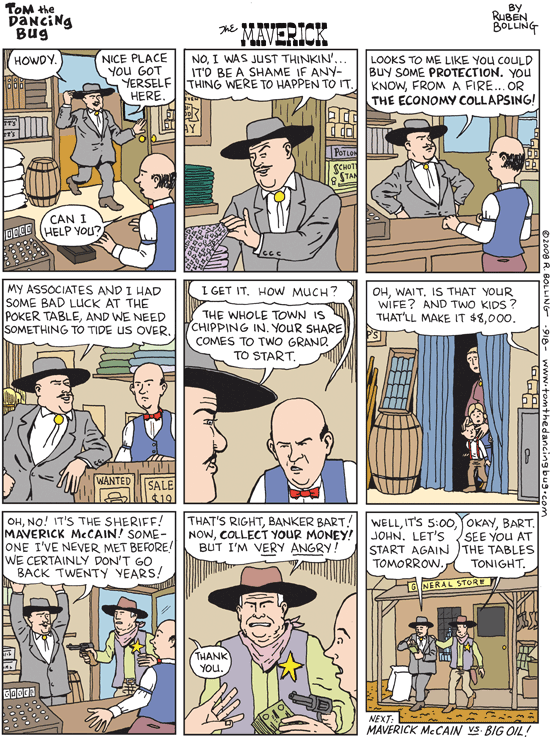
Showdown at Tombstone
By Mariann Wizard / The Rag Blog / October 3, 2008

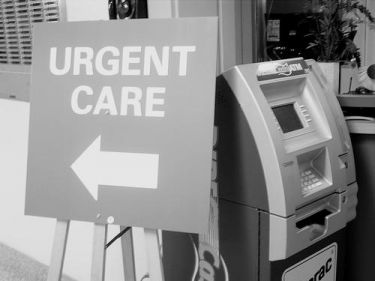
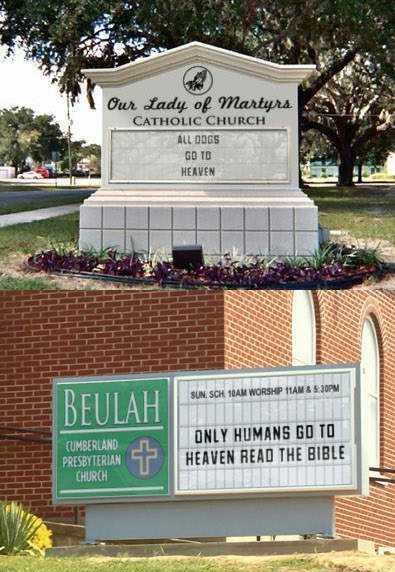
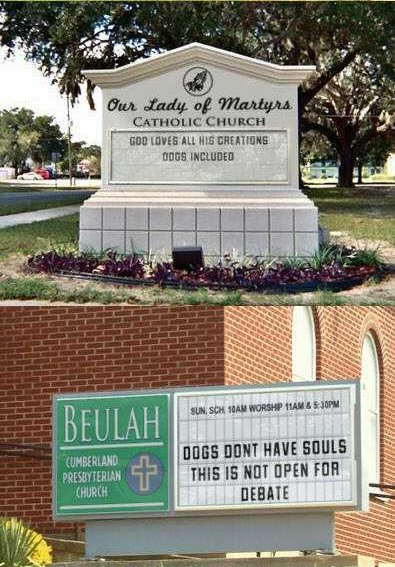
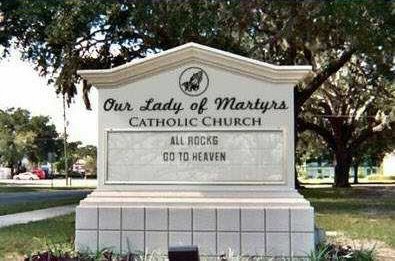
This is hilarious; a little something on the lighter side — but beyond the laugh, offering some really very freaky insight into the fundamentalist “soul”!! Thanks to Cousin Karen in the country!

Years ago I started buying my Mom a set of collector plates illustrated with Biblical themes; the artwork is cute and humorous, with a wide cast of creatures in addition to whatever human characters were involved. The first one, as I recall, showed Noah’s Ark right after the Flood, as the animals and birds, two by two, head out into a fresh-washed world — next came Moses parting the Red Sea, the Israelites crossing over with all their flocks, herds, dogs, cats, etc. I got all the way through the set until the sixth and final plate was announced, supposed to be “Heaven”, where all the little human angels sat around on clouds and played musical instruments, w/ not a dog or a cat or a bird in sight. I dunno about the Presbyterians, as seen in this sequence of church signboard statements, but Mama was a Methodist, and none of her kids would go to a Heaven without animals. I only bought five plates.

The Rag Blog

Posted in Rag Bloggers | Tagged , , | 1 Comment

Ron Ridenour: Sounds of Venezuela, Part IV

Source: Global Exchange

Click here to view the entire series.

Sounds of Venezuela
Part IV: “This is the revolution of women”
By Ron Ridenour / The Rag Blog / October 3, 2008

CHU CHU CHU
CHUG CHUG CHUG
CHE CHE CHE

What! Is that right? Did I hear Che?

Coming out of a liturgical dream or awakened by revolutionary chanting, I throw off my sheet, pull on my kimona and rush downstairs and out the door into pitch black darkness. A booming united chant pulls me around the corner. The people are struggling in ardent enthusiasm for the cause. My legs move quickly now, taking me toward the ever-moving revolution. The chant surges and wanes in the wind.

Ron Stop! Now! You are running in the streets in a kimona. People will not understand this. The chanting is far away now and if you did catch up with the cantors what would you do and what would be their reaction to you? Can you be one with them, a gray-haired man in a blue kimona and sandals? They would be bewildered or insulted. No one will understand that you are driven with emotion hearing revolutionary chants.

I rush back as darkness begins to lighten. I pull on trousers and t-shirt and rush out again still in semi-darkness. The united voice fluctuates in volume. I’m reminded that these people are Catholic and some may be partaking in a sacred canticle. I see a man standing before a closed work center and ask him about the chanting. Does it have to do with evangelical spirits or the upcoming commemoration of the liberty of La Victoria, in 1814, by university and seminary students led by General José Félix Ribas?

“No,” he chuckles, “that’s just soldiers running their early morning exercises.”

* * * * *

Diego had earlier introduced me to a master sergeant at the military training base on the edge of town. The base was preparing a pageant of teenage girl beauties for “youth day”, part of the military-community solidarity policy. Diego’s friend’s daughter was a contender for “Queen of La Victoria”, and he invited me to attend. The evening following my crazy escapade, I entered the base plaza to see the show, feeling uneasy. Pretty girls sauntered about in high heels and white gowns, round buttocks vibrating, breasts pushed forward from low-cut necklines, they nervously caressed their long black hair. The audience milled about or sat on folding chairs, many drank Colombia’s Death Squads’ drink, Coca-Cola. Teenage boys and fathers watched the girls with pleasure and mothers smiled proudly.

Humans are filled with contradictions. Male-chauvinist inspired beauty contests continue to be popular. On the other hand, María León, president of the National Institute of Women, asserted, in an interview on Women’s Day: “This is the revolution of Women”. That same day, President Chavez announced a new Ministry of Women’s Affairs and named Ms. León its minister. She is unrelated to Rosa León, who was not even born when María took up arms alongside fellow members of the Communist Party against the oppressive regime of Rómulo Betancourt, in the 1960s.

By the summer of 2008, the new ministry had representation in most communities, helping the recently and newly created programs designed for women, including Banmujer—the world’s only government bank for women. It was established on Women’s Day in 2001 and has since granted small loans to two million women, mainly to help them in business ventures aimed at bringing them out of poverty and encourage participation in society. The ministry also has Meeting Points and Madres del Barrio. The “Mothers of the Barrio” Mission, started in March 2006, provides a monthly stipend (80% of the minimum wage) to poor women with children and who do not have full-time employment.

Women suffrage arrived late in Venezuela, 1946. Not until constitutional changes in 1960 were women formally granted equality under the law. It wasn’t until the 1980s, though, that women were allowed to manage their own affairs, including signing official documents without the approval of a spouse or common law lover. Women began organizing for equal rights, in the 1970s, but most efforts were based on signal issues, such as the right to abort. There were few female public leaders before Chavez won the presidency. In the1997 National Assembly, for instance, only six percent of the deputies were women.

With Chavez’ 1998 electoral victory, a new constitutional campaign was initiated and with women’s rights at its core. Thousands of proposals were forthcoming by women’s organizations. The new constitution of December 15, 1999 is the first in the world written in a non-sexist language, meaning that both genders are used in referring to positions and titles, and it is known as the non-sexist Magna Carta, because of establishing full rights and benefits in all arenas. All forms of discrimination, also in the home, are forbidden.

In the first Chavez-led National Assembly women deputies doubled and have since tripled. Thirty-eight percent of the work force is female as are 56% of university graduates. Six women have earned the rank of general. Six of the 15-member executive committee of the new Socialist United Party of Venezuela are women. There are 11 female ministers, making up forty percent of the 29 ministries. And most spectacular is that four of the five highest public leaders are women. Standing beside executive leader Hugo Chavez, women are the President of the National Assembly, leaders of the National Electoral Council and Human Rights Office, and Chief Justice of the Supreme Court (TSJ).

Inspired by the current female Chief Justice, a judgeship on the Supreme Court is an aspiration held by Rose León. Although she, and presumably most if not all of the beauty queen contestants, seek equality and power this does not prevent them from continuing some traditional sexual roles and with pink frills. Rosa, for example, affords herself the luxury—or affectation—of having her own bathroom in the offices where dozens of mayoral employees work. There are two bathrooms but the workers and visitors must only use one. A sign on one door states that this one is exclusive for Rose. Unable to resist the temptation, I used it. I found the light on—something a cleaning woman insists upon so that Rosa does not need to switch it on—and the toilet seat covered in pink clothe; a pink hand towel hung beside the immaculately clean sink. Nothing was amiss except my presence, which the cleaning woman let me know in no unspoken terms when I came out.

Throughout my two months exploring the Venezuelan revolution everywhere I spoke with people working or organizing the majority were women. Black women are more often political activists and community organizers than black men as is the case for indigenous women, who represent or are active among the some 50 tribes in the country. They carry out Mission Guaicaipuro, the program to restore communal land titles and human rights for the half-million indigenous peoples.

I did not witness any brute macho treatment of women and most women accompanied by men did not look down or fear to speak up. In fact, women are most outspoken and many are not shy about showing other aspects of themselves, such as gyrating hips and breasts springing forth, a sight fair to this dirty old man.

But, yes, there is violence against women, especially in the homes. And there are rapes; prostitution too. Prostitutes are offered free tests for venereal diseases by local clinics. The courts do not prosecute prostitutes. Many judges are women. The new women’s affairs ministry addresses both violence against women and prostitution through information, conferences at the community Meeting Points and hotlines for women abused by men.

The Bolivarian Revolution is truly a transformation for women, an empowerment that half the population is not about to let disappear.

The Rag Blog

Posted in Rag Bloggers | Tagged | 2 Comments

The End of America As We Know It?


A Father Sounds An Alarm
By Ray Zwarich / The Rag Blog / October 3, 2008

Like many readers of the Rag Blog, I have been a leftist since the Tet Offensive set off a political awakening in a nice middle class college student’s mind. As we watch current events unfold, I hope that others share my disappointment that we, as leftists, are not better prepared for what may be about to befall us.

I have only been reading the Rag Blog for a few months, but when I do I feel a sense of ‘community’ with its writers, and with its other readers. Surely all of us belong to several, or many, such ‘communities’.

I am not a ‘chicken little’, but I know that I am surely not alone in such communities in the concerns, and even fears, I am feeling today. Surely all of us who read The Rag Blog, as leftists, are cognizant of the possible implications of current events, depending on how ‘things’ play out.

We have no way of knowing what decisions we may be called upon to make, possibly in the not so distant future. Whenever survival becomes a direct issue, people’s chances are greatly enhanced if they have the option of functioning collectively with people they trust. I trust that as we read each day’s new headlines, we realize that we may very well be called upon, possibly very soon, to turn to our ‘clans’ to enhance our chances for survival.

I hope that we all have clans of family and friends to turn to. But if our fears come to pass, we must quickly exploit the full potential of each and every ‘clan’ or ‘community’ of which we might be a part. It is a shame that we are not better prepared. We have squandered the opportunity to make preparations that might have proven valuable to us, (and we may yet have time to make such plans), but our recent history has perhaps taught us that people need to be more directly motivated than we have yet been before we will do what we need to do.

Perhaps the looming events we fear will not come to pass. Perhaps we will be granted more time. But if chaos soon visits us, I trust that we all realize that the time will be at hand when we need to make connections between the clans and communities that exist. If these events do not befall us in the near future, (as they very well may not), we might give more serious thought to using the reprieve we have been granted to re-think what we have or have NOT yet done to prepare for such events.

I am not an alarmist by nature, but there are times when any prudent person must consider sounding whatever alarm that she or he can. When is it time to ‘break the glass’? Each must decide for herself or himself. Copied below is an ‘alarm’ I have sent to my own family, (together with an excellent article from Richard Cook). This is not nearly yet a ‘breaking of the glass’, but I can feel my nose open, and hackles rising, when I watch and read the news. My eyes are at least on ‘the glass’ these days, even though I know that the time for breaking it is not yet here.

In light of current events, I hope others are making similar contacts with those they love and trust the most.

The End of ‘America’ As We know It?

I know that in the busy flow of our daily lives, some of us pay more attention to current events than others. But I would assume that we all understand that what is happening these days is very serious, and might potentially have immense impact on our own lives.

I read a lot of articles written by people who say ‘the sky is falling’, and I tend to dismiss most of them. I have lived through other lean times when many people were saying the same sorts of things, but the sky never did fall, and the economy straightened itself out instead. But what I am seeing and hearing now seems to be much more serious than anything I have seen or heard during my lifetime.

The credentials of the author of the article copied below are impressive. (They appear at the end). This writer , Richard Cook, is certainly not a ‘left wing’ nut. The allegations he makes are astoundingly and horrifically serious, (if they are true). They are every bit as serious as the conspiracy theory allegations that 9/11 was either an ‘inside job’, or was intentionally allowed to happen, (which I personally don’t ‘believe’, although I have read the evidence, which is very compelling, and I think that it is entirely possible that such allegations could be true) . This writer contends that the bubble that is now threatening to bring down our economy was created intentionally by those ‘super rich’ barons who effectively exert control over much of the world. (I have long known that these people are much more powerful that mere governments). Their alleged motive is a fascist takeover of the nation.

Assuming nothing dramatic happens, (as it very well may not), we may never know what is true or not, as far as what plots might be afoot, but many current facts are well established. Mass detention camps HAVE been built. For what purpose? For the time being, that is not ours to know. Just a few days ago a military division of the US Army was assigned a duty station within the borders of the United States itself, which is a violation of the Posse Comitatus Act, which was passed in 1878, and forbids the military from being used within US borders for law enforcement. These are very foreboding, (and well established), facts. The allegations made by Richard Cook in this article may or may not be true, but it certainly ‘feels’ to me that it is entirely possible that they could be true. (I don’t think that they ARE true. Just that they COULD be).

Whether or not such ‘conspiracy theories’ are true is secondary (at least for the moment) to the rather stark and obvious reality that our lives as we know them are teetering on the edge of substantial change, and possibly even ruin. We all hope that this ‘ruin’ does not come about, and it very well may not. But surely we recognize that there is a substantial risk that something very bad MAY happen. If the weather man tells us that there is a 30% chance of rain, most of us would probably bring an umbrella, or at least a hat, with us before going out. There is no way for us to know what our risk is in neat terms of a percent. This writer, Cook, however, thinks that monumental events are “inevitable”.

I told J***** recently that we are all lucky to have each other, and that whatever happens, we will be able to help each other survive. History has told a story many times over, in which people like us fell back on their family bonds in order to survive. We all hope that things will not come to that, but at this point it sure seems to me that circumstances merit that we should at least start thinking about contingencies, at least in the backs of our minds. It is WAY too soon to start making ‘plans’. The economy may yet pull through. But surely we all harbor our own fears that haunt us in quiet and private moments. It is at those times when we should remember that none of us is alone. We are a ‘clan’. We have each other, and in times when survival becomes an issue, people have a much better chance when they function collectively with their ‘clans’.

I am not an ‘alarmist’ guys. But I am certainly ‘alarmed’ these days. Here’s the article, (and once again, this writer’s substantial credentials are at the end).

Hope all are well this morning …… Papa

Grand Larceny” on a Monumental Scale: Does the Bailout Bill Mark the End of America as We Know It?
By Richard C. Cook / October 2, 2008

OCTOBER 1, 2008—Tonight the Senate passed the $700 billion Wall Street bailout bill by a vote of 74-25. This follows the rejection of the bill by the House on Monday. In an MSNBC poll, 62 percent of Americans oppose the giveaway, but the lobbyists are doing everything possible to assure the rejection is overturned. According to Bob Borosage, co-director of The Campaign for America’s Future, House leaders “are bringing in the small business lobby and the banking lobby to buy the twelve Republican votes they need.”

The Senate took up the bill in order to pressure House members who voted against it to change their positions when it returns to a vote on the House floor on Friday. This procedure may be unconstitutional, because revenue bills must originate in the House, but there is no time or political will for anyone to mount a challenge on constitutional grounds. As another means of inducement—or blackmail—the bill includes the repeal of the wildly unjust alternative minimum tax.

Every reputable economist commenting on the bill opposes it, including NYU’s Nouriel Roubini, who says the plan is “totally flawed.” He says the plan is:

“a disgrace: a bailout of reckless bankers, lenders, and investors that provides little direct debt relief to borrowers and financially stressed households and that will come at a very high cost to the US taxpayer.”

My own view is that the plan is worse than that: a crime; grand larceny on a monumental scale.

Here’s why: We know that the debacle started with homeowner defaults on subprime mortgages and that it has now spread to other types of mortgages as foreclosures spread. We know that the unhealthy use of subprime mortgages started during the Clinton administration, as did the bundling and sale of these mortgages into mortgage-backed securities sold in the financial markets.

What has not been reported is that the Bush administration turned these acts of reckless lending into a national program of mortgage fraud. Soon after George W. Bush became president in 2001, meetings at the White House between Federal Reserve Chairman Alan Greenspan and administration officials became more frequent. According to mortgage industry insiders I have interviewed, direction soon began to come down from the banks to mortgage brokers to falsify borrower income information to allow them to qualify for loans that were otherwise out of reach.

The FBI has investigations underway to prosecute some of these cases of mortgage fraud. But they are not reaching above the brokers’ level. The FBI is not gaining access—or at least they have not reported it publicly—to information about collusion at the political level or at the level of the banks which provided the leveraged funding for mortgage money.

But at the time the housing bubble was inflating, no one was watching. Note that when Secretary of the Treasury Henry Paulson testified before the Senate Banking Committee last week, he said he was shocked to learn when assuming office in June 2006 that no federal agency regulated mortgage lending. Rather this was an area left to the states.

What Paulson did not say was that when the states attempted to intervene, they were blocked by the Treasury Department’s Office of the Comptroller of the Currency. In a February 14 article in the Washington Post written before he resigned, New York governor Eliot Spitzer wrote:

“In 2003, during the height of the predatory lending crisis, the OCC invoked a clause from the 1863 National Bank Act to issue formal opinions preempting all state predatory lending laws, thereby rendering them inoperative. The OCC also promulgated new rules that prevented states from enforcing any of their own consumer protection laws against national banks. The federal government’s actions were so egregious and so unprecedented that all 50 state attorneys general, and all 50 state banking superintendents, actively fought the new rules. But the unanimous opposition of the 50 states did not deter, or even slow, the Bush administration in its goal of protecting the banks. In fact, when my office opened an investigation of possible discrimination in mortgage lending by a number of banks, the OCC filed a federal lawsuit to stop the investigation.”

Why did the Bush administration do this? The only possible answer is that it had every intention of producing the housing bubble, one that had the effect of not only inflating the cost of homes and real estate but also pumping billions of dollars of borrowed cash into the economy through mortgage and home equity loans.

The bubble enriched huge numbers of executives, managers, and shareholders throughout the financial and real estate industries, and provided jobs to millions of people. The bubble also brought back foreign capital to U.S. markets that had been scared away by the dot.com bust of 2000-2001.

Everyone seemed to benefit, but it was those at the top who skimmed the greatest profits. And for an economy that had already given away millions of its best manufacturing jobs through NAFTA, Most-Favored-Nation trading policies with China, World Trade Organization agreements, etc., the bubble acted as a kind of substitute economic engine.

It also resulted in tax revenues that allowed the Bush administration to implement its 2001 and 2003 tax cuts for the rich and provide funding for the Afghanistan and Iraq wars. Of course these tax revenues were not enough, as the national debt soared to over $9 trillion during the Bush years as well.

Economist Dean Baker of the Center for Economic and Policy Research makes the point:

“The near hysterical discussion (count the times ‘Great Depression’ appears in news stories) of the bailout still largely fails to recognize the roots of the economy’s current problems in the collapse of the housing bubble. Much of the discussion assumes that the problem is just bad subprime loans and that house prices will bounce back once the credit markets are working properly.”

The point is critical, because what the Senate and House leaders are telling us, as are President George W. Bush, presidential candidates Barack Obama and John McCain, and Federal Reserve Chairman Ben Bernanke, is that the bailout is to get the American economy moving again. Credit, they say, is the lifeblood of the economy, and without credit no one can make a move.

But credit is the lifeblood of the economy only because people are broke. Purchasing power in the U.S. has collapsed, and it is getting worse as the recession which has now begun worsens.

People can’t get loans, not because the credit markets are stalled, but because they have no savings for down payments and can’t afford to repay what they wish to borrow. If they could repay their loans, plenty of credit would be available. But there is no money—and no savings—within the economy for it to get moving again. The only possible source is more federal borrowing to prime the pump Keynesian-style. That is what the politicians claim the bailout will do. But it won’t.

Then what is happening?

What is happening is that the Bush administration is engineering a massive raid on the Federal treasury to pay off the people within the financial industry who have been operating the housing scam because the politicians told them to do it. This is hush money.

The people in the financial institutions who are getting the money will be passing it on to the big banks that leveraged their criminal lending practices. The giant sucking sound you hear is almost a trillion dollars of future taxpayer earnings going into the vaults of the nations’s biggest banks, such as Citibank, Bank of American, and—the pet bank of the Rockefeller family—J.P. Morgan Chase. Much will also go into the vaults of foreign investors such as the Bank of China.

And these banks have no intention of recycling the money into productive U.S. investments. Despite the political posturing, where much of it will go at the second or third tier is into executive salaries and bonuses. The fat cats are “gittin’ out while the gittin’s good.”

What happens next?

Well, it is already happening. In the post-bubble era there will be no more economic engines for the American economy. A long term recession and depression are inevitable, and they are expected by those in the know. In fact, there has been a plan in the works for a very long time to bring down the U.S. economy, and it will be happening over the coming months.

This is why the government is also preparing to implement martial law, or something close to it, in case public unrest breaks out. We will likely also see a clampdown on free speech, the right to protest, and use of the internet. Federal facilities are being prepared all around the country to backstop state prisons and local jails that are already bursting at the seams.

This is the plan, so people need to begin to take whatever measures they can to cut their cost of living, get out of debt, and protect themselves and their families.

Richard C. Cook is a former U.S. federal government analyst, whose career included service with the U.S. Civil Service Commission, the Food and Drug Administration, the Carter White House, NASA, and the U.S. Treasury Department. His articles on economics, politics, and space policy have appeared in numerous websites and print magazines. His book on monetary reform, entitled We Hold These Truths: The Hope of Monetary Reform, will soon be published. He is the author of Challenger Revealed: An Insider’s Account of How the Reagan Administration Caused the Greatest Tragedy of the Space Age, called by one reviewer, “the most important spaceflight book of the last twenty years.” His website is www.richardccook.com. Comments or requests to be added to his mailing list or to purchase his special report on the 2008 election may be sent to EconomicSanity@gmail.com.com.

Source / Black Listed News

The Rag Blog

Posted in RagBlog | Tagged , , , | 3 Comments

Using Depression-Era Tactics for Survival


Weathering the Coming Crisis, Part II
By Diane Stirling-Stevens / The Rag Blog / October 3, 2008

A week or so ago, I wrote up some of the things we’re doing to minimize problems in our lives, with this bail-out and any repercussions. We have 6 weeks of foods in supply; we have 3 months of cash for all expenses. We’ve kept our car ‘topped off’ with gas; our motor-home is filled with gasoline as well as our refrigerator is full of propane, as back-up. After putting these measures in place and wondering if we were ‘over-reacting’, this morning I read this article – it’s lengthy, but part of the story includes the potential for banks to declare a one-week ‘holiday’, and close down. The reasons for this decision are in the article, but I’d suggest you take the kinds of steps that don’t put you in a predicament should they go this far.

Most seem to feel the bail-out will pass; yet, there are some in the House who are saying they can hold off approving anything more than $50,000,000,000 which will get the immediate problems remedied. They then suggest they can wait until they reconvene on November 17, to discuss the remaining amount. Should this create some type of credit problem (even though they feel it won’t), you should consider that between now and November 17, that banks might pull this ‘holiday stunt’, essentially to ‘black-mail’ the House/Senate/Congress, to release added funds.

Here’s the entire article – share, and don’t get too complacent and confident that all of this will pass without incident. I think most can deal with this one week bank holiday, but we have to remember there would be a run on food as people ‘stock up’; gasoline as people would do the same, and many would be forced to use credit cards for any purchases (including food), if they haven’t got ‘cash’ in their pockets. Whether or not the ‘holiday’ means they wouldn’t be processing checks, I don’t know (I’m guessing they won’t stop processing your payments because this benefits them). If you can’t easily store a decent food supply in your own home, you can consider getting together with friends and family to see how you could find storage and distribute that food supply in a way that assures you that you’ve all going to have access to what you need.

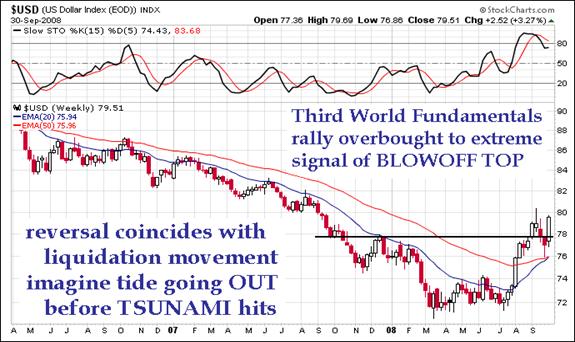
We tend to take life ‘for granted’ because most of us haven’t lived through any major down-turns like this. We’ve had ‘ups and downs’, but I do believe this one might just be the ‘tsunami’ we could underestimate. Anyhow, I wanted to get this off to you because I’m concerned, and also I think this well-written article by somehow who is MUCH more expert than I am, might give you a better explanation than I can. (below)

Breakdown Approaches Climax
By Jim Willie CB / October 2, 2008

Use this link to subscribe to the paid research reports, which include coverage of several smallcap companies positioned to rise during the ongoing panicky attempt to sustain an unsustainable system burdened by numerous imbalances aggravated by global village forces. An historically unprecedented mess has been created by compromised central bankers and inept economic advisors, whose interference has irreversibly altered and damaged the world financial system, urgently pushed after the removed anchor of money to gold. Analysis features Gold, Crude Oil, USDollar, Treasury bonds, and inter-market dynamics with the US Economy and US Federal Reserve monetary policy.

Pardon the brief and jumpy style, laced with more emotion than usual. The events of the last few days have been remarkable, alarming, chaotic, and surreal. Gonna attend the Toronto gold show hosted by the Cambridge House this weekend. If you are there, grab my arm and say hello. Let me know your perspective on the brewing crisis.

HEART ATTACKS & BANK HOLIDAYS

The banking system breakdown is very far along, but still early. Remember USFed Chairman Bernanke stated over a year ago that the mortgage problem was contained. Try not to laugh. The bond crisis is absolute, broad, deep, and all-inclusive, enough to kill the USTreasurys after it kills the US banking system. The heart attack signals are with the LIBOR spreads over USTreasurys, the money market, the TED spread (Treasury versus EuroDollar), and short-term USTreasurys. Charts resemble heart attacks and EKG electro-cardiogram monitors. Many details appear in the October Hat Trick Letter report just posted. The bank runs have begun in earnest. Nevermind the big banks for a moment. The smaller ones are entering seizures. The small and medium sized cities are also entering seizures. Here are two stories, one about a city and another about the bank holiday coming.

This from a friend in Seattle: “I was talking to my neighbor last night. He is in finance in the county government, King County (Seattle). He said there are some very secretive budget talks being held, very hush, hush. Apparently, the county has lost around $200 million of taxpayer money in toxic paper investments, with huge implications on the budget. He says he is not privy to the details, but he is taking a 10-day vacation starting today, because he has nothing to do since everything is in flux.”

This from a friend in Atlanta with strong banking connections: “Reliable word that Bank of America branch managers just received a letter or memo from the USFed instructing them to perhaps be ready for a one-week universal shut-down of the banking system, including access to checking accounts, savings accounts and credit cards. Reliable word has it that BofA bank branches received a shipment of signs last week, reading “WE’RE SORRY, BUT DUE TO CIRCUMSTANCES BEYOND OUR CONTROL, WE CANNOT BE OPEN AT THIS TIME.”

So the banks are in need of a respite, a break, a holiday. They need to shore up their positions. Economists and bankers avoid revealing the consequences of extended absence of short-term credit supply. Imagine all the supply chain DELIVERY routes being interrupted for lack of short-term credit, certain to interrupt the supply of food, gasoline, building materials, basic household wares, simple hardware, and more. The short-term credit would certainly also disrupt payroll streams for companies, inventory supply for retail chains, durable goods purchases by consumers (like washing machines & refrigerators), the maintenance of basic machinery (like cars, trucks, computer, communications), even cash dispensed at ATMachines.

BAILOUT BILL PASSAGE

The Senate passed the Wall Street bailout bill, by a 3:1 majority. Some sweeteners like tax cuts and raising the limit to $250k on individual accounts for bank depositors helped. Some people might think that finally the banking system can at last receive some meaningful fixes. Call me a killjoy, but this will accomplish next to nothing as a banking system remedy. It is more a paper seal to Wall Street corruption than to ANY solution. If passed by the House, as is likely, it puts an epitaph on the American badge of legitimacy. A decade of fraud has been underwritten, sanctioned, and sealed. Even foreigners might smile at the new & improved bill. Their impaired bonds can participate in the redemption process. The only trouble is they might have to accept hot shiny USTreasury Bonds in return, of certain questionable value.

Still the bill must be viewed as a giant paper net to catch a giant locomotive train, one that derailed and then went over the mountainside cliff 500 meters above and is hurtling downward with acceleration. Gravity is a bitch, and so is momentum! One should not doubt for a second that it will do much to halt the downward trajectory. One should remember that debt solutions accomplish nothing in providing remedy for debt abuse and damage inflicted by broken debt contraptions. Nothing is fixed, only accounts have been shifted and names have been changed. THE BANKING SYSTEM PROCEEDS ALONG ITS OWN CLEARLY DEFINED PATHOGENESIS, with great momentum and power, which no human devices can interrupt. The next shock will be why the bill has not fixed the banking system as Mini-Fuhrer Paulson claimed it would. The other next shock is why Wall Street will need another $700 billion within a year. The other other next shock is how much the AIG and Fannie Mae “INVESTMENTS” a la nationalization will each cost the USGovt conglomerate an unexpected extra $trillion. The bailout yesterday enables Wall Street executives to retire more comfortably, even as some seek asylum or face exile.

The irony of the lifted depositor insurance is that big financial conglomerates can now raid the private accounts worth over $100k now, with government coverage in the bankruptcy courts. The October Hat Trick Letter contains some multi-sided evidence of USFed open license to use subsidiary accounts toward the aid of liquidity strains. What constantly leaves me shaking my head is how intelligent people continue to attribute fair spirited motives to the system, when it resembles a crime syndicate more each year. The reason why it resembles one is that it IS a crime syndicate operating under the USGovt roof. There are three crime syndicates operating under the USGovt roof, the others identified in the report this month. Each has had a profound financial effect on the nation, as in killing its host.

One can make a fine balanced and credible argument that the Fannie Mae bailout package represented an aggregate parallel of the simple Trenton New Jersey home loan fraud. The parallels are argued, with conclusion being the USGovt bailout was tantamount to abandonment by the mafia gangsters, who walked away from the $250k loan on the $50 crack house dilapidated property. Parallels are disturbing, as Wall Street and USGovt players fill out the example carried to the aggregate. The other Fannie Mae fraud is the simple bond certificate counterfeit, just plain paper printing without bother of Wall Street involvement. That fraud helped to run up the total Fannie Mae fraud past the $1 trillion mark. Given the sleazy guys who ran Fannie Mae, and all the protection run for it by politicians averse to reform, the fraud was quite easy. Who would want to question a shiny Fannie bond, a device which powered the great housing boom?

FDIC AS NEW I-BANK RAIDER

A new role seems to have come to the Federal Deposit Insurance Corp. They are the newest brokers on Wall Street, the new investment bankers, raiders true to the name. They do not protect depositors any more than Christopher Cox at the SEC protects stock investors. The FDIC has minimal funds, most likely co-mingled with the USTreasury anyway, just like the Social Security Trust Fund. The measly $45 billion lying around in the FDIC fund would not cover more than one or two decent sized banks, or one Washington Mutual or one Wachovia. So what does Sheila Bair do in response? She defends Wall Street, avoids liquidation by dead banks, and steers them to the JPMorgan chop shop and slaughterhouse. A great arbitrage results, as JPMorgan obtains bond assets for nothing, and can sell them to a stupid captive customer, us taxpayers.

In doing so, several things happen:

1) JPMorgan obtains the entire corporate asset kit & kaboodle for next to nothing

2) deposits are used to help the JPM asset ratios

3) bond assets can be sold to the USGovt bailout fund

4) senior bond holders for the dead banks are screwed, receiving a pittance

5) dangerous credit derivatives are placed in the JPM Garbage Can

6) the Wall Street Consolidation Plan continues.

The Big 3 Banks are JPMorgan, Citigroup, and Bank of America. Just how on earth can Citigroup even consider acquiring Wachovia? Buy it with what? Citigroup is insolvent. That does not stop the Wall Street firms from spreading their cancer. Besides, King Cox has a plan, to remove ‘Mark to Market’ asset accounting rules. Poof! The US banks are solvent again. Only trouble is they become Walking Zombies. Couple this desperate policy change with short stock restrictions, and the Third World Finances label fits even better, from lack of credibility. The new Wall Street I-Bank is on the scene. The modern FDIC might make Michael Milken proud, the junk bond king from Drexel Burnham. By the way, he only served two of his ten years in prison. Wall Street does have its privilege. The Wall Street investment bank model is dead & buried, with the door slamming shut by Goldman Sachs changing its coat to read bank holding company.

The group likely to initiate lawsuits is the senior bond holders to the broken banks. They should have entered an orderly procedure led by the FDIC. They face ruin when they should salvage something. The FDIC sets up banks to be raped. The label of pimp is too generous and connotes too much respect. To think that Sheila Bair at the FDIC is being praised for her leadership lately is enough to make a bond holder vomit. These mergers are nothing but disguised ‘Chop Shop’ rapes. At least the FDIC receives fees. JPMorgan donated $1.9 billion to the FDIC cause. By the time the dust clears after the locomotive crashes, three giant hollow monoliths were be standing, a tribute to Manhattan, in the Big 3 Banks. Their glass and aluminum fittings might be in much better shape than the World Trade Center though. It is doubtful that they possess any gold bullion in basement vaults. Let’s hope the third of these buildings does not suffer a structural sympathy, only to collapse.

LOOMING TIME BOMBS

Clearly they are AIG with its raft of Credit Default Swaps, and Fannie Mae with its raft of mortgages and their bonds. Fannie also has a scad of Interest Rate Swaps. As explained in past Hat Trick Letter reports, the quarterly bills payable to JMPorgan and Goldman Sachs might be considerable on these swaps. The USGovt swallowed two really big ugly hairy hungry tapeworms, that will possibly each cost an extra $1 trillion in unplanned expenses. Actually, my guess is the figure might be conservative. A year ago, when clowns like Bernanke and harlots on Wall Street were estimating the entire mortgage fiasco would result in $100 to $200 billion losses, my figure was $1.5 to $2.0 trillion. As the time bombs go off, they will do so in dribs & drabs, actually giant dribs & giant drabs. The costs will take esteemed senators in the august body of the USCongress off guard.

An interesting thought came to me tonight as the Senate Bailout Bill was written. Actually, more sinister than interesting. The Fannie bill, the AIG bill, and the Wall Street omnibus bill might have been greased by private bribes. Imagine the hefty $138 billion paid to JPMorgan by the USFed, ostensibly from counterfeit Dept of Treasury hotmoney, during the Lehman Brothers failure and confusion, approved by Bankruptcy Court judge James Peck in Manhattan, all executed in pre-dawn during the weekend. Sorry, wanted to paint the background accurately but succinctly. If the 74 senators were each given $2 million in a basic traditional bribe, located safely in a Cayman Island account, then the total cost to JPMorgan would only be $148 million, in the neighborhood of 1 part in 1000 on that disgusting under-the-table handout of $138 billion. It makes good business sense in a day and age when rules mean nothing, when preserving the system is paramount, especially when BS bylines can be spouted about helping the common man.

RUN ON BANKS, RUN ON BONDS

Those talking perpetual campaign managers known as USCongressional members, they like to talk about “the fact of the matter” a lot, as thought they have some innate ability to recognize facts. Here are some facts. A broad and deep run is occurring on US banks, small, medium, large. Banks rely upon deposits and bank equity (stocks and bonds) to supply themselves with capital. The bank runs strip banks from their ability to continue operations, at a time when their stocks have cratered. Stock price declines of over 70% and 80% are common, the norm, not the exception. Insolvency plus illiquidity means bankruptcy, without benefit of time extensions. As Meredith Whitney (the intrepid bank analyst from Oppenheimer) said in a recent interview, “There are a ton of regional banks that also face a similar predicament.” She correctly forecasted much bank distress, and expects a flood of FDIC activity to deal with failing banks.

Europeans have also lost respect for the US financial leadership, public statements having been made by the German Finance Minister Peer Steinbrueck to the effect that the United States has lost its geopolitical leadership mantle. A powerful reversal in investment flow endangers the US bond markets. Private flow of money resulted in the movement of $92.9 billion out of the US in July, after $46.8 billion entered the nation in June. A profound new trend is in place, whereby the three major continents of North America, Europe, and Asia are bringing home money. With a US budget deficit easily eclipsing the $1 trillion mark this coming year, demands for USTreasury sales will be left wanting, as USTBonds will be left on the table. The money printing machines will be the main recourse, as US$ monetary inflation will enter at least one and maybe two new gears in higher usage.

THE RISK LIES WITH HIGHER USTBOND YIELDS OFFERED, OR LOWER USDOLLAR EXCHANGE RATES FORCED. Either way, foreign US$-based bondholders face big losses. The nationalization demands will quickly force the issue of USTreasury Bond default. Bear in mind that now 52.7% of USTreasury debt is held by foreigners, and that proportion is fast rising. At yearend 2007, a hefty $9.4 trillion in US$-based securities were in foreign hands, as in liquid assets, easily divested. Risk to foreigner reserve accounts grows. They recognize their risk of becoming bagholders of greatly damaged debt paper. Amidst this pressure and isolation, the US Federal Reserve might simply resign its contractor position with the USCongress. After all, their balance sheet is decimated. It is not unlimited. It does have creditors.

The gold price will respond, as the USDollar faces a trashing. On the other side of this storm, characterized paradoxically as a USDollar rally at a time of truly devastated fundamentals, the USDollar will get trashed. To this end, a shocking admission came from New York City mayor Michael Bloomberg. He is a bit of a maverick, speaking his mind. He actually stated, “The next cause for concern in the battered US economy is whether there will be buyers abroad for the nation’s billions in debt.”

USDOLLAR AT RISK, USFED RATE CUTS SOON

The USDollar is at extreme high risk. Since its bounce in July, behavior is erratic, volatile, and fully dependent upon central banks and market rule changes. The US$ money supply had been steadily growing at a 15% growth rate, give or take. Expect it to surpass 20% soon, and the US$ to reflect the debased currency from a flood of supply. The United States will be the first nation to cut interest rates, from desperation financially and economically. Other nations will eventually follow, but not right away. The effect few talk about regarding the mammoth nationalization and bailouts underway is the powerful jump in price inflation, along with currency debasement. Both are inevitable, sure to lift the gold price in powerful steps. The isolation of the US in geopolitical circles, the utter shock at failed leadership witnessed the world over, the widely perceived national bankruptcy will translate into shunned USTreasury auctions and outright divestment of US$-based assets. The only buyers will be central banks. The USDollar is at very very very high risk of serious declines, exactly like the US stock markets.

A trump factor has entered the room. THE USDOLLAR & GOLD WILL SOON RESPOND TO THE FAILURE OF THE US FINANCIAL SYSTEM, WHICH COULD QUICKLY RESULT IN NATIONAL EMERGENCY, BANK HOLIDAY CLOSURES, AND TOTAL FRUSTRATION BY BANK LEADERS, AS NOTHING SUCCEEDS. The Wall Street bailout bill fixes nothing in bank system structure and integrity and function, as problems remain intact tragically. The United States controls the world reserve currency in the USDollar. In Hat Trick This late summer, my analysis stated that gold must make a difficult transition from an anti-US$ trade to a hedge against monetary inflation, a hedge against realized price inflation, and a hedge against geopolitical risk, even a national US banking collapse. Some movement has been made on the transition from the tunnel vision anti-US$ trade. One should keep focus on how the US official lending rate at 2.0% is more than 3% below the current suppressed Consumer Price Inflation rate. So money is actually free for those who can access that rate.

The USDollar increasingly is being defended by market interference mechanisms of the worst and most egregiously shameful order, such as a) restrictions to short financial stocks, even though they are insolvent and more illiquid by the week, b) calls to eliminate ‘Mark to Market’ accounting of bank assets, and c) the trusty Plunge Protection Team devices used to prop up stocks, bonds, and the US$ itself. The major currencies are all at risk actually. One contact with international connections recently wrote me, “The US$ will drop to 2.00 against the EUR not before long. And then the EUR will crash shortly thereafter.” Many fine analysts expect the USDollar to suffer a severe markdown as the recent US nationalizations and bailouts are fully digested. Their forecasts would coincide with the notion that the USTreasury Bond suffers a severe market interruption like a suspension or possible default, but then later the euro is victimized by new global gold-backed currencies. This is a very possible scenario.

Jim Willie CB is a statistical analyst in marketing research and retail forecasting. He holds a PhD in Statistics. Jim Willie CB is also the editor of the “Hat Trick Letter.” His career has stretched over 25 years. He aspires to thrive in the financial editor world, unencumbered by the limitations of economic credentials. Visit his website at www.GoldenJackass.com.

Source / 321Gold

The Rag Blog

Posted in RagBlog | Tagged , , | 2 Comments

Bernie Sanders: Alternatives to the Massive Bailout


Bailout Passes Senate; 9 Reasons That’s Bad News for You
By Sen. Bernie Sanders / October 1, 2008.

Forcing each American to fork over $2,200 at a time when median family income has declined by as much is no way to improve the economy.

This country faces many serious problems in the financial market, in the stock market, in our economy. We must act, but we must act in a way that improves the situation. We can do better than the legislation now before Congress.

This bill does not effectively address the issue of what the taxpayers of our country will actually own after they invest hundreds of billions of dollars in toxic assets. This bill does not effectively address the issue of oversight because the oversight board members have all been hand picked by the Bush administration. This bill does not effectively deal with the issue of foreclosures and addressing that very serious issue, which is impacting millions of low- and moderate-income Americans in the aggressive, effective way that we should be. This bill does not effectively deal with the issue of executive compensation and golden parachutes. Under this bill, the CEOs and the Wall Street insiders will still, with a little bit of imagination, continue to make out like bandits.

This bill does not deal at all with how we got into this crisis in the first place and the need to undo the deregulatory fervor which created trillions of dollars in complicated and unregulated financial instruments such as credit default swaps and hedge funds. This bill does not address the issue that has taken us to where we are today, the concept of too big to fail. In fact, within the last several weeks we have sat idly by and watched gigantic financial institutions like the Bank of America swallow up other gigantic financial institutions like Countrywide and Merrill Lynch. Well, who is going to bail out the Bank of America if it begins to fail? There is not one word about the issue of too big to fail in this legislation at a time when that problem is in fact becoming even more serious.

This bill does not deal with the absurdity of having the fox guarding the hen house. Maybe I’m the only person in America who thinks so, but I have a hard time understanding why we are giving $700 billion to the Secretary of the Treasury, the former CEO of Goldman Sachs, who along with other financial institutions, actually got us into this problem. Now, maybe I’m the only person in America who thinks that’s a little bit weird, but that is what I think.

This bill does not address the major economic crisis we face: growing unemployment, low wages, the need to create decent-paying jobs, rebuilding our infrastructure and moving us to energy efficiency and sustainable energy.

There is one issue that is even more profound and more basic than everything else that I have mentioned, and that is if a bailout is needed, if taxpayer money must be placed at risk, whose money should it be? In other words, who should be paying for this bailout which has been caused by the greed and recklessness of Wall Street operatives who have made billions in recent years?

The American people are bitter. They are angry, and they are confused. Over the last seven and a half year, since George W. Bush has been President, 6 million Americans have slipped out of the middle class and are in poverty, and today working families are lining up at emergency food shelves in order to get the food they need to feed their families. Since President Bush has been in office, median family income for working-age families has declined by over $2,000. More than seven million Americans have lost their health insurance. Over four million have lost their pensions. Consumer debt has more than doubled. And foreclosures are the highest on record. Meanwhile, the cost of energy, food, health care, college and other basic necessities has soared.

While the middle class has declined under President Bush’s reckless economic policies, the people on top have never had it so good. For the first seven years of Bush’s tenure, the wealthiest 400 individuals in our country saw a $670 billion increase in their wealth, and at the end of 2007 owned over $1.5 trillion in wealth. That is just 400 families, a $670 billion increase in wealth since Bush has been in office.

In our country today, we have the most unequal distribution of income and wealth of any major country on earth, with the top 1 percent earning more income than the bottom 50 percent and the top 1 percent owning more wealth than the bottom 90 percent. We are living at a time when we have seen a massive transfer of wealth from the middle class to the very wealthiest people in this country, when, among others, CEOs of Wall Street firms received unbelievable amounts in bonuses, including $39 billion in bonuses in the year 2007 alone for just the five major investment houses. We have seen the incredible greed of the financial services industry manifested in the hundreds of millions of dollars they have spent on campaign contributions and lobbyists in order to deregulate their industry so that hedge funds and other unregulated financial institutions could flourish. We have seen them play with trillions and trillions dollars in esoteric financial instruments, in unregulated industries which no more than a handful of people even understand. We have seen the financial services industry charge 30 percent interest rates on credit card loans and tack on outrageous late fees and other costs to unsuspecting customers. We have seen them engaged in despicable predatory lending practices, taking advantage of the vulnerable and the uneducated. We have seen them send out billions of deceptive solicitations to almost every mailbox in America.

Most importantly, we have seen the financial services industry lure people into mortgages they could not afford to pay, which is one of the basic reasons why we are here tonight.

In the midst of all of this, we have a bailout package which says to the middle class that you are being asked to place at risk $700 billion, which is $2,200 for every man, woman, and child in this country. You’re being asked to do that in order to undo the damage caused by this excessive Wall Street greed. In other words, the “Masters of the Universe,” those brilliant Wall Street insiders who have made more money than the average American can even dream of, have brought our financial system to the brink of collapse. Now, as the American and world financial systems teeter on the edge of a meltdown, these multimillionaires are demanding that the middle class, which has already suffered under Bush’s disastrous economic policies, pick up the pieces that they broke. That is wrong, and that is something that I will not support.

If we are going to bail out Wall Street, it should be those people who have caused the problem, those people who have benefited from Bush’s tax breaks for millionaires and billionaires, those people who have taken advantage of deregulation, those people are the people who should pick up the tab, and not ordinary working people. I introduced an amendment which gave the Senate a very clear choice. We can pay for this bailout of Wall Street by asking people all across this country, small businesses on Main Street, homeowners on Maple Street, elderly couples on Oak Street, college students on Campus Avenue, working families on Sunrise Lane, we can ask them to pay for this bailout. That is one way we can go. Or, we can ask the people who have gained the most from the spasm of greed, the people whose incomes have been soaring under president bush, to pick up the tab.

I proposed to raise the tax rate on any individual earning $500,000 a year or more or any family earning $1 million a year or more by 10 percent. That increase in the tax rate, from 35 percent to 45 percent, would raise more than $300 billion in the next five years, almost half the cost of the bailout. If what all the supporters of this legislation say is correct, that the government will get back some of its money when the market calms down and the government sells some of the assets it has purchased, then $300 billion should be sufficient to make sure that 99.7 percent of taxpayers do not have to pay one nickel for this bailout.

Most of my constituents did not earn a $38 million bonus in 2005 or make over $100 million in total compensation in three years, as did Henry Paulson, the current secretary of the Treasury, and former CEO of Goldman Sachs. Most of my constituents did not make $354 million in total compensation over the past five years as did Richard Fuld of Lehman Brothers. Most of my constituents did not cash out $60 million in stock after a $29 billion bailout for Bear Stearns after that failing company was bought out by J.P. Morgan Chase. Most of my constituents did not get a $161 million severance package as E. Stanley O’Neill, former CEO Merrill Lynch did.

Last week I placed on my Web site, http://www.sanders.senate.gov/, a letter to Secretary Paulson in support of my amendment. It said that it should be those people best able to pay for this bailout, those people who have made out like bandits in recent years, they should be asked to pay for this bailout. It should not be the middle class. To my amazement, some 48,000 people cosigned this petition, and the names keep coming in. The message is very simple: “We had nothing to do with causing this bailout. We are already under economic duress. Go to those people who have made out like bandits. Go to those people who have caused this crisis and ask them to pay for the bailout.”

The time has come to assure our constituents in Vermont and all over this country that we are listening and understand their anger and their frustration. The time has come to say that we have the courage to stand up to all of the powerful financial institution lobbyists who are running amok all over the Capitol building, from the Chamber of Commerce to the American Bankers Association, to the Business Roundtable, all of these groups who make huge campaign contributions, spend all kinds of money on lobbyists, they’re here loud and clear. They don’t want to pay for this bailout, they want middle America to pay for it.

Source / AlterNet

Thanks to Diane Stirling-Stevens / The Rag Blog

Posted in RagBlog | Tagged , , , | Leave a comment

When Fear Exceeds Our Government’s Capability to Emotionally Deal With It

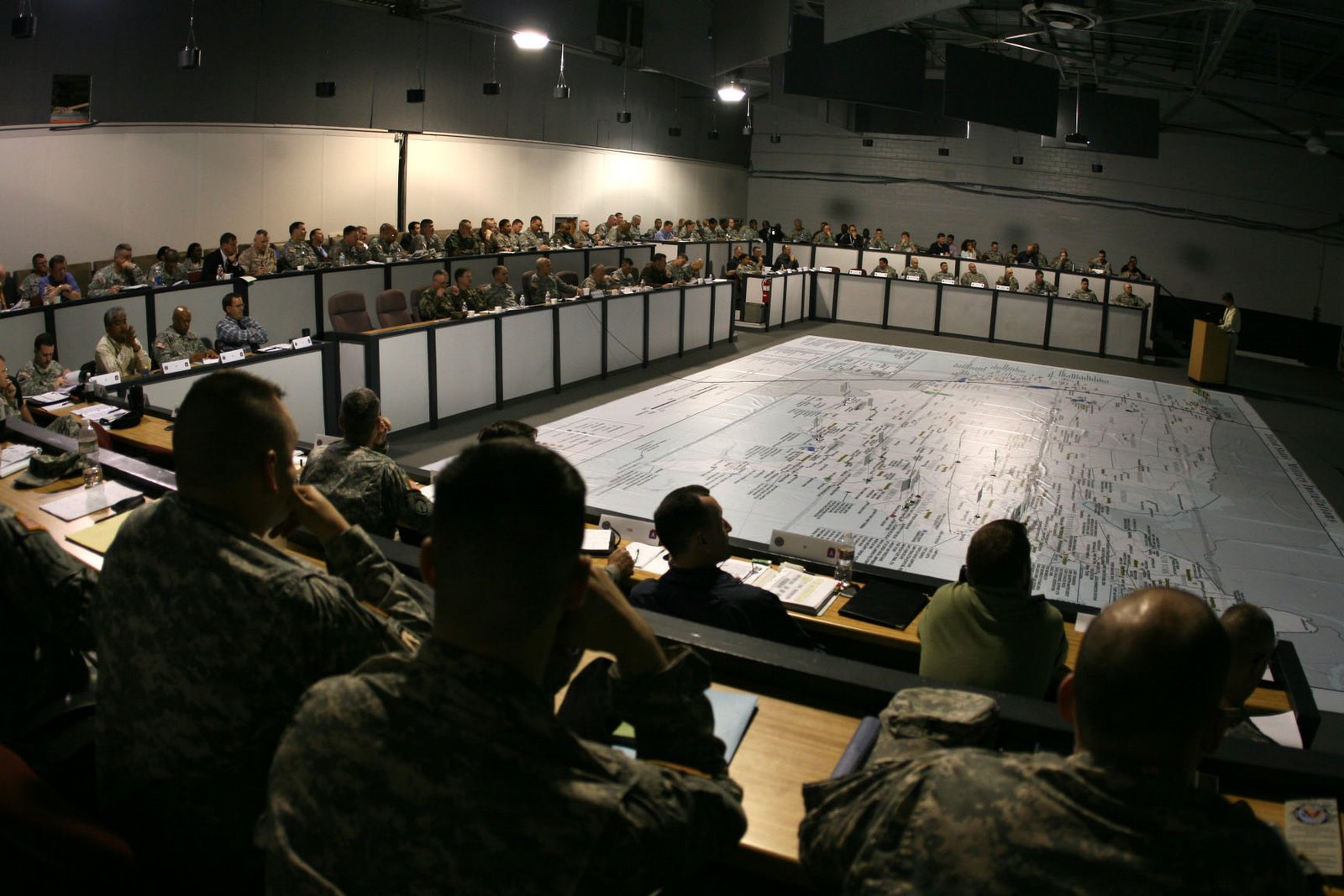
U.S. Army North hosted a commanders’ conference and rehearsal of concept (ROC) drill Mar. 18 through Mar. 20, where senior leaders from Chemical, Biological, Radiological, Nuclear and Explosive Consequence Management Response Force (CCMRF) discussed mission requirements and finalized preparations for exercise NLE 2-08. U.S. Army photo by Sgt. Joshua R. Ford (released).

Invasion of the Sea-Smurfs
By Amy Goodman / October 1, 2008

A little-noticed story surfaced a couple of weeks ago in the Army Times newspaper about the 3rd Infantry Division’s 1st Brigade Combat Team. “Beginning Oct. 1 for 12 months,” reported Army Times staff writer Gina Cavallaro, “the 1st BCT will be under the day-to-day control of U.S. Army North, the Army service component of Northern Command, as an on-call federal response force for natural or manmade emergencies and disasters, including terrorist attacks.” Disturbingly, she writes that “they may be called upon to help with civil unrest and crowd control” as well.

The force will be called the chemical, biological, radiological, nuclear or high-yield explosive Consequence Management Response Force. Its acronym, CCMRF, is pronounced “sea-smurf.” These “sea-smurfs,” Cavallaro reports, have “spent 35 of the last 60 months in Iraq patrolling in full battle rattle,” in a combat zone, and now will spend their 20-month “dwell time”—time troops are required to spend to “reset and regenerate after a deployment”—armed and ready to hit the U.S. streets.

The Army Times piece includes a correction stating that the forces would not use nonlethal weaponry domestically. I called Air Force Lt. Col. Jamie Goodpaster, a public-affairs officer for Northern Command. She told me that the overall mission was humanitarian, to save lives and help communities recover from catastrophic events. Nevertheless, the military forces would have weapons on-site, “containerized,” she said—that is, stored in containers—including both lethal and so-called nonlethal weapons. They would have mostly wheeled vehicles, but would also, she said, have access to tanks. She said that any decision to use weapons would be made at a higher level, perhaps at the secretary-of-defense level.

Talk of trouble on U.S. streets is omnipresent now, with the juxtaposition of Wall Street and Main Street. The financial crisis we face remains obscure to most people; titans of business and government officials assure us that the financial system is “on the brink,” that a massive bailout is necessary, immediately, to prevent a disaster. Conservative and progressive members of Congress, at the insistence of constituents, blocked the initial plan. If the economy does collapse, if people can’t go down to the bank to withdraw their savings, or get cash from an ATM, there may be serious “civil unrest,” and the “sea-smurfs” may be called upon sooner than we imagine to assist with “crowd control.”

The political and financial establishments seem completely galled that people would actually oppose their massive bailout, which rewards financiers for gambling. Normal people worry about paying their bills, buying groceries and gas, and paying rent or a mortgage in increasingly uncertain times. No one ever offers to bail them out. Wall Street’s house of cards has collapsed, and the rich bankers are getting little sympathy from working people.

That’s where the sea-smurfs come in. Officially formed to respond to major disasters, like a nuclear or biological attack, this combat brigade falls under the U.S. Northern Command, a military structure formed on Oct, 1, 2002, to “provide command and control of Department of Defense homeland defense efforts.” Military participation in domestic operations was originally outlawed with the Posse Comitatus Act in 1878. The John Warner National Defense Authorization Act for Fiscal Year 2007, however, included a section that allowed the president to deploy the armed forces to “restore public order” or to suppress “any insurrection.” While a later bill repealed this, President Bush attached a signing statement that he did not feel bound by the repeal.

We are in a time of increasing economic disparity, with the largest gap between rich and poor of any wealthy industrialized country. We are witnessing a crackdown on dissent, most recently with $100 million spent on “security” at the Democratic and Republican national conventions. The massive paramilitary police forces deployed at the RNC in St. Paul, Minn., were complete overkill, discouraging protests and conducting mass arrests (National Guard troops just back from Fallujah were there). The arrest there of almost 50 journalists (myself included) showed a clear escalation in attempting to control the message (akin to the ban on photos of flag-draped coffins of soldiers). There are two ongoing, unpopular wars that are costing lives and hundreds of billions of dollars. Nobel-winning economist Joe Stiglitz estimates that Iraq alone will cost more than $3 trillion.

In December 2001, in the midst of restricted access to bank accounts due to a financial crisis, respectable, middle-class Argentines rose up, took to the streets, smashed bank windows and ultimately forced the government out of power, despite a massive police crackdown and a failed attempt to control the media. Here in the U.S., with the prospect of a complete failure of our financial system, the people have spoken and do not want an unprecedented act of corporate welfare. We don’t know how close the system is to collapse, nor do we know how close the people are to taking to the streets. The creation of an active-duty military force, the sea-smurfs, that could be used to suppress public protest here at home is a very bad sign.

Denis Moynihan contributed to this column. Amy Goodman is the host of “Democracy Now!” a daily international TV/radio news hour airing on more than 700 stations in North America.

© 2008 Amy Goodman

Source / TruthDig

Thanks to Diane Stirling-Stevens / The Rag Blog

Posted in RagBlog | Tagged , , | Leave a comment

Tom the Dancing Bug : The Maverick

Maverick McCain vs. the collapsing economy.

Click on image to enlarge.

Ruben Bolling / Salon.com

Thanks to David McQueen / The Rag Blog

Posted in RagBlog | Tagged , | 1 Comment

Roger Baker : Industrial Collapse? Bring it On!

Collapse the Light into Earth by ~EvidencE~

‘The best outcome is probably for humans to hit the wall soon and hard.’
By Roger Baker / The Rag Blog / October 2, 2008

Is industrial collapse the BEST way out of our current economic mess?

Arguably yes and here is why. But does it even matter? Perhaps not. Capitalism, in its global form and as we now know it, is likely finished in any case, so the choice is likely to be an illusion. But the best outcome is probably for humans to hit the wall soon and hard.

The Economic Context

Capitalism as an economic system depends on an endless expansion of material goods production at a rate that allows lenders to earn interest on money saved and invested. The only way to get potential lenders to lend rather than spending their money immediately is to reward them with a real rate of return on their savings. This is done by promising lenders that they will be rewarded with the ability to buy more material goods in the future. A reward must be offered to lenders for not buying and stockpiling bars of gold, barrels of oil, or any other desirable goods or services now as opposed to putting their money in banks or investing it in stocks or bonds or whatever else can earn them a real rate of interest as a reward for offering their savings up for investment by others.

Keynesian economics tries to maintain a mild inflation rate of a percent or two in order to encourage people to save their money in banks and other alternatives that offer a return above the rate of inflation. This is necessary to keep people from simply putting their money under a mattress. If the rate of inflation is one percent and they can earn three percent in a bank, they will bank their spare funds and will, in theory, be able to come out ahead and buy two percent more in the amount of physical goods or services than they had originally put in.

That is how those managing the economic system (like the Federal Reserve representing the banks) try to set things up. It is meant to encourage people to behave predictably and to keep them saving and investing. Under conditions in which in which it is possible to keep the material world always expanding and yielding a production of desirable goods at or above the rate of interest on money saved, this system remains viable and stable. This assumes that the financial system has been well-managed, and that there are no external limiting factors.

Enter Peak Oil

We now live in a world economy that is rapidly approaching the limiting factor of fossil fuel energy sources. The specific limiting factor that is most relevant is a looming shortage of liquid fuel based on petroleum as the total world oil production peaks and declines.

The peaking of world oil production strongly affects the investment equation that underlies the global capitalist economy and rewards investments and savings. The global economy is based on a cheap-oil-related infrastructure for its expansion of the production of real goods. Capitalism requires cheap energy to deliver the exponential expansion of material goods through investments that can pay real interest rates on loans. But this expectation is probably more than the expansion an oil-addicted global production system can really deliver. It changes the system’s economic potential by making it impossible to earn a real rate of return on the money saved by lenders, who in the case of the United States have increasingly been foreign lenders.

The underlying problem is that nobody can think of a way to keep expanding the material production of a global economy that is experiencing a shrinking supply of liquid fuels. These oil-based fuels move almost all goods in our global economy. This economy is based everywhere on the cheap transport of people, goods, and the capital goods needed to expand global production, whether it be by ship, by rail, by road, or by air. When the ability to move almost all goods declines, the expansion of the ability of capitalist investments to exploit nature for human uses must also decline.

Economic Response to an Oil Shock

The global and also the US economy may be roughly divided into two sectors: necessary spending versus spending that is unnecessary or can be postponed. The necessary spending sector corresponds to spending on vital goods such as food, shelter, the fuel needed to heat or cool a home, and the fuel needed to commute to work. Spending of this kind in the United States cannot be reduced very much or very fast without a long and painful restructuring of the economy to reduce suburban sprawl trends, etc.

If such necessary expenditures rise in cost, spending will be transferred to this sector at the expense of the second sector. We may term the latter the discretionary spending sector. This is a sector of the economy devoted to jewelry, fancy cars, iPods, trips to the movies, vacations, eating out, etc. But it must also include voluntary savings, which are vital for the functioning and expansion of global capitalism.

The discretionary spending sector is a big enough part of the total US and global economy that there are job losses and severe disruptions throughout the total economy if the discretionary spending sector contracts. If foreigners will not lend money and if US consumers are also strapped for cash, then the whole system is soon in trouble.

If there is only enough oil to keep the vital spending sector of the economy functioning, even as it gradually and painfully tries to adjust itself, then no possible kind of economic manipulation, whether by the federal reserve or the US treasury or even the most creative economist can prevent an even steeper contraction of the discretionary spending sector as consumer spending shifts over to the vital spending sector. If we are ever to shift to wind and solar energy, this implies that somebody has money enough left over after paying for food and gasoline and house payments to lend to the companies that expand their output of wind turbines and solar panels.

Thus oil production, whether it is stagnating on a level production plateau or actually contracting as population increases, forces a deep restructuring of the global economy. This raises prices in the vital goods sector and forces a restructuring of the vital spending sector of the economy, which is now additionally called upon to feed those thrown out of work by a contraction throughout the discretionary spending sector. This is basically why we are now in a state of slow economic collapse. Those parts of the economy that cannot be restructured to accommodate permanently higher food and fuel prices must shrink. The discretionary sector of the economy shrinks in terms of total spending (although not necessarily in all cases) as the vital necessity sector restructures itself to require less fossil fuel energy input. In doing so it often has to become more labor intensive.

Further Implications

The foregoing is a description of the general trends forced on the global economy by the end of cheap oil, but it still ignores important details in how US and global capitalism, increasingly organized as a global corporate empire, is likely to respond.

Global oil supply and demand are both relatively inflexible. That means that when oil demand rises faster than its world supply (there is essentially one world oil market with all humans bidding for a shrinking supply of what is left), even a slight imbalance tends to cause a sharp price rise. If oil demand falls, then oil price will fall rapidly too.

In much the same way, if a ship in the ocean runs short of potable water available for sale to the passengers, they are likely to try to bid a very high price for whatever water remains. A graph of the water consumed by the ship’s passengers may reflect a slow decline in water consumption as some passengers die of thirst. But this graph of water consumption would not reveal a sharp increase in the water price as the remaining passengers attempt to buy whatever water remains for sale. If they run short of money, then the price will fall even as they remain thirsty.

The same economic dynamic applies to worldwide bidding for what remains of the global oil supply and explains why the price has fallen modestly due to conservation and demand destruction even as production remains flat. As the dollar is devalued further, people will bid up the price of fuel, and food made from fuel, as much as they are able at the expense of savings and discretionary spending.

The Credit Crisis

The current US economic crisis, sometimes termed a credit meltdown, is actually due to a combination of several factors. First banking deregulation has led to the extreme over-leveraging of debt and credit, based on the Greenspan bubble expectation that the economy can and will continue to grow “normally” (that is exponentially) forever into the future. Billions have been lent to expand the production of Chinese toys and Christmas ornaments and similar discretionary sector goods. These debts, and indeed the smooth functioning of the entire global economy, have been insured by the massive issuing of derivatives such as credit default swaps (default insurance), paper created by the investment banks and AIG on a scale in which their total dollar value dwarfs the annual global economy.

The credit market and the highly profitable derivative market were allowed to expand, primarily after the deregulation of investment banks by Phil Gramm under President Bill Clinton. This paper was issued to the degree that seemed prudent by those who stood greatly to benefit by an enormous expansion, including not only the investment banks, but also their clients, the hedge funds.

It was imagined until about a year ago, that if the US or global economy ever threatened to contract, that a Wall Street or global bank run could be calmed by stimulating the global and national lenders with temporary injections of liquidity, through government lending and bailouts, and in accord with the principles of traditional Keynesian economic theory. Whereas total US bank reserves now equal only about three percent of what has been lent, and whereas the usual guidelines are to keep about eight per cent in reserve to calm the markets it was imagined that the Federal Reserve could come to the rescue and calm investors until the crisis subsides. Failing such assistance, the US and probably the entire global lending system is now grotesquely over-leveraged and subject to collapse as investors seek to withdraw their loaned funds on a large scale.

Reaching for the Right Levers

For the Federal Reserve and the Treasury Department, the crisis continues.

Without the broad bailout plan they invented and lobbied hard for, the two agencies are once again forced to careen from one desperate path to another, and to dig deep into their toolkits to rescue the global financial system. Even before the House stunned the world on Monday by rejecting the Bush administration’s bailout bill, the Fed was already resorting to the oldest action in its book: printing money.

With money markets around the world seizing in fear, the Fed on Monday announced that it would provide an extra $150 billion through an emergency lending program for banks, and an additional $330 billion through so-called swap lines with foreign central banks to help money markets from Europe to Asia.

It was an extraordinary display of financial power, and it reflected acute new anxiety at the Fed and central banks around the world that the crisis of confidence in American financial markets had metastasized to money markets everywhere…

Reaching for the Right Levers in an Anxious Situation by Edmund L. Andrews and Mark Landler / New York Times / September 29, 2008.

The People vs. the Banksters

The financial system is blowing up. Don’t listen to the experts; just look at the numbers. Last week, according to Reuters, “U.S. banks borrowed a record amount from the Federal Reserve nearly $188 billion a day on average, showing the central bank went to extremes to keep the banking system afloat amid the biggest financial crisis since the Great Depression.” The Fed opened the various “auction facilities” to create the appearance that insolvent banks were thriving businesses, but they are not. They’re dead; their liabilities exceed their assets. Now the Fed is desperate because the hundreds of billions of dollars of mortgage-backed securities (MBS) in the banks vaults have bankrupted the entire system and the Fed’s balance sheet is ballooning by the day. The market for MBS will not bounce back in the foreseeable future and the banks are unable to roll-over their short term debt.

…If there’s going to be a bailout, let’s get it right. Paulson’s $700 billion bill does nothing to fix the deep structural problems in the financial markets; it merely pushes the day of reckoning a little further into the future while shifting the burden of payment for toxic assets onto the taxpayer.

The People vs. the Banksters by Mike Whitney / counterpunch / September 27, 2008.

Inflationary consequences

…Now that the market is finally adjusting the price bubble downward and a lot of firms that were incredibly profitable on the way up are falling like leaves in autumn in a bear market. The Fed is merely trying to inject money to keep the prices not supported by fundamentals from falling. It is a prescription for hyperinflation. The only way to keep price of worthless assets high is to lower the value of money. And that appears to be the Fed’s unspoken strategy…

Inflation is effectively a hidden form of governmental taxation that substitutes for the more honest approach of openly raising taxes. A global or national bank run can be calmed by, in effect, printing money to fill the liquidity gap. This is the gap between the material reward promised on money deposited, which the investment system has promised as a reward for saving, versus what the system can actually deliver to lenders in terms of real goods that can be purchased with the money withdrawn. Over the short run, printing bailout money charged to taxpayers can bridge the gap between the liquidity problems and appear to make them seem to go away.

Thus the Federal Reserve is injecting large amounts of bailout money into the economy in order to stop a widening global bank run and financial panic. But this added money will soon diffuse throughout the general economy and start bidding for real commodities. That means inflation as the bailout money starts chasing vital necessity goods tied to oil and energy, or other commodities, or the traditional physical means of preserving wealth, gold.

The reaction by the Federal Reserve has been more or less predictable, traditional, and automatic. If a credit crisis threatens a bank run, the solution is for the US government to print up enough money to make the immediate crisis go away long enough so that the economic downturn ends, the system can recover, and business confidence restored. This is a stopgap measure, much like stalling creditors while looking for a job. It has tended to work in the past, keeping the high tech and housing bubbles expanding during the last decade. But there is only so long that the US economic bubble can be kept expanding by lowering interest rates or using bank bailouts.

During normal times, it tends to work, and the government can make up its own rules to keep things expanding. To use an analogy, not only is it harder to keep a party going past a certain point no matter how much free liquor is on hand, but the situation is made more complicated by the fact that the liquor supply is running short. The attempt to stimulate the system and keep the investment bubble expanding will not work under conditions in which the real economy can never recover because the material world on which it is based can no longer expand and recover over time because a contraction of its economic base is dictated of declining oil-based fuel production.

Stagflation

In the real world this combination of a credit crisis and peak oil strongly implies stagflation; the serious stagflation we saw in the 1970’s during our first big energy crisis was not a random event due merely to bad luck. Stagflation is characterized by a simultaneous economic contraction in the discretionary spending sector of the economy, along with cost-push inflation caused by competitive bidding for a limited supply of goods in the vital necessity sector of the economy. During a time of stagflation, people transfer spending in favor of bare necessities like housing, food, and the fuel needed for vital transportation. The only good news is that base housing prices are falling, but this comes only after many people have been locked into ballooning housing loans. Something has got to give in terms of consumer spending, and the main option is to sharply reduce spending in the discretionary sector of the economy.

No amount of additional money printed by the government can successfully stimulate a renewed expansion of the discretionary sector of the economy if the added money is mostly used to bid for a limited supply of fuel, and food costs heavily based on fuel. The current economic crisis will unfold as some inflationary variety of economic collapse shaped by political reality. The rate of decline and the severity of such an oil-price triggered crisis is made more abrupt and severe than the gradual decline in oil production itself by its interaction with the credit crisis.

The end result, no matter how the details play out, will be predictably contrary to the continued expansion of the capitalist economic system. The end result is unavoidable but will have a strong tendency toward inflation or hyperinflation in the stages that precede the final economic collapse, in accord with the historical experience elsewhere.

Infinite expansion in a finite world

“Anyone who believes exponential growth can go on forever in a finite world is either a madman or an economist.” — Kenneth Boulding, economist.

The situation we face now, on a global scale, is the predictable economic consequence of a deeply dysfunctional economic organization; a system predicated on infinite exponential expansion, struggling to pay the compound interest rates expected by those who have lent their savings to a global capitalist economy:

The global economy is deeply structured in such a way as to be resistant to abrupt change by its national political institutions. The economy and the Wall Street financial institutions are likewise structured in such a way as to always guarantee a real return on long term investments. Something has got to give; a deep and universal economic shock is necessary to reflect the required change on the required time scale. This means the end of exponential economic growth for a long time, assuming the capitalist economic system can ever recover in anything like its current form. Human survival probably now implies reverting to the simpler ways of the past.

If the ultimate limit to continuing economic growth were not liquid fossil fuel, it would be potable water, or arable land, or global warming, or pandemics or some combination of such limiting factors. Given the current world population of six billion people, the current level of human technology, and the powerful ability of that technology to disrupt nature, important limiting factors would soon be reached in any case.

The necessary result must involve a deep restructuring of the entire global economy to reflect the new material reality of declining world energy production. And it must somehow reduce human population growth and reduce the current human population bubble and its unsustainability.

Why should such a painful outcome be encouraged as soon as possible? Few humans can or will change their behavior in response to intellectual arguments or warnings or predictions until they are forced to do so by external factors. If the current reality seems to succeed for those who benefit most, even though they may live in luxury within gated communities, it is human nature for them to attempt to resist change and to try to assure that things continue along the same path as long as possible. But now the global economy system is obliged to change, and to accommodate the new material reality of much reduced energy availability. The faster the accommodation to the limits of nature the better, or else the end result will undoubtedly be worse for humans everywhere.

Faster restructuring now, though it amounts to an industrial collapse, means that we will hit the wall of material reality dictated by the limits of the natural world soon and hard. To hit the wall now, however painful, is preferable to hitting it later, with an increased risk of war and famine if the crisis could somehow be postponed. We probably have little choice in any case.

The Rag Blog

Posted in RagBlog | Tagged , , , , , , , , , | 3 Comments

Groups Protest Honor for Anti-Gay Crusader James Dobson

James Dobson leads flock in prayer during an anti-gay “Battle for Marriage” rally.

Uproar over plans to induct evangelist Dobson into broadcast hall of fame.
By Michelle Garcia / October 2, 2008

Four organizations are demanding that the Museum of Broadcast Communications retract its decision to induct Focus on the Family founder James Dobson into its hall of fame.

The groups are urging supporters to contact the Chicago-based museum to share their disapproval, and to participate in a protest against the induction.

Truth Wins Out, the Gay Liberation Network, Equality Illinois, and Soulforce issued a letter to museum organizers asking to leave Dobson out of the annual ceremony.

“It is simply unconscionable that the museum is giving its imprimatur to a demagogue who has profited from divisive and discriminatory rhetoric. If the museum wants to regain its respect and credibility, it will choose to dump Dobson,” Truth Wins Out executive director Wayne Besen said in a statement.

Aside from establishing Focus on the Family, Dobson’s work also includes founding Love Won Out, a prominent organization that claims to cure gays and lesbians of their homosexuality. At least seven scientists and psychologists have accused him of cherry-picking research results to back his teachings, according to the statement.

Dobson established Focus on the Family in the 1970s and launched a radio show after a television appearance in 1978. The internationally syndicated show has been on the radio ever since, airing on 4,000 stations around the world.

Should the museum choose to go ahead with Dobson’s induction, the ceremony will take place November 8 at the Renaissance Chicago Hotel.

Source / Advocate.com

Thanks to Allen Young / The Rag Blog

Posted in RagBlog | Tagged , , , , , , , , | Leave a comment

Ron Ridenour: Sounds of Venezuela, Part III

Caracas: Cachapa de jojoto con queso de mano. Photo credit: Xosé Castro.

Click here to view the entire series.

Sounds of Venezuela
Part III: Friendly Internal Critique
By Ron Ridenour / The Rag Blog / October 2, 2008

At the beginning of Hunger Street is a cachapa stand where I often breakfasted on corn pancakes. Margarita, the pancake maker, dresses her diminutive body in colorful clothing. She paints eyelashes and her high cheek-bones in the same color as her garb. Her smooth olive-skin face glistens. Her man and another de-husk the corn and scrape off the kernels. She grinds them in a small electric machine and then scoops up the grainy mass in her delicate, strong hands. Unlike tortilla makers, she pats the mass into a thick cake before frying on hot butter.

Palate and stomach satisfied with just one cachapa, I walked two blocks to the Cilento buildings where the Office of the Budget is located. I informed a secretary that the mayor had suggested I could come by to acquire a copy of the public document. Despite its public nature, she had to ask her boss who was not in. He told her over the phone that I had to go to the Office of the Municipality Council. On the bus, I listened to sing-song pleas for alms until stepping off in front of the government offices, an old colonial Spanish yellow building. Scores of people, many youths, walked about the spacious indoors or sat at desks wearing red or blue t-shirts with slogans for the Bolivarian Revolution. In one such office is one of the three existing copies of the budget, but before I could see it the municipal president had to approve and he was not in. I went to the public library.

“The mayor has not sent us one. We have never had a copy of the budget,” the head librarian told me. I looked up on the Internet but the municipality had no homepage. It took three days to catch up with the municipal secretary. He said my request was unusual and not easy to comply with given that there were so few copies. They couldn’t let theirs out of the office and it was not physically possible to copy several hundred pages. But I did glance through the tome. A secretary would copy the 20-page “general considerations” when she could buy ink for the printing machine. It took a week to get this summary. I have to conclude that, in fact, the public had no real access to their budget.

I could make out from the summary that the amount of funds transferred to “decentralized entities”—grass roots decision-making processes, in principal—was 17.6 million BF or 26.2%. Although not the 32% Rosa had told me, it was still impressive that ordinary people could decide the fate of over a quarter of the budget. Most of the budget not related to staff salaries was allocated in three areas: social development—where most funding had been decentralized—infrastructure and human resources. I needed to see the Municipal Controller for a more thorough understanding.

The controller is Argentina-born Guillermo Forti. In mid-1970s, the four young Forti brothers were on their way with their radical activist mother to the airport, hoping to fly to Venezuela where they would reunite with their father in exile, when forces of the military dictatorship arrested them. After some harrowing days, they let the brothers leave prison and Argentina but they kept their mother, whom they “disappeared”.

Guillermo graduated from law school in Venezuela and was elected to this important oversight position in Municipal Ribas. His brother, Mario, a studious Marxist-Christian-Astrologer was Rosa’s political advisor. Guillermo seemed to be an authentic overseer of funds, who had had run-ins with the mayor’s office for insisting that funds miss-allocated by some greedy members of a few community councils be returned. On the three occasions we met, he presented an overall view of the budget, which he concluded was generally well proportioned and utilized.

“These community councils are better than many in the country. A good example is that in some communities they used less funds than allocated to build water pumps, and the extra money went to other projects,” he told me.

“One of the chronic problems all Chavez municipal and state office backers have to contend with is the entrenched bureaucracies and officials and civil servants who skim what they can. Too many directors come from technical university backgrounds and there are too few with roots in the communities.”

I was amazed to hear politicians and civil servants speak openly of errors being made by the Chavez government and local supporters during my search to discover how well local government functioned and how well the infrastructure and social projects were advancing. This shows a healthy attitude towards leadership and building a better democracy. I heard many supporters of Chavez and Rosa voice critiques of their leaders in all government levels. Chavez was surrounded by too many people removed from the base and was pressured to moderate his drive toward socialism. The most common criticism of Rosa’s management centered on her naiveté, too much confidence in the good will of her people, failure to conduct management with a hard hand, too many advisors too removed from the grass roots, and employees more interested in acquiring expensive cars than in struggling for equality and progress for all.

Even top police officials wish Rosa were a tougher manager. Terry Rojas, chief of crime detective investigators (CICPC) for a five-municipality area including Ribas, told me frankly that Rosa was too kind toward those in her employ. “She needs an effective team, one that completes steps initiated.”

Chief Rojas produced figures indicating how common murder and vehicle robbery are. But he was optimistic that better coordination between Ribas municipal police and the investigative detective branch—something Rose had worked for—was improving recuperation of vehicles and detention of thieves. Eighty percent of stolen vehicles were recovered in 2007 compared with 60% in 2006. That year there were 94 homicides in Ribas; 79 accused murderers were arrested. In 2007, homicides were slightly down to 87.

If these figures represent reality, they defy what everyone told me: most criminals do not get caught or do not get imprisoned.

Crime and traffic accidents are major issues locally and nationally; people feel insecure.

“There are far too many accidents and deaths due to poorly maintained roads, reckless driving, and insufficient traffic police,” Rojas said. He also confirmed what I heard on the streets: many cops take bribes instead of issuing tickets, and many also participate in robberies or take payoffs from criminals.

“There is only one prosecutor for this five-municipal area so our investigation and judicial process is all too slow,” he lamented.

The new Chavez government liberalized the legal code (COOP), in 1999, granting greater juridical rights to arrestees. Detainees must appear before a judge within 48 hours of arrest. Those not apprehended at the scene of the crime are to be released—there is no bail system—during the criminal investigation, unless the judge can determine that there is a great risk of flight. Their cases can take years to adjudicate and they are free to commit more crime, say police.

The radical mayor of Caracas, Freddy Bernal, told the media, “In each important crime committed there is a metropolitan policeman involved.” “There are officers who rent their arms to criminals”. (Quinto Día, January 25).

Because of the difficulty in convicting criminals some police also commit extrajudicial killings, reported at from 100 to 300 annually in this decade. Few cases get prosecuted as there is no system of independent investigation of police abuse.

In March, Chavez announced a “National Police System Plan”. For the first time in history police were to be unified. There was top-level resistance to this since most police units adhere directly under governors, who have traditionally appointed police chiefs. Political considerations often take precedence over combating crime and rooting out corruption. The hope was that police unity would increase arrests and criminal prosecution, and improve vigilance over police behavior. Murder is the key issue for most.

On the national level, Interpol shows 10,000 annual murders (2006), which equates to 33 per 100,000 population, one of the world’s top ten homicide rates. Colombia’s 32,000 non-war related murders is a rate of 70 per 100,000. Right-wing mercenaries commit several thousands murders against prostitutes and homosexuals, part of their ideological “social cleansing” politics. Para-militarists also cross the border into Venezuela to sell drugs and guns at low prices to youth gangs, part of their ideological battle to destabilize the progressive government. They also serve rich landowners and cattlemen by murdering poor peasants and unionists in the border area. National figures show 200 such murders in recent times.

Ribas municipal police chief, Alberto Navas, told me, “This is a very violent area, mainly so because it is close to the capital and a transitional stop for people from the most backward areas of the country. With the new prosperity for many, those with nothing flee these areas in search of jobs and better living conditions in the cities. If they don’t find this, many live from crime. Some parts of Caracas are the poorest areas and have the greatest amount of crime. Most murders are of young gang members. Our hands are often tied because witnesses fear coming forth, and modern laws and judges render too lenient sentences.”

Another reason for high crime rates among youths is the lack of recreation facilities and entertainment. There are not even movie houses in the whole of Ribas. Before Rosa’s time as mayor there were three but they closed down for lack of profits. Many say Rosa should allocate funds to rectify this problem. Rosa has increased police pay but it is still not a well paid job and one with risks of physical violence.

On a parting note on this grime theme, I cite a June 23, 2008 Reuters story:
“Venezuela’s youth orchestras and choirs have helped [300,000] children resist thug life…and now wealthy countries are lining up to emulate the system.”

Part of the government’s efforts to combat barrio gangs from trafficking in drugs, from committing thievery and murders is to get them interested in classical music. There are now 200 such orchestras. As part of the $35 million project, each player gets a free instrument. Governments in Scotland, Britain, and Los Angeles are copying the idea. Venezuela is using the program in its crowded and violent prisons as well. Trombones confront pistols in this peaceful revolution, peaceful, at least, from the government’s side.

The Rag Blog

Posted in Rag Bloggers | Tagged | Leave a comment