Sarah Palin : Dinosaurs and Men on Earth Together

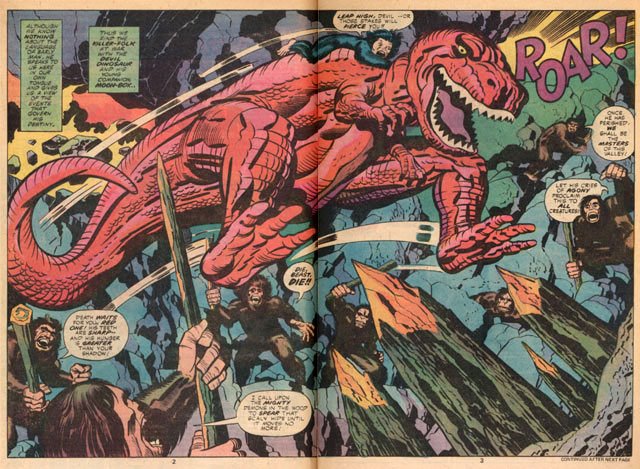
Devil Dinosaur #2.

According to Palin the two species coexisted 6,000 years ago, about 65 million years after dinosaurs are believed to have become extinct.
By Rachel Weiner / September 28, 2008

The LA Times reports:

Soon after Sarah Palin was elected mayor of the foothill town of Wasilla, Alaska, she startled a local music teacher by insisting in casual conversation that men and dinosaurs coexisted on an Earth created 6,000 years ago — about 65 million years after scientists say most dinosaurs became extinct — the teacher said.

After conducting a college band and watching Palin deliver a commencement address to a small group of home-schooled students in June 1997, Wasilla resident Philip Munger said, he asked the young mayor about her religious beliefs.

Palin told him that “dinosaurs and humans walked the Earth at the same time,” Munger said. When he asked her about prehistoric fossils and tracks dating back millions of years, Palin said “she had seen pictures of human footprints inside the tracks,” recalled Munger, who teaches music at the University of Alaska in Anchorage and has regularly criticized Palin in recent years on his liberal political blog, called Progressive Alaska.

The idea of a “young Earth” — that God created the Earth about 6,000 years ago, and dinosaurs and humans coexisted early on — is a popular strain of creationism.

Though in her race for governor she called for faith-based “intelligent design” to be taught along with evolution in Alaska’s schools, Gov. Palin has not sought to require it, state educators say.

In a widely-circulated interview, Matt Damon said of Palin, “I need to know if she really thinks that dinosaurs were here 4000 years ago. I want to know that, I really do. Because she’s gonna have the nuclear codes.”

Source / The Huffington Post

Thanks to Carl Davidson / The Rag Blog

Posted in RagBlog | Tagged , , , , , , | Leave a comment

The Poetry of Sarah Palin


Recent works by the Republican vice presidential candidate.
By Hart Seely / October 1, 2008

See some of Sarah Palin’s finest work, Below.

It’s been barely six weeks since the arctic-fresh voice of Alaskan poet Sarah Heath Palin burst upon the lower 48. In campaign interviews, the governor, mother, and maverick GOP vice presidential candidate has chosen to bypass the media filter and speak directly to fans through her intensely personal verses, spoken poems that drill into the vagaries of modern life as if they were oil deposits beneath a government-protected tundra.

Thursday’s nationally televised debate with Democrat Joe Biden could give Palin the chance to cement her reputation as one of the country’s most innovative practitioners of what she calls “verbiage.”

The poems collected here were compiled verbatim from only three brief interviews. So just imagine the work Sarah Palin could produce over the next four (or eight) years.

“On Good and Evil”

It is obvious to me
Who the good guys are in this one
And who the bad guys are.
The bad guys are the ones
Who say Israel is a stinking corpse,
And should be wiped off
The face of the earth.

That’s not a good guy.

(To K. Couric, CBS News, Sept. 25, 2008)

“You Can’t Blink”

You can’t blink.
You have to be wired
In a way of being
So committed to the mission,

The mission that we’re on,
Reform of this country,
And victory in the war,
You can’t blink.

So I didn’t blink.

(To C. Gibson, ABC News, Sept. 11, 2008)

“Haiku”

These corporations.
Today it was AIG,
Important call, there.

(To S. Hannity, Fox News, Sept. 18, 2008)

“Befoulers of the Verbiage”

It was an unfair attack on the verbiage
That Senator McCain chose to use,
Because the fundamentals,
As he was having to explain afterwards,
He means our workforce.
He means the ingenuity of the American.
And of course that is strong,
And that is the foundation of our economy.
So that was an unfair attack there,
Again based on verbiage.

(To S. Hannity, Fox News, Sept. 18, 2008)

“Secret Conversation”

I asked President Karzai:

“Is that what you are seeking, also?
“That strategy that has worked in Iraq?
“That John McCain had pushed for?
“More troops?
“A counterinsurgency strategy?”

And he said, “Yes.”

(To K. Couric, CBS News, Sept. 25, 2008)

“Outside”

I am a Washington outsider.
I mean,
Look at where you are.
I’m a Washington outsider.

I do not have those allegiances
To the power brokers,
To the lobbyists.
We need someone like that.

(To C. Gibson, ABC News, Sept. 11, 2008)

“On the Bailout”

Ultimately,
What the bailout does
Is help those who are concerned
About the health care reform
That is needed
To help shore up our economy,
Helping the—
It’s got to be all about job creation, too.

Shoring up our economy
And putting it back on the right track.
So health care reform
And reducing taxes
And reining in spending
Has got to accompany tax reductions
And tax relief for Americans.
And trade.

We’ve got to see trade
As opportunity
Not as a competitive, scary thing.
But one in five jobs
Being created in the trade sector today,
We’ve got to look at that
As more opportunity.
All those things.

(To K. Couric, CBS News, Sept. 25, 2008)

“Challenge to a Cynic”

You are a cynic.
Because show me where
I have ever said
That there’s absolute proof
That nothing that man
Has ever conducted
Or engaged in,
Has had any effect,
Or no effect,
On climate change.

(To C. Gibson, ABC News, Sept. 11, 2008)

“On Reporters”

It’s funny that
A comment like that
Was kinda made to,
I don’t know,
You know …

Reporters.

(To K. Couric, CBS News, Sept. 25, 2008)

“Small Mayors”

You know,
Small mayors,
Mayors of small towns—
Quote, unquote—
They’re on the front lines.

(To S. Hannity, Fox News, Sept. 19, 2008)

Source / Slate

The Rag Blog

Posted in RagBlog | Tagged , , , , | 4 Comments

Ron Ridenour: Sounds of Venezuela, Part II

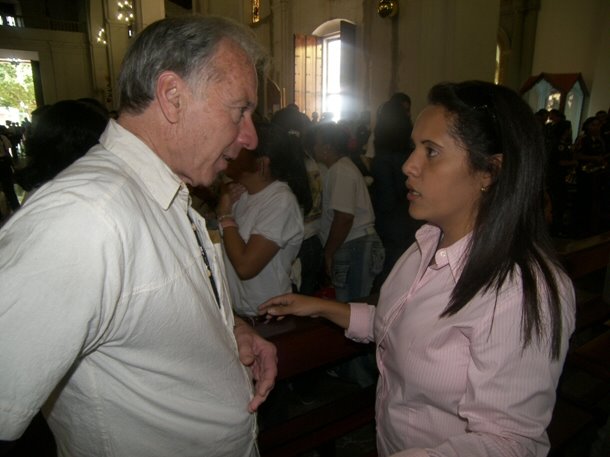
Rosa León in local church with writer during February 12 celebrations of La Victoria’s liberation from Spain. Photo: Ron Ridenour.

Click here to view the entire series.

Sounds of Venezuela
Part II: The Rose Lioness
By Ron Ridenour / The Rag Blog / October 1, 2008

On the day of our interview, Rosa drove alone to the main police station where we were to meet. She was only 90 minutes late. Here are highlights of the interview I taped.

Rosa León’s hope is to utilize more and more of the municipal budget for funding the needs of the people as they see fit. She launched the community councils and there are now 110 of them, although many do not function in reality. While the national government is responsible for building and maintaining the nation’s roadways each municipality has or can have some of its funds to repair city streets. Rosa said her administration had repaired three streets, a total of 7 kilometers. She’d started construction of potable water wells and repairs of others. Progress had been made in the sewage system albeit my ubiquitous, sensitive nose could not confirm that. There were housing projects underway, albeit she could not count more than four houses completed. She was still trying to get weapons for the majority of municipal police; her plan for integrating the three separate policing entities in the municipal area was nearing accomplishment. She believed that 32% of the 63 million Bolivar budget [2.15 Bolivars-BF to $1 at official rate] is dispersed to decentralized entities for social projects, plus one million BF to supplement the national government funds for educational and health missions, operating apart from government entities.

“I don’t have all the figures and projects with me. But you can get the budget from our office,” Rosa told me. “You have to realize that there is a great deal of opposition pressure and even sabotage against our efforts. This state government does not help the Chavez national government or my municipality. Part of our budget, at least four million Bolivars designated for local needs such as potholes, is controlled by the state government, and it has not released these funds to us. Furthermore, some of our budget must go to pay off the large debt [12 million BF] acquired by the previous corrupt mayor, Luis Blanco. He is a friend of Aragua’s governor Didalco Bolivar.

“My first year in government was spent evaluating the structures and learning the people’s needs. Then we began to allocate funds to barrio organizations. For example, we made paths in the hills where people live so that the old, pregnant and handicapped could walk out to the nearby markets and bus stops. We provided some paint for houses and walls. In 2006, social control of some projects began as the community councils took root.

Garbage collection is a major problem not only here but across the nation. The private companies weren’t doing a good job and were extremely costly so I didn’t renew the contracts and let the workers take over the recollection. The problem is they lack the trucks and other necessary equipment. The private companies took everything. We invested 4.5 million BF [7% of the budget] in recollection, in 2007. Almost no one pays tax for garbage collection. Our workers strive to do better but they need more equipment.”

Rosa explained that she had taken a two month leave of office at the end of 2007. She was under attack for fiscal inefficiency. She declared a financial emergency and went off to the state capital, Maracay, to fortify the community council network. Her lawyer cousin took over her mayoral tasks during that time.

“One of our greatest problems is internal,” Rosa confessed during our interview. “We have a tendency to be too casual in our statements and commitments. There is much fugaz [capriciousness]. We start things and don’t finish them; too much Corre Corre [haste and lack of follow through.] I had to go into debt and we’ve been paying it back since January 2008 when I returned to office.”

I mentioned that it would have been a good idea to plan replacement of equipment before ending the private garbage collection company contract. And what about an educational campaign to raise citizens’ consciousness about waste and trash? I recounted how I watch garbage workers come to pick up trash with bear hands—they don’t have gloves or masks—and right before their eyes people drop on the ground everything from cigarette butts and empty packets to food wrappings and empty bottles. Most people wrap their household trash in plastic bags and place them outside, seemly oblivious to the fact that dogs running rampant rip them up for whatever goodies there are inside. There are almost no trash cans. The streets and parks are constantly flooded with wastes. I also noted that the commercial media is 100% anti-Rosa and anti-Chavez and while they all find fault with garbage recollection, among everything else real and unreal, they do nothing to educate people to do their part. Why doesn’t the municipal government, and the political parties backing it, have any media?

“It is an error on my part, to some degree, not to have any media backing,” Rosa affirmed. “We do have some indirect access to two local alternative radio stations but some of the opposition has partial control too. All three local dailies are owned by capitalists and oppositionists. We have allocated a bit of money to creating a local radio station but its start has been delayed. The voceros should soon have a newsletter. And we have just hired a public relations man,” Rosa concluded.

In fact, it is about the same for commercial media on the national level. Of all the newspapers, radio and television stations the pro-Chavez parties and the government itself only control 20%. Practically all newspapers are capitalist owned and are nearly all pro-imperialist. The government only has one national radio station and four television stations. The greatest media asset is Telesur, a regional network begun by the Chavez government. I watch it regularly (also in Denmark) and find it to be professional and credible while delivering pro-socialist, pro-Chavez government plans. There is variety in programming, deep-probing interviews and documentaries, serious entertainment and films. Moreover, the national government has launched 500 community media initiatives in audiovisuals, press and radio stations.

The national opposition and the international mass media spread false propaganda that Chavez is thwarting media democracy. They most often cite the fact that the government refused to renew RCTV’s public license to broadcast, but they do not report the government’s documented reasons: RCTV regularly refused to devote the legally designated time for public service news, and had openly applauded the illegal, armed coup and did not even broadcast the national massive protests which brought him back to power. In fact, RCTV, which is the only medium to be denied public service broadcasting, still broadcasts over cable, which anyone can link up. I often watched it. One of its series concentrated on the poor quality of hospital care. A camera crew filmed inside some of the hospitals, showing real defects and deficiencies, such as: open sewage, dysfunctional medical equipment, broken beds, decaying walls, lack of medicines and low salaries for workers. One program showed sanitary workers complaining to the RCTV crew about these conditions and when hospital security personnel attempted to oust the crew, the medical personnel prevented them from doing so.

From what I have seen, heard and read about the media in the two dozen countries where I have lived and or worked as a journalist over the last four decades, Venezuelans experience the most comprehensive freedom of press extant in the world today.

Shortly after our interview, Rosa, who is studying Social Communication in her spare time, discussed with me the possibility of my assisting her administration and community councils with my journalistic skills. I might conduct radio interviews and lectures, help with the upcoming newsletter and the like. In fact, I did begin a bit before Rosa cut ties with me. I gave a journalistic lecture to the Mission Sucre Social Communication classes conducted at the local university. The 40 students ranged from teenagers to grandparents. They were attentive and inquisitive. They not only asked pertinent questions they also engaged me in debate and challenged some of my views.

Soon thereafter I went to Caracas hoping to interest the pro-Chavez media in the Danish court case concerning seven Danish activists who support FARC and the PFLP in their liberation efforts.

In November 2007, a three-judge Copenhagen court found the activists, “Fighter and Lovers”, innocent of the Justice Ministry’s charge that they had materially supported “terror groups” FARC (Revolutionary Armed Forces of Colombia) and PFLP (Popular Front for the Liberation of Palestine).

The seven solidarity activists had produced and sold t-shirts with FARC and PFLP emblems in an effort to raise a debate about Denmark’s terror law, which is shaped after USA’s Patriotic Act and EU’s terror list where FARC and PFLP appear. The lists are drawn behind closed doors by anonymous politicians whose criteria for selection are secret and the accused are denied rebuttal. Being on the list is therefore not juridical.

Among defense witnesses were the Venezuelan historian Amilcar Figueroa, alternative president of the Latin American Parliament (LAP), and Niels Lindvig, a Danish radio reporter with 25 years experience in covering Colombia and Latin America. They presented facts about President Alvaro Uribe’s ties to drug cartels and mercenaries. The defense referred to a 1991 US Defense Intelligence Agency report, which stated that Uribe collaborated with narcotic cartels (Pablo Escobar) when he was governor of Antioquia.

The court concluded that FARC and PFLP were not engaged in “terrorizing the population,” as is required in Danish law, paragraph 114, in order to be classified as terrorist. But the Danish government, which openly embraces Uribe and Bush, would not accept this decision and appealed the matter. (On September 18, 2008, the Eastern Lands Court voted 5 to 1 to overturn the lower decision that FARC and PFLP are not terrorist groups. Thus, it concluded six of the seven activists are guilty of supporting terror, and they were handed a sentence of from 60 days–suspended–to six months in prison for two of them. The defense is appealing to the Supreme Court.)

Chavez had gained wide acclaim for his humanitarian efforts to negotiate the release of civilian prisoners held by FARC in Colombia. He maintained the same position as “Fighters and Lovers”: that FARC is a legitimate liberation movement representing a majority of Colombia’s peasants in armed uproar for decades against a brutal oligarchy whose governments oppress them. I hoped that if he knew of the Danish court decision Chavez could use that to help sway some who oppose FARC for being terrorists. I was interviewed by the national daily VEA, a few local radio and TV stations and the national VIVE TV station, which reflects grass roots organizations. The interview most viewed was VTV’s “contra golpe” (counterpunch) program with Vanessa Davis. She was later elected on the 15-person leadership council of the new political party PSUV (United Socialist Party of Venezuela), into which 5.7 million of the population of 27 million had registered.

Vanessa Davis went straight to the theme of FARC—was it terrorist or not—and then to EXXON, which was trying to strangle Venezuela’s nationalization of its oil and gas. She gave no time to why I was here or where I lived, which would have allowed me to put in a plug for the La Victoria government of Rosa León. It would have been natural to do so but it was not priority. When I got back to La Victoria I was to meet with Rosa to solidify my role with her administration, but she gave me the cold shoulder for having failed to mention her on TV.

The Rag Blog

Posted in Rag Bloggers | Tagged | Leave a comment

Meet the New Rome, Same as the Old Rome


Will Wall Street’s Meltdown Turn America Into a Police State?
By Scott Thill / September 30, 2008.

Raw capitalism is dead.” — Henry Paulson, U.S. Treasury secretary

Can’t we just all go out and say things are OK?” — President Bush, to congressional leaders during bailout negotiations

I’m not much of an Army Times reader, but after reading that a brigade was shipping from Iraq in October to serve as “an on-call federal response force for natural or manmade emergencies and disasters, including terrorist attacks” in the homeland right before the election, my antennae perked up. Same as they did when I read that an electoral college doomsday scenario exists in which Dick Cheney casts the deciding vote that gives McCain-Palin the White House.

That is, if Cheney and Bush don’t take it for themselves. That may sound like fantasy, but don’t kill the messenger. They are all strands of the Gordian knot the Bush administration has tied around the neck of the American people for the last two presidential terms, best represented today by the failed bailout of banks, brokers and other complicit parties that have since jacked the American people out of trillions. And while the Army Times revelation or election doomsday may turn out to be paranoia rather than prescience, the evidence just isn’t there.

Like I said: antennae.

They’ve come in handy as bullshit detectors since Bush stole the election from a flat-footed Al Gore and set about engineering the greatest transfer of public wealth into private hands in American history. If you factor in Monday’s failed takeover, as well as the $5 trillion the American people now owe thanks to the “bailout” of Fannie Mae and Freddie Mac, not to mention the continuing hyper-expensive occupation of Iraq and so on, our citizenry is now so far in the hole that it’s pointless griping about numbers. If you want one, use the figure put forth by Dennis Kucinich: half a quadrillion dollars. We have evolved past the point of economic or geopolitical reality and entered a phase of pure concept.

And all vectors of that phase point toward the conclusion that the proverbial shit has totally hit the fan — head on, and all over again.

Meet the New Rome, Same as the Old Rome

“Franklin Roosevelt had to save capitalism from itself,” Los Angeles Times business editor Tom Petruno told me as Washington Mutual and Wachovia became the latest banking dominoes to fall. “Is history repeating?”

Indeed, it is, as one could tell from the repetitive usage of loaded terms and phrases like “Great Depression,” “meltdown,” “apocalypse,” “Armageddon” and more to describe the just-on-time cratering of the American economy. After the strange bedfellows in both parties torpedoed Bush, Bernanke and Paulson’s so-called bailout, more than $1 trillion of market value in American equities disappeared in a single day. The Dow Jones average set a record for quickest suicide dive in a single day. Other indexes sunk to multiyear lows, wiping out years of value, and stocks across the board went negative like Ann Coulter. In fact, the only major stock that actually advanced on Monday was Campbell Soup.

Can there be a more fitting metaphor for the American economy stuck beneath the Bush administration’s thumb?

But the reruns, and their loaded terminology, are merging: Bush himself is just another iteration of the infamous “New World Order” instituted by his father while trying to, what else, convince the American public that it needed to go to war against Saddam Hussein. The revisionism is transparent, befitting a government that cares nothing of what its people actually think. Jon Stewart of “The Daily Show” recently juxtaposed Bush’s address on the financial cataclysm with his pre-invasion speech in 2003 and found — surprise! — they were exactly the same.

This is a long way of saying that this particularly frightening crux of historical geopolitics, fascism and environmental calamity has been a long time coming. Failing banks? Deregulation. Endless war? Homeland security. Total information awareness? Transparent government. Bankrupt economy? The fundamentals are strong.

“Here’s my question,” Petruno adds. “If this is remembered as Black September, will that end up being too gentle a reference to what actually happened to the American financial system this month? It is beyond comprehension for people who have been on Wall Street their entire lives. I can only imagine how absolutely stunned the American public must be. Stunned, and very afraid.”

It should be. From a military brigade armed for action in the homeland in blatant transgression of Posse Comitatus to what ex-hedge funder and financial personality Jim Cramer recently called “financial terrorism,” the United States is pushing forward back.

To start with, the bailout was obvious theft, but our situation is more precarious than you think. The hyperreal credit default swap market, which few understand although it is estimated to involve tens if not hundreds of global trillions, is faltering under the weight of its own Ponzi origins. The scenario significantly worsens once you factor in the given that countries like China and others who have denominated their loans in dollars are shouldering our exploding debt, along with oil-soaked sovereign wealth funds from nations whose civil liberties records suck ass. As I wrote last year on this clusterfuck, if the Chinese call in our debts and oil-producing countries decide to peg their petrodollars to the euro, you can more or less kiss the dollar goodbye. Which means the last thing you’ll need to worry about is your stocks, retirement or credit cards. You will instead worry whether or not the cash you have on hand will be worth anything at all. That is the loaded gun that bankers, brokers and the White House is holding to the public’s head, as I write. That trillion erased on Monday, as well as the trillions that have been lost and will be lost in the coming months, was nothing more than a hostage situation engineered by the Bush administration, the Federal Reserve and their partners in crime in finance, insurance and real estate business.

They don’t call that sector FIRE for nothing. Fire destroys everything and leaves little in its catastrophic wake. Which raises the question: What’s left to burn?

“I think our economic situation can get much worse,” argues Danny Schechter, the veteran producer and author whose 2006 indie documentary “In Debt We Trust” covered this volatile territory long before CNN would. “Jobless claims are already at a seven-year high, but the government is worried about the reaction from Asia. We are living on other countries’ money, and when that spigot gets cut off, we will be in deeper doo-doo. Part of the reason for the scale of the bailout is to show Asia and sovereign wealth funds that we will protect their interests.”

But for how long? The Bush administration and Congress’ disdain for the American people has been painfully obvious, so it’s hard to believe they will call from sky-high Dubai to see how we are doing after making off with almost all of our money.

“It’s a high-stakes gamble, which is why Paulson tried to do it quickly in a climate of shock and crisis,” Shechter says. “He knew that the longer it takes, the more opposition it will attract. This plan, if eventually passed, will pre-empt the next president from doing anything about it, because there will be no money. They are wrecking the government by wrecking the economy first.”

That shock doctrine, as Naomi Klein explained in her brilliant book of the same name, has foisted this same kind of disaster capitalism on country after country over the last century. Klein’s book is littered with democracies that slept their way through coups and takeovers, entranced by one simulation or another. The United States was plugged into a matrix that onetime White House press secretary Ari Fleischer described as “an American way of life,” adding without deceit that “it should be the goal of policy makers to protect the American way of life.”

By destroying it? Mission accomplished.

“This is the September of surprise,” Schechter concluded, “not a war on Iran but on America.”

Civil War, the Rerun?

So, what’s the next step for the shoe yet to drop? Perhaps the Army Times has the clues:

(The brigade) may be called upon to help with civil unrest and crowd control or to deal with potentially horrific scenarios such as massive poisoning and chaos in response to a chemical, biological, radiological, nuclear or high-yield explosive, or CBRNE, attack. … The 1st BCT’s soldiers also will learn how to use “the first ever nonlethal package that the Army has fielded,” 1st BCT commander Col. Roger Cloutier said, referring to crowd and traffic control equipment and nonlethal weapons designed to subdue unruly or dangerous individuals without killing them.

Like every move the Bush administration has ever made, from the Patriot Act to the occupation of Iraq and down to bankrupting the American economy, this maneuver is a solution in search of a problem that it seems destined to create. Look around you. Housing is over. Stocks are nosediving. The banks are gone. War is ceaseless. Civil liberties are disappearing. Nerds at the Federal Reserve and the Treasury are taking hostages. It is madness.

And mad people have a tendency to infect everyone around them. The difference is that when you go mad … well, that’s the question mark: What will happen?

Ask the late Iman Morales, who went crazy in Brooklyn on a ledge 10 feet above ground and was illegally tasered by New York police officers, eventually falling to his death, immobilized. A perfect metaphor for our economy, sure, but it’s also the type of literal shock we might be awaiting, as the November election creeps nearer and shit begins to hit the fan with ferocity. Many of us so-called alternative journos are not conspiracy nuts, but realists. We look at galvanizing leaders like Barack Obama, America’s next president, and compare his impact to that of Lincoln, Kennedy or King — without forgetting that all three were eventually assassinated. We are the type of realists who live through two Bush presidents, both of whom configured a New World Order, with and without the approval of the American people and the world at large. The type of realists that notice that after 9/11, we couldn’t fly to Vegas, but Osama bin Laden’s family was flown out of the country on government charter.

And here is what we see today: Crowds protesting in the streets, the people’s money wiped out thanks to the Bush administration’s latest economic shock and awe. An army brigade matter-of-factly betraying Posse Comitatus for the purpose of crowd control. The public trust and wealth almost robbed cleanly with congressional approval.

In other words, we see another unfolding coup, which is to say, a rerun. And there is no telling what the future may hold, or whether or not we are connecting vectors that should remain solitary. But our math has worked just fine in the past — better than Ben Bernanke and Henry Paulson’s math, that’s for sure.

And we’d love to be wrong about what’s coming. But unfortunately that isn’t up to us, and it never has been: It’s up to the Bush administration. And it has never failed to let us down.

Scott Thill runs the online mag Morphizm.com. His writing has appeared on Salon, XLR8R, All Music Guide, Wired and others.

Source / AlterNet

The Rag Blog

Posted in RagBlog | Tagged , , | 1 Comment

Michael Moore : Bucks Not Delivered; People Say ‘No’


‘Hundreds of thousands of Americans woke up yesterday morning and decided it was time for revolt’
By Michael Moore / September 30, 2008

Everyone said the bill would pass. The masters of the universe were already making celebratory dinner reservations at Manhattan’s finest restaurants. Personal shoppers in Dallas and Atlanta were dispatched to do the early Christmas gifting. Mad Men of Chicago and Miami were popping corks and toasting each other long before the morning latte run.

But what they didn’t know was that . The politicians never saw it coming. Millions of phone calls and emails hit Congress so hard it was as if Marshall Dillon, Elliot Ness and Dog the Bounty Hunter had descended on D.C. to stop the looting and arrest the thieves.

The Corporate Crime of the Century was halted by a vote of 228 to 205. It was rare and historic; no one could remember a time when a bill supported by the president and the leadership of both parties went down in defeat. That just never happens.

A lot of people are wondering why the right wing of the Republican Party joined with the left wing of the Democratic Party in voting down the thievery. Forty percent of Democrats and two-thirds of Republicans voted against the bill.

Here’s what happened:

The presidential race may still be close in the polls, but the Congressional races are pointing toward a landslide for the Democrats. Few dispute the prediction that the Republicans are in for a whoopin’ on November 4th. Up to 30 Republican House seats could be lost in what would be a stunning repudiation of their agenda.

The Republican reps are so scared of losing their seats, when this “financial crisis” reared its head two weeks ago, they realized they had just been handed their one and only chance to separate themselves from Bush before the election, while doing something that would make them look like they were on the side of “the people.”

Watching C-Span yesterday morning was one of the best comedy shows I’d seen in ages. There they were, one Republican after another who had backed the war and sunk the country into record debt, who had voted to kill every regulation that would have kept Wall Street in check — there they were, now crying foul and standing up for the little guy! One after another, they stood at the microphone on the House floor and threw Bush under the bus, under the train (even though they had voted to kill off our nation’s trains, too), heck, they would’ve thrown him under the rising waters of the Lower Ninth Ward if they could’ve conjured up another hurricane. You know how your dog acts when sprayed by a skunk? He howls and runs around trying to shake it off, rubbing and rolling himself on every piece of your carpet, trying to get rid of the stench. That’s what it looked like on the Republican side of the aisle yesterday, and it was a sight to behold.

The 95 brave Dems who broke with Barney Frank and Chris Dodd were the real heroes, just like those few who stood up and voted against the war in October of 2002. Watch the remarks from yesterday of Reps. Marcy Kaptur, Sheila Jackson Lee, and Dennis Kucinich. They spoke the truth.

The Dems who voted for the giveaway did so mostly because they were scared by the threats of Wall Street, that if the rich didn’t get their handout, the market would go nuts and then it’s bye-bye stock-based pension and retirement funds.

And guess what? That’s exactly what Wall Street did! The largest, single-day drop in the Dow in the history of the New York Stock exchange. The news anchors last night screamed it out: Americans just lost 1.2 trillion dollars in the stock market!! It’s a financial Pearl Harbor! The sky is falling! Bird flu! Killer Bees!

Of course, sane people know that nobody “lost” anything yesterday, that stocks go up and down and this too shall pass because the rich will now buy low, hold, then sell off, then buy low again.

But for now, Wall Street and its propaganda arm (the networks and media it owns) will continue to try and scare the bejesus out of you. It will be harder to get a loan. Some people will lose their jobs. A weak nation of wimps won’t last long under this torture. Or will we? Is this our line in the sand?

Here’s my guess: The Democratic leadership in the House secretly hoped all along that this lousy bill would go down. With Bush’s proposals shredded, the Dems knew they could then write their own bill that favors the average American, not the upper 10% who were hoping for another kegger of gold.

So the ball is in the Democrats’ hands. The gun from Wall Street remains at their head. Before they make their next move, let me tell you what the media kept silent about while this bill was being debated:

1. The bailout bill had NO enforcement provisions for the so-called oversight group that was going to monitor Wall Street’s spending of the $700 billion;

2. It had NO penalties, fines or imprisonment for any executive who might steal any of the people’s money;

3. It did NOTHING to force banks and lenders to rewrite people’s mortgages to avoid foreclosures — this bill would not have stopped ONE foreclosure!;

4. It had NO teeth anywhere in the entire piece of legislation, using words like “suggested” when referring to the government being paid back for the bailout;

5. Over 200 economists wrote to Congress and said this bill might actually WORSEN the “financial crisis” and cause even MORE of a meltdown.

Put a fork in this slab of pork. It’s over. Now it is time for our side to state very clearly the laws WE want passed. I will send you my proposals later today. We’ve bought ourselves less than 72 hours.

Source / MichaelMoore.com

The Rag Blog

Posted in RagBlog | Tagged , , , , | 2 Comments

Experts Weigh in on the Financial Services Crisis


Bailout Burnout
By Lila Shapiro / September 29, 2008

Yesterday the house rejected Paulson’s $700 billion rescue plan 228-205. Today, Congress breaks for Rosh Hashanah. Between the finger pointing (It’s Nancy’s fault!!!!), and the mavericking, it’s hard to get a grasp on what the hell is happening. We here at TPM world headquarters profess no expertise in high-end economics so we’ve rounded up the reactions of various economists we trust and respect. The verdict: there has got to be a better way. Or, in Adam Levitin’s words, “So what did Congressional leadership do with this bailout bill? Put lipstick on a pig. I wonder how many Congressmen who voted for the bill know just how impotent the executive compensation, oversight, and homeowner protection provisions are. There’s a reasonable bailout bill that could be passed. But this wasn’t it.”

Robert Reich, former Secretary Of Labor and UC Berkeley professor

Don’t expect easier sailing in the Senate. Fewer than a third of the Senate is up for reelection on November 4, but they’re all hearing from angry constituents.

Prediction: A scaled-down bill will be enacted by the end of the week. It will provide the Treasury with a first installment of $150 billion. Treasury can use it to back Wall Street’s bad debts with lend no-interest loans of up to two years, until the housing market rebounds. Or to invest in Wall Street houses directly, in exchange for stocks and stock warrants. There will be strict oversight. Congressional leaders will promise further installments, but with conditions calling for limits on salaries and relief to distressed homeowners.

David Cay Johnston, Pulitzer Prize winning economic journalist

Maybe we will also get answers to some hard questions. Like:

–Why was the CEO of Goldman Sachs in the room when government officials decided to bailout the insurer AIG, especially since Goldman has about $20 billion, half of its shareholder equity, at risk on AIG? Keep in mind that Treasury Secretary Paulson is the immediate former CEO of Goldman.

–Why was Lehman Brothers, a Goldman competitor, the only Wall Street firm in trouble so far left to collapse on its own? The Wall Street Journal reports today that it was the collapse of Lehman (which because of its structure may not have been an attractive firm for purchase) that “triggered cash crunch around the globe.”

–Has Treasury obtained from every bank the amount of its illiquid assets, which would tell us if the problems are concentrated at a few banks or are pervasive?

–Would a temporary provision in the bankruptcy code, allowing people with toxic mortgages to get their loans rewritten or pursued to foreclosure, be a cheaper and better alternative?

Disclosure, transparency, options–those should be the issues in the next few days.

Dean Baker, co-director of the Center for Economic and Policy Research

This isn’t about begging for a sliver of equity as a concession for a $700 billion bailout, this is about constructing a bank rescue the way that business people would do it. We have an interest in a well-operating financial system. There is zero public interest in giving away taxpayer dollars to the Wall Street banks and their executives.

Jeffrey Miron, Visiting Professor in the Department of Economics at Harvard University

This bailout was a terrible idea. Here’s why.

The current mess would never have occurred in the absence of ill-conceived federal policies. The federal government chartered Fannie Mae in 1938 and Freddie Mac in 1970; these two mortgage lending institutions are at the center of the crisis…The fact that government bears such a huge responsibility for the current mess means any response should eliminate the conditions that created this situation in the first place, not attempt to fix bad government with more government.

The obvious alternative to a bailout is letting troubled financial institutions declare bankruptcy. Bankruptcy means that shareholders typically get wiped out and the creditors own the company.

Further, the current credit freeze is likely due to Wall Street’s hope of a bailout; bankers will not sell their lousy assets for 20 cents on the dollar if the government might pay 30, 50, or 80 cents.

Nouriel Roubini, professor of Economics at NYU

It is obvious that the current financial crisis is becoming more severe in spite of the Treasury rescue plan (or maybe because of it as this plan it totally flawed). The severe strains in financial markets (money markets, credit markets, stock markets, CDS and derivative markets) are becoming more severe rather than less severe in spite of the nuclear option (after the Fannie and Freddie $200 billion bazooka bailout failed to restore confidence) of a $700 billion package: interbank spreads are widening (TED spread, swap spreads, Libo-OIS spread) and are at level never seen before; credit spreads (such as junk bond yield spreads relative to Treasuries are widening to new peaks; short-term Treasury yields are going back to near zero levels as there is flight to safety; CDS spread for financial institutions are rising to extreme levels (Morgan Stanley ones at 1200 last week) as the ban on shorting of financial stock has moved the pressures on financial firms to the CDS market; and stock markets around the world have reacted very negatively to this rescue package (US market are down about 3% this morning at their opening).

Floyd Norris, chief financial correspondent of The New York Times

The banking industry is in trouble with or without this bailout. Its efforts to change accounting rules to hide its problems are sad and appalling. The defeated bill would have authorized the Securities and Exchange Commission to suspend the mark-to-market rule, which forced the banks to admit how badly they had gambled and lost. The S.E.C. has already yielded to political pressure and barred short-selling in financial stocks, so it is possible it would yield to the accounting pressure as well.

“Truth is the first casualty,” is an old line to describe war reporting. It could also apply financial reporting at a time of crisis.

James Galbraith, senior scholar with the Levy Economics Institute and chair of the board of Economists for Peace and Security

In short, as I said at the beginning, the bill is a vast improvement over the original Treasury proposal. Given the choice between approving or defeating the bill as it stands, I would urge supporting the bill. I do so without illusions. There need be no pretense that it will solve our underlying financial and economic problems. It will not. The purpose, in my view, is to get the financial system and the economy through the year, and into the hands of the next administration. That is a limited purpose, but a legitimate purpose. And it may be the most that can be accomplished for the time being.

Read all of it here. / Talking Points Memo

Thanks to Diane Stirling-Stevens / The Rag Blog

Posted in RagBlog | Tagged , , | 1 Comment

Ron Ridenour: Sounds of Venezuela, Part I

This is the first of an eleven-part series from long-time activist, traveller, and author Ron Ridenour. He very kindly asked us to publish this wonderful story of his experiences in Latin America titled Sounds of Venezuela. We will publish a new episode daily for the next 10 days. We hope you enjoy it.

Richard Jehn / The Rag Blog

Una hamburguesa!? Un sandwich? NO!! Un “Pepito”!!!
En “La Calle del Hambre” (Caracas). Photo credit: dvanguardia

Click here to view the entire series.

Sounds of Venezuela
Part I: Hunger Street
By Ron Ridenour / The Rag Blog / September 30, 2008

I lived at the end of Hunger Street.

My ubiquitous nose quivered with smells of grilled meats smothered in spicy sauces. The warm humid air urged enticing odors inwardly as I passed the row of food stands on the short street, La Calle de Hambre, walking with bags in hands towards the wooden house behind the mango tree budding green.

My mission: absorb the new Venezuela vibrating with change, advancing essential life conditions for the multitudes of poor, rebuilding the vast fallowed lands, bringing pride throughout this magnificent undulating land; bringing strife, as well, from the national rich and powerful, and spewing sulfur from Bushland.

A wonderful revolutionary guide was provided. Diego found me a humble room in the family house where I lived for two months amongst a lively variety of insects, reptiles and rodents; ducking under falling plaster, falling asleep between hair-raising car alarms ticked off by black cats.

Diego warned me right off: Don’t go out alone after dark; always keep your gate and door locked; beware of speaking as a revolutionary; use deodorant on your smelly armpits.

This former soldier side-kick of rebellious commandant Hugo Chavez—a man of the people—took me into people’s real lives. Diego, his suave, tight-lipped smile hovering above a bushy black mustache, showed the way into their homes, their offices, work places, land cooperatives, into their schools, even into the mayor’s office.

Rosa León, The Rose Lioness, won La Victoria’s 2004 mayor election with 56% of the votes in which 54 political parties participated as well as three independent candidates. (Only 40% of the voting population, however, went to the polls.) Her party, the Venezuela Revolutionary Movement (MVR), led with 39% in the nine-party leftist coalition. Her rival, Mayor Luis Blanco and his nine-party coalition, lost with 27% of the vote.

I cite these uncontested figures as an example of how democratic and fair the many elections have been since Hugo Chavez first won the presidency. There have been a dozen elections since 1998 for presidency and or the legislature, state and local posts, and national referendums. The only one Chavez lost was the referendum in December 2007—by one percent of the vote—which would have deepened the transfer of power and benefits for the working class; and it would have allowed any president to run for that office continuously, as is the case in many European democracies.

León won a legislative seat in this state of Aragua, in 2000, upon graduating with a law degree at age 23. She had gained the respect of the dashing uproar President Hugo Chavez when she campaigned for his presidency and then defended it when he was forcibly removed in a coup d´état, in April 2002, backed by most mass media and the US.

Once elected mayor of the Municipality of Ribas, Rose embarked on her mission of “turning power over to the people,” “…creating equity, cooperation, liberty and social justice.” She sought to benefit the vast numbers of poor and disadvantaged in this municipality of 140,000. Some projects began to take seed within the budding grass roots democracy. Others floundered. Some never began. Many grew disillusioned. The Lioness was in trouble.

And in comes old revolutionary gringo Ron!

A community worker introduced me to Rosa at the 23rd of January celebration in the barrio by the same name. That day, half-a-century ago, tens of thousands of the poor in Caracas stormed the streets to oust one of the Pentagon’s favorite dictators, General Marcos Pérez Jiménez. Leftist political parties protested too; unionists struck. The mass forced Jiménez’ to flee; the bourgeoisie consolidated to maintain power. The left remained ineffective. Some took the decisive step to engage in guerrilla warfare, including the Communist party (PCV), but that failed. Soldier Chavez tried a military rebellion in 1994. That failed. In 1996, upon his early release from prison, Chavez forged a broad coalition of the poor and progressives to engage in parliamentary process, which succeeded in 1999.

The streets of this poor barrio, like hundreds more throughout the nation bearing the honorable name, filled with people chatting, some held forth hands and good advice to the young mayor. There were police too. Many were unarmed women with fair public rapport.

Rosa gave me a warm handshake. We agreed to an interview in a few days. In the intervening time, I visited a Mission Ribas in which hundreds of thousands throughout the nation, who had not been able to go to school, learn basic reading, writing, arithmetic skills. I spoke with social workers, voceros (spokespersons) of the new community councils, and people on the streets. I heard praise and complaints of the revolutionary process. Most were still quite enthused by President Chavez but most were also so critical of Rosa León that many asserted they would not vote for her again in the next elections (November 23, 2008) for 23 state governors and 335 municipal mayors. The majority of elected leaders are supporters of the Bolivarian Revolution. The right-wing feels hopeful in scaling down Chavez backed elected leaders.

The Bolivarian Revolution’s mainstay is its 20 missions, which President Chavez launched beginning in July 2003. Mission Robinson eradicated illiteracy with the use of Cuban techniques and personnel. In two years, 99% of the 1.5 million illiterates had learned to read and write and Venezuela declared itself “Territory Free of Illiteracy”. The other missions seek to end poverty, implement social welfare programs, reduce environmental degradation, provide comprehensive and community heath care, construct new housing for the poor, restore communal land titles and human rights to Venezuela’s numerous indigenous communities, expropriate and redistribute lands to the poor, and foster an economy that brings “a quality and dignified life for all.”

Some 70,000 Cuban experts assist these missions, as well as in other areas.

Life of most Venezuelans has clearly improved during the Chavez years. According to governmental statistics, 2007, indications include: social consumption per person has increased by 300%; GNP has sky-rocketed by 100% with about 10% annual growth; poverty has fallen from 51% to 25%.

But people complain and, perhaps, even more so when their living conditions are improving but are yet insufficient. In La Victoria rumors have it that Rosa has a helicopter and is afraid to be in some areas. The rich and right-wing, even some workers and poor people, blame Rosa for everything from not ending the corruption chronic among local politicians and civil servants, the high murder and theft rates, to the omnipresent potholes.

The Rag Blog

Posted in Rag Bloggers | Tagged | 2 Comments

Wall Street Bailout and the Republican Right : Far from Populist Heroes!

Sandra Hines, of Detroit, who said she lost her home after 40 years, speaks at the Spirit of Detroit statue to protest the government bailout of financial institutions on Thursday, Sept. 25, 2008 in Detroit. Photo by Rashaun Rucker / Detroit Free Press.

The real reason conservatives led the fight against the bailout deal
By Joshua Holland / September 30, 2008

On Monday, the Bush administration’s massive Wall Street bailout went down to a narrow defeat in the House. After the 228-205 vote, markets crashed, and the usual partisan finger-pointing followed. According to the Washington Post, Speaker Nancy Pelosi “maintained that Democrats ‘delivered on our side of the bargain’ by getting 60 percent of House Democrats to support a bill that was built around the Bush administration’s proposal, whereas 67 percent of House Republicans voted against it.”

At first glance, it may appear that the 133 House Republicans who broke with their party’s leadership did so out of principle — that they bravely stood up against a massive cash transfer to those most responsible for precipitating the financial crisis in the first place. They appeared to be gambling a lot in taking that principled position, despite the fact that the bailout had drawn fire from across the political spectrum. The conventional wisdom, after all, has gelled around the idea that only an unprecedented cash infusion into the ailing banking system will stave off a potential Next Great Depression. The message many rebellious conservatives sent was that it takes courage to roll the dice with the world’s economy six weeks before an election, even if the public was deeply skeptical of the measure (the reality is that almost none of the lawmakers who face tight races this fall voted for the bailout, fearing a backlash from voters; Congress is not known for courage or principle on the eve of an election).

And there’s no question that the bill they and 95 of their Democratic colleagues killed was an extremely bad one, even if some token nods to “Main Street” had been added to help it go down lawmakers’ throats more smoothly. Democrats abandoned a key provision — one vehemently opposed by lenders — to allow bankruptcy judges to modify mortgages that are in the process of foreclosure, and they accepted only token limits on executive compensation for companies that would be rescued under the plan (PDF). Worst of all was a vaguely worded provision that might have allowed the Treasury to buy up bad paper at the price at which it was originally booked, rather than at those securities’ largely unknowable but deeply diminished current value. That would have essentially given a small investor class an opportunity to recover its losses at the expense of the American taxpayer (and future taxpayers, as the bailout would be financed through debt).

But a deeper look reveals another picture of the legislative fight that has occupied Washington since George W. Bush first proposed the bailout. Unlike most House Democrats, who voted against the bill in an attempt to send the plan back to the drawing board to get a deal that might better protect taxpayers and homeowners, House conservatives torpedoed the measure in order to advance their own alternative “bailout,” one that’s an ideologically motivated back door to bailing out Wall Street without doing anything for Main Street.

The plan is notably light on detail, even for campaign season, when politicians are loath to discuss the fine points of any proposal. But based on what can be gleaned from media reports, the heart of the “alternative” scheme is for the government to sell insurance for securities based on bad loans, rather than buy up the paper directly. Supposedly, the premiums would be high enough to assure that Joe and Jane taxpayer don’t get fleeced.

On its face, that idea seems both fiscally sound and decidedly conservative, in the traditional sense of the word.

But remember what the immediate problem we face is all about. The financial industry is weighed down by an enormous shit pile of bad paper — mortgage-backed securities, complex derivatives and insurance-like instruments that were supposed to make all these “creative” investment vehicles somewhat sound. That shit pile, impossible to value accurately, is threatening the whole economy, as lenders hunker down and hold onto their cash reserves in an attempt to ride out the storm of foreclosures, and that’s making it tough for businesses and consumers to get credit they need to expand their operations or buy new gizmos.

That’s not a situation that lends itself to a government-backed insurance policy. If the premiums aren’t deeply subsidized by the American public, they’ll be out of reach of troubled banks by definition — after all, if they had enough cash to cover their bad debts, which will ultimately be the job of the insurer (that’s you, me and the people we know), then they wouldn’t find themselves on the brink of collapse to begin with. That means the government would still end up effectively buying up the banks’ worthless paper piece by piece as the underlying assets on which that paper is written go belly-up. Think of it as the government selling fire insurance for houses that are already ablaze.

So the point was not to spare the taxpayer the expense of Wall Street’s shit pile. By offering an alternative plan, House conservatives abandoned a negotiating process that was, at heart, about trying to modify the disastrous Bush-Paulson plan so that it didn’t just bail out the financial sector’s movers and shakers without getting some concessions for working America.

The other two tenets of the alternative plan are worse still.

In keeping with the tradition of a party that has one policy solution to all economic ills — cutting taxes on the wealthy — the conservatives who bucked their leaders also suggested cutting capital gains taxes, even if only on a temporary basis. It’s a triumph of ideology over common sense. We’ve seen stock markets tanking, as investors flee like rats from a sinking ship, seeking safer ground in commodities, which have gone through the roof (oil prices have been moderated somewhat by expectations of a long slowdown that would cut demand). A tax holiday on capital gains would only encourage those investors with steely nerves (and gains) who are staying in the market to join the herd, getting out while it’s tax-free to do so. That can only send the already sky-high prices for food, energy and everything else even higher into the stratosphere. Ordinary working people would end up paying on both sides of the deal — getting soaked for Wall Street’s Reckless Lending Insurance and then paying through the nose to put food on the table.

Adding insult to injury is the third leg of the “alternative” bailout plan: more deregulation of the financial sector.

That’s nothing short of breathtaking in its audacity. It was a lax regulatory environment that brought us to the verge of collapse in the first place. Exotic security-backed loans — loans that didn’t conform to the standards in place for banks that held deposits, including subprime loans, mortgages given to people who misstated their income and loans with heavy prepayment penalties and huge balloon payments — are, as one would expect, faring far worse than the kinds of traditional loans that are regulated by the Federal Housing Authority or backed by Fannie Mae. Regulations passed by Congress only three months ago, as the depth of the meltdown had become clear, made “coercing a real estate appraiser to misstate a home’s value” and “making a loan without regard to borrowers’ ability to repay the loan from income and assets other than the home’s value” a no-no; if similar commonsense regulations had been in place over the past decade, the run-up of the real estate market wouldn’t have been as frenzied, and we wouldn’t see the skyrocketing number of foreclosures we’re witnessing today.

Again, none of this is to suggest that Americans should shed a tear for the demise of the compromise deal struck between Treasury Secretary Paulson and the Bush administration — it was a bad deal that deserved to go down in flames. But it’s also becoming increasingly evident that some sort of intervention is necessary to prevent the crisis from spreading through the entire global economy. Rather than pugnaciously cling to a failed ideology by heaping lucre on the wealthiest in the hope that it trickles down to the rest of us, Congress should be going back to the drawing board and coming up with a bailout plan rooted in a modicum of economic justice.

The House conservatives who have proven to be such a fly in the ointment are trying to go the other way — cooking up a plan that will only deepen Main Street’s pain in the name of saving it from Wall Street’s predations.

Source / AlterNet / Progressives for Obama

Thanks to Carl Davidson / The Rag Blog

Posted in RagBlog | Tagged , , , , , , | Leave a comment

Apocalypse Soon? : The World Keeps Getting Hotter

Eden adjusted by climate change 2005 by James Gleeson.

Carbon is building up in the atmosphere at a much faster pace then previously thought
By Juliet Eilperin / September 26, 2008

The rise in global carbon dioxide emissions last year outpaced international researchers’ most dire projections, according to figures being released today, as human-generated greenhouse gases continued to build up in the atmosphere despite international agreements and national policies aimed at curbing climate change.

TyIn 2007, carbon released from burning fossil fuels and producing cement increased 2.9 percent over that released in 2006, to a total of 8.47 gigatons, or billions of metric tons, according to the Australia-based Global Carbon Project, an international consortium of scientists that tracks emissions. This output is at the very high end of scenarios outlined by the Intergovernmental Panel on Climate Change (IPCC) and could translate into a global temperature rise of more than 11 degrees Fahrenheit by the end of the century, according to the panel’s estimates.

“In a sense, it’s a reality check,” said Corinne Le Quéré, a professor at the School of Environmental Sciences at the University of East Anglia and a researcher with the British Antarctic Survey. “This is an extremely large number. The emissions are increasing at a rate that’s faster than what the IPCC has used.”

The new statistics also underscore the growing contribution to the world’s “carbon budget” from rapidly industrializing countries such as China, India and Brazil. Developing nations have roughly doubled their carbon output in less than two decades and now account for slightly more than half of total emissions, according to the new figures, up from about a third in 1990. By contrast, total carbon emissions from industrialized nations are only slightly higher than in 1990.

“What’s happening is the major developed countries’ plans are converging for emissions growth that will stop and be able to come down significantly,” said James L. Connaughton, who chairs the White House Council on Environmental Quality. “But that’s being completely overtaken now by the increasing greenhouse gas emissions in developing counties. It underscores the need for a broader and more aggressive effort by the major economies to come together.”

It is unclear how much industrialized countries will be able to reduce their carbon output in the years to come, regardless of whether developing nations seek to restrain their greenhouse gas emissions. The federal government predicts that U.S. fossil fuel consumption will increase, not decrease. Japan, Canada and several other countries that committed to reducing their carbon emissions under the 1997 Kyoto Protocol have fallen far behind in meeting their targets.

Moreover, new scientific research suggests Earth is already destined for a greater worldwide temperature rise than previously predicted. Last month, two scientists from the Scripps Institution of Oceanography and the University of California at San Diego published research showing that even if humans stopped generating greenhouse gases immediately, the world’s average temperature would “most likely” increase by 4.3 degrees Fahrenheit by the end of this century. Writing in the journal Proceedings of the National Academy of Sciences, they based their calculations on the fact that new air-quality measures worldwide are reducing the amount of fine particles, or aerosols, in the atmosphere and diminishing their cooling effect.

The IPCC has warned that an increase of between 3.2 and 9.7 degrees Fahrenheit could trigger massive environmental changes, including major melting of the Greenland ice sheet, the Himalayan-Tibetan glaciers and summer sea ice in the Arctic. The prediction that current emissions put the planet on track for a temperature rise of more than 11 degrees Fahrenheit, Le Quéré said, means the world could face a dangerous rise in sea level as well as other drastic changes.

Richard Moss, vice president and managing director for climate change at the World Wildlife Fund, said the new carbon figures and research show that “we’re already locked into more warming than we thought.”

“We should be worried, really worried,” Moss said. “This is happening in the context of trying to reduce emissions.”

The new data also show that forests and oceans, which naturally take up much of the carbon dioxide humans emit, are having less impact. These “natural sinks” have absorbed 54 percent of carbon dioxide emissions since 2000, a drop of 3 percent compared with the period between 1959 and 2000.

Connaughton argued that the Bush administration’s “major economies” meetings, a series of talks among both developed and rapidly industrializing nations, have moved the world closer toward achieving significant cuts in greenhouse gases because the group is developing a common measurement system for emissions and is exploring how different industrial sectors can commit to worldwide reductions.

“We are unquestionably moving toward each other,” he said of the industrialized and developing countries, “but there’s a ways to go.”

But Moss, who characterized the latest round of negotiations as “a lot of talk but not much action,” said the administration cannot expect emerging economies to constrain their carbon emissions when the United States has yet to adopt binding targets for cutting its greenhouse gases. He noted that since 1990, the United States has released about 30 gigatons of carbon into the atmosphere, compared with China’s seven gigatons and India’s one.

“We really do have to start showing some leadership and start doing some changes ourselves,” he said. “If we did that, China and India, which are developing rapidly, would be willing to come along.”

Source / Washington Post

The Rag Blog

Posted in RagBlog | Tagged , , | 1 Comment

The Era of American Dominance Is Over


A shattering moment in America’s fall from power
By John Gray / September 28, 2008

The global financial crisis will see the US falter in the same way the Soviet Union did when the Berlin Wall came down. The era of American dominance is over

Our gaze might be on the markets melting down, but the upheaval we are experiencing is more than a financial crisis, however large. Here is a historic geopolitical shift, in which the balance of power in the world is being altered irrevocably. The era of American global leadership, reaching back to the Second World War, is over.

You can see it in the way America’s dominion has slipped away in its own backyard, with Venezuelan President Hugo Chávez taunting and ridiculing the superpower with impunity. Yet the setback of America’s standing at the global level is even more striking. With the nationalisation of crucial parts of the financial system, the American free-market creed has self-destructed while countries that retained overall control of markets have been vindicated. In a change as far-reaching in its implications as the fall of the Soviet Union, an entire model of government and the economy has collapsed.

Ever since the end of the Cold War, successive American administrations have lectured other countries on the necessity of sound finance. Indonesia, Thailand, Argentina and several African states endured severe cuts in spending and deep recessions as the price of aid from the International Monetary Fund, which enforced the American orthodoxy. China in particular was hectored relentlessly on the weakness of its banking system. But China’s success has been based on its consistent contempt for Western advice and it is not Chinese banks that are currently going bust. How symbolic yesterday that Chinese astronauts take a spacewalk while the US Treasury Secretary is on his knees.

Despite incessantly urging other countries to adopt its way of doing business, America has always had one economic policy for itself and another for the rest of the world. Throughout the years in which the US was punishing countries that departed from fiscal prudence, it was borrowing on a colossal scale to finance tax cuts and fund its over-stretched military commitments. Now, with federal finances critically dependent on continuing large inflows of foreign capital, it will be the countries that spurned the American model of capitalism that will shape America’s economic future.

Which version of the bail out of American financial institutions cobbled up by Treasury Secretary Hank Paulson and Federal Reserve chairman Ben Bernanke is finally adopted is less important than what the bail out means for America’s position in the world. The populist rant about greedy banks that is being loudly ventilated in Congress is a distraction from the true causes of the crisis. The dire condition of America’s financial markets is the result of American banks operating in a free-for-all environment that these same American legislators created. It is America’s political class that, by embracing the dangerously simplistic ideology of deregulation, has responsibility for the present mess.

In present circumstances, an unprecedented expansion of government is the only means of averting a market catastrophe. The consequence, however, will be that America will be even more starkly dependent on the world’s new rising powers. The federal government is racking up even larger borrowings, which its creditors may rightly fear will never be repaid. It may well be tempted to inflate these debts away in a surge of inflation that would leave foreign investors with hefty losses. In these circumstances, will the governments of countries that buy large quantities of American bonds, China, the Gulf States and Russia, for example, be ready to continue supporting the dollar’s role as the world’s reserve currency? Or will these countries see this as an opportunity to tilt the balance of economic power further in their favour? Either way, the control of events is no longer in American hands.

The fate of empires is very often sealed by the interaction of war and debt. That was true of the British Empire, whose finances deteriorated from the First World War onwards, and of the Soviet Union. Defeat in Afghanistan and the economic burden of trying to respond to Reagan’s technically flawed but politically extremely effective Star Wars programme were vital factors in triggering the Soviet collapse. Despite its insistent exceptionalism, America is no different. The Iraq War and the credit bubble have fatally undermined America’s economic primacy. The US will continue to be the world’s largest economy for a while longer, but it will be the new rising powers that, once the crisis is over, buy up what remains intact in the wreckage of America’s financial system.

There has been a good deal of talk in recent weeks about imminent economic armageddon. In fact, this is far from being the end of capitalism. The frantic scrambling that is going on in Washington marks the passing of only one type of capitalism – the peculiar and highly unstable variety that has existed in America over the last 20 years. This experiment in financial laissez-faire has imploded.While the impact of the collapse will be felt everywhere, the market economies that resisted American-style deregulation will best weather the storm. Britain, which has turned itself into a gigantic hedge fund, but of a kind that lacks the ability to profit from a downturn, is likely to be especially badly hit.

The irony of the post-Cold War period is that the fall of communism was followed by the rise of another utopian ideology. In American and Britain, and to a lesser extent other Western countries, a type of market fundamentalism became the guiding philosophy. The collapse of American power that is underway is the predictable upshot. Like the Soviet collapse, it will have large geopolitical repercussions. An enfeebled economy cannot support America’s over-extended military commitments for much longer. Retrenchment is inevitable and it is unlikely to be gradual or well planned.

Meltdowns on the scale we are seeing are not slow-motion events. They are swift and chaotic, with rapidly spreading side-effects. Consider Iraq. The success of the surge, which has been achieved by bribing the Sunnis, while acquiescing in ongoing ethnic cleansing, has produced a condition of relative peace in parts of the country. How long will this last, given that America’s current level of expenditure on the war can no longer be sustained?

An American retreat from Iraq will leave Iran the regional victor. How will Saudi Arabia respond? Will military action to forestall Iran acquiring nuclear weapons be less or more likely? China’s rulers have so far been silent during the unfolding crisis. Will America’s weakness embolden them to assert China’s power or will China continue its cautious policy of ‘peaceful rise’? At present, none of these questions can be answered with any confidence. What is evident is that power is leaking from the US at an accelerating rate. Georgia showed Russia redrawing the geopolitical map, with America an impotent spectator.

Outside the US, most people have long accepted that the development of new economies that goes with globalisation will undermine America’s central position in the world. They imagined that this would be a change in America’s comparative standing, taking place incrementally over several decades or generations. Today, that looks an increasingly unrealistic assumption.

Having created the conditions that produced history’s biggest bubble, America’s political leaders appear unable to grasp the magnitude of the dangers the country now faces. Mired in their rancorous culture wars and squabbling among themselves, they seem oblivious to the fact that American global leadership is fast ebbing away. A new world is coming into being almost unnoticed, where America is only one of several great powers, facing an uncertain future it can no longer shape.

• John Gray is the author of Black Mass: Apocalyptic Religion and the Death of Utopia (Allen Lane).

Source / The Observer

The Rag Blog

Posted in RagBlog | Tagged , , | Leave a comment

Larry Piltz : Bush’s Final Jenga Surprise


Jingo Bush Pulls Out the Last Piece and the Tower Comes Tumbling Down
By Larry Piltz / The Rag Blog / September 30, 2008

1st Jenga piece: The 9/11 Attacks – Bush, with his “9/10 mentality” and bring-it-on, laissez-faire national security policy, dared fate and the 9-11 attacks to occur by ignoring the CIA’s red alerts, canceling already ongoing follow-the-money al Qaeda investigations, and replacing the successful previous North American air defense protocol with one answering ultimately to blithering Reichsmarshall Cheney only, effectively leaving America’s chin open.

2nd Jenga piece: A Divided Homeland – Bush, wielding egregious lies, convoluted logic, a sadistic cynicism, and blatant fearmongering, divided and conquered the American people and hyperpartisanized the politics of the country, when its unity and solidarity would actually have been the very best weapon against terrorism, a foolish and sinister Bush intention and legacy that may never end.

3rd Jenga piece: The Unnecessary Iraq Tragedy – Bush wasn’t emotionally developed or smart enough to resist his Mad Adventure in Iraq, the beginning in earnest of the withering of the United States, militarily and financially. Bye bye, hyperpower status. Bye bye, unipolar world. Move over and make room, England, France, Holland, and Spain. Hey, China, save a seat for us on the moon, and can we hitch a ride?

4th Jenga piece: Afghanistan II – Bush largely abandoned Afghanistan, intentionally ignored it, starved it of attention and aid, and was quite smugly satisfied with the successful narco-state there that he and his local allied warlords crafted, thereby enabling the inevitable rise of the expanded Neo-Taliban, seemingly as if an endless terror war was what Bush had in mind all along. Nah, couldn’t be, could it?

5th Jenga piece: The Destabilization of Nuclear Pakistan – Bush sided with the dictator despite the Pakistani general’s permissiveness with al Qaeda’s top leadership, undermining Pakistani democracy, and, now that the dictator’s out, is undermining the new democratically elected president with cross-border attacks. Does Bush want an excuse to commandeer Pakistan’s nukes? Well, he’s creating one.

6th Jenga piece: Bush’s Nuclear Cold War with Putin’s Russian Soul – Bush has expedited the arming and training of the militaries of the new proxy “democracies” on Russia’s borders and has corrupted their politicians with the temptation of NATO membership, and Bush “looked the other way” as Georgia invaded and devastated Russian border ally Lower Ossetia. Remember how great the first Cold War was? Don’t worry. It’s never too late for nuclear winter!

7th Jenga piece: The Very Bad Awful Horrible Wall Street Scam & Sting – Wall Street’s big-time Ponzi-pyramid scheme will impoverish the federal government for at least two decades to come, but it’s all in a presidency’s work for the lazy-faire Bush, who brought us the first six Jenga pieces. This Nightmare on Main Street is the Mother of All Fleeces and could have been avoided had Bush’s intention had not been to help drown the federal government in the proverbial bathtub. We don’t need no stinking oversight!?

8th Jenga piece: Believe It Or Not It’s The Iran War Oh My God – Here we go, batten your hatches, because now Bush is going to attack Iran. The new ballistic missile-tracking radar is in place in Israel just in time for October, the expanded carrier/amphibious fleet is in place in and around the Persian Gulf, Subservient Saint Genius Petraeus is newly in charge of the entire Theater of War, and McCain’s campaign has screwed things up so badly that an October Surprise has become not an option but a requirement to keep intact the whole giant con game against America by the mostly Republican branch of the oligarchy. Watch for a CIA false-flag operation in the Gulf. Watch your back. It could be after the election, though.

With Bush’s pulling of the 8th Jenga piece, when Iran implements its justified counter-operations, the whole fantastic tower would come down. The economy would crash, and martial law will burn the elections. It would be bye bye, democracy, and hello, end of the Republic as we think we’ve known it. My only consolation, though mixed for his sake, is that Gore Vidal may still be around to see his prediction literally come true. But I’d bet even he didn’t see it happening all under one president. J-J-J-Jenga!

The Rag Blog

Posted in Rag Bloggers | Tagged , , , , | 4 Comments

Retired Physician : Our Health Care System an Outrage


‘The insurance industry, and the Republican Party, over the years have sold the public a bill of goods’
By S. R. Keister / The Rag Blog / September 30, 2008

I have been reading Vincent Bugliosi’s “The Prosecution of George W. Bush for Murder”. Mr. Bugliosi is very, very angry, a justifiable anger, perhaps akin to Zola’s anger when he penned “‘J’Accuse.” Perhaps in today’s world there should be increased justifiable anger. Perhaps if the nation would become aroused we, the citizens of The United States, could accomplish something with well directed, intelligently utilized anger. Perhaps we could awaken the dumbed down citizen who spends his/her time before a TV set, believing every word, to stand up for their own interests instead of believing in the propaganda that they are inundated with.

I am very, very angry. I am angry that I am an old retired physician with a malignancy. But I am especially angry at the state of health care in this country, a system of which I was proud when I started practice in the 1950s, but which, by the perfidy of the insurance and pharmaceutical industries has become one of the least desirable in the free world. Our health care currently ranks 25th in the world according to The Commonwealth Fund. I cringe when I see notices on public bulletin boards announcing a fund raiser at a fire hall for a child who needs money for a kidney transplant. Only in the United States!

I am angry when I hear seemingly intelligent folks say, “I wouldn’t want ‘socialized medicine’,” yet they accept Medicare or government retirement health care and are too stupid to realize that they are receiving “socialized medicine.” The insurance industry, and the Republican Party, over the years have sold the public a bill of goods. Most every Western European nation, Australia, and Canada have government subsidized health care, with 100% of the population covered. I have personally had contact with the system in the U.K. and have had friends treated, both in and out of hospital, in France, Italy, and Norway and they attest to excellent care. Interestingly, in most instances, as guests in the countries, the costs were minimal if any.

The capitalist profits of doom ask the uninformed citizen; “Do you want to wait long weeks for medical care?” and “Do you want ‘the government’ dictating your health care? Of course this is balderdash worthy of P.T.Barnum. In most other industrialized western nations, one waits no longer for medical care than one does in the United States. Here or there certain procedures or appointments require a wait. A total knee replacement may get done sooner here, but emergency care is more immediately accessible abroad.

Europe has more physicians per 100,000 population than does the USA. They have more hospital beds and more CT Scanners, and their medical education is free, or nearly free, to students that academically qualify. In no nation with universal health care does the “government” determine choice, save in exceptional instances. One is totally free to choose one’s physician, dentist, or pharmacy. The insurance industries’ propaganda sources can always dig up, or manufacture, exceptions which are foisted on the credulous public as the normal experience.

Another facet of the health care mess in this country is how the public has been purposefully confused as re: “non-profit” institutions. The average American in some way has confused “non-profit” with “charitable institutions”. Of course, most charitable institutions are non profit. BUT ‘non-profit’ insurers, most hospitals, many retirement homes, are non-profit only in the sense that they are profit making institutions without stock holders. They have tax concessions, can pay their executives extreme salaries, and list their ‘profits’ as ‘surplus’. Again, it makes me very angry to see the American public completely duped by the big business enterprises in the United States. I am angry at the way our elderly are scammed in ‘retirement homes’, ‘assisted care facilities’, utilizing their savings to make unseemly profits for the corporations managing same. Only in the USA ! Why then, if we take such good care of our elderly, does the United States have shorter life spans than much of the industrialized world? Perhaps the same reasons that we have one of the highest infant mortality rates, and child poverty rates, of any nation in the Western World. I feel that I have reason to be angry.

I am angry, as well, at the fact that a majority of American physicians sit lethargically by and do nothing to change the situation. Perhaps it is that fact, thanks to the HMOs demanding that they care for more patients than in many instances is humanly possible, and the need to spend hours filling out insurance forms, that time for social action is limited. Perhaps, sadly, a few feel that income will be threatened by a change in the system. In any event, I have throughout my career noted that most doctors vote against their own best interests. Sort of a lemming effect. For instance, when Medicare was first introduced, most physicians opposed the plan, but in the long run most found it to be a boon. Perhaps, and I say this, in part, with tongue in cheek, they are too busy answering questions from patients who have noted a new drug on TV.

The USA and New Zealand are the only nations that advertise prescription drugs on TV, no doubt grossly increasing the prescription costs at the drug stores. Our politicians accept this, no-doubt because the vast majority are prostitutes to the drug and insurance industries. This creates a special anger within me. The public must realize that the current government not only wants to privatize Social Security, but is attempting to turn over Medicare, by default, to the private insurance industry via “Medicare Advantage Plans”. Another con game not understood by the elderly subscribers, who are sold the bill of goods that this is for their benefit, but in the long run is really for the insurance industry, its executives, and stock-holders. The Medicare “Prescription Plan D” was purely a gift of billions of dollars of taxpayer money to the insurance and pharmaceutical companies disguised as a program to benefit the elderly. A less corrupt congress could have written a plan with better coverage, at much less cost to the tax-payer and the patient.

As summer phases into autumn one will be exposed to further libelous garbage produced by the insurance companies. Remember three things:

1.) The insurance industry is there for the profits of its owners and stockholders, just like any other business.

2.) Polls show a preponderance of the public for single payer, universal health care, ergo any politician that does not support his/her constituents is either (a) Totally disinterested in the voters needs and desires, or (b) is taking baksheesh from the insurance industry

3.). In anyone’s group of acquaintances one will find a chronic complainer. Such folks are meat for the insurance industry, as with a little financial inducement they will be happy to make commercials demeaning good health care, lies and exaggerations are no problem. So if you hear how bad Canadian care is consider that you are doubtlessly being scammed by a chronic unhappy, fault finding, dissident who will do the job of destroying the truth better than professional actors, who may be utilized as well. Remember the actors on TV who libeled Hillary Clinton’s program in 1993 and she was espousing something far removed from single payer care.

I have had a bit of personal contact with foreign health care. Some 18-20 years ago my late wife and I were in Edinboro, Scotland. She became ill. Nearby was The Royal Infirmary. We headed for the emergency department (in Europe most nations do not have ERs as we know them but have two departments, one for the unassigned person who becomes ill and one for ambulance cases and such). We were directed to the former where a nice lady behind a desk asked us our names, where we were staying, and took a quick look at our passports. She directed us to an office where a young doctor spent an hour with us, prescribed, wished us a nice visit. When we departed I stopped at the desk to pay and was told that as guests in the UK that we were covered by National Health and there was no charge. Similarly, I know a young adult lady who was visiting in the Rhone delta area of France, her hostess cut a nasty gash on her hand, the family doctor was called, he came to the house with a portable suture kit and sewed up the lacerated hand. The charges were covered by the National Health Plan. She did not have to sit for two hours in an ER, fill out endless papers, sign many insurance, and other, forms, and be hurried through the procedure.

I find that putting this on paper helps my anger. What the psychiatrists call “ventilation therapy”. But, with your forbearance, what do we do?

1.) Join in a joint effort on the Federal level to have Congress pass HR 676. a bill for single payer, universal health care. There is information regarding this from Physicians for a National Health Program. This group of 15,000-plus idealistic, humane doctors has been at this for 20 years and has recently been joined by the 125,000 member American College of Physicians,

2.) Check with your Congressional and Senatorial candidates and vote for the one that will support HR 676. If they refuse they do not give a damn about you.

For Pennsylvania citizens there is another alternative, a universal health care plan for The Commonwealth. Health Care for All Pa. Again if you want decent health care check whether your state senate or Legislative candidate supports this.

Unfortunately neither presidential candidate overtly supports universal, single payer health care. I would hope that Sen. Obama, once in office, will listen, especially if he has a progressive House and Senate. I would expect no action from Sen. McCain as he has announced that he wants to privatize Social Security and has long been a friend of the big corporations and insurance industry. He also seems a bit vague as re: geography, the Middle East, and international affairs. In the meantime please when possible make yourselves known to Sen.Obama.

Thank you for your forbearance and please let us unite in an effort to prevail. I note that the insurance industry is about to start a propaganda program of gigantic proportions to persuade the public that the United States has the ‘best health care in the world’.

The Rag Blog

Posted in Rag Bloggers | Tagged , , , , , | 1 Comment